Unlocking Green Growth: How Artificial Intelligence Policies Enhance Green Economic Efficiency—Evidence from China



Abstract
1. Introduction
2. Literature Review
3. Theoretical Analysis and Research Hypothesis
3.1. Policy Background
3.2. Research Hypotheses
3.2.1. The Direct Effect of NAIDPZ Policies
3.2.2. The Indirect Effect of NAIDPZ Policies
3.2.3. The Moderation Effect of NAIDPZ Policies
4. Research Design
4.1. Model Setting
4.1.1. Baseline Regression Model
4.1.2. Mediating Effect Model
4.1.3. Moderation Effect Model
4.2. Variable Definition
4.2.1. Dependent Variable
4.2.2. Explanatory Variable
4.2.3. Control Variable
4.2.4. Mediating Variable
4.2.5. Moderation Variable
4.3. Data Source
5. Empirical Results
5.1. Baseline Regression Results
5.2. Robust Tests
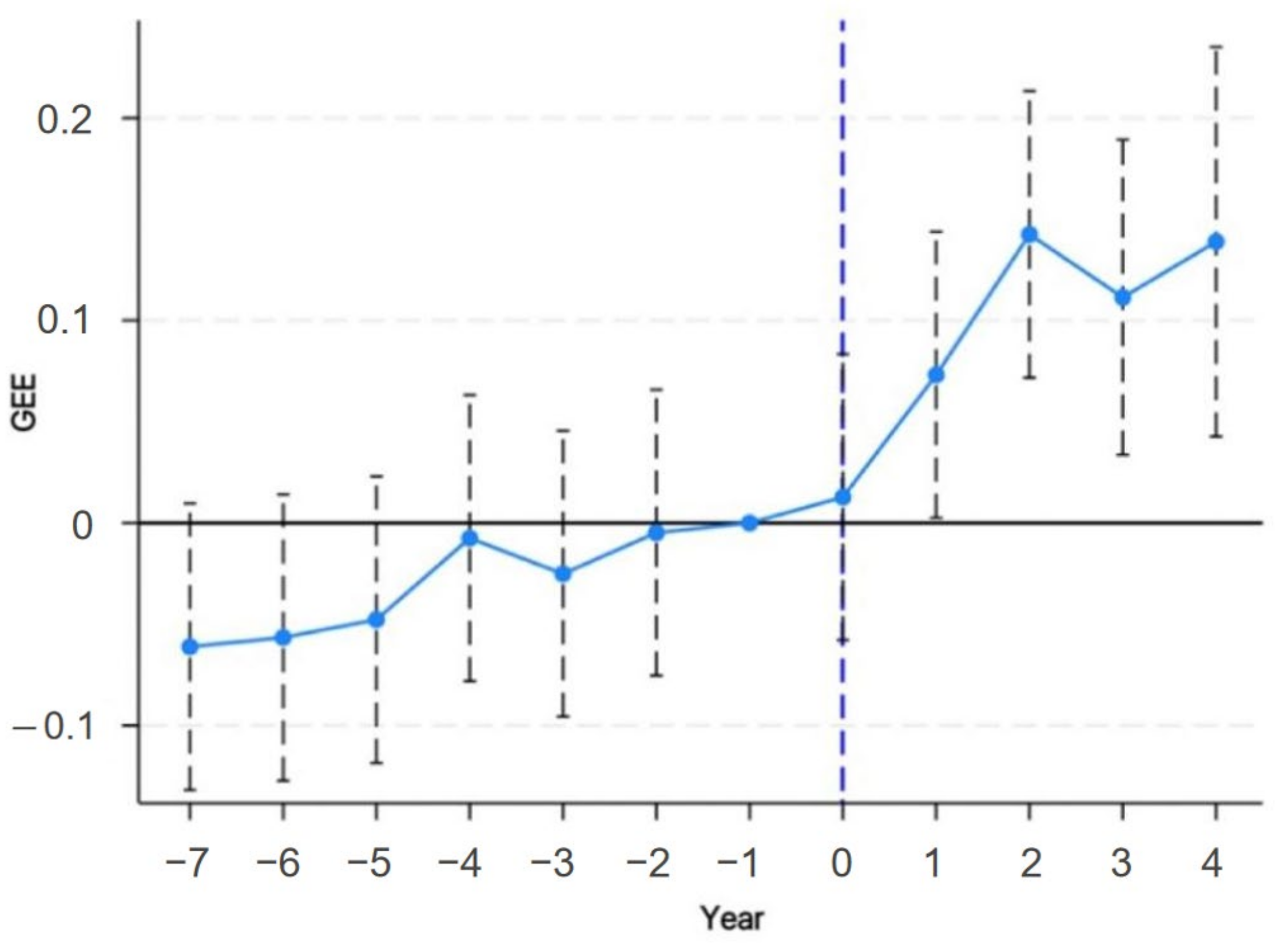
5.2.1. Parallel Trend Test
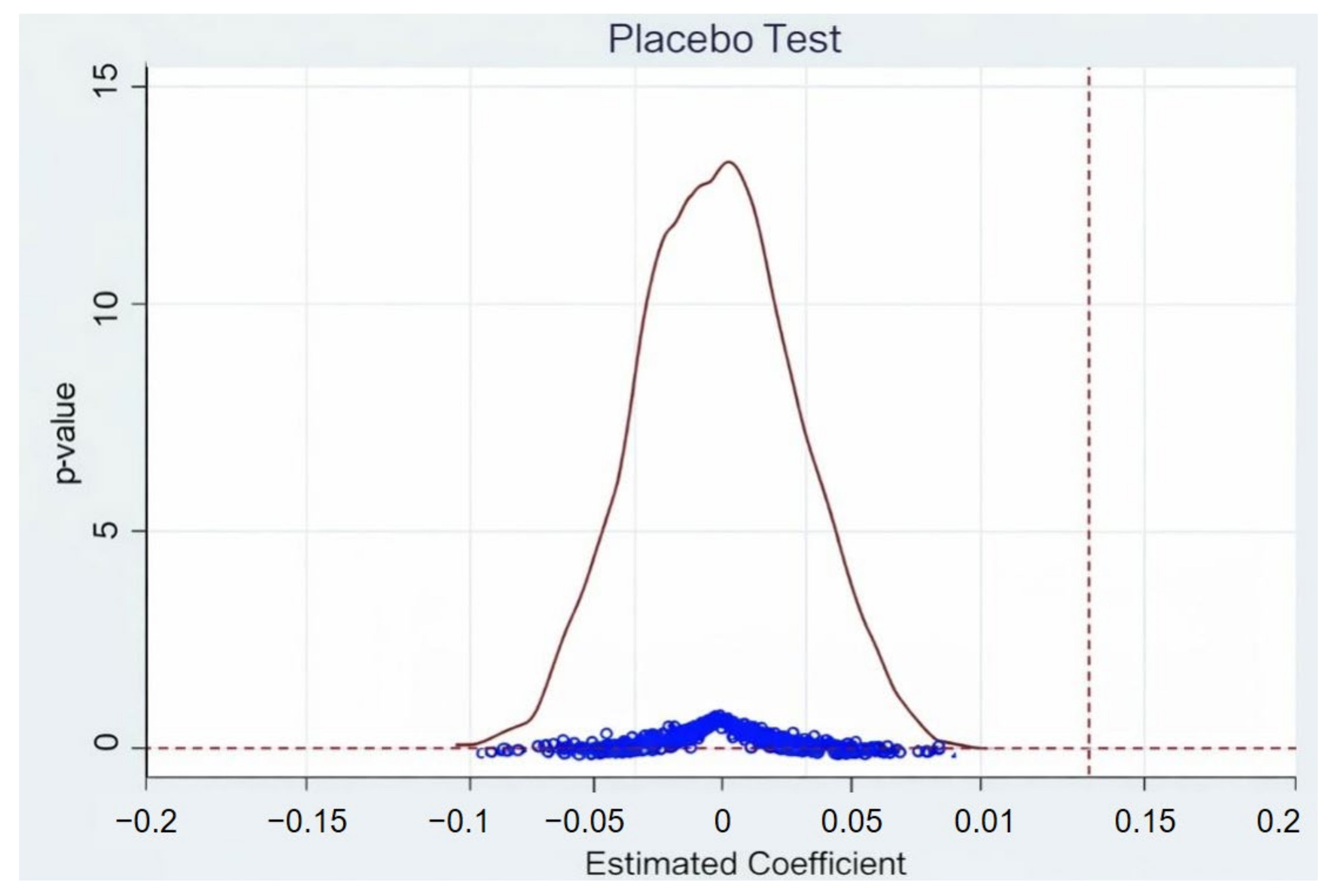
5.2.2. Placebo Test
5.2.3. Exclude the Interference of Other Policies
5.2.4. PSM-DID Test
5.2.5. Endogeneity Test
5.2.6. CSDID Test
5.3. Mechanism Tests
5.3.1. Green Technological Innovation
5.3.2. Industrial Structure Optimisation
6. Further Analysis
6.1. Moderation Effect Analysis
6.2. Heterogeneity Analysis
6.2.1. Resource Dependence Heterogeneity
6.2.2. Urban Geographical Heterogeneity
6.2.3. Spatial Hierarchical Heterogeneity
7. Conclusions
7.1. Main Results
7.2. Theoretical Contribution and Practical Implications
7.3. Policy Recommendations
Author Contributions
Funding
Institutional Review Board Statement
Informed Consent Statement
Data Availability Statement
Conflicts of Interest
References
- Khan, Z.; Chatti, W.; Zhu, X. Artificial Intelligence and Sustainable Development in China: Evidence From a Dynamic Autoregressive Distributed Lag Approach. Sustain. Dev. 2026, 14, 1–18. [Google Scholar] [CrossRef]
- Chen, X.; Chen, X.; Song, M. Polycentric agglomeration, market integration and green economic efficiency. Struct. Change Econ. Dyn. 2021, 59, 185–197. [Google Scholar] [CrossRef]
- Jiang, M.; Yu, X. Enhancing the resilience of urban energy systems: The role of artificial intelligence. Energy Econ. 2025, 144, 108313. [Google Scholar] [CrossRef]
- Ding, W.; Hu, P. Impact of AI development on green total factor productivity. Sci. Rep. 2025, 15, 22906. [Google Scholar] [CrossRef]
- Li, H. Artificial intelligence, green transition and green total factor productivity in enterprises. Sci. Rep. 2025, 15, 33248. [Google Scholar] [CrossRef]
- Wang, H.; Guo, X. The impact of resource misallocation on green technology innovation: Evidence from 288 cities in China. Humanit. Soc. Sci. Commun. 2025, 12, 823. [Google Scholar] [CrossRef]
- Zhao, R.; Xu, J.; Zhao, Y.; Feng, Y. Resource allocation pattern to green technology innovation efficiency: Synergy between environmental resource orchestration and firms’ digital capabilities. J. Innov. Knowl. 2025, 10, 100760. [Google Scholar] [CrossRef]
- Mijit, R.; Hu, Q.; Xu, J.; Ma, G. Greening through AI? The impact of Artificial Intelligence Innovation and Development Pilot Zones on green innovation in China. Energy Econ. 2025, 146, 108507. [Google Scholar] [CrossRef]
- Wang, Q.; Sun, T.; Li, R. Does Artificial Intelligence (AI) enhance green economy efficiency? The role of green finance, trade openness, and R&D investment. Humanit. Soc. Sci. Commun. 2025, 12, 12. [Google Scholar] [CrossRef]
- Gao, D.; Zhou, X.; Liu, X. The bright side of uncertainty: The impact of climate policy uncertainty on urban green total factor energy efficiency. Energies 2024, 17, 2899. [Google Scholar] [CrossRef]
- Song, Z.; Deng, Y. The impact of artificial intelligence on green economy efficiency under integrated governance. Sci. Rep. 2025, 15, 25919. [Google Scholar] [CrossRef] [PubMed]
- He, X.; Ruan, J.; Bian, C. Development of artificial intelligence empowering green innovation: A case study of the Yangtze River Economic Belt. Environ. Dev. Sustain. 2025, 1–29. [Google Scholar] [CrossRef]
- Lin, B.Q.; Yang, Y.X. Building efficiency: How the national AI innovation pilot zones enhance green energy utilisation? Evidence from China. J. Environ. Manag. 2025, 387, 125945. [Google Scholar] [CrossRef] [PubMed]
- Zhang, J.; Kang, L.; Li, H.; Ballesteros-Pérez, P.; Skitmore, M.; Zuo, J. The impact of environmental regulations on urban Green innovation efficiency: The case of Xi’an. Sustain. Cities Soc. 2020, 57, 102123. [Google Scholar] [CrossRef]
- Zhang, C.; Li, R.; Wang, Q. Artificial intelligence and sustainable development: A global nonlinear analysis of the moderating roles of human capital and renewable energy. Renew. Sustain. Energy Rev. 2026, 228, 116574. [Google Scholar] [CrossRef]
- Liu, G.; Su, X.; Zhu, Z.; Ge, W.; Ran, Q. The path to green efficiency: The critical role of digital infrastructure in industrial upgrading and environmental sustainability. J. Environ. Manag. 2025, 395, 127827. [Google Scholar] [CrossRef]
- Liu, M.; Zhu, Y.; Zhang, J. Can Environmental Regulation Enhance Green Total Factor Productivity?—Evidence from 107 Cities in the Yangtze River Economic Belt. Sustainability 2024, 16, 5243. [Google Scholar] [CrossRef]
- Bai, X.; Lyu, C. Environmental information disclosure and corporate green innovation: The moderating effect of formal and informal institutions. Sustainability 2023, 15, 6169. [Google Scholar] [CrossRef]
- Zhai, S.; Liu, Z. Artificial intelligence technology innovation and firm productivity: Evidence from China. Financ. Res. Lett. 2023, 58, 104437. [Google Scholar] [CrossRef]
- Wu, T. Artificial intelligence and green development: Evidence from China on efficiency and equity. Energy Econ. 2026, 109201. [Google Scholar] [CrossRef]
- Chen, J.; Xie, F.; Inna, S.; Liu, B.; Luo, H. Breaking barriers, boosting green: Artificial intelligence and green transformation in cities. Sustain. Cities Soc. 2025, 155, 106626. [Google Scholar] [CrossRef]
- Jiang, Z.; Yuan, C.; Xu, J. The impact of digital government on energy sustainability: Empirical evidence from prefecture-level cities in China. Technol. Forecast. Soc. Change 2024, 209, 123776. [Google Scholar] [CrossRef]
- Fang, X.; Yang, L. The driving effect of artificial intelligence on green total factor energy efficiency: Evidence from China’s provincial data. J. Clean. Prod. 2025, 524, 146474. [Google Scholar] [CrossRef]
- Kang, S.; Shang, Y. How artificial intelligence drives industrial digitalisation and greening synergies? Evidence from China’s AI innovation and development pilot zones. Technol. Soc. 2025, 83, 103011. [Google Scholar] [CrossRef]
- Gohr, C.; Rodríguez, G.; Belomestnykh, S.; Berg-Moelleken, D.; Chauhan, N.; Engler, J.O.; Heydebreck, L.V.; Hintz, M.J.; Kretschmer, M.; Krügermeier, C.; et al. Artificial intelligence in sustainable development research. Nat. Sustain. 2025, 8, 970–978. [Google Scholar] [CrossRef]
- Costa, A.; Crupi, A.; Cesaroni, F.; Abbate, T. Exploring the role of artificial intelligence in addressing sustainable development. A semantic analysis of AI patents. Technovation 2025, 148, 103335. [Google Scholar] [CrossRef]
- Mancuso, I.; Petruzzelli, A.M.; Panniello, U.; Vaia, G. The bright and dark sides of AI innovation for sustainable development: Understanding the paradoxical tension between value creation and value destruction. Technovation 2025, 143, 103232. [Google Scholar] [CrossRef]
- Zhou, Y.; Alnafrah, I. Leveraging AI and green finance for cleaner energy production: A sustainability framework for ESG integration and climate action. J. Clean. Prod. 2025, 525, 146595. [Google Scholar] [CrossRef]
- Wang, Q.; Zhang, F.; Li, R. Artificial intelligence and sustainable development during urbanization: Perspectives on AI R&D innovation, AI infrastructure, and AI market advantage. Sustain. Dev. 2025, 33, 1136–1156. [Google Scholar]
- Liu, S.; Wang, Y. Green innovation effect of pilot zones for green finance reform: Evidence of quasi natural experiment. Technol. Forecast. Soc. Change 2023, 186, 122079. [Google Scholar] [CrossRef]
- Gao, D.; Tan, L.; Duan, K. Forging a path to sustainability: The impact of Fintech on corporate ESG performance. Eur. J. Financ. 2024, 1–19. [Google Scholar] [CrossRef]
- Xu, B. Artificial intelligence and green technology innovation: Evidence from 265 cities in China. J. Environ. Manag. 2026, 398, 128494. [Google Scholar] [CrossRef]
- Xu, Y.; Shi, W. The impact of pilot policy for innovative industrial clusters on green innovation efficiency. Sci. Rep. 2025, 15, 21930. [Google Scholar] [CrossRef]
- Gao, D.; Cai, J.; Wu, K. The smart green tide: A bibliometric analysis of AI and renewable energy transition. Energy Rep. 2025, 13, 5290–5304. [Google Scholar] [CrossRef]
- Blind, K.; Petersen, S.S.; Riillo, C.A.F. The impact of standards and regulation on innovation in uncertain markets. Res. Policy 2017, 46, 249–264. [Google Scholar] [CrossRef]
- Lee, C.C.; Yan, J. Will artificial intelligence make energy cleaner? Evidence of nonlinearity. Appl. Energy 2024, 363, 123081. [Google Scholar] [CrossRef]
- Cheng, Z.; Li, L.; Liu, J. Industrial structure, technical progress and carbon intensity in China’s provinces. Renew. Sustain. Energy Rev. 2018, 81, 2935–2946. [Google Scholar] [CrossRef]
- George, G.; Merrill, R.K.; Schillebeeckx, S.J. Digital sustainability and entrepreneurship: How digital innovations are helping tackle climate change and sustainable development. Entrep. Theory Pract. 2021, 45, 999–1027. [Google Scholar] [CrossRef]
- Su, J.; Su, K.; Wang, S. Does the digital economy promote industrial structural upgrading?—A test of mediating effects based on heterogeneous technological innovation. Sustainability 2021, 13, 10105. [Google Scholar] [CrossRef]
- Kamble, S.S.; Gunasekaran, A.; Gawankar, S.A. Sustainable Industry 4.0 framework: A systematic literature review identifying the current trends and future perspectives. Process Saf. Environ. Prot. 2018, 117, 408–425. [Google Scholar] [CrossRef]
- Boza, P.; Evgeniou, T. Artificial intelligence to support the integration of variable renewable energy sources to the power system. Appl. Energy 2021, 290, 116754. [Google Scholar] [CrossRef]
- Zhu, K.; Du, L.; Feng, Y. Government attention on environmental protection and firms’ carbon reduction actions: Evidence from text analysis of manufacturing enterprises. J. Clean. Prod. 2023, 423, 138703. [Google Scholar] [CrossRef]
- Zhang, Z.; Zhang, M.; Xu, X. Artificial intelligence, green innovation efficiency, and public health benefits: Evidence from China’s pilot zones with a DID approach. Front. Public Health 2025, 13, 1713295. [Google Scholar] [CrossRef] [PubMed]
- Bao, R.; Liu, T. How does government attention matter in air pollution control? Evidence from government annual reports. Resour. Conserv. Recycl. 2022, 185, 106435. [Google Scholar] [CrossRef]
- Chu, Z.; Bian, C.; Yang, J. How can public participation improve environmental governance in China? A policy simulation approach with multi-player evolutionary game. Environ. Impact Assess. Rev. 2022, 95, 106782. [Google Scholar] [CrossRef]
- Jie, G.; Jiahui, L. Media attention, green technology innovation and industrial enterprises’ sustainable development: The moderating effect of environmental regulation. Econ. Anal. Policy 2023, 79, 873–889. [Google Scholar] [CrossRef]
- Ren, X.; Ren, Y. Public environmental concern and corporate ESG performance. Financ. Res. Lett. 2024, 61, 104991. [Google Scholar] [CrossRef]
- Lin, B.; Zhou, D. A new green transition driver: How does artificial intelligence affect the green economic efficiency. Energy 2025, 334, 137808. [Google Scholar] [CrossRef]
- Zhou, W.; Zhang, Y.; Li, X. Artificial intelligence, green technological progress, energy conservation, and carbon emission reduction in China: An examination based on dynamic spatial Durbin modeling. J. Clean. Prod. 2024, 446, 141142. [Google Scholar] [CrossRef]
- Liu, Y.; Dong, F. How technological innovation impacts urban green economy efficiency in emerging economies: A case study of 278 Chinese cities. Resour. Conserv. Recycl. 2021, 169, 105534. [Google Scholar] [CrossRef]
- Tian, X.; Zhang, H. Analysis of the impact factors of industrial structure upgrading on green total factor productivity from the perspective of spatial spillover effects. Heliyon 2024, 10, e28660. [Google Scholar] [CrossRef] [PubMed]
- Du, J.; Zhong, Z.; Shi, Q.; Wang, L.; Liu, Y.; Ying, N. Does government environmental attention drive green total factor productivity? Evidence from China. J. Environ. Manag. 2024, 366, 121766. [Google Scholar] [CrossRef] [PubMed]
- Yu, W.; Jin, X. Does environmental information disclosure promote the awakening of public environmental awareness? Insights from Baidu keyword analysis. J. Clean. Prod. 2022, 375, 134072. [Google Scholar] [CrossRef]
- Xu, X.; Shi, Y.; Xu, X. AI and Green Efficiency in Technological Innovation: A Two-Stage Analysis of Chinese Rare Earth Enterprises. Systems 2025, 13, 176. [Google Scholar] [CrossRef]
- Tang, C.; Xue, Y.; Wu, H.; Irfan, M.; Hao, Y. How does telecommunications infrastructure affect eco-efficiency? Evidence from a quasi-natural experiment in China. Technol. Soc. 2022, 69, 101963. [Google Scholar] [CrossRef]
- Ren, Y.; Li, W.; Yu, Y.; Zhang, K. Towards low-carbon economy through artificial intelligence: Empirical evidence from China. Technol. Anal. Strateg. Manag. 2025, 1–15. [Google Scholar] [CrossRef]
- Xing, L.; Han, D.H.; Xie, H. Government digital policy breaks the mystery of “limited participation” in China’s home finance market. Sci. Rep. 2023, 13, 20233. [Google Scholar] [CrossRef]
- Xu, M.; Tan, R. Digital economy as a catalyst for low-carbon transformation in China: New analytical insights. Humanit. Soc. Sci. Commun. 2024, 11, 841. [Google Scholar] [CrossRef]
- Callaway, B.; Sant’Anna, P.H.C. Difference-in-differences with multiple time periods. J. Econom. 2021, 225, 200–230. [Google Scholar] [CrossRef]
- Johnson, P.C.; Laurell, C.; Ots, M.; Sandström, C. Digital innovation and the effects of artificial intelligence on firms’ research and development–automation or augmentation, exploration or exploitation? Technol. Forecast. Soc. Change 2022, 179, 121636. [Google Scholar] [CrossRef]
- Dong, X.; Zhou, N.; Zhao, X.; Yang, S. The impact of artificial intelligence on corporate green innovation: Can” increasing quantity” and” improving quality” go hand in hand? J. Environ. Manag. 2025, 376, 124439. [Google Scholar] [CrossRef]
- Bolón-Canedo, V.; Morán-Fernández, L.; Cancela, B.; Alonso-Betanzos, A. A review of green artificial intelligence: Towards a more sustainable future. Neurocomputing 2024, 599, 128096. [Google Scholar] [CrossRef]
- Mao, J.; Xie, J.; Hu, Z.; Deng, L.; Wu, H.; Hao, Y. Sustainable development through green innovation and resource allocation in cities: Evidence from machine learning. Sustain. Dev. 2023, 31, 2386–2401. [Google Scholar] [CrossRef]
- Tu, C.; Liang, Y.; Fu, Y. How does the environmental attention of local governments affect regional green development? Empirical evidence from local governments in China. Humanit. Soc. Sci. Commun. 2024, 11, 371. [Google Scholar] [CrossRef]
- Jiang, Y.; Wang, X.; Wang, W.; Yu, X. Impact of government attention guided by environmental policies on green technology innovation. Int. Rev. Financ. Anal. 2025, 101, 104009. [Google Scholar] [CrossRef]
- Zhou, B.; Ding, H. How public attention drives corporate environmental protection: Effects and channels. Technol. Forecast. Soc. Change 2023, 191, 122486. [Google Scholar] [CrossRef]
- Xie, Y.; Ying, Q. Unpacking the impact of public attention on green investment: Insights from climate sentiment on social media. Int. Rev. Financ. Anal. 2025, 104, 104325. [Google Scholar] [CrossRef]
- Zhou, Y.; Chen, L. Public attention and “Environmental Disclosure Greenwashing”: Pressure from oversight or incentive from legitimacy. China Financ. Rev. Int. 2024. [Google Scholar] [CrossRef]
- Liu, H.; Tan, M.; Cao, R. The role of AI in promoting urban sustainable development: Evidence from China’s new generation of national AI innovative development pilot zones. Appl. Geogr. 2026, 188, 103906. [Google Scholar] [CrossRef]
- Li, B.; Han, Y.; Wang, C.; Sun, W. Did civilised city policy improve energy efficiency of resource-based cities? Prefecture-level evidence from China. Energy Policy 2022, 167, 113081. [Google Scholar] [CrossRef]
- Yuan, C.; Liu, J.; Fan, Y. Exploring the dynamics of urban digital intelligent transformation: Sustainable development through the National AI innovation pilot zone. Environ. Dev. Sustain. 2025, 1–36. [Google Scholar] [CrossRef]
- Gao, D.; Li, Y.; Li, G. Boosting the green total factor energy efficiency in urban China: Does low-carbon city policy matter? Environ. Sci. Pollut. Res. 2022, 29, 56341–56356. [Google Scholar] [CrossRef]
- Wang, J.; Yeh, A.G. Administrative restructuring and urban development in China: Effects of urban administrative level upgrading. Urban Stud. 2020, 57, 1201–1223. [Google Scholar] [CrossRef]




| Category | Variable | Index |
|---|---|---|
| Input variable | Capital | Fixed capital stock |
| Labour | Number of employees | |
| Energy | Total energy consumption | |
| Expected output variables | Total economic output | Real GDP |
| Non-expected output variable | Environmental pollution emissions | Sulphur dioxide in industry |
| Emissions of industrial smoke and dust | ||
| Discharge of industrial wastewater |
| Category | Variable | Symbol | Measurement |
|---|---|---|---|
| Dependent variable | Green economic efficiency | GEE | Super-efficiency SBM model. |
| Explanatory variable | National new-generation artificial intelligence innovation development pilot zone | NAIDPZ | In 2019 and subsequent years and in the pilot areas, the value is 1; otherwise, it is 0. |
| Mediating variable | Green technological innovation | Techn | The total number of city-level patent authorisations. |
| Green | Number of green patent grants. | ||
| Industrial structure optimisation | Advan | Proportion between the tertiary and secondary industries’ added values. | |
| Justi | Measured by the Theil index. | ||
| Moderation variable | Government attention | Gover | The ratio of total keyword frequency to the total word count of the report. |
| Public environmental attention | Publi | The natural logarithm of the Baidu annual average haze search index. | |
| Control variable | Environmental regulation | Er | The rate at which industrial solid waste is used overall. |
| Urbanisation level | Urb | The proportion of the population living in permanent urban areas to the overall population. | |
| Marketisation level | Mar | The private economic development index. | |
| Economic development level | Pgdp | The natural logarithm of per capita GDP. | |
| Government intervention | Gov | The ratio of local general public budget expenditure to regional GDP. | |
| Population size | Popd | Year-end permanent population divided by the administrative area. | |
| Financial development level | Fin | The proportion between the year-end loan balance of financial institutions and regional GDP. |
| (1) | (2) | (3) | (4) | (5) | |
|---|---|---|---|---|---|
| Variables | N | Mean | Sd | Min | Max |
| NAIDPZ | 4539 | 0.0123 | 0.110 | 0.000 | 1.000 |
| GEE | 4539 | 0.348 | 0.155 | 0.081 | 1.213 |
| Er | 4539 | 0.975 | 0.498 | 0.168 | 14.410 |
| Urb | 4539 | 0.534 | 0.166 | 0.115 | 1.000 |
| Mar | 4539 | 15.400 | 1.156 | 5.472 | 19.010 |
| Pgdp | 4539 | 10.550 | 0.705 | 8.138 | 12.460 |
| Gov | 4539 | 0.181 | 0.094 | 0.043 | 1.485 |
| Popd | 4539 | 5.910 | 0.677 | 2.868 | 8.136 |
| Fin | 4539 | 2.367 | 1.145 | 0.504 | 7.621 |
| Variables | (1) | (2) | (3) | (4) | (5) | (6) |
|---|---|---|---|---|---|---|
| GEE | GEE | GEE | GEE | GEE | GEE | |
| NAIDPZ | 0.1513 ** | 0.2068 *** | 0.1408 *** | 0.1289 ** | 0.1493 *** | 0.1322 *** |
| (0.058) | (0.035) | (0.036) | (0.052) | (0.035) | (0.034) | |
| Er | −0.0016 | 0.0004 | −0.0008 | |||
| (0.005) | (0.004) | (0.003) | ||||
| Urb | −0.0330 | −0.0422 | −0.0810 | |||
| (0.057) | (0.058) | (0.052) | ||||
| Mar | 0.0482 *** | −0.0008 | −0.0148 | |||
| (0.017) | (0.007) | (0.009) | ||||
| Pgdp | −0.0077 | 0.0438 *** | −0.1096 *** | |||
| (0.023) | (0.013) | (0.025) | ||||
| Gov | 0.0607 | −0.0294 | −0.0832 | |||
| (0.093) | (0.071) | (0.063) | ||||
| Popd | −0.0104 | 0.0317 | −0.0545 | |||
| (0.021) | (0.073) | (0.081) | ||||
| Fin | −0.0283 *** | 0.0325 *** | −0.0085 | |||
| (0.006) | (0.007) | (0.011) | ||||
| Constant | 0.3466 *** | 0.3459 *** | 0.3467 *** | −0.1771 | −0.3401 | 2.1317 *** |
| (0.006) | (0.000) | (0.000) | (0.209) | (0.404) | (0.590) | |
| Year FE | √ | × | √ | √ | × | √ |
| City FE | × | √ | √ | × | √ | √ |
| N | 4539 | 4539 | 4539 | 4539 | 4539 | 4539 |
| 0.115 | 0.500 | 0.594 | 0.182 | 0.542 | 0.609 |
| Variables | Excluding Other Policy Interference | PSM-DID Before Matching | PSM-DID After Matching |
|---|---|---|---|
| (1) | (2) | (3) | |
| NAIDPZ | 0.1284 *** | 0.1322 *** | 0.0216 *** |
| (0.034) | (0.034) | (0.006) | |
| Constant | 2.1223 *** | 2.1317 *** | −0.3269 ** |
| (0.582) | (0.590) | (0.554) | |
| Controls | √ | √ | √ |
| Year FE | √ | √ | √ |
| City FE | √ | √ | √ |
| N | 4539 | 4539 | 2615 |
| 0.611 | 0.609 | 0.761 |
| Variables | (1) | (2) |
|---|---|---|
| NAIDPZ | GEE | |
| IV | 0.0011 *** | |
| (0.000) | ||
| NAIDPZ | 0.5039 ** | |
| (0.215) | ||
| Controls | √ | √ |
| Year FE | √ | √ |
| City FE | √ | √ |
| 4505 | 4505 | |
| Kleibergen–Paap rk Wald F | 21.195[16.38] | |
| Kleibergen–Paap rk LM | 22.202 *** |
| Variables | (1) | (2) | (3) | (4) | (5) |
|---|---|---|---|---|---|
| Simple ATT | Calendar-Time ATT | Group ATT | Pre-Treatment ATT | Post-Treatment ATT | |
| NAIDPZ | 0.0472 *** | 0.0351 *** | 0.0405 *** | 0.0061 | 0.0685 *** |
| (0.012) | (0.009) | (0.006) | (0.0040) | (0.0130) | |
| Control variables | √ | √ | √ | √ | √ |
| Year FE | √ | √ | √ | √ | √ |
| City FE | √ | √ | √ | √ | √ |
| N | 4539 | 4539 | 4539 | 4539 | 4539 |
| Variables | Paten | Indus | ||
|---|---|---|---|---|
| (1) | (2) | (3) | (4) | |
| Techn | Green | Advan | Justi | |
| NAIDPZ | 0.2927 *** | 0.4640 *** | 0.1614 *** | 0.0456 ** |
| (0.105) | (0.107) | (0.034) | (0.019) | |
| Constant | 5.7417 *** | −22.6245 *** | 4.3738 *** | 1.0401 *** |
| (1.383) | (0.566) | (0.448) | (0.222) | |
| Controls | √ | √ | √ | √ |
| Year FE | √ | √ | √ | √ |
| City FE | √ | √ | √ | √ |
| 4539 | 4539 | 4505 | 4505 | |
| 0.893 | 0.861 | 0.858 | 0.655 | |
| Variables | (1) | (2) | (3) | (4) |
|---|---|---|---|---|
| GEE | GEE | GEE | GEE | |
| NAIDPZ | 0.1379 *** | 0.1291 *** | 0.1217 *** | 0.1123 *** |
| (0.036) | (0.034) | (0.033) | (0.034) | |
| Gover | 0.0038 | 0.0050 * | ||
| (0.003) | (0.003) | |||
| NAIDPZ × Gover | 0.0156 *** | 0.0146 *** | ||
| (0.004) | (0.004) | |||
| Publi | 0.0006 | 0.0010 ** | ||
| (0.000) | (0.000) | |||
| NAIDPZ × Publi | 0.0013 *** | 0.0012 ** | ||
| (0.000) | (0.000) | |||
| Constant | 0.3496 *** | 2.1045 *** | 0.3707 *** | 2.0820 *** |
| (0.000) | (0.597) | (0.001) | (0.668) | |
| Controls | × | √ | × | √ |
| Year FE | √ | √ | √ | √ |
| City FE | √ | √ | √ | √ |
| N | 4386 | 4386 | 3096 | 3096 |
| 0.595 | 0.609 | 0.605 | 0.615 |
| Variables | Development Resources | Geographical Location | Spatial Hierarchy | |||
|---|---|---|---|---|---|---|
| Resou | Non-Resou | Coast | Non-Coast | Cente | Non-Cente | |
| NAIDPZ | 0.0609 *** | 0.1280 *** | 0.0796 *** | 0.1574 *** | 0.0670 *** | 0.0332 |
| (0.018) | (0.037) | (0.021) | (0.025) | (0.016) | (0.022) | |
| Constant | 3.3546 *** | 1.2116 | 0.5211 | 2.8379 *** | −0.6434 | 3.0123 *** |
| (0.634) | (0.829) | (0.383) | (0.258) | (0.459) | (0.536) | |
| Controls | √ | √ | √ | √ | √ | √ |
| Year FE | √ | √ | √ | √ | √ | √ |
| City FE | √ | √ | √ | √ | √ | √ |
| 0.555 | 0.633 | 0.656 | 0.561 | 0.815 | 0.579 | |
| 1768 | 2737 | 1870 | 2635 | 595 | 3910 | |
Disclaimer/Publisher’s Note: The statements, opinions and data contained in all publications are solely those of the individual author(s) and contributor(s) and not of MDPI and/or the editor(s). MDPI and/or the editor(s) disclaim responsibility for any injury to people or property resulting from any ideas, methods, instructions or products referred to in the content. |
© 2026 by the authors. Licensee MDPI, Basel, Switzerland. This article is an open access article distributed under the terms and conditions of the Creative Commons Attribution (CC BY) license.
Share and Cite
Jiang, S.; Gao, D.; Zhang, X. Unlocking Green Growth: How Artificial Intelligence Policies Enhance Green Economic Efficiency—Evidence from China. Sustainability 2026, 18, 3581. https://doi.org/10.3390/su18073581
Jiang S, Gao D, Zhang X. Unlocking Green Growth: How Artificial Intelligence Policies Enhance Green Economic Efficiency—Evidence from China. Sustainability. 2026; 18(7):3581. https://doi.org/10.3390/su18073581
Chicago/Turabian StyleJiang, Shangqing, Da Gao, and Xinyu Zhang. 2026. "Unlocking Green Growth: How Artificial Intelligence Policies Enhance Green Economic Efficiency—Evidence from China" Sustainability 18, no. 7: 3581. https://doi.org/10.3390/su18073581
APA StyleJiang, S., Gao, D., & Zhang, X. (2026). Unlocking Green Growth: How Artificial Intelligence Policies Enhance Green Economic Efficiency—Evidence from China. Sustainability, 18(7), 3581. https://doi.org/10.3390/su18073581