1. Introduction
At the policy level, international education agendas such as UNESCO’s Education for Sustainable Development and Sustainable Development Goal (SDG) 4.7 emphasize the importance of fostering global citizenship, human rights, and respect for cultural diversity as key foundations for sustainable societies [
1,
2]. Achieving these goals within schools ultimately depends on teachers’ capacity to engage constructively with cultural diversity in everyday classroom practice. From this perspective, teachers’ beliefs about their capability to teach in culturally diverse classrooms represent an important micro-level condition that may support educational environments aligned with the broader aims of social sustainability.
These policy priorities are closely connected to ongoing demographic and cultural transformations occurring in school systems worldwide. Across the globe, schools are increasingly characterized by racial, linguistic, cultural, and migratory diversity, and Korean society is no exception to this trend. Over the past two decades, Korea has experienced a rapid transition toward a multicultural society, resulting in school environments that are increasingly shaped by cultural and linguistic diversity. Within this broader transformation, ensuring equity and inclusion in education has become an important task for schools and educators operating in culturally diverse contexts.
As classrooms become increasingly culturally diverse, the role of teachers has expanded beyond the transmission of subject knowledge to include the ability to navigate complex cultural, relational, and instructional dynamics [
3,
4]. Teachers are expected to create learning environments that recognize students’ diverse cultural backgrounds, facilitate respectful interactions among students, and respond constructively to cultural differences that arise in classroom practice. Within the literature on multicultural education, these professional demands are frequently conceptualized through the framework of culturally responsive teaching, which emphasizes equity-oriented pedagogy and responsiveness to students’ cultural experiences [
5,
6]. From this perspective, effective teaching in culturally diverse classrooms requires not only pedagogical knowledge but also teachers’ confidence in their capability to enact inclusive and culturally responsive practices.
Against this backdrop, teachers’ multicultural teaching efficacy has been widely examined as a key psychological construct shaping how educators respond to cultural diversity in classrooms. Multicultural teaching efficacy refers to teachers’ beliefs about their capability to design and implement instruction in culturally diverse classrooms, respond constructively to students’ cultural differences, and foster inclusive classroom interactions [
7]. Prior research [
8,
9] indicates that such efficacy beliefs influence teachers’ instructional decision-making, classroom interaction patterns, and responsiveness to diversity, thereby affecting the quality of multicultural education and students’ learning experiences.
Beyond its role as an individual psychological belief, teachers’ multicultural teaching efficacy can also be understood as a key educational resource that supports teachers’ capacity to respond effectively to diversity and equity in multicultural learning environments and contributes to educational contexts aligned with the broader goals of social sustainability. From this perspective, teachers’ confidence in engaging constructively with cultural diversity represents an important mechanism through which schools may contribute to equity, social cohesion, and long-term social sustainability.
Given its recognized importance, a substantial body of research [
10,
11] has examined teachers’ multicultural teaching efficacy and has made significant contributions to understanding its role in instructional practices and inclusive education. However, despite these advances, existing research has predominantly conceptualized multicultural teaching efficacy as a single continuous variable or mean-level score. Such variable-centered approaches are limited in their ability to capture the multidimensional nature of efficacy beliefs and the structural heterogeneity that may exist within teacher populations. Conceptually, multicultural teaching efficacy constitutes a complex belief system composed of multiple components, including culturally responsive instructional design, facilitation of positive peer relationships, and engagement in anti-bias and critical pedagogical practices. These components are likely to combine in different ways across teachers. However, mean-based analyses reduce these configurations to a single index, thereby constraining the identification of diverse belief structures and typologies within the teaching workforce.
This limitation is also evident from a theoretical standpoint. Grounded in social cognitive theory, self-efficacy refers to individuals’ beliefs in their capability to organize and execute courses of action required to attain designated outcomes, with efficacy beliefs continuously shaped and reorganized through the interaction of mastery experiences, emotional states, and contextual feedback [
12,
13]. From this perspective, efficacy beliefs are inherently dynamic and structurally differentiated rather than static or unidimensional. Viewed through this lens, teachers’ multicultural teaching efficacy cannot be reduced to a single score; rather, it should be understood as a multilayered belief system in which efficacy components differ in centrality and combine in distinct configurations across teachers.
Within this conceptualization, differences in the organization and integration of efficacy beliefs raise the question of which psychological mechanisms shape these belief systems. Building on this multidimensional conceptualization of efficacy, the next critical question concerns the psychological resources that shape how these belief systems are organized and enacted. One important dimension concerns teachers’ emotional resources, particularly teachers’ social and emotional learning self-efficacy (TSEL-SE). In culturally diverse classrooms, teachers are required to interpret and respond to students’ emotions, experiences, and behaviors within culturally situated contexts [
14]. From a social cognitive perspective [
12,
13], TSEL-SE integrates emotional awareness with beliefs about one’s capability to enact supportive practices, functioning as a key psychological mechanism through which empathic understanding is translated into sustained social and emotional learning implementation.
While emotional resources shape how teaching experiences are interpreted, professional learning constitutes a primary source of experiences through which efficacy beliefs are developed. Within the framework of social cognitive theory, professional learning provides key experiences that support the development of efficacy beliefs [
13]. Extending this framework, Guskey [
15] further argued that changes in teachers’ beliefs do not result directly from professional learning itself, but rather from changes in instructional practice and the subsequent positive outcomes that teachers observe in their students. Alongside emotional resources, professional learning related to multicultural education thus represents a key experiential factor shaping teachers’ beliefs and instructional practices. Prior studies [
16,
17,
18,
19] have shown that participation in diversity- and equity-focused professional learning is positively associated with teachers’ multicultural beliefs, culturally responsive teaching practices, and efficacy for inclusive instruction.
However, despite these documented benefits, approaches that examine emotional and experiential resources in isolation have important limitations. In practice, TSEL-SE and professional learning experiences operate in an interdependent and mutually reinforcing manner, such that their influence is unlikely to be fully captured by independent models alone. Consistent with this theoretical account, efficacy beliefs are shaped through interactions between emotional states and experiential feedback [
13], suggesting that professional learning does not automatically enhance efficacy but instead depends on teachers’ psychological resources for interpreting and integrating learning experiences.
Because TSEL-SE directly reflects their perceived capability to manage emotional demands and enact supportive practices, it constitutes a particularly salient emotional resource in this process [
20]. In this regard, TSEL-SE can be viewed as a potential conditional resource that shapes how professional learning experiences are processed and integrated into efficacy beliefs. Consistent with Guskey’s model of teacher change [
15], professional learning is more likely to reshape teachers’ beliefs when accompanied by changes in instructional practice and perceived positive outcomes, indicating that emotional resources may support the sustained enactment of new practices in culturally diverse classrooms. Accordingly, the impact of professional learning on efficacy development may vary depending on teachers’ levels of TSEL-SE.
Taken together, these considerations suggest that understanding multicultural teaching efficacy requires moving beyond main-effect models to examining how emotional and professional resources interact in shaping efficacy belief structures. In particular, from the perspective of this study—which conceptualizes efficacy as a latent belief structure rather than a unidimensional level—it is essential to examine how combinations of emotional and professional resources may amplify or buffer teachers’ likelihood of membership in distinct efficacy profiles.
Accordingly, the present study adopts a theoretically informed exploratory approach that reconceptualizes multicultural teaching efficacy as a set of latent belief structures and adopts a person-centered analytic approach to identify heterogeneous efficacy profiles among teachers. Furthermore, TSEL-SE and participation in multicultural education–related professional learning are examined as emotional and experiential resources that may contribute to the formation of these profiles, both independently and interactively. Based on the conceptual framework outlined above, the specific research objectives of this study are as follows.
First, this study aims to identify distinct latent profiles of teachers’ multicultural teaching efficacy, reflecting heterogeneous configurations of its constituent components.
Second, this study seeks to examine how TSEL-SE and participation in multicultural education–related professional learning are associated with differential likelihoods of membership in these efficacy profiles, conceptualized as key emotional and experiential resources.
Third, this study aims to investigate how the interaction between TSEL-SE and professional learning participation shapes the structural typology of multicultural teaching efficacy, highlighting the combinatory effects of emotional and professional resources.
Fourth, this study aims to explore profile-sensitive strategies for teacher education and professional learning by integratively examining the main and interaction effects of TSEL-SE and professional learning participation across the identified latent efficacy profiles, with the ultimate goal of advancing social sustainability in education.
In line with these aims, the present study addresses the following research questions:
RQ1: What distinct latent belief profiles can be identified in teachers’ multicultural teaching efficacy?
RQ2: To what extent is TSEL-SE associated with differential likelihoods of membership in distinct multicultural teaching efficacy profiles?
RQ3: How is participation in multicultural education–related professional learning associated with differences in teachers’ multicultural teaching efficacy profiles?
RQ4: In what ways do combinations of TSEL-SE and participation in multicultural education–related professional learning correspond to variations in the likelihood of membership across multicultural teaching efficacy profiles?
RQ5: Based on the identified latent efficacy profiles and the overall empirical patterns observed in the study, what profile-sensitive strategies can be proposed to promote social sustainability in teacher education?
2. Theoretical Framework and Related Literature
This section presents the theoretical framework and key literature underpinning the present study. It situates multicultural teaching efficacy within the framework of culturally responsive teaching and conceptualizes it as a multidimensional, contextually grounded belief system. The section then examines key psychological and experiential resources associated with the development and configuration of these efficacy beliefs, as well as their interaction.
2.1. Culturally Responsive Teaching and Multicultural Teaching Efficacy
Culturally responsive teaching (CRT) is widely conceptualized as an instructional approach that recognizes students’ cultural backgrounds as valuable resources for learning and deliberately integrates these cultural assets into teaching practices [
5]. From this perspective, teaching is not culturally neutral but inherently interpretive and relational, requiring ongoing responsiveness to students’ cultural experiences, values, identities, and modes of communication. CRT emphasizes equity-oriented pedagogy, inclusive instructional practices, and the creation of classroom environments in which all students experience recognition, belonging, and meaningful learning opportunities [
6].
Building on this pedagogical framework, teachers’ beliefs about their capability to enact culturally responsive practices have emerged as a critical psychological resource shaping classroom practice. Teachers’ efficacy beliefs in this domain—conceptualized in the present study as multicultural teaching efficacy—extend beyond technical instructional competence to encompass relational sensitivity, cultural awareness, and the capacity to foster inclusive and equitable classroom environments.
In the OECD Teaching and Learning International Survey (TALIS), teachers’ capacity to address cultural diversity in classrooms is conceptualized as self-efficacy in multicultural environments and situated within the broader domain of diversity and equity, reflecting teachers’ perceived capability to respond effectively to cultural diversity in classroom practice. Within this framework, teachers evaluate their capacity to adapt instruction to students’ cultural backgrounds, facilitate cooperation among students from diverse or migrant backgrounds, promote awareness of cultural differences, reduce ethnic stereotyping, critically reflect on curriculum materials for cultural bias, and incorporate culturally relevant examples into instruction. In this sense, multicultural teaching efficacy can be understood as a domain-specific extension of teachers’ broader self-efficacy beliefs in responding to culturally diverse classroom environments [
21].
Prior theoretical and empirical research suggests that multicultural teaching efficacy is inherently multidimensional rather than a uniform belief construct [
4,
22]. Specifically, it encompasses teachers’ perceived capability to understand and respect cultural diversity, adapt instructional strategies to meet the needs of culturally diverse learners, foster respectful classroom interactions, and engage in practices that challenge bias and stereotyping. Importantly, these components may not develop evenly across teachers or be uniformly integrated within individual belief systems. Consequently, multicultural teaching efficacy may manifest as diverse configurations of beliefs rather than as a single homogeneous construct.
Empirical research further indicates that multicultural teaching efficacy varies systematically across domains of practice. Teachers often report relatively strong efficacy beliefs in value- and relationship-oriented dimensions—such as respect for cultural diversity and mutual understanding—while exhibiting lower efficacy in practice-oriented domains, including instructional adaptation and responses to culturally grounded social and emotional challenges [
22]. This pattern suggests that commitments to multicultural values do not automatically translate into perceived instructional competence, reflecting structural differentiation within teachers’ efficacy belief systems.
Consistent with this perspective, research grounded in social cognitive theory demonstrates domain-specific differentiation in teachers’ efficacy beliefs. Using the Culturally Responsive Teaching Self-Efficacy (CRTSE) and Outcome Expectancy (CRTOE) scales, Siwatu [
23] found that preservice teachers reported stronger efficacy in relational and affective competencies—such as building positive teacher–student relationships—than in instructional and communicative competencies, including communication with English Language Learners. Outcome expectancy beliefs similarly prioritized trust-based relational processes over instructional practices aimed at sustaining students’ cultural and linguistic identities. Together, these findings suggest that multicultural teaching efficacy tends to develop more readily in relational domains, whereas pedagogical competence in culturally complex classroom contexts remains comparatively underdeveloped.
Viewed collectively, this body of literature underscores the importance of conceptualizing multicultural teaching efficacy as domain-specific beliefs that may be unevenly developed and differentially integrated within individual teachers. Such heterogeneity has important implications for both theory and measurement, as reliance on single composite scores may obscure meaningful variation in teachers’ belief structures. Accordingly, multicultural teaching efficacy may be more appropriately understood as heterogeneous configurations of beliefs rather than a single composite construct, providing a theoretical rationale for a person-centered analytical approach. This perspective is grounded in Bandura’s theory of self-efficacy, which conceptualizes efficacy as individuals’ judgments about their capability to perform specific actions.
From a social cognitive perspective, these beliefs are shaped by broader psychological resources that influence individuals’ perceived capability to manage complex situations. In educational contexts, teachers’ social and emotional learning self-efficacy represents such a resource, reflecting confidence in managing emotions and fostering supportive classroom relationships. Because these competencies align with the relational dimensions of culturally responsive teaching, teachers’ social and emotional learning self-efficacy may function as an important psychological driver of multicultural teaching efficacy.
2.2. Teachers’ Social and Emotional Learning Self-Efficacy as a Psychological Driver of Multicultural Teaching Efficacy
In culturally diverse classrooms, teachers must navigate not only instructional complexity but also emotionally charged interactions shaped by cultural norms, power relations, and students’ lived experiences. Such environments often require teachers to interpret students’ behaviors within culturally situated contexts, manage potential misunderstandings, and maintain supportive relationships across diverse backgrounds. In these circumstances, effective multicultural teaching depends not merely on teachers’ awareness of diversity or empathic dispositions, but critically on their beliefs about their capability to enact emotionally responsive and supportive practices in culturally sensitive ways [
24,
25,
26].
From this perspective, TSEL-SE functions as a central psychological driver of multicultural teaching efficacy. Grounded in Bandura’s self-efficacy theory, TSEL-SE is conceptualized in this study as teachers’ perceived capability to provide instruction related to social and emotional skills, support students’ social and emotional needs, and integrate social and emotional learning into everyday teaching practices. Importantly, this construct emphasizes perceived capability rather than dispositional empathy or general emotional orientation.
Consistent with this theoretical view, prior research indicates that teachers with stronger social and emotional learning self-efficacy are more likely to enact inclusive instructional practices, adopt asset-based perspectives toward culturally diverse students, and report greater confidence in addressing cultural and social differences in the classroom [
27,
28,
29,
30]. Viewed from a belief-system perspective, these findings suggest that TSEL-SE functions as a core psychological resource that conditions both the strength and structural configuration of domain-specific efficacy beliefs. Accordingly, the present study positions TSEL-SE as a primary psychological driver shaping heterogeneous patterns of multicultural teaching efficacy.
2.3. Professional Learning as an Experiential Driver of Multicultural Teaching Efficacy
While psychological resources provide a foundation for efficacy development, multicultural teaching efficacy also develops through teachers’ participation in professional learning. From a social cognitive perspective, professional learning constitutes a key experiential context through which teachers acquire, enact, and refine culturally responsive instructional practices. Accordingly, the present study conceptualizes professional learning as an experiential driver of multicultural teaching efficacy.
In this study, professional learning is understood as a multifaceted construct encompassing both formal and informal learning opportunities related to teaching in culturally and linguistically diverse contexts. Formal professional learning includes structured activities such as workshops, in-service training, seminars, and coursework focused on diversity, equity, and culturally responsive pedagogy. Informal and practice-embedded learning occurs through collaborative reflection, peer dialogue, mentoring, and classroom observation, including both observation of colleagues’ practices and reflective examination of one’s own teaching. Contemporary scholarship emphasizes that effective professional learning is ongoing, situated within teachers’ daily work, and oriented toward instructional practice rather than episodic knowledge transmission—an emphasis that is particularly critical in multicultural classroom settings [
31,
32].
The central role of professional learning in efficacy development is well articulated in Bandura’s self-efficacy theory, which identifies mastery experiences, vicarious experiences, social persuasion, and physiological and affective states as the primary sources of efficacy beliefs [
12]. Professional learning provides structured opportunities for teachers to access these sources by introducing new instructional strategies, enabling observation of effective practice, fostering professional dialogue, and offering social validation. In culturally diverse classrooms, where instructional challenges are often emotionally demanding, professional learning can expand teachers’ opportunities for successful practice and reflective sense-making.
Guskey’s model of teacher change further clarifies the process through which professional learning influences teachers’ beliefs. According to this model, changes in teachers’ beliefs typically follow changes in instructional practice and teachers’ perceptions of positive student outcomes, rather than occurring immediately as a result of participation in professional learning activities [
15]. From this perspective, professional learning initiates instructional experimentation, but belief revision occurs only when teachers perceive these changes as effective in improving student engagement and learning. This process-oriented view is particularly relevant in multicultural education, where new pedagogical approaches often require sustained implementation and iterative refinement before teachers perceive them as effective, thereby reinforcing their multicultural teaching efficacy.
Empirical research generally supports a positive association between professional learning and multicultural teaching efficacy, indicating that participation in diversity- and equity-focused professional learning is linked to greater confidence in understanding students’ cultural backgrounds, adapting instruction, and fostering inclusive classroom environments [
33,
34,
35]. However, the magnitude and consistency of these effects vary considerably across teachers and contexts, suggesting that professional learning does not uniformly enhance multicultural teaching efficacy [
36].
Taken together, these findings indicate that professional learning functions not as an automatic input, but as an experiential resource whose effects depend on how learning experiences are enacted, interpreted, and integrated into teachers’ belief systems. Accordingly, professional learning should be understood as a necessary but not sufficient condition for the development of multicultural teaching efficacy. Although professional learning constitutes a key experiential source of efficacy development, its impact is unlikely to operate independently of teachers’ psychological resources. This observation leads to the need to examine the interaction between emotional and experiential drivers.
2.4. Interaction Between Psychological and Experiential Resources in Multicultural Teaching Efficacy Development
Building on the theoretical perspectives on psychological and experiential drivers introduced above, it is insufficient to examine these resources in isolation. Rather, multicultural teaching efficacy is most appropriately understood as developing through their combined and interactive influence.
TSEL-SE functions as a core psychological driver shaping how emotionally complex situations are interpreted and managed, professional learning provides the experiential context through which culturally responsive practices are introduced, enacted, and refined. Importantly, neither resource operates in isolation.
From a social cognitive perspective, identical professional learning experiences may yield markedly different efficacy outcomes depending on teachers’ emotional and cognitive appraisals of those experiences. Professional learning does not automatically constitute a mastery experience; instructional attempts contribute to efficacy development only when they are perceived as manageable and successful. In this process, TSEL-SE plays a critical role by shaping how teachers interpret emotionally demanding and culturally complex classroom interactions. Teachers with higher levels of TSEL-SE are more likely to construe challenging experiences as opportunities for growth, whereas teachers with lower TSEL-SE may perceive similar experiences as threatening or discouraging.
This interactional process is further illuminated by Guskey’s model of teacher change, which emphasizes that changes in teachers’ beliefs typically follow changes in instructional practice and perceived positive student outcomes. Professional learning may initiate pedagogical change, but belief revision occurs only when such changes are sustained and experienced as effective. TSEL-SE influences both the enactment of newly learned practices and the interpretation of student responses, thereby shaping whether professional learning experiences are internalized as evidence of growing capability. In this sense, TSEL-SE functions as a psychological condition that moderates the influence of professional learning on efficacy development.
Although much of the existing literature has tended to examine professional learning and teachers’ psychological resources in parallel rather than in interaction, the present study argues that such an approach is theoretically incomplete. The development of multicultural teaching efficacy reflects a dynamic process in which psychological resources and experiential learning mutually reinforce or constrain one another. In this process, TSEL-SE functions as a key psychological condition that shapes how professional learning experiences are interpreted and integrated into efficacy beliefs. Professional learning, in turn, serves as a necessary but not sufficient condition for efficacy development, while TSEL-SE amplifies, stabilizes, or buffers the impact of learning experiences on teachers’ efficacy belief systems.
This interactional framework provides the theoretical foundation for the present study. If psychological and experiential resources combine in different ways across teachers, multicultural teaching efficacy is likely to be organized into heterogeneous belief configurations rather than a single continuum. From this perspective, a person-centered approach provides an appropriate framework for capturing such heterogeneity in teachers’ efficacy belief configurations.
4. Results
4.1. Heterogeneous Patterns of Multicultural Teaching Efficacy
Latent profile analysis was conducted to identify distinct subgroups of teachers based on patterns of multicultural teaching efficacy. Models specifying one to seven profiles were estimated and compared using AIC, BIC, entropy, BLRT, and class size criteria (
Table 2). Although AIC and BIC decreased with additional profiles, improvements diminished beyond the five-profile solution. The five-profile model demonstrated high classification quality (entropy = 0.95) and substantively adequate class sizes (minimum ≈ 8%), exceeding the recommended 5% threshold [
40,
41,
42,
43]. While BLRT remained significant for models with more classes, solutions with six or more profiles produced substantially smaller classes, raising concerns regarding overextraction.
Taken together, these criteria supported the retention of the five-profile solution. Profile-specific classification stability was further evaluated using average posterior probabilities (APP).
Table 3 reports the sample size (n), class proportion (%), APP, and classification accuracy for each latent profile in the five-profile solution.
Overall, classification quality was high (APP = 0.89–1.00), with four profiles demonstrating accuracy values of 0.94 or higher. One profile showed comparatively lower classification accuracy (≈0.71), suggesting partially overlapping boundaries consistent with a boundary-type configuration. The remaining profiles exhibited stable and clearly differentiated classification. To further examine the structural differentiation among the identified profiles, dimensionality-reduction visualizations were generated using t-SNE and UMAP.
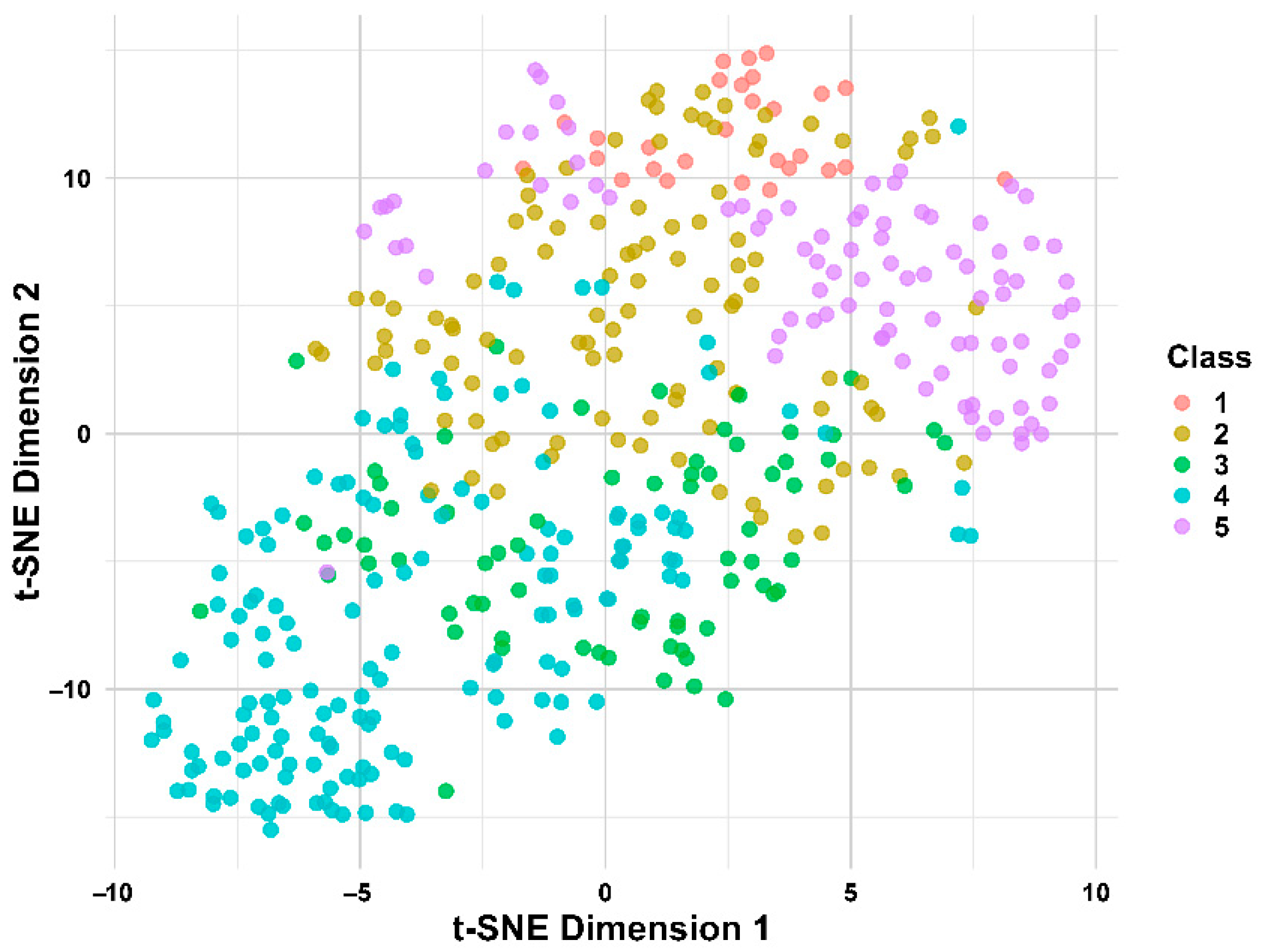
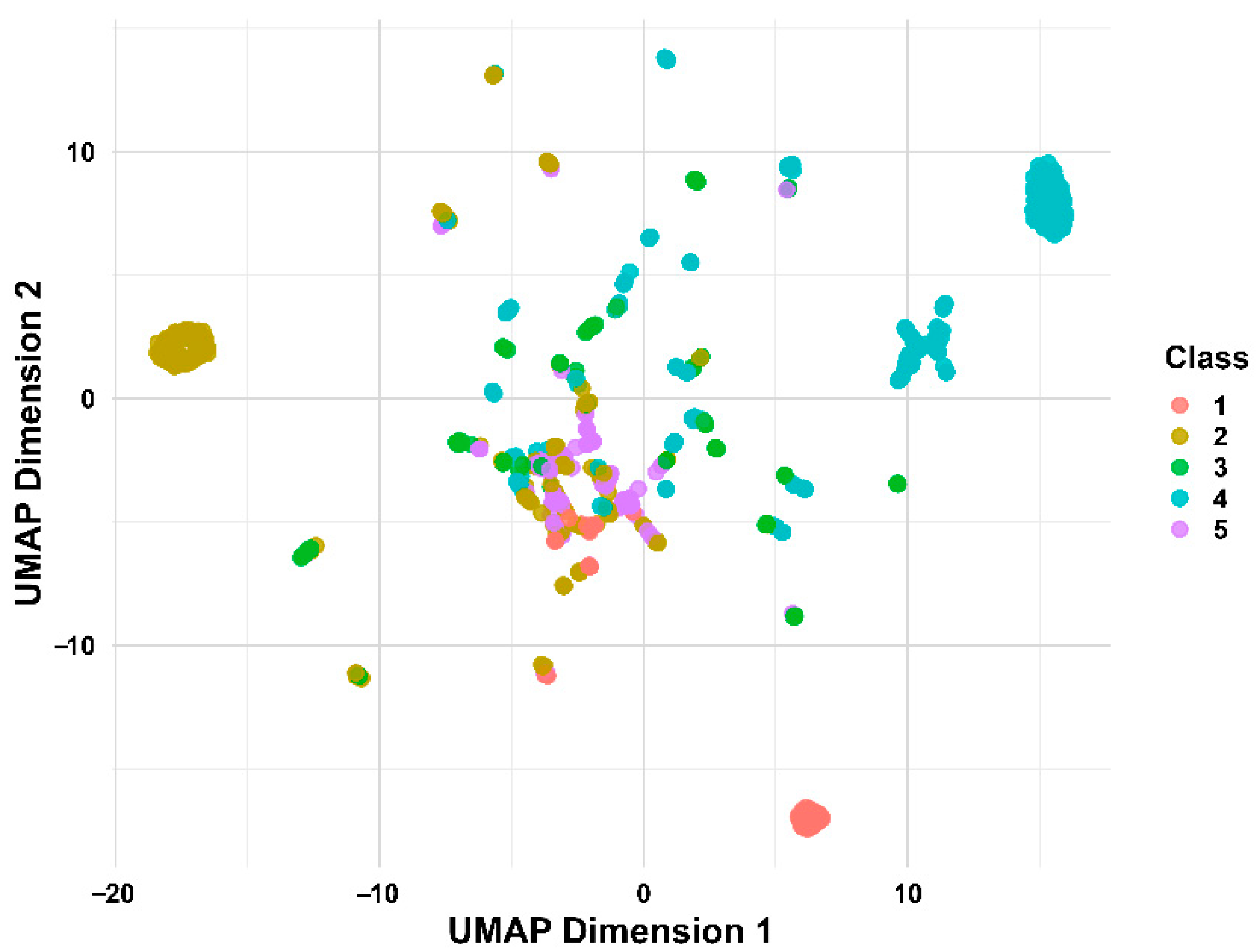
Figure 1 and
Figure 2 present the t-SNE and UMAP visualizations of the five latent profiles identified through latent profile analysis. Together, these visualizations illustrate the structural organization of the profiles in high-dimensional space, with the t-SNE visualization highlighting local clustering patterns within profiles and the UMAP visualization illustrating the relative separation and global relationships among profiles. First, to address overplotting and more clearly represent the structural distinctions among profiles, the t-SNE visualization in
Figure 1 was generated using non-duplicated response patterns.
As shown in
Figure 1, the t-SNE embedding indicates that most latent profiles are organized into relatively distinct regions of the low-dimensional space. Profiles representing contrasting patterns of high and low multicultural teaching efficacy are positioned in clearly separated areas, reflecting well-defined local clustering. In contrast, the boundary-type profile exhibits a more dispersed spatial configuration, characterized by greater within-profile variability and partial overlap with adjacent profiles.
Because dimensionality-reduction techniques provide only a simplified projection of high-dimensional structures, caution is required when interpreting spatial overlap in the visualization. It should be noted that t-SNE represents a two-dimensional projection of a high-dimensional structure; therefore, apparent overlap in the visualization does not imply a lack of differentiation in the original multivariate space. Rather, the observed pattern visually suggests that the identified latent profiles differ not only in overall efficacy levels but also in the internal configuration and dispersion of individual response patterns.
Figure 2 displays the UMAP visualization of the five latent profiles. The color-coded distributions indicate that the profiles occupy largely distinguishable regions in the embedded space, although partial overlap is observed among some profiles. Several profiles form relatively compact and cohesive clusters, whereas others are positioned in closer proximity, suggesting adjacent locations within the latent space rather than sharply delineated boundaries. In particular, one profile exhibits a more dispersed distribution, whereas other profiles demonstrate higher cluster density, indicating differences in within-profile homogeneity. It is necessary to note that UMAP represents a low-dimensional projection of a high-dimensional structure; therefore, spatial proximity or overlap in the visualization does not imply a lack of differentiation in the original multivariate space. Rather, these spatial patterns provide visual support for substantive structural distinctions among the latent profiles.
When viewed jointly, the partial overlap observed across the t-SNE and UMAP visualizations reflects the probabilistic nature of latent profile analysis, in which classification uncertainty and gradual transitions between profiles may occur. When considered alongside favorable model fit indices, acceptable entropy values, high average posterior probabilities, and the absence of very small classes, the visualizations provide convergent support for the structural validity of the five-profile solution. Subsequent analyses therefore focus on examining profile-specific characteristics and covariate associations within this solution.
4.2. Structural and Substantive Profiles of Multicultural Teaching Efficacy
To further examine the five latent profiles, principal component analysis (PCA) was conducted to map their relative positions and structural orientations in a reduced-dimensional space. Profile-specific configurations were then evaluated by comparing standardized mean scores across the seven efficacy domains.
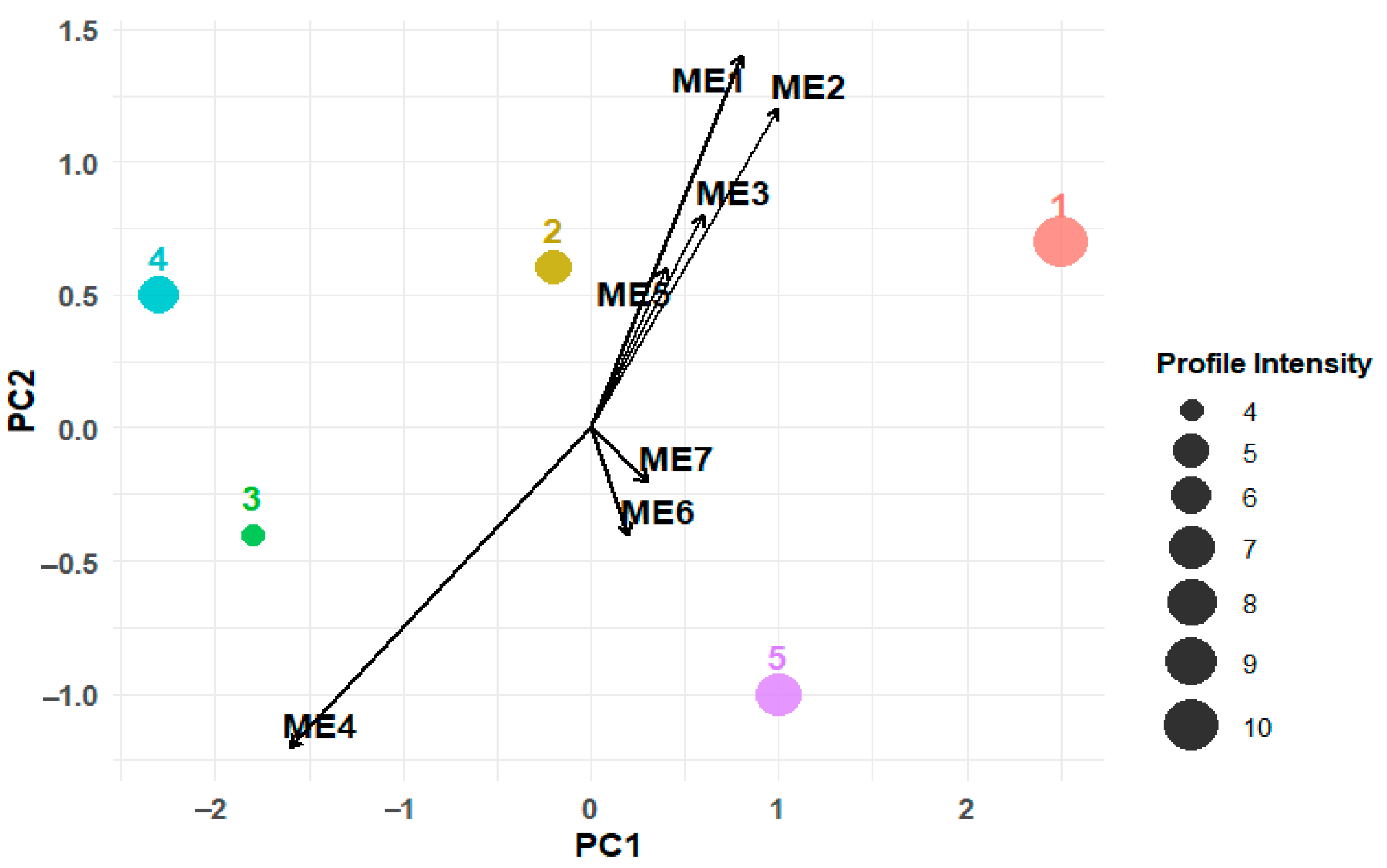
Figure 3 presents the PCA biplot illustrating profile positions and indicator loadings (ME1–ME7).
The PCA biplot depicts the structural organization of multicultural teaching efficacy across the seven domains within a two-dimensional space defined by PC1 and PC2. PC1 primarily reflects the overall intensity of efficacy beliefs, with higher values indicating stronger perceived capability across domains. PC2 appears to differentiate qualitative orientations in how multicultural teaching efficacy is expressed. Specifically, this dimension broadly separates instructional and classroom-interaction practices (e.g., ME1–ME3, ME5) from critical–curricular forms of engagement (ME6–ME7). This pattern suggests that teachers’ efficacy beliefs may vary not only in overall strength but also in the relative emphasis placed on instructional adaptation and classroom interaction versus critical reflection on curricular content and cultural bias.
The proximity of ME1, ME2, ME3, and ME5 in the biplot indicates relatively strong associations among these instructional and classroom-interaction domains, whereas ME6 and ME7 appear to represent a partially distinct curricular orientation. ME4 occupies a comparatively differentiated position, suggesting that efficacy related to reducing ethnic stereotyping may be structured somewhat differently from other instructional domains. The spatial distribution of latent profiles broadly mirrors these structural patterns: profiles positioned along the positive PC1 direction exhibit higher overall efficacy, whereas those located in lower PC2 regions tend to place relatively greater emphasis on critical–curricular orientations. Overall, the biplot indicates that differences among profiles involve not only variation in magnitude but also structural differentiation within the efficacy belief system.
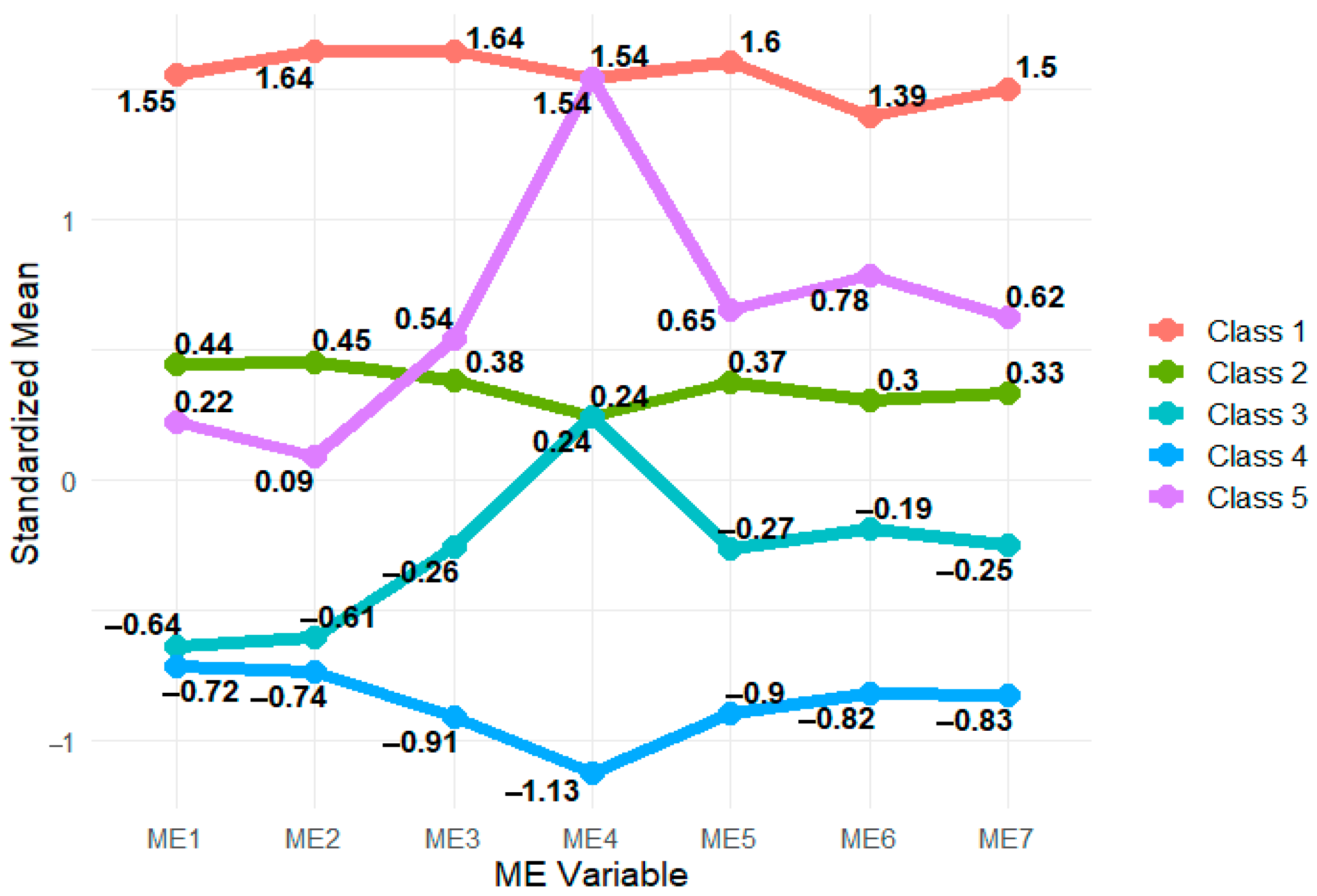
To further examine profile-specific configurations, standardized mean scores for ME1 through ME7 were calculated for each profile and plotted to illustrate domain-level contrasts.
Figure 4 presents these standardized mean profiles for the five latent classes, enabling direct comparison of efficacy patterns across the seven domains.
Figure 4 highlights differences in overall magnitude and domain-specific configurations across the five latent profiles, whereas
Figure 3 illustrates the structural positioning of the latent profiles within the multivariate efficacy space. Together, these visualizations indicate that the profiles differ not only in overall efficacy levels but also in qualitative orientations, supporting a multidimensional and heterogeneous structure of multicultural teaching efficacy.
For interpretive clarity, each profile was assigned a descriptive persona label based on its overall intensity, domain-specific configuration, and structural positioning in the PCA space. These labels serve as heuristic summaries rather than normative categorizations. Building on this structural mapping of efficacy orientations, the five latent classes are interpreted below.
4.2.1. Class 1—Globally High Multicultural Teaching Efficacy Type
Class 1 is characterized by a uniformly elevated and internally coherent efficacy configuration across all seven domains. As shown in
Figure 4, this profile displays consistently high standardized mean scores across ME1–ME7, ranging approximately from 1.39 to 1.64, indicating strong perceived capability in culturally adaptive instruction, facilitation of student cooperation, promotion of cultural awareness, prejudice reduction, and curriculum-related practices. Consistent with this pattern, the PCA biplot in
Figure 3 places this profile in the positive direction of the primary structural dimension, with strong alignment across multiple efficacy vectors, reflecting a well-integrated and structurally coherent efficacy configuration. Accordingly, this profile was labeled the Globally High Multicultural Teaching Efficacy Type, comprising 12.3% of the sample (
Table 3).
4.2.2. Class 2—Moderate and Partially Consolidated Multicultural Efficacy Type
Class 2 exhibits a moderately elevated and relatively even efficacy configuration across domains. As shown in
Figure 4, this profile displays standardized mean scores across ME1–ME7 ranging approximately from 0.24 to 0.45, indicating moderate perceived capability across instructional, relational, and curriculum-related aspects of multicultural teaching without pronounced peaks or troughs. Consistent with this pattern, the PCA biplot in
Figure 3 places this profile near the central region of the efficacy space, suggesting an intermediate structural position between more strongly integrated and more weakly organized efficacy configurations. The absence of strong directional alignment with specific efficacy vectors indicates an efficacy structure that is partially consolidated but weakly differentiated across domains. Taken together, these patterns suggest a partially consolidated efficacy structure; accordingly, this profile was labeled the Moderate and Partially Consolidated Multicultural Efficacy Type, accounting for 30.9% of the sample (
Table 3).
4.2.3. Class 3—Low-Level Boundary Multicultural Efficacy Profile
Class 3 demonstrates an overall low level of multicultural teaching efficacy combined with a structurally fragmented, boundary-type configuration. As shown in
Figure 4, this profile exhibits generally low standardized mean scores across most efficacy domains (ME1, ME2, ME3, ME5–ME7), ranging approximately from −0.74 to −0.26, indicating limited perceived capability across instructional, relational, and curriculum-related aspects of multicultural teaching. Although prejudice reduction (ME4) shows a comparatively higher standardized mean (≈0.24), this selective elevation occurs within an otherwise low efficacy profile and is not accompanied by increases in other domains.
Consistent with this pattern, the PCA biplot in
Figure 3 places this profile in a structurally ambiguous region of the efficacy space, characterized by weak alignment with the ME4 vector and minimal association with other efficacy dimensions. The combination of low overall efficacy and selective domain elevation produces blurred boundaries with adjacent profiles, reflecting a boundary-type configuration rather than a coherent efficacy structure. Accordingly, this profile was labeled the Low-Level Boundary Multicultural Efficacy Profile, comprising 12.7% of the sample (
Table 3).
Accordingly, this profile was labeled the Low-Level Boundary Multicultural Efficacy Profile, comprising 12.7% of the sample (
Table 3). In contrast to the uniformly low configuration observed in Class 4, Class 3 displays selective domain-specific elevation within a low efficacy baseline.
4.2.4. Class 4—Structurally Low Multicultural Efficacy Type
As depicted in
Figure 4, this profile displays consistently low standardized mean scores across all seven domains, ranging approximately from −1.13 to −0.72, indicating low perceived capability across instructional, relational, and curriculum-related aspects of multicultural teaching. Consistent with this pattern, the PCA biplot in
Figure 3 positions this profile at the extreme negative end of the primary structural dimension and shows minimal alignment with any of the efficacy vectors, reflecting a lack of structural integration among efficacy beliefs. The convergence of uniformly low domain scores and weak vector alignment indicates a globally constrained and poorly coordinated efficacy configuration. The term structurally low is used to emphasize that the defining feature of this profile lies not only in low efficacy levels, but in the lack of integration and coordination among efficacy beliefs across domains, as evidenced by both the standardized mean patterns and the PCA structure. On the basis of its uniformly low and weakly integrated configuration, this profile was labeled the Structurally Low Multicultural Efficacy Type, accounting for 36% of the sample (
Table 3).
4.2.5. Class 5—Prejudice Reduction–Focused and Integrated Multicultural Efficacy Type
As shown in
Figure 4, this profile displays positive standardized mean scores across all seven efficacy domains, with a pronounced peak in prejudice reduction (ME4 ≈ 1.54). This pattern indicates broadly well-established efficacy across instructional, relational, and curricular domains, with prejudice reduction emerging as a particularly salient component. Consistent with this pattern, the PCA biplot in
Figure 3 shows strong alignment with the ME4 vector and a positive position on the primary structural dimension, suggesting that prejudice reduction functions as a central organizing component within the efficacy structure.
This profile is structurally distinct from both the Globally High Multicultural Teaching Efficacy Type (Class 1) and the Moderate and Partially Consolidated Type (Class 2). Whereas Class 1 shows uniformly high efficacy and Class 2 reflects moderately elevated but evenly distributed efficacy, Class 5 demonstrates a focused yet integrated configuration centered on prejudice reduction within an otherwise positive efficacy structure. Accordingly, this profile was labeled the Prejudice Reduction–Focused and Integrated Multicultural Efficacy Type, comprising 8% of the sample (
Table 3).
Overall, the five efficacy types suggest that multicultural teaching efficacy varies not only in overall level but also in qualitatively distinct patterns of belief integration and emphasis.
4.3. Predictors of Latent Class Membership
To examine predictors of latent profile membership, multinomial logistic regression analyses were conducted using Class 4 (Structurally Low Multicultural Efficacy Type) as the reference category. TSEL-SE and participation in professional learning (PL) served as predictors. Participation in professional learning (PL) was operationalized as a binary variable (1 = Yes, 0 = No). Two models were estimated: Model 1 included main effects only, whereas Model 2 additionally incorporated the TSEL-SE × PL interaction to test whether the association between TSEL-SE and profile membership varied by professional learning participation.
Table 4 presents the main-effects model, showing the independent associations of TSEL-SE and participation in professional learning with the likelihood of membership in each latent profile relative to the reference group.
As shown in
Table 4, TSEL-SE was a significant positive predictor of membership in all latent classes relative to Class 4. Specifically, a one-unit increase in mean-centered TSEL-SE was associated with 3.41 times higher odds of belonging to Class 1 (B = 1.23, SE = 0.07, OR = 3.41,
p < 0.001), 1.50 times higher odds for Class 2 (B = 0.40, SE = 0.05, OR = 1.50,
p < 0.001), 1.26 times higher odds for Class 3 (B = 0.23, SE = 0.06, OR = 1.26,
p < 0.001), and 2.11 times higher odds for Class 5 (B = 0.75, SE = 0.07, OR = 2.11,
p < 0.001). These results indicate that higher levels of TSEL-SE were consistently associated with an increased likelihood of belonging to any latent class relative to the reference group, with particularly strong effects observed for Classes 1 and 5.
Participation in professional learning also significantly predicted class membership for several profiles. Compared to teachers who did not participate in PL, those who participated were 3.26 times more likely to belong to Class 1 (B = 1.18, SE = 0.18, OR = 3.26, p < 0.001), 2.09 times more likely to belong to Class 2 (B = 0.74, SE = 0.12, OR = 2.09, p < 0.001), and 1.48 times more likely to belong to Class 3 (B = 0.39, SE = 0.15, OR = 1.48, p = 0.009), relative to Class 4. However, PL participation did not significantly differentiate Class 5 from the reference group (B = 0.19, SE = 0.19, OR = 1.22, p = 0.310).
Overall, TSEL-SE emerged as a consistent and robust predictor across all latent profiles, whereas the association between PL participation and profile membership varied across classes and was not significant for Class 5.
Table 5 presents the results of the interaction model examining the interaction effects of TSEL-SE and participation in professional learning on latent profile membership.
As shown in
Table 5, the interaction between TSEL-SE and participation in professional learning was statistically significant for Class 1 (B = 0.65, SE = 0.15, OR = 1.91,
p < 0.001), indicating that the association between TSEL-SE and the likelihood of belonging to Class 1 (relative to Class 4) differed depending on participation in professional learning. To clarify this interaction, conditional effects were examined. Among teachers who did not participate in PL (PL = 0), a one-unit increase in mean-centered TSEL-SE was associated with 2.46 times higher odds of belonging to Class 1. In contrast, among teachers who participated in PL (PL = 1), the corresponding increase was substantially larger (OR = 4.71), suggesting that PL participation amplified the positive association between mean-centered TSEL-SE and Class 1 membership.
For Class 2, although mean-centered TSEL-SE (OR = 1.42, p < 0.001) and participation in professional learning (OR = 2.29, p < 0.001) were both significant predictors, their interaction did not reach statistical significance (p = 0.08), indicating that their effects were primarily additive rather than multiplicative. Similarly, for Class 3, both TSEL-SE (OR = 1.24, p = 0.003) and participation in professional learning (OR = 1.60, p = 0.004) were significant predictors, but the interaction term was not statistically significant (p = 0.478). For Class 5, TSEL-SE remained a significant predictor (OR = 1.99, p < 0.001), whereas neither participation in professional learning nor the interaction effect was statistically significant. Overall, these findings suggest that PL participation significantly moderated the association between TSEL-SE and profile membership only for Class 1, whereas for the other classes TSEL-SE and participation in professional learning exerted largely independent effects.
5. Discussion
The present study examined heterogeneity in teachers’ multicultural teaching efficacy using a person-centered analytic framework and investigated how TSEL-SE and participation in professional learning jointly shape latent configurations of efficacy beliefs. By integrating latent profile analysis with multinomial regression and multiple visualization techniques, this study advances understanding of multicultural teaching efficacy as a multidimensional and structurally differentiated belief system.
The discussion is organized around four core empirical contributions: (1) the identification, construct validity, and prevalence of five latent profiles of multicultural teaching efficacy; (2) the qualitative and structural characteristics distinguishing these profiles; (3) the main effects of TSEL-SE and participation in professional learning on profile membership; and (4) the interaction effects between these psychological and experiential resources, with attention to profile-specific patterns of moderation. While analytically distinct, contributions (1) and (2) are discussed jointly to reflect the configurational and heterogeneous nature of efficacy beliefs.
Beyond these empirical contributions, a separate section elaborates on the broader implications of the findings for social sustainability and the Sustainable Development Goals. The discussion concludes with interpretive boundaries and directions for future research. Taken together, the findings offer a multidimensional portrait of teachers’ multicultural teaching efficacy.
5.1. Multicultural Teaching Efficacy as a Configurational and Heterogeneous Construct
The present study examined multicultural teaching efficacy from a configurational perspective and identified five latent profiles reflecting qualitatively distinct patterns of efficacy beliefs. The central theoretical contribution of this study lies in its empirical demonstration that multicultural teaching efficacy among Korean lower-secondary teachers is not a unidimensional construct located along a single continuum, but rather a configurational belief system composed of functionally differentiated domains that combine in diverse ways. This finding both aligns with and extends prior research on multicultural teaching efficacy and teacher efficacy more broadly.
Consistent with prior literature, multicultural teaching efficacy has been conceptualized as a multidimensional construct encompassing instructional, relational, and reflective components [
44,
45]. Within the broader framework of culturally responsive teaching, teachers are expected to integrate students’ cultural backgrounds into instruction, foster inclusive classroom environments, and respond adaptively to diverse learners [
4,
46]. In parallel, research on teacher self-efficacy has emphasized that teachers’ beliefs about their capabilities function as critical psychological resources shaping instructional practices and student outcomes [
12,
47].
However, prior empirical approaches have generally assumed that domain-specific efficacy beliefs cohere into a relatively unified construct, often represented through composite scores or overall indices. While such approaches have been useful in identifying the predictive role of efficacy, they have paid limited attention to how different efficacy components are internally organized within individuals.
The present study departs from this assumption by demonstrating that multicultural teaching efficacy does not necessarily operate as a fully integrated or internally coherent system. Instead, the findings indicate that efficacy components may remain only partially integrated, forming distinct configurations that vary across teachers. The five latent profiles identified in this study show that teachers differ not only in their overall level of efficacy but also in how specific domains—such as instructional adaptation, classroom interaction, and prejudice reduction—are selectively emphasized and structurally combined.
Converging evidence from t-SNE, UMAP, and PCA analyses supports this interpretation, suggesting that the observed heterogeneity reflects substantively meaningful configurations of teachers’ multicultural teaching efficacy rather than statistical artifacts of model estimation. In particular, the PCA results indicate that efficacy beliefs are organized along qualitatively distinct dimensions, separating instructional and interactional efficacy from more reflective and prejudice-related orientations. This structural differentiation implies that teachers’ responses to cultural diversity are not governed by a single unified competence, but instead emerge from multiple, partially independent domains of efficacy beliefs.
Importantly, not all latent profiles were sharply delineated. One profile (Class 3) exhibited comparatively lower classification accuracy and greater dispersion in the visualization space, indicating a boundary-type configuration characterized by blurred structural boundaries and weaker internal integration across domains. Rather than undermining the validity of the five-profile solution, this pattern highlights the possibility that multicultural teaching efficacy may be organized in fluid and context-sensitive configurations rather than fixed or stage-like categories.
These findings also provide important insight into the relationship between teachers’ beliefs and instructional practice. While previous research has often implied alignment between teachers’ multicultural orientations and their instructional competence [
48,
49,
50], the present study demonstrates that such alignment cannot be assumed. For example, some teachers exhibited relatively high efficacy in reducing prejudice while demonstrating low efficacy in instructional and practice-oriented domains. This pattern suggests that positive multicultural orientations do not automatically translate into effective instructional practices, echoing broader concerns regarding the gap between beliefs and practice in teaching [
51,
52].
Notably, Class 4—the Structurally Low Multicultural Teaching Efficacy Type—accounted for approximately 36% of the sample, indicating that a substantial proportion of teachers exhibit weak and poorly integrated efficacy beliefs. Importantly, this pattern should not be interpreted as an individual deficit at the teacher level. Rather, it points to broader structural and contextual conditions that may constrain teachers’ opportunities to develop and integrate multicultural teaching efficacy. From this perspective, the prevalence of this profile highlights the need to move beyond individual-level explanations and to consider how institutional support, professional learning opportunities, and school environments shape the development of teachers’ efficacy systems. This interpretation aligns with prior research emphasizing that teacher efficacy is socially and contextually situated [
13,
53].
Taken together, these findings advance the literature by moving beyond a purely dimensional understanding of multicultural teaching efficacy toward a configurational framework. Rather than conceptualizing efficacy as a set of independent dimensions or a single continuous variable, the present study suggests that multicultural teaching efficacy is structured as an internally organized system in which multiple components interact in complex and sometimes uneven ways.
5.2. Teachers’ Social–Emotional Learning Self-Efficacy as a Central Psychological Resource
A central empirical finding of this study is that TSEL-SE emerged as the most consistent and robust predictor of latent profile membership. As shown in the multinomial logistic regression results (
Table 4), higher levels of TSEL-SE were associated with significantly increased odds of belonging to all alternative profiles relative to the Structurally Low Multicultural Teaching Efficacy Type (Class 4), with particularly strong effects observed for the highly integrated profile (Class 1; OR = 3.41) and the prejudice reduction–focused profile (Class 5; OR = 2.11). These findings indicate that TSEL-SE functions as a foundational psychological resource underlying the development and differentiation of multicultural teaching efficacy configurations.
This result is broadly consistent with prior research emphasizing the importance of teachers’ social–emotional competence and efficacy in shaping classroom practices. Studies on social–emotional learning (SEL) and culturally responsive teaching have highlighted that teaching in diverse classrooms requires not only instructional knowledge but also the capacity to manage interpersonal relationships, respond to students’ emotional needs, and navigate culturally embedded interactions [
27,
54,
55]. Similarly, research grounded in social–cognitive theory has consistently demonstrated that teachers’ beliefs about their capability to manage affective and relational aspects of teaching play a critical role in shaping instructional behavior and professional persistence [
12,
53].
However, prior empirical research has typically examined these constructs within a variable-centered framework, focusing on linear associations between social–emotional efficacy and outcomes such as instructional quality or student engagement. In contrast, the present study extends this line of research by demonstrating that TSEL-SE not only predicts overall levels of multicultural teaching efficacy but also systematically differentiates teachers across qualitatively distinct configurations of efficacy beliefs.
In this regard, TSEL-SE appears to function not merely as a predictor of efficacy level but as a structural organizing mechanism within teachers’ efficacy systems. Higher levels of TSEL-SE are associated with increased likelihood of belonging to profiles characterized by more integrated and differentiated efficacy structures. This suggests that teachers’ confidence in supporting students’ social and emotional development may facilitate the coordination and integration of multiple efficacy domains, including instructional adaptation, classroom interaction, and prejudice reduction.
From this perspective, multicultural teaching in lower-secondary school contexts can be understood as inherently relational and emotionally demanding. Teachers are required to simultaneously support students’ social–emotional development, manage culturally diverse classroom interactions, and address identity-related tensions. In such contexts, TSEL-SE—operationalized in this study as teachers’ perceived capability to provide instruction on social–emotional skills, respond to students’ emotional needs, and integrate SEL into everyday teaching practice—becomes a critical enabling condition for effective multicultural teaching.
Importantly, the findings further suggest that TSEL-SE is not merely an additional or complementary competence but a foundational psychological resource that supports the enactment of multicultural teaching practices. When teachers lack confidence in addressing social–emotional dimensions of teaching, multicultural teaching efforts may remain fragmented, unevenly developed, or limited to normative orientations without corresponding instructional implementation.
This interpretation also highlights a key point of differentiation from prior research. Whereas earlier studies have often emphasized the role of multicultural beliefs or attitudes in promoting inclusive teaching [
4,
56,
57], the present findings indicate that the translation of such orientations into practice depends critically on teachers’ social–emotional efficacy. In particular, the strong association between TSEL-SE and membership in more integrated efficacy profiles suggests that social–emotional efficacy may serve as a key mechanism through which values are transformed into coherent and actionable teaching practices.
Taken together, these findings contribute to the literature by reconceptualizing TSEL-SE not simply as an individual attribute, but as a central organizing resource within a configurational system of teacher efficacy. This perspective provides a more nuanced understanding of how different dimensions of teacher competence interact and highlights the importance of strengthening teachers’ social–emotional efficacy as a pathway toward enhancing multicultural teaching efficacy in diverse classroom contexts.
5.3. Professional Learning Participation and Its Selective Effects
Participation in multicultural education–related professional learning demonstrated meaningful but differentiated associations with latent profile membership, providing both convergent and theoretically extending insights relative to prior research. First, the present findings are broadly consistent with prior research demonstrating positive associations between professional learning and teachers’ multicultural competence, culturally responsive practices, and efficacy beliefs [
58,
59,
60]. Prior studies have shown that participation in diversity-focused professional learning is associated with increased instructional adaptation, improved responsiveness to culturally diverse students, and stronger confidence in implementing inclusive practices [
58,
59,
60].
These findings are theoretically grounded in social cognitive theory, which conceptualizes professional learning as a key source of mastery experiences, vicarious learning, and social persuasion that contribute to efficacy development [
12]. In addition, Thomas Guskey’s model of teacher change suggests that professional learning influences teachers’ beliefs indirectly through changes in instructional practice and the subsequent observation of positive student outcomes [
15].
Consistent with these theoretical and empirical perspectives, the present study found that teachers who participated in professional learning were significantly more likely to belong to profiles characterized by higher or more consolidated efficacy structures, particularly the Globally High (Class 1; OR = 3.26) and Moderately Consolidated profiles (Class 2; OR = 2.09), as well as, to a lesser extent, the Low-Level Boundary profile (Class 3; OR = 1.48). These results reinforce the established view that professional learning functions as an important experiential resource in the development of multicultural teaching efficacy.
However, beyond this general convergence, the present findings reveal a critical point of divergence from prior research. Much of the existing literature—particularly studies adopting variable-centered approaches—has tended to conceptualize professional learning as a uniformly beneficial factor, often reporting generalized positive effects across teachers [
16,
17,
18,
19,
33,
34,
35]. In contrast, the present study demonstrates that the influence of professional learning is selective rather than universal. Notably, participation in professional learning did not significantly predict membership in the Prejudice Reduction–Focused and Integrated profile (Class 5;
p = 0.310), indicating that its effects are not evenly distributed across all configurations of multicultural teaching efficacy.
This divergence provides an important theoretical refinement. While prior research has largely emphasized the overall magnitude of professional learning effects, the present findings indicate that its influence is configuration-dependent, varying according to how teachers’ efficacy beliefs are internally structured and integrated. In particular, professional learning appears to be most strongly associated with profiles characterized by relatively integrated or moderately consolidated efficacy structures, whereas its association with profiles reflecting domain-specific or selectively organized efficacy patterns is more limited. This finding aligns with emerging perspectives in teacher learning research suggesting that professional learning effects are contingent upon teachers’ prior beliefs, interpretive frameworks, and contextual conditions rather than operating as uniformly effective interventions [
61,
62].
Furthermore, the present study extends the literature by adopting a person-centered analytical perspective. Whereas prior studies have predominantly relied on variable-centered approaches that estimate average effects across individuals, such approaches may obscure meaningful heterogeneity in how professional learning operates across different groups of teachers. By identifying distinct latent profiles and examining differential associations across them, this study demonstrates that professional learning functions as a structurally bounded and heterogeneously distributed resource, whose impact varies across qualitatively distinct configurations of efficacy beliefs.
5.4. The Interactive Role of Teachers’ Social–Emotional Learning Self-Efficacy and Professional Learning
A key contribution of this study lies in the profile-specific interaction between TSEL-SE and participation in professional learning. This finding both aligns with and extends prior research on teacher efficacy and professional learning. In line with prior research, the present findings support the view that both teachers’ psychological resources and professional learning independently contribute to the development of instructional competence and efficacy beliefs [
58,
63]. Research grounded in social cognitive theory emphasizes that efficacy beliefs are shaped through mastery experiences, social persuasion, and contextual supports, while studies on professional learning highlight the role of structured learning opportunities in enhancing teachers’ instructional capacity and confidence. Within this broader literature, psychological and experiential resources have typically been conceptualized as additive influences on teacher outcomes [
12,
13].
However, the present study reveals an important point of divergence by demonstrating that these resources also operate in an interactive rather than purely additive manner. Specifically, the significant interaction term observed for the Globally High Multicultural Teaching Efficacy profile (Class 1; OR = 1.91, p < 0.001) indicates that the positive association between TSEL-SE and membership in this profile is amplified among teachers who have participated in professional learning. This suggests that professional learning enhances the extent to which teachers’ confidence in addressing students’ social–emotional needs and integrating SEL into classroom practice translates into a globally integrated configuration of multicultural teaching efficacy.
Importantly, this interaction effect was not uniform across profiles. No significant interaction was observed for Class 2, Class 3, or Class 5, even though TSEL-SE remained a significant predictor across these profiles. This pattern indicates that professional learning does not universally amplify efficacy development; rather, its synergistic effect is concentrated in the profile representing the highest and most fully integrated efficacy structure. This finding challenges the common assumption in prior research that professional learning exerts consistent effects across teachers and instead points to the importance of conditional and context-dependent mechanisms.
The pattern observed for Class 5 further reinforces this interpretation. Membership in the Prejudice Reduction–Focused and Integrated profile was significantly associated with TSEL-SE, whereas neither professional learning participation nor the interaction term was statistically significant. This suggests that some teachers may develop relatively integrated but domain-specific efficacy configurations primarily through strong psychological resources, rather than through formal professional learning experiences.
From a practical perspective, these results have important implications for the design of teacher professional learning. They suggest that one-size-fits-all approaches may be insufficient, as the effectiveness of professional learning depends on teachers’ underlying levels of TSEL-SE. For teachers in the Structurally Low Multicultural Teaching Efficacy profile (Class 4), professional growth may require not only access to professional learning opportunities but also targeted support for strengthening social–emotional instructional confidence. By contrast, teachers in the Globally High profile (Class 1) appear particularly well positioned to benefit from advanced professional learning and may serve as key resources within school-based professional learning communities.
5.5. Implications for Social Sustainability and the SDGs
From a social sustainability perspective, the findings of this study warrant broader interpretation beyond the immediate scope of teachers’ belief systems. Given that multicultural teaching efficacy represents a core pedagogical capacity related to diversity and inclusion, its relevance can be most directly situated within the framework of United Nations Sustainable Development Goal (SDG) 4.7, which emphasizes inclusive and equitable quality education. However, schools function not only as instructional settings but also as institutional and social spaces where patterns of inclusion, exclusion, and interaction are reproduced and transformed. In this regard, variations in teachers’ multicultural teaching efficacy—particularly as reflected in distinct latent profiles—may contribute to differential educational experiences and shape the extent to which inequalities are reproduced or mitigated within school contexts [
64,
65].
Accordingly, the implications of this study extend beyond SDG 4.7 to encompass broader dimensions of social sustainability, including SDG 10 (Reduced Inequalities), SDG 11 (Sustainable Cities and Communities), and SDG 16 (Peace, Justice, and Strong Institutions) [
2]. From this multidimensional perspective, multicultural teaching efficacy can be understood as a key micro-level mechanism linking classroom processes to wider societal outcomes related to equity, social cohesion, and institutional trust [
66,
67,
68]. Importantly, the present findings suggest that not only the level but also the structural organization of multicultural teaching efficacy plays a critical role in translating inclusive educational values into effective classroom practices.
Within the framework of SDG 4.7, the findings indicate that educational quality depends not only on access but also on teachers’ capacity to enact multicultural teaching grounded in coherent and well-integrated efficacy beliefs. The identification of heterogeneous efficacy profiles suggests that students’ learning experiences may vary substantially depending on how such efficacy is configured. Classrooms led by teachers with globally integrated multicultural teaching efficacy are more likely to provide inclusive and responsive learning environments, whereas those characterized by structurally low multicultural teaching efficacy may be less able to support diverse learners effectively.
Multicultural teaching efficacy also has important implications for understanding the emergence of educational inequalities. In connection with SDG 10, the findings indicate that differences in multicultural teaching efficacy profiles may lead to unequal learning experiences even within formally equal systems. Variations in efficacy—particularly in domains such as instructional adaptation and prejudice reduction—can shape teachers’ expectations, interactions, and instructional decisions, thereby contributing to the accumulation of disparities over time.
Beyond the classroom, multicultural teaching efficacy functions as a key educational resource for fostering inclusive and cohesive communities. From the perspective of SDG 11, teachers with globally integrated multicultural teaching efficacy are better positioned to create classroom environments characterized by mutual respect, inclusion, and collaboration, thereby supporting the development of social cohesion and students’ sense of belonging. In contrast, variability in efficacy profiles may lead to uneven classroom climates, potentially extending into broader patterns of social fragmentation.
Furthermore, multicultural teaching efficacy contributes to the development of just and inclusive institutional practices. In relation to SDG 16, teachers with globally integrated multicultural teaching efficacy are more likely to enact fair and non-discriminatory practices, thereby modeling principles of justice and equity and fostering students’ trust in institutional processes. Conversely, limited multicultural teaching efficacy may allow subtle forms of bias and exclusion to persist, potentially undermining perceptions of fairness and institutional legitimacy.
Taken together, these findings underscore that multicultural teaching efficacy constitutes a central mechanism through which education systems can contribute to more inclusive, equitable, and socially sustainable societies. Strengthening such efficacy—particularly in alignment with social–emotional competencies and professional learning opportunities—represents a critical pathway for advancing social sustainability through education.
5.6. Interpretive Boundaries and Directions for Future Research
Although the present findings provide robust evidence for heterogeneity in multicultural teaching efficacy and its predictors, they should be interpreted with careful consideration of how key constructs were operationalized within large-scale survey data. Several limitations help clarify the interpretive boundaries of the conclusions drawn in this study.
First, although the TALIS dataset is based on a probability sampling design, the analytic sample was reduced due to the exclusion of cases with missing data on key variables. This reduction may introduce potential bias if teachers with complete data differ systematically from those excluded from the analysis. While such data screening procedures are necessary to ensure the stability and interpretability of person-centered analyses, they may nonetheless affect the representativeness of the final analytic sample. In addition, sampling weights provided by TALIS were not incorporated into the latent profile estimation because the primary analytic objective was structural identification rather than population inference. Consequently, the estimated class prevalence should be interpreted cautiously in terms of national representativeness.
Second, the present study focused exclusively on lower-secondary school teachers in Korea, which constrains the generalizability of the findings even within the Korean educational system. Teaching demands, student developmental characteristics, and institutional contexts differ substantially across primary, lower-secondary, and upper-secondary education. The multicultural teaching efficacy configurations identified in this study may therefore reflect contextual characteristics specific to lower-secondary schooling. Future research should examine whether similar configurational patterns of multicultural teaching efficacy emerge across different educational levels.
Third, several key constructs—particularly professional learning—were operationalized using relatively broad indicators typical of large-scale international surveys. In the present study, professional learning was measured solely in terms of participation in professional learning activities, capturing whether teachers had participated in such activities but not the qualitative and quantitative characteristics of those experiences. Consequently, potentially important dimensions such as the type of professional learning activities, frequency of participation, duration and intensity of engagement, and the contextual relevance of learning experiences were not captured in the analysis. As a result, the observed effects of professional learning may underestimate or obscure more nuanced relationships between professional learning experiences and multicultural teaching efficacy.
These limitations should not be interpreted simply as methodological weaknesses, but rather as interpretive boundaries that help situate the present findings. Building on the current results, future research should incorporate more fine-grained measures of professional learning that capture experiential variation and conduct systematic cross-national and cross-level comparisons to assess the generalizability of configurational patterns of multicultural teaching efficacy across educational systems.
6. Conclusions
This study demonstrates that multicultural teaching efficacy is a heterogeneous and configurational construct shaped by the combination of teachers’ psychological and experiential resources. The findings reveal that TSEL-SE and participation in professional learning exert significant main effects on latent profile membership, while their interaction further strengthens the likelihood of belonging to the globally integrated efficacy profile.
These results indicate that multicultural teaching efficacy is not simply the additive outcome of isolated factors but emerges through the conditional alignment of TSEL-SE and professional learning. Accordingly, policy efforts should prioritize both universal access to multicultural professional learning and the systematic development of teachers’ social–emotional learning self-efficacy.
In particular, the findings highlight the need for differentiated and profile-sensitive professional learning strategies, as the effectiveness of professional learning varies across teachers with different efficacy configurations. Staged and targeted support systems are especially important for teachers with lower levels of TSEL-SE, while teachers with highly integrated efficacy profiles may serve as key resources within professional learning communities.
From a broader perspective, these findings suggest that strengthening teachers’ multicultural teaching efficacy represents a critical pathway for advancing social sustainability through education. By enhancing teachers’ capacity to foster inclusive, equitable, and socially responsive classroom environments, education systems can contribute to reducing inequalities and promoting social cohesion in increasingly diverse societies. In this sense, the present study provides important empirical insights into how teacher development processes can support the goals of the Sustainable Development Goals (SDGs), particularly those related to inclusive education, reduced inequalities, sustainable communities, and peaceful and inclusive societies.