A Prospective Decision-Making Model for Contaminated Site Remediation Technology Selection Under Green and Sustainable Remediation

Abstract
1. Introduction
2. Methods and Data
2.1. General Framework for the Model
2.2. GSR-Based Prospective Decision Matrix Construction
- (1)
- Environmental dimension
- (2)
- Economic dimension
- (3)
- Social dimension
2.3. Data Normalization and Entropy-Based Weighting
2.4. The VIKOR Method
2.5. Deterministic Sensitivity Analysis
2.6. Case Study Description
3. Results and Discussion
3.1. Indicator Results of the Decision Matrix
3.2. Model Decision Results
3.3. Deterministic Sensitivity Analysis Results
3.4. GSR Improvement Recommendations Derived from LCA
4. Conclusions
Supplementary Materials
Author Contributions
Funding
Institutional Review Board Statement
Informed Consent Statement
Data Availability Statement
Conflicts of Interest
References
- Ellis, D.E.; Hadley, P.W. Sustainable remediation white paper—Integrating sustainable principles, practices, and metrics into remediation projects. Remediat. J. 2009, 19, 5–114. [Google Scholar] [CrossRef] [Scilit]
- SuRF-UK. A framework for assessing the sustainability of soil and groundwater remediation. In Contaminated Land: Applications in Real Environments; CLAIRE: London, UK, 2010. [Google Scholar]
- ASTM E2876-13; Standard Guide for Integrating Sustainable Objectives into Cleanup. ASTM International: West Conshohocken, PA, USA, 2013.
- ASTM E2893-25; Standard Guide for Greener Cleanups. ASTM International: West Conshohocken, PA, USA, 2025.
- ISO 18504:2017; Soil Quality—Sustainable Remediation. International Organization for Standardization (ISO): Geneva, Switzerland, 2017.
- T/CAEPI 26—2020; Principles for Green and Sustainable Remediation. China Association of Environmental Protection Industry: Beijing, China, 2020.
- O’Connor, D.; Hou, D. Chapter 3—Sustainability assessment for remediation decision-making. In Sustainable Remediation of Contaminated Soil and Groundwater; Hou, D., Ed.; Butterworth-Heinemann: Oxford, UK, 2020; pp. 43–73. [Google Scholar]
- Harclerode, M.; Ridsdale, D.R.; Darmendrail, D.; Bardos, P.; Alexandrescu, F.; Nathanail, P.; Pizzol, L.; Rizzo, E. Integrating the Social Dimension in Remediation Decision-Making: State of the Practice and Way Forward. Remediat. J. 2015, 26, 11–42. [Google Scholar] [CrossRef] [Scilit]
- Bardos, P.; Bone, B.; Boyle, R.; Ellis, D.; Evans, F.; Harries, N.D.; Smith, J.W.N. Applying sustainable development principles to contaminated land management using the SuRF-UK framework. Remediat. J. 2011, 21, 77–100. [Google Scholar] [CrossRef] [Scilit]
- Cinelli, M.; Coles, S.R.; Kirwan, K. Analysis of the potentials of multi criteria decision analysis methods to conduct sustainability assessment. Ecol. Indic. 2014, 46, 138–148. [Google Scholar] [CrossRef] [Scilit]
- Pan, S.H.; Song, Y.N.; Wang, J.; Wang, J.; Hou, D.Y. Coupling health risk assessment and life cycle assessment for environmental and economic impact assessment of site remediation. Acta Sci. Circumst. 2021, 41, 4306–4314. [Google Scholar]
- Dong, J.Q. Assessment Methods and Case Studies on Contaminated Sites Green and Sustainable Remediation; China University of Geosciences: Beijing, China, 2019. [Google Scholar]
- Li, Y.; Chen, R.; Yang, X.; Liu, X.; Zhu, G.; Hu, Q. A Quantitative Sustainability Assessment Framework for Contaminated Site Remediation: Integrating LCA, Economic Analysis, and Social Big Data. Water 2025, 17, 3416. [Google Scholar] [CrossRef] [Scilit]
- Ossai, I.C.; Ahmed, A.; Hassan, A.; Hamid, F.S. Remediation of soil and water contaminated with petroleum hydrocarbon: A review. Environ. Technol. Innov. 2020, 17, 100526. [Google Scholar] [CrossRef] [Scilit]
- Liang, C.; Chien, Y.-C.; Lin, Y.-L. Impacts of ISCO Persulfate, Peroxide and Permanganate Oxidants on Soils: Soil Oxidant Demand and Soil Properties. Soil Sediment Contam. Int. J. 2012, 21, 701–719. [Google Scholar] [CrossRef] [Scilit]
- Zhao, C.; Dong, Y.; Feng, Y.; Li, Y.; Dong, Y. Thermal desorption for remediation of contaminated soil: A review. Chemosphere 2019, 221, 841–855. [Google Scholar] [CrossRef] [Scilit]
- Gomez, F.; Sartaj, M. Optimization of field scale biopiles for bioremediation of petroleum hydrocarbon contaminated soil at low temperature conditions by response surface methodology (RSM). Int. Biodeterior. Biodegrad. 2014, 89, 103–109. [Google Scholar] [CrossRef] [Scilit]
- Michael-Igolima, U.; Abbey, S.J.; Ifelebuegu, A.O. A systematic review on the effectiveness of remediation methods for oil contaminated soils. Environ. Adv. 2022, 9, 100319. [Google Scholar] [CrossRef] [Scilit]
- ISO 14040; Environmental Management: Life-Cycle Assessment: Principles and Framework. International Organization for Standardization (ISO): Geneva, Switzerland, 2006.
- ISO 14044; Environmental Management: Life Cycle Assessment: Requirements and Guidelines. International Organization for Standardization (ISO): Geneva, Switzerland, 2006.
- Abu Dabous, S.; Zeiada, W.; Zayed, T.; Al-Ruzouq, R. Sustainability-informed multi-criteria decision support framework for ranking and prioritization of pavement sections. J. Clean. Prod. 2020, 244, 118755. [Google Scholar] [CrossRef] [Scilit]
- Yazdani, M.; Graeml, F.R. VIKOR and its applications: A state-of-the-art survey. Int. J. Strateg. Decis. Sci. (IJSDS) 2014, 5, 56–83. [Google Scholar] [CrossRef] [Scilit]
- Cucurachi, S.; van der Giesen, C.; Guinée, J. Ex-ante LCA of Emerging Technologies. Procedia CIRP 2018, 69, 463–468. [Google Scholar] [CrossRef] [Scilit]
- Delpierre, M.; Quist, J.; Mertens, J.; Prieur-Vernat, A.; Cucurachi, S. Assessing the environmental impacts of wind-based hydrogen production in the Netherlands using ex-ante LCA and scenarios analysis. J. Clean. Prod. 2021, 299, 126866. [Google Scholar] [CrossRef] [Scilit]
- Norris, G.A. Impact characterization in the tool for the reduction and assessment of chemical and other environmental impacts: Methods for acidification, eutrophication, and ozone formation. J. Ind. Ecol. 2002, 6, 79–101. [Google Scholar] [CrossRef] [Scilit]
- Rybaczewska-Błażejowska, M.; Jezierski, D. Comparison of ReCiPe 2016, ILCD 2011, CML-IA baseline and IMPACT 2002+ LCIA methods: A case study based on the electricity consumption mix in Europe. Int. J. Life Cycle Assess. 2024, 29, 1799–1817. [Google Scholar] [CrossRef] [Scilit]
- Huijbregts, M.A.J.; Steinmann, Z.J.N.; Elshout, P.M.F.; Stam, G.; Verones, F.; Vieira, M.; Zijp, M.; Hollander, A.; van Zelm, R. ReCiPe2016: A harmonised life cycle impact assessment method at midpoint and endpoint level. Int. J. Life Cycle Assess. 2016, 22, 138–147. [Google Scholar] [CrossRef] [Scilit]
- Cai, N.; Zhao, Y.; Xu, F.; Jiang, M.; Han, L.; Zhu, B.; Wang, B. Integrated internal and external exposure models for dimethylformamide risk assessment and health risk monetization. Ecotoxicol. Environ. Saf. 2025, 291, 117890. [Google Scholar] [CrossRef] [Scilit]
- Krishnan, A.R. Past efforts in determining suitable normalization methods for multi-criteria decision-making: A short survey. Front. Big Data 2022, 5, 990699. [Google Scholar] [CrossRef] [Scilit]
- Sinsomboonthong, S. Performance Comparison of New Adjusted Min–Max with Decimal Scaling and Statistical Column Normalization Methods for Artificial Neural Network Classification. Int. J. Math. Math. Sci. 2022, 2022, 3584406. [Google Scholar] [CrossRef] [Scilit]
- Malefaki, S.; Markatos, D.; Filippatos, A.; Pantelakis, S. A Comparative Analysis of Multi-Criteria Decision-Making Methods and Normalization Techniques in Holistic Sustainability Assessment for Engineering Applications. Aerospace 2025, 12, 100. [Google Scholar] [CrossRef] [Scilit]
- Zhang, Z.; Cheng, Y.; Liu, N.C. Comparison of the effect of mean-based method and z-score for field normalization of citations at the level of Web of Science subject categories. Scientometrics 2014, 101, 1679–1693. [Google Scholar] [CrossRef] [Scilit]
- Kumar, R.; Singh, S.; Bilga, P.S.; Jatin; Singh, J.; Singh, S.; Scutaru, M.-L.; Pruncu, C.I. Revealing the benefits of entropy weights method for multi-objective optimization in machining operations: A critical review. J. Mater. Res. Technol. 2021, 10, 1471–1492. [Google Scholar] [CrossRef] [Scilit]
- Zhe, W.; Xigang, X.; Feng, Y. An abnormal phenomenon in entropy weight method in the dynamic evaluation of water quality index. Ecol. Indic. 2021, 131, 108137. [Google Scholar] [CrossRef] [Scilit]
- Kim, J.H.; Ahn, B.S. Extended VIKOR method using incomplete criteria weights. Expert Syst. Appl. 2019, 126, 124–132. [Google Scholar] [CrossRef] [Scilit]
- Anderson, R.; Norrman, J.; Back, P.-E.; Söderqvist, T.; Rosén, L. What’s the point? The contribution of a sustainability view in contaminated site remediation. Sci. Total Environ. 2018, 630, 103–116. [Google Scholar] [CrossRef] [Scilit]
- Opricovic, S.; Tzeng, G.-H. Compromise solution by MCDM methods: A comparative analysis of VIKOR and TOPSIS. Eur. J. Oper. Res. 2004, 156, 445–455. [Google Scholar] [CrossRef] [Scilit]
- Tao, X.; Jiang, W. Automatically interactive group VIKOR decision making mechanism based on BSO-SNA. Appl. Soft Comput. 2021, 113, 107979. [Google Scholar] [CrossRef] [Scilit]
- Patel, G.; Das, S.; Das, R. Evaluation of optimal normalization techniques in multi-criteria decision-making to rank CMIP6 climate models. Theor. Appl. Climatol. 2025, 156, 385. [Google Scholar] [CrossRef] [Scilit]
- Opricovic, S.; Tzeng, G.-H. Extended VIKOR method in comparison with outranking methods. Eur. J. Oper. Res. 2007, 178, 514–529. [Google Scholar] [CrossRef] [Scilit]
- Więckowski, J.; Sałabun, W. Sensitivity analysis approaches in multi-criteria decision analysis: A systematic review. Appl. Soft Comput. 2023, 148, 110915. [Google Scholar] [CrossRef] [Scilit]
- Mahmood, A.; Varabuntoonvit, V.; Mungkalasiri, J.; Silalertruksa, T.; Gheewala, S.H. A Tier-Wise Method for Evaluating Uncertainty in Life Cycle Assessment. Sustainability 2022, 14, 13400. [Google Scholar] [CrossRef] [Scilit]
- Tanackov, I.; Sinani, F.; Stanković, M.; Bogdanović, V.; Stević, Ž.; Vidić, M.; Mihaljev-Martinov, J. Natural Test for Random Numbers Generator Based on Exponential Distribution. Mathematics 2019, 7, 920. [Google Scholar] [CrossRef] [Scilit]
- Cai, Y.X. Evaluation of Greenhouse Gas Emissions in Soil Remediation Activities Based on the Integration of Machine Learning Models and Life Cycle Assessment. Master’s Thesis, Chinese Research Academy of Environmental Sciences, Beijing, China, 2025. [Google Scholar]
- Yuan, H.C.; Sang, Y.M.; Yang, L.; Yang, T.Y.; Song, Q.W.; Zhang, X.; Zhen, Z.S. Green sustainability analysis of soil thermal desorption remediation technology based on life cycle assessment. Pet. Process. Petrochem. 2024, 55, 118–128. [Google Scholar] [CrossRef]
- Sanscartier, D.; Margni, M.; Reimer, K.; Zeeb, B. Comparison of the secondary environmental impacts of three remediation alternatives for a diesel-contaminated site in Northern Canada. Soil Sediment Contam. 2010, 19, 338–355. [Google Scholar] [CrossRef] [Scilit]
- Villa, R.D.; Trovó, A.G.; Nogueira, R.F.P. Diesel degradation in soil by Fenton process. J. Braz. Chem. Soc. 2010, 21, 1089–1095. [Google Scholar] [CrossRef] [Scilit]
- Jin, W.B.; Wang, B.Z.; Song, L.H. Experimental study of composting treatment for crude-oil contaminated soil. Acta Sci. Circumst. 2002, 22, 405–407. [Google Scholar]
- U.S. Environmental Protection Agency. Application, Performance, and Costs for Biotreatment Technologies for Contaminated Soils; EPA: Cincinnati, OH, USA, 2002.
- McDade, J.M.; McGuire, T.M.; Newell, C.J. Analysis of DNAPL source-depletion costs at 36 field sites. Remediat. J. 2005, 15, 9–18. [Google Scholar] [CrossRef] [Scilit]
- Horst, J.; Munholland, J.; Hegele, P.; Klemmer, M.; Gattenby, J. In Situ Thermal Remediation for Source Areas: Technology Advances and a Review of the Market From 1988–2020. Ground Water Monit. Remediat. 2021, 41, 17. [Google Scholar] [CrossRef] [Scilit]
- Heron, G.; Parker, K.; Galligan, J.; Holmes, T.C. Thermal Treatment of Eight CVOC Source Zones to Near Nondetect Concentrations. Groundw. Monit. Remediat. 2009, 29, 56–65. [Google Scholar] [CrossRef] [Scilit]
- Chang, Y.-C.; Chen, T.-Y.; Tsai, Y.-P.; Chen, K.-F. Remediation of trichloroethene (TCE)-contaminated groundwater by persulfate oxidation: A field-scale study. RSC Adv. 2018, 8, 2433–2440. [Google Scholar] [CrossRef] [Scilit] [PubMed]
- Baker, R.S.; Nielsen, S.G.; Heron, G.; Ploug, N. How effective is thermal remediation of DNAPL source zones in reducing groundwater concentrations? Groundw. Monit. Remediat. 2016, 36, 38–53. [Google Scholar] [CrossRef] [Scilit]
- Iturbe, R.; Flores, C.; Chavez, C.; Bautista, G.; Torres, L.G. Remediation of contaminated soil using soil washing and biopile methodologies at a field level. J. Soils Sediments 2004, 4, 115–122. [Google Scholar] [CrossRef] [Scilit]
- McWatters, R.S.; Wilkins, D.; Spedding, T.; Hince, G.; Raymond, B.; Lagerewskij, G.; Terry, D.; Wise, L.; Snape, I. On site remediation of a fuel spill and soil reuse in Antarctica. Sci. Total Environ. 2016, 571, 963–973. [Google Scholar] [CrossRef] [Scilit]
- Roszkowska, E. Entropy and Normalization in MCDA: A Data-Driven Perspective on Ranking Stability. Entropy 2026, 28, 114. [Google Scholar] [CrossRef] [Scilit]
- Alinezhad, A.; Esfandiari, N. Sensitivity Analysis in the QUALIFLEX and VIKOR Methods. J. Optim. Ind. Eng. 2012, 10, 29–34. [Google Scholar]
- Kim, J.; Lee, A.H.; Chang, W. Enhanced bioremediation of nutrient-amended, petroleum hydrocarbon-contaminated soils over a cold-climate winter: The rate and extent of hydrocarbon biodegradation and microbial response in a pilot-scale biopile subjected to natural seasonal freeze-thaw temperatures. Sci. Total Environ. 2018, 612, 903–913. [Google Scholar] [CrossRef] [Scilit]
- Ostovar, M.; Muñana, S.; Galdames, A.; Berganza, J.; Orueta, M.; Esteban, J.J.; Brettes, P.; Vilela, J.L.V.; Rubio, L.R. Advancements in biopile-based sustainable soil remediation: A decade of improvements, integrating bioremediation technologies and AI-based innovative tools. Environ. Sci. Pollut. Res. 2025, 32, 22766–22793. [Google Scholar] [CrossRef] [Scilit]
- Vidonish, J.E.; Zygourakis, K.; Masiello, C.A.; Sabadell, G.; Alvarez, P.J.J. Thermal Treatment of Hydrocarbon-Impacted Soils: A Review of Technology Innovation for Sustainable Remediation. Engineering 2016, 2, 426–437. [Google Scholar] [CrossRef] [Scilit]
- Alazaiva, M.Y.D.; Albahnasawi, A.; Copty, N.K.; Ali, G.A.M.; Bashir, M.J.K.; Al Maskari, T.; Abu Amr, S.S.; Abujazar, M.S.S.; Nassani, D.E. Thermal based remediation technologies for soil and groundwater: A review. Desalination Water Treat. 2022, 259, 206–220. [Google Scholar] [CrossRef] [Scilit]
- Hou, D.; Gu, Q.; Ma, F.; O’Connell, S. Life cycle assessment comparison of thermal desorption and stabilization/solidification of mercury contaminated soil on agricultural land. J. Clean. Prod. 2016, 139, 949–956. [Google Scholar] [CrossRef] [Scilit]


| Dimension | Indicator | Description | Unit | Data Source |
|---|---|---|---|---|
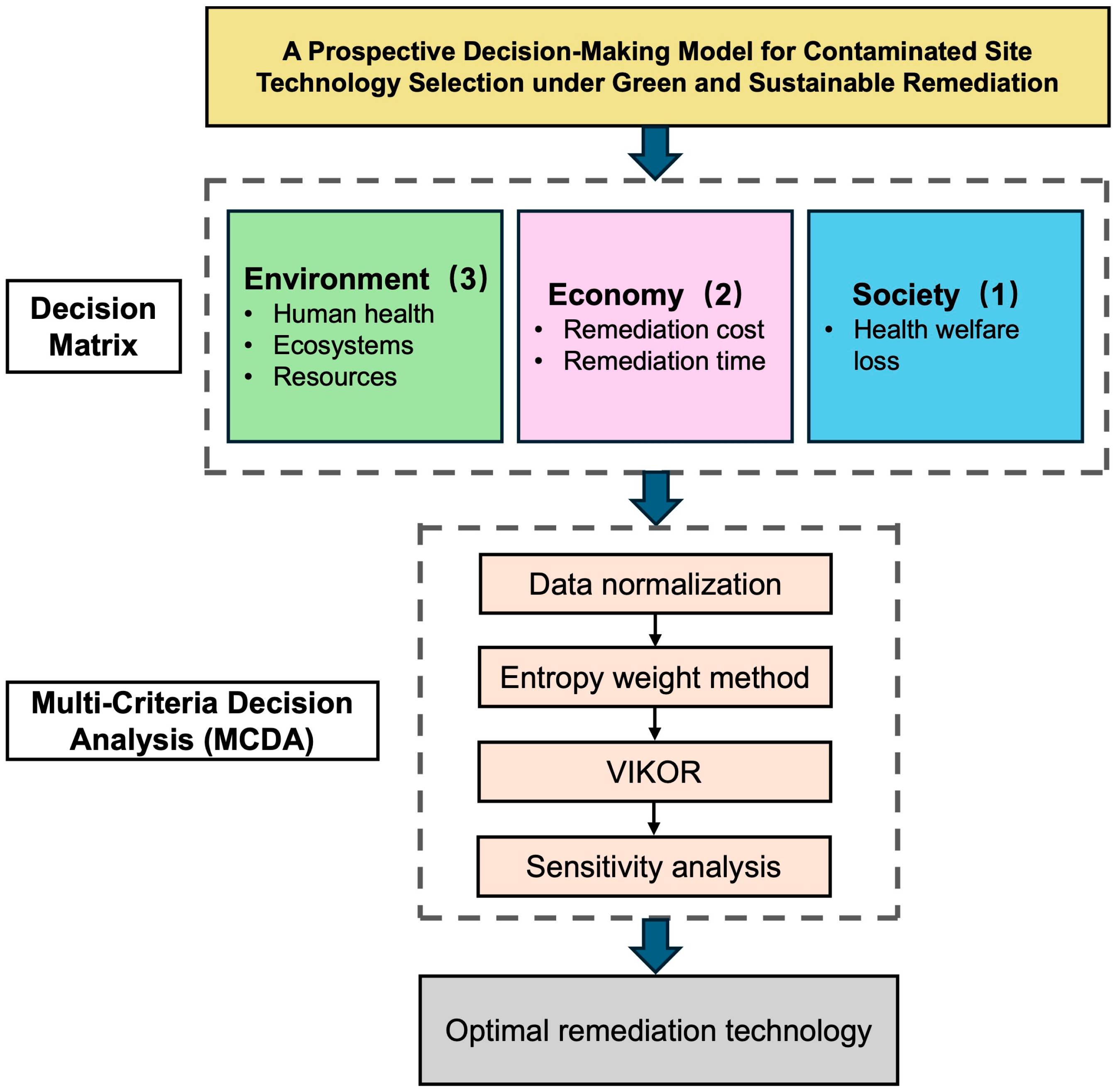
| Environment | Human health | Potential Environmental impacts of remediation activities over the life cycle | DALY/m3 | Calculated by ReCiPe 2016 endpoint method |
| Ecosystems | species·yr/m3 | |||
| Resources | USD/m3 | |||
| Economy | Remediation cost | Remediation cost per unit soil volume | USD/m3 | Literature data and engineering design assumptions |
| Remediation time | Time required to complete remediation per unit soil volume | d/m3 | ||
| Society | Health welfare loss | Monetized human health damage | USD/m3 |
| Scenario Type | v | Decision Focus | Management Implication | Typical Application Context |
|---|---|---|---|---|
| Risk-averse scenario | 0.3 | Minimum individual regret (R) | Emphasizes avoidance of adverse performance in any critical indicator | Sites near sensitive receptors; strict regulatory constraints |
| Balanced compromise scenario | 0.5 | Balanced consideration of S and R | Balances overall performance and shortfall control | General remediation decision-making contexts |
| Overall optimization scenario | 0.7 | Maximum group utility (S) | Emphasizes the best overall comprehensive performance | Resource-limited projects prioritizing overall efficiency |
| Dimension | Indicator | Unit | Chemical Oxidation | Thermal Desorption | Biopiles |
|---|---|---|---|---|---|
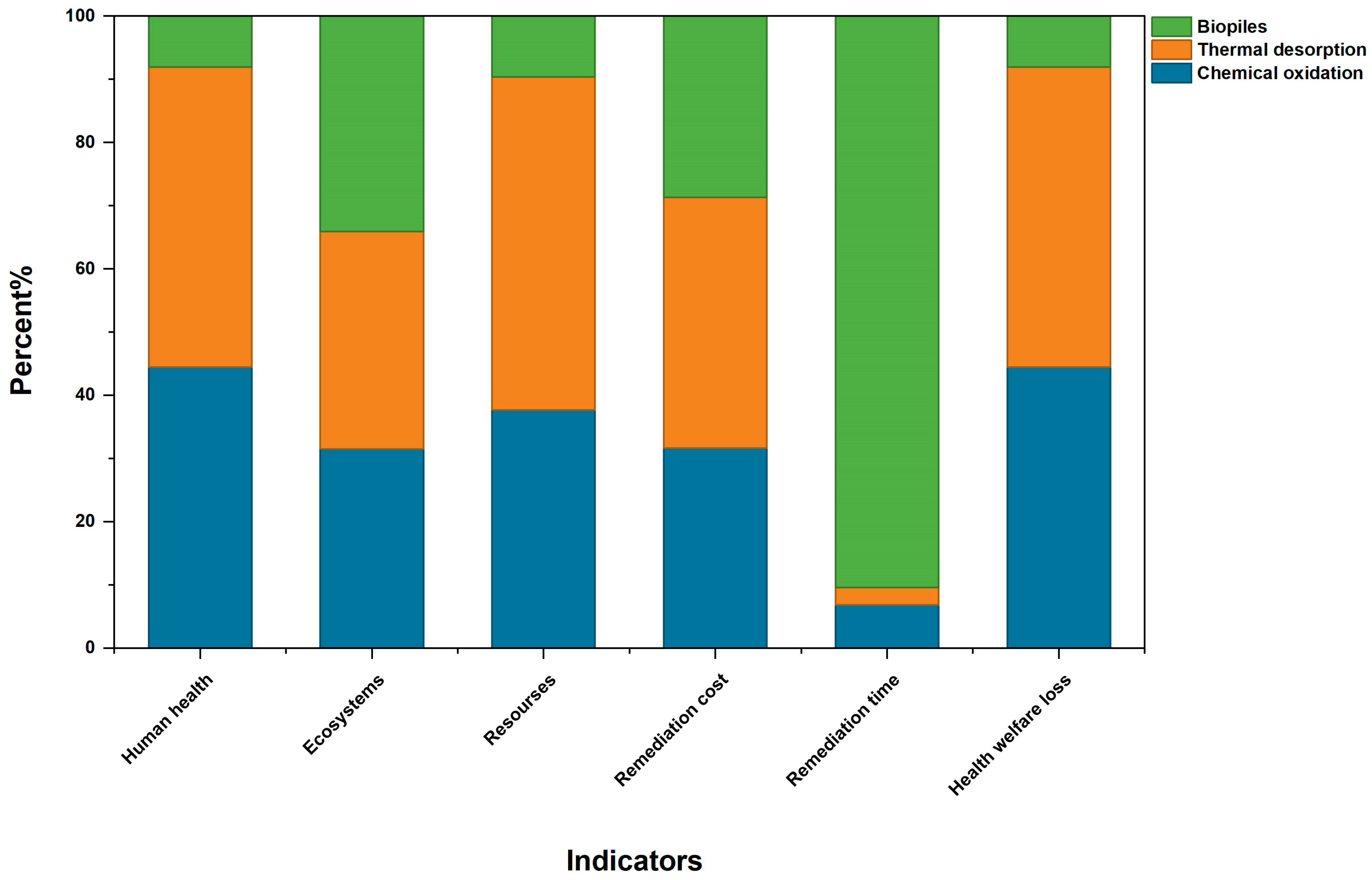
| Environment | Human health | DALY/m3 | 5.95 × 10⁻⁴ | 6.35 × 10⁻⁴ | 1.08 × 10⁻⁴ |
| Ecosystems | species·yr/m3 | 9.25 × 10⁻⁷ | 1.01 × 10⁻⁶ | 1.00 × 10⁻⁶ | |
| Resources | USD/m3 | 18.3 | 25.6 | 4.67 | |
| Economy | Remediation cost | USD/m3 | 153 a | 192 b | 139 c |
| Remediation time | d/m3 | 0.05 d | 0.02 e | 0.66 f | |
| Society | Health welfare loss | USD/m3 | 98.16 | 104.76 | 17.82 |
| Indicator | Entropy (ej) | Weight (wj) |
|---|---|---|
| Human health | 0.2322 | 0.2220 |
| Ecosystems | 0.3063 | 0.2006 |
| Resources | 0.5203 | 0.1387 |
| Remediation cost | 0.6203 | 0.1098 |
| Remediation time | 0.6307 | 0.1068 |
| Health welfare loss | 0.2322 | 0.2220 |
| Remediation Technologies | S | R | Q (v = 0.3) | Q (v = 0.5) | Q (v = 0.7) |
|---|---|---|---|---|---|
| Chemical oxidation | 0.5347 | 0.2052 | 0.5616 | 0.5188 | 0.4760 |
| Thermal desorption | 0.8932 | 0.2220 | 1.0000 | 1.0000 | 1.0000 |
| Biopiles | 0.2838 | 0.1770 | 0.0000 | 0.0000 | 0.0000 |
| Scenario | Perturbed Object | Range of Values of δij | Changes in Ranking |
|---|---|---|---|
| 1 | Environmental dimension indicators | ±15% | unchanged |
| 2 | Economic dimension indicators | ±10% | unchanged |
| 3 | Joint perturbation of multidimensional indicators | ±10–15% | unchanged |
Disclaimer/Publisher’s Note: The statements, opinions and data contained in all publications are solely those of the individual author(s) and contributor(s) and not of MDPI and/or the editor(s). MDPI and/or the editor(s) disclaim responsibility for any injury to people or property resulting from any ideas, methods, instructions or products referred to in the content. |
© 2026 by the authors. Licensee MDPI, Basel, Switzerland. This article is an open access article distributed under the terms and conditions of the Creative Commons Attribution (CC BY) license.
Share and Cite
Shi, Y.; Wu, L.; Wang, Z. A Prospective Decision-Making Model for Contaminated Site Remediation Technology Selection Under Green and Sustainable Remediation. Sustainability 2026, 18, 3553. https://doi.org/10.3390/su18073553
Shi Y, Wu L, Wang Z. A Prospective Decision-Making Model for Contaminated Site Remediation Technology Selection Under Green and Sustainable Remediation. Sustainability. 2026; 18(7):3553. https://doi.org/10.3390/su18073553
Chicago/Turabian StyleShi, Yue, Lei Wu, and Zihang Wang. 2026. "A Prospective Decision-Making Model for Contaminated Site Remediation Technology Selection Under Green and Sustainable Remediation" Sustainability 18, no. 7: 3553. https://doi.org/10.3390/su18073553
APA StyleShi, Y., Wu, L., & Wang, Z. (2026). A Prospective Decision-Making Model for Contaminated Site Remediation Technology Selection Under Green and Sustainable Remediation. Sustainability, 18(7), 3553. https://doi.org/10.3390/su18073553