Article

Integrated Hybrid Framework for Urban Traffic Signal Optimization Based on Metaheuristic Algorithm and Fuzzy Multi-Criteria Decision-Making

1
Faculty of Mechanical Engineering, University of Niš, 18000 Niš, Serbia
2
Faculty of Transport and Traffic Engineering, University of Belgrade, 11000 Belgrade, Serbia
3
Military Academy, University of Defence in Belgrade, 11000 Belgrade, Serbia
*
Author to whom correspondence should be addressed.
Sustainability 2026, 18(7), 3514; https://doi.org/10.3390/su18073514
Submission received: 4 February 2026 / Revised: 25 March 2026 / Accepted: 31 March 2026 / Published: 3 April 2026
(This article belongs to the Topic Data-Driven Optimization for Smart Urban Mobility)

Abstract

Traffic signal control at urban intersections is one of the key determinants of the overall efficiency of the transportation system, given its direct impact on travel time, congestion levels, and emissions of exhaust fumes. This study proposes an integrated hybrid model that combines a metaheuristic Genetic Algorithm for generating potential signal timing plans with fuzzy multi-criteria decision-making (MCDM) for their evaluation and selection of the optimal solution. In order to determine the relative importance of criteria, the fuzzy methods F-AHP, F-FUCOM, and F-PIPRECIA were employed, thus providing stable assessments of criteria importance under conditions of uncertainty and expert subjectivity. The ranking of generated alternatives was performed by employing the F-TOPSIS, F-WASPAS, and F-ARAS methods, while the robust decision-making rule approach was employed to develop a robust decision-making rule by integrating multiple MCDM methods. The proposed model was tested using data collected from a real urban intersection. The results show that the integrated hybrid approach enables a significantly more reliable selection of the optimal signal timing plan and achieves higher traffic management efficiency compared to traditional methods. The proposed model provides a flexible and scalable framework that can be adapted to different types of intersections and traffic demand conditions, thereby significantly contributing to the development of modern intelligent traffic management systems.

1. Introduction

Traffic management is one of the key and most challenging issues contemporary urban environments are facing. Almost all major cities worldwide are confronted with various forms of traffic-related problems, with a particularly prominent factor being the continuous growth of the population in urban areas, while the development of transportation infrastructure generally does not follow this trend, thus resulting in an imbalance between the number of vehicles and the capacity of the road network. This, consequently, results in frequent traffic congestion and prolonged travel times for road users.
At-grade intersections play a central role in the operation of the traffic network, serving as points where traffic flows converge and conflict. Ensuring safe and efficient movement for all users at these locations requires minimizing conflicts and delays. A key instrument in achieving this is traffic control devices, which serves as the primary means of communication between road authorities and road users. Traffic control devices include traffic signs, pavement markings, traffic signals, and other supporting equipment. Traffic signals are of particular importance, as they enable the right-of-way allocation, i.e., allocating priority in traffic, among conflicting flows, in accordance with predefined control criteria.
The improvement of traffic flow conditions requires reducing total vehicle delays, the number of stops, and queue lengths, as well as mitigating negative environmental impacts. The achievement of the aforementioned goals requires a detailed analysis of signal timing plans, including the determination of optimal cycle length and the appropriate allocation of green time within individual phases.
Intelligent Transportation Systems have been developed with the aim of ensuring more efficient management of the factors that cause traffic congestion, thereby contributing to an overall improvement in the quality of life. Modern technological advancements have enabled transportation systems to collect and process vast amounts of real-time data, thus significantly accelerating the evolution and application of ITSs. These systems are based on the integration of various technologies, including electronics, computer data processing, and wireless communication networks, thereby enhancing safety, reliability, and efficiency of the transportation infrastructure. In this regard, an ITS constitutes an integrated framework that enables the collection, exchange, and analysis of information, communication coordination, and the management of different elements within a transportation network, with the primary goals of increasing safety, reducing traffic congestion, and lowering carbon dioxide (CO2) emissions.
One of the most significant ITS applications is the smart traffic signal, as presented in [1,2]. A smart traffic signal essentially constitutes the optimization of traffic signal operation based on the application of advanced ICT [3,4], the IoT [5], and AI [6]. In particular, artificial intelligence is recognized as one of the most advanced fields of contemporary computer science, focused on developing methods and algorithms that enable computers to imitate human-like intelligent behavior, solve complex optimization and prediction problems, and make decisions based on logic and data-driven analysis.
Since the optimization of traffic signal control at intersections is an extremely important and publicly relevant issue, numerous researchers have devoted significant attention to its modeling and improvement over the past decades. In this context, a wide range of algorithms and decision-making methods have been used. Traditional traffic signal control methods are based on fixed-time cycles configured based on historical traffic volume data. However, this approach has limited capability to adapt to changing real-time conditions, which is why modern systems incorporate intelligent control methods, including adaptive algorithms and sensor-based technologies which enable dynamic optimization of signal timing plans [7].
One practical illustration of mitigating congestion at intersections can be found in the role of a traffic police officer, who makes real-time decisions based on direct observation, personal experience, and knowledge of local traffic patterns, thereby substantially reducing or eliminating congestion. The application of artificial intelligence in the domain of smart traffic signals aims to replace this form of human intervention, which is costly, limited in availability, and often unsustainable, by enabling sensors and surveillance devices to continuously collect traffic data. Based on the data collected in this manner, signal timing plans optimization can be performed using metaheuristic methods such as a GA [8] and Particle Swarm Optimization [9], as well as through the application of hybrid metaheuristic approaches that integrate multiple models and algorithms [10,11]. Alternatively, the signal control system itself can be trained using machine learning methods [12], deep learning techniques [13,14], reinforcement learning [5,15,16], and deep reinforcement learning [17,18], enabling it to acquire behavioral patterns comparable to human reasoning and to adaptively regulate traffic signals in interaction with the environment. Nevertheless, in most cases, only a single criterion is considered when determining the cycle length and green time durations, whereas only a limited number of studies simultaneously analyze multiple criteria. Depending on the proposed traffic signal control model, the following criteria can be identified as dominant in the selection of cycle length or green time duration: minimization of delay [19], minimization of total travel time [20], minimization of queue length and number of vehicles [21,22], maximization of the residual intersection capacity [23], minimization of efficiency losses in traffic flow [24], maximization of average vehicle speed [25], maximization of pedestrian safety [26], minimization of fuel consumption [27], and minimization of exhaust fumes emissions [28], among others.
Recent research has expanded intersection analysis toward simulation-based infrastructure assessment and control selection [29,30], network-level delay estimation using passive sensing technologies [31,32,33], and safety-oriented deep learning analysis of red-light violation behavior [34,35]. However, these studies predominantly address isolated operational or safety aspects, while integrated optimization and multi-criteria decision-making frameworks remain comparatively underexplored [36,37]. In contrast, limited attention has been devoted to integrated frameworks that simultaneously combine optimization techniques with multi-criteria decision-making for robust selection of optimal signal timing plans under varying traffic conditions. The proposed hybrid framework aims to address this research gap by integrating metaheuristic optimization with fuzzy MCDM methods within a unified decision-support environment.
The introduction of MCDM into the process of selecting the optimal signal timing plan arises from the need to simultaneously consider multiple, often mutually conflicting criteria, as well as to determine their relative importance within the overall performance assessment. The determination of criteria weight coefficients plays a crucial role in the quality of the final solution, as it directly affects the accuracy and stability of the optimization results. Involving a group of traffic engineering experts, whose assessments are based on professional knowledge and experience in analyzing and managing traffic flows, allows for a more objective determination of a weight set, thereby yielding more reliable signal timing plans optimization outcomes.
The earliest attempts to integrate MCDM into traffic signal control involved the application of the AHP methods to assess the performance of different signal timing plans using criteria such as queue length, average delay, and number of stops [38]. These methods provide a systematic framework for ranking alternatives and determining the relative importance of criteria based on expert evaluation.
Furthermore, methods such as VIKOR and ELECTRE, combined with Data Envelopment Analysis, have proven useful in scenarios involving several alternative signal timing plans, where it is necessary to balance efficiency, safety, and environmental aspects [39]. These methods enable the identification of compromise solutions, especially in urban networks with a large number of intersections and variable traffic conditions.
Later, hybrid and fuzzy-based approaches have been developed, combining MCDM with uncertainty modeling. For instance, F-AHP and F-TOPSIS methods have been applied to optimize green time allocation under real traffic conditions, taking into consideration the uncertainties in expert assessments and fluctuating traffic flows [40]. Taking into account the inherent uncertainty in traffic data, fuzzy TOPSIS frameworks have been developed, enabling the ranking of traffic signal control methods based on their similarity to the ideal solution by integrating both fixed and adjustable criteria, thereby achieving transparent and systematic decision-making process [41].
The most recent studies focus on integrating MCDM with ITS and adaptive traffic signal control. Hybrid models that combine fuzzy logic with MCDM techniques provide adaptable and robust real-time control, effectively reducing average delay and enhancing traffic throughput in critical urban areas [42].
The optimization of traffic signal operations constitutes a complex research problem, involving numerous mutually conflicting criteria, from the minimization of delays, number of stops, and travel time along corridors to the reduction in total user’s costs, as well as the maximization of intersection capacity and the control of queue lengths. Taking all of the factors into account, it can be concluded that the problem is obviously an MCDM task, wherein a single alternative solution is selected that best meets the conflicting performance criteria.
Based on the identified research gap, the main contributions and innovative aspects of this study can be summarized as follows:
  • Development of an integrated hybrid framework combining metaheuristic optimization and fuzzy MCDM methods for traffic signal timing optimization;
  • Generation of feasible signal timing plan alternatives using a GA based on real traffic data collected from an operational intersection;
  • Implementation of a structured group decision-making approach with aggregation-based weighting to reduce expert subjectivity;
  • Application of multiple fuzzy ranking methods followed by the RDMR to ensure stable final decision selection;
  • Validation of the proposed framework under multiple traffic demand scenarios derived from a seven-day field data collection period.
Accordingly, the proposed framework represents a generalized decision-support methodology rather than a case-specific solution.
Compared with conventional traffic signal optimization approaches based solely on single optimization or decision-making techniques, the proposed hybrid framework enables simultaneous generation, evaluation, and robust selection of signal timing plans using multiple performance criteria. The integration of metaheuristic optimization with fuzzy MCDM methods and aggregation-based decision rules improves solution stability and reduces sensitivity to subjective parameter selection, providing a more reliable basis for traffic signal control decision-making under varying traffic conditions.
In this study, a hybrid framework integrating metaheuristic optimization and fuzzy MCDM methods is proposed for traffic signal timing optimization at signalized intersections. The novelty of the study lies in the integration of metaheuristics and multiple fuzzy MCDM methods within a robust decision-making framework to enable a comprehensive optimization of traffic signal timing in order to achieve higher traffic management efficiency compared to traditional methods. The model is structured as a two-level architecture separating solution generation from multi-criteria sustainability-oriented decision-making.
Accordingly, this study investigates whether the integration of metaheuristic optimization and fuzzy MCDM can provide a more robust and sustainable traffic signal timing plan compared to conventional approaches. It is hypothesized that the proposed hybrid GA–fuzzy MCDM framework enables the identification of signal timing plans that improve overall intersection performance by simultaneously considering operational, environmental, and public transport related criteria.
The paper is structured as follows: Section 2 provides a review of the relevant literature, with the focus on the application of the MCDM methods in the process of traffic signal control at intersections, with special emphasis on the integration of fuzzy logic-based models for determining the criteria weighting coefficients. Section 3 provides on overview of the employed methods and describes the proposed methodology. Within this section, a model for designing the optimal signal timing plan is presented, based on a hybrid approach which requires the participation of a group of experts and the application of a metaheuristic algorithm for generating alternative solutions. Section 4 presents the case study carried out based on data collected from a real urban intersection, along with a comparative evaluation of criteria provided by a group of experts. Section 5 focuses on the experimental validation, along with the analysis, and discussion of the obtained results. Finally, Section 6 provides concluding remarks, summarizes the main findings and scientific contributions of the research, and outlines potential directions for future research in this field.

2. Materials and Methods

The proposed model for determining the optimal signal timing plan at a signalized intersection represents an integrated hybrid framework combining a GA and MCDM methods. The GA is used to generate potential signal timing plan alternatives based on collected traffic data, while the MCDM framework is applied for the evaluation and selection of the optimal signal timing plan. The proposed methodology consists of two main stages:
  • Generation of feasible signal timing plan alternatives using a GA;
  • Multi-criteria evaluation and selection of the optimal solution using fuzzy MCDM methods.
In the first stage, a GA is applied to explore the feasible search space of signal timing parameters and generate a diversified set of candidate signal timing plans under predefined operational constraints. In the second stage, the generated alternatives are evaluated using fuzzy MCDM methods, enabling the simultaneous consideration of operational, environmental, and public transport performance criteria.
The Genetic Algorithm was selected due to its well-established capability to efficiently explore nonlinear and constrained search spaces typical of traffic signal timing optimization problems. Unlike gradient-based or deterministic optimization techniques, a GA does not require problem linearization or differentiable objective functions, making it particularly suitable for multi-criteria traffic control problems involving conflicting performance indicators and discrete decision variables. Furthermore, a GA enables generation of multiple feasible signal timing alternatives, which is consistent with the subsequent multi-criteria evaluation stage of the proposed hybrid decision-making framework. The complete conceptual framework of the proposed model is shown in Figure 1.
The model utilizes detailed traffic data collected at the individual intersection, including traffic volumes, queue lengths, vehicle delays, and other relevant parameters that directly affect signal timing plan performance. Based on these data, a GA generates candidate signal timing plans used as alternatives in the subsequent MCDM evaluation stage. Each generated alternative is subsequently evaluated through an MCDM framework, where fuzzy-based methods are applied for determining the criteria weight coefficients and ranking the alternatives.
A Genetic Algorithm was employed to generate a set of potential signal timing plans. In the multi-criteria decision-making process, F-AHP, F-FUCOM, and F-PIPRECIA methods were applied to determine criteria weight coefficients. Since the assessments of criteria importance were obtained from a group of experts, the results of individual methods were aggregated using a mathematical aggregation operator, thereby forming a unified set of weight coefficients. In the subsequent stage, the generated signal timing plan alternatives were ranked using F-TOPSIS, F-WASPAS, and F-ARAS methods, while the RDMR approach was applied to establish a robust decision-making rule. This procedure enabled a multidimensional evaluation of traffic control performance and facilitated the selection of the optimal signal timing plan under conditions of uncertainty.
The integration of these steps enables comprehensive multi-criteria evaluation of the generated signal timing plans, taking into account operational indicators (delay, queue length, number of stops), as well as environmental and energy-related aspects. The process ultimately yields the optimal signal timing plan that meets the defined goals and constraints, providing efficient, stable, and adaptive traffic signal control.

2.1. Integration of GA and MCDM in Traffic Signal Optimization

For the purposes of the mathematical formulation of the problem, the following variables are introduced:
  • i —index of traffic lane, i = 1, 2 , , n ;
  • j —index of signal phase, j = 1, 2 , , m ;
  • q i —traffic flow in lane   i   (veh/h);
  • s i —saturation flow in lane   i (veh/h);
  • X i —degree of saturation of lane   i ;
  • c i —capacity of lane   i (veh/h);
  • T —duration of the analysis period (h);
  • t i —duration of oversaturation (unserved demand) during T in lane   i   or lane i group;
  • u i —delay parameter in lane i   or lane i group;
  • C —cycle length (s);
  • C m i n —minimum cycle length (s);
  • C m a x —maximum cycle length (s);
  • L —delay time per cycle (s);
  • g i —green time allocated to lane i (s);
  • g j —green time allocated to phase j (s);
  • g m i n —minimum allowable green time (s);
  • g m a x —maximum allowable green time (s);
  • g e f —effective green time (s);
  • g e f p e d —effective green time of the pedestrian signal group (s);
  • r e f —effective red time (s);
  • D —total average delay of all vehicles passing through the intersection during the analysis period (s/veh);
  • d i —average delay per vehicle in lane   i (s/veh);
  • d 1 i —uniform delay per vehicle in lane i (s/veh);
  • d 2 i —incremental delay per vehicle in lane i   (s/veh);
  • d 3 i —delay caused by the initial queue per vehicle in lane   i (s/veh);
  • d 1 i * —uniform delay per vehicle in lane   i   when an initial queue of unserved vehicles exists (s/veh);
  • d p e d —average delay of the pedestrian signal group (s/ped);
  • h —average number of stops (VS/h);
  • y —degree of utilization of ideal capacity;
  • N —number of vehicles in queue (veh);
  • N 0 —number of unserved vehicles (veh);
  • q —flow rate (veh/s);
  • U —green time utilization coefficient;
  • Q —traffic flow (veh/h);
  • L q —queue length (m);
  • l —average vehicle length (m);
  • p f u e l —average fuel consumption per vehicle (L/veh);
  • α —average idle fuel consumption (L/veh);
  • β —average fuel consumption during deceleration–acceleration cycles (L/veh);
  • d —average delay (h/veh);
  • d a d —average delay during deceleration and acceleration (h/veh).
The determination of alternatives, i.e., potential cycle lengths and the green time allocation across phases, was performed through optimization using a GA, whereby the optimization was performed via minimization of the total delay of all vehicles (D). This objective function has previously been applied in traffic management using the Artificial Bee Colony optimization algorithm [43]. The mathematical form of the objective function is expressed as follows:
D = i = 1 K q i · d i i = 1 K q i
In order to determine the optimal signal timing plan that corresponds to the minimum total delay time of all the vehicles passing through the intersection during the analysis period, it is first necessary to calculate the average delay per vehicle in the i traffic lane. For undersaturated traffic flow, the following applies:
d i = d 1 i + d 2 i
d 1 i is calculated as follows:
d 1 i = 0.5 · C   · 1 g i C 2 1 m i n ( 1 , X i ) · g i C
d 2 i is calculated as follows:
d 2 i = 900 T X i 1 + ( X i 1 ) 2 + 4 · X i c i · T
To ensure consistency and computational tractability within the iterative optimization process, the above analytical formulations were adopted for performance estimation. The analytical evaluation approach was intentionally selected to ensure computational efficiency within the Genetic Algorithm framework. Since a large number of candidate signal timing plans are generated and repeatedly evaluated, the integration of a microsimulation model would result in substantial computational burden and reduced practical applicability. The objective of this study is to support multi-criteria sustainability-oriented decision-making at the strategic level rather than to replicate detailed microscopic vehicle interactions.
For oversaturated traffic flow, additional delay caused by the presence of an initial queue is introduced, and the following applies:
d i = d 1 i * + d 2 i + d 3 i
d 1 i * = d s i · t i T + d u i · ( T t i ) T
d u i = d 1 i
d 3 i = 1800 · Q b i · ( 1 + u i ) · t i c i · T
The optimization constraints are as follows:
C m i n C C m a x
g m i n g j g m a x ,   j F
j = 1 F g j = C L
Equation (9) constitutes the range of the cycle length, while Equation (10) defines the range of green times allocated to every phase. The relationship between the cycle length, green time, and the delay within the cycle is defined by Equation (11).
The proposed minimum cycle length is C m i n = 30   s [27], while the maximum cycle length is adopted as C m a x = 120   s [44]. The minimum green time is set to   g m i n = 7   s and the maximum green time to g m a x = 80   s [43]. The delay per cycle L depends on the selected number of phases. The adopted value of the delay in the case of using “The two-way crossing signal timing plan” [44] for the assumed two-phase regime is 10 s. For the optimization process, the following GA parameters were used:
  • Crossover probability: 30%;
  • Mutation probability: 4%;
  • Convergence threshold: 0.01%;
  • Population size: 10;
  • Maximum number of generations: 10, 20, and 30.
The selected GA population size and number of generations were adopted considering the limited dimensionality of the signal timing optimization problem and previous validated applications in traffic signal optimization studies [33]. Since a GA is primarily used for generating feasible alternative signal timing plans rather than direct single-solution convergence, the adopted parameter configuration provides sufficient exploration while maintaining computational efficiency. Preliminary experimental runs confirmed that increasing population size beyond the adopted values did not produce significant improvements in solution quality but considerably increased computational time.
The result of the optimization is the cycle length and the allocation of green time to the phases, whose mathematical formulation is given as follows:
A i = C i , g i 1 , g i 2 , , g i j
where   i = 1 , , n   stands for a potential cycle, while   j = 1 , , m   denotes the number of green phases within the cycle.
In order to determine the optimal signal timing plan, considering both traffic-related and non-traffic-related parameters through the application of MCDM, a set of nine criteria ( C i , i = 1 , ,   9 ) are evaluated: minimization of vehicle delay, number of stops, queue length, pedestrian delay, exhaust fumes emissions, and fuel consumption, as well as maximization of intersection capacity, green time utilization, and public transport vehicle throughput. The selection of criteria was based on the authors’ previous experience, a comprehensive review of the literature related to traffic signal control at intersections, and the feasibility of applying these criteria to isolated intersections.
Criterion C1: Intersection capacity [veh/h] is defined as the maximum number of vehicles that can pass through the intersection per unit of time. By maximizing the intersection capacity, overall traffic throughput is increased, congestion is reduced particularly during peak periods and traffic efficiency on arterial roads is improved. The value of the intersection capacity is obtained using the following equation [45,46]:
K = s i · g e f C
Criterion C2: Vehicle delay or waiting time [s/veh] is defined as the time a vehicle spends idling or moving at reduced speed at an intersection. The objective of minimization of vehicle delay is to reduce the average time that vehicles spend waiting at the intersection, which contributes to faster traffic flow, and improved travel comfort. The value of vehicle delay is obtained using Equation (1).
Criterion C3: The number of stops is intended to minimize the frequency with which vehicles are forced to stop at a red signal at the intersection. Applying this criterion improves traffic flow, enables vehicles to maintain a higher average travel speed, reduces total travel time, enhances driving comfort, and increases safety, since fewer stops reduce the likelihood of traffic accidents caused by sudden braking.
The average number of vehicle stops is obtained using the following Equation (14) in accordance with ref. [47]:
h = 0.9 · 1 g e f C 1 y + N 0 q · C
Criterion C4: Queue length [m] is defined as a constraint used in determining the signal timing plan to ensure that the vehicle queue length on the intersection adjacent roadways does not exceed a predefined acceptable threshold. During the optimization of the signal timing plan, special emphasis is placed on preventing the queue from becoming long enough to block the intersection or adjacent streets. By applying this criterion, intersection blocking is avoided, congestion is reduced, and traffic safety is improved, since long queues may provoke dangerous maneuvers (e.g., overtaking) and increase the risk of secondary delays, since long queues can block nearby intersections. The number of vehicles in the queue is obtained using the following Equation (15) in accordance with ref. [47]:
N = q · r e f + N 0
Meanwhile, the queue length is obtained using the following Equation (16):
L q = N · l
Criterion C5: The degree of green time utilization indicates how effectively the allocated green time is used relative to the traffic demand. This criterion is a key indicator of the balance of the signal timing plan and helps ensure that green time is distributed efficiently to reduce delays. The value of the degree of utilization of the green time is obtained using Equation (17) in accordance with [45]. The objective is for the utilization degree to be as close as possible to the value of 0.95, since values greater than 1 indicate an oversaturated phase, which may lead to congestion. When evaluating this criterion, the degree of green time utilization is analyzed separately for the major roadway (C51) and for the minor roadway (C52), which are defined as sub-criteria.
U = Q S · g e f C
Criterion C6: Pedestrian delay [s/ped] is defined as the time pedestrians spend waiting at the intersection before being given the pedestrian right of way (green light). The minimization of pedestrian delay is a key criterion when the goal is sustainable and inclusive mobility. It enables a safer, faster, and more efficient movement of pedestrians through the intersection and contributes the balance between motorized and non-motorized traffic. Within this criterion, two sub-criteria are considered: average pedestrian delay on the major roadway (C61) and on the minor roadway (C62). The average delay of the pedestrian signals is determined based on Equation (18), in accordance with ref. [48]:
d p e d = 0.5 · ( C g e f p e š ) 2 C
Criterion C7: Emission of exhaust fumes is defined linguistically in the proposed model. Since various pollutants are produced during the combustion of fossil fuels, CO2 (C71) and NOx—nitrogen oxides (C72)—are selected as the most significant and are treated as sub-criteria. Estimated CO2 emissions represent the amount of carbon dioxide emitted by vehicles during movement, idling, and acceleration at intersections. The objective in forming the signal timing plan is to minimize total CO2 emissions in order to improve the environmental sustainability of traffic [49]. The minimization of CO2 emissions reduces negative environmental impacts, supports the goals of green and smart cities, and improves air quality in urban areas. NOx emissions arise from the combustion of fuel in vehicle engines and have severe negative effects on air quality, human health, and the environment (acid rain, smog). The minimization of nitrogen oxide emissions is becoming an increasingly important criterion in modern signal timing plans, especially in urban environments.
Criterion C8: Fuel consumption is defined as the total estimated fuel consumption per traffic signaling cycle. Although the unit of measurement for average fuel consumption per vehicle is typically (L/veh), in the proposed model fuel consumption is defined linguistically due to large variations among the defined alternatives. The minimization of fuel consumption serves as a secondary indicator of efficiency, but is often a significant user-oriented or system-level criterion during traffic signal timing plan optimization because it directly reduces vehicle operating costs, contributes to environmental goals, and mitigates the negative effects of traffic congestion and delay. This parameter is determined based on the average unit fuel consumption under the corresponding vehicle operating regime within the zone of influence of an intersection on traffic flow. The average fuel consumption can be estimated using Equation (19) in accordance with ref. [46]:
P f u e l = α · d + ( β α · d a d ) · h
Criterion C9: In the proposed model, the uninterrupted public transport vehicle throughput is defined linguistically, based on multiple simulation runs for a given signal timing plan. This criterion represents the maximization of unobstructed movement of public transport vehicles (buses, trams, trolleybuses) through the intersection, with the objective of reducing the number of stops, shortening public transport travel times, and improving schedule adherence and arrival punctuality. The importance of uninterrupted public transport flow and signal priority strategies for public transport vehicles at signalized intersections has been widely recognized in recent studies [50].
The proposed framework represents a two-level decision architecture rather than a purely single-objective optimization model. The Genetic Algorithm is employed as a structured search mechanism to generate a feasible and diversified set of candidate signal timing plans under operational and technical constraints, where delay minimization serves primarily as a feasibility-oriented filtering criterion rather than the final optimization objective. The final selection of the optimal signal timing plan is performed within a fuzzy MCDM environment that simultaneously considers operational, environmental, energy-related, and public transport performance indicators. Since these criteria are inherently conflicting (e.g., delay reduction versus emission minimization or pedestrian service quality), the decision stage preserves the multi-criteria nature of the problem and enables sustainability-oriented evaluation of alternative solutions. In this framework, the GA stage ensures exploration and feasibility of candidate solutions, while the MCDM stage constitutes the actual MCDM layer responsible for final solution selection.

2.2. Applied Methods for Determining the Optimal Signal Timing Plan

The Genetic Algorithm is one of the most well-known and most frequently applied metaheuristic methods for solving optimization problems of varying complexity. Developed on principles inspired by natural selection and evolutionary processes, the GA employs mechanisms of biological evolution, such as selection, crossover, and mutation, to explore the space of possible solutions and gradually converge toward the global optimum [51]. Unlike classical deterministic optimization methods, which often encounter difficulties of local optima and require strictly defined mathematical models, the GA is stochastic in nature and capable of efficiently solving nonlinear, multi-criteria, and complex problems where the number of feasible solutions is extremely large and the relationships among variables are difficult to predict. Its robustness and flexibility make it suitable not only for theoretical research but also for solving practical real-world problems.
Multi-criteria decision-making methods are used to generate decision-making rules based on which a given set of alternatives is evaluated according to multiple criteria, with corresponding criteria weight coefficients. Managing imprecision and uncertainty in the decision-making process is enabled through fuzzy MCDM methods, which can integrate different types of criteria and allow the processing of qualitative information and linguistic variables alongside numerical data. Determining criteria weight coefficients is not a straightforward task and essentially depends on the subjective judgments of experts. Depending on the chosen MCDM method, the influence of criteria weight coefficients on the final solution changes, and even slight modifications in their values may lead to different rankings of alternatives. Numerous approaches to determining criteria weight coefficients have been investigated for many years. Expert judgment can significantly influence the selection of the optimal solution, as the evaluation must take into account multiple and often conflicting criteria. In order to make the determination of weight coefficients as objective as possible, it is necessary to involve a larger number of experts; therefore, robust group decision-making methods must be applied to integrate conflicting opinions, viewpoints, and proposed solutions. This problem is addressed by introducing mathematical aggregation operators to obtain aggregated initial decision matrices or aggregated criteria weight coefficients. The advantage of using aggregation operators, compared to other methods, lies in their objective synthesis of diverse expert opinions, even when the experts belong to different stakeholder groups.
Based on the previously reviewed literature, the aim of this study was the application of a multimodal hybrid approach using three well-known fuzzy MCDM methods for determining the criteria weight coefficients—F-AHP, F-FUCOM, and F-PIPRECIA—and the introduction of an aggregation operator, in this case the F-GM, which combines individual values into a single aggregated value while taking into account information on variations, dependencies, and expert preferences, after which the alternatives were ranked using F-TOPSIS, F-WASPAS, and F-ARAS, thereby providing a more robust and objective basis for decision-making. Finally, the RDMR method was applied as a tool for generating robust decision-making rules, yielding the final complete ranking of alternatives. Sensitivity analysis was performed using Kendall’s τ b and Spearman’s ρ tests. In the conducted study, expert evaluations were obtained independently to avoid mutual influence during the assessment process, while aggregation and subsequent robustness analysis ensured mitigation of potential individual judgment bias. Furthermore, the simultaneous application of multiple fuzzy weighting methods was intended to enable cross-validation of obtained criteria weights and to reduce sensitivity to method-specific assumptions. The aggregation of results using the F-GM operator therefore represents a robustness-oriented procedure aimed at minimizing subjectivity rather than increasing it.
The F-AHP method constitutes an extension of the conventional AHP through the integration of fuzzy numbers into the pairwise comparison process. The earliest applications of the F-AHP method could be seen in [52], while subsequent research introduced numerous variations and improvements to the algorithm. The fundamental idea of the F-AHP approach is that expert pairwise comparisons are expressed using fuzzy numbers (typically triangular or trapezoidal), which effectively model uncertainty, subjectivity, and imprecision in decision-making process. Owing to these characteristics, F-AHP is today regarded as one of the key tools of modern MCDM, and its flexibility and ability to integrate with other methods make it a suitable basis for the development of new hybrid and robust MCDM approaches. In this study, the fuzzy scale proposed in [53] was applied.
The FUCOM method is based on pairwise comparison of criteria and the assessment of deviations from maximal consistency thus ensuring stable and reliable weight determination with a minimal number of comparisons. Its main advantage over traditional methods is that it requires fewer pairwise criteria comparisons while still ensuring a high degree of consistency in the results. In order to provide additional flexibility and take into account the uncertainty in expert evaluations, the fuzzy extension F-FUCOM was developed. In this study, the weighting scale presented in [54,55] was used.
The PIPRECIA method [56] is based on comparisons with a reference criterion, without the need to pre-rank the criteria according to importance. This procedure enables a relatively simple and intuitive weighting process that requires fewer comparisons than methods such as AHP. Given that fuzzy logic is based on the transformation of qualitative evaluations into quantitative values, this method provides an ideal framework for integration within fuzzy MCDM models. In the proposed framework, the scale referred to in [57] was applied.
The F-GM operator is an extension of the classical geometric mean within fuzzy set theory, enabling uncertainty and subjectivity in expert evaluations to be adequately modeled and incorporated into the decision-making process. Compared to the fuzzy arithmetic mean, F-GM reduces the influence of extreme values and provides more stable results in cases with substantial variability among assessments. The application of the F-GM operator is particularly important in group decision-making, as it allows all individual expert evaluations to be aggregated into a single unified value, providing a balanced and robust basis for further MCDM analysis and alternative ranking.
The main limitation of the classical TOPSIS method lies in the assumption that all input values are precisely defined. In real-world decision-making conditions, expert assessments are often vague, subjective, and expressed in the form of linguistic variables. In order to overcome this limitation, the F-TOPSIS method was developed [58]. F-TOPSIS integrates the classical TOPSIS algorithm with fuzzy set theory, wherein the criteria and alternative evaluations are defined using fuzzy numbers.
The WASPAS method is based on combining the advantages of the WSM and WPM through a linear combination of their optimality criteria. In this way, greater accuracy and stability of the results are achieved compared to the individual application of either the WSM or WPM. Although the classical WASPAS method ensures a high degree of reliability, it is based on the assumption that both the criteria values and the weights are precisely defined [59]. In real decision-making environments, this is often not the case, as expert assessments are subject to subjectivity, imprecision, and uncertainty. Therefore, the fuzzy extension F-WASPAS was developed. The general characteristic of this method is its ability to evaluate and rank alternatives with a high level of reliability.
The F-ARAS method integrates fuzzy set theory with the classical ARAS algorithm [60] based on a proportional assessment of alternatives. The fundamental idea of the method is that the optimality of each alternative directly depends on the proportional relationship between its criteria’s values and in relation to the reference solution. In this way, the method enables the determination of alternative priorities through linear normalization of criteria and calculating the overall utility degree of each alternative.
RDMR is an approach developed to form robust decision rules within MCDM problems. Instead of direct alternative ranking, RDMR combines the results of multiple MCDM methods, enabling the identification of stable and reliable solutions, especially when different MCDM approaches yield conflicting rankings. The approach is based on quality engineering principles inspired by the Taguchi method, specifically through the calculation of the S/N ratio for each alternative to generate a robust decision-making rule [61].

3. Case Study

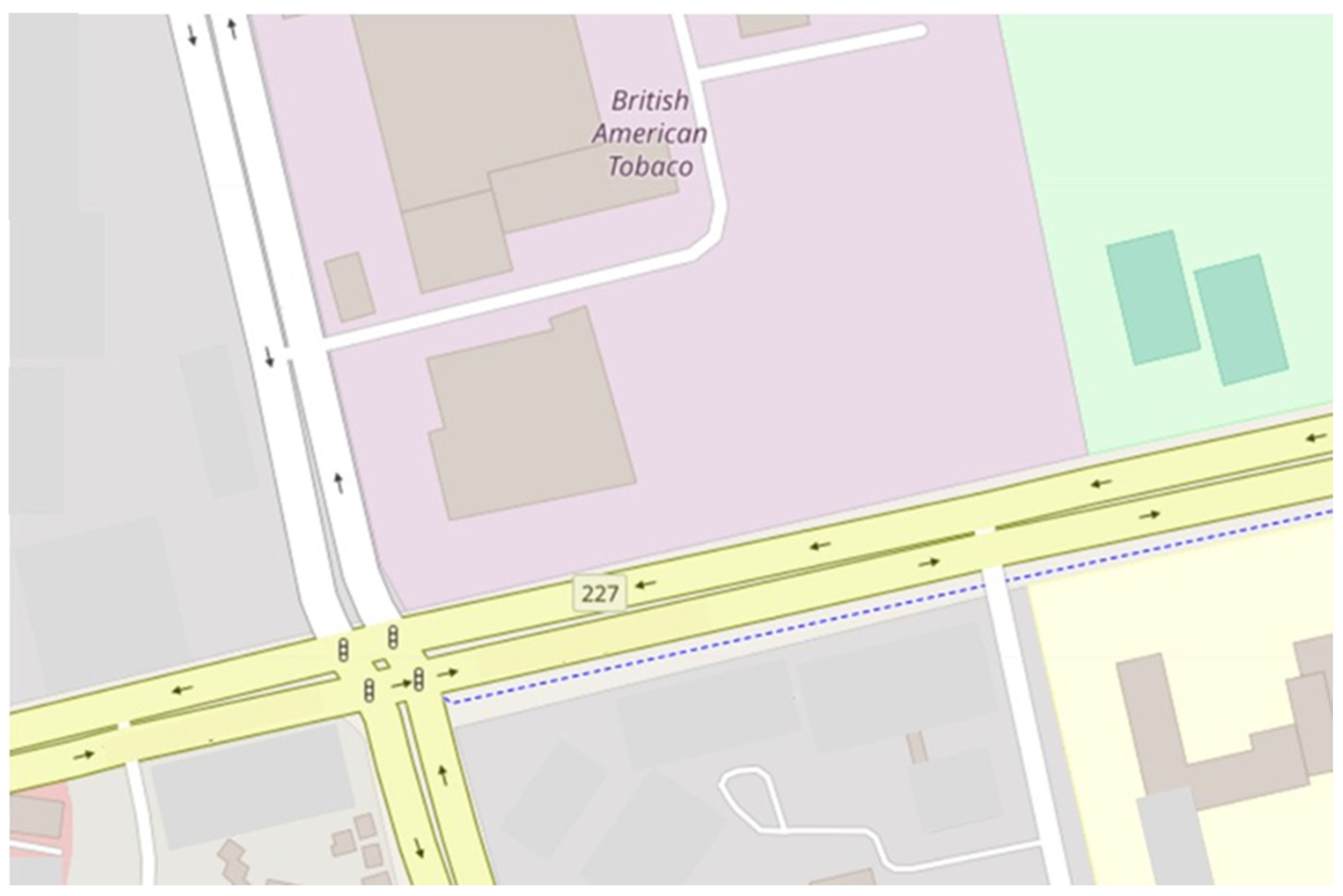
In this study, an isolated four-leg signalized intersection located in Vranje, Serbia, shown in Figure 2, was selected as a real-world test environment for validation of the proposed traffic signal optimization framework. The intersection consists of two traffic lanes on each of the three adjacent roadways, and one adjacent roadway with three traffic lanes.
The traffic demand data used in this case study were obtained through field measurements conducted at the analyzed intersection under different traffic load levels. These observed traffic volumes were directly incorporated into the analytical evaluation framework. Since the proposed model operates on established capacity-based formulations rather than behavioral microsimulation, traditional microsimulation calibration procedures were not required.
Multiple traffic demand scenarios were defined to enable a comprehensive performance assessment, including low, moderate, peak-hour, and oversaturated traffic conditions. Within this framework, the microsimulation environment was employed as a controlled comparative platform for consistent benchmarking of alternative control strategies under equivalent operating conditions, thereby ensuring a methodologically sound validation of the proposed model’s performance.
The selected intersection is used as a representative real-world test environment for methodological validation purposes, while the proposed hybrid framework itself is not location-specific and can be applied to other signalized intersections through adaptation of traffic input data and evaluation criteria.
The determination of the optimal cycle length and green time allocation was performed for a one-hour time interval, and the obtained results constitute the alternatives within the MCDM framework. Based on the collected data from the analyzed intersection over a seven-day period, 50 alternatives were generated using Equation (12), i.e., the corresponding cycle lengths and green time allocations shown in Table 1. The adopted data collection horizon allowed the optimization process to account for temporal variations in traffic demand and operational conditions, thereby ensuring that the generated alternative set reflects realistic and representative operating regimes of the analyzed intersection. This approach ensures that the generated alternatives are derived from observed traffic variability, providing a reliable basis for subsequent multi-criteria evaluation and robust decision-making.
In accordance with the actual operational configuration of the analyzed intersection, a two-phase signal control scheme was adopted for the determination of candidate signal timing plans. Nevertheless, the proposed optimization framework is not inherently restricted to this phase structure. Intersections with additional phases, including protected or dedicated turning movements, can be incorporated through straightforward extension of the decision variable set and the corresponding constraint formulation. Accordingly, the adopted two-phase configuration represents a case-specific implementation reflecting existing field conditions rather than a methodological limitation of the proposed model. Therefore, the analyzed intersection should be interpreted as a representative implementation environment, while the proposed hybrid framework constitutes a generalized decision-support architecture applicable to signalized intersections with varying geometric layouts and operational configurations.
The first value in the generated alternatives denotes the cycle length, the second value stands for the duration of the green time in the first phase, and the third value stands for the duration of the green time in the second phase.
The fuzzy decision-making matrix, based on the previously described alternatives and the defined set of criteria, was constructed and is shown in Table 2.
A team of six experts, with a minimum of 10 years of experience in traffic management, was selected to evaluate the relative levels of importance of the criteria. Experts were selected according to predefined eligibility criteria, including professional experience in traffic management practice, direct involvement in traffic signal control analysis, and demonstrated expertise in urban traffic engineering. In order to better capture subjective opinions, as well as the knowledge and expertise of decision-makers in the group decision-making process, three fuzzy subjective criteria weight coefficients methods were applied: F-AHP, F-FUCOM, and F-PIPRECIA. After performing pairwise comparisons of each criterion, the corresponding criteria weight coefficients were determined. In this way, the experts were able to express their assessments within a broader interval of values, in accordance with their beliefs and confidence levels. The aggregation of the computed criteria weight coefficients obtained from all applied fuzzy MCDM methods was carried out using the F-GM aggregation operator, and the aggregated weights are presented in Table 3.
It can be concluded that the values of almost all criteria weight coefficients are relatively close to each other. The F-FUCOM method indicated that some criteria weight coefficients have identical or very close values compared to their real and maximum expected values.

4. Results

The results obtained using the F-GM aggregation operator for each fuzzy MCDM method were used for further computations, i.e., for ranking the alternatives. The F-GM weight coefficients were combined with another set of three fuzzy MCDM methods, namely F-TOPSIS, F-WASPAS, and F-ARAS, with the aim of generating a more robust decision-making rule. The resulting rankings are shown in Table 4.
Based on the comparison of the results of the fuzzy MCDM methods, it can be observed and concluded that the first alternative, i.e., the best-ranked option, is A40 (40, 22.1, 11.9). Furthermore, the second-ranked alternative is A25, and this result is consistent across all combinations of fuzzy MCDM methods, whereas the rankings of the remaining alternatives are not aligned to the same extent as for the top two. The greatest discrepancies among the fuzzy MCDM combinations are evident for the F-AHP + F-TOPSIS and F-AHP + F-WASPAS methods.
In such situations where discrepancies arise in the ranking of alternatives, it is appropriate to apply the RDMR approach. This approach generates a robust decision-making rule by incorporating multiple rankings derived from solving the same decision-making problem with different MCDM methods. In its practical implementation, the RDMR procedure involves calculating the S/N ratio for each evaluated alternative (A1, …, A50), which is an indication of their stability under varying conditions. The final step consists of ranking these S/N values, whereby the alternative with the highest S/N ratio is identified as the most favorable alternative, while the lowest value corresponds to the least desirable option.
In this study, although all rankings of the alternatives were obtained using different fuzzy MCDM methods and approaches, they exhibit varying levels of similarity. To analyze the degree of similarity between the complete rankings, Kendall’s τ b and Spearman’s ρ tests were selected. These two non-parametric statistical tests were applied to measure the correlation between the rankings obtained through ten combinations of fuzzy MCDM methods and the RDMR concept. Kendall’s τ b indicates the similarity in the ordering of ranked alternatives (i.e., the number of concordant and discordant paired observations), whereas Spearman’s ρ measures the strength of the linear relationship between two complete rankings. The results of Kendall’s τ b and Spearman’s ρ tests are shown in Table 5.
Taking into account the results of Kendall’s τ b and Spearman’s ρ tests—which generate values within the interval [−1, +1], whereby +1 indicates a complete positive association between two rankings, whereas −1 indicates a complete negative association, and 0 denotes the absence of association between the compared ranking sets—it can be concluded that higher values of Sum ( τ b ) and Sum (   ρ ) indicate smaller variations in the ranking order. It is evident that RDMR achieves the highest cumulative value of Spearman’s   ρ (8.6090), whereas its cumulative Kendall’s τ b value is also high (7.5347). Only two combinations show slightly higher but not significantly different τ b values: F-AHP + F-ARAS (7.5641) and F-FUCOM + F-TOPSIS (7.5608). Therefore, it can be concluded that RDMR provides a more robust and comprehensive decision-making rule, which can be highly useful in solving real-world decision-making problems.
Furthermore, a general characteristic of the proposed approach is that a wide dispersion of rankings obtained using different fuzzy MCDM methods and RDMR was not observed, which is confirmed by the high values of Sum ( τ b ) and Sum (   ρ ), except in the case of applying the F-AHP + F-TOPSIS and F-AHP + F-WASPAS combinations, where a certain level of inconsistency in the alternative ranking order is noticeable compared to that with the other approaches.

5. Discussion

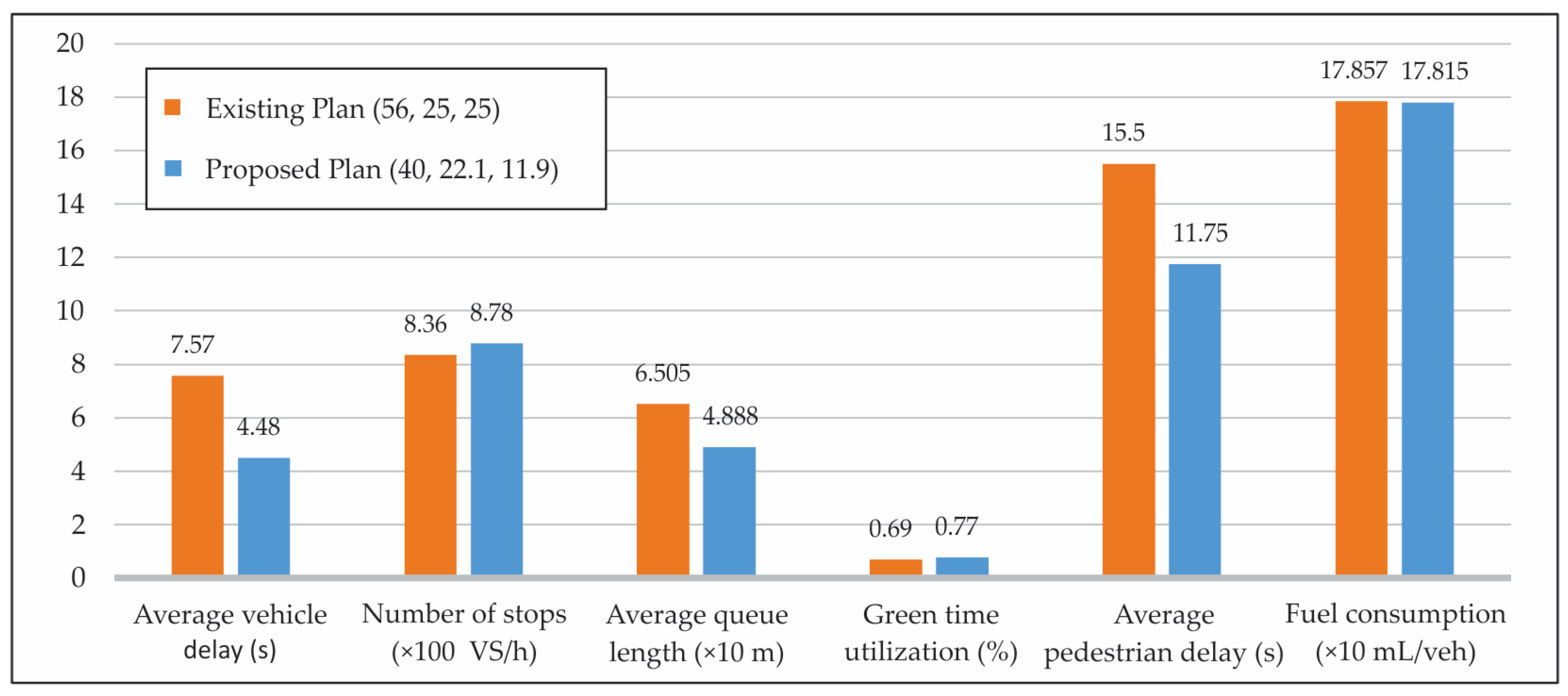
The obtained results confirm that the integration of metaheuristic optimization and fuzzy MCDM enables a comprehensive evaluation of traffic signal timing plans that cannot be achieved using single-objective optimization approaches. Unlike traditional fixed-time strategies or purely optimization-based models, the proposed hybrid framework simultaneously considers operational, environmental, and public transport performance indicators, thereby enabling a more balanced and sustainable traffic control decision. The comparative analysis of the existing fixed signal timing plan for the analyzed intersection and the optimized proposed plan clearly highlights the benefits of applying the proposed hybrid optimization framework. Figure 3 presents the key performance indicators and the achieved relative improvements.
The most significant improvement is observed in the average vehicle delay, which is reduced by 3.09 s, corresponding to an improvement of 40.82%. This reduction indicates that the optimized plan allocates green time much more efficiently in accordance with actual traffic demand, thereby reducing vehicle delay and accelerating the traffic flow through the intersection. A notable improvement is also achieved in the average pedestrian delay, which decreases by 24.19%. This result shows that the optimized plan successfully balances the needs of both vehicles and pedestrians, enabling faster and more efficient pedestrian crossings without disrupting vehicle flow.
The average queue length is reduced by 24.86%, confirming that the optimized plan not only decreases delay, but also contributes to reduction in vehicle queuing in the adjacent lanes. Shorter queues directly reduce the risk of congestion increase and propagation onto surrounding roadways. Regarding green time utilization, the optimized plan increases efficiency from 0.69% to 0.77%, representing an improvement of 10.39%. Although the absolute values are small due to the nature of the metric, the relative increase indicates better use of the available intersection capacity.
Two criteria show minimal or negative deviations. The number of stops increases by 5.02%, which may be a consequence of the optimization primarily favoring the minimization of total delay rather than reducing the frequency of stops. Such trade-offs are common in multi-criteria optimization problems where objectives may be mutually conflicting. Similarly, fuel consumption shows only a marginal change of 0.23%, which is expected because fuel usage is highly dependent on acceleration patterns that are not fully optimized solely by adjusting cycle length and green time allocation.
Overall, the results confirm that the proposed optimization model significantly improves key operational metrics, especially those directly related to intersection efficiency (delays, queue lengths, green time utilization). The minimal or negative changes observed in secondary criteria highlight the complexity of multi-criteria traffic management but do not diminish the overall benefits of the proposed solution, thereby confirming its robustness and practical value.

6. Conclusions

The selection of the optimal signal timing plan at a signalized intersection constitutes a crucial stage in effective traffic flow management, where it is necessary to take into account all relevant criteria that influence vehicle, passenger, and pedestrian delays, traffic safety, energy consumption, and exhaust fumes emissions. In this study, an integrated hybrid framework for signal timing plan optimization was developed, combining a GA for determining the optimal cycle length and green time allocation, fuzzy MCDM methods for system performance evaluation, and the RDMR approach to enhance the stability and reliability of decision-making outcomes.
The results of the experimental analysis clearly confirm the practical advantages of the proposed framework. The comparative evaluation of the existing fixed signal timing plan and the optimized proposed plan demonstrated substantial improvements across key operational metrics. Average vehicle delay was reduced by 40.82% and pedestrian delay by 24.19%, while average queue length decreased by 24.86%. Green time utilization increased by 10.39%, indicating more effective use of the available intersection capacity. Although minor or negative deviations were observed for the number of stops and fuel consumption, their relatively small magnitude reflects expected trade-offs as a result of mutually conflicting objectives. Considering the discussion presented in the previous section, these results show that the integrated hybrid approach provides a more robust, stable, and practically applicable solution compared to traditional methods of traffic control devices management.
The hybrid framework integrates metaheuristic optimization with fuzzy MCDM techniques to enable systematic generation, evaluation, and robust selection of signal timing alternatives. The application of aggregation-based decision rules and correlation-based sensitivity analysis confirms stability and reliability of the obtained decision outcomes, demonstrating suitability of the proposed approach for real-world traffic management applications.
The obtained results further indicate that the proposed hybrid optimization and fuzzy MCDM framework enables effective selection of optimal traffic signal timing plans under varying traffic demand conditions, contributing to improved intersection performance and decision-making reliability. From a practical implementation perspective, the framework operates using traffic data commonly available in existing urban traffic management systems and does not require deployment of advanced adaptive infrastructure. Consequently, the proposed approach is particularly suitable for small and medium-sized urban environments where implementation of fully adaptive signal control systems is often constrained by infrastructural or economic limitations. Overall, the multi-scenario evaluation based on real traffic data, combined with metaheuristic optimization, aggregated group decision-making procedures, and ranking stability verification, confirms that the proposed hybrid framework represents a reliable and robust decision-support approach for traffic signal timing optimization under realistic urban traffic conditions. Although correlation-based sensitivity analysis confirms stability of decision rankings, investigation of operational robustness under incident-related disturbances such as traffic surges, lane blockages, or detector failures represents an important direction for future research.
The proposed model exhibits a general and flexible structure, enabling its adaptation to various intelligent and adaptive traffic management applications. The generation of candidate signal timing plans can be further enhanced through integration of additional metaheuristic optimization techniques, deep learning approaches, or reinforcement learning models. Future research will therefore focus on extending the proposed framework toward network-level traffic control applications and incorporating disturbance-aware optimization mechanisms aimed at improving the resilience of intelligent traffic management systems. Moreover, integration with microsimulation environments represents a promising direction for further validation of the proposed decision-support framework under stochastic traffic conditions. In this context, the proposed framework provides a scalable foundation for future development of intelligent and data-driven traffic signal control systems.

Author Contributions

Conceptualization, B.L., G.P., A.T., S.L. and S.D.; Methodology, B.L., G.P., A.T., S.L. and S.D.; Validation, B.L., G.P., A.T., S.L. and S.D.; Formal analysis, B.L.; Investigation, B.L., G.P., A.T., S.L. and S.D.; Resources, B.L., G.P., A.T., S.L. and S.D.; Data curation, B.L., G.P., A.T., S.L. and S.D.; Writing – original draft, B.L., G.P., A.T., S.L. and S.D.; Writing – review & editing, G.P., A.T., S.L. and S.D.; Visualization, B.L., G.P., A.T., S.L. and S.D.; Supervision, G.P., A.T., S.L. and S.D. All authors have read and agreed to the published version of the manuscript.

Funding

This research received no external funding.

Institutional Review Board Statement

Not applicable.

Informed Consent Statement

Not applicable.

Data Availability Statement

The original contributions presented in this study are included in the article. Further inquiries can be directed to the corresponding author.

Conflicts of Interest

The authors declare no conflicts of interest.

Abbreviations

The following abbreviations are used in this manuscript:
ITSIntelligent Transportation System
ICTInformation and Communication Technologies
IoTInternet of Things
AIArtificial Intelligence
GAGenetic Algorithms
MCDMMulti-Criteria Decision-Making
F-AHPFuzzy AHP
F-FUCOMFuzzy FUCOM
F-PIPRECIAFuzzy PIPRECIA
F-TOPSISFuzzy TOPSIS
F-WASPASFuzzy WASPAS
F-ARASFuzzy ARAS
RDMRRobust Decision-Making Rule
F-GMFuzzy Geometric Mean
WSMWeighted Sum Method
WPMWeighted Product Method
S/NSignal-to-Noise

References

  1. De Oliveira, L.F.P.; Manera, L.T.; Da Luz, P.D.G. Development of a smart traffic light control system with real-time monitoring. IEEE Internet Things J. 2020, 8, 3384–3393. [Google Scholar] [CrossRef]
  2. Deshpande, S.; Hsieh, S.-J. Cyber-Physical System for Smart Traffic Light Control. Sensors 2023, 23, 5028. [Google Scholar] [CrossRef]
  3. Lee, W.-H.; Chiu, C.-Y. Design and Implementation of a Smart Traffic Signal Control System for Smart City Applications. Sensors 2020, 20, 508. [Google Scholar] [CrossRef]
  4. Astarita, V.; Giofrè, V.P.; Guido, G.; Vitale, A. A scientometric-based review of traffic signal control methods and experiments based on connected vehicles and floating car data (FCD). Appl. Sci. 2021, 11, 5547. [Google Scholar] [CrossRef]
  5. Damadam, S.; Zourbakhsh, M.; Javidan, R.; Faroughi, A. An intelligent IoT based traffic light management system: Deep reinforcement learning. Smart Cities 2022, 5, 1293–1311. [Google Scholar] [CrossRef]
  6. Agrahari, A.; Dhabu, M.M.; Deshpande, P.S.; Tiwari, A.; Baig, M.A.; Sawarkar, A.D. Artificial intelligence-based adaptive traffic signal control system: A comprehensive review. Electronics 2024, 13, 3875. [Google Scholar] [CrossRef]
  7. Wei, H.; Zheng, G.; Gayah, V.V.; Li, Z. Recent advances in reinforcement learning for traffic signal control: A survey of models and evaluation. ACM SIGKDD Explor. Newsl. 2021, 22, 12–18. [Google Scholar] [CrossRef]
  8. Mao, T.; Mihaita, A.S.; Cai, C. Traffic signal control optimization under severe incident conditions using Genetic Algorithm. arXiv 2019, arXiv:1906.05356. [Google Scholar] [CrossRef]
  9. Shi, Y.; Qi, Y.; Lv, L.; Liang, D. A Particle Swarm Optimisation with Linearly Decreasing Weight for Real-Time Traffic Signal Control. Machines 2021, 9, 280. [Google Scholar] [CrossRef]
  10. Srivastava, S.; Sahana, S.K. Nested hybrid evolutionary model for traffic signal optimization. Appl. Intell. 2017, 46, 113–123. [Google Scholar] [CrossRef]
  11. Khasawneh, M.A.; Awasthi, A. Intelligent Meta-Heuristic-Based Optimization of Traffic Light Timing Using Artificial Intelligence Techniques. Electronics 2023, 12, 4968. [Google Scholar] [CrossRef]
  12. Abduljabbar, R.; Dia, H.; Liyanage, S. Machine Learning Traffic Flow Prediction Models for Smart and Sustainable Traffic Management. Infrastructures 2025, 10, 155. [Google Scholar] [CrossRef]
  13. Ashkanani, M.; AlAjmi, A.; Alhayyan, A.; Esmael, Z.; AlBedaiwi, M.; Nadeem, M. A self-adaptive traffic signal system integrating real-time vehicle detection and license plate recognition for enhanced traffic management. Inventions 2025, 10, 14. [Google Scholar] [CrossRef]
  14. Talaat, F.M.; El-Balka, R.M.; Sweidan, S.; Gamel, S.A.; Al-Zoghby, A.M. Smart traffic management system using YOLOv11 for real-time vehicle detection and dynamic flow optimization in smart cities. Neural Comput. Appl. 2025, 37, 19957–19974. [Google Scholar] [CrossRef]
  15. Zamfirache, I.A.; Precup, R.E.; Petriu, E.M. Q-learning, Policy Iteration and Actor–Critic Reinforcement Learning Combined with Metaheuristic Algorithms in Servo System Control. Facta Univ. Ser. Mech. Eng. 2023, 21, 615–630. [Google Scholar] [CrossRef]
  16. Skoropad, V.N.; Deđanski, S.; Pantović, V.; Injac, Z.; Vujičić, S.; Jovanović-Milenković, M.; Jevtić, B.; Lukić-Vujadinović, V.; Vidojević, D.; Bodolo, I. Dynamic Traffic Flow Optimization Using Reinforcement Learning and Predictive Analytics: A Sustainable Approach to Improving Urban Mobility in the City of Belgrade. Sustainability 2025, 17, 3383. [Google Scholar] [CrossRef]
  17. Li, D.; Wu, J.; Xu, M.; Wang, Z.; Hu, K. Adaptive traffic signal control model on intersections based on deep reinforcement learning. J. Adv. Transp. 2020, 2020, 6505893. [Google Scholar] [CrossRef]
  18. Bouktif, S.; Cheniki, A.; Ouni, A.; El-Sayed, H. Deep reinforcement learning for traffic signal control with consistent state and reward design approach. Knowl.-Based Syst. 2023, 267, 110440. [Google Scholar] [CrossRef]
  19. Ali, M.E.M.; Durdu, A.; Celtek, S.A.; Yilmaz, A. An adaptive method for traffic signal control based on fuzzy logic with Webster and modified Webster formula using SUMO traffic simulator. IEEE Access 2021, 9, 102985–102997. [Google Scholar] [CrossRef]
  20. Wei, H.; Chen, C.; Zheng, G.; Wu, K.; Gayah, V.; Xu, K.; Li, Z. PressLight: Learning max pressure control to coordinate traffic signals in arterial network. In Proceedings of the 25th ACM SIGKDD International Conference on Knowledge Discovery & Data Mining, Anchorage, AK, USA, 4–8 August 2019; pp. 1290–1298. [Google Scholar]
  21. Wang, B.; He, Z.; Sheng, J.; Chen, Y. Deep reinforcement learning for traffic light timing optimization. Processes 2022, 10, 2458. [Google Scholar] [CrossRef]
  22. Zheng, Y.; Luo, J.; Gao, H.; Zhou, Y.; Li, K. Pri-DDQN: Learning adaptive traffic signal control strategy through a hybrid agent. Complex Intell. Syst. 2025, 11, 47. [Google Scholar] [CrossRef]
  23. Joo, H.; Lim, Y. Traffic signal time optimization based on deep Q-network. Appl. Sci. 2021, 11, 9850. [Google Scholar] [CrossRef]
  24. Tang, D.; Duan, Y. Traffic signal control optimization based on neural network in the framework of model predictive control. Actuators 2024, 13, 251. [Google Scholar] [CrossRef]
  25. Huang, L.; Qu, X. Improving traffic signal control operations using proximal policy optimization. IET Intell. Transp. Syst. 2023, 17, 592–605. [Google Scholar] [CrossRef]
  26. Han, G.; Zheng, Q.; Liao, L.; Tang, P.; Li, Z.; Zhu, Y. Deep reinforcement learning for intersection signal control considering pedestrian behavior. Electronics 2022, 11, 3519. [Google Scholar] [CrossRef]
  27. Calle-Laguna, A.J.; Du, J.; Rakha, H.A. Computing optimum traffic signal cycle length considering vehicle delay and fuel consumption. Transp. Res. Interdiscip. Perspect. 2019, 3, 100021. [Google Scholar] [CrossRef]
  28. Wang, Z.; Xu, L.; Ma, J. Carbon dioxide emission reduction-oriented optimal control of traffic signals in mixed traffic flow based on deep reinforcement learning. Sustainability 2023, 15, 16564. [Google Scholar] [CrossRef]
  29. Owais, M.; Abulwafa, O.; Abbas, Y.A. When to decide to convert a roundabout to a signalized intersection: Simulation approach for case studies in Jeddah and Al-Madinah. Arab. J. Sci. Eng. 2020, 45, 7897–7914. [Google Scholar] [CrossRef]
  30. Taglieri, D.; Liu, H.; Gayah, V.V. Network-wide implementation of roundabouts versus signalized intersections on urban streets: Analytical and simulation comparison. Transp. Res. Rec. 2024, 2678, 719–735. [Google Scholar] [CrossRef]
  31. Liu, H.; Gayah, V.V. A novel max pressure algorithm based on traffic delay. Transp. Res. Part C Emerg. Technol. 2022, 143, 103803. [Google Scholar] [CrossRef]
  32. Almutairi, A.; Yi, P.; Owais, M. New approach for estimating intersection control delay from passive traffic sensors at network level. IEEE Access 2024, 12, 2882–2900. [Google Scholar] [CrossRef]
  33. Wang, Y.; Yang, X. The key technologies of new generation urban traffic control system: Review and prospect—Case by China. Appl. Sci. 2025, 15, 7195. [Google Scholar] [CrossRef]
  34. Komol, M.M.R.; Elhenawy, M.; Pinnow, J.; Masoud, M.; Rakotonirainy, A.; Glaser, S.; Alderson, D. Prediction of drivers’ red-light running behaviour in connected vehicle environments using deep recurrent neural networks. Mach. Learn. Knowl. Extr. 2024, 6, 2855–2875. [Google Scholar] [CrossRef]
  35. Owais, M.; El Sayed, M.A. Red light crossing violations modelling using deep learning and variance-based sensitivity analysis. Expert Syst. Appl. 2025, 267, 126258. [Google Scholar] [CrossRef]
  36. Zhang, G.; Chang, F.; Jin, J.; Yang, F.; Huang, H. Multi-objective deep reinforcement learning approach for adaptive traffic signal control system with concurrent optimization of safety, efficiency, and decarbonization at intersections. Accid. Anal. Prev. 2024, 199, 107451. [Google Scholar] [CrossRef] [PubMed]
  37. Li, M.; Pan, X.; Liu, C.; Li, Z. Federated deep reinforcement learning-based urban traffic signal optimal control. Sci. Rep. 2025, 15, 11724. [Google Scholar] [CrossRef]
  38. Ding, J.; Wang, C. An AHP-Based Performance Evaluation Model of Transportation Control System: The Experience from West Liaohe Rd., Dalian. In Proceedings of the ICCTP 2009: Critical Issues in Transportation Systems Planning, Development, and Management, Harbin, China, 5–8 August 2009; pp. 1–7. [Google Scholar]
  39. Talab, H.S.; Mohammadkhani, H.; Haddadnia, J. Controlling multi variable traffic light timing in an isolated intersection using a novel fuzzy algorithm. J. Intell. Fuzzy Syst. 2013, 25, 103–116. [Google Scholar] [CrossRef]
  40. Zachariah, B.; Ayuba, P.; Damuut, L.P. Optimization of traffic light control system of an intersection using fuzzy inference system. Sci. World J. 2017, 12, 27–33. [Google Scholar]
  41. Briki, I.; Ellaia, R.; Chentoufi, M.A. Fuzzy-TOPSIS decision-support framework for traffic signal control. Innov. Infrastruct. Solut. 2025, 10, 284. [Google Scholar] [CrossRef]
  42. Chala, T.D.; Kóczy, L.T. Intelligent fuzzy traffic signal control system for complex intersections using fuzzy rule base reduction. Symmetry 2024, 16, 1177. [Google Scholar] [CrossRef]
  43. Jovanović, A. Izbor Signalnih Planova za Upravljanje Saobraćajem Primenom Optimizacije Kolonijom Pčela. [Signal Timing Plan Selection for Traffic Management Using the Bee Colony Optimization]. Ph.D. Thesis, Univerzitet u Beogradu, Belgrade, Serbia, 2017. [Google Scholar]
  44. Transportation Research Board. Highway Capacity Manual: A Guide for Multimodal Mobility Analysis, 7th ed.; National Academy of Sciences: Washington, DC, USA, 2022. [Google Scholar]
  45. Vuchic, V.R. Urban Transit Systems and Technology; John Wiley & Sons: Hoboken, NJ, USA, 2007. [Google Scholar]
  46. Kajalić, J.; Čelar, N.; Stanković, S. Travel time estimation on urban street segment. Promet-Traffic Transp. 2018, 30, 115–120. [Google Scholar] [CrossRef]
  47. Akçelik, R. Traffic Signals: Capacity and Timing Analysis; Australian Road Research Board: Melbourne, Australia, 1981. [Google Scholar]
  48. Federal Highway Administration. Highway Capacity Manual: Signalized Intersections—Methodology and Applications; U.S. Department of Transportation: Washington, DC, USA, 2009.
  49. Santos, O.; Ribeiro, F.; Metrôlho, J.; Dionísio, R. Using smart traffic lights to reduce CO2 emissions and improve traffic flow at intersections: Simulation of an intersection in a small Portuguese city. Appl. Syst. Innov. 2023, 7, 3. [Google Scholar] [CrossRef]
  50. Ali, M.S.; Kodi, J.; Alluri, P.; Sando, T. Exploring the operational benefits of transit signal priority: A microsimulation-based analysis. Int. J. Transp. Sci. Technol. 2023, 12, 1080–1092. [Google Scholar] [CrossRef]
  51. Holland, J.H. Adaptation in Natural and Artificial Systems; University of Michigan Press: Ann Arbor, MI, USA, 1975. [Google Scholar]
  52. Chang, D.-Y. Applications of the extent analysis method on fuzzy AHP. Eur. J. Oper. Res. 1996, 95, 649–655. [Google Scholar] [CrossRef]
  53. Chatterjee, P.; Stević, Ž. A two-phase fuzzy AHP—Fuzzy TOPSIS model for supplier evaluation in manufacturing environment. Oper. Res. Eng. Theory Appl. 2019, 2, 72–90. [Google Scholar]
  54. Pamučar, D.; Stević, Ž.; Sremac, S. A new model for determining weight coefficients of criteria in MCDM models: Full consistency method (FUCOM). Symmetry 2018, 10, 393. [Google Scholar] [CrossRef]
  55. Pamucar, D.; Ecer, F. Prioritizing the weights of the evaluation criteria under fuzziness: The fuzzy full consistency method—FUCOM-F. Facta Univ. Ser. Mech. Eng. 2020, 18, 419–437. [Google Scholar] [CrossRef]
  56. Stević, Ž.; Stjepanović, Ž.; Božičković, Z.; Das, D.K.; Stanujkić, D. Assessment of conditions for implementing information technology in a warehouse system: A novel fuzzy PIPRECIA method. Symmetry 2018, 10, 586. [Google Scholar] [CrossRef]
  57. Đalić, I.; Stević, Ž.; Karamasa, C.; Puška, A. A novel Integrated Fuzzy PIPRECIA-Interval Rough SAW Model: Green Supplier Selection. Decis. Mak. Appl. Manag. Eng. 2020, 3, 126–145. [Google Scholar] [CrossRef]
  58. Chen, S.J.; Hwang, C.L. Fuzzy Multiple Attribute Decision Making: Methods and Applications; Springer: Berlin/Heidelberg, Germany, 1992; pp. 289–486. [Google Scholar]
  59. Zavadskas, E.K.; Turskis, Z.; Antucheviciene, J.; Zakarevicius, A. Optimization of Weighted Aggregated Sum Product Assessment. Elektron. Elektrotechnika 2012, 122, 3–6. [Google Scholar] [CrossRef]
  60. Zavadskas, E.K.; Turskis, Z. A new additive ratio assessment (ARAS) method in multicriteria decision-making. Technol. Econ. Dev. Econ. 2010, 16, 159–172. [Google Scholar] [CrossRef]
  61. Petrović, G.; Madić, M.; Antucheviciene, J. An approach for robust decision-making rule generation: Solving transport and logistics decision making problems. Expert Syst. Appl. 2018, 106, 263–276. [Google Scholar] [CrossRef]
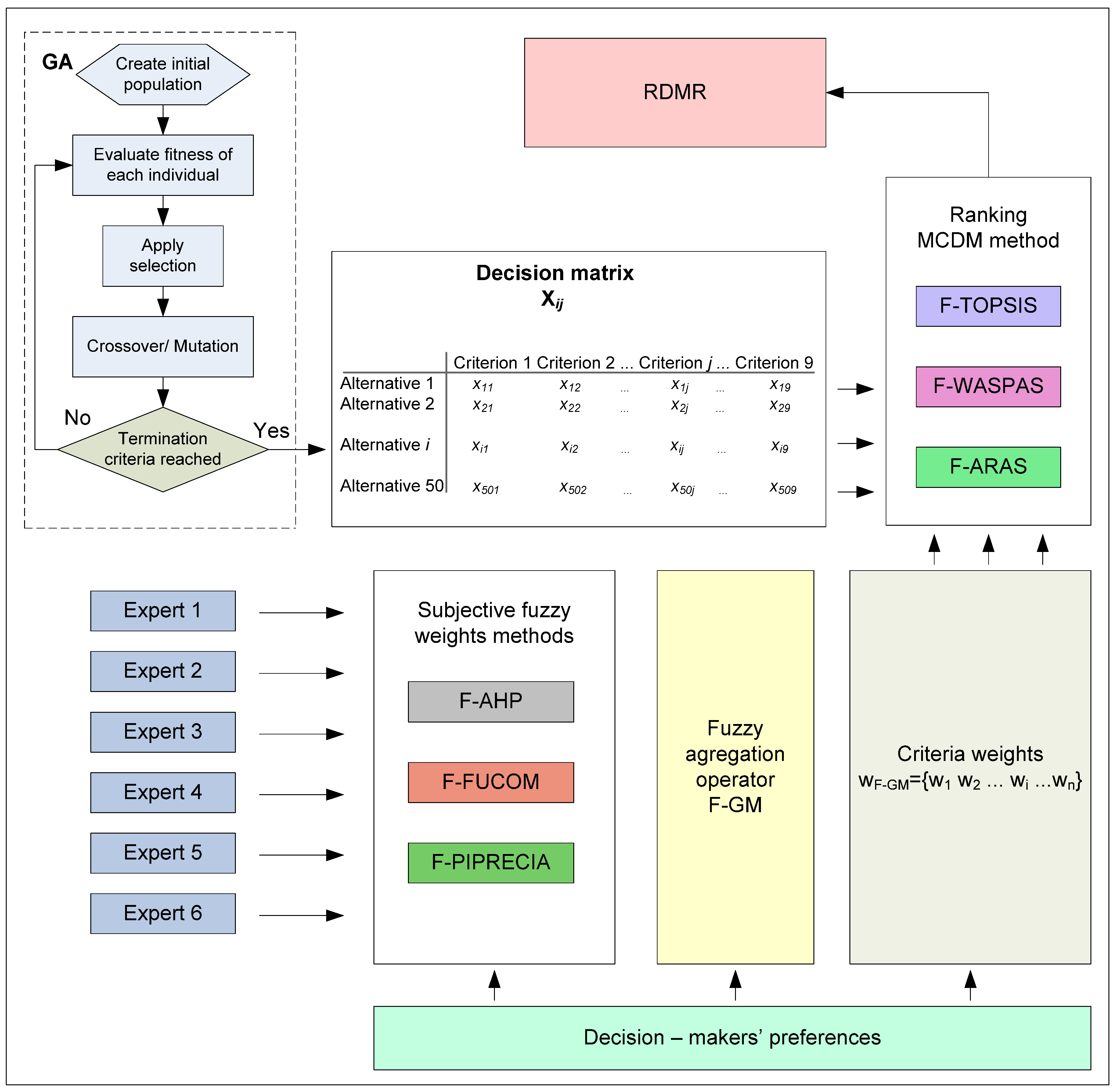
Figure 1. Hybrid approach for optimal signal timing plan determination.
Sustainability 18 03514 g001
Figure 2. The intersection analyzed for traffic signal optimization.
Sustainability 18 03514 g002
Figure 3. Comparative analysis of the existing fixed signal timing plan and the obtained optimal plan based on the hybrid model.
Sustainability 18 03514 g003
Table 1. Alternatives obtained using the GA.
Alternatives (A1–A50)
A1(30, 10.8, 13.2)A11(30, 13.9, 10.1)A21(30, 15.3, 8.7)A31(40, 20, 14)A41(40, 22.3, 11.7)
A2(30, 11.4, 12.6)A12(30, 14, 10)A22(30, 15.9, 8.1)A32(40, 20.1, 13.9)A42(40, 22.5, 11.5)
A3(30, 12.4, 11.6)A13(30, 14.1, 9.9)A23(30, 16, 8)A33(40, 20.4, 13.6)A43(50, 22.9, 21.1)
A4(30, 12.7, 11.3)A14(30, 14.2, 9.8)A24(30, 16.3, 7.7)A34(40, 20.5, 13.5)A44(50, 23.9, 20.1)
A5(30, 13, 11)A15(30, 14.3, 9.7)A25(30, 17.4, 6.6)A35(40, 21.2, 12.8)A45(50, 24.7, 19.3)
A6(30, 13.1, 10.9)A16(30, 14.4, 9.6)A26(30, 8.8, 15.2)A36(40, 21.3, 12.7)A46(50, 25, 19)
A7(30, 13.2, 10.8)A17(30, 14.5, 9.5)A27(40, 17.6, 16.4)A37(40, 21.4, 12.6)A47(50, 25.5, 18.5)
A8(30, 13.4, 10.6)A18(30, 14.8, 9.2)A28(40, 18.2, 15.8)A38(40, 21.7, 12.3)A48(50, 26.8, 17.2)
A9(30, 13.5, 10.5)A19(30, 15, 9)A29(40, 18.3, 15.7)A39(40, 21.9, 12.1)A49(50, 30, 14)
A10(30, 13.6, 10.4)A20(30, 15.1, 8.9)A30(40, 19.5, 14.5)A40(40, 22.1, 11.9)A50(60, 31.7, 22.3)
Table 2. Performance evaluations of cycle lengths and green time allocations—fuzzy decision-making matrix.
AiC1 [veh]C2 [s/vehicle]C3 [stops]C4 [m]C5 [%]C6 [s]C7 [−]C8 [−]C9 [−]
C51C52C61C62C71C72
MaxMinMinMinMaxMinMinMinMax
A13887(9.59, 9.81, 10.05)(771, 835, 899)(32.03, 34.78, 37.53)(0.45, 0.49, 0.52)(0.26, 0.28, 0.3)6.144.70(0.17, 0.33, 0.5)(0.17, 0.33, 0.5)(0.17, 0.33, 0.5)(0, 0, 0.25)
A23853(8.59, 8.77, 8.96)(466, 528, 590)(19.35, 21.97, 24.6)(0.25, 0.29, 0.32)(0.17, 0.19, 0.21)5.775.05(0.17, 0.33, 0.5)(0, 0.17, 0.33)(0, 0.17, 0.33)(0, 0, 0.25)
A33798(8.77, 8.97, 9.18)(855, 914, 972)(35.64, 38.05, 40.47)(0.45, 0.49, 0.52)(0.32, 0.34, 0.36)5.165.64(0.17, 0.33, 0.5)(0.17, 0.33, 0.5)(0.33, 0.5, 0.67)(0, 0, 0.25)
A43781(8.7, 8.9, 9.11)(896, 954, 1011)(37.32, 39.68, 42.03)(0.48, 0.51, 0.54)(0.33, 0.35, 0.37)4.995.83(0.17, 0.33, 0.5)(0.17, 0.33, 0.5)(0.33, 0.5, 0.67)(0, 0, 0.25)
A53765(8.84, 9.05, 9.28)(1024, 1080, 1137)(42.58, 44.87, 47.16)(0.56, 0.59, 0.62)(0.37, 0.39, 0.41)4.826.02(0.17, 0.33, 0.5)(0.33, 0.5, 0.67)(0.33, 0.5, 0.67)(0, 0, 0.25)
A63759(7.24, 7.37, 7.51)(228, 284, 341)(9.58, 11.85, 14.12)(0.11, 0.14, 0.17)(0.09, 0.12, 0.14)4.766.08(0, 0.17, 0.33)(0, 0, 0.17)(0, 0, 0.17)(0, 0, 0.25)
A73754(8.37, 8.56, 8.76)(908, 964, 1020)(37.83, 40.08, 42.33)(0.46, 0.49, 0.52)(0.35, 0.38, 0.4)4.706.14(0, 0.17, 0.33)(0.33, 0.5, 0.67)(0.33, 0.5, 0.67)(0, 0, 0.25)
A83743(7.53, 7.68, 7.83)(559, 614, 670)(23.45, 25.66, 27.87)(0.24, 0.27, 0.3)(0.25, 0.27, 0.3)4.596.27(0, 0.17, 0.33)(0.17, 0.33, 0.5)(0.17, 0.33, 0.5)(0, 0.25, 0.5)
A93737(8.58, 8.78, 9)(1078, 1133, 1188)(44.84, 47.03, 49.22)(0.56, 0.59, 0.61)(0.41, 0.44, 0.47)4.546.34(0.17, 0.33, 0.5)(0.33, 0.5, 0.67)(0.33, 0.5, 0.67)(0, 0.25, 0.5)
A103731(8.04, 8.22, 8.4)(894, 948, 1003)(37.31, 39.48, 41.65)(0.43, 0.45, 0.48)(0.37, 0.4, 0.42)4.486.40(0, 0.17, 0.33)(0.33, 0.5, 0.67)(0.33, 0.5, 0.67)(0, 0.25, 0.5)
A113715(8.3, 8.5, 8.71)(1061, 1114, 1168)(44.04, 46.14, 48.25)(0.55, 0.58, 0.6)(0.41, 0.44, 0.47)4.326.60(0, 0.17, 0.33)(0.33, 0.5, 0.67)(0.33, 0.5, 0.67)(0, 0.25, 0.5)
A123709(7.81, 7.97, 8.15)(917, 971, 1024)(38.35, 40.43, 42.51)(0.42, 0.44, 0.47)(0.4, 0.43, 0.46)4.276.67(0, 0.17, 0.33)(0.33, 0.5, 0.67)(0.33, 0.5, 0.67)(0, 0.25, 0.5)
A133704(7.45, 7.6, 7.77)(719, 772, 825)(29.99, 32.05, 34.11)(0.35, 0.37, 0.4)(0.3, 0.33, 0.35)4.216.73(0, 0.17, 0.33)(0.17, 0.33, 0.5)(0.17, 0.33, 0.5)(0, 0.25, 0.5)
A143698(7.88, 8.05, 8.23)(1025, 1077, 1130)(42.81, 44.85, 46.89)(0.46, 0.49, 0.51)(0.46, 0.48, 0.51)4.166.80(0, 0.17, 0.33)(0.33, 0.5, 0.67)(0.33, 0.5, 0.67)(0, 0.25, 0.5)
A153693(7.46, 7.61, 7.77)(803, 855, 907)(33.48, 35.5, 37.52)(0.38, 0.4, 0.43)(0.35, 0.37, 0.4)4.116.87(0, 0.17, 0.33)(0.17, 0.33, 0.5)(0.17, 0.33, 0.5)(0, 0.25, 0.5)
A163687(7.71, 7.88, 8.05)(1017, 1069, 1121)(42.53, 44.53, 46.53)(0.44, 0.47, 0.5)(0.47, 0.5, 0.52)4.066.94(0, 0.17, 0.33)(0.33, 0.5, 0.67)(0.33, 0.5, 0.67)(0, 0.25, 0.5)
A173682(7.46, 7.62, 7.78)(859, 911, 963)(35.75, 37.73, 39.71)(0.41, 0.44, 0.46)(0.37, 0.4, 0.42)4.007.00(0, 0.17, 0.33)(0.33, 0.5, 0.67)(0.33, 0.5, 0.67)(0, 0.25, 0.5)
A183665(7.32, 7.48, 7.64)(918, 969, 1020)(38.31, 40.23, 42.14)(0.41, 0.44, 0.46)(0.42, 0.45, 0.48)3.857.21(0, 0.17, 0.33)(0.33, 0.5, 0.67)(0.33, 0.5, 0.67)(0, 0.25, 0.5)
A193654(7.54, 7.71, 7.89)(1114, 1164, 1214)(46.44, 48.32, 50.19)(0.49, 0.52, 0.54)(0.53, 0.55, 0.58)3.757.35(0, 0.17, 0.33)(0.5, 0.67, 0.83)(0.33, 0.5, 0.67)(0, 0.25, 0.5)
A203648(7.19, 7.35, 7.51)(934, 984, 1033)(38.83, 40.68, 42.54)(0.43, 0.45, 0.48)(0.43, 0.46, 0.49)3.707.42(0, 0.17, 0.33)(0.33, 0.5, 0.67)(0.33, 0.5, 0.67)(0, 0.25, 0.5)
A213637(6.43, 6.55, 6.68)(536, 585, 634)(22.4, 24.21, 26.02)(0.24, 0.26, 0.29)(0.25, 0.28, 0.31)3.607.56(0, 0.17, 0.33)(0, 0.17, 0.33)(0, 0.17, 0.33)(0, 0.25, 0.5)
A223604(5.88, 5.99, 6.1)(341, 388, 435)(13.95, 15.64, 17.33)(0.19, 0.21, 0.23)(0.13, 0.16, 0.2)3.317.99(0, 0.17, 0.33)(0, 0.17, 0.33)(0, 0.17, 0.33)(0, 0.25, 0.5)
A233598(6.63, 6.76, 6.91)(991, 1038, 1085)(41.43, 43.1, 44.77)(0.4, 0.43, 0.45)(0.53, 0.56, 0.6)3.278.07(0, 0.17, 0.33)(0.17, 0.33, 0.5)(0.33, 0.5, 0.67)(0, 0.25, 0.5)
A243582(6.04, 6.15, 6.27)(685, 731, 777)(28.49, 30.09, 31.69)(0.3, 0.32, 0.34)(0.36, 0.39, 0.43)3.138.29(0, 0.17, 0.33)(0, 0.17, 0.33)(0.17, 0.33, 0.5)(0, 0.25, 0.5)
A253521(4.65, 4.72, 4.79)(31, 73, 115)(1.65, 3.02, 4.4)(0.01, 0.03, 0.05)(0.01, 0.05, 0.09)2.659.13(0, 0, 0.17)(0, 0, 0.17)(0, 0, 0.17)(0, 0.25, 0.5)
A263997(9.34, 9.53, 9.73)(36, 107, 178)(1.24, 4.4, 7.57)(0.03, 0.07, 0.11)(0.02, 0.04, 0.05)7.493.65(0.17, 0.33, 0.5)(0, 0, 0.17)(0, 0, 0.17)(0, 0, 0.25)
A274034(11.75, 12.03, 12.32)(1201, 1257, 1313)(74.08, 77.5, 80.92)(0.55, 0.58, 0.61)(0.49, 0.51, 0.53)6.276.96(0.33, 0.5, 0.67)(0.5, 0.67, 0.83)(0.67, 0.83, 1)(0, 0.25, 0.5)
A284009(9.07, 9.23, 9.41)(170, 224, 279)(10.53, 13.82, 17.11)(0.08, 0.1, 0.13)(0.07, 0.09, 0.11)5.947.32(0.17, 0.33, 0.5)(0, 0, 0.17)(0, 0, 0.17)(0.25, 0.5, 0.75)
A294005(10.65, 10.89, 11.14)(890, 944, 999)(54.86, 58.13, 61.4)(0.45, 0.47, 0.5)(0.34, 0.36, 0.38)5.897.38(0.33, 0.5, 0.67)(0.33, 0.5, 0.67)(0.5, 0.67, 0.83)(0.25, 0.5, 0.75)
A303955(11.03, 11.3, 11.59)(1288, 1340, 1391)(79.34, 82.36, 85.38)(0.61, 0.64, 0.66)(0.52, 0.55, 0.57)5.258.13(0.33, 0.5, 0.67)(0.67, 0.83, 1)(0.67, 0.83, 1)(0.25, 0.5, 0.75)
A313934(8.79, 8.96, 9.13)(474, 524, 574)(29.15, 32.07, 34.98)(0.24, 0.27, 0.29)(0.18, 0.2, 0.23)5.008.45(0.17, 0.33, 0.5)(0.17, 0.33, 0.5)(0.17, 0.33, 0.5)(0.25, 0.5, 0.75)
A323930(9.97, 10.19, 10.43)(1038, 1088, 1137)(63.88, 66.78, 69.67)(0.49, 0.51, 0.54)(0.43, 0.46, 0.48)4.958.52(0.17, 0.33, 0.5)(0.5, 0.67, 0.83)(0.5, 0.67, 0.83)(0.25, 0.5, 0.75)
A333918(9.27, 9.46, 9.66)(792, 841, 890)(48.61, 51.44, 54.27)(0.4, 0.42, 0.44)(0.31, 0.34, 0.37)4.808.71(0.17, 0.33, 0.5)(0.33, 0.5, 0.67)(0.33, 0.5, 0.67)(0.25, 0.5, 0.75)
A343913(9.8, 10.01, 10.24)(1093, 1142, 1191)(67.4, 70.21, 73.02)(0.48, 0.51, 0.53)(0.48, 0.51, 0.54)4.758.78(0.17, 0.33, 0.5)(0.5, 0.67, 0.83)(0.67, 0.83, 1)(0.25, 0.5, 0.75)
A353884(8.53, 8.69, 8.86)(664, 711, 758)(40.69, 43.36, 46.03)(0.32, 0.35, 0.37)(0.28, 0.3, 0.33)4.429.25(0.17, 0.33, 0.5)(0.17, 0.33, 0.5)(0.33, 0.5, 0.67)(0.25, 0.5, 0.75)
A363880(9.12, 9.31, 9.52)(956, 1002, 1049)(58.56, 61.2, 63.85)(0.46, 0.48, 0.5)(0.41, 0.44, 0.46)4.379.32(0.17, 0.33, 0.5)(0.5, 0.67, 0.83)(0.5, 0.67, 0.83)(0.25, 0.5, 0.75)
A373876(9.71, 9.93, 10.17)(1274, 1320, 1367)(78.42, 81.04, 83.67)(0.55, 0.58, 0.6)(0.6, 0.62, 0.65)4.329.38(0.17, 0.33, 0.5)(0.5, 0.67, 0.83)(0.67, 0.83, 1)(0.25, 0.5, 0.75)
A383864(7.59, 7.72, 7.85)(320, 366, 412)(19.8, 22.37, 24.93)(0.15, 0.17, 0.19)(0.14, 0.17, 0.2)4.199.59(0.17, 0.33, 0.5)(0, 0.17, 0.33)(0, 0.17, 0.33)(0.25, 0.5, 0.75)
A393847(7.2, 7.31, 7.43)(218, 263, 308)(13.72, 16.2, 18.68)(0.08, 0.1, 0.13)(0.11, 0.14, 0.17)4.019.87(0.17, 0.33, 0.5)(0, 0, 0.17)(0, 0.17, 0.33)(0.5, 0.75, 1)
A403848(6.23, 6.33, 6.44)(107, 151, 196)(0.66, 5.22, 9.79)(0.01, 0.03, 0.05)(0, 0.02, 0.03)4.014.10(0, 0.17, 0.33)(0, 0, 0.17)(0, 0, 0.17)(0.5, 0.75, 1)
A413839(9.15, 9.35, 9.56)(1351, 1395, 1439)(83.63, 86.07, 88.51)(0.52, 0.54, 0.56)(0.72, 0.75, 0.78)3.9210.01(0.17, 0.33, 0.5)(0.5, 0.67, 0.83)(0.83, 1, 1)(0.5, 0.75, 1)
A423830(7.06, 7.17, 7.29)(192, 236, 280)(11.51, 13.91, 16.31)(0.13, 0.15, 0.17)(0.05, 0.08, 0.11)3.8310.15(0.17, 0.33, 0.5)(0, 0.17, 0.33)(0, 0.17, 0.33)(0.5, 0.75, 1)
A434172(13.63, 13.94, 14.27)(1034, 1089, 1143)(84.73, 89.12, 93.52)(0.49, 0.52, 0.55)(0.4, 0.42, 0.44)7.348.35(0.67, 0.83, 1)(0.67, 0.83, 1)(0.83, 1, 1)(0.5, 0.75, 1)
A444139(13.51, 13.83, 14.17)(1139, 1191, 1243)(93.22, 97.41, 101.6)(0.55, 0.58, 0.61)(0.44, 0.46, 0.48)6.818.94(0.5, 0.67, 0.83)(0.83, 1, 1)(0.83, 1, 1)(0.5, 0.75, 1)
A454112(12.54, 12.82, 13.12)(986, 1037, 1087)(80.73, 84.76, 88.78)(0.47, 0.5, 0.53)(0.39, 0.41, 0.43)6.409.42(0.5, 0.67, 0.83)(0.67, 0.83, 1)(0.67, 0.83, 1)(0.5, 0.75, 1)
A464102(13.56, 13.89, 14.25)(1339, 1389, 1439)(109.65, 113.61, 117.56)(0.62, 0.65, 0.67)(0.55, 0.57, 0.59)6.259.61(0.5, 0.67, 0.83)(0.83, 1, 1)(0.83, 1, 1)(0.5, 0.75, 1)
A474086(12.3, 12.56, 12.85)(1077, 1126, 1175)(88.22, 92.08, 95.93)(0.48, 0.51, 0.53)(0.45, 0.48, 0.5)6.009.92(0.5, 0.67, 0.83)(0.67, 0.83, 1)(0.83, 1, 1)(0.5, 0.75, 1)
A484043(11.34, 11.58, 11.84)(980, 1027, 1073)(80.14, 83.72, 87.3)(0.45, 0.47, 0.5)(0.42, 0.44, 0.47)5.3810.76(0.33, 0.5, 0.67)(0.5, 0.67, 0.83)(0.67, 0.83, 1)(0.75, 1, 1)
A493936(10.56, 10.79, 11.04)(1376, 1416, 1456)(112.25, 115.16, 118.08)(0.57, 0.59, 0.61)(0.73, 0.76, 0.79)4.0012.96(0.33, 0.5, 0.67)(0.67, 0.83, 1)(0.83, 1, 1)(0.75, 1, 1)
A504167(14.52, 14.86, 15.21)(1132, 1180, 1227)(115.67, 120.32, 124.97)(0.54, 0.56, 0.59)(0.45, 0.48, 0.5)6.6711.84(0.83, 1, 1)(0.83, 1, 1)(0.83, 1, 1)(0.75, 1, 1)
Table 3. Aggregated criteria weight coefficients obtained by the F-GM operator.
C1C2C3C4C5C6C7C8C9
F-AHP
m 10.162260.176060.162460.124580.164930.075240.018260.036990.07923
F-FUCOM
l 20.067490.076420.056190.051380.057780.045750.032620.057490.0381
m0.143620.129590.108580.132480.108710.100450.092150.122860.07384
u 30.144520.131360.108590.135620.114910.100470.100270.140890.07593
F-PIPRECIA
l0.049910.052220.039980.032560.044510.028170.019760.017120.02057
m0.15060.169270.126020.103810.152030.086720.057880.050370.06586
u0.555130.574060.42320.33880.475640.270340.188020.168170.25462
1 middle, 2 lower, 3 upper.
Table 4. Ranking of alternatives according to different sets of criteria weight coefficients.
F-AHPF-FUCOMF-PIPRECIARDMR Rank
F-TOPSISF-WASPASF-ARASF-TOPSISF-WASPASF-ARASF-TOPSISF-WASPASF-ARAS
A148505050485050505050
A249451112111131251126
A344494948504948494949
A443484847494847484848
A534474645464745474747
A6454345631510419
A739462829282632382634
A846402532232439242531
A919424135354430294439
A1031412425252523232427
A1110351617191713151713
A1228392223242321222223
A1335342326152227212324
A1418381920222018191920
A1533322124142124172122
A1616371819201916181816
A1726362022211820202021
A1821331721181619161615
A198311414171410131410
A2012301516161514141512
A2115874564464
A2217753453353
A2352913131313812138
A2411211211121258127
A252222222222
A2641133674121139
A2736444746474644464646
A284746937285714
A2938224543404543424544
A309203431383726313730
A3150114449294249394345
A3227184039364137334038
A3337164342334342364241
A3422193936373933323935
A3542124244304046344142
A3625143738323836303833
A377153128313322283425
A38406101010101791011
A3929597887696
A401111111111
A4149271826289262717
A4223388996785
A4332283841453641453643
A4420263334423229403132
A4530253640433540433540
A466232927393025352928
A4724243537413435413237
A4813173030342934373029
A493102615272711272818
A5014273233443138443336
Table 5. Performance test results (Kendall’s and Spearman’s rank correlation coefficients).
F-AHPF-FUCOMF-PIPRECIARDMR
Fuzzy TOPSISFuzzy WASPASFuzzy ARASFuzzy TOPSISFuzzy WASPASFuzzy ARASFuzzy TOPSISFuzzy WASPASFuzzy ARAS
F-AHPFuzzy TOPSIS τ b 1.00000.25880.26040.35840.13140.22610.48410.25710.23430.3829
ρ 1.00000.35480.30800.41150.17380.27970.63420.33450.28460.5181
Fuzzy WASPAS τ b 0.25881.00000.26370.29310.39270.26530.32080.38120.26040.3633
ρ 0.35481.00000.37660.42260.43110.37230.43410.45860.37250.4900
Fuzzy ARAS τ b 0.26040.26371.00000.89550.80900.96240.73710.82040.97060.8449
ρ 0.30800.37661.00000.97730.93920.99670.87840.93580.99690.9478
F-FUCOMFuzzy TOPSIS τ b 0.35840.29310.89551.00000.76980.86780.83510.79760.86940.8743
ρ 0.41150.42260.97731.00000.91480.96560.93380.93150.96670.9654
Fuzzy WASPAS τ b 0.13140.39270.80900.76981.00000.81060.63100.85800.80240.7322
ρ 0.17380.43110.93920.91481.00000.93770.80910.96320.93460.8998
Fuzzy ARAS τ b 0.22610.26530.96240.86780.81061.00000.70610.79920.97880.8139
ρ 0.27970.37230.99670.96560.93771.00000.85970.92340.99850.9358
F-PIPRECIAFuzzy TOPSIS τ b 0.48410.32080.73710.83510.63100.70611.00000.74040.72410.8629
ρ 0.63420.43410.87840.93380.80910.85971.00000.88790.86530.9642
Fuzzy WASPAS τ b 0.25710.38120.82040.79760.85800.79920.74041.00000.80730.8318
ρ 0.33450.45860.93580.93150.96320.92340.88791.00000.92360.9498
Fuzzy ARAS τ b 0.23430.26040.97060.86940.80240.97880.72410.80731.00000.8286
ρ 0.28460.37250.99690.96670.93460.99850.86530.92361.00000.9381
RDMR τ b 0.38290.36330.84490.87430.73220.81390.86290.83180.82861.0000
ρ 0.51810.49000.94780.96540.89980.93580.96420.94980.93811.0000
Sum τ b 3.59353.79927.56417.56086.93717.43027.04167.29317.47597.5347
ρ 4.29934.71278.35698.48938.00338.26948.26678.30848.28068.6090
Disclaimer/Publisher’s Note: The statements, opinions and data contained in all publications are solely those of the individual author(s) and contributor(s) and not of MDPI and/or the editor(s). MDPI and/or the editor(s) disclaim responsibility for any injury to people or property resulting from any ideas, methods, instructions or products referred to in the content.