Article

GIS and AHP-Based Agricultural Land-Use Suitability Analysis in Semi-Arid Regions of Southeastern Türkiye

1
Department of Design, Caycuma Vocational School, Zonguldak Bülent Ecevit University, 67900 Zonguldak, Türkiye
2
Department of Landscape Architecture, Graduate School, Bartın University, 74100 Bartin, Türkiye
3
Department of Landscape Architecture, Faculty of Engineering, Architecture and Design, Bartın University, 74100 Bartin, Türkiye
4
Department of Architecture and Urban Planning, Vocational School, Mardin Artuklu University, 47200 Mardin, Türkiye
*
Author to whom correspondence should be addressed.
Sustainability 2026, 18(7), 3508; https://doi.org/10.3390/su18073508
Submission received: 20 February 2026 / Revised: 23 March 2026 / Accepted: 31 March 2026 / Published: 3 April 2026

Abstract

This study aims to identify agricultural land suitability in Mardin province, located in the semi-arid Southeastern Anatolia Region of Türkiye. Within this framework, eight ecological criteria were selected to assess agricultural land suitability. Criterion weights were derived from expert judgments using the Analytical Hierarchy Process (AHP), a Multi-Criteria Decision-Making (MCDM) method. The criteria were evaluated within the framework of the five classes used in agricultural land-use suitability, in accordance with the guidelines of the Food and Agriculture Organization of the United Nations (FAO). Based on this classification, maps of the determined criteria were prepared using Geographic Information Systems (GISs), and an agricultural land-use suitability map was produced using a weighted overlay approach. The results indicate that 31.3% of the total land area in Mardin province falls within the highly and moderately suitable classes. For validation, the suitability map was overlaid with the Coordination of Information on the Environment (CORINE) Land Cover (CLC) 2018 data, revealing that 98.8% of highly suitable (S1) areas and 94.6% of moderately suitable (S2) areas correspond to existing agricultural lands. Furthermore, Receiver Operating Characteristic (ROC) analysis yielded an Area Under the Curve (AUC) value of 0.815, indicating an acceptable-to-good discrimination ability and confirming the robustness of the model.

1. Introduction

Climate change is increasing agricultural risks in arid and semi-arid regions. Agricultural planning and agricultural land-use suitability assessment in arid and semi-arid areas have become increasingly critical in the face of today’s environmental and socio-economic challenges, such as climate change, water scarcity, and land degradation. These areas are of strategic importance for food security, rural development, and sustainable land management, especially in developing countries [1].
In addition to climate-related stressors, improper and unplanned land-use management leads to land depletion and degradation, negatively impacting agricultural activities and posing a major threat to natural resources. Indeed, the World Commission on Environment and Development [2] linked land suitability to sustainable development and defined sustainable development as “growth that meets the needs of the present without jeopardizing the needs of future generations”. The rational and sustainable use of non-renewable natural resources such as land is one of the most important indicators of economic growth [3]. Sustainable land management is widely recognized as a critical strategy for reducing the global rate of land degradation [4,5,6]. In order to implement sustainable land management, agricultural land-use suitability must first be scientifically assessed.
Agricultural land-use suitability assessment is one of the most effective models for revealing concerns about arable land and estimating allocation for long-term growth in semi-arid regions [7,8]. Furthermore, land suitability assessment helps identify the most suitable crop growing areas; therefore, it is a key factor in proper planning to maximize production yield [9]. In semi-arid regions, physiographic components play a fundamental role in the planning and sustainability of agricultural activities [8]. In land suitability analyses, classifying land into suitability classes (S1, S2, S3, N1, N2) provides rational guidance for land-use planning [9].
Agricultural lands provide the largest share of food resources and offer a significant number of ecosystem services (providing food, fuel, and fiber) [10]. Therefore, planning efforts worldwide aim to support the sustainable use of agricultural lands. The United Nations Sustainable Development Goal (SDG) 2 aims to eliminate hunger and ensure food security for all by 2030. Achieving this goal requires a multidisciplinary approach that integrates all forms of science, including mathematics and statistics, with agricultural practice [11]. Planning for agricultural areas forms the basis for the economic systems and agricultural policies of developed and developing countries [11,12,13]. In this case, it is necessary to identify potential agricultural lands and carry out land-use planning in order to rationally analyze and evaluate rapid, accurate, and sufficient information and data about soil, land resources and potentials by taking advantage of today’s technologies [14]. In this context, the increasing global population, rising food demand, and socio-economic factors have increased the need for land suitability assessment for agricultural areas [15,16]. Utilizing land according to its potential and capabilities is essential for achieving optimum productivity [17,18].

Conceptual Framework

Rational and sustainable land use is a crucial issue for the benefit of current and future populations, both for land-users and decision-makers concerned with the conservation of land resources. Determining the suitability classes of agricultural lands is vital for land assessment and land use planning studies, enabling optimal land use decisions and identifying efficient uses through comparisons between different land types [13]. This directly impacts cropping patterns and agricultural productivity in a region [19].
It appears that there is no specific standard for the criteria to be considered when evaluating the agricultural suitability potential of land, and the criteria used in similar studies are generally readily available. Many studies [3,12,20,21] commonly use soil and topographic parameters to determine land suitability.
It appears that several criteria need to be considered together to evaluate the suitability of a particular plot of land for agricultural production. Since not all criteria affecting land suitability have equal importance, various methods have been used to determine the weights of these criteria and the scores of the sub-criteria [3]. In this context, the role of remote sensing (RS), GIS, and AHP integration in multi-criteria land suitability analyses is of great importance. In land evaluation analyses, multi-criteria analysis approaches that consider various factors together provide more holistic and reliable results. MCDM techniques, which can help find a suitable alternative for a given complex situation, have proven to be effectively applicable in complex decision-making problems, particularly in agricultural planning and management, due to their potential to offer optimal solutions [11].
Developed by Saaty [22], AHP is one of the most comprehensive MCDM tools for ranking alternatives by providing a decision structure to handle multiple objectives [11]. AHP involves multiple choices based on the importance and weights of parameters relative to each other within a hierarchical system [18,22]. AHP, which assigns weights to evaluation criteria, has the ability to identify and consolidate inconsistencies in the decision-making process [13]. In their study, Hassan et al. [12] emphasized that the integration of AHP into land-use suitability is efficient and will help policymakers improve the management of land resources.
Regional studies have shown that RS and GIS technologies are effective tools in evaluating land-use suitability for different agricultural uses. Thanks to its ability to analyze numerous spatial factors on the same platform, the integration of GIS with MCDM methods is widely used in agricultural land-use suitability classifications [20,23,24]. GIS-AHP applications are among the most frequently used approaches for integrating AHP with other decision support techniques [25].
This study, conducted to determine agriculturally suitable areas throughout the semi-arid Mardin province, utilized the AHP method for land-use suitability analysis. Expert opinions were consulted in determining the weights of the criteria, and the resulting agricultural land-use suitability map was divided into five categories (highly suitable, moderately suitable, marginally suitable, currently not suitable, permanently not suitable) according to the FAO [26] land suitability classification. The resulting agricultural suitability map was then overlaid and compared with the land cover map obtained from the CORINE 2018 data [27], and the extent of their overlap was calculated.
This article outlines two major research questions:
RQ1: How can suitability classes for agricultural land-use be determined in semi-arid climate regions using ecological criteria?
RQ2: To what extent do the existing agricultural areas and the agricultural land-use suitability classes produced using the GIS-based AHP method match in accuracy?

2. Study Area

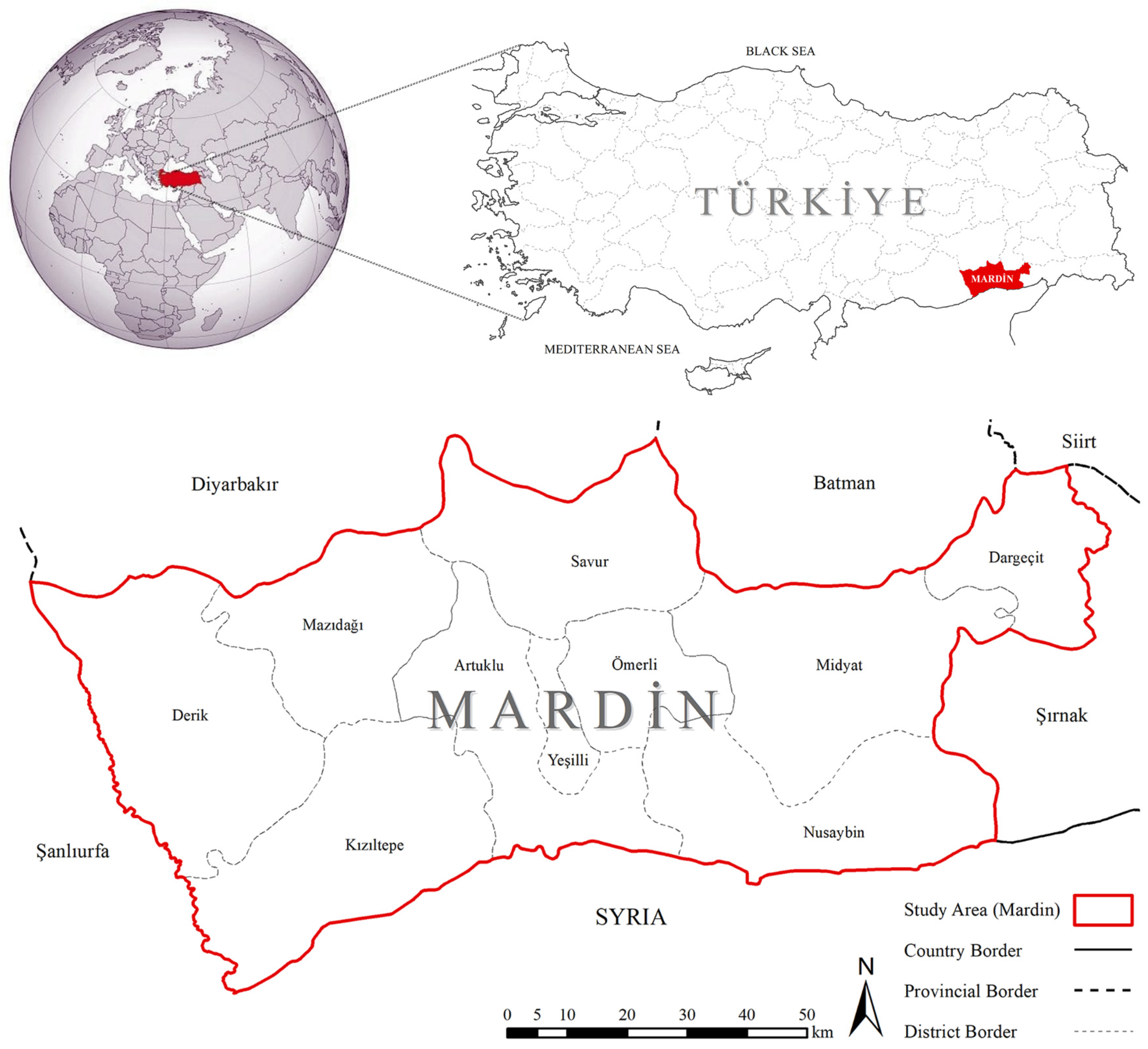
The study area is defined as the administrative boundaries of Mardin province, located in the Southeastern Anatolia Region of Türkiye (Figure 1). Situated in the region known as the “Fertile Crescent” within the Euphrates–Tigris Basin, the study area is geographically located between 36°54′–37°43′ north latitudes and 39°52′–41°53′ east longitudes. Its surface area is approximately 878,101.9 ha, and its altitude is approximately 1083 m above sea level. Mardin is bordered by Syria to the south, Şanlıurfa to the west, Diyarbakır and Batman to the north, Şırnak to the east, and Siirt to the northeast. Mardin province has a total of ten districts: Artuklu, Kızıltepe, Midyat, Nusaybin, Dargeçit, Derik, Mazıdağı, Ömerli, Yeşilli, and Savur. According to the 2024 Turkish Statistical Institute Address-Based Population Registration System data, the total population of Mardin province is 895,911. The districts with the highest population density are Kızıltepe with 30.75% and Artuklu with 22.08%, while the district with the lowest density is Yeşilli with 1.45%. The location of the study area is presented in Figure 1.
Climatic data show that the region has a climate similar to the Mediterranean; summers are hot and dry, while winters are mild and rainy. In Mardin, cold weather conditions are experienced during the winter months due to the influence of high-pressure areas. Due to the influence of the desert climate in the south (the Basra Low-Pressure system) and the high mountains in the north preventing cool air masses from entering the region, summers are quite hot in the plains area of the province. Occasional continental climate characteristics are observed in the northern part of the province [28,29]. According to the General Directorate of Meteorology, the average annual temperature in Mardin is 16.2 °C, the average annual sunshine duration is 8.1 h, and the total annual rainfall is 673.1 mm. The hottest months are July and August, with an average temperature of 29 °C, while the coldest months are January and February, with an average temperature of around 4 °C. Water deficit in the region reaches its highest level, especially in July and August, when agricultural products require the most water [28,29,30].

3. Method

3.1. Preparation of Spatial Datasets

The spatial datasets used in the agricultural land-use suitability analysis were determined in line with the study’s objective, based on literature reviews and expert opinions. In this context, data layers representing the main and sub-criteria were obtained from various institutions. These data were imported into ArcGIS 10.8 (ESRI, Redlands, CA, USA) software and prepared for analysis. Topographic factor criteria were obtained from ASTER GDEM v3 data (NASA/METI, Reston, VA, USA) downloaded from the USGS EarthExplorer website. Soil factor criteria were generated using a digital soil map obtained from the Mardin Provincial Directorate of Agriculture and Forestry (Mardin, Türkiye). The land-use map was created from CORINE 2018 Land Cover data (European Environment Agency, Copenhagen, Denmark) obtained from the Copernicus website. Spatial datasets from different sources were converted to the WGS 1984 UTM Zone 37N projection system (EPSG:32637) to ensure analytical integrity. The datasets were converted to raster format and reconstructed at a spatial resolution of 30 × 30 m to ensure comparability. The data types and sources used in the study are presented in Table 1.

3.2. Criteria Identification and Reclassification

In our study, the criteria to be used for evaluating the suitability for agricultural purposes were determined by examining the studies carried out by Akıncı et al. [3], Anusha et al. [7], Hassan et al. [12], Özkan et al. [13], Demir [32] and Yin et al. [33] and by taking into account the expert opinions on the subject. In selecting expert opinions, a total of 10 individuals from different institutions and professional groups were interviewed. This included four academics (one professor and two assistant professors from the Kızıltepe Faculty of Agricultural Sciences and Technologies at Mardin Artuklu University, and one lecturer from Mardin Vocational School); two agricultural engineers from the Mardin Provincial Directorate of Agriculture and Forestry; one landscape architect from the Mardin Metropolitan Municipality; one landscape architect from the private sector; and two farmers engaged in agricultural activities in Mardin. Accordingly, in selecting the criteria, eight main ecological criteria (slope, aspect, elevation, LUCC, GSG, soil depth, OSP and erosion degree) and sub-criteria, classified under two factors (topographic and soil) that directly affect agricultural suitability, were considered (Table 2). Climate and hydrological criteria, which are known to have significant effects on agricultural production [34,35,36], were excluded from the evaluation due to low spatial resolution and data limitations; the analysis focused on topographic and soil variables. Using the prepared spatial datasets, thematic maps for each criterion were created in an ArcGIS environment. Then, each criterion map was reclassified and standardized into five categories based on the suitability levels (highly suitable, moderately suitable, marginally suitable, currently not suitable, permanently not suitable) defined within the FAO [26] land assessment framework to reflect the suitability of the agricultural land. All criteria were scored on a scale of 1–5, where 5 represents the greatest significance and 1 represents the least significance. Standardized criterion maps were used as the input dataset in the weighting phase of the AHP method.

3.3. Weighting of Criteria Using the AHP Approach

Literature reviews reveal that multi-criteria problems are generally solved using the AHP method [25,30]. In this study, the AHP method was chosen because of the multi-criteria nature of our problem and its suitability for solving this structure. In this context, the AHP steps [22,25,30] are given below.
Step 1. A pairwise comparison matrix (A) of n × n criteria is created. k i j   expresses how much more important criterion i is compared to criterion j, using the value scale proposed by Saaty [22], as shown in Table 3. The components on the diagonal of the comparison matrix take the value 1 when i = j. For values below the diagonal, a matrix with opposing properties is calculated using k i j = 1 k i j (Equation (1)).
A = k 11 k 12 k 1 n k 21 k 22 k 2 n k n 1 k n 2 k n n
Step 2. The pairwise comparison matrices are normalized to form the Aw matrix. To find this Aw matrix, each value in column j is divided by the sum of the values in column j. In the newly calculated Aw matrix, the sum of each column must be equal to 1 (Equation (2)).
A W = k 11 k i 1 k 12 k i 2 k 1 n k i n k n 1 k i 1 k n 2 k i 2 k n n k i n
Step 3. The priority vector (C) is calculated from the normalized Aw matrix. To obtain the priority vector, the sum of each row of the Aw matrix is divided by the dimension (n) of the matrix and the average is taken. The obtained values are expressed as percentages. The importance weights calculated for each criterion form the priority vector. A higher weighting indicates that the criterion has a greater impact on agricultural land-use suitability assessments (Equation (3)).
C = C 1 C 2 C n k 11 k i 1 n k 12 k i 2 n k 1 n k i n n k n 1 k i 1 n k n 2 k i 2 n k n n k i n n
Step 4. The consistency ratio (CR) is calculated. To calculate the CR, the first stage is to calculate the A × C matrix, also known as the consistency vector (Equation (4)).
A × C = k 11 k 12 k 1 n k 21 k 22 k 2 n k n 1 k n 2 k n n × C 1 C 2 C n = X 1 X 2 X n
In the second stage, the eigenvalue λmax of the comparison pairs matrix in the “Consistency Index (CI)” inequality is calculated using the formula given in Equation (5).
λ m a x = 1 n i = 1 n x i c i
The third stage is to calculate the CI coefficient. CI is measured using the formula given in Equation (6).
C I = λ m a x n n 1
In the final stage, it is necessary to determine whether the consistency of the matrix dimension (n) is sufficient. In this context, the CR value is calculated by ratioing the CI with the Random Index (RI) using the formula specified in Equation (7). RI has a standard value determined by Saaty [22] and varies according to the number n (Table 4).
C R = C I R I
Within the scope of the AHP application, the opinions of experts in the field were collected through pairwise comparison using Saaty’s [22] nine-point significance scale (Table 3) to determine the importance of the criteria. The pairwise comparison matrices and geometric mean method obtained from the experts were combined to accurately reflect the weights of each expert opinion, and the results were combined with group aggregation methods to create a common evaluation framework. These values were calculated through the AHP Online System software [37] (BPMSG, last update: August 16, 2024, Rev. 222) and validated with the online calculation tools provided by the software. Criterion weights were calculated from the combined comparison matrix (Table 5) and are presented in Table 6 [12,22,38].
In the final step, AHP consistency analysis was performed. If the CR value defined in Equation (7) is below 10% (CR ≤ 0.1), the comparison matrix is considered consistent. Otherwise, there are significant inconsistencies in pairwise comparisons. Therefore, AHP may not yield meaningful results. In the present study, there are eight criteria (n = 8) related to decision criteria. Accordingly, RI = 1.41 and CR = 0.0124, which are within the acceptable range.

3.4. Creation of an Agricultural Land-Use Suitability Map and Verification of Results

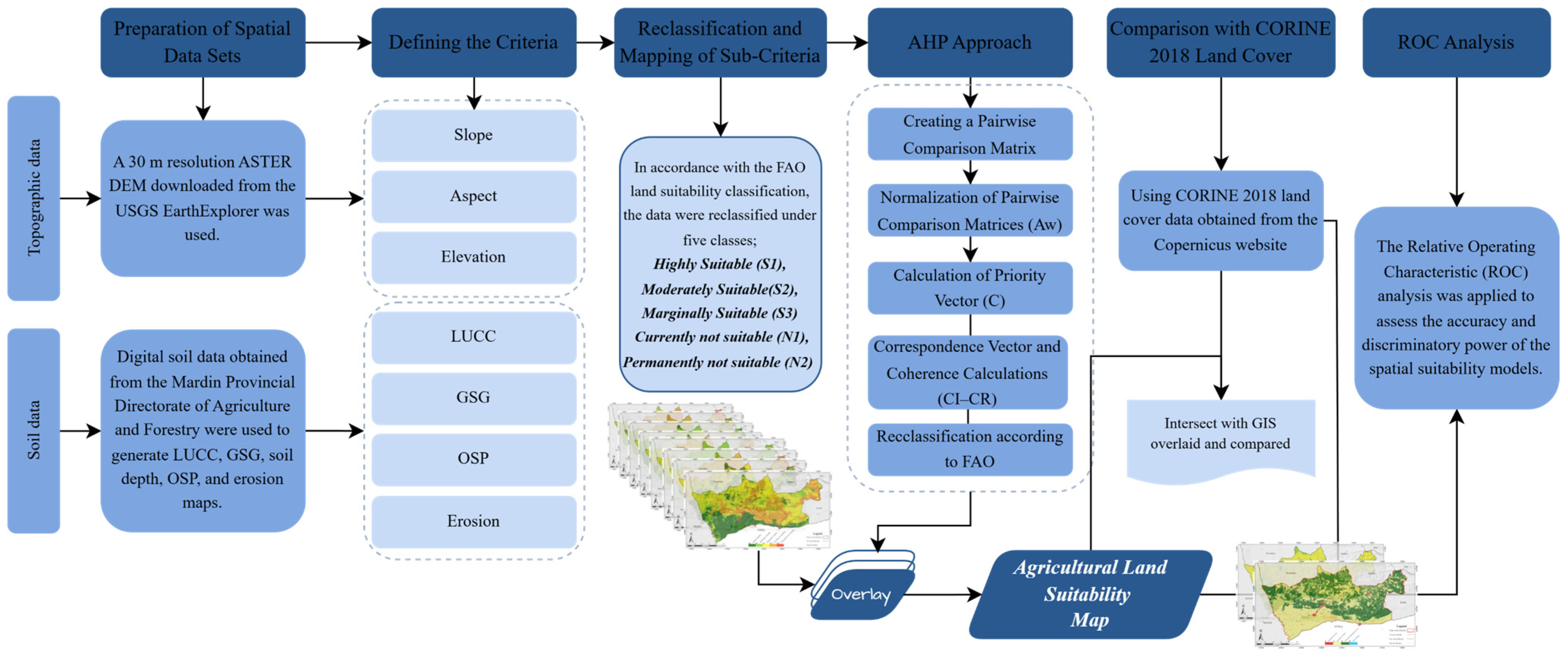
Using the criterion weights determined from the AHP method, standardized criterion maps were overlaid in an ArcGIS environment using weighted overlay analysis. The weighted overlay analysis resulted in a final agricultural land-use suitability map, taking into account the relative impact of each criterion on agricultural suitability. To verify the reliability of the obtained suitability map, a two-stage data validation approach was adopted. In this context, the agricultural land-use suitability map was overlaid with the CLC 2018 data, and the results were validated by subjecting them to the ROC analysis. The methodology of the study is presented in Figure 2.

4. Results

RQ1 Evaluations:
This section includes evaluations regarding Research Question 1: How can suitability classes for agricultural land use be determined in semi-arid climate regions using ecological criteria?

4.1. Determination of Agricultural Land-Use Suitability Classes in Mardin Province Based on Ecological Criteria

The aim of this study is to determine the suitability of agricultural land use throughout the Mardin province, which has a semi-arid climate. The reliability of the study’s results depends on the correct selection and appropriate evaluation of the criteria. In this context, when examining studies that evaluate the suitability of agricultural land use, it is observed that they mainly focus on topographic factors [39,40] and soil properties [41,42]. In our study, eight ecological criteria were analyzed under these two factors. In this context, thematic maps of the criteria used in evaluating the suitability of agricultural lands have been created. The prepared criterion maps reveal the spatial patterns of different physical and environmental characteristics throughout the study area. The distribution of each criterion within the area has been evaluated quantitatively and visually (Table 6).

4.1.1. Slope

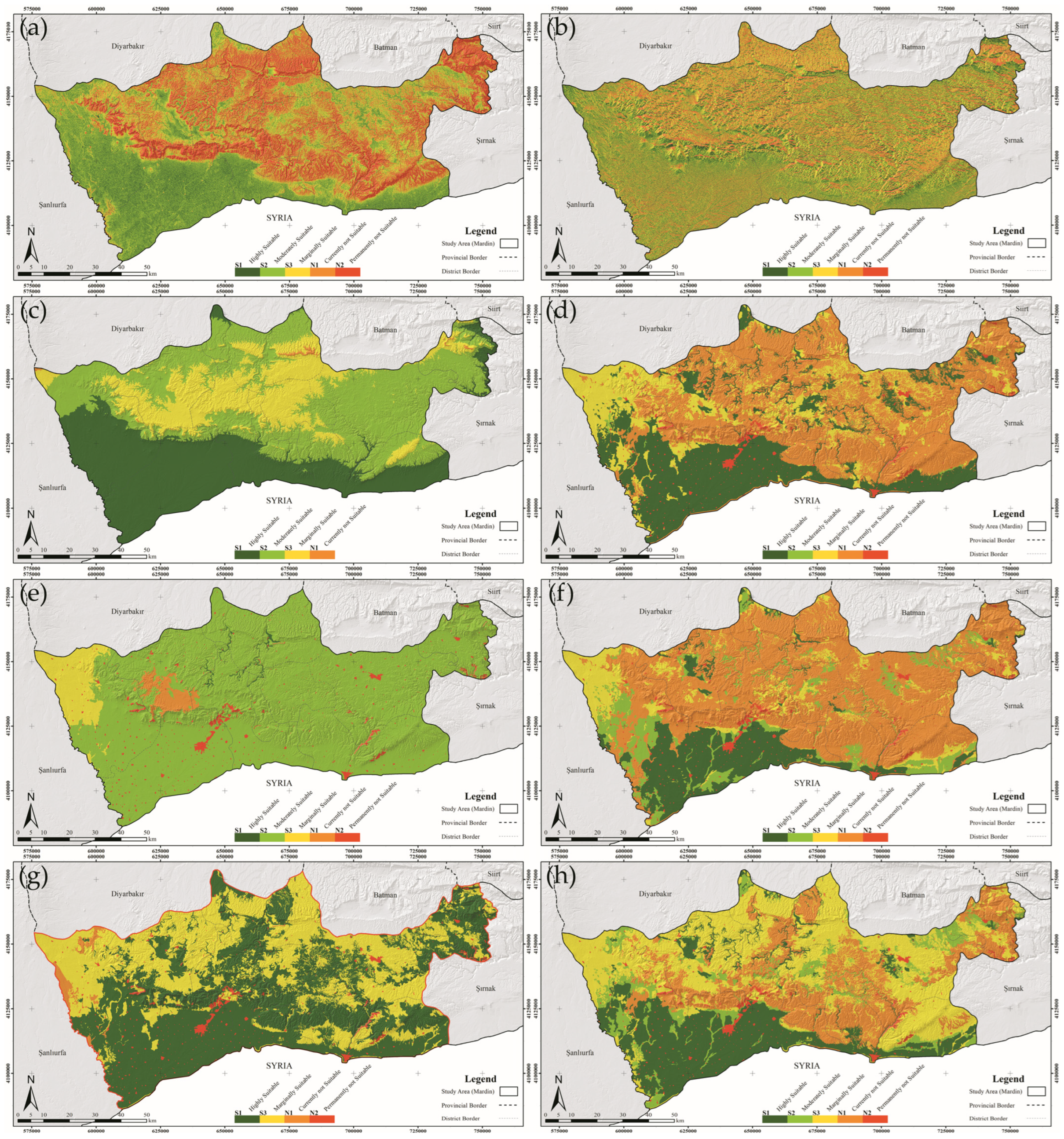
Land slope directly affects agricultural land-use suitability, including soil depth and stability, surface runoff, erosion risk, and water retention capacity [18]. Areas with low slopes offer more favorable conditions for agricultural activities. According to the slope criteria map (Figure 3a), approximately 29.4% of the study area, the majority of which has a slope of 2–6%, is covered by this map (Table 6). The fact that areas with a slope of 0–6% constitute 41.2% of the total area, meaning that the majority of the area is flat and classified as having a low slope, indicates the presence of land use suitable for agriculture.

4.1.2. Aspect

Land aspect is one of the important topographic factors in terms of sunshine duration and agricultural productivity. Aspect directly affects microclimatic characteristics, soil temperature, and crop development in agricultural areas. According to the aspect criteria map (Figure 3b), S and flat areas cover a total of 17.3% of the study area, while areas with SW and SE aspects, which are considered advantageous for agricultural production, have a more dominant distribution within the study area, with a rate of 27.9% (Table 6).

4.1.3. Elevation (m)

Land elevation is another important topographic factor that shapes the microclimate by causing temperature variations and directly affects agricultural product diversity, thus contributing to agricultural land-use suitability [3]. When the elevation criteria map (Figure 3c) is examined, 34.5% of the study area is located in the 350–700 m elevation range, and 43.6% is in the 700–1000 m range (Table 6). This indicates that a large part of the area is located at moderate elevations.

4.1.4. LUCC

Soil classification is a fundamental soil factor developed to determine the agricultural production potential of land. In agricultural land-use suitability assessments, those with lower classification numbers offer favorable conditions for agricultural suitability [43,44]. When the LUCC criteria map is examined (Figure 3d), it is seen that 28.6% of the study area consists of Class I, II, and III lands, which represent the most suitable regions for agriculture. Class VII lands, on the other hand, constitute 48.9%, and these regions generally contain significant limitations for agricultural production (Table 6).

4.1.5. GSG

Different soil groups are one of the criteria that directly affect agricultural production, such as water retention capacity, suitability for root development, and nutrient content. When the GSG criteria map is examined (Figure 3e), the dominant soil groups in the study area are determined as K (colluvial soils), M (brown forest soils), and F (reddish-brown soils) with a rate of 89.3% (Table 6). The soil group where the most intensive agricultural activity is carried out in the study area is reddish-brown soils.

4.1.6. Soil Depth (cm)

Plant root growth is a crucial factor in terms of access to water and nutrients. Deep soils allow roots to develop over a wider area, directly influencing the diversity of arable species [3]. Examining the soil depth criteria map (Figure 3f), a large portion of the study area (59.9%) falls into the “very shallow” and “lithosolic” categories. Other areas classified according to depth in the study area are 15.6% deep, 11.30% medium-deep, and 11.1% shallow (Table 6).

4.1.7. OSP

Other soil characteristics such as stoniness, rockiness, surface rock outcrops, and floodplains limit soil depth and root development for agricultural suitability. These limitations complicate planting, harvesting, and agricultural mechanization activities. One of the most prominent soil characteristics limiting agricultural production in the study area is stoniness (41.6%), followed by rockiness (1.3%) (Table 6). Figure 3g shows the OSP map of the study area.

4.1.8. Erosion Degree

Erosion causes the loss of organic matter and nutrients essential for agricultural activity through the transportation of topsoil. The risk of erosion increases in sloping and improperly managed agricultural areas, threatening their suitability for farming [18]. When the erosion degree criteria map is examined (Figure 3h), 40.1% of the study area has a “severe” erosion risk, and 25.0% has a “very severe” erosion risk (Table 6). In contrast, 23.2% of the total area has a “very weak” erosion risk, covering a large region in the southwest of the province according to the erosion risk map.
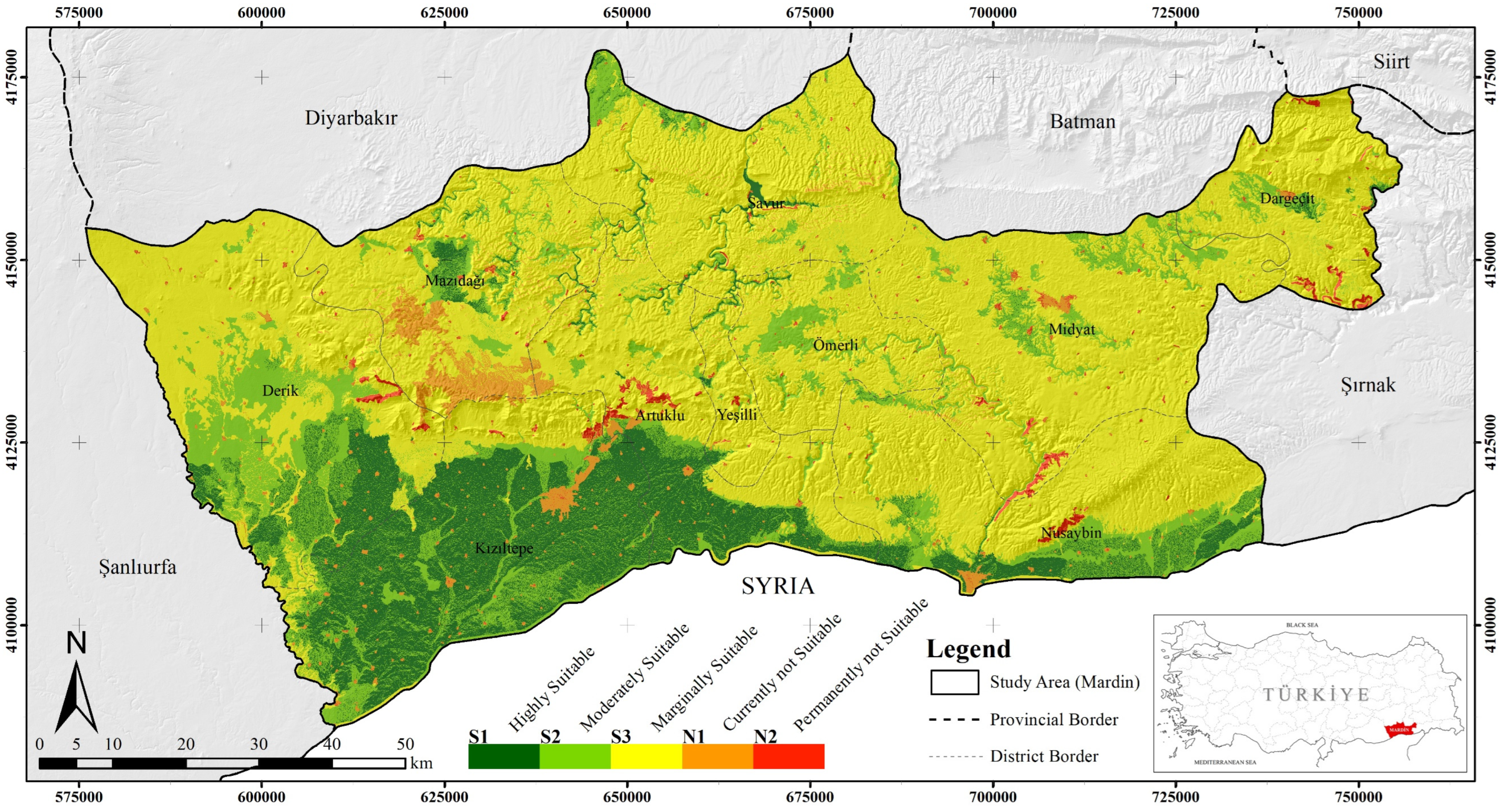
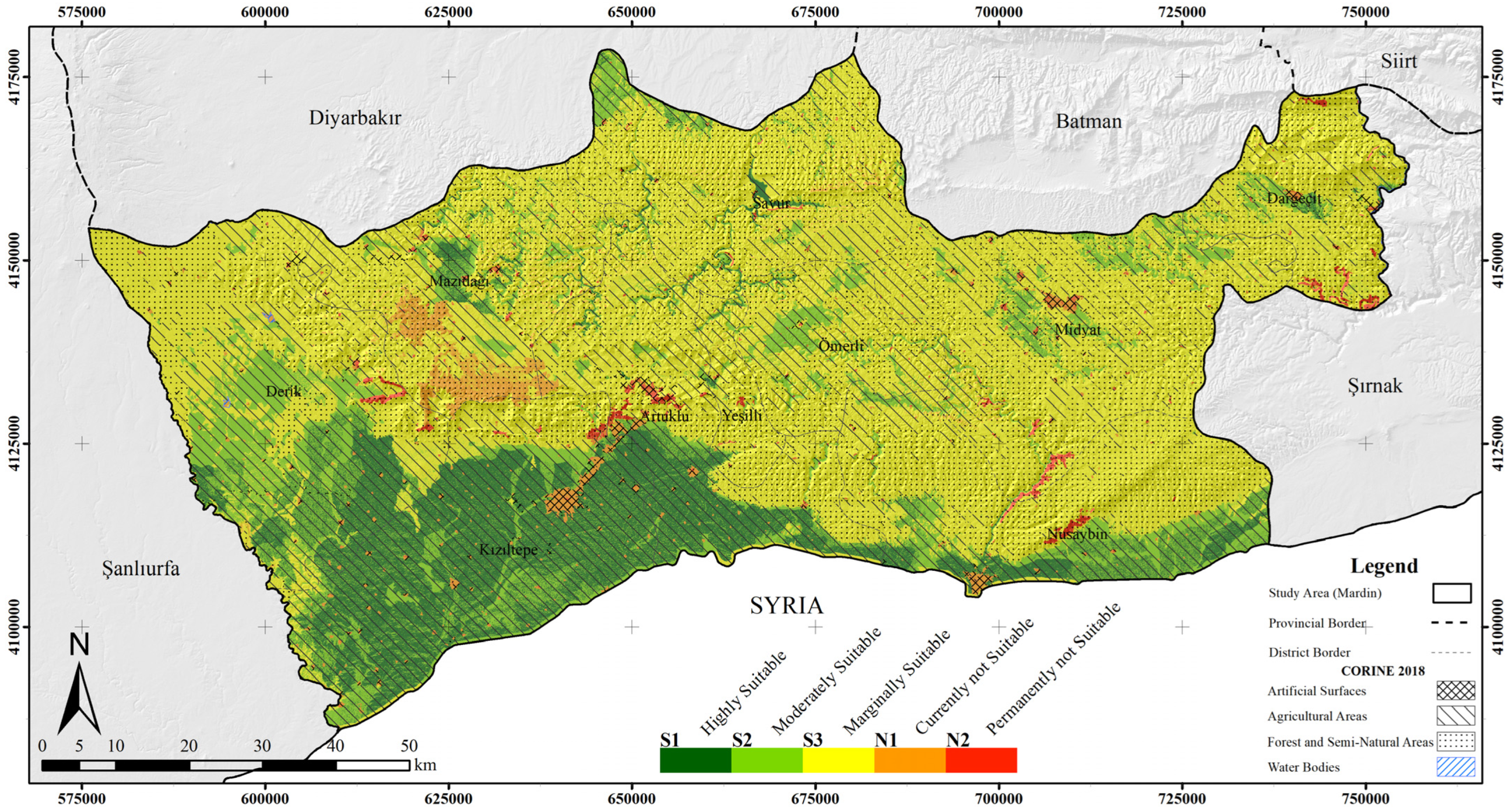
Based on the data obtained (Table 6 and Figure 3), the criteria maps, weighted using the AHP method and classified and standardized according to FAO land suitability classes, were overlaid using the weighted overlay method to create an agricultural land-use suitability map specific to Mardin province (Figure 4). Accordingly, this shows that 14.1% of the study area is classified as “highly suitable (S1)” for agriculture. It is observed that these lands are largely concentrated in the Kızıltepe district (55.2%), located in the southwest of the study area, followed by the Artuklu (21.4%), Derik (12.3%), and Nusaybin (10.8%) districts, respectively. Furthermore, it was determined that approximately 17.2% of the study area was “moderately suitable (S2)”, while the majority, 65%, was “marginally suitable (S3)”. Out of a total area of 878,101.9 ha in Mardin province, 570,665.7 ha (65.0%) represents the “marginally suitable (S3)” class, indicating that these lands constitute the majority of the study area. Of these lands, 65.2% (372,210.1 ha) are used as forest and semi-natural areas, 34.2% (195,387.7 ha) as agricultural areas, 0.5% (2905.1 ha) as artificial surfaces, and 0.1% (162.8 ha) as water bodies. The lands classified as “currently not suitable (N1)” (2.7%) and “permanently not suitable (N2)” (1%) respectively represent areas with limited agricultural use (Table 7).
RQ2 Evaluations:
This section includes evaluations regarding Research Question 2: To what extent do the existing agricultural areas and the agricultural land-use suitability classes produced using the GIS-based AHP method match in accuracy?

4.2. Verification of Results

In this study, a two-stage data validation approach was adopted to evaluate the reliability of the agricultural land-use suitability map produced. In the first stage, the obtained suitability map was compared with CORINE 2018 Land Cover data using intersect analysis in the ArcGIS environment, and the extent of overlap was evaluated (Figure 5). The analysis results presented in Table 8 show that the areas defined as agricultural land in the CORINE classification are largely concentrated in the “highly suitable (98.8%)” and “moderately suitable (94.6%)” class lands. This situation reveals that these areas, which continue to be used for agriculture, largely correspond in terms of area and proportion with the agricultural suitability map obtained. Furthermore, it was determined that the lands classified as “currently not suitable (N1)” and “permanently not suitable (N2)”, which are unsuitable for agriculture, largely consist of forests and semi-natural areas, artificial surfaces, and water bodies. These findings support the accuracy of the produced suitability map by demonstrating that unsuitable areas can also be correctly identified.
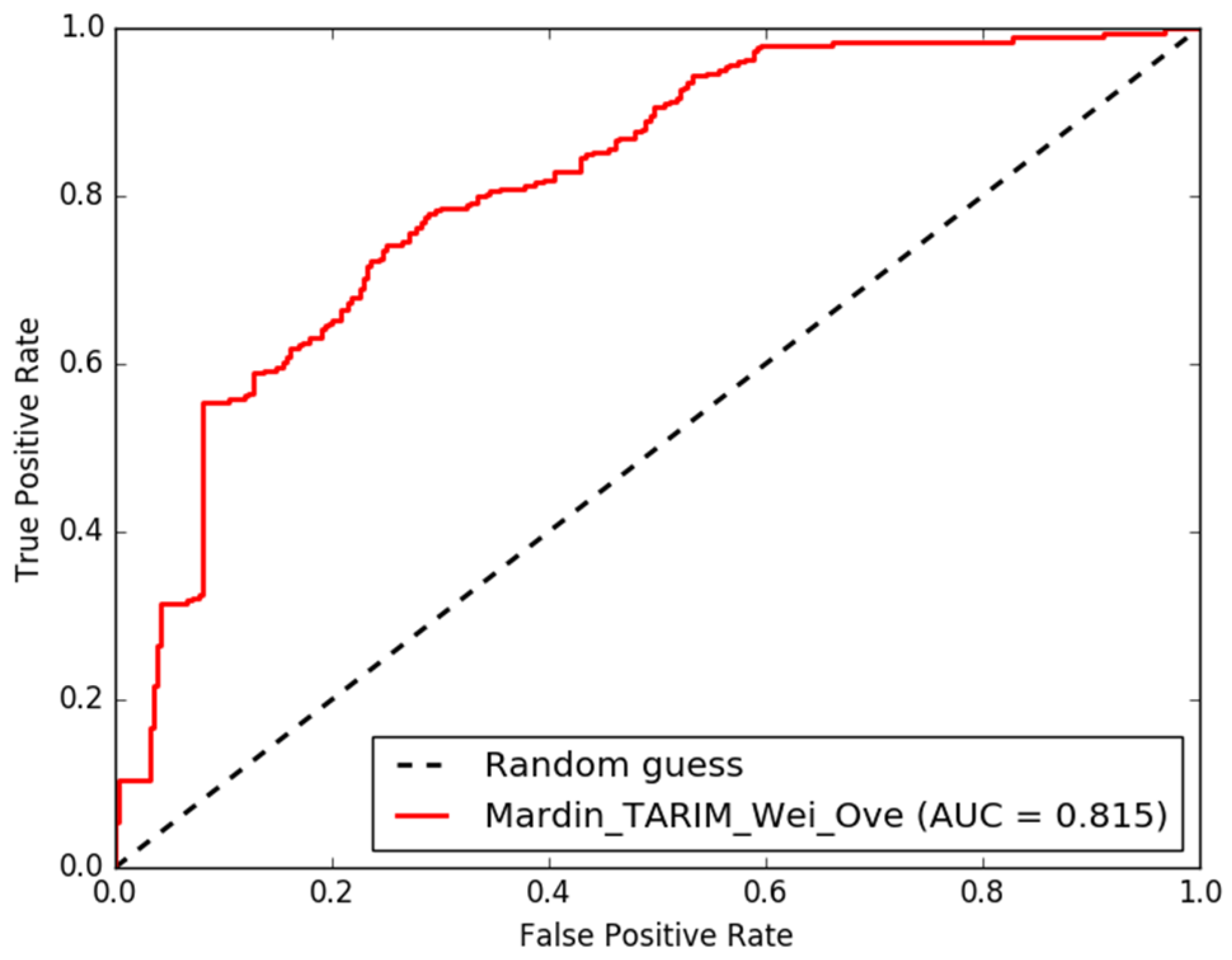
In the second stage, ROC analysis, which is widely used in many studies in the literature [45,46,47,48,49], was applied to support the accuracy and discriminative power of spatial suitability models. Positive reference data were obtained from the CORINE Land Cover dataset, which represents the existing agricultural areas in the study area. Agricultural classes (211, 212, 221, 222, 231, 242, and 243) in the CORINE database were selected to represent agricultural areas. A total of 300 positive sample points were generated from these areas using a random sampling method. Negative samples were represented by 300 randomly selected sample points from non-agricultural land-use classes. From the agricultural land-use suitability raster generated by the model, raster values corresponding to each validation point were extracted using the Extract Values to Points tool in the ArcGIS Spatial Analyst Toolbox, thus obtaining the estimated suitability value from the model for each point. Using the validation data and the model output raster, calculations were performed using the “Calculate ROC Curves and AUC Values” tool in the SDMtoolbox. The AUC value obtained from the analysis was calculated as 0.815 (Figure 6). Since this value is above 0.50, it is considered acceptable and shows a strong correlation between the research results and reality. In conclusion, the findings obtained in these two validation stages reveal that agricultural land-use suitability maps are highly consistent with existing land use and have a strong discriminative power.

5. Discussion

In our article, an agricultural land-use suitability analysis based on ecological criteria was carried out throughout the Mardin province. Within this scope, a GIS-supported land assessment was conducted using the AHP method, one of the MCDM approaches. In addition, the compatibility of the obtained agricultural land-use suitability classes with existing agricultural areas was analyzed. For this purpose, the AHP method was implemented based on expert opinions. Using the resulting pairwise comparison matrix, the importance weights of the ecological criteria considered in the agricultural land-use suitability analysis were determined. These weights were integrated into the GIS-based spatial analysis process using the Weighted Overlay method in ArcGIS software, resulting in an agricultural land-use suitability map of the study area. This provided a scientific basis for the MCDM process, enabling a holistic approach to evaluation based on various ecological criteria.
In this context, in this article, eight ecological criteria under two directly effective factors were taken into account in the analysis of the agricultural suitability of Mardin province. Accordingly, it was determined that 14.1% (123,363.6 ha) of the province is “highly suitable (S1)” for agricultural production. The study area was determined to be 17.2% (150,869.4 ha) “moderately suitable (S2)”, 65.0% (570,665.7 ha) “marginally suitable (S3)”, 2.7% (24,005.6 ha) “currently not suitable (N1)”, and finally 1.0% (9197.6 ha) “permanently not suitable (N2)” (Figure 4). Permanently not suitable areas are characterized by geomorphological features unsuitable for agriculture, such as open rocky terrain.
Land classified as “Moderately Suitable (S3)”, constituting the largest area (65%), is widely distributed throughout the Mardin province. These areas have conditional agricultural potential. Topographic and soil factors such as soil properties, slope, and land characteristics stand out as the main elements limiting agricultural suitability. These areas can be considered as potential areas that can be brought into agricultural production through regional agricultural planning and improvement practices.
In Mardin province, the suitability of agricultural land-use increases from north to south. This indicates that areas with high agricultural potential are concentrated, particularly in the southern regions. However, a significant portion of these areas, especially in the Kızıltepe and Artuklu districts, are under increasing pressure from urbanization. According to the spatial analysis results, a total of 2412.6 hectares of land in the high suitability class (S1–S2) overlap with urbanized areas. Of this overlap, 1060.6 hectares are located in Kızıltepe and 286.2 hectares are in the Artuklu district. This situation points to a significant land-use conflict between areas with high agricultural potential and urban growth. This situation poses significant risks to SDG 2 (Zero Hunger), SDG 13 (Climate Action), and SDG 15 (Life on Land). Therefore, planning approaches aimed at protecting agricultural land in these areas need to be prioritized. In this context, developing planning strategies for the protection of agricultural land is critical for sustainable development, climate change adaptation, and food security goals.
To demonstrate the accuracy and reliability of the study, the agricultural land-use suitability map data produced was overlaid and compared with CORINE 2018 Land Cover data. Furthermore, the results were validated using an ROC analysis. A high level of agreement was observed between the existing agricultural areas and the generated agricultural land-use suitability map, supporting the reliability of the study. It should be noted, however, that the comparison with CORINE Land Cover data reflects consistency with current land-use patterns rather than a direct assessment of the model’s predictive performance. Future studies may benefit from the use of more up-to-date remote sensing data, such as Sentinel-2 imagery or updated land cover products, to further improve the timeliness of the validation process and the robustness of the results.
Our study falls within the scope of the sustainable management of natural resources, one of the key objectives of the CGIAR Strategy and Results Framework (SRF) 2016–2030 [50]. Identifying arable land in Mardin province, ensuring the efficient use of water resources, increasing soil fertility, and developing sustainable agricultural practices suitable for the region are of great importance, and the results provide support for alignment with global policies. Land-use planning and modeling are critical tools for the effective management of natural resources in terms of the sustainability and efficiency of agricultural production, and, at the local level, they contribute to the National Rural Development Strategy implemented by the Ministry of Agriculture and Forestry in Türkiye. For this purpose, the combination of GIS technology and hierarchical analysis used in studies is one of the important methods for conducting conformity assessment studies [3,51,52,53,54,55,56]. Everest et al. [18] also emphasized in their study that AHP is a very powerful MCDM method. In our study, AHP methodology and GIS techniques were used in a comparable approach to determine the suitability of agricultural land-use. Similarly, various scientific studies on agricultural land-use planning in arid and semi-arid climate regions are also included in the literature. Anusha et al. [7], AbdelRahman et al. [9], Tashayo et al. [57], Mangan et al. [58], Aghaloo and Sharifi [59], and Chiaka et al. [60] focused on land suitability assessment for sustainable agricultural development by applying AHP-GIS techniques. Mercan [49], Maddahi et al. [61], Salata et al. [62], and Ozalp and Akinci [63] aimed to identify suitable land for growing specific agricultural products such as rice, olives, pistachios, almonds, and walnuts. While the literature studies on Mardin province [48,49,64] focus on crop-specific suitability using AHP and FUCOM weighting methods, our study focuses on a general agricultural suitability perspective, offering a broader assessment at the regional scale. Although a traditional GIS-based AHP framework was used, the main contribution is the integration of multi-level validation (CORINE Land Cover data and ROC analysis) and the correlation of suitability results with land-use dynamics through spatial overlap analysis. This study evaluates the suitability of agricultural land in the semi-arid Mardin province using a holistic approach and provides spatial decision support information for regional land-use planning. Our study, which is also GIS-AHP based and integrates multiple datasets, provides a comprehensive assessment of agricultural land-use suitability in Mardin province, located in a semi-arid climate zone, and has been conducted with a holistic approach encompassing analyses of the suitability of cultivated/planted agricultural areas throughout the province.

Limitations and Recommendations

Our study has some limitations. The most comprehensive and high-quality soil data for the study area were obtained from 1/100,000 scale vector soil maps. The fact that this dataset contains numerous attributes such as soil depth, stoniness, and land-use capability ensures that the analysis results reflect general trends and make significant contributions to decision support processes. In the analysis process, in order to ensure spatial integrity between different data layers (DEM, satellite images, etc.), all datasets, including soil data, were converted to a 30 × 30 m spatial resolution. This conversion is a technical requirement for performing raster-based multi-criteria spatial analyses (pixel-based overlay operations) and does not improve the original spatial accuracy of the data. Therefore, the 30 m resolution used in the analyses represents a common grid structure for all datasets and does not fully reflect the true spatial sensitivity, especially in terms of soil data. This situation has the potential to create a misleading perception of sensitivity, particularly in the evaluation of micro-scale spatial variations and in local-level decision support processes. Therefore, when interpreting the obtained suitability results, the scale represented by the soil data should be taken into account, and the results should be evaluated within a framework that reflects more regional/general trends.
Although this study focuses on biophysical criteria such as topographic and soil properties, it is known that climatic, hydrological and socio-economic factors are also decisive in agricultural suitability [34,35,36]. The largely homogeneous spatial distribution of semi-arid climate conditions in Mardin province limits the spatial discriminative power of climate parameters such as temperature and precipitation at the regional scale. However, the insufficient accuracy and representation of existing climate data at smaller spatial scales and the limitations in accessing high-resolution, spatially consistent climate and hydrological datasets covering the entire study area make it difficult to include these variables in the modeling process. Therefore, within the scope of the analysis, the focus was on topographic and soil properties, which have a higher spatial variability. In future studies, the accuracy and applicability of the results could be improved by including these variables, which could not be evaluated within the scope of the analysis in this article due to data deficiencies and availability limitations, in the model if high-spatial-resolution and spatially consistent datasets are created or made available, or by developing multi-scale analysis approaches.
Although the GIS-supported AHP method used in our article provides practical and applicable results in evaluating agricultural land suitability, it has some limitations. Firstly, the quality of the datasets used and the evaluations based on expert opinions in determining the criterion weights can cause the results to contain a certain degree of subjectivity. Alternative methods in the literature (fuzzy logic-based approaches [65], TOPSIS and VIKOR [66], FUCOM [64]) offer potential advantages in terms of more effective representation of uncertainty, increased ranking sensitivity, and more flexible modeling of the decision-making process. In this context, a comparative application of different Multi-Criteria Decision-Making methods in future studies may increase the reliability and robustness of the obtained suitability results.

6. Conclusions

Assessments of agricultural land-use suitability are critical for agricultural planning, productivity, and farmers. For arid and semi-arid areas facing significant environmental constraints, it is crucial that agricultural planning decisions are made more carefully and are based on scientific principles.
Mardin province, with its semi-arid climate, is located in a region sensitive to the effects of global climate change due to its geographical location. For successful agricultural planning, a holistic approach that respects ecological limits and is adapted to climate change is crucial. This will enable a strategic roadmap for ensuring sustainable agricultural development through the efficient and effective use of agricultural land. The study also contributes to increasing food and nutrition security, supports rural development in the region, and provides a framework aligned with CGIAR’s 2030 SDGs.
The findings are significant in terms of basing land-use decisions on scientific principles and can provide strategic guidance to decision-makers in future planning efforts. Land-use suitability assessment for agriculture provides crucial content for future agricultural land-use planning to achieve sustainable development goals such as “no poverty (SDG-1)”, “food security (SDG-2)”, and “climate action (SDG-13)”. It also serves the purpose of selecting suitable land for appropriate crops. This study is expected to provide a foundation for future research on crop suitability.

Author Contributions

Conceptualization, C.C., B.C. and D.K.; methodology, C.C., B.C., D.K. and K.T.; statistical computing and software, K.T. and D.A.T.; validation, C.C., K.T. and D.A.T.; formal analysis, C.C., K.T. and D.A.T.; investigation, C.C., D.K., K.T. and D.A.T.; resources, C.C., D.K. and K.T.; data curation, C.C., B.C. and K.T.; writing—original draft preparation, C.C., B.C., D.K., K.T. and D.A.T.; writing—review and editing, B.C., C.C. and K.T.; visualization, D.A.T. and K.T. All authors have read and agreed to the published version of the manuscript.

Funding

This research received no external funding.

Institutional Review Board Statement

Not applicable.

Informed Consent Statement

Not applicable.

Data Availability Statement

The original contributions presented in this study are included in the article. Further inquiries can be directed to the corresponding author.

Conflicts of Interest

The authors declare no conflicts of interest.

Abbreviations

The following abbreviations are used in this manuscript:
SDGSustainable Development Goal
RSRemote Sensing
GISGeographic Information Systems
AHPAnalytical Hierarchy Process
MCDMMulti-Criteria Decision-Making
FAOFood and Agriculture Organization of the United Nations
CORINECoordination of Information on the Environment
LUCCLand-Use Capability Class
GSGGreat Soil Group
OSPOther Soil Properties
CLCCORINE Land Cover
ROCReceiver Operating Characteristic

References

  1. Deng, X.; Wang, S. The research progress on climate change impacts on agricultural water resources. Adv. Resour. Res. 2026, 6, 110–132. [Google Scholar] [CrossRef]
  2. World Commission on Environment and Development. Our Common Future; Oxford University Press: Oxford, UK, 1987. [Google Scholar]
  3. Akıncı, H.; Özalp, A.Y.; Turgut, B. Agricultural land use suitability analysis using GIS and AHP technique. Comput. Electron. Agric. 2013, 97, 71–82. [Google Scholar] [CrossRef]
  4. Haregeweyn, N.; Tsunekawa, A.; Tsubo, M.; Fenta, A.A.; Ebabu, K.; Vanmaercke, M.; Borrelli, P.; Panagos, P.; Berihun, M.L.; Langendoen, E.J.; et al. Progress and challenges in sustainable land management initiatives: A global review. Sci. Total Environ. 2023, 858, 160027. [Google Scholar] [CrossRef] [PubMed]
  5. Scherzinger, F.; Schädler, M.; Reitz, T.; Yin, R.; Auge, H.; Merbach, I.; Roscher, C.; Harpole, W.S.; Blagodatskaya, E.; Siebert, J.; et al. Sustainable land management enhances ecological and economic multifunctionality under ambient and future climate. Nat. Commun. 2024, 15, 4930. [Google Scholar] [CrossRef] [PubMed]
  6. Jiang, Z.; Wu, H.; Xu, Z.; Shen, F.; Jia, N.; Huang, J.; Lin, A. Optimizing land use spatial patterns to balance urban development and resource-environmental constraints: A case study of China’s Central Plains Urban Agglomeration. J. Environ. Manag. 2025, 380, 125173. [Google Scholar] [CrossRef]
  7. Anusha, B.N.; Babu, K.R.; Kumar, B.P.; Sree, P.P.; Veeraswamy, G.; Swarnapriya, C.; Rajasekhar, M. Integrated studies for land suitability analysis towards sustainable agricultural development in semi-arid regions of AP, India. Geosyst. Geoenviron. 2023, 2, 100131. [Google Scholar] [CrossRef]
  8. Badapalli, P.K.; Kottala, R.B.; Madiga, R.; Mesa, R. Land suitability analysis and water resources for agriculture in semi-arid regions of Andhra Pradesh, South India using remote sensing and GIS techniques. Int. J. Energy Water Resour. 2023, 7, 205–220. [Google Scholar] [CrossRef]
  9. AbdelRahman, M.A.; Yossif, T.M.; Metwaly, M.M. Enhancing land suitability assessment through integration of AHP and GIS-based for efficient agricultural planning in arid regions. Sci. Rep. 2025, 15, 31370. [Google Scholar] [CrossRef]
  10. Viana, C.M.; Freire, D.; Abrantes, P.; Rocha, J.; Pereira, P. Agricultural land systems importance for supporting food security and sustainable development goals: A systematic review. Sci. Total Environ. 2022, 806, 150718. [Google Scholar] [CrossRef]
  11. Kumar, A.; Pant, S. Analytical hierarchy process for sustainable agriculture: An overview. MethodsX 2023, 10, 101954. [Google Scholar] [CrossRef]
  12. Hassan, I.; Javed, M.A.; Asif, M.; Luqman, M.; Ahmad, S.R.; Ahmad, A.; Akhtar, S.; Hussain, B. Weighted overlay based land suitability analysis of agricultural land in Azad Jammu and Kashmir using GIS and AHP. Pak. J. Agric. Sci. 2020, 57, 9507. [Google Scholar] [CrossRef]
  13. Özkan, B.; Dengiz, O.; Turan, İ.D. Site suitability analysis for potential agricultural land with spatial fuzzy multi-criteria decision analysis at the regional scale under a semi-arid terrestrial ecosystem. Sci. Rep. 2020, 10, 22074. [Google Scholar] [CrossRef]
  14. Mohit, M.A.; Ali, M.M. Integrating GIS and AHP for land suitability analysis for urban development in a secondary city of Bangladesh. J. Alam Bina 2006, 8, 1–20. [Google Scholar]
  15. Lambin, E.F.; Meyfroidt, P. Global land use change, economic globalization, and the looming land scarcity. Proc. Natl. Acad. Sci. USA 2011, 108, 3465–3472. [Google Scholar] [CrossRef] [PubMed]
  16. Tscharntke, T.; Clough, Y.; Wanger, T.C.; Jackson, L.; Motzke, I.; Perfecto, I.; Vandermeer, J.; Whitbread, A. Global food security, biodiversity conservation and the future of agricultural intensification. Biol. Conserv. 2012, 151, 53–59. [Google Scholar] [CrossRef]
  17. Everest, T. Arazi kullanım etkinliğinin değerlendirilmesi: Edirne İli Havsa İlçesi örneği. Anadolu J. Agric. Sci. 2011, 26, 251–257. [Google Scholar] [CrossRef]
  18. Everest, T.; Sungur, A.; Özcan, H. Determination of agricultural land suitability with a multiple-criteria decision-making method in Northwestern Turkey. Int. J. Environ. Sci. Technol. 2021, 18, 1073–1088. [Google Scholar] [CrossRef]
  19. Esa, E.; Assen, M. A GIS-based land suitability analysis for sustainable agricultural planning in the Gelda catchment, Northwest Highlands of Ethiopia. J. Geogr. Reg. Plan. 2017, 10, 77–91. [Google Scholar] [CrossRef]
  20. Cengiz, T.; Akbulak, C. Application of analytical hierarchy process and geographic information systems in land-use suitability evaluation: A case study of Dümrek village (Çanakkale, Turkey). Int. J. Sustain. Dev. World Ecol. 2009, 16, 286–294. [Google Scholar] [CrossRef]
  21. Purnamasari, R.A.; Noguchi, R.; Ahamed, T. Land suitability assessment for cassava production in Indonesia using GIS, remote sensing, and multi-criteria analysis. In Remote Sensing Application: Regional Perspectives in Agriculture and Forestry; Ahamed, T., Ed.; Springer: Singapore, 2022; Volume 59. [Google Scholar] [CrossRef]
  22. Saaty, T.L. Multi Criteria Decision Making: The Analytic Hierarchy Process; McGraw-Hill: New York, NY, USA, 1980. [Google Scholar]
  23. Mistri, P.; Sengupta, S. Multi-criteria decision-making approaches to agricultural land suitability classification of Malda District, Eastern India. Nat. Resour. Res. 2020, 29, 2237–2256. [Google Scholar] [CrossRef]
  24. Yang, X.; Ahmad, I.; Dar, M.A.; Zelenakova, M.; Gebrie, L.M.; Sisay, M.; Zewdu, G.S. Land suitability analysis for agriculture using GIS. Rend. Lincei Sci. Fis. Nat. 2025, 36, 599–614. [Google Scholar] [CrossRef]
  25. Al Garni, H.Z.; Awasthi, A. Solar PV power plant site selection using a GIS-AHP based approach with application in Saudi Arabia. Appl. Energy 2017, 206, 1225–1240. [Google Scholar] [CrossRef]
  26. Food and Agriculture Organization of the United Nations (FAO). A Framework for Land Evaluation; Food and Agriculture Organization of the United Nations: Rome, Italy, 1976.
  27. Copernicus Land Monitoring Service. Available online: https://land.copernicus.eu/en/products/corine-land-cover/clc2018 (accessed on 10 June 2025).
  28. Davutoğlu, E. Kültürel Turizmin Bir Yerel Kalkınma Aracı Olarak Sürdürülebilirliğinin Mardin Kenti Örneği Üzerinden Incelenmesi. Master’s Thesis, Gazi University, Ankara, Turkey, 2019. [Google Scholar]
  29. Republic of Türkiye, Mardin Governorship, Provincial Directorate of Environment, Urbanization and Climate Change. Environmental Status Report of Mardin Province 2024; Mardin Governorship: Mardin, Türkiye, 2024. Available online: https://webdosya.csb.gov.tr/db/ced/icerikler/mard-n_-cdr2024-20250718094832.pdf (accessed on 10 August 2025).
  30. Tekdamar, D.A.; Tekdamar, K. Coğrafi Bilgi Sistemleri tabanlı Analitik Hiyerarşi Yöntemi kullanılarak güneş enerjisi santrali yer seçimi: Mardin ili örneği. Kahramanmaraş Sütçü İmam Univ. J. Eng. Sci. 2024, 27, 199–212. [Google Scholar] [CrossRef]
  31. U.S. Geological Survey. Available online: https://earthexplorer.usgs.gov/ (accessed on 10 June 2025).
  32. Demir, S. Determination of suitable agricultural areas and current land use in Isparta Province, Türkiye, through a linear combination technique and geographic information systems. Environ. Dev. Sustain. 2024, 26, 13455–13493. [Google Scholar] [CrossRef]
  33. Yin, S.; Li, J.; Liang, J.; Jia, K.; Yang, Z.; Wang, Y. Optimization of the weighted linear combination method for agricultural land suitability evaluation considering current land use and regional differences. Sustainability 2020, 12, 10134. [Google Scholar] [CrossRef]
  34. Shayanmehr, S.; Porhajašová, J.I.; Babošová, M.; Sabouhi Sabouni, M.; Mohammadi, H.; Rastegari Henneberry, S.; Shahnoushi Foroushani, N. The impacts of climate change on water resources and crop production in an arid region. Agriculture 2022, 12, 1056. [Google Scholar] [CrossRef]
  35. Chen, H.; Huo, Z.; Dai, X.; Ma, S.; Xu, X.; Huang, G. Impact of agricultural water-saving practices on regional evapotranspiration: The role of groundwater in sustainable agriculture in arid and semi-arid areas. Agric. For. Meteorol. 2018, 263, 156–168. [Google Scholar] [CrossRef]
  36. Sikka, A.K.; Islam, A.; Rao, K.V. Climate-smart land and water management for sustainable agriculture. Irrig. Drain. 2018, 67, 72–81. [Google Scholar] [CrossRef]
  37. Goepel, K.D. Implementation of an Online Software Tool for the Analytic Hierarchy Process (AHP-OS). Int. J. Anal. Hierarchy Process 2018, 10, 469–487. [Google Scholar] [CrossRef]
  38. Feizizadeh, B.; Roodposhti, M.S.; Jankowski, P.; Blaschke, T. A GIS-based extended fuzzy multi-criteria evaluation for landslide susceptibility mapping. Comput. Geosci. 2014, 73, 208–221. [Google Scholar] [CrossRef]
  39. Lisso, L.; Lindsay, J.B.; Berg, A. Evaluating the topographic factors for land suitability mapping of specialty crops in Southern Ontario. Agronomy 2024, 14, 319. [Google Scholar] [CrossRef]
  40. Mesgaran, M.B.; Madani, K.; Hashemi, H.; Azadi, P. Iran’s land suitability for agriculture. Sci. Rep. 2017, 7, 7670. [Google Scholar] [CrossRef] [PubMed]
  41. Abd-Elmabod, S.K.; Bakr, N.; Muñoz-Rojas, M.; Pereira, P.; Zhang, Z.; Cerdà, A.; Jordán, A.; Mansour, H.; De la Rosa, D.; Jones, L. Assessment of soil suitability for improvement of soil factors and agricultural management. Sustainability 2019, 11, 1588. [Google Scholar] [CrossRef]
  42. Morán-Alonso, N.; Viedma-Guiard, A.; Simón-Rojo, M.; Córdoba-Hernández, R. Agricultural land suitability analysis for land use planning: The case of the Madrid Region. Land 2025, 14, 134. [Google Scholar] [CrossRef]
  43. Soil Science Division Staff; United States Department of Agriculture. Soil Survey Manual (U.S. Department of Agriculture Handbook No. 18); U.S. Government Publishing Office: Washington, DC, USA, 2017.
  44. Bahrami, M.; Sarmadian, F.; Pazira, E. Integrating AHP (Analytic Hierarchy Process) and GIS (Geographic Information System) for precision land use planning and ecological capacity assessment in Alborz Province, Iran. EQA-Int. J. Environ. Qual. 2024, 64, 48–67. [Google Scholar] [CrossRef]
  45. Orhan, O. Land suitability determination for citrus cultivation using a GIS-based multi-criteria analysis in Mersin, Turkey. Comput. Electron. Agric. 2021, 190, 106433. [Google Scholar] [CrossRef]
  46. Amin, H.; Mokarram, M.; Zarei, A.R. Using the fuzzy-AHP technique for evaluating the land ecological potential for pistachio cultivation with an emphasis on climatic variables. Arab. J. Geosci. 2023, 16, 227. [Google Scholar] [CrossRef]
  47. Yarahmadi, J.; Amini, A.; Rostamizad, G. Accuracy assessment of pistachio climate suitability map based on ROC curve. Environ. Water Eng. 2023, 9, 127–140. [Google Scholar]
  48. Mercan, Ç.; Acibuca, V. Land suitability assessment for pistachio cultivation using GIS and multi-criteria decision-making: A case study of Mardin, Turkey. Environ. Monit. Assess. 2023, 195, 1300. [Google Scholar] [CrossRef]
  49. Mercan, Ç. Assessment of walnut (Juglans regia L.) cultivation land suitability using a multiple-criteria decision-making method in Southeastern Turkey. Sci. Rep. 2025, 15, 2716. [Google Scholar] [CrossRef]
  50. CGIAR. CGIAR Strategy and Results Framework 2016–2030; CGIAR: Montpellier, France, 2016; Available online: https://cgspace.cgiar.org/server/api/core/bitstreams/b17510aa-5416-4d13-a4af-75212ca73d31/content/ (accessed on 20 November 2025).
  51. Herzberg, R.; Pham, T.G.; Kappas, M.; Wyss, D.; Tran, C.T.M. Multi-criteria decision analysis for the land evaluation of potential agricultural land use types in a hilly area of Central Vietnam. Land 2019, 8, 90. [Google Scholar] [CrossRef]
  52. Han, C.; Chen, S.; Yu, Y.; Xu, Z.; Zhu, B.; Xu, X.; Wang, Z. Evaluation of agricultural land suitability based on RS, AHP, and MEA: A case study in Jilin Province, China. Agriculture 2021, 11, 370. [Google Scholar] [CrossRef]
  53. Zhou, K.; Li, J.; Wang, Q. Evaluation on agricultural production space and layout optimization based on resources and environmental carrying capacity: A case study of Fujian Province. Sci. Geogr. Sin. 2021, 41, 280–289. [Google Scholar]
  54. Sathiyamurthi, S.; Saravanan, S.; Karuppannan, S.; Balakumbahan, R.; Sivasakthi, M.; Praveen Kumar, S.; Ramya, M.; Hussain, S.; Tariq, A. Agricultural land suitability of Manimutha Nadhi watershed using AHP and GIS techniques. Discov. Sustain. 2024, 5, 270. [Google Scholar] [CrossRef]
  55. Hosen, M.B.; Islam, M.R.; Tahera-Tun-Humayra, U.; Sharker, R.; Kader, Z.; Aziz, M.T.; Miah, M.; Hasan, M.; Pervin, R.; Hossain, M.A.; et al. Assessing land suitability for dragon fruit cultivation in Bangladesh: A GIS-based AHP approach. Smart Agric. Technol. 2025, 1, 101241. [Google Scholar] [CrossRef]
  56. Cojocariu, L.L.; Horablaga, N.M.; Popescu, C.A.; Horablaga, A.; Bella-Sfîrcoci, M.; Copăcean, L. Mapping grassland suitability through GIS and AHP for sustainable management: A case study of Hunedoara County, Romania. Sustainability 2026, 18, 1155. [Google Scholar] [CrossRef]
  57. Tashayo, B.; Honarbakhsh, A.; Akbari, M.; Eftekhari, M. Land suitability assessment for maize farming using a GIS-AHP method for a semi-arid region, Iran. J. Saudi Soc. Agric. Sci. 2020, 19, 332–338. [Google Scholar] [CrossRef]
  58. Mangan, P.; Pandi, D.; Haq, M.A.; Sinha, A.; Nagarajan, R.; Dasani, T.; Keshta, I.; Alshehri, M. Analytic hierarchy process based land suitability for organic farming in the arid region. Sustainability 2022, 14, 4542. [Google Scholar] [CrossRef]
  59. Aghaloo, K.; Sharifi, A. A GIS-based agroecological model for sustainable agricultural production in arid and semi-arid areas: The case of Kerman Province, Iran. Curr. Res. Environ. Sustain. 2023, 6, 100230. [Google Scholar] [CrossRef]
  60. Chiaka, J.C.; Zhen, L.; Xiao, Y.; Hu, Y.; Wen, X.; Muhirwa, F. Spatial assessment of land suitability potential for agriculture in Nigeria. Foods 2024, 13, 568. [Google Scholar] [CrossRef]
  61. Maddahi, Z.; Jalalian, A.; Zarkesh, M.; Honarjo, N. Land suitability analysis for rice cultivation using a GIS-based fuzzy multi-criteria decision making approach: Central part of Amol District, Iran. Soil Water Res. 2017, 12, 1. [Google Scholar] [CrossRef]
  62. Salata, S.; Ozkavaf-Senalp, S.; Velibeyoğlu, K.; Elburz, Z. Land suitability analysis for vineyard cultivation in the Izmir metropolitan area. Land 2022, 11, 416. [Google Scholar] [CrossRef]
  63. Ozalp, A.Y.; Akinci, H. Evaluation of land suitability for olive (Olea europaea L.) cultivation using the random forest algorithm. Agriculture 2023, 13, 1208. [Google Scholar] [CrossRef]
  64. Mercan, Ç. GIS-based FUCOM method for assessing land suitability for almond cultivation in Midyat, Southeastern Türkiye. Trans. GIS 2025, 29, e70109. [Google Scholar] [CrossRef]
  65. Tuncel, G.; Gunturk, B. A fuzzy multi-criteria decision-making approach for agricultural land selection. Sustainability 2024, 16, 10509. [Google Scholar] [CrossRef]
  66. Saha, P.; Gayen, S.K. Assessment of agricultural land use suitability using TOPSIS and VIKOR models: A case study of Koch Bihar district, West Bengal. Arab. J. Geosci. 2025, 18, 44. [Google Scholar] [CrossRef]
Figure 1. Location of Mardin province.
Sustainability 18 03508 g001
Figure 2. The methodology of the study.
Sustainability 18 03508 g002
Figure 3. Criterion maps standardized by reclassifying them according to FAO land suitability classes: (a) slope; (b) aspect; (c) elevation; (d) LUCC; (e) GSG; (f) soil depth; (g) OSP; (h) erosion degree.
Sustainability 18 03508 g003
Figure 4. The agricultural land-use suitability map of Mardin province.
Sustainability 18 03508 g004
Figure 5. Map comparison of agricultural land-use suitability classes with CORINE 2018 Land Cover.
Sustainability 18 03508 g005
Figure 6. The area under the ROC curve (AUC) for agricultural areas.
Sustainability 18 03508 g006
Table 1. Data types and sources used in the study.
CriteriaData TypeScale/
Resolution
Final
Resolution
ExplanationSource
Slope (%)Raster30 m30 × 30 mCalculated from
ASTER GDEM v3
NASA & METI (ASTER GDEM v3),
accessed via USGS EarthExplorer [31]
AspectRaster30 m30 × 30 m
Elevation (m)Raster30 m30 × 30 m
Land-Use Capability Class (LUCC)Vector1/100.00030 × 30 mDerived from the digital soil map obtained from the Mardin
Provincial Directorate of
Agriculture and Forestry
Mardin Provincial Directorate of
Agriculture and Forestry
Great Soil Group (GSG)Vector1/100.00030 × 30 m
Soil Depth (cm)Vector1/100.00030 × 30 m
Other Soil Properties (OSP)Vector1/100.00030 × 30 m
Erosion DegreeVector1/100.00030 × 30 m
Land Use/Land CoverVector100 m30 × 30 mCLC 2018 data used for validation by overlay analysis with the agricultural suitability mapCopernicus Land Monitoring
Service (CLC 2018) [27]
Table 2. Criteria for suitable agricultural areas.
CriteriaSub-CriteriaReferences
S1
Highly
Suitable
S2
Moderately
Suitable
S3
Marginally
Suitable
N1
Currently Not
Suitable
N2
Permanently Not
Suitable
Slope (%)0–2%2–6%6–12%12–20%>20[3,12,13,18,20,24,32,33] & experts’ opinions
AspectFlat, SSW, SEW, ENW, NEN[3,18,20,32] & experts’ opinions
Elevation (m)350–700700–10001000–12501250–1454-[3,12,18,24,32] & experts’ opinions
Land-Use Capability Class (LUCC)I, II, IIIIVVIVIIVIII, water bodies, urban fabric[3,18,20,32] & experts’ opinions
Great Soil Group (GSG)A (alluvial)K (colluvial soils)
M (brown forest soils)
F (reddish-brown soils)
X (basaltic soils)N (non-calcic brown forest soils)Water bodies,
urban fabric,
bare rocky
[3,12,24] & experts’ opinions
Soil Depth (cm)Deep (>90)Medium-deep (50–90)Shallow (20–50)Very shallow (0–20)
Litosolic
Water bodies, urban fabric, bare rocky[3,13,18,20,32,33] & experts’ opinions
Other Soil Properties (OSP)Stone-free-t (stony)r (rocky)Water bodies, urban fabric, river floodplain, bare rocky[3,18,24] & experts’ opinions
Erosion Degree1 (very weak)2 (moderate)3 (severe)4 (very severe)Water bodies, urban fabric, bare rocky[3,13,18,20,32] & experts’ opinions
Table 3. The comparison scale in AHP [22].
Intensity of ImportanceDefinitionExplanation
1Equal importanceTwo activities contribute equally to the objective
3Moderate importance of one over anotherExperience and judgment strongly favor one activity over another
5Essential or strong importanceExperience and judgment strongly favor one activity over another
7Very strong importanceAn activity is strongly favored and its dominance demonstrated in practice
9Extreme importanceThe evidence favoring one activity over another is of the highest possible order of affirmation
2, 4, 6, 8Intermediate values between the two adjacent judgmentsWhen compromise is needed
ReciprocalsIf activity i has one of the above numbers assigned to it when compared with activity j, then j has the reciprocal value when compared with i
Table 4. Random Consistency Index (RI) value [22,25,30].
n12345678910
RI0.000.000.580.901.121.241.321.411.451.49
Table 5. AHP matrix.
CriteriaSlopeAspectElevationLUCCGSGSoil DepthOSPErosion DegreeWeights
Slope (%)1.002.543.850.290.480.681.031.930.110
Aspect0.391.001.430.220.250.310.711.280.056
Elevation (m)0.260.701.000.180.240.230.470.840.041
LUCC3.404.645.431.000.982.453.054.970.277
GSG2.094.044.041.021.001.663.083.330.226
Soil Depth (cm)1.473.214.290.410.601.001.122.970.144
OSP0.971.412.120.330.320.901.001.790.093
Erosion Degree0.520.781.200.200.300.340.561.000.052
λmax = 8.1219; n = 8; CI = (λmaxn)/(n − 1) = 0.0174; RI = 1.41; CR = CI/RI = 0.0124.
Table 6. Spatial and percentage distributions of main and sub-criterion parameters in the study area.
FactorsMain CriteriaWeightsSub-CriteriaScore (1–5)Area (ha)Area (%)
Topographic FactorsSlope (%)11.0%0–2%5103,264.111.8
2–6%4258,456.529.4
6–12%3173,651.119.8
12–20%2145,247.016.5
>201197,483.222.5
Aspect5.6%Flat, S (South)5152,385.117.3
SW (Southwest), SE (Southeast)4244,569.027.9
W (West), E (East)3229,337.126.1
NW (Northwest), NE (Northeast)2180,750.220.6
N (North)171,060.58.1
Elevation (m)4.1%350–7005302,583.034.5
700–10004382,920.243.6
1000–12503189,618.621.6
1250–145422980.10.3
Soil FactorsLUCC27.7%I, II, III5251,163.128.6
IV44758.20.6
VI3174,000.319.8
VII2429,433.248.9
VIII, water bodies, urban fabric118,747.12.1
GSG22.6%A (alluvial)53737.10.4
K (colluvial soils)
M (brown forest soils)
F (reddish-brown soils)
4784,033.489.3
X (basaltic soils)351,136.25.8
N (non-calcic brown forest soils)220,448.02.4
Water bodies, urban fabric, bare rocky118,747.22.1
Soil Depth (cm)14.4%Deep (>90)5136,799.315.6
Medium-deep (50–90)499,214.111.3
Shallow (20–50)397,062.211.1
Very shallow (0–20)
Litosolic
2526,279.259.9
Water bodies, urban fabric, bare rocky118,747.12.1
OSP9.3%Stone-free5482,513.255.0
t (stony)3365,314.341.6
r (rocky)211,526.11.3
Water bodies, urban fabric, river floodplain, bare rocky118,748.32.1
Erosion
Degree
5.2%1 (very weak)5203,658.023.2
2 (moderate)484,413.19.6
3 (severe)3351,921.340.1
4 (very severe)2219,362.425.0
Water bodies, urban fabric, bare rocky118,747.12.1
Table 7. Spatial and proportional distributions of agricultural land-use suitability classes in relation to the study area and districts.
DistrictsS1
Highly
Suitable
S2
Moderately
Suitable
S3
Marginally
Suitable
N1
Currently Not
Suitable
N2
Permanently Not
Suitable
Total
(ha)
ha%ha%ha%ha%ha%
Artuklu18,604.121.410,81112.453,836.762.02237.82.61402.71.686,892.3
Dargeçit571.41.14317.38.345,115.286.6463.00.91610.53.152,077.4
Derik17,032.012.337,995.327.580,023.558.01898.91.41099.30.8138,049.0
Kızıltepe69,192.255.233,890.227.117,093.813.74265.03.4806.80.6125,248.0
Mazıdağı2760.73.39859.711.661,181.872.010,525.512.4594.60.784,922.3
Midyat579.70.514,312.511.5105,919.685.31464.91.21856.31.5124,133.0
Nusaybin11,683.610.820,331.418.873,766.268.41202.11.1946.70.9107,930.0
Ömerli236.70.58943.919.536,194.179.0280.40.6166.10.445,821.2
Savur2152.22.29201.19.682,819.386.11542.01.6511.60.596,226.2
Yeşilli551.03.31207.07.214,715.587.6126.00.7203.01.216,802.5
Study Area123,363.614.1150,869.417.2570,665.765.024,005.62.79197.61.0878,101.9
Table 8. Comparison of agricultural suitability classes with CORINE 2018 Land Cover data.
CORINE 2018S1
Highly
Suitable
S2
Moderately
Suitable
S3
Marginally
Suitable
N1
Currently Not
Suitable
N2
Permanently Not
Suitable
Total
(ha)
ha%ha%ha%ha%ha%
Artificial Surfaces1120.00.91292.60.82905.10.55722.123.82018.822.013,058.6
Agricultural Areas121,978.798.8142,697.094.6195,387.734.25373.722.41724.018.7467,161.1
Forest and Semi-Natural Areas254.00.26846.54.5372,210.165.212,696.452.95368.358.4397,375.3
Water Bodies10.90.133.30.1162.80.1213.40.986.50.9506.9
Total123,363.6100.0150,869.4100.0570,665.7100.024,005.6100.09197.6100.0878,101.9
Disclaimer/Publisher’s Note: The statements, opinions and data contained in all publications are solely those of the individual author(s) and contributor(s) and not of MDPI and/or the editor(s). MDPI and/or the editor(s) disclaim responsibility for any injury to people or property resulting from any ideas, methods, instructions or products referred to in the content.