Article

Impacts of Non-Modified and Acid-Modified Biochars Generated from Date Palm Residues on Soil Fertility Improvement and Maize Growth


1
College of Environmental Science and Engineering, Tongji University, Shanghai 200092, China
2
Shanghai Engineering Research Center of Low-Carbon Agriculture, Institute of Eco-Environmental Protection Research, Shanghai Academy of Agricultural Sciences, Shanghai 201403, China
3
Key Laboratory of Urban Water Supply, Water Saving, and Water Environment Governance in the Yangtze River Delta of Ministry of Water Resources, Tongji University, Shanghai 200092, China
4
Department of Soils, Faculty of Agriculture, Benha University, Benha 13736, Egypt
5
Department of Soils and Water, Faculty of Agriculture, New Valley University, New Valley 72511, Egypt
*
Authors to whom correspondence should be addressed.
Sustainability 2026, 18(7), 3499; https://doi.org/10.3390/su18073499
Submission received: 16 February 2026 / Revised: 16 March 2026 / Accepted: 30 March 2026 / Published: 2 April 2026

Abstract

This research evaluated the efficacy of using two types of biochar (non-modified and acidified) from date palm residues (fronds, leaves, pits) as soil amendments for enhancing soil fertility and maize growth. These biochars were produced through slow pyrolysis under oxygen-limited conditions at 500 °C. Our innovative approach was to minimize gas emissions by converting smoke into liquid fertilizer (LS), which was expected to improve seed germination and early plant growth stages. To assess this aim, a completely randomized experiment was conducted under lab conditions, in which 10 maize seeds were placed on double filter papers in Petri dishes and then exposed to seven concentrations of LS (0.0, 0.01, 0.10, 1.0, 10 and 100%, using distilled water for dilution v/v). The LS contains nutrients and bioactive compounds that may enhance seed germination and early plant growth at low concentrations, whereas higher concentrations may cause phytotoxic effects. Results showed that liquefied smoke at 0.1% increased the absolute percentage of maize germination from 75% (control) to 100% and achieved the highest root length of 9.80 cm. Acidified biochars at 5% reduced soil pH from 8.87 to 8.12 and enhanced potassium availability to 87.93 mg kg−1. Conversely, the non-modified biochars contributed to further increases in soil organic matter (up to 1.02%), nitrogen, and phosphorus. In addition, the application of acidified leaf biochar (5%) enhanced maize shoot growth by 133%, chlorophyll content by 39%, and potassium uptake by 110%. This research establishes a scalable approach for converting agricultural waste into climate-resilient resources, effectively addressing soil degradation in arid environments, boosting crop resilience, and furthering the objectives of a circular bioeconomy.

1. Introduction

Soil degradation represents a significant threat to human society and is increasingly recognized as a limiting factor in achieving global food security [1,2]. To meet the growing need for food, modern agriculture relies heavily on chemical fertilizers and pesticides, which can harm the environment and biodiversity [3]. An Integrated Organic Farming System (IOFS) is another option for increasing high-quality food [4] while achieving the UN Sustainable Development Goals [5].
Biochar is a carbon-rich porous solid that is produced from the anaerobic thermal pyrolysis of organic waste materials in low- or no-oxygen environments [6,7]. It can be produced from a variety of feedstocks [8] and has garnered considerable attention due to its numerous beneficial attributes [9,10], i.e., its incorporation into the soil system serves as an effective approach to improve the physical, chemical, and biological characteristics of the soil [11,12], thus boosting plant growth and improving the pre- and post-harvest quality of agricultural products [13,14]. In addition, it contributes to carbon sequestration [15] and is being utilized for the degradation of persistent organic pollutants and related sustainable transformation processes [15,16,17,18,19]. Thus, biochar is termed the black diamond [20].
Biochar has been produced globally for millennia using different methods such as pit charring or metal drum charring. Recent advancements in engineering and environmental sciences have positioned biochar as a sustainable alternative to conventional agricultural waste management, as well as a strategy to tackle carbon-related environmental challenges [21]. A diverse array of agricultural waste materials has been effectively utilized as feedstock for biochar production [22,23,24]. Thus, the physical and chemical characteristics of biochar are largely influenced by both the raw materials utilized in the production methodologies. There are two main challenges facing biochar production and usage in arid soils. Firstly, biochar is alkaline due to the presence of basic cations (e.g., Ca2+, Mg2+, K+, Na+) which concentrate during pyrolysis; hence its application to arid alkaline soils may hinder nutrient mobility therein, and this in turn diminish plant growth and productivity [25,26,27]. A potential solution for this challenge is the usage of acid-modified biochar, which is produced by treating biochar with acids [28]. This technique not only neutralizes its alkalinity but may also enhance nutrient solubility [29]. The second issue is related to the released gases during the poorly controlled pyrolysis process, which increase nutrient losses and may intensify global warming threats. Alternatively, these emissions can be captured, condensed, and liquefied to be used as a germination-enhancing additive [11].
Prior studies have indicated that the application of unmodified (normal) biochar to soil can still be beneficial to alkaline soils as this biochar may enhance the availability and absorption of essential nutrients by growing plants [25], which in turn fosters plant growth and productivity; for example, biochar produced from maize stove increase wheat production [28], potato straw biochar boosted maize production [27] and rice straw biochar enhanced zucchini (Cucurbita pepo) growth [30]. However, comparative evidence remains inconsistent, and further research is still needed to compare the impacts of acid and normal biochar on plant growth under arid conditions. Many studies highlighted the positive effects of unmodified biochar in improving the physicochemical properties of various soil types; comparatively fewer investigations have been conducted on the effects of acidified biochar on soil characteristics [26,31] and crop growth, particularly under alkaline and arid conditions, and particularly for biochar derived from date palm residues.
Date palm (Phoenix dactylifera L.) is one of the most important fruit crops in arid and semi-arid regions, and every palm generates approximately 24 kg of waste annually, which is rich in cellulose [32]. These residues can be converted into biochar via a cost-effective and eco-friendly pyrolysis process [33]. Additionally, the liquid smoke, which is the byproduct of the pyrolysis process, may increase seed germination, probably by: (1) stimulating dormant seeds to germinate, (2) carrying nutrients needed for promoting plant growth and (3) stimulating the activities of soil biota in the rhizosphere of the seeds, which indirectly improves plant growth [34,35].
Therefore, this study aimed to evaluate the effects of liquid smoke derived from different date palm parts, including branches, leaves, and pits, on the growth of maize seedlings (Zea mays). Although biochar has been extensively investigated for its impacts on improving soil fertility and plant growth, most of these studies have used a single bulk material for its preparation [33] while rarely examining the effects of different plant fractions or the potential role of liquefied smoke produced during their pyrolysis on soil productivity. Accordingly, this study considered biochars and liquefied smoke derived from different date palm residues (fronds, leaves, and pits), including modified and non-modified biochars, to identify the most effective biomass fraction and treatment for enhancing maize germination, plant growth, and soil physicochemical properties. This study addresses the following UN Sustainable Development Goals (SDGs), 2, 12, 13, and 15, via promoting sustainable agriculture, recycling agricultural residues, improving soil characteristics, and mitigating environmental impacts by capturing greenhouse gas (GHG) emissions produced during biochar production. To achieve the above-mentioned objectives, a 30-day germination experiment was carried out to assess the overall effects and effectiveness of acidified versus non-modified biochar produced from date palm residues on soil fertility and maize plant growth, while recycling agricultural wastes and reducing their environmental impacts. Additionally, the liquid smoke—the byproduct of the pyrolysis process—is tested to increase seed germination.

2. Materials and Methods

2.1. Agricultural Wastes

Agricultural waste was collected from farms located in the New Valley Governorate of Egypt, including fronds, leaves, and pits. These byproducts constitute over 80% of the total agricultural wastes generated in the New Valley Governorate of Egypt (calculated from EEAA’s reported agricultural waste and palm waste tonnages) [36]. Following this process, the collected residues were air-dried, and then were used in the manufacture of biochar.

2.2. Biochar-Producing Plant

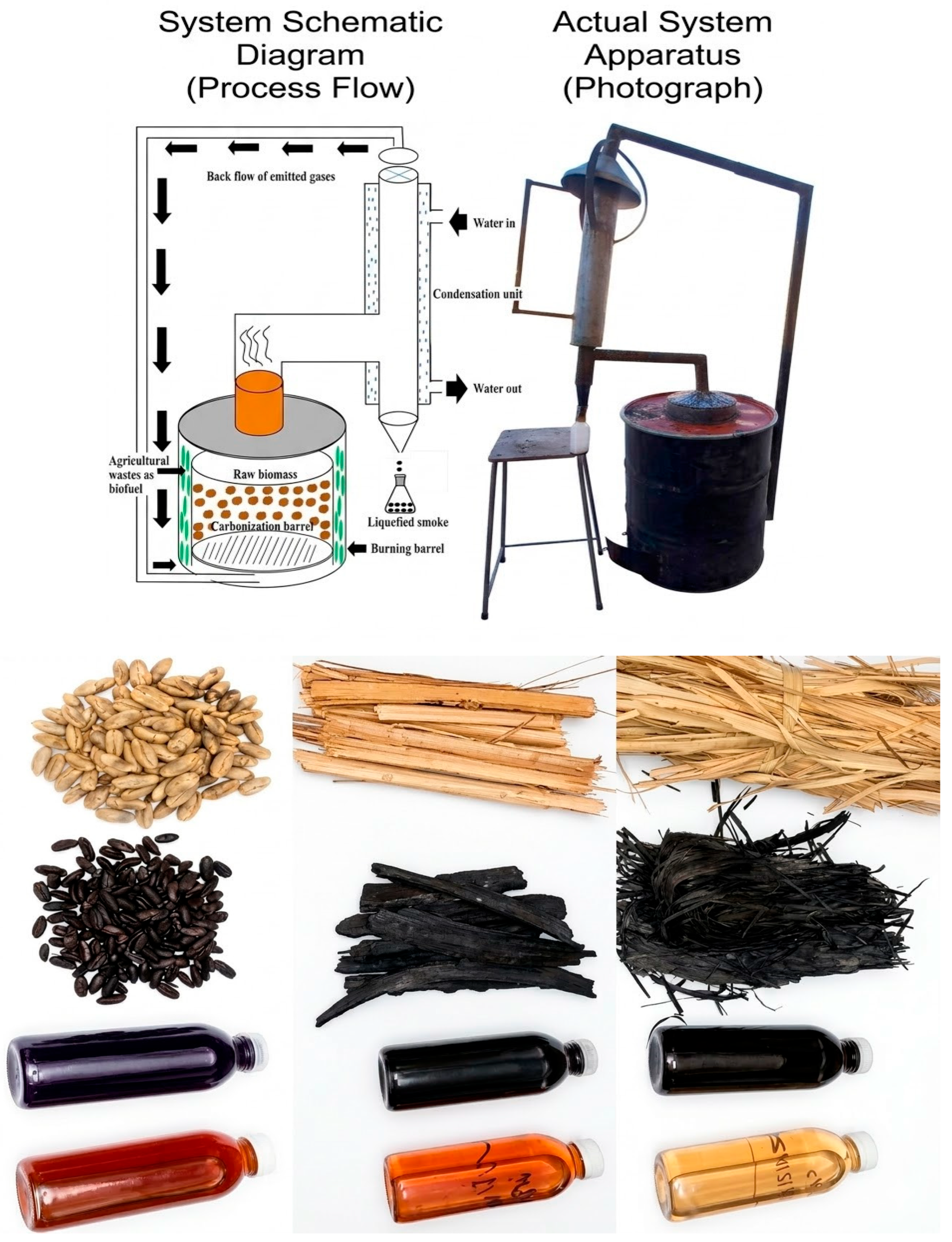
A sustainable approach for biochar production was applied in this study, including a modification designed to capture and condense emitted smoke and repurpose it as a combustion resource [11]. Biochar was produced via slow pyrolysis of date palm residues (branches, leaves and pits) under oxygen-limited conditions through a heating rate of 10 °C min−1 with a holding time of 120 min to achieve a final temperature of 500 °C. After pyrolysis, the reactor was allowed to cool in absence of oxygen to prevent biochar oxidation. This product was collected, crushed, sieved to 5 mm, and stored in airtight containers for subsequent analyses and experiments. The resulting biochars were designated as B-biochar (derived from the branches of the date palm), L-biochar (originating from the leaves of the date palm), and P-biochar (produced from the pits of the date palm).
This thermal process, referred to as pyrolysis, facilitates the conversion of biomass into biochar, simultaneously releasing gases and volatile organic compounds (smoke) as byproducts [11]. The emitted smoke was rerouted through a condensing system to cool and was converted into a liquid or tar-like substance, centrifuged to remove solids and heavy fractions, and the liquid smoke extract was collected and utilized as a biostimulant/biofertilizer to promote seedling development. This enhancement not only mitigates harmful emissions but also improves the energy efficiency of the overall process by establishing a closed-loop system (Figure 1), which guarantees that the entire operation is self-sustaining, thereby decreasing reliance on external energy.

2.3. Characterization of Biochars and Liquefied Smokes

The pyrolysis process produced both biochar and liquefied smoke as recoverable products. Biochar yields varied depending on the feedstock type, i.e., 48.54% for fronds, 21.56% for leaves, and 43.23% for pits (Table 1). During pyrolysis, the emitted smoke was collected using the condensation unit, cooled and converted into liquefied smoke. The collected volumes were estimated by 29 L from 1000 kg of fronds, 12 L from 1000 kg of pits, and 23 L from 1000 kg of leaves, centrifuged to remove solids, then stored in clean containers. The produced biochars were characterized following the framework recommended by the International Biochar Initiative (IBI) Biochar Standards [37], including elemental composition (C, H, N, S), ash content, pH, electrical conductivity, surface area (BET), and structural characterization (SEM and FTIR).
Chemical, physical, and engineering analyses were conducted to evaluate the produced biochars, adhering to the protocols established by [22]. The elemental composition of the biochars was assessed utilizing a CHNOS elemental analyzer (Vario-E, Piding, Germany) to quantify the carbon, hydrogen, nitrogen, and sulfur content. Organic matter and ash content were determined using the loss on ignition method. The pH and electrical conductivity (EC) of the biochars were analyzed through a 1:10 (w/v) mixture of biochar and deionized water. Fourier transform infrared (FTIR) spectrometry was used to identify the functional groups present on the biochars, using powdered samples mixed with KBr pellets and scanned over the range of 4000–400 cm−1. Spectral data were collected using a Thermo scientific instrument (NICOLET IS 10-USA, Waltham, MA, USA). The surface microscopic structures of biochars were scrutinized using scanning electron microscopy (SEM), after being gold-coated in a sputter coater to enhance conductivity, utilizing the Jeol (JSM 5440LV Scanning Microscope, Tokyo, Japan) instrument.
Mass of the biochars was recorded before and after the pyrolysis treatment, and density was calculated. Analyses of the BET surface area and pore volume were carried out using a Quantachrome TouchWin v1.2 instrument, with the samples being degassed at 300 °C for a minimum of 2 h to eliminate moisture prior to conducting the adsorption experiment. Volumes of 29, 23 and 12 L of liquefied smoke were produced through the pyrolysis process, utilizing 1000 kg of fronds, pits and leaves, respectively, of date palm residual materials.

2.4. Acidification of Biochar Material

Fifty percent of the generated biochars were acidified by shaking with a 0.1 M sulfuric acid at a ratio of 1:100 (w/v) and agitation rate of 150 rpm for 4 h. Afterwards, the samples were subjected to filtration, and washed with tap water followed by double distilled water to eliminate any residual chemical solutions. Finally, the samples were oven-dried at 70 °C for a period of 24 h [38].

2.5. Germination Test of Maize Plant

A maize germination test was conducted for one month at the Agricultural Farm of the Faculty of Agriculture, New Valley University in Egypt. This experiment evaluated the viability of amending sandy soil with non-modified and acidified biochars to enhance maize plant growth. This soil is characterized by a sandy composition and a markedly alkaline pH of 8.45. It contains minimal organic matter, quantified at 0.24%, resulting in very low fertility levels, as all essential nutrients—specifically N at 6.11 mg kg−1, P at 1.13 mg kg−1, and potassium at 49.34 mg kg−1—are found to be inadequate. Although the soil is non-saline, with an electrical conductivity of 0.38 dS m−1 and exhibits good drainage properties attributable to its substantial sandy content of 87.45%, its limitations in nutrient and water retention, coupled with the elevated pH, necessitate considerable incorporation of organic matter and meticulous nutrient management to enhance its productivity. A non-amended control treatment was included for data comparison. The experimental design was a randomized one encompassing 15 treatments, with three replicates each including three types of biochars (fronds, pits, and leaves), which were applied at four rates (1%, 2.5% and 5%, w/w) in the form of non-modified and acid-modified biochars, along with the non-amended control.
Three-hundred-gram portions of soil samples were meticulously mixed with one of the aforementioned amendments and uniformly packed into plastic pots. Three seeds of maize were sown per pot, and all treatments received mineral NPK fertilizers according to the recommendations set forth by the Ministry of Agriculture and Land Reclamation, i.e., 180 kg N (urea, 46%N), 15.5 kg P (calcium super phosphate, 6.98%), and 100 kg K ha−1 (potassium sulphate, 40%K).
Throughout the experimental period, soil moisture was sustained at 80% of the soil water holding capacity gravimetrically, i.e., each pot was weighed daily using a digital balance, and the amount of water lost was replenished by adding distilled water to maintain soil moisture at 80% of WHC.
After six weeks, chlorophyll content in the plant leaves was assessed using a SPAD meter and the total shoot length was recorded. Subsequently, the maize plants were harvested and washed multiple times with tap water followed by distilled water. Shoot fresh and dry weights (oven-dried at 70 °C) were then determined.
Samples of plant materials were digested using a mixture of H2SO4 and H2O2 acids as established by Lowther [39], then total nitrogen content was analyzed in the plant digest by an elemental analyzer, while total phosphorus and potassium levels were determined using an Inductively Coupled Plasma (ICP 720 ES) and Flame Photometer (Jenway, PFP7, Cole Palmer Ltd., Vernon Hills, IL, USA). Additionally, soil rhizosphere samples were collected from each pot to evaluate alterations in soil pH and electrical conductivity (EC) in suspension and supernatant, respectively. Residual soil organic matter attributed to the application of organic amendments was measured using a Welkley–Black procedure [40]. The analysis of available nutrients involved the measurement of ammonium-N and nitrate-N measured by extracting biochar samples with 2 M KCl; thereafter, NH4+ and NO3 concentrations were measured by a flow-injection auto-analyzer (Seal, AA3, Norderstedt, Germany), following the procedures of Selmer-Olsen [41] and Doane and Horwath [42], respectively. Additionally, the determinations of available contents of the tested nutrients and elements were extracted by AB-DTPA extract as mentioned by Soltanpour [43] and Purpose [44].

2.6. Seed Germination Experiment with Liquefied Smoke

The liquefied smoke produced during the pyrolysis process was evaluated as a priming agent for seed germination in a controlled laboratory experiment conducted for seven days. Ten seeds of maize were placed on double filter papers in Petri dishes, in which filter papers were moistened with liquefied smoke, applied at seven distinct concentrations (0.0, 0.01, 0.10, 1.0, 10 and 100% v/v of LS; using distilled water for dilution v/v). Each treatment was replicated three times. Petri dishes were incubated at 20 ± 2 °C, in accordance with ISTA guidelines [36]. Liquefied smoke and water were administered as required, maintaining a constant volume of 2.5 mL per dish. The germination dates for each treatment were duly recorded, and root lengths along with seedling heights were measured for every treatment. The germination percentage was calculated based on the methodology outlined by Abdelhafez et al. [11] as follows:
Germination percentage (%) = (Number of total germinated seeds)/(Total number of seeds tested)

2.7. Statistical Analysis

A statistical analysis of the data was conducted, utilizing an ANOVA and Duncan’s Multiple Range Test (DMRT) as a post hoc test to compare among mean values of treatments. Pearson correlation was also used to examine relationships among the measured attributes of maize under biochar treatments.

3. Results and Discussion

Biochar application may improve soil water holding capacity due to its porous structure [45] and may also buffer soil pH because of its colloidal nature [46]. These characteristics are important for crop production, especially in light-textured soils of low buffering capacity [47,48]. Moreover, liquefied smoke contains nutrients and bioactive compounds that can stimulate seed germination and early seedling development when applied at low concentrations. In particular, date palm residues (fronds, leaves, and pits) were used as three feedstock types for the manufacturing of biochar and the generated liquid smoke was collected during the pyrolysis process. Biochars from each fraction were applied in two forms (non-modified and acidified forms) at different rates to evaluate their impacts of plant growth, while the corresponding liquefied smokes were tested for enhancing maize seed germination.

3.1. Characterization of Biochars and Liquefied Smokes

Biochars derived from date palm fronds, leaves, and pits displayed variations in chemical, physical, and engineering properties that signify their suitability for agricultural applications. Specifically, biochar obtained from date palm leaves exhibits a pH value of 9.31, with an enhanced water holding capacity of 480.34%, and a notably superior BET surface area of 43.5 m2 g−1 (Table 1). These characteristics render it particularly advantageous for improving soil nutrient retention, porosity, and moisture availability, especially in sandy or degraded soil types [11,45].
Conversely, biochar produced from date palm pits is characterized by a higher organic matter content of 69.23% and nitrogen content which was 1.95%. This composition enhances its efficacy as an amendment for increasing soil organic carbon and raising nitrogen availability [49]. Finally, biochar originating from fronds exhibits intermediate properties, such as a slightly high alkalinity with a pH of 8.26, an electrical conductivity (EC) of 0.77 dS m−1, and balanced nutrient levels, indicating its potential to effectively ameliorate acidic soil conditions while providing balanced nutrient supplementation [11].
A pronounced shift in the pH of the amendment occurred from alkaline or neutral conditions towards acidity due to the donation of protons from sulfuric acid. Likewise, marked reductions occurred in ash content, major cation levels (calcium, magnesium, and potassium), and micronutrients (iron, zinc, manganese, and copper), mostly due to the process of acid leaching. On the other hand, total S content increases substantially in acid-modified biochars, introducing sulfonic functional groups. In this aspect, soluble sulfate levels in acidified biochars follow the order of leaves > fronds > pits, which were mostly directly associated with the original ash content in plant residues. Moreover, acidifying modifications raised soluble chloride salts in biochars, thereby increasing their soluble salt contents.
The liquefied smokes that resulted from the pyrolysis of these residues demonstrate valuable chemical characteristics for agricultural applications. The acidic properties of these smokes, with a pH ranging from 2.80 to 3.98, along with a high electrical conductivity of 10.18 to 19.24 dS m−1, are advantageous for pest and pathogen management (Table 2). Moreover, they may hold promises as natural preservatives or biostimulants [50].
In particular, the smoke derived from date palm leaves possesses the highest levels of soluble ammonium (NH4+) at 1630.11 mg L−1 and a significant carbon content of 56.3 g L−1, making it exceptionally suitable as an organic fertilizer that can promptly furnish nitrogen and carbon to support plant growth [51]. Mostly, proteins, chlorophyll, amino acids, and other N-rich metabolites are concentrated in leaves, while fronds tend to be more structural (cellulose–hemicellulose–lignin) with lower N content [52]. In contrast, the liquefied smoke obtained from date palm pits displays considerably elevated potassium concentrations of 1006.97 mg L−1, indicating its potential utility as a potassium-rich foliar fertilizer or biostimulant for enhancing crop nutrition [49].
These observations align closely with the findings of Abdelhafez et al. [11] who reported that liquefied smoke from date palm pyrolysis contains significant amounts of nitrogen (2.3 g L−1), phosphorus (8.25 mg L−1) and potassium (521.38 mg L−1) which were comparable, to some extent with the results obtained herein, in addition to organic acids, and phenolic compounds, thereby indicating its potential utility as a biostimulant and antimicrobial agent [53]. Such results are further corroborated by studies including those by Iacomino et al. [54], which emphasize that liquids resulting from pyrolysis process could be rich in NH4+-N (8.3 mg L−1), NO3-N (5.2 mg L−1), total P (0.97 mg L−1) and micronutrients which were comparable to the nutrient ranges reported in this study. In agricultural contexts, liquid smoke (LS) has been proven to enhance seed germination at low concentrations, yet LS may demonstrate phytotoxic effects at elevated doses, underscoring the necessity for considering careful dose management [11].
Unlike earlier studies that used all date palm residues in one mix, we tested how liquid smoke made separately from fronds, leaves, and pits affects maize germination.
The smoke generated from fronds featured a moderate nitrogen level (1.58 g L−1) and a relatively balanced profile of macro- and micronutrients, which may be suitable for general foliar spray applications. However, the consistently low pH and high salinity levels across all variants necessitate dilution prior to application in order to mitigate risks of phytotoxicity and osmotic stress.
These observations underscore the environmental and agronomic advantages associated with transforming date palm residues into biochars and liquefied smokes, thereby maximizing sustainable agricultural practices and promoting efficient waste utilization.
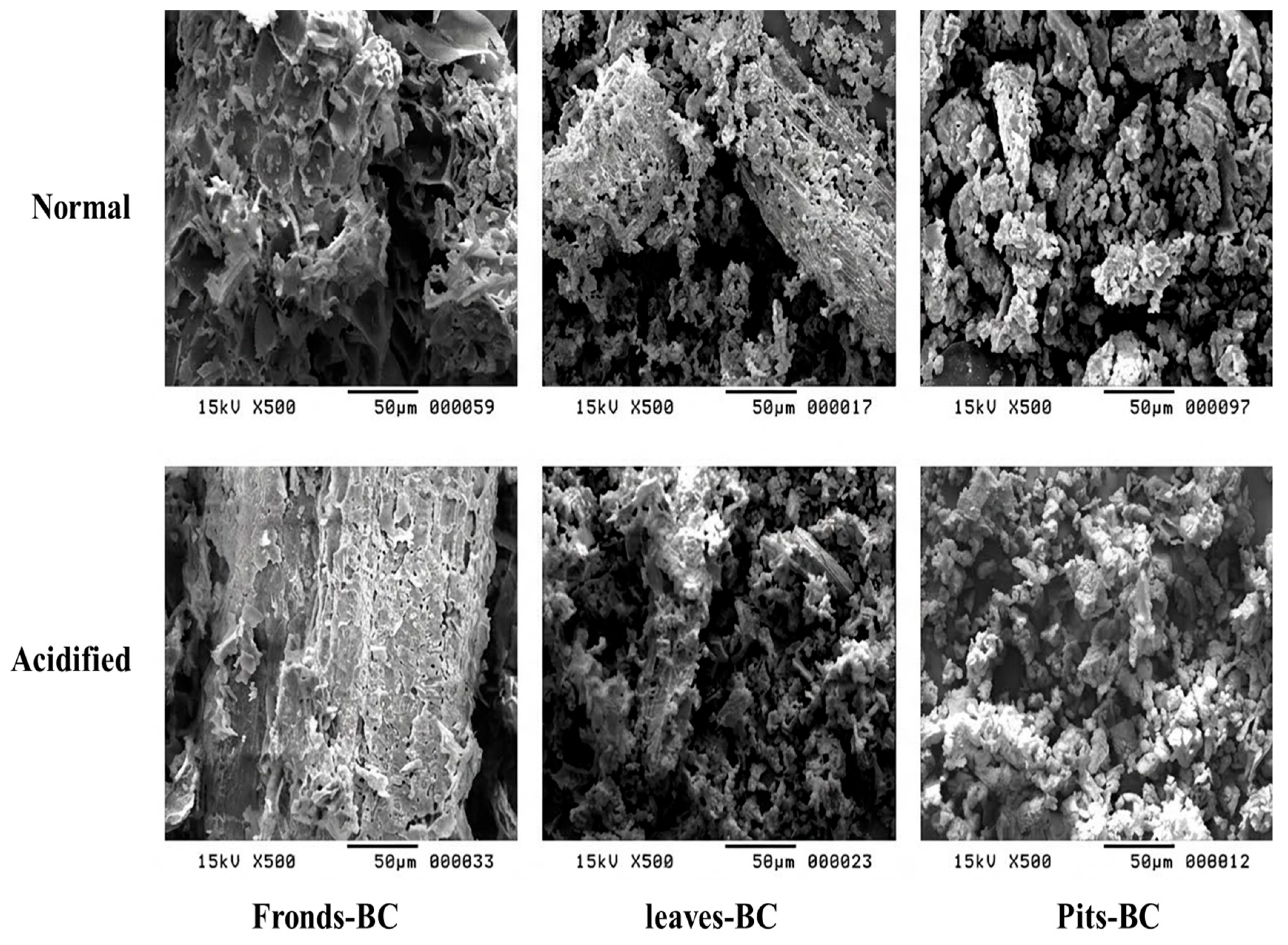
The scanning electron microscopy (SEM) micrographs, along with the physicochemical analyses of frond, leaf, and pit biochars, in both normal and acidified forms, illustrated significant disparities in surface morphology, porosity, and functional characteristics (Figure 2). Generally, biochar showed highly porous structures with irregular pore sizes and shapes. For example, the biochar derived from fronds, in its untreated condition, manifests a relatively smooth and compact structure with limited pore development, which is corroborated by its low Brunauer–Emmett–Teller (BET) surface area of 6.27 m2 g−1 and a porous volume of 0.025 m3 t−1. Overall, the porous structure of biochar has many agronomic and environmental applications, e.g., a soil conditioner, sorption of contaminants from aqueous solutions, as nutrient carriers [55].
Following acidification, the SEM imagery depicts a more fragmented and porous architecture, consistent with earlier research indicating that acid treatments can increase the surface area by revealing internal porous structure [56]. Nevertheless, the fronds’ average particle size at 2.09 µm may inhibit their surface reactivity. Conversely, the leaves’ biochar exhibits a highly porous and sponge-like configuration even in its non-acidified form, associated with the highest BET surface area of 43.5 m2 g−1 and a water holding capacity of 480.34%. The acidification process further accentuates these characteristics by unveiling additional micro- and mesopores, thereby enhancing its suitability for adsorption-related applications, aligning with the findings of Liu and Zhang [57], who noted significant increases in pore complexity and surface functionality in acid-treated biochars. The pits’ biochar, distinguished by its low ash content of 9.11% and the highest density of 0.57 ton/m3, presents a coarse structure with moderate porosity in its untreated state. The acidification process enhances its structural disintegration and porosity, resulting in a BET surface area of 23.5 m2 g−1, as evidenced by the granular, fractured texture observed in the SEM images. Across all examined biochar types, acidification promotes a more open and reactive surface morphology, greater porosity, and an increased potential for various environmental applications, including soil enhancement and pollutant adsorption [58], thereby affirming the essential role of post-treatment processes in optimizing biochar properties for targeted purposes.

3.2. X-Ray Diffraction and Fourier Transform Infrared Analyses of Used Biochars

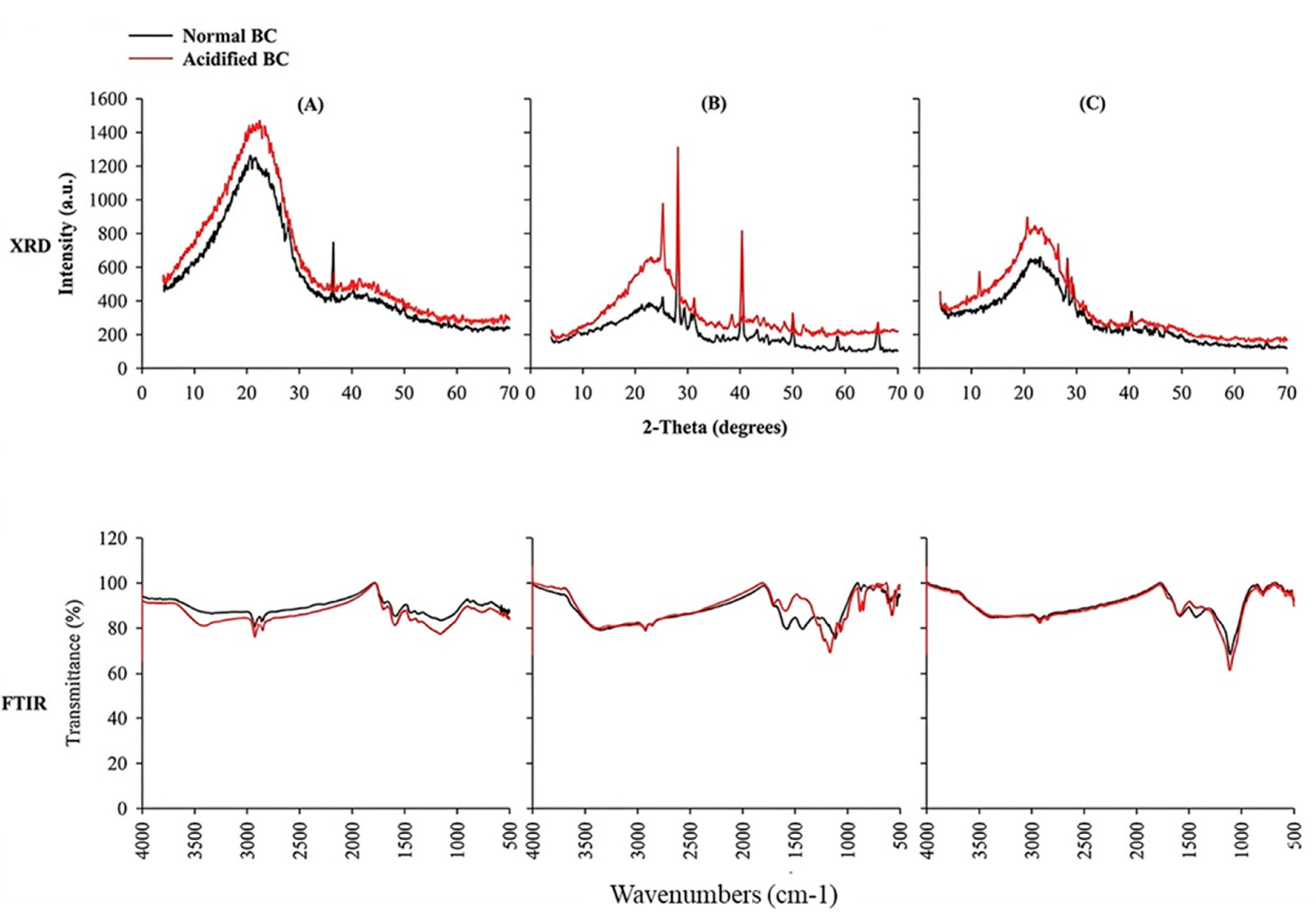
Data presented in Figure 3 shows the X-ray diffraction (XRD) and Fourier transform infrared (FTIR) analyses of both non-acidified and acid-modified biochars derived from date palm fronds, leaves and pits. The results showed a significant alteration in mineral crystallinity and surface functional groups due to acid treatment. The XRD data reveal that non-modified biochars showed distinct crystalline reflections based on the standard reference patterns from the ICDD Powder Diffraction File (PDF) database, i.e., peaks at approximately 2θ ≈ 26.6° were assigned to quartz (SiO2), whereas peaks around 2θ ≈ 29.4° were attributed to calcite (CaCO3). More reflections were observed at 2θ ≈ 39.4°, 43.1°, 47.5°, and 48.5°, which further supported the presence of calcite. In case of acidified biochars, they exhibit reductions in intensity of distinct crystalline diffraction peaks, particularly those related to calcite, as noticed by the decrease in their XRD peaks. In contrast, the quartz peak at ~26.6° remained relatively unchanged or even increased in some samples (e.g., leaves biochar), because quartz is an acid-resistant mineral. This observation suggests the dissolution of ash-associated mineral phases originally present in the untreated biochar [56,59], with increases in the relative proportions of amorphous carbon phases.
The findings collectively suggest that acid treatment changed the mineral fraction and surface chemistry of biochars rather than increasing carbon ordering as evidenced by the decline in ash content and base cation concentrations, besides weakening of carbonate-related XRD peaks. Additionally, FTIR spectra demonstrate that acid treatment results in enhanced absorbance at approximately 1700 cm−1 (C=O stretching) and around 3400 cm−1 (O–H stretching), which aligns with an increase in carboxyl, hydroxyl and carbonyl functional groups on the surface of the biochar [11]. These functional groups improve soil CEC, increase soil water holding capacity and boost soil beneficial activity [55]. Moreover, acid modifications can further increase soil fertility and probably immobilize inorganic constituents in water treatment and soil remediation. Acidification seems to considerably modify the structure of biochar, especially in biochars produced from leaves. This modification was evidenced by reduced transmittance, which may be attributable to heightened acidity that promotes the leaching of minerals or the incorporation of acidic functional groups, such as carboxylic and phenolic groups, on the surface of the biochar.

3.3. Role of Liquefied Smokes for Enhancing Germination of Maize Seeds

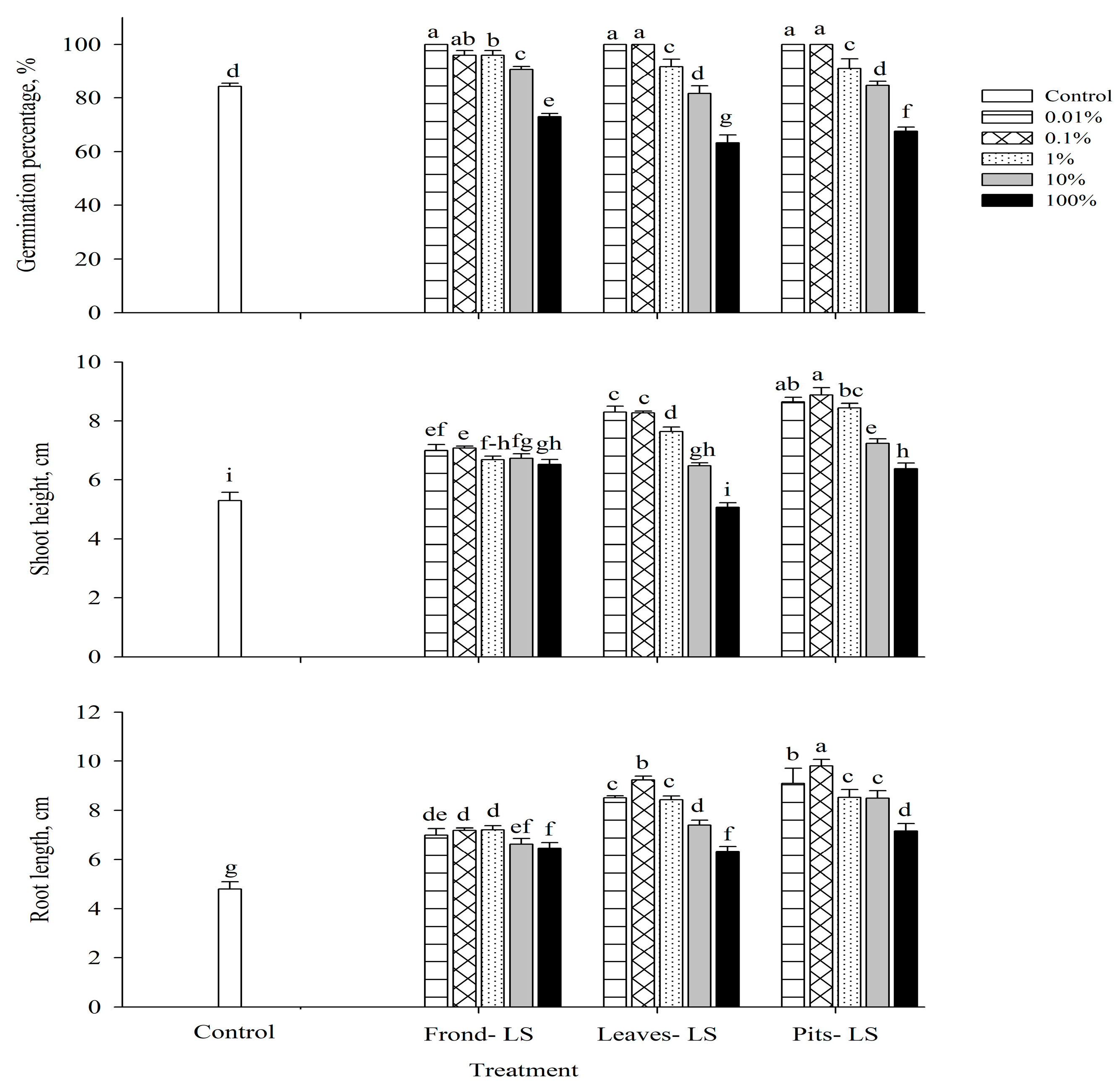
Figure 4 shows the effect of liquefied smokes added at different concentrations on the germination of maize seeds. All doses of liquefied smokes (LS) derived from date palm residues demonstrate significant increases in the investigated parameters, germination rate, root length and plant height, versus the control and such increases were concentration dependent. Specifically, pits-LS at lower concentrations (0.01–0.1%) significantly enhanced germination rates from 75% (control) to 100% and also promotes root and shoot elongation (up to 9.80 cm in root length). Among the tested liquefied smokes derived from different date palm residues, pits-LS recorded the greatest increases in both root length and shoot height, followed by leaves-LS then frond-LS. This positive effect can be attributed to the higher contents of lipids, simple sugars, and phenolic antioxidants in pits compared to fronds/leaves [60]. Upon pits pyrolysis, the presence of smoke-derived bioactive compounds, including organic acids and phenolic constituents, and potentially Karrikin-like germination stimulants were produced, which boosted germination and elongation [61,62]. At low application doses, Karrikin loosened the seed coat, improving water uptake and oxygen diffusion into the embryo and was therefore capable of breaking seed dormancy [63,64]. On the other hand, no significant variations were found in germination percentage among the investigated LS. On the other hand, no significant differences were observed in germination percentage among the investigated liquefied smoke (LS) treatments.
Nevertheless, the higher doses of this liquid smoke (>0.1%) considerably affected seed germination, root length and seedling height. Most likely, LS increased osmotic pressure at high application levels, reducing water uptake by seeds. Additionally, its high levels can acidify the environment and hinder enzyme functions during the germination process [65].
Comparable findings were reported by Abdelhafez et al. [11] who found that adding liquefied smoke (produced from nutshell and date palm seed) at 0.1% or 0.25% significantly increased seed germination of lettuce by more than 93%, corresponding to the control treatment, which achieved only 72% as a germination rate.

3.4. Role of Added Biochars on Soil Chemical Characteristics

Table 3 indicates that application of non-modified frond biochar did not significantly affect soil pH, irrespective of the application rate.
In contrast, the pH decreased significantly due to the application of the acidified biochar, only at the highest rate of application. Also, acidified leaf and pit biochars decreased soil pH, with superiority for pit biochar. This result was confirmed by Khalil et al. [29], Abuzaid et al. [66]. Accordingly, this additive could be beneficial for alkaline soils typically found in arid environments, as it can improve the solubility and availability of vital micronutrients such as Fe, Mn, Zn and Cu [67]. On the other hand, the non-modified biochars of both leaf and pits raised considerably soil pH, with no variations among doses. Such increases may be attributed to the alkaline mineral ash, especially carbonates, bicarbonates, and oxides/hydroxides of Ca, Mg, K, and Na, which could raise soil pH and hinder the availability of some soil nutrients, especially P and micronutrients [66]. Nevertheless, the higher doses of non-modified biochar acted as a buffer against further increases in soil pH [28], probably because of their high surface area which decreased the activities of free H+ and OH- ions in the media [68].
Soil organic matter increased owing to the application of all types of biochar, specifically the non-acidified ones, demonstrating the role of biochar as stable organic carbon source that enhances soil structure, water retention, aeration, and the microbial habitat while sequestering carbon in the long term [69,70]. At higher doses of acidified biochar, the rate of biochar degradation slowed down, possibly because of its acidic properties that hindered soil microbial activity, thereby increasing organic matter in soil.
Changes in electrical conductivity (EC) were statistically insignificant (Control: 0.34 dS m−1), indicating that these biochars are unlikely to induce salinity stress, even at a 5% application rate, which is a critical factor for arid regions [71].
Furthermore, available nitrogen (AN) exhibited marked increases, particularly at elevated application rates (5%). The highest increases were recorded for the application of the highest rate of non-modified biochar which was produced via pyrolysis of leaves (28.99 mg kg−1), which may be attributed to the relatively higher concentrations of NH4+-N and NO3-N in this biochar. It is worth notifying that total nitrogen varied considerably among different chars (N = 0.21–1.95%), and recorded the highest increases in palm date pits (1.89–1.95%), followed by N- in leaf char then frond char. This result indicates that concentrations of available-N could be strongly controlled by mineral N forms (NH4+ and NO3) in the amendment, rather than the total N-content in the produced biochar. Overall, acidified biochars yielded lower AN compared to their non-modified counterparts at equivalent rates.
The findings also revealed noteworthy increases in available phosphorus (AP), especially with non-modified frond biochar which demonstrated significant increases even at a rate of 1% (17.89 mg kg−1) compared to the control. Generally, the highest available P was found for the non-modified leaves biochar. This underscores the capacity of biochar to mitigate phosphorus fixation, particularly in alkaline soils [72]. In contrast, acidified biochars consistently designated significantly lower AP levels than the non-modified biochars, which may be attributed to the increased solubility of Al/Fe resulting in re-fixation or enhanced adsorption of P onto the surfaces of the acidified biochar [73].
Additionally, available potassium (AK) demonstrated a dose-dependent increase across all biochars, especially the pits biochar, which exhibited the highest available-K increases. Notably, the application of acidified pits biochar at 5% yielded the highest AK value (87.93 mg kg−1 versus control, 54.20 mg kg−1). Since acidified biochar is generally more easily degradable than non-modified biochar [27,29]. Maybe, H+ ions displace sorbed K+ from exchange sites or from the biochar matrix [29]; however, this acidity also increased the surface functional groups formed during biochar acidification to retain K+ more strongly [74].
The uptake of the studied nutrients was higher in plants treated with acid-modified biochar than the non-acidified types. Generally, acidified biochar raised NPK contents in different plant parts compared to non-acidified biochar. The highest increases were observed with pit biochar, especially at its highest application rate.

3.5. Role of Applied Biochars for Maize Growth

All additives significantly boosted plant growth parameters (root and shoot biomasses, plant height and root length), with superiority for the acidified biochar at increasing rate of application. There were some exceptions as the lowest rates of non-modified biochar (up to 2.5%) recorded comparable shoot dry weight and chlorophyll content to the control.
These additives enriched soils with nutrients during degradation to be taken up by plant and increase plant growth [27]. Overall, application of acidified biochars, derived from date palm residues at rates of 2.5% to 5%, substantially improved maize growth and nutrient absorption in comparison to standard biochars or control groups (Table 4 and Table 5).
Similar results reported that maize productivity, when grown on soil amended with non-modified rice straw biochar, was significantly raised by 1.96 higher than the control [75]. Also, Elshony et al. [76] noticed significant improvements in growth and productivity of peanut plants following biochar application at a rate of 12.5 Mg ha−1. Regarding acidified biochar, several studies have reported its superior impacts on plant growth versus non-modified biochar, particularly in maize [27,29,66] and wheat [28,77].
These enhancements could be attributed to several factors: (1) the modulation of pH (with acidified biochar pH approximately 4.23 compared to soil pH of 7.97), which improved phosphorus solubility; (2) the presence of hydrophilic functional groups (e.g., -OH at 3400 cm−1) that promote the retention of water and nutrients [75]; and (3) enhanced stress tolerance facilitated through potassium-mediated osmoregulation and the activation of antioxidant enzymes [78].
Consequently, the implementation of 2.5% to 5% acidified palm biochar is advocated to optimize maize productivity in arid soil conditions while simultaneously conserving irrigation resources.

3.6. Correlation Between Plant Growth and Nutrient Status in Shoots, Roots, and Soil

The findings illustrated in Table 6 indicate that plant growth parameters, specifically shoot and root fresh weights, plant height, and root length, were significantly correlated with each other. These parameters recorded significant correlations with available N in soil and N contents in roots and shoots. In this respect, nitrogen contents in both shoots and roots were also significantly correlated with their corresponding available N- contents in soil. In the case of P, a significant correlation was detected between P content in shoots and P content in roots, but not with available P. Most likely, plants mobilize in situ soil P through secretion of exudates that chelate P [79,80] followed by high-affinity transporters [81]. Overall, chlorophyll content in plant shoots was significantly correlated with the nutritional status of plants, particularly with N and P concentrations in both shoots and roots, as well as K concentration in roots.

4. Conclusions

This research corroborates that the utilization of biochar and liquefied smoke derived from date palm residues considerably improves soil fertility and promotes maize growth in arid landscapes, exhibiting effects that are contingent upon both the specific feedstock and the type of treatment applied. Among the materials derived from pits, those produced from pits-LS at a low dosage (≤0.1%) were identified as particularly effective, yielding the highest rates of germination and root development. Furthermore, the acidified pits biochar at a concentration of 5% was observed to release the greatest amount of potassium into the soil (87.93 mg kg−1) while simultaneously decreasing pH levels. Non-modified leaf biochar was found to provide enhanced nitrogen availability (28.99 mg kg−1), and biochar derived from fronds was optimal for phosphorus enrichment. Additionally, the process of acidification was noted to significantly improve maize shoot growth (with a 133% increase attributed to leaf biochar) and nutrient absorption (for instance, a 589% increase in root nitrogen uptake with pit biochar), facilitated by increased porosity, the presence of functional groups, and adjustments in pH levels. Nevertheless, elevated concentrations of liquefied smoke (such as leaves-LS) and excessive doses of biochar (exceeding 5%) were linked to phytotoxic effects or reductions in root biomass, underscoring the need for calibrated application approaches. From a practical standpoint, it is advisable to use pits-LS for seed priming, employ acidified biochar at concentrations between 2.5% and 5% to bolster maize cultivation in alkaline soils, and utilize non-modified frond or leaf biochar for the enhancement of phosphorus and nitrogen levels. Collectively, these strategies not only facilitate the valorization of waste but also promote sustainable soil management practices.

Research Limitations

The experiment was conducted under controlled greenhouse conditions, which may not fully represent field environments. Moreover, the study was performed using a single soil type, and the specific chemical composition of smoke-derived bioactive compounds was not chemically characterized. Future research should therefore aim to address these limitations through field-scale experiments and detailed chemical analyses.

Author Contributions

X.Z. (Xu Zhang): Investigation, validation, data curation, writing—original draft. N.C.: Data curation, formal analysis. F.L.: Funding acquisition. Y.X.: Data curation, formal analysis. H.C.: Conceptualization, formal analysis. X.Z. (Xuefei Zhou): Writing—review and editing, validation, methodology. Y.Z.: Writing—review and editing, validation, methodology. M.H.H.A.: Conceptualization, methodology, formal analysis, writing—review and editing. M.E.Y.: Investigation, formal analysis. A.A.A.: Conceptualization, methodology, formal analysis, funding acquisition, writing—review and editing. All authors have read and agreed to the published version of the manuscript.

Funding

This study was funded by the Shanghai Agricultural Science and Technology Innovation Program (Grant No. I2023008).

Institutional Review Board Statement

Not applicable.

Informed Consent Statement

Not applicable.

Data Availability Statement

The dataset is available upon request from the authors.

Conflicts of Interest

The authors declare no conflicts of interest.

References

  1. Hossain, A.; Krupnik, T.J.; Timsina, J.; Mahboob, M.G.; Chaki, A.K.; Farooq, M.; Bhatt, R.; Fahad, S.; Hasanuzzaman, M. Agricultural Land Degradation: Processes and Problems Undermining Future Food Security. In Environment, Climate, Plant and Vegetation Growth; Fahad, S., Hasanuzzaman, M., Alam, M., Ullah, H., Saeed, M., Ali Khan, I., Adnan, M., Eds.; Springer International Publishing: Cham, Switzerland, 2020; pp. 17–61. [Google Scholar]
  2. Farid, I.M.; El-Ghozoli, M.A.; Abbas, M.H.H.; Abbas, H.H.; Elsayed, I.M.; El-Atrony, D.S. Short term impacts of amending calcareous and non-calcareous sandy soils with organic amendments and their extracts: Effects on soil biota, soil physical and chemical characteristics. Ann. Agric. Sci. Moshtohor 2021, 59, 137–150. [Google Scholar] [CrossRef]
  3. Selvan, T.; Panmei, L.; Murasing, K.K.; Guleria, V.; Ramesh, K.R.; Bhardwaj, D.R.; Thakur, C.L.; Kumar, D.; Sharma, P.; Digvijaysinh Umedsinh, R.; et al. Circular economy in agriculture: Unleashing the potential of integrated organic farming for food security and sustainable development. Front. Sustain. Food Syst. 2023, 7, 1170380. [Google Scholar] [CrossRef]
  4. Barrett, C.B. Overcoming Global Food Security Challenges through Science and Solidarity. Am. J. Agric. Econ. 2021, 103, 422–447. [Google Scholar] [CrossRef]
  5. Cotrufo, M.F.; Lavallee, J.M. Chapter One—Soil organic matter formation, persistence, and functioning: A synthesis of current understanding to inform its conservation and regeneration. In Advances in Agronomy; Sparks, D.L., Ed.; Academic Press: Cambridge, MA, USA, 2022; Volume 172, pp. 1–66. [Google Scholar]
  6. Mohamed, I.; Farid, I.M.; Siam, H.S.; Abbas, M.H.H.; Tolba, M.; Mahmoud, S.A.; Abbas, H.H.; Abdelhafez, A.A.; Elkelish, A.; Scopa, A.; et al. A brief investigation on the prospective of co-composted biochar as a fertilizer for Zucchini plants cultivated in arid sandy soil. Open Agric. 2024, 9, 20220322. [Google Scholar] [CrossRef]
  7. Hallawa, A.M.I.Y.; Abd El-Hamed, A.E.H.; Salem, H.M.S.; Ali, I.M.E. Removal efficiency of Cd from aqueous solution by H2O2; and KMnO4 modified biochar derived from orange and pea shells. Ann. Agric. Sci. Moshtohor 2024, 62, 49–56. [Google Scholar] [CrossRef]
  8. Simić, M.; Petrović, J.; Koprivica, M.; Ercegović, M.; Dimitrijević, J.; Vuković, N.S.; Fiol, N. Efficient Adsorption of Lead on Hydro-Pyrochar Synthesized by Two-Step Conversion of Corn Cob in Magnesium Chloride Medium. Toxics 2025, 13, 459. [Google Scholar] [CrossRef] [PubMed]
  9. Seow, Y.X.; Tan, Y.H.; Mubarak, N.M.; Kansedo, J.; Khalid, M.; Ibrahim, M.L.; Ghasemi, M. A review on biochar production from different biomass wastes by recent carbonization technologies and its sustainable applications. J. Environ. Chem. Eng. 2022, 10, 107017. [Google Scholar] [CrossRef]
  10. Chen, C.; Yang, L.; Zhang, X.; Zhao, C.; Sun, J.; Li, G.; Shi, H. Advances and prospects of multifunctional biochar-based materials from organic solid waste of traditional Chinese medicine: A review. Biomass Bioenergy 2024, 187, 107296. [Google Scholar] [CrossRef]
  11. Abdelhafez, A.A.; Zhang, X.; Zhou, L.; Cai, M.; Cui, N.; Chen, G.; Zou, G.; Abbas, M.H.H.; Kenawy, M.H.M.; Ahmad, M.; et al. Eco-friendly production of biochar via conventional pyrolysis: Application of biochar and liquefied smoke for plant productivity and seed germination. Environ. Technol. Innov. 2021, 22, 101540. [Google Scholar] [CrossRef]
  12. Abdelhafez, A.; Ibrahim, M.; Farid, Y.; Sayed, A.; Abbas, H.; Farid, I.M.; Abbas, M.H.H. Impacts of Acidified Biochar on Wheat growth under Deficit Irrigation systems. Environ. Biodivers. Soil Secur. 2024, 8, 191–207. [Google Scholar] [CrossRef]
  13. Bolan, N.; Hoang, S.A.; Beiyuan, J.; Gupta, S.; Hou, D.; Karakoti, A.; Joseph, S.; Jung, S.; Kim, K.-H.; Kirkham, M.B.; et al. Multifunctional applications of biochar beyond carbon storage. Int. Mater. Rev. 2022, 67, 150–200. [Google Scholar] [CrossRef]
  14. Amalina, F.; Krishnan, S.; Zularisam, A.W.; Nasrullah, M. Recent advancement and applications of biochar technology as a multifunctional component towards sustainable environment. Environ. Dev. 2023, 46, 100819. [Google Scholar] [CrossRef]
  15. Luo, L.; Wang, J.; Lv, J.; Liu, Z.; Sun, T.; Yang, Y.; Zhu, Y.-G. Carbon Sequestration Strategies in Soil Using Biochar: Advances, Challenges, and Opportunities. Environ. Sci. Technol. 2023, 57, 11357–11372. [Google Scholar] [CrossRef]
  16. Shan, R.; Han, J.; Gu, J.; Yuan, H.; Luo, B.; Chen, Y. A review of recent developments in catalytic applications of biochar-based materials. Resour. Conserv. Recycl. 2020, 162, 105036. [Google Scholar] [CrossRef]
  17. Zhou, X.; Zhu, Y.; Niu, Q.; Zeng, G.; Lai, C.; Liu, S.; Huang, D.; Qin, L.; Liu, X.; Li, B.; et al. New notion of biochar: A review on the mechanism of biochar applications in advanced oxidation processes. Chem. Eng. J. 2021, 416, 129027. [Google Scholar] [CrossRef]
  18. Bartoli, M.; Giorcelli, M.; Tagliaferro, A. A Comprehensive Overview on Biochar-Based Materials for Catalytic Applications. Catalysts 2023, 13, 1336. [Google Scholar] [CrossRef]
  19. Subramaniam, M.N.; Wu, Z.; Goh, P.S.; Zhou, S. The state-of-the-art development of biochar based photocatalyst for removal of various organic pollutants in wastewater. J. Clean. Prod. 2023, 429, 139487. [Google Scholar] [CrossRef]
  20. Abdelhafez, A.A.; Abbas, M.; Li, J. Biochar: The Black Diamond for Soil Sustainability, Contamination Control and Agricultural Production. In Engineering Applications of Biochar; Huang, W.-J., Ed.; IntechOpen: London, UK, 2017. [Google Scholar]
  21. Abdelhafez, A.A.; Abbas, M.H.H. Applications of Biochar for Environmental Safety; IntechOpen: London, UK, 2020. [Google Scholar] [CrossRef]
  22. Abdelhafez, A.A.; Li, J.; Abbas, M.H.H. Feasibility of biochar manufactured from organic wastes on the stabilization of heavy metals in a metal smelter contaminated soil. Chemosphere 2014, 117, 66–71. [Google Scholar] [CrossRef] [PubMed]
  23. Abdelhafez, A.A.; Li, J. Removal of Pb(II) from aqueous solution by using biochars derived from sugar cane bagasse and orange peel. J. Taiwan Inst. Chem. Eng. 2016, 61, 367–375. [Google Scholar] [CrossRef]
  24. Amalina, F.; Razak, A.S.A.; Krishnan, S.; Sulaiman, H.; Zularisam, A.W.; Nasrullah, M. Biochar production techniques utilizing biomass waste-derived materials and environmental applications—A review. J. Hazard. Mater. Adv. 2022, 7, 100134. [Google Scholar] [CrossRef]
  25. Hossain, M.Z.; Bahar, M.M.; Sarkar, B.; Donne, S.W.; Ok, Y.S.; Palansooriya, K.N.; Kirkham, M.B.; Chowdhury, S.; Bolan, N. Biochar and its importance on nutrient dynamics in soil and plant. Biochar 2020, 2, 379–420. [Google Scholar] [CrossRef]
  26. Bolan, N.; Sarmah, A.K.; Bordoloi, S.; Bolan, S.; Padhye, L.P.; Van Zwieten, L.; Sooriyakumar, P.; Khan, B.A.; Ahmad, M.; Solaiman, Z.M.; et al. Soil acidification and the liming potential of biochar. Environ. Pollut. 2023, 317, 120632. [Google Scholar] [CrossRef]
  27. Abdel-Salam, M.; Abuzaid, A.S.; Mouhmoud, F.; Abbas, M.H.H. Increasing Maize Productivity in Arid Sandy Soils using Combinations of (Normal/Acidified) Biochar and Elemental Sulfur. Egypt. J. Soil Sci. 2025, 65, 339–357. [Google Scholar] [CrossRef]
  28. Mohamed, I.; Abdelhafez, A.A.; Mohamed Farid, Y.I.; Sayed, A.; Abbas, H.H.; Farid, I.M.; Azab, A.E.; Abbas, M.H.H. Biochar as a Potential Strategy for Enhancing Wheat Production in Arid Soils under deficit irrigation practices. Egypt. J. Soil Sci. 2025, 65, 519–533. [Google Scholar] [CrossRef]
  29. Khalil, F.W.; Abdel-Salam, M.; Abbas, M.H.H.; Abuzaid, A.S. Implications of Acidified and Non-Acidified Biochars on N and K Availability and their Uptake by Maize Plants. Egypt. J. Soil Sci. 2023, 63, 101–112. [Google Scholar] [CrossRef]
  30. Tolba, M.; Farid, I.M.; Siam, H.; Abbas, M.H.H.; Mohamed, I.; Mahmoud, S.; El-Sayed, A.E.-K. Integrated Management of K -Additives to Improve the Productivity of Zucchini Plants Grown on a Poor Fertile Sandy Soil. Egypt. J. Soil Sci. 2021, 61, 355–365. [Google Scholar] [CrossRef]
  31. Shi, R.-Y.; Ni, N.; Nkoh, J.N.; Dong, Y.; Zhao, W.-R.; Pan, X.-Y.; Li, J.-Y.; Xu, R.-K.; Qian, W. Biochar retards Al toxicity to maize (Zea mays L.) during soil acidification: The effects and mechanisms. Sci. Total Environ. 2020, 719, 137448. [Google Scholar] [CrossRef]
  32. Abid, W.; Ammar, E. Date Palm (Phoenix dactylifera L.) Wastes Valorization: A Circular Economy Approach. In Mediterranean Fruits Bio-Wastes: Chemistry, Functionality and Technological Applications; Ramadan, M.F., Farag, M.A., Eds.; Springer International Publishing: Cham, Switzerland, 2022; pp. 403–430. [Google Scholar]
  33. Faiad, A.; Alsmari, M.; Ahmed, M.M.Z.; Bouazizi, M.L.; Alzahrani, B.; Alrobei, H. Date Palm Tree Waste Recycling: Treatment and Processing for Potential Engineering Applications. Sustainability 2022, 14, 1134. [Google Scholar] [CrossRef]
  34. Elsadek, M.A.; Yousef, E.A.A. Smoke-Water Enhances Germination and Seedling Growth of Four Horticultural Crops. Plants 2019, 8, 104. [Google Scholar] [CrossRef] [PubMed]
  35. Noel, R.; Benoit, M.; Wilder, S.L.; Waller, S.; Schueller, M.; Ferrieri, R.A. Treatments with Liquid Smoke and Certain Chemical Constituents Prevalent in Smoke Reduce Phloem Vascular Sectoriality in the Sunflower with Improvement to Growth. Int. J. Mol. Sci. 2022, 23, 12468. [Google Scholar] [CrossRef]
  36. ISTA. International rules for seed testing. Seed. Sci. Technol. 1999, 27, 1–333. [Google Scholar]
  37. IBI-STD-2.1; Standardized Product Definition and Product Testing Guidelines for Biochar That Is Used in Soil (IBI Biochar Standards). Version 2.1 (23 November 2015). International Biochar Initiative: Norfolk, VA, USA, 2015.
  38. El-Sharkawy, M.; El-Naggar, A.H.; AL-Huqail, A.A.; Ghoneim, A.M. Acid-Modified Biochar Impacts on Soil Properties and Biochemical Characteristics of Crops Grown in Saline-Sodic Soils. Sustainability 2022, 14, 8190. [Google Scholar] [CrossRef]
  39. Lowther, J.R. Use of a single sulphuric acid-hydrogen peroxide digest for the analysis of pinus radiata needles. Commun. Soil Sci. Plant Anal. 1980, 11, 175–188. [Google Scholar] [CrossRef]
  40. Nelson, D.W.; Sommers, L.E. Total Carbon, Organic Carbon, and Organic Matter. In Methods of Soil Analysis; SSSA Book Series; Soil Science Society of America: Madison, WI, USA; American Society of Agronomy: Madison, WI, USA, 1996; pp. 961–1010. [Google Scholar]
  41. Selmer-Olsen, A.R. Determination of ammonium in soil extracts by an automated indophenol method. Analyst 1971, 96, 565–568. [Google Scholar] [CrossRef]
  42. Doane, T.A.; Horwáth, W.R. Spectrophotometric Determination of Nitrate with a Single Reagent. Anal. Lett. 2003, 36, 2713–2722. [Google Scholar] [CrossRef]
  43. Soltanpour, P.N. Determination of Nutrient Availability and Elemental Toxicity by AB-DTPA Soil Test and ICPS. In Advances in Soil Science: Volume 16; Stewart, B.A., Ed.; Springer New York: New York, NY, USA, 1991; pp. 165–190. [Google Scholar]
  44. Purpose, A. Plant analysis. In Laboratory Guide for Conducting Soil Tests and Plant Analysis; Jones, J.B., Ed.; CRC Press: Washington, DC, USA, 2001; pp. 115–203. [Google Scholar]
  45. Tenodi, S.; Maletić, S.; Kragulj Isakovski, M.; Kruse, J.; Weihermüller, L. Impact of biochar, compost, and sludge amendments on the soil water balance of a sandy soil. Biochar 2026, 8, 14. [Google Scholar] [CrossRef]
  46. He, C.; Zhang, T.; Su, S.; Zhang, Y.; Zeng, X.; Qiu, Y.; Wen, Y.; Tan, S. Stabilizing Active Aluminum (Al3+) in Acidic Soils via Biochar-Induced Microbial Niches: Focusing on Denitrifier-Mediated Mechanisms, Efficiency, and Environmental Outcomes. Toxics 2026, 14, 157. [Google Scholar] [CrossRef] [PubMed]
  47. Khalifa, D.M.; Hewait, H.M.; Stanciu, A.-S.; Eladly, R.M.; Shalaby, M.E.; Głowacka, A. Interactive effects of biochar and microbial biofertilizers on sandy soil fertility and cowpea yield in Egyptian agroecosystems. Sci. Rep. 2026, 16, 8735. [Google Scholar] [CrossRef] [PubMed]
  48. Soliman, Y.M.; Soliman, W.S.; Abbas, A.M. Biochar–NPK–Seaweed Integration as a Sustainable Strategy to Boost Productivity of Spearmint in Sandy Soils. Sustainability 2026, 18, 1665. [Google Scholar] [CrossRef]
  49. Burezq, H.a.; Davidson, M.K. Biochar from date palm (Phoenix dactylifera L.) residues—A critical review. Arab. J. Geosci. 2023, 16, 101. [Google Scholar] [CrossRef]
  50. Aladin, A.; Yani, S.; Modding, B.; Wiyani, L. Pyrolysis of corncob waste to produce liquid smoke. IOP Conf. Ser. Earth Environ. Sci. 2018, 175, 012020. [Google Scholar] [CrossRef]
  51. Yuniwati, E.D.; Lestari, A.M. Application of biochar and liquid smoke from biomass waste management to increase yields and raise farmers’ income. In Proceedings of the International Conference on Community Development (ICCD 2020); Atlantis Press: Dordrecht, The Netherlands, 2020. [Google Scholar] [CrossRef]
  52. Li, L.; Chen, D.; Huang, X.; Liu, Q.; Liang, J.; Hu, J.; Liu, Q. Variations of nitrogen and phosphorus between leaf, stem and root in shrubland biomes and responses to climate and soil factors across the Hengduan Mountains, China. CATENA 2024, 241, 108008. [Google Scholar] [CrossRef]
  53. Abdul-Aziz, A.-L.; Uz, I. Biochar from Agricultural Waste Enhances Rhizosphere Microbial Activity Over Bulk Soil. J. Soil Sci. Plant Nutr. 2026, 26, 2614–2627. [Google Scholar] [CrossRef]
  54. Iacomino, G.; Idbella, M.; Staropoli, A.; Nanni, B.; Bertoli, T.; Vinale, F.; Bonanomi, G. Exploring the Potential of Wood Vinegar: Chemical Composition and Biological Effects on Crops and Pests. Agronomy 2024, 14, 114. [Google Scholar] [CrossRef]
  55. Koprivica, M.; Petrović, J.; Simić, M.; Dimitrijević, J.; Ercegović, M.; Trifunović, S. Characterization and Evaluation of Biomass Waste Biochar for Turfgrass Growing Medium Enhancement in a Pot Experiment. Agriculture 2025, 15, 2206. [Google Scholar] [CrossRef]
  56. Mahmoud, E.R.I.; Aly, H.M.; Hassan, N.A.; Aljabri, A.; Khan, A.L.; El-Labban, H.F. Utilizing Date Palm Leaf Biochar for Simultaneous Adsorption of Pb(II) and Iodine from Aqueous Solutions. Processes 2024, 12, 1370. [Google Scholar] [CrossRef]
  57. Liu, Z.; Zhang, F.-S. Removal of lead from water using biochars prepared from hydrothermal liquefaction of biomass. J. Hazard. Mater. 2009, 167, 933–939. [Google Scholar] [CrossRef] [PubMed]
  58. Tan, X.; Liu, Y.; Zeng, G.; Wang, X.; Hu, X.; Gu, Y.; Yang, Z. Application of biochar for the removal of pollutants from aqueous solutions. Chemosphere 2015, 125, 70–85. [Google Scholar] [CrossRef] [PubMed]
  59. Younis, M.; Farag, H.A.; Alhamdan, A.; Aboelasaad, G.; Zein El-Abedein, A.I.; Kamel, R.M. Utilization of palm residues for biochar production using continuous flow pyrolysis unit. Food Chem. X 2023, 20, 100903. [Google Scholar] [CrossRef] [PubMed]
  60. Shi, L.-E.; Zheng, W.; Aleid, S.M.; Tang, Z.-X. Date Pits: Chemical Composition, Nutritional and Medicinal Values, Utilization. Crop Sci. 2014, 54, 1322–1330. [Google Scholar] [CrossRef]
  61. Waters, M.T.; Nelson, D.C. Karrikin perception and signalling. New Phytol. 2023, 237, 1525–1541. [Google Scholar] [CrossRef]
  62. Faizan, M.; Rajput, K.; Patyal, U.; Kaur, M.; Sanchan, R.K.; Alam, P.; Soysal, S.; Jairoun, A.; Maruthi, K.R. Karrikins biosynthesis, signaling route, regulatory roles, and hormonal crosstalk in plant soil system. Egypt. J. Soil Sci. 2024, 64, 1495–1509. [Google Scholar] [CrossRef]
  63. Fang, P.; Hu, Y.; Guo, Q.; Li, L.; Xu, P. Karrikins, redox and plant abiotic stress tolerance: A focal review. Plant Stress 2023, 9, 100185. [Google Scholar] [CrossRef]
  64. Deng, Q.; Wang, H.; Qiu, Y.; Wang, D.; Xia, Y.; Zhang, Y.; Pei, M.; Zhao, Y.; Xu, X.; Zhang, H. The Multifaceted Impact of Karrikin Signaling in Plants. Int. J. Mol. Sci. 2025, 26, 2775. [Google Scholar] [CrossRef] [PubMed]
  65. Abou El-Nour, H.H. Effects of Smoke Water on Seeds Germination, Seedling Growth of some Vegetables and Green Yield Productivity of Phaseolus vulgaris. Al-Azhar J. Agric. Res. 2021, 46, 124–138. [Google Scholar] [CrossRef]
  66. Abuzaid, A.S.; Abdel-Salam, M.; Abbas, M.H.H.; Khalil, F.; Abdelhafez, A.A. Effectiveness of Biochar and Elemental Sulfur for Sustaining Maize Production in Arid soils. Egypt. J. Soil Sci. 2025, 65, 163–177. [Google Scholar] [CrossRef]
  67. Tag, A.T.; Duman, G.; Ucar, S.; Yanik, J. Effects of feedstock type and pyrolysis temperature on potential applications of biochar. J. Anal. Appl. Pyrolysis 2016, 120, 200–206. [Google Scholar] [CrossRef]
  68. Tusar, H.M.; Uddin, M.K.; Mia, S.; Suhi, A.A.; Wahid, S.B.A.; Kasim, S.; Sairi, N.A.; Alam, Z.; Anwar, F. Biochar-Acid Soil Interactions—A Review. Sustainability 2023, 15, 13366. [Google Scholar] [CrossRef]
  69. Sohi, S.P.; Krull, E.; Lopez-Capel, E.; Bol, R. Chapter 2—A Review of Biochar and Its Use and Function in Soil. In Advances in Agronomy; Academic Press: Cambridge, MA, USA, 2010; Volume 105, pp. 47–82. [Google Scholar]
  70. Lehmann, J.; Rillig, M.C.; Thies, J.; Masiello, C.A.; Hockaday, W.C.; Crowley, D. Biochar effects on soil biota—A review. Soil Biol. Biochem. 2011, 43, 1812–1836. [Google Scholar] [CrossRef]
  71. Al-Wabel, M.I.; Al-Omran, A.; El-Naggar, A.H.; Nadeem, M.; Usman, A.R.A. Pyrolysis temperature induced changes in characteristics and chemical composition of biochar produced from conocarpus wastes. Bioresour. Technol. 2013, 131, 374–379. [Google Scholar] [CrossRef]
  72. Xu, G.; Sun, J.; Shao, H.; Chang, S.X. Biochar had effects on phosphorus sorption and desorption in three soils with differing acidity. Ecol. Eng. 2014, 62, 54–60. [Google Scholar] [CrossRef]
  73. Glaser, B.; Lehr, V.-I. Biochar effects on phosphorus availability in agricultural soils: A meta-analysis. Sci. Rep. 2019, 9, 9338. [Google Scholar] [CrossRef] [PubMed]
  74. Swaminaathan, P.; Kamalesh, R.; Karishma, S.; Ragini, Y.P.; Saravanan, A.; Vickram, A.S. A comparative study of raw and sulfuric acid-activated areca-fungal biochar for effective Pb (II) adsorption. Next Mater. 2026, 10, 101360. [Google Scholar] [CrossRef]
  75. Bassouny, M.; Abbas, M.H.H. Role of Biochar in Managing the Irrigation Water Requirements of Maize Plants: The Pyramid Model Signifying the Soil Hydro-physical and Environmental Markers. Egypt. J. Soil Sci. 2019, 59, 99–115. [Google Scholar] [CrossRef]
  76. Elshony, M.; Farid, I.M.; Alkamar, F.; Abbas, M.H.H.; Abbas, H. Ameliorating a Sandy Soil Using Biochar and Compost Amendments and Their Implications as Slow Release Fertilizers on Plant Growth. Egypt. J. Soil Sci. 2019, 59, 305–322. [Google Scholar] [CrossRef]
  77. Farid, Y.; Ali, I.; Abdelhafez, A.; Abbas, M.H.H. Enhancing Wheat Productivity in Salt-Affected Soils Using Traditional and Acidified Biochars: A Sustainable Solution. Egypt. J. Soil Sci. 2025, 65, 121–134. [Google Scholar] [CrossRef]
  78. Zhou, G.; Liu, C.; Cheng, Y.; Ruan, M.; Ye, Q.; Wang, R.; Yao, Z.; Wan, H. Molecular Evolution and Functional Divergence of Stress-Responsive Cu/Zn Superoxide Dismutases in Plants. Int. J. Mol. Sci. 2022, 23, 7082. [Google Scholar] [CrossRef] [PubMed]
  79. De Andrade, S.A.L.; Borghi, A.A.; De Oliveira, V.H.; Gouveia, L.d.M.; Martins, A.P.I.; Mazzafera, P. Phosphorus Shortage Induces an Increase in Root Exudation in Fifteen Eucalypts Species. Agronomy 2022, 12, 2041. [Google Scholar] [CrossRef]
  80. Ma, W.; Tang, S.; Dengzeng, Z.; Zhang, D.; Zhang, T.; Ma, X. Root exudates contribute to belowground ecosystem hotspots: A review. Front. Microbiol. 2022, 13, 937940. [Google Scholar] [CrossRef]
  81. Prathap, V.; Kumar, A.; Maheshwari, C.; Tyagi, A. Phosphorus homeostasis: Acquisition, sensing, and long-distance signaling in plants. Mol. Biol. Rep. 2022, 49, 8071–8086. [Google Scholar] [CrossRef]
Figure 1. Modified biochar-producing plant and produced biochars and liquefied smokes.
Sustainability 18 03499 g001
Figure 2. SEM of date palm residues’ biochars.
Sustainability 18 03499 g002
Figure 3. XRD and FTIR patterns of date palm residues’ biochars (fronds (A), leaves (B) and pits (C)).
Sustainability 18 03499 g003
Figure 4. Effect of liquefied smokes of date palm fronds, leaves and pits generated during pyrolysis treatment on maize germination attributes. Means with the same letters within column are not significantly different.
Sustainability 18 03499 g004
Table 1. Chemical, physical and engineering characteristics of the produced biochars.
Date Palm PitsDate Palm LeavesDate Palm FrondsParameter
AcidifiedNormalAcidifiedNormalAcidifiedNormal
Chemical Characteristics
4.01 ± 0.096.2 ± 0.114.41 ± 0.219.31 ± 0.324.5 ± 0.038.26 ± 0.21pH
0.87 ± 0.100.56 ± 0.100.76 ± 0.140.63 ± 0.041.3 ± 0.120.77 ± 0.03EC, dS m−1
64.34 ± 2.3469.23 ± 1.1761.20 ±3.4563.21 ± 5.2148.03 ± 4.5651 ± 3.12OM, %
Total Contents (dry weight)
71.02 ± 3.4572.86 ± 8.4556.32 ± 3.2457.98 ± 1.2354.1 ± 2.1262.8 ± 5.32C, %
1.45 ± 0.061.29 ± 0.021.12 ± 0.060.93 ± 0.010.89 ± 0.020.67 ± 0.03H, %
1.89 ± 0.021.95 ± 0.011.81 ± 0.021.69 ± 0.010.21 ± 0.020.25 ± 0.02N, %
1.89 ± 0.00.27 ± 0.011.72 ± 0.010.29 ± 0.071.41 ± 0.171.14 ± 0.21S, %
0.017 ± 0.00.0865 ± 0.00.021 ± 0.00.077 ± 0.00.017 ± 0.00.052 ± 0.01Ca, %
0.01 ± 0.00.0395 ± 0.00.042 ± 0.00.0234 ± 0.0010.032 ± 0.00.0211 ± 0.01Mg, %
0.025 ± 0.0010.22 ± 0.0010.038 ± 0.010.14 ± 0.0030.035 ± 0.00.12 ± 0.02K, %
37.54 ± 2.3442.4 ± 0.7667.76 ± 7.56111.34 ± 2.1343.65 ± 3.2167.34 ± 5.21P, mg kg−1
89.65 ± 5.11112.34 ± 0.9121.56 ± 5.12211.4 ± 1.5668.45 ± 6.3489.45 ± 2.34Fe, mg kg−1
6.87 ± 0.349.98 ± 0.4511.45 ± 0.2120.45 ± 0.937.11 ± 0.8913.23 ± 1.12Zn, mg kg−1
4.05 ± 0.356.45 ± 0.176.45 ± 0.1114.34 ± 0.235.10 ± 0.248.45 ± 0.34Mn, mg kg−1
2.34 ± 0.063.43 ± 0.183.12 ± 0.055.11 ± 0.082.67 ± 0.154.12 ± 0.11Cu, mg kg−1
Available Contents (dry weight)
3.56 ± 0.214.56 ± 0.9310.56 ± 0.3414.23 ± 0.747.12 ± 0.2410.12 ± 0.21NH4, mg kg−1
0.65 ± 0.041.23 ± 0.022.08 ± 0.063.34 ± 0.081.67 ± 0.193.11 ± 0.21NO3, mg kg−1
308.65 ± 10.3495.34±12.34745.6 ± 7.67171.5 ± 5.34681.2 ± 10.23212.57 ± 13.23SO4, g kg−1
24.65 ± 2.1060.34 ± 8.4843.87 ± 3.21211.56 ± 4.5631.23 ± 4.34152.6 ± 12.34Ca, mg kg−1
18.76 ± 1.2042.54 ± 0.739.56 ± 0.4315.34 ± 0.236.45 ± 0.2320.34 ± 0.56Mg, mg kg−1
4.11 ± 0.1212.71 ± 0.069.76 ± 0.8722.34 ± 2.2613.34 ± 0.4534.23 ± 1.23K, mg kg−1
8.65 ± 0.0812.34 ± 0.2131.45 ± 0.0754.34 ± 0.0215.56 ± 0.1331.23 ± 0.05P, mg kg−1
19.65 ± 1.2330.31 ± 0.5847.87 ± 2.3271.34 ± 1.1132.65 ± 1.1353.23 ± 2.45Fe, mg kg−1
2.10 ± 0.033.23 ± 0.062.87 ± 0.015.11 ± 0.011.07 ± 0.043.12 ± 0.02Zn, mg kg−1
0.85 ± 0.011.78 ± 0.082.08 ± 0.053.24 ± 0.120.87 ± 0.062.12 ± 0.03Mn, mg kg−1
0.34 ± 0.030.76 ± 0.0561.07 ± 0.082.011 ± 0.040.65 ± 0.021.67 ± 0.07Cu, mg kg−1
Engineering Characteristics
58.65 ± 2.3458.43 ± 1.6778.0 ± 3.4578.34 ± 7.4551.08 ± 1.2351.23 ± 3.21Loose on Pyrolysis, %
43.76 ± 1.1143.23 ± 0.8720.56 ± 1.2321.56 ± 5.1148.09 ± 4.3448.54 ± 2.45Yield, %
5.56 ± 0.029.11 ± 1.1122.51 ± 2.3433.21 ± 1.6520.87 ± 1.2128.34 ± 2.78Ash Content, %
0.59 ± 0.010.57 ± 0.0030.41 ± 0.050.39 ± 0.0090.52.5 ± 0.030.51 ± 0.01Density, ton/m3
365.76 ± 4.34324.34 ± 26.49512.56 ± 11.23480.34 ± 36.45423.56 ± 4.56390.34 ± 13.45Water Holding Capacity, %
39.56 ± 2.3423.5 ± 0.4358.87 ± 1.2343.5 ± 0.1210.12 ± 0.016.27 ± 0.02BET Surface Area, m2 g−1
0.043 ± 0.00.034 ± 0.00020.053 ± 0.010.041 ± 0.00030.031 ± 0.00.025 ± 0.0Total Porous Volume, m3 t−1
2.46 ± 0.112.46 ± 0.210.86. ± 0.030.85 ± 0.113.00 ± 0.072.09 ±0.23Avg. Particle Size, µm
Table 2. Chemical characterization of liquefied smokes generated during the pyrolysis process of date palm residues.
ParametersBiochar Type
FrondsLeavesPits
Chemical characteristics
pH3.54 ± 0.272.80 ± 0.053.98 ± 0.11
EC dS m−112.78 ± 0.5910.18 ± 0.7919.24 ± 0.85
Total metal contents
C (g L−1)51.33 ± 2.056.30 ± 3.6226.34 ± 3.47
N (g L−1)1.58 ± 0.592.55 ± 0.791.45 ± 0.85
Ca (mg L−1)328.36 ± 15.09164.60 ± 7.4488.60 ± 1.53
Mg (mg L−1)12.89 ± 2.025.28 ± 1.998.20 ± 0.80
K (mg L−1)771.01 ± 59.0621.86 ± 10.391006.97 ± 86.16
P (mg L−1)17.04 ± 1.3411.53 ± 1.5810.09 ± 1.04
Fe (mg L−1)72.67 ± 4.99177.26 ± 8.8428.52 ± 1.87
Zn (mg L−1)6.40 ± 1.372.03 ± 0.113.36 ± 0.74
Mn (mg L−1)1.97 ± 0.098.38 ± 0.581.13 ± 0.07
Cu (mg L−1)29.97 ± 1.4147.30 ± 4.505.10 ± 1.02
Soluble metal contents
NH4+ (mg L−1)1017.08 ± 81.381630.11 ± 98.35833.95 ± 36.23
NO3 (mg L−1)6.11 ± 0.859.91 ± 1.408.39 ± 1.10
Ca2+ (mg L−1)53.18 ± 7.1287.71 ± 9.3728.88 ± 2.15
Mg2+ (mg L−1)1.18 ± 0.140.72 ± 0.060.81 ± 0.07
K+ (mg L−1)28.48 ± 1.5619.63 ± 2.3439.29 ± 1.92
P (mg L−1)3.08 ± 0.120.14 ± 0.032.59 ± 0.12
Fe (mg L−1)6.84 ± 0.433.20 ± 0.225.93 ± 0.53
Zn (mg L−1)2.17 ± 0.243.32 ± 0.323.36 ± 0.74
Mn (mg L−1)0.41 ± 0.020.77 ± 0.040.24 ± 0.04
Cu (mg L−1)0.73 ± 0.110.64 ± 0.090.96 ± 0.08
Table 3. Effect of applied biochars on soil chemical characteristics.
Treatment and Rates of
Application, %
pHEC, dS m−1OM, %ANAPAK
mg kg−1
Control (0.0%)8.87 ± 0.06 bc0.34 ± 0.01 a–e0.45 ± 0.0 h9.57± 0.77 i7.64 ± 0.48 i54.20 ± 1.61k
Date palm fronds biochar
Non-acidified biochar 1%8.70 ± 0.06 de0.34 ± 0.01 a–e0.61 ± 0.03 g9.34 ± 0.22 i17.89 ± 0.21 ab66.01 ± 2.64 e–h
Non-acidified biochar 2.5%8.85 ± 0.06 cd0.34 ± 0.01 a–e0.70 ± 0.01 f13.36 ± 0.35 g16.87 ± 0.46 bc74.60 ± 3.10 b
Non-acidified biochar 5%8.73 ± 0.09 c–e0.33 ± 0.01 de1.02 ± 0.06 a21.58 ± 1.05 c18.52 ± 0.49 a69.64 ± 1.18 c–e
Acidified biochar 1%8.75 ± 0.04 b–e0.34 ± 0.01 a–e0.63 ± 0.02 g16.91 ± 0.64 f13.86 ± 0.72 ef65.37 ± 1.17 f–h
Acidified biochar 2.5%8.53 ± 0.01 f0.33 ± 0.01 c–e0.76 ± 0.03 ef19.51 ± 0.75 e12.80 ± 0.58 fg64.42 ± 0.70 f–h
Acidified biochar 5%8.37 ± 0.02 g0.36 ± 0.02 ab0.90 ± 0.01 c20.54 ± 0.33 c–e13.64 ± 0.47 ef68.32 ± 2.52 d–f
Date palm leaves biochar
Non-acidified biochar 1%9.12 ± 0.1 a0.34 ± 0.02 a–d0.57 ± 0.07 g16.32 ± 0.98 f15.94 ± 0.20 cd63.73 ± 4.07 g–i
Non-acidified biochar 2.5%8.90 ± 0.18 b0.32 ± 0.01 de0.73 ± 0.03 ef20.42 ± 0.98 c–e17.97 ± 0.19 ab66.63 ± 1.51 d–h
Non-acidified biochar 5%9.22 ± 0.02 a0.35 ± 0.03 a–c0.90 ± 0.01 c28.99 ± 1.13 a17.03 ± 0.95 bc63.06 ± 1.04 g–i
Acidified biochar 1%8.67 ± 0.1 ef0.33 ± 0.01 b–e0.59 ± 0.04 g21.08 ± 0.71 cd12.96 ± 0.69 e–g59.07 ± 3.40 j
Acidified biochar 2.5%8.55 ± 0.04 f0.33 ± 0.0 c–e0.83 ± 0.01 d21.11 ± 0.61 cd14.13 ± 1.05 e62.70 ± 1.13 hi
Acidified biochar 5%8.80 ± 0.08 b–e0.33 ± 0.0 de0.98 ± 0.03 ab25.99 ± 1.36 b17.01 ± 0.95 bc66.99 ± 1.0 d–g
Date palm pits biochar
Non-acidified biochar 1%8.73 ± 0.07 c–e0.36 ± 0.02 a–c0.59 ± 0.02 g8.56 ± 0.39 i10.48 ± 0.59 h60.38 ± 0.54 ij
Non-acidified biochar 2.5%8.81 ± 0.1 b–e0.34 ± 0.02 a–d0.73 ± 0.03 f11.73 ± 0.32 h12.06 ± 0.79 g65.34 ± 1.52 f–h
Non-acidified biochar 5%8.76 ± 0.09 b–e0.32 ± 0.0 de0.96 ± 0.01 ab27.94 ± 0.45 a17.34 ± 0.39 b70.30 ± 2.09 cd
Acidified biochar 1%8.85 ± 0.05 b–d0.36 ± 0.03 a0.61 ± 0.04 g12.98 ± 0.47 g10.89 ± 0.61 h66.78 ± 1.29 d–g
Acidified biochar 2.5%8.54 ± 0.14 f0.29 ± 0.01 f0.79 ± 0.08 de19.86 ± 0.21 de13.95 ± 0.64 ef72.21 ± 1.10 bc
Acidified biochar 5%8.12 ± 0.01 h0.31 ± 0.02 e0.94 ± 0.01 bc25.26 ± 0.64 b15.56 ± 0.59 d87.93 ± 3.13 a
Means with the same letters within column are not significantly different, OM: organic matter, AN: available nitrogen, AP: available phosphate and AK: available K.
Table 4. Effect of applied biochars on plant growth attributes.
Pits BiocharLeaf BiocharFrond BiocharPits BiocharLeaf BiocharFrond BiocharPits BiocharLeaf BiocharFrond Biochar
Shoot dry weight (g) per plantShoot fresh weight (g) per plantShoot height, cm
0.07 ± 0.01 j0.11 ± 0.02 f–h0.08 ± 0.01 ij0.62 ± 0.11 g1.17 ± 0.16 b0.79 ± 0.02 ef22.83 ± 1.61 h26.83 ± 2.57 g27.67 ± 0.58 d–gNB 1%
0.08 ± 0.02 ij0.10 ± 0.02 f–i0.09 ± 0.01 g–i0.81 ± 0.03 ef1.25 ± 0.06 ab0.85 ± 0.04 d–f28.50 ± 1.32 d–g28.17 ± 1.76 d–g26.33 ± 1.53 gNB 2.5%
0.09 ± 0.01 hi0.13 ± 0.02 de0.07 ± 0.01 j0.86 ± 0.04 d–f1.31 ± 0.03 a0.76 ± 0.03 f29.67 ± 1.53 b–e31.77 ± 1.66 a–c26.17 ± 1.76 gNB 5%
0.13 ± 0.02 de0.12 ± 0.01 ef0.18 ± 0.01 ab0.75 ± 0.04 f1.34 ± 0.16 a0.98 ± 0.03 cd28.13 ± 0.81 d–g27.33 ± 2.08 e–g29.38 ± 0.85 c–gAB 1%
0.15 ± 0.02 cd0.11 ± 0.01 e–g0.19 ±0.02 a0.85 ± 0.01 d–f1.31 ± 0.04 a1.03 ± 0.07 cd28.25 ± 0.99 d–g30.10 ± 1.15 b–d33.28 ± 0.85 aAB 2.5%
0.16 ± 0.02 bc0.12 ± 0.01 ef0.09 ± 0.01 g–i0.91 ± 0.05 de1.31 ± 0.02 a0.85 ± 0.08 d–f28.88 ± 0.49 d–g33.56 ± 1.58 a32.11 ± 0.95 abAB 5%
0.08 ± 0.01 ij0.55 ± 0.05 g14.43 ± 0.15 iControl (0.0%)
Root dry weight (g) per plantRoot fresh weight (g) per plantRoot length, cm
0.13 ± 0.03 h0.14 ± 0.03 gh0.30 ± 0.01 bc0.42 ± 0.01 h0.46 ± 0.06 h0.51 ± 0.02 f-h11.00 ± 1.5 g12.87 ± 0.81 ef8.73 ± 0.64 hiNB 1%
0.23 ± 0.03 e0.31 ± 0.02 bc0.16 ± 0.02 fg0.57 ± 0.09 e–g0.76 ± 0.07 c0.49 ± 0.05 gh11.67 ± 1.26 fg14.40 ± 0.53 bd9.33 ± 0.58 hNB 2.5%
0.29 ± 0.03 bc0.36 ± 0.03 a0.26 ± 0.03 de0.56 ± 0.05 e–g0.97 ± 0.12 a0.62 ± 0.07 de12.67 ± 0.58 ef15.43 ± 0.51 ab7.50 ± 1.32 iNB 5%
0.08 ± 0.01 ij0.31 ± 0.03 bc0.11 ± 0.02 hi0.27 ± 0.05 i0.63 ± 0.09 de0.65 ± 0.02 de13.78 ± 0.7 c–e11.70 ± 1.47 fg13.47 ± 0.46 deAB 1%
0.12 ± 0.02 hi0.32 ± 0.02 b0.19 ± 0.0 2f0.60 ± 0.06 ef0.79 ± 0.04 c0.78 ± 0.01 c15.18 ± 0.17 a–c14.07 ± 0.90 b–e15.59 ± 0.54 abAB 2.5%
0.11 ± 0.02 hi0.37 ± 0.02 a0.28 ± 0.01 cd0.71 ± 0.03 cd0.81 ± 0.02 bc0.89 ± 0.02 ab15.43 ± 0.42 ab16.32 ± 0.10 a16.11 ± 0.1 aAB 5%
0.05 ± 0.01 j0.21 ± 0.03 i11.04 ± 0.8 gControl (0.0%)
Total chlorophyll (SPAD)
23.83 ± 1.76 fg25.67 ± 1.53 d–g23.33 ± 1.53 gNB 1%
25.00 ± 1.0 fg29.67 ± 2.08 bc25.00 ± 1.0 fgNB 2.5%
28.67 ± 1.53 c29.67 ± 1.54 bc27.33 ± 1.15 c–eNB 5%
25.83 ± 0.29 d–f27.50 ± 1.50 c–e25.33 ± 0.58 e–gAB 1%
27.62 ± 0.33 c–e32.67 ± 1.49 a32.00 ± 1.0 aAB 2.5%
27.78 ± 0.38 cd31.67 ± 0.58 ab31.67 ± 1.53 abAB 5%
23.50 ± 0.5 fgControl (0.0%)
Note: NB: non-modified biochar; AB: acidified biochar. Means with the same letters within column are not significantly different.
Table 5. Effect of applied biochars on N, P and K contents in maize plant.
K, %P, %N, %
Pits BiocharLeaf BiocharFrond BiocharPits BiocharLeaf BiocharFrond BiocharPits BiocharLeaf BiocharFrond Biochar
Shoots
2.85 ± 0.07 de2.44 ± 0.09 gh2.64 ± 0.23 f0.09 ± 0.0 gh0.08 ± 0.01 gh0.10 ± 0.02 e–g1.06 ± 0.12 h1.12 ± 0.07 gh1.05 ± 0.05 hNB 1%
2.82 ± 0.12 e2.14 ± 0.09 i2.32 ± 0.10 h0.10 ± 0.0 fg0.09 ± 0.0 gh0.09± 0.0 fg1.14 ± 0.16 gh1.29 ± 0.05 ef1.16 ± 0.04 f–hNB 2.5%
2.50 ± 0.09 fg2.07 ± 0.08 i2.82 ± 0.09 e0.10 ± 0.0 e–g0.10 ± 0.0 e–g0.10 ± 0.0 fg1.18 ± 0.07 f–h1.38 ± 0.06 e1.29 ± 0.04 efNB 5%
3.72 ± 0.03 b2.84 ± 0.05 de3.38 ± 0.12 c0.13 ± 0.04 cd0.11 ± 0.01 d–f0.12 ± 0.01 cd1.10 ± 0.01 h1.35 ± 0.11 e1.25 ± 0.06 e–gAB 1%
3.89 ± 0.03 a3.01 ± 0.11 d2.47 ± 0.05 gh0.16 ± 0.0 a0.12 ± 0.01 cd0.14 ± 0.0 bc1.62 ± 0.06 d1.76 ± 0.06 bc1.68 ± 0.01 cdAB 2.5%
3.97 ± 0.05 a3.94 ± 0.06 a2.97 ± 0.12 de0.17 ± 0.0 a0.12 ± 0.01 de0.15 ± 0.0 ab1.93 ± 0.09 a1.86 ± 0.03 ab1.88 ± 0.08 aAB 5%
1.89 ± 0.08 j0.07 ± 0.0 h0.85 ± 0.0 iControl (0.0%)
Roots
0.73 ± 0.04 f–h0.66 ± 0.03 g–i0.84 ± 0.06 e–g0.18 ± 0.02 e0.12 ± 0.0 i0.15 ± 0.0 gh0.18 ± 0.01 j0.32 ± 0.03 f0.14 ± 0.01 kNB 1%
0.64 ± 0.04 g–i0.77 ± 0.06 f–h0.48 ± 0.06 hi0.16 ± 0.0 fg0.14 ± 0.01 hi0.16 ± 0.01 fg0.21 ± 0.03 ij0.29 ± 0.03 fg0.23 ± 0.03 iNB 2.5%
1.01 ± 0.05 c–f0.87 ± 0.07 d–g0.57 ± 0.05 g–i0.15 ± 0.01 gh0.16 ± 0.01 g0.18 ± 0.0 ef0.19 ± 0.02 ij0.28 ± 0.02 f–h0.26 ± 0.01 ghNB 5%
0.75 ± 0.04 f–h1.16 ± 0.1 a–d0.50 ± 0.06 hi0.22 ± 0.01 b–d0.25 ± 0.01 a0.23 ± 0.01 b0.30 ± 0.05 fg0.43 ± 0.01 cd0.39 ± 0.04 eAB 1%
0.87 ± 0.05 d–g1.20 ± 0.16 a–c1.45 ± 0.07 a0.23 ± 0.01 bc0.21 ± 0.0 d0.22 ± 0.01 b–d0.47 ± 0.05 c0.46 ± 0.03 cd0.42 ± 0.02d eAB 2.5%
1.11 ± 0.10 b–e1.34 ± 0.02 ab1.35 ± 0.1 ab0.23 ± 0.02 b0.26 ± 0.01 a0.22 ± 0.01 cd0.62 ± 0.01 a0.53 ± 0.02 b0.52 ± 0.01 bAB 5%
0.36 ± 0.02 i0.03 ± 0.01 j0.09 ± 0.0 lControl (0.0%)
Note: NB: non-modified biochar; AB: acidified biochar. Means with the same letters are not significantly different.
Table 6. Correlations between plant growth traits and NPK contents in soil and different plants parts.
Plant HeightRoot LengthRoot Fresh wtRoot Dry wtShoot Fresh wtShoot Dry wtSPADpHECOMAv-NAv-PAv-KN-ShootP-ShootK-ShootN-RootP-RootK-Root
Plant height
Root length0.582 **
Root fresh wt0.588 **0.477 *
Root dry wt0.473 *0.633 **0.353
Shoot fresh wt0.779 **0.570 *0.672 **0.334
Shoot dry wt0.560 *0.1180.641 **−0.2260.694 **
SPAD0.713 **0.692 **0.637 **0.3430.805 **0.583 **
pH−0.193−0.2290.193−0.272−0.2070.134−0.274
EC−0.116−0.180−0.201−0.334−0.179−0.022−0.2260.356
OM0.629 **0.3190.2550.0720.686 **0.533 *0.667 **−0.309−0.330
Av-N0.623 **0.548 *0.620 **0.3530.736 **0.548 *0.749 **−0.120−0.4230.797 **
Av-P0.509 *−0.0690.430−0.0570.499 *0.600 **0.2880.114−0.3210.602 **0.543 *
Av-K0.3610.172−0.0770.2590.225−0.1090.125−0.540 *−0.460 *0.563 *0.3650.473 *
N-shoot0.684 **0.702 **0.4540.478 *0.758 **0.3280.812 **−0.641 **−0.3590.673 **0.644 **0.2300.478 *
P-shoot0.557 *0.613 **0.0660.635 **0.420−0.0870.467 *−0.775 **−0.3670.4450.383−0.0120.600 **0.797 **
K-shoot0.3670.3790.0060.4200.088−0.1680.150−0.545 *−0.2880.3060.182−0.0320.505 *0.545 *0.751 **
N-root0.616 **0.711 **0.492 *0.623 **0.607 **0.1270.659 **−0.608 **−0.3600.468 *0.566 *0.1250.472 *0.920 **0.822 **0.679 **
P-root0.710 **0.4490.3700.543 *0.492 *0.2130.483 *−0.512 *−0.1720.4190.4020.1330.3660.703 **0.757 **0.768 **0.785 **
K-root0.703 **0.636 **0.486 *0.3590.647 **0.506 *0.807 **−0.515 *−0.1660.490 *0.555 *0.1330.1600.805 **0.613 **0.3230.690 **0.632 **
p > 0.05, p < 0.05 (positive), p < 0.01 (positive), p < 0.05 (negative), p < 0.01 (negative). * Significant at the 0.05 level (p < 0.05); ** Significant at the 0.01 level (p < 0.01).
Disclaimer/Publisher’s Note: The statements, opinions and data contained in all publications are solely those of the individual author(s) and contributor(s) and not of MDPI and/or the editor(s). MDPI and/or the editor(s) disclaim responsibility for any injury to people or property resulting from any ideas, methods, instructions or products referred to in the content.