Article

Computational Screening of N-Doped Graphene-Supported Cu-Sc Nanoclusters for CO2 Capture

by
Katherine Liset Ortiz Paternina
1,* and
Joaquín Hernández Fernández
1,2,3,*
1
Chemistry Program, Department of Natural and Exact Sciences, San Pablo Campus, Universidad de Cartagena, Cartagena de Indias D.T. y C., Cartagena 130015, Colombia
2
Department of Natural and Exact Sciences, Universidad de la Costa, Barranquilla 080002, Colombia
3
Grupo de Investigación GIA, Fundacion Universitaria Tecnologico Comfenalco, Cr 44 D N 30A, 91, Cartagena 30015, Colombia
*
Authors to whom correspondence should be addressed.
Sustainability 2026, 18(7), 3497; https://doi.org/10.3390/su18073497
Submission received: 4 February 2026 / Revised: 5 March 2026 / Accepted: 30 March 2026 / Published: 2 April 2026

Abstract

Converting carbon dioxide (CO2) into value-added chemicals and/or capturing it before emission are complementary strategies to mitigate rising atmospheric CO2 levels. Copper-based materials are widely investigated for CO2 conversion because Cu can bind and electronically activate CO2 and related intermediates. In this computational research, an evaluation of CO2 activation in CuxScγ nanoclusters (Cu3Sc, Cu2Sc2, and CuSc3) anchored on a graphene bilayer doped with three nitrogen atoms (graphene-3N) was performed using conformational screening and thermochemical adsorption analysis at 298.15, 300, and 400 K. Initially, the Cu3Sc, Cu2Sc2, and CuSc3 nanoclusters were optimized and characterized (relative energy, multiplicity, and electronic characteristics), and the support model (graphene-3N bilayer) was validated by comparing free geometry with partially restricted geometry, corroborating minima through vibrational analysis. Subsequently, CO2 adsorption/activation on CuxScγ @graphene-3N was evaluated, and ΔH and ΔG values were calculated. Ultimately, based on the ΔG(T) values, the Sabatier regimes were established, where it was observed that Cu3Sc exhibits moderate exergonic adsorption (ΔG = −76.07, −67.31, and −58.92 kJ·mol−1 at 298.15, 350, and 400 K). In contrast, Cu2Sc2 exhibits intense adsorption (−165.02, −156.36, and −148.04 kJ·mol−1), and CuSc3 results in practically irreversible fixation (−293.98, −287.32, and −279.09 kJ·mol−1), giving priority to Cu3Sc as the most optimal cluster in terms of activation-regeneration.

1. Introduction

The constant increase in atmospheric carbon dioxide (CO2) is a key driver of global warming [1,2,3]. In this context, simply collecting CO2 is not enough unless a process is implemented to convert it into valuable products [4,5,6]. However, such conversion is restricted by the remarkable thermodynamic stability of CO2 and its low intrinsic reactivity [7,8,9].
From a molecular perspective, the main obstacle lies in the activation of CO2: the transformation of a linear molecule (O–C–O ≈ 180°) to an adsorbed state that is polarized and curved, which involves the weakening of C–O bonds and the transfer of charge to antibonding orbitals [10,11,12]. If this phase is not managed correctly, the transformation can become energy-intensive or lose selectivity for alternative routes [13,14,15]. In electrochemical systems, this manifests as competition with hydrogen evolution (HER) and as the limitation of faradaic efficiencies directed towards the desired products [16,17,18].
Consequently, catalysts are essential for mitigating the energy penalty associated with activation and stabilizing key intermediates [10,11,12]. In the field of metals, copper has been extensively studied for its ability to bind carbon species and facilitate multiple carbon dioxide conversion pathways [19,20,21,22]. However, this “multi-path” characteristic tends to compromise selectivity, as minimal fluctuations in the active site (coordination, effective oxidation state, microenvironment) alter the product map.
Two approaches have been identified that are particularly effective in modifying the interaction between CO2 and the active site: (i) nanostructuring and (ii) bimetallization [23,24]. In nanoclusters, low-coordination sites, such as edges and vertices, are prevalent. This characteristic alters the electronic density of the environment, which, in turn, can promote both CO2 adsorption and activation by facilitating charge transfer and causing geometric distortion in the adsorbed molecule. The addition of a second metal also makes it possible to alter the electronic arrangement at the site (ligand effect), the local geometry (ensemble effect), and the bond strength of the adsorbed species [25].
Within this context, Cu–Sc systems are conceptually interesting, as they integrate a metal with adaptable surface chemistry (Cu) with a more oxophilic element with Lewis’s acid characteristics (Sc). The latter can polarize CO2 through preferential coordination to oxygen. However, this feature poses a design risk: if adsorption is too strong, CO2 becomes excessively stabilized, potentially clogging the active site [22]. From the perspective of catalysis, this can be summarized in a fundamental principle: to achieve optimal performance, it is essential to reach a Sabatier-type equilibrium, in which the interaction is intense enough to facilitate activation but not so rigid as to prevent regeneration [26].
Furthermore, under pragmatic conditions, the nanocluster’s function is supported. The support does not simply act as a “spectator”; it regulates dispersion, sintering, charge transfer, and the structure of the active site. Two-dimensional materials, such as graphene, are essential for their stability, large surface area, and ability to modulate local electronic properties through defects and doping. Specifically, nitrogen-doped graphene provides stronger anchoring sites and an electronic environment that promotes charge transfer to adsorbed species, including carbon monoxide [27].
Despite progress, a methodological limitation persists in the CO2 literature on nanoclusters: adsorption energies are often addressed without explicitly integrating (a) the entropic contribution that becomes critical with increasing temperature, and (b) the sensitivity of the system to spin multiplicity, particularly when the energy separations between states are small. In nanoclusters, these two dimensions have the capacity to alter the stability hierarchy and, therefore, the reading of “optimal candidate” when changing from ΔE to ΔG(T).
Based on the above, this study presents a DFT analysis of Cu3Sc, Cu2Sc2, and CuSc3 nanoclusters anchored to graphene-3N to establish thermodynamic and electronic criteria for CO2 activation with site-regeneration potential. Initially, relative stability is based on, and relevant electronic components are defined, accounting for multiplicity. Subsequently, CO2 adsorption is quantified using ΔH and ΔG measurements at 298.15, 350, and 400 K. The adsorption regimes are then classified. A Sabatier rule is proposed to prioritize Cu: Sc compositions that achieve effective activation without compromising reversibility.

2. Materials and Methods

2.1. Computational Methodology and Thermodynamic Analysis

All calculations related to the electronic structure were performed using Density Functional Theory (DFT) with ORCA v6.1.0 software [28]. The r2SCAN-3c method was used to jointly characterize the geometries, interaction energies, and vibrational contributions in extended cluster-type systems [29]. This scheme combines the functional meta-GGA r2SCAN, the def2-mTZVP basis set, the D4 dispersion correction, and the geometrical counterpoise (gCP) correction to reduce the basis-set overlap error. A uniform protocol was applied in all cases, facilitating direct comparisons between metal compositions and different doping types.
Thermodynamic analyses were performed at 298.15 K, 350 K, and 400 K, using a uniform calculation protocol for all species, including surfaces, gas-phase molecules, and adsorbed complexes.

2.2. Cu–Sc Nanocluster Models

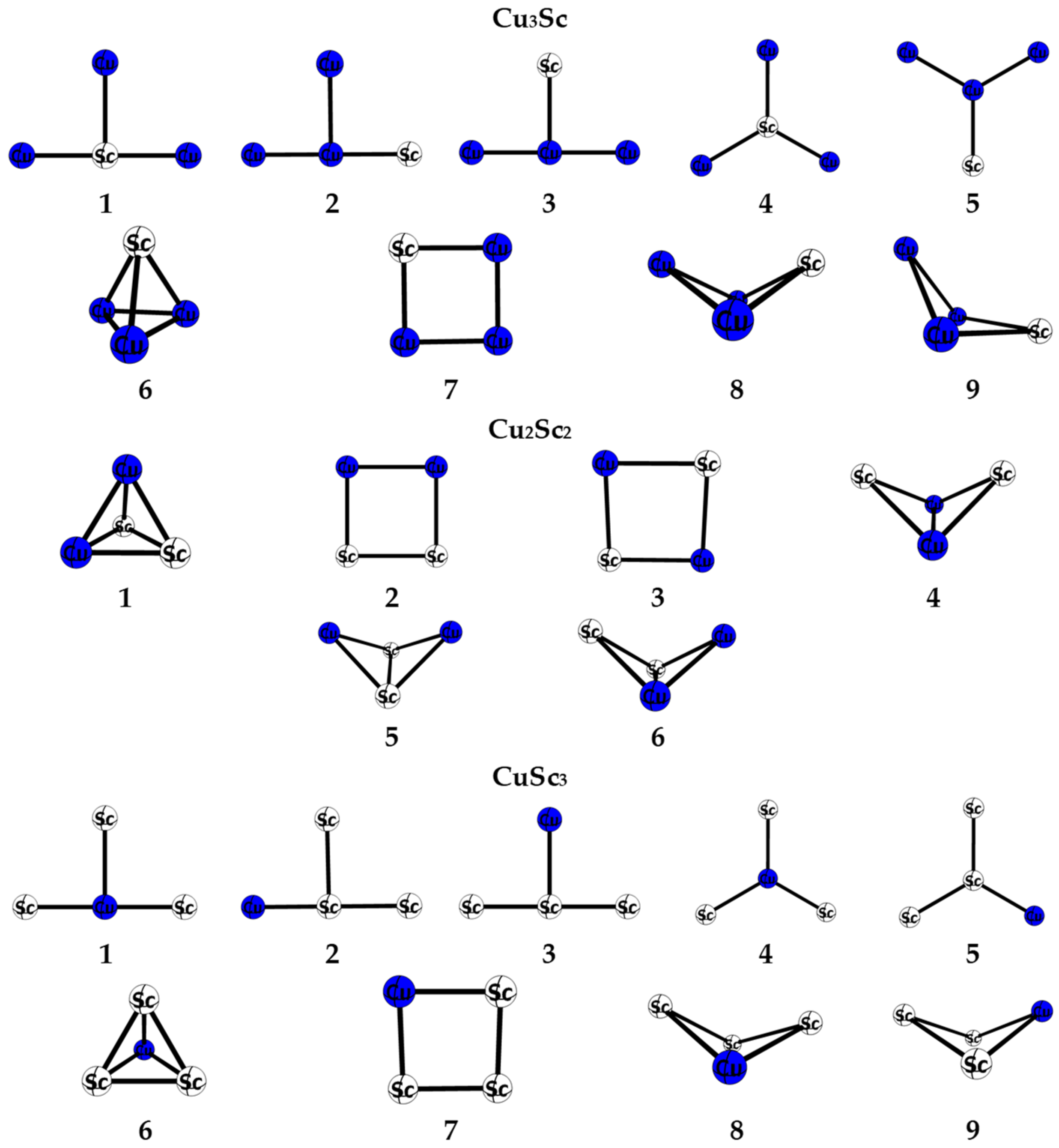
A study was conducted on bimetallic nanoclusters composed of four atoms, considering three different compositions: Cu3Sc, Cu2Sc2, and CuSc3. For each composition, representative initial geometries, such as triangular, pyramidal, and quasi-planar arrangements, were subjected to a thorough optimization process (Figure 1). Given that in small clusters multiplicity can significantly influence stability, an evaluation of multiple spin states was carried out for each system.
The final configuration of each assignment was determined based on the optimized minimum electronic energy. In the thermochemical study, which varies with temperature, comparisons were made using the Gibbs free energy, G(T), because the electronic energy of a specific optimized structure remains constant regardless of temperature.

2.3. Construction of Support Models

A finite graphene bilayer model was used to capture the localized chemistry of the active site without the cost of periodic supercells. Pure graphene was used as a reference for structural and electronic properties. To create anchoring sites, a cavity (an extended vacancy defect) was introduced in the center, and the model’s edges were filled with hydrogen atoms to prevent spurious radicals. Three carbon atoms were replaced with nitrogen in the defect environment to create the graphene-3N system, thereby regulating the local electron density and improving the anchoring affinity of the metal cluster.

2.4. Thermochemistry and Boltzmann Populations

Harmonic vibrational calculations were used to characterize the optimized structures, confirm that they were minimal (i.e., without imaginary frequencies), and obtain thermochemical corrections. Gibbs free energies and enthalpies were recorded at 298.15, 350, and 400 K (1 atm) using the standard translational-rotational-vibrational partition model. The Boltzmann distribution was used to calculate the relative population of each isomer within the same multiplicity to assess thermal accessibility to nearby minima.

2.5. CO2 Adsorption

The structures of the complexes were developed by placing a CO2 molecule in chemically feasible arrangements around the active center (a nanocluster adsorbed on graphene-3N) and then optimized at the same theoretical level. The thermochemical magnitudes of adsorption were calculated, using enthalpy, the entropic term (−TΔS), and Gibbs free energy as relevant functions. To do this, the difference between the thermodynamic function of the adsorbed complex and the sum of the contributions of the support, the cluster, and CO2 in the isolated phase was used. This methodology allows explicit separation of the entropic contribution and examination of how spontaneity varies with temperature, distinguishing moderate interactions that may be reversible from deeper fixations, which are associated with a high risk of active-site blocking and loss of regenerability.
All energy parameters associated with adsorption were calculated assuming CO2(g) at 1 atm under standard ideal-gas conditions. Thermal and zero-point energy (ZPE) corrections were applied consistently, using harmonic frequencies for both isolated species and the adsorbed complex.

2.6. Electronic Analysis

The energy of the frontier orbitals (EHOMO, ELUMO) and the difference ΔEgap = ELUMO − EHOMO were used to evaluate the electronic modulation of the support. These quantities were used to calculate global reactivity descriptors: hardness η = ΔEgap/2, chemical potential μ = (EHOMO + ELUMO)/2, and electrophilicity index ω = μ2/(2η). They were used to compare the relative electronic stability and charge transfer propensity between cavity graphene and graphene-3N. Qualitative inspection of the densities and orbitals was performed on the final geometries to rationalize the polarization and activation of CO2 in the adsorbed complex.

3. Results

3.1. Analysis of the Structure, Stability, and Electronic Characteristics of Cu–Sc Clusters

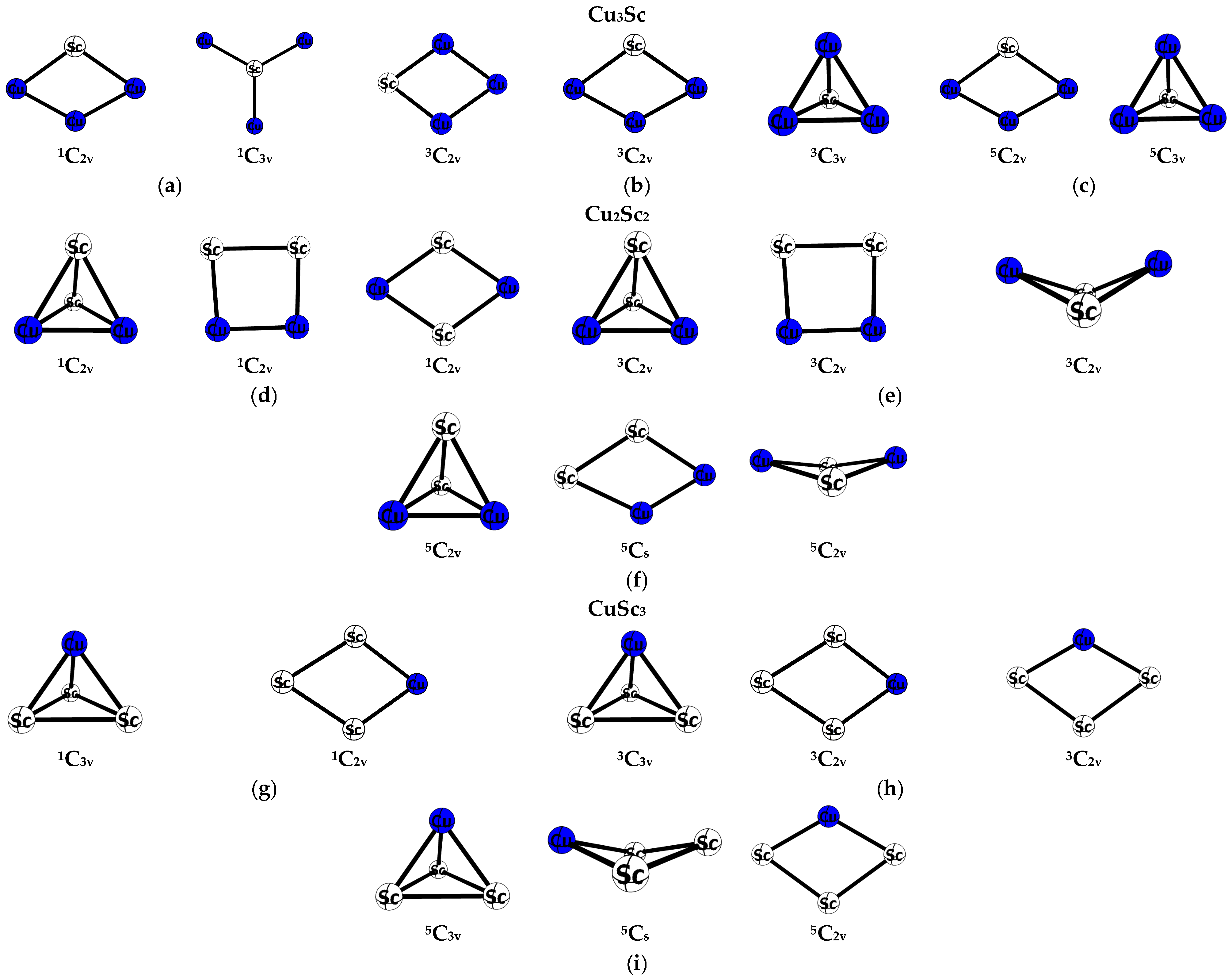
Figure 2 illustrates the structures and associated energies of the lowest-energy isomers corresponding to the Cu4−nScn tetrahedral clusters (with n varying from 0 to 4). Considering that at 298.15 K the thermal energy is expressed as kBT ≈ 0.025 eV (where kB is Boltzmann’s constant), it can be reasonably assumed that several isomers could be present in significant quantities at room temperature if their relative energies are less than approximately 0.25 eV [22].
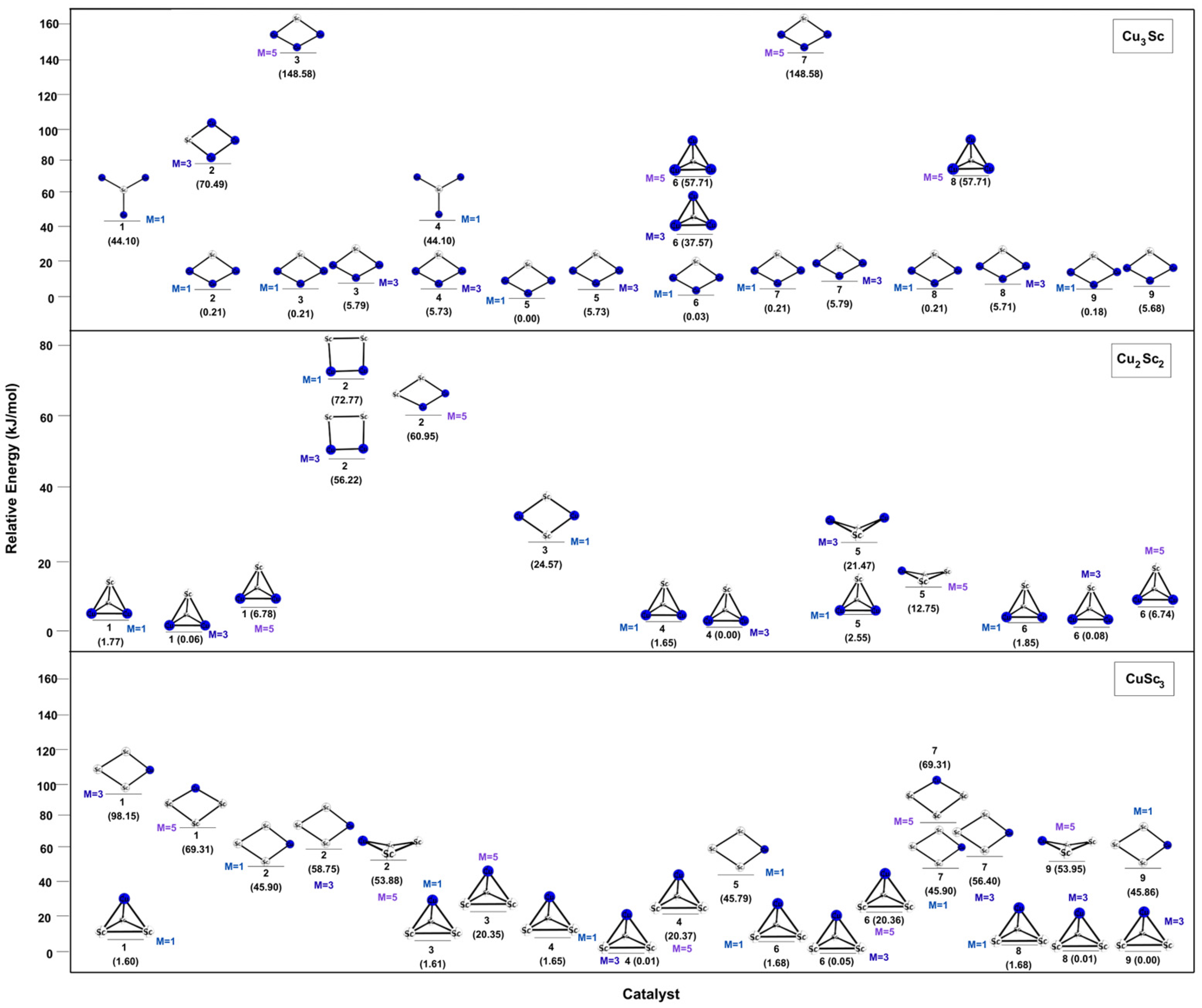
Figure 2 presents a summary of the optimized geometries (DFT) corresponding to all the isomers analyzed for each of the compositions, covering a total of nine configurations for Cu3Sc, six for Cu2Sc2, and nine for CuSc3 (Figure 1). In each situation, the spin multiplicity is clearly specified, whether singlet, triplet, or quintet, as well as the point symmetry related to the most significant conformation. Based on this structure, Figure 3 shows the associated relative energies (Er) to determine the order of stability and indicate which isomers are thermodynamically accessible under environmental conditions.
According to Figure 3 and taking as reference the thermodynamic threshold of 0.25 eV (approximately 24.1 kJ·mol−1) to evaluate co-population at 298 K, it is evident that Cu–Sc clusters composed of four atoms are not governed by a single isolated energy minimum, but are distributed in a group of low-energy isomers (multiple nearby minima) whose accessibility is also influenced by the spin state. In Cu3Sc, the singlet isomer 5 (M = 1) has the lowest energy configuration, characterized by a quasi-planar rhombohedral geometry, as shown in the 1C2v motif in Figure 2a. However, this state exhibits a fundamental degeneracy with isomer 6, for which the estimated energy difference is only ΔE = 0.03 kJ·mol−1, a value that falls within the usual numerical uncertainty range of the DFT method at the theoretical level used. Thus, no relevant energy difference is observed between these two isomers, so both are classified in the same low-energy, nearly degenerate category. Additionally, local minima are identified at equally low energies (ΔE ≈ 0.21 kJ·mol−1). A second set of isomers is identified in the range of approximately 5.7 to 5.8 kJ·mol−1, predominantly in the triplet state, which falls within a thermally accessible interval.
For Cu2Sc2, the ground state is located in the triplet 4 isomer (M = 3) (ΔE = 0.00 kJ·mol−1), consistent with a 3C2v motif (Figure 2e), followed by low-energy competitors (ΔE ≈ 1.06–2.55 kJ·mol−1) and other isomers in the range ~6.7–21.5 kJ·mol−1, suggesting moderate energy dispersion but still compatible with co-population at 298 K. In CuSc3, the global minimum corresponds to the triplet isomer 9 (M = 3) (ΔE = 0.00 kJ·mol−1), with nearly degenerate isomers (ΔE ≈ = 0.01–0.05 kJ·mol−1) and other low-energy minima at ~1.6–1.7 kJ·mol−1, in addition to structures close to ~20.3 kJ·mol−1.
According to Figure 3, the most thermodynamically stable clusters for each stoichiometry are Cu3Sc–isomer 5 (M = 1), Cu2Sc2–isomer 4 (M = 3), and CuSc3–isomer 9 (M = 3), which correspond to the global minima. However, the existence of competing isomers with energies below approximately 24 kJ·mol−1 (0.25 eV) indicates that, at room temperature, it is more appropriate to describe the population as a set of energetically close states (dependent on multiplicity) rather than a single predominant conformation.

3.2. Thermal Population of Isomers by Boltzmann Distribution

To measure the thermal accessibility of the identified local minima, an estimate of each isomer’s relative population was obtained from a Boltzmann distribution. This was done using the relative energies ΔE with respect to the most stable minimum in the analyzed set. The probability Pi related to isomer i was determined as follows:
P i = e E i R T j e E j R T
where R represents the universal gas constant, and T denotes the temperature in absolute terms.
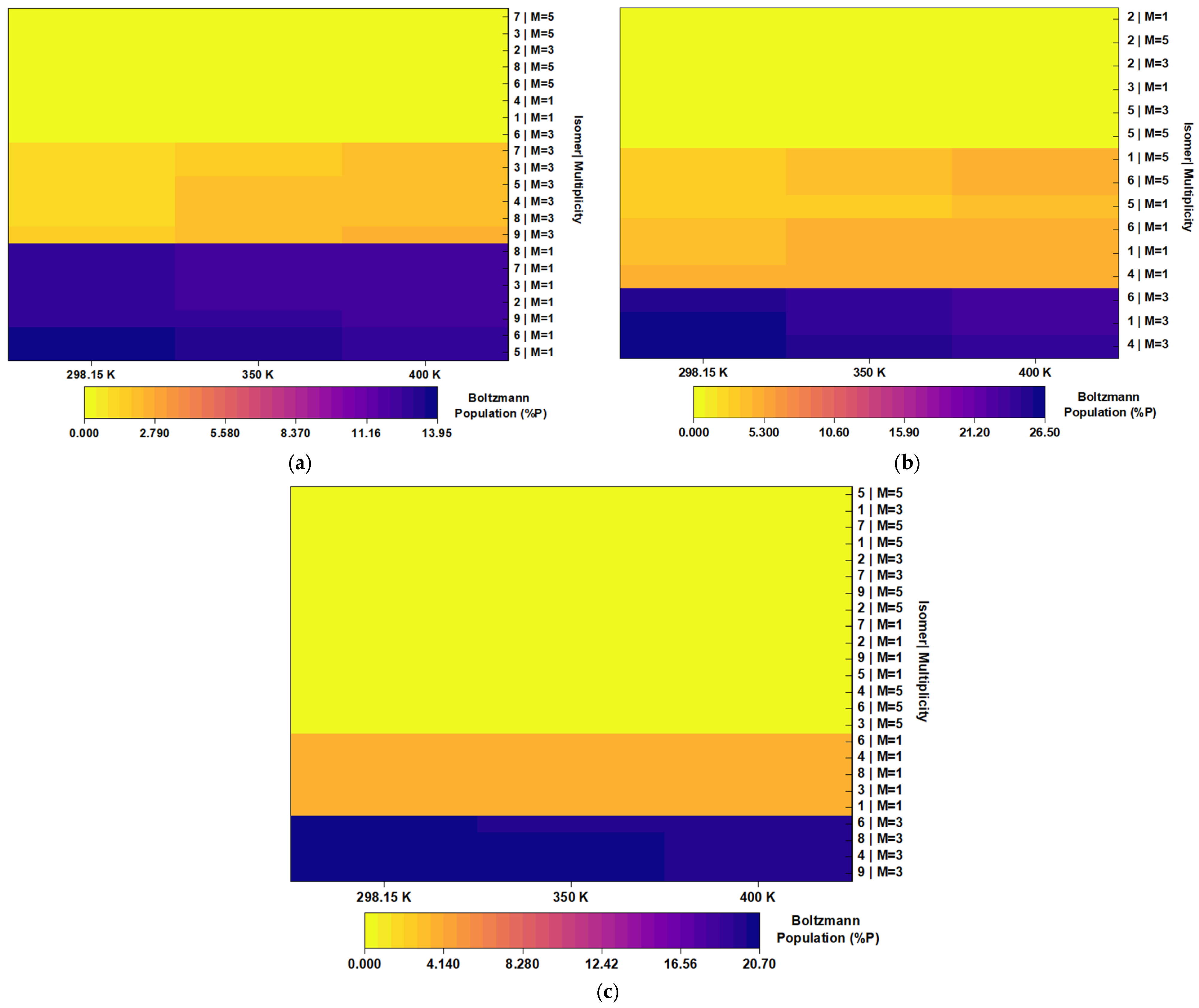
Figure 4a–c indicate that the equilibrium population is not dominated by high-energy states, but is controlled by a limited group of minima with ΔE ≤ 6 kJ·mol−1. In contrast, configurations with ΔE ≥ 35–45 kJ·mol−1 contribute insignificantly over the temperature range analyzed.
In Cu3Sc (Figure 4a), the distribution is regulated by the singlet manifold, presenting total fractions of 91.77% at 298.15 K, 88.86% at 350 K, and 86.21% at 400 K (Table S1a, Supplementary Materials). These fractions are distributed relatively evenly among seven low-energy isomers (mainly structures 2, 3, 5, 6, 7, 8, and 9, each with approximately 12–14% representation), suggesting the absence of a dominant conformer under ambient conditions. On the other hand, triplets represent a minor contribution, although increasing with temperature (8.26% → 11.16% → 13.77%), linked to a group of isomers that are around ΔE ≈ 5.7–5.8 kJ·mol−1. In contrast, quintets remain virtually unoccupied due to their greater energy differences, which exceed ~58 kJ·mol−1 (Supplementary Materials).
In the case of Cu2Sc2 (Figure 4b), a clear concentration of the population was observed in extremely low-energy triplets, with overall contributions of 77.81% at 298.15 K, 74.08% at 350 K, and 70.86% at 400 K (Table S1b, Supplementary Materials). This distribution is dominated by three nearly isoenergetic minima (structures 1, 4, and 6), each with an approximate probability of 23–26%. Singlets show a constant participation (16.17% → 17.20% → 17.83%), distributed among four closely spaced isomers (ΔE ≈ 1.65–2.55 kJ·mol−1). In this system, increasing temperature increases the availability of moderately excited quintets (especially structures 1 and 6). The proportion of these quintets rises from 6.02% to 11.31% when moving from 298.15 to 400 K, which is consistent with the intermediate energy separations (ΔE ≈ 6.7–6.8 kJ·mol−1).
Finally, CuSc3 (Figure 4c) shows a notable bias toward M = 3, with a triplet population of 82.15% at 298.15 K, which decreases to 79.42% at 400 K (Table S1c, Supplementary Materials). This manifold is distributed almost equally among four practically degenerate minima (structures 4, 6, 8, and 9), each with an approximate probability of 19.7–20.7%. Accessible singlets contribute a smaller but significant proportion (17.83–20.35% as the temperature increases), corresponding to isomers with an energy difference (ΔE) of approximately 1.60–1.68 kJ·mol−1. In contrast, quintets are practically irrelevant (≤0.21% at 400 K) due to their activation energy, which is around ΔE ≈ 20.35–20.37 kJ·mol−1.

3.3. Nitrogen-Modified Graphene Surface

To establish a computationally representative and efficient support for anchoring metal nanoclusters and evaluating CO2 adsorption, two references were taken into account: (i) the graphene bilayer in its pure state (pristine graphene) and (ii) an active surface obtained by doping with three nitrogen atoms (graphene-3N). The structures were refined and validated through vibrational analysis, confirming the presence of absolute minima on the potential energy surface (i.e., the absence of imaginary frequencies). This section analyzes the robustness of the support, the influence of doping on its electronic behavior, and the immediate impact on the initial capture and stabilization of CO2, assuming the chosen nanocluster is a global minimum.

3.3.1. Stability and Active Surface Area of Modified Graphene

The first criterion for selecting the support was the vibrational validity of the optimized minimum. In constrained models, edge fixing can cause artificial decoupling between the relaxed and rigid zones, generating spurious modes. For this reason, vibrational analysis was used as a criterion to ensure the existence of an absolute minimum.
Computational Cost
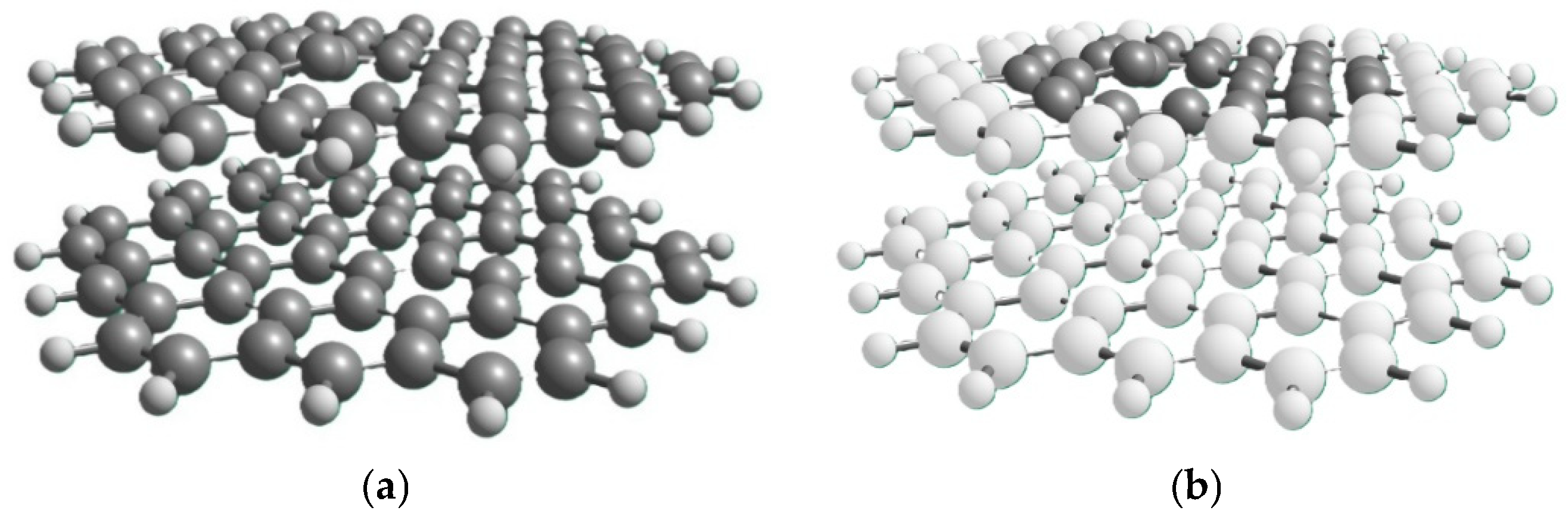
To create a protocol that can be replicated, a comparison was made between total geometric optimization strategies (Figure 5a) and partial geometric optimization strategies (Figure 5b), in which peripheral atoms were restricted. Total optimization was considered more advantageous because it reduced processing time and avoided anomalies caused by mechanical constraints in large sheets. Consequently, it was established as the reference scheme for both the support (pristine graphene and graphene-3N) and the adsorbate-support systems. This principle ensures methodological consistency among the bare support, the support containing nanoclusters, and the complex with CO2, which is essential for comparing relative energies and thermochemical magnitudes under equivalent conditions.
Under the same computational technique, complete and partial optimization strategies were compared methodologically. For both supports, total optimization in this internal test yielded shorter wall-clock times than partial optimization: graphene-3N required 13.48 h compared to 21.68 h, and the double-layer cavity model required 6.52 h compared to 11.92 h (Table 1). Since comprehensive optimization eliminates vibrational artifacts related to geometric limitations and is more convenient within this workflow, it was chosen as the standard protocol.

3.3.2. Constraint-Release Thermochemistry of Cavity and Cavity-3N Bilayer Supports

Before analyzing CO2 adsorption, the thermochemical impact was quantified using a bilayer model with partial optimization (restricted model) compared to the fully relaxed model (free model). In the restricted model, the lower layer and the outermost atoms of the upper layer were fixed, while the area adjacent to the cavity was left free. The imposed limitations can give rise to imaginary frequencies that concentrate near edges or fixed atoms, resulting in artifacts inherent to the procedure. Therefore, the data presented in Table 2 do not reflect absolute stability or defect formation energies compared to pure graphene. Instead, Table 2 presents the thermochemistry associated with the release of constraints, which is used as an indicator of the penalty (or stabilization) imposed by the cavity and cavity-3N constrained protocol.
To this end, Table 2 shows the thermochemistry of constraint release (relaxation), as defined in the following computational cycle.
Restricted double-layer support → Free bilaminar support (completely relaxed) and calculated at each temperature by:
ΔXrelax(T) = Xfree(T) − Xrestricted(T) with X ∈ {H, G}
where H is the enthalpy, and G is the Gibbs free energy. To eliminate any ambiguity related to units and symbols, the concept of entropy is presented as an energy contribution:
−TΔSrelax(T) = ΔGrelax(T) − ΔHrelax(T)
Table 2 indicates that the nature of the support used significantly influences this variation in thermochemistry. In the case of the undoped cavity, both ΔHrelax and ΔGrelax have negative values. They are greater in magnitude, with ΔHrelax in the approximate range of −40.5 to −40.7 kJ·mol−1 and ΔGrelax between −38.9 and −38.6 kJ·mol−1 at temperatures of 298. 15 to 400 K. On the other hand, for cavity-3N, these values are also negative, although significantly lower, with ΔHrelax ranging from −5.48 to −5.51 kJ·mol−1, and ΔGrelax varying from −4.01 to −3.55 kJ·mol−1. In the two systems analyzed, the variation in ΔHrelax with respect to temperature is minimal. At the same time, the modification of ΔGrelax within the range examined is fundamentally related to the increase in the entropic component (−TΔSrelax).
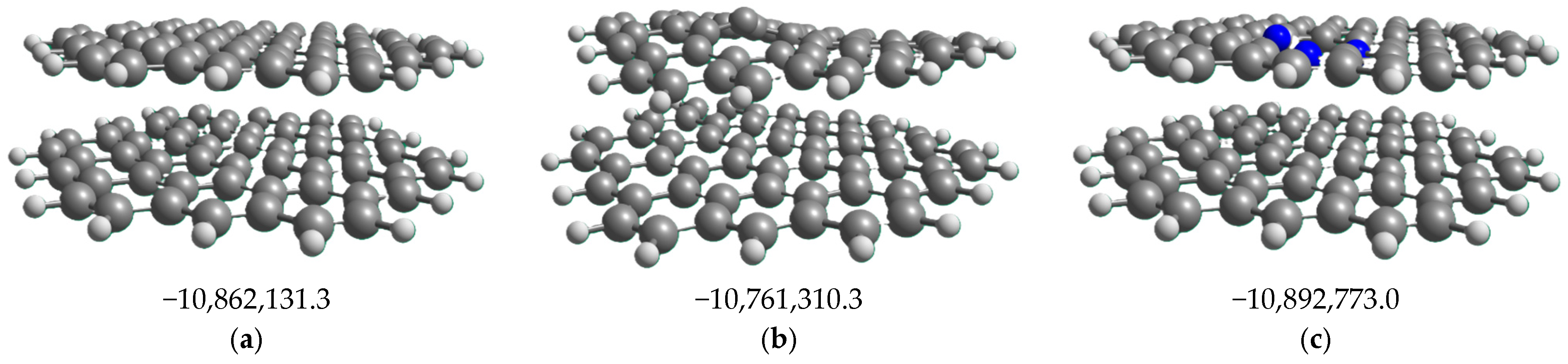
Figure 6 shows a qualitative comparison of the electronic energies of pure graphene, the cavity, and graphene-3N. Although numerical values are presented, these systems are not isostechiometric. Therefore, their total electronic energies cannot be directly compared to measure their relative stability. In this context, the image is used only to show the basic energy differences between the three support models.

3.3.3. Analysis of Stability and Reactivity Based on Global Descriptors

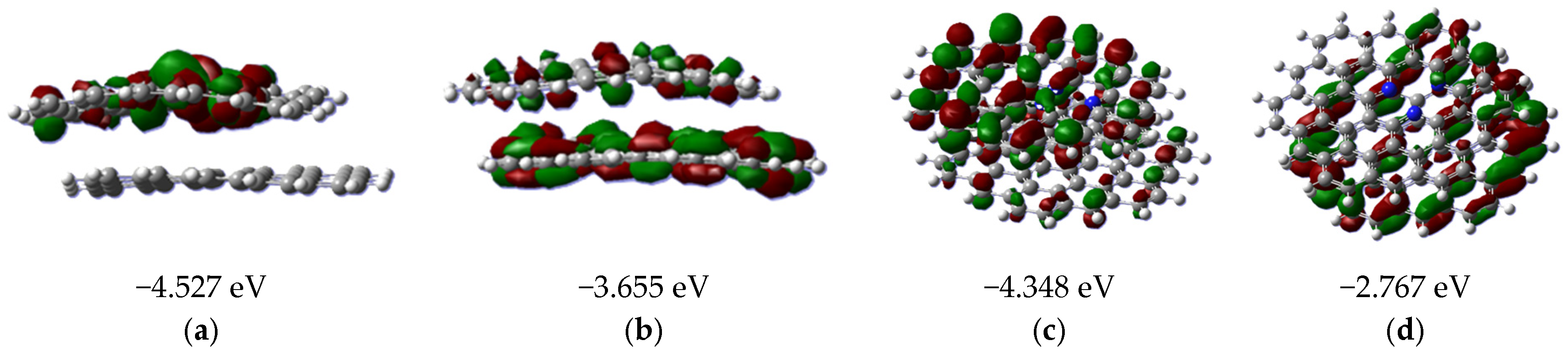
After determining the thermochemical preference of the N-doped support compared to the undoped cavity, we analyzed how doping affects the electronic structure and, therefore, the support’s ability to transfer charge. The frontier orbitals (Figure 7) indicate direct control of the HOMO–LUMO separation (ΔE): the cavity has an intermediate value (0.872 eV), whereas 3N doping significantly increases this separation (1.581 eV), indicating a support less prone to charge redistribution or electronic excitations.
This trend is consistently reflected in the global descriptors (Table 3). Graphene-3N has the highest hardness (η = 0.791 eV) and the lowest electrophilicity (ω = 7.99 eV), making it the most stable support at the electronic level (with lower polarizability and a lower tendency to accept charge). The undoped cavity exhibits an intermediate regime in η and ΔE (ΔE = 0.872 eV; η = 0.436 eV), but retains a more negative chemical potential (μ = −4.0915 eV), consistent with greater relative electronic availability compared to doped surfaces.
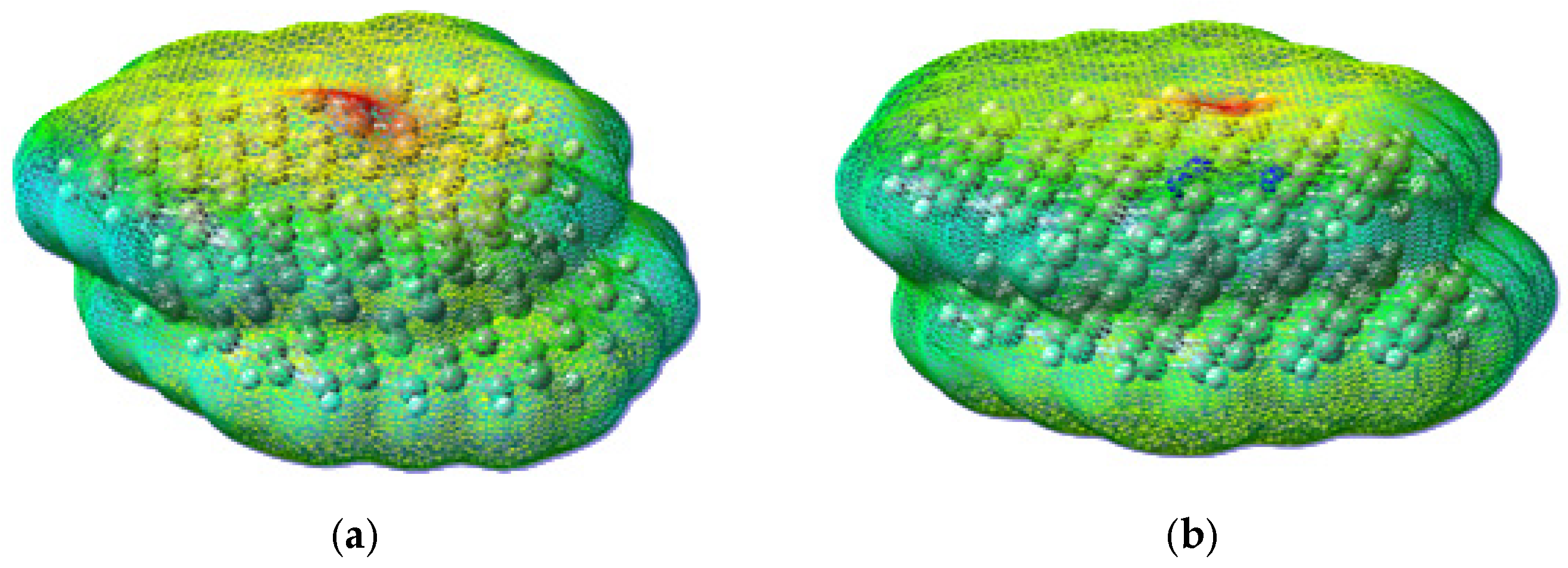
Finally, MEPs (maps of electrostatic potential) corroborate these spatial disparities: the areas surrounding the defect exhibit electrostatic gradients that regulate initial contact with polar and electrophilic species. In this section, to highlight the electronic diversity induced by doping, the MEP is used as a visual aid (Figure 8).
Global Descriptors of Reactivity of Adsorbed Complexes CuxScγ@3N-Graphene
The global reactivity descriptors for the fully adsorbed complexes (CuxScγ@3N-graphene) were evaluated to represent the species directly involved in CO2 adsorption. As shown in Table 4, Cu3Sc@3N-graphene and Cu2Sc2@3N-graphene have smaller HOMO–LUMO gaps (ΔE = 0.219 and 0.231 eV, respectively) and lower hardness values (η = 0.109 and 0.115 eV) compared to CuSc3@3N -graphene (ΔE = 0.518 eV; η = 0.259 eV). This suggests that the electronic structures of the former are softer and more prone to electronic reorganization in the adsorbed state.
The chemical potential values are relatively similar, ranging between μ = −3.028 and −3.041 eV. In contrast, the electrophilicity index shows a more notable difference, with a higher value for CuSc3@3N-graphene, which is ω = 1.198 eV, compared to Cu3Sc@3N-graphene, which has ω = 0.502 eV, and Cu2Sc2@3N-graphene, with ω = 0.498 eV.

3.4. Nanocluster Adsorption and CO2 Adsorption in Graphene-3N-Nanocluster Complex

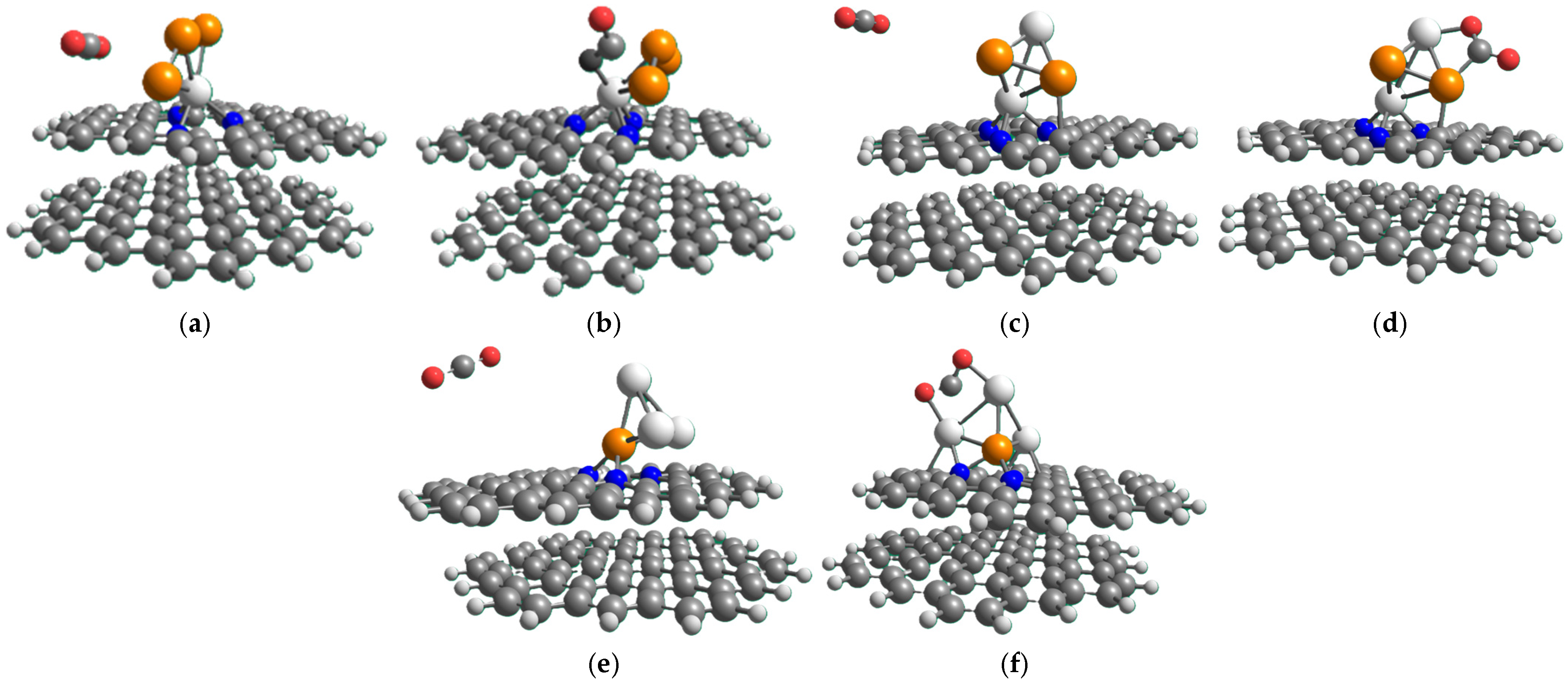
With the graphene-3N support validated, the global minimum nanocluster was selected as a representative active site, and CO2 adsorption on the graphene-3N/nanocluster complex was evaluated. Table 5 summarizes the adsorption thermodynamics at 298.15, 350, and 400 K (ΔH, −TΔS, and ΔG), while Figure 9 shows the optimized geometries (initial and final configurations).
To prevent redundancy and simplify direct comparison between CuxScγ compositions, the thermochemical parameters of CO2 adsorption are briefly presented through the adsorption magnitudes (ΔHads, −TΔSads, and ΔGads) at temperatures of 298.15, 350, and 400 K, which are defined as follows:
ΔXads = X(graphene-3N/cluster + CO2) − X(graphene-3N/cluster) − X(CO2)
X ∈ {ΔH, −TΔS, ΔG}
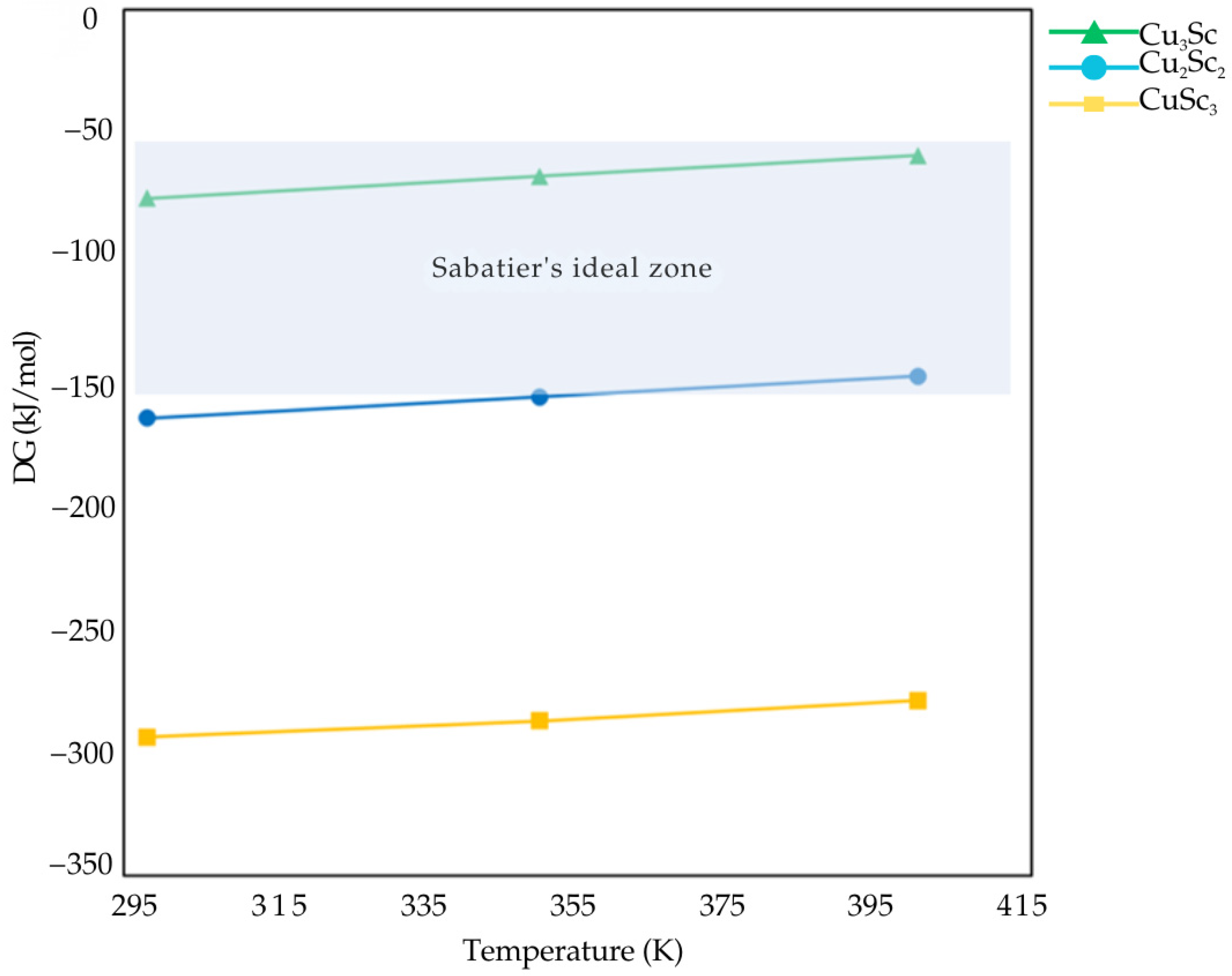
Table 5 shows a clear trend: the adsorption strength increases with the addition of Sc, following the order Cu3Sc < Cu2Sc2 < CuSc3 in terms of ΔHads and ΔGads. In all three scenarios, ΔHads is very negative and largely independent of temperature (fluctuations are less than 1 kJ·mol−1), indicating that enthalpic contributions from chemical interactions at the active site predominate in CO2 stabilization. In contrast, the entropic term (−TΔSads) increases with T (from approximately 49 to 65 kJ·mol−1), making ΔGads less negative with temperature: between 298 and 400 K, ΔGads becomes less harmful. However, it remains exergonic throughout the range.
According to a Sabatier-style interpretation, the values of ΔGads suggest that the three Cu–Sc compositions span different ranges of CO2 adsorption strength. However, all are in the exergonic zone (indicating a robust bond). Within this framework, Cu3Sc (ΔGads ≈ −76 to −59 kJ·mol−1) is the composition that exhibits the lowest adsorption strength compared to the rest of the analyzed series (Cu3Sc < Cu2Sc2 < CuSc3). Cu2Sc2 (ΔGads ≈ −165 to −148 kJ·mol−1) and, in particular, CuSc3 (ΔGads ≈ −294 to −279 kJ·mol−1) show increasing thermodynamic stabilization of the CO2 adsorption state, which translates into a notable inclination towards its retention (Figure 10).

3.5. Activation of CO2 Adsorbed on CuxScγ@3N-Graphene: Geometric Descriptors, Charge Transfer, and QTAIM Topological Validation

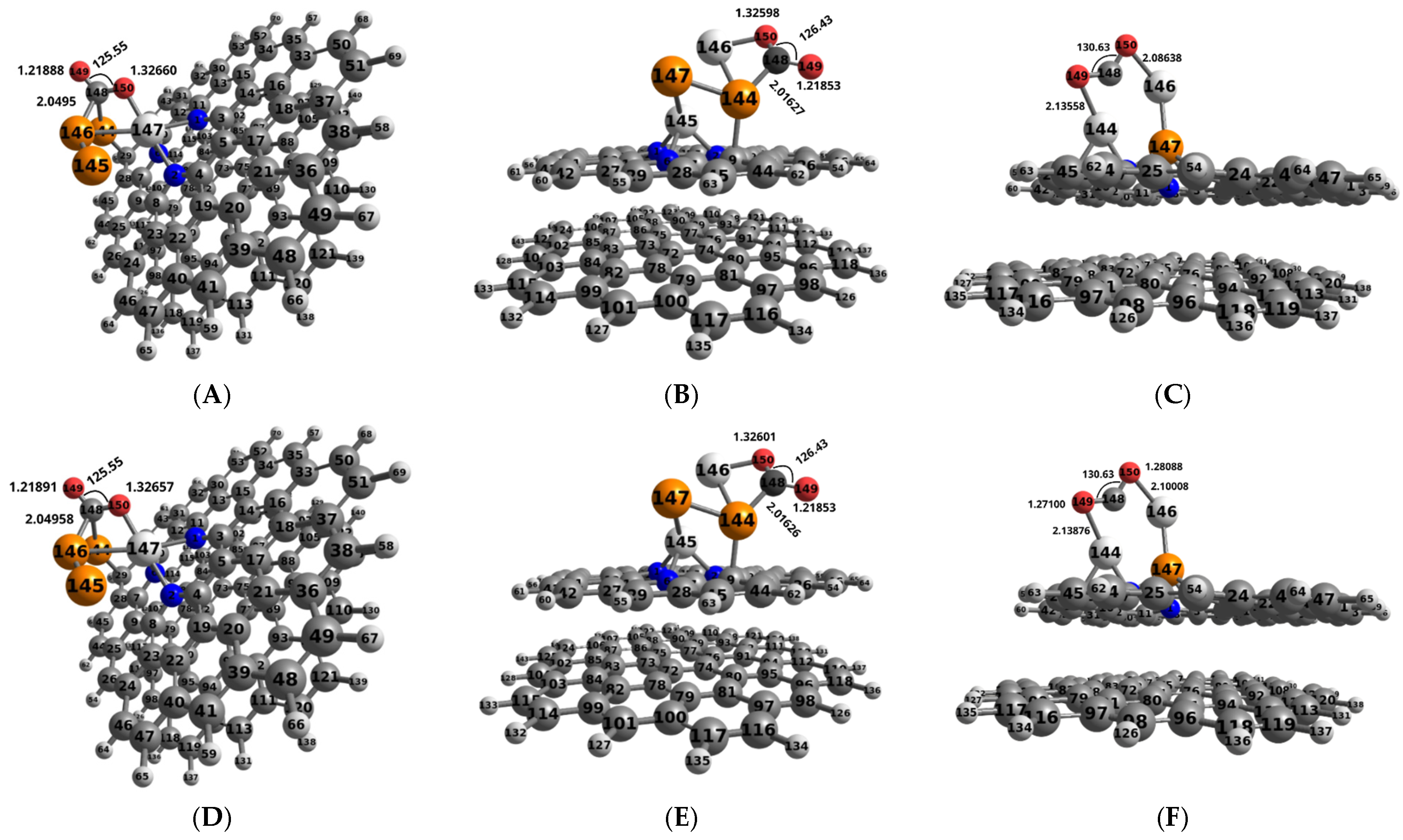
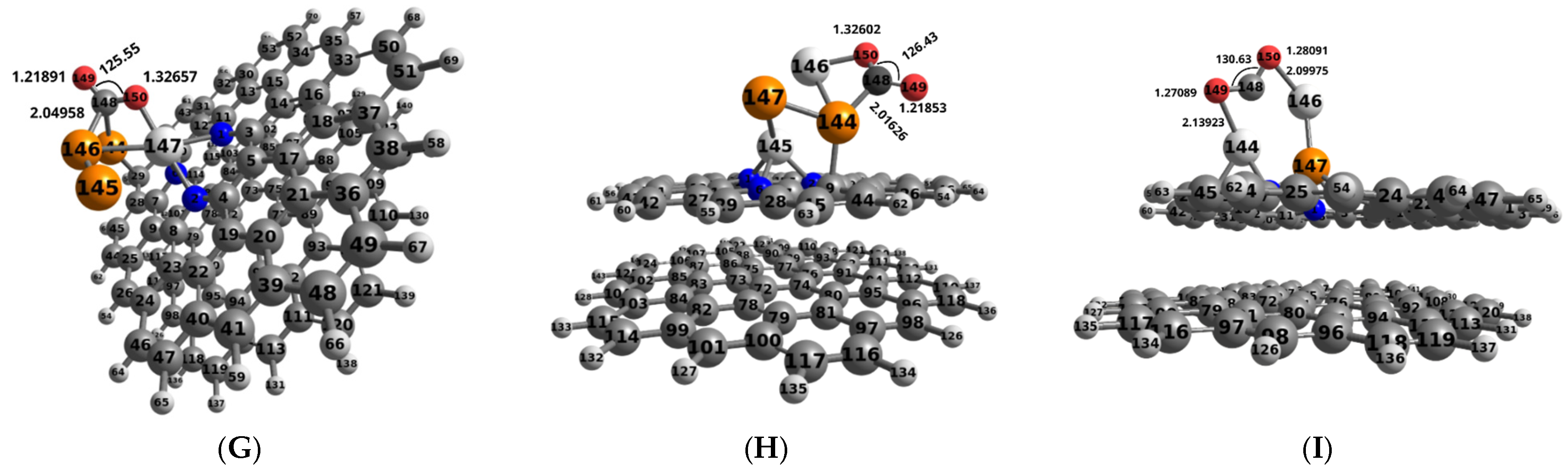
In Figure 11 and Table 6, CO2 activation after adsorption on CuxScγ@graphene-3N is evaluated using geometric descriptors such as the ∠O–C–O angle and C–O bond lengths, as well as electronic descriptors including the net charge acquired by CO2, ΔQ(CO2) = q(C) + q(O1) + q(O2), derived from Hirshfeld analysis.
CO2 in its gaseous state has a linear geometry, with an O–C–O angle of 180° and a distance between the carbon and oxygen atoms of approximately 1.18 Å. Unlike non-adsorbed complexes, all adsorbed complexes show a notable loss of linearity (∠O–C–O ≈ 125.55–130.63°), as well as a clear elongation of the C–O bond (d(C–O) ≈ 1.218–1.326 Å for Cu3Sc and Cu2Sc2; 1.270–1.282 Å for CuSc3). A significant charge accumulation is also observed in the CO2 fragment (ΔQ (CO2) ≈ −0.449 e for Cu3Sc, −0.316 e for Cu2Sc2, and between −0.412 and −0.425 e for CuSc3), suggesting that this is a chemisorbed or activated CO2 state, as opposed to weak physisorption (Table 6; Figure 11).
Of all the systems analyzed, Cu3Sc@graphene-3N stands out for its remarkable charge transfer and evident bond asymmetry (one C–O bond considerably longer than the other), suggesting a more polarized adsorption mechanism. In contrast, CuSc3@graphene-3N exhibits a less pronounced activation signature, with a more balanced C–O elongation and a wider crucial metal–CO2 distance. It is important to note that the activation metrics show remarkable insensitivity to temperature within the range of 298 to 400 K. Variations in ∠O–C–O and ΔQ(CO2) are minimal, and bond distances change only marginally. This indicates that both the adsorption geometry and activation state remain stable over the analyzed temperature range.
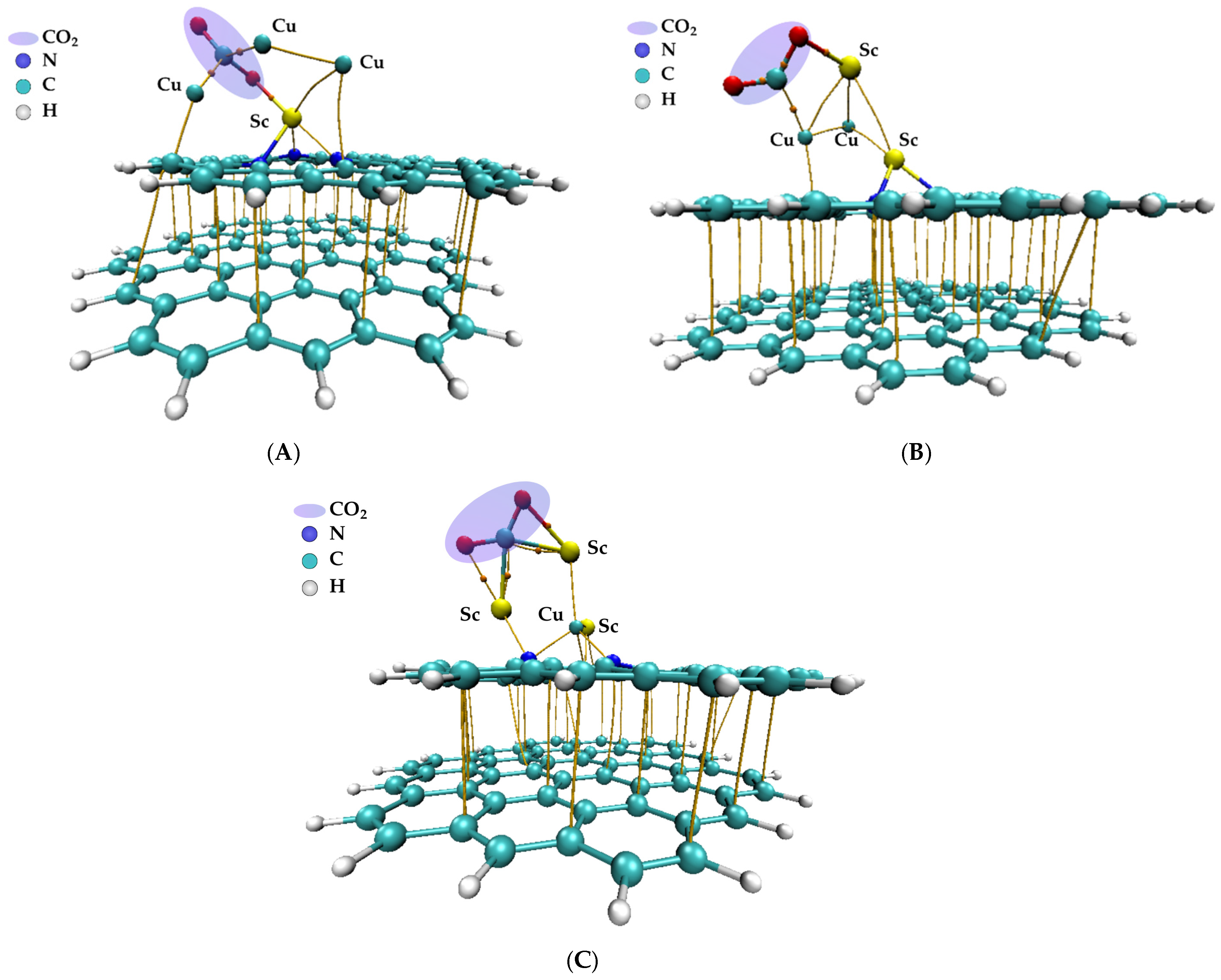
After determining, through geometric descriptors such as the angle ∠O–C–O and the distance d(C–O), as well as the charge ΔQ(CO2) according to Hirshfeld, that the adsorbed CO2 exhibits a state similar to “activated chemosorption” in CuxScγ@graphene-3N, a QTAIM topological analysis (AIM) topological analysis was performed (Figure 12). The purpose of this analysis was to validate the assignment based on electron density and to enable the identification of subtle differences among the compositions.
Figure 12 illustrates the bond paths and bond critical points (BCPs) related to the interaction between CO2 and the cluster in Cu3Sc@3N-graphene + CO2 (A), Cu2Sc2@3N-graphene + CO2 (B), and CuSc3@3N-graphene + CO2 (C). In the first two systems, inter-fragment connectivity between the adsorbate and the metal center is observed, providing direct topological evidence of the specific CO2–metal interaction. This is consistent with the activated character that had previously been inferred from the deformation of CO2, the elongation of C–O bonds, and the net charge accumulation on the CO2 fragment.
The QTAIM descriptors presented in Table 7 support this interpretation. In the first two complexes, the Laplacian of the density at the relevant charge critical points (BCPs) is positive (∇2ρc > 0). On the other hand, the total energy density is negative (H < 0), and the ratio |V|/G is just above unity, with an approximate value of |V|/G ≈ 1.24–1.25. This pattern is distinguished by coordinative or polarized interactions of the “closed-shell” type, which make a significant stabilizing contribution due to partial sharing of electron density. This is consistent with chemisorption in metal–CO2 systems, where activation manifests as a combination of electronic polarization and structural reorganization of the adsorbate.
The comparative analysis of the compositions also reveals a pattern that is consistently aligned with the previous ΔQ(CO2) results. In the Cu3Sc@3N−graphene + CO2 system, integrated electron density values are observed that are slightly higher in the relevant BCPs (ρc = 2.45 × 10⁻¹), as well as more pronounced local stabilization (H = −5.84 × 10⁻²) compared to Cu2Sc2@3N−graphene + CO2, which has ρc = 2.00 × 10⁻¹ and H = −5.10 × 10⁻². On the other hand, the |V|/G ratio remains practically constant (1.25 vs. 1.24). This pattern indicates that, in an N−doped support environment, both systems exhibit a similar interaction. However, Cu3Sc shows a slightly more pronounced intensity and polarization of the CO2–cluster interaction, consistent with the greater net charge transfer to CO2 evident in the Hirshfeld analysis.

4. Discussion

The gas-phase screening procedure developed by Szalay et al. represents a significant milestone in identifying Cu3X motifs with the potential to interact with/activate CO2, including Cu3Sc as a promising composition. In this context, our research does not seek to present Cu3Sc as a “new” compositional discovery, but rather to verify and expand this active motif in a context closer to a supported material. In this context, the behavior of the cluster is no longer governed exclusively by its intrinsic composition, but also by the cluster-support coupling.
The main contribution of this research lies in the explicit integration of Cu–Sc synergy with nitrogen-doped graphene. The N-doped support does not serve as an inert surface: it provides more robust anchoring sites, alters the local electronic distribution, and can stabilize cluster geometries/electronic states that differ from those favored in the gas phase. Therefore, the adsorption thermodynamics and signals linked to activation (CO2 geometric changes and charge transfer) should be interpreted as emergent properties of the CuxScγ@graphene−N system, rather than attributes of the individual nanocluster. This perspective facilitates the analysis of two aspects that gas-phase screening does not capture: (i) how anchoring at N-sites restructures the hierarchy of isomers/states (including spin sensitivity) and (ii) how the support modulates the balance between adsorbate stabilization and effective adsorption strength under supported material conditions. Consequently, although the general trend aligns with that of Szalay et al., the added value of this study is to quantify and rationalize the impact of the functionalized support, thereby establishing a design framework based on the cooperative cluster−graphene−N interaction rather than on the metal composition itself.

5. Conclusions

In conclusion, CuxScγ stoichiometry and graphene−3N support engineering jointly control CO2 adhesion strength and electronic access. N doping expands the HOMO−LUMO gap to ΔE = 1.58 eV (compared to 0.87 eV in the cavity), increases the hardness (η = 0.79 eV), and decreases the electrophilicity (ω = 7.99 eV), which stabilizes the support and concentrates the activation in the nanocluster. Cu3Sc, among the series evaluated, shows the best compromise for operating in a catalytic cycle: moderate exergonic adsorption (ΔGads = −76.07, −67.31, and −58.92 kJ·mol−1 at 298.15, 350, and 400 K) with an entropic penalty that increases and reduces spontaneity without completely suppressing it. On the other hand, the increase in Sc leads to overbonding: Cu2Sc2 and CuSc3 cause the adsorption well (ΔGads = −165.02 → −148.04 and −293.98 → −279.09 kJ·mol−1) to deepen, which is beneficial for activation/capture but also increases the likelihood that the active site is blocked and reduces regenerability. Therefore, to balance CO2 activation and desorption under working conditions, the rational design of Cu−Sc sites on graphene−N should aim to maintain |ΔGads|~60–80 kJ·mol−1 as the operating range.

Supplementary Materials

The following supporting information can be downloaded at: https://www.mdpi.com/article/10.3390/su18073497/s1, Table S1a. Cu3Sc; Table S1b. Cu2Sc2; Table S1c. CuSc3.

Author Contributions

Conceptualization, K.L.O.P. and J.H.F.; Methodology, K.L.O.P. and J.H.F.; Software, K.L.O.P. and J.H.F.; Validation, K.L.O.P. and J.H.F.; Formal analysis, K.L.O.P. and J.H.F.; Investigation, K.L.O.P. and J.H.F.; Resources, J.H.F.; Data curation, K.L.O.P. and J.H.F.; Writing—original draft, K.L.O.P. and J.H.F.; Writing—review & editing, K.L.O.P. and J.H.F.; Visualization, J.H.F.; Supervision, J.H.F.; Project administration, J.H.F.; Funding acquisition, J.H.F. All authors have read and agreed to the published version of the manuscript.

Funding

This research received no external funding.

Institutional Review Board Statement

Not applicable.

Informed Consent Statement

Not applicable.

Data Availability Statement

The original contributions presented in this study are included in the article/Supplementary Materials. Further inquiries can be directed to the corresponding authors.

Conflicts of Interest

The authors declare no conflict of interest.

References

  1. Duan, Y.; Meng, F.; Liu, K.; Yi, S.; Li, S.; Yan, J.; Jiang, Q. Amorphizing of Cu nanoparticles toward highly efficient and robust electrocatalyst for CO2 reduction to liquid fuels with high Faradaic efficiencies. Adv. Mater. 2018, 30, 1706194. [Google Scholar] [CrossRef] [PubMed]
  2. Intergovernmental Panel on Climate Change (IPCC). Climate Change 2021: The Physical Science Basis. Available online: https://www.ipcc.ch/report/ar6/wg1/ (accessed on 26 February 2026).
  3. Houghton, J. Global warming. Rep. Prog. Phys. 2005, 68, 1343–1403. [Google Scholar] [CrossRef]
  4. Nitopi, S.; Bertheussen, E.; Scott, S.B.; Liu, X.; Engstfeld, A.K.; Horch, S.; Seger, B.; Stephens, I.E.L.; Chan, K.; Hahn, C.; et al. Progress and perspectives of electrochemical CO2 reduction on copper in aqueous electrolyte. Chem. Rev. 2019, 119, 7610–7672. [Google Scholar] [CrossRef] [PubMed]
  5. Hepburn, C.; Adlen, E.; Beddington, J.; Carter, E.A.; Fuss, S.; Mac Dowell, N.; Minx, J.C.; Smith, P.; Williams, C.K. The technological and economic prospects for CO2 utilization and removal. Nature 2019, 575, 87–97. [Google Scholar] [CrossRef]
  6. Boot-Handford, M.E.; Abanades, J.C.; Anthony, E.J.; Blunt, M.J.; Brandani, S.; Mac Dowell, N.; Fernández, J.R.; Ferrari, M.-C.; Gross, R.; Hallett, J.P.; et al. Carbon capture and storage update. Energy Environ. Sci. 2014, 7, 130–189. [Google Scholar] [CrossRef]
  7. Artz, J.; Müller, T.E.; Thenert, K.; Kleinekorte, J.; Meys, R.; Sternberg, A.; Bardow, A.; Leitner, W. Sustainable conversion of carbon dioxide: An integrated review of catalysis and life cycle assessment. Chem. Rev. 2018, 118, 434–504. [Google Scholar] [CrossRef]
  8. Aresta, M.; Dibenedetto, A.; Angelini, A. Catalysis for the valorization of exhaust carbon: From CO2 to chemicals, materials, and fuels. Technological use of CO2. Chem. Rev. 2014, 114, 1709–1742. [Google Scholar] [CrossRef]
  9. Sakakura, T.; Choi, J.-C.; Yasuda, H. Transformation of carbon dioxide. Chem. Rev. 2007, 107, 2365–2387. [Google Scholar] [CrossRef]
  10. Etim, U.J.; Zhang, C.; Zhong, Z. Impacts of the catalyst structures on CO2 activation on catalyst surfaces. Nanomaterials 2021, 11, 3265. [Google Scholar] [CrossRef]
  11. Li, H.; Zhao, J.; Luo, L.; Du, J.; Zeng, J. Symmetry-breaking sites for activating linear carbon dioxide molecules. Acc. Chem. Res. 2021, 54, 1454–1464. [Google Scholar] [CrossRef]
  12. Butera, V.; Barone, G. Advances in CO2 capture and utilization: The role of DFT in understanding CO2 activation and its conversion mechanisms for methanol and cyclic carbonates production. Catal. Sci. Technol. 2025, 15, 5574–5601. [Google Scholar] [CrossRef]
  13. Bullock, R.M.; Appel, A.M.; Helm, M.L. Production of hydrogen by electrocatalysis: Making the H–H bond by combining protons and hydrides. Chem. Commun. 2014, 50, 3125–3143. [Google Scholar] [CrossRef] [PubMed]
  14. Francke, R.; Schille, B.; Roemelt, M. Homogeneously catalyzed electroreduction of carbon dioxide—Methods, mechanisms, and catalysts. Chem. Rev. 2018, 118, 4631–4701. [Google Scholar] [CrossRef] [PubMed]
  15. Costentin, C.; Robert, M.; Savéant, J.-M. Catalysis of the electrochemical reduction of carbon dioxide. Chem. Soc. Rev. 2013, 42, 2423–2436. [Google Scholar] [CrossRef]
  16. Qiao, J.; Liu, Y.; Hong, F.; Zhang, J. A review of catalysts for the electroreduction of carbon dioxide to produce low-carbon fuels. Chem. Soc. Rev. 2014, 43, 631–675. [Google Scholar] [CrossRef]
  17. Cui, Z.; Aztergo, K.D.; Hwang, J.; Co, A.C. Kinetic analysis makes the impossible possible: Measuring CO adsorption free energies on the active sites during CO2 electroreduction. ChemRxiv 2024, preprint. [Google Scholar] [CrossRef]
  18. Murata, A.; Hori, Y. Product selectivity affected by cationic species in electrochemical reduction of CO2 and CO at a Cu electrode. Bull. Chem. Soc. Jpn. 1991, 64, 123–127. [Google Scholar] [CrossRef]
  19. Zhong, W.; Zhou, S.; Lovell, E.C.; Amal, R.; Lu, X. Copper-based electrocatalysts converting carbon dioxide to narrowly distributed products. Chem. Eng. J. 2025, 517, 163925. [Google Scholar] [CrossRef]
  20. Garza, A.J.; Bell, A.T.; Head-Gordon, M. Mechanism of CO2 reduction at copper surfaces: Pathways to C2 products. ACS Catal. 2018, 8, 1490–1499. [Google Scholar] [CrossRef]
  21. Yesupatham, M.S.; Honnappa, B.; Agamendran, N.; Kumar, S.Y.; Chellasamy, G.; Govindaraju, S.; Yun, K.; Selvam, N.C.S.; Maruthapillai, A.; Li, W.; et al. Recent developments in copper-based catalysts for enhanced electrochemical CO2 reduction. Adv. Sustain. Syst. 2024, 8, 2300549. [Google Scholar] [CrossRef]
  22. Muthuperiyanayagam, A.; Nabi, A.G.; Zhao, Q.; Aman-Ur-Rehman; Di Tommaso, D. Adsorption, activation, and conversion of carbon dioxide on small copper–tin nanoclusters. Phys. Chem. Chem. Phys. 2023, 25, 13429–13441. [Google Scholar] [CrossRef] [PubMed]
  23. Fu, J.; Liu, K.; Li, H.; Hu, J.; Liu, M. Bimetallic atomic site catalysts for CO2 reduction reactions: A review. Environ. Chem. Lett. 2022, 20, 243–262. [Google Scholar] [CrossRef]
  24. Qiu, L.-Q.; Li, H.-R.; He, L. Incorporating catalytic units into nanomaterials: Rational design of multipurpose catalysts for CO2 valorization. Acc. Chem. Res. 2023, 56, 2225–2240. [Google Scholar] [CrossRef] [PubMed]
  25. Montejo-Álvaro, F.; Martínez-Espinosa, J.A.; Rojas-Chávez, H.; Navarro-Ibarra, D.C.; Cruz-Martínez, H.; Medina, D.I. CO2 adsorption over 3d transition-metal nanoclusters supported on pyridinic N3-doped graphene: A DFT investigation. Materials 2022, 15, 6136. [Google Scholar] [CrossRef]
  26. Ooka, H.; Huang, J.; Exner, K.S. The Sabatier principle in electrocatalysis: Basics, limitations, and extensions. Front. Energy Res. 2021, 9, 654460. [Google Scholar] [CrossRef]
  27. Guba, M.; Höltzl, T. Stability and electronic structure of nitrogen-doped graphene-supported Cun (n = 1–5) clusters in vacuum and under electrochemical conditions: Toward sensor and catalyst design. J. Phys. Chem. C 2024, 128, 4677–4686. [Google Scholar] [CrossRef]
  28. Neese, F. The ORCA program system. Wiley Interdiscip. Rev. Comput. Mol. Sci. 2012, 2, 73–78. [Google Scholar] [CrossRef]
  29. Grimme, S.; Hansen, A.; Ehlert, S.; Mewes, J.-M. r2SCAN-3c: A “Swiss army knife” composite electronic-structure method. J. Chem. Phys. 2021, 154, 064103. [Google Scholar] [CrossRef]
Figure 1. Candidate structural isomers of the tetraatomic clusters Cu3Sc, Cu2Sc2, and CuSc3 (2D and 3D forms) generated prior to DFT optimization. The numbers label distinct initial isomeric configurations within each stoichiometric composition and do not imply energetic ordering. Blue and white spheres represent Cu and Sc atoms, respectively.
Sustainability 18 03497 g001
Figure 2. Lowest-energy isomers of four-atom Cu4−Scn clusters, where n ranges from 0 to 4: (a) Cu3Sc singlet; (b) Cu3Sc triplet; (c) Cu3Sc quintet; (d) Cu2Sc2 singlet; (e) Cu2Sc2 triplet; (f) Cu2Sc2 quintet; (g) CuSc3 singlet; (h) CuSc3 triplet; (i) CuSc3 quintet. Blue and white spheres represent copper and scandium atoms, respectively.
Sustainability 18 03497 g002
Figure 3. Relative energies (kJ mol−1) and spin multiplicities of the optimized isomers of the four-atom clusters Cu3Sc, Cu2Sc2, and CuSc3. Isomer labels are retained from Figure 1 for identification of the corresponding 2D and 3D geometries within each stoichiometric composition. Blue and white spheres represent Cu and Sc atoms, respectively.
Sustainability 18 03497 g003
Figure 4. Heat map of the Boltzmann populations of isomers and spin multiplicities for Cu3Sc (a), Cu2Sc2 (b), and CuSc3 (c) over the 298.15–400 K temperature range.
Sustainability 18 03497 g004
Figure 5. Atomic structure of graphene with vacancies used in the optimization tests: (a) fully unrestricted model, in which all atoms were allowed to relax; (b) partially restricted model, in which dark-gray atoms were allowed to relax whereas light-gray atoms were kept fixed. Carbon and hydrogen atoms are represented according to their relative sizes.
Sustainability 18 03497 g005
Figure 6. Electronic energies (kJ/mol) of the support: pristine graphene (a), cavity (b), and graphene-3N (c). The blue and gray spheres represent nitrogen and carbon atoms, respectively.
Sustainability 18 03497 g006
Figure 7. HOMO energy for the cavity (a), LUMO energy for the cavity (b), HOMO energy for graphene-3N (c), LUMO energy for graphene-3N (d), and the band gap (ΔEgap). Red and green isosurfaces denote opposite orbital phases. Gray, blue, and white spheres represent C, N, and H atoms, respectively.
Sustainability 18 03497 g007
Figure 8. Representation of the MEP of graphene with cavity (a) and nitrogen-modified graphene (b) in a range between −0.05 (red) and 0.05 (blue) in atomic units. The color scale ranges from −0.05 a.u. (red, more negative potential) to +0.05 a.u. (blue, more positive potential), with intermediate colors representing intermediate potential values.
Sustainability 18 03497 g008
Figure 9. CO2 adsorption on graphene-3N/global-minimum nanocluster: initial and final geometries. Reaction scheme for a CO2 molecule interacting with the nitrogen-doped graphene surface and the Cu3Sc cluster (a,b); reaction scheme for a CO2 molecule interacting with the nitrogen-doped graphene surface and the Cu2Sc2 cluster (c,d); reaction scheme for a CO2 molecule interacting with the nitrogen-doped graphene surface and the CuSc3 cluster (e,f). Gray, blue, orange, white, red, and light-gray spheres represent C, N, Cu, Sc, O, and H atoms, respectively.
Sustainability 18 03497 g009
Figure 10. Gibbs free energy trend (ΔG) vs. Cluster composition in the graphene-3N complex.
Sustainability 18 03497 g010
Figure 11. Optimized CO2 adsorption geometries on Cu3Sc anchored on NGF, showing bond lengths (Å) and O–C–O angles (°): 298.15 K (A) and (DG) at 350 and 400 K; Optimized CO2 adsorption geometries on Cu2Sc2 anchored on NGF, showing bond lengths (Å) and O–C–O angles (°): 298.15 K (B) and (EH) at 350 and 400 K; Optimized CO2 adsorption geometries in CuSc3 anchored on NGF, showing bond lengths (Å) and O–C–O angles (°): 298.15 K (C) and (FI) at 350 and 400 K. Gray, blue, orange, white, red, and light-gray spheres represent C, N, Cu, Sc, O, and H atoms, respectively.
Sustainability 18 03497 g011aSustainability 18 03497 g011b
Figure 12. QTAIM topology of the CO2–CuxScγ@graphene-3N system: bond paths and bond critical points (BCPs) that show CO2–metal interaction and electronic connectivity in (A) Cu3Sc@graphene-3N + CO2; (B) Cu2Sc2@graphene-3N + CO2, and (C) CuSc3@3N-graphene + CO2.
Sustainability 18 03497 g012
Table 1. Computing time (h) for geometric optimization of Cavity and Cavity-3N supports under free and restricted schemes.
SystemFreeRes
Cavity6.5211.92
Cavity-3N13.4821.68
Table 2. Thermochemical comparison of the cavity and cavity-3N bilayer supports (same level of theory and standard state).
SystemT (K)ΔH (kJ/mol)ΔS Correction (kJ/(mol)ΔG (kJ/mol)
Cavity298.15−40.511.64−38.87
350−40.631.86−38.76
400−40.732.10−38.63
Cavity-3N298.15−5.481.47−4.01
350−5.491.73−3.76
400−5.511.97−3.55
Table 3. Global descriptors (η, μ, ω) of the support for cavity and graphene-3N.
System∆E (eV)η (eV)µ (eV)ω (eV)
Cavity0.8720.436−4.091519.16
Cavity-3N1.5810.791−3.55787.99
Table 4. Global descriptors (η, μ, ω) for CuxScγ@3N-graphene systems.
System∆E (eV)η (eV)µ (eV)ω (eV)
Cu3Sc@3N-graphene0.5180.259−3.0411.198
Cu2Sc2@3N-graphene0.2310.115−2.9360.498
CuSc3@3N-graphene0.2190.109−3.0280.502
Table 5. Thermodynamic data of the CO2 adsorption process in the graphene-3N-cluster complex (Cu3Sc, Cu2Sc2, and CuSc3) at various temperatures.
SystemT (K)ΔHads (kJ·mol−1)−TΔSads (kJ·mol−1)ΔGads (kJ·mol−1)
Cu3Sc@3N-graphene298.15−124.76+48.69−76.07
350−124.26+56.95−67.31
400−123.75+64.83−58.92
Cu2Sc2@3N-graphene298.15−213.29+48.27−165.02
350−212.78+56.42−156.36
400−212.22+64.18−148.04
CuSc3@3N-graphene298.15−343.23+49.25−293.98
350−344.76+57.43−287.32
400−344.21+65.13−279.09
Table 6. Geometric and load transfer metrics (Hirshfeld) of CO2 adsorbed on CuxScγ@graphene-3N at different temperatures: atomic charges (e), angle ∠O–C–O (°), lengths C–O (Å), and key metal–CO2 distance (M–C/M–O, Å).
SystemT (K)q(CCO2) (e)q(O1CO2) (e)q(O2CO2) (e)ΔQ(CO2) Hirshfeld (e)∠O–C–O (°)d(C–O1) (Å)d(C–O2) (Å)d(M–C)/d(M–O) (Å)
Cu3Sc@3N-graphene + CO2298.150.0704−0.3161−0.2037−0.4494125.551.21881.32662.0495
3500.0704−0.3161−0.2036−0.4493125.551.21891.32662.0495
4000.0704−0.3161−0.2036−0.4493125.551.21891.32662.0495
Cu2Sc2@3N-graphene + CO2
graphene + CO2
298.150.0368−0.36820.0154−0.3160126.431.21851.32592.0163
3500.0368−0.36810.0151−0.3162126.431.21851.32602.0163
4000.0367−0.36810.0152−0.3162126.431.21851.32602.0163
CuSc3@3N-graphene + CO2298.15−0.72260.01960.2909−0.4120130.631.27021.28172.1356
350−0.58670.01450.1477−0.4245130.631.27101.28082.1388
400−0.58600.01400.1478−0.4242130.631.27091.28092.1392
Table 7. Integrated QTAIM descriptors of the set of BCPs associated with CO2 adsorption on CuxScγ@graphene-3N: electron density (ρc), Laplacian (∇2ρc), total energy density (H), potential (V), kinetic (G), and ratio |V|/G.
Systemρc2ρcHVG|V|/G
Cu3Sc@3N-graphene + CO22.45 × 10−16.97 × 10⁻¹−5.84 × 10⁻²−2.91 × 10−12.33 × 10−11.25
Cu2Sc2@3N−graphene + CO22.00 × 10−16.43 × 10⁻¹−5.10 × 10⁻²−2.63 × 10−12.12 × 10−11.24
CuSc3@3N−graphene + CO22.71 × 10−11.18−1.68 × 10⁻²−3.28 × 10−13.11 × 10−11.05
Disclaimer/Publisher’s Note: The statements, opinions and data contained in all publications are solely those of the individual author(s) and contributor(s) and not of MDPI and/or the editor(s). MDPI and/or the editor(s) disclaim responsibility for any injury to people or property resulting from any ideas, methods, instructions or products referred to in the content.