1. Introduction
Against the backdrop of growing global economic fluctuations and the quickened rate of worldwide urban expansion, urban areas, serving as the central hubs of global economic operations, encounter the twin pressures of external risk impacts and internal developmental shifts; strengthening urban economic resilience has emerged as a critical matter for advancing the sustainable growth of cities worldwide (Ribeiro & Gonçalves, 2019) [
1]. The UN Sustainable Development Goals explicitly call for building inclusive, safe, resilient and sustainable cities and human settlements (SDG 11), and urban economic resilience serves as the critical economic foundation for achieving this goal. Given that urban centers are intricate social systems and key spatial platforms for attaining sustainable development targets, they need to demonstrate reflectiveness, adjustability, sturdiness, redundancy, pliability, and inclusiveness (Martin & Sunley, 2015; Zhu et al., 2025) [
2,
3]. Within this context, boosting urban economic resilience serves not only as a primary strategy for nations to efficiently guard against risks and adjust to shifts in the global market structure but also as an essential necessity for executing the UN Sustainable Development Goals and realizing high-quality, sustainable urban advancement (Wang & Wei, 2021; Zhang et al., 2021) [
4,
5]. The resilience of an urban economic system, specifically its capacity to withstand shocks and recover quickly, is essential for providing a solid economic foundation for urban infrastructure, public services, and employment security, thereby supporting safe, stable, and sustainable urban development. Consequently, urban economic resilience has become a focal point in policy formulation and industrial development across countries (Cheek & Chmutina, 2022; Toth et al. 2022) [
6,
7]. Based on the World Economic Situation and Prospects 2021 report from the United Nations Department of Economic and Social Affairs, governments around the globe must re-evaluate fiscal and debt sustainability frameworks to enhance economic resilience and achieve an inclusive recovery. Concerning China, which is in the phase of advancing urbanization and industrial restructuring, the exploration of methods to strengthen cities’ economic resilience and the boosting of urban risk defense capabilities through financial progress stand as a vital practical need for driving sustainable urban development.
As global economic interconnection continues to deepen, the financial sector has experienced swift growth. Urban areas frequently see clusters of financial activities, which facilitate the integration of finance with other sectors, provide a favorable driving force for the financial sector’s expansion, aid in industrial growth, and in turn strengthen the economic resilience of cities (Zhong & Du, 2018) [
8]. This study has pointed out two phases through which financial agglomeration boosts urban economic resilience. Among these, the initial phase is built upon resilience against shocks. The degree of susceptibility to vulnerabilities and capacity to adapt to shocks within the urban economic system determine this phase of resilience in the urban economy. In this context, the monetary domain integrates the advantages of human resources, funds, and expertise, ensuring that when outside disturbances occur, adverse effects are prevented from spreading to other sectors (Chen & Ding, 2020; Xu & Deng, 2021) [
9,
10]. The stage of adjustment and recovery follows as the next phase. As shown in what follows, this stage of city economic adaptability means that, following a disruption, the urban entity carries out suitable modifications and formulates a fresh growth framework based on this. Another viable approach within such a development framework involves the concentration of financial activities, which serves to mitigate information imbalances in the capital market and boost regional economic expansion. Clustering of financial activities enhances the effective distribution of monetary resources through boosting the movement of production factors, thereby aiding in refining the industrial framework of cities and promoting the steady and lasting growth of urban economic systems (Feng & Huang, 2023) [
11]. Through this process, urban economic resilience is strengthened, enabling cities to maintain stable development when facing various risks and challenges. This not only ensures the basic living needs of urban residents but also promotes the coordinated development of urban ecology, society, and economy, ultimately achieving the urban development goal of being “inclusive, safe, resilient, and sustainable”.
At present, scholarly efforts have paid limited attention to how financial agglomeration influences urban economic resilience; instead, the majority of studies focus on the conceptualization and evaluation of these two concepts. Against this backdrop, the present study takes China’s urban economic development as its context and financial agglomeration as the point of departure to explore how financial agglomeration influences urban economic resilience.
This research offers three modest supplements to the existing knowledge regarding financial agglomeration and urban economic resilience. To gain a comprehensive grasp of the core operational pathway through which financial agglomeration influences the economic resilience of cities, the research puts forward the upgrading of industrial frameworks and technological advancements as two intermediate factors. This rectifies the shortcoming of prior investigations, which merely identify the basic associative connection between these two aspects without probing into their operational mechanisms in greater depth. Next, the current research innovatively employs the urban scale as the threshold factor to develop a panel threshold model through a non-linear analytical perspective. This approach elucidates the varying influence patterns of financial concentration on urban economic resilience across different urban scales and offers empirical support towards the idea that urban size has a dual threshold impact on the relationship between financial concentration and urban economic resilience. This rectifies the limitations in existing research, which overlook the regulatory impact of urban size variables and are restricted to linear examinations. To address this, this research investigates the varying influences of financial concentration on the resilience of urban economies from multiple aspects: resource endowments, regional discrepancies, and the evolution of digital finance. It enriches empirical studies on financial concentration and urban economic resilience in China, and offers practical guidance for bridging regional development gaps and facilitating the balanced, sustainable advancement of China’s urban economy through the rational distribution of financial resources.
2. Literature Reviews
2.1. Connotation, Measurement, and Heterogeneity of Urban Economic Resilience
The concept of resilience first emerged in the field of physics before being later extended to economic research. Resilience in economics was initially conceptualized in scholarly works as the ability of an economic system to withstand outside disruptions and return to its original condition (Cellini & Torrisi, 2014) [
12]; this definition was later expanded to incorporate the ability to foster innovative expansion by scholars such as Boschma (2014) [
13]. Drawing on adaptive recovery theory, Wu (2023) [
14] put forward a fresh viewpoint: urban economic resilience refers to the ability of the “urban economic system to quickly adjust and sustain its ongoing, sound growth when confronted with risk impacts”. As relevant investigations advance, scholars have started merging resilience theory with urban system structures to carry out targeted research on urban economic resilience. Within scholarly circles, two well-recognized quantitative techniques have been formulated to assess the urban economic resilience metric: the central variable method and the index framework method (Cheng et al., 2024; Fusillo et al., 2022; Holl, 2018; Laubscher, 2017) [
15,
16,
17,
18]. Su et al. (2020) measured city economic resilience using the employment growth rate index [
19]. Faggian (2018) and Holl (2018) adopted the sensitivity indicator, commonly used to measure urban economic resilience [
17,
20], which is an index designed to measure relative change by comparing local employment variations with national employment changes. Another approach is proposed by Zheng and Li (2024), who built an assessment system for urban economic resilience by taking into account four dimensions: resilience capability, adaptability, adjustment ability, and innovative capacity [
21].
Scholars have explored the elements that impact the economic resilience of cities, examining them through diverse analytical perspectives in the academic literature. Within the institutional context, key elements include the level of market development, capacity for institutional reform, effectiveness of public administration, and adaptability of policy measures (Bristow & Healy, 2018; Enka et al., 2021; Kakderi & Tasopulou, 2017; Wen et al., 2024) [
22,
23,
24,
25]. Regarding factor endowments, a comprehensive industrial framework, optimized labor distribution, sensible resource deployment, support from skilled professionals, and efficient capital allocation all help boost urban resilience against external disturbances. Additionally, research has pointed to digital elements as another critical dimension (Tan et al., 2020; Viana, Hoffmann, & Miranda Junior, 2023; Zhou et al., 2025) [
26,
27,
28]. From the perspective of digital enablement, the resilience of urban economies may be notably shaped by the development of digital infrastructure, the use of digital technologies, the strengthening of digital capabilities, and the market-oriented distribution of data resources (Beraja et al., 2023; Wen et al., 2024) [
25,
29].
2.2. Connotation, Measurement, and Impact of Financial Agglomeration Research
Up to now, academic circles have yet to establish a unified definition for financial agglomeration. According to Zhong and Du (2018), such agglomeration is defined as the organic merging of financial instruments, products, systems, organizations, and cultural elements with geographical and locational aspects in a particular area via a sequence of dynamic activities [
8].
To gauge financial agglomeration, two primary kinds of indicator-based methods can be identified: individual and composite. Single indicator methods gauge the extent of financial agglomeration by employing metrics such as the Herfindahl index, location entropy, geographic concentration, and the spatial Gini coefficient (Qu et al., 2020) [
30]. Conversely, to conduct a thorough evaluation of financial agglomeration, the composite indicator methodology necessitates developing a multi-faceted assessment framework and utilizing either subjective or objective weighting methods (He et al., 2023; Wen et al. 2023) [
31,
32]. Scholars primarily investigate factors contributing to financial agglomeration, with a focus on economies of scale and financial geography theory. Kindle Berger (1974) noted that the primary force prompting the clustering of financial entities is economies of scale [
33]. Owing to nearness in location, those involved in financial activities tend to gather in particular regions to conduct their trades. As the financial industry expands, these regions grow more attractive to financial businesses, which in turn intensifies the clustering of financial activities even further. The theoretical framework of financial geography offers an explanation for the concentration of financial activities by focusing on the aspect of information transmission. Unstandardized “qualitative information” tends to weaken or get distorted more easily as distance increases compared to standardized “quantitative information”. Given this vulnerability, financial institutions often gather near information hubs to reduce costs and mitigate risks stemming from asymmetric information, leading to geographical concentration (Clark, 2005; Porteous, 1999) [
34,
35]. Existing studies indicate that such geographical concentration boosts economic development, improves productivity, and drives tech-based innovation by enhancing the efficiency of credit resource distribution and lowering the expenses involved in accessing investment and financing data (Qu et al., 2020; Wen et al., 2023) [
30,
32]. Furthermore, by expanding financial service networks and facilitating knowledge diffusion, this concentration can exert a positive spillover impact on neighboring areas (Tao et al., 2023) [
36].
2.3. The Impact of Financial Agglomeration on Urban Economic Resilience Research
In urban settings, the clustering of financial activities is widespread; by encouraging closer collaboration between the financial domain and various industrial sectors, it stimulates financial growth and aids industrial progress, thus strengthening the economic resilience of cities. Scholarly research has indicated that this facilitative role functions through two separate stages. In the initial shock-withstanding stage, the resilience of urban economies manifests through their susceptibility to external disruptions, degree of vulnerability, and ability to adapt; clusters of financial activities, leveraging their built-in strengths in data, funding, and skilled personnel, reduce the spread and adverse ripple effects from financial market disturbances to other sectors. Moving into the recovery and restructuring phase, the resilience of urban economies manifests in prompt post-crisis adaptations and the establishment of novel growth patterns; financial agglomeration reduces information imbalances in capital markets, serves as an effective platform for information sharing, speeds up the circulation of information within capital markets, eases diverse supply–demand exchanges, and provides improved funding avenues for businesses (Hua & Chen, 2022) [
37]. Additionally, financial agglomeration can improve the efficiency of resource distribution in the capital market, thereby strengthening the economic resilience of cities (Li, 2023) [
38].
At present, scholarly investigations into financial agglomeration and urban economic resilience have primarily focused on their individual conceptual meanings and approaches to measurement. However, there has been limited exploration into how financial agglomeration affects urban economic resilience, and the pathways through which this occurs have yet to be clearly identified. Against this backdrop, the present research investigates the effect of financial agglomeration on the economic resilience of cities in China, focusing on identifying and exploring the underlying mediating pathways of this effect.
3. Theoretical Analysis and Research Hypotheses
3.1. The Direct Impact of Financial Agglomeration on Urban Economic Resilience
While the influence of financial agglomeration on the resilience of urban economies is intricate, it remains of great significance. Areas featuring clustered financial activities often possess a greater concentration of financial bodies and resources, and this setup contributes to driving stable urban economic growth by enhancing the effectiveness and quality of financial services (Wang & Hu, 2024) [
39]. These abundant financial entities and assets allow businesses and people to secure easily accessible and efficient financial support which in turn cuts down on funding expenses and uncertainties and eventually drives the growth of the urban economy (Hua & Chen, 2022) [
37]. This steady economic expansion serves as a robust foundation for the resilience of urban economies. Furthermore, the clustering of financial activities within a city can foster innovative progress in the local financial sector. Among financial entities, intense collaboration and keen rivalry serve to successfully drive dynamic financial innovation. This environment promotes continuous advancement in financial offerings and services, significantly enhancing the sector’s overall competitive edge and fostering sustained growth in financial market prosperity. These advancements and growth can bring more dynamism and support to the urban economic system, enhancing its resilience and ability to adapt. Against this backdrop, the subsequent assumption is put forward:
H1. Financial agglomeration exerts a notably positive effect on the resilience of urban economies.
3.2. Indirect Channels of Financial Agglomeration on Economic Resilience
Financial agglomeration, a modern organizational form within the financial sector, exerts a notable impact on regional economic development, especially in driving the upgrading and restructuring of industrial structures. As a vital force, financial agglomeration contributes to local capital accumulation and effective resource distribution while encouraging the flow of skilled labor, thus driving the continuous transformation of both financial and industrial frameworks (Zhao et al., 2025) [
40]. The movement of production elements from less efficient sectors to more productive ones, which is the optimization of the industrial structure, acts as a buffer when the regional economy confronts external disruptions, creating a ‘structural dividend’ (Li & Qu, 2023) [
41] and further strengthening economic resilience. In essence, through adjusting financial and associated industrial frameworks and steering the sensible movement of factors of production among different sectors, financial agglomeration bolsters the economic system’s ability to withstand outside disruptions, thereby strengthening economic resilience.
Meanwhile, the clustering of financial activities significantly drives the advancement of technology. The spatial clustering of financial activities facilitates the smooth circulation and exchange of capital, talent, and information within a specific area. The geographical clustering of financial activities helps reduce borrowing costs and enhance the accessibility of financing, which in turn elevates the efficiency of research and development. Furthermore, spillover impacts stemming from the clustering of financial activities can significantly drive innovative endeavors through spatial diffusion influences (Liu et al., 2025) [
42]. In turn, tech advancements positively influence a region’s capacity to handle external disturbances. Regional innovative capabilities serve as a crucial underpinning for areas to cope with external disturbances and make dynamic adaptations. When local industrial sectors hold an advanced tech standing, they typically show clear strengths in manufacturing productivity and goods quality. Even in the face of significant outside disturbances, the local economic system is able to draw upon such technical edge to swiftly revert to its prior growth path. In addition, cutting-edge research and development-focused sectors typically possess enhanced market edge and more sophisticated operational frameworks, exhibiting higher flexibility and resilience against outside disturbances; as a result, the economic resilience of cities is reinforced. In light of the foregoing analysis, the present research advances the following hypothesis:
H2. Concentration of financial activities is capable of strengthening the economic resilience of cities by means of the impact of industrial structure refinement and the influence of tech advancement.
3.3. The Threshold Effect of Financial Agglomeration on Urban Economic Resilience
Urban scale functions as a critical boundary factor, dictating how monetary clustering influences municipal economic resilience. However, such influences can vary significantly across urban areas of different sizes. For instance, larger urban areas naturally possess plentiful financial assets and well-developed financial frameworks, raising the probability that network effects and economies of scale will be generated through financial agglomeration. Such urban settings frequently exhibit a more noticeable clustering of financial operations, given that the greater density of financial bodies and assets within them facilitates more efficient distribution and application of resources (Yang & Liang, 2024) [
43]. Thus, this clustering of financial activities in major urban areas might exert a more substantial influence in enhancing the economic resilience of such cities. By contrast, in cities of smaller size, the influence might be less notable. Given the comparative scarcity of monetary resources and underdeveloped financial frameworks in these smaller cities, financial agglomeration might fail to replicate the outcomes observed in major urban centers (Hua & Chen, 2022) [
37]. Under these conditions, financial agglomeration is primarily restricted to offering financing assistance at the local level, leading to a somewhat constrained effect on enhancing the economic resilience of cities. Consequently, it can be posited that financial agglomeration in smaller Chinese urban areas has not yet reached sufficient size or standardization, thereby reducing its beneficial impact on enhancing urban economic resilience. Building on the preceding analysis, this research puts forward the following hypothesis:
H3. As urban scale expands, the boosting impact of clustering of financial activities on cities’ economic resilience grows steadily, showing a notable non-linear upward pattern.
4. Model Design
4.1. Model Specification
4.1.1. Benchmark Regression Model
To explore the direct impacts of financial concentration on the resilience of urban economies, the study constructs an econometric framework. In the empirical investigation, panel datasets are employed. After conducting comprehensive testing that includes the F-test, Hausman test, and LM test, the fixed-effects model was selected for estimation. To examine how financial agglomeration affects the economic resilience of cities, this model is constructed with controls for both temporal and municipal fixed effects.
represents the prefecture-level urban i’s urban economic resilience in year t; denotes financial agglomeration of prefecture-level urban i in year t; denotes a series of control variables; denotes city fixed effect; represents time fixed effect; denotes a stochastic perturbation term.
4.1.2. Mediation Effect Model
Centering on the intermediary functions of technological innovation and industrial structure upgrading, this research utilizes empirical methods to explore the pathways by which financial agglomeration influences the resilience of urban economies. To achieve this, the concrete analytical steps are carried out as follows: Initially, Regression Equation (2) is applied to gauge the influence of financial agglomeration (Agg) on the intermediary factor (M). Subsequently, Regression Equation (3) is developed to evaluate the combined effects of financial agglomeration (Agg) and the intermediary factor (M) on the outcome variable (Resi). Ultimately, the statistical significance of the regression parameters is tested to confirm the existence of a mediating role.
4.1.3. Panel Threshold Model
To further explore the impact of financial agglomeration on the economic resilience of cities and verify whether a threshold effect linked to urban scale exists, the present research develops the subsequent panel threshold model by building upon Model (1):
where Size denotes threshold variable and
,
,
denotes threshold value; I denotes index function—if true, it in parentheses and it takes 1; otherwise, it takes 0—and finally;
denotes control variable.
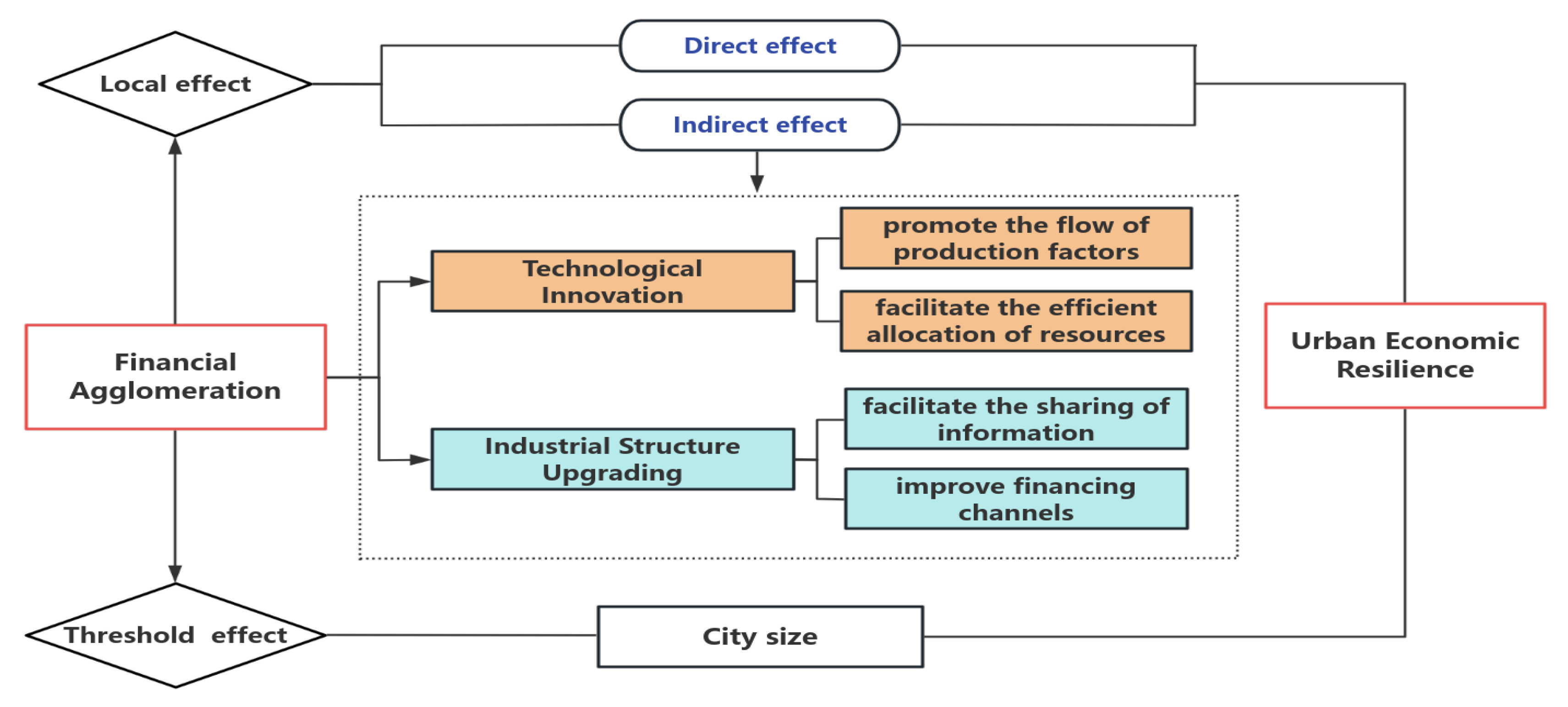
In summary,
Figure 1 shows the research content and research process of this paper.
4.2. Variable Selection and Data Sources
4.2.1. Variable Selection
(1) Dependent variable: municipal economic resilience (Resi). Drawing on the approach put forward by Zhang (2022) [
44], the present research employs the entropy weighting method, which relies on an assessment indicator framework constructed across three aspects—resistance and recovery capability, adaptation and adjustment potential, and innovation and transformation competence—to gauge municipal economic resilience.
Table 1 presents the complete assessment index system.
(2) Explanatory variable: financial agglomeration (Agg). The present research explores financial agglomeration within the Chinese context, with measurement data being collected from cities in China. For a more precise, authentic, and thorough portrayal of the clustering of financial firms within the area, the research adopts the methodological framework of Zhang (2022) [
44] and assesses urban financial agglomeration using the Location Quotient. The formula is:
FSit and Sit indicate the total number of workers in urban areas and the number of financial employees in year t; FSi and Si indicate the overall number of employed people in the study city as well as the number of financial employees. The larger the value of is, the higher level of financial agglomeration in urban i is.
(3) Mediating variables: industrial structure upgrading (Is). This indicator is calculated by taking the ratio of the added value from the tertiary industry to that from the secondary industry, following the measurement method of Zhou and Chen (2021) [
45]; another variable under examination is technological innovation (Tech). For this research, the proxy employed to represent urban technical aptitude is the ratio of science and technology spending to overall fiscal expenditure, following the methodology put forward by Hua and Chen (2022) [
37].
(4) Threshold variables: city size (Size): Drawing on prior research (Hua & Chen, 2022) [
36], urban scale is measured by population density, defined as the count of permanent inhabitants per square kilometer.
(5) Control variables: The following control variables are used to more thoroughly investigate how financial agglomeration affects urban economic resilience. ➀ Urban economic density (Eco), uses the ratio of GDP to urban land area to measure urban economic density (Li, 2023) [
41]. ➁ The degree of openness to the outside world (Open) improves the interaction between urban and the international talent market, the ratio of foreign direct investment to GDP is used as an indicator of the degree of openness (Wan & Hu, 2018) [
46]. ➂ Urban economic living standard (Ssa): This paper refers to the research practice of Su et al. (2020) [
19], and the natural logarithm of the per capital wage of urban residents is used as the urban economic living standard. ➃ The degree of urban informatization (Informa), i.e., the application of information technology. This refers to the definition of Zhang & Zhao (2021) [
47], where the proportion of the total amount of telecom services in GDP is used to measure the informatization degree of urban.
4.2.2. Data Sources
The analysis employs a set of Chinese urban areas spanning the period 2008 through 2021. After excluding entries with missing values, the resulting dataset takes the form of a balanced panel, covering 280 cities and yielding 3920 city-year data points. Key data is drawn mainly from the China City Statistical Yearbook and the China Regional Statistical Yearbook, while gaps are addressed by municipal-level statistical yearbooks to ensure the precision and reliability of the dataset. For ensuring comprehensiveness and consistency, key details regarding patent grants are obtained from the China National Research Data Service (CNRDS), while data concerning fixed-asset investments is derived from Official Statistical Communiqués on National Economic and Social Development.
4.2.3. Data Descriptive Analysis
The present research carries out an in-depth analysis of the dependent variable, core explanatory variable, mediating variable, threshold variable, and control variables by drawing on the descriptive statistics presented in
Table 2. Specifically, the resilience of urban economies presents an average value of 0.117, with its variation ranging from 0.034 to 0.802. This suggests that urban areas exhibit considerable disparities, and the overall degree of economic resilience in China’s cities remains insufficient. Financial concentration exhibits an average value of 1.016, with the highest recorded figure reaching 1.996 and the lowest value standing at 0.369. These statistics reveal a marked variation and imbalanced distribution in the financial agglomeration degree among cities in China, as shown by the significant gap between the highest and lowest figures.
5. Empirical Results and Discussion
5.1. Empirical Results
Analysis of Baseline Regression Results
The primary regression outcomes derived from Model (1) are presented in
Table 3. With no control variables considered, Column (1) demonstrates the impact of financial agglomeration on urban economic resilience. After successively incorporating control factors, statistical outcomes are presented in Columns (2) to (5); the complete statistical outcome in Column (5) serves as the focus of the present study. These regression outcomes reveal that financial concentration demonstrates a favorable and notable influence on the economic resilience of cities, irrespective of the inclusion of control variables. Such an influence is notably pronounced at the 1% statistical significance level, highlighting the vital function of financial agglomeration in strengthening urban economic resilience. This implies that financial agglomeration has the capacity to boost the economic resilience of cities through channeling resources like funding, skilled personnel, technological advancements, and expertise into the clustered region, which in turn establishes a robust base for strengthening the ability to withstand risks and elevating urban economic resilience. Consequently, the clustering of financial activities exerts a favorable effect on the economic resilience of cities, with Hypothesis H1 being confirmed.
5.2. Endogeneity Test and Resilience Test
5.2.1. Addressing Endogeneity Issues
For one thing, financial entities within clusters of financial activity can reduce the funding expenses and hazards of tech-oriented enterprises while providing financing solutions that are both more obtainable and efficient. By strengthening the capacity to resist outside disturbances and fostering the development of a flexible and diverse economic framework, such a setup can boost the economic resilience of the city. Consequently, cities with stronger economic resilience not only have a greater capacity to address risks but also show distinct benefits in aspects like market scale, infrastructure, technological innovation setting, and residents’ quality of life. Such beneficial features are able to attract more financial entities and capital resources, which can affect the selection of sites for the clustering of financial operations. As indicated by Cheng & Jin (2020), a first-order lag of financial agglomeration is employed as an instrumental variable to mitigate endogeneity issues [
48]. To evaluate the stability of the analytical framework, the two-stage least squares method is then adopted for verification. Findings from the regression analysis are presented in Columns (1) and (2) of
Table 4. The results presented in these columns indicate that the employed instruments satisfy both the test for weak instruments and the under-identification test. Additionally, following the application of the instrumental variable approach for endogeneity examination, the regression coefficient associated with financial agglomeration shows no substantial variation, which suggests that the findings of the study are fairly stable.
5.2.2. Robustness Test
Within the resilience checks, the subsequent approaches are applied. We first alter the assessment approach for the resilience of the urban economy regarding the variable being explained. Prior research assesses urban economic resilience through the development of an index framework. On this basis, the current investigation re-evaluates the resilience of urban economies through alternative sensitivity metrics, following the method proposed by Liu Yi and others. The outcomes are displayed in Column (1) of
Table 5. Column (1) shows that the clustering of financial activities has a notably positive direct impact on urban economic resilience, with statistical significance at the 1% level; this is consistent with the initial regression results and thus confirms the stability of the main conclusions. The estimation approach is adjusted, and the model is re-evaluated by adopting a random effects framework to further enhance the reliability of the results. Additional evidence supporting the credibility of these outcomes is shown in
Table 5, where the parameter of financial agglomeration stays positive and statistically significant at the 1% level. This observation confirms that the baseline regression results are dependable, as they match the earlier baseline findings. As part of the subsequent analytical process, the sample volume was reduced. Urban areas were sorted according to their mean economic resilience across the period spanning 2008 through 2021. After removing the upper 10 percent and lower 10 percent of outlier city cases, the model was re-evaluated using the remaining 224 urban units. The findings presented in
Table 5 show that even with the application of the random effects model, the impact coefficient of financial agglomeration on urban economic resilience stays positive and statistically significant at the 1% significance level, which verifies the sound dependability of the earlier regression findings. To ensure the resilience of the above regression findings, the impact of extreme data points in the dataset was minimized by implementing a 1% two-tailed Winsorizing process on all continuous variables. After applying this data adjustment, the findings from the regression analysis are shown in Column (3) of
Table 5. The estimates of the key independent variables stay statistically significant at the 1% level, a situation that thus confirms the stability of the research results. To further solidify the stability of these results, an additional step involves modifying the temporal range of the data under analysis. To reduce the impact of atypical time periods on empirical results and improve the stability of findings, researchers conduct the regression again after removing data from 2019 to 2021. Following this re-conducted regression, the columns of
Table 5 show that the coefficient linked to financial agglomeration presents a statistically significant positive result at the 1% significance level. Such findings indicate that, following the removal of unusual time periods, financial agglomeration remains to have a notably positive and significant effect on urban economic resilience, thereby reinforcing the stability of Hypothesis H1.
5.3. Mediation Effect Test
The research separately computes Model 2 and Model 3 to explore the intermediary effects of industrial structure upgrading and technological innovation on the relationship between financial agglomeration and urban economic resilience. As shown in Column (1) of
Table 6, the value associated with financial agglomeration is 0.237, presenting statistical significance and a positive direction. Moreover, Column (2) of
Table 6 further shows that the coefficient for industrial structure is similarly statistically significant and positive. These coefficients’ significance serves to validate the intermediary role, indicating that the clustering of financial activities can positively influence the economic resilience of prefectural cities via the indirect pathway of industrial framework adjustment.
In order to delve deeper into the intermediary function of technological innovation, the model was re-evaluated. Looking at Columns (3) and (4) in
Table 6, the impact coefficient of financial agglomeration on technological innovation stands at 0.0211 and is statistically significant at the 1% significance level, which suggests that financial agglomeration has a notable positive effect on tech innovation. Through examining the first model and the third model, it is found that after adding the mediating factor (technological innovation), the impact coefficient of financial agglomeration on urban economic resilience is reduced in size yet still maintains statistical significance. This demonstrates that technological innovation acts as a partial mediator between financial agglomeration and economic resilience; that is, the impact of financial agglomeration on economic resilience is partially realized through the promotion of technological innovation.
5.4. Threshold Effect Test
To examine the threshold effect, the research employs the threshold regression method by drawing on the methodological framework of Hua and Chen (2022) [
37], with city size designated as the threshold variable. Within Model (4), urban scale has successfully cleared the dual threshold examination.
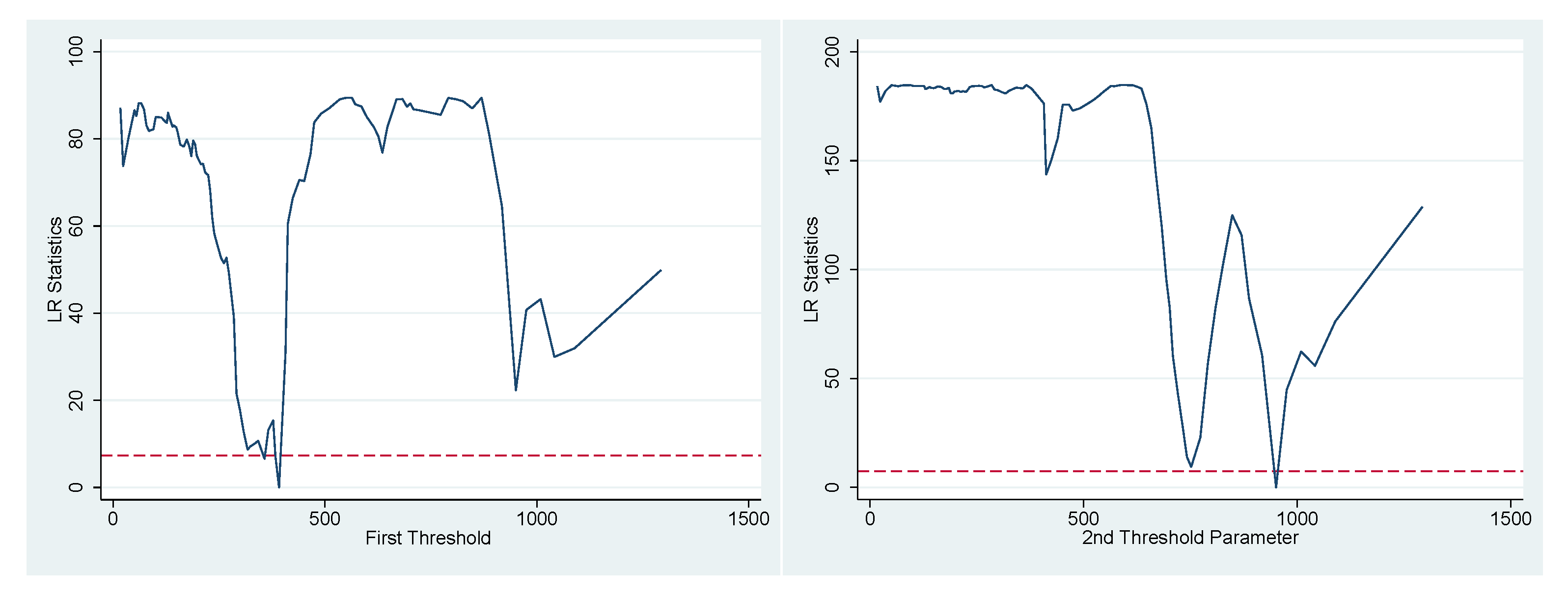
Figure 2 presents the likelihood ratio function plots corresponding to the threshold figures of 391.73 and 956.81. Notably, the likelihood ratio statistics linked to the threshold values of 391.73 and 956.81 are markedly lower than the critical value of 7.35, thereby confirming the statistical validity of the city size’s dual threshold impact.
Results from regression analysis concerning the threshold impact of urban scale on how financial concentration relates to a city’s economic resilience are shown in
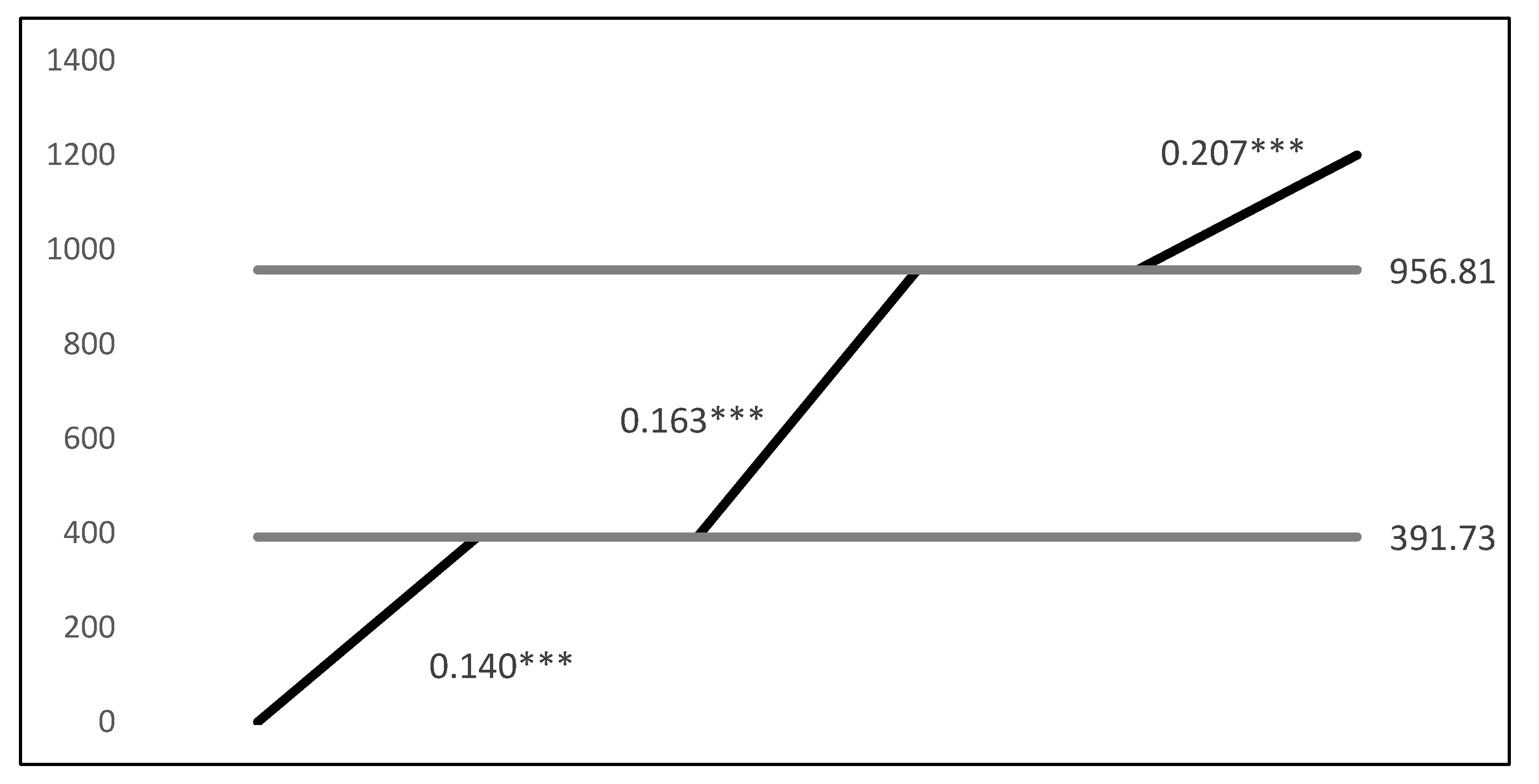
Table 7. As shown in Column (2), when city size falls within the first interval (Size ≤ 391.73), the coefficient of financial agglomeration is 0.140, which is statistically significant at the 1% level. When city size falls within the second interval (391.73 < Size ≤ 956.81), the estimated financial agglomeration coefficient is 0.163, significantly positive at the 1% significance level; when city size falls within the third interval (Size > 956.81), the estimated financial agglomeration coefficient is 0.207, which is significantly positive at the 1% significance level. These findings reveal that the boosting impact of financial concentration on urban economic resilience grows stronger as the urban scale expands, showing a notable non-linear growth trend. Accordingly, Assumption H3 has been confirmed.
From
Figure 3, it is evident that urban scale exhibits a notable dual threshold phenomenon. When the scale of a city (Size) gradually increases and surpasses the two thresholds, the beneficial influence of financial concentration (Agg) on urban economic resilience (Resi) grows steadily, showing a clear non-linear strengthening trend.
5.5. Heterogeneity Test
5.5.1. Differences in Resource Endowments
Findings regarding how financial agglomeration affects city-level economic resilience under varying resource endowment conditions are displayed in
Table 8. Following the State Council’s categorization and the work of Zhu and Sun (2021) [
49], the research divided the sample into resource-based and non-resource-based cities, where findings for non-resource-based cities are presented in Column (1) and those for resource-based cities in Column (2). Clusters of financial activities exert a notably positive impact on the economic resilience of both city categories, thereby verifying their general role in fortifying such resilience. An in-depth examination reveals that such an impact is more evident in cities not reliant on resources, which suggests that financial agglomeration exerts a more vital function in boosting economic resilience within these urban areas.
5.5.2. Differences in Regions
Given the uneven allocation of financial assets and economic foundations across various parts of China, the influence of financial concentration on regional economic resilience might vary across regions. To examine variations across regions in the link between financial concentration and local economic resilience through subgroup regression analyses, the research divides the dataset into three geographical divisions: Eastern, Central, and Western.
Table 8 displays the outcomes of the regional subgroup analysis, indicating that the regression estimators for the agglomeration of financial activities in the Eastern, Central, and Western regions are all positive (0.205, 0.0922, and 0.112, respectively) and statistically meaningful. Notably, the Eastern area demonstrates the most pronounced facilitative impact, with its coefficient surpassing the national average; the Western area follows, and the Central area shows a relatively weaker influence.
5.5.3. Differences in Digital Finance Development
The advancement of digital financial services in cities is assessed through the yearly Peking University Index of Digital Financial Inclusion. All samples are divided into groups with high and low levels of digital financial development based on the median value of the index’s yearly mean, and a subgroup regression analysis is performed to examine the varying effects. Findings from this grouped regression are shown in Columns (6) and (7) of
Table 8, which reveal that the concentration of financial resources has a more distinct positive impact on the economic resilience of cities featuring well-developed digital financial sectors.
6. Discussion
This study’s robust empirical findings demonstrate that the clustering of financial activities exerts a statistically significant positive influence on urban economic resilience. Moreover, the study also finds notable differences in the manifestation of this effect among urban areas distinguished by varying geographical positions and degrees of digital financial advancement. Such findings demonstrate the complexity of the facilitative role of financial agglomeration amid China’s regional variations while aligning with core theoretical models like technological spillover and network-based external effects.
To begin with, the empirical results indicate a significant positive effect of financial agglomeration on urban economic resilience, consistent with prior studies and the theoretical frameworks outlined in
Section 3 [
37]. Prior academic studies typically argue that financial concentration reinforces urban economic resilience through pathways such as enhancing the efficiency of resource distribution, easing funding constraints, and lowering systemic risk concentration. Current research additionally reveals that financial agglomeration bolsters city-level economic resilience via a pair of mutually reinforcing pathways: optimizing industrial frameworks and fostering technological advancements. This two-channel insight corresponds to the perspective on financial functions. Importantly, the noted resilience does not originate from one sole pathway, but rather from the mutual interplay and supplementary nature of these system-level processes. Collectively, these systemic processes enhance the stability, flexibility, and capacity for transformation of the city’s economic framework, which in turn facilitates swift recuperation and structural enhancement [
50].
Next, through threshold impact assessment, urban scale is recognized as a key boundary condition: as cities grow beyond sequential thresholds, the resilience-promoting impact of financial agglomeration strengthens progressively. Earlier research efforts have mainly adopted factors such as financial development level or institutional quality as threshold indicators [
51], with comparatively little focus directed toward city size as a restrictive element. Metropolises are equipped with advanced infrastructure systems, a robust industrial foundation, and stronger capacity for absorption, which enables them to more efficiently capitalize on the benefits generated by financial concentration [
43]. The positive marginal impact of urban size indicates that the complementary interplay between financial concentration and urban scale is not linear but presents a stepwise enhancement. Such a finding advances earlier research that simply noted a broadly positive regulatory function of urban scale.
Thirdly, an analysis of variability reveals significant differences in the impacts of financial agglomeration across three key aspects, thereby enhancing the contextual understanding of resilience studies. Among these dimensions, urban classification stands out: the favorable influence of financial concentration is more evident in cities not dependent on resources, a result that matches earlier studies emphasizing the structural fragility of resource-reliant urban regions. For cities reliant on natural resources, capital is mainly directed towards sectors tied to such resources, thereby restricting their capacity to develop diverse economic resilience. Geographically, the impact appears more pronounced in eastern regions of the country, which is consistent with existing research highlighting geographical disparities in financial advancement [
37]. Cities in the east, by taking advantage of better institutional setups, higher degrees of market liberalization, and more well-developed financial infrastructures, strengthen the diffusion impacts of financial concentration. A key innovation of the present research involves incorporating the degree of digital financial advancement as an aspect of variability, an angle that prior studies have largely neglected. Findings validate the collaborative relationship between conventional financial agglomeration and digital financial services by demonstrating that urban areas where digital finance is more advanced strengthen the capacity of financial agglomeration to enhance resilience. In other words, digital innovations can boost the impact of agglomeration’s spillover effects and overcome spatial barriers when distributing financial resources.
In terms of research methodology, the present study enhances the depth of existing academic literature by incorporating mediation analysis, threshold regression, and heterogeneity decomposition into an integrated analytical structure. Prior research efforts have generally focused on either direct impacts alone or individual aspects of variability separately; in contrast, the present study systematically breaks down the conduction pathways, boundary conditions, and situational differences that influence the way financial agglomeration impacts the economic resilience of cities. Nevertheless, this research is not without certain restrictions, which in turn create possibilities for subsequent exploration. First, regarding variable quantification, the clustering of financial activities is primarily gauged through the location quotient for financial sector employment; even with resilience checks, this approach remains unable to comprehensively capture its multi-faceted nature. Second, while the instrumental variables applied in endogeneity testing adhere to academic norms, the one-period lagged metric of financial agglomeration may not entirely remove endogeneity arising from omitted variables.
Overall, the effect of financial activity clustering on the economic resilience of cities operates through multiple pathways is contingent on specific thresholds and varies across different contexts. To gain deeper insights into the interplay between clustering of financial activities, city size, and digital financial services in shaping economic resilience across different phases of growth, subsequent research might develop non-linear analytical frameworks. Moreover, comparative analyses across different countries or regions with varied institutional environments could help define the scope within which the research outcomes can be generalized. From a policy-making standpoint, these outcomes indicate that a uniform strategy for financial agglomeration policies proves ineffective, considering the clarified limits of general applicability. Conversely, to fully leverage the resilience-boosting impacts of financial agglomeration, it is essential to adopt customized strategies that account for city size, resource endowments, geographical positions, and stages of digital financial development.
7. Conclusions and Recommendations
Using panel datasets from 280 prefecture-level and higher cities in China covering the years 2008 to 2021, the research employs a two-way fixed effects model to examine the relationship between financial agglomeration and urban economic resilience. Results of the analysis reveal that the clustering of financial activities exerts a strongly positive influence on the economic resilience of cities. Further mechanism-based tests affirm that this favorable impact is primarily propelled through two channels: optimization of industrial frameworks and fostering of technological innovations. Notably, there exists a distinct threshold effect regarding how financial agglomeration facilitates urban economic resilience. As urban scale expands, the impact of financial agglomeration on urban economic resilience gradually strengthens, displaying a non-linear trait with increasing marginal effects. At lower levels of urban scale, the impact of financial agglomeration remains modest. Once the urban scale surpasses the initial threshold (391.73), the facilitating impact becomes stronger. Once the urban scale surpasses the second threshold (956.81), the favorable impact brought about by financial concentration hits its peak. Beyond this threshold effect, an analysis of variability indicates that the promoting impact of financial concentration on the economic resilience of cities is markedly more pronounced in cities not reliant on resources compared to those that are resource-dependent. From a regional perspective, the boosting role of financial agglomeration in economic resilience is notably more substantial in eastern regions compared to their central and western counterparts. Similarly, heterogeneity analyses categorized by the advancement of digital finance reveal that the beneficial effect of financial concentration is markedly stronger in urban areas with more advanced digital financial systems than in those with less developed ones. Drawing on these empirical observations, the present research puts forth four policy recommendations to enhance the economic resilience of urban areas:
To enhance the economic resilience of cities in China through financial concentration, we suggest a coordinated policy system. To start with, it is crucial to rationalize the distribution of financial resources through reinforcing policy direction and market-driven mechanisms. Authorities ought to set up dedicated funding and incentive schemes to direct capital concentration toward strategic emerging sectors and research and development efforts, attaining technological self-sufficiency step-by-step and aiding in the modernization of industrial chains. Next, the simultaneous advancement of technological innovation and industrial structural enhancement should be promoted to bolster the pivotal function of financial concentration. On one hand, funding support ought to accurately facilitate the advancement of industrial frameworks. On the other hand, a mechanism for the in-depth integration between technology and finance needs to be established. Next, it is crucial to adopt policies that vary according to urban size. With regard to smaller cities, measures should center on enlarging the urban area and upgrading infrastructure, so as to lay the foundation for financial agglomeration to come into play. In the context of mid-sized urban regions, actions should be directed at reinforcing the monetary system and upgrading the standard of concentration. Regarding major urban centers, priority ought to be placed on refining financial agglomerations and warding off overcrowding impacts, aligning with the advocacy to “develop globally competitive urban agglomerations.” Additionally, it is necessary to enforce policies tailored to individual regions. To this end, eastern areas are advised to advance into high-tier manufacturing and contemporary service sectors; central regions should capitalize on their geographical strengths to undertake industrial relocation; and western areas require more policy assistance to enhance their competitive capacity. Meanwhile, cities relying on resources or boasting strong financial sectors should further push forward industrial clustering, while other urban areas need to develop unique industrial segments and improve their financial structures. Urban areas where digital financial services are more advanced should prioritize systemic reforms and practical use cases of digital finance, thereby strengthening the beneficial spillover effects of clustering financial activities. To reduce disparities in digital financial development across different regions, region-specific supporting measures need to be worked out, aiming to strengthen the collaborative impact between financial agglomeration and digital finance in promoting economic resilience.
Author Contributions
Conceptualization, Y.Q. and X.W.; Methodology, Y.Q. and X.W.; Software, J.Z. and W.H.; Validation, X.W. and Y.Q.; Formal analysis, J.Z.; Investigation, J.Z. and W.H.; Resources, Y.Q.; Data curation, X.W. and J.Z.; Writing—original draft, X.W.; Writing—review & editing, X.W. and Y.Q.; Visualization, J.Z. and W.H.; Supervision, Y.Q.; Project administration, X.W. and Y.Q. All authors have read and agreed to the published version of the manuscript.
Funding
This research is supported by the Major Project of Philosophy and Social Science Research in Colleges and Universities of Jiangsu Province (No. 2025SJZD055) and the Postgraduate Research and Practice Innovation Program of Jiangsu Province (No. KYCX25_3548).
Institutional Review Board Statement
Not applicable.
Informed Consent Statement
Not applicable.
Data Availability Statement
The original contributions presented in this study are included in the article material. Further inquiries can be directed to the corresponding author.
Conflicts of Interest
The authors declare no conflicts of interest.
References
- Ribeiro, P.J.G.; Gonçalves, L.A.J. Urban resilience: A conceptual framework. Sustain. Cities Soc. 2019, 50, 101625. [Google Scholar] [CrossRef] [Scilit]
- Martin, R.; Sunley, P. On the notion of regional economic resilience: Conceptualization and explanation. J. Econ. Geogr. 2015, 15, 1–42. [Google Scholar] [CrossRef] [Scilit]
- Zhu, L.; He, Y.; Chen, C.; Liao, N. Coordinated development of economic-environmental resilience and its drivers in Chinese cities: A study considering regional disparities. Environ. Dev. Sustain. 2025, 1–38. [Google Scholar] [CrossRef] [Scilit]
- Wang, Z.X.; Wei, W. Regional economic resilience in China: Measurement and determinants. Reg. Stud. 2021, 55, 1228–1239. [Google Scholar] [CrossRef] [Scilit]
- Zhang, M.D.; Wu, Q.B.; Li, W.L.; Sun, D.Q.; Huang, F. Intensifier of urban economic resilience: Specialized or diversified agglomeration? PLoS ONE 2021, 16, e0260214. [Google Scholar] [CrossRef] [Scilit]
- Cheek, W.; Chmutina, K. Measuring resilience in the Assumed City. Int. J. Disaster Risk Sci. 2022, 13, 317–329. [Google Scholar] [CrossRef] [Scilit]
- Toth, G.; Elekes, Z.; Whittle, A.; Lee, C.; Kogler, D.F. Technology network structure conditions the economic resilience of regions. Econ. Geogr. 2022, 98, 355–378. [Google Scholar] [CrossRef] [Scilit]
- Zhong, S.; Du, L. Research on the impact of financial agglomeration on regional economic growth: An econometric analysis based on spatial panel data. Ind. Technol. Econ. 2018, 37, 62–69. [Google Scholar]
- Chen, Y.; Ding, G. Measurement of urban economic resilience in prefecture-level cities in China. Stat. Decis. 2020, 36, 102–106. [Google Scholar] [CrossRef]
- Xu, Y.; Deng, H. Diversification, innovation and resilience of urban economy. Econ. Trends 2020, 8, 88–104. [Google Scholar]
- Feng, J.; Huang, X. Financial agglomeration and high-quality enterprise development: A perspective on the spatial distribution of financial institutions. Econ. Manag. 2023, 37, 71–82. [Google Scholar]
- Cellini, R.; Torrisi, G. Regional resilience in Italy: A very long-run analysis. Reg. Stud. 2014, 48, 1779–1796. [Google Scholar] [CrossRef] [Scilit]
- Boschma, R. Towards an evolutionary perspective on regional resilience. Reg. Stud. 2014, 49, 733–751. [Google Scholar] [CrossRef] [Scilit]
- Wu, Y. The impact of digital finance and green innovation on urban economic resilience. China Bus. Econ. 2023, 37, 97–107. [Google Scholar] [CrossRef]
- Cheng, X.; Ge, F.; Xu, M.; Li, Y. The heat island effect, digital technology, and urban economic resilience: Evidence from China. Technol. Forecast. Soc. Change 2024, 209, 123802. [Google Scholar] [CrossRef] [Scilit]
- Fusillo, F.; Consoli, D.; Quatraro, F. Resilience, skill endowment, and diversity: Evidence from US metropolitan areas. Econ. Geogr. 2022, 98, 170–196. [Google Scholar] [CrossRef] [Scilit]
- Holl, A. Local employment growth patterns and the great recession: The case of Spain. J. Reg. Sci. 2018, 58, 837–863. [Google Scholar] [CrossRef] [Scilit]
- Laubscher, P. The business cycle resilience of the western cape economy: A regional analysis of the 2009 recession and subsequent recovery. Stud. Econ. Econom. 2017, 41, 1–24. [Google Scholar] [CrossRef] [Scilit]
- Su, R.; Zhao, X. Manufacturing development, entrepreneurial vitality and urban economic resilience. J. Financ. Econ. 2020, 9, 79–91. [Google Scholar]
- Faggian, A.; Gemmiti, R.; Jaquet, T.; Santini, I. Regional economic resilience: The experience of the Italian local labor systems. Ann. Reg. Sci. 2018, 60, 393–410. [Google Scholar] [CrossRef] [Scilit]
- Zheng, M.; Li, F. Agglomeration of productive service industries and urban economic resilience: Theoretical basis and empirical facts. Stat. Decis. 2024, 40, 126–131. [Google Scholar]
- Bristow, G.; Healy, A. Innovation and regional economic resilience: The role of institutional support. Camb. J. Reg. Econ. Soc. 2018, 11, 137–155. [Google Scholar]
- Enka, J.; Chreneková, M.; Kokeová, L.; Svetlíková, V. Industrial structure and economic resilience of non-metropolitan regions: An empirical base for the smart specialization policies. Land 2021, 10, 1335. [Google Scholar] [CrossRef] [Scilit]
- Kakderi, C.; Tasopulou, A. Regional economic resilience: The role of national and regional policies. Eur. Plan. Stud. 2017, 25, 1435–1453. [Google Scholar] [CrossRef] [Scilit]
- Wen, H.; Liu, Y.; Zhou, F. New-type infrastructure and urban economic resilience: Evidence from China. Int. Rev. Econ. Financ. 2024, 96, 103560. [Google Scholar] [CrossRef] [Scilit]
- Tan, J.; Hu, X.; Hassink, R.; Ni, J. Industrial structure or agency: What affects regional economic resilience? Evidence from resource-based cities in China. Cities 2020, 106, 102906. [Google Scholar] [CrossRef] [Scilit]
- Viana, L.F.C.; Hoffmann, V.E.; Miranda Junior, N.D.S. Regional resilience and innovation: Paper profiles and research agenda. Innov. Manag. Rev. 2023, 20, 119–131. [Google Scholar] [CrossRef] [Scilit]
- Zhou, Y.; Li, J.; Chen, J. The promotion mechanism of financial agglomeration and human capital on urban economic resilience: Based on the moderating effect of industrial structure. Int. Rev. Econ. Financ. 2025, 97, 103764. [Google Scholar] [CrossRef] [Scilit]
- Beraja, M.; Yang, D.; Yuchtman, N. Data-intensive innovation and the state: Evidence from AI firms in China. Rev. Econ. Stud. 2023, 90, 1701–1723. [Google Scholar] [CrossRef] [Scilit]
- Qu, C.Y.; Shao, J.; Shi, Z.K. Does financial agglomeration promote the increase of energy efficiency in China? Energy Policy 2020, 146, 15. [Google Scholar] [CrossRef] [Scilit]
- He, Y.; Chang, D.N.; Wei, R. Local financial agglomeration and corporate green innovation. Asia-Pac. J. Financ. Stud. 2023, 52, 539–564. [Google Scholar] [CrossRef] [Scilit]
- Wen, Y.Y.; Zhao, M.; Tang, G.L.; Zhou, X.X.; Hu, X.C.; Sui, L. How does financial agglomeration affect green development? Evidence from the yangtze river delta of China. Growth Change 2023, 54, 135–156. [Google Scholar] [CrossRef] [Scilit]
- Kindleberger, C.P. The Formation of Financial Centers: A Study in Comparative Economic History; Princeton University Press: Princeton, NJ, USA, 1974; pp. 89–112. [Google Scholar]
- Clark, G.L. Money flows like mercury: The geography of global finance. Geogr. Ann. Ser. B Hum. Geogr. 2005, 87, 99–112. [Google Scholar] [CrossRef] [Scilit]
- Porteous, D. The development of financial centres: Location, information externalities and path dependence. In Money and the Space Economy; Martin, R., Ed.; Wiley: Chichester, UK, 1999; pp. 95–114. [Google Scholar]
- Tao, M.M.; Silva, E.; Sheng, M.S.; Wen, L.; Qi, L.L. How financial clustering influences China’s green development: Mechanism investigation and empirical discussion. J. Environ. Manag. 2023, 347, 15. [Google Scholar] [CrossRef] [Scilit]
- Hua, G.H.; Chen, Y.J. Financial Agglomeration, Technological Innovation, and Urban Economic Resilience. East China Econ. Manag. 2022, 36, 48–56. [Google Scholar] [CrossRef]
- Li, S.F. Financial agglomeration, innovation and entrepreneurship activity and urban economic resilience. Econ. J. 2023, 40, 26–36. [Google Scholar] [CrossRef]
- Wang, L.; Hu, X. The impact of financial agglomeration on regional technological innovation efficiency. Technol. Econ. Manag. Res. 2024, 9, 19–24. [Google Scholar]
- Zhao, J.; Yang, W.; Wang, Y. Research on the impact of financial agglomeration on urban economic resilience in China. Acta Geogr. Sin. 2025, 80, 3142–3159. [Google Scholar]
- Li, B.; Qu, Y. The impact of path dependence and breakthrough in industrial evolution on regional economic resilience in China’s coastal areas. Acta Geogr. Sin. 2023, 78, 824–839. [Google Scholar]
- Liu, L.; Gao, X.; Bao, Y. Can financial agglomeration effectively enhance regional economic resilience? A study based on moderating and threshold effects. Theory Pract. Financ. Econ. 2025, 46, 17–25. [Google Scholar] [CrossRef]
- Yang, H.; Liang, H. Digital economy, capital agglomeration effect and regional innovation. Stat. Decis. 2024, 18, 149–154. [Google Scholar] [CrossRef]
- Zhang, X.C. Financial Agglomeration, Innovation Capability, and Urban Economic Resilience. J. Tech. Econ. Manag. 2022, 6, 47–51. [Google Scholar]
- Zhou, G.; Chen, H. Analysis of the threshold effect of industrial structure upgrading on the urban-rural income gap. Stat. Res. 2021, 38, 15–28. [Google Scholar] [CrossRef]
- Wan, D.; Hu, B. Industrial agglomeration, financial development and “innovation inertia” of enterprises. Ind. Econ. Res. 2018, 1, 28–38. [Google Scholar] [CrossRef]
- Zhang, Z.; Zhao, R. Research on the spatial spillover effect of financial industry agglomeration on regional economic resilience. Contemp. Econ. Manag. 2021, 43, 89–97. [Google Scholar]
- Cheng, G.B.; Jin, Y. Can Innovation Capacity Improvement Enhance Urban Economic Resilience? Mod. Econ. Res. 2022, 2, 1–11+32. [Google Scholar] [CrossRef]
- Zhu, J.; Sun, H. Does digital economy enhance urban economic resilience? Mod. Econ. Res. 2021, 10, 1–13. [Google Scholar] [CrossRef]
- Wang, Y.; Li, Y. The Impact of the Digital Economy on Urban Ecosystem Resilience in the Yellow River Basin. Sustainability 2025, 17, 790. [Google Scholar] [CrossRef] [Scilit]
- Song, Y.J.; Wu, X.P. The Impact of Industrial Digitalization on Regional Economic Resilience: Based on the Mediating Effect of Public Services. Stat. Manag. 2025, 40, 74–86. [Google Scholar] [CrossRef]
| Disclaimer/Publisher’s Note: The statements, opinions and data contained in all publications are solely those of the individual author(s) and contributor(s) and not of MDPI and/or the editor(s). MDPI and/or the editor(s) disclaim responsibility for any injury to people or property resulting from any ideas, methods, instructions or products referred to in the content. |