Article

An Exploratory Protocol for Sustainability-Oriented Cross-Index Assessment of National Climate Policy Effectiveness

by
Olena Matukhno
1,2,
Valentyna Stanytsina
2,3,*,
Olena Dobrovolska
4 and
Volodymyr Artemchuk
5,6,7
1
Department of Ecology and Technologies of Environmental Protection, Dnipro University of Technology, 49005 Dnipro, Ukraine
2
Department for Energy Efficiency and Energy Balances Forecasting, The General Energy Institute of the National Academy of Sciences of Ukraine, 03150 Kyiv, Ukraine
3
State Institution “Center for Evaluation of Activity of Research Institutions and Scientific Support of Regional Development of Ukraine of the National Academy of Sciences of Ukraine”, 01601 Kyiv, Ukraine
4
Department of Finance, Banking and Insurance, University of Customs and Finance, 49000 Dnipro, Ukraine
5
Department of Mathematical and Econometric Modelling, G.E. Pukhov Institute for Modelling in Energy Engineering of the National Academy of Sciences of Ukraine, 03164 Kyiv, Ukraine
6
Department of Environmental Protection Technologies and Radiation Safety, Center for Information-Analytical and Technical Support of Nuclear Power Facilities Monitoring of the National Academy of Sciences of Ukraine, 03142 Kyiv, Ukraine
7
Department of Computer Science, Kyiv National Economic University named after Vadym Hetman, 03680 Kyiv, Ukraine
*
Author to whom correspondence should be addressed.
Sustainability 2026, 18(7), 3444; https://doi.org/10.3390/su18073444
Submission received: 23 February 2026 / Revised: 22 March 2026 / Accepted: 30 March 2026 / Published: 1 April 2026
(This article belongs to the Section Development Goals towards Sustainability)

Abstract

Effective climate policy is central to sustainability transitions and to monitoring progress toward sustainable development, yet national climate policy ratings often differ in scope, indicator design, time coverage, and scoring logic, producing inconsistent country assessments. This creates a need for transparent tools that can compare, interpret, and contextualize existing indices rather than rely on any single metric. This paper develops an exploratory protocol for sustainability-oriented cross-index assessment of national climate policy effectiveness. We combine a structured comparative analysis and a SWOT-informed diagnostic synthesis of four representative approaches—the Climate Change Performance Index (CCPI), Climate Action Tracker (CAT), the Climate Laws, Institutions, and Measures Index (CLIMI), and the Climate Policy Measure Index (CPMI)—with a pilot inter-index concordance test using rank-based correlation analysis for a small country sample and a common reference year (2012). The pilot is intended as an illustrative methodological example rather than a generalizable statistical test. The results indicate strong alignment among broad, composite approaches (CCPI, CAT, CLIMI), while an instrument-focused metric (CPMI, centered on carbon pricing and fiscal signals) shows weaker consistency with outcome- and governance-oriented ratings. Building on these insights, we compile an integrated indicator set that links outcomes (GHG levels and trends), structural drivers (energy mix, efficiency), policy instruments (pricing, regulation, subsidies), governance capacity (legal and institutional strength), and enabling conditions (finance, public engagement, international cooperation). We also specify the operational steps of the proposed workflow, including index selection, temporal harmonization, ordinal encoding, concordance analysis, discrepancy diagnosis, indicator mapping, and provisional normalization, weighting, aggregation, and validation rules for future composite implementation. The protocol should therefore be understood as a sustainability-oriented decision support workflow for interpreting agreements and disagreements across existing indices and for supporting more balanced evaluation of low-carbon transitions; a fully aggregated composite index with large-sample validation remains a task for future research.

1. Introduction

With the adoption of the Paris Agreement, parties committed to holding the increase in global average temperature well below 2 °C above pre-industrial levels and pursuing efforts to limit it to 1.5 °C. However, the IPCC Sixth Assessment Report [1] reported an increase in near-surface temperature of about 1.1 °C in 2011–2020 compared with 1850–1900, indicating that current policies and measures remain insufficient. Effective climate policy should ultimately translate into lower greenhouse gas (GHG) emissions, typically through improved energy efficiency and accelerated deployment of renewable energy sources.
According to the World Bank [2], more than 4500 state policies aimed at reducing GHG emissions and combating climate change have been adopted worldwide over the last three decades. However, only part of these climate and energy policies has been successfully implemented.
In this paper, the term “government climate policy” is used as an umbrella concept covering public strategies and sector-specific instruments (laws, regulations, fiscal measures, and action plans) designed to mitigate greenhouse gas emissions and/or adapt to climate change. In the EU multilingual environmental dictionary GEMET, “climate policy” is defined as government or private actions designed to lower anthropogenic GHG emissions or to adapt to climate change [3]. This broad definition implies that a single country may implement many concurrent policies across sectors such as energy, industry, transport, and agriculture.
The objectives, strategies, and instruments of countries’ climate policies differ substantially [4,5]. The European Environment Agency [6] reports a marked increase in the number of national policies and measures in Europe after the Paris Agreement and the preparation of national energy and climate plans. Yet the number of policy documents is not, by itself, an indicator of effectiveness [7]. Despite the proliferation of instruments, recent assessments still project global warming of up to about 2.7 °C by 2100 under current policies [8], highlighting the need for robust and comparable approaches to evaluating policy effectiveness, including context-specific pathways and sectoral measures [9].
A growing body of scholarship evaluates national climate action using composite indicators and rating systems.
Dieler [10] notes that, despite the availability of many environmental indicators, only a subset is typically used when assessing climate policy, often focusing on factors related to CO2 emissions. At the same time, effectiveness should be assessed not only by changes in emission volumes, but also by the breadth and coherence of measures aimed at limiting emissions. The authors of Refs. [11,12] emphasize that approaches to accounting for and evaluating climate policy effectiveness differ substantially: for example, Gugler et al. [12] operationalize effectiveness through emission reductions and associated costs.
Prominent families of metrics include policy stringency inputs (e.g., the OECD Environmental Policy Stringency, EPS) [13,14], policy and outcome performance composites (e.g., the Climate Change Performance Index, CCPI [15] and the Environmental Performance Index, EPI [16]), and price-based instruments (e.g., OECD Effective Carbon Rates, ECR [17]). Each embodies distinct conceptual choices about indicator selection, normalization, weighting, and aggregation—choices known to drive ranking differences across indices [18].
The OECD EPS is the most widely used cross-country input measure of environmental policy strictness. The original construction (1990s–2012) scores and aggregates instrument-level data—primarily on climate and air pollution—into sectoral and economy-wide composites [13]. A major update extends coverage to 1990–2020 for 40 countries, refines the structure, and explicitly adds a technology support sub-index alongside market- and non-market-based instruments, thereby moving EPS closer to a policy mix perspective [14].
The EPI offers a broad sustainability score that includes—but is not limited to—climate; crucially, the EPI team explicitly cautions against comparing scores across editions due to methodological revisions, a point that reinforces the general challenges of longitudinal and cross-index comparability [16].
Germanwatch, within the framework of the composite Climate Change Performance Index (CCPI) rating [19], identifies a separate category, “climate policy”, which accounts for 20% of the total score and covers the latest developments in the national and international climate policy of a country. The Climate Action Tracker (CAT) evaluates a wide range of national targets and actions for reducing greenhouse gas emissions in accordance with the temperature limit set by the Paris Agreement [20].
The Climate Laws, Institutions, and Measures Index (CLIMI) [11,21,22,23] was developed for the comparative assessment of indicators of governmental intentions to reduce emissions, expressed through climate policy and measures. The Climate Policy Measure Index (CPMI) [10] measures exclusively governmental political activity aimed at limiting greenhouse gas emissions, focusing on metrically measurable climate policy measures.
The Index of Climate Policy Activity [7] is used to assess the relative importance of policy innovations within complex policy portfolios. Earlier work also discusses the feasibility and limits of statistical analysis of climate policy determinants, reinforcing the need for careful interpretation of comparative policy metrics [24]. The Kaya identity [25] is often the basis for emission scenarios in integrated assessment models.
The CCPI evaluates mitigation performance across GHG emissions (40%), renewables (20%), energy use (20%), and climate policy (20%), assessing 63 countries and the EU, with transparent weights and indicator definitions—yet it remains primarily outcome-/trajectory-focused and includes expert-based policy scoring [15]. Methodology documents emphasize comparability within a given vintage but do not claim commensurability with other indices.
CAT assigns categorical ratings by benchmarking national targets and implemented action against temperature-consistent pathways. The names and granularity of CAT categories have evolved over time [20,26]. Table 1 summarizes the contemporary CAT methodology in its general/current form, whereas the harmonized pilot correlation exercise in this paper uses the historical four-category scheme available for the 2012 reference year (inadequate, medium, sufficient, role model) under CAT’s effort-sharing assessment [20]. Because CAT is ordinal by design, the choice of statistical treatment matters for inter-index comparisons.
Alongside composite indices that summarize the results and institutional characteristics of climate policy, approaches are being developed that focus on measuring individual policy instruments and their stringency: for example, carbon pricing metrics. The OECD’s Effective Carbon Rates (ECR) aggregates ETS permit prices, explicit carbon taxes, and fuel excise taxes into a single effective price signal, enabling comparability across countries and sectors; recent editions expand coverage and detail the methodology used to harmonize disparate price instruments [17].
Empirical studies leveraging these indices highlight both their policy salience and their limits. For example, the authors of Ref. [27] use EPS and report heterogeneous impacts of policy stringency on banking profitability across G7 vs. E7 economies, suggesting that institutional capacity mediates the transmission of environmental regulation to financial outcomes. Mahajan et al. [28] find long-run co-movements between EPS and revealed a comparative advantage in G20 textile exports, indicating trade competitiveness channels that can be orthogonal to mitigation progress. These applications illustrate that EPS captures policy inputs that may or may not correspond to mitigation outcomes assessed by CCPI/CAT [14]. Similarly, cross-national analyses of reforms aimed at overcoming barriers to sustainable energy development [29] show how governance quality and institutional frameworks condition the success of decarbonization policies.
Work on policy mixes underscores why indices disagree. The policy mix literature argues that effectiveness depends on the consistency, coherence, credibility, and comprehensiveness of instrument combinations, not on single instruments in isolation; hence, indices that emphasize stringency (EPS), outcomes/trajectories (CCPI), Paris alignment (CAT), legal and institutional readiness (CLIMI), or price-based instruments (CPMI/ECR) can legitimately diverge where policy mixes and implementation differ [30,31]. More generally, composite indicator research shows that weighting, aggregation, and robustness choices can materially affect rankings and the stories told by the resulting indices [18,32,33]. Recent MDPI-based studies reinforce this point from complementary angles: Wang and Ju [34] show how policy evaluation outcomes depend on explicit scoring architecture, and Srpak et al. [35] demonstrate the importance of transparent indicator selection and aggregation in sustainability-oriented composite index design.
Beyond global comparators, regional and sectoral evidence from Europe and Ukraine highlights granular constraints are often under-represented in national indices. For the cement sector in Ukraine, Stanytsina et al. [36] map technology-specific decarbonization options and policy levers, demonstrating how sectoral pathways interact with national policy metrics. Maevsky et al. [37] complement this with game-theoretic models of regulator–emitter interactions, clarifying conditions under which pricing or quotas elicit efficient abatement given information and enforcement frictions. Workforce and implementation capacity—for example, GIS-enhanced training for renewable energy professionals—also shape the feasibility of policy action [38]. Together, these works illustrate how implementation capabilities and sectoral techno-economics mediate the link from measured policy stringency to realized performance.
Recent investor-facing assessments make the divergence among indices visible. For instance, the Transition Pathway Initiative’s sovereign framework explicitly compares its country results to CCPI and EPI, noting coverage and construct differences that yield non-trivial ranking disagreements, even within Europe [39]. Recent peer-reviewed work also shows that carefully operationalized climate policy indices can be linked to emissions and economic outcomes, but only when index construction choices are explicit and internally consistent [40].
Taken together, the literature shows that indices can send divergent signals because they operationalize different constructs (policy inputs, governance capacity, observed outcomes, or temperature consistency). This motivates explicit cross-index validation rather than reliance on any single metric.

2. Research Gap, Study Scope, and Contributions

Synthesis and identified research gap. The state of the art offers high-quality but conceptually distinct lenses: policy input stringency (EPS), outcome-oriented mitigation performance (CCPI), Paris consistency assessments (CAT), legal and institutional readiness (CLIMI), and instrument stringency focused on pricing and fiscal measures (CPMI). What remains less developed is a transparent workflow for diagnosing when these indices converge, when they diverge, and how those divergences can be translated into a structured multidimensional assessment. This article addresses that gap by comparing four representative approaches (CCPI, CAT, CLIMI, CPMI), conducting a pilot inter-index concordance test for a common reference year, and compiling an integrated indicator set for subsequent policy assessment.
All the indices listed differ in methodology, selection of indicators, and information content, and each has advantages and disadvantages. However, when the goal is to assess climate policy effectiveness, these indices are only partially informative on their own. Therefore, existing approaches and indices should be analyzed comparatively, and a structured set of indicators should be developed to enable a more comprehensive characterization of national climate policy effectiveness.
Among the diverse landscape of climate policy metrics, four indices stand out due to their complementary analytical approaches. CCPI provides a broad, outcome-oriented assessment by combining emissions, renewables, energy use, and policy scores. CAT offers a distinct perspective by evaluating the consistency of national targets and actions with the Paris Agreement’s temperature goals. CLIMI focuses on the foundational legal and institutional frameworks that underpin long-term climate governance. CPMI takes a narrow, instrument-oriented view, concentrating on quantifiable market and fiscal measures such as carbon pricing. These four indices were selected for this study precisely because their methodological diversity (ranging from comprehensive outcomes to specific instruments and from institutional inputs to Paris alignment) allows for a robust examination of how different conceptual approaches can lead to convergent or divergent signals about a country’s climate policy effectiveness.
The aim of this study is to assess the consistency and discrepancies between international approaches to measuring climate policy effectiveness and to develop an exploratory decision support workflow, together with an integrated set of indicators, for more transparent cross-index interpretation in sustainability-oriented policy evaluation.
Specifically, this paper makes three contributions. First, it systematizes the conceptual differences between four widely used climate policy indices and clarifies how their scope, scoring logic, and policy focus shape comparability. Second, it provides a harmonized pilot illustration of cross-index concordance and discrepancy patterns for a common reference year, while explicitly treating the empirical exercise as exploratory rather than generalizable. Third, it proposes an operational workflow and integrated indicator architecture that can support future sustainability-oriented assessment of national climate policy without prematurely claiming a fully validated composite index.
Taking into account the differences in conceptual approaches, indicator structure, and climate index aggregation methodology, this study formulates the following research hypotheses:
Hypothesis 1 (H1). 
There is a strong direct correlation between indices covering a wide range of aspects of climate policy and its results, indicating their conceptual consistency in measuring the effectiveness of climate policy. This hypothesis is based on the assumption that, despite differences in the scales of assessment and weighting of indicators, these indices reflect common fundamental characteristics of climate policy, such as the level of ambition, institutional capacity, and actual results in reducing emissions.
Hypothesis 2 (H2). 
The index, which focuses primarily on market and fiscal climate policy instruments, is characterized by a lower level of consistency with composite indices compared with their interrelationships, reflecting the difference between instrument-oriented and system-effective approaches to climate policy assessment. This hypothesis is based on the assumption that the existence or strictness of carbon pricing mechanisms does not always directly translate into better overall climate policy outcomes, especially given the varying institutional capacities, economic structures, and energy balances of countries.

3. Materials and Methods

This study is designed as an exploratory methodological paper rather than as the construction of a fully aggregated composite index. To identify the most informative indicators, we carried out a structured comparative analysis and a SWOT-informed diagnostic synthesis of CCPI, CAT, CLIMI, and CPMI. These approaches were selected because they contain climate policy-relevant components, represent complementary analytical logics, are widely cited in the literature, and differ markedly in scope, weighting philosophy, aggregation rules, and scale structure.
The empirical strategy comprises four linked stages: (1) a structured comparison of the selected indices by focus, coverage, indicators, methodology, transparency, and public engagement; (2) a SWOT-based diagnostic interpretation used to identify likely sources of cross-index convergence and divergence; (3) a pilot rank-based concordance analysis for a small cross-country sample; and (4) the compilation of an integrated set of quantitative and qualitative indicators that can support subsequent multidimensional policy assessment.
The research hypotheses were explored using rank correlation analysis (Spearman’s rho) of the selected indices across a small cross-country sample. This approach is suitable for mixed measurement scales and ordinal inputs (CAT category encodings) and focuses on the direction and strength of monotonic relationships. Given the limited sample size (n = 5), the correlation results are interpreted as descriptive exploratory evidence of concordance/discordance rather than as definitive statistical confirmation.
Operational workflow of the proposed protocol. The workflow now comprises eight steps: (1) selecting conceptually complementary indices; (2) identifying a common reference year or the closest harmonized temporal window; (3) transforming non-metric ratings into ordinal values where necessary; (4) applying rank-based concordance analysis to identify agreement and disagreement between indices; (5) interpreting discrepancies in light of index scope, weighting logic, and policy focus; (6) mapping recurring dimensions into a structured indicator set for multidimensional policy evaluation; (7) applying provisional normalization and aggregation rules when the indicator menu is translated into a composite framework; and (8) subjecting the resulting scores to sensitivity and validation checks. The outputs are therefore not only a concordance matrix, a discrepancy profile, and an integrated indicator catalogue for decision support, but also an explicit operational pathway for future composite implementation.
Because n = 5 provides very limited statistical power, no inferential claims are made from the pilot analysis and no significance testing is used as a basis for substantive conclusions. The analysis is intended to illustrate methodological comparability and disagreement patterns, not to generalize across the population of countries.
Countries were selected for comparison based on two criteria:
  • Complete data for all four indices were available for a common reference year (2012), ensuring internal consistency of the comparative and correlation analyses and avoiding distortions from missing observations or mismatched vintages.
  • The sample reflects diversity in economic structure, energy mix, and climate governance models, which helps illustrate how instrument-focused and composite approaches may diverge in practice. The objective of this pilot is methodological (inter-index consistency), not inference about a population of countries.
Because the indices differ in publication cycles, vintages, and conceptual coverage, the year 2012 was selected as the most recent year for which data were simultaneously available across all methodologies in our sample. To reduce temporal mismatch, the analysis uses a common reference year and relies on source-reported values corresponding to that year; no interpolation, back-casting, or forward extrapolation was introduced. Using a common reference year improves internal comparability, but it also limits temporal generalization because climate policy indices evolve over time and do not update their indicators synchronously. The pilot should therefore be read as a harmonized methodological illustration rather than as a time-robust ranking exercise.
Data quality and sensitivity considerations. Because this study is designed as a pilot illustration, we did not perform formal sensitivity tests for alternative codings, weighting choices, or missing data treatments. Instead, we minimized avoidable distortion by restricting the sample to complete observations for all four indices and by using only published index values. A full-scale follow-up study should assess the sensitivity of results to alternative temporal windows, coding rules, expert-based uncertainty, and country-level control variables.

4. Results

4.1. Comparative Analysis of the Main Characteristics of CCPI, CAT, CLIMI, and CPMI

Table 1 presents a comparative analysis of the main characteristics of the selected indices. They are compared in terms of content and focus, geographical coverage, indicators, and the methodology applied.

4.2. SWOT Analysis of the Methodologies

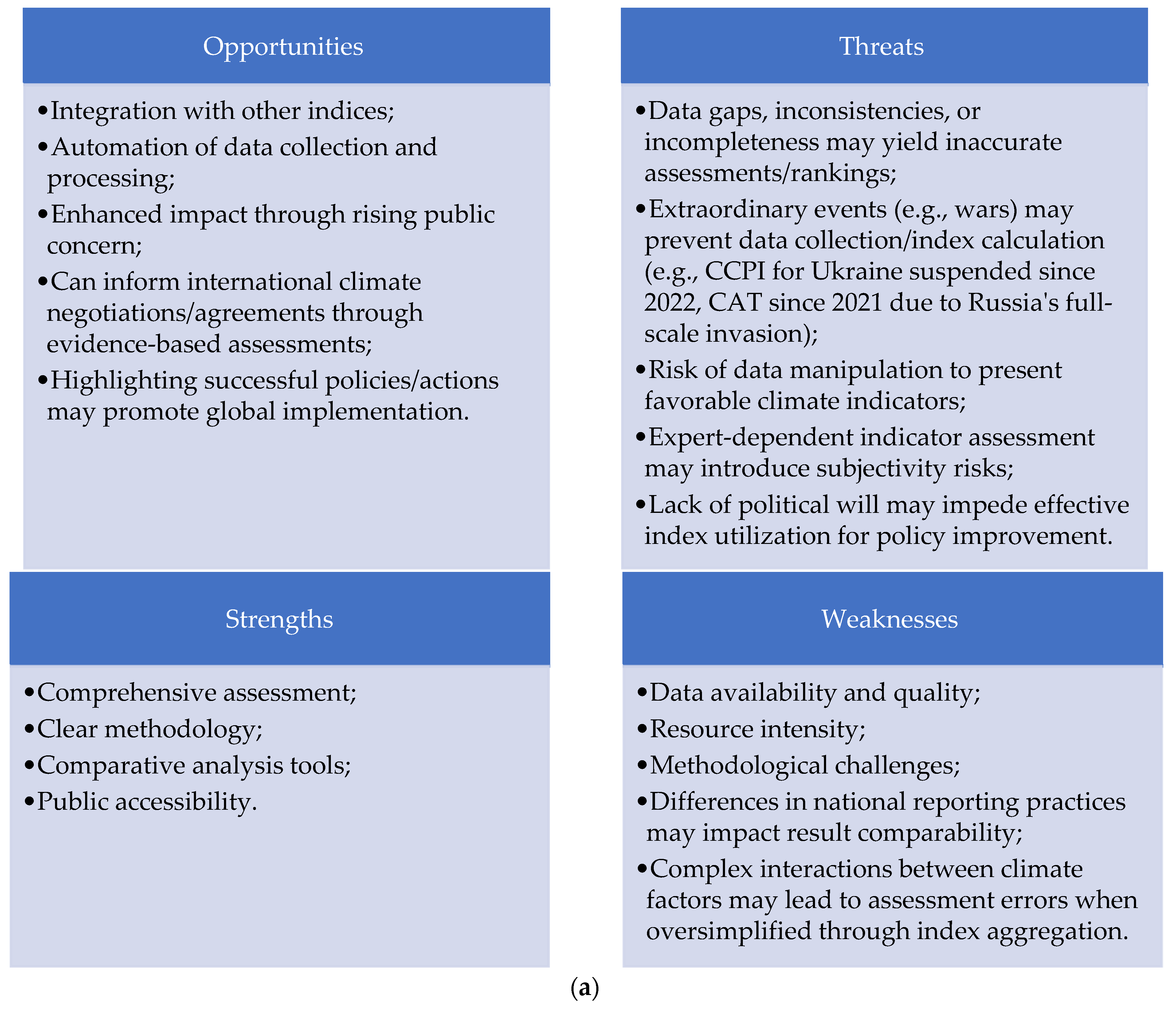
A SWOT analysis of the methods considered in Table 1 was used as a diagnostic heuristic to identify methodological features of indices that can help interpret later concordance results. In this study, SWOT is not treated as a quantitative decision model; rather, it provides a structured qualitative lens for identifying typical strengths, blind spots, opportunities, and threats associated with each index family, and these profiles are later used in the Discussion section to interpret why some indices converge more strongly than others.
All methodologies share both common features and differences (Figure 1a). Common challenges include data availability, methodological complexity (for example, identifying weighting coefficients for aggregating sub-indicators), and the simplification of complex interrelationships in climate policy, which affect the quality of the assessment results. Common strengths include the fact that these are comparative analysis tools with results publicly available, which allows countries to be encouraged to improve their position in the ranking.
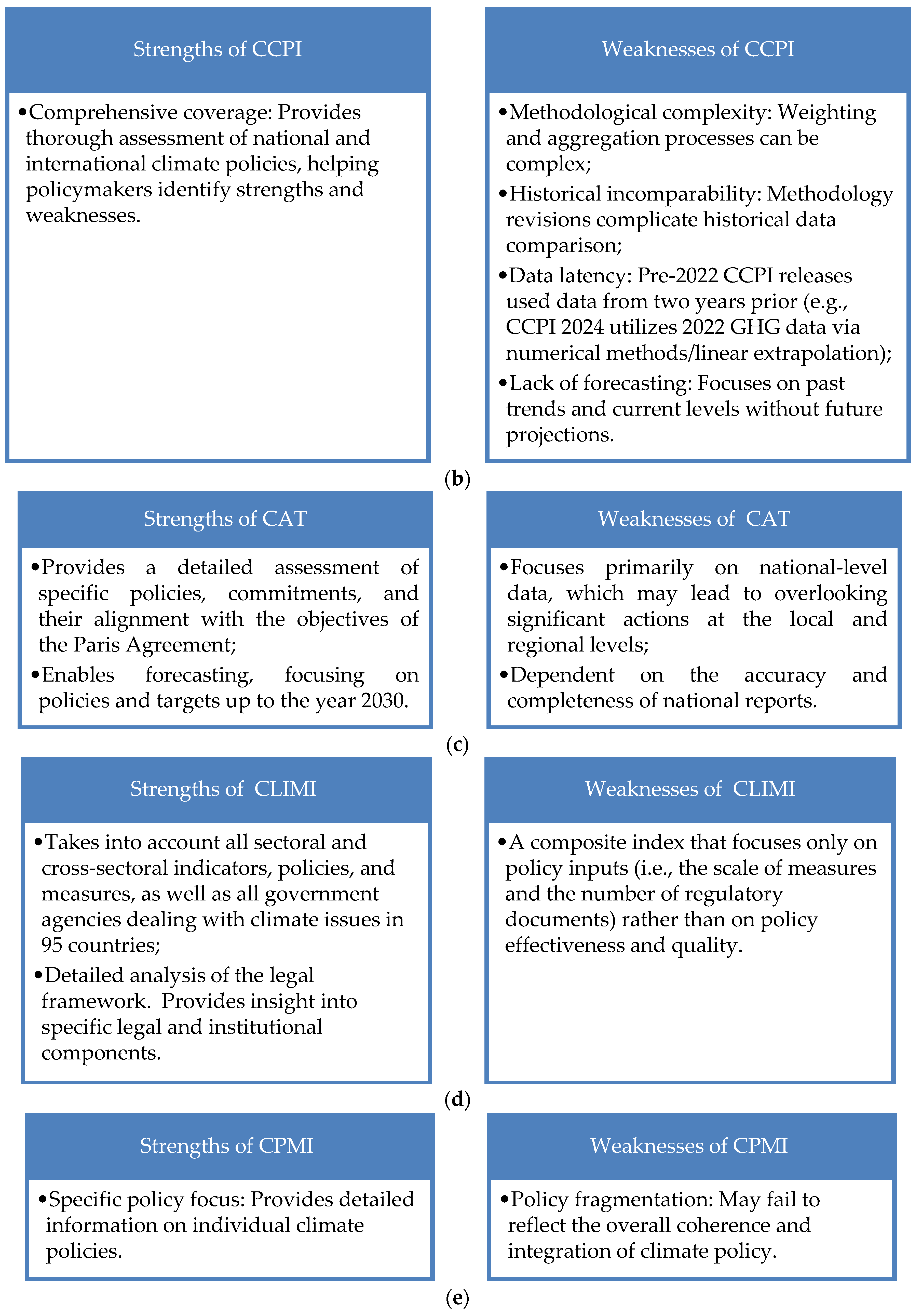
The opportunities and threats are the same for all methodologies. The specific differences in strengths and weaknesses of each methodology have been identified (Figure 1b–e).
Based on the analysis of Table 1 and Figure 1, the following conclusions can be drawn:
CCPI is best suited for a comprehensive assessment of national climate actions;
CAT is suitable for assessing the impact of national policies on global temperature targets;
CLIMI emphasizes the importance of legal and institutional frameworks for climate governance and can be used to analyze the relationship between policy and the effectiveness of climate change mitigation measures;
CPMI is suitable for assessing, comparing, and improving national climate policies.

4.3. Inter-Index Comparability

Dieler [10] notes the problem of index comparability. For instance, CAT and the “climate policy” sub-indicator in CCPI rely partly on relative or expert-based assessments, whereas CLIMI and CPMI encode policy inputs in different metric forms. For this reason, the proposed workflow begins with temporal harmonization and scale alignment and then proceeds to rank-based concordance analysis and discrepancy diagnosis (Figure 2). Since CAT employs a qualitative assessment scale, we converted it to an ordinal numerical scale (1–4 points, worst to best) for rank-based comparison.
Since the climate policy indices considered use different assessment scales, CAT categorical ratings were encoded into an ordinal numerical form to enable quantitative comparison. Consistent with the historical four-category CAT scheme available for the harmonized 2012 pilot year, we assigned ranks from 1 to 4 in ascending order of ambition (inadequate, medium, sufficient, role model) and then normalized by dividing by four, yielding values in the range 0.25–1.00 (Table 2). This encoding preserves the order of categories but does not convert CAT into an interval-scale measure; therefore, rank-based statistics are appropriate. We used Spearman’s rank correlation coefficient, which is invariant to monotonic transformations and is robust to scale differences when the analysis goal is concordance in ordering rather than equality of absolute magnitudes. Given the very small sample, the resulting coefficients are used descriptively and are not interpreted as a basis for statistical generalization.
For CCPI, we used overall rating indicators (not limited to the climate policy component) as it more comprehensively covers climate policy effectiveness indicators, such as the “renewable energy” criterion.
The input data for the calculation are presented in Table 2 and cover the values of international climate policy indices for selected countries for 2012.
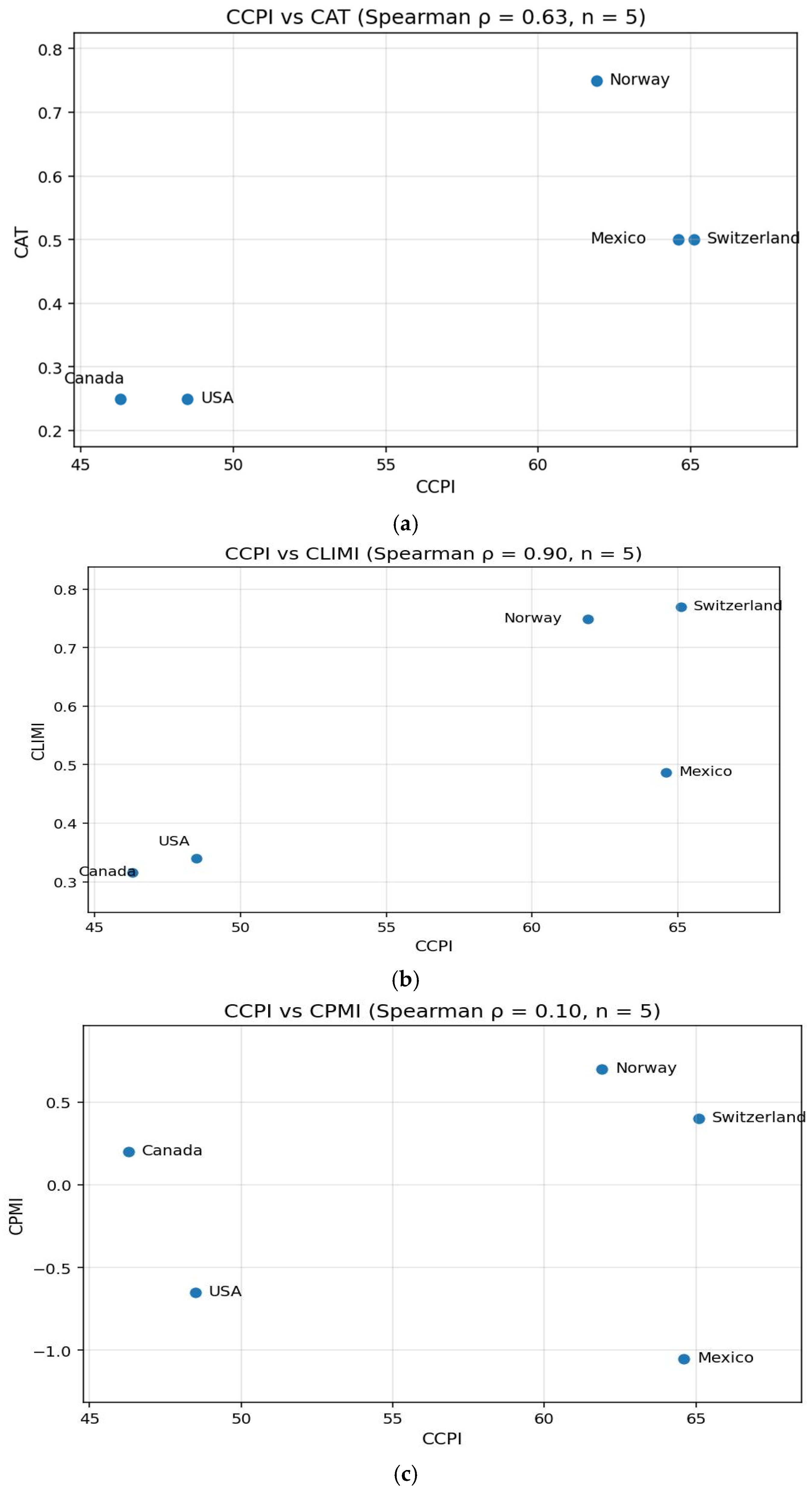
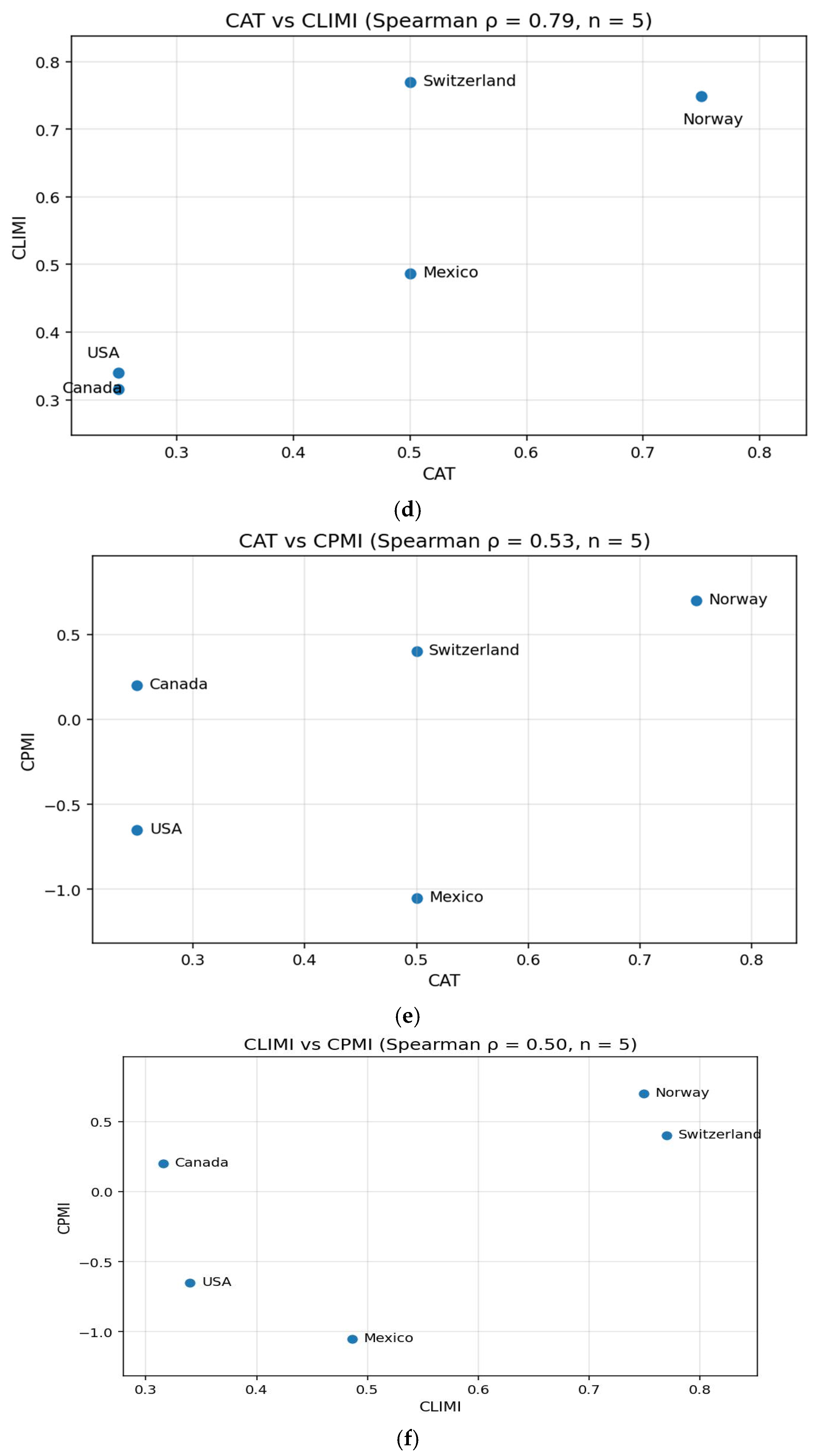
Hypotheses H1 and H2 were explored in two stages. First, scatter plots were constructed for each pair of indices to visually inspect country ordering and potential monotonic patterns (Figure 3). Second, Spearman’s rank correlation coefficients were calculated to summarize the strength and direction of monotonic associations between indices, given the mixed scales and the ordinal nature of CAT encodings. Both steps are used here as illustrative components of the exploratory protocol.

5. Discussion

Visual inspection of the scatter plots and the rank correlation matrix suggests predominantly monotonic relationships between several index pairs (Figure 3; Table 3). Given the mixed scales, the ordinal encoding of CAT ratings, the single harmonized reference year, and the very small sample (n = 5), the results should be interpreted as exploratory and illustrative rather than as statistically generalizable.
Spearman rank correlation coefficients between indices across countries were calculated (Table 3).
The rank correlation results indicate that the three broad, composite approaches (CCPI, CAT, CLIMI) exhibit strong positive concordance in the ordering of countries in this pilot sample, which is broadly consistent with Hypothesis H1. In contrast, CPMI shows weaker concordance with CCPI and only moderate concordance with CAT and CLIMI, which is also consistent with Hypothesis H2 and reflects the narrower, instrument-focused scope of CPMI.
CPMI’s lower concordance with CCPI is plausible because CPMI focuses primarily on carbon pricing and fiscal policy signals, whereas CCPI places strong weight on observed emissions trajectories, energy use, renewables, and expert assessments. Therefore, countries can score well on outcome- and governance-oriented composites while scoring poorly on pricing-focused measures (and vice versa).
The largest discrepancies in country ordering in this sample occur between CCPI and CPMI. For example, Mexico ranks relatively high in CCPI (second among the five countries considered) but ranks last in CPMI, illustrating how composite performance metrics and pricing-based instruments can diverge in practice.
The SWOT findings help explain these concordance patterns. As summarized in Figure 1, CCPI, CAT, and CLIMI share broad cross-sectoral coverage, transparent methodological logic, and an orientation toward system-level policy architecture, which helps explain why they move more consistently together in the pilot sample. By contrast, CPMI’s SWOT profile highlights analytical precision with respect to carbon pricing and fiscal instruments, but also a narrower construct coverage and a risk of policy fragmentation; this offers a substantive explanation for its weaker alignment with the broader composite approaches.
From a methodological point of view, the identified interrelationships indicate that no single index can fully reflect the effectiveness of climate policy, and their consistency or inconsistency helps reveal which policy dimension is actually being assessed. For climate policy analysis, this means that composite indices are better suited to assessing overall direction and multidimensional performance, while instrumental indicators such as CPMI are better suited to scrutinizing the design and potential effectiveness of specific economic mechanisms for reducing emissions.
Thus, assessing the effectiveness of climate policy requires a holistic, multifaceted approach that examines a variety of indicators rather than relying on a single headline score. Such a reading helps policymakers understand progress, identify gaps, and distinguish between divergences caused by policy design, implementation capacity, or the measurement logic of the selected indices.
Discrepancies between instrument-focused and composite indices can also be interpreted through policy transmission mechanisms and national heterogeneity. A carbon pricing instrument affects emissions only indirectly—through price pass-through, investment response, technology substitution, regulatory complementarity, and political feasibility—so a country may record a comparatively strong pricing signal while still showing weaker composite performance if governance capacity, energy structure, or implementation conditions constrain impact. Conversely, countries can perform relatively well in broader composite indices because of regulation, renewable deployment, or institutional commitment even when price-based instruments remain limited. In this sense, GDP level, energy mix, and governance quality are not merely background factors; they help explain why inter-index disagreement is substantively meaningful rather than a purely statistical artifact.
Policy implications. The pilot suggests that relying on a single climate policy index can obscure important differences between policy ambition, institutional readiness, observed outcomes, and instrument design. Concordance among CCPI, CAT, and CLIMI may therefore be interpreted as a stronger signal of broad policy consistency, whereas divergence involving CPMI should trigger closer examination of carbon pricing architecture, fiscal instruments, and implementation mechanisms.
Methodological implications. Cross-index disagreement should not automatically be interpreted as an error. Composite indicators embed different indicator choices, weighting rules, aggregation philosophies, and normative assumptions, and the literature on composite indices shows that such design choices can materially affect rankings and interpretation [18,32,33]. In this sense, disagreement is itself analytically informative and can be used to structure a more careful multidimensional assessment.
Limitations and future operationalization. This study remains exploratory for five reasons: the sample is small (n = 5); the analysis uses a single harmonized reference year; country-specific heterogeneity (e.g., GDP, energy structure, governance quality) is interpreted contextually rather than modeled as formal controls; the proposed indicator set has not yet been converted into a validated aggregate index; and no formal sensitivity analysis was undertaken for alternative codings or data quality assumptions. A full operational composite measure would therefore require explicit normalization rules, weighting logic, an aggregation function, robustness testing, sensitivity analysis, treatment of uncertainty in expert-based inputs, and validation on a larger multi-year sample. These steps are outside the scope of the present pilot but are now made explicit as the next stage of research.
Based on the results of correlation analysis and SWOT analysis, quantitative and qualitative indicators were identified that most fully characterize the effectiveness of climate policy and reflect its various dimensions. The purpose of this stage was to generalize the methodological approaches of the indices considered and to form a structured set of indicators suitable for use in the policy-making process. Table 4 presents a systematic list of quantitative and qualitative indicators grouped by key areas of climate policy assessment, including emission reduction results, institutional and legal frameworks, and economic and market instruments. The proposed set of indicators should be interpreted as an integrated indicator menu for subsequent assessment, not as a finalized weighted composite index.
Table 4 therefore identifies the substantive dimensions that should enter a future full-scale assessment framework. Table 5 complements this indicator menu by specifying provisional normalization, weighting, aggregation, and validation rules, thereby making the proposed protocol operational at a baseline level while still leaving room for larger-sample calibration and refinement.
To make the proposed framework more operational, Table 5 specifies a provisional rule set for normalization, weighting, aggregation, and validation. These rules are not yet presented as a finalized benchmarked composite index; rather, they define a transparent starting specification that can be implemented, stress-tested, and refined on a larger multi-year dataset.
In the baseline implementation suggested in Table 5, indicators are first converted to a common 0–1 scale, aggregated within each block by arithmetic mean, and then combined across the five blocks using equal top-level weights. The resulting baseline score is not intended to replace the existing index families examined in this paper; rather, it provides a transparent synthesis layer whose robustness can be checked against alternative weighting schemes, different normalization choices, and external comparator indices.

6. Conclusions

We examined the information content, strengths and weaknesses, and pilot cross-index concordance of four approaches used to assess national climate policy (CCPI, CAT, CLIMI, and CPMI). In a harmonized pilot sample (five countries; reference year 2012), the results show strong concordance among the broad composite approaches (CCPI, CAT, and CLIMI), while CPMI displays weaker alignment with them because it emphasizes a narrower set of pricing and fiscal instruments.
The pilot evidence is broadly consistent with Hypothesis H1, but only at an exploratory level. Because the analysis relies on a very small sample and a single-year snapshot, these findings should be interpreted as illustrative of methodological convergence rather than as generalizable statistical patterns.
The pilot evidence also provides preliminary support for Hypothesis H2: systematic discrepancies are observed between broad composite indices and CPMI, which emphasizes price and fiscal instruments. These discrepancies highlight the conceptual difference between instrument stringency measures and broader assessments of climate policy performance that incorporate outcomes, targets, governance capacity, and implementation context.
The main contribution of the paper is therefore not a validated composite score, but an exploratory protocol for cross-index assessment. Its outputs are (1) a structured comparison of index families, (2) a concordance/discrepancy reading of their signals, (3) an integrated indicator set that can guide more comprehensive climate policy assessment, sustainability-oriented monitoring, and decision support, and (4) a provisional operationalization scheme specifying how normalization, weighting, aggregation, and validation can be approached in a future composite implementation.
From a sustainability perspective, the proposed workflow contributes a transparent way to connect climate policy assessment with broader sustainable development objectives. By jointly considering emissions outcomes, energy transition dynamics, institutional capacity, and policy instruments, it supports more balanced evaluation of national pathways toward low-carbon and socially resilient development. In this sense, the study aligns with sustainability-oriented monitoring and decision support rather than with the production of another standalone headline ranking.
Future work should expand the country and time coverage, empirically test the provisional normalization and weighting rules proposed here, and only then finalize aggregation and external validation for a full composite index. In this sense, the present study should be read as a methodological starting point and decision support workflow rather than as a definitive ranking tool.

Author Contributions

O.M.: Conceptualization, methodology, writing—original draft, visualization. O.D.: Data curation, formal analysis, writing—review and editing. V.S.: Investigation, resources, validation, writing—review and editing. V.A.: Supervision, project administration, writing—review and editing. All authors have read and agreed to the published version of the manuscript.

Funding

This research was supported by the National Academy of Sciences of Ukraine within the framework of the projects “Directions of decarbonization of electric power and energy-intensive industries of Ukraine in accordance with the requirements of domestic environmental policy and international obligations” (0122U000176), “Development of a system of mathematical models for long-term forecasting of the consumption of the main types of fuel and energy resources in the country’s economy, taking into account current environmental restrictions” (0122U000178), “Comprehensive analysis of robust preventive and adaptive measures of food, energy, water and social management in the context of systemic risks and consequences of COVID-19” (0122U000552), and “Development of methods and means of monitoring research on greenhouse gas emissions in the energy sector of Ukraine” (0123U100770).

Institutional Review Board Statement

Not applicable.

Informed Consent Statement

Not applicable.

Data Availability Statement

The data supporting the conclusions of this article are available in the cited literature and public domain sources referenced throughout the manuscript. No new datasets were generated for this study.

Conflicts of Interest

The authors declare no conflicts of interest.

References

  1. Intergovernmental Panel on Climate Change (IPCC). Summary for Policymakers. In Climate Change 2023: Synthesis Report. Contribution of Working Groups I, II and III to the Sixth Assessment Report of the Intergovernmental Panel on Climate Change; Core Writing Team, Lee, H., Romero, J., Eds.; IPCC: Geneva, Switzerland, 2023; pp. 1–34. [Google Scholar] [CrossRef]
  2. World Bank. Climate Policies for a Low-Carbon Future: Lessons from 25 Case Studies; 19 September 2023. Available online: https://www.worldbank.org/en/news/video/2023/09/19/climate-policies-for-a-low-carbon-future-lessons-from-25-case-studies (accessed on 18 July 2025).
  3. European Environment Information and Observation Network (Eionet). Climate Policy. GEMET—General Multilingual Environmental Thesaurus, 2025. Available online: https://www.eionet.europa.eu/gemet/en/concept/15097 (accessed on 18 July 2025).
  4. Dauwe, T.; Young, K.; Mandl, N.; Jóźwicka, M. Overview of Reported National Policies and Measures on Climate Change Mitigation in Europe in 2019; ETC/CME Technical Report 5/2019; European Environment Agency: Copenhagen, Denmark, 2019. Available online: https://www.eionet.europa.eu/etcs/etc-cme/products/etc-cme-reports/etc-cme-report-5-2019-overview-of-reported-national-policies-and-measures-on-climate-change-mitigation-in-europe-in-2019 (accessed on 18 July 2025).
  5. World Bank. Reality Check: Lessons from 25 Policies Advancing a Low-Carbon Future; Climate Change and Development Series; World Bank: Washington, DC, USA, 2023; Available online: http://hdl.handle.net/10986/40262 (accessed on 18 July 2025).
  6. European Environment Agency (EEA). More National Climate Policies Expected, but How Effective Are the Existing Ones? EEA Briefing No. 11/2019; European Environment Agency: Copenhagen, Denmark, 2019. Available online: https://www.eea.europa.eu/publications/more-national-climate-policies-expected (accessed on 18 July 2025).
  7. Schaffrin, A.; Sewerin, S.; Seubert, S. The innovativeness of national policy portfolios—Climate policy change in Austria, Germany, and the UK. Environ. Politics 2014, 23, 860–883. [Google Scholar] [CrossRef]
  8. Climate Action Tracker (CAT). CAT Thermometer (Global Temperature Increase Projections). 2023. Available online: https://climateactiontracker.org/global/cat-thermometer/ (accessed on 18 July 2025).
  9. Matviichuk, O.; Sokolovska, N.; Zaporozhets, A. Prospects for Preventing Industrial Pollution from Enterprises of the Energy Sector Based on EU Experience. In Systems, Decision and Control in Energy VII; Babak, V., Zaporozhets, A., Eds.; Studies in Systems, Decision and Control; Springer: Cham, Switzerland, 2025; Volume 595, pp. 441–458. [Google Scholar] [CrossRef]
  10. Dieler, J. Effectiveness of Climate Policies: Empirical Methods and Evidence; ifo Beiträge zur Wirtschaftsforschung; ifo Institute: Munich, Germany, 2016; Volume 68, Available online: https://www.ifo.de/DocDL/ifo_Beitraege_z_Wifo_68.pdf (accessed on 18 July 2025).
  11. Surminski, S.; Williamson, A. Policy Indexes—What Do They Tell Us and What Are Their Applications? The Case of Climate Policy and Business Planning in Emerging Markets; Centre for Climate Change Economics and Policy Working Paper No. 88; London School of Economics and Political Science: London, UK, 2012; Available online: https://www.lse.ac.uk/granthaminstitute/wp-content/uploads/2014/02/WP88-policy-indexes-climate-policy-business-planning.pdf (accessed on 18 July 2025).
  12. Gugler, K.; Haxhimusa, A.; Liebensteiner, M. Effectiveness of climate policies: Carbon pricing vs. subsidizing renewables. J. Environ. Econ. Manag. 2021, 106, 102405. [Google Scholar] [CrossRef]
  13. Botta, E.; Koźluk, T. Measuring Environmental Policy Stringency in OECD Countries; OECD Economics Department Working Papers, No. 1177; OECD Publishing: Paris, France, 2014. [Google Scholar] [CrossRef]
  14. Kruse, T.; Dechezleprêtre, A.; Saffar, R.; Robert, L. Measuring Environmental Policy Stringency in OECD Countries: An Update of the OECD Composite EPS Indicator; OECD Economics Department Working Papers, No. 1703; OECD Publishing: Paris, France, 2022. [Google Scholar] [CrossRef]
  15. Germanwatch; NewClimate Institute; Climate Action Network International. Climate Change Performance Index 2024: Background and Methodology. 2023. Available online: https://www.germanwatch.org/en/node/89896 (accessed on 8 August 2025).
  16. Block, S.; Emerson, J.W.; Esty, D.C.; Sherbinin, A.D.; Wendling, Z.A. 2024 Environmental Performance Index: Technical Appendix; Yale Center for Environmental Law & Policy: New Haven, CT, USA, 2024; Available online: https://epi.yale.edu/downloads/2024epitechnicalappendix20241207.pdf (accessed on 8 August 2025).
  17. OECD. Effective Carbon Rates 2023; OECD Publishing: Paris, France, 2023. [Google Scholar] [CrossRef]
  18. OECD; European Commission Joint Research Centre (JRC). Handbook on Constructing Composite Indicators: Methodology and User Guide; OECD Publishing: Paris, France, 2008. [Google Scholar] [CrossRef]
  19. Climate Change Performance Index (CCPI). How to Measure Countries’ Climate Performance. 2023. Available online: https://ccpi.org/how-to-measure-countries-climate-performance/ (accessed on 18 July 2025).
  20. Climate Action Tracker (CAT). Climate Action Tracker: Global Analysis of Climate Policies. 2023. Available online: https://climateactiontracker.org/ (accessed on 18 July 2025).
  21. European Bank for Reconstruction and Development (EBRD). Special Report on Climate Change: The Low Carbon Transition. 2022. Available online: https://www.ebrd.com/content/dam/ebrd_dxp/assets/pdfs/office-of-the-chief-economist/special-reports/energy-security/the-low-carbon-transition/Special-Report-on-Climate-Change-The-Low-Carbon-Transition.pdf (accessed on 18 July 2025).
  22. Surminski, S. The Impact of Climate Change on the BRICS Economies. In Proceedings of the Presentation at LSE Autumn Symposium, London, UK, 21 November 2012; Available online: https://www.cccep.ac.uk/wp-content/uploads/2015/10/impact-climate-change-BRICS-economies-Swenja-Surminski.pdf (accessed on 18 July 2025).
  23. Steves, F.; Teytelboym, A. Political Economy of Climate Change Policy; Smith School Working Paper 13-02; University of Oxford: Oxford, UK, 2013. [Google Scholar] [CrossRef]
  24. Künkel, N.; Jacob, K.; Busch, P.-O. Climate Policies—(the Feasibility of) a Statistical Analysis of Their Determinants. In Proceedings of the 2006 Berlin Conference on Human Dimensions of Global Environmental Change, Berlin, Germany, 17–18 November 2006; Available online: https://www.researchgate.net/publication/267304789_Climate_policies-the_feasibility_of_a_statistical_analysis_of_their_determinants (accessed on 18 July 2025).
  25. Raupach, M.R.; Marland, G.; Ciais, P.; Le Quéré, C.; Canadell, J.G.; Klepper, G.; Field, C.B. Global and Regional Drivers of Accelerating CO2 Emissions. Proc. Natl. Acad. Sci. USA 2007, 104, 10288–10293. [Google Scholar] [CrossRef] [PubMed]
  26. Climate Action Tracker (CAT). CAT Rating Methodology. 2024. Available online: https://climateactiontracker.org/methodology/cat-rating-methodology (accessed on 18 July 2025).
  27. Nasim, A.; Chen, X.H.; Al Najjar, B.; Hoang, Y.H. The Financial Sector’s Response to Environmental Policy Stringency: Comparative Analysis of Developed and Developing Economies. Energy Econ. 2025, 144, 108377. [Google Scholar] [CrossRef]
  28. Mahajan, A.; Majumdar, K. Environmental Policy Stringency and Comparative Advantage of Environmental-Sensitive Goods: A Study of Textile Exports in G20 Countries. Benchmarking Int. J. 2022, 29, 2924–2951. [Google Scholar] [CrossRef]
  29. Dobrovolska, O.; Schmidtke, K.; Krause, J.; Matukhno, O.; Cierjacks, A. Effectiveness of Reforms to Eliminate Obstacles in the Development of Sustainable Energy in Different Countries of the World. Probl. Perspect. Manag. 2024, 22, 1–13. [Google Scholar] [CrossRef]
  30. Kern, F.; Rogge, K.S.; Howlett, M. Policy Mixes for Sustainability Transitions: New Approaches and Insights Through Bridging Innovation and Policy Studies. Res. Policy 2019, 48, 103832. [Google Scholar] [CrossRef]
  31. Rogge, K.S.; Reichardt, K. Policy Mixes for Sustainability Transitions: An Extended Concept and Framework for Analysis. Res. Policy 2016, 45, 1620–1635. [Google Scholar] [CrossRef]
  32. Greco, S.; Ishizaka, A.; Tasiou, M.; Torrisi, G. On the Methodological Framework of Composite Indices: A Review of the Issues of Weighting, Aggregation, and Robustness. Soc. Indic. Res. 2019, 141, 61–94. [Google Scholar] [CrossRef]
  33. Kuc-Czarnecka, M.; Lo Piano, S.; Saltelli, A. Quantitative Storytelling in the Making of a Composite Indicator. Soc. Indic. Res. 2020, 149, 775–802. [Google Scholar] [CrossRef]
  34. Wang, G.; Ju, L. Quantitative Evaluation of China’s Carbon Peaking Policies Based on PMC Index Model: Evidence from the First Batch of National Carbon Peak Pilot Provinces and Regions. Sustainability 2025, 17, 1738. [Google Scholar] [CrossRef]
  35. Srpak, M.; Pavlović, D.; Novak Mavar, K.; Zelenika, I. Methodological Approach in Selecting Sustainable Indicators (IPREGS) and Creating an Aggregated Composite Index (AKI) for Assessing the Sustainability of Mineral Resource Management: A Case Study of Varaždin County. Mining 2025, 5, 67. [Google Scholar] [CrossRef]
  36. Stanytsina, V.; Ivanenko, N.; Sheludchenko, L.; Garmata, O.; Kuchirka, Y.; Artemchuk, V. Prospective Directions of Cement Production Decarbonization in Ukraine. In Systems, Decision and Control in Energy VI; Babak, V., Zaporozhets, A., Eds.; Studies in Systems, Decision and Control; Springer: Cham, Switzerland, 2024; Volume 552, pp. 579–597. [Google Scholar] [CrossRef]
  37. Maevsky, O.; Kovalchuk, M.; Brodsky, Y.; Stanytsina, V.; Artemchuk, V. Game-Theoretic Modeling in Regulating Greenhouse Gas Emissions. Heliyon 2024, 10, e30549. [Google Scholar] [CrossRef] [PubMed]
  38. Zinovieva, I.S.; Iatsyshyn, A.V.; Artemchuk, V.O.; Stanytsina, V.V.; Sheludchenko, L.S.; Popov, O.O.; Kovach, V.O.; Iatsyshyn, A.V. The Use of GIS in Renewable-Energy Specialist’s Learning. J. Phys. Conf. Ser. 2023, 2611, 012016. [Google Scholar] [CrossRef]
  39. Transition Pathway Initiative (TPI). State of Transition in Sovereigns 2024: Tracking National Climate Action for Investors; TPI Centre: London, UK, 2024; Available online: https://www.transitionpathwayinitiative.org/publications/uploads/2024-state-of-transition-in-sovereigns-2024-tracking-national-climate-action-for-investors-report.pdf (accessed on 18 July 2025).
  40. Bergquist, P.; Warshaw, C. How Climate Policy Commitments Influence Energy Systems and the Economies of US States. Nat. Commun. 2023, 14, 4850. [Google Scholar] [CrossRef] [PubMed]
Figure 1. Results of the SWOT analysis of the methodologies considered: (a) common features of the considered methodologies; (b) features of the Climate Change Performance Index (CCPI); (c) features of the Climate Action Tracker (CAT); (d) features of the Climate Laws, Institutions, and Measures Index (CLIMI); (e) features of the Climate Policy Measure Index (CPMI).
Sustainability 18 03444 g001aSustainability 18 03444 g001b
Figure 2. Operational workflow of the exploratory cross-index assessment protocol.
Sustainability 18 03444 g002
Figure 3. Relationships between indices: (a) CCPI vs. CAT; (b) CCPI vs. CLIMI; (c) CCPI vs. CPMI; (d) CAT vs. CLIMI; (e) CAT vs. CPMI; (f) CLIMI vs. CPMI.
Sustainability 18 03444 g003aSustainability 18 03444 g003b
Table 1. Overview of the characteristics of climate policy assessment methodologies [10,11,19,20,21,22,23].
AspectClimate Change Performance Index (CCPI)Climate Action Tracker (CAT)Climate Laws, Institutions, and Measures Index (CLIMI)Climate Policy Measure Index (CPMI)
FocusAn instrument for assessing and comparing national climate policies and actions. Data until 2017 focus on past trends and current levels. Since 2017, it evaluates targets for 2030 and their compatibility with current levels and national targets in the categories of greenhouse gas emissions, renewable energy, and energy use at temperatures well below 2 °C. Reflects policy improvements over time and compatibility with the Paris Agreement.An instrument for assessing the compatibility of climate policies and targets with the Paris Agreement. Focuses on policies and targets for 2030. Evaluates a wide range of national goals, policies, and actions to reduce greenhouse gas emissions in line with the temperature limit set by the Paris Agreement. Provides a detailed assessment of national decarbonization efforts, including Net Zero targets.An instrument for assessing and comparing legal and institutional frameworks (climate laws, institutions, measures) that support climate action in different countries. Relies on assessing the scale of policy measures but does not evaluate the quality of their implementation. Reflects the current state of a country’s climate policy and assesses institutional capacity to reduce emissions in the future.An instrument for measuring the stringency of climate policy based on emission reduction indicators. Takes into account not only the level of policy categories but also the effectiveness of policy instruments for GHG emissions. Reflects the current state of climate policy.
CoverageA total of 63 countries and the EU, together accounting for over 90% of global greenhouse gas emissionsA total of 42 countries, covering about 85% of global greenhouse gas emissions and approximately 70% of the world’s population.A total of 95 countries, accounting for over 90% of global GHG emissionsOECD countries
IndicatorsUses 4 categories and 14 indicators.
1. Greenhouse Gas Emissions:
- Current Level of GHG Emissions per Capita;
- Past Trend of GHG Emissions per Capita;
- Current Level of GHG Emissions per Capita Compared with a Well Below 2 °C Compatible Pathway;
- GHG Emissions Reduction 2030 Target Compared with a Well Below 2 °C Compatible Pathway.
2. Renewable Energy:
- Current Share of Renewable Energy Sources per Total Primary Energy Supply (TPES);
- Past Trend of Energy Supply from Renewable Energy Sources per TPES;
- Current Share of Renewables per TPES Compared with a Well Below 2 °C Compatible Pathway;
- Renewable Energy 2030 Target Compared with a Well-Below 2 °C Compatible Pathway.
3. Energy Use:
- Current Level of Energy Use Measured as TPES per Capita;
- Past Trend of Energy Use measured as TPES per Capita;
- Current Level of TPES per Capita Compared with a Well Below 2 °C Compatible Pathway;
- Energy Use TPES per Capita 2030 Target Compared with a Well Below 2 °C Compatible Pathway.
4. Climate Policy:
- National Climate Policy;
- International Climate Policy.
Main indicators include Nationally Determined Contributions (NDCs), policies and actions, and their projected impact on greenhouse gas emissions.
1. Policies and Actions;
2. National and International GHG Reduction Targets, Including Net Zero;
3. Rating of the Country’s “Fair Share” Targets (Rating of NDCs Against Fair Share) *;
4. Climate Finance.
Assesses factors such as the existence of climate laws, the capacity and effectiveness of institutions, and the implementation of climate measures.
1. International Climate Cooperation:
- Kyoto Ratification;
- Joint Implementation (JI) or Clean Development Mechanism (CDM);
2. Domestic Climate Frameworks:
- Cross-Sectoral Climate Change Legislation;
- Carbon Emissions Target;
- Dedicated Climate Change Institution;
3. Sectoral Fiscal or Regulatory Climate Policy Measures:
- Energy Supply and Renewable Energy;
- Transport;
- Buildings;
- Agriculture;
- Forestry;
- Industry.
4. Cross-sectoral fiscal or regulatory climate policy measures:
- Cross-sectoral policy measures.
Focuses on quantitative policy indicators to improve the comparability of different policies.
1. Fossil Fuel Consumption Taxes;
2. Policies Promoting the Expansion of Renewable Energy Sources (Subsidies);
3. Carbon Pricing Mechanisms.
MethodologyComposite rating.
Data sources: Relies on publicly available data from sources such as the International Energy Agency (IEA), the World Bank, and national governments. Only production-based emissions are used in the calculation.
Weighting: Each category and indicator has a specific weight influencing the overall score. The weighting reflects the relative importance of each factor for climate protection.
Scoring: Countries are assessed and ranked based on results in each category. Scores are normalized and aggregated to obtain the overall rating.
More than half of the CCPI rating indicators are expressed in relative (better/worse) rather than absolute terms.
Data sources: Uses national reports, third-party assessments, and academic studies.
Analysis: Evaluates the ambition, implementation, and impact of climate policies and NDCs. Projects future emissions based on current policies and measures.
Rating: In the current/general methodology, CAT assesses countries’ climate commitments and actions using five Paris alignment categories for limiting temperature rise to 1.5 °C: Paris compatible, almost sufficient, insufficient, highly insufficient, critically insufficient. However, for the harmonized 2012 pilot used in this paper, CAT data were taken from the historical four-category effort-sharing scheme (inadequate, medium, sufficient, role model).
Composite index.
Focuses on policy inputs (i.e., climate laws, institutions, and measures) rather than policy outcomes (e.g., emissions).
Data sources: Collects information from national legislative bodies, government reports, and international databases. Includes only input variables in the assessment.
Rating: Evaluates countries based on the reliability and effectiveness of their legal and institutional climate frameworks.
Weighting: Fixed weighting coefficients based on reasoned proposals for policy indicators and for most individual policies, except sectoral ones.
Data sources: Uses information from national governments, international organizations, and academic research.
Rating: Evaluates and ranks policies based on their design, implementation, and effectiveness in reducing GHG emissions.
Weighting: Assesses the impact of each category on emissions. The weights of sub-indicators vary by policy category.
Scoring: Based on scores assigned to each policy compared with the efforts of other countries for that indicator.
* This rating element assesses the level of government effort towards a target or policy against what could be considered a “fair share” contribution to global efforts to reduce greenhouse gas emissions. Based on an analysis of what the country’s overall contribution should be to make a fair contribution to fulfilling the Paris Agreement.
Table 2. Input data for correlation analysis of climate policy indices (reference year 2012).
CountryClimate Change Performance Index
[19]
Climate Action Tracker [20]Climate Laws, Institutions, and Measures Index [11,23]Climate Policy Measure Index
[10]
Switzerland65.1medium (0.5)0.770.4
United States of America48.5inadequate (0.25)0.34−0.65
Mexico64.6medium (0.5)0.486−1.05
Canada46.3inadequate (0.25)0.3160.20
Norway61.9sufficient (0.75)0.7490.70
Table 3. Spearman rank correlation coefficients between indices (reference year 2012; n = 5 countries).
CCPICATCLIMICPMI
CCPI10.630.900.10
CAT0.6310.790.53
CLIMI0.900.7910.50
CPMI0.100.530.501
Table 4. Quantitative and qualitative indicators for assessing the effectiveness of climate policy.
Quantitative IndicatorsQualitative Indicators
Greenhouse Gas Emissions:
Total emissions—measurement of total GHG emissions in CO2-equivalent units;
Emissions per capita—emissions per person, providing a sense of individual impact;
Emission intensity—emissions per unit of GDP, indicating the carbon efficiency of the economy.
Policy and Legislative Framework:
Climate laws—existence and completeness of climate legislation;
Regulatory standards—specific rules on emissions, energy efficiency, and renewable energy;
Climate action plans—detailed national or regional plans outlining climate strategies and targets.
Renewable Energy Development:
Energy production—actual amount of energy generated from renewable sources;
Share of renewable sources—percentage of total energy consumption obtained from renewable sources;
Energy consumption—consumption of renewable energy per capita.
Institutional Measures:
Government agencies—existence of specialized agencies or ministries for climate policy;
Coordination mechanisms—effectiveness of interdepartmental and intergovernmental coordination on climate issues.
Energy Efficiency:
Energy intensity—energy consumption per unit of GDP;
Efficiency standards—adoption and compliance with energy efficiency standards in buildings, appliances, and industrial processes.
Financing and Investment:
Public and private investments—levels of investment in climate change mitigation and adaptation projects;
Financial mechanisms—availability and effectiveness of financial instruments (e.g., green bonds, climate funds).
Carbon Pricing:
Carbon price level—carbon price in existing carbon markets;
Coverage—share of emissions covered by carbon pricing mechanisms (e.g., carbon taxes, cap-and-trade systems).
International Cooperation:
International agreements—participation in international climate agreements (e.g., Paris Agreement);
Bilateral and multilateral initiatives—participation in climate-related initiatives and cooperation with other countries.
Kaya Identity Indicators:
Carbon intensity (CO2 emissions per unit of Total Primary Energy Supply (TPES));
Energy intensity (TPES per unit of GDP);
Gross Domestic Product (GDP) per capita;
Population size.
Public Awareness and Engagement:
Public awareness campaigns: efforts to raise awareness about climate change and policy;
Stakeholder engagement: involvement of civil society, businesses, and local communities in policy development and implementation.
Adaptation Measures:
Climate resilience plans: development and implementation of plans to enhance resilience to climate impacts;
Infrastructure adaptation: modifications and investments in infrastructure to address climate change.
Table 5. Provisional operationalization rules for a future composite application of the integrated indicator framework.
Indicator BlockNormalization RuleWeighting and Aggregation RuleValidation Focus
Emissions and carbon efficiency (total emissions, emissions per capita, emission intensity)Lower-is-better indicators are transformed to a 0–1 scale using min–max normalization or distance-to-target normalization where Paris-consistent benchmarks are available.Equal weights are applied within the block; the block score is the arithmetic mean of normalized indicators.Test sensitivity to benchmark choice, missing data treatment, and the reference year.
Energy transition and efficiency (renewables share, renewable output, energy intensity trends)Positive indicators are scaled to 0–1 using min–max normalization; trend indicators are expressed as comparable improvement rates before rescaling.Baseline rule: equal within-block weights. Robustness check: compare with entropy-based weights.Check temporal stability and cross-source consistency.
Policy and institutional framework (laws, targets, institutions, coordination mechanisms)Qualitative indicators are coded with a transparent rubric (0 = absent, 0.33 = emerging, 0.67 = established, 1.00 = established with implementation support).Indicators are averaged within the block to preserve interpretability and auditability.Assess inter-coder agreement and document traceability of scores.
Carbon pricing and market instruments (carbon price level, coverage, fossil fuel tax/subsidy reform)Use ratio-to-benchmark or min–max scaling on a 0–1 scale; higher effective prices and broader coverage receive higher scores.Retain this block separately and aggregate internally with equal weights so that instrument-focused effects are not diluted.Examine convergent and discriminant validity against CPMI-type measures.
Enabling conditions and adaptation (finance, public engagement, international cooperation, resilience planning)Mixed quantitative and ordinal indicators are first converted to a common 0–1 scale using min–max or rubric-based rescaling, depending on data type.Baseline composite rule: equal top-level weights across five blocks (0.20 each); expert-based and entropy-based alternatives are tested in sensitivity analysis.Assess convergent validity against CCPI, CAT, and CLIMI, plus rank robustness and leave-one-block-out tests.
Disclaimer/Publisher’s Note: The statements, opinions and data contained in all publications are solely those of the individual author(s) and contributor(s) and not of MDPI and/or the editor(s). MDPI and/or the editor(s) disclaim responsibility for any injury to people or property resulting from any ideas, methods, instructions or products referred to in the content.