A Review of Existing Plastic Waste Management Strategies, Assessment & Tools: Towards the Development of a Plastic Offsetting Strategies

Abstract
1. Introduction
- To review reputable literature on the environmental impacts of plastics.
- To examine the CE concept within the plastic industry, demonstrating why a CE approach alone may not achieve sustainability goals within the pledged timeframes.
- To investigate various environmental measures, tools, and strategies—such as LCA, alternative materials (bioplastic), and offsetting mechanisms that could form the building blocks of a plastic offsetting framework.
2. Literature Review Methodology
3. Circular Economy in Plastics
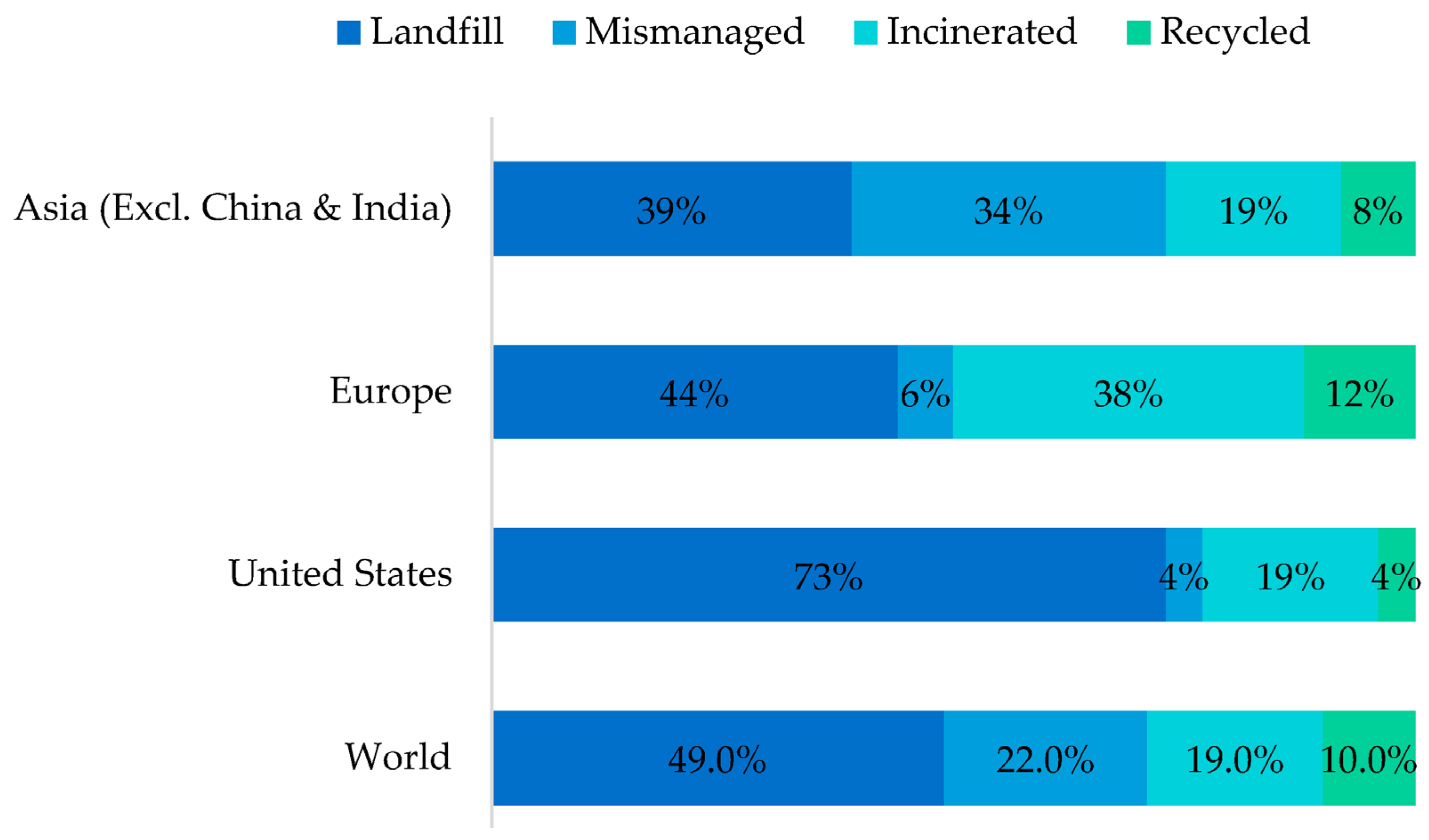
- Landfill: The process of burial of waste in land disposal sites. For most plastics, landfilling results in ~0.03 of GHG per 1 kg of polymer; however, degradation of certain plastics (PE, PET, and PVC) in landfills can also generate organic pollutants.
- Incineration (flaring without energy recovery): The process of burning waste, mainly for mixed plastics that cannot be segregated for use/recycle. It generates 2.71 of GHG per 1 kg of plastic, along with emissions of steam and cinders (residual ash).
- Energy Recovery: Incineration with energy recovery uses the heating value of (~40 MJ/Kg). Approximately 1 kg of plastic waste can yield up to 1 L of fuel oil, or equivalently converted to heat, or electricity, preventing about 0.98 emissions per kg of polymer (i.e., a net negative emission when replacing fossil fuel). This is considered one of the most viable end-of-life options for plastics.
- Recycling: processing waste plastic into new products. Different recycling methods result in 0.32 emitted per 1 kg of reprocessed plastic (excluding the avoided production of virgin materials) which is lower than emissions associated with incineration.
3.1. Limitations to Circularity: Design and Hazardous Additives
3.2. Limitation to Circularity: Stakeholder Awareness and Commitment
- Lack of sufficient recycling facilities or easy access to them.
- Difficulties in transporting waste to recycling plants.
- Limited space or on-site waste storage.
- Inadequate funding for recycling initiatives.
- Shortage of skilled personnel or technology for effective plastic sorting.
- Lack of environmental experts to guide management.
- Insufficient market demand or buyers for recycled materials.
3.3. Limitations to Circularity: Standardization & Regulation
4. Metrics and Assessment Tools
4.1. Life Cycle Assessment (LCA)
4.2. Environmental Impact Assessment (EIA)
5. Plastic Waste Management Strategies
5.1. Reduce & Reuse Strategies
5.2. Recycling Strategies
5.3. Bioplastics Strategy
5.4. Carbon Offsetting Strategy
5.4.1. Carbon Neutrality & Carbon Sinks
5.4.2. Carbon Offsetting Case Studies
5.4.3. Towards Plastic Offsetting
5.4.4. Plastic Offsetting: A Potential Strategy
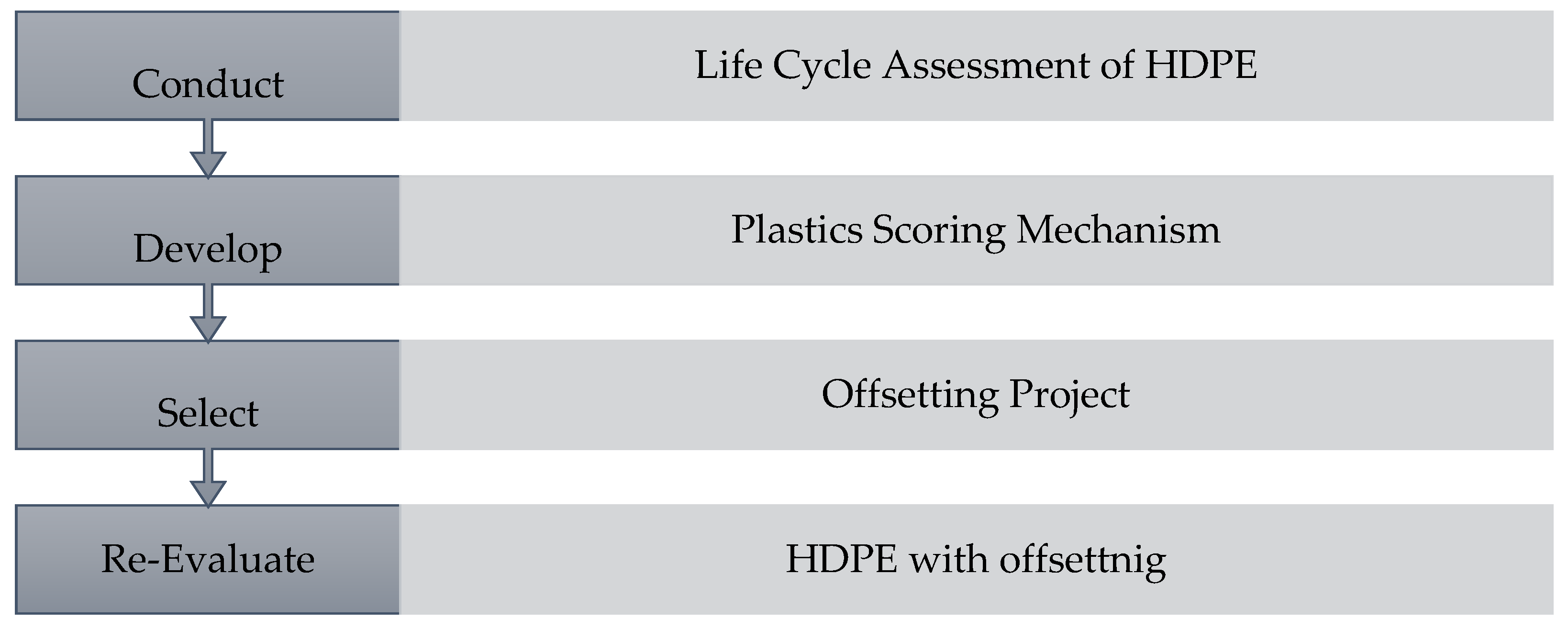
- Step 1: Establish a baseline of environmental impact from virgin plastic production (via an LCA) to measure the status quo.
- Step 2: Develop a scoring mechanism based on the LCA results to quantify plastic impacts (analogous to a carbon footprint score, but for plastics).
- Step 3: Select an offsetting project that will be funded to reduce plastic waste (e.g., sponsoring a beach cleanup in a high-leakage region) as an intervention.
- Step 4: Re-evaluate the LCA after offsetting to calculate the improved score and quantify the waste reduction benefit achieved.
6. Conclusions
- Insufficient progress of the existing waste management strategies: reduce, reuse, recycle, and bioplastics cannot cope with the increased production of virgin plastics and the increase in the accumulation of waste.
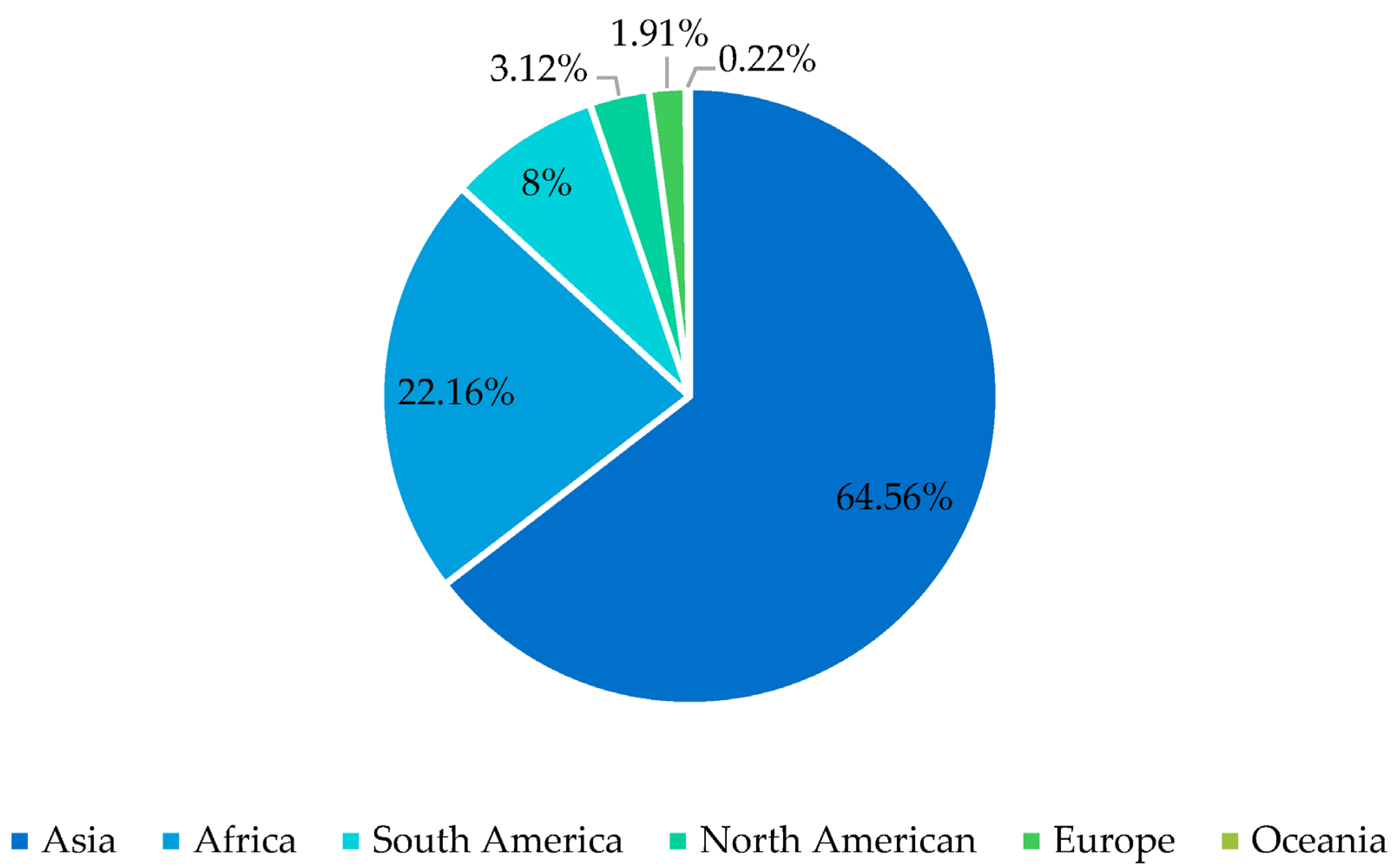
- Geographic disparity in waste management: Most sustainability efforts, including recycling and CE initiatives, are concentrated in developed countries. Plastic pollution is growing in developing regions due to inadequate waste management systems, contributing significantly to global plastic leakage into oceans and rivers.
- Inadequate focus on offsetting: While carbon offsetting mechanisms are well-established and widely studied, there is limited research on implementing similar strategies for plastics. There is no comprehensive plastic offset mechanism proposed or tested that links plastic production in developed regions to waste reduction investments in developing regions.
- Insufficient metrics and standardized methodologies: Research lacks standardized methodologies tailored to evaluate the environmental, social, and economic impacts of plastic. There is a need for robust metrics to measure initiatives in reducing plastic waste and mitigating environmental burdens, while considering social and economic aspects. For example, its potential to fund waste management infrastructure, create jobs, and support the sustainable growth of local economies in high-need areas remains underexplored.
- Policy and framework deficiencies: Existing policy frameworks do not provide adequate support for the implementation of plastic—setting unrealistic targets at national or international levels. There is limited guidance on how such mechanisms could complement existing waste management strategies
- Integration of plastic offsetting with CE initiatives: The literature has not sufficiently explored how plastic offsetting could be integrated into CE strategies to achieve dual benefits of waste reduction and economic growth in developing regions. Studies often treat plastic offsetting and CE as separate concepts, missing the opportunity for synergistic solutions.
- More research needed: Additional research is needed for developing plastic footprint accounting rules and system boundaries that reflect polymer heterogeneity and leakage risk; testing polymer mass-based units as a cornerstone for further environmental scoring; establishing robust baselines; and empirically evaluating whether plastic credit finance materially improves waste management outcomes without incentivizing continued growth in virgin plastic production.
Author Contributions
Funding
Data Availability Statement
Conflicts of Interest
References
- Zheng, J.; Suh, S. Strategies to reduce the global carbon footprint of plastics. Nat. Clim. Change 2019, 9, 374–378. [Google Scholar] [CrossRef]
- Haque, S. The United Nations Framework Convention on Climate Change. In Sustainability After Rio; Emerald Group Publishing Limited: Leeds, UK, 2015; pp. 3–26. [Google Scholar]
- United Nations. News Turning to Sustainable Global Business: 5 Things to Know About the Circular Economy. Available online: https://news.un.org/en/story/2021/06/1093802 (accessed on 30 March 2022).
- Amelia, T.S.M.; Khalik, W.M.A.W.M.; Ong, M.C.; Shao, Y.T.; Pan, H.-J.; Bhubalan, K. Marine microplastics as vectors of major ocean pollutants and its hazards to the marine ecosystem and humans. Prog. Earth Planet Sci. 2021, 8, 12. [Google Scholar] [CrossRef]
- Wright, S.L.; Kelly, F.J. Plastic and Human Health: A Micro Issue? Environ. Sci. Technol. 2017, 51, 6634–6647. [Google Scholar] [CrossRef] [PubMed]
- Morales-Caselles, C.; Viejo, J.; Martí, E.; González-Fernández, D.; Pragnell-Raasch, H.; González-Gordillo, J.I.; Montero, E.; Arroyo, G.M.; Hanke, G.; Salvo, V.S.; et al. An inshore–offshore sorting system revealed from global classification of ocean litter. Nat. Sustain. 2021, 4, 484–493. [Google Scholar] [CrossRef]
- Meijer, L.J.; Van Emmerik, T.; Van Der Ent, R.; Schmidt, C.; Lebreton, L. Supplementary data for ‘More than 1000 rivers account for 80% of global riverine plastic emissions into the ocean. Sci. Adv. 2021, 7, eaaz5803. [Google Scholar] [CrossRef]
- McDonough, W.; Braungart, M. Cradle to Cradle: Remaking the Way We Make Things; Vintage Books: London, UK, 2009. [Google Scholar]
- Vanderreydt, I.; Rommens, T.; Tenhunen-Lunkka, A.; Mortensen, L.F.; Tange, I. Greenhouse Gas Emissions and Natural Capital Implications of Plastics (Including Biobased Plastics); European Environment Agency: Copenhagen, Denmark, 2021. [Google Scholar] [CrossRef]
- Kumar, R.; Verma, A.; Shome, A.; Sinha, R.; Sinha, S.; Jha, P.K.; Kumar, R.; Kumar, P.; Shubham; Das, S.; et al. Impacts of Plastic Pollution on Ecosystem Services, Sustainable Development Goals, and Need to Focus on Circular Economy and Policy Interventions. Sustainability 2021, 13, 9963. [Google Scholar] [CrossRef]
- Bishop, G.; Styles, D.; Lens, P.N. Styles Environmental performance comparison of bioplastics and petrochemical plastics: A review of life cycle assessment (LCA) methodological decisions. Resour. Conserv. Recycl. 2021, 168, 105451. [Google Scholar] [CrossRef]
- Rhein, S.; Sträter, K.F. Corporate self-commitments to mitigate the global plastic crisis: Recycling rather than reduction and reuse. J. Clean. Prod. 2021, 296, 126571. [Google Scholar] [CrossRef]
- Hatti-Kaul, R.; Nilsson, L.J.; Zhang, B.; Rehnberg, N.; Lundmark, S. Designing Biobased Recyclable Polymers for Plastics. Trends Biotechnol. 2020, 38, 50–67. [Google Scholar] [CrossRef]
- Wei, J.; Zhao, K.; Zhang, L.; Yang, R.; Wang, M. Exploring development and evolutionary trends in carbon offset research: A bibliometric perspective. Environ. Sci. Pollut. Res. 2021, 28, 18850–18869. [Google Scholar] [CrossRef]
- Boulding, K.E. The Economics of the Coming Spaceship Earth; RFF Press: Washington, DC, USA, 1966; pp. 297–309. [Google Scholar]
- Pearce, D.W.; Turner, R.K. Economics of Natural Resources and the Environment; Johns Hopkins University Press: Baltimore, MD, USA, 1990. [Google Scholar]
- Macarthur, E. Foundation Circular Economy Introduction. Available online: https://www.ellenmacarthurfoundation.org/topics/circular-economy-introduction/overview (accessed on 13 October 2025).
- European Environment Agency. Plastics, the Circular Economy and Europe’s Environment: A Priority for Action; Publications Office: Luxembourg, 2021; Available online: https://data.europa.eu/doi/10.2800/5847 (accessed on 13 October 2025).
- Kirchherr, J.; Reike, D.; Hekkert, M. Conceptualizing the circular economy: An analysis of 114 definitions. Resour. Conserv. Recycl. 2017, 127, 221–232. [Google Scholar] [CrossRef]
- Costa, L.P.d.M.; de Miranda, D.M.V.; de Oliveira, A.C.C.; Falcon, L.; Pimenta, M.S.S.; Bessa, I.G.; Wouters, S.J.; Andrade, M.H.S.; Pinto, J.C. Capture and Reuse of Carbon Dioxide (CO2) for a Plastics Circular Economy: A Review. Processes 2021, 9, 759. [Google Scholar] [CrossRef]
- Licy, C.D.; Vivek, R.; Saritha, K.; Anies, T.K.; Josphina, C.T. Awareness, attitude and practice of school students towards household waste management. J. Environ. 2013, 2, 147–150. [Google Scholar]
- Zink, T.; Geyer, R. Material Recycling and the Myth of Landfill Diversion. J. Ind. Ecol. 2019, 23, 541–548. [Google Scholar] [CrossRef]
- Devasahayam, S.; Raju, G.B.; Hussain, C.M. Utilization and recycling of end of life plastics for sustainable and clean industrial processes including the iron and steel industry. Mater. Sci. Energy Technol. 2019, 2, 634–646. [Google Scholar] [CrossRef]
- National Geographic. Plastic Pollution Facts and Information. Available online: https://www.nationalgeographic.com/environment/article/plastic-pollution (accessed on 30 March 2022).
- Aurisano, N.; Weber, R.; Fantke, P. Enabling a circular economy for chemicals in plastics. Curr. Opin. Green Sustain. Chem. 2021, 31, 100513. [Google Scholar] [CrossRef]
- Wagner, S.; Schlummer, M. Legacy additives in a circular economy of plastics: Current dilemma, policy analysis, and emerging countermeasures. Resour. Conserv. Recycl. 2020, 158, 104800. [Google Scholar] [CrossRef]
- The European Chemical Agency. Chemical Recycling of Polymeric Materials from Waste in the Circular Economy. Final Report. 2021. Available online: https://www.echa.europa.eu/documents/10162/1459379/chem_recycling_final_report_en.pdf/887c4182-8327-e197-0bc4-17a5d608de6e?t=1636701265520 (accessed on 30 March 2022).
- Crippa, M.; De Wilde, B.; Koopmans, R.; Leyssens, J.; Muncke, J.; Ritschkoff, A.C.; Van Doorsselaer, K.; Velis, C.; Wagner, M. A Circular Economy for Plastics: Insights from Research and Innovation to Inform Policy and Funding Decisions; European Commission EC: Luxembourg, 2019. [Google Scholar]
- Fitzgerald, N.; Bailey, A.; Fitzgerald, J.; Bentley, G.; Klembara, M.; Peretti, K. Plastics for a Circular Economy Workshop: Summary Report; US Department of Energy: Washington, DC, USA, 2020. [Google Scholar]
- Bucknall, D.G. Plastics as a materials system in a circular economy. Phil. Trans. R. Soc. A 2020, 378, 20190268. [Google Scholar] [CrossRef]
- Hopewell, J.; Dvorak, R.; Kosior, E. Plastics recycling: Challenges and opportunities. Philos. Trans. Biol. Sci. 2009, 364, 2115–2126. [Google Scholar] [CrossRef]
- Aryan, Y.; Yadav, P.; Ranjan Samadder, S. Life Cycle Assessment of the existing and proposed plastic waste management options in India: A case study. J. Clean. Prod. 2019, 211, 1268–1283. [Google Scholar] [CrossRef]
- Barford, A.; Ahmad, S.R. A Call for a Socially Restorative Circular Economy: Waste Pickers in the Recycled Plastics Supply Chain. Circ. Econ. Sust. 2021, 1, 761–782. [Google Scholar] [CrossRef] [PubMed]
- Paletta, A.; Filho, W.L.; Balogun, A.-L.; Foschi, E.; Bonoli, A. Barriers and challenges to plastics valorisation in the context of a circular economy: Case studies from Italy. J. Clean. Prod. 2019, 241, 118149. [Google Scholar] [CrossRef]
- Khan, O.; Daddi, T.; Slabbinck, H.; Kleinhans, K.; Vazquez-Brust, D.; De Meester, S. Assessing the determinants of intentions and behaviors of organizations towards a circular economy for plastics. Resour. Conserv. Recycl. 2020, 163, 105069. [Google Scholar] [CrossRef] [PubMed]
- Walker, S.; Rothman, R. Life cycle assessment of bio-based and fossil-based plastic: A review. J. Clean. Prod. 2020, 261, 121158. [Google Scholar] [CrossRef]
- Shamsuyeva, M.; Endres, H.-J. Plastics in the context of the circular economy and sustainable plastics recycling: Comprehensive review on research development, standardization and market. Compos. Part C Open Access 2021, 6, 100168. [Google Scholar] [CrossRef]
- Glachant, M. Non-binding voluntary agreements. J. Environ. Econ. Manag. 2007, 54, 32–48. [Google Scholar] [CrossRef]
- Lyon, T.P.; Maxwell, J.W. “Voluntary” Approaches to Environmental Regulation: A Survey; Indiana University: Bloomington, IN, USA, 1999. [Google Scholar] [CrossRef]
- Malhotra, A.; Schmidt, T.S.; Huenteler, J. The role of inter-sectoral learning in knowledge development and diffusion: Case studies on three clean energy technologies. Technol. Forecast. Soc. Change 2019, 146, 464–487. [Google Scholar] [CrossRef]
- Dauvergne, P.; Lister, J. Big brand sustainability: Governance prospects and environmental limits. Glob. Environ. Change 2012, 22, 36–45. [Google Scholar] [CrossRef]
- Dauvergne, P. The power of environmental norms: Marine plastic pollution and the politics of microbeads. Environ. Politics 2018, 27, 579–597. [Google Scholar] [CrossRef]
- ISO 14040; Environmental Management—Life Cycle Assessment—Principles and Framework. International Organization for Standardization (ISO): Geneva, Switzerland, 2006.
- Rebitzer, G.; Ekvall, T.; Frischknecht, R.; Hunkeler, D.; Norris, G.; Rydberg, T.; Schmidt, W.-P.; Suh, S.; Weidema, B.P.; Pennington, D.W. Life cycle assessment. Environ. Int. 2004, 30, 701–720. [Google Scholar] [CrossRef]
- Wulf, C.; Werker, J.; Ball, C.; Zapp, P.; Kuckshinrichs, W. Review of Sustainability Assessment Approaches Based on Life Cycles. Sustainability 2019, 11, 5717. [Google Scholar] [CrossRef]
- Alsabri, A.; Al-Ghamdi, S.G. Carbon footprint and embodied energy of PVC, PE, and PP piping: Perspective on environmental performance. Energy Rep. 2020, 6, 364–370. [Google Scholar] [CrossRef]
- Rajendran, S.; Hodzic, A.; Scelsi, L.; Hayes, S.; Soutis, C.; Alma’Adeed, M.; Kahraman, R. Plastics recycling: Insights into life cycle impact assessment methods. Plast. Rubber Compos. 2013, 42, 1–10. [Google Scholar] [CrossRef]
- Nicholson, S.R.; Rorrer, N.A.; Carpenter, A.C.; Beckham, G.T. Manufacturing energy and greenhouse gas emissions associated with plastics consumption. Joule 2021, 5, 673–686. [Google Scholar] [CrossRef]
- Peña, C.; Civit, B.; Gallego-Schmid, A.; Druckman, A.; Pires, A.C.; Weidema, B.; Mieras, E.; Wang, F.; Fava, J.; Canals, L.M.I.; et al. Using life cycle assessment to achieve a circular economy. Int. J. Life Cycle Assess. 2021, 26, 215–220. [Google Scholar] [CrossRef]
- Valdivia, S.; Sonnemann, G.; Mila i Canals, L. LCA mainstreaming conditions in Latin America—Based on learnings from 2005 to 2014. Int. J. Life Cycle Assess. 2016, 22, 485–491. [Google Scholar] [CrossRef]
- Haegerbaeumer, A.; Mueller, M.-T.; Fueser, H.; Traunspurger, W. Impacts of Micro- and Nano-Sized Plastic Particles on Benthic Invertebrates: A Literature Review and Gap Analysis. Front. Environ. Sci. 2019, 7, 17. [Google Scholar] [CrossRef]
- Pawar, P.R.; Shirgaonkar, S.S.; Patil, R.B. Plastic marine debris: Sources, distribution and impacts on coastal and ocean biodiversity. PENCIL Publ. Biol. Sci. 2016, 3, 40–54. [Google Scholar]
- Pauly, D. Tropical fishes: Patterns and propensities. J. Fish Biol. 1998, 53, 1–17. [Google Scholar] [CrossRef]
- Eriksen, M.; Lebreton, L.C.M.; Carson, H.S.; Thiel, M.; Moore, C.J.; Borerro, J.C.; Galgani, F.; Ryan, P.G.; Reisser, J. Plastic Pollution in the World’s Oceans: More than 5 Trillion Plastic Pieces Weighing over 250,000 Tons Afloat at Sea. PLoS ONE 2014, 9, e111913. [Google Scholar] [CrossRef]
- Sutton, P.C.; Anderson, S.J.; Costanza, R.; Kubiszewski, I. The ecological economics of land degradation: Impacts on ecosystem service values. Ecol. Econ. 2016, 129, 182–192. [Google Scholar] [CrossRef]
- Denuncio, P.; Bastida, R.; Dassis, M.; Giardino, G.; Gerpe, M.; Rodríguez, D. Plastic ingestion in Franciscana dolphins, Pontoporia blainvillei (Gervais and d’Orbigny, 1844), from Argentina. Mar. Pollut. Bull. 2011, 62, 1836–1841. [Google Scholar] [CrossRef] [PubMed]
- Su, L.; Xue, Y.; Li, L.; Yang, D.; Kolandhasamy, P.; Li, D.; Shi, H. Microplastics in Taihu Lake, China. Environ. Pollut. 2016, 216, 711–719. [Google Scholar] [CrossRef] [PubMed]
- Imhof, H.K.; Rusek, J.; Thiel, M.; Wolinska, J.; Laforsch, C. Do microplastic particles affect Daphnia magna at the morphological, life history and molecular level? PLoS ONE 2017, 12, e0187590. [Google Scholar] [CrossRef]
- United Nations Environment Program: Addressing Single-Use Plastic Products Pollution Using a Life Cycle Approach. Available online: https://www.unep.org/resources/publication/addressing-single-use-plastic-products-pollution-using-life-cycle-approach (accessed on 10 August 2022).
- Hottle, T.A.; Bilec, M.M.; Landis, A.E. Biopolymer production and end of life comparisons using life cycle assessment. Resour. Conserv. Recycl. 2017, 122, 295–306. [Google Scholar] [CrossRef]
- Greene, J.P. Sustainable Plastics: Environmental Assessments of Biobased, Biodegradable, and Recycled Plastics; John Wiley & Sons, Inc.: Hoboken, NJ, USA, 2014. [Google Scholar]
- Bloomberg Linea. Braskem Develops New Technology for Advanced Recycling Process. Available online: https://www.bloomberglinea.com/2022/12/06/braskem-develops-new-technology-for-advanced-recycling-process/ (accessed on 10 September 2022).
- CPChem (Chevron Phillips Chemical Company LLC). Drive the Development of Circular Products. Available online: https://www.cpchem.com/sustainability/product-sustainability-and-circularity/drive-circular-development (accessed on 10 August 2022).
- Gu, F.; Guo, J.; Zhang, W.; Summers, P.A.; Hall, P. From waste plastics to industrial raw materials: A life cycle assessment of mechanical plastic recycling practice based on a real-world case study. Sci. Total Environ. 2017, 601–602, 1192–1207. [Google Scholar] [CrossRef]
- Chilton, T.; Burnley, S.; Nesaratnam, S. A life cycle assessment of the closed-loop recycling and thermal recovery of post-consumer PET. Resour. Conserv. Recycl. 2010, 54, 1241–1249. [Google Scholar] [CrossRef]
- Al-Thani, N.A.; Al-Ansari, T.; Haouari, M. Integrated TOPSIS-COV approach for selecting a sustainable PET waste management technology: A case study in Qatar. Heliyon 2022, 8, e10274. [Google Scholar] [CrossRef]
- Liu, M.; Wen, J.; Feng, Y.; Zhang, L.; Wu, J.; Wang, J.; Yang, X. A benefit evaluation for recycling medical plastic waste in China based on material flow analysis and life cycle assessment. J. Clean. Prod. 2022, 368, 133033. [Google Scholar] [CrossRef]
- Juan, R.; Domínguez, C.; Robledo, N.; Paredes, B.; García-Muñoz, R.A. Incorporation of recycled high-density polyethylene to polyethylene pipe grade resins to increase close-loop recycling and Underpin the circular economy. J. Clean. Prod. 2020, 276, 124081. [Google Scholar] [CrossRef]
- Hillmyer, M.A. The promise of plastics from plants. Science 2017, 358, 868–870. [Google Scholar] [CrossRef] [PubMed]
- Ishii-Hyakutake, M.; Mizuno, S.; Tsuge, T. Biosynthesis and Characteristics of Aromatic Polyhydroxyalkanoates. Polymers 2018, 10, 1267. [Google Scholar] [CrossRef] [PubMed]
- Ishii-Hyakutake, M.; Mizuno, S.; Tsuge, T. Early-stage sustainability assessment to assist with material selection: A case study for biobased printer panels. J. Clean. Prod. 2016, 135, 30–41. [Google Scholar] [CrossRef]
- Broeren, M.L.; Kuling, L.; Worrell, E.; Shen, L. Environmental impact assessment of six starch plastics focusing on wastewater-derived starch and additives. Resour. Conserv. Recycl. 2017, 127, 246–255. [Google Scholar] [CrossRef]
- White, D. The Essential Role of Photosynthesis in Defining Net Zero Carbon Dioxide Emissions for Equilibrium Calculations. J. Earth Sci. Clim. Change 2022, 13, 1000602. [Google Scholar] [CrossRef]
- Duan, Z.; Wang, X.; Dong, X.; Duan, H.; Song, J. Peaking Industrial Energy-Related CO2 Emissions in Typical Transformation Region: Paths and Mechanism. Sustainability 2020, 12, 791. [Google Scholar] [CrossRef]
- Tsai, W.-H. Carbon Emission Reduction—Carbon Tax, Carbon Trading, and Carbon Offset. Energies 2020, 13, 6128. [Google Scholar] [CrossRef]
- Bernoville, T. What Is the Difference Between Carbon-Neutral, Net-Zero and Climate Positive? 2021. Available online: https://plana.earth/academy/what-is-difference-between-carbon-neutral-net-zero-climate-positive (accessed on 10 August 2022).
- Park, H.-M.; Jo, H.-K. Ecological Design and Construction Strategies through Life Cycle Assessment of Carbon Budget for Urban Parks in Korea. Forests 2021, 12, 1399. [Google Scholar] [CrossRef]
- Wu, W.; Xu, L.; Chen, L.; Zheng, H.; Zhang, X.; Zhu, M. How far need to go from peak to neutrality? Perspective from energy consumption emission offset analysis in Beijing-Tianjin-Hebei Agglomeration. J. Clean. Prod. 2024, 468, 143119. [Google Scholar] [CrossRef]
- Wu, Q.; He, Y.; Madramootoo, C.A.; Qi, Z.; Xue, L.; Bukovsky, M.; Jiang, Q. Optimizing strategies to reduce the future carbon footprint of maize under changing climate. Resour. Conserv. Recycl. 2022, 188, 106714. [Google Scholar] [CrossRef]
- Dong, H.; Yang, G.; Zhang, Y.; Yang, Y.; Wang, D.; Zhou, C. Recycling, disposal, or biodegradable-alternative of polyethylene plastic film for agricultural mulching? A life cycle analysis of their environmental impacts. J. Clean. Prod. 2022, 380, 134950. [Google Scholar] [CrossRef]
- Lee, S.; Lee, S. Can universities be a platform for climate mitigation? Exploring the impacts of carbon pricing in the university setting. Int. J. Sustain. Dev. World Ecol. 2021, 28, 759. [Google Scholar] [CrossRef]
- Pitre, V.; La, H.; Bergerson, J.A. Impacts of alternative fuel combustion in cement manufacturing: Life cycle greenhouse gas, biogenic carbon, and criteria air contaminant emissions. J. Clean. Prod. 2024, 475, 143717. [Google Scholar] [CrossRef]
- Mukherjee, A.; Ruj, B.; Sadhukhan, A.K.; Gupta, P.; Parashar, C.K.; Chatterjee, P.K. Applications of H2-Enriched syngas and slag products from plastic wastes via novel plasma dual-stage-arc pyrolysis. J. Environ. Manag. 2024, 370, 123025. [Google Scholar] [CrossRef]
- Dan, E.; McCue, A.J.; Dionisi, D.; Martín, C.F. Household mixed plastic waste derived adsorbents for CO2 capture: A feasibility study. J. Environ. Manag. 2024, 355, 120466. [Google Scholar] [CrossRef]
- Li, J.; Song, F.; Guo, J.; Abed, A.M.; Alghassab, M.A.; Abdullaev, S.; Khan, M.N.; Hajri, A.K.; Elmasry, Y.; Mahariq, I. Environmental protection and sustainable waste-to-energy scheme through plastic waste gasification in a combined heat and power system. Process Saf. Environ. Prot. 2024, 190, 1562–1574. [Google Scholar] [CrossRef]
- Zou, J.; Zhao, L.; Hu, Q.; Yao, D.; Yang, H. Pyrolysis and catalytic reforming of disposable plastic waste for syngas production with adjustable H2/CO ratio. Appl. Energy 2024, 362, 122844. [Google Scholar] [CrossRef]
- Amin, N.; Hossain, S.; de Bruyn, L.L.; Wilson, B. A systematic review of soil carbon management in Australia and the need for a social-ecological systems framework. Sci. Total Environ. 2020, 719, 135182. [Google Scholar] [CrossRef]
- Chen, W.; Sun, X.; Liu, L.; Liu, X.; Zhang, R.; Zhang, S.; Xue, J.; Sun, Q.; Wang, M.; Li, X.; et al. Carbon neutrality of China’s passenger car sector requires coordinated short-term behavioral changes and long-term technological solutions. One Earth 2022, 5, 875. [Google Scholar] [CrossRef]
- Wen, Z.; Li, H.; Wang, Y.; Zhao, X.; Deng, X. Can the implementation of household waste classification mitigate greenhouse gas emissions in Beijing? A comprehensive analysis of recent trends and future scenarios. Heliyon 2023, 9, e23132. [Google Scholar] [CrossRef]
- Dijkstra, H.; van Beukering, P.; Brouwer, R. In the business of dirty oceans: Overview of startups and entrepreneurs managing marine plastic. Mar. Pollut. Bull. 2021, 162, 111880. [Google Scholar] [CrossRef]



| End-of-Life Options | GHG Emissions Per kg of Polymer |
|---|---|
| Recycling | 0.32 |
| Incineration | 2.71 |
| Energy Recovery | −0.98 |
| Landfilling | 0.03 |
| Market-Based Mechanism | Description |
|---|---|
| International Emission Trading Mechanism | Each country under the Kyoto Protocol is allowed to emit into the atmosphere; under the emission trading mechanism, certain countries with spare assigned amount units (AAUs) can sell them to countries that exceed their AAUs. |
| Clean Development Mechanism (CDM) | Each country under the Kyoto Protocol can implement an emission reduction project in a developing country. These projects can be certified emission reduction (CER) credits equivalent to a ton of Since 2006, 1650 projects were registered, totaling an expected 2.9 billion tons of |
| Joint implementations | Each country under the Kyoto Protocol can earn emission reduction units (ERUs) from an emission reduction project in another country to meet its target. The joint projects must reduce emissions by source or remove by enhancing sinks. |
| Technological Pathway | Main Outputs | Advantages | Limitations | Scalability Considerations | Environmental Trade-Offs |
|---|---|---|---|---|---|
| Landfill-derived alternative fuels (AFs) in cement production | Alternative fuels used in cement production | Reported 7.2–12.7% reduction in GHG emissions | Limited application in Canada due to cost and regulatory factors | Broader deployment constrained by economic feasibility and regulatory acceptance | Benefits are conditional on policy/economics; no additional impact categories quantified in this manuscript excerpt |
| Plasma pyrolysis & microwave-assisted activation | Syngas, slag, activated carbon | Demonstrates technological feasibility of converting plastic waste to valuable products; framed as minimal CO2 emissions | High energy demand; need for extensive infrastructure | Scaling constrained by energy intensity and infrastructure availability | Trade-off between “minimal CO2” framing and the burden associated with high energy demand and infrastructure requirements |
| Gasification systems (including CHP and two-stage) | Syngas for energy; CHP yielded 300 kW; two-stage adjusts H2/CO2 ratios for higher-value fuel | CHP system reported reduced emissions, successful demonstrations; improved fuel quality potential (two-stage) | Scalability remains a key limitation | Practical constraints include energy use and economic feasibility | Environmental gains depend on deployment conditions; trade-off implied via energy and cost constraints |
| Term | Definition |
|---|---|
| Plastic footprint | The plastic waste generated that is affecting the environment |
| Plastic offsetting | Balancing plastic footprints by sponsoring projects to eliminate plastic waste elsewhere |
| Plastic credit | The plastic units that are tradable in markets to balance plastic footprint |
| Plastic neutrality | Equalizing plastic use with equivalent plastic credit to claim net-zero footprint |
Disclaimer/Publisher’s Note: The statements, opinions and data contained in all publications are solely those of the individual author(s) and contributor(s) and not of MDPI and/or the editor(s). MDPI and/or the editor(s) disclaim responsibility for any injury to people or property resulting from any ideas, methods, instructions or products referred to in the content. |
© 2026 by the authors. Licensee MDPI, Basel, Switzerland. This article is an open access article distributed under the terms and conditions of the Creative Commons Attribution (CC BY) license.
Share and Cite
Abdulla, A.; Al-Ansari, T. A Review of Existing Plastic Waste Management Strategies, Assessment & Tools: Towards the Development of a Plastic Offsetting Strategies. Sustainability 2026, 18, 3442. https://doi.org/10.3390/su18073442
Abdulla A, Al-Ansari T. A Review of Existing Plastic Waste Management Strategies, Assessment & Tools: Towards the Development of a Plastic Offsetting Strategies. Sustainability. 2026; 18(7):3442. https://doi.org/10.3390/su18073442
Chicago/Turabian StyleAbdulla, Ahmed, and Tareq Al-Ansari. 2026. "A Review of Existing Plastic Waste Management Strategies, Assessment & Tools: Towards the Development of a Plastic Offsetting Strategies" Sustainability 18, no. 7: 3442. https://doi.org/10.3390/su18073442
APA StyleAbdulla, A., & Al-Ansari, T. (2026). A Review of Existing Plastic Waste Management Strategies, Assessment & Tools: Towards the Development of a Plastic Offsetting Strategies. Sustainability, 18(7), 3442. https://doi.org/10.3390/su18073442