Article

Resonant Leadership as a Relational HR Practice for Sustainable Tourism Development: The Mediating Role of Job Satisfaction in Fostering Organizational Citizenship


by
Ibrahim Yikilmaz
1,*,
Lutfi Surucu
2,
Mustafa Bekmezci
3,
Bulent Cetinkaya
4 and
Alper Bahadir Dalmis
5
1
Department of Management and Organization, Faculty of Business Administration, Kocaeli University, Kocaeli 41380, Turkey
2
Department of Business Administration, Faculty of Business and Economics, Altinbas Cyprus University, Nicosia 99010, Turkey
3
Department of Defence Studies, National Defence University, Ankara 06654, Turkey
4
Department of Business Administration, Faculty of Business, European Leadership University, Famagusta 99500, Turkey
5
Department of Logistics Management, University of Turkish Aeronautical Association, Ankara 06790, Turkey
*
Author to whom correspondence should be addressed.
Sustainability 2026, 18(7), 3426; https://doi.org/10.3390/su18073426
Submission received: 27 February 2026 / Revised: 26 March 2026 / Accepted: 31 March 2026 / Published: 1 April 2026

Abstract

Sustainable tourism development requires more than well-designed human resource systems; it also relies on how leadership is demonstrated in daily interactions with employees, especially in high-contact service environments. While high-performance work systems (HPWSs) are widely recognized for enhancing employee performance and service quality, their effectiveness may depend on relational processes that occur at the supervisory level. This study examines resonant leadership as a relational mechanism that complements structural HR practices. Instead of viewing leadership as a background condition, we focus on how emotionally intelligent leader behaviors influence employees’ job satisfaction and, consequently, their organizational citizenship behavior (OCB). Based on Social Exchange Theory and Affective Events Theory, we propose that job satisfaction acts as a mediator linking resonant leadership to discretionary service behaviors. Survey data were gathered from hotel employees in Cyprus, with 337 valid questionnaires included in the final analysis. The results show that resonant leadership is positively related to job satisfaction and OCB. Additionally, job satisfaction partially mediates this relationship, suggesting that emotionally attuned leadership fosters stronger affective bonds and encourages voluntary behaviors that support service delivery. By including relational leadership in the sustainability discussion, this study expands the mostly system-focused HPWS literature. The findings imply that sustainable tourism outcomes are driven not only by formal HR structures but also by leadership practices that stabilize human capital and reinforce service consistency over time.

1. Introduction

In the hospitality industry, service quality and business success mainly depend on the attitudes and voluntary actions of employees during their daily interactions with customers. In service environments where employees regularly contact customers, they are expected not only to fulfill their official duties but also to show voluntary behaviors that support service consistency and customer satisfaction. However, maintaining these positive behaviors over time remains a significant challenge for organizations, especially under conditions of high emotional labor and operational stress.
From this perspective, recent discussions on sustainability have increasingly highlighted the importance of human and social aspects. As focus on social and human sustainability grows, more attention must be given to the psychological and behavioral processes that help sustain employee motivation over time. Although environmental sustainability has been extensively studied, much less focus has been placed on the sustainability of employee behavior—that is, how organizations maintain positive attitudes and cooperative actions over the long term. In high-contact hospitality environments, employees’ attitudes and voluntary efforts have immediate, visible impacts on service quality, guest experiences, and ultimately tourist satisfaction. From this perspective, employee-centered sustainability can be seen as a key part of sustainable tourism development rather than a secondary factor. Viewed through a sustainability lens, such employee-focused practices can also be understood within broader frameworks such as the social dimension of the triple bottom line and Sustainable Development Goal 8, which highlights decent work and productive employment. In hospitality settings, higher job satisfaction and discretionary behaviors like OCB can improve service quality, organizational reputation, and workforce stability, potentially contributing to the social and human pillars of sustainability.
In contemporary approaches, an organization’s success is explained through several variables beyond financial indicators. Among these variables, employees’ long-term performance, their motivation levels in the work environment, and their feelings of being valued and psychologically secure are also dependent on this [1,2]. Leadership approaches that acknowledge and respond to employees’ emotional and relational needs help create more resilient and sustainable workplaces. This is particularly critical in service-intensive sectors, where employee behavior directly impacts customer experience [3,4,5]. While research on sustainable HR management and high-performance work systems (HPWS) has highlighted the strategic value of employee engagement and positive work attitudes for service quality and long-term destination competitiveness, these structural perspectives often fail to adequately address the daily relational interactions in which leadership influences employee attitudes in emotionally challenging hospitality settings. Therefore, a leadership approach that promotes employee psychological safety and emotional support can play a decisive role not only in maintaining service consistency but also in strengthening the human foundations of sustainable tourism. Examining leadership as a relational mechanism complements HR-focused perspectives by clarifying how employee-centered sustainability is maintained at the interactional level.
In the modern context, among relationship-oriented leadership approaches, resonant leadership has gained greater prominence due to its emphasis on emotional intelligence, empathy, and hope [6,7]. Unlike task-oriented leadership approaches, resonant leadership focuses on establishing meaningful emotional connections with employees in a relationship-oriented manner. In this respect, resonant leadership can also increase employees’ sense of belonging, willingness to contribute voluntarily, and adoption of constructive role behaviors [8,9,10].
Voluntary employee behaviors are most discussed within the framework of Organizational Citizenship Behavior (OCB), which refers to discretionary actions beyond formally defined job duties [11]. In hospitality contexts, these behaviors are particularly significant because service delivery is highly interactive and often unpredictable. Employees who willingly assist colleagues, take initiative during busy hours, or contribute beyond their assigned roles help maintain service continuity, especially during peak demand or service disruptions. In this sense, OCB does not simply enhance internal efficiency; it becomes a practical mechanism that supports service stability and customer experience in real time. While previous research has consistently established a positive relationship between leadership styles and OCB, the psychological processes underlying this link remain somewhat underexplored [12,13,14].
Job satisfaction is a significant attitudinal variable that shapes employees’ workplace behavior, with higher levels associated with stronger organizational commitment, greater trust in the organization, and an increased likelihood of out-of-role behavior [15,16]. Rather than simply being an outcome, it often represents how an employee reacts to the work environment and the underlying psychological state.
Recent studies show that the relationship between leadership and employee performance outcomes and attitudes is not only influenced by direct behavioral mechanisms; it often manifests through employees’ emotional and evaluative responses to their work, particularly their levels of job satisfaction [17,18]. In this context, meta-analytic findings also indicate that job satisfaction mediates the relationship between various leadership styles and employee outcomes [19,20].
However, some inconsistencies exist across the studies. The strength and consistency of the relationship between job satisfaction and OCB vary according to contextual conditions; sector-specific dynamics, individual differences, leaders’ approaches, and emotional abilities can influence whether employee satisfaction translates into voluntary set behaviors [21,22,23]. These differences show that the satisfaction-OCB link is neither automatic nor universal, but depends on situational and relational factors, and the situation is even more complex in the tourism and hospitality sector due to the nature of the service. In this sector, high emotional labor demands, intense customer interaction, and fluctuating operational pressures are prominent [24,25,26,27]. In such environments, supportive and emotionally responsive leadership can have a relatively stronger impact on discretionary service behaviors compared to sectors with lower interpersonal interaction [28].
Although prior research has linked leadership styles to job satisfaction and OCB, these relationships have often been examined separately or through different mediating mechanisms and have frequently been studied outside the tourism and hospitality context. Despite growing interest in leadership and employee outcomes, empirical research simultaneously examining resonant leadership, job satisfaction, and OCB within hospitality contexts remains limited. Addressing this gap, the present study investigates whether job satisfaction mediates the relationship between resonant leadership and OCB among hotel employees in the tourism context.
The study is grounded in Social Exchange Theory (SET) and Affective Events Theory. SET suggests that workplace relationships develop through ongoing exchanges between leaders and employees [29]. When leaders provide emotional support, recognition, and understanding, employees may perceive these behaviors as meaningful relational resources and feel inclined to respond positively, often through extra-role contributions such as OCB. AET adds a complementary perspective by emphasizing the role of emotions in shaping workplace attitudes and behaviors. It argues that leadership influences employee behavior indirectly by affecting emotional experiences and attitudes, particularly job satisfaction [30]. Together, these frameworks offer a clear explanation of how resonant leadership can foster sustainable organizational behaviors through affective processes.
Building on this theoretical foundation, the research proposes that job satisfaction functions as a key psychological mechanism that translates the relational qualities of resonant leadership into sustained discretionary behaviors. By testing this model in the hospitality sector, the study provides insights into how emotionally intelligent leadership may support employee commitment, stabilize human capital, and contribute to the human dimension of sustainable tourism development.

2. Literature Review

2.1. Resonant Leadership and OCB

Resonant leadership refers to a leadership approach characterized by emotional awareness and supportive leader–employee relationships that foster a positive organizational climate [31]. Rather than focusing solely on task completion, they place importance on emotional dynamics, which is particularly critical in people-oriented work environments.
Such leaders are often characterized by high emotional intelligence, including self-awareness, self-regulation, social awareness, and relationship management. These qualities align closely with emotional intelligence theory and psychological resilience perspectives, as they involve traits such as empathy, optimism, and hope [32,33,34]. This combination enables leaders to navigate workplace challenges while preserving relational stability [35]. In practice, resonant leaders are more likely to encourage collaboration, ease interpersonal tensions, and promote a supportive organizational atmosphere [36].
Resonant leadership includes elements found in many contemporary leadership approaches. Through coaching behaviors, participatory decision-making, and relationship-focused interaction, resonant leaders contribute to employees’ personal development and strengthen their sense of shared purpose [8]. This combination of relational depth and practical guidance possessed by a resonant leader offers a leadership practice that supports both individual growth and collective harmony. Resonant leaders create a psychologically safe climate within the organization. In this climate, employees transcend their formal roles. When employees receive emotional support and attention within the organizational process, they tend to develop a sense of belonging to their organization through the trust they feel in their leaders [37,38]. These relational dynamics can strengthen commitment and motivation, especially in service contexts where interpersonal interactions are important [10,39].
Organizational Citizenship Behavior (OCB) refers to voluntary behaviors that go beyond formal job duties and contribute to organizational effectiveness [12,40]. Recent research has also pointed to a potential “dark side” of OCB, suggesting that when such extra-role behaviors become implicitly expected rather than voluntary, they may create risks, such as role overload or citizenship pressure, for employees [41]. In the present study, however, OCB is conceptualized as positive discretionary behavior that supports collaborative service delivery and aligns with sustainable human resource practices in hospitality organizations. In the hospitality industry, since service quality mainly relies on interactions with front-line staff, voluntary cooperation and proactive help are crucial factors in guests’ experiences and how dependable they view the service to be.
Current research shows that leadership styles support the development of OCB [42,43]. In sectors where emotional interaction is paramount, such as tourism and hospitality, a leadership approach with high emotional intelligence that builds trust and psychological security can make a significant difference [44,45]. Because tourism and hospitality workers often work under time pressure and emotional stress, resonant leadership can encourage voluntary efforts that help stabilize service delivery.
Although empirical research on resonant leadership is somewhat limited, findings from related approaches such as servant, transformational, and responsible leadership show positive effects on organizational citizenship behaviors among hotel employees [46,47,48,49]. For example, evidence from the UAE hospitality sector indicates that perceptions of resonant leadership are linked to higher levels of organizational citizenship behavior [46]. When viewed through the lens of reciprocity norms in SET [29], employees who experience supportive and emotionally intelligent leadership may feel more motivated to reciprocate this positive environment with behaviors that benefit the organization.
Despite these new findings, cross-cultural evidence is still limited, and more research is needed to clarify how resonant leadership influences OCB in various service settings. Based on existing literature and SET, the following hypothesis is suggested.
H1. 
Resonant leadership is positively associated with organizational citizenship behavior (OCB) among hotel employees.

2.2. Job Satisfaction, Resonant Leadersip and OCB

Job satisfaction refers to employees’ overall positive evaluation of their work and the feelings associated with it [50,51,52]. Multiple factors, including pay, working conditions, promotion opportunities, leadership experience, and the quality of interpersonal relationships, shape it. Because these elements are embedded in the organizational environment, job satisfaction reflects not only individual perceptions but also broader workplace dynamics. Higher levels of satisfaction are associated with improved well-being, lower burnout and turnover intentions, and stronger collaboration and organizational commitment [53,54,55,56]. In this sense, job satisfaction can be viewed as an important resource for sustaining long-term organizational performance.
AET provides a helpful perspective for understanding how job satisfaction forms. It suggests that daily workplace events—especially those involving social interactions—shape employees’ emotional responses, which then influence their attitudes [30]. When leaders create a respectful and supportive setting, employees are more likely to experience positive emotions, which over time lead to higher job satisfaction. Research also shows that perceived leadership support is positively linked to employee satisfaction [57,58].
Resonant leadership, rooted in emotional awareness and empathy, is especially relevant here. Leaders who pay attention to employees’ emotional needs are more likely to build trust and mutual understanding within the organization [59,60]. From a SET perspective [29], these interactions can be seen as socio-emotional resources that employees may reciprocate through positive attitudes and behaviors. This relational aspect becomes even more important in high-contact sectors like tourism and hospitality, where employees often work under time pressure and emotional labor demands. In such settings, leadership behaviors that show appreciation and psychological support tend to carry more influence. Consequently, affective mechanisms like job satisfaction may be particularly important in turning leadership experiences into discretionary behaviors, such as OCB.
Job satisfaction is also strongly linked to OCB. Employees who are content with their jobs tend to engage more in voluntary actions beyond their formal duties, such as assisting coworkers or taking initiative in service situations. SET indicates that these extra-role behaviors are a form of reciprocity, as employees respond positively when they perceive fairness and support [29,61]. Research in the hospitality industry supports this connection, showing a positive relationship between job satisfaction and discretionary work behaviors among hotel staff [62,63].
Although previous research has explored the relationship between leadership and OCB, relatively few studies have directly examined job satisfaction as a mediating factor between resonant leadership and OCB. Additionally, previous research indicates that the strength of the job satisfaction–OCB relationship can differ depending on the context, emphasizing the need to explore affective mechanisms that explain when and how job satisfaction leads to discretionary behaviors. Recent discussions in the literature emphasize the importance of exploring such affective mechanisms, especially in tourism and hospitality settings [49,64,65,66]. Combining SET and AET offers a solid conceptual foundation for understanding this relationship. Resonant leadership can promote positive emotional experiences that boost employees’ job satisfaction, and satisfied employees may respond with discretionary behaviors that enhance organizational effectiveness.
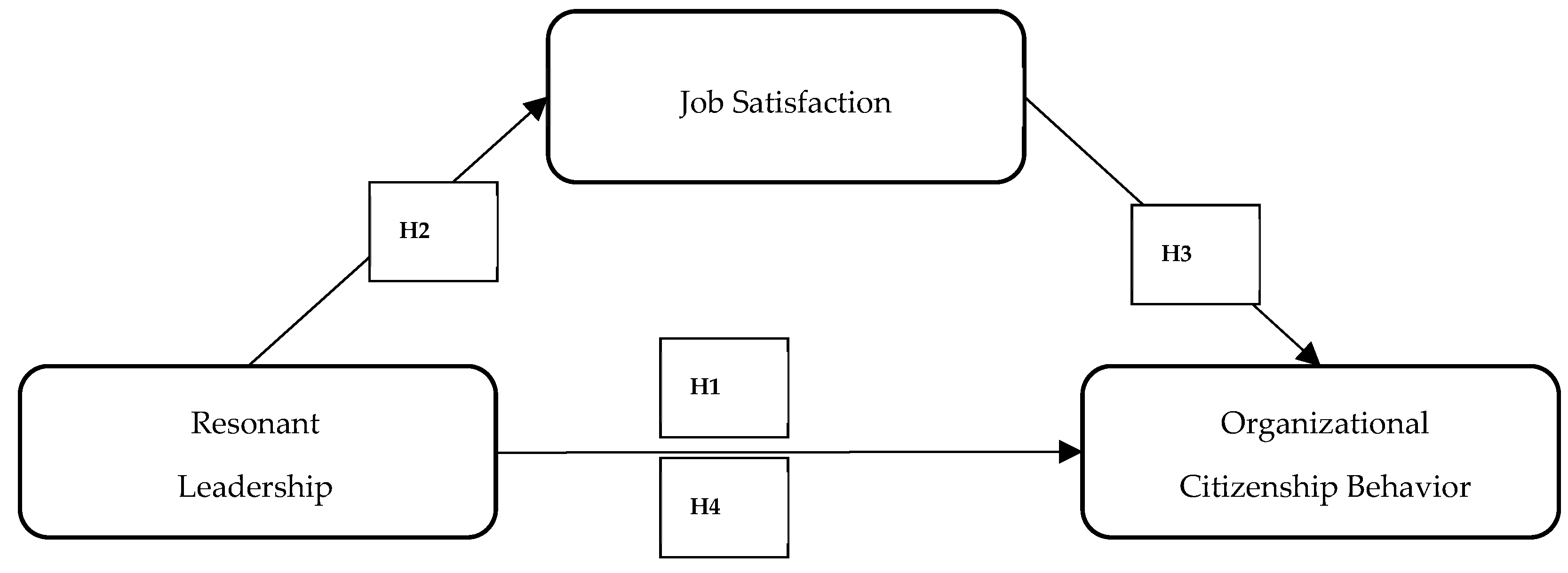
Although there is emerging evidence on resonant leadership, research that simultaneously explores resonant leadership, job satisfaction, and OCB remains limited, especially in the tourism and hospitality sectors. While Tabche et al. [46] examined psychological resilience as a mediator, the role of job satisfaction as an emotional and attitudinal mechanism has received less focus. Therefore, this study suggests that job satisfaction mediates the relationship between resonant leadership and organizational citizenship behavior. Applying this model in the tourism sector provides a more context-aware understanding of how emotionally intelligent leadership can promote sustainable behavioral outcomes. In this context, the research model shown in Figure 1 draws from existing literature as well as SET and AET, and the following hypotheses are proposed for testing:
H2. 
Resonant leadership is positively associated with job satisfaction among hotel employees.
H3. 
Job satisfaction is positively associated with organizational citizenship behavior (OCB) among hotel employees.
H4. 
Job satisfaction mediates the relationship between resonant leadership and organizational citizenship behavior (OCB) among hotel employees.

3. Materials and Methods

3.1. Sample and Procedure

The sample of the study consists of employees from five-star hotels in the Famagusta and the Bafra region, Turkish Republic of Northern Cyprus (TRNC). The participating hotels employ approximately 250–350 employees each, distributed across departments such as front office, housekeeping, food and beverage, and guest services. The sample mainly consists of frontline employees who interact directly with customers.
Prior to collecting the research data, ethical approvals were secured from the Kocaeli University Ethics Committee (Ethics Committee No: 05/07/2024, 2024/08). Once the ethical permissions were secured, interviews were conducted with the managers of six hotels operating in the TRNC to collect data. These preliminary interviews were conducted solely to obtain managerial permission for data collection and to gain an understanding of the operational structure of the hotels. The discussions focused on identifying departments where employees have direct interaction with customers and determining the most appropriate timeframes for survey administration. These interviews were not utilized as qualitative data; instead, they were performed to facilitate access to participants and to ensure the suitability of the sampling procedure. A survey was distributed among employees of three hotels that permitted the study. A total of 388 questionnaires were collected through convenience sampling. After excluding 51 incomplete or incorrectly completed questionnaires, 337 valid questionnaires were retained for analysis. The data collection process was conducted between July and August 2024. Participants were approached in person at their workplaces, with the support of hotel management. Surveys were administered to participants face-to-face, and participants completed the forms in their own private settings voluntarily. The study sample consisted primarily of non-managerial operational personnel (e.g., front desk, housekeeping, and food and beverage staff), who are in direct contact with customers. The three five-star hotels that agreed to participate in the study are located in popular tourist areas of Northern Cyprus, each with over 200 rooms and a variety of customer service capabilities, including a large conference hall, restaurant, and spa.
In fact, the selection of the Turkish context within the scope of this study is not just about geographical accessibility. It is also because it has an established and important role in global tourism and accommodation processes. According to reports by the United Nations World Tourism Organization, Turkey is a major tourism destination (UNWTO, 2023, [67]), hosting a significant number of luxury hotels in regions such as Antalya, Istanbul, and Northern Cyprus, where intense customer interaction, high emotional labor, and high expectations of service quality are experienced. This situation, characterized by specific conditions and characteristics unique to the tourism and hospitality sectors, presents significant empirical opportunities to examine the impact of leadership practices on workplace attitudes.
Among the participants, 199 were males and 138 were females. Of these, 111 were aged 26 to 30, 57 were aged 31 to 35, and 169 were 36 or older. Fifty-eight participants finished high school, 101 earned an associate degree, 137 obtained an undergraduate degree, and 41 earned a postgraduate degree.

3.2. Measurement Tools

Participants rated the items on a 5-point Likert scale, ranging from 1 (Strongly Disagree) to 5 (Strongly Agree). The survey consists of four parts: the first includes the resonant leadership scale, the second the job satisfaction scale, the third features the OCB scale, and the final part contains an information form to collect demographic data. In total, the survey has 21 questions, and brief definitions of the scales used in the research are provided below.
Resonant Leadership: The short-form Resonant Leadership Scale, developed by Estabrooks et al. (2009) [35], was translated and adapted into Turkish by Sürücü and Yikilmaz [9]. This single-dimensional scale consists of six items rated from 1 to 5. Sample questions include “My boss focuses on success rather than failure” and “My boss allows others to be free to make important decisions in their work.” In this study, the scale’s internal consistency reliability (Cronbach’s Alpha) coefficient was measured at 0.876.
Job Satisfaction: The job satisfaction scale (short version) developed by Brayfield and Rothe [68] was adapted into Turkish by Keser and Bilir [69]. This single-dimensional scale includes 5 items rated from 1 to 5. Sample questions are, “Most days I go to work with enthusiasm.” and “Every day at work feels like it will never end.” In this study, the scale’s internal consistency reliability (Cronbach’s Alpha) coefficient was measured at 0.861.
Organizational Citizenship Behavior: Meta-analytic studies emphasize that OCB dimensions are highly correlated with each other and exhibit similar relationship patterns with predictors/outcomes; therefore, the general/single-factor measurement of OCB and the use of short forms are methodologically advocated and used in many studies [70,71]. It is also emphasized in the measurement literature that short scales provide valid measurements when sufficient evidence of reliability and validity is available [72]. In this context, the OCB scale developed by DiPaola et al. [73] was adapted into Turkish by Taştan and Yılmaz [74]. This single-dimensional scale consists of 10 items; each rated on a scale of 1 to 5. Sample questions from the scale include “I help the employees in their personal time” and “I voluntarily help the new employees.” In this study, the scale’s internal consistency reliability (Cronbach’s Alpha) coefficient was measured at 0.907.
Control Variables: Based on a literature review, it has been determined that various demographic factors may be associated with job satisfaction [75]. Therefore, demographic variables (gender, age and education) have been controlled as significant determinants of job satisfaction.

3.3. Common Method Bias (CMB)

Studies in the literature have reported that collecting data at a single time using self-reporting methods can lead to methodological issues such as Common Method Bias (CMB). Therefore, it is recommended to assess the risk of CMB before analysis [76,77]. In this context, various methodological measures were taken to minimize the effect of CMB in the study. First, participation was entirely voluntary, and participants were clearly informed that they could withdraw from the study at any time. Participants were informed that their shared information would remain confidential and not be disclosed to third parties, which helped to lower the chances of receiving misleading responses.
First, Harman’s single-factor test, which is widely used in the literature, was performed. In the analysis where all items were grouped under a single factor, the highest variance ratio was found to be 32.7%. This ratio is well below Harman’s recommended threshold of 50%. Kock [77] states that the CMB effect will not be a significant issue if Variance Inflation Factor (VIF) values are below 3.3, and the results in the conducted analyses remained below this level. Based on these findings, it can be concluded that CMB is not viewed as a significant threat in this research [76,77,78,79].

3.4. Data Analysis

The data were analyzed using SPSS 27 and AMOS 22 software. Initially, frequency analyses were applied to examine participants’ demographic characteristics (gender, age and education). Subsequently, scale reliability and validity were assessed, and correlation and regression analyses were conducted to evaluate the research hypotheses.

4. Results

4.1. Validity and Reliability Analyses

Before analyzing the model created in the research, the validity and reliability of the research constructs were assessed. For validity, both discriminant and convergent validity, along with model fit indices, were examined. Cronbach’s alpha coefficients evidenced the construct’s internal consistency, and composite reliability was evaluated. The findings are presented in Table 1.
Reliability refers to the internal consistency of the measurement scales and ensures that the constructs are measured consistently [80]. As shown in Table 1, the composite reliability values are 0.881, 0.912, and 0.865, while the Cronbach’s alpha coefficients are 0.876, 0.907, and 0.861. All values exceed the recommended threshold of 0.70, indicating a satisfactory level of internal consistency reliability [81].
AVE values greater than 0.5 and composite reliability values exceeding AVE values indicate that the constructs have convergent validity. The AVE values of the research constructs are 0.552, 0.510, and 0.562, respectively. Moreover, composite reliability values surpass AVE values. These results suggest that the constructs being explored are indeed related and support one another [81,82].
For discriminant validity, A V E values and correlation values were taken into consideration. Literature states that discriminant validity is established if the A V E value is higher than the correlation coefficients found between the constructs used in the study [83]. The values in parentheses in Table 2 express A V E values. When examining the findings in Table 2, it is evident that the A V E value of each construct used in the study is higher than the correlation coefficients found between them and the other constructs used in the study. This situation confirms that the constructs possess discriminant validity.
Finally, the fit indices of the research model were checked, revealing that it had good fit indices (χ2/df = 3.154, p < 0.001, GFI = 0.960, CFI = 0.961, TLI = 0.952, RMSEA = 0.049, SRMR = 0.041).

4.2. Correlation Analysis

Correlation analysis was conducted to assess the relationship between variables. To determine which correlation coefficient to use, the data distribution was initially examined. Kurtosis and skewness values served as the basis for evaluating the data distribution. Correlation analysis was performed to assess the relationship and strength between the variables included in the study, with the results presented in Table 2.
The literature states that if the kurtosis and skewness values are within the range of ±1.5, the data displays a normal distribution [81]. The analyses’ findings in this context reveal that the kurtosis values lie between −0.250 and 0.559, while the skewness values range from −0.444 to 0.625. These results indicate that the data exhibit a normal distribution. Given that the data show a normal distribution, the Pearson value was considered in the correlation analysis.
The results in Table 2 indicate that resonant leadership positively correlates with OCB (r = 0.266, p < 0.05) and job satisfaction (r = 0.301, p < 0.05). Additionally, the relationship between OCB and job satisfaction is also positive and significant (r = 0.411, p < 0.05).

4.3. Hypothesis Testing

An analysis was conducted using Process Macro (Model 4) to determine the mediating effect of job satisfaction on the impact of resonant leadership on organizational citizenship behavior. Bootstrapping with 5000 resamples was preferred because it provides a more robust estimation of indirect effects and confidence intervals in mediation analysis. Model 4 in PROCESS Macro represents the simple mediation model. The results are presented in Table 3. Unstandardized regression coefficients (B) are reported.
When examining the results in Table 3, it is evident that resonant leadership has a significant and positive effect on OCB (B = 0.244, p < 0.05) and job satisfaction (B = 0.233, p < 0.05). Furthermore, the effect of job satisfaction on OCB is also significant and positive (B = 0.345, p < 0.05).
To determine whether there is a mediating effect of job satisfaction on the effect of resonant leadership on organizational citizenship behavior, the significance of the indirect effect was checked. If the lower and upper confidence intervals (LLCI-ULCI) do not contain zero, the significance of the effect can be mentioned [82]. The results in Table 3 show that there is a mediating effect of job satisfaction on the effect of resonant leadership on OCB (B = 0.147, p < 0.05). The indirect effect accounted for approximately 37.6% of the total effect, indicating partial mediation. In line with these findings, all Hypothesizes were supported.
The explanatory power of the model was assessed using the coefficient of determination (R2). The results indicate that resonant leadership explains 9% of the variance in job satisfaction (R2 = 0.24). When job satisfaction is included in the model, the predictors jointly explain 41% of the variance in organizational citizenship behavior (R2 = 0.41).

5. Discussion

This study examined whether job satisfaction functions as a mediating mechanism in the relationship between resonant leadership and OCB among hotel employees. The analyses conducted using the PROCESS Macro indicate that resonant leadership exerts both direct and indirect positive effects on OCB.

5.1. Resonant Leadership and OCB in Hospitality Contexts

The results first indicate that resonant leadership is positively related to employees’ organizational citizenship behaviors. This aligns with previous research conducted in various sectors, including evidence from Saudi Arabia showing a positive link between resonant leadership and OCB [84]. In hospitality settings—where emotional labor and customer expectations are especially demanding—the emotional style of leadership can influence how employees perceive their work roles. For example, Mirza and Raza [85] show that resonant leadership fosters a work climate in which employees are more willing to exceed formal job boundaries to enhance guest experiences. Similar findings were reported by Elche et al. [66]. From a SET point of view, these behaviors can be seen as reciprocal responses to supportive and respectful leadership practices.

5.2. Job Satisfaction as an Affective Mechanism

The findings also indicate that resonant leadership is positively related to job satisfaction, supporting prior research suggesting that leadership support, fairness, and recognition are key factors in employee satisfaction [86,87]. In emotionally challenging service environments, a leadership approach that focuses on employees’ psychological needs can enhance their sense of meaning and value at work. Empirical studies in healthcare, logistics, and education sectors show similar effects of resonant leadership on satisfaction [58,59,88,89]. Although direct evidence is limited in the hospitality sector, current findings extend these insights to tourism settings. According to the AET [30], the emotional aspect of leader-employee interactions impacts attitudes like job satisfaction.
Consistent with previous hospitality research [90,91], job satisfaction is positively linked to OCB. Employees who feel more satisfied may be more likely to perform discretionary efforts that support colleagues and improve service delivery. In labor-intensive industries like tourism, these extra-role behaviors can directly impact service consistency and customer satisfaction.
A notable finding within the study’s main goal is the role of job satisfaction as a partial mediator in the relationship between resonant leadership and OCB. The study shows that resonant leaders do not influence behaviors within their authority only through direct relational dynamics. Instead, they also have an indirect effect by shaping how employees perceive and experience their jobs. Similar outcomes from modern leadership approaches, especially servant leadership, emphasize the importance of attitudinal pathways in explaining out-of-role behaviors [92]. However, existing research indicates that the link between job satisfaction and OCB varies by context; industry and situational factors can either strengthen or weaken this relationship [21,22,23]. The partial mediating role of job satisfaction found in this study uncovers a more complex mechanism of influence. Beyond boosting job satisfaction, resonant leadership encourages employees to demonstrate extra-role organizational behaviors by fostering deeper relational elements such as trust, psychological ownership, and commitment.
Viewed through the lenses of SET and AET, the results indicate that emotionally intelligent leadership behaviors foster positive emotional experiences. These experiences, in turn, lead to both attitudinal outcomes, such as job satisfaction, and behavioral outcomes, such as OCB. In high-contact hospitality environments, where employee–guest interactions are frequent and emotionally intense, these mechanisms may help sustain discretionary service behaviors over time instead of just producing short-term effects.

5.3. Implications for Sustainable Tourism and HPWS

The implications of these findings go beyond internal organizational results and are especially relevant to the tourism industry. In tourism environments, service quality arises through continuous interactions between employees and guests. Employees’ voluntary efforts beyond their formal roles are crucial for maintaining consistent service and boosting the reputation of destinations. By fostering employees’ emotional bonds with the organization and promoting discretionary efforts, resonant leadership can indirectly support the human capital aspect of sustainable tourism development. From this viewpoint, sustainability should be seen not just through environmental or structural lenses, but also as a relational and human-focused process.
From a human resources management perspective, these results also align with the literature on high-performance work systems (HPWS). Although HPWS research often emphasizes formal practices like training, participation, and performance-based incentives, the present findings highlight the importance of relational leadership processes in maintaining positive employee attitudes in everyday work contexts. In service sectors where emotional labor is key, resonant leadership may serve as a relational micro-foundation that supports the sustainability of human resource systems over time. From this perspective, the study mainly contributes to the human and social aspects of sustainable tourism, especially through its implications for stable and engaged workforces, consistent service delivery, and organizational resilience. It is also important to note that direct environmental or destination-level sustainability outcomes were not measured in this study and are therefore beyond the scope of the current data.

6. Conclusions

This study explores the link between resonant leadership and OCB among hotel staff, highlighting the mediating effect of job satisfaction. The results indicate that resonant leadership positively relates to OCB both directly and through increased job satisfaction. This implies that leadership impacts not only formal performance results but also voluntary actions that support organizational success. Overall, the study contributes by demonstrating how relational leadership processes sustain positive employee behaviors through affective mechanisms in hospitality contexts.
The results highlight job satisfaction as a key psychological mechanism through which leadership influences employee behavior. Leaders who demonstrate empathy, trust, and emotional awareness promote more positive work attitudes among employees. In hospitality environments, where emotional labor is an essential part of service delivery, such relational dynamics are crucial in maintaining consistent service behaviors.
The findings also offer insights into sustainable tourism management. From a human and social sustainability perspective, sustainable tourism development also depends on maintaining a stable, motivated, and engaged workforce. By strengthening employees’ emotional attachment and encouraging discretionary contributions, resonant leadership can support service reliability and long-term organizational effectiveness in hospitality organizations.

6.1. Theoretical Implications

This study enhances existing knowledge by examining the emotional and relational foundations of employee behavior within resonant leadership. Specifically, it emphasizes the significant role of job satisfaction in the tourism and hospitality sectors. It highlights the importance of emotional processes in the development of out-of-role behaviors among employees [93,94], even amid modern leadership styles like resonant leadership. This contribution adds to ongoing discussions about employee-centered sustainability.
The findings expand HPWS literature by emphasizing the importance of relational leadership processes, suggesting that leadership acts as a micro-level mechanism that promotes positive employee outcomes beyond formal HR practices. Additionally, the results support both Affective Events Theory and Social Exchange Theory by demonstrating that emotionally supportive leadership (resonant leadership) encourages positive attitudes and reciprocal behaviors among employees.

6.2. Practical Implications

This study offers significant practical implications. The findings show that understanding leadership in tourism businesses should go beyond task-oriented methods. Especially in service environments with high emotional demands, leadership approaches focused on empathy, open communication, and psychological support are crucial for boosting employee satisfaction and voluntary efforts. This highlights the need to prioritize emotional intelligence and relational skills in leadership development programs. Additionally, leadership should be viewed not just as a tool for short-term performance but as a strategic element that supports the sustainability of human resources. Since employee-customer interactions are vital in the service sector, recognizing employees’ emotional experiences is essential to delivering consistent service and maintaining organizational resilience.
Lastly, the mediating role of job satisfaction underscores the importance of considering the employee experience as a whole. A relationship environment built on trust, appreciation, and meaningful feedback encourages employees to engage in voluntary behaviors that benefit the organization. In this way, leadership development and employee well-being practices can serve as complementary components of a sustainable management approach in tourism businesses.

6.3. Research Limitations and Future Directions

While this study makes valuable contributions, it also has some limitations. First, the cross-sectional research design restricts causal conclusions; therefore, the progression of relationships over time should be explored in future longitudinal studies [76].
Second, collecting data through self-reports may heighten the risk of common method bias. Using different data sources in future research will strengthen the robustness of the findings [76].
Additionally, since the study was conducted within a specific cultural and sectoral context, the generalizability may be limited. Consequently, it is advisable to test the model in various countries and sectors [95].
Finally, only job satisfaction was included as a mediating variable. Future research exploring different mechanisms such as psychological safety, perceived organizational support, or emotional burnout will provide more comprehensive insights [96,97,98,99].

Author Contributions

Conceptualization, I.Y. and B.C.; methodology, I.Y., L.S., M.B. and A.B.D.; formal analysis, I.Y., M.B. and B.C.; data curation, L.S., M.B. and A.B.D.; writing—original draft preparation, all authors; writing—review and editing, all authors; visualization, all authors. All authors have read and agreed to the published version of the manuscript.

Funding

This research received no external funding.

Institutional Review Board Statement

This study was conducted in accordance with the Declaration of Helsinki and approved by the Ethics Committee of Kocaeli University (approval number 2024/08 and date of approval 5 July 2024).

Informed Consent Statement

Informed consent was obtained from all subjects involved in the study.

Data Availability Statement

The data presented in this study are available on request from the corresponding author. The data are not publicly available due to privacy, legal or ethical restrictions.

Conflicts of Interest

The authors declare no conflict of interest.

References

  1. Luthans, F.; Youssef-Morgan, C.M. Psychological capital: An evidence-based positive approach. Annu. Rev. Organ. Psychol. Organ. Behav. 2017, 4, 339–366. [Google Scholar] [CrossRef]
  2. Inceoglu, I.; Thomas, G.; Chu, C.; Plans, D.; Gerbasi, A. Leadership behavior and employee well-being: An integrated review and a future research agenda. Leadersh. Q. 2018, 29, 179–202. [Google Scholar] [CrossRef]
  3. Karatepe, O.M. High-performance work practices, work social support and their effects on job embeddedness and turnover intentions. Int. J. Contemp. Hosp. Manag. 2013, 25, 903–921. [Google Scholar] [CrossRef]
  4. Lee, M.; Kim, B. Effect of employee experience on organizational commitment: Case of South Korea. Behav. Sci. 2023, 13, 521. [Google Scholar] [CrossRef]
  5. Kim, L.; Yeo, S.F. From side effects to work attitudes influencing customer service quality: Moderating impacts of work experience in banking industry. Int. J. Qual. Serv. Sci. 2025, 17, 5–23. [Google Scholar] [CrossRef]
  6. Boyatzis, R.E.; McKee, A. Resonant Leadership: Renewing Yourself and Connecting with Others Through Mindfulness, Hope, and Compassion; Harvard Business School Press: Boston, MA, USA, 2005. [Google Scholar]
  7. Lilius, J.M.; Worline, M.C.; Maitlis, S.; Kanov, J.; Dutton, J.E.; Frost, P. Compassion revealed: What we know about compassion at work (and where we need to know more). In The Oxford Handbook of Positive Organizational Scholarship; Cameron, K., Spreitzer, G., Eds.; Oxford University Press: Oxford, UK, 2011; pp. 273–287. [Google Scholar]
  8. Cummings, G. Investing relational energy: The hallmark of resonant leadership. Nurs. Leadersh. 2004, 17, 76–87. [Google Scholar] [CrossRef]
  9. Sürücü, L.; Yıkılmaz, İ. Resonant Liderlik Ölçeğinin Türkçeye Uyarlanması: Geçerlik ve Güvenirlik Çalışması. J. Yaşar Üniv. 2021, 16, 739–753. [Google Scholar] [CrossRef]
  10. Judeh, M.; Al-Gasawneh, J.; Al-Zu’bi, H.; Ngah, A.H. Linking resonant leadership, psychological ownership, and organizational commitment: The mediating role of employee empowerment. Probl. Perspect. Manag. 2022, 20, 153–163. [Google Scholar] [CrossRef]
  11. Organ, D.W. Organizational Citizenship Behavior: The Good Soldier Syndrome; Lexington: Lexington, MA, USA, 1988. [Google Scholar]
  12. Podsakoff, P.M.; MacKenzie, S.B.; Paine, J.B.; Bachrach, D.G. Organizational citizenship behaviors: A critical review of the theoretical and empirical literature and suggestions for future research. J. Manag. 2000, 26, 513–563. [Google Scholar] [CrossRef]
  13. Fan, Q.; Wider, W.; Chan, C.K. The brief introduction to organizational citizenship behaviors and counterproductive work behaviors: A literature review. Front. Psychol. 2023, 14, 1181930. [Google Scholar] [CrossRef]
  14. Iqbal, S.; Qureshi, I.M.; Saleem, S.; Khan, A.; Yousaf, H. Exploring the relationship between ethical leadership and organizational citizenship behavior: The mediating role of organizational justice. Int. J. Public Leadersh. 2020, 16, 23–39. [Google Scholar]
  15. Judge, T.A.; Thoresen, C.J.; Bono, J.E.; Patton, G.K. The job satisfaction–job performance relationship: A qualitative and quantitative review. Psychol. Bull. 2001, 127, 376–407. [Google Scholar] [CrossRef] [PubMed]
  16. Singh, U.; Srivastava, K.B. Organizational trust and organizational citizenship behaviour. Glob. Bus. Rev. 2016, 17, 594–609. [Google Scholar] [CrossRef]
  17. Notarnicola, I.; Duka, B.; Lommi, M.; Grosha, E.; De Maria, M.; Iacorossi, L.; Mastroianni, C.; Ivziku, D.; Rocco, G.; Stievano, A. Transformational Leadership and Its Impact on Job Satisfaction and Personal Mastery for Nursing Leaders in Healthcare Organizations. Nurs. Rep. 2024, 14, 3561–3574. [Google Scholar] [CrossRef]
  18. Christiana, C.R.R.; Rofiqoh, I. Systematic Literature Review: The Impact of Leadership Style, Work Motivation, and Job Satisfaction on Employee Performance in the Digital Era. Am. J. Econ. Manag. Bus. (AJEMB) 2025, 4, 302–316. [Google Scholar] [CrossRef]
  19. Avolio, B.J.; Walumbwa, F.O.; Weber, T.J. Leadership: Current theories, research, and future directions. Annu. Rev. Psychol. 2009, 60, 421–449. [Google Scholar] [CrossRef]
  20. Riketta, M. The causal relation between job attitudes and performance: A meta-analysis of panel studies. J. Appl. Psychol. 2008, 93, 472–481. [Google Scholar] [CrossRef]
  21. Lambert, E.G.; Hogan, N.L.; Griffin, M.L. Being the good soldier: Organizational citizenship behavior and commitment among correctional staff. Crim. Justice Behav. 2008, 35, 56–68. [Google Scholar] [CrossRef]
  22. Li, Q. Ethical leadership, internal job satisfaction and OCB: The moderating role of leader empathy in emerging industries. Humanit. Soc. Sci. Commun. 2024, 11, 901. [Google Scholar] [CrossRef]
  23. Rodrigues, R.; Teixeira, N.; Costa, B. The Impact of Perceived Leadership Effectiveness and Emotional Intelligence on Employee Satisfaction in the Workplace. Merits 2024, 4, 490–501. [Google Scholar] [CrossRef]
  24. Wu, T.J.; Zhang, R.X.; Li, J.M. How does emotional labor influence restaurant employees’ service quality during COVID-19? The roles of work fatigue and supervisor–subordinate Guanxi. Int. J. Contemp. Hosp. Manag. 2024, 36, 136–154. [Google Scholar] [CrossRef]
  25. Tang, X.; Gu, Y. Influence of leaders’ emotional labor and its perceived appropriateness on employees’ emotional labor. Behav. Sci. 2024, 14, 413. [Google Scholar] [CrossRef] [PubMed]
  26. Cheng, P.; Zhou, L.; Liu, T.; Ge, N. Empowering leadership and frontline employees’ emotional labor: The mediation effects of job passion. Front. Psychol. 2025, 16, 1437736. [Google Scholar] [CrossRef] [PubMed]
  27. Karatepe, O.M.; Olugbade, O.A. The effects of job and personal resources on hotel employees’ work engagement. Int. J. Hosp. Manag. 2009, 28, 504–512. [Google Scholar] [CrossRef]
  28. Baum, T.; Kralj, A.; Robinson, R.N.; Solnet, D.J. Tourism workforce research: A review, taxonomy and agenda. Ann. Tour. Res. 2016, 60, 1–22. [Google Scholar] [CrossRef]
  29. Blau, P.M. Exchange and Power in Social Life; Wiley: New York, NY, USA, 1964. [Google Scholar]
  30. Weiss, H.M.; Cropanzano, R. Affective events theory: A theoretical discussion of the structure, causes and consequences of affective experiences at work. In Research in Organizational Behavior: An Annual Series of Analytical Essays and Critical Reviews; Staw, B.M., Cummings, L.L., Eds.; JAI Press: London, UK, 1996; Volume 18, pp. 1–74. [Google Scholar]
  31. Goleman, D.; Boyatzis, R.; McKee, A. Primal Leadership: Realizing the Power of Emotional Intelligence; Harvard Business School Press: Boston, MA, USA, 2002. [Google Scholar]
  32. Reivich, K.; Shatté, A. The Resilience Factor: 7 Essential Skills for Overcoming Life’s Inevitable Obstacles; Broadway Books: New York, NY, USA, 2002. [Google Scholar]
  33. Cummings, G. Hospital restructuring and nursing leadership: A journey from research question to research program. Nurs. Adm. Q. 2006, 30, 321–329. [Google Scholar] [CrossRef]
  34. McKee, A.; Massimiliano, D. Resonant leadership: A new kind of leadership for the digital age. J. Bus. Strategy 2006, 27, 45–49. [Google Scholar] [CrossRef]
  35. Estabrooks, C.A.; Squires, J.E.; Cummings, G.G.; Birdsell, J.M.; Norton, P.G. Development and assessment of the Alberta Context Tool. BMC Health Serv. Res. 2009, 9, 234. [Google Scholar] [CrossRef]
  36. Turk, E.; Wolfe, Z.M. Principals’ perceived relationship between emotional intelligence, resilience, and resonant leadership throughout their career. Int. J. Educ. Leadersh. Prep. 2019, 14, 147–169. [Google Scholar]
  37. Cavazotte, F.; Moreno, V.; Hickmann, M. Effects of leader intelligence, personality and emotional intelligence on transformational leadership and managerial performance. Leadersh. Q. 2012, 23, 443–455. [Google Scholar] [CrossRef]
  38. Hur, W.M.; Moon, T.W.; Han, S.J. The effect of customer incivility on service employees’ customer orientation through double-mediation of surface acting and emotional exhaustion. J. Serv. Theory Pract. 2015, 25, 394–413. [Google Scholar] [CrossRef]
  39. Ramirez, R.J.; Marcano, M.; Molina, R.I.R.; Raby, N.D.L.; Tapias, B.H. Relationship Between social intelligence and resonant leadership in public health Institutions. Opción 2019, 35, 1223–1249. [Google Scholar]
  40. Organ, D.W. Organizational citizenship behavior and the good soldier. In Personnel Selection and Classification; Psychology Press: East Sussex, UK, 1994; pp. 53–67. [Google Scholar]
  41. Bolino, M.C.; Klotz, A.C.; Turnley, W.H.; Harvey, J. The unintended consequences of organizational citizenship behaviors for employees, teams, and organizations. In The Oxford Handbook of Organizational Citizenship Behavior; Podsakoff, P.M., MacKenzie, S.B., Podsakoff, N.P., Eds.; Oxford University Press: Oxford, UK, 2018; pp. 185–202. [Google Scholar]
  42. Jiao, C.; Richards, D.A.; Zhang, K. Leadership and organizational citizenship behavior: OCB-specific meanings as mediators. J. Bus. Psychol. 2011, 26, 11–25. [Google Scholar] [CrossRef]
  43. Dubey, P.; Pathak, A.K.; Sahu, K.K. Assessing the influence of effective leadership on job satisfaction and organisational citizenship behaviour. Rajagiri Manag. J. 2023, 17, 221–237. [Google Scholar] [CrossRef]
  44. Grobelna, A. Emotional exhaustion and its consequences for hotel service quality: The critical role of workload and supervisor support. J. Hosp. Mark. Manag. 2021, 30, 395–418. [Google Scholar] [CrossRef]
  45. Amissah, E.F.; Blankson-Stiles-Ocran, S.; Mensah, I. Emotional labour, emotional exhaustion and job satisfaction in the hospitality industry. J. Hosp. Tour. Insights 2022, 5, 805–821. [Google Scholar] [CrossRef]
  46. Tabche, I.; Behery, M.H.; Bin Ahmad, K.Z. Resonant leadership and organizational citizenship behavior: A moderated-mediation analysis of followers’ resilience. Int. J. Product. Perform. Manag. 2024, 73, 18–42. [Google Scholar] [CrossRef]
  47. Algarni, M.A.; Munshi, A. The roles of servant leadership style, LMX style and leadership effectiveness on employees’ engagement in Medina hotels. Int. J. Knowl. Manag. Tour. Hosp. 2023, 3, 149–170. [Google Scholar] [CrossRef]
  48. Srivastava, S.; Singh, L.B. Role of inclusive leadership in employees’ OCB in hospitality industry: A social cognitive perspective. J. Manag. Dev. 2023, 42, 548–567. [Google Scholar] [CrossRef]
  49. Freire, C.; Gonçalves, J. The relationship between responsible leadership and organizational citizenship behavior in the hospitality industry. Sustainability 2021, 13, 4705. [Google Scholar] [CrossRef]
  50. Locke, E.A. The nature and causes of job satisfaction. In Handbook of Industrial and Organizational Psychology; Dunnette, M.D., Ed.; Rand McNally: Chicago, IL, USA, 1976; pp. 1297–1349. [Google Scholar]
  51. Robbins, S.P. Organizational Behavior: Concepts, Controversies, Applications, 8th ed.; Prentice Hall: Upper Saddle River, NJ, USA, 1998. [Google Scholar]
  52. Başaran, İ.E. Yönetimde İnsan İlişkileri: Yönetsel Davranış; Feryal Matbaası: Ankara, Turkey, 2000. [Google Scholar]
  53. Jung, H.S.; Hwang, Y.H.; Yoon, H.H. Impact of Hotel employees’ Psychological Well-being on job satisfaction and Pro-social Service Behavior: Moderating Effect of work-life balance. Sustainability 2023, 15, 11687. [Google Scholar] [CrossRef]
  54. Salama, W.; Abdou, A.H.; Mohamed, S.A.K.; Shehata, H.S. Impact of work stress and job burnout on turnover intentions among hotel employees. Int. J. Environ. Res. Public Health 2022, 19, 9724. [Google Scholar] [CrossRef] [PubMed]
  55. Dorta-Afonso, D.; Romero-Domínguez, L.; Benítez-Núñez, C. It’s worth it! High performance work systems for employee job satisfaction: The mediational role of burnout. Int. J. Hosp. Manag. 2023, 108, 103364. [Google Scholar] [CrossRef]
  56. Bello, M.B.; Bello, Y.O. Job satisfaction and employees’ turnover in hotel industry: Evidence from Lagos state Nigeria. J. Tour. Theory Res. 2021, 7, 32–43. [Google Scholar] [CrossRef]
  57. Hassan, M.; Qureshi, A. Resonant Leadership at Workplace: How Emotional Intelligence Impacts Employees’ attitudes—A Cross-Sectional Study. Pak. Bus. Rev. 2019, 21, 237–251. [Google Scholar]
  58. Dabral, V.; Arijit, K.; Purohit, H.C. The role of resonant leadership in predicting turnover intentions and mediating role of job satisfaction: Evidence from international logistics industry in India. Korea Rev. Int. Stud. 2022, 15, 122–146. [Google Scholar]
  59. Bawafaa, E.; Wong, C.A.; Laschinger, H. The influence of resonant leadership on the structural empowerment and job satisfaction of registered nurses. J. Res. Nurs. 2015, 20, 610–622. [Google Scholar] [CrossRef]
  60. Lee, E.S.; Ryu, S.W. Effect of supportive work environment on the job satisfaction of registered nurses: Resonant leadership and structural empowerment. Korean J. Health Serv. Manag. 2017, 11, 43–53. [Google Scholar] [CrossRef]
  61. Cropanzano, R.; Mitchell, M.S. Social exchange theory: An interdisciplinary review. J. Manag. 2005, 31, 874–900. [Google Scholar] [CrossRef]
  62. Yeşilyurt, H.; Koçak, N. İş doyumu ve örgütsel vatandaşlık davranışı arasındaki ilişkinin otel işletmeleri açısından incelenmesi. Dokuz Eylül Üniv. Sos. Bilim. Enst. Derg. 2014, 16, 303–324. [Google Scholar]
  63. Uludag, O.; Khan, S.; Guden, N. The effects of job satisfaction, organizational commitment, organizational citizenship behavior on turnover intentions. Hosp. Rev. 2011, 29, 1. [Google Scholar]
  64. Azila-Gbettor, E.M. Servant leadership and customer OCB: Moderation effect of altruistic values amongst family hotels employees. J. Fam. Bus. Manag. 2023, 13, 314–334. [Google Scholar] [CrossRef]
  65. Kwak, W.J.; Kim, H.K. Servant leadership and customer service quality at Korean hotels: Multilevel organizational citizenship behavior as a mediator. Soc. Behav. Personal. Int. J. 2015, 43, 1287–1298. [Google Scholar] [CrossRef]
  66. Elche, D.; Ruiz-Palomino, P.; Linuesa-Langreo, J. Servant leadership and organizational citizenship behavior: The mediating effect of empathy and service climate. Int. J. Contemp. Hosp. Manag. 2020, 32, 2035–2053. [Google Scholar] [CrossRef]
  67. United Nations World Tourism Organization (UNWTO). International Tourism Highlights, 2023 ed.; UNWTO: Madrid, Spain, 2023; Available online: https://voyagesafriq.com/wp-content/uploads/2023/09/Tourism_Highlights_2023.pdf (accessed on 30 March 2026).
  68. Brayfield, A.H.; Rothe, H.F. An Index of Job Satisfaction. J. Appl. Psychol. 1951, 35, 307–311. [Google Scholar] [CrossRef]
  69. Keser, A.; Bilir, K.B.Ö. İş Tatmini Ölçeğinin Türkçe Güvenilirlik Ve Geçerlilik Çalişmasi. Kırklareli Üniv. Sos. Bilim. Derg. 2019, 3, 229–239. [Google Scholar]
  70. LePine, J.A.; Erez, A.; Johnson, D.E. The nature and dimensionality of organizational citizenship behavior: A critical review and meta-analysis. J. Appl. Psychol. 2002, 87, 52–65. [Google Scholar] [CrossRef] [PubMed]
  71. Hoffman, B.J.; Blair, C.A.; Meriac, J.P.; Woehr, D.J. Expanding the criterion domain? A quantitative review of the OCB literature. J. Appl. Psychol. 2007, 92, 555–566. [Google Scholar] [CrossRef] [PubMed]
  72. Ziegler, M.; Kemper, C.J.; Kruyen, P. Short scales—Five misunderstandings and ways to overcome them. J. Individ. Differ. 2014, 35, 185–189. [Google Scholar] [CrossRef]
  73. DiPaola, M.F.; Tarter, C.J.; Hoy, W.K. Measuring organizational citizenship behavior in schools: The OCB scale. In Educational Leadership and Reform; Hoy, W.K., Miskel, C.G., Eds.; Information Age Publishing: Greenwich, CT, USA, 2005; pp. 319–342. [Google Scholar]
  74. Taştan, M.; Yılmaz, K. Adaptation of organizational citizenship and organizational justice scales into Turkish. Eğitim Bilim 2008, 33, 87–96. [Google Scholar]
  75. Güleryüz, İ.; Sürücü, L.; Yıkılmaz, İ. The moderator role of leader member exchange on the effect of loneliness at work on organizational citizenship behavior. Firat Univ. J. Soc. Sci. 2024, 34, 237–250. [Google Scholar] [CrossRef]
  76. Podsakoff, P.M.; MacKenzie, S.B.; Lee, J.Y.; Podsakoff, N.P. Common method biases in behavioral research: A critical review of the literature and recommended remedies. J. Appl. Psychol. 2003, 88, 879–903. [Google Scholar] [CrossRef] [PubMed]
  77. Kock, N. Common method bias in PLS-SEM: A full collinearity assessment approach. Int. J. E-Collab. 2015, 11, 1–10. [Google Scholar] [CrossRef]
  78. Bagozzi, R.P.; Yi, Y.; Phillips, L.W. Assessing construct validity in organizational research. Adm. Sci. Q. 1991, 36, 421–458. [Google Scholar] [CrossRef]
  79. Fuller, C.M.; Simmering, M.J.; Atinc, G.; Atinc, Y.; Babin, B.J. Common methods variance detection in business research. J. Bus. Res. 2016, 69, 3192–3198. [Google Scholar] [CrossRef]
  80. Bekmezci, M.; Sürücü, L. Determination of validity, reliability and sample size in qualitative research. Preprints 2025. [Google Scholar] [CrossRef]
  81. Hair, J.F.; Black, W.C.; Babin, B.J.; Anderson, R.E. Multivariate Data Analysis, 7th ed.; Pearson Prentice Hall: Upper Saddle River, NJ, USA, 2010. [Google Scholar]
  82. Sürücü, L.; Şeşen, H.; ve Maslakçı, A. Regression, Mediation/Moderation, and Structural Equation Modeling with SPSS, AMOS, and Process Macro; Livre de Lyon: Lyon, France, 2023. [Google Scholar]
  83. Fornell, C.; Larcker, D.F. Evaluating Structural Equation Models with Unobservable Variables and Measurement Error. J. Mark. Res. 1981, 18, 39–50. [Google Scholar] [CrossRef]
  84. Iqbal, S.Z.; Alamer, A.M.; Gull, H.; Bin Khalefa, W.A. Organizational citizenship behavior and resonant leadership: Analyzing the mediation effect of employee resilience in Saudi Arabian companies. In Proceedings of the 4th International Conference on Business and Information Management (ICBIM 2020), Rome, Italy, 3–5 August 2020; pp. 16–21. [Google Scholar]
  85. Mirza, S.; Raza, B. Success is Achieved Through Action: Exploring a Mediation Path between Leadership and Creativity in the Hospitality Industry. Contemp. J. Soc. Sci. Rev. 2024, 2, 823–833. [Google Scholar]
  86. Bogler, R. The influence of leadership style on teacher job satisfaction. Educ. Adm. Q. 2001, 37, 662–683. [Google Scholar] [CrossRef]
  87. Hulpia, H.; Devos, G. How distributed leadership can make a difference in teachers’ organizational commitment? A qualitative study. Teach. Teach. Educ. 2010, 26, 565–575. [Google Scholar] [CrossRef]
  88. Özer, Ö.; Büyükşirin, B.; Özkan, O. Investigation of Resonant Leadership, Work Engagement and Employee Performance in Nurses. J. Health Manag. 2025, 27, 736–745. [Google Scholar] [CrossRef]
  89. Obied, A. Resonant Leadership: A Catalyst for Job Empowerment Among Palestine Technical University Kadoorie Employees. J. Tech. Educ. Train. 2023, 15, 105–117. [Google Scholar] [CrossRef]
  90. Nadiri, H.; Tanova, C. An investigation of the role of justice in turnover intentions, job satisfaction, and organizational citizenship behavior in hospitality industry. Int. J. Hosp. Manag. 2010, 29, 33–41. [Google Scholar] [CrossRef]
  91. Na’ibi, A.A.; Saleem, N. The effects of job satisfaction on organization citizenship and mobbing in hospitality industry. Int. J. Res. Humanit. Soc. Stud. 2022, 9, 22–32. [Google Scholar]
  92. Zia, M.Q.; Naveed, M.; Bashir, M.A.; Iqbal, A. The influence of servant leadership on employees’ outcomes via job embeddedness in hospitality industry. J. Hosp. Tour. Insights 2022, 5, 612–628. [Google Scholar] [CrossRef]
  93. Grandey, A.A. When “the show must go on”: Surface acting and deep acting as determinants of emotional exhaustion and peer-rated service delivery. Acad. Manag. J. 2003, 46, 86–96. [Google Scholar] [CrossRef]
  94. Zhao, X.; Ghiselli, R. Why do you feel stressed in a “smile factory”? Hospitality job characteristics influence work-family conflict and job stress. Int. J. Contemp. Hosp. Manag. 2016, 28, 305–326. [Google Scholar] [CrossRef]
  95. Hofstede, G. Culture’s Consequences: Comparing Values, Behaviors, Institutions, and Organizations Across Nations, 2nd ed.; Sage Publications: Thousand Oaks, CA, USA, 2001. [Google Scholar]
  96. Edmondson, A. Psychological safety and learning behavior in work teams. Adm. Sci. Q. 1999, 44, 350–383. [Google Scholar] [CrossRef]
  97. Rosso, B.D.; Dekas, K.H.; Wrzesniewski, A. On the meaning of work: A theoretical integration and review. Res. Organ. Behav. 2010, 30, 91–127. [Google Scholar] [CrossRef]
  98. Eisenberger, R.; Stinglhamber, F.; Vandenberghe, C.; Sucharski, I.L.; Rhoades, L. Perceived supervisor support: Contributions to perceived organizational support and employee retention. J. Appl. Psychol. 2002, 87, 565. [Google Scholar] [CrossRef]
  99. Maslach, C.; Leiter, M.P. Understanding the burnout experience: Recent research and its implications for psychiatry. World Psychiatry 2016, 15, 103–111. [Google Scholar] [CrossRef]
Figure 1. Research model.
Sustainability 18 03426 g001
Table 1. Validity findings of the scales.
ItemsFactor LoadsαCRAVE
Resonant Leadership (RL) 0.8760.8810.552
RS10.735
RS20.758
RS30.761
RS40.736
RS50.679
RS60.785
Organizational Citizenship Behavior (OCB) 0.9070.9120.510
OCB10.632
OCB20.644
OCB30.629
OCB40.637
OCB50.755
OCB60.688
OCB70.721
OCB80.750
OCB90.822
OCB100.826
Job Satisfaction (JS) 0.8610.8650.562
JS10.785
JS20.774
JS30.725
JS40.719
JS50.743
Table 2. Correlation analysis results (N = 337).
VariableMeanSd.123
1. Resonant Leadership3.470.889√AVE(0.743)
2. Organizational Citizenship
Behavior
3.780.6720.266 **√AVE (0.714)
3. Job Satisfaction3.410.8110.301 **0.411 **√AVE (0.750)
Kurtosis −0.250−0.1280.559
Skewness 0.625−0.444−0.114
** p < 0.05, The values in parentheses represent the square root of AVE.
Table 3. Hypothesis test results.
BS.ELLCIULCI
RL → OCB0.244 *0.040.1740.396
RL → JS0.233 *0.060.1450.351
JS → OCB0.345 *0.050.2770.567
Mediating Effect
Indirect Effect (RL → JS → OCB)0.1470.040.0680.274
RL: Resonant Leadership, OCB: Organizational Citizenship Behavior, JS: Job Satisfaction, * p < 0.05.
Disclaimer/Publisher’s Note: The statements, opinions and data contained in all publications are solely those of the individual author(s) and contributor(s) and not of MDPI and/or the editor(s). MDPI and/or the editor(s) disclaim responsibility for any injury to people or property resulting from any ideas, methods, instructions or products referred to in the content.