


Abstract
Porous stones are widely used in historical constructions and represent a major component of built cultural heritage. Their conservation commonly depends on multiple single-function products, such as consolidants, hydrophobic agents, biocides, or cleaning agents, which are often toxic and environmentally burdensome. This study performs an environmental assessment of a novel multi-function product designed for the sustainable conservation of porous stones and compares it with other conservation treatment alternatives. This product integrates green chemistry and nanotechnology through a water-based alkoxysilane modified with layered double hydroxide (LDH) particles. Laboratory and field tests on Portuguese monuments demonstrated suitable technical performance, including high substrate compatibility, effective consolidation depth, durable hydrophobicity, biocidal effect, and minimal visual alteration. To evaluate its environmental performance, a life cycle assessment (LCA) was carried out, from cradle-to-grave. The system boundaries encompassed production, application, and transportation stages, with 1 m2 of treated sandstone surface as the functional unit. LCA was performed using CML-IA and ReCiPe methodologies in the SimaPro software. The results revealed the extent of environmental impacts of the novel product, addressing the multi-function strategy compared with conventional products and treatment scenarios. They identified critical life cycle stages for improvement to further enhance environmental performance across scenarios, particularly the influence of perfluorodecyltrimethoxysilane on the environmental burden of the novel product. Overall, this study demonstrates the value of LCA as a design and decision support tool for developing sustainable, multifunctional materials for cultural heritage conservation.
1. Introduction
Stones have been an integral part of European built heritage that requires conservation as several weathering phenomena are erasing the tangible testimonies of their artistic, historic, social and cultural value [1,2]. In order to ensure the preservation of stone heritage for future generations, its conservation often has to include a variety of conservation activities and treatments, such as (i) consolidation, to reestablish the cohesion of a decayed stone and avoid further loss of material, (ii) hydro-protection, as water is one of the main agents responsible for stone decay processes; and (iii) cleaning, to avoid stone decay or proper appreciation of the cultural heritage objects caused by a strong presence of deposits of extrinsic agents and/or biological colonization. Accordingly, the conservation of cultural heritage materials often involves the use of a wide range of products and procedures with distinct functions, such as consolidants, hydrophobic agents, biocides, and cleaning agents (e.g., solvents or water), among others. The diversity of substances employed, combined with the frequent use of materials containing high levels of volatile organic compounds (VOCs), poses a significant risk of negative environmental impact. In response to this issue, current research in the field of conservation has increasingly focused on the development of more environmentally sustainable products—such as water-based formulations [3,4]—as well as strategies and methodologies aimed at minimizing environmental impact, including life cycle assessment (LCA) of conservation materials and practices [5,6].
Most research on environmental impact assessment within the field of conservation focused on comparing the environmental performance of various consolidation products, with particular emphasis on the consolidation of carbonate substrates such as marble, limestone or lime mortar [7,8,9,10,11]. Within this scope, consolidants including diammonium hydrogen phosphate (DAP), nanolime, ethyl silicate, acrylic resin (e.g., Paraloid B72), calcium acetoacetate and calcium alkoxides (such as calcium ethoxide and calcium isopropoxide) have been studied [7,8,9,10,11]. Findings indicate that the environmental impact associated with different stone consolidants can vary significantly, highlighting the importance of careful product selection in sustainable conservation practice. During the stage of use, ethyl silicate consolidants have significant VOC emissions because they contain relatively high concentrations of organic solvents. However, the synthesis of ethyl polysilicate is the largest contributor to its overall environmental footprint, as it is the main constituent of typical ethyl silicate consolidants (75%) [6,9]. Other consolidants, such as nanolime, have very high concentrations of organic solvents (~99%), which dominate their environmental footprint [6]. Therefore, the environmental impact of these consolidants primarily derives from the high concentrations of active components involving environmentally costly synthesis processes and/or large amounts of organic solvents. DAP, which is water-based, showed clear environmental benefits over others, including ethyl silicates [6,8], and is an excellent option to consolidate carbonate stones, such as limestones and marbles, due to their chemical affinity. However, it is widely known that silicate stones, such as sandstones and granites, are best treated with ethyl silicate due to chemical similarities [12].
Indeed, the best-performing products in terms of environmental performance do not seem to meet all conservation needs. Sandstone, a key material in the European built heritage, is particularly vulnerable to degradation due to the high porosity (often around 20% or more), significant water absorption capacity, and relatively low mechanical strength of some varieties [13,14,15,16,17]. While each sandstone variety has its own specific decay behavior, these characteristics generally make sandstones more prone to various forms of decay, posing significant conservation challenges.
Sandstones are found across many historic buildings and monuments in Europe. In Spain, Palaeocene and Miocene types were used in monuments in the western regions and Aragon [14,15]. Germany features several sandstone varieties, such as Elbe, Wealden, Bentheimer, Baumberger, and Obernkirchen, which are present in national heritage and have been exported to the Netherlands and Belgium [1,17]. The Charles Bridge in Prague, Czech Republic, is a well-known example built with Cretaceous sandstone [2]. In Italy, sandstones such as Pietra Serena, Gorgoglione stone, and Pietraforte have been widely used in various regions and historical periods [18,19,20]. In Portugal, Silves Sandstone has a strong regional presence in the south region and, like many European sandstones, it has been extensively used in built heritage and historic objects [21] and combines cultural and historical significance with physical properties that make its conservation particularly challenging.
To address the relatively high VOC emissions of ethyl silicates while exploring their suitability with silicate substrates, like sandstone, and their versatility to comprise other conservation functions, a novel route to produce water-based ethyl silicates has been developed [22]. The versatility of silanes enabled the development of a multifunctional silane homogenized by ultrasonic irradiation, capable of forming hybrid networks [23,24], which demonstrated successful consolidation, hydro-protection in sandstone and other stone types, as well as a strong potential to inhibit biocolonization growth [25]. This novel multifunctional and water-based option could contribute to a more sustainable conservation practice as it allows various conservation activities to be addressed simultaneously, avoiding the need for multiple treatments, and is an inherently greener alternative per se by eliminating VOC emissions from organic solvents and possesses lower amounts of ethyl polysilicate. In summary, this single product has the potential to replace multiple treatments and rationalize the chemicals, resources and actions required in built heritage interventions.
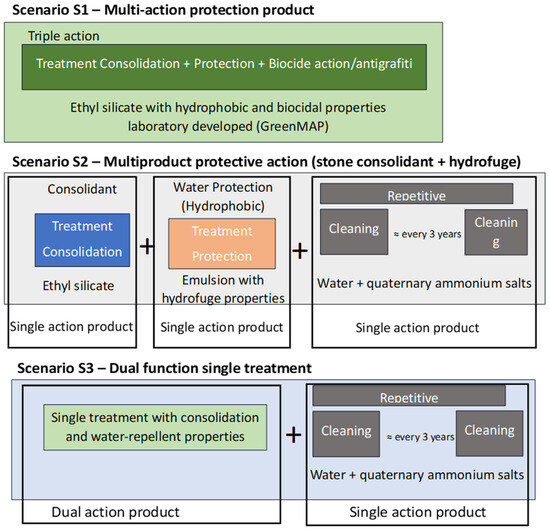
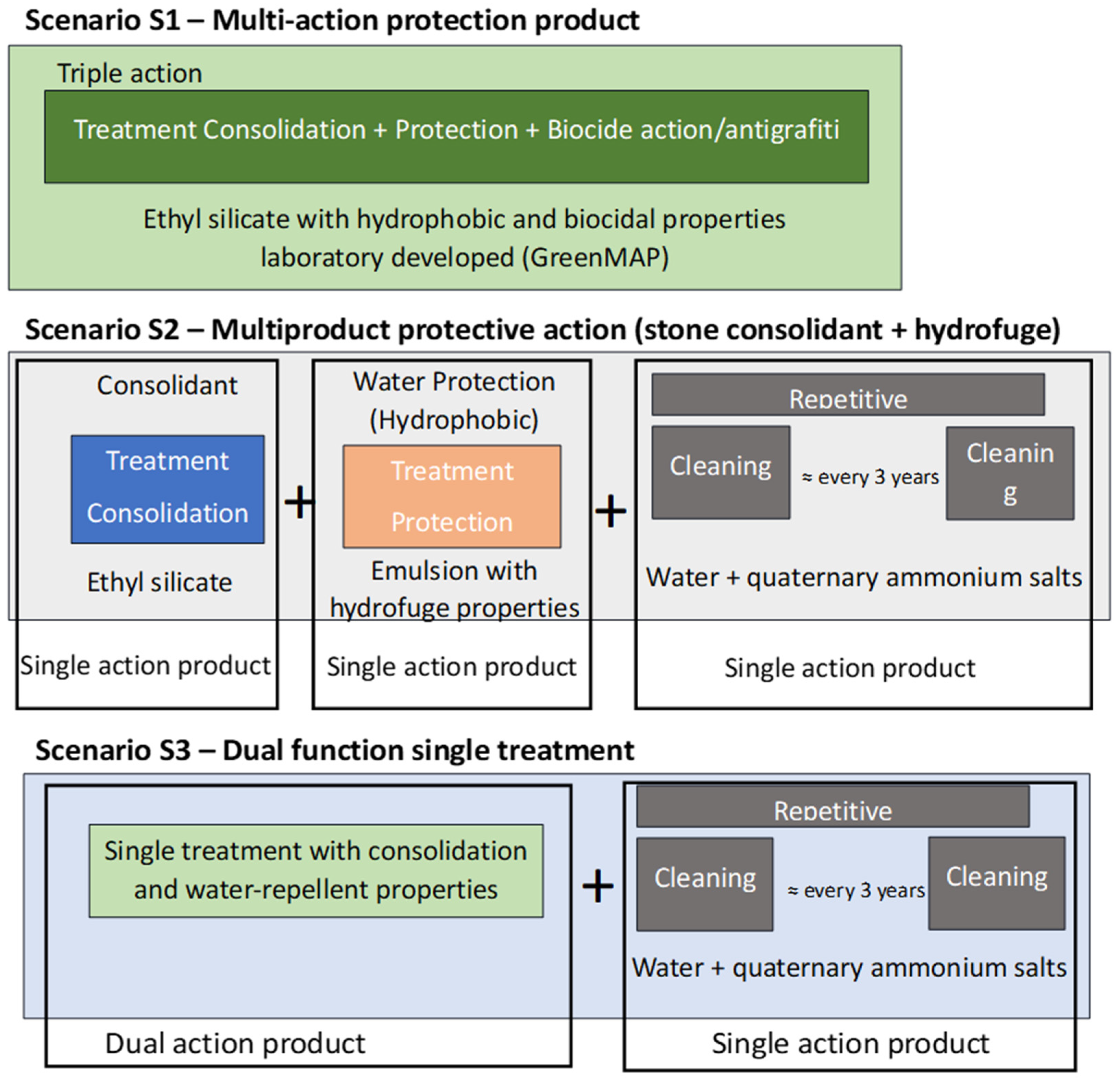
This study undertakes an assessment of the environmental benefits of this novel multifunctional conservation option. This assessment is conducted using life cycle analysis (LCA) in an unexplored context, based on holistic conservation scenarios applied to a variety of sandstones and in accordance with ISO 14040 guidelines [26]. The approach adopted involves a comparative analysis of the environmental impact resulting from the application of this novel multifunctional product, which possesses a consolidating function, provides protection against water, and inhibits biological colonization, with current conservation options to tackle the same functions. Three conservation scenarios (S1, S2 and S3) were selected for analysis. The first scenario (S1) involved a single treatment with the novel water-based multi-function product. The second scenario (S2) entailed a multilayer treatment involving the application of a consolidant, followed by a product with hydrophobic function, and periodic cleaning for biocolonization removal with a biocidal agent. The third scenario (S3) involved a single treatment with a double-function product with consolidation and hydrophobic functions, followed by periodic cleaning for biocolonization removal with a biocidal agent.
2. Materials and Methods
2.1. Materials
Silves sandstone, a silicate sandstone characterized by high porosity (>20%) and present in the built heritage, mostly in the south region of Portugal, was the selected stone variety for this study. This sandstone variety allowed us to reduce the need for assumptions and simplifications for the LCA, as there is information available about the conservation of this stone with different products [19,24,25]. Moreover, other porous sandstone varieties are found in European built heritage with similar petrophysical characteristics, so it is, therefore, reasonable to hypothesize that the results will not differ significantly.
The stone is mostly composed of sub-angular quartz grains ranging from 0.25 to 0.10 mm and hematite and clay/mica minerals cement. The mechanical and petrophysical properties of this stone were previously characterized in several research investigations, which unveiled low mechanical compressive strength (around 22 MPa), open porosities between 22% and 23%, and a unimodal pore size distribution centered in pores with a radius of 10 µm [19,24].
The environmental impact resulting from the application of the novel multifunctional product (i) was compared with other conservation options to tackle the same objectives but carried out with commonly used commercial products having specific purposes, namely, a consolidant (ii), a hydro-protective product (iii), a hydrophobic consolidant (iv) and a free biocide (v). The selected products were used to analyze three comparable conservation scenarios in terms of objectives to fulfil (increase the cohesion; hydro-protection; and reduce the need for biocolonization removal): a single treatment with the novel water-based multi-function product (S1); a multilayer treatment and periodic biocolonization removal (S2); and a single treatment with a double-function product and biocolonization removal (S3).
The rationales for the selected products (i, ii, iii, iv and v) and their description, including the novel multifunctional product, are as follows:
- (i)
- Multifunctional product: The novel multifunctional product, F0.11LDH, is laboratory-synthesized and water-based. It was recently developed for conservation purposes and exhibits consolidation, hydro-protective and biocidal activity in various porous stones, including sandstone. This product is a modified ethyl silicate formulation, with its main active components being ethyl silicate, namely, tetraethyl silicate (26% v/v), and 1H,1H,2H,2H-perfluorodecyltriethoxysilane (3% v/v). A small quantity of hydrochloric acid (0.04%) is used as a catalyst. Additionally, F0.11LDH incorporates zinc–aluminum layered double hydroxide (ZnAl-LDH) particles loaded with pyrithione at a concentration of 0.3% w/v (2.7 g/L). These particles are synthesized via a co-precipitation method [27,28].The preparation of the product involves the sonication of the reagent mixture over a defined period, corresponding to an energy consumption of approximately 250 kJ per Liter [24].
- (ii)
- Consolidant: The most used and versatile consolidants are based on “ethyl silicates”. These are offered by various manufacturers and have been applied to stones with diverse characteristics; however, most effective applications are typically observed in silicate-based substrates, such as porous sandstones. Moreover, “ethyl silicates” are the most comparable products in nature with the novel multifunctional product since both derive from tetraethyl silicate.For this study, ESTEL 1000 (CTS, Vicenza, Italy) was selected as the single-function product with a consolidation function. This choice is supported by the availability of the literature documenting its application on various sandstones, including the one considered and analyzed here. ESTEL 1000 is one of the most recognized and widely used ethyl silicate consolidants in Europe, as evidenced by both the extensive technical documentation and numerous research publications. The product is composed of approximately 75% tetraethyl silicate, with the remaining portion consisting of solvents, and includes a small amount of a tin-based catalyst according to the technical datasheet [29].
- (iii)
- Hydro-protective product: An aqueous emulsion based on organo-siloxanes was selected to provide the superficial hydro-protective function, as these products are currently among the most widely used for protecting construction materials against water-induced deterioration [30]. Specifically, MasterProtect H 305 (Master Builders Solutions, Manheim, Germany) was chosen due to documented experience with its application on porous sandstone, both as a single treatment and as part of multilayer systems [31,32].
- (iv)
- Dual-function product with hydrophobic and consolidation functions: Ethyl silicates are quite versatile, and some versions may possess hydrophobic properties. ESTEL 1100 (CTS, Vicenza, Italy), the hydrophobic variant of ESTEL 1000, is a well-established dual-function product, with both consolidation and hydrophobic functions, that has been employed in the treatment of various cultural heritage objects composed of different stone types, including the specific sandstone under study. ESTEL 1100 shares the same fundamental composition as ESTEL 1000, consisting of approximately 75% ethyl silicate, with the remaining portion made up of solvents and a small amount of organotin catalyst. The difference lies in minor chemical modifications that impart hydrophobic characteristics (Table 1).Table 1. Product specifications and consumption values that ensure the efficacy of their functions, available in the literature for the porous sandstone.
- (v)
- Biocidal product: The cleaning of biocolonized surfaces using free biocidal products based on quaternary ammonium compounds is extensively employed in the conservation of stone heritage [33,34,35]. For this purpose, Preventol RI80 (Lanxess, Leverkusen, Germany) was selected, as it has been widely used in the cleaning and biocolonization removal of numerous stone monuments [31,32,34]. The concentration of Preventol RI80 may vary between 1.5% and 3% depending on the context [33,34,36], but the lowest concentration (1.5%) was adopted in this study, as it has been shown to be sufficient against various types of lichens [36].
Table 1 summarizes the products considered for the different scenarios, their specifications, and the consumption values for porous sandstones that ensure their efficacy reported in the literature.
2.2. Minimum Efficacy Requirements
To fairly compare the environmental impact of different conservation scenarios, it is necessary to ensure that all options considered meet the requirements imposed by the conservation reality of a given situation. However, assessing the performance of conservation treatments is inherently complex, involving multiple domains that span technical (e.g., effectiveness, incompatibility risks, and durability) and conceptual requirements within heritage conservation. In many cases, there is a high degree of subjectivity involved, and what is an acceptable level of performance may vary depending on the specific challenges posed by each context, as well as the intrinsic values associated with the object.
Given the multiplicity of factors and the high technical and conceptual demands involved, it is important to recognize the difficulty of ensuring that different treatments perform identically in all relevant domains, particularly when they are intended to perform various functions simultaneously. To conduct the LCA, a minimum technical criterion was established, based on the demonstrated capacity of each scenario to be effective in two key functions: hydro-protection and consolidation.
In terms of hydro-protection, while various parameters and tests may be used to evaluate the protective performance, the most widely accepted and least subjective indicator is the contact angle formed between a water droplet and the surface. A hydrophobic treatment is generally expected to produce contact angles equal to or greater than 90°, which is considered a benchmark for sufficient water repellence.
Regarding the consolidation function, a treatment must be capable of increasing the internal cohesion or, more broadly, the mechanical strength of the stone, ideally restoring it to its original condition. The extent of cohesion required can vary depending on the condition of the material, from a minimal increment to full-strength recovery. In theory, a perfectly effective treatment would fully restore the original strength of the stone. However, in practice, such homogeneity is rarely observed in decayed materials, and many consolidation treatments are tested on sound stone, which does not reflect the typical stone condition found in real cases.
Thus, even a treatment that provides only a moderate increase in cohesion may be considered satisfactory if it prevents further material loss. Importantly, there is a delicate balance between achieving sufficient effectiveness and avoiding over-strengthening, which can cause compatibility issues. Excessive strengthening is often viewed negatively, as it may create significant mechanical discontinuities between treated and untreated zones. Various authors have proposed thresholds for acceptable strengthening, such as not exceeding three times the strength of the untreated stone [37] or limiting surface-to-depth resistance differences to 25% [38].
With this in mind, treatments able to increase the mechanical resistance of the stone in a measurable way are considered to be at least partially effective, provided they are capable of fulfilling the intended conservation role.
Another crucial aspect of a consolidation treatment is its ability to penetrate to sufficient depths, ideally treating the entire degraded layer and reaching into sound material to ensure effectiveness. The literature offers consistency on this point, and a consensual threshold depth of 15–20 mm is generally accepted [37,38].
The biocidal function, which is the most subjective and difficult parameter to assess, is the other function considered in this study. There are currently no standardized quantitative methods for evaluating the initial biocidal efficacy, making the outcomes reported in the literature difficult to compare. Since this study aims to compare two fundamentally different approaches, one involving the cleaning of colonized or recolonized surfaces (S2 and S3), and the other aiming to inhibit recolonization for a certain period of time (S1), a sensitivity analysis was incorporated into the LCA, considering different hypothetical recolonization periods to account for the inherent variability and uncertainty.
2.3. Functional Unit and Treatment Lifetime
The analysis of the environmental performance of the products and the comparison between scenarios was carried out using 1 m2 of treated Silves sandstone as the functional unit (FU). Since the efficacy of most conservation treatments is known to be time-limited, it is necessary to associate their environmental impact with a realistic duration, up to which no new intervention or additional environmental burden is required. A common challenge in the development of conservation and maintenance plans is precisely the determination of treatment duration. It is widely accepted within the scientific community that the duration of many conservation interventions is uncertain and may range from weeks to several years, depending on a combination of multiple factors such as product composition, application procedures, substrate condition, severity of deterioration phenomena, and exposure conditions [39,40].
The durability of hydro-protective superficial treatments can be quite limited, as their active compounds, mostly organo-silicon compounds, are directly exposed to degrading agents such as UV radiation and water. Indeed, the efficacy has been observed to last only a few weeks in certain circumstances [39,40]. Studies on porous sandstones with similar porosities (~20%) to those here analyzed, treated with organo-silicon products, have shown highly variable results. In some instances, the hydrophobic properties persisted for 17 to even 30 years when sufficiently thick treated layers were achieved, while in other cases, significant water ingress was reported after just 2 years of outdoor exposure [39,41,42].
Meanwhile, inappropriate consolidation treatments have been reported to fail prematurely, sometimes within just a few years, due to incompatibility issues that can exacerbate deterioration processes [32,43,44]. In the absence of major compatibility concerns, ethyl silicate-based consolidants have been reported to last between 5 and 15 years [45]. However, studies specifically addressing the long-term loss of consolidation efficacy remain scarce.
Due to this uncertainty, and in order to encompass the range between the worst- and best-case durability scenarios reported in the literature for products having the same nature as the ones here analyzed (Section 2.1), a somewhat conservative period of 6 years before the need for further actions involving hydro-protection or consolidation was adopted for the present study.
Regarding the frequency of cleaning actions required to remove biocolonization, observations of starting recolonization in cleaned/hydro-protected stones vary significantly, from a few weeks to several years [40]. For example, evident signs of recolonization of marble statues from Queluz Garden (Portugal) varied between 1 and 6 years [36], while complete regrowth was detected in travertine embankments in Rome (Italy) after 4 years of exposure [46]. Different studies point out that silicate-based water repellents inhibited microbial regrowth for about 2 years, but inform that some report longer periods (5 or even 8 years) [34]. Given the difficulty in establishing the time period after which recolonization occurs, as many variables are involved (e.g., stone properties, treatments’ chemical nature, surrounding environmental conditions, the orientation/position of the surfaces, and exposure, among others), a sensitivity analysis using various hypotheses was considered for the scenarios involving cleaning with free biocides (S2 and S3; Section 2.1). During the period of 6 years, considered to be the lifetime of the remaining actions, the hypotheses considered were as follows:
- (a)
- No need for cleaning during the 6-year period;
- (b)
- Need for 1 cleaning (3 years after treatment application);
- (c)
- Need for 2 cleanings (2 and 4 years after treatment application).
2.4. Conservation Scenarios
Assuming the need for a conservation intervention addressing consolidation, hydro-protection and biocolonization control, three scenarios were considered as follows:
- Scenario 1: This scenario involves a single (i) application of the novel multifunctional product (F0.11LDH), with the capacity to consolidate, hydro-protect and incorporate biocide (LDH particles).
Porous stones typically require significant amounts of consolidant due to the need for deep penetration. An effective and in-depth treatment of the porous sandstone was achieved through the application of 3.3 L/m2 of F0.11LDH (Table 1). This allowed the product to penetrate to depths of at least 20 mm, ensuring consolidation of the stone in-depth (Table 1). In addition to mechanical strengthening, the treatment significantly increased the surface water contact angle, reaching values of 128°, indicating a strong hydrophobizing effect [24]. ZnAl-PT LDH particles have pyrithione embedded, a well-known biocidal agent used across various applications. These particles enable a slow and sustained release of the biocide, activated primarily by exposure to rainwater. The 0.3% w/v concentration of ZnAl-PT LDH in the product has proven highly effective in inhibiting biocolonization and biofilm formation by common microbial colonizers of stone cultural heritage [25]. Considering the above-mentioned conservative 6-year lifetime assumed for the treatment, no additional biocidal treatments or surface-cleaning interventions are required within the projected scenario lifetime (6 years).
All application tools and accessories (e.g., brushes, containers, and reusable gloves) are assumed to be reusable after cleaning with a compatible solvent. Given the nature of the consolidant (ethyl silicate-based), white spirit was considered appropriate for this purpose. A total of 2 L of white spirit per treatment was considered sufficient to clean all accessories, regardless of the treated area.
- Scenario 2: Multilayer treatment involving the application of a (ii) consolidant, followed by the application of a (iii) hydro-protective superficial treatment and (v) periodic cleaning for biocolonization removal with a biocidal agent.
In previous laboratory investigations, the porous sandstone focused on in this study absorbed approximately 4.4 L/m2 of ESTEL 1000 during application [32]. This resulted in effective strengthening of stone to depths of 28 mm or more (Table 1).
After the application of ESTEL 1000, it may be necessary to accelerate the reaction of the product before applying the hydro-protective product. This can be done by rinsing the surface with water/ethanol solutions to facilitate subsequent applications [32,47]. However, this step was not included in the present study, as the product with hydrophobic function can alternatively be applied after a sufficiently long waiting period, offering a practical and resource-efficient alternative.
Because the second treatment provides only superficial protection, lower product absorption is expected, especially following the consolidant application. In this scenario, 0.3 L/m2 of MasterProtect H 305 was absorbed by the studied porous sandstone [32].
The hydro-protective performance of this outer layer was found to be effective, with contact angles well above 130°, Table 1, confirming the treatment capacity to meet its intended hydrophobic function.
The same tools and accessory cleaning and reuse strategy described for Scenario 1 applies here: all application tools (e.g., brushes, gloves, and containers) are assumed to be reusable after cleaning with 2 L of white spirit, regardless of the treated area.
Despite its water-repellent properties, MasterProtect H 305 is not expected to prevent biocolonization, and therefore, periodic cleaning interventions may remain necessary. As no direct information is available on the use of free biocides on this specific sandstone, the procedures adopted here were, therefore, extrapolated from similar interventions on comparable substrates. The diluted biocidal solution has a typical average dosage of approximately 0.1 L per m2 reported for sandstone monuments [48]. As multiple applications are required to achieve satisfactory results [36], two application cycles were considered in this scenario. This resulted in a total biocide consumption of 200 mL/m2 (100 mL/m2 per cycle).
The application of free biocidal agents also involves considerable water consumption, both prior to the treatment, for surface cleaning (removal of loose biocolonization and dust), and after each application, for rinsing residues and dead microorganisms. On fragile stone surfaces, this is commonly performed using low-pressure water jets to minimize the risk of damage. To estimate the water volumes involved, the authors conducted cleaning trials using a low-pressure water jet (25 bar) on various porous stones, including the sandstone studied here. These trials indicated a water consumption of approximately 60 L/m2 per pass (unpublished data). Consequently, a total water use of 180 L/m2 was considered for this scenario: one cleaning pass before the first biocide application (60 L/m2) and one after each of the two biocide cycles (2 × 60 L/m2).
As discussed previously, Scenario 2 includes three different assumptions for biocolonization cleaning over the 6-year period: (a) no cleaning; (b) one cleaning cycle; and (c) two cleaning cycles.
- Scenario 3: This scenario involves the (iv) application of a double-function product capable of consolidating and hydro-protecting stone simultaneously, followed by (v) periodic cleaning for biocolonization removal with a biocidal agent.
As in the previous cases, the product must penetrate deeply to ensure effective consolidation action, although it has more functions. In previous studies involving the porous sandstone under consideration, approximately 4.0 L/m2 of ESTEL 1100 was absorbed, enabling consolidation to depths of up to at least 28 mm (Table 1) [31].
The same accessory cleaning and reuse strategy described in previous scenarios applies to Scenario 3.
Biocidal application is a mandatory component of this scenario. Thus, the cleaning procedures and the hypothesis regarding cleaning frequency needs described in Scenario 2 are applicable to Scenario 3.
2.5. Boundaries and Scenario Systems
The products are part of the three conservation scenarios studied (Figure 1), which are comparable with respect to the functions they are intended to fulfil, namely, increasing cohesion; providing hydro-protection; and keeping surfaces free from biological colonization:
Figure 1.
Conservation scenarios and summary of the products, functions and treatments involved.
- A single treatment with the new water-based multifunctional product (S1);
- A multilayer treatment and periodic removal of biocolonization (S2);
- A single treatment with a dual-function product and periodic removal of biocolonization (S3).
These scenarios are based on a 6-year cycle, initiated with the application of the consolidant product. Scenario S1 assumes that no biocolonization removal is required during the 6-year period. Both scenarios S2 and S3 are based on the assumption that two biocide-based cleaning interventions are necessary per cycle.
The LCA of the tested treatments and associated practices follows a cradle-to-grave approach, covering the extraction of raw materials, their processing, the transport of the final product to the place of use, and the treatment of the generated waste.
The analysis of the environmental performance of the products and the comparison between the three scenarios are carried out considering the functional unit as 1 m2 of treated sandstone. The amount of product required to treat 1 m2 of this stone is referred to as the specific consumption, expressed in L/m2. To address two key issues—the relative environmental impacts of the products and the stages involved in each scenario, and the potential damages of the three scenarios under consideration—the following aspects were examined:
- (a)
- The environmental impacts across midpoint impact indicators and the three areas of protection, per m2 of treated stone substrate, from the production of each product.
- (b)
- The environmental impacts across midpoint impact categories and the three scenarios, per m2 of treated stone substrate, from the local application of each product.
- (c)
- The comparison of the differentiated impacts across the various impact categories and the three scenarios, per m2 of treated stone substrate.
To analyze the aspects described above, the environmental impact was quantified for the functional unit (FU) as follows:
- (a)
- Specific consumption (L/m2) of each product at the factory gate;
- (b)
- Specific consumption (L/m2) of each product at the point of use;
- (c)
- Specific consumption (L/m2) associated with each scenario at the point of use.
For each product, the reference flow corresponds to the quantity of material required to be applied on 1 m2 of the stone substrate surface.
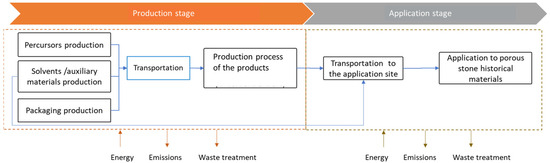
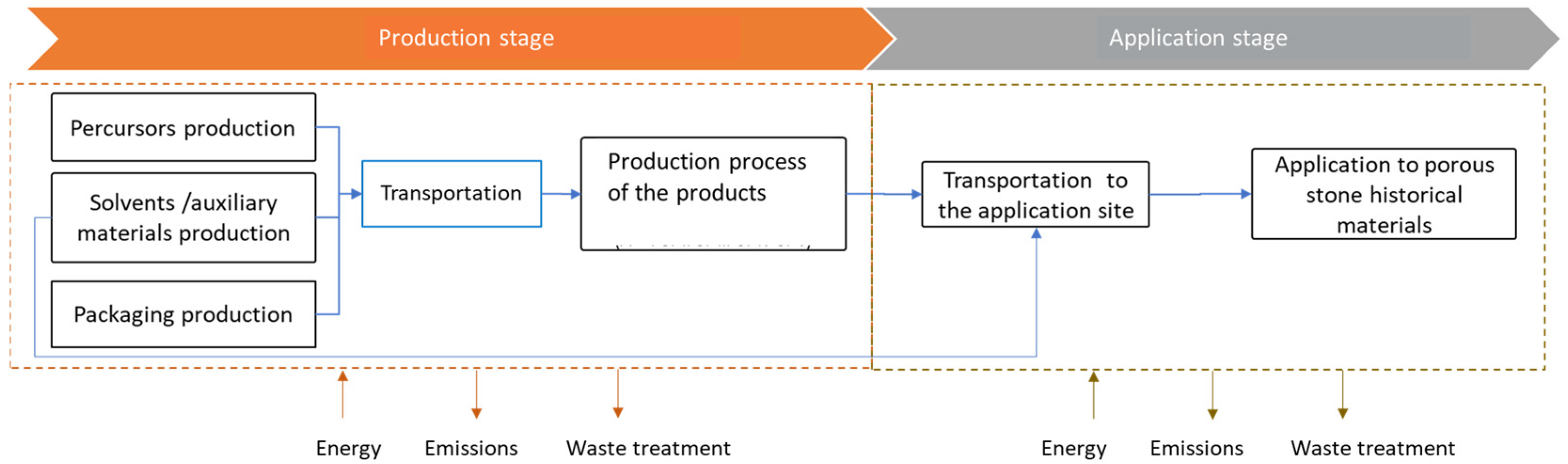
The system boundaries of the LCA include, for each of the products considered in the three evaluated scenarios, the extraction and transformation of raw materials used in the manufacture of precursors and additives (e.g., solvents and catalysts) employed in product formulation, as well as their commercialization and application within the set of associated practices.
These stages are summarized in Figure 2.
Figure 2.
System boundaries for the production and application of each product are included in the three scenarios.
The temporal reference for this study is the year 2025, as it corresponds to the final stage of testing of the new multi-action product. In geographical terms, it is assumed that the data collected is, in general, representative of European production of the five products analyzed in the LCA. The energy required for the manufacture of these products, namely, electricity generation and fuels, was adjusted to the energy mix of the producing countries: Italy, Germany, and Portugal.
With regard to allocation, when a system generates more than one valuable product, as is the case for some intermediate chemical precursors, the environmental load is allocated—that is, divided—among the co-products. In LCAs of chemical products, several allocation methods are used: (1) mass-based allocation (where the heavier product receives a greater share of the load) and (2) economic allocation (where the load is divided according to relative monetary values). There is no single “best” allocation method a priori; the allocation procedure must be selected case by case, as no single approach is suitable for all situations.
Accordingly, the mass allocation method was assumed to be the most appropriate. This approach reflects the biophysical flows of materials and resources from one production process to the next, and it is not sensitive to price fluctuations that may occur, for example, due to increases in raw material or energy costs. It is also insensitive to situations in which industrial-scale production costs (and consequently, the final price) are unknown. For background data (energy and materials), extracted from Ecoinvent 3.9.1, allocation is as defined by the database.
No cut-off criteria were defined for this study. The system boundaries were defined to encompass the three scenarios described in Section 2.4. For the processes within the system boundary, all available data on energy and material flows were included in the model. In cases where corresponding life cycle inventories were unavailable, proxy data were used, based on conservative assumptions regarding environmental impacts.
2.6. Selection of LCIA Methodology and Impact Categories
The Life Cycle Impact Assessment (LCIA) classifies and aggregates the material, energy, and emission flows entering and leaving each product system according to the type of environmental impact they cause.
The LCIA method selected to assess environmental impacts was the CML-IA Baseline, developed by the Centre of Environmental Science (CML) at Leiden University (The Netherlands). This method is an update of CML 2 2000 Baseline and corresponds to the files published by CML in August 2016 (version 4.8). It is a midpoint-level methodology, and the following categories were considered: abiotic depletion (resource depletion), acidification, eutrophication, freshwater aquatic ecotoxicity, global warming potential (GWP100), human toxicity, marine aquatic ecotoxicity, ozone layer depletion, photochemical oxidation and terrestrial ecotoxicity.
The ReCiPe 2016 v.01.04 Endpoint (World H/A) method was also used, at the endpoint level, corresponding to the three areas of protection (AoPs): human health, ecosystem quality, and resource depletion [49].
The impacts on the AoPs were expressed as a single score (Pt), which is meaningful only in comparative contexts.
The LCA model was developed using the SimaPro software system (version 10.2.0.1), developed by Pré Sustainability. The Ecoinvent 3.11 database provided the life cycle inventory data for processes related to the various raw materials, precursors, and other products included in the analyzed system.
3. Results and Discussion
Given the complexity of the chemical synthesis of the products under analysis, the Reaxys® [50] database was used to identify the most feasible production methods and subsequently to obtain the documentation needed to establish the substances involved in the various steps of the chemical synthesis, as well as their quantities and production efficiencies. The numerous documents consulted included patents, technical reports, and scientific articles.
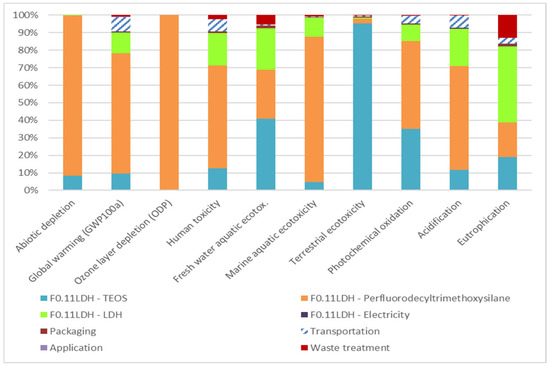
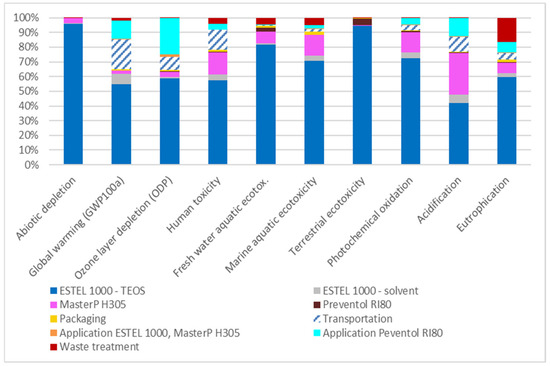
Information on the identified raw materials, certain additives, and energy/fuel data was obtained from the Ecoinvent database. The results of the environmental impact assessment of the production and application stages of the products associated with each of the three scenarios are presented in Figure 3, Figure 4 and Figure 5.
Figure 3.
Scenario 1—Relative contribution of the F0.11LDH multifunction consolidant, production and application (including cleaning of utensils and waste treatment) to the overall impact per CML-IA baseline V3.11 midpoint category.
Figure 4.
Scenario 2—Relative contribution of the production and application of the single-action consolidant, the water-repellent emulsion, and the biocide agent (including equipment cleaning and waste treatment) to the overall impact, according to the midpoint category of the CML-IA V3.11 baseline.
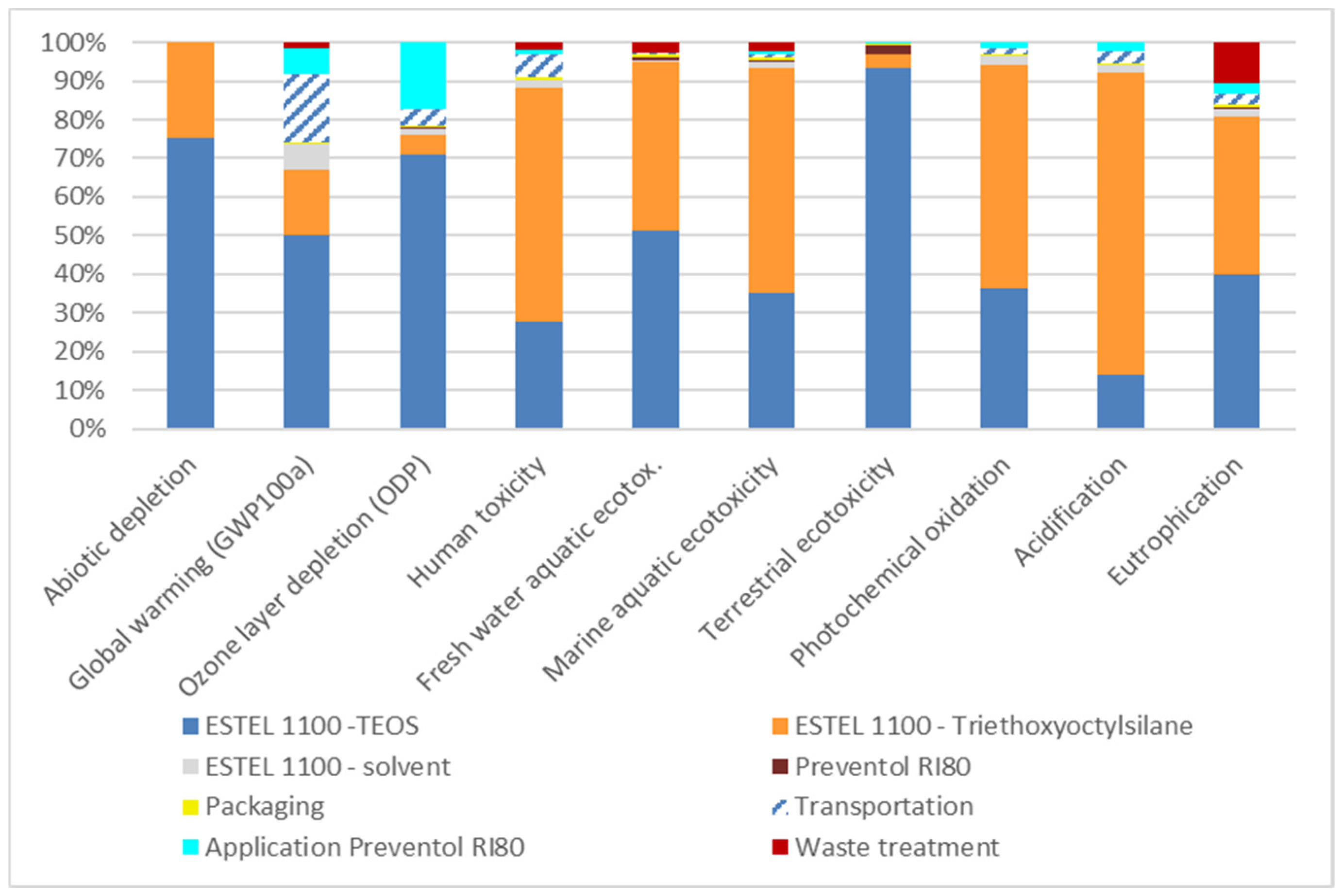
Figure 5.
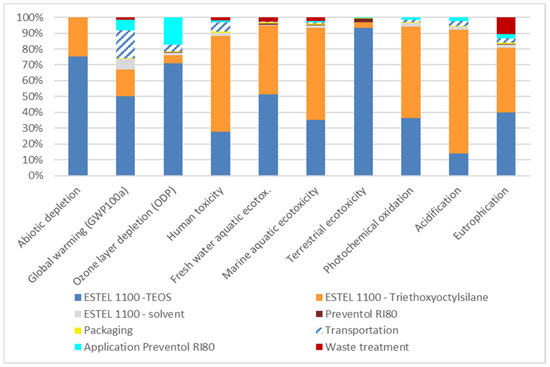
Scenario 3—Relative contribution of the production and use of the dual-function consolidant (ESTEL 1100) and of the biocidal agent (including equipment cleaning and waste treatment) to the overall impact, according to the midpoint category of the CML-IA V3.11 baseline.
The modeling of Scenario 1 (Figure 3) revealed that the main contributor to the environmental impact of the process is associated with the production and use of perfluorodecyltrimethoxysilane, particularly in the ozone layer depletion and abiotic depletion categories. This compound also showed a significant contribution across nearly all other midpoint impact categories analyzed, namely, global warming, human toxicity, marine ecotoxicity, photochemical oxidation, and acidification.
The terrestrial ecotoxicity and freshwater aquatic ecotoxicity categories exhibited the highest relative impacts from the production of TEOS (tetraethyl silicate). In turn, the eutrophication category recorded the highest relative impact value associated with the production of layered double hydroxide (ZnAl-LDH).
For Scenario 2 (Figure 4), the highest relative environmental impact was caused by the production of TEOS (tetraethyl silicate), affecting all the impact categories analyzed. Biocidal application, transport and waste generation also contributed to the impacts, but to a much lower extent than the relative values for TEOS production.
In Scenario 3 (Figure 5), the highest relative environmental impacts were caused by the production of TEOS (tetraethyl silicate) and triethoxyoctylsilane. The production of TEOS mainly affected the categories of terrestrial ecotoxicity, abiotic depletion, ozone layer depletion and global warming. In turn, triethoxyoctylsilane production had a relatively greater impact on acidification, human toxicity and photochemical oxidation and contributed to global warming, together with the production of solvents, transport activities and biocidal application.
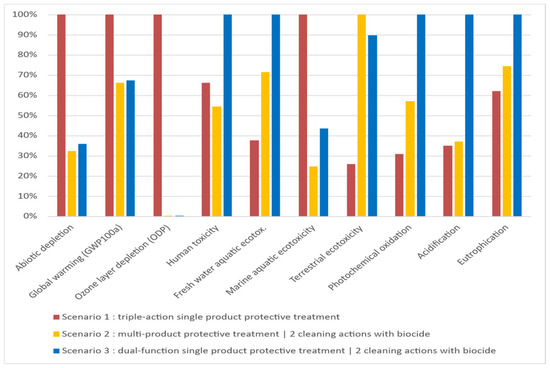
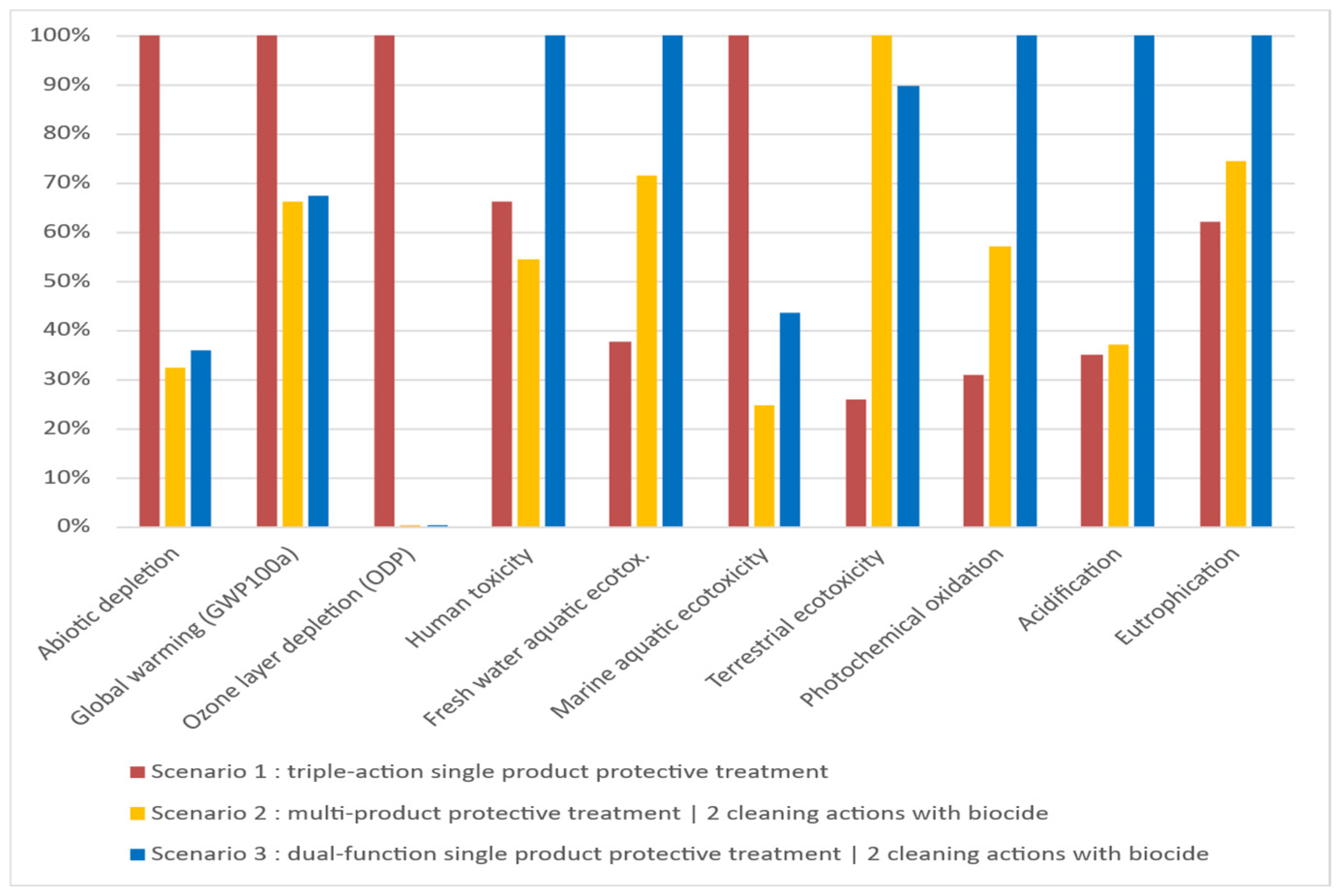
The overall analysis carried out for the three scenarios, considering the different impact categories (Figure 6), showed that Scenario 1, corresponding to the new water-based multi-function product, presented promising results, although further improvement is still needed to surpass the environmental performance of the other scenarios.
Figure 6.
Comparison of environmental impacts associated with the three scenarios analyzed per m2 of surface treated and per midpoint category (method: CML-IA baseline V3.11).
In the categories of eutrophication, acidification, photochemical oxidation and human and freshwater toxicity, Scenario 3 showed the highest impacts. Conversely, Scenario 1 made a greater contribution in the categories of ozone layer depletion, global warming, abiotic depletion and marine toxicity. Scenario 2 exhibited lower environmental impact values in most categories, except for terrestrial toxicity, in which it recorded the highest impact among the three scenarios.
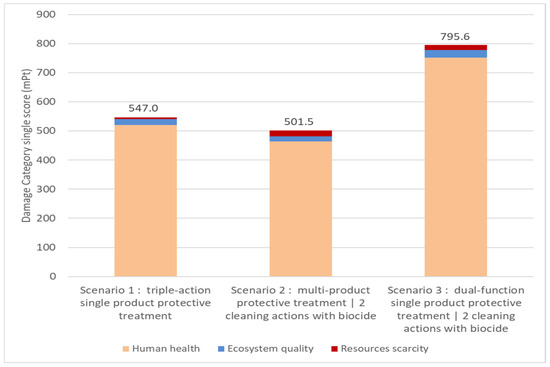
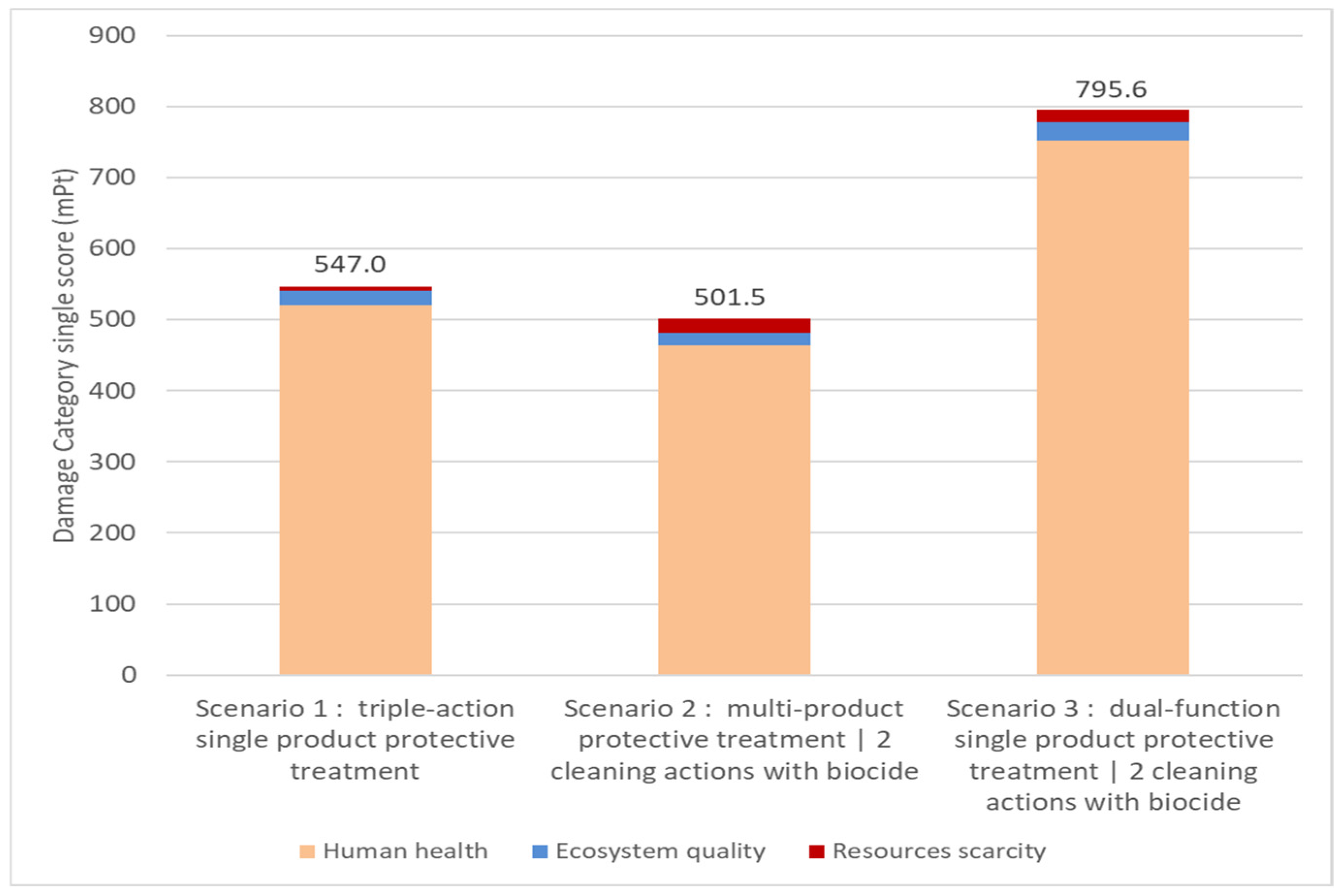
The results of the environmental impact assessment across the LCA areas of protection indicate that Scenario 1 showed good overall environmental performance compared with the other scenarios (Figure 7). This scenario demonstrated advantages over Scenario 3 and achieved a performance similar to Scenario 2.
Figure 7.
Comparison of environmental impacts associated with the three scenarios analyzed per m2 of surface treated, considering the three areas of protection (method: ReCiPe 2016 v.01.04 endpoint World H/A, Single Score).
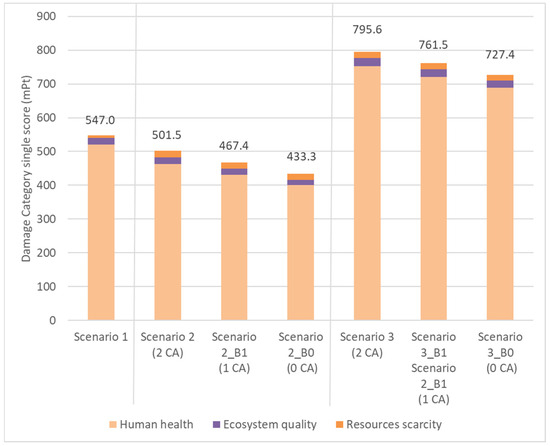
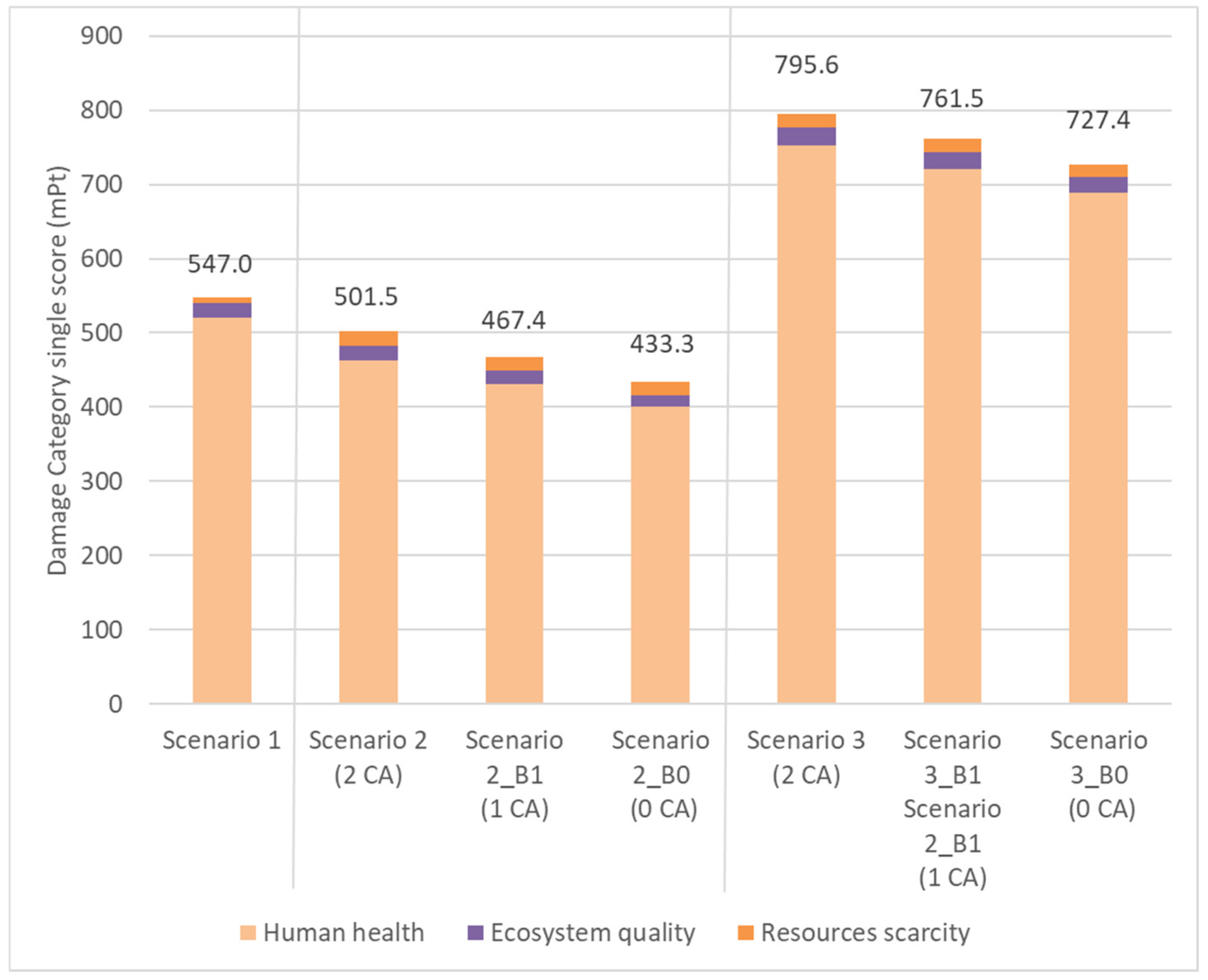
The results of the sensitivity analysis regarding the number of cleaning actions (CAs), using free biocide, required over the 6-year period for Scenarios S2 and S3 (c.f. Section 2.1) are expressed in Figure 8. These results reinforce the poor environmental performance of Scenario 3, regardless of the CAs necessary to clean colonized or recolonized sandstone surfaces. The relative environmental gap between Scenarios S1 and S2 increases linearly as the number of cleaning operations is reduced from two to zero, from approximately 8.3% ([S1 − S2]/S1) to 20.8% ([S1 − S2_B0]/S1). Based on these observations, it can be inferred that Scenario S1 could potentially outperform any scenario based on S2, provided that the number of CAs required over a six-year period exceeds three.
Figure 8.
Comparison of the environmental impacts associated with the three scenarios analyzed, based on the number of cleaning actions (CAs) carried out over a 6-year period, expressed per square meter of treated area, considering the three protection zones (method: ReCiPe 2016 v.01.04, World H/A endpoint, single score).
The LCA of the three conservation scenarios provided a comprehensive understanding of the environmental performance of the different conservation strategies and the underlying factors influencing their impacts.
Scenario 1, corresponding to the new water-based multifunctional product, showed an overall favorable environmental performance, standing out in relation to Scenario 3 and remaining close to the performance observed in Scenario 2. Perfluorodecyltrimethoxysilane was identified as the main contributor to the environmental impacts in this scenario, particularly within the abiotic depletion category, while also contributing significantly to global warming, ozone layer depletion, human toxicity, marine ecotoxicity, photochemical oxidation, and acidification. These results indicate that, although the product shows promising environmental potential, there are opportunities for improvement in the selection of raw materials and in the optimization of the formulation.
In Scenario 2, the environmental impact was dominated by the production of tetraethyl silicate (TEOS), which influenced all the impact categories evaluated. Although transport and waste treatment also contributed to the total environmental load, their magnitude was considerably lower than that observed for TEOS production.
Scenario 3 exhibited the highest overall environmental impacts, primarily associated with the production of TEOS and of triethoxyoctylsilane. TEOS was the main driver of impacts in the categories of abiotic depletion, global warming, ozone layer depletion, and ecotoxicity, whereas triethoxyoctylsilane had a more pronounced influence on human toxicity and terrestrial toxicity. Additionally, waste treatment processes contributed significantly to the eutrophication category.
The integrated analysis of the areas of protection (AoPs)—human health, ecosystem quality, and resource scarcity—revealed that human health was the most affected domain in all scenarios, followed by ecosystem quality, while resource scarcity showed the lowest level of impact. These findings are consistent with previous LCA studies on chemical-based conservation materials, which have reported the strong influence of precursor synthesis and solvent use on toxicity-related categories.
The results emphasize that material synthesis and formulation design represent the most critical phases in determining the overall environmental performance of conservation products. In particular, fluorinated and silicon-based precursors, although effective in providing durability and hydrophobicity, are associated with high energy consumption and potential toxicity impacts. Therefore, efforts to enhance sustainability should focus on replacing high-impact chemical agents, improving production efficiency, and reducing the dependence on volatile or energy-intensive intermediates.
When compared with conventional multi-layer or solvent-intensive treatments, the new water-based multifunctional product (Scenario 1) (Figure 8) demonstrates potential advantages in terms of process simplification and reduced environmental load. Its performance suggests that innovative formulation strategies can effectively balance functionality and environmental responsibility, even within complex chemical systems. Moreover, the similarity of impact between Scenarios 1 and 2, as evaluated through the ReCiPe methodology, suggests that performance improvements might be achieved without compromising treatment efficacy.
Overall, the findings highlight the potential of LCA as a strategic design tool for the development of next-generation conservation materials. Beyond quantifying environmental impacts, LCA facilitates the identification of hotspots and trade-offs, guiding researchers and manufacturers toward evidence-based improvements. Integrating life cycle thinking into material innovation, thus, contributes to the development of sustainable conservation technologies, aligning with the United Nations Sustainable Development Goals (SDGs), particularly those related to Sustainable Cities and Communities (SDG 11) and Responsible Consumption and Production (SDG 12).
4. Conclusions
The LCA carried out for the three conservation scenarios enabled the identification of the main environmental hotspots associated with the production and application of the analyzed treatments, as well as the comparative performance of alternative conservation strategies. The results demonstrated that the newly developed water-based multifunctional product (Scenario 1) presents a generally favorable environmental profile when compared with the conventional multi-step treatment approach (Scenario 3), while showing a performance close to that observed for the single-action treatment system (Scenario 2).
Despite this positive overall performance, the analysis revealed that the environmental impacts of Scenario 1 are strongly influenced by the synthesis of specific fluorinated and silicon-based precursors, particularly perfluorodecyltrimethoxysilane, which significantly contributes to categories such as abiotic depletion, global warming, ozone layer depletion and toxicity-related indicators. Similarly, the production of tetraethyl silicate (TEOS) emerged as a dominant contributor in Scenarios 2 and 3, affecting most midpoint impact categories. These findings confirm that raw material selection and synthesis efficiency are decisive factors in determining the environmental performance of conservation products.
The sensitivity analysis further indicated that the environmental advantage of the multifunctional product increases as the need for maintenance cleaning operations rises, highlighting the importance of durability and long-term performance in the life cycle evaluation of conservation treatments. In this context, formulation strategies that combine functional performance with extended service life can contribute substantially to impact reduction over time.
From a broader perspective, this study demonstrates that the integration of multiple protective functions within a single water-based formulation can contribute to process simplification, reduced material consumption, and lower cumulative environmental burdens. Nevertheless, further optimization is required to fully exploit the sustainability potential of the new product, particularly through the replacement of high-impact chemical agents, the reduction in energy-intensive synthesis steps, and the improvement of waste management practices.
Overall, the results highlight the relevance of life cycle assessment as a strategic design and decision support tool in the development of next-generation conservation materials for porous stone heritage. By enabling the systematic identification of environmental trade-offs and performance drivers, LCA supports evidence-based innovation and promotes the transition toward more sustainable conservation technologies. Such approaches are consistent with current sustainability frameworks and contribute to advancing resource-efficient solutions in both the construction and cultural heritage sectors.
Author Contributions
Conceptualization, A.P.F.P. and B.S.d.F.; Methodology, N.M.C., H.F. and G.M.; Validation, H.F.; Formal analysis, H.F., A.P.F.P. and B.S.d.F.; Research, N.M.C., H.F. and G.M.; Writing—original draft, N.M.C. and B.S.d.F.; Writing—review & editing, H.F., G.M. and A.P.F.P.; Supervision, G.M.; Project administration, A.P.F.P. and B.S.d.F.; Funding acquisition, A.P.F.P. and B.S.d.F. All authors have read and agreed to the published version of the manuscript.
Funding
This research was supported by Fundação para a Ciência e Tecnologia (FCT, https://ror.org/00snfqn58) through the following funding sources: Project GreenMAP (PTDC/ECI-EGC/2519/2020; https://doi.org/10.54499/PTDC/ECI-EGC/2519/2020); CQE—Center for Structural Chemistry (UIDB/00100/2020 and UIDP/00100/2020); IMS—Institute of Molecular Sciences (LA/P/0056/2020; https://doi.org/10.54499/LA/P/0056/2020); CERIS—Civil Engineering Research and Innovation for Sustainability (UIDB/04625/202); MARE—Marine and Environmental Sciences Centre (UID/4292/2025 and UID/PRR/4292/2025); ARNET—Aquatic Research Network (LA/P/0069/2020; https://doi.org/10.54499/LA/P/0069/2020) and; Author B. Sena da Fonseca—(2020.04185.CEECIND/CP1587/CT0004; https://doi.org/10.54499/2020.04185.CEECIND/CP1587/CT0004).
Institutional Review Board Statement
Not applicable.
Informed Consent Statement
Not applicable.
Data Availability Statement
The original contributions presented in this study are included in the article. Further inquiries can be directed to the corresponding author.
Acknowledgments
The authors acknowledge Paula Sério Branco of NovaFCT, for granting them access to organic synthesis databases and for her valuable comments on alternative chemical pathways.
Conflicts of Interest
The authors declare no conflicts of interest.
References
- Ehling, A. Cretaceous building sandstones in northern Germany. In Global Heritage Stone: Worldwide Examples of Heritage Stones; Geological Society of London: London, UK, 2020. [Google Scholar]
- Přikryl, R.; Svobodová, J.; Zák, K.; Hradil, D. Anthropogenic origin of salt crusts on sandstone sculptures of Prague’s Charles Bridge (Czech Republic): Evidence of mineralogy and stable isotope geochemistry. Eur. J. Mineral. 2004, 16, 609–618. [Google Scholar] [CrossRef] [Scilit]
- Daniele, V.; Taglieri, G.; Macera, L.; Rosatelli, G.; Otero, J.; Charola, A. Green approach for an eco-compatible consolidation of the Agrigento biocalcarenites surface. Constr. Build. Mater. 2018, 186, 1188–1199. [Google Scholar] [CrossRef] [Scilit]
- Lettieri, M.; Masieri, M.; Aquaro, M.; Dilorenzo, D.; Frigione, M. Eco-Friendly Protective Coating to Extend the Life of Art-Works and Structures Made in Porous Stone Materials. Coatings 2021, 11, 1270. [Google Scholar] [CrossRef] [Scilit]
- Franzoni, E.; Volpi, L.; Bonoli, A. Applicability of life cycle assessment methodology to conservation works in historical building: The case of cleaning. Energy Build. 2020, 214, 109844. [Google Scholar] [CrossRef] [Scilit]
- Pozzo, A.D.; Masi, G.; Sassoni, E.; Tugnoli, A. Life cycle assessment of stone consolidants for conservation of cultural heritage. Build. Environ. 2024, 249, 111153. [Google Scholar] [CrossRef] [Scilit]
- Almeida, I. Study of a Multilayer Treatment for the Consolidation and Protection of Stone Materials from Portuguese Monuments. Master’s Thesis, IST, Lisbon University, Lisboa, Portugal, 2025. [Google Scholar]
- Pozzo, A.D.; Masi, G.; Tugnoli, A.; Sassoni, E. Towards Green Materials for Cultural Heritage Conservation: Sustainability Evaluation of Products for Stone Consolidation. In Proceedings of the 75th RILEM Annual Week 2021; Springer International Publishing: Cham, Switzerland, 2023; pp. 751–760. [Google Scholar]
- Pranjić, A.M.; Ranogajec, J.; Škrlep, L.; Škapin, A.S.; Vučetić, S.; Rebec, K.M.; Turk, J. Life cycle assessment of novel consolidants and a photocatalytic suspension for the conservation of the immovable cultural heritage. J. Clean. Prod. 2018, 181, 293–308. [Google Scholar] [CrossRef] [Scilit]
- Turk, J.; Pranjić, A.M.; Tomasin, P.; Škrlep, L.; Antelo, J.; Favaro, M.; Škapin, A.S.; Bernardi, A.; Ranogajec, J.; Chiurato, M. Environmental performance of three innovative calcium carbonate-based consolidants used in the field of built cultural heritage. Int. J. Life Cycle Assess. 2017, 22, 1329–1338. [Google Scholar] [CrossRef] [Scilit]
- Masi, G.; Pozzo, A.D.; Ugolotti, G.; Tugnoli, A.; Sassoni, E. Choosing the consolidant for carbonate substrates: Technical performance and environmental sustainability of selected inorganic and organic products. Constr. Build. Mater. 2023, 407, 133599. [Google Scholar] [CrossRef] [Scilit]
- Scherer, G.W.; Wheeler, G.S. Silicate Consolidants for Stone. Key Eng. Mater. 2009, 391, 1–25. [Google Scholar] [CrossRef] [Scilit]
- Sancho, C.; Fort, R.; Belmonte, A. Weathering rates of historic sandstone structures in semiarid environments (Ebro basin, NE Spain). Catena 2003, 53, 53–64. [Google Scholar] [CrossRef] [Scilit]
- Buj, O.; Gisbert, J. Petrophysical characterization of three commercial varieties of miocene sandstones from the Ebro valley. Mater. Construcción 2007, 57, 63–74. [Google Scholar] [CrossRef] [Scilit]
- Nespereira, J.; Blanco, J.A.; Yenes, M.; Pereira, D. Irregular silica cementation in sandstones and its implication on the usability as building stone. Eng. Geol. 2010, 115, 167–174. [Google Scholar] [CrossRef] [Scilit]
- Verstrynge, E.; Schueremans, L.; Van Gemert, D.; Bourel, E. Long-Term Reliability of Historical Monuments Built with Low Quality Sandstone. Adv. Mater. Res. 2010, 133–134, 331–336. [Google Scholar] [CrossRef] [Scilit]
- Dubelaar, C.W.; Nijland, T.G. Early Cretaceous Obernkirchen and Bentheim Sandstones from Germany used as dimension stone in the Netherlands: Geology, physical properties, architectural use and comparative weathering. In Sustainable Use of Traditional Geomaterials in Construction Practice; Geological Society, London, Special Publications: London, UK, 2016; Volume 416, pp. 163–181. [Google Scholar] [CrossRef] [Scilit]
- Salvatici, T.; Calandra, S.; Centauro, I.; Pecchioni, E.; Intrieri, E.; Garzonio, C.A. Monitoring and evaluation of sandstone decay adopting non-destructive techniques: On-site application on building stones. Heritage 2020, 3, 1287–1301. [Google Scholar] [CrossRef] [Scilit]
- De Luca, V.; Bentivenga, M.; Cavalcante, F.; Lezzerini, M.; Marano, C.; Palladino, G.; Prosser, G. Geological Features and Physical and Mechanical Properties of the Gorgoglione Building Stone of Basilicata (Southern Italy). Geoheritage 2019, 11, 1621–1629. [Google Scholar] [CrossRef] [Scilit]
- Coli, M.; Donigaglia, T.; Cristofaro, M.T.; Tanganelli, M.; Viti, S. Assessments on the material properties of the Pietraforte stone of Florence (Italy) in conservation, restoration and construction. Case Stud. Constr. Mater. 2022, 16, e00986. [Google Scholar] [CrossRef] [Scilit]
- Sena da Fonseca, B.; Pinto, A.F.; Rodrigues, A.; Piçarra, S.; Santos, C.; Montemor, M. Effect of the pore network and mineralogy of stones on the behavior of alkoxysilane-based consolidants. Constr. Build. Mater. 2022, 345, 128383. [Google Scholar] [CrossRef] [Scilit]
- Sena da Fonseca, B.; Pinto, A.F.; Piçarra, S.; Rucha, M.; Montemor, M. Sonocatalysis: Eco-design strategy for developing novel inorganic sonogels for the conservation of stone heritage. J. Cult. Herit. 2024, 67, 214–225. [Google Scholar] [CrossRef] [Scilit]
- Sena da Fonseca, B.; Pinto, A.F.; Piçarra, S.; Mègre, S.; Rucha, M.; Montemor, M. New water-based hybrid materials for the protection against water and consolidation of stone monuments. Prog. Org. Coat. 2024, 194, 108599. [Google Scholar] [CrossRef] [Scilit]
- Rucha, M.; Piçarra, S.; Pinto, A.F.; Montemor, M.; da Fonseca, B.S. 51Superficial and in-depth effects of novel water-based fluorinated alkoxysilanes formulations for stone materials. J. Build. Eng. 2026, 117, 114801. [Google Scholar] [CrossRef] [Scilit]
- Sena da Fonseca, B.; Aksoy, B.; Assunção, M.F.G.; Santos, L.M.; Alves, M.M.; Piçarra, S.; Rucha, M.; Silva, B.A.; Pinto, A.F. Controlled release of pyrithione from ZnAl layered double hydroxides to inhibit biocolonization on porous building-material surfaces. Prog. Org. Coat. 2026, 215, 110120. [Google Scholar] [CrossRef] [Scilit]
- ISO 14040:2006; Environmental Management—Life Cycle Assessment—Principles and Framework. ISO (International Organization for Standardization): Geneva, Switzerland, 2006.
- SmallMatek. Product Specification: Zinc Pyrithione-Loaded Zinc-Aluminum Layered Double Hydroxides—Revision date: 29/11/2022; Smallmatek—Small Materials and Technologies: Aveiro, Portugal, 2019. [Google Scholar]
- Avelelas, F.; Martins, R.; Oliveira, T.; Maia, F.; Malheiro, E.; Soares, A.M.V.M.; Loureiro, S.; Tedim, J. Efficacy and Ecotoxicity of Novel Anti-Fouling Nanomaterials in Target and Non-Target Marine Species. Mar. Biotechnol. 2017, 19, 164–174. [Google Scholar] [CrossRef] [Scilit] [PubMed]
- CTS España. ESTEL 1000: Ficha de Seguridade. 2021. Available online: https://shop-espana.ctseurope.com/170-estel-1000-consolidante-a-base-de-silicato-de-etilo (accessed on 12 November 2024).
- Zheng, M.; Zhang, L.; Feng, Y. A review on silane and siloxane materials: Enhancing durability of cementitious materials through surface treatments. J. Mater. Sci. 2024, 59, 10119–10139. [Google Scholar] [CrossRef] [Scilit]
- Ferreira Pinto, A.P.; Sena da Fonseca, B.; Mègre Pires, S.; Machado, R. Potential and limitations of available dual function products to address new stone conservation challenges. Case Stud. Constr. Mater. 2025, 22, e04601. [Google Scholar] [CrossRef] [Scilit]
- Ferreira Pinto, A.P.; Almeida, I.; Sena da Fonseca, B. Conservation of High Porosity Stones: Compatibility of Multilayer Treatments. In Protection of Historical Constructions (PROHITECH 2025); Mazzolani, F.M., Landolfo, R., Faggiano, B., Eds.; Lecture Notes in Civil Engineering; Springer: Cham, Switzerland, 2025; Volume 595. [Google Scholar]
- Lo Schiavo, S.; De Leo, F.; Urzì, C. Present and Future Perspectives for Biocides and Antifouling Products for Stone-Built Cultural Heritage: Ionic Liquids as a Challenging Alternative. Appl. Sci. 2020, 10, 6568. [Google Scholar] [CrossRef] [Scilit]
- Pinna, D. Microbial recolonization of artificial and natural stone artworks after cleaning and coating treatments. J. Cult. Herit. 2023, 61, 217–228. [Google Scholar] [CrossRef] [Scilit]
- Toreno, G.; Zucconi, L.; Caneva, G.; Meloni, P.; Isola, D. Recolonization dynamics of marble monuments after cleaning treatments: A nine-year follow-up study. Sci. Total Environ. 2024, 912, 169350. [Google Scholar] [CrossRef] [Scilit]
- Rodrigues, J.D.; Anjos, M.V.; Charola, A.E. Recolonization of marble sculptures in a garden environment. In Biocolonization of Stone: Control and Preventive Methods; Charola, A.E., McNamara, C., Koestler, R.J., Eds.; Smithsonian Institution Scholarly Press: Washington, DC, USA, 2011; pp. 71–86. [Google Scholar]
- Sasse, H.R. Baudenkmalpflege aus der Sicht des Ingenieurs/Engineering Aspects of Monument Preservation. Restor. Build. Monum. 2001, 7, 197–216. [Google Scholar] [CrossRef] [Scilit]
- Delgado Rodrigues, J.; Grossi, A. Indicators and ratings for the compatibility assessment of conservation actions. J. Cult. Herit. 2007, 8, 32–43. [Google Scholar] [CrossRef] [Scilit]
- Kunz, A.; Groh, M.; Braun, F.; Brüggerhoff, S.; Orlowsky, J. Durability assessment of differently orientated surfaces of treated long-term weathered natural stones. J. Cult. Herit. 2022, 53, 176–183. [Google Scholar] [CrossRef] [Scilit]
- Salvadori, O.; Charola, A.E. Methods to prevent biocolonization and recolonization: An overview of current research for architectural and archaeological heritage. In Biocolonization of Stone: Control and Preventive Methods; Proceedings from the MCI Workshop Series; Smithsonian Institution Scholarly Press: Washington, DC, USA, 2011. [Google Scholar]
- Orlowsky, J.; Braun, F.; Groh, M. The Influence of 30 Years Outdoor Weathering on the Durability of Hydrophobic Agents Applied on Obernkirchener Sandstones. Buildings 2020, 10, 18. [Google Scholar] [CrossRef] [Scilit]
- Orlowsky, J.; Groh, M.; Braun, F. About the effectiveness of a hydrophobic surface treatment of Baumberger Sandstones. Environ. Earth Sci. 2022, 81, 90. [Google Scholar] [CrossRef] [Scilit]
- Delgado Rodrigues, J. Consolidation of decayed stones. A delicate problem with few practical solutions. In Proceedings of the International Seminar on Historical Constructions, Guimarães, Portugal, 7–9 November 2001; pp. 3–14. [Google Scholar]
- Delgado Rodrigues, J.; Ferreira Pinto, A.P. 2022—“Testing to assess the long-term durability of stone treatments. Limitations, misconceptions, and the harsh reality”. In Proceedings of the International Symposium of Stone Consolidation in Cultural Heritage, Lisbon, Portugal, 23–25 March 2022; Rodrigues, J.D., Menezes, M., Eds.; Book of Full Papers; LNEC: Lisbon, Portugal, 2022; pp. 151–165. ISBN 978-972-49-2320-8. [Google Scholar]
- Gupta, S.P. Modification of the physical properties of deteriorated stone by chemical consolidation treatment. Int. J. Conserv. Sci. 2011, 2, 229–234. [Google Scholar]
- Bartoli, F.; Municchia, A.C.; Leotta, M.; Luciano, S.; Caneva, G. Biological recolonization dynamics: Kentridge’s artwork disappearing along the Tiber embankments (Rome, Italy). Int. Biodeterior. Biodegrad. 2021, 160, 105214. [Google Scholar] [CrossRef] [Scilit]
- Naidu, S.; Liu, C.; Scherer, G.W. Hydroxyapatite-based consolidant and the acceleration of hydrolysis of silicate-based consolidants. J. Cult. Herit. 2015, 16, 94–101. [Google Scholar] [CrossRef] [Scilit]
- Warscheid, T.; Leisen, H. Microbiological studies on stone deterioration and development of conservation measures at Angkor Wat. In Biocolonization of Stone: Control and Preventive Methods; Proceedings from the MCI Workshop Series; Smithsonian Institution Scholarly Press: Washington, DC, USA, 2011. [Google Scholar]
- Huijbregts, M.A.; Steinmann, Z.J.; Elshout, P.M.; Stam, G.; Verones, F.; Vieira, M.D.M.; Hollander, A.; Ziip, M.; van Zelm, R. ReCiPe 2016: A Harmonized Life Cycle Impact Assessment Method at Midpoint and Endpoint Level Report I: Characterization; Rijksinstituut voor Volksgezondheid en Milieu RIVM: Bilthoven, Netherlands, 2016; Available online: https://rivm.openrepository.com/entities/publication/3d19272d-3ee1-4d95-bbc7-3ad21f0a769e (accessed on 10 January 2025).
- Elsevier. Reaxys; Elsevier: Amsterdam, The Netherlands, 2025; Available online: https://www.reaxys.com (accessed on 17 March 2025).

Disclaimer/Publisher’s Note: The statements, opinions and data contained in all publications are solely those of the individual author(s) and contributor(s) and not of MDPI and/or the editor(s). MDPI and/or the editor(s) disclaim responsibility for any injury to people or property resulting from any ideas, methods, instructions or products referred to in the content. |
© 2026 by the authors. Licensee MDPI, Basel, Switzerland. This article is an open access article distributed under the terms and conditions of the Creative Commons Attribution (CC BY) license.