Article

Innovations in Water-Pollution Monitoring Based on Global Patent Trends (TRL 4–5): Toward Cleaner Environment and Smarter Technologies


by
Cristina M. Quintella
1,*,
Ricardo Salgado
2,3 and
Ana M. A. T. Mata
2
1
Chemistry Institute and Center for Energy and Environment, Campus Ondina, Federal University of Bahia, Salvador 40170-115, BA, Brazil
2
MARE—Marine and Environmental Sciences Centre/ARNET—Aquatic Research Network, Instituto Politécnico de Setúbal, Escola Superior de Tecnologia de Setúbal, Campus do IPS, Estefanilha, 2910-761 Setúbal, Portugal
3
LAQV-REQUIMTE, Department of Chemistry, Faculty of Science and Technology, Nova University of Lisbon, 2829-516 Caparica, Portugal
*
Author to whom correspondence should be addressed.
Sustainability 2026, 18(7), 3396; https://doi.org/10.3390/su18073396
Submission received: 20 January 2026 / Revised: 28 March 2026 / Accepted: 30 March 2026 / Published: 31 March 2026

Abstract

Unpolluted water, both freshwater and saltwater, is essential for achieving several United Nations Sustainable Development Goals, particularly SDGs 6, 3, 2, 14, and 15. This study maps emerging water-quality monitoring technologies at intermediate technological readiness levels (TRLs 4–5) and their potential patent markets (TRL 9). A total of 40,469 patent families were retrieved from the Espacenet worldwide database using IPC G01N33/18 and used to analyze sensing parameters. A subset of 2146 water-pollution-related patents was analyzed in detail. The analysis covered sensing parameters, temporal trends, compound annual growth rates (CAGR), legal status, geographic distribution of patent origins and markets, and the technological landscape, including application domains and niche clusters. The results show pronounced exponential growth in patent filings since 2014 and a high share of active documents, indicating sustained global investment. Innovation leadership is concentrated in China, South Korea, India, the United States, and Japan, with export-oriented patents largely held by transnational corporations, while African participation remains limited. Technological trends prioritize multiparameter environmental and biological sensing, addressing pH, temperature, turbidity, dissolved oxygen, nutrients, heavy metals, polycyclic aromatic hydrocarbons (PAHs), and oxidation–reduction potential. Emerging solutions integrate autonomous platforms, remote sensing, Internet-of-Things architectures, and machine-learning-based analytics. Persistent bottlenecks include sensor robustness in harsh aquatic environments and the reliable discrimination between background variability and early pollution signals. Strengthening low-cost and scalable deployment remains essential to ensure water quality, support environmental sustainability, and minimize risks.

1. Introduction

Water quality is a fundamental determinant of future well-being. The identification of events that alter acceptable thresholds is essential. This enables detection of potential contamination occurrences. It also supports evaluation of remediation technologies in restoring environmental conditions.

1.1. Water Quality in the Context of SDGs

Water pollution poses a significant threat to achieving the United Nations (UN) 2030 Agenda. It affects several Sustainable Development Goals (SDGs), including SDG 6 (Clean Water and Sanitation), SDG 3 (Good Health and Well-Being), and SDG 2 (Zero Hunger and Sustainable Agriculture). These objectives depend on access to safe drinking resources, irrigation supply, and aquaculture production. Contamination also impacts SDG 14 (Life Below Water) and SDG 15 (Life on Land), which relate to ecosystem protection and biodiversity conservation [1,2].
Protecting the planet, often referred to as “Our Common Home” [3,4], is a multilateral challenge. It requires a transition from anthropocentrism to ecocentrism [5]. These aspects are critical for water pollution. They affect multiple activities, including aquatic logistics hubs, cargo handling, wastewater discharge, and aquaculture value chains [6,7,8]. A recent example is the BRICS Joint Declaration on Food Security [9], which highlights the role of aquaculture and its cross-cutting relevance to multiple SDGs. Addressing these challenges requires technological cooperation, knowledge sharing, and transparency.
Freshwater monitoring systems have been developed over several decades. They support drinking supply (SDG 6) and ecosystem protection (SDG 15). In contrast, saline environments such as estuaries and coastal zones remain more complex. High salinity interferes with analytical techniques commonly applied to freshwater systems. Consequently, fewer studies address these environments [10]. In addition, many available technologies are not suitable for real marine and estuarine conditions, which present high edaphoclimatic variability [10,11].
Monitoring environmental parameters is essential for developing water-quality indices. These indices support management adapted to local conditions. Key parameters include pH, temperature, dissolved oxygen, oxidation–reduction potential (ORP), conductivity, turbidity, ammonia, nitrate, phosphorus, heavy metals (Cu, Zn, Pb, Cd, Hg), and polycyclic aromatic hydrocarbons (PAHs) [10,11,12].
Real-time assessment has become essential due to multiple contamination sources [13,14,15,16,17]. Detection alone is insufficient. Early warning systems are required to identify variations in contamination levels and enable timely intervention. These approaches help prevent environmental degradation and catastrophic events. Continuous observation is critical for energy production, food supply, and industrial processes [18,19]. Monitoring is also required to evaluate ecological restoration initiatives and their long-term sustainability [20].

1.2. Emerging Technological Development: Intermediary Technological Readiness Levels

Enhancing sustainability requires forward-looking planning. Identification of future technological developments is essential. This supports the design of water-pollution alert strategies. It also guides investments in human capital, financial and non-financial resources, and policy frameworks.
The Technology Readiness Level (TRL) framework [21] classifies the stages required for an invention to reach the market. Evaluation of intermediate levels enables anticipation of technological evolution.
Intermediate stages (TRL 3 and TRL 4–5) have been applied to forecast emerging technologies.
TRL 3 can be inferred from analyses of scientific discoveries reported in articles. It reflects research supported by initial experimental evidence. This approach is widely applied in reviews, including systematic studies. However, it represents early phases within intermediate maturity levels.
TRL 4–5 corresponds to more advanced stages. These involve technological development and validation in laboratory and relevant environments. At this level, patents serve as analytical proxies of potential innovation [22]. They reflect strategic directions and support identification of future market opportunities. Strong alignment exists between TRL 4–5 and the stage at which patent filing predominantly occurs [23].
At these levels, environmental patents, combined with economic development, act as strategic factors. They influence participation in global value chains [24]. They also function as amplifiers of innovation performance [25].
This approach differs from traditional engineering practices. Conventional methods focus on operational readiness in civil and environmental infrastructure [26].
Previous studies by the authors adopted a sustainability-oriented perspective. Patents were used as proxies. These studies mapped developments at TRL 4 in academia and at TRL 5 in industry, with or without collaboration. Potential patent markets (TRL 9) were also evaluated. Scientific articles were used as proxies for TRL 3. These analyses covered pollution alert systems in ports [27], food systems [28], biotechnology [29], enhanced oil recovery [30] and the treatment of its associated wastes and effluents [31], as well as the use of insect-based feed for aquaculture [32].

1.3. Water-Pollution Monitoring Reviews

A systematic review conducted in 2022 compared methods for water-quality monitoring. It identified cyber-physical systems as a promising trend. These systems combine physical components with computational algorithms. The study was based only on scientific articles (TRL 3). Technologies at more advanced stages (TRL 4–5) were not addressed [33].
A bibliometric study on water-quality monitoring and artificial intelligence (AI), based on scientific articles as proxies for TRL 3, showed strong dependence on model accuracy relative to the geographical context of training data [34].
Another bibliometric review on environmental risk, based on scientific articles (TRL 3) and patents (TRL 4–5), showed strong correlations with water quality. It highlighted modeling and early-warning systems. It emphasized the importance of integrated environmental risk platforms for management and control. [35].
A systematic review on water monitoring and pollution alert technologies used patents (TRL 4–5) and indexed articles (TRL 3). The scope was limited to cleaner and smart ports [27].
However, most reviews on water quality address isolated aspects, including Internet of Things applications [36], water-quality indices [37], biosensors for online monitoring [38], and microbial contamination studies [39]. Consequently, an integrated perspective on water-quality monitoring remains limited.
Furthermore, the majority of studies are based on scientific articles and remain at TRL 3 [36,37,38,39]. Advancing beyond TRL 3 is essential for comprehensive water pollution monitoring. This requires the examination of TRL 4–5 technologies, particularly patented solutions with strong market potential. Patent filings reflect strategic interest and secure ownership rights, as well as priority in production, implementation, and application across different geographic regions.
This study maps potential future technologies at TRL 4–5 for water-pollution detection, focusing on situations in which monitoring indicates a decline in water quality. The analysis targets intermediate levels of technological maturity and supports the development and application of monitoring and alert systems. It also provides a detailed assessment of available technologies and their potential applications.
In this context, several key questions arise. The first is:
  • How are patents distributed across the main water-quality and water-pollution parameters, and their associations?
For water-pollution sensing:
  • What are the temporal trends and growth rates of patents, according to patent status?
  • What is the global distribution of patent origins and the potential patent markets?
  • Are the technologies intended for local innovation or transnational implementation?
  • Who owns the top active export-oriented patents, and which technologies do they cover?
  • What are the main technological domains?
  • What is the technology cluster landscape of patents?
  • Which future technologies are likely to emerge, and what are their key bottlenecks requiring further technological development efforts?

2. Materials and Methods

Patent families (hereinafter referred to as “patents”) [40] were retrieved from the worldwide Espacenet database, which covers more than 100 countries [41], using the ORBIT software platform v2.0.0 [42,43], in which all documents are available in English.
Data collection was conducted in December 2025. Patent documents with first priority years between 2004 and 2023 were selected, avoiding the 18-month confidentiality period and focusing on patents that may still be active, considering the maximum legal protection period of 20 years.
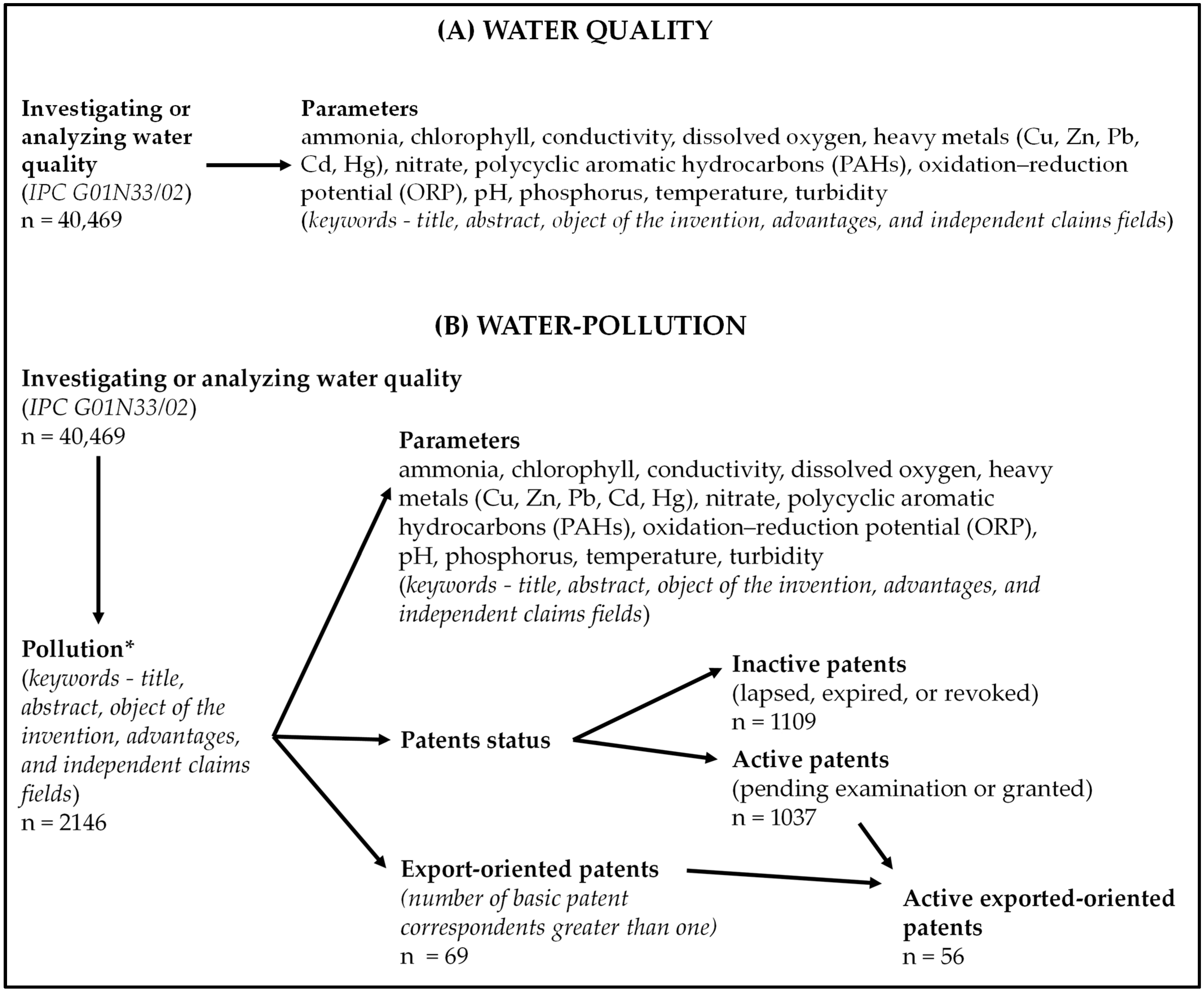
Figure 1 schematically presents the methodological workflow of International Patent Classification (IPC) and keyword-based search strategy. Details of the search strings are provided in Table S1 of the Supplementary Materials.
The initial search was based on the IPC code G01N 33/02 (investigating or analyzing water quality), resulting in 40,469 documents and generating the first patent dataset.
Subsequently, a subset of 2146 patents specifically related to water pollution was identified using keywords combined with truncation characters and Boolean operators applied to the title, abstract, object of the invention, advantages, and independent claims fields.
Complementary searches targeting water quality sensors were also performed. The most frequently monitored parameters were selected, including ammonia, chlorophyll, conductivity, dissolved oxygen, heavy metals (Cu, Zn, Pb, Cd, Hg), nitrate, PAHs, oxidation–reduction potential (ORP), pH, phosphorus, temperature, and turbidity.
These parameters were retrieved using keywords and their synonyms in both UK and US English, combined with truncation characters and Boolean operators, applied to the title, abstract, object of the invention, advantages, and independent claims fields.
Table S1 of the Supplementary Materials provides the complete search strings. The summary of the IPC codes and keywords used is as follows:
  • WATER QUALITY—G01N-033/18
  • WATER-POLLUTION ANALYSIS—(“water* pollut*”) AND G01N-033/18
  • SENSOR—sensor* OR probe* OR monitor* OR “measuring device*” OR “measurement unit*” OR gauge* OR detector* OR analy?er*
  • AMMONIA—ammonia OR azane OR NH3 OR “aqueous ammonia” OR ammonium
  • CHLOROPHYLL—chlorophyll* OR “thylakoid pigment*” OR “phyll pigment*” OR “photosynthetic pigment*” OR “photosynthesis pigment*” OR “leaf green*” OR “chloroplast pigment*” OR “chlorophyllous compound*” OR chlorophyllin*
  • CONDUCTIVITY—condictivit* OR conductance* OR “charge transport*”
  • DISSOLVED OXYGEN—“dissolved oxygen” OR “water oxygen content” OR “oxygen in water” OR “liquid phase oxygen” OR “dissolved O2” OR “aqueous oxygen” OR “aquatic oxygen level*
  • HEAVY METALS—“heavy metal*” OR “toxic metal*” OR “metal pollutant*
  • NITRATE—nitrate* OR azotate*
  • ORP—“oxidation-reduction potential*OR ORP
  • PAHs—pahs ORfused ring aromatic system*ORmultiring aromatic compound*ORpolycyclic aromatic hydrocarbon*ORcondensed aromatic hydrocarbon*ORaromatic hydrocarbon compound*
  • PH—pH ORhydrogen ion concentration*OR alkalinity OR acidity
  • PHOSPHORUS—Phosphorus OR phosphate
  • TEMPERATURE—temperature* ORthermal measurement*ORthermal level*
  • TURBIDITY—turbidit* ORwater clarit*ORwater opacit*OR haze* OR cloudiness* OR nephelometr*
The IPC code G01N 33/02 (investigating or analyzing water quality) was used as the initial inclusion criterion, ensuring high data consistency and quality. It enabled the retrieval of patents specifically related to water-quality investigation or analysis, as IPCs are assigned by official patent offices (national or regional), rather than by applicants.
The FAMPAT system in ORBIT automatically removes duplicate documents.
The exclusion criteria comprised patents with priority dates prior to 2004 and those not classified under IPC code G01N 33/02.
To determine whether additional exclusion criteria were necessary, patent titles were manually screened by the authors to verify their alignment with the scope of this study. In cases of uncertainty, the abstract, claims, and object of the invention fields were also reviewed. No further exclusions were required, which is consistent with the initial use of an IPC-based criterion rather than exclusive reliance on keyword-based filtering.
Thus, the following datasets were created and analyzed:
  • 2146 total patents;
  • 1037 active patents (pending examination or granted);
  • 1109 inactive patents (lapsed, expired, or revoked);
  • 69 export-oriented patents, defined as those filed in countries other than their country of origin, identified by a number of basic patent correspondents greater than one; and
  • 56 active export-oriented patents.
To assess recent growth trends, the Compound Annual Growth Rate (CAGR), a widely used temporal indicator, was applied [28,29,30,31,32,44]. Average values for two biennial periods (2020–2021 and 2022–2023) were compared to minimize the influence of atypical years, using Equation (1).
C A G R ( t 0 ,   t n ) = 100 { ( P t n P t 0 ) 1 ( t n t 0 ) 1 }
where t 0 is the start time, t n is the end time, P t 0 is the number of documents at the start time, P t n is the number of documents at the end time t n .
The ORBIT software was used to automatically create technological cluster landscape analyses [45]. These analyses are generated by aggregating patent families (FAMPAT) into multidimensional vectors based on IPC/CPC classifications, which are further organized into Technology Domains to structure and reduce the complexity of technological fields. Clusters are then statistically consolidated through frequency, co-occurrence, and distribution analyses.
In addition to the figures generated by ORBIT, document counts were exported as CSV files and imported into Microsoft Excel, where they were processed to generate tables and figures. Figures were subsequently refined using PowerPoint.

3. Results and Discussion

Initially, the most common types of water-pollution sensing parameters and their associations are presented. Subsequently, temporal trends are analyzed across different legal statuses, including active patents (pending and granted) and inactive patents (lapsed, expired, and revoked). The global distribution of patents by countries of origin and potential markets is then examined. Finally, the distribution of patents across technological domains is presented, complemented by a technology cluster landscape analysis.

3.1. Water-Pollution Sensing Parameters

Sensing technologies for water-pollution monitoring are essential in current environmental management, and multiple parameters can be monitored [45]. Table 1 presents the number of patents associated with each type of water quality and water-pollution parameter. An initial observation indicates that pollution-related patents are consistently fewer in number, which is expected, as they focus on extreme water quality conditions.
pH and temperature are the most frequently monitored parameters due to their high sensitivity to environmental changes, ease of measurement, and low-cost sensors. pH is a key parameter [45], influencing heavy metal speciation [46]; total ammonia concentrations [47]; and industrial and sanitation discharges [48]. However, measurements may be affected by temperature variations and biofouling, requiring cleaning or advanced optical sensing approaches [49,50,51,52].
Temperature regulates oxygen solubility, biological degradation rates, ammonia toxicity, and eutrophication processes [53,54,55,56]. However, it should be interpreted in conjunction with other parameters due to potential measurement uncertainties, including drift and depth-related variability [57,58,59,60,61,62].
Turbidity is a direct indicator of suspended solids from runoff, agriculture, and erosion. It affects light penetration, photosynthesis, and the performance of optical sensors and UAV-based monitoring systems [63,64,65,66,67].
Dissolved oxygen is a critical indicator of organic pollution and eutrophication, with relevance to SDGs 14 and 2. Accurate measurement requires proper calibration [68,69,70]. Patents refer to portable oxygen sensors, biotoxicity warning systems, and aeration monitoring devices (CN108362846, CN116879520, CN117706053, CN218174768).
Ammonia is highly toxic in its un-ionized form and must be evaluated together with pH and temperature due to the NH3/NH4+ equilibrium [56,71]. Detection methods include membrane, microfluidic, and electrochemical sensors [72,73,74,75,76,77,78]. Patents refer to automatic ammonia monitoring systems (CN217278299, CN217820337, CN213210117).
Phosphorus, a limiting nutrient associated with eutrophication, is often monitored alongside ammonia [78,79,80,81,82,83]. Patents refer to sensing membranes and treatment systems (CN219031910, US12339228).
Oxidation–reduction potential (ORP) reflects organic loading, sulfides, and aeration conditions. It serves as a rapid early-warning indicator, particularly when combined with other parameters, and can be measured using Internet of Things (IoT)-based sensors [84,85,86,87]. Patents refer to ORP monitoring and control systems (CN120351964, CN107340375).
Heavy metals such as mercury, lead, chromium, cadmium, and arsenic exhibit cumulative toxicity in aquatic systems [88]. Detection typically requires sensitive analytical methods, often laboratory-based or calibrated in situ, including biomonitoring approaches [89,90,91,92,93,94,95,96,97,98,99]. Patents refer to chemical sensors and intelligent detection systems (US10690647, CN203396770, CN219201564).
Conductivity is used to identify pollution from industrial effluents, sewage, and salinity changes. It correlates with total dissolved solids and is commonly combined with temperature measurements [100,101,102,103,104]. Patents refer to integrated multi-parameter monitoring systems (KR10-2025-0088929, WO2022/011399, US7691329).
Nitrate, a key pollutant from agricultural runoff, contributes to eutrophication and water quality degradation. Detection relies on electrochemical and optical methods with compensation requirements [105,106,107,108,109,110,111,112,113,114]. Patents refer to advanced sensing materials (CN117805208).
Chlorophyll is an indicator of eutrophication and harmful algal blooms. Monitoring is based on fluorescence, absorbance, and remote sensing techniques [64,67,115,116,117,118,119]. Patents refer to both monitoring and mitigation strategies (US11097813, CN110057992).
PAHs, mainly derived from oil spills, are toxic and bioaccumulative. Detection relies on laboratory and spectroscopic techniques [81,120,121,122,123,124,125,126]. Patent CN106290759 refers to biomarker-based detection using fish ATPase activity.
Recent patents emphasize multi-parameter monitoring systems and pollution control technologies (CN105866364, CN209707494, CN207742191, CN220795207). These include remote monitoring platforms such as unmanned surface vehicles and robotic systems, as well as fluorescence-based spatial mapping approaches.
Integrated solutions include monitoring–treatment vessels and systems for pollutant profiling (CN113859451, CN102478532). Intelligent monitoring systems increasingly incorporate IoT, machine learning, and automated sampling, enabling improved detection, prediction, and source tracking (CN221726005, CN104217040, CN116451142, US12105075, CN202648999, KR10-2592931).
Machine learning techniques reduce inter-parameter interference and improve multi-sensor accuracy [127,128]. These approaches are also applied in large-scale satellite-based analyses supporting SDG monitoring [51,129].
Patent Applications span groundwater, drinking water, sewage systems, aquaculture, industrial processes, and environmental monitoring (CN112114107, KR10-2622449, US20250044272, CN208076506, CN207380025, KR10-1328026; JP7351046, CN116125027, CN105445431, CN108318651, CN115211391).
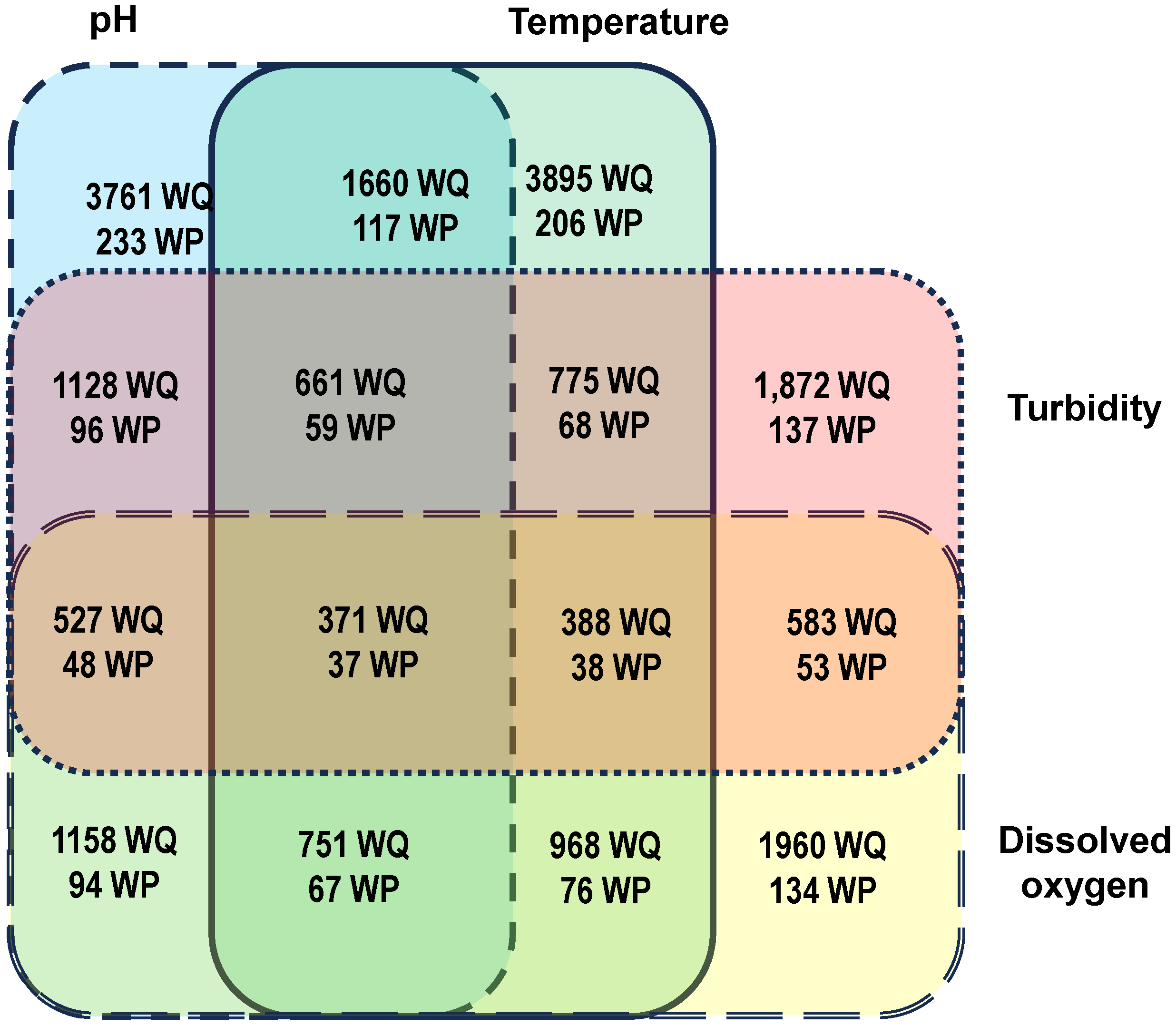
Figure 2 presents a comparative overview of the number of patents associated with the four most frequently monitored parameters—pH, temperature, turbidity, and dissolved oxygen—and their respective associations. Patent counts related to general water quality are consistently higher than those specifically addressing water pollution. This pattern indicates that water-pollution monitoring requires more targeted technologies capable of distinguishing harmful conditions in aquatic environments, leading to water-quality degradation and subsequent classification as polluted (see also Table S2A,B in the Supplementary Material).
For both water quality and water pollution (Figure 2), patents involving combined pH and temperature sensors are the most numerous (1660 and 117, respectively), followed by combinations of pH with turbidity (1128 and 98) and with dissolved oxygen (1158 and 984). This distribution is expected, as pH is an essential parameter for diagnosing both water quality and pollution across multiple applications and influences most other indicators. Similarly, temperature is frequently associated with dissolved oxygen in both contexts (968 and 76, respectively).
Among combinations involving three sensors, the most prominent is the association of pH, temperature, and dissolved oxygen (751 and 67), consistent with their strong interdependence. The combination of all four parameters accounts for only about 10% of patents focused on water pollution (371 and 37).
Understanding the current stage of technological development is essential for defining appropriate levels of human and financial resource allocation. It is therefore necessary to assess whether these technologies are mature, emerging, or represent future potential. Analysis of temporal trends provides insights into these aspects.

3.2. Patent Temporal Trends

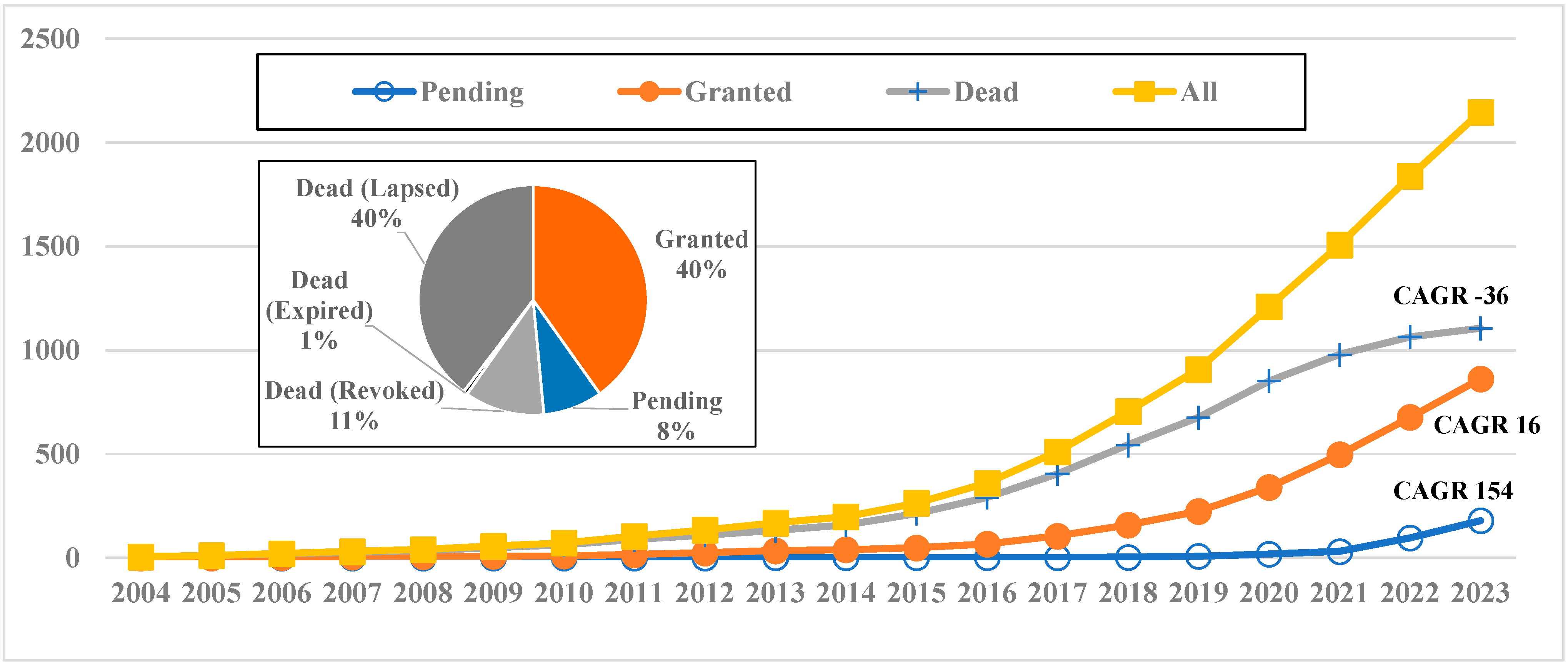
Figure 3 shows the cumulative annual evolution of patents and a breakdown of their legal status. An initial observation indicates that the total number of patents follows an emerging technology pattern, characterized by exponential growth. This trend suggests that water-pollution monitoring represents a significant global challenge and reflects sustained investment of social capital in technological development.
It can be observed that active patents (Figure 3), including both granted (40%) and pending applications (8%), exhibit an exponential growth pattern, confirming that this field represents an emerging technology in the early phase of the S-shaped knowledge diffusion curve. The CAGR between the 2020–2021 and 2022–2023 biennia indicates a positive growth rate in granted patents (16) and a markedly higher growth rate in pending applications (154), further supporting this classification.
The accelerated growth in pending patents may also reflect technologies originating from countries whose national intellectual property (IP) offices experience examination delays. A time lag is observed from 2021, corresponding to approximately five years relative to the data collection year, indicating contributions from jurisdictions with longer processing times. For example, India has an average examination duration of approximately 49.5 months [129], while in other countries, such as China [130] and South Korea [131], where average examination times are around 16 months, processing times have also exceeded expected durations.
Inactive patents exhibit a negative CAGR (−36), indicating a field characterized by intensive recent patenting activity and a tendency to maintain technological competitiveness. Inactive patents account for approximately half of the total, which is below the typical proportion of about two-thirds observed in other fields. This further supports the recent emergence of this field, particularly given that patents expired after reaching the 20-year legal protection period represent only a negligible share (1%).
A high proportion of lapsed patents (40%) is observed, primarily due to non-payment of maintenance fees, indicating reduced interest from applicants. These patents have entered the public domain and may be used without authorization from the original holders. They originate predominantly from more than fifty Chinese organizations and are concentrated in the period immediately before and after the COVID-19 pandemic. This pattern suggests possible challenges in intellectual property (IP) management by technology transfer offices or strategic shifts in market positioning, leading to the release of technologies for potential local development.
Revoked patents, invalidated through administrative or judicial decisions, also represent a considerable proportion (11%) within this technological field. This suggests competitive dynamics in which third parties challenge patent validity, with national offices or courts determining that patentability criteria were not met. Analysis of applicants indicates that revoked patents are largely concentrated among Chinese applicants and filings in China, with only a small number originating from South Korea. Their temporal distribution spans approximately from 2014 to 2022. However, when considering revoked patents targeting export markets, only five cases were identified, indicating that invalidation is primarily associated with domestic competition in China.
These findings raise further questions regarding the global geopolitical distribution of patent activity. Specifically, which countries are most active in the technological development of water-pollution detection, and which countries represent the primary target markets for these technologies?

3.3. Global Distribution of Patent Origins and Patent Potential Markets

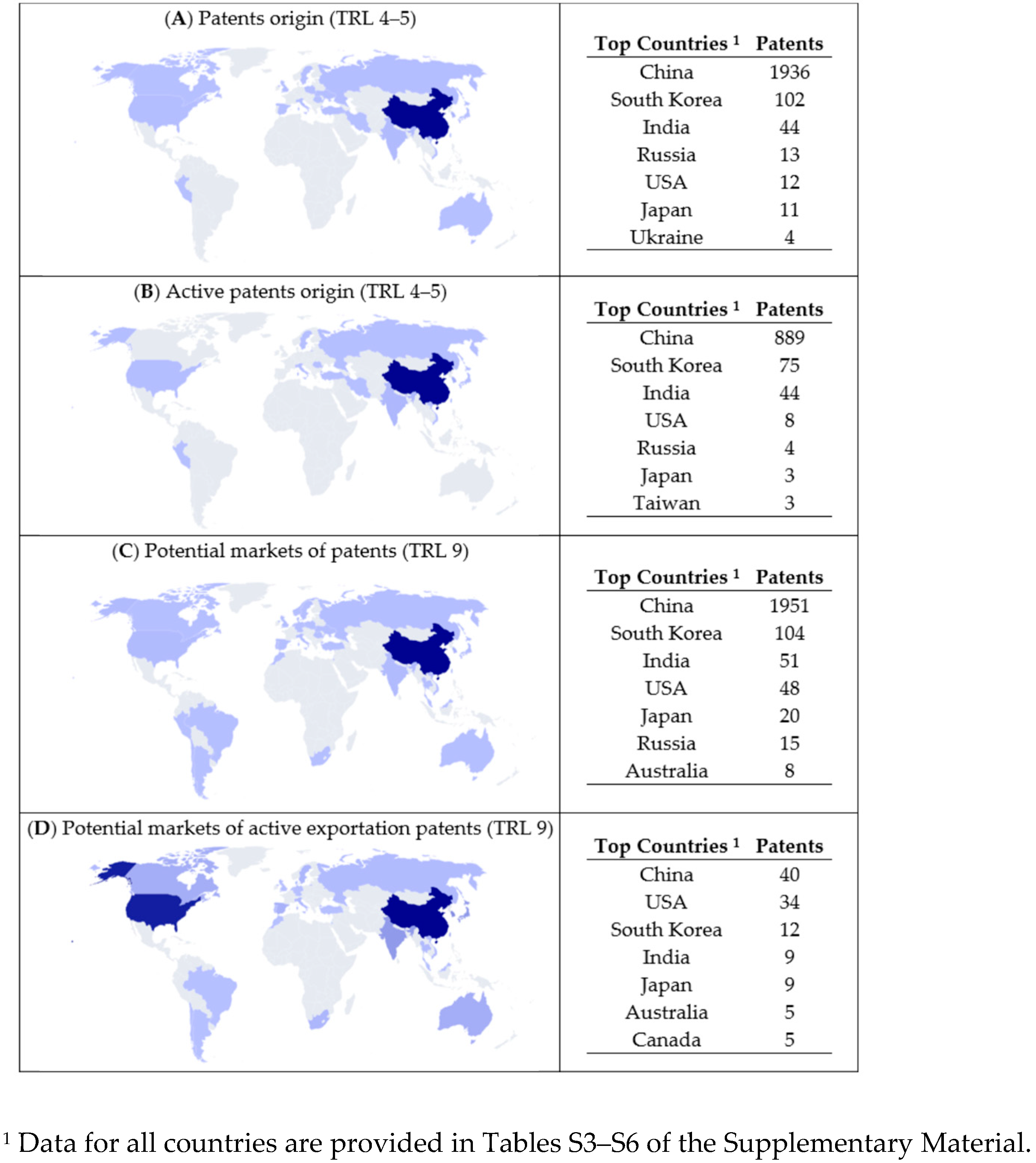
Figure 4 presents world maps that provide a global overview of the countries of origin of the technologies (TRL 4–5) and the countries identified as potential markets (TRL 9), considering both all patents and active export-oriented patents (see also Tables S3–S6 in the Supplementary Material).
Twenty countries are involved in the development of technologies in this field (Figure 4A), with China identified as the leading country. China’s prominence is associated with increased R&D investment since the early 21st century and policies linking TRL 3 research to TRL 4–5 development [132]. This reflects a state-driven strategy aimed at strengthening domestic innovation to sustain economic growth [133]. Environmental patents also contribute to enhanced participation in global value chains [24].
However, only 14 countries currently maintain active patents (Figure 4B). The remaining countries—Ukraine, Taiwan, the United Kingdom, Australia, Canada, Spain, and Poland—have allowed their patents to lapse. In the case of Ukraine, the ongoing conflict is likely a major contributing factor. For the other countries, this pattern suggests a strategic preference for importing technologies to protect maritime borders, particularly in regions with port activities requiring pollution monitoring.
Among active patents, only 5% are directed toward export markets, indicating that this technological field is primarily oriented toward local development, with applicants designing solutions tailored to specific social and environmental contexts.
When only active export-oriented patents are considered, the 20 countries of origin (Figure 4A) and the 14 countries with active patents (Figure 4B) are reduced to 11 origin countries (Figure 4D): China (27), South Korea (10), the United States (4), India (2), Italy (2), Japan (2), Sweden (2), Taiwan (2), Iran (1), Turkey (1), and Vietnam (1). These countries initially targeted export markets in 32 countries (Figure 4C); however, active patents are maintained in only 28 countries (Figure 4D). A shift is observed, with China moving from a dominant target market in total filings (Figure 4C) to near parity with the United States in active patents, with 40 and 34 active patents, respectively (Figure 4D).
Target patent markets (TRL 9) span a wide range of countries, with approximately 3% of patents filed via the Patent Cooperation Treaty (PCT) route or within the European patent system.
Strong coherence is observed between technological development and market strategy, as the same leading countries—China, South Korea, India, the United States, and Japan—remain dominant in overall patent generation (Figure 4A), maintenance of active patents (Figure 4B), and priority target markets (Figure 4C,D). This alignment distinguishes this technological field from several other domains [32,134]. Russia and Ukraine, although ranked among the top seven countries in technology development, do not appear among the top seven target markets. This pattern may be associated with disruptions linked to recent wartime conditions [133], highlighting the loss of inventive capacity in environmental sustainability technologies under such circumstances.
Africa is absent from this technological development trajectory and from the increase in technological maturity related to water-quality monitoring and pollution detection (Figure 4), despite South Africa and Morocco being identified as target patent markets.
Active export-oriented patents comprise seven pending applications and 49 granted patents. The average patent family size is 4.6, indicating interest in protection across multiple jurisdictions. In addition, 13 inventions include applications filed with the European Patent Office (EPO), and eight were filed via PCT. These patents exhibit a relatively high average citation count (11), indicating technological relevance, with an average patent value of 3.1 and an originality index of 0.81 [135].
Among organizations holding active export-oriented patents, 11 are multinational companies, 20 are national companies, 13 belong to the academic sector, and 12 are governmental entities. Approximately 23% of the patents are held by the top 10 applicants.
Among global companies, Anatek Enterprise, Anatek Scientific Instrument, and General Xiang Science Instrument patented an automatic jar test analyzer that enables automated determination of the coagulant concentration required to promote contaminant precipitation in water samples (TWI695982).
Ashland developed a proactive real-time data analysis system designed to optimize corrosion, scaling, fouling inhibition, and particulate dispersion performance while reducing water and treatment chemical consumption, thereby improving the efficiency of industrial water systems (WO2009/020709).
Jinan Shidai Assaying Instrument Co., Ltd. (Jinan, China), in collaboration with Shandong University and the South China Institute of Environmental Sciences, developed a method and system for biomonitoring water pollution by organic compounds and heavy metals with high sensitivity and low cost. This approach is based on real-time electrocardiographic signals of fish under normal swimming conditions (WO2020/010836).
Kankyo System Service, Nissho Invention & Design Institute, and Kawasaki Heavy Industries, through its Environmental Electronics division, jointly developed a purification system based on a bioassay device designed to reduce turbidity interference. The system uses the medaka fish (Oryzias latipes) as a biological indicator (WO2024/161846).
LG Electronics patented a device and method for measuring turbidity over a wide range by amplifying optical signals using a reflector (KR10-2025-0002073).
Petrofarzan Apadana developed an apparatus for remote detection of oil pollutants in water using laser-induced fluorescence of petrochemical hydrocarbons (WO2021/205223).
Qilu Pharmaceutical, Qilu University of Technology, and the Shandong Academy of Sciences patented a device for pollution detection based on microbial fuel cell energy generation, enabling monitoring of pH and temperature without manual sampling (WO2022/217734).
The Science & Technology Analysis Center developed a device for simultaneous measurement of multiple pollutants, using voltage differences generated by each sensor to determine contamination levels of lead, cadmium, mercury, copper, chloride, nitrogen, and nitrate (CN102478532).
SK Technology Innovation developed a technology based on Fast Fourier Transform (FFT) image processing to assess water pollution by microplastics, enabling detailed analysis of particle size, quantity, and polymer type (EP4578834).
General Electric, currently owned by TortoiseEcofin Investments, developed a method for contaminant detection using an architecture designed to reduce interference through purging, combined with a camera-assisted flow system (US20080116908).
The Institute of Oceanology of the Chinese Academy of Sciences and Qingdao Bangbang Information Technology of ZTE Corporation developed an online monitoring device that minimizes measurement errors and signal loss caused by pollutant accumulation on sensor surfaces (AU2021103878).
Patent co-ownership is observed exclusively among Chinese organizations, indicating strong national coordination aimed at advancing water-pollution detection technologies. Co-inventor networks are extensive but largely isolated, suggesting that, despite interorganizational collaboration, technological development occurs within research environments characterized by limited information exchange across groups.
Only the patent held by Tecnosens, filed in multiple countries, including via the EPO and PCT, has faced opposition; however, it has already been granted in several jurisdictions. This patent refers to the use of nano- and/or microstructured printed electrodes as electrochemical probes for water-pollution measurement (IT201700046831).
These technologies exhibit export potential; however, this raises a broader question regarding the overall landscape of water-pollution detection technologies.

3.4. Technological Landscape

The technological landscape was analyzed using the distribution of technological domains across patents and their interconnections through the technological cluster landscape.

3.4.1. Technological Domains

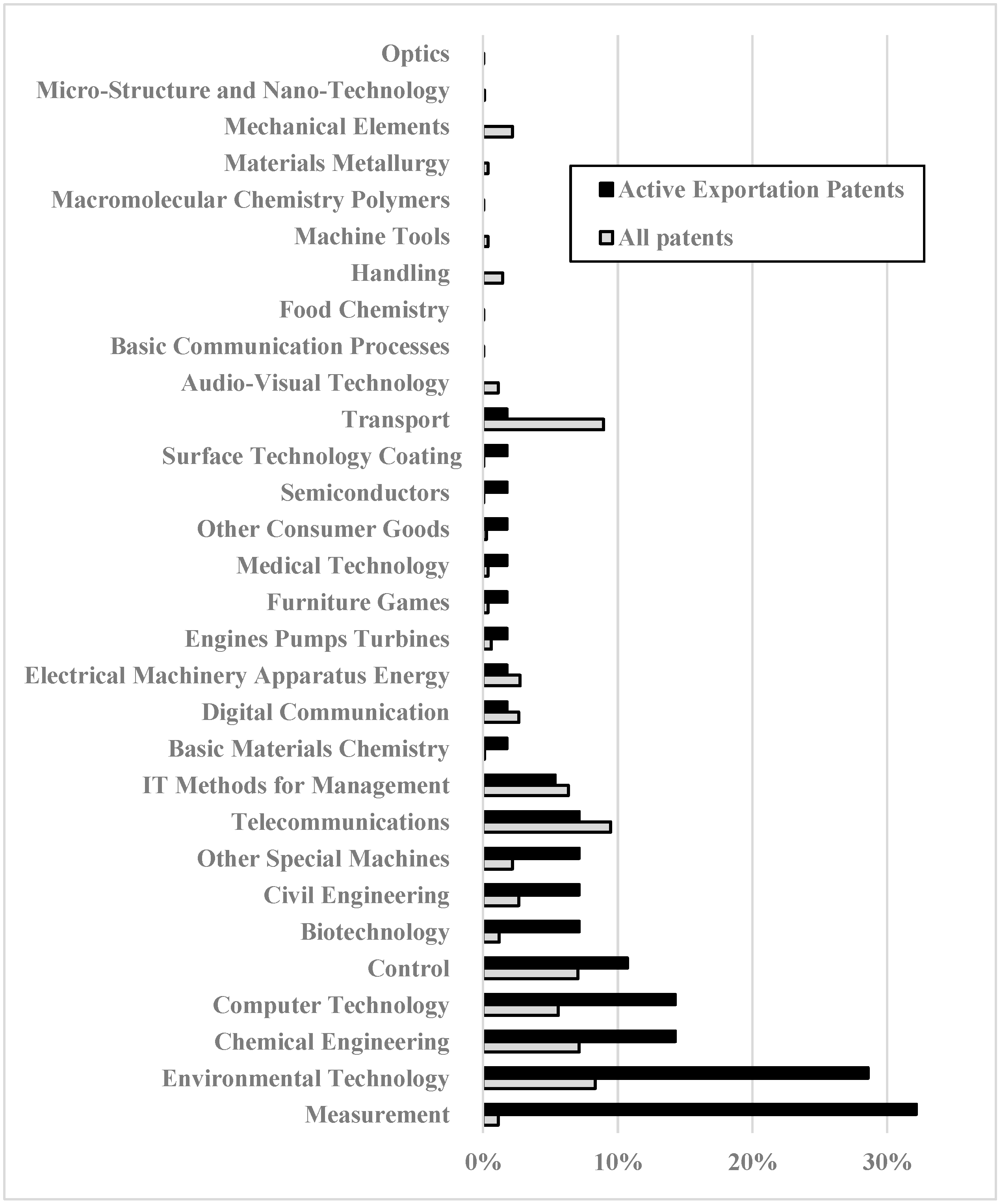
The distribution by technological domain, according to the IPC codes of the patents [136], is presented in Figure 5. This distribution is predominantly concentrated in the domain of Analysis of Biological Materials, as pollution detection is primarily classified within this domain in patent documentation (see Table S7 of the Supplementary Material).
For patents overall, the most relevant technological domains are Telecommunications (9.5%), Transport (8.9%), Environmental Technology (8.3%), Chemical Engineering (7.1%), Control (7.0%), IT Methods for Management (6.3%), and Computer Technology (5.6%).
In contrast, for active and export-oriented patents, the predominant domains shift to Measurement (32.1%), Environmental Technology (28.6%), Chemical Engineering (14.3%), Computer Technology (14.3%), Control (10.7%), Biotechnology (7.1%), and Civil Engineering (7.1%).
A significant contribution from automation and remote detection–related domains is observed, including control systems, computer engineering, digital communication, and information technology–based management methods. More recently, some patents have incorporated generative intelligence approaches based on interpenetrating neural networks.
Only a limited number of patents address rapid warning systems for sudden changes in water quality or the entry of specific pollutants, indicating a recently emerging technological direction.
Data acquisition is also a relevant aspect of patented technologies. Several documents describe structural configurations for sensor fixation. In most cases, sample collection followed by laboratory analysis is required. Some patents describe vessels designed as sample collectors, while others refer to satellite- or drone-based data acquisition using spectroscopic techniques, including visible color changes, reflectance variations, infrared spectra, and characteristic Raman peak shifts.
The most common energy source for water-pollution detectors is photovoltaic solar power, with recent developments integrating these systems into sensor mounting structures [137]. Only a limited number of patents refer to tidal energy, river flow at estuaries, or hybrid renewable configurations.
Patents describe sensor applications in marine environments, estuaries, lagoons, lakes, groundwater systems, and storage tanks. The most frequently monitored indicators are pH (233 patents), followed by turbidity (137 patents), ammonia (69 patents), and chlorophyll (9 patents), often using spectroscopic methods.
Technologies integrating pH, ammonia, and turbidity sensors include an underwater online monitoring system patented by Imp. Env. Technology (CN107340375) and a groundwater pollution detection system developed by Northwest University (CN105866364).
Technologies combining pH, ammonia, turbidity, and chlorophyll sensors include water-depth profiling systems with early warning capabilities (KR10-13280260) and visual monitoring systems with algae removal based on ultrasound and online data analysis (CN110057992). A machine learning–based method for sensor fault detection has been developed to improve robustness against failures and reduce monitoring uncertainty (CN116451142). In addition, an unmanned surface vehicle for aquatic ecosystem monitoring and restoration has been proposed to eliminate manual sampling and reduce delays between detection and intervention (US11097813).
Within the methodological domain, several patents describe analytical and evaluation approaches, including methods for manganese concentration assessment (CN1036614), evaluation of fishing habitat water quality (CN111126768), intelligent calibration of marine monitoring systems (CN116087455), and advanced modeling techniques integrating optimization algorithms and machine learning (CN115762669, CN119624228, CN119026955, CN119783371).
Within the methodological domain, several Chinese patents stand out. These include a method for evaluating manganese concentration in water (CN1036614); a method and system for assessing water quality in fishing habitats (CN111126768); an online intelligent calibration method for initial reference values in marine water quality detection (CN116087455); a river water quality assessment method based on an enhanced gray correlation analysis algorithm combined with a multiclass support vector machine optimized by particle swarm optimization (CN115762669); a data analysis–based water quality evaluation method (CN119624228); a comprehensive water quality assessment method (CN119026955); and a method, system, and storage medium for accurate simulation of water quality and quantity based on the SWOT model (CN119783371).
Structural designs and equipment are also addressed, including fixation devices for multiparameter monitors (CN204188634), multifunctional aquaculture vessels (CN115009418), integrated detection equipment and evaluation methods (CN113959990), and devices for monitoring temperature profiles and water-quality indices in lakes (CN216559088).
Some patents combine methods and systems, including mobile monitoring of density flow stratification in reservoir environments (CN104457712), as well as integrated visual monitoring and algae removal systems (CN110057992, CN210764447).

3.4.2. Technology Cluster Landscape

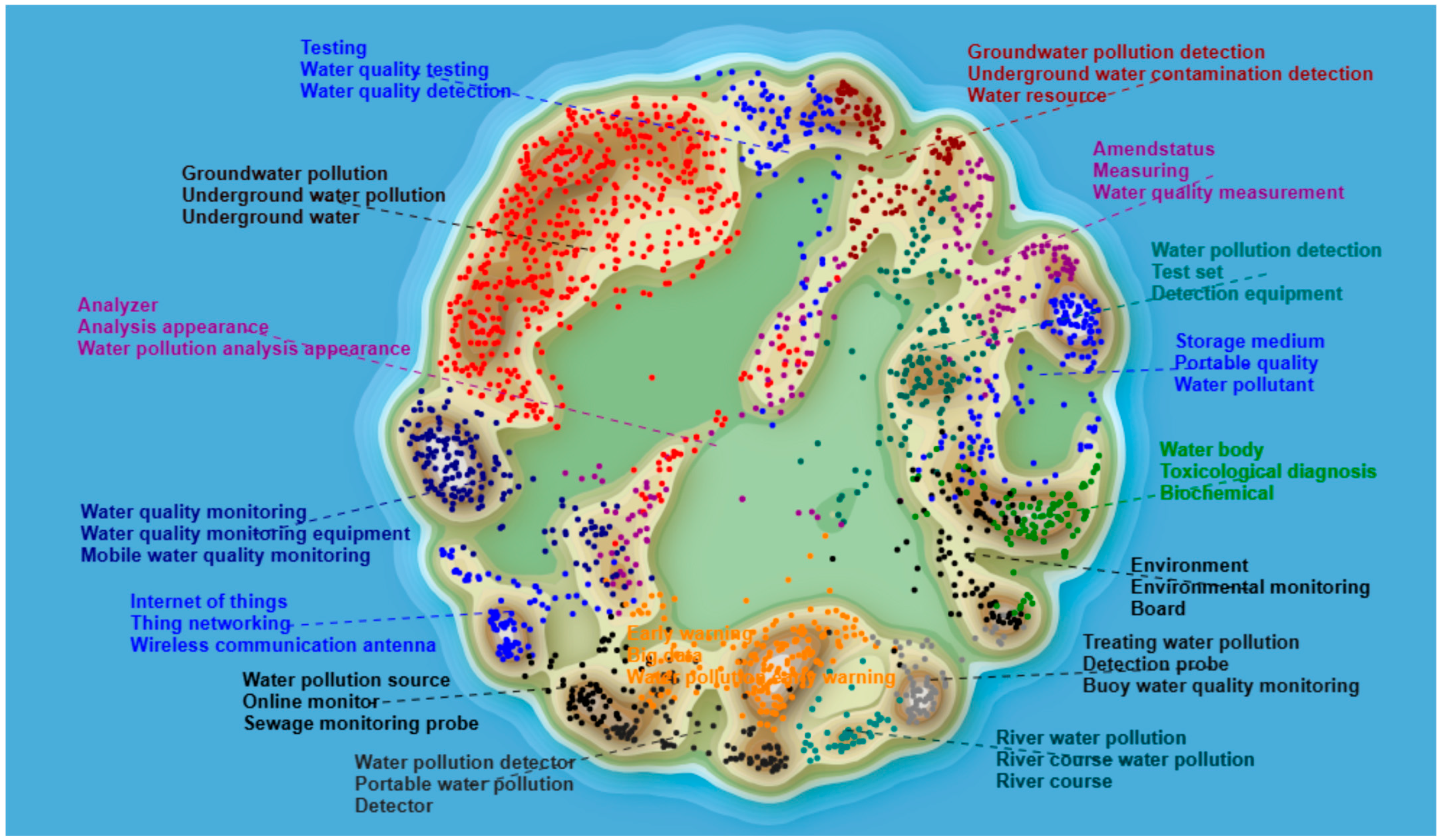
Figure 6 presents a technology landscape in the form of an island map, in which clusters are represented as mountainous regions encompassing all patents. Each point corresponds to an individual patent, and the distance between points, and thus their spatial distribution, is determined by the similarity of patent claims (see also Figure S1 of the Supplementary Material).
The largest technology cluster (red dots, second from the right) focuses on ground and groundwater pollution, which is consistent with the global challenge of ensuring the quality of water reservoirs used for drinking water production through continuous monitoring and preservation. In addition to water-quality analysis, clusters related to water resources and groundwater-pollution detection (dark red points in the upper right) reinforce the need for continuous monitoring and early detection of contamination. Once contaminated, groundwater is significantly more difficult to remediate than surface water. Similarly, pollution affecting water storage media (blue cluster, fourth from the right) requires continuous monitoring.
Sewage monitoring probes (black dots cluster, sixth from the left) represent a relevant source of water pollution that requires real-time monitoring. These systems enable early alerts at the onset of contamination events, allowing incidents to be prevented or mitigated before escalation.
River water pollution (green cluster, eighth from the left) represents a smaller but relevant group, as many human activities discharge waste into rivers. Examples include effluents from rice cultivation, aquaculture, agribusiness, and terrestrial animal production systems.
Portable water detection kits (gray cluster, eighth from the left), test sets with detection equipment (green cluster, third from the right), and general water-quality testing systems (blue cluster, first from the right) represent conventional field analysis and sample collection approaches. These systems remain essential in contexts where remote and real-time monitoring is not available.
Water appearance analyzers and pollution assessment tools (pink cluster, third from the left), as well as toxicological and biochemical analysis systems (green cluster, fifth from the right), are essential for ensuring safe human consumption and maintaining aquaculture systems free from pests, parasites, and diseases. Buoy-based water-quality monitoring systems equipped with detection probes (gray cluster, seventh from the right) also play a key role in pollution control and water management.
General environmental monitoring platforms (black dots, sixth cluster from the right) represent a fundamental and generic group, focused on parameters aligned with the SDGs. Analysis of patents in this cluster indicates that the addressed SDGs are multiple and overlapping, exhibiting synergistic and interconnected relationships, with strong links to SDGs 6, 3, 2, 14, and 15 [27,138].
A more recent objective, enabled by the widespread availability of low-cost, high-speed internet, is real-time monitoring (dark blue cluster, fourth from the left). This approach relies on IoT and generative intelligence techniques (blue cluster, fifth from the left) and may incorporate alarm systems for pollution events (orange cluster, inner bottom). Previous studies also report advantages of IoT and cyber-physical systems in water-quality monitoring, particularly in enabling real-time detection while reducing operational costs and system complexity, despite the continued use of advanced yet simplified monitoring approaches [35,38].
This TRL 4–5 analysis demonstrates advances in multi-parameter sensors and bioindicators, expanding detection capabilities, including for emerging contaminants. However, these developments introduce challenges, such as sensor drift, biofouling, and cross-sensitivity, which increase uncertainty in AI-based analyses. Integration with digital twins enhances simulation and decision support, but requires high-frequency, validated, and interoperable data. Previous studies indicate that biosensors represent a niche area in water-quality monitoring; however, technologies at TRL 4–5 remain limited, and large-scale application is constrained by factors such as size, cost, detection range, leakage of biological elements, selectivity, and challenges in online deployment [38].
Future trends in water-quality monitoring are shaped by AI-based predictive analytics and early-warning systems [34]. However, limitations persist in detecting pollutants and generating actionable information [33]. System performance depends on data quality, sensor reliability, and the representativeness of training datasets, which restrict robustness in heterogeneous environments such as coastal and port systems.
Continuous monitoring combined with machine learning improves temporal resolution and pattern recognition. However, predictive models may fail under rapid environmental changes, and anomaly detection depends on stable baselines that are difficult to establish in dynamic systems.
Patent analysis indicates an emerging yet still limited integration of AI with IoT [139], enabling scalable and autonomous monitoring. Nevertheless, challenges remain, including interoperability, energy demand, maintenance, and cybersecurity. These technologies support predictive and decision-oriented management and align with sustainability objectives. However, implementation remains constrained by technical barriers and limited standardization. Robust calibration, interoperable frameworks, and hybrid modeling approaches are required.

4. Conclusions

This field remains an emerging technology, drawing extensively on approaches originally developed for laboratory-based research. A substantial number of patents still focus on laboratory methodologies for sample analysis, including preparation, digestion, and storage. These approaches offer advantages such as reduced material consumption, lower waste generation, and shorter analysis time. However, they require physical sample collection and transport to laboratory facilities.
A growing trend involves real-time, in situ analysis at the point of interest, aiming to ensure reliability, repeatability, and robust detection limits. Achieving this requires the integration of AI, IoT, and machine learning into accessible platforms. Previous studies based on TRL 3 have highlighted the relevance of IoT and cyber-physical systems in water-quality monitoring [35,38]. The present analysis, based on patents (TRL 4–5), indicates that although these technologies have progressed toward market-oriented stages, their development remains at an early phase, requiring further maturation to establish reliable and scalable technological solutions.
Current technological bottlenecks include sensor resistance in harsh environments, such as marine systems and estuarine zones, and the difficulty of distinguishing meaningful pollution signals from background variability. This includes differentiating conditions classified as acceptable water quality from those considered contaminated [140,141]. Although this topic is extensively addressed at TRL 3, further technological consolidation is required to advance toward patentable and deployable solutions at TRL 4–5.
Unlike previous bibliometric patent studies that primarily describe global growth patterns, the present geographical analysis reveals a structurally fragmented innovation landscape, characterized by strong nationalization of technological development and limited transnational diffusion. This suggests that water-quality monitoring technologies are evolving within localized innovation systems rather than converging toward globally integrated solutions, raising concerns regarding equitable access and the effective achievement of SDG-related targets. The high concentration of patents in a limited number of countries, combined with the role of environmental patents in shaping participation in global value chains [24], reinforces these concerns.
From an international perspective, uncertainty remains regarding the extent to which these technologies will be shared across countries. It is necessary to evaluate the affordability of technology transfer and whether the resulting financial and non-financial benefits translate into improvements in quality of life. It is also relevant to consider whether fair mechanisms, including intercultural approaches to knowledge exchange [142], will be implemented and how fairness is defined across different contexts.
This study, based on patents as proxies of future innovation, presents inherent limitations. It does not account for traditional indicators of operational readiness, such as TRL 9 in civil and environmental infrastructure. Due to the 18-month confidentiality period under the PCT, not all existing patents were captured. In addition, some organizations may retain developments as confidential in-company knowledge or adopt trade-secret strategies rather than formal patenting. The analysis relies on the IPC codes, which, although widely used, may not be consistently assigned to all documents in the Espacenet database.
To achieve the United Nations 2030 Agenda, it is essential that these technologies accelerate their development, combining a strong local focus with the capacity for global application across “Our Common Home,” planet Earth [3,4]. Solutions should be widely deployable and accessible at low cost.
Although the required knowledge base is available, as demonstrated by ongoing technological development and patenting activity, progress along the TRL scale depends on effective use of intellectual property. This requires appropriate legislative and regulatory frameworks, sustained funding, and policy instruments that incentivize participation from the productive sector. It also raises questions regarding the capacity of leading countries in intellectual property generation to implement these enabling conditions.
Environmental innovation derived from patents is context-dependent rather than universally beneficial. It requires strong managerial capabilities, financial stability, and policy support, functioning as a conditional multiplier in sustainable innovation [25].
Future research on water quality should incorporate economic, environmental, and social sustainability assessments into decision-making processes, with emphasis on life-cycle approaches and frugal innovation [143].
In this context, it is essential for the United Nations and the Food and Agriculture Organization to develop strategies and mechanisms that recognize technological overlaps and address existing bottlenecks. These efforts should facilitate effective intercultural translation, incorporating diverse epistemological and ontological perspectives, and promote multilateral technology sharing within a multiversal context. [142].

Supplementary Materials

The following supporting information can be downloaded at: https://www.mdpi.com/article/10.3390/su18073396/s1, Table S1: Patent search scopes; Table S2: Number of patents referring to combinations of the four most frequently monitored parameters: (A) water quality; (B) water-pollution; Table S3: First-priority countries of all patents (TRLs 4–5); Table S4: First-priority countries of active patents—those pending examination or granted (TRLs 4–5); Table S5: Countries where patents have been filed beyond the first priority, indicating potential commercial markets (TRL 9); Table S6: Countries where active patents have been filed beyond the first priority, indicating potential commercial markets for export (TRL 9); Table S7: Number and percentage distribution of patents by technological domain: all patents and active export-oriented patents; Table S8: List of patents cited; Figure S1: Technological domains of patents: (A) all patents; (B) active patents.

Author Contributions

Conceptualization: C.M.Q., R.S. and A.M.A.T.M.; methodology: C.M.Q.; validation: C.M.Q., R.S. and A.M.A.T.M.; formal analysis: C.M.Q.; investigation: C.M.Q., R.S. and A.M.A.T.M.; data curation: C.M.Q.; writing—original draft preparation: C.M.Q.; writing—review and editing: all authors; supervision: A.M.A.T.M. All authors have read and agreed to the published version of the manuscript.

Funding

This work was produced within the scope of the Agenda “NEXUS–Pacto de Inovação–Transição Verde e Digital para Transportes, Logística e Mobilidade”, financed by the Portuguese Recovery and Resilience Plan (PRR), with no. C645112083-00000059 (investment project no. 53). The study was also supported by national funds from FCT—Fundação para a Ciência e a Tecnologia, I.P. (Portugal) through projects UID/04292/2025 and UID/PRR/04292/2025, awarded to MARE—Marine and Environmental Sciences Center, and by project LA/P/0069/2020 (https://doi.org/10.54499/LA/P/0069/2020), awarded to the Associate Laboratory ARNET-Aquatic Research Network.

Data Availability Statement

The original contributions presented in this study are included in the article/Supplementary Materials. Further inquiries can be directed to the corresponding author.

Acknowledgments

C.M.Q. acknowledges a productivity fellowship in technological development research from the National Council for Scientific and Technological Development of Brazil (CNPq). The authors also acknowledge Axonal and Questel for providing access to their ORBIT v2.0.0 software as part of the Professional Master in Intellectual Property and Technology Transfer for Innovation (PROFNIT) program. The authors have reviewed and edited the output and take full responsibility for the content of this publication.

Conflicts of Interest

The authors declare no conflicts of interest.

Abbreviations

The following abbreviations are used in this manuscript:
CAGRCompound Annual Growth Rate
EPOEuropean Patent Office
IAArtificial Intelligence
IoTInternet of Things
IPCInternational Patent Classification
PAHsPolycyclic Aromatic Hydrocarbons
PCTPatent Cooperation Treaty of the World Intellectual Property Organization
SDGSustainable Development Goal
TRLTechnology Readiness Level

References

  1. United Nations Transforming Our World: The 2030 Agenda for Sustainable Development. Available online: https://sdgs.un.org/2030agenda (accessed on 19 July 2025).
  2. United Nations. Sustainable Development Goals. Available online: https://sdgs.un.org/goals (accessed on 19 July 2025).
  3. Fincham, G. “A World Not Our Own to Define”: Ecological Solutions to Global Catastrophe in the Works of Barry Lopez. Engl. Acad. Rev. 2024, 41, 33–46. [Google Scholar] [CrossRef]
  4. Joseph, J.A. The Ethical Interface of Sustainable Prosperity in the Teachings of Pope Francis. J. Dharma 2021, 46, 279–294. [Google Scholar]
  5. Porat Wojakowski, M.; Porat-Butman, S. A One Health Call to Re-Examine Medical Practice: Going beyond Strong Anthropocentrism. Sci. One Health 2025, 4, 100129. [Google Scholar] [CrossRef] [PubMed]
  6. Food and Agriculture Organization of the United Nations—FAO. Blue Transformation—Roadmap 2022–2030. Available online: https://openknowledge.fao.org/items/467191e5-111b-4191-a4d3-843e491fd418 (accessed on 29 August 2025).
  7. Organisation for Economic Co-Operation and Development. Meeting Policy Challenges for a Sustainable Bioeconomy. Available online: https://www.oecd.org/en/publications/policy-challenges-facing-a-sustainable-bioeconomy_9789264292345-en.html (accessed on 29 August 2025).
  8. Carbonell, S.A.M.; Cortez, L.A.B.; Madi, L.F.C.; Anefalos, L.C.; Baldassin Junior, R.; Leal, R.L.V. Bioeconomy in Brazil: Opportunities and Guidelines for Research and Public Policy for Regional Development. Biofuels Bioprod. Biorefin. 2021, 15, 1675–1695. [Google Scholar] [CrossRef]
  9. BRICS. Países Do BRICS Aprovam Declaração Conjunta Com Foco Em Segurança Alimentar. Available online: https://brics.br/pt-br/noticias/paises-do-brics-aprovam-declaracao-conjunta-com-foco-em-seguranca-alimentar (accessed on 29 August 2025).
  10. Gandra, V.; Salgado, R.; Ribeiro, R.S.; Chainho, P.; Galhanas, D.; Mata, A.M.T. Development of a Water Quality Index as a Management Tool to Sado Coastal Estuarine Areas. J. Coast. Conserv. 2023, 27, 20. [Google Scholar] [CrossRef]
  11. Ujjania, N.C.; Dubey, M. Water Quality Index of Estuarine Environment. Curr. Sci. 2025, 108, 1430–1433. [Google Scholar]
  12. Rodrigues, M.; Cravo, A.; Freire, P.; Rosa, A.; Santos, D. Temporal Assessment of the Water Quality along an Urban Estuary (Tagus Estuary, Portugal). Mar. Chem. 2020, 223, 103824. [Google Scholar] [CrossRef]
  13. Zawala, J.; Swiech, K.; Malysa, K. A Simple Physicochemical Method for Detection of Organic Contaminations in Water. Colloids Surf. A Physicochem. Eng. Asp. 2007, 302, 293–300. [Google Scholar] [CrossRef]
  14. Zhang, H.; Li, H.; Gao, D.; Yu, H. Source Identification of Surface Water Pollution Using Multivariate Statistics Combined with Physicochemical and Socioeconomic Parameters. Sci. Total Environ. 2022, 806, 151274. [Google Scholar] [CrossRef]
  15. Zolkefli, N.; Sharuddin, S.S.; Yusoff, M.Z.M.; Hassan, M.A.; Maeda, T.; Ramli, N. A Review of Current and Emerging Approaches for Water Pollution Monitoring. Water 2020, 12, 3417. [Google Scholar] [CrossRef]
  16. Sharma, R.; Kumar, R.; Satapathy, S.C.; Al-Ansari, N.; Singh, K.K.; Mahapatra, R.P.; Agarwal, A.K.; Le, H.V.; Pham, B.T. Analysis of Water Pollution Using Different Physicochemical Parameters: A Study of Yamuna River. Front. Environ. Sci. 2020, 8, 581591. [Google Scholar] [CrossRef]
  17. Sharma, N.; Sharma, R. Real-Time Monitoring of Physicochemical Parameters in Water Using Big Data and Smart IoT Sensors. Environ. Dev. Sustain. 2022, 26, 22013–22060. [Google Scholar] [CrossRef]
  18. Oros, A.; Coatu, V.; Damir, N.; Danilov, D.; Ristea, E. Recent Findings on the Pollution Levels in the Romanian Black Sea Ecosystem: Implications for Achieving Good Environmental Status (GES) Under the Marine Strategy Framework Directive (Directive 2008/56/EC). Sustainability 2024, 16, 9785. [Google Scholar] [CrossRef]
  19. Doan, V.T.; Le, C.C.; Le, H.V.T.; Trieu, N.A.; Vo, P.L.; Tran, D.A.; Nguyen, H.V.; Tabata, T.; Vu, T.T.H. Comprehensive Statistical Analysis for Characterizing Water Quality Assessment in the Mekong Delta: Trends, Variability, and Key Influencing Factors. Sustainability 2025, 17, 5375. [Google Scholar] [CrossRef]
  20. Hou, Y.; Hu, N.; Teng, C.; Zheng, L.; Zhang, J.; Gong, Y. Monitoring and Evaluation of Ecological Restoration Effectiveness: A Case Study of the Liaohe River Estuary Wetland. Sustainability 2025, 17, 2973. [Google Scholar] [CrossRef]
  21. NASA. The TRL Scale as a Research & Innovation Policy Tool. NASA EARTO Recommendations. Available online: https://www.earto.eu/wp-content/uploads/The_TRL_Scale_as_a_R_I_Policy_Tool_-_EARTO_Recommendations_-_Final.pdf (accessed on 6 August 2025).
  22. Nesta, L.; Patel, P. National Patterns of Technology Accumulation: Use of Patent Statistics. In Handbook of Quantitative Science and Technology Research; Kluwer Academic Publishers: Dordrecht, The Netherlands, 2004; pp. 531–551. [Google Scholar]
  23. European Commission. Technology Readiness Level: Guidance Principles for Renewable Energy Technologies. Available online: https://op.europa.eu/pt/publication-detail/-/publication/d5d8e9c8-e6d3-11e7-9749-01aa75ed71a1 (accessed on 19 March 2026).
  24. Xu, L.; Nadeem, M.; Wang, Z. The Environmental Patents, Changing Investment, Trade Landscape, and Factors Contributing to Sustainable GVCs Participation: Evidence from Emerging Market Countries. Sustainability 2022, 14, 6434. [Google Scholar] [CrossRef]
  25. Zhao, Y.; Gu, B.; Xu, X.; Yang, D. The Role of Green Patents in Innovation: An FsQCA Study of Chinese Listed Agricultural Enterprises. Sustainability 2025, 17, 2317. [Google Scholar] [CrossRef]
  26. Ma, G.; Buswell, R.; Leal da Silva, W.R.; Wang, L.; Xu, J.; Jones, S.Z. Technology Readiness: A Global Snapshot of 3D Concrete Printing and the Frontiers for Development. Cem. Concr. Res. 2022, 156, 106774. [Google Scholar] [CrossRef]
  27. Quintella, C.M.; Borges, N.; Salgado, R.; Mata, A.M.A.T. Toward Cleaner and Smarter Ports: Systematic Review of Water Monitoring and Pollution Alert Technologies from Global Patents (TRL4-5) and Scientific Analyses (TRL 3). Environments 2026, 13, 176. [Google Scholar] [CrossRef]
  28. Quintella, C.M.; Pires, E.A.; Santos, W.P.C.d. Brazil’s Food Technology: A Pre-Pandemic Assessment to Achieve Zero Hunger SDG2 Goal, Benchmarking against USA. World Pat. Inf. 2023, 75, 102240. [Google Scholar] [CrossRef]
  29. Quintella, C.M.; Hanna, S.A.; Santos, S.C.d. Brazil’s Biotechnology Assessment of Potential to Achieve Sustainable Development Goals, Benchmarking against the USA. World Pat. Inf. 2024, 77, 102275. [Google Scholar] [CrossRef]
  30. Quintella, C.M.; Rodrigues, P.D.; Nicoleti, J.L.; Ramos-de-Souza, E.; Carvalho, E.B.; Hanna, S.A. EOR Technology (Patents) and Science (Articles) Assessment of BRICS and NonBRICS with Growth Rates and Specializations within Responsible Global Energy Transition: A Critical Review. Energies 2024, 17, 3197. [Google Scholar] [CrossRef]
  31. Quintella, C.M. Environmental Protection in Enhanced Oil Recovery and Its Waste and Effluents Treatment: A Critical Patent-Based Review of BRICS and Non-BRICS (2004–2023). Sustainability 2025, 17, 2896. [Google Scholar] [CrossRef]
  32. Quintella, C.M.; Ghesti, G.F.; Salgado, R.; Mata, A.M.A.T. From Science to Innovation in Aquatic Animal Nutrition: A Global TRL-Based Assessment of Insect-Derived Feed Technologies via Scientific Publications and Patents. Animals 2025, 15, 3174. [Google Scholar] [CrossRef]
  33. Zainurin, S.N.; Wan Ismail, W.Z.; Mahamud, S.N.I.; Ismail, I.; Jamaludin, J.; Ariffin, K.N.Z.; Wan Ahmad Kamil, W.M. Advancements in Monitoring Water Quality Based on Various Sensing Methods: A Systematic Review. Int. J. Environ. Res. Public Health 2022, 19, 14080. [Google Scholar] [CrossRef]
  34. Frincu, R.M. Artificial Intelligence in Water Quality Monitoring: A Review of Water Quality Assessment Applications. Water Qual. Res. J. 2025, 60, 164–176. [Google Scholar] [CrossRef]
  35. Geng, J.; Fang, W.; Liu, M.; Yang, J.; Ma, Z.; Bi, J. Advances and Future Directions of Environmental Risk Research: A Bibliometric Review. Sci. Total Environ. 2024, 954, 176246. [Google Scholar] [CrossRef]
  36. Ighalo, J.O.; Adeniyi, A.G.; Marques, G. Internet of Things for Water Quality Monitoring and Assessment: A Comprehensive Review. In Artificial Intelligence for Sustainable Development: Theory, Practice and Future Applications; Springer: Berlin/Heidelberg, Germany, 2021; pp. 245–259. [Google Scholar]
  37. Alves, M.T.R.; Teresa, F.B.; Nabout, J.C. A Global Scientific Literature of Research on Water Quality Indices: Trends, Biases and Future Directions. Acta Limnol. Bras. 2014, 26, 245–253. [Google Scholar] [CrossRef]
  38. Hossain, S.M.Z.; Mansour, N. Biosensors for On-Line Water Quality Monitoring—A Review. Arab J. Basic Appl. Sci. 2019, 26, 502–518. [Google Scholar] [CrossRef]
  39. Tirado, Z.I.C.; Sayaverde, I.W.D.; Yajahuanca, R.d.S.A.; Aparicio, S.C.; Aliaga, K.M.J.d.; Aparicio, E.G.; Tyrrel, M.A.R.; Fortes Figueiredo, M.d.L.; Borges, J.W.P.; Brito Magalhães, R.d.L.; et al. Global Research Trends on Water Contamination by Microorganisms: A Bibliometric Analysis. Int. J. Environ. Res. Public Health 2025, 22, 1128. [Google Scholar] [CrossRef]
  40. Questel Orbit. The Fampat Collection. Available online: https://intelligence.help.questel.com/en/support/solutions/articles/77000436698-fampat-family-construction-rules (accessed on 6 August 2025).
  41. European Patent Office. Worldwide Database. Available online: https://worldwide.espacenet.com (accessed on 6 August 2025).
  42. Questel Orbit Intelligence. Available online: https://www.orbit.com (accessed on 1 November 2025).
  43. Pires, E.A.; Ribeiro, N.M.; Quintella, C.M. Sistemas de Busca de Patentes: Análise Comparativa Entre Espacenet, Patentscope, Google Patents, Lens, Derwent Innovation Index e Orbit Intelligence. Cad. Prospecção 2020, 13, 13. [Google Scholar] [CrossRef]
  44. Lee, S.; Lee, H. Patent Leadership Changes and Technological Competence in Atomic Layer Deposition Technology of Global Leading Companies, Countries, and Subindustries. Sustainability 2025, 17, 2600. [Google Scholar] [CrossRef]
  45. Wright-Fairbanks, E.K.; Lord, N.; Dugan, D.; Goldsmith, K.; Hall, E.R.; Harper, A.; Reimer, J.J.; Siedlecki, S.; Turner, E.J.; Vreeland-Dawson, J.; et al. Management Considerations for Establishing a Coastal Acidification Monitoring System from U.S. Coastal Acidification Networks. Environ. Monit. Assess. 2025, 197, 990. [Google Scholar] [CrossRef] [PubMed]
  46. Campbel, P.G.C.; Stokes, P.M. Acidification and Toxicity of Metals to Aquatic Biota. Can. J. Fish. Aquat. Sci. 1985, 42, 2034–2049. [Google Scholar] [CrossRef]
  47. Erickson, R.J. An Evaluation of Mathematical Models for the Effects of PH and Temperature on Ammonia Toxicity to Aquatic Organisms. Water Res. 1985, 19, 1047–1058. [Google Scholar] [CrossRef]
  48. Schellenberg, T.; Subramanian, V.; Ganeshan, G.; Tompkins, D.; Pradeep, R. Wastewater Discharge Standards in the Evolving Context of Urban Sustainability–The Case of India. Front. Environ. Sci. 2020, 8, 30. [Google Scholar] [CrossRef]
  49. Staudinger, C.; Strobl, M.; Breininger, J.; Klimant, I.; Borisov, S.M. Fast and Stable Optical PH Sensor Materials for Oceanographic Applications. Sens. Actuators B Chem. 2019, 282, 204–217. [Google Scholar] [CrossRef]
  50. McLaughlin, K.; Dickson, A.; Weisberg, S.B.; Coale, K.; Elrod, V.; Hunter, C.; Johnson, K.S.; Kram, S.; Kudela, R.; Martz, T.; et al. An Evaluation of ISFET Sensors for Coastal PH Monitoring Applications. Reg. Stud. Mar. Sci. 2017, 12, 11–18. [Google Scholar] [CrossRef]
  51. Zeta, B.M.A.; Alam, S.U.; Rahman, G.M.A.E.U.; Ahmed, K.I.U. A Low-Cost PH Sensor for Real-Time Monitoring of Aquaculture Systems in a Multi-Layer Wireless Sensor Network. Sensors 2025, 25, 2824. [Google Scholar] [CrossRef]
  52. Alhussein, A.N.D.; Qaid, M.R.T.M.; Agliullin, T.; Valeev, B.; Morozov, O.; Sakhabutdinov, A.; Konstantinov, Y.A. Advancements in Optical Fiber Sensors for PH Measurement: Technologies and Applications. Sensors 2025, 25, 4275. [Google Scholar] [CrossRef]
  53. Gobler, C.J. Climate Change and Harmful Algal Blooms: Insights and Perspective. Harmful Algae 2020, 91, 101731. [Google Scholar] [CrossRef]
  54. Azanza, R.V.; Yñiguez, A.T.; Onda, D.F.; Benico, G.A.; Lim, P.T.; Leaw, C.P.; Iwataki, M. Expansion of Toxic Algal Blooms in Coastal and Marine Areas in the Philippines and Malaysia: Is It Climate Change Related? Sustainability 2024, 16, 3304. [Google Scholar] [CrossRef]
  55. Yavuz, V.S. Impact of Temperature and Flow Rate on Oxygen Dynamics and Water Quality in Major Turkish Rivers. Sci. Rep. 2025, 15, 22830. [Google Scholar] [CrossRef]
  56. Edwards, T.M.; Puglis, H.J.; Kent, D.B.; Durán, J.L.; Bradshaw, L.M.; Farag, A.M. Ammonia and Aquatic Ecosystems—A Review of Global Sources, Biogeochemical Cycling, and Effects on Fish. Sci. Total Environ. 2024, 907, 167911. [Google Scholar] [CrossRef] [PubMed]
  57. Piechowski, L.; Muc, A.; Iwaszkiewicz, J. The Precise Temperature Measurement System with Compensation of Measuring Cable Influence. Energies 2021, 14, 8214. [Google Scholar] [CrossRef]
  58. Gao, D.; Zhang, M.; Sun, Q.; Wu, J.; Qiao, Z.; Gao, W.; Su, J.; Liu, X.; Wu, C. Investigation of the Stability of Thermistor Based Sensors for High-Precision Marine Temperature Measurement. Measurement 2025, 250, 117163. [Google Scholar] [CrossRef]
  59. Liang, H.; Wang, J.; Zhang, L.; Liu, J.; Wang, S. Review of Optical Fiber Sensors for Temperature, Salinity, and Pressure Sensing and Measurement in Seawater. Sensors 2022, 22, 5363. [Google Scholar] [CrossRef]
  60. Delgado, A.; Briciu-Burghina, C.; Regan, F. Antifouling Strategies for Sensors Used in Water Monitoring: Review and Future Perspectives. Sensors 2021, 21, 389. [Google Scholar] [CrossRef]
  61. Kumar, M.; Khamis, K.; Stevens, R.; Hannah, D.M.; Bradley, C. In-Situ Optical Water Quality Monitoring Sensors—Applications, Challenges, and Future Opportunities. Front. Water 2024, 6, 1380133. [Google Scholar] [CrossRef]
  62. Chen, X.; Xu, Y.; Li, H. Lanthanide Organic/Inorganic Hybrid Systems: Efficient Sensors for Fluorescence Detection. Dye. Pigment. 2020, 178, 108386. [Google Scholar] [CrossRef]
  63. Sehgal, D.; Martínez-Carreras, N.; Hissler, C.; Bense, V.F.; Hoitink, A.J.F. A Generic Relation Between Turbidity, Suspended Particulate Matter Concentration, and Sediment Characteristics. J. Geophys. Res. Earth Surf. 2022, 127, e2022JF006838. [Google Scholar] [CrossRef]
  64. Carstea, E.M.; Popa, C.L.; Baker, A.; Bridgeman, J. In Situ Fluorescence Measurements of Dissolved Organic Matter: A Review. Sci. Total Environ. 2020, 699, 134361. [Google Scholar] [CrossRef] [PubMed]
  65. Cui, M.; Sun, Y.; Huang, C.; Li, M. Water Turbidity Retrieval Based on UAV Hyperspectral Remote Sensing. Water 2022, 14, 128. [Google Scholar] [CrossRef]
  66. Qi, X.; Li, Q.; Han, Q.; Li, B.; Liu, L.; Shi, Z.; Ou, Y.; Wang, D. Remote Sensing-Based Assessment of Eco-Environmental Quality Dynamics and Driving Forces in the Anhui Section of the Yangtze-to-Huaihe Water Diversion Project (2015–2024). Sustainability 2025, 17, 7329. [Google Scholar] [CrossRef]
  67. Moro, L.D.; Maculan, L.S.; Pivoto, D.; Cardoso, G.T.; Pinto, D.; Adelodun, B.; Bodah, B.W.; Santosh, M.; Bortoluzzi, M.G.; Branco, E.; et al. Geospatial Analysis with Landsat Series and Sentinel-3B OLCI Satellites to Assess Changes in Land Use and Water Quality over Time in Brazil. Sustainability 2022, 14, 9733. [Google Scholar] [CrossRef]
  68. Jeong, Y.-H.; Choi, Y.-H.; Kwak, D.-H. Effects of Dissolved Oxygen Changes in the Benthic Environment on Phosphorus Flux at the Sediment-Water Interface in a Coastal Brackish Lake. Mar. Environ. Res. 2024, 196, 106439. [Google Scholar] [CrossRef]
  69. Huang, W.; Weng, N.; Zhang, J.; Huo, S. Spatiotemporal Patterns and Driving Factors of Dissolved Oxygen Dynamics in a Highly Turbid Subtropical Macrotidal River Estuary. Mar. Pollut. Bull. 2026, 222, 118732. [Google Scholar] [CrossRef]
  70. Miller, U.K.; Fogaren, K.E.; Atamanchuk, D.; Johnson, C.; Koelling, J.; Le Bras, I.; Lindeman, M.; Nagao, H.; Nicholson, D.P.; Palevsky, H.; et al. Oxygen Optodes on Oceanographic Moorings: Recommendations for Deployment and in Situ Calibration. Front. Mar. Sci. 2024, 11, 1441976. [Google Scholar] [CrossRef]
  71. U.S. Environmental Protection Agency; Office of Water; Office of Science and Technology. Aquatic Life Ambient Water Quality Criteria For Ammonia—Freshwater. Available online: https://www.epa.gov/sites/default/files/2015-08/documents/aquatic-life-ambient-water-quality-criteria-for-ammonia-freshwater-2013.pdf (accessed on 26 December 2025).
  72. Mahmud, M.A.P.; Ejeian, F.; Azadi, S.; Myers, M.; Pejcic, B.; Abbassi, R.; Razmjou, A.; Asadnia, M. Recent Progress in Sensing Nitrate, Nitrite, Phosphate, and Ammonium in Aquatic Environment. Chemosphere 2020, 259, 127492. [Google Scholar] [CrossRef]
  73. Bhuiyan, W.T.; Milinovic, J.; Warren, B.; Liu, Y.-Q.; Nightingale, A.M.; Niu, X. Automated Droplet-Based Microfluidic Analyzer for In Situ Monitoring of Ammonium Ions in River Water. ACS EST Water 2025, 5, 4387–4394. [Google Scholar] [CrossRef]
  74. Li, Z.; Liu, H.; Wang, D.; Zhang, M.; Yang, Y.; Ren, T. Recent Advances in Microfluidic Sensors for Nutrients Detection in Water. TrAC Trends Anal. Chem. 2023, 158, 116790. [Google Scholar] [CrossRef]
  75. Farina, R.; Scalese, S.; Corso, D.; Capuano, G.E.; Screpis, G.A.; Coniglio, M.A.; Condorelli, G.G.; Libertino, S. Chronoamperometric Ammonium Ion Detection in Water via Conductive Polymers and Gold Nanoparticles. Molecules 2024, 29, 3028. [Google Scholar] [CrossRef]
  76. Zhou, Y.; Wang, J. Detection and Removal Technologies for Ammonium and Antibiotics in Agricultural Wastewater: Recent Advances and Prospective. Chemosphere 2023, 334, 139027. [Google Scholar] [CrossRef] [PubMed]
  77. Moezzi, S.A.; Rastgar, S.; Faghani, M.; Ghiasvand, Z.; Javanshir Khoei, A. Optimization of Carbon Membrane Performance in Reverse Osmosis Systems for Reducing Salinity, Nitrates, Phosphates, and Ammonia in Aquaculture Wastewater. Chemosphere 2025, 376, 144304. [Google Scholar] [CrossRef] [PubMed]
  78. Daniel, A.; Laës-Huon, A.; Barus, C.; Beaton, A.D.; Blandfort, D.; Guigues, N.; Knockaert, M.; Munaron, D.; Salter, I.; Woodward, E.M.S.; et al. Toward a Harmonization for Using in Situ Nutrient Sensors in the Marine Environment. Front. Mar. Sci. 2020, 6, 773. [Google Scholar] [CrossRef]
  79. Leng, Q.; Yusuff, F.M.; Zhang, W.; Hassan, Z.; Mohamed, K.N.; Zainordin, N.S. Impacts of Nitrogen-to-Phosphorus Imbalance from Hybrid Ocean Thermal Energy Conversion Operations on Benthic Communities and Coastal Ecosystem Management. Mar. Pollut. Bull. 2025, 218, 118206. [Google Scholar] [CrossRef]
  80. Kanoun, O.; Lazarević-Pašti, T.; Pašti, I.; Nasraoui, S.; Talbi, M.; Brahem, A.; Adiraju, A.; Sheremet, E.; Rodriguez, R.D.; Ben Ali, M.; et al. A Review of Nanocomposite-Modified Electrochemical Sensors for Water Quality Monitoring. Sensors 2021, 21, 4131. [Google Scholar] [CrossRef]
  81. Mogashane, T.M.; Mapazi, O.; Motlatle, M.A.; Mokoena, L.; Tshilongo, J. A Review of Recent Developments in Analytical Methods for Determination of Phosphorus from Environmental Samples. Molecules 2025, 30, 1001. [Google Scholar] [CrossRef]
  82. Clinton-Bailey, G.S.; Grand, M.M.; Beaton, A.D.; Nightingale, A.M.; Owsianka, D.R.; Slavik, G.J.; Connelly, D.P.; Cardwell, C.L.; Mowlem, M.C. A Lab-on-Chip Analyzer for in Situ Measurement of Soluble Reactive Phosphate: Improved Phosphate Blue Assay and Application to Fluvial Monitoring. Environ. Sci. Technol. 2017, 51, 9989–9995. [Google Scholar] [CrossRef]
  83. Wei, H.; Pan, D.; Han, H. Electrochemical Monitoring of Marine Nutrients: From Principle to Application. TrAC Trends Anal. Chem. 2021, 138, 116242. [Google Scholar] [CrossRef]
  84. Wang, X.; Wu, Y.; Chen, N.; Piao, H.; Sun, D.; Ratnaweera, H.; Maletskyi, Z.; Bi, X. Characterization of Oxidation-Reduction Potential Variations in Biological Wastewater Treatment Processes: A Study from Mechanism to Application. Processes 2022, 10, 2607. [Google Scholar] [CrossRef]
  85. de Camargo, E.T.; Spanhol, F.A.; Slongo, J.S.; da Silva, M.V.R.; Pazinato, J.; de Lima Lobo, A.V.; Coutinho, F.R.; Pfrimer, F.W.D.; Lindino, C.A.; Oyamada, M.S.; et al. Low-Cost Water Quality Sensors for IoT: A Systematic Review. Sensors 2023, 23, 4424. [Google Scholar] [CrossRef] [PubMed]
  86. Park, S.; Kim, K.; Hibino, T.; Sakai, Y.; Furukawa, T.; Kim, K. An Antifouling Redox Sensor with a Flexible Carbon Fiber Electrode for Machine Learning-Based Dissolved Oxygen Prediction in Severely Eutrophic Waters. Water 2023, 15, 2467. [Google Scholar] [CrossRef]
  87. Ferraro, A.; Marino, E.; Trancone, G.; Race, M.; Mali, M.; Pontoni, L.; Fabbricino, M.; Spasiano, D.; Fratino, U. Assessment of Environmental Parameters Effect on Potentially Toxic Elements Mobility in Foreshore Sediments to Support Marine-Coastal Contamination Prediction. Mar. Pollut. Bull. 2023, 194, 115338. [Google Scholar] [CrossRef] [PubMed]
  88. Balali-Mood, M.; Naseri, K.; Tahergorabi, Z.; Khazdair, M.R.; Sadeghi, M. Toxic Mechanisms of Five Heavy Metals: Mercury, Lead, Chromium, Cadmium, and Arsenic. Front. Pharmacol. 2021, 12, 643972. [Google Scholar] [CrossRef]
  89. Hayder, R.; Hafeez, M.; Ahmad, P.; Memon, N.; Khandaker, M.U.; Elqahtani, Z.M.; Al-Buriahi, M.S.; Mahmoud, Z.M.M.; Ahmed, M.N. Heavy Metal Estimation and Quality Assurance Parameters for Water Resources in the Northern Region of Pakistan. Water 2022, 15, 77. [Google Scholar] [CrossRef]
  90. Mukherjee, S.; Bhattacharyya, S.; Ghosh, K.; Pal, S.; Halder, A.; Naseri, M.; Mohammadniaei, M.; Sarkar, S.; Ghosh, A.; Sun, Y.; et al. Sensory Development for Heavy Metal Detection: A Review on Translation from Conventional Analysis to Field-Portable Sensor. Trends Food Sci. Technol. 2021, 109, 674–689. [Google Scholar] [CrossRef]
  91. Mehana, E.-S.E.; Khafaga, A.F.; Elblehi, S.S.; Abd El-Hack, M.E.; Naiel, M.A.E.; Bin-Jumah, M.; Othman, S.I.; Allam, A.A. Biomonitoring of Heavy Metal Pollution Using Acanthocephalans Parasite in Ecosystem: An Updated Overview. Animals 2020, 10, 811. [Google Scholar] [CrossRef]
  92. Chen, Z.; Xie, M.; Zhao, F.; Han, S. Application of Nanomaterial Modified Aptamer-Based Electrochemical Sensor in Detection of Heavy Metal Ions. Foods 2022, 11, 1404. [Google Scholar] [CrossRef]
  93. Zhao, G.; Tran, T.-T.; Modha, S.; Sedki, M.; Myung, N.V.; Jassby, D.; Mulchandani, A. Multiplexed Anodic Stripping Voltammetry Detection of Heavy Metals in Water Using Nanocomposites Modified Screen-Printed Electrodes Integrated with a 3D-Printed Flow Cell. Front. Chem. 2022, 10, 815805. [Google Scholar] [CrossRef]
  94. Wang, J.; Lu, J.; Hocevar, S.B.; Farias, P.A.M.; Ogorevc, B. Bismuth-Coated Carbon Electrodes for Anodic Stripping Voltammetry. Anal. Chem. 2000, 72, 3218–3222. [Google Scholar] [CrossRef]
  95. Rutyna, I.; Korolczuk, M. Determination of Lead and Cadmium by Anodic Stripping Voltammetry at Bismuth Film Electrodes Following Double Deposition and Stripping Steps. Sens. Actuators B Chem. 2014, 204, 136–141. [Google Scholar] [CrossRef]
  96. AbhijnaKrishna, R.; Velmathi, S. A Review on Fluorimetric and Colorimetric Detection of Metal Ions by Chemodosimetric Approach 2013–2021. Coord. Chem. Rev. 2022, 459, 214401. [Google Scholar] [CrossRef]
  97. Sulthana, S.F.; Iqbal, U.M.; Suseela, S.B.; Anbazhagan, R.; Chinthaginjala, R.; Chitathuru, D.; Ahmad, I.; Kim, T. Electrochemical Sensors for Heavy Metal Ion Detection in Aqueous Medium: A Systematic Review. ACS Omega 2024, 9, 25493–25512. [Google Scholar] [CrossRef] [PubMed]
  98. Fang, Z.; Hu, X.; Luo, J.; Liu, S. A Critical Review of the Field Applications of Diffusive Gradients (DGT) in Assessing the Environmental Behavior of Emerging Organic Contaminants: Advantages, Limitations, and Methodological Considerations. Talanta Open 2025, 12, 100576. [Google Scholar] [CrossRef]
  99. Galceran, J.; Gao, Y.; Puy, J.; Leermakers, M.; Rey-Castro, C.; Zhou, C.; Baeyens, W. Speciation of Inorganic Compounds in Aquatic Systems Using Diffusive Gradients in Thin-Films: A Review. Front. Chem. 2021, 9, 624511. [Google Scholar] [CrossRef]
  100. Hutton, P.H.; Roy, S.B. Application of the Practical Salinity Scale to the Waters of San Francisco Estuary. Estuar. Coast. Shelf Sci. 2023, 290, 108380. [Google Scholar] [CrossRef]
  101. Banna, M.H.; Najjaran, H.; Sadiq, R.; Imran, S.A.; Rodriguez, M.J.; Hoorfar, M. Miniaturized Water Quality Monitoring PH and Conductivity Sensors. Sens. Actuators B Chem. 2014, 193, 434–441. [Google Scholar] [CrossRef]
  102. Lauer, J.W.; Klinger, P.; O’Shea, S.; Lee, S.-Y. Development and Validation of an Open-Source Four-Pole Electrical Conductivity, Temperature, Depth Sensor for in Situ Water Quality Monitoring in an Estuary. Environ. Monit. Assess. 2023, 195, 221. [Google Scholar] [CrossRef]
  103. McCleskey, R.B.; Kirk Nordstrom, D.; Ryan, J.N. Electrical Conductivity Method for Natural Waters. Appl. Geochem. 2011, 26, S227–S229. [Google Scholar] [CrossRef]
  104. Lewis, E. The Practical Salinity Scale 1978 and Its Antecedents. IEEE J. Ocean. Eng. 1980, 5, 3–8. [Google Scholar] [CrossRef]
  105. Wang, H.; Ju, A.; Wang, L. Ultraviolet Spectroscopic Detection of Nitrate and Nitrite in Seawater Simultaneously Based on Partial Least Squares. Molecules 2021, 26, 3685. [Google Scholar] [CrossRef] [PubMed]
  106. Wang, J.; Wu, Y.; Zhang, J.; Wang, S.; Wang, H. A Traveling Multi-Analyte Chemosensor Based on Wet-Chemical Colorimetry for Shipboard Seawater Analysis. Appl. Sci. 2025, 15, 12861. [Google Scholar] [CrossRef]
  107. Yang, Z.; Zhang, J.; Zhao, J.; Zhou, W.; Cheng, Y.; Xu, Z.; Wei, P.; Wang, Z.; Liang, H.; Li, C. A High-Sensitivity Lab-on-a-Chip Analyzer for Online Monitoring of Nitrite and Nitrate in Seawater Based on Liquid Waveguide Capillary Cells. Lab Chip 2024, 24, 3528–3535. [Google Scholar] [CrossRef]
  108. Beaton, A.D.; Schaap, A.M.; Pascal, R.; Hanz, R.; Martincic, U.; Cardwell, C.L.; Morris, A.; Clinton-Bailey, G.; Saw, K.; Hartman, S.E.; et al. Lab-on-Chip for In Situ Analysis of Nutrients in the Deep Sea. ACS Sens. 2022, 7, 89–98. [Google Scholar] [CrossRef]
  109. Paré, F.; Visús, A.; Gabriel, G.; Baeza, M. Novel Nitrate Ion-Selective Microsensor Fabricated by Means of Direct Ink Writing. Chemosensors 2023, 11, 174. [Google Scholar] [CrossRef]
  110. Olmos, J.M.; Gil, L.; Ortuño, J.Á. In Situ Potentiometric Monitoring of Nitrate Removal from Aqueous Solution by Activated Carbon and Ion Exchange Resin. Micromachines 2024, 15, 1366. [Google Scholar] [CrossRef]
  111. Mishra, P.; Jain, B.; Dutt Shukla, R.; Dagdag, O.; Ebenso, E.E.; Kumar Tyagi, M.; Berdimurodov, E.; Kumar Verma, D.; Patel, R.; Berdimuradov, K.; et al. A Review on the Determination Methods of Nitrate and the Routes for Its Removal from Environmental Samples. Int. J. Environ. Anal. Chem. 2025, 105, 33–79. [Google Scholar] [CrossRef]
  112. Dong, J.; Tang, J.; Wu, G.; Xin, Y.; Li, R.; Li, Y. Effective Correction of Dissolved Organic Carbon Interference in Nitrate Detection Using Ultraviolet Spectroscopy Combined with the Equivalent Concentration Offset Method. RSC Adv. 2024, 14, 5370–5379. [Google Scholar] [CrossRef]
  113. Sakamoto, C.M.; Johnson, K.S.; Coletti, L.J.; Jannasch, H.W. Pressure Correction for the Computation of Nitrate Concentrations in Seawater Using an in Situ Ultraviolet Spectrophotometer. Limnol. Oceanogr. Methods 2017, 15, 897–902. [Google Scholar] [CrossRef]
  114. Arai, R.; Sakai, T.; Nishida, Y.; Inada, M. In Situ Temperature-Compensated Ultraviolet Spectrophotometry to Estimate Nitrate and Chloride Concentrations in Estuarine Seawater with Different Salinity and Composition. J. Environ. Manage. 2023, 344, 118689. [Google Scholar] [CrossRef]
  115. Behrenfeld, M.J.; Westberry, T.K.; Boss, E.S.; O’Malley, R.T.; Siegel, D.A.; Wiggert, J.D.; Franz, B.A.; McClain, C.R.; Feldman, G.C.; Doney, S.C.; et al. Satellite-Detected Fluorescence Reveals Global Physiology of Ocean Phytoplankton. Biogeosciences 2009, 6, 779–794. [Google Scholar] [CrossRef]
  116. Zhang, Y.; Shen, F.; Sun, X.; Tan, K. Marine Big Data-Driven Ensemble Learning for Estimating Global Phytoplankton Group Composition over Two Decades (1997–2020). Remote Sens. Environ. 2023, 294, 113596. [Google Scholar] [CrossRef]
  117. Roesler, C.S.; Barnard, A.H. Optical Proxy for Phytoplankton Biomass in the Absence of Photophysiology: Rethinking the Absorption Line Height. Methods Oceanogr. 2013, 7, 79–94. [Google Scholar] [CrossRef]
  118. Bertone, E.; Burford, M.A.; Hamilton, D.P. Fluorescence Probes for Real-Time Remote Cyanobacteria Monitoring: A Review of Challenges and Opportunities. Water Res. 2018, 141, 152–162. [Google Scholar] [CrossRef] [PubMed]
  119. Dey, J.; Vijay, R. A Critical and Intensive Review on Assessment of Water Quality Parameters through Geospatial Techniques. Environ. Sci. Pollut. Res. 2021, 28, 41612–41626. [Google Scholar] [CrossRef]
  120. Attwa, M.; Elkafrawy, S.B.; El Bastawesy, M.; Abd El-wahid, K.H.; Abotalib, A.Z.; Talal, A.; Shehata, M. Oil Spills Characterization and Modeling Using Remote Sensing and Geophysical Techniques to Protect the Highly Vulnerable Coastal Zones in Alexandria, Egypt. Mar. Pollut. Bull. 2024, 208, 117004. [Google Scholar] [CrossRef]
  121. Felemban, S.; Vazquez, P.; Moore, E. Future Trends for In Situ Monitoring of Polycyclic Aromatic Hydrocarbons in Water Sources: The Role of Immunosensing Techniques. Biosensors 2019, 9, 142. [Google Scholar] [CrossRef]
  122. Berríos-Rolón, P.J.; Cotto, M.C.; Márquez, F. Polycyclic Aromatic Hydrocarbons (PAHs) in Freshwater Systems: A Comprehensive Review of Sources, Distribution, and Ecotoxicological Impacts. Toxics 2025, 13, 321. [Google Scholar] [CrossRef]
  123. Perron, M.M.; Burgess, R.M.; Suuberg, E.M.; Cantwell, M.G.; Pennell, K.G. Performance of Passive Samplers for Monitoring Estuarine Water Column Concentrations: 1. Contaminants of Concern. Environ. Toxicol. Chem. 2013, 32, 2182–2189. [Google Scholar] [CrossRef]
  124. Zarejousheghani, M.; Rahimi, P.; Borsdorf, H.; Zimmermann, S.; Joseph, Y. Molecularly Imprinted Polymer-Based Sensors for Priority Pollutants. Sensors 2021, 21, 2406. [Google Scholar] [CrossRef] [PubMed]
  125. Sunuwar, S.; Haddad, A.; Acheson, A.; Manzanares, C.E. Synchronous Fluorescence as a Sensor of Trace Amounts of Polycyclic Aromatic Hydrocarbons. Sensors 2024, 24, 3800. [Google Scholar] [CrossRef] [PubMed]
  126. Baszanowska, E.; Otremba, Z. Year-Round Testing of Coastal Waters of the Gulf of Gdańsk in the Baltic Sea for Detecting Oil in a Seawater Column Using the Fluorescence Method. Sustainability 2023, 15, 9898. [Google Scholar] [CrossRef]
  127. Mamun, K.A.; Islam, F.R.; Haque, R.; Khan, M.G.M.; Prasad, A.N.; Haqva, H.; Mudliar, R.R.; Mani, F.S. Smart Water Quality Monitoring System Design and KPIs Analysis: Case Sites of Fiji Surface Water. Sustainability 2019, 11, 7110. [Google Scholar] [CrossRef]
  128. Quang, N.H.; Dinh, N.T.; Dien, N.T.; Son, L.T. Calibration of Sentinel-2 Surface Reflectance for Water Quality Modelling in Binh Dinh’s Coastal Zone of Vietnam. Sustainability 2023, 15, 1410. [Google Scholar] [CrossRef]
  129. Arya, R.R. India’s Patent Surge—A Deep Analysis. Available online: https://www.linkedin.com/pulse/indias-patent-surge-deep-analysis-dr-rupal-rana-arya-9ltkf (accessed on 26 December 2025).
  130. Xinhua. China Accelerates Patent Review Process to Improve Innovation Protection. Available online: https://english.cnipa.gov.cn/art/2024/12/5/art_2975_196448.html (accessed on 26 December 2025).
  131. Korean Intellectual Property Office Annual Report 2023. Available online: https://www.kipo.go.kr/upload/en/download/Annual_Report_2023.pdf (accessed on 26 December 2025).
  132. Zhou, Y.; Dahal, S. Has R&D Contributed to Productivity Growth in China? The Role of Basic, Applied and Experimental R&D. China Econ. Rev. 2024, 88, 102281. [Google Scholar] [CrossRef]
  133. Statistica. Countries with the Least Peace Worldwide. Available online: https://www.statista.com/statistics/273160/countries-with-the-least-peace-worldwide/ (accessed on 26 December 2025).
  134. Quintella, C.M.; Rodrigues, P.D.; Nicoleti, J.L.; Hanna, S.A. Comprehensive Review of Smart Water Enhanced Oil Recovery Based on Patents and Articles. Technologies 2025, 13, 457. [Google Scholar] [CrossRef]
  135. Hall, B.; Jaffe, A.; Trajtenberg, M. The NBER Patent Citation Data File: Lessons, Insights and Methodological Tools; The MIT Press: Cambridge, MA, USA, 2001. [Google Scholar]
  136. Schmoch, U. IPC and Technology Concordance Table. Available online: https://www.wipo.int/meetings/en/doc_details.jsp?doc_id=117672 (accessed on 29 August 2025).
  137. Almgren, R.; Skobelev, D. Evolution of Technology and Technology Governance. J. Open Innov. Technol. Mark. Complex. 2020, 6, 22. [Google Scholar] [CrossRef]
  138. WPSP World Ports Sustainability Program. Available online: https://sustainableworldports.org/areas-of-interest/ (accessed on 6 February 2026).
  139. Das, S.; Khondakar, K.R.; Mazumdar, H.; Kaushik, A.; Mishra, Y.K. AI and IoT: Supported Sixth Generation Sensing for Water Quality Assessment to Empower Sustainable Ecosystems. ACS EST Water 2025, 5, 490–510. [Google Scholar] [CrossRef]
  140. Li, X.; Yang, J.; Fan, Y.; Xie, M.; Qian, X.; Li, H. Rapid Monitoring of Heavy Metal Pollution in Lake Water Using Nitrogen and Phosphorus Nutrients and Physicochemical Indicators by Support Vector Machine. Chemosphere 2021, 280, 130599. [Google Scholar] [CrossRef]
  141. Kazi, T.G.; Arain, M.B.; Jamali, M.K.; Jalbani, N.; Afridi, H.I.; Sarfraz, R.A.; Baig, J.A.; Shah, A.Q. Assessment of Water Quality of Polluted Lake Using Multivariate Statistical Techniques: A Case Study. Ecotoxicol. Environ. Saf. 2009, 72, 301–309. [Google Scholar] [CrossRef]
  142. El-Hani, C.N.; Ludwig, D. Intercultural Education as Dialogue Between Knowledge Systems: Elements of a Theoretical Framework. Sci. Educ. 2025, 34, 2797–2844. [Google Scholar] [CrossRef]
  143. Fregonara, E.; Thiebat, F.; Senatore, C.; Muñoz Veloza, M.A.; Masoero, A.; Giordano, R.; Ferrando, D.G. A Methodology for Evaluating Economic–Environmental–Social Sustainability. Sustainability 2026, 18, 2290. [Google Scholar] [CrossRef]
Figure 1. Schematic representation of the methodological workflow of the IPC and keyword-based strategy for: (A) water quality; and (B) water-pollution.
Sustainability 18 03396 g001
Figure 2. Number of patents in each parameter class and their combinations, referring to water quality (WQ) and water pollution (WP).
Sustainability 18 03396 g002
Figure 3. Cumulative annual evolution of patent legal status, showing total patents (yellow squares), granted patents (orange circles), patents pending examination (blue circles), and inactive (dead) patents (gray crosses), as well as the Compound Annual Growth Rate (CAGR) between the 2020–2021 and 2022–2023 biennia. The inset presents the overall percentage distribution of each legal status, including expired (light gray), lapsed (dark gray), and revoked (black) patents.
Sustainability 18 03396 g003
Figure 4. World maps and top-country tables showing: (A) first-priority countries representing the origin of patents; (B) first-priority countries with active patents; (C) countries where patents have been filed beyond the first priority, indicating potential commercial markets; and (D) countries where active patents have been filed beyond their first-priority jurisdictions.
Sustainability 18 03396 g004
Figure 5. Percentage distribution of technological domains for all patents and active patents, excluding the Analysis of Biological Materials domain, as all patents fall within this category.
Sustainability 18 03396 g005
Figure 6. Technology cluster landscape for all water-pollution patents. Each point represents a patent, and the distance between points—and consequently their relative positions—is determined by the similarity of the patent claims.
Sustainability 18 03396 g006
Table 1. Number of patents for each type of water quality and water-pollution parameter.
ParameterWater QualityWater-Pollution
pH3761233
Temperature3895206
Turbidity1872137
Dissolved oxygen1960134
Ammonia107869
Phosphorus65046
Oxidation-reduction potential (ORP)38428
Heavy metals28723
Conductivity32113
Nitrate22913
Chlorophyll1479
PAHs101
Disclaimer/Publisher’s Note: The statements, opinions and data contained in all publications are solely those of the individual author(s) and contributor(s) and not of MDPI and/or the editor(s). MDPI and/or the editor(s) disclaim responsibility for any injury to people or property resulting from any ideas, methods, instructions or products referred to in the content.