Article

Vegetal Waste as a Sustainable Option to Boost Sorption for the Efficient Removal of Steroid Hormones in Constructed Wetlands


by
José Alberto Herrera-Melián
1,*,
Rayco Guedes-Alonso
1,
Jean Carlos Tite-Lezcano
1,
Michelangelo Fichera
2,
Massimo Del Bubba
2,
Ezio Ranieri
3,
Zoraida Sosa-Ferrera
1 and
José Juan Santana-Rodríguez
1
1
Instituto Universitario de Estudios Ambientales y Recursos Naturales (i-UNAT), Universidad de Las Palmas de Gran Canaria, 35017 Las Palmas de Gran Canaria, Spain
2
Department of Chemistry “U. Schiff”, University of Florence, Via della Lastruccia 3, Sesto Fiorentino, 50019 Florence, Italy
3
Department of Biology, Università degli Studi di Bari, 70125 Bari, Italy
*
Author to whom correspondence should be addressed.
Sustainability 2026, 18(7), 3395; https://doi.org/10.3390/su18073395
Submission received: 19 February 2026 / Revised: 28 March 2026 / Accepted: 30 March 2026 / Published: 31 March 2026
(This article belongs to the Special Issue Advancing Innovation in Sustainable Treatment of Water and Wastewater)

Abstract

Steroid hormones (SHs) have a high estrogenic potential, and urban wastewater is one of their main ways into the aquatic environment. Constructed wetlands (CWs) are considered one of the most sustainable alternatives for the treatment of wastewater from small communities. However, the use of gravel and sand implies a significant environmental impact associated with their extraction and transport. A more sustainable alternative is the use of plant residues, as they are abundant, inexpensive, and readily available, and they can improve the efficiency of hormone removal through sorption. Thus, the sorption of 15 SHs was studied on conventional, mineral substrates (gravel, sand, and volcanic ash) and alternative vegetal wastes, i.e., mulches from giant reed, palm tree, balsa wood, and pine needles. These materials were characterized by determining their Point of Zero Charge (pHPZC), ash content, content of leachable polycyclic aromatic hydrocarbons (PAH) and heavy metals, total surface area (BET), and pore characteristics. Results indicated that SH sorption on the mineral substrates was quite low, in most cases less than 10–15%. However, in the mulches it reached between 50 and 95%, except for corticosteroids (11–43%). The pseudo-second-order kinetics provided the best fit in all cases, with R2 values between 0.97 and 0.9999. Experiments with a contact time of 7 days showed that the palm tree was the only substrate that completely removed the three corticosteroids studied (cortisone, prednisone, and prednisolone). Additionally, a significant correlation was observed between removal due to sorption (%) and log octanol–water partition coefficient (log Kow). Freundlich isotherm provided a higher number of best fits than Langmuir. Lastly, to compare sand with palm mulch under more realistic experimental conditions, four lab-scale CWs (two with palm mulch and two with sand, with/without plants) were studied. The sand-based CWs achieved faster SH percentage removals, while after 24 h, SH mass removals were significantly higher in the palm mulch-based CWs.

1. Introduction

Emerging contaminants include many different groups, such as pharmaceuticals, personal care products, steroidal hormones (SHs), or agrichemicals [1]. SHs, natural or synthetic, are synthesized from cholesterol and are found in many different applications in the pharmaceutical and livestock industries and the veterinary sector. As a consequence of such a massive use, SHs reach the aquatic environments mainly through agricultural fertilization with manure or sludge and the discharge of raw and treated wastewater [2]. These compounds have raised concern because they pose a threat to the biota even at trace concentrations as low as ng L−1. One of the most disturbing effects of SHs is their ability to alter the normal functioning of the endocrine system in humans and aquatic organisms [3]. In fact, estrone and 17β-estradiol (natural SHs) and 17α-ethinylestradiol (synthetic SH) are among the most potent endocrine disrupters [4].
Constructed wetlands (CWs) are nature-based wastewater treatment technologies and are probably one of the best options for small communities (<2000 person equivalent, p.e.). Though these systems are regarded as secondary treatment (BOD removal), they can achieve acceptable nutrient (N and P) and pathogen removal (tertiary treatment). In comparison to the conventional wastewater treatment methods, the main advantages of CWs are their easy design and construction, low-cost maintenance, high robustness, aesthetic appearance, and pollutant abatement efficiency, while their main constraint is their higher footprint [5]. In fact, CWs are among the most preferred methods for small communities by experts from the academic, research, and industrial fields [6]. CWs are usually regarded as more sustainable than conventional methods. For example, Wang et al. (2023) [7] concluded that during the service period, CWs would approach carbon neutrality if carbon sequestration by plants were considered. They also showed significantly low carbon emissions and cost-effective benefits when compared with other wastewater treatments [7].
CWs basically consist of an impervious layer, the porous substrate, helophytes, and water. Gravel and sand are conventional substrate materials, but their use involves a non-negligible environmental and social impact associated with mining and transport [8]. Additionally, gravel and sand can clog, and their pollutant sorption capacity is usually very low. Thus, low-cost adsorbents have been proposed as alternative substrates for CWs to reduce clogging and/or increase performance by improving the removal of one or more water-quality parameters [9]. Low-cost adsorbents should be abundant, available from waste or byproducts, and require little or no processing.
Mulch from plant waste is a good example of low-cost adsorbents [1]. The Canary Island palm (Phoenix canariensis L.) is one of the most ubiquitous ornamental palm species that can grow on a wide variety of soils [10]. However, studies dealing with the valorization of palm trees as a low-cost adsorbent are scarce [11]. Arundo donax or giant reed is characterized by a high biomass productivity, resistance to most pests, and a potential for invasiveness [12]. In natura or, transformed into activated carbon or biochar, Arundo donax has been proposed as a biosorbent for the removal of heavy metals, antibiotics, and dyes from water [13]. Biomasses from different pine tree species have also been used as biosorbents for the removal of antibiotics [14], dyes [15], and heavy metals [16]. Balsa (Ochroma pyramidale) is one of the fastest-growing wood species. Most balsa wood used commercially is harvested from plantations, particularly from Ecuador. Balsa wood is a lightweight, cost-effective material, and one of the preferred core materials in structural sandwich panels for wind turbine blades, sporting equipment, boats, aircraft, heat, and sound insulation [17]. Nevertheless, to the authors’ knowledge, these materials have not been systematically studied as biosorbents for the removal of SHs from wastewater in CWs.
CWs can be particularly efficient at the removal of SHs [18,19]. Biodegradation, sorption onto organic surfaces, and plant uptake have been considered as the main removal pathways of SHs in CWs [3]. Therefore, the starting hypothesis of this work was that using biosorbents as a substrate for CWs could improve their efficiency by increasing the sorption of SHs. Thus, this study presents a systematic comparison of the sorption of 15 SHs in four vegetal mulches (Canarian palm tree, Canarian pine needle, balsa wood, and giant reed) and three conventional mineral substrates (sand, gravel, and volcanic lapilli). Finally, the removal of SHs in lab-scale CWs with sand and palm mulch was assessed. The results obtained can help to improve SH removal in CWs by enhancing sorption.

2. Materials and Methods

2.1. Steroid Hormones Analysis

The analysis of steroid hormones in water samples was performed using an ultra-high performance liquid chromatography system coupled to a triple quadrupole mass spectrometer (UHPLC-MS/MS) from Waters (Barcelona, Spain). The target compounds, including estrogens, androgens, progestogens, and glucocorticoids, were obtained from Sigma-Aldrich (Madrid, Spain) with purities exceeding 99% (Table 1). Stock solutions (1000 mg·L−1) were prepared in methanol and stored at −20 °C in amber bottles, while working solutions (10 mg·L−1) were freshly prepared daily. All solvents and reagents, including HPLC- and LC-MS-grade methanol and water, as well as ammonia for pH adjustment, were purchased from Panreac Química (Barcelona, Spain). Ultrapure water was supplied by a Milli-Q system (Millipore, Bedford, MA, USA).
Chromatographic separation was achieved using a Phenomenex EVO column C18 (50 × 2.1 mm) with a particle size of 1.7 μm (Phenomenex, CA, USA) at a temperature of 35 °C. The mobile phase consisted of water with 0.1% ammonia and methanol, applied in a gradient mode at a flow rate of 0.4 mL·min−1. The gradient started with an 80:20 (v/v) water/methanol ratio, progressively transitioning to 0:100 (v/v) for 6.5 min, including re-equilibration time. Ionization was conducted using electrospray ionization (ESI), with estrogens detected in negative ion mode (ESI –) at −2.5 kV and androgens, progestogens, and glucocorticoids detected in positive ion mode (ESI +) at 3.0 kV. Multiple reaction monitoring (MRM) parameters were optimized via direct infusion of a 1 mg·L−1 standard solution in methanol at 10 µL·min−1, considering mobile phase composition. The source temperature was set to 150 °C, with a desolvation temperature of 500 °C and N2 as the desolvation gas at a flow rate of 1000 L·h−1. Argon was used as the collision-induced dissociation gas at 0.15 mL·min−1. More information regarding calibration range, internal standards, recoveries, and LOQs can be found in [18].

2.2. Sorption Experiments

All glassware was autoclaved (121 °C and 16 psi, 30 min) before use. All experiments were carried out in glass material, at a stable temperature of 20 (±1) °C, in darkness and with constant magnetic stirring. An SH standard solution of 500 µg L−1 of each hormone was prepared for the sorption experiments. Though the SH concentrations in untreated wastewater are typically in the ng·L−1 range, 500 µg·L−1 was chosen in this study to minimize uncertainty associated with the analytical process. pH was set to 7.1 with a phosphate buffer (1.36 g of KH2PO4 and 0.24 g of NaOH in 1 L). The phosphate buffer was selected to set experimental conditions close to those of domestic wastewater. In addition to fixing the pH and avoiding variability in the results, the reference solution had an electrical conductivity of 1.3–1.5 mS/cm (at 25 °C), within the range of domestic wastewater. Additionally, due to the high pKa values (9–11) of SH in water, they will be predominantly in their non-ionized form, which favors their adsorption onto organic substrates.
The plant substrates were manually cut into small pieces and then triturated to sizes of about 1–2 cm. Then, they were freeze-dried at temperature and pressure values of −50 °C and 0.098 mbar, respectively. The gravel was basaltic, and the sand was highly carbonated (45.5% carbonate as shown by calcimetric analysis). The gravel, sand, and volcanic lapilli had approximate average particle sizes of 6.5, 0.32, and 4.5 mm, respectively. To determine if other processes, such as sorption on the walls of the container or biodegradation, could contribute significantly to the removal, sorption controls were carried out without substrate, both at free and fixed pH at 7.15, in duplicate in each case. Volumes of the hormone solution of 200 mL were used, from which 1 mL samples were taken at t = 0, 30, 60, 90, 120, 180, 240, 1440, and 2880 min. Contact times of 7 days were used in the desorption studies. In mineral sorption studies, 2 g and hormone solution volumes of 200 mL (10 g/L) were used.

2.3. Experiments with Lab-Scale CWs

Four lab-scale CWs (polypropylene, volume: 15 L, 30 × 25 × 20 cm) were built in plastic recipients to determine the effect of biodegradation and sorption in more realistic conditions (Figure S1). The sorption of SHs on the plastic material was not tested since it would be similar in all the recipients and the results would be comparable among them. Thus, two of them had palm tree mulch as substrate, and the other two had sand. To determine the effect of the presence of plants, one CW of each substrate was planted with Cyperus sp. The CWs were prepared in January 2022 and were irrigated with water from the Campus CW effluent (analytical methods in Supplementary Material S2 and obtained results in Table S1). To give time for bacterial colonization of the substrate, substrate stabilization, and plant growth, the study was carried out in May 2023. Just before starting the experiments, the porosities of the CWs were determined by measuring their free water volumes, which resulted in: 13 L (CW1, mulch + plant), 9 L (CW2, mulch), 6 L (CW3, sand + plant), and 4.5 L (CW4, sand). The experiments were performed in batch mode with the effluent of the full-scale CW of the Campus spiked with the SHs to achieve an initial concentration of 500–800 µg L−1. It must be taken into account that though the full-scale CW achieves a good removal, the effluent also contains SHs. Thus, the initial concentrations in the lab-scale CWs varied. Once the lab-scale CWs had been filled up, samples were taken at t = 0 and at intervals of 30 min during the first 3 h and after 24 h. In addition to this, NH4-N was measured after 24 h. All experiments were performed in duplicate, and the average values are shown.

2.4. Statistics

The sorption of SHs onto the plant residue experiments was studied both as a percentage with respect to the control without substrate, and as the mass of hormone retained per mass of sorbent. For the first case, the following equation was used (1):
Sorption (%) = 100 × (Cb,t − Cs,t)/Cb,t
where Cb,t is the SH concentration in the control at t = t; Cs,t = SH concentrations in the solution containing the studied substrate at t = t.
The amount of hormone adsorbed per unit mass of substrate at time t and upon equilibrium, qe (mg/g), was estimated by the mass balance equation as follows:
qt = (C − Ct) × V/m
qe = (Co − Ce) × V/m
where Co and Ce are respectively the initial and equilibrium concentrations of hormone (µg L−1) in the liquid phase, Ct is the concentration of hormone at time t, m is the mass of dry sorbent used (g), and V is the volume of solution (L). The non-linear fit of the experimental results was used to determine parameters of sorption kinetics and isotherm models with Solver in Microsoft Excel 2020. The number of concentration points was 4, the equilibrium was set at 48 h, and the models were considered valid when R2 was above 0.7–0.8.
Removal (%) and mass removal (µg) in the lab-scale CWs were calculated according to:
Removal, % = 100 × (Cin − Cout)/Cin
Mass removal (µg) = (Cin − Cout) × V
where Cin is the pollutant concentration in the influent or at time = 0, and Cout is the concentration in the effluent or at the indicated time.
In general, all the experiments were performed twice. If differences were important (>10%), a third repetition was made. Significant differences among different groups of values, such as qe and removals, were compared by means of the ANOVA test if normality (Shapiro–Wilk test) and homoscedasticity (Bartlett test) were met. Otherwise, the non-parametric Kruskal–Wallis test was used. In all cases, a 95% confidence level was adopted, i.e., the means of the compared groups of data were different when p-values < 0.05. The open-source software R-Commander (version 2.9-5) was used for the statistical analysis.

2.5. Sorption Kinetics

Kinetic studies help to explain how fast the process occurs and the mechanisms involved, and suggest the factors that affect the rate of reaction. The sorption kinetics can be analyzed by mathematical models [1]. In the present work, zero, first, second, pseudo-first, pseudo-second-order, and intraparticle diffusion kinetic models have been tested. The linear model equations were used for plotting and determining the corresponding constants [20]. The equations corresponding to the different kinetic models are shown in Table 2.

2.6. Sorption Equilibrium

The study of equilibrium is important in the understanding of the sorption process. In this case, sorption isotherms, i.e., equilibrium equations that are applied when equilibrium is reached at constant temperature, are used. There are many different equilibrium isotherms, but those of Langmuir and Freundlich are among the most used [1].
The Langmuir isotherm assumes no interaction between adsorbed molecules and a constant binding energy between the adsorbate and the adsorbent. The capacity of the adsorbent, qe, can be expressed according to the following Equation (6):
qe = (qs KL Ce)/(1 + KL Ce)
where qe (µg hormone/g adsorbent) is the capacity of adsorbent at equilibrium, Ce (µg hormone/L) is the liquid phase hormone concentration at equilibrium, constant KL (L/µg hormone) relates to the sorption energy, and qs (µg hormone/g adsorbent) is the maximum monolayer sorption capacity.
Freundlich isotherm is an empirical model used to describe sorption on heterogeneous sites with multilayer sorption. It assumes a non-uniform distribution of energy on the sorption sites. In this case, the capacity of the adsorbent, qe, is expressed according to Equation (7):
qe = KF Ce 1/nF
where qe (µg hormone/g adsorbent) is the capacity of adsorbent at equilibrium, Ce (µg hormone/L) is the liquid phase hormone concentration at equilibrium, KF (µg hormone/g adsorbent (L/mg hormone)1/nF) represents the Freundlich constant associated with the sorption capacity, and 1/nF shows the surface energetic heterogeneity or sorption intensity. When nF > 1, sorption is considered favorable and stronger with larger values [21].

2.7. Sorbent Surface Characterization

Environmental compatibility for materials used in sorption studies was assessed by the analysis of selected water-extractable metals and polycyclic aromatic hydrocarbons (PAHs) and ash content according to the European Standard UNIEN 12915-1/2009 [22] for sorbents meant to be used for drinkable water production. Sorbent characterization methods are summarized in the Supplementary Materials (S1), and more details on the analytical protocols, including reagents, standards, and materials, used for the characterization of the materials can be found in [23,24].

3. Results and Discussion

3.1. Characterization of the Sorbents

The pHPZC is the pH at which the sorbent’s surface has no net electrical charge and has a relevant role in predicting the sorption behavior. Determination of pHPZC has been carried out to assess the behavior of materials towards pollutants of different charges at different pH [23]. Values of pHPZC of the different materials were determined (see Table 1), while the graphs obtained for pHPZC calculation are shown in Figure S2.
In the mulches, ash percentages were in the narrow range of 1.39–3.4%, with the lowest value corresponding to balsa (Table 2), whereas mineral waste materials exhibited very high ash content due to their inorganic composition. These data are fully comparable with those determined elsewhere [25].
Both mineral and vegetal sorbents showed leachable PAH concentrations below MQLs in extraction water (0.17–0.90 ng/L) except for fluoranthene in the sub-ng/L range in selected samples (Table 3). These results can be explained by the absence of a combustion process, well-known to be associated with PAH formation, on the materials used in this study [26]. However, the sum of PAH regulated by EN 12915-1 in all materials complies with this European Standard limit, highlighting their environmental compatibility for water depuration purposes. Assessing the water-extractable metals regulated by the standard, all materials showed values far below the limits. In most cases, the data shown in Table 3 evidenced values below the limits of quantification (LOQs). The only exception was observed in balsa for Hg and Pb, which were higher than the European regulation limit. Thus, pine needles, giant reed, and palm mulch are suitable for water treatment from an environmental point of view. Even though mineral materials do not strictly comply with EN 12915-1, the latter should be used as a precautionary approach since it regulates the use of adsorbent materials in the treatment of water for human consumption. These biosorbents are proposed for their use as substrates in CWs treating wastewater treatment, not for water treatment for human consumption. However, metal leachability studies would be recommended, particularly in the case of balsa.
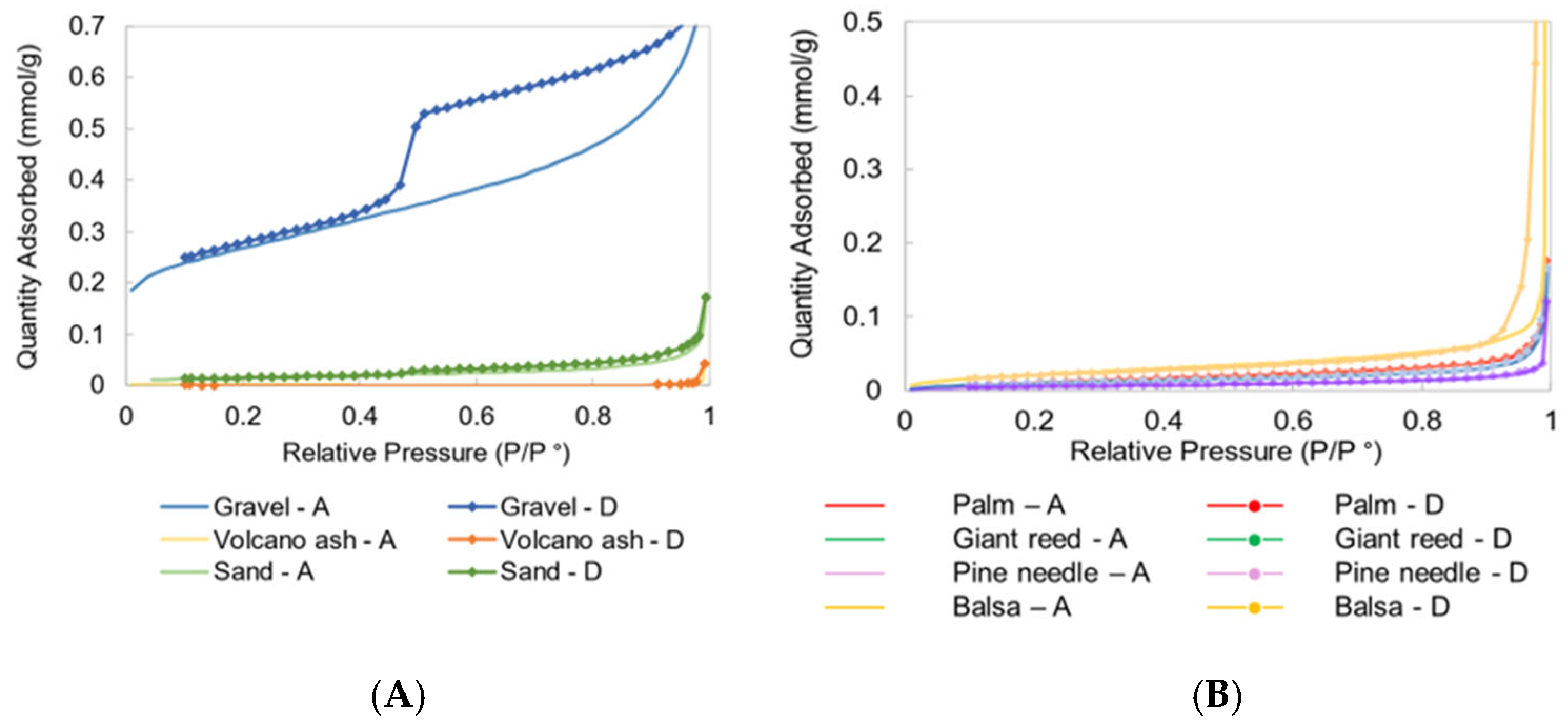
Textural properties are presented in Table 4. Overall, based on BET surface area values, these materials are characterized by low porosity, except for gravel having relatively greater porosity than the others. N2 sorption–desorption isotherms of materials selected for sorption studies are shown (Figure 1). The N2 amount adsorbed on the substrates was significantly low except for volcanic ash, in agreement with their BET values. According to the classification of physisorption isotherms [27], overall, all curves can be attributed to Type III, generally associated with the surface of a nonporous or macroporous solid. Based on the IUPAC classification of hysteresis loops, the observed H3-type hysteresis loop for sand and gravel suggests the presence of a pore network consisting of macropores, whereas no hysteresis phenomena were reported for the other materials.

3.2. Controls in Sorption Experiments

Controls without the substrate showed that the reduction in the concentration of hormones by processes other than sorption on the substrates remained below 10–15%.

3.3. SH Sorption on Mineral vs. Vegetal Substrates

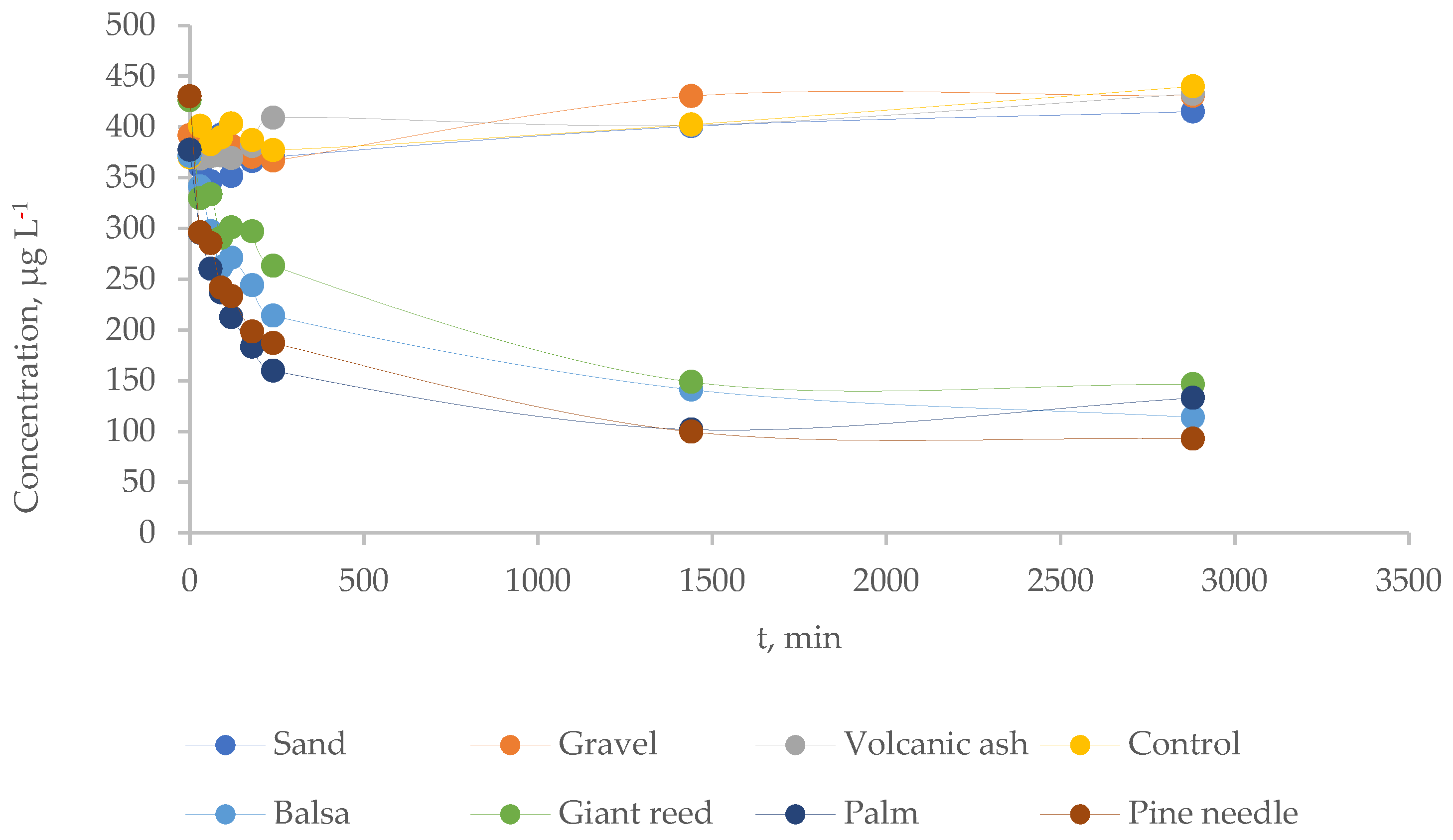
The experiments were carried out with 2 g of each substrate separately in 200 mL of solution (10 g/L). Samples were taken every 30 min for the first 4 h, and then at 24 and 48 h. A blank without substrate was also used to account for sorption on the container walls and other possible processes, such as bacterial degradation. Figure 2 shows the evolution of the E1 concentration in the control without substrate and with the mineral substrates (sand, gravel, and lapilli) and the organic substrates (giant reed, palm, pine needles, and balsa wood). As can be seen in the case of the mineral substrates, the concentrations remained stable around 350–400 ppb, similarly to the evolution of the control. The results for the other hormones are very similar (Figure S3). Nevertheless, in the case of the organic substrates, a reduction in concentration is observed over time, while that of the control remains constant.
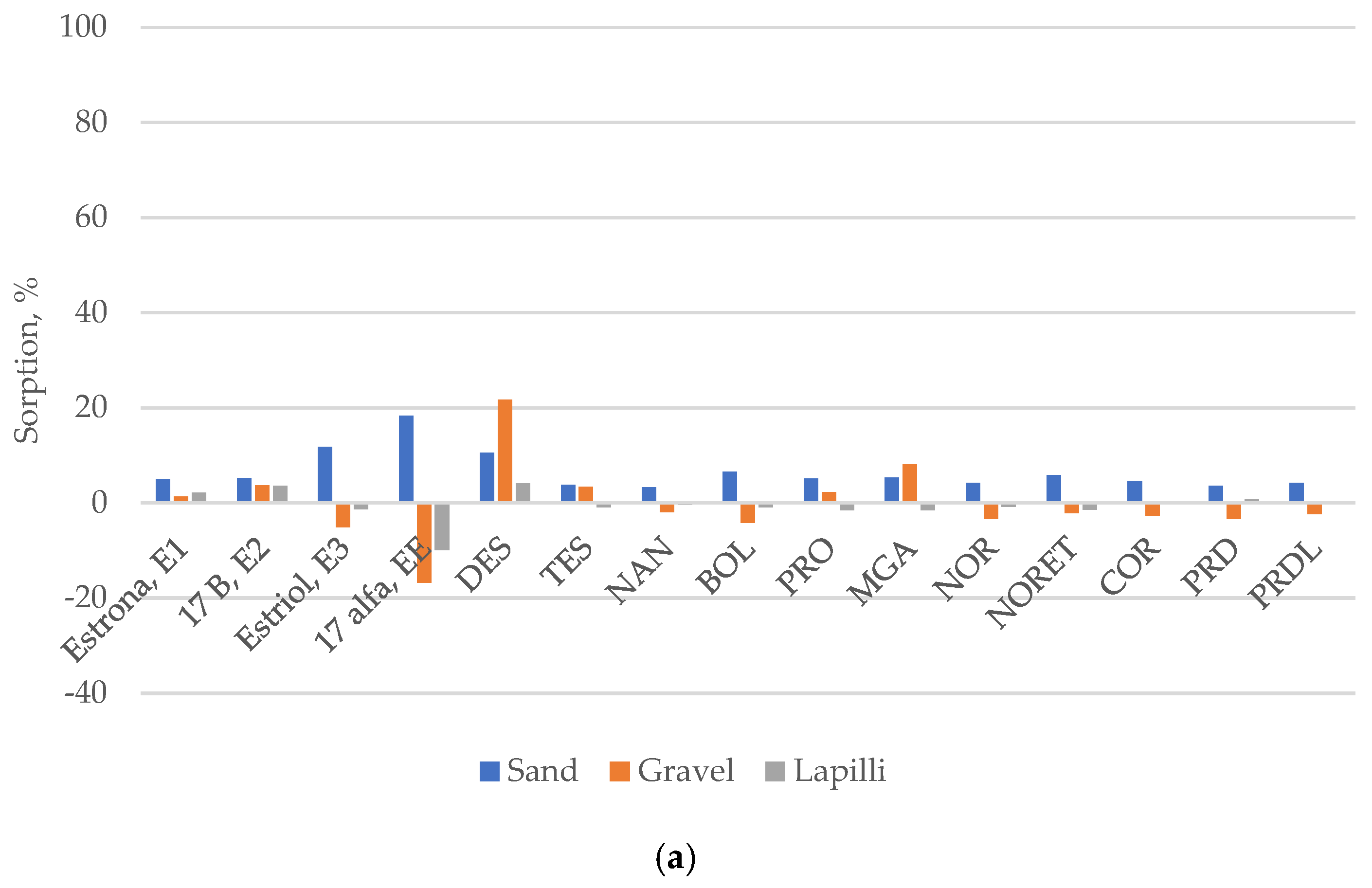
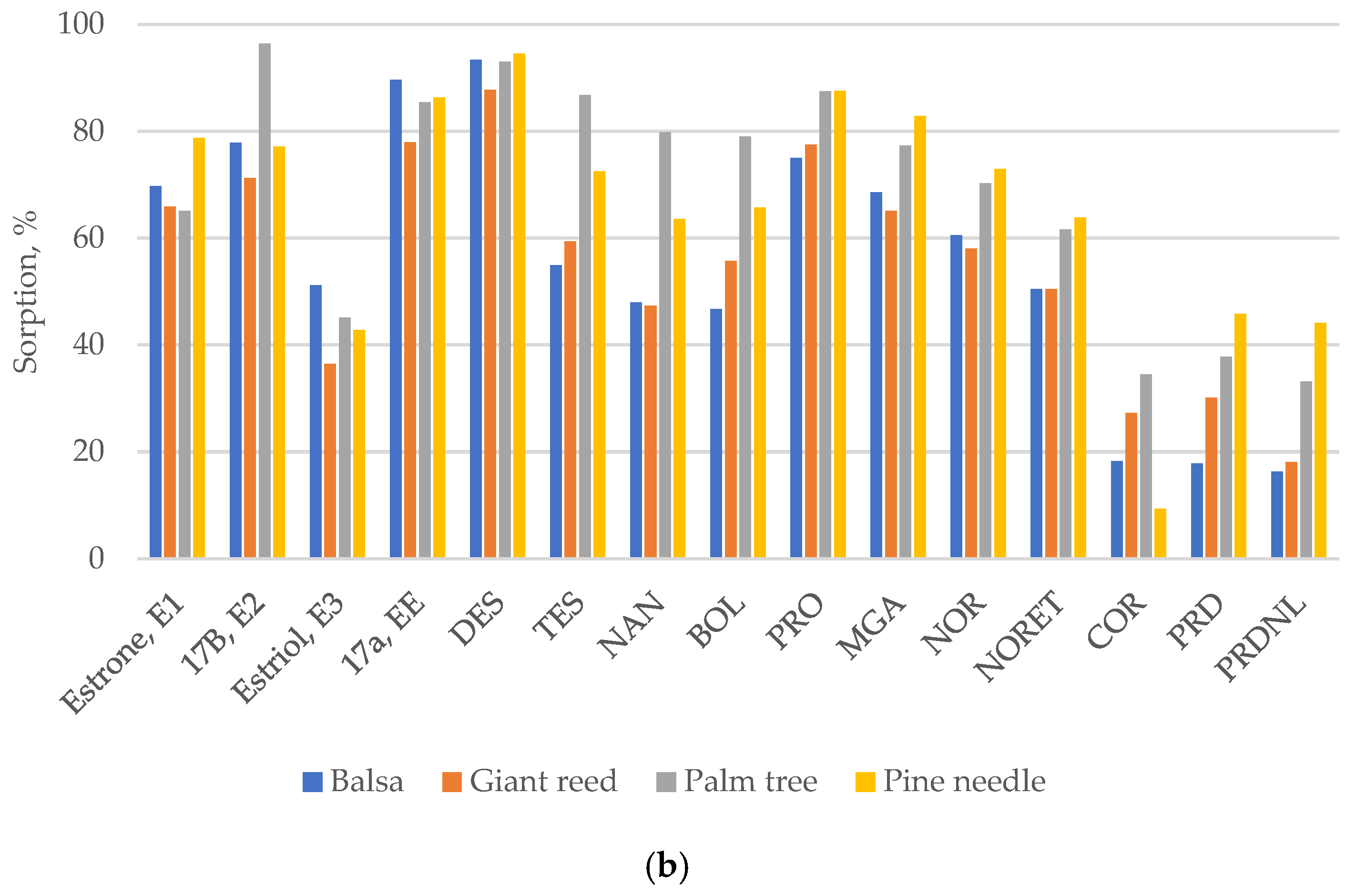
Figure 3 illustrates the average sorption values with respect to the control, for the mineral and vegetal substrates after a contact time of 48 h, 10 g/L of substrate, and pH = 7.2.
As can be seen, in the case of mineral substrates, most sorption values were below 10%, except for sand for estriol, EE and DES, and gravel with DES. Therefore, it can be concluded that the sorption of hormones on the surface of mineral substrates can be regarded as negligible, and it was not considered in the kinetics and isotherms analyses. However, in the case of the vegetal substrates, much higher sorption values, between 50 and 90%, were achieved after 48 h, except for Estriol and the corticosteroids (prednisone, prednisolone, and cortisone).

3.4. Sorption onto the Vegetal Substrates

Once it was determined that mineral substrates have a very limited adsorbent capacity for hormones, sorption on vegetal substrates was studied in more depth.

3.4.1. Kinetic Studies

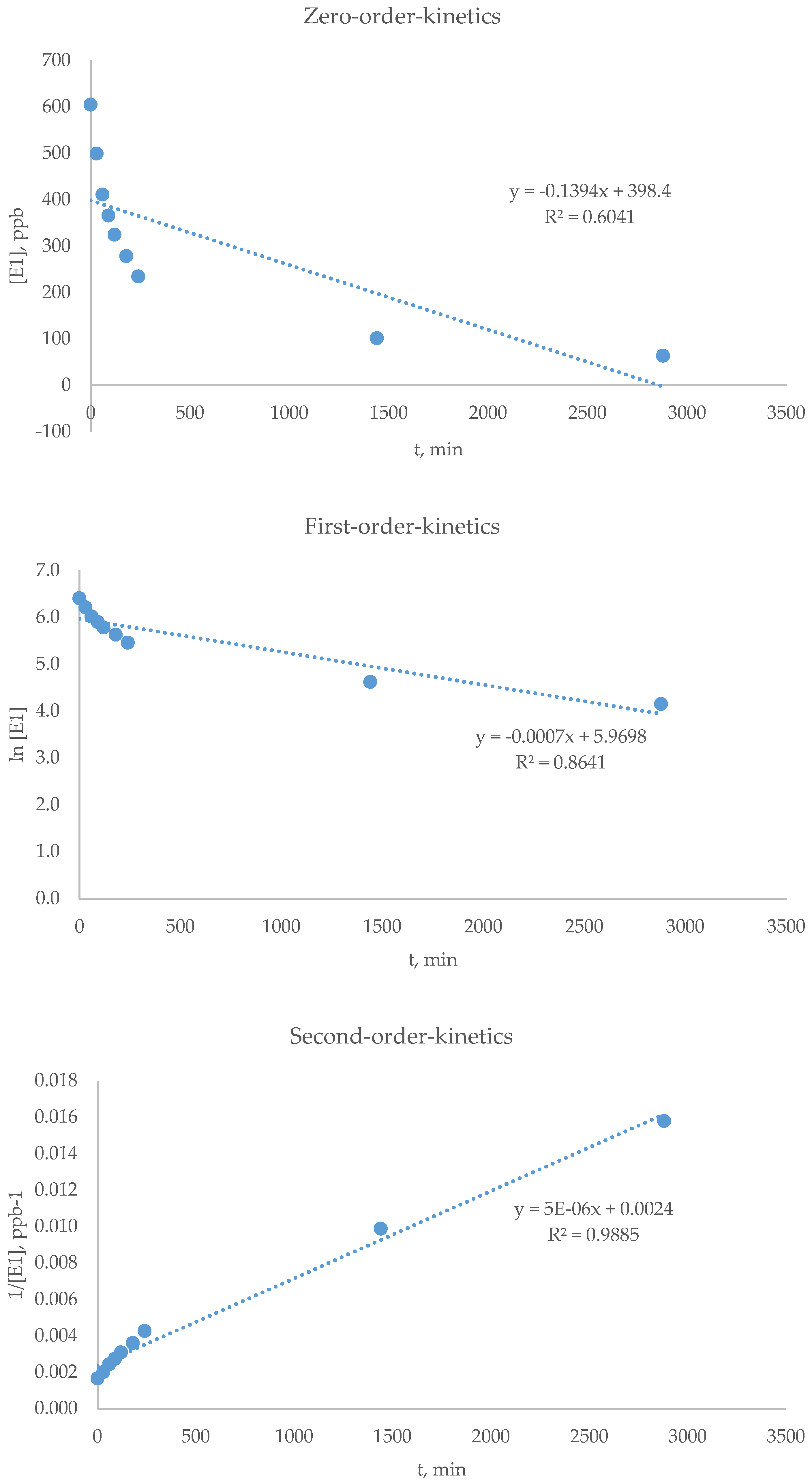
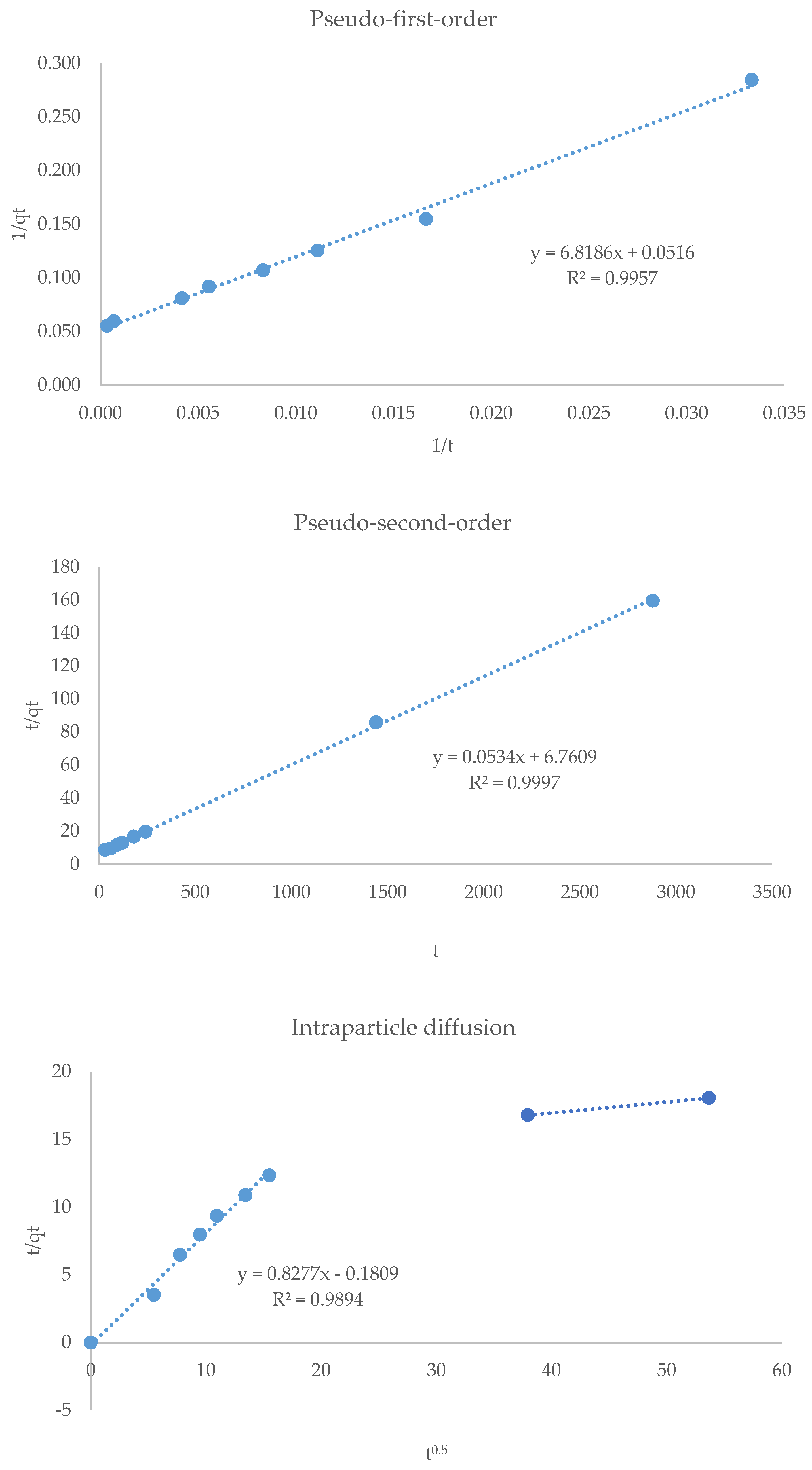
Kinetic studies are probably the most important factor to predict the sorption rate [28]. With the goal of investigating the mechanisms of sorption, various kinetic models were tested. In the present study, the model fit of the experimental data followed the following pattern: low for zero-order (R2: 0.318–0.903), acceptable for first-order (R2: 0.442–0.963) and second-order (R2: 0.788–0.988), good for pseudo-first order (R2: 0.675–0.996) and intraparticle diffusion (R2: 0.907–0.997), and particularly good, with the highest fit for pseudo-second-order kinetics (R2: 0.975–0.9999). Table 5 shows the R2 values for the sorption of Estrone on the vegetal substrates as an example.
Nevertheless, Ngeno et al. (2024) observed that both the pseudo-first-order and pseudo-second-order models forecasted the biosorption kinetics of progesterone onto acid-activated Moringa oleifera seed comparatively well, but the former gave the best fit [28]. As an example, Figure 4 illustrates the different model fits for Estrone to giant reed mulch substrate.
The fact that the best fit was almost always for the pseudo-second-order model, and with it having such high R2 values, indicates that chemisorption, involving electron sharing or exchange, plays a significant role in the sorption process [29]. Nevertheless, the observed rate can be influenced by external diffusion (mass transport from bulk solution to the sorbent surface) and internal diffusion (within pores). If the pseudo-second-order kinetics model fits well despite potential diffusion limitations, it implies that the adsorption sites are not uniformly accessible, causing heterogeneous kinetics, and the overall rate is not controlled solely by diffusion [30]. In the present study, the lignocellulosic biosorbents are structurally heterogeneous as they have different functional groups (–OH, –COOH, and aromatic sites) and pores of various sizes (Table 4). In conclusion, a predominant pseudo-second-order kinetic fit suggests that sorption occurs mainly via chemisorption at heterogeneous sites, and the resistance to mass transfer (diffusion) may influence the overall rate, especially in porous or complex biosorbents.
Therefore, the comparison of the different substrates and hormones was made based on the qe values obtained with this model. Table 6 shows the qe values with 2 g of substrate and 7 days of contact time for the different substrates and hormones according to the pseudo-second-order model (Figure S4).
The qe values were generally very similar among the different substrates and hormones, except for the corticosteroids. Thus, the mean qe of the palm (39 ± 3.4 µg/g) was slightly higher than that of the other substrates (pine needle: 33.6 ± 6.3 µg/g, balsa: 33.1 ± 12.9 µg/g, and giant reed: 33.5 ± 11.8 µg/g). The qe of palm was significantly greater than that of pine needles (p = 0.008) but not significantly different from those of balsa and giant reed, most probably due to the high standard deviation values.
The present results fall in the range obtained by other authors for similar sorbents. For example, Fernandes et al. (2011) studied the sorption of EE2 and E2 on decomposed peat and found qe values of 83 and 86 µg/g, respectively [31]. Martins et al. (2022) found qe values between 4.6 and 10.9 µ/g for the same hormones with different sorbents obtained from water treatment sludges [32]. Ngeno et al. (2024) found Langmuir isotherm biosorption capacity of 135.8 μg/g for the sorption of progesterone onto acid-activated Moringa oleifera seed biomass [28].

3.4.2. Sorption Isotherms

To know what type of sorption prevailed, the Langmuir and the Freundlich isotherms were applied to the results obtained. Table 7 shows the experimental and fitting parameters for the Freundlich and Langmuir isotherms for each hormone and plant substrate. The best fit has been assigned according to R2, RMSE (Root Mean Square Error), and SSE (Sum of Squared Errors) values.
In the case of giant reed and palm, a clear predominance of the Freundlich model is observed, indicating a highly heterogeneous surface with good affinity and strong initial uptake for many hormones. Pine needles showed a greater prevalence of the Langmuir model, which suggests a less heterogeneous surface but with a non-negligible sorption capacity. Finally, balsa shows poorer fits to both models and a mixed behavior, although many hormones fit the Langmuir model better, indicating good sorption capacity for some hormones, but not as consistent as palm or cane. In conclusion, it can be said that the obtained results indicate that SHs’ sorption to the mulches was more a non-ideal sorption involving heterogeneous sorption phenomena rather than the formation of monolayer coverage of SH molecules on the surface of the adsorbents.
Sorption results can be explained by taking into consideration the role of electrostatic attractions/repulsions between the adsorbate and adsorbent. Indeed, under the pH conditions of wastewater close to neutrality, sand and gravel have a strong positive surface charge and therefore should absorb better anionic contaminants and retain less cationic/neutral compounds if the electrostatic sorption mechanism plays an important role in governing SHs removal. Also, pore dimension-related phenomena could be taken into consideration as a driving force in the sorption process; even if the investigated materials are generally macroporous, a minor contribution to the total pore volume is ascribable to mesoporosity, which is relatively modest, especially in sand (almost 50%) and less in palm mulch (33%). On the other hand, all the investigated target analytes are dimensionally similar, having a maximum diameter included in a narrow range (13.26–16.72 Å), and thus able to fully access pore sites in materials (mesoporosity range 20–50 Å). In comparison with palm mulch, the higher mesoporosity degree of sand, as well as its higher total surface area, would agree with its faster sorption capacity.

3.4.3. Sorption/Kow Correlation

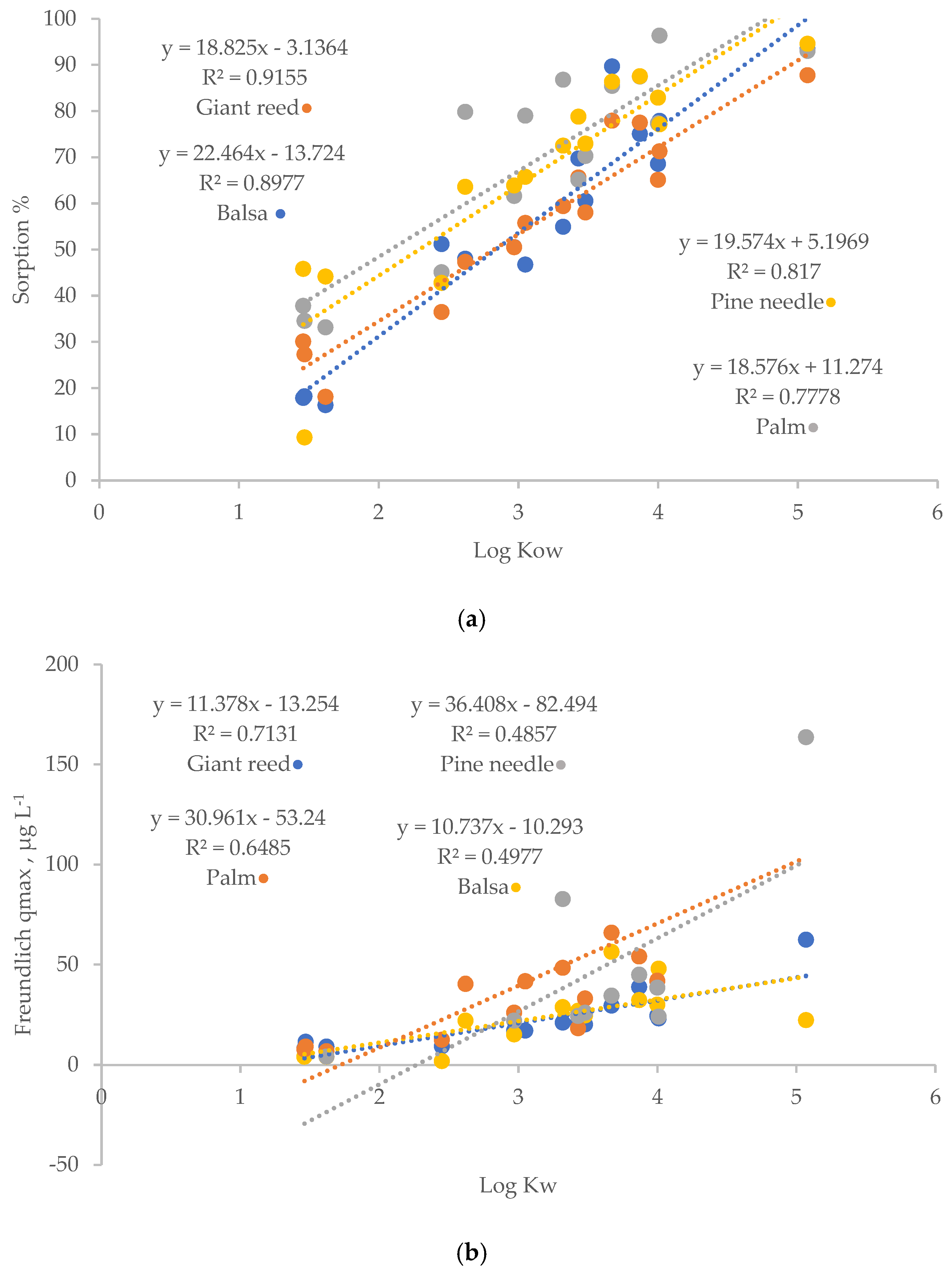
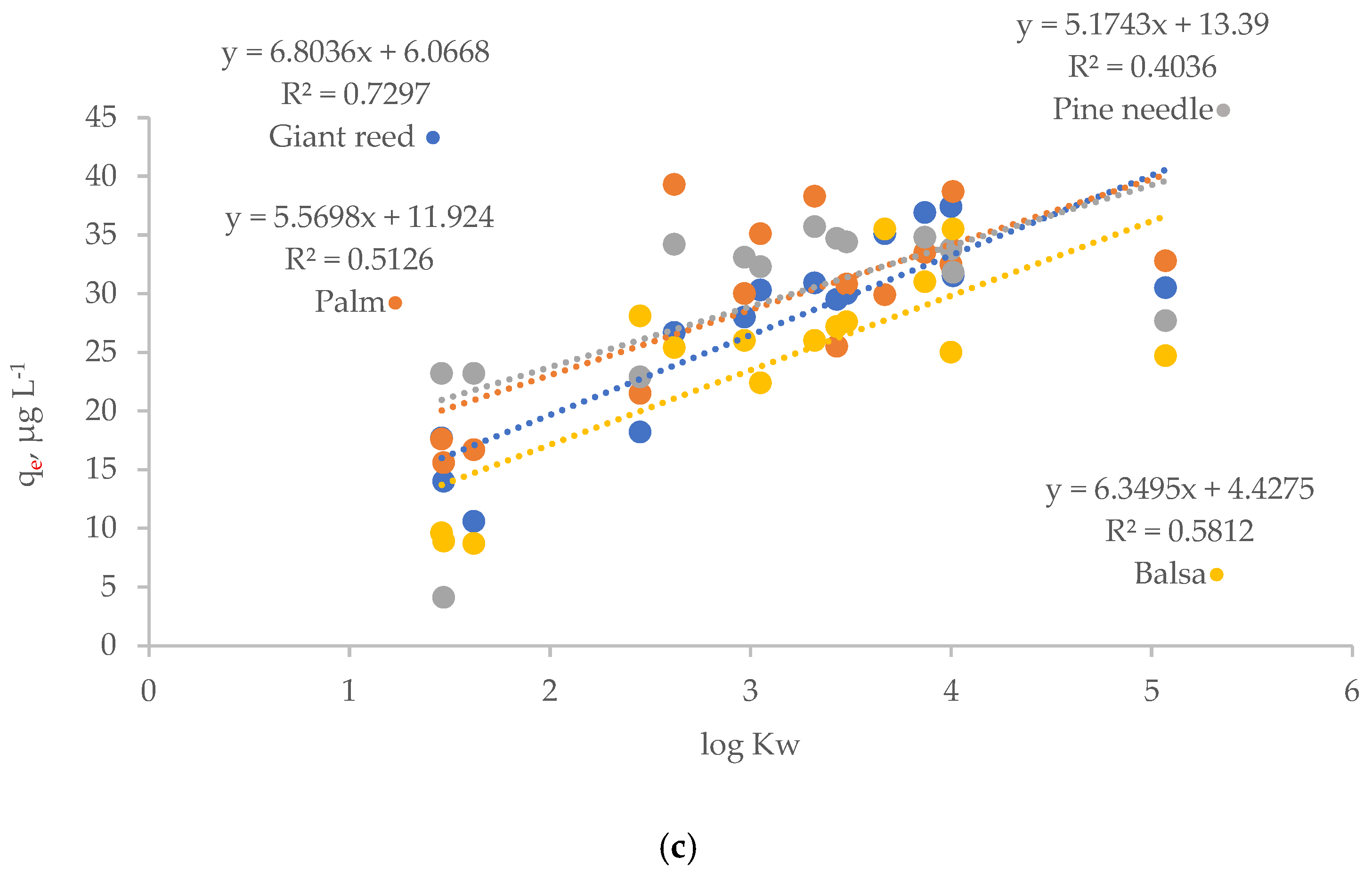
Ilyas et al. (2021) investigated the prediction of removal efficiency of different groups of organic micropollutants, namely pharmaceuticals (PhC), personal care products (PCP), and steroid hormones (SH) in CWs [33]. Their predictive models were based on the physicochemical properties of micropollutants, such as molecular weight (MW), octanol–water partition coefficient (Log Kow), soil organic carbon sorption coefficient (Log Koc), octanol–water distribution (Log Dow), and dissociation constant (pKa). In the case of SHs, the best performing model combined MW, Log Kow, and pKa. Our results show a significant positive correlation between sorption (%) and log Kow (Figure 5a). However, in sorption processes, saturation can occur at different concentrations for different biosorbents and pollutants, leading to erroneous conclusions. Thus, the correlation analysis has also been performed with qmax (calculated with the Freundlich isotherm and a reference hormone concentration of 100 µg L−1) and qe (derived from the second-order kinetics) (Figure 5b,c, respectively). As can be observed, though the results are qualitatively similar (positive, significant correlation), those with sorption percentage were the highest. As can be observed, sorption was at least partially governed by the relative liposolubility/hydrosolubility of the different SHs, with corticosteroids having the lowest qe values because of their low Kow. Corticosteroids have a predominantly hydrophobic structure (steroidal nucleus), but they also contain polar groups (–OH, =O) in a higher proportion than other steroid hormones, making them moderately polar and somewhat water-soluble. These structural features are reflected in low Kow values. Thus, they exhibit lower log Kow values (≈1.5–2.5) than other SHs, such as androgens or estrogens (≈3–4.5), indicating lower hydrophobicity and explaining their reduced tendency to adsorb onto biosorbents.
However, the correlation with Koc, although positive, was not significant since the R2 values obtained were much lower (R2 < 0.3). These results can help to improve predictive models on the removal of SHs in aquatic systems through sorption.

3.4.4. Effect of Sorption Time

To study the effect of sorption over time and possible desorption, contact time was extended to 7 days. The results indicate a relatively rapid sorption in the first 24–48 h, in which most of the removal is achieved, and stabilization or a slight increase in removal thereafter. Results are shown in Figure S4.
In general, and except for corticosteroids, the results indicate that SH sorption onto the vegetal wastes was an irreversible process, so that desorption was not usually observed after that time. On the other hand, corticosteroids not only show the lowest sorption values due to their low log Kow values, but they can also suffer desorption from some organic substrates. However, it is interesting to note that palm mulch was the only biosorbent that achieved complete removal of the three corticosteroids, although at times it took as long as 6 days.

3.5. Biodegradation vs. Sorption of SHs in Lab-Scale CWs

The objective of the first part of the article was to compare and quantify the effect of sorption in the process of hormone removal using mineral substrates and those obtained from plant residues. The conclusions are clear: (i) sorption is stronger in plant residues; (ii) it follows pseudo-second-order kinetics; (iii) the Freundlich isotherm better describes the process; and (iv) palm is the most recommended adsorbent. However, under CW real conditions, other factors such as biodegradation and, to a lesser extent, plant uptake, are relevant.
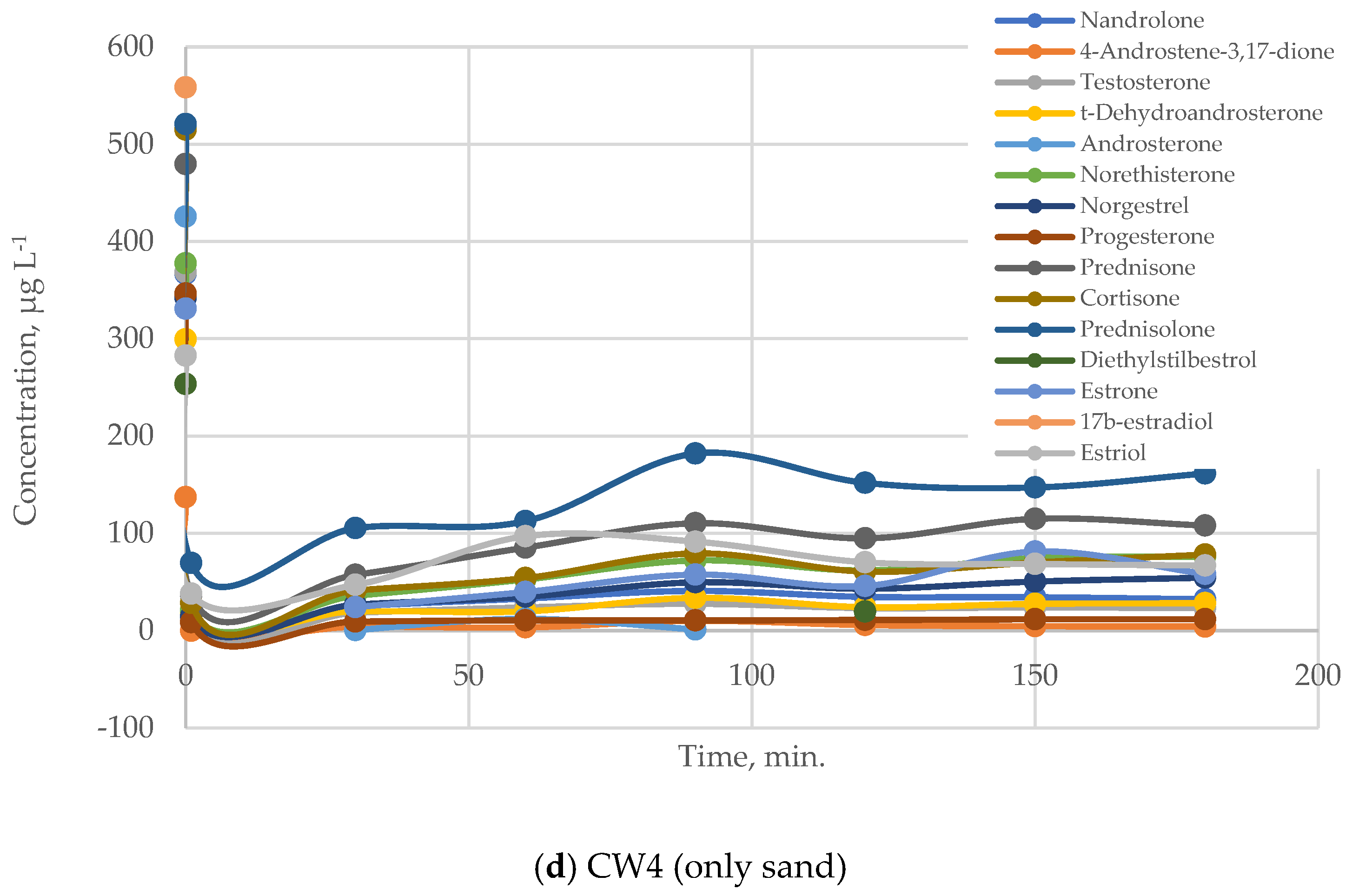
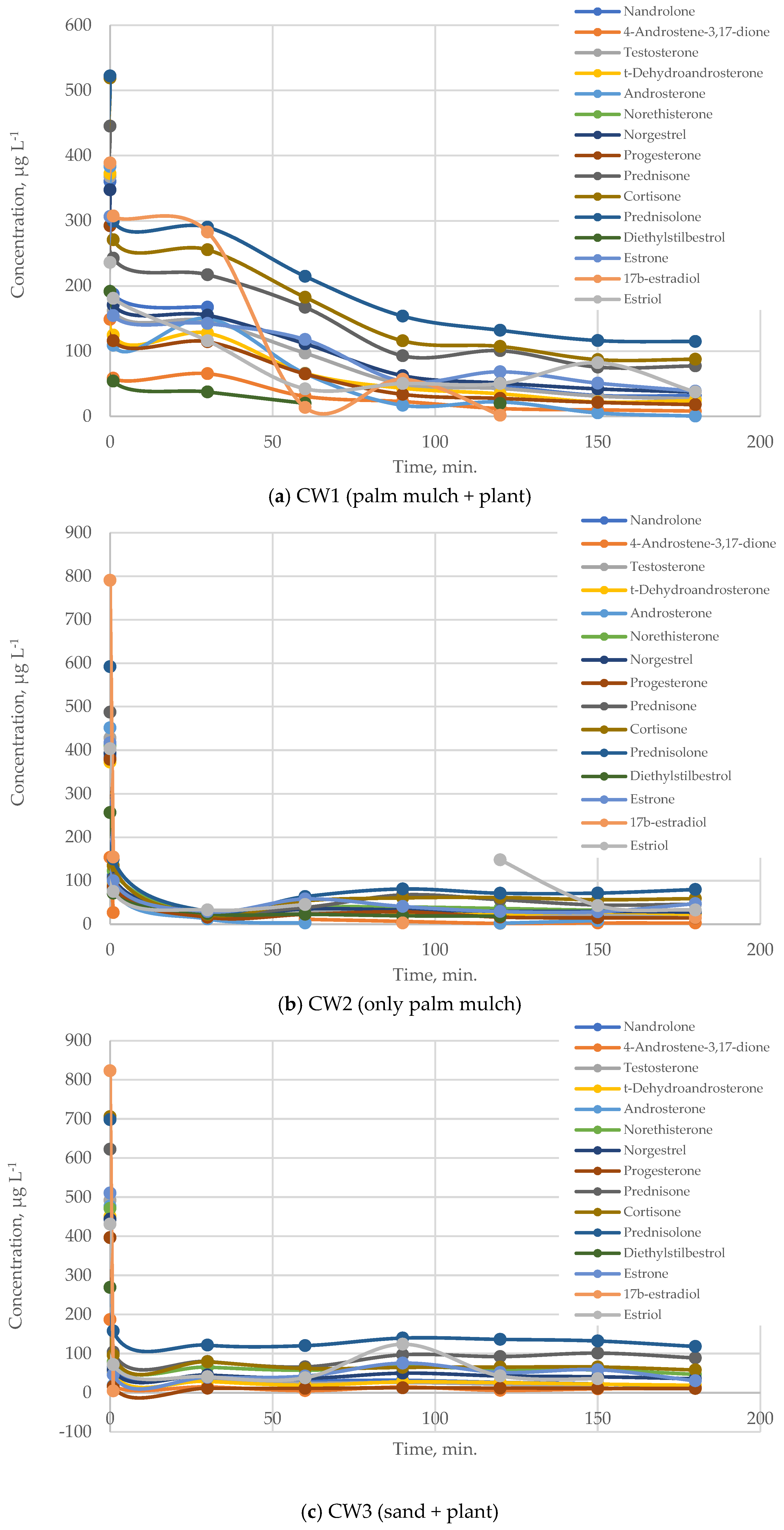
Thus, it was decided to study the removal of the SHs in four lab-scale CWs to determine the effect of the substrate (organic vs. mineral) and the presence of plants (Cyperus sp.) on the removal of SHs, namely: CW1: palm mulch + plant; CW2: only mulch; CW3: sand + plant; and CW4: only sand (Figure S1). The experiments were performed in batch mode with the effluent of the full-scale CW of the Campus spiked with the SHs to achieve an initial concentration of 500 µg L−1. It must be considered that though the full-scale CW achieves a good removal, the effluent also contains SHs. Thus, the initial concentrations in the lab-scale CWs varied. Figure 6 shows the evolution of the spiked SHs in the lab-scale CWs.
In CW1 (palm mulch + plant), there was a gradual reduction in hormone concentrations from a mean concentration of 350 µg L−1 to 42 µg L−1 after 3 h, and to 8 µg L−1 after 24 h. Three SHs (diethylstilbestrol, 17-beta-estradiol, and estriol) were completely removed after 3 h, and four more SHs (4-androstene-3,17-dione, t-dehydroandrostene, androstane, and estrone) after 24 h. In CW2 (palm mulch only), concentrations dropped rapidly from a mean concentration of 434 µg L−1 to 33 µg L−1 after 3 h and to 13 µg L−1 after 24 h. At 3 h, two hormones had been eliminated (androstene and diethylstilbestrol), and another six SHs (4-androstene, t-dehydroandrostene, prednisone, diethylstilbestrol, 17 b-estradiol, and estriol) after 24 h. At 3 h, two hormones had been completely eliminated (androstene and diethylstilbestrol), and another six SHs (4-androstene, t-dehydroandrostene, prednisone, diethylstilbestrol, 17 b-estradiol, and estriol) after 24 h. In CW3 (sand + plant), the kinetic behavior was like that of CW2, with mean concentrations rapidly dropping from 497 µg L−1 to 41 µg L−1 at 3 h and to 13 µg L−1 at 24 h. In this case, four hormones (androstene, diethylstilbestrol, 17b-estradiol, and estriol) were eliminated, while at 24 h, in addition to those already indicated above, five others (nandrolone, 4-androstene, testosterone, t-dehydroandorstene, and androstene) were also completely removed. In CW4, the mean concentrations also decreased rapidly at first from a mean of 374 µg L−1 to 59 µg L−1 at 3 h, and to 8 µg L−1 at 24 h. In CW4, three hormones disappeared within 3 h (androsterone, diethylstilbestrol, and 17-b-estradiol), while nine others were completely removed after 24 h (nandrolone, 4-androstene, t-dehydroandrostene, androstene, cortisone, diethylstilbestrol, estrone, 17-b-estradiol, and estriol). Although CW4 achieved complete removal of the highest number of hormones after 24 h (12, compared to nine in CW3, eight in CW2, and seven in CW1), in this case, some desorption from the substrate can be observed, being more evident for prednisolone and prednisone (Figure 6d).
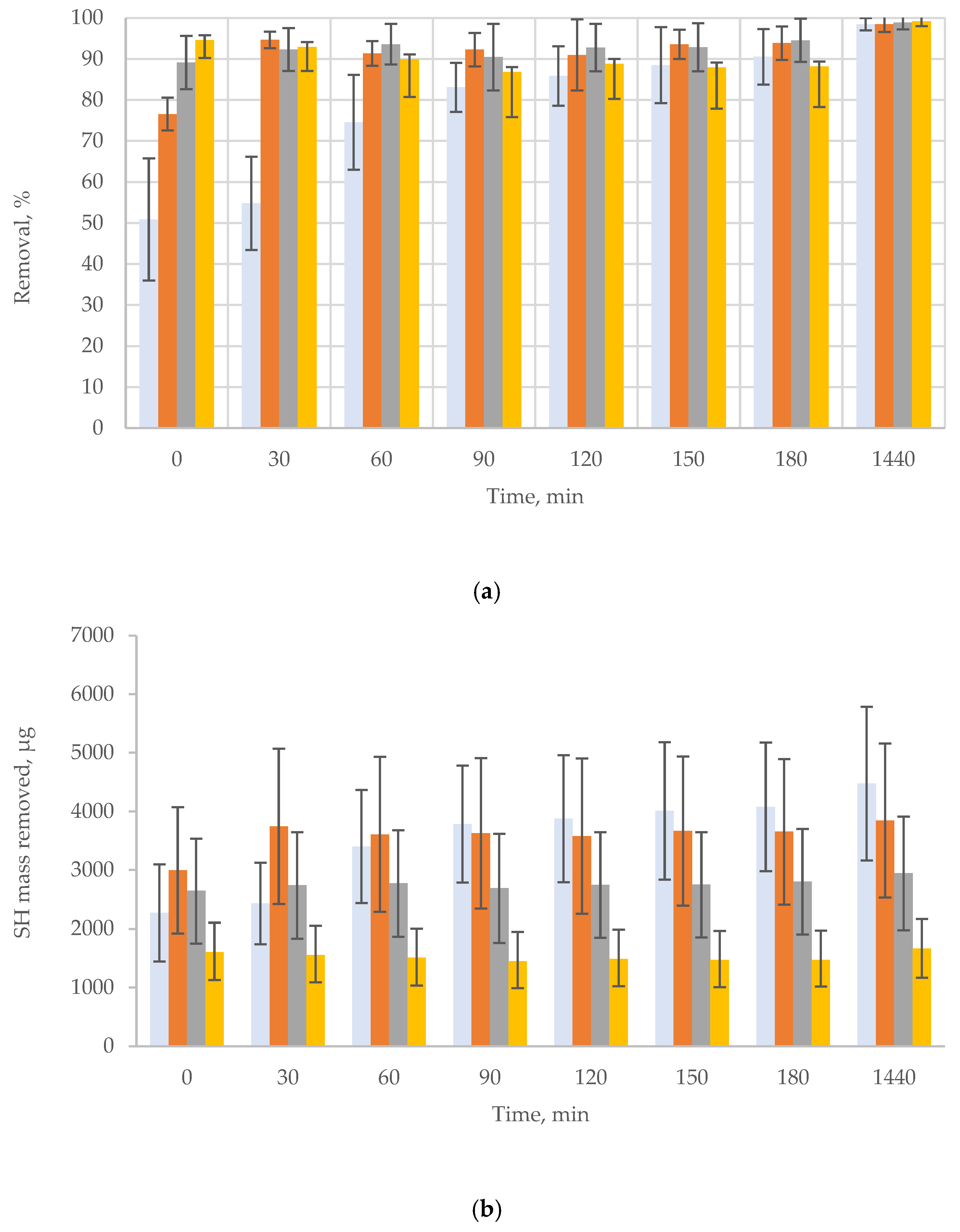
As indicated above, the different CWs had quite different porosities and thus could treat different amounts of water. Thus, to have an idea of the different reactors’ efficiencies, and therefore the effect of the substrate and the plants, the temporal evolution of average SH removals (%) and SH mass removed (µg) was calculated (Figure 7).
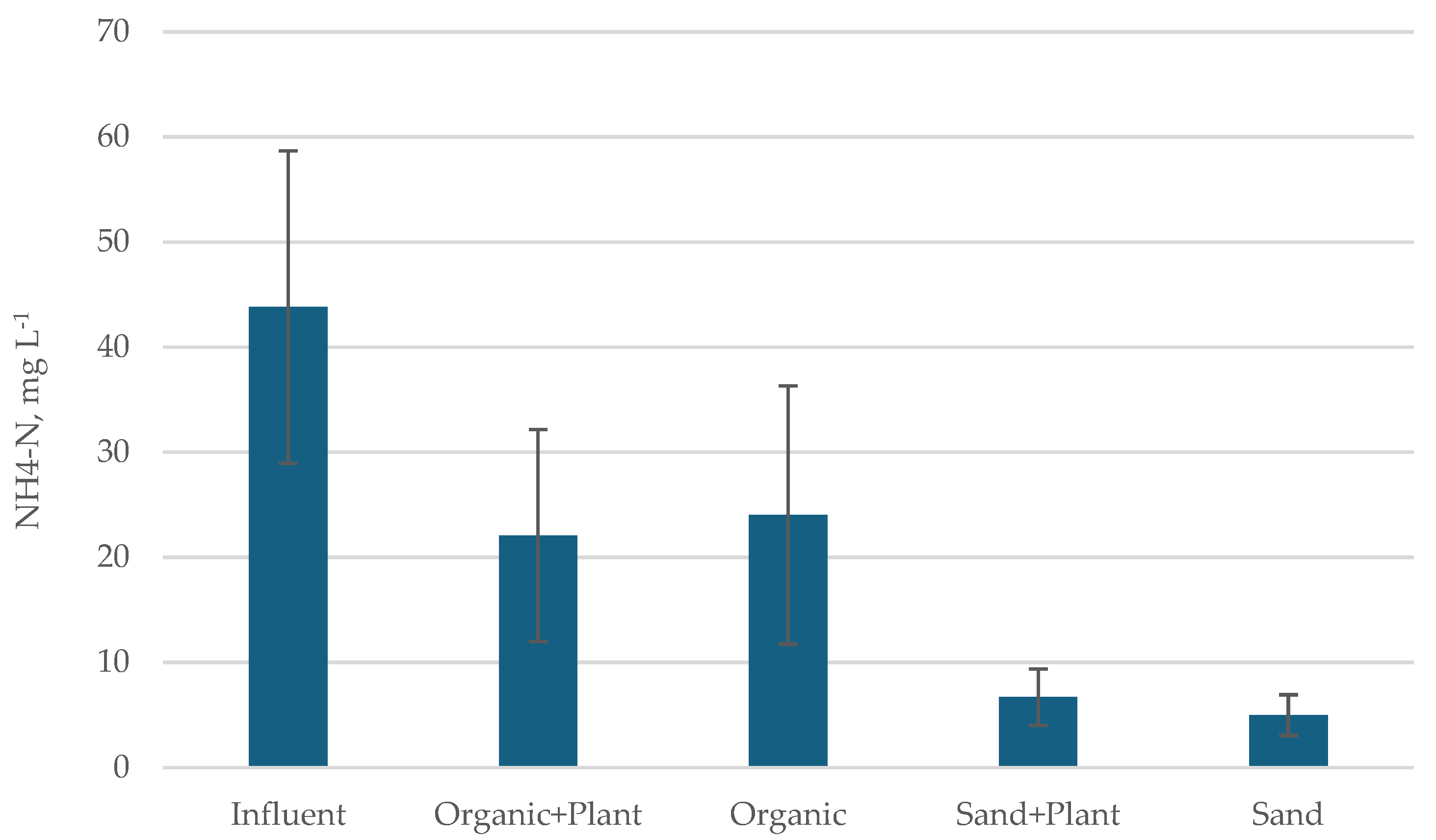
As can be seen, the average removals reached values greater than 90% in very short periods of time, particularly in the sand-based CWs (Figure 7a), i.e., there was an important difference caused by the substrate. At t = 0 min, removals in CWs with sand (CW3: 89.1 ± 6.5%; CW4: 95.2 ± 4.2%) were significantly faster than those with mulch (CW1: 51 ± 15%; CW2: 76.5 ± 4%). After 90 min, CW2, CW3, and CW4 presented average removals without significant differences, between 87 and 92%, except for CW1 (mulch + plant) with a significantly lower value of 82.5%. After 3 h, there was no significant difference among removals for all the CWs (CW1: 89.8 ± 6.4%, CW2: 93.5 ± 4%, CW3: 93 ± 5%, and CW4: 88.5 ± 9.6%). After 24 h, an almost complete removal, greater than 98%, was achieved in all of them. These fast degradations can be explained by the aerobic conditions of the reactors [3,34], since dissolved oxygen concentrations in CW3 and CW4 were in the range of 5–6 mg L−1, while those with mulch (CW1 and CW2) were significantly lower (2–3 mg L−1). These results agree with the stronger N-NH4 removals obtained by nitrification in the CWs with sand (84–89%) compared to those with mulch (42–49%, Figure 8). The complete degradation of ethinyl estradiol within 6 d by nitrifying activated sludge was reported by Vader et al. (2000), who established a correlation between degradation capability and nitrifying activity [35]. The simultaneous elimination of N-NH4 and different organic micropollutants, including ethinyl estradiol, has been reported because of the cometabolic biotransformations induced by autotrophic aerobic bacteria through the enzyme ammonium monooxygenase [36]. Chen et al. (2021) studied the effect of CW type and aeration and found that aerobic biodegradation was significantly faster than anaerobic biodegradation, with the former being the main removal mechanism in comparison to substrate sorption and plant uptake [37].
Nevertheless, the picture provided by the evolution of the SH mass removed is different from that of percentage removal (Figure 7b). As mentioned above, the porosities of the CWs, i.e., the water volume that can be housed and treated in each CW, were rather different (13 L for CW1, 9 L for CW2, 6 L for CW3, and 4.5 L for CW4). These values can help to justify the faster initial removals obtained in the sand-based CWs, since, in addition to their higher dissolved oxygen concentrations, their lower water content indicates higher substrate density, and most probably a higher concentration of bacteria per unit volume. As time passed, mass removals in the mulch-based reactors (CW1 and CW2) increased to reach significantly higher levels than those of sand-based ones, although between them (CW1 vs. CW2), the difference in removals was not significant (p > 0.05). Furthermore, when the average mass removed after 24 h (1440 min) was analyzed, significant differences due to the substrate were observed, with the mulch being more efficient than sand. On the other hand, the presence of the plant significantly improved the efficiency of the mineral substrate, and also in the case of mulch, but not significantly for the latter (p > 0.05).
The fact that palm mulch CWs increased their efficiency over time with respect to sand CWs may be due to the combination of sorption and biodegradation, since the obtained results have shown that sorption on sand was rather limited. In other words, SH removal in sand CWs was most probably due to aerobic biodegradation, while in palm mulch CWs, it was due to a combination of biodegradation and sorption, with sorption being slower than biodegradation. In the latter, sorption was able to compensate for the faster biodegradation in sand. The lower concentration of dissolved oxygen and nitrification in the palm mulch justifies the lower aerobic SH degradation rate in those CWs, which is compensated by adsorption afterwards. Additionally, in the more real conditions of the CWs, the palm mulch particle size would be bigger than that of the adsorption studies, leading to less efficient SH adsorption. This could explain the initial faster degradation in sand CWs.
Moreover, the fact that the plants improved removal in both cases, but only significantly in the sand-based CWs, can be explained by the greater surface area for biofilm colonization and SH sorption provided by the rhizosphere. Many studies have shown that plants can help to improve pollutant removal in CWs. This effect has been attributed to increased water retention time and pH changes that could boost sorption onto substrates [38] in addition to improved microbial activities and increased retention sites [37].
In view of these results, it can be concluded that palm mulch can improve CW sustainability and notably contribute through sorption to the removal of SHs with respect to sand CWs. Nevertheless, sand, despite its greater capacity for physical filtration and hosting a greater number of bacteria, can suffer from clogging more easily and has a high environmental cost. In fact, in previous studies with sand CWs, better removals of conventional water-quality parameters were initially obtained, but clogging problems appeared soon, leading to later lower performance [8]. Thus, only influents with low concentrations of suspended solids and organic matter should be treated in sand CWs. The lower density of palm mulch compared to sand, and thus the lower concentration of bacteria, can justify that biodegradation in sand was faster than the combination of biodegradation and sorption in palm mulch. Thus, future research on more sustainable, efficient CW substrates should be devoted to studying the combination of vegetal wastes, such as palm mulch with soil or wastes from construction/demolition.

4. Conclusions

This study presents a comparison of the SH sorption capacity of conventional, mineral CW substrates (gravel, sand, and lapilli) vs. alternative sustainable substrates obtained from vegetal residues. The latter provided much higher sorption efficiencies, with no desorption observed after 7 days. The pseudo-second-order kinetic model and the Freundlich isotherm provided the best fits to experimental data. Palm mulch provided the best results. Sorption (measured as %, qe and qmax) was significantly correlated to log Kow, with corticosteroids showing the lowest sorption.
Experiments with laboratory-scale CWs showed that the removal efficiency of SHs was extremely fast in aerobic, sand-based CWs, most probably by aerobic biodegradation, since the SH sorption capacity of sand was low. However, the SH mass removal was the highest in the planted palm mulch CW, since it could treat larger volumes of influent. In this case, a combination of aerobic biodegradation and sorption would be responsible for removal. Thus, the substrate porosity/density is an important variable to consider. Therefore, considering the higher clogging risk of sand, unsaturated sand-based CWs are a good choice for the treatment of waters with low suspended solids content, such as the effluent of conventional wastewater treatment facilities or the final steps of nature-based systems. On the contrary, mulch will be the best option for the treatment of wastewater with high SS content, such as urban wastewater, because of its lower clogging risk.

Supplementary Materials

The following supporting information can be downloaded at: https://www.mdpi.com/article/10.3390/su18073395/s1; Figure S1: Lab-scale CWs with different substrates and plant presence for sorption vs. degradation studies and a photo of one with only a mineral substrate; S1. Water analysis methods. Table S1: Characterization of the influent to the lab-scale CWs in the SH spike experiments as average concentrations (std. deviation), and amount of data; S2. Sorbent surface characterization; Figure S2. Point of zero charge (pHPZC) of waste materials used in this study; Figure S3: Evolution of the concentration of SHs in the control and in the presence of mineral and organic substrates. Substrate concentration: 10 g/L, pH = 7.2; Figure S4. Adsorption (%) results from the 7-day adsorption/desorption study with the vegetal residue substrates.

Author Contributions

J.A.H.-M.: Writing—review and editing, writing—original draft, visualization, supervision, methodology, investigation, formal analysis, data curation, and conceptualization. R.G.-A.: Methodology, investigation, and formal analysis. J.C.T.-L.: Investigation. M.F.: Writing—original draft, methodology, investigation, and formal analysis. M.D.B.: Writing—original draft. E.R.: Visualization, validation, supervision, and formal analysis. Z.S.-F.: Project administration and resources. J.J.S.-R.: Project administration and resources. All authors have read and agreed to the published version of the manuscript.

Funding

This work was supported by funds provided by the Consejería de Economía, industria, Comercio y Conocimiento del Gobierno de Canarias, Research Project CEI 2021–02, and the Spanish Ministry of Science and Innovation through Grant PID2020–118966RJ-I00, funded by MCIN/AEI/10.13039/501100011033.

Institutional Review Board Statement

Not applicable.

Informed Consent Statement

Not applicable.

Data Availability Statement

The data used to support the findings of this study are included within the article. The raw data supporting the conclusions of this article will be made available by the authors on request.

Conflicts of Interest

The authors declare no conflicts of interest.

References

  1. Quesada, H.S.; Alves Baptista, A.T.; Cusioli, L.F.; Seibert, D.; de Oliveira Bezerra, C.; Bergamasco, R. Surface water pollution by pharmaceuticals and an alternative of removal by low-cost adsorbents: A review. Chemosphere 2019, 222, 766–780. [Google Scholar] [CrossRef]
  2. Zhao, L.; Wang, C.; Sun, F.; Liao, H.; Chang, H.; Jia, X. Assessment of occurrence, partitioning and ecological risk for 144 steroid hormones in Taihu Lake using UPLC-MS/MS with machine learning model. Chemosphere 2024, 354, 141598. [Google Scholar] [CrossRef]
  3. Ilyas, H.; van Hullesbusch, E.D. A review on the occurrence, fate and removal of steroidal hormones during treatment with different types of constructed wetlands. J. Environ. Chem. Eng. 2020, 8, 103793. [Google Scholar] [CrossRef]
  4. Zhang, Q.Q.; Xing, C.; Cai, Y.Y.; Yan, X.T.; Ying, G.G. How much do human and livestock actually contribute to steroids emission and surface water pollution from past to the future: A global research. Sci. Total Environ. 2021, 772, 145558. [Google Scholar] [CrossRef] [PubMed]
  5. Calheiros, S.C.; Bessa, V.S.; Mesquita, R.B.R.; Brix, H.; Rangel, A.O.S.S.; Castro, P.M.L. Constructed wetland with a polyculture of ornamental plants for wastewater treatment at a rural tourism facility. Ecol. Eng. 2015, 79, 1–7. [Google Scholar] [CrossRef]
  6. Molinos-Senante, M.; Gómez, T.; Caballero, R.; Hernández-Sancho, F.; Sala-Garrido, R. Assessment of wastewater treatment alternatives for small communities: An analytic network process approach. Sci. Total Environ. 2015, 532, 676–687. [Google Scholar] [CrossRef]
  7. Wang, S.; Li, X.; Ji, M.; Zhang, J.; Tanveer, M.; Hu, Z. Is constructed wetlands carbon source or carbon sink? Case analysis based on life cycle carbon emission accounting. Bioresour. Technol. 2023, 388, 129777. [Google Scholar] [CrossRef]
  8. Herrera-Melián, J.A.; Mendoza-Aguiar, M.; Guedes-Alonso, R.; García-Jiménez, P.; Carrasco-Acosta, M.; Ranieri, E. Multistage Horizontal Subsurface Flow vs. Hybrid Constructed Wetlands for the Treatment of Raw Urban Wastewater. Sustainability 2020, 12, 5102. [Google Scholar] [CrossRef]
  9. Wang, L.; Zhang, J.G.; Sha, H.Y.; Wang, Y.R.; Wang, H.Y.; Zhu, G.C.; Lu, Y.Z. Lanthanum-quaternized chitosan-modified zeolite for long-lasting operation of constructed wetland: A bifunctional strategy for simultaneous phosphorus removal and microbial clogging mitigation. Water Res. 2026, 288, 124688. [Google Scholar] [CrossRef]
  10. Spennemann, D.H.R. The connective potential of vertebrate vectors responsible for the dispersal of the Canary Island date palm (Phoenix canariensis). Flora 2019, 259, 151468. [Google Scholar] [CrossRef]
  11. Gaber, M.M.; Shokry, H.; Hassanin, A.H.; Awad, S.; Samy, M.; Elkady, M. Novel palm peat lignocellulosic adsorbent derived from agricultural residues for efficient methylene blue dye removal from textile wastewater. Appl. Water Sci. 2025, 15, 32. [Google Scholar] [CrossRef]
  12. Fernando, A.L.; Barbosa, B.; Costa, J.; Papazoglou, E.G. Giant Reed (Arundo donax L.): A multipurpose crop bridging phytoremediation with sustainable bioeconomy. In Bioremediation and Bioeconomy; Prasad, M.N.V., Ed.; Elsevier Inc.: Amsterdam, The Netherlands, 2015; pp. 77–95. [Google Scholar]
  13. Correia, R.; Gonçalves, M.; Nobre, C.; Mendes, B. Impact of torrefaction and low-temperature carbonization on the properties of biomass wastes from Arundo donax L. and Phoenix canariensis. Bioresour. Technol. 2017, 223, 210–218. [Google Scholar] [CrossRef] [PubMed]
  14. Mohammadzadeh, M.; Leiviska, T. Iron-modified peat and magnetite-pine bark biosorbents for levofloxacin and trimethoprim removal from synthetic water and various pharmaceuticals from real wastewater. Ind. Crops Prod. 2023, 195, 116491. [Google Scholar] [CrossRef]
  15. da Silva Andrade, J.G.; Porto, C.E.; Martins Moreira, W.; Batistela, V.B.; Olsen Scaliante, M.H.N. Production of hydrochars from Pinus caribaea for biosorption of methylene blue and tartrazine yellow dyes. Clean. Chem. Eng. 2023, 5, 100092. [Google Scholar] [CrossRef]
  16. Cutillas-Barreiro, L.; Paradelo, R.; Igrexas-Soto, A.; Núñez-Delgado, A.; Fernández-Sanjurjo, M.J.; Álvarez-Rodriguez, E.; Garrote, G.; Nóvoa-Muñoz, J.C.; Arias-Estévez, M. Valorization of biosorbent obtained from a forestry waste: Competitive sorption, desorption and transport of Cd, Cu, Ni, Pb and Zn. Ecotoxicol. Environ. Saf. 2016, 131, 118–126. [Google Scholar] [CrossRef]
  17. Zhu, X.; Liu, L.; Wang, Y.; Zhang, C.; Li, R.; Dong, H. Phosphorylated calix[4]arene/balsa wood copolymers for selective uranyl extraction from wastewater and seawater. J. Water Process Eng. 2023, 53, 103842. [Google Scholar] [CrossRef]
  18. Herrera-Melián, J.A.; Torres-Padrón, M.E.; Betancor-Abreu, A.; Sosa-Ferrera, Z.; Santana-Rodríguez, J.J.; Martín-González, M.A.; Araña, J.; Guedes-Alonso, R. Clogging reduction and removal of hormone residues with laboratory-scale vertical flow organic-based filter and hybrid wetland. Int. J. Environ. Sci. Technol. 2015, 12, 1039–1052. [Google Scholar] [CrossRef]
  19. Guedes-Alonso, R.; Montesdeoca-Esponda, S.; Herrera-Melián, J.A.; Rodríguez-Rodríguez, R.; Ojeda-González, Z.; Landívar-Andrade, V.; Sosa-Ferrera, Z.; Santana-Rodríguez, J.J. Pharmaceutical and personal care product residues in a macrophyte pond-constructed wetland treating wastewater from a university campus: Presence, removal and ecological risk. Sci. Total Environ. 2020, 703, 135596. [Google Scholar] [CrossRef]
  20. Zhou, Y.; Chen, L.; Lu, P.; Tang, X.; Lu, J. Removal of bisphenol A from aqueous solution using modified fibric peat as a novel biosorbent. Sep. Purif. Technol. 2011, 81, 184–190. [Google Scholar] [CrossRef]
  21. Kumar, A.K.; Mohan, S.V.; Sarma, P.N. Sorptive removal of endocrine-disruptive compound (estriol, E3) from aqueous phase by batch and column studies: Kinetic and mechanistic evaluation. J. Hazard. Mater. 2009, 164, 820–828. [Google Scholar] [CrossRef]
  22. EN 12915:2009; Products Used for the Treatment of Water Intended for Human Consumption—Granular Activated Carbon. European Committee for Standardization: Brussels, Belgium; European Union: Brussels, Belgium, 2009.
  23. Bakari, Z.; Fichera, M.; El Ghadraoui, A.; Renai, L.; Giurlani, W.; Santianni, D.; Fibbi, D.; Bruzzoniti, M.C.; Del Bubba, M. Biochar from co-pyrolysis of biological sludge and woody waste followed by chemical and thermal activation: End-of-waste procedure for sludge management and biochar sorption efficiency for anionic and cationic dyes. Environ. Sci. Pollut. Res. 2024, 31, 35249–35265. [Google Scholar] [CrossRef]
  24. DelBubba, M.; Anichini, B.; Bakari, Z.; Bruzzoniti, M.C.; Camisa, R.; Caprini, C.; Checchini, L.; Fibbi, D.; El Ghadraoui, A.; Liguori, F.; et al. Physicochemical properties and sorption capacities of sawdust-based biochars and commercial activated carbons towards ethoxylated alkylphenols and their phenolic metabolites in effluent wastewater from a textile district. Sci. Total Environ. 2020, 708, 135217. [Google Scholar] [CrossRef]
  25. Velázquez Martí, B.; Gaibor-Chávez, J.; Franco Rodríguez, J.E.; López Cortés, I. Biomass Identification from Proximate Analysis: Characterization of Residual Vegetable Materials in Andean Areas. Agronomy 2023, 13, 2347. [Google Scholar] [CrossRef]
  26. Shields, W.J.; Ahn, S.; Pietari, J.; Robrock, K.; Royer, L. Atmospheric Fate and Behavior of POPs. In Environmental Forensics for Persistent Organic Pollutants; O’Sullivan, G., Sandau, C., Eds.; Elsevier: Amsterdam, The Netherlands, 2014; pp. 199–289. [Google Scholar]
  27. Thommes, M.; Kaneko, K.; Neimark, A.V.; Olivier, J.P.; Rodríguez-Reinoso, F.; Jean Rouquerol, J.; Sing, K.S.W. Physisorption of gases, with special reference to the evaluation of surface area and pore size distribution (IUPAC Technical Report). Pure Appl. Chem. 2015, 87, 1051–1069. [Google Scholar] [CrossRef]
  28. Ngeno, E.; Ongulu, R.; Shikuku, V.; Ssentongo, D.; Otieno, B.; Ssebugere, P.; Francis Orata, F. Response surface methodology directed modeling of the biosorption of progesterone onto acid activated Moringa oleifera seed biomass: Parameters and mechanisms. Chemosphere 2024, 360, 142457. [Google Scholar] [CrossRef] [PubMed]
  29. Hkiri, K.; Mohamed, H.E.A.; Abodouh, M.M.; Maaza, M. Experimental and theoretical insights into the sorption mechanism of methylene blue on the (002) WO3 surface. Sci. Rep. 2024, 14, 26991. [Google Scholar] [CrossRef]
  30. Ho, Y.S.; McKay, G. Pseudo-second order model for sorption processes. Process Biochem. 1999, 34, 451–465. [Google Scholar] [CrossRef]
  31. Fernandes, A.N.; Giovanela, M.; Almeida, C.A.P.; Esteves, V.I.; Sierra, M.M.D.; Grassi, M.T. Removal of the hormones 17b-estradiol and 17a-ethinylestradiol from aqueous solutions employing a decomposed peat as a adsorbent material. Quim. Nova 2011, 34, 1526–1533. (In Portuguese) [Google Scholar] [CrossRef]
  32. Martins, D.S.; Estevam, B.R.; Perez, I.S.; Américo-Pinheiro, J.H.P.; Isique, W.D.; Boina, R.F. Sludge from a water treatment plant as an adsorbent of endocrine disruptors. J. Environ. Chem. Eng. 2022, 10, 108090. [Google Scholar] [CrossRef]
  33. Ilyas, H.; Masih, I.; van Hullebusch, E.D. Prediction of the removal efficiency of emerging organic contaminants in constructed wetlands based on their physicochemical properties. J. Environ. Manag. 2021, 294, 112916. [Google Scholar] [CrossRef] [PubMed]
  34. Ávila, C.; García-Galán, M.J.; Uggetti, E.; Montemurro, N.; García-Vara, M.; Pérez, S.; García, J.; Postigo, C. Boosting pharmaceutical removal through aeration in constructed wetlands. J. Hazard. Mater. 2021, 412, 125231. [Google Scholar] [CrossRef]
  35. Vader, J.S.; van Ginkel, C.G.; Sperling, F.M.G.M.; de Jong, J.; de Boer, W.; de Graaf, J.S.; van der Most, M.; Stokman, P.G.W. Degradation of ethinyl estradiol by nitrifying activated sludge. Chemosphere 2000, 41, 1239–1243. [Google Scholar] [CrossRef]
  36. Alvarino, T.; Suarez, S.; Lema, J.; Omil, F. Understanding the sorption and biotransformation of organic micropollutants in innovative biological wastewater treatment technologies. Sci. Total Environ. 2018, 615, 297–306. [Google Scholar] [CrossRef]
  37. Chen, J.; Liu, S.S.; Wang, Y.J.; Li, J.; Liu, Y.S.; Yang, F.; Ying, Y. Optimized constructed wetlands enhance the removal and reduce the risks of steroid hormones in domestic wastewater. Sci. Total Environ. 2021, 757, 143773. [Google Scholar] [CrossRef]
  38. Wang, Y.; Cai, Z.; Sheng, S.; Pan, F.; Chen, F.; Fu, J. Comprehensive evaluation of substrate materials for contaminants removal in constructed wetlands. Sci. Total Environ. 2020, 701, 134736. [Google Scholar] [CrossRef]
Figure 1. N2 sorption–desorption isotherm linear plots for mineral (A) and organic substrates (B). A: sorption; D: desorption.
Sustainability 18 03395 g001
Figure 2. Evolution of the concentration of E1 in the control and in the presence of mineral and organic substrates. Substrate concentration: 10 g/L, pH = 7.2.
Sustainability 18 03395 g002
Figure 3. Sorption (%) with respect to the control for the mineral (a) and mulch (b) substrates after a contact time of 48 h, 10 g/L of substrate, and pH = 7.2.
Sustainability 18 03395 g003aSustainability 18 03395 g003b
Figure 4. Plots of the kinetic models of Estrone with giant reed mulch.
Sustainability 18 03395 g004aSustainability 18 03395 g004b
Figure 5. Correlation between log Kow and percentage sorption (a), Freundlich-derived qmax (b), and second-order kinetics qe (c), for the different vegetal residues.
Sustainability 18 03395 g005aSustainability 18 03395 g005b
Figure 6. Evolution of SH concentrations over time (3 h) in CW1: (a) palm mulch + plant; (b) CW2: only mulch; (c) CW3: sand + plant; and (d) CW4: only sand.
Sustainability 18 03395 g006aSustainability 18 03395 g006b
Figure 7. Average SH removal (%) (a) and SH mass removed (µg) (b) over time for the lab-scale CWs: CW1 (palm mulch + plant); CW2 (palm mulch); CW (sand + plant); and CW4 (sand). Each bar value is the average SH concentration (n = 15) at the corresponding time.
Sustainability 18 03395 g007
Figure 8. Average concentrations of NH4-N in the influent and effluents of the lab-scale CWs with HRT of 1 day (n = 4).
Sustainability 18 03395 g008
Table 1. The studied hormones by family and acronyms.
Steroid Hormones FamilyCompounds (Acronym)
EstrogensDiethylstilbestrol (DES)
17α-Ethinylestradiol (EE)
17β-Estradiol (E2)
Estrone (E1)
Estriol (E3)
GlucocorticoidsPrednisolone (PRDNL)
Prednisone (PRD)
Cortisone (COR)
AndrogensTestosterone (TES)
Boldenone (BOL)
Nandrolone (NAN)
ProgestogensNorgestrel (NOR)
Megestrol Acetate (MGA)
Norethisterone (NORET)
Progesterone (PRO)
Table 2. List of kinetic models used in this study, equations, linear form, and plot.
Kinetics ModelEquationLinear FormPlot
Zero-orderdqt/dt = k1qt = qt0 − k1 tqt vs. t
First-orderdqt/dt = k2 qtln qt = ln qt0 − k2 tln qt vs. t
Second-orderdqt/dt = k3 qt21/qt = 1/qt0 + k3 t1/qt vs. t
Pseudo-first-orderdqt/dt = k4(qe − qt)ln (qe − qt) = ln qe − (k4 t)ln(qe − qt) vs. t
Pseudo-second-orderdqt/dt = k5(qe − qt)2t/qt = 1/(k5 qe2) + t/qet/qt vs. t
Intraparticle diffusionqt = ki t1/2 + C-qt vs. t1/2
Table 3. Ash content (%), concentrations of selected elements (µg L−1), and polycyclic aromatic hydrocarbons (PAHs, ng L−1). UNI EN 12915-1 [22] limits are also reported.
AshPAHs aSbAsCdCrHgNiPbSepHPZC
Pine needles2.99<MQL1.02<1 *<0.5 *<1 *0.1352.563.782.934.72
Giant reed3.40<MQL<1 *<1 *<0.5 *1.170.1184.933.77<1 *6.66
Sand75.300.21<1 *<1 *<0.5 *<1 *0.1242.293.72<1 *9.92
Lapilli (volcano ash)1000.19<1 *<1 *<0.5 *2.910.1124.735.362.097.62
Palm mulch2.19<MQL<1 *<1 *<0.5 *1.350.1393.004.75<1 *6.42
Gravel95.080.24<1 *<1 *<0.5 *<1 *0.1273.444.33<1 *9.71
Balsa wood1.39<MQL<1 *<1 *<0.5 *<1 *0.6032.6418.92.865.57
Limit
UNIEN 12915-1
15203100.550.31553n.r.
* Limits of quantification; a PAH regulated by the EN 12915-1: fluoranthene, benzo(b)fluoranthene, benzo(k)fluoranthene, benzo(a)pyrene, indeno(1,2,3-c,d)pyrene, and benzo(g,h,i)perylene; n.r. = not reported.
Table 4. Total (BET), micropore (t-plot), and mesopore (BJH) surface area (m2 g−1), mesoporosity percentage (%), and average pore width (Pore width, Å).
BETt-PlotBJHMesoporosityPore Width
Pine needle0.44n.c.0.316>1000
Giant reed0.83n.c.0.440>1000
Sand1.2n.c.1.24538
Volcano ash1.3n.c.1.15635
Palm mulch1.07n.c.0.933>1000
Gravel21.348.2818.97438
Balsa wood1.86n.c.n.c.0>1000
n.c.: not calculable.
Table 5. R2 values for the sorption of Estrone on the vegetal residues with the different kinetic models tested.
Kinetic ModelBalsaGiant ReedPalm TreePine Needle
Zero order0.34340.05680.51740.2115
First-order0.37310.03550.77020.1832
Second-order0.34500.02020.70000.1258
Pseudo-first-order0.97720.97140.88980.9491
Pseudo-second-order0.99680.99840.95240.9945
Intraparticle diffusion0.96980.95920.90850.9631
Table 6. Values of qe (µg/g) from the second-order kinetics model for the different organic substrates and SHs after 48 h of contact time were 48 h with 2 g substrate.
Giant ReedPalmPine NeedleBalsa Wood
Estrone29.525.534.727.2
17 β31.538.731.835.3
Estriol18.221.522.928.1
17α35.129.935.535.5
Des30.532.827.724.7
Testosterone30.938.335.726.0
Nandrolone26.739.334.225.4
Boldenone30.335.132.322.4
Progesterone36.933.534.831
MGA37.432.533.825
Norgestrel30.030.834.427.6
Noretisterone28.03033.126
Cortisone14.315.64.18.9
Prednisone17.717.623.29.6
Prednisolone10.616.723.28.7
Table 7. Experimental and fitting parameters for the Freundlich and Langmuir isotherms for each hormone and plant substrate.
Giant ReedLangmuirFreundlichBest Fit
HormoneqmaxKR2RMSESSEKfnR2RMSESSE
Estrona835.80.00030.9782.728.30.301.080.9812.525.0Freundlich
17 beta922.90.00030.9742.729.30.311.070.9762.627.2Freundlich
Estriol138.30.00060.8313.858.70.261.280.8383.856.3Freundlich
17 alfa288.80.00120.9842.320.80.591.170.9852.220.2Freundlich
DES185.20.00510.9872.220.01.801.300.9941.69.9Freundlich
TES36.30.01610.9241.813.14.272.880.8552.524.9Langmuir
Boldenone41.60.00700.8372.526.02.062.180.7932.932.9Langmuir
Progesterone67.70.01560.9164.062.93.912.000.9513.036.6Freundlich
MGA64.10.00660.9462.016.51.631.700.9641.711.0Freundlich
Norgestrel48.80.00750.9950.50.92.001.990.9880.82.5Langmuir
NORE37.70.00860.9591.14.62.352.320.9261.48.2Langmuir
Cortisone13.70.03600.0831.37.28.4214.590.0421.47.5Langmuir
Predinsone21.80.00490.4252.218.91.152.370.4102.219.4Langmuir
Prednisolone11.40.02680.1430.82.55.9210.690.1060.82.6Langmuir
Palm treeLangmuirFreundlichBest Fit
HormoneqmaxKR2RMSESSEKfnR2RMSESSE
Estrone59.50.00470.9741.266.320.691.400.9701.367.35Langmuir
17 beta9,255,670.10.00000.64111.18499.990.190.630.7429.48359.32Freundlich
Estriol45.00.00390.8921.8012.950.691.590.8831.8714.03Langmuir
17 alfa16,808,330.20.00000.8774.8092.350.050.640.9831.8012.94Freundlich
DES17,366,554.60.00000.9842.3221.501.270.950.9852.2219.63Freundlich
TES46.30.17070.9543.2041.0810.613.041.0000.240.24Freundlich
Nandrolone100.10.00700.8525.58124.373.151.800.8765.11104.43Freundlich
Boldenone92.90.00850.8485.87137.714.192.000.9064.6285.22Freundlich
Progesterone43.00.23460.9224.0264.549.562.660.9861.6911.47Freundlich
MGA129.10.00470.9751.8914.241.041.240.9831.559.57Freundlich
Norgestrel89.80.00610.9093.9361.911.391.450.9353.3143.76Freundlich
NORE46.90.01460.8324.2772.803.022.130.9163.0236.51Freundlich
Cortisone24.90.00570.9430.722.050.891.980.9700.521.09Freundlich
Predinsone78.90.00110.9451.074.610.181.220.9511.014.09Freundlich
Prednisolone75.40.00100.9440.983.860.151.210.9450.983.84Freundlich
Pine needleLangmuirFreundlichBest fit
HormoneqmaxKR2RMSESSEKfnR2RMSESSE
Estrone61.70.0070150.695.67128.71.51.60.6366.2151.3Langmuir
17 beta89.00.0039120.864.1267.71.01.40.8354.477.4Langmuir
Estriol Freundlich
17 alfa72.30.01070010.914.0967.03.32.00.8734.890.7Langmuir
DES17,366,554.68.798 × 10−80.982.3221.51.30.90.9852.219.6Freundlich
TES54.90.09750340.923.5750.97.41.90.9662.321.3Freundlich
Progesterone61.20.02912960.756.39163.58.02.70.8435.0101.1Freundlich
MGA74.20.01180980.962.5125.12.81.70.9263.446.8Langmuir
Norgestrel55.60.009720.893.1740.22.92.10.8234.064.1Langmuir
NORE46.50.00930570.852.7530.23.62.50.7693.548.0Langmuir
Prednisolone9,553,760.07.883 × 10−90.872.4824.70.00.60.9940.51.1Freundlich
BalsaLangmuirFreundlichBest Fit
HormoneqmaxKR2RMSESSEKfnR2RMSESSE
Estrone243.20.00.3508.5291.50.31.00.3478.6292.9Langmuir
17 beta6,897,031.20.00.5688.6296.10.00.50.7676.3159.9Freundlich
Estriol1,753,190.40.00.2488.5289.60.00.30.4357.4217.6Freundlich
17 alfa7646.50.00.6995.9140.10.61.00.7005.9139.9Freundlich
DES17.352.60.0007.1200.015.612.80.0396.9192.4Freundlich
TES29.81.10.23311.1489.718.210.00.15711.6538.1Langmuir
Nandrolone22.46.80.4161.58.619.131.70.5601.36.5Freundlich
Progesterone33.01.40.21711.7552.124.416.30.05312.9667.7Langmuir
MGA42.50.00.08911.1494.05.32.70.07111.2503.6Langmuir
NORG78.50.00.2039.7379.01.11.50.1919.8384.8Langmuir
NORE699.70.00.2089.7377.20.11.00.2079.7377.3Langmuir
Cortisone21.10.00.0533.548.90.41.80.0473.549.2Langmuir
Predinsone16.80.00.6791.04.00.31.70.6641.04.2Langmuir
Prednisolone17.10.00.2211.59.10.31.80.2071.59.3Langmuir
Disclaimer/Publisher’s Note: The statements, opinions and data contained in all publications are solely those of the individual author(s) and contributor(s) and not of MDPI and/or the editor(s). MDPI and/or the editor(s) disclaim responsibility for any injury to people or property resulting from any ideas, methods, instructions or products referred to in the content.