1. Introduction
The aviation sector has become indispensable to the modern global economy. It facilitates unprecedented international trade, tourism, and connectivity [
1,
2]. Yet rapid expansion has generated a critical tension; while air travel delivers economic benefits, it does so at the cost of an escalating environmental footprint [
3], placing the industry at the forefront of the decarbonization challenge.
In the European Union (EU), the transition toward climate neutrality imposes significant structural changes across economic sectors classified as “hard-to-abate”, such as aviation [
4]. The environmental urgency stems from two challenges: direct emissions and non-CO
2 effects. Direct air transport emissions accounted for an estimated 3.8% to 4% of total EU Greenhouse Gas (GHG) emissions in 2022, a share that is accelerating with the post-COVID recovery of air traffic: in 2022, European flight activity increased by about 48% compared to 2021 and reached roughly 84% of 2019 flight levels [
5,
6]. Recent assessments reveal that non-CO
2 effects pose severe challenges [
7]. NO
x emissions and contrail cirrus formation can exert a climate impact up to twice as large as aviation CO
2 emissions alone. These systemic hurdles span technology, regulation, operations, and demand management. Research shows that incremental approaches are insufficient [
8,
9,
10]; consequently, strategies centered solely on sustainable aviation fuels (SAFs), operational efficiency improvements, and the EU Emissions Trading System (ETS) are unlikely to deliver climate neutrality. Moreover, existing climate policy instruments have shown limited effectiveness in curbing aviation emissions due to structural lock-ins and free allowances [
11]. In this context, achieving climate neutrality requires more transformative, integrated policies combining energy-system change, infrastructure modernization, and demand-side measures to counter resource intensity and tourism growth effects [
8].
In parallel with the aviation challenge, the circular economy (CE) paradigm has gained traction as an EU strategy to reduce resource intensity and foster sustainable production and consumption [
12]. While CE is expected to enhance resource productivity and align transport infrastructure with sustainable goals, empirical evidence for aviation remains limited. A recent review shows that CE adoption in aviation is uneven and under-researched, with most studies relying on micro-level case studies (e.g., on-board waste management, operational efficiency, or SAF initiatives) [
13]. Consequently, macro-level CE indicators (Circular Material Use Rate, Resource Productivity) and complementary waste management metrics (Recycling Rate) have rarely been tested against national aviation environmental performance using comparative, longitudinal EU data. This limitation is consistent with cross-country CE disparities [
14] and the lack of sector-specific applications in existing EU panel analyses [
15], reinforcing the need for EU-wide empirical testing.
This study bridges the empirical and methodological gap by examining the association between macro-level CE indicators and environmental performance in the air transport sector. Our analysis covers European Union Member States over the period 2010–2024. Using publicly available panel data (Eurostat), we address this research question: To what extent do macro-level CE indicators influence greenhouse gas emissions from air transport across EU Member States, when controlling tourism demand and economic scale? Accordingly, the study’s aim is to evaluate whether macro-level CE performance contributes independently to aviation emissions outcomes once tourism-driven mobility demand, aviation energy use, and structural factors are accounted for.
Beyond addressing the empirical gap, the study contributes theoretically by clarifying the boundary conditions under which macro-level CE progress can (and cannot) translate into sector-specific decarbonization outcomes, using a decoupling and IPAT/STIRPAT-informed mediation framework.
The study begins by introducing the theoretical foundations that connect CE principles with transport sustainability and the tourism–aviation nexus. Then, it describes the data, variables, and empirical strategies. The analysis focuses on the main findings and cross-country patterns, before concluding with policy-relevant insights for the European context.
3. Theoretical Background
This study is grounded in four major theoretical frameworks that collectively inform the analysis of aviation’s environmental performance, its dependence on tourism activity, and the potential mitigating role of systemic sustainability transitions.
The CE framework has emerged as a cornerstone of sustainability policy in the EU, advocating a systemic shift from a linear “take–make–dispose” model to a regenerative system where materials and energy remain in use for as long as possible [
54]. Empirical studies such as Erdiaw-Kwasie et al. [
55] and Mansi [
56] demonstrated that improvements in CMUR and RP are significantly associated with lower environmental pressures and more efficient energy use at the macroeconomic level. Applied to aviation, the CE framework suggests that increased resource efficiency, material recovery, and recycling in airport infrastructure and airline operations can indirectly reduce energy intensity and emissions. While literature confirms that airlines and airports adopting circular practices—such as component reuse and waste recovery—can achieve measurable efficiency gains, most existing research is limited to firm-level or case-based analyses and does not examine cross-country or macro-level environmental outcomes [
13,
37,
38]. In this study, CE progress is operationalized using Eurostat macro-level indicators (CMUR and RP), allowing a comparative test of whether economy-wide circularity is associated with aviation-sector environmental outcomes.
The Ecological Modernization Theory (EMT) provides a useful conceptual lens for understanding sustainability transitions in sectors with high environmental intensity, such as aviation. Developed by scholars such as Huber, Mol et al. [
57,
58], EMT argues that economic development and environmental protection are not mutually exclusive; rather, technological innovation, regulatory reform and institutional modernization can enable societies to decouple growth from ecological degradation. In the context of aviation, EMT suggests that advances such as SAF, energy-efficient aircraft, and circular resource strategies can reduce emissions when supported by coherent policy frameworks and multi-stakeholder collaboration. Accordingly, EMT informs the interpretation of energy-transition mechanisms—including renewable energy adoption and low-carbon fuel substitution—as necessary enabling conditions for emissions reductions in energy-intensive transport sectors such as aviation.
The Decoupling Theory provides a conceptual foundation for evaluating whether economic growth can be sustained while reducing environmental impact. Originating in ecological economics and formalized by organizations such as the OECD [
59] and UNEP [
60], the theory distinguishes between relative decoupling, defined as a situation in which environmental pressures grow more slowly than economic output, and absolute decoupling, defined as a situation in which environmental impact declines despite continued growth. Applied to tourism and aviation, the framework raises the critical question of whether increases in passenger volumes and tourism demand can be “decoupled” from corresponding rises in fuel consumption and greenhouse gas emissions. Existing evidence suggests that such decoupling has been largely absent in global tourism, with emissions consistently outpacing efficiency gains, as demonstrated by recent analyses of tourism-related carbon footprints [
41]. This perspective underpins the present study’s investigation into whether improvements in CE performance or national sustainability factors can mitigate aviation emissions and help achieve relative decoupling between continued tourism expansion and the environmental impact.
To contextualize how tourism-related mobility demand shapes environmental outcomes, this study draws on the IPAT identity (Impact = Population × Affluence × Technology) and its stochastic reformulation, STIRPAT (Stochastic Impacts by Regression on Population, Affluence and Technology). These frameworks conceptualize environmental impact as the result of socio-economic drivers, offering a robust foundation for examining volume-based pressures. Within tourism research, Affluence is commonly operationalized through indicators of travel intensity—such as passenger volumes or trip frequency—given their direct association with energy use and emissions [
61,
62]. In this formulation, Technology represents the efficiency or fuel use dimension through which consumption patterns translate into environmental pressure; in the aviation context, this aligns closely with energy use as the immediate physical mechanism linking activity to emissions. Applied to aviation, this implies that increases in aviation-intensive travel activity tend to raise emissions by driving higher energy and fuel consumption across the air transport system. Although air transport also includes freight/express activity, we proxy tourism-related mobility demand using passenger volumes (PASS) because they better capture demand intensity than flight counts and are consistently available across EU Member States.
The study contributes theoretically by clarifying the sectoral boundary conditions of CE transitions in energy-intensive industries. While CE indicators capture economy-wide material circularity and resource efficiency, aviation’s climate impact is dominated by fuel combustion and demand growth. By combining Decoupling Theory with the IPAT/STIRPAT perspective and a causal mediation framework, the study specifies the mechanism through which tourism demand translates into emissions via aviation energy use, thereby refining expectations about when and how CE progress can affect sector-specific decarbonization outcomes.
4. Hypotheses Development
The reviewed literature highlights significant advances in understanding the environmental challenges associated with aviation and its strong interdependence with tourism mobility. While studies have pointed to the potential of CE to improve resource efficiency, evidence specific to the aviation sector remains limited and largely conceptual [
13,
63]. Concurrently, research consistently shows that tourism growth intensifies aviation activity and contributes to rising emissions, though the magnitude and direction of this relationship vary across countries [
4,
49]. Despite these insights, a crucial, two-fold research gap persists. First, no empirical investigation has examined how macro-level CE progress interacts with tourism-driven air mobility to jointly shape aviation’s environmental performance at the EU level. Second, existing studies suggest—but do not empirically test—the systemic mechanisms through which circularity or demand may influence aviation emissions, particularly the mediating role of energy consumption [
26,
40]. These gaps motivate a comparative, data-driven assessment integrating CE indicators, tourism dynamics, and aviation sustainability outcomes across European countries.
Based on these research gaps, the following hypotheses are proposed:
The CE and the transition to renewable energy are closely linked within the EU sustainability agenda (e.g., the European Green Deal and CEAP). By reducing reliance on virgin resource extraction and promoting regenerative production systems, CE progress can support cleaner energy transitions and higher renewables uptake [
15,
25]. Therefore:
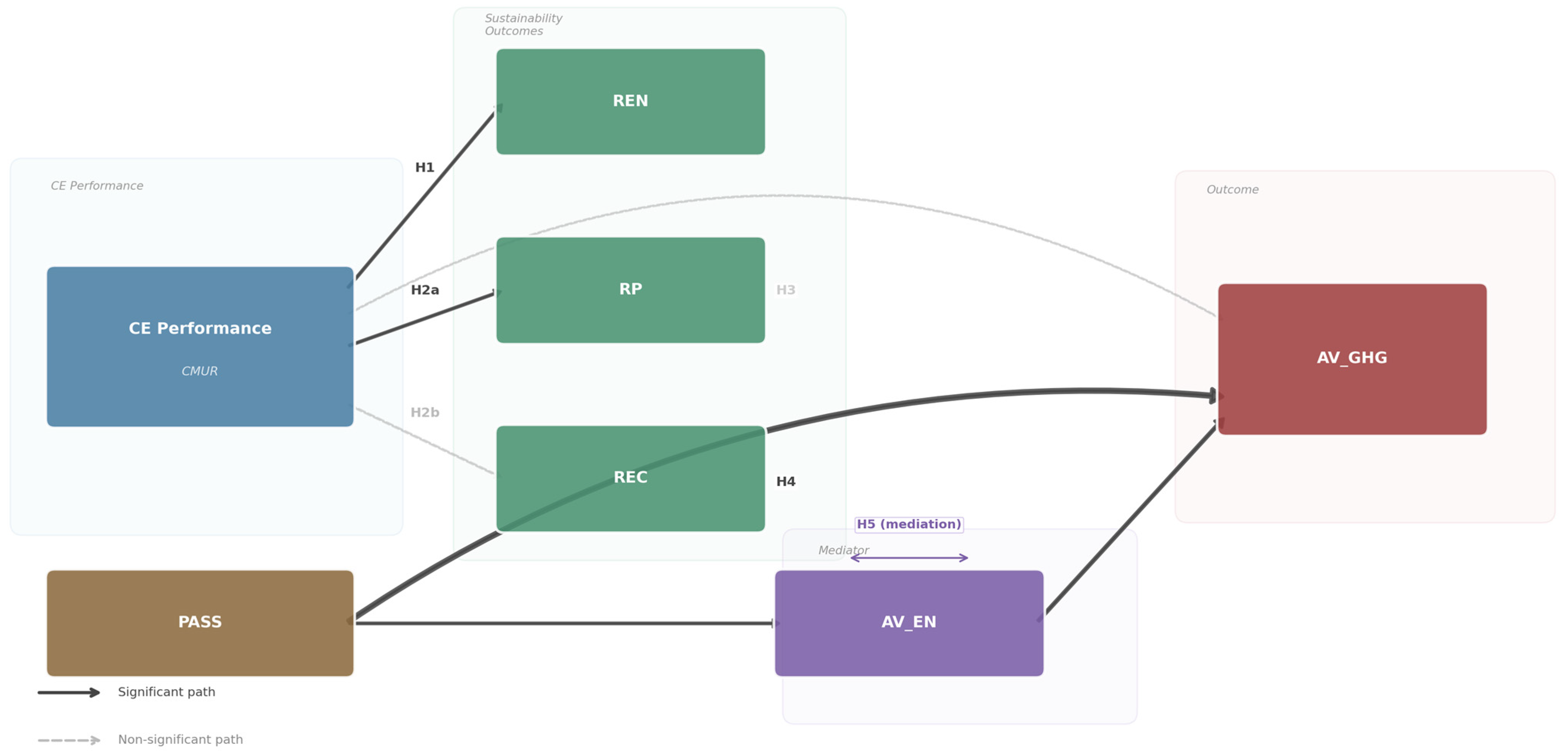
H1. CE performance is positively associated with the national share of renewable energy.
Resource productivity—measured as economic output per unit of material consumption—is a core macro-level indicator of CE outcomes [
64]. Since CE strategies aim to reduce material throughput and improve efficiency, stronger CE performance is expected to be associated with higher levels of resource productivity [
32,
65]. Therefore:
H2a. CE performance is positively associated with national resource productivity.
While the municipal recycling rate is sometimes used as a proxy for circularity, it primarily reflects local waste management implementation capacity rather than systemic industrial circularity. As such, this indicator often displays structural inertia and depends strongly on local governance capacity, infrastructure, and behavioral factors [
15,
31,
37,
64,
65]. Because such municipal systems may not adjust in parallel with national-level circularity improvements, macro-level CE progress is not expected to directly determine recycling outcomes. Thus, the following hypothesis is suggested:
H2b. The association between CE performance and national recycling rates is expected to be weak and statistically non-significant, reflecting structural inertia in municipal waste management systems that operate independently of macro-level circularity transitions.
As shown in the literature, aviation’s environmental performance is shaped predominantly by demand-side pressures and structural sustainability conditions rather than by material circularity initiatives [
36,
66]. Since CE indicators primarily capture material flows, their influence on aviation’s fuel combustion emissions is expected to be indirect, while broader sustainability factors and tourism-related mobility better explain aviation outcomes [
15,
67]. On this basis, the following hypothesis is proposed:
H3. As a group, national sustainability factors—particularly renewable energy share, resource productivity, population dynamics and tourism growth—explain aviation environmental performance more strongly than CE indicators.
Tourism-related air mobility is consistently identified as a dominant driver of aviation activity and emissions, as increases in passenger volumes translate into higher flight activity and fuel combustion [
36,
41,
45,
62]. Conversely, CE indicators do not directly affect travel demand and therefore are expected to have weaker explanatory power for aviation emissions. From these considerations, the following hypothesis arises:
H4. Among the predictors included in the aviation emission models, tourism growth, measured by air passenger volumes, is expected to be the strongest determinant of aviation GHG emissions.
Aviation emissions arise primarily from jet fuel combustion; therefore, increases in aviation activity translate into higher energy use and emissions. Within the IPAT/STIRPAT framework, aviation energy use represents the physical mechanism through which mobility demand translates into environmental impact [
41,
51,
62,
66]. Building on this logic, the present study applies a causal mediation framework to assess whether tourism growth affects aviation emissions indirectly via aviation energy consumption. From this theoretical rationale, the following hypothesis is proposed:
H5. The effect of tourism growth on aviation emissions is mediated by aviation energy consumption, which represents the main pathway linking demand growth to environmental impact.
Figure 1 synthesizes the theoretical framework underpinning this study by illustrating the hypothesized relationships between macro-level CE performance, national sustainability outcomes, tourism-driven demand, and aviation GHG emissions. The framework integrates Circular Economy Theory, Decoupling Theory, and the IPAT/STIRPAT perspective.
5. Materials and Methods
This study employs a quantitative, comparative, longitudinal research design to examine how CE performance, tourism activity, and energy use shape aviation-related environmental outcomes across 27 EU Member States between 2010 and 2024, excluding the United Kingdom due to the unavailability of harmonized CMUR data following its withdrawal from the European Union. The approach addresses gaps in existing research, particularly the lack of empirical cross-country analyses linking macro-level CE indicators with aviation emissions and the limited integration of tourism-driven demand factors into environmental assessments of the aviation sector. The empirical analysis is based on a country–year panel dataset constructed entirely from harmonized Eurostat indicators, ensuring consistent measurement across Member States and over time. Fixed effects (FE) estimators are employed to isolate within-country variation while controlling unobserved, time-invariant national characteristics—such as geography, institutional structures, or aviation market configuration—that may influence both CE performance and aviation emissions. The Hausman test indicates that unobserved country effects are correlated with the regressors, supporting the use of FE over Random Effects. Time fixed effects are included to absorb shocks common to all Member States.
The study adopts a deductive, explanatory approach informed by Circular Economy Theory, Decoupling Theory, and Ecological Modernization Theory. Tourism activity is proxied by air passenger volumes (PASS), which directly capture aviation-related mobility and avoid disruptions affecting international arrival statistics during the COVID-19 period. Aviation environmental outcomes are measured using aviation greenhouse gas emissions (AV_GHG) and aviation energy consumption (AV_EN), both obtained from Eurostat’s environmental accounts and energy balances for NACE Rev. 2 category H51. Passenger volumes in major EU hub states are retained without adjustment, as they reflect structural market differences rather than statistical anomalies. To examine whether tourism-driven demand influences aviation emissions through energy use, the study employs panel-based Causal Mediation Analysis (CMA), allowing the decomposition of total effects into direct and indirect components. This analytical strategy is consistent with the IPAT/STIRPAT framework, which conceptualizes energy use as the primary physical pathway linking human activity to environmental pressure.
All statistical analyses are conducted in R (version 4.5.1), using the PLM package (plm (version 2.6.7) and mediation (version 4.5.1)) for fixed-effects (FE) estimation and the mediation package for causal mediation analysis (CMA). Robustness checks include cluster-robust standard errors, heteroscedasticity and serial correlation tests, alternative CE operationalizations, and log-linear specifications to address variable skewness. The exclusive reliance on harmonized Eurostat datasets ensures transparency, consistency, and full replicability.
5.1. Data and Variables
Aviation greenhouse gas emissions (AV_GHG) constitute the primary dependent variable in the environmental models. AV_GHG is measured in thousand tonnes of CO
2 equivalent (kt CO
2e) and reflects the total emissions generated by air transport activities classified under NACE Rev. 2 code H51. The indicator follows European Environment Agency (EEA) reporting standards and is sourced from Eurostat’s environmental accounts, ensuring harmonized and comparable measurement across EU Member States. It is important to note that AV_GHG captures CO
2-equivalent emissions as reported under standard GHG accounting frameworks and does not include non-CO
2 climate effects—such as contrail cirrus formation and NO
x chemistry—which can substantially amplify aviation’s total warming impact. Accordingly, the results reported in this study reflect aviation’s measured GHG footprint as captured in Eurostat accounts, rather than its full climate footprint. Aviation energy consumption (AV_EN), expressed in thousand tonnes of oil equivalent (ktoe), captures the final energy use attributable to aviation and represents the energy–emissions mechanism at the core of the sector’s environmental footprint. Tourism-related aviation demand is measured through air passenger volumes (PASS), representing the annual number of passengers transported by air in each Member State; PASS is widely used in the tourism–aviation literature as a proxy for mobility flows and tourism intensity. In this study, tourism intensity is interpreted as relative tourism-related air mobility within the EU panel (i.e., cross-country differences and within-country changes over time in PASS), rather than as a comparison to an external regional benchmark or a fixed baseline.
Table 1 presents the full set of variables used in the analysis, including their operational definitions and Eurostat data sources.
CE performance is captured using CMUR and RP. CMUR measures the share of material input derived from recycled waste streams and is one of the European Commission’s core CE monitoring indicators. RP quantifies material efficiency by expressing the amount of economic output generated per unit of domestic material consumption. Prior research shows that the EC’s CE monitoring indicators—particularly CMUR—are the most harmonized and comparable metrics for assessing national circularity performance across the EU [
14]. Additional indicators include the recycling rate of municipal waste (REC), which reflects waste management efficiency, and the renewable energy share (REN), which captures progress in energy transition. GDP per capita is included as a control for economic development, while population size accounts for structural scale effects in national aviation markets.
The study period (2010–2024) was chosen for both substantive and technical reasons. First, it aligns with the availability of harmonized Eurostat data on CE indicators, aviation emissions and energy use across EU Member States. Second, it spans the key EU policy milestones relevant for circularity and transport decarbonization—including the 2015 Circular Economy Action Plan, the 2019 European Green Deal, the 2020 new CEAP, and the Fit for 55 package—allowing the analysis to capture the initial implementation phase of these frameworks. Third, 2010 provides a consistent pre-CEAP baseline, while 2024 represents the last year for which a complete and internally consistent set of CE and aviation indicators was available at the time of data extraction. The panel ends in 2024, the most recent year with complete and consistently harmonized Eurostat coverage across the full set of indicators used.
Although Eurostat environmental accounts are typically released with a time lag, the aviation air emissions accounts and energy balances for NACE H51, together with the CE indicators used in this study, are fully populated up to 2024, so no extrapolation or smoothing procedures were required. Missing values in some indicators—particularly AV_EN and REC—result in an unbalanced panel for selected model specifications; however, listwise deletion ensures internal consistency within each estimation.
5.2. Descriptive Statistics
Prior to econometric estimation, we examined the descriptive statistics of the variables.
Table 2 presents these results, which reveal substantial cross-country heterogeneity in aviation-related indicators. Both AV_GHG and AV_EN exhibit high dispersion, while passenger volumes (PASS) vary by several orders of magnitude, reflecting the prominence of major EU air hubs and differences in tourism intensity across Member States. This structural variation underscores the appropriateness of the FE estimator, which controls for country-specific characteristics. Descriptive statistics are rounded by variable types (counts/scales as integers; percentages/ratios with two decimals), with minima reported to two decimals only when below 1 to preserve precision.
CE indicators also display notable variability. CMUR remains low on average (9.13%), reflecting continued reliance on primary materials, while REC shows wide disparities in national waste management performance. REN ranges from below 1% to over 80%, illustrating uneven progress in the EU’s energy transition. Taken together, these distributions provide sufficient statistical richness for regression analysis and reflect the diverse environmental and structural trajectories of EU Member States.
To complement the descriptive statistics reported in
Table 2,
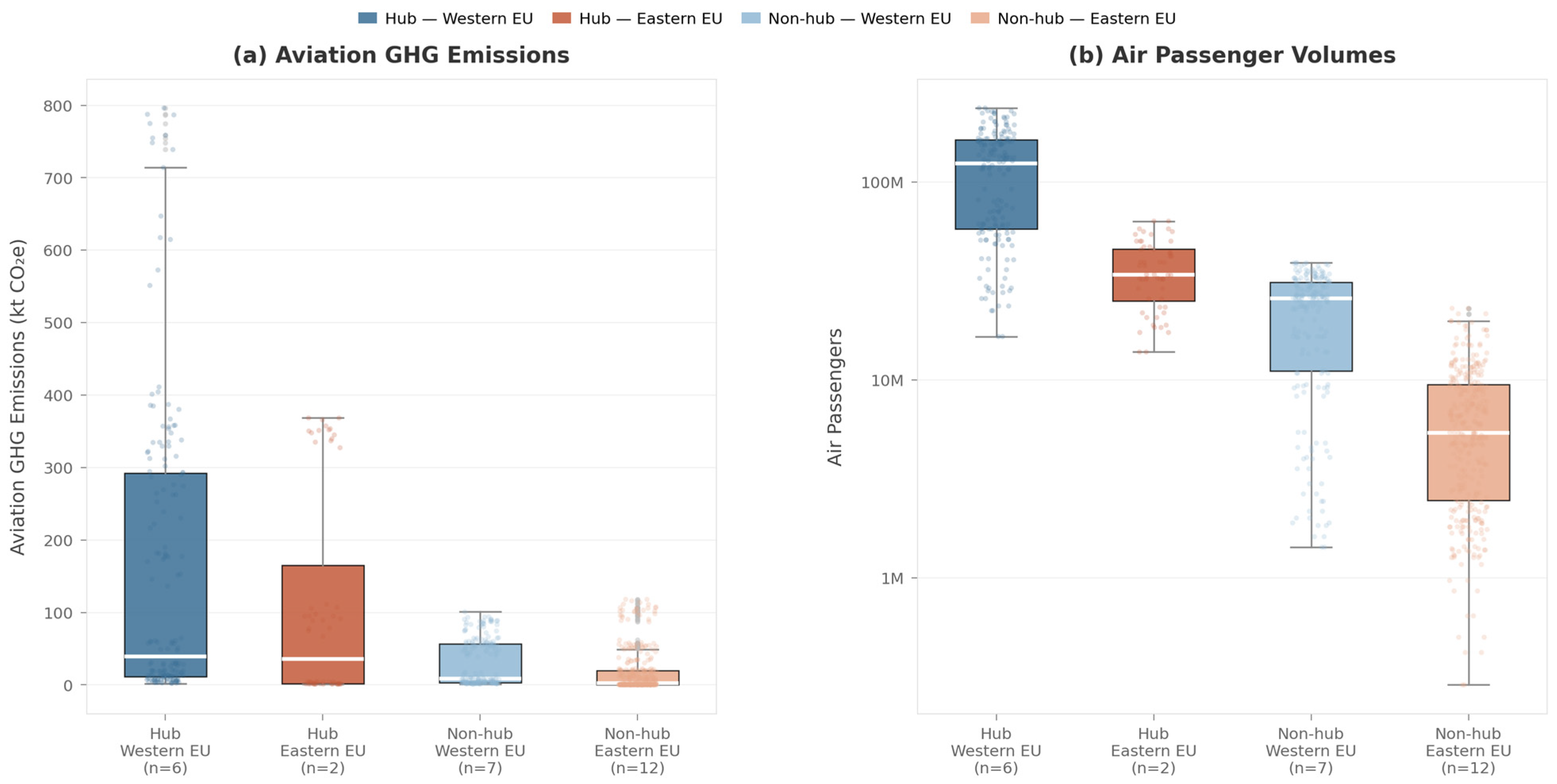
Figure 2 illustrates the structural heterogeneity in aviation GHG emissions and air passenger volumes across four country groups defined by hub status and geographic location. Hub countries in Western Europe exhibit median emissions and passenger volumes substantially higher than those observed in non-hub Eastern Member States, confirming the presence of strong structural differences across the panel. This heterogeneity further supports the use of the fixed-effects estimator, which controls for time-invariant country-specific characteristics such as airport network configuration, geography, and tourism market structure.
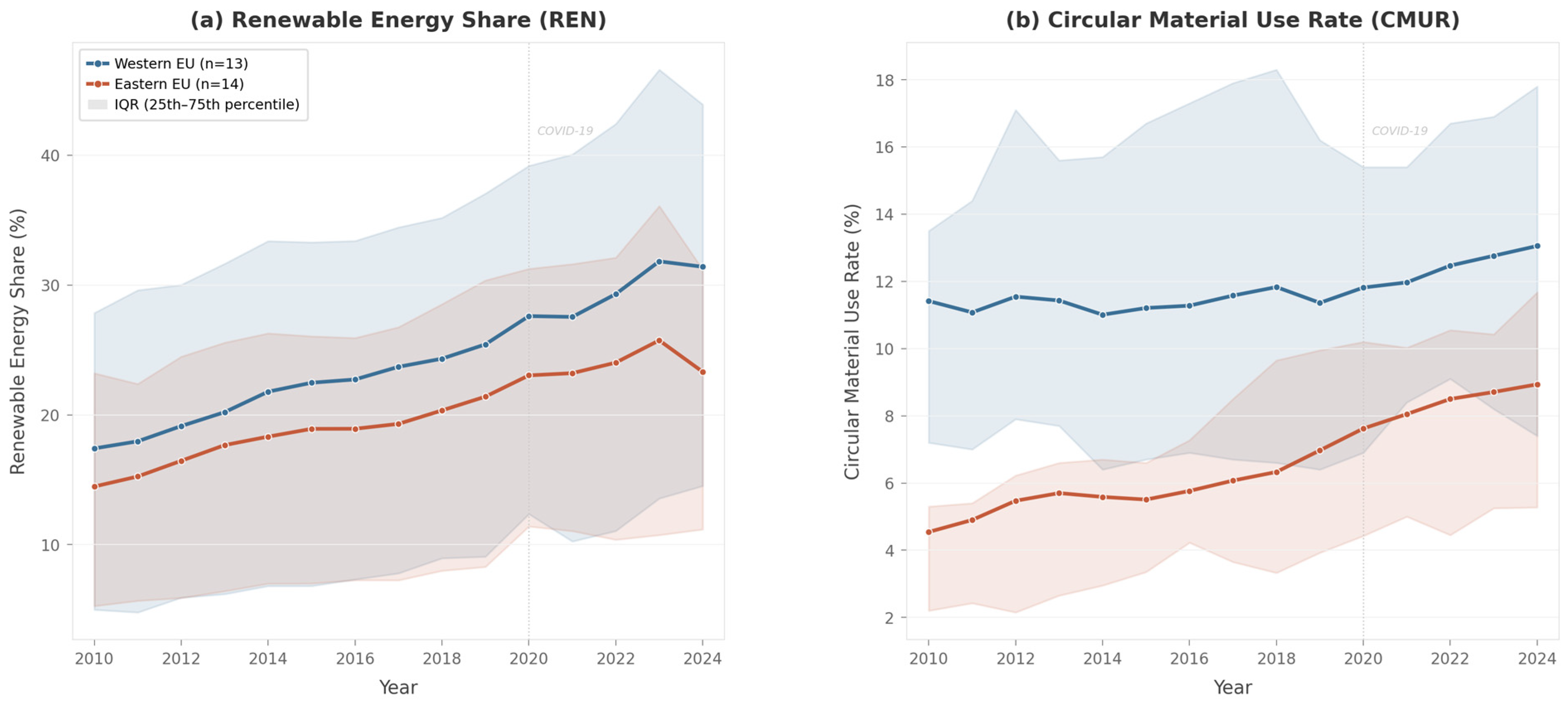
Figure 3 traces the temporal evolution of renewable energy share (REN) and circular material use rate (CMUR) across Western and Eastern EU Member States between 2010 and 2024. Both indicators display consistent upward trends, reflecting the progressive implementation of EU circularity and energy transition policies, with Western Member States maintaining systematically higher levels throughout. The persistent gap between the two groups—consistent with the ‘two-speed Europe’ pattern documented in the literature [
14]—provides empirical context for the cross-country heterogeneity observed in the panel and motivates the treatment of REN and CMUR as distinct dimensions of national CE progress in the empirical models. The disruption visible in 2020 reflects the temporary impact of the COVID-19 shock on economic activity and energy consumption patterns.
5.3. Econometric Strategy
The empirical strategy is implemented in two stages. First, a series of Fixed Effects (FE) panel regression models is estimated to examine the determinants of AV_GHG and AV_EN. This approach isolates within-country variation over time while controlling for unobserved, time-invariant heterogeneity across EU Member States. To formally justify the use of the FE estimator, the Hausman specification test [
68] was conducted to compare fixed effects and random effects (RE) models. The null hypothesis of RE consistency was decisively rejected (χ
2 significant at
p < 0.001), indicating that unobserved country-specific factors are correlated with the regressors. Consequently, FE is adopted throughout the analysis, ensuring consistent and unbiased estimates of the within-country effects.
The baseline specification takes the following form:
As shown in Equation (1), captures tourism-driven aviation demand, represents CE indicators (CMUR, RP, REC), denotes economic and energy-related control variable (REN, GDP_PC, POP), are country-specific fixed effects, and accounts for common time shocks. Separate specifications are estimated for AV_GHG and AV_EN to analyze emissions and energy use as interconnected but distinct environmental outcomes.
In the second stage, the study evaluates whether aviation energy consumption acts as a mediating mechanism through which tourism activity influences aviation emissions. Following Imai et al. [
69], Causal Mediation Analysis (CMA) is implemented using the two-equation framework reported in Equations (2) and (3):
The indirect effect of tourism activity on emissions is computed as , while represents the direct (non-mediated) effect. This framework is theoretically consistent with the IPAT/STIRPAT perspective, which positions energy use as the central physical pathway through which human activity generates environmental impact. All mediation models include the same set of controls and fixed effects to ensure comparability across equations. Given the heterogeneous scale of aviation markets across EU countries, standard errors are clustered at the country level to address heteroscedasticity and serial correlation. Additional robustness checks include alternative CE operationalizations (e.g., excluding REC due to missingness), models estimated without time effects, and specifications using logarithmic transformations to account for skewness in aviation-related variables. CMA models include country- and year-fixed effects and cluster-robust standard errors, consistent with the FE panel structure. Results remain qualitatively stable across all model variants. Because the study period (2010–2024) includes the COVID-19 shock—which caused an unprecedented collapse in passenger volumes and aviation emissions—time fixed effects absorb the large common shocks affecting all EU Member States. To further assess robustness, the core FE models were re-estimated with a COVID-19 dummy variable (equal to 1 for 2020–2021 and 0 otherwise). The magnitude and significance of the coefficients remain highly consistent across specifications, indicating that the main results are not driven by pandemic-related non-linearities.
In all baseline specifications for H3–H5, aviation-related variables enter the models in levels. Specifically, AV_GHG (kt CO2-eq), AV_EN (ktoe), PASS (number of passengers), and POP (number of inhabitants) are used in their original scales. Given the strong right-skewness of aviation variables, log-linear and log–log variants (e.g., ln(AV_GHG), ln(AV_EN), ln(PASS), ln(POP)) were estimated as additional robustness checks. These alternative specifications produce qualitatively identical results in terms of sign, statistical significance, and the magnitude of the mediated effect. For brevity, they are not reported here but are available upon request. This multi-step econometric strategy—integrating FE estimators with causal mediation analysis—allows the study to identify both the structural determinants of aviation emissions and the mechanisms through which tourism demand contributes to environmental pressure in the EU aviation sector.
6. Results
The empirical analysis first explores the bivariate relationships among aviation, demographic, and sustainability indicators for the period 2010–2024. As reported in
Table 3, the Pearson correlation matrix reveals several strong and structurally consistent patterns. AV_GHG and AV_EN display an almost perfect positive correlation (
r = 0.992), reflecting the direct dependence of aviation emissions on fuel combustion.
PASS is also strongly correlated with both AV_GHG (r = 0.975) and AV_EN (r = 0.986), consistent with the scale-dependent and energy-intensive nature of air transport across the EU. These high correlation values underscore the structural linkage between aviation activity, energy use, and emissions, and confirm that aviation energy consumption and aviation emissions should not be used simultaneously as predictors in the same regression model due to multicollinearity. The correlation structure further indicates that POP is highly correlated with AV_GHG (r = 0.957), AV_EN (r = 0.953), and PASS (r = 0.938), indicating that larger countries tend to exhibit greater aviation activity and higher associated environmental impacts. By contrast, GDP_PC shows very weak correlations with aviation variables, suggesting that economic development levels do not directly correspond to aviation environmental pressures within the EU context.
CE indicators display low to moderate correlations with aviation-related variables. CMUR shows weak positive associations with AV_GHG (r = 0.169) and AV_EN (r = 0.197), indicating limited direct interaction between macro-level circularity performance and aviation environmental outcomes. REC exhibits similarly low correlations with aviation metrics (r = 0.233 with AV_GHG; r = 0.247 with AV_EN), reflecting the structural separation between national waste management systems and aviation operations. RP and REN are weakly correlated with aviation indicators, although RP shows a positive association with GDP_PC (r = 0.799), consistent with broader patterns of economic structure and resource efficiency in advanced economies. Overall, the correlation structure reveals pronounced clustering among aviation activity variables and population, while CE indicators and renewable energy shares remain largely independent from aviation-related measures. The absence of excessively high correlations outside the aviation cluster indicates no immediate threat of multicollinearity among the sustainability and CE variables, supporting their inclusion in the subsequent panel regression models.
To complement these bivariate associations,
Table 4 reports multicollinearity diagnostics (VIF and tolerance) for the main regression specification. CE performance (CMUR), renewable energy share (REN), and GDP per capita exhibit very low VIF values (between 1.06 and 1.16) and high tolerance levels (>0.86), indicating an absence of collinearity concerns for these predictors. Air passengers and population present moderate VIF values (≈8.7), which is expected given the strong structural link between country size and aviation demand already observed in the correlation matrix. Importantly, all VIF values remain well below the conventional threshold of 10, suggesting that multicollinearity does not pose a threat to the stability, precision, or interpretability of the subsequent panel regression estimates.
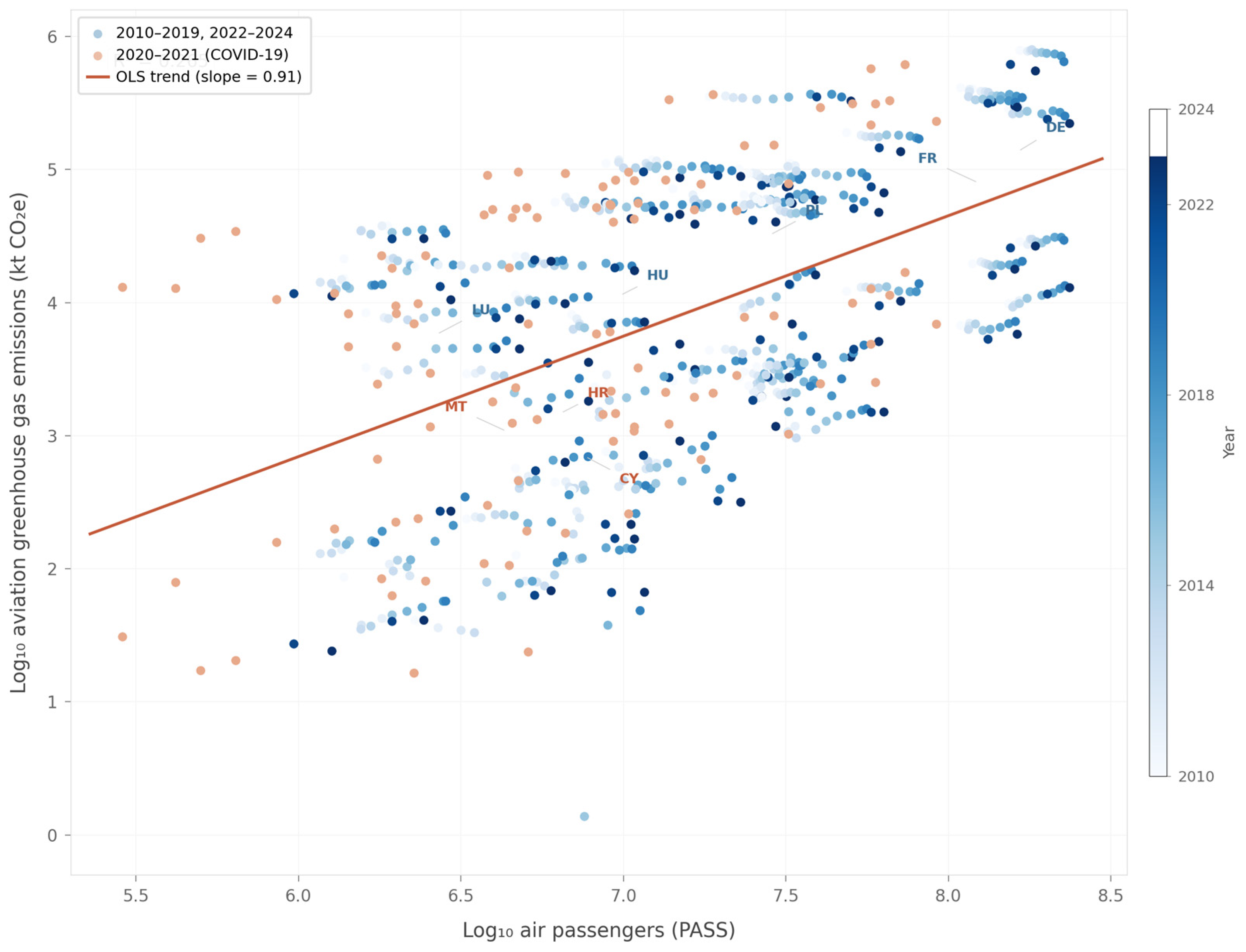
Figure 4 illustrates the strong positive association between passenger volumes and aviation greenhouse gas emissions across EU Member States, while also highlighting systematic deviations from the fitted trend.
Countries located persistently above the OLS line appear to generate higher emissions than implied by traffic volumes alone, whereas those below the line indicate comparatively lower emission intensity at similar demand levels. The pronounced contraction of the point cluster in 2020–2021 reflects the structural shock of the COVID-19 pandemic, which temporarily disrupted the demand–emissions relationship across the panel.
The core fixed-effects estimations for hypotheses H1–H4 are summarized in
Table 5, which presents five models examining the determinants of renewable energy share, resource productivity, recycling rates, and aviation GHG emissions across EU Member States during 2010–2024. The first three models focus on sustainability and CE outcomes, while the last two models assess the factors associated with aviation-related greenhouse gas emissions. In the first model, CMUR has a positive and statistically significant association with renewable energy share (β = 0.3911;
p < 0.05), suggesting that improvements in circularity tend to accompany higher uptake of renewable energy sources. GDP per capita also displays a positive and significant effect (β = 0.000344;
p < 0.05), indicating that higher-income countries are more likely to expand renewable energy integration. In the second model, resource productivity is positively associated with CMUR (β = 0.0536;
p < 0.01) and GDP per capita (β = 0.000045;
p < 0.01), showing that more circular and economically advanced economies tend to use resources more efficiently. Population also exhibits a small but statistically significant coefficient (β = 9.17 × 10
−8;
p < 0.05).
The third model shows no significant relationship between CMUR and the recycling rate (β = 0.4714; p > 0.10), supporting the expectations that recycling systems evolve slowly and depend more on long-term waste management infrastructures than short-term improvements in circularity. The relatively large standard error (SE = 0.3670) reflects substantial cross-country heterogeneity in municipal recycling infrastructure, consistent with the structural inertia argument underlying H2b. GDP per capita and population display only small but statistically significant effects, suggesting limited links between economic scale and recycling performance.
The results for H3 (model 4) indicate that air passengers have a positive and statistically significant association with aviation emissions (β = 0.000094; p < 0.01), confirming that demand pressure remains a key driver of energy use and environmental impact in the aviation sector. Circularity indicators exert no significant direct effect on emissions, suggesting that CE-related progress does not translate immediately into reductions in aviation-level environmental pressures. This likely reflects a sectoral mismatch: macro-level CE indicators primarily capture material circularity and resource efficiency, whereas aviation emissions are dominated by jet fuel combustion and energy use. GDP per capita shows a positive but statistically insignificant association with emissions, while population effects are not included in this specification. Overall, H3 is supported: as a group, national sustainability factors explain aviation emissions substantially more effectively than CE indicators alone, which offer no independent explanatory contribution once structural and demand-side drivers are included.
Among the sustainability variables, population shows a negative and statistically significant relationship with aviation emissions in the tourism-focused model (β = –0.000779; p < 0.01), indicating that when holding passenger volumes constant, increases in overall population do not translate directly into higher aviation-related emissions. GDP per capita displays a positive but statistically insignificant association in both aviation models. Across all models, the fixed-effects estimation demonstrates strong explanatory power, with adjusted R2 values close to unity in the aviation GHG specifications, reflecting the persistence of aviation emissions within countries over time once country and year fixed effects absorb stable structural heterogeneity and common shocks.
To evaluate whether national sustainability factors provide superior explanatory power relative to CE indicators,
Table 6 compares three fixed-effects model specifications. The sustainability-only model shows a substantial improvement in model fit over the circular economy-only model, with a marked increase in adjusted R
2 (from 0.955 to 0.997) and significant reductions in AIC/BIC values. The F-test confirms that the additional sustainability variables significantly enhance explanatory power (
p < 0.001). Adding CE performance to the sustainability model (Model 3) does not yield any meaningful improvement, as the adjusted R
2 remains unchanged and the χ
2 difference is statistically insignificant. These results indicate that national sustainability factors explain aviation-related emissions far more strongly than CE indicators.
Although the FE estimator focuses on within-country changes, baseline differences across Member States remain relevant for interpretation. Tourism-intensive and hub countries typically exhibit structurally higher passenger volumes and aviation emissions, while CE performance often follows a “two-speed” pattern, with Northern/Western Member States outperforming many Central/Eastern countries in macro-level circularity indicators.
While H3 established the collective superiority of sustainability factors over CE indicators, Model 5 evaluates H4 by identifying the strongest individual predictor within this group. Tourism-related demand significantly increases aviation emissions (β = 0.0000935; p < 0.01), emerging as the single most consistent determinant across all specifications. This result aligns with prior studies showing that tourism mobility represents a major source of energy-intensive transportation growth in Europe. Notably, CE indicators remain statistically insignificant, reinforcing the conclusion that circularity policies—although effective in other sectors—do not exert downward pressure on aviation emissions. This finding is consistent with evidence that aviation faces persistent decarbonization challenges due to technological constraints, slow fleet turnover, and sustained demand growth. Therefore, H4 is strongly supported.
The final step of the analysis investigates whether aviation energy consumption mediates the relationship between tourism activity and aviation emissions. To test the mechanism through which tourism demand affects emissions, a Causal Mediation Analysis (CMA) was conducted following the two-equation framework of Imai [
68]. In the first-stage regression, tourism activity significantly increases aviation energy consumption (θ
1 > 0;
p < 0.01), indicating that energy use is highly sensitive to demand shocks. In the second-stage equation, aviation energy consumption strongly predicts aviation emissions (δ
2 > 0;
p < 0.001), while the direct effect of tourism demand on emissions (δ
1) becomes substantially weaker when controlling for energy use.
The mediation results, summarized in
Table 7, show a strong and statistically significant indirect effect of air passengers on emissions through aviation energy use (ACME = 7.26 × 10
−5,
p < 0.001). Bootstrap-based confidence intervals exclude zero, confirming the robustness of the mediated pathway. By contrast, the direct effect of tourism demand on aviation emissions (ADE = 2.26 × 10
−5) is not statistically significant (
p = 0.12), indicating that tourism-driven changes in emissions operate primarily through increases in aviation energy consumption rather than through any direct, non–energy-related mechanisms. The total effect of passenger volumes on aviation emissions remains positive and significant (Total Effect = 9.52 × 10
−5;
p < 0.001), and the proportion mediated (0.762) indicates that approximately 76% of the overall impact of tourism demand on aviation emissions is transmitted through the energy pathway. Although the upper bound of the confidence interval for the proportion mediated slightly exceeds 1, this likely reflects sampling variability typical of mediation analysis and does not alter the substantive interpretation of the result.
This mediated share aligns closely with the theoretical expectations of the IPAT/STIRPAT framework, in which energy consumption constitutes the physical transformation layer through which human activity produces environmental impact. The results therefore provide strong empirical support for H5: aviation energy consumption is a key mechanism linking tourism activity to aviation emissions. The findings further suggest that meaningful decoupling between tourism growth and aviation emissions is unlikely without deep structural changes in aviation energy systems, as incremental efficiency gains are insufficient to counteract the scale effect of rising tourism demand. This mechanism also explains why improvements in CE performance at the macroeconomic level do not automatically translate into reductions in aviation GHG emissions—the sector remains structurally energy-intensive and strongly demand-driven.
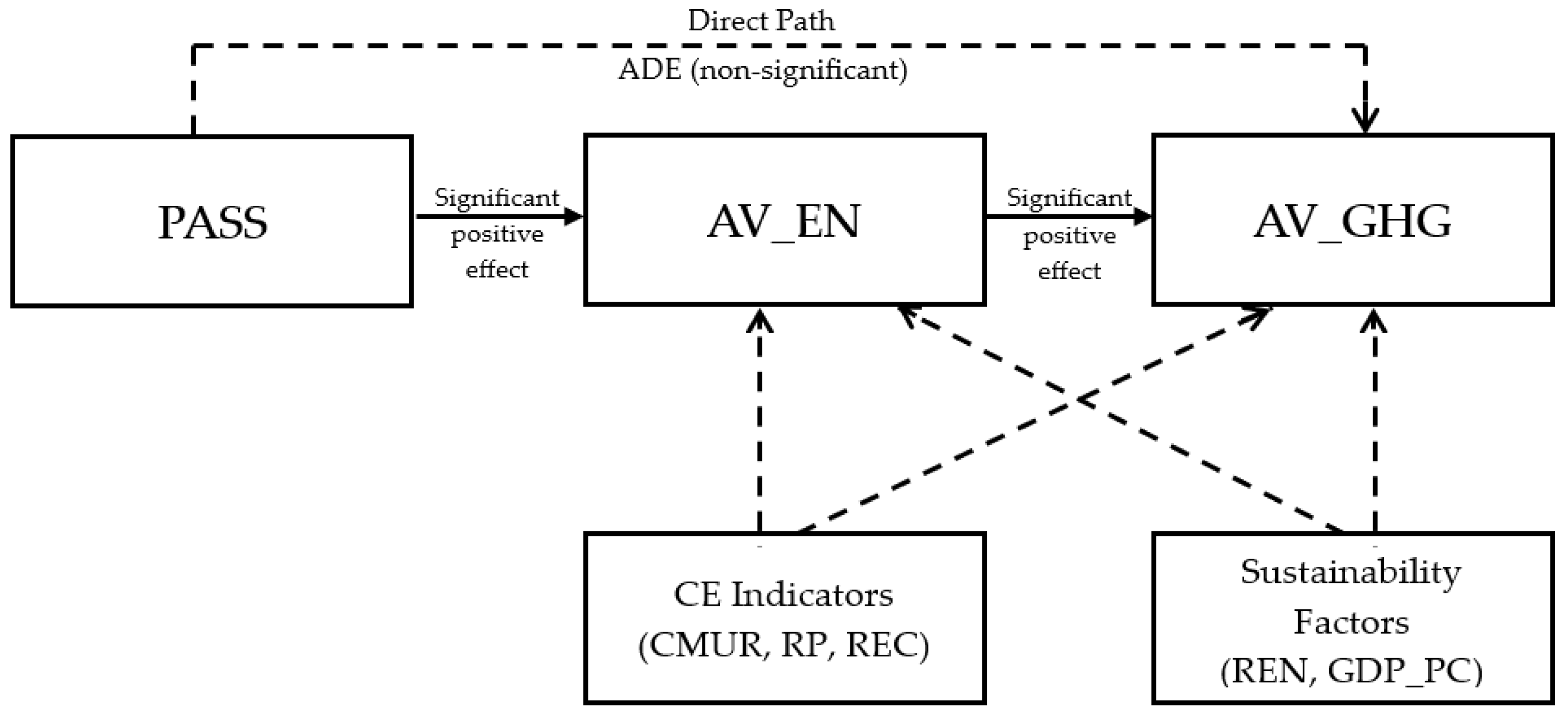
To provide a clearer visual summarization of the mediation mechanism,
Figure 5 illustrates the estimated PASS → AV_EN → AV_GHG pathway. The diagram highlights the strong indirect effect through aviation energy use and the non-significant direct path from tourism activity to emissions.
Overall, these findings suggest that the relationship between tourism activity and aviation emissions is largely driven by the energy intensity of air transport operations. Aviation energy consumption functions as a key mechanism through which tourism demand contributes to environmental pressure in the aviation sector, reinforcing the central role of the energy–emissions nexus in aviation decarbonization strategies.
7. Discussion
This study examined how CE performance, sustainability factors, and tourism dynamics jointly shape aviation-related environmental outcomes across European Union Member States between 2010 and 2024. The results for H1 show that CE performance—captured through the CMUR—is positively and significantly associated with the share of REN. This finding empirically validates the expected link between material circularity and progress in the energy transition, indicating that improvements in circularity tend to reinforce broader sustainability dynamics. The result aligns with Circular Economy Theory and Ecological Modernization Theory, both of which emphasize that resource-efficient systems facilitate wider environmental restructuring. As highlighted by Kirchherr [
31] and Korhonen [
32], increasing the use of secondary materials reduces reliance on energy-intensive primary extraction and processing. Consequently, higher circularity lowers embodied energy demand and creates structural conditions that favor the expansion of renewable energy within the national energy mix. From a policy perspective, this relationship underscores the complementarity between the EU Circular Economy Action Plan and the European Green Deal. The evidence suggests that circularity measures should be viewed not only as waste reduction strategies but as integral contributors to the EU’s clean energy transition. Member States with more advanced material recirculation appear better positioned to meet renewable energy targets, indicating that investments in circular practices can generate meaningful co-benefits in the energy sector.
The empirical analysis provides clear support for H2a, showing that CE performance—measured through the CMUR—is positively and significantly associated with RP. This finding indicates that higher levels of material recirculation directly enhance the economic output generated per unit of resource input, reinforcing the fundamental principle that circularity contributes to systemic efficiency improvements. The result is consistent with the broader literature: Geissdoerfer et al. [
65] conceptualize circularity as a mechanism for decoupling economic growth from resource use, while Korhonen [
32] demonstrates that circular strategies systematically increase material productivity at the national scale. Similarly, Castillo et al. [
25] argue that extending material utility and preserving value across the supply chain inherently reduces pressure on natural resources, which aligns with the empirical pattern observed here.
From a policy perspective, this confirms the strategic relevance of resource productivity within the EU’s Circular Economy Action Plan: strengthening secondary material markets generates tangible macroeconomic gains and reinforces the role of circularity as a systemic sustainability driver, not merely a waste management paradigm [
55,
56,
69].
The results for H2b show that the CMUR has only a weak and statistically insignificant association with REC. Although the coefficient is nominally positive, the absence of significance indicates structural inertia and a clear decoupling between national-level circularity progress and local waste management outcomes. This finding reinforces the conceptual distinction widely emphasized in the CE literature: CMUR reflects systemic, industrial-level circularity transitions—such as eco-design, industrial symbiosis, and advanced resource loops—as described by Kirchherr [
31], whereas REC captures heterogeneous municipal implementation capacities. The statistical separation observed here is consistent with Morseletto [
64], who argues that macro-level circularity indicators and micro-level waste metrics operate within fundamentally different governance and operational domains. REC performance depends heavily on local infrastructure quality, municipal autonomy, collection systems, and behavioral factors, which explains why improvements in industrial circularity (CMUR) do not automatically translate into progress at the municipal level. Salesa [
37] similarly highlights the persistent governance challenges that arise when national CE ambitions encounter uneven local implementation structures. In the broader systemic context, this result complements the findings of Knäble [
15]: while CMUR is a strong predictor of higher-level sustainability outcomes—such as contributions to the energy transition (H1)—the lack of a relationship with REC demonstrates that different CE objectives require distinct policy instruments. National-scale CE strategies and industrial material loops may advance without parallel improvements in municipal recycling systems, indicating the need for targeted, implementation-focused interventions at the local level.
The comparative model analysis provides strong support for H3, showing that national sustainability factors and tourism-driven demand pressures explain aviation-related emissions far more effectively than CE indicators alone. While the CE-only model achieves a relatively high adjusted R
2, the inclusion of renewable energy share, resource productivity, GDP per capita, population, and passenger volumes generates a substantial and statistically significant improvement in explanatory power. The absence of additional gains when CMUR is added to the full model indicates that CE performance offers no independent explanatory contribution once structural drivers are accounted for. These results are consistent with broader CE research showing that EU efforts have primarily focused on waste management rather than systemic value chain transformations [
33]. Consequently, CE progress supports general sustainability transitions but exerts only a limited influence on sectors whose environmental impacts are driven primarily by energy consumption rather than material throughput. Similar conclusions are reported in recent studies highlighting that CE implementation often improves material efficiency without fundamentally transforming energy-intensive sectors [
70], particularly where structural frictions—such as governance gaps, insufficient investment, and illegal waste flows—constrain the diffusion of circular practices [
35].
The strong explanatory role of air passenger volumes and population scale aligns with theoretical and empirical work emphasizing the dominance of demand-side and fuel-related constraints in aviation’s environmental performance [
46,
66]. These findings are consistent with earlier evidence showing that aviation emissions are primarily shaped by tourism demand and structural scale effects rather than by incremental efficiency gains [
8,
36]. At the same time, the lack of a significant CMUR effect reinforces the view that macro-level circularity transitions—focused on material flows, value preservation, and resource efficiency—do not directly affect the combustion-intensive processes underlying aviation emissions. The absence of a direct CE effect is not surprising given the sector’s structural characteristics. Aviation emissions are driven by fuel combustion, not material flows—the domain that CE indicators measure. Beyond this indicator mismatch, high energy density requirements and slow fleet turnover mean that circularity gains take time to reach the sector. Any indirect CE influence, operating through broader energy transitions or innovation spillovers, falls outside the scope of the present analysis and warrants future investigation.
This sectoral asymmetry is consistent with Knäble et al. [
15], who show that while CE progress contributes to national sustainability outcomes, its effects vary substantially across sectors. In contrast to material-intensive domains such as hospitality and food systems—where circular strategies can significantly reduce resource inputs and waste [
71]—aviation remains constrained by its reliance on energy-dense fuels. As a result, circularity-driven improvements in material efficiency do not translate directly into emission reductions within the aviation sector. Overall, these results confirm that national sustainability factors and tourism-driven demand dominate aviation environmental performance, thereby supporting H3.
While H3 established the collective superiority of sustainability factors over CE indicators, the individual coefficient analysis for H4 reveals that this superiority is driven predominantly by a single predictor: air passenger volumes. The fixed-effects results provide strong support for H4, showing that tourism growth, captured through PASS, emerges as the strongest determinant of aviation-related emissions across EU Member States. The persistent effect of passenger volumes confirms that demand-side pressure far outweighs the influence of CE indicators or broader socio-economic controls. This pattern is consistent with extensive evidence in the aviation–tourism literature, which identifies air mobility demand as the central driver of aviation emissions [
4,
8,
36,
45,
48]. Because the FE specification absorbs time-invariant national characteristics such as geography, institutional history, and airport network structure, the persistent strength of this relationship reflects a genuine behavioral and economic effect rather than a statistical artifact.
The behavior of the control variables provides additional insight. The negative and significant coefficient for population suggests that, once passenger volumes are held constant, larger countries tend to exhibit proportionally lower aviation emissions—possibly due to the availability of alternative transport modes such as high-speed rail or more diversified domestic mobility systems. This demand-dominance pattern also has implications for how future EU aviation policy is evaluated: progress metrics focused on efficiency gains per seat-kilometers may mask absolute emission growth driven by volume expansion, a dynamic consistent with the rebound effects documented in transport decarbonization literature [
72]. These findings align with Sun et al. [
41] and Chovancová et al. [
67], who document that growth in aviation and transport activity systematically outpaces efficiency gains, leaving emissions driven primarily by demand scale.
The mediation results complement and extend the fixed-effects findings by revealing the precise mechanism through which tourism demand shapes aviation’s climate footprint. While the FE models establish the net association between PASS and AV_GHG, the CMA decomposes this relationship and confirms that the primary pathway runs through aviation energy consumption—not through any direct, non-energy behavioral or structural channel. This mechanistic specificity has important theoretical implications: it positions aviation energy use as the critical intervention point in any decarbonization strategy and clarifies why economy-wide CE progress—operating through material flows rather than fuel systems—cannot substitute for aviation-specific energy transitions. The result aligns with established evidence that aviation emissions are fundamentally determined by fuel combustion [
41,
66] and with recent modeling work emphasizing the centrality of the demand → fuel → emissions pathway [
51,
73], even in the presence of regulatory instruments such as the EU Emissions Trading System [
11,
26].
The strong mediated relationship identified in this study has important policy implications. The fact that most of tourism’s impact on emissions is transmitted through aviation energy use indicates that improvements in material circularity alone are unlikely to significantly alter aviation’s emissions trajectory. While CE strategies contribute to broader sustainability transitions, the present findings indicate no measurable direct or empirically estimated indirect effect of CE performance on aviation emissions within the 2010–2024 study period. The sector’s environmental footprint is dominated by fuel combustion rather than material flows, which structurally limits the reach of circularity policies. Consequently, policy frameworks focused solely on CE measures are unlikely to achieve meaningful reductions in aviation emissions without parallel transformations in the sector’s energy base. These results highlight the central importance of energy-focused interventions, including the large-scale deployment of SAF and waste-based SAF, the development of alternative propulsion technologies, and further improvements in aircraft energy efficiency [
51]. At the same time, the findings underline the growing relevance of demand-side measures in managing tourism-related mobility. Because tourism growth directly increases aviation energy use, sustainable tourism strategies, modal substitution where feasible, and targeted regulation of high-emission mobility patterns may become necessary components of long-term decarbonization pathways. Finally, the mediation results contribute to the broader debate on decoupling tourism growth from environmental impact. The dominance of the energy pathway suggests that relative decoupling may be achievable through technological improvements and fuel transitions, but absolute decoupling remains highly challenging under continued tourism expansion.
From a policy perspective—and beyond the scope of the empirical findings reported here—meaningful decarbonization may benefit from integrating CE principles with aviation-specific energy interventions, particularly large-scale SAF deployment, alternative propulsion development, and demand-management frameworks in tourism-intensive Member States [
13,
37,
38].
8. Conclusions
This study examined how CE progress, sustainability transitions, tourism intensity, and aviation energy use shape aviation-related emissions across EU Member States between 2010 and 2024. The results show that CE performance contributes meaningfully to national environmental progress, particularly through renewable energy integration and resource productivity, but does not directly reduce aviation emissions. Instead, tourism-driven passenger volumes emerge as the main determinant of aviation’s climate impact, while aviation energy consumption appears to be the main mechanism through which demand translates into greenhouse gas emissions. These findings point to an asymmetric policy imperative: while CE progress contributes to economy-wide sustainability transitions, the decisive levers for aviation decarbonization are energy- and demand-side interventions—particularly SAF deployment, operational efficiency improvements, and targeted demand management measures. Strengthening circularity across the broader economy remains valuable, but cannot substitute for aviation-specific action on fuel systems and mobility demand.
In policy terms, the results align with the EU’s Fit for 55 agenda and aviation ETS reform by indicating that pricing and regulatory instruments alone are unlikely to offset demand-driven emission pressures without addressing the sector’s energy base. ReFuelEU Aviation and SAF scaling therefore become central levers for reducing the energy-mediated emissions pathway identified in this study. More broadly, CE progress supports economy-wide sustainability transitions, but aviation decarbonization requires aviation-specific energy interventions complemented by mobility management measures in tourism-intensive contexts.
Despite the robustness of the econometric approach, the study is not without limitations. The use of national-level data constrains the ability to capture micro-level circular practices within airlines and airports. Moreover, the use of aggregated country-level indicators limits the separation of passenger-related demand from freight/express (“delivery”) aviation activity and cannot capture subnational hub effects. Furthermore, the environmental indicator used excludes non-CO2 effects such as contrails and NOx emissions, which substantially influence aviation’s total climate footprint. The reliance on a limited set of circularity indicators restricts the dimensionality of CE measurement, and these macro-level CE indicators are not aviation-sector-specific, potentially overlooking circular practices embedded in maintenance, repair, reuse, procurement, and end-of-life processes. The absence of spatial modelling also prevents the identification of cross-border spillover effects in aviation demand or CE policy implementation. In addition, the empirical specifications do not directly include operational or technological aviation indicators—such as the number of flights, load factors, route structure, fleet composition/age, aircraft efficiency, or SAF uptake—because consistent long-run cross-country series are not available within the harmonized data framework used for 2010–2024. Finally, the presence of structural shocks during the study period, including the COVID-19 pandemic, may introduce nonlinearities that fixed-effects models, despite robustness checks, cannot fully capture.
These limitations point toward several promising directions for future research. Further studies could incorporate firm-level and airport-level data to investigate how circular practices influence operational efficiency, energy use, and emissions at the micro scale. Expanding environmental assessments to include non-CO2 aviation impacts would allow for a more comprehensive evaluation of climate effects. Future research may also broaden the set of circularity metrics using eco-innovation indicators, lifecycle circularity scores, or waste recovery data specific to the aviation sector. Additionally, adopting spatial econometric models could help identify how tourism flows, CE progress, and aviation policies diffuse across borders. Future work could also integrate operational aviation metrics (e.g., flight activity measures, load factors, fleet characteristics, and SAF deployment) to better isolate demand composition and technological drivers of emissions. More broadly, this study opens several avenues for future research, including the development of more generalizable models capable of assessing the medium- and long-term effectiveness of European sustainability and mobility policies, as well as their economic and societal implications.




 ,
,