Article

Sustainable Valorisation of Hazardous MSWI Air Pollution Control Fly Ash in Portland Composite Cement: Performance, Environmental Safety and Circular Economy Perspective


by
Beata Łaźniewska-Piekarczyk
1,* and
Monika Czop
2
1
Department of Building Processes and Building Physics, Faculty of Civil Engineering, Silesian University of Technology, Akademicka 5, 44-100 Gliwice, Poland
2
Department of Waste Management Technologies, Faculty of Energy and Environmental Engineering, Silesian University of Technology, Konarskiego 18, 44-100 Gliwice, Poland
*
Author to whom correspondence should be addressed.
Sustainability 2026, 18(7), 3322; https://doi.org/10.3390/su18073322
Submission received: 6 March 2026 / Revised: 24 March 2026 / Accepted: 25 March 2026 / Published: 29 March 2026

Abstract

The management of hazardous municipal solid waste incineration (MSWI) residues represents a critical challenge for sustainable development due to their increasing generation and environmental risk. At the same time, the cement industry faces urgent pressure to reduce CO2 emissions associated with clinker production, creating a demand for alternative supplementary cementitious materials. The aim of this study was to evaluate the feasibility of valorising hazardous municipal solid waste incineration (MSWI) air pollution control fly ash (EWC 19 01 07*) as a constituent of Portland composite cement, in line with circular economy principles and the need to reduce CO2 emissions associated with clinker production. The investigated fly ash, originating from flue gas cleaning processes, is characterised by high alkalinity and elevated concentrations of heavy metals, which currently necessitate controlled landfilling. To enable its safe reuse, the ash was subjected to high-temperature thermal treatment following granulation and subsequently incorporated into cement formulations under semi-industrial conditions. Two Portland composite cements were produced with different ash contents, corresponding to CEM II/A-07 and CEM II/B-07, while a Portland cement manufactured from the same clinker was used as a reference material. The chemical and phase composition of the ash before and after thermal treatment was analysed using XRF and XRD, supported by SEM/EDS observations. The results demonstrate that thermal treatment at 1150 °C induces partial phase stabilisation of APC fly ash without full vitrification, allowing its integration into cement systems under semi-industrial conditions. The incorporation of ash significantly alters hydration behaviour through increased water demand governed by particle porosity, CaO-rich phase composition, and early ionic interactions in the pore solution, leading to reduced workability and mechanical performance. While immobilisation efficiencies exceeding 99.5% were achieved for most heavy metals due to precipitation and incorporation into hydration products, barium exhibited persistent leaching controlled by its solubility under highly alkaline conditions and limited incorporation into C–S–H phases. These findings define both the technological feasibility and the key environmental constraints of APC fly ash utilisation in Portland composite cement. From a sustainability perspective, the proposed approach contributes to the reduction in hazardous waste landfilling and supports clinker substitution in cement production. The results demonstrate the potential of integrating waste management and low-carbon material design within a circular economy framework while highlighting current environmental limitations related to barium leaching.

1. Introduction

Municipal solid waste incineration (MSWI) is increasingly applied as an integrated waste management strategy that enables significant reduction in waste volume while simultaneously recovering energy in the form of electricity and heat. Despite these advantages, the process generates substantial quantities of solid residues, including bottom ash, boiler ash, and air pollution control (APC) fly ash. Among these, APC fly ash (EWC 19 01 07*) is considered particularly problematic due to its fine particle size, high alkalinity, and elevated concentrations of soluble salts and hazardous heavy metals, which necessitate controlled handling and disposal [1].
In recent decades, increasingly stringent environmental regulations in the European Union have significantly limited landfilling and promoted material recovery pathways [2]. As a result, there is growing interest in the valorisation of MSWI residues within the construction sector, particularly in cementitious systems, which offer high material consumption capacity and favourable chemical conditions for contaminant stabilisation [3]. While bottom ash has already found limited application as a secondary aggregate, APC fly ash remains challenging due to its adverse effects on cement hydration, durability, and environmental performance when used without prior treatment [4].
Thermal treatment has been widely investigated as an effective method for the stabilisation of APC fly ash, enabling phase transformations, volatilisation of selected elements, and reduction in contaminant mobility [5]. High-temperature processing can promote the incorporation of heavy metals into more stable crystalline or amorphous phases, thereby decreasing their leachability [6]. However, most existing studies focus on laboratory-scale vitrification or melting processes, often producing highly glassy materials that are not directly compatible with conventional cement manufacturing technologies and may require additional processing steps [7].
At the same time, the scale of MSWI residue generation highlights the urgency of developing practical and scalable valorisation strategies. The continuous increase in waste production and the growing role of thermal treatment lead to the generation of significant quantities of hazardous APC residues, which are currently managed predominantly through controlled landfilling or underground storage. Although these approaches ensure environmental protection, they do not constitute a sustainable long-term solution, as they do not enable material recovery and they contribute to the accumulation of hazardous waste [8].
In parallel, the cement industry is responsible for approximately 7–8% of global anthropogenic CO2 emissions, primarily associated with clinker production. Consequently, there is an urgent need to identify alternative supplementary cementitious materials that enable partial clinker substitution while maintaining required performance characteristics [9]. From a sustainability perspective, the most desirable solutions are those that simultaneously address hazardous waste management and contribute to the decarbonisation of construction materials.
In this context, the utilisation of thermally treated APC fly ash in cement systems represents a particularly challenging but highly relevant research direction. The key issue is not only the technical feasibility of incorporating such material into cement but also the ability to ensure long-term environmental safety through effective immobilisation of hazardous components. Although numerous studies have investigated either mechanical performance or environmental behaviour of MSWI residues, relatively few provide a comprehensive assessment that integrates thermal treatment, cement performance, and contaminant immobilisation within a single framework, particularly under conditions representative of industrial cement production [10].
The novelty of the present study lies in the application of semi-industrial thermal treatment, followed by direct incorporation of hazardous APC fly ash into Portland composite cement compliant with EN 197-1 [2] requirements. Unlike laboratory-based approaches reported in the literature, this work adopts a cement-plant-oriented perspective, enabling direct evaluation of process compatibility, hydration behaviour, mechanical performance, and environmental safety under realistic production conditions. This integrated approach allows the identification of practical utilisation limits and critical environmental constraints associated with APC fly ash valorisation.
Furthermore, this study directly addresses the current gap between hazardous waste management and low-carbon cement technology by linking waste stabilisation with clinker substitution and CO2 reduction strategies. This reflects the broader sustainability challenge, where material design must simultaneously consider environmental safety, technical performance, and climate impact.
Therefore, the objective of this study is to evaluate the feasibility of incorporating thermally treated MSWI APC fly ash into Portland composite cement while identifying the physicochemical mechanisms governing hydration behaviour, mechanical performance, and contaminant immobilisation. Particular emphasis is placed on defining realistic utilisation thresholds and identifying element-specific environmental limitations, with the aim of supporting the development of safe and sustainable valorisation pathways for hazardous MSWI residues.

2. Materials and Methods

2.1. Materials

The material investigated was hazardous municipal solid waste incineration (MSWI) air pollution control fly ash classified under the European Waste Catalogue code EWC 19 01 07*. The fly ash originated from a flue gas cleaning system of a municipal waste incineration plant and is characterised by high alkalinity, high loss on ignition, and elevated concentrations of soluble salts and heavy metals. Due to these properties, this residue is classified as hazardous waste and typically requires controlled landfilling [1].
Portland clinker used in this study was obtained from a single industrial production batch to ensure compositional consistency across all cement formulations. Calcium sulphate in the form of gypsum was used as a setting time regulator. Distilled water was applied in all preparation and testing procedures to avoid the influence of external ionic species on hydration and leaching behaviour.

2.2. Pre-Treatment and Thermal Processing of MSWI Fly Ash

Prior to its use in cement production, the raw MSWI fly ash was subjected to a pre-treatment procedure consisting of homogenisation and granulation with water as a binding medium. Granulation was applied to improve handling safety, reduce dust emissions, and ensure uniform heat transfer during subsequent thermal treatment.
The granulated material was subsequently dried at 105 °C to constant mass in order to remove physically bound moisture prior to thermal processing.
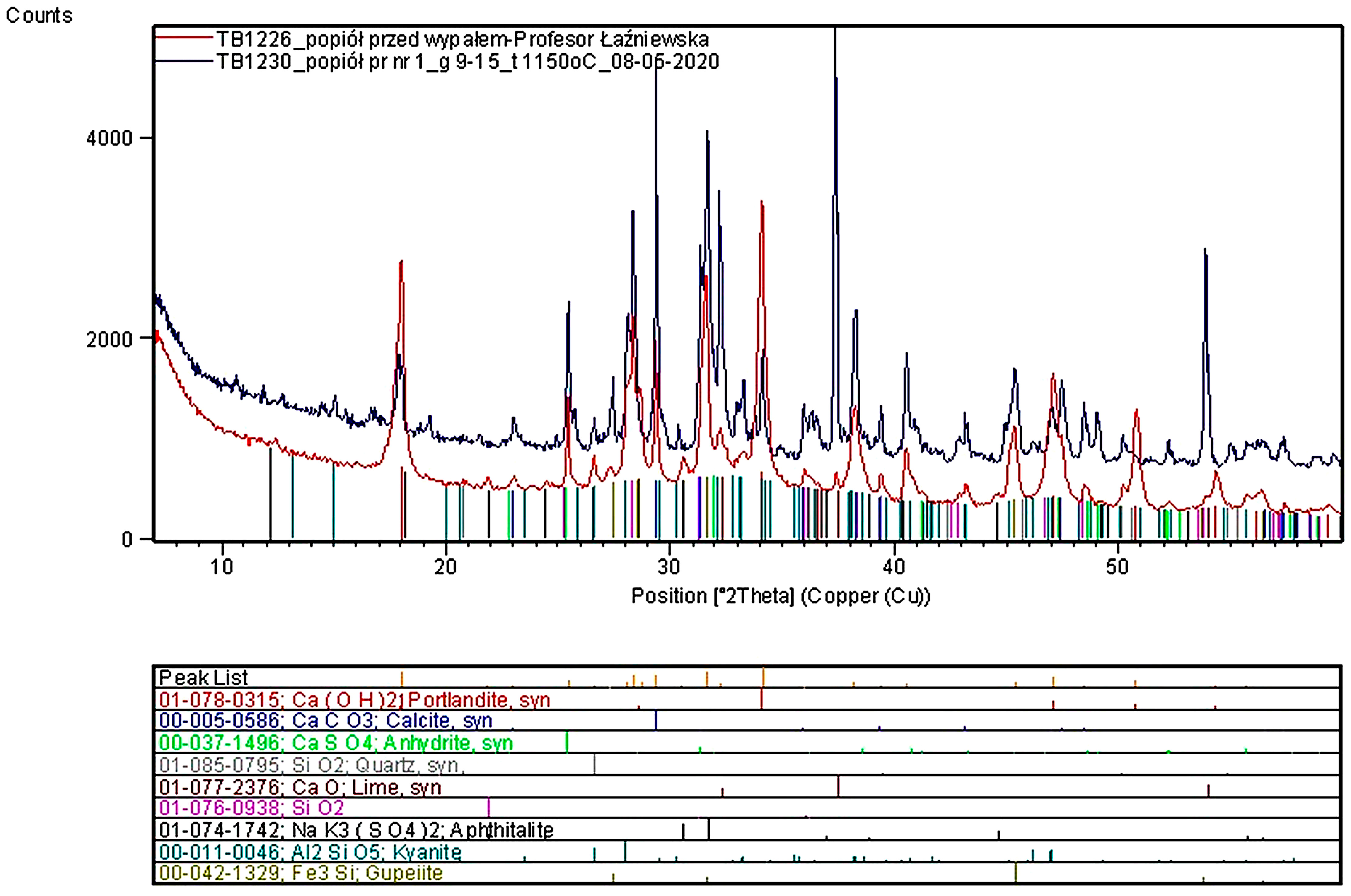
The granulated fly ash was dried and thermally treated in a semi-industrial rotary kiln. The selection of the calcination temperature was based on phase composition analysis performed using X-ray diffraction (XRD), as discussed in Section 3.1 and illustrated in Figure 1, Figure 2 and Figure 3. The XRD results indicated that temperatures above 1150 °C promoted excessive sintering and partial melting of the material, which could lead to operational problems in rotary kiln systems. Consequently, a calcination temperature of 1150 °C was selected for semi-industrial processing.
Thermal treatment was conducted under operating conditions representative of cement-plant auxiliary installations, including a kiln rotational speed of 1.0 rpm and a residence time in the sintering zone of approximately 30 min.
The heating rate was controlled at approximately 10 °C·min−1, enabling gradual decomposition of carbonate phases and limiting thermal gradients within the material.
The process was carried out under oxidising atmospheric conditions, ensured by continuous air supply, which is typical for rotary kiln systems applied in cement-related processes and favours stabilisation of metal oxides.
Natural gas was used as the primary fuel, allowing stable temperature control and reducing the risk of local reducing conditions that could enhance heavy metal volatilisation.
After calcination, the fly ash was cooled, milled, and stored in sealed containers.
Cooling was performed under ambient air conditions (air quenching), which limited further phase transformations and stabilised the mineral phases formed during high-temperature treatment.
The effect of thermal treatment on the chemical composition of the ash, including changes in loss on ignition and major oxide content, is summarised in Table 1, while phase transformations are presented in Figure 1, Figure 2 and Figure 3.
The selected thermal regime represents a compromise between phase stabilisation and process compatibility. While higher temperatures could enhance vitrification and heavy metal immobilisation, they would simultaneously reduce grindability and limit integration into conventional cement manufacturing systems.

2.3. Cement Preparation

Two Portland composite cements incorporating thermally treated MSWI fly ash were produced, corresponding to compositions designated as CEM II/A-07 and CEM II/B-07. The cement formulations were designed to reflect clinker-to-additive ratios commonly applied in industrial cement production and to comply with the compositional requirements for common cements [2].
Cement CEM II/A-07 consisted of 18 wt.% thermally treated MSWI fly ash, 77.9 wt.% Portland clinker, and 4.1 wt.% gypsum. Cement CEM II/B-07 contained 33 wt.% fly ash, 63.6 wt.% clinker, and 3.4 wt.% gypsum. In addition, a reference Portland cement (CEM I) was prepared using the same clinker and 6 wt.% gypsum.
All cement components were ground and homogenised to achieve a Blaine specific surface area of approximately 3800 cm2 g−1. This ensured comparable fineness across all cement types and limited the influence of particle size effects on hydration and strength development. The resulting standardised cement properties are reported in Table 2.

2.4. Chemical, Phase, and Microstructural Characterisation

The chemical composition of the MSWI fly ash before and after thermal treatment was determined using X-ray fluorescence spectroscopy (XRF) in accordance with standard cementitious material analysis procedures [3]. The results are summarised in Table 1.
Phase composition was analysed by X-ray diffraction (XRD). Attention was paid to calcium-bearing phases, sulphates, and residual amorphous components, as presented in Figure 1, Figure 2 and Figure 3. Microstructural observations were carried out using scanning electron microscopy (SEM) coupled with energy-dispersive X-ray spectroscopy (EDS), providing qualitative insight into particle morphology, porosity, and elemental distribution.

2.5. Testing of Cement Properties

The selected compositions were designed to reflect industrially relevant clinker substitution levels, enabling assessment of both moderate and high replacement scenarios under standardised conditions. The physical and mechanical properties of the produced cements were evaluated in accordance with the requirements for common cements [2]. Water demand, initial and final setting times, and volume stability were determined using standardised methods [4].
Mortar consistency was assessed by flow table tests after 2 and 60 min in accordance with standard procedures for fresh mortar testing [5]. Mechanical performance was evaluated through flexural and compressive strength testing of standard mortar prisms at curing ages of 2, 7, and 28 days, following established cement testing methods [6]. All specimens were prepared with a constant water-to-cement ratio of 0.5. The results are summarised in Table 2.

2.6. Environmental Assessment and Leaching Tests

The environmental performance of the cementitious materials was assessed through leaching tests conducted on cement pastes and hardened mortars. Leachates were analysed for pH and major ionic species. The results obtained for cement samples are summarised in Table 3, while the corresponding data for hardened mortars are presented in Table 4.
The leaching behaviour of selected heavy metals was evaluated to assess immobilisation efficiency within the cement matrix. The results of heavy metal analyses are reported in Table 5 and were compared with regulatory criteria governing waste acceptance and wastewater discharge [7,8].

3. Results

3.1. Chemical and Phase Composition of the MSWI Fly Ash

The chemical composition of the MSWI air pollution control fly ash before and after thermal treatment is summarised in Table 1. The raw ash is characterised by a high loss on ignition and a dominant CaO content, reflecting the extensive use of lime-based sorbents during flue gas cleaning processes. In addition to calcium-bearing phases, the ash contains significant amounts of sulphur- and chlorine-related compounds, which are typical for APC residues and are known to strongly influence both hydration behaviour and environmental performance of cementitious systems [9].
Thermal treatment at 1150 °C resulted in a pronounced reduction in loss on ignition, indicating the decomposition of residual carbonates and the partial removal of volatile components. This effect is consistent with previously reported behaviour of MSWI APC fly ash subjected to high-temperature processing, where decarbonation and sulphate phase transformations play a dominant role [10]. At the same time, the relative content of major oxides, such as CaO, SiO2, and Al2O3, increased due to mass loss associated with thermal decomposition, as reflected in Table 1.
From a thermodynamic perspective, the observed decrease in loss on ignition can be primarily attributed to the decomposition of calcium carbonate according to CaCO3 → CaO + CO2, which becomes significant above 700–800 °C. In parallel, sulphate-bearing phases such as anhydrite undergo transformation. From a thermochemical perspective, the decomposition of carbonates and transformation of sulphate phases result in the formation of reactive CaO and CaSO4 phases. These phases increase system alkalinity and act as sources of Ca2+ and SO42− ions during early hydration, influencing dissolution–precipitation equilibria and accelerating initial reaction kinetics. In parallel, partial decomposition and transformation of sulphate-bearing phases occur, leading to the formation of more thermally stable calcium sulphates.
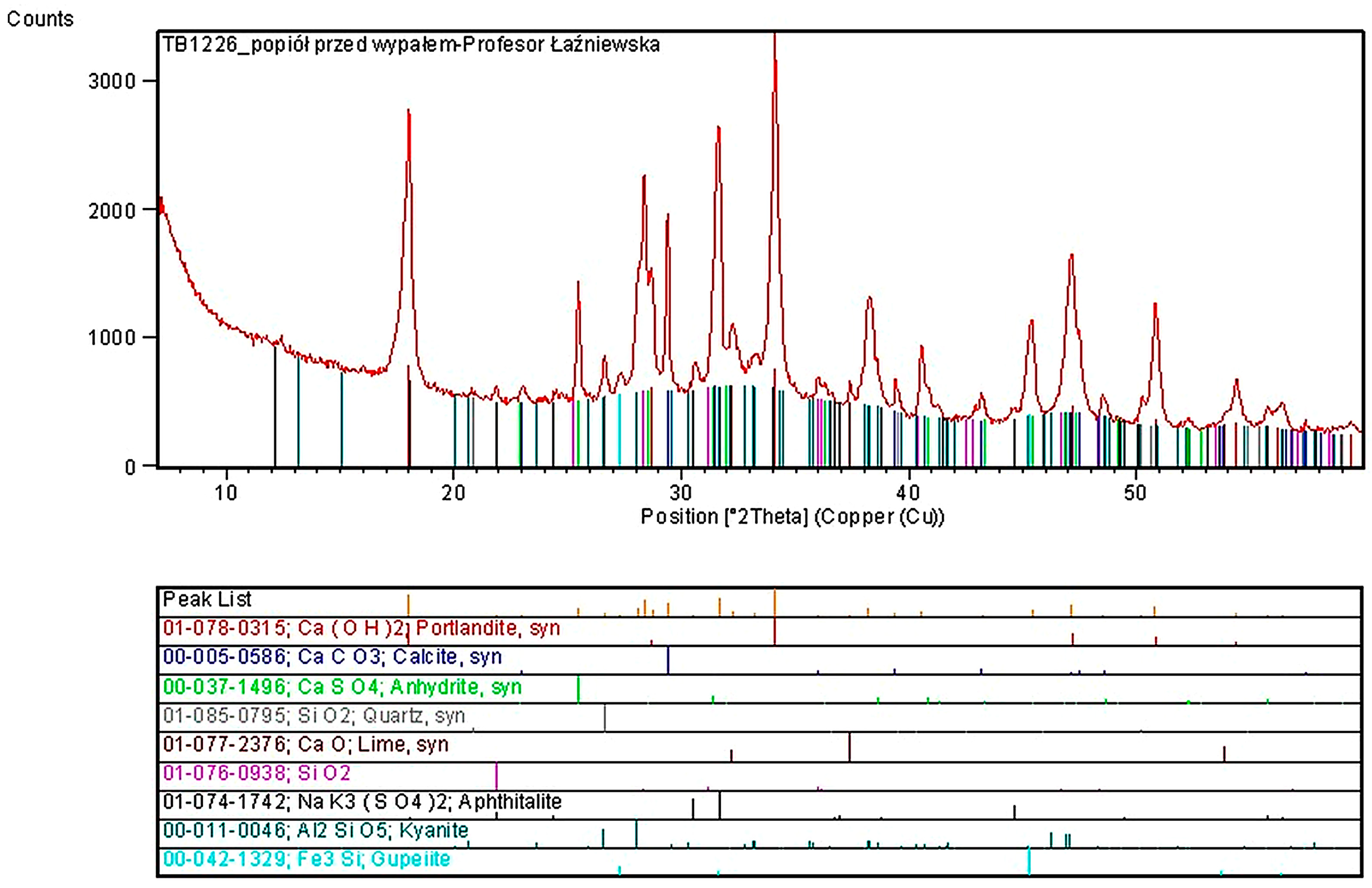
Phase composition analysis performed by X-ray diffraction revealed significant changes induced by thermal treatment. The XRD pattern of the untreated fly ash, presented in Figure 1, indicates the presence of portlandite, calcite, anhydrite, quartz, and free lime, accompanied by minor crystalline phases of lower intensity. This mineralogical assemblage confirms the highly reactive and chemically unstable nature of the raw APC fly ash, which poses challenges for its direct incorporation into cementitious systems.
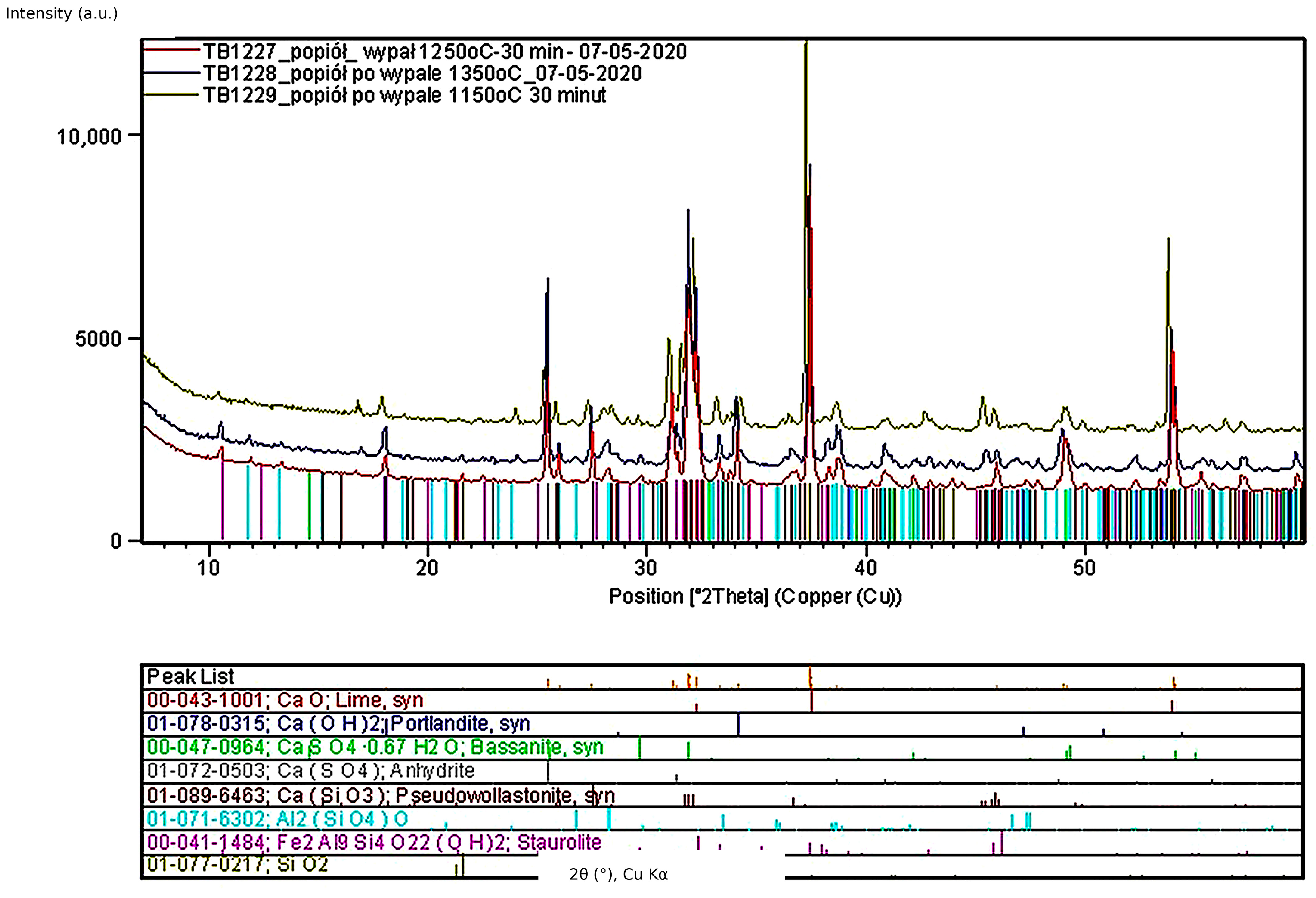
The influence of calcination temperature on phase evolution is illustrated in Figure 2, which compares diffractograms of fly ash treated at 1150, 1250, and 1350 °C under laboratory conditions. Increasing temperature promoted progressive decomposition of carbonate phases and the formation of more thermodynamically stable calcium sulphate and calcium oxide phases. However, treatment at temperatures exceeding 1150 °C led to pronounced sintering and partial melting, which would be undesirable from a technological perspective due to the risk of material agglomeration and kiln blockage. Consequently, 1150 °C was selected as the optimal temperature for semi-industrial processing.
At higher temperatures (>1200 °C), the onset of liquid-phase formation and partial vitrification can be expected, resulting in the incorporation of heavy metals into amorphous silicate matrices. However, such conditions reduce the reactivity and grindability of the material, limiting its compatibility with conventional cement manufacturing processes.
The XRD pattern of fly ash treated at 1150 °C under semi-industrial conditions is shown in Figure 3. The dominant crystalline phases identified include free lime, portlandite, calcite, and anhydrite, with minor contributions from other phases indicated by low-intensity reflections. The persistence of calcium-rich phases after thermal treatment is of particular importance, as it directly affects the alkalinity of the cement system and the subsequent hydration reactions when the ash is incorporated into Portland composite cement.
The presence of free CaO and portlandite suggests incomplete decarbonation equilibrium and indicates that the selected thermal regime favours phase stabilisation rather than complete vitrification. This is advantageous from a process integration perspective but may contribute to increased water demand and rapid early-age reactions.
Moreover, the presence of free CaO and sulphate phases significantly affects subsequent hydration reactions by increasing alkalinity and promoting rapid ion release in the pore solution, which directly influences early-stage reaction kinetics.
Microstructural observations supported the phase analysis results. SEM images revealed that fly ash particles exhibit a porous and irregular morphology, while EDS point analyses confirmed the prevalence of calcium, sulphur, chlorine, and silicon within individual particles. Such a microstructure is known to increase water demand and may disturb particle packing during cement hydration, thereby influencing early-age strength development [11].
Additionally, the irregular particle morphology and internal porosity promote physical adsorption of water, which further contributes to the increase in effective water demand observed in composite cement systems.
From an environmental perspective, the chemical composition shown in Table 1 also indicates the presence of trace heavy metals, such as Zn, Pb, and others. Although thermal treatment reduced the concentration of selected volatile metals, it did not completely eliminate them from the material. Instead, high-temperature processing promoted their incorporation into less soluble mineral phases, which is a key prerequisite for effective immobilisation within the cement matrix, as discussed in Section 3.3.
Heavy metal stabilisation during thermal treatment is associated with their incorporation into calcium-rich crystalline phases and, to a lesser extent, into amorphous components. This reduces their mobility but does not fully eliminate leaching potential, particularly for elements such as barium, which exhibit higher solubility under alkaline conditions.
Overall, the combined chemical and phase analyses demonstrate that thermal treatment at 1150 °C significantly modifies the MSWI APC fly ash, transforming it into a material that is mineralogically more stable and potentially compatible with cementitious systems. Nevertheless, the dominance of calcium-rich phases and residual soluble components suggests that the ash may still adversely affect water demand and mechanical performance at higher replacement levels, an issue addressed in the following Section 3.2.

3.2. Cement Properties and Mechanical Performance

The standardised physical and mechanical properties of the produced cements are summarised in Table 2. The incorporation of thermally treated MSWI APC fly ash had a pronounced influence on both fresh and hardened cement behaviour, with the magnitude of the effect strongly dependent on the ash content.
As shown in Table 2, the water demand of the composite cements increased significantly with increasing fly ash dosage. While the reference Portland cement (CEM I) exhibited a water demand of 28.0%, the values increased to 35.5% for CEM II/A-07 and to 40.1% for CEM II/B-07. This behaviour can be attributed to the porous morphology of the fly ash particles and the high content of free CaO and sulphate phases identified in Section 3.1, which enhance water adsorption and reduce effective particle packing during paste formation [12].
From a microstructural perspective, the increased water demand is also associated with the high specific surface area and irregular particle geometry of the thermally treated ash, which promote physical water adsorption and increase interparticle friction, thereby reducing workability.
The increase in water demand was accompanied by a reduction in mortar flow values measured after both 2 and 60 min, as reported in Table 2. The reduced workability was particularly pronounced for CEM II/B-07, indicating that higher ash contents significantly impair fresh-state rheology. This effect is consistent with previous findings for calcium-rich MSWI residues, where fine particle size and irregular surface texture lead to increased internal friction and rapid loss of workability [13].
Setting time measurements further revealed that the addition of thermally treated fly ash affected the early hydration kinetics of the cement system. As shown in Table 2, both initial and final setting times were shortened for the fly ash-containing cements compared to the reference CEM I. Such behaviour suggests an acceleration of early hydration reactions, likely associated with the presence of reactive calcium phases and sulphates originating from the treated APC fly ash. However, the simultaneous increase in water demand indicates that this acceleration does not translate into improved microstructural development at later ages.
The acceleration of setting may be attributed to the presence of free CaO and sulphate phases, which enhance early ionic dissolution and promote rapid formation of ettringite and portlandite. This results in faster stiffening but does not necessarily improve long-term strength development.
Mechanical performance, evaluated through flexural and compressive strength testing, demonstrated a clear decline with increasing fly ash content. As presented in Table 2, the compressive strength of CEM II/A-07 was reduced by approximately 21% after 28 days compared to the reference cement, while CEM II/B-07 exhibited a dramatic strength loss of approximately 63%. A similar trend was observed for flexural strength at all curing ages.
The observed strength reduction can be explained by several concurrent mechanisms. First, the increased water demand led to a higher effective water-to-binder ratio, resulting in increased capillary porosity after hardening. Second, the high proportion of calcium-rich but weakly hydraulic phases in the treated fly ash limited its contribution to strength development, particularly at later ages. Finally, difficulties in mortar compaction, especially for CEM II/B-07 at a constant water-to-cement ratio of 0.5, further exacerbated strength losses, as noted during specimen preparation and reflected in the results shown in Table 2.
In addition, the mineralogical composition of the treated ash, dominated by calcium-rich but weakly hydraulic or non-hydraulic phases, limits its contribution to the formation of strength-giving C–S–H phases. As a result, the ash acts predominantly as a filler rather than a reactive component under the investigated conditions.
The porous morphology of ash particles further contributes to increased total porosity and weak interfacial transition zones (ITZ) between ash particles and the cement matrix, which act as preferential sites for crack initiation and propagation.
Compaction issues observed during sample preparation indicate insufficient workability at a fixed w/c ratio, which likely resulted in entrapped air and additional macroporosity, further contributing to strength reduction, particularly in the case of CEM II/B-07.
Despite the reduction in mechanical performance, the results indicate that CEM II/A-07 still satisfies the requirements for strength class 42.5 according to EN 197-1, albeit with altered hydration characteristics. In contrast, CEM II/B-07 does not meet the criteria for any standard strength class, highlighting the existence of a practical upper limit for the incorporation of thermally treated MSWI APC fly ash in Portland composite cements under the applied processing conditions.
These results suggest that the practical replacement level of thermally treated MSWI APC fly ash in Portland composite cement is limited by a combination of rheological constraints and dilution effects rather than solely by environmental considerations.
Importantly, volume stability tests confirmed that all cement formulations exhibited acceptable dimensional stability, with no evidence of excessive expansion or shrinkage. This finding indicates that, despite the high free lime content identified in Section 3.1, the applied thermal treatment effectively mitigated the risk of deleterious late expansion, in agreement with previous observations for thermally processed MSWI residues [14].
Overall, the results presented in Table 2 demonstrate that, while moderate incorporation levels of thermally treated MSWI APC fly ash are technically feasible, higher replacement ratios lead to substantial deterioration of fresh and hardened cement properties. These findings underline the necessity of balancing waste utilisation targets with performance requirements, and they provide a quantitative basis for defining safe and practical application limits.
These results confirm that mechanical performance is controlled not only by chemical composition but also by processing-related factors, particularly workability and compaction efficiency.

3.3. Environmental Performance and Leaching Behaviour

The environmental performance of the cementitious materials was evaluated through leaching tests conducted on cement pastes and hardened mortars. The results obtained for major ionic species and pH values are summarised in Table 3 and Table 4, while the leaching behaviour of selected heavy metals is presented in Table 5. This approach allows for a comprehensive assessment of contaminant immobilisation within the cement matrix and its compliance with regulatory thresholds. It should be noted that the reported pH limits refer to wastewater discharge criteria and are used here only as a reference point, as cementitious systems inherently exhibit highly alkaline conditions.
As shown in Table 3, eluates obtained from cement pastes exhibited strongly alkaline pH values of approximately 13.1 for both CEM II/A-07 and CEM II/B-07. Such high alkalinity is characteristic of Portland cement systems and is primarily governed by the dissolution of portlandite and other calcium-rich phases identified in Section 3.1. Although elevated pH values exceed the permissible range for direct discharge into surface waters, they play a crucial role in reducing the solubility of many heavy metals through precipitation of poorly soluble hydroxides and carbonates [15].
The concentrations of major ions in cement paste eluates, particularly chlorides, sulphates, sodium, potassium, and calcium, increased with increasing fly ash content, as reported in Table 3. This trend reflects the chemical composition of the MSWI APC fly ash, which contains significant amounts of soluble salts originating from flue gas cleaning processes. Notably, the sum of chlorides and sulphates exceeded regulatory thresholds for both fly ash-containing cements, indicating that the cement paste itself may not meet environmental criteria without further immobilisation through hardening and microstructural densification.
In contrast, leaching results obtained from hardened mortars demonstrate a substantial reduction in the mobility of major ions. As summarised in Table 4, chloride concentrations in mortar eluates were below the detection limit, while sulphate concentrations were markedly reduced compared to cement pastes. This reduction can be attributed to the formation of a dense cementitious matrix that physically encapsulates soluble phases and chemically binds ions within hydration products. The significant decrease in potassium, sodium, and calcium concentrations further confirms the effectiveness of hardening in limiting ionic transport.
Heavy metal leaching behaviour provides critical insight into the environmental safety of the proposed utilisation route. As shown in Table 5, leaching concentrations of Zn, Cu, Cd, Cr, Ni, and Pb from mortars containing thermally treated fly ash were generally below detection limits or well within regulatory thresholds for non-hazardous waste. These results indicate an immobilisation efficiency exceeding 99.5% for most analysed metals, demonstrating that the cement matrix effectively stabilises potentially hazardous constituents present in the MSWI APC fly ash.
The high immobilisation efficiency observed can be explained by the combined effects of chemical and physical mechanisms. The strongly alkaline environment promotes the precipitation of heavy metal hydroxides, while the incorporation of metals into calcium silicate hydrate (C–S–H) phases and other hydration products further limits their mobility. In addition, the dense microstructure formed during hydration reduces pore connectivity, thereby hindering diffusive transport of contaminants [16].
Despite these favourable results, barium exhibited a distinct leaching behaviour. As reported in Table 5, barium concentrations in mortar eluates exceeded the regulatory limit of 2 mg·dm−3 for both CEM II/A-07 and CEM II/B-07, with higher values observed for the cement containing 33 wt.% fly ash. This behaviour can be attributed to the relatively high solubility of barium compounds under strongly alkaline conditions and the limited incorporation of Ba2+ ions into stable hydration products. Similar observations have been reported for other cementitious systems containing calcium-rich industrial residues [17].
The elevated barium leaching highlights a key limitation of the investigated system and underscores the importance of carefully controlling alkalinity and ash content when utilising MSWI APC fly ash in cement. While thermal treatment effectively reduces the mobility of most heavy metals, it does not fully mitigate barium release, indicating that additional process optimisation or complementary treatment strategies may be required for higher replacement levels.
Overall, the leaching results presented in Table 3, Table 4 and Table 5 confirm that the incorporation of thermally treated MSWI APC fly ash into Portland composite cement leads to effective immobilisation of most environmentally relevant contaminants. However, the persistent leaching of barium at elevated pH values represents a critical challenge that defines the current applicability limits of this approach and must be addressed before large-scale implementation. This behaviour identifies barium as the controlling factor for environmental acceptability of APC fly ash-based cement systems.

4. Discussion

The present study offers a comprehensive, multi-level assessment of the utilisation of thermally treated municipal solid waste incineration (MSWI) air pollution control (APC) fly ash (EWC 19 01 07*) as a constituent of Portland composite cement. By jointly analysing chemical and phase composition (Table 1, Figure 1, Figure 2 and Figure 3), fresh and hardened cement performance (Table 2), and environmental behaviour (Table 3, Table 4 and Table 5), the results allow for an in-depth evaluation of both the technological feasibility and the environmental implications of this valorisation route. Importantly, the discussion below explicitly distinguishes between findings that are consistent with recent literature and those that represent a genuine extension of current knowledge.

4.1. Thermal Treatment Intensity and Phase Evolution: Implications for Cement Integration

The chemical composition data presented in Table 1 indicate that the investigated APC fly ash is characterised by an exceptionally high CaO content and loss on ignition prior to treatment, reflecting the intensive use of lime-based sorbents in flue gas cleaning systems. Such compositions are widely recognised as a major obstacle for direct reuse due to high alkalinity, reactivity, and leaching potential [18,19]. Thermal treatment at 1150 °C resulted in a substantial reduction in loss on ignition and a redistribution of oxide concentrations, confirming partial decarbonation and the removal of volatile components.
The XRD results shown in Figure 1, Figure 2 and Figure 3 reveal that thermal treatment induces significant, yet incomplete, phase transformation. While carbonate phases are partially decomposed, calcium-rich crystalline phases, such as free lime, portlandite, and anhydrite, remain dominant after calcination at 1150 °C. This mineralogical signature clearly differentiates the treated material from fully vitrified APC fly ash reported in recent studies, where amorphous glassy phases dominate due to melting temperatures exceeding 1300 °C [20,21,22].
Recent literature published in Cement and Concrete Research and Journal of Hazardous Materials increasingly emphasises the importance of tailoring thermal treatment intensity to the intended reuse pathway [21,23]. Full vitrification effectively immobilises contaminants but produces materials that are incompatible with cement plant processing and require additional grinding energy. In contrast, the present study demonstrates that a moderate, semi-industrial thermal treatment is sufficient to significantly stabilise APC fly ash while retaining its processability within a cement manufacturing framework. This aspect is rarely addressed in recent publications and constitutes a key technological novelty of this work.
Moreover, the persistence of sulphate-bearing phases observed in Figure 2 and Figure 3 has important implications for cement hydration. While sulphates may accelerate early hydration reactions, their excessive presence can also disrupt phase assemblage development and contribute to increased water demand. This observation confirms that the increase in water demand results from the combined influence of particle morphology, surface chemistry, and early-stage hydration processes rather than from a single controlling factor. The present results, therefore, illustrate the delicate balance between chemical stabilisation and cement compatibility, a balance that is often neglected in laboratory-scale studies focusing exclusively on leaching behaviour. The increase in water demand is governed by both physical and chemical mechanisms. The porous particle structure promotes capillary water absorption, while high CaO content leads to rapid surface hydration and formation of Ca(OH)2, consuming free water. Additionally, soluble salts increase ionic strength, enhance flocculation of cement particles and reduce dispersion.

4.2. Hydration Behaviour and Fresh-State Performance: Insights from Water Demand and Workability

The marked increase in water demand reported in Table 2 for both CEM II/A-07 and CEM II/B-07 reflects the combined effects of particle morphology, phase composition, and surface chemistry of the treated APC fly ash. SEM observations indicate a highly porous and irregular particle structure, which increases internal water absorption and reduces the availability of free water for lubrication during mixing. Similar trends have been reported for MSWI-derived materials in recent years [24,25], although most studies focus on bottom ash rather than APC fly ash.
Importantly, the magnitude of the water demand increase observed in this study exceeds values typically reported for bottom ash or treated slag [25,26], highlighting the fundamentally different nature of APC residues. This finding reinforces the need to treat APC fly ash as a distinct material class rather than grouping it with other incineration by-products, a distinction that is still insufficiently recognised in the literature.
Elevated concentrations of Ca2+, Na+, and SO42− ions reduce electrostatic repulsion between particles, promoting flocculation and the formation of a percolated particle network. This results in increased yield stress and a rapid loss of workability. The reduced mortar flow values after both 2 and 60 min (Table 2) further indicate rapid loss of workability, which can be attributed to the presence of reactive calcium phases and soluble salts. Recent studies have shown that such salts may accelerate early hydration reactions and promote flocculation of cement particles, leading to rapid stiffening [27]. In the present study, this behaviour is particularly pronounced for CEM II/B-07, suggesting that higher APC fly ash contents amplify these mechanisms.
These results indicate that APC fly ash shifts the system’s behaviour from dispersion-controlled to flocculation-dominated, fundamentally altering rheological and hydration characteristics.

4.3. Mechanical Performance Under Standardised Conditions: Defining Realistic Utilisation Limits

The compressive and flexural strength results summarised in Table 2 provide critical insight into the structural implications of incorporating thermally treated APC fly ash into Portland composite cement. The moderate strength reduction observed for CEM II/A-07 (approximately 21% at 28 days) contrasts sharply with the severe reduction observed for CEM II/B-07 (approximately 63%). This nonlinear relationship between ash content and strength highlights the existence of a threshold beyond which performance deterioration accelerates rapidly. The reduction in mechanical performance is associated with decreased formation and connectivity of C–S–H phases due to clinker dilution and the presence of weakly reactive phases in APC fly ash. This leads to increased capillary porosity and reduced matrix cohesion. Furthermore, early formation of ettringite driven by sulphate-rich phases accelerates setting but does not contribute significantly to long-term strength, resulting in a decoupling between early hydration kinetics and mechanical performance. Based on the obtained results, a practical utilisation threshold can be defined at approximately 15–20% clinker replacement under standardised conditions.
Several recent studies have reported strength reductions associated with MSWI-derived materials; however, many rely on modified curing regimes, reduced water-to-cement ratios, or chemical admixtures to compensate for adverse effects [28,29]. While such approaches may be effective, they obscure the intrinsic performance limits of the material. The present study intentionally avoids such optimisation and applies standardised EN testing conditions, thereby providing a conservative and industry-relevant assessment.
The finding that CEM II/A-07 meets the requirements of strength class 42.5 under these conditions is particularly significant. Recent literature rarely demonstrates EN-compliant mechanical performance for composite cements containing hazardous APC fly ash, especially when produced at semi-industrial scale [24,30]. This result, therefore, represents a tangible advancement over existing studies and supports the feasibility of moderate replacement levels.
Additionally, limited workability and compaction at a constant w/c ratio result in entrapped air and macroporosity, further reducing compressive strength, particularly at higher ash contents.
Based on the obtained results, a practical utilisation threshold can be defined at approximately 15–20% clinker replacement. Beyond this range, increased water demand, reduced workability, and dilution of hydraulic phases lead to unacceptable deterioration of mechanical performance. The formation of weak interfacial transition zones (ITZ) around ash particles further contributes to crack initiation and propagation, reducing structural integrity.

4.4. Leaching Behaviour and Immobilisation Mechanisms: Beyond Compliance

Heavy metal immobilisation is governed by precipitation of hydroxides, incorporation into hydration products (C–S–H, AFm), and physical encapsulation within the cement matrix. High alkalinity promotes the formation of low-solubility phases, significantly reducing metal mobility.
The leaching data presented in Table 3, Table 4 and Table 5 illustrate the critical role of cement hardening in immobilising contaminants present in thermally treated APC fly ash. The dramatic reduction in ion concentrations between cement pastes (Table 3) and hardened mortars (Table 4) underscores the importance of physical encapsulation and microstructural densification. Recent studies published between 2021 and 2024 similarly emphasise the role of pore refinement and reduced connectivity in limiting contaminant transport [31,32,33].
For most heavy metals, the concentrations reported in Table 5 are below detection limits or well within regulatory thresholds. While high immobilisation efficiencies have been reported previously, they are often achieved using additional stabilising agents, such as phosphates or alkali-activated binders [34]. The present study demonstrates that thermal treatment combined with conventional Portland cement hydration is sufficient to achieve immobilisation efficiencies exceeding 99.5%, which is rarely documented for hazardous APC fly ash. In contrast, barium exhibits a distinct behaviour. Due to its larger ionic radius and limited substitution capacity, Ba2+ ions are not effectively incorporated into C–S–H structures. Instead, their mobility is controlled by solubility equilibria of barium compounds such as BaSO4 and Ba(OH)2. Under highly alkaline conditions, increased hydroxide concentration enhances dissolution of certain barium phases, resulting in persistent leaching despite matrix densification.
The persistent leaching of barium observed in Table 5 deserves particular attention. Recent literature has begun to identify barium as a critical contaminant in MSWI-derived materials, especially under highly alkaline conditions [23,35,36]. However, systematic discussions of barium behaviour in cementitious matrices remain scarce. The present results provide clear experimental evidence that barium mobility constitutes the primary environmental limitation of APC fly ash-based composite cements, even when other metals are effectively immobilised.
This finding is scientifically important, as it challenges the common assumption that high alkalinity universally enhances immobilisation. Instead, the data demonstrates that alkalinity may simultaneously suppress and promote leaching, depending on the specific element, thereby highlighting the need for element-specific risk assessment rather than reliance on bulk indicators.
These findings demonstrate that high alkalinity does not universally enhance immobilisation. While it promotes precipitation of many metals, it may simultaneously increase solubility of specific elements such as barium, requiring element-specific assessment.

4.5. Scientific Novelty and Broader Significance

Taken together, the results presented in Table 1, Table 2, Table 3, Table 4 and Table 5 and Figure 1, Figure 2 and Figure 3 provide a level of integration and realism that is largely absent from recent literature. While individual aspects of APC fly ash stabilisation, cement performance, or leaching behaviour have been addressed previously, few studies combine all these elements under semi-industrial processing conditions and standardised testing protocols.
The present work, therefore, contributes new knowledge in three key areas:
  • Demonstration of a cement-compatible thermal treatment strategy that avoids full vitrification;
  • Identification of realistic mechanical performance limits under EN-compliant conditions;
  • Recognition of barium leaching as a defining environmental bottleneck for APC fly ash-based cements.
These contributions are highly relevant for both the cement industry and waste-to-energy sector, as they provide a scientifically robust basis for evaluating APC fly ash valorisation strategies within a circular economy framework.

4.6. Sustainability Implications and Practical Relevance

The results obtained in this study have important implications from a sustainability perspective, particularly in the context of circular economy and low-carbon construction materials. The proposed approach addresses two major environmental challenges simultaneously: the management of hazardous waste and the reduction in clinker-related CO2 emissions.
The utilisation of MSWI APC fly ash as a cement constituent contributes to the diversion of hazardous waste from landfilling or underground storage, thereby reducing long-term environmental liabilities associated with waste disposal. At the same time, partial replacement of clinker directly lowers the carbon footprint of cement production, as clinker manufacturing remains the dominant source of CO2 emissions in the cement industry.
However, the results clearly demonstrate that sustainability must be evaluated in a holistic manner. While high immobilisation efficiencies were achieved for most heavy metals, the observed leaching of barium highlights that not all environmental risks are fully mitigated under the investigated conditions. This finding emphasises the need for element-specific assessment rather than relying solely on general indicators of environmental performance.
Furthermore, the reduction in mechanical performance at higher replacement levels indicates that technical feasibility and environmental benefits must be carefully balanced. Excessive substitution may compromise material performance, leading to indirect sustainability drawbacks related to durability and service life.
Therefore, the optimal application of thermally treated MSWI APC fly ash should be defined within a multi-criteria framework that considers mechanical performance, environmental safety, and carbon reduction simultaneously. The present study contributes to this framework by identifying realistic utilisation limits and highlighting key barriers that must be addressed in future research.
From a technological perspective, the approach corresponds to an intermediate implementation stage, requiring further optimisation, particularly in controlling barium leaching and improving rheological performance.

5. Conclusions

This study provides a mechanistically grounded and application-oriented evaluation of the utilisation of thermally treated municipal solid waste incineration (MSWI) air pollution control (APC) fly ash (EWC 19 01 07*) in Portland composite cement.
Thermal treatment at 1150 °C induces partial phase stabilisation, including decarbonation and transformation of sulphate phases, leading to the formation of reactive CaO- and CaSO4-bearing phases. This treatment is sufficient to reduce chemical instability while preserving process compatibility, in contrast to fully vitrified systems reported in the literature.
Under standardised EN conditions, moderate incorporation levels (~15–20%) are technically feasible. The material exhibits increased water demand and modified hydration kinetics due to particle porosity, high CaO content, and early ionic interactions; however, it retains acceptable mechanical performance (strength class 42.5). At higher replacement levels, the combined effects of clinker dilution, increased effective water-to-binder ratio, and reduced workability result in excessive capillary porosity and severe strength deterioration, defining a clear technological threshold.
Contaminant immobilisation is governed by precipitation, incorporation into hydration products (C–S–H, AFm), and microstructural encapsulation. Immobilisation efficiencies exceeding 99.5% were achieved for most heavy metals. In contrast, barium exhibits solubility-controlled behaviour and limited incorporation into hydration phases, resulting in persistent leaching under highly alkaline conditions and representing the primary environmental constraint of the system.
The key scientific contribution of this work lies in the integration of semi-industrial thermal processing, EN-compliant cement production, and coupled mechanical–environmental assessment within a single framework. Unlike predominantly laboratory-scale studies, this approach enables identification of realistic performance limits and reveals barium as a critical, previously underemphasised controlling factor for environmental acceptability.
From a sustainability perspective, the proposed solution simultaneously addresses hazardous waste management and clinker substitution, contributing to circular economy implementation and potential CO2 emission reduction in cement production. However, the results demonstrate that effective valorisation requires balancing mechanical performance, environmental safety, and process compatibility rather than maximising waste incorporation.

Author Contributions

Conceptualisation, B.Ł.-P.; methodology, B.Ł.-P. and M.C.; software, B.Ł.-P. and M.C.; validation, B.Ł.-P. and M.C.; formal analysis, B.Ł.-P. and M.C.; investigation, B.Ł.-P. and M.C.; data curation, B.Ł.-P. and M.C.; writing—original draft preparation, B.Ł.-P. and M.C.; writing—review and editing, B.Ł.-P.; visualisation, B.Ł.-P.; supervision, B.Ł.-P.; project administration B.Ł.-P.; funding acquisition, B.Ł.-P. All authors have read and agreed to the published version of the manuscript.

Funding

This research was funded by the National Centre of Science (NCN), grant number MINIATURA 3-03/030/PBU19/0099.

Institutional Review Board Statement

Not applicable.

Informed Consent Statement

Not applicable.

Data Availability Statement

The original contributions presented in this study are included in the article. Further inquiries can be directed to the corresponding author.

Conflicts of Interest

The authors declare no conflicts of interest.

References

  1. Zhang, Y.; Wang, J.; Chen, L.; Ma, B.; Zhang, Y.; Ni, W.; Tsang, D.C. Treatment of municipal solid waste incineration fly ash: State-of-the-art technologies and future perspectives. J. Hazard. Mater. 2021, 411, 125132. [Google Scholar] [CrossRef]
  2. EN 197-1:2011; Cement—Part 1: Composition, Specifications and Conformity Criteria for Common Cements. European Committee for Standardization (CEN): Brussels, Belgium, 2011.
  3. EN 196-2:2025; Methods of Testing Cement—Part 2: Chemical Analysis of Cement. European Committee for Standardization (CEN): Brussels, Belgium, 2025.
  4. EN 196-3:2016; Methods of Testing Cement—Part 3: Determination of Setting Times and Soundness. European Committee for Standardization (CEN): Brussels, Belgium, 2016.
  5. EN 1015-3:1999; Methods of Test for Mortar for Masonry—Part 3: Determination of Consistence of Fresh Mortar (by Flow Table). European Committee for Standardization (CEN): Brussels, Belgium, 1999.
  6. EN 196-1:2016; Methods of Testing Cement—Part 1: Determination of Strength. European Committee for Standardization (CEN): Brussels, Belgium, 2016.
  7. EN 12457-4:2002; Characterisation of Waste—Leaching—Compliance Test for Leaching of Granular Waste Materials and Sludges—Part 4: One Stage Batch Test at L/S = 10 L/kg. European Committee for Standardization (CEN): Brussels, Belgium, 2002.
  8. The Council of the European Union. Council Decision 2003/33/EC Establishing Criteria and Procedures for the Acceptance of Waste at Landfills Pursuant to Article 16 of and Annex II to Directive 1999/31/EC. Available online: https://eur-lex.europa.eu/legal-content/EN/TXT/?uri=CELEX:32003D0033 (accessed on 6 March 2026).
  9. The European Parliament and the Council. Directive 1999/31/EC on the Landfill of Waste. Available online: https://eur-lex.europa.eu/eli/dir/1999/31/oj/eng (accessed on 6 March 2026).
  10. Gong, Y.; Kirk, D.W. Behaviour of municipal solid waste incinerator flyash: I: General leaching study. J. Hazard. Mater. 1994, 36, 249–264. [Google Scholar] [CrossRef]
  11. Pera, J.; Coutaz, L.; Ambroise, J.; Chababbet, M. Use of incinerator bottom ash in concrete. Cem. Concr. Res. 1997, 27, 1–5. [Google Scholar] [CrossRef]
  12. Bertolini, L.; Carsana, M.; Cassago, D.; Curzio, A.Q.; Collepardi, M. MSWI ashes as mineral additions in concrete. Cem. Concr. Res. 2004, 34, 1899–1906. [Google Scholar] [CrossRef]
  13. Clavier, K.A.; Paris, J.M.; Ferraro, C.C.; Townsend, T.G. Opportunities and challenges associated with using municipal waste incineration ash as a raw ingredient in cement production—A review. Resour. Conserv. Recycl. 2020, 160, 104888. [Google Scholar] [CrossRef]
  14. Lane, D.J.; Jokiniemi, J.; Heimonen, M.; Peräniemi, S.; Kinnunen, N.M.; Koponen, H.; Lähde, A.; Karhunen, T.; Nivajärvi, T.; Shurpali, N.; et al. Thermal treatment of municipal solid waste incineration fly ash: Impact of gas atmosphere on the volatility of major, minor and trace elements. Waste Manag. 2020, 114, 1–16. [Google Scholar] [CrossRef]
  15. Ren, P.; Ling, T.-C.; Mo, K.H. CO2 pretreatment of municipal solid waste incineration fly ash and its feasible use as supplementary cementitious material. J. Hazard. Mater. 2022, 424, 127457. [Google Scholar] [CrossRef]
  16. Liu, Q.; Wang, X.; Gao, M.; Guan, Y.; Wu, C.; Wang, Q.; Rao, Y.; Liu, S. Heavy metal leaching behaviour and long-term environmental risk assessment of cement-solidified municipal solid waste incineration fly ash in sanitary landfill. Chemosphere 2022, 300, 134571. [Google Scholar] [CrossRef]
  17. Xiang, J.; Qiu, J.; Li, Z.; Chen, J.; Song, Y. Eco-friendly treatment for MSWI bottom ash applied to supplementary cementing: Mechanical properties and heavy metal leaching concentration evaluation. Constr. Build. Mater. 2022, 327, 127012. [Google Scholar] [CrossRef]
  18. Ma, X.; He, T.; Da, Y.; Xu, Y.; Zhao, F.; Sun, Y.; Yang, R. Improving the performance of incineration fly ash as cement admixture by high-temperature sintering and its toxic leaching characteristics. J. Clean. Prod. 2023, 416, 137875. [Google Scholar] [CrossRef]
  19. Chen, B.; Ye, G. The role of water-treated municipal solid waste incineration (MSWI) bottom ash in microstructure formation and strength development of blended cement pastes. Cem. Concr. Res. 2024, 178, 107440. [Google Scholar] [CrossRef]
  20. Cao, W.; Lv, X.; Ban, J.; Lu, J.-X.; Liu, Z.; Chen, Z.; Poon, C.S. High-efficient stabilization and solidification of municipal solid waste incineration fly ash by synergy of alkali treatment and supersulfated cement. Environ. Pollut. 2024, 355, 124261. [Google Scholar] [CrossRef]
  21. Xing, Y.; Wang, B. Chemical speciation, distribution, and leaching behaviors of heavy metals in alkali-activated converter steel slag-based stabilization/solidification of MSWI FA. Constr. Build. Mater. 2024, 417, 135209. [Google Scholar] [CrossRef]
  22. Ogawa, N.; Amano, T.; Nagai, Y.; Hagiwara, K.; Honda, T.; Koike, Y. Water repellents for the leaching control of heavy metals in municipal solid waste incineration fly ash. Waste Manag. 2021, 124, 154–159. [Google Scholar] [CrossRef]
  23. Chen, D.; Zhang, Y.; Xu, Y.; Nie, Q.; Yang, Z.; Sheng, W.; Qian, G. Municipal solid waste incineration residues recycled for typical construction materials—A review. RSC Adv. 2022, 12, 6279–6291. [Google Scholar] [CrossRef]
  24. Aghabeyk, F.; Sadeghi, M.; Omran, A.; Ghorbani, M. Physicochemical Characterization and Resource Recovery Potential of MSWI Fly Ash and APC Residues. J. Environ. Manag. 2025, 355, 120456. [Google Scholar]
  25. He, Y.; Jiang, Y.; Ren, L.; Qian, C.; Zhang, H.; Zhong, Y.; Qu, X.; Dou, J.; Zhang, S.; Ding, J.; et al. Recent Advances in Heavy Metal Stabilization and Resource Recovery from Municipal Solid Waste Incineration Fly Ash. Toxics 2025, 13, 695. [Google Scholar] [CrossRef] [PubMed]
  26. Truong, T.V.; Nguyen, H.T.; Le, Q.H.; Pham, T.D. Mechanochemical Immobilization of Heavy Metals in Municipal Solid Waste Incineration Residues. J. Environ. Manag. 2025, 360, 121234. [Google Scholar]
  27. Pietrzak, A.; Ulewicz, M.; Kozień, E.; Pietraszek, J. Application of a Mixture of Fly Ash and Solid Waste from Gas Treatment from Municipal Solid Waste Incineration in Cement Mortar. Materials 2025, 18, 481. [Google Scholar] [CrossRef] [PubMed]
  28. Rao, F.; Zhu, X.; Zhang, Y.; Ji, Y.; Lei, W.; Li, N.; Zhang, Z.; Chen, Y.; Yu, W. Water resistance and mechanical properties of bamboo scrimber composite made from different units of Bambusa chungii as a function of resin content. Constr. Build. Mater. 2022, 335, 127250. [Google Scholar] [CrossRef]
  29. Wrzesińska-Jędrusiak, E.; Muradin, M.; Herkowiak, M.; Łaska-Zieja, B.; Myczko, A. Environmental performance of the innovative, patented mixing system in an agricultural biogas plant based on LCA approach. J. Clean. Prod. 2022, 349, 131420. [Google Scholar] [CrossRef]
  30. Ghazi, M.; Janfaza, S.; Tahmooressi, H.; Tasnim, N.; Hoorfar, M. Selective detection of VOCs using microfluidic gas sensor with embedded cylindrical microfeatures coated with graphene oxide. J. Hazard. Mater. 2022, 424, 127566. [Google Scholar] [CrossRef] [PubMed]
  31. Reinelt, T.; McCabe, B.K.; Hill, A.; Harris, P.; Baillie, C.; Liebetrau, J. Field measurements of fugitive methane emissions from three Australian waste management and biogas facilities. Waste Manag. 2022, 137, 294–303. [Google Scholar] [CrossRef]
  32. Zero Waste Europe. Incineration Residues in Europe: Quantities and Fate; Zero Waste Europe: Brussels, Belgium, 2022; Available online: https://zerowasteeurope.eu/wp-content/uploads/2022/09/ZWE_2022_Report_Incineration_residues_EU_quantities_fates-1.pdf (accessed on 19 March 2026).
  33. Soto, M.; Rojas, C.; Cárdenas-Ramírez, J.P. Characterization of a Thermal Insulating Material Based on a Wheat Straw and Recycled Paper Cellulose to Be Applied in Buildings by Blowing Method. Sustainability 2023, 15, 58. [Google Scholar] [CrossRef]
  34. Kaza, S.; Yao, L.; Bhada-Tata, P.; Van Woerden, F. What a Waste 2.0: A Global Snapshot of Solid Waste Management to 2050; World Bank: Washington, DC, USA, 2018. [Google Scholar] [CrossRef]
  35. Rusănescu, C.O.; Rusănescu, M. Application of Fly Ash Obtained from the Incineration of Municipal Solid Waste in Agriculture. Appl. Sci. 2023, 13, 3246. [Google Scholar] [CrossRef]
  36. Sun, Z.; Li, X.; Gan, M.; Ji, Z.; Fan, X.; Xing, J. Converting Municipal Solid Waste Incineration Fly Ash and Municipal Sludge into Environmentally Compatible Alkali-Activated Material. Sustainability 2024, 16, 7912. [Google Scholar] [CrossRef]
Figure 1. XRD patterns of ash before and after calcination (1150 °C and 1350 °C). Red—untreated; blue and olive—thermally treated samples. Reference peaks are shown as vertical bars (ICDD PDF). Red curve—raw material (untreated sample, before thermal processing); Vertical bars—reference diffraction peak positions corresponding to identified crystalline phases (based on the ICDD PDF database).
Sustainability 18 03322 g001
Figure 2. XRD patterns of ash after calcination at 1150, 1250, and 1350 °C. Reference peaks are shown as vertical bars (ICDD PDF). Higher temperature promotes decomposition of Ca(OH)2 and CaCO3 and formation of CaO, indicating progressive phase transformation and stabilization. Red curve—ash calcined at 1250 °C (30 min); Blue curve—ash calcined at 1350 °C; Olive curve—ash calcined at 1150 °C (30 min); Vertical bars—reference peaks of identified crystalline phases (ICDD PDF).
Sustainability 18 03322 g002
Figure 3. XRD patterns of ash after calcination at 1150, 1250, and 1350 °C. Reference peaks are shown as vertical bars (ICDD PDF). Increasing temperature promotes decomposition of Ca(OH)2 and CaCO3 and formation of CaO, indicating progressive phase transformation and stabilization. Red curve—raw material (untreated sample, before thermal processing); Blue curve—material after calcination at 1150 °C for 30 minutes; Vertical bars—reference diffraction peak positions corresponding to identified crystalline phases (based on the ICDD PDF database).
Sustainability 18 03322 g003
Table 1. Chemical composition of ash before and after roasting.
ComponentAshes Before RoastingAshes After Roasting
[% Weight]
Roasting losses31.4121.79
SiO26.367.73
Al2O32.553.16
Fe2O30.710.92
CaO47.5953.74
MgO1.291.52
SO38.388.89
K2O0.000.01
Na2O0.000.00
P2O50.690.84
TiO20.610.74
Mn2O30.040.05
SrO0.030.03
ZnO0.350.58
Table 2. Properties of cement and mortar.
Cement TypeFlow After 2 min; mmFlow After 60 min; mmWater Demand, %Setting Time 1, minFlexural Strength by Days 1, N/mm2Compressive Strength 2 by Days, N/mm2
PK27282728
CEM I *16.515.128.0801505.646.036.8233.237.155.1
CEM II/A-0712.811.635.524244.064.355.5229.034.443.5
CEM II/B-0711.410.540.118182.652.883.3814.918.020.6
Notes: * Cement reference; 1 Tests of the beginning and end of bonding for CEM II/A-07 and CEM II/B-07 cements suggest that there may be stiffening; 2 During the production of strength test samples/beams for ash cements, especially CEM II/B-07, compaction problems were observed at the standard coefficient w/c = 0.5 due to the high water supply of the ash.
Table 3. Results for cements (mg/dm3).
ParameterSymbolCEM II/A-07CEM II/B-07Maximum Value
pHpH13.113.16.0–9.0
ChloridesCl230434561000
SulfatesSO42−264.67218.04500
PotassiumK709.41031.480
CalciumCa859.31378.8-
LiLi3.34.0-
SodiumNa425.9658.2800
BaBa219.2339.22
Sum of chlorides and sulfates(Cl + SO4)2568.673674.041500
Table 4. Results for mortars (mg/dm3) acc. To Council Decision 2003/33/EC.
ParameterSymbolCEM II/A-WCEM II/B-WMaximum Permissible Value [Acc. To Council Decision 2003/33/EC]
pH-12.312.46.0–9.0
ChloridesClb.ob.o1000
SulfatesSO42−414.69603.94500
PotassiumKb.ob.o3
CalciumCa11.7016.6580
LiLi13.6235.89-
SodiumNa0.050.14-
BaBa4.197.40800
Sum of chlorides and sulfates(Cl + SO4)4.326.202
b.o—below the threshold of quantification.
Table 5. Determination of the content of heavy metals in mortar water extract in mg/kg.
ElementSymbolCEM ICEM II/B-07Permissible Content According to Acc. To Council Decision 2003/33/EC
Inert WasteNon-Hazardous Waste
ZincZnb.o*b.o.450
CopperCu0.070.52250
LeadPb0.554.20.510
CadmiumCdb.o*b.o0.041
ChromeCrb.o*b.o0.510
CobaltCob.o*b.o--
IronFeb.o*b.o--
ManganeseMnb.o*0.001--
NickelNi0.13b.o0.410
b.o*—below the quantification.
Disclaimer/Publisher’s Note: The statements, opinions and data contained in all publications are solely those of the individual author(s) and contributor(s) and not of MDPI and/or the editor(s). MDPI and/or the editor(s) disclaim responsibility for any injury to people or property resulting from any ideas, methods, instructions or products referred to in the content.