Performance Assessment of a Low-Global-Warming-Potential Solar-Powered Generator–Chiller

 ,
,  ,
,  , ,
, ,  ,
,  and
and
Abstract
1. Introduction
2. Modeling and Simulating
2.1. Modeling
2.1.1. Organic Rankine Cycle Model, ORC
2.1.2. Absorption Refrigeration Cycle Modeling
2.1.3. Solar Heating Cycle (SHC) Modeling
2.1.4. Sustainable Solar Generator–Chiller Modeling
2.2. Model Validation
2.3. Simulating
2.3.1. Assumptions
- The properties of fluids depend on the average temperature during the process;
- The inlet temperature is the same as the outlet temperature in both evaporators and condensers;
- Expansion valves perform an isenthalpic process;
- The condenser and the absorber release heat at the same ambient temperature;
- The simulated ambient temperature and solar radiation values are typical of tropical climates.
2.3.2. Steady-State Simulation
2.3.3. Dynamic Simulation
3. Results
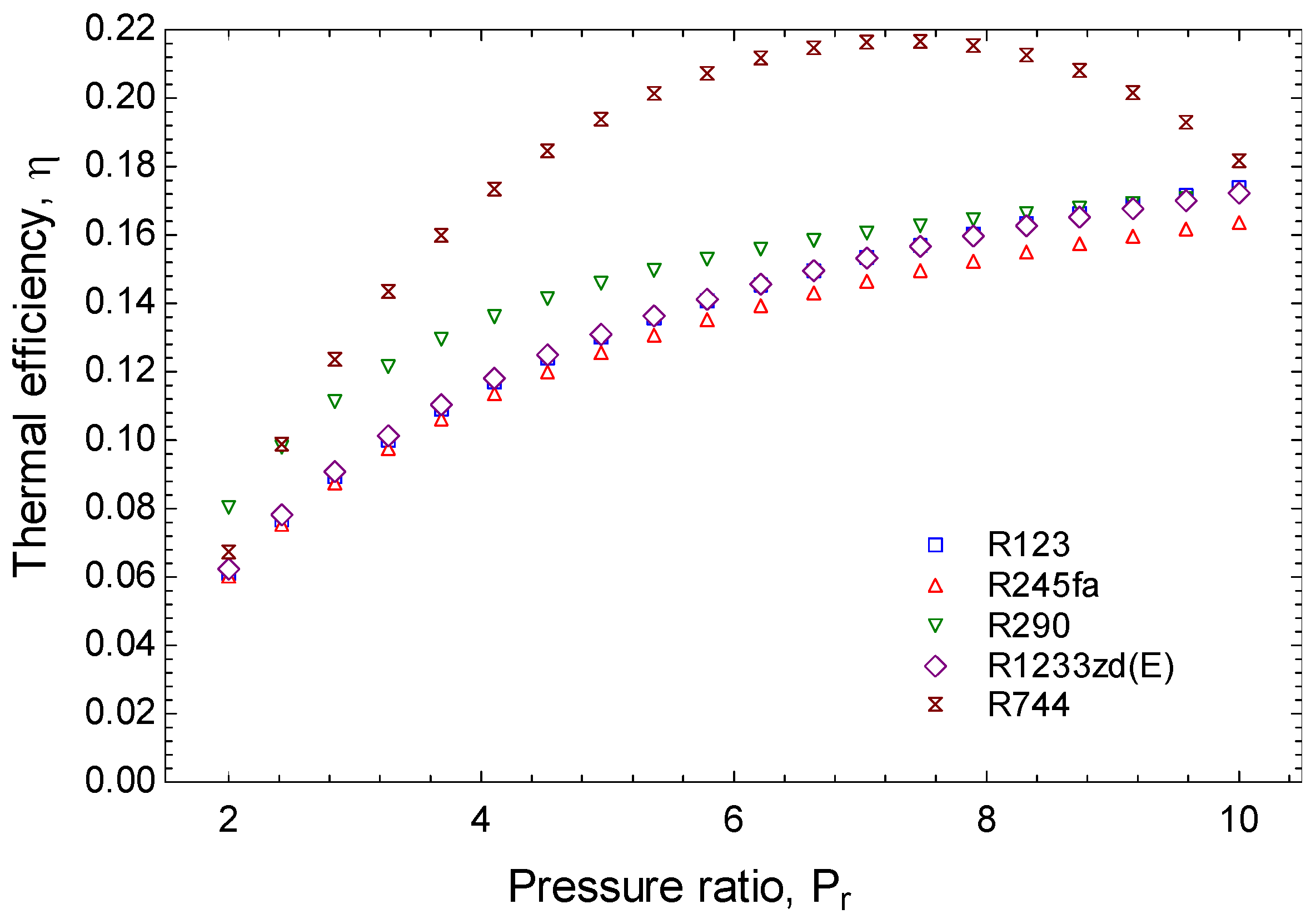
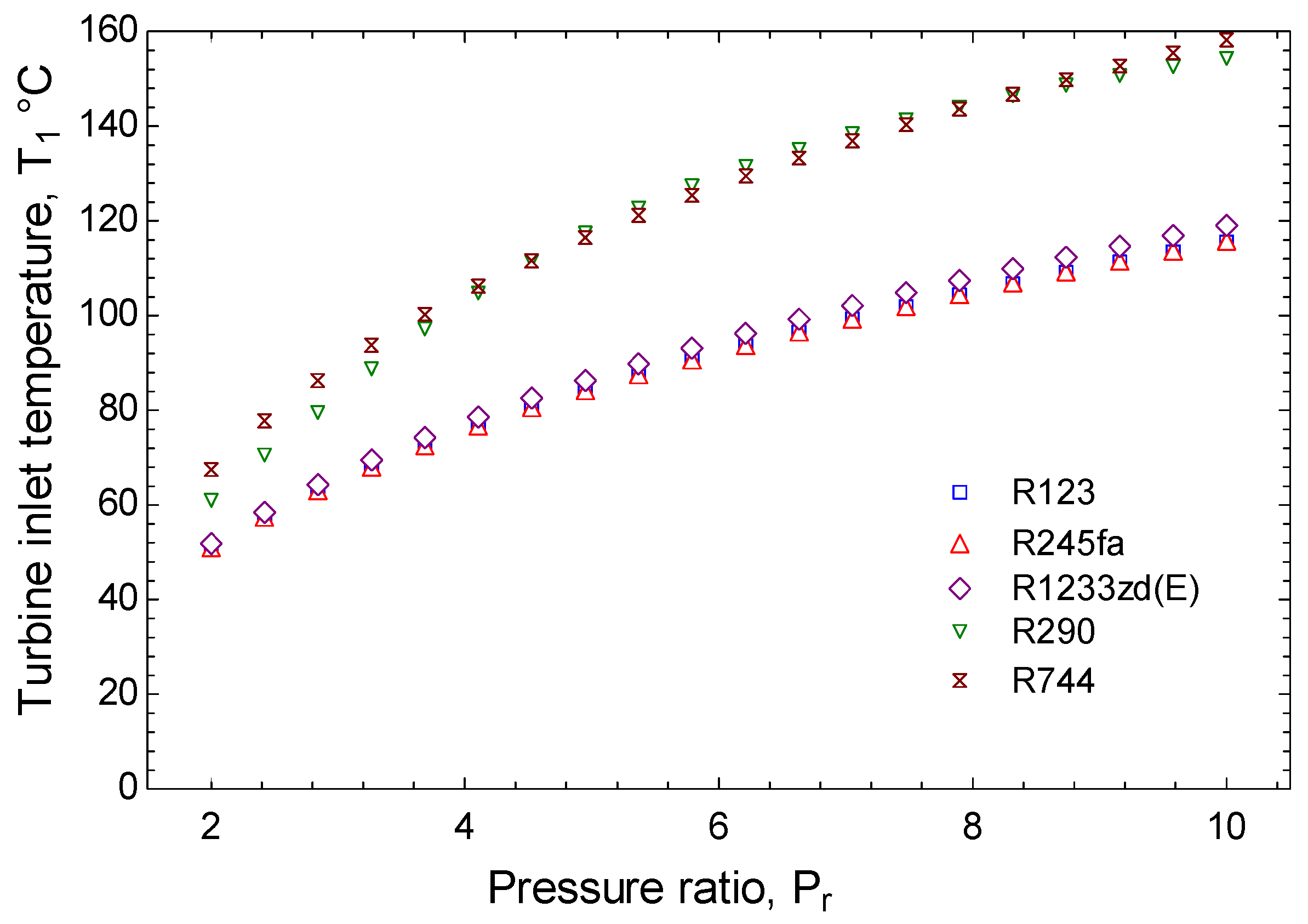
3.1. Low Global Warming Potential Power Cycle Assessment
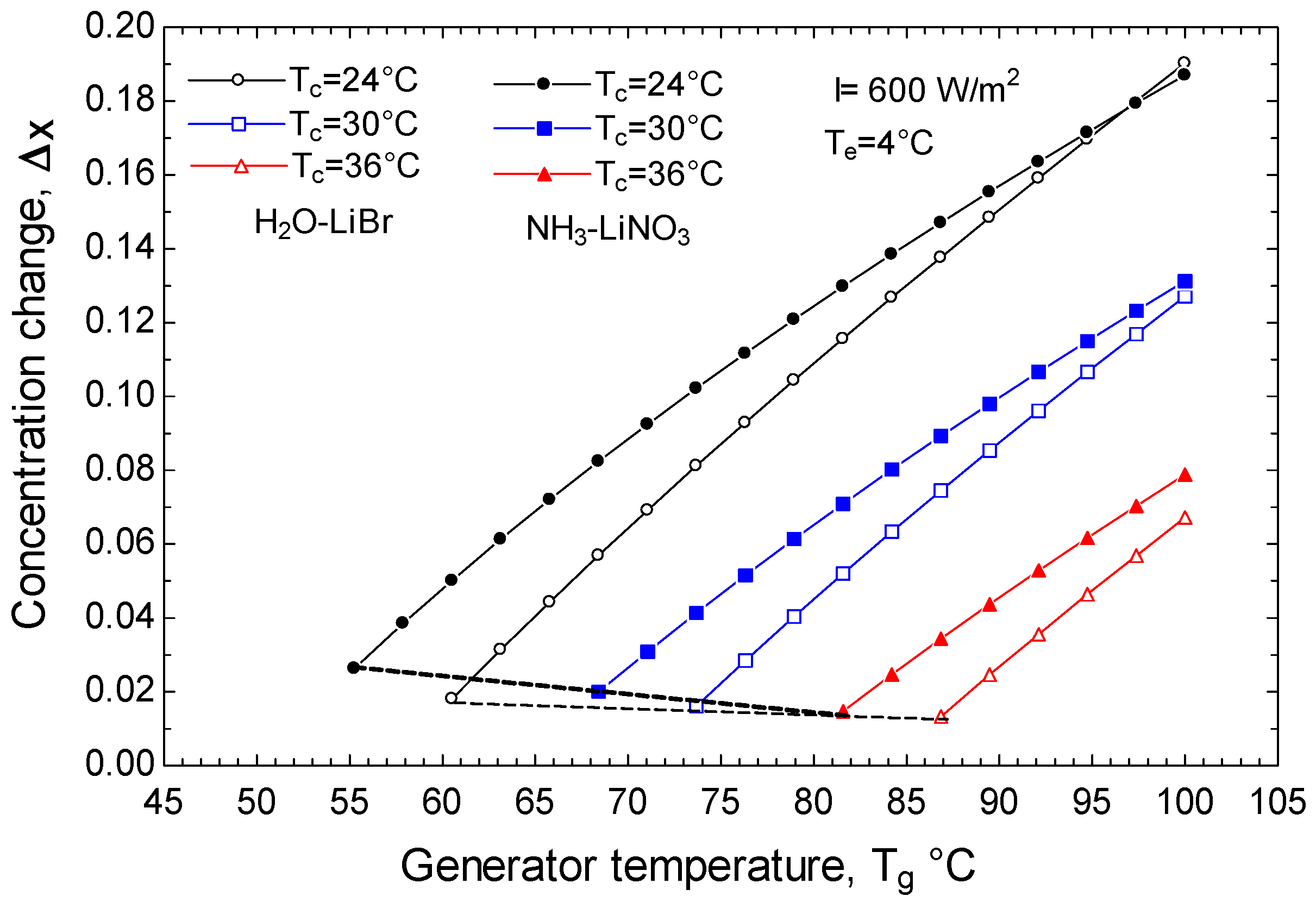
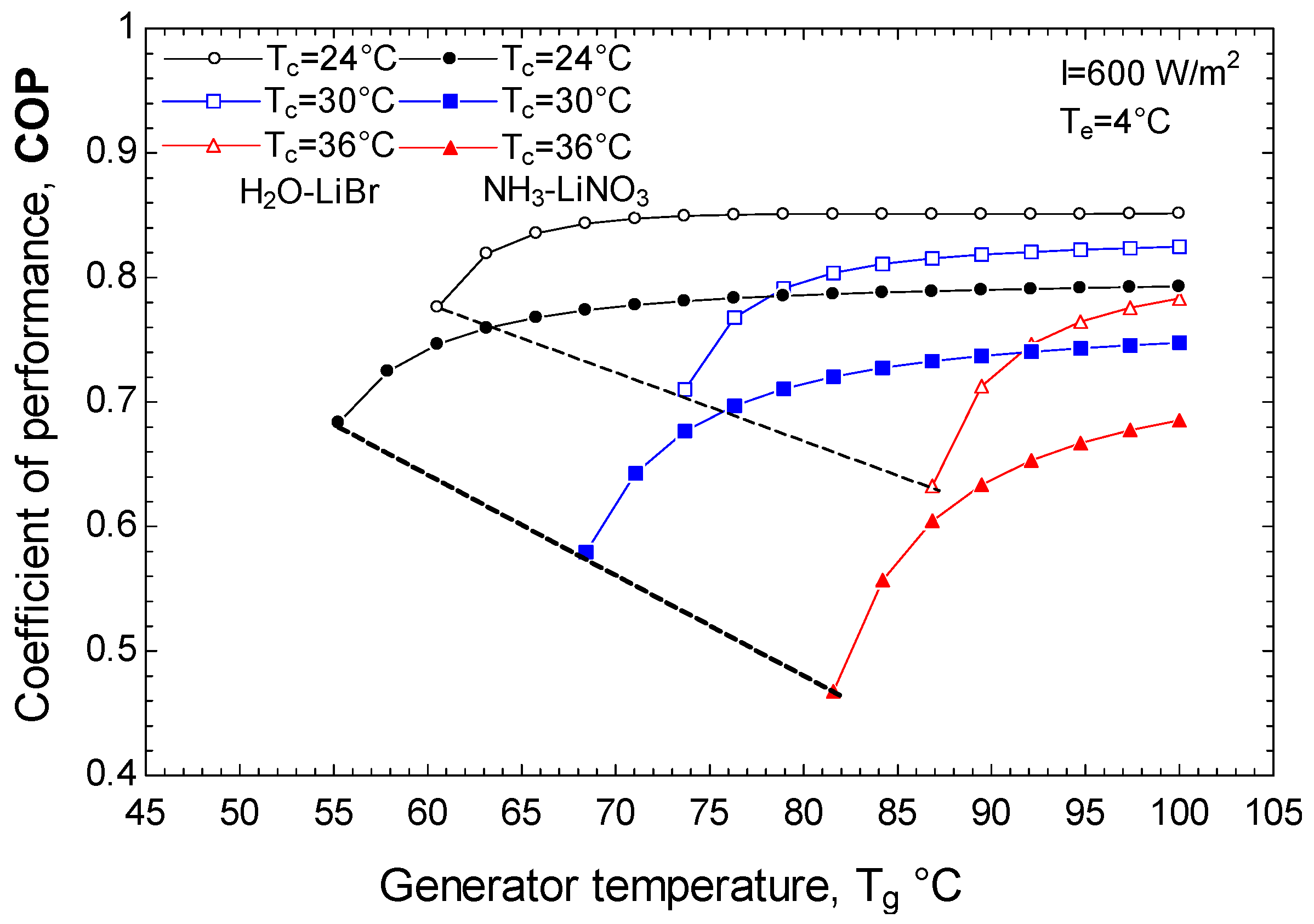
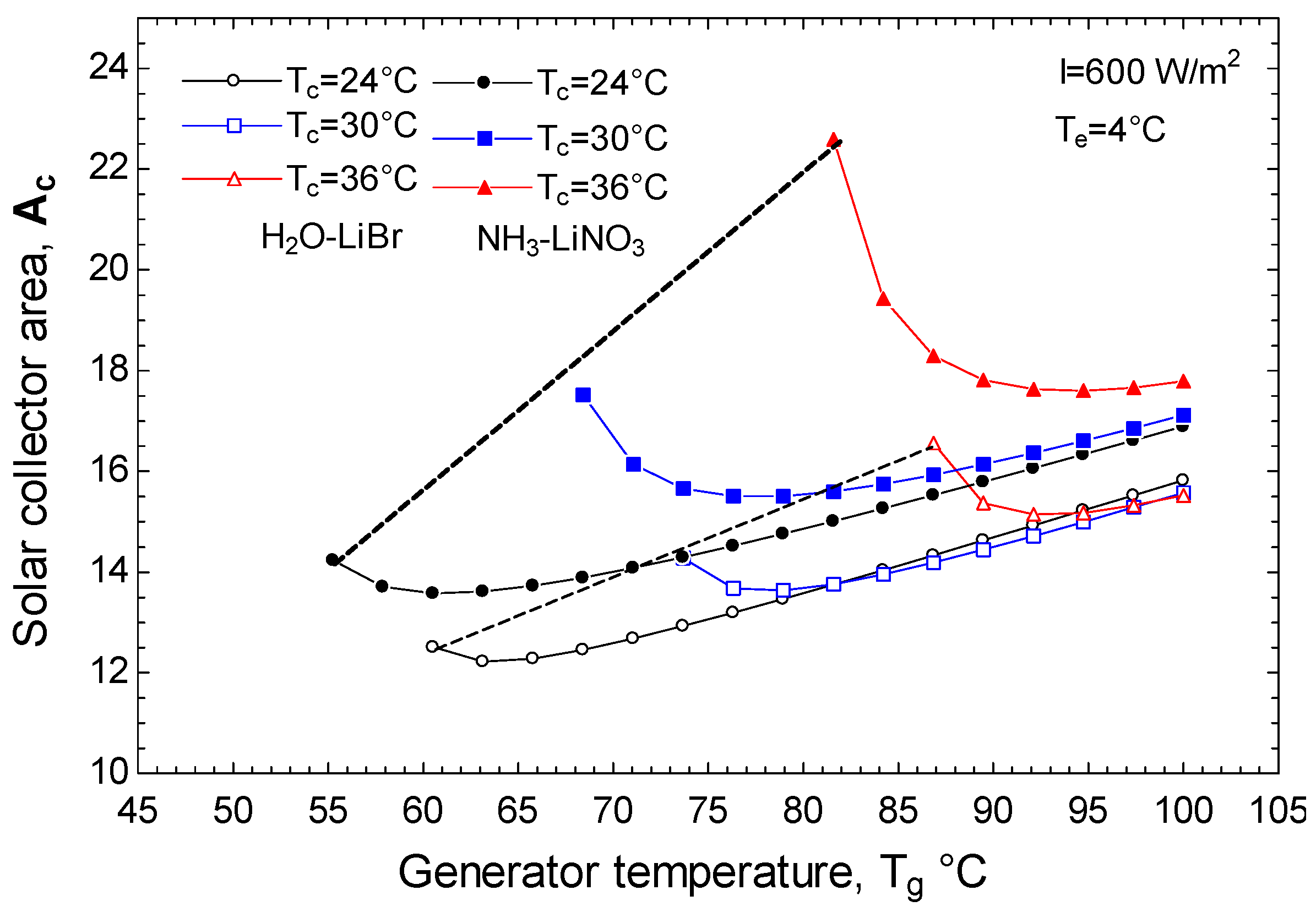
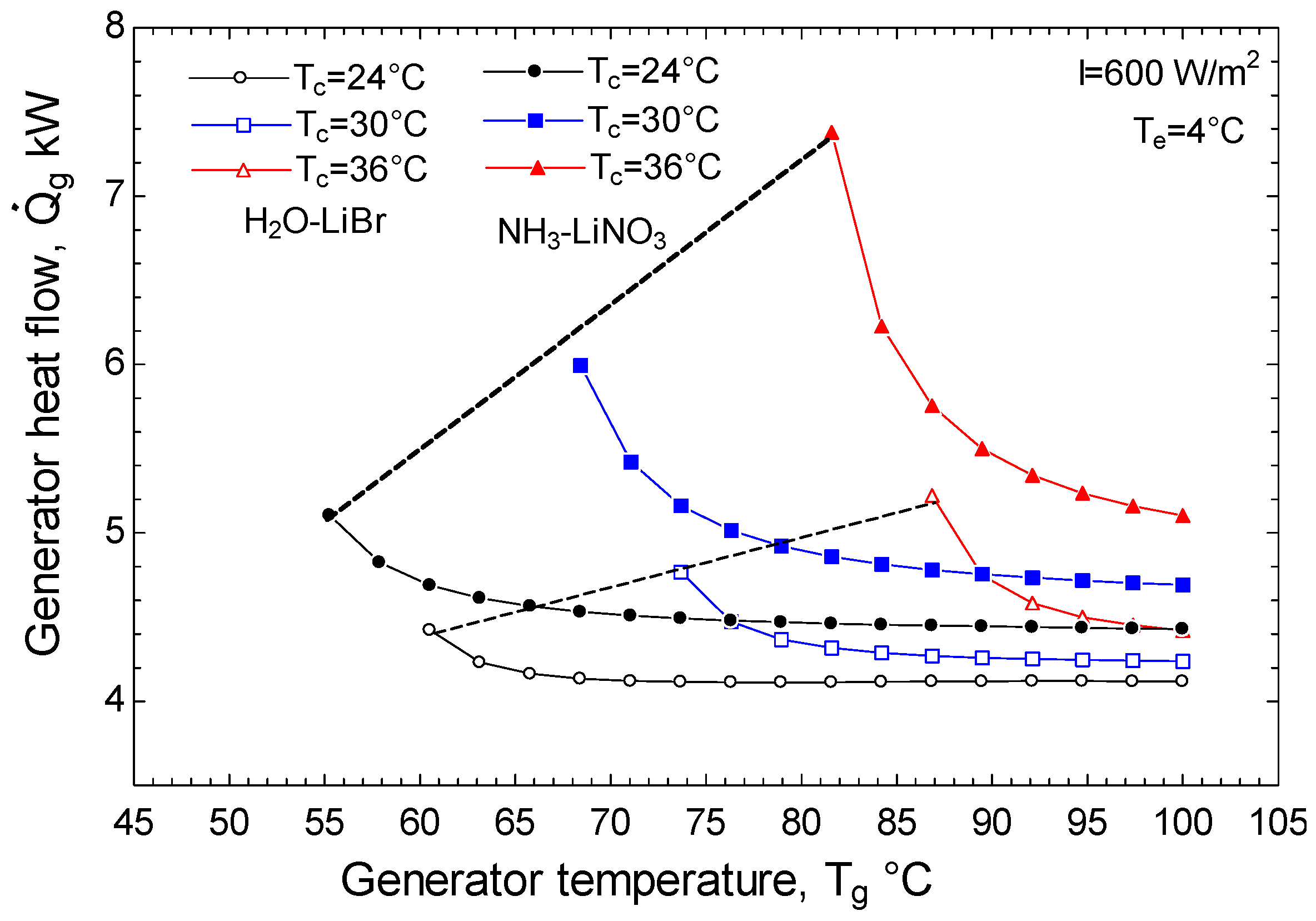
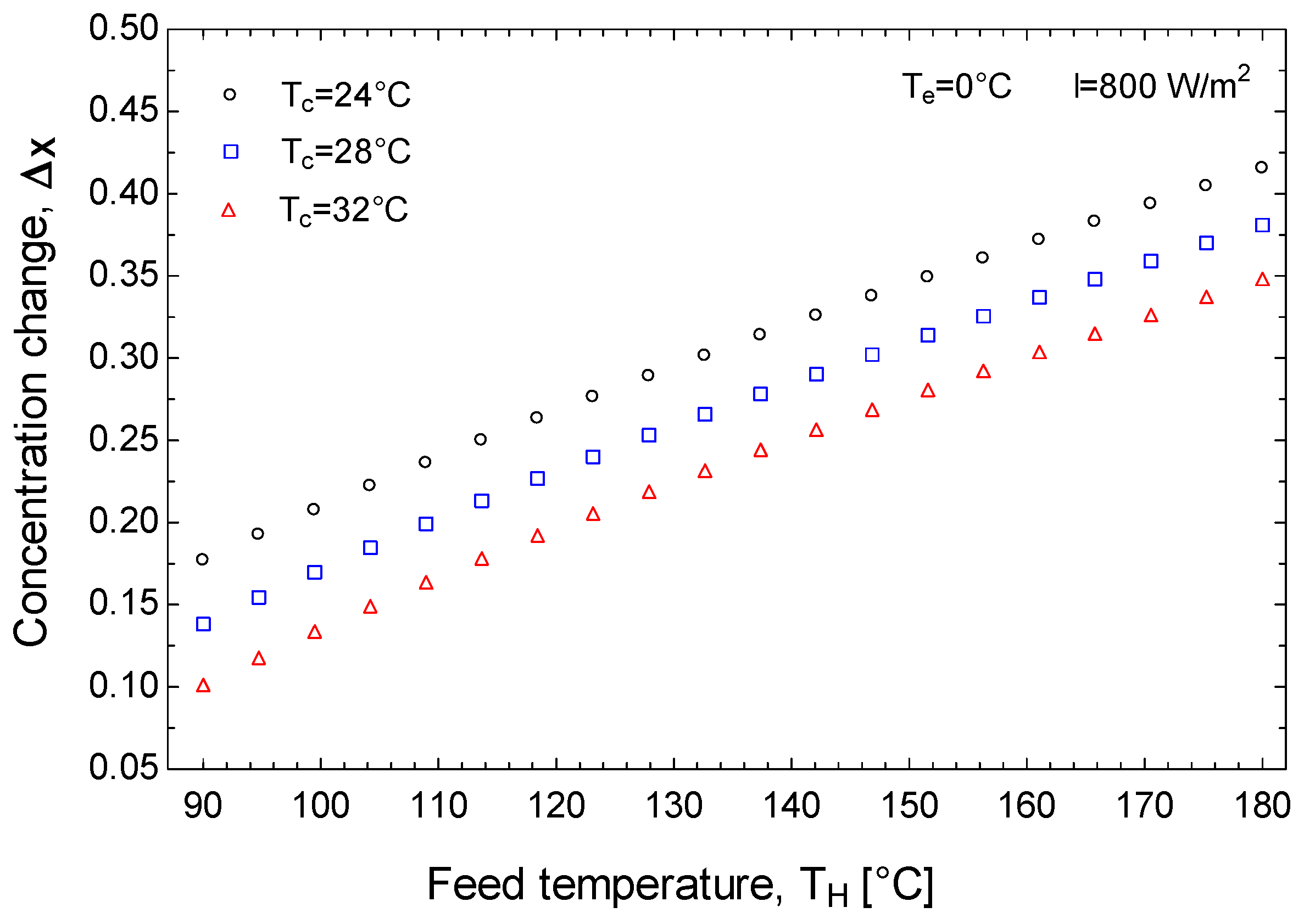
3.2. Low Global Warming Potential Absorption Chiller Assessment
3.3. Low-Global-Warming-Potential Solar Generator–Chiller Steady-State Simulation
3.4. Low-Global-Warming-Potential Solar Generator–Chiller Dynamic Simulation
3.4.1. Typical Seasonal Day
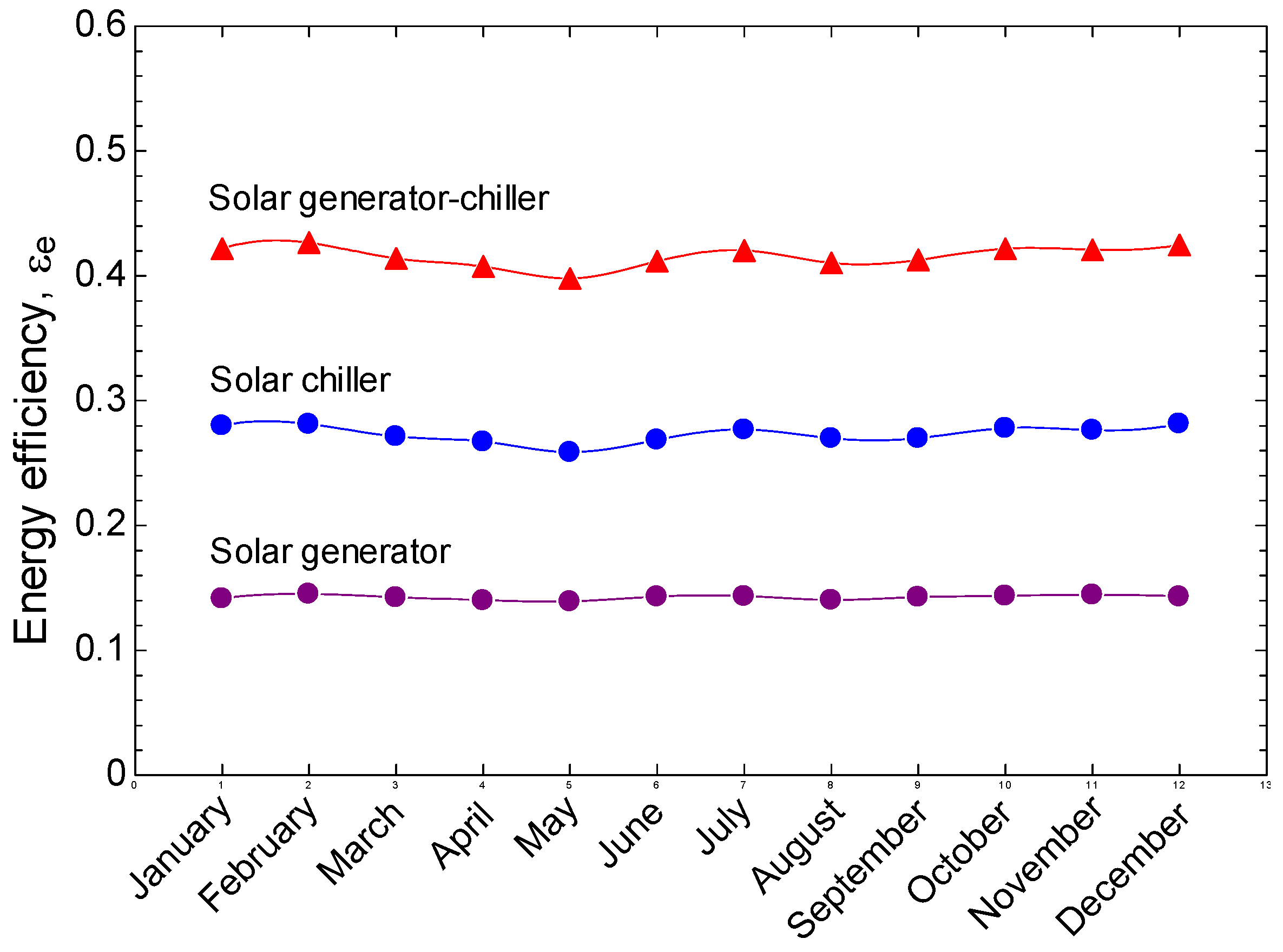
3.4.2. Energy Efficiency
3.4.3. Energy Profitability
4. Conclusions
Author Contributions
Funding
Institutional Review Board Statement
Informed Consent Statement
Data Availability Statement
Acknowledgments
Conflicts of Interest
Nomenclature
| A | Area, m2 |
| COP | Coefficient of performance |
| C | Thermal capacitance (kW/K), concentration ratio. |
| D | Diameter, m |
| f | Circulation ratio |
| h | Enthalpy, kJ/kg |
| I | Irradiance, W/m2 |
| Mass flow rate, kg/s | |
| Heat flow, kW | |
| T | Temperature, °C |
| V | Volume, m3 |
| w | Specific work, kJ/kg |
| Power, kW | |
| X | Concentration |
| Subscripts | |
| 1,2 | State of the system |
| a | Absorber, absorbate, absorption |
| c | Collector, condenser, cold |
| cs | Concentrate solution |
| ds | Diluted solution |
| e | Evaporator |
| g | Generator |
| h | High, hot |
| l | Low |
| min | Minimum |
| P | Pump |
| r | Recuperator, Rankine, refrigerant |
| T | Turbine, temperature |
| u | Useful |
| Greek symbols | |
| Efficiency | |
| ε | Emissivity, efficiency |
| σ | Stefan–Boltzmann constant |
References
- Davoodi, V.; Amiri Rad, E.; Akhoundi, M.; Eicker, U. Design, Optimization, and Performance Analysis of a Solar-Wind Powered Compression Chiller with Built-in Energy Storage System for Sustainable Cooling in Remote Areas. Energy 2024, 312, 133664. [Google Scholar] [CrossRef]
- Trygg, L.; Amiri, S. European Perspective on Absorption Cooling in a Combined Heat and Power System—A Case Study of Energy Utility and Industries in Sweden. Appl. Energy 2007, 84, 1319–1337. [Google Scholar] [CrossRef]
- Turja, A.I.; Sadat, K.N.; Khan, Y.; Ehsan, M.M. Cascading the Transcritical CO2 and Organic Rankine Cycles with Supercritical CO2 Cycles for Waste Heat Recovery. Int. J. Thermofluids 2023, 20, 100508. [Google Scholar] [CrossRef]
- Zhang, D.; Zhang, H.; Luo, Y.; Zhao, S. Comparative and Optimal Study of Energy, Exergy, and Exergoeconomic Performance in Supercritical CO2 Recompression Combined Cycles with Organic Rankine, Trans-Critical CO2, and Kalina Cycle. Energy 2024, 311, 133347. [Google Scholar] [CrossRef]
- Moctezuma-Hernandez, J.A.; Merchán, R.P.; Roco, J.M.M. Supercritical CO2 Hybrid Brayton–Organic Rankine Cycle Integrated with a Solar Central Tower Particle Receiver: Performance, Exergy Analysis, and Choice of the Organic Refrigerant. Renew. Energy 2025, 250, 123231. [Google Scholar] [CrossRef]
- Marc, O.; Sinama, F.; Praene, J.P.; Lucas, F.; Castaing-Lasvignottes, J. Dynamic Modeling and Experimental Validation Elements of a 30 KW LiBr/H2O Single Effect Absorption Chiller for Solar Application. Appl. Therm. Eng. 2015, 90, 980–993. [Google Scholar] [CrossRef]
- Arabkoohsar, A.; Sadi, M. A Solar PTC Powered Absorption Chiller Design for Co-Supply of District Heating and Cooling Systems in Denmark. Energy 2020, 193, 945–957. [Google Scholar] [CrossRef]
- Choi, H.W.; Jung, D.Y.; Doseong, Y.; Kim, M.S.; Kang, Y.T. Sorption Thermal Battery with Solar Powered Absorption Chiller for Various Building Cooling Applications. Energy Build. 2024, 317, 114373. [Google Scholar] [CrossRef]
- Boukholda, I.; Ben Ezzine, N.; Bellagi, A. Experimental Investigation and Simulation of Commercial Absorption Chiller Using Natural Refrigerant R717 and Powered by Fresnel Solar Collector. Int. J. Thermofluids 2025, 27, 101213. [Google Scholar] [CrossRef]
- Tsoutsos, T.; Aloumpi, E.; Gkouskos, Z.; Karagiorgas, M. Design of a Solar Absorption Cooling System in a Greek Hospital. Energy Build. 2010, 42, 265–272. [Google Scholar] [CrossRef]
- Zacarías, A.; Quiroz, J.A.; Gutiérrez-Urueta, G.L.; Venegas, M.; Carvajal, I.; Rubio, J. Comparison between Adiabatic and Non-Adiabatic Absorption Chillers Using Ammonia-Lithium Nitrate and Water-Lithium Bromide Solutions. Heat Transf. Res. 2020, 51, 609–621. [Google Scholar] [CrossRef]
- Romage, G.; Jiménez, C.; de Jesús Reyes, J.; Zacarías, A.; Carvajal, I.; Jiménez, J.A.; Pineda, J.; Venegas, M. Modeling and Simulation of a Hybrid Compression/Absorption Chiller Driven by Stirling Engine and Solar Dish Collector. Appl. Sci. 2020, 10, 9018. [Google Scholar] [CrossRef]
- Zeng, R.; Gan, J.; Guo, B.; Zhang, X.; Li, H.; Yin, W.; Zhang, G. Thermodynamic Performance Analysis of Solid Oxide Fuel Cell—Combined Cooling, Heating and Power System with Integrated Supercritical CO2 Power Cycle—Organic Rankine Cycle and Absorption Refrigeration Cycle. Energy 2023, 283, 129133. [Google Scholar] [CrossRef]
- Shen, S.; Alamri, S.; Ahmad, S.F.; Thaljaoui, A.; Ooi, J.B.; Khan, M.S.; Ghachem, K.; Kolsi, L. Modeling of New Tri-Generation System Based on Triple Organic Rankine Cycle, Kalina Cycle and Absorption Chiller with Heat Recovery Parameter. Case Stud. Therm. Eng. 2025, 76, 107401. [Google Scholar] [CrossRef]
- Ali, A.H.H.; Noeres, P.; Pollerberg, C. Performance Assessment of an Integrated Free Cooling and Solar Powered Single-Effect Lithium Bromide-Water Absorption Chiller. Sol. Energy 2008, 82, 1021–1030. [Google Scholar] [CrossRef]
- Ma, Y.; Zhang, X.; Liu, M.; Yan, J.; Liu, J. Proposal and Assessment of a Novel Supercritical CO2 Brayton Cycle Integrated with LiBr Absorption Chiller for Concentrated Solar Power Applications. Energy 2018, 148, 839–854. [Google Scholar] [CrossRef]
- Ehyaei, M.A.; Ahmadi, A.; El Haj Assad, M.; Rosen, M.A. Investigation of an Integrated System Combining an Organic Rankine Cycle and Absorption Chiller Driven by Geothermal Energy: Energy, Exergy, and Economic Analyses and Optimization. J. Clean. Prod. 2020, 258, 120780. [Google Scholar] [CrossRef]
- El-Sattar, H.A.; Kamel, S.; Vera, D.; Jurado, F. Tri-Generation Biomass System Based on Externally Fired Gas Turbine, Organic Rankine Cycle and Absorption Chiller. J. Clean. Prod. 2020, 260, 121068. [Google Scholar] [CrossRef]
- Assareh, E.; Jahanbin, A.; Izadyar, N.; Barati, M.; Agarwal, N. Solar-Powered Tri-Generation System Integrating Organic Rankine Cycle and Absorption Chiller for Passenger Trains Energy Supply. Energy Built Environ. 2025. [Google Scholar] [CrossRef]
- Srinivas, T.; Vignesh, D. Performance Enhancement of GT-ST Power Plant with Inlet Air Cooling Using Lithium Bromide/Water Vapour Absorption Refrigeration System. Int. J. Energy Technol. Policy 2012, 8, 94–107. [Google Scholar] [CrossRef]
- Anvari, S.; Taghavifar, H.; Parvishi, A. Thermo- Economical Consideration of Regenerative Organic Rankine Cycle Coupling with the Absorption Chiller Systems Incorporated in the Trigeneration System. Energy Convers. Manag. 2017, 148, 317–329. [Google Scholar] [CrossRef]
- Cengel, Y.A.; Ghajar, A.J. Transferencia de Calor y Masa, 4th ed.; Mc Graw Hill: Mexico City, Mexico, 2011. [Google Scholar]
- Herold, K.E.; Radermacher, R.; Klein, S.A. Absorption Chillers and Heat Pumps, 2nd ed.; CRC Press: Columbus, OH, USA, 2016. [Google Scholar]
- Cai, D.; Jiang, J.; He, G.; Li, K.; Niu, L.; Xiao, R. Experimental Evaluation on Thermal Performance of an Air-Cooled Absorption Refrigeration Cycle with NH3-LiNO3 and NH3-NaSCN Refrigerant Solutions. Energy Convers. Manag. 2016, 120, 32–43. [Google Scholar] [CrossRef]
- Zacarías, A.; Romage, G.; Jiménez, C.; de Jesús Rubio, J.; Carvajal, I.; Venegas, M. Adiabatic and No-Adiabatic Absorption Chillers Using Ammonia-Lithium Nitrate Solutions. In Low-Temperature Systems; IntechOpen: London, UK, 2025; Volume 1, pp. 1–16. [Google Scholar]
- Bergman, T.L.; Lavine, A.S.; Incropera, F.P.; DeWitt, D.P. Introduction to Heat Transfer, 6th ed.; John Wiley & Sons, Inc.: Hoboken, NJ, USA, 2011. [Google Scholar]
- Duffie, J.A.; Beckman, W.A. Solar Engineering of Thermal Processes; Wiley: Hoboken, NJ, USA, 2013. [Google Scholar]
- Ding, K.; Cao, X.; Zhang, Y. System Modeling and Performance Simulation of a Full-Spectrum Solar-Biomass Combined Electricity-Heating-Cooling Multi-Generation System. Sustainability 2025, 17, 4675. [Google Scholar] [CrossRef]
- Klein, S.A. Engineering Equation Solver, 1992–2015; f-Chart Software: Madison, WI, USA, 2018. [Google Scholar]
- Libotean, S.; Salavera, D.; Valles, M.; Esteve, X.; Coronas, A. Vapor-Liquid Equilibrium of Ammonia + Lithium Nitrate + Water and Ammonia + Lithium Nitrate Solutions from (293.15 to 353.15). J. Chem. Eng. Data 2007, 52, 1050–1055. [Google Scholar] [CrossRef]
- Libotean, S.; Martín, A.; Salavera, D.; Valles, M.; Esteve, X.; Coronas, A. Densities, Viscosities and Heat Capacities of Ammonia-Lithium Nitrate and Ammonia-Lithium Nitrate-Water Solutions between (293.15 and 353.15) K. J. Chem. Eng. Data 2008, 53, 2383–2388. [Google Scholar] [CrossRef]
- Zacarías, A.; Ventas, R.; Venegas, M.; Lecuona, A. Boiling Heat Transfer and Pressure Drop of Ammonia-Lithium Nitrate Solution in a Plate Generator. Int. J. Heat Mass Transf. 2010, 53, 4768–4779. [Google Scholar] [CrossRef]
- Domínguez-Inzunza, L.A.; Hernández-Magallanes, J.A.; Sandoval-Reyes, M.; Rivera, W. Comparison of the Performance of Single-Effect, Half-Effect, Double-Effect in Series and Inverse and Triple-Effect Absorption Cooling Systems Operating with the NH3-LiNO3 Mixture. Appl. Therm. Eng. 2014, 66, 612–620. [Google Scholar] [CrossRef]
- Farshi, L.G.; Infante Ferreira, C.A.; Mahmoudi, S.M.S.; Rosen, M.A. First and Second Law Analysis of Ammonia/Salt Absorption Refrigeration Systems. Int. J. Refrig. 2014, 40, 111–121. [Google Scholar] [CrossRef]
- Garousi Farshi, L.; Asadi, S. Ammonia Lithium Nitrate and Ammonia Sodium Thiocyanate Double Effect Absorption Refrigeration Systems: Thermodynamic Analysis. Appl. Therm. Eng. 2018, 138, 374–385. [Google Scholar] [CrossRef]
- Figaj, R.; Szubel, M.; Przenzak, E.; Filipowicz, M. Feasibility of a Small-Scale Hybrid Dish/Flat-Plate Solar Collector System as a Heat Source for an Absorption Cooling Unit. Appl. Therm. Eng. 2019, 163, 114399. [Google Scholar] [CrossRef]
- Calise, F.; Figaj, R.D.; Vanoli, L. A Novel Polygeneration System Integrating Photovoltaic/Thermal Collectors, Solar Assisted Heat Pump, Adsorption Chiller and Electrical Energy Storage: Dynamic and Energy-Economic Analysis. Energy Convers. Manag. 2017, 149, 798–814. [Google Scholar] [CrossRef]
- Osta-Omar, S.M.; Micallef, C. Mathematical Model of a Lithium-Bromide/Water Absorption Refrigeration System Equipped with an Adiabatic Absorber. Computation 2016, 4, 44. [Google Scholar] [CrossRef]
- National Solar Radiation Database, NSRDB, D.V. Villahermosa, Tabasco, Mexico-Meteorological Station United States and Americas (60 Min) Temperature and Global Horizontal UV Irradiance (280–400 Nm) 2024, U.S. Department of Energy. 2026. Available online: https://nsrdb.nrel.gov/ (accessed on 16 February 2026).
- Wheather Underground, Data from Station IVILLA933; The Weather Company, LLC: Villahermosa, Mexico, 2026; Available online: https://www.wunderground.com/ (accessed on 16 February 2026).
- Klepp, G. Solar Stirling for Renewable Energy Multigeneration Systems. Sustainability 2025, 17, 1257. [Google Scholar] [CrossRef]










| Parameter | Value | This Work | Error, % |
|---|---|---|---|
| Organic Rankine cycle efficiency [4], % | 2.7 | 2.747 | 1.71 |
| Coefficient of operation, absorption cycle [11], COP | 0.78 | 0.79 | 1.26 |
| Solar collector efficiency [12], % | 0.75 | 0.82 | 8 |
| Parameter | Value |
|---|---|
| Organic Rankine cycle | |
| Working fluid | R1233zd(E) |
| °C | 89.5 |
| °C | 30 |
| 4.5 | |
| Absorption refrigeration cycle | |
| Working fluid | Ammonia–lithium nitrate |
| °C | 74 |
| °C | 0 |
| °C | 30 |
| Solar heating cycle | |
| Working fluid | Oil Diatermo S |
| , °C | 200 |
| °C | 100 |
| Solar radiation, I W/m2 | 1000 |
| Trade Name | Nomenclature | Boiling Temperature [°C] | Critic Temperature [°C] | Critic Pressure [kPa] |
|---|---|---|---|---|
| Genetron–123 | R123 | 27.79 | 183.7 | 3668 |
| ENOVATE–245fa | R245fa | 15.19 | 154.0 | 3651 |
| Eco Flush HFO-1233zd | R1233zd(E) | 17.92 | 109.4 | 3632 |
| Propane | R290 | −42.09 | 96.68 | 4247 |
| Carbon dioxide | R744 | −78.5 | 30.98 | 7377 |
| Water | R718 | 100 | 374.0 | 22,064 |
| Ammonia | R717 | −33.32 | 132.3 | 11,333 |
| Parameter | Value |
|---|---|
| Conventional generator | |
| 0.30 | |
| kW | 1.5 |
| Conventional chiller | |
| , kW | 3.517 |
| 2.5 | |
| 0.30 |
Disclaimer/Publisher’s Note: The statements, opinions and data contained in all publications are solely those of the individual author(s) and contributor(s) and not of MDPI and/or the editor(s). MDPI and/or the editor(s) disclaim responsibility for any injury to people or property resulting from any ideas, methods, instructions or products referred to in the content. |
© 2026 by the authors. Licensee MDPI, Basel, Switzerland. This article is an open access article distributed under the terms and conditions of the Creative Commons Attribution (CC BY) license.
Share and Cite
García, A.I.; Sánchez, J.G.; Ramos-López, G.; Rubio, J.d.J.; Escandón, J.P.; Zacarías, A.; Vargas, R.O.; Mil-Martínez, R.; Flores-Vasconcelos, A.; Barrera, E.E. Performance Assessment of a Low-Global-Warming-Potential Solar-Powered Generator–Chiller. Sustainability 2026, 18, 3301. https://doi.org/10.3390/su18073301
García AI, Sánchez JG, Ramos-López G, Rubio JdJ, Escandón JP, Zacarías A, Vargas RO, Mil-Martínez R, Flores-Vasconcelos A, Barrera EE. Performance Assessment of a Low-Global-Warming-Potential Solar-Powered Generator–Chiller. Sustainability. 2026; 18(7):3301. https://doi.org/10.3390/su18073301
Chicago/Turabian StyleGarcía, Alberto I., Josué G. Sánchez, Gonzalo Ramos-López, José de Jesús Rubio, Juan P. Escandón, Alejandro Zacarías, René O. Vargas, Rubén Mil-Martínez, Alicia Flores-Vasconcelos, and Esteban E. Barrera. 2026. "Performance Assessment of a Low-Global-Warming-Potential Solar-Powered Generator–Chiller" Sustainability 18, no. 7: 3301. https://doi.org/10.3390/su18073301
APA StyleGarcía, A. I., Sánchez, J. G., Ramos-López, G., Rubio, J. d. J., Escandón, J. P., Zacarías, A., Vargas, R. O., Mil-Martínez, R., Flores-Vasconcelos, A., & Barrera, E. E. (2026). Performance Assessment of a Low-Global-Warming-Potential Solar-Powered Generator–Chiller. Sustainability, 18(7), 3301. https://doi.org/10.3390/su18073301