


Abstract
This work investigates the physicochemical characteristics of waste tire pyrolysis char (WTP-char) produced at 500 °C in an industrial-scale auger reactor. The study uniquely combines material profiling with environmental safety assessment, specifically targeting organic contaminants and polymer stabilizers, evaluating WTP-char’s potential for circular economy applications. The samples underwent comprehensive analysis, including GC-MS, TGA, SEM-EDS, TXRF, and BET surface area measurements. The results revealed a high volatile matter content (13 wt.%), attributed to the thermal inertia typical of industrial-scale units. The organic fraction was dominated by n-alkanes (48.3%) and a significant concentration (6.97%) of the stabilizer Tris(2,4-di-tert-butylphenyl) phosphate (bDtBPP), posing potential environmental risks due to its cytotoxicity. Polycyclic aromatic hydrocarbon (PAH) analysis showed a prevalence of high-molecular-weight (HMW) compounds (79.7%), indicating high chemical stability. Although the specific surface area was low (28.9 m2/g), suggesting the need for activation, the material exhibits potential as a low-cost semi-reinforcing filler or solid fuel. By moving beyond laboratory-scale experiments to real industrial production, this study establishes a practical framework for evaluating both the performance and environmental safety of waste tire pyrolysis char.
1. Introduction
Large numbers of vehicles that are removed from use indicate a serious problem of waste tire disposal. According to the WBCSD—Tire Industry Project (TIP) [1], 1.6 to 2.3 billion tires are classified as waste in the world annually; this represents 2–3% of the total waste collected. Currently, the recovery rate of raw materials obtained from used tires is reported to be ca. 90% in the United States of America (USA) and the European Union (EU) [2]. It is estimated that there are still around 4 billion waste tires in landfills around the world, and this will increase to 5 billion by 2030 [3]. Composed mainly of 55–65 wt.% of vulcanized natural and synthetic rubbers (e.g., butadiene and butadiene–styrene) and 30–40 wt.% of carbon black, and varying quantities of metal wires, textiles, thickeners, and hardeners [4], waste tires could be considered as resources from which valuable materials and/or chemicals can be recycled. One of the technologies that can be considered in this regard is pyrolysis [5,6].
Among the available reactors for waste tire pyrolysis (WTP), auger (or screw) pyrolyzers are promising types due to their effective heat transfer capabilities and continuous operation mode, which is crucial for industrial implementation. In an auger reactor, the feedstock that is continuously fed to a single or twin screw moves through the reactor and is thermally decomposed to form the solid (i.e., WTP-char) and vapor fractions. The condensable vapors are then condensed to form the pyrolysis oil (i.e., WTP-oil). The non-condensable pyrolysis gases leaving the condenser can be combusted to generate the heat and/or power required for the process [7]. The yield of WTP-char is reported to be in the range of 28–40 wt.% [8]. However, upscaling the process often alters the product characteristics due to thermal inertia, potentially leading to higher volatile matter retention in the solid fraction.
In terms of the results of its ultimate analysis, the WTP-char is characterized mainly by its carbon (75–85 wt.%), hydrogen (0.9–1.5 wt.%), nitrogen (0.3–0.5 wt.%), and sulfur (2.0–3.5 wt.%) contents [9,10]. The WTP-char consists also of volatiles, trace amounts of condensed aerosols, and ash (12.4–18.5 wt.%). The latter involves heavy metals and residues of rubber additives, which, depending on the targeted end-use, should be removed before further processing of WTP-char. Specifically, the presence of persistent organic pollutants and stabilizers requires detailed screening to ensure environmental safety.
Most of the available literature sources concerning the WTP are focused on the characterization of the WTP-oil as a potential liquid intermediate for the production of alternative transportation fuels and/or chemicals [11,12]. However, just a few studies about the physicochemical properties of WTP-char are available [13,14,15]; it has to be highlighted that utilizing the WTP-char is promising in terms of the production of certain industrial raw materials such as recycled carbon black (rCB) and activated carbon (AC) [16,17].
An important factor determining char use is its surface area, which is widely improved by the activation processes. The surface area of WTP-char was shown to vary between 54.9 and 73.5 m2/g (fixed-bed quartz reactor) depending on the pyrolysis reaction temperature [18]. This parameter is an indicator of WTP-char utilization for gas or water filtration purposes [19]. However, while activated carbon produced from WTP-char can have a surface area as high as 720 m2/g [20], the surface area of the ACs produced from bio-waste may reach over 2000 m2/g [21,22]. Therefore, apart from porosity, the chemical purity and toxicological profile of WTP-char become decisive factors for its applicability in a circular economy, perhaps as a replacement for virgin carbon black, whose BET surface area varies significantly based on grade, generally ranging from 20 to 155 m2/g for standard rubber grades [23].
This study comprehensively characterizes the physicochemical properties of WTP-char produced in a continuous industrial-scale auger reactor located in western Poland, addressing the scarcity of data on commercial pyrolysis processes compared to studies performed in laboratory-scale systems operating batch-wise. A key novelty of this work is the integration of standard material profiling with a rigorous assessment of environmental safety, specifically focusing on the identification of organic contaminants, including polymer stabilizers (e.g., bDtBPP) and polycyclic aromatic hydrocarbons (PAHs). By correlating detailed chemical analyses with morphological and thermal investigations, this research bridges a critical gap in the literature, offering essential data for assessing the viability and toxicological safety of WTP-char in circular economy applications.
2. Materials and Methods
2.1. Production of WTP-Char
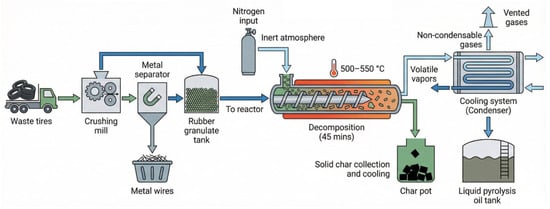
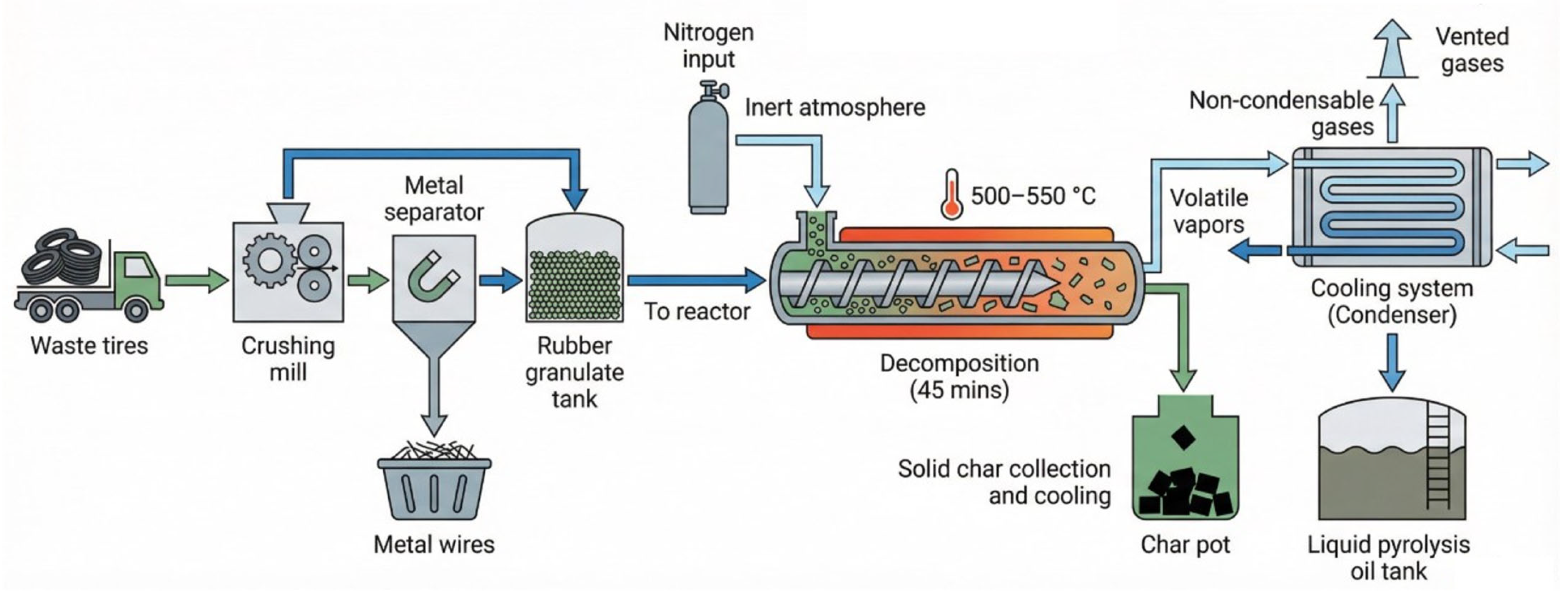
The WTP-char analyzed in this study was obtained from an industrial-scale waste tire pyrolysis plant located in western Poland. Before thermal treatment, the waste tires underwent mechanical separation to remove metal wires, ensuring a rubber-rich feedstock for the process, and to provide a uniform feedstock size set to 25 mm particles. The pyrolysis was conducted in a continuous mode using an auger reactor, with nitrogen utilized as the carrier gas to maintain an inert atmosphere. The reactor operated within a temperature range of 500–550 °C, with a solid residence time of approximately 45 min. A schematic representation of the waste tire pyrolysis plant is shown in Figure 1. Before the analytical investigations, the collected WTP-char samples were stored in a desiccator at a temperature of approximately 22 °C.
Figure 1.
Schematic of the waste tire pyrolysis plant.
2.2. WTP-Char Characterization
2.2.1. Proximate Analysis
Thermogravimetric analysis (TGA) was performed using a NETZSCH Libra 209 F1 (Selb, Germany) analyzer under a high-purity nitrogen atmosphere (99.999%). Approximately 12 mg of the sample was placed in a ceramic crucible on a SiO2-coated c-DTA® carrier. Proximate analysis parameters, including moisture (MC) [24], volatile matter (VC) [25], and ash (AS) [26], were determined according to standard protocols, while fixed carbon (FC) was calculated by difference. The measurement was run in triplicate.
2.2.2. Chemical Composition
Qualitative and quantitative analyses of organic compounds, specifically n-alkanes and polycyclic aromatic hydrocarbons (PAHs), were conducted using a gas chromatograph coupled with a mass spectrometer (Agilent Technologies GC/MS 7890B Triple Quad 7000C (Santa Clara, CA, USA)). A WTP-char sample of 3 g was subjected to ultrasound-assisted extraction in triplicate using a hexane/dichloromethane mixture (2:1 v/v). The obtained extract was dried over anhydrous sodium sulfate, purified via a silica gel SPE column, and concentrated to 2 mL under a nitrogen stream. The concentrate was divided into two equal aliquots: one for direct chromatographic analysis and the other for gravimetric determination of the dry extraction residue.
Chromatographic separation for all analytes was performed on an Agilent HP-5MS (Santa Clara, CA, USA) capillary column (30 m × 250 µm × 0.25 µm; 5%-phenyl-methylpolysiloxane). The n-alkanes were analyzed in full scan mode, with identification based on mass spectra and retention indices. Conversely, the quantitative analysis of PAHs was conducted in single-ion monitoring (SIM) mode to ensure high sensitivity. Detailed operating parameters of the chromatograph are presented in Table 1.
Table 1.
Operating parameters of the chromatograph.
Elemental analysis was performed using total reflection X-ray fluorescence (TXRF) on an S2 PICOFOX spectrometer (Bruker, Billerica, MA, USA). For this analysis, 0.5 g of the sample was suspended in 50 mL of a 1% Triton X-100 solution (Sigma-Aldrich, St. Louis, MO, USA) and extracted in an ultrasonic bath for 30–40 min at 30–40 °C. A homogenized gallium (Ga) solution (50 µL) was added as an internal standard.
The concentrations of major metals (Ca, Mg, Fe, Mn, Zn, Cu, and Al) were determined by flame atomic absorption spectrometry (FAAS), following microwave-assisted digestion with aqua regia (0.5 g dry char, 8 mL HCl, and 2 mL HNO3) in an Ethos Easy system (Milestone, Sorisole, Italy), according to standard [27]. Trace heavy metals (Cr, Ni, Pb, and Cd) were quantified using graphite furnace atomic absorption spectrometry (GFAAS). Both FAAS and GFAAS measurements were conducted using an iCE 3500 instrument (Thermo Scientific, Waltham, MA, USA). All measurements were run in triplicate.
The analytical procedures were conducted following internal quality control protocols. Method robustness was ensured by the use of high-purity standards (certified purity > 98%) and systematic monitoring of retention time stability (RSD < 0.5%) and peak shape symmetry. To minimize matrix effects and ensure consistent extraction recovery, all samples were processed in a single batch by the same operator using standardized solvent volumes and extraction times.
2.2.3. Textural and Morphological Analysis
Particle size distribution was determined using a Fritsch Analysette 22 NanoTec plus (Oberstein, Germany) analyzer equipped with a dry dispersion unit. The WTP-char sample was introduced via a vibrating feeder into a Venturi nozzle, where an accelerated air stream dispersed the agglomerates before laser diffraction measurement.
Specific surface area was analyzed by volumetric nitrogen adsorption using a Micromeritics Gemini 2360 (Norcross, GA, USA) surface analyzer. Calculations were performed using both single-point (evaluated at a relative pressure of P/P0 = 0.30) and multi-point (using the standard relative pressure range of P/P0 = 0.05–0.30) Brunauer–Emmett–Teller (BET) models via MicroActive 4.03 software. Skeletal density was measured using a helium pycnometer (AccuPyc II 1340, Micromeritics, Norcross, GA, USA)) equipped with a 10 cm3 chamber; data were processed using FoamPyc V1.06 software.
Morphological analysis was conducted using field-emission scanning electron microscopy (FE-SEM) (Thermo Fisher Scientific, Waltham, MA, USA). Samples were mounted on aluminum stubs using double-sided carbon tape and sputter-coated with a ca. 7 nm gold layer using a Safematic CCU-010 (Zizers, Switzerland) high-vacuum coater. Imaging was performed on a Scios 2 DualBeam FIB-SEM (Thermo Fisher Scientific, Waltham, MA, USA) at an accelerating voltage of 2 kV, while elemental composition was simultaneously assessed via energy-dispersive X-ray spectroscopy (EDS) at 30 kV.
2.2.4. Sorption Properties
The sorption properties and chemical nature of the WTP-char were characterized using standard protocols. The pH value was determined according to PN-85 C-97555/10 [28] by measuring the acidity of an aqueous suspension of the char. The iodine number, serving as an indicator of the adsorption capacity and microporosity, was measured via the titration method described in PN-83 C-97555.04 [29]. Furthermore, the structure and void volume of the agglomerates were evaluated using the Oil Absorption Number (OAN) test, following the ASTM D 2414-04 [30] standard. All measurements were run in triplicate.
3. Results
3.1. Proximate Analysis
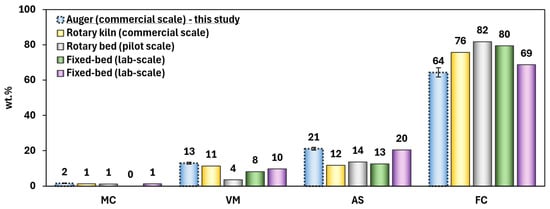
The proximate composition of the WTP-char produced in the industrial-scale auger reactor differs noticeably from chars obtained via other reactor configurations, as illustrated in Figure 2. All compared materials exhibited low moisture content (MC < 2 wt.%), confirming the hydrophobic nature and storage stability of the carbonaceous product.
Figure 2.
Proximate analyses of WTP-chars obtained in various reactor types in the temperature range of 500–550 °C [18,31,32,33]. MC: moisture content; VM: volatile matter; AS: ash; FC: fixed carbon.
A distinguishing feature of the analyzed WTP-char is its relatively high volatile matter (VM) content of 13 wt.%. This value aligns with data from commercial-scale rotary kilns (11.3 wt.%) [30] but stands in contrast to laboratory-scale fixed-bed reactors, where VM values are significantly lower (3.5–9.7 wt.%) [31,32,33]. This discrepancy indicates that devolatilization in large-scale continuous units is less exhaustive than in batch laboratory processes, likely due to thermal inertia and limited gas–solid contact time in the auger screw. The 13 wt.% volatile matter (VM) significantly impacts the raw WTP-char’s industrial applicability. For high-end uses like recovered carbon black (rCB) or porous adsorbents, residual heavy hydrocarbons block pores, interfere with rubber vulcanization, and cause VOC emissions, making post-treatment mandatory. Conversely, for energy recovery (solid fuel or gasification), this VM level is advantageous as it lowers the ignition temperature and enhances reactivity. Consequently, the fixed carbon (FC) content in this study (64.3 wt.%) was lower than in chars produced in controlled lab-scale environments (up to 82 wt.%).
The ash content (AS) was found to be 21.1 wt.%, representing the highest value among the compared datasets. While high ash content acts as a ballast that may reduce the development of the porous structure and adsorption capacity [34], it introduces potential catalytic properties. The mineral fraction (rich in Zn and other metals) may catalyze cracking reactions in secondary thermal valorization processes, such as gasification or catalytic pyrolysis [35].
3.2. Chemical Composition
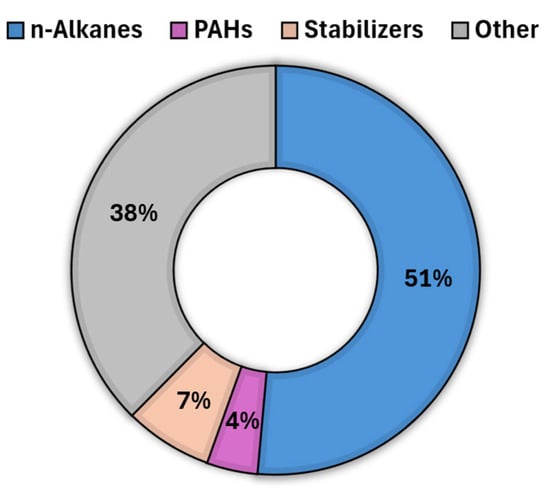
The organic fraction of the WTP-char was dominated by n-alkanes (48.3 area%), PAHs (6.25 area%), and a significant concentration of tris(2,4-di-tert-butylphenyl) phosphate (bDtBPP, 6.97 area%).
Particular attention was directed towards bDtBPP due to its high abundance. This organophosphorus compound is a known oxidation product of Irgafos 168, a common secondary antioxidant used to protect polymers against thermal degradation and gamma irradiation during processing [36]. Its presence in the char confirms that additive residues from the tire matrix survived the pyrolysis process. This observation is critical for environmental safety assessments, as bDtBPP and its related derivative, bis(2,4-di-tert-butylphenyl) phosphate, are cytotoxic. Studies have demonstrated their ability to suppress CHO cell growth and significantly reduce mitochondrial membrane potential [37,38]. However, specific international regulatory thresholds for this emerging organophosphate contaminant in environmental matrices or recovered carbon black have not yet been established. This regulatory gap underscores the necessity of applying the precautionary principle. The presence of such unregulated, biologically active additives further necessitates the post-treatment purification of raw WTP-char before its application in open environments.
The sample also contained alkylated (predominantly methylated) benzene and naphthalene derivatives, as well as higher PAHs. These compounds likely originate from the pyrolysis and subsequent cyclization of isoprene units found in natural rubber. While often less regulated than unsubstituted PAHs, these alkylated derivatives are highly persistent in the environment and have been reported to exhibit higher toxicity and carcinogenic potential [39]. Their presence confirms the mixed composition of the feedstock, comprising both natural and synthetic rubber fractions.
Figure 3 presents the eleven most abundant organic compounds identified in the WTP-char. A comprehensive list of all detected compounds is provided in the Supplementary Materials (Tables S1–S6).
Figure 3.
Distribution of organic compound groups identified in the WTP-char sample. The ‘Stabilizers’ fraction corresponds to tris(2,4-di-tert-butylphenyl) phosphate (bDtBPP), a degradation product of polymer antioxidants (n-Alkanes, PAHs, and Stabilizers with peak area > 1%, Other < 1%).
Ideally, WTP-char is intended to serve as a sustainable substitute for commercial carbon black (recovered carbon black, rCB). However, a comparative analysis reveals substantial compositional differences between the two materials. While conventional furnace carbon black typically consists of a mixture of simple, non-alkylated PAHs [40], WTP-char exhibits a much more complex organic profile. This heterogeneity arises directly from the tire feedstock, which contains natural and synthetic rubbers (e.g., stereoregular polyisoprene), resins, and various additives. During pyrolysis, the thermal decomposition of these polymeric precursors yields a diverse spectrum of alkylated derivatives and secondary by-products that are retained in the char matrix.
3.2.1. n-Alkanes
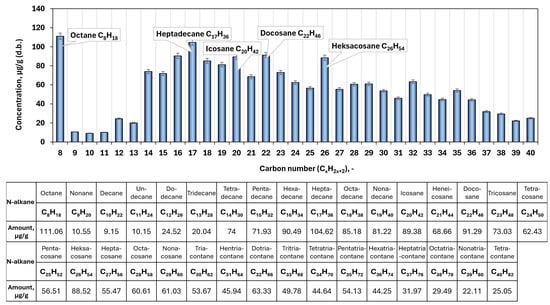
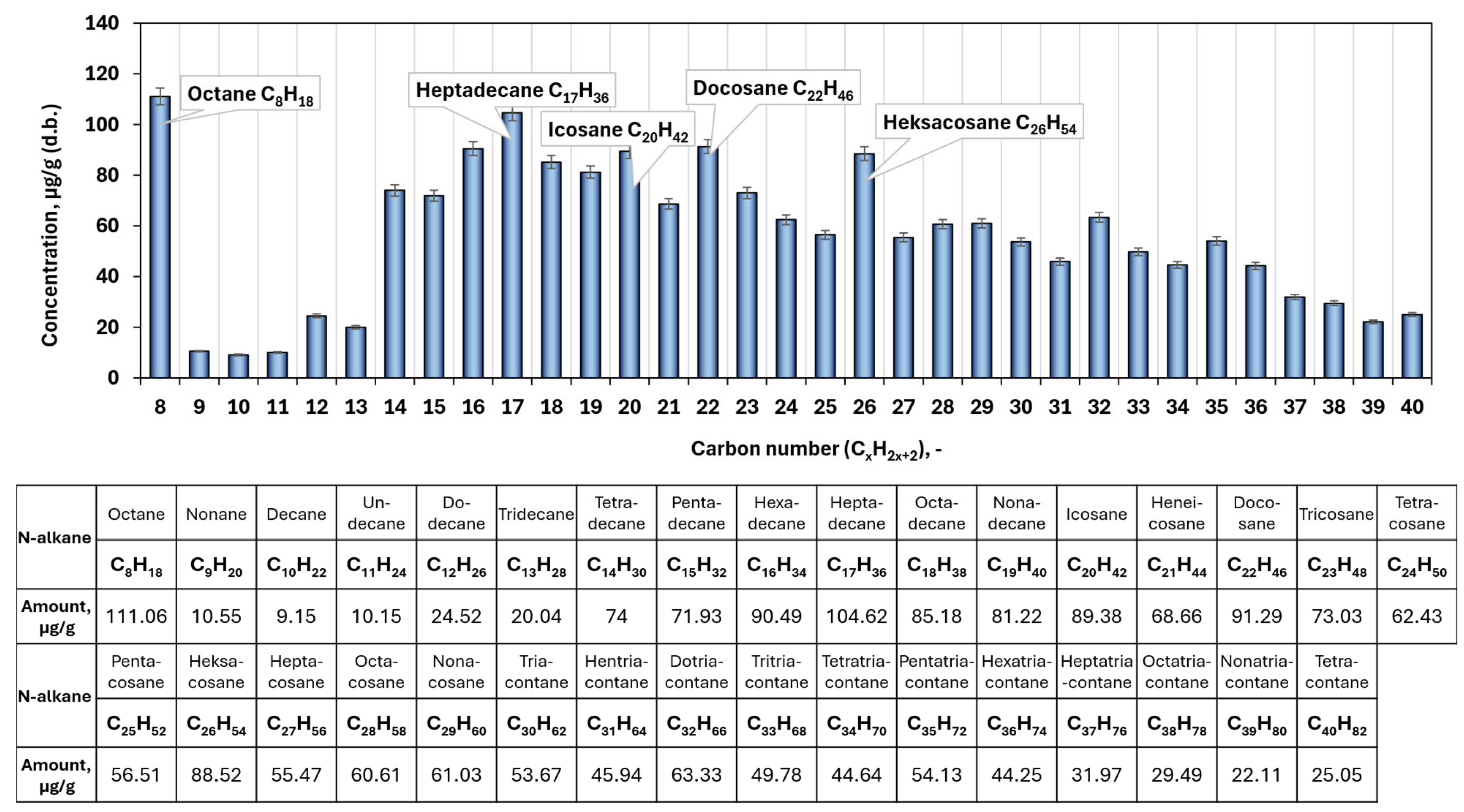
The quantitative analysis of n-alkanes (C8–C40) revealed a distinctive bimodal distribution pattern, as depicted in Figure 4. The total concentration of n-alkanes in the WTP-char was determined to be 1864.20 µg/g (d.b.), constituting the dominant fraction of the extractable organic matter.
Figure 4.
Distribution of n-alkanes in WTP-char as a function of carbon chain length (C8–C40), illustrating the bimodal concentration profile.
The first major peak corresponds to lighter hydrocarbons, specifically octane (C8), which exhibited the highest individual concentration (111.06 µg/g). This abundance of short-chain alkanes suggests intense cracking of aliphatic side chains attached to the polymer backbone during pyrolysis [41]. The second, broader maximum is observed in the mid-range region (C14–C22), peaking at heptadecane (C17H36, 104.62 µg/g) and docosane (C22H46, 91.29 µg/g). The prominence of these mid-range hydrocarbons is attributed to the random scission of C–C bonds within the polybutadiene and styrene–butadiene rubber backbones. In particular, the distinct peak of heptadecane may result from the decarboxylation of stearic acid, a common vulcanization activator used in tire manufacturing, which typically decomposes into C17-alkanes under pyrolysis conditions [42,43].
It is noteworthy that a significant fraction of heavy alkanes (C25–C40), including hexacosane (C26H54, 88.52 µg/g), remains in the char structure. The presence of these long-chain waxy compounds indicates incomplete thermal degradation of the rubber matrix. This finding correlates with the high volatile matter content (12.98 wt.%) discussed in Section 3.1. It confirms that the residence time or heat-transfer efficiency in the industrial-scale auger reactor was insufficient to fully crack these high-molecular-weight hydrocarbons into gaseous products.
3.2.2. PAHs
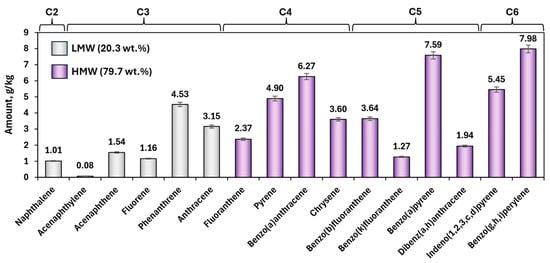
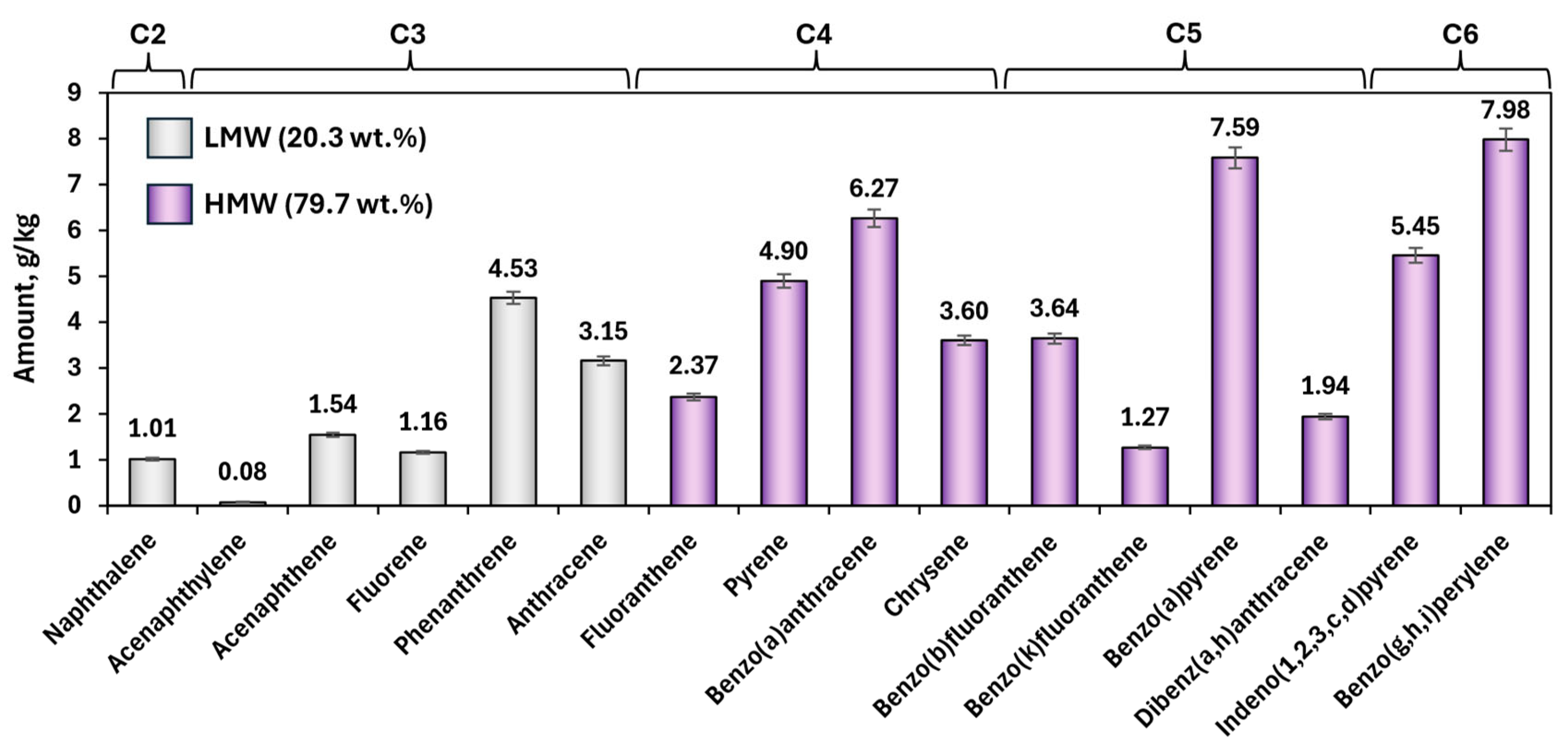
The chromatographic analysis revealed a distinct organic footprint characterized by a high prevalence of alkylated aromatic structures (Figure 5). This abundance of alkylated PAHs (e.g., methyl and ethyl derivatives of naphthalene and phenanthrene) is directly linked to the feedstock composition. As detailed by Cataldo [39], these compounds originate from the low-temperature pyrolysis of natural rubber (cis-1,4-polyisoprene).
Figure 5.
Quantities of 16 PAH compounds detected in WTP-char.
During thermal decomposition, the isoprene units undergo cyclization and dehydrogenation rather than complete aromatization, preserving the aliphatic methyl groups on the resulting aromatic rings [39]. This ‘carbonized rubber’ fraction, which remains adsorbed on the WTP-char surface, differs significantly from the impurity profile of commercial furnace carbon black, which typically contains simple, non-alkylated PAHs [39].
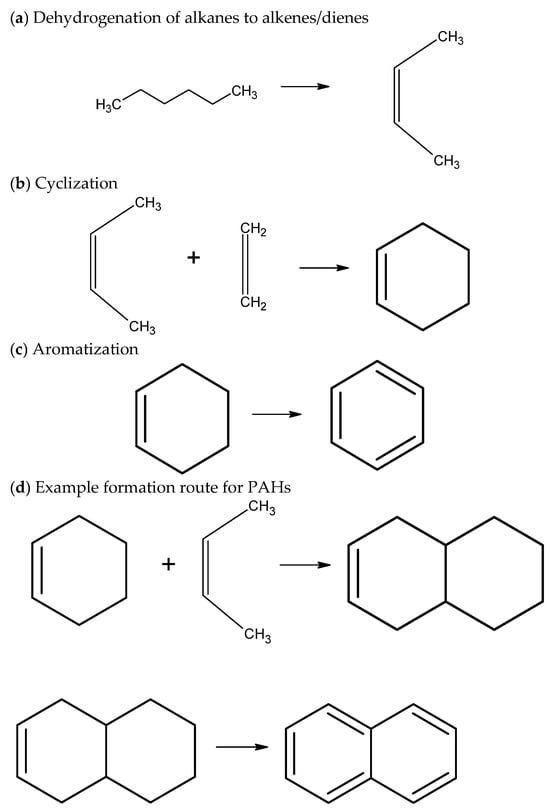
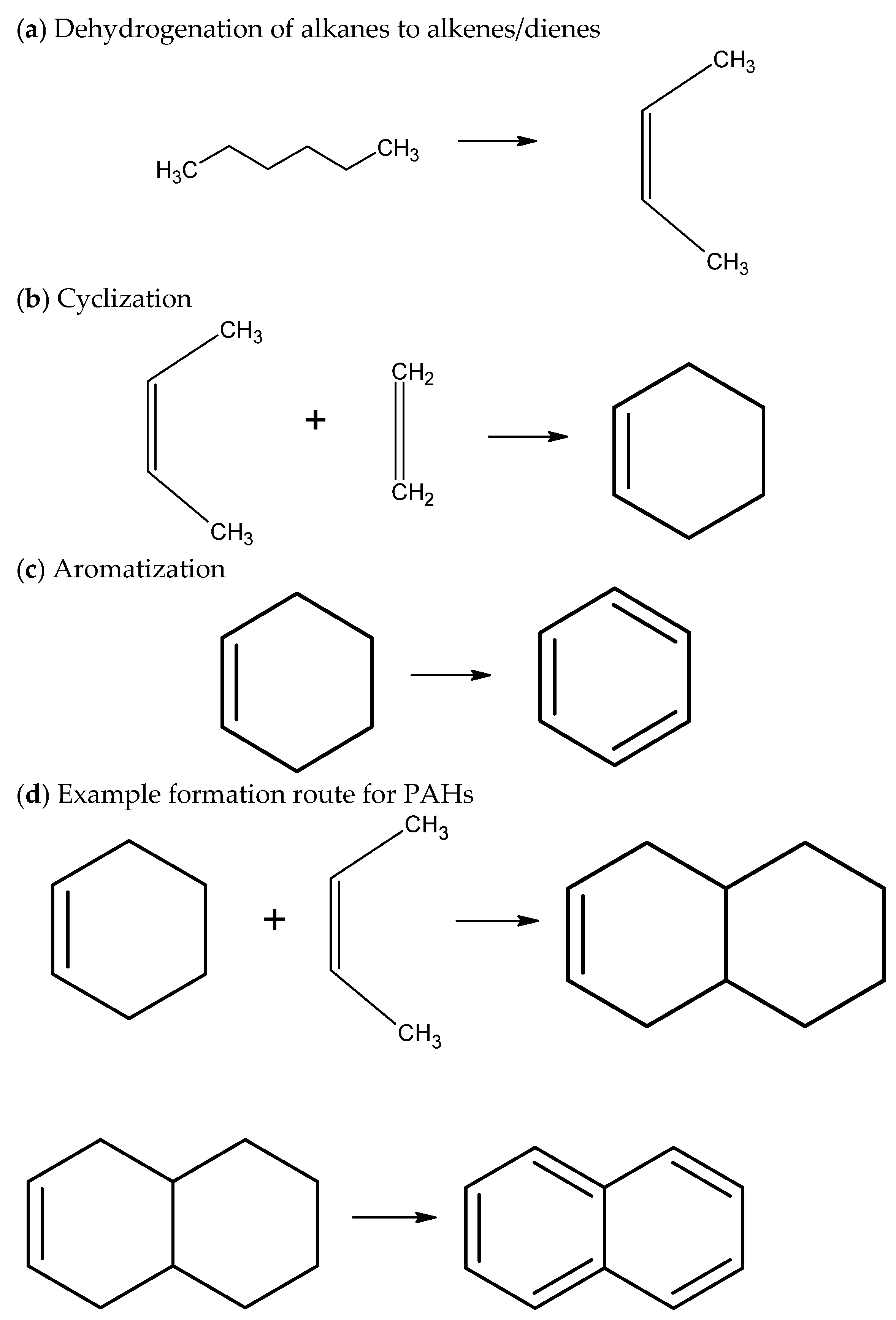
Aromatic compounds are formed according to reactions Figure 6a–d [44]:
Figure 6.
Proposed reaction pathways for the formation of aromatic compounds during the pyrolysis of end-of-life tyres: (a) initial dehydrogenation of aliphatic chains to alkenes and dienes; (b) cyclization via Diels–Alder type reactions; (c) subsequent aromatization to form single-ring aromatics; and (d) an example formation route for polycyclic aromatic hydrocarbons (PAHs).
Furthermore, Figure 5 illustrates the distribution of PAHs classified by ring number. The analysis indicates a strong predominance of high-molecular-weight (HMW, 4–6 rings) compounds, which constitute 79.7 wt.% of the total identified PAHs, compared to 20.3 wt.% for low-molecular-weight (LMW, 2–3 rings) species. The dominance of HMW compounds, such as Benzo(g,h,i)perylene (7.98 g/kg) and Benzo(a)pyrene (7.59 g/kg), suggests that the reactor conditions (500–550 °C) favored secondary synthesis reactions. While lighter aromatics are formed via the Diels–Alder mechanism from alkenes, larger polyaromatics are likely generated through the radical condensation of aryl species derived from the cleavage of styrene–butadiene rubber (SBR) [44,45].
Moreover, the high HMW/LMW ratio has significant environmental implications. While HMW compounds contribute to the chemical stability of the organic residue, they are characterized by high lipophilicity, low water solubility, and extreme persistence in the environment [46]. Unlike LMW PAHs, which are more susceptible to microbial degradation, the HMW fraction detected here (including known carcinogens like Benzo(a)pyrene) represents a recalcitrant load. Consequently, the presence of these species indicates that untreated WTP-char may require post-treatment or thermal/chemical activation (e.g., steam activation) to ensure environmental safety and to desorb these toxic residues before application as a soil amendment or water filtration medium [47].
3.2.3. Inorganic Compounds
The elemental composition of the WTP-char reflects the complex formulation of the initial tire feedstock, which, in addition to rubber polymers, contains steel reinforcement, inorganic fillers, and vulcanization agents. Table 2 summarizes the content of macro- and microelements determined in the sample. While the material is predominantly carbonaceous (67.2 wt.% C), it contains a significant mineral fraction dominated by calcium (3.13 wt.%), zinc (2.40 wt.%), and sulfur (1.92 wt.%). These elements are largely residues of additives such as calcium carbonate (filler), zinc oxide (activator), and elemental sulfur (vulcanizing agent), which are concentrated in the solid product after the volatilization of the organic matrix.
Table 2.
Elemental composition of the WTP-char (macroelements in wt.%, microelements in mg/kg) (max. SD ± 2%).
Method detection limits (MDLs) and quantification limits (MQLs) for trace metals were conservatively estimated based on the instrumental detection limits of the Thermo Scientific iCE 3500 system and the applied sample dilution factor (0.5 g digested to a final volume of 50 mL). The calculated MQLs for all analyzed metals were ≤0.07 mg/kg d.b. Since the lowest detected concentration in the samples was 0.16 mg/kg (for Cd), all reported values safely exceed the quantification thresholds, confirming their analytical reliability.
The high sulfur content (1.92 wt.%) is a characteristic feature of tire-derived chars. According to Susa et al. [48], sulfur decomposition into the gaseous fraction increases at higher pyrolysis temperatures, which theoretically reduces its retention in the liquid and solid fractions. However, at the moderate temperatures used in this study (500–550 °C), a substantial amount remains trapped in the char matrix, likely as metal sulfides (e.g., ZnS) or organic sulfur structures. It can be concluded that the sulfur present in WTP-char may be partially removed by post-pyrolysis acid activation, which facilitates the dissolution of inorganic sulfur species and partial removal of sulfur from the char matrix.
Zinc was identified as the second most abundant metal (2.4 wt.%). Xu et al. [31] stated that the presence of zinc does not necessarily reduce the quality of the recovered carbon black (rCB). On the contrary, the presence of ZnO/ZnS in the char can be beneficial if the material is reused in the rubber industry; since ZnO is an indispensable additive, improving cross-link density and heat stability during vulcanization, the zinc-rich WTP-char could partly substitute virgin activating agents.
Regarding the microelements, the concentrations of highly toxic metals such as arsenic (0.003 mg/kg), mercury (0.04 mg/kg), and cadmium (0.16 mg/kg) were found to be negligible. However, slightly higher concentrations of manganese (127 mg/kg) were detected, which likely originated from the steel wires used in tire reinforcement (typically enriched with Mn), suggesting that microscopic metal fines were transferred into the char despite mechanical separation.
A relatively high concentration of lead (66.45 mg/kg) was also observed. This may indicate that the tires were exposed to lead contamination during their operational life or treatment in car scrapping plants. In particular, the widespread use of lead-acid batteries appears to be a possible source of lead contamination in waste tires [49]. Similar mineral profiles were reported by Zhang et al. [50], who identified Zn, Ca, Fe, Al, Ti, and Co as the main inorganic constituents. They demonstrated that further treatment of the char, consisting of combined acid digestion under the influence of ultrasound, could successfully remove these mineral components to a value below 1 wt.%, offering a pathway for upgrading the WTP-char if higher purity is required.
3.3. Textural Characteristics
3.3.1. Particle Size Distribution
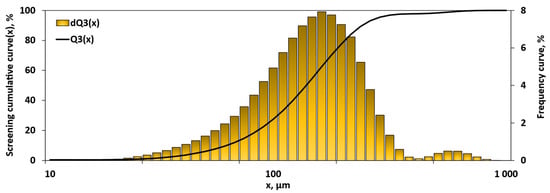
The particle size distribution (PSD) of the as-received WTP-char, determined via laser diffraction, is presented in Figure 7. The analysis reveals a heterogeneous, multimodal profile spanning a wide range from <1 μm to approximately 900 μm. The distribution is characterized by an arithmetic mean diameter of 159.33 μm and a median value (d50) of 143.75 μm.
Figure 7.
Particle size distribution in WTP-char.
Three distinct population fractions can be distinguished in the differential curve: a minor fine fraction visible around 10–30 μm, a dominant medium fraction peaking at the mode value of 162.98 μm, and a significant coarse fraction extending up to 600–800 μm. Quantitative analysis confirms that the material is predominantly coarse, with the vast majority of particles exceeding a diameter of 50 μm.
This particle size characteristic is a critical parameter for subsequent valorization steps. For thermochemical upgrading, such as physical or chemical activation, feedstocks with smaller particle sizes are generally preferred to minimize internal mass transfer resistance and enhance the diffusion of activating agents into the carbon matrix [51]. Furthermore, regarding the potential utilization of WTP-char for sorption purposes, it must be noted that adsorption capacity and kinetic accessibility are typically enhanced by smaller particle sizes due to the increased external surface area [52]. Consequently, considering the coarse nature of the obtained char (mean size > 150 μm), a milling step would be recommended before its application as a high-performance adsorbent or activated carbon precursor.
3.3.2. Microscopy Observation and Elemental Analysis
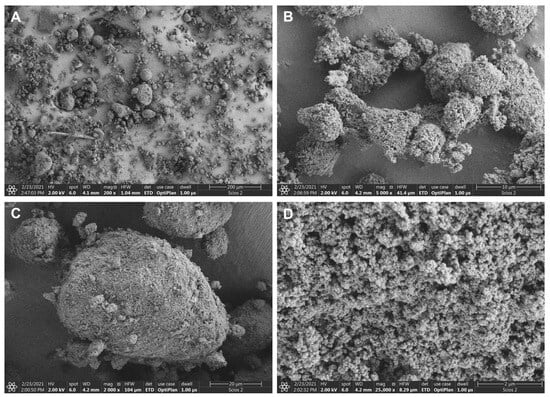
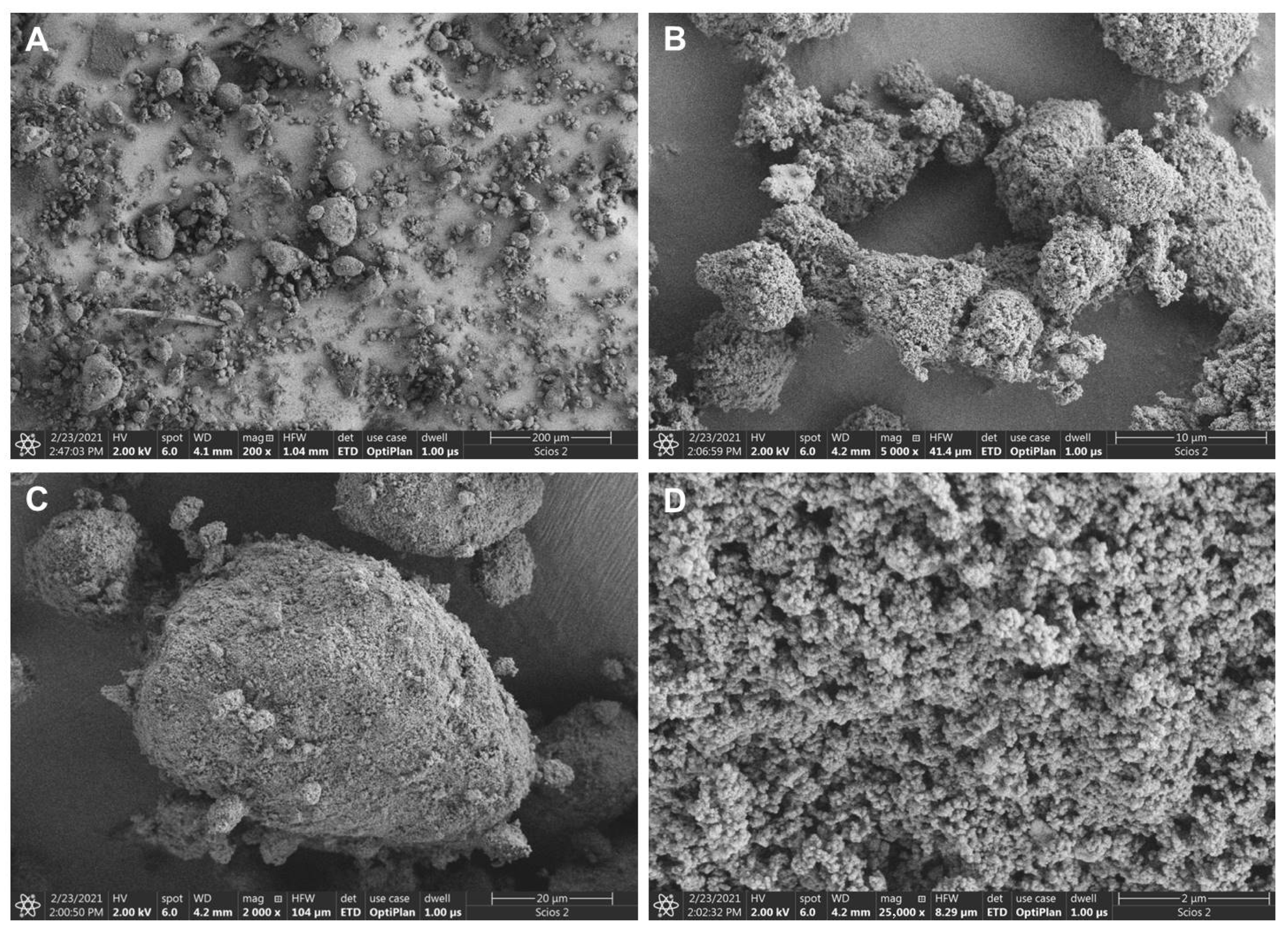
Scanning electron microscopy (SEM) analysis revealed the complex, heterogeneous morphology of the WTP-char, as shown in Figure 8. The low-magnification micrographs (Figure 8A) confirm that the material is composed of polydisperse particles forming irregular agglomerates. While the general shape of these aggregates tends to be quasi-spherical or granular (Figure 8B,C), they exhibit significant surface roughness.
Figure 8.
SEM images of WTP-char.
High-resolution imaging (Figure 8D) unveils the hierarchical structure of the material. It can be observed that the macroscopic granules are, in fact, clusters of much smaller, fused primary particles, creating a porous, sponge-like surface texture typical for carbon black-derived materials. Based on image analysis, two distinct particle populations were defined: a dominant coarse fraction (diameter > 50 µm) with an average size of 65.39 ± 14.94 µm and a fine fraction (diameter < 20 µm) with an average size of 16.08 ± 3.22 µm. This bimodal distribution suggests that while the auger reactor preserves some of the original agglomerate structure, mechanical shear forces during transport likely generate the finer particulate fraction.
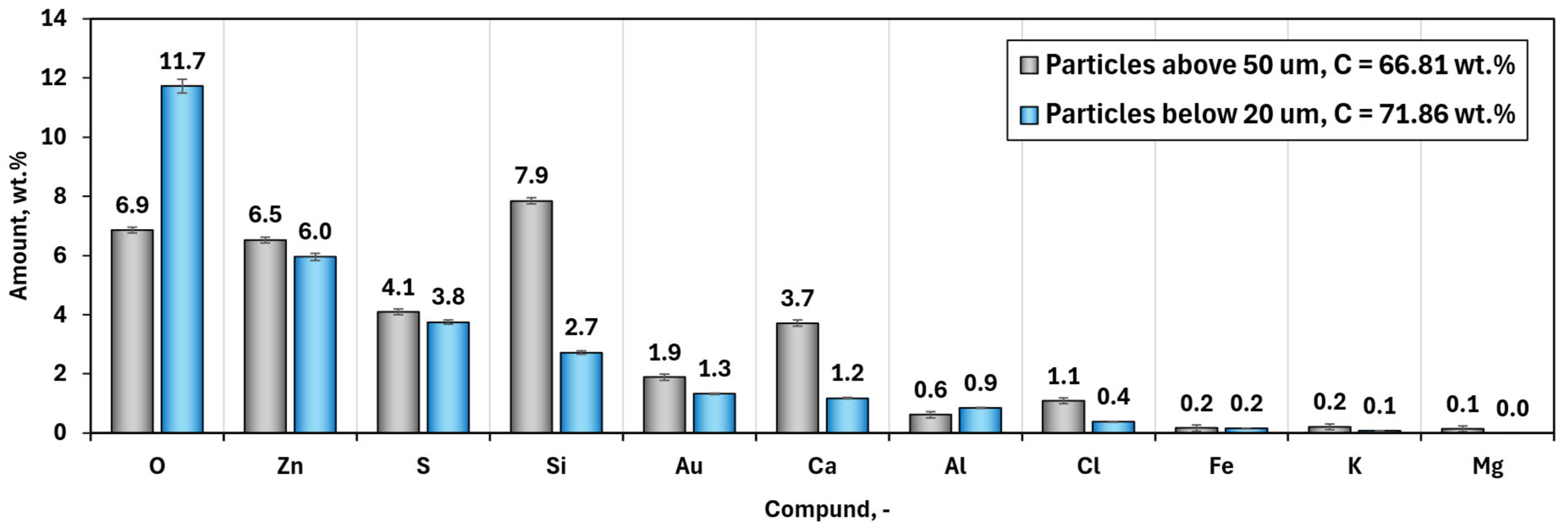
To further investigate the structural composition, energy-dispersive X-ray spectroscopy (EDS) was performed on two distinct particle populations defined in the morphological analysis: the coarse fraction (>50 µm) and the fine fraction (<20 µm). The comparative results, summarized in Figure 9, reveal significant chemical heterogeneity between these groups.
Figure 9.
Comparative elemental composition (EDS) of coarse (>50 µm) and fine (<20 µm) WTP-char particle fractions.
The fine fraction was characterized by a higher carbon content (71.9 wt.%) and elevated oxygen levels (11.7 wt.%) compared to the coarse particles. This suggests that the smaller particles predominantly consist of carbon black aggregates released from the rubber matrix, which possess a higher specific surface area prone to surface oxidation. In contrast, the coarse fraction exhibited a higher concentration of inorganic impurities, particularly silicon (7.9 wt.% vs. 2.7 wt.%) and calcium (3.7 wt.% vs. 1.2 wt.%). This enrichment indicates that mineral fillers used in tire manufacturing, such as silica (SiO2) and calcium carbonate (CaCO3), are preferentially retained within the larger, uncracked agglomerates. Interestingly, the distribution of vulcanization agents appeared relatively uniform, with zinc (6.0–6.5 wt.%) and sulfur (3.8–4.1 wt.%) present in substantial amounts in both fractions. This confirms that the ZnS network formed during vulcanization is deeply embedded throughout the entire char matrix and is not easily separated by simple physical attrition. Traces of gold (Au) detected in the spectrum are artifacts resulting from the sample sputtering process before SEM imaging. These findings imply that a post-pyrolysis milling step could be beneficial not only for reducing particle size but also for liberating mineral-rich agglomerates, potentially facilitating subsequent demineralization processes.
3.3.3. Specific Surface Area and Skeletal Density
Table 3 presents the detailed textural parameters of the tested char. The skeletal density, defined as the ratio of the solid mass to its volume excluding open and closed pores, represents the true density of the solid material [53]. The WTP-char exhibited a skeletal density of 1.853 g/cm3. This result is highly consistent with values reported in the literature for similar carbonaceous materials, including rCB (1.670 g/cm3) [54] and acid-washed chars obtained from fixed-bed reactors [55]. Furthermore, the density of the analyzed sample falls close to that of commercially available industrial carbon blacks, such as N550 (1.920 g/cm3) and N772 (1.980 g/cm3) [56], suggesting a dense structural matrix typical for reinforcing fillers.
Table 3.
Textural parameters of the WTP-char, including skeletal density and specific surface area.
In contrast to density, the specific surface area (SBET) was found to be at a relatively low level of ca. 28 m2/g. This finding aligns with observations by Gomez-Hernandez, who reported a nitrogen surface area of 30 m2/g for tire-derived char [57]. Similarly, Antoniou and Zabaniotou observed SBET values in the range of 32.7–52.8 m2/g, depending on the duration of the pyrolysis process [58]. The low porosity in the as-received state indicates a need for further pretreatment of the WTP-char, specifically through activation processes, to enhance its textural development.
The inherently low specific surface area of the raw WTP-char is closely associated with its high ash content (ca. 21 wt.%). The substantial mineral fraction, primarily composed of zinc, calcium, and silica derivatives, acts as a non-porous ballast. These inorganic constituents physically occupy internal void spaces and block the nascent micropore network within the carbonaceous matrix, effectively restricting the textural development of the char prior to any demineralization or activation processes.
The discrepancies among the surface area values (Table 3) stem from the fundamental assumptions of the applied models. The multi-point BET method provides the most reliable estimate (28.9 m2/g), as it correctly accounts for multilayer physical adsorption. The single-point BET yields a slightly lower, approximated value (27.0 m2/g) due to the mathematical simplification of assuming a zero intercept in the BET plot. Conversely, the Langmuir model significantly overestimates the surface area (48.1 m2/g) because it forces a strictly monolayer adsorption assumption onto the heterogeneous WTP-char surface, failing to account for the multilayer interactions occurring in reality.
Activation can be conducted using chemical agents (such as KOH, NaOH, and Na2CO3) or physical agents (CO2, steam) at high temperatures. For instance, Firkha’s research group [32] successfully activated pyrolytic char chemically at 750 °C and physically with nitrogen at 850 °C. During the activation process, the agent diffuses into the char pores and reacts with carbon atoms, resulting in a significantly improved surface area, potentially reaching 500 m2/g or more [32,59].
Textural properties are a critical factor affecting the reuse of char from a circular economy perspective. Studies have demonstrated that untreated rCB cannot directly fully replace commercial carbon black in tire production due to its lower surface area and structure, which leads to reduced cross-linking efficiency with rubber matrices. However, partial replacement of commercial carbon black with rCB is feasible and does not adversely affect tire properties while offering reduced production costs [54,60].
3.4. Physicochemical and Sorption Properties
The key physicochemical parameters determining the surface chemistry and structural aggregation of the WTP-char are summarized in Table 4. The material exhibits a slightly alkaline nature with a pH value of 7.6. This alkalinity is primarily attributed to the significant content of alkali metals (i.e., Na, K) and alkaline earth metals (i.e., Ca, Mg) identified in the elemental analysis (see Table 2), which likely exist as carbonates or surface oxides within the char structure. Furthermore, the basicity of pyrolytic chars has been reported to increase with higher processing temperatures due to the progressive decomposition of acidic hydroxyl groups [61]. From an application perspective, the pH of WTP-char plays a pivotal role in its sorption performance; for instance, alkaline surface conditions are known to favor the adsorption capacity for cationic dyes, such as methylene blue [62].
Table 4.
Sorption and physical properties of WTP-char.
The structure of the carbon aggregates was evaluated using the Oil Absorption Number (OAN), yielding a value of 80 mL/100 g. The OAN serves as an indirect measure of the void volume and the degree of aggregation (“structure”) of the carbon black. This value is lower than that reported by Xu et al. (2021) [31], who obtained an OAN of 107.7 mL/100 g for char derived from crushed truck tires (5–20 mm fraction), suggesting a less developed aggregate structure and lower inter-aggregate void volume in the sample analyzed in this study.
The iodine number, which correlates with the surface area available for the adsorption of small molecules, was determined to be 101 mg/g. This result is highly consistent with literature data for WTP-chars produced in the temperature range of 550–700 °C, which typically exhibit iodine numbers between 96 and 98 mg/g [50]. Notably, the adsorption capacity of the tested WTP-char is comparable to, or even exceeds, that of commercially available industrial carbon blacks such as grade N339 (93 mg/g) and is significantly higher than grade N326 (84 mg/g) [50], suggesting its potential applicability as a semi-reinforcing filler, although further evaluation of mechanical reinforcement performance is required.
From a sustainability and circular economy perspective, the obtained results indicate that industrially produced WTP-char cannot be considered a direct drop-in substitute for commercial carbon black or activated carbon without additional upgrading. Although the material exhibits a high carbon content and promising sorption-related parameters, the presence of persistent organic contaminants, including HMW PAHs and organophosphate stabilizer residues, raises potential environmental and toxicological concerns. Consequently, direct use of the raw char in soil remediation or water treatment applications may pose risks unless appropriate purification or activation steps are implemented.
Nevertheless, the demonstrated physicochemical stability and the relatively high iodine number confirm that WTP-char represents a valuable secondary carbon resource rather than a waste by-product. Integrating post-treatment strategies such as milling, demineralization, or thermal/chemical activation could enable its safe valorization as recovered carbon black or adsorbent material, thereby reducing reliance on fossil-derived carbon black and contributing to material circularity in the tire and environmental sectors. These findings support the role of industrial pyrolysis not only as a waste management technology but also as a viable pathway for sustainable carbon recovery.
To fully unlock the circular economy potential of raw WTP-char and mitigate its environmental risks, specific secondary upgrading pathways are essential. The pathways with the highest valorization potential include the following: (i) Production of activated carbon (AC): Physical activation (using steam or CO2) or chemical activation at elevated temperatures (e.g., 700–900 °C) can simultaneously volatilize and destruct hazardous organic residues (including HMW PAHs and bDtBPP), significantly reduce the volatile matter, and develop a highly porous matrix suitable for advanced environmental remediation. (ii) Upgrading to recovered carbon black (rCB): To serve as a safe, semi-reinforcing filler in the rubber industry, the char requires a combination of micronization (milling to <10 µm), thermal desorption to strip away VOCs and toxic stabilizers, and selective acid demineralization to reduce the inorganic ash content. (iii) Energy recovery: If complex purification is economically unviable, the raw char—benefiting from its elevated volatile matter and high calorific value—can be routed directly toward thermal pathways, such as solid fuel combustion or co-gasification, where organic contaminants are thermally destroyed.
4. Conclusions
This study provided a comprehensive physicochemical characterization of waste tire pyrolysis char (WTP-char) produced in a continuous industrial-scale auger reactor. The results highlight distinct differences between commercial-scale products and those obtained in controlled laboratory settings, offering critical insights into the challenges and opportunities for the circular economy application of this material.
The WTP-char exhibited a relatively high volatile matter content (13 wt.%), which stands in contrast to lower values typically reported for laboratory-scale fixed-bed reactors. This is attributed to the thermal inertia and limited gas–solid contact time inherent to the continuous auger process, which results in less exhaustive devolatilization compared to batch processing.
A critical finding of this research is the identification of specific hazardous organic residues that may pose environmental risks. The char contained a significant concentration (6.97 area%) of tris(2,4-di-tert-butylphenyl) phosphate (bDtBPP), a cytotoxic organophosphorus derivative of the antioxidant Irgafos 168. Furthermore, the PAHs profile was dominated by persistent high-molecular-weight (HMW) compounds (79.7%), such as Benzo(g,h,i)perylene. The prevalence of these stable toxic compounds indicates that raw char requires purification or thermal treatment to meet safety standards for applications in agriculture or water filtration.
The as-received char possesses a low specific surface area (SBET ca. 29 m2/g) and a coarse particle size distribution (predominantly >50 μm), necessitating milling and activation to enhance its porosity. Despite this, the material demonstrated a high iodine number (101 mg/g), comparable to the commercial carbon black grade N339. This suggests that with appropriate post-treatment, such as pulverization and chemical or physical activation, the industrial WTP-char holds significant potential as a semi-reinforcing filler or activated carbon precursor.
In conclusion, while industrial auger pyrolysis effectively recovers carbonaceous material from waste tires, the resulting char in its raw state is chemically complex and contains toxic organic residues. To transition this by-product into a safe, high-value recovered carbon black (rCB), secondary upgrading processes are essential to eliminate hazardous stabilizers, reduce volatile matter, and develop the necessary porous structure.
Supplementary Materials
The following supporting information can be downloaded at: https://www.mdpi.com/article/10.3390/su18073294/s1. Table S1. Qualitative chromatographic analysis of char—compounds with a content above 1% by area; Table S2. Qualitative chromatographic analysis of char—compounds with a content of up to 1.0% by area; Table S3. Qualitative chromatographic analysis of char—compounds with a content of up to 0.5% by area; Table S4. Qualitative chromatographic analysis of char—compounds with a content of up to 0.35% by area; Table S5. Qualitative chromatographic analysis of char—compounds with a content of up to 0.35% by area; Table S6. Qualitative chromatographic analysis of WTP-char—compounds with a content of up to 0.1% by area.
Author Contributions
Conceptualization, K.J.K., E.S., I.B.Z. and M.J.Y.; methodology, E.S., I.B.Z. and M.J.Y.; software, E.S.; validation, E.S. and M.J.Y.; formal analysis, K.J.K.; investigation, E.S., I.B.Z. and M.J.Y.; resources, E.S. and K.J.K.; data curation, E.S., M.J.Y., I.B.Z. and G.Y.; writing—original draft preparation, M.J.Y. and E.S.; writing—review and editing, K.J.K., I.B.Z., G.Y., M.J.Y. and E.S.; visualization, M.J.Y.; supervision, K.J.K. and G.Y.; project administration, K.J.K.; funding acquisition, K.J.K., E.S. and I.B.Z. All authors have read and agreed to the published version of the manuscript.
Funding
This research was funded under the project “Piroliza 2.0” (Grant Agreement No. 1/PB/2021), implemented within the framework of Project No. WND-RPPD.01.02.01-20-0203/20 titled “Pilot project on the development of R&D cooperation between business and universities” (Polish: “Pilotażowy projekt dotyczący rozwoju współpracy w zakresie B + R między biznesem i uczelniami”). The project is realized under agreement No. UDA-RPPD.01.02.01-20-0203/20-00 (signed on 25 March 2021) and financed by the Regional Operational Programme of the Podlaskie Voivodeship for the years 2014–2020.
Institutional Review Board Statement
Not applicable.
Informed Consent Statement
Not applicable.
Data Availability Statement
The original contributions presented in this study are included in the article/Supplementary Material. Further inquiries can be directed to the corresponding authors.
Acknowledgments
The authors thank Grand Activated (Hajnówka, Poland) for assistance in selected characterizations of WTP-char.
Conflicts of Interest
The authors declare no conflicts of interest.
References
- WBCSD. Global ELT Management Statistics 2023–2025; Tire Industry Project (TIP), World Business Council for Sustainable Development: Geneva, Switzerland, 2024; Available online: https://tireindustryproject.org/ (accessed on 12 March 2026).
- Wu, Y.; Zhao, Q.; Xu, J.; Liu, S.; Xu, J.; Zhu, H.; Li, G. On the Potential of Waste Tire Pyrolysis in Carbon Mitigation: A Review. Recycling 2025, 10, 172. [Google Scholar] [CrossRef] [Scilit]
- MarketsandMarkets. Tire Recycling Market—Industry Size, Share, Forecast & Trends Analysis Report; MarketsandMarkets: Pune, India, 2024; Available online: https://www.marketsandmarkets.com/Market-Reports/tire-recycling-market-202803362.html (accessed on 30 December 2025).
- Xu, J.; Yu, J.; Xu, J.; Sun, C.; Huang, W.; Han, H.; Li, G. High-Value Utilization of Waste Tires: A Review with Focus on Modified Carbon Black from Pyrolysis. Sci. Total Environ. 2020, 742, 140235. [Google Scholar] [CrossRef] [Scilit] [PubMed]
- Bockstal, L.; Berchem, T.; Schmetz, Q.; Richel, A. Devulcanisation and reclaiming of tires and rubber by physical and chemical processes: A review. J. Clean. Prod. 2019, 236, 117574. [Google Scholar] [CrossRef] [Scilit]
- Čepić, Z.; Mihajlović, V.; Đurić, S.; Milotić, M.; Stošić, M.; Stepanov, B.; Ilić Mićunović, M. Experimental Analysis of Temperature Influence on Waste Tire Pyrolysis. Energies 2021, 14, 5403. [Google Scholar] [CrossRef] [Scilit]
- Lewandowski, W.M.; Januszewicz, K.; Kosakowski, W. Efficiency and proportions of waste tyre pyrolysis products depending on the reactor type—A review. J. Anal. Appl. Pyrolysis 2019, 140, 25–53. [Google Scholar] [CrossRef] [Scilit]
- Brassard, P.; Godbout, S.; Raghavan, V. Pyrolysis in auger reactors for biochar and bio-oil production: A review. Biosyst. Eng. 2017, 161, 80–92. [Google Scholar] [CrossRef] [Scilit]
- Yaru, S.S.; Satope, P.O.; Akinola, A.O. Characterization of char from waste tyre pyrolysis. Saudi J. Eng. Technol. 2021, 6, 169–177. [Google Scholar]
- Li, S.Q.; Yao, Q.; Wen, S.E.; Chi, Y.; Yan, J.H. Properties of pyrolytic chars and activated carbons derived from pilot-scale pyrolysis of used tires. J. Air Waste Manag. Assoc. 2005, 55, 1315–1326. [Google Scholar] [CrossRef] [Scilit]
- Ma, L.; Lv, W.; Wen, Y.; Xu, Y.; Hu, H.; Jin, L. Pyrolysis behaviors of different parts in waste tire and catalytic enhancement mechanism of high-value aromatics via upgrading over char-based catalyst. J. Clean. Prod. 2025, 487, 144636. [Google Scholar] [CrossRef] [Scilit]
- Egun, I.L.; Hu, J.; Offiong, N.A.O.; Akwaowo, E.S.; Essien, E.S.; Hou, Y.; Chen, Z. Conversion of waste tires to porous carbon towards diverse applications with enhanced performance. Carbon Lett. 2025, 35, 1955–1980. [Google Scholar] [CrossRef] [Scilit]
- Campuzano, F.; Cardona-Uribe, N.; Agudelo, A.F.; Sarathy, S.M.; Martínez, J.D. Pyrolysis of waste tires in a twin-auger reactor using CaO: Assessing the physicochemical properties of the derived products. Energy Fuels 2021, 35, 8819–8833. [Google Scholar] [CrossRef] [Scilit]
- Sanchís, A.; Veses, A.; Martínez, J.D.; Lopez, J.M.; Garcia, T.; Murillo, R. The role of temperature profile during the pyrolysis of end-of-life tyres in industrially relevant conditions auger plant. J. Environ. Manag. 2022, 317, 115323. [Google Scholar] [CrossRef] [Scilit] [PubMed]
- Gao, N.; Wang, F.; Quan, C.; Santamaria, L.; Lopez, G.; Williams, P.T. Tire pyrolysis char: Processes, properties, upgrading and applications. Prog. Energy Combust. Sci. 2022, 93, 101022. [Google Scholar] [CrossRef] [Scilit]
- Costa, S.M.R.; Fowler, D.; Carreira, G.A.; Portugal, I.; Silva, C.M. Production and Upgrading of Recovered Carbon Black from the Pyrolysis of End-of-Life Tires. Materials 2022, 15, 2030. [Google Scholar] [CrossRef] [Scilit] [PubMed]
- Kuśmierek, K.; Świątkowski, A.; Kotkowski, T.; Cherbański, R.; Molga, E. Adsorption on activated carbons from end-of-life tyre pyrolysis for environmental applications. Part I. Preparation of adsorbent and adsorption from gas phase. J. Anal. Appl. Pyrolysis 2021, 157, 105205. [Google Scholar] [CrossRef] [Scilit]
- Li, G.; Shen, B.; Lu, F. The mechanism of sulfur component in pyrolyzed char from waste tire on the elemental mercury removal. Chem. Eng. J. 2015, 273, 446–454. [Google Scholar] [CrossRef] [Scilit]
- Kuśmierek, K.; Świątkowski, A.; Kotkowski, T.; Cherbański, R.; Molga, E. Adsorption properties of activated tire pyrolysis chars for phenol and chlorophenols. Chem. Eng. Technol. 2020, 43, 770–780. [Google Scholar] [CrossRef] [Scilit]
- Kuśmierek, K.; Świątkowski, A.; Kotkowski, T.; Cherbański, R.; Molga, E. Adsorption on activated carbons from end-of-life tyre pyrolysis for environmental applications. Part II. Adsorption from aqueous phase. J. Anal. Appl. Pyrolysis 2021, 158, 105206. [Google Scholar] [CrossRef] [Scilit]
- Wang, A.; Sun, K.; Xu, R.; Sun, Y.; Jiang, J. Cleanly synthesizing rotten potato-based activated carbon for supercapacitor by self-catalytic activation. J. Clean. Prod. 2021, 283, 125385. [Google Scholar] [CrossRef] [Scilit]
- Jiang, G.; Pan, J.; Che, K.; Deng, W.; Sun, Y.; Wu, Y.; Yuan, H.; Gu, J.; Gu, Y.; Zhang, W.; et al. Recent developments of waste tires derived multifunctional carbonaceous nanomaterials. Mater. Today Sustain. 2023, 24, 100576. [Google Scholar] [CrossRef] [Scilit]
- Banala, D.; Sabri, Y.; Choudhury, N.R.; Parthasarathy, R. Sustainable Valorisation of End-of-Life Tyres Through Pyrolysis-Derived Recovered Carbon Black in Polymer Composites. Polymers 2025, 17, 2771. [Google Scholar] [CrossRef] [Scilit]
- PN-80/G-04511; Solid Fuels—Determination of Moisture. Polish Committee for Standardization: Warsaw, Poland, 1980.
- PN-G-04516; Solid Fuels—Determination of Volatile Matter Content by Weight. Polish Committee for Standardization: Warsaw, Poland, 1998.
- PN-80/G-04512; Solid Fuels—Determination of Ash Content. Polish Committee for Standardization: Warsaw, Poland, 1980.
- PN-ISO 11466:2002; Soil Quality—Extraction of Trace Elements Soluble in Aqua Regia. Polish Committee for Standardization: Warsaw, Poland, 2002.
- PN-85/C-97555/10; Activated Carbons—Determination of Iodine Number. Polish Committee for Standardization: Warsaw, Poland, 1985.
- PN-83/C-97555.04; Activated Carbons—Determination of Methylene Blue Number. Polish Committee for Standardization: Warsaw, Poland, 1983.
- ASTM D2414-04; Standard Test Method for Carbon Black—Oil Absorption Number (OAN). ASTM International: West Conshohocken, PA, USA, 2004.
- Xu, J.; Yu, J.; He, W.; Huang, J.; Xu, J.; Li, G. Recovery of carbon black from waste tire in continuous commercial rotary kiln pyrolysis reactor. Sci. Total Environ. 2021, 772, 145507. [Google Scholar] [CrossRef] [Scilit] [PubMed]
- Díez, C.; Sánchez, M.E.; Haxaire, P.; Martínez, O.; Morán, A. Pyrolysis of tyres: A comparison of the results from a fixed-bed laboratory reactor and a pilot plant (rotatory reactor). J. Anal. Appl. Pyrolysis 2005, 74, 254–258. [Google Scholar] [CrossRef] [Scilit]
- Frikha, K.; Limousy, L.; Pons Claret, J.; Vaulot, C.; Pérez, K.F.; Garcia, B.C.; Bennici, S. Potential Valorization of Waste Tires as Activated Carbon-Based Adsorbent for Organic Contaminants Removal. Materials 2022, 15, 1099. [Google Scholar] [CrossRef] [Scilit] [PubMed]
- Kim, S.; Lee, S.-E.; Baek, S.-H.; Choi, U.; Bae, H.-J. Preparation of Activated Carbon from Korean Anthracite: Simultaneous Control of Ash Reduction and Pore Development. Processes 2023, 11, 2877. [Google Scholar] [CrossRef] [Scilit]
- Shi, X.; Li, P.; Wang, X.; Song, J.; Fang, S.; Chang, C.; Pang, S. Enhancement of the production of aromatics and bio-syngas from microwave ex-situ pyrolysis based on Zn/Zr modified biochar and multi-catalysts. Energy 2022, 261, 125307. [Google Scholar] [CrossRef] [Scilit]
- Kuo, Y.C.; Ku, I.N. Application of polyethyleneimine-modified scaffolds to the regeneration of cartilaginous tissue. Biotechnol. Prog. 2009, 25, 1459–1467. [Google Scholar] [CrossRef] [Scilit]
- Liu, Y.; Gong, S.; Ye, L.; Li, J.; Liu, C.; Chen, D.; Zhang, X.; Wang, R.; Su, G. Organophosphate (OP) diesters and a review of sources, chemical properties, environmental occurrence, adverse effects, and future directions. Environ. Int. 2021, 155, 106691. [Google Scholar] [CrossRef] [Scilit]
- Chang, X.; Xue, Y.; Li, J.; Zou, L.; Tang, M. Potential health impact of environmental micro- and nanoplastics pollution. J. Appl. Toxicol. 2020, 40, 4–15. [Google Scholar] [CrossRef] [Scilit]
- Cataldo, F. On the characterisation of carbon black from tire pyrolysis. Fuller. Nanotub. Carbon Nanostruct. 2020, 28, 368–376. [Google Scholar] [CrossRef] [Scilit]
- International Agency for Research on Cancer. Carbon Black, Titanium Dioxide, and Non-Asbestiform Talc. In IARC Monographs on the Evaluation of Carcinogenic Risks to Humans; World Health Organization: Lyon, France, 2006; Volume 93. [Google Scholar]
- Wang, G.; Xu, D.; Tang, J.; Liu, B.; Wang, Z.; Xu, Q.; Zhang, Y.; Wang, S. Study on the influence of different side chain structures on the pyrolysis behavior of polyolefin plastic wastes. Combust. Flame 2023, 255, 112909. [Google Scholar] [CrossRef] [Scilit]
- Maher, K.D.; Kirkwood, K.M.; Gray, M.R.; Bressler, D.C. Pyrolytic decarboxylation and cracking of stearic acid. Ind. Eng. Chem. Res. 2008, 47, 5328–5336. [Google Scholar] [CrossRef] [Scilit]
- Amber, S.; Kamal, M.A. Production of hydrocarbons by catalytic cracking of stearic acid under atmospheric pressure for petrochemical replacement. Pet. Sci. Technol. 2019, 37, 146–154. [Google Scholar] [CrossRef] [Scilit]
- Altarawneh, M.; Ali, L. Formation of polycyclic aromatic hydrocarbons (PAHs) in thermal systems: A comprehensive mechanistic review. Energy Fuels 2024, 38, 21735–21792. [Google Scholar] [CrossRef] [Scilit]
- Qu, B.; Zhang, Y.S.; Wang, T.; Choi, H.S.; Zhang, Y.; Fu, Z.; Li, X.; Ji, G. Pyrolysis-catalysis of waste tire to enhance the aromatics selectivity via metal-modified ZSM-5 catalysts. Process Saf. Environ. Prot. 2024, 190, 138–148. [Google Scholar] [CrossRef] [Scilit]
- Feng, Y.; Zhu, X.; Huang, X.; Li, F. New Advances in Bioelectrochemical Systems in the Degradation of Polycyclic Aromatic Hydrocarbons: Source, Degradation Pathway, and Microbial Community. Energies 2025, 18, 209. [Google Scholar] [CrossRef] [Scilit]
- Carlini, C.; Chaudhuri, S.; Mann, O.; Tomsik, D.; Hüffer, T.; Greggio, N.; Hale, S.E.; Cornelissen, G.; Sigmund, G. Benchmarking biochar with activated carbon for immobilizing leachable PAH and heterocyclic PAH in contaminated soils. Environ. Pollut. 2023, 325, 121417. [Google Scholar] [CrossRef] [Scilit]
- Susa, D.; Haydary, J. Sulphur distribution in the products of waste tire pyrolysis. Chem. Pap. 2013, 67, 1521–1526. [Google Scholar] [CrossRef] [Scilit]
- Czajczyńska, D.; Czajka, K.; Krzyżyńska, R.; Jouhara, H. Waste tyre pyrolysis—Impact of the process and its products on the environment. Therm. Sci. Eng. Prog. 2020, 20, 100690. [Google Scholar] [CrossRef] [Scilit]
- Zhang, X.; Li, H.; Cao, Q.; Jin, L.E.; Wang, F. Upgrading pyrolytic residue from waste tires to commercial carbon black. Waste Manage. Res. 2018, 36, 436–444. [Google Scholar] [CrossRef] [Scilit]
- Murillo, R.; Navarro, M.V.; López, J.M.; Garcia, T.; Callén, M.S.; Aylón, E.; Mastral, A.M. Activation of pyrolytic tire char with CO2: Kinetic study. J. Anal. Appl. Pyrolysis 2004, 71, 945–957. [Google Scholar] [CrossRef] [Scilit]
- Kymäläinen, M.; Rautkari, L.; Hill, C.A.S. Sorption behaviour of torrefied wood and charcoal determined by dynamic vapour sorption. J. Mater. Sci. 2015, 50, 7673–7680. [Google Scholar] [CrossRef] [Scilit]
- Zelenka, T.; Slovák, V.; Lhotka, M.; Hotová, G. Alternative determination of the skeletal density of solids using a manometric gas physisorption apparatus: A systematic and methodological study. Microporous Mesoporous Mater. 2019, 290, 109641. [Google Scholar] [CrossRef] [Scilit]
- Urrego-Yepes, W.; Cardona-Uribe, N.; Vargas-Isaza, C.A.; Martínez, J.D. Incorporating the recovered carbon black produced in an industrial-scale waste tire pyrolysis plant into a natural rubber formulation. J. Environ. Manag. 2021, 287, 112292. [Google Scholar] [CrossRef] [Scilit] [PubMed]
- Issac, M.; Dai, B.; Zhang, L. Kinetics underpinning the C-CO2 gasification of waste tyre char and its interaction with coal char upon co-gasification. Fuel 2019, 256, 115991. [Google Scholar] [CrossRef] [Scilit]
- Martínez, J.D.; Cardona-Uribe, N.; Murillo, R.; García, T.; López, J.M. Carbon black recovery from waste tire pyrolysis by demineralization: Production and application in rubber compounding. Waste Manag. 2019, 85, 574–584. [Google Scholar] [CrossRef] [Scilit]
- Gómez-Hernández, R.; Panecatl-Bernal, Y.; Méndez-Rojas, M.Á. High yield and simple one-step production of carbon black nanoparticles from waste tires. Heliyon 2019, 5, e02139. [Google Scholar] [CrossRef] [Scilit]
- Antoniou, N.; Zabaniotou, A. Re-designing a viable ELTs depolymerization in circular economy: Pyrolysis prototype demonstration at TRL 7, with energy optimization and carbonaceous materials production. J. Clean. Prod. 2018, 174, 74–86. [Google Scholar] [CrossRef] [Scilit]
- Al-Rahbi, A.S.; Williams, P.T. Decomposition of biomass gasification tar model compounds over waste tire pyrolysis char. Waste Dispos. Sustain. Energy 2022, 4, 75–89. [Google Scholar] [CrossRef] [Scilit]
- Dwivedi, C.; Manjare, S.; Rajan, S.K. Recycling of waste tire by pyrolysis to recover carbon black: Alternative & environment-friendly reinforcing filler for natural rubber compounds. Compos. Part B Eng. 2020, 200, 108346. [Google Scholar] [CrossRef] [Scilit]
- Semaan, J.N.; Huron, M.; Daouk, E. Pilot scale pyro-gasification of biomass and waste: Char characterization. Biomass Conv. Bioref. 2022, 12, 5751–5765. [Google Scholar] [CrossRef] [Scilit]
- Zhang, Y.; Cheng, Q.; Wang, D.; Zhu, X.; Wang, H. Preparation of pyrolytic carbon from waste tires for methylene blue adsorption. JOM 2019, 71, 3658–3666. [Google Scholar] [CrossRef] [Scilit]

Disclaimer/Publisher’s Note: The statements, opinions and data contained in all publications are solely those of the individual author(s) and contributor(s) and not of MDPI and/or the editor(s). MDPI and/or the editor(s) disclaim responsibility for any injury to people or property resulting from any ideas, methods, instructions or products referred to in the content. |
© 2026 by the authors. Licensee MDPI, Basel, Switzerland. This article is an open access article distributed under the terms and conditions of the Creative Commons Attribution (CC BY) license.