1. Introduction
The climate crisis poses an immediate threat to global agri-food systems, undermining the sustainability of natural resources and land productivity [
1,
2]. As the global food system accounts for nearly one-third of anthropogenic emissions and agriculture, forestry, and land use contribute roughly one-fifth of total greenhouse gas emissions (GHG) [
3,
4,
5]—the need for decisive action is increasingly urgent. Within the framework of the European Green Deal and the new CAP 2023–2030, achieving climate neutrality by 2050 requires the adoption of robust, evidence-based assessment tools [
6]. The Carbon Footprint (CF) has emerged as a key indicator for quantifying emissions and evaluating the environmental performance of agricultural products and systems [
7,
8,
9,
10].
Growing environmental awareness among consumers, together with increasing demands for transparency, has intensified the need for sustainability-oriented practices that can strengthen the competitiveness of producers [
11]. In this context, Life Cycle Assessment (LCA) represents the most comprehensive methodological framework for capturing environmental impacts across all stages of the production chain in a systematic and holistic manner [
12,
13].
By enabling the precise quantification of both direct and indirect GHG emissions, LCA supports the comparative evaluation of different agricultural systems and technologies [
9,
10]. In the wine sector, this approach is particularly important for calculating the Carbon Footprint, as it provides the necessary data for identifying emission hotspots and guiding mitigation strategies [
14,
15]. The incorporation of such assessment processes allows producers and industry stakeholders to enhance their environmental performance, positioning sustainability as a core element of their strategic planning [
16,
17].
In the wine production chain, the viticultural stage is widely recognized as a major source of environmental impacts, with the use of agrochemicals, fertilizers, and fuels identified as key contributing factors [
18,
19,
20]. Although experimental data remain limited, comparing alternative practices is essential for identifying more sustainable solutions, making the optimization of vineyard management a critical step toward reducing GHG emissions [
21,
22,
23]. Strategies such as replacing synthetic fertilizers with organic amendments and reducing soil tillage have been shown to lower emissions while enhancing carbon sequestration [
24]. Moreover, the choice of grape variety plays an important role, as native cultivars—being well adapted to local microclimatic conditions—typically require fewer inputs than widely cultivated international varieties [
25].
Although LCA is the cornerstone for quantifying environmental impact, its use on its own has limitations. It focuses mainly on the impact per unit of product, without necessarily assessing whether the available resources (inputs) were used in the best possible way by the producer [
26]. This gap is filled by Data Envelopment Analysis (DEA), which, working in a complementary manner, offers a comprehensive decision-making framework [
27]. DEA allows for the simultaneous evaluation of the technical and environmental efficiency of multiple vineyards by analysing the relationship between consumed inputs and produced outputs. Due to its inherent flexibility, it is a powerful strategic planning tool for the agri-food sector [
28,
29,
30,
31,
32,
33].
The combined application of LCA and DEA is a reliable methodological approach for assessing eco-efficiency in agricultural systems [
31,
34]. Through this process, producers can identify best practices that minimize emissions while optimizing resource allocation [
26,
35]. Given that the international literature points to a direct correlation between the rational use of inputs and environmental footprint [
36,
37], DEA allows for the precise identification of “undesirable outputs,” such as carbon dioxide emissions. For the region of Paionia, the combination of the two methodologies offers a double benefit: on the one hand, it identifies wasteful use of resources (e.g., fertilizers and energy) and, on the other hand, it highlights practices that reduce the CF without sacrificing productivity.
Despite the existence of studies combining LCA and DEA in viticulture, the relevant literature focuses mainly on comparing management systems (organic, integrated, conventional) rather than on differentiation between varieties, as is typically the case in the study by Tziolas et al. (2024) [
37], Previous LCA studies [
25,
38,
39,
40] examine environmental performance exclusively, while corresponding DEA applications [
36] evaluate only technical efficiency, without taking into account varietal differences. Furthermore, existing integrated LCA-DEA approaches are mainly based on economic inputs (land, labor) and use 1 hectare as the sole functional unit, limiting the comparison to the level of cropping systems) [
38]. In contrast, the present study applies a unified LCA-DEA framework at the variety level, incorporating agronomic and environmental inputs that reflect actual farming patterns.
At the same time, it uses two functional units, which enhances the methodological accuracy of the analysis, as it allows the assessment of environmental performance at both the land and production levels. This avoids bias caused by variations in variety performance and ensures consistency between LCA flows and DEA outputs. Overall, the study fills an important gap in the literature by investigating how varietal differences simultaneously affect emissions and technical efficiency, and by providing new empirical data for four wine grape varieties in the Paionia region.
Based on the above, the main objective of this study is to simultaneously evaluate the carbon footprint and technical efficiency of four grape varieties (Roditis, Xinomavro, Assyrtiko, Merlot) through the combined use of LCA and DEA. This approach allows the identification of areas for improvement, proposing realistic scenarios that maintain profitability while reducing environmental impact. The results aim to be a useful tool for producers and policymakers, helping to shape strategies that boost the sustainability and competitiveness of the Greek wine sector [
26,
35].
2. Materials and Methods
2.1. Study Area, Varieties and Data Collection
The research for the 2025 growing season was conducted in the Municipality of Paionia (Prefecture of Kilkis), in a vineyard located on the eastern slopes of Mount Paiko, west of the Axios River (40°52′–41°00′ N, 22°25′–22°35′ E). The aim of the study is to evaluate and compare the carbon footprint of four dominant varieties in the region: the red Xinomavro and Merlot, as well as the white Assyrtiko and Roditis.
The analysis was based on a sample of 82 vineyards, which were selected using stratified random sampling to ensure representativeness in terms of cultivation practices, soil types, and microclimate. Specifically, 37 Merlot, 17 Assyrtiko, 16 Roditis, and 12 Xinomavro vineyards were examined, covering a wide range of production systems in the study area. A special questionnaire based on ISO 14040/14044/14067 standards [
41,
42,
43] was used to collect primary data, covering inputs (fertilizers, pesticides, fuel, energy), soil management, and irrigation. The data were cross-checked through field visits and agronomic consultations.
The primary data were checked for missing values and extreme values, while all inputs were converted to an annual basis and expressed in uniform units (kg of active ingredient, L of fuel, kWh, m3 of water) to ensure comparability between fields and varieties. The same standardized inputs were also used in the DEA model as input variables, maintaining consistency with the functional units and results of the CGE and enhancing the overall methodological consistency of the analysis. The choice of variables in the DEA is in line with the objective of the study, as these specific agronomic and environmental inputs reflect the intensity of resource use and the related environmental impacts at the field level. Their use in standardised units allows for a consistent link with the operational units of 1 ha and 1 kg of final product, while final production was used as the output, which is the most appropriate indicator for assessing technical efficiency. This configuration ensures methodological consistency between LCA and DEA and allows for a reliable assessment of the eco-efficiency of the varieties under study.
2.2. Scope and Functional Unit
The primary objective of this study is to calculate the CF of wine grape production and identify the processes that contribute most to climate change. The methodological framework of this analysis is in compliance with the international standards ISO 14040, ISO 14044, and ISO 14067 [
41,
42,
43], which are part of the ISO 14000 family of standards for Life Cycle Assessment and carbon footprint quantification.
For the multidimensional sustainability assessment, two Functional Units (FU)were used, the kg CO2/ha to capture the intensity of inputs per unit area, and the kg CO2/kg grape to measure the environmental efficiency of the product. The analysis focuses on identifying “hotspots” per variety, analysing the variations in fertilization, energy and irrigation. The incorporation of economic data was not feasible due to the lack of information across all varieties. Nevertheless, the relationship between emission intensity and product value can be interpreted through input use. Higher emissions reflect greater resource consumption and therefore higher production costs, whereas lower emission intensity indicates more efficient input use and a potential improvement in economic performance.
2.3. Carbon Footprint
2.3.1. System Boundaries
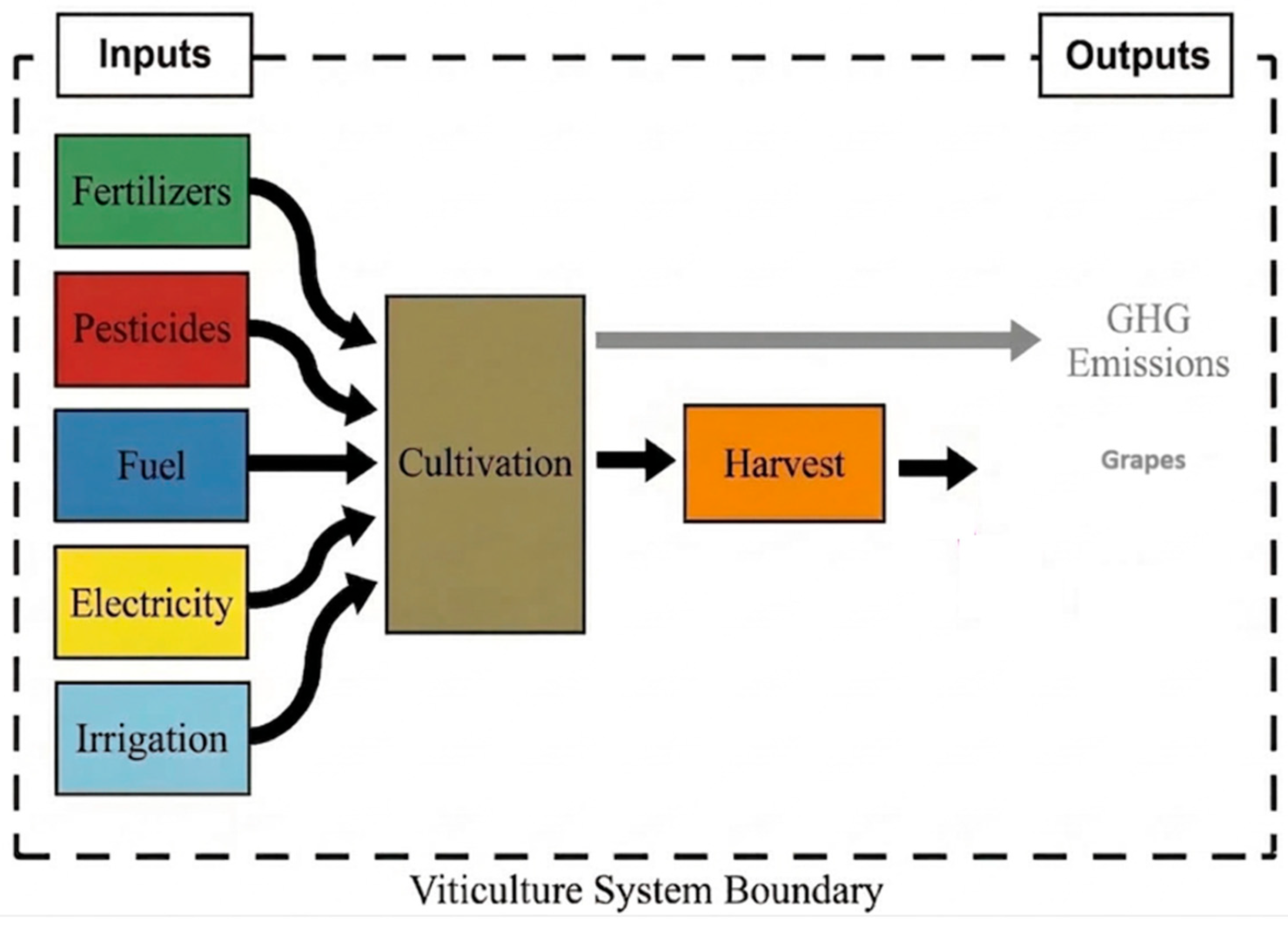
The study adopts a “cradle to gate” approach, delimiting the system from the production of inputs to the harvest. The choice of cradle-to-gate system boundaries is justified by the study’s objective, which focuses exclusively on assessing the environmental performance of primary vineyard production, in accordance with ISO 14040/14044. In this context, upstream processes are analysed, which include the industrial production of fertilizers, pesticides and energy, the main cultivation practices (basic processes) within the vineyard (fertilization, irrigation, soil cultivation), as well as the final outputs (outputs) in fresh grapes and greenhouse gas emissions.
Figure 1 represents the system boundaries of the process. In contrast, winemaking, transport to the winery and packaging waste management are defined as external parameters and placed outside the boundaries of this analysis.
2.3.2. Life Cycle Inventory (LCI) and Emissions
The Life Cycle Inventory (LCI) was based on primary data collected through personal interviews and field inspections. The inputs of fertilizers (N, P, K), plant protection products and energy (diesel, electricity) were recorded in detail by variety, ensuring an accurate depiction of the cultivation requirements for each of them. Emissions were classified into two categories for the most complete environmental assessment per variety. The study includes both direct and indirect emissions in accordance with the IPCC 2019 Refinement, while CH
4 emissions were not included because they are considered negligible for vineyards under the Tier 1 methodology. Direct (On field), which concerns soil emissions of nitrous oxide and carbon dioxide from fuel combustion during operations, and Indirect (Upstream), which represents the integrated footprint of production and transportation of agricultural supplies. The calculation of indirect emissions was based on secondary data from the international databases Ecoinvent and Agri-footprint [
44,
45], allowing for an accurate comparative assessment of the environmental burden of each variety.
2.3.3. Life Cycle Impact Assessment (LCIA)
This methodological approach allows the comparison of the four varieties and the identification of the one with the largest carbon footprint based on their specific cultivation requirements. For direct and indirect soil emissions N
2O the IPCC (2019 Refinement) [
4] methodology was applied, while emission factors for agro-inputs and energy were derived from the Ecoinvent and Agri-footprint databases.
The total carbon footprint for field
j was calculated as the sum of all individual emission sources and is presented in Equation (1).
where
: Total carbon footprint, expressed in kg CO2eq per operational unit
: Amount of input or activity applied to field j
EFi: Emission factor associated with input i
2.3.4. Direct N2O Emissions from Nitrogen Fertilizers
Emissions from Fertilization Direct soil nitrous oxide emissions N2O were calculated based on the IPCC Tier 1 methodology (2019 Refinement). The process includes the application of the emission factor EF1 to the total applied the stoichiometric conversion from elemental nitrogen to molecular N2O () and final conversion to carbon dioxide equivalents CO2 using the GWP factor 273.
Direct emissions of nitrous oxide were calculated based on the IPCC Tier 1 methodology (2019 Refinement). The process involves applying the emission EF
1 = 0.01 (1%) to the total applied nitrogen N
applied. This is followed by stoichiometric conversion from elemental nitrogen to molecular N
2O (ratio 44/28) and final reduction to CO
2 equivalents using the GWP factor 273 as shown in Equation (2).
where
: Carbon footprint from direct nitrous oxide (N2O) emissions resulting from the application of nitrogen fertilizers to field j, expressed in kg CO2-eq ha−1.
: Amount of nitrogen applied to field −1
EF1: Direct emission factor 0.01 (1%)
: Stoichiometric conversion ratio from N2O–N to N2O, based on their respective molecular masses.
273 Global Warming Potential over a 100-year time horizon for nitrous oxide (N2O), expressed in kg CO2-eq per kg N2O, as defined in the IPCC Sixth Assessment Report (AR6).
2.3.5. Direct CO2 Emissions from Agricultural Operation
To calculate the carbon footprint of mechanical cultivation operations (tillage, fertilization, plant protection), Equation (3) was used. Emissions CF
operations are obtained by multiplying fuel consumption by the corresponding diesel emission EF
diesel, the value of which were extracted from the ecoinvent database [
42].
where
CFoperations,j: Carbon footprint from diesel consumption for agricultural work on field j (kg CO2-eq ha−1).
: Diesel consumption (L).
: Emission factor according to the ecoinvent databases used.
2.3.6. Direct CO2 Emissions from Irrigation
The calculation CO
2 of emissions from the drip irrigation process was based on a four-stage model, which combines primary field data with bibliographic indicators. While for each vineyard field there was an accurate recording of the volume of irrigation water, the lack of autonomous electricity consumption meters made it necessary to estimate the energy intensity (EI) of the system, according to the methodology based on Qin et al. (2024) [
46], the energy intensity for drip irrigation (1.0 MJ/m
3) was converted to 0.278 kWh/m
3 (using 1 kWh = 3.6 MJ) to align with the functional unit of the national electricity emission factor. The specific electricity consumption per hectare was obtained from the product of the water volume and the energy intensity index, while the final carbon footprint was determined through Equation (4), by applying the emission factor of the Greek grid (EF
energy) from the ecoinvent database.
where
CFirr: Carbon footprint from irrigation-related activities expressed in kg CO2eq
Vtotal: The total volume of irrigation water applied (m3).
0.278: The specific energy consumption factor for drip irrigation
EFenergy Emission factor according to the ecoinvent databases used.
2.3.7. Indirect CO2 Emissions
To calculate the carbon footprint of indirect emissions from the production of agricultural inputs (mineral fertilizers, plant protection products, energy), the following general formula was used, as shown in Equation (5). The emission factors used were taken from the ecoinvent database.
where
CFindirect: Carbon footprint, expressed in kg CO2eq per operational unit
i: Input type
Ii: Quantity of the ith input
EFi: Emission factors according to the ecoinvent databases used.
2.3.8. Indirect N2O Emissions
To calculate the total carbon footprint, indirect nitrous oxide emissions from atmospheric deposition NH3 and NOx and leaching or runoff to water were included, following the IPCC Tier 1 methodology. The calculations were based on the total nitrogen input N
input and the parameters
(0.10), EF
3 (0.01), and
(0.30) EF
4 (0.0075). For Xinomavro, which is cultivated under dryland conditions, the IPCC Tier 1 default value of
= 0.10 was applied instead of 0.30, as the latter is used exclusively for irrigated crops. To convert emissions to carbon dioxide equivalents CO
2eq, the stoichiometric coefficient 44/28 and the GWP100 value (273) from the IPCC 6th Assessment Report (AR6, 2021) were used as shown in Equation (6).
where
CFindirect: Indirect emissions expressed in kg CO2e.
Ninput: Total amount of nitrogen applied to the field (kg N).
: Fraction of synthetic fertilizer nitrogen that volatilizes as NH3 and NOx (0.10).
EF3: Emission factor for N2O emissions from atmospheric deposition of N on soils and water surfaces (0.01 kg N2O-N/kg NH3-N).
: Fraction of all organic and mineral fertilizer nitrogen that is lost to leaching and runoff (0.30), applied to irrigated crops. For Xinomavro (dryland cultivation), a value of 0.10 was used in accordance with IPCC Tier 1 guidelines.
EF4: Emission factor for N2O emissions from nitrogen leaching and runoff (0.0075 kg N2O-N/kg N).
: Stoichiometric conversion ratio from N2O–N to N2O, based on their respective molecular masses.
273 Global Warming Potential over a 100-year time horizon for nitrous oxide (N2O), expressed in kg CO2-eq per kg N2O, as defined in the IPCC Sixth Assessment Report (AR6).
2.4. Data Envelopment Analysis
Data Envelopment Analysis (DEA) was applied to assess the technical efficiency of the vineyard fields, which served as the Decision-Making Units (DMUs). Both the Constant Returns to Scale (CRS) and Variable Returns to Scale (VRS) models were estimated to obtain a complete efficiency profile. The CRS model (CCR) of Charnes et al. [
27] assumes proportionality between inputs and outputs, whereas the VRS model (BCC) of Banker et al. [
47] relaxes this assumption to account for the substantial heterogeneity observed in viticultural systems, where soil conditions, microclimate, management practices and field size vary considerably. An input-oriented formulation was adopted because farmers can adjust input quantities more readily than output levels, which are largely driven by biological and environmental factors. The DEA model incorporated seven inputs (nitrogen, phosphorus, potassium, irrigation water, electricity used for irrigation, fungicide amount and diesel for field operations), while grape yield was used as the single output. Because the four grape varieties differ substantially in agronomic structure and input requirements, DEA models were estimated separately for each variety to ensure methodological homogeneity.
For the Xinomavro variety, irrigation water and electricity irrigation were structurally zero because the fields are cultivated under dryland conditions. These inputs were therefore excluded from the DEA formulation rather than treated as zero-valued variables, preventing artificial inflation of efficiency scores and ensuring that each variety was evaluated using only relevant agronomic inputs. Since DEA models were estimated separately for each variety, the exclusion of irrigation variables does not affect cross-varietal comparability, as each frontier is defined internally by the production conditions and input structure specific to that group of Decision-Making Units.
In the BCC framework, the convexity constraint ensures that each vineyard field is benchmarked only against units operating at comparable scale. This allows overall efficiency to be decomposed into pure technical efficiency (PTE), which reflects input utilisation, and scale efficiency (SE), which captures the influence of production scale. This distinction is particularly relevant in linking the DEA results with the LCA-derived carbon footprint presented in the previous section, as it helps clarify whether differences in environmental performance arise from the way inputs are used or from underlying structural and scale-related characteristics of the vineyard fields.
Let there be production units (DMUs), each using m inputs
(for
) to produce one output
. To evaluate DMU
0, the input-oriented BCC DEA model is formulated as follows
represents the technical efficiency score (0 < θ ≤ 1).
are intensity variables that construct the reference frontier.
The constraint , imposes Variable Returns to Scale, indicating the BCC model.
A DMU is considered fully efficient if and all constraints hold without slack.
The combined use of the CCR and BCC models is essential for obtaining a complete efficiency profile. The CCR formulation provides overall technical efficiency under the assumption of constant returns to scale, meaning that deviations from full efficiency may reflect both managerial performance and scale conditions. In contrast, the BCC model isolates pure technical efficiency by allowing variable returns to scale, thereby identifying whether inefficiencies arise from non-optimal scale or from input-use practices. Through the TE = PTE × SE decomposition, the two models jointly allow a clear distinction between technical and scale-related inefficiencies, in line with standard empirical practice in DEA applications.
The selection of input variables in the DEA model was based directly on the Life Cycle Inventory (LCI) categories used in the carbon footprint assessment, ensuring methodological coherence between the LCA and DEA components of the study. All seven inputs, nitrogen, phosphorus, potassium, irrigation water, irrigation electricity, fungicides and diesel, represent the primary resource flows that contribute to greenhouse gas emissions at field level, and thus correspond to the functional units expressed as kg CO2e per hectare and kg CO2e per kilogram of grapes. Using these inputs in DEA enables a consistent evaluation of both environmental burden and technical performance. Grape yield was selected as the single output because it represents the only desired agronomic product of the vineyard system within the cradle-to-gate boundaries, and it provides a directly measurable, comparable production indicator across all fields.
3. Results
3.1. Carbon Footprint
In the context of this study, the carbon footprint of four winemaking varieties (Assyrtiko, Roditis, Xinomavro and Merlot) was calculated. The results show significant differences between the varieties both per hectare and per kilogram of final product. Specifically, the total footprint per hectare amounted to 2798.40 kg CO
2e/ha for Assyrtiko, 2784.48 kg CO
2e/ha for Xinomavro, 3794.02 kg CO
2e/ha for Merlot and 1958.07 kg CO
2e/ha for Roditis. Accordingly, in the functional unit per kilogram of product, emissions were calculated at 0.281 kg CO
2e/kg for Assyrtiko, 0.304 kg CO
2e/kg for Xinomavro, 0.340 kg CO
2e/kg for Merlot and 0.143 kg CO
2e/kg for Roditis.
Table 1 presents the main descriptive statistics (mean and standard deviation) of key agricultural inputs and the resulting carbon footprint across the four examined grape varieties. The environmental impacts were quantified using the Life Cycle Assessment (LCA) methodology, providing a clear quantitative baseline to compare the resource consumption and emission intensity of each variety.
Table 2 summarizes the average carbon footprint values for each variety and for both functional units.
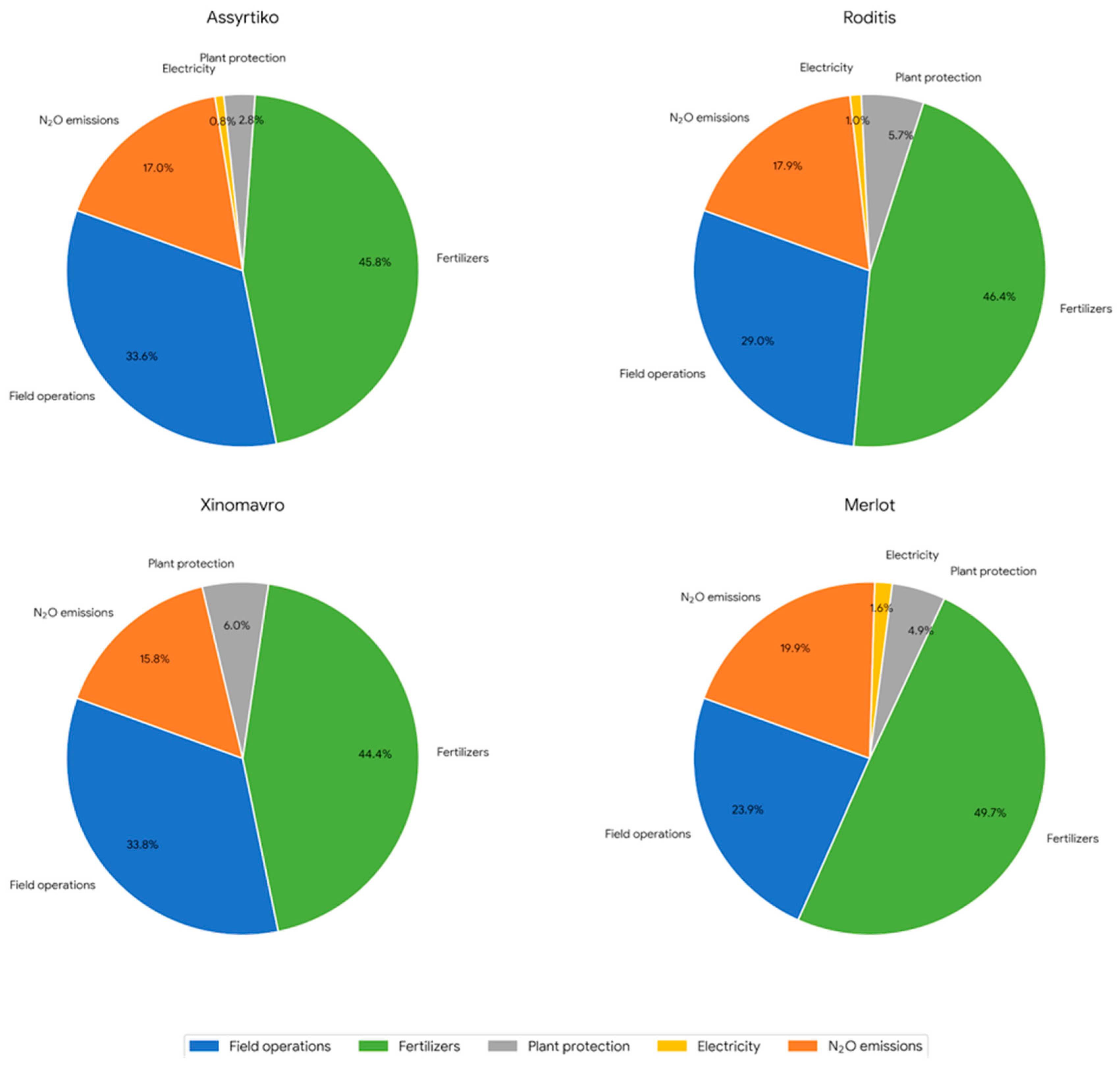
The analysis of the individual emission sources (
Figure 2) shows that fertilization, including emissions from fertilizer production and soil emissions, is the dominant burden category for all varieties, accounting for between 60% and 70% of the total footprint. Diesel consumption for agricultural operations is the second most important source of emissions, while the contribution of plant protection and irrigation is smaller. The differences between varieties are reflected in the relative proportions of the individual emission categories, as presented in the corresponding graphs.
The assessment of the carbon footprint in the two operational units (kg CO
2e/ha and kg CO
2e/kg) demonstrates differences related to productivity per hectare. Although Assyrtiko and Xinomavro present similar values per hectare (≈2790 kg CO
2e/ha), the footprint per kilo of product differs (0.281 and 0.304 kg CO
2e/kg respectively). Roditis presents the lowest value in both measurement units (1958.07 kg CO
2e/ha and 0.143 kg CO
2e/kg), while Merlot presents the highest value per kilo of product (0.340 kg CO
2e/kg).
Table 3 presents the detailed distribution of emissions by variety and input category, calculated in both operational units.
3.2. Data Envelopment Analysis
The DEA models were estimated separately for four grape varieties: Assyrtiko, Merlot, Roditis and Xinomavro. Each variety was analyzed independently due to differences in cultivation practices, input requirements and production conditions. Xinomavro does not use irrigation water or electricity for irrigation, and therefore these inputs were excluded from its dataset.
The distribution of technical efficiency under CRS (
Table 4) shows significant differences between the four varieties. Assyrtiko shows high levels of efficiency, as more than half of the fields (52.94%) are fully efficient and no farm has a score below 0.85, indicating homogeneous and efficient use of inputs. Roditis also presents a satisfactory picture, with 50% of fields being fully efficient, but also greater variation, as one field has very low efficiency (<0.80), indicating heterogeneity in management practices. Merlot shows the greatest dispersion and the lowest rate of full efficiency (27.03%), with 18.92% of fields showing significant inefficiency (<0.80), reflecting differences in the use of inputs and possible technical or cultivation deficiencies. In contrast, Xinomavro, despite the absence of irrigation, presents a positive picture, with 50% of fields being fully efficient and no value below 0.85, indicating stable and effective management in the context of dry farming. Overall, the results show high levels of efficiency in Assyrtiko and Xinomavro, moderate performance in Roditis, and increased heterogeneity in Merlot.
The results for the white varieties (
Table 5) indicate consistently high VRS efficiency scores, often reaching 1.000, suggesting limited scope for improvements in pure technical practices. The lower CCR values observed in certain fields (0.85 for Assyrtiko and 0.76 for Roditis) point to inefficiencies mainly associated with scale conditions. The returns-to-scale categories reported in the table illustrate whether units operate below or above their optimal scale. Overall, both varieties demonstrate stable performance, although adjustments related to scale may support further efficiency improvements.
The red varieties (
Table 6) present a more heterogeneous efficiency pattern. Several Merlot and Xinomavro fields achieve full efficiency (CCR = 1.000), yet Merlot exhibits substantial variation, with CCR scores falling to 0.744–0.814 in several cases, indicating wider margins for improvement. Most BCC scores remain relatively high (0.747–1.000), and the divergence between CCR and BCC suggests that part of the inefficiency is scale-related rather than technical. Xinomavro performs more consistently, with CCR values rarely below 0.898, implying smaller deviations from efficient performance. Overall, the results indicate broader scale-related inefficiencies in Merlot, while Xinomavro displays a more uniform and stable efficiency profile.
DEA analysis shows that, although most fields exhibit high pure technical efficiency under VRS, there is still room for improvement in the use of certain inputs, as reflected in the slack values (
Table 7). These margins do not indicate mismanagement, but largely reflect the specific characteristics of each farm, such as differences in size, soil and climate conditions, and the requirements of individual farming practices. The existence of slacks therefore indicates potential opportunities for improving efficiency and further reducing the environmental footprint, without calling into question the adequacy or correctness of producers’ existing practices.
The average improvement slack values indicate variations by variety and input (
Table 6). In nitrogen, there are margins for reduction in all varieties, with the highest frequency of adjustments in Roditis (50%) and Merlot (43.24%), while the averages range from 2–4 kg/field. In phosphorus, the margins are generally small, but Xinomavro has a higher average, while the frequency is higher in Merlot (27.03%). In potassium, no margins are observed in white varieties, while in red varieties they appear mainly in Merlot (37.84%) and more mildly in Xinomavro (16.67%). Irrigation water and irrigation electricity show the most significant margins in white varieties, especially in Roditis (≈100 m
3/field and ≈1466 kWh/field on average, with a frequency of 50% and 43.75% respectively), while in Assyrtiko the margins are lower but still present. In red varieties they are clearly smaller and in Xinomavro they do not apply due to dry farming. For fungicides, the margins are small, with a higher frequency in Merlot (32.43%), while for diesel the averages are generally low. Assyrtiko shows a slightly higher average, but the highest frequency is recorded in Merlot (18.92%). Overall, the findings indicate targeted opportunities for rationalization, mainly in water and electricity for irrigation in white varieties and in Potassium in red varieties, which can be explored where growing conditions allow.
3.3. Sensitivity Analysis
To assess the stability of the model and the impact of key parameters on the overall CF, a sensitivity analysis was performed with a ±20% change in the main system inputs. The following interactions were examined: the amount of Nitrogen (N), which affects Direct N2O Emissions (Direct N2O), Indirect N2O Emissions (Indirect N2O) and upstream emissions from nitrogen fertilizer production (Upstream N); the emission factor EF1, which affects direct N2O emissions only; diesel consumption, which affects emissions from field operations (Diesel field operations); and the upstream emission factors (Upstream EFs) for fertilizer production (N, P2O5, K2O) and crop protection products.
The results in
Table 8 show that Upstream EFs cause the largest change in the total CF (±9.66%), followed by the amount of Nitrogen (±6.92%) and the diesel consumption (±6.74%), while EF
1 shows the smallest effect (±2.60%). Based on the initial total CF of the system (39,021.58 kg CO
2e), no parameter leads to a change greater than ±10%, which confirms the robustness and reliability of the model. The high sensitivity of the upstream coefficients and the amount of Nitrogen highlight the critical role of rational fertilization, while the significant effect of diesel highlights the importance of accurate recording of mechanized operations. In contrast, the limited effect of EF
1 is because this system is characterized by a high percentage of emissions originating from fuels and upstream inputs, reducing the relative importance of direct soil emissions. It should be noted that the ±20% sensitivity analysis was applied to the aggregate system total rather than to each variety separately. A variety-specific sensitivity assessment could provide additional insights and is identified as a direction for future research.
A leave-one-out jackknife procedure was applied to assess the robustness of the DEA results, following established practice in the literature [
48,
49]. In each iteration, the CCR model was re-estimated with one DMU removed, and the resulting efficiency vector was compared with the baseline using Pearson and Spearman correlation coefficients (
Table 9). These correlations provide a direct measure of the stability of efficiency levels and rankings, while the reported minimum–maximum ranges reflect the variability introduced by the omission of individual units.
The mean Pearson and Spearman correlation coefficients were consistently high across all varieties, generally above 0.95, confirming that both efficiency levels and rankings remain stable when individual DMUs are omitted. Although the Spearman coefficient for Merlot was not statistically significant, its magnitude (ρ = 0.932) still indicates strong ranking stability, driven by limited score dispersion and frequent ties rather than model instability. The minimum–maximum correlation ranges further demonstrate that no jackknife iteration diverges meaningfully from the baseline, confirming that no single DMU exerts undue influence on the CCR frontier. A non-parametric statistical framework was used to examine whether input slack magnitudes differed across grape varieties. Normality was first assessed with the Shapiro–Wilk test, which indicated strong deviations for all five common slacks (N, P, K, fungicide, diesel), reflecting their zero-inflated and skewed distributions. Given this non-normality, the Kruskal–Wallis H-test was applied to evaluate overall differences among the four varieties (Assyrtiko, Roditis, Merlot, Xinomavro), followed, when significant, by Bonferroni-adjusted Mann–Whitney pairwise comparisons. For irrigation-related slacks (m3 water and kWh electricity), data were available only for Assyrtiko, Roditis and Merlot; these inputs were therefore analysed separately using the same procedures.
Table 10 summarizes the statistical tests for the five input slacks common to all grape varieties. The Shapiro–Wilk test confirmed strong non-normality for all variables (
p < 10
−17), reflecting the zero-inflated structure of the slack data. The Kruskal–Wallis test indicated significant overall differences for Potassium (H = 8.50,
p = 0.0368) and Diesel (H = 8.56,
p = 0.0358), whereas Nitrogen, Phosphorus and Fungicide showed no statistical evidence of variation among varieties (
p > 0.20). However, none of the pairwise Mann–Whitney comparisons remained significant after Bonferroni adjustment, suggesting that although group-level divergence exists for K and Diesel, no specific variety pairs can be identified as systematically different. This outcome is typical of zero-inflated slack distributions, where variability is dispersed across multiple groups rather than concentrated in distinct pairwise contrasts.
Table 11 presents the irrigation-related slacks for the three varieties with available data (Assyrtiko, Roditis and Merlot). As with the other inputs, irrigation slacks showed strong departures from normality (
p < 10
−15), consistent with their zero-inflated distributions. The Kruskal–Wallis’s test indicated marginal but non-significant differences for both irrigation water (
p = 0.057) and irrigation electricity (
p = 0.069), with no pairwise contrasts remaining significant after Bonferroni-adjusted Mann–Whitney tests. Given that median irrigation slacks were zero across all varieties, these non-significant results reflect the sparse nature of irrigation adjustments, with only a small subset of fields exhibiting positive slack.
4. Discussion
The assessment of the carbon footprint in the Paionia viticultural zone underscores the importance of strategic input management and the adoption of sustainable cultivation practices. By concentrating on the stages from field operations to harvest, the study provides essential evidence for mitigating the effects of climate change on primary production.
This study goes beyond the quantitative reporting of emissions by demonstrating that the examined varieties exhibit a competitive overall environmental profile when compared with internationally reported ranges. A critical comparison of our findings (0.143–0.340 kg CO
2e/kg and 1.958–3.794 kg CO
2e/ha) with the current literature shows that the carbon footprint of the varieties examined is at the lower end of the internationally reported ranges for both functional units. Indicatively, in a Mediterranean environment, Litskas et al. [
25] report values of 0.572 kg CO
2e/kg for Cabernet Sauvignon, while studies in Spanish and French vineyards report ranges of 0.35–1.20 kg CO
2e/kg [
20,
36]. At the hectare level, recent LCA applications in conventional vineyards in Northern Greece [
37] and Northern Italy [
1] record maximum emissions of 3661 and 2937 kg CO
2e/ha, respectively, values that exceed the upper limit of our region. This comparison suggests that, despite differences between varieties, the Paionia production system operates with lower emissions intensity compared to similar European systems, a factor that enhances its environmental competitiveness and highlights opportunities for further optimization through targeted input management.
In this study, fertilization emerged as the most influential factor driving vineyard emissions. This impact is linked both to the energy-intensive industrial synthesis of nitrogen-based fertilizers, which represents a major source of indirect emissions, and to soil denitrification processes that release nitrous oxide directly from the field. These results are consistent with international findings, which similarly identify input use as the primary hotspot in viticultural systems. A typical example is the study by Karalis and Kanakoudis [
38] in a winery in Northern Greece, where the vineyard contributes 32% to the total carbon footprint. In contrast, the winery dominates with 68%, mainly due to high energy requirements and the use of refrigerants. However, internal analysis of the vineyard revealed that plant protection products (PPPs) are responsible for a staggering 79% of emissions at this stage. This is attributed to the particularly high emission factor of agrochemicals, highlighting them as the main factor of environmental impact in the field. Specifically, a similar picture to that of Paionia and the wider region of Northern Greece [
38,
39] is observed in California [
50], Sardinia [
16], and France [
36], where agrochemical production and fuel consumption dominate the carbon profile. The comparison of the varieties overturns the assumption that locality automatically implies reduced environmental impact. As shown by the study by Litskas et al. [
25], the advantage of native varieties depends on their ability to adapt to the local climate with limited inputs, as management intensity remains the determining factor for carbon footprint. This variation is due to the increased vulnerability of Xinomavros to pathogens during the study, which required more frequent plant protection interventions. The need for additional use of fuels and preparations increased the intensity of emissions per unit of final product. This fact demonstrates that resistance to biotic stresses is a key parameter for maintaining environmental efficiency, in line with the approach of Tziolas et al. [
37] regarding the need to balance cultivation needs and pollutant emissions. Accordingly, the international variety Merlot recorded the greatest environmental burden, as the high input requirements to achieve the quality objectives of the zone degrade the technical efficiency of cultivation.
The application of DEA analysis under the VRS model highlights the high technical efficiency of vineyards, while revealing, through slack prices, significant opportunities for reducing the carbon footprint without hindering the production process. These findings are in line with international literature [
36], which indicates that a large part of vineyards operate with margins for improvement often linked to endogenous factors, such as microclimate and topography. Similarly, Santos et al. [
51] point out that such deviations in efficiency do not necessarily stem from mismanagement but reflect the structural characteristics of vineyards and the level of available technology. In our case, the need to optimize fertilization and energy consumption, especially regarding nitrogen, irrigation water and fuels, confirms that the elimination of excess inputs is a crucial factor in limiting the climate burden.
Furthermore, the differentiation of adaptation needs between varieties, e.g., nitrogen in Roditis versus potassium in Merlot underlines that the improvement strategy must be individualized and not horizontal. As Tziolas et al. [
37] argue, the integration of environmental parameters into the evaluation demonstrates that systems that appear less efficient in purely quantitative terms such as dryland crops in the study area may in fact be the most sustainable when the rational use of natural resources is considered.
In conclusion, the existence of slacks highlights a clear opportunity for the transition to precision agriculture models, where the targeted reduction in inputs will enhance the sustainability of Greek viticulture, while ensuring its productive capacity. The study aligns with Sustainable Development Goal 12 on responsible production, emphasizing that progress toward climate neutrality requires optimizing resource use in relation to productivity. Reducing the carbon footprint along the wine value chain must begin with strategic vineyard management, ensuring that the raw material is produced with minimal losses and the lowest possible environmental impact before entering the processing stage.
5. Conclusions
This study, aligned with the Sustainable Development Goals, highlights that the environmental performance of the final product in the wine sector is largely determined at the primary production stage. In the wine-growing region of Paionia, the results show that the environmental and economic sustainability of wine is significantly influenced by the practices applied before harvesting. The life cycle analysis identified fertilization and plant protection as the main “hot spots” of the carbon footprint. This finding is consistent with the international literature and underscores that rational use of inputs can contribute significantly to reducing emissions. Furthermore, the differentiation between varieties showed that environmental efficiency is closely linked to the adaptability of plant material to local conditions. The higher performance of Roditis compared to Merlot suggests that indigenous varieties, when requiring fewer inputs, can offer an advantage in terms of sustainability. The application of DEA confirmed that the vineyards in the region are highly efficient from a technical standpoint, while at the same time identifying areas for further improvement, mainly in terms of nitrogen, fuel, and irrigation management. These findings do not indicate specific policy directions, but they do provide evidence-based indications of where the most significant potential for reducing emissions at the crop level lies.
Overall, the study demonstrates that targeted input optimization can enhance the sustainability of viticulture in Paionia while maintaining production capacity and final product quality. The results lay the foundation for future research that could be extended to more varieties and incorporate social and circular indicators, contributing to the development of a more resilient and climate-responsible agri-food system in the Mediterranean.
Despite the valuable insights provided, the study is subject to certain limitations associated with the specific conditions of the Paionia region. Local microclimatic characteristics, production scale, and cost structures influence both input requirements and the resulting carbon footprint, indicating that the generalizability of these findings to other viticultural areas cannot be assumed. A careful evaluation of regional conditions is therefore necessary before drawing broader conclusions. Nevertheless, the analytical framework developed in this study remains fully applicable and can be transferred to other contexts, provided that the corresponding local parameters are appropriately integrated.





 ,
,