1. Introduction
Industrial wastewater discharge has become one of the major sources of global water pollution [
1]. According to a report by the United Nations Educational, Scientific, and Cultural Organization (UNESCO), a large proportion of wastewater worldwide is discharged directly into water bodies without adequate treatment, posing severe threats to ecosystem security and human health [
2,
3]. Industrial wastewater often contains harmful substances such as heavy metals, organic pollutants, and pathogenic microorganisms, which can enter the human body through drinking water, irrigation systems, and the food chain, inducing a series of waterborne diseases [
4,
5]. In the context of accelerated urbanization and industrialization, developing countries are facing particularly severe water pollution challenges [
6,
7]. In China, for example, industrial wastewater has become a critical barrier to improving water quality and public health [
8,
9,
10].
Existing studies have revealed the impacts of water pollution on human health from multiple perspectives. A growing body of empirical evidence shows that heavy metals, organic pollutants, and pathogens in industrial wastewater are associated with elevated risks of specific diseases once they enter the human body via water environments. Some studies have focused on severe chronic outcomes. Polluted water environments have been linked to higher risks of liver cancer, pancreatic cancer, brain cancer, and other long-term health problems [
11,
12,
13]. To broaden the health perspective beyond single infectious outcomes, recent research has also shown that the health effects of polluted water may extend to digestive cancer mortality and other chronic consequences in China [
9]. Prior literature indicates that water pollution is associated with a wide range of health outcomes, including waterborne infectious diseases, chronic illnesses, and cancer, with these effects exhibiting clear regional and population heterogeneity [
14]. This broader pattern indicates that the health burden of water pollution is heterogeneous rather than limited to a single disease category. Against this background, evidence from Bangladesh shows that the incidence of skin diseases, diarrhea, and dysentery was substantially higher in severely polluted areas along the Turag River [
15]. Similar findings have been reported in India, where communities near sewage overflow sites experienced a higher incidence of acute gastroenteritis, typhoid fever, dysentery, and hepatitis A [
16]. Collectively, these studies indicate that water pollution is closely associated with adverse health outcomes [
9,
14].
Within this broader literature, industrial wastewater merits particular attention because it is a major pollution source whose impacts often extend beyond the place of discharge. As a typical watershed-based pollutant, its generation and diffusion are shaped by industrial location, regional production linkages, and cross-regional pollutant transfer [
17,
18]. As a result, the health and environmental effects of industrial wastewater are often not confined to the area where the pollution originates [
17,
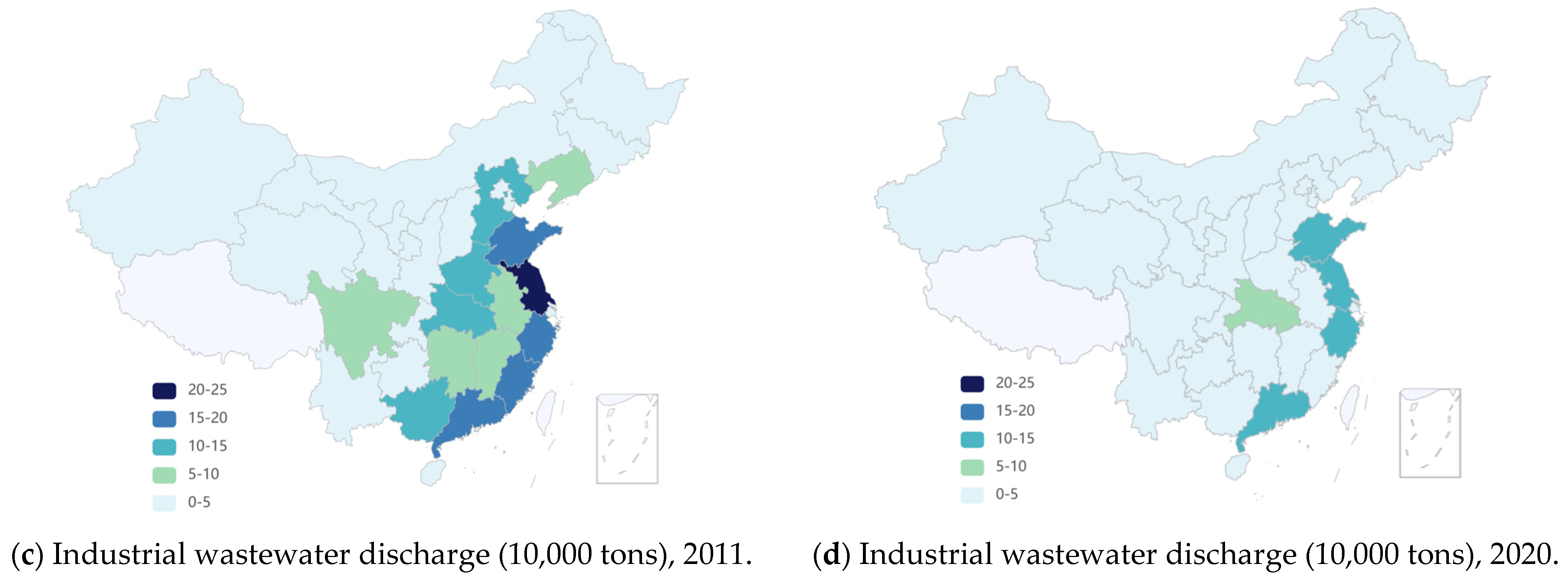
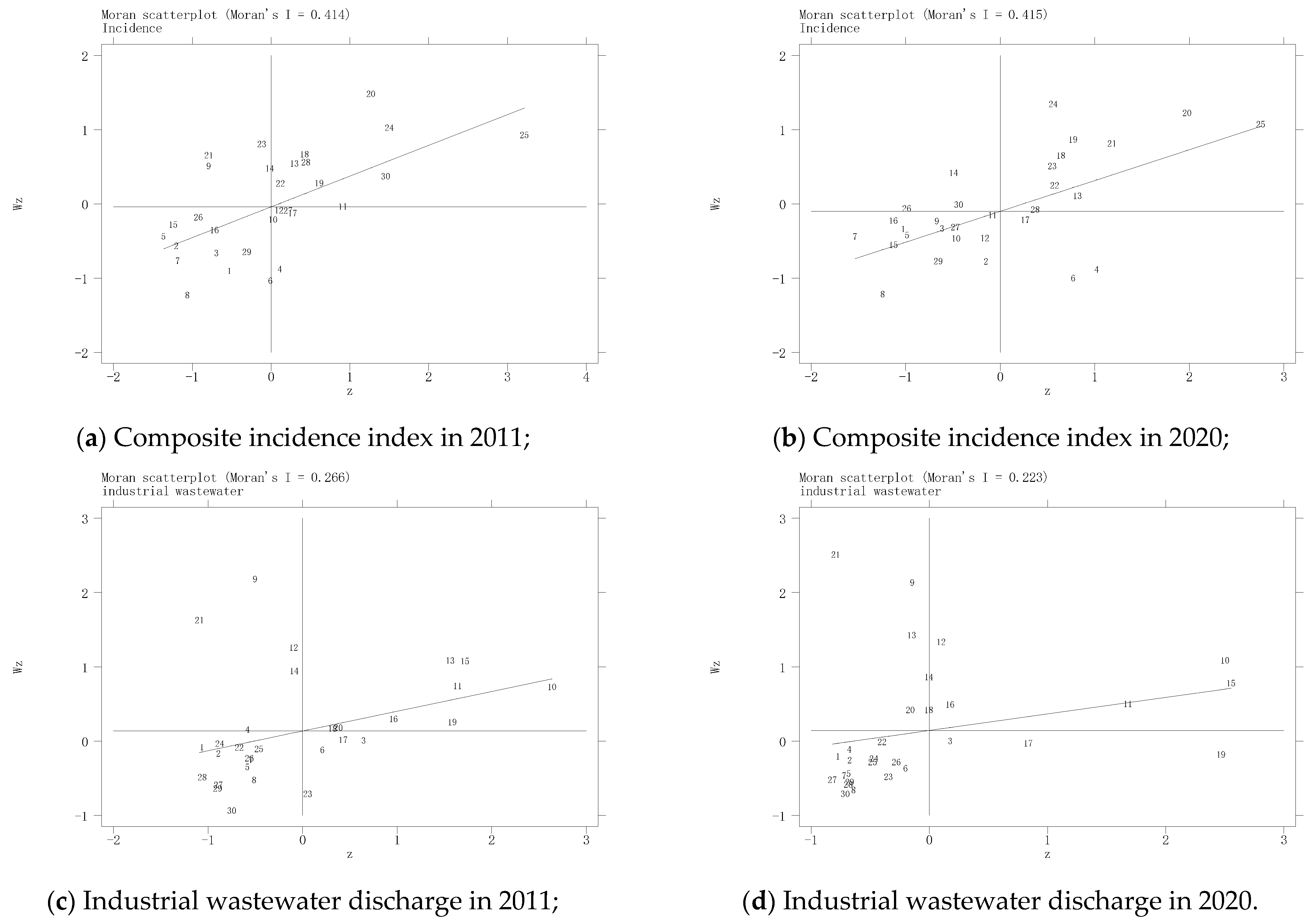
18]. This understanding is further supported by provincial panel evidence from China, showing that industrial wastewater discharge remained at a relatively high level during the study period and exhibited clear spatial dependence [
19]. Accordingly, industrial wastewater should not be treated simply as a local explanatory variable in analyses of its health consequences.
The health consequences of pollution may also exhibit a spatial dimension because environmental risks can extend beyond administrative boundaries through hydrological and related pathways [
14,
17,
18]. Recent studies suggest that pollution and its associated spatial spillovers may affect health-related outcomes in neighboring regions [
20]. Evidence from related environmental health research also indicates that conventional non-spatial panel models may be inadequate when spatial dependence is present [
21].
To examine the relationship between pollution and health, existing studies have employed diverse approaches in both indicator construction and empirical identification. Lloyd and Wheeler proposed the Disease Product Index (DPI), which multiplies the incidence rates of diarrhea, typhoid fever, and hepatitis to capture the combined effects of water quality on multiple diseases [
22]. A significant positive correlation was reported between the DPI and water pollution levels. Field survey evidence from Pakistan further showed that drinking groundwater contaminated by industrial wastewater was associated with a markedly higher hepatitis A infection rate, reaching 32–38% [
23].
These studies provide a solid foundation for understanding the association between water pollution and health. However, several important limitations remain. First, most of the current studies focus on specific watersheds or individual diseases, lacking a comprehensive assessment of the health risks posed by multiple waterborne diseases, which limits the full depiction of complex exposure scenarios [
14]. Second, spatial spillover effects in the pollution–health relationship have been insufficiently addressed in current studies. There is a general lack of attention to the dynamic evolution of spatial and temporal heterogeneity. Given these spatial diffusion characteristics, pollutants can be transported across regions through surface runoff and hydrological cycles, posing health risks not only locally but also to adjacent areas. This calls for simultaneous consideration of both localized impacts and spatial spillovers.
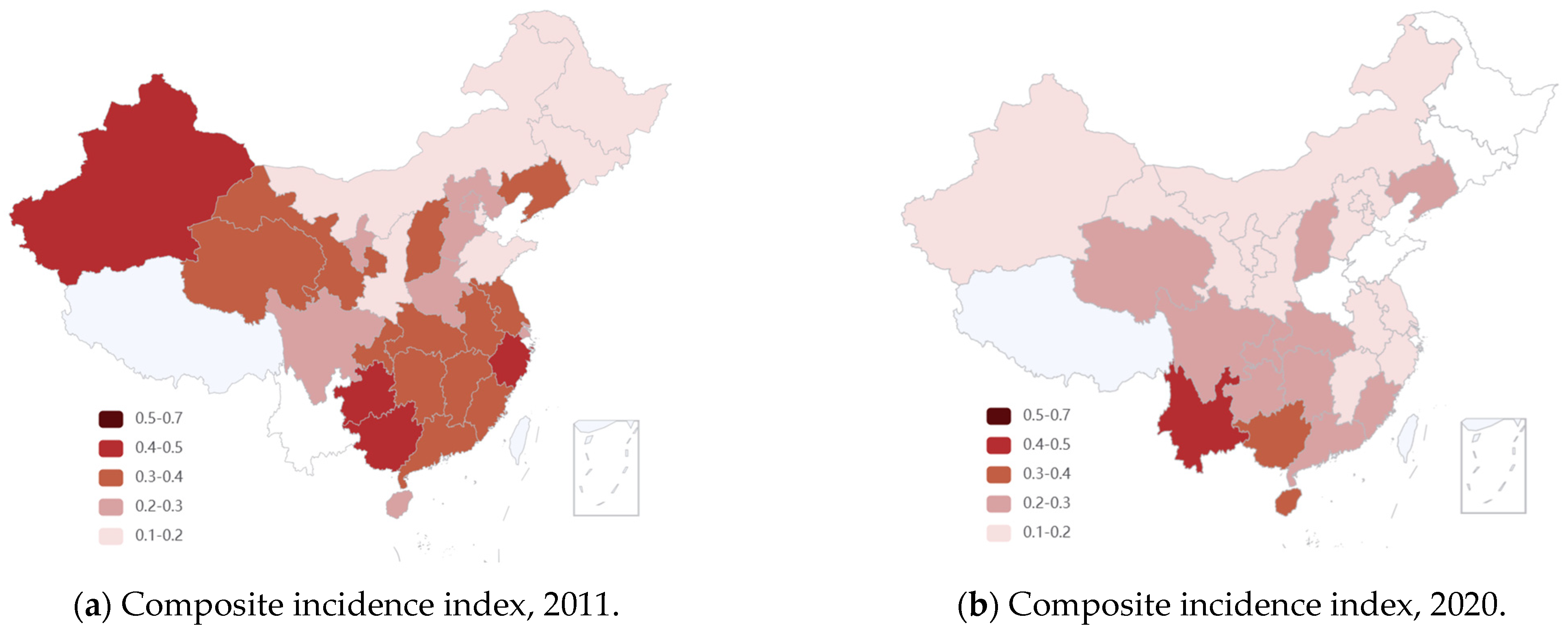
To address these gaps, this study selects four infectious diseases with clear waterborne pathways—bacillary dysentery, typhoid fever, hepatitis A, and hepatitis E. We construct a composite incidence index using the entropy weight method to comprehensively measure the regional conditions of waterborne diseases. Based on panel data from 30 provincial-level regions in China between 2011 and 2020, we employ the Spatial Durbin Model (SDM) to systematically assess the direct and indirect effects of industrial wastewater discharge on public health in both local and neighboring areas. Furthermore, we examine changes in the spatial relationship between pollution and health outcomes before and after the implementation of China’s national water pollution control policy—the “Water Ten Plan.” This design allows us to assess both localized effects and spatial spillovers and to examine whether the pattern of association changed after the implementation of the “Water Ten Plan.”
This study contributes to the literature in three main respects. First, it develops a multi-disease indicator system, thereby broadening the assessment of water-related public health risks. Second, it brings localized effects and spatial spillovers into a unified analytical framework, helping to identify how industrial wastewater discharge influences health outcomes across regions. Third, it evaluates whether national pollution control policies were accompanied by changes in pollution-related health risks, providing evidence from China on the role of public intervention in mitigating environmental health risks.
4. Discussion
Industrial wastewater discharge is positively associated with waterborne disease incidence in China, and this relationship has a clear spatial dimension. Pollution-related health risks are not confined to the province where wastewater is discharged but are also associated with conditions in neighboring provinces. Water pollution, therefore, appears to be not only a local environmental problem but also a cross-regional public health issue.
This pattern is broadly consistent with previous research showing that wastewater pollution may affect health through multiple exposure channels and that both environmental risks and health outcomes often exhibit spatial clustering [
11,
15,
17]. The analysis further shows that, at the provincial level in China, the association between industrial wastewater discharge and disease incidence extends across adjacent regions. This suggests that local environmental conditions and health outcomes are embedded in a broader regional context.
The post-policy analysis suggests that this relationship became weaker after the implementation of the “Water Ten Plan”. This pattern is broadly consistent with the policy emphasis on stricter discharge control and stronger cross-regional coordination in water governance.
From a policy perspective, the findings suggest that environmental health governance may benefit from greater coordination across regions. When pollution-related health risks are spatially associated, isolated local responses may be insufficient to address the full range of environmental health impacts. Strengthening coordination in pollution control, monitoring, and public health response may therefore improve the effectiveness of environmental governance.
Several limitations should also be noted. The health indicators cover only four waterborne infectious diseases and therefore do not capture the full health burden associated with water pollution. The spatial weight matrix used in the baseline analysis may not fully reflect hydrological linkages, economic interaction, or distance decay. In addition, the provincial scale of the data may conceal important within-province variation. These limitations point to clear directions for future research.
5. Conclusions
Using panel data for 30 provincial-level regions in China from 2011 to 2020, this study examines the spatial relationship between industrial wastewater discharge and waterborne disease incidence. The results show that both variables exhibit significant spatial dependence and that industrial wastewater discharge is positively associated with disease incidence at both the local and neighboring-regional levels.
The spatial effect decomposition further shows that the indirect effect accounts for a substantial share of the total effect, suggesting that cross-regional association is an important feature of pollution-related health risks. The post-policy analysis also indicates that this relationship became weaker after the implementation of the “Water Ten Plan” and that the spillover term was no longer statistically significant in the later period.
Overall, pollution control and health protection should not rely solely on isolated local responses. More effective governance may require stronger coordination across adjacent regions in order to address the cross-boundary nature of environmental health risks. Therefore, improving industrial wastewater management is important not only for reducing pollution and disease but also for promoting healthier and more sustainable regional development.