Next Article in Journal
Developing the Cilician Heritage Corridor: A Spatial Planning Framework for Sustainable Cultural Tourism Across Archaeological and Environmental Landscapes Centred on the Adana–Kozan–Anavarza Axis (Türkiye)
Previous Article in Journal
Source-Dependent Accessibility Discrepancies and Their Effects on Land-Value Models
Previous Article in Special Issue
Regional Ecological Security Assessment and Driving Factor Analysis Based on the Innovative Health-Service-Risk-Sensitivity Framework: A Case Study of an Arid Inland River Basin
 
 
Due to scheduled maintenance work on our servers, there may be short service disruptions on this website between 11:00 and 12:00 CEST on March 28th.
Article

The Impact of Meteorological Parameters and Air Pollution on the Spatiotemporal Distribution of Nighttime Light in China


1
School of Resource and Environmental Sciences, Wuhan University, Wuhan 430079, China
2
Institute of Engineering Consulting and Design, Northeast Forestry University, Harbin 150040, China
3
Real Estate & Construction, Faculty of Architecture, The University of Hong Kong, Hong Kong, China
4
Future Urbanity & Sustainable Environment (FUSE) Lab, Division of Landscape Architecture, Faculty of Architecture, The University of Hong Kong, Hong Kong, China
*
Author to whom correspondence should be addressed.
Sustainability 2026, 18(7), 3256; https://doi.org/10.3390/su18073256 (registering DOI)
Submission received: 12 February 2026 / Revised: 20 March 2026 / Accepted: 24 March 2026 / Published: 26 March 2026
(This article belongs to the Special Issue Ecology, Environment, and Watershed Management)

Abstract

Nighttime light (NTL), a crucial indicator of human activity intensity, has not been systematically analyzed for its interactive mechanisms with air pollution and climate change. This study first investigates the spatiotemporal evolution of China’s total nighttime light (TNTL) and average nighttime light (ANTL), alongside key indicators of meteorological parameters and air pollution, at the grid scale from 2000 to 2023. We then employ prefecture-level city data and a geographically and temporally weighted regression (GTWR) model to quantify the spatiotemporally heterogeneous associations of temperature (TMP), precipitation (PRE), fine particulate matter (PM2.5), ozone (O3), land use (LUL), topography, and socioeconomic factors with NTL. The results indicate that (1) China’s NTL exhibits a significant overall upward trend, with areas of increase or significant increase comprising 92.04% of the total study area. TNTL growth demonstrates regional heterogeneity, expanding by a factor of 4.91 in East China and 2.65 in Northeast China; (2) meteorological and air pollution indicators display spatiotemporal non-stationarity, with the synergistic effect between O3 and PRE being the strongest; (3) among NTL drivers, LUL contributes most significantly (0.44), followed by TMP (0.14) > PM2.5 (−0.33 × 10⁻¹) > O3 (0.17 × 10⁻¹) > PRE (−0.33 × 10⁻⁶); (4) TMP and PRE may primarily influence NTL by altering ecological conditions and nighttime activity patterns. TMP shows a strong positive correlation with NTL in the junction zone of South, East, and Central China, whereas PRE predominantly exerts a negative influence; (5) air pollution exhibits distinct spatiotemporal effects: high PM2.5 and O3 generally correspond to lower NTL, though positive correlations persist in some areas due to industrial structures, highlighting the need for integrated policies that balance air quality management with sustainable urban planning; (6) the 2013 “Air Pollution Prevention and Control Action Plan” significantly strengthened the negative correlation between PM2.5 and NTL in North China. However, O3 concentrations increased by 28.9% after 2017, underscoring the challenge of coordinating VOC and NOx controls for long-term atmospheric sustainability.

1. Introduction

Nighttime light (NTL) serves as a crucial indicator of human activity, objectively reflecting socioeconomic dynamics and is widely applied in urbanization research [1]. As a form of direct observational data, NTL offers advantages such as long temporal coverage, extensive spatial reach, and visualizability, making it valuable for studying spatiotemporal dynamics at large scales [2]. Against the backdrop of accelerating urbanization, air pollution, a byproduct of urbanization and economic activity, has become increasingly prominent. Fine particulate matter (PM2.5) and ozone (O3) are among the most widely recognized pollutants [3]. Exposure to air pollution contributes to premature mortality [4] and can lead to plant cell damage and reduced crop yields [5], exerting critical impacts on human activities. In contrast, the influence of climate change on human activities presents a more complex picture. The Intergovernmental Panel on Climate Change (IPCC) Sixth Assessment Report (AR6) highlights that climate change has increased the frequency and intensity of extreme weather events, with broad and profound impacts on ecosystems and human societies [6]. Meanwhile, some studies suggest that climate change may also enhance certain economic sectors, such as marine economies [7] and tourism [8], and can have positive effects on agriculture under specific conditions [9,10]. These complex systemic interactions between climate change and human activities warrant focused research attention [11].
Previous studies have extensively documented the impacts of air pollution and climate change on various aspects of human activity. Air pollution, particularly PM2.5 and O3, has been shown to adversely affect human health [12], discourage outdoor physical activity [13,14], and impose economic costs [15]. In the context of NTL research, several studies have used NTL data to estimate PM2.5 concentrations [16,17,18], suggesting a link between nighttime light and pollution patterns. Climate change, meanwhile, affects human activities through multiple pathways, including increased health risks from extreme temperatures and vector-borne diseases [19,20,21], mental health impacts [22,23], and threats to food security and economic stability [24,25]. It also influences cultural practices and human–nature interactions [26,27]. Regarding NTL, Ceola et al. [28] suggested that climate change may increase human exposure to flooding risks, which NTL could help characterize. However, no study has yet directly examined the impact of climate change on NTL dynamics.
Existing research has predominantly examined the individual effects of air pollution and climate change on human activities, with limited exploration of the complex dynamic interactions among these three factors. Consequently, understanding of their integrated spatiotemporal dynamics remains incomplete. In particular, whether and how air pollution is associated with NTL has rarely been tested with spatiotemporally explicit methods at the national scale, partly because such linkages have often been assumed to be weak or indirect. Furthermore, due to the complexity of human activity, prior studies have largely relied on statistical indicators, which are inherently constrained in scope and resolution. There is a notable lack of long-term, large-scale, high-resolution direct observational data to substantiate and refine scientific insights. NTL data have been applied across diverse fields such as economics [29], demography [30,31], carbon emissions [32], urbanization [33], and light pollution [34]. While many scholars have focused on exploring the applicability of NTL data in different domains and developing improved modeling approaches [35,36], few have investigated the underlying driving mechanisms and dynamic feedback processes reflected in NTL dynamics. As a result, the potential of NTL data to reveal nuanced patterns of nighttime human activity remains largely underutilized.
To address these research gaps, this study employs annual NTL data for China from 2000 to 2023, alongside climate and air pollution datasets obtained from Institute of Tibetan Plateau Research Chinese Academy of Sciences. First, it analyzes the dynamic patterns of China’s total nighttime light (TNTL) and average nighttime light (ANTL). Second, trend analysis and standard deviational ellipse methods are applied to quantitatively evaluate the spatiotemporal patterns and non-stationarity of meteorological parameters and air pollution changes. Finally, a geographically and temporally weighted regression (GTWR) model is used to examine the drivers and spatially heterogeneous effects on NTL changes in China from 2000 to 2020. By integrating multi-source data, this study aims to elucidate the pathways and mechanisms through which meteorological parameters and air pollution influence the spatiotemporal evolution of NTL in China, providing new perspectives on the interplay between environmental change and human activity during a period of rapid national development. By quantifying the spatially varying impacts of meteorological factors and air pollution on NTL, a proxy for socio-economic activity, this study offers evidence to support integrated policy frameworks that reconcile economic growth, public health, and environmental quality, thereby contributing to the broader goals of sustainable development.
In this study, we focus specifically on the influence of meteorological parameters and air pollution on NTL, treating NTL as a response variable that reflects human activity patterns. While bidirectional relationships between air pollution and NTL are possible—for instance, economic activities contribute to emissions, and aerosol optical effects may attenuate satellite-observed radiance—our analytical framework is designed to quantify associations in the direction from environmental factors to NTL. This perspective aligns with the GTWR approach, which examines how variations in explanatory variables relate to changes in the dependent variable across space and time.

2. Data and Methods

2.1. Research Area

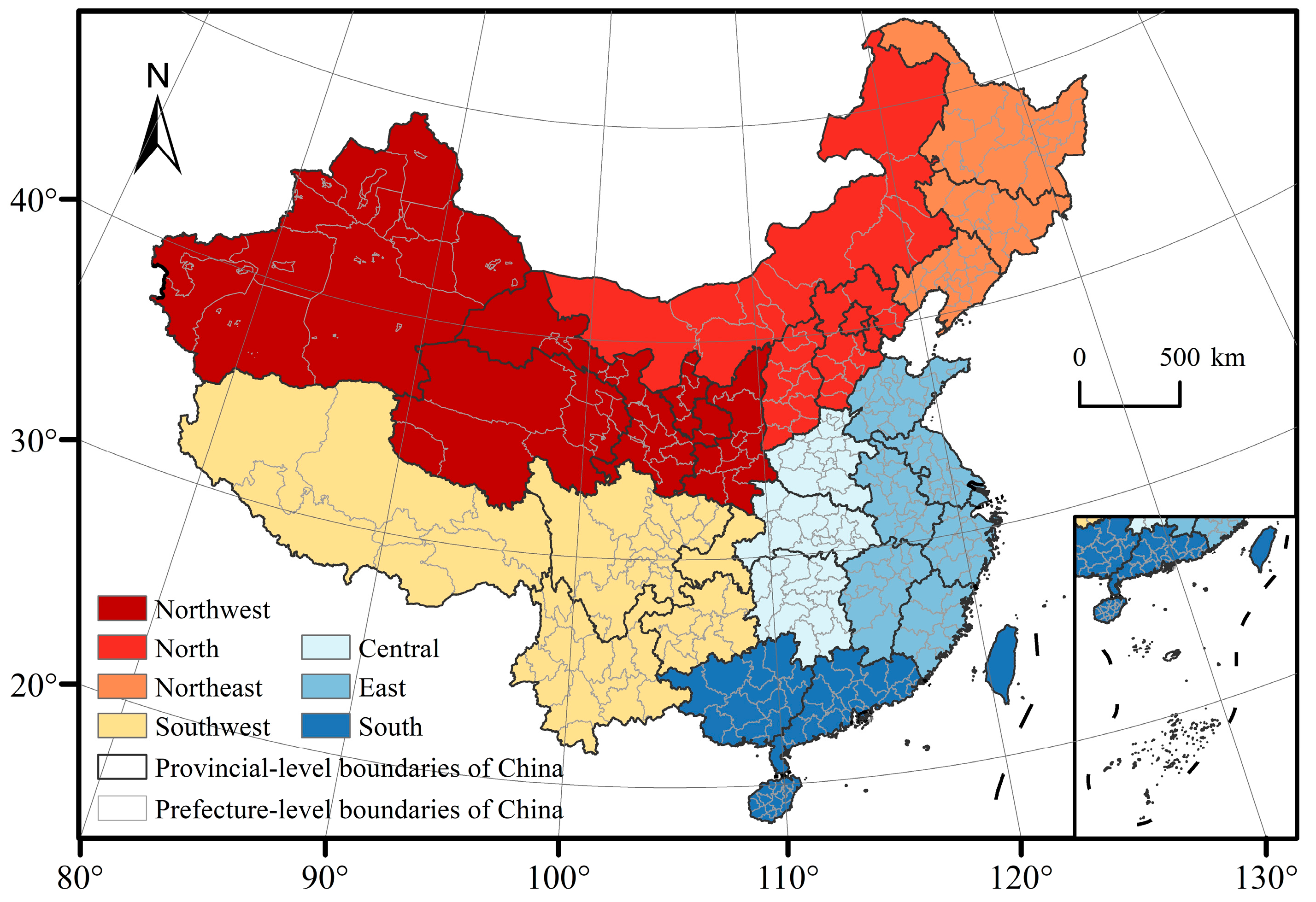
This study focuses on the spatiotemporal evolution of NTL across China (excluding the Sansha Islands) at the grid scale from 2000 to 2023, and examines the spatiotemporal response of NTL to air pollution and meteorological parameters at the prefecture-level city scale and above. For analytical purposes, the 293 prefecture-level cities in China were categorized into seven geographical regions: North China, Northeast China, East China, Central China, South China, Southwest China, and Northwest China (Figure 1).

2.2. Data Source

2.2.1. NTL Data

This study utilizes the Pixel-Scale Calibrated NTL Dataset (PCNL) [37], which provides annual global nighttime light data from 2000 to 2023. While DMSP-OLS and NPP-VIIRS have been widely used in previous research [38], they are limited by inconsistencies in spatiotemporal continuity and a lack of pixel-scale calibration [39]. Among the currently available global long-term NTL datasets, including PCNL, LiNTL [40], and ChenNTL [41], the PCNL dataset is selected for this study due to its inter-calibration between DMSP-OLS and NPP-VIIRS and its pixel-level adjustment. This dataset exhibits stable temporal trends and demonstrates strong performance in long-term analyses, particularly in developing regions such as China.

2.2.2. Independent Variable Data

The study selected meteorological parameters including annual mean temperature (TMP) and annual mean precipitation (PRE), the air pollution factors fine particulate matter (PM2.5) and ozone (O3), the topography factors elevation (DEM) and slope (SLP), the socioeconomic factors population (POP) and Gross Domestic Product (GDP), and the land use factors percentage of land under construction (LUL) and percentage of land under vegetation (LUV). These five categories of factors were used as independent variables in spatiotemporal geographically weighted regression. The variables LUL and LUV were derived from land use classification data [42], while slope (SLP) was calculated from the DEM dataset. Data sources are detailed in Table 1.

2.3. Methods

2.3.1. NTL Standards

To characterize the spatiotemporal patterns of NTL in China, two widely used statistical metrics in nighttime light research are adopted: TNTL and ANTL [49]. TNTL is defined as the sum of all pixel values within the study area:
T N T L = i = 1 n l i
where n is the total number of pixels and l i denotes the radiance value of the i -th pixel in the NTL image.
ANTL is calculated as the mean radiance across all pixels:
A N T L = T N T L / n
Both TNTL and ANTL are expressed in units of nW·cm−2·sr−1.

2.3.2. Trend Analysis

Trend analysis is a widely used approach for examining interannual variation in long-term time series data [50]. This study utilizes the Theil–Sen median method to estimate the slope of change and applies the Mann–Kendall test to assess the significance of trends in nighttime light data. The specific calculation formulas are as follows:
β = M e d i a n x j x i j i      j > i
where M e d i a n ( ) represents the median value. If β > 0 , it indicates an increasing trend; otherwise, a decreasing trend. Based on the Sen’s slope and the Mann–Kendall statistic Z, the significance of trends is classified into three categories: Significant increase ( S e n   s l o p e   >   0 ,   | Z | > 1.96 ); Non-significant change ( S e n   s l o p e   =   0   or trend not statistically significant); Significant decrease ( S e n   s l o p e   <   0 ,   | Z | > 1.96 ).

2.3.3. Standard Deviational Ellipse (SDE) Method

The standard deviational ellipse (SDE) method effectively captures the overall spatial distribution pattern of geographic elements [51]. This approach characterizes the extent of data dispersion through its major and minor axes, where the major axis indicates the primary directional trend and the ellipse shape reflects the overall distribution form. All SDE calculations in this study were performed using the Directional Distribution (Standard Deviational Ellipse) tool in ArcGIS 10.2.

2.3.4. Geographically and Temporally Weighted Regression Model (GTWR)

The geographically and temporally weighted regression (GTWR) model, originally proposed by Huang et al. (2010) [52] and further developed by Fotheringham et al. (2015) [53], captures spatiotemporal heterogeneity by incorporating spatial and temporal weighting matrices [54]. In this study, the GTWR model is employed to assess the effects of multiple drivers on NTL. Five categories of explanatory variables—climate, air pollution, topography, socioeconomic conditions, and land use—are included as independent variables. The model is formulated as follows:
N T L i = β 0 μ i , v i , t i + β 1 μ i , v i , t i × T M P i + β 2 μ i , v i , t i × P R E i + β 3 μ i , v i , t i × C P R I i + β 4 μ i , v i , t i × P M 2.5 i + β 5 μ i , v i , t i × O 3 i + β 6 μ i , v i , t i × D E M i + β 7 μ i , v i , t i × P O P i + β 8 μ i , v i , t i × G D P i + β 9 μ i , v i , t i × L U L i + β 10 μ i , v i , t i × L U V i + β 11 μ i , v i , t i × T i + ε i
where N T L i is the annual NTL radiance for observation i ; μ i , v i , t i denotes the longitude, latitude, and time coordinate for i ; β 0 μ i , v i , t i is the intercept; and β 1 to β 10 are the local coefficients for TMP, PRE, PM2.5, O3, DEM, SLP, POP, GDP, LUL and LUV.
Prior to GTWR modeling, we assessed potential multicollinearity among the independent variables by calculating the variance inflation factor (VIF) for each variable. A VIF value greater than 10 is commonly regarded as indicative of severe multicollinearity that may distort model estimation. As shown in Table 2, all VIF values are well below 10, with the maximum VIF being 3.13 for LUL. These results confirm that multicollinearity is not a concern in our dataset; therefore, all ten explanatory variables were retained in the GTWR model.
To evaluate the superiority of the GTWR model in capturing spatiotemporal heterogeneity, we additionally fitted OLS and GWR models as benchmarks, and compared their goodness-of-fit using AICc and adjusted R2. GTWR, OLS and GWR model calculations were performed using a plugin within ArcGIS 10.2.

3. Results

3.1. China NTL Spatiotemporal Variations

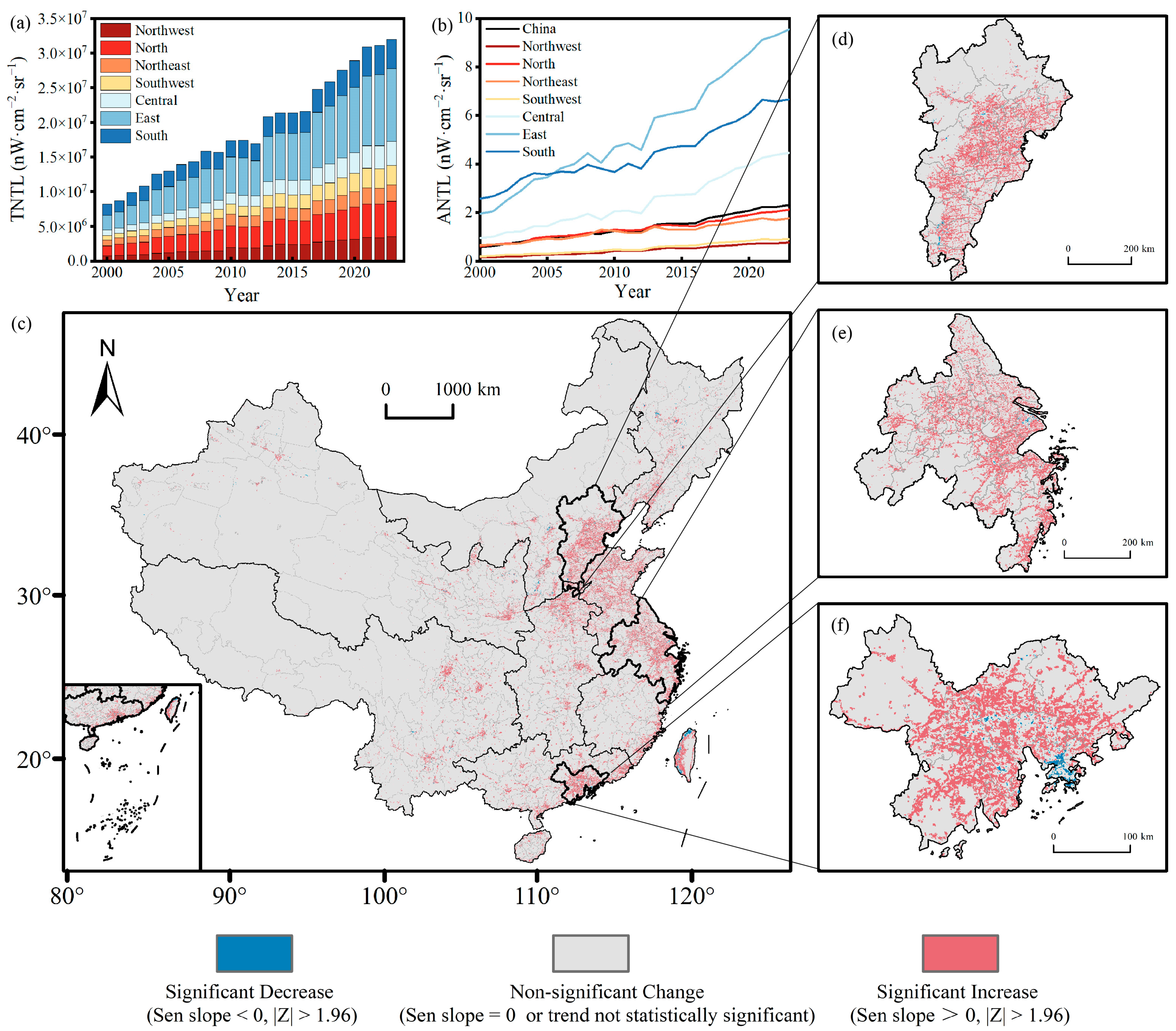
Figure 2 presents changes in TNTL across China’s seven major geographical regions from 2000 to 2023, along with the national trend. Results show that China’s TNTL follows an overall upward trajectory, rising from 8.22 × 10⁶ nW·cm−2·sr−1 in 2000 to a peak of 3.20 × 10⁷ nW·cm−2·sr−1 in 2023. Among the regions, East China exhibited the strongest TNTL growth and the most pronounced fluctuations: its 2023 value was approximately 4.91 times that of 2000, with marked declines in 2009 and 2012 and notable rises in 2013 and 2017. In contrast, Northeast China showed the smallest increase, with 2023 levels about 2.65 times those of 2000 and clear decreases in 2014 and 2022. Nationally, ANTL also increased, ranging between 0.59 and 2.30 nW·cm−2·sr−1, and displayed a spatial pattern generally characterized by higher values in the eastern and southern parts of the country. Among the four northern regions, ANTL gradually increased but consistently remained below the national average, with the largest gaps observed in the Southwest and Northwest. Conversely, East, South, and Central China exceeded the national average, with East China recording the highest ANTL in 2023, which was 8.77 nW·cm−2·sr−1 higher than that of Northwest China. Overall, between 2000 and 2023, NTL in northern China grew slowly with limited interannual variation, whereas southern regions experienced more rapid and volatile growth.
During the 24-year study period, in areas where China’s NTL underwent change (Figure 2c), regions showing an increasing or significantly increasing trend accounted for 92.04% of the total (with significantly increasing areas making up 82.80%), while those exhibiting a decreasing or significantly decreasing trend constituted 7.96%. Significantly increasing regions were mainly concentrated in the Yangtze River Delta urban agglomeration (Figure 2e), the Guangdong–Hong Kong–Macao Greater Bay Area (Figure 2f), and coastal areas north of Taiwan in the southeastern seaboard. A notable concentration of increase was also observed at the tri-junction of North China, East China, and Central China. Overall, areas of significant increase generally radiated outward from major urban centers. At the local scale, regions with significant NTL decrease (Figure 2d) were primarily located in the core zones of large cities, transitioning from decrease to no change and then to increase with increasing distance from the city center.

3.2. Spatial and Temporal Patterns of Meteorological Parameters and Air Pollution

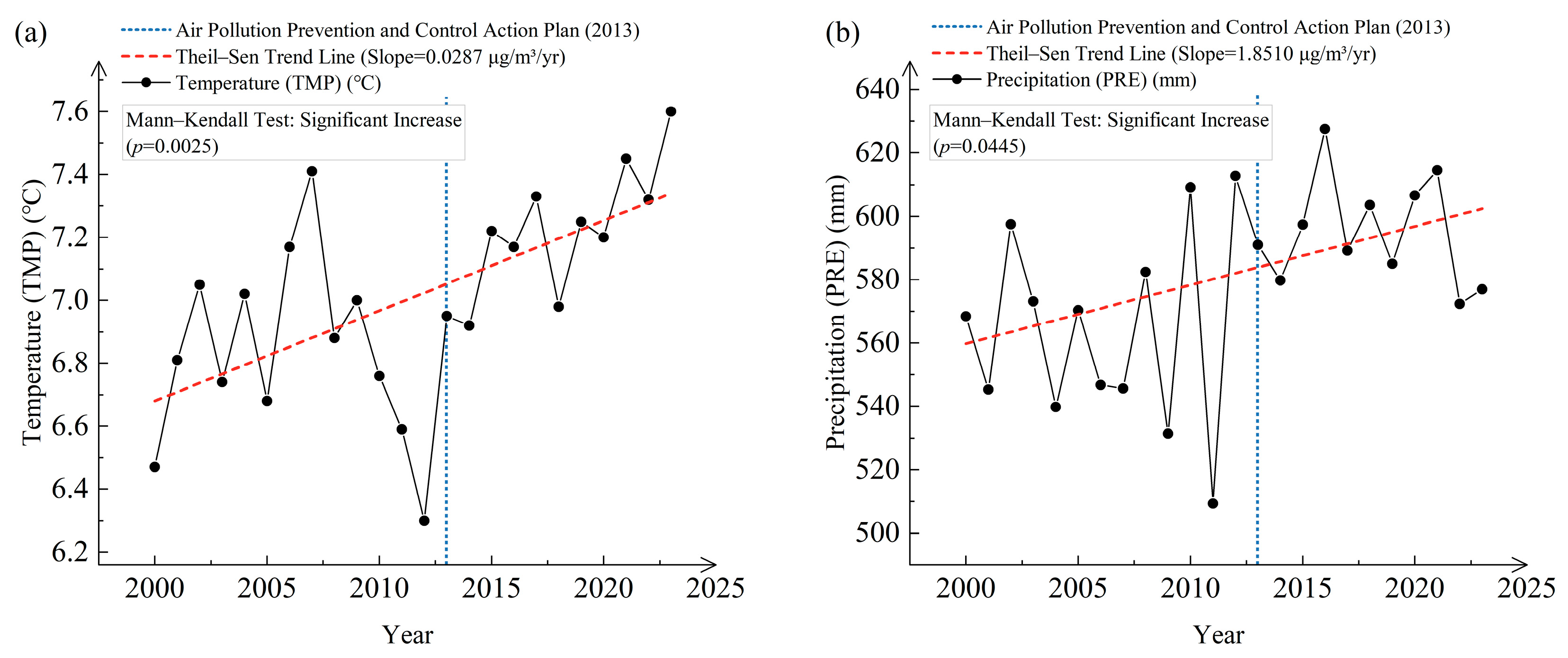
Figure 3 displays the interannual variations in annual mean TMP and annual total PRE in China from 2000 to 2023. TMP exhibited a significant increasing trend, with values rising from 6.47 °C in 2000 to 7.60 °C in 2023. The warmest year was 2023 (7.60 °C), while the coolest occurred in 2000 (6.47 °C). PRE also showed a significant upward trend, fluctuating between a minimum of 509.25 mm (2011) and a maximum of 627.58 mm (2016). Despite considerable interannual variability, the long-term increase in both TMP and PRE indicates a warming and wetting tendency over the study period, consistent with broader climatic changes in China.
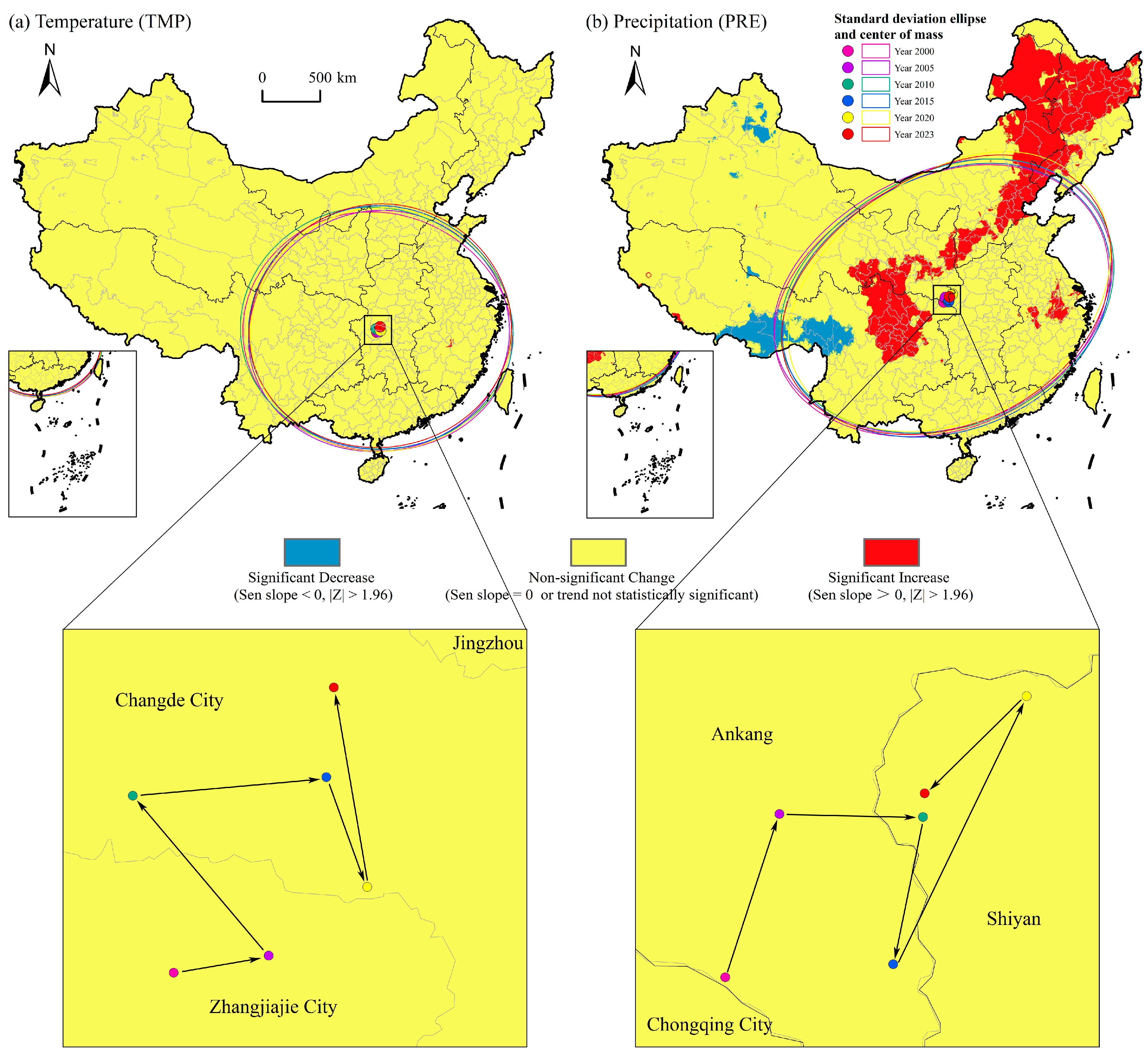
During the period from 2000 to 2023, the directional dispersion of TMP distribution in China was relatively weak (Figure 4a). The center of gravity of TMP shifted in distinct phases: it moved northward from 2000 to 2015, retreated southward between 2015 and 2020, and resumed a northward movement after 2020. Overall, the trajectory shifted from the southwest toward the northeast, relocating from Zhangjiajie City in Hunan Province to Changde City. Trends in TMP remained largely stable, with 82.45% of the area showing no significant change and 16.04% exhibiting non-significant warming, mainly concentrated in the southeastern coastal region and the Sichuan Basin. No areas experienced extremely significant increases or decreases in TMP. PRE displayed a northeast–southwest oriented elliptical dispersion pattern (Figure 4b). Its center of gravity shifted overall to the northeast, from Ankang City in Shaanxi Province to Shiyan City in Hubei Province, with a northeastward movement from 2000 to 2020 followed by a slight southwestward retraction from 2020 to 2023. Spatially, PRE exhibited a pattern of “increase in the east and decrease in the west.” Areas with non-significant increase accounted for the largest proportion (41.65%), followed by those with non-significant decrease (29.83%), reflecting an overall increasing trend. Regions showing extremely significant increase (6.91%) and significant increase (10.49%) were primarily distributed along a belt extending from the Sichuan Basin through the Qinling–Taihang Mountains to the Northeast Plain. Significant increases in PRE were observed in the Sichuan-Chongqing, Beijing–Tianjin–Hebei, and Northeast urban agglomerations. In contrast, areas with extremely significant decrease (0.64%) and significant decrease (2.09%) were concentrated in the Junggar Basin and along the eastern margin of the Qinghai–Tibet Plateau.
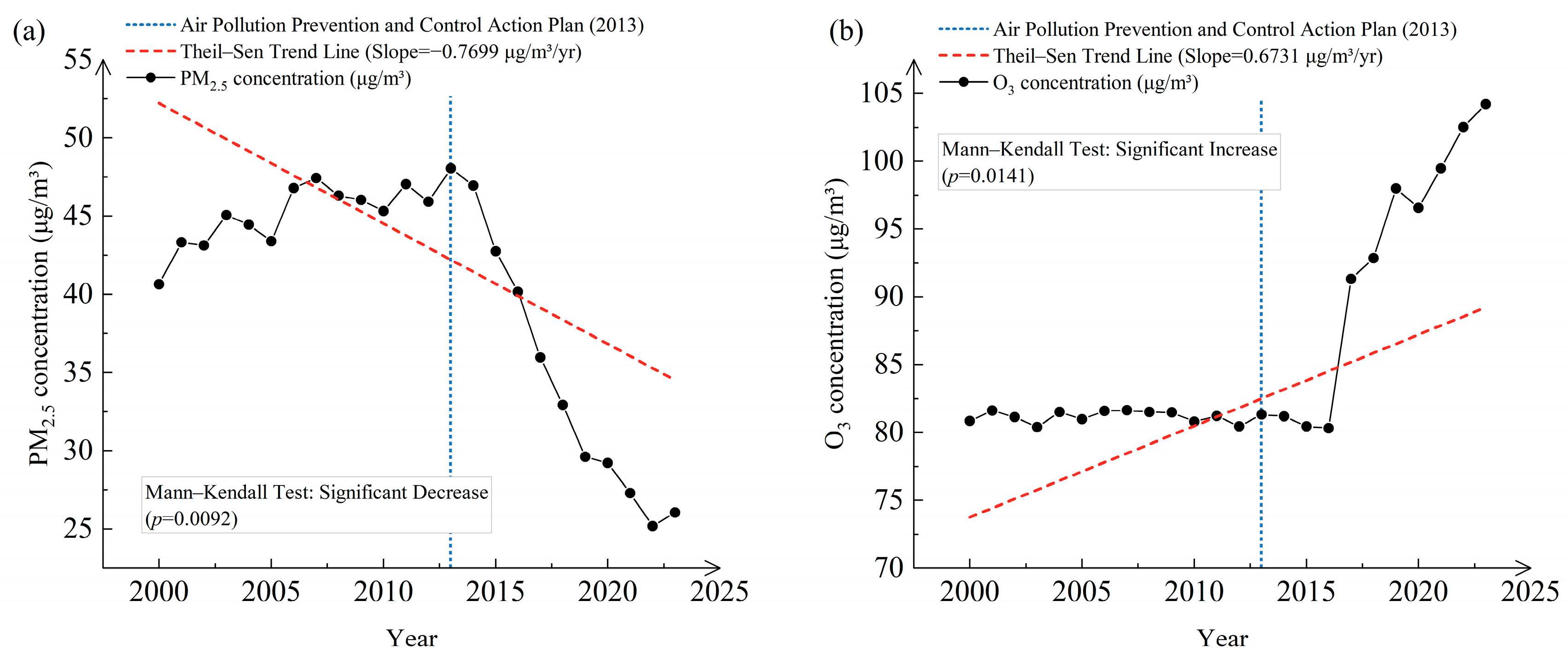
Figure 5 presents the annual mean concentrations of PM2.5 and O3 from 2000 to 2023. PM2.5 concentrations displayed a significant decreasing trend, with a peak of 48.04 μg/m3 in 2013 followed by a sustained decline to 26.06 μg/m3 in 2023. This marked decrease after 2013 coincides with the implementation of the “Air Pollution Prevention and Control Action Plan” (the “Ten-Point Plan”), underscoring the effectiveness of stringent emission controls. In contrast, O3 concentrations exhibited a significant increasing trend, remaining relatively stable around 80–82 μg/m3 before 2017, then rising sharply to 104.21 μg/m3 in 2023. The post-2017 increase reflects the complex photochemical response to precursor reductions and highlights the growing challenge of O3 pollution despite declining PM2.5.
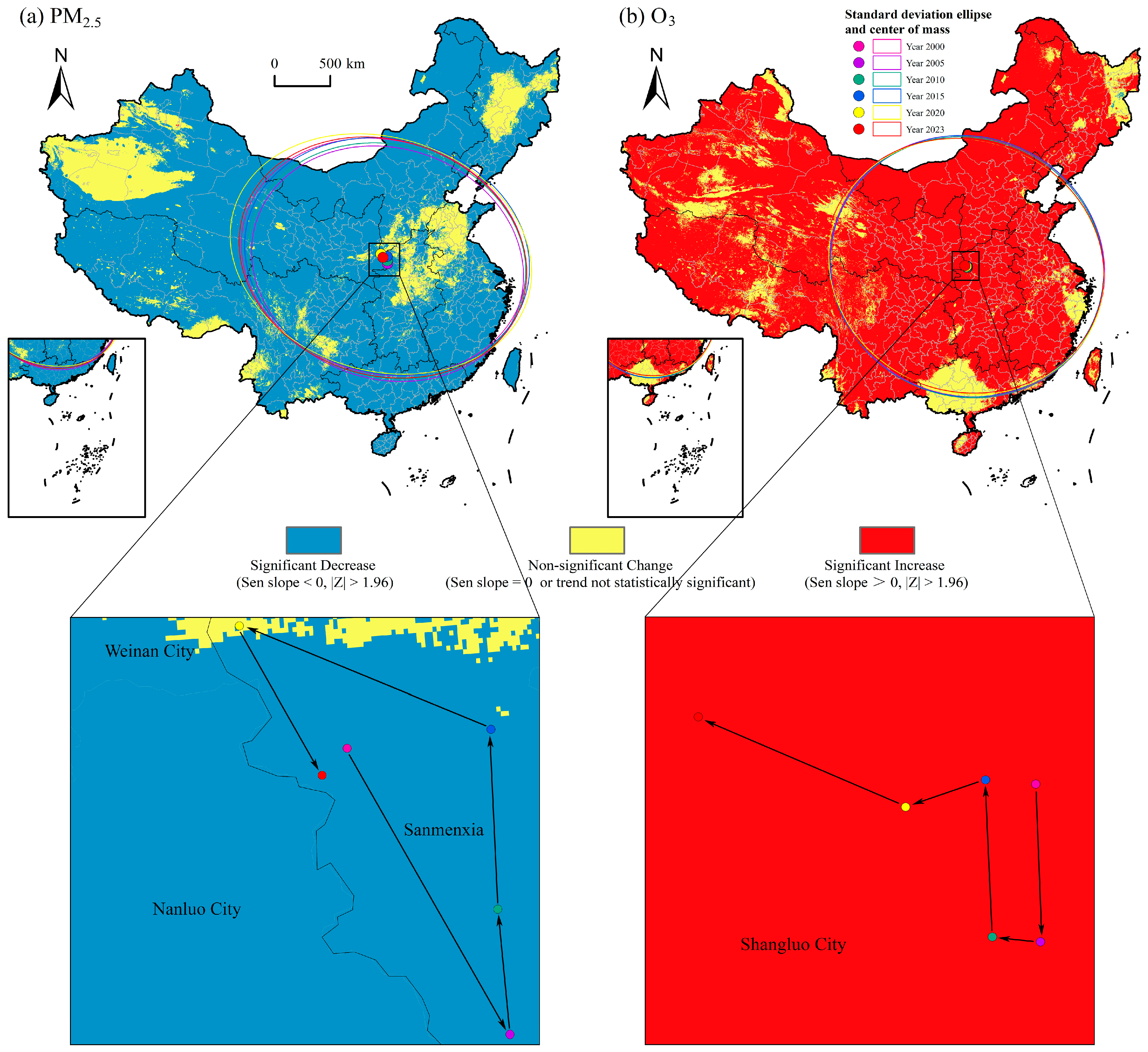
Between 2000 and 2023, the spatial dispersion of PM2.5 concentrations across China generally decreased (Figure 6a). The standard deviational ellipse reached its maximum extent in 2005, oriented along a northwest–southeast axis with a major axis length of 1241.17 km. The center of PM2.5 pollution remained comparatively stable around Sanmenxia City in Henan Province, tracing a south–north–south migration trajectory. By 2023, the spatial centroid (34.21° N, 110.62° E) closely resembled its position in 2000 (34.26° N, 110.68° E). Trend analysis indicates that 83.55% of China’s land area experienced a significant decrease in PM2.5 concentration, of which 56.60% showed an extremely significant decline. The core areas of reduction were located in western regions (excluding Xinjiang) and the southeastern coast. Only Wujiaqu City in the Xinjiang Uygur Autonomous Region exhibited a non-significant increasing trend. For ozone (O3), the standard deviational ellipse shifted westward and northward over the study period (Figure 6b). The pollution center moved southward from Shangluo City in Shaanxi Province between 2000 and 2010 (displacement 11.34 km), then turned northwestward from 2010 to 2023 (displacement 20.32 km), reflecting an inland expansion of ozone pollution. Areas with significantly increasing O3 concentrations accounted for 87.61% of the total study area, including 64.96% classified as extremely significant increases. In northwestern China, the trend exhibited elevation dependence, with pronounced increases occurring mainly in lower-elevation zones. Notable hotspots of increase emerged in the source regions of the Yellow River and Jinsha River. Against the general upward trend observed across central and eastern China, only the southwestern area around Mudanjiang–Jixi showed a significant decrease in O3 concentration.
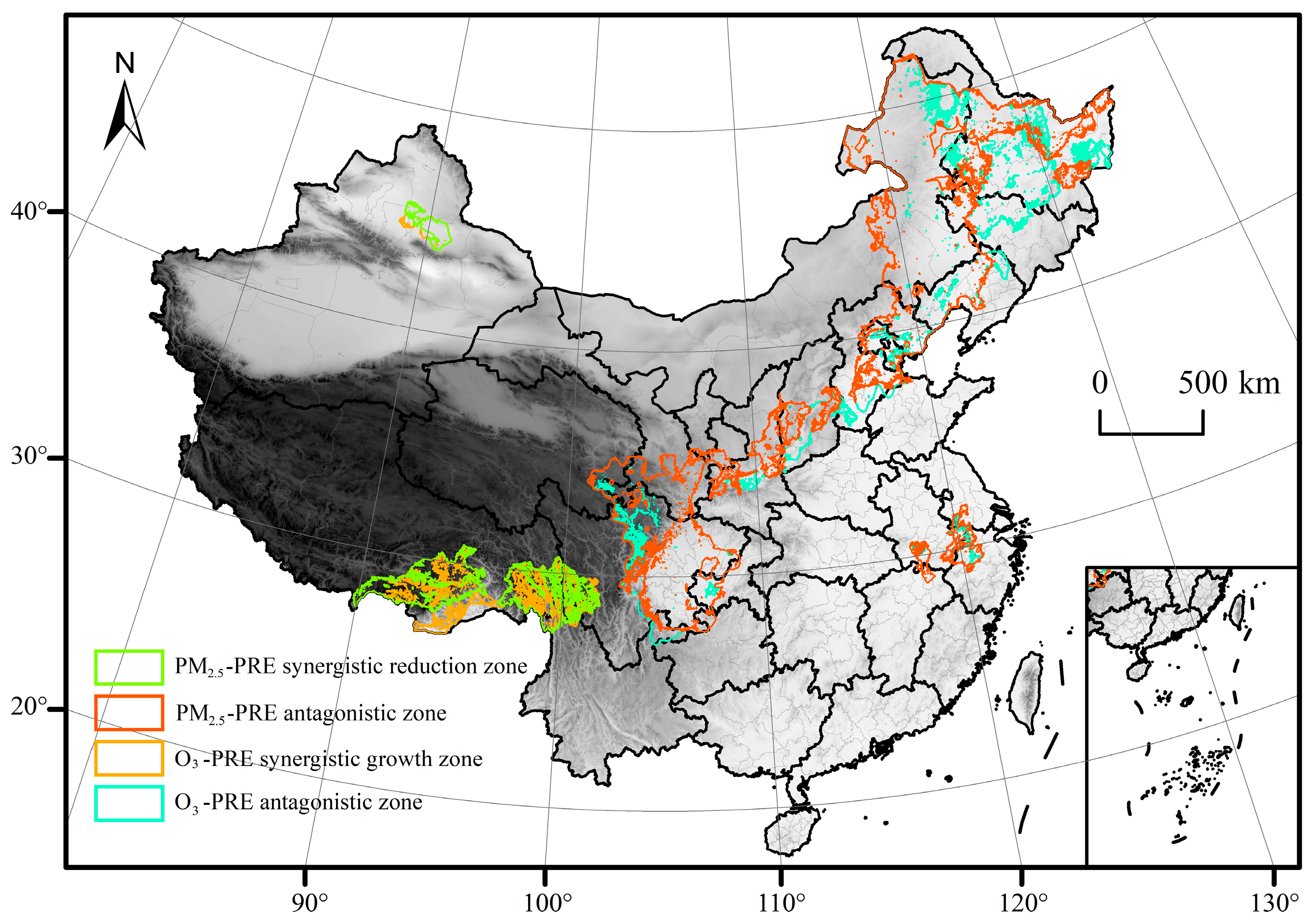
Between 2000 and 2023, the spatial coupling between climatic factors and air pollution in China displayed pronounced regional heterogeneity (Figure 7). Synergistic increase zones of O3 and PRE covered 15.91% of the national land area, primarily distributed across Northeast and Central China. Antagonistic zones between PM2.5 and PRE accounted for 14.37%, concentrated in the North China Plain, the Sichuan Basin, and scattered parts of East China. The southwestern region and the Junggar Basin featured co-decreasing zones of PM2.5 and PRE (2.25%) and antagonistic zones between O3 and PRE (2.25%). Synergistic or antagonistic zones involving TMP and either pollutant were minimal (0.02%), a pattern constrained by the limited variability in TMP trends, as 82.45% of the area exhibited no significant change. This spatial decoupling suggests that regional differences in climatic and pollution changes may influence NTL dynamics through non-stationary spatiotemporal mechanisms. The following analysis employs the GTWR model to quantify the spatiotemporal weights of each driving factor and examine their differentiated pathways.

3.3. Model Selection and Validation

To evaluate the capability of the GTWR model in capturing spatiotemporal heterogeneity, we compared its performance against two benchmark models—ordinary least squares (OLS) and geographically weighted regression (GWR)—using key goodness of fit indicators: the coefficient of determination (R2), adjusted R2, Akaike information criterion (AICc), and residual standard error (Sigma). As summarized in Table 3, GTWR achieved the highest R2 (0.910) and adjusted R2 (0.909), alongside the lowest AICc (7988.49) and Sigma (1.905). The AICc, which penalizes model complexity, is considerably smaller for GTWR than for GWR (8177.18) and OLS (9342.61), indicating that GTWR provides the best balance between explanatory power and parsimony. A similar pattern was observed in the residual standard error (Sigma), which declined from 2.934 (OLS) to 2.059 (GWR) and further to 1.905 (GTWR), indicating a steady reduction in unexplained variance as more heterogeneity was accounted for.
These results demonstrate that incorporating both spatial and temporal dimensions substantially improves model performance. The GTWR framework captures the spatiotemporal non stationarity inherent in the relationship between NTL and its driving factors, thereby providing a more accurate representation of the underlying dynamics compared to conventional global or spatially explicit models.

3.4. Temporal Dynamics and Overall Contributions of Driving Factors

The statistical significance of the GTWR coefficients was first evaluated (Table 4). All ten drivers exhibited significant effects in over 96% of the spatiotemporal units (p < 0.05), confirming the robustness of the model estimates. Notably, LUL and POP were almost exclusively positive (99.95% and 92.19%, respectively), while PM2.5 and LUV were predominantly negative (86.79% and 90.80%). These high significance proportions indicate that the relationships captured by GTWR are widespread rather than driven by outliers.
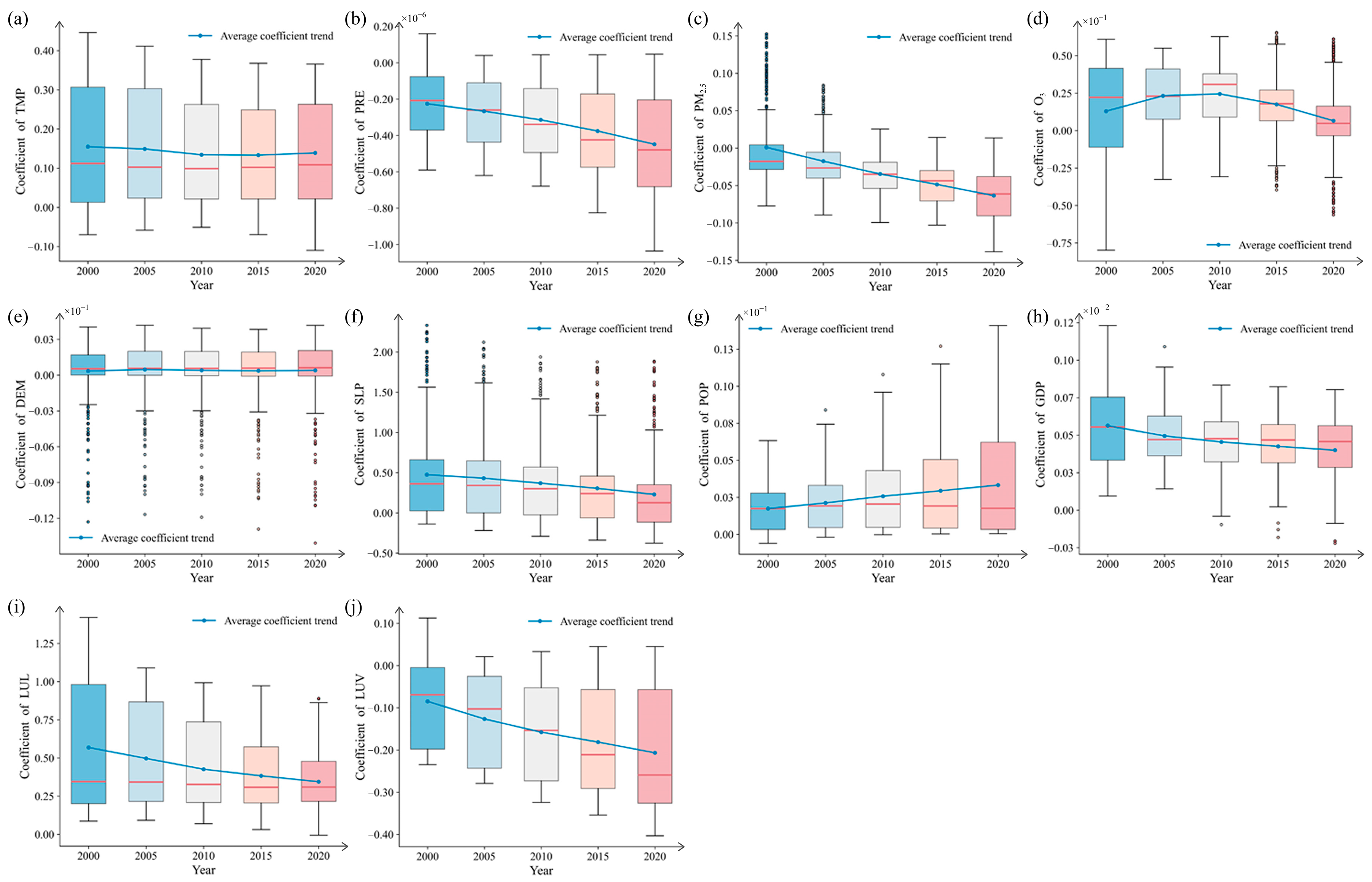
Table 5 summarizes the descriptive statistics of the local coefficients. Based on the mean values, the overall contribution of each driver to NTL, ranked in descending order of absolute magnitude, is as follows: LUL (0.44) > SLP (0.36) > LUV (−0.15) > TMP (0.14) > PM2.5 (−0.033) > O3 (0.017) > POP (0.0025) > GDP (0.00047) > DEM (0.00040) > PRE (−3.0 × 10⁻⁷). Land use and topographic factors exhibit the largest effects, while socioeconomic variables, despite their smaller coefficients, show consistently positive and stable influences across the study area, as reflected in their narrow interquartile ranges (IQRs). In contrast, air pollution (PM2.5, O3) and climatic factors (TMP, PRE) display wider IQRs and more balanced positive–negative distributions (Table 4), indicating substantial spatial heterogeneity in their effects.
Temporally, the GTWR coefficients display distinct evolutionary trends for different drivers (Figure 8). The effects of PRE, PM2.5, POP, and LUV gradually strengthened over the study period. The increasing influence of PM2.5 may be linked to the rapid industrialization and urbanization experienced by many regions in China during the 2000s–2010s, while the strengthening of POP effects could reflect continued population agglomeration in economically developed areas. The influence of O3 on NTL peaked around 2010 (median = 0.031) and subsequently declined. This pattern coincides with the implementation of stringent air pollution control policies in China after 2013, which have effectively reduced PM2.5 concentrations but have had complex effects on O3 chemistry. In contrast, the coefficients of SLP, GDP, and LUL showed a decreasing trend, while TMP and DEM remained relatively stable throughout the period. The declining role of GDP and LUL may suggest that economic growth and land expansion are no longer the primary drivers of NTL increase in already developed regions, where lighting efficiency improvements and saturation effects may play a larger role.
Overall, these results highlight the dominant and spatially stable role of land use and socioeconomic factors in driving NTL changes, while the effects of air pollution and climatic factors are more variable and context-dependent.

3.5. Spatial Heterogeneity of Driving Factors

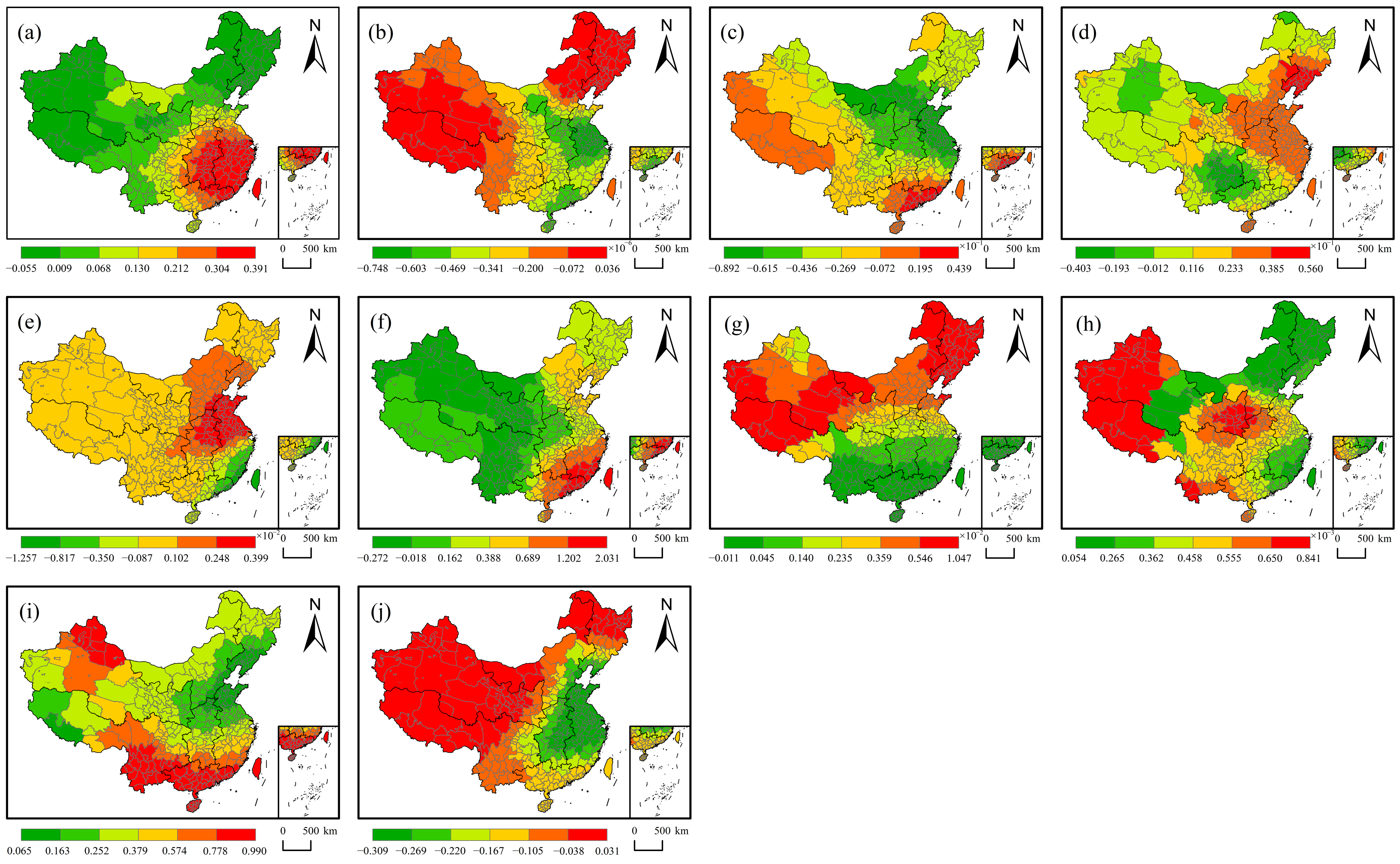
The GTWR results demonstrate distinct spatial heterogeneity in the effects of natural and anthropogenic drivers on NTL (Figure 9). Regions with high positive regression coefficients for TMP are concentrated in the transitional zone between South China, East China, and Central China, indicating a generally positive influence of temperature on NTL. In contrast, negative coefficients are clustered in western and northeastern China, reflecting a suppressive effect of warming on nighttime light. The spatial pattern of PRE coefficients shows a bipolar structure: positive values are mainly found in Northeast China, eastern North China, southern Northwest China, and the northwestern part of Southwest China, whereas negative values appear in western North China and northeastern East China, suggesting an overall negative response of NTL to increased precipitation.
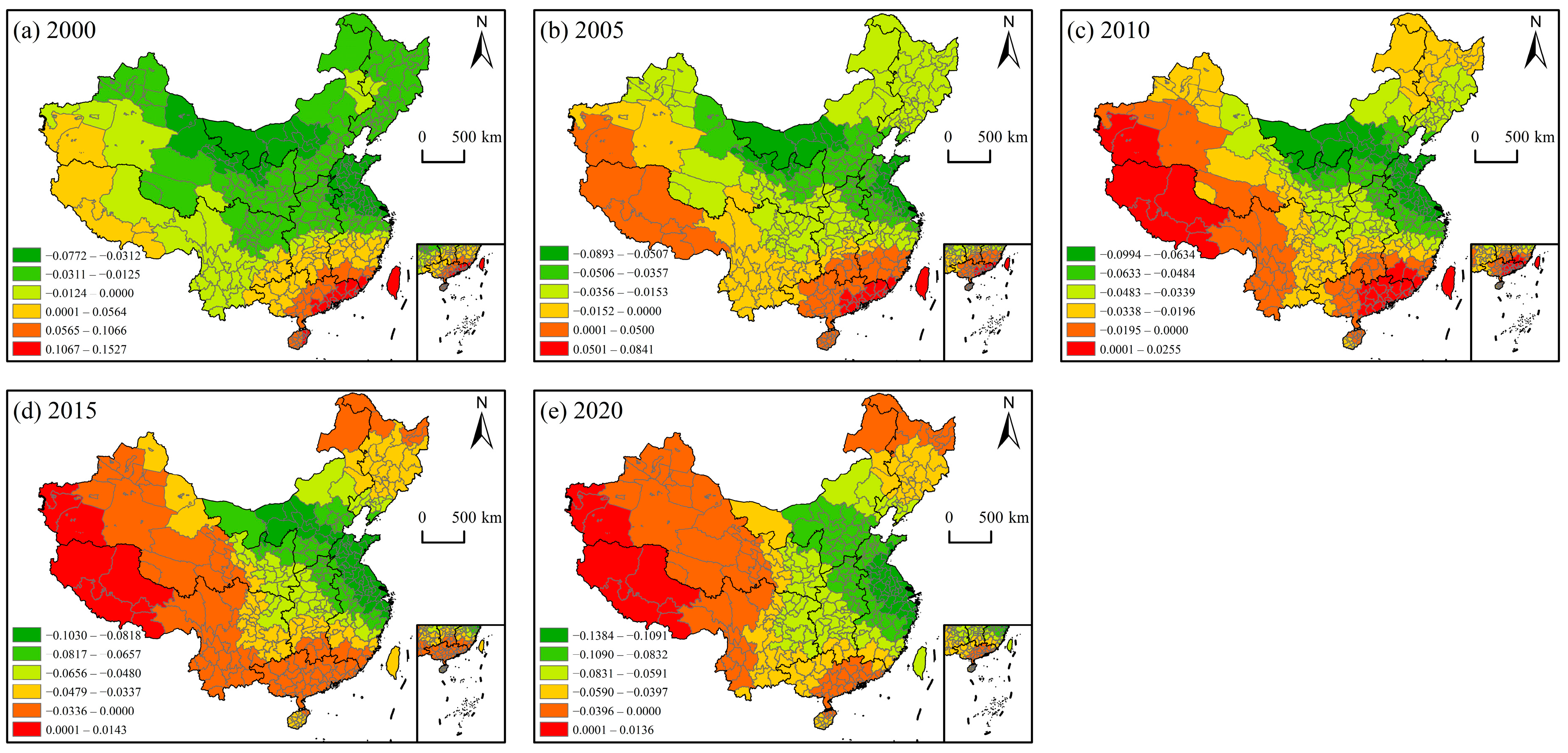
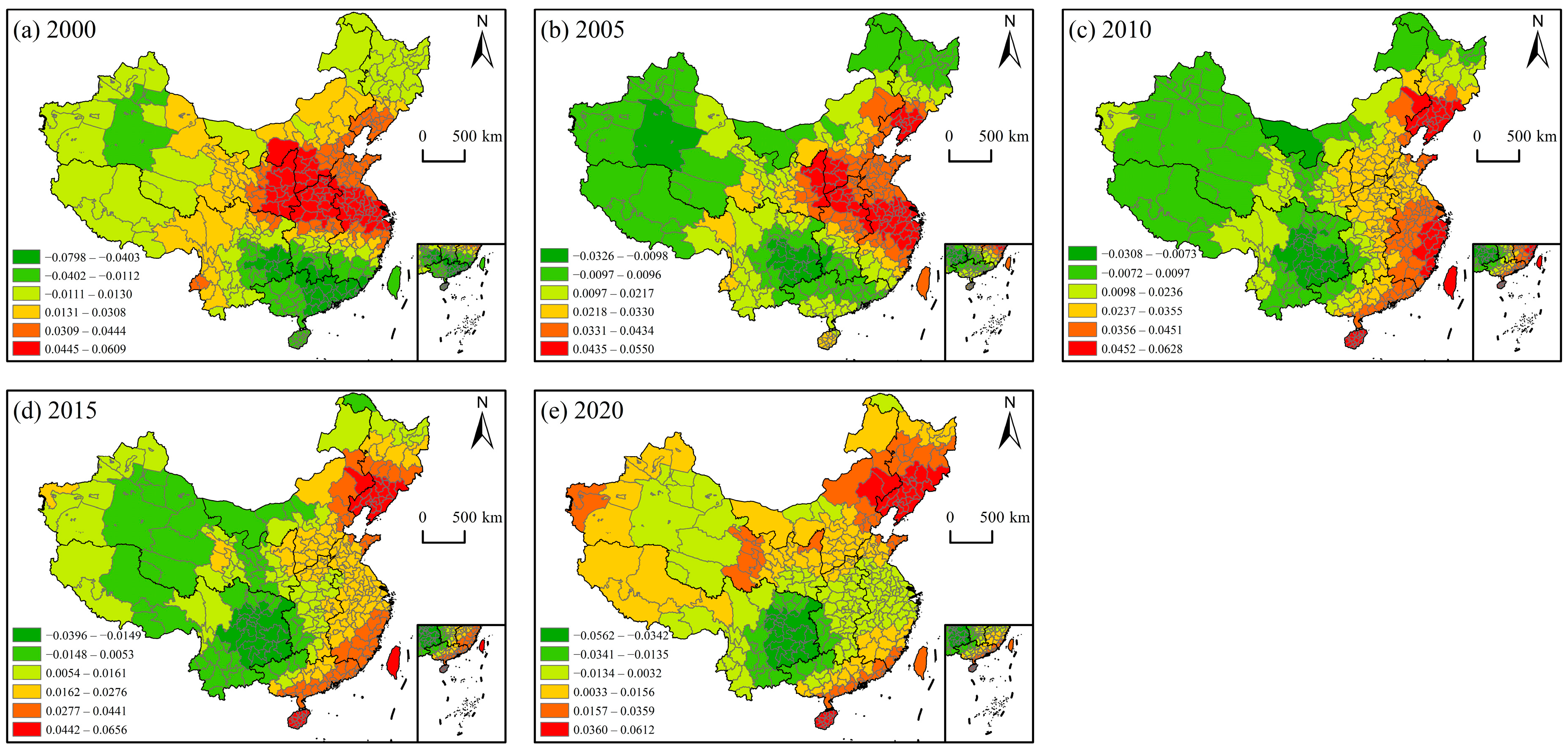
The spatial distribution of PM2.5 regression coefficients (Figure 9c) reveals that strongly negative values are concentrated in northern East China and southwestern North China, whereas strongly positive values are distributed along the southeastern coast. Further analysis integrating national PM2.5 concentration trends with regional NTL growth indicates that the PM2.5–NTL relationship exhibits clear phased evolution and spatial heterogeneity (Figure 10). In the early period prior to stringent air pollution control (2000–2010), the southeastern coastal region and Taiwan Province showed high positive correlations between PM2.5 and NTL, suggesting that rising PM2.5 concentrations coincided with increased nighttime activity. In contrast, regions such as North China and East China displayed strong negative correlations, reflecting a suppressive effect of air pollution on regional nighttime activity levels. During the pollution control transition phase (2015–2020), the positive correlation zone along the southeastern coast gradually diminished, with only southwestern cities remaining as areas of positive association. Concurrently, the strength of negative correlations increased markedly in core urban agglomerations such as the Yangtze River Delta and Beijing–Tianjin–Hebei, reflecting a joint boost to NTL from reduced PM2.5 under rigorous environmental policies and ongoing service-sector upgrading. The proportion of positively correlated areas decreased from 20.13% in 2000 to 14.30% in 2020. Spatially, this positive correlation fundamentally represents a spatiotemporal mapping of the path dependence between pollution and economic development at specific stages, rather than indicating that pollution directly drives NTL growth.
The spatial distribution of O3 regression coefficients (Figure 9d) indicates that ozone does not exert a spatially uniform effect on NTL. Areas of strong positive correlation are located in southern Northeast China, whereas strong negative correlations are concentrated in the eastern part of Southwest China, particularly the Sichuan Basin. Temporally (Figure 11), zones of high negative correlation were initially clustered in Guizhou and Guangdong provinces and later contracted toward the Sichuan Basin. The proportion of negatively correlated areas decreased from 37.46% in 2000 to 16.07% in 2010, then increased again to 31.21% in 2020, a pattern closely linked to the marked rise in O3 concentrations after 2017. Regions of high positive correlation evolved from a latitudinal belt between 25° N and 35° N in central-eastern China into a multi-core structure that includes the southeastern coast, southern Northeast China, and the Bohai Bay region. Influenced indirectly by service-sector upgrading and transportation electrification, the positive correlation along the southeastern coast weakened in later years.
The spatial distribution of high DEM regression coefficients (Figure 9e) is concentrated in the transitional zone among North, Central, and East China. While this region exhibits moderate topographic relief, concentrated urban development and industrial-agricultural activities intensify human presence, leading to a positive relationship between elevation and NTL. In contrast, the southeastern coastal plains—where urbanization is focused in low-elevation areas—show a negative DEM-NTL correlation. The spatial differentiation of SLP coefficients is pronounced (Figure 9f). Positive correlations appear in the hilly southeastern coastal region, likely associated with the expansion of mountain tourism and specialized agricultural lighting. Conversely, negative correlations are observed in the ecologically fragile northwest and southwest, reflecting the constraint of steep slopes on human activity. POP regression coefficients (Figure 9g) display an east–west band-like pattern across western China, North China, and Northeast China—regions with relatively low population density—indicating significant potential for population growth to enhance NTL. In sparsely populated southern hills and densely populated coastal urban agglomerations, the influence of POP on NTL is transitional or weakly negative. GDP regression coefficients are positive nationwide (Figure 9h), with high-value areas distributed in western China (Xinjiang, Tibet), central China (Shaanxi Province), and southern Southwest China, directly linked to the expansion of nighttime production activities. All LUL regression coefficients show positive correlations (Figure 9i). Southern China exhibits high economic vitality, where urbanization directs new construction land toward commercial complexes, residential communities, and high-tech industrial parks—all areas with substantial nighttime lighting demand. Coupled with active nighttime outdoor activity, this region displays high coefficient values. Northern Xinjiang shows moderately high values, likely due to nighttime operations linked to energy development. LUV regression coefficients are predominantly negative (Figure 9j), with positive zones appearing in parts of Northeast, Southwest, and South China. In these regions, increased vegetation cover significantly improves ecological quality while promoting eco-tourism and related industries, thereby exerting a positive effect on NTL.

4. Discussion

4.1. Spatiotemporal Evolution Patterns of NTL

China’s TNTL has increased significantly, yet exhibits pronounced regional heterogeneity. East China shows the strongest TNTL growth with considerable fluctuation, consistent with its role as a major engine of China’s economy. In this region, the Yangtze River Delta and Pearl River Delta urban agglomerations have driven rapid expansion of nighttime economic activity through industrial clustering, attraction of foreign investment, and innovation-led development [37,42]. The decline in TNTL between 2009 and 2012 coincides with reduced exports resulting from the global financial crisis and the European debt crisis [55]. The slowest TNTL growth occurs in Northeast China, reflecting structural challenges associated with its traditional industrial base, where the decline of heavy industries and delayed emergence of new sectors [56,57] have limited nighttime economic vitality. Furthermore, areas of significant NTL increase generally radiate outward from major urban centers, aligning with documented patterns of urban expansion, suburban industrialization, and transport network extension [58]. Localized decreases in NTL brightness within urban cores arise from the relocation of energy-intensive industries and the replacement of vegetated land during urban redevelopment [59,60]. This pattern manifests as brightness saturation in city centers coupled with increased radiance in suburban zones [61], producing a spatial structure characterized by “central dimming and peripheral expansion.”

4.2. Spatiotemporal Nonstationarity Between Meteorological Parameters and Air Pollution

From 2000 to 2023, the spatiotemporal patterns of climate and air pollution in China exhibited marked non-stationarity. Targeted emission control policies have driven a significant improving trend in the spatiotemporal distribution of PM2.5 concentrations [62], whereas O3 concentrations increased markedly after 2017, with the pollution centroid shifting toward inland northwestern regions. This shift is closely associated with enhanced photochemical reactions and regional differences in precursor emissions [63]. Climate factors nonlinearly modulate pollutant distributions: in North China and the Sichuan Basin, increased PRE suppresses PM2.5 accumulation through wet deposition [64]; meanwhile, rising humidity in Northeast and Central China intensifies photochemical activity, manifesting as synergistic increases in O3 and PRE [65]. Wang et al. [66] observed in a U.S. context that intensified drought may offset anthropogenic emission reductions; the relatively limited area of concurrent PM2.5-PRE decline in southwestern China may reflect a similar dynamic. Notably, the northeastward shift in the PRE gravity center (2000–2020) correlates with interannual variability in the East Asian summer monsoon and anomalies of the western Pacific subtropical high [67]. Concurrently, the “south–north–south” oscillation of the high-temperature centroid couples with regional responses to extreme heat under global warming [68]. The spatiotemporal divergence of these two phenomena collectively amplifies the complexity of the regional climate system.

4.3. Spatiotemporal Heterogeneity of Driving Mechanisms for NTL

4.3.1. Drivers of the Long-Term Secular Trend in NTL

The GTWR results identify a set of factors whose effects on NTL are characterized by temporal stability and consistently positive contributions. LUL exhibits the largest mean coefficient (0.44) among all drivers, with an exceptionally high proportion of significant positive effects (99.95%) and a narrow interquartile range (Table 4 and Table 5; Figure 8). This temporal stability and magnitude indicate that urbanization, proxied by construction land expansion, serves as the fundamental driver of the long-term secular increase in NTL observed over the past two decades. This finding aligns with a broad literature demonstrating that NTL effectively captures urban development dynamics [69], and that land use change associated with urbanization is a primary determinant of NTL emissions [70].
Socioeconomic factors, GDP and POP, also exhibit consistently positive coefficients throughout the study period, albeit with smaller magnitudes (mean = 0.00047 and 0.0025, respectively). Their narrow interquartile ranges and high proportions of significant positive effects (Table 4) suggest that economic growth and population agglomeration contribute steadily to the underlying NTL trend, consistent with studies linking NTL to economic activity [71] and population distribution [72]. Together, these factors form a stable urbanization—economy—population baseline upon which other environmental and pollution factors superimpose their effects.
Other factors, such as topography (DEM, SLP) and LUV, exhibit wider interquartile ranges and more balanced positive—negative distributions (Table 4), indicating that their influence operates primarily at interannual timescales or exhibits strong spatial heterogeneity. These are discussed in detail in Section 4.3.2, alongside climatic and air pollution factors.

4.3.2. Climatic Modulation of Interannual NTL Variability

In contrast to the stable long-term drivers discussed in Section 4.3.1, climatic and air pollution factors exhibit wider interquartile ranges, more balanced positive–negative distributions, and greater temporal fluctuations (Table 4 and Table 5; Figure 8). These characteristics suggest that their influence on NTL operates primarily at interannual timescales, modulating year-to-year departures around the urbanization-driven baseline established by LUL, GDP, and POP. The following subsections discuss the specific roles of TMP, PRE, PM2.5, and O3 in shaping these interannual variations.
This study applies a geographically and temporally weighted regression (GTWR) model to elucidate the differentiated driving mechanisms of ten natural and anthropogenic factors on the spatiotemporal evolution of NTL in China. The influence of temperature (TMP) displays a north–south divergence: in South and Central China, rising TMP may extends nighttime business hours and stimulates outdoor consumption, thereby enhancing NTL; conversely, in Western and Northeastern China, higher temperatures may exacerbate ecological fragility [73,74] and reduce the intensity of nighttime agricultural and pastoral activities, potentially leading to diminished NTL. Temperature may also influence NTL indirectly through its effects on atmospheric stability and boundary layer dynamics, which can modulate aerosol accumulation and hygroscopic growth, thereby affecting aerosol optical depth and atmospheric extinction [75]. This north–south divergence, together with TMP’s wide interquartile range (Table 5), is consistent with temperature modulating interannual variability in nighttime activity rather than driving the long-term trend. In the arid and semi-arid regions of Northeast and Northwest China, increased precipitation may improve ecological carrying capacity and promotes related productive inputs, thereby strengthening NTL [76]. By contrast, in areas such as western North China and northeastern East China, where baseline precipitation already meets ecological and human activity needs, further precipitation increases can suppress industrial output [77] and reduce transportation mobility [78], resulting in weaker NTL. These contrasting regional responses, along with PRE’s balanced positive–negative distribution (Table 4), support its role in influencing interannual NTL fluctuations, particularly in water-sensitive regions. Precipitation can also directly affect satellite-observed NTL by reducing clear-sky observations and introducing compositing biases in annual NTL products, as well as by scavenging aerosols that would otherwise contribute to atmospheric extinction.

4.3.3. Air Pollution Modulation of Interannual NTL Variability

Air pollution factors also exhibit characteristics consistent with modulating interannual variability, as reflected in their wide coefficient ranges and phase-specific behaviors.
The impact of PM2.5 on NTL demonstrates pronounced spatial heterogeneity and phase-specific characteristics. During the early period (2000–2010), prior to the implementation of stringent pollution controls, PM2.5 concentrations and NTL brightness exhibited a synchronous upward trend in many regions, with positive associations between PM2.5 and NTL prevailing in the spatial patterns of GTWR coefficients. This co-variation likely reflects the simultaneous expansion of industrial activity and energy consumption, which drove both emissions and nighttime light emissions [79]. After the introduction of the “Ten-Point Plan” in 2013, the PM2.5–NTL relationship shifted notably. Core urban agglomerations such as North China and the Yangtze River Delta exhibited a strong negative correlation, as stringent environmental regulations jointly suppressed high-pollution industries and promoted service-sector upgrading [80], leading to lower PM2.5 concentrations and a low-carbon transition of the nighttime economy [81]. Driven by the Western Development Strategy, localized positive correlations between PM2.5 and NTL persisted in Southwest China from 2015 to 2020, indicating that infrastructure and energy projects temporarily maintained the short-term “pollution-economy” path dependency [82]. The phased shifts in PM2.5–NTL associations before and after 2013 illustrate how policy interventions can modulate interannual pollution effects without altering the underlying NTL trend driven by urbanization and economic growth. It should be noted that the negative coefficients for PM2.5 may partly reflect aerosol optical effects arising from increased atmospheric extinction under high PM2.5 concentrations, an effect further amplified under high relative humidity due to hygroscopic aerosol growth [75], rather than solely capturing behavioral responses to pollution. This spatiotemporal divergence highlights that the effect of PM2.5 on NTL is jointly shaped by policy intensity and regional development stage. This spatiotemporal divergence suggests that: in the initial control phase, PM2.5—as an industrial by-product—increased in tandem with NTL; in the mature control phase, declining PM2.5 levels accompanied industrial restructuring, which may indirectly boost nighttime consumption and lighting demand by improving environmental quality.
Regarding O3, its relationship with NTL was generally weak from 2000 to 2016. After 2017, however, the negative correlation between rising O3 and NTL strengthened in regions such as the Sichuan Basin, where O3 pollution likely suppressed outdoor activities [83] and thus reduced nighttime economic vitality. In industrial and transportation hubs like southern Northeast China and the Bohai Bay area, emissions of O3 precursors grew alongside nighttime economic activity [84], resulting in a positive O3–NTL correlation. The GTWR results reveal substantial variability in O3 coefficients across space and time (Table 4 and Table 5): positive associations predominate in the majority of significant units, yet negative associations are also non-negligible, and the coefficient magnitudes span a wide range. This pronounced variability suggests that O3 does not exert a consistent directional influence on NTL; rather, its association is contingent upon regional precursor regimes and socioeconomic contexts. This negative association may also be influenced by O3’s co-variation with photochemical haze and visibility loss, which can indirectly attenuate satellite-detected NTL [85]. The pronounced variability in O3 coefficients across space and time reinforces that O3 primarily contributes to interannual and spatial heterogeneity in NTL, rather than acting as a consistent long-term driver. Following the 2013 Action Plan, the positive explanatory power of O3 on NTL weakened in the North China–East China border zone, consistent with the partial suppression of O3 formation under the nitrogen oxides (NOx)-priority control strategy. Nevertheless, the continued nationwide rise in O3 concentrations revealed a lag in the coordinated management of volatile organic compounds (VOCs) and NOx [86]. The dual-sided influence of O3 illustrates that its linkage with NTL depends on the interplay among precursor emission structures, photochemical reactivity, and types of human activity.
Collectively, the interpretations presented in this section are inferred from the observed statistical associations and should be regarded as plausible mechanisms that warrant further investigation using more detailed behavioral, meteorological, or experimental data. The GTWR framework identifies spatially varying correlations, which provide a foundation for generating hypotheses about underlying processes, but does not establish definitive causal pathways.

4.4. Limitations and Future Research

This study systematically examines the spatiotemporal response of China’s NTL to meteorological parameters and air pollution, yet it acknowledges three main limitations. First, the analysis focuses on the prefecture-level city scale and does not capture spatial heterogeneity at finer grid resolutions, which may constrain the understanding of local human-environment interactions. Second, although the GTWR model effectively captures spatiotemporal non-stationarity, it does not fully represent nonlinear dynamic responses to abrupt disturbances such as COVID-19 lockdowns or extreme climate events. Moreover, while GTWR identifies associations between explanatory variables and NTL, it does not inherently address endogeneity issues such as reverse causality or omitted variable bias [87,88]. Third, while this study identifies spatiotemporal associations between NTL and its potential drivers, the analysis does not extend to fully disentangling the underlying mechanisms. The interpretations of air pollution–NTL associations are grounded in observed statistical patterns and plausible physical mechanisms, yet they remain to be further validated. Similarly, the discussion of policy effects—particularly the shifts in PM2.5–NTL associations before and after the 2013 “Air Pollution Prevention and Control Action Plan”—is based on temporal comparisons that capture overall trends rather than formal intervention analysis.
Future research could build on the current findings in several directions. First, employing instrumental variable approaches or lagged explanatory variables would help better isolate causal pathways and mitigate endogeneity concerns. Second, incorporating a policy dummy variable and its interactions with pollution terms within a spatiotemporal modeling framework could provide more rigorous causal inference regarding the effects of major environmental regulations. Third, integrating more granular data—such as industrial sector composition, nighttime activity patterns, or atmospheric optical measurements—would enable deeper validation of the proposed physical mechanisms and a more detailed understanding of how economic restructuring modulates environmental outcomes. Fourth, incorporating satellite-derived AOD products or reanalysis meteorological fields into future modeling efforts would help quantify how aerosol optical effects and humidity modulate the observed pollution–NTL associations. Future work will also integrate multi-source, high-resolution, long-time-series data to build a grid-based “pollution-climate-light” coupling framework. By incorporating machine learning and causal inference approaches, we aim to reveal fine-scale coupling patterns between environmental stressors and human activity. This line of inquiry is expected to provide new insights into environment-human interactions during China’s rapid development and to offer robust scientific support for policy-making and regional sustainability.

5. Conclusions

Based on China’s NTL, meteorological parameters, and air pollution datasets from 2000 to 2023, this study applies standard deviational ellipse analysis and trend analysis to examine the spatiotemporal patterns and trends of these three variables at the grid scale. By integrating multi-source natural and socioeconomic data, a GTWR model is used to analyze the drivers of NTL at the prefecture-level city scale. The main conclusions are as follows: (1) China’s NTL shows a significant overall upward trend, with 92.04% of the territory showing increased brightness. Growth exhibits clear regional heterogeneity, with TNTL expanding 4.91 fold in East China and 2.65 fold in Northeast China; (2) the spatiotemporal patterns of meteorological parameters and air pollution are non-stationary, with the most pronounced synergistic effect occurring between ozone and precipitation; (3) among the drivers of NTL, LUL contributes most strongly (0.44), followed by TMP (0.14) > PM2.5 (−0.33 × 10⁻¹) > O3 (0.17 × 10⁻¹) > PRE (−0.33 × 10⁻⁶); (4) TMP and PRE may influence NTL mainly by modulating ecological carrying capacity and nighttime activity patterns. TMP displays a strong positive correlation with NTL in the junction zone of South, East, and Central China, while PRE generally exerts a negative influence; (5) air pollution exhibits distinct spatiotemporal effects: high PM2.5 and O3 generally correspond to lower NTL, though positive correlations persist in some areas due to industrial structures, highlighting the need for integrated policies that balance air quality management with sustainable urban planning; (6) the 2013 “Air Pollution Prevention and Control Action Plan” significantly strengthened the negative correlation between PM2.5 and NTL in North China. However, post-2017 O3 concentrations rose by 28.9%, revealing the challenge of coordinating VOC and NOx controls for long-term atmospheric sustainability.

Author Contributions

Conceptualization, D.W., W.S., S.H. and S.S.; methodology, S.H.; software, Q.W.; validation, D.W., S.H. and Q.W.; formal analysis, D.W.; investigation, D.W.; resources, W.S.; data curation, D.W.; writing—original draft preparation, D.W.; writing—review and editing, D.W., S.S. and B.C.; visualization, D.W.; supervision, W.S.; project administration, W.S.; funding acquisition, W.S. All authors have read and agreed to the published version of the manuscript.

Funding

This research was funded by A Study on the Spatiotemporal Correlation Between Nighttime Light Expansion and Global Climate Change, grant number 2024011306.

Institutional Review Board Statement

Not applicable.

Informed Consent Statement

Not applicable.

Data Availability Statement

The original contributions presented in this study are included in the article. Further inquiries can be directed to the corresponding author.

Conflicts of Interest

The authors declare no conflicts of interest.

References

  1. Zheng, Q.; Seto, K.C.; Zhou, Y.; You, S.; Weng, Q. Nighttime light remote sensing for urban applications: Progress, challenges, and prospects. ISPRS J. Photogramm. Remote Sens. 2023, 202, 125–141. [Google Scholar] [CrossRef]
  2. Zhang, L.; Ren, Z.; Chen, B.; Gong, P.; Xu, B.; Fu, H. A Prolonged Artificial Nighttime-light Dataset of China (1984–2020). Sci. Data 2024, 11, 414. [Google Scholar] [CrossRef]
  3. Li, H.; Peng, L.; Bi, F.; Li, L.; Bao, J.M.; Li, J.L.; Zhang, H.; Chai, F.H. Synergistic control strategy for PM2.5 and ozone pollution in China. Res. Environ. Sci. 2019, 32, 1763–1778. [Google Scholar] [CrossRef]
  4. Xiao, Q.; Geng, G.; Xue, T.; Liu, S.; Cai, C.; He, K.; Zhang, Q. Tracking PM2.5 and O3 Pollution and the Related Health Burden in China 2013–2020. Environ. Sci. Technol. 2022, 56, 6922–6932. [Google Scholar] [CrossRef]
  5. He, C.; Mu, H.; Yang, L.; Wang, D.L.; Di, Y.F.; Ye, Z.X.; Yi, J.H.; Ke, B.Q.; Tian, Y.; Hong, S. Spatial pattern evolution of near-surface ozone concentration and main meteorological driving factors in warm season in China. Environ. Sci. 2020, 42, 4168–4179. [Google Scholar] [CrossRef]
  6. Wu, S.; Luo, M.; Lau, G.N.C.; Zhang, W.; Wang, L.; Liu, Z.; Lin, L.; Wang, Y.; Ge, E.; Li, J.; et al. Rapid flips between warm and cold extremes in a warming world. Nat. Commun. 2025, 16, 3543. [Google Scholar] [CrossRef]
  7. Weatherdon, L.V.; Magnan, A.K.; Rogers, A.D.; Sumaila, U.R.; Cheung, W.W.L. Observed and Projected Impacts of Climate Change on Marine Fisheries, Aquaculture, Coastal Tourism, and Human Health: An Update. Front. Mar. Sci. 2016, 3, 48. [Google Scholar] [CrossRef]
  8. Zeydan, O.; Zeydan, I.; Guerbuez, A. Evaluating Climate Change Effects on Coastal Tourism over the Black Sea Region by Using the Summer Simmer Index. Sustainability 2025, 17, 1490. [Google Scholar] [CrossRef]
  9. Fiorini, A.C.O.; Angelkorte, G.; Bakman, T.; Baptista, L.B.; Cruz, T.; Diuana, F.A.; Morais, T.N.; Rathmann, R.; da Silva, F.T.F.; Tagomori, I. How climate change is impacting the Brazilian agricultural sector: Evidence from a systematic literature review. Environ. Res. Lett. 2024, 19, 083001. [Google Scholar] [CrossRef]
  10. Rezaei, E.E.; Webber, H.; Asseng, S.; Boote, K.; Durand, J.L.; Ewert, F.; Martre, P.; MacCarthy, D.S. Climate change impacts on crop yields. Nat. Rev. Earth Environ. 2023, 4, 831–846. [Google Scholar] [CrossRef]
  11. Ochoa-Sánchez, A.; Stone, D.; Drenkhan, F.; Mendoza, D.; Gualán, R.; Huggel, C. Detection and attribution of climate change impacts in coupled natural-human systems in the Andes. Commun. Earth Environ. 2025, 6, 314. [Google Scholar] [CrossRef]
  12. Tran, H.M.; Tsai, F.J.; Lee, Y.L.; Chang, J.H.; Chang, L.T.; Chang, T.Y.; Chung, K.F.; Kuo, H.P.; Lee, K.Y.; Chuang, K.J.; et al. The impact of air pollution on respiratory diseases in an era of climate change: A review of the current evidence. Sci. Total Environ. 2023, 898, 166340. [Google Scholar] [CrossRef]
  13. An, R.; Zhang, S.; Ji, M.; Guan, C. Impact of ambient air pollution on physical activity among adults: A systematic review and meta-analysis. Perspect. Public Health 2018, 138, 111–121. [Google Scholar] [CrossRef]
  14. Chen, W.; He, Y.; Pan, S. Impact of air pollution on human activities: Evidence from nine million mobile phone users. PLoS ONE 2021, 16, e0251288. [Google Scholar] [CrossRef]
  15. Xie, Y.; Dai, H.; Zhang, Y.; Wu, Y.; Hanaoka, T.; Masui, T. Comparison of health and economic impacts of PM2.5 and ozone pollution in China. Environ. Int. 2019, 130, 104881. [Google Scholar] [CrossRef] [PubMed]
  16. Li, D.; Ding, Z.; Liu, J.; He, Q.; Naeem, H. Exploring Spatiotemporal Dynamics of PM2.5 Emission Based on Nighttime Light in China from 2012 to 2018. Sustainability 2022, 14, 14011. [Google Scholar] [CrossRef]
  17. Li, R.; Liu, X.; Li, X. Estimation of the PM2.5 Pollution Levels in Beijing Based on Nighttime Light Data from the Defense Meteorological Satellite Program-Operational Linescan System. Atmosphere 2015, 6, 607–622. [Google Scholar] [CrossRef]
  18. Xu, Z.; Xia, X.; Liu, X.; Qian, Z. Combining DMSP/OLS Nighttime Light with Echo State Network for Prediction of Daily PM2.5 Average Concentrations in Shanghai, China. Atmosphere 2015, 6, 1507–1520. [Google Scholar] [CrossRef]
  19. Bernard, P.; Chevance, G.; Kingsbury, C.; Baillot, A.; Romain, A.J.; Molinier, V.; Gadais, T.; Dancause, K.N. Climate Change, Physical Activity and Sport: A Systematic Review. Sports Med. 2021, 51, 1041–1059. [Google Scholar] [CrossRef] [PubMed]
  20. Khan, M.D.; Thi Vu, H.H.; Lai, Q.T.; Ahn, J.W. Aggravation of Human Diseases and Climate Change Nexus. Int. J. Environ. Res. Public Health 2019, 16, 2799. [Google Scholar] [CrossRef]
  21. Mueller, K.; Allstrom, H.; Smith, D.J.; Downes, E.; Modly, L.A. Climate change’s implications for practice. Nurse Pract. 2024, 49, 30–38. [Google Scholar] [CrossRef]
  22. Liu, J.; Varghese, B.M.; Hansen, A.; Dear, K.; Morgan, G.; Driscoll, T.; Zhang, Y.; Prescott, V.; Dolar, V.; Gourley, M.; et al. Increasing burden of poor mental health attributable to high temperature in Australia. Nat. Clim. Change 2025, 15, 489–496. [Google Scholar] [CrossRef]
  23. Soomro, S.; Zhou, D.; Charan, I.A. The effects of climate change on mental health and psychological well-being: Impacts and priority actions. Camb. Prism. Glob. Ment. Health 2024, 11, e118. [Google Scholar] [CrossRef]
  24. Freedman, H.; AghaKouchak, A.; Rigden, A.J.; van der Hoek, A.; Tomlinson, B. Disparities in the impact of drought on agriculture across countries. Sci. Rep. 2025, 15, 13465. [Google Scholar] [CrossRef]
  25. Makwana, M.; Patnaik, U. Seasonal effects of extreme climate events and sea surface temperature indicators on the vulnerability of marine pelagic fisheries in the Bay of Bengal region. Mar. Environ. Res. 2025, 205, 107009. [Google Scholar] [CrossRef]
  26. Schirpke, U.; Ebner, M.; Tappeiner, U. Effects of climate-related environmental changes on non-material benefits from human-nature interactions: A literature review. Ecosyst. Serv. 2024, 69, 101650. [Google Scholar] [CrossRef]
  27. Schlingmann, A.; Graham, S.; Benyei, P.; Corbera, E.; Martinez Sanesteban, I.; Marelle, A.; Soleymani-Fard, R.; Reyes-García, V. Global patterns of adaptation to climate change by Indigenous Peoples and local communities. A systematic review. Curr. Opin. Environ. Sustain. 2021, 51, 55–64. [Google Scholar] [CrossRef]
  28. Ceola, S.; Domeneghetti, A.; Schumann, G.J.P. Unraveling Long-Term Flood Risk Dynamics Across the Murray-Darling Basin Using a Large-Scale Hydraulic Model and Satellite Data. Front. Water 2022, 3, 797259. [Google Scholar] [CrossRef]
  29. Zhang, G.; Zhang, L.; Chen, Y.; Chen, M.; Tian, J.; Wu, Y. Application of Nighttime Light Data Simulation Based on Multi-Indicator System and Machine Learning Model in Predicting Potentially Suitable Economic Development Areas: A Case Study of the Turpan-Hami Region. Remote Sens. 2025, 17, 240. [Google Scholar] [CrossRef]
  30. Huang, C.; Hong, S.; Niu, X.; Wu, Q.; Zhong, Y.; Yang, H.; Zhang, H. Mapping of nighttime light trends and refugee population changes in Ukraine during the Russian-Ukrainian War. Front. Environ. Sci. 2023, 11, 1055100. [Google Scholar] [CrossRef]
  31. Wang, X.; Ning, X.G.; Zhang, H.C.; Wang, H.; Hao, M.H. Population spatialization by integrating LJl-01 nighttime light and WeChat positioning data-taking Beijing city as an example. Sci. Surv. Mapp. 2022, 47, 173–183. [Google Scholar] [CrossRef]
  32. Zhang, L.; Zhang, J.; Li, X.; Zhou, K.; Ye, J. The Impact of Urban Sprawl on Carbon Emissions from the Perspective of Nighttime Light Remote Sensing: A Case Study in Eastern China. Sustainability 2023, 15, 11940. [Google Scholar] [CrossRef]
  33. Ye, Y.; Yun, G.; He, Y.; Lin, R.; He, T.; Qian, Z. Spatiotemporal Characteristics of Urbanization in the Taiwan Strait Based on Nighttime Light Data from 1992 to 2020. Remote Sens. 2023, 15, 3226. [Google Scholar] [CrossRef]
  34. Li, Y.T.; Li, Y.M.; Wu, B.W.; Wang, D.C.; Zhao, J.Z. Study on County-Level Light Pollution in Yunnan Province Using Nighttime Light Images. Remote Sens. Inf. 2023, 38, 98–105. [Google Scholar]
  35. Cao, H.; Li, X.; Belabbes, S.; Dell’oro, L.; Dou, C. Estimates of power supply during the 2023 Gaza humanitarian crisis using night-time light images. Geo-Spat. Inf. Sci. 2025, 28, 2744–2762. [Google Scholar] [CrossRef]
  36. Xu, J.; Wang, J.; Li, R.; Yang, X. Spatio-temporal effects of urbanization on CO2 emissions: Evidences from 268 Chinese cities. Energy Policy 2023, 177, 113569. [Google Scholar] [CrossRef]
  37. Li, S.; Cao, X.; Zhao, C.; Jie, N.; Liu, L.; Chen, X.; Cui, X. Developing a Pixel-Scale Corrected Nighttime Light Dataset (PCNL, 1992–2021) Combining DMSP-OLS and NPP-VIIRS. Remote Sens. 2023, 15, 3925. [Google Scholar] [CrossRef]
  38. Ma, T.; Zhou, Y.K. Building a Series of Consistent Night-Time Light Data (1992–2018) in Southeast Asia by Integrating DMSP-OLS and NPP-VIIRS. IEEE Trans. Geosci. Remote Sens. 2020, 58, 1843–1856. [Google Scholar] [CrossRef]
  39. Tu, Y.; Zhou, H.L.; Lang, W.; Chen, T.T.; Li, X.; Xu, B. A novel cross-sensor calibration method to generate a consistent night-time lights time series dataset. Int. J. Remote Sens. 2020, 41, 5482–5502. [Google Scholar] [CrossRef]
  40. Li, X.; Zhou, Y.; Zhao, M.; Zhao, X. A harmonized global nighttime light dataset 1992–2018. Sci. Data 2020, 7, 168. [Google Scholar] [CrossRef]
  41. Chen, Z.; Yu, B.; Yang, C.; Zhou, Y.; Yao, S.; Qian, X.; Wang, C.; Wu, B.; Wu, J. An extended time series (2000–2018) of global NPP-VIIRS-like nighttime light data from a cross-sensor calibration. Earth Syst. Sci. Data 2021, 13, 889–906. [Google Scholar] [CrossRef]
  42. Yang, J.; Huang, X. The 30 m annual land cover dataset and its dynamics in China from 1990 to 2019. Earth Syst. Sci. Data 2021, 13, 3907–3925. [Google Scholar] [CrossRef]
  43. Peng, S. 1-km Monthly Mean Temperature Dataset for China (1901–2024); National Tibetan Plateau/Third Pole Environment Data Center: Beijing, China, 2019. [Google Scholar] [CrossRef]
  44. Peng, S. 1-km Monthly Precipitation Dataset for China (1901–2024); National Tibetan Plateau/Third Pole Environment Data Center: Beijing, China, 2020. [Google Scholar] [CrossRef]
  45. Wei, J.; Li, Z. ChinaHighPM2.5: High-Resolution and High-Quality Ground-Level PM2.5 Dataset for China (2000–2023); National Tibetan Plateau/Third Pole Environment Data Center: Beijing, China, 2023. [Google Scholar] [CrossRef]
  46. Wei, J.; Li, Z. ChinaHighO3: High-Resolution and High-Quality Ground-Level MDA8 O3 Dataset for China (2000–2023); National Tibetan Plateau/Third Pole Environment Data Center: Beijing, China, 2023. [Google Scholar] [CrossRef]
  47. Xu, X.L. China Population Spatial Distribution 1-km Grid Dataset; Resource and Environmental Science Data Platform: Beijing, China, 2017. [Google Scholar] [CrossRef]
  48. Xu, X.L. China GDP Spatial Distribution 1-km Grid Dataset; Resource and Environmental Science Data Platform: Beijing, China, 2017. [Google Scholar] [CrossRef]
  49. Jiang, F.; Ye, Y.; He, Z.; Cai, J.; Shen, A.; Peng, R.; Chen, B.; Tong, C.; Deng, J. Revealing the Spatiotemporal Patterns of Anthropogenic Light at Night within Ecological Conservation Redline Using Series Satellite Nighttime Imageries (2000–2020). Remote Sens. 2022, 14, 3461. [Google Scholar] [CrossRef]
  50. Tu, P.; Tian, Y.; Hong, Y.; Yang, L.; Huang, J.; Zhang, H.; Mei, X.; Zhuang, Y.; Zou, X.; He, C. Exposure and Inequality of PM2.5 Pollution to Chinese Population: A Case Study of 31 Provincial Capital Cities from 2000 to 2016. Int. J. Environ. Res. Public Health 2022, 19, 12137. [Google Scholar] [CrossRef] [PubMed]
  51. Li, D.R.; Yu, H.R.; Li, X. Spatiotemporal Pattern Analysis of Urban Development in Countries along the “Belt and Road” Based on Nighttime Light Remote Sensing Images. Geomat. Inf. Sci. Wuhan Univ. 2023, 42, 711–720. [Google Scholar] [CrossRef]
  52. Huang, B.; Wu, B.; Barry, M. Geographically and temporally weighted regression for modeling spatio-temporal variation in house prices. Int. J. Geogr. Inf. Sci. 2010, 24, 383–401. [Google Scholar] [CrossRef]
  53. Fotheringham, A.S.; Crespo, R.; Yao, J. Geographical and temporal weighted regression (GTWR). Geogr. Anal. 2015, 47, 431–452. [Google Scholar] [CrossRef]
  54. He, Q.; Huang, B. Satellite-based mapping of daily high-resolution ground PM2.5 in China via space-time regression modeling. Remote Sens. Environ. 2018, 206, 72–83. [Google Scholar] [CrossRef]
  55. Duerler, R.; Cao, C.; Xie, B.; Huang, Z.; Chen, Y.; Wang, K.; Xu, M.; Lu, Y. Cross Reference of GDP Decrease with Nighttime Light Data via Remote Sensing Diagnosis. Sustainability 2023, 15, 6900. [Google Scholar] [CrossRef]
  56. Qi, H.H. Revitalization of the Old Industrial Base in Northeast China in the New Era: Ideas, Dilemmas and Countermeasures. North. Econ. 2023, 11, 10–13. [Google Scholar]
  57. Sun, L.W.; Guo, J.H. Construction and Empirical Measurement of New Productive Forces Evaluation Index System. Stat. Decis. 2024, 40, 5–11. [Google Scholar] [CrossRef]
  58. Du, W.Z.; Wang, R.N.; Yu, W.J.; Liu, X.Y.; Zhang, Y.F.; Nian, Y.Y. Research on Urban Expansion Patterns in Gansu Province Based on Time-Series Nighttime Light Data. Remote Sens. Technol. Appl. 2023, 39, 659–668. [Google Scholar]
  59. Li, J.; Liao, Y.; Mao, X.; Zhang, S. Construction of Urban Biodiversity System Based on Ecological Atlas. Fresenius Environ. Bull. 2022, 31, 7112–7120. [Google Scholar]
  60. Yu, M.; Guo, S.; Guan, Y.; Cai, D.; Zhang, C.; Fraedrich, K.; Liao, Z.; Zhang, X.; Tian, Z. Spatiotemporal Heterogeneity Analysis of Yangtze River Delta Urban Agglomeration: Evidence from Nighttime Light Data (2001–2019). Remote Sens. 2021, 13, 1235. [Google Scholar] [CrossRef]
  61. Xu, T.; Ma, T.; Zhou, C.; Zhou, Y. Characterizing Spatio-Temporal Dynamics of Urbanization in China Using Time Series of DMSP/OLS Night Light Data. Remote Sens. 2014, 6, 7708–7731. [Google Scholar] [CrossRef]
  62. Zhang, Y.; Shuai, C.; Bian, J.; Chen, X.; Wu, Y.; Shen, L. Socioeconomic factors of PM2.5 concentrations in 152 Chinese cities: Decomposition analysis using LMDI. J. Clean. Prod. 2019, 218, 96–107. [Google Scholar] [CrossRef]
  63. Liu, Y.; Geng, G.; Cheng, J.; Liu, Y.; Xiao, Q.; Liu, L.; Shi, Q.; Tong, D.; He, K.; Zhang, Q. Drivers of Increasing Ozone during the Two Phases of Clean Air Actions in China 2013–2020. Environ. Sci. Technol. 2023, 57, 8954–8964. [Google Scholar] [CrossRef]
  64. Zheng, S.S.; Wang, W.J.; Liu, D.S.; Miao, H.Y. Analysis of Precipitation Scavenging Effects on PM2.5 and PM10 in the Sichuan Basin. Torrential Rain Disasters 2024, 43, 607–616. [Google Scholar]
  65. Yang, X.L.; Wang, Q.Y.; Wang, L.Y.; Liu, F.; Li, C.H.; Xu, G. Meteorological Impacts and Potential Source Areas of O3 Pollution in Xi’an from 2014 to 2022. Res. Environ. Sci. 2024, 38, 486–496. [Google Scholar] [CrossRef]
  66. Wang, Y.; Wang, J.; Wang, Y.; Li, W. Drought Impacts on PM2.5 Composition and Amount Over the US During 1988–2018. J. Geophys. Res. Atmos. 2022, 127, e2022JD037677. [Google Scholar] [CrossRef]
  67. Ma, Z.H.; Wang, Y.B.; Gao, Z.Y. Precipitation Characteristics in the East Asian Monsoon Region from 1951 to 2020 Based on EOF and Its Response to Different Summer Monsoon Configurations. Plateau Meteorol. 2024, 43, 855–867. [Google Scholar]
  68. Yang, Y.; Zhao, N.; Yue, T.X. Spatiotemporal Evolution Characteristics of Extreme High Temperature Events in China from 1980 to 2018. Sci. Geogr. Sin. 2022, 42, 536–547. [Google Scholar] [CrossRef]
  69. Zhang, Y.; Li, X.; Wang, S.; Yao, Y.; Li, Q.; Tu, W.; Zhao, H.; Zhao, H.; Feng, K.; Sun, L.; et al. A global North-South division line for portraying urban development. iScience 2021, 24, 102729. [Google Scholar] [CrossRef]
  70. Tang, S.Y.; Yu, D.; Hu, Y.Z.; Wei, P.; Hu, H.Y. Research on urban land green use efficiency and influencing factors in the Yangtze River Economic Belt based on nighttime light data. Shanghai Land Resour. 2024, 45, 43–52. [Google Scholar]
  71. Bluhm, R.; Krause, M. Top lights: Bright cities and their contribution to economic development. J. Dev. Econ. 2022, 157, 102880. [Google Scholar] [CrossRef]
  72. Ch, R.; Martin, D.A.; Vargas, J.F. Measuring the size and growth of cities using nighttime light. J. Urban Econ. 2021, 125, 103254. [Google Scholar] [CrossRef]
  73. Wang, C.H.; Zhang, S.N.; Li, K.C.; Zhang, F.M.; Yang, K. Variation Characteristics of Precipitation in Northwest China from 1961 to 2018. Chin. J. Atmos. Sci. 2021, 45, 713–724. [Google Scholar]
  74. Wu, Z.; Zhou, T.; Zhang, N.; Choi, Y.; Kong, F. A hidden risk in climate change: The effect of daily rainfall shocks on industrial activities. Econ. Anal. Policy 2023, 80, 161–180. [Google Scholar] [CrossRef]
  75. Wang, X.; Zhang, R.; Yu, W. The Effects of PM2.5 Concentrations and Relative Humidity on Atmospheric Visibility in Beijing. J. Geophys. Res. Atmos. 2019, 124, 2235–2259. [Google Scholar] [CrossRef]
  76. Xu, F.J. Analysis of the Impact of Rainfall on Urban Road Capacity. Master’s Thesis, Chang’an University, Xi’an, China, 2018. [Google Scholar]
  77. Mu, C.C.; Zhang, G.F.; Xiao, C.D.; Wei, Y.G.; Krinner, G. Interpretation of IPCC Sixth Assessment Report: Permafrost Changes and Their Impacts. J. Glaciol. Geocryol. 2023, 45, 306–317. [Google Scholar]
  78. Qiao, S.R.; Xu, X.; Huang, Y.Q. Impacts of Extreme Climate Indices on Ecosystem Vulnerability in Inland Coastal Areas of China from 1986 to 2015. J. Beijing Norm. Univ. (Nat. Sci.) 2024, 60, 438–446. [Google Scholar]
  79. Wu, Y.Y.; Liu, Y.F.; Tang, R.; Jiang, L.L.; Wang, H.K. Spatiotemporal Evolution Characteristics of PM2.5 Pollution and Health Burden in Chinese Megacity Agglomerations. J. Nanjing Univ. (Nat. Sci.) 2024, 60, 158–167. [Google Scholar] [CrossRef]
  80. Wu, S.Q.; Yao, J.Q.; Yang, R.; Zhang, S.W.; Zhao, W.J. Spatiotemporal Variation and Influencing Factors of PM2.5 in the Yangtze River Delta Urban Agglomeration. Environ. Sci. 2022, 44, 5325–5334. [Google Scholar] [CrossRef]
  81. Zhang, Q.; Zheng, Y.; Tong, D.; Hao, J. Drivers of improved PM2.5 air quality in China from 2013 to 2017. Proc. Natl. Acad. Sci. USA 2019, 116, 24463–24469. [Google Scholar] [CrossRef]
  82. Ma, H.Q.; Li, W.Q.; Chi, F.D. Research on the Shared Development Strategy of Southwest China Promoted by Energy Revolution. Chin. J. Eng. Sci. 2021, 23, 86–91. [Google Scholar] [CrossRef]
  83. Ao, C.L.; Wang, J.X.; Sun, B.S. Research on the Impact of Air Quality on Public Outings and Travel Based on Big Data. Resour. Sci. 2020, 42, 1199–1209. [Google Scholar]
  84. Liu, S.; Li, X.; Wei, J.; Shu, L.; Jin, J.; Fu, T.M.; Yang, X.; Zhu, L. Short-Term Exposure to Fine Particulate Matter and Ozone: Source Impacts and Attributable Mortalities. Environ. Sci. Technol. 2024, 58, 11256–11267. [Google Scholar] [CrossRef]
  85. Gui, X.; Ren, J.; Wang, G.; Wang, Y.; Zhang, M.; Wang, X. Retrieval of Atmospheric Visibility and Its Driving Factors in Shanghai, China. Atmosphere 2025, 16, 1181. [Google Scholar] [CrossRef]
  86. Wang, Y.; Zhao, Y.; Liu, Y.; Jiang, Y.; Zheng, B.; Xing, J.; Liu, Y.; Wang, S.; Nielsen, C.P. Sustained emission reductions have restrained the ozone pollution over China. Nat. Geosci. 2023, 16, 967–974. [Google Scholar] [CrossRef]
  87. Kelejian, H.H.; Prucha, I.R. A generalized spatial two-stage least squares procedure for estimating a spatial autoregressive model with autoregressive disturbances. J. Real Estate Financ. Econ. 1998, 17, 99–121. [Google Scholar] [CrossRef]
  88. Elhorst, J.P. Applied spatial econometrics: Raising the bar. Spat. Econ. Anal. 2010, 5, 9–28. [Google Scholar] [CrossRef]
Figure 1. Geographical regions and provincial and prefecture-level boundaries of China.
Sustainability 18 03256 g001
Figure 2. Spatiotemporal trends of NTL in China, 2000–2023. (a) interannual variation in TNTL; (b) ANTL brightness change; (c) trend classification of NTL changes across China; (d) Beijing-Tianjin-Hebei NTL cluster; (e) Yangtze River Delta urban agglomeration NTL cluster; (f) Guangdong-Hong Kong-Macao Greater Bay Area NTL cluster.
Sustainability 18 03256 g002
Figure 3. Interannual variations and trends of annual mean (a) temperature (TMP) and (b) total precipitation (PRE) in China, 2000–2023.
Sustainability 18 03256 g003
Figure 4. Spatiotemporal trends, dispersion ellipses, and gravity center trajectories of annual mean (a) temperature (TMP) and (b) precipitation (PRE) in China, 2000–2023.
Sustainability 18 03256 g004
Figure 5. Interannual variations and trends of annual mean (a) PM2.5 and (b) O3 concentrations in China, 2000–2023.
Sustainability 18 03256 g005
Figure 6. Spatiotemporal trends, dispersion ellipses, and gravity center trajectories of (a) PM2.5 and (b) O3 concentrations in China, 2000–2023.
Sustainability 18 03256 g006
Figure 7. Spatial distribution of significant co-change zones between air pollution and climate factors, where overlapping areas exceed 1% of China’s national territory. (Only combinations showing significant/extremely significant changes in both pollutant and climate trends are displayed).
Sustainability 18 03256 g007
Figure 8. Temporal variation in GTWR model coefficients for each factor. The red horizontal line within each box represents the median, and hollow circles indicate outliers. The blue line denotes the time series of the national average coefficient. (a) Temperature (TMP); (b) Precipitation (PRE); (c) Fine particulate matter (PM2.5); (d) Ozone (O3); (e) Topography factors elevation (DEM); (f) Slope (SLP); (g) Population (POP); (h) Gross domestic product (GDP); (i) Percentage of land under construction (LUL); (j) Percentage of land under vegetation (LUV).
Sustainability 18 03256 g008
Figure 9. Spatial distribution of 10 independent variable coefficients for GTWR. (a) Temperature (TMP); (b) Precipitation (PRE); (c) Fine particulate matter (PM2.5); (d) Ozone (O3); (e) Topography factors elevation (DEM); (f) Slope (SLP); (g) Population (POP); (h) Gross domestic product (GDP); (i) Percentage of land under construction (LUL); (j) Percentage of land under vegetation (LUV).
Sustainability 18 03256 g009
Figure 10. Spatial distribution of annual GTWR coefficients for PM2.5 in (a) 2000, (b) 2005, (c) 2010, (d) 2015, and (e) 2020.
Sustainability 18 03256 g010
Figure 11. Spatial distribution of annual GTWR coefficients for O3 in (a) 2000, (b) 2005, (c) 2010, (d) 2015, and (e) 2020.
Sustainability 18 03256 g011
Table 1. Other data sources.
Factor NameYearResolutionData Sources
Temperature (TMP)2000~20231 kmInstitute of Tibetan Plateau Research Chinese Academy of Sciences [43,44,45,46]
Precipitation (PRE)2000~20231 km
Fine particulate matter (PM2.5)2000~20231 km
Ozone (O3)2000~20231 km
Topography Factors Elevation (DEM)20001 kmResource and Environmental Science Data Platform [47,48]
Population (POP)2000/2005/2010/2015/20201 km
Gross Domestic Product (GDP)2000/2005/2010/2015/20201 km
Land Use Classification1985~202330 mYang and Huang (2021) [42]
Table 2. Variance inflation factor (VIF) for each explanatory variable.
VariableVIF
Percentage of land under construction (LUL)3.130
Topography Factors Elevation (DEM)2.856
Population (POP)1.924
Ozone (O3)1.624
Temperature (TMP)1.579
Fine particulate matter (PM2.5)1.579
Precipitation (PRE)1.483
Percentage of land under vegetation (LUV)1.451
Gross Domestic Product (GDP)1.332
Table 3. Comparison of OLS, GWR, and GTWR models.
ModelR2Adjusted R2AICcSigma
OLS0.7880.7879342.612.934
GWR0.8950.8948177.182.059
GTWR0.9100.9097988.491.905
Table 4. Proportion of statistically significant coefficients (p < 0.05) for each explanatory variable in the GTWR model.
VariableSignificant (%)Positive (%)Negative (%)
Percentage of Land Under Construction (LUL)99.9599.950.00
Population (POP)99.8992.197.70
Fine particulate matter (PM2.5)99.3012.5186.79
Gross Domestic Product (GDP)99.2597.271.98
Slope (SLP)98.7270.1628.56
Percentage of Land Under Vegetation (LUV)98.617.8190.80
Precipitation (PRE)98.188.2989.89
Temperature (TMP)97.4980.7516.74
Ozone (O3)96.7476.6820.05
Topography Factors Elevation (DEM)96.3671.3924.97
Table 5. Descriptive statistics of GTWR coefficient estimates for all drivers.
VariableMeanMinQ1MedianQ3Max
Temperature (TMP)0.14211−0.109600.019190.103460.27250.44635
Precipitation (PRE)−3.00 × 10⁻⁷−1.00 × 10⁻⁶−1.00 × 10⁻⁶−3.00 × 10⁻⁷−2.00 × 10−71.00 × 10−7
Fine particulate matter (PM2.5)−0.03263−0.13844−0.05434−0.03380−0.017160.15275
Ozone (O3)0.01696−0.079840.002190.017830.035970.06557
Topography Factors Elevation (DEM)0.000399−0.01408−0.000030.0005750.0019310.004182
Slope (SLP)0.36228−0.37570−0.026100.258320.57292.33254
Population (POP)0.00254−0.000610.000390.001850.003890.0141
Gross Domestic Product (GDP)0.000468−0.000220.0003270.0004780.0006080.001231
Percentage of Land Under Construction (LUL)0.44407−0.005410.209470.325620.627981.42069
Percentage of Land Under Vegetation (LUV)−0.15139−0.40315−0.26176−0.15739−0.019210.11274
Disclaimer/Publisher’s Note: The statements, opinions and data contained in all publications are solely those of the individual author(s) and contributor(s) and not of MDPI and/or the editor(s). MDPI and/or the editor(s) disclaim responsibility for any injury to people or property resulting from any ideas, methods, instructions or products referred to in the content.