Article

Spatiotemporal Variation of Dust Retention in the Leaves of Common Greening Tree Species in Urumqi


by
Maidina Yiming
1,
Kailibinuer Nuermaimaiti
1,*,
Aliya Baidourela
1,
Hongguang Bao
2 and
Enkaer Shadekebieke
1
1
College of Forestry and Landscape Architecture, Xinjiang Agricultural University, Urumqi 830052, China
2
College of Forestry, Inner Mongolia Agricultural University, Hohhot 010010, China
*
Author to whom correspondence should be addressed.
Sustainability 2026, 18(7), 3240; https://doi.org/10.3390/su18073240
Submission received: 24 February 2026 / Revised: 21 March 2026 / Accepted: 23 March 2026 / Published: 26 March 2026
(This article belongs to the Special Issue Aerosol-Driven Air Pollution: Pathways to Sustainable Mitigation)

Abstract

To investigate the spatiotemporal variations in particulate matter (PM) retention by common urban greening species, six tree species were studied across different functional zones in Urumqi, China, which includes traffic area (TA), residential area (RA), park area (PA), and landscape ecological forest (LA) at varying altitudes. We measured the retention of PM0.2–3, PM3–10, PM>10, and PMtotal for Pinus sylvestris, Picea asperata, Ulmus pumila, Ligustrum obtusifolium, Ulmus densa, and Fraxinus rhynchophylla. Results showed significant differences (p < 0.05) among functional zones, with retention capacity following the order that evergreen trees > deciduous shrubs > deciduous trees. Specifically, P. sylvestris and Picea asperata exhibited the highest overall PM retention. Temporally, PM accumulation increased over time, reaching a minimum 3 days after heavy rainfall (>20.4 mm) and a maximum after 23 days. Spatially, retention was highest in the TA and lowest in the PA. On Yamalike Mountain, PM3–10 and PM>10 retention by Ulmus pumila increased significantly with altitude, while other fractions showed no clear trend. These findings suggest that the spatiotemporal differences in PM retention are distinct, and the strategic selection and management of species in specific urban environments can significantly enhance the regulation of atmospheric particulate pollution.

1. Introduction

Air pollution has become a major environmental and public health concern in arid inland cities, where unfavorable dispersion conditions and intense anthropogenic emissions can aggravate particulate accumulation. In Urumqi, particulate pollution can be further intensified by winter heating emissions, traffic-related sources, and frequent dust resuspension. Recent studies in Urumqi have shown that PM2.5 pollution is closely related to urban form, seasonal meteorological conditions, and regional transport processes [1]. There is an increasing amount of evidence demonstrating that the current urban air pollution levels pose considerable risks to both the environment and human health. Particulate matter (PM), which primarily originates from vehicle exhaust, fossil fuel combustion, road dust, dust storms, and volcanic eruptions [2,3,4], is one of the main pollutants affecting the quality of urban atmospheric environment. A large number of medical studies have shown that PM10 can enter the upper human respiratory tract to cause coughs, asthma, and other diseases, while PM2.5 can enter the alveoli to induce cancer and other malignant diseases [5]. Its impacts on the environment primarily manifest as air visibility, extreme climates, plant growth and development, as well as the Earth’s biogeochemical cycles [6]. Therefore, mitigating ambient concentrations of PM confers great benefits to human health and the social environment.
Greening tree species, acting as “natural air filters”, mitigate atmospheric particulate pollution through leaf interception, but their PM retention capacities vary markedly among species and environments [7,8]. Previous studies have shown that evergreen conifers often retain more particulate matter than deciduous broad-leaved species, largely because of their needle-like leaves, longer leaf longevity, and more complex surface microstructure. Broad-leaved shrubs and tree species also differ substantially in PM retention, depending on traits such as leaf roughness, wax layers, grooves, trichomes, and stomatal characteristics. Previous studies have examined foliar dust retention [9,10], plant retention mechanisms [11,12], and related influencing factors such as crown structure, leaf morphological traits, environmental conditions, and time, all of which can affect particulate capture efficiency [13,14]. However, most existing studies have focused either on interspecific comparisons under a single environmental setting or on general urban environments, with relatively limited evidence from arid continental cities. In particular, few studies have jointly evaluated temporal, spatial, and altitudinal variation in foliar retention across different particle-size fractions in common urban greening species under arid urban conditions [15,16,17].
Urumqi, located in the hinterland of the Eurasian continent and known as the “Capital of the Asian Continental Center”, is the world’s farthest city from any ocean [18]. It is a typical arid continental city characterized by scarce rainfall, frequent dust resuspension, prolonged winter heating, and unfavorable atmospheric dispersion conditions, which contribute to the accumulation of atmospheric particulate pollution [19]. These features make it a representative case for examining how urban vegetation contributes to particulate interception in dry inland environments. In addition, species-specific leaf traits may strongly influence PM retention and thus have important ecological relevance for urban greening design [13,14]. Therefore, this study selected six common greening tree species in different functional green spaces of Urumqi and quantified their retention of PM0.2–3, PM3–10, PM>10, and PMtotal. By integrating temporal, spatial, and altitudinal comparisons, this study aims to clarify species-specific PM retention patterns in an arid urban environment and to provide a scientific basis for urban greening strategies targeting particulate pollution mitigation [20].

2. Materials and Methods

2.1. Study Area and Sampling Sites

Urumqi (86°37′ E–88°58′ E, 42°45′ N–44°08′ N; mean altitude 800 m) is the capital of the Xinjiang Uygur Autonomous Region and the political, economic, transportation, and cultural center of Xinjiang. It is also an important strategic corridor of the “Silk Road Economic Belt”. The Hetan Expressway in Urumqi has a total length of 28 km and a greening area of approximately 270.5 hm2. It is the main north–south traffic artery of the city, and its construction has made important contributions to the economic development of the capital and residents’ travel [21]. Renmin Park is located on the west side of the Hetan Expressway. It is currently the largest and oldest comprehensive cultural, entertainment, and leisure park in the city center, with a total area of 30.51 hm2 and a greening area of 20.79 hm2 [22]; The residential area of the main campus of Xinjiang University is close to Nan Park and Yan’an Park and is about 415 m from the main road to the north (Shengli Road). This sampling area is relatively enclosed, and particulate matter sources are mainly human activities and secondary road dust resuspension from vehicles; Yamarlik Mountain Forest Park is located in the northwest of Urumqi. With the gradual westward expansion of the city, the park has gradually evolved from an urban fringe area into part of the city center. It has a greening area of nearly 920 hm2, markedly improving the ecological environmental quality of the urban area and effectively separating factory/industrial zones from residential areas; it is an important ecological barrier in Urumqi [23].

2.2. Test Species

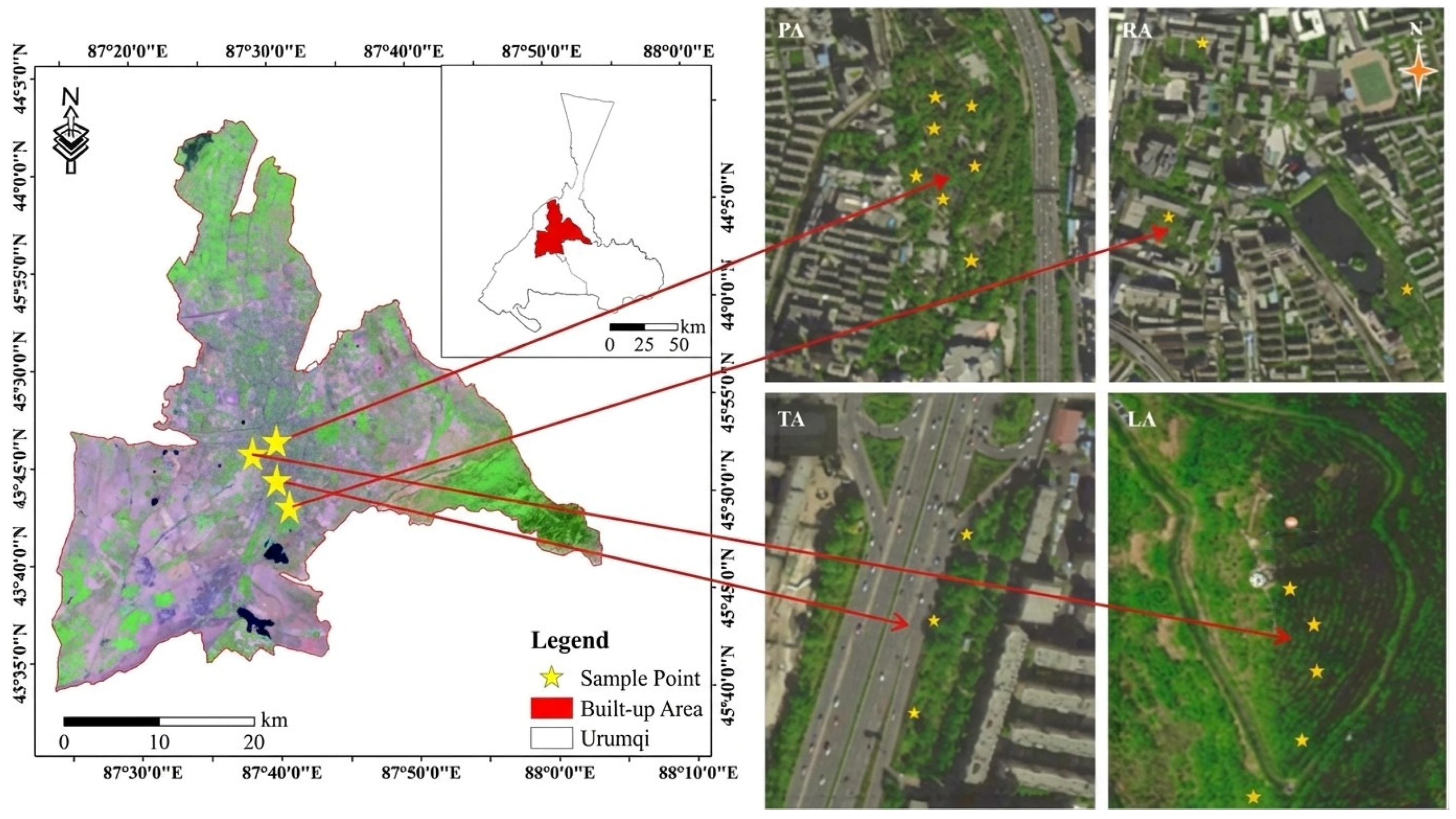
Based on the air pollution conditions in Urumqi and field investigations, representative 30 m × 30 m plots were established in different functional green spaces with relatively high vegetation coverage, uniform species distribution, and good growth conditions, including traffic areas (TA; three sites within the Hutan Expressway greenbelt), residential areas (RA; three sites in the Xinjiang University residential compound), park areas (PA; six sites in People’s Park), and landscape ecological forest areas (LA; five sites in Yamalik Mountain). Following the principles of proximity and general applicability, 17 representative plots were set. According to dominance, frequency, and distribution, six common urban greening species with consistent tree age, leaf age, and crown size were selected, including evergreen trees Pinus sylvestris and Picea asperata; deciduous trees Ulmus densa and Fraxinus rhynchophylla; and shrubs Ulmus pumila and Ligustrum obtusifolium. These species were selected because they are among the most common and representative greening plants in Urumqi and are widely distributed across the sampled functional green spaces. At the same time, they represent different life forms and contrasting leaf morphological characteristics, which makes them suitable for comparing interspecific differences in particulate retention. Each species was replicated three times, yielding 3 functional areas × 6 species × 3 replicates = 54 sample trees. In addition, considering the topography, tree distribution, sampling convenience, and the altitudinal variation in the study area, three U. pumila individuals were selected at each of five elevations (844, 869, 910, 930, and 960 m), resulting in 5 × 3 = 15 sample trees. Ulmus pumila was selected for the altitudinal comparison because it was the most consistently distributed greening species across the urban–mountain elevation gradient. This allowed altitude-related variation in particulate retention to be evaluated while minimizing interspecific differences. The other five species were not continuously distributed across all elevation bands and therefore were not suitable for a comparable altitudinal analysis. In total, 54 + 15 = 69 sample trees were selected in different functional green spaces in the central urban area of Urumqi to analyze the temporal variation in leaf dust retention capacity across different urban functional green spaces and elevations and to investigate the spatiotemporal variation in leaf particulate retention of common greening species (Table 1). A schematic of the sampling sites is shown in Figure 1.

2.3. Leaf Collection

2.3.1. Diurnal Sampling

It is generally considered that a rainfall amount of 15 mm can substantially wash off or blow away the dust accumulated on plant leaves, allowing leaves to enter a new dust-retention cycle [17]. Light rain to heavy rain occurred in Urumqi on 12–13 June 2023 (maximum precipitation 20.4 mm), accompanied by northwesterly winds at force 3–4. Therefore, from the third day after the heavy rainfall, leaves were sampled every 4 days from 16 June to 6 July (10:00–14:00), for a total of six sampling events. For each event, 30–60 leaves were collected from broad-leaved trees, 50–120 leaves from broad-leaved shrubs, and 200–400 needles from conifers. Sampling was conducted on sunny and windless days to minimize the influence of short-term meteorological variability on particulate deposition. Healthy plants with similar growth status and mature leaves were selected. To reduce the influence of canopy position on particulate deposition, leaves were collected from comparable canopy positions of each individual, with sampling distributed across different canopy directions and heights according to the growth form of each species. Leaves from different directions were composited as one replicate, and each sample was collected in triplicate, placed into sealed bags, and returned to the laboratory for processing. Leaf sampling of greening species in the four functional green spaces was carried out simultaneously. Meteorological data and background PM concentrations were synchronized from the local environmental monitoring station to ensure environmental consistency across sampling sites.

2.3.2. Seasonal Sampling

For evergreen trees, sampling was conducted from January to December; for deciduous species, sampling was conducted from June to October. Each season included 3–4 replicates, and the mean value was used. According to the rainfall characteristics of Urumqi, sampling and analysis were uniformly conducted on sunny and windless days on the seventh day after rainfall in June, September, and November to reduce the influence of transient meteorological disturbances. As in the diurnal sampling, efforts were made to maintain comparable weather conditions during sampling, although detailed background meteorological and pollution data were not available for every site and sampling date.

2.4. Leaf Area Measurement and Quantification of PM Retention

2.4.1. Leaf Area Determination

Because PM retention was expressed per unit leaf area, leaf area was quantified prior to PM calculation. For broad-leaved species, leaves were flattened and scanned and total leaf area (S) was determined using ImageJ software (version 1.53, National Institutes of Health, Bethesda, MD, USA). For conifers, needle surface area was calculated by combining scanned needle length measurements with volume determined by the water displacement method [24]. Needle area was then estimated using the established geometric conversion:
S = 2 L 1 + π n n V π L
where L is total needle length (cm), V is needle volume (cm3), and n is the number of needles per fascicle.

2.4.2. Determination of PM Retention on Leaf Surfaces

The elution–filtration gravimetric method was used to quantify particulate matter retained on leaf surfaces [25]. This method has been widely applied in studies of foliar particulate retention because it allows particles washed from leaf surfaces to be separated into different size fractions and quantified gravimetrically with relatively good reproducibility and comparability across species and sampling conditions [26,27,28]. During measurement, leaf wash solutions were sequentially filtered through membranes with pore sizes of 10, 3, and 0.2 μm that had been pre-dried to constant weight ( M 1 ). The membranes were then dried to constant weight at 60 °C and weighed ( M 2 ). The retained PM was calculated as:
P M 0.2 3 / 3 10 / > 10 = ( M 2 M 1 ) / S 0
P M total = P M 0.2 3 + P M 3 10 + P M > 10
where M 1 is the dry weight of the membrane (μg), M 2 is the dry weight of the membrane after filtration (μg), PM0.2–3 is the mass of particles with diameter > 0.2 μm and PM3–10 is the mass of particles with diameter > 3 μm and PM>10 is the mass of particles with diameter > 10 μm, and PMtotal was calculated as the sum of PM0.2–3, PM3–10, and PM>10 for each sample.

2.5. Data Processing

Excel (Microsoft Corporation, Redmond, WA, USA) and SPSS 27.0 (IBM Corp., Armonk, NY, USA) were used for statistical analysis and plotting. All measurements were performed using three biological replicates unless otherwise specified. Prior to ANOVA, data normality and homogeneity of variance were tested. One-way ANOVA was used to compare PM retention among species, time periods, functional zones, and altitudes as appropriate, and two-way ANOVA based on the SPSS general linear model was used for seasonal comparisons. When significant differences were detected, the least significant difference (LSD) test was applied for multiple comparisons at p < 0.01. The corresponding F values and degrees of freedom (df) are reported in the Results.

3. Results

3.1. Differences in the Retention of Particulate Matter of Different Size Fractions by Leaves of Greening Tree Species

The retention of particulate matter (PM) differed significantly among the six tree species for all particle-size fractions (one-way ANOVA, PM0.2–3: F (5, 24) = 52.4, p < 0.01; PM3–10: F (5, 24) = 45.8, p < 0.01; PM>10: F (5, 24) = 116.6, p < 0.01; PMtotal: F (5, 24) = 108.3, p < 0.01). Overall, PM retention generally followed the pattern evergreen trees > deciduous shrubs > deciduous trees (Table 2). For PM3–10 and PMtotal, the retention capacity ranked as Pinus sylvestris > Picea asperata > Ulmus pumila > Ligustrum obtusifolium > Ulmus densa > Fraxinus rhynchophylla. However, for PM0.2–3, Picea asperata (3.31 μg·cm−2) showed higher retention than P. sylvestris (2.96 μg·cm−2), and for PM>10, Ligustrum obtusifolium (70.97 μg·cm−2) showed higher retention than U. pumila (60.13 μg·cm−2). These results indicate clear interspecific differences in PM retention capacity and suggest that both life form and leaf traits influence particle capture.

3.2. Spatiotemporal Variation in the Retention of Particulate Matter of Different Size Fractions by Leaves of Six Greening Tree Species

3.2.1. Diurnal Variation

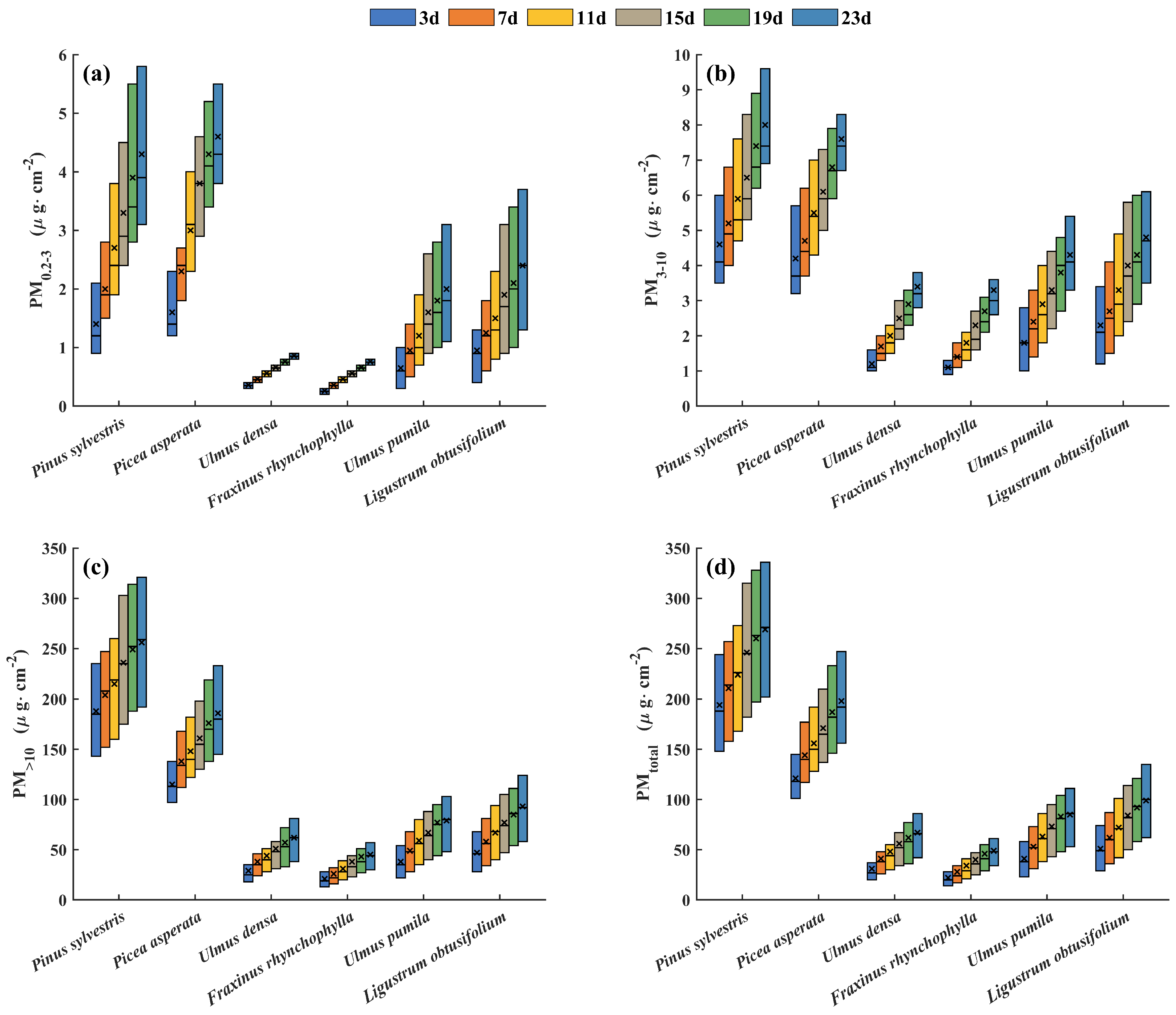
Using SPSS Post Hoc multiple comparisons with the least significant difference (LSD) test, differences in PM retention among species at different time periods were analyzed. After the heavy rain event on 12–13 June 2023 (maximum precipitation 20.4 mm), leaf-surface dust was assumed to be substantially reduced and the subsequent period was treated as a renewed accumulation stage. On days 3, 7, 11, 15, 19, and 23 after the rainfall, the differences in retention among species were significant and showed a gradual increasing trend over time (one-way ANOVA, PM0.2–3: F (5, 24) = 32.6, p < 0.01; PM3–10: F (5, 24) = 28.4, p < 0.01; PM>10: F (5, 24) = 45.2, p < 0.01; PMtotal: F (5, 24) = 41.8, p < 0.01). Retention was the lowest on day 3 after the heavy rain and the highest on day 23, with a significant difference between day 3 and day 23 (p < 0.05).
As shown in Figure 2, the mean retention of PM0.2–3 for different species increased gradually over time, and in all time periods, Picea asperata (1.67–4.69 μg·cm−2) showed the highest retention, followed by P. sylvestris (1.41–4.33 μg·cm−2), while Fraxinus rhynchophylla showed the lowest retention (0.23–0.76 μg·cm−2). Differences among species were relatively large between day 7 and day 11 and relatively small between day 19 and day 23. For PM3–10, P. sylvestris showed the highest retention at all time periods (4.64–7.98 μg·cm−2), followed by Picea asperata (4.23–7.63 μg·cm−2), while Fraxinus rhynchophylla showed the lowest retention (1.10–3.28 μg·cm−2). Differences among species were relatively large on days 3 and 7 and day 11, whereas the differences were smaller on days 15 and 19 and day 23. On days 3, 7, 11, 15, 19, and 23, the retention of PM3–10 by P. sylvestris was 4.2, 3.6, 2.1, 2.7, 2.7, and 2.4 times that of Fraxinus rhynchophylla, respectively. For PM>10, the ranking of retention on day 23 from high to low was consistent with that of PMtotal. On day 23, PMtotal retention followed the order P. sylvestris (256.46 μg·cm−2) > Picea asperata (186.20 μg·cm−2) > U. pumila (91.65 μg·cm−2) > Ligustrum obtusifolium (78.15 μg·cm−2) > Ulmus densa (61.89 μg·cm−2) > Fraxinus rhynchophylla (44.52 μg·cm−2). The retention of P. sylvestris was 1.4 times that of Picea asperata and 5.8 times that of Fraxinus rhynchophylla. In different functional green spaces, species with different life forms showed the pattern evergreen trees > deciduous shrubs > deciduous trees, with a ratio of 4.7:1.7:1.

3.2.2. Seasonal Variation

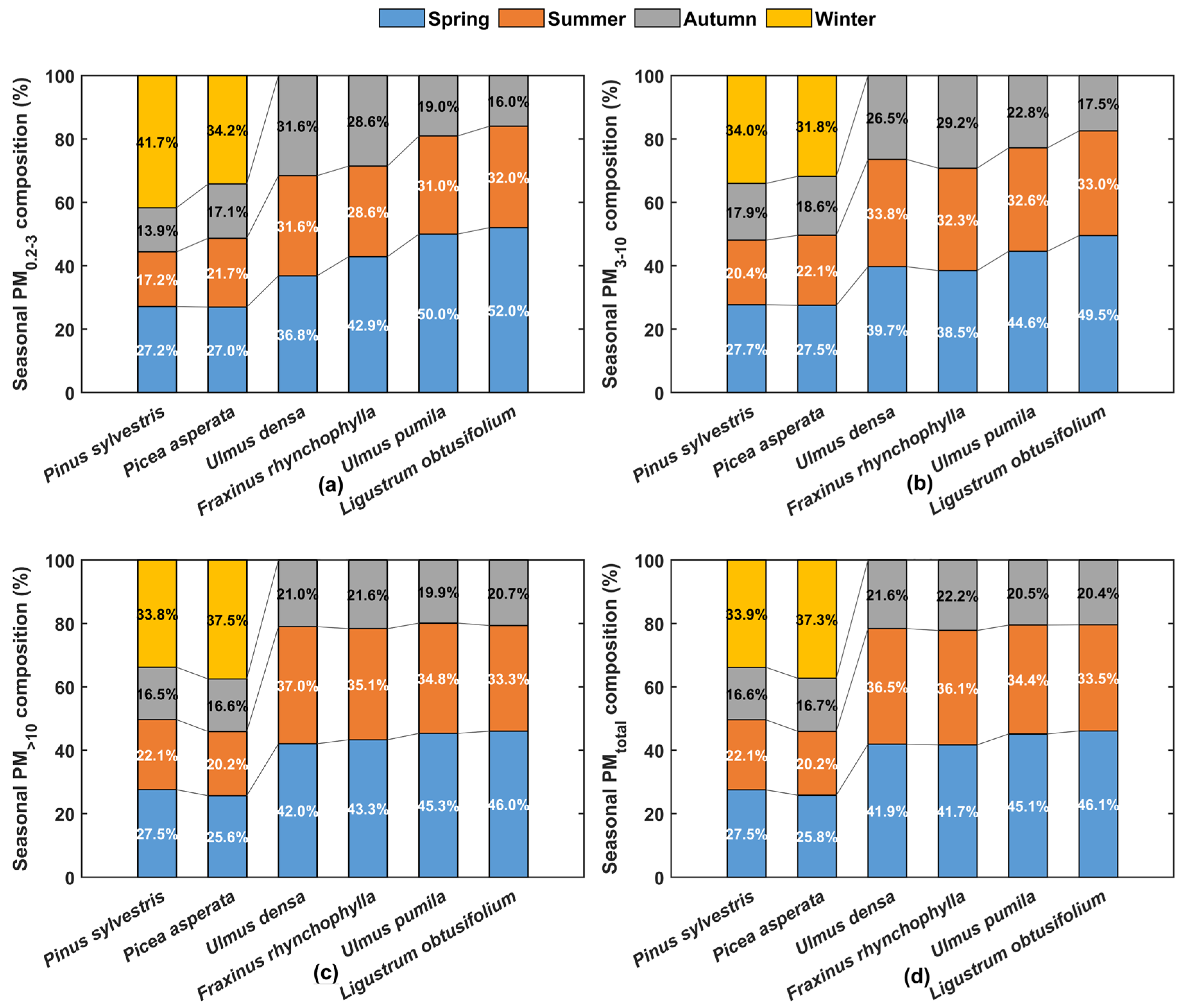
Because leaves of deciduous trees and shrubs fall off in winter, only the changes in spring, summer, and autumn could be analyzed for deciduous species, whereas leaves of evergreen species were present in all four seasons and could reflect PM retention. Two-factor analysis using the SPSS general linear model indicated that seasonal differences in the dust-retention amounts of tree species for PM0.2–3, PM3–10, PM>10, and PMtotal were significant (one-way ANOVA, PM0.2–3: F (3, 20) = 22.4, p < 0.01; PM3–10: F (3, 20) = 18.6, p < 0.01; PM>10: F (3, 20) = 35.2, p < 0.01; PMtotal: F (3, 20) = 31.5, p < 0.01). As shown in Figure 3, for deciduous trees and deciduous shrubs, PM retention for all particle size fractions followed the order spring > summer > autumn, whereas for evergreen species it followed the order winter > spring > summer > autumn. Across species, the mean seasonal retention of PM0.2–3 in winter, spring, summer, and autumn was 5.78, 2.38, 1.63, and 1.21 μ g · c m 2 , respectively; the mean seasonal retention of PM3–10 was 4.88, 3.70, 2.92, and 8.95 μ g · c m 2 , respectively; the mean seasonal retention of PM>10 was 124.81, 98.97, 70.52, and 310.98 μ g · c m 2 , respectively; and the mean seasonal retention of PMtotal was 132.07, 104.46, 74.65, and 325.82 μ g · c m 2 , respectively.
In summary, the seasonal variation in PM retention of the selected species showed the lowest values in autumn. Evergreen trees showed the highest dust retention in winter, whereas deciduous trees showed the highest values in spring and intermediate values in summer. Moreover, in September (autumn), leaves of deciduous trees began to fall or had largely turned yellow, resulting in sparse canopies and leaf senescence with stomatal closure, which weakened leaf dust-retention capacity.

3.3. Spatial Variation in PM Retention on Leaves of Six Tree Species

3.3.1. Different Functional Zones

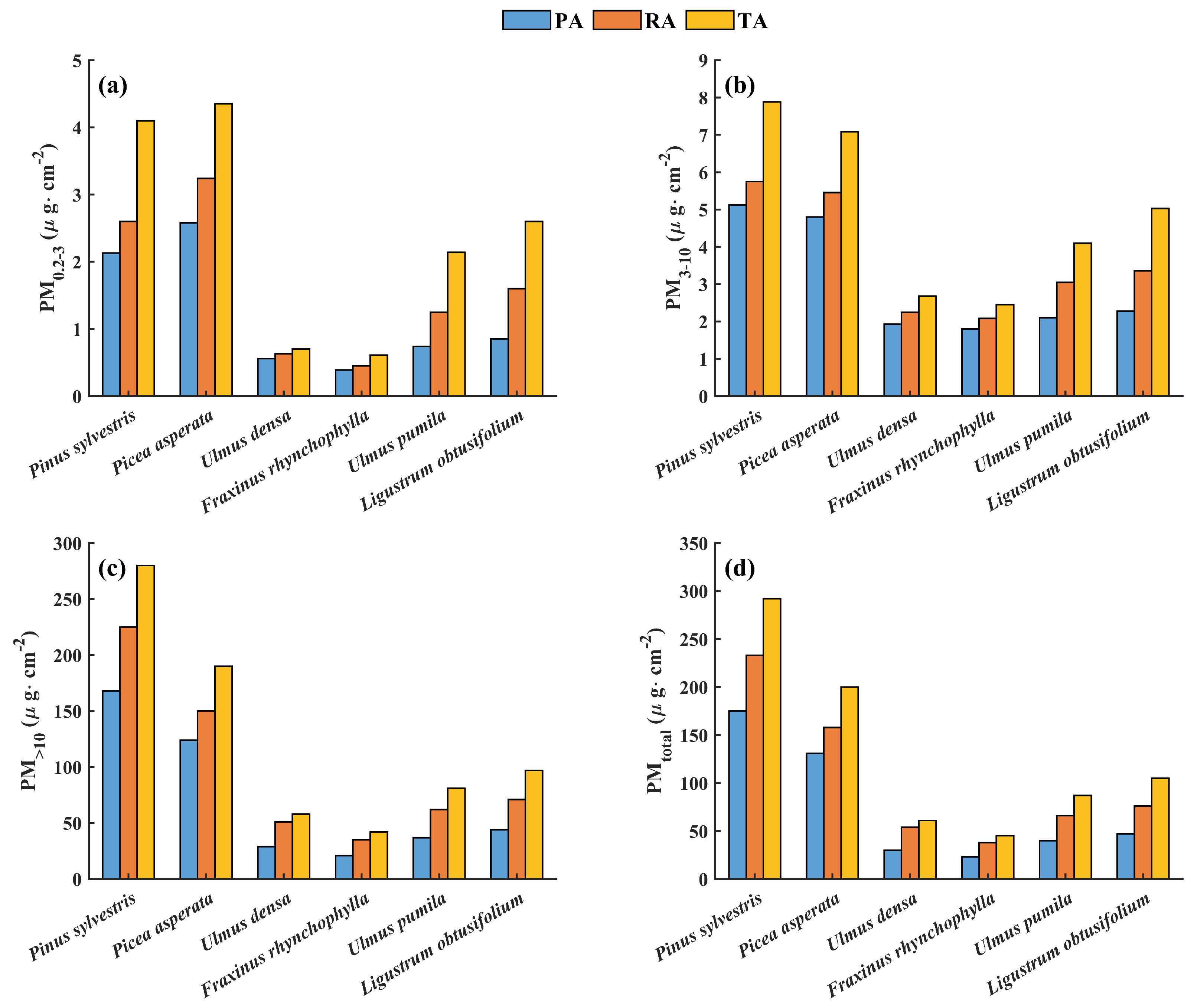
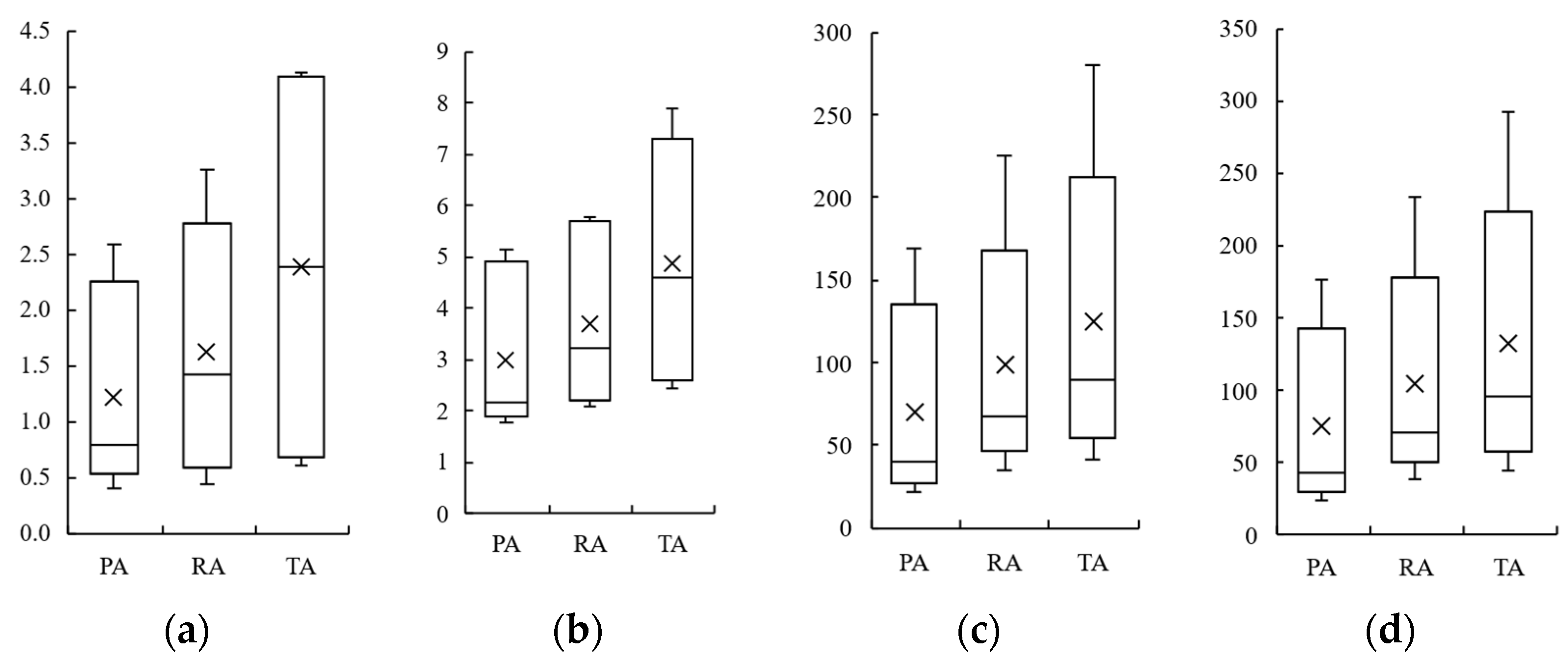
PM retention on leaves differed significantly among the three functional zones (park area, PA; residential area, RA; and traffic area, TA) for PM0.2–3, PM3–10, PM>10 and PMtotal (one-way ANOVA, PM0.2–3: F (2, 15) = 12.48, p < 0.01; PM3–10: F (2, 15) = 6.75, p < 0.01; PM>10: F (2, 15) = 9.82, p < 0.01; PMtotal: F (2, 15) = 10.33, p < 0.01), as shown in Figure 4. Across the six species, the overall pattern was consistent, with PM retention following TA > RA > PA for each size fraction and for PMtotal. This indicates that site context strongly influences the amount of particulate matter retained on leaf surfaces.
Within each zone, interspecific differences were also evident. For PM3–10, PM>10, and PMtotal, the general ranking of retention capacity was: Pinus sylvestris > Picea asperata > Ulmus pumila > Ligustrum obtusifolium > Ulmus densa > Fraxinus rhynchophylla. For PM0.2–3, Picea asperata showed higher retention than Pinus sylvestris, while the remaining species followed a similar relative pattern. Overall, evergreen conifers exhibited the highest PM retention across zones, broad-leaved shrubs ranked second, and broad-leaved trees showed the lowest retention, highlighting the role of leaf functional traits in regulating PM capture under different urban land-use settings.
To further illustrate how PM size fractions contribute to overall retention in each zone, the proportional composition of PM retention was compared among PA, RA, and TA (Figure 5). Mean retention values across the six species showed a clear increase from PA to RA to TA. Specifically, the mean PM0.2–3 retention was 1.21, 1.63, and 2.43 μg·cm−2 in PA, RA, and TA, respectively. Mean PM3–10 retention increased from 3.00 (PA) to 3.67 (RA) and 4.88 μg·cm−2 (TA). For coarse particles, mean PM>10 retention was 70.52, 98.97, and 124.81 μg·cm−2 in PA, RA, and TA, respectively. Consequently, PMtotal reached 74.65 μg·cm−2 in PA, 104.46 μg·cm−2 in RA, and 132.07 μg·cm−2 in TA. Differences between PA and RA were comparatively small, whereas TA showed substantially higher values than both PA and RA, consistent with elevated particle loading in traffic-influenced environments.

3.3.2. Different Altitudes

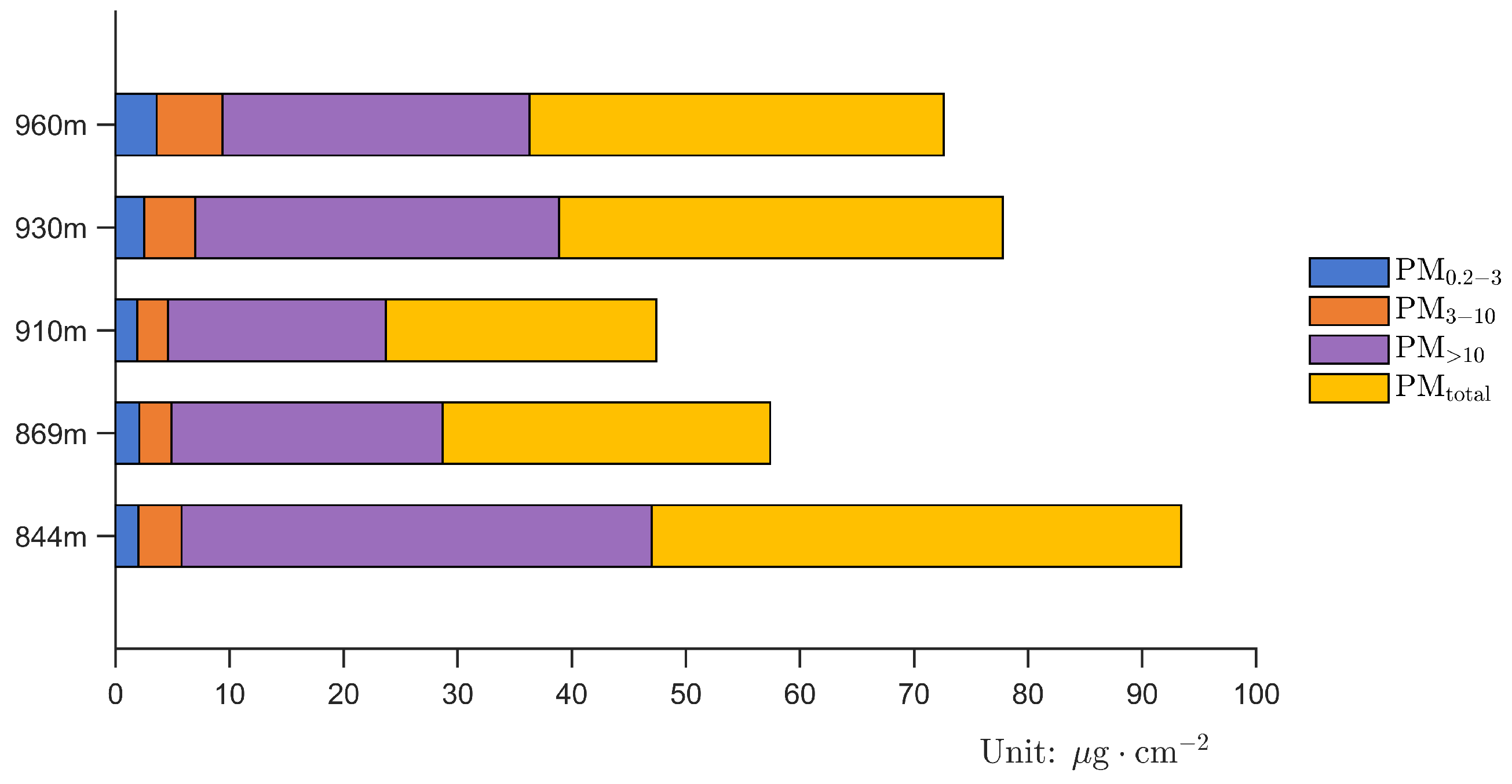
To assess altitudinal effects, PM retention by Ulmus pumila was compared across four elevations (Figure 6). PM retention differed significantly among altitudes for all size fractions and for PMtotal (one-way ANOVA, PM0.2–3: F (3, 8) = 14.25, p < 0.01; PM3–10: F (3, 8) = 18.67, p < 0.01; PM>10: F (3, 8) = 12.48, p < 0.01; PMtotal: F (3, 8) = 11.56, p < 0.01). For fine particles, PM0.2–3 retention was highest at 960 m (3.07 μg·cm−2) and lowest at 869 m (1.48 μg·cm−2). For PM3–10, the maximum also occurred at 960 m (6.22 μg·cm−2), while the lowest values were recorded at 869 m (2.60 μg·cm−2) and 910 m (2.59 μg·cm−2). In contrast, PM>10 and PMtotal peaked at the lowest elevation (844 m; 41.68 and 46.59 μg·cm−2, respectively) and reached minima at 910 m (19.29 and 23.43 μg·cm−2, respectively). Across particle-size classes, the difference between maximum and minimum retention exceeded two-fold.
Overall, the altitudinal pattern was not monotonic across size fractions. The highest altitude (960 m) favored retention of PM0.2–3 and PM3–10, whereas the lowest altitude (844 m) showed the highest retention of coarse particles and total PM. The mid-altitude site (910 m) consistently exhibited the lowest retention across fractions. Except for the 844 m site, PM0.2–3 and PM3–10 tended to increase with altitude, whereas PM>10 and PMtotal showed an increase followed by a decrease with increasing elevation. These results suggest that altitude-related differences in local particle availability and deposition conditions can alter both the magnitude and size composition of PM retained on leaf surfaces.

4. Discussion

4.1. Temporal Patterns of PM Retention

Temporal variability in foliar PM retention in Urumqi was evident at two scales: short-term accumulation following rainfall and broader seasonal differences. After the rainfall event that initiated a new accumulation period, PM retained per unit leaf area increased from day 3 to day 23 across species and functional zones. This supports the view that, under relatively stable weather conditions, leaf surfaces act as progressive sinks where deposition outweighs removal processes, at least over the multi-week intervals typical of semi-arid climates.
Particle-size fractions did not behave identically through time. PM0.2–3, PM3–10 showed clearer interspecific separation during the earlier part of the cycle and weaker differentiation by days 19–23, consistent with partial saturation of the micro-sites that retain fine particles most effectively. In contrast, PM>10 and therefore P M total continued to a rise substantially later in the cycle, including between days 19 and 23. Coarse material is more strongly influenced by local mechanical sources and resuspension, so continued increases likely reflect persistent supply rather than a rapid approach to equilibrium. This distinction is relevant when interpreting retention capacity: species that appear similar for fine particles near the end of the cycle may still differ meaningfully in their ability to intercept coarse PM under ongoing resuspension [29].
Seasonal sampling further showed that retention is not solely determined by leaf traits, but also by seasonal shifts in atmospheric loading and plant phenology. Deciduous species generally followed the order spring > summer > autumn across fractions, while evergreen conifers exhibited the highest values in winter. For deciduous trees and shrubs, reduced retention in autumn is plausibly linked to senescence-related changes together with partial leaf loss that reduces the effective interception surface [30]. For evergreen conifers, winter maxima are consistent with the combined effect of persistent foliage and seasonally elevated particle concentrations in cold periods in continental cities. Overall, these temporal patterns suggest that foliar PM retention results from the interplay between the time elapsed since the last wash-off event and seasonal shifts in both ambient PM availability and leaf condition. It should be noted that rainfall may not completely remove previously deposited particles and wash-off efficiency may vary with particle size and leaf morphology. Therefore, the temporal accumulation pattern observed after rainfall should be interpreted with caution.

4.2. Spatial Patterns Across Functional Zones and Altitudes

Spatial context strongly shaped PM retention, reinforcing the importance of site placement in urban greening strategies. Across species and size fractions, PM retention followed a consistent functional-zone gradient of TA > RA > PA. This pattern points to traffic corridors as the dominant near-surface source environment, where exhaust-related particles, brake/tire wear, and especially resuspended road dust elevate deposition fluxes onto adjacent vegetation. The comparatively modest difference between RA and PA suggests that proximity to major roadways is the key spatial driver of the leaf-surface loading measured here.
Species rankings were largely maintained across zones, implying that the urban context modulates the magnitude of retention more than it changes the relative performance of species. These interspecific differences are also closely related to leaf-surface traits that influence particle interception and retention stability. Evergreen conifers generally exhibited higher PM retention in this study, which is consistent with their needle-like foliage, complex shoot architecture, and relatively rougher surface microstructure, all of which can increase surface roughness, boundary-layer interception, and particle stabilization. By contrast, broad-leaved species with smoother leaf surfaces may retain fewer particles, especially coarse particles that are more easily resuspended. In addition, leaf-surface wax layers, trichomes, grooves, and other micromorphological features can provide attachment sites for particles and reduce their subsequent removal by wind disturbance. Therefore, the observed differences among species likely reflect the combined effects of ambient particle loading and species-specific leaf traits that govern both interception and stabilization of particles on leaf surfaces. This is useful for application: species selection based on retention capacity can be combined with targeted siting to maximize particulate interception where exposure is highest [31]. At the same time, the TA environment likely imposes greater stress on vegetation; therefore, high retention should be considered alongside tolerance and maintenance requirements to sustain long-term ecosystem service delivery.
The LA analysis demonstrates that spatial gradients are not captured by land-use context alone. For Ulmus pumila sampled across elevation bands, retention differed significantly among altitudes, but the response depended on particle size. Fine fractions tended to be higher at the highest elevation site, whereas PM>10 and PMtotal peaked at the lowest altitude and reached minima at mid-altitude. This non-monotonic behavior suggests that “higher elevation = cleaner air = lower retention” is an oversimplification. Fine particles can be transported efficiently and can remain suspended long enough to respond to mountain–valley circulation and boundary-layer dynamics, while coarse particles more strongly reflect local resuspension sources and rapid settling. In practice, this means peri-urban ecological forests may differ not only in how much PM they intercept, but also in the particle-size composition of what they retain—an important point given the distinct health relevance of fine particles [16].
From the perspective of urban planning and green infrastructure design, the results suggest that species with relatively high PM retention, especially evergreen conifers, may be preferentially deployed in traffic corridors and other high-exposure environments. However, retention capacity should not be the only selection criterion. In practical greening design, PM interception efficiency should be considered together with tolerance to pollution stress, maintenance requirements, seasonal landscape value, and suitability to local site conditions. A mixed planting strategy combining high-retention species with structurally diverse vegetation may provide a more stable and sustainable pollution-mitigation benefit across urban functional zones.
Overall, the Discussion suggests that PM retention in this arid urban system is jointly controlled by accumulation time since rainfall, spatial context, and species-specific microstructural traits that affect particle interception and stabilization on leaf surfaces [32]. It should be noted that the altitudinal analysis in this study was conducted only for Ulmus pumila. Therefore, the observed elevational pattern should be interpreted as species-specific and cannot be directly generalized to all greening tree species.
Our results are broadly consistent with previous studies showing that evergreen conifers generally retain more particulate matter than deciduous broad-leaved species, especially for coarse particles and in traffic-influenced urban environments. This pattern is commonly attributed to differences in leaf longevity, canopy persistence, and leaf-surface microstructure, which together enhance particle interception and retention stability in coniferous species. At the same time, the magnitude and size composition of retained PM can vary among cities because of differences in climate, rainfall regime, particle sources, and urban morphology. In this regard, the patterns observed in Urumqi are particularly relevant to arid urban environments, where limited rainfall, prolonged dry periods, and frequent dust resuspension can promote sustained particle accumulation on leaf surfaces. Therefore, while the overall species ranking observed here is generally consistent with findings from other urban studies, the strong contribution of coarse particles and the clear spatiotemporal contrasts likely reflect the distinctive environmental conditions of this arid continental city. These comparisons indicate that the present findings are both consistent with the general literature on urban vegetation PM interception and informative for understanding retention behavior in dry inland cities.
This study also has several limitations. First, only six greening species were included, and the altitudinal analysis was conducted only for Ulmus pumila; therefore, the observed species rankings and elevational patterns should not be directly generalized to all urban greening species. Second, the study was conducted in a single arid continental city, and the results may partly reflect the specific climatic, topographic, and pollution characteristics of Urumqi. Third, although sampling conditions were controlled as much as possible, detailed background meteorological and ambient PM data were not continuously available for every site and date. Future studies should include more species, multiple cities, and more detailed environmental monitoring to test the broader applicability of the observed patterns.

5. Conclusions

This study compared particulate matter retention on leaf surfaces of six commonly planted greening species across contrasting urban functional zones in Urumqi and along an urban–mountain gradient, and it evaluated whether microstructural leaf traits help explain interspecific differences. PM retention generally increased with time after rainfall. PM retention also varied strongly with urban context, following a consistent TA > RA > PA pattern, underscoring the dominant influence of traffic-related emissions and resuspended dust on leaf loading.
Across sites and sampling times, evergreen conifers showed the highest retention, shrubs were intermediate, and broad-leaved trees were generally lower. Microstructural traits were significantly associated with PM retention, further supporting the ecological relevance of trait-based species selection. These results indicate that species with relatively high PM retention, especially evergreen conifers, may be preferentially deployed in traffic-influenced areas and other high-exposure environments. However, PM retention should not be the only selection criterion; species tolerance, maintenance requirements, and landscape suitability should also be considered to achieve sustainable green infrastructure design in arid and semi-arid cities. Future research should include more plant species, multiple cities, and more detailed environmental monitoring to test the generality of the observed patterns and to better clarify how meteorological conditions and leaf traits jointly influence PM retention.

Author Contributions

Conceptualization: M.Y. and K.N.; methodology, M.Y.; software, M.Y.; validation, A.B., H.B. and E.S.; formal analysis, K.N.; investigation, M.Y.; resources, H.B.; data curation, M.Y. and K.N.; writing—original draft preparation, M.Y. and K.N.; writing—review and editing, A.B. and H.B.; visualization, M.Y.; supervision, K.N.; project administration, K.N.; funding acquisition, M.Y. All authors have read and agreed to the published version of the manuscript.

Funding

This research was funded by the “Tianchi Talents” Introduction Program of the Xinjiang Uygur Autonomous Region Talent Development Fund of China.

Institutional Review Board Statement

Not applicable.

Informed Consent Statement

Not applicable.

Data Availability Statement

The data in this study are available from the corresponding author upon request.

Conflicts of Interest

The authors declare no conflicts of interest.

References

  1. Li, X.; Zhang, T.; Sun, F.; Song, X.; Zhang, Y.; Huang, F.; Yuan, C.; Yu, H.; Zhang, G.; Qi, F.; et al. The Relationship between Particulate Matter Retention Capacity and Leaf Surface Micromorphology of Ten Tree Species in Hangzhou, China. Sci. Total Environ. 2021, 771, 144812. [Google Scholar] [CrossRef]
  2. He, C.; Qiu, K.; Pott, R. Reduction of Urban Traffic–Related Particulate Matter—Leaf Trait Matters. Environ. Sci. Pollut. Res. Int. 2020, 27, 5825–5844. [Google Scholar] [CrossRef] [PubMed]
  3. Zhang, Z.; Gong, J.; Li, Y.; Zhang, W.; Zhang, T.; Meng, H.; Liu, X. Analysis of the Influencing Factors of Atmospheric Particulate Matter Accumulation on Coniferous Species: Measurement Methods, Pollution Level, and Leaf Traits. Environ. Sci. Pollut. Res. 2022, 29, 62299–62311. [Google Scholar] [CrossRef]
  4. Zhu, Y.; Huang, L.; Li, J.; Ying, Q.; Zhang, H.; Liu, X.; Liao, H.; Li, N.; Liu, Z.; Mao, Y.; et al. Sources of Particulate Matter in China: Insights from Source Apportionment Studies Published in 1987–2017. Environ. Int. 2018, 115, 343–357. [Google Scholar] [CrossRef]
  5. Chen, J.; Hoek, G. Long-term Exposure to PM and All-cause and Cause-specific Mortality: A Systematic Review and Meta-analysis. Environ. Int. 2020, 143, 105974. [Google Scholar] [CrossRef] [PubMed]
  6. Sahai, S. Atmospheric Submicron Particulate Matter (PM): An Emerging Global Environmental Concern. Curr. World Environ. 2019, 14, 189–193. [Google Scholar] [CrossRef]
  7. Baidourela, A.; Zhayimu, K. Patterns of Dust Retention by Urban Trees in Oasis Cities. Nat. Environ. Pollut. Technol. 2015, 14, 53–57. [Google Scholar]
  8. Baidurela, A.; Halik, U.; Aishan, T.; Nuermaimaiti, K. Maximum Dust Retention of Main Greening Trees in Arid Land Oasis Cities, Northwest China. Sci. Silvae Sin. 2015, 51, 57–64. [Google Scholar]
  9. Yan, P.B.; Yang, Y. Performances of Urban Tree Species under Disturbances in 120 Cities in China. Forest 2018, 9, 50. [Google Scholar] [CrossRef]
  10. Singh, R.; Chavan, S.B.; Tomar, A.; Singh, H.; Chauhan, V.; Paul, N.; Singh, A.K. Species Variation in Air Pollution Tolerance, Performance, and Dust Retention of Urban Roadside Trees: Implications for Urban Greening and Green Corridor Planning. Air Qual. Atmos. Health 2025, 18, 3311–3327. [Google Scholar] [CrossRef]
  11. Nurmamat, K.; Halik, M.; Baidourela, A.; Aishan, T. Atmospheric Particle Distribution on Tree Leaves in Different Urban Areas of Aksu City, Northwest China. Nat. Environ. Pollut. Technol. 2022, 21, 921–929. [Google Scholar] [CrossRef]
  12. Vigevani, I.; Corsini, D.; Mori, J.; Pasquinelli, A.; Gibin, M.; Comin, S.; Szwałko, P.; Cagnolati, E.; Ferrini, F.; Fini, A. Particulate Pollution Capture by Seventeen Woody Species Growing in Parks or along Roads in Two European Cities. Sustainability 2022, 14, 1113. [Google Scholar] [CrossRef]
  13. Xu, L.; Yan, Q.; He, P.; Zhen, Z.; Jing, Y.; Duan, Y.; Chen, X. Combined Effects of Different Leaf Traits on Foliage Dust-Retention Capacity and Stability. Air Qual. Atmos. Health 2022, 15, 1263–1274. [Google Scholar] [CrossRef]
  14. Xu, X.; Yu, X.; Bao, L.; Desai, A.R. Size Distribution of Particulate Matter in Runoff from Different Leaf Surfaces during Controlled Rainfall Processes. Environ. Pollut. 2019, 255, 113234. [Google Scholar] [CrossRef]
  15. Liu, C.; Dai, A.; Ji, Y.; Sheng, Q.; Zhu, Z. Effect of different plant communities on fine particle removal in an urban road greenbelt and its key factors in Nanjing, China. Sustainability 2022, 15, 156. [Google Scholar] [CrossRef]
  16. Zhang, W.; Li, Y.; Wang, Q.; Zhang, T.; Meng, H.; Gong, J.; Zhang, Z. Particulate matter and trace metal retention capacities of six tree species: Implications for improving urban air quality. Sustainability 2022, 14, 13374. [Google Scholar] [CrossRef]
  17. Li, Q.; Liao, J.; Zhu, Y.; Ye, Z.; Chen, C.; Huang, Y.; Liu, Y. A study on the leaf retention capacity and mechanism of nine greening tree species in central tropical Asia regarding various atmospheric particulate matter values. Atmosphere 2024, 15, 394. [Google Scholar] [CrossRef]
  18. Zhao, S.; Li, X.; Li, Y.; Li, J.; Liu, X.; Duan, M.; Wang, X. Differential impacts of functional traits across 65 plant species on PM retention in the urban environment. Ecol. Eng. 2024, 200, 107184. [Google Scholar] [CrossRef]
  19. Tripathi, D.P.; Nema, A.K. Air pollution mitigation and suspended particulate matter retention potential of selected plant species across seasonal variation in the urban area. Environ. Sci. Pollut. Res. 2024, 31, 45035–45054. [Google Scholar] [CrossRef] [PubMed]
  20. Rasheed, F.; Ruffner, C.; Iqbal, A. Particulate matter retention and removal efficiency in ten tree species of semi-arid environment. Int. J. Phytoremediat. 2025, 27, 362–371. [Google Scholar] [CrossRef] [PubMed]
  21. Kong, L.; Huang, X.; Zhu, F. Planting design for urban overpasses based on atmospheric particulate matter retention in Changsha. Int. J. Phytoremediat. 2025, 27, 675–687. [Google Scholar] [CrossRef]
  22. Wang, J.; Kong, W.; Li, H.; Sun, X.; Sun, Y.; Liu, Y. Effects of meteorological factors on the retention of particulate matter in lawn grass blades. Front. Plant Sci. 2025, 16, 1495212. [Google Scholar] [CrossRef] [PubMed]
  23. Popek, R.; Przybysz, A. Precipitation plays a key role in the processes of accumulation, retention and re-suspension of particulate matter on Betula pendula, Tilia cordata and Quercus robur foliage. Desalination Water Treat. 2022, 275, 14–23. [Google Scholar] [CrossRef]
  24. Kwak, M.J.; Lee, J.; Park, S.; Lim, Y.J.; Kim, H.; Jeong, S.G.; Son, J.-A.; Je, S.M.; Chang, H.; Oh, C.-Y.; et al. Understanding particulate matter retention and wash-off during rainfall in relation to leaf traits of urban forest tree species. Horticulturae 2023, 9, 165. [Google Scholar] [CrossRef]
  25. Wang, H.; Xing, Y.; Yang, J.; Xie, B.; Shi, H.; Wang, Y. The nature and size fractions of particulate matter deposited on leaves of four tree species in Beijing, China. Forests 2022, 13, 316. [Google Scholar] [CrossRef]
  26. Zeng, Y.; Wang, H.; Liang, D.; Yuan, W.; Xu, H.; Li, S.; Li, J. Disentangling the retention preferences of estuarine suspended particulate matter for diverse microplastic types. Environ. Pollut. 2025, 366, 125390. [Google Scholar] [CrossRef]
  27. Roy, A.; Mandal, M.; Popek, R.; Przybysz, A.; Sarkar, A. Decoding leaf micro- and macro-morphology: A path to effective particulate matter phytoremediation. Int. J. Phytoremediat. 2025, in press. [Google Scholar] [CrossRef]
  28. Fan, J.; Yang, J.; Duan, T.; Gong, Y.; Sun, J. Key role of hydrodynamic conditions in the adsorption and migration of sulfamethoxazole driven by suspended particulate matter. J. Contam. Hydrol. 2025, 272, 104581. [Google Scholar] [CrossRef]
  29. Tomson, M.; Kumar, P.; Abhijith, K.V.; Watts, J.F. Exploring the interplay between particulate matter capture, wash-off, and leaf traits in green wall species. Sci. Total Environ. 2024, 921, 170950. [Google Scholar] [CrossRef]
  30. Chen, D.; Long, Y.; Zhu, Y.; Zheng, J.; Yan, J.; Yin, S. Mapping the constituent preference of tree species for capturing particulate matter on leaf surfaces using single-particle mass spectrometry and supervised machine learning. Environ. Pollut. 2024, 360, 124785. [Google Scholar] [CrossRef]
  31. Wang, M.; Qin, M.; Xu, P.; Huang, D.; Jin, X.; Chen, J.; Dong, D.; Ren, Y. Atmospheric particulate matter retention capacity of bark and leaves of urban tree species. Environ. Pollut. 2024, 342, 123109. [Google Scholar] [CrossRef] [PubMed]
  32. Jin, E.J.; Yoon, J.H.; Bae, E.J.; Jeong, B.R.; Yong, S.H.; Choi, M.S. Particulate matter removal ability of ten evergreen trees planted in Korea urban greening. Forests 2021, 12, 438. [Google Scholar] [CrossRef]
Figure 1. The distribution map of sampling sites.
Sustainability 18 03240 g001
Figure 2. Diurnal variations in PM retention capacity of the six selected tree species. (a) PM0.2–3; (b) PM3–10; (c) PM>10; (d) PMtotal.
Sustainability 18 03240 g002
Figure 3. Seasonal variations in leaf PM retention across different greening tree species. (a) PM0.2–3; (b) PM3–10; (c) PM>10; (d) PMtotal.
Sustainability 18 03240 g003
Figure 4. Spatial differences of PM retention amount of each tree species. (a) PM0.2–3; (b) PM3–10; (c) PM>10; (d) PMtotal.
Sustainability 18 03240 g004
Figure 5. Proportions of different PM size fractions retained by tree species across various functional green spaces. (a) PM0.2–3; (b) PM3–10; (c) PM>10; (d) PMtotal.
Sustainability 18 03240 g005
Figure 6. PM retention difference of Ulmus pumila at different altitudes.
Sustainability 18 03240 g006
Table 1. Basic morphological traits of the test species.
Title SpeciesTree Height (m)Leaf TypeLeaf ShapeLeaf CharacteristicsLeaf MarginPhyllotaxy
Pinus sylvestris10–14Needle leafNeedle-shapedGlabrousEntireFascicled/spiral
Picea asperata10–12Needle leafNeedle-shapedGlabrous or slightly pubescent when youngEntireSpiral
Ulmus densa10–13Simple leafOvate to ellipticGlabrousSerrateAlternate
Fraxinus rhynchophylla7–11Compound leafPinnate leaflets, lanceolate to ovate-lanceolate Generally glabrous SerrateOpposite
Ulmus pumila0.8Simple leaf Ovate to elliptic GlabrousSerrateAlternate
Ligustrum obtusifolium0.8Simple leafOvate to obovate Glabrous to sparsely pubescentEntireOpposite
Table 2. Particle matter retention of different tree species (μg·cm−2).
Life FormTree SpeciesPM0.2–3PM3–10PM>10PMtotal
Evergreen treesPinus sylvestris2.96 ± 0.336.27 ± 0.40224.74 ± 12.76233.97 ± 13.43
Picea asperata3.31 ± 0.305.86 ± 0.36154.29 ± 8.87163.46 ± 9.53
Deciduous shrubsUlmus pumila1.70 ± 0.233.58 ± 0.3660.13 ± 6.5265.41 ± 6.77
Ligustrum obtusifolium1.38 ± 0.193.33 ± 0.2870.97 ± 5.5775.68 ± 6.04
Deciduous treesUlmus densa0.63 ± 0.042.24 ± 0.2045.88 ± 4.1748.75 ± 4.41
Fraxinus rhynchophylla0.48 ± 0.052.15 ± 0.1932.58 ± 2.8635.21 ± 2.87
Disclaimer/Publisher’s Note: The statements, opinions and data contained in all publications are solely those of the individual author(s) and contributor(s) and not of MDPI and/or the editor(s). MDPI and/or the editor(s) disclaim responsibility for any injury to people or property resulting from any ideas, methods, instructions or products referred to in the content.