Review

Environmental Policy and Risk Regulatory Framework for Sustainable Tidal Current Energy in China


1
School of Law, Shanghai Maritime University, Shanghai 201306, China
2
Law School, Shanghai University, Shanghai 200444, China
3
School of Law, Wuhan University, Wuhan 430072, China
4
Key Laboratory of Ministry of Education for Coastal Disaster and Protection, Hohai University, Nanjing 210024, China
5
School of Law, The University of Hong Kong, Hong Kong SAR, China
6
Southern Marine Science and Engineering Guangdong Laboratory (Zhuhai), Zhuhai 519082, China
*
Author to whom correspondence should be addressed.
These authors contributed equally to this work.
Sustainability 2026, 18(7), 3224; https://doi.org/10.3390/su18073224
Submission received: 24 February 2026 / Revised: 20 March 2026 / Accepted: 23 March 2026 / Published: 25 March 2026

Abstract

The advancement of sustainable energy is a key component of the achievement of the Sustainable Development Goals. Technology advancements have made tidal current energy (TCE) a promising renewable energy source. China possesses abundant TCE resources and has gradually incorporated TCE into its energy and marine development policies. In China, TCE projects are currently being implemented on a large scale. However, despite policy-level recognition, TCE development in China has received limited regulatory attention, particularly with respect to environmental protection and ecological risk governance. Existing governance frameworks largely rely on general marine environmental and ecological policies, which are insufficient to address the three-dimensional, underwater characteristics and cumulative ecological risks. This study analyzes the evolution of China’s TCE-related laws and policies and identifies key deficiencies in current environmental regulation. To promote the sustainable TCE projects, the paper proposes tentative recommendations to promote the sustainable development of TCE in China, including the formulation of specialized environmental impact assessment guidelines grounded in the precautionary principle, future policies for addressing the cumulative environmental impact of large-scale TCE deployment, and the establishment of an environmental risk assessment system tailored to the data limitations and ecological characteristics of TCE exploitation.

1. Introduction

The 2030 Agenda for Sustainable Development, adopted by the United Nations General Assembly in 2015, aims to “make the world a better place by 2030” [1,2]. Sustainable energy systems are a prerequisite for sustainable development [3,4], as the latter depends critically on meeting ever-increasing global energy demand in an environmentally responsible manner [5]. The transition from fossil fuels to renewable energy sources represents one of three major technological transformations required for sustainable energy development [6,7]. Long-term energy system planning is essential to anticipate and meet future energy needs, and various strategies have been proposed to achieve this objective [8]. Meanwhile, we are entering the era of artificial intelligence (AI) [9]. Aside from the large language models (LLMs) and AI agents we are familiar with, the success of AI depends on coupling “energy-storage-data-algorithm-ecology-governance” across the entire stack [10,11,12,13,14,15,16,17]. As AI has been widely applied, energy consumption has increased substantially [18,19].
In response to the escalating energy demand, the Chinese government is allocating increased attention to the development of renewable energy sources [20]. As a developing sector, marine renewable energy (MRE) could play a significant role in providing clean, renewable energy and steering the energy industry towards a sustainable future [21,22]. Tidal current energy (TCE) has unique superiority over other intermittent renewable sources [23,24].
TCE is becoming more technologically advanced as project development continues to grow rapidly [25]. China possesses abundant TCE resources, with an annual average power output of approximately 13.95 Gigawatt (GW), primarily concentrated in the North Yellow Sea (2.31 GW), East China Sea (10.96 GW), and South China Sea (0.68 GW) [26]. Zhejiang Province, which is located along the East China Sea, has a theoretical TCE potential of 7.09 GW—accounting for 50.8% of China’s national total TCE—with channel power densities ranging from 15 to 30 Kilowatt (kW)/m2 [27]. It is evident that key sites within the Zhoushan Archipelago, such as the Jintang, Guishan, and Xihoumen channels, and Hangzhou Bay, demonstrate average power densities that exceed 20 kW/m2, and peak flow velocities that surpass 5 m/s [27,28]. These locations are considered to be optimal for the purpose of electricity generation. At present, there are over 20 TCE devices with capacities in excess of 10 kW, which have been installed in this region [22,29,30,31]. Sea trials have been completed by approximately 40 units, with a maximum single unit power of 650 kW [22]. In total, TCE offers several significant advantages: Firstly, this technology is highly regular and predictable. Second, TCE processes emit no pollutants in comparison with thermal power plants, etc. Thirdly, TCE equipment is usually installed on the seabed or floats on the ocean surface, requiring no land resources. Fourthly, TCE boasts a higher energy density than wind and solar energy—approximately four times that of wind energy and thirty times that of solar energy [22,32,33].
Those in positions of decision-making are increasingly being tasked with acting in a sustainable manner and pursuing policy paths that are conducive to sustainable development [34]. In pursuit of sustainable development, the Chinese government has initiated a series of initiatives to advance the ecological civilization construction [35,36,37]. In addition to the multifarious scientific and technological factors [22,38], the government’s policy guidelines play a pivotal role in ensuring sustainable development, which includes the utilization of TCE. The Chinese government has identified TCE as a priority in the new energy transition, evidenced by its inclusion in relevant laws and government policies. The economy, society, and environment are typically prioritized when discussing sustainability [39]. The continued sustainability of TCE is contingent upon a number of factors, including technological maturity, effective cost control, and the balanced integration of social and environmental benefits [40]. In the context of TCE, the environmental implications of the turbine usage have been observed to result in an increase in underwater noise levels. It has been demonstrated to induce stress and potentially inflict tissue damage in fish, marine mammals and birds [32,41,42,43]. Further issues may include fish being struck by turbine blades and the collision of marine mammals with tidal farms [32,42,44]. The impact of TCE converters and arrays on benthic habitats is multifaceted, encompassing alterations to water flows, substrate composition, and sediment dynamics [42]. These alterations, in turn, have been shown to affect bed morphology and benthic ecosystems [45]. Despite the existence of numerous factors, there remains scope for further investigation into specific instances of harm resulting from the deployment of tidal current devices in the environment [32,42,46].
Hangzhou Lin Dong Ocean Energy Technology Co., Ltd. established China’s first tidal power station in April 2013, the LHD (Zhoushan) Ocean Tidal Energy Project (LHD project) in China [47]. On 25 May 2017, it was connected to the national grid [48]. As of 20 October 2025, the LHD project, with an installed capacity of 3.3 Megawatt (MW) had produced 8.34 million kilowatt-hours of electricity and had maintained uninterrupted grid connectivity for over 100 months [49,50,51]. It is anticipated that the financial outlay required for the generation of tidal energy will decrease to a figure lower than 0.3 Chinese yuan ($0.042) per kilowatt-hour upon the completion of the seventh-generation LHD unit [49]. In February 2025, a joint initiative was undertaken by six Chinese government departments, who collectively issued the Guiding Opinions of the Ministry of Natural Resources, the National Development and Reform Commission, the Ministry of Industry and Information Technology, the Ministry of Finance, the Chinese Academy of Sciences, and the National Energy Administration on Promoting the Utilization of Marine Energy at Scale (GOPUMES) with the objective of promoting large-scale marine energy utilization [52]. The ambitious target set for 2030 is to achieve an installed capacity of 400 MW of marine energy [53]. In September 2025, a 100 MW tidal power project was officially launched in Zhoushan [49].
TCE appears to be in the process of industrialization at present. While at the same time, it is necessary to avoid the occurrence of cumulative environmental impacts [44,54]. A policy refers to the guidelines that determine the rules of a certain historical period, which are formulated by a government or a political party [55]. North America, Europe, Korea, and other countries have all adopted their own TCE policies. However, while their goals are similar, their actual progress is not the same [32,56,57,58,59,60,61]. This study aims to collect comprehensive Chinese TCE policies, and to determine whether these policies and risk regulatory frameworks meet the requirements for promoting a sustainable development of the TCE industry by analyzing the existing environmental policies and risk regulatory frameworks. The rest of the paper is structured as follows: Section 2 describes the materials and methodology used in the study. Section 3 analyzes and evaluates perspectives on the main stages of TCE policies and related environmental content. In Section 4, we discuss current gaps in the field. Conclusions and future policies are presented in Section 5.

2. Materials and Methods

For this study, the PKULaw database (also known as Beida Fabao) was selected as the database for obtaining the materials [62,63]. In 1985, Peking University established PKULaw, the country’s first and most comprehensive legal database, renowned for its authoritative data collection [64,65]. It encompasses legislation and regulations, judicial cases, law journals, the practices of law firms, and judicial examinations [62]. Therefore, the present study employs the PKULaw database as the fundamental retrieval system to analyze the present policy focus of China on TCE.
Current Chinese policies do not provide a clear definition of TCE, and these concepts are not consistently covered in policy texts. Specifically, the GOPUMES hold the view that tidal energy is made up of both TCE and tidal range energy, and that this constitutes a significant category within ocean energy. The 13th Five-Year Plan for Renewable Energy Development (FYPRED) and the Outline for the Development of Marine Renewable Energy (2013–2016) (ODMRE) follow the same logic [66,67]. The National Marine Functional Zoning (2011–2020) (NMFZ) [68] emphasizes that both wind energy and TCE fall under the category of renewable energy. Ocean energy is a macro-level target with no logical connection to the energy category. Although there are some differences in classification, they all essentially adhere to the conceptual logic that TCE is a form of both ocean and renewable energy. Therefore, this study used four key terms (KT) including “energy,” “renewable energy,” “ocean energy,” and “tidal current energy” to retrieve and source policy texts. All central-level and local-level policies (including laws, regulations, normative documents and working documents) were scanned using these four key terms in the PKULaw database. Policies that are no longer in effect, have not yet been implemented or only briefly mention TCE were excluded from the selection. Where different departments had issued related notices for the same normative document, the higher-level policy was retained. Up to 27 September 2025, 229 policy texts were identified, of which 180 were irrelevant, and 49 were included the TCE content effectiveness (see Figure 1).
As a powerful research tool, policy analysis enables us to understand how and why governments enact certain policies, as well as their subsequent effects [69,70,71]. Texts form the way in which we see the world [72]. An increasing amount of research has focused on policy documents as texts [73]. The policy texts embedded in national and local documents represent significant outcomes of political struggles and are essential for analyzing policy formulation, enactment and implementation [73,74]. This study mainly examines and discusses China’s TCE issues using a policy analysis method.
ROST CM6 (Version 5.8.0.600) is a content mining and word frequency analysis software that has been widely employed by scholars to analyze structured policy texts [75,76,77,78]. The software offers multiple functions, including keyword frequency statistics, semantic element extraction, sentiment analysis, and the construction of social relationship networks. These capabilities facilitate the identification of core content and key points of the policy texts in question. In line with the objectives of this study, each policy document was treated as an individual unit of analysis. ROST CM6 was primarily utilized to examine TCE-related policies, primarily through word frequency analysis and social network analysis.

3. Results

In 1986, the central government issued the Opinion on Strengthening Rural Energy Construction, which incorporated ocean energy into the framework of “developing long-term planning for rural energy development”. This marked an early recognition of ocean energy (primarily tidal energy at the time) as part of broader rural renewable energy sources, alongside biomass, solar, and geothermal energy. However, targeted policies specifically for TCE emerged later.

3.1. Main Stages

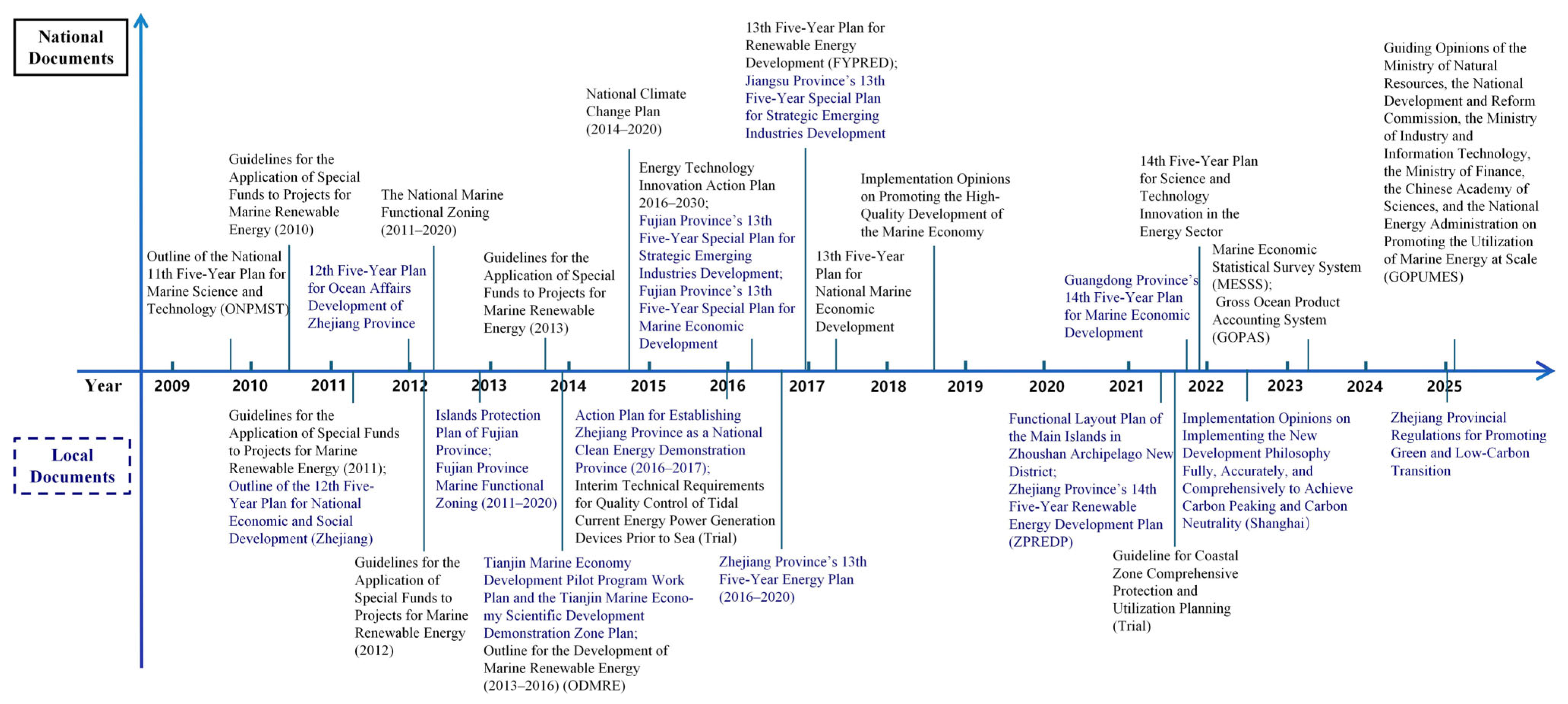
Three stages were identified in this study with respect to the TCE policies released since 2009. The representative policies of each stage are intuitively illustrated in the policy evolution diagram (Figure 2).
Stage I: 2009 to 2012. This period represents the infancy of the TCE policy. Outline of the National 11th Five-Year Plan for Marine Science and Technology (ONPMST), China’s first national marine science and technology development plan, outlined overarching objectives for marine science and technology development in 2009 [79]. To propel the growth of the marine economy, it explicitly called for the development of TCE technology. As a priority area for support, TCE was listed alongside other energy technologies for the first time. Together with the Ministry of Finance, the State Oceanic Administration (SOA) has successively issued the Guidelines for the Application of Special Funds to Projects for Marine Renewable Energy since 2010, supporting TCE technology research through project funding. The NMFZ also reserves marine space for the development of TCE as one of the key tools for marine spatial planning [80]. China’s coastal provinces, including Zhejiang, Guangdong, and Fujian, have incorporated TCE into their marine economic development strategies. It is noteworthy that Zhejiang authorities have successively released the Outline of the 12th Five-Year Plan for National Economic and Social Development, the Marine Economic Development Demonstration Zone Plan (Zhejiang), and the 12th Five-Year Plan for Ocean Affairs Development of Zhejiang Province in order to advance the implementation of the TCE projects [81].
Stage II: 2013 to 2022. Under the policy encouragement, this period represents the pilot stage for TCE projects. Some of the key aspects include:
(1) Continuing to issue policies regarding TCE projects that make use of spatial reservations and applicable scenarios. At the central level, the Ministry of Natural Resources (MNR) [82] released the Guideline for Coastal Zone Comprehensive Protection and Utilization Planning (Trial) [83] in 2021. Locally, the Tianjin Municipal People’s Government developed the Tianjin Marine Economy Development Pilot Program Work Plan and the Tianjin Marine Economy Scientific Development Demonstration Zone Plan in 2013. The Zhejiang Provincial Development and Reform Commission and the Zhoushan Archipelago New District Administrative Committee issued the Functional Layout Plan of the Main Islands in Zhoushan Archipelago New District in 2021 [84].
(2) Incorporating TCE into broader renewable energy policy frameworks. The SOA released the ODMRE in 2013, while the National Development and Reform Commission and the National Energy Administration released the Energy Technology Innovation Action Plan 2016–2030 and the FYPRED in 2016. At the local level, taking Zhejiang as a precedent, the province successively issued an Action Plan for Establishing Zhejiang Province as a National Clean Energy Demonstration Province (2016–2017) in 2015, Zhejiang Province’s 13th Five-Year Energy Plan (2016–2020) in 2016, and Zhejiang Province’s 14th Five-Year Renewable Energy Development Plan (ZPREDP) in 2021.
(3) Integrating TCE into the marine economy and industrial development process. There are many policy documents, including the 13th Five-Year Plan for National Marine Economic Development in 2017, Fujian Province’s 13th Five-Year Special Plan for Strategic Emerging Industries Development in 2016, Fujian Province’s 13th Five-Year Special Plan for Marine Economic Development in 2016, Jiangsu Province’s 13th Five-Year Special Plan for Strategic Emerging Industries Development in 2016, and Guangdong Province’s 14th Five-Year Plan for Marine Economic Development in 2021. In 2018, the MNR and the Commercial Bank of China issued Implementation Opinions on Promoting the High-Quality Development of the Marine Economy [85], which specifically supports the development of TCE industries from a financial perspective.
(4) Adapting and mitigating climate change through the use of TCE. The National Climate Change Plan (2014–2020) has been released since 2014, and Shanghai Municipal Committee of Communist Party of China and Shanghai Municipal People’s Government have issued the Implementation Opinions on Implementing the New Development Philosophy Fully, Accurately, and Comprehensively to Achieve Carbon Peaking and Carbon Neutrality by 2022, in which technological advances, demonstration projects, and industrial applications are identified as essential measures to reduce greenhouse gas emissions.
(5) Investing in TCE technology research and regulating its quality together. Industrialization of TCE requires corresponding equipment. In addition to the special funds for marine renewable energy, the 14th Five-Year Plan for Science and Technology Innovation in the Energy Sector, the Zhejiang Province’s 14th Five-Year Plan for Fundamental Research and Development, and other policies continue to support TCE technology research. In order to standardize TCE testing standards [86], the SOA issued a policy in 2015 entitled Interim Technical Requirements for Quality Control of Tidal Current Energy Power Generation Devices Prior to Sea (Trail). It has been through the encouragement and guidance of policy that China has achieved a successful transition from basic research technology to practical implementation in the industry of TCE.
Stage III: 2023 to 2025. TCE projects are moving toward large-scale implementation. Including TCE in gross ocean product accounting is one of the best indicators that the project is maturing into industrialization. TCE projects were explicitly incorporated into the Marine Economic Statistical Survey System (MESSS) and the Gross Ocean Product Accounting System (GOPAS), released by the MNR in 2023 [87]. In 2025, the Zhejiang Provincial Regulations for Promoting Green and Low-Carbon Transition expressly supported the large-scale utilization of ocean energy, including TCE. According to the GOPUMES, it is imperative to support the power generation of TCE as a green energy supplementary solution for coastal areas and islands in areas abundant with TCE resources. There is a call for implementing “hundred-megawatt-scale TCE key projects” [52]. These developments suggest that large-scale TCE deployment is progressing faster than initially anticipated.

3.2. Analysis of the Frequency of Terms and Social Network Semantic Analysis

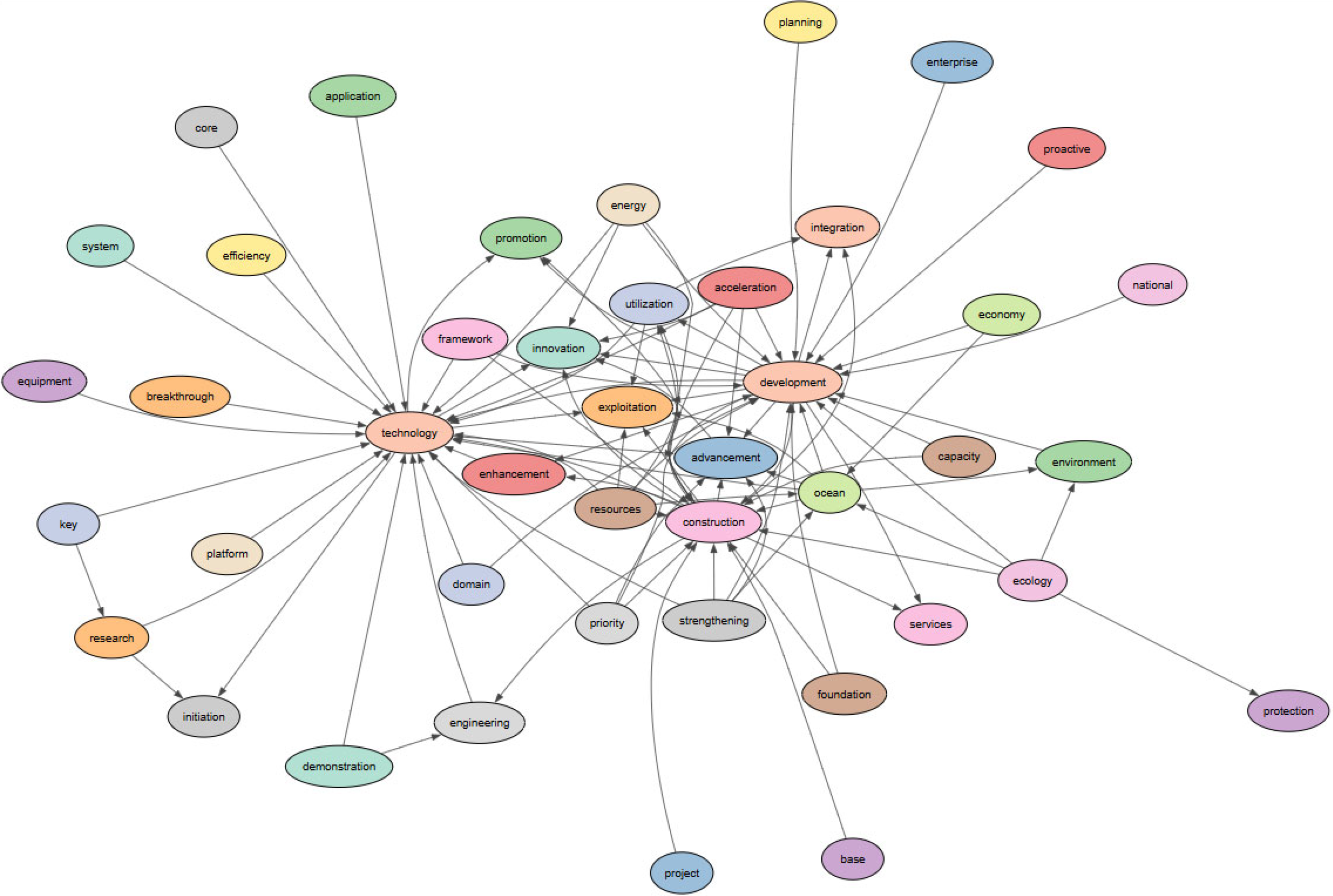
As shown in Table 1, the top 20 most frequently occurring terms in TCE policy texts are based on the results of ROST CM6 after removing semantically redundant terms. Technological innovation and development are the core focus of TCE policies from an overall perspective. Even though this study used TCE as the keyword for policy text retrieval, its term frequency (286) ranks relatively low, accounting for only 3% of the frequency of “technology” terms. The TCE is recognized in China’s policies, but receives limited attention as it is primarily positioned as a new form of marine renewable energy. However, from another perspective, these policy initiatives highlight TCE’s cutting-edge nature and significance.
In addition, ROST CM6 was used to generate social network and semantic network analysis diagrams (Figure 3). A high-frequency word is represented by a node in the diagram, and the number of lines connecting nodes indicates the strength of the link between them. The semantic connections between words and the deeper structural relationships within the policy texts are reflected here [88]. Currently, TCE remains within the scope of ocean construction. Among the most frequently occurring core keywords, “technology” exhibits high levels of association with “development,” “construction,” and “innovation.” Based on this analysis, current policy priorities are focused on increasing the development and utilization of TCE, promoting projects, and achieving industrialization. The prevalence of action-oriented terms such as “enhancement,” “acceleration,” “advancement,” and “promotion” further indicates that TCE is currently moving from technology development to project implementation and engineering application. Additionally, enterprises are explicitly encouraged and supported to enhance their technological capabilities and research capacities in marine renewable energy, including TCE. There is a co-linear relationship between “ocean,” “ecology,” and “environment.” Accordingly, TCE governance is largely governed by marine environmental and ecological regulations ordinarily. The frequency of “ecology” and “environment” is considerably lower than that of technology- and development-related terms, suggesting that environmental and ecological considerations, while present, do not constitute the primary focus of current TCE policies.

3.3. Specific Analysis of the Original Text Including Keywords

This study examines the content of policy texts in detail after conducting a term frequency analysis and a social network semantic analysis. It is important to note that text content, as an explicit and objective system description, can accurately present the current focus of research, enabling decision-makers to make the most informed decision about where to direct their efforts. Coastal regions such as Zhejiang, Shandong, Fujian, Guangdong, and Hainan possess relatively abundant marine energy resources, according to policy texts. One of the most significant marine energy reserves in China is in Zhejiang. This study performs a foundational classification based on keyword and semantic network analysis. Having removed action-related conjunctions and meaningless content, the policy texts can be categorized into three categories (Table 2).
Based on the fundamental classification of TCE policies, it is evident that the current focus is on technological R&D and engineering applications. Firstly, the main policies supporting the TCE technology application. In China, the main policies encourage the use of marine technologies, such as power generation technologies and equipment technologies, that are compatible with the characteristics of Chinese TCE resources, encouraging R&D of TCE resource exploration and energy supply platforms, miniaturization and modularization of marine energy, and the comprehensive utilization of TCE technology. The fundamental logic of technology-driven TCE utilization is reflected in all central and local policies related to TCE R&D. Secondly, these policies promote TCE technologies to engineering construction projects. Marine energy power systems, marine energy demonstration bases, TCE stations, TCE plants, and offshore TCE test sites are encouraged by policies. Using this engineering approach, it is possible to scale up the use of TCE technologies. It is possible to develop TCE projects and their underlying platforms in order to establish a fundamentally complete TCE utilization system, which will facilitate the subsequent creation of management systems and policy frameworks that are aligned with industrial development. Thirdly, marine economies should be developed in regions that are abundant in TCE. Nearshore waters are primarily targeted for the industrialization of TCE technologies. The development of TCE should be prioritized as a key task for the growth of the marine economy. Moreover, TCE contributes to the creation of low-carbon energy systems that support carbon peaking and sustainable economic growth by increasing power generation efficiency and reducing electricity costs.
Overall, environmental and ecology policies for TCE development constitute a very small portion of all policy documents.

4. Discussion

4.1. Environmental and Ecological Impacts of TCE

The use of TCE as a renewable energy source has many advantages. In the process of moving towards a large scale, however, it can have disproportionately negative impacts on the environment and ecology. These mainly include:
(1) Disruption of marine ecosystems and habitats. By acting as an artificial reef and increasing habitat heterogeneity, TCE installations accelerate flow around the devices and create highly mixed flows in their wakes [24,89,90]. As a result of the installation and operation of tidal energy devices, the seabed and benthic ecology are directly disturbed [91,92]. In addition, tidal energy exploitation can produce both near-field and far-field environmental effects depending on their proximity to devices or arrays [93]. There was little effect of tidal energy extraction on water level, according to most studies [31,94,95,96]. However, the tidal arrays could alter the tidal range upstream by approximately 5–42%, and the intertidal mudflats could decrease by 14–32%, resulting in habitat loss near shore [93,97]. It is likely that our concern will not be of concern for one device, but for a number of devices, which will become a significant threat to sensitive species as the number of devices increases [98]. A number of questions remain regarding the effects of tidal energy devices on marine wildlife, as well [99].
(2) Disturbances of the visual and auditory systems. During the installation phase, there is a potential for disturbance of seabirds and others [91]. Noise from turbines disrupts species that rely on sound for communication, orientation, predation, and evasion, as well as electromagnetic fields generated by power cables and moving parts of turbines that affect animals that use magnetic fields to navigate and hunt [89,100,101,102,103].
(3) Risks associated with collisions. Many tidal turbines, like wind turbines, are designed to pose collision risks with marine organisms [104]. According to some studies, the collision risk is very low [105,106]. Research on collision risks associated with the deployment of large-scale TCE turbines is lacking; however, existing studies suggest evaluating their potential risks over time [41,107].
(4) Ecological risks in the lifecycle of TCE projects. It is possible that oils, grease, and lubricants may leak from TCE devices, and antifouling and anticorrosion paints on TCE devices may contaminate the seawater over time [91,108]. In the conventional manufacturing of turbine blades, reinforced polymer composite materials are not recycled [109]. There will be an increase in blade waste as a result of increasing TCE capacity. There may be an environmental impact associated with the manufacture, transportation, installation, operation, and decommissioning of tidal turbine equipment [109].
Since interactions between devices and ecosystems are complex and dynamic, the ecological impacts of TCE projects remain unclear [89,104]. Although technological advances may be able to address potential risks in the future, they must not be overlooked in the process of large-scale expansion.

4.2. Limited and Poorly Applicable Environmental and Risk Regulations

Although a few policies refer to environmental standards and risk regulations for TCE, these references appear to be very simple or principled. In the Fujian Province Marine Functional Zoning (2011–2020), for instance, there is a strict control over the scale, scope, and intensity of nearshore mineral and energy development [110]. But specific standards are lacking, only requiring scientific assessment. However, this excessive reliance on scientists’ single decision-making approach cannot guarantee effective protection of the environment and ecology. When an island is primarily used for TCE project utilization, including building infrastructure for TCE. The Islands Protection Plan of Fujian Province strengthens the protection of islands’ ecological environment and prevents potential damage to their terrain, beaches, island ecosystems, and marine environment [111]. As a result of the lack of detailed implementation rules, specific environmental rules and risk regulations are not easily applied to TCE projects.
Due to TCE’s status as a renewable energy source, its environmental regulations are also applied to general laws and regulations. Laws such as the Renewable Energy Law (REL), the Island Protection Law, and the Wetland Protection Law are examples of these laws [112]. As a TCE construction project is a type of marine engineering project, it is also subject to laws that regulate environmental risks associated with marine engineering. These laws include the Environmental Protection Law, the Marine Environment Protection Law (MEPL), and the Law on Environmental Impact Appraisal (LEIA), among others.
It should be noted, however, that these regulations are sparse, broadly defined due to their diverse scope of application, and similarly hindered by the lack of detailed implementation guidelines. During the enforcement inspection of the REL, the Inspection Group of the Standing Committee of the National People’s Congress (NPC) of China highlighted issues such as insufficient policy coordination between renewable energy development and utilization and ecological environment protection, as well as inadequate regulatory coordination among the appropriate departments in 2019 [113]. The MEPL must be followed when approving environmental impact reports for marine projects, including TCE [114]. Among the topics covered in Chapter 5 of MEPL is pollution damage caused by construction projects to the marine environment [115]. Environmental pollution challenges are unique to TCE projects. The MEPL requires that appropriate environmental monitoring and supervisory standards be developed in accordance with Article 23. There is, however, a relative lack of standards regarding TCE. MEPL encourages the public to become involved, but the lack of environmental information regarding TCE prevents this from happening. It has limited practical applicability and operability. The potential environmental impacts of TCE may not have received special attention from MEPL. Alternatively, it does not adequately consider the need for environmental and ecological protection in TCE projects. The LEIA requires assessments to be conducted to analyze, predict, and mitigate adverse environmental impacts [116]. Construction projects subject to classified management of environmental impact assessments are one of the most important rules of the IEIA [117]. TCE is not directly included in the revised draft of the classified management list released by the Ministry of Ecology and Environment in December 2025 [118].

5. Conclusions and Future Policies

5.1. Aiming for More Reasonable and Comprehensive TCE Policies

As we move towards a future with a greater focus on sustainability, green energy is becoming an increasingly important part of the picture [119,120,121,122]. A recent report estimates that the global wave and tidal energy market will grow from USD 0.98 billion in 2023 to USD 19.75 billion by 2032 [123]. China is endowed with abundant TCE resources, positioning it favorably in this emerging sector. At least in China, we are currently experiencing an era of large-scale industrialization of TCE.
In China, the development of TCE policies can be divided into three stages. Despite increasing recognition in national and provincial policy frameworks, TCE exploitation policies specifically addressing environmental and ecological aspects constitute only a minor proportion of the overall policy corpus. Given that tidal turbines are typically deployed at specific depths (hub heights) within the water column, TCE extraction poses a complex three-dimensional environmental challenge, predominantly underwater [93]. General environmental laws and policies have not yet effectively addressed the associated risks. As large-scale TCE industrialization is now underway, the urgent development of targeted risk regulation policies is more critical than ever.

5.2. Research Limitations and Future Polices

When interpreting the findings of this study, it is important to keep in mind the numerous limitations of this study. First, TCE projects are managing the beginning stages of China’s large-scale development. As many enterprises consider details regarding TCE projects, especially those that involve environmental and ecological challenges, to be confidential, this study does not provide a specific case analysis. Second, the scope of policy texts covers all publicly available policies, but many working documents are not fully disclosed. We find it difficult to keep up with the latest developments in the unpublished policy documents relevant to the environment and ecological protection within government agencies. The third limitation is that this study does not provide a comprehensive overview of TCE policy in China based on quantitative impact assessments due to the insufficient amount of data available. Despite these limitations, this study provides insight into the shortcomings of environmental policies in the large-scale process of TCE projects, as well as directions for future policy innovation.
To ensure sustainable TCE in China, and even in the world, some targeted environmental policies and risk regulations are recommended:
First, dedicated EIA guidelines for TCE projects should be developed. China must strengthen its EIA policy framework by adhering to the principle of risk prevention. There are provisions in general environmental laws, especially in the Ecological and Environmental Code (approved on 12 March 2026) [124], but given the unique nature of TCE’s environmental impacts and the difficulty of supervision, it is unlikely that specialized regulations will be introduced to address potential TCE risks owing to the limited legislative resources in China. At a minimum, specific EIA technological guidelines grounded in the precautionary principle should be introduced to promote the long-term sustainability of TCE projects. Additionally, the application of fuzzy logic offers a promising, innovative approach to enhancing TCE-specific EIA processes [125].
Second, future policies should explicitly address the cumulative environmental impact of large-scale TCE deployment. In view of the fact that research has focused on the nature of marine resources and the technological aspects of exploiting them, there are few observations from which we can draw conclusions [89,126]. Although it is reasonable to assume that extracting only a small fraction of natural energy fluxes should have minimal ecological implications, it is difficult to determine acceptable limits of extraction [89,107]. The research suggests that impacts vary by location and season, by design and scale of devices and arrays, and may be cumulative, both over time and with an ever-increasing number of TCE projects [89,92]. For large-scale TCE projects, it is important to predict the potential changes in the hydrodynamic regime [97]. Accordingly, assessments of cumulative effects on marine ecosystems, biodiversity, and coastal processes must be systematically incorporated into planning and approval procedures.
Third, a comprehensive environmental risk evaluation system should be developed specifically for TCE. On 24 December 2025, the National Marine Energy Industry Alliance (NMEIA) was established [127]. The NMEIA, a national-level cooperation platform for marine energy industries that consists of leading enterprises, research institutes, and universities, is designed to facilitate collaborative innovation, technology sharing, risk sharing, and mutual benefits among marine energy industries [127]. The industry standard “Laboratory Testing Methods for Combined Wave Energy, Tidal Current Energy, and Offshore Wind Energy Generation Devices” was released for public comment on 30 December 2025 [128]. The development of large-scale marine renewable energy projects, including TCE projects, represents a major future trend, driven by the imperatives of marine economic growth, climate change mitigation, and even by the need for corporate profits [129,130]. An industry-specific environmental risk assessment system applicable to TCE projects is recommended as one of the best options [108].

Author Contributions

Conceptualization, R.G. and Y.D.; methodology, Z.L. and H.W.; software, Z.L. and H.W.; validation, Z.L., H.W. and Y.D.; formal analysis, R.G., S.Z. and Y.D.; investigation, Z.L., H.W., G.W. and S.Z.; resources, R.G.; data curation, Z.L., H.W., G.W. and S.Z.; writing—original draft preparation, R.G., Z.L., H.W. and Y.D.; writing—review and editing, G.W., S.Z. and Y.D.; visualization, H.W. and S.Z.; supervision, R.G. and Y.D.; project administration, Y.D.; funding acquisition, R.G. All authors have read and agreed to the published version of the manuscript.

Funding

This research was funded by the National Social Science Fund of China (grant No. 24AZD051); Innovation Group Project of Southern Marine Science and Engineering Guangdong Laboratory (Zhuhai) (grant No. SML2024SP026); UNDP Green and Digital Innovation Cooperation Project (01004047).

Institutional Review Board Statement

Not applicable.

Informed Consent Statement

Not applicable.

Data Availability Statement

The data that support the findings of this study are available from the corresponding author upon reasonable request, as they are being reserved for future investigations.

Conflicts of Interest

The authors declare no conflicts of interest.

References

  1. Pang, S.; Abdul Majid, M.; Perera, H.A.C.C.; Sarkar, M.S.I.; Ning, J.; Zhai, W.; Guo, R.; Deng, Y.; Zhang, H. A Systematic Review and Global Trends on Blue Carbon and Sustainable Development: A Bibliometric Study from 2012 to 2023. Sustainability 2024, 16, 2473. [Google Scholar] [CrossRef]
  2. Olubiyi, T.O.; Jubril, B.; Sojinu, O.S.; Ngari, R. Strengthening Gender Equality in Small Business and Achieving Sustainable Development Goals (SDGS): Comparative Analysis of Kenya and Nigeria. J. Sawala Adm. Negara 2022, 10, 168–186. [Google Scholar] [CrossRef]
  3. Østergaard, P.A.; Sperling, K. Towards Sustainable Energy Planning and Management. Int. J. Sustain. Energy Plan. Manag. 2014, 1, 1–5. [Google Scholar] [CrossRef]
  4. Østergaard, P.A.; Duic, N.; Noorollahi, Y.; Mikulcic, H.; Kalogirou, S. Sustainable Development Using Renewable Energy Technology. Renew. Energy 2020, 146, 2430–2437. [Google Scholar] [CrossRef]
  5. Güney, T. Renewable Energy, Non-Renewable Energy and Sustainable Development. Int. J. Sustain. Dev. World Ecol. 2019, 26, 389–397. [Google Scholar] [CrossRef]
  6. Lund, H. Renewable Energy Strategies for Sustainable Development. Energy 2007, 32, 912–919. [Google Scholar] [CrossRef]
  7. Afgan, N.H.; Carvalho, M.G. Multi-Criteria Assessment of New and Renewable Energy Power Plants. Energy 2002, 27, 739–755. [Google Scholar] [CrossRef]
  8. Østergaard, P.A.; Duic, N.; Noorollahi, Y.; Kalogirou, S. Renewable Energy for Sustainable Development. Renew. Energy 2022, 199, 1145–1152. [Google Scholar] [CrossRef]
  9. Sarala, R.M.; Post, C.; Doh, J.; Muzio, D. Advancing Research on the Future of Work in the Age of Artificial Intelligence (AI). J. Manag. Stud. 2025, 62, 1863–1884. [Google Scholar] [CrossRef]
  10. Ning, J.; Pang, S.; Arifin, Z.; Zhang, Y.; Epa, U.P.K.; Qu, M.; Zhao, J.; Zhen, F.; Chowdhury, A.; Guo, R.; et al. The Diversity of Artificial Intelligence Applications in Marine Pollution: A Systematic Literature Review. J. Mar. Sci. Eng. 2024, 12, 1181. [Google Scholar] [CrossRef]
  11. Singhal, N.; Vardhan, H.; Jain, R.; Vashistha, P.; Pandey, A.; Wagri, N.K.; Gaur, A. Algorithms for Nature: Integrating Technology, Ecology, and Society for Sustainable Conservation. Environ. Syst. Res. 2025, 14, 30. [Google Scholar] [CrossRef]
  12. Zhang, J. AI-Based Data Intelligence System for Sustainable Ecological Governance and Smart Environmental Management. Microchem. J. 2025, 219, 115850. [Google Scholar] [CrossRef]
  13. Deng, Z.; Guo, Y.; Han, C.; Ma, W.; Xiong, J.; Wen, S.; Xiang, Y. AI Agents Under Threat: A Survey of Key Security Challenges and Future Pathways. ACM Comput. Surv. 2025, 57, 1–36. [Google Scholar] [CrossRef]
  14. Kyriakarakos, G. Artificial Intelligence and the Energy Transition. Sustainability 2025, 17, 1140. [Google Scholar] [CrossRef]
  15. Hlabisa, S. The Ecology of Artificial Intelligence: Energy, Water, Materials, and Land Limits of Digital Systems. Carbon Neutr. Syst. 2025, 1, 19. [Google Scholar] [CrossRef]
  16. Attard-Frost, B.; Lyons, K. AI Governance Systems: A Multi-Scale Analysis Framework, Empirical Findings, and Future Directions. AI Ethics 2025, 5, 2557–2604. [Google Scholar] [CrossRef]
  17. Batool, A.; Zowghi, D.; Bano, M. AI Governance: A Systematic Literature Review. AI Ethics 2025, 5, 3265–3279. [Google Scholar] [CrossRef]
  18. Pimenow, S.; Pimenowa, O.; Prus, P. Challenges of Artificial Intelligence Development in the Context of Energy Consumption and Impact on Climate Change. Energies 2024, 17, 5965. [Google Scholar] [CrossRef]
  19. Bogmans, C.; Gomez-Gonzalez, P.; Ganpurev, G.; Melina, G.; Pescatori, A.; Thube, S. Power Hungry: How AI Will Drive Energy Demand; IMF Working Papers; International Monetary Fund: Washington, DC, USA, 2025; Volume 2025, p. 1. [Google Scholar] [CrossRef]
  20. Li, Y.; Ma, C. Development and Management of Ocean Energy in China. IOP Conf. Ser. Earth Environ. Sci. 2020, 467, 012207. [Google Scholar] [CrossRef]
  21. Taveira-Pinto, F.; Rosa-Santos, P.; Fazeres-Ferradosa, T. Marine Renewable Energy. Renew. Energy 2020, 150, 1160–1164. [Google Scholar] [CrossRef]
  22. Su, X.; Chen, J.; Yuan, L.; Xu, W.; Xiong, C.; Wang, X. Current Status of Development and Application of Ocean Renewable Energy Technology. Sustainability 2025, 17, 5648. [Google Scholar] [CrossRef]
  23. Liu, X.; Chen, Z.; Si, Y.; Qian, P.; Wu, H.; Cui, L.; Zhang, D. A Review of Tidal Current Energy Resource Assessment in China. Renew. Sustain. Energy Rev. 2021, 145, 111012. [Google Scholar] [CrossRef]
  24. Boretti, A.; Castelletto, S. Advancements and Challenges in Tidal Stream and Oceanic Current Turbines: An Overview of Current Technologies and Future Prospects. Mar. Dev. 2025, 3, 10. [Google Scholar] [CrossRef]
  25. IRENA. Offshore Renewables: An Action Agenda for Deployment; International Renewable Energy Agency: Abu Dhabi, United Arab Emirates, 2021; ISBN 978-1-5231-5189-9. [Google Scholar]
  26. Chu, J. Marine Tidal Current Energy Electricity Generation Technology and Equipment, 1st ed.; Publishing House of Electronics Industry: Beijing, China, 2021; ISBN 978-7-121-39319-8. [Google Scholar]
  27. Liu, H.; Bahaj, A.S. Status of Marine Current Energy Conversion in China. Int. J. Mar. Eng. 2021, 4, 11–23. [Google Scholar] [CrossRef]
  28. Zhang, Y.; Lin, Z.; Liu, Q. Marine Renewable Energy in China: Current Status and Perspectives. Water Sci. Eng. 2014, 7, 288–305. [Google Scholar] [CrossRef]
  29. Li, Y.; Liu, H.; Lin, Y.; Li, W.; Gu, Y. Design and Test of a 600-kW Horizontal-Axis Tidal Current Turbine. Energy 2019, 182, 177–186. [Google Scholar] [CrossRef]
  30. Li, Y.; Li, W.; Liu, H.; Lin, Y.; Gu, Y.; Xie, B. Indirect Load Measurements for Large Floating Horizontal-Axis Tidal Current Turbines. Ocean Eng. 2020, 198, 106945. [Google Scholar] [CrossRef]
  31. Zhang, D.; Liu, X.; Tan, M.; Qian, P.; Si, Y. Flow Field Impact Assessment of a Tidal Farm in the Putuo-Hulu Channel. Ocean Eng. 2020, 208, 107359. [Google Scholar] [CrossRef]
  32. Uihlein, A.; Magagna, D. Wave and Tidal Current Energy—A Review of the Current State of Research beyond Technology. Renew. Sustain. Energy Rev. 2016, 58, 1070–1081. [Google Scholar] [CrossRef]
  33. Chen, H.; Tang, T.; Ait-Ahmed, N.; Benbouzid, M.E.H.; Machmoum, M.; Zaim, M.E.-H. Attraction, Challenge and Current Status of Marine Current Energy. IEEE Access 2018, 6, 12665–12685. [Google Scholar] [CrossRef]
  34. Norton, B.G.; Toman, M.A. Sustainability: Ecological and Economic Perspectives. Land Econ. 1997, 73, 553. [Google Scholar] [CrossRef]
  35. Zhang, W.; Li, H.; An, X. Ecological Civilization Construction Is the Fundamental Way to Develop Low-Carbon Economy. Energy Procedia 2011, 5, 839–843. [Google Scholar] [CrossRef]
  36. Meng, F.; Guo, J.; Guo, Z.; Lee, J.C.K.; Liu, G.; Wang, N. Urban Ecological Transition: The Practice of Ecological Civilization Construction in China. Sci. Total Environ. 2021, 755, 142633. [Google Scholar] [CrossRef]
  37. Zhang, L.; Wang, H.; Zhang, W.; Wang, C.; Bao, M.; Liang, T.; Liu, K. Study on the Development Patterns of Ecological Civilization Construction in China: An Empirical Analysis of 324 Prefectural Cities. J. Clean. Prod. 2022, 367, 132975. [Google Scholar] [CrossRef]
  38. Hu, J.; Hu, M.; Zhang, H. Has the Construction of Ecological Civilization Promoted Green Technology Innovation? Environ. Technol. Innov. 2023, 29, 102960. [Google Scholar] [CrossRef]
  39. Hariram, N.P.; Mekha, K.B.; Suganthan, V.; Sudhakar, K. Sustainalism: An Integrated Socio-Economic-Environmental Model to Address Sustainable Development and Sustainability. Sustainability 2023, 15, 10682. [Google Scholar] [CrossRef]
  40. Zhang, X.; Ji, R.; Sun, K.; Zhang, J.; Zhang, X.; Yin, M.; Kong, M.; Reabroy, R. A Review of Ocean Tidal Current Energy Technology: Advances, Trends, and Challenges. Phys. Fluids 2025, 37, 071308. [Google Scholar] [CrossRef]
  41. Rivera, G.; Felix, A.; Mendoza, E. A Review on Environmental and Social Impacts of Thermal Gradient and Tidal Currents Energy Conversion and Application to the Case of Chiapas, Mexico. Int. J. Environ. Res. Public Health 2020, 17, 7791. [Google Scholar] [CrossRef]
  42. Frid, C.; Andonegi, E.; Depestele, J.; Judd, A.; Rihan, D.; Rogers, S.I.; Kenchington, E. The Environmental Interactions of Tidal and Wave Energy Generation Devices. Environ. Impact Assess. Rev. 2012, 32, 133–139. [Google Scholar] [CrossRef]
  43. Halvorsen, M.B.; Carlson, T.J.; Copping, A.E. Effects of Tidal Turbine Noise on Fish Task 2.1.3.2: Effects on Aquatic Organisms: Acoustics/Noise—Fiscal Year 2011—Progress Report—Nvironmental Effects of Marine and Hydrokinetic Energy. Available online: https://www.pnnl.gov/main/publications/external/technical_reports/PNNL-20787.pdf (accessed on 25 November 2025).
  44. Boehlert, G.; Gill, A. Environmental and Ecological Effects of Ocean Renewable Energy Development—A Current Synthesis. Oceanography 2010, 23, 68–81. [Google Scholar] [CrossRef]
  45. Fallon, D.; Hartnett, M.; Olbert, A.; Nash, S. The Effects of Array Configuration on the Hydro-Environmental Impacts of Tidal Turbines. Renew. Energy 2014, 64, 10–25. [Google Scholar] [CrossRef]
  46. Edenhofer, O.; Madruga, R.P.; Sokona, Y.; Seyboth, K.; Matschoss, P.; Kadner, S.; Zwickel, T.; Eickemeier, P.; Hansen, G.; Schlömer, S.; et al. Renewable Energy Sources and Climate Change Mitigation: Special Report of the Intergovernmental Panel on Climate Change; IPCC, Ed.; Cambridge University Press: Cambridge, UK, 2012; ISBN 978-1-107-60710-1. [Google Scholar]
  47. PRIMRE. LHD Tidal Generation 1. Available online: https://openei.org/wiki/PRIMRE/Databases/Projects_Database/Projects/LHD_Tidal_Generation_1 (accessed on 15 May 2025).
  48. TheCivilEngineer.org. A Chinese Tidal Energy Project Qualifies as ‘World Record’. Available online: https://www.thecivilengineer.org/news/a-chinese-tidal-energy-project-marks-as-world-record (accessed on 16 May 2025).
  49. Dou, H. Zhoushan in E China Harnesses Ocean Power for a Sustainable Future. CPC Central Committee Bimonthly, 28 November 2025. Available online: https://en.qstheory.cn/2025-11/28/c_1144138.htm (accessed on 11 December 2025).
  50. Hu, F. The World’s First Ocean Tidal Power Stateion: Generating over 8.1 Million Kilowatt Hours of Electricity Cumulatively. Available online: https://news.qq.com/rain/a/20250815A023Q100 (accessed on 20 December 2025).
  51. Ocean Energy Europe. Ocean Energy: Key Trends and Statistics. 2022. Available online: https://www.oceanenergy-europe.eu/wp-content/uploads/2023/03/Ocean-Energy-Key-Trends-and-Statistics-2022.pdf (accessed on 2 December 2025).
  52. Instrumentalities of the State Council; Ministry of Natural Resources; State Development & Reform Commission; Ministry of Industry & Information Technology; Ministry of Finance; Chinese Academy of Sciences; National Energy Administration. Guiding Opinions of the Ministry of Natural Resources, the National Development and Reform Commission, the Ministry of Industry and Information Technology, the Ministry of Finance, the Chinese Academy of Sciences, and the National Energy Administration on Promoting the Utilization of Marine Energy at Scale. Available online: https://lawinfochina.com/display.aspx?id=44380&lib=law (accessed on 25 August 2025).
  53. Dialogue Earth. China Looks to Ride Wave of Clean Ocean Energy. Available online: https://www.reccessary.com/en/news/china-looks-to-ride-wave-of-clean-ocean-energy (accessed on 30 November 2025).
  54. Ji, R.; Wu, M.; Zheng, J.; Sun, K.; Zhang, J.; Xue, M.; Reabroy, R.; Zhang, Y. Lagrangian Dynamic Large-Eddy Simulation of the Performance of a Horizontal-Axis Tidal Turbine with an Actuator-Line Method. Phys. Fluids 2025, 37, 075169. [Google Scholar] [CrossRef]
  55. Qi, M.; Dai, X.; Zhang, B.; Li, J.; Liu, B. The Evolution and Future Prospects of China’s Wave Energy Policy from the Perspective of Renewable Energy: Facing Problems, Governance Optimization and Effectiveness Logic. Sustainability 2023, 15, 3274. [Google Scholar] [CrossRef]
  56. Ko, D.-H.; Chung, J.; Lee, K.-S.; Park, J.-S.; Yi, J.-H. Current Policy and Technology for Tidal Current Energy in Korea. Energies 2019, 12, 1807. [Google Scholar] [CrossRef]
  57. O’Hagan, A.M.; Lewis, A.W. The Existing Law and Policy Framework for Ocean Energy Development in Ireland. Mar. Policy 2011, 35, 772–783. [Google Scholar] [CrossRef]
  58. Leary, D.; Esteban, M. Climate Change and Renewable Energy from the Ocean and Tides: Calming the Sea of Regulatory Uncertainty. Int. J. Mar. Coast. Law 2009, 24, 617–651. [Google Scholar] [CrossRef]
  59. Corsatea, T.D. Increasing Synergies between Institutions and Technology Developers: Lessons from Marine Energy. Energy Policy 2014, 74, 682–696. [Google Scholar] [CrossRef]
  60. Jansujwicz, J.S.; Johnson, T.R. Understanding and Informing Permitting Decisions for Tidal Energy Development Using an Adaptive Management Framework. Estuaries Coasts 2015, 38, 253–265. [Google Scholar] [CrossRef]
  61. Kelsey, A. All Tide up: Addressing the Regulatory and Environmental Barriers Affecting Tidal Energy Development in British Columbia. Available online: https://summit.sfu.ca/_flysystem/fedora/2026-01/etd24123.pdf#page=31.09 (accessed on 19 March 2026).
  62. Zhang, X.; Yang, F. Rural Informatization Policy Evolution in China: A Bibliometric Study. Scientometrics 2019, 120, 129–153. [Google Scholar] [CrossRef]
  63. Yang, F.; Shu, H.; Zhang, X. Understanding “Internet Plus Healthcare” in China: Policy Text Analysis. J. Med. Internet Res. 2021, 23, e23779. [Google Scholar] [CrossRef]
  64. Wang, D. Joint Liability and Aggravation? An Inspection of Legislative and Judicial Practices in Cases of the Crime of the Abduction, Sale, and Purchase of Women and Children in China. Humanit. Soc. Sci. Commun. 2023, 10, 785. [Google Scholar] [CrossRef]
  65. Wang, K.; Dong, K.; Wu, J.; Wu, J. Patterns of Artificial Intelligence Policies in China: A Nationwide Perspective. Libr. Hi Tech 2025, 43, 295–325. [Google Scholar] [CrossRef]
  66. International Energy Agency. China 13th Renewable Energy Development Five Year Plan (2016–2020). Available online: https://www.iea.org/policies/6277-china-13th-renewable-energy-development-five-year-plan-2016-2020 (accessed on 1 December 2025).
  67. State Oceanic Administration. Notice of the State Oceanic Administration on Issuing the Outline for the Development of Marine Renewable Energy (2013–2016). Available online: https://www.lawinfochina.com/display.aspx?id=16668&lib=law&EncodingName=gb2312 (accessed on 2 December 2025).
  68. Lu, W.-H.; Liu, J.; Xiang, X.-Q.; Song, W.-L.; McIlgorm, A. A Comparison of Marine Spatial Planning Approaches in China: Marine Functional Zoning and the Marine Ecological Red Line. Mar. Policy 2015, 62, 94–101. [Google Scholar] [CrossRef]
  69. Browne, J.; Coffey, B.; Cook, K.; Meiklejohn, S.; Palermo, C. A Guide to Policy Analysis as a Research Method. Health Promot. Int. 2019, 34, 1032–1044. [Google Scholar] [CrossRef] [PubMed]
  70. Lejano, R. Frameworks for Policy Analysis: Merging Text and Context, 1st ed.; Routledge: New York, NY, USA, 2013; ISBN 978-0-203-62542-2. [Google Scholar]
  71. Weimer, D.L.; Vining, A.R. Policy Analysis: Concepts and Practice, 6th ed.; Routledge: New York, NY, USA, 2017; ISBN 978-1-315-44212-9. [Google Scholar]
  72. Saarinen, T. Position of Text and Discourse Analysis in Higher Education Policy Research. Stud. High. Educ. 2008, 33, 719–728. [Google Scholar] [CrossRef]
  73. Taylor, S. Critical Policy Analysis: Exploring Contexts, Texts and Consequences. Discourse Stud. Cult. Polit. Educ. 1997, 18, 23–35. [Google Scholar] [CrossRef]
  74. Fischer, F.; Miller, G.J. (Eds.) Handbook of Public Policy Analysis: Theory, Politics, and Methods, 1st ed.; Routledge: New York, NY, USA, 2017; ISBN 978-1-315-09319-2. [Google Scholar]
  75. Yu, J.; Zhang, L. Evolution of Marine Ranching Policies in China: Review, Performance and Prospects. Sci. Total Environ. 2020, 737, 139782. [Google Scholar] [CrossRef]
  76. Peng, J.-E.; Jiang, Y. Mining Opinions on LMOOCs: Sentiment and Content Analyses of Chinese Students’ Comments in Discussion Forums. System 2022, 109, 102879. [Google Scholar] [CrossRef]
  77. Chen, Y.; Chen, D.; Zhong, Z. Research on Destination Image Perception of Fujian Tulou World Heritage Site Based on Online Visitors’ Reviews. J. Asian Archit. Build. Eng. 2025, 1–14. [Google Scholar] [CrossRef]
  78. Yu, J.; Wang, Y. Evolution of Blue Carbon Management Policies in China: Review, Performance and Prospects. Clim. Policy 2023, 23, 254–267. [Google Scholar] [CrossRef]
  79. State Oceanic Administration. Outline of the National 11th Five-Year Plan for Marine Science and Technology. Available online: https://policy.mofcom.gov.cn/claw/clawContent.shtml?id=1801 (accessed on 15 September 2025).
  80. Gao, J.; An, T.; Zhang, K.; Zhao, R. Development and Reform of Marine Spatial Planning in China under the New Territorial Spatial Planning System. Mar. Dev. 2024, 2, 2. [Google Scholar] [CrossRef]
  81. Cui, Y.; Xu, H.; An, D.; Yang, L. Evaluation of Marine Economic Development Demonstration Zone Policy on Marine Industrial Structure Optimization: A Case Study of Zhejiang, China. Front. Mar. Sci. 2024, 11, 1403347. [Google Scholar] [CrossRef]
  82. Deng, Y.; Shi, Y. Recent Developments of China’s Institutional Reform for Ocean Management: An Appraisal. Coast. Manag. 2023, 51, 91–114. [Google Scholar] [CrossRef]
  83. Liu, J.; Chen, F.; Xiao, L. China’s Island Management System Based on Qualitative Content Analysis: The Choice between Development and Conservation. J. Sea Res. 2024, 202, 102553. [Google Scholar] [CrossRef]
  84. Mao, H.; Qin, S.; Xu, B.; Zhang, X. The Functional Layout of Main Islands in the Zhoushan Archipelago New District, Zhejiang Province. Ocean. Dev. Manag. 2021, 38, 46–51. [Google Scholar]
  85. Zheng, H.; Zhang, L.; Wang, S.; Xu, J.; Zhao, X. The Affecting Channels and Performances of FInancial Development and Poverty Reduction: New Evidence from China’s Fishery Industry. Mar. Policy 2021, 123, 104324. [Google Scholar] [CrossRef]
  86. Noble, D.R.; O’Shea, M.; Judge, F.; Robles, E.; Martinez, R.; Khalid, F.; Thies, P.R.; Johanning, L.; Corlay, Y.; Gabl, R.; et al. Standardising Marine Renewable Energy Testing: Gap Analysis and Recommendations for Development of Standards. J. Mar. Sci. Eng. 2021, 9, 971. [Google Scholar] [CrossRef]
  87. Kedong, Y.; Liu, Z.; Zhang, C.; Huang, S.; Li, J.; Lv, L.; Su, X.; Zhang, R. Analysis and Forecast of Marine Economy Development in China. Mar. Econ. Manag. 2022, 5, 1–33. [Google Scholar] [CrossRef]
  88. Chuling, C.; Xue, Q. Analysis of the Image Perception of Luxury Hotels Based on UGC Data and Customer Value Theory. J. Phys. Conf. Ser. 2022, 2301, 012007. [Google Scholar] [CrossRef]
  89. Bonar, P.A.J.; Bryden, I.G.; Borthwick, A.G.L. Social and Ecological Impacts of Marine Energy Development. Renew. Sustain. Energy Rev. 2015, 47, 486–495. [Google Scholar] [CrossRef]
  90. El-Geziry, T.M.; Bryden, I.G.; Couch, S.J. Environmental Impact Assessment for Tidal Energy Schemes: An Exemplar Case Study of the Strait of Messina. J. Mar. Eng. Technol. 2009, 8, 39–48. [Google Scholar] [CrossRef]
  91. DTI. A Scoping Study for an Environmental Impact Field Programme in Tidal Current Energy. Available online: https://www.osti.gov/etdeweb/servlets/purl/20295312#page=1.00&gsr=0 (accessed on 15 February 2026).
  92. Shields, M.A.; Dillon, L.J.; Woolf, D.K.; Ford, A.T. Strategic Priorities for Assessing Ecological Impacts of Marine Renewable Energy Devices in the Pentland Firth (Scotland, UK). Mar. Policy 2009, 33, 635–642. [Google Scholar] [CrossRef]
  93. Neill, S.P.; Haas, K.A.; Thiébot, J.; Yang, Z. A Review of Tidal Energy—Resource, Feedbacks, and Environmental Interactions. J. Renew. Sustain. Energy 2021, 13, 062702. [Google Scholar] [CrossRef]
  94. Yang, Z.; Wang, T.; Copping, A.; Geerlofs, S. Modeling of In-Stream Tidal Energy Development and Its Potential Effects in Tacoma Narrows, Washington, USA. Ocean. Coast. Manag. 2014, 99, 52–62. [Google Scholar] [CrossRef]
  95. Wang, T.; Yang, Z. A Tidal Hydrodynamic Model for Cook Inlet, Alaska, to Support Tidal Energy Resource Characterization. J. Mar. Sci. Eng. 2020, 8, 254. [Google Scholar] [CrossRef]
  96. Wang, T.; Yang, Z. A Modeling Study of Tidal Energy Extraction and the Associated Impact on Tidal Circulation in a Multi-Inlet Bay System of Puget Sound. Renew. Energy 2017, 114, 204–214. [Google Scholar] [CrossRef]
  97. Nash, S.; O׳Brien, N.; Olbert, A.; Hartnett, M. Modelling the Far Field Hydro-Environmental Impacts of Tidal Farms—A Focus on Tidal Regime, Inter-Tidal Zones and Flushing. Comput. Geosci. 2014, 71, 20–27. [Google Scholar] [CrossRef]
  98. Hemery, L.G.; Garavelli, L.; Copping, A.E.; Farr, H.; Jones, K.; Baker-Horne, N.; Kregting, L.; McGarry, L.P.; Sparling, C.; Verling, E. Animal Displacement from Marine Energy Development: Mechanisms and Consequences. Sci. Total Environ. 2024, 917, 170390. [Google Scholar] [CrossRef]
  99. Isaksson, N.; Masden, E.A.; Williamson, B.J.; Costagliola-Ray, M.M.; Slingsby, J.; Houghton, J.D.R.; Wilson, J. Assessing the Effects of Tidal Stream Marine Renewable Energy on Seabirds: A Conceptual Framework. Mar. Pollut. Bull. 2020, 157, 111314. [Google Scholar] [CrossRef]
  100. Tethys. Tidal. Available online: https://tethys.pnnl.gov/technology/tidal (accessed on 18 December 2025).
  101. Veneruso, G.; Chapuis, L.; Hastie, G.D.; Le Vay, L.; Cordes, L.S. Tidal Flow Masks Acoustic Detections of Harbour Porpoises (Phocoena Phocoena): Implications for Passive Acoustic Studies of Cetaceans. J. Acoust. Soc. Am. 2025, 158, 2883–2891. [Google Scholar] [CrossRef]
  102. The Crown Estate. 2024–2025, The Crown Estate and ABPmer, Tidal Stream Energy Project, Collision Risk Data and Evidence Summary. Available online: https://www.marinedataexchange.co.uk/details/TCE-4144/2024-2025-the-crown-estate-and-abpmer-tidal-stream-energy-project-collision-risk-data-and-evidence-summary (accessed on 20 December 2025).
  103. Gill, A.B.; Bartlett, M.D. Literature Review on the Potential Effects of Electromagnetic Fields and Subsea Noise from Marine Renewable Energy Developments on Atlantic Salmon, Sea Trout and European Eel. Scottish Natural Heritage Commissioned Report. Available online: https://dspace.lib.cranfield.ac.uk/server/api/core/bitstreams/dee1a7b3-e898-44b1-9974-a03a5c698fa5/content (accessed on 20 February 2026).
  104. Wilson, B.; Batty, R.S.; Daunt, F.; Carter, C. Collision Risks between Marine Renewable Energy Devices and Mammals, Fish and Diving Birds: Report to the Scottish Executive. Available online: https://nora.nerc.ac.uk/id/eprint/504110/1/N504110CR.pdf (accessed on 18 February 2026).
  105. Fraenkel, P.L. Tidal Current Energy Technologies. Ibis 2006, 148, 145–151. [Google Scholar] [CrossRef]
  106. Ascher, S.E.; Gray, I.M.; Collins, C.M. (Tilly) Misplaced Fears? What the Evidence Reveals of the Ecological Effects of Tidal Power Generation. Ecol. Sol. Evid. 2025, 6, e70124. [Google Scholar] [CrossRef]
  107. Shields, M.A.; Woolf, D.K.; Grist, E.P.M.; Kerr, S.A.; Jackson, A.C.; Harris, R.E.; Bell, M.C.; Beharie, R.; Want, A.; Osalusi, E.; et al. Marine Renewable Energy: The Ecological Implications of Altering the Hydrodynamics of the Marine Environment. Ocean. Coast. Manag. 2011, 54, 2–9. [Google Scholar] [CrossRef]
  108. Copping, A.; Hanna, L.; Van Cleve, B.; Blake, K.; Anderson, R.M. Environmental Risk Evaluation System—An Approach to Ranking Risk of Ocean Energy Development on Coastal and Estuarine Environments. Estuaries Coasts 2015, 38, 287–302. [Google Scholar] [CrossRef]
  109. Walker, S.R.J.; Thies, P.R. A Life Cycle Assessment Comparison of Materials for a Tidal Stream Turbine Blade. Appl. Energy 2022, 309, 118353. [Google Scholar] [CrossRef]
  110. Fujian Provincial People’s Government. Fujian Province Marine Functional Zoning (2011–2020). Available online: https://view.officeapps.live.com/op/view.aspx?src=https%3A%2F%2Fhyyyj.fujian.gov.cn%2Fres%2Fextra_new%2F7%2F7674dc98f5bfa2cccfec1c7c5e0afd40.doc (accessed on 15 October 2025).
  111. Fujian Provincial Department of Ocean and Fisheries. Islands Protection Plan of Fujian Province. Available online: https://hyyyj.fujian.gov.cn/res/extra_new/1/1e5a2f396879a8c9bd345c634129ac31.pdf (accessed on 15 October 2025).
  112. Deng, Y.-C.; Jiang, X. Wetland Protection Law of the People’s Republic of China: New Efforts in Wetland Conservation. Int. J. Mar. Coast. Law 2023, 38, 141–160. [Google Scholar] [CrossRef]
  113. Ding, Z. The 2019 Report of the Inspection Group of the Standing Committee of the National People’s Congress (NPC) of China for Inspecting the Implementation of Renewable Energy Law. Available online: http://www.npc.gov.cn/npc/c2/c30834/201912/t20191224_303904.html (accessed on 15 November 2025).
  114. Zou, K.; Tan, Y. New Revision of China’s Marine Environmental Protection Law. Int. J. Mar. Coast. Law 2024, 40, 203–215. [Google Scholar] [CrossRef]
  115. Yang, W.; Chen, X.; Liu, Y. Recent Developments in Building Sustainable Marine Fisheries in China: Reflections on the 2023 Revision of the Marine Environmental Protection Law. Mar. Policy 2025, 171, 106439. [Google Scholar] [CrossRef]
  116. Ministry of Ecology and Environment Law of People’s Republic of China on Environmental Impact Appraisal. Available online: https://english.mee.gov.cn/Resources/laws/environmental_laws/202012/t20201204_811509.shtml (accessed on 17 December 2025).
  117. Yang, Y.; Xu, H.; Zhang, Y.; Guo, X. The Evolution of China’s Environmental Impact Assessment System: Retrospect and Prospect from the Perspective of Effectiveness Evaluation. Environ. Impact Assess. Rev. 2023, 101, 107122. [Google Scholar] [CrossRef]
  118. Ministry of Ecology and Environment Notice on Public Consultation Regarding the Draft Revision of the Catalogue for Classified Management of Appraisal of Environmental Impacts of Construction Projects. Available online: https://www.mee.gov.cn/xxgk2018/xxgk/xxgk06/202512/t20251205_1137209.html (accessed on 18 February 2026).
  119. Li, X. Green Energy for Sustainability and Energy Security. In Green Energy; Li, X., Ed.; Progress in Green Energy; Springer: London, UK, 2011; Volume 1, pp. 1–16. ISBN 978-1-84882-646-5. [Google Scholar]
  120. Jeffrey, H.; Jay, B.; Winskel, M. Accelerating the Development of Marine Energy: Exploring the Prospects, Benefits and Challenges. Technol. Forecast. Soc. Change 2013, 80, 1306–1316. [Google Scholar] [CrossRef]
  121. Taroual, K.; Nachtane, M.; Adeli, K.; Faik, A.; Boulzehar, A.; Saifaoui, D.; Tarfaoui, M. Hybrid Marine Energy and AI-Driven Optimization for Hydrogen Production in Coastal Regions. Int. J. Hydrogen Energy 2025, 118, 80–92. [Google Scholar] [CrossRef]
  122. Miller, T.; Durlik, I.; Kostecka, E.; Kozlovska, P.; Staude, M.; Sokołowska, S. The Role of Lightweight AI Models in Supporting a Sustainable Transition to Renewable Energy: A Systematic Review. Energies 2025, 18, 1192. [Google Scholar] [CrossRef]
  123. Fortune Business Insights. Wave and Tidal Energy Market Size, Share & Industry Analysis, By Technology (Wave Energy {Oscillating Water Columns, Oscillating Body Converters, Others}, Tidal Energy {Tidal Turbine, Tidal Barrages, Others}), By Application (Power Generation, Desalination, Others) and Regional Forecasts, 2024–2032. Available online: https://www.fortunebusinessinsights.com/industry-reports/wave-and-tidal-energy-market-100584 (accessed on 18 December 2025).
  124. Singh, M. China’s Ecological and Environmental Code: A Landmark Law for Green Governance. Available online: https://theinterviewtimes.com/china-ecological-and-environmental-code-2026/ (accessed on 19 March 2026).
  125. Flores, P.; Mendoza, E. A Fuzzy Logic Technique for the Environmental Impact Assessment of Marine Renewable Energy Power Plants. Energies 2025, 18, 272. [Google Scholar] [CrossRef]
  126. Bell, M.; Jonathan, S. Tidal Technology Development and Deployment in the UK: Tidal Technologies: Key Issues across Planning and Development for Environmental Regulators. Available online: https://tethys.pnnl.gov/sites/default/files/publications/Key_Issues_Across_Planning_and_Development_for_Environmental_Regulators.pdf (accessed on 18 February 2026).
  127. NOTC. The Inaugural Meeting of the National Marine Energy Industry Alliance Held in Beijing. Available online: http://www.notcsoa.org.cn/cn/index/show/4513 (accessed on 20 February 2026).
  128. National Ocean Technology Center. Letter on the Public Solicitation of Opinions for the Marine Industry Standard “Laboratory Testing Methods for Combined Wave Energy, Tidal Current Energy, and Offshore Wind Energy Generation Devices”. Available online: https://mp.weixin.qq.com/s/IuEQ-ny43BtjwmTkmHBSXw (accessed on 6 January 2025).
  129. Sims, R.E.H. Renewable Energy: A Response to Climate Change. Sol. Energy 2004, 76, 9–17. [Google Scholar] [CrossRef]
  130. Lin, B.; Zhu, J. The Role of Renewable Energy Technological Innovation on Climate Change: Empirical Evidence from China. Sci. Total Environ. 2019, 659, 1505–1512. [Google Scholar] [CrossRef]
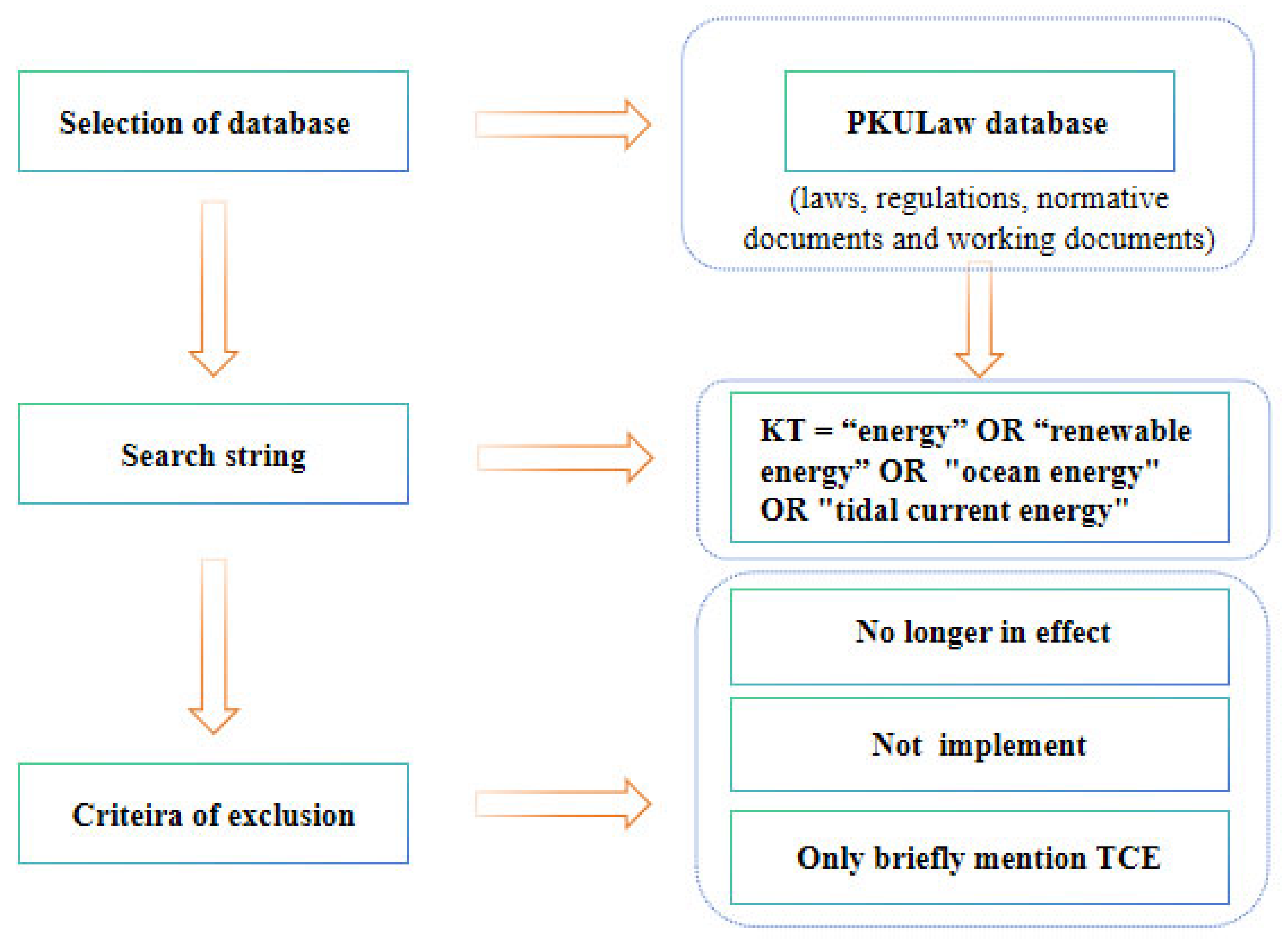
Figure 1. Overview of TCE-related policy selection process (source: own illustration).
Sustainability 18 03224 g001
Figure 2. Time axis of representative policies of TCE in China (source: own illustration).
Sustainability 18 03224 g002
Figure 3. Analysis of social and semantic networks (source: own illustration with minor aesthetic modifications).
Sustainability 18 03224 g003
Table 1. Frequency of Terms.
NumberKey TermsFrequency
1technology10,042
2ocean6185
3development5726
4construction4452
5research4301
6energy3577
7innovation3491
8exploitation2520
9utilization2405
10advance2303
11resource2168
12system2002
13key1970
14launch1933
15strengthen1893
16ecology1855
17engineering1779
18enterprise1784
19project1748
20economy1708
Table 2. Main classification with related content.
Main CategoriesRelated Content
TechnologyResearch Technology, Technology Utilization, Technological Innovation, Energy Technology, System Technology, Equipment Technology, Demonstration Technology, Platform Technology, Ocean Technology
ConstructionOcean Construction, Construction Innovation, Resource Construction, Energy Construction, Construction Engineering, Project Construction, Base Construction
DevelopmentEconomic Development, Marine Development, Energy Development, Resource Development, Ecological Development, National Development, Enterprise Development, Development Planning
Disclaimer/Publisher’s Note: The statements, opinions and data contained in all publications are solely those of the individual author(s) and contributor(s) and not of MDPI and/or the editor(s). MDPI and/or the editor(s) disclaim responsibility for any injury to people or property resulting from any ideas, methods, instructions or products referred to in the content.