Article

Sustainability Assessment and Sustainable Management Scenarios as a Green Hospital Model in West Java, Indonesia: A Multi-Aspect Method


by
Ari Nurfikri
1,2,*,
Rachmadhi Purwana
1,
Tri Edhi Budhi Soesilo
1 and
Deni Danial Kesa
2
1
Graduate School of Sustainable Development, Universitas Indonesia, Jakarta 10430, Indonesia
2
Vocational Education Program, Universitas Indonesia, Depok 16424, Indonesia
*
Author to whom correspondence should be addressed.
Sustainability 2026, 18(7), 3211; https://doi.org/10.3390/su18073211
Submission received: 4 February 2026 / Revised: 11 March 2026 / Accepted: 14 March 2026 / Published: 25 March 2026
(This article belongs to the Section Air, Climate Change and Sustainability)

Abstract

The implementation of a green hospital reduces negative impacts and contributes ensures sustainability, but Indonesia does not yet have a comprehensive model for assessing its status. Therefore, this research aimed to analyze the sustainability status of hospitals, considering current conditions and future scenarios. The Multi-Aspect Sustainability (MSA) framework was used to assess sustainability status based on the implementation of a green hospital, integrating Triple Bottom Line (TBL), Environmental, Social, and Governance (ESG), and GGHH concepts across institutional, environmental, economic, and social dimensions. Primary data was collected through in-depth interviews with five members of the green team and observations at R Syamsudin SH Regional General Hospital in Sukabumi. The institutional dimension was the highest, with current and future sustainability scores of 94.05 and 50.66, respectively. Meanwhile, the social dimension was the lowest, with current and future sustainability scores of 47.33 and 57.33, respectively. The findings presented in this study indicate an imbalance among the dimensions. This study highlights the scenarios of each leverage factor for each stakeholder. Further research is recommended to involve more hospitals in terms of ownership, type, and region.

1. Introduction

Hospitals in developed and developing countries have the same function, which is to provide preventive, curative, and rehabilitative health services. Over the past 50 years, hospitals have gradually evolved toward maturity, adapting to changes in medical technology, patient needs, and healthcare policies. Hospitals, in carrying out their roles, also have an impact on society and the environment [1]. Hospitals, in carrying out their functions, become the main consumers of energy, leading to increased operational costs, decreased competitiveness, and negative environmental impacts, such as higher carbon emissions and resource depletion. Healthcare in hospitals is the largest consumer of energy and natural resources because these facilities operate twenty-four hours non-stop and have negative environmental effects, such as high carbon emissions and significant waste generation, which contribute to climate change and resource depletion [2].
Globally, hospitals face the challenge of increasing energy consumption and negative environmental impacts. Hospitals make up the largest part of healthcare facilities, consuming 80% of available resources and generating 35% of carbon emissions [3]. Hospitals in England produce 18 million tons of CO2 each year. India generated 33,000 tons of medical waste in the first seven months of the pandemic [4]. The average energy intensity of hospitals in America exceeds the average of other commercial buildings [5]. Hospitals in Malaysia and Indonesia have higher energy intensity than those in South Korea, Japan, and Thailand, which raises concerns about their environmental impact and sustainability practices in comparison to those countries [6]. Hospitals in Indonesia are estimated to generate 376,089 tons of hazardous and toxic waste per day and 48,985 tons of liquid waste per day [7]. Each hospital has limited capacity in terms of environmental sustainability, which requires the attention of hospital management [8]. The Intergovernmental Panel on climate change states that rapid and widespread changes are needed in all aspects of society to limit global warming. In this contex, the energy consumption and waste generated by hospital must be limited to reduce CO2 emission world wide in order to achieve the net zero traget by 2025 [9]. The problem with hospitals in Asia, including Indonesia, is that the increase in the number of hospitals is not matched by investments in efficient and low-emission energy infrastructure [6]. This represents the environmental footprint generated by hospitals, which contributes to climate change [10]. Climate change threatens health systems, with impacts estimated to cause 250,000 deaths and losses of US $4 billion per year between 2030 and 2050 [11].
Amid the threats of death and financial loss due to climate change, Indonesia needs the establishment of new hospitals because the bed-to-population ratio is 1.21:1000. Meanwhile, the World Health Organization recommends a bed-to-population ratio of 5:1000. Limiting the number to reduce CO2 emissions is not feasible since the health quality of the Indonesian population can be impacted negatively [12]. Therefore, hospitals must implement the green concept to reduce negative impacts and ensure sustainability. The concept of environmentally friendly buildings was adopted as the basis for a green hospital. This incorporates sustainable development principles into the planning, construction, operation, and maintenance of buildings. The green building concept was combined with the Triple Bottom Line (TBL) method to achieve sustainability in business practices, including the healthcare service industry [13]. TBL is a concept by John Elkington that integrates environmental, social, and economic dimensions to assess business sustainability [14]. Sustainable development with the concept transforms institutions and policymakers in understanding and measuring performance [15]. The implementation in developing countries has limitations in terms of resources and supporting structures. TBL has room for improvement in institutional governance to support sustainability [16]. In addition, the implementation of TBL has the potential to create greenwash to mislead people into having very positive beliefs about an institution’s environmental practices and performance [17]. The Environmental, Social, and Governance (ESG) concept was proposed to bridge the TBL gap. The factors play a crucial role in measuring future financial performance and social impact. These concepts are integrated with the Global Green and Healthy Hospital (GGHH) framework, allowing hospitals to respond to climate change through the adoption of a sustainability agenda [13].
Southeast Asia is vulnerable to climate change. Countries in Southeast Asia need resilient healthcare facilities to withstand climate change. An effort made by becoming a member of GGHH is that Indonesia, Malaysia, Vietnam, Singapore, Thailand, and the Philippines have nine, five, one, four, 10, and 22 hospitals, respectively [18]. The Indonesian hospital committed to the entire GGHH sustainability agenda is located in West Java, namely, R Syamsudin, SH Sukabumi Regional General Hospital, Sukabumi [19]. West Java province, with the highest population of the country, reached 50,639,156 people based on 2022 data [20]. There are 399 hospitals in West Java, consisting of nine, 73, 240, and 75 Class A, B, C, and D hospitals, respectively [21].
Hospitals do not have sustainability assessments, unlike other industries. Sustainability evaluation systems are highly dependent on establishing new strategies [22]. Developed countries have instruments to evaluate hospital sustainability through environmental, social, and institutional quality assessments using descriptive analysis with SustHealth V2 [23]. The SusHealth V2 instrument only assesses the environmental, social, and institutional dimensions of current conditions. The implementation of sustainability assessments with SustHealth V2 is still limited to developed countries, making it difficult to apply in developing countries like Indonesia. This limitation is due to differences in policies, regulations, geographical conditions, and population size. The lack of a standardized and systematic method for implementing climate-resilient hospitals shows the importance of flexible and adaptive policies [24]. In 2018, the Ministry of Health created the green hospital guidelines, which did not integrate the three dimensions of environmental, social, and economic sustainability and only included six out of 10 GGHH sustainability agendas [25]. The ideal value and status of sustainability based on tiered planning, monitoring, and evaluation will improve in the future [26]. The existing guidelines cannot be used as a reference for implementing a green hospital because the model is not standardized [7]. Previous research assessed the sustainability dimension as still partial, failing to integrate environmental, social, economic, and institutional dimensions and sustainability models based on the TBL, ESG, and GGHH frameworks. Previous research was conducted in developed countries, which technically does not align with the conditions in developing countries. This research is crucial because the implementation of green hospitals in Indonesia needs assessment and evaluation to ensure improvement in the future. The process of transforming into a green hospital requires the right models and methods. This research addresses the issue by developing a sustainability model based on the implementation of green hospitals that integrates the TBL, ESG, and GGHH frameworks. The comprehensive model for assessing sustainability status based on the implementation of a green hospital in West Java encompasses environmental, social, economic, and institutional dimensions with a Multi-Aspect Sustainability Analysis (MSA) method that can provide information for improving each dimension in the future. Therefore, this research aimed to analyze the sustainability status of hospitals, considering current conditions and future scenarios.

2. Materials and Methods

This research assesses expert-based sustainability using a case study approach. This approach allows for the exploration of detailed values and sustainability status, leverage factors for each dimension, and scenarios to enhance future value. This research used the Multi-Aspect Sustainability (MSA) framework to assess sustainability status based on the implementation of a green hospital. MSA is a development of Multi-Dimensional Scaling Rapfish Analysis (MDS Rapfish) using the principles of Multi-Criteria Analysis (MCA) [27]. The framework was selected for several reasons in this research. MSA is based on the Rapid Appraisal Process (RAP), suitable for evaluating complex socio-ecological systems where quantitative data is limited and expert judgment is crucial [28]. The selected MSA evaluated sustainability in line with environmental science and integrated the TBL, ESG, and GGHH frameworks by incorporating institutional, environmental, and economic dimensions. The development of dimensions in this research is an integration of two concepts: TBL and ESG. TBL considers 3 dimensions, namely, environmental, economic, and social. ESG expands by adding an institutional dimension. The integration of these two concepts results in 4 dimensions: institutional, environmental, economic, and social. The four dimensions are organized with the GGHH sustainability agenda as a guide for implementing green hospitals. Third, MSA could adapt to local conditions, allowing for the adjustment of global TBL, ESG, and GGHH concepts to balance with Indonesian government policies, infrastructure capabilities, and the inclusion of green teams [29].

2.1. Research Location and Informant Selection Method

The selection of hospitals as the research locus was based on GGHH data. A total of 3 out of 9 GGHH members were from West Java. Only one hospital was committed to the 10 GGHH sustainability agendas, namely, R. Syamsudin, SH Regional General Hospital, Sukabumi [30]. The selection of informants was based on the principles of relevance and sufficiency. The principle of relevance showed that the selected informants were key stakeholders with knowledge related to the research topic. The principle of sufficiency prioritized data adequacy [26].

2.2. Data Collection and Data Validation

The research period was from 8 April to 12 December 2025. Data collection was conducted with a small number of informants, represented by five members of the green team. The rapid appraisal process was conducted with a qualitative method. However, quantitative methods such as rapid surveys could also be added, and data collection was conducted using in-depth interviews. The assessment was performed on a few selected informants based on expertise rather than the number of informants, with an odd number to avoid selecting the mode value [26]. Each indicator was assessed using in-depth interviews with five members of the green team and observation, and the results were entered into a structured questionnaire. Validation was carried out in three stages, including a consensus assessment of the green team, random iteration validation, and uncertainty error testing. The random iteration validation involved the green team members providing assessments. The value that represents the consensus was the mode. The random iteration value was determined by assessing the indicators provided by the green team members, followed by calculating the probability value of each indicator. Next, random values were input for each iteration, which were adjusted according to the cumulative level grouping per indicator, resulting in simulation values that approach the mode. The validation status value has a maximum limit of five. The error value calculation based on random iterations will show the validation status value and the estimation respondent error value with a maximum limit of 0.5 [26]. The aggregate validation random iteration is 2.16, with details of the institutional dimension being 2.05 and the estimation respondent error being 0.15. The environmental dimension is 1.74, and the estimated respondent error is 0.13. The economic dimension is 4.88, and the estimated respondent error is 0.2. The social dimension is 1.27, and the estimated respondent error is 0.05.

2.3. Data Analysis and Interpretation

The dimensions and criteria were determined based on expert concepts outlined in the literature review. The dimensions and criteria were used as the basis for in-depth interviews with the green teams of each hospital. The dimensions and criteria were input into the questionnaire in the MSA system, resulting in the existing and future sustainability status [26,31,32]. The data processing stages began with the development of questionnaires informed by a literature review and expert input. This was followed by assessments conducted by selected respondents, data processing using MSA Eximpro software version 2.0 with license number MSA-2407125-PI, evaluation of status and leverage factors, and analysis of policy priority scenarios [33]. The conceptual framework can be seen in Figure 1.
Data analysis started by converting the results of the in-depth interviews into quantitative values using the mode. Mode selection was employed to achieve consensus among the green team and to reduce the influence of extreme values. Indicators were assessed on a predetermined ordinal scale with relevant references ranging from 0 to 1, 0 to 2, 0 to 3, 0 to 4, and 0 to 5. The status value for the dimension was reported in the ordinate visualization as a value on the x-axis. This was obtained by dividing the modal value in the assessments by the highest (good) indicator for each factor and calculating the average. The formula for calculating the status value in these aspects is as follows: [30,32]
y = y f 1 + y f 2 + y f 3 + y f 4 + + y f n f n ×   100 % = y f n f n
y f n = M o × f n G f n
where y is the value of the dimension status, yf is the dimension factor, Mo is the capital value for that factor, G is the highest (good) score for the indicator assessment factor, and f is the factor value [30,32]. Future conditions refer to the value that describes the likelihood of a factor occurring in the future. This condition is associated with a higher level of uncertainty. The uncertainty value (uncertainty error) was considered to strengthen the robustness of the assessment results. The ordinate was represented by the y-axis to calculate the future condition value representing the position in the visualization. The formula for calculating the future condition value of a factor is as follows [26]:
F c = M o C 1 + M o C 2 + M o C 3 + M o C 4 + + M o C n n × 25
where 0 (stable), 3 (increasing), and 4 (highly increased). The standard value of 25 was multiplied to achieve normalization to 100 since the maximum future condition value was 4. The potential value of future scenarios was constrained by the evaluation of factors. The future scenario was not enhanced when a factor possessed the maximum. The value of the future condition recorded uncertainty, which did not exceed 10% [26].
This research divided sustainability values and status into four criteria, namely, unsustainable, low sustainable, sustainable, and highly sustainable [31]. Table 1 shows the categories of sustainability values and status. Research related to green hospitals also divides these care facilities into red, brown, yellow, and green categories [34].
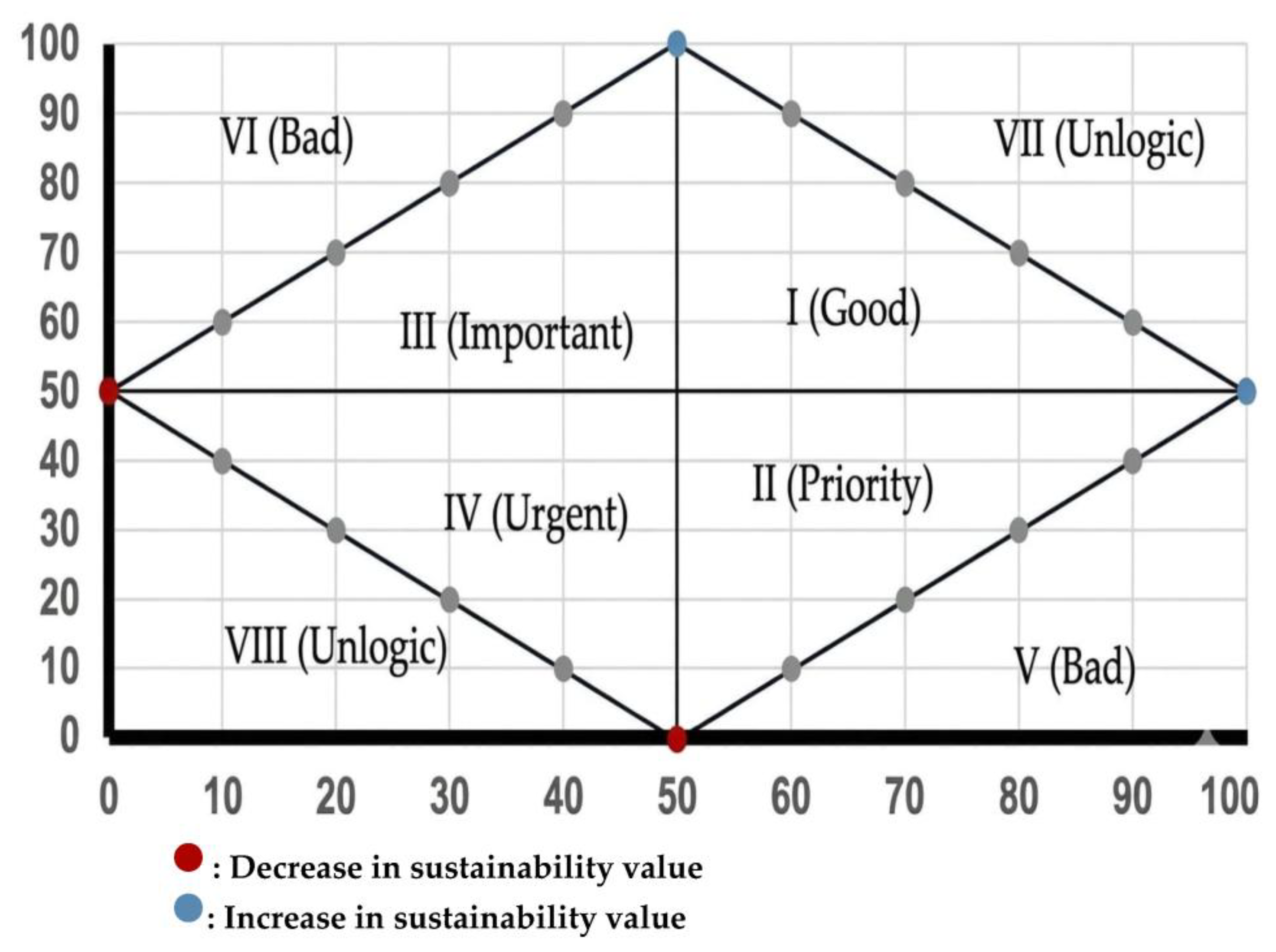
Figure 2 shows that sustainability values and status can be divided into eight quadrants. The values on the x-axis and the y-axis are larger than 50 in Quadrant I (positive). This condition is perfect because the value is good. Hospitals need to keep certain conditions to increase their worth and long-term viability. The x-axis and y-axis values are above and below 50 in Quadrant II (priorities). Y-axis values below 50 show a potential decline, thereby enabling hospital management to focus on areas requiring support and increased attention. The x-axis and y-axis values are less than and more than 50 in Quadrant III (important). The hospital needs to take action right away because the y-axis number is above 50. The x- and y-axis values are below 50 in Quadrant IV (Urgent). Therefore, the hospital must act quickly to stop the slide from getting worse [30,32]. Group V, with a poor condition, is not appropriate due to high uncertainty bias. This condition reports an x-axis value greater than 50, but the y-axis exceeds the specified limit. Quadrant VI (poor) has an x-axis value less than 50 and a y-axis value exceeding the specified limit. This condition is worse than that of Quadrant V due to high uncertainty bias. Quadrant VII, with the illogical condition, is an impossible and inappropriate condition because of high uncertainty bias. Even though the x-axis is greater than 50, the y-axis exceeds the specified limit. In this condition, the value can be increased beyond the specified boundary line. Quadrant VIII possesses an impossible and inappropriate condition due to high uncertainty bias, specifically with an x-axis value less than 50 and a y-axis value exceeding the line limit. In this condition, the value cannot be decreased beyond the specified limit line [26]. Adverse conditions in Groups IV, III, II, and I should be addressed when making policy decisions [28].

3. Results

3.1. Sustainability Status Value

The assessment of sustainability status is based on the implementation of a green hospital, which integrates TBL, ESG, and GGHH concepts across all institutional, environmental, economic, and social dimensions. Table 2 shows the sustainability assessment parameters.
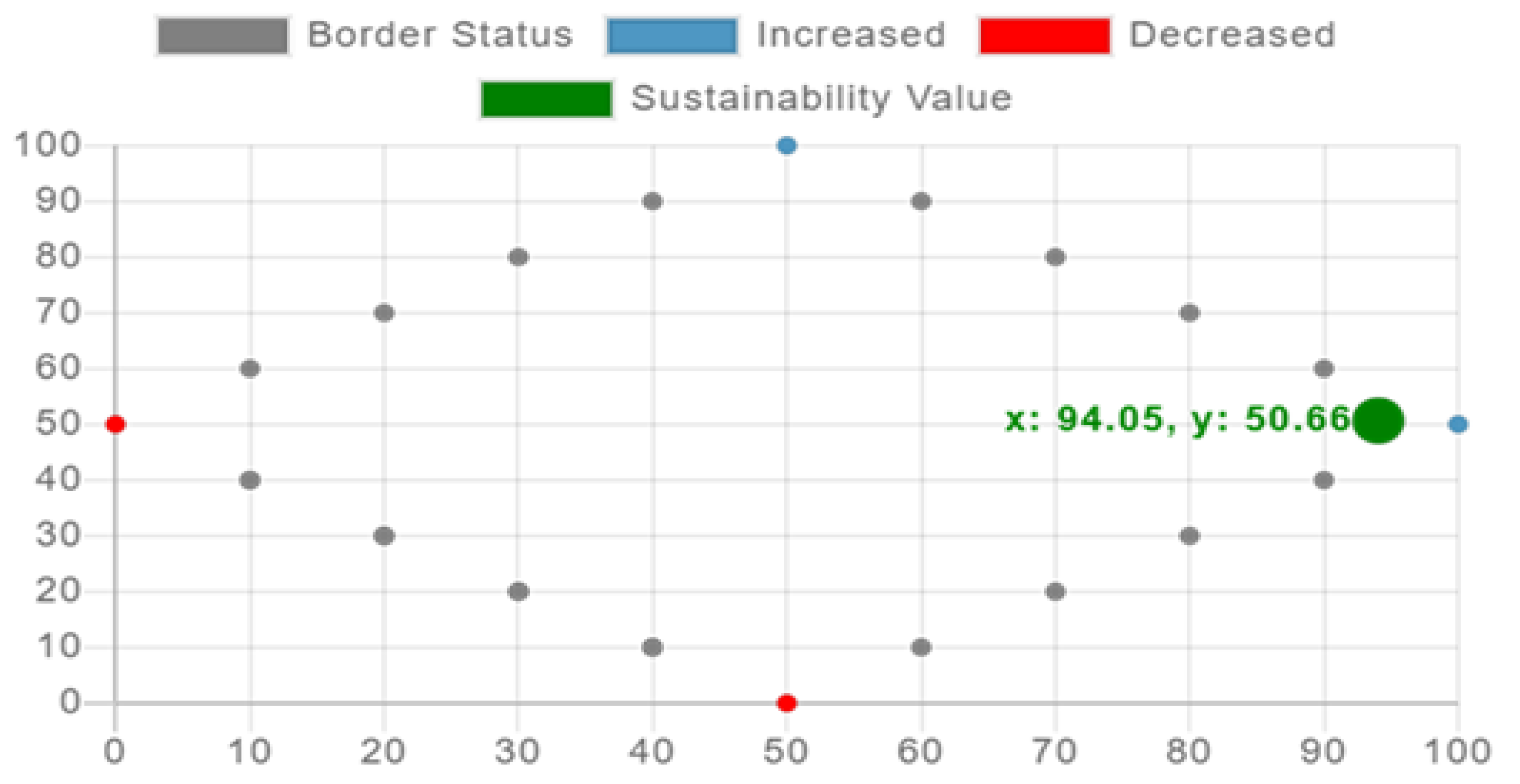
Sustainability assessment from institutional, environmental, economic, and social dimensions uses the GGHH agenda, which includes leadership, waste, energy, buildings, transportation, food, pharmacy, water, chemicals, and procurement. The status of the institutional dimension shows values on the x and y axes greater than 50. The x-axis shows the value and sustainability status of the current conditions, while the y-axis represents the future. Furthermore, the x-axis and y-axis are valued at 94.05 and 50.66, respectively. Given a very high x-axis, the y-axis is increased significantly, but there remains an opportunity for improvement since the value is above 50. The condition is ideal, and this state should be maintained to improve the value and sustainability status in the future. When discussing a future increase or decrease in value and sustainability status, it is important to acknowledge the inherent uncertainty. The value of this uncertainty should not exceed 10% or go beyond the border. The value of 50.66 is already at the limit, and if it exceeds that, it will cross the border [26]. The current sustainability value is 94.05, which has a very sustainable status, as reported in Figure 3.
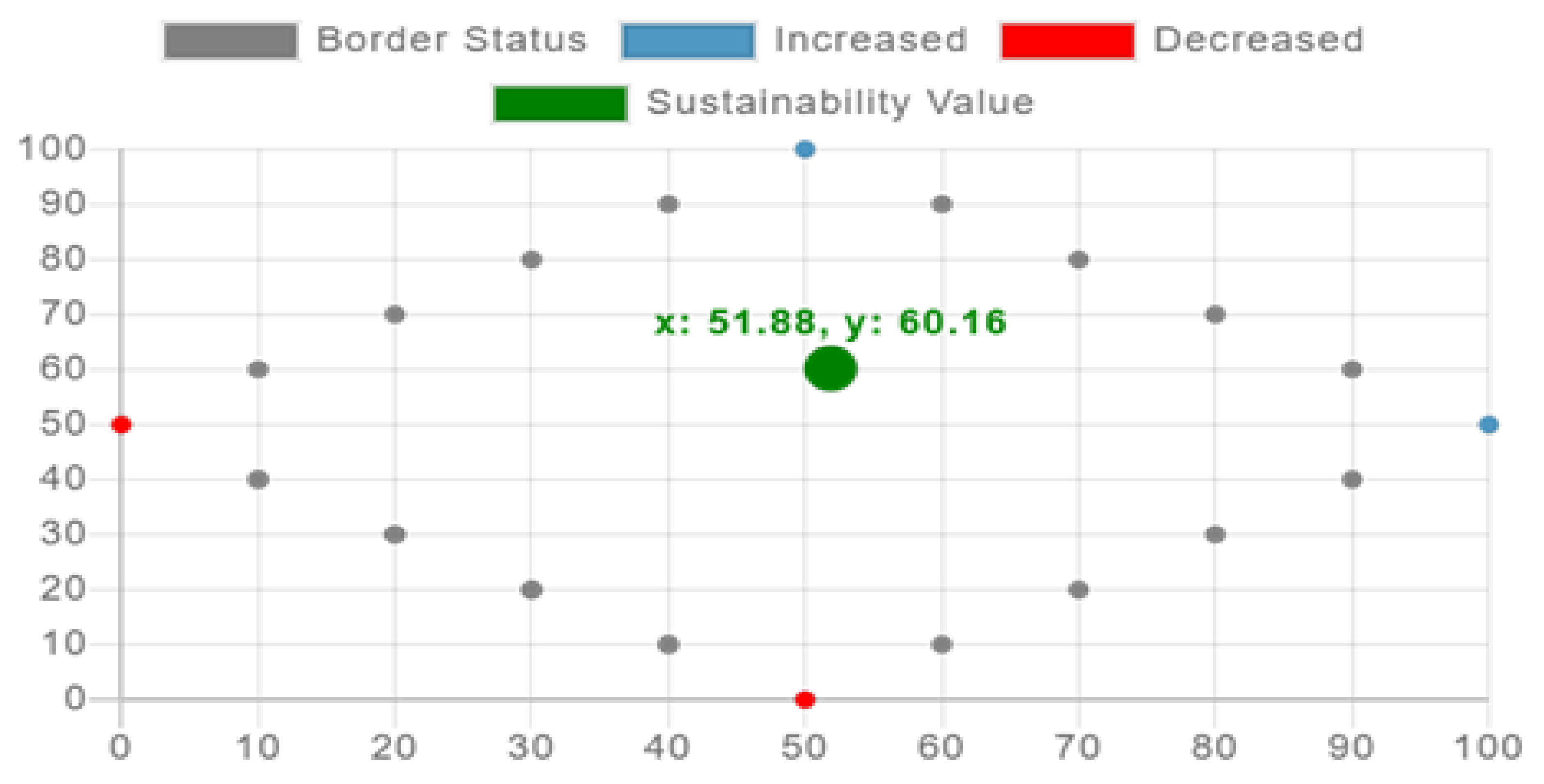
The sustainability status of the economic dimension shows values on the x-axis and y-axis that are greater than and less than 50. The x-axis and the y-axis represent the value and sustainability status of the current and future conditions, respectively. Furthermore, the x-axis and the y-axis are valued at 51.88 and 60.16, respectively. This condition falls into Quadrant I and must be maintained for future improvements in value and sustainability status since the y-axis is above 50. The current value is 57.81, showing a sustainable state, as reported in Figure 4.
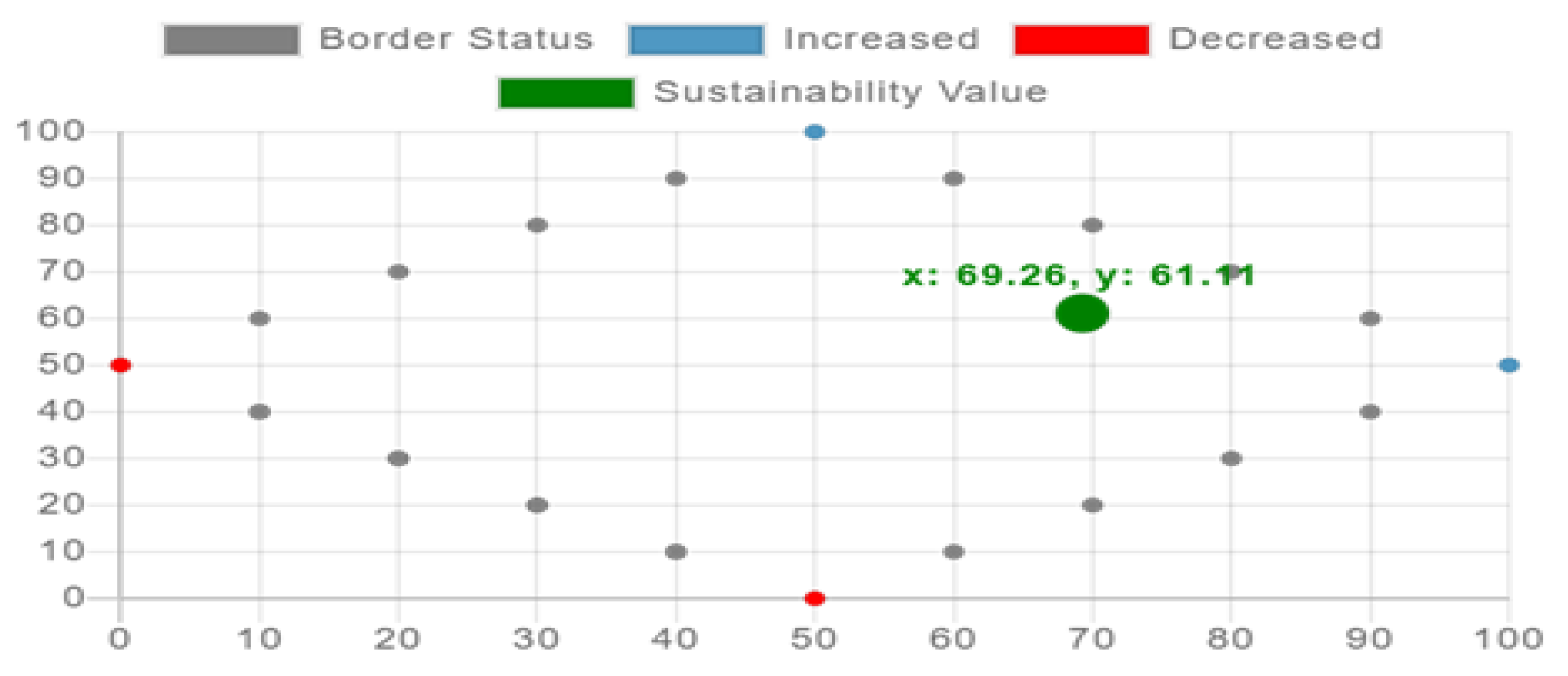
The sustainability status of the environmental dimension shows values on the x and y axes that are greater than 50. The x-axis shows the value and sustainability status of the current conditions, while the y-axis represents future conditions. In this context, the x-axis and the y-axis are valued at 69.26 and 61.11, respectively. This condition falls into Quadrant 1, which is an ideal state. This condition should be maintained for future improvements in value and sustainability status since the y-axis value is above 50. The current sustainability value is 69.26, showing a sustainable state. Figure 5 shows the sustainability value of the environmental dimension at R Syamsudin, SH Regional General Hospital, in Sukabumi.
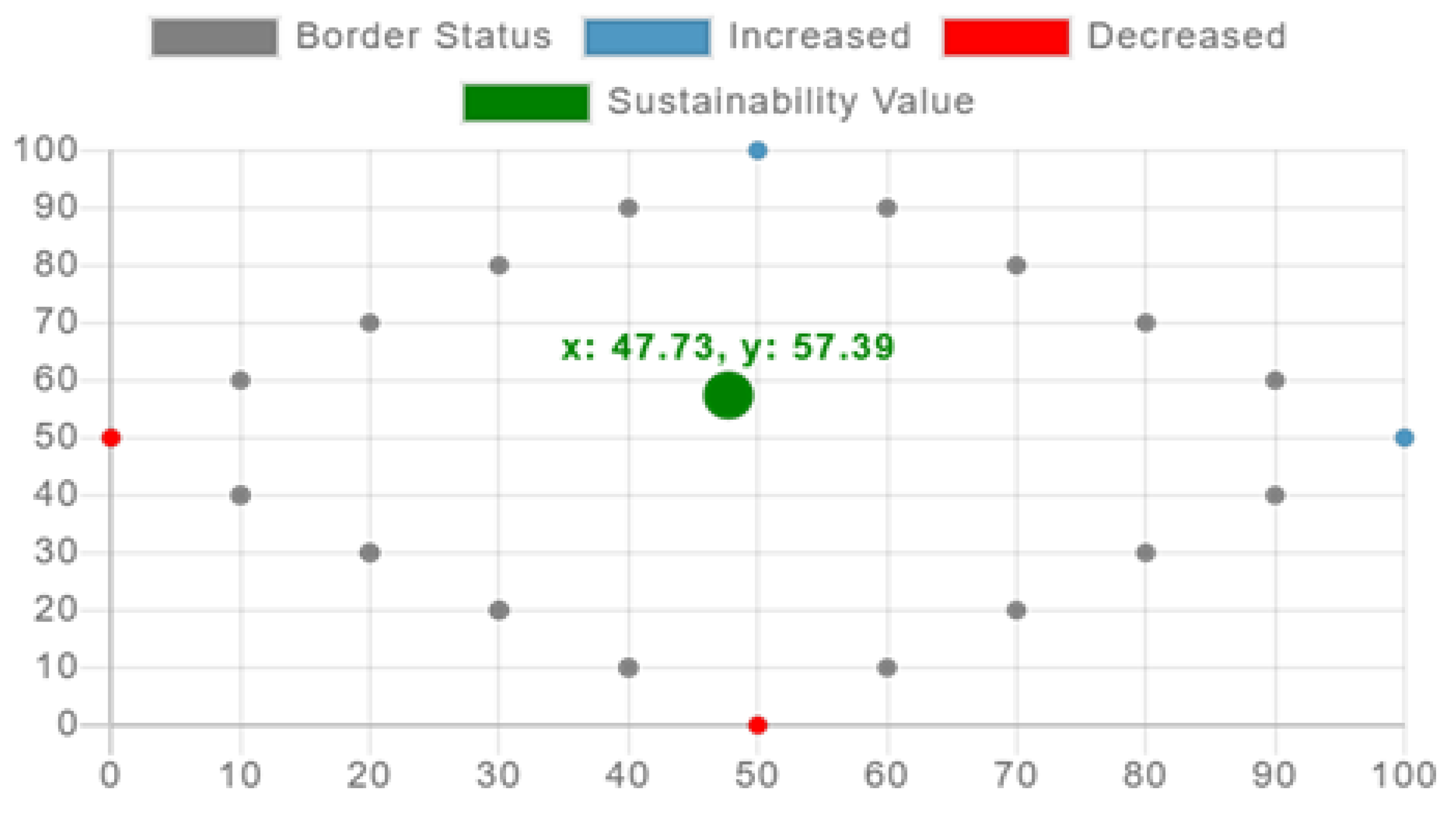
The sustainability status of the social dimension shows values on the x-axis and the y-axis that are less than and greater than 50, respectively. The x-axis and the y-axis show the value and sustainability status of the current and future conditions, respectively. Additionally, the x-axis and the y-axis are valued at 47.73 and 57.39, respectively. This condition falls into Quadrant 3, with potential for improvement requiring immediate action. The current sustainability score is 47.7, showing a low status. The sustainability value of the social dimension can be seen in Figure 6.

3.2. Development of a Sustainability Model Based on Green Hospital Implementation

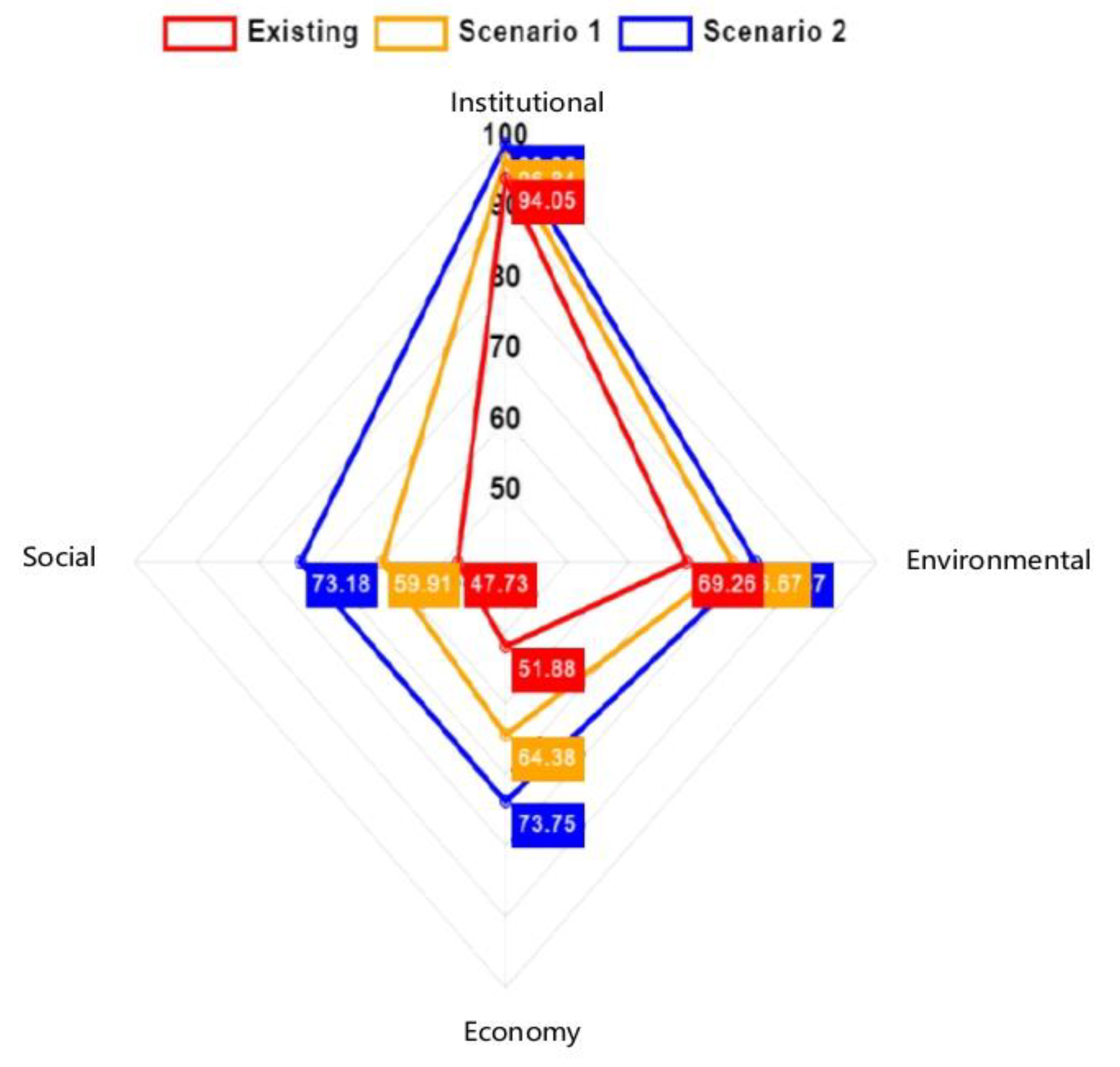
The development of a sustainability model is based on the implementation of a green hospital using current conditions, as well as moderate and optimistic scenarios. The current sustainability value in the institutional dimension is 94.05. A moderate future improvement scenario is expected to raise the value to 96.84. Under an optimistic scenario, the sustainability value of the institutional dimension increases to 98.95 in the future. The value in the environmental dimension is 69.26. Using a moderate future enhancement scenario is projected to elevate the value to 76.67. Under an optimistic scenario, the environmental dimension achieves a sustainability value of 80.37 in the future. The current value of the economic dimension at 51.88 is increased to 64.38 when a moderate scenario is applied for future improvement. The optimistic scenario for the economic dimension obtains a future sustainability value of 73.75. The current value in the social dimension at 47.73 is increased to 59.91 when using a moderate scenario for future improvement. The sustainability value of the social dimension will reach 73.18 in the future when using an optimistic scenario. The moderate and optimistic scenarios use leverage factors in the institutional, environmental, economic, and social dimensions. Figure 7 shows the implementation-based sustainability model for a green hospital.

3.3. Laverage Factors

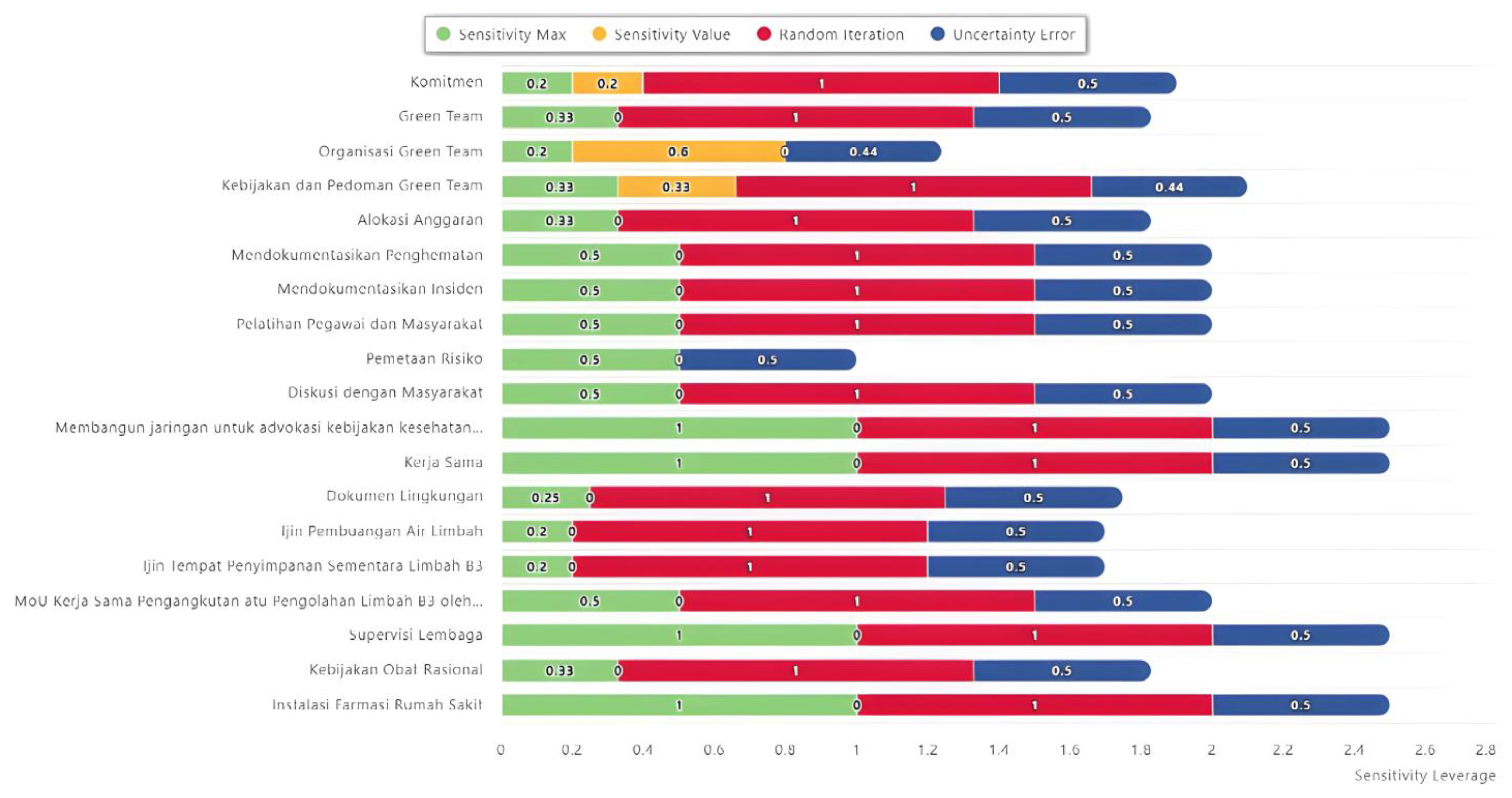
Figure 8 shows the assessment of sustainability factors from the institutional perspective, concentrating on sensitivity max, sensitivity value, random iteration, and uncertainty error. This matrix reports the leverage factors from the institutional dimension that improve the sustainability value. The first, second, and third leverage factors are green team organization, green team policies and guidelines, and commitment, respectively.
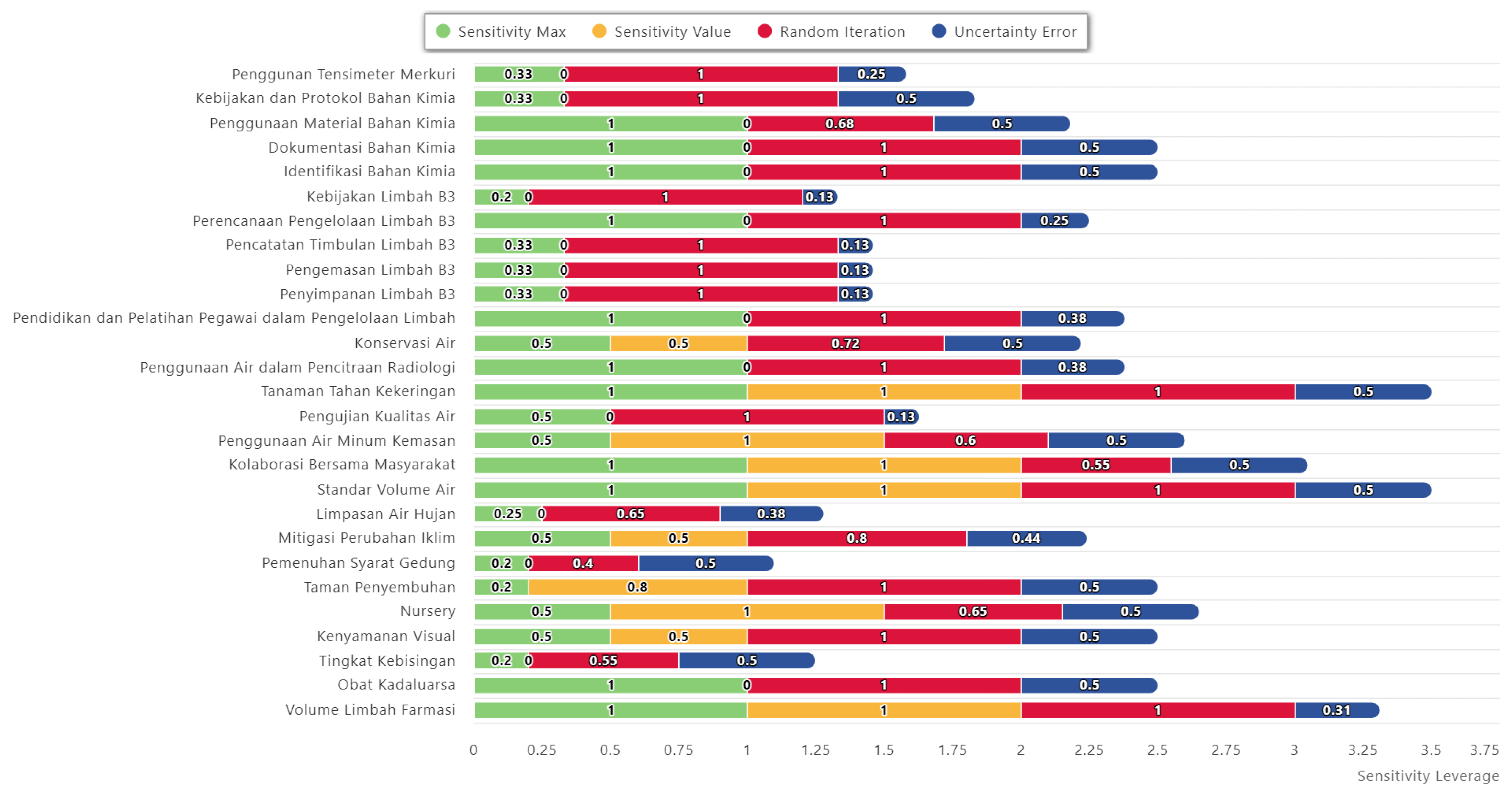
Figure 9 shows the evaluation of sustainability factors in the environmental dimension, focusing on sensitivity max, sensitivity value, random iteration, and uncertainty error. This matrix reports the leverage factors of the environmental dimension that enhance the sustainability value. The first, second, and third leverage points are drought-resistant plants and water volume standards, pharmaceutical waste volume, and community collaboration, respectively.
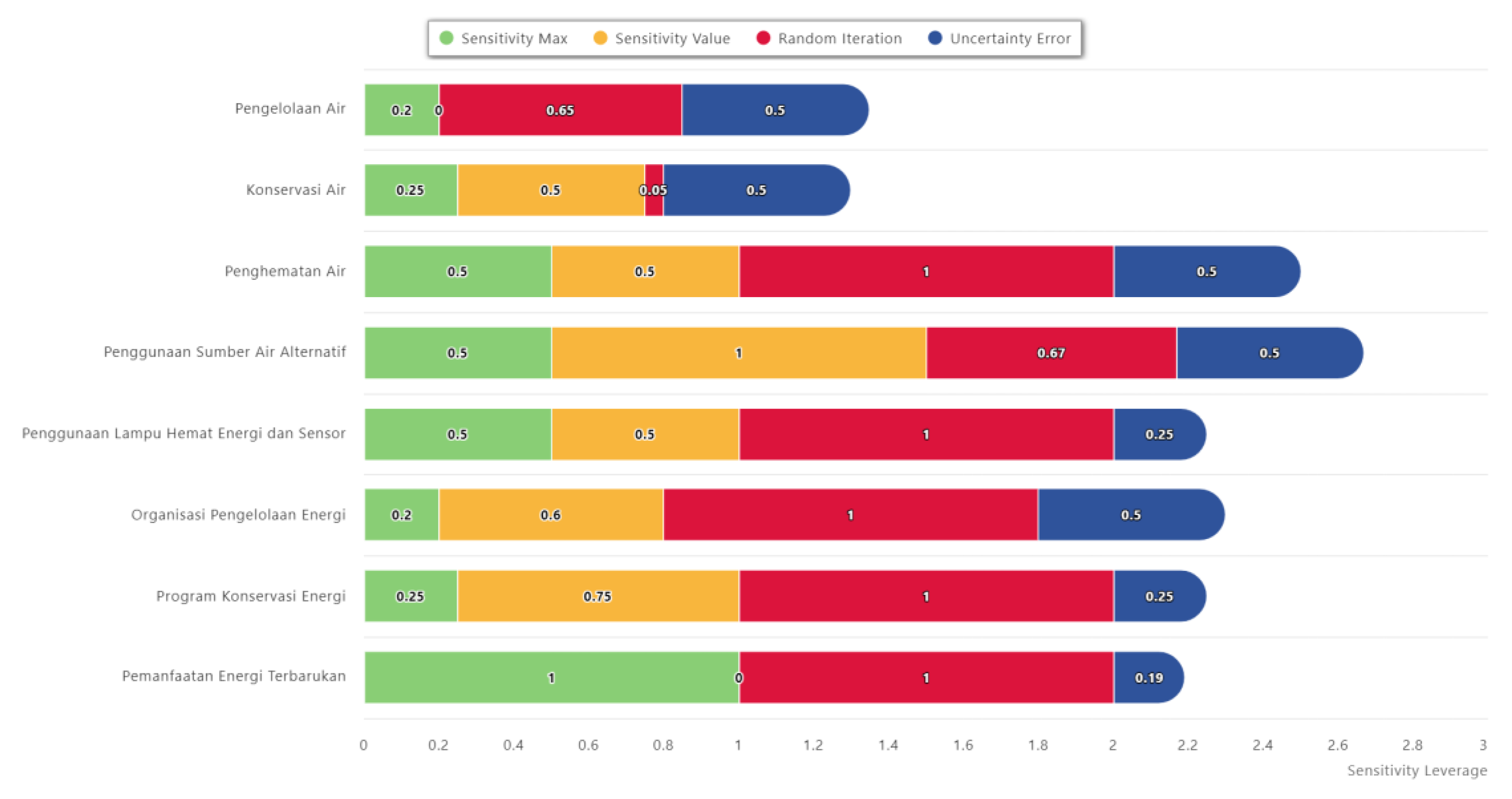
Figure 10 shows the evaluation of sustainability factors from the economic dimension, focusing on sensitivity max, sensitivity value, random iteration, and uncertainty error. This matrix reports the leverage factors from the economic dimension that enhance the sustainability value. The first, second, and third levers are the use of alternative water sources, water conservation, and the use of energy-saving lamps and sensors, respectively.
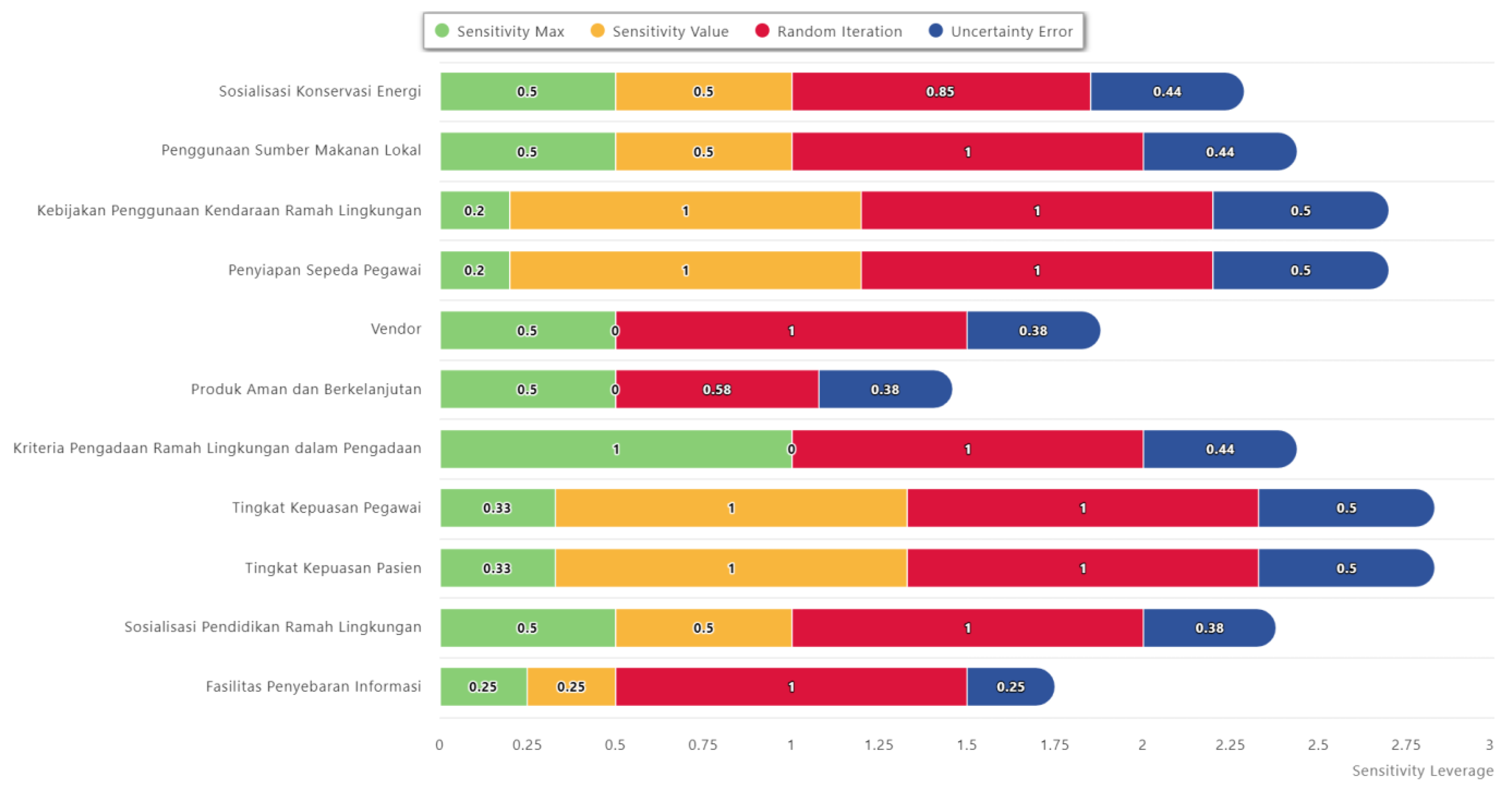
Figure 11 shows the evaluation of sustainability factors from the social dimension, focusing on sensitivity max, sensitivity value, random iteration, and uncertainty error. This matrix reports the leverage factors from the social dimension that enhance the sustainability value. The first, second, and third leverage factors are patient satisfaction and employee satisfaction, policy on using environmentally friendly vehicles and preparing employee bicycles, and the use of local food sources, respectively.

4. Discussion

The sustainability value of the institutional dimension is the highest, at 94.05 (very sustainable), with a projected future value of 50.66 (sustainable). In contrast, the sustainability value of the social dimension is the lowest, at 47.33 (less sustainable), with a projected future value of 57.33 (sustainable). This is consistent with Erjaee et al.’s (2021) findings in an institutionally established hospital, where the social dimension is not a priority because the focus is on the environment and economy [44]. The analysis is supported by Takeda et al.’s (2025) findings since hospitals with high institutional and environmental efficiency have low scores in social dimensions, such as patient satisfaction and community participation [45]. Other research reinforces that the sustainability value and status of the social dimension are low when institutional and environmental aspects are high [23]. This research makes a significant contribution to research in developing countries by analyzing sustainability across institutional, environmental, economic, and social dimensions within an integrated conceptual framework. Empirical facts show that R. Syamsudin, SH, Regional General Hospital, Sukabumi, as a government-owned hospital, has strengths and weaknesses in the institutional and social dimensions. The results show an imbalance between the four dimensions of sustainability, regarding regulatory compliance, economic efficiency, and social relations. Environmentally friendly hospitals managed by local governments have strong institutions and established management systems but show lower social performance. This result is based on TBL theory, where the institutional dimension strengthens the environmental and economic dimensions. The institutional dimension pressure to comply with environmental policies allows hospitals to focus on external legitimacy and routine reporting rather than social transformation [46]. Therefore, R Syamsudin, SH, Regional General Hospital, Sukabumi, has a low level of patient perception of the physical environment and community participation. This is supported by Mostepaniuk et al. (2023), who showed that hospitals are becoming more focused on accreditation systems, certification, and complying with environmental regulations as part of fulfilling the 2030 sustainable development agenda [47]. Pasamar et al. (2025) showed that stricter regulations for sustainable practices led to a bigger gap between promise and reality in organizations focused on sustainability [46]. This phenomenon is evident in the implementation of a green hospital, which focuses on institutional and environmental dimensions.
The sustainability assessment instrument is adapted from the TBL and ESG frameworks and enhanced with the GGHH agenda. Hospitals in other provinces can use sustainability assessments based on the implementation of the GGHH agenda. This capability is because GGHH has 70,000 members from 86 countries, including Indonesia. Furthermore, nine hospitals in six provinces, including West Java, Central Java, East Java, Yogyakarta, Jakarta, and Central Kalimantan, have committed to the GGHH sustainability agenda [19]. A self-assessment based on the implementation of a green hospital using the MSA method was conducted. This calculated scores, sustainability statuses, and leverage factors for the institutional, environmental, economic, and social dimensions. The sustainability assessment at R Syamsudin, SH Regional General Hospital, Sukabumi, shows that the development of a green hospital-based model is carried out in stages across institutional, environmental, economic, and social dimensions. In the scenarios, the institutional dimension has the highest sustainability value. This is true for the environmental, economic, and social dimensions. The high value shows an increased level of commitment and leadership, good governance, regulatory compliance, and internal coordination, functioning as a strong foundation. This is consistent with [48] who showed that institutional participation increases the commitment of healthcare facilities to sustainable initiatives [48]. The high values in the institutional dimension across current conditions, moderate scenarios, and optimistic scenarios show that the institution is a driving force for achieving sustainability in the environmental, social, and economic dimensions.
The environmental dimension includes sustainability values for the current condition, moderate scenario, and optimistic scenario under the institutional dimension. There is an increase in value from the current condition to the moderate and optimistic scenarios. Therefore, there is potential to improve sustainability values in the future. This is consistent with McGain and Naylor (2014), who showed that the implementation of the environmental dimension directly intersects with patient care practices [49].
The social dimension ranks lowest, below the institutional, environmental, and economic dimensions. This dimension is a priority for improving sustainability values at R. Syamsudin, SH Regional General Hospital in Sukabumi. The focus of some hospitals is on the institutional, environmental, and economic dimensions. However, the social dimension related to the inclusion of patients, staff, and the community is not prioritized. This is consistent with research stating that hospitals need strategies in sustainability communication, green hospital culture, and employee and patient engagement [50]. The implementation-based sustainability model has a strong hierarchy and weaknesses in the institutional and social dimensions, respectively. Institutional, environmental, economic, and social dimensions serve as the main drivers, act as a responsive technical component, strengthen future sustainability, and represent the pillar of sustainable hospital cultural transformation, respectively. The strategy in the social dimension prioritizes achieving sustainability through the implementation of a green hospital.

4.1. Proposed Management Scenarios

4.1.1. Institutional Dimensions Scenarios

The first leverage factor in the institutional dimension is green team organization. Green team organization is detailed in the Director’s Decree Number 42 of 2020. This pertains to the formation of a green team for implementing a hospital at the same institution. The team remains organized as a working group, and the official decision letter has yet to be revised despite the retirement of certain members. In the future, the green team organization will integrate structural and functional elements. Governance and institutional methods must be implemented across all organizational levels to effectively apply the principles of sustainable development. In the context of this research, an environmental committee called a green team needs to be formed. The committee comprises a combination of management or structural personnel and professionals within the hospital [3]. This is supported by [51], who showed that green teams are effective agents of change for sustainability projects by including the appropriate stakeholders and representing multidisciplinary scientific fields [51]. The Ministry of Health issued guidelines for green hospitals in Indonesia, including Minister of Health Regulation Number 7 of 2019, which outlines the obligation for hospitals to establish a green team responsible for implementing the green hospital program [52,53]. Scenario 1 focuses on the clarity of the green team’s status, whether it is a working group or has already integrated functional and structural groups, which has not been explained in the guidelines and ministerial regulations.
The second leverage factor in the institutional dimension is green team policies and guidelines. An implementation guide for the green hospital program was issued in 2017. However, regular monitoring and evaluation have not been conducted. This is consistent with S.M. Lee and Lee (2022), who showed that top management in hospitals plays a role in carefully and meticulously monitoring sustainability progress [54]. The step after forming a green team was to set goals and guidelines for achieving sustainability [51]. Monitoring and evaluating impact is a crucial step after successfully achieving sustainability [51]. The policies and guidelines for the green team still originate from the initiatives of each hospital, and there are none from the Ministry of Health. This phenomenon causes hospitals to create green team policies and guidelines for administrative needs without conducting regular monitoring and evaluation. The second scenario focuses on the creation of green team policies and guidelines up to the stage of continuous monitoring and evaluation.
The third leverage factor is commitment, which is reflected in the mission of realizing a comfortable R. Syamsudin, SH Regional General Hospital, Sukabumi, based on the concept of a green hospital. The drawback of the research results related to commitment is the lack of awareness and ability to conduct continuous evaluations and follow-ups. tracking progress and promoting sustainability improvements required indicators to be included in systems for assessing hospital sustainability [55]. Furthermore, hospital sustainability benchmarks and practices suffer from the absence of a consistent measurement system [55]. The commitment of hospitals in Indonesia to the implementation of green hospitals is still low. This aspect is reflected in the membership of GGHH, which includes only nine hospitals out of a total of 3296 hospitals in Indonesia. Among the nine GGHH member hospitals that have committed to 10 sustainability agendas, only one hospital, namely, R. Syamsudin, SH Regional General Hospital, Sukabumi, has made this commitment. The third scenario focuses on increasing the number of hospitals that are committed to implementing green practices, emphasizing the need for evaluation and follow-up stages in the future.

4.1.2. Environmental Dimensions Scenarios

The first leverage factor from the environmental dimension is drought-resistant plants and water volume standards. R. Syamsudin, SH Regional General Hospital, Sukabumi, does not have drought-resistant plants and has not established a standard for water volume in cleaning hospital equipment. Countries in Southeast Asia, as reported in the research [56] on Thai hospitals, exhibit higher water consumption rates compared to India, Germany, Italy, Turkey, Spain, and Portugal. Sanitation systems, laundry services, kitchens, and medical equipment are the primary contributors to water usage [56]. In Australia, 20–40% of the total water usage is for sanitation and sterilization [57]. The strategy implemented is consistent with leverage factors, namely, identifying unnecessary water usage reduction, such as watering plants, and creating efficiency policies for activities in the hospital [56]. The green hospital guidelines in Indonesia have explained the efficiency of water use for watering plants, which does not come from groundwater sources or regional drinking water companies. The chosen plants are local varieties that do not require much water. The green hospital guidelines in Indonesia have not yet established a standard volume of water for cleaning hospital equipment. The establishment of such standards certainly does not contradict the principles of infection prevention in hospitals. Scenario 1 focuses on establishing standards for the use of water to clean hospital equipment.
The second leverage factor in the environmental dimension is the volume of pharmaceutical waste. The average volume of waste generated shows an increasing trend. This contradicts the sustainability agenda developed by GGHH with a stable or decreasing trend. The increase in pharmaceutical waste is due to the rising number of patients. This contradicts the previous research, where multiple methods are needed because the causes of high pharmaceutical waste are multifactorial [58]. The rise in the number of patients is not the main cause of the increase in pharmaceutical waste. There is no single intervention to address the increase in pharmaceutical waste through medication overuse. All stakeholders can implement sustainable drug supplies and implement measures to minimize waste [58]. Empirical evidence from previous reserach showed that pharmaceutical waste in Saudi Arabian hospitals was primarily caused by non-moving and expired supplies [59]. This is further supported by evidence that pharmaceutical waste arises from expired medications due to inappropriate grants or donations, inadequate distribution management, leftover medications from contract-based procurement systems, and unused drugs [60]. The second scenario focuses on reducing the volume of pharmaceutical waste. In the green hospital guidelines in Indonesia, there is documentation and reporting of medical waste, but it is not accompanied by efforts to reduce pharmaceutical waste in hospitals, which shows an increasing trend each year.
Collaboration with the community is the third leverage factor in the environmental dimension. The hospital has not developed joint projects with the community to improve and protect the water supply, distribution, and wastewater systems. This contradicts the research conducted in low- and middle-income countries. The result suggested that community collaboration in Water, Sanitation, and Hygiene (WASH) programs was more sustainable [61]. The third scenario focuses on collaboration with the community to develop joint projects in improving and protecting water supply, distribution, and waste systems. The government, as a regulator, can refine green hospital guidelines by referring to the WASH program. The third scenario focuses on collaboration with the community to develop joint projects that improve and protect water supply, distribution, and waste systems. The government, as a regulator, can refine green hospital guidelines by referring to the WASH program.

4.1.3. Economic Dimensions Scenarios

The first leverage factor in the economic dimension is the use of alternative water sources. Research shows that the hospital needs to use rainwater and recycled water to minimize clean water usage. The limitation is due to the need for permission from the relevant ministry to use rainwater and recycled water at the hospital. This leverage factor is consistent with [57] who showed that water recycling is an important agenda but receives a low score in sustainability assessments in hospitals. The result shows a gap between urgency and implementation in hospitals [57]. The main obstacle in developing countries is the high initial investment cost without long-term calculations, leading some hospitals to discontinue recycling programs due to safety concerns and the risk of cross-infection [57]. The condition of hospitals in Indonesia largely relies on groundwater and regional drinking water companies. The use of alternative water sources is still limited to watering plants because there is no technology yet that can recycle water to make it safe. The first scenario focuses on coordination among the relevant ministries in creating regulations and standards for the use of alternative water sources.
The second leverage factor in the economic dimension is the socialization of water conservation based on research results at R. Syamsudin, SH Sukabumi Regional General Hospital, in the form of stickers and posters. a survey conducted in 42 countries reported a lack of interest in implementing green hospital initiatives and inadequate training to support implementation, including planning, evaluation, and follow-up [61]. This is further supported by other research showing that only a small percentage of hospitals have sustainability commitments documented [62]. Like other developing countries, hospitals in Indonesia have not yet implemented the entire process of planning, evaluation, and follow-up for water conservation. The second scenario focuses on socializing water conservation with stages of planning, evaluation, and follow-up.
The third leverage factor in the economic dimension is the use of energy-saving lamps and sensors. Based on the research results, the use of energy-saving lamps and new sensors is partially implemented. This data is consistent with research showing that the use of energy-saving lamps and sensors is a key intervention for improving energy efficiency [63,64]. Lighting systems equipped with motion sensors have an impact on savings without sacrificing patient comfort [65]. Hospitals in Indonesia have not fully adopted energy-saving lights and sensors. The third scenario focuses on regulations that require hospitals to gradually use energy-saving lights and sensors.

4.1.4. Social Dimensions Scenarios

The first leverage factor in the social dimension is the patient satisfaction level and the employee satisfaction level. Based on the result, R. Syamsudin, SH Sukabumi Regional General Hospital, has not conducted research on patient satisfaction levels regarding green hospital-based environmental management. However, implementing a green hospital can increase patient satisfaction, allowing the hospital to focus on positive interactions between medical staff and patients in the implementation of a green hospital [66]. Environmentally friendly hospital implementing sustainability protocols could improve efficiency and the quality of healthcare services [11]. In this context, healthcare services can be more holistic, including environmental aspects to support patient recovery [11]. R Syamsudin, SH, Sukabumi Regional General Hospital, has not conducted research on employee satisfaction with green hospital-based environmental management. Previous research suggested that employee satisfaction was the most important focus in determining innovative strategies to improve the quality of sustainable healthcare services. Employee satisfaction, deeply rooted in a hospital’s culture, promotes a sustainable and high-quality healthcare system [67]. This is consistent with [68], where internal and external stakeholder satisfaction promotes sustainability in the social dimension of the community. In a synergistic context, sustainability is achieved through the implementation of a green hospital [68]. The implementation of green hospitals in Indonesia still focuses on institutional and environmental dimensions. This is evident from the green hospital guidelines in Indonesia, which have not yet included the social dimension. The measurement of patient and employee satisfaction levels is still generally inapplicable to green hospitals. The first scenario focuses on regulators preparing instruments to measure patient and employee satisfaction regarding the implementation of green hospitals, which is crucial for ensuring that the social dimension is adequately addressed in the green hospital guidelines.
The second leverage factor is the policy on using environmentally friendly vehicles and the provision of employee bicycles. Vehicle emissions constitute a significant source of overall emissions [68]. Hospitals that lack policies for using environmentally friendly vehicles and providing bicycles for employees have been unable to minimize the emissions generated. The use of environmentally friendly vehicles remains a critical aspect of the emissions reduction agenda. This is shown by the National Health Service (NHS), which is creating a roadmap through environmentally friendly vehicles. The NHS aims for non-ambulance and ambulance operational vehicles to produce zero emissions by 2035 and 2040, respectively [69]. The policy of using environmentally friendly vehicles in healthcare facilities is influenced by factors outside a hospital’s control, namely, urban transportation planning in the city where the hospital is located [70]. The topographical conditions at R Syamudin, SH Sukabumi Regional General Hospital, allow for the use of environmentally friendly operational vehicles and assist employee mobility by bicycle. The second scenario encourages regulators to formulate technical rules for environmentally friendly transportation planning, as well as to raise awareness among hospitals about using environmentally friendly vehicles.
The third leverage factor is the use of local food sources. Research shows that R. Syamsudin, SH, Sukabumi Regional General Hospital, has a policy. Hospital policies should be an important part of providing food services to patients sustainably. The provision of sustainable food services means growing vegetables in local gardens and composting waste [71]. Hospitals that prioritize local food require a comprehensive plan with clear targets, timelines, and funding. The initial step is to compile a database of small- to medium-scale local producers, map the food production generated, and check the capacity to sustainably supply products. Procuring local food will have a double effect on farmers and small- and medium-sized businesses [72]. In the green hospital guidelines in Indonesia, criteria for local food ingredients have already been included, but in practice, they have not yet been implemented, which raises concerns about the effectiveness of these guidelines in promoting local food sources in hospitals. The third scenario focuses on the role of local governments in providing a supply of local food sources that can meet the needs of hospitals, which is crucial for ensuring that the guidelines for using local food ingredients are effectively implemented in practice.

4.2. Policy Implications

The effective implementation of the green hospital-based sustainability scenario in West Java, Indonesia, requires coordinated interventions in the institutional, environmental, economic, and social dimensions. This policy must be supported by the roles and responsibilities of each stakeholder to ensure effectiveness and sustainable outcomes. In the institutional dimension, it is very important to formulate sustainability assessment policies based on the implementation of green hospitals into hospital accreditation instruments. Hospital compliance with accreditation standards is due to the Minister of Health’s Decree number HK.01.07/Menkes/1596/2024 on hospital accreditation standards. It contains the obligation to fulfill hospital management, patient-centered services, safety targets, and national programs.
In the environmental dimension, it is very important to formulate policies related to the development of systems for monitoring carbon emissions produced by hospitals. Additionally, the Ministry of the Environment and hospitals currently still focus on waste reporting and should shift to waste management with a circular economy approach. In the economic dimension, it is very important to formulate energy efficiency policies by conducting energy audits in hospitals. Additionally, local governments can provide tax incentives for hospitals that have low energy consumption and have switched to environmentally friendly technologies and the use of renewable energy. In the social dimension, it is very important to formulate policies that integrate higher education curricula at universities with green competencies. Hospitals can continue the training policy for their employees focused on green practices. In addition, due to the still low participation of the community, there is a need for the development of training, education, and active community roles in environmental health and public health.

5. Conclusions

This research contributes to the assessment of hospital sustainability by evaluating the implementation of green hospital practices. The institutional dimension still dominates, while the social dimension has the lowest sustainability assessment. There is an imbalance among the institutional, environmental, economic, and social dimensions. Balance is necessary for each dimension to perform its function. The institutional dimension serves as the main driver, the environmental dimension acts as a responsive technical component, the economic dimension plays a role in strengthening future sustainability, and the social dimension serves as the pillar of cultural sustainability transformation. Theoretically, this research contributes to sustainability assessments based on the implementation of green hospitals by integrating the concepts of TBL, ESG, and GGHH. Practically, this research has important implications for the Ministry of Health to refine the green hospital guidelines in Indonesia, as well as to collaborate with independent hospital accreditation bodies to integrate hospital sustainability assessments into the hospital accreditation evaluation system. Local governments can provide tax incentives for hospitals that have low energy consumption and have switched to environmentally friendly technologies and the use of renewable energy. The Ministry of the Environment and hospitals are shifting from waste reporting to waste management with a circular economy approach. The community is actively involved in training, education, and playing an active role in improving environmental health and public health.
The choice to focus this research on a single hospital is because this hospital is the only one committed to the 10 GGHH sustainability agendas. The research findings may be influenced by the characteristics of a government-owned hospital, so future research is recommended to expand this study’s scope by involving more hospitals in terms of ownership, type, and other regions in Indonesia.

Author Contributions

Conceptualization, A.N. and R.P.; methodology, A.N. and T.E.B.S.; software, A.N.; validation, R.P., T.E.B.S. and D.D.K.; formal analysis, A.N. and T.E.B.S.; investigation, R.P.; resources, A.N.; data curation, R.P.; writing—original draft, A.N. and D.D.K.; writing—review and editing, A.N., R.P. and T.E.B.S.; visualization, A.N.; supervision, R.P.; project administration, A.N. and D.D.K.; funding acquisition, A.N. All authors have read and agreed to the published version of the manuscript.

Funding

This research was funded by the Vocational Education Program Universitas Indonesia under the Q1 Research Grant scheme and contract number PKS-26/UN2.F14.DV/HKP.05.01/2025.

Institutional Review Board Statement

This study was conducted in accordance with the Declaration of Helsinki and approved by the Ethics Committee of Health Research of R. Syamsudin. SH General Hospital, Sukabumi, Indonesia (protocol code 445/10/Ethical Clearance/KEPK-RS/VIII/2025 and 1 April 2025).

Informed Consent Statement

Informed consent for participation was obtained from all subjects.

Data Availability Statement

The original contributions presented in this research are included in this article. Further inquiries can be directed to the corresponding author.

Conflicts of Interest

The authors declare no conflicts of interest.

Abbreviations

The following abbreviations are used in this manuscript:
CO2Carbon Dioxide
GGHHGlobal Green and Healthy Hospital
ESGEnvironmental, Social, and Governance
kWhKilowatt Hour
MCAMulti-Criteria Analysis
MDSMulti-Dimensional Scaling
MSAMulti-Aspect Sustainability Analysis
NHSNational Health Service
RAPRapid Appraisal Process
TBLTriple Bottom Line
UKUnited Kingdom
US$United States Dollar
WASHWater, Sanitation, and Hygiene

References

  1. Rouhifard, M.; Vosoogh-Moghaddam, A.; Moshiri, M. The roles and functions of future hospitals in health promotion: A systematic review in Iran. J. Educ. Health Promot. 2022, 11, 316. [Google Scholar] [CrossRef]
  2. Borges de Oliveira, K.; dos Santos, E.F.; Neto, A.F.; de Mello Santos, V.H.; de Oliveira, O.J. Guidelines for efficient and sustainable energy management in hospital buildings. J. Clean. Prod. 2021, 329, 129644. [Google Scholar] [CrossRef]
  3. Schie, V. Van Health policy Governance related factors influencing the implementation of sustainability in hospitals: A systematic literature review. Health Policy 2024, 146, 105115. [Google Scholar] [CrossRef]
  4. Lee, S.M.; Lee, D. Developing Green Healthcare Activities in the Total Quality Management Framework. Int. J. Environ. Res. Public Health 2022, 19, 6504. [Google Scholar] [CrossRef]
  5. Bawaneh, K.; Nezami, F.G.; Rasheduzzaman, M.; Deken, B. Energy Consumption Analysis and Characterization of Healthcare Facilities in the United States. Energies 2019, 12, 3775. [Google Scholar] [CrossRef]
  6. Chung, M.; Park, H.-C. Comparison of building energy demand for hotels, hospitals, and offices in Korea. Energy 2015, 92, 383–393. [Google Scholar] [CrossRef]
  7. Aini, F.; Irianto, A.; Amar, S. Green Building, Green Innovation and Green HRM: Determinants of Green Hospital Implementation at West Pasaman Regional General Hospital. Int. J. Sustain. Dev. Plan. 2023, 18, 2891–2898. [Google Scholar] [CrossRef]
  8. Yaghoubi, R.; Ghanizadeh, G.; Zaboli, R.; Teymourzadeh, E. Challenges of Achieving Green Hospital Criteria: A Mixed Method Research in Iran. J. Mil. Med. 2022, 24, 1437–1446. [Google Scholar] [CrossRef]
  9. Ritchie, N.H. Leadership for a climate resilient, net-zero health system: Transforming supply chains to the circular economy. Healthc. Manag. Forum 2021, 34, 216–220. [Google Scholar] [CrossRef]
  10. Lenzen, M.; Malik, A.; Li, M.; Fry, J.; Weisz, H.; Pichler, P.P.; Chaves, L.S.M.; Capon, A.; Pencheon, D. The environmental footprint of health care: A global assessment. Lancet Planet. Health 2020, 4, e271–e279. [Google Scholar] [CrossRef]
  11. Ngatindriatun, N.; Alfarizi, M.; Arifian, R. Green hospital practices on patient’s satisfaction in Indonesian hospital: Medical specialist department case investigation. J. Model. Manag. 2024, 19, 899–924. [Google Scholar] [CrossRef]
  12. Imron, A.; Husin, A.E. Green retrofitting in hospital project based on value engineering. AIP Conf. Proc. 2024, 2710, 020016. [Google Scholar] [CrossRef]
  13. Dhillon, V.S. Green Hospital and Climate Change: Their Interrelationship and the Way Forward. J. Clin. Diagn. Res. 2015, 9, LE01–LE05. [Google Scholar] [CrossRef] [PubMed]
  14. Slaper, T.; Hall, T. The Triple Bottom Line: What Is It and How Does It Work? Indiana Bus: Bloomington, IN, USA, 2011. [Google Scholar]
  15. Elkington, J. Cannibals with Forks: The Triple Bottom Line of 21st Century Business; New Society Publishers: Gabriola, BC, Canada, 1998. [Google Scholar]
  16. Nica, I.; Chiriță, N.; Georgescu, I. Triple Bottom Line in Sustainable Development: A Comprehensive Bibliometric Analysis. Sustainability 2025, 17, 1932. [Google Scholar] [CrossRef]
  17. Lyon, T.P.; Montgomery, A.W. The Means and End of Greenwash. Organ. Environ. 2015, 28, 223–249. [Google Scholar] [CrossRef]
  18. Nurfikri, A.; Purwana, R.; Soesilo, T.E.B.; Kesa, D.D. Evaluation of Hospital Sustainability Initiatives in South-east Asia. Gema Lingkung. Kesehat. 2025, 23, 523–532. [Google Scholar] [CrossRef]
  19. HCWH. A Comprehensive Environmental Health Agenda for Hospitals and Health Systems Around the World. 2023. Available online: https://greenhospitals.org/goals (accessed on 7 April 2025).
  20. Kementerian Kesehatan. Profil Kesehatan Indonesia 2022; Pusdatin Kemenkes Go., Id.: Jakarta, Indonesia, 2022; Available online: https://kemkes.go.id/id/profil-kesehatan-indonesia-2022 (accessed on 7 April 2025).
  21. Ditjen Yankes Kementerian Kesehatan. Dashboard Informasi Rumah Sakit. RS Online. 2023. Available online: https://sirs.kemkes.go.id/fo/home/dashboard_rs?id=0 (accessed on 7 April 2025).
  22. Regragui, H.; Sefiani, N.; Azzouzi, H.; Cheikhrouhou, N. A hybrid multi-criteria decision-making approach for hospitals’ sustainability performance evaluation under fuzzy environment. Int. J. Product. Perform. Manag. 2024, 73, 855–888. [Google Scholar] [CrossRef]
  23. Brambilla, A.; Apel, J.M.; Schmidt-Ross, I.; Buffoli, M.; Capolongo, S. Testing of a Multiple Criteria Assessment Tool for Healthcare Facilities Quality and Sustainability: The Case of German Hospitals. Sustainability 2022, 14, 16742. [Google Scholar] [CrossRef]
  24. Gan, C.C.R.; Madders, R. Exploring context-specific perspectives: A qualitative study on building climate resilience health-care facilities in southeast Asia. Lancet Planet. Health 2024, 8, S6. [Google Scholar] [CrossRef]
  25. Kementerian Kesehatan. Pedoman Rumah Sakit Ramah Lingkungan (Green Hospital) di Indonesia; Kementerian Kesehatan: Jakarta, Indonesia, 2018; Volume 1. Available online: https://galihendradita.wordpress.com/wp-content/uploads/2019/11/2018-pedoman-rumah-sakit-ramah-lingkungan.pdf (accessed on 7 April 2025).
  26. Firmansyah, I. Multiaspect sustainability analysis. Expert Simul. Progr. Artic. 2022, 1, 1–14. [Google Scholar]
  27. Kavanagh, P.F.; Pitcher, T.J.; University of British Columbia, Fisheries Centre. Implementing Microsoft Excel Software for Rapfish: A Technique for the Rapid Appraisal of Fisheries Status; Fisheries Centre, University of British Columbia: Vancouver, BC, Canada, 2004; Available online: https://books.google.co.id/books?id=n7QSNAEACAAJ (accessed on 7 April 2025).
  28. Apriyanto, H.; Warseno, W.; Mukti, S.H.; Suhendra, A.; Tamtomo, T.D.; Prasetya, H.; Tukiyat, T.; Wibowo, H.; Wikaningrum, T.; Hakiki, R.; et al. Sustainability Assessment and Sustainable Management Scenario of Lake Batur in Bali, Indonesia: Insights from a Multi-Aspect Approach. Resources 2025, 14, 135. [Google Scholar] [CrossRef]
  29. Anwar, M.A.; Suprihatin, S.; Sasongko, N.A.; Najib, M.; Pranoto, B.; Firmansyah, I.; Soekotjo, E.S. Sustainable waste management strategies for multilayer plastic in Indonesia. Clean. Responsible Consum. 2025, 16, 100254. [Google Scholar] [CrossRef]
  30. GGHH. Members Global Green and Healthy Hospital. 2023. Available online: https://greenhospitals.org/about (accessed on 7 April 2025).
  31. Bancin, H.D.; Ekawati, E.; Rizieq, R.; Ellyta, E. Sustainability of Adoption of New Improved Rice Variety Innovation in West Kalimantan Coastal Areas: Review of Social and Cultural Aspects. Agro Ekon. 2024, 35, 63. [Google Scholar] [CrossRef]
  32. Azmanajaya, E.; Hermansyah, H.; Rus, T.Y.; Kiptiah, M.; Devi, S.M.; Aditya, A.W.; Paulus, C.A. The Sustainability Aspect Affecting the Urban Rainwater Harvesting System in Balikpapan City: A Water Supply Adaption Strategies for The Capital City of Nusantara. J. Pengelolaan Sumberd. Alam Lingkung. 2024, 14, 627–640. [Google Scholar] [CrossRef]
  33. Lindawati, L.; Zulfida, I.; Nasution, S.K.H.; Handayani, S. Multi-aspect Analysis of Rice Sustainability in the Improvement of Rice Production in North Sumatra Province, Indonesia. Agro Bali Agric. J. 2024, 7, 390–398. [Google Scholar] [CrossRef]
  34. Sutanto; Putri, E.I.K.; Pramudya, B.; Utomo, S.W. Green Hospital Model dan Strategi Pengelolaan Lingkungan Rumah Sakit; Amerta Media: Purwokerto, Indonesia, 2020. [Google Scholar]
  35. Thangavel, P.; Chandra, B. Two Decades of M-Commerce Consumer Research: A Bibliometric Analysis Using R Biblioshiny. Sustainability 2023, 15, 11835. [Google Scholar] [CrossRef]
  36. Getachew, E.M.; Taffese, W.Z.; Espinosa-Leal, L.; Yehualaw, M.D. Machine Learning Applications in Sustainable Construction Materials: A Scientometrics Review of Global Trends, Themes, and Future Directions. Sustainability 2025, 17, 8453. [Google Scholar] [CrossRef]
  37. Vallée, A. Green hospitals face to climate change: Between sobriety and resilience. Heliyon 2024, 10, e24769. [Google Scholar] [CrossRef] [PubMed]
  38. Yusuf, Z.F.A.; Yusuf, F.A.; Nuryanto, U.W. Basrowi Assessing organizational commitment and organizational citizenship behavior in ensuring the smoothness of the supply chain for medical hospital needs towards a green hospital: Evidence from Indonesia. Uncertain Supply Chain Manag. 2024, 12, 181–194. [Google Scholar] [CrossRef]
  39. Shaabani, Y.; Vafaee Najar, A.; Shafiee, M.N.; Meraji, M.; Hooshmand, E. Designing a green hospital model: Iranian hospital. Int. J. Healthc. Manag. 2020, 13, 427–433. [Google Scholar] [CrossRef]
  40. Sutanto, S.; Putri, E.I.K.; Pramudya, B.; Utomo, S.W. Atribut Penilaian Keberlanjutan Pengelolaan Lingkungan Rumah Sakit Menuju Green Hospital di Indonesia. J. Kesehat. Lingkung. Indones. 2020, 19, 51. [Google Scholar] [CrossRef][Green Version]
  41. Saviano, M.; Sciarelli, F.; Rinaldi, A.; Alowanou, G.G. Healthcare and SDGs Governance in Light of the Sustainability Helix Model: Evidence from the African Continent. Sustainability 2019, 11, 1203. [Google Scholar] [CrossRef]
  42. Weimann, E.; Patel, B. Tackling the climate targets set by the Paris Agreement (COP 21): Green leadership empowers public hospitals to overcome obstacles and challenges in a resource-constrained environment. S. Afr. Med. J. 2017, 107, 34–38. [Google Scholar] [CrossRef]
  43. Wood, L.C.; Wang, C.; Abdul-Rahman, H.; Jamal Abdul-Nasir, N.S. Green hospital design: Integrating quality function deployment and end-user demands. J. Clean. Prod. 2016, 112, 903–913. [Google Scholar] [CrossRef]
  44. Erjaee, A.; Hendiani, S.; Moradi, S.; Bagherpour, M. Healthcare Sustainability Evaluation Using a Hybrid Fuzzy Multi-Criteria Decision-Making Model. Int. J. Fuzzy Syst. 2022, 24, 1182–1202. [Google Scholar] [CrossRef]
  45. Takeda, M.; Xie, J.; Kurita, K.; Managi, S. Advancing Hospital Sustainability: A Multidimensional Index Integrating ESG and Digital Transformation. Sustainability 2025, 17, 8787. [Google Scholar] [CrossRef]
  46. Pasamar, S.; Bornay-Barrachina, M.; Morales-Sánchez, R. Institutional pressures for sustainability: A triple bottom line approach. Eur. J. Manag. Bus. Econ. 2025, 34, 460–484. [Google Scholar] [CrossRef]
  47. Mostepaniuk, A.; Akalin, T.; Parish, M.R. Practices Pursuing the Sustainability of A Healthcare Organization: A Systematic Review. Sustainability 2023, 15, 2353. [Google Scholar] [CrossRef]
  48. Calabrese, M.; Suparaku, S.; Santovito, S.; Hysa, X. Preventing and developmental factors of sustainability in healthcare organisations from the perspective of decision makers: An exploratory factor analysis. BMC Health Serv. Res. 2023, 23, 797. [Google Scholar] [CrossRef] [PubMed]
  49. McGain, F.N.C. Environmental sustainability in hospitals—A systematic review and research agenda. J. Health Serv. Res. Policy 2014, 19, 245–252. [Google Scholar] [CrossRef] [PubMed]
  50. Chiang, C.; Chuang, M. Effect of Sustainable Supply Chain Management on Procurement Environmental Performance: A Perspective on Resource Dependence Theory. Sustainability 2024, 16, 586. [Google Scholar] [CrossRef] [PubMed]
  51. Smale, E.; Baid, H.; Balan, M.; Mcgain, F.; Mcalistar, S.; De Waele, J.J.; Diehl, J.C.; Van Raaij, E.; Van Genderen, M.; Tibboel, D.; et al. The green ICU: How to interpret green? A multiple perspective approach. Crit. Care 2025, 29, 80. [Google Scholar] [CrossRef] [PubMed]
  52. Kemenkes, R.I. Pedoman Rumah Sakit Ramah Lingkungan (Green Hospital); Kementeri Kesehat Republik Indones: Jakarta, Indonesia, 2018; pp. 1–48. [Google Scholar]
  53. Kementerian Kesehatan. Peraturan Menteri Kesehatan No.7 Tahun 2019. 2019. Available online: https://peraturan.bpk.go.id/Details/111721/permenkes-no-7-tahun- (accessed on 7 April 2025).
  54. Lee, S.M. Effective Medical Waste Management for Sustainable Green Healthcare. Int. J. Environ. Res. Public Health 2022, 19, 14820. [Google Scholar] [CrossRef] [PubMed]
  55. Dolcini, M.; Ferrè, F.; Brambilla, A.; Capolongo, S. Integrating environmental sustainability into hospitals performance management systems: A scoping review. BMC Health Serv. Res. 2025, 25, 764. [Google Scholar] [CrossRef]
  56. Ziegler, A.D.; Wangsan, K.; Supinit, P.; Potapohn, M. Hospital Resilience in a Multi-Hazard Era: Water Security Planning in Northern Thailand. Urban Sci. 2025, 9, 240. [Google Scholar] [CrossRef]
  57. Ibrahim, M.; Ghofar, A.; Purwanti, L.; Iqbal, S. Sustainability Practices in Hospitals: A Systematic Literature Review and Research Agenda. SAGE Open 2025, 15, 21582440251357033. [Google Scholar] [CrossRef]
  58. Smale, E.M.; Egberts, T.C.G.; Heerdink, E.R.; Van Den Bemt, B.J.F.; Bekker, C.L. Waste-minimising measures to achieve sustainable supply and use of medication. Sustain. Chem. Pharm. 2021, 20, 100400. [Google Scholar] [CrossRef]
  59. Alanazi, M.Q.; Alkhadhairi, E.K.; Alrumi, W.H.; Alajlan, S.A. Reducing Pharmaceutical and Non-Pharmaceutical Inventory Waste in Tertiary Hospital: Impact of ABC-VEN Analysis in a Zero-Waste Strategy Over 7 Years. Risk Manag. Healthc. Policy 2024, 17, 2659–2675. [Google Scholar] [CrossRef]
  60. Pore, S.M. Pharmaceutical waste from hospitals and homes: Need for better strategies. Indian J. Pharmacol. 2014, 46, 459–460. [Google Scholar] [CrossRef]
  61. Nelson, S.; Drabarek, D.; Jenkins, A.; Negin, J. How community participation in water and sanitation interventions impacts human health, WASH infrastructure and service longevity in low–income and income countries: A realist review. BMJ Open 2021, 11, e053320. [Google Scholar] [CrossRef]
  62. Bobini, M. Chasing environmental sustainability in healthcare organizations: Insights from the Italian experience. BMC Health Serv. Res. 2025, 25, 978. [Google Scholar] [CrossRef]
  63. Chen-Xu, J.; Kislaya, I.; Fernandes, R.M.; Carvalho, J.; Blanco-Rojas, B.J.; El-Omrani, O.; Miotto, E.; Čič, K.; Boto, P.; Viegas, S. Interventions for increasing energy efficiency in hospitals. Cochrane Database Syst. Rev. 2024, 2024, CD015693. [Google Scholar] [CrossRef]
  64. Tomanek, M. Energy Efficiency in Hospitals—Towards Sustainable Healthcare. Builder 2024, 320, 38–41. [Google Scholar] [CrossRef]
  65. Silva, B.V.F.; Holm-Nielsen, J.B.; Sadrizadeh, S.; Teles, M.P.R.; Kiani-Moghaddam, M.; Arabkoohsar, A. Sustainable, green, or smart? Pathways for energy-efficient healthcare buildings. Sustain. Cities Soc. 2024, 100, 105013. [Google Scholar] [CrossRef]
  66. Milicevic, N.; Djokic, N.; Djokic, I.; Radic, J.; Berber, N. The Impact of Environmental Quality Dimensions and Green Practices on Patient Satisfaction from Students ’ Perspective—Managerial and Financial Implications. Healthcare 2025, 13, 1673. [Google Scholar] [CrossRef]
  67. Hoxha, G.; Simeli, I.; Theocharis, D.; Vasileiou, A.; Tsekouropoulos, G. Sustainable Healthcare Quality and Job Satisfaction through Organizational Culture: Approaches and Outcomes. Sustainability 2024, 16, 3603. [Google Scholar] [CrossRef]
  68. Antimisaris, K.; Fieber, R.; Thorenz, A.; Messmann, L.; Sandra, K.; Tuma, A. Indicator-based environmental and social sustainability assessment of hospitals: A literature review. J. Clean. Prod. 2024, 466, 142721. [Google Scholar] [CrossRef]
  69. Tennison, I.; Roschnik, S.; Ashby, B.; Boyd, R.; Hamilton, I.; Oreszczyn, T.; Owen, A.; Romanello, M.; Ruyssevelt, P.; Sherman, J.D.; et al. Health care’s response to climate change: A carbon footprint assessment of the NHS in England. Lancet Planet. Health 2021, 5, 84–92. [Google Scholar] [CrossRef]
  70. National Health Service. NHS Net Zero Travel and Transport Strategy; National Health Service: London, UK, 2023; Available online: https://www.england.nhs.uk/long-read/net-zero-travel-and-transport-strategy (accessed on 13 August 2025).
  71. Carino, S.; Colins, J.; Malekpour, S.; Porter, J. The role of policy in supporting environmentally sustainable foodservice in healthcare: Lessons from exemplar hospitals. Front. Nutr. 2023, 13, 1122911. [Google Scholar] [CrossRef]
  72. Alberdi, G.; Begiristain-zubillaga, M. Identifying a Sustainable Food Procurement Strategy in Healthcare Systems: A Scoping Review. Sustainability 2021, 13, 2398. [Google Scholar] [CrossRef]
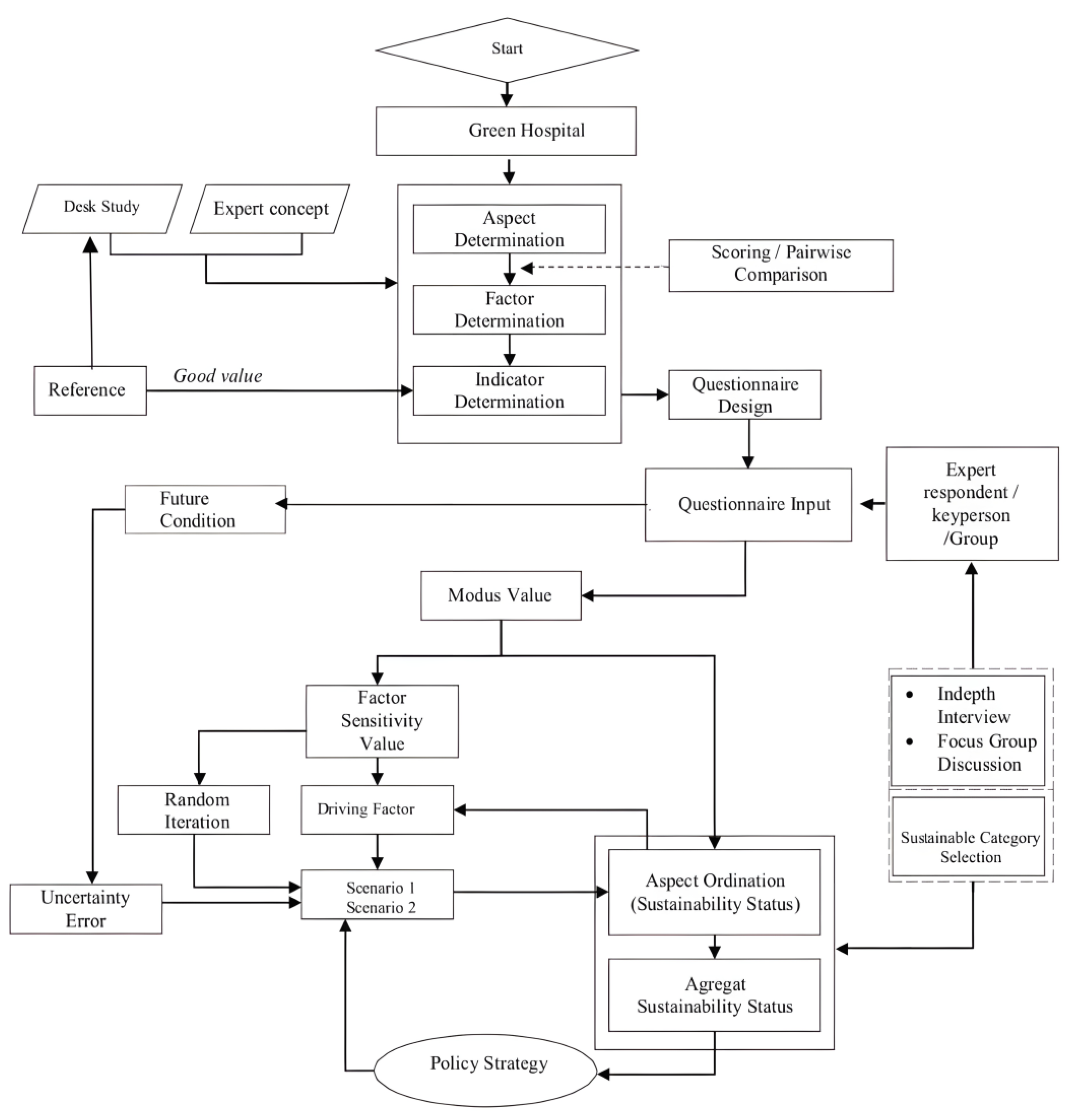
Figure 1. Conceptual framework. Source: Adapting the research framework [31,32]; →: Main flow of the analysis process; ⇢: Not the main flow of analysis.
Sustainability 18 03211 g001
Figure 2. Quadrant for determining priorities. Source: Adapting the research framework [35,36].
Sustainability 18 03211 g002
Figure 3. Sustainability value of the institutional dimension. Source: Output MSA.
Sustainability 18 03211 g003
Figure 4. Sustainability value of the economic dimension. Source: Output MSA.
Sustainability 18 03211 g004
Figure 5. Sustainability value of the environmental dimension. Source: Output MSA.
Sustainability 18 03211 g005
Figure 6. Sustainability value of the social dimension. Source: Output MSA.
Sustainability 18 03211 g006
Figure 7. Sustainability status scenarios simulation. Source: Output MSA.
Sustainability 18 03211 g007
Figure 8. Institutional dimension leverage factors. Source: Output MSA.
Sustainability 18 03211 g008
Figure 9. Environmental dimension leverage factors. Source: Output MSA.
Sustainability 18 03211 g009
Figure 10. Economic dimension leverage factors. Source: Output MSA.
Sustainability 18 03211 g010
Figure 11. Social dimension leverage factors. Source: Output MSA.
Sustainability 18 03211 g011
Table 1. Sustainability status criteria.
ValueSustainability Status
0–25Unsustainable
>25–50Low sustainable
>50–75Sustainable
>75–100Highly sustainable
Source: Adapted from [31].
Table 2. Sustainability assessment parameters based on the TBL, ESG, and GGHH frameworks.
Code/Institutional
(Bad–Good Score)
Code/Environmental
(Bad–Good Score)
Code/Economy
(Bad–Good Score)
Code/Social (Bad–Good Score)
I.1 The policy consists of the hospital management’s commitment to a green hospital (no policy to exists, functional, and sustainable)E.1 Use of mercury sphygmomanometer (none to exists and calibrated periodically)Ec.1 Water management organizational structure (none to exists)S.1 Employee satisfaction with environmental management
(none to exists and sustainable)
I.2 Formation of green team (none to exists, functional, and sustainable)E.2 Chemical policies and protocols (exist and are evaluated and developed periodically)Ec.2 Water conservation (none to exists)S.2 Patient satisfaction with environmental management
(none to exists and sustainable)
I.3 Green team organization (none to green team is both functionally and structurally integrated)E.3 Restriction of materials containing chemicals (none to limiting and finding safer alternatives)Ec3 Saving water (no socialization to socialization is accompanied by plans, evaluations, and follow-up)S.3 Socialization of environmentally friendly education (none to exists and sustainable)
I.4 Green hospital operational policies and guidelines (none to having operational policies and guidelines; monitoring and evaluation are conducted regularly)E.4 Chemical documentation (none to exists)Ec.4 Use of alternative water sources (none to exists)S.4 Information dissemination facilities related to green hospital (none to exist and sustainable)
I.5 Budget allocation (none to budget allocation can lead to innovations that overcome barriers to implementing green hospital)E.5 Chemical identification (none to exists)Ec.5 Energy-saving lamps and sensors (none to exist)S.5 Energy conservation socialization (none to exists and have plans, evaluations, and follow-ups)
I.6 Documentation on saving (none to documented periodically)E.6 Hazardous waste management policy (none to has been implemented routinely, continuouslyEc.6 Energy management organization
(none to exists)
S.6 Local food (none to exists)
I.7 Incident documentation (none to documented periodically)and reported)Ec.7 Energy conservation program (none to exists)S.7 Policy on the use of environmentally friendly vehicles (none to exists)
I.8 Risk mapping (none to existing collaboration with stakeholders on an ongoing basis)E.7 Hazardous waste management planning (one to exists)Ec.8 Utilization of renewable energy (none to exists)S.8 Employee bicycles (none to sufficient quantity, well-maintained, utilized, and sustainable)
I.9 Policy on collaboration and communication with the community (none to exists and sustainable)E.8 Recording of hazardous waste generation (none to sustainable and reported)Ec.9S.9 Socially and environmentally responsible vendors (none to exist)
I.10 Building networks for environmental health policy advocacy (none to exists)E.9 Packaging of hazardous waste (none to exists) S.10 Safe and sustainable products (none to exist)
I.11 Cooperation (none to exists)E.10 Hazardous waste storage (none to exists) S.11 Environmental criteria in procurement
(none to exist)
I.12 Environmental documents (none to exist and sustainable)E.11 Waste management education and training (none to exists)
I.13 Wastewater discharge permits (none to exist and fulfill obligations)E. 12 Water conservation (none to exists)
I.14 (Temporary hazardous waste storage E.13 Water usage in radiological imaging
permit to exists and fulfills obligations)(using water to digital)
I.15 MoU for cooperation in the transportation and/or treatment of hazardous waste by a third party (none to exists)E.14 Drought-resistant plants (none to exist)
I.16 Institutional supervision (none to exists and implement follow-up actions on environmental audit results)E.15 Water quality testing
None of the results are below the standard and are done routinely
I.17 Incident documentation (none to documented periodically)E.16 Use of bottled drinking water (exists to none)
I.18 Risk mapping (none to existing collaboration with stakeholders on an ongoing basis)E.17 Collaboration with the community in protecting water supply, water distribution, and wastewater systems (none to exists)
I.19 Policy on collaboration and communication with the community (none to exists and sustainable)E.18 Water volume standard (none to have standard)
I.20 Building networks for environmental health policy advocacy (none to exists)E.19 Rainwater runoff
(flooding to no flooding)
I.21 Cooperation (none to exists)E.20 Climate change mitigation (none to
exists, report and follow-up periodically)
I.22 Environmental documents (none to exist and sustainable)E.21 Building code compliance (0% to 81–100%)
I.23 Wastewater discharge permits (none to exist and fulfill obligations)E.22 Healing gardens
(none to exist and evaluate, follow up, and develop healing gardens)
I.24 (Temporary hazardous waste storage permit to exists and fulfills obligations)E.23 Nursery (none to utilized well and sustainably)
I.25 MoU for cooperation in the transportation and/or treatment of hazardous waste by a third party (none to exists)E.24 Visual comfort (does not comply with SNI 03-6197-2000
to complies with SNI 03-6197-2000)
I.26 Institutional supervision (none to exists and implements follow-up actions on environmental audit results)E.25 Noise level (none to the results meet quality standard requirements and are evaluated and reported)
I.27 Rational drug policy (none to implement, evaluate, and follow-up)E.26 Returning expired medication to the distributor (none to exists)
I.28 Hospital pharmacy installation (none to exists)E.27 Volume of pharmaceutical waste (increasing to decreasing)
Source: [19,37,38,39,40,41,42,43].
Disclaimer/Publisher’s Note: The statements, opinions and data contained in all publications are solely those of the individual author(s) and contributor(s) and not of MDPI and/or the editor(s). MDPI and/or the editor(s) disclaim responsibility for any injury to people or property resulting from any ideas, methods, instructions or products referred to in the content.