1. Introduction
Recent transformative events have profoundly impacted the world. Addressing economic, social, and environmental concerns holistically, sustainability is increasingly considered a viable solution [
1,
2]. The question is, how can sustainability produce measurable results? In other words, from a theoretical approach, how can a change of heart, stance and behaviour in practice be accomplished?
One possible answer lies in the Stockholm Declaration on the Human Environment, established in 1972 [
3], which acknowledged the pivotal role of education in promoting sustainability through knowledge generation and transfer. Furthermore, Pizzutilo [
4] referred to higher educational institutions as “transformative organisations” in 1973, emphasising their contribution to a responsible, ethical, and sustainable world. In recent years, Casarejos et al. [
5] have argued that higher education institutions (HEIs) can facilitate the generation and dissemination of knowledge, thereby contributing to the building of a resilient society. Accordingly, Deda et al. [
6] support that HEIs cannot ignore the sustainability challenge; they may be seen as key players in advancing sustainable development [
7].
With the increasing emphasis on sustainable development, the role of higher education in this process has become a focal point of debate, exploring how higher education can be a catalyst for sustainability [
8,
9]. In response, many higher education institutions have prioritised the integration of sustainability into teaching, research, community life, and campus operations [
10]. This brought prominence to a new field of research, with growing interest in organising education for a sustainable future [
11,
12,
13]. Sustainability through higher education has become a global development agenda, known as Higher Education for Sustainable Development (HEfSD), emerging as one of the primary educational initiatives to address the world’s challenges [
14]. Likewise, Filho attests that education for sustainable development (ESD) is a fundamental initiative that seeks to integrate the values of sustainable development (SD) across all levels and facets of learning [
15].
With an estimated 348 million tourism jobs worldwide in 2024 and a forecast of 449 million in 2034 [
16], higher education in tourism is no exception when embracing sustainability principles and practices. Frequently, it is argued that integrating sustainability into the tourism industry through education [
4,
8] can also yield significant benefits. Clearly, universities specializing in tourism education play a critical role in equipping future tourism experts and professionals with the necessary skills for sustainable tourism development. A main finding of this research is that evaluating Greece’s tourism-related universities’ response to the call to integrate sustainability and develop a generic approach to fostering sustainability implementation in higher education remains a challenge.
The structure of the remainder of this paper is as follows:
Section 2 provides an overview of the literature on sustainability assessment tools (SATs), their evolution, key challenges, and emerging trends, while also reviewing theory-building approaches relevant to real-world applications.
Section 3 develops a meta-model of the theory-building process, synthesizing established frameworks and defining six distinct phases that structure the development of a new reflective SAT.
Section 4 presents these six phases in detail and introduces the Sustainability Implementation Reflective Assessment Framework (SIRAF), outlining its conceptual basis, indicator taxonomy, and application steps.
Section 5 applies SIRAF to eight Greek tourism higher education institutions, offering empirical insights into the current state of sustainability implementation.
Section 5 concludes with a discussion of the framework’s theoretical and practical contributions, highlighting its potential to support institutional change through reflective self-assessment, outlining directions for future research, including refinements of scoring mechanisms and broader applications across diverse contexts.
2. Literature Review
2.1. Sustainability Assessment Tools: Significance, Synthesis, Challenges, and Trends
Lozano was one of the pioneers in integrating effective, sustainable development (SD) into university policies and operations, advocating for its incorporation as a radical innovation process [
4,
17,
18,
19]. The initial notion of sustainability assessment tools (SATs) was developed in the 1990s in the UK by the Building Research Establishment Environmental Assessment Method (BREEAM) and in the US by the Leadership in Energy and Environmental Design (LEED) to achieve building and urban sustainability [
20]. Analytically, the evolution started from Building Sustainability Assessment Tools (BSATs) to Neighbouring Sustainability Assessment Tools (NSATs) and to finally what is widely used in higher education as SATs; hence, they are clustered as third-generation evaluation tools nowadays. In all of the above cases, an SAT entails the use of different indicators structured in a weighted-criteria-based framework that provides valuable information on the (sustainability integration) performance of a specific research subject. Similarly, in higher education they are designed to assess the integration of sustainability across various institutional dimensions, such as education, research, campus operations, and community engagement [
21,
22,
23]. Overall, SATs have the potential to build capacity and improve future processes through reflective evaluation [
24] and are increasingly seen as necessary for reporting on sustainability implementation. Berzosa advocates that SATs play a crucial role in HEIs as they allow for the creation of future actions for a sustainable university [
25]. And while sustainability reporting, via an SAT, is mostly voluntary, it has the power to strategize towards sustainable practices of a university [
26].
Sustainability assessment tools (SATs) are defined as a systematic framework for measuring higher education institutions’ (HEIs) efforts in integrating sustainability [
21]. Another definition describes SATs as instruments that provide HEIs with systematic procedures and methods for measuring, auditing, benchmarking, and communicating their sustainable development (SD) efforts [
27]. Most academics agree that SATs can function as benchmark tools for HEIs, using specific metrics to communicate their performance to the world and to specific stakeholders [
6,
22,
28,
29,
30,
31]. They enable the description of an HEI’s status and provide clear guidelines for future directions aligned with sustainability implementation. In essence, SATs answer how well an HEI is performing (in relation to sustainability implementation) now and how well it aims to perform in the future. Accordingly, the gaps to bridge and the room for improvement become evident in the context of unaccomplished indicators when reporting SATs. SATs can, therefore, become the starting point for addressing sustainability matters in an organised way. The progression of assessment results into the implementation of future strategies is suggested and enabled when using an SAT.
In the literature, there are numerous tools with diverse methodologies, each reporting on different countries and on scientific fields, whilst adopting a wide range of approaches. According to Kutty et al. [
32] and Maragakis & Dobbelsteen [
33] many sustainability assessment methodologies are available. Specifically, Dalal-Calyton and Bass [
34] summarise measuring and analysing sustainability approaches into three types: account-, narrative- and indicator-based assessments. At present, the mainstream evaluation method relies on indicators to assess sustainability implementation in universities [
20]. Regardless of the approach that an SAT employs, Lambrechts and Ceulemans [
35] identified the most significant thematic areas in policy development, assessment for higher education, mainstreaming, transparency, and communication contributions. Similarly, Da Rosa [
36] and colleagues conducted an indicator analysis on 19 SATs. Findler et al. [
37] summarised that core indicators are found in the elements of: institutional frameworks, education, research, outreach, campus operations, campus experiences, assessments and reporting, and finally higher education institutions. Based on previous research by authors, again within the framework of a systematic literature review, six main thematic areas of educational indicators were determined: identity and institutional characteristics, education and academic matters, research, campus operations and environment, campus operations and society, and public engagement [
38]. It is now apparent that several researchers contribute to a discussion and overview of the key thematic areas, debating on which thematic areas are predominant when assessing sustainability implementation. An examination of the similarities of SATs worldwide reveals the most significant indicators. Consequently, Mapar et al. [
39], reviewing 27 tools, suggest how this increasing variety can contribute to more tailored and structured SAT development processes in higher education institutions (HEIs).
Besides the various advantages associated with sustainability assessment tools (SATs), several challenges need to be considered. Even though the initial development of assessment tools occurred three decades ago, recent research suggests that they are still in their nascent stages of development [
8,
28], and that improvements to their implementation and structure are necessary [
40]. While they have contributed to the advancement of knowledge regarding the implementation of sustainability in higher education institutions (HEIs), their efficacy in facilitating this process has been questioned. Ceulemans et al. [
41] argue that SATs primarily focus on “what” HEIs can do rather than “how” they can integrate sustainability, an argument posed by several researchers, who also cite that the reporting results are often vague despite the great variety of SATs with standardized indicators included [
23,
42]. Moreover, the predominant emphasis of SATs on environmental issues, such as campus operations or climate change elements in curricula, overlooks the economic and social aspects of sustainability [
23,
43,
44]. Various scholars have proposed strategies to enhance the effectiveness of SATs. Ceulemans et al. [
22,
41] stress linking reporting indicators to existing management standards to increase efficacy.
Additionally, an emphasis on acquiring a comprehensive understanding of SAT components, similarities, and differences to foster practical applications is underlined [
33,
39]. They note that constructively comparing different SATs, rather than subjecting HEIs to a ranking or competition format, would facilitate the identification of essential themes and the involvement of critical stakeholders to increase effectiveness [
28]. However, excessive emphasis on indicators can lead to complexity and application challenges [
39]. Consequently, there is a call for comprehensive reports based on SATs, linked to practical applications, offering clear guidance for action and incorporating all three dimensions of sustainability. This would involve delineating and incorporating key thematic areas and utilising a carefully selected few questions to ensure usability, transparency, and comparability [
45]. For the above to be orchestrated successfully, the presence of a sustainability leader in HEIs is essential, whose role nowadays lacks recognition and hence is missing [
22,
36].
2.2. The Need of and Approach to Redefining SATs
Although the significance and advantages of SATs are well established theoretically and conceptually, there is a comparative limited body of research examining their practical application. According to UNESCO in 2018, 88,071 universities operate globally, and even though there is an increase in universities reporting sustainability, the total number is still insignificant [
26]. The reluctancy of universities to report sustainability reflects an obstruction in the applicability of an SAT as well as the cost of organisational change for universities to bear. Since sustainability implementation affects numerous and diversified university operations, one could argue that the potential organisational change is so substantial that it ultimately necessitates a change of the governing university’s heart. As Meredith elaborates, managers are unwilling to accept the results of models they cannot relate to or comprehend ‘since they would rather live with a problem which they understand than accept a solution which they do not understand’ [
46]. Regarding higher education, Ceulemans et al. [
23] and Roos’s [
7] suggest that universities should be applying business and market criteria for effective change. Therefore, as our analysis also argues, it is pivotal to aid universities to embrace the operational change that comes with sustainability implementation. The key challenge is to deconstruct the complexity entailed in the process of reporting. More specifically a methodology and theoretical meta-framework is necessary, simplifying the use and concept of an SAT in a practical and reflective way. To this end, a new reflective assessment framework is required, especially for higher education, which should be fundamentally adjustable at its core. This attribute would make it potentially useful and also applicable in non-academic organisations and could potentially notify the progression from third- to fourth-generation SATs, specifically SIRAF.
Further explaining the basic concepts, a conceptual model is defined as a set of concepts that are used to describe an event, object, or, in this case, a process. It is not explanatory at this stage but solely descriptive, allowing logical statements to reveal themselves, which, in the latter stage, allows for the evaluation of suspected relationships [
46]. The role of a conceptual model is to underline the theory of semantics and foster a way to be put into practice [
47]. A framework, on the other hand, includes explanatory elements, and therefore it enables the identification of relevant variables, their classification, and a description of possible interactions, which subsequently results in mapping them in an organised meaningful way. The conceptual mapping of these variables can be organised either in taxonomies or typologies. Taxonomies are linear and describe a continuous relationship amongst the variables, allowing for core and sub-titles. Typologies, on the other hand, are multidimensional taxonomies, organised together in a coherent way to adequately classify and describe the variables’ relations. Such organisational and conceptual mapping is necessary, with the purpose of uniting multiple variables, which independently act in specific areas but unitedly and collectively serve one purpose. A single SAT is defined as a set of concepts used to describe sustainability capacities of an organization and thus is only descriptive rather than explanatory. In addition, it can be clustered as a conceptual framework in taxonomy arrangements. In case two or more conceptual frameworks (SATs) are integrated, with the purpose of identifying strong interactions, a meta-framework is established [
46]. By assigning a weight of significance in the meta-framework indicators, another dimension of interaction is added and thus a typology arrangement is developed. Therefore, an SAT meta-framework in taxonomy presents the prospect of developing a typology arrangement in the future.
The pursuit of this SAT meta-framework for higher education, paradoxical as it may seem, is a simplification of the reporting process, so that more universities are motivated to perform as such. This article aspires to share a viewpoint of a user-friendly reporting process, reflective of the existing challenges. This can be achieved by a thorough explanation of the significance, development, application and implications of this suggested meta-framework in a rigorous manner. Because such an approach has not been undertaken in the past, the structured development of this conceptual meta-framework in a rigorous and meaningful way draws caution. In response to this challenge, the theory development literature has been reviewed to ensure that the discussion, findings and conclusions of this paper are well managed. The theory development literature is vast; therefore, the parts that relate to empirical data, building and testing useful theories in practice, and using a conceptual framework for management applications are isolated [
46,
47,
48,
49,
50,
51]. At this point it is worth stating that, following Dubin and Whetten, the approach of this paper will make no distinguishments between a model and a theory, as they are closely related [
52].
So, what is defined as a theory? Various scholars have approached this definition from different viewpoints, yet they all agree in the description of making sense in stages. A theory is described as ‘a coherent description, explanation and representation of observed or experienced phenomena’ [
53]. Eisenhardt supports the notion that a theory emerges by ‘recognising patterns of relationships among constructs within and across cases and their underlying logical arguments’ [
50], and it could be as straightforward as a framework, as long as it satisfies Dubin’s five requirements [
46,
54]. Progressively, one may at this point ask, is there a good or a bad theory? Academics of theory building within applied sciences address this question in relation to the theory’s applicability capacity. Lynham explicitly states, ‘Well, that is all very well in theory, but it does not work like that in practice, in the real world’ and passionately supports the need for utility of a good theory [
51]. Likewise, Meredith supports the idea that in operations management, there is little relation from theories to reality; thus, little utility is offered to managers in the real world [
46]. Therefore, a ‘good’ theory is heavily related to the nature of its content and thus the degree of its utility. Methodically, the explanation of current mechanisms occurs, aiming for better understanding and hence enhanced actions. Outcome knowledge and process knowledge are key indicators of a good theory, reflecting the qualities of rigor and relevance (explained as validity and utility) [
51]. The meta-framework described in this paper adds increased utility of existing SATs, enhancing the alignment with real-world challenges and needs. In the disciplines of sustainability studies and university operations management, theory development of practical value is essential to achieve sustainability implementation.
Building a theory is defined as an ongoing process of producing, confirming, applying and adapting a theory [
55]. Several theory-building methodologies from the ‘theory to practice’ literature have been reviewed, fulfilling the needs of this paper. Certain key points surfaced that need special attention. ‘Theory building and theory testing go hand in hand to establish valid theories which will be useful to managers and researchers [
46]. Eisenhardt shed light on theory building from multiple case studies, involving the creation of theoretical constructs and propositions from case-based empirical evidence [
50]. Inductive and deductive logic were thoroughly described as the process of producing a new theory from cases, which is considered inductive, whilst testing a new theory is clustered as deductive. On numerous occasions Dubin’s theory-building model has been applied in scientific fields such as management, marketing and organisational studies, facilitating the development of new theories [
49]. Kaplan, as summarised by Lynham, refers to the terms ‘the-logic-in-use’ and ‘reconstructed logic’ in describing the reconstruction, where needed, of the cognitive development and application of a theory [
51]. The latter further investigates two strategies, namely research-to-theory and theory-to-research methodology. The second strategy appeals to this paper, as a research project is designed based on theoretical axioms and then tests their application to the real world by collecting empirical data for adjusting validity and utility.
Phases [
51], research cycles [
46], steps [
49], frameworks [
48,
54] and building blocks [
52] are all terms describing the sequential components of the theory-building procedure.
Table 1 visually summarises the overviewed theory-building processes in stages.
Building a theory is defined as an ongoing process of producing, confirming, applying and adapting concepts. According to the literature, building a theory is a process marked by acknowledged phases. In our analysis, these are clearly stated and explained in
Section 3. Nevertheless, we should note that most scholars recognize a theory’s ephemeral nature. Similarly, we support the argument that ‘there is no supreme method of theory building, and nor should there be’ [
51,
53,
55]. Similarly, Eisenhardt notes that there is no ‘sure-to-please’ template for writing an emerging theory in theory-building research [
50]. Thus, an applied theory is never considered complete but rather always ‘in progress’, until further research redefines it [
51]; hence, adjustability and transformation are not to be ignored when building a theory.
2.3. SIRAF: A Meta-Framework for Sustainability Assessment
This article responds to the growing need for universities to meaningfully implement sustainability across all operational levels—not merely as a compliance task but as an integrated, strategic objective. To support this aim, this study addresses one of the core barriers in current practice: the complexity, rigidity, and limited applicability of existing sustainability assessment tools (SATs). By examining the persistent criticisms and limitations highlighted in the literature alongside recent trends advocating for more adaptive and user-centred approaches, this article identifies clear opportunities for innovation in how sustainability is assessed in higher education.
A critical insight from the literature is the necessity for transformation and adjustability in sustainability assessment, grounded in the recognition that each university has unique characteristics, constraints, and priorities. This insight drives the conceptualization of a new assessment approach based on flexibility and self-diagnosis. The proposed framework introduces a taxonomy of core and sub-indicators, allowing institutions to self-develop a tailor-made SAT using a “pick-and-mix” method. This approach empowers universities to measure sustainability implementation in ways that are most relevant to their current context, resources, and strategic goals. To reflect this shift toward reflective, autonomous practice, the framework is named the Sustainability Implementation Reflective Assessment Framework (SIRAF).
SIRAF has been pilot-developed and applied to assess sustainability implementation in eight Greek higher education institutions offering tourism-related programs. The tool was adapted in both its composition and data collection methods to fit the practical constraints and institutional characteristics observed in the Greek context. Although the results represent a preliminary measurement, they demonstrate the feasibility of initiating sustainability self-assessments in a simplified, accessible, and institutionally owned manner. The findings also underscore the framework’s utility as both a diagnostic tool and a catalyst for organisational learning and change.
The structure of this article follows a three-phase approach. To build the meta-framework we first review existing SATs and present a reclassified taxonomy of indicators. Secondly, we illustrate uses of the framework and possible applications, as this is a customised assessment tool tailored to a specific context—in this case, tourism higher education in Greece. Finally, the implications of SIRAF are explored, with a focus on universities seeking to assess, implement, and advance sustainability initiatives in a reflective and scalable manner. Analysis in this context aims to answer the following research questions:
RQ1. How can a reflective SIRAF be developed through the identification and reclassification of core and sub-indicators from existing SATs?
RQ2. How can the SIRAF framework be applied and tested in practice through the development of a tailor-made, context-specific sustainability assessment tool (as demonstrated in the case of tourism higher education in Greece)?
RQ3. How does SIRAF contribute to sustainability assessment theories and support broader institutional change and applicability in higher education?
3. Materials and Methods
The methodological approach combines a systematic literature review, a comparative analysis of existing sustainability assessment tools (SATs), and a theory-building synthesis to develop the SIRAF meta-framework. Analytically, during the development and validation of the SIRAF framework, a range of analytical tools and methodological approaches were employed, resulting in a mixed-methods research design. Scopus and Google Scholar served as the primary bibliographic databases, while Mendeley (Version 2.142.0, UK) and MAXQDA (Version 24, Germany) were utilized for reference management and qualitative content analysis, respectively. XMind (Version 25.04.03523, Hong Kong) and Napkin AI (Version 1.1.14, CA, USA) supported the development of the article’s infographics, which are presented as figures within the text.
The findings of the authors’ previous research, as identified through a systematic literature review, have been employed in this article, laying the foundation for SIRAF. This review has been conducted to identify the most frequently applied sustainability assessment tools (SATs), their constituent components, their reported relevance, implementation challenges, and emerging trends as documented in the contemporary literature [
38].
Additionally, applied theory-building procedures have been investigated. The above comprised the stepping stones for developing the methodology, addressing our main research questions in a systematic and rigorous way.
In the process of conceptualizing a robust theoretical foundation for this research, an initial synthesis was conducted across several established theory-building models, including those of Dubin (1978), Whetten (1989), Meredith (1993), Lynham (2002), and Becerra et al. (2025) [
46,
48,
49,
51,
52]. Each of these frameworks offers distinct emphases—ranging from foundational theoretical components to applied, consecutive processes—yet they collectively highlight repeated structural elements essential to theory development. Through a comparative analysis of these models, key thematic parallels were identified, such as the articulation of constructs, the specification of relationships, contextual delimitation, operationalization, and iterative validation.
To enhance coherence and applicability within the context of this study, these common elements were synthesized into a six-stage meta-theoretical framework (
Table 2). This meta-model consolidates the core dimensions of theory building into a simplified yet comprehensive structure: (1) Purpose and Conceptual Framing, (2) Relational Structure and Boundaries, (3) System Configuration and States, (4) Operationalization and Empirical Design, (5) Testing, (6) Refinement, and Theoretical Output. By offering a unified and systematic pathway for theoretical development, this model serves both as a guiding scaffold for the present inquiry and as a transferable tool for future theory-driven research in applied fields.
The structure of the discussion of this paper follows the six phases described in the meta-model for establishing the Sustainability Implementation Reflective Assessment Framework (SIRAF) systematically, in an organised and meaningful way.
With regards to phase 5, a meta-framework was developed and tested in tourism higher education in Greece, attempting to examine SIRAF’s applicability and validation.
4. Establishing the Meta-Framework (Presenting SIRAF)
4.1. Framing the Theory
The conceptual development of the SIRAF meta-framework is presented in this 1st phase, involving the formulation of initial ideas that include a higher understanding of a shortfall, a better explanation of a phenomenon, or a problem of the relevant area [
51]. To be precise, this stage involves clearly identifying the shortcomings in the area of interest in supporting the development of knowledge with practical value.
The literature highlights the key challenges and trends related to SATs. Based on these findings this new meta-SAT was created to address those areas of improvement as retrieved from within challenges. Accordingly, the emerging design elements are adjustability, transformability, and ease of use, reflective of a university’s unique features and flexible on the data collection methods. Developing an SAT that facilitates those characteristics is believed to encourage universities to implement sustainability. The aim of this meta-framework is to allow universities to self-develop their own SAT and self-diagnose sustainability integration, allowing them to decide the context, length, data collection method, repetition mode, and percentage of completion of the overall assessment process every time. The novelty of this meta-framework is grounded in the fact that a good-for-all SAT does not exist. In recognition of the uniqueness of each university, a reflective assessment framework is concluded to be essential for reinforcing the functional dimension of sustainability implementation.
Whilst adjustability is a core feature of SIRAF, it should not add to the complexity of its practical deployment. As noted by several scholars and discussed previously, a common challenge is the vagueness of sustainability terminology and its interpretation. In addition, prefixed SATs tend to ignore the ease-of-use feature concerning context inclusion. The commonly held assumption that complexity necessarily accompanies inclusivity and effectiveness is challenged in our analysis. Although ornate language can lend sophistication to academic writing, it often hinders clarity and practical application. Accordingly, the proposed meta-framework prioritizes functional clarity and a theory that provides impact and testable results to facilitate the transfer of knowledge and the theory and achieve impactful results.
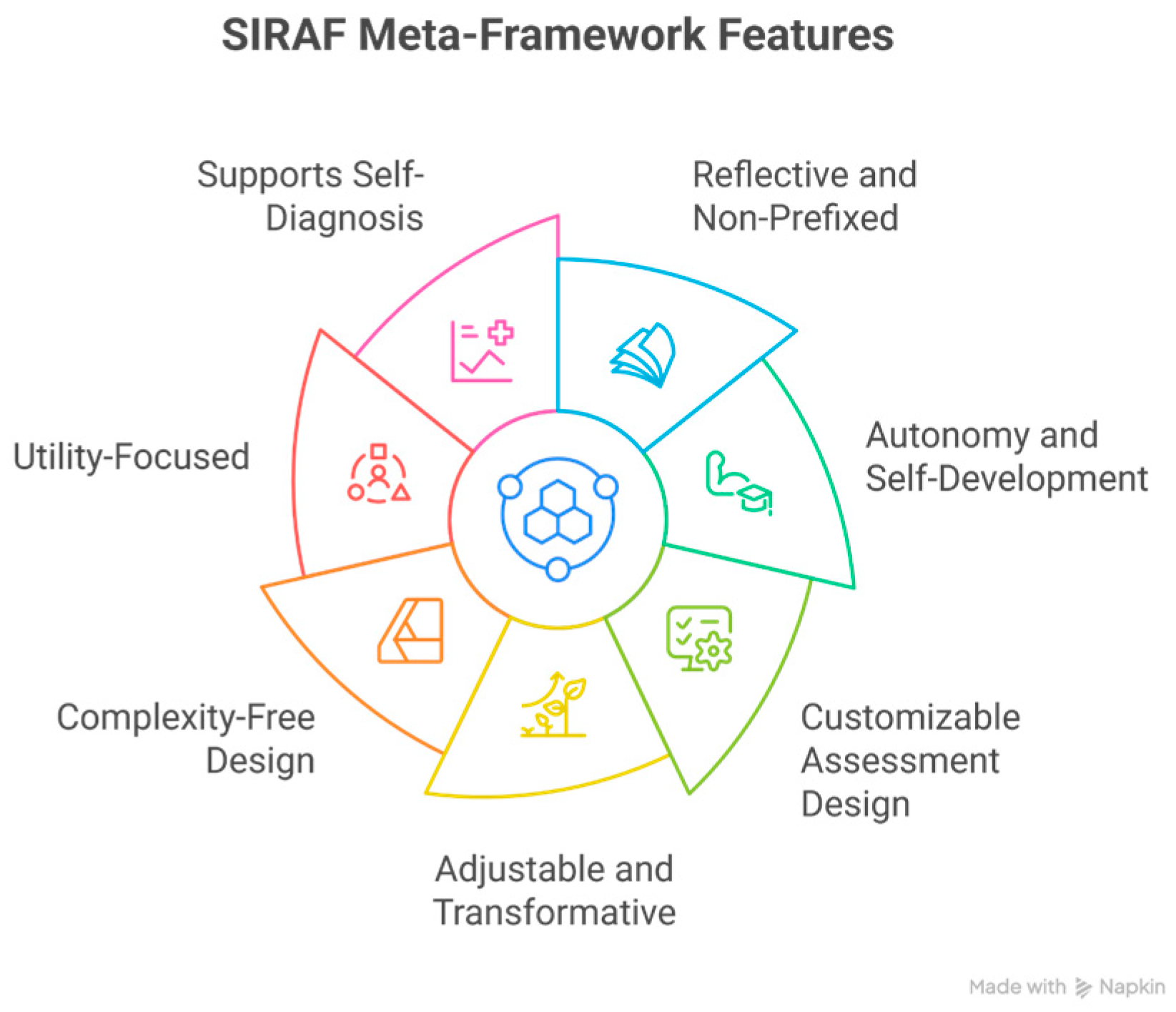
This new meta-framework, named Sustainability Implementation Reflective Assessment Framework (SIRAF), is not prefixed but rather reflective, flexible, unique (every time it is used), simply worded, and easy to apply. Arguably, its most transformative attribute is the autonomy it provides universities to develop their own sustainability assessment frameworks, tailored to their needs and resources. Based on the previous discussion and findings, the core features (units and constructs) of SIRAF should be the following (
Figure 1):
Reflective and Non-Prefixed: SIRAF is not a one-size-fits-all tool; each university adapts it to its unique context. Uniqueness is a core feature.
Autonomy and Self-Development: SIRAF empowers universities to self-develop their own sustainability assessment tools (SATs).
Customizable Assessment Design: Users can determine: the context, length, data collection methods, repetition mode and percentage of completion of the overall assessment.
Adjustable and Transformative: It can evolve over time to meet institutional changes or shifting sustainability goals.
Complexity-Free Design, User-Friendly and Simply Worded: SIRAF avoids complex or vague terminology to promote clarity and practical applications. It balances content inclusivity with simplicity.
Utility focused: SIRAF aims to bridge theory and practice.
Supports Self-Diagnosis: It enables institutions to assess their own progress and status in sustainability implementation.
4.2. Defining Relationships and Context
The fundamental conceptual framework/principles/features of this new model have been described so far. The transition of converting the theory into practice initiates in this phase. Lynham best describes this as the ‘explicit connection between conceptualization phase and practice’ [
51]. The constructs or units of this model, as outlined in the previous phase, will be further examined to uncover the potential relationships and dynamics that may exist among them. It becomes apparent that their combined effect is directed toward encouraging institutions to adopt sustainability reporting practices. They all selectively encourage autonomy; hence, greater convenience is achieved for universities that wish to start reporting but are discouraged so far by the complex and strict procedure.
One potential concern associated with the autonomy embedded in this meta-framework is the assumption that it will be used in good faith. To be more precise, because a great deal of freedom is deeply rooted in the core of SIRAF, achieving effectiveness necessitates measured, responsible, constructive and ethical use. Universities ought to choose the development of their own SAT in a way that truth is prioritised in relation to the pursuit of high implementation scores, solely stated in black and white. Therefore, a potential limitation lies in the challenge of preventing manipulation or misuse when institutions develop their own version of SIRAF. Two suggested strategies could address this limitation: either nominate significance weights to SIRAF components and/or the provision of concise institutional justifications for the selection of particular indicators.
The conversion of this conceptual framework into applicable components begins at this preliminary stage. The meta-framework outlines the general structure and its elements, allowing the theoretical constructs to begin taking concrete form. This included a two-step approach: a desk analysis of the SATs available online and a systematic literature review aiming to distinguish the significant areas within which a university measures sustainability implementation. These areas of implementation/evaluation are named as core indicators. Every core indicator (area of interest) consists of a set of exploratory questions named sub-indicators. Each SAT, therefore, comprises a set of core indicators along with their associated sub-indicators. The need to review as many existing SATs as possible became evident in the effort to identify evolving relationships between core and sub-indicators. Through this process, indicators that appeared repeatedly across frameworks were marked as significant. In several instances, indicators overlapped, sometimes expressed differently, yet ultimately referring to the same measurement, while in other cases, unique sub-indicators appeared only once, without repetition across SATs. In such cases, indicators referring to the same conceptual dimension were consolidated through manual thematic and contextual interpretation, allowing terminological variations across frameworks to be grouped into unified categories. The pursuit at this stage is to isolate the most eminent core and sub-indicators by repetition, which in turn will become the building blocks of this meta-framework. Consequently, the development of SIRAF builds upon previous SATs. An analysis of twelve SATs was conducted to identify interactions, common elements, and composite variables, with the aim of developing a meta-framework that integrates the most prominent indicators of sustainability implementation and provides both variety and practical usability based on existing models.
Comparative studies of SATs have been previously conducted in the literature, aiming to enhance sustainability implementation in higher education [
22]. The identification of key indicators has been widely explored. For instance, Dawodu et al. [
20] isolated 62 indicators based on the minimization approach and explored ‘how to’ select indicators according to the stakeholders’ (staff and students’) views and opinions. Casarejos and Gustavson [
5] analysed 24 international frameworks for sustainability implementation and identified 4 core indicators divided into 40 sub-indicators or ‘proposed actions’, as mentioned in their paper. Huber and Bassen [
56] developed a set of reporting principles in fostering effective sustainability implementation. Kapitulcinova et al. developed the ‘Accelerator’ toolset, a framework for reporting sustainability while allowing for certain flexibility to encourage universities to undertake such a task [
57]. The mere synthesis of a new framework and the formulation of yet another set of equations measuring HEIs’ operations conclude in proposing another prefixed reporting approach with questionable results. Similarly, Rosa et al. [
36] conducted a systematic review of trends and patterns reported in universities, exploring the core and sub-indicators. They acknowledge both the heterogeneity of existing SATs and the distinctive features of individual universities, concluding that each university should adopt one of the existing assessment tools most suited to a university’s needs and circumstances. Scholars studying SATs have been restless in deciding which prefixed SAT is the best to use. Apparently, no clear-cut reply can be generated, since available SATs vary in characteristics on the one hand and, on the other hand, so do the universities’ features, needs and resources. Thus, the suitability of an SAT depends on multiple factors, as what proves effective for one university may not be appropriate for another. Conclusively, the features/needs of an institution need to be aligned with the features/indicators of the deployed SAT for productive results.
Addressing the need for this alignment, this new meta-framework suggests full autonomy, as a university develops its own SAT. An inclusive conceptual map was organised, and the taxonomy of core and sub-indicators was created based on the results of previous and the authors’ own research [
58]. The longer this map is, the greater its capacity for applicability and critical reflection, thereby enhancing its overall utility. The novelty of this framework is that universities are empowered to select the core and sub-indicators through which to develop their own SAT. This is achieved through what is referred to as a ‘pick-and-mix’ method, which grants universities autonomy in tailoring the SAT to their specific indicators and contextual/organizational needs. There is no pre-established structure of the tool, and therefore universities can report on a chosen area of interest.
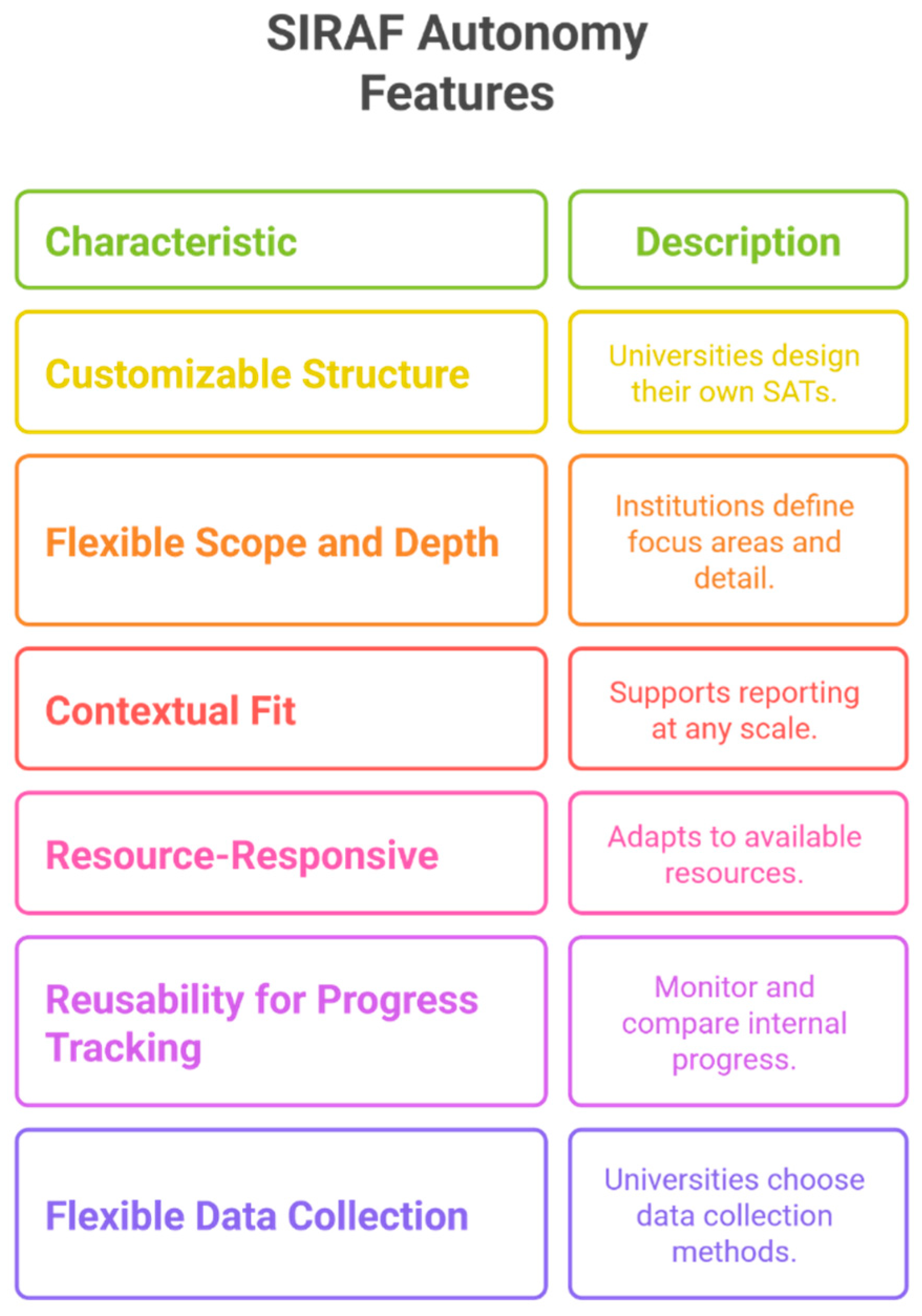
The autonomy supported by this tool allows universities to determine both the “breadth” and “depth” of their evaluation areas (
Figure 2). Breadth refers to the number of key interest areas selected, noted as core indicators, and depth refers to the explanatory questions per area, named sub-indicators. Thus, the free choice to initiate a departmental or holistic reporting process is enabled. Overall, the length, complexity, content can consequently significantly vary every time a SIRAF is used. If benchmarking one’s own progress is decided, the same SIRAF can be used within the same institution. The significance of this choice is that adjustments can be arranged in this manner, reflecting the university’s available resources when reporting. Flexibility on data collection methods can also be enabled, as most data are currently available online.
Following the evolution of building-level (BSATs) and neighbourhood-level (NSATs) sustainability assessment tools, those currently used in higher education (SATs) are regarded as third-generation tools [
20]. If the approach proposed in this paper succeeds in advancing both theoretical understanding and practical utility, it could justify the emergence of a fourth generation of sustainability assessment tools.
4.3. Mapping the System
Imagine a candy store where candies are organized into large sections based on their main characteristics—such as hard candies, chocolate-based candies, marshmallows, and so on. These principal sections represent the core indicators. Within each section, a wide variety of individual candies can be found, corresponding to the sub-indicators. Just as a customer can pick and mix from any section to create a personalized selection, institutions using SIRAF can choose from across different core and sub-indicator categories to develop a tailored sustainability assessment tool aligned with their unique context and needs. In this section, we identify the core and sub-indicators which are the building blocks [
52] of SIRAF. For this purpose, a desk manual thematic analysis was conducted on 12 assessment frameworks available online for free on higher education in 2023. Furthermore, the findings of the authors’ previous research, based on a systematic literature review aiming to reveal the three most frequently cited SATs [
38], were fully implemented and further developed in fostering SIRAF’s creation. This mixed-methods approach has been employed to increase the validity of the findings. Both methods aimed to identify areas of interest (core) and questions (sub) when measuring sustainability implementation in higher education.
Specifically, the assessment frameworks analysed were: 1. UI Green Metric (World University Ranking), 2. AISHE (Assessment Instrument for Sustainability in Higher Education), 3. GRI (Global Reporting Initiative) 404, 4. GASU (Graphic Assessment of Sustainability in Universities), 5. ISCN (International Sustainability Campus Network), 6. STARS (Sustainability Tracking Assessment and Tracking System) by AASHE, 7. PRME (Principles for Responsible Management Education), 8. CRUE (by Spanish Universities), 9. the Sustainability Leadership Scorecard (by AUDE and EADUC, UK), 10. USAT (Unit-Based Assessment Tool) by UNEP for African Universities, 11. SCAS (Sustainable Campus Assessment System by Hokkaido University and AUA), and 12. THE (Times Higher Education). Comparability is a challenge as they do not comply with one common layout; however, an overview has been attempted in identifying similarities of assessment areas. Through the minimization approach context analysis was performed, isolating the common areas of assessment and ignoring the areas that are seldomly mentioned. Collectively, four core indicators surface when comparing these frameworks: a. Identity and Governance, b. Academic, c. Environmental and d. Social. These four core indicators divide themselves into sixteen explanatory sub-indicators.
Table 3 presents the repetition frequency of indicators as per assessment framework and the score in percentage form.
Since not all frameworks address the same matters, and even if they do on certain occasions their description might be different, a context analysis based on the comprehension of the researchers might eliminate the results in terms of compromising subjectivity. To the best of the researchers’ ability, knowledge and interest, the results reveal that most existing frameworks assess the areas presented above. Whilst some indicators are straightforward, like ‘waste’, others like ‘society’, require further explanation as the approach was differentiated. Questions regarding governance and operations score the highest in the identity core indicator, whereas industry engagement is still low. In academic matters, the term ‘education’ is vague and in certain cases refers to curriculum, which is included in all frameworks. The fact that environmental indicators are related to other core indicators in such detail explains how the notion of sustainability was and still is very much related to greening the operations of a university. This notion is evolving towards three-dimensional sustainability, encompassing societal and economic viability within the governance of the widest area. The evolution of social sustainability indicators is clearly marked in the diversification of measurement approaches as identified in the existing frameworks. Because of this broad variety of context this core indicator was not divided into sub-indicators but is mapped as unified with explanations, where appropriate. Thus, even though it holds the highest score, it is justified due to the unification of sub-indicators, rather than their frequency of appearance. An overview of the sub-indicators concludes that the winners are the assessment areas of education, research and environment.
A generic overview of the indicators in the approach described so far has been achieved, yet rigour has not been established, as comparability, bias and analysis issues can compromise the findings. Consequently, the results were verified against the results of a prior systematic literature review to ensure robustness of the overall findings [
38]. It is worth emphasising that the selected studies were required to address sustainability as three-dimensional (economic, social, and environmental pillars) and within the context of higher education. Following duplicate removal, 162 articles were identified. Using Zotero (Version 6, VA, USA), articles not containing the terms ‘sustainable’ or ‘sustainability’ were excluded, along with those unrelated to ‘education’ or ‘higher education,’ resulting in 42 articles. Manual screening led to a final sample of 36 eligible articles. These were examined in depth, with the analysis supported by the qualitative software MAXQDA. Codes were developed to capture relevant areas of interest, forming the basis of a taxonomy. The literature was then thematically analysed, yielding six thematic areas aligned with the research objectives. The classification codes were derived from key points of interest, focusing on the publications and methodologies of the reviewed articles, the origins of the sustainability assessment tools, and the components of the SATs. To enhance reliability of the qualitative analysis, coding decisions and thematic categorizations were reviewed and cross-checked amongst the authors through iterative discussion to ensure conceptual consistency in the interpretation of indicators.
The bibliometric analysis revealed that most of the reviewed documents are peer-reviewed journal articles, complemented by a few theses, with the majority published in the last three years, indicating a growing interest in SATs. The journals dominating in the literature are the International Journal of Sustainability in Higher Education and Sustainability (MDPI). In geographical terms, Europe leads in SAT contributions, followed by North America, with limited representation from South America. The field of scientific analysis reveals strong interdisciplinary involvement, with business, economics, sustainability, environmental studies, and education being the most represented disciplines. To ensure relevance to the research objectives, explicit inclusion criteria were applied. Articles were included if they explicitly addressed three-dimensional sustainability or sustainable development in the context of higher education and contained references to sustainability assessment tools (SATs), or their indicators. Studies not containing the terms sustainable or sustainability, or those not relating to higher education, were excluded during screening. Thirty-six review items were analysed using qualitative coding to identify the most frequently referenced SATs. Among these, the Sustainability Tracking, Assessment, and Rating System (STARS) emerged as the most prominent, widely used in the US and Europe. The Global Reporting Initiative (GRI) ranked second but was excluded from further analysis due to its limited relevance to higher education contexts. AISHE (Assessment Instrument for Sustainability in Higher Education) followed, noted for its evolution ifrom environmental to broader sustainability dimensions. The American College & University Presidents’ Climate Commitment (ACUPCC) ranked fourth, focusing on environmental aspects; but it lacks coverage of social and economic pillars and was thus also excluded. The Principles for Responsible Management Education (PRME) ranked fifth and was retained for further analysis due to its alignment with the SDGs and comprehensive sustainability focus on business education. To sum up, STARS, AISHE, and PRME are further analysed to investigate their structures as sets of indicators, identify similarities and differences, and compare and contrast their dynamics and potentials.
The systematic literature review identified six core indicators frequently emphasised in sustainability implementation within HEIs: institutional structure, education, research, campus operations regarding environment and society, and community outreach. These indicators were compared against three prominent SATs, namely STARS, AISHE, and PRME, to assess alignment. Despite terminological differences, a substantial overlap was observed in the composition of these core indicators, particularly in the first five domains. Notably, STARS integrates research under education, while AISHE and PRME treat it independently. Community engagement emerged as the most prominent core indicator across tools. STARS uniquely includes an “Innovation and Leadership” indicator, while PRME highlights “Dialogue” as a principle that promotes stakeholder interaction on sustainability themes. Each of these six core indicators was further analysed to explain what it assesses and how it is worded/expressed/formulated in a question, or as is best known, a sub-indicator.
4.3.1. Core Indicator 1: Identity and Institutional Characteristics
This set of questions examines the institutional and strategic dimensions of sustainability, with particular emphasis on the organization’s commitment to sustainable development. Among the frameworks reviewed, only AISHE explicitly addresses the institution’s economic viability. STARS, by contrast, incorporates economic considerations more indirectly, primarily through its focus on sustainable investment within the Planning and Administration criterion. Key thematic areas across the criteria include operations, institutional structures, leadership, policy, and governance. As per the SATs, foundational terms suitable for constructing sub-indicators are summarised in
Table 4.
4.3.2. Core Indicator 2: Education and Academic Matters
The academic dimension forms the core of any higher education institution. This set of questions explores the integration of sustainability across disciplines, curricula, courses, and degree levels. Attention is given to the processes involved in course development, the articulation of learning outcomes, and the extent to which students can influence curriculum design. Key criterion themes include curriculum development, sustainability as a subject, thematic integration, and learning outcomes and outputs. Key conceptual terms that can guide the development of sub-indicators, as per the SATs, include those summarised in
Table 5.
4.3.3. Core Indicator 3: Research
In both AISHE and PRME, this is addressed as a stand-alone criterion, underscoring the significance of research and related activities in advancing sustainability. This set of questions primarily investigates the extent to which research topics are aligned with sustainability themes. It also evaluates the availability of open access to research outputs, the degree of student involvement, and the recognition of sustainability-—or SDG-related topics. Key criterion keywords include thematic integration of sustainability, open access, and recognition of research addressing sustainability and the Sustainable Development Goals (SDGs). Keywords of sub-indicators’ themes are summarised in
Table 6.
4.3.4. Core Indicator 4: Campus Operational Aspects of Environmental Interest
This group of questions primarily focuses on campus operations and their environmental impact. It examines how higher education institutions manage their physical footprint, with particular attention to environmental and operational practices, two of the most assessed areas. Notably, as highlighted in Criterion B of the STARS framework, the concept of the campus as a “living laboratory” for sustainability practices presents a valuable approach to integrating real-world green and environmental policies. Key criterion keywords include climate, water, air, biodiversity, waste, energy, greenhouse gas emissions, and campus operations (
Table 7).
4.3.5. Core Indicator 5: Campus Operational Aspects of Societal Interest (Stakeholders Within the Institute)
The social integration of sustainability within a higher education institution (HEI) pertains to the well-being and equitable treatment of internal stakeholders, primarily students and staff. This dimension addresses issues such as equal opportunities, inclusivity, professional development, and the promotion of a safe and healthy working and learning environment. Key criterion keywords include social responsibility, equity, inclusion (for both students and employees), support for diversity, affordability, professional development, well-being, internal stakeholders, and health and safety (
Table 8).
4.3.6. Core Indicator 6: Public Engagement, Outreach, Collaborations and Communication
Although positioned last, this set of questions correspond to the criterion with the highest frequency score, reflecting a growing emphasis among higher education institutions (HEIs) on external engagement. Despite being a relatively recent focus in sustainability discourse, public engagement is consistently addressed across the STARS, AISHE, and PRME frameworks. These questions examine how HEIs cultivate relationships with stakeholders within society and the economy to promote sustainability goals. Core criterion keywords include public engagement, community involvement, collaboration with surrounding communities, partnerships, stakeholder involvement, and cooperation with external actors to contribute to sustainable development and resilient and transformative growth in its surrounding area/region (
Table 9).
The table below provides a comprehensive visual representation of the SIRAF configuration, designed to facilitate the selective use of core and sub-indicators in alignment with the specific sustainability priorities of a given university. In the sub-indicator section, only the keywords are presented, as their detailed descriptions have been provided earlier. This system mapping consolidates the six previously outlined tables of sub-indicator keywords under their respective core indicators. A visual synopsis is, therefore, included to illustrate the overall structure and interrelation of all indicators within the framework.
Finally, the SIRAF mapping presented in
Table 10 was compared to the findings of the twelve SATs analysed in previous section (
Table 3), and it is evident that they coincide, increasing validity of SIRAF mapping. Yet, considering the transformative nature of this framework, it should be noted that the arrangement, depth and analysis of indicators are subject to change. This framework is not a panacea for all universities, as a fit-for-all and prefixed framework is suggested to be ineffective. Contextual factors, such as geographic particularities or emerging temporal trends, may necessitate adaptations or revisions. Accordingly, sub-indicators, more so than core indicators, may vary selectively when institutions tailor the SIRAF framework to their specific sustainability agendas.
4.4. Designing Empirical Pathways
In this 4th phase the core rationale and methodology of the SIRAF framework are translated into a strategy for developing a context-specific SAT. An analytical application guide is provided below (
Table 11) to describe the transition from conceptualization to practical implementation.
A key challenge lies in translating reporting outcomes into quantifiable and comparable results—either across institutions or for monitoring a single university’s progress over time. To strengthen the practical applicability of SIRAF, future research is encouraged to explore incorporating significance weighting and structured scoring mechanisms. If such enhancements are introduced, the framework could evolve from a single-dimensional taxonomy into a two-dimensional typology, comprising both contextual groupings (titles and subtitles) and quantifiable scoring metrics.
A proposed strategy involves classifying sub-indicators into ‘mandatory’ and ‘optional’ components, thereby enhancing the framework’s flexibility while maintaining consistency. Specifically, it is suggested that each core indicator be assigned a minimum score threshold (x units) to ensure that the corresponding sustainability domain is adequately addressed. These score units must be drawn from: (a) mandatory sub-indicators within each core indicator, and (b) a selective, open-choice set of additional sub-indicators that reflect the unique characteristics and priorities of each institution.
This scoring process pertains to the completion of a single core indicator. Given that SIRAF encompasses six core indicators, the framework promotes adaptability by allowing institutions to address each core independently, whether over time or through departmental delegation. Ultimately, institutions are encouraged to complete all six areas of assessment within a reasonable timeframe to ensure a holistic evaluation of sustainability implementation.
4.5. Testing
SIRAF was applied to assess sustainability implementation in tourism higher education across eight Greek universities in the authors’ previous research [
58]. The eight universities included in the analysis represent the full population of Greek public higher education institutions offering tourism-related programs. Consequently, no sampling criteria were applied, as the study encompasses all relevant public universities within the national higher education system. Its development and data collection approach were tailored to the country’s specific context. To better understand the dynamics that shaped this SAT, a brief overview of tourism higher education in Greece is provided.
Tourism is a major industry for Greece’s economy. The sector has experienced substantial growth, with international arrivals reaching 32.7 million in 2023, yielding a resident-to-tourist ratio of 1:3, which falls to 1:6 when adjusted for a six-month tourism season [
59,
60]. Employment in the sector peaked at 703,000 in 2022, representing 16.4% of total employment, and applying the multiplier effect, the sector’s employment contribution averages around 40% [
60]. This significant economic impact also underscores the importance of private and public investments in human capital and the critical role of university education, preparing future experts and professionals.
In Greece, eight public universities offer undergraduate programs designed to support the tourism sector. Major legislative and regulatory reforms between 2013 and 2019 reshaped the higher education landscape [
61,
62], notably through the closure or merger of Technological Education Institutes (TEIs). As a result, only higher education institutions (AEIs) remain, having established new tourism-related programs. The tourism departments evaluated in this study have thus been operating in their current form for approximately six years.
Greece’s quality assurance framework for higher education underwent significant reform with the establishment of the Hellenic Authority for Higher Education (HAHE/ΕΘAΕΕ) in 2020, succeeding the Hellenic Quality Assurance Agency (HQA) and aligning with European standards. HAHE evaluates and accredits HEI programs using a structured framework of indicators, benchmarks, and criteria ensuring quality, effectiveness, and transparency [
63]. It also plays a key role in guiding institutional operations through the ‘Quality Assurance Policy’ as part of strategic planning. Additionally, HAHE mandates that institutions publicly share updated, transparent, and objective information on their teaching and academic activities via their websites [
64].
Previous analysis reveals the significance of the specific contextual features within which sustainability is to be assessed, and assessment tools can be implemented. In the new meta-framework, the scope of the SAT should reflect these contextual characteristics. In this case, the aim was to provide a general overview of sustainability implementation in Greek higher education in tourism, with particular emphasis on pedagogical dimensions. As a result, the SAT was designed to prioritise curriculum and research areas, while placing less emphasis on ESG (environmental, societal, and governance) aspects [
65]. Furthermore, in line with HAHE’s requirement that universities maintain regularly updated, transparent websites, data were collected exclusively from online sources.
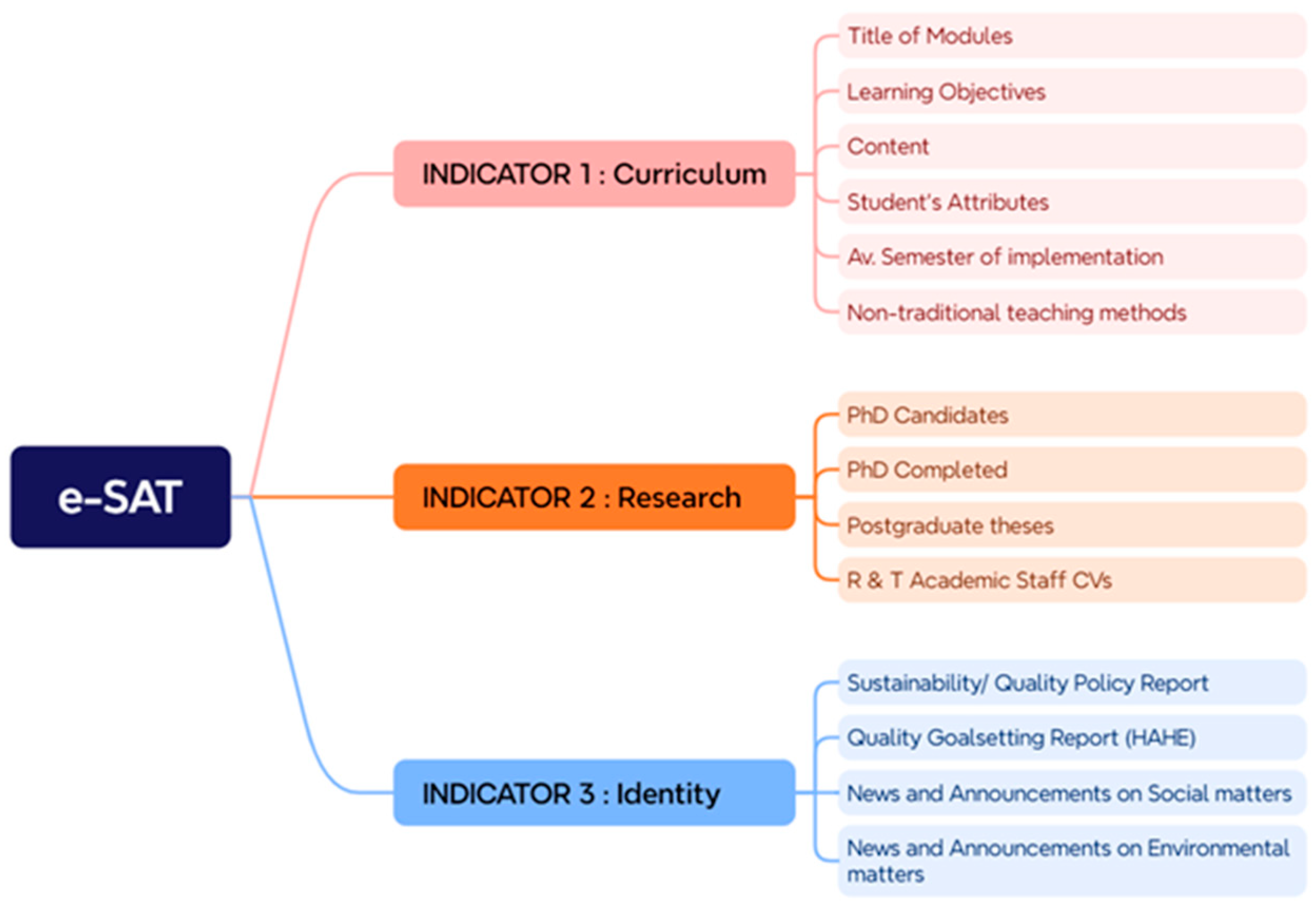
With the context, scope, and data collection method for this pilot application of SIRAF already established, the next steps were to assess the SIRAF database of core and sub-indicators and select those that most accurately reflect the institution’s sustainability implementation agenda, in accordance with HAHE requirements. In this case, the customised SAT includes three core indicators: curriculum, research, and identity. Each core indicator is subdivided into sub-indicators, with the first two, curriculum and research, exclusively addressing their respective domains, as the focus remains on pedagogical dimensions. For the ‘identity’ indicator, two sub-indicators pertain to institutional policy planning and goal setting, while one addresses societal issues and another covers environmental considerations in a broad, non-specific manner. Furthermore, to ensure rigor and validity of results, the selected sub-indicators were compared to HAHE criteria and the UN’s Sustainable Development Goals. In conclusion, the customised SAT consists of three core indicators and fourteen sub-indicators, structured as follows (
Figure 3).
A customised, easy-to-use tool with a suitable data collection method was developed within the SIRAF framework, which is ready for practical use. When applying SIRAF, one possible data collection strategy could involve interviewing multiple administrative executives at each institution. However, this approach was deemed time-consuming and potentially unreliable. Given that HAHE mandates higher education institutions (HEIs) to regularly publish up-to-date and objective information online, the SAT was adapted to collect data exclusively from institutional websites. Hence, between December 2023 and February 2024, desk research was conducted on eight public universities offering tourism-related programs.
The inclusion criteria required alignment with the three dimensions of sustainability and publicly accessible data through official university websites. The review process covered 518 undergraduate modules, 103 faculty CVs, 132 PhD candidates’ and 58 PhD graduates’ research topics, 2021 Master’s thesis titles (2018 onward), and numerous ‘News and Announcements’ posts (September 2022 onward). Relevant documents were retrieved and imported into MAXQDA for qualitative analysis, using keyword searches for ‘sustainability’ and its Greek equivalents (αειφορ-, βιωσιμ-). The results were manually verified and transferred to Excel for comparison and visualisation. Where online access was limited, particularly in the ‘News and Announcements’ section, manual retrieval was conducted. Research limitations include potential data gaps or outdated content due to infrequent site updates, as well as comparability challenges arising from the non-standardised structure and presentation of university websites.
Following the application of the new SAT to assess sustainability implementation in Greek tourism higher education, results were generated through keyword analysis, yielding minimum, maximum, and mean values. In this case, quantifiable outputs were required to support the eventual development of the report. Although the analysis was conducted using MAXQDA 24, this method is not intended as the default approach, though it may serve as a useful option in similar future applications. The SAT’s results are reported in
Table 12.
Concluding, the SAT yielded insightful findings, especially on pedagogical aspects, as initially required. The first core indicator examines the integration of sustainability into curricula across eight universities, focusing on module titles, learning objectives, content, student attributes, non-traditional teaching methods, and the average semester of integration. Sustainability appeared in 1.42% of module titles, 12.99% of learning objectives, 13.48% of content, and 20.45% of student attributes. On average, 21 modules per institution incorporated sustainability-aligned, non-traditional methods, typically introduced by the sixth semester. The second core indicator assessed the breadth and depth of sustainability-related research by both students and academic staff. Postgraduate theses, completed and ongoing PhD research, and faculty CVs were examined. Sustainability appeared in 1.93% of postgraduate thesis titles, 8.3% of completed PhD projects, and 19.09% of ongoing PhD research. Among the 103 academic staff members reviewed, 63.93% demonstrated involvement in sustainability through research, publications, or professional activities. The final core indicator addresses institutional governance and identity, as outlined by HAHE, focusing on the presence of sustainability-related language in strategic documents and outreach activities. Sustainability was explicitly referenced in the quality policy report of three universities, while five omitted it. In contrast, most universities included multiple references in their quality goalsetting reports, averaging five mentions per report. Only one university had published a dedicated sustainability report. This indicator also considers non-academic activities with environmental and social relevance, as reflected in the ‘News and Announcements’ section of institutional websites. Social sustainability received greater emphasis, with an average of 14.5 relevant announcements over 18 months, compared to 5.12 related to environmental initiatives.
The report’s findings highlight key areas for improvement, including specific gaps and limitations in current practices, and offer insights into how sustainability can be more effectively implemented in both content and approach. As such, the SIRAF SAT demonstrates practical utility and holds potential for broader application and impact.
4.6. Refine and Theorize
A value-added contribution to theory, as Whetten [
52] suggests, occurs when a new principle alters established relationships between variables, prompting a broader reconceptualization of existing theories. Such contributions are considered legitimate when they bridge conceptual development with paradigmatic understanding. The application of a new theory holds particular importance, as theorists can refine or enhance theoretical tools through logical reasoning, empirical findings, or epistemological insights. When theory building and testing are integrated, the result is the development of valid, practically useful theories for both researchers and practitioners [
40].
Lynham [
51] further emphasizes that no theory or model is ever truly complete; instead, it is continuously evolving. This ongoing refinement is essential for maintaining the theory’s relevance to real-world practice. Additionally, when the idiosyncratic knowledge and perspectives of readers are introduced into the inherently dynamic nature of a theory, the theory itself may be challenged [
45]. Such challenges, however, are effectively addressed when the theory has been developed through a systematic and transparent process, clearly documented and open to scrutiny.
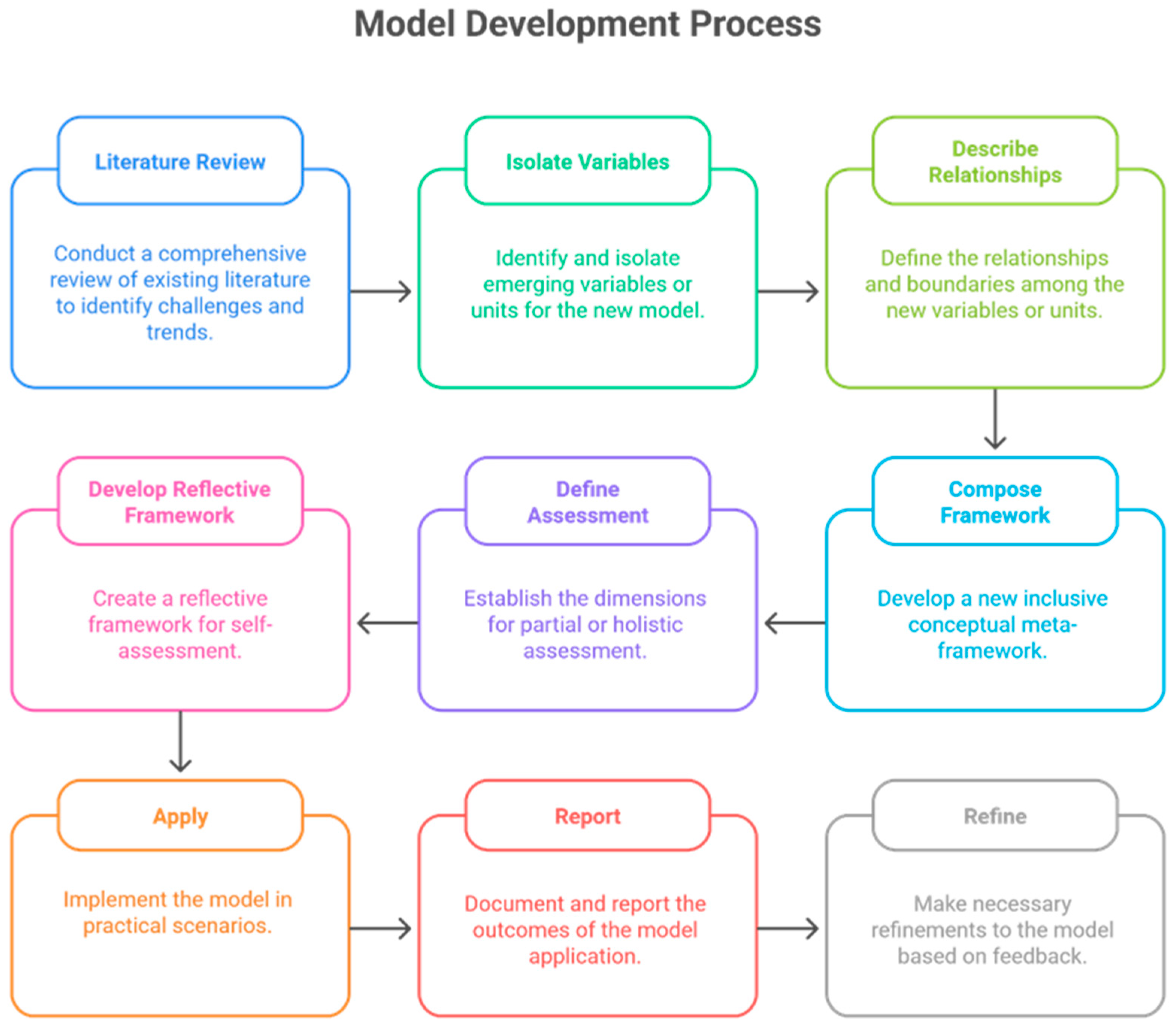
In the case of SIRAF the new principle added to the existing literature is that of self-developing an SAT in recognition of the uniqueness of each institute or circumstance when implementing sustainability. The value of adjustability, reflectiveness and transformability are recognised as key elements for ensuring effectiveness when reporting. In other words, a broader scope of an organisation’s inclusivity is encouraged to achieve maximum tool utility. This new conceptual framework has been developed with those elements at its core, recognising, at the same time, the need for SIRAF redefining itself in a dynamic environment, where and when appropriate. The development of a meta-theory model was created to facilitate a systematic and transparent five-phase process, best describing SIRAF. This tool is directed at higher education, although the framework and methodology could be adjusted in other sectors and organizations wishing to report on sustainability. The conceptual practical phases employed according to our methodology are depicted in
Figure 4.
Ultimately, this model proposes a conceptual framework for assessing sustainability that is innovative and dynamic, as well as practical and adjustable to other sectors, contexts, and organisations. This approach offers clear advantages for both the end user (organisation or researcher) and for advancing the reporting process, leading to an overall and broad understanding of sustainability. Beyond higher education, this perspective encourages other sectors to adopt reflective, customised SATs that better accommodate their unique contexts and improve the effectiveness of sustainability assessment.
5. Conclusions and Future Directions
This study introduced the Sustainability Implementation Reflective Assessment Framework (SIRAF) as a transformative response to persistent limitations of conventional sustainability assessment tools (SATs) in higher education. Through a meta-theoretical and empirical approach, SIRAF was designed to support institutions in developing context-specific, reflective, and autonomous sustainability assessment tools. It departs from one-size-fits-all models by prioritizing flexibility, simplicity, and user engagement, allowing universities to align assessment efforts with their internal structures, priorities, and resources. The core innovation lies in enabling self-development and self-diagnosis capabilities, which are fundamental to overcoming the institutional inertia that often hinders sustainability implementation.
The pilot application of SIRAF in Greek tourism higher education institutions offered a realistic yet critical depiction of current sustainability practices. The findings reveal a promising yet still fragmented integration of sustainability, particularly in curricula and research. While academic staff engagement and policy references to sustainability are relatively visible, actual curriculum transformation and institutional reporting remain limited. These outcomes underscore both the applicability of SIRAF as a practical assessment framework and the urgency for universities to internalize sustainability beyond rhetorical commitments. Importantly, the ease of deployment through online data and the methodological clarity of SIRAF enhance its replicability across institutional and disciplinary contexts.
A key implication of this research is the potential behavioural shift it fosters within higher education institutions, from compliance-oriented reporting to a culture of reflective learning and self-driven improvement [
66]. SIRAF repositions sustainability assessment not as a bureaucratic obligation but as an opportunity for constructive introspection and strategic alignment. By offering a user-friendly, adaptable process, SIRAF reduces technical and organizational barriers that often discourage engagement, especially in the absence of external mandates. In doing so, it addresses managerial short-sightedness and promotes a more mature, long-term approach to sustainability implementation. The framework supports universities in taking ownership of their commitments, encouraging a mindset shift toward openness, institutional learning, and continuous improvement.
From a theoretical standpoint, this research contributes to the development of applied conceptual models in sustainability assessment by integrating theory-building processes with pragmatic empirical validation. SIRAF not only serves as a fourth-generation SAT but also demonstrates the potential of reflective meta-frameworks in enhancing the utility and legitimacy of assessment practices. By embracing the heterogeneity of higher education institutions, this study challenges static assessment paradigms and advances the discourse on how sustainability reporting can evolve to support meaningful organizational change, particularly in sectors such as tourism education where sustainability imperatives are deeply contextual. Taken together, the findings of this study address the three research questions by demonstrating how SIRAF can be developed through the reclassification of sustainability indicators (RQ1), how the framework can be operationalized through a context-specific assessment tool applied in tourism higher education in Greece (RQ2), and how SIRAF contributes to sustainability assessment theory and supports institutional change in higher education (RQ3).
It should be noted that the present application represents a preliminary operationalization of the SIARF framework. The development of structured scoring logic, weighting mechanisms, and formal reliability and construct validation procedures represents an important direction for the authors’ ongoing and future research aimed at further strengthening the framework’s analytical robustness and comparability. Future research should explore the refinement of SIRAF through longitudinal studies across diverse institutional types and geographies. The introduction of significance weights and scoring typologies could enable benchmarking and progress tracking over time. Expanding SIRAF’s application beyond higher education to other sectors, such as public administration, cultural institutions, or small enterprises, could further validate its adaptability and utility. Additionally, empirical research examining how institutions use SIRAF-generated insights to inform policy, curriculum development, and strategic planning would deepen understanding of its impact as both a diagnostic and a developmental tool for transformative sustainability implementation.