Article

How Do Multi-Actor Environmental Sentiment Tendencies Affect the Green Transformation of Chinese Energy Companies? The Moderating Role of Economic and Climate Policy Uncertainty


1
School of Economics and Management, Nanjing Tech University, Nanjing 211816, China
2
School of Economics and Management, University of Chinese Academy of Sciences, Beijing 100190, China
3
School of Economics and Management, Suqian University, Suqian 223800, China
*
Author to whom correspondence should be addressed.
Sustainability 2026, 18(7), 3190; https://doi.org/10.3390/su18073190
Submission received: 24 January 2026 / Revised: 11 March 2026 / Accepted: 21 March 2026 / Published: 24 March 2026
(This article belongs to the Section Economic and Business Aspects of Sustainability)

Abstract

Existing research on green transformation predominantly emphasizes “hard constraints” such as carbon taxes and environmental regulations, while neglecting “soft constraints” shaped by environmental sentiment expressions from key actors such as the public, financial institutions, media, and government. In particular, the collective influence of these multi-actor environmental sentiments remains insufficiently explored. This study fills that gap by constructing a collaborative governance framework using multi-source heterogeneous data from China spanning 2013–2023, including 330 provincial government work reports, 1862 bank annual reports, 2472 newspaper articles, and 68,519 Weibo posts, matched to 4708 firm-year observations of Chinese A-share energy companies. We quantify environmental sentiment tendencies through natural language processing, calculating the index as (negative word frequency − positive word frequency)/total word frequency at the province-year level, thus higher index value indicates more negative sentiment tendency, while green transformation is proxied by ln(green patent applications + 1). The results reveal the following: (1) More negative environmental sentiment tendencies from financial institutions, media, public, and government significantly promote green transformation in energy enterprises, with stronger effects observed from financial institutions and government. (2) Economic and climate policy uncertainty selectively weaken the impact of financial institutions’ sentiment, while the moderating effects for other actors are statistically insignificant. (3) The effect of multi-actor environmental sentiment is more pronounced for firms located in eastern China, operating under high competition or stricter environmental regulations. This study provides a novel, quantified approach to assessing multi-actor environmental sentiment tendencies, affirms the effectiveness of informal governance, and highlights the importance of stable policy in guiding corporate green transformation in emerging economies.

1. Introduction

The escalating climate crisis poses significant challenges to achieving the Sustainable Development Goals (SDGs). According to the United Nations Environment Programme (2023), even full implementation of existing national commitments would result in a global temperature rise of 2.5–2.9 °C by the end of this century—far exceeding the 1.5 °C threshold set by the Paris Agreement [1]. In response, an expanding body of research has focused on carbon reduction strategies and corporate green transformation mechanisms, particularly in the energy sector, which plays a pivotal role in the global sustainability transition [2,3,4]. Existing carbon reduction research in the energy sector has primarily focused on the emission-reducing effects of formal institutions, such as carbon pricing and environmental regulation—commonly referred to as “hard constraints”. Previous studies have shown that China’s pilot emissions trading scheme has been found to enhance low-carbon innovation among participating firms by 5–10% without crowding out other forms of technological innovation [5]. However, there are notable limitations in the existing focus on hard constraints. First, this body of research relies heavily on the coercive power of formal institutions, overlooking the strategic guiding role of “soft constraints” emerging from environmental sentiment networks formed by diverse actors, such as financial institutions. Second, the dynamic influence of policy uncertainty is often excluded from analytical frameworks, making it difficult to explain the heterogeneous responses of enterprises under complex policy environments.
In recent years, scholars have increasingly recognized the importance of soft constraints in environmental governance. These studies often rely on Python-based web scraping techniques to extract keywords from online platforms, constructing attention indices that reflect the external pressure exerted on specific actors. For instance, some researchers have developed a public environmental attention index by crawling environment-related keywords on Baidu and found that public concern positively influences corporate social responsibility [6]. Similarly, others have collected posts related to green consumption on Weibo to construct a public attention index toward sustainable consumption [7]. However, such studies remain limited in their capacity to capture multi-actor attention and sentiment. With the advancement of natural language processing technologies, a new generation of research can overcome these limitations by enabling collaborative analysis of soft constraints from multiple actors.
Otherwise, the impact of policy uncertainty on corporate green transformation has attracted increasing scholarly attention, yet the research on its mechanisms remains fragmented. For instance, in the context of economic policy, research suggests that economic policy uncertainty exacerbates information asymmetry among investors, thereby reducing managerial willingness to disclose [8]. Within the domain of climate policy, it has been proposed that climate policy uncertainty undermines corporate perceptions of legitimacy, prompting firms to adopt “greenwashing” strategies rather than undertaking substantive green transformations [9]. Despite these advances across different policy domains, current studies exhibit several critical limitations. First, most research focuses on a single type of policy, lacking systematic cross-policy comparisons. Second, there is insufficient exploration of the dynamic transmission mechanisms of policy uncertainty, especially regarding how firms adapt to policy shifts and the interaction between regulatory adjustments and market actors’ adaptive behaviors.
In summary, this study integrates a large-scale, multi-source dataset covering the period from 2013 to 2023, including 330 government work reports, 1862 annual reports from financial institutions, 2472 articles from traditional media newspapers, and 68,519 social media posts. Leveraging natural language processing techniques, we conduct dynamic sentiment analysis on heterogeneous textual data to quantify the environmental sentiment tendencies of various actors. Utilizing a two-way fixed effects model and moderation analysis, this study empirically examines the influence of multi-actor environmental sentiment tendencies on the green transformation of energy companies, while also investigating the moderating roles of economic policy uncertainty and climate policy uncertainty. The key contributions of this study are as follows: (1) Exploring how environmental sentiment tendencies—across financial actors (market sentiment), media (public opinion sentiment), communities (public sentiment), and governments (policy sentiment)—jointly affect corporate green transformation. This framework moves beyond the conventional institutional-centric perspective in environmental governance and introduces a novel lens for understanding the role of affective, non-rational drivers in corporate environmental decision-making. (2) Transforming implicit multi-actor sentiment tendencies into quantifiable indices by applying NLP-based sentiment analysis to heterogeneous Chinese-language texts, including financial reports, media coverage, social media posts, and official documents. By employing a domain-specific sentiment dictionary, this approach represents a methodological leap from qualitative narratives to quantitative measurement. (3) Incorporating both EPU and CPU alongside multi-actor sentiment tendencies into a unified analytical framework. By examining the coupling effects between informal regulation and informal sentiment-based governance, we uncover how macro-level policy environments modulate the influence of environmental sentiment on corporate behavior. This provides an explanation for understanding corporate responses under complex and uncertain policy conditions.

2. Literature Review and Formulation of Research Hypotheses

2.1. Distinction Between Sentiment Tendency, Attention, and Formal Regulation

Environmental governance mechanisms can be broadly categorized into “hard constraints” and “soft constraints.” Formal regulations, such as environmental taxes and carbon emission mandates, constitute the “hard constraints” that impose direct compliance costs on firms through legal enforcement. In contrast, informal regulations act as “soft constraints” that shape corporate behavior through social norms and legitimacy pressures. Within the realm of informal regulation, stakeholders influence firms through two distinct but interrelated dimensions: attention and sentiment tendency. While attention (or salience) reflects the public or institutional focus on environmental issues through the volume of discourse, sentiment tendency captures the specific evaluative tone and emotional valence—ranging from supportive to critical. Unlike mere attention, which only indicates the visibility of a topic, environmental sentiment tendency provides a more nuanced signal of stakeholder expectations, exerting a transformative impact on a firm’s perceived legitimacy and long-term strategic orientation.

2.2. Sentiment Tendencies and Green Transformation Mechanisms

In theory, the impact of negative environmental sentiment on innovation is not monolithic. On one hand, intensified negative sentiment could trigger ‘defensive compliance’; firms might allocate resources to immediate pollution abatement or reduce production to mitigate reputation risks, which could crowd out R&D investment. On the other hand, according to the ‘Strong Porter Hypothesis,’ such pressure acts as an innovation-inducing force. For energy enterprises, which face existential threats from the energy transition, we argue that the inducing effect dominates. Because simple compliance cannot resolve long-term legitimacy crises, these firms are compelled to seek fundamental solutions through green technological breakthroughs.
As the central hub of capital allocation in the modern economic system, financial institutions’ preferences regarding environmental risks influence corporate strategic decisions through multiple transmission mechanisms. Based on resource dependence theory, energy companies are significantly more reliant on financing from financial institutions than firms in other industries, making them more compelled to respond to the environmental risk attitudes of these institutions. When financial institutions express negative sentiment toward environmental issues, companies face dual pressure of increased financing costs and reduced capital availability. As a result, they are often forced to restructure their resource acquisition strategies through green technological innovation and low-carbon asset reconfiguration [10,11,12]. Prior research has confirmed that in traditional industries, manufacturing, and highly polluting sectors, ESG performance can alleviate financing constraints and thus promote technological innovation [13].
The mechanism by which media environmental sentiment tendencies influence companies can be traced back to agenda-setting theory. Through selective reporting and emotional narrative strategies, the media constructs a public agenda on environmental issues, amplifying public attention to specific environmental risks. This public discourse environment triggers a corporate behavior chain of “reputation threat-legitimacy restoration” [14]. Negative environmental reporting, such as exposing corporate pollution or criticizing insufficient environmental measures, often generates strong public reactions, creating significant social pressure and forcing energy companies to adopt more proactive environmental measures in response to public expectations and concerns [15,16]. Research has pointed out that media coverage of corporate pollution incidents significantly positively impacts the likelihood of subsequent green mergers and acquisitions [17].
Stakeholder theory emphasizes the role of the public as a key stakeholder in shaping corporate environmental behavior. Public negative environmental sentiment exerts pressure on companies through various social interaction channels, including consumer choice, community action, and public oversight, all of which are non-market mechanisms [18]. For instance, in situations where public environmental concern surges, the likelihood of CEO turnover in high-polluting companies significantly increases, and these companies tend to alleviate pressure by increasing green investments [19]. More importantly, this sustained pressure from the public not only encourages companies to increase investments in environmental governance but also pushes them to internalize environmental responsibility as a core component of business ethics [6]. Research has indicated that corporate social responsibility driven by stakeholder expectations promotes the green dynamic capabilities of firms, enhancing their green technological innovation performance [20].
The government plays a crucial role in the green transformation of energy companies, and its environmental sentiment tendencies directly influence the formulation and implementation of environmental policies. Institutional theory suggests that the government’s negative environmental sentiment transmits signals of stricter regulation through the semantic intensity of policy texts, triggering companies’ preventive compliance behaviors. After the implementation of the new “Environmental Protection Law”, companies tended to submit more environmental patent applications, and their green innovation capabilities improved [21]. Negative environmental sentiment tendencies, such as concerns about environmental issues and attention to climate change, may prompt the government to adopt stricter environmental protection measures and intensify penalties for corporate environmental violations. When the deterrent effect of criminal enforcement strengthens, companies’ environmental performance improves, and the number of criminal charges and environmental violations decreases in cities [22].
Furthermore, within the collaborative governance framework, we expect a hierarchy of influence. Because financial institutions control capital flows (the ‘blood’ of innovation) and governments control policy resources and ‘social licenses,’ their environmental sentiments are expected to exert stronger and more immediate pressure on corporate decision-making compared to the relatively indirect signaling from the public and media.
While the existing literature provides a solid foundation for understanding environmental governance, several critical gaps remain. First, most studies conceptualize environmental pressure as a fragmented force, focusing on isolated actors while ignoring the collective impact of a multi-actor sentiment landscape. This leads to an incomplete understanding of how firms prioritize conflicting or reinforcing signals. Second, there is a noticeable lack of research on the ‘resilience’ of these sentiment channels; specifically, it remains unclear how macro-level shocks, such as economic and climate policy uncertainty, might selectively impair certain ‘soft constraints’ while leaving others intact. Third, the unique institutional context of the Chinese energy sector—where market-based sentiment and administrative signals coexist—warrants more nuanced empirical scrutiny. To fill these gaps, this study proposes a comprehensive multi-actor framework to test how integrated sentiments drive green innovation and how these paths are moderated by policy volatility. Based on this logic, we formulate the following hypotheses:
H1a. 
The more negative the environmental sentiment tendency of financial institutions, the faster the green transformation speed of energy companies.
H2a. 
The more negative the environmental sentiment tendency of the media, the faster the green transformation speed of energy companies.
H3a. 
The more negative the environmental sentiment tendency of the public, the faster the green transformation speed of energy companies.
H4a. 
The more negative the environmental sentiment tendency of the government, the faster the green transformation speed of energy companies.
Considering the evident time lag characteristic of green patents from research and development, output, to formal application, this paper posits that the driving effect of multi-actor environmental sentiment in period t on the green transformation of energy enterprises exhibits persistence and lag. Based on this, this paper further proposes the following hypothesis of lag effect:
H1b. 
Negative environmental sentiment tendencies from financial institutions significantly foster the green transformation of energy enterprises over the long term.
H2b. 
Negative environmental sentiment tendencies from the media significantly foster the green transformation of energy enterprises over the long term.
H3b. 
Negative environmental sentiment tendencies from the public significantly foster the green transformation of energy enterprises over the long term.
H4b. 
Negative environmental sentiment tendencies from the government significantly foster the green transformation of energy enterprises over the long term.

2.3. Moderating Effects of Economic and Climate Policy Uncertainty

From the perspective of regulatory-incentive theory, the impact of environmental governance is often determined by the design of policy tools and the specific characteristics of the target firms. Traditional “hard constraints” typically include command-and-control instruments (e.g., environmental penalties) and market-based instruments (e.g., subsidies and taxes). These tools create differentiated incentives: for instance, penalties are mainly achieved by increasing external environmental pressure, improving environmental supervision and litigation risks, and effectively reducing the pollution emission level of manufacturing enterprises [23], while subsidies incentivize green innovation in enterprises by alleviating financing constraints, increasing research and development willingness, and improving resource allocation efficiency [24]. The heterogeneity in firm responses to these tools—often driven by differences in industry competition, regional institutional quality, and internal resource configurations. However, beyond these formal mechanisms, the governance landscape is also shaped by the “soft constraints” of stakeholder sentiment. Unlike hard policy tools that rely on direct economic costs, sentiment-based constraints operate through reputational signals and legitimacy pressures, providing a distinct yet complementary incentive structure for firms to pursue green transformation.
Economic policy uncertainty (EPU) reflects the frequency and unpredictability of changes in government policies related to finance, monetary policy, trade, and other economic areas, increasing the complexity of business decision-making. EPU may weaken the positive impact of multi-actor environmental sentiment tendencies on the green transformation of energy companies. Firstly, financial institutions, as core entities in capital allocation, directly influence the financing costs and willingness of companies to invest in green initiatives through their environmental risk preferences [25]. When EPU rises, companies may delay long-term green investments in favor of reserving liquidity or investing in short-term projects, thereby inhibiting the driving effect of financial public pressure on green transformation. While this short-term resource allocation strategy helps companies avoid risks in uncertain environments, it may delay the research and application of green technologies in the long run, hindering the sustainable development of the energy industry [26]. Secondly, in uncertain environments, the media tends to adopt a more conservative stance, making it difficult to sustain continuous environmental protection public pressure [27]. Rising EPU leads to the “issue substitution effect”, where economic news takes up more media space, reducing the frequency and depth of environmental reporting. Furthermore, according to Maslow’s hierarchy of needs theory, when economic uncertainty increases, community residents prioritize basic needs such as employment and income, leading to a decrease in their enthusiasm for participating in environmental protection activities and raising their tolerance for environmental pollution. Research has confirmed that under economic slowdowns and limited resources, policymakers tend to prioritize basic needs, such as livelihood concerns, over higher-level demands like environmental protection [28]. Finally, fluctuations in policy may weaken the authority of government environmental signals. EPU may lead to misallocation of regulatory resources, with environmental enforcement being deprioritized in favor of more urgent economic stabilization tasks. Local governments may selectively enforce environmental regulations under economic pressure. Research has shown that rising EPU leads local governments to weaken environmental regulation due to fiscal pressures, thus increasing industrial pollution [29].
Climate policy uncertainty (CPU) stems from the uncertainty surrounding the direction, intensity, and timeline of climate change-related policies, which may lead companies to adopt a wait-and-see approach in their long-term green investments. Firstly, financial institutions, when evaluating the financing risks of green projects, highly depend on the stability of the policy environment. When climate policies are frequently adjusted or their objectives are ambiguous, financial institutions find it difficult to accurately calculate the investment return cycles of green technologies, which may reduce their support for low-carbon projects [30,31]. Secondly, when the direction of climate policy is unclear, the media reduces in-depth reporting on environmental issues and shifts its focus to policy changes themselves. When faced with a vague policy environment, companies often adopt a wait-and-see approach rather than actively responding to public pressure, which weakens the effectiveness of media supervision [32]. Thirdly, when policy signals are ambiguous, it is difficult for residents to establish stable expectations about the “behavior-outcome” relationship and believe that individual environmental actions will have little substantial impact. This shift weakens the pressure exerted by communities through complaints, protests, and other means. When policies are unstable, the public tends to underestimate long-term environmental risks and focus instead on short-term economic survival issues [33]. Finally, CPU can undermine the effectiveness of government incentives such as green subsidies. Companies, unable to ensure continued policy support, may reduce their investment in green technologies and conduct greenwashing behavior [9]. Moreover, it may lead local governments to adopt a “wait-and-see” approach during the implementation process. When central policies are unclear, local governments tend to delay the enforcement of stringent environmental regulations, reduce the intensity of environmental law enforcement, and directly weaken the mandatory constraints that the government places on corporate green transformation [34].
Based on the conclusions above, the following hypotheses are proposed in this paper:
H5. 
When EPU increases, the impact of multi-actor environmental sentiment tendencies on energy companies’ green transformation weakens.
H6. 
When CPU increases, the impact of multi-actor environmental sentiment tendencies on energy companies’ green transformation weakens.
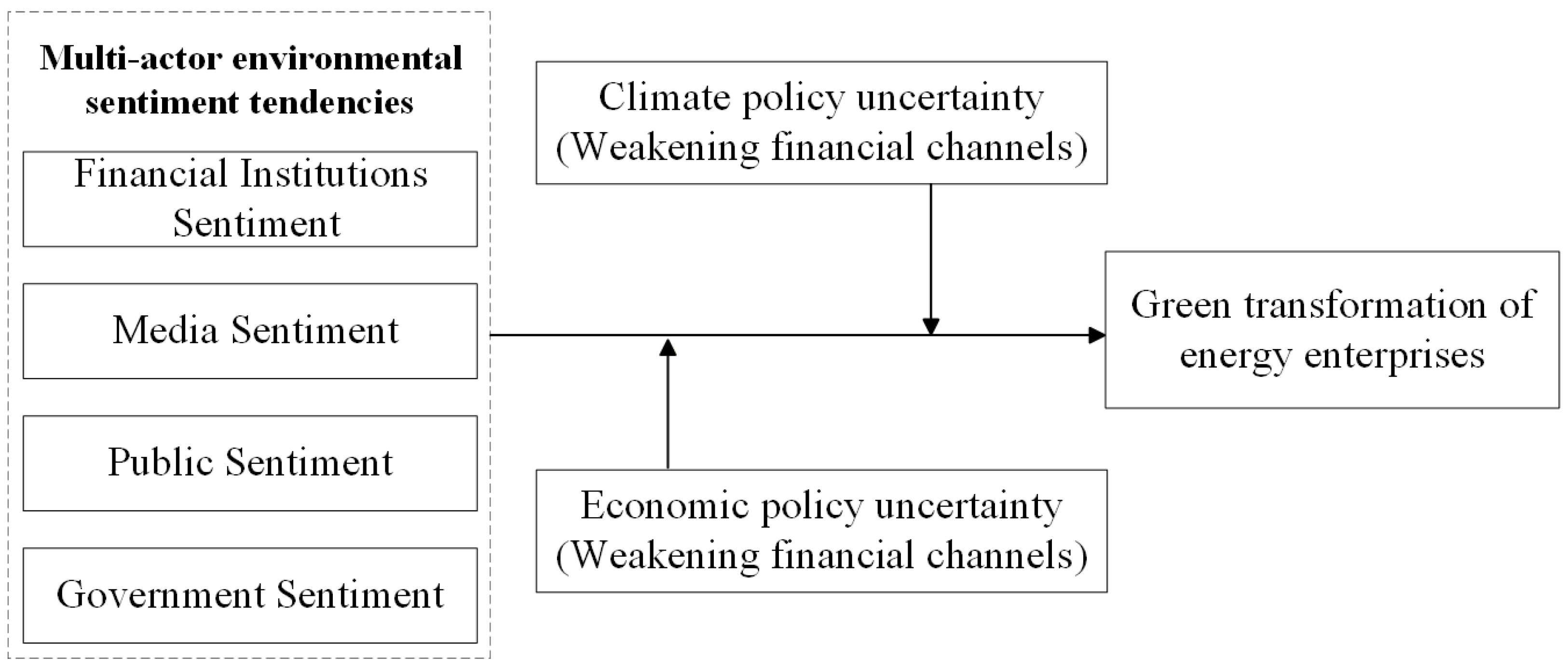
To systematically illustrate the transmission mechanism of multi-actor environmental sentiment on green technology innovation, we develop a conceptual framework as shown in Figure 1.

3. Data and Methods

3.1. Variable Description

3.1.1. Independent Variables

The term environmental sentiment tendency, as used in this study, refers to the attitudinal and emotional orientation of societal actors toward environmental issues. Positive sentiment primarily reflects recognition of the current environmental status, affirmation of green achievements, and support for environmental protection policies. In contrast, negative sentiment captures expressions of concern, criticism, or anxiety regarding environmental pollution, ecological degradation, and climate risks.
(1)
Environmental sentiment tendencies of financial institutions (FES).
Evaluating environmental sentiment tendencies of financial institutions requires performing a certain sequence of actions that includes several steps. The first step involves processing the annual report text data from commercial banks. Using Python (version 3.11) technology, data from the bank websites are crawled to obtain PDF files (190 banks, including 42 listed commercial banks, 73 urban commercial banks, 4 joint-stock commercial banks, and 71 rural commercial banks, resulting in a total of 1862 source PDF files), which are then batch-converted to text files using Adobe Acrobat DC. Non-text and invalid information are filtered, and the data are organized by year and province.
The second step focuses on identifying environmentally related segments. Following the method of Li et al. [35], paragraphs are treated as basic units to find environmentally related segments. Referring to the research method of Chen et al. [36], any paragraph containing keywords such as “environment”, “environmental protection”, “pollution”, “energy consumption”, “emission reduction”, “pollution discharge”, “ecology”, “green”, “low carbon”, “air”, “chemical oxygen demand”, “sulfur dioxide”, “carbon dioxide”, “PM10” or “PM2.5” is classified as an environmentally related segment; otherwise, it is considered non-environmental.
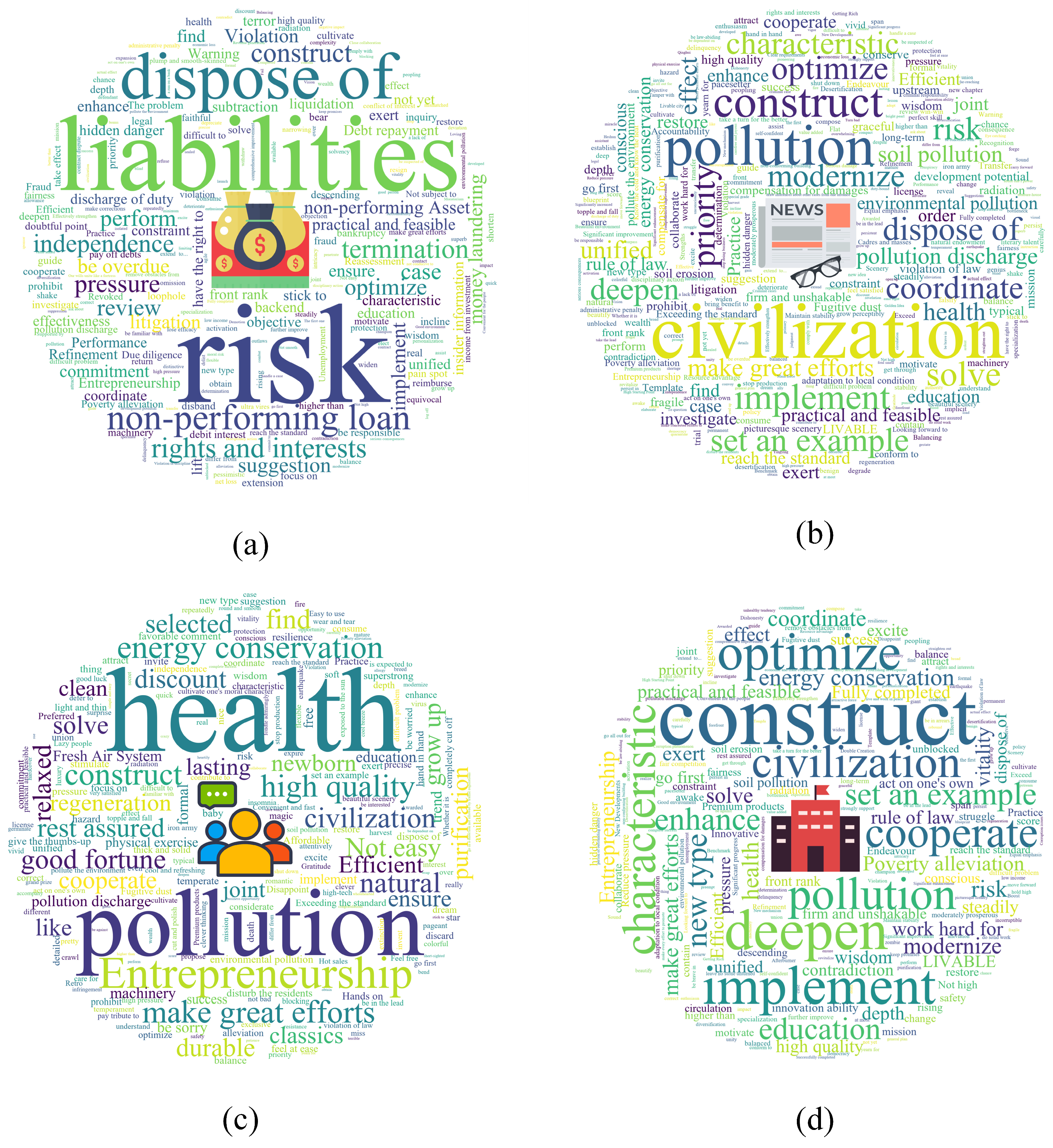
The third step is to construct the index of FES. The Jieba Chinese word segmentation module is used to segment the environmentally related text and remove stop words. For sentiment analysis, we utilize the specialized Chinese financial sentiment lexicon developed by Jiang et al. [37] as our foundational tool (Table 1). This lexicon is specifically tailored for the Chinese institutional and financial environment, having been constructed using advanced machine learning techniques (e.g., Word2Vec) to capture semantic similarities within financial corpora. Unlike generic dictionaries, this lexicon ensures that word polarities are fine-tuned for professional discourse in Chinese policy and financial domains. The calculation method for the specific multi-actor sentiment tendency index follows the approach of Durnev and Mangen [38], which is: the difference between the frequency of negative words and the frequency of positive words, divided by the total word frequency. A higher index value indicates that the environmental sentiment tendency of the entity is more negative. This method is also applicable to measuring the sentiment tendencies of other entities. Figure 2a shows the word cloud for financial institutions’ environmental sentiment tendencies, which highlights keywords like “risk”, “control” and “liabilities” reflecting financial institutions’ focus on the environmental risks that affect asset security, emphasizing the capital rigidity constraint of market-oriented governance tools.
(2)
Media environmental sentiment tendencies (MES).
Evaluating environmental sentiment tendencies of the media requires performing a certain sequence of actions that includes several steps. The first step involves processing the newspaper text data. Compared to the rapidly developing internet and television news, local newspapers possess stronger influence, authority, and authenticity [39]. We collects all the newspaper articles related to the environment from provincial mainstream media newspapers between 2013 and 2023 using the Full Text Database of Important Chinese Newspapers. In total, 2472 source PDF newspaper files are compiled.
The second step focuses on identifying environmentally related segments. Following the approach of Zhao et al. [39], we conduct a search in the database using the keyword “environment” and manually read the abstract of each news report. The specific method is consistent with the preceding text.
The third step is to construct the index of MES. The specific method is consistent with the preceding text. Figure 2b shows the word cloud for media environmental sentiment tendencies. It can be seen that keywords like “beautiful”, “harmonious” and “civilized” are central, reflecting the media’s role in guiding social culture and creating a social atmosphere for green development through public opinion dissemination. Additionally, there is a high correlation between the media’s environmental reporting and government policies, as seen in Figure 2d, which illustrates the high degree of synergy between media environmental reporting and government environmental sentiment, also fulfilling the function of environmental supervision.
(3)
Public environmental sentiment tendencies (PES).
Evaluating environmental sentiment tendencies of the public requires performing a certain sequence of actions that includes several steps. The first step is data collection. Weibo is one of the largest social media platforms in China, with a vast user base and extensive geographic coverage. This enables Weibo to reflect the public’s attention and attitudes toward environmental issues from different regions and backgrounds, making it highly representative [40]. Using Python technology, posts containing the keyword “environment” are scraped from Weibo for the years 2013–2023, resulting in 68,519 data entries. The data collected includes the Weibo ID of each post, the posting time, the posting location, and the location of the user. The posts are then categorized and summarized by province and year based on the posting location.
The second step is to construct the index of PES. The specific quantification method is consistent with the preceding text. Figure 2c shows the word cloud for public environmental sentiment tendencies. It can be seen that the main keywords are “health”, “comfort” and “garbage”, reflecting the fact that public discussions are more directly related to personal life experiences, indicating that public environmental sentiment has clear problem-oriented characteristics.
(4)
Government environmental sentiment tendencies (GES).
Evaluating environmental sentiment tendencies of the government requires performing a certain sequence of actions that includes several steps. The first step involves processing government work report text data. Government work reports summarize and plan annual government tasks at various levels, containing a large amount of policy statements and goal-setting related to environmental governance, green development, and pollution prevention, which effectively reflect the government’s attention to environmental issues and policy orientation [41]. We use data from government work reports of 30 provincial-level administrative regions (excluding Hong Kong, Macau, Taiwan, and Tibet) collected from the official provincial government websites between 2013 and 2023, totaling 330 reports for analysis. The texts of government work reports from local government websites are collected and filtered for non-text and invalid information. The data is then organized and categorized by province and year.
The second step focuses on identifying environmentally related segments. The specific identification method is consistent with the FES described earlier.
The third step is to construct the index of GES. The specific quantification method is consistent with the preceding text. Figure 2d shows the word cloud for government environmental sentiment tendencies. It can be seen that keywords like “construction”, “development”, “innovation” and “reform” are central, reflecting the significant administrative dominance in government environmental governance and emphasizing the rigid goal constraints of government policies’ enforcement.
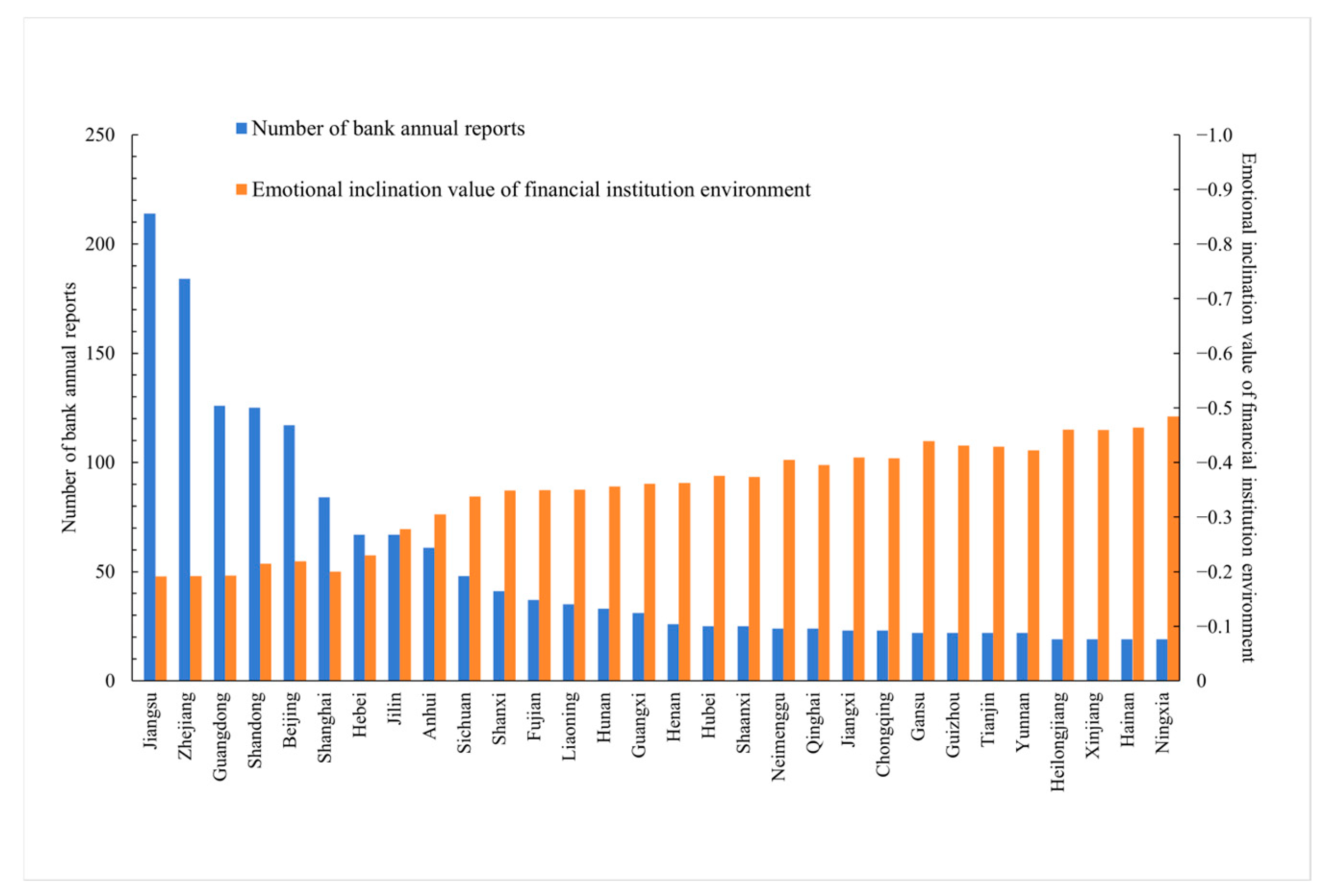
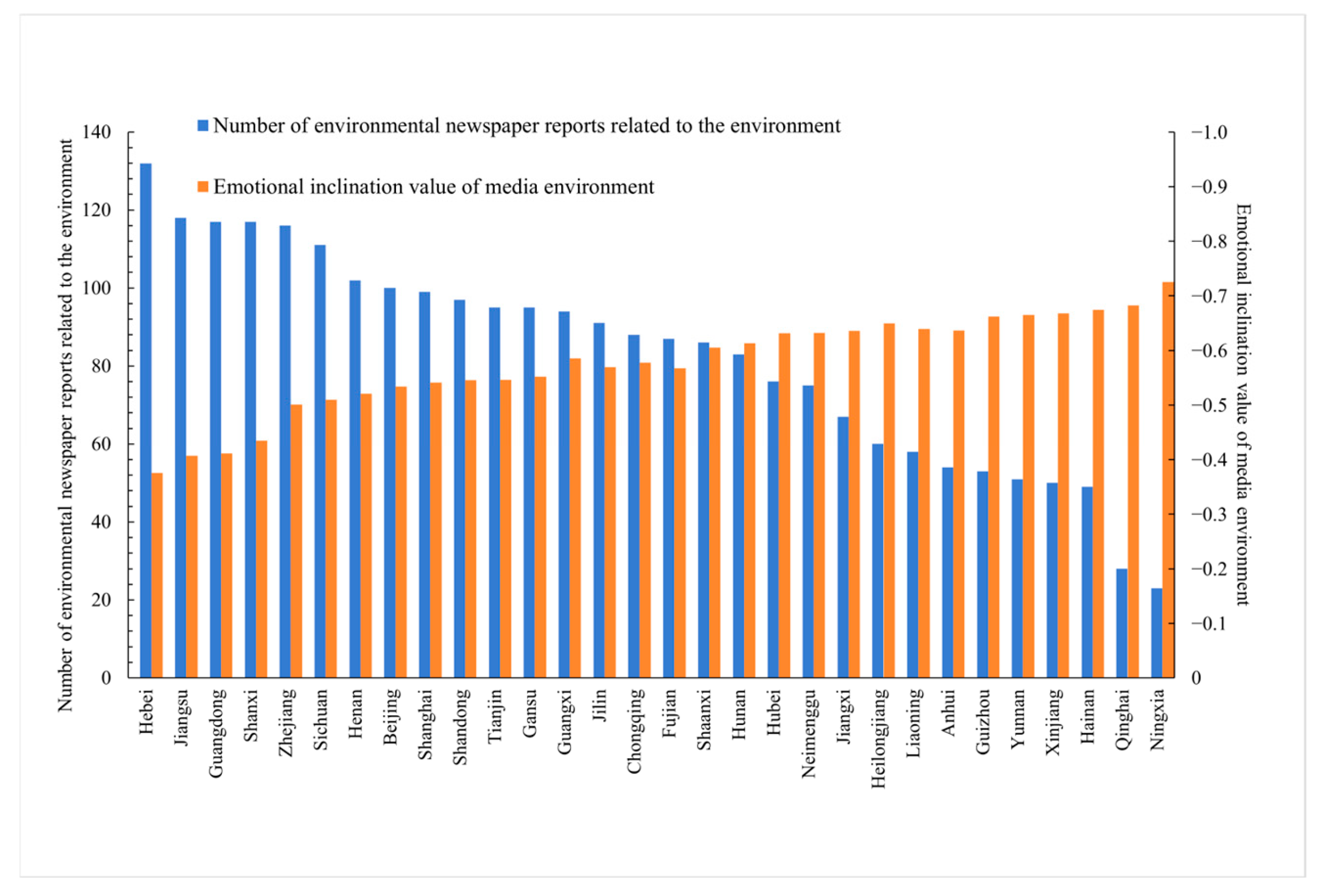
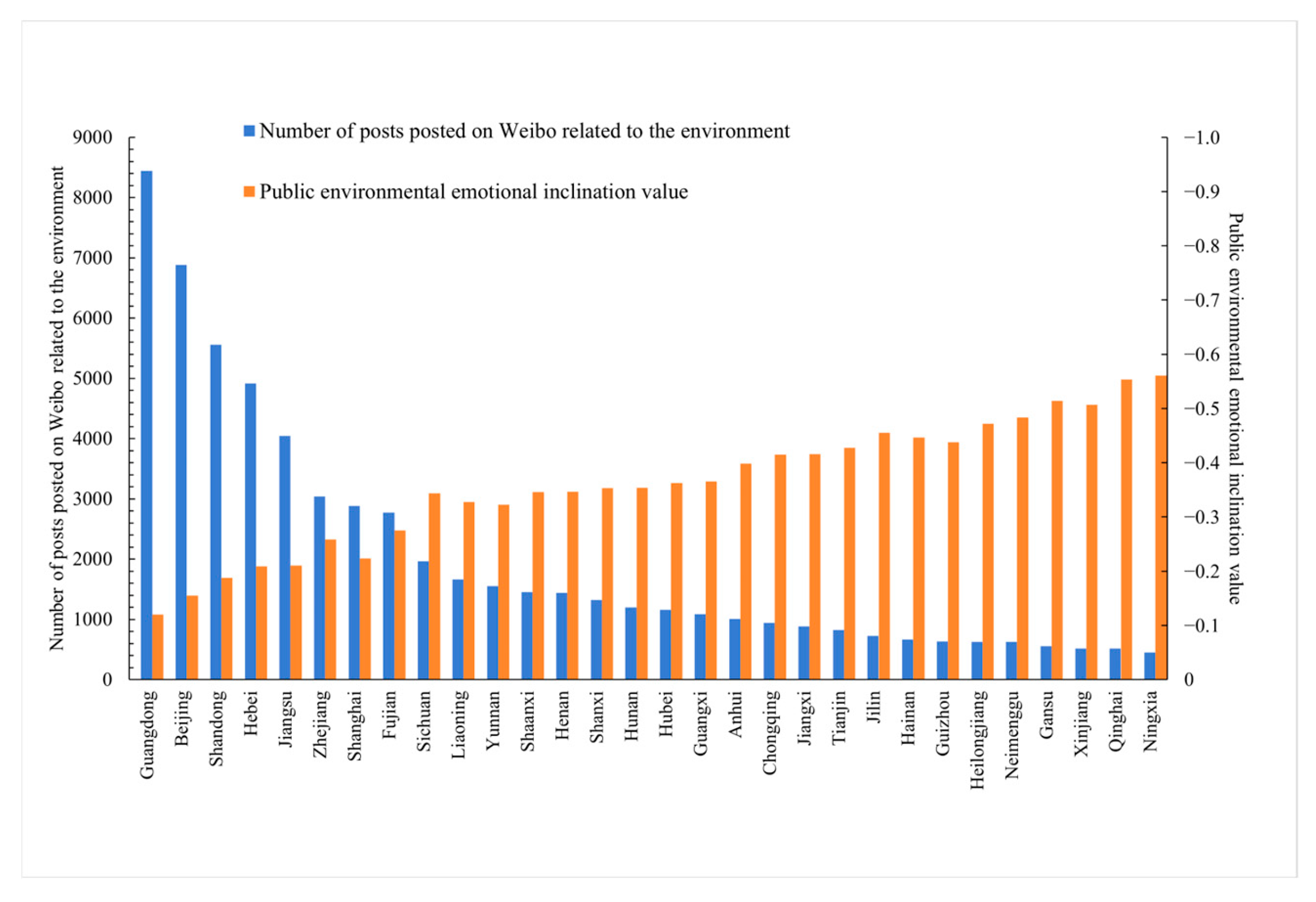
Furthermore, we conducted a visual analysis of the collected and calculated multi-actor environmental sentiment tendency data. Figure 3, Figure 4 and Figure 5 represent the distribution of environmental sentiment tendency values and the number of activities by financial institutions, media, and the public in different regions. The overall trend shows a high degree of consistency: the frequency of activities is significantly positively correlated with negative sentiment tendencies, meaning that the higher the participation of the actors in environmental issues (such as bank annual report disclosures, media coverage, and social media discussions), the stronger the expression of negative sentiment. From a spatial distribution perspective, economically developed or densely populated eastern provinces (e.g., Guangdong, Jiangsu, Zhejiang) exhibit higher activity frequencies and negative sentiment tendencies across all three types of actors, reflecting that these regions have high levels of marketization and well-established social supervision mechanisms. Otherwise, the mechanisms and focal points of the three types of actors differ: financial institutions are most prominent in economically developed regions (such as Jiangsu, Zhejiang, Guangdong). The media focuses on public opinion supervision and is stronger in regions with prominent industrial pollution (e.g., Hebei). The public, relying on the mobilizing power of social media, forms widespread social pressure in regions with high internet penetration rates (e.g., Beijing, Guangdong).

3.1.2. Dependent Variable

Green transformation of energy companies (GTEE): The core of the green transformation for energy enterprises lies in facilitating clean energy development, energy conservation, and emission reduction through substantive technological breakthroughs. We choose the number of green patent applications as the dependent variable for several reasons. First, compared to output-based indicators like clean energy generation shares—which are often constrained by regional resource endowments and macro-infrastructure—green patents provide a more direct and reliable proxy for firm-level technological transformation. Second, green patents capture the endogenous innovation drive and R&D investment of energy firms, offering a granular observation of their strategic response to environmental sentiments [21,42]. Following the approach of Zhao et al. [39], we employ the Ln(n + 1) method to measure this transformation, ensuring the metric aligns with our micro-level research perspective while maintaining comparability with extant literature.

3.1.3. Moderating Variables

Economic Policy Uncertainty (EPU): To capture the external macro-economic environment, this study adopts the China Economic Policy Uncertainty Index developed by Baker et al. [43]. This index is constructed based on text analysis of mainstream newspapers and is widely recognized for its authority in measuring policy fluctuations. Following the established literature, we use the annual average of the monthly EPU index and match it to our firm-level data based on the corresponding year. This external macro-level shock serves as a proxy for the economic uncertainty faced by each firm.
Climate Policy Uncertainty (CPU): The Climate Policy Uncertainty index is sourced from the province-level CPU dataset developed by Ma et al. [44]. This index quantifies the uncertainty surrounding climate regulations and environmental policies at the provincial level by analyzing a vast corpus of mainstream media reports. We match this provincial-year level index to each energy company according to its registered location and year, ensuring that the measure reflects the specific regional climate policy environment in which the firm operates.

3.1.4. Control Variables

Based on previous research [45,46,47,48], this study selects the following variables as control variables. Foreign direct investment (FDI) not only brings financial support but also introduces advanced green technologies and management experience, directly promoting corporate green technological innovation and transformation. Economic development level (GDP) is measured by per capita GDP. Openness to trade (OPEN) is calculated as the ratio of total goods imports and exports to GDP, measured per 10,000 units of GDP at the location of the business entity. Industrial structure (STR) is calculated as the ratio of value added from the secondary industry to regional GDP. Technology market turnover rate (TECH) is measured by the logarithm of the technology market transaction volume. Ownership (SOE) is measured by the ratio of state-owned controlled industrial enterprises to the total number of industrial enterprises above a certain scale. Leverage (Lev) is measured as the ratio of total liabilities to total assets. Company size (Size) is measured as the natural logarithm of total assets. Controlling for Return on equity (ROE) allows for the exclusion of potential effects of corporate profitability on green transformation.

3.2. Model Setting

Based on existing literature, this study adopts the following empirical model for analysis:
G T E E i , t = β 0 + β 1 F E S i , t + β 2 M E S i , t + β 3 P E S i , t + β 4 G E S i , t + β 5 C o n t r o l + F i r m + Y e a r + ϵ i , t
where i represents the enterprise and t represents the year; the dependent variable GTEE represents the green transformation of energy enterprises, measured by the number of green patent applications from energy companies. The core independent variables FES, MES, PES, and GES represent the environmental sentiment tendencies of four main actors: financial institutions, media, the public, and the government, respectively. Control represents a series of control variables. Firm and Year are the firm and year fixed effects, respectively. ϵ i , t is the random error term.

3.3. Data and Sample

The main sources of data are Guotai An database (https://data.csmar.com/, accessed on 23 January 2026) and Tonghuashun Finance and Economics website (https://www.10jqka.com.cn/, accessed on 23 January 2026). To ensure the rigor and reliability of the research, the research process follows the following steps: firstly, we screened the initial sample to ensure industry representativeness. The listed energy companies in our dataset encompass the leading players in China’s coal, oil, gas, and power sectors, representing the core force of the nation’s energy transition. To maintain data quality, samples of ST and ST* companies, as well as those with significant business anomalies, were excluded. Furthermore, all continuous variables were Winsorized at the 1% and 99% levels, and linear interpolation was applied to supplement scattered missing values, thereby reducing the interference of outliers. Secondly, to effectively eliminate heteroscedasticity, logarithmic transformation is applied to some variables to enhance the stability and comparability of the data. Finally, the environmental sentiment indices are constructed at the province-year level. To ensure spatial alignment, we match these indices with provincial level data according to the registered location of each energy firm. For the multi-source corpora: (1) Bank annual reports are assigned to specific provinces based on the bank’s headquarters. (2) Media articles are categorized based on the publication’s regional affiliation. (3) Social media (Weibo) data are filtered to include only posts with explicit, verified geographic tags at the province level, while missing or ambiguous data are excluded to minimize noise. (4) Government Sentiment is allocated based on the province to which the government work report belongs. Specific variable names and data sources are listed in Table 2.

4. Results and Discussions

4.1. Descriptive Statistics

Table 3 presents the descriptive statistics of the main variables. According to the statistical results, the mean of GTEE is 0.448, with a standard deviation of 0.825 and a maximum value of 3.584, indicating considerable variation in the green transformation levels across different firms, with some enterprises exhibiting particularly strong green innovation performance. For the multi-actor environmental sentiment indices (FES, MES, PES, and GES), it should be noted that the index is constructed as the difference between the frequency of negative words and positive words divided by the total word frequency. Therefore, a higher value of the index represents a stronger negative environmental sentiment, while a lower (more negative) value indicates that positive environmental expressions are relatively more prevalent in the corpus. As shown in Table 3, the mean values of FES, MES, PES, and GES are slightly negative. This suggests that, on average, positive environmental expressions appear somewhat more frequently than negative ones in the sampled texts. At the same time, the variation across provinces and years indicates that the intensity of environmental sentiment differs across actors and regions.
To eliminate concerns regarding multicollinearity among the four sentiment indices, we conducted a Variance Inflation Factor (VIF) diagnostic. Table 4 shows that the VIF values for all key regressors are significantly lower than the critical threshold of 5, indicating that the correlation between multi-actor sentiments does not bias our statistical inference. Furthermore, the correlation matrix presented in Appendix A Table A1 further supports the independence of our regressors.

4.2. Baseline Regression

The baseline regression results are shown in Table 5. Columns (1)–(3) present the results without/with control variables, considering whether to include firm fixed effects and year fixed effects. The results show that FES, MES, PES, and GES are all positively and significantly associated with GTEE, initially indicating that the negative environmental sentiment tendencies of each actor effectively promote the green transformation of energy companies. To facilitate the comparison of the economic importance of different actors, we report standardized coefficients. The results show that for every one standard deviation increase in negative environmental sentiment among the government, green patent applications increase by 1.98%, followed by the financial institutions (1.14%) and the public (0.68%), and finally the media (0.63%). This hierarchical impact highlights that, compared to indirect information intermediaries, actors with direct resource allocation power have a more significant economic driving effect on corporate green innovation. Resource dependency theory suggests that firms’ high reliance on financing forces them to respond to the risk preferences of financial institutions, because the capital market has direct pricing power over a company’s environmental performance [11]. This may be the reason for the effectiveness of FES. Similarly, negative environmental reporting from media triggers the “reputation threat-legitimacy restoration” mechanism within companies, prompting them to improve their environmental performance to maintain social legitimacy [15,16]. This study’s findings align with Xu et al. [49] that increased public awareness substantially stimulates corporate green innovation. Chen et al. [45] found that an increase in the frequency of environmental keywords in government work reports may be seen as a precursor to enhanced policy implementation, prompting companies to strategically invest in green technologies in advance, providing further corroboration for the conclusions. This confirms H1a-H4a.
Regarding the control variables, the empirical results in Table 5 reveal several key insights. First, OPEN exhibits a significant positive impact on green patent applications. This confirms that increased integration into the global market incentivizes energy firms to engage in green R&D, likely driven by the ‘technology spillover effect’ and the need to comply with stringent international environmental standards to maintain export competitiveness. Second, ROE is significantly and positively correlated with green transformation, suggesting that firms with higher financial returns possess the necessary internal capital to support high-risk green innovation projects. Interestingly, Firm Size shows a significant negative coefficient, which may indicate that smaller, more agile energy firms are currently more responsive to green transformation pressures, while larger firms may face higher structural inertia.
Regarding the model fit, although the R-squared values in our panel regressions appear relatively modest, they are consistent with existing micro-level studies on green innovation [21]. In the context of large-scale panel data, the primary objective is to achieve consistent causal identification and establish the statistical significance of the coefficients rather than maximizing the predictive power of the equation. Given that the core explanatory variables are significant and the model passes various robustness checks, the empirical specifications are considered appropriate for this research.

4.3. Robustness Tests

4.3.1. Alternative Measurement of Independent Variables

The multi-actor environmental sentiment tendency can also be calculated by taking the difference between the frequency of negative words and the frequency of positive words, divided by the sum of the frequencies of both types of words [38]. Using this method, a new multi-actor environmental sentiment tendency indicator is recalculated. As shown in Table 6 columns (1), the signs and significance of the explanatory variables do not change, indicating that the empirical conclusions of this study are robust and reliable.

4.3.2. Sample Exclusions

Considering the significant differences in land area and policies between Beijing, Shanghai, Tianjin, Chongqing, and other four municipalities directly under the central government, this article excluded samples of energy companies located in these four municipalities for robustness testing. As shown in columns (2) in Table 6, after removing some samples, the significance of the results is unchanged. Therefore, this robustness test is passed.

4.3.3. Period Adjustments

Due to the varying degrees of impact of the COVID-19 outbreak on business operations at the end of 2019, this article further excluded samples from 2020–2022 for robustness testing. As shown in columns (3) of Table 6, after excluding some time samples, the significance of the results is unchanged. Thus, passing this robustness test.

4.3.4. Validity and Robustness of Textual Analysis

To ensure the construct validity and reproducibility of our textual measures, we conducted two additional validation exercises. First, a sensitivity test was performed by incorporating six alternative environment-related keywords (e.g., “Climate change”, “sustainability”, “sustainable development”, “carbon emissions”, “greenhouse gas emissions”, “low-carbon economy”) to reconstruct the sentiment indices [50]. The high correlation between the expanded index and our baseline index confirms that the keyword-based extraction effectively captures the core environmental discourse without significant selection bias. Second, to justify the cross-domain application of our sentiment dictionary, we conducted a manual validation exercise. We randomly selected a stratified sample of 200 paragraphs (50 per actor). Two researchers independently manually coded the sentiment valence of these paragraphs. The significant alignment between the manual labels and the computer-generated scores demonstrate that the dictionary-based approach is robust across heterogeneous corpora, including formal government reports and informal social media posts. As shown in Table 7, both the sensitivity analysis and the manual coding consistency test demonstrate high levels of correlation and agreement. These results provide strong evidence for the construct validity and cross-domain reliability of our sentiment measures.
While the corpora from the four actors (government, financial institutions, media, and public) exhibit heterogeneous linguistic styles—ranging from formal administrative language to informal social media expressions—the application of a unified environmental sentiment dictionary is both theoretically and methodologically justified in this study. First, although the syntax varies, the core semantic logic of environmental evaluation remains consistent across domains: terms such as ‘pollution,’ ‘emission,’ and ‘violation’ consistently carry negative normative weight, while ‘restoration,’ ‘efficiency,’ and ‘protection’ signal positive orientation regardless of the source. Second, using a consistent dictionary ensures the cross-actor comparability of sentiment indices, allowing us to identify which actor exerts relatively stronger pressure within a unified measurement scale.

4.3.5. Change Clustering

To address potential spatial and serial correlations within the same region, we re-estimated the baseline model by clustering standard errors at the province level. This approach accounts for the fact that our key explanatory variables—multi-actor environmental sentiments—are measured at the provincial-year level. As shown in Column (1) of Table 8, the core findings remain statistically significant even under this more rigorous clustering criterion, confirming that our results are not biased by regional-level correlations.

4.3.6. Replacement Model

Considering that the number of green patent applications is a non-negative integer with a certain proportion of zero values, we employed the Fixed-effects Poisson Pseudo Maximum Likelihood (PPML) estimator to test the robustness of our results. The PPML model is particularly effective for count data and provides consistent estimates in the presence of heteroscedasticity. As reported in Column (2) of Table 8, the PPML estimation results are qualitatively consistent with our baseline OLS results, ensuring that our conclusions are robust to the choice of functional form.

4.3.7. Lag Effect Test

Table 8 shows the test results of hysteresis effect, Columns 3 and 4 present the results for one-period and two-period lagged sentiment indices, respectively. The results show heterogeneous persistence patterns across different actors. Financial institution sentiment remains significantly positive in both the first-order and second-order lag models, indicating that its influence on the green transformation of energy enterprises is relatively persistent. This may reflect the long-term nature of financial relationships and capital allocation mechanisms, through which financial institutions continuously shape firms’ environmental risk perceptions and investment decisions. By contrast, the effects of government sentiment and public sentiment are only significant in the first-order lag and become statistically insignificant in the second-order lag. This suggests that the pressures arising from policy signals and public participation tend to exert a relatively short- to medium-term influence rather than a sustained long-term effect. For media sentiment, the coefficient becomes significantly negative in the first-order lag model and turns insignificant in the second-order lag model. This pattern implies that media pressure may function more as a short-term shock that triggers immediate corporate responses, but its influence does not persist over a longer horizon.

4.3.8. Handling Endogeneity Issues

To alleviate potential endogeneity concerns associated with the environmental sentiment tendencies of different actors, this study employs an instrumental variable (IV) approach. The IV strategy helps reduce potential bias arising from reverse causality or omitted variables and provides an additional robustness check for the baseline regression results.
(1)
Regarding the FES, this study selects bank branch density (BBD)—measured as the total number of banking financial institution outlets (in tens of thousands)—as the instrumental variable. On one hand, the number of bank outlets directly reflects the regional coverage and capital allocation activity of financial institutions. The greater the number of branches, the stronger the influence financial institutions exert on energy companies’ environmental risk assessments and green credit issuance, thereby enhancing the transmission efficiency of their environmental sentiment tendency (such as heightened risk awareness toward high-carbon projects). On the other hand, the distribution of bank branches is determined by external factors like institutional strategic planning and regional economic development levels, which are unlikely to directly influence the green transformation decisions of energy companies. This helps to avoid the issue of reverse causality, where corporate transformation might influence financial institution behavior [51].
(2)
Regarding media environmental sentiment tendency, this study uses the logarithm of the number of newspaper types published in each province (NNP) as the instrumental variable. On one hand, a greater variety of regional newspapers indicates a more diverse media ecosystem and broader coverage of environmental issues, thereby generating stronger public opinion pressure and directly reinforcing the media’s environmental sentiment tendency. On the other hand, the approval and regulation of the number of newspaper types are primarily overseen by independent authorities such as the National Press and Publication Administration. The number of newspapers is largely determined by long-term factors such as regional cultural traditions and historical publishing policies, which are unlikely to directly influence the green transformation decisions of energy companies.
(3)
Regarding public environmental sentiment tendency, this study selects Internet penetration rate (IVPE)—measured by the number of broadband internet users (in tens of millions)—as the instrumental variable. On one hand, a higher number of broadband users indicates greater public engagement in environmental discussions on social media platforms (such as Weibo), thereby amplifying public environmental sentiment tendencies. On the other hand, the number of broadband internet users is determined by factors such as regional information infrastructure development and population density, which are unlikely to directly influence the green transformation decisions of energy companies [52].
(4)
Regarding government environmental sentiment tendency, this study uses the logarithm of direct economic losses caused by natural disasters (DEL) as the instrumental variable. On one hand, the greater the direct economic losses from natural disasters, the more urgent the pressure on local governments to ensure public safety and undertake ecological restoration, which compels them to emphasize environmental language in policy documents and increase the frequency of environment-related keywords—thereby enhancing their environmental sentiment tendency. On the other hand, the occurrence of natural disasters is primarily driven by natural factors such as climate and geology, which are unlikely to directly influence the green transformation decisions of energy companies, thus satisfying the exogeneity condition.
To ensure the validity of the instrumental variable, the exclusion restriction must be satisfied—i.e., the IV should affect green innovation only through the channel of environmental sentiment. However, potential threats exist; for instance, regional financial development or digital infrastructure could independently foster innovation. To mitigate these concerns, we have expanded our control variable set to include the information environment (IT sector employment), financial development level (loan-to-GDP ratio), fixed asset investment (Fixed assets investment amount), and new-type digital infrastructure. By explicitly controlling for these alternative pathways, we isolate the specific impact of environmental sentiment.
The two-stage instrumental variable regression results reported in Table 9 are broadly consistent with the baseline estimates. The coefficients of the environmental sentiment tendencies for each actor remain positive and statistically significant, suggesting that the main empirical findings are robust after accounting for potential endogeneity concerns. In addition, the first-stage F-statistics are all well above the conventional threshold of 10, and the Kleibergen-Paap rk LM statistic rejects the under-identification hypothesis at the 1% significance level. The Kleibergen-Paap rk Wald F statistics also exceed the Stock-Yogo critical values, indicating that the instrumental variables are unlikely to suffer from weak instrument problems. Nevertheless, as with most IV strategies in empirical studies, the validity of the exclusion restriction cannot be directly tested. Therefore, the IV results should be interpreted as providing supportive evidence that strengthens the credibility of the baseline results rather than as definitive causal proof.

4.4. Heterogeneity Analysis

4.4.1. Heterogeneity Analysis by Region

To further investigate the regional heterogeneity of multi-actor environmental sentiment tendencies on the green transformation of energy enterprises, this study divides China into three regions: eastern, central, and western. Table 10 reveals regional differences in the regression results. The results show that the impact of multi-actor environmental sentiment tendencies on the eastern and central regions are all significantly positive. Among these, the impact of FES is the most significant. Meanwhile, only GES has significant positive effects on the green transformation of energy enterprises in the western region. This reflects that in the western region, the government plays the most significant role in driving green transformation, while the influence of other types of environmental sentiment tendencies is weaker or uncertain.

4.4.2. Heterogeneity Analysis by Competitive Pressure

In highly competitive markets, firms often need to balance short-term survival with long-term development, which affects their investment and response to green transformation. To measure the intensity of market competition, this study uses the Lerner index as a proxy variable. The specific calculation formula is: (operating revenue-operating costs-sales expenses-management expenses)/operating revenue. This index reflects the market power of a company, and the larger its value, the stronger its pricing ability in the product market and the less competitive pressure it faces. The results are shown in columns (1) and (2) of Table 11. In column (1), which represents firms facing high competition, the coefficients for multi-actor environmental sentiment tendencies are all significantly positive, indicating that in highly competitive environments, multi-actor environmental sentiment tendencies have a more pronounced positive impact on energy enterprises’ green transformation. In contrast, in column (2), which represents firms with lower competition intensity, only the coefficient for GES is significant, while the impact of other actors’ environmental sentiment tendencies on green transformation is weaker.

4.4.3. Heterogeneity Analysis by Environmental Regulation

Environmental regulation, as an important policy tool for governments to promote green development and sustainability, has a profound impact on the green transformation of energy enterprises. To quantify the intensity of environmental regulation in different regions, this study follows the method by Chen et al. [36] to divide the sample into two groups. According to the results in columns (3) and (4) of Table 11, in regions with high environmental regulation, the coefficients for environmental sentiment tendencies from financial institutions, media, the public, and government are all significantly positive. This indicates that in areas with high environmental regulation, these external actors’ environmental sentiment tendencies can effectively promote the green transformation of enterprises.

4.5. Moderation Effect Test

4.5.1. Moderating Effect of Economic Policy Uncertainty

As shown in column (1) of Table 12, the interaction term between EPU and financial institutions’ environmental sentiment tendency carries a significantly negative coefficient (at the 10% level). Notably, this moderating effect is not observed across all actors, which characterizes a ‘selective weakening effect’ of policy uncertainty. This implies that while EPU partially dampens the positive influence of financial institutions’ environmental sentiment on the green transformation of energy enterprises, its interference is selective rather than universal, primarily affecting actors with direct resource-allocation linkages. This result can be explained by behavioral finance that policy volatility amplifies firms’ risk aversion tendencies, causing them to prioritize short-term survival over long-term strategies [53]. When EPU increases, companies may delay long-term investments in green technology development and instead focus on liquidity reserves or invest in short-term revenue-generating projects. This decision-making logic is in fundamental conflict with the long-term commitment required for green transformation, preventing societal pressure from being translated into substantive action. Moreover, EPU increases financial institutions’ risk perception, leading them to tighten financing conditions for green projects, further worsening companies’ financing constraints [54].

4.5.2. Moderating Effect of Climate Policy Uncertainty

CPU further confirms the selective weakening effect of policy uncertainty, as shown in column (2) of Table 12, CPU only plays a significant negative moderating role in the impact of FES on the green transformation of energy enterprises. This may be because CPU weakens corporate response motivations through “strategic ambiguity” and “disrupted expectations” [55]. Frequent changes in climate policy (such as adjustments to carbon allocation rules or revisions to emission reduction targets) make it difficult for companies to form stable policy expectations, causing them to adopt a wait-and-see approach in choosing technological paths and investment plans. Without a clear, stable regulatory framework, firms are less likely to make the significant long-term commitments needed for green transformation. The results partially support H5 and H6. This finding confirms the existence of a “selective weakening effect” of policy uncertainty rather than a universal dampening mechanism.
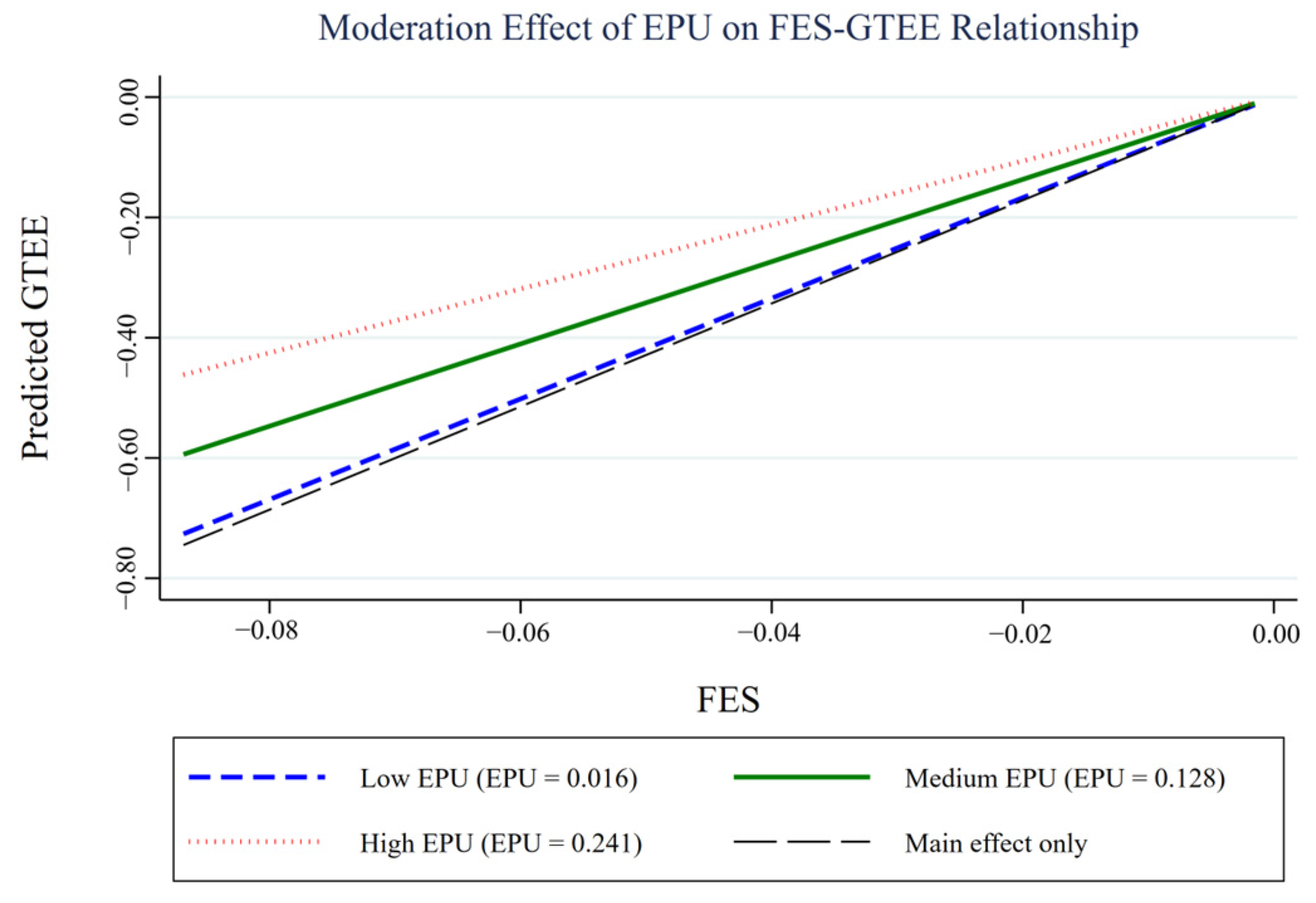
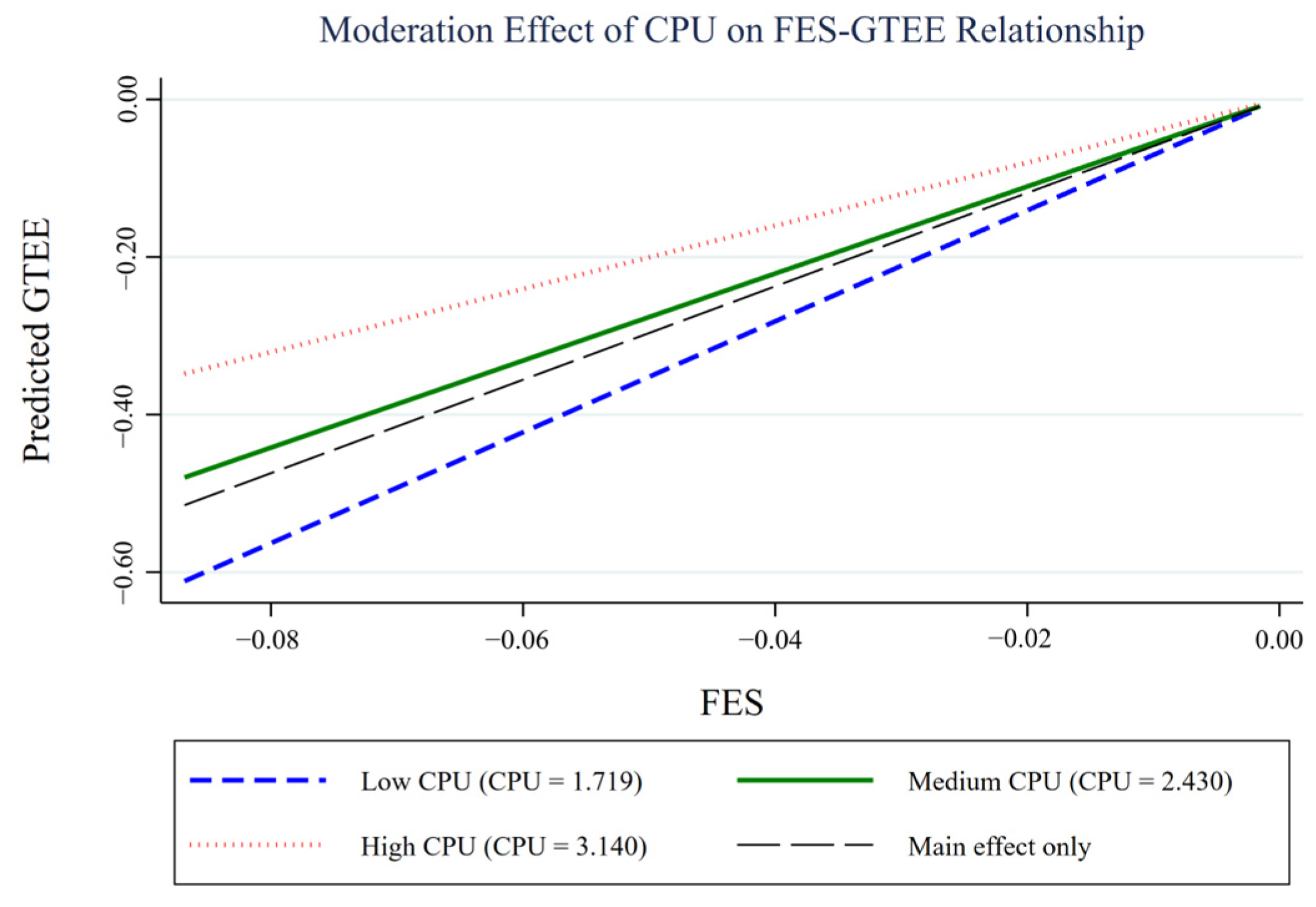
To move beyond a simple interpretation of interaction coefficient signs and to provide a more intuitive demonstration of the substantive moderation, we plotted the marginal effects of environmental sentiment across the observed ranges of EPU and CPU (as shown in Figure 6 and Figure 7). The visual evidence in these plots is consistent with the empirical results reported in our tables, confirming that the promoting effect of environmental sentiment on green innovation significantly diminishes as policy uncertainty increases. This graphical representation reinforces the reliability of the ‘selective weakening effect’ identified in our regression analysis.

5. Conclusions and Recommendations

5.1. Conclusions and Policy Implications

This paper investigates the impact of multi-actor environmental sentiment on the green transformation of Chinese A-share energy companies from 2013 to 2023. Our findings suggest: (1) Driving effect of multi-actor sentiment: Negative environmental sentiments from financial institutions, media, the public, and the government all significantly promote green innovation. Notably, the sentiments of financial institutions and the government exhibit the most prominent effects, acting as powerful “soft constraints.” (2) Selective weakening effect of policy uncertainty: Economic and climate policy uncertainty significantly dampens the effectiveness of environmental sentiments, but this moderation is highly selective. Our results indicate that heightened uncertainty primarily weakens the promotion effect of financial institution sentiment, while the driving forces from other actors remain relatively resilient. This suggests that the financial channel is the most sensitive to macro-policy volatility. (3) Heterogeneous impacts: The driving effect is more pronounced in firms located in eastern regions, facing high competitive pressure, or under stringent environmental regulations. In contrast, firms in western regions or under lower regulation rely more heavily on government-led sentiment.
Based on the empirical evidence, we offer the following targeted implications: (1) Prioritizing the Stability of Financial Signaling: Given that the “soft constraint” from financial institutions is the only channel significantly impaired by policy uncertainty, the government should prioritize the predictability of policy signals. By reducing climate policy volatility, authorities can prevent the erosion of financial institutions’ green guiding role, ensuring that capital remains committed to energy enterprises’ green transformation even during macro-economic shifts. (2) Strengthening Diversified Supervision: While financial and government sentiments are primary drivers, the role of media and public opinion should not be ignored. Regulatory frameworks should encourage a multi-layered information environment to maintain constant pressure for green transformation, especially when formal policy environments fluctuate.

5.2. Research Limitations

Despite its contributions, this study is subject to several limitations that offer avenues for future inquiry. First, regarding measurement and sampling, although we employ deep learning for text analysis, potential measurement errors in sentiment indices may persist. Moreover, the representativeness of our data could be constrained by platform-specific biases inherent in Weibo and newspaper sampling. Additionally, while our framework covers four key actors, the specific sentiments of energy consumers and supply chain partners were not separately isolated due to data overlapping, as their voices are often implicitly captured within the broader public and media discourse. Second, in terms of econometric specification, while an instrumental variable approach is utilized to address endogeneity, concerns regarding the exclusion restriction and the potential lag structures of patent responses to sentiment shocks warrant further scrutiny.
Building upon these limitations, future research could be extended in the following directions: (1) exploring cross-actor interaction effects, such as how media sentiment amplifies or moderates government signals; (2) incorporating more granular data from energy consumers and upstream/downstream partners to refine the multi-actor sentiment framework; (3) tracing the specific financing-cost mechanisms to better understand how sentiment-driven pressure translates into innovation investment; and (4) expanding the analytical framework beyond the energy sector to other carbon-intensive industries to test the generalizability of these findings.

Author Contributions

All authors contributed to the study conception and design. Data collection and analysis were performed by J.W., C.W. and T.C. The first draft of the manuscript was written by J.W. and C.W. M.T. participated in the visualization and provided critical revisions to the manuscript. All authors commented on previous versions of the manuscript. All authors have read and agreed to the published version of the manuscript.

Funding

This study was financially supported by grants from the National Natural Science Fund of China (No. 72404129), the Major Project of National Social Science Foundation of China (No. 22&ZD122) and the Major Projects of Philosophy and Social Sciences Research in Colleges and Universities in Jiangsu Province (2022SJZD009).

Institutional Review Board Statement

Not applicable.

Informed Consent Statement

Not applicable.

Data Availability Statement

The data presented in this study are available on request from the corresponding author.

Conflicts of Interest

The authors declare no conflicts of interest.

Appendix A

Table A1. Correlation coefficients.
Variables(1)(2)(3)(4)(5)(6)(7)(8)(9)(10)(11)(12)(13)(14)
(1) GTEE1.000
(2) FES0.111 ***1.000
(3) MES0.085 ***−0.074 ***1.000
(4) PES0.067 ***0.114 ***0.056 ***1.000
(5) GES0.048 ***−0.0150.0170.035 **1.000
(6) GDP0.037 **−0.163 ***0.158 ***−0.104 ***−0.124 ***1.000
(7) OPEN−0.004−0.153 ***−0.062 ***−0.112 ***−0.044 ***0.636 ***1.000
(8) STR−0.0120.335 ***−0.165 ***0.026 *−0.171 ***−0.451 ***−0.412 ***1.000
(9) TECH0.121 ***−0.037 **0.170 ***−0.045 ***−0.145 ***0.701 ***0.504 ***−0.331 ***1.000
(10) FDI−0.035 **−0.132 ***−0.058 ***−0.026 *0.075 ***0.198 ***0.402 ***−0.104 ***0.289 ***1.000
(11) SOE0.058 ***−0.0170.034 **−0.0020.065 ***−0.150 ***−0.145 ***−0.060 ***−0.056 ***−0.033 **1.000
(12) LEV−0.0110.031 **0.0210.0070.008−0.073 ***−0.091 ***0.000−0.095 ***−0.028 *0.274 ***1.000
(13) SIZE0.073 ***−0.047 ***0.054 ***−0.0140.036 **0.078 ***0.006−0.178 ***0.072 ***−0.030 **0.374 ***0.465 ***1.000
(14) ROE0.103 ***0.0200.009−0.040 ***−0.0100.051 ***0.0190.027 *0.061 ***−0.067 ***−0.048 ***−0.212 ***0.154 ***1.000
Note: The standard errors in parentheses are ***, **, and *, respectively, indicating significance at the 1%, 5%, and 10% levels.

References

  1. Olhoff, A.; Christensen, J.; Lamb, W.F.; Pathak, M.; Kuramochi, T.; den Elzen, M.; Fransen, T.; Rogelj, J.; Portugal-Pereira, J.; Burton, J.; et al. Emissions Gap Report 2023: Broken Record–Temperatures Hit New Highs, Yet World Fails to Cut Emissions (Again); United Nations Environment Programme: Nairobi, Kenya, 2023. [Google Scholar]
  2. Chen, T.; Zheng, X.; Wang, L. Systemic risk among Chinese oil and petrochemical firms based on dynamic tail risk spillover networks. N. Am. J. Econ. Financ. 2025, 77, 102404. [Google Scholar] [CrossRef]
  3. Yousaf, T.; Shahzad, M.F.; Ain, Q.U. Evaluating the environmental impacts of Chinese decentralization policies toward SDG 13. Sustain. Dev. 2025, 33, 939–956. [Google Scholar] [CrossRef]
  4. Zhao, Y.; Li, J.; Yu, L. A deep learning ensemble approach for crude oil price forecasting. Energy Econ. 2017, 66, 9–16. [Google Scholar] [CrossRef]
  5. Zhu, J.; Fan, Y.; Deng, X.; Xue, L. Low-carbon innovation induced by emissions trading in China. Nat. Commun. 2019, 10, 4088. [Google Scholar] [CrossRef] [PubMed]
  6. Tao, Y.; Wang, D.; Ye, Y.; Wu, H.; Zhang, Y. The role of public environmental concern on corporate social responsibility: Evidence from search index of web users. Energy Econ. 2023, 126, 107041. [Google Scholar] [CrossRef]
  7. Huang, H.; Long, R.; Chen, H.; Sun, K.; Li, Q. Exploring public attention about green consumption on Sina Weibo: Using text mining and deep learning. Sustain. Prod. Consum. 2022, 30, 674–685. [Google Scholar] [CrossRef]
  8. Nagar, V.; Schoenfeld, J.; Wellman, L. The effect of economic policy uncertainty on investor information asymmetry and management disclosures. J. Account. Econ. 2019, 67, 36–57. [Google Scholar] [CrossRef]
  9. Yao, K.; Ma, X.; Zhang, J. Green disguise or real action? The truth behind corporate greenwashing under stringent climate policy. Energy Econ. 2024, 108059. [Google Scholar] [CrossRef]
  10. Hu, G.; Wang, X.; Wang, Y. Can the green credit policy stimulate green innovation in heavily polluting enterprises? Evidence from a quasi-natural experiment in China. Energy Econ. 2021, 98, 105134. [Google Scholar] [CrossRef]
  11. Liu, Y.; Xu, R. Money talks: How financial constraint influence corporate environmental behavior prioritization. Int. Rev. Econ. Financ. 2024, 91, 556–578. [Google Scholar] [CrossRef]
  12. Lei, H.; Gao, R.; Ning, C.; Sun, G. Green finance and corporate green innovation. Financ. Res. Lett. 2025, 72, 106577. [Google Scholar] [CrossRef]
  13. Tang, H. The effect of ESG performance on corporate innovation in China: The mediating role of financial constraints and agency cost. Sustainability 2022, 14, 3769. [Google Scholar] [CrossRef]
  14. Barroso del Toro, A.; Tort-Martorell, X.; Canela, M.A. How shareholders react to sustainable narratives about leading European energy companies? An event study using sentiment data from the global database for events, language and tone (GDELT). Appl. Econ. 2022, 54, 3482–3494. [Google Scholar] [CrossRef]
  15. Long, L.; Wang, C.; Zhang, M. Does social media pressure induce corporate hypocrisy? Evidence of ESG greenwashing from China. J. Bus. Ethics 2024, 197, 311–338. [Google Scholar] [CrossRef]
  16. Wang, F.; Ren, K. Corporate Reputation, Media Attention, and Cost of Capital. Financ. Res. Lett. 2025, 86, 108581. [Google Scholar] [CrossRef]
  17. Chen, Q. Impact of sentiment tendency of media coverage on corporate green total factor productivity: The moderating role of environmental uncertainty. Financ. Res. Lett. 2024, 65, 105637. [Google Scholar] [CrossRef]
  18. Hollstein, B.; Rosa, H. Social acceleration: A challenge for companies? Insights for business ethics from resonance theory. J. Bus. Ethics 2023, 188, 709–723. [Google Scholar] [CrossRef]
  19. Gu, Y.; Ho, K.C.; Yan, C.; Gozgor, G. Public environmental concern, CEO turnover, and green investment: Evidence from a quasi-natural experiment in China. Energy Econ. 2021, 100, 105379. [Google Scholar] [CrossRef]
  20. Abbas, J. Does the nexus of corporate social responsibility and green dynamic capabilities drive firms toward green technological innovation? The moderating role of green transformational leadership. Technol. Forecast. Soc. Change 2024, 208, 123698. [Google Scholar] [CrossRef]
  21. Liu, Y.; Wang, A.; Wu, Y. Environmental regulation and green innovation: Evidence from China’s new environmental protection law. J. Clean. Prod. 2021, 297, 126698. [Google Scholar] [CrossRef]
  22. Liu, X.; Wang, W.; Huang, S. Criminal enforcement and environmental performance: Evidence from China. Ecol. Econ. 2024, 224, 108267. [Google Scholar] [CrossRef]
  23. Cheng, B.; An, Z.; Li, W. Regulatory enforcement and firm sustainability: Evidence from China’s environmental public interest litigation reform. Econ. Anal. Policy 2025, 85, 530–545. [Google Scholar] [CrossRef]
  24. Han, F.; Mao, X.; Yu, X.; Yang, L. Government environmental protection subsidies and corporate green innovation: Evidence from Chinese microenterprises. J. Innov. Knowl. 2024, 9, 100458. [Google Scholar] [CrossRef]
  25. Nguyen, J.H.; Phan, H.V. Carbon risk and corporate capital structure. J. Corp. Financ. 2020, 64, 101713. [Google Scholar] [CrossRef]
  26. Hassan, S.T.; Batool, B.; Sadiq, M.; Zhu, B. How do green energy investment, economic policy uncertainty, and natural resources affect greenhouse gas emissions? A Markov-switching equilibrium approach. Environ. Impact Assess. Rev. 2022, 97, 106887. [Google Scholar] [CrossRef]
  27. Brüggemann, M.; Engesser, S. Beyond false balance: How interpretive journalism shapes media coverage of climate change. Glob. Environ. Change 2017, 42, 58–67. [Google Scholar] [CrossRef]
  28. Rojas, M.; Méndez, A.; Watkins-Fassler, K. The hierarchy of needs empirical examination of Maslow’s theory and lessons for development. World Dev. 2023, 165, 106185. [Google Scholar] [CrossRef]
  29. Wen, Q.; Zhang, T. Economic policy uncertainty and industrial pollution: The role of environmental supervision by local governments. China Econ. Rev. 2022, 71, 101723. [Google Scholar] [CrossRef]
  30. Iqbal, N.; Bouri, E.; Shahzad, S.J.H.; Alsagr, N. Asymmetric impacts of Chinese climate policy uncertainty on Chinese asset prices. Energy Econ. 2024, 133, 107518. [Google Scholar] [CrossRef]
  31. Bouteska, A.; Bhuiyan, F.; Sharif, T.; Abedin, M.Z. Contagion between investor sentiment and green bonds in China during the global uncertainties. Int. Rev. Econ. Financ. 2024, 93, 469–484. [Google Scholar] [CrossRef]
  32. Hart, P.S.; Nisbet, E.C.; Myers, T.A. Public attention to science and political news and support for climate change mitigation. Nat. Clim. Change 2015, 5, 541–545. [Google Scholar] [CrossRef]
  33. Weber, E.U. Breaking cognitive barriers to a sustainable future. Nat. Hum. Behav. 2017, 1, 0013. [Google Scholar] [CrossRef]
  34. Lin, Y. Climate policy uncertainty and energy transition: Evidence from prefecture-level cities in China. Energy Econ. 2024, 139, 107938. [Google Scholar] [CrossRef]
  35. Li, K.; Mai, F.; Shen, R.; Yan, X. Measuring corporate culture using machine learning. Rev. Financ. Stud. 2021, 34, 3265–3315. [Google Scholar] [CrossRef]
  36. Chen, Z.; Kahn, M.E.; Liu, Y.; Wang, Z. The consequences of spatially differentiated water pollution regulation in China. J. Environ. Econ. Manag. 2018, 88, 468–485. [Google Scholar] [CrossRef]
  37. Jiang, F.; Meng, L.; Tang, G. Media text sentiment and stock return prediction. China Econ. Q. 2021, 21, 1323–1344. [Google Scholar] [CrossRef]
  38. Durnev, A.; Mangen, C. The spillover effects of MD&A disclosures for real investment: The role of industry competition. J. Account. Econ. 2020, 70, 101299. [Google Scholar] [CrossRef]
  39. Zhao, L.; Zhang, L.; Sun, J.; He, P. Can public participation constraints promote green technological innovation of Chinese enterprises? The moderating role of government environmental regulatory enforcement. Technol. Forecast. Soc. Change 2022, 174, 121198. [Google Scholar] [CrossRef]
  40. Yang, J.; Hu, Y.; Liu, M.; Li, Y.; Ma, Z.; Fang, W.; Bi, J. Event triggers and opinion leaders shape climate change discourse on Weibo. Commun. Earth Environ. 2025, 6, 142. [Google Scholar] [CrossRef]
  41. Shi, C.; Shi, Q.; Guo, F. Environmental slogans and action: The rhetoric of local government work reports in China. J. Clean. Prod. 2019, 238, 117886. [Google Scholar] [CrossRef]
  42. You, W.; Fang, C.; Guo, Y.; Nan, S. Can policy achieve environmental improvement? Evidence from the whole county photovoltaic project in China. Energy Econ. 2025, 154, 109100. [Google Scholar] [CrossRef]
  43. Baker, S.R.; Bloom, N.; Davis, S.J. Measuring economic policy uncertainty. Q. J. Econ. 2016, 131, 1593–1636. [Google Scholar] [CrossRef]
  44. Ma, Y.R.; Liu, Z.; Ma, D.; Zhai, P.; Guo, K.; Zhang, D.; Ji, Q. A news-based climate policy uncertainty index for China. Sci. Data 2023, 10, 881. [Google Scholar] [CrossRef]
  45. Chen, H.; Deng, J.; Lu, M.; Zhang, P.; Zhang, Q. Government environmental attention, credit supply and firms’ green investment. Energy Econ. 2024, 134, 107547. [Google Scholar] [CrossRef]
  46. Wang, J.; Wang, W.; Wu, H.; Liu, Y. Exploring the effects of manufacturing servitization on enterprise energy conservation and emissions reduction moderated by digital transformation. Energy Econ. 2023, 122, 106706. [Google Scholar] [CrossRef]
  47. Du, J.; Shen, Z.; Song, M.; Zhang, L. Nexus between digital transformation and energy technology innovation: An empirical test of A-share listed enterprises. Energy Econ. 2023, 120, 106572. [Google Scholar] [CrossRef]
  48. Lee, C.C.; Wang, T. The impact of renewable energy policies on the energy transition-–an empirical analysis of Chinese cities. Energy Econ. 2024, 138, 107838. [Google Scholar] [CrossRef]
  49. Xu, Y.; Yang, L.; Hossain, M.E.; Haseeb, M.; Ran, Q. Unveiling the trajectory of corporate green innovation: The roles of the public attention and government. J. Clean. Prod. 2024, 444, 141119. [Google Scholar] [CrossRef]
  50. Zhang, Z.; Hu, G.; Mu, X.; Kong, L. From low carbon to carbon neutrality: A bibliometric analysis of the status, evolution and development trend. J. Environ. Manag. 2022, 322, 116087. [Google Scholar] [CrossRef]
  51. Gama, P.M.; Sol Murta, F.; Vieira, E.S. Local banking development and SME conservative financing policy. Does bank branch density matter? Small Bus. Econ. 2024, 63, 1747–1765. [Google Scholar] [CrossRef]
  52. Chu, Z.; Yang, T.; Zhang, Z. Assessing the role of public, media, and government attention on air pollution governance in China. Sustain. Cities Soc. 2024, 113, 105681. [Google Scholar] [CrossRef]
  53. Yi, S.; Raghutla, C.; Chittedi, K.R.; Fareed, Z. How economic policy uncertainty and financial development contribute to renewable energy consumption? The importance of economic globalization. Renew. Energy 2023, 202, 1357–1367. [Google Scholar] [CrossRef]
  54. Awosusi, A.A. How do economic policy uncertainty, climate policy uncertainty and US monetary policy uncertainty shape investors’ sentiment in the green market? Appl. Econ. 2025, 1–19. [Google Scholar] [CrossRef]
  55. Sun, G.; Fang, J.; Li, T.; Ai, Y. Effects of climate policy uncertainty on green innovation in Chinese enterprises. Int. Rev. Financ. Anal. 2024, 91, 102960. [Google Scholar] [CrossRef]
Figure 1. Conceptual logic diagram.
Sustainability 18 03190 g001
Figure 2. Word clouds representing environmental sentiment tendencies of four actor types. Note: (a) is the word cloud for the environmental sentiment tendencies of financial institutions; (b) is the word cloud for the environmental sentiment tendencies of the media; (c) is the word cloud for the environmental sentiment tendencies of the public; (d) is the word cloud for the environmental sentiment tendencies of the government.
Sustainability 18 03190 g002
Figure 3. Number of bank annual reports and financial institution environmental sentiment tendency values by province/autonomous region.
Sustainability 18 03190 g003
Figure 4. Number of newspapers and media environmental sentiment tendency values by province/autonomous region.
Sustainability 18 03190 g004
Figure 5. Number of Weibo posts and public environmental sentiment tendency values by province/autonomous region.
Sustainability 18 03190 g005
Figure 6. Regulatory effect diagram of EPU.
Sustainability 18 03190 g006
Figure 7. Regulatory effect diagram of CPU.
Sustainability 18 03190 g007
Table 1. Emotional dictionary display.
Positive WordsNegative Words
improve, grow, advance, enhance, deepen, break through, revitalize, optimize
pressure, review, control, constraint, escalation, punishment, accountability, cost
Note: The ellipses indicate that only representative words are listed; the full lexicon contains more terms used for analysis.
Table 2. Variables and data sources.
Variable TypeVariable SymbolDefinitionsData Sources
Dependent variableGTEEGreen transformation of energy companiesCNRDS Green Patent Database
Independent variablesFESEnvironmental sentiment tendency of financial institutionsBank Official Website
MESEnvironmental sentiment tendency of the mediaFull Text Database of Important Chinese Newspapers
PESEnvironmental sentiment tendency of the publicWeibo Official Website
GESEnvironmental sentiment tendency of the governmentGovernment Official Website
Moderating variablesEPUEconomic policy uncertaintyMark Data Network
CPUClimate policy uncertaintyA News-Based Climate Policy Uncertainty Index For China.
Control variablesFDIForeign direct investmentChina Statistical Yearbook
GDPEconomic development levelChina Statistical Yearbook
OPENOpenness to TradeNational Bureau of Statistics
STRIndustrial structureNational Bureau of Statistics
TECHTechnology market turnover rateChina Statistical Yearbook
SOEOwnershipCSMAR Database
LEVLeverageCSMAR Database
SIZECompany sizeCSMAR Database
ROEReturn on EquityCSMAR Database
Table 3. Descriptive statistics of variables.
VariablesObsMeanStd.Dev.MinMax
GTEE47080.4480.82503.584
FES4708−0.040.016−0.087−0.002
MES4708−0.1090.05−0.2340.019
PES4708−0.0360.026−0.1010.034
GES4708−0.1630.022−0.2090.204
GDP470886.24537.11731.93190.321
OPEN47080.4290.3010.0411.253
STR470840.0528.42715.852.8
TECH47086.7180.7414.4827.9
FDI47080.0250.0210.0010.101
SOE47080.3880.48701
LEV47080.4930.1680.070.909
SIZE470822.7911.27320.0726.715
ROE47080.0550.105−0.510.327
Table 4. Variance inflation factor.
VIF1/VIF
GDP2.8440.352
TECH2.2160.451
OPEN2.1530.465
STR1.6410.61
SIZE1.620.617
LEV1.4770.677
FDI1.3130.762
SOE1.2540.797
FES1.1920.839
ROE1.1720.853
GES1.1240.889
MES1.1220.891
PES1.0360.965
MEAN VIF1.551
Table 5. Baseline regression results.
Variables(1)(2)(3)
GTEEGTEEGTEE
FES5.873 ***7.32 ***5.929 ***
(0.756)(0.885)(0.91)
MES1.485 ***0.601 **0.643 **
(0.239)(0.26)(0.265)
PES1.535 ***1.702 ***2.027 ***
(0.47)(0.511)(0.511)
GES1.704 ***1.495 **2.155 ***
(0.53)(0.646)(0.647)
GDP −0.001
(0.001)
OPEN 0.702 ***
(0.226)
STR −0.008
(0.008)
TECH 0.113
(0.071)
FDI −1.178
(0.869)
LEV 0.047
(0.124)
SIZE −0.104 ***
(0.021)
ROE 0.581 ***
(0.124)
Constant1.176 ***0.966 ***2.759 ***
(0.097)(0.125)(0.801)
ControlsNoNoYes
Firm FENoYesYes
Year FENoYesYes
Observations470847084708
R-squared0.0260.060.082
Note: The standard errors in parentheses are ***, **, and *, respectively, indicating significance at the 1%, 5%, and 10% levels.
Table 6. Robustness test results (replace explanatory variable, sample exclusions and period adjustments).
VariablesReplace Explanatory VariableSample ExclusionsPeriod Adjustments
(1)(2)(3)
GTEEGTEEGTEE
FES0.713 ***2.603 ***3.404 ***
(0.109)(1.006)(1.034)
MES0.125 **0.873 ***0.906 ***
(0.061)(0.308)(0.291)
PES0.261 ***1.889 ***2.041 ***
(0.053)(0.557)(0.513)
GES0.898 ***2.835 ***1.236 *
(0.237)(0.7)(0.679)
Constant2.751 ***3.413 ***3.501 ***
(0.799)(0.849)(0.887)
ControlsYesYesYes
Firm FEYesYesYes
Year FEYesYesYes
Observations470839383424
R-squared0.0840.1060.057
Note: The standard errors in parentheses are ***, **, and *, respectively, indicating significance at the 1%, 5%, and 10% levels.
Table 7. Textual analysis results.
VariablesCorrelation with Expanded IndexManual Coding Consistency (%)
FES0.821 ***90
MES0.996 ***92
PES0.982 ***86
GES0.992 ***94
Note: The standard errors in parentheses are ***, **, and *, respectively, indicating significance at the 1%, 5%, and 10% levels.
Table 8. Robustness test results (cluster by province, ppml, first-order lag and second-order lag).
VariablesCluster by ProvincePPMLFirst-Order LagSecond-Order Lag
(1)(2)(3)(4)
GTEEGTEEGTEEGTEE
FES5.929 ***18.027 ***4.176 ***4.11 ***
(1.632)(4.09)(0.924)(1.136)
MES0.643 *1.745 **−0.997 ***0.446
(0.372)(0.768)(0.261)(0.298)
PES2.027 ***4.657 ***1.202 **−0.238
(0.624)(1.361)(0.545)(0.584)
GES2.155 *3.355 *1.812 **0.924
(1.242)(1.777)(0.869)(1.13)
Constant2.926 **8.309 **1.0441.477
(1.321)(3.488)(0.981)(1.122)
ControlsYesYesYesYes
Firm FEYesYesYesYes
Year FEYesYesYesYes
Observations4708392742803852
R-squared0.2880.1850.2870.297
Note: The standard errors in parentheses are ***, **, and *, respectively, indicating significance at the 1%, 5%, and 10% levels.
Table 9. Handling of endogeneity issues.
Variables(1)(2)(3)(4)(5)
Phase 1Phase 2
FESMESPESGESGTEE
BBD0.017 ***
(0.004)
NNP 0.07 ***
(0.015)
IVPE 0.02 ***
(0.002)
DEL −0.003 ***
(0.0004)
FES 0.09 ***
(0.02)
MES 0.123 ***
(0.045)
PES 0.361 ***
(0.092)
GES 0.151 ***
(0.058)
ControlsYesYesYesYesYes
Firm FEYesYesYesYesYes
Year FEYesYesYesYesYes
Observations47084708470847084708
CD-F statistic41.54528.393115.27066.512
KP-F statistic20.28921.30274.10655.998
KP-LM statistic10.175 ***11.868 ***75.437 ***57.428 ***
Note: The standard errors in parentheses are ***, **, and *, respectively, indicating significance at the 1%, 5%, and 10% levels.
Table 10. Results of regional heterogeneity analysis.
Variables(1)(2)(3)
EasternCentralWestern
FES8.987 ***3.085 *2.887
(1.365)(1.768)(2.087)
MES0.551 *1.218 *1.442
(0.323)(0.736)(0.893)
PES2.416 ***1.776 *−0.315
(0.733)(1.011)(1.204)
GES1.678 *2.205 **3.272 **
(0.939)(1.121)(1.33)
Constant2.1681.9231.338
(1.452)(1.582)(2.013)
ControlsYesYesYes
Firm FEYesYesYes
Year FEYesYesYes
Observations3245880583
R-squared0.1080.1240.114
Note: The standard errors in parentheses are ***, **, and *, respectively, indicating significance at the 1%, 5%, and 10% levels.
Table 11. Heterogeneity analysis by competitive pressure and environmental regulation.
Variables(1)(2)(3)(4)
High Competitive PressureLow Competitive PressureHigh Environmental RegulationsLow Environmental Regulations
FES4.337 ***2.8933.671 ***2.334
(1.321)(1.777)(1.372)(1.464)
MES1.43 ***0.4821.747 ***0.349
(0.406)(0.488)(0.488)(0.324)
PES2.293 ***1.5582.086 **0.541
(0.718)(1.062)(0.815)(0.715)
GES3.412 ***3.193 **2.75 **0.785
(1.1)(1.308)(1.215)(0.964)
Constant1.8653.25 *1.7682.396 **
(1.179)(1.766)(1.43)(1.122)
ControlsYesYesYesYes
Firm FEYesYesYesYes
Year FEYesYesYesYes
Observations1405140522992299
R-squared0.1090.0780.130.064
Note: The standard errors in parentheses are ***, **, and *, respectively, indicating significance at the 1%, 5%, and 10% levels.
Table 12. Moderation analysis of policy uncertainty.
Variables(1)Variables(2)
GTEEGTEE
FES8.574 ***FES10.707 ***
(1.561) (2.983)
MES1.092 **MES−0.119
(0.471) (0.983)
PES4.025 ***PES0.284
(0.934) (1.881)
GES2.079 **GES2.366 *
(1.043) (1.323)
EPU−0.486CPU−0.02
(1.061) (0.115)
FES × EPU−13.517 *FES × CPU−2.133 *
(8.2) (1.231)
MES × EPU−0.78MES × CPU0.346
(2.419) (0.41)
PES × EPU−8.009PES × CPU0.801
(5.304) (0.839)
GES × EPU3.568GES × CPU−0.143
(6.04) (0.556)
Constant0.742Constant2.453 ***
(1.073) (0.836)
ControlsYesControlsYes
Firm FEYesFirm FEYes
Year FEYesYear FEYes
Observations3441Observations4708
R-squared0.067R-squared0.083
Note: The standard errors in parentheses are ***, **, and *, respectively, indicating significance at the 1%, 5%, and 10% levels.
Disclaimer/Publisher’s Note: The statements, opinions and data contained in all publications are solely those of the individual author(s) and contributor(s) and not of MDPI and/or the editor(s). MDPI and/or the editor(s) disclaim responsibility for any injury to people or property resulting from any ideas, methods, instructions or products referred to in the content.