Article

A Study on the Priority Evaluation Through the Analysis of the Relative Importance of Key Issues in Sustainable Management in South Korea


1
Climate and Energy Policy, Department of Climate and Energy, Sejong University, Seoul 05006, Republic of Korea
2
Carbon Neutral Office, The Korea Chamber of Commerce and Industry (KCCI), Seoul 05006, Republic of Korea
*
Author to whom correspondence should be addressed.
Sustainability 2026, 18(7), 3163; https://doi.org/10.3390/su18073163
Submission received: 2 February 2026 / Revised: 7 March 2026 / Accepted: 16 March 2026 / Published: 24 March 2026

Abstract

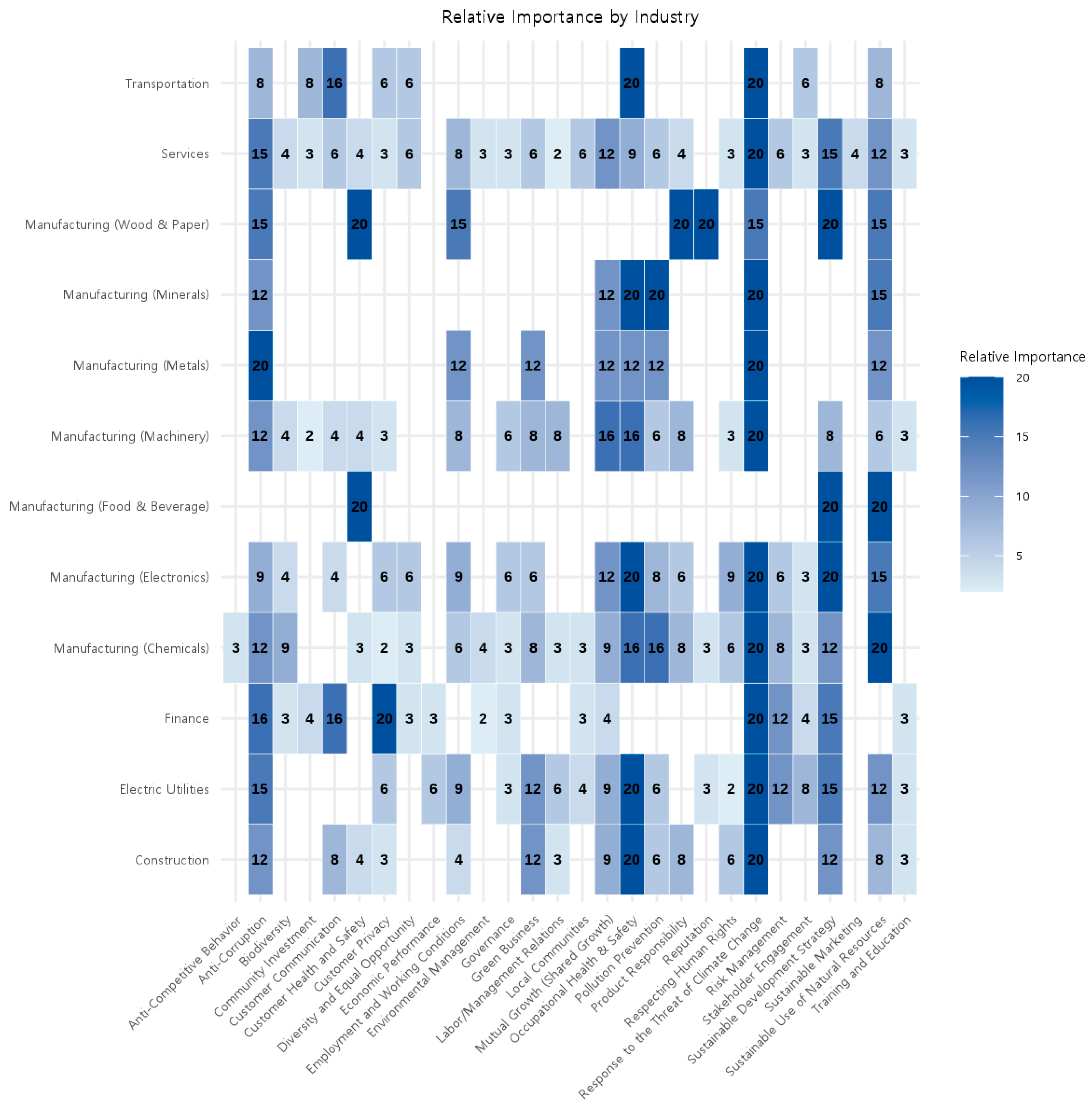
Corporate management has recently shifted from a traditional shareholder-centric approach to sustainability-oriented strategic management, with ESG factors becoming central to corporate strategy. In this study, we identified strategic implications for enhancing corporate sustainability amid these changes. Specifically, we examined the structural context in which voluntary international standards, such as the Global Reporting Initiative (GRI), interact with the rising importance of environmental issues, diverse stakeholders, and intensified corporate competition, leading to a more in-depth discourse on corporate sustainability management. We analyzed corporate sustainability management reports of 102 companies across five industries in South Korea, applying risk management techniques and calculating relative importance indicators for key issues. The analysis revealed that “Response to the Threat of Climate Change” was the top priority across many industries and was closely linked to other issues such as sustainable resource use, customer safety, and supplier management, depending on industry characteristics. Several issues were identified as highly important despite being infrequently mentioned, suggesting they could become key future concerns. Based on our findings, we recommend that companies develop scenario-based, industry-specific strategies to address the threat of climate change, with a focus on greenhouse gas (GHG) reductions. For governments and regulators, these findings are expected to have significant implications for enhancing corporate capacity to respond to Net Zero goals and improve climate change resilience across industries.
Keywords: corporate sustainability management; ESG; climate change response; relative importance; risk management corporate sustainability management; ESG; climate change response; relative importance; risk management