A Study on the Priority Evaluation Through the Analysis of the Relative Importance of Key Issues in Sustainable Management in South Korea



Abstract
1. Introduction
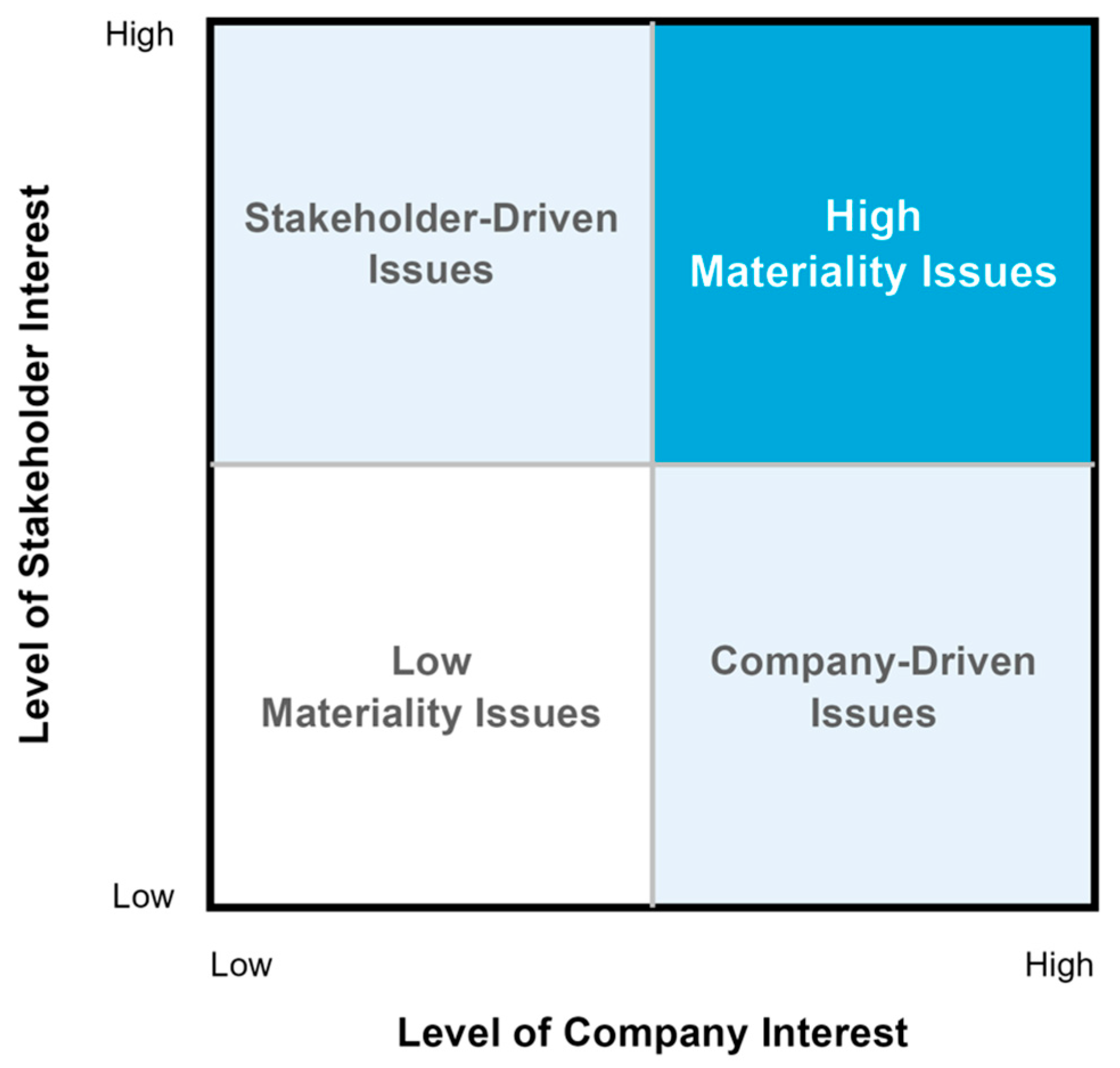
- A company’s economic and environmental management strategies will be recognized as major issues from the perspective of stakeholders.
- The main issues considered by companies and perceived by stakeholders will show common tendencies.
- These tendencies will be related to the need for a company’s response to the threat of climate change.
- Evaluation indicators will vary in robustness depending on how much these tendencies and needs are reflected.
2. Research Design and Methods
2.1. Overview of Research Stages
2.2. Data Collection and Target Selection
2.3. Identification of Main Issues and Classification Standards
2.4. Relative Importance Analysis

| Intensity Group | Priority Level | Description |
|---|---|---|
| Lowest Group | 1 | Selected as an issue that needs to be managed |
| Lower Group | 2 | Selected as an issue that needs to be managed with priority |
| Upper Group | 3 | Selected as an issue that must be managed |
| Top Group | 4 | Selected as a top-priority issue to be managed |
2.5. Priority Evaluation
3. Results
3.1. Construction Industry
3.2. Finance Industry
3.3. Service Industry
3.4. Transportation Industry
3.5. Manufacturing (Chemical)
3.6. Manufacturing (Machinery)
3.7. Electric Utilities
3.8. Manufacturing (Electrical and Electronics)
3.9. Manufacturing (Food and Beverage)
3.10. Manufacturing (Minerals)
3.11. Manufacturing (Metal)
3.12. Manufacturing (Wood and Paper)
4. Conclusions and Implications
- Construction Industry–Customer Health and Safety, Employment and Working Conditions
- Finance Industry–Stakeholder Engagement, Mutual Growth (Shared Growth), and Community Investment
- Service Industry–Sustainable Marketing, Product Responsibility, Customer Health and Safety, and Biodiversity
- Manufacturing (Chemical)–Environmental Management
- Manufacturing (Machinery)–Biodiversity, Customer Health and Safety, and Customer Communication
- Electric Utilities–Local Communities
- Manufacturing (Electrical and Electronics)–Biodiversity and Customer Communication
Limitations and Future Research
Author Contributions
Funding
Institutional Review Board Statement
Informed Consent Statement
Data Availability Statement
Conflicts of Interest
References
- European Commission. Corporate Sustainability Reporting. 2025. Available online: https://finance.ec.europa.eu/capital-markets-union-and-financial-markets/company-reporting-and-auditing/company-reporting/corporate-sustainability-reporting_en (accessed on 31 January 2026).
- European Commission. The Commission Adopts the European Sustainability Reporting Standards. 2023. Available online: https://finance.ec.europa.eu/news/commission-adopts-european-sustainability-reporting-standards-2023-07-31_en (accessed on 31 January 2026).
- Khaw, T.Y.; Amran, A.; Teoh, A.P. Factors influencing ESG performance: A bibliometric analysis, systematic literature review, and future research directions. J. Clean. Prod. 2024, 448, 141430. [Google Scholar] [CrossRef] [Scilit]
- Frishkoff, P. An empirical investigation of the concept of materiality in accounting. J. Account. Res. 1970, 8, 116–129. [Google Scholar] [CrossRef] [Scilit]
- Voegtlin, C.; Pless, N.M. Global governance: CSR and the role of the UN Global Compact. J. Bus. Ethics 2014, 122, 179–191. [Google Scholar] [CrossRef] [Scilit]
- Martiny, A.; Taglialatela, J.; Testa, F.; Iraldo, F. Determinants of environmental social and governance (ESG) performance: A systematic literature review. J. Clean. Prod. 2024, 456, 142213. [Google Scholar] [CrossRef] [Scilit]
- Bowen, H.R. Business Management: A Profession? Ann. Am. Acad. Political Soc. Sci. 1955, 297, 112–117. [Google Scholar]
- Bowen, H.R. Social Responsibilities of the Businessman; University of Iowa Press: Iowa City, IA, USA, 2013. [Google Scholar]
- Windsor, D. The future of corporate social responsibility. Int. J. Organ. Anal. 2001, 9, 225–256. [Google Scholar] [CrossRef] [Scilit]
- Hu, Q.; Gu, Y. Copper economic dynamics: Navigating resource scarcity, price volatility, and green growth. Resour. Policy 2024, 89, 104462. [Google Scholar] [CrossRef] [Scilit]
- Mian, H.R.; Hewage, K.; Sadiq, R. Responsible financing and investment: Identification, development, and assessment of Environmental, Social, and Governance (ESG) metrics. Sustain. Futures 2024, 8, 100246. [Google Scholar] [CrossRef] [Scilit]
- Molnár, P.; Suta, A.; Lukács, B.; Tóth, Á. Linking sustainability reporting and energy use through global reporting initiative standards and sustainable development goals. Clean Technol. Environ. Policy 2024, 27, 8659–8667. [Google Scholar] [CrossRef] [Scilit]
- Bonetti, L.; Lai, A.; Stacchezzini, R. Stakeholder engagement in the public utility sector: Evidence from Italian ESG reports. Util. Policy 2023, 84, 101649. [Google Scholar] [CrossRef] [Scilit]
- Dathe, T.; Helmold, M.; Dathe, R.; Dathe, I. ESG stakeholders. In Implementing Environmental, Social and Governance (ESG) Principles for Sustainable Businesses: A Practical Guide in Sustainability Management; Springer: Berlin/Heidelberg, Germany, 2024; pp. 113–131. [Google Scholar]
- Daugaard, D.; Jia, J.; Li, Z. Implementing corporate sustainability information in socially responsible investing: A systematic review of empirical research. J. Account. Lit. 2024, 46, 238–276. [Google Scholar] [CrossRef] [Scilit]
- Szewczuk, S.; Więcek-Janka, E. Exploring sustainable investment: In-depth analysis of socially responsible investing (SRI) and ESG strategies. Ann. Univ. Mariae Curie-Skłodowska Sect. H–Oecon. 2024, 58, 103–114. [Google Scholar]
- Liu, X.; Du, W.; Olasehinde, T.; Fan, Y. Balancing competition and sustainability: Strategic supply chain configurations in response to consumer low-carbon preferences. Sustain. Futures 2025, 9, 100411. [Google Scholar]
- Yammanur, V. Integrated enterprise systems: Leveraging ERP, EDI, and AI for enhanced US business competitiveness. Int. J. Comput. Eng. Technol. 2025, 16, 454–466. [Google Scholar] [CrossRef] [Scilit]
- Sra, J.; Deo, B. GRI Standards for Environmental Sustainability–A Brief Review. In Proceedings of the IISE Annual Conference, Montreal, Canada, 18–21 May 2024. [Google Scholar]
- Brown, H.S.; De Jong, M.; Levy, D.L. Building institutions based on information disclosure: Lessons from GRI’s sustainability reporting. J. Clean. Prod. 2009, 17, 571–580. [Google Scholar]
- Perera-Aldama, L. GRI and materiality: Discussions and challenges. Sustain. Account. Manag. Policy J. 2023, 14, 884–903. [Google Scholar] [CrossRef] [Scilit]
- Nial, N.; Parashar, P. A comparative study on sustainability standards with specific reference to GRI standards and BRSR framework. Int. J. Qual. Reliab. Manag. 2024, 41, 1752–1782. [Google Scholar] [CrossRef] [Scilit]
- Mezzanotte, F.E. Examining the reasons for impact materiality in EU corporate sustainability reporting. Eur. Bus. Law Rev. 2024, 35, 925–946. [Google Scholar] [CrossRef] [Scilit]
- Tronci, L. “ESG” Targets in the Corporate Governance of Banks: KPI and Double Materiality (Impact and Financial Materiality). Eur. Co. Financ. Law Rev. 2024, 21, 738–761. [Google Scholar] [CrossRef] [Scilit]
- Global Reporting Initiative. GRI Standards; (GRI—Standards—Global Reporting Initiative). Available online: https://www.globalreporting.org/standards (accessed on 31 January 2026).
- Adams, C.A.; Alhamood, A.M.; He, X. The development and implementation of GRI standards: Practice and policy issues. In Handbook of Accounting and Sustainability; Edward Elgar Publishing: Cheltenham, UK, 2022; pp. 26–43. [Google Scholar]
- Bednárová, M. ESG reporting and communication. In Environmental, Social, and Governance (ESG) Investment and Reporting; Springer Nature: Cham, Switzerland, 2025; pp. 175–202. [Google Scholar]
- Goswami, K.; Islam, M.K.S.; Evers, W. A case study on the blended reporting phenomenon: A comparative analysis of voluntary reporting frameworks and standards—GRI, IR, SASB, and CDP. Int. J. Sustain. Policy Pract. 2023, 19, 35. [Google Scholar] [CrossRef] [Scilit]
- Macias, H.A.; Ficco, C.R. ¿ Inició la era de reportes de sostenibilidad obligatorios? Transición desde lineamientos GRI hacia estándares de ISSB. Rev. Act. 2022, 20, 4–13. [Google Scholar]
- Pizzi, S.; Principale, S.; De Nuccio, E. Material sustainability information and reporting standards. Exploring the differences between GRI and SASB. Meditari Account. Res. 2023, 31, 1654–1674. [Google Scholar] [CrossRef] [Scilit]
- Javan, K.; Altaee, A.; BaniHashemi, S.; Darestani, M.; Zhou, J.; Pignatta, G. A review of interconnected challenges in the water–energy–food nexus: Urban pollution perspective towards sustainable development. Sci. Total Environ. 2024, 912, 169319. [Google Scholar] [CrossRef] [Scilit]
- Wang, J.; Azam, W. Natural resource scarcity, fossil fuel energy consumption, and total greenhouse gas emissions in top emitting countries. Geosci. Front. 2024, 15, 101757. [Google Scholar]
- Panfilo, S.; Scarpa, F.; Canestraro, N. Reporting for change: Does the adoption of double materiality influence ESG risk management? Manag. Decis. 2025; ahead of print. [CrossRef] [Scilit]
- Vito, D.; Leto, L.; Bernini, F.; D’Onza, G. Double materiality in corporate sustainability: Insights from Italian companies. In Environmental, Social, Governance (ESG) Risk, Performance, Monitoring; Springer: Berlin/Heidelberg, Germany, 2025; pp. 387–409. [Google Scholar]
- van Dijk, L.; Hijink, S.; in’t Veld, L. Corporate sustainability reporting. In Sustainable Finance in Europe: Corporate Governance, Financial Stability and Financial Markets; Springer International Publishing: Cham, Switzerland, 2024; pp. 185–210. [Google Scholar]
- Huq, A.M.; Mohammadrezaei, M. A review of ex ante and ex post materiality measures, and consequences and determinants of material disclosures in sustainability reporting. J. Account. Lit. 2025, 47, 71–98. [Google Scholar] [CrossRef] [Scilit]
- Whitehead, J. Prioritizing sustainability indicators: Using materiality analysis to guide sustainability assessment and strategy. Bus. Strategy Environ. 2017, 26, 399–412. [Google Scholar]
- Belidan, M.A.; Baghad, H. Navigating materiality in sustainability reporting: A scoping review of single and double materiality approaches. Zesz. Teor. Rachun. 2024, 48, 11–32. [Google Scholar] [CrossRef] [Scilit]
- Hehenberger, L.; Andreoli, C. Impact measurement and the conflicted nature of materiality decisions. Curr. Opin. Environ. Sustain. 2024, 68, 101436. [Google Scholar] [CrossRef] [Scilit]
- Witjes, S.; Vermeulen, W.J.; Cramer, J.M. Assessing Corporate Sustainability integration for corporate self-reflection. Resour. Conserv. Recycl. 2017, 127, 132–147. [Google Scholar] [CrossRef] [Scilit]
- Elliot, V.; Jonäll, K.; Paananen, M.; Bebbington, J.; Michelon, G. Biodiversity reporting: Standardization, materiality, and assurance. Curr. Opin. Environ. Sustain. 2024, 68, 101435. [Google Scholar] [CrossRef] [Scilit]
- IFRS S1; General Requirements for Disclosure of Sustainability-Related Financial Information. IFRS Foundation: London, UK, 2023.
- IFRS S2; Climate-Related Disclosures. IFRS Foundation: London, UK, 2023.
- Carungu, J.; Dimes, R.; Molinari, M. EFRAG and ISSB: Tensions and opportunities for convergence in the quest for the standardisation of sustainability reporting standards. Manag. Decis. 2025; ahead of print. [CrossRef] [Scilit]
- Huang, P.C.; Mirza, N.; Umar, M.; Horobet, A. Impact of environmental double materiality on firm valuation: Evidence from the EU. Int. Rev. Econ. Financ. 2025, 103, 104461. [Google Scholar] [CrossRef] [Scilit]
- Qian, Y.; Liu, Y. Improve carbon emission efficiency: What role does the ESG initiatives play? J. Environ. Manag. 2024, 367, 122016. [Google Scholar] [CrossRef] [Scilit]
- Celoza, A.; Owens, V. Perspectives on ESG materiality in the engineering and construction industry: An exploratory study. J. Leg. Aff. Disput. Resolut. Eng. Constr. 2025, 17, 05025001. [Google Scholar] [CrossRef] [Scilit]
- Lu, J.; Li, H. The impact of ESG ratings on low carbon investment: Evidence from renewable energy companies. Renew. Energy 2024, 223, 119984. [Google Scholar] [CrossRef] [Scilit]
- Alqadi, M.; Zaharieva, S.; Commichau, A.; Disse, M.; Koellner, T.; Chiogna, G. Developing and implementing a decision support system-integrated framework for evaluating solar park effects on water-related ecosystem services. Sustainability 2025, 17, 3121. [Google Scholar]
- Bogdan, V.; Rus, L.; Matica, D.E. The Interconnection of Double Materiality Assessment, Circularity Practices Disclosure and Business Development in the Fast Fashion Industry. Sustainability 2025, 17, 1619. [Google Scholar] [CrossRef] [Scilit]
- Bux, C.; Geatti, P.; Sebastiani, S.; Del Chicca, A.; Giungato, P.; Tarabella, A.; Tricase, C. Toward an Experimental Common Framework for Measuring Double Materiality in Companies. Sustainability 2025, 17, 6518. [Google Scholar] [CrossRef] [Scilit]
- Carroll, A.B. The pyramid of corporate social responsibility: Toward the moral management of organizational stakeholders. Bus. Horiz. 1991, 34, 39–48. [Google Scholar] [CrossRef] [Scilit]
- Chopra, S.S.; Senadheera, S.S.; Dissanayake, P.D.; Withana, P.A.; Chib, R.; Rhee, J.H.; Ok, Y.S. Navigating the challenges of environmental, social, and governance (ESG) reporting: The path to broader sustainable development. Sustainability 2024, 16, 606. [Google Scholar] [CrossRef] [Scilit]
- De Cristofaro, T.; Gulluscio, C. In search of double materiality in non-financial reports: First empirical evidence. Sustainability 2023, 15, 924. [Google Scholar] [CrossRef] [Scilit]
- Delgado-Ceballos, J.; Ortiz-De-Mandojana, N.; Antolín-López, R.; Montiel, I. Connecting the Sustainable Development Goals to firm-level sustainability and ESG factors: The need for double materiality. BRQ Bus. Res. Q. 2023, 26, 2–10. [Google Scholar]
- Dunfjäll, M. Materiality in transition: Challenges and opportunities in corporate sustainability reporting under the CSRD. Eur. J. Risk Regul. 2025, 16, 1–15. [Google Scholar] [CrossRef] [Scilit]
- Dyczkowska, J.; Szalacha, P. Double materiality concept in practice: Impact in a construction company. Manag. Decis. 2025; ahead of print. [CrossRef] [Scilit]
- Escrig-Olmedo, E.; Fernández-Izquierdo, M.Á.; Ferrero-Ferrero, I.; Rivera-Lirio, J.M.; Muñoz-Torres, M.J. Rating the raters: Evaluating how ESG rating agencies integrate sustainability principles. Sustainability 2019, 11, 915. [Google Scholar] [CrossRef] [Scilit]
- Freeman, R.E. Strategic Management: A Stakeholder Approach; Cambridge University Press: Cambridge, UK, 2010. [Google Scholar]
- Friedman, M. The social responsibility of business is to increase its profits. In Corporate Ethics and Corporate Governance; Springer: Berlin/Heidelberg, Germany, 2007; pp. 173–178. [Google Scholar]
- Gourdel, R.; Monasterolo, I.; Dunz, N.; Mazzocchetti, A.; Parisi, L. The double materiality of climate physical and transition risks in the euro area. J. Financ. Stab. 2024, 71, 101233. [Google Scholar] [CrossRef] [Scilit]
- Kim, J.; Kang, J.; Hyun, S. Environmental, social, and governance (ESG) and idiosyncratic volatility: The COVID-19 pandemic and its impact on ESG-sensitive industries. Bus. Ethics Environ. Responsib. 2024, 33, 730–745. [Google Scholar]
- Lee, H. Does ESG performance drive firm-level innovation? Evidence from South Korea. Sustainability 2025, 17, 1727. [Google Scholar] [CrossRef] [Scilit]
- Lee, H.; Kim, J.H.; Jung, H.S. ESG-KIBERT: A new paradigm in ESG evaluation using NLP and industry-specific customization. Decis. Support Syst. 2025, 193, 114440. [Google Scholar]
- Matakanye, R.M.; Van Der Poll, H.M.; Muchara, B. Do companies in different industries respond differently to stakeholders’ pressures when prioritising environmental, social and governance sustainability performance? Sustainability 2021, 13, 12022. [Google Scholar] [CrossRef] [Scilit]
- Morganho, C.; Milánes-Montero, P.; Pérez-Calderón, E. The Determinants of Materiality Assessment Disclosures in the Sustainability Statements of Iberian-Listed Companies. Corp. Soc. Responsib. Environ. Manag. 2025, 32, 3659–3673. [Google Scholar] [CrossRef] [Scilit]
- Nielsen, C. ESG reporting and metrics: From double materiality to key performance indicators. Sustainability 2023, 15, 16844. [Google Scholar] [CrossRef] [Scilit]
- Nugroho, D.P.; Hsu, Y.; Hartauer, C.; Hartauer, A. Investigating the interconnection between environmental, social, and governance (ESG), and corporate social responsibility (CSR) strategies: An examination of the influence on consumer behavior. Sustainability 2024, 16, 614. [Google Scholar] [CrossRef] [Scilit]
- Primec, A.; Belak, J. Sustainable CSR: Legal and managerial demands of the new EU legislation (CSRD) for the future corporate governance practices. Sustainability 2022, 14, 16648. [Google Scholar] [CrossRef] [Scilit]
- Ssekyanzi, G.; Ahmad, M.J.; Choi, K.-S. Sustainable solutions for mitigating water scarcity in developing countries: A comprehensive review of innovative rainwater storage systems. Water 2024, 16, 2394. [Google Scholar] [CrossRef] [Scilit]
- Wu, S.R.; Shao, C.; Chen, J. Approaches on the screening methods for materiality in sustainability reporting. Sustainability 2018, 10, 3233. [Google Scholar] [CrossRef] [Scilit]
- Yoon, C.; Kwak, H.; Jung, S. A Study on ESG Evaluation Indicators Through Chemical Accident Data Analysis and Double Materiality Assessment. Processes 2025, 13, 323. [Google Scholar] [CrossRef] [Scilit]


| Step | Title | Description |
|---|---|---|
| 1 | Preliminary survey | Survey of the publication status of sustainability reports in Korea |
| 2 | Sample selection | Selection of the study sample and industry classification |
| 3 | Identification of key issues | Industry-level analysis to identify key sustainability issues |
| 4 | Relative importance analysis | Analysis of the influence and frequency of key issues by industry |
| 5 | Priority evaluation | Prioritization based on the integrated results of the importance analysis |
| Relative Importance | Rank | Lowest Group | Lower Group | Upper Group | Top Group |
|---|---|---|---|---|---|
| Very Low | 1 | 1 | 2 | 3 | 4 |
| Low | 2 | 2 | 4 | 6 | 8 |
| Moderate | 3 | 3 | 6 | 9 | 12 |
| High | 4 | 4 | 8 | 12 | 16 |
| Very High | 5 | 5 | 10 | 15 | 20 |
| Frequency Category | Frequency Level | Description |
|---|---|---|
| Very High | 80–100% | The majority of companies (or stakeholders) selected as key issues |
| High | 60–80% | Many companies (or stakeholders) selected key issues |
| Moderate | 40–60% | Generally selected as key issues |
| Low | 20–40% | Few companies (or stakeholders) selected as key issues |
| Very Low | 0–20% | Only some companies (or stakeholders) selected as key issues |
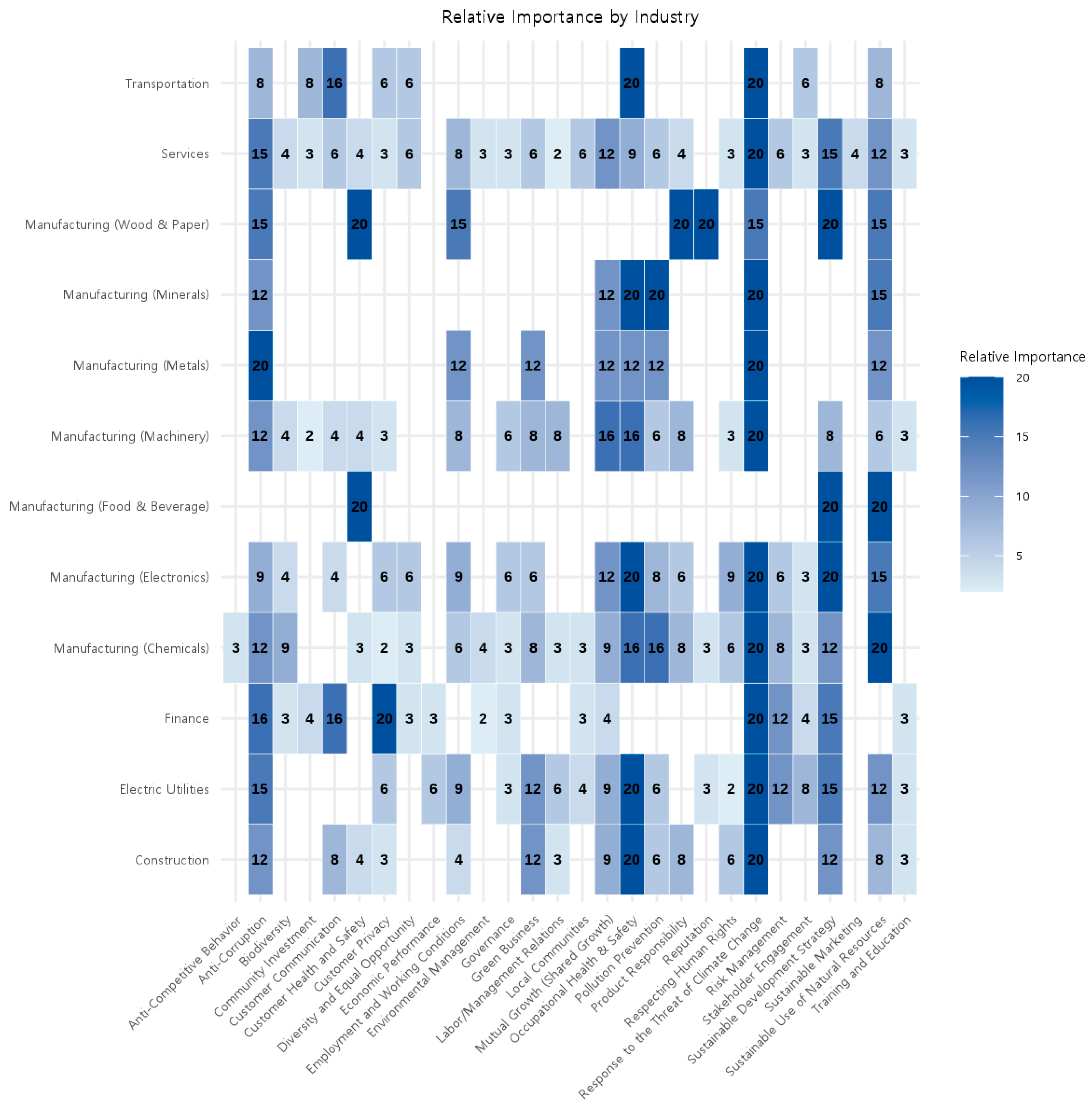
| Industry Sector | Priority 1 | Score | Priority 2 | Score | Priority 3 | Score |
|---|---|---|---|---|---|---|
| Construction | Employee Health and Safety | 20 | Climate Change Response | 20 | Ethical Management | 12 |
| Finance | Consumer Info Protection | 20 | Climate Change Response | 20 | Consumer Communication | 16 |
| Transportation | Employee Health and Safety | 20 | Climate Change Response | 20 | Consumer Communication | 16 |
| Services | Climate Change Response | 20 | Sustainable Management Strategy | 15 | Ethical Management | 15 |
| Electric Utilities | Employee Health and Safety | 20 | Climate Change Response | 20 | Ethical Management | 15 |
| Manufacturing (Minerals) | Climate Change Response | 20 | Employee Health and Safety | 20 | Pollution Prevention | 20 |
| Manufacturing (Metals) | Ethical Management | 20 | Climate Change Response | 20 | Working Condition Improvement | 12 |
| Manufacturing (Machinery) | Climate Change Response | 20 | Employee Health and Safety | 16 | Shared Growth | 16 |
| Manufacturing (Wood/Paper) | Product Responsibility | 20 | Consumer Health and Safety | 20 | Reputation | 20 |
| Manufacturing (Electronics) | Sustainable Management Strategy | 20 | Employee Health and Safety | 20 | Climate Change Response | 20 |
| Manufacturing (Chemicals) | Sustainable Resource Use | 20 | Climate Change Response | 20 | Pollution Prevention | 16 |
| Manufacturing (Food & Beverage) | Sustainable Resource Use | 20 | Sustainable Management Strategy | 20 | Consumer Health and Safety | 20 |
Disclaimer/Publisher’s Note: The statements, opinions and data contained in all publications are solely those of the individual author(s) and contributor(s) and not of MDPI and/or the editor(s). MDPI and/or the editor(s) disclaim responsibility for any injury to people or property resulting from any ideas, methods, instructions or products referred to in the content. |
© 2026 by the authors. Licensee MDPI, Basel, Switzerland. This article is an open access article distributed under the terms and conditions of the Creative Commons Attribution (CC BY) license.
Share and Cite
Kim, Y.; Jeon, E.-c.; Lee, S. A Study on the Priority Evaluation Through the Analysis of the Relative Importance of Key Issues in Sustainable Management in South Korea. Sustainability 2026, 18, 3163. https://doi.org/10.3390/su18073163
Kim Y, Jeon E-c, Lee S. A Study on the Priority Evaluation Through the Analysis of the Relative Importance of Key Issues in Sustainable Management in South Korea. Sustainability. 2026; 18(7):3163. https://doi.org/10.3390/su18073163
Chicago/Turabian StyleKim, Youngnam, Eui-chan Jeon, and Sihyoung Lee. 2026. "A Study on the Priority Evaluation Through the Analysis of the Relative Importance of Key Issues in Sustainable Management in South Korea" Sustainability 18, no. 7: 3163. https://doi.org/10.3390/su18073163
APA StyleKim, Y., Jeon, E.-c., & Lee, S. (2026). A Study on the Priority Evaluation Through the Analysis of the Relative Importance of Key Issues in Sustainable Management in South Korea. Sustainability, 18(7), 3163. https://doi.org/10.3390/su18073163