An Empirical Study on the Coupling of Wetland Ecotourism and Resource–Environmental Carrying Capacity in Dongting Lake Wetland

 ,
,  , and
, and
Abstract
1. Introduction
2. Theoretical Model Construction
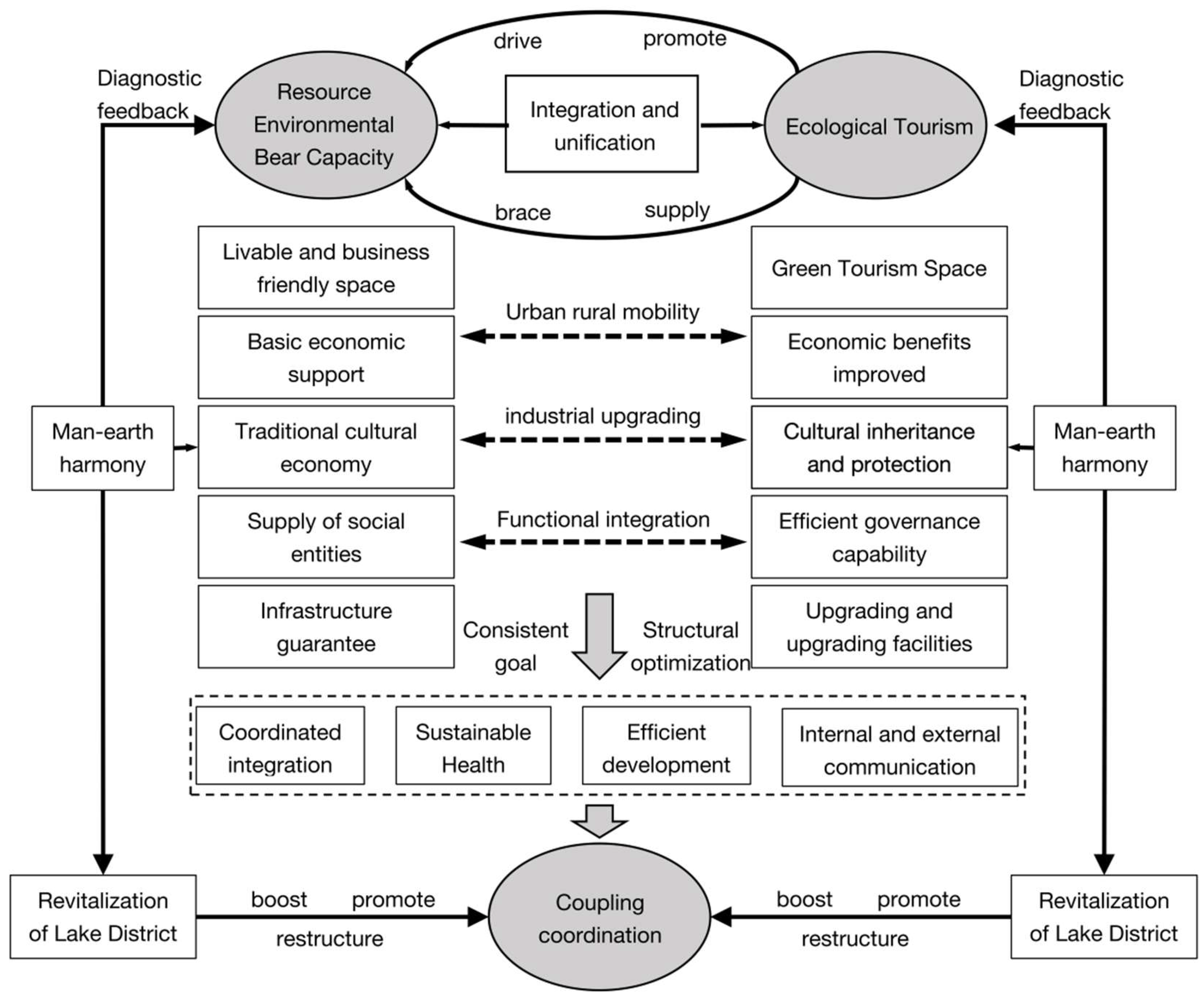
2.1. Coordination Mechanism
2.2. Coupling Coordination Degree Model
3. Indicator System and Weight Determination Method
3.1. Selection of Indicator System
3.2. Weight Determination
- (1)
- Calculate the entropy values of various indicators. If there are m evaluation units and n indicators, and the entropy value of the jth indicator is defined as Ej, the calculation formula is:
- (2)
- Calculate the redundancy of entropy values for various indicators:
- (3)
- Calculate the weights of various indicators:
3.3. Overview of the Research Area and Data Sources
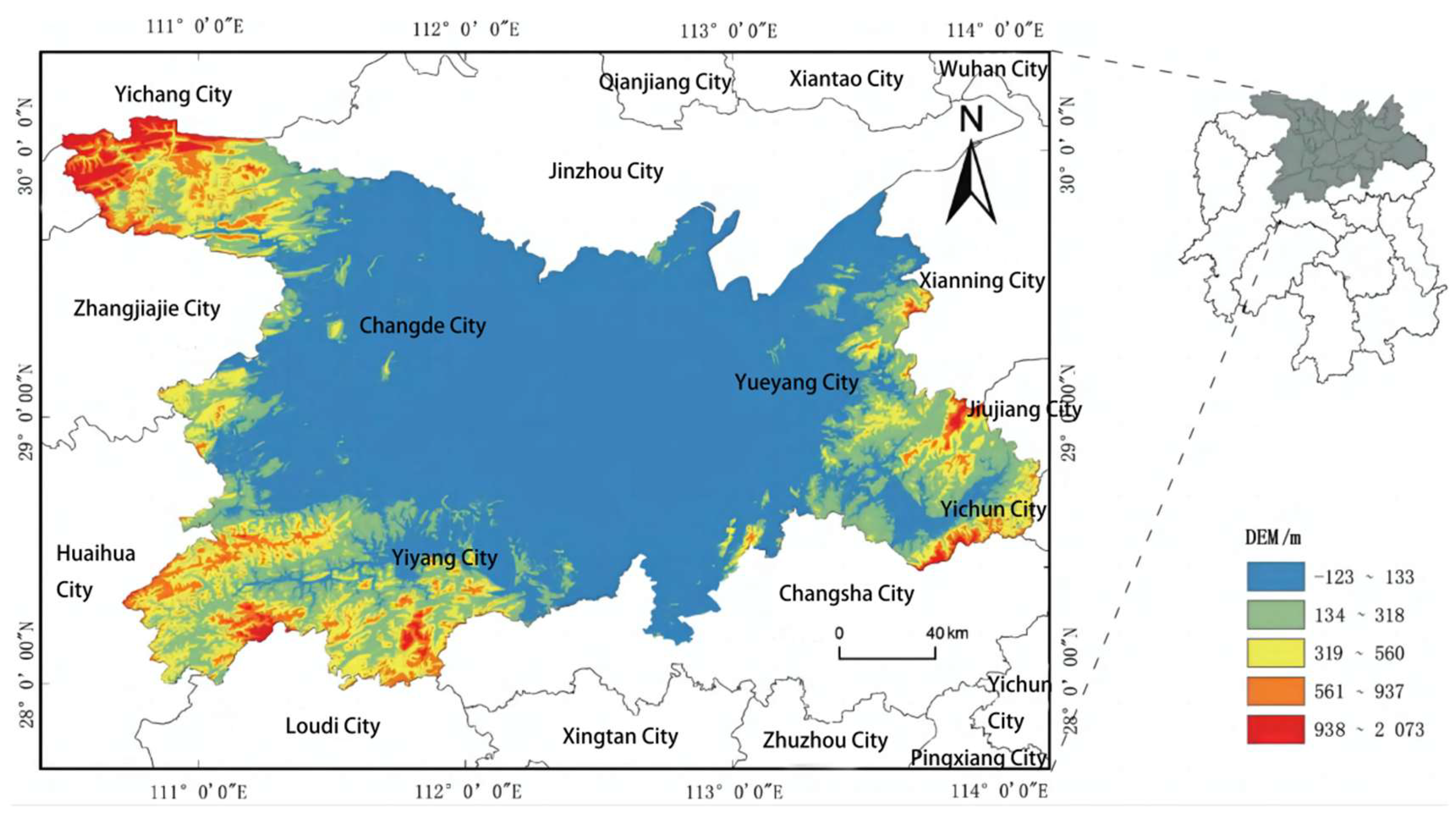
3.3.1. Overview of the Research Area
3.3.2. Data Sources
4. Calculation Results and Analysis
4.1. Coupling Degree Calculation
4.2. Evaluation of Ecotourism and Resource and Environmental Carrying Capacity in Dongting Lake Area
4.2.1. Time Dimension
- (1)
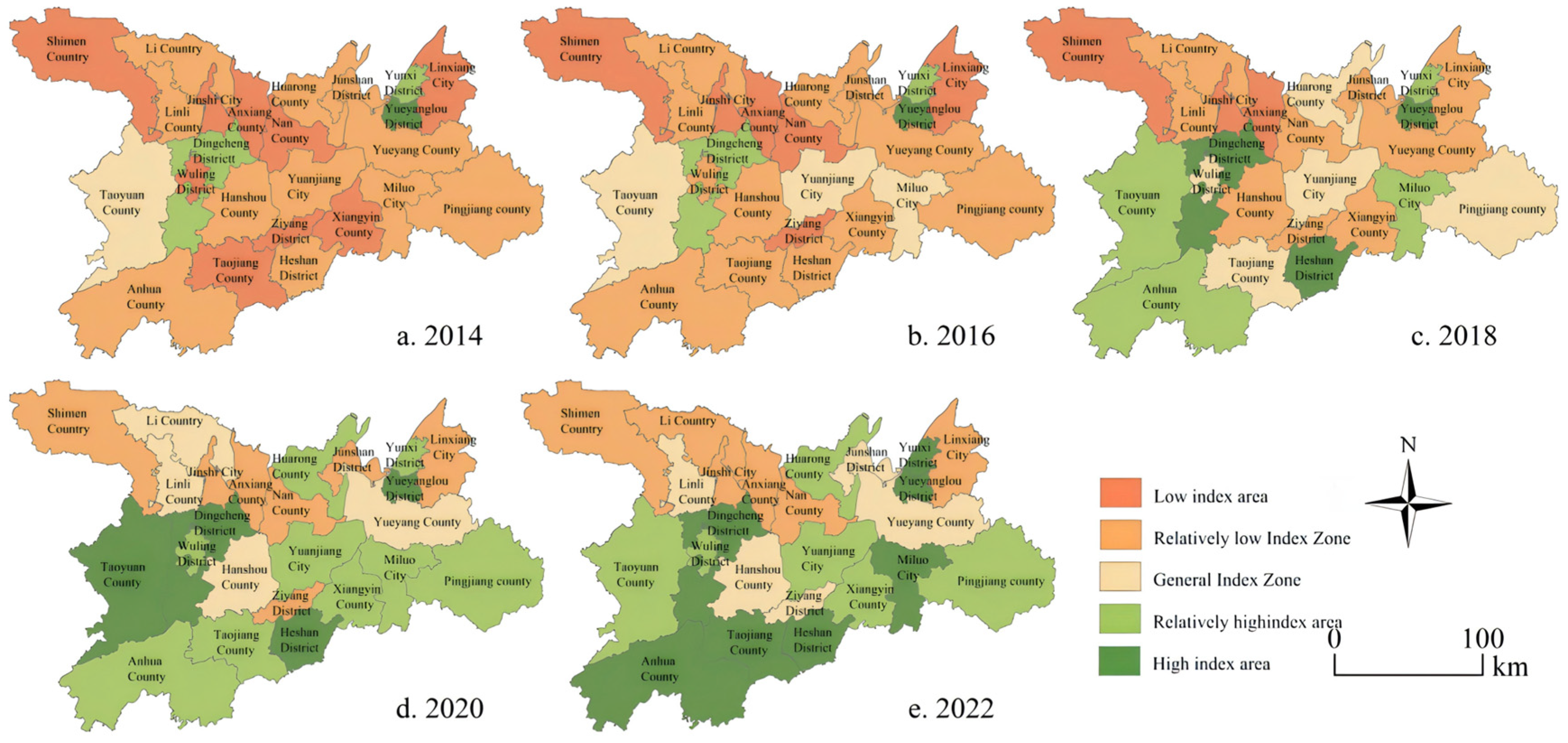
- Evaluation of the Development Level of Ecotourism: From 2014 to 2022, the average quality evaluation index of ecological tourism development in Dongting Lake area increased from 0.1397 to 0.2632. In 2014, there was only one county in the Dongting Lake area that was in a high-index zone, which was Yueyanglou District. There are two counties in the high-index zone, namely Yunxi District and Dingcheng District. There is one general-index area, which is Taoyuan County. There are 11 areas with a lower index. Nine counties are located in low-index areas. The number of low-index areas and low-index counties accounts for 83.33% of the total, and the overall quality of ecotourism urgently needs to be improved(Figure 3). Since 2020, due to the impact of COVID-19, the development of ecotourism has suffered setbacks, so the ecotourism evaluation index has fluctuated, and the growth rate has also decreased compared with previous years. Although affected by the epidemic, the Dongting Lake area, with its good tourism foundation and years of tourism development experience, has adopted forms such as “online tour” and “cloud explanation” to reduce tourism benefits to a certain extent. By 2022, ecological tourism development in the Dongting Lake area will no longer have low-index areas. At the same time, except for Yueyanglou District, a total of seven counties including Yunxi District, Anhua District, Taojiang County, Dingcheng District, Heshan District, and Miluo City have entered the high-index area, with six high-index areas, five general-index areas, and six low-index areas. Additionally, 75% of the counties are already in the general index or above level area, and the overall quality of ecotourism has been significantly improved.
- (2)
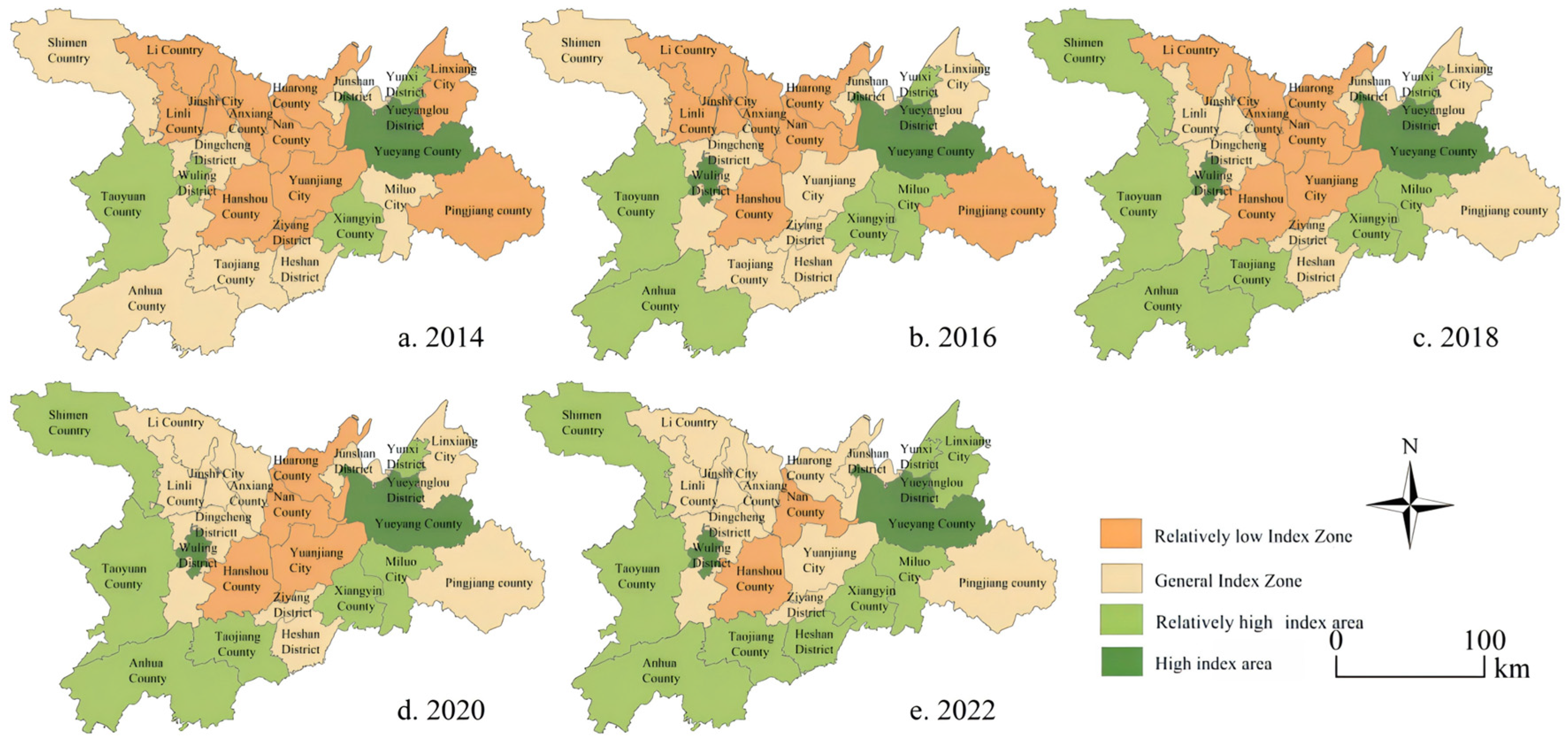
- Evaluation of Resource and Environmental Carrying Capacity Level: From 2014 to 2022, the development trend of resource and environmental carrying capacity quality in the Dongting Lake area was good, and the average evaluation index increased from 0.1835 to 0.2205. In 2014, only Yueyanglou District and Yueyang County in the Dongting Lake area were in the high-index zone. There are four counties in the high-index zone, namely Wuling District, Yunxi District, Xiangyin County, and Taoyuan County. The remaining 18 counties are either general-index areas or low-index areas, accounting for 75% of the total. The overall level of resource and environmental quality in the Dongting Lake area needs to be improved. In 2022, with the continuous improvement of the environment, the resource and environmental carrying capacity score of the Dongting Lake area has significantly increased. Except for Wuling District, Yueyanglou District, and Yueyang County, which have stabilized as high-index areas, the number of counties in high-index areas has risen to nine, and many counties in general-index areas have approached the threshold of high-index areas. By 2022, 50% of counties will be at or above the high index level, and significant achievements will be made in resource and environmental governance (Figure 4).
4.2.2. Spatial Dimensions
4.3. Coupling and Coordination of Ecotourism and Resource and Environmental Carrying Capacity in Dongting Lake Area
4.3.1. Spatiotemporal Patterns of Coupling and Coordination Levels Between Ecotourism and Resource and Environmental Carrying Capacity
4.3.2. Types of Coupled Coordination Stages Between Ecotourism and Resource and Environmental Carrying Capacity
- (1)
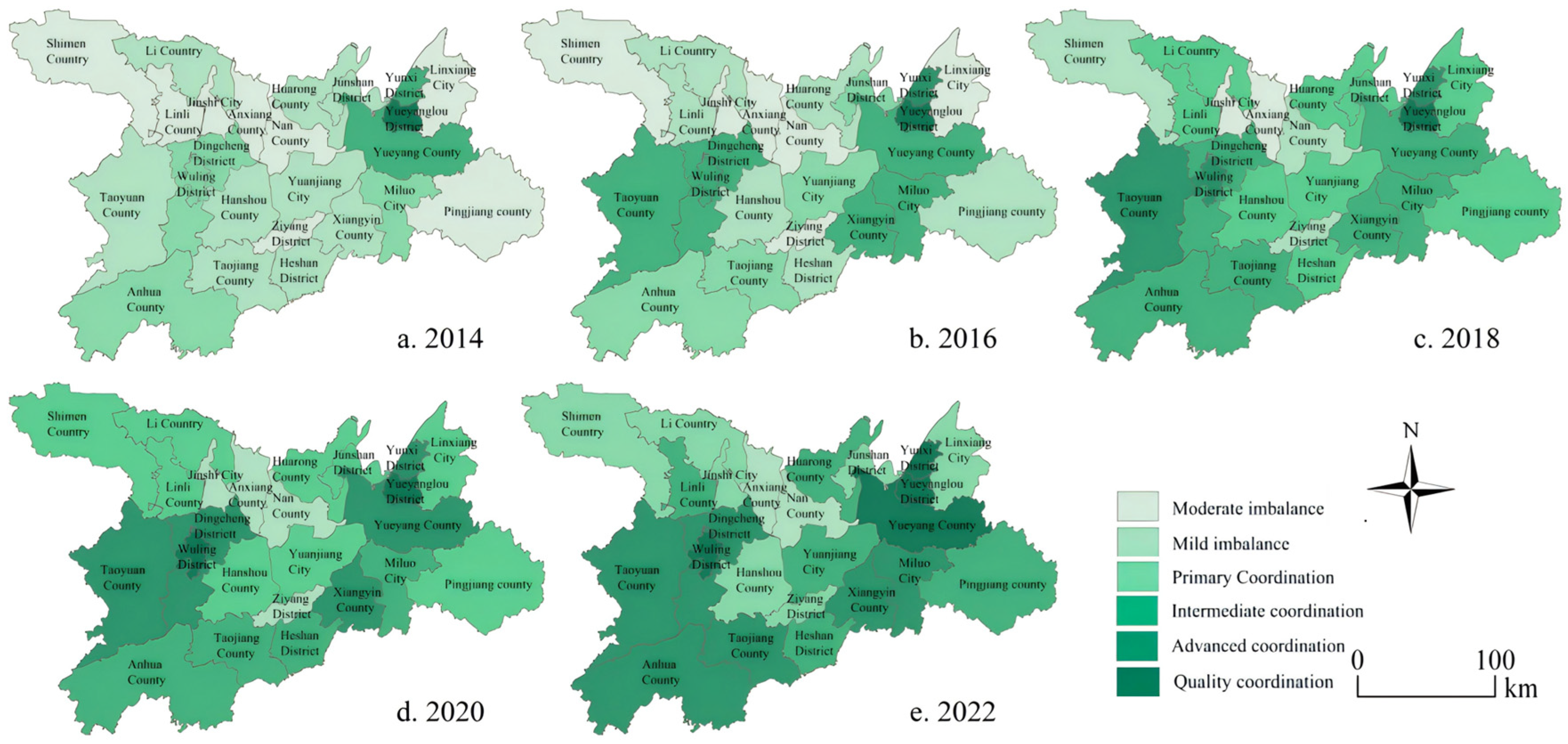
- Coordinated and balanced type: The coupling coordination degree is in the coordination stage. A D value above 0.50 is classified as a coordinated balance type. This type is located in the central part of Dongting Lake area, mostly adjacent to water bodies, with abundant water resources, good agricultural foundation, excellent air quality, and abundant ecological resources, providing a solid foundation for the development of the resource environment and ecological tourism. The evaluation index of ecological tourism and resource–environment carrying capacity are both high and maintain synchronous growth. At the same time, the ecological tourism resources in this type of area are relatively abundant, with 5A-level tourist attractions such as Yueyang Tower. The tourism development is early and the degree of openness is high. The abundant tourism resources have enabled the area to achieve good overall planning, and various elements have achieved a virtuous cycle. The evaluation index and coupling coordination level are both at the leading level in the 24 counties of Dongting Lake.
- (2)
- Well-adapted type: The coupling coordination degree is in the adaptation stage, and those with a D value between 0.40 and 0.50 are classified as the well-adapted type. The evaluation index of ecological tourism and resource and environmental carrying capacity in this type shows a state of “one high and one low”. For example, the evaluation index of resource and environmental carrying capacity in counties represented by Linxiang City and Jinshi City is relatively high, while the evaluation index of ecological tourism development is relatively low. The evaluation index of resource and environmental carrying capacity in counties represented by Pingjiang County and Yuanjiang City is relatively low, but the evaluation index of ecological tourism development is relatively high. The low level of economic development in this type of county has to some extent constrained the coordinated development of ecotourism and resource and environmental carrying capacity. For this type of county, it is necessary to strengthen the coordination and interaction with development and promote the high-level development of its coupling and coordination level.
- (3)
- Imbalance lag type: The coupling coordination degree is in the stage of imbalance, and those with a D value below 0.40 are classified as the imbalance lag type. The evaluation index of ecological tourism and resource and environmental carrying capacity in this type is relatively low, and the development is relatively lagging behind. Due to the late promotion of ecological tourism resource development, lagging infrastructure development, inconvenient transportation conditions, and serious population outflow in this type of county, the driving force for ecological tourism development and resource and environmental remediation is insufficient. It is difficult for various development factors to achieve efficient interaction, and the evaluation index and coupling coordination level are both lagging behind. However, the transportation location advantages of this type of county are obvious, with north–south and east–west transportation arteries passing through. For this type of county, it is necessary to strengthen the complementary advantages with surrounding counties and promote the improvement of evaluation index and coupling coordination level.
5. Discussion
5.1. Interpreting the Spatiotemporal Dynamics
5.2. Dialogue with Existing Literature
5.3. Implications for Differentiated Development
5.4. Limitations and Future Directions
6. Conclusions
- (1)
- Temporal Evolution: The region has achieved a definitive transition from “mild imbalance” to “primary coordination.” This trajectory validates the efficacy of the “Yangtze River Protection” strategy, confirming that strict ecological redlining has successfully reversed the degradation trends of the previous decade and initiated a synchronous improvement in both tourism quality and environmental capacity.
- (2)
- Spatial Heterogeneity: A distinct “center-periphery” disparity has been identified. High-level coordination is heavily concentrated in economically mature central districts, while resource-rich but economically peripheral counties remain trapped in lower coordination levels. This confirms that natural endowment alone is insufficient for sustainable development; economic infrastructure serves as the essential prerequisite for translating ecological assets into coordinated development.
- (3)
- Typological Differentiation: The region comprises three distinct evolutionary stages—coordinated, well-adapted, and lagging. This classification deconstructs the feasibility of uniform regional policies, establishing that the primary development bottleneck shifts from infrastructure deficits in lagging areas to operational inefficiencies in adapting areas and finally to carrying capacity limits in coordinated areas.
Author Contributions
Funding
Institutional Review Board Statement
Informed Consent Statement
Data Availability Statement
Acknowledgments
Conflicts of Interest
References
- Qiu, W.; Zhao, Y. Status of Wetland Protection in Poyang Lake Region and Its Main Influencing Factors. J. Northeast For. Univ. 2025, 53, 122–126. [Google Scholar]
- Zhu, C.; Cao, J. Research progress and prospects of ecotourism. Chin. J. Eco-Agric. 2022, 30, 1698–1708. [Google Scholar] [CrossRef]
- Xu, L.; Ao, C.; Mao, B.; Cheng, Y.; Sun, B.; Wang, J.; Liu, B.; Ma, J. Which Is More Important, Ecological Conservation or Recreational Service? Evidence from a Choice Experiment in Wetland Nature Reserve Management. Wetlands 2020, 40, 2381–2396. [Google Scholar] [CrossRef]
- Dushani, S.N.; Aanesen, M.; Armstrong, C.W. Willingness to Pay for Mangrove Restoration to Reduce the Climate Change Impacts on Ecotourism in Rekawa Coastal Wetland, Sri Lanka. J. Environ. Econ. Policy 2023, 12, 19–32. [Google Scholar] [CrossRef]
- Zhao, N.; Song, J. Research on the Status Quo and Countermeasures of Ecotourism Development under the Background of Rural Revitalization. Rural Econ. Sci. Technol. 2023, 34, 130–133. [Google Scholar]
- Chen, L.; Tan, J.; Song, H. Research on the High-quality Development of Ecotourism in the Mountainous Areas of Southern Tibet. China Tibetol. 2023, 155–162. [Google Scholar]
- Wang, Z.; Chen, Q. Verification of Interactive Stress Relationship and Coordination Effect between Tourism Industry and Ecological Environment in the Yangtze River Economic Belt. Resour. Environ. Yangtze Basin 2021, 30, 2581–2593. [Google Scholar] [CrossRef]
- Zhu, Y.; Zhang, R.; Gu, J.; Gao, Z. Spatiotemporal Evolution and Driving Mechanism of Ecological Well-being Performance in the Urban Agglomeration of the Middle Reaches of the Yangtze River under the Carbon Peaking and Carbon Neutrality Goals. Prog. Geogr. 2022, 41, 2231–2243. [Google Scholar] [CrossRef]
- Sahahiri, R.M.; Griffin, A.L.; Sun, Q. Investigating Ecotourism Opportunities Measurements in a Complex Adaptive System: A Systematic Literature Review. Sustainability 2023, 15, 2678. [Google Scholar] [CrossRef]
- Ma, Z.; Duan, X.; Wang, L.; Wang, Y. Spatial Coupling Characteristics of Regional Development and Resource-Environmental Carrying Capacity in the Yangtze River Economic Belt and High-Quality Development Path. Resour. Environ. Yangtze Basin 2022, 31, 1873–1883. [Google Scholar] [CrossRef]
- Zhang, H. Suggestions on the Development of Forest Ecotourism in Shanxi Province. Shanxi For. 2023, 4, 10–11. [Google Scholar] [CrossRef]
- Ma, Z.; Duan, X.; Wang, L.; Wang, Y.; Yan, W.; Wang, H.; Ju, X. Evaluation of China’s Rural Resource and Environmental Carrying Capacity Based on the ZI–CI–GI Framework. Ecol. Indic. 2025, 171, 113174. [Google Scholar] [CrossRef]
- Shi, W.; Sun, Y.; Wang, J.; Lin, X.; Wu, S. Spatiotemporal Coordination Analysis of Resource and Environment Carrying Capacity and Social Development under Multi-functional Orientation: A Case Study of Counties in Fujian Province. Acta Ecol. Sin. 2025, 45, 4803–4817. [Google Scholar] [CrossRef]
- Zhang, W.; Shi, P.; Zhao, W.; Huang, W. Spatiotemporal Differentiation and Obstacle Factor Diagnosis of Resources and Environment Carrying Capacity in Lanzhou-Xining Urban Agglomeration in the Upper Reaches of the Yellow River. Chin. J. Appl. Ecol. 2022, 33, 2501–2510. [Google Scholar] [CrossRef]
- Yoon, S.-E.; Lee, K.-J. The Effect of Ecotourism Knowledge on Residents’ Attitudes in Otavalo, Ecuador: The Knowledge Theory of Attitude. J. Hosp. Tour. Insights 2023, 6, 174–190. [Google Scholar] [CrossRef]
- Zhao, R.; Long, D.; Yang, M.; Fan, X. From Resettlement to Revitalization: Examining the Water Resource Environment Carrying Capacity of Ecological Migrant Resettlement Areas in China. Ecol. Indic. 2024, 160, 111879. [Google Scholar] [CrossRef]
- Kovács, Z.; Farkas, J.Z.; Szigeti, C.; Harangozó, G. Assessing the Sustainability of Urbanization at the Sub-National Level: The Ecological Footprint and Biocapacity Accounts of the Budapest Metropolitan Region, Hungary. Sustain. Cities Soc. 2022, 84, 104022. [Google Scholar] [CrossRef]
- Sadri-Shojaei, S.; Momeni, M.; Kerachian, R. A Novel Methodology for Assessing Resources and Environmental Carrying Capacity with Emphasis on Ecosystem Services: A Multi-Disciplinary Approach to Sustainable Urban Planning. J. Environ. Manag. 2025, 373, 123507. [Google Scholar] [CrossRef]
- Peng, Y.; Tan, X.; Zhu, Z.; Liao, J.; Xiang, L.; Wu, F. Evaluation of Resource and Environmental Carrying Capacity at Provincial Level in China Using a Pressure–Support–Adjustment Ternary System. Sustainability 2024, 16, 8607. [Google Scholar] [CrossRef]
- Zhang, M.; Tan, S.; Zhou, J.; Wang, C.; Liu, F. Analyzing Resource and Environment Carrying Capacity of Kunming City Based on Fuzzy Matter–Element Model. Sustainability 2023, 15, 10691. [Google Scholar] [CrossRef]
- Tong, C.; Jin, Y.; Liang, B.; Ye, Y.; Bao, H. A Comprehensive Framework for Monitoring and Providing Early Warning of Resource and Environmental Carrying Capacity Within the Yangtze River Economic Belt Based on Big Data. Land 2024, 13, 1993. [Google Scholar] [CrossRef]
- Yin, H.; Qi, Q.; Wu, Y.; Yan, J.; Shi, R. Assessment and Early Warning of the Coupled Carrying Capacity of Water Resources, Environment, and Ecology: A Case Study of Ordos. Ecol. Indic. 2025, 180, 114346. [Google Scholar] [CrossRef]
- Wang, Y.Y.; Li, Y.P.; Huang, G.H.; Xu, Z.P.; Li, Y.F. Bayesian Multistage Factorial Analysis for Unveiling Multi-Indicator Effects on Synergistic Carrying Capacity of Water Resource, Environment and Ecology: A Case Study of Ordos. Ecol. Indic. 2025, 178, 113982. [Google Scholar] [CrossRef]
- Yang, L.; Wang, J.; Zhou, W. Analysis on Coupling Evolution of LUCC and Habitat Quality in Dongting Lake Basin Based on Multi-scenario Simulation. China Environ. Sci. 2023, 43, 863–873. [Google Scholar] [CrossRef]
- Bole, Y.; Rina, S.; Guga, S.; Na, M.; Fan, S.; Zhang, J. Evaluation of Resources, Environment, and Ecological Carrying Capacity from the Perspective of “Production-Living-Ecology” Spaces: A Case Study of Western Jilin Province, China. J. Clean. Prod. 2025, 491, 144770. [Google Scholar] [CrossRef]
- Chen, D.; Lu, X.; Zhang, C.; Zhang, Y.; Liao, D.; Li, J. Correction: Measuring and Enhancing the Effectiveness of Regional Integration Policies for Resource and Environmental Carrying Capacity. Humanit. Soc. Sci. Commun. 2025, 12, 1332. [Google Scholar] [CrossRef]
- Ye, S.; Wei, C.; Wang, Z. Coupling Coordination between Resource and Environmental Carrying Capacity and Social Development Quality and Its Influence Mechanism. Ecol. Indic. 2025, 179, 114151. [Google Scholar] [CrossRef]
- Chen, F.; Zhong, Y.; Zhang, H.; He, P. Study on Development and Utilization of Ecotourism Resources in South Dongting Lake. J. Cent. South For. Univ. 1999, 67–70. [Google Scholar] [CrossRef]
- Zhuang, D.; Dong, M. Study on Development Model of Wetland Ecotourism Resources in Dongting Lake Area. Hum. Geogr. 2002, 73–76. [Google Scholar] [CrossRef]
- Ren, X.; Du, Y.; Wang, X. Study on Wetland Ecological Degradation in South Dongting Lake. J. Cent. China Norm. Univ. (Nat. Sci. Ed.) 2006, 128–131. [Google Scholar] [CrossRef]
- Zhang, Y.; Shen, L.; Shuai, C.; Bian, J.; Zhu, M.; Tan, Y.; Ye, G. How Is the Environmental Efficiency in the Process of Dramatic Economic Development in the Chinese Cities? Ecol. Indic. 2019, 98, 349–362. [Google Scholar] [CrossRef]
- Dong, M.; Zhu, Y.; Zhuang, D. Study on Protection and Development of Wetland Ecotourism Resources in the Dongting Lake Area. Resour. Sci. 2001, 23, 82–86. [Google Scholar]
- Xiong, J.; Wang, W.; He, S.; Yin, Y.; Tang, C. Spatiotemporal Pattern and Influencing Factors of Coupling Coordination of Tourism Urbanization System in Dongting Lake Area. Sci. Geogr. Sin. 2020, 40, 1532–1542. [Google Scholar] [CrossRef]
- Yang, F. Evolution of Agricultural Development Mode in Dongting Lake Eco-economic Zone under the Background of Collaborative Coupling of Agricultural Information Technology Progress and Institutional Change. J. Agric. 2019, 9, 96–100. [Google Scholar]
- Qiao, F. Study on Spatial Coupling Relationship between Population and Economy in Dongting Lake Eco-economic Zone. Econ. Res. Guide 2015, 63–67. [Google Scholar]
- Liu, Y.; Long, H.; Li, Y. New Recognition of Global Rural-Urban Relationship and Research on Human Geography. Acta Geogr. Sin. 2021, 76, 2869–2884. [Google Scholar] [CrossRef]
- Geng, R.; Luan, Z. Spatiotemporal Evolution of Coupling Coordination between Tourism Industry and Ecological Environment in Provinces of China. J. Cent. South Univ. For. Technol. 2022, 42, 191–201. [Google Scholar] [CrossRef]
- Zhu, Z.; Zhan, Y.; Jiang, J.; Li, H. Comparative Analysis of Resources and Environment Carrying Capacity Literature at Home and Abroad: Status Quo and Hotspots. J. Liaoning Norm. Univ. (Nat. Sci. Ed.) 2020, 43, 532–542. [Google Scholar]
- Wolters, T. Why Is Ecological Sustainability so Difficult to Achieve? An In-context Discussion of Conceptual Barriers. Sustain. Dev. 2022, 30, 2025–2039. [Google Scholar] [CrossRef]
- Yang, L.; He, X.; Yao, Q.; Dai, D. Construction of the Evaluation Index System and Identification of the Dominant Limiting Factor of the District-county Resource Environmental Bearing Capacity: A Case of Jiangjin District in Chongqing. Sci. Technol. Manag. Land Resour. 2020, 37, 1–12. Available online: https://gtkjgl.cdut.edu.cn/article/id/gtzykjgl_202005001 (accessed on 8 March 2026).
- Wang, S.; Huang, L.; Xu, X.; Li, J. Spatiotemporal Differentiation of Ecological Space and Its Ecological Carrying Status in Megalopolises. Acta Geogr. Sin. 2022, 77, 164–181. [Google Scholar] [CrossRef]
- Xiong, J.; Chen, D.; Peng, B.; Deng, S.; Xie, X. Spatiotemporal Differentiation of Coupling Coordination Degree of Ecological Carrying Capacity System in Dongting Lake Area. Sci. Geogr. Sin. 2014, 34, 1108–1116. [Google Scholar] [CrossRef]
- Rasoolimanesh, S.M.; Roldán, J.L.; Jaafar, M.; Ramayah, T. Factors Influencing Residents’ Perceptions toward Tourism Development: Differences across Rural and Urban World Heritage Sites. J. Travel Res. 2017, 56, 760–775. [Google Scholar] [CrossRef]
- Fu, X.; Wang, J.; Yin, H.; Zhao, X.; Ding, X.; Huang, J.; Fang, Y. Study on Coupling Mechanism of Wetland Ecotourism and Resources and Environment Carrying Capacity: A Case Study of Dongting Lake Area. Resour. Environ. Yangtze Basin 2025, 34, 2249–2263. [Google Scholar] [CrossRef]
- Duan, L. Evaluation of Resources and Environment Carrying Capacity in Dongting Lake Eco-Economic Zone. Master’s Thesis, Hunan Normal University, Changsha, China, 2020. [Google Scholar]
- Zhou, C. Research on Total Factor Eco-Efficiency of Dongting Lake Eco-Economic Zone Based on Ecological Footprint. Master’s Thesis, Hunan Normal University, Changsha, China, 2018. [Google Scholar]
- Zhang, J.; Li, T.; Wang, W. Quantitative Analysis of Coupling Status of Man-land Relationship Areal System in Weihe River Basin. J. Arid Land Resour. Environ. 2010, 24, 34–39. [Google Scholar] [CrossRef]
- Wang, C.; Hou, Y.; Xue, Y. Water Resources Carrying Capacity of Wetlands in Beijing: Analysis of Policy Optimization for Urban Wetland Water Resources Management. J. Clean. Prod. 2017, 161, 1180–1191. [Google Scholar] [CrossRef]
- Ren, B.; Sun, B.; Shi, X.; Zhao, S.; Wang, X. Analysis of the Cooperative Carrying Capacity of Ulan Suhai Lake Based on the Coupled Water Resources–Water Environment–Water Ecology System. Water 2022, 14, 3102. [Google Scholar] [CrossRef]
- Wang, X.; Zhang, S.; Gao, C.; Tang, X. Coupling Coordination and Driving Mechanisms of Water Resources Carrying Capacity under the Dynamic Interaction of the Water-Social-Economic-Ecological Environment System. Sci. Total Environ. 2024, 920, 171011. [Google Scholar] [CrossRef]
- Zhou, F.; Zhang, W.; Jiang, A.; Peng, H.; Li, L.; Deng, L.; Sun, Y.; Wang, H. Spatial-Temporal Variation Characteristics and Coupling Coordination of the “Water Resources—Water Environment—Water Ecology” Carrying Capacity in the Three Gorges Reservoir Area. Ecol. Indic. 2023, 154, 110874. [Google Scholar] [CrossRef]
- Wang, J.; Wang, Z.; Fu, Z.; Fang, Y.; Zhao, X.; Ding, X.; Huang, J.; Liu, Z.; Fu, X.; Liu, J. Spatial-Temporal Evaluation and Prediction of Water Resources Carrying Capacity in the Xiangjiang River Basin Using County Units and Entropy Weight TOPSIS-BP Neural Network. Sustainability 2024, 16, 8184. [Google Scholar] [CrossRef]
- Khani, S.; Emadzadeh, M.; Mahjouri, N.; Behboudian, M. A Novel Framework for Evaluating Water Resources and Environmental Carrying Capacity under Climate Change: The Zarrinehrud Basin Experience. Environ. Sustain. Indic. 2025, 27, 100810. [Google Scholar] [CrossRef]
- Hsu, W.-L.; Shen, X.; Xu, H.; Zhang, C.; Liu, H.-L.; Shiau, Y.-C. Integrated Evaluations of Resource and Environment Carrying Capacity of the Huaihe River Ecological and Economic Belt in China. Land 2021, 10, 1168. [Google Scholar] [CrossRef]
- Dai, R.; Xiao, C.; Liang, X.; Yang, W.; Chen, J.; Zhang, L.; Zhang, J.; Yao, J.; Jiang, Y.; Wang, W. Spatial-Temporal Evolution Law Analysis of Resource and Environment Carrying Capacity Based on Game Theory Combination Weighting and GMD-GRA-TOPSIS Model. Evidence from 18 Cities in Henan Province, China. J. Clean. Prod. 2024, 439, 140820. [Google Scholar] [CrossRef]
- Luo, Y.; Xiang, P.; Liu, J.; Cheng, H.; Ji, J. Evaluation of Resource and Environmental Carrying Capacity of Chengdu-Chongqing Urban Agglomeration Based on GMD-GRA-TOPSIS. Environ. Sci. Technol. 2024, 47, 178–186. [Google Scholar] [CrossRef]
- Xu, C.; Yang, L. Evaluation of Land Resources Carrying Capacity Based on Entropy Weight and Cloud Similarity. Sci. Rep. 2024, 14, 9050. [Google Scholar] [CrossRef]
- Zhou, L.; Hu, X. Research on Evaluation of Industrial Resources and Environment Carrying Capacity Based on Entropy Weight TOPSIS Model: A Case Study of Xinyu City. Environ. Eng. 2023, 41, 783–786, 793. [Google Scholar]
- Hediger, W. Weak and Strong Sustainability, Environmental Conservation and Economic Growth. Nat. Resour. Model. 2006, 19, 359–394. [Google Scholar] [CrossRef]
- Han, Z. An Empirical Analysis of the Impact of Agricultural Sci-tech Human Capital on Agricultural Economic Growth: Taking Shandong Province as an Example. J. Shandong Univ. (Philos. Soc. Sci.) 2011, 86–92. [Google Scholar]
- Chen, M.; Lu, D.; Zhang, H. Comprehensive Evaluation of China’s Urbanization and Analysis of Its Dynamic Factors. Acta Geogr. Sin. 2009, 64, 387–398. [Google Scholar]
- Chen, L.; Lu, Z. Discussion on Watershed Ecological Economic Management and Its Indicator System. Ecol. Econ. 1992, 16–22. [Google Scholar]
- Yang, B. Research on Regional Eco-efficiency in China from 2000 to 2006: Empirical Analysis Based on DEA Method. Econ. Geogr. 2009, 29, 1197–1202. [Google Scholar] [CrossRef]
- Wang, Z.; Zou, P.; Li, H.; Zhang, B.; Gao, J. Path of Regional Coordinated Development in the Yellow River Basin from the Perspective of Economy-Energy-Water Nexus. China Popul. Resour. Environ. 2022, 32, 10–19. [Google Scholar]
- Song, W.; Bai, C.; Liao, W.; Zhou, R. Research on Coupling Coordination between Economic Development Level and Residents’ Quality of Life in the Yangtze River Delta Region. Resour. Environ. Yangtze Basin 2013, 22, 1382–1388. [Google Scholar]
- Wang, C.; Long, Z.; Fan, R. Adaptability Evaluation and Obstacle Factors Analysis of Rural Production Space System in Jiangjin District, Chongqing. Geogr. Res. 2020, 39, 1609–1624. [Google Scholar] [CrossRef]
- Huang, H.; Li, Y.; Qiao, X. Evaluation of Agricultural Circular Economy and Analysis of Obstacle Factors Based on IUOCE: A Case Study of Jiangxi Province. Chin. J. Eco-Agric. 2018, 26, 916–925. [Google Scholar] [CrossRef]
- Tang, L.; Long, H.; Yang, J.; Pan, X. Obstacle Diagnosis of Rural Human Settlements and Rural Tourism Development in the Dongting Lake Area and Their Coupling Coordination. Econ. Geogr. 2023, 43, 211–221. [Google Scholar] [CrossRef]
- Wang, S.; Fang, C.; Wang, Y. Quantitative Measurement of Interactive Coupling Relationship between Urbanization and Ecological Environment in Beijing-Tianjin-Hebei Region. Acta Ecol. Sin. 2015, 35, 2244–2254. [Google Scholar] [CrossRef]
- Zhu, X.; Wang, H.; Wu, Y.; Yu, Y. Research on the Coupling Coordination Degree of Urbanization and Eco-environment of the Urban Agglomeration in the Middle Reaches of the Yangtze River Based on Google Earth Engine. Resour. Environ. Yangtze Basin 2022, 31, 2706–2717. [Google Scholar] [CrossRef]
- Samal, R.; Dash, M. Stakeholder engagement in advancing sustainable ecotourism: An exploratory case study of Chilika Wetland. Discov. Sustain. 2024, 5, 56. [Google Scholar] [CrossRef]
- Sethy, M.K.; Senapati, A.K. Perceptions towards ecotourism practice and the willingness to pay: Evidence from Chilika coastal wetland ecosystem, Odisha. Int. J. Geoheritage Parks 2023, 11, 497–513. [Google Scholar] [CrossRef]
- Shi, H.; Chen, W. Environmental values, face, and ecotourism intention in China: The mediating role of ecotourism attitude and the moderating role of emotional intelligence. J. Hosp. Tour. Manag. 2024, 61, 101–114. [Google Scholar] [CrossRef]



| Interval of D Values for Coupling Coordination | Degree of Coupling Coordination | Developmental Stage |
|---|---|---|
| (0.00–0.35] | Moderate imbalance | Dissonance stage |
| (0.35–0.40] | Mild imbalance | |
| (0.40–0.45] | Primary coordination | Adaptation stage |
| (0.45–0.50] | Intermediate coordination | |
| (0.50–0.55] | Advanced coordination | Coordination stage |
| (0.55–1.00) | Quality coordination |
| System Level | Standardized Level | Standardized Level Weights | Indicator Level | Indicator Level Weights |
|---|---|---|---|---|
| Ecotourism system in the Dongting Lake area A | Extent and benefits of ecotourism development A1 | 0.6782 | Spatial density of tourism A11 | 0.3554 |
| Tourism resource class A12 Area of excursion zone A13 Ecotourism income A14 | 0.0475 0.1952 0.0802 | |||
| Ecotourism infrastructure A2 | 0.1796 | Density of the road network A21 Economic development capacity A22 | 0.0573 0.1026 | |
| Accommodation and food accessibility A23 | 0.0196 | |||
| Ecotourism management A3 | 0.1423 | Average education level of tourism workers A31 | 0.0373 | |
| Environmental protection index of tourist transportation A32 | 0.0438 | |||
| Local people’s perception of wetland ecotourism A33 | 0.0266 | |||
| Ecotourism complaint resolution rate A34 | 0.0346 |
| System Level | Standardized Level | Standardized Level Weights | Indicator Level | Indicator Level Weights |
|---|---|---|---|---|
| Environmental Carrying Capacity System for Wetland Resources B | Natural resources carrying capacity B1 | 0.4040 | Cultivated land area per capita B11 | 0.0251 |
| Annual sunshine hours B12 | 0.0199 | |||
| Water resources per capita B13 | 0.0758 | |||
| Annual precipitation B14 | 0.0202 | |||
| Wetland area per capita B15 | 0.2629 | |||
| Ecological carrying capacity B2 | 0.1161 | The number of days with air quality at or above Level 2B21 | 0.0023 | |
| Air composite index B22 | 0.0181 | |||
| Sewage treatment rate B23 | 0.0208 | |||
| Utilization rate of solid waste B24 | 0.0168 | |||
| Forest coverage rate B25 | 0.0582 | |||
| Socio-economic support B3 | 0.4800 | Green coverage rate of built-up area B31 | 0.0350 | |
| Per capita green park area B32 | 0.0233 | |||
| Urbanization rate B33 | 0.0303 | |||
| Per capita GDP B34 | 0.0799 | |||
| Economic density B35 | 0.3115 |
| City | District/County |
|---|---|
| Yueyang City | Huarong County, Xiangyin County, Miluo City, Yueyang Lou District, Yunxi District, Junshan District, Yueyang County, Linxiang City, Pingjiang County |
| Changde City | Shimen County, Li County, Jinshi City, Linli County, Taoyuan County, Anxiang County, Hanshou County, Dingcheng District, Wuling District |
| Yiyang City | Anhua County, Taojiang County, Nan County, Yuanjiang City, Heshan District, Ziyang District |
| Category | Variable | Symbol | N | Mean | Std. Dev. | Min | Max |
|---|---|---|---|---|---|---|---|
| Raw Indicators | Ecotourism Revenue (108 CNY) | A14 | 216 | 44.32 | 37.53 | 4.12 | 198.6 |
| Raw Indicators | Per Capita Water Resources (m3) | B13 | 216 | 3217.78 | 2289.39 | 753 | 10,936 |
| Raw Indicators | Per Capita GDP (CNY) | B34 | 216 | 58,904.88 | 41,901.38 | 17,840 | 242,991 |
| Evaluation Indices | Ecotourism System Index | 216 | 0.201 | 0.045 | 0.112 | 0.356 | |
| Evaluation Indices | RECC System Index | 216 | 0.205 | 0.032 | 0.15 | 0.28 | |
| Evaluation Indices | Coupling Coordination Degree | 216 | 0.432 | 0.085 | 0.315 | 0.65 |
| Region | Year | |||||||||
|---|---|---|---|---|---|---|---|---|---|---|
| 2014 | 2016 | 2018 | 2020 | 2022 | ||||||
| D Value | The Coupled Coordination Degree | D Value | The Coupled Coordination Degree | D Value | The Coupled Coordination Degree | D Value | The Coupled Coordination Degree | D Value | The Coupled Coordination Degree | |
| Anhua County | 0.40328 | Primary coordination | 0.44448 | Primary coordination | 0.48198 | Intermediate coordination | 0.49631 | Intermediate coordination | 0.51094 | Advanced coordination |
| Anxiang County | 0.30815 | Moderate imbalance | 0.31666 | Moderate imbalance | 0.34199 | Moderate imbalance | 0.36045 | Mild imbalance | 0.36355 | Mild imbalance |
| Dingcheng District | 0.44771 | Primary coordination | 0.46211 | Intermediate coordination | 0.49563 | Intermediate coordination | 0.51082 | Advanced coordination | 0.51614 | Advanced coordination |
| Hanshou County | 0.36980 | Mild imbalance | 0.38308 | Mild imbalance | 0.40303 | Primary coordination | 0.41224 | Primary coordination | 0.42677 | Primary coordination |
| Heshan District | 0.37007 | Mild imbalance | 0.39896 | Mild imbalance | 0.42902 | Primary coordination | 0.48866 | Intermediate coordination | 0.49989 | Intermediate coordination |
| Huarong County | 0.39273 | Mild imbalance | 0.38528 | Mild imbalance | 0.41551 | Primary coordination | 0.44050 | Primary coordination | 0.46487 | Intermediate coordination |
| Jinshi City | 0.29724 | Moderate imbalance | 0.31318 | Moderate imbalance | 0.33972 | Moderate imbalance | 0.38557 | Mild imbalance | 0.40447 | Primary coordination |
| Junshan District | 0.38587 | Mild imbalance | 0.40189 | Primary coordination | 0.42621 | Primary coordination | 0.41759 | Primary coordination | 0.43685 | Primary coordination |
| Li County | 0.38509 | Mild imbalance | 0.37881 | Mild imbalance | 0.40948 | Primary coordination | 0.42331 | Primary coordination | 0.41425 | Primary coordination |
| Linli County | 0.34639 | Moderate imbalance | 0.38346 | Mild imbalance | 0.43282 | Primary coordination | 0.42629 | Primary coordination | 0.45517 | Intermediate coordination |
| Linxiang City | 0.26214 | Moderate imbalance | 0.33620 | Moderate imbalance | 0.41572 | Primary coordination | 0.42781 | Primary coordination | 0.43967 | Primary coordination |
| Miluo City | 0.43315 | Primary coordination | 0.46708 | Intermediate coordination | 0.47674 | Intermediate coordination | 0.49164 | Intermediate coordination | 0.51600 | Advanced coordination |
| Nan County | 0.23251 | Moderate imbalance | 0.25927 | Moderate imbalance | 0.35745 | Mild imbalance | 0.39134 | Mild imbalance | 0.39824 | Mild imbalance |
| Pingjiang county | 0.34883 | Moderate imbalance | 0.38029 | Mild imbalance | 0.44324 | Primary coordination | 0.44266 | Primary coordination | 0.47107 | Intermediate coordination |
| Shimen County | 0.31744 | Moderate imbalance | 0.34004 | Moderate imbalance | 0.37731 | Mild imbalance | 0.41169 | Primary coordination | 0.42045 | Primary coordination |
| Taojiang County | 0.35774 | Mild imbalance | 0.40979 | Primary coordination | 0.46912 | Intermediate coordination | 0.49294 | Intermediate coordination | 0.51494 | Advanced coordination |
| Taoyuan County | 0.45763 | Intermediate coordination | 0.47167 | Intermediate coordination | 0.50815 | Advanced coordination | 0.52060 | Advanced coordination | 0.51828 | Advanced coordination |
| Wuling District | 0.40891 | Primary coordination | 0.47525 | Intermediate coordination | 0.53632 | Advanced coordination | 0.55796 | Quality coordination | 0.56137 | Quality coordination |
| Xiangyin County | 0.38085 | Mild imbalance | 0.46035 | Intermediate coordination | 0.46896 | Intermediate coordination | 0.50084 | Advanced coordination | 0.50904 | Advanced coordination |
| Yuanjiang City | 0.38465 | Mild imbalance | 0.42279 | Primary coordination | 0.42662 | Primary coordination | 0.44026 | Primary coordination | 0.46269 | Intermediate coordination |
| Yueyanglou District | 0.66037 | Quality coordination | 0.73444 | Quality coordination | 0.77026 | Quality coordination | 0.72224 | Quality coordination | 0.71504 | Quality coordination |
| Yueyang County | 0.45173 | Intermediate coordination | 0.46992 | Intermediate coordination | 0.49717 | Intermediate coordination | 0.54556 | Advanced coordination | 0.55295 | Advanced coordination |
| Yunxi District | 0.49540 | Intermediate coordination | 0.50771 | Advanced coordination | 0.51939 | Advanced coordination | 0.52534 | Advanced coordination | 0.55730 | Quality coordination |
| Ziyang District | 0.31291 | Moderate imbalance | 0.34702 | Moderate imbalance | 0.38604 | Mild imbalance | 0.39517 | Mild imbalance | 0.43644 | Primary coordination |
| Year | Ecotourism Index (U) | RECC Index (U2) | Difference (U1 − U2) | Coordination Type Characteristic |
|---|---|---|---|---|
| 2014 | 0.1344 | 0.1815 | −0.0471 | Ecotourism Lagging |
| 2016 | 0.1723 | 0.1922 | −0.0199 | Ecotourism Lagging |
| 2018 | 0.2195 | 0.207 | 0.0125 | Transition/RECC Lagging |
| 2020 | 0.2548 | 0.2168 | 0.038 | RECC Lagging |
| 2022 | 0.259 | 0.2185 | 0.0405 | RECC Lagging |
| Coupling Coordination Type | District/County |
|---|---|
| Coordinated and balanced type | Wuling District, Yueyanglou District, Yunxi District, Yueyang County, Taoyuan County, Anhua County, Taojiang County, Dingcheng District, Xiangyin County, Miluo City |
| Well-adapted type | Shimen County, Li County, Jin City, Hanshou County, Ziyang District, Junshan District, Linxiang City, Linli County, Huarong County, Yuanjiang City, Heshan District, Pingjiang County |
| Imbalance lag type | Nan County |
Disclaimer/Publisher’s Note: The statements, opinions and data contained in all publications are solely those of the individual author(s) and contributor(s) and not of MDPI and/or the editor(s). MDPI and/or the editor(s) disclaim responsibility for any injury to people or property resulting from any ideas, methods, instructions or products referred to in the content. |
© 2026 by the authors. Licensee MDPI, Basel, Switzerland. This article is an open access article distributed under the terms and conditions of the Creative Commons Attribution (CC BY) license.
Share and Cite
Chen, M.; Wang, J.; Fu, X.; Fang, Y.; Wang, H.; Xu, H.; Zhao, P.; Luo, J.; Wu, Y.; Zhu, J. An Empirical Study on the Coupling of Wetland Ecotourism and Resource–Environmental Carrying Capacity in Dongting Lake Wetland. Sustainability 2026, 18, 3158. https://doi.org/10.3390/su18063158
Chen M, Wang J, Fu X, Fang Y, Wang H, Xu H, Zhao P, Luo J, Wu Y, Zhu J. An Empirical Study on the Coupling of Wetland Ecotourism and Resource–Environmental Carrying Capacity in Dongting Lake Wetland. Sustainability. 2026; 18(6):3158. https://doi.org/10.3390/su18063158
Chicago/Turabian StyleChen, Meixuan, Jiacheng Wang, Xiaohua Fu, Yingchun Fang, Hui Wang, Haiyin Xu, Peirui Zhao, Jiahao Luo, Yi Wu, and Jian Zhu. 2026. "An Empirical Study on the Coupling of Wetland Ecotourism and Resource–Environmental Carrying Capacity in Dongting Lake Wetland" Sustainability 18, no. 6: 3158. https://doi.org/10.3390/su18063158
APA StyleChen, M., Wang, J., Fu, X., Fang, Y., Wang, H., Xu, H., Zhao, P., Luo, J., Wu, Y., & Zhu, J. (2026). An Empirical Study on the Coupling of Wetland Ecotourism and Resource–Environmental Carrying Capacity in Dongting Lake Wetland. Sustainability, 18(6), 3158. https://doi.org/10.3390/su18063158