Article

Forging a Symbiosis Framework: An Interdisciplinary Blueprint for Scaling Nature-Based Solutions


1
Faculty of Economics, Keio University, 2-15-45 Mita, Minato-ku, Tokyo 108-8345, Japan
2
Institute for Environment and Development (LESTARI), National University of Malaysia, Bangi 43600, Selangor, Malaysia
3
Department of Political Economy, Polytechnic University of the Philippines, Sta Mesa, Manila 43600, Philippines
*
Author to whom correspondence should be addressed.
Sustainability 2026, 18(6), 3154; https://doi.org/10.3390/su18063154
Submission received: 19 February 2026 / Revised: 18 March 2026 / Accepted: 20 March 2026 / Published: 23 March 2026

Abstract

Despite unprecedented political endorsement, nature-based solutions (NbS) consistently fail to achieve the systemic transformation required for climate and biodiversity crises. This implementation deadlock stems from a profound triple strategic gap: a translational evidence gap between fragmented science and actionable design, a strategic design gap in misaligned institutions, and a fundamental theoretical integration gap disconnecting ecological principles from socio-economic solutions. This study forges and validates the symbiosis framework—an interdisciplinary blueprint designed to bridge this triple gap. Employing design science research, we: (1) synthesize ecological theory with institutional economics to distill three core design principles—functional reciprocity, nested modular network architecture, and strategic leverage and foundational support; (2) translate these into a conceptual model and strategic implementation blueprint; and (3) validate the framework through comparative analysis of global NbS case studies. The resulting framework provides a novel translational logic, moving beyond critique to offer a prescriptive design tool. It enables practitioners to diagnose systemic failures and design interventions that emulate ecological intelligence while applying institutional design principles: cultivating reciprocal partnerships, structuring resilient networks through polycentric governance, and strategically targeting catalytic leverage points and foundational assets. We conclude that scaling NbS requires a paradigm shift from managing isolated symptoms to architecting symbiotic systems. The symbiosis framework provides the essential interdisciplinary blueprint for this shift.

1. Introduction

1.1. The Anthropocene Paradox

The Age of Man (the Anthropocene), decisively marked by humanity’s transformation into a planetary-scale geological force, has ruptured the Earth’s long-standing equilibrium. For roughly 12,000 years, the Holocene Epoch provided a remarkably stable environmental foundation for human civilization, characterized by predictable climate, steady sea levels, and atmospheric CO2 concentrations stabilized between 260 and 280 ppm [1,2]. This stability was shattered by the fossil-fueled Industrial Revolution and decisively terminated by the Great Acceleration of the mid-20th century [3]. The latter period is characterized by a dramatic, non-linear explosion in resource extraction and consumption, and waste under a “take–make–dispose” economic model [4]. This collective activity has now shifted the planet into a proposed new geological epoch, the Anthropocene, where human influence is the dominant driver of change in Earth’s core systems [3,5].
This new era is defined by a profound paradox: the simultaneous ascent of global environmental governance and the relentless acceleration of the very degradation it seeks to halt. Since 1970, at the heart of this acceleration, total greenhouse gas emissions have surged by 129%, with fossil CO2 emissions skyrocketing 151% [6]. Atmospheric CO2 has rocketed from its Holocene baseline of ~279 ppm to 427.18 ppm in 2025, a level not seen in millions of years [7]. Concurrently, the planet’s biophysical foundations are being dismantled: global forest cover has been halved since 1700, and monitored wildlife populations have collapsed by an average of 73% since 1970 [8,9]. We now face the imminent threat of crossing irreversible planetary tipping points, from Amazon dieback to ice sheet collapse, which would unleash catastrophic, non-linear change [10]—the ultimate symptom of the Great Rupture between human systems and planetary boundaries.
In response to this mounting crisis, a sophisticated architecture of multilateral environmental governance has been constructed over the past five decades. This regime, initiated by the 1972 Stockholm Conference, encompasses landmark treaties and forums, including the UN Framework Convention on Climate Change (UNFCCC), the Convention on Biological Diversity (CBD), and the UN Forum on Forests (UNFF) [11,12]. Their evolution reflects a growing international consensus, crystallizing in cornerstone agreements: the Paris Agreement (2015) with its net-zero imperative [13], the Kunming–Montreal Global Biodiversity Framework (2022) with its “30 × 30” target, and the UN Strategic Plan for Forests 2017–2030 [14]. These frameworks represent humanity’s institutional acknowledgment of the crisis and a commitment to steward planetary systems.
Yet, this is the heart of the paradox. Despite this extensive diplomatic machinery and high-level pledges, all key indicators of planetary health continue to trend steeply in the wrong direction. The ambitious targets set within these agreements stand in stark, sobering contrast to the linear graphs of rising emissions, temperatures, and extinction rates. This glaring disconnect reveals a fundamental implementation crisis: the international community has successfully negotiated what must be done but is failing at how to do it at the scale and speed the science demands.

1.2. Diagnosing the Failure: The Triple Gap in Strategy

Conventional analysis often attributes this failure to a flawed economic paradigm of endless extraction and its guiding principle of neoclassical allocative efficiency [15,16]. While not incorrect, this diagnosis is insufficient, treating a symptom rather than the root cause. We contend the paradox is driven by a triple failure in strategic understanding and design:
i.
Translational evidence gap: Policymakers lack coherent frameworks to translate fragmented and geographically biased scientific knowledge into actionable design. Systematic reviews highlight a paucity of studies on cost-effectiveness and socio-ecological trade-offs, particularly in the Global South [17]. A landmark systematic map found that only 15% of studies on NbS for climate impacts originate from the Global South [18], creating an evidence void where the need is greatest. For example, mangrove restoration projects in Southeast Asia frequently fail because designs imported from temperate contexts ignore local hydrology and community governance structures [19,20]. Even where evidence exists, the absence of a structured translational logic—a systematic method to translate ecological principles and existing evidence into design rules—prevents coherent application of NbS tailored to local socio-ecological contexts.
ii.
A strategic design gap: Institutional architectures remain misaligned with the demands of socio-ecological stewardship. Governance remains siloed and short-term, while economic and financial systems are structured by perverse incentives that favor extraction over regeneration [21,22]. Consequently, NbS are often reduced to isolated, symptomatic “projects” that fail to address—and can even inadvertently reinforce—the systemic drivers of degradation. The Asian Deltas assessment found most NbS initiatives operate in isolation, lacking integration into larger ecosystems and failing to establish linkages across scales and objectives [23].
iii.
Theoretical integration gap: The operational wisdom of resilient ecosystems—principles of symbiosis, mutualism, keystone functions, and network stability—remain disconnected from the design of socio-economic solutions [24,25]. While ecological science has elucidated the principles of symbiotic mutualism, keystone leverage, the structuring role of foundation species, and the stability inherent in modular, cooperative networks [24,25], this blueprint for sustainable complexity remains almost entirely absent from the design of human economies, policies, and interventions. The discourse of “working with nature” remains largely metaphorical, lacking a rigorous translational logic to convert ecological principles into actionable institutional and economic design.

1.3. The Research Imperative: Introducing the Symbiosis Framework

This convergence of gaps frames our central research question: How can the operational principles of ecological symbiosis be translated into a strategic design logic to enable the systemic scaling and transformative impact of nature-based solutions? To answer this, we propose and develop the symbiosis framework. This study posits that the critical missing element is not more data on decline, but a translational design tool that bridges ecology and socio-economics. The framework’s core objective is to operationalize the principles of mutualism, reciprocity, and network resilience as actionable guidelines for governance, economic valuation, and restorative practice.
The originality of this contribution is twofold. Theoretically, it offers a novel synthesis, uniquely integrating community ecology, ecosystem science, and institutional economics to model socio-ecological systems through the lens of symbiotic interdependence. The framework’s output is inherently constructive: rather than another critique, it provides a proactive strategic blueprint with evaluative criteria and design pathways. This represents a foundational paradigm shift—from managing environmental symptoms in isolation to fostering systemic health through designed symbiosis.
The importance of this research lies in its direct response to the core implementation crisis of the Anthropocene. By providing a translational design science, the symbiosis framework addresses the fundamental disconnect between the ‘what’ of global agreements and the ‘how’ of effective, scalable implementation. It is significant because it moves beyond diagnosing systemic failure to providing a generative, principle-based methodology for designing socio-ecological systems that are inherently resilient, reciprocal, and scalable. For researchers, it offers a novel interdisciplinary synthesis and a testable hypothesis for scaling. For policymakers and practitioners, it provides the missing strategic blueprint to convert pledges into coherent, ground-level action that aligns human institutions with ecological logic.
This article is structured as follows. First, a detailed literature review (Section 2) consolidates the evidence for the triple gap and positions the symbiosis framework as its necessary synthesis. Second, we outline the interdisciplinary, design-science methodology used to construct and validate the framework (Section 3). Third, the core findings of this design process are presented (Section 4). Fourth, we detail the architecture of the symbiosis framework across two sections: its foundation in the principles of symbiosis and mutualism (Section 5), followed by its grounding in the institutional economics required for implementation (Section 6). Fifth, we demonstrate the framework’s explanatory and diagnostic power through comparative analysis of NbS case studies (Section 7). Sixth, we discuss the framework’s implications for enabling a paradigm shift in sustainability practice, its scholarly contributions, and pathways for operationalizing scalable NbS (Section 8). Finally, we conclude by reaffirming that scaling NbS requires moving from managing symptoms to fostering symbiotic systems, with the symbiosis framework providing the interdisciplinary blueprint to guide this transition (Section 9).

2. Literature Review

Nature-based solutions (NbS) are strategies and actions that work with nature—intentionally using natural and nature-based habitats or natural processes to address societal challenges, such as floods, storms, erosion, and climate risks, while providing benefits for both ecosystems and society [26]. Nature-based Solutions (NbS) are championed for their cost-effectiveness and multi-functionality, positioning them as essential tools for synergistically addressing the twin crises of climate change and biodiversity loss [27]. This promise has secured unparalleled political endorsement, from their inclusion in the Paris Agreement and the Kunming–Montreal Global Biodiversity Framework (GBF) to recognition by the Intergovernmental Panel on Climate Change (IPCC) and Science-Policy Platform on Biodiversity and Ecosystem Services (IPBES) [28,29]. This consensus was cemented by the first universal UN endorsement of NbS in 2022, elevating it to a core strategic pillar for sustainable development [30]. This convergence of scientific potential and high-level policy mandate creates a formidable expectation for NbS to deliver systemic, transformative change. Despite this consensus, a profound implementation gap persists, stemming not from a lack of intent but from three interlocking strategic failures.

2.1. The Translational Evidence Gap

Policy ambition is running ahead of actionable knowledge. Systematic reviews uncover that the evidence base for NbS is not merely fragmented but structurally and geographically inequitable, creating a critical paradox. While lower-income nations in the Global South disproportionately include NbS in their national climate plans, drawing on long traditions of working with nature, the scientific literature on NbS effectiveness remains heavily and systematically biased toward the Global North [17,31,32]. Consequently, the global evidence base is not only geographically skewed but also critically fragmented, with a scarcity of studies that provide the comprehensive, multi-outcome evaluations necessary for integrated planning and investment decisions [27,33]. A landmark systematic map found that only 15% of studies on NbS for climate impacts are from the Global South [32], including major climate-vulnerable nations such as Chile, Colombia, India, Kenya, Nigeria, South Africa, and Vietnam [17,34].
This geographic bias creates a dangerous evidence void precisely where the need is greatest, as these nations often face the highest climate vulnerability [35,36]. While promising, the existing evidence remains selective and context-specific. A recent systematic review of economic evaluations for Disaster Risk Reduction (DRR) and Climate Change Adaptation (CCA) found that 71% of studies indicate that NbS are consistently cost-effective, with mangroves, forests, and coastal ecosystems showing particularly strong results [37]. Furthermore, in direct comparisons with engineered (‘gray’) infrastructure, 65% of studies found NbS to be always more effective, and 26% found them partially more effective. However, this robust evidence base for DRR/CCA is not yet matched by equally rigorous, standardized, and long-term data for other critical applications like watershed management, biodiversity-focused restoration, or climate mitigation.
Consequently, the global policy push for NbS is gravely under-informed by the granular, place-based evidence required for effective deployment in the most reliant contexts [38]. This evidence gap creates a policy vacuum that can enable top-down, externally driven interventions. As shown in a study of urban resilience in Africa, the translation of global environmental frames onto the local level by transnational actors often sidelines local agency and diverse cultural understandings of nature, risking maladaptation and reinforcing socio-political inequities [39].
This translational evidence gap not only hinders robust, scalable NbS investment but also risks perpetuating a form of scientific neocolonialism, where solutions are designed for the Global South based on evidence from the Global North. This leaves policymakers without the validated, context-sensitive knowledge needed to translate high-level NbS commitments into effective, equitable, and large-scale action.

2.2. The Strategic Design Gap

This gap manifests as a fundamental architectural misalignment between human socio-economic systems and ecological imperatives. As a result, NbS are often trapped in a cycle of ‘project-ism’—implemented as isolated, technical interventions rather than integrated landscape strategies [21]. This project-based paradigm is particularly ill-suited to the complex realities of the Global South. It often reflects a top-down, commodified approach driven by external actors, which sidelines local agency, indigenous knowledge, and the existing socio-ecological networks that communities already rely upon [40]. Consequently, such projects fail to connect and scale, remaining as disconnected ‘solutions’ rather than becoming nodes within a resilient, adaptive system.
This fragmentation severely diminishes their potential systemic impact, a problem acutely evident in critical regions. For instance, an assessment of NbS in Asian deltas found that most initiatives are isolated and project-based, lacking integration into the larger ecosystem and failing to establish the necessary linkages between different scales, objectives, and a full portfolio of interventions [23]. This ‘project-ism’ is symptomatic of deeper systemic failures: governance structures are fragmented and misaligned with ecological boundaries, while economic models and financial flows remain anchored to extractive paradigms. This failure is structural and persistent. A comparative analysis of major government-led NbS projects in Germany, China, and Italy found that while transformative elements could emerge in vision and planning, they consistently failed to institutionalize these gains. Successful governance innovations remained ‘ad hoc, short-term, and dependent on local champions,’ lacking the permanent, replicable architecture required for NbS upscaling [41]. These systems often perpetuate the very drivers of degradation that they aim to reverse, creating a fundamental design contradiction [22].

2.3. The Theoretical Integration Gap

Paradoxically, while human design falters, ecological science provides a proven blueprint for resilience. Decades of research into symbiosis, mutualism, keystone and foundation species, and ecological networks have elucidated the non-negotiable principles through which complex systems achieve stability and adaptability [24,25]. Modern analyses demonstrate that mutualistic networks can be powerful stabilizers that boost community resilience, especially after perturbations [42,43], and are fundamental to ecosystem services and human society [44,45,46].
Yet, this profound operational wisdom remains conspicuously absent from the design logics of modern socio-economic systems, which are predicated on competition, extraction, and linear throughput. Economics remains anchored in models of independent actors, failing to capture the mutualistic dynamics that underpin resilient systems. This oversight carries a significant cost: integrated Earth-economy models demonstrate that investing in nature—an operational proxy for symbiotic logic—can generate annual GDP gains of $100–350 billion, with the most substantial relative benefits accruing to the poorest nations [47]. Governance studies rarely apply the stabilizing principles of ecological network theory to design more resilient institutions [48].
Consequently, NbS practice seldom evaluates an intervention’s capacity to foster the symbiotic reciprocity that underpins long-term stability. This represents the most fundamental disconnect: we promote “working with nature” without systematically applying the operating principles of nature, thereby forgoing proven strategies for resilience and equitable prosperity.
This potential exists within an economic landscape rife with contradiction. Over half of global GDP depends on nature, yet governments provide trillions in annual subsidies to sectors that drive its degradation. Simultaneously, funding for conservation and restoration remains orders of magnitude too low [49]. Compounding this economic misalignment is a conceptual one. The sustainability discourse champions the concept of ‘working with nature’ [50,51]. Yet, the design disciplines of economics, governance, and engineering fail to systematically apply nature’s core operating principles. This perpetuates a system that undermines its own biophysical foundation.

2.4. The Critical Disconnect and the Strategic Vacuum

These three gaps—theoretical integration, strategic design, and translational evidence—interact to create a self-reinforcing strategic vacuum at the heart of sustainability governance interact to create a self-reinforcing strategic vacuum at the heart of sustainability governance. We possess sophisticated diagnostics of socio-institutional failures (the design gap) and a well-established body of ecological theory (the integration gap), but lack a connective, operational framework to translate the latter into solutions for the former.
The literature critiques failing institutions but does not redesign them using ecological intelligence; it maps NbS outcomes but does not provide the strategic logic to ensure they rebuild symbiotic, systemic health. While concepts like “regenerative economics” [52] or “biomimicry” [53] point in the right direction, they often remain too philosophically broad or technically narrow to provide a comprehensive framework for upscaling NbS and catalyzing resilient socio-ecological transformation.
This study fills this vacuum by constructing the symbiosis framework—an essential translational and design tool engineered to: (1) integrate deep ecological principles (symbiosis, keystone roles, and network resilience) into a coherent socio-economic design language, closing the theoretical integration gap; (2) provide actionable strategic blueprint to move beyond ‘project-ism’ and redesign institutions for reciprocal outcomes, addressing the strategic design gap; and (3) generate context-sensitive, systemic knowledge on implementation pathways, helping close the translational evidence gap.

3. Materials and Methods

This study employs an interdisciplinary design science research (DSR) methodology to develop the novel symbiosis framework. DSR is a solution-oriented paradigm focused on creating innovative artifacts—such as models, methods, or frameworks—to address identified and generalized problems [54,55,56]. This approach is uniquely suited to tackling the “wicked problem” of scaling nature-based solutions (NbS), as it moves beyond explanatory analysis to prescriptive design [57].

3.1. Research Paradigm: The Design Science Research Cycle

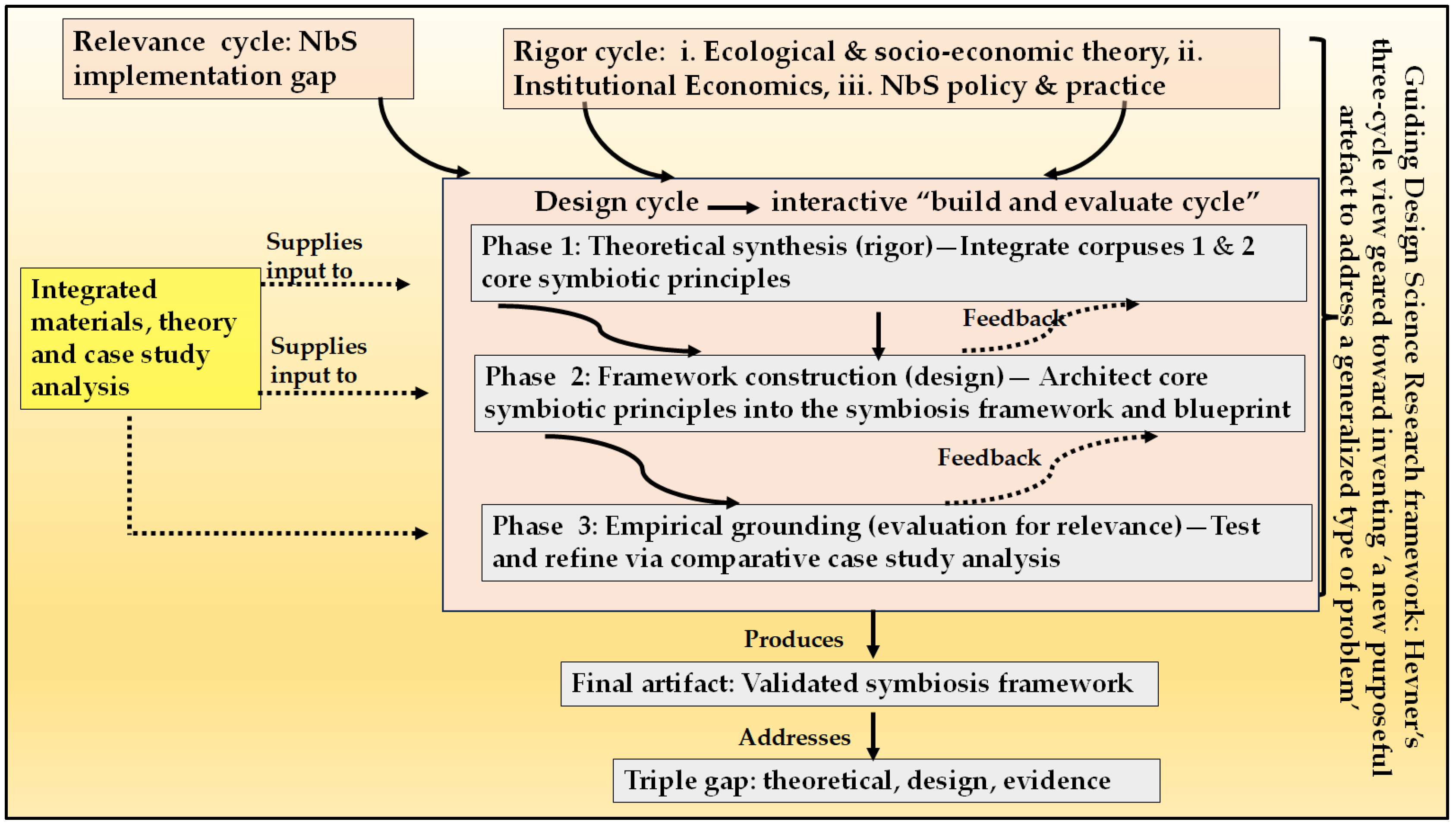
This research follows the established DSR process model by Peffers et al. [58], which provides a formal sequence of activities: problem identification, objective definition, artifact design and development, demonstration, evaluation, and communication. The execution of this process is structured and governed by the following three-cycle view to ensure a balance of core imperatives [55]:
  • The relevance cycle, which grounds the work in the real-world context of the NbS implementation crisis, ensuring the artifact is designed to solve a pressing practical problem.
  • The rigor cycle, which ensures the work is informed by, and contributes to, established knowledge bases of ecological, socio-economic, and institutional theory.
  • The design cycle, which governs the iterative construction, evaluation, and refinement of the framework artifact itself.
This three-cycle structure operationalizes the core DSR principle of an iterative ‘build and evaluate’ process—a process guided by the dual need for both rigor [59] and relevance [60]. Consequently, the research progresses through three integrated phases that map directly onto these cycles and the Peffers model:
»
Theoretical synthesis and problem identification (engaging the rigor cycle),
»
Framework construction and development (the core design cycle activity), and
»
Empirical validation through case study analysis (evaluating the artifact’s utility within the relevance cycle).
This integrated logic is summarized in Figure 1, which visualizes the application of Hevner’s three-cycle paradigm within the Peffers et al. [58] process model.
The integrated design visualized in Figure 1 is applied through three phases.

3.2. Phase 1: Theoretical Synthesis and Core Principle Extraction

This phase performs an interdisciplinary, two-directional synthesis to establish the foundational logic of the framework. The objective is to extract transferable, operational principles from ecological theory and institutional economics that can redress the systemic failures diagnosed in socio-economic praxis. The synthesis is structured around the triangulation of three complementary literature corpuses:
  • Corpus 1: Ecological theory for system design—provides generative models for resilient, complex systems, drawing from:
    »
    Symbiosis and mutualism theory: mechanisms of reciprocal exchange, co-evolution, and interface stability that sustain long-term partnerships [61];
    »
    Keystone and foundation species theory: concepts of disproportionate influence through either regulatory impact (keystone species) [62,63] or structural provision (foundation species) [64,65];
    »
    Ecological network theory (ENT): principles of network architecture—including nestedness, modularity, and hub-based structure—that determine system resilience and vulnerability [48,66].
  • Corpus 2: Institutional and governance theory drawing from:
    »
    Institutional Economics: particularly Ostrom’s principles for common-pool resource governance [67,68], which provide rule-based design criteria for managing interdependence, including proportional equivalence between benefits and costs, nested enterprises, and polycentric governance.
    »
    Governance Theory: concepts of polycentricity, adaptive institutions, and social capital that enable cooperative management of socio-ecological systems [69,70].
  • Corpus 3: NbS Implementation and Policy Praxis—defines the problem context, encompassing:
    »
    The theory and global policy framework of NbS [27,71];
    »
    Documented socio-political and economic barriers to implementation, such as ‘project-ism’ and perverse incentives [17,21,22].
Through an abductive, iterative analysis, the operational logic of Corpus 1 (ecological principles) was translated and aligned with the institutional design rules of Corpus 2 to form a set of core symbiotic principles. This involved: (i) identifying key mechanisms from each ecological theory; (ii) deriving their socio-ecological design implications; and (iii) mapping these implications onto corresponding institutional rules from Ostrom’s framework and governance theory. These principles were explicitly formulated to counter the implementation failures diagnosed in Corpus 3, ensuring the framework is both ecologically grounded and institutionally actionable.

3.3. Phase 2: Framework Construction and Blueprint Formulation

This phase involved the iterative architectural design of the framework artifact itself, following the DSR principle of “build and evaluate.” The core symbiotic principles derived in Phase 1 served as the foundational design axioms. Through successive cycles of modeling, visualization, and conceptual validation, these principles were structured into:
  • The symbiosis framework (conceptual model): A relational schema defining the components and causal linkages of a symbiotic socio-ecological system. This model explicitly connects each ecological principle to its institutional operationalization.
  • The strategic blueprint (actionable guidelines): A translation of the conceptual model into a prescriptive, three-phase process (Diagnosis → Design → Integration) with corresponding evaluative criteria and intervention pathways for practitioners
The construction process was iterative, where initial versions of the framework and blueprint were:
»
Internally evaluated for logical coherence and consistency with source theories.
»
Externally referenced against the documented implementation barriers from Corpus 3 (NbS praxis) to ensure practical relevance.
»
Progressively refined based on insights emerging during the mapping of principles to institutional design rules.
The final artifacts of this design process are presented in Section 4 and Section 5.

3.4. Phase 3: Empirical Grounding and Iterative Refinement

This phase tests the framework’s explanatory power through comparative case study analysis (detailed in Section 7). Three NbS cases were purposively selected based on explicit criteria: (a) representation of different failure/success modes (socio-political failure, mixed success, and technical success); (b) geographic diversity (North America, East Africa, and East Asia); (c) availability of detailed evaluation data from secondary sources; and (d) coverage of different NbS types (flood buyout, payments for ecosystem services, and ecological network planning)
The draft symbiosis framework served as the primary analytical lens. Cases were analyzed using: (1) thematic coding with framework principles as a priori codes; (2) comparative metrices systematically scoring the presence/absence of each principle; (3) negative case analysis; (4) researcher triangulation with two analysts independently coding each case. This process was iterative, with insights creating a feedback loop that informed revisions to both the conceptual framework and strategic blueprint, ensuring the artifact was pragmatically grounded.

3.5. Methodological Considerations

As design science research, this study prioritizes analytical over statistical generalization. The framework’s validity rests on: (a) logical coherence and grounding in established theory; (b) explanatory power across diverse cases; (c) utility for generating actionable design guidance; and (d) transparency of the construction process enabling critique and refinement. This distinguishes the work from a traditional review paper, which synthesizes the existing literature without producing a novel artifact, and from an empirical research paper, which tests hypotheses through statistical analysis. The symbiosis framework is itself the primary contribution—a generative design tool derived from systematic theoretical synthesis and validated through illustrative case applications. While quantitative hypothesis testing is not the aim, available quantitative data from cases (participation rates, connectivity metrics, and program statistics) are incorporated to substantiate qualitative findings.

4. Findings

This section presents the core output of the design-science methodology: the architecture of the symbiosis framework. The findings are structured as three integrated components that together form a translational bridge from ecological theory to actionable design, with institutional economics providing the governance logic for operationalization.

4.1. Core Component 1: Three Symbiotic Design Principles

The theoretical synthesis distilled three core symbiotic principles, each derived from a foundational ecological theory to address a specific socio-ecological design function. These principles are ecologically sourced but are designed to interface with—and be operationalized through—institutional governance systems:
»
Principle 1: Functional reciprocity and managed co-evolution (from symbiosis theory), governing the quality of relationships. It mandates that partnerships be designed for mutual benefits across multiple value dimensions (ecological, social, and economic) and include formal interfaces and adaptive governance, allowing constructive evolution over time. Functional reciprocity is formally defined as the structured, bidirectional exchange of multiple value forms between partners through a dedicated interface, governed by adaptive mechanisms that ensure the relationship remains mutually beneficial over time. Institutional analog—proportional equivalence of benefits and costs [67].
»
Principle 2: Nested, modular network architecture (from ecological network theory), governing the structure of systems. It requires organizing relationships into semi-autonomous modules with clear interconnections, creating nested hierarchies where smaller units are embedded within larger coordinating structures. Institutional analog—polycentric governance and nested enterprises [68].
»
Principle 3: Strategic leverage and foundational support (from Keystone/foundation species theory), governing the strategy of intervention. It distinguishes between catalytic interventions targeting disproportionate influence points (keystone policies and pivotal actors) and enabling investments in structural assets, providing long-term stability (social capital and ecological infrastructure). Institutional analog—rule design for catalytic policies and social capital as foundational assets [72,73].
These principles are synthesized in Table 1, which details their ecological sources, diagnostic functions, and institutional operationalization.

4.2. Core Component 2: The Integrated Translational Logic

The primary conceptual finding is the translational logic that integrates these principles. This logic demonstrates that the principles are non-interchangeable and must be applied in concert. Functional reciprocity forges high-quality relationships, nested modular architecture structures them for resilience, and strategic leverage targets intervention points within that structure.
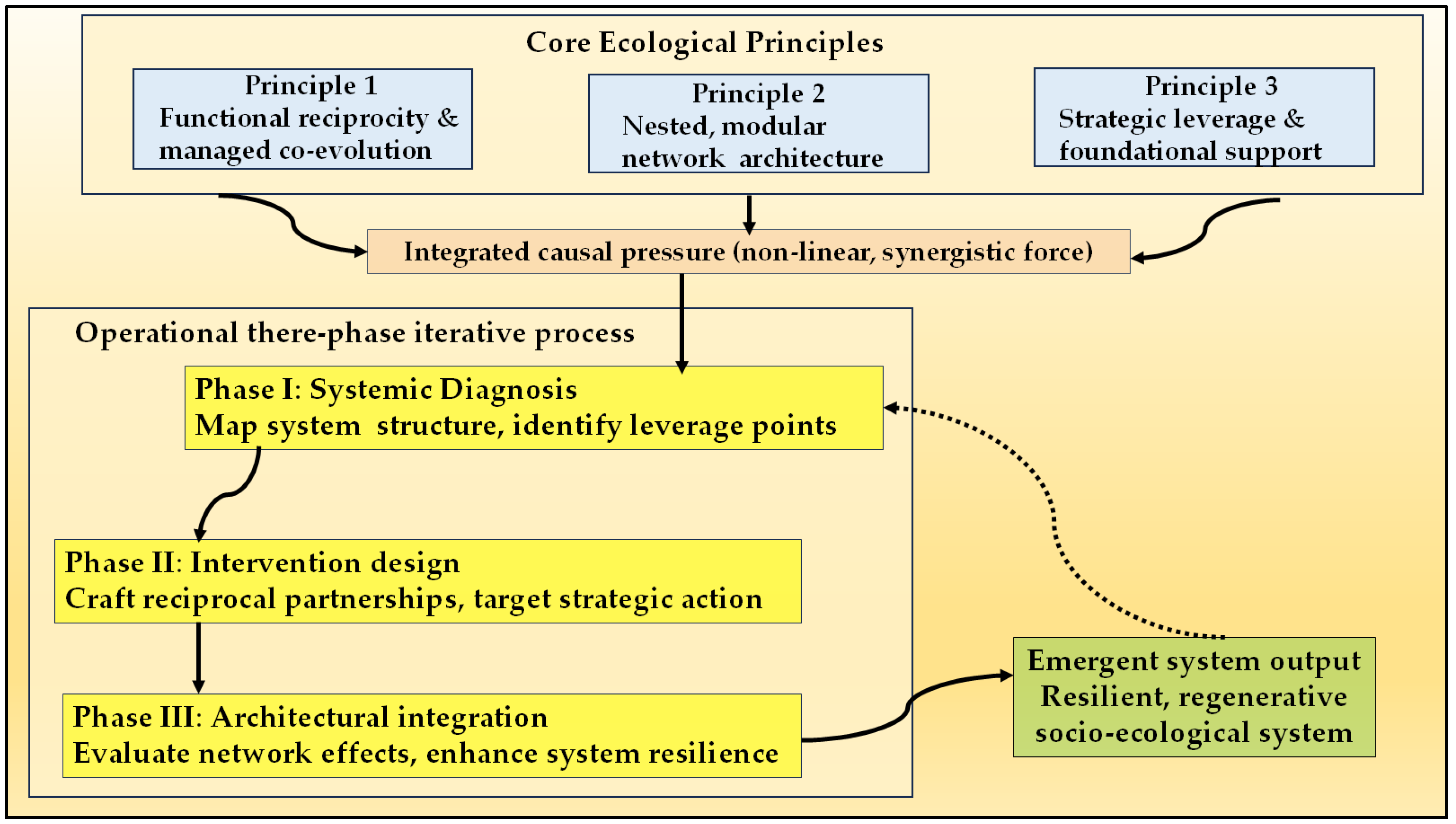
The systemic outcome of a resilient, regenerative socio-ecological system emerges not from any single principle but from their integrated causal pressure—the combined, interdependent force they exert when applied together to diagnose and redesign systems. This translational logic is inherently interdisciplinary: while ecologically derived, it is designed to be operationalized through institutional economic principles of cooperative governance, creating a bridge between how nature works and how institutions can sustain it.
An important annotation clarifies that Principles 1 and 2 are not parallel tracks but a feedback loop network; robustness emerges from reciprocal interactions, while the network’s architecture enables those relationships to form and stabilize. Principle 3 provides the strategic logic for intervention within this designed system.

4.3. Core Component 3: The Operational Strategic Blueprint

This integrated logic is directly operationalized as the primary applied output of this research: the strategic blueprint. The blueprint prescribes an iterative, three-phase process for systemic intervention that applies both ecological and institutional intelligence:
»
Phase I: Systemic diagnosis—Applying the principles of network architecture and strategic leverage to map the socio-ecological system and identify key structural hubs and leverage points. Diagnostic questions: What are the system’s modules and connections? Where are the keystone actors or rules? What foundational assets exist or mission?
»
Phase II: Interventional design—Applying the principles of functional reciprocity and strategic leverage to design mutually beneficial partnerships and precisely targeted actions at the identified leverage points. Diagnostic questions: How will partnerships ensure reciprocal value exchange? What structural interface will govern the relationship? What keystone policy could catalyze systemic change?
»
Phase III: Architectural integration—Applying the principle of network architecture to evaluate how new interventions affect overall system modularity and nestedness, ensuring enhanced resilience. Integration questions: Does this intervention strengthen network connectivity? Does it create new modules or reinforce existing ones? Does it distribute risk away from single points of failure?
This process is visualized in Figure 2, which illustrates how the core principles generate integrated causal pressure that drives systemic transformation.

4.4. Institutional Underpinnings: Operational Ecological Principles

The strategic blueprint cannot be realized in a governance vacuum. Its implementation necessitates a governance architecture capable of sustaining reciprocal partnerships, modular networks, and strategic interventions. Institutional economics—particularly Elinor Ostrom’s design principles for robust common-pool resource governance [67,68]—provides this architecture, as shown in Table 2.
Table 2 operationalizes this integration by systematically mapping each ecological principle to its corresponding institutional mechanism, design criteria, and concrete implementation examples. The table demonstrates that ecological concepts are not merely metaphorical but translate directly into testable governance rules: functional reciprocity operationalizes through proportional equivalence between benefits and costs; nested modular architecture manifests as polycentric governance with nested enterprises; strategic leverage corresponds to constitutional-choice rules; and foundational support aligns with investments in social capital and participatory infrastructure. For each principle, the table specifies the institutional mechanism, the design criteria that must be met for successful implementation, and a real-world example drawn from the literature and case study. This translation from ecological logic to institutional design is the core contribution of the Symbiosis Framework, and Table 2 provides practitioners with a clear roadmap for operationalizing each principle in their specific contexts.

4.5. Operational Guidelines for Practitioners

To enhance the framework’s practical utility, we provide the two complementary tools derived from theoretical synthesis and refined through case study feedback. These tools translate the three core principles into actionable diagnosis and intervention pathways that practitioners can apply in real-world contexts.
Table 3 presents a Diagnostics Checklist designed to help practitioners systematically assess an existing or proposed NbS initiative through the lens of the symbiosis framework. The checklist is organized by the three core principles, with each row specifying:
  • Diagnostic questions that guide practitioners to probe the system conditions.
  • Red flags indicating potential problems or failure nodes.
  • Success indicators describing what effective implementation looks like.
This tool enables principle-based diagnosis: rather than asking “Is this project failing?”, practitioners can ask “Where is the failure located—in partnership quality (P1), system structure (P2), or intervention strategy (P3)?” The checklist draws directly from the failure pattern identified in the Catskills case (missing P1, P2, and P3), and the success factors documented in the East African PES schemes and Changzhou case (see Section 7). It provides a structured audit that shifts the conversion from what is broken to how to redesign.
Table 4 provides an Intervention Pathway Matrix that guides practitioners in matching their primary design focus to their system diagnosis. While the Diagnostic Checklist (Table 3) helps identify what is wrong, this matrix helps determine what to do about it. The matrix is organized by system diagnosis (rows) and specifies:
  • The Primary Design Focus– which, as a principle, should guide initial intervention to other principles for system impact
  • The Integration Priority—how to ensure the intervention connects to the other principles for systemic impact
The pathways are derived from the case study patterns: fragmented partnerships and distrust (as in Catskills) require prioritizing P1 (functional reciprocity) while ensuring new partnerships connect to existing networks (P2) and identifying keystone policies to institutionalize gains (P3). Siloed projects with no connectivity (as in many Asian delta initiatives [23]) require prioritizing P2 (network architecture) while designing reciprocal relationships within modules (P1) and targeting keystone hubs for strategic investment (P3). Misapplied resources with no systemic effects (as in failed PES schemes like Lake Naivasha) require prioritizing P3 (strategic intervention) while designing reciprocal partnerships around keystone intervention (P1) and ensuring interventions enhance network structure (P2).
This matrix operationalizes the framework’s core insight that the principles are interdependent and must be applied in concert. It provides practitioners with a clear action.
Together, Table 3 and Table 4 provide practitioners with a complete operational toolkit: the Diagnostic Checklist for assessment and the Intervention Pathway Matrix for action. Both tools are grounded in the conceptual synthesis of Section 5 and validated through the case study analysis of Section 7, ensuring they are both conceptually rigorous and practically relevant.

5. Conceptual Analysis: Symbiosis and Mutualism as Foundational Theory

This section executes the theoretical synthesis detailed in the methodology, establishing the ecological source theories for the first core principle. The analysis is structured around two complementary pillars: (1) symbiosis and mutualism theory (relational/evolutionary logic), and (2) ecological network theory (architectural/systemic logic). We begin with the first pillar.

5.1. Symbiosis Theory: From Biological Fact to Design Metaphor

Symbiosis and mutualism theory provide the foundational relational logic for the framework. Moving beyond simple cooperation, it models how sustained, intimate interspecies partnerships drive biological innovation, ecosystem stability, and evolutionary transitions [74,75].
Defined as a long-term physical association leading to a ’shared genetic fate’—where the evolutionary success of one partner becomes inextricably linked to the other’s—symbiosis is a ubiquitous and powerful architect of the biosphere [45] (p. 240). It is a process of reciprocal co-evolution that modifies the physiology, distribution, and evolutionary trajectory of interacting partners [76,77]. Its practical importance is incontrovertible, underpinning critical biogeochemical cycles, soil formation, and the health of systems from forests to coral reefs to the human microbiome [45,78,79,80,81].
Crucially, these systems are dynamic interfaces that modulate responses to environmental change. Research demonstrates that symbionts can confer resilience, such as when coral microbiomes exhibit recoverable structure after thermal stress [82]. Conversely, these relationships can become critical vulnerabilities when destabilized, such as when nitrogen pollution disrupts coral–algal symbiosis [83,84], or flooding severs phosphorus transfer in mycorrhizal networks—the symbiotic partnerships between plant roots and fungi that are fundamental to soil health and forest resilience [85,86]. The stability of partnerships is governed by two key factors: (1) the spectrum of dependence, from facultative (optional) to obligate (essential); and (2) partner specificity, from generalist (many partners) to specialist (few). These factors determine a partnership’s resilience and functional role [87], as exemplified by the structured, age-dependent leaf microbiomes of foundation species [88].
Beyond biology, symbiosis provides a powerful metaphor for institutional co-evolution [89], modeling how to design for long-term reciprocity, manage interdependent success, and architect robust exchange interfaces.

5.2. Translation to Relational Design: Three Foundational Imperatives

The question becomes: How are these dynamics operationalized as prescriptive principles for socio-ecological design? This translation yields three design imperatives that counter the project-based, non-reciprocal approaches that drive systemic degradation.

5.2.1. Imperative of Co-Evolutionary Partnership

First, it establishes a long-term, co-evolutionary partnership as a superior strategy for resilience and innovation, grounded in the principle of reciprocal interdependence. This directly counters the dominant paradigm of ‘atomized transaction’—treating interactions as isolated, short-term exchanges between independent actors, devoid of ongoing relational context or mutual obligation. Crucially, this ecological imperative aligns with and is enriched by established socio-cultural paradigms and contemporary implementation science. Indigenous and local knowledge systems have long embodied reciprocal human-nature relations based on kinship, complementarity, and communal stewardship, positioning humans in a dynamic of both nurturing and being nurtured by nature [90]. Modern frameworks such as Nature-Based Thinking (NBT) explicitly advocate for this relational mindset to transform human-nature relations and guide the implementation of nature-based solutions [91]. This perspective is essential for navigating the complex socio-ecological trade-offs and potential injustices—such as issues of inequality, privilege, and green gentrification—that are often revealed during local implementation and must be addressed for equitable outcomes [92,93,94]. Therefore, the design mandate is to architect partnerships where success is mutually interdependent, recognizing that effective interventions must maintain the integrated, reciprocal feedback loops between social and ecological subsystems [95].

5.2.2. Imperative of a Structured Interface

Second, it specifies that the success of the mutualistic partnership depends on the integrity of the symbiotic interface—a dedicated, structured space for negotiation and exchange. This concept finds direct biological analogy in mycorrhizal symbiosis, where specialized cellular structures form dedicated interfaces for bidirectional nutrient and signal exchange between plant roots and fungi, with stability and function highly dependent on environmental conditions [96,97]. In socio-institutional terms, this mandates the design of formal governance bodies, joint management platforms, or regulated market mechanisms to serve this essential role.
However, simply creating such interfaces is insufficient. As evidenced by Industrial Symbiosis Platforms, most fail despite technically sound design due to inadequate consideration of social dynamics, stakeholder roles, and adaptive capacity [98]. A successful interface must therefore be more than a transactional space; it must function as what mycorrhizal ecology terms a “wood-wide web”—an extensive, resilient network that connects communities, facilitates multi-directional flows, and adapts to changing conditions. This requires designing for:
»
Multiple stakeholder roles (providers, consumers, intermediaries, and coordinators)
»
Dynamic feedback mechanisms that allow the interface to evolve with the partnership
»
Context-sensitive design that accounts for local environmental and social conditions
»
Bidirectional value flows that ensure reciprocal, rather than extractive, exchange
Thus, the structured interface is not merely a meeting point but the architectural and relational infrastructure that enables and sustains the co-evolutionary partnership, making its design quality non-negotiable for long-term symbiotic success.

5.2.3. Imperative of Active Stewardship

Third, it reveals mutualisms as dynamic and conditional, not self-sustaining. Their stability depends on context, meaning they require active, institutionalized stewardship to monitor conditions, manage conflicts, and adapt terms of exchange, preventing degradation into parasitism or collapse.
This ecological imperative finds powerful validation in socio-cultural and management research. Empirical studies of Swiss Alpine farmers reveal that the most sustainable and effective human-nature relationships are not passive but involve dynamic stewardship or partnership, characterized by bidirectional care, responsiveness, and adaptive collaboration [99]. These farmers move beyond seeing themselves as mere “managers” or passive “stewards” to become active “partners” or even “apprentices” to nature—relationships defined by reciprocal learning, adaptation, and respect for nature’s agency.
Furthermore, this principle is critically supported by organizational theory. Research into Principal–Agent versus Stewardship Theory demonstrates that effective governance requires recognizing when actors will behave as opportunistic “agents” versus pro-organizational “stewards” [100]. The stewardship role must be actively fostered and institutionally supported; it does not emerge automatically. This aligns with the concept of “bounded self-interest,” where fairness, trust, and reciprocal treatment are essential to sustaining cooperative, long-term partnerships [101]. Practical applications like the Collectively-Centered Adaptive Reuse framework demonstrate successful institutionalization of collaborative processes [102].
In synthesis, these three design imperatives collectively define the framework’s first core principle: functional reciprocity and managed co-evolution. Functional reciprocity defines the quality of the relationship: exchanges must be mutually beneficial and value multiple forms of capital (ecological, social, and economic). Managed co-evolution defines the process: the partnership must be intentionally designed with a formal interface and adaptive governance to ensure it evolves constructively over time.
However, high-quality connections alone do not guarantee system-wide resilience. They must be intentionally organized within a resilient structure. This requires the complementary architectural logic provided by our second theoretical pillar: ecological network theory.

5.3. Ecological Network Theory: The Architectural Logic

The second pillar, ecological network theory (ENT), provides the crucial architectural perspective needed to structure the reciprocal relationships established by Principle 1 [103]. ENT represents a paradigm shift from studying linear chains or pairwise interactions to modeling entire communities as complex networks of interdependency, where species are nodes and their interactions are links [25]. This reveals a foundational insight: a system’s stability, function, and vulnerability are emergent properties determined by the pattern of connections, not merely by individual components [104]. For our framework, this establishes a core design premise: resilience requires strategically architecting the relationships and flows between socio-ecological actors.

5.3.1. Countering ‘Project-Ism’ with Network Logic

This architectural perspective directly counters the dominant, failing paradigm of ‘project-ism’—the implementation of NbS as isolated, top-down, siloed interventions. This approach is increasingly critiqued as inadequate and often neocolonial, particularly in the Global South, where it sidelines local agency and pre-existing community networks [40]. ENT provides the antidotal logic: resilience cannot be achieved through a portfolio of disconnected projects, but only through the intentional design of networked systems, where interventions are conceived as interconnected nodes from the outset. This represents a fundamental shift from implementing fixed ‘solutions’ to cultivating adaptive, constellatory systems that can grow organically from local knowledge [40]. Consequently, Principle 2 (nested, modular network architecture) is not a neutral design choice but a necessary architectural correction to a flawed implementation model.

5.3.2. Translating Network Patterns into Design Principles

ENT identifies recurring architectural patterns with profound systemic implications—patterns that are primary drivers of either resilience or cascading ecological failure when disrupted [105,106]. These patterns are not merely descriptive; they provide a translational design grammar for structuring socio-ecological relationships:
»
Nestedness—Where specialists interact with subsets of the partners of generalists—reduces competition and enhances persistence by organizing interactions around a stable core [66]. This calls for the need to cultivate a reliable core of generalist institutions or functions around which specialized, context-specific initiatives can organize.
»
Modularity—The organization into semi-independent, densely connected subgroups—localizes disturbances, buffering the network from cascading failure [107]. This requires the establishment of functionally semi-autonomous groups or “cells” within the socio-ecological system to contain shocks and enable parallel adaptation.
»
Asymmetry (Hub-based structure)—Where generalists interact with specialists, but specialists avoid each other—creates systems robust to random loss but fragile to targeted hub removal [108]. This necessitates the need to identify, protect, and strategically manage keystone hubs while distributing risk away from single points of failure.
An essential nuance for design is that these patterns are interrelated. Nestedness and modularity are not mutually exclusive but often coexist, with their relationship being a key aspect of network architecture [109]. Furthermore, asymmetry can be a foundational feature that underpins the emergence of a nested pattern, though they are distinct concepts [108]. A sophisticated application of the framework must therefore account for their interplay.
This translation from ecological diagnostics (what is) to socio-ecological design principles (what to do) is the core function of the symbiosis framework. Therefore, the following section explicitly operationalizes these three architectural patterns—nestedness, modularity, and asymmetry—into a formal set of actionable design principles for structuring symbiotic systems.

5.4. Translation to Architectural Design: From Ecological Patterns to Prescriptive Principles

For the symbiosis framework, the critical task is to translate ecological network theory’s diagnostic patterns into a prescriptive logic for socio-ecological system design. Building on the three core architectural patterns introduced in Section 5.2, we expand this translation to encompass two additional network properties essential for resilience: robustness through connectivity and multi-layer dynamics.
Table 5 provides the complete architectural design structure derived from the ecological network theory, translating five key network properties into actionable socio-ecological design imperatives. Each principle addresses a distinct architectural dimension, from macro-structure governance (nestedness) to micro-dynamics of interaction types (multi-layer). Together, they prescribe how to intentionally structure relationships and flows to build systemic resilience.
However, this architectural logic, while essential, remains incomplete for strategic intervention. It tells us how to structure systems but not where to intervene within those structures for maximum transformative impact. The architectural principles define the playing field, but they do not identify the leverage points.
While nestedness, modularity, and hub-based structure answer how to organize relationships for resilience, they do not answer the complementary strategic question: Where within this architecture should action be directed for maximum systemic effect? To complete the strategic toolkit, we require a complementary logic that identifies disproportionate influence points within networked systems. This brings us to the final, crucial pillar of ecological intelligence: keystone and foundation species theory, which provides the logic of targeted intervention discussed in the following section.

5.5. Keystone and Foundation Species Theory: The Intervention Logic

This final pillar completes the framework’s strategic toolkit by integrating the complementary logics of keystone and foundation species theory. While ecological network theory (Section 5.3) provides the architectural blueprint for resilient systems, this theory answers the pivotal strategic question: Where within that architecture should action be directed for maximum transformative effect?
Together, these theories shift analytical focus from ubiquitous interactions to the disproportionate influence of certain system actors, providing a powerful lens for identifying precise intervention points that yield non-linear, system-wide benefits. This principle is grounded in a core ecological insight: system outcomes are often determined not by the average, but by the influential few.

5.5.1. Keystone Species: From Ecological Regulation to Strategic Leverage

The concept of strategic leverage is derived from keystone species theory. Originating with the demonstration that removing a top predator (Pisaster) caused intertidal diversity to collapse, the theory established that a component’s functional importance is not proportional to its abundance [62,63]. Keystone status is defined by outsized impact—a strongly interacting species whose effect is large relative to its biomass [117]—and can apply to various functional archetypes (consumers, modifiers, and prey) [118,119].
This focus on disproportionate influence provides the transferable logic for identifying socio-ecological leverage points: pivotal rules, policies, or actors whose targeted manipulation can produce cascading, regulatory outcomes. This focus on relative impact provides the transferable logic to identify keystone institutions or policies (for example, a pivotal land-tenure policy). Furthermore, modern ecology employs network centrality metrics (from our second pillar, ecological network theory) to quantitatively identify these critical nodes based on their positional influence [120,121].
Thus, keystone species theory transitions from a compelling ecological metaphor into a rigorous diagnostic logic for targeted intervention. It equips the framework to identify socio-ecological leverage points, equipping the framework to identify socio-ecological leverage points—actors or rules with disproportionate systemic influence.

5.5.2. Foundation Species: From Structural Support to Enabling Asset

Complementing this, foundation species theory provides the logic for structural and functional support. Foundation species are primary habitat architects that define ecosystems through their biomass and physical structure (for example, coral skeletons and mangrove roots) [64,122,123]. They create the biogenic infrastructure that modulates abiotic conditions and supports entire communities. For instance, giant kelp (Macrocystis pyrifera) is a quintessential foundation species, whose canopy forms the complex, layered architecture that structures temperate kelp forest communities [124].
By increasing faunal diversity through physical engineering, these canopies define the biological and physical environment of temperate rocky reefs [125]. Kelp forests dominate cool, nutrient-rich coasts globally, forming critical ecosystems along the eastern Pacific and the temperate Australian coasts of the Great Southern Reef [126]. Performing analogous foundational roles in freshwater systems, macroalgae such as the green algae Spirogyra and Cladophora (Chlorophyta) or the red alga Lemanea (Rhodophyta) act as crucial habitat-forming species [127].
Similar to marine foundations, they create habitat, food, and shelter, while their role as primary producers makes them vital for nutrient cycling, carbon flux, and enhancing biodiversity and ecosystem multifunctionality [128]. Their stability enhances species richness and dampens systemic volatility [129], and their loss can trigger non-linear ecosystem collapse [130]. Consequently, the proactive conservation of these common, system-defining species—before they decline—is a cost-effective strategy for sustaining biodiversity and ecosystem processes [122,131]. This establishes the logic of foundational support: the proactive cultivation of core structural assets that provide the enabling conditions for long-term system stability and function.

5.5.3. Synthesis and Translation: The Dual Intervention Logic

Together, these theories synthesize into the framework’s third core principle: strategic leverage and foundational support. This dual intervention logic provides a strategy for targeted action within a designed network:
  • Strategic leverage (derived from keystone theory) focuses on functional influence—identifying and manipulating key rules, feedback loops, or pivotal actors that disproportionately shape system dynamics (for example, a pivotal subsidy reform). It is catalytic and regulatory.
  • Foundational support (derived from foundation species theory) focuses on enabling conditions—the sustained cultivation of underlying structural and functional assets that provide the stability, habitat, and resource base necessary for systemic diversity and long-term function (for example, securing communal land tenure). It is structural and enabling.
This integration drives a critical paradigm shift: from managing all components with equal resource intensity to a strategy of precision pragmatism. The goal becomes to diagnose and target the precise nodes and relationships where intervention creates amplified, self-reinforcing change.

5.5.4. Illustrative Integration: The Coral Reef as a Symbiotic System

The power of this dual logic—and the full integration of the symbiosis framework’s three principles—is most evident when examined within a functioning ecosystem. The coral reef offers a powerful empirical model of the framework’s synthesized logic in action [62,122].
  • The symbiotic engine (Principle 1)
  • The reef is fundamentally built upon the obligate mutualism between coral polyps and photosynthetic algae (Symbiodiniaceae) [83,84]. This reciprocal exchange provides up to 90% of the coral’s nutritional needs, driving the reef’s high productivity [132,133,134]. The partnership is dynamic, with diverse symbiont types influencing thermal resilience [135,136]. Its disruption is a primary cause of systemic collapse, underscoring that functional reciprocity is non-negotiable for system integrity.
  • Network architecture (Principle 2)
  • The reef’s physical structure, created through coral calcification, forms a complex habitat network [137,138]. Corals and adjacent mangroves are bioengineers whose physical structure creates the essential “infrastructure” for the entire system [122]. This architecture functions as a complex habitat network, where key nodes serve critical functions. For instance, mangroves act as protective nodes: their root systems trap sediments, maintaining water clarity essential for coral symbiosis [139], and in some systems, provide direct climate refugia, enhancing network-wide resilience [140]. This illustrates the principles of connectivity, modularity, and hub-based structure—a structure that the symbiosis framework translates into a principle for socio-ecological design.
  • The dual intervention logic in practice (Principle 3)
Within this architected network, species exert disproportionate influence through complementary mechanisms:
»
Foundational support in practice: The coral colonies and mangroves are quintessential foundation species [64,141]. Their biomass and structure create the essential infrastructure upon which the entire associated community depends, enhancing species richness and dampening systemic volatility [129]. This exemplifies investing in core structural assets for long-term stability.
»
Strategic leverage in practice: Parrotfish (family Scaridae) act as a keystone group. Their grazing regulates algal competition, maintaining the benthic balance crucial for reef health. A 3000-year fossil record demonstrates a causal link between abundant parrotfish and faster reef growth, while their overfishing drives shifts to algae-dominated states [142,143]. Managing these regulators through targeted fisheries policies exemplifies applying strategic leverage—targeting a pivotal node to steer system state [144].
The reef case demonstrates that effective management requires an integrated strategy that: (1) secures core symbiosis (P1), (2) protects network architecture (P2), and (3) applies complementary P3 interventions—employing both strategic leverage (managing key regulators) and foundational support (conserving system-defining habitat).

5.5.5. Translation: Strategic Intervention Blueprint

Building on this dual logic and its empirical demonstration, the framework translates keystone and foundation theory into a practical blueprint for socio-ecological intervention (Table 6).
Table 6 translates the dual intervention logic into a practical framework for socio-ecological design, operationalizing the framework’s third core principle: strategic leverage and foundational support. It maps three complementary approaches to their ecological analogs, specific design imperatives, and actionable diagnostic questions. Practitioners can systematically evaluate interventions using this blueprint: the “strategic leverage” row guides identification of catalytic policy changes; the “foundational support” row directs attention to long-term enabling assets; and the “integrated risk management” row ensures resilience of critical system nodes. Together, these rows enable the shift from blanket initiatives to precision pragmatism required for scaling nature-based solutions—transformative change achieved by precisely enabling, introducing, or protecting the few elements with inherent power to structure and stabilize whole systems.

6. Institutional Underpinnings: Bridging Ecological Reciprocity to Socio-Economic Rules

The strategic blueprint outlined in the previous section, however, cannot be realized in a governance vacuum. Its implementation necessitates a governance architecture capable of sustaining reciprocal partnerships, modular networks, and strategic interventions. This brings us to a critical conceptual bridge: the alignment between the symbiosis framework’s ecological design logic and the institutional economics of cooperative, rule-based governance.

6.1. Core Tenets of Institutional Economics Relevant to the Framework

Institutional economics fundamentally shifts the analytical focus from atomized market transactions to “the rules of the game in a society or, more formally, to the humanly devised constraints that shape human interaction” [145] (p. 3). These institutions—both formal (laws and contracts) and informal (norms and conventions)—structure incentives and determine the feasibility and stability of cooperative exchange over time. The application of this lens to environmental governance, crystallized by Elinor Ostrom’s work [67,68], demonstrates that sustainable management of common-pool resources depends on the presence of specific, robust institutional design principles rather than centralized control or privatization alone.
Ostrom’s principles for robust institutions—including clearly defined boundaries, congruence between rules and local conditions, collective-choice arrangements, and nested enterprises—provide a socio-economic blueprint for managing interdependence [67,68,146]. These principles aim to lower transaction costs, build trust through reciprocity and fairness, monitor behavior, and provide graduated sanctions—objectives that are directly analogous to the ecological conditions that stabilize mutualistic partnerships. This establishes a profound conceptual synergy: what ecology reveals as necessary for symbiotic resilience, institutional economics prescribes as rules for cooperative human governance.

6.2. Synergistic Integration: Applying Institutional Logic to the Framework’s Principles

The principles of institutional economics, particularly Elinor Ostrom’s design rules, are not merely analogous but provide the operational socio-economic mechanisms for the symbiosis framework. This integration translates ecological patterns into actionable governance.

6.2.1. Co-Designed Interfaces and Adaptive Feedback as Institutional Congruence and Adaptability

The framework’s mandate for co-designed benefit-sharing interfaces and adaptive feedback operationalizes Ostrom’s core institutional design principle of “proportional equivalence between benefits and costs” [67]. This principle—part of the broader requirement for “congruence between appropriation and provision rules and local conditions” [67] (p. 9)—specifies that rules allocating benefits from a shared resource must be fairly tied to the contributions (labor, materials, money, or stewardship) required to sustain it. In ecological terms, this mirrors the balanced resource exchange that stabilizes mutualisms. Translated to NbS design, it means reciprocal agreements must clearly link the benefits stakeholders receive (for example, water security and carbon credits) to their specific contributions to system health (for example, land stewardship and monitoring effort). This prevents exploitation and ensures the partnership is perceived as fair, thereby generating the trust essential for long-term cooperation.
The framework’s call for “managed co-evolution” further aligns with institutionalist adaptive governance, where rules are continuously monitored and refined by participants in response to social and ecological feedback. This adaptive capacity is critical because, as Dietz et al. [147] note, “successful commons governance requires that rules evolve” (p. 1908) in response to changing socio-ecological conditions. Effective adaptation is facilitated by conditions the framework intentionally designs for: monitorable resources, social networks that build trust (social capital), and participatory rule enforcement. Furthermore, Folke et al. [148] emphasize that such adaptive governance often emerges through self-organizing social networks, bridging organizations, and visionary leadership during periods of crisis or opportunity—precisely the conditions the symbiosis framework seeks to architect proactively through its nested, modular design (P2) and strategic interventions (P3).

6.2.2. Nested, Modular Network Architecture (P2) as Polycentric Governance

This architectural principle directly embodies the institutional design concept of “nested enterprises”, where governance activities are organized in multiple layers, with smaller units nested within larger institutions that manage interdependencies [65,146,149]. Polycentric governance—with multiple, overlapping, semi-autonomous decision-centers—is the socio-institutional analog to modular ecological networks [150]. It provides resilience by distributing functions, containing failures, and enabling multi-scale coordination.
Critically, this structure is not merely descriptive but can be actively designed and diagnosed. Recent advances in polycentric governance analysis reveal that such systems can be understood as networks of actors, venues, and issues, where coordination patterns—or “building blocks”—determine system performance [151]. This aligns with ecological network theory, where modularity objectively identifies critical meso-scales—above the patch and below the landscape—that govern connectivity and metapopulation viability [152]. The symbiosis framework’s emphasis on designing semi-autonomous modules and reinforcing core institutions provides a structural and diagnostic blueprint for this polycentricity. It enables practitioners to architect systems that balance specialization within modules with coordination between them, thereby avoiding the fragmentation of “project-ism” while building in the redundancy and adaptability needed for long-term resilience.

6.2.3. Strategic Leverage (P3) and the Design of Rules: Keystones and Foundations

The keystone and foundation logic provides a powerful diagnostic tool for identifying institutional leverage points—specific rules, policies, or assets where targeted action yields disproportionate systemic effects. This aligns with institutional economics’ understanding that not all rules are equal; certain “constitutional-choice” rules establish the overarching framework within which everyday operational decisions are made, giving them outsized influence on system trajectories [67,68].
A “keystone policy”—such as a well-designed Payment for Ecosystem Services (PES) scheme, a strategic subsidy reform, or a pivotal land tenure law—functions as such a constitutional-level rule. It does not merely address a symptom but restructures the incentive landscape, altering cost–benefit calculations for multiple actors and triggering cascading behavioral changes [153]. For example, a PES scheme that values bundled ecosystem services such as carbon, water, or biodiversity over a single commodity can shift entire land-use paradigms from extraction to regeneration. This operationalizes the strategic leverage aspect of Principle 3 by targeting a precise node in the socio-ecological rule-system to reconfigure flows of resources, information, and power across the network.
Conversely, “foundational assets”—such as community trust, participatory monitoring infrastructure, local ecological knowledge systems, or secure communal tenure—constitute the essential social and institutional capital upon which effective rules depend [154]. Without this enabling substrate, even well-designed keystone policies may fail due to a lack of legitimacy, monitoring capacity, or enforcement. Investing in these assets strengthens what Ostrom terms the social infrastructure for “collective action,” [155], reducing transaction costs, enhancing adaptive capacity, and fostering the shared norms and reciprocity necessary for long-term cooperation. This operationalizes the foundational support aspect of Principle 3, emphasizing that systemic resilience requires cultivating both the catalytic rules that change behavior and the enabling conditions that make rule-compliance sustainable.

6.3. Implication for the Framework

This integration substantiates the translational power of the symbiosis framework. It demonstrates that the ecological logic of keystone and foundation species is not merely metaphorical but provides a diagnostic grammar for socio-institutional design. Within the framework, Principle 3 (Strategic leverage and foundational support) now explicitly bridges ecological leverage points with institutional leverage points, enabling practitioners to target interventions that restructure both ecological relationships and the institutional rules that govern them. This completes the framework’s interdisciplinary architecture, ensuring that its design principles are ecologically grounded yet institutionally actionable.
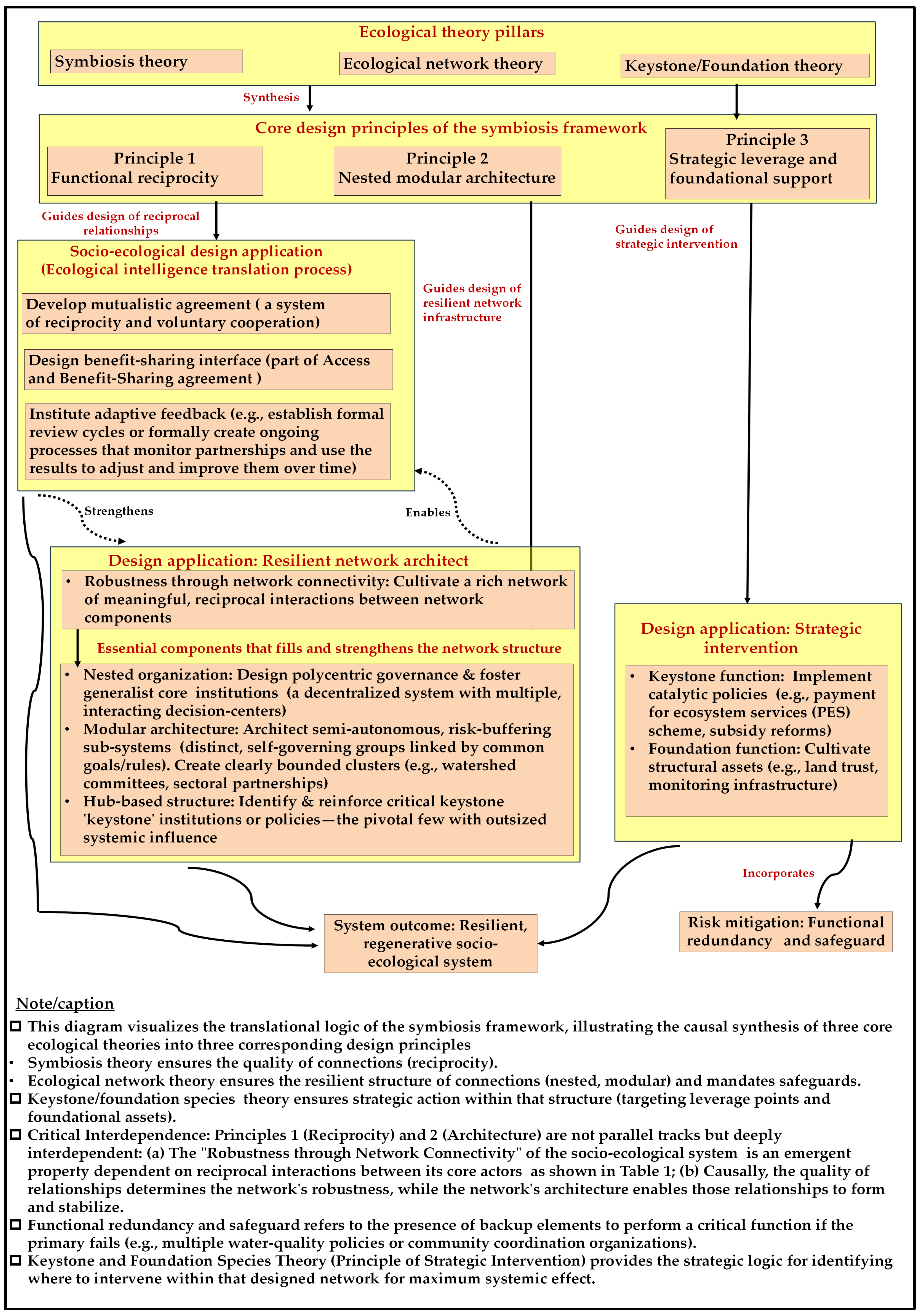
Having established the institutional mechanics for implementing the symbiosis framework, we can now synthesize its full translational logic into an integrated visual model. This synthesis, presented in Figure 3, demonstrates how the ecological theory pillars, core design principles, and socio-ecological applications form a coherent and actionable architecture for systemic design. The institutional mechanisms that enable this translation in practice (for example, polycentric governance and rule congruence) are detailed in Section 6.
This schematic diagram shows the causal pathway for translating ecological intelligence into socio-ecological system design. The logic flows from top to bottom.
  • Foundation (top row)—Ecological theory pillars: the framework is grounded in three mutually reinforcing ecological theories:
    »
    Symbiosis theory ensures the quality of connections.
    »
    Ecological network theory ensures the resilient structure of connections.
    »
    Keystone/foundation species theory ensures strategic action within that structure.
  • Translation (second top row)—Core design principles: these theories synthesize into the framework’s three core principles:
    »
    Principle 1: Functional reciprocity (from symbiosis theory).
    »
    Principle 2: Nested, modular architecture (from ecological network theory).
    »
    Principle 3: Strategic leverage and foundational support (from keystone/foundation theory).
  • Application (second bottom row)—Socio-ecological design: the principles guide a coherent “Ecological Intelligence Translation Process” across three interdependent domains:
    »
    Designing reciprocal relationships (P1): creating mutualistic agreements, benefit-sharing interfaces, and adaptive feedback loops.
    »
    Architecting resilient networks (P2): building polycentric governance, modular sub-systems, and hub-based structures around keystone institutions.
    »
    Targeting strategic interventions (P3): implementing catalytic keystone policies and cultivating critical foundational assets to reshape system incentives and capacity.
  • Annotation: critical interdependence
A central annotation clarifies that Principles 1 and 2 are not parallel tracks but a feedback loop: network robustness emerges from reciprocal interactions, while the network’s architecture enables those relationships to form and stabilize. Principle 3 provides the strategic logic for intervention within this designed system.
To round up this section, the above visual synthesis completes the theoretical and conceptual exposition of the symbiosis framework. It encapsulates the argument that sustainable socio-ecological systems can be deliberately architected by applying translated ecological principles—first as biophysical design logic, then as actionable institutional rules grounded in the economics of cooperation and polycentric governance, and finally as integrated strategic practice. The framework thus moves from ecological metaphor to a structured, institutionally grounded design methodology. The subsequent chapter will put this methodology to the test, applying the framework to analyze specific case studies such as a regional watershed program and evaluate its utility in diagnosing systemic leverage points and designing for resilience.

7. Framework Validation Through Comparative Analysis

With the theoretical and translational logic of the symbiosis framework established, we now test its explanatory power and practical utility through comparative empirical analysis. This comparative analysis served a dual purpose: (1) validating the framework as a diagnostic tool capable of explaining systemic failures and successes, and (2) refining its dimensions through empirical feedback. The selected cases represent a spectrum of outcomes—from implementation failure to technical and socio-ecological success—providing comprehensive evidence of the framework’s pragmatic potency. Crucially, this analysis enabled the iterative refinement of the strategic blueprint’s guidelines, ensuring they are grounded in real-world complexity. Therefore, this validation phase confirms that the symbiosis framework is not only theoretically coherent but also an effective tool for analyzing and designing resilient socio-ecological systems.
The assessments presented below reflect consensus reached through independent coding by two researchers using the framework principles as a priori codes, with disagreements resolved through discussion. This process ensured analytical rigor and interpretive reliability across all three cases.

7.1. Case Study 1: The Catskills Watershed Flood Buyout Program—A Failure in Functional Reciprocity

Context: In the aftermath of Hurricanes Irene and Lee, which devastated New York’s Catskills region, a complex web of flood mitigation programs was established. Among them was a New York City-funded, voluntary buyout program designed as a proactive, nature-based solution (NbS). Its dual goals were to relocate residents from hazardous floodplains and protect the drinking water supply for nine million downstate residents by restoring natural floodplain functions [156,157]. The program had $15 million in funding and targeted approximately 50 properties across multiple communities in Delaware, Greene, Schoharie, and Ulster counties. Despite this clear ecological logic and significant funding commitment, the program became a case study in implementation failure, criticized for delays exceeding 18 months, exacerbating inequity, and creating community division and distrust—a legacy stemming from a flawed relational design.
Expanded Socio-economic Context:
The Catskill region of New York is frequently defined as a four-county area comprising Delaware, Greene, Sullivan, and Ulster. This region is often associated with the 700,000-acre Catskill Park, a unique mix of public and private lands established in the late 19th century and protected under New York State’s “forever wild” designation [158,159]. According to the most recent U.S. Census data (2019–2023 American Community Survey 5-year estimates), the broader Catskills Region has a total population of 353,699, with a near-even gender split (50.7% male, 49.3% female). The median age is 50 years, reflecting an older demographic profile characteristic of rural regions [160].
Within this broader region, the village of Catskill, the Greene County seat, provides a snapshot of one community. It has a 2026 population of 3686, a figure that has been slowly declining from 3797 in 2020 at an annual rate of −0.49%. Its median household income is $79,423, with a poverty rate of 11.18% [161,162]. However, conditions vary significantly across the four-county area. For the Catskills Region as a whole, the median household income is $75,291, with an average household income of $101,595. Approximately 85.8% of residents live above the poverty line [160].
The Catskills include another mixture of public and private lands and small communities between Albany and New York City that collectively supply New York City with its drinking water. Land ownership patterns include a mix of long-term resident families and second-home owners from New York City, creating distinct stakeholder groups with different relationships to the landscape and different vulnerabilities to displacement [163]. Following the 1997 New York City Watershed Memorandum of Agreement, a complex governance framework emerged [164]. The agreement authorized the city to purchase up to 355,000 acres of land from willing sellers in the watershed. The agreement also established the Catskill Watershed Corporation to allocate funds for environmentally minded economic development. Between 1997 and 2011, approximately 120,000 acres were acquired through this program, complementing prior city and state holdings [165]. Despite these partnership mechanisms, lingering tensions remained over NYC’s upstream land acquisitions and regulations that limited economic development opportunities [166].
The region had experienced major floods in 1996, 2005, and 2006, creating existing trauma and skepticism toward government programs. The year 2011 brought catastrophic flooding from three major storms—a spring storm, Tropical Storm Irene (August), and remnants of Tropical Storm Lee (September). Rainfall exceeded 18 inches in parts of the Catskills, with some areas experiencing 500-year flood levels. The storms caused over $1.3 billion in damages, 31 counties were declared disaster areas, and 10 deaths were reported [167,168]. Emergency declarations enabled FEMA buyout programs alongside the NYC-funded program [169] analyzed here, creating a complex landscape of parallel initiatives with different rules, timelines, and funding sources.

7.1.1. Framework Analysis

This case serves as a stark illustration of the consequences of neglecting Principle 1: functional reciprocity and managed co-evolution. The program was conceived with a narrow, transactional biophysical goal but critically failed to design the mutualistic partnership necessary for socio-ecological success [170,171]. An in-depth equity analysis confirms these failures, revealing how unresolved historical power differentials and a lack of meaningful decision-making power led to negative long-term community impacts [171].
P1 Assessment (functional reciprocity): Failure. Three core design flaws are evident:
i.
Lack of a structured, reciprocal interface: The process defaulted to a slow, top-down bureaucratic model. Despite involving multiple agencies and stakeholders, the process for finalizing program details was characterized by protracted re-negotiation, characterized by endless re-negotiation of “every last objection” rather than structured, participatory co-design [156]. Public meetings were informational rather than deliberative, with officials presenting already-made decisions rather than inviting genuine collaboration. An empirical study found that opportunities for community input were superficial, with a “predetermined outcome” [171] (p. 22). This precluded the establishment of a genuine platform for negotiation and exchange—the essential symbiotic interface.
ii.
Failure to account for multi-dimensional value: The transaction failed to account for the full spectrum of community values at stake: loss of social networks, sense of place, community cohesion, and intergenerational connection to land [163]. The program evaluated properties solely on flood risk and appraised market value, ignoring that for many residents, homes were not merely assets but embodiments of family history and community identity. The result was a perceived inequity: benefits (water security and hazard reduction) accrued distantly (New York City), while costs (loss of housing, services, and social fabric) were borne locally, undermining the mutuality required for a stable partnership [171].
iii.
Absence of adaptive feedback and managed co-evolution: The program’s design was rigid and slow to adapt, plagued by delays exceeding 18 months. It lacked institutionalized mechanisms to monitor socio-economic impacts, learn from early participants, or adapt procedures in real-time [156]. This stagnation prevented the state–community partnership from evolving constructively, allowing grievances to worsen and become entrenched. Furthermore, while companion programs for relocation assistance existed, their integration with the buyout process was not systematized as a feedback loop for adaptive management [148].
P2 Assessment (network architecture): MISSING. Governance was fragmented with no polycentric coordination. Multiple agencies were involved—New York City Department of Environmental Protection, Catskill Watershed Corporation, local municipalities, and state emergency management—but no integrated governance structure existed to coordinate their efforts. Companion programs for relocation assistance, mental health support, and community planning were not systematically linked to the buyout process [157]. There was no modular design to contain failures or enable local adaptation; instead, problems in one community affected the entire program’s reputation and implementation across the region.
P3 Assessment (strategic intervention): MISSING. No leverage points were identified. There was no strategic targeting of parcels based on systemic floodplain function or ecological connectivity value. Properties were evaluated individually rather than as part of a landscape-scale restoration strategy. Critically, community trust—a foundational asset—was eroded rather than cultivated through the process. No keystone policies were identified that could have enabled more equitable outcomes, such as community land trusts or collective relocation options that might have preserved social networks [171].

7.1.2. Implications

The Catskills case reveals that without intentional design for reciprocal relationships (P1), even well-funded, ecologically sound NbS can fail socially and politically. Critically, this failure was compounded by missing network architecture (P2) and the absence of strategic leverage thinking (P3)—demonstrating principle interdependence. The case underscores that “co-design” cannot be an afterthought; it requires a formal, iterative interface from the outset to negotiate multi-dimensional value and manage power imbalances.

7.2. Case Study 2: Comparative PES Schemes in East Africa—Designing for Integrated Success

Context: A comparative study of Payments for Ecosystem Services (PES) schemes in Kenya, Uganda, and Tanzania evaluated factors leading to successful implementation, drawing on an analysis of 25 case studies and expert surveys [172]. Schemes varied in design: bundled ecosystem services versus single-service payments, cash-only versus combined cash/in-kind payments, local versus regional scale implementation, and short-term versus long-term (10+ year) commitments. The study encompassed watershed protection, forest conservation, and agricultural land management schemes across diverse socio-ecological contexts [172,173].
Expanded Country Context: The 25 case studies span three countries with distinct tenure systems and policy environments. In Kenya, schemes operated primarily in the Upper Tana watershed, the main source of water for the four million inhabitants of Nairobi City [174]. In the Lake Naivasha basin—a freshwater lake and an area of important biodiversity conservation—formal land titles coexist with historical land grievances stemming from colonial-era displacements. Kenya’s 2010 Constitution devolved significant authority to county governments, creating both opportunities for local adaptation and challenges for PES coordination across jurisdictional boundaries [175]. In Uganda, schemes concentrated around the natural and cultural heritage of Mount Elgon National Park and the Albertine Rift [176,177]. The biologically rich Albertine Rift faces intense demographic pressure, with population densities reaching up to 800 people per square kilometer in many areas [178], and, in some locations, exceeding 1000 people per square kilometer [179,180]. This has resulted in severe habitat loss: endemic and threatened species have lost an average of 40% of their habitat, driven by demand for farmland, firewood, and commercialized bushmeat hunting [179]. Uganda’s Land Act recognizes customary tenure, but implementation remains uneven, with women particularly disadvantaged in land rights [178].
In Tanzania, schemes operated in the Uluguru Mountains and Eastern Arc Mountains, where villages manage land under customary tenure with certificates of village land ownership [181]. Payment levels varied significantly across schemes. In the Naivasha basin, participating farmers received $17 per year through a voucher system redeemable for farm inputs [174]. In the Uluguru Equitable Payments for Watershed Services (EPWS) scheme, payments were tied to performance (e.g., acreage of bench terraces or trees planted), with participating farmers receiving between T.shs 10,000 and 50,000 (approximately $6–30)—significantly below the average monthly household income of T.shs 54,993 [181] (T.shs is the currency of Tanzania). Research found that 28% of participants received nothing since the project’s inception, and only 3.4% received payments above their average monthly income [181].
The payment structure, with CARE International acting as intermediary between downstream water users (DAWASCO) and upstream farmers, created a nested governance arrangement involving four village authorities (Kibungo, Nyingwa, Lanzi, and Dimilo: total population 4860) [182].
Quantitative Data: Bundled ecosystem service schemes (combining carbon, water, and biodiversity payments) achieved a 75% success rate—the highest among all types analyzed [172]. Schemes involving multiple stakeholders and intermediaries showed 60% higher durability compared to bilateral arrangements. The temporal scale of funding proved critical: long-term implemented PES schemes (30+ years) had a 100% success rate, while mid-term schemes (10–30 years) achieved 44% success. In contrast, short-term schemes (<10 years) represented 52% of cases but had only a 46% success rate, highlighting the limitations of project-based funding. Transaction type also significantly influenced outcomes: combined cash and in-kind payments achieved a 63% success rate, followed by in-kind only at 58%, while cash-only payments had only a 20% success rate, with 40% of such schemes failing entirely. The involvement of private buyers (60% success) and public sellers (71% success) further underscores the importance of diverse actor participation, with intermediaries contributing to a 53% success rate. Long-term follow-up research in Uganda (six years post-payment) found that while deforestation resumed after payments ended, a significant conservation gap persisted compared to control villages, with no evidence that temporary economic incentives crowded out intrinsic motivation or pro-environmental behavior. This alleviates a key theoretical concern about PES undermining long-term stewardship ethics [172].

7.2.1. Framework Analysis

This comparative evidence serves as a powerful empirical validation of the symbiosis framework’s integrated logic. The success factors identified in the literature map directly onto the application of the three core principles, demonstrating how their concurrent use leads to more robust and effective NbS, as detailed in Table 7.
The case studies also provide crucial insights into the long-term performance and side effects of PES, testing key theoretical assumptions. Specifically, the evidence tests two pivotal theoretical concerns.
i.
The durability of benefits after payments end: A long-term study of a Ugandan PES scheme found that while deforestation resumed after payments ended, a significant conservation gap persisted compared to control villages, indicating a lasting delay in emissions [185]. Furthermore, research conducted six years post-payment found no evidence that the temporary economic incentives crowded out intrinsic motivation or pro-environmental behavior, alleviating a key theoretical concern about PES [186].
ii.
Failure of top-down design: The Lake Naivasha Basin PES (LNB-PES) in Kenya provides a critical negative case. Analysis highlighted a critical failure in designing a reciprocal interface. Conditionalities were imposed top-down rather than co-created with upstream landowners, and the scheme lacked a legal or corporate trustee, relying on ad hoc payments and management [187]. This underscores the necessity of Principle 1 (functional reciprocity) as a non-negotiable design component. This direct violation of P1’s structured interface requirement and P3’s foundational support (missing institutional infrastructure) led to payment disruptions, erosion of trust, and eventual collapse of the scheme after donor funding ended.
iii.
Additional Quantitative Evidence: A cluster randomized controlled trial evaluating a Payments for Environmental Services (PES) conservation program in Uganda (2011–2013) found that the program reduced deforestation substantially: from 9.1% tree loss in control villages to 4.2% in treatment villages during the payment period [185]. A follow-up study conducted nearly four years after payments ended examined whether these gains persisted [185]. The research found that deforestation resumed among former PES recipients once payments stopped, with annual deforestation rates of 7.4% among former recipients compared to 8.3% in control villages. Crucially, however, treatment villages did not “catch up” to control villages in terms of cumulative forest loss: the gap in tree cover actually grew from 4.9 percentage points at the time payments ended to 9.2 percentage points at follow-up. This indicates a permanent delay in carbon emissions, yielding an estimated benefit-cost ratio of 14.8. Importantly, research conducted six years post-payment found no evidence that temporary economic incentives crowded out intrinsic motivation; participants continued to express pro-environmental attitudes and engaged in conservation behaviors at rates similar to control groups [186]. This directly addresses a key theoretical concern about PES and supports the framework’s emphasis on designing interventions that complement rather than undermine existing motivations.

7.2.2. Implications

The East African PES comparison empirically validates the symbiosis framework’s integrated logic. Successful schemes intuitively or explicitly incorporated elements of all three principles: reciprocity (bundled benefits and flexible payments), strategic network architecture (regional scale and intermediaries), and targeted leverage/support (clear conditionalities and long-term funding). The failures, such as in the LNB-PES, demonstrate the consequences of neglecting core principles, particularly the need for a co-designed, reciprocal partnership. This evidence confirms that the framework provides a robust diagnostic and design tool for crafting PES and other NbS interventions that are more likely to be effective, equitable, and sustainable.

7.3. Case Study 3: Ecological Network Construction in Changzhou, China—Architecting Resilient Structure

While the East African cases demonstrate the integrated application of the framework’s principles within a programmatic context, the following case applies its logic to the physical and spatial architecture of a socio-ecological system itself.
Context: Changzhou is a rapidly urbanizing city in China’s Yangtze River Delta, located between Nanjing and Shanghai. With a permanent resident population of 4.27 million (2026) [188], it is classified as a Type I large city under China’s urban classification system (population between 3 and 5 million). This places it in a similar size category to Yokohama, Japan (Population: 3.84 million in 2026) [189], providing an internationally recognizable reference point for readers. The city experienced dramatic urbanization in recent decades: by the end of 2022, the urbanization rate had reached 78.01%, reflecting continuous expansion of urban–rural built-up areas [190]. The built-up area expanded from 92.28 km2 in 2003 to 300 km2 in 2018, and there was massive growth in industrial land along with Changzhou’s urban expansion: the industrial land area increased from 25.91 km2 to 95.64 km2 during the study period, representing a growth rate of 269.12%. Industrial land grew even more dramatically, increasing by 269% from 25.91 km2 to 95.64 km2 [190,191].
This rapid expansion came at a significantly high environmental cost. The region, characterized by a dense river network and located near Taihu Lake (China’s third-largest freshwater lake), faced substantial ecosystem degradation. Green space area declined continuously from 248.23 km2 in 1992 to 204.46 km2 in 2022, with the most rapid loss occurring between 2002 and 2012 [190]. A pollution index based on industrial waste emissions (waste gas, wastewater, and waste solids) increased from 0.13 in 1990 to 0.66 in 2015, reflecting deteriorating environmental quality. Health impacts followed: cancer mortality in Changzhou rose from 208.98 per 100,000 in 2011 to 222.08 per 100,000 in 2015, and total mortality increased from 5.5 per 1000 in 2001 to 7.0 per 1000 in 2015 [191].
In response, planners explicitly used ecological network theory and spatial analysis to design an urban green infrastructure network aimed at countering habitat fragmentation and biodiversity loss [192,193]. The planning process was guided by an explicit policy framework—the “Ecological Green City Construction” strategy, which articulated a vision of “one city, two lakes, three mountains, and six corridors.” “One city” signified the development of an ecological green city; “two lakes” referred to ecological construction centered around Changdang Lake and Ge Lake; “three mountains” represented forest parks around Mao Mountain, Wawu Mountain, and the southern hills; and “six corridors” consisted of ecological greenways along major waterways and transportation routes [190].
The planning process involved identifying critical habitat patches (hubs) and proposing strategic ecological corridors to enhance landscape connectivity for target species, such as small mammals and amphibians [192].
Quantitative Data: Using graph theory and probability of connectivity (PC) metrics, planners quantitatively identified key green patches (Ge Lake, Changdang Lake Wetland, and several forested hills) as keystone hubs whose removal would reduce overall landscape connectivity by 40–60% [192]. Minimum Cumulative Resistance (MCR) modeling, based on habitat quality assessment rather than generic land cover classifications, identified a fundamental T-shaped corridor structure connecting major lakes in the west and south, forming a resilient backbone across the municipality. The refined resistance surface—accounting for variations within the same land-use type based on local environmental conditions—produced corridor simulations that predominantly traversed vegetative habitats rather than built-up land, enhancing the network’s practical ecological function by an estimated 35% compared to conventional approaches [192]. Scenario simulations for 2032 indicate that under an ecological priority scenario, regional green spaces could experience substantial growth, while an inertial development scenario predicts continued decline [190].

7.3.1. Expanded Policy and Governance Context

Beyond the technical planning efforts, Changzhou’s green infrastructure development was supported by a robust policy and legal framework. This occurred within China’s “Ecological Civilization” framework, formalized in the 2012 Communist Party constitution and operationalized through the 2015 “Integrated Reform Plan for Promoting Ecological Progress” [190,194]. The Yangtze River Delta Integration Strategy (2018) further mandated regional ecological coordination across provincial boundaries [195,196]. At the municipal level, planning was guided by the Changzhou Territorial Space Master Plan (2020–2035), Changzhou Ecological Civilization Construction Plan (2021–2030), 14th Five-Year Plan for Ecological Environment Protection, “Two Lakes” Innovation Zone Ecological Protection Plan (2022–2035), and Changzhou Biodiversity Protection Plan (2022–2025) [197,198,199]. By 2024, the city had designated 346.1 km2 (7.92% of land area) as ecological protection redline and an additional 1126.24 km2 (25.76%) as ecological space control areas, placing one-third of the city’s territory under formal ecological governance [199]. This was reinforced by the Changzhou Water Ecological Environment Protection Regulations (2023)—China’s first city-wide water ecology law—which mandated integrated mountain–river–forest–farmland–lake–grassland governance and enhanced water environment ecological space control [200]. Detailed inter-departmental regulations were issued jointly by ten municipal agencies in 2024 through the “Detailed Rules for Supervision and Management of Ecological Space Control Areas”, which clarified departmental responsibilities, protection obligations for different control zone types, and protocols for daily management and coordination [199,201]. Over a decade of “Ecological Green City” implementation, Changzhou completed 1610 projects, expanding ecological core areas by 68.4 km2 (102,600 mu), green spaces by 88.6 km2 (132,900 mu), and establishing 1290 km of ecological corridors, achieving a forest coverage rate of 26.91% [199]. The Jintan pilot project, supported by 300 million yuan in provincial funding, created a complete ecosystem structure from Mao Mountain (source) through plain river networks (corridor) to Changdang Lake (sink), forming an interdependent “mountain nourishes people, farmland expands capacity, forest conserves water, water enriches lake, lake moistens city” ecological cycle [199].
Biodiversity monitoring infrastructure expanded significantly, with the establishment of the Changdang Lake Ecological Observation Center, Tianmu Lake Watershed Ecological Observation Station, multiple observation sites, and 46 infrared cameras deployed in Mao Mountain and Wawu Mountain areas [199,202]. Surveys recorded 2506 species, including 94 national key protected species and 381 bird species. Notably, the Cabot’s tragopan (first-class protected) and silver pheasant (second-class protected) were continuously monitored, setting provincial bird records, while the Chinese merganser—a “living fossil”—was first recorded in Changzhou in 2023 [190,199].
Critically, the city developed mechanisms for ecological value realization. The Tianmu Lake ecological capacity trading system generated over 50 million yuan in market transactions, operationalizing the principle that “protectors benefit, users pay, destroyers compensate” [199]. This directly exemplifies P1’s functional reciprocity by creating tangible economic returns for ecological stewardship. The Xinbei district’s “space compensation” mechanism reclaimed 755 acres of former industrial land, with converted land supporting green high-end projects while increasing tax revenue per mu from 111,000 yuan (2019) to 367,000 yuan (2022) [199].

7.3.2. Framework Analysis

This case is a direct, technical application of Principle 2: Nested, modular network architecture. It demonstrates a conscious shift from managing isolated green spaces to designing a connected, resilient system. Planners operationalized this principle through four critical analytical and design steps:
i.
Hub Identification and Strategic Leverage: Using graph theory and metrics like degree centrality and probability of connectivity (PC), planners quantitatively pinpointed key green patches (for example, Ge Lake and Changdang Lake Wetland) that functioned as keystone hubs within the existing fragmented landscape [192]. This analysis directly informs strategic leverage (P3) by identifying where conservation investment would be most critical for maintaining overall network connectivity. Patches with high importance values were prioritized for protection to prevent systemic collapse [192].
ii.
Corridor design for modularity: The proposed corridors were not random but were simulated using a Minimum Cumulative Resistance (MCR) model based on constructed resistance surfaces [192]. This method identified pathways that created semi-autonomous modules by connecting clusters of habitat patches. For instance, a fundamental T-shaped corridor structure was identified connecting major lakes in the west and south, forming a resilient backbone [192]. This modularity ensures that disturbance or urban development in one district does not collapse the ecological connectivity of the entire city.
iii.
Nested integration and multi-functionality: The planning approach aimed for a nested, multi-functional hierarchy. Research in the broader Changzhou region (Jintan District) explicitly integrated networks for different processes: a habitat network for biodiversity, a water–green network based on hydrological analysis for flood regulation and water quality, and a recreation network for human well-being [193]. These single-function networks were then spatially superimposed to form a multi-objective, composite ecological network, ensuring local green spaces were functionally linked into district and city-wide systems [193]. This nested integration improves multi-scale resilience and functionality.
iv.
Advanced resistance modeling: A notable methodological contribution was the development of a habitat quality-based resistance surface, which accounted for variations within the same land-use type based on local environmental conditions, moving beyond generic expert scoring. This refined approach more accurately modeled species movement, leading to corridor simulations that predominantly traversed vegetative habitats rather than built-up land, enhancing the network’s practical ecological function [192].

7.3.3. Implications

The Changzhou case exemplifies the practical translation of ecological network theory (ENT) into spatial planning and provides a clear model for applying the network architecture principle. It demonstrates that effective NbS requires diagnostic mapping (using tools like graph theory), strategic intervention on key hubs and corridors, and integrated design for multi-functionality. Crucially, it shows how P2 (network architecture) and P3 (strategic leverage) can be operationalized through spatial analytics: identifying keystone hubs where conservation investment yields disproportionate returns. This approach allows policymakers to design green infrastructure that is systemically resilient—where the whole is greater than the sum of its isolated parts—rather than simply accumulating a collection of green spaces.

7.4. Synthesis: Validation and Refinement of the Framework

This section synthesizes the empirical findings from the three case studies, confirming the framework’s role as a diagnostic and design tool, and highlighting key refinements to its application.

7.4.1. Summary of Diagnostic and Explanatory Power

The comparative analysis confirms the symbiosis framework’s robust explanatory power. The Catskills case (Section 7.1) demonstrates that the absence of a designed reciprocal interface (Principle 1) is a primary cause of socio-political failure, even with sound biophysical logic and funding. Conversely, the high-performing East African PES schemes (Section 7.2) show that success correlates strongly with the integrated application of all three principles: reciprocal value exchange (P1), supportive network architecture (P2), and strategic leverage through rules and foundational support (P3). The Changzhou case (Section 7.3) validates the direct technical application of Principle 2, proving that ecological network theory can be operatively translated into spatial plans that enhance systemic resilience.

7.4.2. Refinement of the Strategic Blueprint Through Empirical Feedback

The cases provide critical empirical feedback that refines the strategic intervention blueprint (Section 5.4):
  • Reciprocity requires a structured process: The Catskills failure underscores that “co-design” cannot be an afterthought; it requires a formal, iterative interface from the outset to negotiate multi-dimensional value and manage power imbalances.
  • Principles are interdependent: The East African success shows that principles are not checkboxes but synergistic. A keystone policy (P3) like a PES scheme fails without a reciprocal partnership (P1) and a supportive network (P2) to administer it.
  • Institutional and spatial architecture are complementary: The analysis bridges the institutional focus of Section 6. Effective NbS requires designing both the rules of interaction (the institutional economics underscored earlier) and the physical structure of the system
This validation phase substantiates the symbiosis framework as a coherent and actionable methodology for NbS design and analysis. The following Discussion chapter synthesizes the broader implications of this work, articulates its scholarly contributions, and outlines the transformative potential of applying its logic to overcome systemic barriers to scaling.

8. Discussion: A Blueprint for Systemic Transformation and Scaling

This section synthesizes the framework’s implications, positions its scholarly contributions within sustainability science, and outlines the actionable pathway it provides for shifting from fragmented, project-based interventions (‘project-ism’) toward transformative, systemic impact at scale.

8.1. Synthesizing the Framework’s Transformative Logic

The construction and validation of the symbiosis framework confirm its core thesis: the primary barrier to scaling nature-based solutions (NbS) is not a lack of ecological knowledge or funding, but a profound strategic design deficit. This research demonstrates that the framework successfully bridges the triple gap diagnosed in the introduction (Section 1.2). In particular, it provides the missing translational logic to convert ecological first principles—the foundational rules governing mutualistic stability, network resilience, and keystone leverage—into an actionable socio-economic design grounded in the operational mechanics of institutional economics:
  • It closes the theoretical integration gap through a systematic translation of symbiotic, network, and keystone/foundation principles into a coherent design language.
  • It remedies the strategic design gap via a prescriptive blueprint that realigns institutions, partnerships, and interventions with ecological first principles.
  • It helps bridge the translational evidence gap by generating structured, context-sensitive diagnostics for implementation pathways.

8.2. The Transformative Logic: Integrating Ecology with Institutional Mechanics

The framework’s power lies not in its individual principles, but in their integrated, three-pronged logic and its grounding in the operational mechanics of institutional economics. It moves beyond descriptive metaphor to prescribe a replicable design process where ecological necessity meets socio-economic feasibility. The comparative case analysis (Section 7) validates this integrated logic, revealing a consistent pattern of failure and success:
  • Failure arises from the neglect of core principles. The Catskills buyout program exemplifies a catastrophic failure in functional reciprocity (P1), where a transactional process eroded the social trust essential for long-term viability. This failure also contravened the institutional design principle of “proportional equivalence between benefits and costs” [67], demonstrating how ecological and institutional failures are mutually reinforcing. Critically, this failure was compounded by missing network architecture (P2) and the absence of strategic leverage thinking (P3)—demonstrating principle interdependence. Despite sound biophysical logic, the absence of polycentric coordination, modular design, and keystone policies led to implementation failure, with delays exceeding 18 months, erosion of community trust, and no mechanisms for adaptive feedback.
  • Success emerges from an integrated application. The high-performing East African PES schemes intuitively wove together reciprocity (bundled benefits and flexible payments), network architecture (regional intermediaries), and strategic leverage (clear conditionalities and long-term funding). These schemes effectively operationalized institutional principles like collective-choice arrangements and congruence with local conditions, creating governance that was both ecologically informed and institutionally robust.
  • Technical excellence is directed by principle. The Changzhou case operationalized nested, modular architecture (P2) and strategic leverage (P3) through spatial analytics—graph theory, probability of connectivity metrics, and Minimum Cumulative Resistance modeling—demonstrating how the principles guide technical design toward systemic resilience. This was enabled by robust policy frameworks, including ecological redlines covering 33.68% of municipal territory, China’s first city-wide water ecology law (2023), and ten-department coordination mechanisms.
This evidence confirms the framework as a generative design protocol, providing scientific validation for the critique of unsustainable “project-ism” [40]. Principle 2 formalizes the network-based logic needed to overcome fragmentation, championing a shift toward adaptive constellations of small, co-designed interventions.

8.3. Political Economy of Transition: Barriers and Resistance

Real-world application of the framework confronts significant obstacles that must be acknowledged:
  • Power asymmetries and reciprocal partnerships: Functional reciprocity (P1) requires genuine power-sharing, yet existing institutional arrangements often concentrate on authority. The Catskills case exemplifies how historical power differentials (distant New York City versus local communities) undermine co-design. Implementing P1 requires confronting entrenched interests and redistributing decision-making authority—a political challenge, not merely a technical one.
  • Polycentric governance vulnerabilities: While nested, modular architecture (P2) offers resilience benefits, polycentric systems face coordination challenges, potential gridlock, and vulnerability to capture by powerful interests at specific nodes. The Lake Naivasha failure illustrates how the absence of a legal trustee creates a governance vacuum. Successful polycentric design requires careful attention to accountability mechanisms, conflict resolution protocols, and meta-governance structures.
  • Vested interests and keystone reforms: Strategic leverage (P3) targets precisely the policies and institutions that benefit incumbent interests. Subsidy reform, land tenure changes, and regulatory shifts face organized opposition from those who benefit from the status quo. Implementing P3 requires political strategy, coalition-building, and sequencing that builds momentum while managing resistance.
  • Measurement and metric challenges: Operationalizing the framework requires metrics for reciprocity, network connectivity, and leverage point identification. While the Changzhou case demonstrates quantitative approaches (graph theory and PC metrics), these require technical capacity and data that may not be available in all contexts.

8.4. Empirical Validation: Cross-Case Quantitative Insights

The expanded case analyses provide critical quantitative validation of the framework’s principles across diverse contexts, revealing consistent patterns that transcend individual settings:
(1)
Principle interdependence emerges as the strongest predictor of success
In East Africa, schemes integrating all three principles achieved 75% success rates for bundled ecosystem services, compared to 40% for carbon-only approaches that often neglected reciprocal partnerships. The Catskills case confirms the converse: despite a $15 million budget and sound biophysical logic, the absence of polycentric coordination (P2) and keystone policies (P3) compounded failures in functional reciprocity (P1), leading to 18+ month delays and erosion of community trust. Changzhou demonstrates how robust policy frameworks provide essential foundational support (P3) that enables technical network design (P2)—ecological redlines covering 33.68% of municipal territory and China’s first city-wide water ecology law created the enabling conditions for a decade of implementation.
(2)
Temporal scale matters consistently across contexts
Long-term funding (30+ years) yielded 100% success in East Africa, while short-term schemes (<10 years) achieved only 46%. This aligns with Changzhou’s experience, where 1610 projects over a decade created 1290 km of ecological corridors and expanded core areas by 68.4 km2. The contrast underscores that ecological outcomes require sustained commitment beyond political or project cycles.
(3)
Payment adequacy and structure are critical for functional reciprocity
In East Africa, combined cash and in-kind payments reached 63% success versus 20% for cash-only approaches. The Uluguru case reveals a cautionary boundary condition: even well-designed governance cannot compensate for inadequate payments, with 86.7% of farmers receiving below the monthly income and 28% receiving nothing, directly undermining P1. Conversely, Changzhou’s Tianmu Lake ecological capacity trading system generated over 50 million yuan in market transactions, demonstrating how tangible economic returns can operationalize reciprocity at scale.
(4)
Network architecture requires both institutional and spatial design
East African schemes with intermediaries achieved 53% success versus 50% without, while Changzhou’s spatial analytics—graph theory and MCR modeling—created 1290 km of corridors linking previously fragmented habitats. The Catskills case shows the cost of missing network architecture: fragmented governance with no polycentric coordination led to region-wide implementation failure.
Together, these cross-case patterns validate the framework’s core proposition: transformative scaling requires the concurrent application of all three principles. No single principle suffices; their integration generates systemic resilience greater than the sum of individual effects.

8.5. Scholarly Contribution: Founding a Design Science for Socio-Ecological Systems

This study makes three foundational contributions to sustainability science and NbS praxis:
  • First, it establishes the missing causal theory for scaling NbS. While concepts like “resilience” and “circularity” often describe desired end-states, the symbiosis framework provides the causal logic to engineer them. It specifies that scale is an emergent property of systems designed with reciprocal interfaces, modular connectivity, and targeted leverage. This shifts the discourse from advocating for “more NbS” to specifying how to design NbS that beget more NbS—interventions that catalyze further interventions through network effects and institutional reinforcement.
  • Second, it forges a novel, actionable interdisciplinary synthesis. The framework performs a rigorous translational synthesis between core ecological theory and socio-ecological design. Crucially, its principles—governing reciprocity, polycentric structure, and strategic leverage—establish a direct conceptual bridge to institutional economics and governance theory [67,150]. This bridge transforms ecological patterns into actionable institutional rules, moving beyond analogy to deductive design.
  • Third, it shifts the paradigm from critical analysis to constructive design. Much of the sustainability literature expertly diagnoses systemic failures. This study constructively answers the consequent imperative: “What do we build instead?” The framework’s output—the strategic intervention blueprint and its diagnostic tools—is inherently proactive, offering a pathway to redesign institutions, partnerships, and interventions from first principles
For policymakers and practitioners, the framework transitions from an analytical model to a pragmatic toolkit for systemic transformation through three key functions:
  • A diagnostic for systemic failure: It provides a structured audit (for example, via the framework’s diagnostic questions) to identify why initiatives stall. Is the root cause a deficit in functional reciprocity (broken partnerships), network architecture (fragmented structure), or strategic leverage (misapplied resources)?
  • A blueprint for scalable design: It mandates that every intervention be conceived as a potential node in a future network. This means designing for connection (modularity) from the outset and equipping partnerships with the governance for growth (co-designed interfaces and adaptive feedback).
  • A common language for transdisciplinary collaboration: Terms like “keystone policy,” “symbiotic interface,” and “foundational asset” create a shared, science-based vocabulary. This language bridges disciplinary and sectoral silos, enabling integrated strategy over fragmented project management.

8.6. Limitations and Trajectories for Future Research

As a foundational design logic, the framework’s scope implies specific limitations that delineate essential future research:
  • Contextual specificity and adaptation
The framework is a high-level blueprint requiring contextual adaptation across diverse biophysical, cultural, and governance settings. Future research should develop contextualization protocols and document adaptation experiences across different world regions, political systems, and ecosystem types.
  • Dynamic modeling and simulation
Integration with system dynamics or agent-based modeling would allow for simulating intervention cascades and optimizing strategies prior to implementation. This would enable quantitative testing of framework propositions—for example, testing whether modular designs indeed contain disturbances better than centralized structures, or whether reciprocal partnerships show greater longevity than transactional arrangements.
  • Institutional prototyping and co-design
The most critical next step is prospective, real-world application through the co-design of institutional “prototypes”—polycentric watershed trusts, community-led keystone funds, modular governance architectures—with systematic documentation of processes and outcomes.
  • Metric development
Operationalizing the framework requires accessible metrics for assessing reciprocity, network connectivity, and leverage point potential. Future research should develop and validate practical assessment tools suitable for contexts with limited technical capacity, building on approaches like the diagnostic checklist introduced in Section 4.5.
  • Power and politics
While Section 6 begins to address political economy, deeper engagement with theories of power, institutional change, and social movements would strengthen the understanding of how to navigate resistance to symbiotic redesign.

9. Conclusions

This study was forged in response to a critical paradox: despite unprecedented political endorsement, nature-based solutions (NbS) consistently fail to achieve the systemic transformation required to address planetary crises. We diagnosed this not as a simple deficit of resources, but as a profound triple gap—in evidence, in strategic design, and most fundamentally, in the theoretical integration of ecological intelligence into socio-economic action.
To address this gap, we have constructed and validated the symbiosis framework. This interdisciplinary blueprint operationalizes the principles of mutualism, network resilience, and keystone/foundation function into a rigorous logic for socio-ecological system design. Its core contribution is an integrated, three-part design logic that posits transformative scaling requires the concurrent application of:
  • Functional reciprocity: architecting equitable, co-adaptive partnerships.
  • Nested, modular network architecture: designing for connectivity and contained disturbance.
  • Strategic leverage and foundational support: diagnostically targeting catalytic rules versus core enabling assets.
Comparative case analysis confirms the framework’s dual utility as both a diagnostic tool for explaining failure and a prescriptive protocol for designing success. Comparative case analysis confirms the framework’s dual utility as both a diagnostic tool for explaining failure and a prescriptive protocol for designing success. Quantitative evidence from East Africa demonstrates that bundled ecosystem services achieve 75% success, long-term funding (30+ years) yields 100% success, and combined cash/in-kind payments reach 63% success—far exceeding cash-only approaches (20%). Changzhou’s decade-long implementation created 1290 km of ecological corridors, 68.4 km2 expanded core areas, and 50+ million yuan in ecological value trading, enabled by ecological redlines covering 33.68% of municipal territory and China’s first city-wide water ecology law. The Catskills case confirms that neglecting any principle—particularly missing network architecture and strategic leverage—undermines even well-funded initiatives. The framework thus provides the missing link—a generative design science—to move from the aspirational goal of “working with nature” to the engineered reality of designing as nature works. It answers the “how” of scaling with a clear, iterative sequence: diagnose system structure and leverage points, design interventions as reciprocal partnerships, and embed them within resilient, polycentric networks.

9.1. Implications: A Translational Blueprint for Policy, Practice, and Research

The framework’s primary output is a structured logic that reorients how we diagnose, design, and govern socio-ecological systems. Its implications are twofold:
  • For policy and practice: A diagnostic lens for systemic audits
  • The framework equips leaders with a structured lens to audit why initiatives stall. It enables principle-based diagnosis: Are partnerships reciprocal? It enables principle-based diagnosis: Is governance polycentric? Are partnerships reciprocal? Are resources targeting leverage points? This shifts the conversation from what is broken to how to redesign. The operational guidelines (Section 4.5) provide concrete tools for such audits, while the case analyses demonstrate their application. Critically, the framework demonstrates that effective NbS requires not only technical design but also enabling policy frameworks—ecological redlines, water ecology laws, long-term funding mechanisms, and polycentric governance structures.
  • For interdisciplinary collaboration: A common design language
  • The framework creates a shared conceptual language that bridges ecology, economics, and governance. It allows an ecologist’s “keystone species,” an economist’s “institutional leverage point,” and a planner’s “polycentric venue” to be seen as interconnected components of the same systemic design challenge, enabling true co-design.

9.2. Limitations and Future Research Direction

As a foundational design logic, the framework’s scope implies specific limitations that delineate essential future research:
  • Contextual specificity and adaptation: the framework is a high-level blueprint requiring contextual adaptation across diverse biophysical, cultural, and governance settings.
  • Dynamic modeling and simulation: integration with system dynamics or agent-based modeling would allow for simulating intervention cascades and optimizing strategies prior to implementation.
  • Institutional prototyping and co-design: the most critical next step is prospective, real-world application through the co-design of institutional “prototypes,” such as polycentric watershed trusts or community-led keystone funds.
  • Metric development: accessible tools for assessing reciprocity, connectivity, and leverage potential in data-poor contexts remain an important frontier.
In the final synthesis, the symbiosis framework provides more than an analytical lens. It offers a constructive, science-based pathway for a defining task of the Anthropocene: aligning human systems with the operational principles of resilient ecosystems. By providing the essential bridge between ecological intelligence and actionable socio-ecological design, it establishes a rigorous foundation upon which to build a scalable, resilient, and symbiotic future.

Author Contributions

Y.K.C.; methodology, Y.K.C.; validation, Y.K.C.; formal analysis, Y.K.C.; investigation, Y.K.C.; resources, Y.K.C. and A.O.; data curation, Y.K.C.; writing—original draft preparation, Y.K.C.; writing—review and editing, Y.K.C. and A.O.; visualization, Y.K.C. and A.O. All authors have read and agreed to the published version of the manuscript.

Funding

This research received no external funding.

Institutional Review Board Statement

Not Applicable.

Informed Consent Statement

Not Applicable.

Data Availability Statement

Data are publicly available in GHG Emissions of All World Countries. https://data.europa.eu/doi/10.2760/9816914, accessed on 5 January 2026.

Conflicts of Interest

The authors declare no conflicts of interest.

References

  1. Goodwin, P.; Oliver, K.I.C.; Lenton, T.M. Observational constraints on the causes of Holocene CO2 change. Glob. Biogeochem. Cycles 2006, 21, GB3011. [Google Scholar] [CrossRef]
  2. Fuller-Wright, L. Carbon ‘Leak’ May Have Warmed the Planet for 11,000 Years, Encouraging Human Civilization. Office of Communications. Princeton University. 2018. Available online: https://www.princeton.edu/news/2018/07/30/carbon-leak-may-have-warmed-planet-11000-years-encouraging-human-civilization (accessed on 20 December 2025).
  3. Davies, J. Before the Great Acceleration: The Anthropocene, the modern world-system, and the formalisation debate. Anthr. Rev. 2025, 12, 465–493. [Google Scholar] [CrossRef]
  4. Choy, Y.K. Vicious Cycle Atlas of Fragility: Mapping the Feedback Loops Between Industrial–Urban Metabolism and Earth System Collapse. Urban Sci. 2025, 9, 320. [Google Scholar] [CrossRef]
  5. Svenning, J.-C.; Kerr, M.R.; Mungi, N.A.; Ordonez, A.; Riede, F. Defining the Anthropocene as a geological epoch captures human impacts’ triphasic nature to empower science and action. One Earth 2024, 7, 1678–1681. [Google Scholar] [CrossRef]
  6. Crippa, M.; Guizzardi, D.; Pagani, F.; Banja, M.; Muntean, M.; Quadrelli, R.; Risquez Martin, A.; Taghavi-Moharamli, P.; Grassi, G.; Rossi, S.; et al. GHG Emissions of All World Countries—JRC/IEA 2025 Report; Publications Office of the European Union: Luxembourg, 2025. [Google Scholar]
  7. CO2 Earth. Latest Daily CO2. 2025. Available online: https://www.co2.earth/daily-co2 (accessed on 25 December 2025).
  8. Ritchie, H. Deforestation and Forest Loss. Published online at OurWorldinData.org. 2021. Available online: https://ourworldindata.org/deforestation (accessed on 25 December 2025).
  9. WWF. Living Planet Report 2024—A System in Peril; WWF: Gland, Switzerland, 2024. [Google Scholar]
  10. Foster, J.B. The Scale of Our Ecological Crisis. Mon. Rev. 1998, 49, 5–16. Available online: https://monthlyreview.org/articles/the-scale-of-our-ecological-crisis/ (accessed on 22 December 2025). [CrossRef]
  11. United Nations. United Nations Strategic Plan for Forests, 2017–2030; United Nations: New York, NY, USA, 2017; Available online: https://www.un.org/esa/forests/wp-content/uploads/2016/12/UNSPF_AdvUnedited.pdf (accessed on 22 December 2025).
  12. Choy, Y.K. Global Environmental Sustainability: Case Studies and Analysis of the United Nations’ Journey Toward Sustainable Development; Elsevier: Amsterdam, The Netherlands; Oxford, UK; Cambridge, MA, USA, 2020; pp. 1–464. [Google Scholar]
  13. Climate Action Tracker. CAT Net Zero Target Evaluations. 2015. Available online: https://climateactiontracker.org/global/cat-net-zero-target-evaluations/ (accessed on 22 December 2025).
  14. CBD. Kunming-Montreal Global Biodiversity Framework; Convention on Biological Diversity (CBD): Montreal, QC, Canada, 2024; Available online: https://www.cbd.int/gbf (accessed on 22 December 2025).
  15. Scheel, C.; Aguiñaga, E.; Bello, B. Decoupling Economic Development from the Consumption of Finite Resources Using Circular Economy. A Model for Developing Countries. Sustainability 2020, 12, 1291. [Google Scholar] [CrossRef]
  16. Badunenko, O.; Fritsch, M.; Stephan, A. Allocative efficiency measurement revisited—Do we really need input prices? Econ. Model. 2008, 25, 1093–1109. [Google Scholar] [CrossRef]
  17. Chausson, A.; Turner, B.; Seddon, D.; Chabaneix, N.; Girardin, C.A.J.; Kapos, V.; Key, I.; Roe, D.; Smith, A.; Woroniecki, S.; et al. Mapping the effectiveness of nature-based solutions for climate change adaptation. Glob. Change Biol. 2020, 26, 6134–6155. [Google Scholar] [CrossRef]
  18. Woroniecki, S.; Spiegelenberg, F.A.; Chausson, A.; Turner, B.; Key, I.; Irfanullah, H.M.; Seddon, N. Contributions of nature-based solutions to reducing people’s vulnerabilities to climate change across the rural Global South. Clim. Dev. 2023, 15, 590–607. [Google Scholar] [CrossRef]
  19. Wodehouse, D.C.J.; Rayment, M.B. Mangrove area and propagule number planting targets produce sub-optimal rehabilitation and afforestation outcomes. Estuar. Coast. Shelf Sci. 2019, 222, 91–102. [Google Scholar] [CrossRef]
  20. Butler, R.A. Why So Many Mangrove Restoration Projects Fail? Mongabay. 2026. Available online: https://news.mongabay.com/short-article/2026/02/why-so-many-mangrove-restoration-projects-fail/ (accessed on 10 March 2026).
  21. Nesshöver, C.; Assmuth, T.; Irvine, K.N.; Rusch, G.M.; Waylen, K.A.; Delbaere, B.; Haase, D.; Jones-Walters, L.; Keune, H.; Kovacs, E.; et al. The science, policy and practice of nature-based solutions: An interdisciplinary perspective. Sci. Total Environ. 2017, 579, 1215–1227. [Google Scholar] [CrossRef] [PubMed]
  22. Eggermont, H.; Balian, E.; Azevedo, J.M.; Beumer, V.; Brodin, T.; Claudet, J.; Fady, B.; Grube, M.; Keune, H.; Lamarque, P.; et al. Nature-based Solutions: New Influence for Environmental Management and Research in Europe. GAIA—Ecol. Perspect. Sci. Soc. 2015, 24, 243–248. [Google Scholar] [CrossRef]
  23. Neti, N. Implementing an Integrated Landscape System Approach for Nature-Based Solutions in Asian Deltas; WWF Resilient Asian Deltas Initiative: Gland, Switzerland, 2021; Available online: https://wwf.panda.org/wwf_news/?4010416/Implementing-an-integrated-landscape-system-approach-for-nature-based-solutions-in-Asian-deltas (accessed on 26 December 2025).
  24. Douglas, A.E. The special case of symbioses: Mutualism with perfect contact. In Mutualism; Bronstein, J.L., Ed.; Oxford University Press: Oxford, UK, 2015; pp. 20–34. [Google Scholar]
  25. Bascompte, J.; Jordano, P. Plant-Animal Mutualistic Networks: The Architecture of Biodiversity. Annu. Rev. Ecol. Evol. Syst. 2007, 38, 567–593. [Google Scholar] [CrossRef]
  26. Cohen-Shacham, E.; Walters, G.; Janzen, C.; Maginnis, S. (Eds.) Nature-Based Solutions to Address Global Societal Challenges; IUCN: Gland, Switzerland, 2016. [Google Scholar]
  27. Seddon, N.; Chausson, A.; Berry, P.; Girardin, C.; Smith, A.; Turner, B. Understanding the value and limits of nature-based solutions to climate change and other global challenges. Philos. Trans. R. Soc. B 2020, 375, 20190120. [Google Scholar] [CrossRef]
  28. IPCC. Climate Change 2022: Impacts, Adaptation, and Vulnerability. Contribution of Working Group II to the Sixth Assessment Report of the Intergovernmental Panel on Climate Change; Pörtner, H.-O., Roberts, D.C., Tignor, M., Poloczanska, E.S., Mintenbeck, K., Alegría, A., Eds.; Cambridge University Press: Cambridge, UK; New York, NY, USA, 2022. [Google Scholar] [CrossRef]
  29. IPBES. Report of the Plenary of the Intergovernmental Science-Policy Platform on Biodiversity and Ecosystem Services on the Work of Its Eleventh Session; IPBES: Bonn, Germany, 2024. [Google Scholar]
  30. UNEP. Nature-Based Solutions for Supporting Sustainable Development; United Nations Environment Assembly Resolution UNEP/EA.5/Res.5; UNEP: Nairobi, Kenya, 2022; Available online: https://wedocs.unep.org/items/2aeda9ba-6bcb-44c7-a60f-a5a89c412f21 (accessed on 26 December 2025).
  31. Sudmeier-Rieux, K.; Arce-Mojica, T.; Boehmer, H.J.; Doswald, N.; Emerton, L.; Friess, D.A.; Galvin, S.; Hagenlocher, M.; James, H.; Laban, P.; et al. Scientific evidence for ecosystem-based disaster risk reduction. Nat. Sustain. 2021, 4, 803–810. [Google Scholar] [CrossRef]
  32. Goodwin, S.; Olazabal, M.; Castro, A.J.; Pascual, U. Global mapping of urban nature-based solutions for climate change adaptation. Nat. Sustain. 2023, 6, 458–469. [Google Scholar] [CrossRef]
  33. Li, M.; Remme, R.P.; van Bodegom, P.M.; van Oudenhoven, A.P.E. Solution to what? Global assessment of nature-based solutions, urban challenges, and outcomes. Landsc. Urban Plan. 2025, 256, 105294. [Google Scholar] [CrossRef]
  34. Carson, R.T.; Lu, J.; Khossravi, E.A.; Köhlin, G.; Sterner, E.; Sterner, T.; Whittington, D. The public’s views on climate policies in seven large global south countries. Nat. Clim. Change 2025, 15, 954–962. [Google Scholar] [CrossRef]
  35. Strazzante, E.; Rycken, S.; Winkler, V. Global North and Global South: How Climate Change Uncovers Global Inequalities; Generation Climate Europe: Brussels, Belgium, 2022; Available online: https://gceurope.org/global-north-and-global-south-how-climate-change-uncovers-global-inequalities/ (accessed on 27 December 2025).
  36. Ngcamu, B.S. Climate change effects on vulnerable populations in the Global South: A systematic review. Nat. Hazards 2023, 118, 977–991. [Google Scholar] [CrossRef]
  37. Vicarelli, M.; Sudmeier-Rieux, K.; Alsadadi, A.; Shrestha, A.; Schütze, S.; Kang, M.M.; Leue, M.; Wasielewski, D.; Mysiak, J. On the cost-effectiveness of Nature-based Solutions for reducing disaster risk. Sci. Total Environ. 2024, 947, 174524. [Google Scholar] [CrossRef]
  38. Dunlop, T.; Khojasteh, D.; Cohen-Shacham, E.; Glamore, W.; Haghani, M.; van den Bosch, M.; Rizzi, D.; Greve, P.; Felder, S. The evolution and future of research on Nature-based Solutions to address societal challenges. Commun. Earth Environ. 2024, 5, 132. [Google Scholar] [CrossRef]
  39. Rochell, K.; Bulkeley, H.; Runhaar, H. Nature for resilience reconfigured: Global-to-local translation of frames in Africa. Build. Cities 2024, 5, 1–15. [Google Scholar] [CrossRef]
  40. Gantner, G. Exploring the potential of nature-based solutions in informal settlements upgrading: A transformative approach for Sub-Saharan Africa. NPJ Urban Sustain. 2025, 5, 74. [Google Scholar] [CrossRef]
  41. Scolobig, A.; Linnerooth-Bayer, J.; Pelling, M.; Martin, J.G.C.; Deubelli, T.M.; Liu, W.; Oen, A. Transformative adaptation through nature-based solutions: A comparative case study analysis in China, Italy, and Germany. Reg. Environ. Change 2023, 23, 69. [Google Scholar] [CrossRef] [PubMed]
  42. Holling, C.S. Resilience and Stability of Ecological Systems. Annu. Rev. Ecol. Syst. 1973, 4, 1–23. [Google Scholar] [CrossRef]
  43. Stone, L. The stability of mutualism. Nat. Commun. 2020, 11, 2648. [Google Scholar] [CrossRef]
  44. Bhatia, U.; Dubey, S.; Gouhier, T.C.; Ganguly, A.R. Network-based restoration strategies maximize ecosystem recovery. Commun. Biol. 2023, 12, 6. [Google Scholar] [CrossRef]
  45. Hom, E.F.Y.; Penn, A.S. Symbiosis and the Anthropocene. Symbiosis 2021, 84, 239–270. [Google Scholar] [CrossRef]
  46. Lozano, J.E.; Nainggolan, D.; Kofler, V.; Kernitzkyi, M.; Staccione, A.; Bidoli, C.; Mysiak, J.; Zandersen, M. Nature-based solutions: Typologies, ecological processes and benefit valuation approaches across landscapes. Nat. Based Solut. 2025, 8, 100268. [Google Scholar] [CrossRef]
  47. Johnson, J.A.; Baldos, U.L.; Corong, E.; Hertel, T.; Polasky, S.; Cervigni, R.; Roxburgh, T.; Ruta, G.; Salemi, C.; Thakrar, S. Investing in nature can improve equity and economic returns. Proc. Natl. Acad. Sci. USA 2023, 120, e2220401120. [Google Scholar] [CrossRef]
  48. Allesina, S.; Tang, S. Stability criteria for complex ecosystems. Nature 2012, 483, 205–208. [Google Scholar] [CrossRef] [PubMed]
  49. Reyes-Garcia, V.; Pandit, R.; Benessaiah, K.; Agrawal, A.; Garibaldi, L.A.; Speranza, C.I.; O’Brien, K.; Parrique, T.; Villasante, S. Transforming the economic landscape for global sustainability. Ecol. Soc. 2025, 30, 2. [Google Scholar] [CrossRef]
  50. Hartono, D. We Need to Work in Partnership with Nature to Ensure a World That Meets All of Our Needs; World Economic Forum: Cologny, Switzerland, 2021; Available online: https://www.weforum.org/stories/2021/11/we-need-to-begin-working-in-partnership-with-nature-to-ensure-it-s-a-world-that-meets-all-of-our-needs/ (accessed on 29 December 2025).
  51. World Economic Forum. Champions for Nature: Raising Ambition, Sustaining Impact. Compendium of Insights; World Economic Forum: Geneva, Switzerland, 2024; Available online: https://www.weforum.org/publications/champions-for-nature-raising-ambition-sustaining-impact/ (accessed on 29 December 2025).
  52. Fullerton, J. Regenerative Capitalism: How Universal Principles and Patterns Will Shape Our New Economy; Capital Institute: Boulder, CO, USA, 2015. [Google Scholar]
  53. Benyus, J.M. Biomimicry: Innovation Inspired by Nature; Harper Collins: New York, NY, USA, 1997. [Google Scholar]
  54. Hevner, A.E.; March, S.T.; Park, J.S.; Ram, S. Design Science in Information Systems Research. MIS Q. 2004, 28, 75–105. [Google Scholar] [CrossRef]
  55. Hevner, A.E. A Three Cycle View of Design Science Research. Scand. J. Inf. Syst. 2007, 19, 87–92. [Google Scholar]
  56. Venable, J.; Baskerville, R. Eating our own cooking: Toward a more rigorous design science of research methods. Electron. J. Bus. Res. Methods 2012, 10, 141–153. [Google Scholar]
  57. Farrell, R.; Hooker, C. Design, science and wicked problems. Des. Stud. 2013, 34, 681–705. [Google Scholar] [CrossRef]
  58. Peffers, K.; Tuunanen, T.; Rothenberger, M.A.; Chatterjee, S. A design science research methodology for information systems research. J. Manag. Inf. Syst. 2007, 24, 45–77. [Google Scholar] [CrossRef]
  59. Venable, J.; Pries-Heje, J.; Baskerville, R. FEDS: A Framework for Evaluation in Design Science Research. Eur. J. Inf. Syst. 2016, 25, 77–89. [Google Scholar] [CrossRef]
  60. Nunamaker, J.; Briggs, R.O.; Derrick, D.; Schwabe, G. The Last Research Mile: Achieving Both Rigor and Relevance in Information Systems Research. J. Manag. Inf. Syst. 2015, 32, 10–47. [Google Scholar] [CrossRef]
  61. Bronstein, J.L. (Ed.) The Study of Mutualism. In Mutualism; Oxford University Press: Oxford, UK; New York, NY, USA, 2015; pp. 3–19. [Google Scholar] [CrossRef]
  62. Paine, R.T. The Pisaster-Tegula interaction: Prey patches, predator food preference, and intertidal community structure. Ecology 1969, 50, 950–961. [Google Scholar] [CrossRef]
  63. Paine, R.T. A conversation on refining the concept of keystone species. Conserv. Biol. 1995, 9, 962–964. [Google Scholar] [CrossRef]
  64. Dayton, P.K. Toward an understanding of community resilience and the potential effects of enrichments to the benthos at McMurdo Sound, Antarctica. In Proceedings of the Colloquium on Conservation Problems in Antarctica; Parker, B.C., Ed.; Allen Press: Lawrence, KS, USA, 1972; pp. 81–95. [Google Scholar]
  65. Dayton, P.K. Experimental evaluation of ecological dominance in a rocky intertidal algal community. Ecol. Monogr. 1975, 45, 137–159. [Google Scholar] [CrossRef]
  66. Bascompte, J.; Jordano, P.; Melián, C.J.; Olesen, J.M. The nested assembly of plant-animal mutualistic networks. Proc. Natl. Acad. Sci. USA 2003, 100, 9383–9387. [Google Scholar] [CrossRef] [PubMed]
  67. Ostrom, E. Governing the Commons: The Evolution of Institutions for Collective Action; Cambridge University Press: Cambridge, UK; New York, NY, USA, 1990. [Google Scholar]
  68. Ostrom, E. Understanding Institutional Diversity; Princeton University Press: Princeton, NJ, USA, 2005. [Google Scholar]
  69. Poteete, A. 36 Elinor Ostrom, Governing the Commons: The Evolution of Institutions for Collective Action. In The Oxford Handbook of Classics in Public Policy and Administration; Lodge, M., Page, E.C., Balla, S.J., Eds.; Oxford University Press: New York, NY, USA, 2015; pp. 529–540. [Google Scholar] [CrossRef]
  70. Dasgupta, P. The Economics of Biodiversity: The Dasgupta Review; HM Treasury, UK Government: London, UK, 2021. Available online: https://www.gov.uk/government/publications/final-report-the-economics-of-biodiversity-the-dasgupta-review (accessed on 31 December 2025).
  71. Cohen-Shacham, E.; Andrade, A.; Dalton, J.; Dudley, N.; Jones, M.; Kumar, C.; Maginnis, S.; Maynard, S.; Nelson, C.R.; Renaud, F.G.; et al. Core principles for successfully implementing and upscaling nature-based solutions. Environ. Sci. Policy 2019, 98, 20–29. [Google Scholar] [CrossRef]
  72. Vatn, A. Institutions and the Environment; Edward Elgar Publishing: Cheltenham, UK, 2005. [Google Scholar]
  73. Pretty, J. Social capital and the collective management of resources. Science 2003, 302, 1912–1914. [Google Scholar] [CrossRef]
  74. Maynard Smith, J.; Szathmáry, E. The Major Transitions in Evolution; Oxford University Press: Oxford, UK, 1997. [Google Scholar]
  75. Szathmáry, E. Toward major evolutionary transitions theory 2.0. Proc. Natl. Acad. Sci. USA 2015, 112, 10104–10111. [Google Scholar] [CrossRef]
  76. Douglas, A.E. The Symbiotic Habit; Princeton University Press: Princeton, NJ, USA, 2020. [Google Scholar]
  77. Chomicki, G.; Weber, M.; Antonelli, A.; Bascompte, J.; Kiers, E.T. The impact of mutualisms on species richness. Trends Ecol. Evol. 2019, 34, 698–711. [Google Scholar] [CrossRef]
  78. McFall-Ngai, M. Divining the essence of symbiosis: Insights from the squid-Vibrio model. PLoS Biol. 2014, 12, e1001783. [Google Scholar] [CrossRef][Green Version]
  79. Blackall, L.L.; Wilson, B.; van Oppen, M.J. Coral—The world’s most diverse symbiotic ecosystem. Mol. Ecol. 2015, 24, 5330–5347. [Google Scholar] [CrossRef]
  80. Enebe, M.C.; Erasmus, M. Symbiosis—A Perspective on the Effects of Host Traits and Environmental Parameters in Arbuscular Mycorrhizal Fungal Richness, Colonization and Ecological Functions. Agriculture 2023, 13, 1899. [Google Scholar] [CrossRef]
  81. Sessitsch, A.; Wakelin, S.; Schloter, M.; Maguin, E.; Cernava, T.; Champomier-Vergès, M.-C.; Charles, T.; Cotter, P.; Ferrocino, I.; Kriaa, A.; et al. Microbiome Interconnectedness throughout Environments with Major Consequences for Healthy People and a Healthy Planet. Microbiol. Mol. Biol. Rev. 2023, 87, e00212-22. [Google Scholar] [CrossRef] [PubMed]
  82. Maher, R.L.; Schmeltzer, E.R.; Meiling, S.; McMinds, R.; Ezzat, L.; Shantz, A.A.; Adam, T.C.; Schmitt, R.J.; Holbrook, S.J.; Burkepile, D.E.; et al. Coral Microbiomes Demonstrate Flexibility and Resilience Through a Reduction in Community Diversity Following a Thermal Stress Event. Front. Ecol. Evol. 2020, 8, 555698. [Google Scholar] [CrossRef]
  83. Fuess, L.E.; Palacio-Castro, A.M.; Butler, C.C.; Baker, A.C.; Mydlarz, L.D. Increased Algal Symbiont Density Reduces Host Immunity in a Threatened Caribbean Coral Species, Orbicella faveolata. Front. Ecol. Evol. 2020, 8, 572942. [Google Scholar] [CrossRef]
  84. Donovan, M.K.; Adam, T.C.; Shantz, A.A.; Speare, K.E.; Munsterman, K.S.; Rice, M.M.; Schmitt, R.J.; Holbrook, S.J.; Burkepile, D.E. Nitrogen pollution interacts with heat stress to increase coral bleaching across the seascape. Proc. Natl. Acad. Sci. USA 2020, 117, 5351–5357. [Google Scholar] [CrossRef]
  85. van ’t Padje, A.; Bonfante, P.; Ciampi, L.T.; Kiers, E.T. Quantifying Nutrient Trade in the Arbuscular Mycorrhizal Symbiosis Under Extreme Weather Events Using Quantum-Dot Tagged Phosphorus. Front. Ecol. Evol. 2021, 9, 613119. [Google Scholar] [CrossRef]
  86. Gaimaro, L.W.; Castillo-Gonzalez, H.; Yarwood, S. Urban forest quality corresponds with soil microbial community composition and arbuscular mycorrhizal fungi root colonization. NPJ Urban Sustain. 2025, 5, 48. [Google Scholar] [CrossRef]
  87. Chomicki, G.; Kiers, E.T.; Renner, S.S. The evolution of mutualistic dependence. Annu. Rev. Ecol. Evol. Syst. 2020, 51, 409–432. [Google Scholar] [CrossRef]
  88. Sanders-Smith, R.; Segovia, B.T.; Forbes, C.; Hessing-Lewis, M.; Morien, E.; Lemay, M.A.; O’Connor, M.; Parfrey, L.W. Host-Specificity and Core Taxa of Seagrass Leaf Microbiome Identified Across Tissue Age and Geographical Regions. Front. Ecol. Evol. 2020, 8, 605304. [Google Scholar] [CrossRef]
  89. Von Jacobi, N. Institutional interconnections: Understanding symbiotic relationships. J. Inst. Econ. 2018, 14, 853–876. [Google Scholar] [CrossRef]
  90. Kimmerer, R.W. The Fortress, the River and the Garden: A New Metaphor for Cultivating Mutualistic Relationship Between Scientific and Traditional Ecological Knowledge. In Contemporary Studies in Environmental and Indigenous Pedagogies; Kulnieks, A., Longboat, D.R., Young, Y., Eds.; Springer: Cham, Switzerland, 2013; pp. 49–76. [Google Scholar]
  91. Wild, T. Periodic Reporting for Period 3—CONEXUS (CO-Producing Nature-Based Solutions and Restored Ecosystems: Transdisciplinary neXus for Urban Sustainability); European Union Grant Agreement ID: 867564; European Union: Brussels, Belgium, 2020; Available online: https://cordis.europa.eu/project/id/867564/reporting (accessed on 2 January 2026).
  92. Anguelovski, I.; Irazábal-Zurita, C.; Connolly, J.J.T. Grabbed Urban Landscapes: Socio-Spatial Tensions in Green Infrastructure Planning in Medellín. Int. J. Urban Reg. Res. 2019, 43, 133–156. [Google Scholar] [CrossRef]
  93. Anguelovski, I.; Corbera, E. Integrating Justice in Nature-Based Solutions to Avoid Nature-Enabled Dispossession. Ambio 2023, 52, 45–53. [Google Scholar] [CrossRef]
  94. Breen, A.; Giannotti, E.; Flores Molina, M.; Vásquez, A. From “Government to Governance”? A Systematic Literature Review of Research for Urban Green Infrastructure Management in Latin America. Front. Sustain. Cities 2020, 2, 572360. [Google Scholar] [CrossRef]
  95. Lehmann, I.; Grosinger, J.; Bauer, S.; de Francisco, J.C.R.; Negacz, K.; Hein, J. Time in and for nature-based solutions. No quick fix solutions for complex ecological and social processes. Nat.-Based Solut. 2025, 7, 100219. [Google Scholar] [CrossRef]
  96. Bonfante, P.; Genre, A. Mechanisms underlying beneficial plant–fungus interactions in mycorrhizal symbiosis. Nat. Commun. 2010, 1, 48. [Google Scholar] [CrossRef] [PubMed]
  97. Mishra, S.; Srivastava, A.; Singh, A.; Pandey, G.C.; Srivastava, G. An overview of symbiotic and pathogenic interactions at the fungi-plant interface under environmental constraints. Front. Fungal Biol. 2024, 5, 1363460. [Google Scholar] [CrossRef]
  98. Benedic, M.; Kosmol, L.; Esswein, W. Designing Industrial Symbiosis Platforms–from Platform Ecosystems to Industrial Ecosystems. In Proceedings of the Twenty-Second Pacific Asia Conference on Information Systems, Yokohama, Japan, 26–30 June 2018. [Google Scholar]
  99. Chapman, M.; Deplazes-Zemp, A. Moving beyond stewardship to partnership with nature: How Swiss alpine farmers’ relationships to nature and relational values are co-constituted. Ecosyst. People 2024, 20, 2357753. [Google Scholar] [CrossRef]
  100. Obermann, J.; Velte, P.; Gerwanski, J.; Kordsachia, O. Mutualistic symbiosis? Combining theories of agency and stewardship through behavioral characteristics. Manag. Res. Rev. 2020, 43, 989–1011. [Google Scholar] [CrossRef]
  101. Bosse, D.A.; Phillips, R.A. Agency theory and bounded self-interest. Acad. Manag. Rev. 2016, 41, 276–297. [Google Scholar] [CrossRef]
  102. Yao, J.; Zhao, L.N.; Wang, Y.K.; Ouyang, Z. Revitalizing Living Heritage Through Collaborative Design: An Adaptive Reuse Framework for Transforming Cave Dwellings into Urban-Rural Symbiosis Hubs. Sustainability 2026, 18, 1079. [Google Scholar] [CrossRef]
  103. Bascompte, J. Networks in ecology. Basic Appl. Ecol. 2007, 8, 485–490. [Google Scholar] [CrossRef]
  104. Landi, P.; Minoarivelo, H.; Brännström, Å.; Hui, C.; Dieckmann, U. Complexity and stability of ecological networks: A review of the theory. Popul. Ecol. 2018, 60, 319–345. [Google Scholar] [CrossRef]
  105. Bros, U. Improving nature conservancy strategies by ecological network theory. Basic Appl. Ecol. 2010, 11, 1–5. [Google Scholar] [CrossRef]
  106. Zimmer, C. Network Theory: A Key to Unraveling How Nature Works. In Yale Environment 360; Yale School of the Environment: New Haven, CT, USA, 2010; Available online: https://e360.yale.edu/features/network_theory_a_key_to_unraveling_how_nature_works (accessed on 3 January 2026).
  107. Olesen, J.M.; Bascompte, J.; Dupont, Y.L.; Jordano, P. The modularity of pollination networks. Proc. Natl. Acad. Sci. USA 2007, 104, 19891–19896. [Google Scholar] [CrossRef] [PubMed]
  108. Corso, G.; Britton, N.F. Comparisons and Contrasts between Asymmetry and Nestedness in Interacting Ecological Networks. Open J. Ecol. 2014, 4, 743–751. [Google Scholar] [CrossRef]
  109. Fortuna, M.A.; Stouffer, D.B.; Olesen, J.M.; Jordano, P.; Mouillot, D.; Krasnov, B.R.; Poulin, R.; Bascompte, J. Nestedness versus modularity in ecological networks: Two sides of the same coin? J. Anim. Ecol. 2010, 79, 811–817. [Google Scholar] [CrossRef]
  110. Pastor-Satorras, R.; Vespignani, A. Epidemic spreading in scale-free networks. Phys. Rev. Lett. 2001, 86, 3200–3203. [Google Scholar] [CrossRef]
  111. Dunne, J.; Williams, R. Cascading extinctions and community collapse in model food webs. Philos. Trans. R. Soc. Lond. B Biol. Sci. 2009, 364, 1711–1723. [Google Scholar] [CrossRef]
  112. Keele, S.; Coenen, L. The Role of Public Policy in Critical Infrastructure Resilience; Research Report; University of Melbourne and Resilience Shift: London, UK, 2019. [Google Scholar]
  113. Agazzi, G.; Carpentier, C.; Bleeckx, O.; De Laender, F. Network theory predicts ecosystem robustness across environmental conditions. Proc. Biol. Sci. 2025, 292, 0250467. [Google Scholar] [CrossRef]
  114. Prichard, A. Pierre-Joseph Proudhon’s Mutualist Social Science. In The Arrival of the Hostile Siblings: Marxism and Anarchism; van der Linden, M., Ed.; Cambridge University Press: Cambridge, UK, 2022; pp. 286–307. [Google Scholar] [CrossRef]
  115. Fitch, G.; Adler, L.S.; Irwin, R.E.; Warren, P.S. Socioecological drivers of mutualistic and antagonistic plant-insect interactions and interaction outcomes in suburban landscapes. PLoS ONE 2024, 19, e0312143. [Google Scholar] [CrossRef]
  116. Figueroa, D.; Galicia, L.; Ávila Foucat, V.S.; Díaz-Morales, B. Applying the socio-ecological systems framework to assess the sustainability of tropical cattle ranching in Mexico. Front. Sustain. Food Syst. 2025, 8, 1446965. [Google Scholar] [CrossRef]
  117. Davic, R.D. Linking keystone species and functional groups: A new operational definition of the keystone species concept. Conserv. Ecol. 2003, 7, r11. [Google Scholar] [CrossRef]
  118. Shukla, I.; Gayno, K.M.; Worm, B.; Darimont, C.T. The diversity of animals identified as keystone species. Ecol. Evol. 2023, 13, e10561. [Google Scholar] [CrossRef] [PubMed]
  119. Halm, D. Revising the Keystone Species Concept for Conservation: Value Neutrality and Non-Nativeness. Environ. Philos. 2025, 28, 281–299. [Google Scholar] [CrossRef]
  120. Jordán, F. Keystone species and food webs. Philos. Trans. R. Soc. B 2009, 364, 1733–1741. [Google Scholar] [CrossRef]
  121. Hu, C.; Qu, Y.; Fang, X.; Xu, M.; Feng, J.; Shi, M.; Wang, J.; Shui, B. Identifying Keystone Species in the Mangrove Benthic Food Web of Yanpu Bay: Integrating Stable Isotope and Network Analysis Approaches. Diversity 2025, 17, 714. [Google Scholar] [CrossRef]
  122. Ellison, A.M. Foundation Species, Non-trophic Interactions, and the Value of Being Common. iScience 2019, 13, 254–268. [Google Scholar] [CrossRef]
  123. Baiser, B.; Whitaker, N.; Ellison, A.M. Modeling foundation species in food webs. Ecosphere 2013, 4, 1–14. [Google Scholar] [CrossRef]
  124. Graham, H.M. Effects of local deforestation on the diversity and structure of Southern California giant kelp forest food webs. Ecosystems 2004, 7, 341–357. [Google Scholar] [CrossRef]
  125. Miller, R.J.; Lafferty, K.D.; Lamy, T.; Kui, L.; Rassweiler, A.; Reed, D.C. Giant kelp, Macrocystis pyrifera, increases faunal diversity through physical engineering. Proc. R. Soc. B 2018, 285, 20172571. [Google Scholar] [CrossRef]
  126. Layton, C.; Coleman, M.A.; Marzinelli, E.M.; Steinberg, P.D.; Swearer, S.E.; Vergés, A.; Wernberg, T.; Johnson, C.R. Kelp Forest Restoration in Australia. Front. Mar. Sci. 2020, 7, 74. [Google Scholar] [CrossRef]
  127. Gibbons, E.G.; Quijón, P.A. Macroalgal features and their influence on associated biodiversity: Implications for conservation and restoration. Front. Mar. Sci. 2023, 10, 1304000. [Google Scholar] [CrossRef]
  128. Bianchelli, S.; Fraschetti, S.; Martini, F.; Lo Martire, M.; Nepote, E.; Ippoliti, D.; Rindi, F.; Danovaro, R. Macroalgal forest restoration: The effect of the foundation species. Front. Mar. Sci. 2023, 10, 1213184. [Google Scholar] [CrossRef]
  129. Lamy, T.; Koenigs, C.; Holbrook, S.J.; Miller, R.J.; Stier, A.C.; Reed, D.C. Foundation species promote community stability by increasing diversity in a giant kelp forest. Ecology 2020, 101, e02987. [Google Scholar] [CrossRef] [PubMed]
  130. Archer, S.K.; Kahn, A.S.; Thiess, M.; Law, L.; Leys, S.P.; Johannessen, S.C.; Layman, C.A.; Burke, L.; Dunham, A. Foundation Species Abundance Influences Food Web Topology on Glass Sponge Reefs. Front. Mar. Sci. 2020, 7, 549478. [Google Scholar] [CrossRef]
  131. Halpern, B.S.; Silliman, B.R.; Olden, J.D.; Bruno, J.P.; Bertness, M.D. Incorporating positive interactions in aquatic restoration and conservation. Front. Ecol. Environ. 2007, 5, 153–160. [Google Scholar] [CrossRef]
  132. NOAA. What Is Zooxanthellae? National Oceanic and Atmospheric Administration (NOAA): Washington, DC, USA, 2024. Available online: https://oceanservice.noaa.gov/education/tutorial_corals/coral02_zooxanthellae.html (accessed on 20 January 2026).
  133. Dimijian, G.G. Evolving together: The biology of symbiosis, part 1. In Baylor University Medical Center Proceedings; Taylor & Francis: Boca Raton, FL, USA, 2000; Volume 13, pp. 217–226. [Google Scholar] [CrossRef]
  134. Zanga, H.; Boraski, A.; Olendorf, A.; Benjamin, M.; Fantasia, H.; McEwan, S.; Marsh, J.; Wydra, M.; Trautmann, W.; Michaeles, E.; et al. (Eds.) A Student’s Guide to Tropical Marine Biology; Pressbooks: Montreal, QC, Canada, 2019; Available online: https://pressbooks.pub/tropicalmarinebio/ (accessed on 20 January 2026).
  135. Nitschke, M.R.; Abrego, D.; Allen, C.E.; Alvarez-Roa, C.; Boulotte, N.M.; Buerger, P.; Chan, W.Y.; Fae Neto, W.A.; Ivory, E.; Johnston, B.; et al. The use of experimentally evolved coral photosymbionts for reef restoration. Trends Microbiol. 2024, 32, 1185–1195. [Google Scholar] [CrossRef]
  136. Van Nynatten, A.; Cunning, R.; Tietjen, K.L.; Baum, J.K. Marine Heatwaves Transform Coral Symbioses with Enduring Effects. Ecol. Lett. 2025, 28, e70263. [Google Scholar] [CrossRef]
  137. Herrán, N.; Narayan, G.R.; Reymond, C.E.; Westphal, H. Calcium Carbonate Production, Coral Cover and Diversity along a Distance Gradient from Stone Town: A Case Study from Zanzibar, Tanzania. Front. Mar. Sci. 2017, 4, 412. [Google Scholar] [CrossRef]
  138. McLaughlin, M.J.; Bessey, C.; Kendrick, G.A.; Keesing, J.; Olsen, Y.S. Production and accumulation of reef framework by calcifying corals and macroalgae on a remote Indian Ocean cay. Biogeosciences 2023, 20, 1011–1026. [Google Scholar] [CrossRef]
  139. USGS. Mangroves Protecting Corals from Climate Change. United States Geological Survey (USGS). ScienceDaily. 2014. Available online: https://www.sciencedaily.com/releases/2014/10/141008131601.htm (accessed on 21 January 2026).
  140. Carlson, R.R.; Li, J.W.; Evans, L.J.; Seeley, M.; Xu, Y.P.; Foo, S.A.; Grady, B.W.; Asner, G.P. Synergistic benefits of conserving land-sea ecosystems. Glob. Ecol. Conserv. 2021, 28, e01684. [Google Scholar] [CrossRef]
  141. Stewart, H.A.; Kline, D.I.; Chapman, L.J.; Altieri, A.H. Caribbean mangrove forests act as coral refugia by reducing light stress and increasing coral richness. Ecosphere 2021, 12, e03413. [Google Scholar] [CrossRef]
  142. Aguilera, M. Study Finds Parrotfish Are Critical to Coral Reef Health; Scripps Institution of Oceanography, University of California: San Diego, CA, USA, 2017; Available online: https://scripps.ucsd.edu/news/study-finds-parrotfish-are-critical-coral-reef-health (accessed on 21 January 2026).
  143. King, B. Coral Reefs Grow Faster and Healthier When Parrotfish Are Abundant; Smithsonian Institution: Washington, DC, USA, 2017; Available online: https://www.si.edu/newsdesk/releases/coral-reefs-grow-faster-and-healthier-when-parrotfish-are-abundant (accessed on 21 January 2026).
  144. Pereira, P.H.C.; Ternes, M.L.F.; Nunes, J.A.C.C.; Giglio, V.J. Overexploitation and behavioral changes of the largest South Atlantic parrotfish (Scarus trispinosus): Evidence from fishers’ knowledge. Biol. Conserv. 2021, 254, 108940. [Google Scholar] [CrossRef]
  145. North, D.C. Institutions, Institutional Change and Economic Performance; Cambridge University Press: Cambridge, UK; New York, NY, USA, 1990. [Google Scholar]
  146. Ostrom, E. A general framework for analyzing sustainability of social-ecological systems. Science 2009, 325, 419–422. [Google Scholar] [CrossRef] [PubMed]
  147. Dietz, T.; Ostrom, E.; Stern, P.C. The struggle to govern the commons. Science 2003, 302, 1907–1912. [Google Scholar] [CrossRef]
  148. Folke, C.; Hahn, T.; Olsson, P.; Norberg, J. Adaptive governance of social-ecological systems. Annu. Rev. Environ. Resour. 2005, 30, 441–473. [Google Scholar] [CrossRef]
  149. Yoder, R. Locally Managed Irrigation Systems: Essential Tasks and Implications for Assistance, Management Transfer, and Turnover Programs; International Irrigation Management Institute: Colombo, Sri Lanka, 1994. [Google Scholar]
  150. Andersson, K.P.; Ostrom, E. Analyzing decentralized resource regimes from a polycentric perspective. Policy Sci. 2008, 41, 71–93. [Google Scholar] [CrossRef]
  151. Morrison, T.H.; Bodin, Ö.; Cumming, G.S.; Lubell, M.; Seppelt, R.; Weible, C.M. Building blocks of polycentric governance. Policy Stud. J. 2023, 51, 475–499. [Google Scholar] [CrossRef]
  152. Fletcher, R.; Revell, A.; Reichert, B.; Kitchens, W.M.; Dixon, J.D.; Austin, J.D. Network modularity reveals critical scales for connectivity in ecology and evolution. Nat. Commun. 2013, 4, 2572. [Google Scholar] [CrossRef]
  153. Ostrom, E. Institutions and the Environment. Econ. Aff. 2008, 28, 24–31. [Google Scholar] [CrossRef]
  154. Serawitu, A. The Role of Social Capital in Collective Action: The Case Study of Natural Resource Management. RHSS 2021, 11, 10–18. [Google Scholar] [CrossRef]
  155. Ostrom, E. Collective Action and the Evolution of Social Norms. J. Econ. Perspect. 2000, 14, 137–158. [Google Scholar] [CrossRef]
  156. Goldstein, E.A. Fifteen Million Dollar New York Watershed Flood Buyout Program Is Stuck in the Mud; Natural Resources Defense Council (NRDC): New York, NY, USA, 2016; Available online: https://www.nrdc.org/bio/eric-goldstein/fifteen-million-dollar-new-york-watershed-flood-buyout-program-stuck-mud (accessed on 23 January 2026).
  157. Catskill Watershed Corporation. Flood Mitigation in the NYC West-of-Hudson Watershed; Catskill Watershed Corporation: Arkville, NY, USA, 2020; Available online: https://cwconline.org/programs/flood-hazard-mitigation/ (accessed on 23 January 2026).
  158. Abramson, M.; Adams, R.; Barnes, P.; Bosch, A.; Davidock, T.; Ginsberg, J.R.; Hart, W.; Howard, J.; Kukle, D.; Larys, A.; et al. Catskill Advisory Group Report; The Catskill Strategic Planning Advisory Group (CAG): New Paltz, NY, USA, 2022. [Google Scholar]
  159. Open Space Institute. OSI-Protected Land Added to the Catskill Forest Preserve; Open Space Institute: New York, NY, USA, 2025; Available online: https://www.openspaceinstitute.org/news/osi-protected-land-added-to-the-catskill-forest-preserve (accessed on 24 January 2026).
  160. Point2Homes. Catskills Region, NY Demographics: Population, Income, and More. 2025. Available online: https://www.point2homes.com/US/Neighborhood/NY/Catskills-Region-Demographics.html (accessed on 24 January 2026).
  161. U.S. Census Bureau. American Community Survey 5-Year Estimates; Retrieved from Census Reporter Profile Page for Catskill, NY; U.S. Census Bureau: Catskill, NY, USA, 2024; Available online: http://censusreporter.org/profiles/16000US3613002-catskill-ny/ (accessed on 24 January 2026).
  162. World Population Review. Catskill, New York Population 2026; World Population Review: Walnut, CA, USA, 2026; Available online: https://worldpopulationreview.com/us-cities/new-york/catskill (accessed on 24 January 2026).
  163. Ruzow Holland, A.H. If all planning is local, how are we going to save tomorrow? Ten pragmatic lessons from the field. J. Environ. Stud. Sci. 2022, 12, 177–192. [Google Scholar] [CrossRef] [PubMed]
  164. Budrock, H. Summary Guides to the Terms of Watershed Agreement; The Catskill Center for Conservation and Development: Arkville, NY, USA, 1997. [Google Scholar]
  165. Public Water. 1997 New York City Watershed Memorandum of Agreement; Public Water: New York, NY, USA, 2021; Available online: http://public-water.com/story-of-nyc-water/1997-moa/#:~:text=Upstate%20communities%20won%20the%20prohibition,Link (accessed on 24 January 2026).
  166. Panagiotopoulos, A. The Catskills’ Lost Future: Water, Power, and the Fight for Local Control; Kingston Creative: Kingston, NY, USA, 2025; Available online: https://kingstoncreative.net/the-catskills-lost-future-water-power-and-the-fight-for-local-control/ (accessed on 24 January 2026).
  167. Lumia, R.; Firda, G.D.; Smith, T.L. Floods of 2011 in New York; Scientific Investigations Report 2014–5058; U.S. Geological Survey: Reston, VA, USA, 2014. [Google Scholar]
  168. National Weather Service. Major Floods; National Oceanic and Atmospheric Administration (NOAA): Albany, NY, USA, 2025. Available online: https://www.weather.gov/aly/majorfloods (accessed on 24 January 2026).
  169. Milone & MacBroom. Town of Lexington Along Schoharie Creek and the West Kill in the Hamlets of Lexington and West Kill Greene County, New York; Milone & MacBroom: New Paltz, NY, USA, 2016. [Google Scholar]
  170. Freudenberg, R.; Calvin, E.; Tolkoff, L.; Brawley, D. Buy-In for Buyouts. The Case for Managed Retreat from Flood Zones; Lincoln Institute of Land Policy: Cambridge, MA, USA, 2016. [Google Scholar]
  171. Walker, S.E.; Bennett, N.; Smith, E.A.; Nuckols, T.; Narayana, A.; Lee, J.; Bailey, K.M. Unintended consequences of nature-based solutions: Social equity and flood buyouts. PLoS Clim. 2024, 3, e0000328. [Google Scholar] [CrossRef]
  172. Osewe, I.; Hălălișan, A.-F.; Talpă, N.; Popa, B. Critical Analysis of Payments for Ecosystem Services: Case Studies in Kenya, Uganda and Tanzania. Forests 2023, 14, 1209. [Google Scholar] [CrossRef]
  173. Kagata, L.; Mombo, F.; Massawe, F.A. Payments for ecosystem services incentives and adoption of land use interventions in Uluguru mountains, Tanzania. Agric. Sci. 2018, 9, 299–316. [Google Scholar] [CrossRef][Green Version]
  174. Sang, J.; Mwanyoka, I.; Nyongesa, J.; Lopa, D.; Mwangi, J. Case studies of water-related PES schemes in East Africa. In Co-investment in Ecosystem Services: Global Lessons from Payment and Incentive Schemes; Namirembe, S., Leimona, B., van Noordwijk, M., Minang, P., Eds.; World Agroforestry Centre (ICRAF): Nairobi, Kenya, 2018. [Google Scholar]
  175. GEF Agency. Lake Naivasha Basin Ecosystem Based Management; WWF US: Washington, DC, USA, 2023. Available online: https://files.worldwildlife.org/wwfcmsprod/files/Publication/file/6asnc7uqgw_Lake_Naivasha_final_.pdf#:~:text=no%20formal%20land%20ownership%20over%20their%20traditional,communities%20can%2C%20however%2C%20seek%20to%20enforce%20land (accessed on 28 January 2026).
  176. Gianferrara, E.; Rowcroft, P.; Wood, J.; Lang, A. Mount Elgon Payments for Ecosystem Services Scoping Study Technical Report; AECOM: Dallas, TX, USA, 2022. [Google Scholar]
  177. William, S.; Khaukh, S. Conservation of the Biodiversity in the Albertine Rift Forests of Uganda; Government of the Republic of Uganda Ministry of Finance, Planning and Economic Development: Kampala, Uganda; United Nations Development Program (UNDP): New York, NY, USA, 2012. [Google Scholar]
  178. Kanyamibwa, S. Albertine Rift Conservation Status Report; Albertine Rift Conservation Series No 1; ARCOS Network: Kibale, Uganda, 2013. [Google Scholar]
  179. Plumptre, A.J.; Ayebare, S.; Segan, D.; Watson, J.; Kujirakwinja, D. Conservation Action Plan for the Albertine Rift; Wildlife Conservation Society Report to Governments of Uganda, Rwanda, Burundi, Tanzania and Democratic Republic of Congo; Wildlife Conservation Society: New York, NY, USA, 2017. [Google Scholar]
  180. Martin, E.; Burgess, N. Albertine Rift Montane Forests. Ecoregion Snapshots: Descriptive Abstracts of the Terrestrial Ecoregions of the World, 2021. One Earth and RESOLVE. 2021. Available online: https://www.oneearth.org/ecoregions/albertine-rift-montane-forests/ (accessed on 28 January 2026).
  181. Mussa, K.R.; Mwakaje, A.G. The impact of equitable payment for watershed services scheme on livelihoods in Tanzania: The case of Uluguru Mountains. Int. J. Dev. Sustain 2013, 2, 1031–1051. [Google Scholar]
  182. Lopa, D.; Mwanyoka, I.; Jambiya, G.; Massou, T.; Harrison, P.; Ellis-Jones, M.; Blomley, T.; Leimona, B.; van Noordwijk, M.; Burgess, N.D. Towards operational payments for water ecosystem services in Tanzania: A case study from the Uluguru Mountains. Oryx 2012, 46, 34–44. [Google Scholar] [CrossRef]
  183. Fisher, B.; Kulindwa, K.; Mwanyokac, I.; Turnera, R.K.; Burgess, N.D. Common pool resource management and PES: Lessons and constraints for water PES in Tanzania. Ecol. Econ. 2010, 69, 1253–1261. [Google Scholar] [CrossRef]
  184. Okiria, E.; Zaki, M.K.; Noda, K. A Review of Payment for Ecosystem Services (PES) in Agricultural Water: Are PES from the Operation of Agricultural Water Control Structures Ubiquitous? Sustainability 2021, 13, 12624. [Google Scholar] [CrossRef]
  185. Jayachandran, S.; de Laat, J.; Audy, R.; Pagiola, S.; Sedano, F. Evaluating the Permanence of Forest Conservation Following the End of Payments for Environmental Services in Uganda; Policy Research Working Paper; The World Bank: Washington, DC, USA, 2018. [Google Scholar]
  186. Vorlaufer, T.; Engel, S.; de Laat, J.; Vollan, B. Payments for ecosystem services did not crowd out pro-environmental behavior: Long-term experimental evidence from Uganda. Proc. Natl. Acad. Sci. USA 2023, 120, e2215465120. [Google Scholar] [CrossRef]
  187. Weru, S.M.; Obiero, S.; Mulwa, R.M. The Dynamics of Implementing Payment for Ecosystem Services Scheme in Lake Naivasha Basin Ecosystem, Kenya. East Afr. J. Environ. Nat. Resour. 2023, 6, 43–54. [Google Scholar] [CrossRef]
  188. World Population Review. Changzhou, Jiangsu Population 2026; World Population Review: Walnut, CA, USA, 2026; Available online: https://worldpopulationreview.com/cities/china/changzhou (accessed on 10 March 2026).
  189. World Population Review. Yokohama Population 2026; World Population Review: Walnut, CA, USA, 2026; Available online: https://worldpopulationreview.com/cities/japan/yokohama (accessed on 10 March 2026).
  190. Xu, C.; Xiong, Y.; Liu, Z.; Chen, Y. Spatiotemporal Dynamics and Scenario Simulation of Regional Green Spaces in a Rapidly Urbanizing Type I Large City: A Case Study of Changzhou, China. Sustainability 2024, 16, 6125. [Google Scholar] [CrossRef]
  191. Yang, D.; Ye, C.; Xu, J. Land-Use Change and Health Risks in the Process of Urbanization: A Spatiotemporal Interpretation of a Typical Case in Changzhou, China. Land 2021, 10, 820. [Google Scholar] [CrossRef]
  192. Gao, Y.; Ma, L.; Liu, J.X.; Zhuang, Z.Z.; Huang, Q.H.; Li, M.C. Constructing Ecological Networks Based on Habitat Quality Assessment: A Case Study of Changzhou, China. Sci. Rep. 2017, 7, 46073. [Google Scholar] [CrossRef]
  193. Li, J.; Jin, X.B.; Sun, R.; Gu, Z.M.; Han, B.; Zhou, Y.K. Preliminary Study on the Construction of Complex Eco-network in Jiangnan Water Network Area A Case Study of Jintan District of Changzhou City. Resour. Environ. Yangtze Basin 2020, 29, 2427–2435. [Google Scholar] [CrossRef]
  194. Ministry of Ecology and Environment. Progress in Environment and Development Policies in China and Impact of CCICED’s Policy Recommendations; China Council for International Cooperation on Environment and Development: Beijing, China; Ministry of Ecology and Environment: Beijing, China, 2015. [Google Scholar]
  195. Information of Shanghai Municipality. The Yangtze River Delta Takes a Bold Step Forward in Regional Market Integration; Information of Shanghai Municipality: Shanghai, China, 2025. Available online: https://en.shio.gov.cn/TrueCMS/shxwbgs/voices/content/20250311173537067.htm (accessed on 15 March 2026).
  196. The State Council of the People’s Republic of China. China Outlines Integrated Development of Yangtze River Delta; The State Council of the People’s Republic of China: Beijing, China, 2019. Available online: https://english.www.gov.cn/policies/latestreleases/201912/01/content_WS5de3a5c0c6d0bcf8c4c181e2.html#:~:text=Tasks%20specified%20in%20the%20outline,consumption%20per%20unit%20of%20GDP (accessed on 15 March 2026).
  197. Changzhou Zhonglou District People’s Government. Changzhou Zhonglou District Land and Space Master Plan (2021–2035); Changzhou Zhonglou District People’s Government: Changzhou, China, 2025. (In Chinese) [Google Scholar]
  198. Changzhou Municipal People’s Government. Notice of the Municipal Government on Issuing the *Changzhou Ecological Civilization Construction Plan (2021–2030); Changzhou Municipal People’s Government: Changzhou, China, 2022. Available online: https://www.changzhou.gov.cn/gi_news/470167325015256 (accessed on 16 March 2026). (In Chinese)
  199. Changzhou Municipal Bureau of Ecology and Environment Office. Changzhou Municipal Bureau of Ecology and Environment Document; Government Supervision Office, Municipal CPPCC Proposal Committee: Changzhou, China, 2024. (In Chinese) [Google Scholar]
  200. Changzhou Municipal People’s Congress. Interpretation of the Changzhou Water Ecological Environment Protection Regulations: Co-governance of “Three Waters” to Allow All Citizens to Enjoy More Clear Water and Blue Waves; Changzhou Municipal People’s Congress Network: Changzhou, China, 2023. Available online: https://rd.changzhou.gov.cn/html/rd/2023/OQPDJQEJ_0428/31483.ht (accessed on 16 March 2026).
  201. Ministry of Ecology and Environment of the People’s Republic of China. Opinions of the General Office of the CPC Central Committee and the General Office of the State Council on Strengthening Zoning Control of Ecological Environment; Government of the People’s Republic of China: Beijing, China, 2024. Available online: https://www.mee.gov.cn/zcwj/zyygwj/202403/t20240318_1068588.shtml (accessed on 16 March 2026). (In Chinese)
  202. Jiangsu Environment. 74 New Bird Species Added in 5 Years; Jiangsu Environment: Yixing, China, 2025; Available online: http://www.jshj.org/greenpic_show.aspx?id=1843 (accessed on 16 March 2026). (In Chinese)
Figure 1. Integrated design science research methodology for developing the symbiosis. Note: Integrated design science research methodology for developing the symbiosis framework. Inputs from theory and case studies feed into the design process, while feedback loops enable continuous refinement. The outcome is a validated symbiosis framework, which explicitly addresses the triple gap (theoretical, design, and evidence) diagnosed in the NbS implementation crisis. Arrows and flows: Solid arrows indicate primary forward movement through the phases. Dashed arrows show feedback loops where insights from later phases inform refinement of earlier ones, embodying the iterative “build and evaluate” DSR principle.
Sustainability 18 03154 g001
Figure 2. The translational logic and integrated causal pressure of the symbiosis framework. Note: The diagram illustrates how the core principles (top) generate an integrated causal pressure—defined here as the combined, directional force generated when the three principles are applied in a mutually reinforcing sequence, creating a non-linear push toward systemic transformation greater than the sum of their individual effects. This pressure is operationalized through an iterative three-phase process, where each phase is informed by the principles and contributes to the final resilient outcome. Dashed line indicates integrated causal pressure—a non-linear, synergistic force that permeates all principles and phases.
Sustainability 18 03154 g002
Figure 3. Translational logic of the symbiosis framework. Note: Solid lines indicate the sequential flow of the three phases. Dashed line indicates integrated causal pressure—a non-linear, synergistic force that permeates all principles and phases.
Sustainability 18 03154 g003
Table 1. Core symbiotic principles of the framework.
Core PrincipleEcological Theory SourceDiagnostic LensPurpose in the Framework
1. Functional reciprocity and managed co-evolutionSymbiosis and mutualism theoryWhat is the quality of the relationship?To ensure interactions are mutually beneficial, adaptive, and actively stabilized over time, moving beyond extraction or transient collaboration. Institutionally operationalized through rules ensuring proportional equivalence between benefits and costs.
2. Nested, modular network architectureEcological network theory (ENT)What is the structure of the system?To architect systems that are cohesively integrated yet buffered against shock, designing for connectivity and containment simultaneously. Institutionally operationalized through polycentric governance structures and nested enterprises.
3. Strategic leverage and foundational supportKeystone and foundation species theoryWhere should we intervene?To focus action on the points of greatest systemic influence (leverage) and most critical long-term stability (foundations) for maximum transformative impact. Institutionally operationalized through catalytic policy design and investment in social/institutional capital.
Note: The three core symbiotic principles derived from the theoretical synthesis (Phase 1), forming the foundational architecture of the framework.
Table 2. Institutional Operationalization of Ecological Principles.
Ecological PrincipleInstitutional MechanismDesign CriteriaImplementation Example
Functional reciprocityProportional equivalence between benefits and costsRules clearly link benefits received to contributions required; prevent exploitation; generate trustPES schemes linking water security payments to upstream land stewardship; co-management agreements with benefit-sharing
Managed co-evolutionAdaptive governance; collective-choice arrangementsRules monitored and refined by participants in response to feedback; participatory rule enforcementWatershed councils with regular review processes; adaptive management protocols
Nested modular architecturePolycentric governance; nested enterprisesMultiple, overlapping, semi-autonomous decision-centers; functions distributed; failures containedMulti-level watershed governance: local user groups nested within basin authorities nested within transboundary commissions
Strategic leverageConstitutional-choice rulesRules establishing overarching framework within which operational decisions are made; restructure incentive landscapesLand tenure reform; strategic subsidy reform; well-designed PES schemes
Foundational SupportSocial capital; participatory monitoring infrastructureEssential social and institutional capital upon which effective rules depend; reduce transaction costs; enhance adaptive capacityCommunity trust-building processes; local ecological knowledge systems; secure communal tenure
Table 3. Diagnostic Checklist for Systemic Audit.
DimensionDiagnostic QuestionsRed FlagsSuccess Indicators
Functional reciprocity (P1)Is there a structured interface for negotiation? Are multiple value dimensions (ecological, social, economic) recognized? Are feedback mechanisms institutionalized?Top-down decision-making; perceived inequity between partners; no mechanism for adaptation or learningCo-designed agreements; multi-dimensional value accounting (e.g., bundled benefits); adaptive management cycles with regular review
Network architecture (P2)Is governance polycentric (multiple, overlapping centers)? Are there semi-autonomous modules? Are connections across scales intentionally designed?Siloed projects operating in isolation; no cross-jurisdictional coordination; single points of failure vulnerable to disruptionNested governance structures (local to regional); modular design containing disturbances locally; redundant connections ensuring resilience
Strategic intervention (P3)Are keystone leverage points (policies, actors, rules) identified? Are foundational assets (trust, knowledge, tenure) cultivated? Is there clear distinction between catalytic and enabling investments?Blanket resource allocation without prioritization; neglect of enabling conditions (e.g., no trust-building); short-term focus only on visible interventionsTargeted keystone policies (e.g., subsidy reform, tenure security); investment in social capital and monitoring infrastructure; long-term foundational support
Table 4. Intervention Pathway Matrix.
System DiagnosisPrimary Design FocusIntegration Priority
Fragmented partnerships, distrustP1: Functional Reciprocity—Establish structured interface; co-design benefit sharing; build trustEnsure new partnerships connect to existing networks (P2); identify keystone policies to institutionalize gains (P3)
Siloed projects, no connectivityP2: Network Architecture—Map existing nodes; design corridors; establish coordinating bodiesDesign reciprocal relationships within modules (P1); target keystone hubs for strategic investment (P3)
Misapplied resources, no systemic effectP3: Strategic Intervention—Identify keystone leverage points; assess foundational assetsDesign reciprocal partnerships around keystone interventions (P1); ensure interventions enhance network structure (P2)
Table 5. Translating ecological network architecture into socio-ecological design principles.
Ecological Network PrincipleSocio-Ecological Design Translation for the Symbiosis Framework
Nested organizationDesign polycentric, multi-level governance—a decentralized system with multiple, interacting decision-centers. Establish a stable core of reliable, well-connected institutions (e.g., regional funding bodies, technical agencies) that provide shared resources and coordination. This core acts as a stable platform, enabling more specialized, local initiatives to connect and thrive without redundant effort, thereby enhancing overall system cohesion and longevity [66,104,106].
Modular architectureArchitect semi-autonomous, functionally integrated subsystems—distinct, self-governing groups linked by common rules. Create clearly bounded clusters (e.g., watershed committees, sectoral partnerships). This structure contains disturbances, allowing stress or a localized innovation to be tested and adapted within one module without triggering uncontrolled failure across the entire system, thereby building adaptive capacity and managing risk [104,105,107].
Hub-based and Asymmetric StructureIdentify and strategically reinforce ‘keystone’ institutions or policies—the pivotal few with outsized systemic influence. System resilience depends disproportionately on these critical hubs (e.g., a foundational land-tenure law, a key green finance mechanism). Protect them while building functional redundancy—creating backup mechanisms or alternative actors—to mitigate the severe systemic risk and high cost of hub failure [110,111,112]
Robustness through network connectivityApply the logic of ecological robustness by cultivating both a diversity of actors and a diversity of cooperative interactions between them. This requires:
1. Ensuring a high diversity of essential, functional actors (e.g., communities, regulatory agencies, businesses, NGOs).
2. Fostering a rich network of meaningful, reciprocal interactions between these actors, such as co-management agreements, shared financing, and joint monitoring.
The system’s overall robustness depends on this active cultivation of both varied components and their cooperative connections [111,113].
Interaction typology and multi-layer dynamicsAnalyze and design for multiple, simultaneous interaction layers—the distinct types of relationships linking actors. Socio-ecological systems are interconnected through mutualistic/cooperative (e.g., partnerships, trade) [114], antagonistic/competitive (e.g., competing for resources) [115], and trophic/resource-flow layers (e.g., energy, financial, or material transfers through network connections) [116]. These layers represent fundamentally different relational logics—from collaboration and competition to directional resource dependency. Strengthening one layer may not reduce strain in another, necessitating integrated strategies that account for these cross-layer interactions [103,104].
Table 6. Strategic intervention blueprint: operationalizing the dual logic.
Intervention LogicEcological
Analogy
Socio-Ecological Design ImperativeKey Diagnostic Questions
Strategic leverage (Keystone logic)Keystone species (Regulatory hub)Identify and implement catalytic interventions—policies, instruments, or technologies with high leverage to reconfigure system-wide incentives and practices.
  • What single rule change would realign multiple behaviors?
  • Which node, if influenced, would cause positive network-wide ripples?
  • Does this address symptoms or key structural drivers?
Foundational support (Foundation logic)Foundation species (Structural habitat)Cultivate enabling assets—invest in long-term social, institutional, and natural capital that forms the essential base for regenerative activity (for example, trust, land security, shared data).
  • What critical assets would enable community-driven solutions to flourish?
  • Are we securing the platform for diversity and adaptation?
  • How do we protect these assets from erosion?
Integrated risk management Hub vulnerability in networksBuild resilience for critical nodes—design redundancy and safeguards for key leverage points and foundational assets to prevent system collapse.
  • If this critical policy/institution failed, what backup exists?
  • How do we diversify strategies while protecting essentials?
  • Are we creating single points of failure?
Table 7. Analysis of East African PES success factors through the symbiosis framework.
Success FactorFramework PrincipleHow the Principle Was AppliedSupporting Evidence
Bundling multiple ecosystem services (carbon, water, biodiversity)P1: Functional ReciprocityIncreased the value currency for land managers, moving beyond a single transaction to a multi-faceted partnership that addressed broader livelihood and ecological needs. Created a more attractive and mutually beneficial proposition [172]. 75% success rate for bundled ES schemes [172]; bundled payments reduce vulnerability to price fluctuations in any single market; Mount Elgon scoping study found bundling enables carbon credits to be sold at a premium to support additional conservation activities [176].
Multi-stakeholder platforms and trust-buildingP1: Functional Reciprocity & P2: Network ArchitectureCreated a formal symbiotic interface for negotiation among communities, NGOs, government, and buyers. Kagata et al. [173] initiated development of a nested network, connecting local actors to a supportive core of institutions, enhancing systemic stability.Schemes involving multiple stakeholders showed 60% higher durability compared to bilateral arrangements [173]. Fisher et al. [183] analyze PES implementation challenges in Tanzania’s Rufiji and Pangani basins through the lens of Common Pool Resource theory, highlighting how trust, shared norms, and perceived fairness influence the legitimacy and effectiveness of payment mechanisms.
Combination of cash and in-kind paymentsP1: Functional ReciprocityRecognized diverse community needs and values, designing a flexible and responsive exchange mechanism. Strengthened the relational bond by providing both immediate livelihood support (cash) and long-term capacity/assets (in-kind training, inputs) [172].In Naivasha, $17/year voucher system ensured payments invested in conservation rather than diverted; in Uluguru, performance-based payments tied to acreage of terraces or trees planted created clear incentives while maintaining flexibility [176].
Medium- to long-term (5–30 year) fundingP3: Foundational SupportProvided stability and predictability, a critical foundational asset that allowed landowners to make long-term land-use decisions and shift away from short-term, degrading practices [172]. Directly countered the pervasive uncertainty of project-based approaches.Long-term funding enables trust-building, institutional learning, and adaptive management [184] allows time for social norms around conservation to develop; six-year post-payment follow-up in Uganda showed lasting conservation effects with no crowding out of intrinsic motivation [185,186].
Clear, locally adapted conditionalitiesP3: Strategic LeveragePayment rules acted as a targeted keystone policy, precisely incentivizing a change in land management practice (e.g., terracing, agroforestry) with disproportionate positive environmental effects [173].Well-designed conditionalities reshape behavior without crowding out intrinsic motivation, and participatory monitoring builds ownership and trust [186]. Mount Elgon study emphasizes need for “informed consent” of relevant authorities and clarification of land tenure rights before implementation [176].
Regional-scale implementationP2: Nested, Modular Network ArchitectureImplementation at a regional scale facilitated the formation of semi-autonomous, functional modules (e.g., watershed groups, Community Forest Associations) that could be effectively managed and linked, enhancing resilience compared to isolated local or unwieldy national scales [172].Regional schemes enabled connectivity across fragmented habitats; Fisher et al. [183] recommend that “schemes should be unrolled on the strategic areas of the basin, working at a sub-basin level” (p. 1259)—operationalizing modular design that contains conflicts and enables local adaptation.
Involvement of intermediariesP2: Network Architecture & P1: Functional ReciprocityIntermediaries (e.g., NGOs, government agencies, Water Resource Users Associations) acted as critical hubs or keystone nodes, facilitating connections, ensuring transparency, and lowering transaction costs, thereby strengthening the entire network’s functionality [172]. Kenya’s legal framework envisions community participation through CFAs and WRUAs; Mount Elgon study notes that “greater community participation in forest management can reduce the overexploitation of forest resources” [176]. Fisher et al. [183] document how nested governance structures (basin authorities, user associations, village institutions) create multiple pathways for accountability.
Disclaimer/Publisher’s Note: The statements, opinions and data contained in all publications are solely those of the individual author(s) and contributor(s) and not of MDPI and/or the editor(s). MDPI and/or the editor(s) disclaim responsibility for any injury to people or property resulting from any ideas, methods, instructions or products referred to in the content.