Article

Twin Transition and Women’s Empowerment in the EU: Is There a Synergy Effect?

Department of Economics, Erciyes University, Melikgazi, Kayseri 38039, Turkey
*
Author to whom correspondence should be addressed.
Sustainability 2026, 18(6), 3152; https://doi.org/10.3390/su18063152
Submission received: 13 February 2026 / Revised: 17 March 2026 / Accepted: 19 March 2026 / Published: 23 March 2026

Abstract

This study examines the effects of the digital economy, the circular economy and their integration, referred to as the twin transition, on women’s human capital, employment, and participation in decision-making in EU-27 countries over the period 2012–2020, using a fixed effects model, the generalized method of moments, and panel quantile regressions. The findings indicate that the digital economy significantly enhances women’s human capital, particularly in the lower and middle quantiles, while the circular economy shows limited effects across quantiles and is mainly significant in the dynamic generalized method of moments specification. The twin transition produces the strongest and most consistent improvements in human capital, benefiting countries with initially lower levels the most. Regarding employment, both digital and circular economies have generally positive effects on women, whereas the twin transition demonstrates strong, stable, and significant impacts across almost all quantiles, highlighting the synergy of combining both transformations. In terms of decision-making participation, the individual effects of the digital and circular economies are weaker and less consistent, with notable positive impacts mostly in mid- to upper quantiles and in higher-performing countries. The twin transition, however, shows clear positive and statistically significant effects in the mid- to upper quantiles. Digitalization and circular economy efforts each help women’s employment and skills, but together as a twin transition they have a stronger, more inclusive impact on women’s human capital, labor outcomes, and leadership participation. These findings highlight that policy strategies supporting the twin transition should consider different levels of women’s empowerment across countries. In contexts with lower empowerment levels, policies that expand women’s access to education and digital skills can strengthen human capital accumulation. At middle and higher levels, promoting women’s participation in green and digital sectors and supporting inclusive leadership opportunities may further enhance employment and decision-making participation.

1. Introduction

The world has witnessed two major transition processes in recent years [1]. The digitalization process brought about by rapid technological developments continues to transform societies and the business world radically [2]. On the other side, the negative effects of climate change have led to a transition from the traditional economic model to a green or circular economy. This is because the linear economy leads to the rapid depletion of natural resources and increasing environmental degradation [3]. In contrast, the circular economy aims to use resources efficiently, recycle waste, and reduce environmental impacts [4,5,6]. Simultaneously, the mutual interaction between digital and green transformations is commonly referred to as the twin transition [7,8].
The EU has set an ambitious twin transition goal that represents a new paradigm shift driven by a combination of digital and green transitions [9]. The EU is taking policy measures to achieve its net zero economy target by 2050 [10]. Targeting the twin transition, the EU aims not only to implement digital technologies that mitigate the damaging environmental impacts of climate change, but also to achieve inclusive growth and transformation that encompasses social equality and justice [9,11]. Despite considerable progress in recent decades, gender inequality remains a persistent challenge across member states, particularly in economic, social, and political domains. Eurostat data show that gender pay gaps remain significant and vary considerably between member states, reflecting differences in labor market structures and institutional conditions [12]. Although female employment rates in the EU have increased over time, they remain lower than those of men and differ substantially across countries. According to Eurostat statistics, the employment rate of women in the EU is around 69%, compared with nearly 80% for men. Moreover, gender gaps in employment and earnings continue to persist despite gradual improvements, with the gender pay gap still averaging around 12% across the EU. Women are also underrepresented in political and decision-making positions, holding roughly one-third of seats in national parliaments. These disparities indicate that the level of women’s empowerment differs considerably across EU member states, shaped by variations in economic development, institutional frameworks, and socio-cultural conditions. Taken together, these patterns highlight the heterogeneous nature of gender equality and women’s empowerment outcomes across the EU. In this context, structural transformations such as digitalization and the circular economy may create new opportunities to address these inequalities and strengthen women’s empowerment across member states.
The use of digital technologies in line with sustainability goals is primarily aimed at reducing emissions [13,14]. However, the twin transition is complex, structural, and multidimensional and will have an impact on all actors across a wide spectrum [15]. Thus, the wide range of economic and social benefits offered by the twin transition process can create significant opportunities for women’s empowerment [16,17]. Women’s empowerment is a key pillar of the United Nations 2030 Agenda for Sustainable Development. It is articulated in SDG 5 as achieving gender equality and empowering all women and girls. UN Women [18] state that this goal recognizes gender equality not only as a fundamental human right, but also as a prerequisite for achieving inclusive economic growth, environmental sustainability and social justice. Women’s empowerment goes beyond basic equality in today’s world. It involves women having the ability to make decisions about their own lives, actively participate in decision-making, and realize their potential in all spheres of life [19,20]. Women’s empowerment is a multidimensional and structural process [21,22] like twin transition. Fair and sustainable policy approaches that encompass all segments of society can open up unique opportunities for women’s empowerment [23,24].
The potential contributions of the twin transition for women are explored through the sub-dimensions of women’s empowerment. It has five sub-dimensions: human capital, employment, labor, participation in decision-making, and civil liberties. Health is one of the essential components of human capital [25]. Access to reproductive health services, contraception, safe childbirth, and maternal healthcare is directly linked to a woman’s overall quality of life [26]. Adolescent fertility rates, in particular, are a critical factor that significantly impacts women’s participation in education [27] and the labor market [28,29]. Gender norms that are accepted by society might usually result in childcare and maternal responsibilities being allocated unequally, meaning that women are excluded from economic and social life [30,31]. Increased internet usage and digitalization are raising awareness among adolescent girls and improving their ability to make informed decisions about their future [32,33]. At the same time, the economic benefits of the circular economy model for girls and young women might contribute to the postponement of motherhood to a later age. Moreover, twin transition processes might accelerate this positive effect. Another pivotal component of human capital is education [34]. It constitutes the point of departure for the empowerment of women and an indispensable instrument for long-term stability, offering hope for a more equitable future. Equipping women with digital skills not only enhances their visibility in the workforce but also paves the way for their economic independence [35]. It is crucial to give more women access to technology, improve their digital skills, and encourage them to study STEM fields, achieving sustainable development goals [36,37].
Women’s empowerment is strongly associated with their economic independence, and employment emerges as a functional tool of this process [38]. According to Törnqvist and Schmitz [39], empowering women is possible by eliminating inequalities in the labor market. However, women’s participation in the workforce is limited by patriarchal gender norms, which define them in terms of their domestic roles [40,41]. The existence of childcare responsibilities that fall primarily on women, combined with the lack of flexible working conditions, results in their exclusion from the labor market [42,43]. The twin transition may facilitate more flexible working arrangements, such as remote work [44], for women who are unable to access employment opportunities due to their traditional responsibilities, such as childcare and domestic duties [23,45]. New job opportunities provided by the digital and circular economy can facilitate women’s participation in the paid labor market. On the other hand, the gender pay gap is a fundamental structural issue affecting women in the labor market. Women usually work in informal, low-value-added, and low-paid jobs [17,46]. Long-term wage equality goals can be achieved by promoting greater participation of women in STEM fields and eliminating gender-based disparities in digital skills [47,48]. These measures will improve women’s access to higher-paid jobs and positions in the digital and circular economies. However, the anticipated increase in employment within traditionally male-dominated sectors, such as energy, construction, and engineering [17,49], as part of the green transition, may hinder women’s equal participation and reinforce existing wage inequalities.
Participation in decision-making is a barometer reflecting the status of women in society. It is also essential for economic development and democratic culture [50]. Increasing women’s representation at local and national levels is crucial for empowering [18,51,52]. There are two reasons why the active and effective participation of women in policymaking is vital. Firstly, it ensures equitable social representation [53,54]. Secondly, it might guarantee the integration of gender-specific issues into decision-making processes [55,56,57]. Nevertheless, women are often underrepresented in political decision-making processes in many countries due to male-dominated political party structures and social prejudices [58]. Similarly, in the business sector, women in senior and middle management positions encounter glass ceilings [59] and organizational biases that limit their progression into executive roles, impeding gender diversity in leadership [60,61]. The twin transition can significantly increase women’s participation in policy-making processes. It does so by creating new opportunities for communication, education, and employment through digitalization. So, new forms of jobs like e-commerce and digital entrepreneurship can help women get into the workforce in a way that works for them, and also open up more chances to move up in their careers [45,62]. This is achieved by enabling remote and flexible working and fostering interaction via digital platforms, such as social media, which hold immense potential for increasing women’s visibility [63,64]. The green transition might be a catalyst for women to assume leadership roles in sectors such as renewable energy, sustainable agriculture, and the circular economy. Crucially, it also demands gender-sensitive and inclusive policy frameworks. The empowerment of women is therefore a powerful strategic lever that, when fully utilized, might maximizes the economic, environmental and social benefits of the twin transition.
Civil liberties and rights constitute another crucial dimension affecting women’s presence in the private and public areas [65,66]. These are freedom of domestic movement, the right to private property, freedom from forced labor, and access to justice [67]. The twin transition process might achieve considerable advancements in women’s civil liberties and rights, operating through mechanisms similar to those involved in participatory decision-making.
The transition to a digital and circular economy can have a permanent improving effect on women’s economic and social lives. Furthermore, the combined effects of the digital and circular economies can lead to a greater overall impact if a twin transition process is present. This effect could be described as a “synergy effect”. More clearly, in EU policy documents, the concept of twin transitions generally refers to the simultaneous advancement of digital and green transformations. In this study, we go a step further and interpret this joint transformation through a “synergy effect.” That is, digitalization and circular economy processes are not only occurring simultaneously but may also reinforce each other and generate stronger social and economic outcomes when implemented together. Digital technologies such as data analytics, smart platforms, and digital networks enable the implementation of circular economy practices by improving resource efficiency, waste management, and sustainable production systems. At the same time, the circular economy generates new green sectors and jobs and so employment opportunities that increasingly rely on digital skills and technological capabilities. This interaction may create additional opportunities for women by expanding access to flexible digital work, increasing demand for new skills, and opening pathways to participation in emerging green and digital sectors. Therefore, analyzing digital and circular transformations together provides a more comprehensive framework for understanding their potential impact on women’s empowerment. Theoretical and empirical evidence suggest that digital transformation will have a positive contribution to women’s empowerment [68,69]. At the same time, while the contributions of women to the circular economy are widely debated [70,71,72], the impact of the circular economy on women’s empowerment has largely been overlooked. Furthermore, there are only a limited number of studies that evaluate the combined impact of both transformations, focusing on the effects of the twin transition on women’s empowerment, and there are only a few descriptive studies [23,73] that address these relationships. Nevertheless, we did not come across any empirical study during our research. Accordingly, this study addresses the following research question: How does the twin transition, defined as the combined development of digital and circular economies, affect women’s empowerment in the EU? Based on all these insights, the study examines the impact of the twin transition on women’s empowerment in the EU during the 2012–2020 period, using static, dynamic, and heterogeneous panel data estimation methods, focusing on its sub-dimensions: human capital accumulation, employment, and participation in decision-making. We also developed a “twin transition index” employing an extensive, multifaceted set of data comprising metrics representing the digital and circular economies. Similarly, we formulated a multidimensional “women empowerment sub-indexes” using a dataset comprising variables associated with women empowerment. This allowed us to thoroughly assess the wide-ranging impact of the twin transformation, which is the structural transformation process, on the empowerment of women.

2. Literature Review

2.1. Digital Economy and Women’s Empowerment

The literature examining the relationship between the digital economy and women’s empowerment highlights several key dimensions through which digital transformation may influence women’s socio-economic status. These include labor market outcomes, wage inequality, human capital formation, and women’s participation in social and political life. The digital economy is reshaping labor markets through radical changes, and these structural shifts are expected to continue with unstoppable momentum [74]. It is predicted that these changes will have a greater impact on women’s labor force [44,68,75]. Therefore, the literature on the impact of the digital economy on women’s empowerment has predominantly focused on labor market transformation and women’s employment. There exist two opposing views on these effects in relevant literature. Some researchers argue that the digital economy and digital technologies have increased employment opportunities for women [76,77,78]. Ahmad et al. [79] empirically proved that the digital economy has made significant contributions to female employment in developing Asian countries. They emphasized that digital empowerment would be an effective tool in reducing gender inequality. Conversely, some researchers claimed that the digital economy may have a limited impact on women’s employment [45] and could even widen the digital gender gap in some instances [80,81,82].
Another important dimension of women’s empowerment relates to women’s representation in leadership and entrepreneurial positions. The digital economy has the potential to open doors for women, leading to more opportunities for leadership roles. This is not only through the infrastructure and technology it brings, but also through its influence on business models, education, and social norms [79]. Digitalization tends to have positive effects on businesses with female managers, depending on access to technology, digital literacy, and social dynamics [83], and mobile banking applications can increase the business of women entrepreneurs [62]. The digital economy can help reduce the problems women face in the labor market, particularly in traditional sectors, and assist them in finding employment in fields that match their skills [78]. However, the opportunities created by the digital economy for women may be contingent upon various conditions. The current situation reveals a persistent gender gap in access to and use of digital technologies and digital skills. Nevertheless, constraints such as limited access to digital technologies, low digital literacy, and inadequate digital skills may hamper these benefits [84,85]. Clark et al. [86] highlight that, as one progresses in seniority within the digital economy, gender diversity tends to decrease. Also, Davaki [75] underscores that opportunities for women professionals in the ICT sector are limited by barriers to entry within the sector.
A significant debate issue for women in the workforce is the wage disparity between men and women employed in similar positions. Women employees in the same position as men employees often receive lower wages. The question of whether the digital economy will close the wage gap remains open to debate [87]. Recent studies examining the impact of the digital economy on the gender pay gap have yielded mixed results [88,89]. Some studies suggest that there are still some persistent challenges [90]. Bednorz et al. [23] note in their research that the effects of digitalization on the gender wage gap are uncertain. This is because, while the digital economy has increased demand for labor requiring high levels of digital literacy and skills, the digital divide for women persists. Furthermore, digitalization in China’s gig economy has been found to exacerbate gender disparities in wages, particularly among married and older women. Discrimination accounts for a significant proportion of this disparity [91]. Some studies suggest that digitalization could narrow the gender wage gap by mitigating family care responsibilities and enhancing employment conditions for women [92]. The digital economy may also raise wages for women, particularly in low- and middle-skilled roles [93]. These findings highlight the complex relationship between the digital economy and gender wage inequality.
In addition to labor market outcomes, the literature also emphasizes the role of human capital—particularly education in STEM fields—in shaping the impact of the digital economy on women’s empowerment. In other words, the positive impact of the digital economy on women’s empowerment depends significantly on whether women are educated in STEM fields and on their employment status within these fields [94], as well as digital literacy [95,96] and access to digital technologies [69,97]. The ICT sector is at the center of digital transformations. It is strongly linked to STEM fields. This means that the workforce required by this sector needs to have digital skills related to these fields. Nevertheless, even in developed countries, the level of education of women in STEM fields and their representation in employment sectors directly related to these fields remains lower [98]. For instance, Duarte [99] highlights that women are falling behind men in ICT and STEM in the European Union. On the other side, Bustelo et al. [47] emphasize the importance of digital capabilities, finding that ICT and STEM skills yield positive returns for both genders in Latin America. However, men benefit significantly more from STEM skills.
Beyond labor market and education outcomes, digital transformation may also influence social norms that affect women’s empowerment. Early childbearing and the expansion of domestic care services represent important social norms that influence women’s empowerment [30]. Women are often excluded from education and the labor market because they become mothers at a young age. Digital jobs, particularly those involving telecommuting through the digital economy, as well as microfinance and internet access, can facilitate young women’s access to education and employment, enabling them to overcome mobility constraints and challenge social norms [18,100]. It is crucial to challenge these norms and perceptions of traditional gender roles, as Guldi and Herbst [32] and Nie et al. [33] found that internet use negatively impacts women’s fertility intentions, with women’s intention to have children decreasing as these roles become less prevalent with the spread of the internet. Ning et al. [101] found that increased social media use had a negative impact on women’s fertility decisions. However, some studies have also found that internet access has no significant effect on the fertility rates of women under 25 or those with lower levels of education [102].
A critical aspect of women’s empowerment is their participation in political decision-making processes [18]. The digital economy plays a crucial role in this empowerment [103,104]. The increasing employment of women in the digital economy has resulted in greater political representation [105]. Mobile phones and social media, in particular, play a significant role in this process, allowing women to share their voices and opinions on politics worldwide, and amplifying their impact and reach [64,106,107]. For example, Nkoa et al. [63] found that social media usage has a positive impact on women’s political empowerment, an effect reinforced by ICT and political stability. According to UN Women [18], numerous political movements have been initiated and widely advocated for through the online presence of women activists on various social media platforms, demonstrating the power of these platforms in shaping political discourses. Conversely, some research argues that women use social media primarily to share and obtain information about their daily lives [108]. This means that its impact on their political empowerment may be more limited than expected.
Women’s empowerment is closely linked to civil liberties and rights. Women’s freedom to make decisions about their own lives is a fundamental human right. Gender-based violence is a violation of fundamental human rights that affects women more. They experience sexual harassment and violence at work, in their social lives, and cyberspace [109]. It is a significant barrier to women’s empowerment, making them hesitant to go to work or participate in social life [18]. This may be their own decision or be dictated by their families or social norms. Women are increasingly using information and communication tools to their voices against all forms violence and to defend their freedoms and rights in digital age [110,111,112]. Nowadays, women frequently use social media to make their voices heard worldwide [113]. Loiseau and Nowacka [114] and Fu [115] assert that social media is a powerful instrument for shaping public sentiment on women’s rights concerns and prompting legislators to intensify their commitment to gender equity.
The digital economy presents a world of opportunities for women, encompassing education, employment, entrepreneurship, senior management, parliamentary representation, and civil liberties. It provides a platform for their voices to be heard and actively contributes to reducing existing gender-based inequalities, mainly using digital technologies. While some studies suggest that the digital economy can exacerbate the gender gap by deepening existing inequalities, the consensus is that it is a valuable opportunity for women’s empowerment.
As observed, the digital economy creates new opportunities for women’s empowerment, but there are similar debates about the circular economy. This is another major structural change that is affecting labor markets and sustainability practices.

2.2. Circular Economy and Women’s Empowerment

The literature discusses the implications of the circular economy for women’s empowerment mainly through employment opportunities, leadership roles, and broader social outcomes. Similarly to digital transformation, the circular economy brings about radical changes to the labor market, increasing the number of new green jobs. It is expected that these green transformations will have a positive effect on employment opportunities for women [116,117]. The existing literature discusses how and in which areas women will benefit from the opportunities provided by the circular economy. Recent studies have emphasized the important role of women in promoting sustainable development through the adoption of circular economy practices [118,119,120]. In the European agricultural sector, for example, circular economy initiatives such as recycling and innovation are creating employment opportunities and helping to close the gender gap [121]. Nevertheless, gender inequalities persist, with women being overrepresented in informal, undervalued and end-of-pipe circular economy activities such as recycling, waste management, and reuse [122], while men dominate technologically advanced roles [122]. In addition to labor market opportunities, the transition to a circular economy requires deeper skills in STEM fields [116,123]. Research indicates that women are significantly underrepresented in fields of study related to green transformation, especially in STEM-related fields [16,124]. To summarize, the circular economy is creating new job opportunities for women, but it can also lead to deepening gender wage disparity because it means low-paid jobs for women who are low-educated and low-skilled.
Another important dimension discussed in the literature is the role of women in leadership positions in promoting circular economy practices. Having women in senior roles within firms has a positive impact on the adoption of circular economy practices. Research suggests that women are more sensitive to environmental issues [125,126,127], have higher awareness of them [128] and are more likely to make sustainable decisions in senior roles [70,129]. Also, Nadeem et al. [72], García-Sánchez et al. [130] and Oyewo et al. [131] found that board gender diversity led to a positive impact on decisions related to sustainable circular practices. As seen, empirical studies in the literature have highlighted the significant contributions that women in upper echelons can make to the transition to a circular economy, a crucial consideration in the fight against climate change [71,132]. However, the question of whether this transition will lead to more women in senior positions in the context of women’s empowerment has been overlooked. Indeed, the presence of women leaders in business can empower women during the transition to a circular economy [70]. Women who take advantage of the circular economy’s opportunities, such as employment, education, and entrepreneurship, may be more likely to become senior managers. Therefore, rather than a unidirectional relationship, there might be a bidirectional causal relationship.
The circular economy may also influence broader social and health-related dimensions of women’s empowerment. A sustainable economy presents greater equality and opportunity in the labor market. Economic independence can give women more flexibility and choice when it comes to delaying childbearing [133]. This may be a factor that reduces women’s early fertility rates. On the other hand, environmental pollution and toxins can hurt women’s reproductive health [134,135]. However, the adoption of more sustainable practices within the circular economy has a positive impact on women’s health. Increased environmental sustainability practices and clean, healthy living spaces can improve reproductive health and reduce fertility-related health problems [136]. In the long term, these improvements may contribute to more informed reproductive choices and potentially delay early childbearing.
Lastly, the circular economy may also influence women’s social and political empowerment. The economic benefits of the circular economy empower women by making them more economically independent and enabling them to enjoy greater social and political influence [94,137]. Those who have economic power are more likely to make decisions about their own lives. They also become more aware of their fundamental rights and more proactive in defending them. To the best of our knowledge, no studies have investigated the relationship between the circular economy and women’s civil liberties and rights and political representation. However, the literature on the circular economy emphasizes that such a green transition will not be possible for countries without first achieving gender equality in all areas [124,138,139]. On the other hand, studies in the literature indicate that women in leadership positions in political decision-making often tend to make decisions that align with climate policy and circular economy practices [140,141,142]. However, no empirical studies have investigated the impact of the circular economy on women’s empowerment. Clearly, more empirical evidence is needed. However, the circular economy has the potential to empower women to safeguard their fundamental rights and civil liberties and to participate in political decision-making. Therefore, it would be a mistake to ignore the direct or indirect linkages between them.
The literature on the circular economy and women’s empowerment tends to focus on unidirectional causality. It emphasizes that women play a pivotal role in the transition to a circular economy and will make positive contributions to sustainability practices. However, the potential impact of the circular economy on women’s empowerment has yet to move beyond the realm of theoretical debate. The circular economy and women are both vital components of sustainable development, and there is a strong possibility for a reciprocal relationship between them.
Finally, the twin transition, defined as the combined integration of digital and circular economies, is expected to have more comprehensive and profound effects on women’s empowerment. This process enhances women’s human capital, expands employment opportunities, and strengthens their representation in decision-making processes. Compared to single transitions, the twin transition provides a holistic mechanism that supports women’s gains in education, work, and leadership, while simultaneously advancing sustainable development and gender equality. Therefore, considering both economic models together and examining the impacts of this twin transition on women’s empowerment will also contribute to relevant academic discussions.

3. Data, Model and Methodology

To estimate the impact of digital and circular economies on women’s empowerment, we construct a model as follows.
W i t = α + β 1 D _ E C O N i t + β 2 C _ E C O N i t + γ X i t + μ i + λ t + ε i t
Here, W i t represents the dependent variable measuring women’s empowerment, encompassing three sub-dimensions: women’s human capital, labor force participation, and participation in decision-making processes. These dimensions capture key aspects of women’s economic and social empowerment and are operationalized using observable quantitative indicators obtained from internationally comparable datasets.   D _ E C O N i t indicates the level of digital economy, while C _ E C O N i t     represents the circular economy indicator. X i t   includes macroeconomic and demographic controls, such as GDP per capita and urban population share. GDP per capita is included to capture the level of economic development, which may influence women’s empowerment through education, employment opportunities, and institutional development. The logarithmic transformation is applied to reduce skewness and facilitate elasticity-based interpretation of the coefficients. Urban population share is included as a demographic control reflecting structural differences in economic activity, labor market structure, and access to services that may affect women’s economic and social participation. Table 1 reports the variables, data, and sources used in the econometric model. The model also includes unit-specific fixed effects, μ i   , and time fixed effects, λ t , which control for both time-invariant differences across units and annual shocks affecting all countries.
In each equation, β 1 captures the independent effect of digital economy on the respective sub-dimension, while β 2 captures the effect of circular economy. Positive coefficients indicate that the corresponding policy area contributes positively to women’s empowerment. Since no interaction term is included, the effect of each variable is independent of the other. Estimation is typically performed using fixed effects to control for unit-specific time-invariant differences and common yearly shocks, and cluster-robust standard errors or other adjustments may be applied to address issues such as autocorrelation or heteroskedasticity in panel data.
After estimating Equation (1), we use the following model to estimate the effect of the twin transition, the combination of the digital economy and circular economy, on women’s empowerment.
W i t = α + β 1 ( D _ E C O N × C _ E C O N ) i t + γ X i t + μ i + λ t + ε i t
To measure women’s empowerment, we constructed a “Women’s Empowerment Index” encompassing three sub-dimensions: human capital, labor force participation, and participation in decision-making processes. These dimensions are widely used in the literature to reflect women’s capabilities, their integration into the labor market, and their representation in economic and political decision-making structures. The indicators for these sub-dimensions are presented in Table 2. For instance, the human capital sub-dimension includes the adolescent fertility rate, the proportion of women who have completed at least post-secondary education, and the share of young women (aged 15–24) not in education, employment, or training. While the World Bank’s Human Capital Index provides an aggregate measure of human capital, the index constructed in this study focuses specifically on gender-related outcomes and incorporates indicators that directly capture women’s education, demographic conditions, and labor market readiness. This approach allows the analysis to better reflect the multidimensional nature of women’s empowerment. Lower fertility and NEET rates and higher educational attainment are interpreted as stronger human capital outcomes for women. The labor force sub-dimension comprises women employed in science and technology, the gender pay gap, and the prime-age female labor force participation rate. These indicators capture both women’s participation in economic activity and the quality of their labor market outcomes. The decision-making sub-dimension covers the female share of employment in senior and middle management positions and the proportion of seats held by women in national parliaments. These variables reflect women’s representation in leadership and governance positions.
The circular economy and digital economy indicators are presented in Table 3. Circular economy indicators include variables such as recycling rates, waste generation, patent counts, and sectoral employment, while digital economy indicators cover broadband internet access, e-commerce, e-government usage, and ICT services/employment. These indicators reflect the technological infrastructure, digital adoption, and resource-efficiency dynamics that may shape economic opportunities and institutional environments affecting women’s empowerment. For each country, secondary indicators were first calculated, and then the arithmetic average was taken to construct the circular economy index and digital economy index.
Finally, the twin transition index, which evaluates the digital and circular economies together, was calculated by normalizing 13 circular economy indicators and 24 digital economy indicators using Equation (3) and then taking their arithmetic average. The normalization formula is as follows:
Index   =   [ ( Country   value sample   minimum ) / ( sample   maximum sample   minimum ) ]
This normalization procedure was applied separately for each year of the sample period, and the resulting values were used to construct the twin transition index for 27 EU countries covering the period 2012–2020. The same procedure was used to construct the three sub-dimension indices of women’s empowerment. Although more recent data are available for some individual indicators, several circular economy variables reported by Eurostat are not consistently available for all EU countries after 2020. Since the construction of the composite indices requires a balanced dataset across indicators and countries, the analysis is limited to the period 2012–2020.
This study employs three complementary panel data estimation techniques, FEM, dynamic GMM, and PQR, to analyze the effect of the twin transition on women’s empowerment. Using multiple estimators allows us to address unobserved heterogeneity, endogeneity, dynamic persistence, and heterogeneous effects across the distribution of the dependent variable.
The FEM is used as the baseline estimator to examine the relationship between the twin transition and women’s empowerment while controlling for unobservable country-specific characteristics that do not vary over time. These characteristics may include institutional structures, cultural norms, or long-standing gender-related practices that could otherwise bias the results. By incorporating both country and time fixed effects, FEM isolates within-country variations over time and removes the influence of common external shocks affecting all countries simultaneously.
To address endogeneity concerns such as reverse causality between empowerment and technological or environmental transitions and to capture the dynamic nature of women’s empowerment, the study employs the dynamic panel GMM estimator [143]. This method accounts for the possibility that past levels of women’s empowerment influence current levels and allows potentially endogenous explanatory variables to be instrumented using their own lagged values. The dynamic GMM approach is well-suited for short panels like the one used in this study and provides consistent estimates even when regressors are not strictly exogenous. Diagnostic tests for instrument validity and autocorrelation further ensure the reliability of the GMM estimates.
Finally, PQR is applied to investigate whether the impact of the twin transition differs across countries with varying levels of women’s empowerment. Unlike traditional estimators that measure only the average effect, PQR allows the analysis to focus on different points of the distribution of empowerment, such as countries with low, middle, or high empowerment levels [144]. This approach is particularly useful in the present context because digital and circular transitions may influence countries differently depending on their initial levels of women’s empowerment. For instance, digital infrastructure and circular economy activities may generate stronger improvements in countries where women’s participation in the economy and decision-making is already relatively high, while the effects may be weaker or operate through different channels in countries with lower empowerment levels. Therefore, PQR enables us to capture such heterogeneous effects across the conditional distribution of the empowerment index rather than relying solely on an average relationship.
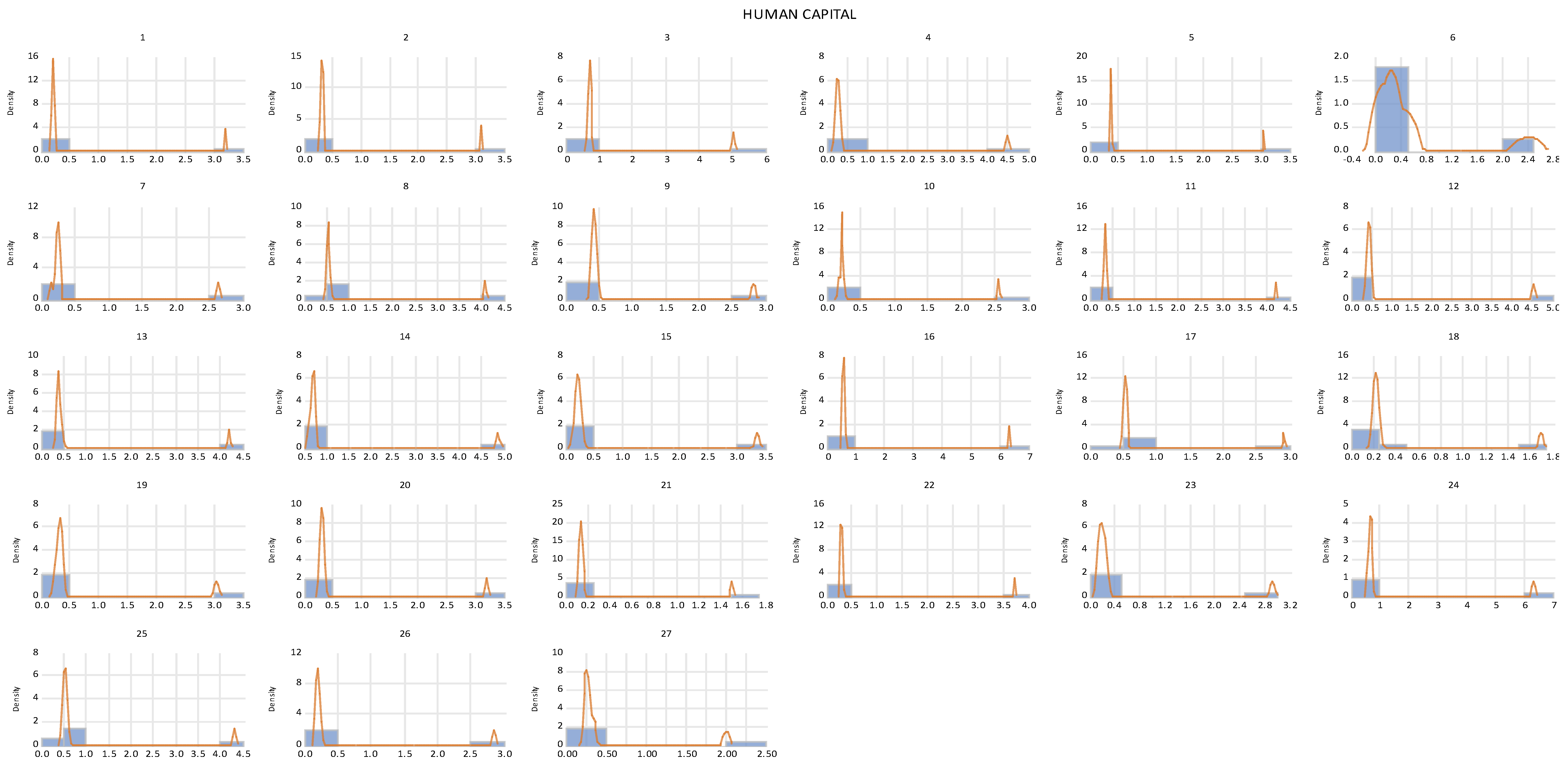
Figure 1 presents the histogram and kernel density distribution of women’s human capital levels across 27 countries. The distribution is generally asymmetric, with some countries exhibiting left-skewed and others right-skewed patterns, indicating substantial cross-country heterogeneity in human capital accumulation. The presence of extended tails in several density functions signals potential outliers and underscores the non-homogeneous nature of the variable. Such distributional asymmetry and dispersion across countries further support the use of quantile regression, as the effects of digital and circular transitions may differ between countries located at the lower and upper tails of the human capital distribution.
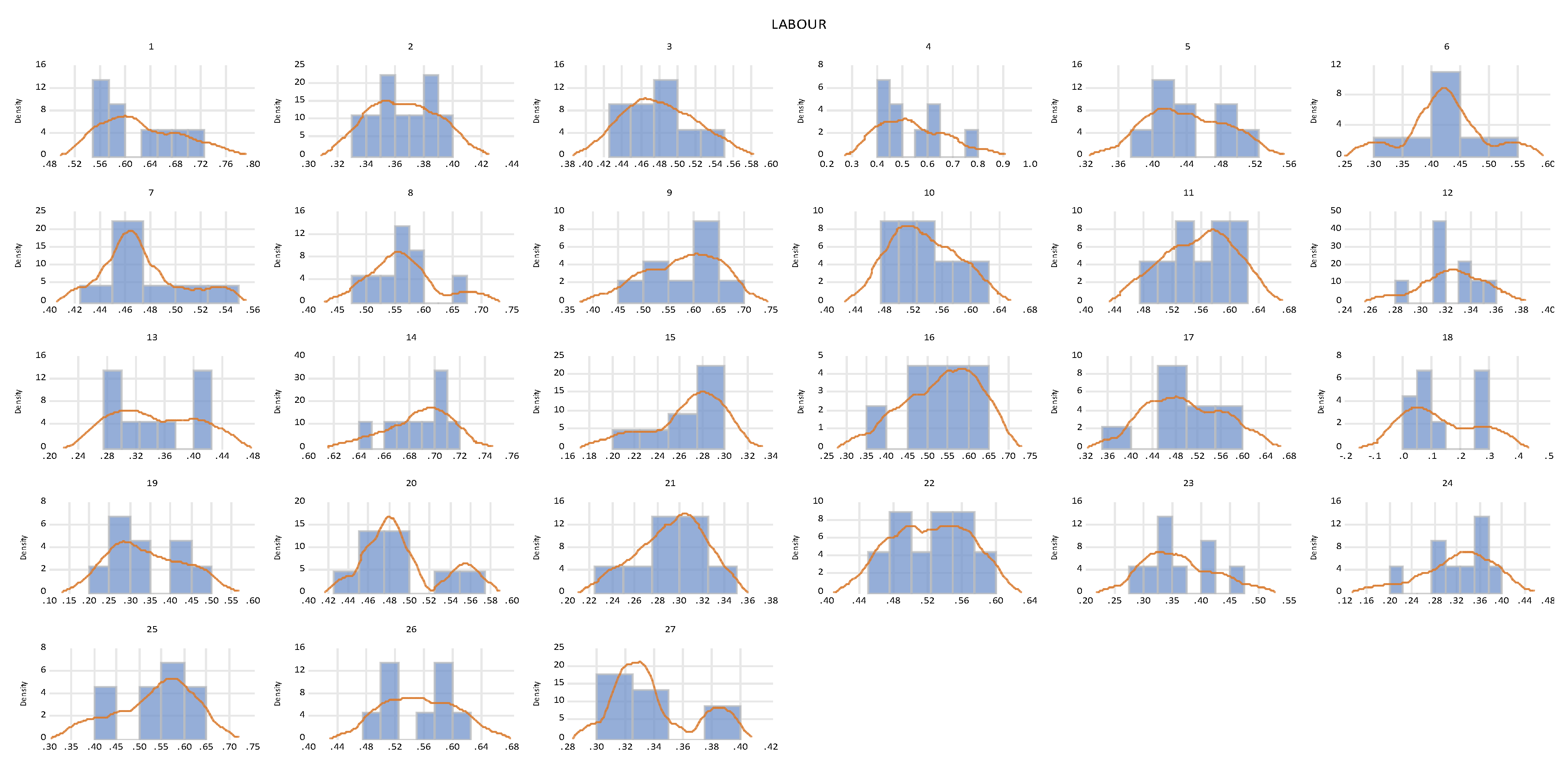
Figure 2 shows that women’s labor levels are dispersed over a wide range, with several density plots displaying bimodal or multimodal structures. This indicates clear groupings among countries, such as differences between Northern and Southern Europe. Additionally, the distributions vary between left- and right-skewed forms, implying that variance differs across quantiles, which is a sign of strong heteroskedasticity. Under such conditions, quantile regression provides a more informative framework because it allows the estimation of effects at different points of the distribution rather than imposing a constant impact across all countries.
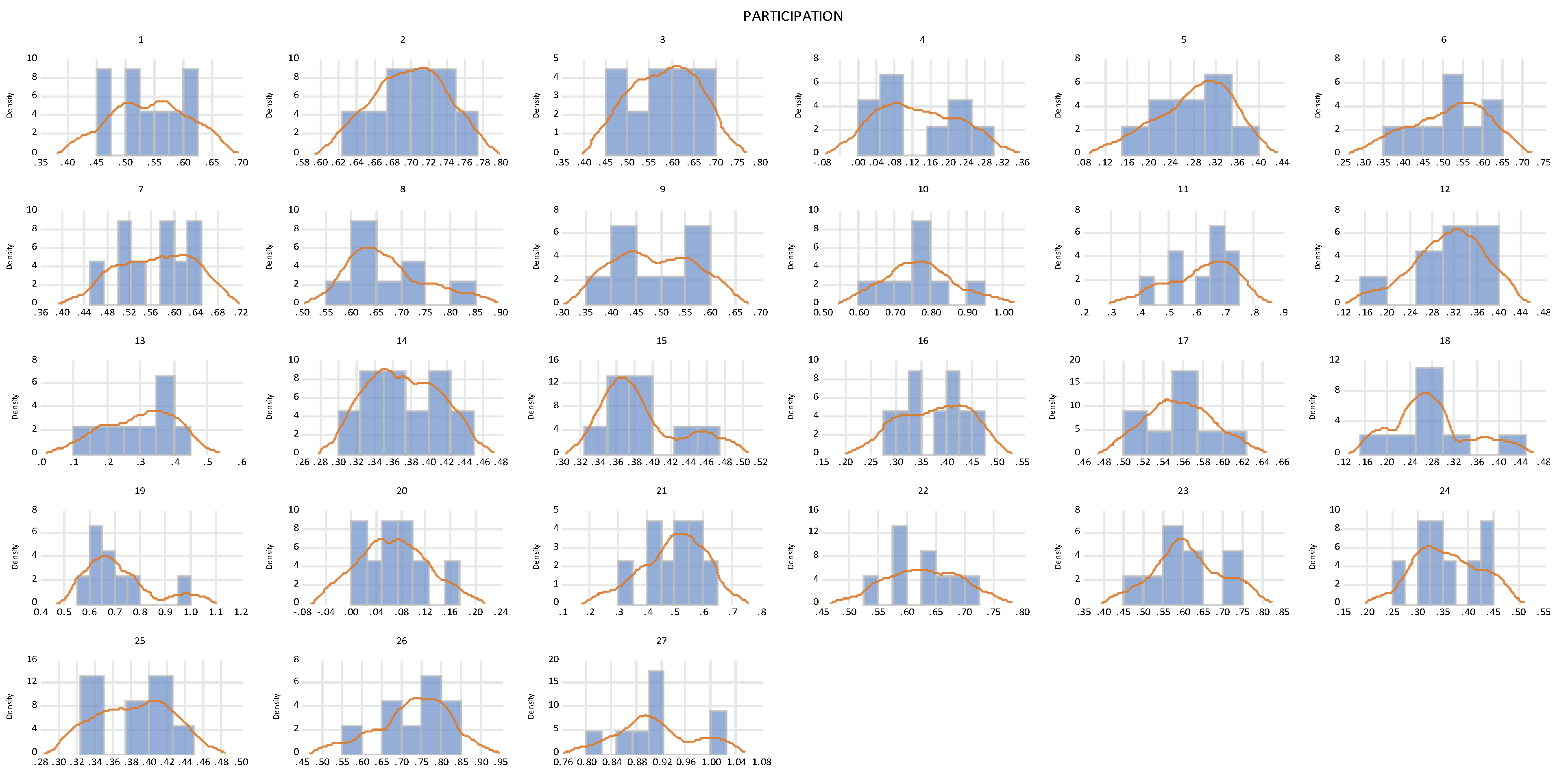
Figure 3 reveals a distinctly polarized distribution of women’s participation levels. Some countries cluster around participation rates of 30–40%, while others cluster around 70–80%. This bi-clustered pattern suggests that countries differ substantially in structural and institutional determinants of participation. The asymmetrical and long-tail behaviors visible in many density plots indicate that countries at the lower and upper ends of the participation distribution may be driven by different mechanisms. Consequently, relying solely on mean-based estimators would fail to capture these differentiated dynamics across the distribution. By estimating conditional quantiles of the dependent variable, PQR allows us to examine whether the digital and circular transitions exert stronger or weaker effects across countries with low, medium, and high levels of women’s empowerment.
The pronounced asymmetry, heteroskedasticity, polarization, multimodality, and cross-country variance differences observed in Figure 1, Figure 2 and Figure 3 collectively justify the use of PQR. Traditional panel estimators such as OLS, FEM, or GMM provide only a single average effect, assuming that the relationship between explanatory variables and outcomes is uniform across all countries. However, it is highly likely that digital economy, circular economy, and twin transition indicators have stronger or weaker effects in different parts of the distribution—for example, low-human-capital countries may experience different impacts compared to high-human-capital countries. PQR captures these heterogeneous effects across the 0.10–0.90 quantiles, offering a more accurate, policy-relevant, and methodologically robust estimation strategy for this dataset.

4. Results

Before discussing the individual tables, it is important to note that the statistical significance and explanatory power of the models vary across estimators and dimensions of women’s empowerment. This variation is expected in a multi-method panel framework. In particular, the fixed effects models for women’s human capital and participation display relatively high explanatory power, whereas lower goodness-of-fit measures are observed in some employment equations. In addition, the pseudo-R2 values reported for panel quantile regressions are not directly comparable to conventional R2 statistics and should be interpreted with caution. More importantly, quantile estimates are designed to uncover heterogeneous effects across the conditional distribution rather than maximize overall model fit. Therefore, differences in significance across models and quantiles should be interpreted as evidence of heterogeneity, dynamic persistence, and possible endogeneity.

4.1. Digital Economy, Circular Economy, Twin Transition and Women’s Human Capital

Table 4 presents the impact of the digital and circular economy on women’s human capital using FEM, GMM, and PQR. The results indicate that the digital economy has a significant positive effect primarily on the lower and middle quantiles of women’s human capital. Specifically, countries with relatively low to middle levels of female human capital experience notable gains from digitalization, while countries at higher quantiles show no significant effect. This suggests that digital transformation is particularly effective in supporting human capital accumulation where it is most needed, while its marginal impact diminishes in more advanced contexts.
In contrast, the circular economy demonstrates a strong positive effect in the dynamic GMM estimation, highlighting that its impact on women’s human capital is more pronounced when accounting for dynamic and endogenous relationships. This finding implies that structural changes associated with circular economic sectors such as increased employment opportunities, skill development, and green innovation, gradually contribute to enhancing women’s human capital. However, the effect of the circular economy is not significant across the quantiles. When considering the heterogeneous distribution, the PQR and FEM models support each other, indicating that the circular economy does not have a significant impact on women’s human capital levels.
Table 5 presents the impact of the combined digital and circular economy, captured by the twin transition index, on women’s human capital accumulation. The results show that while the individual effects of digital and circular economy were either limited to certain quantiles or significant only in dynamic models, the combined twin transition exhibits consistently stronger and more robust positive effect, particularly in the GMM estimation and at lower to mid-quantiles in the PQR. Specifically, the GMM estimates indicate a highly significant positive effect, highlighting that when dynamic adjustments and endogeneity are considered, the twin transition substantially enhances women’s human capital. Similarly, the PQR results show significant positive effects at the lower quantiles (τ = 0.10–0.30) and a weaker, marginally significant effect at τ = 0.40, indicating that countries with initially lower levels of female human capital benefit most from the combined digital and circular economy transformations.
In contrast, the effects at higher quantiles are not statistically significant, suggesting diminishing marginal gains for countries already performing well in terms of women’s human capital. These findings contrast with the separate analyses of digital and circular economy, where the digital economy was effective mainly for low- to middle-level countries and the circular economy showed significance only in dynamic GMM, with limited quantile-level impact. Taken together, the results emphasize that integrating digitalization and circular economy into a single twin transition index produces more consistent and meaningful improvements in women’s human capital, especially in countries with lower initial endowment.
Although not all coefficients are statistically significant across all specifications, this pattern is substantively informative. The findings suggest that the effects of digitalization and circular economy are not uniform across countries or across the distribution of women’s human capital. In this respect, the significance observed in the lower and middle quantiles, together with the strong GMM estimates, indicates that these transitions matter particularly when persistence and heterogeneous initial conditions are considered.

4.2. Digital Economy, Circular Economy, Twin Transition and Women’s Employment

The results in Table 6 show that digital and circular economic indicators generally have significant and positive effects on women’s employment. The digital economy variable is statistically significant and positive in both FEM and GMM estimations, indicating that improvements in digital infrastructure, digital services, and e-commerce capacity strengthen women’s position in the labor market. The PQR provides a more detailed picture across the distribution: the effect of the digital economy is strong and significant particularly in the middle quantiles (τ = 0.20–0.80). This suggests that digitalization promotes women’s employment by increasing labor force participation and creating new and flexible forms of work, especially in countries with middle performance levels. The weaker effects at the lowest and highest quantiles indicate that digitalization alone may not be sufficient in countries with very low starting levels, while marginal gains diminish in the highest-performing countries.
The circular economy variable shows a strong and consistent positive effect across most models. FEM and GMM yield highly significant results, and PQR estimates are also significant across most quantiles (τ = 0.10–0.90), except for τ = 0.50 and τ = 0.90. This finding indicates that components of the circular economy such as recycling rates, waste management, green employment, and sustainable production, create new employment opportunities for women and support women’s employment by diversifying sectors. The strong positive effects across quantiles show that the circular economy enhances women’s employment consistently in low-, middle-, and high-performing countries.
The results in Table 7 show that the twin transition has a very strong and consistent positive impact on women’s employment. While the separate effects of the digital and circular economies in the previous table were generally significant, their magnitudes varied across quantiles and the strength of the effects weakened in some parts of the distribution. In contrast, in the twin transition model, the effects are much stronger, more stable, and highly significant across the FEM, GMM, and all quantile estimations.
In the FEM model, the coefficient of the twin transition is 0.428, a relatively large magnitude. The GMM estimate is also positive and significant, confirming that even when accounting for dynamic structure and potential endogeneity, the twin transition increases women’s employment.
The most striking finding appears in the PQR results: from τ = 0.10 to τ = 0.90, the effect of the twin transition is positive, highly statistically significant, and remarkably similar in size across quantiles. The coefficients range from 0.27 to 0.59, showing a strong positive effect throughout the entire distribution. This consistency indicates that the twin transition enhances women’s employment not only in low- or high-performing countries but across all parts of the distribution. The combined effect is substantially stronger than the separate impacts of digitalization and the circular economy, demonstrating a clear synergy when both transformations occur together.
A comparison with the individual effects reported in Table 6 also reveals an important pattern. While digital economy effects are concentrated in middle quantiles and circular economy effects are strong but somewhat uneven across the distribution, the twin transition produces positive and statistically significant effects across nearly all quantiles. This indicates that the interaction between digitalization and circular economy development generates a more uniform and robust impact on women’s employment outcomes across countries.
For women’s employment, the lower fit observed in the fixed effects specification likely reflects the fact that labor-market outcomes are influenced by a broader set of institutional and structural factors beyond those included in the baseline model. Nevertheless, the core variables of interest remain statistically significant in several specifications, and the consistency of the twin transition effect across FEM, GMM, and quantiles supports the robustness of the main finding.

4.3. Digital Economy, Circular Economy, Twin Transition and Women’s Participation

The findings in Table 8 indicate that the effects of the digital and circular economies on women’s participation in decision-making are generally weaker and less consistent compared to their effects on human capital and employment. In the FEM estimation, neither digital economy nor circular economy indicators are statistically significant, suggesting that, when country-fixed characteristics are controlled for, these transformations alone are not sufficient to significantly influence women’s presence in managerial or political decision-making roles.
The GMM results, however, reveal a different pattern. Both digital economy and circular economy variables are positive and statistically significant in the dynamic specification. This implies that once endogeneity and persistence in women’s participation levels are considered, progress in digitalization and circular economic structures contributes meaningfully to strengthening women’s decision-making positions. The significance in the GMM model highlights the importance of dynamic effects, institutional changes, and cumulative improvements, which may take time to influence leadership structures.
PQR results offer additional insights. For the digital economy, the effect is mostly insignificant across the lower and middle quantiles, turning positive and marginally significant only at the highest quantile (τ = 0.90). This indicates that digital transformation benefits women’s participation primarily in countries that are already high performers in gender equality within leadership structures. In lower-performing countries, digital advances alone may not be strong enough to dismantle structural barriers related to institutional representation or managerial gender gaps.
The circular economy shows somewhat stronger effects in the quantile regressions. Although insignificant at several quantiles, it becomes positive and significant in the mid-upper quantiles (τ = 0.40–0.60). This suggests that circular economy developments, such as green sector employment, recycling industry expansion, and sustainability-driven innovation, may support leadership opportunities for women, but the effect emerges mostly in countries where structural and institutional conditions are already more favorable.
The findings presented in Table 9 show that the impact of the twin transition (the combined effect of digital and circular transformation) on women’s participation in decision-making exhibits a distinct pattern compared to the effects of the individual transitions. In the FEM estimation, the twin transition variable is not statistically significant. This indicates that, once country-specific fixed effects are controlled for, the twin transition alone is not sufficient to enhance women’s representation in managerial or political decision-making structures. In contrast, the GMM results reveal a clear and statistically significant positive effect. In the dynamic specification, the twin transition variable is strongly positive and significant, suggesting that when endogeneity and the persistence of decision-making participation levels are considered, progress in both digitalization and circular economy development meaningfully contributes to strengthening women’s roles in leadership positions. This highlights the importance of dynamic effects, institutional adaptation, and cumulative improvements in digital and green transitions that materialize over time.
The PQR results provide further nuance. At the lower quantiles (τ = 0.10–0.30), the effect of the twin transition is negative and insignificant, indicating that in countries where women’s participation in leadership is already low, the twin transition does not yield measurable benefits. From the mid-quantiles onward (τ = 0.40–0.70), however, the effect becomes positive and statistically significant. The strongest effects occur at τ = 0.60, where the twin transition exhibits both a robust magnitude and high statistical significance. This suggests that countries with more advanced institutional frameworks and greater progress in gender equality benefit more from the combined momentum of digital and circular transformation. At the highest quantile (τ = 0.90), although the coefficient remains positive, it loses statistical significance, likely because countries already performing at very high levels leave limited space for additional marginal improvements.
The results across the three dimensions suggest that the twin transition tends to produce more stable and policy-relevant effects than the individual transitions. While digital and circular economy indicators sometimes show significance only in specific models or quantiles, their combined index yields clearer and more consistent improvements, particularly in dynamic specifications and middle-to-upper quantiles of women’s empowerment.
Table 10 provides a compact comparison of the estimated effects of the digital economy, circular economy, and twin transition across the three dimensions of women’s empowerment. The table clearly shows that the twin transition yields more consistent and robust effects than the individual transitions. While the digital and circular economy indicators are significant only in certain models or quantiles, the combined transition exhibits a broader and more stable pattern of positive effects, especially for women’s employment and, to a lesser extent, human capital and participation. More specifically, the digital economy mainly affects lower and middle quantiles, while the circular economy shows significance primarily in the dynamic GMM specification. In contrast, the twin transition is statistically significant both in the dynamic model and across several lower and middle quantiles in the PQR results. This summary reinforces the interpretation that simultaneous progress in digital and circular transformation generates stronger and more policy-relevant gains for women’s empowerment than either transition in isolation.

5. Conclusions, Discussion and Policy Implications

The EU has institutionalized gender equality and women’s empowerment as a fundamental policy priority and has subsequently integrated global normative frameworks, such as the Beijing Declaration, into its internal policy processes. It has aimed to promote the equitable development of women and men and their equal participation in societal life. The EU’s new and ambitious policy objective—the twin transition, which combines the circular and digital economies—is expected to generate significant positive effects on women’s empowerment across economic, political, and social spheres. The findings of our research explore the outcomes of the twin transition process on women’s human capital, labor, and participation.
First, the results provide empirical evidence—aligned with the theoretical and empirical literature—demonstrating that the digital economy, the circular economy and the twin transition exert a positive influence on women’s human capital. Quantile-based estimates further indicate that the impact of the digital economy is heterogeneous across the human capital distribution: strong positive effects emerge at the lower and middle levels, whereas the marginal returns diminish at the upper levels. Digital technologies are creating a rapid catch-up effect among women with low and middle women’s human capital at the outset by reducing the cost of access to education and knowledge [18]. Conversely, additional gains for highly educated women remain limited due to diminishing marginal returns. These findings imply that the digital economy is particularly effective at early stages of human capital accumulation [45]. This underscores a clear policy implication that the EU may achieve substantial and measurable progress in women’s empowerment by strategically accelerating digital transformation in member states with persistent human capital gaps among women.
While the impact of the circular economy on women’s human capital is positive and statistically significant, its effects appear to unfold more gradually over a longer time horizon [94]. Unlike digitalization, which generally offers accessible, modular tools that can be acquired through short-term training, the circular economy requires fundamental transformations in production and consumption patterns, industrial processes, and regulatory frameworks. The green skills needed in this domain are inherently complex and interdisciplinary, encompassing STEM-related skills essential for circular economy practices [116]. Consequently, the development of expertise in this field relies on long-term academic and professional training. In this context, establishing regulations on education and skill development that specifically target the enhancement of women’s green skills is crucial for fostering gender-inclusive participation in the circular economy.
The twin transition, combining digitalization and the circular economy, enhances women’s human capital more strongly and consistently than either dimension alone. Its effects are particularly pronounced at lower and middle levels of human capital, while diminishing at higher levels. In lower-performing countries, the twin transition generates a leverage effect, producing substantial gains, whereas in countries with already-high levels of women’s human capital, marginal gains are limited. By strategically leveraging these synergy effects, the EU may help reduce disparities in women’s human capital across member states.
Second, the findings demonstrate that the digital economy, the circular economy, and the twin transition have a positive impact on women’s employment. Digital transformation represents a radical shift from physical to cognitive labor, substantially enhancing women’s participation in the labor market. Through flexible and remote work models as well as the expansion of e-commerce platforms, the digital economy lowers barriers to women’s labor force entry and creates new pathways for career advancement, thereby offering significant potential for human capital accumulation. At lower quantiles, at the initial stages, digitalization alone may not significantly increase female employment [80]. However, at middle levels, women possess higher human capital, and many of the traditional constraints on employment are considerably reduced [79]. Nonetheless, since structural inequalities such as the glass ceiling and promotion biases are not eliminated through digitalization, the potential gains at higher levels remain constrained. Moreover, the susceptibility of high-skilled white-collar occupations to automation may further diminish the benefits that highly educated women can derive from digitalization. Policymakers should harness the benefits of digitalization across all employment levels by implementing policies aligned with women’s human capital and skill levels. Accordingly, priority may be given to digital literacy training for low-income groups, legal protections for flexible working arrangements at middle levels, and strategic measures addressing automation risks and the glass ceiling for high-skilled women.
The circular economy positively influences women’s employment by generating new job opportunities in green sectors [16]. Women in the circular economy are predominantly employed in low-value-added and often informal sectors, such as waste management and recycling. In contrast, employment in sustainable production and green technologies, which typically require higher-level green skills, remains lower [73,124]. Policies that support women in acquiring green skills and promote flexible working arrangements in green sectors are likely to enhance female employment, while simultaneously achieving the EU’s sustainability targets.
The findings on the effects of the twin transition on female employment are robust and consistent, confirming a positive impact. The twin transition has a stronger influence on women’s employment than the digital or circular economies individually. While the digital and circular economies independently support women’s employment, the twin transition generates a wider impact. The results suggest that the EU may leverage its synergy effect to enhance women’s participation in the labor market.
Third, the digital economy exhibits a positive effect on women’s decision-making participation at higher quantiles. At lower performance levels, gender-based inequalities in access to technology, inadequate digital infrastructure, and persistent socio-cultural barriers prevent the digital economy from contributing meaningfully to women’s participation in decision-making [59,61]. In contrast, at higher levels—where structural constraints have been largely reduced—the digital economy produces the expected positive impact on women’s economic, social, and political representation [62]. The EU may strengthen policies to reduce gender gaps in digital access and skills in low-performing member states. This will enable the digital economy to increase women’s participation in economic and political decision-making processes.
The empirical findings of our research suggest that the positive impact of the circular economy on women’s decision-making emerges mainly at middle levels. Where such inequalities persist, the circular economy may reinforce existing gender gaps by restricting women to low-value, informal roles, whereas more gender-equitable contexts enable women’s participation in high-value activities and decision-making. For the EU, integrating a systematic gender perspective into circular economy policies is essential to ensure women’s effective involvement in decision-making processes.
Our empirical findings confirm that the twin transition has a positive and significant impact on women’s participation in decision-making processes, particularly in the dynamic specification and in the middle quantiles of the distribution. This outcome is attributed to the synergy arising over time from the alignment of digital and circular economy transition processes. Quantile estimates indicate that the effect varies across performance levels: it is statistically insignificant at lower levels, becomes positive and significant at middle levels, and weakens again at higher levels. The effect of the twin transition is constrained in lower-performing contexts due to structural and institutional barriers, is maximized in middle-performing contexts where supportive infrastructure and policies exist, and diminishes in higher-performing contexts due to already-high levels of women’s participation.
The digital economy and circular economy generally have positive effects on women’s empowerment, particularly at low to middle levels. Indeed, the twin transition process amplifies these impacts. However, structural barriers such as entrenched gender norms and inadequate legal and institutional frameworks can hinder the transition to the twin transition at higher performance levels. While these processes initially promote improvements in women’s human capital and employment, their long-term sustainability may depend on supportive institutional contexts. The effects on women’s decision-making power are more pronounced among higher levels. These findings have important implications for the EU’s twin transition process. Digital and circular economies affect women’s empowerment differently at various levels; their impacts are heterogeneous rather than uniform. Recognizing this heterogeneity in the EU policies on women’s empowerment within the twin transition can enhance the inclusiveness and sustainability of the process. Adopting policies at the union level to the specific needs of different groups is likely to yield more effective outcomes.
As a result, the study provides an important insight that the European Union cannot be considered a homogeneous region in terms of women’s empowerment. Although the EU has established common policy frameworks promoting gender equality, significant inequalities persist among member states due to differences in economic development, institutional structures, and socio-cultural norms. These differences are reflected in disparities in women’s human capital, employment opportunities, and levels of participation in decision-making processes. Therefore, the effectiveness of twin transition policies may vary across countries, indicating that policy approaches to promoting women’s empowerment within the EU need to account for country-specific conditions. In this context, EU policies may focus on strengthening training digital skills, promoting women’s participation in green and STEM-related sectors, and supporting gender-inclusive innovation and entrepreneurship ecosystems. Such targeted policy instruments can help ensure that the benefits of the digital and circular transitions translate more effectively into improvements in women’s human capital, employment opportunities, and leadership participation across member states.

Author Contributions

F.U.: Conceptualization, investigation, data curation, and writing—original draft, review, and editing. E.K.: Investigation, methodology, writing—original draft, review, and editing. All authors have read and agreed to the published version of the manuscript.

Funding

This research received no external funding.

Institutional Review Board Statement

Not applicable.

Informed Consent Statement

Not applicable.

Data Availability Statement

The data presented in this study are available on request from the corresponding author.

Acknowledgments

During the preparation of this manuscript, the authors used an AI-assisted language tool solely for language editing and grammar improvement. The authors reviewed and revised the content as necessary and take full responsibility for the accuracy and integrity of the manuscript.

Conflicts of Interest

The authors declare no conflicts of interest.

Abbreviations

The following abbreviations are used in this manuscript:
C_ECONCircular Economy
D_ECONDigital Economy
FEMFixed Effects Model
GDPGross Domestic Product
GMMGeneralized Method of Moments
ICTInformation and Communication Technologies
OLSOrdinary Least Squares
PQRPanel Quantile Regression
STEMScience, Technology, Engineering and Mathematics

References

  1. Amoroso, S.; Pahl, S.; Seric, A. How to Achieve The Twin Transition Towards Green Digital Production. 2022. Available online: https://iap.unido.org/articles/how-achieve-twin-transition-towards-green-and-digital-production (accessed on 14 October 2025).
  2. ITU. Turning Digital Technology Innovation into Climate Action; ITU Publications: Geneva, Switzerland, 2019. [Google Scholar]
  3. Ormazabal, M.; Prieto-Sandoval, V.; Puga-Leal, R.; Jaca, C. Circular Economy in Spanish SMEs: Challenges and opportunities. J. Clean. Prod. 2018, 185, 157–167. [Google Scholar] [CrossRef]
  4. Sajadieh, S.M.M.; Do Noh, S. A Review of Digital Twin Integration in Circular Manufacturing for Sustainable Industry Transition. Sustainability 2025, 17, 7316. [Google Scholar] [CrossRef]
  5. Bimonte, G.; Romano, M.G.; Russolillo, M. Green innovation and competition: R&d incentives in a circular economy. Games 2021, 12, 68. [Google Scholar] [CrossRef]
  6. Herrador, M.; Van, M.L. Circular economy strategies in the ASEAN region: A comparative study. Sci. Total Environ. 2024, 908, 168280. [Google Scholar] [CrossRef]
  7. Tänzler, D.; Ivleva, D.; Bernstein, T. Twin Transition Digital Transformation and Climate Policy in Development Cooperation; Deutsche Gesellschaft für Internationale Zusammenarbeit (GIZ) GmbH: Bonn, Germany, 2022. [Google Scholar]
  8. Diodato, D.; Timmermans, B.; Huergo, E.; Rentocchini, F.; Moncada-Paternò-Castello, P. Introduction to the special issue on “the twin (digital and green) transition: Handling the economic and social challenges”. Ind. Innov. 2023, 30, 755–765. [Google Scholar] [CrossRef]
  9. Muench, S.; Stoermer, E.; Jensen, K.; Asikainen, T.; Salvi, M.; Scapolo, F. Towards a Green and Digital Future; Publications Office of the European Union: Luxembourg, 2022. [Google Scholar] [CrossRef]
  10. European Commission. Communication from the Commision, The European Green Deal; European Commision: Brussels, Belgium, 2019. [Google Scholar]
  11. EEA. Delivering Justice in Sustainability Transitions. 2024. Available online: https://www.eea.europa.eu/en/analysis/publications/delivering-justice-in-sustainability-transitions (accessed on 21 September 2025).
  12. Leythienne, D.; Pérez-Julián, M. Gender Pay Gaps in the European Union—A Statistical Analysis—Revision 1; Publications Office of the European Union: Luxembourg, 2021. [Google Scholar]
  13. Husain, S.; Sohag, K.; Wu, Y. The response of green energy and technology investment to climate policy uncertainty: An application of twin transitions strategy. Technol. Soc. 2022, 71, 102132. [Google Scholar] [CrossRef]
  14. European Commission. Communication from the Commission to the European Parliament, the Council, the European Economic and Social Committee and the Committee of the Regions, 2030 Digital Compass: The European Way for the Digital Decade; European Commision: Brussels, Belgium, 2021. [Google Scholar]
  15. Fouquet, R.; Hippe, R. Twin transitions of decarbonisation and digitalisation: A historical perspective on energy and information in European economies. Energy Res. Soc. Sci. 2022, 91, 102736. [Google Scholar] [CrossRef]
  16. OECD. Harnessing the Green and Digital Transitions for Gender Equality: Insights from the 2024 OECD Forum on Gender Equality; OECD Publishing: Paris, France, 2024. [Google Scholar]
  17. Quimba, F.M.A.; Serafica, R.B.; Bayudan-Dacuycuy, C.; Andrada, A.E.; Irwin, N.; Moreno, S. Green and Digital: Managing the Twin Transition Toward Sustainable Development; PIDS Discussion Paper Series; Philippine Institute for Development Studies: Manila, Philippines, 2023. [Google Scholar]
  18. UN Women. Women’s Empowerment, SDGs and ICT; United Nations Asian and Pacific Training Centre for Information and Communication Technology for Development: Incheon, Republic of Korea, 2016; pp. 1–60. [Google Scholar]
  19. Kabeer, N. The Conditions and Consequences of Choice: Reflections on the Measurement of Women’s; UNRISD Discussion Papers; United Nations Research Institute For Social Development: Geneva, Switzerland, 1999; Volume 30, pp. 435–464. [Google Scholar]
  20. UN Women and Social Development Direct. Empowerment of Women; UN Women: New York, NY, USA, 2020. [Google Scholar]
  21. UNDP. The Paths to Equal: Twin Indices on Women’s Empowerment and Gender Equality; Technical Note; United Nations Development Program: New York, NY, USA, 2023; pp. 1–5. [Google Scholar]
  22. Bayissa, F.W.; Smits, J.; Ruben, R. The Multidimensional Nature of Women’s Empowerment: Beyond the Economic Approach. J. Int. Dev. 2018, 30, 661–690. [Google Scholar] [CrossRef]
  23. Bednorz, J.; Sadauskaitė, A.; Czarzasty, J.; Surdykowska. Unionisation and the Twin Transition, Good Practices in Collective Action and Employee Involvement; Policy Department for Economic, Scientific and Quality of Life Policies, European Parliament: Luxembourg, 2022. [Google Scholar]
  24. Leal Filho, W.; Kovaleva, M.; Tsani, S.; Țîrcă, D.M.; Shiel, C.; Dinis, M.A.P.; Nocolau, M.; Sima, M.; Fritzen, B.; Salvia, A.L.; et al. Promoting gender equality across the sustainable development goals. Environ. Dev. Sustain. 2023, 25, 14177–14198. [Google Scholar] [CrossRef]
  25. Grossman, M. On the Concept of Health Capital and the Demand for Health. J. Polit. Econ. 1972, 80, 223–255. [Google Scholar] [CrossRef]
  26. Wang, Y.; Torbica, A. Investigating the relationship between health and gender equality: What role do maternal, reproductive, and sexual health services play? Health Policy 2024, 149, 105171. [Google Scholar] [CrossRef] [PubMed]
  27. Klepinger, B.D.H.; Lundberg, S.; Plotnick, R.D. Adolescent Fertility and the Educational Attainment of Young Women. Fam. Plan. Perspect. 1995, 27, 23–28. [Google Scholar] [CrossRef]
  28. Mishra, V.; Smyth, R. Female labor force participation and total fertility rates in the OECD: New evidence from panel cointegration and Granger causality testing. J. Econ. Bus. 2010, 62, 48–64. [Google Scholar] [CrossRef]
  29. Berthelon, M.; Kruger, D.I. Does adolescent motherhood affect education and labor market outcomes of mothers? A study on young adult women in Chile during 1990–2013. Int. J. Public Health 2017, 62, 293–303. [Google Scholar] [CrossRef]
  30. Nikulin, D. The Impact of ICTs on Women’s Economic Empowerment; GUT Faculty of Management and Economics Working Paper Series A (Economics, Management, Statistics); GUT Faculty of Management and Economics: Gdańsk, Poland, 2017; Volume 2016, pp. 15–24. [Google Scholar]
  31. Pavolini, E.; Brini, E.; Scherer, S. The Elephant in the Family Policy Room: How Care Culture Influences the Effects of Public Childcare on Women ’ s Labor Market Participation in Europe. Soc. Indic. Res. 2025, 180, 1619–1637. [Google Scholar] [CrossRef]
  32. Guldi, M.; Herbst, C.M. Offline effects of online connecting: The impact of broadband diffusion on teen fertility decisions. J. Popul. Econ. 2017, 30, 69–91. [Google Scholar] [CrossRef]
  33. Nie, P.; Peng, X.; Luo, T. Internet Use and Fertility Behavior Among Reproductive-Age Women in China. China Econ. Rev. 2022, 77, 101903. [Google Scholar] [CrossRef]
  34. Leoni, S. A Historical Review of the Role of Education: From Human Capital to Human Capabilities. Rev. Polit. Econ. 2025, 37, 227–244. [Google Scholar] [CrossRef]
  35. Lechman, E.; Paradowski, P. Digital technologies and women’s empowerment—Casting the bridges. In Technology and Women’s Empowerment; Routledge: Abingdon, UK, 2021; Volume 4, pp. 1–19. [Google Scholar] [CrossRef]
  36. Mishra, V. Gendering the G20: Empowering Women in the Digital Age; Observer Research Foundation: Delhi, India, 2017. [Google Scholar]
  37. Stevenson, G.; Harris, S.; Bortes, C.; Doherty, E. Women and the Net Zero Economy: A Briefing on Changes in Garment, Agriculture and Energy Supply Chains; Government of United Kingdom: London, UK, 2021. [Google Scholar]
  38. Kabeer, N. Women’s Economic Empowerment and Inclusive Growth: Labour Markets and Enterprise Development; International Development Research Centre: Ottawa, ON, Canada, 2012. [Google Scholar]
  39. Törnqvist, A.; Schmitz, C. Women’s Economic Empowerment: Scope for Sida’s Engagement, A Guide to Principles, Procedures and Working Methods; Sida: Sundbyberg, Sweden, 2009; pp. 1–39. [Google Scholar]
  40. Ashraf, F.; Jepsen, D. Private Patriarchy’s Impact on Women’s Careers: Through Kaleidoscope Career Model Lens. Group Organ. Manag. 2024, 51, 533–574. [Google Scholar] [CrossRef]
  41. Cislaghi, B.; Bhatia, A.; Hallgren, E.S.T.; Horanieh, N.; Weber, A.M.; Darmstadt, G.L. Gender Norms and Gender Equality in Full-Time Employment and Health: A 97-Country Analysis of the World Values Survey. Front. Psychol. 2022, 13, 689815. [Google Scholar] [CrossRef]
  42. Gao, M.G.; Ruan, H. Work-Family Policies and Gender Inequalities in Childcare Time. Socius Sociol. Res. Dyn. World 2022, 8, 23780231221142677. [Google Scholar] [CrossRef]
  43. Han, J. Research on the Economic Effects of Childcare Costs on Womens Employment Decisions. Adv. Econ. Manag. Polit. Sci. 2025, 148, 36–41. [Google Scholar] [CrossRef]
  44. Shah, M. Information-Based Economy: Is Really Empowering Women. Int. J. Adv. Res. Commer. Manag. Soc. Sci. 2023, 6, 121–128. [Google Scholar] [CrossRef]
  45. Lu, J.; Xiao, Q.; Wang, T. Does the digital economy generate a gender dividend for female employment? Evidence from China. Telecommun. Policy 2023, 47, 102545. [Google Scholar] [CrossRef]
  46. Pansera, M.; Barca, S.; Martinez Alvarez, B.; Leonardi, E.; D’Alisa, G.; Meira, T.; Guillibert, P. Toward a just circular economy: Conceptualizing environmental labor and gender justice in circularity studies. Sustain. Sci. Pract. Policy 2024, 20, 2338592. [Google Scholar] [CrossRef]
  47. Bustelo, M.; Flabbi, L.; Viollaz, M. The Gender Labor Market Gap in the Digital Economy; Inter-American Development Bank: Washington, DC, USA, 2019. [Google Scholar]
  48. UNDP. Rethinking Circular Economy: Integrating Gender Equality, Disability and Social Inclusion, Resource Material for Circular Economy Practitioners; UNDP: New York, NY, USA, 2024. [Google Scholar]
  49. Yerlikaya, B. Yeşil Ekonomiye Geçiş Kadinlarin Istihdama Katilimi Için Kriz Mi Firsat Mi? Toplumsal Cinsiyet Eşitliği Bağlaminda Yeşil Işler. Marmara Üniver. İktisadi İdari Bilim. Derg. 2022, 44, 137–161. [Google Scholar] [CrossRef]
  50. Dieleman, R.; Andersson, F. Measuring women’s political empowerment and investigating the role of women’s civil liberties in democratization. V-Dem Policy Brief 2016, 4, 1–3. [Google Scholar]
  51. Berevoescu, I.; Ballington, J. Women’s Representation in Local Government: A Global Analysis; Governance and Participation Section, Un Women: New York, NY, USA, 2021; pp. 1–28. [Google Scholar]
  52. Barrios, A.; Taborda, R.; Rueda, X. Time Poverty: An Unintended Consequence of Women Participation in Farmers’ Associations. Soc. Indic. Res. 2025, 178, 225–253. [Google Scholar] [CrossRef]
  53. Lombardo, E.; Meier, P.; Verloo, M. Policymaking from a Gender+ Equality Perspective. J. Women Polit. Policy 2017, 38, 1–19. [Google Scholar] [CrossRef]
  54. Jacob, C. The Significance of Women’s Political Participation towards Gender Equality. J. Polit. Sci. Public. Aff. 2023, 11, 1–2. [Google Scholar]
  55. Mavisakalyan, A.; Tarverdi, Y. Gender and climate change: Do female parliamentarians make difference? Eur. J. Polit. Econ. 2019, 56, 151–164. [Google Scholar] [CrossRef]
  56. Hessami, Z.; da Fonseca, M.L. Female political representation and substantive effects on policies: A literature review. Eur. J. Polit. Econ. 2020, 63, 101896. [Google Scholar] [CrossRef]
  57. Shim, J. Substantive representation of women and policy-vote trade-offs: Does supporting women’s issue bills decrease a legislator’s chance of reelection? J. Legis. Stud. 2022, 28, 533–553. [Google Scholar] [CrossRef]
  58. Ehrhart, A. Navigating underrepresentation and gendered barriers to women’s political power: Narratives and experiences of women parliamentarians in Turkey. Front. Polit. Sci. 2023, 4, 1075462. [Google Scholar] [CrossRef]
  59. Alasoini, T. Twin Transition as a Transformer of Work and an Opportunity for Development; Finnish Institute of Occupational Health: Helsinki, Finland, 2024. [Google Scholar]
  60. Corbett, C.; Wullert, K.E.; Gilmartin, S.K.; Simard, C. Glass Ceilings, Step Stools, and Sticky Floors: The Racialized Gendered Promotion Process. Socius Sociol. Res. A Dyn. World 2024, 10, 23780231241274238. [Google Scholar] [CrossRef]
  61. Khan, K.I.; Jamil, B.; Muhammad, M.; Mohsin, S.; Khan, A.H.; Javid, M.Q. Gender inequality in healthcare leadership: The challenges women face in breaking through the glass ceiling. BMC Health Serv. Res. 2025, 25, 190. [Google Scholar] [CrossRef]
  62. Demirgüç-Kunt, A.; Klapper, L.; Singer, D.; Ansar, S.; Hess, J. The Global Findex Database 2017: Measuring Financial Inclusion and the Fintech Revolution; World Bank Group: Washington, DC, USA, 2018. [Google Scholar]
  63. Ongo Nkoa, B.E.; Ondoua Beyene, B.; Ngo Nsoa Simb, J.F.; Ngnouwal Eloundou, G. Does social media improve women’s political empowerment in Africa? Telecommun. Policy 2023, 47, 102624. [Google Scholar] [CrossRef]
  64. Sakja, A. Digital Storytelling as Technique of Woman Politician Improving the Perception and Their Political Status. Interdiscip. J. Res. Dev. 2024, 11, 163. [Google Scholar] [CrossRef]
  65. Dahlum, S.; Knutsen, C.H.; Mechkova, V. Women’s political empowerment and economic growth. World Dev. 2022, 156, 105822. [Google Scholar] [CrossRef]
  66. Norris, P. The State of Women’s Participation and Empowerment: New Challenges to Gender Equality. In Proceedings of the 65th Commision on the Status of Women, New York City, NY, USA, 15–26 March 2020; UN Women: New York City, NY, USA, 2020; Volume 17, pp. 1–37. [Google Scholar]
  67. Cole, W.M. Working to protect rights: Women’s civil liberties in cross-cultural perspective. Soc. Sci. Res. 2020, 91, 102461. [Google Scholar] [CrossRef]
  68. Abdelwahed, N.A.A.; Bano, S.; Al Doghan, M.A.; Aljughiman, A.A.; Shah, N.; Soomro, B.A. Empowering women through digital technology: Unraveling the nexus between digital enablers, entrepreneurial orientation and innovations. Equal. Divers. Incl. 2024, 44, 602–626. [Google Scholar] [CrossRef]
  69. Amah, O.E.; Kolo, V.; Aigbona, C.; Baderinwa, R.; Okoro, C.; Akanji, M. Economic empowerment of women domestic workers: Role of digital financial services. S. Afr. J. Inf. Manag. 2024, 26, a1884. [Google Scholar] [CrossRef]
  70. Enciso-Alfaro, S.Y.; García-Sánchez, I.M. Are innovative firms more circular when women hold upper positions? J. Innov. Knowl. 2024, 9, 100556. [Google Scholar] [CrossRef]
  71. Caby, J.; Coron, C.; Ziane, Y. How does gender diversity in top management teams affect carbon disclosure and its quality: Evidence from the technological industry. Technol. Forecast. Soc. Change 2024, 199, 123077. [Google Scholar] [CrossRef]
  72. Nadeem, M.; Bahadar, S.; Gull, A.A.; Iqbal, U. Are women eco-friendly? Board gender diversity and environmental innovation. Bus. Strateg. Environ. 2020, 29, 3146–3161. [Google Scholar] [CrossRef]
  73. Giesemann, E. The Future of Work in the Twin Transition to Green and Digital. In System Updates: Resetting the Future of Work; Ladd, C., Ed.; Bertelsmann Foundation: Washington, DC, USA, 2023. [Google Scholar]
  74. Rani, U.; Castel-Branco, R.; Satija, S.; Nayar, M. Women, work, and the digital economy. Gend. Dev. 2022, 30, 421–435. [Google Scholar] [CrossRef]
  75. Davaki, K. The Underlying Causes of the Digital Gender Gap and Possible Solutions for Enhanced Digital Inclusion of Women and Girls; Policy Department for Citizens’ Rights and Constitutional Affairs, European Parliament: Brussels, Belgium, 2018. [Google Scholar]
  76. Karyotaki, M.; Bakola, L.; Drigas, A.; Skianis, C. A new decade for social changes. Tech. Soc. Sci. J. 2020, 6, 101–105. [Google Scholar]
  77. Sorgner, A.; Krieger-Boden, C. Empowering Women in the Digital Economy; Productivity Press: New York, NY, USA, 2017. [Google Scholar] [CrossRef]
  78. Xue, Q.; Wang, H.; Xue, Q.; Wang, H.; Wei, J.; Wei, J.; Bai, C. Does the digital economy improve female autonomy? Struct. Chang. Econ. Dyn. 2024, 71, 193–207. [Google Scholar] [CrossRef]
  79. Ahmad, R.; Sharif, F.; Ahmad, S.; Gul, A.; Abdirasulovna, Z.A. Does the digital economy improve female employment? A cross-country panel data analysis. Heliyon 2024, 10, e33535. [Google Scholar] [CrossRef]
  80. Avanesian, G.; Zaw, H.T.; Kelly, P.; Mizunoya, S. Dissecting the digital divide: A household fixed effects approach to estimating gender gaps in digital skills of youth in low- and middle-income economies. Heliyon 2024, 10, e33127. [Google Scholar] [CrossRef]
  81. Ajmone Marsan, G.; Sey, A. Women’s Participation in the Digital Economy; Policy Brief; Economic Research Institute for ASEAN and East Asia: Jakarta, Indonesia, 2020; pp. 1–5. [Google Scholar]
  82. Mishra, D.; Kandpal, V.; Agarwal, N.; Kumar, R.; Singh, R.; Priyadarshi, N.; Twala, B. Digital and Financial Literacy for Uplifting Women and Achieving Sustainable Development Goals. F1000Research 2024, 13, 1364. [Google Scholar] [CrossRef]
  83. Khandelwal, R.; Priya, A. Digital Transformation To Spur Women Empowerment in Msmes: A Case Study Approach. ShodhKosh J. Vis. Perform. Arts 2024, 5, 1735–1744. [Google Scholar] [CrossRef]
  84. Hazudin, S.F.; Sabri, M.F.; Kader, M.A.R.A.; Ishak, M. Empowering Women-owned Businesses in the Era of Digital Transformation: A Review of the Opportunities and Challenges. Int. J. Acad. Res. Bus. Soc. Sci. 2021, 11, 231–244. [Google Scholar] [CrossRef] [PubMed]
  85. Sicat, M.; Xu, A.; Mehetaj, E.; Ferrantino, M.; Chemutai, V. Leveraging ICT Technologies in Closing the Gender Gap; World Bank Group: Washington, DC, USA, 2020; pp. 1–45. [Google Scholar] [CrossRef]
  86. Clark, A.; Ratcliffe, J.; Sangha, M. Empowering Women in the Digital Economy: Addressing Tech’s Untapped Potential; Information and Communications Technology Council (ICTC): Ottawa, ON, Canada, 2023. [Google Scholar]
  87. Zhang, C.; Jian, Y.; Zhou, Z.; Zhou, B. Can the digital economy close the gender wage gap? Evidence from China. Int. Rev. Econ. Finance 2024, 96, 103604. [Google Scholar] [CrossRef]
  88. Li, W.; Chen, Y. The Digital Economy and Gender Disparities in rural Non-Agricultural Employment: Challenges or Opportunities for Sustainable Development? Sustainability 2025, 17, 3911. [Google Scholar] [CrossRef]
  89. Ma, X. Internet use and gender wage gap: Evidence from China. J. Labour Mark. Res. 2022, 56, 15. [Google Scholar] [CrossRef]
  90. Cortes, G.M.; Oliveira, A.; Salomons, A. Do technological advances reduce the gender wage gap? Oxford Rev. Econ. Policy 2020, 36, 903–924. [Google Scholar] [CrossRef]
  91. Han, J.; Li, M.; Li, S.; Hu, Y. The widening gender wage in the gig economy in China: The impact of digitalisation. Humanit. Soc. Sci. Commun. 2024, 11, 1639. [Google Scholar] [CrossRef]
  92. Wang, Y.; Huang, B.; Pan, Y.; Shao, P. Which groups benefit more? Evidence from the impact of the digital economy on the gender wage gap. Appl. Econ. 2024, 56, 8462–8480. [Google Scholar] [CrossRef]
  93. Zhang, C.; Tian, X.; Yang, X.; Xu, B.; Li, Q. The iron-out effect of digital economy: A discussion on gender wage rate discrimination for working hours. J. Bus. Res. 2023, 156, 113399. [Google Scholar] [CrossRef]
  94. Drucza, K.; Kaddour, A.; Ganguly, S.; Sarea, A.M. Centering Gender in the Era of Digital and Green Transition: Intersectional Perspectives; Palgrave Macmillan: Cham, Switzerland, 2023. [Google Scholar] [CrossRef]
  95. Anzak, S.; Sultana, A. Social and Economic Empowerment of Women in the Age of Digital Literacy: A Case Study of Pakistan, Islamabad Rawalpindi. Glob. Soc. Sci. Rev. 2020, 5, 102–111. [Google Scholar] [CrossRef] [PubMed][Green Version]
  96. Egbuka, N.I.; Dabo, O.D.; Akinyele, V.O.; Azino, O.D. The impact of digital literacy on women’s economic empowerment: A study of Owerri municipal. World J. Adv. Res. Rev. 2024, 24, 1864–1876. [Google Scholar] [CrossRef]
  97. ECLAC. Women in the Digital Economy: Breaking Through the Equality Threshold. In Proceedings of the 12th Regional Conference on Women in Latin America and the Caribbean, Santo Domingo, Dominican Republic, 15 October 2013; ECLAC: Santiago, Chile, 2013. [Google Scholar]
  98. Zacharia, C. Education and Employment of Women in Science, Technology and the Digital Economy, Including AI and its Influence on Gender Equality; Policy Department for Citizens’ Rights and Constitutional Affairs, European Parliament: Brussels, Belgium, 2020; Volume 84. [Google Scholar]
  99. Duarte, B. EU’s Digital Transition—What’s in it for Women? Eyes on Europe, 9 July 2021; pp. 2–4. [Google Scholar]
  100. The World Bank. Empowering Women Through Jobs in the Digital Economy. World Bank Group, 20 October 2015; pp. 1–5. [Google Scholar]
  101. Ning, C.; Wu, J.; Ye, Y.; Yang, N.; Pei, H.; Gao, H. How Media Use Influences the Fertility Intentions Among Chinese Women of Reproductive Age: A Perspective of Social Trust. Front. Public Health 2022, 10, 882009. [Google Scholar] [CrossRef] [PubMed]
  102. Billari, F.C.; Giuntella, O.; Stella, L. Does broadband Internet affect fertility? Popul. Stud. 2019, 73, 297–316. [Google Scholar] [CrossRef]
  103. Gupta, A. Towards Participatory Democracy: Can Digitalisation Help Women in India? Indian J. Public Adm. 2019, 65, 897–915. [Google Scholar] [CrossRef]
  104. Ristanović, V.; Šostar, M.; Hak, M. Are Women Recognized in the Digital Economy? Experiences of Developed Economies. Stud. Bus. Econ. 2024, 19, 200–215. [Google Scholar] [CrossRef]
  105. Stockemer, D.; Byrne, M. Women’s representation around the world: The importance of women’s participation in the workforce. Parliam. Aff. 2012, 65, 802–821. [Google Scholar] [CrossRef]
  106. Osei-Appiah, S.; Mutsvairo, B.; Orgeret, K.S. Women and digital political communication in non-Western societies. Inf. Commun. Soc. 2023, 26, 2507–2517. [Google Scholar] [CrossRef]
  107. Gomes, D.B.P.; Meyimdjui, C. Digitalization and Gender Equality in Political Leadership in Sub-Saharan Africa; Working Paper; International Monetary Fund (IMF): Washington, DC, USA, 2014. [Google Scholar]
  108. Tonami, A.; Yamamoto, H. Women, Social Media and Political Engagement in Japan: A Survey Study. Int. Q. Asian Stud. 2024, 55, 335–352. [Google Scholar] [CrossRef]
  109. Treuthart, M.P. Connectivity: The Global Gender Digital Divide and Its Implications for Women’s Human Rights and Equality. Gonzaga J. Int. Law 2019, 23, 1. [Google Scholar]
  110. Sutton, J.O.; Pollock, S. Online Activism for Women’s Rights. Cyberpsychol. Behav. Soc. Netw. 2000, 3, 699–706. [Google Scholar] [CrossRef]
  111. Shirazi, F. Telematics and Informatics Information and communication technology and women empowerment in Iran. Telemat. Inform. 2012, 29, 45–55. [Google Scholar] [CrossRef]
  112. Monshipouri, M. Human Rights in the Digital Age: Opportunities and Constraints. Public Integr. 2017, 19, 123–135. [Google Scholar] [CrossRef]
  113. Shamsu, L.S.; Ahmad, N.; Haziqah, R.; Husaini, A.; Danish, M.; Ariffin, I. Social Media Effects on Women’s Rights and Protections in Brunei Darussalam. J. Internet Soc. Netw. Virtual Communities 2023, 2023, 324314. [Google Scholar]
  114. Loiseau, E.; Nowacka, K. Can Social Media Effectively Include Women’s Voices in Decision-Making Processes? OECD Publishing: Paric, France, 2015; pp. 1–5. [Google Scholar] [CrossRef]
  115. Fu, Y. Research on the Influences of Social Media to Gender Equality. SHS Web Conf. 2022, 148, 03026. [Google Scholar] [CrossRef]
  116. ILO. Decent Work in the Circular Economy: An Overview of the Existing Evidence Base; ILO: Geneva, Switzerland, 2023; pp. 1–30. [Google Scholar]
  117. Nhamo, G.; Mukonza, C. Opportunities for women in the green economy and environmental sectors. Sustain. Dev. 2020, 28, 823–832. [Google Scholar] [CrossRef]
  118. Bannò, M.; Filippi, E.; Trento, S. Women in top echelon positions and their effects on sustainability: A review, synthesis and future research agenda. J. Manag. Gov. 2023, 27, 181–251. [Google Scholar] [CrossRef]
  119. Coghlan, C.; Proulx, P.; Salazar, K. A Food-Circular Economy-Women Nexus: Lessons from Guelph-Wellington. Sustainability 2022, 14, 192. [Google Scholar] [CrossRef]
  120. Chineme, A.; Assefa, G.; Herremans, I.M.; Wylant, B.; Shumo, M. African Indigenous Female Entrepreneurs (IFÉs): A Closed-Looped Social Circular Economy Waste Management Model. Sustainability 2022, 14, 11628. [Google Scholar] [CrossRef]
  121. Erdiaw-Kwasie, M.O.; Abunyewah, M.; Kusi, K.; Owusu-Ansah, K.K.; Baah, C.; Alam, K.; Basson, M. Circular economy and agricultural employment: A panel analysis of EU advanced and emerging economies. Environ. Dev. Sustain. 2025, 27, 10469–10496. [Google Scholar] [CrossRef]
  122. Palm, J.; Lazoroska, D.; Valencia, M.; Bocken, N.; Södergren, K. A gender perspective on the circular economy: A literature review and research agenda. J. Ind. Ecol. 2024, 28, 1670–1683. [Google Scholar] [CrossRef]
  123. Klonowska-Matynia, M. Human Capital and the Sustainable Energy Transition: A Socio-Economic Perspective. Sustainability 2025, 17, 10710. [Google Scholar] [CrossRef]
  124. Albaladejo, B.M.; Arribas, V.; Mirazo, P. Why Adopting a Gender-Inclusive Approach Towards Circular Economy Matters; UNIDO: Vienna, Austria, 2022; Available online: https://iap.unido.org/articles/why-adopting-gender-inclusive-approach-towards-circular-economy-matters (accessed on 21 September 2025).
  125. Liao, Z.; Zhang, M.; Wang, X. Do female directors influence firms’ environmental innovation? The moderating role of ownership type. Corp. Soc. Responsib. Env. Manag. 2019, 26, 257–263. [Google Scholar] [CrossRef]
  126. Naciti, V. Corporate governance and board of directors: The effect of a board composition on fi rm sustainability performance. J. Clean. Prod. 2019, 237, 117727. [Google Scholar] [CrossRef]
  127. Musova, Z. Environmentally responsible behaviour of consumers: Evidence from Slovakia. Econ. Sociol. 2022, 14, 178–198. [Google Scholar] [CrossRef]
  128. Ali, Q.; Parveen, S.; Yaacob, H.; Nasir, A.; Zaini, Z. Environmental beliefs and the adoption of circular economy among bank managers: Do gender, age and knowledge act as the moderators? J. Clean. Prod. 2022, 361, 132276. [Google Scholar] [CrossRef]
  129. Lakhal, F.; Hamrouni, A.; Jilani, I.; Mahjoub, I.; Benkraiem, R. The power of inclusion: Does leadership gender diversity promote corporate and green innovation? Res. Int. Bus. Financ. 2024, 67, 102128. [Google Scholar] [CrossRef]
  130. García-Sánchez, I.M.; Monteiro, S.; Piñeiro-Chousa, J.R.; Aibar-Guzmán, B. Climate change innovation: Does board gender diversity matter? J. Innov. Knowl. 2023, 8, 100372. [Google Scholar] [CrossRef]
  131. Oyewo, B.; Tauringana, V.; Tingbani, I. Microplastics in aquatic bodies: Assessing the role of governance mechanisms in industrial wastewater management. J. Environ. Manag. 2024, 349, 119563. [Google Scholar] [CrossRef]
  132. Atif, M.; Hossain, M.; Alam, M.S.; Goergen, M. Does board gender diversity affect renewable energy consumption? J. Corp. Financ. 2021, 66, 101665. [Google Scholar] [CrossRef]
  133. Goldin, C. The Quiet Revolution that Transformed Womens Employment Education and Family; American Economic Association: Nashville, TN, USA, 2006; Volume 96, pp. 1–21. [Google Scholar]
  134. Canipari, R.; De Santis, L.; Cecconi, S. Female Fertility and Environmental Pollution. Int. J. Environ. Res. Public Health 2020, 17, 8802. [Google Scholar] [CrossRef]
  135. Saidmamatov, O.; Sobirov, Y.; Makhmudov, S.; Marty, P.; Yusupova, S.; Ibadullaev, E.; Toshnazarova, D. Dynamics of Human Fertility, Environmental Pollution, and Socio-Economic Factors in Aral Sea Basin. Economies 2024, 12, 272. [Google Scholar] [CrossRef]
  136. Mu, R.; Zhang, F.; He, S.; Zhang, J. The role of environmental efficiency and economic development in fertility: Implications for public health and sustainability among OECD nations. Front. Public Health 2025, 13, 1551413. [Google Scholar] [CrossRef] [PubMed]
  137. Bozkurt, Ö.; Xheneti, M.; Vicky. On the Front Line of the Circular Economy: The Entrepreneurial, Identity and Institutional Work of a Female Entrepreneur towards the Circular Transition. Work Employ. Soc. 2022, 36, 156–166. [Google Scholar] [CrossRef]
  138. Crespo-Rosas, N.; Franco-García, L. Improving Gender Equality with Social Entrepreneurship and Circular Economy: A Mexican Case. In The Social Dimensions of the Circular Economy; Greening of Industry Networks Studies; Springer: Cham, Switzerland, 2023; Volume 10, pp. 241–263. [Google Scholar] [CrossRef]
  139. Oppong, C.; Mathibe, M.S. Women’s Role in Promoting Sustainable Development Through Stakeholder Engagement and Environmental Policy: African Perspectives On the Circular Economy. Bus. Strateg. Dev. 2024, 7, e70051. [Google Scholar] [CrossRef]
  140. Strumskyte, S.; Magaña, S.R.; Bendig, H. Women’s Leadership in Environmental Action; Working Paper; OECD Publishing: Paris, France, 2022; Volume 193, pp. 1–33. [Google Scholar]
  141. Koengkan, M.; Fuinhas, J.A.; Auza, A.; Castilho, D.; Kaymaz, V. Environmental Governance and Gender Inclusivity: Analyzing the Interplay of PM2.5 and Women’s Representation in Political Leadership in the European Union. Sustainability 2024, 16, 2492. [Google Scholar] [CrossRef]
  142. Lodi, C.; Sacchi, A.; Vidoli, F. Gender politics, environmental behaviours, and local territories: Evidence from Italian municipalities. Ann. Reg. Sci. 2025, 74, 52. [Google Scholar] [CrossRef]
  143. Blundell, R.; Bond, S. Initial conditions and moment restrictions in dynamic panel data models. J. Econom. 1998, 87, 115–143. [Google Scholar] [CrossRef]
  144. Koenker, R.; Bassett, G. Regression Quantiles; The Econometric Society: Cleveland, OH, USA, 1978; Volume 46. [Google Scholar]
Figure 1. Distribution of women’s human capital across 27 countries (2012–2020). Note: The blue shaded area represents the distribution (kernel density) of women’s human capital, while the orange line indicates the mean value.
Sustainability 18 03152 g001
Figure 2. Distribution of women’s labor (employment) levels in 27 countries (2012–2020). Note: The blue shaded area represents the distribution of women’s employment levels, while the orange line shows the mean value.
Sustainability 18 03152 g002
Figure 3. Distribution of women’s participation across 27 countries (2012–2020). Note: The blue shaded area represents the distribution of women’s participation levels, while the orange line shows the mean value.
Sustainability 18 03152 g003
Table 1. The variables used in the analysis.
VariablesSource
Circular Economy Index (own calculations)Eurostat (Circular Economy Indicators)
Digital Economy Index (own calculations)Eurostat (Digital Economy and Society Indicators)
Adolescent fertility rate (births per 1000 women aged 15–19)United Nations Population Division, World Population Prospects
Educational attainment, at least completed post-secondary, population 25+, female (%)The World Bank (World Development Indicators)
Female share of employment in senior and middle management (%)The World Bank (World Development Indicators)
Females with tertiary education employed in science and technologyEurostat
Gender pay gap (%) Eurostat
Prime-age labor force participation rate by sex, household type and presence of children (%) (female)ILO
Proportion of seats held by women in national parliaments (%)The World Bank (World Development Indicators)
Proportion of youth (aged 15–24 years) not in education, employment or training (female)ILO
GDP per capita (constant 2015 US$, logarithmic form)The World Bank (World Development Indicators)
Urban population (% of total population, logarithmic form)The World Bank (World Development Indicators)
Table 2. The sub-dimensions of women empowerment.
Sub-DimensionIndicator
Human CapitalAdolescent fertility rate (births per 1000 women aged 15–19)
Educational attainment, at least completed post-secondary, population 25+, female (%)
Proportion of youth (aged 15–24 years) not in education, employment or training (Female)
Labor IndexFemales with tertiary education employed in science and technology
Gender pay gap (%)
Prime-age labor force participation rate by sex, household type and presence of children (%) (Female)
Participation in Decision-making IndexFemale share of employment in senior and middle management (%)
Proportion of seats held by women in national parliaments (%)
Table 3. The circular and digital economy indicators.
Circular Economy IndicatorsSource
Circular material use rate (Total, %)Eurostat
Generation of municipal waste per capita (Kilograms per capita)Eurostat
Generation of packaging waste per capita (Kilograms per capita)Eurostat
Generation of plastic packaging waste per capita (Kilograms per capita)Eurostat
Patents related to recycling and secondary raw materials (Number)Eurostat
Persons employed in circular economy sectors (Full-time equivalent, number)Eurostat
Private investment and gross added value related to circular economy sectors (GDP, %) Eurostat
Raw material consumption (Tonnes per capita)Eurostat
Recycling rate of municipal waste (Total, %)Eurostat
Recycling rate of packaging waste (Total, %)Eurostat
Recycling rate of waste of electrical and electronic equipment (Total, %)Eurostat
Resource productivity (Purchasing power standard per kilogram)Eurostat
Trade in recyclable raw materials (Total, tonne)Eurostat
Digital Economy Indicators
Broadband internet coverage by speed (More than 2 megabits per second, Mbps)Eurostat
Broadband internet coverage by technology (Next-generation access, percentage of households)Eurostat
E-commerce sales of enterprises (Percentage of enterprises)Eurostat
E-government activities of individuals via websites (Internet use: interaction with public authorities in last 12 months, percentage of individuals) Eurostat
E-government activities of individuals via websites (Internet use: obtaining information from public authorities’ websites in last months, percentage of individuals)Eurostat
Employed ICT specialists (Percentage of total employment)Eurostat
Enterprises that employ ICT specialists (Percentage of enterprises)Eurostat
ICT goods exports (% of total goods exports)OECD
ICT service exports (% of total service exports)OECD
Enterprise provided training to ICT/IT specialists to develop their ICT skills (Percentage of enterprises)Eurostat
Enterprise provided training to other persons employed to develop their ICT skills (Percentage of enterprises)Eurostat
Enterprise provided training to their personnel to develop their ICT skills (Percentage of enterprises)Eurostat
Household internet connection type: fixed broadband (Percentage of households)Eurostat
Households—level of internet access (Percentage of households)Eurostat
Individuals—frequency of internet use (Daily, percentage of individuals)Eurostat
Internet use: telephoning or video calls (Percentage of individuals)Eurostat
Individuals—internet use in last 12 months (Percentage of individuals)Eurostat
Individuals used a laptop, notebook, netbook or tablet computer to access the internet away from home or work (Percentage of individuals)Eurostat
Individuals used a mobile phone (or smart phone) to access the internet (Percentage of individuals)Eurostat
Enterprises where persons employed have access to the internet (Percentage of enterprises)Eurostat
Internet purchases by individuals (Percentage of individuals)Eurostat
Persons employed have access to the internet for business purposes (Percentage of total employment)Eurostat
Enterprises’ total turnover from e-commerce sales (Percentage of turnover)Eurostat
Enterprises with a website (Percentage of enterprises)Eurostat
Table 4. The impact of the digital and circular economy on women’s human capital accumulation.
FEMGMMTau = 0.10Tau = 0.20Tau = 0.30Tau = 0.40Tau = 0.50Tau = 0.60Tau = 0.70Tau = 0.80Tau = 0.90
D_ECON−0.055
(0.174)
0.248
(1.742)
0.164 ***
(0.056)
0.203 *
(0.058)
0.213 ***
(0.064)
0.153 **
(0.071)
0.018
(0.080)
0.003
(0.081)
0.099
(0.116)
−0.075
(0.208)
1.466
(2.319)
C_ECON0.224
(0.274)
13.645 ***
(1.198)
0.033
(0.100)
−0.012
(0.097)
0.054
(0.099)
0.092
(0.113)
0.122
(0.137)
0.054
(0.154)
−0.232
(0.186)
−0.262
(0.200)
4.228
(2.767)
GDP P. C.−0.299 ***
(0.057)
4.758 ***
(0.952)
−0.162 ***
(0.033)
−0.138 ***
(0.029)
−0.166 ***
(0.031)
−0.188 ***
(0.036)
−0.214 ***
(0.035)
−0.230 ***
(0.035)
−0.192 ***
(0.035)
−0.166 ***
(0.036)
−0.017
(0.330)
URBANIZATION0.006
(0.176)
16.106 *
(9.056)
0.151 **
(0.071)
0.123 *
(0.069)
0.072
(0.078)
0.123
(0.085)
0.114
(0.084)
0.124
(0.083)
0.124
(0.104)
0.059
(0.193)
−1.379
(2.325)
Y(t-1)-−0.398 ***
(0.045)
---------
CONSTANT3.676 ***
(0.698)
-1.132 ***
(0.236)
1.023 ***
(0.260)
1.545 ***
(0.318)
1.600 ***
(0.372)
2.007 ***
(0.441)
2.196 ***
(0.430)
1.931 ***
(0.475)
2.090 ***
(0.611)
5.818
(11.725)
R20.85----------
Pseudo-R2--0.090.070.070.070.070.060.050.030.03
Hansen-13.379---------
AR (2)-−0.802---------
*** p < 0.01; ** p < 0.05; * p < 0.10.
Table 5. The impact of the twin transitions on women’s human capital accumulation.
FEMGMMTau = 0.10Tau = 0.20Tau = 0.30Tau = 0.40Tau = 0.50Tau = 0.60Tau = 0.70Tau = 0.80Tau = 0.90
TWIN_TRAN.0.140
(0.260)
9.595 ***
(1.076)
0.273 ***
(0.071)
0.319 ***
(0.083)
0.302 ***
(0.095)
0.196 *
(0.110)
0.091
(0.143)
0.054
(0.170)
−0.139
(0.213)
−0.302
(0.198)
2.451
(13.370)
CONTROLSYESYESYESYESYESYESYESYESYESYESYES
Y(t-1)-−0.442 ***
(0.039)
---------
CONSTANT3.664 ***
(0.724)
-1.096 ***
(0.253)
1.240 ***
(0.288)
1.633 ***
(0.337)
1.599 ***
(0.398)
2.058 ***
(0.442)
2.273 ***
(0.438)
2.028 ***
(0.457)
1.992 ***
(0.624)
7.691
(7.310)
R20.86----------
Pseudo-R2 -0.090.070.070.070.070.070.050.030.02
Hansen-9.357---------
AR (2)-−0.825---------
*** p < 0.01; * p < 0.10.
Table 6. The impact of the digital and circular economy on women’s employment.
FEMGMMTau = 0.10Tau = 0.20Tau = 0.30Tau = 0.40Tau = 0.50Tau = 0.60Tau = 0.70Tau = 0.80Tau = 0.90
D_ECON0.135 ***
(0.051)
0.195 ***
(0.066)
−0.090
(0.104)
0.107 **
(0.055)
0.173 ***
(0.056)
0.181 ***
(0.066)
0.148 **
(0.062)
0.184 ***
(0.057)
0.167 ***
(0.059)
0.161 ***
(0.060)
0.114
(0.134)
C_ECON0.304 ***
(0.082)
0.158 *
(0.093)
0.576 ***
(0.187)
0.267 **
(0.108)
0.244 **
(0.096)
0.321 ***
(0.106)
0.394
(0.081)
0.399 ***
(0.082)
0.342 ***
(0.081)
0.319 ***
(0.088)
0.214
(0.189)
GDP P. C.−0.100 ***
(0.017)
0.149 ***
(0.052)
−0.166 ***
(0.034)
−0.116 ***
(0.019)
−0.125 ***
(0.018)
−0.110 ***
(0.024)
−0.087 ***
(0.023)
−0.078 ***
(0.021)
−0.086 ***
(0.021)
−0.079 ***
(0.022)
−0.050
(0.036)
URBANIZATION−0.117 **
(0.053)
−0.571
(0.533)
0.215 ***
(0.054)
0.077
(0.060)
−0.013
(0.076)
−0.167 **
(0.074)
−0.244 ***
(0.059)
−0.302 ***
(0.054)
−0.254 ***
(0.064)
−0.238 ***
(0.073)
−0.231
(0.182)
Y(t-1)-0.178 *
(0.099)
---------
CONSTANT1.787 ***
(0.210)
-0.897 ***
(0.275)
1.051 ***
(0.270)
1.538 ***
(0.350)
2.052 ***
(0.256)
2.172 ***
(0.233)
2.331 ***
(0.240)
2.272 ***
(0.296)
2.169 ***
(0.386)
1.988 **
(1.011)
R20.25----------
Pseudo-R2--0.100.120.150.160.170.170.160.140.10
Hansen-11.667---------
AR (2)-−1.151---------
*** p < 0.01; ** p < 0.05; * p < 0.10.
Table 7. The impact of the twin transition on women’s employment.
FEMGMMTau = 0.10Tau = 0.20Tau = 0.30Tau = 0.40Tau = 0.50Tau = 0.60Tau = 0.70Tau = 0.80Tau = 0.90
TWIN_TRAN.0.428 ***
(0.078)
0.298 ***
(0.103)
0.270 ***
(0.103)
0.385 ***
(0.099)
0.516 ***
(0.098)
0.590 ***
(0.071)
0.552 ***
(0.064)
0.590 ***
(0.062)
0.565 ***
(0.075)
0.546 ***
(0.098)
0.271 ***
(0.101)
CONTROLSYESYESYESYESYESYESYESYESYESYESYES
Y(t-1)-0.255 ***
(0.079)
---------
CONSTANT1.904 ***
(0.218)
-0.599 ***
(0.224)
1.227 ***
(0.300)
1.655 ***
(0.358)
2.176 ***
(0.264)
2.237 ***
(0.232)
2.417 ***
(0.234)
2.322 ***
(0.281)
2.211 ***
(0.372)
2.188 ***
(0.590)
R20.24----------
Pseudo-R2--0.080.120.160.160.160.160.150.120.10
Hansen-12.345---------
AR (2)-−0.933---------
*** p < 0.01.
Table 8. The impact of the digital and circular economy on women’s participation.
FEMGMMTau = 0.10Tau = 0.20Tau = 0.30Tau = 0.40Tau = 0.50Tau = 0.60Tau = 0.70Tau = 0.80Tau = 0.90
D_ECON0.028
(0.090)
0.435 ***
(0.148)
−0.176
(0.124)
−0.127
(0.118)
0.013
(0.124)
−0.043
(0.130)
0.009
(0.110)
−0.028
(0.110)
−0.012
(0.108)
0.006
(0.105)
0.224 *
(0.121)
C_ECON0.006
(0.142)
0.381 **
(0.164)
0.042
(0.197)
0.236
(0.187)
0.175
(0.197)
0.356 *
(0.198)
0.326 *
(0.174)
0.346 **
(0.173)
0.197
(0.168)
0.205
(0.162)
−0.295
(0.193)
GDP P. C.0.025
(0.029)
−0.159 **
(0.078)
0.054
(0.041)
−0.025
(0.039)
−0.007
(0.041)
0.003
(0.051)
−0.045
(0.036)
−0.038
(0.037)
−0.033
(0.036)
−0.008
(0.035)
0.107 ***
(0.040)
URBANIZATION0.041
(0.091)
−0.002
(0.889)
−0.369 ***
(0.127)
−0.112
(0.122)
0.026
(0.127)
0.149
(0.138)
0.363 ***
(0.112)
0.287 ***
(0.113)
0.277 **
(0.099)
0.172
(0.116)
−0.041
(0.124)
Y(t-1)-0.065
(0.063)
-- -
CONSTANT0.041
(0.362)
-1.316 ***
(0.506)
1.024 **
(0.482)
0.272
(0.506)
−0.283
(0.527)
−0.695
(0.448)
−0.359
(0.449)
−0.287
(0.438)
−0.078
(0.426)
−0.143
(0.492)
R20.81--
Pseudo-R2--0.080.020.010.020.040.040.040.040.08
Hansen-10.128-
AR (2)-−0.437-
*** p < 0.01; ** p < 0.05; * p < 0.10.
Table 9. The impact of the twin transition on women’s participation.
FEMGMMTau = 0.10Tau = 0.20Tau = 0.30Tau = 0.40Tau = 0.50Tau = 0.60Tau = 0.70Tau = 0.80Tau = 0.90
TWIN_TRAN.−0.068
(0.1362)
0.942 ***
(0.291)
−0.207
(0.218)
−0.208
(0.247)
0.173
(0.218)
0.296 *
(0.167)
0.312 **
(0.145)
0.373 ***
(0.139)
0.294 **
(0.135)
0.183
(0.152)
0.090
(0.573)
CONTROLSYESYESYESYESYESYESYESYESYESYESYES
Y(t-1)-−0.043
(0.069)
---------
CONSTANT−2.513
(2.433)
-0.975 *
(0.552)
0.731 *
(0.441)
0.341
(0.525)
−0.352
(0.475)
−0.768 **
(0.390)
−0.325
(0.513)
−0.381
(0.487)
−0.287
(0.394)
−0.518
(0.704)
R20.89----------
Pseudo-R2--0.70.20.010.020.040.040.040.040.06
Hansen-11.972---------
AR (2)-−1.238---------
*** p < 0.01; ** p < 0.05; * p < 0.10.
Table 10. Summary of findings.
OutcomeDigital EconomyCircular EconomyTwin Transition
Women’s Human CapitalSignificant mainly in lower-middle quantilesSignificant in dynamic GMM onlyStronger and more consistent effects in GMM and lower quantiles
Women’s EmploymentSignificant mainly in middle quantilesStrong positive effects across many quantilesHighly consistent positive effects across almost all quantiles
Women’s ParticipationLimited effects, significant only at the highest quantileSignificant mainly in mid–upper quantilesStronger dynamic effects and significant results in middle–upper quantiles
Disclaimer/Publisher’s Note: The statements, opinions and data contained in all publications are solely those of the individual author(s) and contributor(s) and not of MDPI and/or the editor(s). MDPI and/or the editor(s) disclaim responsibility for any injury to people or property resulting from any ideas, methods, instructions or products referred to in the content.