Article

The Impact of Financial Literacy on Social Entrepreneurship Tendencies Among University Students: Evidence from Turkey

1
Department of Marketing and Advertising, Manisa Celal Bayar University, Manisa 45300, Türkiye
2
Department of Finance and Banking, Applied Science Faculty, Manisa Celal Bayar University, Manisa 45140, Türkiye
3
Faculty of Economics, Administrative and Social Sciences, İstanbul Nişantaşı University, Istanbul 34398, Türkiye
4
Faculty of Engineering Management, Białystok University of Technology, 15-351 Bialystok, Poland
*
Author to whom correspondence should be addressed.
Sustainability 2026, 18(6), 3149; https://doi.org/10.3390/su18063149
Submission received: 11 February 2026 / Revised: 16 March 2026 / Accepted: 19 March 2026 / Published: 23 March 2026
(This article belongs to the Special Issue Green Transition and Technology for Sustainable Management)

Abstract

This study examines the relationship between university students’ financial literacy and their social entrepreneurship tendencies, using a convenience sample of 245 students from a single public university in Turkey. Two previously validated scales were employed, and reliability analyses indicated high internal consistency (α = 0.828–0.936). Regression analyses indicate that financial literacy partially and statistically significantly explains social entrepreneurship tendencies, although the effect size is modest (R2 = 0.016), suggesting that additional individual, social, and contextual factors likely play a larger role. Sub-dimension analyses indicate that financial literacy is significantly associated with Financial Return, Sustainability, and Social Networks (p < 0.05; p < 0.01), while associations with Social Vision and Innovation were not statistically significant, reflecting its partial contribution to social entrepreneurship tendencies. Demographic comparisons indicate significant differences based on gender, academic level, academic achievement, parental education, and the presence of an entrepreneur in the family (p < 0.05). These findings suggest that financial literacy can support socially responsible entrepreneurial tendencies, while acknowledging that the observed effects are modest and the sample is limited to a single university. The study emphasizes the importance of integrating financial literacy and entrepreneurship education into higher education curricula, while clearly acknowledging the study’s methodological limitations and the small magnitude of observed effects.

1. Introduction

In contemporary societies, young and dynamic social entrepreneurs play an important role in fostering economic and social development. Social entrepreneurship, which emphasizes the creation of both social and economic value, requires individuals to possess not only motivation and innovation but also practical competencies such as financial literacy [1].
Financial literacy is defined as the ability to understand basic economic concepts and apply them to make informed and rational financial decisions [2]. It enables individuals to manage everyday financial challenges and make critical investment or financing choices. Entrepreneurs and future business leaders with higher financial literacy are better equipped to design effective strategies, manage resources, and align social objectives with economic outcomes. In particular, financial literacy provides the knowledge and skills necessary to support social entrepreneurship by facilitating financial sustainability while pursuing social goals [1,3].
Social entrepreneurship refers to entrepreneurial activity that uses market-based methods to generate social and economic value [4]. University students demonstrate high potential for social entrepreneurship due to their motivation, digital literacy, and goal-oriented attitudes [5,6]. Higher financial literacy among these students can facilitate effective decision-making, resource management, and the successful operation of social enterprises.
Although previous studies have examined student attitudes primarily in the context of consumer behavior and marketing [7,8], relatively few studies have focused on their entrepreneurial and social impact roles [9,10]. Understanding financial literacy and social entrepreneurship tendencies within this specific student population is therefore important for supporting the development of socially responsible entrepreneurial activities.
In light of these considerations, this study addresses the following research question:
How does financial literacy influence social entrepreneurship tendencies among university students in Turkey?
The study focuses exclusively on empirically measured constructs financial literacy and social entrepreneurship while examining the influence of socio-demographic characteristics on these tendencies. By clearly defining the sample, this approach provides a nuanced understanding of factors shaping social entrepreneurship among the university students included in the study.

2. Literature Review

2.1. Financial Literacy

Financial literacy has emerged as a core competency that enables individuals to navigate an increasingly complex financial environment and make informed financial decisions [11]. Rather than referring solely to financial knowledge, financial literacy represents a multidimensional construct encompassing the ability to understand financial information, apply numerical skills, and translate this knowledge into effective financial behaviour [12,13,14,15]. In this sense, financial literacy integrates cognitive competencies with practical decision-making skills that are essential for managing personal financial resources. This integrated skill set enhances individuals’ capacity to process economic information and supports sound personal financial management across a range of everyday financial activities, including budgeting, saving, spending, borrowing, and investing [16]. Given that individuals are required to make financial decisions repeatedly throughout their lives, such as allocating income, planning expenditures, evaluating investment alternatives, and determining borrowing conditions-financial literacy plays a critical role in reducing financial vulnerability and promoting long-term economic well-being [17]. Accordingly, possessing at least a basic level of financial and economic knowledge is a prerequisite for making rational decisions and avoiding potential financial difficulties [3,18].
Financial literacy and economic literacy are closely interconnected concepts and are occasionally used interchangeably within the literature [19]. Although both terms refer to individuals’ capacity to understand and manage economic and financial matters, the present study adopts the concept of financial literacy to ensure conceptual consistency. As an integral component of everyday life, financial literacy supports individuals in making informed decisions that enhance their economic well-being and standard of living [20]. Rather than representing a static form of knowledge, financial literacy constitutes a dynamic process through which individuals develop and apply financial and economic competencies in pursuit of improved financial outcomes. This process involves the effective evaluation of one’s personal economic conditions and the enhancement of knowledge and skills related to fundamental financial activities, such as saving, borrowing, budgeting, and making prudent investment decisions, as well as the rational assessment of financial risks and opportunities [21,22,23,24]. Beyond its individual-level implications, financial literacy also exerts broader effects on societal well-being by shaping financial behaviours and economic participation [25]. Consequently, the ability to interpret economic developments and their implications for issues such as unemployment, household consumption, and financial markets is essential for both individual financial stability and wider economic functioning [26].

2.2. Social Entrepreneurship Tendency

Entrepreneurship constitutes a key mechanism for fostering innovation and driving societal change. Within this broad framework, social entrepreneurship specifically addresses social problems by developing innovative and sustainable solutions that generate positive social impact. Unresolved social problems may undermine social cohesion and pose long-term risks to societal stability and development. In this context, it is particularly important for young people—who represent the future human capital of societies—to demonstrate sensitivity to social issues and to engage in the creation of innovative solutions that yield collective benefits [27,28]. The fundamental mission of social entrepreneurship is to address pressing social challenges through entrepreneurial approaches, thereby contributing to social development and facilitating meaningful social change [29].
The driving force behind social entrepreneurship is to create social value by solving problems that negatively affect society. However, income is needed to create social value. Therefore, social entrepreneurship can be defined as individuals and organizations whose primary goal is to provide social benefit innovating to generate income [30]. Social entrepreneurship plays an important role in social development. In this context, social enterprises established and operated with the aim of creating social benefit engage in economic activities. They use the income generated from these activities for social purposes [31].
According to Nga and Shamuganathan (2010), social entrepreneurs are individuals who possess a clear social vision, engage in sustainable activities, establish and utilize social networks, and develop ventures capable of generating innovative and acceptable financial returns [32]. The elements emphasized in this definition constitute the fundamental dimensions of social entrepreneurship orientation. The social vision dimension refers to the capacity to conceptualize solutions to societal problems and to guide entrepreneurial initiatives toward societal development and long-term social value creation. In this sense, social vision serves as the normative and strategic foundation of social entrepreneurial activity.
The financial return dimension is critical for ensuring the sustainability and continuity of social entrepreneurial initiatives. This dimension emphasizes the effective utilization of limited resources, opportunity recognition, and the maintenance of an economic cycle that enables the realization of social objectives through innovative and financially viable mechanisms [32,33]. The innovation dimension, widely recognized as a core attribute of social entrepreneurship, reflects the continuous development and application of novel ideas, services, and processes aimed at addressing complex social problems [34]. Accordingly, innovation enables social entrepreneurs to produce scalable and effective solutions to societal challenges [35].
Another important component is the social network dimension, which refers to the ability of social entrepreneurs to mobilize social capital, access resources, and ensure the continuity and expansion of their initiatives through network relationships. Through these networks, social entrepreneurs can facilitate collaboration, acquire critical resources, and strengthen the implementation of solutions targeting social issues [36]. Finally, the sustainability dimension focuses on generating long-term and enduring impacts by integrating economic, social, and environmental considerations. In this context, sustainability involves the effective management of natural resources, the promotion of social justice, environmental protection, and the advancement of green transformation processes [37]. Ensuring a more livable world for future generations requires that present decisions prioritize the efficient use of resources and the development of sustainable solutions capable of addressing emerging societal challenges [38].
Considering these dimensions, the underlying mechanism linking financial competencies to social entrepreneurship can be conceptualized as follows. Financial literacy enhances individuals’ knowledge and skills related to long-term investment planning, risk management, and efficient resource allocation [39,40]. These competencies not only strengthen individuals’ capacity to evaluate economic opportunities but also facilitate opportunity recognition in sustainability- and socially oriented entrepreneurial contexts. Consequently, individuals with higher levels of financial literacy are more likely to develop and implement initiatives that generate both social value and sustainable economic outcomes [41,42,43].

2.3. University Students, Social Entrepreneurship, and Financial Literacy

University students are considered a key population for understanding social entrepreneurship due to their motivation, creativity, and goal-oriented attitudes [44]. Higher financial literacy among students enables effective decision-making, resource management, and the successful operation of social enterprises. Financial literacy provides the knowledge and skills necessary to ensure financial sustainability while pursuing social and societal objectives [1,2,3].
Social entrepreneurship refers to entrepreneurial activity that uses market-based methods to generate social and economic value [4]. Students’ social consciousness, including awareness of corporate social responsibility and environmental sustainability, can influence their social entrepreneurship tendencies [45,46]. Understanding the relationship between financial literacy and social entrepreneurship tendencies in this specific student population is therefore crucial for supporting socially responsible entrepreneurial behaviors.
Previous studies have primarily examined student attitudes in consumer behavior and marketing contexts, while relatively few have focused on their entrepreneurial and social impact roles [7,8,9,10]. By focusing on university students at a single public university in Turkey, this study aims to provide empirical insights into factors shaping social entrepreneurship tendencies without overgeneralizing to an entire generational cohort.

3. Materials and Methods

3.1. Research Objective

The objective of this research is to examine the relationship between university students’ financial literacy levels and their social entrepreneurship tendencies. It also aims to determine whether students’ perceived financial literacy and social entrepreneurship tendencies differ according to their socio-demographic characteristics within the specific sample of students from a public university, Manisa Celal Bayar Univesrity, Manisa in Turkey.

3.2. Population and Sample

The population of the study consists of students enrolled at a public university in Turkey. The sample comprises 245 university students who voluntarily participated in the research and were selected using a convenience sampling approach, which is frequently employed in social science research when access to the entire population is limited. Data were collected through a structured survey administered to 250 students. However, five questionnaires were excluded from the analysis due to incomplete or improperly completed responses. Consequently, a total of 245 valid questionnaires were retained for statistical analysis, corresponding to a response rate of 98%. The data collection process was conducted between 2 May 2025 and 30 December 2025. Participation in the study was voluntary, and respondents were informed about the purpose of the research. All statistical analyses were performed at a 95% confidence level.

3.3. Research Method

A structured survey served as the primary data collection instrument in this study. Participants were randomly drawn from the student population and provided informed consent prior to participation. Data were collected through face-to-face administration of the survey. The survey comprised three distinct scales. The first scale was a personal information scale, designed to document participants’ socio-demographic characteristics. The second scale was a financial literacy scale, intended to measure participants’ knowledge and competencies in managing personal economic resources. The third scale was a social entrepreneurship tendency scale, employed to assess participants’ propensity to engage in socially oriented entrepreneurial activities.

Financial Literacy Scale

The financial literacy questionnaire used in this study consists of 24 items and is treated as a single-dimensional scale. The scale measures students’ basic economic and financial knowledge and was constructed from previously validated instruments widely applied in Turkish university student samples [11,13,25,26,47,48,49,50,51,52,53,54,55]. The combined scale demonstrated high internal consistency in the present sample, with a Cronbach’s alpha of 0.828, indicating reliable measurement of students’ basic financial knowledge.

Social Entrepreneurship Tendency Scale

Social entrepreneurship tendencies were assessed using a 33-item, five-dimensional scale originally developed by Nga and Shamuganathan (2010) to measure students’ intention to engage in social entrepreneurship [32]. The five dimensions include social vision (6 items), financial return (7 items), innovation (6 items), sustainability (7 items), and social networks (7 items) [32,33,34,56,57,58].
The scale was adapted into Turkish by Reyhanoğlu and Akın (2012), demonstrating Cronbach’s alpha values between 0.69 and 0.84 [33]. Subsequent studies applied the Turkish adaptation to university students, including Yıldırım and Sunman (2022) [56], confirming its validity and reliability. Since the scale has been previously validated in Turkish university student populations and the factor structure has been consistently replicated in multiple studies, conducting a new confirmatory factor analysis (CFA) for this specific sample is not required [32,34,56,58]. The internal consistency in the current sample confirms that the scale reliably measures students’ social entrepreneurship tendencies.
In the current sample, the overall scale exhibited excellent internal consistency (α = 0.936), with sub-dimension reliabilities as follows: social vision (α = 0.865), financial return (α = 0.828), innovation (α = 0.782), sustainability (α = 0.782), and social networks (α = 0.774). Reliability was assessed using Cronbach’s alpha, which measures the internal consistency of items within a construct; values above 0.70 are generally considered acceptable [59].
Both scales were analyzed according to their original structure without modification, consistent with previous applications. All items in both scales were rated on a five-point Likert scale ranging from “1 = Strongly Disagree” to “5 = Strongly Agree.” This approach ensures methodological rigor while focusing the analyses on the relationship between financial literacy and social entrepreneurship tendency among university students.
As shown in Table 1, the social entrepreneurship tendency scale demonstrated excellent reliability (α = 0.936), with sub-dimension reliabilities as follows: social vision α = 0.865, financial return α = 0.828, innovation α = 0.782, sustainability α = 0.782, and social networks α = 0.774. The financial literacy scale also showed high reliability (α = 0.828). These results indicate that all scales used in this study possess strong internal consistency.
The present study employed a quantitative research approach using both correlational and descriptive survey models. The correlational survey model provides a framework for examining the strength and direction of relationships between two or more variables while the descriptive survey model aims to describe a phenomenon, individual, or object within its natural context as it exists [60,61,62].
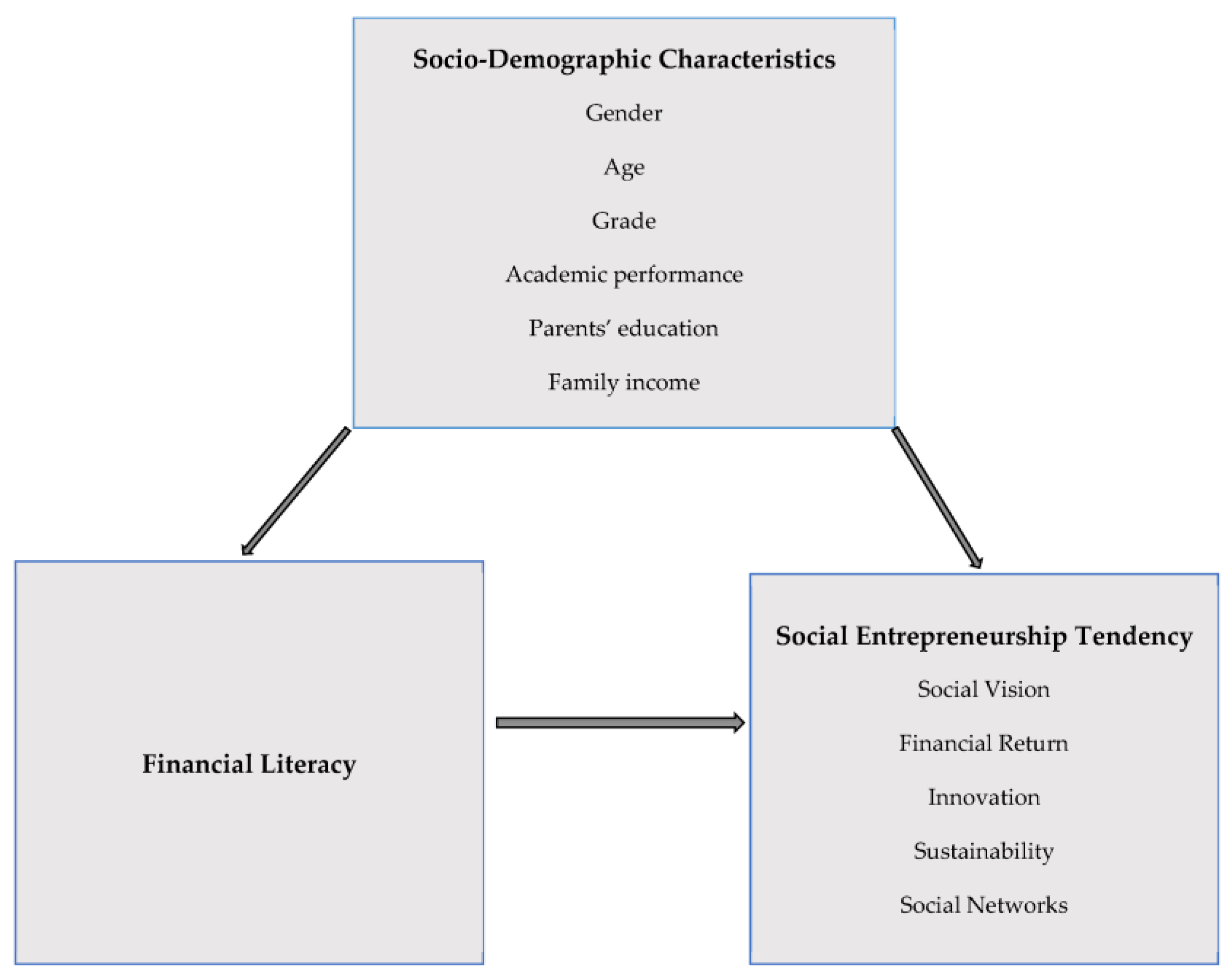
Guided by this framework, the study investigates the relationship between financial literacy and social entrepreneurship tendency among students included in our sample at a single Turkish university, as well as the effects of socio-demographic characteristics on this relationship (Figure 1).
The following hypotheses were formulated in accordance with the purpose and conceptual framework of the study, reflecting the perceptions and characteristics of the university student participants:
H1. 
There is a meaningful and positive relationship among the sub-dimensions of social entrepreneurship tendency (Social Vision, Financial Return, Innovation, Sustainability, Social Networks).
H2. 
There is a significant and positive relationship between financial literacy and social entrepreneurship tendency.
H3. 
There is a significant and positive relationship between financial literacy and the sub-dimensions of social entrepreneurship tendency.
H4. 
Financial literacy has a significant effect on social entrepreneurship tendency.
H5. 
Financial literacy differs according to socio-demographic characteristics.
H6. 
Social entrepreneurship tendency differs according to socio-demographic characteristics.
H7. 
The Social Vision sub-dimension differs according to socio-demographic characteristics.
H8. 
The Financial Return sub-dimension differs according to socio-demographic characteristics.
H9. 
The Innovation sub-dimension differs according to socio-demographic characteristics.
H10. 
The Sustainability sub-dimension differs according to socio-demographic characteristics.
H11. 
The Social Networks sub-dimension differs according to socio-demographic characteristics.

4. Results

The findings obtained in the scope of the study are presented in the tables below.
As shown in Table 2, the sample consisted of 245 Generation Z participants, with a slightly higher proportion of females (55.1%) than males (44.9%). The majority of participants were aged 18–21 and primarily enrolled in their second or third academic year. Most participants reported average academic performance. Regarding parental education, the majority of mothers had completed primary education, while fathers’ education levels were more evenly distributed. In terms of family income, most participants reported a medium income level. Approximately one-fifth of the participants indicated the presence of an entrepreneur in the family.
As shown in Table 3, the descriptive statistics reveal that the university students in the present Turkish sample exhibit a moderately high level of social entrepreneurship tendency (M = 3.77, SD = 0.573). Examination of the sub-dimensions indicates that social vision (M = 3.76, SD = 0.696), financial return (M = 3.64, SD = 0.739), and innovation (M = 3.65, SD = 0.730) display comparable mean scores, suggesting a relatively balanced orientation across these components. The sustainability sub-dimension yielded a slightly higher mean (M = 3.81, SD = 0.675), reflecting an increased emphasis on long-term social and environmental considerations within this student cohort. The highest mean score was observed for social networks (M = 4.03, SD = 0.697), underscoring the pivotal role of networking and relational capital in shaping students’ social entrepreneurship tendencies. In contrast, the financial literacy level was moderate (M = 3.46, SD = 0.993), indicating potential for enhancement in foundational economic and financial competencies.
Table 4 presents the results of the correlation analysis examining the relationships between financial literacy and social entrepreneurship tendency, as well as its sub-dimensions.
To determine which specific dimensions of social entrepreneurship tendency are associated with financial literacy, correlation analyses were conducted between financial literacy and each sub-dimension of the social entrepreneurship tendency. As shown in Table 4, financial literacy is positively and significantly correlated with financial return (r = 0.226, p < 0.01), sustainability (r = 0.200, p < 0.01), and social networks (r = 0.224, p < 0.01). These results indicate that higher levels of financial literacy are primarily associated with economic-oriented and network-based aspects of social entrepreneurship, while no significant correlations were observed with social vision or innovation, suggesting that financial literacy has less influence on visionary or innovative dimensions of social entrepreneurship tendency.
Given that the overall social entrepreneurship tendency score is computed from its sub-dimensions, these findings imply that financial literacy contributes modestly to the total social entrepreneurship tendency, reflecting partial support for Hypotheses 2 and 3 (H2, H3). The strongest association is observed with the financial return dimension, whereas the weakest relationship emerges with social networks. These results highlight that, although financial literacy plays a role in shaping social entrepreneurship tendencies, additional individual, social, and contextual factors likely exert a larger influence.
Following the identification of significant relationships among the variables through correlation analysis, a simple linear regression analysis was conducted to examine the effect of financial literacy on social entrepreneurship tendency. The results of the regression analysis are presented in Table 5.
Table 5 presents the results of the simple linear regression analysis examining the effect of financial literacy on social entrepreneurship tendency. The analysis indicates that financial literacy has a positive but modest effect on social entrepreneurship tendency (R = 0.128, p < 0.05).
The relationship between financial literacy and social entrepreneurship tendency can be expressed by the following regression equation:
y = 3.966 + 0.056x
where
  • y represents social entrepreneurship tendency, the dependent variable.
  • x represents financial literacy, the independent variable.
  • β0 = 3.966 is the intercept, indicating the expected social entrepreneurship tendency when x = 0.
  • β1 = 0.056 is the slope, indicating that a one-unit increase in x is associated with a 0.056-unit increase in y.
The results of the regression analysis (Table 5) indicate that a one-unit increase in financial literacy is associated with a 0.056-unit increase in social entrepreneurship tendency, and this effect is statistically significant (p = 0.046). The model accounts for approximately 1.6% of the variance in social entrepreneurship tendency (R2 = 0.016), suggesting that while financial literacy contributes positively, its explanatory power is modest. These findings highlight a statistically significant but limited influence of financial literacy on overall social entrepreneurship tendencies among the sampled university students.
Given that financial literacy was not significantly correlated with the social vision and innovation sub-dimensions, a subsequent regression analysis excluding these dimensions was conducted to further examine its impact on the remaining components.
The results of this analysis are presented in Table 6, providing a more nuanced understanding of how financial literacy contributes specifically to the economic-oriented and network-based aspects of social entrepreneurship tendency.
A subsequent regression model, excluding the social vision and innovation dimensions due to their non-significant association with financial literacy in the initial analysis, is presented in Table 6. In this model, financial literacy remains a statistically significant predictor of social entrepreneurship tendency (B = 0.062, p = 0.029; R2 = 0.019), indicating that approximately 1.9% of the variance in social entrepreneurship tendency is accounted for by financial literacy.
These findings provide partial support for Hypothesis 4 (H4), demonstrating a positive yet modest effect of financial literacy on social entrepreneurship tendency among the sampled university students. Importantly, the limited variance explained underscores that additional individual, social, and contextual factors are likely more influential in shaping students’ social entrepreneurship behaviors.
Table 7 presents the results of independent-samples t-tests comparing social entrepreneurship tendency, its sub-dimensions, and financial literacy across gender. These analyses provide insights into potential gender-based differences in the measured constructs within the study sample.
Table 7 presents the results of independent-samples t-tests comparing social entrepreneurship tendency, its sub-dimensions, and financial literacy by gender. The analysis indicates that social entrepreneurship tendency and the sub-dimensions social vision, innovation, sustainability, and social networks did not differ significantly between male and female participants (p < 0.05). However, the financial return sub-dimension revealed a significant gender difference (p < 0.05), with male participants scoring higher than female participants. Additionally, financial literacy was found to differ significantly by gender (p < 0.05), with female participants scoring higher than male participants. These results suggest that gender is associated with certain specific aspects of social entrepreneurship and financial literacy, while most dimensions of social entrepreneurship tendency remain consistent across genders.
Table 8 shows that no significant differences were observed in social entrepreneurship tendency, its sub-dimensions, or financial literacy across age groups (p > 0.05). These results indicate that participants’ age does not appear to influence their social entrepreneurship orientation or financial literacy, suggesting stability of these constructs across different age categories.
Table 9 presents the results of analyses comparing social entrepreneurship tendency, its sub-dimensions, and financial literacy across grade levels. The findings indicate that social entrepreneurship tendency and the sub-dimensions social vision, financial return, and sustainability did not differ significantly across grades (p < 0.05). In contrast, the sub-dimensions innovation and social networks exhibited significant differences by grade level (p < 0.05). Post hoc analyses using the Dunnett test revealed that for innovation, third-year students scored significantly higher than fourth-year students (p = 0.023). Conversely, for social networks, fourth-year students scored significantly higher than third-year students (p = 0.006).
Regarding financial literacy, significant differences were observed across grade levels (p < 0.05). Post hoc comparisons showed that fourth-year students scored significantly higher than both first-year (p = 0.006) and third-year students (p < 0.001).
These results suggest that while most dimensions of social entrepreneurship tendency remain relatively stable across academic years, specific dimensions (innovation and social networks) and financial literacy exhibit significant variation by grade level, indicating that students’ academic progression may influence certain cognitive and social aspects relevant to entrepreneurial orientation.
Table 10 shows that social entrepreneurship tendency and its sub-dimensions of social vision, financial return, innovation, and sustainability did not show significant differences according to academic achievement (p > 0.05), while the social networks sub-dimension showed significant differences according to academic achievement (p < 0.05). It was determined that the significant difference in the social networks sub-dimension was between the highly successful and unsuccessful (p = 0.038, Dunnett test). Accordingly, the social networks score of those with very high academic achievement are higher than those with low academic achievement. It was determined that financial literacy did not show a significant difference according to academic achievement (p > 0.05).
Table 11 shows that there are no significant differences in social entrepreneurship tendencies and their sub-dimensions according to the Mother’s educational level (p > 0.05). Financial literacy was found to show significant differences according to the Mother’s educational level (p < 0.05). A significant difference was found between those whose mothers had a primary school-bachelor’s degree (p = 0.001, Dunnett test) and those whose mothers had a high school-bachelor’s degree (p = 0.021, Dunnett test). Accordingly, the financial literacy score of participants whose mothers had a bachelor’s degree was lower than that of participants whose mothers had a primary school or high school degree.
Table 12 shows that the social entrepreneurship tendency exhibits a significant difference (p < 0.05) only in the financial return sub-dimension according to the Father’s educational level. The significant difference was found among those whose fathers were high school or postgraduate graduates (p = 0.044, Dunnett test). Accordingly, the financial return score of participants whose fathers were postgraduate degree holders was higher than that of participants whose fathers were high school graduates. Financial literacy was found to show a significant difference according to the Father’s educational level (p < 0.05). A significant difference was found between participants whose fathers had elementary school and graduate degrees (p = 0.013, Dunnett test). Accordingly, the financial literacy scores of participants whose fathers had elementary school degrees were higher than those of participants whose fathers had graduate degrees.
Table 13 shows that the social entrepreneurship tendency only exhibits a significant difference based on family income in the social networks sub-dimension (p < 0.05). The significant difference was found to be between those with medium-level family income and those with high-level family income (p = 0.025, Dunnett test). A significant difference was found between those with medium-level family income and those with high-level family income (p = 0.025, Dunnett test). Accordingly, the social networks sub-dimension score of those with medium-level family income is higher than the score of those with high-level family income.
A significant difference in financial literacy levels was found according to Family income (p < 0.05). A significant difference was found between those with low family income and those with high family income (p = 0.030, Dunnett test) and between those with medium family income and those with high family income (p = 0.024, Dunnett test). Accordingly, the financial literacy score of those with low family income is higher than that of those with high family income. Similarly, the financial literacy score of those with medium family income is higher than that of those with high family income.
Table 14 shows that there is no significant difference in social entrepreneurship tendencies and their sub-dimensions based on whether there is an entrepreneur in the family (p > 0.05). Financial literacy was found to show a significant difference based on whether there was an entrepreneur in the family (p < 0.05). The reason for this significant difference is that the financial literacy scores of participants with entrepreneurs in their families were higher than those of participants without entrepreneurs in their families.
The analysis conducted to determine whether financial literacy and social entrepreneurship tendency and its sub-dimensions showed significant differences according to socio-demographic characteristics revealed that hypotheses H5, H8, H9, and H11 were partially accepted, while hypotheses H6, H7, and H10 were rejected.
The results of the hypothesis testing are summarized in Table 15, which presents the relationships among the sub-dimensions of social entrepreneurship tendency, the effect of financial literacy, and the differences according to socio-demographic characteristics.

5. Discussion and Conclusions

The present study examined the relationship between financial literacy and social entrepreneurship tendency among students enrolled at a Turkish public university. In addition, it explored how students’ financial literacy levels and social entrepreneurship tendencies, as well as their sub-dimensions, varied according to socio-demographic characteristics.
Descriptive analyses indicated that participants’ financial literacy and social entrepreneurship tendency were moderately above average. The sample was predominantly composed of female students aged 18–21, primarily in their third and fourth years of study, with average academic achievement. Regarding parental background, most participants’ parents had completed elementary or high school education, and family income was generally at a middle level. The majority of participants reported no entrepreneurs in the family.

5.1. Interrelationships Among Social Entrepreneurship Sub-Dimensions

The analysis revealed statistically significant positive relationships among the sub-dimensions of social entrepreneurship tendency. This indicates that positive changes in one sub-dimension (social vision, financial return, innovation, sustainability, or social networks) tend to coincide with increases in other sub-dimensions, confirming the multidimensional coherence of social entrepreneurship. This result supports the conceptualization of social entrepreneurship as an integrated construct rather than a set of independent traits. There are studies in the literature that apply the social entrepreneurship tendency scale to university students. In the research conducted by Paksoy et al. (2019) to examine the effects of personality traits and social responsibility awareness of university students on their social entrepreneurship intention, the social entrepreneurship tendency scale was analyzed in accordance with the original scale through the dimensions of social vision, financial return, innovation, sustainability, and social networks [34].

5.2. Financial Literacy and Social Entrepreneurship

The present analysis revealed a positive yet modest association between financial literacy and social entrepreneurship tendency among university students. At the sub-dimensional level, financial literacy was significantly correlated with Financial Return, Sustainability, and Social Networks, whereas no statistically significant associations were observed with Social Vision or Innovation. This absence of association may reflect the characteristics of the sample; as students with limited professional experience, participants may not yet have had opportunities to enact behaviors indicative of social vision or innovation in real-world contexts.
Complementary regression analyses further corroborated that financial literacy exerts a statistically significant but modest effect on social entrepreneurship tendency (B = 0.056, p < 0.05; R2 = 0.016), suggesting that while financial literacy serves as a facilitative factor, it is not the primary determinant of socially responsible entrepreneurial behaviors.
These findings are broadly consistent with extant research. Seyrek and Gül (2017) reported that financial literacy did not directly influence entrepreneurial intention but was positively associated with perceiving entrepreneurship as attractive [63]. Similarly, Kıran et al. (2018) observed no direct effect of financial literacy on entrepreneurial intention among university students, although socio-demographic factors such as gender, academic year, family income, and the presence of entrepreneurs in the family were significant [64]. In contrast, Ripain et al. (2017) documented a significant positive relationship between financial literacy and entrepreneurial intention in Malaysia [65]. Ahmad et al. (2025) further demonstrated that while financial literacy did not directly shape entrepreneurial spirit, personal financial management mediated this relationship, underscoring the indirect yet meaningful role of financial competencies in fostering entrepreneurial behaviors [17]. Koshal et al. (2011) found that demographic variables, including gender, age, and academic year, did not significantly influence economic literacy among Indian MBA students [66]. Finally, Şirin et al. (2018) identified social entrepreneurship tendencies among university students, with significant differences across sub-dimensions by gender and parental education [28].
Collectively, these findings suggest that financial literacy contributes indirectly and selectively to social entrepreneurship, particularly through capacities related to economic outcomes, sustainability, and social networking. The results highlight that additional individual, social, and contextual factors are likely more decisive in shaping students’ social entrepreneurship tendencies.

5.3. Socio-Demographic Differences

Analysis of socio-demographic factors revealed that financial literacy levels differ according to gender, class level, parental education, family income, and the presence of an entrepreneur in the family. In this context, striking results have emerged:
Students whose parents completed primary school were found to have higher levels of financial literacy than others. This can be explained by the fact that children of parents with lower levels of education are exposed to financial responsibilities at an early age and develop financial awareness through practical experience.
Students from low-income families were found to have higher levels of financial literacy than others. This can be explained by the fact that, due to economic constraints, they develop budget management and saving behaviors at an early age. The necessity of making financial decisions in daily life may have increased individuals’ financial awareness.
  • Financial return differed by gender and father’s education, suggesting that practical financial aspects of social entrepreneurship are sensitive to familial and gender-related factors.
Social entrepreneurship tendency was largely unaffected by demographic variables; however, specific sub-dimensions displayed meaningful variation:
  • Innovation varied by class level, implying that educational exposure enhances creative problem-solving within social entrepreneurship.
  • Social networks differed according to class level, academic achievement, and family income, indicating that networking and collaboration capacities are influenced by socio-economic and educational contexts.
  • Sustainability and social vision were largely unaffected by demographic variables, suggesting that these dimensions may be driven more by generational or cultural norms than by socio-economic status.

5.4. Integration with Literature

The present findings corroborate and extend prior research on the relationship between financial literacy and social entrepreneurship. While previous studies on financial literacy and entrepreneurial intention have reported mixed results, the current study demonstrates that financial literacy exerts a modest yet statistically significant influence on social entrepreneurship tendencies, particularly through its association with resource-oriented and networked sub-dimensions. Seyrek and Gül (2017) and Kıran et al. (2018) emphasized the role of demographic characteristics in shaping entrepreneurial outcomes [63,64], whereas Ripain et al. (2017) and Ahmad et al. (2025) highlighted the importance of contextual and mediating factors [17,65]. Similarly, Koshal et al. (2011) and Şirin et al. (2018) illustrated nuanced effects of demographic variables on economic and social entrepreneurship competencies [28,66]. Collectively, these findings suggest that the integration of financial literacy with experiential learning and network-building interventions may more effectively foster social entrepreneurship among university students.
Prior research also underscores the relevance of contextual and culturally informed perspectives for developing entrepreneurial competencies [67,68,69,70]. Understanding local norms and values is crucial in promoting socially responsible behaviors and ensuring that educational interventions are relevant to students’ immediate environments.
In the present Turkish university sample, financial literacy demonstrated a statistically significant but modest positive effect on overall social entrepreneurship tendency. Although the total tendency did not vary substantially across socio-demographic characteristics, certain sub-dimensions, specifically Financial Return, Innovation, and Social Networks, exhibited meaningful variation, suggesting that targeted educational and policy interventions could enhance these capacities. Integrating financial literacy with experiential and social learning opportunities could thus better prepare students to engage in socially responsible entrepreneurial activities.

5.5. Limitations and Future Research Directions

These findings should be interpreted in light of the study’s sample limitations: the participants were drawn from a single Turkish university, and the modest effect sizes indicate that financial literacy is supportive rather than primary in shaping social entrepreneurship tendencies. Psychological, social, and contextual factors are likely to play a larger role in determining students’ engagement in socially entrepreneurial behaviors.
Based on the findings, several practical recommendations and avenues for future research emerge. Increasing university students’ awareness of financial literacy and social entrepreneurship remains essential, as these competencies underpin effective participation in economic and social systems. Practical initiatives, including seminars, workshops, panels, and targeted courses, can help strengthen students’ knowledge and skills.
Future research should consider comparative analyses across multiple universities, examine financial literacy’s relationship with other outcomes such as career planning, decision-making styles, problem-solving skills, time management, and emotional intelligence, and explore differences between students who have received formal financial education versus those who have not. Given the limited explanatory power observed in this study and the scarcity of research in this area, the current findings provide a preliminary foundation for guiding subsequent studies aimed at identifying additional factors influencing socially entrepreneurial behaviors among university students.


Author Contributions

Conceptualization, S.T., B.A., Y.K. and A.B.; data curation, S.T., B.A., Y.K. and A.B.; formal analysis, S.T., B.A., Y.K. and A.B.; investigation, S.T., B.A., Y.K. and A.B.; supervision, S.T., B.A., Y.K. and A.B.; validation, S.T., B.A., Y.K. and A.B.; visualization, S.T., B.A., Y.K. and A.B.; writing—original draft, S.T., B.A., Y.K. and A.B.; writing—review and editing, S.T., B.A., Y.K. and A.B. All authors have read and agreed to the published version of the manuscript.

Funding

The research was conducted as part of project no. WZ/WIZ-INZ/3/2026 at the Białystok University of Technology and co-funded by a research grant awarded by the Minister responsible for science.

Institutional Review Board Statement

The study was conducted in accordance with the Declaration of Helsinki, and approved by MANİSA CELAL BAYAR UNIVERSITY Social and Humanities Sciences Scientific Research and Publication Ethics Committee (protocol code: E--050.01-1023235 and date of approval: 26 April 2025).” for studies involving humans.

Informed Consent Statement

Informed consent was obtained from all subjects involved in the study.

Data Availability Statement

Data are unavailable due to privacy.

Conflicts of Interest

The authors declare no conflicts of interest.

References

  1. Burchi, A.; Włodarczyk, B.; Szturo, M.; Martelli, D. The effects of financial literacy on sustainable entrepreneurship. Sustainability 2021, 13, 5070. [Google Scholar] [CrossRef] [Scilit]
  2. Barış, S.; Şeker, H. Economic literacy: A research on Amasya University. J. Financ. Politics Econ. Rev. 2017, 54, 79–94. [Google Scholar]
  3. Wibowo, W.; Nofriansyah, N.; Nasrudin, N.; Aminuddin, A. Integrating Islamic Financial Literacy, Social Entrepreneurship, and Social Finance: Innovative Pathways to Inclusive and Sustainable Development. In Synergizing Islamic Finance for Sustainability; IGI Global Scientific Publishing: Hershey, PA, USA, 2026; pp. 115–144. [Google Scholar]
  4. Hota, P.K.; Subramanian, B.; Narayanamurthy, G. Mapping the Intellectual Structure of Social Entrepreneurship Research: A Citation/Co-citation Analysis. J. Bus. Ethics 2020, 166, 89–114. [Google Scholar] [CrossRef] [Scilit]
  5. Iskandar, J.; Chidir, G.; Simorangkir, Y.N. Digital literacy and entrepreneurial attitudes: A study of Indonesian university students. Indones. J. Manag. Econ. Res. 2024, 1, 1–14. [Google Scholar] [CrossRef] [Scilit]
  6. Zhao, J.; Zhao, L.; Chong, K.M.; Hamid, M.B.B.Y.; Osman, M.Z. Entrepreneurial intention among university students in the digital economy: The mediating role of alertness and the moderating effect of motivation. Humanit. Soc. Sci. Commun. 2025, 12, 1861. [Google Scholar] [CrossRef] [Scilit]
  7. Zhuo, Z.; Ren, Z.; Zhu, Z. Attitude-behavior gap in green consumption behavior: A review. J. Econ. Manag. Trade 2022, 28, 12–28. [Google Scholar] [CrossRef] [Scilit]
  8. Rozenkowska, K. Theory of planned behavior in consumer behavior research: A systematic literature review. Int. J. Consum. Stud. 2023, 47, 2670–2700. [Google Scholar] [CrossRef] [Scilit]
  9. Maziriri, E.T.; Nyagadza, B.; Maramura, T.C. Social entrepreneurial role models’ influence on social entrepreneurial self-efficacy, social entrepreneurial intent, and social entrepreneurial action in South Africa: The moderating role of moral obligation. Soc. Enterp. J. 2024, 20, 278–317. [Google Scholar] [CrossRef] [Scilit]
  10. Ahmad, M.I.S.; Idrus, M.I.; Rijal, S. The role of education in fostering entrepreneurial spirit in the young generation. J. Contemp. Adm. Manag. (ADMAN) 2023, 1, 93–100. [Google Scholar] [CrossRef] [Scilit]
  11. Kılıç, Y.; Ata, H.A.; ve Seyrek, H.İ. Financial Literacy: A Study of College Students. J. Account. Financ. 2015, 129–150. [Google Scholar] [CrossRef] [Scilit]
  12. Lusardi, A.; Tufano, P. Debt Literacy, Financial Experiences, and Overindebtedness; National Bureau of Economic Research: Cambridge, MA, USA, 2008; Available online: http://www.nber.org/papers/w14808 (accessed on 20 October 2025).
  13. Sarıgül, H. Financial literacy behavior and attitude scale: Development, reliability and validity. J. Manag. Econ. Res. 2015, 13, 200–218. [Google Scholar]
  14. Güney, G.; Karaaslan, İ. A Bibliometric Analysis of Financial Literacy: An Evaluation For Disadvantaged Groups. J. Hum. Soc. Sci. Res. 2025, 14, 2723–2751. [Google Scholar] [CrossRef] [Scilit]
  15. Üstün, Ö. The Effect of Financial Wellbeing on Turnover Intention and Financial Attitude via the Mediating Role of Risk Taking Attitude. The Mediating Role of Economy Literacy. Doctoral Thesis, Kayseri University Graduate Education Institute, Kayseri, Turkey, 2023. [Google Scholar]
  16. Lusardi, A.; Mitchell, O.S. The Economic importance of financial literacy: Theory and evidence. J. Econ. Lit. 2014, 52, 5–44. [Google Scholar] [CrossRef] [Scilit] [PubMed] [PubMed Central]
  17. Ahmad, N.L.; Mohammad Fazil, N.F.; Yusaof, R. The relationship between financial literacy and entrepreneurship spirit with mediating effect of personal financial management. Pertanika J. Soc. Sci. Hum. 2025, 33, 873–896. [Google Scholar] [CrossRef] [Scilit]
  18. Widdowson, D.; Hailwood, K. Financial literacy and its role in promoting a sound financial system. Reserve Bank. New Zealand Bull. 2007, 70, 37–49. [Google Scholar]
  19. Worthington, A.C. Predicting financial lteracy in Australia. Financ. Serv. Rev. 2006, 15, 59–79. [Google Scholar] [CrossRef] [Scilit]
  20. Utami, N.N. The economic literacy education for elementary school students. IOSR J. Humanit. Soc. Sci. (IOSR-JHSS) 2014, 19, 24–27. [Google Scholar] [CrossRef] [Scilit]
  21. Lusardi, A. Household Saving Behavior: The Role of Financial Literacy, Information, and Financial Education Programs. 2008. Available online: http://ssrn.com/abstract=1094102 (accessed on 20 October 2025).
  22. Remund, D.L. Financial literacy explicated: The case for a clearer definition in an ıncreasingly complex economy. J. Consum. Aff. 2010, 44, 279. [Google Scholar] [CrossRef] [Scilit]
  23. Temizel, F.; Bayram, F. Financial literacy: An examination of anadolu university faculty of economics and administrative sciences students. C.U. J. Econ. Adm. Sci. 2011, 12, 73–86. [Google Scholar]
  24. Özbay, M.; Özel Türkay, E.Y. Measuring the financial literacy level of generation Z: Case of adana Z. Erzincan Binali Yıldırım Univ. J. Fac. Econ. Adm. Sci. 2021, 3, 13–21. [Google Scholar] [CrossRef] [Scilit]
  25. Belen, B. The Relationship Between Digital Literacy and Financialliteracy (the Case of Düzce)/Dijital Okuryazarlık ile Finansal Okuryazarlık Arasındaki Ilişki (Düzce örneği). Master’s Thesis, Düzce University Graduate Education Institute, Düzce, Turkey, 2025. [Google Scholar]
  26. Gerek, S.; Kurt, A.A. Economic literacy scale: Validity-reliability study. Uludağ J. Econ. Soc. 2011, 30, 59–73. [Google Scholar]
  27. Koçak, O.; Kavi, E. Social entrepereneur municipality as a social policy actors/Sosyal politika aktörü olarak sosyal girişimci belediyecilik. Hak-İş Uluslararası Emek Ve Toplum. Derg. 2014, 3, 26–49. [Google Scholar]
  28. Şirin, Y.E.; Bilir, F.P.; Öz, G. Universty students social entrepreneurship trends: The example of school of physical education and sport. Gaziantep Univ. J. Sports Sci. 2018, 3, 35–47. [Google Scholar] [CrossRef] [Scilit]
  29. Coşkun, E.; Sarıkaya, M. Sosyal girişimcilik eğitiminde gönüllü kuruluşlar. Strateg. Public Manag. J. 2016, 4, 72–82. [Google Scholar] [CrossRef] [Scilit]
  30. Austin, J.; Stevenson, H.; Wei-Skillern, J. Social and commercial entrepreneurship: Same, different, or both? Entrep. Theory Pract. 2006, 47, 370–384. [Google Scholar] [CrossRef] [Scilit]
  31. Yıldırım, B.; Tuncay, T. The role of social innovation and social entrepreneurship in the future of social work profession. Hacet. Univ. J. Econ. Adm. Sci. 2019, 37, 169–187. [Google Scholar] [CrossRef] [Scilit]
  32. Nga, J.K.H.; Shamuganathan, G. The Influence of personality traits and demographic factors on social entrepreneurship start up ıntentions. J. Bus. Ethics 2010, 95, 259–282. [Google Scholar] [CrossRef] [Scilit]
  33. Reyhanoğlu, M.; ve Akın, O. How much is commercial entrepreneur a Social entrepreneur?/Ticari girişimciler ne kadar sosyal girişimcidir? Istanb. Manag. J. 2012, 23, 8–23. [Google Scholar]
  34. Paksoy, H.M.; Özbezek, B.D.; Gül, M. A research on the effect of personality traits and social responsibility conscıousness to social entrepreneurship characteristics. Turk. Stud. Soc. Sci. 2019, 14, 973–1006. [Google Scholar]
  35. Popescu, G.H.; Gheorghe, H. The Dynamics of social innovation networks. Psychosociological Issue Hum. Resour. Manag. 2015, 3, 77–82. [Google Scholar]
  36. Kırılmaz, K.S. A theoretical overview on dimensions of social entrepreneurship. J. Econ. Manag. 2014, 3, 55–74. [Google Scholar]
  37. Kuzgun, Ş. Bibliometric analysis of green entrepreneurship literature. J. Busıness Res. Türk 2024, 16, 692–712. [Google Scholar] [CrossRef] [Scilit]
  38. Waddock, S. Building successful social partnerships. Sloan Manag. Rev. 1988, 29, 17–23. [Google Scholar]
  39. Parsai, P.; Chandok, A.K. The role of financial literacy in investment decision-making: A review. Int. J. Inno Vations Sci. Eng. Manag. 2025, 4, 296–301. [Google Scholar] [CrossRef] [Scilit]
  40. Maity, A.; Mitra, A.; Das, P.; Duraipandi, O.; Jadhav, B. Educational marketing strategies for financial literacy programs in India: Enhancing resilience and informed decision-making during economic uncertainty. SGS-Humanit. Manag. 2025, 1. Available online: https://www.spast.org/index.php/sgshm/article/view/5680 (accessed on 20 October 2025).
  41. Memon, A.; Yong An, Z.; Memon, M.Q. Does financial availability sustain financial, innovative, and environmental perfor-mance? Relation via opportunity recognition. Corp. Soc. Responsib. Environ. Manag. 2020, 27, 562–575. [Google Scholar] [CrossRef] [Scilit]
  42. MacDonald, A.; Clarke, A.; Huang, L.; Seitanidi, M.M. Partner strategic capabilities for capturing value from sustainabi-lity-focused multi-stakeholder partnerships. Sustainability 2019, 11, 557. [Google Scholar] [CrossRef] [Scilit]
  43. Rani, A.; Salanke, P.; Priyadarshinee, P.; Madhu, B.K.; Singh, J.E. Examining the effect of social entrepreneurship on organizational sustainability of social enterprise: A quantitative evidence from emerging markets. J. Entrep. Emerg. Econ. 2026, 1–20. [Google Scholar] [CrossRef] [Scilit]
  44. Akturan, A. Gen Z’s skepticism levels and perceptions of corporate social responsibility focus of corporations: A study on university students. J. Hum. Soc. Sci. Res. 2025, 14, 986–1006. [Google Scholar]
  45. Anghel, G.A.; Anghel, M.A. Green entrepreneurship among students—Social and behavioral motivation. Sustainability 2022, 14, 8730. [Google Scholar] [CrossRef] [Scilit]
  46. Radzi, N.A.M.; Olaleye, B.R.; Saidi, N.A.; Hassan, S.; Khumalo, N. Environmental sustainability awareness and knowledge among millennial and gen z students: A study from a public higher education institution. J. Lifestyle SDGs Rev. 2025, 5, 1–31. [Google Scholar] [CrossRef] [Scilit]
  47. Güler, E.Ö.; Veysikarani, D. An emprical research on economic literacy. Çukurova Univ. Soc. Sci. Inst. J. 2019, 28, 126–141. [Google Scholar]
  48. Şantaş, F.; Demirgil, B. A research on determination of economic literacy level. Acad. Sight. Int. Ref. Online J. 2015, 48, 46–60. [Google Scholar]
  49. Yağız, K.; Dinç, A. A study aimed at examining the effect of economics literacy on professional career awareness. Iğdır Univ. J. Soc. Sci. 2024, 37, 406–430. [Google Scholar]
  50. Prawitz, A.; Garman, E.T.; Sorhaindo, B.; O’Neill, B.; Kim, J.; Drentea, P. In Charge financial distress/financial well-being scale: Development, 135 administration, and score interpretation. J. Financ. Couns. Plan. 2006, 17, 34–50. [Google Scholar] [CrossRef] [Scilit]
  51. Ahmetoğulları, K.; Parmaksız, H. Relationship of financial well-being with financial literacy and credit card attitude. J. Acad. Soc. Sci. 2017, 5, 317–330. [Google Scholar] [CrossRef] [Scilit]
  52. Asar, M. Mediator Role of Entrepreneurial Self-Efficacy and Risk-Taking Tendency in The Relationship Between Financial Literacy and Entrepreneurial Intention. Master’s Thesis, Çankırı Karatekin University Social Sciences Institute, Çankırı, Turkey, 2021. [Google Scholar]
  53. Tüfekçi, B.; Erdoğan, S.; Karaca, S.S.; Seçgin, N. The measurement of financial literacy knowledge level: An application on the students of department of business administration. Int. J. Bus. Econ. Manag. Perspect. 2017, 2, 58–72. [Google Scholar]
  54. Tekin, B.; Dursun, V. Determining the financial literacy levels of university students: The example of Adnan Menderes University FEAS Students. J. Cukurova Univ. Fac. Econ. Adm. Sci. 2021, 25, 239–267. [Google Scholar]
  55. Kıratoğlu, E.; Kuran, İ. Determining the level of financial literacy in university students: The Case of Harran University Faculty of Economics and Administrative Sciences. Int. Soc. Sci. Stud. J. 2022, 8, 1384–1393. [Google Scholar]
  56. Yıldırım, K.E.; Sunman, G. The effect of self-efficacy belief on social entrepreneurship ıntent: The case of Anadolu University and Aksaray University Students. Int. J. Econ. Soc. Res. 2022, 18, 214–226. [Google Scholar]
  57. Günaydın, F. Investigating the Relationship Between Creative Personality Traits and Social Entrepreneurship Tendency of University Students: The Case of Agri Province. Master’s Thesis, Ağrı İbrahim Çeçen University Graduate Education Institute, Ağrı, Turkey, 2024. [Google Scholar]
  58. Gül, M. A Research in the TR63 Region on the Effect of Personality and Entrepreneurial Personality Traits on Social Entrepreneurial Orientation: The Case of University Students. Doctoral Thesis, Gaziantep University Institute of Social Sciences, Gaziantep, Turkey, 2019. [Google Scholar]
  59. Hair, J.F.; Anderson, R.E.; Tatham, R.L.; Black, W.C. Multivariate Data Analysis; Prentice Hall: Upper Saddle River, NJ, USA, 1998. [Google Scholar]
  60. Creswell, J.W. Educational Research: Planning, Conducting, and Evaluating Quantitative and Qualitative Research, Enhanced Pearson e-Text with Looseleaf Version—Access Card Package; Pearson Education, Inc.: Upper Saddle River, NJ, USA, 2014. [Google Scholar]
  61. Cengiz, R.; Güllü, S. Investigation of leadership orientation and physical respectiveness levels of faculty of sport sciences students. Gaziantep Univ. J. Sports Sci. 2018, 3, 94–108. [Google Scholar] [CrossRef] [Scilit]
  62. Karasar, N. Bilimsel Araştırma Yöntemi. 8. Baskı; Nobel Yayıncılık: Ankara, Turkey, 1998. [Google Scholar]
  63. Seyrek, İ.H.; Gül, M. Financial literacy and entrepreneurship intentıon: A study of undergraduate university students. J. Manag. Econ. Res. 2017, 15, 103–118. [Google Scholar] [CrossRef] [Scilit]
  64. Kıran, F.; Çetinkaya Bozkurt, Ö.; Tunç, H. The relationship between financial literacy and entrepreneurship intention: A research on university students. J. Bucak Fac. Bus. 2018, 1, 29–51. [Google Scholar]
  65. Ripain, N.; Amirul, S.M.; Mail, R. Financial literacy and SMEs’ potential entrepreneurs: The case of Malaysia. J. Adm. Bus. Stud. 2017, 3, 60–68. [Google Scholar] [CrossRef] [Scilit]
  66. Koshal, R.K.; Gupta, A.K.; Goyal, A.; Choudhary, V.N. Assessing economic literacy of Indian MBA students. Am. J. Bus. 2011, 23, 43–52. [Google Scholar] [CrossRef] [Scilit]
  67. Ndou, V. Social entrepreneurship education: A combination of knowledge exploitation and exploration processes. Adm. Sci. 2021, 11, 112. [Google Scholar] [CrossRef] [Scilit]
  68. Panait, M.C.; Voica, M.C.; Hysa, E.; Siano, A.; Palazzo, M. The Bucharest stock exchange: A starting point in structuring a valuable CSR index. J. Risk Financ. Manag. 2022, 15, 94. [Google Scholar] [CrossRef] [Scilit]
  69. Akkaya, B.; Popescu, C.; Üstgörül, S. How can we remove psychological entrepreneurship barriers on entrepreneurship intention for health organizations in the future? Sustainability 2024, 16, 3503. [Google Scholar] [CrossRef] [Scilit]
  70. Coşkun, H.E.; Popescu, C.; Şahin Samaraz, D.; Tabak, A.; Akkaya, B. Entrepreneurial university concept review from the perspective of academicians: A mixed method research analysis. Sustainability 2022, 14, 10110. [Google Scholar] [CrossRef] [Scilit]
Figure 1. Research Model.
Sustainability 18 03149 g001
Table 1. Reliability analysis results.
ScalesCronbach’s AlfaN of Items
Social Entrepreneurship Tendency Scale0.93633
   Social Vision0.8658
   Financial Return0.8287
   Innovation0.7826
   Sustainability0.7827
   Social Networks0.7745
Financial Literacy Scale0.82824
Table 2. Distribution of participants by socio-demographic characteristics.
VariablesSubvariablesn%
GenderFemale13555.1
Male11044.9
Age18–2117270.2
22–236124.9
24+124.9
Grade 1st Grade3213.1
2nd Grade7329.8
3rd Grade8835.9
4th Grade5221.2
Academic PerformanceVery successful104.1
Successful8233.5
Average13856.3
Unsuccessful156.1
Mother’s educational levelPrimary education13153.5
High school7731.4
Bachelor’s degree3514.3
Postgraduate degree20.8
Father’s educational levelPrimary education9338.0
High school9036.7
Bachelor’s degree5422.0
Postgraduate degree83.3
Family incomeLow4016.3
Middle14960.8
High5622.9
Family Entrepreneurial BackgroundYes5120.8
No19479.2
Table 3. Mean and standard deviation values for the scales.
ScalesnSD
Social Vision2453.760.696
Financial Return2453.640.739
Innovation2453.650.730
Sustainability2453.810.675
Social Networks2454.030.697
Social Entrepreneurship Tendency (Total)2453.770.573
Financial Literacy Scale2453.460.993
Table 4. Correlations between financial literacy and social entrepreneurship tendency and its sub-dimensions.
Scales1234567
1. Social Vision1
2. Financial Return0.607 **1
3. Innovation0.742 **0.634 **1
4. Sustainability0.715 **0.526 **0.738 **1
5. Social Networks0.347 **0.294 **0.364 **0.527 **1
6. Financial Literacy0.1180.226 **0.0650.200 **0.224 **0.128 *1
** p < 0.01; * p < 0.05.
Table 5. The effect of financial literacy on social entrepreneurship tendency. (Regression 1).
Unstandardized CoefficientsStandardized CoefficientstSig.
BStd. ErrorBeta
(Constant)3.9660.104 38.2550.000
Financial Literacy0.0560.0280.1282.0040.046
R0.128
R20.016
F4.016
p0.046
Dependent Variable: Social Entrepreneurship Tendency.
Table 6. The effect of financial literacy on social entrepreneurship tendency. (Regression 2).
Unstandardized CoefficientsStandardized CoefficientstSig.
BStd. ErrorBeta
(Constant)3.9720.105 38.0080.000
Financial Literacy0.0620.0280.1392.1910.029
R0.139
R20.019
F4.799
p0.029
Dependent Variable: Social Entrepreneurship Tendency.
Table 7. Gender differences in social entrepreneurship tendency and financial literacy.
ScalesGendernSDtp
Social VisionFemale1353.820.6351.4960.136
Male1103.680.762
Financial ReturnFemale1353.520.729−2.8390.005
Male1103.780.728
InnovationFemale1353.650.7150.0020.999
Male1103.650.751
SustainabilityFemale1353.860.6671.1940.234
Male1103.760.683
Social NetworksFemale1354.100.7111.7250.086
Male1103.950.673
Social Entrepreneurship Tendency (Total)Female1353.780.5600.2890.773
Male1103.760.591
Financial Literacy ScaleFemale1353.631.2662.2330.026
Male1103.261.323
Table 8. Age group differences in social entrepreneurship tendency and financial literacy.
ScalesSum of SquaresdfMean SquareFp
Social VisionBetween Groups1.22520.6121.2640.284
Within Groups117.2702420.485
Total118.495244
Financial ReturnBetween Groups0.87020.4350.7950.453
Within Groups132.5022420.548
Total133.372244
InnovationBetween Groups1.50520.7531.4170.245
Within Groups128.5642420.531
Total130.070244
SustainabilityBetween Groups0.52820.2640.5770.562
Within Groups110.7512420.458
Total111.279244
Social NetworksBetween Groups0.19320.0960.1970.822
Within Groups118.5822420.490
Total118.775244
Social Entrepreneurship Tendency (Total)Between Groups0.79820.3991.2150.298
Within Groups79.4692420.328
Total80.267244
Financial Literacy ScaleBetween Groups1.59720.7990.4680.627
Within Groups412.6612421.705
Total414.258244
Table 9. Differences in social entrepreneurship tendency and financial literacy by grade.
ScalesSum of SquaresdfMean SquareFp
Social VisionBetween Groups2.39630.7991.6580.177
Within Groups116.0992410.482
Total118.495244
Financial ReturnBetween Groups4.42131.4742.8270.104
Within Groups125.6492410.521
Total130.070244
InnovationBetween Groups0.40830.1360.2960.039
Within Groups110.8712410.460
Total111.279244
SustainabilityBetween Groups6.92232.3074.9710.829
Within Groups111.8532410.464
Total118.775244
Social Networks Between Groups3.35631.1192.0740.002
Within Groups130.0162410.539
Total133.372244
Social Entrepreneurship Tendency (Total)Between Groups0.58730.1960.5920.621
Within Groups79.6802410.331
Total80.267244
Financial Literacy ScaleBetween Groups165.862355.28753.6410.000
Within Groups248.3962411.031
Total414.258244
Table 10. Comparison of scale scores according to Academic Performance.
ScalesSum of SquaresdfMean SquareFp
Social VisionBetween Groups1.64930.5501.1340.336
Within Groups116.8452410.485
Total118.495244
Financial ReturnBetween Groups2.65430.8851.6310.183
Within Groups130.7182410.542
Total133.372244
InnovationBetween Groups3.19831.0662.0250.111
Within Groups126.8712410.526
Total130.070244
SustainabilityBetween Groups1.52530.5081.1160.343
Within Groups109.7552410.455
Total111.279244
Social NetworksBetween Groups3.82731.2762.6750.048
Within Groups114.9482410.477
Total118.775244
Social Entrepreneurship Tendency (Total)Between Groups1.86830.6231.9140.128
Within Groups78.3992410.325
Total80.267244
Financial Literacy ScaleBetween Groups3.67431.2250.7190.542
Within Groups410.5842411.704
Total414.258244
Table 11. Comparison of scale scores according to Mother’s educational level.
ScalesSum of SquaresdfMean SquareFp
Social VisionBetween Groups0.35430.1180.2410.868
Within Groups118.1402410.490
Total118.495244
Financial ReturnBetween Groups2.54430.8481.5620.199
Within Groups130.8282410.543
Total133.372244
InnovationBetween Groups0.59330.1980.3680.776
Within Groups129.4772410.537
Total130.070244
SustainabilityBetween Groups0.10130.0340.0730.974
Within Groups111.1782410.461
Total111.279244
Social NetworksBetween Groups2.05630.6851.4150.239
Within Groups116.7192410.484
Total118.775244
Social Entrepreneurship Tendency (Total)Between Groups0.46230.1540.4650.707
Within Groups79.8052410.331
Total80.267244
Financial Literacy ScaleBetween Groups25.73138.5775.3200.001
Within Groups388.5282411.612
Total414.258244
Table 12. Comparison of scale scores according to Father’s educational level.
ScalesSum of SquaresdfMean SquareFp
Social VisionBetween Groups0.23930.0800.1630.921
Within Groups118.2552410.491
Total118.495244
Financial ReturnBetween Groups4.83531.6123.0220.030
Within Groups128.5382410.533
Total133.372244
InnovationBetween Groups0.48230.1610.2990.826
Within Groups129.5882410.538
Total130.070244
SustainabilityBetween Groups0.23330.0780.1680.918
Within Groups111.0462410.461
Total111.279244
Social NetworksBetween Groups1.03830.3460.7080.548
Within Groups117.7372410.489
Total118.775244
Social Entrepreneurship Tendency (Total)Between Groups0.48130.1600.4840.694
Within Groups79.7872410.331
Total80.267244
Financial Literacy ScaleBetween Groups36.878312.2937.8500.000
Within Groups377.3812411.566
Total414.258244
Table 13. Comparison of scale scores according to Family income.
ScalesSum of SquaresdfMean SquareFp
Social VisionBetween Groups0.27020.1350.2760.759
Within Groups118.2252420.489
Total118.495244
Financial ReturnBetween Groups2.25121.1262.0780.127
Within Groups131.1212420.542
Total133.372244
InnovationBetween Groups1.91120.9551.8040.167
Within Groups128.1592420.530
Total130.070244
SustainabilityBetween Groups1.03620.5181.1370.323
Within Groups110.2432420.456
Total111.279244
Social NetworksBetween Groups3.96821.9844.1820.016
Within Groups114.8072420.474
Total118.775244
Social Entrepreneurship Tendency (Total)Between Groups0.57320.2870.8710.420
Within Groups79.6942420.329
Total80.267244
Financial Literacy ScaleBetween Groups13.05726.5293.9380.021
Within Groups401.2012421.658
Total414.258244
Table 14. Comparison of scale scores based on whether there is an entrepreneur in the family.
ScalesAnswernSdtp
Social VisionYes 513.770.8270.6140.113
No1943.750.660
Financial ReturnYes 513.740.7861.0770.283
No1943.610.726
InnovationYes 513.650.8622.2800.132
No1943.660.693
SustainabilityYes 513.890.6990.9300.353
No1943.790.669
Social NetworksYes 514.140.6921.2380.217
No1944.010.697
Social Entrepreneurship Tendency (Total)Yes 513.820.6140.7650.445
No1943.750.563
Financial Literacy ScaleYes 513.970.8983.1970.002
No1943.330.976
Table 15. Hypotheses Testing Results for Social Entrepreneurship Tendency and Financial Literacy.
HypothesisVariable/Sub-DimensionRelationship/DifferenceStatistical EvidenceSupportExplanation
H1Social Vision, Financial Return, Innovation, Sustainability, Social NetworksPositive inter-correlationsr = 0.294–0.742, p < 0.01SupportedSub-dimensions are significantly correlated; improvement in one dimension accompanies increases in others.
H2Financial Literacy → Social Entrepreneurship TendencyPositive associationr = 0.128,
p < 0.05
Partially SupportedFinancial literacy has a modest yet statistically significant positive association with overall social entrepreneurship tendency.
H3Financial Literacy → Sub-dimensions (Financial Return, Sustainability, Social Networks, Social Vision, Innovation)Positive association for Financial Return, Sustainability, Social Networks; not significant for Social Vision and Innovationr = 0.200–0.226, p < 0.01Partially SupportedFinancial literacy mainly supports economic and network-related sub-dimensions; Social Vision and Innovation are unaffected.
H4Financial Literacy → Social Entrepreneurship TendencyPositive effectR2 = 0.016, β = 0.056,
p < 0.05
SupportedRegression confirms a modest but significant effect; additional factors likely contribute more to social entrepreneurship tendencies.
H5Financial Literacy by socio-demographic characteristicsPartial differencesp < 0.05Partially SupportedFinancial literacy differs according to certain demographic factors, but differences are limited.
H6Social Entrepreneurship Tendency by socio-demographicsNo significant differencesp > 0.05Not SupportedOverall social entrepreneurship tendency does not vary significantly across demographic characteristics.
H7Social Vision by socio-demographicsNo significant differencesp > 0.05Not SupportedSocial Vision sub-dimension remains consistent across demographic groups.
H8Financial Return by socio-demographicsPartial differencesp < 0.05Partially SupportedSome demographic factors influence Financial Return sub-dimension.
H9Innovation by socio-demographicsPartial differencesp < 0.05Partially SupportedInnovation sub-dimension shows modest differences across certain demographic groups.
H10Sustainability by socio-demographicsNo significant differencesp > 0.05Not SupportedSustainability sub-dimension remains stable across demographic characteristics.
H11Social Networks by socio-demographicsPartial differencesp < 0.05Partially SupportedSocial Networks sub-dimension is modestly affected by some socio-demographic factors.
Disclaimer/Publisher’s Note: The statements, opinions and data contained in all publications are solely those of the individual author(s) and contributor(s) and not of MDPI and/or the editor(s). MDPI and/or the editor(s) disclaim responsibility for any injury to people or property resulting from any ideas, methods, instructions or products referred to in the content.