1. Introduction
Hospitality management unfolds within environments marked by volatility, human intensity, and real-time decision-making. Hotel and restaurant managers must continuously interpret ambiguous information, balance competing stakeholder demands, and make judgements that directly affect service quality, innovation capacity, employee outcomes, and organisational performance [
1]. Despite this cognitive burden, much of the hospitality management literature has privileged relational and emotional capabilities, often portraying successful managers primarily as emotionally intelligent, charismatic, and interpersonally skilled. Recent practitioner-oriented debates [
2] have begun to question this imbalance, suggesting that cognitive intelligence (CI), the ability to reason, analyse, learn, and solve problems, may represent a more fundamental managerial capability for navigating complexity and enabling innovation. However, academic hospitality research has yet to systematically theorise CI as a core competency for hospitality managers, particularly in relation to innovation management and organisational performance. This absence is notable given the extensive empirical evidence from organisational psychology demonstrating the strong relationship between cognitive intelligence and managerial performance.
This article adopts a conceptual review approach aimed at integrating insights from hospitality management, organisational psychology, and leadership studies. Rather than conducting a systematic review, this paper synthesises key theoretical contributions and influential empirical studies related to managerial cognition, intelligence, and decision-making in service contexts. The aim is to clarify how cognitive intelligence may shape managerial decision-making, organisational learning, and innovation processes within hospitality organisations. Drawing on established academic sources from cognitive intelligence research [
3], job performance studies [
4], hospitality education scholarship [
5], and managerial competency frameworks [
6], this paper argues that CI should be understood as a foundational managerial capability that enables the effective deployment of emotional, social, and technical skills.
This paper contributes to hospitality management scholarship by offering an integrative conceptual perspective that situates cognitive intelligence alongside emotional intelligence and managerial sensemaking processes in highly dynamic service environments. Building on this synthesis, this article develops a conceptual framework and proposes a set of theoretical propositions linking cognitive intelligence to managerial decision-making, adaptive learning, innovation processes, and organisational performance in hospitality contexts.
2. Defining Cognitive Intelligence
Cognitive intelligence has traditionally been defined as a latent mental ability encompassing reasoning, problem-solving, abstract thinking, learning capacity, and the effective manipulation of information [
7]. Within psychometric and cognitive psychology traditions, CI is conceptualised as a performance-based capability rather than a dispositional trait, reflecting what individuals can do when confronted with novel, complex, or ill-structured problems. Crucially, cognitive intelligence is not reducible to accumulated knowledge or educational attainment. Instead, it represents a general capacity to acquire, integrate, and apply knowledge across contexts [
8]. This distinction explains why CI has been consistently associated with learning speed, adaptive expertise, and performance in cognitively demanding roles [
9]. In managerial settings, CI enables individuals to move beyond routine responses and engage in diagnostic reasoning, hypothesis testing, and evaluative judgement [
10].
Brody’s [
3] conceptual clarification remains particularly influential in distinguishing cognitive intelligence from adjacent constructs. He argues that CI refers to demonstrable problem-solving performance grounded in correct answers and objective criteria, whereas many emotional intelligence measures assess knowledge about emotions rather than the capacity to act effectively. This distinction is theoretically significant for management research, as it reinforces CI’s status as a capability directly linked to task execution and decision quality rather than attitudinal orientation or interpersonal style. Empirical studies further suggest that CI and EI interact rather than compete. Côté and Miners’ [
11] compensatory model demonstrates that emotional intelligence predicts job performance most strongly when cognitive intelligence is lower, implying that CI remains the primary driver of effectiveness in cognitively complex roles. This insight is particularly relevant for hospitality management, where operational and strategic decisions require continuous cognitive processing under time pressure.
From an organisational perspective, cognitive intelligence underpins what might be described as managerial sensemaking capacity [
12]. Managers high in CI are better equipped to interpret ambiguous information, recognise causal relationships, anticipate second-order consequences, and integrate multiple sources of data into coherent courses of action. These abilities are especially salient in environments characterised by uncertainty, time pressure, and competing priorities. Importantly, contemporary intelligence research increasingly emphasises that CI is neither fixed nor immutable. Studies in education [
13] and management [
6] demonstrate that cognitive intelligence competencies, such as systems thinking, analytical reasoning, and reflective judgement, can be developed through intentional pedagogical design and sustained exposure to complexity. This developmental perspective challenges deterministic interpretations of intelligence and positions CI as a strategically cultivable capability within organisations [
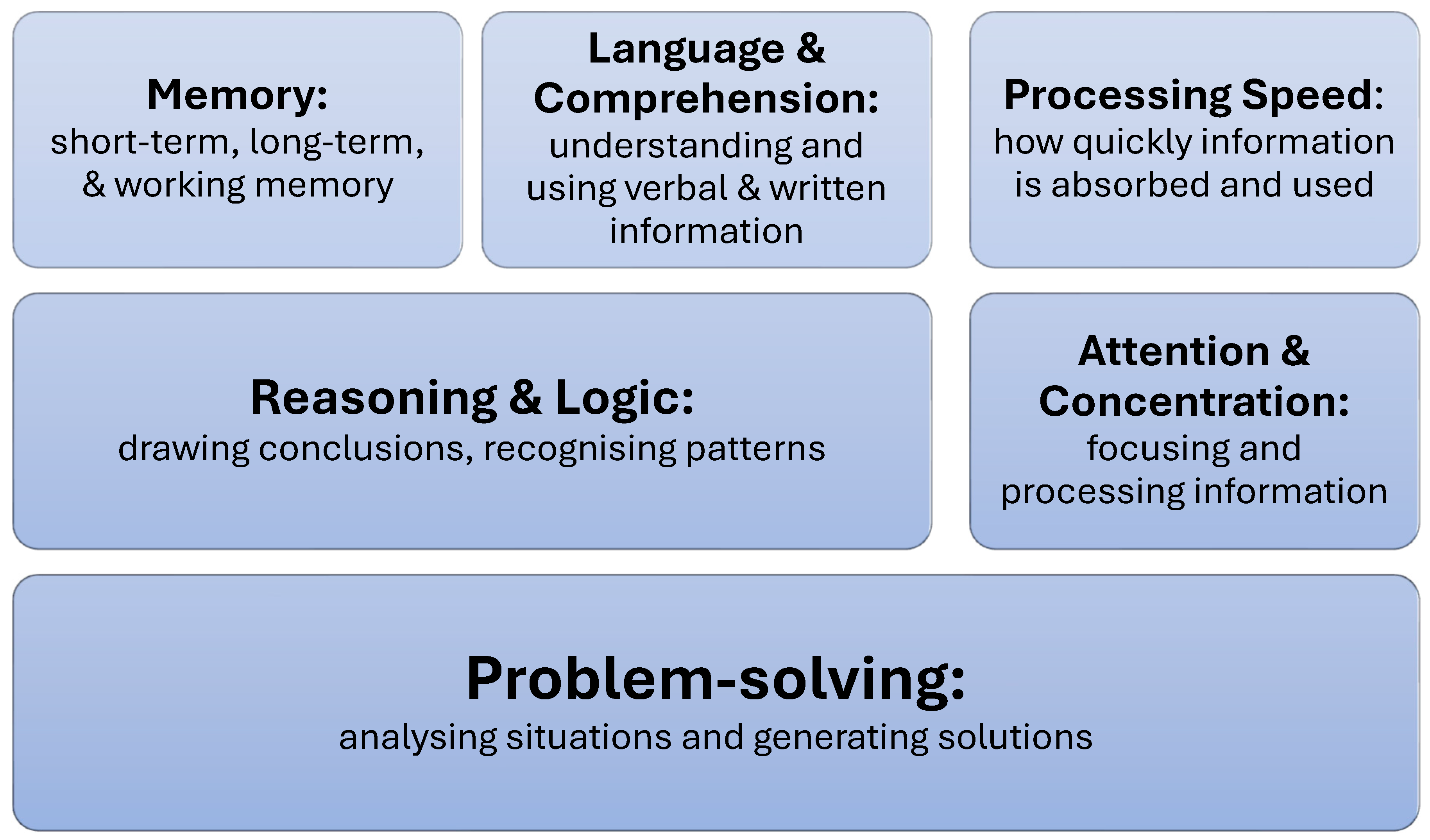
14]. Taken together, these perspectives position cognitive intelligence as a foundational managerial capability that enables learning, judgement, and effective action (
Figure 1). In contrast to narrower skill-based or trait-based constructs, CI provides the cognitive infrastructure upon which innovation management and organisational performance are built [
15].
3. Cognitive Intelligence and Job Performance
3.1. Evidence from General Management Research
A substantial body of research in organisational psychology and management (i.e., [
4,
16,
17]) consistently identifies cognitive intelligence as the strongest single predictor of job performance across occupations and hierarchical levels. Meta-analytic traditions in intelligence research have long demonstrated that CI is robustly associated with task performance, learning speed, and the acquisition of job-relevant knowledge, particularly in roles characterised by complexity, ambiguity, and decision-making responsibility. Subsequent meta-analytic research continues to confirm the strong relationship between cognitive ability and job performance, particularly in complex occupations [
18]. Individuals with higher cognitive ability typically acquire job knowledge more rapidly and perform more effectively in complex roles [
19].
More recent integrative models further clarify the relative importance of CI vis-à-vis emotional and personality-based constructs. Dhliwayo and Coetzee’s [
4] personnel selection study provides compelling empirical evidence that cognitive intelligence outperforms both ability-based and trait emotional intelligence in predicting job performance. Their structural equation modelling results position CI as the primary explanatory variable, with emotional intelligence contributing only incremental variance. This finding is particularly salient for managerial and professional roles, where abstract reasoning, problem diagnosis, and judgement are central to effectiveness.
Importantly, research also suggests that the influence of cognitive intelligence extends beyond immediate performance outcomes to longer-term career trajectories. Large-scale cross-sectional studies indicate that CI is associated with promotion, leadership emergence, and progression to higher management levels [
20]. Treglown and Furnham’s [
16] study of over 6000 individuals in Great Britain demonstrates that cognitive ability adds incremental explanatory power beyond demographic variables and emotional intelligence in predicting management level attainment. Their findings suggest that specific facets of cognitive ability, particularly numerical reasoning and processing speed, are especially influential in supporting progression into senior roles. This pattern aligns with subsequent research examining the relative contribution of cognitive ability versus personality in predicting advancement to higher-level management positions, offering further evidence that ability-based factors may be more decisive determinants of senior managerial attainment [
17].
Taken together, this body of evidence challenges dominant managerial narratives that overemphasise soft skills and emotional display while downplaying analytical reasoning and cognitive capacity [
3]. While emotional and social competencies may shape how managers interact, motivate, and lead, cognitive intelligence appears to determine whether managers can effectively interpret information, learn from experience, and make decisions that sustain performance over time.
3.2. Implications for Hospitality Contexts
Hospitality management roles are characterised by non-routine problems, rapid decision cycles, and high consequences for error. Managers must routinely make decisions under conditions of incomplete information, time pressure, and emotional intensity, often while service delivery is ongoing [
1]. Cognitive intelligence enables hospitality managers to diagnose operational issues, interpret financial and performance data, anticipate downstream effects of decisions, and balance short-term service recovery with longer-term strategic considerations.
Unlike many managerial contexts where decisions can be deferred or delegated, hospitality managers frequently operate in real-time service systems [
21]. Errors in judgement can immediately affect guest satisfaction, employee morale, and organisational reputation [
22]. Cognitive intelligence supports the capacity to recognise patterns across incidents, distinguish symptoms from root causes, and avoid reactive decision-making that prioritises immediate appeasement over sustainable solutions [
10]. The relevance of CI is further amplified by the nature of innovation in hospitality, which is predominantly incremental and practice based [
23]. Service innovations, process improvements, and managerial innovations rarely emerge from formal Research and Development (R&D) functions; instead, they depend on managers’ ability to learn from operational data, experiment within constraints, and adapt routines without disrupting service continuity [
24]. These activities place significant cognitive demands on managers and underscore the centrality of reasoning, learning, and judgement.
Despite its relevance to managerial judgement and innovation, hospitality scholarship has historically only limitedly engaged with cognitive intelligence as an explicit construct, with cognitive capability more often implied through broader notions of expertise and experience [
2]. Where intelligence is discussed, it is often subsumed under generic notions of expertise, learning capacity, or experience, without explicit theoretical treatment of CI as a distinct managerial capability. This omission limits the field’s ability to fully explain why some managers consistently outperform others in innovation management and organisational performance, even when emotional and interpersonal skills appear comparable [
25]. By foregrounding cognitive intelligence, hospitality scholarship can develop more nuanced explanations of managerial effectiveness that move beyond surface-level competencies and better reflect the cognitive realities of contemporary hospitality work.
While emotional intelligence has received extensive attention in hospitality research, cognitive intelligence represents a complementary capability that supports analytical reasoning, problem diagnosis, and strategic interpretation. In practice, effective hospitality management often requires the integration of both capabilities, where cognitive intelligence supports structured decision-making and emotional intelligence facilitates interpersonal and service-oriented interactions. Furthermore, despite the extensive empirical tradition linking cognitive intelligence to job performance in organisational psychology, empirical research explicitly examining CI within hospitality management remains limited. Most hospitality studies addressing managerial competence tend to focus on leadership behaviour, emotional labour, or interpersonal capabilities, while cognitive capability is often implicitly embedded within broader constructs such as expertise, experience, or managerial judgement. This absence of explicit empirical investigation represents an important gap in hospitality scholarship and reinforces the need for conceptual work that clarifies the role of cognitive intelligence in shaping managerial effectiveness, innovation practices, and organisational performance in service environments.
4. Cognitive Intelligence in Hospitality Management and Education
Hospitality management is frequently portrayed as emotionally demanding and relationally intensive; however, empirical accounts of managerial work reveal a role equally defined by sustained cognitive effort [
1,
2,
26]. Hotel and restaurant managers are required to interpret operational data, diagnose service failures, forecast demand, allocate resources, and resolve non-routine problems in real time [
21]. These activities demand analytical reasoning, systems thinking, and judgement under pressure rather than scripted emotional responses. Managerial work in hospitality is therefore best understood as cognitive labour embedded within the service systems. Decisions related to pricing, staffing, service recovery, and innovation rarely follow linear logic and instead require continuous sensemaking across multiple temporal horizons. Cognitive intelligence enables managers to prioritise competing demands, recognise patterns in complex environments, and avoid reactive decision-making that undermines long-term performance [
27]. Although hospitality competency frameworks increasingly acknowledge analytical and strategic skills [
1], these capabilities are seldom theorised explicitly as manifestations of cognitive intelligence. As a result, CI remains implicitly present but theoretically underdeveloped in hospitality management scholarship.
Furthermore, hospitality education has traditionally emphasised operational competence, soft skills, and employability attributes [
5]. However, research on expertise development suggests that cognitive performance develops unevenly during formal education and accelerates primarily through workplace exposure to complexity [
8,
10]. Wilson-Wünsch et al. [
28] demonstrate that personality traits and emotional intelligence show limited associations with cognitive performance, reinforcing the conceptual distinctiveness of CI as a capability developed through deliberate problem-solving and experiential learning. Studies in management education (i.e., [
29,
30]) further support the argument that cognitive intelligence competencies can be developed, but only through pedagogical approaches that foreground reflection, analytical reasoning, and the application of knowledge. Boyatzis et al. [
31] show that conventional curricula focused on knowledge transmission or generic competencies are insufficient for sustained cognitive development. For hospitality education, this implies a need to move beyond skills-based training towards learning designs that cultivate judgement, diagnostic reasoning, and adaptive thinking.
5. Conceptual Framework
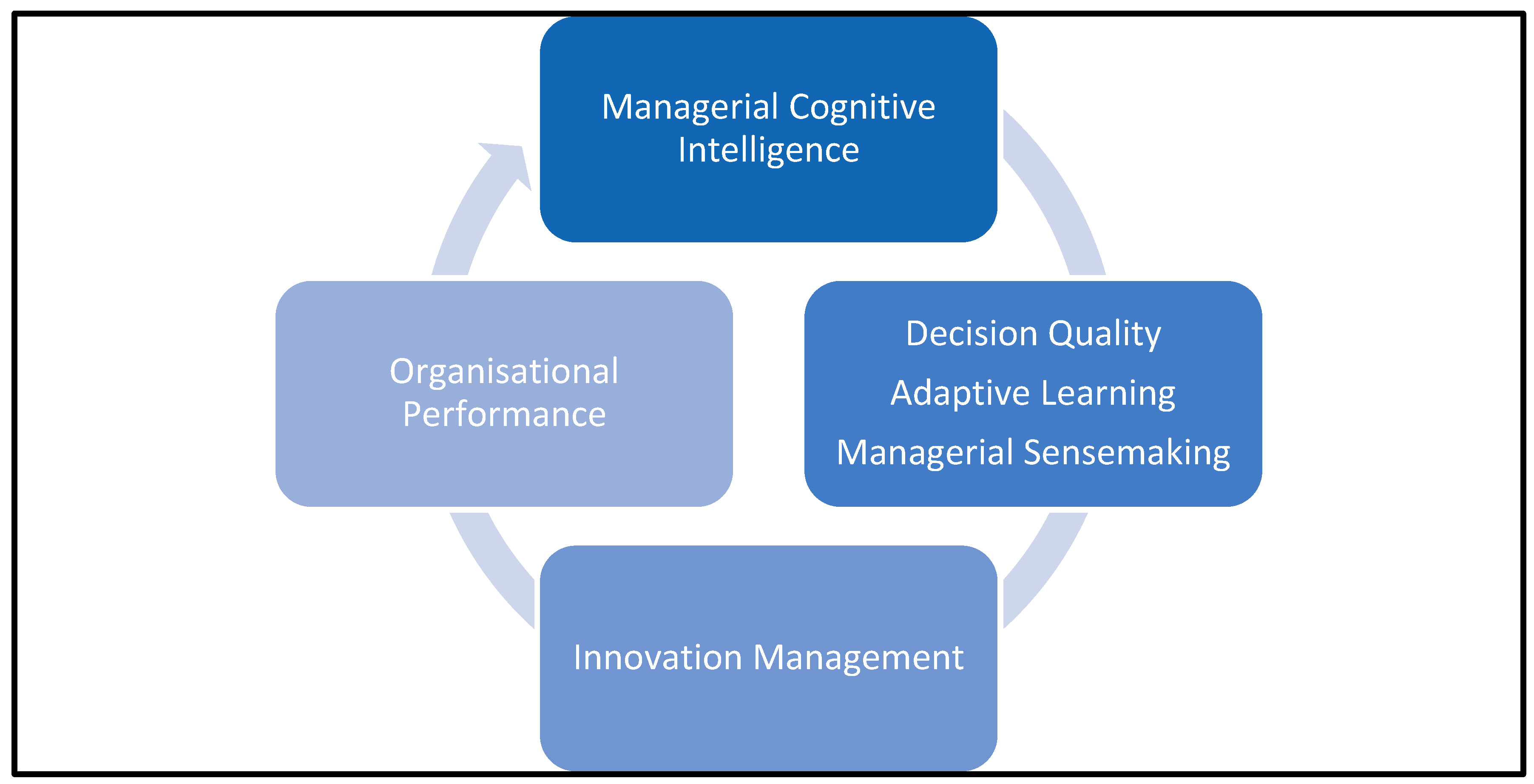
This paper proposes a conceptual framework (
Figure 2) positioning cognitive intelligence (CI) as a foundational managerial capability that shapes innovation management and organisational performance in hospitality organisations. The relevance of cognitive intelligence may vary across managerial roles and organisational contexts. For example, CI may be particularly important in strategic and operational decision-making positions where managers must interpret complex information, respond to uncertainty, and coordinate multiple service processes. Hospitality management takes place in environments characterised by operational complexity, real-time decision-making, and continuous interaction between organisational processes and human behaviour. Within such environments, managerial effectiveness depends not only on interpersonal competencies but also on the capacity to analyse information, interpret ambiguous situations, and make sound judgements under conditions of uncertainty. In hospitality organisations, such cognitive capabilities are also relevant for sustainability-related decision-making, where managers must interpret environmental information, evaluate trade-offs, and translate sustainability goals into operational practices [
32]. CI enables managers to perform these functions by supporting three interrelated processes: decision quality, adaptive learning, and managerial sensemaking. These processes collectively shape the ability of hospitality organisations to innovate and sustain organisational performance.
First, CI enhances managerial decision quality. Hospitality managers frequently face non-routine operational problems that require rapid evaluation of alternatives and assessment of potential consequences. Managers with higher levels of CI are better equipped to integrate diverse information sources, distinguish symptoms from root causes, and select solutions that balance short-term operational demands with longer-term strategic objectives. Extensive research in organisational psychology demonstrates that CI is strongly associated with job performance and decision-making effectiveness in complex roles [
4,
9,
10]. In complex service environments, such decision quality becomes a critical determinant of organisational performance.
Second, CI facilitates adaptive learning and knowledge integration. Hospitality organisations rely heavily on experiential learning, where operational improvements and service innovations emerge from reflection on practice rather than formal research and development activities. Managers with stronger cognitive capabilities are more likely to extract meaningful lessons from experience, recognise patterns across incidents, and translate operational insights into improved processes and routines. Research on intellectual development and problem-solving suggests that cognitive ability plays a central role in learning from experience and integrating knowledge across contexts [
8,
13,
29]. Through this mechanism, CI contributes to continuous improvement and organisational adaptability.
Third, CI supports managerial sensemaking in complex service environments. Hospitality managers must constantly interpret evolving information related to guest expectations, employee performance, operational constraints, and market conditions. Sensemaking involves constructing coherent interpretations of ambiguous situations and coordinating organisational responses accordingly [
12]. CI strengthens this process by enabling managers to identify causal relationships, anticipate unintended consequences, and develop coherent strategies under uncertainty [
10].
Finally, CI enables the effective deployment of emotional and relational competencies. While emotional intelligence plays an important role in interpersonal interactions, its effectiveness depends on managers’ ability to interpret situations accurately and apply relational strategies appropriately. CI provides the analytical foundation through which emotional and social competencies translate into meaningful organisational outcomes. Rather than competing constructs, cognitive and emotional intelligence operate as complementary capabilities within managerial practice. Research suggests that emotional intelligence contributes most strongly to performance when CI is lower, highlighting the foundational role of cognitive capability in complex work contexts [
3,
11].
The above mechanisms collectively explain how cognitive intelligence translates individual managerial capability into organisational-level outcomes such as innovation and sustained performance. Together, these mechanisms position CI as a managerial meta-competency that supports innovation processes and organisational performance in hospitality organisations. By enabling better decision-making, facilitating learning, and supporting sensemaking under uncertainty, CI can be understood as a managerial meta-competency that structures how other capabilities are mobilised in practice [
33].
6. Theoretical Contribution
By conceptualising cognitive intelligence as a managerial meta-competency that structures how other capabilities are mobilised, this paper shifts analytical attention from surface-level competencies toward the underlying cognitive architecture of managerial action. Therefore, this paper makes three distinct theoretical contributions to the hospitality management and innovation management studies. First, it advances cognitive intelligence from a background individual-difference variable to a core managerial meta-competency [
33] that underpins innovation management and organisational performance in hospitality contexts. In doing so, this paper challenges the field’s longstanding tendency to privilege emotional and interpersonal capabilities while leaving the cognitive foundations of managerial action under-theorised.
Second, this paper contributes to theory by reframing hospitality innovation as a cognitively mediated managerial process rather than a primarily technological or creativity-driven outcome [
24]. By positioning decision quality, adaptive learning, and sensemaking as central mechanisms linking cognitive intelligence to innovation and performance, this paper provides a theoretically grounded explanation for why some hospitality organisations are better able to innovate and perform under conditions of complexity and uncertainty.
Third, this study offers a clarifying contribution to ongoing debates on the relationship between cognitive and emotional intelligence [
3]. Rather than treating these constructs as competing predictors of performance, this paper conceptualises cognitive intelligence as an enabling condition that determines whether emotional and social competencies translate into meaningful organisational outcomes. This integrative perspective extends existing compensatory models of intelligence by embedding them explicitly within hospitality management and innovation contexts.
By articulating these contributions, this paper opens new avenues for empirical research on managerial intelligence configurations, innovation practices, and performance dynamics in hospitality and other service-based industries.
7. Managerial Implications
The conceptual arguments advanced in this paper have several actionable implications for hospitality managers, organisations, and educators concerned with innovation management and organisational performance (
Table 1). For hospitality managers, the findings highlight the need to explicitly recognise cognitive intelligence as a core managerial capability rather than an implicit or assumed attribute [
2]. First, organisations should reconsider managerial selection and promotion practices that prioritise interpersonal style, charisma, or emotional display while neglecting cognitive capacity [
34]. Incorporating validated assessments of cognitive reasoning, problem-solving, and analytical judgement into recruitment and succession planning processes can improve managerial fit for cognitively demanding roles. Second, hospitality managers should be supported in developing their cognitive capabilities through targeted development interventions [
30]. Rather than relying solely on generic leadership or soft-skills training, organisations should invest in learning designs that enhance decision-making quality, systems thinking, and reflective judgement. Examples include scenario-based training, post-incident reviews of service failures, structured reflection on complex cases, and cross-functional problem-solving projects. Third, senior leaders should create organisational conditions that allow cognitive intelligence to be exercised effectively. Excessive standardisation, rigid performance metrics, and constant firefighting can suppress managerial judgement and learning [
35]. Allowing for discretion, encouraging analytical discussion of failures, and legitimising evidence-based decision-making can help translate individual cognitive capacity into innovation and performance outcomes.
For hospitality educators, this paper suggests a need to rebalance curricula that have historically privileged operational competence and employability skills. While interpersonal and emotional capabilities remain important, they should be complemented by intentional development of cognitive intelligence competencies such as analytical reasoning, problem diagnosis, and strategic judgement. Educational programmes should move beyond content-heavy delivery towards pedagogical approaches that expose students to complexity and ambiguity [
5]. Case-based learning, problem-based projects with incomplete information, simulations, and reflective assessments can foster cognitive development more effectively than procedural training alone. Importantly, assessment strategies should reward quality of reasoning and decision logic, not just correct answers or polished presentations. Finally, closer integration between hospitality education and industry practice can accelerate cognitive development. Structured work-based learning, mentoring focused on judgement rather than technique, and guided reflection on managerial experiences can help students and early-career managers translate experience into cognitive growth.
8. Limitations and Future Research
As a conceptual study, this paper has several limitations that should be acknowledged. First, the analysis relies primarily on interdisciplinary theoretical and empirical literature from psychology, management, and education rather than direct empirical evidence from hospitality contexts. While this approach was necessary given the limited hospitality-specific research on cognitive intelligence, it highlights the need for empirical studies that examine cognitive intelligence explicitly within hospitality organisations. Second, managerial effectiveness in hospitality is shaped by the interaction of multiple individual and organisational variables. While this paper focuses on the relationship between cognitive intelligence, innovation management, and organisational performance, future research could examine how cognitive intelligence interacts with factors such as leadership behaviour, organisational culture, team dynamics, and organisational learning processes. Third, the conceptual framework proposed in this paper has not yet been empirically validated. Future research could therefore test the proposed relationships through quantitative or mixed-method designs examining how cognitive intelligence interacts with emotional intelligence, managerial experience, and organisational context. Longitudinal research may also help clarify how these capabilities influence managerial learning and decision-making over time.
Future studies may also employ multiple methodological approaches. Quantitative research using validated psychometric measures of cognitive intelligence combined with organisational performance indicators could provide empirical validation of the proposed framework, while qualitative approaches such as case studies and managerial decision-making analyses could offer deeper insights into how cognitive intelligence manifests in hospitality management practice. By addressing these research opportunities, future studies can further advance the theoretical and empirical understanding of managerial intelligence within hospitality and service-based industries.
9. Conclusions
This conceptual paper advances hospitality management scholarship by repositioning cognitive intelligence as a core managerial competency underpinning innovation management and organisational performance. Challenging the field’s longstanding emphasis on emotional and interpersonal capabilities, this paper argues that without sufficient cognitive capacity, managerial action risks becoming reactive, performative, and strategically misaligned.
By synthesising insights from cognitive intelligence theory, job performance research, and hospitality education studies, this paper offers a theoretically grounded framework that explains how CI enables effective decision-making, learning, and innovation in complex service environments. Rather than diminishing the role of emotional intelligence, this paper clarifies its dependence on cognition as an enabling condition. In doing so, this study contributes to emerging debates on innovation management and performance in hospitality and service-based industries and provides a robust conceptual foundation for future empirical investigation.
Future research should empirically examine the role of cognitive intelligence in hospitality innovation processes, service improvement initiatives, and organisational performance outcomes. Longitudinal and mixed-method designs are particularly well suited to capturing the developmental nature of CI and its interaction with emotional and social competencies.