Assessing Circular Economy and Sustainability Business Strategies in Fast Fashion: A Fuzzy Cognitive Maps Approach



Abstract
1. Introduction
- RQ1: what are the main CE and sustainability strategies currently adopted by fast fashion companies?
- RQ2: which of these strategies can be most effective in reducing the main environmental impacts identified in this sector?
2. State of the Art
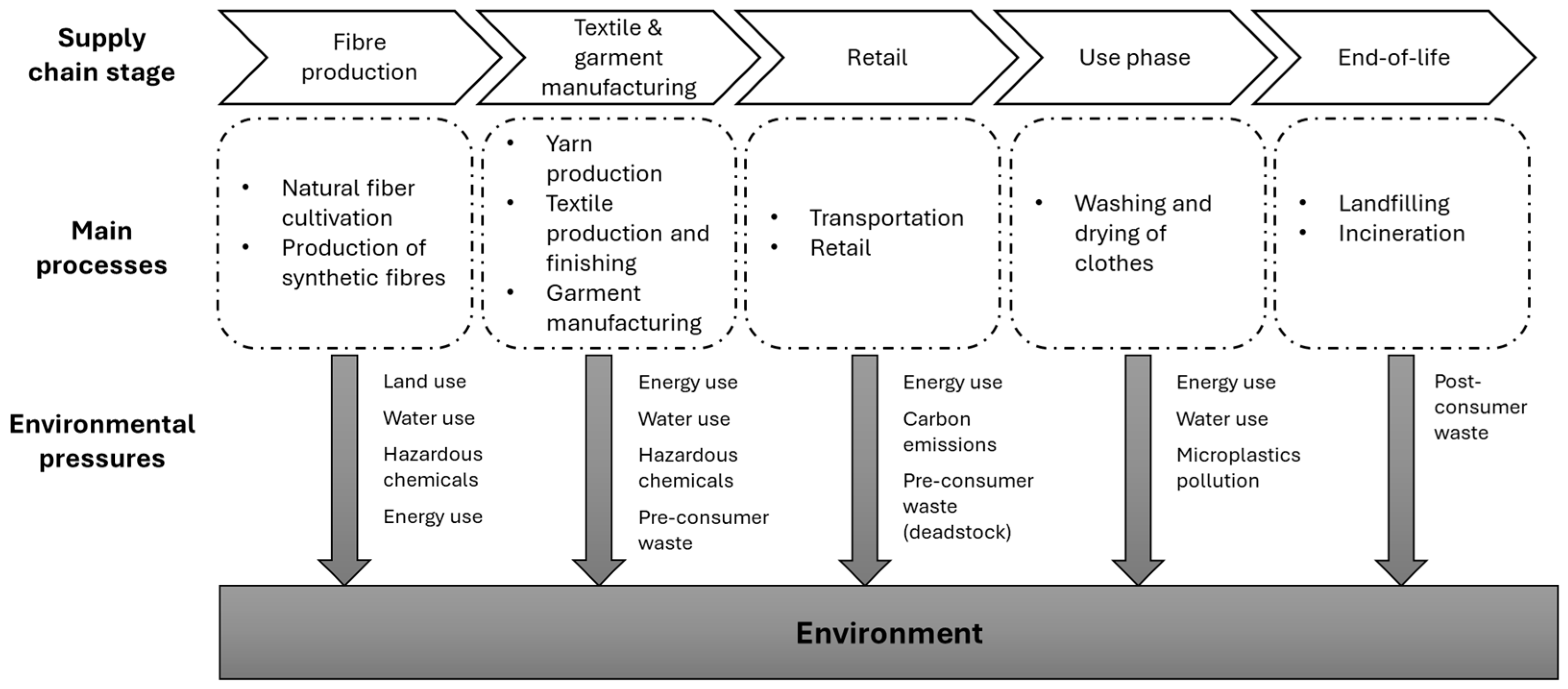
2.1. The Fast Fashion Model and Its Main Environmental Impacts: A Quick Review
- Trend imitation: Fast fashion relies on the ability to quickly imitate luxury brands’ fashion trends and create cheaper copies that are only available for a short period of time [27].
- Reduced costs: Due to the speed of production, fast fashion companies try to keep production costs as low as possible. This characteristic involves the use of low-cost labor in countries of the Global South, as well as the use of cheap materials [34].
- Low-priced and low-quality products: Fast fashion products are therefore affordable for a vast pool of customers, but the quality of garments is usually low, which often discourages reuse and repair [35].
2.2. Current Circular Economy and Sustainability Strategies Applied by Fast Fashion Companies
3. Materials and Methods
3.1. Fuzzy Cognitive Maps: The Theoretical Model
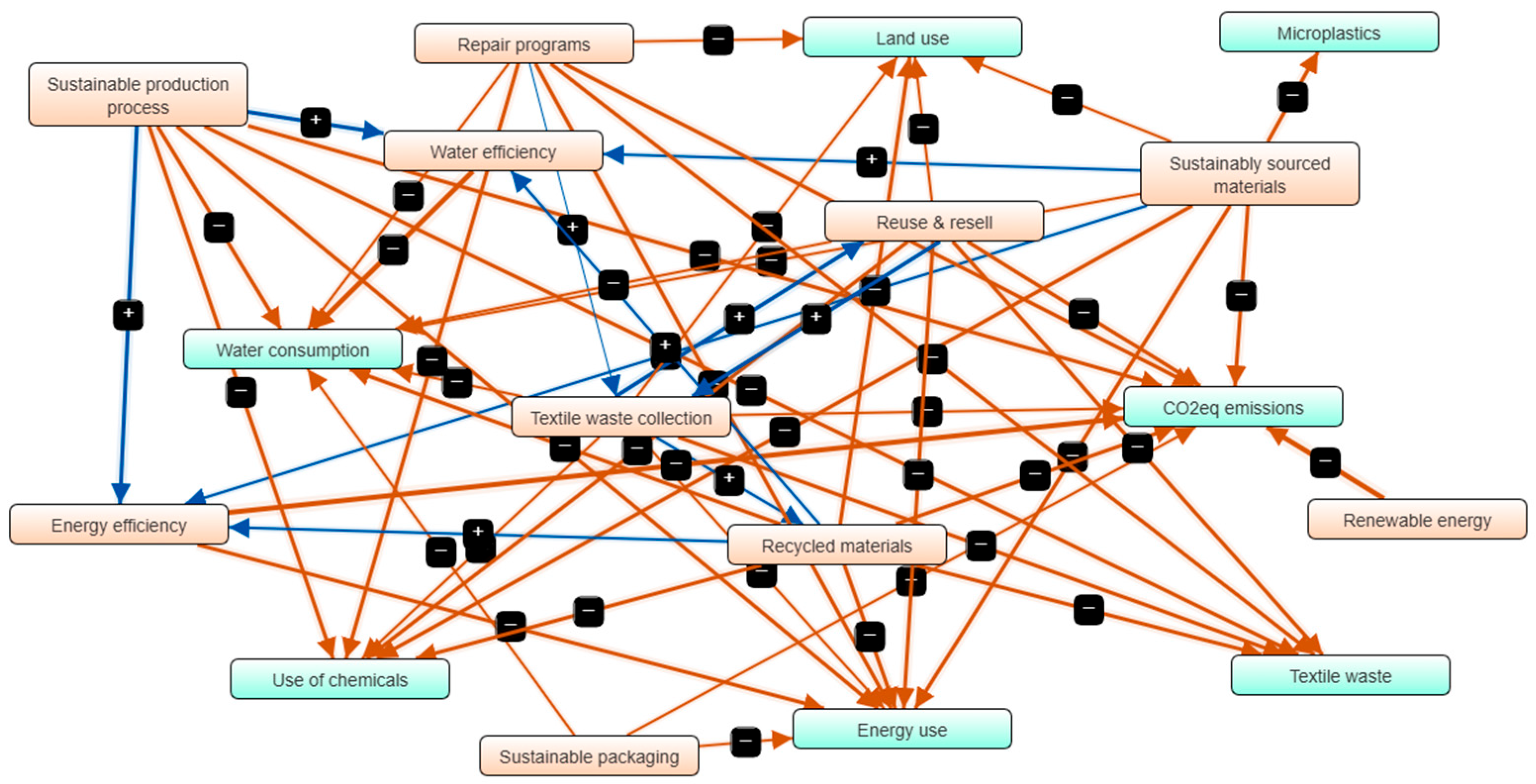
- the concepts (Ci), represented by the nodes of the diagram and indicating variables that are characteristics of the system analyzed; each concept takes a fuzzy value Ai;
- the arcs, which connect the concepts identified and indicate their causal relationship;
- the relative weights (wij), representing the relative influence of concept Ci on concept Cj. Relative weights vary in the range [−1;+1] and denotes the type of causality connecting the two concepts [61]: a negative weight wij indicates that the value of Cj decreases with the increase in Ci; a positive weight wij indicates that the value of Cj increases with the increase in Ci; in both cases, the higher the absolute value of wij, the stronger is the relationship. Wij = 0 means that no causal relationship exists between the two concepts.
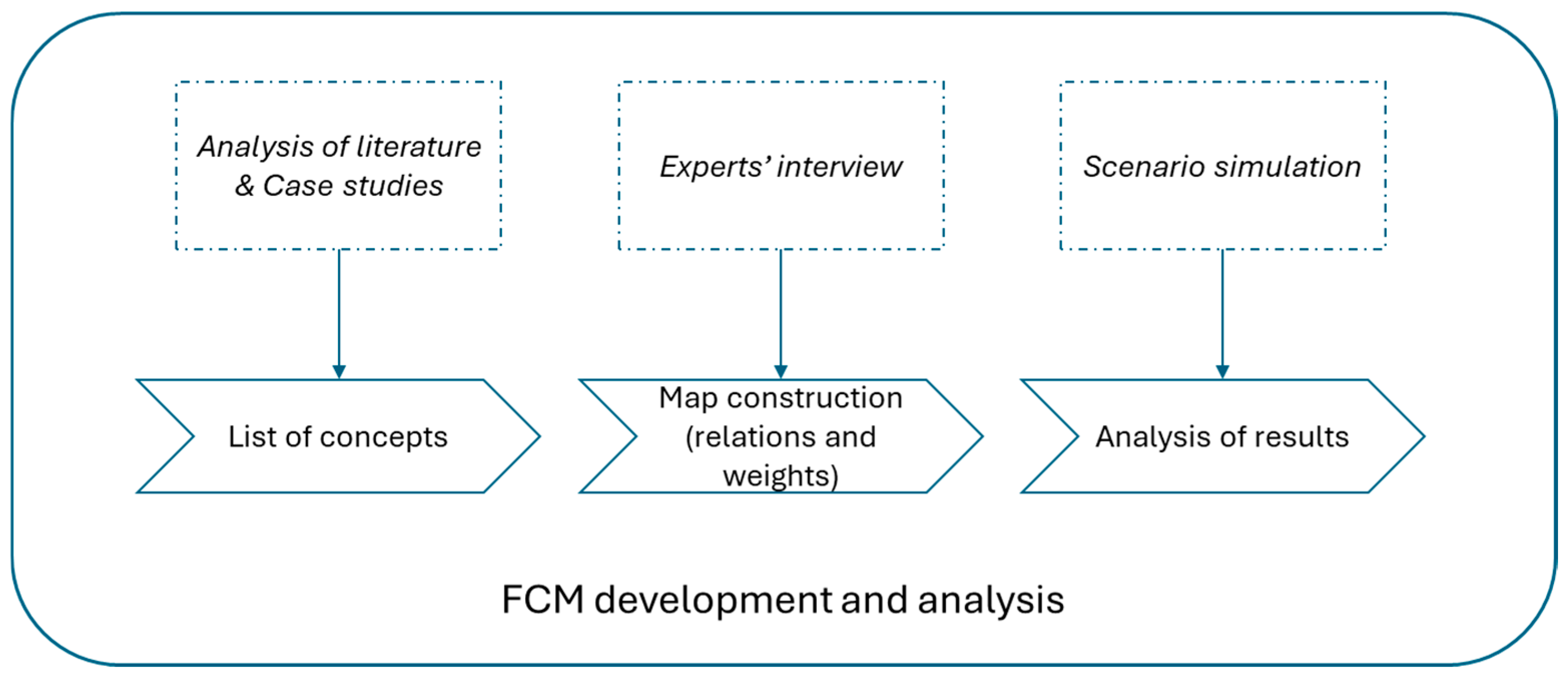
3.2. The Proposed FCM Process Development
- Develop a list of concepts included in the map. The concepts constituting the map can be defined through different methods, such as interviews, data analysis, questionnaires or text analysis [53]. In this study, the concepts were selected through text analysis, considering two main sources. Starting from the analysis of the literature on the environmental impact of fast fashion, presented in Section 2.1, a first set of concepts related to the main impacts on the environment was defined. Next to this, two case studies of globally recognized fast fashion leaders were selected, and their corporate reports were analyzed to identify the main CE and sustainability strategies adopted to improve their environmental performance. More details are reported in Section 3.3.
- Map construction. In the second step, relationships between concepts and their relative weights have been defined, starting from experts’ interviews. The experts involved are all researchers that have a deep knowledge of the fashion sector and its dynamics, or experience with environmental sustainability impact assessment. This step is detailed in Section 3.4.
- Analysis of results. In the last step, a few scenarios have been simulated through the FCM, with the aim of estimating the impact on environmental sustainability of the CE strategies identified, as detailed in Section 4.
3.3. Development of the List of Concepts
3.4. Map Construction
- A low value for concepts weakly correlated: 0 < |wij| ≤ 0.3
- A medium value for concepts with a moderate correlation: 0.4 < |wij| ≤ 0.6
- A high value for concepts with a strong correlation: 0.7 < |wij| ≤ 1
4. Results
4.1. Descriptive Analysis
4.2. Scenario Analysis
4.2.1. Single-Strategy Scenarios
4.2.2. Multi-Strategy Scenarios
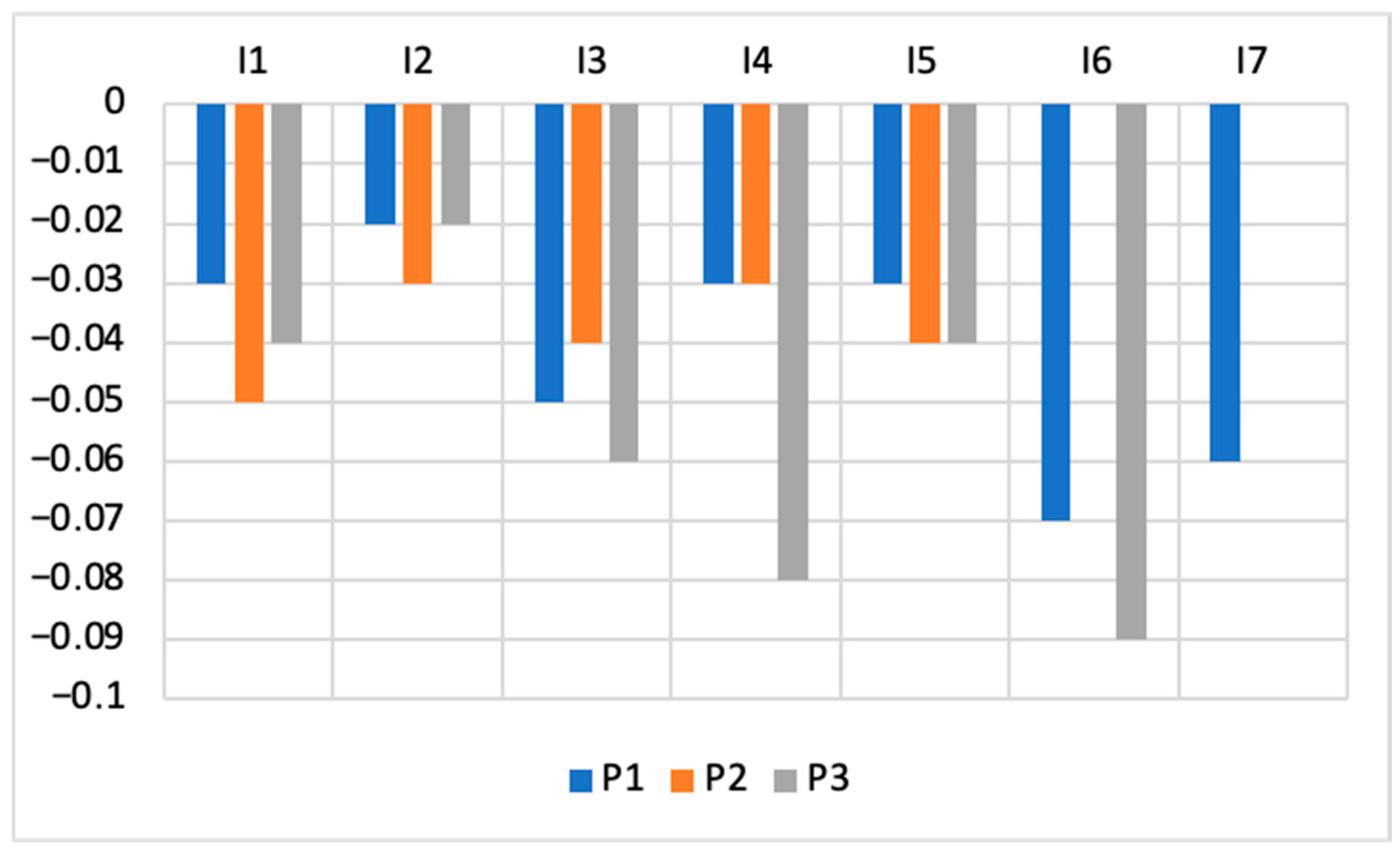
- Scenario P1 involves the adoption of strategies focused on improving the sustainability of material inputs. In this scenario, strategies S1 and S2 were set to 1.
- Scenario P2 includes all the strategies oriented to improve the sustainability and the efficiency of the production process; therefore, strategies S3, S4, S8, S9 and S10 were set to 1.
- Finally, scenario P3 involves the strategies oriented to close the loop of materials in the fast fashion supply chain: S5, S6 and S7.
5. Discussion
6. Conclusions
6.1. Limitations of the Study
6.2. Further Research Directions
Author Contributions
Funding
Institutional Review Board Statement
Data Availability Statement
Conflicts of Interest
Abbreviations
| CE | Circular Economy |
| CSR | Corporate Social Responsibility |
| FCM | Fuzzy Cognitive Maps |
| FF | Fast Fashion |
| GHG | Greenhouse Gas |
| LCA | Life Cycle Assessment |
| SSCM | Sustainable supply chain management |
References
- Abdelmeguid, A.; Afy-Shararah, M.; Salonitis, K. Towards circular fashion: Management strategies promoting circular behaviour along the value chain. Sustain. Prod. Consum. 2024, 48, 143–156. [Google Scholar] [CrossRef]
- European Environment Agency. Textiles and the Environment: The Role of Design in Europe’s Circular Economy; Publications Office: Luxembourg, 2022. Available online: https://data.europa.eu/doi/10.2800/578806 (accessed on 21 January 2025).
- Garcia-Ortega, B.; Galan-Cubillo, J.; Llorens-Montes, F.J.; de-Miguel-Molina, B. Sufficient consumption as a missing link toward sustainability: The case of fast fashion. J. Clean. Prod. 2023, 399, 136678. [Google Scholar] [CrossRef]
- Niinimäki, K.; Peters, G.; Dahlbo, H.; Perry, P.; Rissanen, T.; Gwilt, A. The environmental price of fast fashion. Nat. Rev. Earth Environ. 2020, 1, 189–200. [Google Scholar] [CrossRef]
- De Falco, F.; Di Pace, E.; Cocca, M.; Avella, M. The contribution of washing processes of synthetic clothes to microplastic pollution. Sci. Rep. 2019, 9, 6633. [Google Scholar] [CrossRef]
- Ellen MacArthur Foundation. A New Textiles Economy: Redesigning Fashion’s Future; Ellen MacArthur Foundation: Isle of Wight, UK, 2017. [Google Scholar]
- Maldini, I.; Grimstad Klepp, I. The EU Textile Strategy: How to Avoid Overproduction and Overconsumption Measures in Environmental Policy. J. Sustain. Mark. 2025, 6, 56–72. [Google Scholar] [CrossRef]
- Castagna, A.C.; Duarte, M.; Pinto, D.C. Slow fashion or self-signaling? Sustainability in the fashion industry. Sustain. Prod. Consum. 2022, 31, 582–590. [Google Scholar] [CrossRef]
- Bick, R.; Halsey, E.; Ekenga, C.C. The global environmental injustice of fast fashion. Environ. Health 2018, 17, 92. [Google Scholar] [CrossRef]
- Wren, B. Sustainable supply chain management in the fast fashion Industry: A comparative study of current efforts and best practices to address the climate crisis. Clean. Logist. Supply Chain 2022, 4, 100032. [Google Scholar] [CrossRef]
- Dzhengiz, T.; Haukkala, T.; Sahimaa, O. (Un)Sustainable transitions towards fast and ultra-fast fashion. Fash. Text. 2023, 10, 19. [Google Scholar] [CrossRef]
- Zhang, B.; Zhang, Y.; Zhou, P. Consumer Attitude towards Sustainability of Fast Fashion Products in the UK. Sustainability 2021, 13, 1646. [Google Scholar] [CrossRef]
- Bartkutė, R.; Streimikiene, D.; Kačerauskas, T. Between Fast and Sustainable Fashion: The Attitude of Young Lithuanian Designers to the Circular Economy. Sustainability 2023, 15, 9986. [Google Scholar] [CrossRef]
- European Commission. Communication from the Commission to the European Parliament, the Council, the European Economic and Social Committee and the Committee of the Regions-EU Strategy for Sustainable and Circular Textiles. 2022. Available online: https://environment.ec.europa.eu/publications/textiles-strategy_en (accessed on 10 April 2024).
- European Commission. Directorate General for Environment. Sustainable and Circular Textiles by 2030; Publications Office: Luxembourg, 2023; Available online: https://data.europa.eu/doi/10.2779/96659 (accessed on 31 January 2025).
- Khatsenkova, S. French Senate Backs Law to Regulate Ultra Fast Fashion Giants Shein and Temu. Euronews. Available online: https://www.euronews.com/my-europe/2025/06/11/french-senate-backs-law-to-regulate-ultra-fast-fashion-giants-shein-and-temu (accessed on 17 September 2025).
- Tran, K.V.; Uehara, T. The influence of key opinion leaders on consumers’ purchasing intention regarding green fashion products. Front. Commun. 2023, 8, 1296174. [Google Scholar] [CrossRef]
- Mathew, M.; Spinelli, R. Decoding sustainable drivers: A systematic literature review on sustainability-induced consumer behaviour in the fast fashion industry. Sustain. Prod. Consum. 2025, 55, 132–145. [Google Scholar] [CrossRef]
- Dragomir, V.D.; Dumitru, M. Practical solutions for circular business models in the fashion industry. Clean. Logist. Supply Chain 2022, 4, 100040. [Google Scholar] [CrossRef]
- Bizikova, L.; Pinter, L.; Huppe, G.; Schandl, H. Sustainable Consumption and Production Indicators for the Future SDGs; UNEP: Nairobi, Kenya, 2015; Available online: https://sdgs.un.org/sites/default/files/publications/2301SCP%20indicators.pdf (accessed on 11 November 2024).
- Potting, J.; Hekkert, M.; Worrel, E.; Hanemaaijer, A. Circular Economy: Measuring Innovation in the Product Chain; PBL Publishers: The Hague, The Netherlands, 2017; Available online: https://research-portal.uu.nl/en/publications/circular-economy-measuring-innovation-in-the-product-chain (accessed on 10 November 2024).
- Turker, D.; Altuntas, C. Sustainable supply chain management in the fast fashion industry: An analysis of corporate reports. Eur. Manag. J. 2014, 32, 837–849. [Google Scholar] [CrossRef]
- Musova, Z.; Musa, H.; Drugdova, J.; Lazaroiu, G.; Alayasa, J. Consumer Attitudes Towards New Circular Models in the Fashion Industry. J. Compet. 2021, 13, 111–128. [Google Scholar] [CrossRef]
- H&M Group. H&M Group-Sustainability Disclosure 2023. 2024. Available online: https://hmgroup.com/wp-content/uploads/2024/03/HM-Group-Sustainability-Disclosure-2023.pdf (accessed on 10 September 2024).
- ASOS. Fashion with Integrity: Strategy Update. 2024. Available online: https://www.asosplc.com/media/prwpal1k/fashion_with_integrity_strategy_update.pdf (accessed on 10 April 2025).
- Mango. Mango-Sustainability Report 2023. 2023. Available online: https://media.mango.com/is/content/punto/mfg-Mango_Memoria-sostenibilidad-2023_EN (accessed on 10 April 2025).
- Baena, V. The shift from fast fashion to socially and sustainable fast fashion: The pivotal role of ethical consideration of consumer intentions to purchase Zara. Corp. Soc. Responsib. Environ. Manag. 2024, 31, 4315–4328. [Google Scholar] [CrossRef]
- Adamkiewicz, J.; Kochańska, E.; Adamkiewicz, I.; Łukasik, R.M. Greenwashing and sustainable fashion industry. Curr. Opin. Green Sustain. Chem. 2022, 38, 100710. [Google Scholar] [CrossRef]
- Badhwar, A.; Islam, S.; Tan, C.S.L.; Panwar, T.; Wigley, S.; Nayak, R. Unraveling Green Marketing and Greenwashing: A Systematic Review in the Context of the Fashion and Textiles Industry. Sustainability 2024, 16, 2738. [Google Scholar] [CrossRef]
- Diaz-Bustamante-Ventisca, M.; Carcelén-García, S.; Díaz-Soloaga, P.; Kolotouchkina, O. Greenwashing perception in Spanish fast-fashion brands’ communication: Modelling sustainable behaviours and attitudes. Int. J. Fash. Des. Technol. Educ. 2025, 18, 179–189. [Google Scholar] [CrossRef]
- Saha, K.; Dey, P.K.; Kumar, V. A comprehensive review of circular economy research in the textile and clothing industry. J. Clean. Prod. 2024, 444, 141252. [Google Scholar] [CrossRef]
- Zamani, B.; Sandin, G.; Peters, G.M. Life cycle assessment of clothing libraries: Can collaborative consumption reduce the environmental impact of fast fashion? J. Clean. Prod. 2017, 162, 1368–1375. [Google Scholar] [CrossRef]
- Bartl, A.; Ipsmiller, W. Fast fashion and the Circular Economy: Symbiosis or antibiosis? Waste Manag. Res. 2023, 41, 497–498. [Google Scholar] [CrossRef] [PubMed]
- De Koning, J.; Lavanga, M.; Spekkink, W. Exploring the clothing overconsumption of young adults: An experimental study with communication interventions. J. Clean. Prod. 2024, 467, 142970. [Google Scholar] [CrossRef]
- Peters, G.; Li, M.; Lenzen, M. The need to decelerate fast fashion in a hot climate—A global sustainability perspective on the garment industry. J. Clean. Prod. 2021, 295, 126390. [Google Scholar] [CrossRef]
- Olivar Aponte, N.; Hernández Gómez, J.; Torres Argüelles, V.; Smith, E.D. Fast fashion consumption and its environmental impact: A literature review. Sustain. Sci. Pract. Policy 2024, 20, 2381871. [Google Scholar] [CrossRef]
- Wiśniewski, A. Fast fashion business model: A review of innovation potential and environmental risks. Econ. Environ. 2025, 93, 944. [Google Scholar] [CrossRef]
- Centobelli, P.; Abbate, S.; Nadeem, S.P.; Garza-Reyes, J.A. Slowing the fast fashion industry: An all-round perspective. Curr. Opin. Green Sustain. Chem. 2022, 38, 100684. [Google Scholar] [CrossRef]
- Bailey, K.; Basu, A.; Sharma, S. The Environmental Impacts of Fast Fashion on Water Quality: A Systematic Review. Water 2022, 14, 1073. [Google Scholar] [CrossRef]
- Pinto, V.C.D.; Peleg Mizrachi, M. The Health Impact of Fast Fashion: Exploring Toxic Chemicals in Clothing and Textiles. Encyclopedia 2025, 5, 84. [Google Scholar] [CrossRef]
- Mensah, J. The Global South as a Wasteland for Global North’s Fast Fashion: Ghana in Focus. Am. J. Biol. Environ. Stat. 2023, 9, 33–40. [Google Scholar] [CrossRef]
- Moazzem, S.; Crossin, E.; Daver, F.; Wang, L. Environmental impact of apparel supply chain and textile products. Environ. Dev. Sustain. 2022, 24, 9757–9775. [Google Scholar] [CrossRef]
- Inditex. Statement of Non Financial Information. 2023. Available online: https://www.inditex.com/itxcomweb/api/media/cc6b203a-de08-4ff9-8989-e0ca52e03472/Statement_of_Non_Financial_Information_2023.pdf?t=1710759711321 (accessed on 11 November 2024).
- Kirchherr, J.; Reike, D.; Hekkert, M. Conceptualizing the circular economy: An analysis of 114 definitions. Resour. Conserv. Recycl. 2017, 127, 221–232. [Google Scholar] [CrossRef]
- Arimany Serrat, N.; Arribas-Ibar, M.; Erdoğan, G. Fast Fashion Sector: Business Models, Supply Chains, and European Sustainability Standards. Systems 2025, 13, 405. [Google Scholar] [CrossRef]
- Gheorghe, C.A.; Matefi, R. Sustainability and Transparency—Necessary Conditions for the Transition from Fast to Slow Fashion: Zara Join Life Collection’s Analysis. Sustainability 2021, 13, 11013. [Google Scholar] [CrossRef]
- Neumann, H.L.; Martinez, L.M.; Martinez, L.F. Sustainability efforts in the fast fashion industry: Consumer perception, trust and purchase intention. Sustain. Account. Manag. Policy J. 2021, 12, 571–590. [Google Scholar] [CrossRef]
- Rani, J.; Guru, R.; Santhanam, S.; Molla, W.T.; Wadmare, S.V. Rethinking Fashion: The Environmental Impact and the Shift Towards Sustainability. In Global Impacts and Sustainable Practices in Fast Fashion; Olubiyi, T.O., Behera, S.K., Tran, T.A., Eds.; IGI Global: Hershey, PA, USA, 2025; pp. 21–48. [Google Scholar] [CrossRef]
- Mousavi, K.; Kowsari, E.; Ramakrishna, S.; Chinnappan, A.; Gheibi, M. A comprehensive review of greenwashing in the textile industry (life cycle assessment, life cycle cost, and eco-labeling). Environ. Dev. Sustain. 2024, 27, 21737–21777. [Google Scholar] [CrossRef]
- Jain, P.; Chaudhary, N.; Thakur, P. Sustainable Shifts: Addressing Challenges and Exploring Opportunities in Fast Fashion Through Circular Practices. In Convergence of AI, Education, and Business for Sustainability; Tariq, M.U., Sergio, R.P., Eds.; IGI Global: Hershey, PA, USA, 2025; pp. 357–378. [Google Scholar] [CrossRef]
- Morone, P.; Yilan, G.; Imbert, E. Using fuzzy cognitive maps to identify better policy strategies to valorize organic waste flows: An Italian case study. J. Clean. Prod. 2021, 319, 128722. [Google Scholar] [CrossRef]
- Emir, O.; Ekici, Ş.Ö. An integrated assessment of food waste model through intuitionistic fuzzy cognitive maps. J. Clean. Prod. 2023, 418, 138061. [Google Scholar] [CrossRef]
- Özesmi, U.; Özesmi, S.L. Ecological models based on people’s knowledge: A multi-step fuzzy cognitive mapping approach. Ecol. Model. 2004, 176, 43–64. [Google Scholar] [CrossRef]
- Carvalho, J.P. On the semantics and the use of fuzzy cognitive maps and dynamic cognitive maps in social sciences. Fuzzy Sets Syst. 2013, 214, 6–19. [Google Scholar] [CrossRef]
- Papageorgiou, E.; Kontogianni, A. Using Fuzzy Cognitive Mapping in Environmental Decision Making and Management: A Methodological Primer and an Application. In International Perspectives on Global Environmental Change; Young, S., Silvern, S., Eds.; InTech: London, UK, 2012. [Google Scholar]
- Jetter, A.J.; Kok, K. Fuzzy Cognitive Maps for futures studies—A methodological assessment of concepts and methods. Futures 2014, 61, 45–57. [Google Scholar] [CrossRef]
- Bevilacqua, M.; Ciarapica, F.E.; Marcucci, G.; Mazzuto, G. Fuzzy cognitive maps approach for analysing the domino effect of factors affecting supply chain resilience: A fashion industry case study. Int. J. Prod. Res. 2019, 58, 6370–6398. [Google Scholar] [CrossRef]
- Wang, L.; Zeng, X.; Koehl, L.; Chen, Y. A Human Perception-Based Fashion Design Support System for Mass Customization. In Knowledge Engineering and Management. Advances in Intelligent Systems and Computing; Sun, F., Li, T., Li, H., Eds.; Springer: Berlin/Heidelberg, Germany, 2014; Volume 214. [Google Scholar] [CrossRef]
- Kosko, B. Fuzzy cognitive maps. Int. J. Man-Mach. Stud. 1986, 24, 65–75. [Google Scholar] [CrossRef]
- Axelrod, R.M. Structure of Decision: The Cognitive Maps of Political Elite; Princeton University Press: Princeton, NJ, USA, 1976. [Google Scholar]
- Stylios, C.D.; Groumpos, P.P. Modeling Complex Systems Using Fuzzy Cognitive Maps. IEEE Trans. Syst. Man Cybern. A Syst. Hum. 2004, 34, 155–162. [Google Scholar] [CrossRef]
- Barbrook-Johnson, P.; Penn, A.S. Fuzzy Cognitive Mapping. In Systems Mapping; Springer International Publishing: Cham, Switzerland, 2022; pp. 79–95. [Google Scholar] [CrossRef]
- Skjott Linneberg, M.; Korsgaard, S. Coding qualitative data: A synthesis guiding the novice. Qual. Res. J. 2019, 19, 259–270. [Google Scholar] [CrossRef]
- Uchańska-Bieniusiewicz, A.; Obłój, K. Disrupting fast fashion: A case study of Shein’s innovative business model. Int. Entrep. Rev. 2023, 9, 47–59. [Google Scholar] [CrossRef]
- Caro, F.; Martínez-de-Albéniz, V. Fast Fashion: Business Model Overview and Research Opportunities. In Retail Supply Chain Management; Agrawal, N., Smith, S., Eds.; International Series in Operations Research & Management Science; Springer: Boston, MA, USA, 2015; Volume 223. [Google Scholar] [CrossRef]
- Borkar, R. Fast Fashion Market Growth Trends, Top Companies, Global Insights and Adoption. Analysis Sphere. Available online: https://analysissphere.com/fast-fashion-market/ (accessed on 15 December 2025).
- H&M Group. H&M Group-Annual and Sustainability Report 2023. 2024. Available online: https://hmgroup.com/wp-content/uploads/2024/03/HM-Group-Annual-and-Sustainability-Report-2023.pdf (accessed on 25 February 2025).
- Sapaloglu, I.; Ajas, İ.İ.; Yıldırım, N. A Strategic Roadmap to Circularization of the Turkish Textile and Ready-To-Wear Industry Within the Context of the European Green Deal. Bus. Strategy Dev. 2025, 3, e70153. [Google Scholar] [CrossRef]
- Papageorgiou, E.I.; De Roo, J.; Huszka, C.; Colaert, D. Formalization of treatment guidelines using Fuzzy Cognitive Maps and semantic web tools. J. Biomed. Inform. 2012, 45, 45–60. [Google Scholar] [CrossRef]
- Mehryar, S.; Sliuzas, R.; Sharifi, A.; Reckien, D.; van Maarseveen, M. A structured participatory method to support policy option analysis in a social-ecological system. J. Environ. Manag. 2017, 197, 360–372. [Google Scholar] [CrossRef]
- Morone, P.; Falcone, P.M.; Lopolito, A. How to promote a new and sustainable food consumption model: A fuzzy cognitive map study. J. Clean. Prod. 2019, 208, 563–574. [Google Scholar] [CrossRef]
- Papageorgiou, K.; Singh, P.K.; Papageorgiou, E.; Chudasama, H.; Bochtis, D.; Stamoulis, G. Fuzzy Cognitive Map-Based Sustainable Socio-Economic Development Planning for Rural Communities. Sustainability 2020, 12, 305. [Google Scholar] [CrossRef]
- Snedecor, G.W.; Cochran, W.G. Statistical Methods, 8th ed.; Iowa State University Press: Ames, IA, USA, 1989. [Google Scholar]
- Sarmiento, I.; Cockcroft, A.; Dion, A.; Belaid, L.; Silver, H.; Pizarro, K.; Pimentel, J.; Tratt, E.; Skerritt, L.; Ghadirian, M.Z.; et al. Fuzzy cognitive mapping in participatory research and decision making: A practice review. Arch. Public Health 2024, 82, 76. [Google Scholar] [CrossRef]
- Aguilar, J. A survey about Fuzzy Cognitive maps papers. Int. J. Comput. Cogn. 2005, 3, 27–33. [Google Scholar]
- Chen, C.-T.; Chiu, Y.-T. A study of dynamic fuzzy cognitive map model with group consensus based on linguistic variables. Technol. Forecast. Soc. Change 2021, 171, 120948. [Google Scholar] [CrossRef]
- Dion, A.; Nakajima, A.; McGee, A.; Andersson, N. How Adolescent Mothers Interpret and Prioritize Evidence About Perinatal Child Protection Involvement: Participatory Contextualization of Published Evidence. Child Adolesc. Soc. Work J. 2022, 39, 785–803. [Google Scholar] [CrossRef]
- Farahani, H. Fuzzy Cognitive Maps for Impact Assessment in Psychological Research: Case Study of Psychological Well-being. In Proceedings of the 3rd International Conference on Modern Approach in Humanities and Social Sciences, Acavent, Amsterdam, The Netherlands, 26–28 February 2021. [Google Scholar] [CrossRef]
- Soler, L.S.; Kok, K.; Camara, G.; Veldkamp, A. Using fuzzy cognitive maps to describe current system dynamics and develop land cover scenarios: A case study in the Brazilian Amazon. J. Land Use Sci. 2012, 7, 149–175. [Google Scholar] [CrossRef]
- Brandl, L.; Van Velsen, L.; Brodbeck, J.; Jacinto, S.; Hofs, D.; Heylen, D. Developing an eMental health monitoring module for older mourners using fuzzy cognitive maps. Digital Health 2023, 9, 20552076231183549. [Google Scholar] [CrossRef] [PubMed]
- Gray, S.A.; Gray, S.; Cox, L.J.; Henly-Shepard, S. Mental Modeler: A Fuzzy-Logic Cognitive Mapping Modeling Tool for Adaptive Environmental Management. In Proceedings of the 46th Hawaii International Conference on System Sciences, Wailea, HI, USA, 7–10 January 2013; pp. 965–973. [Google Scholar] [CrossRef]
- Casciani, D.; Bertolini, M. Towards a sustainable on-demand fashion industry: The impact of digital body measurement technologies. Discov. Sustain. 2025, 6, 478. [Google Scholar] [CrossRef]
- Arrigo, E. Digital platforms in fashion rental: A business model analysis. J. Fashion Mark. Manag. 2022, 26, 1–20. [Google Scholar] [CrossRef]
- Clube, R.K.M.; Tennant, M. Exploring garment rental as a sustainable business model in the fashion industry: Does contamination impact the consumption experience? J. Consum. Behav. 2020, 19, 359–370. [Google Scholar] [CrossRef]
- Niinimäki, K. Designing for (Extended) Product and Material Lifetimes. In Recycling and Lifetime Management in the Textile and Fashion Sector, 1st ed.; CRC Press: Boca Raton, FL, USA, 2024; p. 13. [Google Scholar]
- Liu, N.; Xie, F. Sustainable Practices in Fast Fashion. In Operations Management in the Era of Fast Fashion; Chan, H.-L., Ren, S., Liu, E.N., Eds.; Springer Series in Fashion Business; Springer Nature: Singapore, 2022; pp. 29–45. [Google Scholar] [CrossRef]
- Yerushalmi, E.; Saha, K. How Circular Economy Innovation Can Backfire on the Environment: Quantifying the Rebound Effect of the Textiles and Clothing Sector. Bus. Strategy Environ. 2025, 34, 10495–10512. [Google Scholar] [CrossRef]




| Strategy | Inditex | H&M | ||
|---|---|---|---|---|
| Objective | Current Value | Objective | Current Value | |
| Sustainable materials | By 2030, 100% of textile products will only use lower-impact materials (25% fibers from new generation materials; 40% from recycling; 25% from organic farming; 10% other) | 18% recycled materials in 2023; from 52% to 96% lower-impact materials, depending on material type | 100% of materials sustainably sourced by 2030 | 85% |
| 30% recycled materials by 2025, 50% by 2030 | 25% | |||
| Life extension | Increase number n of markets providing Zara pre-owned program (repair, reuse and resell) | 16 | Increase number of markets providing H&M Take care & repair program | 60 (100%) |
| Increase number of markets (including stores and online) with resell | 11 | |||
| Waste reduction | Clothing Collection Program | 20,259 t collected (67% reused or resold, 33% recycled or disposed) | Garment collection | 16,800 t clothes collected (68% reused, 24% recycled, 8% disposed) |
| Sustainable production process | Improving sustainability of production processes such as washing, pretreatment, coloration (dyeing and printing) and finishing | N/A * | Improving sustainability of production processes such as washing, pretreatment, coloration (dyeing and printing) and finishing | N/A * |
| Sustainable packaging | 100% of packaging materials reused or recycled by 2023 | 100% | Absolute reduction in plastic packaging of 25% by 2025 (2018 baseline) | −55% |
| 50% reduction in plastic footprint by 2025 (2019 baseline) | N/A * | Design 100% of packaging to be recyclable, and where relevant reusable, by 2025 | N/A * | |
| Make 100% of packaging from recycled or sustainably sourced materials by 2030 | 79% | |||
| Reuse or recycle 100% of packaging from own sites by 2025 | N/A * | |||
| Energy efficiency | Reduction in relative energy consumption per square meter (2018 baseline) | −19% | 25% reduction in electricity intensity in stores by 2030 (2016 baseline) | −29% |
| Renewable energy | Share of electricity produced from renewable energy | 100% | Sourcing of 100% renewable electricity in the supply chain by 2030 | N/A * |
| Sourcing of 100% renewable electricity in operations by 2030 | 94% | |||
| Water efficiency | Relative water consumption reduction (2020 baseline) | −20% | % absolute reduction in freshwater extraction and consumption (2022 baseline) | −14% |
| Sustainable transportation | Use alternative fuels for at least 90% of maritime shipping by 2025 | N/A * | support transport decarbonization (transport optimization, alternative fuels, preference for low-carbon transport options) | −8% ktons CO2eq compared to 2022 |
| Category | Concept | Legend | Description | Sources |
|---|---|---|---|---|
| Strategies | Sustainably sourced materials | S1 | Use of fibers from lower impact processes (ex. Organic farming, new generation synthetic materials) | Cluster A [24,43] |
| Recycled materials | S2 | Use of recycled fibers | ||
| Sustainable production process | S3 | Enhancing sustainability of textiles production processes such as washing, pretreatment, coloration (dyeing and printing) and finishing | ||
| Sustainable packaging | S4 | Reduction in plastic packaging, use of recycled materials, reuse or recycle of packaging. | ||
| Repair | S5 | Providing support services for repairing used garments instore | ||
| Reuse & resell | S6 | Programs for second-hand garments sale (online or in store) | ||
| Textile waste collection | S7 | Instore used garment collection for reuse (about 68%) or recycling | ||
| Energy efficiency | S8 | Reduction in relative energy consumption in stores | ||
| Renewable energy | S9 | Use of renewable energies for electricity consumed | ||
| Water efficiency | S10 | Reduction in relative water consumption | ||
| Environmental impacts | Water consumption | I1 | Total water consumption | Cluster B [3,4,6,9,10,11,13,35,38,41,42] |
| CO2eq emissions | I2 | Total CO2eq emissions generated | ||
| Use of chemicals | I3 | Use of hazardous chemicals along the supply chain (especially for fibers production and textile transformation) | ||
| Textile waste | I4 | Generation of pre-consumer (ex. Production waste, deadstock and returns) and post-consumer waste | ||
| Energy use | I5 | Total consumption of energy | ||
| Land use | I6 | Consumption of land for producing natural fibers | ||
| Microplastics | I7 | Dispersion of microplastics in the environment (ex. From washing process of synthetic fibers) |
| S1 | S2 | S3 | S4 | S5 | S6 | S7 | S8 | S9 | S10 | I1 | I2 | I3 | I4 | I5 | I6 | I7 | |
|---|---|---|---|---|---|---|---|---|---|---|---|---|---|---|---|---|---|
| S1—Sustainably sourced materials | -- | 0.28 | 0.36 | −0.43 | −0.51 | −0.68 | −0.5 | −0.47 | −0.5 | ||||||||
| S2—Recycled materials | -- | 0.19 | 0.29 | −0.56 | −0.57 | −0.53 | −0.62 | −0.5 | −0.52 | ||||||||
| S3—Sustainable production process | -- | 0.58 | 0.58 | −0.76 | −0.78 | −0.79 | −0.53 | −0.75 | |||||||||
| S4—Sustainable packaging | -- | −0.21 | −0.35 | −0.19 | |||||||||||||
| S5—Repair programs | -- | 0.06 | −0.47 | −0.52 | −0.52 | −0.78 | −0.52 | −0.47 | |||||||||
| S6—Reuse and resell | -- | 0.54 | −0.48 | −0.57 | −0.53 | −0.73 | −0.55 | −0.47 | |||||||||
| S7—Textile waste collection | 0.45 | 0.60 | -- | −0.34 | −0.46 | −0.42 | −0.64 | −0.42 | −0.32 | ||||||||
| S8—Energy efficiency | -- | −0.88 | −0.83 | ||||||||||||||
| S9—Renewable energy | -- | −0.85 | |||||||||||||||
| S10—Water efficiency | -- | −0.97 | |||||||||||||||
| I1—Water consumption | -- | ||||||||||||||||
| I2—CO2eq emissions | -- | ||||||||||||||||
| I3—Use of chemicals | -- | ||||||||||||||||
| I4—Textile waste | -- | ||||||||||||||||
| I5—Energy use | -- | ||||||||||||||||
| I6—Land use | -- | ||||||||||||||||
| I7—Microplastics | -- |
| Feature | Value |
|---|---|
| Total components [N] | 17 |
| Total connections [C] | 52 |
| Density [C/(N × (N − 1))] | 0.19 |
| Connections per component [C/N] | 3.06 |
| Number of driver components [D] | 5 |
| Number of receiver components [R] | 7 |
| Number of ordinary components [O] | 5 |
| Complexity score | 1.4 |
| Category | Concept | In-Degree | Out-Degree | Centrality |
|---|---|---|---|---|
| CE and sustainability strategies | S1—Sustainably sourced materials | 0 | 3.73 | 3.73 |
| S2—Recycled materials | 0.45 | 3.78 | 4.23 | |
| S3—Sustainable production process | 0 | 4.77 | 4.77 | |
| S4—Sustainable packaging | 0 | 0.74 | 0.74 | |
| S5—Repair | 0 | 3.34 | 3.34 | |
| S6—Reuse and resell | 0.6 | 3.87 | 4.47 | |
| S7—Textile waste collection | 0.6 | 3.65 | 4.25 | |
| S8—Energy efficiency | 1.05 | 1.71 | 2.76 | |
| S9—Renewable energy | 0 | 0.85 | 0.85 | |
| S10—Water efficiency | 1.23 | 0.97 | 2.2 | |
| Environmental impacts | I1—Water consumption | 4.21 | 0 | 4.21 |
| I2—CO2eq emissions | 5.49 | 0 | 5.49 | |
| I3—Use of chemicals | 3.47 | 0 | 3.47 | |
| I4—Textile waste | 3.3 | 0 | 3.3 | |
| I5—Energy use | 4.26 | 0 | 4.26 | |
| I6—Land use | 2.25 | 0 | 2.25 | |
| I7—Microplastics | 0.5 | 0 | 0.5 |
| Active Strategies/ Policies | I1 | I2 | I3 | I4 | I5 | I6 | I7 |
|---|---|---|---|---|---|---|---|
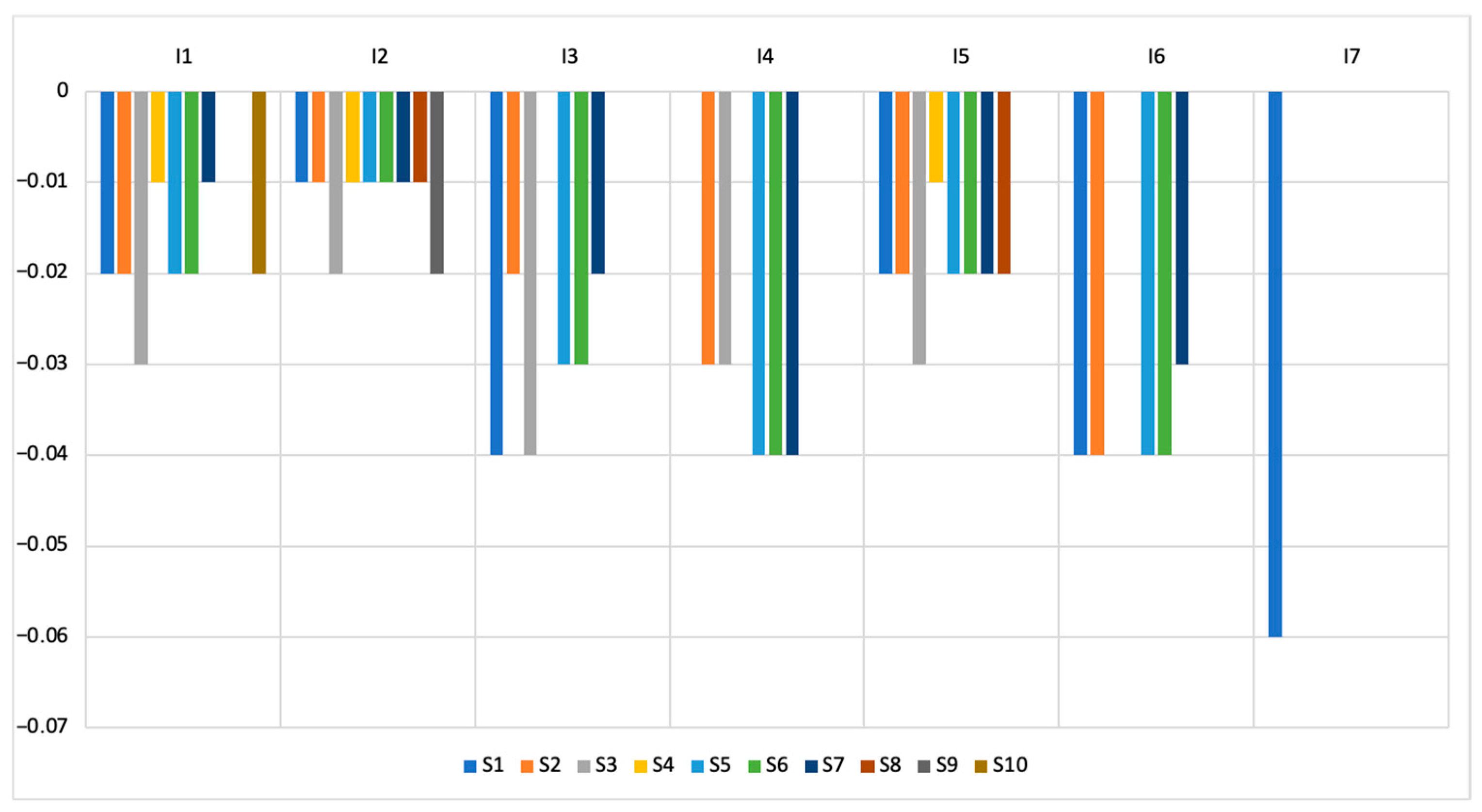
| S1 | −0.02 | −0.01 | −0.04 | −0.02 | −0.04 | −0.06 | |
| S2 | −0.02 | −0.01 | −0.02 | −0.03 | −0.02 | −0.04 | |
| S3 | −0.03 | −0.02 | −0.04 | −0.03 | −0.03 | ||
| S4 | −0.01 | −0.01 | −0.01 | ||||
| S5 | −0.02 | −0.01 | −0.03 | −0.04 | −0.02 | −0.04 | |
| S6 | −0.02 | −0.01 | −0.03 | −0.04 | −0.02 | −0.04 | |
| S7 | −0.01 | −0.01 | −0.02 | −0.04 | −0.02 | −0.03 | |
| S8 | −0.01 | −0.02 | |||||
| S9 | −0.02 | ||||||
| S10 | −0.02 | ||||||
| P1 | −0.03 | −0.02 | −0.05 | −0.03 | −0.03 | −0.07 | −0.06 |
| P2 | −0.05 | −0.03 | −0.04 | −0.03 | −0.04 | ||
| P3 | −0.04 | −0.02 | −0.06 | −0.08 | −0.04 | −0.09 |
| Position | I1 | I2 | I3 | I4 | I5 | I6 | I7 | |||||||
|---|---|---|---|---|---|---|---|---|---|---|---|---|---|---|
| 1 | P2 | −0.05 | P2 | −0.03 | P3 | −0.06 | P3 | −0.08 | P2 | −0.04 | P3 | −0.09 | P1 | −0.06 |
| 2 | P3 | −0.04 | P1 | −0.02 | P1 | −0.05 | S5 | −0.04 | P3 | −0.04 | P1 | −0.07 | S1 | −0.06 |
| 3 | P1 | −0.03 | P3 | −0.02 | P2 | −0.04 | S6 | −0.04 | P1 | −0.03 | S1 | −0.04 | P2 | 0 |
| 4 | S3 | −0.03 | S3 | −0.02 | S1 | −0.04 | S7 | −0.04 | S3 | −0.03 | S2 | −0.04 | P3 | 0 |
| 5 | S1 | −0.02 | S9 | −0.02 | S3 | −0.04 | P1 | −0.03 | S1 | −0.02 | S5 | −0.04 | S2 | 0 |
| 6 | S2 | −0.02 | S1 | −0.01 | S5 | −0.03 | P2 | −0.03 | S2 | −0.02 | S6 | −0.04 | S3 | 0 |
| 7 | S5 | −0.02 | S2 | −0.01 | S6 | −0.03 | S2 | −0.03 | S5 | −0.02 | S7 | −0.03 | S4 | 0 |
| 8 | S6 | −0.02 | S4 | −0.01 | S2 | −0.02 | S3 | −0.03 | S6 | −0.02 | P2 | 0 | S5 | 0 |
| 9 | S10 | −0.02 | S5 | −0.01 | S7 | −0.02 | S1 | 0 | S7 | −0.02 | S3 | 0 | S6 | 0 |
| 10 | S4 | −0.01 | S6 | −0.01 | S4 | 0 | S4 | 0 | S8 | −0.02 | S4 | 0 | S7 | 0 |
| 11 | S7 | −0.01 | S7 | −0.01 | S8 | 0 | S8 | 0 | S4 | −0.01 | S8 | 0 | S8 | 0 |
| 12 | S8 | 0 | S8 | −0.01 | S9 | 0 | S9 | 0 | S9 | 0 | S9 | 0 | S9 | 0 |
| 13 | S9 | 0 | S10 | 0 | S10 | 0 | S10 | 0 | S10 | 0 | S10 | 0 | S10 | 0 |
| Active Strategy/Policy | Transversality (N° of Impacts Involved) | Preferability (Best Strategy for N Impacts) |
|---|---|---|
| S1—Sustainably sourced materials | 6 | 3 |
| S2—Recycled materials | 6 | 1 |
| S3—Sustainable production process | 5 | 4 |
| S4—Sustainable packaging | 3 | 0 |
| S5—Repair | 6 | 2 |
| S6—Reuse and resell | 6 | 2 |
| S7—Textile waste collection | 6 | 1 |
| S8—Energy efficiency | 2 | 0 |
| S9—Renewable energy | 1 | 1 |
| S10—Water efficiency | 1 | 0 |
| P1—Sustainability of materials | 7 | 1 |
| P2—Sustainability of the production process | 5 | 3 |
| P3—Closing the loop | 6 | 4 |
| Transversality Level | ||||
|---|---|---|---|---|
| Low | Medium | High | ||
| Preferability level | High | S3 | ||
| Medium | S1, P2, P3 | |||
| Low | S8, S9, S10 | S4 | S2, S5, S6, S7, P1 | |
Disclaimer/Publisher’s Note: The statements, opinions and data contained in all publications are solely those of the individual author(s) and contributor(s) and not of MDPI and/or the editor(s). MDPI and/or the editor(s) disclaim responsibility for any injury to people or property resulting from any ideas, methods, instructions or products referred to in the content. |
© 2026 by the authors. Licensee MDPI, Basel, Switzerland. This article is an open access article distributed under the terms and conditions of the Creative Commons Attribution (CC BY) license.
Share and Cite
De Leo, F.; Elia, V.; Gnoni, M.G.; Tornese, F. Assessing Circular Economy and Sustainability Business Strategies in Fast Fashion: A Fuzzy Cognitive Maps Approach. Sustainability 2026, 18, 3141. https://doi.org/10.3390/su18063141
De Leo F, Elia V, Gnoni MG, Tornese F. Assessing Circular Economy and Sustainability Business Strategies in Fast Fashion: A Fuzzy Cognitive Maps Approach. Sustainability. 2026; 18(6):3141. https://doi.org/10.3390/su18063141
Chicago/Turabian StyleDe Leo, Federica, Valerio Elia, Maria Grazia Gnoni, and Fabiana Tornese. 2026. "Assessing Circular Economy and Sustainability Business Strategies in Fast Fashion: A Fuzzy Cognitive Maps Approach" Sustainability 18, no. 6: 3141. https://doi.org/10.3390/su18063141
APA StyleDe Leo, F., Elia, V., Gnoni, M. G., & Tornese, F. (2026). Assessing Circular Economy and Sustainability Business Strategies in Fast Fashion: A Fuzzy Cognitive Maps Approach. Sustainability, 18(6), 3141. https://doi.org/10.3390/su18063141