Article

Multi-Scaled Landscape Character Assessment of the Longchuan River Basin, China: Integrating Ecological Units and Administrative Hierarchies


1
College of Landscape Architecture and Horticulture Science, Southwest Forestry University, Kunming 650224, China
2
College of Landscape and Horticulture, Yunnan Agricultural University, Kunming 650500, China
3
College of Agriculture and Life Sciences, Kunming University, Kunming 650214, China
4
College of Civil Engineering, Jiaying University, Meizhou 514015, China
5
Southwest Landscape Engineering & Technology Center of National Forestry and Grassland Administration, Kunming 650224, China
*
Author to whom correspondence should be addressed.
Sustainability 2026, 18(6), 3106; https://doi.org/10.3390/su18063106
Submission received: 4 February 2026 / Revised: 16 March 2026 / Accepted: 17 March 2026 / Published: 21 March 2026

Abstract

The mountainous regions of southwest China represent one of the world’s most distinctive and sensitive areas. Against the backdrop of rapid urbanization and water conservancy construction, rural landscapes in these regions face challenges such as fragmentation, homogenization, and loss of local distinctiveness. Responding to the initiative of the European Landscape Convention (ELC), this study takes the Longchuan River Basin in Southwest China as a case study, and constructs a rural Landscape Character Assessment (LCA) framework adapted to the multi-level governance system. We established a multi-scale evaluation system covering large scale (county-level), medium scale (township-level), and detailed scale (reservoir area-level). The large scale integrated 6 categories of natural variables, while the medium scale involved 4 categories of natural variables and 4 categories of cultural variables. Using a Principal Component Analysis–Two-Step Clustering coupled method and eCognition software, landscape character types and areas were identified respectively. The results show that 11 landscape character types and 41 landscape character areas were identified at the large scale, and 6 landscape character types and 73 landscape character areas at the medium scale. At the detailed scale, 4 typical reservoir areas were selected for field surveys, which verified the in-depth impact of hydropower construction on landscape characteristics. The study provides a transferable technical pathway and policy recommendations for monitoring and managing rural landscapes in mountainous regions. Supports the long-term sustainability and resilience of rural landscapes in China.

1. Introduction

Rapid urbanization and land-use changes are impacting the character and quality of rural landscapes on a global scale [1,2]. While urbanization introduces economic diversification and infrastructure improvements to rural areas [3,4], it also leads to landscapes becoming fragmented, homogenized, and stripped of their cultural identity [5,6]. In China, these challenges are particularly acute in mountainous watersheds, due to complex landscape conditions and rapid urbanization [7]. General research on rural China indicates that the absence of landscape character identification and a failure to establish links between landscape character and its value have resulted in planning and construction lacking a scientific basis [8]. As rural engineering projects adhere to a uniform set of standards, this has led rural landscape construction to overlook regional differences, undermining local distinctiveness and sense of place [9]. Particularly in aspects such as land use, visual perception, and cultural landscapes [10,11], the character and sense of place inherent to traditional rural landscapes are gradually diminishing. The widespread loss of landscape character and the degradation of quality caused by homogenization have become a challenge for rural landscapes worldwide.
China is generally recognized as the world’s largest developing country. In recent years, large-scale construction has exposed its landscapes to the risks of fragmentation and loss of character [12,13,14]. As a foundational task in rural landscape character assessment, the significance of landscape character classification lies in objectively and scientifically revealing the composition and characteristics of rural landscapes [15]. Scholars from different disciplines in China have developed various classification systems based on their research objectives and academic backgrounds. Taking standards or norms-based classification as an example, evaluation systems are constructed based on guidance documents issued by national authorities, emphasizing the value of tourism resources while overlooking indicators that, although indirectly valuable for tourism, contribute to improving rural human settlements and ecological value [16]. Li et al., considering the current situation and characteristics of China’s rural landscapes, proposed a small-scale classification theory based on landscape functional morphology [17], which was subsequently applied in studies by Wang [18] and Li et al. [19]. This theory classifies landscapes from the perspective of functional attributes, but is relatively deficient in indicators related to cultural elements. Consequently, in subsequent research, Liang et al. integrated agricultural culture into landscape classification [20]. However, this approach is limited to small-scale rural areas and fails to encompass the broader landscape scope, rendering the research findings insufficient to address the extensive ecological-scale interconnections within human–environment relationships. Given this, developing a multi-scale classification system adapted to China’s rural governance that integrates both natural and cultural elements has become an urgent necessity for achieving precise management and protection of rural areas.
The European Landscape Convention (ELC) advocates for the application of its principles and values to landscape identification efforts in non-European countries [21]. Since the 1990s, LCA has been widely applied across Europe [5,22]. The United Kingdom was the first to incorporate extensive rural areas into a formal, objective LCA framework, establishing a nested, top-down classification system suitable for rural landscape character classification at different scales. As the research scale narrows, more landscape elements are integrated to enhance the level of detail in characterization [23]. Following its introduction to Asia, Koç and Yılmaz analyzed the landscape character of the Aras Basin using Geographic Information Systems (GIS), providing a methodological reference for basin-scale landscape management [1]. In Turkey, Atik et al. applied LCA to peri-urban areas, combining biophysical analysis with visual perception assessment to identify landscape types, and explored pathways for integrating this approach into Turkey’s planning system [24]. Kim et al. addressed rapid urbanization in Gwangju, South Korea, by using LCA to assess the biodiversity potential of urban fringe landscapes [25]. In summary, LCA has demonstrated adaptability across different geographical contexts, suggesting its potential value when applied to China’s mountainous watersheds. However, these studies have focused on urban fringes or natural basins, leaving a critical gap in LCA methodologies designed for China’s intensively managed agricultural landscapes undergoing rapid transformation.
LCA is a multidimensional approach and a crucial tool for understanding the unique qualities and values of landscapes [26,27]. LCA consists of two phases: a relatively value-free characterization phase and a value judgment-based decision-making phase [23]. Among them, landscape characterization is the primary step in landscape character identification. Aimed at identifying regions with distinct characteristics, it is a process that involves recognizing, classifying, mapping, and describing landscapes [28].When high-quality digital maps are available, parametric methods are an effective approach for landscape classification [29,30]. A combined analysis of parametric and holistic methods is commonly employed [31,32]. For example, by utilizing statistical analysis methods (e.g., cluster analysis) together with GIS 10.7, landscape variables are overlaid and integrated into new maps [33]. The characterization process achieves classification of similar variable combinations through clustering methods [34]. The decision-making phase involves subjective factors and can respond to the practical needs of policies and stakeholders based on research objectives. Photographic documentation [32,35] and value assessments compensate for the risk of over-generalization and loss of sense of place caused by objective methods [36]. Finally, aesthetic and perceptual factors are recorded during field surveys [24,37], and key strategies are proposed to facilitate the translation of research findings into policy. Based on the principle of value neutrality, this approach excludes the orientation toward relative landscape values that characterized previous management practices, helping to focus attention on landscape diversity [38]. The separation of identification and decision-making steps ensures that the objective factual basis of the landscape remains free from subjective value interference, allowing the same set of classification results to flexibly serve different policy objectives. Therefore, applying LCA to study and manage China’s rural landscapes is justified, as it provides a systematic tool—from scientific classification to policy translation—for understanding and governing rural landscapes, thereby advancing the achievement of sustainable rural development goals.
As a tool for understanding landscapes, LCA has been innovatively explored by Chinese scholars for localized application. Bao et al. adopted a three-tiered administrative division of province, city, and district, establishing a multi-scale LCA system at the provincial level in China for the first time [39]. Li et al. introduced “ethnic population density” as a cultural variable in multi-ethnic regions, enhancing the explanatory power for cultural landscapes [40]. Hong et al. incorporated heritage data from cultural relic protection units and traditional villages to establish heritage sources, addressing the challenge of losing local rural landscape characteristics under urbanization [41]. Given China’s vast territory and numerous ethnic groups, these achievements need further integration to develop a scalable, hierarchical identification system that incorporates ethnic culture for rural landscapes in multi-ethnic watershed areas. The Longchuan River Basin is located in western Yunnan Province, in the far western part of the Hengduan Mountains, and is a typical alpine gorge basin in Southwest China. The area features complex geological structures with well-developed fold-fault structures, forming a rare alpine valley landscape. In 2003, the Gaoligong Mountain region in the northern Longchuan River Basin was designated by UNESCO as part of the Three Parallel Rivers of Yunnan Protected Areas, a World Natural Heritage site. As a complete ecological unit, the basin’s continuity of physical geography and the integration of ethnic cultures constitute the dual dimensions of landscape integrity. However, the current fragmented administrative governance model undermines this integrity—a common challenge faced by watershed governance in China and globally [39]. The Longchuan River Basin spans a large area and is situated in a border region inhabited by multiple ethnic groups. Historically (during the Yuan, Ming, and Qing dynasties), influenced by factors such as ethnic migration, foreign invasions, and the central government’s pacification and governance policies, foreign ethnic minorities and Han people from the Central Plains migrated into Yunnan. Through interaction and integration with indigenous populations, this shaped the region’s ethnic distribution pattern as being characterized by Han Chinese as the majority, with multiple ethnic groups living together in large areas while concentrating in small communities. The indigenous ethnic groups in the Longchuan River Basin include the Dai, Hui, Bai, Lisu, and Jingpo minorities. This pattern results in different ethnic groups within the basin being managed by various administrative units, with each administrative region adopting different landscape classification standards and identification methods. This makes it difficult to compare and integrate identification results [40]. Conducting landscape identification work separately according to administrative boundaries fragments the integrity of landscape character and disrupts its internal connections. Therefore, the Longchuan River Basin should be regarded as a cross-regional, integrated ecological unit, making multi-level identification essential. By integrating China’s hierarchical administrative system for regional governance, administrative divisions at different levels can be adapted to the nested, top-down classification system of the LCA approach. This facilitates the coordination of policy objectives among administrative authorities at various levels within the region under the same assessment framework. Consequently, it improves administrative efficiency and avoids conflicting goals arising from unclear responsibility boundaries and difficulties in coordinating planning efforts [39]. It also provides methodological support for the integrated identification and collaborative management of landscapes in multi-ethnic regions.
This study describes a rural landscape character assessment system that integrates ecological units and administrative hierarchies. Focusing on the Longchuan River Basin in western Yunnan Province, China. We considered data sources derived from both natural and cultural elements, and conducted an objective and comprehensive identification and assessment of rural landscapes in the Longchuan River Basin across multiple scales. The purpose of this study is: (1) to develop an LCA framework that integrates basin units with administrative hierarchies; (2) to combine natural and cultural variables in a quantifiable manner for landscape character identification; and (3) comprehensive identification of landscape characteristics in the Longchuan River Basin. The research findings offer an approach to rural landscape governance in the Longchuan River Basin and provide a reference technical pathway for regions worldwide facing similar challenges.

2. Materials and Methods

2.1. Study Area

The Longchuan River Basin is situated in western Yunnan Province, China. Originating from the Gaoligong Mountains at the junction of northwestern Baoshan City and southern Nujiang Lisu Autonomous Prefecture in Yunnan Province, it belongs to the Irrawaddy River system. With a drainage area of 5800 km2, the basin flows through 21 townships, covering a population of 548,000. The Longchuan River stretches for a total length of 310 km, with a total drop of 2339 m and an average slope of 5.3‰, boasting abundant hydropower resources. Currently, a total of 13 cascade hydropower stations are planned, 11 of which have been constructed, along with 7 additional non-cascade stations [42]. Settlements within the basin are mainly concentrated on the river valley plains and terraces along both banks of the river. With the construction of dams, numerous reservoir area settlements have been formed.
The basin serves as a transitional zone between Han Chinese and ethnic minority communities, and is among the regions in Yunnan Province with the most concentrated distribution of traditional villages [43]. Around the 4th century BCE, the “Southwest Silk Road”, the earliest international overland trade route in Chinese history, was opened. The Longchuan River Basin, as an indispensable part of the Southwest Silk Road, preserves numerous historical relics. The river passes through areas with diverse natural and cultural landscapes, including canyon scenery, volcanic hot springs, forest wonders, Longjiang Lake Reservoir, and ethnic minority-concentrated areas, all of which contribute to the basin’s unique landscape characteristics [44].
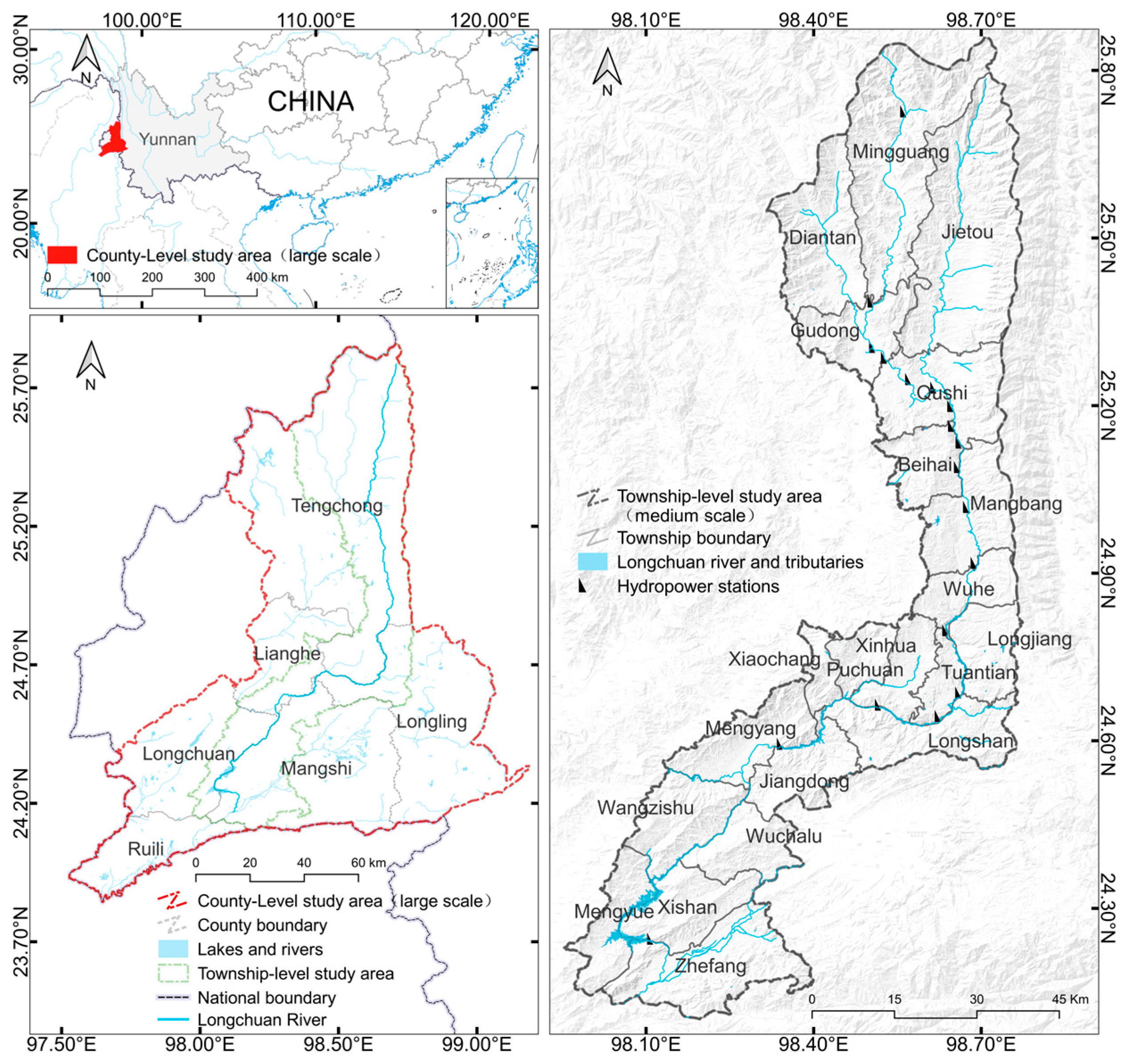
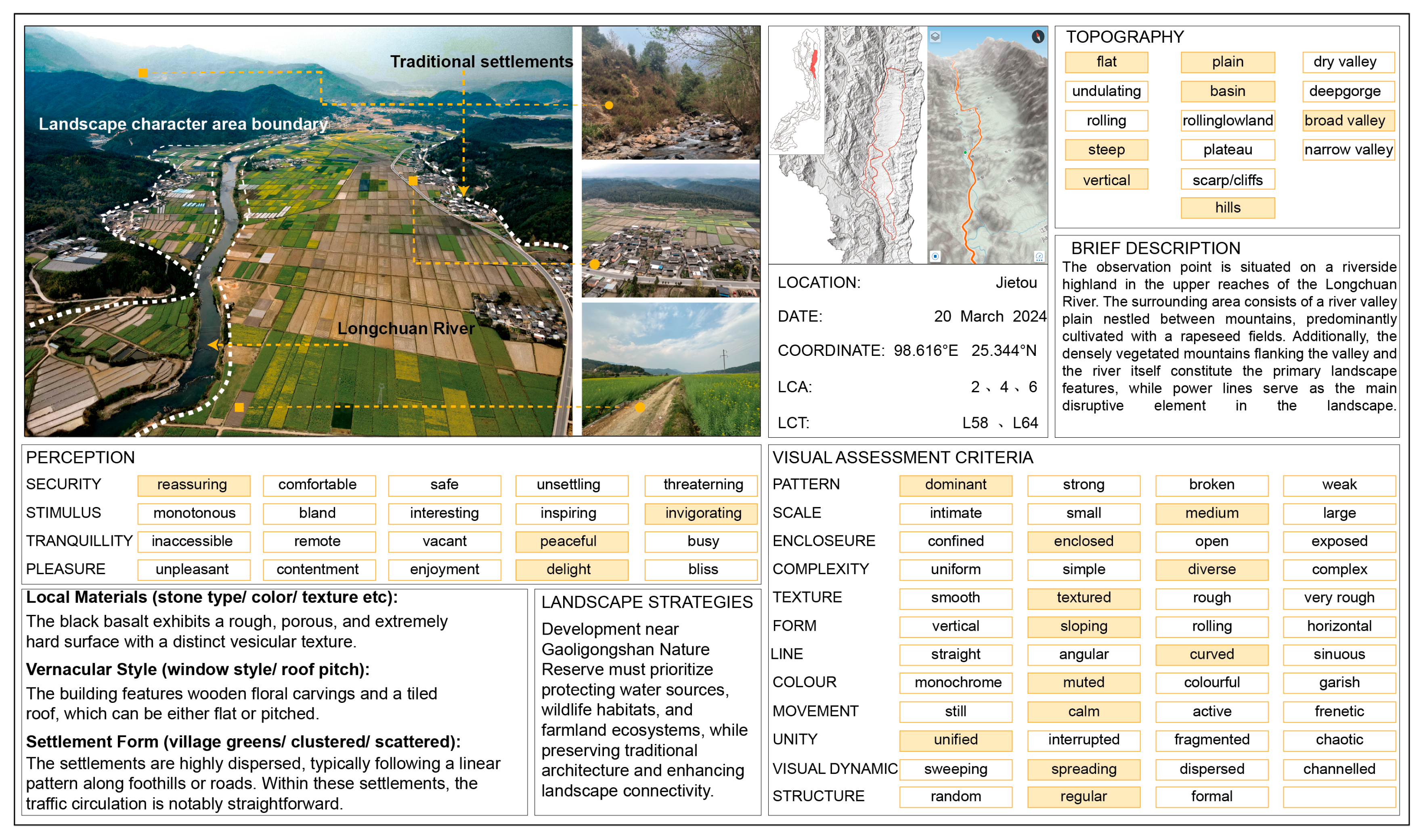
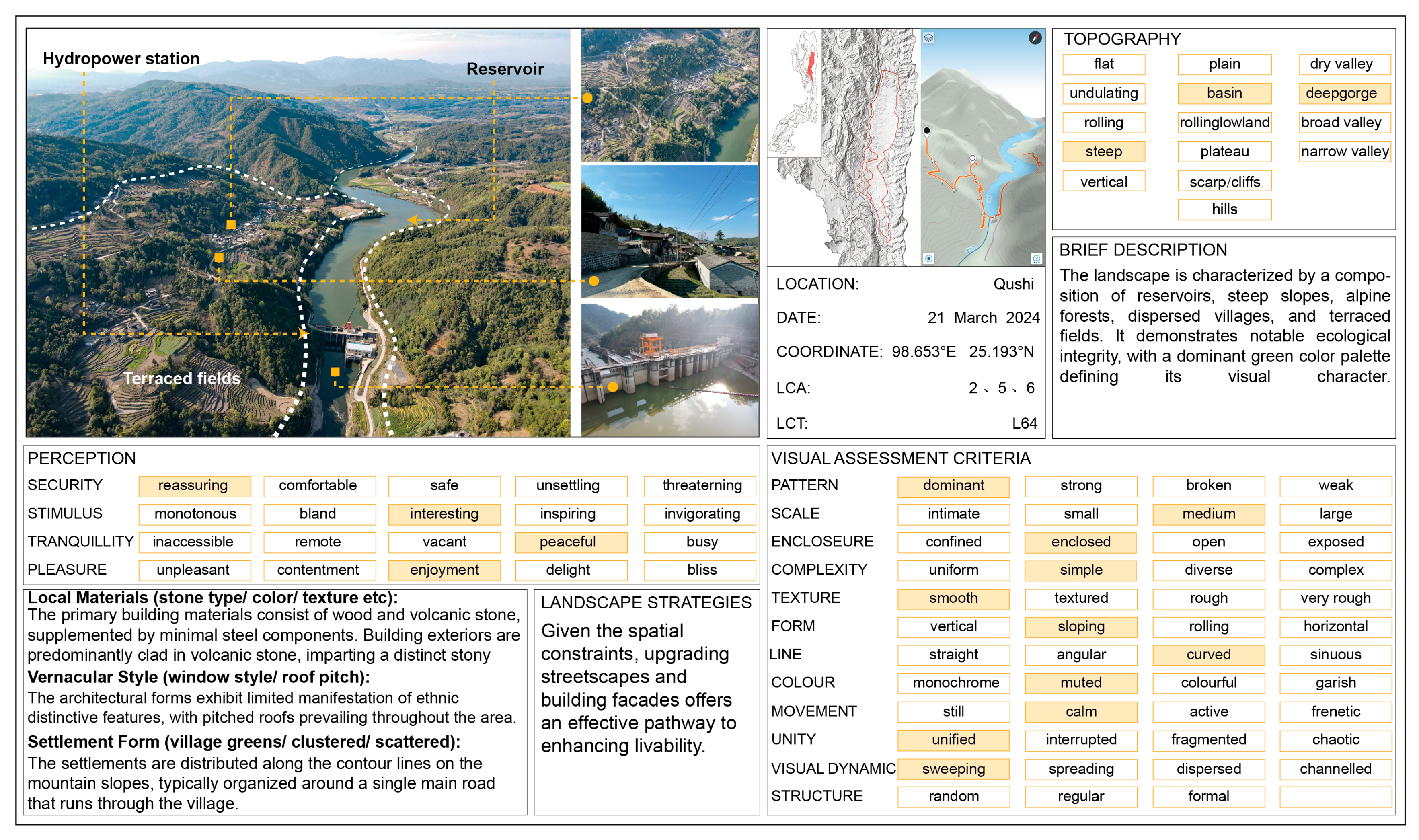
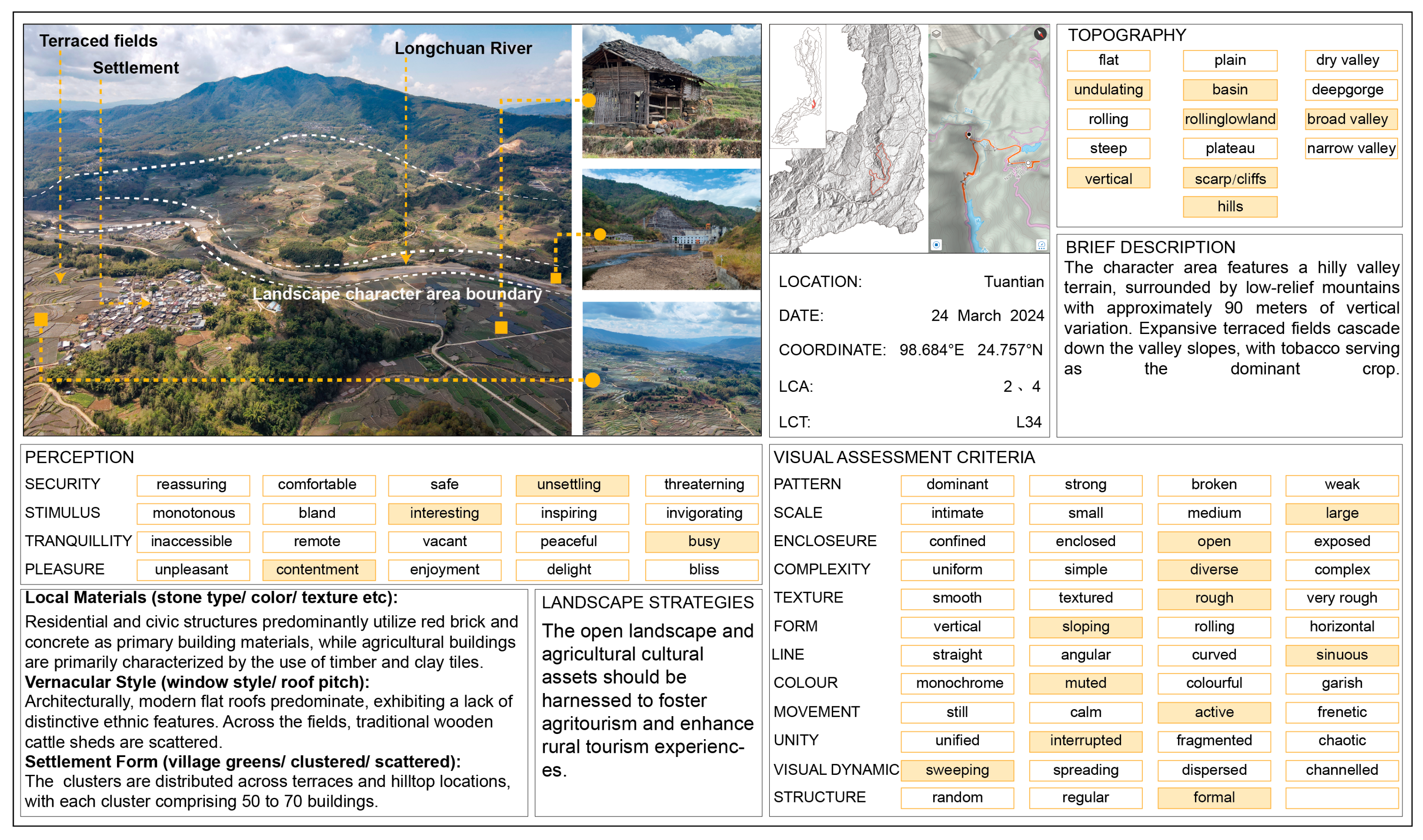
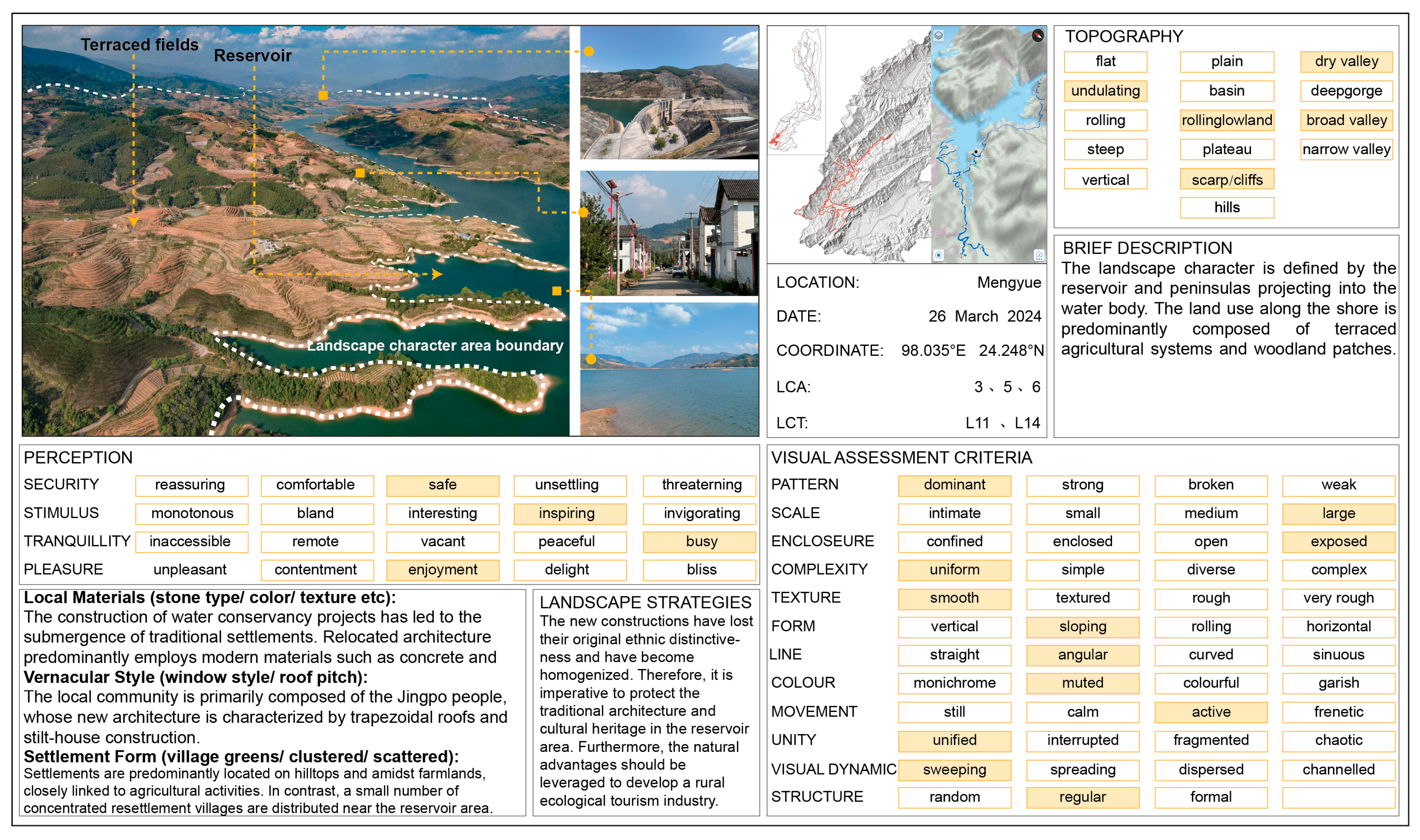
Integrating environmental spatial control with the administrative authority of each administrative level is an effective means of environmental management [45,46]. At the large scale, the study area was defined as the extent of the Longchuan River Basin, encompassing all six county-level administrative regions through which the Longchuan River flows, serving as the first-level evaluation units [47,48], covering an area of 15,091 km2. At the medium scale, the study involves 21 township-level administrative regions associated with the Longchuan River Basin. (Figure 1). Based on the medium-scale research results, four reservoir areas were identified as typical landscape character areas for field surveys at the detailed scale: Jietou Town reservoir area (L58, L64), Qushi Town reservoir area (L58), Tuantian Town reservoir area (L34), and Mengyue Town reservoir area (L11). These areas represent different landscape character types along the basin’s upper, middle, and lower reaches. Using visual references and settlement density. The visual perception range includes the viewsheds obtained with reservoir water bodies and dams as the main observation. A 35 km visual distance limit is considered the theoretically appropriate visible distance for humans [49].To document the aesthetic and perceptual characteristics of the landscape, we conducted field surveys using standardized forms (Appendix B, Appendix C, Appendix D and Appendix E) to identify landscape character areas and types [50]. The survey team, consisting of three landscape architecture professionals, followed the river from its source to the border, passing through major settlements along the way. During the fieldwork, we used drones to capture aerial photographs of typical landforms and landscape type combinations, and recorded aesthetic and perceptual attributes using consistent terminology.

2.2. Selection of Variables at Two Scales

To understand the landscape of a given region, a systematic desk-based study is first essential to explore the factors shaping the landscape. This process helps identify the key landscape elements that play a decisive role in shaping the landscape, with research efforts focused on collecting and analyzing data related to these elements. When conditions permit, a larger number of indicators incorporated into landscape character classification will facilitate more accurate characterization of the landscape character types (LCT) in a region [30,51,52]. Various materials, such as topographic maps, thematic maps, images, and census data, hold potential value for utilization [30]. In multi-scale landscape character identification, a reduction in scale not only means the progressive refinement of the resolution of research data sources at each level but also implies the adoption of more detailed and diverse types of data sources [53]. As a hierarchical structure, landscape elements are ordered according to their degree of independence [54]. Yang et al. elaborated on the essence of ordering landscape elements based on the hierarchical principle: at large scales [34], landscape characterization is dominated by abiotic elements with high independence (e.g., climate, topography), as the scale narrows down to the detailed level, cultural and biotic factors (e.g., vegetation types, land use) become dominant in the landscape. Based on the available data, this study adopted data sources dominated by natural elements at the large scale, while introducing biotic and human-related data at the medium scale. The data and information are presented in Table 1.
At the large scale, 6 categories of thematic data, encompassing a total of 54 feature variables, were selected as identification elements and denoted by uppercase letters (Table 2). Among these, climate data, characterized by low spatial resolution, served as descriptive elements and did not participate in the delineation of landscape units. However, like other elements, it can be queried from the final character map [30]. The elevation data were derived from the Copernicus DEM (Copernicus Digital Elevation Model) of the European Space Agency (https://panda.copernicus.eu/panda, accessed on 9 October 2023). In ArcGIS 10.7, the Focal Statistics tool was used to perform neighborhood analysis on the DEM data, generating relief data. Elevation and relief amplitude thresholds follow national mapping specifications and technical guidelines. Soil data were sourced from the 1:1,000,000 digitized soil map of the People’s Republic of China, published by the Resource and Environmental Science Data Center of the Chinese Academy of Sciences (CAS) (https://www.resdc.cn/, accessed on 23 September 2023). Land cover data were acquired from the Global 30 m Land Cover Dynamic Monitoring Product (GLC_FCS30D), from the Institute of Remote Sensing and Digital Earth of CAS (https://data.casearth.cn/, accessed on 22 December 2023). Geological data were obtained from the Geoscientific Data & Discovery Publishing Center (http://geodb.ngac.org.cn/, accessed on 28 December 2023), specifically the 1:1,000,000 spatial database of digital geological maps. The polygon data mainly included geological age units, supplemented by Quaternary and igneous rock geological types [55]. Through the integration of relevant geological materials and collaboration with geological experts, a geological database suitable for this study was classified.
At the medium scale, 8 categories of thematic data, including a total of 46 feature variables, were selected as identification elements and denoted by lowercase letters (Table 3). Landscapes at this scale still exhibit significant elevation differences; thus, elevation data were also obtained from the Copernicus DEM. Slope and aspect variations were calculated using GIS 10.7. Vegetation data were sourced from the Resource and Environmental Science Data Center of the Chinese Academy of Sciences (CAS) (https://www.resdc.cn/, accessed on 9 February 2024) with a scale of 1:1,000,000. Land use data were acquired from the Esri official website (https://livingatlas.arcgis.com/, accessed on 20 September 2023) at a resolution of 10 m. This study drew inspiration from the graphical representation method of human-dimensional data used in Estonia’s geographical zoning research. Traditional villages (52), national geoparks (1), A-level tourist attractions (30), and cultural relic protection units (32) around the basin were incorporated into the calculation of cultural heritage density. For heritage and village density, we established gradations using Jenks natural breaks optimization. This data-driven approach minimizes within-group variance and maximizes between-group differences. Village data were obtained from the National Bureau of Statistics [56]. A similar calculation method to that used for heritage density was adopted to derive the distribution characteristics of rural settlements within the region. Given the low resolution of official population statistics [40], the digitized map of ethnic distribution in Yunnan Province [57] was used as a descriptive element for medium-scale landscape characters.

2.3. Identification and Visualization of Landscape Characteristics at Large and Medium Scales

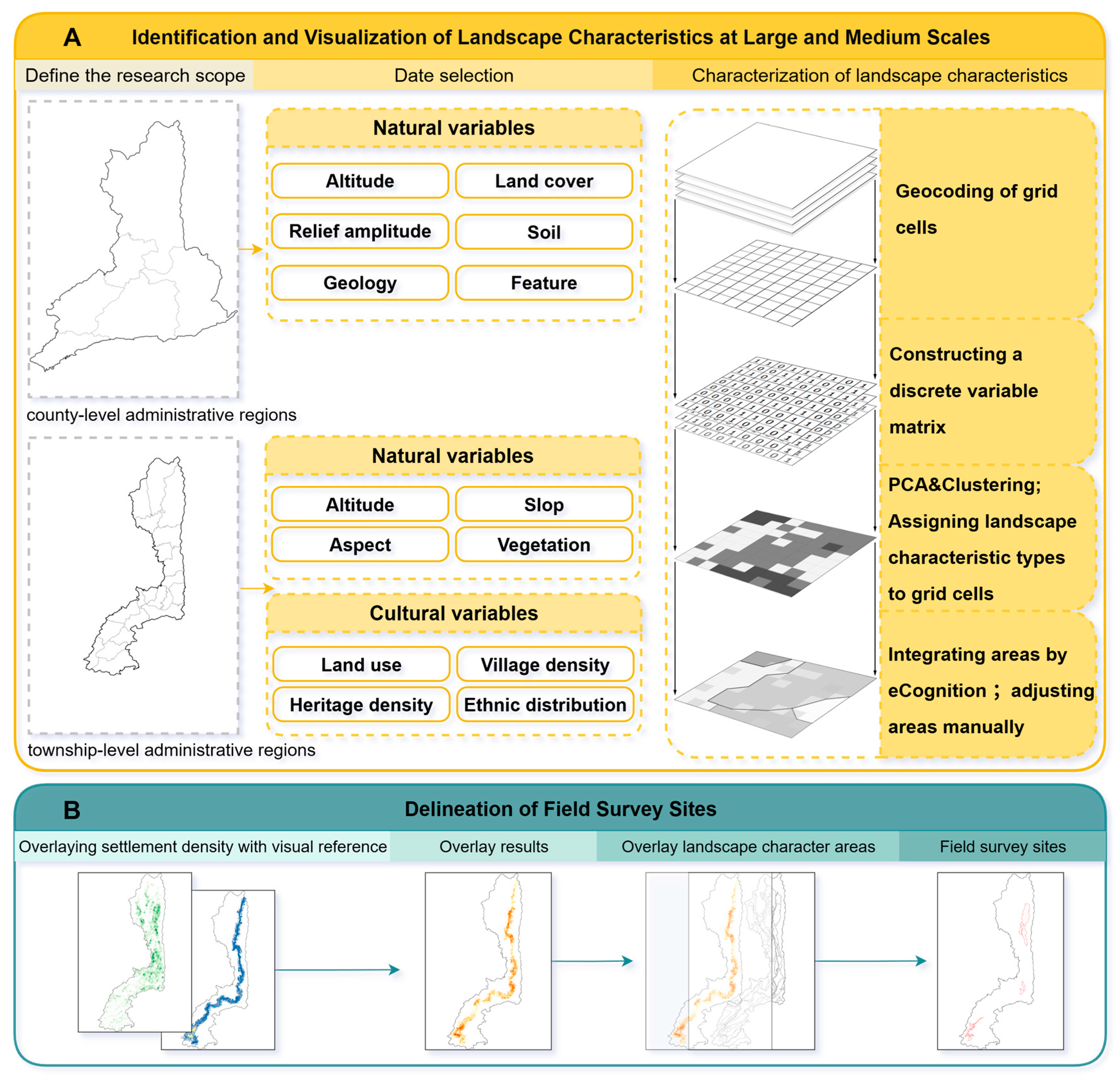
As the independence of observers has been emphasized in landscape characterization [29], parametric methods based on multivariate statistical analysis have been validated and applied in landscape characterization practices [30,31,34,40,58]. Multivariate statistical analysis and cluster analysis are common methods for determining landscape classification [29], which can reduce the number of variables while retaining most of the information from the original data as much as possible. The selection of Principal Component Analysis (PCA) coupled with the Two-Step Cluster method is based on the hierarchical theory of landscape elements and the need to handle mixed data types (categorical and continuous data) [34]. PCA was used to reduce dimensionality and address multicollinearity among landscape variables. Many natural variables (e.g., elevation, slope, relief amplitude) exhibit strong correlations that could bias cluster analysis. PCA transforms these correlated variables into a smaller set of uncorrelated components while retaining maximum variance from the original data, and also converts categorical variables into continuous principal component scores suitable for subsequent clustering. The KMO measure and Bartlett’s test of sphericity were used to verify sampling adequacy and correlation structure suitability before PCA [24,59,60]. Two-step Clustering Analysis efficiently processes large sample size data. Compared with hierarchical clustering and K-means clustering, it has the advantages of managing both categorical and continuous variables simultaneously and automatically determining the specific number of clusters [61]. In this study, SPSS 27 software was used to process large sample size matrix data, enabling the classification of landscape character types. Through clustering, samples of homogeneous types were defined to form multiple groups of landscape character types. Once landscape types were defined, they could be assigned to grid cells and added to the database as attributes [30]. Finally, the cluster results were visualized to generate a preliminary landscape character map. The multi-scale segmentation tool in eCognition 9.0 was used as an objective method for delineating landscape character areas [28], and manual visual interpretation was combined to reduce the actual errors in the boundaries of landscape character areas (Figure 2A).
First, all data were unified into the same spatial coordinate system, and the spatial resolution of raster datasets was standardized through resampling, with a pixel size of 30 m × 30 m. Subsequently, a grid is constructed and used as a spatial unit to define the classification’s granularity [5]. The size of spatial units affects both the level of detail in characterization results and the computational power required; these two factors are mutually conflicting, so striking a balance between them is crucial. Under the principle of maximizing the preservation of data source information without distortion, the large-scale data was divided into 60,365 grid cells of 0.5 km × 0.5 km, while the medium-scale data was divided into 147,239 grid cells of 0.2 km × 0.2 km. Number theory was used to encode and classify different variables [62]. We used the “Extract by Attributes” tool to sequentially assign all variables to each grid cell. This process enabled the construction of a connection matrix between variables and spatial units. Each grid unit was embedded with a unique combination of landscape elements, which served as a single landscape character sample. For example, at the large scale, a specific grid unit might contain the combination A1, R1, G1, S1, L1, F1.
Subsequently, the proportions of different landscape variables within each spatial unit were exported into a spatial unit sequence. Then, landscape elements present within a grid cell were translated into “1”, while those absent were translated into “0”, thereby indirectly constructing a discrete variable matrix [34]. Following this, Principal Component Analysis (PCA) was conducted to reduce the dimensionality of the landscape character element variables. The KMO test and Bartlett’s test were passed. Based on the analysis results, principal components with an eigenvalue of 1 were selected. The new variables were re-integrated via Two-step Clustering, and the number of clusters was determined using the log-likelihood distance and Schwarz Bayesian Criterion (BIC) clustering criteria. Afterwards, the clustering results (i.e., landscape character types) were assigned to grid cells in GIS 10.7, and a landscape character type map was generated through visualization.
Subsequently, a linkage matrix between landscape character types (LCT) and landscape element combinations (Appendix A) was constructed to analyze the combination patterns of each landscape character element across different landscape character types—i.e., the proportion of landscape elements in each landscape character type. Two approaches, textual description and coding method, are applicable for naming landscape character types and areas [63]. The coding method follows a defined set of naming rules: taking the landscape character element “X” as an example, when X ≥ 50%, it was expressed as “X”; when it was in the range of 30% ≤ X < 50%, it was expressed as “{X}”; when it was in the range of 15% ≤ X < 30%, it was expressed as “(X)”; and it was excluded when X < 15%. Textual descriptions of landscape character types were conducted by integrating database information and field survey records.
Finally, image segmentation technology was used to identify landscape character areas [64,65]. Taking the large-scale landscape character type map as the input source, the multiresolution segmentation (MRS) algorithm in eCognition Developer 9.0 software was applied. Through the control variable method, three types of parameters, scale, shape, and compactness, were adjusted to obtain the most suitable regional division results. The scale is a key parameter of MRS, which controls the spectral heterogeneity within image objects [66]. A larger scale parameter allows for higher internal heterogeneity; when the scale parameter is large, more pixels are combined into an object, and vice versa for smaller objects. However, the scale parameter cannot be directly correlated with object size, so researchers need to conduct multiple experiments to find the appropriate scale parameter value. The shape parameter balances color and shape criteria, while compactness optimizes object smoothness versus compactness [67]. To meet the requirements of segmentation precision, the results often lead to over-segmentation. It is necessary to further verify the results by combining satellite images, available data, and survey findings, conducting manual interpretation in GIS 10.7, and correcting the character area boundaries. Finally, the landscape character areas were described based on the combination of landscape types within the character areas and survey experience.

3. Results

3.1. Landscape Character Types and Areas at the Large Scale

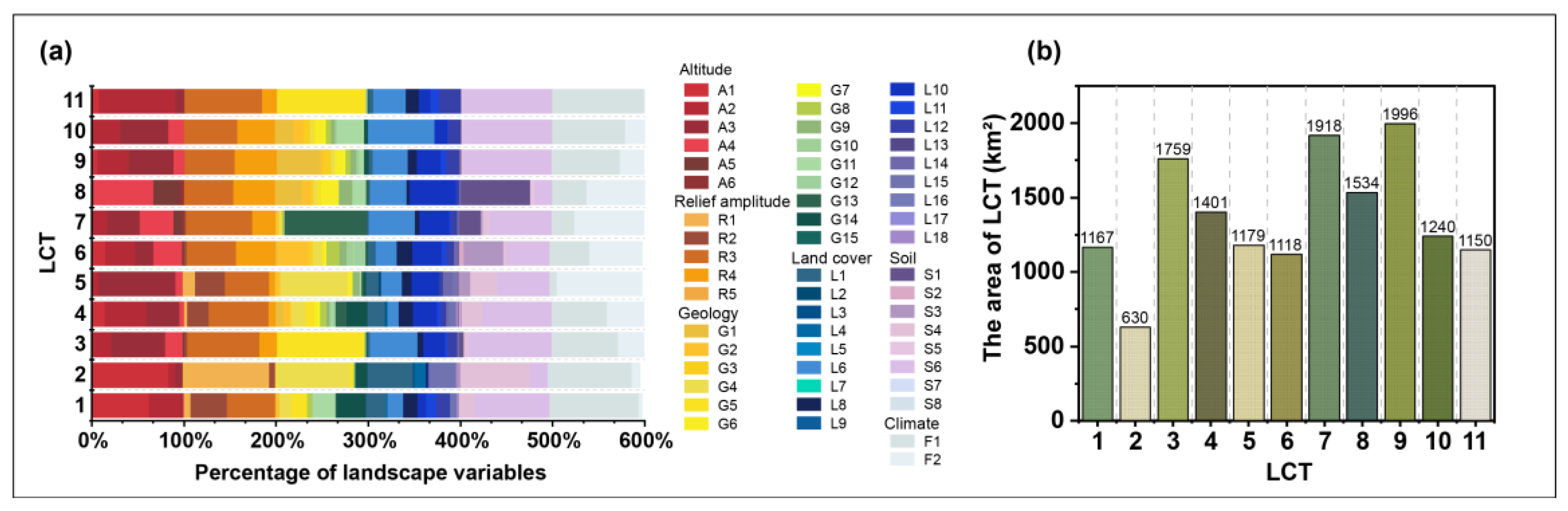
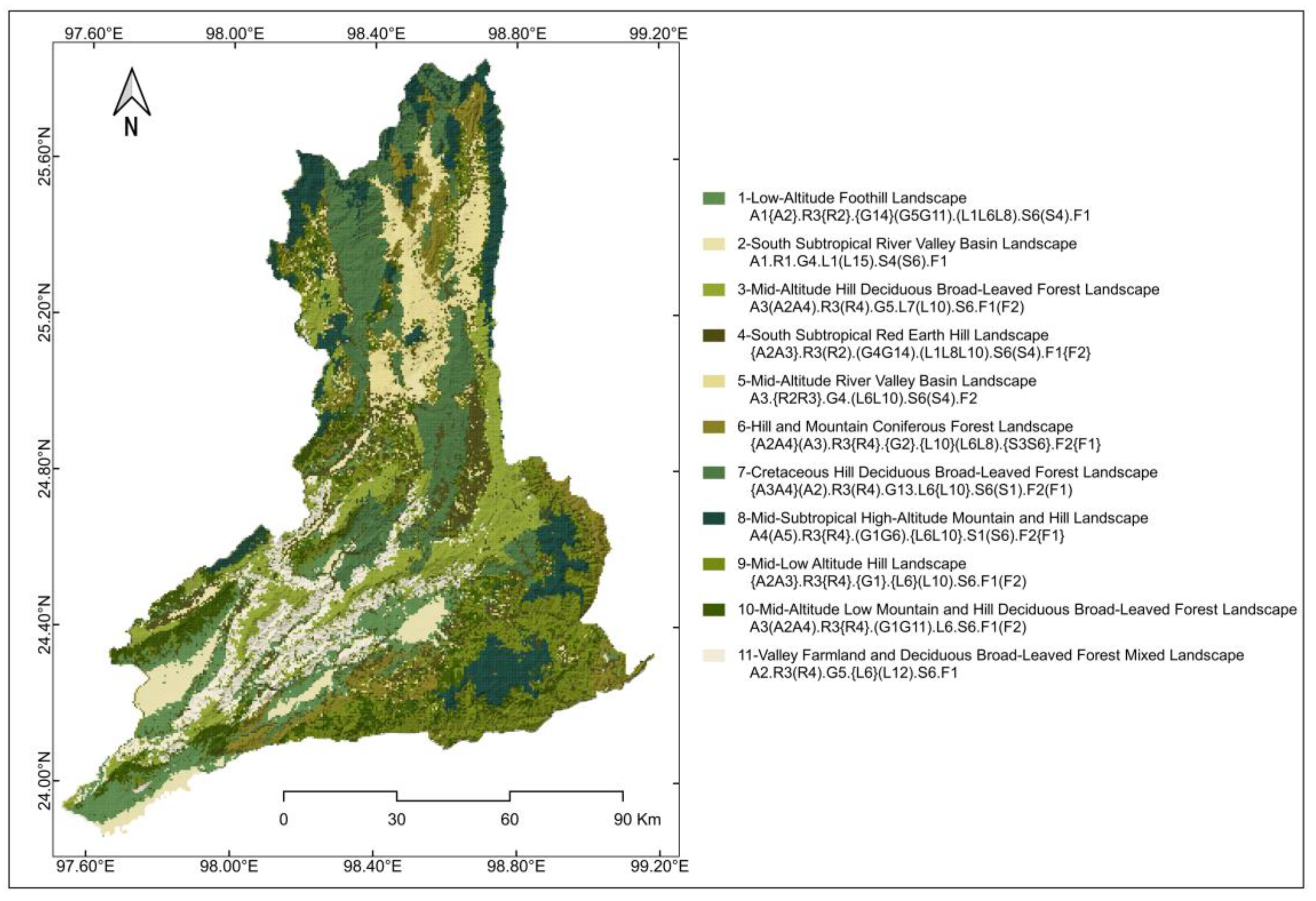
At the large scale, a total of 60,365 spatial units were sampled, covering 54 feature variables. The KMO value was 0.64, indicating suitability for principal component analysis; Bartlett’s test of sphericity was highly significant, meeting the prerequisites for principal component analysis. These variables were transformed into 14 comprehensive variables through PCA, which explained 73.23% of the variance in the original variables. Cluster analysis conducted in SPSS 27 resulted in the identification of 11 landscape character types. Type 9 is the most extensive landscape character type, covering an area of 1996 km2 (13%). Types 7, 3, and 8 follow type 9 in extent, each accounting for over 10% of the total area. Type 2 is the smallest, with an area of 630 km2 (4%) (Figure 3a). To facilitate the interpretation of the character map by different users, two naming methods were adopted (Figure 4). Taking landscape character type 2, “South Subtropical River Valley Basin Landscape” as an example, its coding is “A1.R1.G4.L1.(L15).S4 (S6).F1” This indicates that the type is dominated by plain areas with an elevation of less than 1000 m and overall low relief; the stratum within this type is mainly quaternary sedimentary deposits; the soil is primarily anthropogenic soil, with a portion being ferralisols; rainfed cropland is the dominant land use type, followed by impervious surfaces include artificial materials such as concrete, asphalt roads and other sealed surfaces; and the type is generally controlled by a southern subtropical climate.
For the 11 large-scale landscape character types, the landscape character elements with a proportion exceeding 50% are “A1A2A3A4, R1R3, G4G5G13, L1L6L7, S1S4S6, F1F2”, which are the prominent characteristics of their respective types. Elements with a proportion of 30–50%, “{A2A3A4}, {R2R3R4}, {G1G2G14}, {L6L10}, {S3S6}, {F1F2}”are typical characteristics. Those with a proportion of 15–30%, “(A2A4A5), (R2R4), (G1G4G5G6G11G14), (L1L6L8L10), (S1S4S6), (F1F2)” are general characteristics (Figure 3b) The prominent landscape characteristics are primarily contributed to by elements such as elevation, relief amplitude, geological type, soil type, and climate type. Among the general landscape characteristics, geological elements are particularly diverse, covering nearly half of the geological landscape indicators. This indicates that the geological types in the region are highly abundant and concentrated in small areas. At the large scale, the landscape types reflect the distinct topographic and geomorphic characteristics of the Longchuan River Basin and its surrounding areas, demonstrating diverse landforms and land cover types.
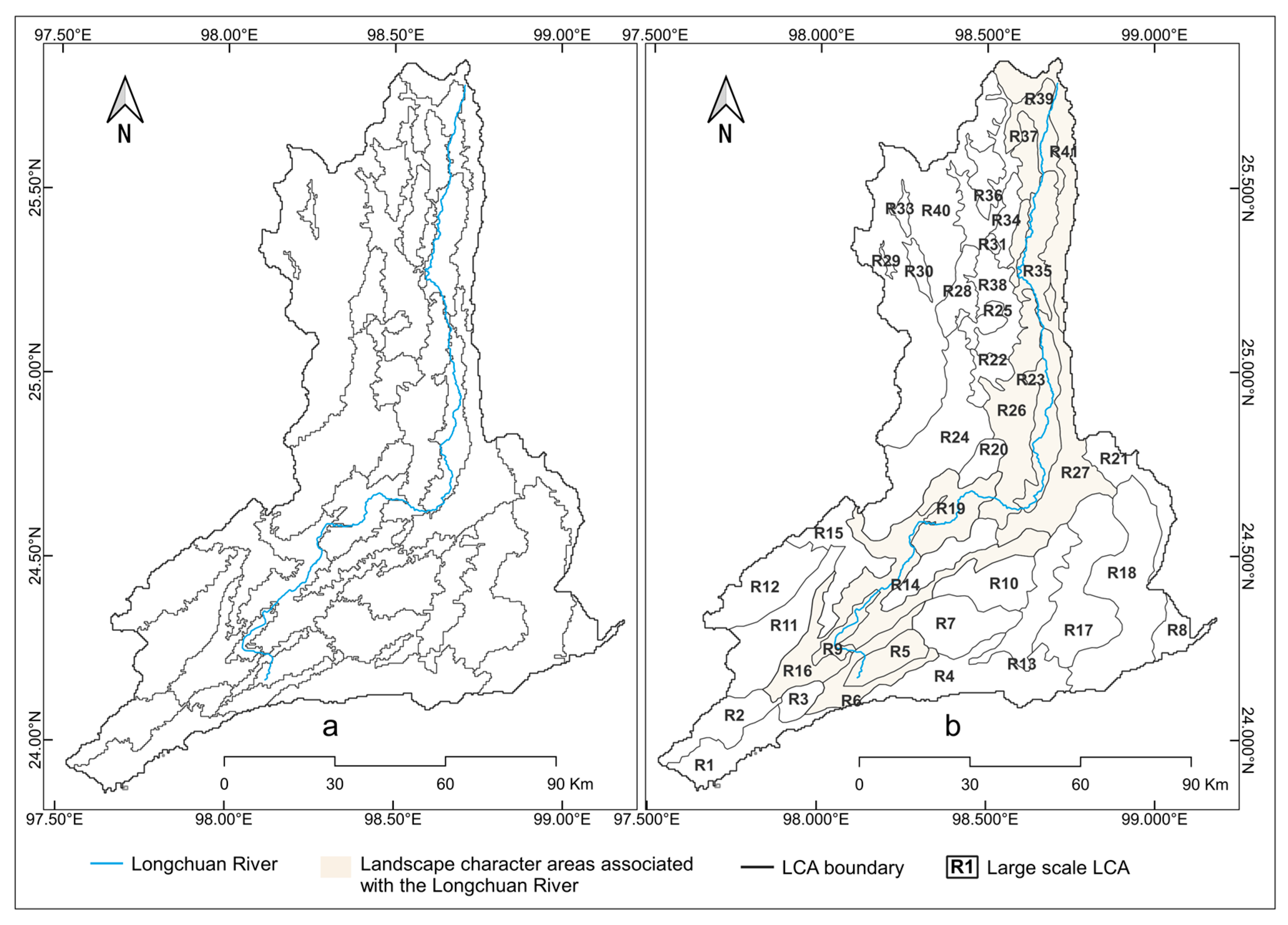
Taking the landscape character type map as the input source, the Multiresolution Segmentation (MRS) tool in eCognition was used to delineate landscape character areas. The study found that the segmentation results were optimal when the Scale parameter, Shape, and Compactness were set to 80, 0.2, and 0.3. In eCognition, the segmented objects were initially merged to obtain 289 character area units. In GIS 10.7, these landscape character areas were manually integrated by combining high-resolution satellite images and field survey experience, resulting in 41 landscape character areas in the final stage (Figure 5). The overall distribution of the landscape character areas is uniform. Influenced by fault zones, the landscape character areas exhibit a long strip-like distribution in the northeast-southwest direction along the Gaoligong Mountains and their branches, with block-shaped basin character areas interspersed among them. The southern character areas are located along the “Longling-Ruili Fault” and exhibit a northeast–southwest distribution pattern. The northern region is a typical mountainous canyon area cut by the Hengduan Mountains, where the character areas generally present a north–south distribution. Complete descriptions of the landscape character areas can be found in Appendix B. There are 13 landscape character areas related to the Longchuan River. These areas run through the entire basin and cover different landscape zones with elevations ranging from 200 m to 3700 m:
R5: Flat riparian plains with extensive agricultural cultivation areas.
R6: Reclaimed elongated terraces on the southern slopes of the mountains, characterized by traditional farming.
R9: Artificial lake formed by a dam interception.
R16: Located on the southern extension of the Gaoligong Mountains in the lower reaches of the Longchuan River, on the south bank of Longjiang Lake. The area features moderately undulating slopes dominated by evergreen broadleaved forests, with elevations ranging from 900 m to 1500 m.
R19: Southern ridges of the Gaoligong Mountains, featuring densely vegetated gorges.
R23: Mid-reach high mountain gorge area, encompassing hills and terraces. Includes large settlements such as Wuhe, Tuantian, and Longjiang, as well as seven cascade dams.
R26: Mountainous area on the western bank of the mid-reach Longchuan River, at elevations between 1700 m and 2000 m.
R27: Southern section of the Gaoligong Mountains, a transitional zone from mountains to foothills, covered with lush wooded hills.
R32: Changziling Mountain, elevations between 1000 m and 1500 m, densely forested mountainous area.
R35: Core area of Jietou Town, consisting of relatively flat alluvial and riparian plains at the mountain front, used for traditional agriculture.
R37: Xishan Mountain on the western bank of the upper Longchuan River, dominated by coniferous and broad-leaved mixed forests.
R39: Narrow mid-mountain valley in northern Jietou Town and Mingguang Town, representing the source of the Longchuan River.
R41: Western slopes of the main Gaoligong Mountain range, characterized by high mountains and dense forests.

3.2. Landscape Character Types and Areas at the Medium Scale

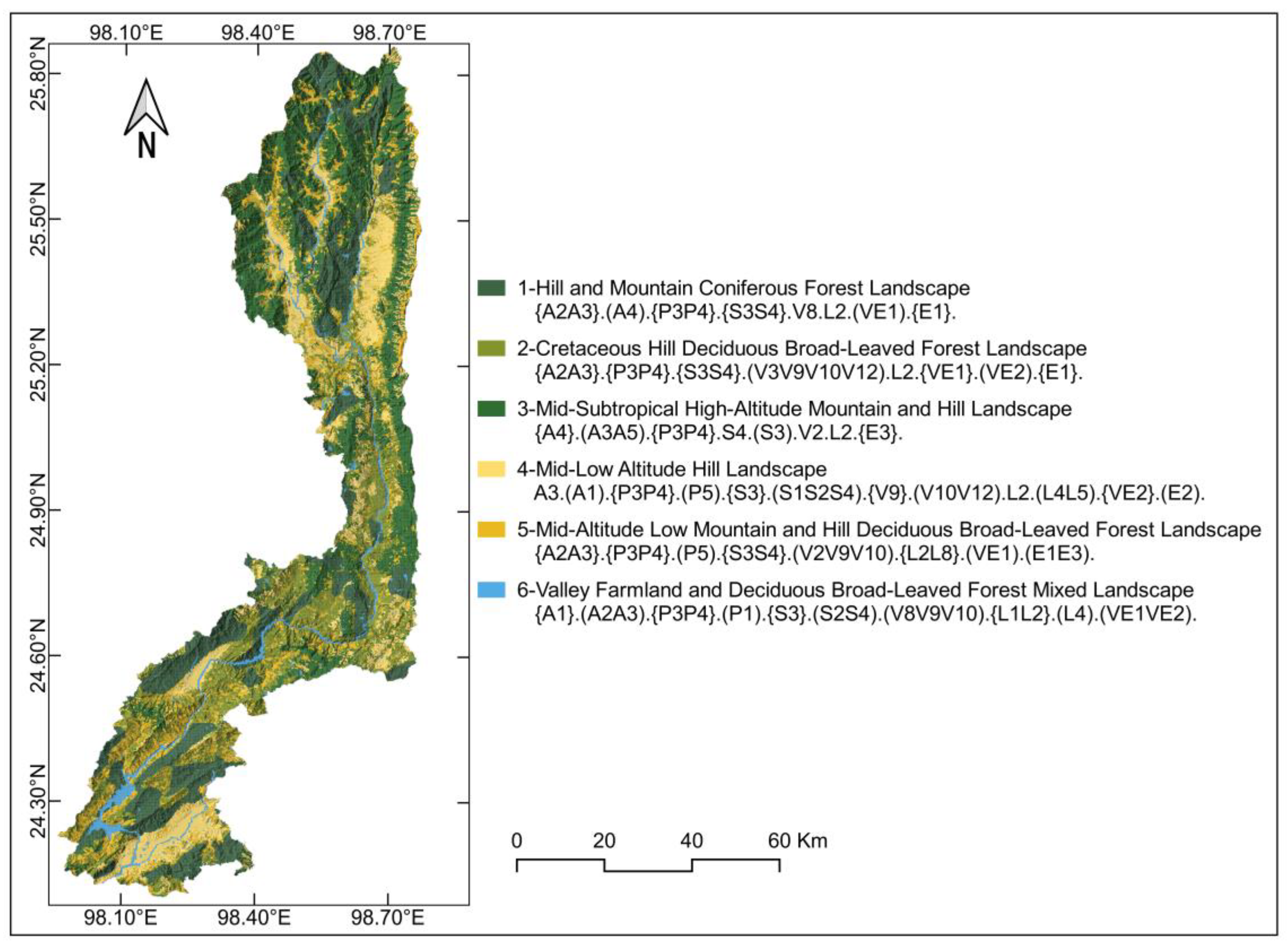
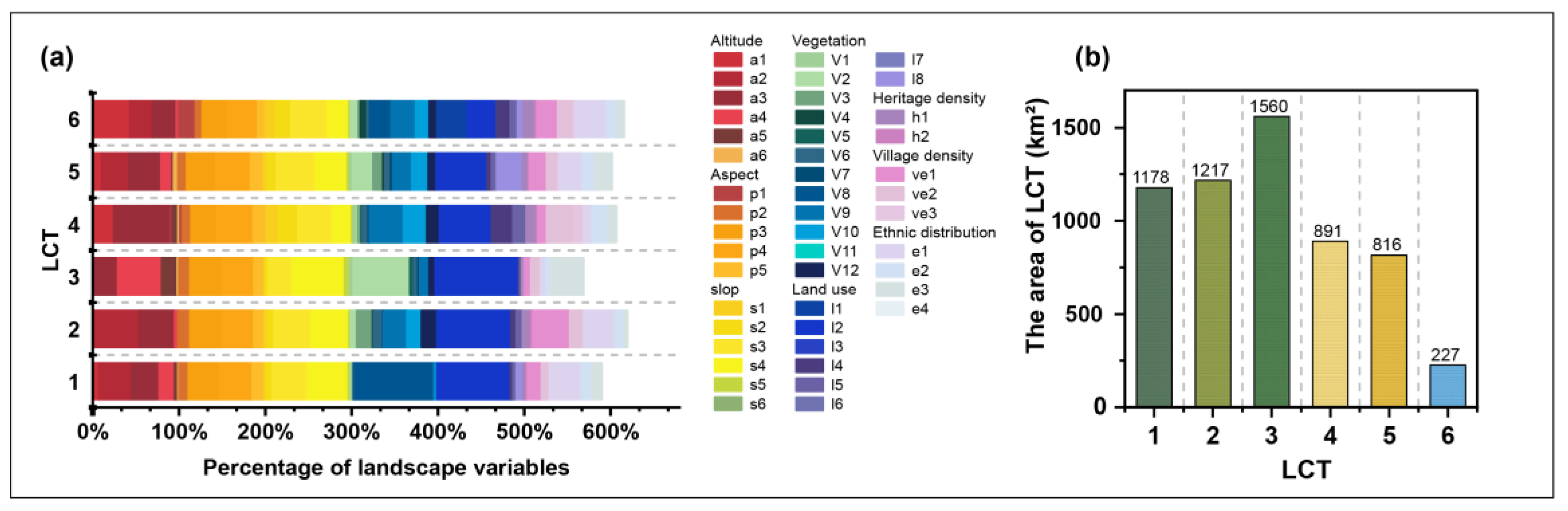
At the medium scale, a total of 147,239 spatial units were sampled, covering 46 feature variables. The variables passed the test, with a KMO value of 0.89, indicating good correlations among the variables and suitability for principal component analysis. Bartlett’s test of sphericity was highly significant, confirming that the results passed the test. Among these variables, 42 were involved in the classification. These 42 variables were transformed into 12 principal components via PCA, with a cumulative explained variance ratio of 75.54%. The two-step clustering method was still adopted, and the optimal number of clusters was determined to be 6. This means 6 landscape character types were identified (Figure 6). Type 3 covers the largest area, reaching 1560 km2, which accounts for 26% of the total study area. Types 2 and 1 rank second and third in terms of coverage, with their areas being 1217 km2 and 1178 km2. The coverage areas of Types 4, 5, and 6 are 891 km2 (15%), 816 km2 (13%), and 227 km2 (3%) (Figure 7b). For these landscape character types, the elements that account for more than 50% of their respective types are “a2a3a4, s4, v2v8, l2”, and these are classified as prominent landscape character elements. Elements with a proportion ranging from 30–50% include “{a1a2a3a4}, {p3p4p5}, {s3s4}, {l1l2l8}, {ve1ve2}, {e1e3}”, and these are defined as typical characteristics. Elements with a proportion between 15% and 30% are “(a1a2a3a4a5), (p1p5), (s1s2s3s4), (v2v3v8v9v10v12), (ve1ve2), (e1e2e3)”, and these are categorized as general characteristics (Figure 7a).
At the medium scale, the landscape is characterized by prominent mountainous canyon landforms, distributed in mountainous and river valley areas with elevations ranging from 1000 m to 2500 m and relatively steep slopes. The vegetation cover types are dominated by subtropical evergreen broad-leaved forests as well as subtropical and tropical grasslands, with a high forest coverage rate. From the typical characteristics, we can see that the areas where ethnic minority settlements are distributed have flat terrain, such as basins and terraces, and cover a wide elevation range. The vegetation cover types are characterized by subtropical vegetation communities and artificial cash crops. As the scale increases, the landscape of the Longchuan River Basin exhibits landscape characteristics shaped by human factors.
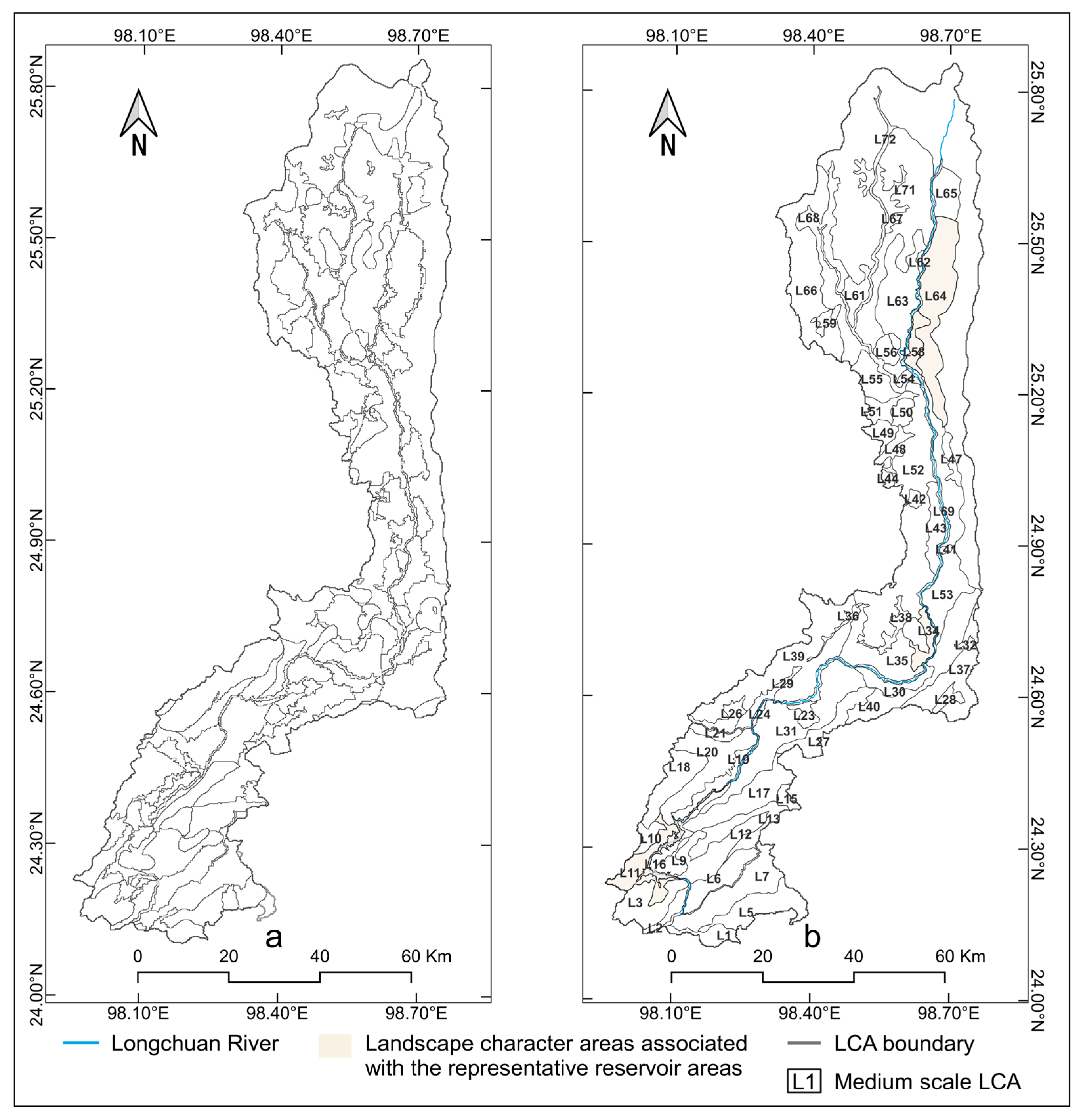
When the Scale, Shape, and Compactness were set to 80, 0.1, and 0.2, the segmentation results in eCognition were optimal. Preliminary patch operations were conducted based on the brightness values of the segmented units, resulting in 138 character area units (Figure 8a). Further manual interpretation was carried out in GIS 10.7. By integrating Landsat 8 satellite images and the medium-scale landscape character type map, manual delineation was performed, and 73 landscape character areas were finally identified (Figure 8b). Complete descriptions of the landscape character areas can be found in Appendix C. Against the background of this study, reservoir areas affected by dam construction are key factors that policymakers need to consider. Reservoirs built based on terrain elevation differences are important visual perception elements within the basin, and they also represent landscapes that significantly impact the production and daily life activities of residents. We overlapped the visual perception range from the human eye perspective in reservoir areas with village density [68], and selected 4 representative reservoir areas for monitoring (Figure 2B). The descriptions of the associated landscape character areas are as follows:
L64: A narrow, river valley area. It is located at the western foot of the Gaoligong Mountains. Large alluvial plains in front of the mountains have been formed by the transportation of water currents, and these plains are now widely used as agricultural planting areas. Traditional buildings in the Lisu style are distributed in different clusters on the highlands between farmlands and mountain ranges.
L58: A fan-shaped hilly area arranged along the east bank of the Longchuan River, with significant topographic relief and land cover dominated by trees. Building clusters are distributed in a strip-like pattern along the contour lines on the hillsides, and the main residents are Han people.
L34: A continuous hilly area on the west bank of the Longchuan River. Areas with relatively smooth terrain have been reclaimed into terraced fields covering the entire mountainsides. A large number of settlements are distributed here, and some buildings are traditional wooden structures. The main residents are Han people, with a small number of Dai, Lisu, Wa, and other ethnic groups.
L11: A hillside almost completely reclaimed. Except for the hilltop, the land has been transformed into continuous stretches of terraced fields, interspersed with irregular clusters of trees. Jingpo people account for 84% of the total population, and the architectural style reflects local characteristics.
L14: Longjiang Lake. It is a large reservoir formed by damming a river, with a shoreline of 45 km and an extremely broad view. The settlements originally located in the valley were demolished a few years ago, and the residents were relocated to areas above the shoreline, where they now live in centralized residential areas funded by the government.

3.3. Field Survey at the Detailed Scale

To connect the identification results with on-site conditions, we conducted field surveys: The upper reaches study area covers L58 and L64. The survey route was carried out around the high mountain and canyon areas on both banks of the river. Areas of human activity are mainly distributed in the alluvial plains in front of mountains and the gentle slopes on the sides of the mid-mountain. The river valley terrain dominates the landscape structure, with mountains, rivers, and mixed forests forming the texture of the landscape. The riparian plains on both sides of the river have a flat terrain and convenient water access, where a large number of crops are grown. The east and west sides are enclosed by towering mountains, resulting in a visually enclosed space. Dams raise the water level, which eases part of the visual tension; the stable water level also brings convenience to the production activities of nearby residents (Appendix D and Appendix E). L34 in the middle reaches is located in the mid-mountain hills on the east bank of the Longchuan River. For flood discharge purposes, the banks of some river sections have been hardened, damaging riparian habitats. Settlements and farmlands are distributed on the hillsides, forming a terraced landscape with flue-cured tobacco, rice, and rapeseed as the main crops. The view when facing the river valley here is broad, and the rich landscape resources make it suitable for the development of tourism (Appendix F). L11 is located in the lower reaches. The river here is blocked by a dam, forming the Longjiang Reservoir, locally known as “Wenbang Shengya”, which means “sacred lake” in the language of the Jingpo people. The northeast of this character area is adjacent to the lake, with terrain that slopes from the northwest to the southeast. The landscape is dominated by steep mountains and deeply incised river valleys, with loose and fragile strata. At the junction with the lake, a dragon claw-shaped shoreline has formed. Therefore, soil erosion issues and geological disaster prevention should be incorporated into landscape policies. Continuous stretches of circular terraced fields have been reclaimed on low-relief mountains and are distributed strictly along contour lines. Patchy forests are interspersed among these terraces, and together they form the overall texture of the character area. Due to reservoir construction, the original sites of settlements have now been submerged. As a result, new resettlement villages for reservoir migrants have been planned around the reservoir. Traditional wooden buildings have been replaced by modern structures. This has effectively improved living conditions but damaged local characteristics, inflicting severe harm on local landscape features (Appendix G). The aforementioned issues have been embedded into on-site records as “Landscape strategies” to facilitate better understanding and provide guidance for landscape policies [69].

4. Discussion

4.1. The Spatial Distribution Features of Landscape Character in the Longchuan River Basin

As a synthesis of nature and culture, the Longchuan River Basin exhibits certain regularities across landscape scales. At the large scale, abiotic elements such as topography, relief amplitude, geological type, soil type, and climate dominate landscape differentiation. At the medium scale, elevation, slope, vegetation type, and land use pattern govern landscape character types, whereas cultural elements such as village density and ethnic distribution emerge as prominent landscape types. This pattern—whereby the contribution of cultural elements to landscape character significantly increases as the scale narrows—is consistent with the landscape element hierarchy theory.
At the large scale, landscape character types (LCTs) exhibit altitudinal attributes, with each type corresponding to a specific elevation range. The most abundant landscape types occur at elevations between 1500 m and 2000 m, attributable to the fact that this elevation range covers the largest area and represents a zone of relatively active human activity. Variations in land use types and topography within this range result in high landscape fragmentation. The study area features higher terrain in the northeast and lower terrain in the southwest, and the LCTs display distinct spatial distribution patterns. Types 1, 2, 10, and 11 are mainly distributed in the southwestern part of the basin; Types 5, 6, 7, and 8 are predominantly located in the high-altitude areas of the upper reaches; and Types 3 and 4 are concentrated in the hilly regions at elevations of 1000–2000 m in the middle reaches. Type 10 has the widest altitudinal distribution range, scattered across various parts of the basin, with broadleaved forest land as its primary land cover type. A notable characteristic of mountainous areas is their rugged terrain. Except for Type 2, the other ten landscape types exhibit medium relief amplitude (70–200 m). Type 2 represents the South Subtropical River Valley Basin landscape, characterized by low-lying and flat terrain, located in the low-altitude basins of the middle and lower reaches. Due to its suitability for human habitation, agricultural land and impervious surfaces have become its defining features.
Cultural phenomena are often too complex and lack international consensus for standardised classification [5], making it difficult for the analysed data to reflect the “sense of place” of the landscape [36]. In China’s multi-ethnic regions, ethnic distribution exerts a significant impact on landscape character. Although population data can be used for ethnic aggregation, its resolution is insufficient [40]. At the medium scale, landscape types 1–5 all exhibit distribution characteristics associated with ethnic minorities. The Jingpo people are prominently represented in landscape types 1 and 2, indicating that their distribution range accounts for 30–50% of these areas. This aligns with the fact that types 1 and 2 are primarily distributed in the middle and lower reaches of the basin, where the Jingpo people are concentrated. Type 3 exhibits the characteristics of the Lisu people and is mainly distributed in the northern and eastern parts of the basin, around the Gaoligong Mountains. It largely overlaps with a large area of Lisu settlement in the northern part of the basin. Regarding the distribution of ethnic minorities, Jingpo people inhabit the middle and lower reaches of the basin, residing in subtropical evergreen broadleaved forest and subtropical grassland areas at elevations of 1000–2000 m. Lisu people are located in areas with relatively steep slopes covered by evergreen broadleaved forests at elevations of 2000–2500 m. A small portion of the Jingpo and Lisu populations inhabit gentle slopes and low-lying areas at elevations of 1000–2000 m, deriving their livelihoods from economic forests and rice cultivation. Dai people primarily inhabit low-altitude agricultural areas adjacent to subtropical coniferous forests. A small population of Deang people is scattered sporadically in Wangzishu Town and contribute minimally to the landscape character; therefore, they are not represented.

4.2. Methodological Innovation and Data Validity Verification

We constructed a two-dimensional cross-scale LCA framework featuring “river basin ecological units—administrative levels”. By integrating landscape characters with the administrative management system across different scales, this framework establishes an interoperable reference system suitable for different administrative levels [51]. This approach addresses the contradiction between “ecological integrity and administrative fragmentation” in basin governance. Compared to the traditional practice of conducting landscape identification separately according to administrative boundaries [39], this method ensures spatial continuity in landscape identification. Simultaneously, the nested classification system enables management departments at different levels to use the same landscape language, thereby achieving goal coordination in cross-regional policies such as ecological compensation and cultural corridor construction.
As a crucial methodology for value neutrality and quantitative research in LCA, parametric methods rely heavily on data sources and their combination methods [52]. In this study, the combined application of PCA and the two-step clustering method validated the effectiveness of the data and the accuracy of the analytical results from multiple perspectives. At the large scale, 60,365 spatial units covering 54 characteristic variables yielded a KMO value of 0.64, which is considered acceptable. At the medium scale, 46 characteristic variables achieved a KMO value of 0.89, indicating a good level of suitability. The KMO values suggest significant correlations among the variables, making them suitable for factor analysis. The higher KMO value at the medium scale compared to the large scale can be attributed to the following reasons: the large scale is dominated by natural factors, among which geological and soil variables exhibit relatively weak linear correlations, which somewhat lowers the KMO value. At the medium scale, in addition to natural factors, cultural variables such as heritage density and village density were introduced. These variables show co-variation trends with topographic factors and land use types in their spatial distribution, leading to enhanced correlations among variables. From the perspective of the landscape element hierarchy theory, abiotic elements possess higher independence and relatively weaker correlations with each other. As the scale narrows, the synergistic effects of biotic and cultural elements become more pronounced, increasing the degree of collinearity among variables and demonstrating that correlations among variables are more significant at smaller scales than at larger scales. At the large scale, 54 original variables were integrated into 14 principal components, with a cumulative explained variance of 73.23%. At the medium scale, 46 variables were integrated into 12 principal components, with a cumulative explained variance of 75.54%. These cumulative variance contribution rates exhibit good representativeness, validating the robustness of the data system and the accuracy of the analytical results in this study.

4.3. Landscape Protection and Management in the Longchuan River Basin Based on Landscape Character Identification

The ultimate goal of landscape character identification is to serve the scientific management and sustainable utilization of landscapes. The multi-scale identification framework constructed in this study provides a unified spatial language and decision-making basis for large-scale macro-protection, medium-scale industrial guidance, and detailed-scale targeted restoration. Large-scale landscape character areas delineate homogeneous landscape units dominated by biophysical elements such as topography, soil types, and vegetation types. Consequently, areas within the same unit share similar natural conditions, landscape functions, and landscape values, which can provide a natural baseline for the delineation of the “Three zones delineated by three lines for land use” (ecological, agricultural, and urban spaces with corresponding control lines) in county-level territorial spatial planning. For instance, R41, located on the western slopes of the main Gaoligong Mountain range, is a high-altitude primary forest. Its extent can serve as a reference for the core protection area of the Gaoligong Mountains, potentially designated as an ecological conservation redline, strictly limiting development and construction. R5, a flat riparian plain, is a traditional agricultural planting area. Through years of artificial intervention, it has formed fertile farmland suitable for cultivation, exhibiting unified and continuous landscape character. It should be protected as prime farmland to regulate the urbanization process and prevent disorderly expansion leading to resource degradation.
The 73 landscape character areas at the medium scale provide precise guidance for the development of characteristic industries and rural landscape management in 21 townships. As shown in Figure 5b and Figure 8b, the boundaries of medium-scale landscape character areas are similar to but more refined than those at the large scale, enabling alignment with township-level territorial spatial planning as a mandatory basis for village layout, industry access, and landscape management. Taking L64 as an example, it can develop eco-tourism and ethnic cultural experience industries by leveraging its mid-mountain valley landform and traditional Lisu settlements. Planning should preserve the traditional stilted architectural style and control the height and volume of new buildings.
At the detailed scale, more detailed landscape characteristics were revealed by means of aerial photography and standardized survey sheets (Appendix B, Appendix C, Appendix D and Appendix E). Based on the information obtained from detailed surveys regarding aspects such as visual perception, sensory experience, architectural style, and settlement layout, we clarified architectural styles, building heights, and visually sensitive areas, aiming to restore the texture of traditional settlements; guided the development of advantageous industries such as the understory industry and ecotourism; and formulated measures for pest and disease control, soil erosion prevention, and shoreline beautification.
The LCA results can be integrated into the territorial spatial planning evaluation recommendations. By leveraging the alignment between administrative divisions and the LCA framework, a collaborative management mechanism for watershed landscapes across administrative regions can be established, thereby enabling higher-level identification results to provide guidance and have a normative effect on lower-level ones. We share landscape data, establish control, and achieve scientific landscape management.

4.4. Limitations and Future Directions

The data in this paper are sufficient to support landscape type identification at broad and medium scales; however, their limitations become evident at the detailed scale. Compensating for the information loss caused by insufficient data resolution through aerial photographs has significant limitations and is difficult to implement over extensive areas. More data should be developed: in addition to acquiring higher-resolution satellite imagery. For example, data on topics such as building layout, roads, and farmland are worth incorporating. Furthermore, future research could draw on landscape pattern indices from landscape ecology, introducing indicators such as the landscape division index, Shannon’s diversity index, and landscape shape index to construct a quantitative evaluation model for detailed-scale landscape character. As a systematic platform, the LCA methodology enables the updating of landscape character with the input of new data. This study represents a “static snapshot” based on data from a fixed period and fails to reveal the evolutionary trajectory of landscape characteristics. Future research could integrate multi-temporal data to simulate the evolution of landscape characteristics under different policy scenarios, thereby providing a forward-looking basis for planning decisions. For instance, the visual impact extent of reservoir landscapes could be simulated after all 13 cascade hydropower stations in the Longchuan River Basin are completed, thereby enabling the pre-identification of high-risk areas.

5. Conclusions

This study develops and applies a multi-scale Landscape Character Assessment (LCA) framework in the Longchuan River Basin, a multi-ethnic mountainous region in Southwest China, integrating basin ecological units with administrative governance hierarchies. The framework aims to address landscape homogenization and governance fragmentation under rapid urbanization, providing technical support for the sustainable development of rural China. The results identified 11 LCTs and 41 landscape character areas at the large scale, and 6 LCTs and 73 landscape character areas at the medium scale. At the detailed scale, field surveys in four typical reservoir areas documented perceptual and visual information. Key innovations include: (1) proposing a cross-scale LCA framework (county, township, reservoir) that reconciles natural ecosystem integrity with decentralized governance; (2) first-time quantification of cultural factors (e.g., ethnic group spatial distribution) in cluster analysis, enhancing cultural dimensions and local distinctiveness; and (3) integrating field surveys at detailed scales to preserve “sense of place”, which is often lost in parametric methods. The resulting multi-scale landscape database and maps align with county and township administrative responsibilities, serving as an operational decision-support system. For hydropower-affected watersheds, the methodology identifies priority management areas (e.g., ecologically sensitive zones, cultural cores) to inform conservation. Highly transferable, it offers a technical pathway for vulnerable regions globally. Future research should integrate diverse datasets to enhance governance precision.

Author Contributions

Conceptualization, C.W.; methodology, C.W. and X.Y.; software, C.W.; validation, B.G. and P.L.; formal analysis, C.W.; investigation, C.W.; resources, Y.S.; data curation, C.W. and B.G.; writing—original draft preparation, C.W.; writing—review and editing, C.W. and B.G., and X.Y.; visualization, C.W.; supervision, Y.S.; project administration, Y.S.; funding acquisition, Y.S. All authors have read and agreed to the published version of the manuscript.

Funding

This research was funded by the National Natural Science Foundation of China (Grant No. 51968064), Yunnan Province High-level Talents Training Support Program (YNWR–CYJS–2020–022), and the First—rate (A) Discipline Landscape Architecture Construction Funding of Yunnan Province, China.

Institutional Review Board Statement

Not applicable.

Informed Consent Statement

Not applicable.

Data Availability Statement

All relevant data are within the paper.

Conflicts of Interest

The authors declare no conflicts of interest.

Appendix A

Table A1. Percentage composition of landscape character types at the large scale.
Variables 1 2 3 4 5 6 7 8 9 10 11
A10.62 0.83 0.02 0.14 0.00 0.15 0.01 0.00 0.06 0.01 0.08
A20.35 0.08 0.19 0.45 0.08 0.32 0.16 0.00 0.34 0.30 0.83
A30.02 0.08 0.59 0.36 0.83 0.20 0.35 0.02 0.49 0.52 0.09
A40.01 0.00 0.19 0.05 0.08 0.31 0.37 0.65 0.12 0.17 0.00
A50.00 0.00 0.01 0.00 0.00 0.02 0.09 0.28 0.00 0.00 0.00
A60.00 0.00 0.01 0.00 0.00 0.00 0.02 0.05 0.00 0.00 0.00
R10.07 0.94 0.00 0.04 0.13 0.00 0.00 0.00 0.00 0.00 0.00
R20.40 0.06 0.03 0.23 0.33 0.03 0.02 0.00 0.00 0.00 0.01
R30.52 0.00 0.78 0.65 0.48 0.54 0.72 0.54 0.54 0.58 0.84
R40.01 0.00 0.19 0.08 0.06 0.43 0.26 0.45 0.46 0.41 0.16
R50.00 0.00 0.00 0.00 0.00 0.00 0.00 0.00 0.00 0.00 0.00
G10.01 0.00 0.00 0.08 0.00 0.02 0.00 0.29 0.47 0.20 0.00
G20.03 0.01 0.00 0.07 0.06 0.34 0.03 0.10 0.03 0.11 0.00
G30.00 0.00 0.00 0.02 0.00 0.04 0.00 0.03 0.09 0.07 0.00
G40.13 0.80 0.00 0.15 0.73 0.10 0.03 0.04 0.04 0.03 0.01
G50.16 0.04 0.94 0.10 0.00 0.01 0.01 0.04 0.00 0.03 0.95
G60.00 0.00 0.01 0.04 0.05 0.03 0.00 0.19 0.09 0.09 0.00
G70.01 0.00 0.00 0.02 0.00 0.01 0.00 0.00 0.02 0.02 0.00
G80.05 0.01 0.01 0.07 0.01 0.14 0.01 0.00 0.06 0.06 0.01
G90.00 0.00 0.00 0.03 0.07 0.08 0.02 0.15 0.06 0.04 0.00
G100.01 0.00 0.00 0.02 0.00 0.07 0.00 0.00 0.03 0.02 0.00
G110.24 0.01 0.01 0.02 0.01 0.01 0.00 0.15 0.05 0.30 0.01
G120.01 0.00 0.00 0.03 0.01 0.12 0.00 0.00 0.01 0.00 0.00
G130.01 0.00 0.00 0.12 0.02 0.02 0.89 0.03 0.00 0.00 0.01
G140.32 0.13 0.01 0.22 0.03 0.01 0.00 0.00 0.05 0.04 0.01
G150.00 0.00 0.00 0.00 0.00 0.00 0.00 0.00 0.00 0.00 0.00
L10.22 0.50 0.03 0.19 0.13 0.07 0.02 0.01 0.04 0.00 0.05
L20.00 0.01 0.00 0.02 0.03 0.01 0.00 0.00 0.00 0.00 0.00
L30.00 0.00 0.00 0.00 0.00 0.00 0.00 0.00 0.00 0.00 0.00
L40.01 0.13 0.00 0.01 0.00 0.00 0.00 0.00 0.00 0.00 0.00
L50.00 0.00 0.00 0.00 0.00 0.00 0.00 0.00 0.00 0.00 0.00
L60.17 0.00 0.52 0.12 0.23 0.23 0.50 0.40 0.38 0.72 0.35
L70.00 0.00 0.00 0.00 0.00 0.00 0.00 0.00 0.00 0.00 0.00
L80.16 0.02 0.06 0.16 0.10 0.17 0.05 0.03 0.10 0.00 0.14
L90.00 0.00 0.00 0.00 0.00 0.00 0.00 0.00 0.00 0.00 0.00
L100.09 0.00 0.23 0.26 0.30 0.32 0.32 0.50 0.26 0.14 0.13
L110.11 0.01 0.03 0.04 0.00 0.05 0.02 0.01 0.06 0.01 0.09
L120.15 0.00 0.11 0.06 0.04 0.08 0.07 0.03 0.14 0.13 0.24
L130.00 0.00 0.00 0.00 0.00 0.00 0.00 0.00 0.00 0.00 0.00
L140.00 0.01 0.01 0.03 0.10 0.05 0.02 0.02 0.01 0.00 0.00
L150.07 0.28 0.01 0.07 0.05 0.00 0.00 0.00 0.00 0.00 0.00
L160.00 0.00 0.00 0.00 0.00 0.00 0.00 0.00 0.00 0.00 0.00
L170.00 0.00 0.00 0.00 0.00 0.00 0.00 0.00 0.00 0.00 0.00
L180.02 0.02 0.00 0.03 0.01 0.00 0.00 0.00 0.00 0.00 0.00
S10.00 0.00 0.05 0.01 0.01 0.01 0.23 0.75 0.01 0.01 0.00
S20.00 0.00 0.00 0.01 0.00 0.05 0.00 0.00 0.01 0.00 0.00
S30.01 0.03 0.00 0.02 0.13 0.43 0.02 0.00 0.00 0.01 0.00
S40.16 0.75 0.04 0.22 0.29 0.04 0.06 0.02 0.01 0.02 0.03
S50.00 0.00 0.01 0.00 0.00 0.00 0.01 0.03 0.00 0.00 0.00
S60.82 0.20 0.90 0.75 0.57 0.46 0.68 0.19 0.96 0.96 0.96
S70.00 0.01 0.00 0.00 0.00 0.00 0.00 0.00 0.00 0.00 0.00
S80.00 0.00 0.00 0.00 0.00 0.00 0.00 0.00 0.00 0.00 0.00
F10.97 0.90 0.72 0.60 0.08 0.43 0.25 0.37 0.74 0.79 0.99
F20.03 0.09 0.28 0.40 0.92 0.57 0.75 0.63 0.26 0.21 0.01
Table A2. Percentage composition of landscape character types at the medium scale.
Variables123456
a10.07 0.01 0.00 0.24 0.10 0.43
a20.38 0.53 0.02 0.01 0.32 0.26
a30.32 0.41 0.27 0.66 0.37 0.28
a40.18 0.04 0.51 0.01 0.13 0.03
a50.04 0.00 0.18 0.07 0.02 0.00
a60.01 0.00 0.02 0.02 0.05 0.00
p10.00 0.00 0.00 0.03 0.00 0.19
p20.11 0.14 0.13 0.10 0.10 0.08
p30.36 0.38 0.37 0.30 0.34 0.30
p40.38 0.36 0.37 0.42 0.40 0.34
p50.14 0.12 0.12 0.15 0.15 0.09
s10.02 0.03 0.01 0.15 0.04 0.12
s20.07 0.08 0.03 0.22 0.11 0.18
s30.41 0.43 0.28 0.40 0.45 0.42
s40.47 0.44 0.61 0.22 0.37 0.25
s50.03 0.02 0.06 0.02 0.03 0.02
s60.00 0.00 0.00 0.00 0.00 0.00
V10.00 0.00 0.04 0.05 0.03 0.00
V20.02 0.07 0.65 0.01 0.24 0.09
V30.01 0.18 0.01 0.03 0.11 0.02
V40.00 0.01 0.00 0.00 0.03 0.08
V50.00 0.01 0.04 0.02 0.00 0.00
V60.01 0.10 0.05 0.06 0.06 0.03
V70.00 0.01 0.02 0.02 0.03 0.00
V80.92 0.00 0.00 0.00 0.00 0.25
V90.02 0.27 0.11 0.39 0.22 0.28
V100.02 0.17 0.00 0.27 0.19 0.16
V110.00 0.00 0.00 0.00 0.00 0.00
V120.00 0.18 0.07 0.15 0.09 0.09
l10.00 0.00 0.00 0.00 0.00 0.35
l20.85 0.86 0.97 0.60 0.59 0.34
l30.00 0.00 0.00 0.00 0.00 0.00
l40.03 0.06 0.01 0.25 0.05 0.16
l50.04 0.07 0.02 0.15 0.06 0.08
l60.00 0.00 0.00 0.00 0.00 0.00
l70.00 0.00 0.00 0.00 0.00 0.00
l80.08 0.00 0.00 0.00 0.30 0.07
h10.04 0.10 0.03 0.12 0.07 0.14
h20.01 0.02 0.00 0.02 0.01 0.02
ve10.16 0.43 0.08 0.10 0.20 0.24
ve20.08 0.15 0.10 0.32 0.13 0.18
ve30.02 0.01 0.01 0.11 0.02 0.02
e10.36 0.36 0.06 0.10 0.27 0.37
e20.13 0.11 0.06 0.18 0.14 0.11
e30.11 0.04 0.38 0.10 0.20 0.09
e40.00 0.00 0.00 0.00 0.00 0.00

Appendix B. Descriptions of Large-Scale Landscape Character Areas

R1: Located at the northeastern end of Tengchong, west of the Gaoligong Mountains, in a valley that serves as the headwater area of the Longchuan River. The land cover is predominantly coniferous and broad-leaved mixed forest, covering an area of 248.1 km2.
R2: Situated on the western bank slope of the upper Longjiang Xiaojiang River, featuring steep terrain and high forest coverage.
R3: Located in the Mingguang Town dam area and the vicinity of the National Volcanic Geopark, characterized by river valley plain topography. It features volcanic geological landscapes and columnar jointing, with land cover dominated by farmland and grassland.
R4: Located in the northwestern mountainous area at an elevation of approximately 2500 m, with land cover predominantly consisting of evergreen broad-leaved forest.
R5: Situated on the mountain peaks north of Mingguang Town, characterized by high relief amplitude and covered by coniferous and broad-leaved mixed forest.
R6: Located north of Diantan Town, this is a mountainous reservoir area composed of the reservoir and surrounding mountain ridges.
R7: Situated on the west bank of the Longchuan River in Jietou Town, this is a river valley agricultural rural landscape area with land cover dominated by cultivated land and residential areas. The terrain is gently sloping and elongated in shape.
R8: Covering an area of 325.6 km2, this area encompasses most of Jietou Town and represents a foothill agricultural production landscape. It features extensive cultivated farmland and evergreen woodlands, with flat terrain and moderate slopes.
R9: Located in the mountainous area east of the Mingguang River in Mingguang Town, this is a water-scarce high-altitude hilly area covering 152.8 km2.
R10: Situated at the eastern foothills of Zhongtang in Mingguang Town, this area has extremely high forest coverage and consists of evergreen coniferous and broad-leaved mixed forest, covering 455.7 km2.
R11: Located in the mountainous areas above 2500 m elevation in the Jietou Town area at the western foothills of the Gaoligong Mountains, representing a high-altitude mountain landscape.
R12: Situated at the headwaters of the Binglang River in Houqiao Town, this is a mountain reservoir landscape covering 164.1 km2.
R13: Located at the junction of Mazhan Township and Gudong Town, west of the National Volcanic Geopark, this area features mid-altitude hilly terrain with dense vegetation, primarily evergreen broad-leaved forest.
R14: Located in the south-central part of Mazhan Township, this is a volcanic cone landform landscape covering 66.5 km2.
R15: Situated within Tengchong City, this is a volcanic dam basin landscape with built-up areas as the typical land cover characteristic.
R16: Located in the river valley area of the middle-upper reaches of the Longchuan River, spanning Qushi Town, Beihai Township, and Mangbang Town. It features deeply incised valley topography with significant elevation drops, and land types primarily consisting of water bodies and woodlands.
R17: Situated in the area of Lianghe County and Heshun Town, Tengchong City, with National Highway 556 running through it from north to south, representing a mountain basin and agricultural landscape type.
R18: Located at the foothills on the west bank of the Nujiang River in northeastern Longling County, the land cover consists of deciduous broad-leaved forest, evergreen coniferous forest, and permeable surfaces. The overall terrain is a northeast-facing slope, characterized by a dry–hot valley climate, covering 274.2 km2.
R19: Situated within Xinhua Township, this area features a basin-like topography with higher terrain in the east, west, and north, and lower terrain in the south. Land types are primarily rainfed farmland and evergreen broad-leaved forest.
R20: Located in the mountainous river valley area northeast of Mengyang Town, characterized by steep slopes and high relief amplitude. Land cover types are primarily water bodies, coniferous and broad-leaved mixed forest, and rainfed farmland.
R21: Distributed in the southern section of the Gaoligong Mountains and the mid-altitude mountains and hills west of Longling County, with elevations ranging from 1500 m to 2000 m and generally high relief amplitude, covering 669.2 km2.
R22: Located in the north–south trending mountain range along the west bank of the Longchuan River in Qushi Town, Beihai Township, and Mangbang Town, representing a mid-altitude mountain forest landscape area covering 636.9 km2.
R23: Situated on the boundary line of Jiangdong Township, Wuchalu Township, and Mangshi City, this area is an offshoot of the Gaoligong Mountains, representing a low-altitude mountain terrain landscape area.
R24: Located in the east-central part of Longling County, this is a mid-altitude hilly landscape area with high relief amplitude, characterized by numerous mountains and rivers, covering 968.7 km2.
R25: Situated within the Mangshi Basin, this is an urban basin landscape area.
R26: Located in the southwestern part of the study area, in the middle-lower reaches of the Longchuan River, this is a low-altitude mountain and agricultural landscape area covering 1094.6 km2.
R27: Situated within Husa Achang Township, this is a low-altitude basin landscape.
R28: Located on the ridge area west of the Longjiang Reservoir, this is a mid-altitude mountain landscape area with steep slopes. Land cover types are primarily evergreen broad-leaved forest, coniferous forest, and shrubland.
R29: Situated at the eastern foothills of the mountain range east of Xishan Township and Mengyue Township, with the Mangshi Basin to the east. Land types are primarily evergreen shrubland and rainfed farmland, covering 74.7 km2.
R30: Located in the low-relief river valley hilly area west of Longling County. Compared to the R24 landscape area to the east, this area has lower hilly relief and numerous rivers, covering 698.9 km2.
R31: This is the Longjiang Reservoir area landscape, characterized by low-altitude river valley lake topography, with landscape elements dominated by water bodies and hills, covering 88.4 km2.
R32: Located in the hilly mountainous area south of the Mangshi Basin, composed of several small parallel mountain ranges that form multiple valley terrains.
R33: Situated east of the Mangshi Basin, with significant relief amplitude, this is a low-altitude mountain landscape area.
R34: Distributed in the eastern corner of Longling County, this is a piedmont alluvial plain connected to the Nujiang River Gorge, with lower relief amplitude compared to surrounding areas.
R35: Located in the Zhefang Basin, with flat low-lying terrain in the center and higher terrain surrounding it, representing an agricultural landscape area.
R36: Situated in the southern part of the study area, characterized by steep slopes and high relief amplitude. This area lies within the Ruili major fault zone, featuring deeply incised valley topography, covering 648.3 km2.
R37: Located in the urban area of Longchuan County, this is a mountain basin landform with the Gaoligong Mountain offshoots to the north and south and flat low-lying terrain in the middle. Main land-cover types include rainfed farmland, impervious surfaces, and irrigated farmland, representing the Longchuan basin urban landscape area.
R38: Situated in the southern mountain range of the Zhefang Basin, representing the southern mountain landscape area of Zhefang.
R39: Located in the northern mountainous area of Ruili City, characterized by mountainous topography and high forest coverage, partly within a national protected area, representing a national park mountain forest landscape area.
R40: Situated in the Ruili River Gorge area east of Ruili City, representing the Ruili River valley landscape area, covering 76.2 km2.
R41: Located in the Ruili Basin, featuring a broad valley basin topography with a minimum elevation of 743 m. The Ruili River runs through the basin from north to south, with flat terrain and extremely low relief amplitude, representing the Ruili broad valley basin urban landscape area, covering 363.3 km2.

Appendix C. Descriptions of Medium-Scale Landscape Character Areas

L1: Located north of the China–Myanmar border. High mountain valley, elevation 1350–1700 m. Land cover is dominated by woodland and farmland.
L2: Located on the north bank at the confluence of the Longchuan River and Mangshi River. An alluvial plain with a southeast aspect, extensive farmland distributed along the riverbank. Human settlements are linearly distributed along the interface between the riverbank and mountain slopes.
L3: Mountainous area south of Mengyue Township. High vegetation coverage. Valleys have been developed into terraced fields for crop production, mainly cash crops such as flue-cured tobacco and fruit.
L4: Lower reaches of the Longchuan River. River section from the Longchuan Lake outlet to the study area boundary, length 12.3 km.
L5: Extensive mountainous area south of Zhefang Town. Elevation 1200–1800 m. Topography consists of medium-relief mountains with high vegetation coverage.
L6: Zhefang Town. North bank of the Mangshi River. Flat terrain, primarily agricultural land. Landscape type is homogeneous.
L7: Zhefang Town. South bank of the Mangshi River. Flat terrain, land types mainly agricultural land and residential areas. Residential areas are scattered among green spaces and farmland, with roads radiating outward.
L8: Mangshi River. Southwest–northeast orientation, passing through Zhefang Town.
L9: Mountainous area on the north shore of Longchuan Lake. Elevation 850–1100 m, with significant relief amplitude. Vegetation consists of woodland.
L10: Northern Mengyue Township. Southeast-facing slope, elevation 1200–1600 m. Dense vegetation.
L11: A hillside almost completely reclaimed. Except for the hilltop, the land has been transformed into continuous stretches of terraced fields, interspersed with irregular clusters of trees. Jingpo people account for 84% of the total population, and the architectural style reflects local characteristics.
L12: Mountain range north of the Zhefang Town basin. Elevation 960–1630 m.
L13: Mid-altitude hills. Moderate relief amplitude, developed into terraced fields with interspersed tree clusters.
L14: Longjiang Lake. It is a large reservoir formed by damming a river, with a shoreline of 45 km and an extremely broad view. The settlements originally located in the valley were demolished a few years ago, and the residents were relocated to areas above the shoreline, where they now live in centralized residential areas funded by the government.
L15: Flat plain agricultural area.
L16: Northeast shore of Longjiang Lake. Foothill hilly area, land cover consists of terraced fields and woodland.
L17: Mountainous hilly area at elevation 1000–1500 m. Primarily woodland, interspersed with agricultural land.
L18: Mountainous area northwest of Wangzishu Township. Elevation 1000–1550 m. Densely vegetated mountain forest.
L19: Hills on the northwest bank of the river. Extensive agricultural land, mainly terraced fields, interspersed with patchy woodlands.
L20: Northwest slope of Wangzishu Township. Elevation 1100–1650 m. Densely vegetated mountain forest.
L21: Slopes on the south bank of the Luoboba River, a tributary of the Longchuan River. Farmland distributed along ridges and valleys. Vegetation dominated by woodland.
L22: Luoboba River. An east-west flowing tributary of the Longchuan River.
L23: Southeast slope of the Nongling Hydropower Station. Vegetation density is higher compared to surrounding areas, with no signs of human development except for roads.
L24: Mengyang Township, area east of the river. Flat terrain, main land use is farmland, with human villages distributed at the interface with the mountains.
L25: Mengyang section of the Longchuan River. From Nongling Hydropower Station to Longjiang Lake, passing through the Mengyang Township basin and mountain river valley zone.
L26: Hills on the north bank of the Luoboba River, a tributary of the Longchuan River. Low-relief mountains, relatively flat slopes developed into agricultural land. Woodland is mainly distributed on hilltops.
L27: Located in the high mountain barrier southeast of Jiangdong Township, elevation 1500–2000 m, an offshoot of the Gaoligong Mountains, southwest–northeast orientation. Dense vegetation.
L28: Longshan Town. A town located at 1500 m elevation. Flat terrain, with roads and urban land as the main land use types.
L29: Mengyang Township, area west of the river. A narrow agricultural zone with flat terrain.
L30: South bank of the middle reaches of the Longchuan River, high-relief mountains. Elevation 1100–2150 m. Roads and human settlements distributed on the mountainside.
L31: Isolated mountain with a maximum elevation of 2000 m. Farmland and villages distributed on moderately sloped areas of the mountainside.
L32: Mid-altitude hilly river valley. Terrain is gentler compared to surrounding areas, with farmland and villages linearly distributed along the valley.
L33: Isolated mountain at elevation 1500–2180 m. Extremely high vegetation coverage, minimal human impact. Villages and agricultural land distributed at the foothills.
L34: A continuous hilly area on the west bank of the Longchuan River. Areas with relatively smooth terrain have been reclaimed into terraced fields covering the entire mountainsides. A large number of settlements are distributed here, and some buildings are traditional wooden structures. The main residents are Han people, with a small number of Dai, Lisu, Wa, and other ethnic groups.
L35: Platform terrain at elevation 1100–1700 m. Moderate vegetation coverage, relatively dry, dominated by shrubs and grassland. Several larger settlements scattered throughout.
L36: Basin area at 1300 m elevation. Elongated shape, settlements distributed in valleys and low-lying areas.
L37: Hills surrounding Longshan Town, high vegetation coverage.
L38: Elongated L-shaped river valley. Farmland and human settlements developed along the valley bottom by the river.
L39: Mountain range at elevation 1200–2100 m. Dense vegetation, villages distributed in some valleys.
L40: Offshoot of the Gaoligong Mountains, southwest-northeast orientation. Composed of high mountains and hills.
L41: Mountainous area southeast of the Dapingtian Hydropower Station. High relief amplitude, vegetation coverage significantly higher than surrounding river valley zones.
L42: Reservoir at 1970 m elevation, located on a hilltop west of the Longchuan River.
L43: Foothills on the west bank of the middle reaches of the Longchuan River. Low relief amplitude, land types primarily agricultural land and villages, interspersed with small, densely vegetated hills.
L44: Reservoir area located in a mountain hollow. The surrounding area consists of densely vegetated mountains.
L45: Low-relief mountains in a river valley plain, composed of woodland and subtropical grassland.
L46: Mountainous area at elevation 1800–2000 m, lush vegetation.
L47: Gentle slopes at the foothills of the Gaoligong Mountains. River valley flatlands extensively used for agriculture, interspersed.
L48: Upper reaches of the Dayingjiang River valley. Farmland distributed along the river, building clusters located in flat areas between mountains.
L49: Beihai Wetland Scenic Area. Located in a mountain hollow, excellent natural conditions, high vegetation coverage. Composed of villages, wetland, and woodland.
L50: Reservoir area located in a mountain hollow, surrounded by mountains covered with woodland. Landscape pattern controlled by the shoreline.
L51: Village cluster located in a mountain hollow. Land types consist of village residential areas, farmland, and woodland.
L52: Continuous medium-relief mountains on the west bank of the Longchuan River, north–south orientation. Primarily woodland, with valleys and hollows used for agriculture and settlement.
L53: Longjiang Township. The main topography consists of mid-altitude platforms and hills. The southern part is characterized by terraced landscapes, while the northern part consists of hills.
L54: Qushi Town. Urban land located on a platform. East-facing slope.
L55: Volcanic Geopark. Flat terrain, with volcanic cones protruding from the surface forming a unique landscape feature. High vegetation coverage, dominated by shrubs and woodland.
L56: High-relief mountains. Affected by human activities such as quarrying, foothill vegetation has been damaged.
L57: Alluvial fan formed by fluvial erosion, containing a small number of settlements.
L58: A fan-shaped hilly area arranged along the east bank of the Longchuan River, with significant topographic relief and land cover dominated by trees. Building clusters are distributed in a strip-like pattern along the contour lines on the hillsides, and the main residents are Han people.
L59: Human settlement area formed by two intersecting valleys, primarily consisting of villages and agricultural land.
L60: Prominent hill between two mountain valleys, elevation 1750–2300 m.
L61: Platform with extensive agricultural land, woodland distributed in patches.
L62: West bank of the upper Longchuan River, rural and agricultural landscape at the mountain foothills. Extremely flat terrain, with a clear boundary against the mountains.
L63: High-relief mountains on the west bank of the upper Longchuan River. High vegetation coverage, with woodland and shrub as the main vegetation types. Elevation 1500–2600 m.
L64: A river valley area featuring a narrow. It is located at the western foot of the Gaoligong Mountains. Large alluvial plains in front of the mountains have been formed by the transportation of water currents, and these plains are now widely used as agricultural planting areas. Traditional buildings of a Lisu style are distributed in different clusters on the highlands between farmlands and mountain ranges.
L65: Hilly area north of Jietou Town. Rugged terrain with poor cultivation conditions, distinctly different from the southern agricultural area. Mainly composed of forested ridges and valleys.
L66: Northwestern boundary of the study area, demarcated by mountain ranges at 2900 m elevation.
L67: East bank of the upper Mingguang River, composed of the riparian zone and foothills. Land use is predominantly agricultural.
L68: West bank of the Xisha River. Composed of the riparian zone and low mountains/hills, with flat areas between hills filled with agricultural land and villages.
L69: Middle-upper reaches of the Longchuan River, from the headwaters to the Nongling Hydropower Station. Overall north–south orientation.
L70: West bank of the river, an agricultural settlement combining mountain hollows and riparian zones. A complex mainly composed of agricultural land, woodland, and villages.
L71: Located in the northern part of the study area, high-relief mountains at elevation 1600–2900 m. Vegetation is predominantly subtropical evergreen broad-leaved forest.
L72: Mingguang River and Xisha River. Main tributaries in the upper reaches of the basin. North–south orientation.
L73: Northeastern boundary of the study area. The northwestern part consists of several high-relief mountains forming a watershed, while the eastern part is formed by the western foothills of the Gaoligong Mountains creating a barrier. Overall elevation above 2000 m, retaining extensive primary forest with limited human activity.

Appendix D

Figure A1. Field survey sheet for Jietou Town.
Sustainability 18 03106 g0a1

Appendix E

Figure A2. Field survey sheet for Qushi Town.
Sustainability 18 03106 g0a2

Appendix F

Figure A3. Field survey sheet for Tuantian Town.
Sustainability 18 03106 g0a3

Appendix G

Figure A4. Field survey sheet for Mengyue Town.
Sustainability 18 03106 g0a4

References

  1. Koç, A.; Yılmaz, S. Landscape Character Analysis and Assessment at the Lower Basin-Scale. Appl. Geogr. 2020, 125, 102359. [Google Scholar] [CrossRef]
  2. Bartlett, D.; Gomez-Martin, E.; Milliken, S.; Parmer, D. Introducing Landscape Character Assessment and the Ecosystem Service Approach to India: A Case Study. Landsc. Urban Plan. 2017, 167, 257–266. [Google Scholar] [CrossRef]
  3. Gormus, S.; Dicle, O.; Tunçay, H.E.; Cengiz, S. Using Landscape Character Analysis to Assess The Relationship Between Protected and Nonprotected Areas: The Case of The Küre Mountains National Park. J. Agric. Sci. 2021. [Google Scholar] [CrossRef]
  4. Khadour, N.; Basha, N.A.; Sárospataki, M.; Fekete, A. Correlation between Land Use and the Transformation of Rural Housing Model in the Coastal Region of Syria. Sustainability 2021, 13, 4357. [Google Scholar] [CrossRef]
  5. Mücher, C.A.; Klijn, J.A.; Wascher, D.M.; Schaminée, J.H. A New European Landscape Classification (LANMAP): A Transparent, Flexible and User-Oriented Methodology to Distinguish Landscapes. Ecol. Indic. 2010, 10, 87–103. [Google Scholar] [CrossRef]
  6. Sun, Q.J.; Maliki, N.Z.; Zhang, R.X. Inherit and Reconstruction of Chinese Rural Landscape Culture-On the Development of Chinese Rural Settlements under the Background of Fast Urbanization. Appl. Mech. Mater. 2013, 357, 2126–2130. [Google Scholar]
  7. Wilmsen, B. Damming China’s Rivers to Expand Its Cities: The Urban Livelihoods of Rural People Displaced by the Three Gorges Dam. Urban Geogr. 2018, 39, 345–366. [Google Scholar] [CrossRef]
  8. Jiake, S.; Zhaofang, C.; Zhenwei, P.; Yuncai, W. Development and Prospect of Rural Landscape Character Assessment in China. Landsc. Archit. 2022, 29, 19–24. [Google Scholar]
  9. Qian, Z.; Wenping, L.; Zhenrong, Y. Landscape Character Assessment Framework in Rural Area: A Case Study in Qiaokou, Chang-Sha, China. J. Appl. Ecol. 2015, 26, 1537–1547. [Google Scholar]
  10. Wascher, D.M. European Landscape Character Areas: Typologies, Cartography and Indicators for the Assessment of Sustainable Landscapes; Landscape Europe: Wageningen, The Netherlands, 2005. [Google Scholar]
  11. Xiao, S.Y.; Bai, S.J. Predicaments of Heritage of Rural Cultural Landscape during Urbanization and Its Solutions. Appl. Mech. Mater. 2013, 357, 2075–2078. [Google Scholar] [CrossRef]
  12. Chaolin, G.U.; Liya, W.U.; Cook, I. Progress in Research on Chinese Urbanization. Front. Archit. Res. 2012, 1, 101–149. [Google Scholar]
  13. Wu, J.-X.; Cheng, X.; Xiao, H.-S.; Wang, H.; Yang, L.-Z.; Ellis, E.C. Agricultural Landscape Change in China’s Yangtze Delta, 1942–2002: A Case Study. Agric. Ecosyst. Environ. 2009, 129, 523–533. [Google Scholar]
  14. Xiao, H.; Liu, Y.; Li, L.; Yu, Z.; Zhang, X. Spatial Variability of Local Rural Landscape Change under Rapid Urbanization in Eastern China. ISPRS Int. J. Geo-Inf. 2018, 7, 231. [Google Scholar]
  15. Wu, X.; Chen, R.; Zhang, Y. Recognition and Assessment Method of Rural Landscape Characters for Multi-Type and Multi-Scale Collaborative Transmission: Taking the Horqin Right Front Banner, Inner Mongolia of Northern China as an Example. J. Beijing For. Univ. 2022, 44, 111–121. [Google Scholar]
  16. Wei, G. The Upsurge of Rural Planning in China: Characteristics, Dilemmas and Reflection. Urban Plan. Int. 2022, 37, 131–137. [Google Scholar]
  17. Li, Z.P.; Liu, L.M.; Xie, H.L. Methodology of Rural Landscape Classification: A Case Study in Baijiatuan Village, Haidian District, Beijing. Resour. Sci. 2005, 27, 167–173. [Google Scholar]
  18. Wang, T.; Zheng, H. Analysis of Landscape Classification on Village Scale—Taking Longkan Village, Dali City as an Example. J. Green Sci. Technol. 2014, 160–163. [Google Scholar]
  19. Li, X. Classification and Evaluation of Rural Landscape: A Case Study in Wuchuanhu Village of Changsha County. J. Anhui Agric. Sci. 2010, 38, 15226–15228. [Google Scholar]
  20. Liang, F.; Liu, L.; Qu, Y. Methodology of Agricultural Landscape Classification with Rural Scale and Its Application in Planning of New Rural Construction. Trans. Chin. Soc. Agric. Eng. 2011, 27, 330–336. [Google Scholar]
  21. Council of Europe. European Landscape Convention. CETS, 176. 2000. Available online: https://rm.coe.int/1680080621 (accessed on 5 August 2023).
  22. Mou, J.; Chen, Z.; Huang, J. Predicting Urban Expansion to Assess the Change of Landscape Character Types and Its Driving Factors in the Mountain City. Land 2023, 12, 928. [Google Scholar] [CrossRef]
  23. Swanwick, C. Landscape Character Assessment: Guidance for England and Scotland; Prepared on Behalf of the Countryside Agency and Scottish Natural Heritage; Countryside Agency: Johnstown, NY, USA, 2002.
  24. Atik, M.; Işıklı, R.C.; Ortaçeşme, V. Clusters of Landscape Characters as a Way of Communication in Characterisation: A Study from Side, Turkey. J. Environ. Manag. 2016, 182, 385–396. [Google Scholar] [CrossRef] [PubMed]
  25. Kim, K.-H.; Pauleit, S. Landscape Character, Biodiversity and Land Use Planning: The Case of Kwangju City Region, South Korea. Land Use Policy 2007, 24, 264–274. [Google Scholar] [CrossRef]
  26. Fairclough, G.; Herlin, I.S.; Swanwick, C. Landscape Character Approaches in Global, Disciplinary and Policy Context: An Introduction. In Routledge Handbook of Landscape Character Assessment; Routledge: London, UK, 2018; pp. 3–20. [Google Scholar]
  27. Fairclough, G.; Herlin, I.S.; Swanwick, C. Routledge Handbook of Landscape Character Assessment: Current Approaches to Characterisation and Assessment; Routledge: London, UK, 2018. [Google Scholar]
  28. Blankson, E.J.; Green, B.H. Use of Landscape Classification as an Essential Prerequisite to Landscape Evaluation. Landsc. Urban Plan. 1991, 21, 149–162. [Google Scholar] [CrossRef]
  29. Simensen, T.; Halvorsen, R.; Erikstad, L. Methods for Landscape Characterisation and Mapping: A Systematic Review. Land Use Policy 2018, 75, 557–569. [Google Scholar] [CrossRef]
  30. Van Eetvelde, V.; Antrop, M. A Stepwise Multi-Scaled Landscape Typology and Characterisation for Trans-Regional Integration, Applied on the Federal State of Belgium. Landsc. Urban Plan. 2009, 91, 160–170. [Google Scholar]
  31. Wang, Y.; Du, J.; Kuang, J.; Chen, C.; Li, M.; Wang, J. Two-Scaled Identification of Landscape Character Types and Areas: A Case Study of the Yunnan–Vietnam Railway (Yunnan Section), China. Sustainability 2023, 15, 6173. [Google Scholar]
  32. Zhao, S.; Yang, D.; Gao, C. Identifying Landscape Character for Large Linear Heritage: A Case Study of the Ming Great Wall in Ji-Town, China. Sustainability 2023, 15, 2615. [Google Scholar] [CrossRef]
  33. Manzanares, J.A.; Álvarez, J.M.M. Landscape Classification of Huelva (Spain): An Objective Method of Identification and Characterization Clasificación Del Paisaje de Huelva (España): Un Método Objetivo de Identificación y Caracterización. Estud. Geográficos 2015, 76, 447–471. [Google Scholar]
  34. Yang, D.; Gao, C.; Li, L.; Van Eetvelde, V. Multi-Scaled Identification of Landscape Character Types and Areas in Lushan National Park and Its Fringes, China. Landsc. Urban Plan. 2020, 201, 103844. [Google Scholar] [CrossRef]
  35. Martín, B.; Ortega, E.; Otero, I.; Arce, R.M. Landscape Character Assessment with GIS Using Map-Based Indicators and Photographs in the Relationship between Landscape and Roads. J. Environ. Manag. 2016, 180, 324–334. [Google Scholar] [CrossRef] [PubMed]
  36. Terkenli, T.S.; Gkoltsiou, A.; Kavroudakis, D. The Interplay of Objectivity and Subjectivity in Landscape Character Assessment: Qualitative and Quantitative Approaches and Challenges. Land 2021, 10, 53. [Google Scholar] [CrossRef]
  37. Tudor, C. An Approach to Landscape Character Assessment. Nat. Engl. 2014, 65, 101716. [Google Scholar]
  38. Bao, Z.T.; ZHOU, J. Landscape Character Assessment in UK: A New Tool to Manage Landscape Change. Chin. Landsc. Archit. 2015, 31, 46–50. [Google Scholar]
  39. Ziting, B.; Jianyun, Z.; Duo, H.; Xiaoshan, L.; Yuan, Y. The Establishment of Provincial Multi-Scale Landscape Character Classification System in Guangxi Autonomous Region Province. Chin. Landsc. Archit. 2021, 37, 52–57. [Google Scholar]
  40. Li, G.; Zhang, B. Identification of Landscape Character Types for Trans-Regional Integration in the Wuling Mountain Multi-Ethnic Area of Southwest China. Landsc. Urban Plan. 2017, 162, 25–35. [Google Scholar] [CrossRef]
  41. Hong, Z.; Cao, W.; Chen, Y.; Zhu, S.; Zheng, W. Identifying Rural Landscape Heritage Character Types and Areas: A Case Study of the Li River Basin in Guilin, China. Sustainability 2024, 16, 1626. [Google Scholar] [CrossRef]
  42. Zhao, S. Feasibility Study on the Development Plan for the Longwenqiao Hydropower Station at Longtou Reservoir on the Main Stem of the Longjiang River. Yunnan Water Power 2014, 30, 27–30. [Google Scholar]
  43. Ma, H.; Tong, Y. Spatial Differentiation of Traditional Villages Using ArcGIS and GeoDa: A Case Study of Southwest China. Ecol. Inform. 2022, 68, 101416. [Google Scholar]
  44. Jiang, T.Q. Cultural Landscape and Tourism Development around Longchuan River Basin in Tengchong. J. Southwest Pet. Univ. Soc. Sci. Ed. 2015, 17, 55–59. [Google Scholar]
  45. Carter, N.; Mol, A.P. Environmental Governance in China; Routledge: London, UK, 2013. [Google Scholar]
  46. CHEN, Y.; Xu, Y. Technical Method and Application of the Regional Environmental Function Management and Control Zoning. Acta Geogr. Sin. 2021, 76, 663–679. [Google Scholar]
  47. Cao, Y.; Wang, J.; Cheng, Y.; Liu, A.X.; Xu, N.; Hao, Y.; Rao, C. Land Use Change and Influential Factors in Reservoir Area of Three Gorges. Resour. Environ. Yangtze Basin 2007, 16, 748–775. [Google Scholar]
  48. Huang, M.; Li, Y.; Ran, C.; Li, M. Dynamic Changes and Transformation of Agricultural Landscape Pattern in Mountainous Areas: A Case Study in the Hinterland of the Three Gorges Reservoir Area. Acta Geogr. Sin. 2021, 76, 2749–2764. [Google Scholar] [CrossRef]
  49. Horvath, H. Estimation of the Average Visibility in Central Europe. Atmos. Environ. 1995, 29, 241–246. [Google Scholar]
  50. Atik, M.; Işikli, R.C.; Ortaçeşme, V.; Yildirim, E. Definition of Landscape Character Areas and Types in Side Region, Antalya-Turkey with Regard to Land Use Planning. Land Use Policy 2015, 44, 90–100. [Google Scholar] [CrossRef]
  51. Brabyn, L. Classifying Landscape Character. Landsc. Res. 2009, 34, 299–321. [Google Scholar] [CrossRef]
  52. Chuman, T.; Romportl, D. Multivariate Classification Analysis of Cultural Landscapes: An Example from the Czech Republic. Landsc. Urban Plan. 2010, 98, 200–209. [Google Scholar] [CrossRef]
  53. Loupa-Ramos, I.; Pinto-Correia, T. Landscape Character Assessment across Scales: Insights from the Portuguese Experience of Policy and Planning. In Routledge Handbook of Landscape Character Assessment; Routledge: London, UK, 2018; pp. 106–117. [Google Scholar]
  54. Mücher, C.A.; Bunce, R.G.H.; Jongman, R.H.G.; Klijn, J.A.; Koomen, A.J.M.; Metzger, M.J.; Wascher, D.M. Identification and Characterisation of Environments and Landscapes in Europe; Alterra Wageningen: Wageningen, The Netherlands, 2003; Volume 832. [Google Scholar]
  55. Jianfeng, P.; Xiaozhong, D.; Kunying, H.; Yong, Z.; Anshu, C.; Yanling, Z.; Qinghe, Z.; Dongsheng, Y. The National 1: 1000000 Geological Map Spatial Database. Geol. China 2017, 44, 8–18. [Google Scholar]
  56. National Bureau of Statistics of China (NBSC). China Statistical Yearbook 2023; China Statistics Press: Beijing, China, 2023.
  57. Yunnan Provincial Committee. Five-Volume Series On Ethnic Issues—A Sociohistorical Survey of the Dulong People; Yunnan Nationalities Publishing House: Kunming, China, 1985. [Google Scholar]
  58. Huang, T.; Zhang, Y.; Li, S.; Griffiths, G.; Lukac, M.; Zhao, H.; Yang, X.; Wang, J.; Liu, W.; Zhu, J. Harnessing Machine Learning for Landscape Character Management in a Shallow Relief Region of China. Landsc. Res. 2023, 48, 1019–1040. [Google Scholar] [CrossRef]
  59. Hotelling, H. Analysis of a Complex of Statistical Variables into Principal Components. J. Educ. Psychol. 1933, 24, 417. [Google Scholar] [CrossRef]
  60. Soto, S.; Pintó, J. Delineation of Natural Landscape Units for Puerto Rico. Appl. Geogr. 2010, 30, 720–730. [Google Scholar] [CrossRef]
  61. Chiu, T.; Fang, D.; Chen, J.; Wang, Y.; Jeris, C. A Robust and Scalable Clustering Algorithm for Mixed Type Attributes in Large Database Environment. In Proceedings of the Seventh ACM SIGKDD International Conference on Knowledge Discovery and Data Mining, San Francisco, CA, USA, 26–29 August 2001; ACM: New York, NY, USA, 2001; pp. 263–268. [Google Scholar]
  62. Pan, Y.; Wu, Y.; Xu, X.; Zhang, B.; Li, W. Identifying Terrestrial Landscape Character Types in China. Land 2022, 11, 1014. [Google Scholar] [CrossRef]
  63. Davey, F.; Lavender, S.; Martin, J.; Teverson, R. A Critical Review of Geospatial Techniques for Landscape Character Assessment. In Proceedings of the Remote Sensing and Photogrammetry Society Annual Conference, Falmouth, UK, 15–17 September 2008. [Google Scholar]
  64. Burnett, C.; Blaschke, T. A Multi-Scale Segmentation/Object Relationship Modelling Methodology for Landscape Analysis. Ecol. Model. 2003, 168, 233–249. [Google Scholar]
  65. Lucas, R.; Rowlands, A.; Brown, A.; Keyworth, S.; Bunting, P. Rule-Based Classification of Multi-Temporal Satellite Imagery for Habitat and Agricultural Land Cover Mapping. ISPRS J. Photogramm. Remote Sens. 2007, 62, 165–185. [Google Scholar]
  66. Baatz, M. Multiresolution Segmentation: An Optimization Approach for High Quality Multi-Scale Image Segmentation. In Angewandte Geographische Informations-Verarbeitung; Wichmann Verlag: Karlsruhe, Germany, 2000; pp. 12–23. [Google Scholar]
  67. Drǎguţ, L.; Tiede, D.; Levick, S.R. ESP: A Tool to Estimate Scale Parameter for Multiresolution Image Segmentation of Remotely Sensed Data. Int. J. Geogr. Inf. Sci. 2010, 24, 859–871. [Google Scholar] [CrossRef]
  68. Gkoltsiou, A.; Terkenli, T.S.; Koukoulas, S. Landscape Indicators for the Evaluation of Tourist Landscape Structure. Int. J. Sustain. Dev. World Ecol. 2013, 20, 461–475. [Google Scholar] [CrossRef]
  69. Su, S.; Xiao, R.; Jiang, Z.; Zhang, Y. Characterizing Landscape Pattern and Ecosystem Service Value Changes for Urbanization Impacts at an Eco-Regional Scale. Appl. Geogr. 2012, 34, 295–305. [Google Scholar] [CrossRef]
Figure 1. Location of the study area and multi-scale landscape identification boundaries of Longchuan River Basin.
Sustainability 18 03106 g001
Figure 2. (A) The process of landscape character identification and visualization at large and medium scales; (B) identification of four reservoir areas as typical landscape character areas for detailed-scale field surveys.
Sustainability 18 03106 g002
Figure 3. (a) Proportion of landscape variables related to LCT at the large scale; (b) areas of landscape character types at the large scale.
Sustainability 18 03106 g003
Figure 4. Landscape character types at the large scale.
Sustainability 18 03106 g004
Figure 5. (a) Large-scale landscape character areas: boundaries integrated via eCognition; (b) results after manual adjustment.
Sustainability 18 03106 g005
Figure 6. Landscape character types at the medium scale.
Sustainability 18 03106 g006
Figure 7. (a) Proportion of landscape variables related to LCT at the medium scale; (b) areas of landscape character types at the medium scale.
Sustainability 18 03106 g007
Figure 8. (a) Medium-scale landscape character areas: boundaries integrated via eCognition; (b) results after manual adjustment.
Sustainability 18 03106 g008
Table 1. Data source.
Data CategoryData NameSpatial ResolutionTime PeriodSource
DEMCopernicus DEM30 m2019European Space Agency (ESA) (https://browser.dataspace.copernicus.eu/)
Geology1:1,000,000 Spatial database of digital geological maps1:1,000,000August 2022Geoscientific Data & Discovery Publishing Center (https://www.ngac.cn/)
Soil1:1,000,000 Digitised soil map of the People’s Republic of China1:1,000,0001995Resource and Environmental Science Data Center of the Chinese Academy of Sciences (CAS) (https://www.resdc.cn/)
Land coverGLC_FCS30D30 mFebruary 2021Institute of Remote Sensing and Digital Earth of CAS (https://data.casearth.cn/)
ClimateClimatic regionalization of China/February 1962Chinese Academy of Sciences Resource and Environment Science Data Center (https://www.resdc.cn/)
Land useEsri Land Cover10 m2021Esri official website (https://livingatlas.arcgis.com/)
Vegetation1:1 million vegetation map of China1:1,000,000May 2001Resource and Environmental Science Data Center of the Chinese Academy of Sciences (CAS) (https://www.resdc.cn/)
Cultural relic protection unitsPoint data (heritage sites)/December 2021Global Change Research Data Publishing & Repository (geodoi.ac.cn)
Village distributionPoint data (villages)/March 2023Ministry of Housing and Urban-Rural Development of the People’s Republic of China (https://www.mohurd.gov.cn/)
Ethnic distributionDigitized ethnic map1:500,0001985Yunnan Provincial Committee
National geoparksPoint data/February 2021National Forestry and Grassland Administration (http://www.forestry.gov.cn/)
A-level tourist attractionsPoint data/December 2021Yunnan Provincial Department of Culture and Tourism (https://dct.yn.gov.cn/)
Table 2. Variables used for landscape classification at the large scale.
VariablesAcronymVariablesAcronym
Altitude(m) Soil
<1000A1LuvisolsS1
1000–1500A2Semi-luvisolsS2
1500–2000A3CambisolsS3
2000–2500A4AnthrosolsS4
2500–3000A5Alpine soilS5
>3000A6FerralisolsS6
Relief amplitude (m) Lakes and reservoirsS7
0–30R1Sandbars and islands in riversS8
30–70R2Land cover
70–200R3Rainfed croplandL1
200–500R4Herbaceous cover croplandL2
500–1000R5Tree or shrub cover (Orchard) croplandL3
Geology Irrigated croplandL4
Cambrian systemG1Open evergreen broadleaved forestL5
Permian systemG2Closed evergreen broadleaved forestL6
Ordovician systemG3Open deciduous broadleaved forest (0.15 < fc < 0.4)L7
Quaternary systemG4Closed deciduous broadleaved forest (fc > 0.4)L8
Mesoproterozoic erathemG5Open evergreen needle-leaved forest (0.15 < fc < 0.4)L9
Paleogene systemG6Closed evergreen needle-leaved forest (fc > 0.4)L10
Devonian systemG7ShrublandL11
Triassic systemG8Evergreen shrublandL12
Carboniferous systemG9Deciduous shrublandL13
Silurian systemG10GrasslandL14
Neoproterozoic erathemG11Impervious surfacesL15
Jurassic systemG12Bare areasL16
Cretaceous systemG13Consolidated bare areasL17
Neogene systemG14Water bodyL18
Ultrabasic rockG15Climate
South subtropical climateF1
Mid-subtropical climateF2
Table 3. Variables used for landscape classification at the medium scale.
VariablesAcronymVariablesAcronym
Altitude (m) Subalpine sclerophyllous evergreen broad-leaved thicketsv7
<1000a1Subtropical and tropical grasslandsv8
1000–1500a2One year, two ripe grain fields; evergreen and deciduous orchards; economic tree plantationsv9
1500–2000a3One year, two ripe or three ripe grain fields; evergreen orchards and subtropical economic tree plantationsv10
2000–2500a4One year, three ripe grain fields, tropical evergreen orchards and commercial tree plantationsv11
2500–3000a5Subtropical coniferous forestsv12
>3000a6Land use
Aspect Waterl1
−1p1Treesl2
337.5–0; 0–22.5p2Flooded vegetationl3
22.5–112.5; 292.5–337.5p3Cropsl4
112.5–157.5; 202.5–292.5p4Built areal5
157.5–202.5p5Bare groundl6
Slope (°) Cloudl7
0–2s1Grassl8
2–5s2Heritage density (number of
heritages per km2)
5–15s316h1
15–35s481h2
35–55s5Village density (number of
villages per km2)
>55s66.7ve0
Vegetation 64ve1
Subtropical and tropical montane coniferous forestsv1151ve2
Subtropical evergreen broad-leaved forestsv2275ve3
Subtropical monsoon evergreen broad-leaved forestsv3Ethnic distribution
Rainforestv4Jingpo minoritye1
Subtropical and tropical bamboo forests and thicketsv5Dai minoritye2
Subtropical and tropical evergreen broad-leaved and deciduous broad-leaved thickets (often with scattered trees)v6Lisu minoritye3
Deang minoritye4
Disclaimer/Publisher’s Note: The statements, opinions and data contained in all publications are solely those of the individual author(s) and contributor(s) and not of MDPI and/or the editor(s). MDPI and/or the editor(s) disclaim responsibility for any injury to people or property resulting from any ideas, methods, instructions or products referred to in the content.