Does Urban–Rural Integrated Development Promote Eco-Environmental Quality? Evidence from China


Abstract
1. Introduction
- (1)
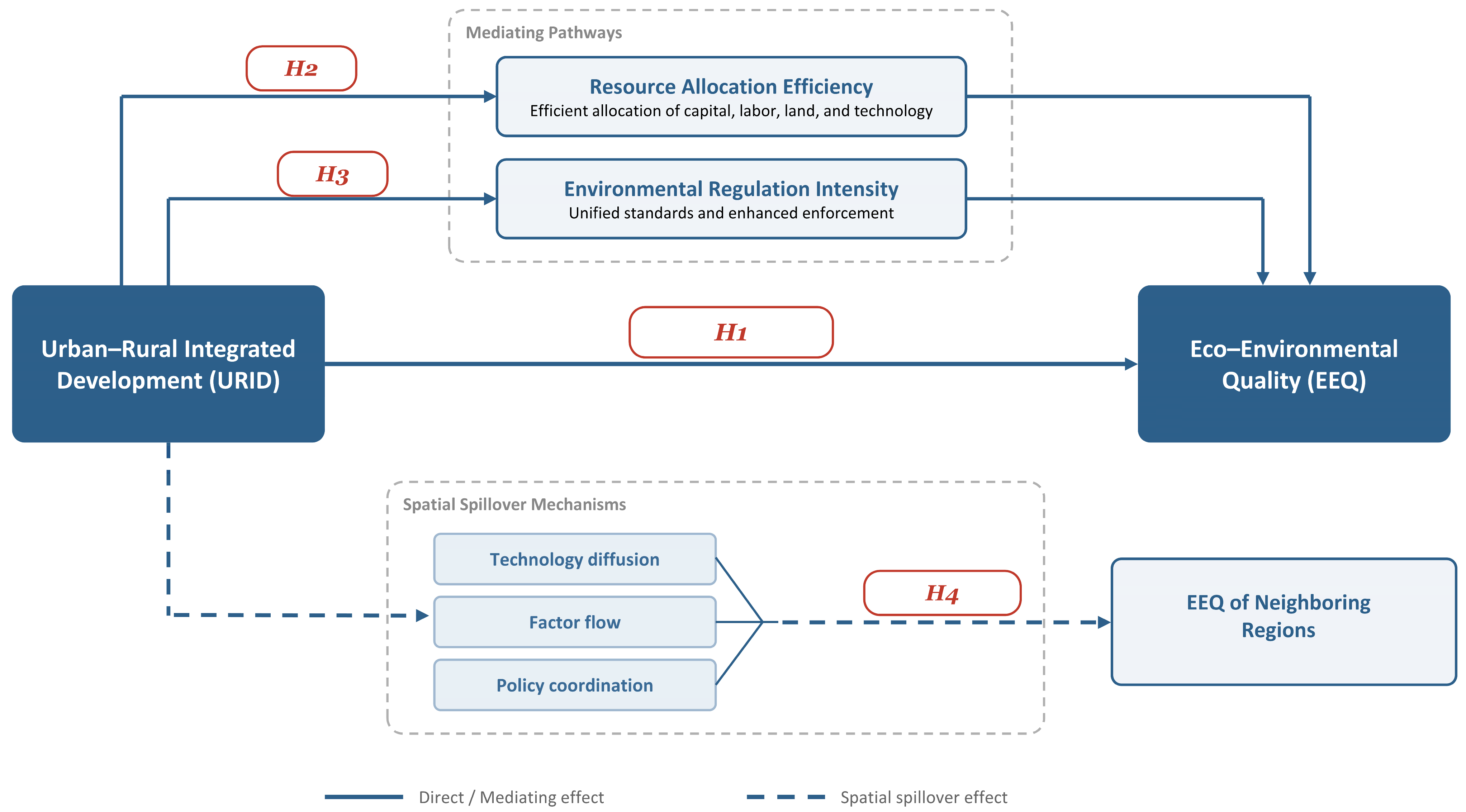
- Does URID have a significant positive promotional impact on EEQ, and does this effect exhibit heterogeneous features across various regions and different development stages?
- (2)
- Do resource allocation efficiency and environmental regulation intensity play a dual mediating role between URID and EEQ?
- (3)
- Does URID exert an obvious positive spatial spillover impact on the eco-environmental quality in neighboring regions?
2. Theoretical Analysis and Research Hypotheses
2.1. Analysis of the Main Effect of URID on EEQ
2.2. Analysis of the Mediating Effect of URID on EEQ
2.2.1. The Mediating Role of Resource Allocation Efficiency
2.2.2. The Mediating Role of Environmental Regulation Intensity
2.3. Analysis of the Spatial Spillover Effect of URID on EEQ
3. Research Design
3.1. Study Area Overview
3.2. Model Specification
3.2.1. Benchmark Regression Model
3.2.2. Mediating Effect Model
3.2.3. Spatial Spillover Effect Model
3.3. Variable Selection
3.3.1. Explained Variable
3.3.2. Core Explanatory Variable
3.3.3. Control Variables
3.3.4. Mediating Variables
- (1)
- Resource Allocation Efficiency
- (2)
- Environmental Regulation Intensity
3.4. Data Sources and Processing
4. Results
4.1. Spatio-Temporal Pattern Characteristics of URID and EEQ
4.1.1. Temporal Evolution Characteristics
4.1.2. Spatial Evolution Characteristics
4.2. Benchmark Regression Analysis
4.3. Robustness Analysis
4.3.1. Endogeneity Test
4.3.2. Robustness Analysis
4.4. Heterogeneous Effects Analysis
4.4.1. Geographical Location Heterogeneity
4.4.2. Policy Background Heterogeneity
4.4.3. Population Scale Heterogeneity
4.5. Mechanism Analysis
4.6. Spatial Spillover Effects
4.6.1. Spatial Correlation Test
4.6.2. Regression Results of the SDM
4.6.3. Robustness Test of Spatial Spillover Effects
5. Discussion
5.1. Hypothesis Validation and Theoretical Implications
5.2. Comparison with Existing Literature
5.3. Research Limitations and Future Directions
6. Conclusions and Policy Implications
6.1. Conclusions
- (1)
- URID significantly promotes EEQ (β = 0.1889, p < 0.01; Table 3). A one-standard-deviation increase in URID is associated with an EEQ improvement of approximately 5.9% of its standard deviation. This effect is robust to instrumental variable estimation, alternative proxies, and sample adjustments (Table 4 and Table 5).
- (2)
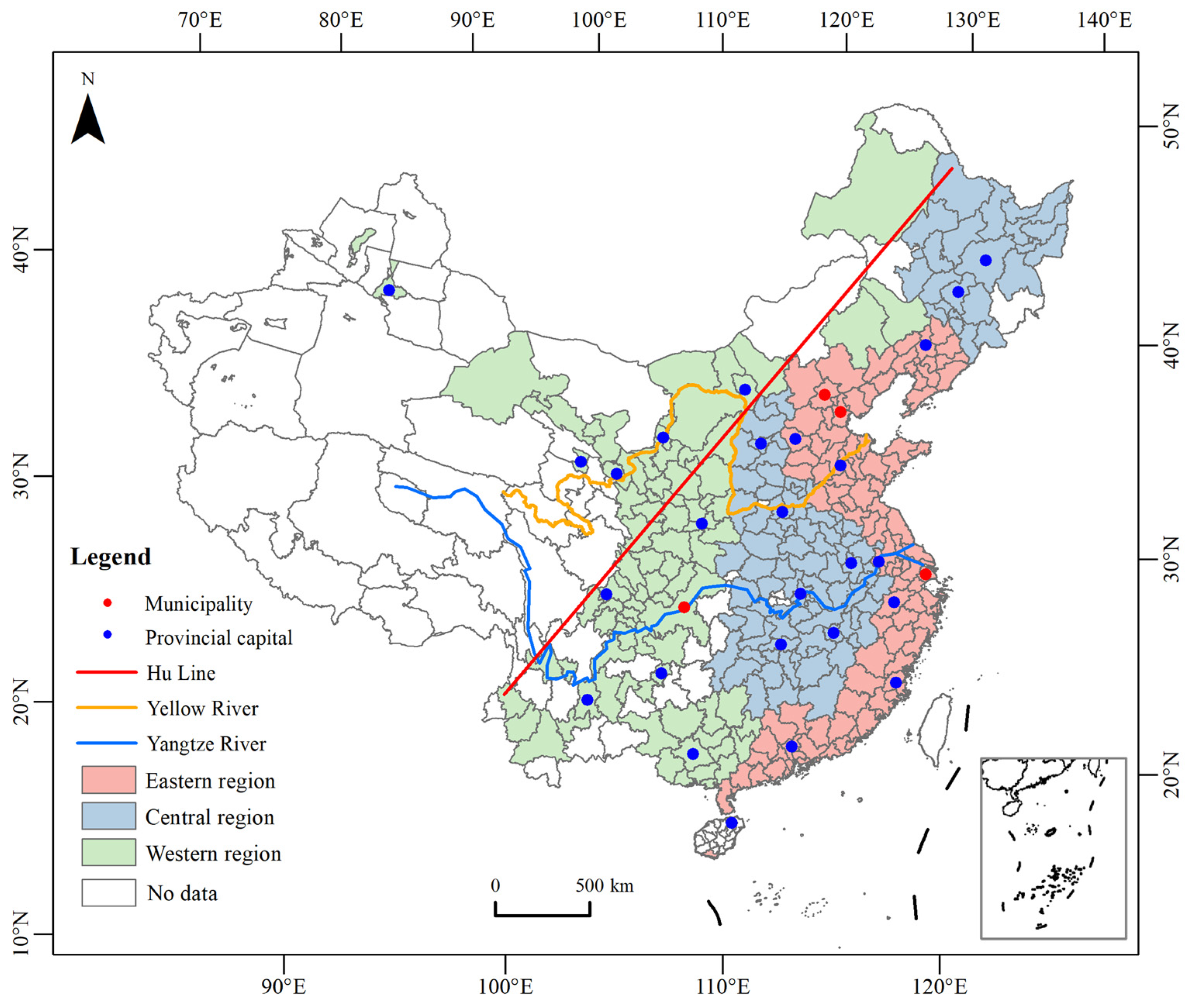
- The promoting effect exhibits significant heterogeneity: it is stronger in the central and eastern regions than in the western region, more pronounced during the early policy stage (2011–2014) than the later stage (2015–2023), and significant only on the southeast side of the Hu Line (Table 6). These patterns underscore the contingent role of factor flow intensity and institutional readiness.
- (3)
- URID indirectly improves EEQ through dual mediating pathways, reducing resource misallocation (β = −0.8424, p < 0.01) and strengthening environmental regulation intensity (β = 0.8995, p < 0.01) (Table 7).
- (4)
- URID generates significant positive spatial spillovers on neighboring regions’ EEQ (indirect effect = 0.0680, p < 0.01; Table 8), operating through technology diffusion, cross-boundary factor flow, and policy coordination. This conclusion is robust across alternative spatial weight matrices and dependent variables (Table A3).
6.2. Policy Implications
Author Contributions
Funding
Institutional Review Board Statement
Informed Consent Statement
Data Availability Statement
Conflicts of Interest
Abbreviations
| URID | Urban–rural integrated development |
| EEQ | Eco-environmental quality |
Appendix A
Appendix A.1. Detailed Temporal Evolution Analysis
Appendix A.1.1. Temporal Stages of URID
- (1)
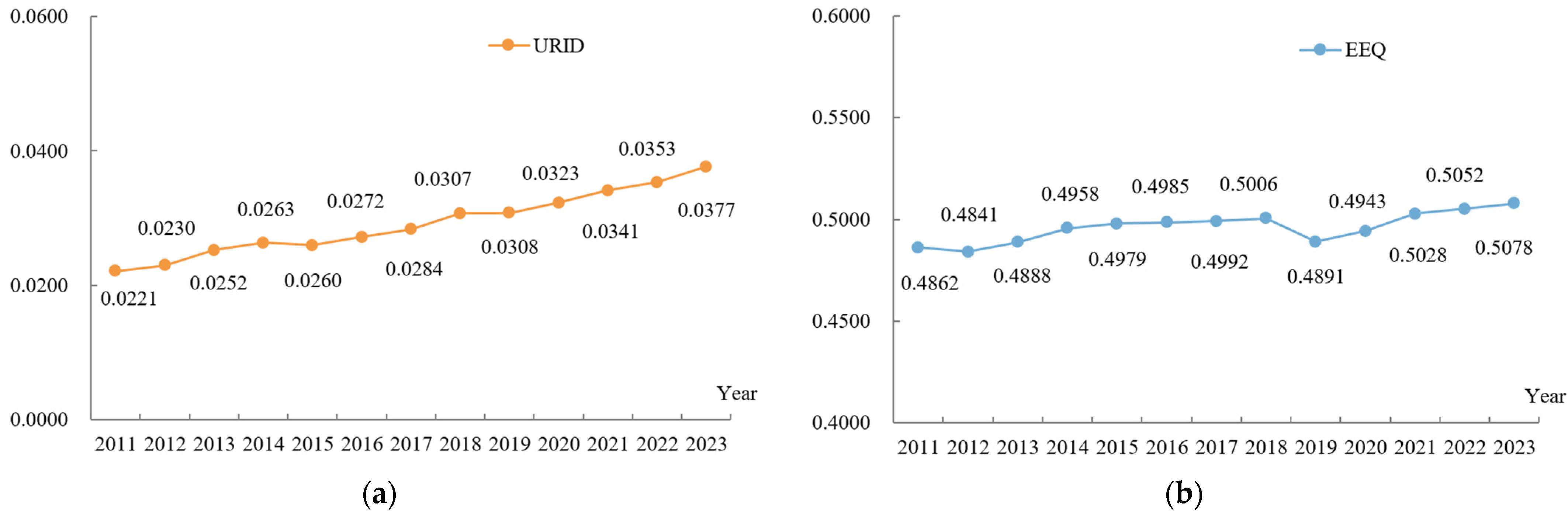
- The initial exploration stage (2011–2017). During this stage, URID increased fluctuantly but with a small growth rate. The possible reason is that the core orientation of China’s urban–rural development during this period was still “urban–rural overall planning”, and the policy focus was concentrated on rural infrastructure construction, without forming an institutional framework for the two-way flow of factors. Urban development was mainly featured by the rapid advancement of industrialization and urbanization. Productive factors—especially capital, skilled labor, and technology—continued to concentrate in urban zones, while rural factors witnessed a prominent outflow, leading to a slow progress in narrowing the urban–rural divide.
- (2)
- The accelerated improvement stage (2018–2023). During this stage, URID rose rapidly from 0.0307 in 2018 to 0.0377 in 2023, with an increase of 22.80%. This may be closely related to the major transformation of national development strategies in recent years. The 19th National Congress of the Communist Party of China proposed the “implementation of the Rural Revitalization Strategy” in 2017, taking URID as the core path to break the urban–rural dual structure. The 2018 No.1 Central Document refined the two-way flow of urban–rural factors and the integration of public services. The concentrated release of policy dividends effectively removed the institutional obstacles to URID, driving it into a rapid improvement channel. Only a small growth was observed from 2018 to 2019 due to the short-term adjustment of policy implementation, and a steady and accelerated growth has been maintained since 2020, reaching a stage peak of 0.0377 in 2023, which confirms the resilience and high-quality evolution trend of URID.
Appendix A.1.2. Temporal Stages of EEQ
- (1)
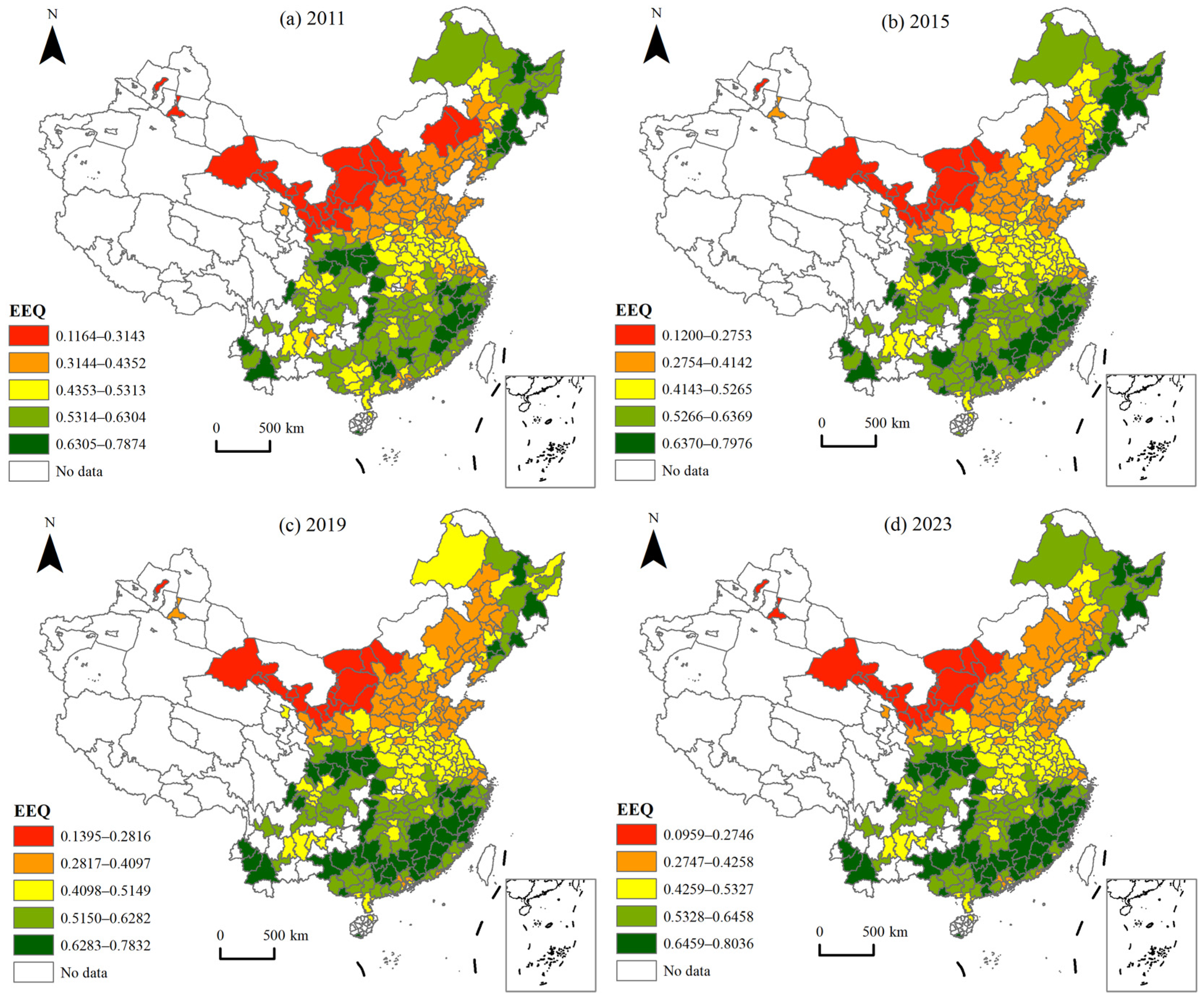
- The slow improvement stage (2011–2018). During this period, economic growth still had the inertia of industrial scale expansion, the path dependence of “pollution first and then treatment” in some regions had not been completely eliminated, environmental protection policies mainly focused on “end-of-pipe treatment”, and the coordination of supervision needed to be strengthened. Under the dual factors, the ecological quality showed a state of “gradual improvement but slow growth rate”.
- (2)
- The short-term correction stage (2019). EEQ fell from 0.5006 to 0.4891, a decrease of about 2.3%. This fluctuation may stem from the phased pains in the process of regional industrial green transformation. Some traditional high-energy-consuming industries resumed production periodically during the transformation and adjustment, coupled with the partial adjustment of environmental protection supervision, leading to a small decline, but the range was limited, reflecting the ecological resilience accumulated by previous governance.
- (3)
- The steady optimization stage (2020–2023). During this stage, EEQ steadily increased from 0.4943 in 2020 to 0.5078 in 2023. Its core driving force came from the deepening of the ecological civilization strategy, which was specifically reflected in the joint efforts of the normalization of the tough battle against pollution, the acceleration of industrial green transformation and clean energy, and the penetration of the concept of urban–rural green development, all of which jointly promoted EEQ into a “steady optimization” channel.
Appendix A.2. Detailed Spatial Evolution Analysis
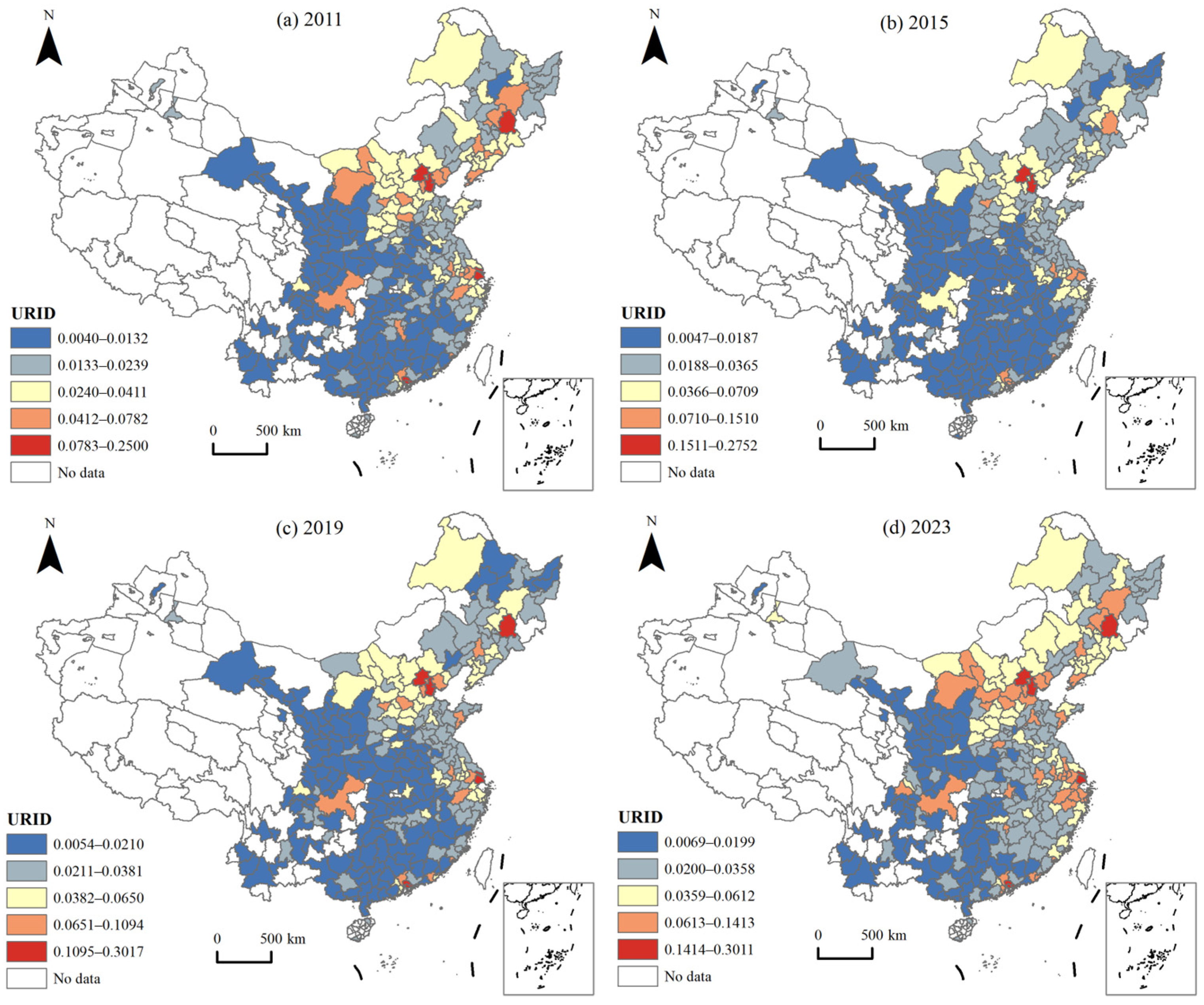
Appendix A.2.1. Spatial Evolution of URID
Appendix A.2.2. Spatial Evolution of EEQ
Appendix A.3. Spatial Correlation Test Results

| Year | URID Moran’s I | p-Value | EEQ Moran’s I | p-Value |
|---|---|---|---|---|
| 2011 | 0.1354 | 0.0000 | 0.1845 | 0.0000 |
| 2012 | 0.1440 | 0.0000 | 0.1757 | 0.0000 |
| 2013 | 0.1436 | 0.0000 | 0.1928 | 0.0000 |
| 2014 | 0.1353 | 0.0000 | 0.1910 | 0.0000 |
| 2015 | 0.1457 | 0.0000 | 0.1959 | 0.0000 |
| 2016 | 0.1455 | 0.0000 | 0.2052 | 0.0000 |
| 2017 | 0.1443 | 0.0000 | 0.2081 | 0.0000 |
| 2018 | 0.1468 | 0.0000 | 0.2132 | 0.0000 |
| 2019 | 0.1445 | 0.0000 | 0.2114 | 0.0000 |
| 2020 | 0.1485 | 0.0000 | 0.1900 | 0.0000 |
| 2021 | 0.1547 | 0.0000 | 0.2044 | 0.0000 |
| 2022 | 0.1565 | 0.0000 | 0.2030 | 0.0000 |
| 2023 | 0.1549 | 0.0000 | 0.2146 | 0.0000 |
Appendix A.4. Spatial Model Diagnostic Tests
| Suitability Test | Test Name and Null Hypothesis | Statistic | p-Value |
|---|---|---|---|
| Model Selection | LM-Error | 752.881 | 0.000 |
| LM-Error-Robust | 313.114 | 0.000 | |
| LM-Lag | 628.749 | 0.000 | |
| LM-Lag-Robust | 188.981 | 0.000 | |
| Hausman Test | H0: Random effects model is superior | −107.39 | |
| Model Robustness (LR Test) | H0: Individual fixed effects are better | 77.23 | 0.000 |
| H0: Time fixed effects are better | 658.44 | 0.000 | |
| H0: SDM can be simplified to SAR | 212.70 | 0.000 | |
| H0: SDM can be simplified to SEM | 242.42 | 0.000 | |
| Model Robustness (Wald Test) | H0: SDM can be simplified to SAR | 218.50 | 0.000 |
| H0: SDM can be simplified to SEM | 249.75 | 0.000 |
Appendix A.5. Robustness Test of Spatial Spillover Effects
| Variables | Model (1) | Model (2) | ||||
|---|---|---|---|---|---|---|
| Direct Effect | Indirect Effect | Total Effect | Direct Effect | Indirect Effect | Total Effect | |
| URID | 0.0744 ** (0.0311) | 0.0614 ** (0.0289) | 0.0852 *** (0.0078) | 0.1508 *** (0.0340) | 0.0421 *** (0.0690) | 0.0071 *** (0.0014) |
| ρ | 0.8025 *** (0.0096) | 0.9393 *** (0.0162) | ||||
| sigma2_e | 0.0000 | 0.0001 | ||||
| N | 3692 | 3692 | ||||
References
- Liu, X. Urban-Rural Integrated Development Modernization in Chinese-Style Modernization. Soc. Sci. Hunan 2024, 1–9. [Google Scholar]
- Su, C. The Development Ethics of Urban-rural Integration in the Process of Chinese Path to Modernization. Moral. Civ. 2024, 10–14. [Google Scholar] [CrossRef]
- Dong, Z.; Xu, C. Policy Evolution, Practical Effectiveness and Development Trends of the “Two Mountains” Concept. Ecol. Econ. 2025, 41, 21–32. [Google Scholar]
- Zhang, R. Promoting Common Prosperity through Ecological Environment Protection: Era Connotation, Value Connotation and Implementation Path. Guangxi Soc. Sci. 2023, 26–33. [Google Scholar]
- Zhang, Y.; Chen, Y.; Xiang, B. Evolution of integrated urban-rural development pattern and its influencing factors in the Yangtze River Delta urban agglomeration. Sci. Geogr. Sin. 2024, 44, 1955–1965. [Google Scholar] [CrossRef]
- Yu, F.; Sun, H.X.; Wu, Q. Theoretical Analysis and Practical Path for Improving Ecological Environment Governance System: From the Perspective of the System Concept. Chin. Rural Econ. 2025, 3–21. [Google Scholar] [CrossRef]
- Mao, X.; Wang, F. Reconstruction of Rural Environmental Governance System from the Perspective of Urban-rural Integration. J. Southwest Minzu Univ. (Hum. Soc. Sci. Ed.) 2022, 43, 190–196. [Google Scholar]
- Wang, P.; Guo, B.; Sun, Z. Sustainable Urban-Rural Symbiosis in China: A Study from the Symbiosis Theory Perspective on Level Measurement and Spatial Difference Analysis. Sustainability 2025, 17, 2790. [Google Scholar] [CrossRef] [Scilit]
- Fan, J.; Wang, Q.; Ji, M.; Sun, Y.; Feng, Y.; Yang, F.; Zhang, Z. Ecological Network Construction and Gradient Zoning Optimization Strategy in Urban-Rural Fringe: A Case Study of Licheng District, Jinan City, China. Ecol. Indic. 2023, 150, 110251. [Google Scholar] [CrossRef] [Scilit]
- Fang, C. Theoretical Analysis on the Mechanism and Evolution Law of Urban-Rural Integration Development. Acta Geogr. Sin. 2022, 77, 759–776. [Google Scholar]
- Yao, S.; Guan, C.; Ye, C.; Wang, D.; Guo, Z.; Peng, Q. Reflections on Several Issues of New Urbanization under the Background of Chinese Path to Modernization. Econ. Geogr. 2025, 45, 1–10. [Google Scholar] [CrossRef]
- Dong, R.; Liu, Y. How Rural Collective Economic Organizations Facilitate the Flow of Urban-rural Factors. J. China Agric. Univ. (Soc. Sci. Ed.) 2025, 42, 174–189. [Google Scholar] [CrossRef]
- Yang, X.; Yang, H.; Ni, F.; Sun, F. Green Finance Empowers Urban-Rural Integration: Driven by Industrial Structure Upgrading and Regulated by Fiscal Decentralization. Financ. Account. Mon. 2025, 46, 107–115. [Google Scholar] [CrossRef]
- Han, L.; Cao, J.; He, J. The Internal Logic and Implementation Path of Digital Economy Enabling Urban-Rural Integration. Southwest Financ. 2024, 42–53. [Google Scholar]
- Grossman, G.M.; Krueger, A.B. Economic Growth and the Environment. Q. J. Econ. 1995, 110, 353–377. [Google Scholar] [CrossRef] [Scilit]
- Zhou, M.; Han, Y. Spatiotemporal Evolution, Influencing Factors, and Prediction of the Coupling Coordination between Urban-Rural Integration and Habitat Quality. Environ. Sci. 2026, 1–17, online ahead of print. [Google Scholar] [CrossRef]
- Cui, Y.; Huang, Y.; Li, J.; Liu, H.; Jia, X.; Zhou, Y. Implementation Path of Collaborative Treatment of Rural Domestic Sewage in Beijing-Tianjin- Hebei in the New Era. Chin. J. Environ. Manag. 2025, 17, 30–39. [Google Scholar] [CrossRef]
- Yang, J.; Cui, X.; Zhang, G. Spatio-Temporal Evolution and Influencing Factors of Coupling Coordination Between Urban-Rural Integration and Carbon Emission in Urban Agglomeration in the Middle Reaches of the Yangtze River. Resour. Environ. Yangtze Basin 2024, 33, 2474–2487. [Google Scholar]
- Liu, X. Mechanism and Path of Promoting Urban-Rural Integration Through Comprehensive Land Improvement in the Whole Region. Nat. Resour. Econ. China 2024, 37, 74–79. [Google Scholar] [CrossRef]
- Qian, Z.; Qin, X. The Theoretical Basis, Value Implication and Practical Dimension of the Integrated Development of Urban and Rural Ecology. Acad. J. Zhongzhou 2023, 43–48. [Google Scholar]
- Tang, C.; Lu, X.; Lei, J.; Sun, W. Characteristics and Formation Mechanism of Urban-rural Multidimensional Spatial Conflict in Metropolitan Fringe: Take Zhuanxi Village in Shaoguan City as an Example. Econ. Geogr. 2022, 42, 79–89. [Google Scholar] [CrossRef]
- Arsiso, B.K. Urban Land Cover Transformations and Thermal Dynamics through Integrated LULC, UHI, and Ecological Vulnerability Assessment Using Remote Sensing Indices in the City of Addis Ababa, Ethiopia. Sustain. Cities Soc. 2025, 135, 107017. [Google Scholar] [CrossRef] [Scilit]
- Sikorska, D.; Sikorski, P.; Hopkins, R.J. High Biodiversity of Green Infrastructure Does Not Contribute to Recreational Ecosystem Services. Sustainability 2017, 9, 334. [Google Scholar] [CrossRef] [Scilit]
- Sun, T.; Sun, B.; Xue, J. Research on Interactive Stress and Coupling Coordination between Urban-Rural Integration and Eco-environment of Urban Agglomerations in Yellow River Basin. J. North China Univ. Water Resour. Electr. Power (Nat. Sci. Ed.) 2025, 46, 10–22. [Google Scholar] [CrossRef]
- Han, X.; Hu, Y.; Ma, Z. Coupling and Coordinated Development of Rural Revitalization, New Urbanization and Ecological Environment: An Empirical Study Based on the Yellow River Basin. Stat. Decis. 2023, 39, 122–127. [Google Scholar] [CrossRef]
- Hu, X.; Song, J.; Yu, J. Coupling and Coordination of Urban-rural Integration System in the Yellow River Basin: Construction of Indicator System, Empirical Measurement and Spatiotemporal Evolution. Northwest Popul. J. 2024, 45, 99–111. [Google Scholar] [CrossRef]
- Zhang, F.; Qiao, C. “Fracture” and “Reconstruction” of Urban and Rural Interests Pattern Based on Factor Allocation: Literature Review and Prospect. Issues Agric. Econ. 2019, 40, 85–93. [Google Scholar] [CrossRef]
- Zhong, Z.; Xie, D.; Zhai, Z. Strategic Orientation and Key Policies of China’s Agricultural and Rural Modernization during “14th Five-Year Plan”. Jianghai Acad. J. 2021, 113–119+254. [Google Scholar]
- Tang, Z. Coupling Research on the Quality of Rural Migrant Population and the Ecological Environmental Carrying Capacity of Migrant-Receiving Areas from the Perspective of Urban-Rural Integration. Agric. Econ. 2019, 70–72. [Google Scholar]
- Gao, M.; Zheng, Z. The Theoretical Logic and Practical Approach of Livable, Business-friendly and Beautiful Rural Construction: Based on the Experience and Inspiration of Zhejiang’s “Ten Million Project”. Acad. J. Zhongzhou 2024, 14–22. [Google Scholar]
- Yang, R.; Ge, Y.; Lin, Y. Coordination Mechanism of Comprehensive Land Consolidation and Modernization of Agriculture and Rural Areas. Mod. Urban Res. 2024, 39, 8–16. [Google Scholar]
- Li, N.; Li, Z. On Establishing Urban-Rural Ecological Governance Community under the Background of Rural Revitalization. Contemp. Econ. Manag. 2022, 44, 42–48. [Google Scholar] [CrossRef]
- Wang, F.; Mao, X. Risk Review and Reconstruction Path of Urban and Rural Environmental Governance System. Qinghai Soc. Sci. 2022, 129–136. [Google Scholar] [CrossRef]
- Hou, J.; Li, M. An Empirical Study on Rural Revitalization Drives Migrant Workers to Return to Their Hometowns: Based on Survey Data of 2,332 Migrant Workers in 26 Provinces. J. Henan Norm. Univ. (Philos. Soc. Sci. Ed.) 2019, 46, 29–36. [Google Scholar] [CrossRef]
- Xing, J.; Xie, Z. Jointly Promoting the New Type of Urbanization and Integrating Urban and Rural Development. Theor. Horiz. 2022, 63–68. [Google Scholar] [CrossRef]
- Chu, T.; Liu, C.; Li, Z. Composite Ecological-Heritage-Recreation Corridors for Social Sustainability: A Regional Framework in the Qinling–Daba Mountains. Buildings 2025, 15, 3700. [Google Scholar] [CrossRef] [Scilit]
- Lin, L.; Li, R.; Chen, C. From Pollution “Refuge” to Green “Main Battlefield”: 70 Years of Rural Environmental Governance in China. J. Arid Land Resour. Environ. 2020, 34, 30–36. [Google Scholar] [CrossRef]
- Jin, C. The Theoretical Basis of Urban-Rural Integrated Development: A Perspective of Wealth Accumulation. Econ. Perspect. 2018, 48–63. [Google Scholar]
- Sun, Y.; Zhang, D.; Liang, Y.; Ding, J. Value Realization of Ecological Products and Integrated Urban-rural Development: An Empirical Study Based on Urban-rural Integrated Development Pilot Zones. Stat. Res. 2024, 41, 87–99. [Google Scholar] [CrossRef]
- Qu, Y. From “Duality” to “Integration”: Research on the Development Path of Urban-Rural Integration under the Strategy of Rural Revitalization. J. Theor. Stud. 2020, 97–104. [Google Scholar] [CrossRef]
- Wang, F.; Mao, X. Integration of Urban and Rural Development from the Perspective of Environmental Equity: Value Review and Direction Choice. J. Agro-Forest. Econ. Manag. 2021, 20, 686–692. [Google Scholar] [CrossRef]
- Zhou, J.; Zou, W.; Qin, F. Review of Urban-Rural Multi-Dimensional Integration and Influencing Factors in China Based on the Concept of Equivalence. Geogr. Res. 2020, 39, 1836–1851. [Google Scholar]
- Penazzi, S.; Accorsi, R.; Manzini, R. Planning Low Carbon Urban-Rural Ecosystems: An Integrated Transport Land-Use Model. J. Clean. Prod. 2019, 235, 96–111. [Google Scholar] [CrossRef] [Scilit]
- Guida-Johnson, B.; Zuleta, G.A. Riparian Rehabilitation Planning in an Urban–Rural Gradient: Integrating Social Needs and Ecological Conditions. Ambio 2017, 46, 578–587. [Google Scholar] [CrossRef] [Scilit] [PubMed]
- Jiang, T. Mediating Effects and Moderating Effects in Causal Inference. China Ind. Econ. 2022, 5, 100–120. [Google Scholar] [CrossRef]
- Lu, F.; Yoon, S.J. Spatiotemporal Evolution and Spillover Effects of Tourism Industry and Inclusive Green Growth Coordination in the Yellow River Basin: Toward Sustainable Development. Sustainability 2025, 17, 11372. [Google Scholar] [CrossRef] [Scilit]
- Xu, D.; Yang, F.; Yu, L.; Zhou, Y.; Li, H.; Ma, J.; Huang, J.; Wei, J.; Xu, Y.; Zhang, C.; et al. Quantization of the Coupling Mechanism between Eco-environmental Quality and Urbanization from Multisource Remote Sensing Data. J. Clean. Prod. 2021, 321, 128948. [Google Scholar] [CrossRef] [Scilit]
- Su, C.; Li, Z. Does the Digital Economy Promote Urban-Rural Integration? Empirical Research Based on 285 Prefectural Cities in China. Comp. Econ. Soc. Syst. 2023, 27–39. [Google Scholar]
- Zhou, H.; Liu, X.; Kong, F. How Can the Digital Economy Promote the Urban-rural Integration?—An Empirical Analysis based on 287 Prefecture-level Cities. J. Southwest Univ. (Soc. Sci. Ed.) 2025, 51, 104–115+303. [Google Scholar] [CrossRef]
- Huo, Z.; Liu, H. Impact of China’s Digital Economy on Integrated Urban–Rural Development. Sustainability 2024, 16, 5863. [Google Scholar] [CrossRef] [Scilit]
- Sun, Y.; Yang, Q.; Liu, J. Spatio-Temporal Evolution and Influencing Factors of Integrated Urban–Rural Development in Northeast China under the Background of Population Shrinkage. Buildings 2023, 13, 2173. [Google Scholar] [CrossRef] [Scilit]
- Hsieh, C.-T.; Klenow, P.J. Misallocation and Manufacturing TFP in China and India. Q. J. Econ. 2009, 124, 1403–1448. [Google Scholar] [CrossRef] [Scilit]
- Liu, C.; Jiechang, X. Online Market, Digital Platform and Resource Allocation Efficiency: The Effect of Price Mechanism and Data Mechanism. China Ind. Econ. 2023, 7, 84–102. [Google Scholar] [CrossRef]
- Chen, S.; Chen, D. Air Pollution, Government Regulations and High-quality Economic Development. Econ. Res. J. 2018, 53, 20–34. [Google Scholar]
- Chen, Z.; Kahn, M.E.; Liu, Y.; Wang, Z. The Consequences of Spatially Differentiated Water Pollution Regulation in China. J. Environ. Econ. Manag. 2018, 88, 468–485. [Google Scholar] [CrossRef] [Scilit]
- Shao, S.; Ge, L.; Zhu, J. How to Achieve the Harmony Between Humanity and Nature: Environmental Regulation and Environmental Welfare Performance from the Perspective of Geographical Factors. Manag. World 2024, 40, 119–146. [Google Scholar] [CrossRef]
- Wang, Q.; Liu, X.; Li, Y. Spatial Structure, City Size and Innovation Performance of Chinese Cities. China Ind. Econ. 2021, 5, 114–132. [Google Scholar] [CrossRef]
- Nunn, N.; Qian, N. US Food Aid and Civil Conflict. Am. Econ. Rev. 2014, 104, 1630–1666. [Google Scholar] [CrossRef] [Scilit]
- Zheng, G.; Wan, M. The Productivity Growth Effect of Digital Economy: Dividend or Divide? Contemp. Financ. Econ. 2023, 12, 3–16. [Google Scholar] [CrossRef]
- Wang, K.; Liu, M.; Gan, C. Impact of Urban-Rural Integration on Carbon Emission Performance. Resour. Environ. Yangtze Basin 2025, 34, 1278–1290. [Google Scholar]
- Peng, Y.; Wang, N.; Gu, L. Enterprise Digital Transformation, Predictive Information Disclosure and the Stock Price Crash Risk. Financ. Trade Econ. 2023, 44, 73–90. [Google Scholar] [CrossRef]
- Zheng, Y.; Long, H. Measurement and spatio-temporal pattern of urban-rural integrated development in China. Acta Geogr. Sin. 2023, 78, 1869–1887. [Google Scholar]


| First-Level Indicators | Second-Level Indicators | Indicator Explanation | Attribute | Indicator Role |
|---|---|---|---|---|
| Urban–rural Economic Integration | Urban–Rural Economic Aggregate | Logarithm of per capita GDP | Positive | State |
| Ratio of Per Capita Income between Urban and Rural Residents | Per capita disposable income of urban residents/Per capita disposable income of rural residents | Negative | Contrast | |
| Ratio of Per Capita Consumption between Urban and Rural Residents | Per capita consumption expenditure of urban residents/Per capita consumption expenditure of rural residents | Negative | Contrast | |
| Urban–Rural Wage Income | Logarithm of average employee wage level | Positive | Driving Force | |
| Dual Contrast Coefficient | (Primary industry output value/Primary industry employment)/(Secondary and tertiary industry output value/Secondary and tertiary industry employment) | Positive | Contrast | |
| Urban–Rural Employment Structure | Employment in secondary and tertiary industries/Employment in primary industry | Positive | Contrast | |
| Scientific and Technological Innovation Capacity | Science and technology expenditure/Fiscal expenditure | Positive | Driving Force | |
| Urban–rural Social Integration | Urban–Rural Basic Education | Public education expenditure/Fiscal expenditure | Positive | Driving Force |
| Urban–Rural Medical Service Level | Number of licensed assistant physicians | Positive | Driving Force | |
| Urban–Rural Endowment Insurance Coverage Coefficient | Number of participants in basic endowment insurance for employees/Permanent population | Positive | Driving Force | |
| Urban–Rural Unemployment Insurance Coverage | Number of participants in unemployment insurance/Permanent population | Positive | Driving Force | |
| Urban–Rural Infrastructure Construction | Fixed asset investment in urban–rural construction/GDP | Positive | Driving Force | |
| Urban–Rural Population Density | Permanent population/Administrative area | Positive | State | |
| Urban–rural Spatial Integration | Urban–Rural Transportation Network | Per capita road area | Positive | Driving Force |
| Population Urbanization Rate | Permanent population urbanization rate | Positive | State | |
| Built-Up Area | Area of built-up district | Positive | Driving Force | |
| Per Capita Communication Expenditure | Per capita postal business income | Positive | Driving Force | |
| Built-Up Area Ratio | Area of built-up district/Total administrative area | Positive | State | |
| Urban–rural Ecological Integration | Green Coverage Rate | Green coverage rate of built-up district | Positive | State |
| Park Green Space Area | Per capita park green space area | Positive | State | |
| Domestic Waste Treatment | Domestic waste treatment rate | Positive | Driving Force | |
| Sewage Treatment | Sewage treatment rate | Positive | Driving Force |
| Variable | Symbol | Mean | Standard Deviation | Minimum | Maximum | Sample Size |
|---|---|---|---|---|---|---|
| Ecological Environment Quality | EEQ | 0.3988 | 0.0906 | 0.0915 | 0.5945 | 3692 |
| Urban–Rural Integrated Development | URID | 0.0283 | 0.0280 | 0.0039 | 0.2636 | 3692 |
| Economic Growth | EG | 0.0742 | 0.0377 | −0.2101 | 0.2200 | 3692 |
| Industrial Structure | IS | 0.7165 | 0.3093 | 0.0885 | 4.4460 | 3692 |
| Technological Progress | TP | 0.0145 | 0.0323 | 1.73 × 10⁻⁷ | 0.9358 | 3692 |
| Government Intervention | GI | 0.2096 | 0.1061 | 0.0438 | 0.9155 | 3692 |
| Opening-Up | OPEN | 0.0140 | 0.0159 | 1.34 × 10⁻⁶ | 0.1843 | 3692 |
| Infrastructure | INF | 0.2640 | 0.1433 | 0.0265 | 1.2187 | 3692 |
| Resource Allocation Efficiency | RAE | 0.3266 | 0.1674 | 0.0039 | 1.0000 | 3692 |
| Environmental Regulation Intensity | ERI | 0.9759 | 0.3364 | 0.0000 | 8.9430 | 3692 |
| Variables | FE (without Controls) | FE (with Controls) |
|---|---|---|
| (1) | (2) | |
| URID | 0.4217 *** (0.0403) | 0.1889 *** (0.0032) |
| EG | −0.0354 *** (0.0097) | |
| IS | 0.0039 ** (0.0018) | |
| TP | −0.0818 * (0.0476) | |
| GI | −0.0316 *** (0.0072) | |
| OPEN | 0.0671 ** (0.0290) | |
| INF | 0.0190 *** (0.0029) | |
| Constant | 0.3924 *** (0.0010) | 0.3997 *** (0.0027) |
| Time Fixed Effects | Yes | Yes |
| City Fixed Effects | Yes | Yes |
| N | 3692 | 3692 |
| R-squared | 0.311 | 0.592 |
| Variables | First-Stage Results | Second-Stage Results | First-Stage Results | Second-Stage Results |
|---|---|---|---|---|
| (1) | (2) | (3) | (4) | |
| URID | EEQ | URID | EEQ | |
| Instrumental Variable | −0.0079 *** (0.0068) | 0.0271 *** (0.0097) | ||
| URID | 0.2137 ***(0.1293) | 0.0779 ** (0.0322) | ||
| Kleibergen–Paap rk LM Statistic | 19.42 [0.0000] | 6.16 [0.0031] | ||
| Kleibergen–Paap Wald rk F Statistic | 10.46 {8.96} | 10.42 {8.96} | ||
| Control Variables | Controlled | Controlled | Controlled | Controlled |
| Time Fixed Effects | Yes | Yes | Yes | Yes |
| City Fixed Effects | Yes | Yes | Yes | Yes |
| N | 3692 | 3692 | 3692 | 3692 |
| F Statistic | 13.36 | 12.04 |
| Variables | EEQ | |||
|---|---|---|---|---|
| (1) | (2) | (3) | (4) | |
| URID | −0.1424 *** (0.0171) | 0.2373 *** (0.0635) | 0.1909 *** (0.5239) | 0.1824 *** (0.0555) |
| Control Variables | Controlled | Controlled | Controlled | Controlled |
| Constant | 0.4159 *** (0.0030) | 0.4098 *** (0.0034) | 0.4000 *** (0.0027) | 0.4047 *** (0.0028) |
| Time Fixed Effects | Yes | Yes | Yes | Yes |
| City Fixed Effects | Yes | Yes | Yes | Yes |
| N | 3692 | 2840 | 3640 | 3354 |
| R-squared | 0.745 | 0.761 | 0.578 | 0.600 |
| Variables | EEQ | ||||||
|---|---|---|---|---|---|---|---|
| (1) | (2) | (3) | (4) | (5) | (6) | (7) | |
| Eastern Region | Central Region | Western Region | 2011–2014 | 2015–2023 | Southeast of the Hu Line | Northwest of the Hu Line | |
| URID | 0.2958 *** (0.0662) | 0.3608 ** (0.1134) | 0.1679 (0.1075) | 0.3526 *** (0.1331) | 0.2469 *** (0.0582) | 0.1636 *** (0.0568) | 0.0658 (0.0995) |
| Control Variables | Controlled | Controlled | Controlled | Controlled | Controlled | Controlled | Controlled |
| Constant | 0.3676 *** (0.0047) | 0.4151 *** (0.0048) | 0.4097 *** (0.0048) | 0.4321 *** (0.0104) | 0.3884 *** (0.0028) | 0.4076 *** (0.0030) | 0.3239 *** (0.0054) |
| Time Fixed Effects | Yes | Yes | Yes | Yes | Yes | Yes | Yes |
| City Fixed Effects | Yes | Yes | Yes | Yes | Yes | Yes | Yes |
| N | 1300 | 1300 | 1092 | 1136 | 2556 | 3341 | 351 |
| R-squared | 0.611 | 0.709 | 0.651 | 0.628 | 0.395 | 0.637 | 0.101 |
| Variables | RAE | ERI |
|---|---|---|
| (1) | (2) | |
| URID | −0.8424 *** (0.1639) | 0.8995 *** (0.2923) |
| Control Variables | Controlled | Controlled |
| Constant | 0.4603 *** (0.0183) | 0.8652 *** (0.0326) |
| Time Fixed Effects | Yes | Yes |
| City Fixed Effects | Yes | Yes |
| N | 3692 | 3692 |
| R-squared | 0.155 | 0.368 |
| SDM Coefficients | EEQ | Direct Effect | Indirect Effect | Total Effect |
|---|---|---|---|---|
| (1) | (2) | (3) | (4) | |
| URID | 0.0585 *** (0.0224) | 0.0896 ** (0.0400) | 0.0680 *** (0.0221) | 0.0590 *** (0.0213) |
| EG | −0.0070 (0.0077) | −0.0128 (0.0078) | −0.0245 * (0.0140) | 0.0519 *** (0.0111) |
| IS | 0.0050 *** (0.0011) | 0.0082 *** (0.0016) | 0.0871 ** (0.0374) | 0.0880 ** (0.0375) |
| TP | −0.0166 *** (0.0062) | 0.0843 ** (0.0360) | −0.0761 ** (0.0323) | −0.0676 ** (0.0311) |
| GI | 0.0086 (0.0057) | −0.0075 (0.0056) | −0.0547 ** (0.0269) | −0.0623 ** (0.0292) |
| OPEN | 0.1457 *** (0.0453) | 0.0661 *** (0.0229) | −0.1529 (0.0976) | −0.0867 (0.0960) |
| INF | 0.0614 *** (0.0092) | −0.0031 (0.0031) | 0.0323 *** (0.0102) | 0.0292 *** (0.0106) |
| ρ | 2.6797 *** (0.0305) | |||
| sigma2_e | 0.0001 | |||
| N | 3692 | 3692 | 3692 | 3692 |
Disclaimer/Publisher’s Note: The statements, opinions and data contained in all publications are solely those of the individual author(s) and contributor(s) and not of MDPI and/or the editor(s). MDPI and/or the editor(s) disclaim responsibility for any injury to people or property resulting from any ideas, methods, instructions or products referred to in the content. |
© 2026 by the authors. Licensee MDPI, Basel, Switzerland. This article is an open access article distributed under the terms and conditions of the Creative Commons Attribution (CC BY) license.
Share and Cite
Lu, F.; Yoon, S.J. Does Urban–Rural Integrated Development Promote Eco-Environmental Quality? Evidence from China. Sustainability 2026, 18, 3090. https://doi.org/10.3390/su18063090
Lu F, Yoon SJ. Does Urban–Rural Integrated Development Promote Eco-Environmental Quality? Evidence from China. Sustainability. 2026; 18(6):3090. https://doi.org/10.3390/su18063090
Chicago/Turabian StyleLu, Fei, and Sung Joon Yoon. 2026. "Does Urban–Rural Integrated Development Promote Eco-Environmental Quality? Evidence from China" Sustainability 18, no. 6: 3090. https://doi.org/10.3390/su18063090
APA StyleLu, F., & Yoon, S. J. (2026). Does Urban–Rural Integrated Development Promote Eco-Environmental Quality? Evidence from China. Sustainability, 18(6), 3090. https://doi.org/10.3390/su18063090