Evaluating the Sustainable Adaptive Reuse Alternative for Architectural Heritage Through the Multi-Criteria Decision Analysis (MCDA) Method—A Study of a National Monument of Nigeria

Abstract
1. Introduction
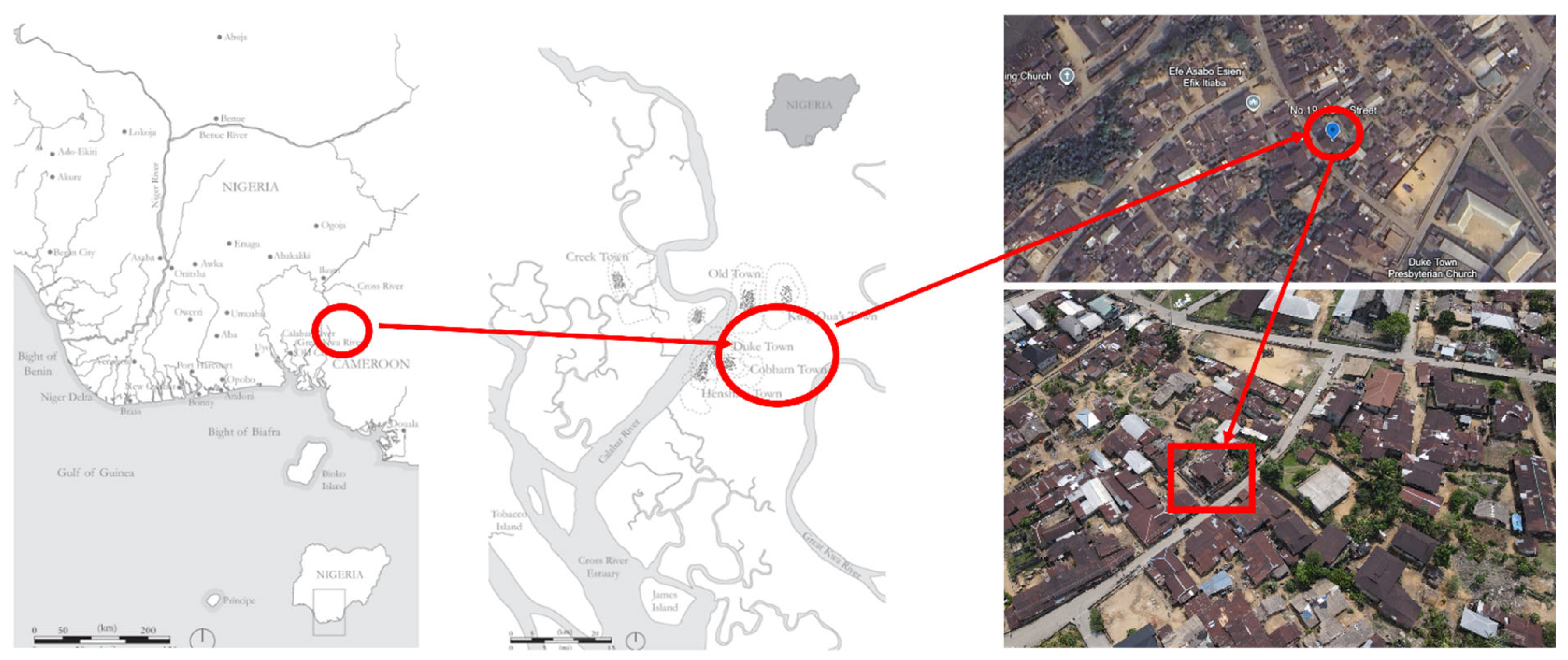
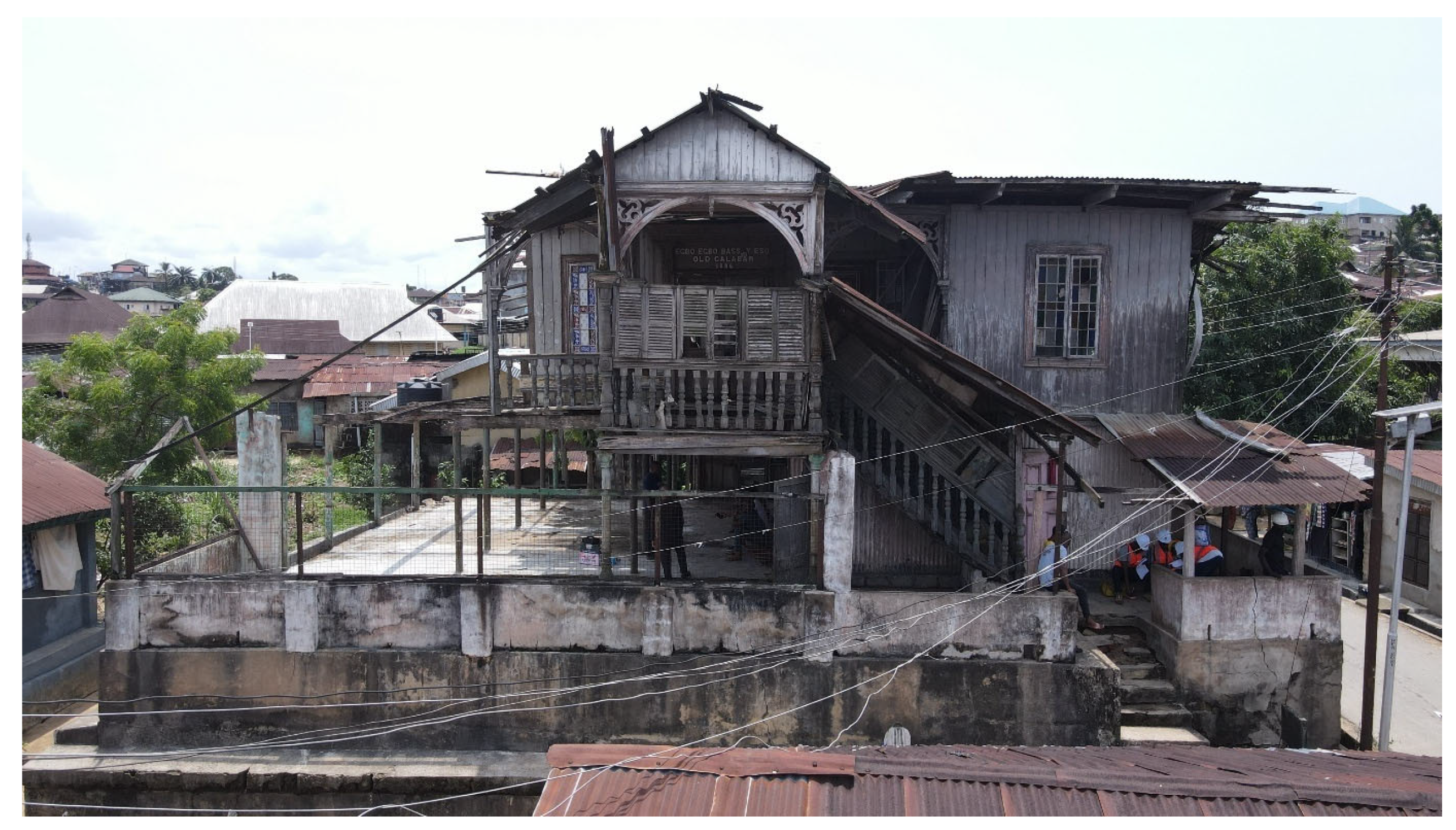
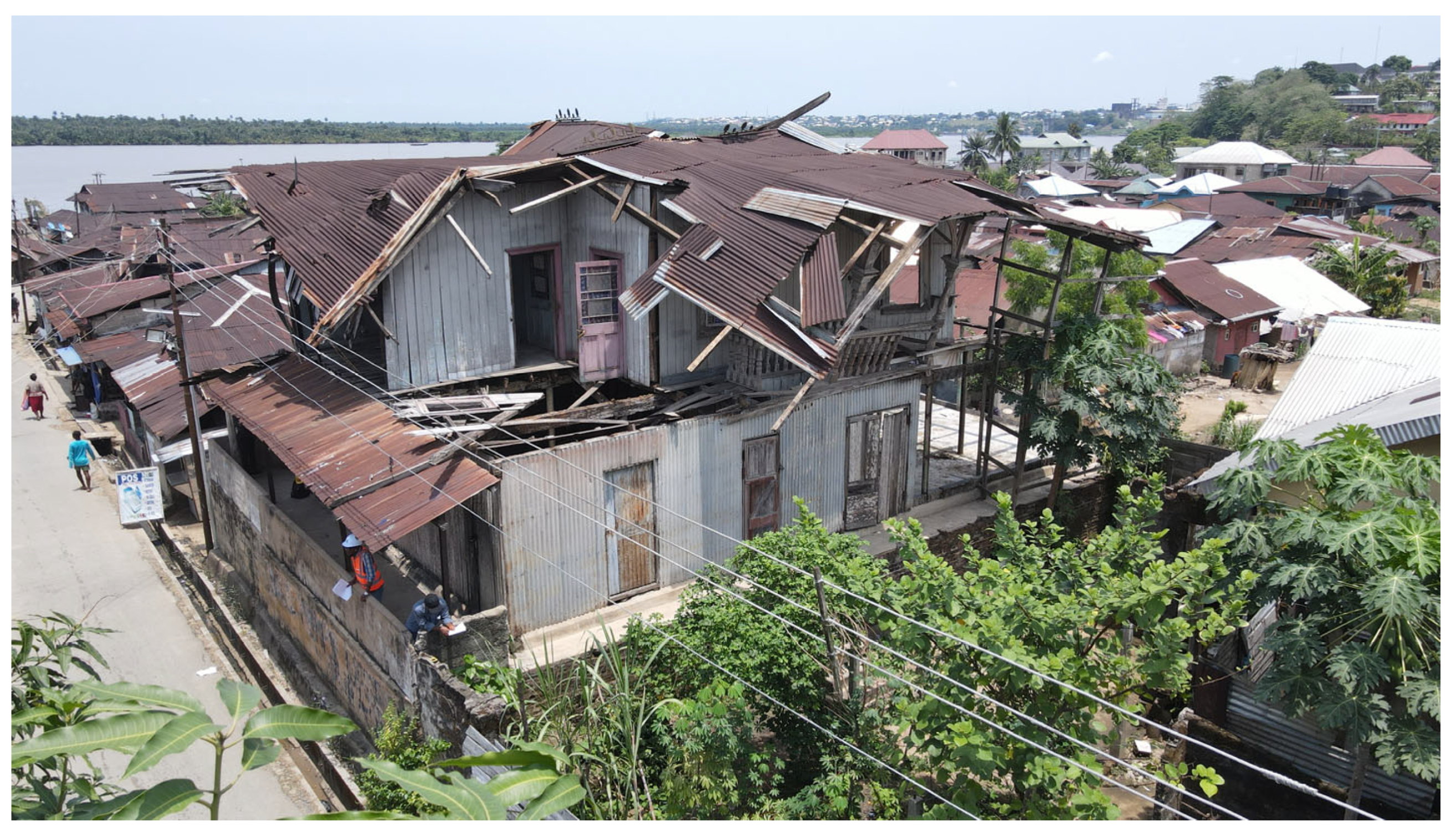
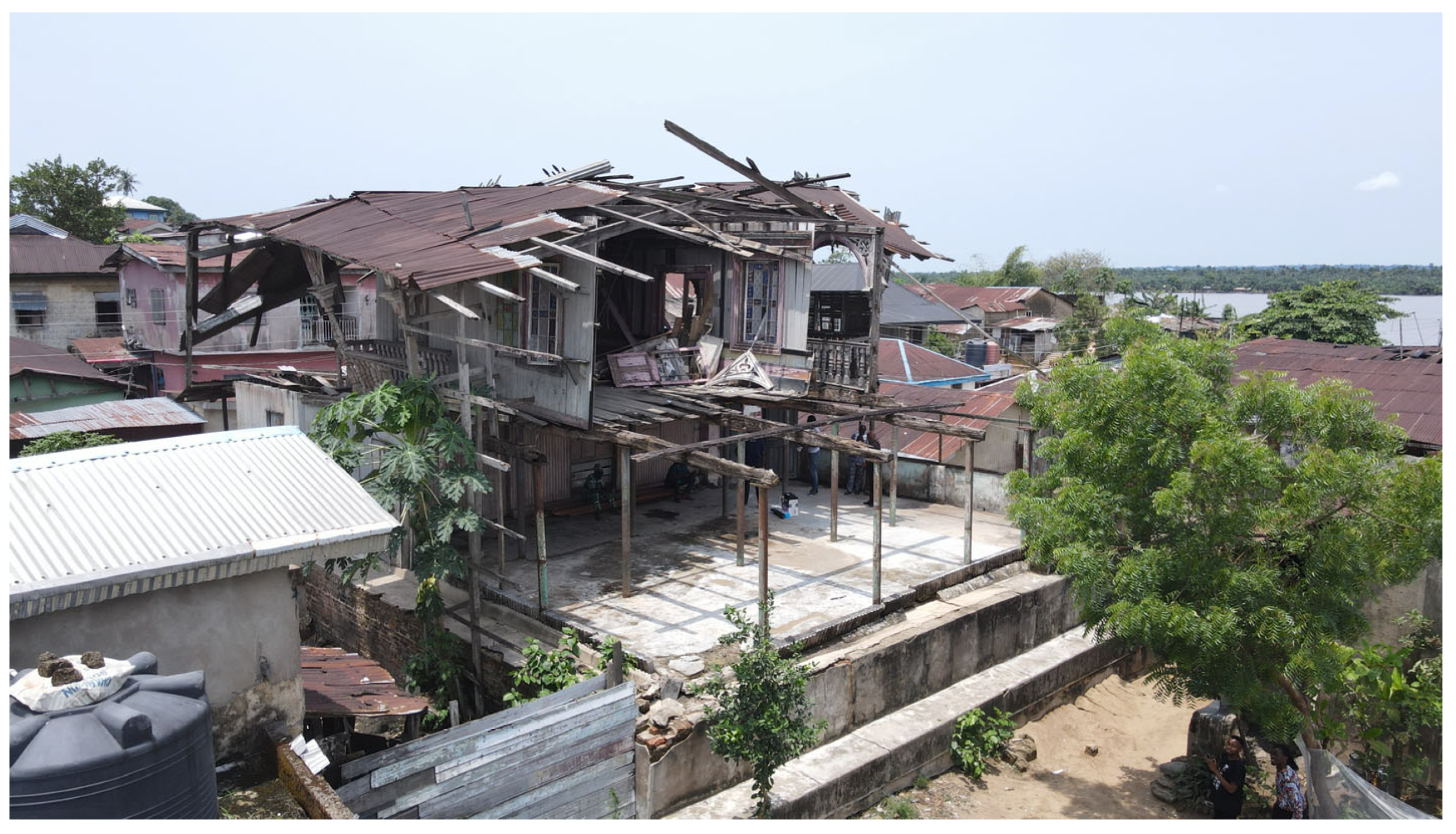
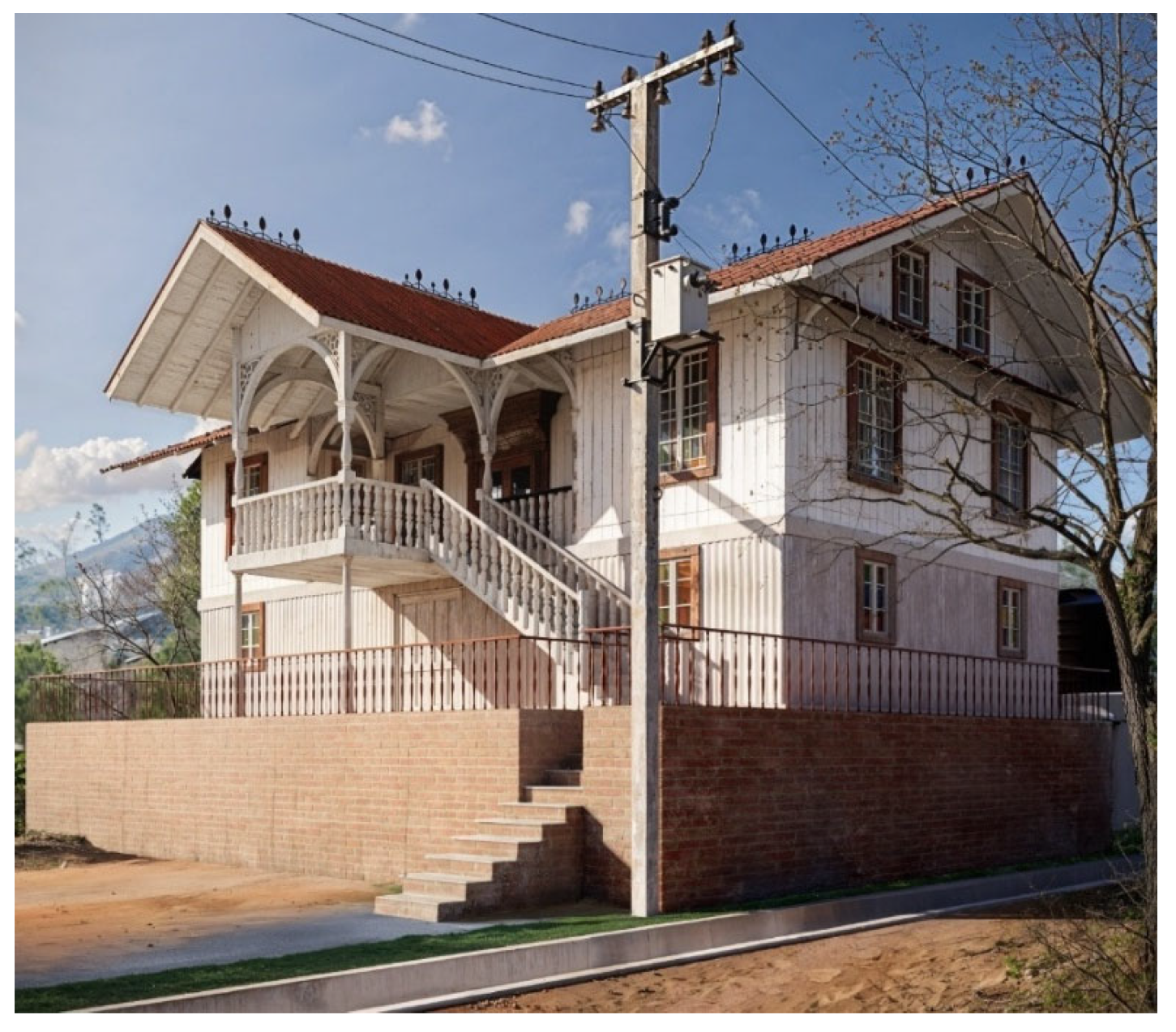
2. Case Context Description
3. Material and Methods
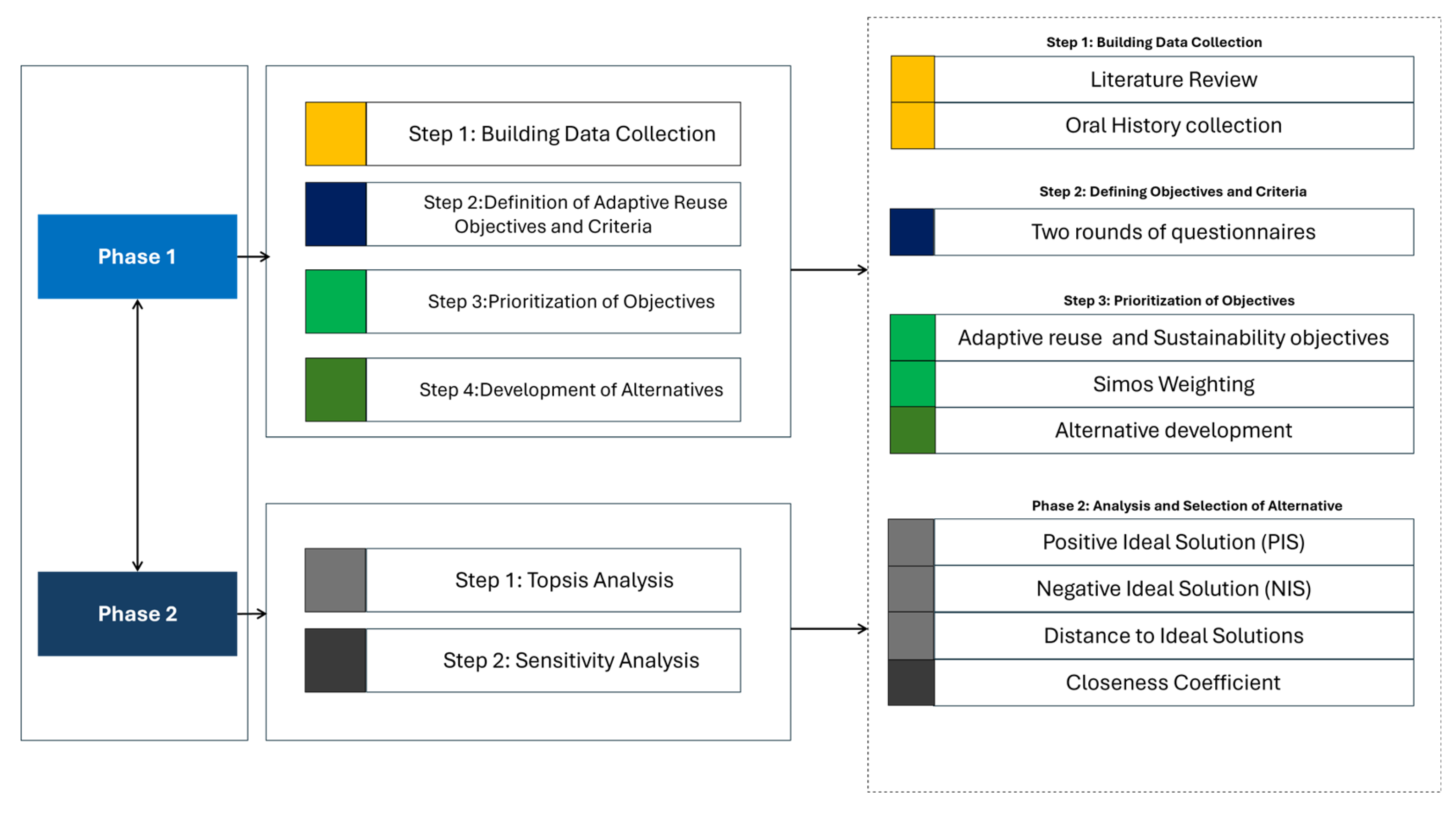
3.1. Phase 1: Data Collection, Objective Selection and Design Proposal
3.1.1. Step 1: Building Data Collection
3.1.2. Step 2: Defining the Adaptive Reuse Objectives
3.1.3. Step 3: Prioritization of Objectives
Adaptive Reuse Objectives
- Card Ordering: Stakeholders arranged objectives from least to most important.
- Equal Gaps: Spacing between cards represented perceived differences in importance.
- Card Counting: Scores were aggregated across participants.
- Heritage continuity
- Social cohesion
- Circular and creative economy
- Access and environmental resilience
- Sustainability objectives
- Ecologically friendly proposal
- Culturally sensitive proposal
- Socially viable proposal
- Economically viable proposal.
3.1.4. Step 4: Development of Project Architectural Alternatives
3.2. Phase 2: Evaluation and Selection of Optimal Solution Using MCDA Approach
- Step 1: Normalization of the Decision Matrix
- = normalized value of alternative for criterion ;
- = original performance score;
- = number of alternatives.
- Step 2: Weighted Normalized Matrix
- (
- ( in Phase 1)
- Step 3: Positive Ideal Solution (PIS)
- Step 4: Negative Ideal Solution (NIS)
- Step 5: Distance to Ideal Solutions
- Step 6: Closeness Coefficient (Final Ranking)
- (how close each alternative is to the ideal)
3.2.1. Scenario Evaluation: Sensitivity Analysis
3.2.2. Stakeholder Validation and Participatory Decision-Making
3.2.3. Why the Choice of TOPSIS Method and the Multidimensional Evaluation Framework
4. Results
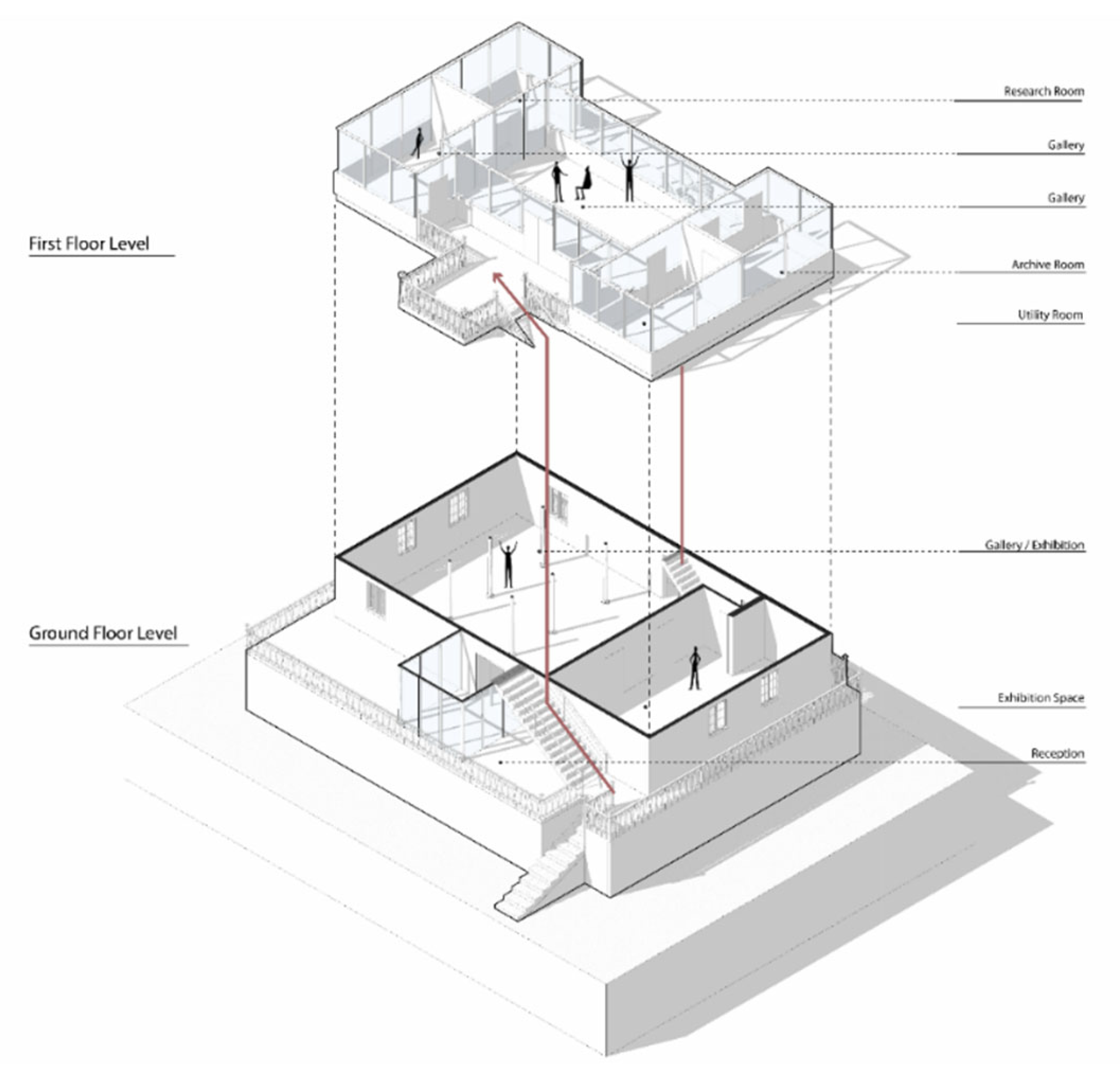
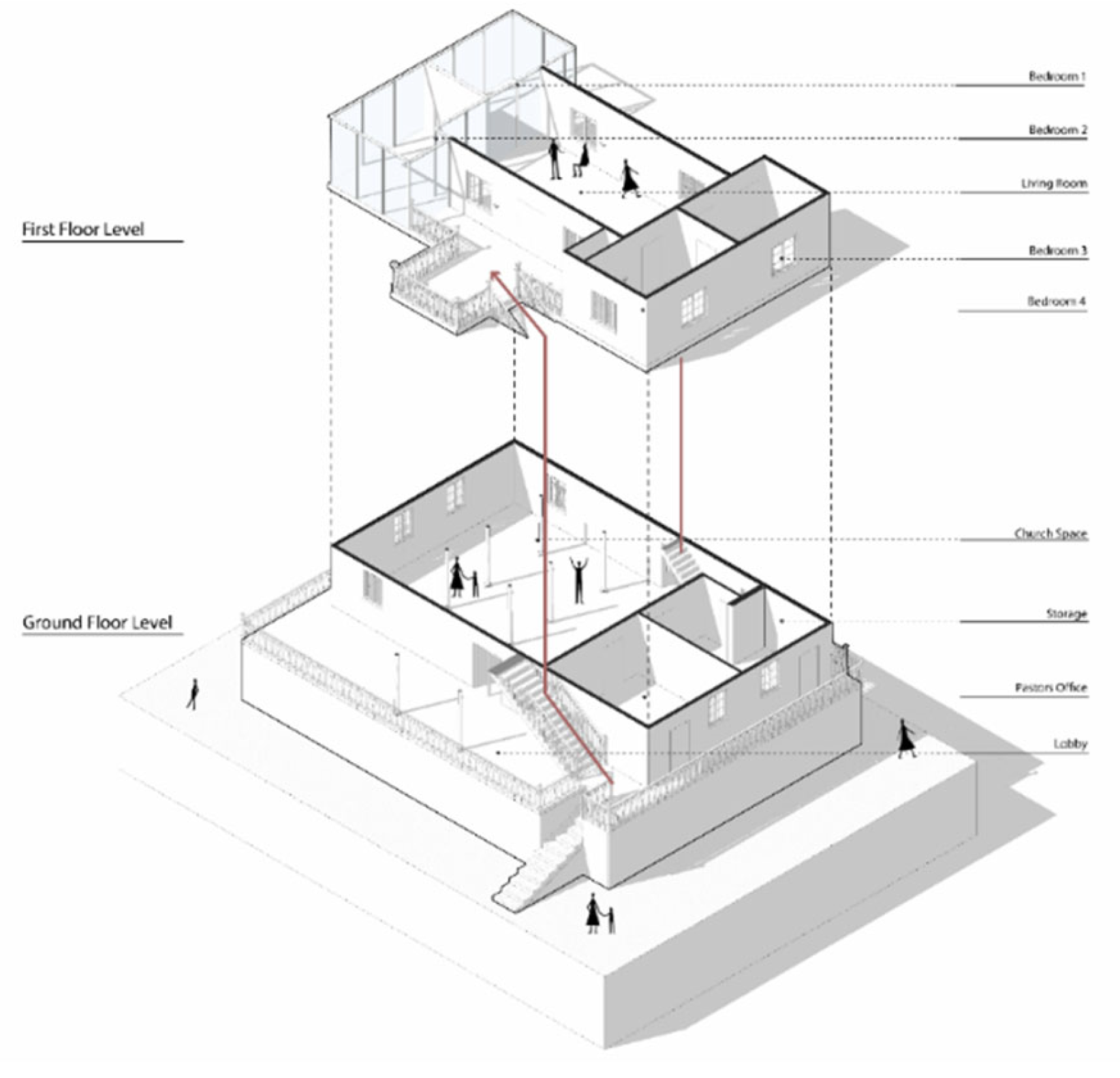
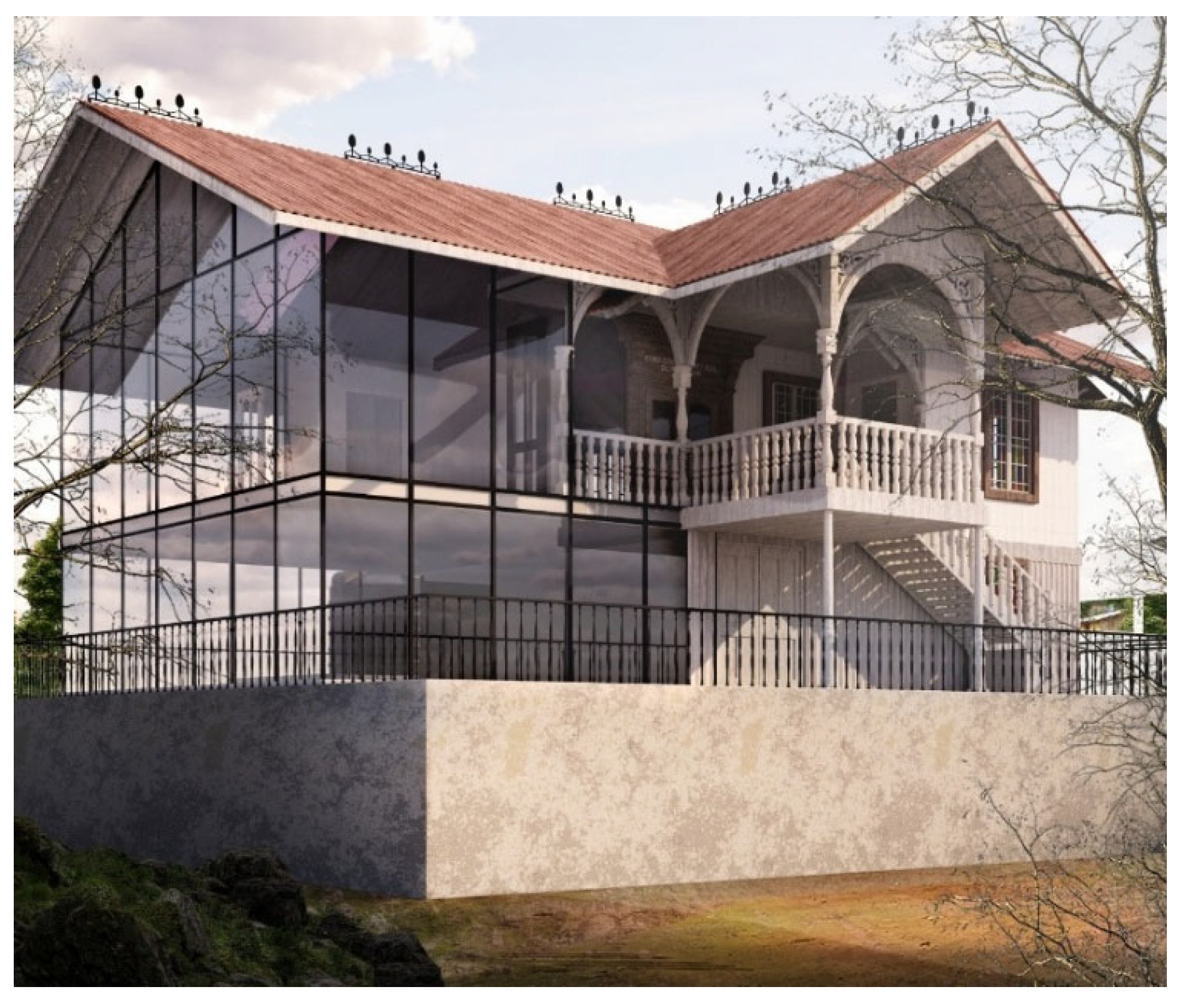
4.1. Proposed Architectural Alternatives Description
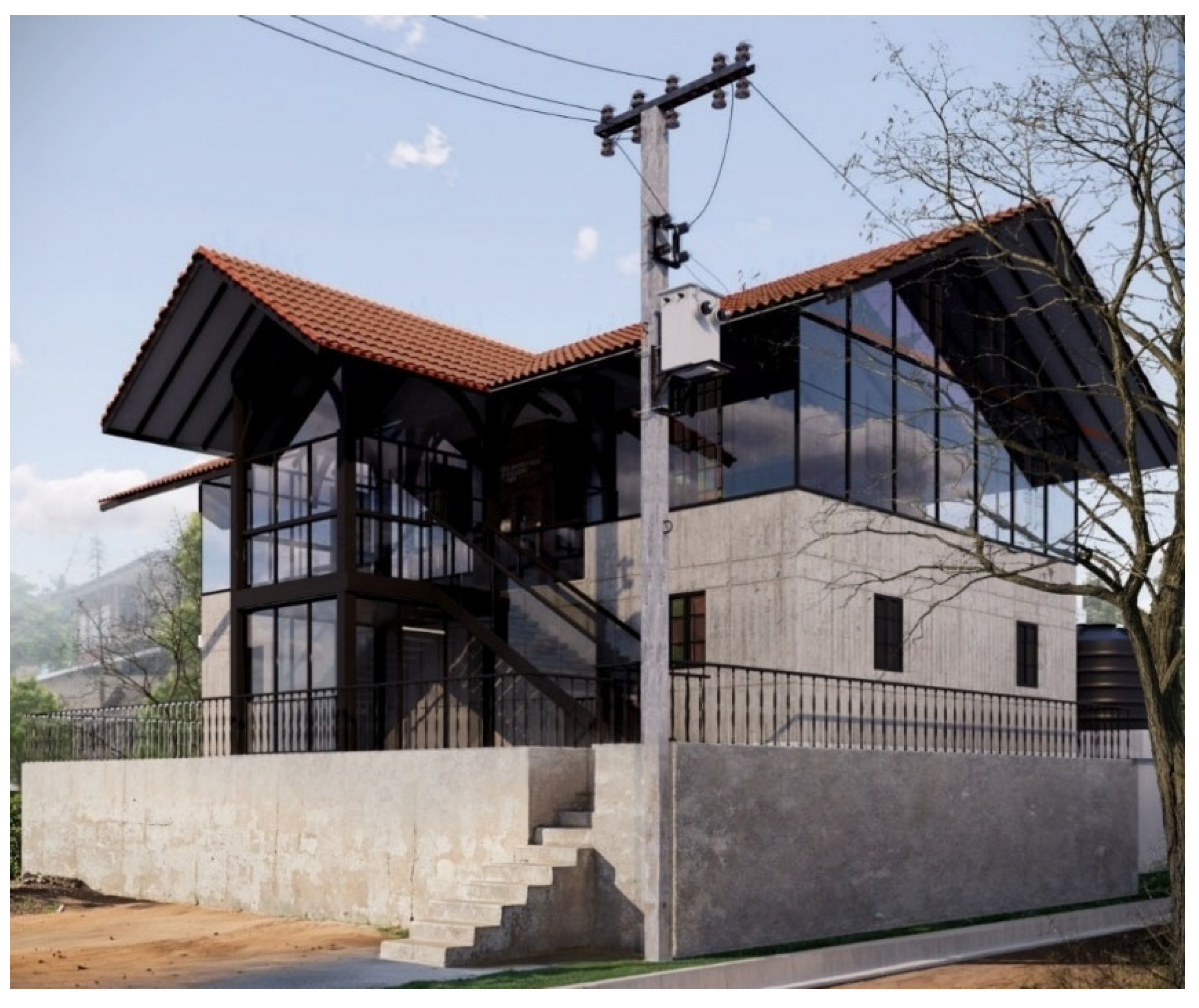
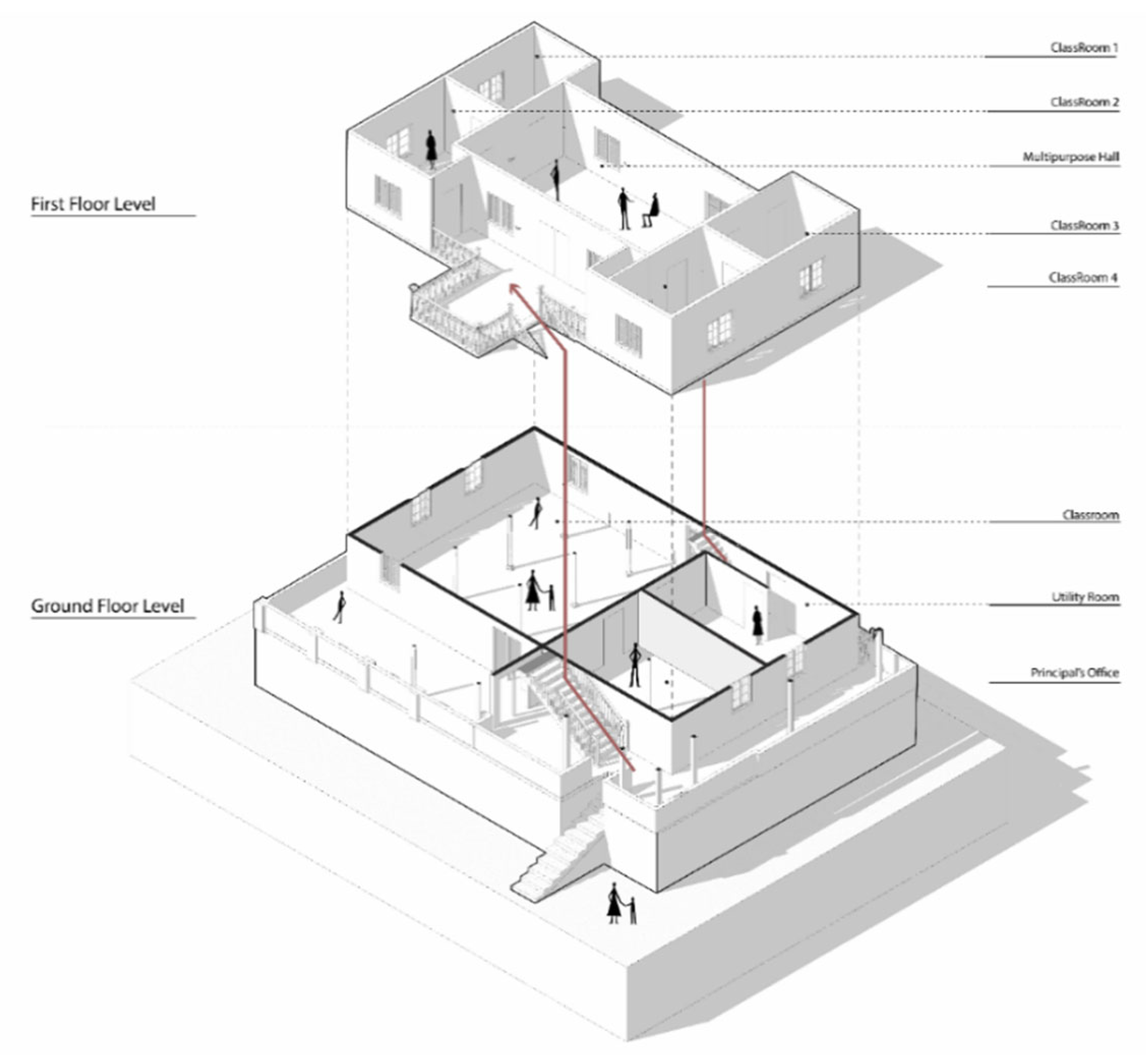
- Alternative 1: Differential (new prevailing over old):
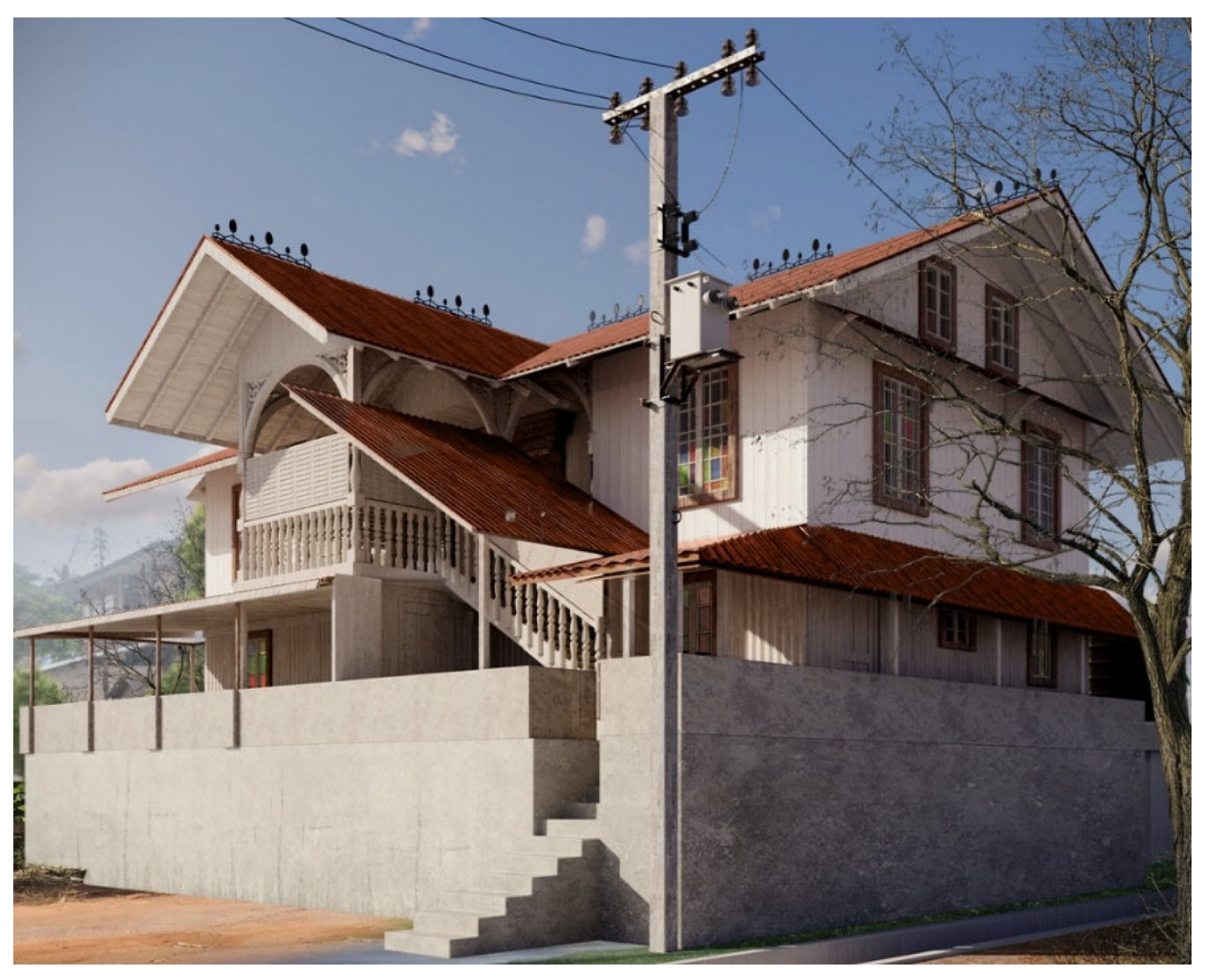
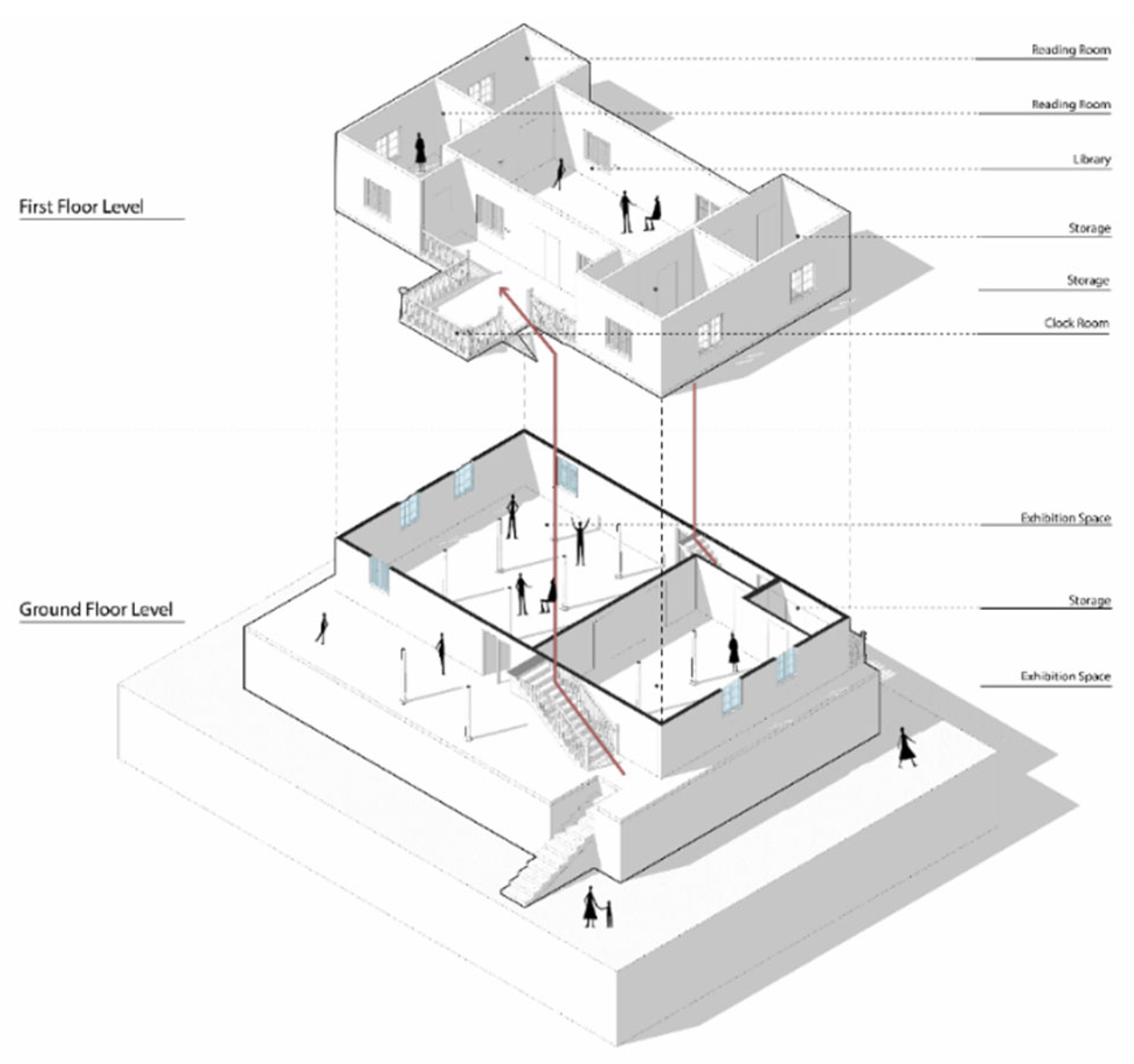
- Alternative 2: Continuity (minimal intervention)
- Alternative 3. Cultivation (stratified dialogue):
- Alternative 4. Optimization (idealized restoration):
4.2. Objectives, Indicators and Criteria
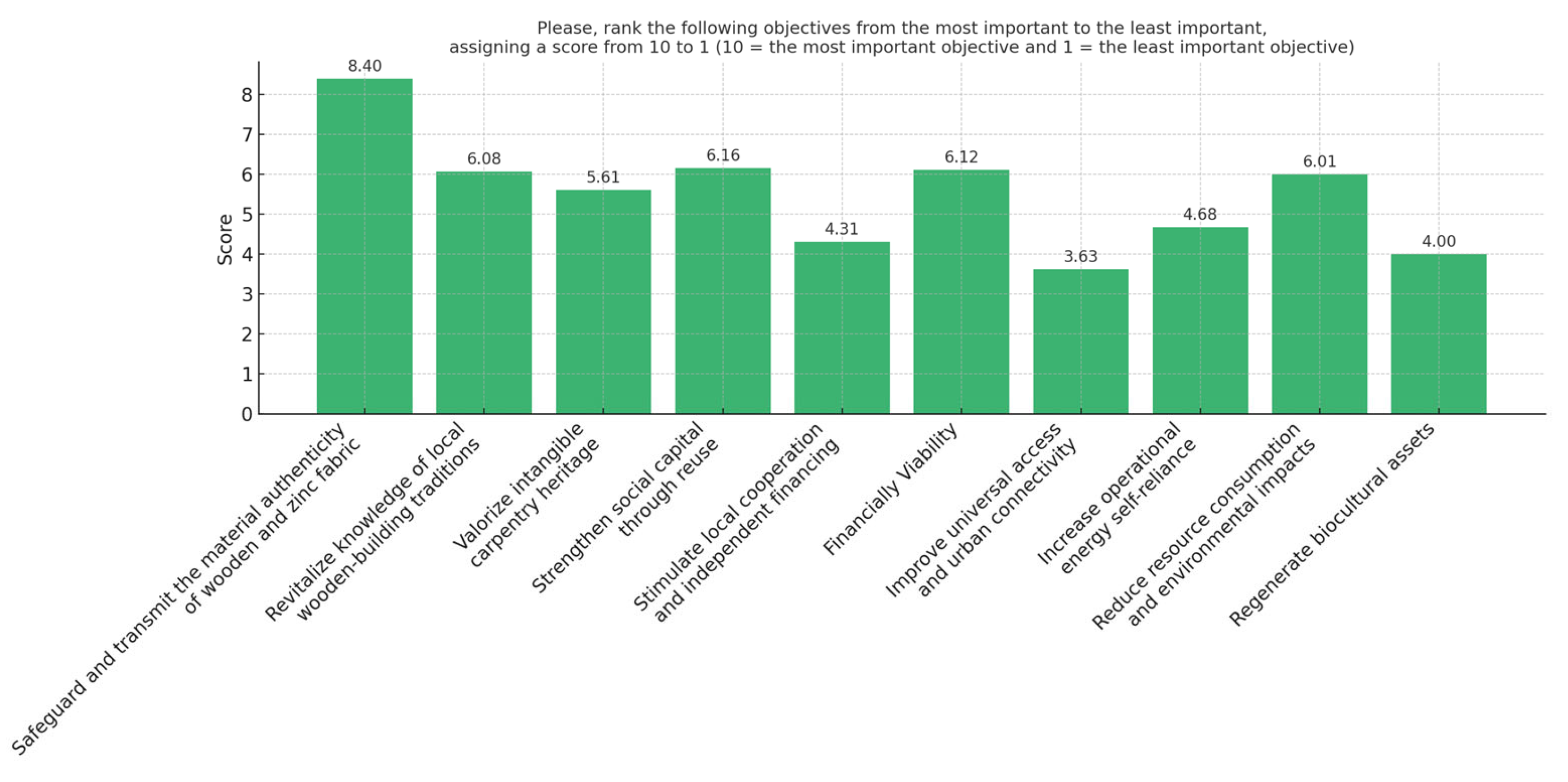
Step 2: Prioritization of the Objectives
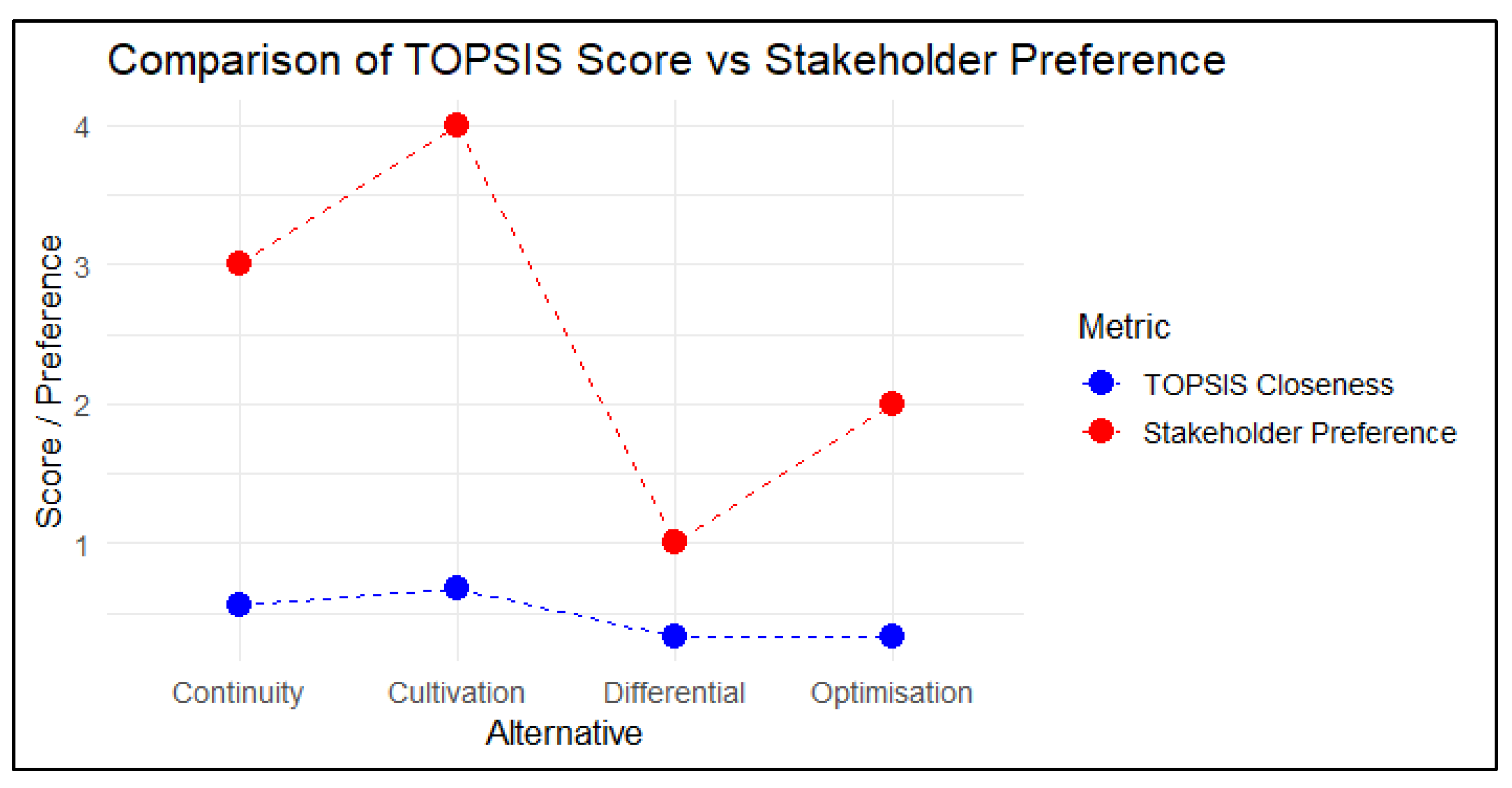
4.3. TOPSIS Evaluation Results
Comparison of TOPSIS Scores and Stakeholder Preferences
4.4. Sensitivity Analysis
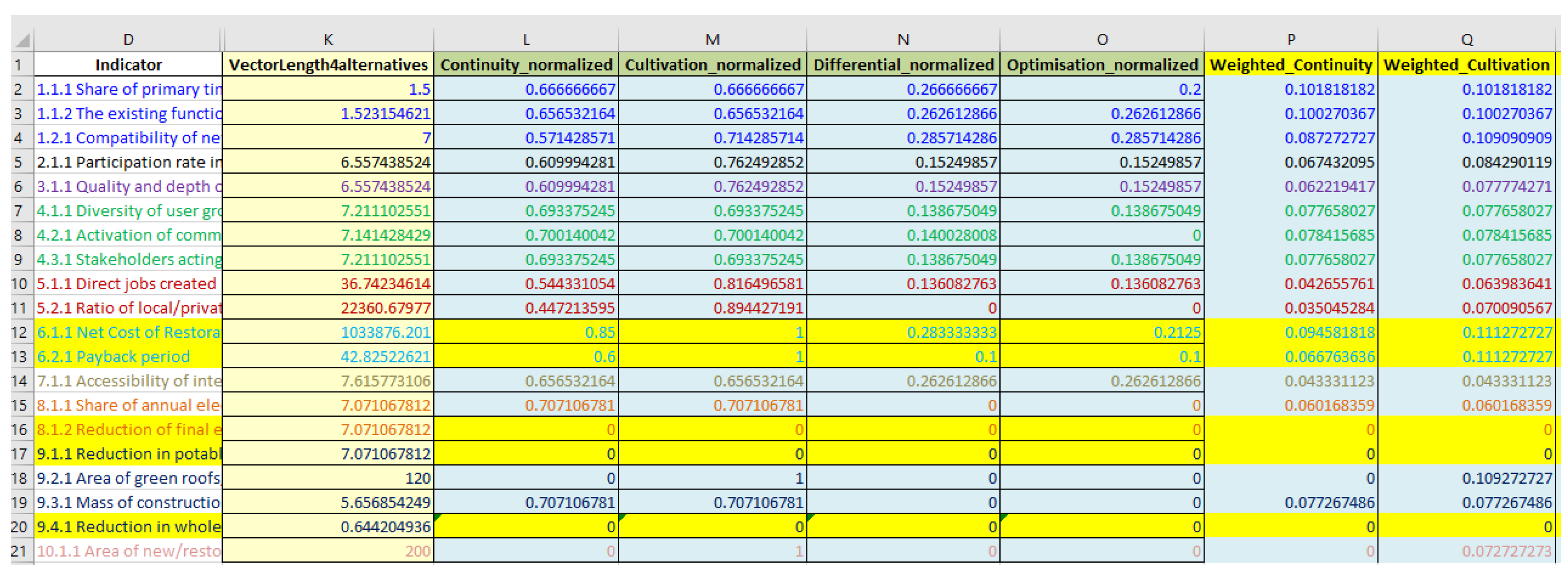
Individual Evaluation of Indicators per Alternative
4.5. Sustainability Dimension
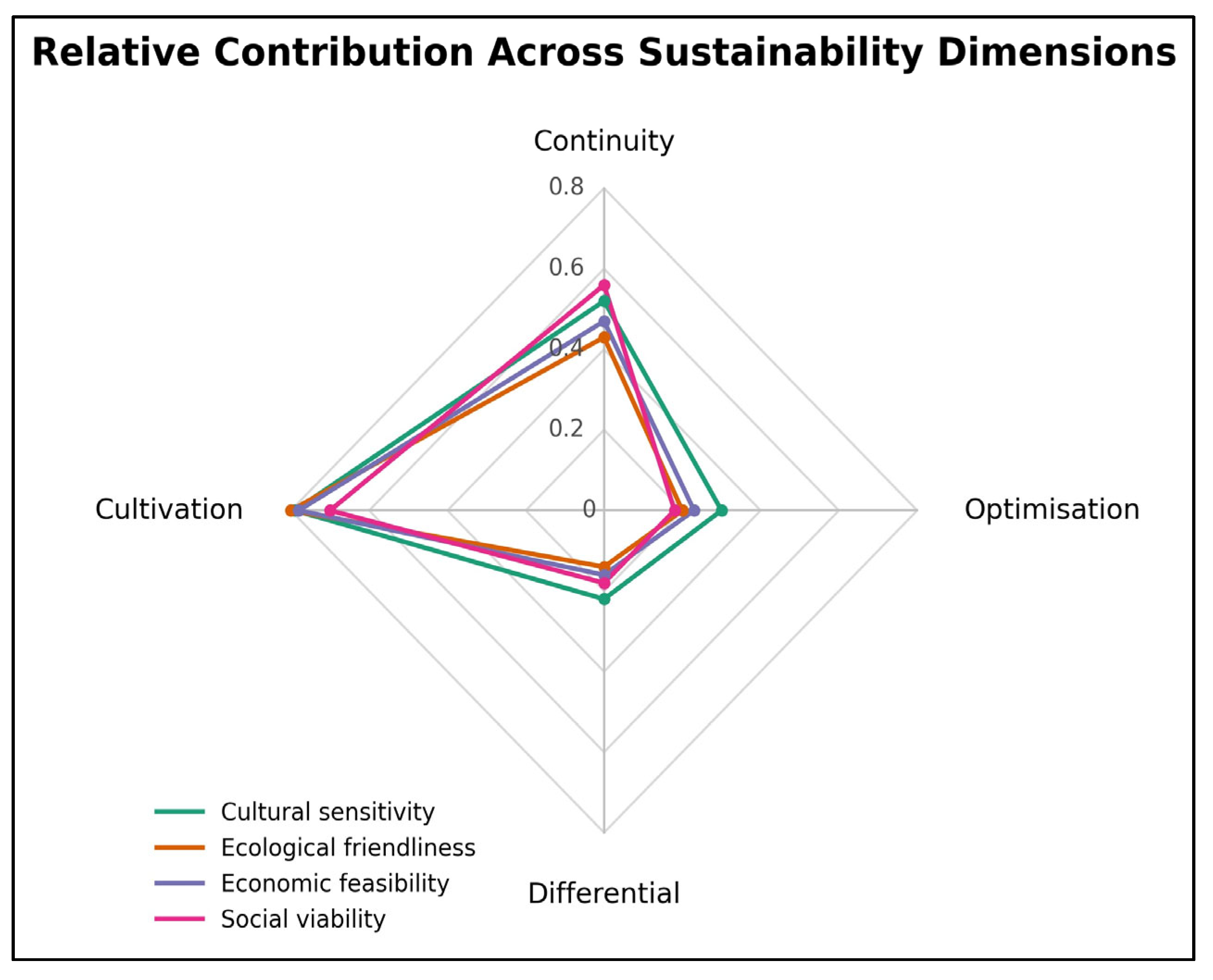
4.5.1. Relative Contribution Across Sustainability Dimensions
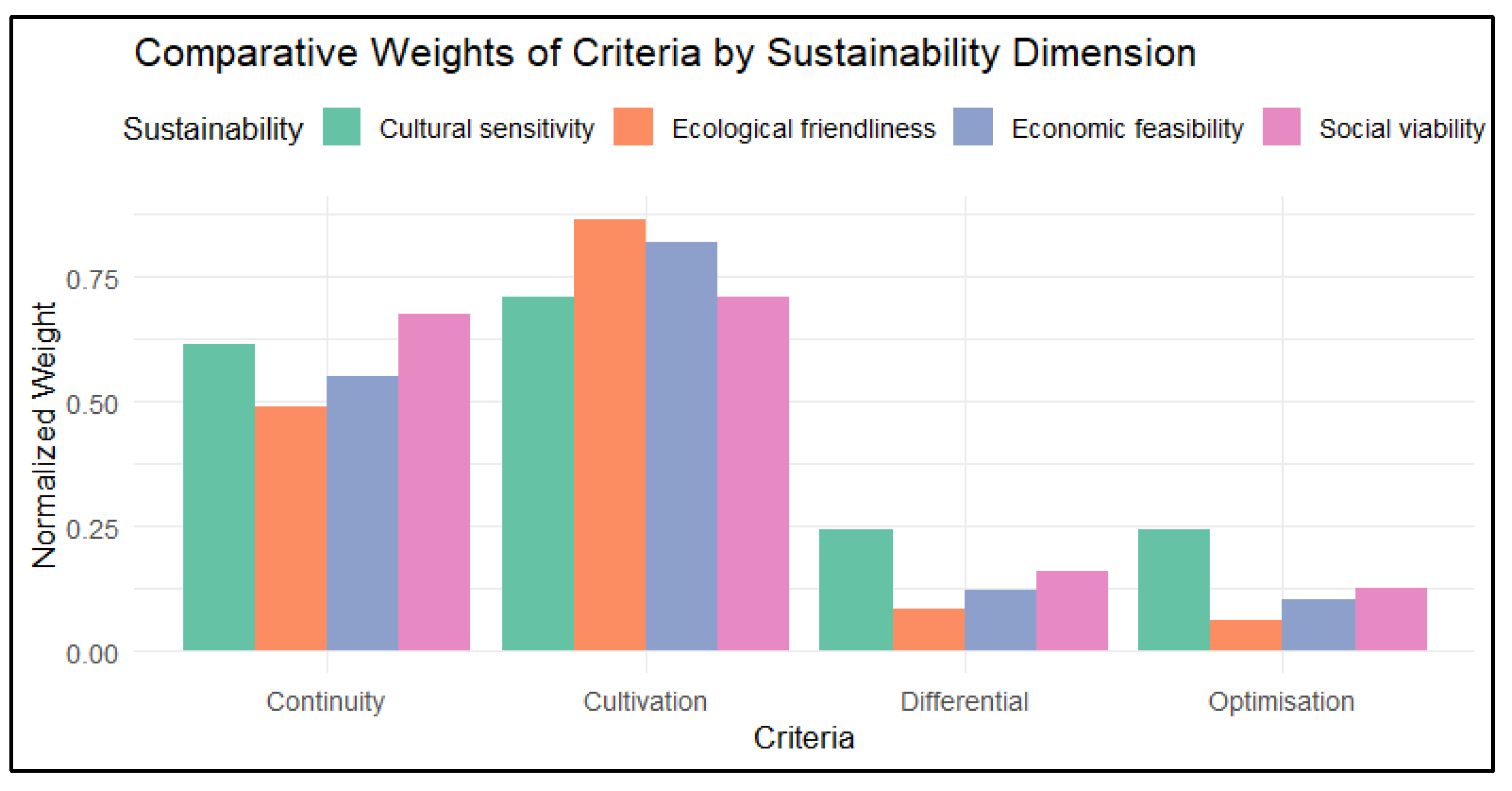
4.5.2. Comparative Weights of Criteria by Sustainability Dimension
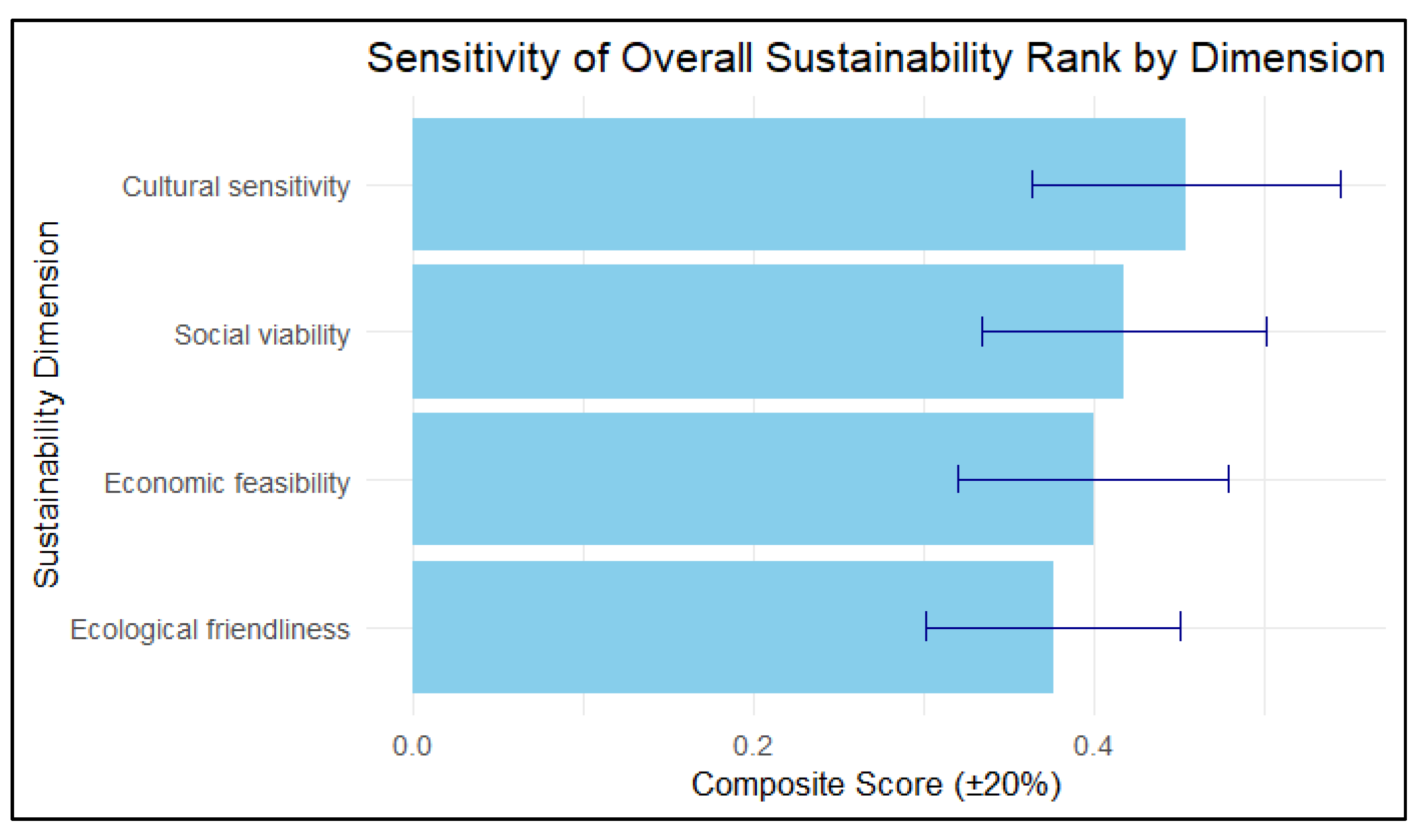
4.5.3. Sensitivity of Overall Sustainability Rank by Dimension
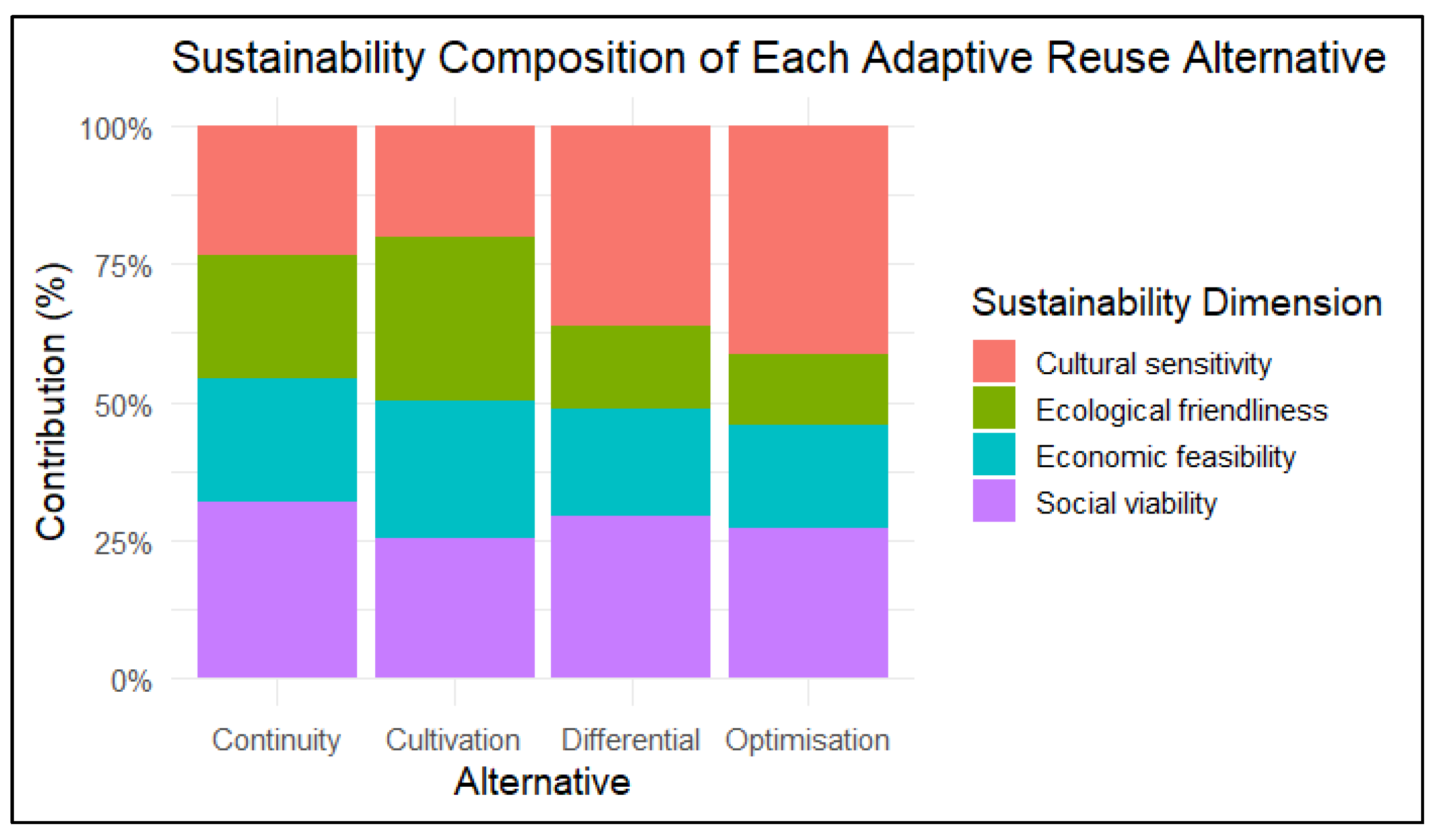
4.5.4. Sustainability Composition of Each Adaptive Reuse Alternative
5. Discussion
6. Conclusions
Funding
Institutional Review Board Statement
Informed Consent Statement
Data Availability Statement
Acknowledgments
Conflicts of Interest
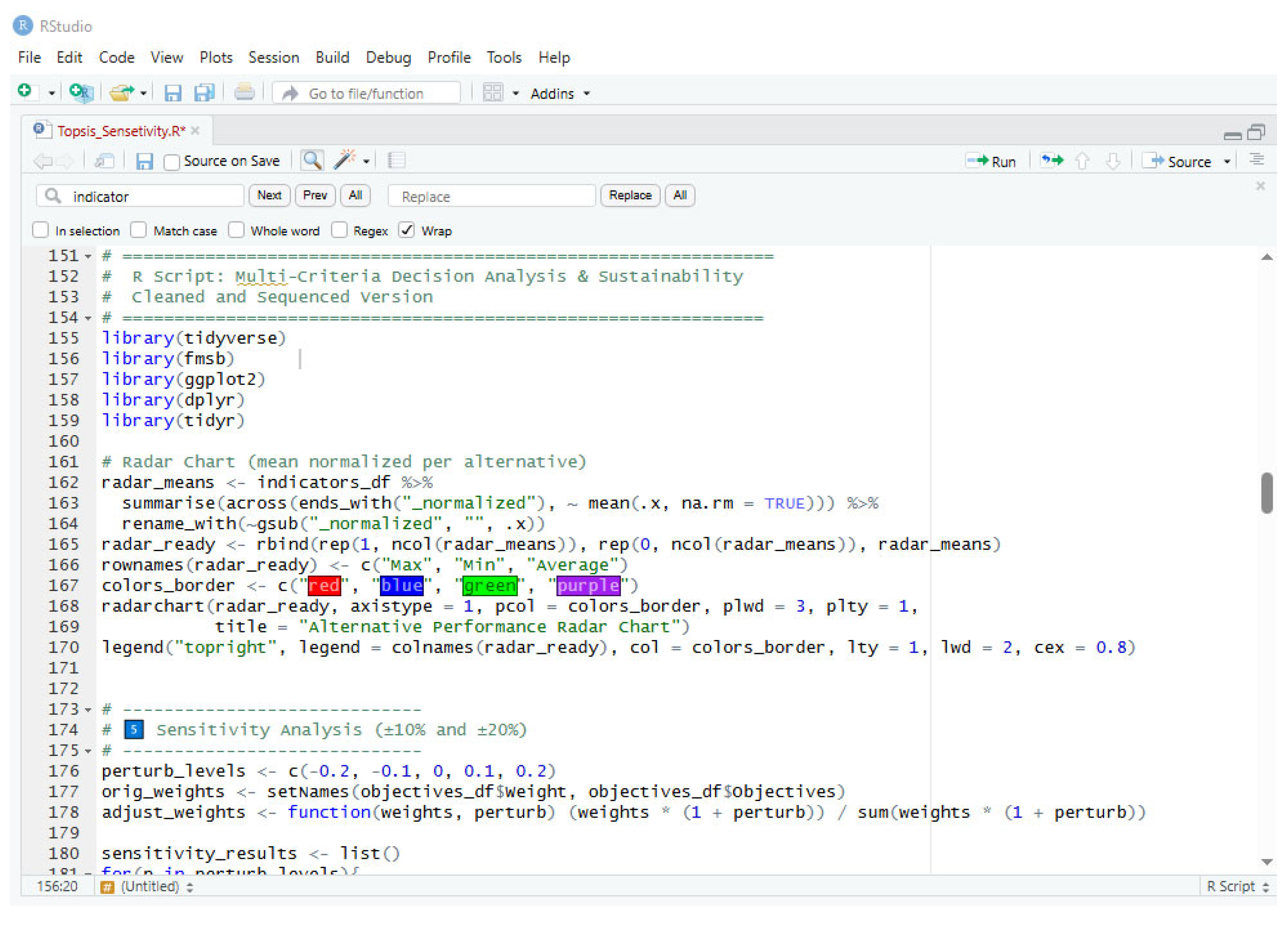
Appendix A. Data Analysis Process in R (Script-Based Analysis)
- —
- Data import and cleaning—Organizing stakeholder weights and performance indicator values.
- —
- Normalization—Standardizing indicator values to a comparable scale (benefit or cost criteria).
- —
- Weight application—Multiplying normalized values by the Simos-derived weights.
- —
- PIS and NIS determination—Identifying the Positive Ideal Solution (PIS) and Negative Ideal Solution (NIS) for each criterion.
- —
- Closeness Coefficient (CC) calculation—Computing the relative closeness of each alternative to the ideal solution.
- —
- Ranking—Generating the final preference order of adaptive reuse alternatives based on CC values.

- —
- Weight calculation using Simos method (ordinal-to-cardinal conversion).
- —
- Normalization of indicators using benefit/cost criteria formulas.
- —
- Weighted score computation across all objectives.
- —
- PIS and NIS identification and distance measurement using Euclidean distance.
- —
- Closeness Coefficient (CC) calculation and final ranking of alternatives


| Objectives | Score | Weight |
|---|---|---|
| 1. Safeguard and transmit the material authenticity of wooden and zinc fabric | 8.4 | 0.152727273 |
| 2. Revitalize knowledge of local wooden-building traditions | 6.08 | 0.110545455 |
| 3. Valorize intangible carpentry heritage | 5.61 | 0.102 |
| 4. Strengthen social capital through reuse | 6.16 | 0.112 |
| 5. Stimulate local cooperation and independent financing | 4.31 | 0.078363636 |
| 6. Financial Viability | 6.12 | 0.111272727 |
| 7. Improve universal access and urban connectivity | 3.63 | 0.066 |
| 8. Increase operational energy self-reliance | 4.68 | 0.085090909 |
| 9. Reduce resource consumption and environmental impacts | 6.01 | 0.109272727 |
| 10. Regenerate biocultural assets | 4 | 0.072727273 |
| Alternative | S_Plus_DistanceToPIS | S_Minus_DistanceToNIS | Closeness_Coefficient | Rank |
|---|---|---|---|---|
| Continuity | 0.167458615 | 0.209725702 | 0.556029751 | 2 |
| Cultivation | 0.133070098 | 0.265560218 | 0.666181691 | 1 |
| Differential | 0.258888013 | 0.129375731 | 0.333216102 | 4 |
| Optimisation | 0.265560218 | 0.133070098 | 0.333818309 | 3 |

Appendix B. The Qualitative and Quantitative Indicators for Each Proposed Alternative for the Egbo Egbo Bassey House
| Alternatives | Objective (No.) | 1. Safeguard and transmit the material authenticity of wooden and zinc fabric | 2. Revitalize knowledge of local wooden-building traditions | 3. Valorize intangible carpentry heritage | 4. Strengthen social capital through reuse | 5. Stimulate local cooperation and independent financing | |||||
| Criteria (ID) | 1.1 Structural soundness of timber | 1.2 Functional compatibility with heritage values | 2.1 Community heritage literacy | 3.1 Narrative interpretation and storytelling | 4.1 Inclusivity breadth | 4.2 Community participation | 4.3 Co-creation intensity | 5.1 Job creation | 5.2 Leveraged local co-financing | ||
| Indicator description | 1.1.1 Share of primary timber members (posts, beams, trusses) retained after intervention | 1.1.2 The existing functional characteristics of the wooden members are retained | 1.2.1 Compatibility of new uses with character-defining wooden features (joinery, finishes, spatial order) | 2.1.1 Participation rate in carpentry demonstrations linked to the proposal | 3.1.1 Quality and depth of interpretation of timber craft (through restoration and new construction) | 4.1.1 Diversity of user groups (age, gender, ability) engaged in building construction | 4.2.1 Activation of community activities in the building construction process | 4.3.1 Stakeholders acting as co-producers (community orgs, artisans, schools) | 5.1.1 Direct jobs created by the adaptive reuse (operation + maintenance + monitoring) | 5.2.1 Ratio of local/private contributions to total project cost | |
| Continuity Approach | Unit of measure | % of original building material retained | % of original building material characteristics retained | Ordinal (5-point expert panel) | Ordinal (5-point expert panel) | Ordinal (5-point expert panel) | Ordinal (5-point expert panel) | Ordinal (5-point expert panel) | Ordinal (5-point expert panel) | Cardinal (number of jobs) | Local contribution (in Euros) |
| Score | 100% | 100% | 4 | 4 | 4 | 5 | 5 | 5 | 20 | 10,000 | |
| Score description | The proposal retains the usage of wooden panels (posts, beams, trusses) with minimal intervention | The proposal selects wood and zinc materials with similar functional characteristics to the existing fabric. Reduced running costs are expected due to reduced use of raw materials, recycling, reuse of products, etc. | The proposal aims to change the use of the building to a museum. This is considered with the wooden characteristics | The proposal aims to be a platform for the revival of traditional carpentry practice | The proposal aims to be a platform for the revival of traditional carpentry practice | The proposal aims to be a platform for social cooperation and inclusion of all genders in the process of restoration | The proposal aims to be a platform for social cooperation and inclusion | The project envisages actions of interaction with the neighbourhood, the creation of a supportive community and the involvement of numerous users. | The project provides for the reduction of youth unemployment through the creation of new jobs deducted from the new activities included. | The project involves local and foreign investors, small and medium enterprises, start-ups, local community. | |
| Cultivation Approach | Score | 100% | 100% | 5 | 5 | 5 | 5 | 5 | 5 | 30 | 20,000 |
| Score description | The proposal retains the usage of authentic wooden panels (posts, beams, trusses) with minimal intervention. The additional local layers imposed on the building are removed. | The proposal retains the usage of authentic wooden panels (posts, beams, trusses—where possible) with minimal intervention. | The proposal aims to change the use of the building to a community library and museum. This is compatible with the wooden characteristics; therefore, the wooden elements will retain their functional contributions to the building. | The proposal aims to be a platform for the revival of traditional carpentry practice through its approach to retaining existing materials where possible and locally sourcing replacement materials. | The proposal aims to be a platform for the revival of traditional carpentry practice through its approach to retaining existing materials where possible and locally sourcing replacement materials. | The proposal aims to be a platform for social cooperation and inclusion of all genders in the process of restoration | The stakeholders engagement is guaranteed by the involvement of the local community, the third sector, professionals, public bodies, local entrepreneurs. | The project envisages actions of interaction with the neighbourhood, the creation of a supportive community and the involvement of numerous users. | involves the creation of community centres as places of social gathering, territorial partnership for a cross fertilization between different sectors | The project involves local and foreign investors, small and medium enterprises, start-ups, local community. The project foresees the Local stakeholders involvement, municipality included. | |
| Differential Approach | Score | 40% | 40% | 2 | 1 | 1 | 1 | 1 | 1 | 5 | 0 |
| Score description | This proposal aims to improve the outlook of the building by using glass material for the construction of the dilapidated parts of the building | The building only retains a fraction of the wooden components. | The building promotes the usage of contemporary material over existing materials | There is no reference to this objective in the proposal | There is no reference to this objective in the proposal | There is no reference to this objective in the proposal | There is no reference to this objective in the proposal | There is no reference to this objective in the proposal | The proposal will retain the building as the private residence of the Egbo Egbo Bassey family. Therefore, there are no reference to social gathering | There is no reference to this objective in the proposal | |
| Optimization Approach | Score | 30% | 40% | 2 | 1 | 1 | 1 | 0 | 1 | 5 | 0 |
| Score description | This proposal aims to retain the tectonic shape of the building, but significantly alter the external outlook by replacing existing materials with modern ones | The building only retains a fraction of the wooden components. | The building promotes the usage of contemporary material over existing materials | There is no reference to this objective in the proposal. | There is no reference to this objective in the proposal | There is no reference to this objective in the proposal | There is no reference to this objective in the proposal | There is no reference to this objective in the proposal | The proposal will become an exhibition centre, therefore, will contribute to social gathering within the community | The proposal will change the use to an exhibition centre for Efik history. Therefore, there are potentials for the building being a catalyst for local/private contributions | |
| Objective (No.) | 6. Financial Viability | 7. Improve Universal Access and Urban Connectivity | 8. Increase Operational Energy Self-Reliance | 9. Reduce Resource Consumption and Environmental Impacts | 10. Regenerate Biocultural Assets | ||||||
| Criteria (ID) | 6.1 Economic value of proposal | 6.2 Financial sufficiency and returns | 7.1 Physical accessibility to the building | 8.1 Energy self-sufficiency and demand reduction | 9.1 Water efficiency | 9.2 Bio-/nature-based components | 9.3 Timber reuse and waste avoidance | 9.4 Life cycle carbon reduction | 10.1 Habitat and biodiversity | ||
| Indicator description | 6.1.1 Net Cost of Restoration | 6.2.1 Payback period | 7.1.1 Accessibility of interior and public interface (ramps, lifts, wayfinding; compliance with standards) | 8.1.1 Share of annual electricity from on-site renewables or renewable PPAs | 8.1.2 Reduction in final energy use versus pre-intervention baseline | 9.1.1 Reduction in potable water use via recovery/reuse systems | 9.2.1 Area of green roofs/walls, rain gardens, or permeable vegetated surfaces delivered | 9.3.1 Mass of construction/demolition waste avoided through salvage and reuse of wood | 9.4.1 Reduction in whole-life GHG emissions compared with a code-compliant new building | 10.1.1 Area of new/restored habitat and biocultural features (e.g., bat boxes, native planting) | |
| Continuity Approach | min/max | max | max | max | max | max | max | max | max | max | max |
| Unite of measure | Economic value (in Euros) | In number of years | Ordinal (5-point expert panel) | Ordinal (5-point expert panel) | Ordinal (5-point expert panel) | Ordinal (5-point expert panel) | Cardinal (m2) | Ordinal (5-point expert panel) | Cardinal (kgCO2e/m2 or %) | Cardinal (m2) | |
| Score | 200,000 | 5 | 5 | 5 | 5 | 5 | 0 | 4 | 0 | 0 | |
| Score description | This project aims to retain existing cultural and material outlook; however, 90% of the existing materials already have poor structural integrity, therefore must be replaced. This replacement cost potentially increases the cost of construction. | The project’s financial returns will be ensured by the generation of revenue streams from the museum. Also, reduced running costs are expected due to reduced use of raw materials, recycling, reuse of materials where possible | The project plans to improve pedestrian accessibility. | The project provides specific actions for energy saving, producing more with less: product life cycle, energy saving, renewable sources. | The project provides specific actions to reduce water consumption and electricity consumption | The project provides specific actions to reduce water consumption. | There is no reference to this objective in the proposal | The project includes as much existing materials where possible. However, 90% of the existing materials cannot be re-used. | There is no reference to this objective in the proposal | There is no reference to this objective in the proposal | |
| Cultivation Approach | Score | 170,000 | 3 | 5 | 5 | 5 | 5 | 120 sqm | 4 | 10% | 200sqm |
| Score description | This proposal aims to retain existing cultural and material outlook; however, 90% of the existing materials already have poor structural integrity, therefore must be replaced. Nonetheless, because the proposal removes the non-compatible elements and additions to the building, it is generally less expensive comparatively. | The proposal financial returns will be ensured by the generation of revenue streams from the museum and also the community library. Also, reduced running costs are expected due to reduced use of raw materials, recycling, reuse of materials where possible | The proposal plans to improve pedestrian accessibility, increase parking areas, create new public spaces with squares, gardens and green paths | All physical intervention on the will include the optimization of natural light, the provision of solar panels. Over 50% of the structures (25000€/tot. sqm) will be based on renewable energy and recycled materials. | The proposal includes a rainwater reuse system and a wastewater purification system. | The proposal provides effective water management through the implementation of rainwater harvesting which makes the building self sufficient. | The project provides the use of nature-based solutions. he proposal provides the use of nature-based solutions through the inclusion of landscape garden around the building. | The proposal foresees the removal of non-compatible elements on the facade of the building. | The proposal will depend solely on green energy to power the building, thereby reducing yearly carbon emission. | The project involves the creation of botanical gardens. | |
| Differential Approach | Score | 600,000 | 30 | 2 | 0 | 0 | 0 | 0 | 0 | 45% | 0 |
| Score description | This project replaces substantial part of the building with new building material, thereby being more expensive | Due to the high cost of construction and the private usage of the facility, there are no potentials for return on investment within two decades | The proposal demonstrates no intention to improve access through car parks or ramps for the people with disabilities | The building will be constructed with glass and other modern materials, therefore the are no potentials for energy efficiency or optimization | There is no reference to this objective in the proposal | There is no reference to this objective in the proposal | There is no reference to this objective in the proposal | This proposal will include demolition of a substantial part of the building; therefore, enormous waste is expected | Since large part of this building will be glass, it is expected that there will be substantial yearly GHG emission. | There is no reference to this objective in the proposal | |
| Optimization Approach | Score | 800,000 | 30 | 2 | 0 | 0 | 0 | 0 | 0 | 45% | 0 |
| Score description | This project replaces substantial part of the building with new building material, thereby being more expensive | Due to the high cost of construction and the private usage of the facility, there are no potentials for return on investment within two decades | The proposal demonstrates no intention to improve access through car parks or ramps for the people with disabilities | The building will be constructed with glass and other modern materials, therefore the are no potentials for energy efficiency or optimization | There is no reference to this objective in the proposal | There is no reference to this objective in the proposal | There is no reference to this objective in the proposal | This proposal will include demolition of a substantial part of the building; therefore, enormous waste is expected | Since large part of this building will be glass, it is expected that there will be substantial yearly GHG emission. | There is no reference to this objective in the proposal | |
References
- Wong, L. Adaptive Reuse: Extending the Lives of Buildings; Birkhäuser: Basel, Switzerland, 2016. [Google Scholar]
- Austin, R.; Woodcock, D.; Steward, W.; Forrester, R. Adaptive Reuse: Issues and Case Studies in Building Preservation; Taylor & Francis Group: Abingdon, UK, 1988. [Google Scholar]
- Arfa, F.H.; Zijlstra, H.; Lubelli, B.; Quist, W. Adaptive reuse of heritage buildings: From a literature review to a model of practice. Hist. Environ. Policy Pract. 2022, 13, 148–170. [Google Scholar] [CrossRef]
- Gaballo, M.; Mecca, B.; Abastante, F. Adaptive reuse and sustainability protocols in Italy: Relationship with circular economy. Sustainability 2021, 13, 8077. [Google Scholar] [CrossRef]
- Olukoya, O.A. Framing the values of vernacular architecture for a value-based conservation: A conceptual framework. Sustainability 2021, 13, 4974. [Google Scholar] [CrossRef]
- Ellen MacArthur Foundation. Growth Within: A Circular Economy Vision for a Competitive Europe; Ellen MacArthur Foundation: Cowes, UK, 2015. [Google Scholar]
- Khalil, I.; Üzümcüoğlu, D. Advancing sustainability and heritage preservation through a novel framework for the adaptive reuse of Mediterranean earthen houses. Sustainability 2025, 17, 6447. [Google Scholar] [CrossRef]
- CIAM. Constatations. Les Ann. Tech. 1933, 44–46, 1183–1188.
- ICOMOS. International Charter for the Conservation and Restoration of Monuments and Sites (The Venice Charter); ICOMOS: Venice, Italy, 1964. [Google Scholar]
- Veldpaus, L.; Fava, F.; Brodowicz, D. Mapping of Current Heritage Re-Use Policies and Regulations in Europe: Complex Policy Overview of Adaptive Heritage Re-Use; OpenHeritage Deliverable 1; OpenHeritage: Budapest, Hungary, 2019. [Google Scholar]
- Chapman, A. Technology as world building. Ethics Place Environ. 2004, 7, 59–72. [Google Scholar] [CrossRef]
- Sabri, R. The uncomfortable truths of adaptive reuse: Faith-to-faith conversion of religious heritage buildings in conflict environments. Int. J. Herit. Stud. 2024, 1–18. [Google Scholar] [CrossRef]
- Lanz, F.; Pendlebury, J. Adaptive reuse: A critical review. J. Archit. 2022, 27, 441–462. [Google Scholar] [CrossRef]
- Orbaşlı, A. Authenticity determination in the context of universalized heritage discourses and localized approaches in the Arabian region. Architecture 2025, 5, 62. [Google Scholar] [CrossRef]
- Langston, C. Validation of the adaptive reuse potential (ARP) model using iconCUR. Facilities 2012, 30, 105–123. [Google Scholar] [CrossRef]
- Langston, C.; Chan, E.; Yung, E. Hybrid input-output analysis of embodied carbon and construction cost differences between new-build and refurbished projects. Sustainability 2018, 10, 3229. [Google Scholar] [CrossRef]
- Günçe, K.; Mısırlısoy, D. Assessment of adaptive reuse practices through user experiences: Traditional houses in the walled city of Nicosia. Sustainability 2019, 11, 540. [Google Scholar] [CrossRef]
- Vardopoulos, I. Adaptive reuse for sustainable development and land use: A multivariate linear regression analysis estimating key determinants of public perceptions. Heritage 2023, 6, 809–828. [Google Scholar] [CrossRef]
- Vardopoulos, I. Industrial building adaptive reuse for museum: Factors affecting visitors’ perceptions of the sustainable urban development potential. Build. Environ. 2022, 222, 109391. [Google Scholar] [CrossRef]
- Conejos, S.; Yung, E.H.K.; Chan, E.H.W. Evaluation of urban sustainability and adaptive reuse of built heritage areas: A case study on conservation in Hong Kong’s CBD. J. Des. Res. 2014, 12, 260. [Google Scholar] [CrossRef]
- Chen, C.-S.; Chiu, Y.-H.; Tsai, L. Evaluating the adaptive reuse of historic buildings through multicriteria decision-making. Habitat Int. 2018, 81, 12–23. [Google Scholar] [CrossRef]
- Parpas, D.; Savvides, A. Sustainable-driven adaptive reuse: Evaluation of criteria in a multi-attribute framework. In WIT Transactions on Ecology and the Environment; WIT Press: Southampton, UK, 2018; Volume 217, pp. 29–37. [Google Scholar]
- Conejos, S. Optimisation of future building adaptive reuse design criteria for urban sustainability. J. Des. Res. 2013, 11, 225. [Google Scholar] [CrossRef]
- Gravagnuolo, A.; Angrisano, M.; Bosone, M.; Buglione, F.; De Toro, P.; Girard, L.F. Participatory evaluation of cultural heritage adaptive reuse interventions in the circular economy perspective: A case study of historic buildings in Salerno (Italy). J. Urban Manag. 2024, 13, 107–139. [Google Scholar] [CrossRef]
- Hasan, H.S.M.; Ab Wahab, L.; Ismail, D. Authenticity in adaptive reuse of heritage building in Malaysia. Int. J. Cult. Herit. 2019, 4. Available online: https://www.iaras.org/iaras/filedownloads/ijch/2019/017-0006(2019).pdf (accessed on 1 February 2026).
- Tu, H.M. The attractiveness of adaptive heritage reuse: A theoretical framework. Sustainability 2020, 12, 2372. [Google Scholar] [CrossRef]
- Simos, J. Evaluer L’impact Sur L’environnement: Une Approche Originale par L’analyse Multicritère et la Négociation; Presses Polytechniques et Universitaires Romandes: Lausanne, Switzerland, 1990. [Google Scholar]
- Roy, B.; Słowiński, R. Multiple Criteria Decision Analysis: State of the Art Surveys; Springer: Berlin/Heidelberg, Germany, 2013; Available online: https://link.springer.com/book/10.1007/978-1-4614-6940-7 (accessed on 27 December 2025).
- Godlewski, J. The Architecture of the Bight of Biafra: Spatial Entanglements; Routledge: London, UK, 2024. [Google Scholar]
- Olukoya, O.A.P.; Olukoya, O.; Haruna, R.G. The architectural documentation of British colonial prefabricated wooden heritage: A case study of a Nigerian national monument. Architecture 2025, 5, 113. [Google Scholar] [CrossRef]
- Carlsson, C.; Zeleny, M. Multiple criteria decision making. J. Oper. Res. Soc. 1983, 34, 1011. [Google Scholar] [CrossRef]
- Fincham, J.E. Response rates and responsiveness for surveys, standards, and the Journal. Am. J. Pharm. Educ. 2008, 72, 43. [Google Scholar] [CrossRef] [PubMed]
- Hsu, C.-C.; Sandford, B.A. The Delphi technique: Making sense of consensus. Pract. Assess. Res. Eval. 2007, 12, 1–8. [Google Scholar]
- Reed, M.S. Stakeholder participation for environmental management: A literature review. Biol. Conserv. 2008, 141, 2417–2431. [Google Scholar] [CrossRef]
- Demir, G.; Chatterjee, P.; Pamucar, D. Sensitivity analysis in multi-criteria decision making: A state-of-the-art research perspective using bibliometric analysis. Expert Syst. Appl. 2023, 237, 121660. [Google Scholar] [CrossRef]
- Europa Nostra. Cultural Heritage Counts for Europe Consortium. Available online: https://www.europanostra.org/our-work/policy/cultural-heritage-counts-europe/ (accessed on 27 December 2025).
- Li, Y.; Zhao, L.; Huang, J.; Law, A. Research frameworks, methodologies, and assessment methods concerning the adaptive reuse of architectural heritage: A review. Built Herit. 2021, 5, 6. [Google Scholar] [CrossRef]
- Braae, E. Beauty Redeemed: Recycling Post-industrial Landscapes; IKAROS Press: Risskov, Denmark, 2015. [Google Scholar]
- Braae, E.; Diedrich, L. Site specificity in contemporary large-scale harbour transformation projects. J. Landsc. Archit. 2012, 7, 20–33. [Google Scholar] [CrossRef][Green Version]
- Hettema, J.; Egberts, L. Designing with maritime heritage: Adaptive re-use of small-scale shipyards in northwest Europe. J. Cult. Herit. Manag. Sustain. Dev. 2020, 10, 130–143. [Google Scholar] [CrossRef]
- Assari, A. Role of public participation in sustainability of historical city: Usage of TOPSIS method. Indian J. Sci. Technol. 2012, 5, 2289–2294. [Google Scholar] [CrossRef]
- Bosone, M.; De Toro, P.; Fusco Girard, L.; Gravagnuolo, A.; Iodice, S. Indicators for ex-post evaluation of cultural heritage adaptive reuse impacts in the perspective of the circular economy. Sustainability 2021, 13, 4759. [Google Scholar] [CrossRef]
- Gravagnuolo, A.; Fusco Girard, L.; Ost, C.; Saleh, R. Evaluation criteria for a circular adaptive reuse of cultural heritage. BDC Boll. Cent. Calza Bini 2017, 17, 185–216. [Google Scholar]
- Hwang, C.L.; Yoon, K. Multiple Attribute Decision Making: Methods and Applications; Springer: Berlin/Heidelberg, Germany, 1981; Available online: https://link.springer.com/book/10.1007/978-3-642-48318-9 (accessed on 27 December 2025).
- Arulnathan, V.; Heidari, M.D.; Doyon, M.; Li, E.P.H.; Pelletier, N. Economic indicators for life cycle sustainability assessment: Going beyond life cycle costing. Sustainability 2023, 15, 846. [Google Scholar] [CrossRef]
- Šestanovic, A.; Qureshi, F.H.; Khawaja, S. Ranking, income diversification, and income size—Are they related? Educ. Res. Theory Pract. 2023, 34, 60–72. [Google Scholar]
- GRI 204; Procurement Practices. Global Reporting Initiative: Amsterdam, The Netherlands, 2016. Available online: https://globalreporting.org/pdf.ashx?id=12401&page=8 (accessed on 27 December 2025).
- International Finance Corporation; World Bank. Harmonized Indicators for Private Sector Operations (HIPSO): Jobs Created—Direct Jobs Created by the Investment. Available online: https://indicators.ifipartnership.org/thematic-area/ (accessed on 27 December 2025).
- Polato, M.; Beltrame, F. Bank’s asset quality review using debt service coverage ratio: An empirical investigation across European firms. In Frontier Topics in Banking; Gualandri, E., Venturelli, V., Sclip, A., Eds.; Palgrave Macmillan Studies in Banking and Financial Institutions; Palgrave Macmillan: Cham, Switzerland, 2019; pp. 225–244. [Google Scholar] [CrossRef]
- Danielsen, B.E.; Baxter, M.N.; Nielsen, P.S. Indicator framework for evaluating building renovation potential. Energies 2024, 17, 846. [Google Scholar] [CrossRef]
- United Nations. Sustainable Development Goal 7 Progress Report. Available online: https://www.un.org/sustainabledevelopment/energy/ (accessed on 27 December 2025).
- ICOMOS. Principles for the Conservation of Wooden Built Heritage; ICOMOS: Paris, France, 2017; Available online: https://icomos.es/wp-content/uploads/2020/01/GA2017_6-3-4_WoodPrinciples_EN_adopted-15122017.pdf (accessed on 27 December 2025).
- U.S. Green Building Council. LEED v5 ID + C Reference Guide. Available online: https://www.usgbc.org/resources/leed-v5-idc-reference-guide (accessed on 27 December 2025).
- Olander, D.N.; Haraldsdóttir, A. The use of recycled materials in sustainable road construction. Int. Acad. J. Innov. Res. 2023, 10, 40–46. [Google Scholar] [CrossRef]
- U.S. Department of Energy. Federal Sustainability Plan 2015; Office of Energy Efficiency and Renewable Energy, Federal Energy Management Program; U.S. Department of Energy: Washington, DC, USA, 2015. Available online: https://www.archives.gov/files/about/plans-reports/sustainability/2015-sustainability-plan.pdf (accessed on 27 December 2025).
- Kayan, B.A.; Jiarou, C.; Shafigh, P. Quantifying embodied carbon expenditure in green maintenance of heritage buildings. Plan. Malays. 2024, 23, 522–537. [Google Scholar]
- European Commission; Directorate-General for Environment. EU Biodiversity Strategy for 2030—Bringing Nature Back into Our Lives; Publications Office of the European Union: Luxembourg, 2021. [Google Scholar]
- Zhao, Q.; Zhang, L.; Hou, J. Developing a cultural sustainability assessment framework for environmental facilities in urban communities. Npj Herit. Sci. 2025, 13, 107. [Google Scholar] [CrossRef]
- Schreuder, E.; van Heel, L.; Goedhart, R.; Dusseldorp, E.; Schraagen, J.M.; Burdorf, A. Effects of newly designed hospital buildings on staff perceptions: A pre-post study to validate design decisions. HERD Health Environ. Res. Des. J. 2015, 8, 77–97. [Google Scholar] [CrossRef]
- United Nations. Sustainable Development Goal 11: Sustainable Cities and Communities. Available online: https://sdgs.un.org/goals/goal11 (accessed on 27 December 2025).
- Mele, C.; Polese, F. Key dimensions of service systems in value-creating networks. In The Science of Service Systems; Springer: Boston, MA, USA, 2011; pp. 37–59. [Google Scholar]
- Zabulis, X.; Partarakis, N.; Demeridou, I.; Doulgeraki, P.; Zidianakis, E.; Argyros, A.; Theodoridou, M.; Marketakis, Y.; Meghini, C.; Bartalesi, V.; et al. A roadmap for craft understanding, education, training, and preservation. Heritage 2023, 6, 5305–5328. [Google Scholar] [CrossRef]
- Liu, Y.; Miller, K. Measuring interpretive quality of traditional carpentry: Development of a multidimensional indicator framework. J. Cult. Herit. 2021, 48, 124–136. [Google Scholar] [CrossRef]
- Fonti, R. Heritage for a sustainable future—The theoretical principle of reversibility and its reflections on architecture. Agathon 2024, 16, 144–155. [Google Scholar] [CrossRef]
- Konsta, A. Built heritage use and compatibility evaluation methods: Towards effective decision making. Structural Studies, Repairs and Maintenance of Heritage Architecture XVI 2019. WIT Trans. Built Environ. 2019, 191, 237–242. [Google Scholar] [CrossRef]
- Yung, E.H.; Chan, E.H. Implementation challenges to the adaptive reuse of heritage buildings: Towards the goals of sustainable, low carbon cities. Habitat Int. 2012, 36, 352–361. [Google Scholar] [CrossRef]
- Bullen, P.A.; Love, P.E.D. Adaptive reuse of heritage buildings. Struct. Surv. 2011, 29, 411–421. [Google Scholar] [CrossRef]
- Plevoets, B.; Van Cleempoel, K. Adaptive Reuse of the Built Heritage: Concepts and Cases of an Emerging Discipline; Routledge: New York, NY, USA, 2019. [Google Scholar]
- Angrisano, M.; Nocca, F.; Scotto Di Santolo, A. Multidimensional evaluation framework for assessing cultural heritage adaptive reuse projects: The case of the Seminary in Sant’Agata de’ Goti (Italy). Urban Sci. 2024, 8, 50. [Google Scholar] [CrossRef]
- Fernández Resta, L. Integration of multi-criteria decision-making in heritage building information management. In Tagungsband 35. Forum Bauinformatik; Stührenberg, J., Al-Zuriqat, T., Chillon Geck, C., Eds.; Technische Universität Hamburg: Hamburg, Germany, 2024; pp. 366–373. [Google Scholar] [CrossRef]
- Ferretti, V.; Bottero, M.; Mondini, G. Decision making and cultural heritage: An application of the Multi-Attribute Value Theory for the reuse of historical buildings. J. Cult. Herit. 2014, 15, 644–655. [Google Scholar] [CrossRef]
- Jato-Espino, D.; Martín-Rodríguez, Á.; Martínez-Corral, A.; Sañudo-Fontaneda, L.A. Multi-expert multi-criteria decision analysis model to support the conservation of paramount elements in industrial facilities. Heritage Sci. 2022, 10, 68. [Google Scholar] [CrossRef]
- Li, W.; Ye, X.; Zhu, B.-W. A decision-making model for the adaptive reuse of ‘buildings of control and reform’: The Nossa Senhora Village, Macau. Humanit. Soc. Sci. Commun. 2025, 12, 1–13. [Google Scholar]
- Liu, X.; Xiao, X.; Tian, C.; Li, H.; Zhu, G. Multi-criteria decision-making in the adaptive reuse of historic buildings: A bibliometric and systematic review of practices in China. J. Asian Archit. Build. Eng. 2025, 1–26. [Google Scholar] [CrossRef]
- Mohamed, B.; Marzouk, M. Post-adaptive reuse evaluation of heritage buildings using multi-criteria decision-making techniques. J. Build. Eng. 2025, 99, 111485. [Google Scholar] [CrossRef]
- Vafaie, F.; Remøy, H.; Gruis, V. Adaptive reuse of heritage buildings: A systematic literature review of success factors. Habitat Int. 2023, 142, 102926. [Google Scholar] [CrossRef]


| Dimension | Objective (No.) | Criteria | Indicator Description | Evaluation Scale |
|---|---|---|---|---|
| Heritage Continuity | 1. Safeguard and transmit the material authenticity of wooden and zinc fabric | 1.1 Structural soundness of timber and zinc materials | 1.1.1 Share of primary timber members (posts, beams, trusses) retained after intervention | Cardinal (%) of original building material retained |
| 1.1.2 The existing functional characteristics of the wooden members are retained | Cardinal (%) of original building material characteristics retained | |||
| 1.2 Functional compatibility with heritage values | 1.2.1 Compatibility of new uses with character-defining wooden features (joinery, finishes, spatial order) | Ordinal (5-point expert panel) | ||
| 2. Revitalize knowledge of local wooden-building traditions | 2.1 Community wooden heritage craft literacy | 2.1.1 Participation rate in heritage carpentry demonstrations linked to the project | Ordinal (5-point expert panel) | |
| 3. Valorize intangible carpentry heritage | 3.1 Narrative interpretation and storytelling regarding values of carpentry heritage | 3.1.1 Quality and depth of interpretation of timber craft (exhibits, signage, digital media) | Ordinal (5-point expert panel) | |
| Social Cohesion | 4. Strengthen social capital through reuse | 4.1 Inclusivity breadth in the restoration process and reuse of building | 4.1.1 Diversity of user groups (age, gender, ability) engaged in building construction | Cardinal (% diversity index)/Ordinal (5-point expert panel) |
| 4.2 Neighbourhood activity activation | 4.2.1 Activation of community activities in the building construction process and building usage | Ordinal (5-point expert panel) | ||
| 4.3 Co-creation intensity | 4.3.1 Stakeholders acting as co-producers (community artisans, school participants) | Ordinal (5-point expert panel) | ||
| Circular and Creative Economy | 5. Stimulate local wood-based entrepreneurship | 5.1 Job creation | 5.1.1 Direct jobs created by the adaptive reuse (operation + maintenance + monitoring) | Cardinal (number of jobs) |
| 5.2 Leveraged local co-financing | 5.2.1 Ratio of local/private contributions to total project cost | Local contribution (in Euros) | ||
| 6. Financial Viability | 6.1 Economic value of proposal | 6.2 Financial sufficiency and returns | Economic value (in Euros) | |
| 6.1.1 Net Cost of Restoration | 6.2.1 Payback period | In number of years | ||
| Access and Environmental Resilience | 7. Improve universal access and urban connectivity | 7.1 Physical and urban accessibility | 7.1.1 Accessibility of interior and public interface (ramps, lifts, wayfinding; compliance with standards) | Ordinal (5-point expert panel) |
| 8. Increase operational energy self-reliance | 8.1 Energy self-sufficiency and demand reduction | 8.1.1 Share of annual electricity from on-site renewables energy | Ordinal (5-point expert panel) | |
| 8.1.2 Reduction in final energy use versus pre-intervention baseline | Cardinal (kWh/m2·yr)/Ordinal (5-point expert panel) | |||
| 9. Reduce resource consumption and environmental impacts | 9.1 Water efficiency | 9.1.1 Reduction in potable water use via recovery/reuse systems | Cardinal (% reduction) | |
| 9.2 Bio-/nature-based components | 9.2.1 Area of green roofs/walls, rain gardens, or permeable vegetated surfaces delivered | Cardinal (m2) | ||
| 9.3 Timber reuse and waste avoidance | 9.3.1 Mass of construction/demolition waste avoided through salvage and reuse of wood | Ordinal (5-point expert panel) | ||
| 9.4 Life cycle carbon reduction | 9.4.1 Reduction in whole-life GHG emissions compared with a code-compliant new build | Cardinal (kgCO2e/m2 or %) | ||
| 10. Regenerate biocultural assets | 10.1 Habitat and urban biodiversity | 10.1.1 Area of new/restored habitat and biocultural features (e.g., bat boxes, native planting) | Cardinal (m2) |
| Objective | Score | Weight |
|---|---|---|
| 1. Safeguard and transmit the material authenticity of wooden and zinc fabric | 8.40 | 0.153 |
| 2. Revitalize knowledge of local wooden-building traditions | 6.08 | 0.111 |
| 3. Valorize intangible carpentry heritage | 5.61 | 0.102 |
| 4. Strengthen social capital through reuse | 6.16 | 0.112 |
| 5. Stimulate local cooperation and independent financing | 4.31 | 0.078 |
| 6. Financial Viability | 6.12 | 0.111 |
| 7. Improve universal access and urban connectivity | 3.63 | 0.066 |
| 8. Increase operational energy self-reliance | 4.68 | 0.085 |
| 9. Reduce resource consumption and environmental impacts | 6.01 | 0.109 |
| 10. Regenerate biocultural assets | 4.00 | 0.073 |
| Alternative | S+ (Distance to PIS) | S− (Distance to NIS) | Closeness Coefficient (CC) | Rank |
|---|---|---|---|---|
| Continuity | 0.1675 | 0.2097 | 0.5560 | 2 |
| Cultivation | 0.1331 | 0.2656 | 0.6662 | 1 |
| Differential | 0.2589 | 0.1294 | 0.3332 | 4 |
| Optimization | 0.2656 | 0.1331 | 0.3338 | 3 |
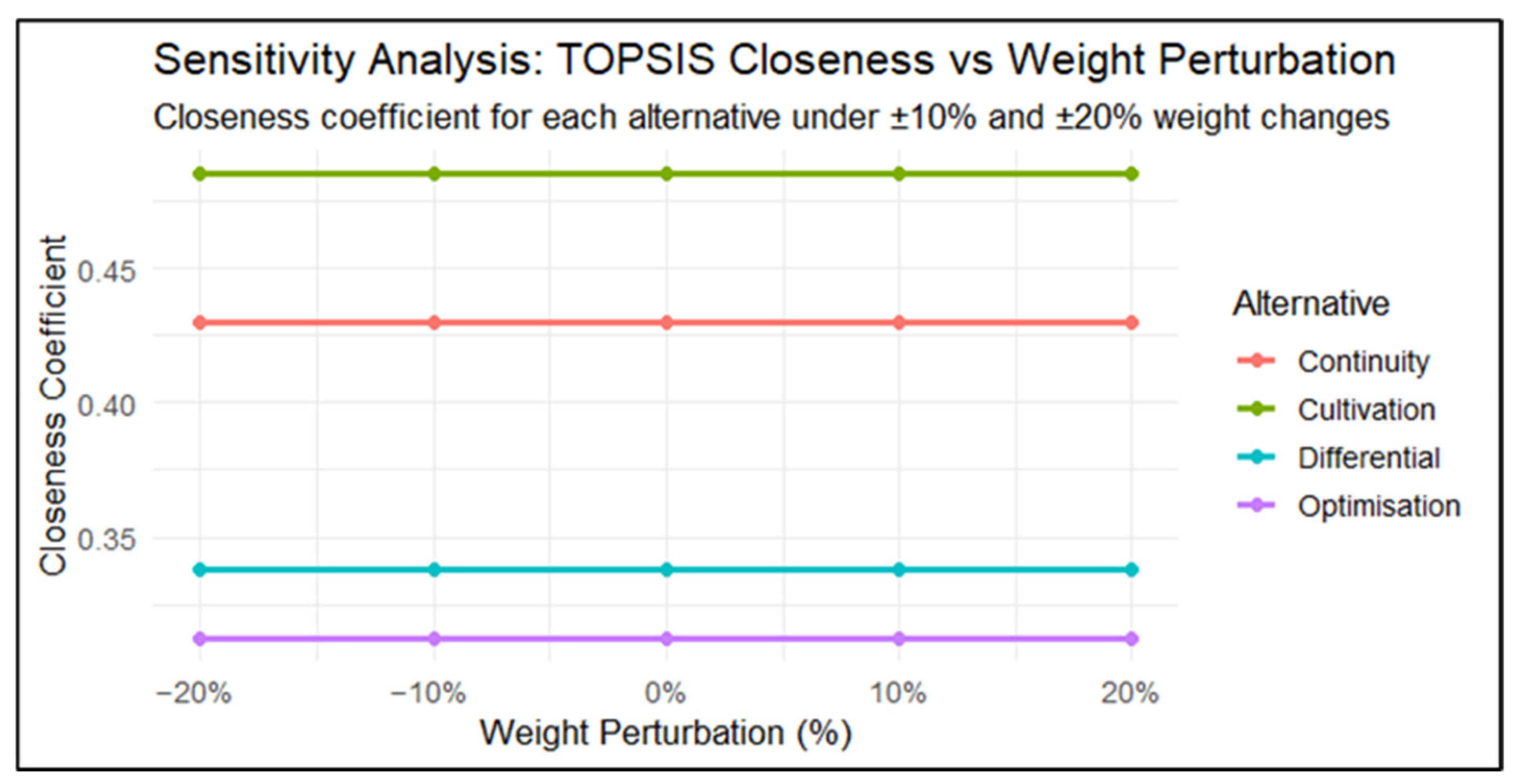
| Perturbation | Continuity | Cultivation | Differential | Optimization |
|---|---|---|---|---|
| −20% | 0.4300 | 0.4851 | 0.3381 | 0.3124 |
| −10% | 0.4300 | 0.4851 | 0.3381 | 0.3124 |
| 0% | 0.4300 | 0.4851 | 0.3381 | 0.3124 |
| 10% | 0.4300 | 0.4851 | 0.3381 | 0.3124 |
| 20% | 0.4300 | 0.4851 | 0.3381 | 0.3124 |
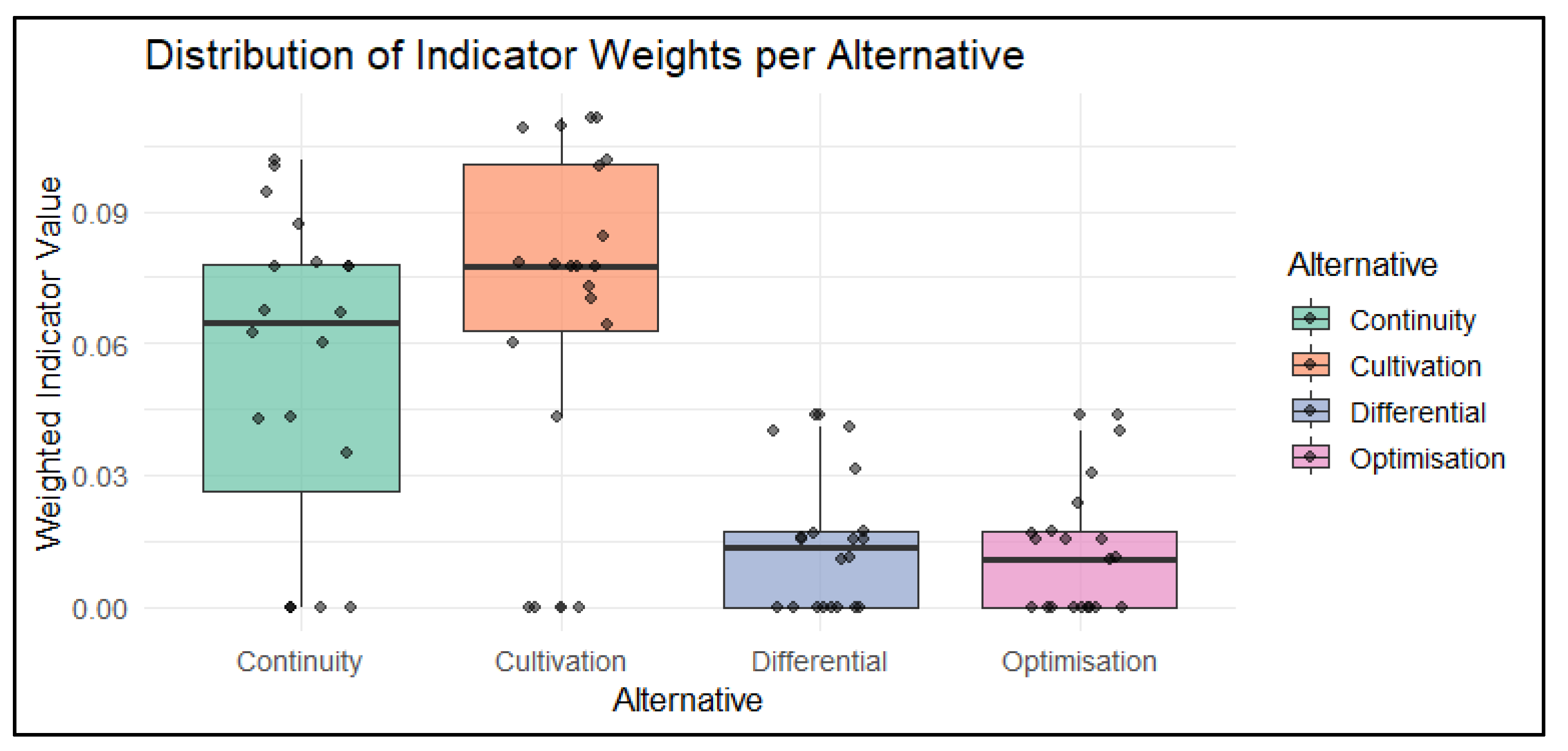
| Indicator No. | Indicator Name | Continuity | Cultivation | Differential | Optimization |
|---|---|---|---|---|---|
| 1.1.1 | Share of primary timber members (posts, beams, trusses) retained after intervention | 0.1 | 0.1 | 0.04 | 0.03 |
| 1.1.2 | The existing functional characteristics of the wooden members are retained | 0.1 | 0.1 | 0.04 | 0.04 |
| 1.2.1 | Compatibility of new uses with character-defining wooden features (joinery, finishes, spatial order) | 0.09 | 0.11 | 0.04 | 0.04 |
| 2.1.1 | Participation rate in carpentry demonstrations linked to the proposal | 0.07 | 0.08 | 0.02 | 0.02 |
| 3.1.1 | Quality and depth of interpretation of timber craft (through restoration and new construction) | 0.06 | 0.08 | 0.02 | 0.02 |
| 4.1.1 | Diversity of user groups (age, gender, ability) engaged in building construction | 0.08 | 0.08 | 0.02 | 0.02 |
| 4.2.1 | Activation of community activities in the building construction process | 0.08 | 0.08 | 0.02 | 0 |
| 4.3.1 | Stakeholders acting as co-producers (community orgs, artisans, schools) | 0.08 | 0.08 | 0.02 | 0.02 |
| 5.1.1 | Direct jobs created by the adaptive reuse (operation + maintenance + monitoring) | 0.04 | 0.06 | 0.01 | 0.01 |
| 5.2.1 | Ratio of local/private contributions to total project cost | 0.04 | 0.07 | 0 | 0 |
| 6.1.1 | Net Cost of Restoration | 0.09 | 0.11 | 0.03 | 0.02 |
| 6.2.1 | Payback period | 0.07 | 0.11 | 0.01 | 0.01 |
| 7.1.1 | Accessibility of interior and public interface (ramps, lifts, wayfinding; compliance with standards) | 0.04 | 0.04 | 0.02 | 0.02 |
| 8.1.1 | Share of annual electricity from on-site renewables or renewable PPAs | 0.06 | 0.06 | 0 | 0 |
| 8.1.2 | Reduction in final energy use versus pre-intervention baseline | 0 | 0 | 0 | 0 |
| 9.1.1 | Reduction in potable water use via recovery/reuse systems | 0 | 0 | 0 | 0 |
| 9.2.1 | Area of green roofs/walls, rain gardens, or permeable vegetated surfaces delivered | 0 | 0.11 | 0 | 0 |
| 9.3.1 | Mass of construction/demolition waste avoided through salvage and reuse of wood | 0.08 | 0.08 | 0 | 0 |
| 9.4.1 | Reduction in whole-life GHG emissions compared with a code-compliant new building | 0 | 0 | 0 | 0 |
| 10.1.1 | Area of new/restored habitat and biocultural features (e.g., bat boxes, native planting) | 0 | 0.07 | 0 | 0 |
| Objective | Top-Contributing Indicator | Highest Weighted Value | Best-Performing Alternative | Interpretation |
|---|---|---|---|---|
| Safeguard and transmit the material authenticity of wooden and zinc fabric | Feature compatibility | 0.109 (Cultivation) | Cultivation | Strong emphasis on compatible material integration and preservation of authentic wooden fabric. |
| Revitalize knowledge of local wooden-building traditions | Carpentry participation | 0.084 (Cultivation) | Cultivation | High engagement of artisans and local trainees reflects cultural transmission of craftsmanship. |
| Valorize intangible carpentry heritage | Craft interpretation | 0.078 (Cultivation) | Cultivation | Effective narrative and interpretive reuse of traditional carpentry techniques. |
| Strengthen social capital through reuse | Community activation | 0.078 (Cultivation and Continuity) | Cultivation/Continuity | Active community participation and social inclusion during the reuse process. |
| Stimulate local cooperation and independent financing | Local contribution | 0.070 (Cultivation) | Cultivation | Greater reliance on local/private co-financing enhances project ownership. |
| Financial Viability | Payback period | 0.111 (Cultivation) | Cultivation | Balanced economic return and cost recovery potential ensure long-term feasibility. |
| Improve universal access and urban connectivity | Accessibility | 0.043 (Cultivation and Continuity) | Cultivation/Continuity | Both alternatives perform equally, showing consistent attention to inclusive design. |
| Increase operational energy self-reliance | Renewable energy share | 0.060 (Cultivation and Continuity) | Cultivation/Continuity | Renewable energy integration remains moderate but balanced. |
| Reduce resource consumption and environmental impacts | Green surfaces | 0.109 (Cultivation) | Cultivation | Cultivation excels in integrating green infrastructure and waste reuse strategies. |
| Regenerate biocultural assets | Habitat restored | 0.073 (Cultivation) | Cultivation | Incorporates ecological and cultural restoration features (habitat and biodiversity). |
| Sustainability | Categories/Factors/Themes | Indicators | Supporting Literature |
|---|---|---|---|
| Economic sustainability | Financial Viability and business model | 1.1 Project net present value (NPV) (cost criterion) | [45] |
| 1.2 Payback period (cost criterion) | [45] | ||
| Market activation and mixed-use intensity | 1.3 Annual revenue diversification index | [46] | |
| Local value chains and procurement | 1.4 Share of spend to local timber/heritage SMEs | [47] | |
| Employment and enterprise | 1.5 Direct jobs created (operation + heritage programming) | [48] | |
| Risk and financial resilience | 1.6 Debt-service coverage ratio (DSCR) | [49] | |
| Environmental sustainability | Energy performance of timber building | 2.1 Reduction in final energy use vs. pre-intervention (cost criterion) | [50] |
| On-site renewables/self-sufficiency | 2.2 Share of annual electricity from renewables | [51] | |
| Timber conservation and fabric retention | 2.3 Percentage of primary timber members retained | [52] | |
| Material circularity (wood salvage and reuse) | 2.4 Mass of salvaged timber reused on site | [53] | |
| Construction and demolition waste diverted | 2.5 C&D waste diversion rate | [54] | |
| Water performance | 2.6 Potable water reduction via reuse/recovery | [55] | |
| Whole-life carbon | 2.7 Life cycle GHG emissions (cost criterion) | [56] | |
| Nature-based solutions and biodiversity | 2.8 New/rehabilitated green area and habitat features | [57] | |
| Social sustainability | Inclusion and equitable access | 3.1 Diversity of users/beneficiaries | [58] |
| Health, safety and comfort | 3.2 post-occupancy comfort and perceived safety | [59] | |
| Accessibility and connectivity | 3.3 Universal access compliance | [60] | |
| Community engagement and co-production | 3.4 Stakeholders acting as co-producers | [61] | |
| Education and skills | 3.5 Heritage carpentry apprenticeships/training | [62] | |
| Cultural sustainability (heritage) | Material authenticity of wooden fabric | 4.1 Compatibility of interventions with character-defining timber features | [55] |
| Intangible heritage and craft continuity | 4.2 Depth/quality of interpretation of carpentry traditions | [63] | |
| Reversibility and minimal intervention | 4.3 Proportion of reversible additions | [9,64] | |
| Fit-for-purpose (use–heritage coherence) | 4.4 Functional compatibility score | [65] |
Disclaimer/Publisher’s Note: The statements, opinions and data contained in all publications are solely those of the individual author(s) and contributor(s) and not of MDPI and/or the editor(s). MDPI and/or the editor(s) disclaim responsibility for any injury to people or property resulting from any ideas, methods, instructions or products referred to in the content. |
© 2026 by the author. Licensee MDPI, Basel, Switzerland. This article is an open access article distributed under the terms and conditions of the Creative Commons Attribution (CC BY) license.
Share and Cite
Olukoya, O.A.P. Evaluating the Sustainable Adaptive Reuse Alternative for Architectural Heritage Through the Multi-Criteria Decision Analysis (MCDA) Method—A Study of a National Monument of Nigeria. Sustainability 2026, 18, 3070. https://doi.org/10.3390/su18063070
Olukoya OAP. Evaluating the Sustainable Adaptive Reuse Alternative for Architectural Heritage Through the Multi-Criteria Decision Analysis (MCDA) Method—A Study of a National Monument of Nigeria. Sustainability. 2026; 18(6):3070. https://doi.org/10.3390/su18063070
Chicago/Turabian StyleOlukoya, Obafemi A. P. 2026. "Evaluating the Sustainable Adaptive Reuse Alternative for Architectural Heritage Through the Multi-Criteria Decision Analysis (MCDA) Method—A Study of a National Monument of Nigeria" Sustainability 18, no. 6: 3070. https://doi.org/10.3390/su18063070
APA StyleOlukoya, O. A. P. (2026). Evaluating the Sustainable Adaptive Reuse Alternative for Architectural Heritage Through the Multi-Criteria Decision Analysis (MCDA) Method—A Study of a National Monument of Nigeria. Sustainability, 18(6), 3070. https://doi.org/10.3390/su18063070