Article

Regulating Ecosystem Services: The Role of Urban Forests in the Removal of Particulate Matter in the Bydgoszcz–Toruń Area (Poland)


by
Fabiana Figurati
1,
Lorenza Nardella
2,
Umberto Grande
1,*,
Dariusz Kamiński
3,
Elvira Buonocore
1,
Pier Paolo Franzese
1,* and
Agnieszka Piernik
3
1
International PhD Programme/UNESCO Chair “Environment, Resources and Sustainable Development”, Department of Science and Technology, Parthenope University of Naples, Centro Direzionale Isola C4, 80143 Naples, Italy
2
Council for Agricultural Research and Economics (CREA), Research Centre for Agricultural Policies and Bioeconomy, Via Barberini 36, 00187 Rome, Italy
3
Department of Geobotany and Landscape Planning, Nicolaus Copernicus University, ulica Lwowska 1, 87-100 Toruń, Poland
*
Authors to whom correspondence should be addressed.
Sustainability 2026, 18(6), 3018; https://doi.org/10.3390/su18063018
Submission received: 29 January 2026 / Revised: 12 March 2026 / Accepted: 13 March 2026 / Published: 19 March 2026
(This article belongs to the Special Issue Green Landscape and Ecosystem Services for a Sustainable Urban System)

Abstract

Air quality improvement represents a critical challenge for the European Union, with particulate matter (PM) being the most harmful pollutant in urban areas. Urban Green Infrastructures (UGIs) provide essential ecosystem services that mitigate air pollution, notably through PM10 removal via deposition on leaf surfaces, reducing health risks associated with poor air quality. This study quantifies the PM10 removal supplied by urban forests in the Bydgoszcz–Toruń area (Poland) using a spatially explicit modeling framework. Remotely sensed Leaf Area Index, vegetation cover, and PM10 concentration data were integrated within a GIS environment, with all analyses conducted on a seasonal basis to capture temporal variability in vegetation phenology and pollutant levels. Resulting maps of mean seasonal PM10 removal efficiency (kg/ha) reveal distinct functional group patterns: deciduous broadleaves reach peak efficiency in summer, whereas conifers provide a more consistent year-round contribution, resulting in the highest annual removal. Monetary valuation was performed using externality costs from the European Environmental Agency. Overall, urban forests remove 3360.40 Mg of PM10 annually, corresponding to an estimated value of 255.69 M€. Integrating biophysical and economic perspectives supports urban planning and highlights UGIs as nature-based solutions to enhance air quality, protect public health and promote ecosystem biodiversity and resilience.

1. Introduction

The number of people living in cities has more than doubled over the last 40 years and is projected to reach over 6.7 billion by 2050 [1]. While urbanization has been linked to increased productivity and improved living standards, it also contributes to environmental degradation, public health issues, housing shortages, congestion, and social inequalities [2]. Despite occupying only approximately 2% of global land, cities are responsible for more than 60% of energy consumption, 70% of greenhouse gas emissions, and 70% of global waste [3]. Although inextricably linked, it is necessary to ensure that socio-economic development and urbanization co-occur sustainably.
Urban agglomerations are found to be among the most polluted places. With an estimated 4.2 million premature deaths in 2019, air pollution emerges as one of the most hazardous environmental risk factors [4]. Among air pollutants, particulate matter (PM) poses significant harm to human health. It consists of a diverse mixture of airborne liquid and solid particles with heterogeneous natures, sizes and physical–chemical properties [5].
The severity of health impacts is related to size. Coarse PM, consisting of particles with diameters of up to 10 µm (PM10), can be inhaled and deposited in the lungs and bronchi [6]; PM10 further comprises a so-called fine fraction (PM2.5), referring to particles with a size equal to or less than 2.5 µm that reach the alveoli and penetrate deeper into the bloodstream [7]. Depending on size, composition, and individual susceptibility, PM may cause a variety of cardiovascular and respiratory problems, including asthma, bronchitis, heart attack, lung-function impairment, cancer, and adverse neurological and developmental effects [5,8,9,10].
Beyond the social dimension, PM pollution can considerably impact a country’s economy due to increased healthcare costs, lost working days across sectors and reduced life expectancy while further damaging natural ecosystems and affecting soil and water quality [11,12,13,14].
In the European context, due to a combination of efforts to strengthen environmental policies and promote technological advancements, air pollution concentrations have declined over the last two decades, resulting in better air quality [15]. Despite the improvements, in 2022, the 83% of the EU urban population was exposed to PM10 concentrations above the World Health Organization’s (WHO) new Air Quality Guidelines [16,17].
In order to align its standards with the new WHO recommendations, and as part of the European Green Deal, in 2022 the European Commission (EC) proposed a revision of its 2008 Ambient Air Quality Directive [18,19], with the values reported in Table 1 together with the corresponding color codes. The background color is used to indicate the air quality grades, ranging from good (blue) to extremely poor (purple) as assigned by the European Air Quality Index (AQI), shown in Table 2 [20].
This commitment was echoed in the Zero Pollution action plan, which set a vision for 2050 to reduce air pollution to levels no longer considered harmful to human health and natural ecosystems. Specifically, the Zero Pollution action plan introduced targets for 2030, aiming to reduce the number of premature deaths caused by air pollution by more than 55% compared to 2005 levels and reduce by 25% the share of EU ecosystems where air pollution threatens biodiversity (the baseline for both is set to 2005 levels) [21].
Data collected by the European Environment Agency (EEA) for the year 2022 related to PM10 show that 16% of EU monitoring stations reported PM10 concentrations above EU daily limit values (50 µm/m3), 84% of which were urban and 12% suburban, clearly pointing to a disproportionately more significant health risk and harmful PM exposure in the urban population. According to the EEA, Poland is among the European countries with the worst air pollution levels, with over 37% of monitoring stations reporting average daily concentrations above EU standards [22]. This is probably because, in most central and eastern European countries, solid fuels such as coal are widely used for heating households and in some industrial facilities and power plants, which, together with an older vehicle fleet, can exacerbate the problem [23]. Furthermore, a reanalysis of 2022 pollution concentration data for Poland is expected to highlight an increase in ambient PM levels due to increased use of wood and coal, as a result of the energy crisis and higher gas prices of the previous years [24].
Ideally, pollution abatement strategies should target emission sources directly; however, this is not always attainable in practice, especially given the marked transboundary character of pollutants in air masses, whereby it is difficult to control concentrations locally [25]. Alternatively, strategies may focus on harnessing the capacity of the natural vegetation to purify ambient air through removal mechanisms involving plant surfaces.
This ability of vegetation to provide a benefit for humans can be intended as part of the provisioning of ecosystem services (ESs), defined as “the benefits people obtain from ecosystems”, which include a wide range of services of various kinds [26,27,28]. The abatement of air pollutants can thus be classified as a Regulating Ecosystem Service (RES), a macro-class of ESs describing the ability of ecosystems to regulate natural processes.
The removal of dangerous air pollutants from the atmosphere is among the most relevant ESs supplied by Urban Green Infrastructures (UGIs), defined as the “strategically planned network of natural and semi-natural areas with other environmental features, designed and managed to deliver a wide range of ecosystem services, while also enhancing biodiversity” [29].
The concept of Green Infrastructure (GI) highlights the quality, as well as quantity, of urban and peri-urban green spaces, emphasizing their multifunctional role and the importance of interconnectivity between habitats [30]. Through the supply of multiple ESs, the multifunctionality of UGI elements, such as urban and peri-urban forests, supports human health and well-being while facing major challenges like climate change and biodiversity loss [31,32]. The strategic planning of UGIs is indeed increasingly promoted as nature-based solutions (NBS), referring to “solutions that are inspired and supported by nature, which are cost-effective, simultaneously provide environmental, social and economic benefits and help build resilience” [33]. The European Union is significantly investing in the Green Deal so that EU member states are encouraged to employ NBSs in urban contexts [34]. In this perspective, NBSs also represent a key approach to promoting biodiversity conservation, strengthening ecosystem resilience, and guiding policymakers toward more sustainable choices while integrating sustainability aspects into urban planning strategies.
In the last fifteen years, the literature on NBSs, and specifically on the role of vegetation in abating PM concentrations in urban areas, has grown considerably [35,36], with particular attention paid to woody vegetation and a special focus on investigating the morpho-functional traits influencing PM removal efficiency displayed by different types of vegetation [37]. Other than local meteorological conditions (e.g., air humidity, temperature, intensity and prevailing wind direction), leaf macro-morphological and micro-anatomical characteristics (i.e., width of the lamina, surface roughness, the presence of leaf grooves, stomatal density, presence of cuticular waxes and trichomes, etc.) have been found to influence PM removal [38]. For example, Nowak [39] found that small leaves and leaves with rough surfaces are more efficient at retaining PM than wider leaves with smooth surfaces. Additionally, Zhang et al. [40] found leaf surfaces with a high density of trichomes to be linked to an increase in the rate of PM deposition, while a high petiole length pointed to a lower deposition rate. Another study highlighted a positive correlation between wax content, leaf hair and PM accumulation [41].
The present study presents a biophysical assessment of the ESs of PM10 removal provided by urban and peri-urban forests in the Bydgoszcz–Toruń agglomeration, located in the Cuiavia–Pomeranian Voivodeship region (Poland). More specifically, for the year 2018, we have estimated the PM10 removal efficiency and total PM10 removal by two Functional Groups (FGs) of vegetation (conifers and deciduous broadleaves) on a seasonal basis, further providing a monetary estimation for the ES.

2. Materials and Methods

2.1. Study Area

The Bydgoszcz–Toruń metropolitan area (Poland) covers approximately 3860 km2 and is centered around the two cities of Bydgoszcz and Toruń, which serve as the administrative capitals and economic hubs of the Kuyavian–Pomeranian Voivodeship, the region to which they belong. The two urban centers are about 40 km apart, and both are traversed by the Vistula River. The total population of the study area is approximately 700,000 residents.
The climate is classified as temperate transitional, marked by considerable meteorological variability and significant seasonal changes. Between 1966 and 2020, the average annual temperature in the municipality of Toruń was 8.4 °C. The highest average monthly temperature was recorded in July (18 °C), while the lowest occurred in January (−1.8 °C). The greatest variation in monthly average temperatures is observed during the winter months, particularly in January, with extremes ranging from −12.2 °C in 1987 to 3.9 °C in 2007 [42]. The average annual precipitation is 605.49 mm.
The combination of extremely cold temperatures and the widespread reliance on fossil fuels for various purposes makes Poland a particularly critical hotspot for air pollution, especially PM.
PM pollution in Poland has been linked to serious impacts on human health. In 2016, according to two different reports by the World Bank and the EEA, respectively, 25,850 and 44,500 premature deaths were attributed to excessive PM2.5 exposure, the former corresponding to over 6% of total mortality in Poland, with an average of 66 people every 100,000 inhabitants [43]. In 2021, the total number of premature deaths increased to 47,300 [22]. Exposure to PM2.5 represents a big problem for the healthcare system and also leads to a reduction in productivity among the Polish population. In 2016, it was estimated that 23% of bronchitis in children and 33% of chronic bronchitis in adults were caused by exposure to PM2.5 [43].
The various macroeconomic sectors of the Polish economy each contribute to a different amount of air pollution emissions. The official inventory created by the Ministry of the Environment’s National Centre for Emissions Management (KOBiZE) classified the “non-industrial combustion plants” of the residential sector as the primary source of PM10 emissions. This depends on the widespread use of woody biomass combustion and the use of fossil fuels to heat domestic and commercial environments during the harsh winter months [44]. This explains why urban agglomerations in Poland are usually predominantly affected by air pollution during the coldest period.

2.2. Land Cover

An essential preliminary step in estimating the removal of atmospheric PM by vegetation is the classification of the arboreal vegetation into vegetation types based on the morpho-functional traits, which allowed for the identification of two FGs: coniferous and deciduous broadleaf trees. To this purpose, the 2018 Forest Type High-Resolution Layer provided by Copernicus Land Monitoring Service (CLMS) at the European scale [45], with 10 m spatial resolution, was used. The vegetation data were validated by photointerpretation using satellite imagery from Sentinel-2 that show the natural colors of the RGB bands for summer and winter 2018 (10 m resolution). This classification was also supported by the comparison with a second vegetation map performed using the database from the General Directorate of State Forest of Poland website “Bank Danych o Lasach” [46], used to reclassify tree species (a total of 42) into the two FGs. This database was especially useful in identifying the trees present in the area at the species level.

2.3. Leaf Area Index

The Leaf Area Index (LAI) is defined as half the total area of green elements in the canopy per unit of horizontal ground area [47]. This index is fundamental to estimating the canopy cover for both FGs, tracing their patterns throughout the seasons. LAI data were obtained from the Copernicus Global Land Service (CLMS) at 300 m, collected at a global scale and on a 10-day basis by the miniature satellite PROBA-V, in operation until approximately mid-2021. Decadal LAI products are delivered in real-time and in several progressively more validated versions. Here, we selected the most consolidated (RT6). Temporal aggregation was performed on a seasonal basis, taking into consideration the phenological characteristics of the two FGs (Table 3).
Assuming the functional processes and structural characteristics that underpin PM10 removal can be guaranteed only by fully developed leaves, spring for deciduous broadleaves was set to the 21st of April to the 31st of May and autumn from the 1st of September to the 10th of October, based on the values observed in the AGROMETEO IMGW-PIB phenological maps for the year 2018 [48]. Following the same reasoning, due to the loss of foliage during the cold season, winter LAI for deciduous broadleaves was arbitrarily set to 0. Also, conifers follow the same phenological seasons, considering fluctuations in the canopy and the period of vegetative growth [49]. The only exception regards their needles: even if less abundant, they can continue to remove the PM10 from the atmosphere during the wintertime. For that reason, the PM10 removal was also estimated in the period from 11th October to 20th April in the case of this FG. All elaborations were carried out using the open-source software GRASS GIS version 8.3.1.

2.4. PM10 Concentrations

PM10 concentration data for the year 2018 were obtained from the Copernicus Atmosphere Monitoring Service (CAMS) [50]. The regional air quality production of CAMS is based on 11 state-of-the-art air quality models developed in Europe; individual outputs from the 11 models are further combined to provide a median value, referred to as the ENSEMBLE, which currently provides the best estimates. The regional air quality models provide daily forecasts and daily reanalyses, the latter obtained by assimilating 1-day-old observations with the models, for the main atmospheric pollutants across the European territory. Besides the near-real-time production, validated reanalyses of previous years are produced by combining revised versions of daily reanalyses, a high number of observations, weather modeling and better-quality control [51]. PM10 concentration data for the year 2018 were downloaded as validated reanalyses from the CAMS Atmosphere Data Store [52] as monthly average rasters in NetCDF format for concentrations at ground level. These rasters were subsequently processed in R-studio, using R version 4.2.2, to produce maps of average seasonal PM10 concentration in GeoTIFF format over the study area. The resulting rasters maintained the original spatial resolution of 0.1° × 0.1°, roughly corresponding to a 10 × 10 km grid.

2.5. PM10 Removal Efficiency

For the ES of PM10 removal by vegetation, we used a model for the biophysical estimation of PM10 deposition presented by Nowak [39]. This model was then modified and applied in subsequent studies with the purpose of investigating the role of functional diversity in vegetation in regulating PM10 removal from the atmosphere [53,54,55,56].
The model proposed below allows for the estimation of PM10 deposition on vegetation to be calculated:
Q = F × L × T
where Q (kg/ha) refers to the amount of PM10 deposited on the leaf surface; F (kg/ha × s) indicates the particulate flow; L represents the LAI (m2/m2); and finally, T (s) expresses the time range considered for the removal calculation in relation to the phenological characteristics of the vegetation. For this study, the time range considered for conifers was 365 days, while for deciduous broadleaves, it was 172 days (from 21st April to 10th October).
F was calculated as follows:
F = Vd × C
where C indicates the PM10 concentration, and Vd represents the particle deposition velocity on the leaf cuticle. Since a Vd value of 0.0064 m/s was estimated for a LAI value of 6 [57], we used the following approximation:
Vd = 0.0064/6 × LAI
PM10 removal modeling allowed us to obtain maps of average seasonal removal efficiency (kg/ha), from which we estimated total removal per season and per FG by summing over the total surface covered by each FG. All modeling was performed in GRASS GIS version 8.3.1.

2.6. Monetary Evaluation Method

The monetary valuation in this paper is based on values provided by the Report “Estimating the External Costs of Industrial Air Pollution: Trends 2012–2021” by the EEA in collaboration with the European Topic Centre on Human Health and the Environment (ETC-HE). Marginal damage costs (MDCs) for impacts on health, crops, forests, ecosystems and buildings are reported for the main air pollutants for the year 2019. In the case of Poland, the value of externalities for PM10 in 2019 is 76,089 €(2021)/Mg [57].

3. Results

3.1. Forest Vegetation Cover

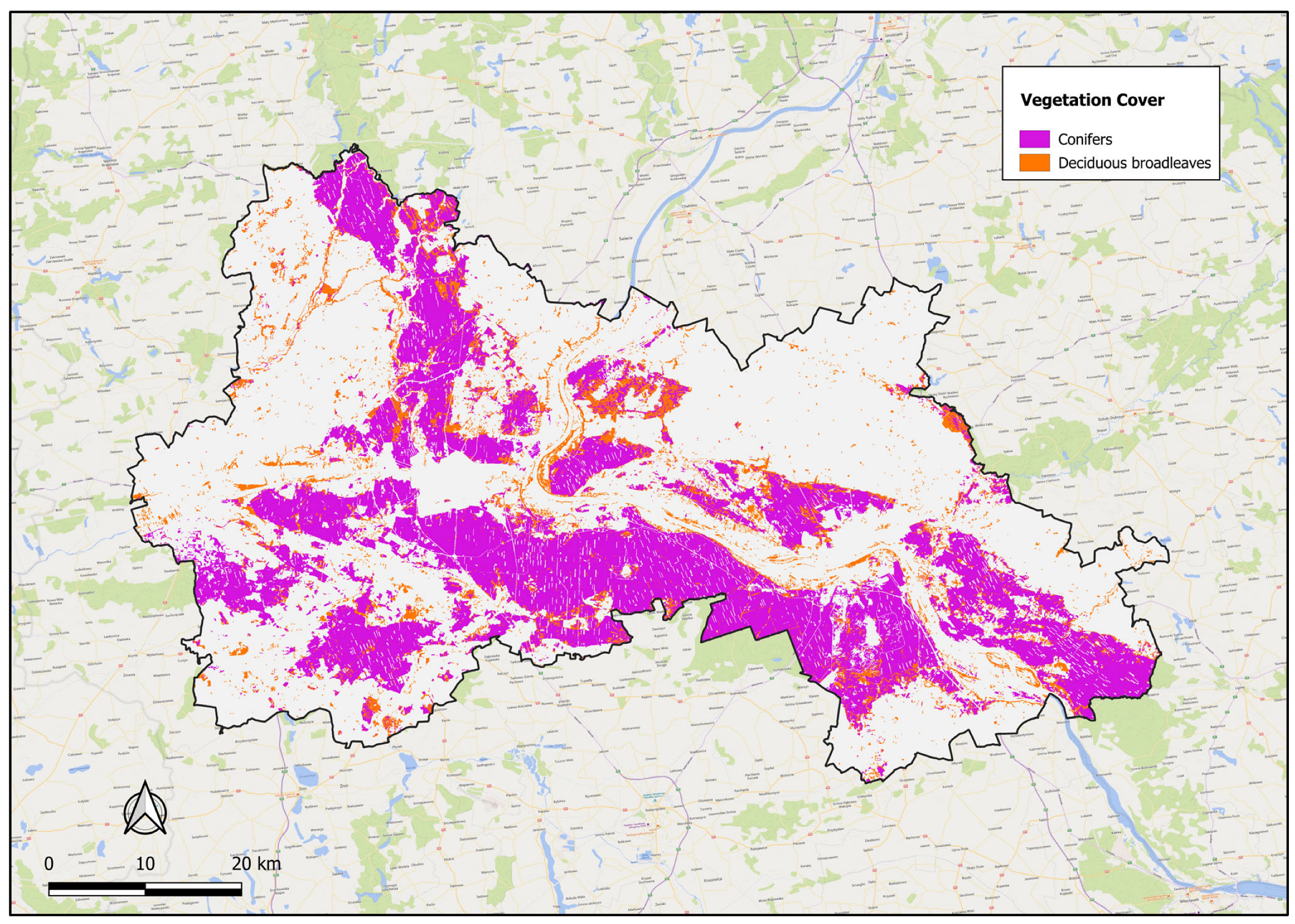
A vegetation map representing the spatial distribution of the two FGs obtained for the Bydgoszcz–Toruń area is presented in Figure 1. As visible from the map, most of the forest cover is dominated by coniferous vegetation (violet), while deciduous species only represent a small portion (orange). Total forest vegetation cover amounts to 137,899.02 ha, of which conifers and deciduous broadleaves cover an area of 109,592.52 ha (80%) and 28,306.50 ha (20%), respectively. As shown in the map (Figure 1), deciduous broadleaf vegetation tends to concentrate in small patches along the Vistula River, suggesting its role as riparian vegetation. On the other hand, the massive and continued presence of conifers probably indicates the presence of monocultures of these species in the area.

3.2. Mean Seasonal LAI

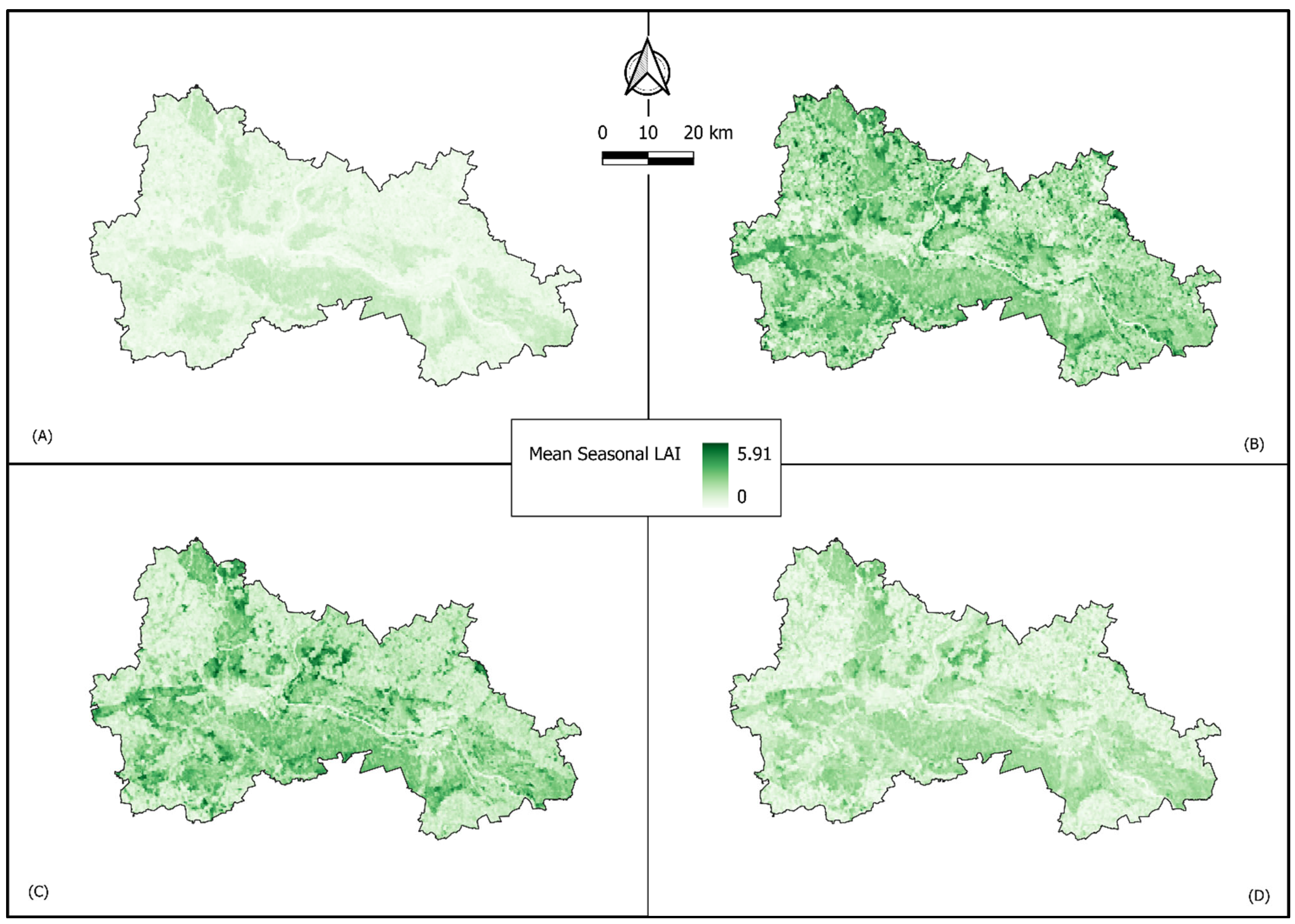
The mean seasonal LAI maps are presented in Figure 2, while the mean seasonal LAI values for the two FGs are shown in Table 4. The data in the table shows that the peak for conifers is reached during the summer (2.73), while for deciduous broadleaf trees, it is reached during the spring period (3.11). On average, broadleaf trees show higher values throughout the year, except for the winter period, due to foliage loss. Conifers, despite lower average values, maintain a relatively constant LAI throughout the year, with a minimum recorded during the winter period (0.82).

3.3. Mean Seasonal PM10 Concentrations

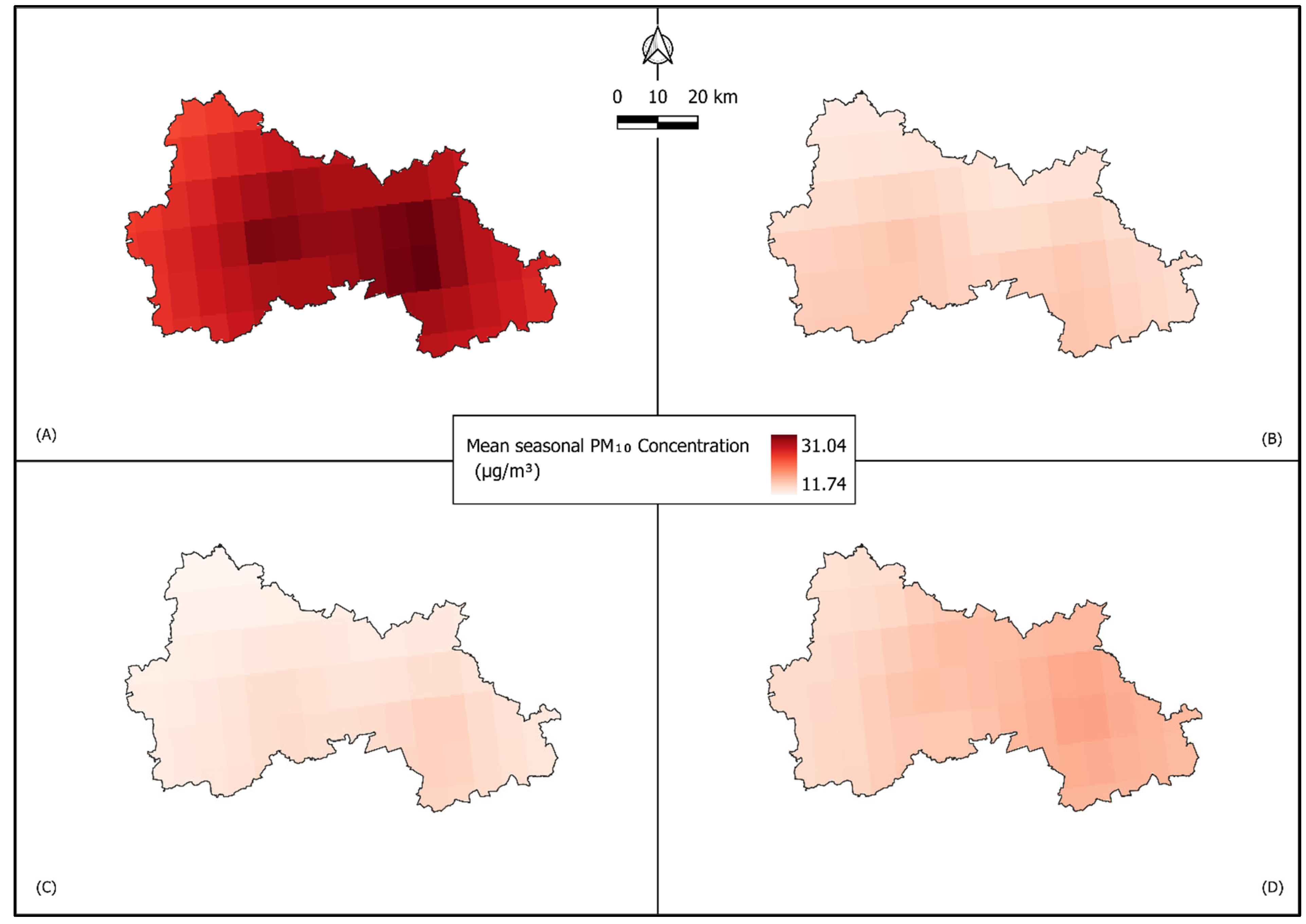
Mean seasonal PM10 concentration maps are shown in Figure 3, while mean seasonal concentrations are presented in Table 5. Concentrations start to increase in autumn and reach their peak during the winter. The observed trend can be explained considering a combination of factors, including the low temperatures, the condensation phenomenon, and the intensification of anthropogenic activities mostly linked to biomass combustion and commercial and domestic heating, which together cause an increase in PM10 concentrations, as mentioned in the Section 2.1 [44,55]. The average winter values recorded in this area exceed the threshold values set by the EU and the more stringent WHO guidelines [18], exposing the population to PM10 levels harmful to human health. In the spring, the values start to decrease, reaching a minimum in the summer season, as expected from a review of the scientific literature [58,59]. Spatially, concentration peaks are found near the two urban agglomerations, with gradually lower values moving from the urban and industrialized areas toward the more sparsely populated ones.

3.4. Mean Seasonal PM10 Removal Efficiency and PM10 Total Removal

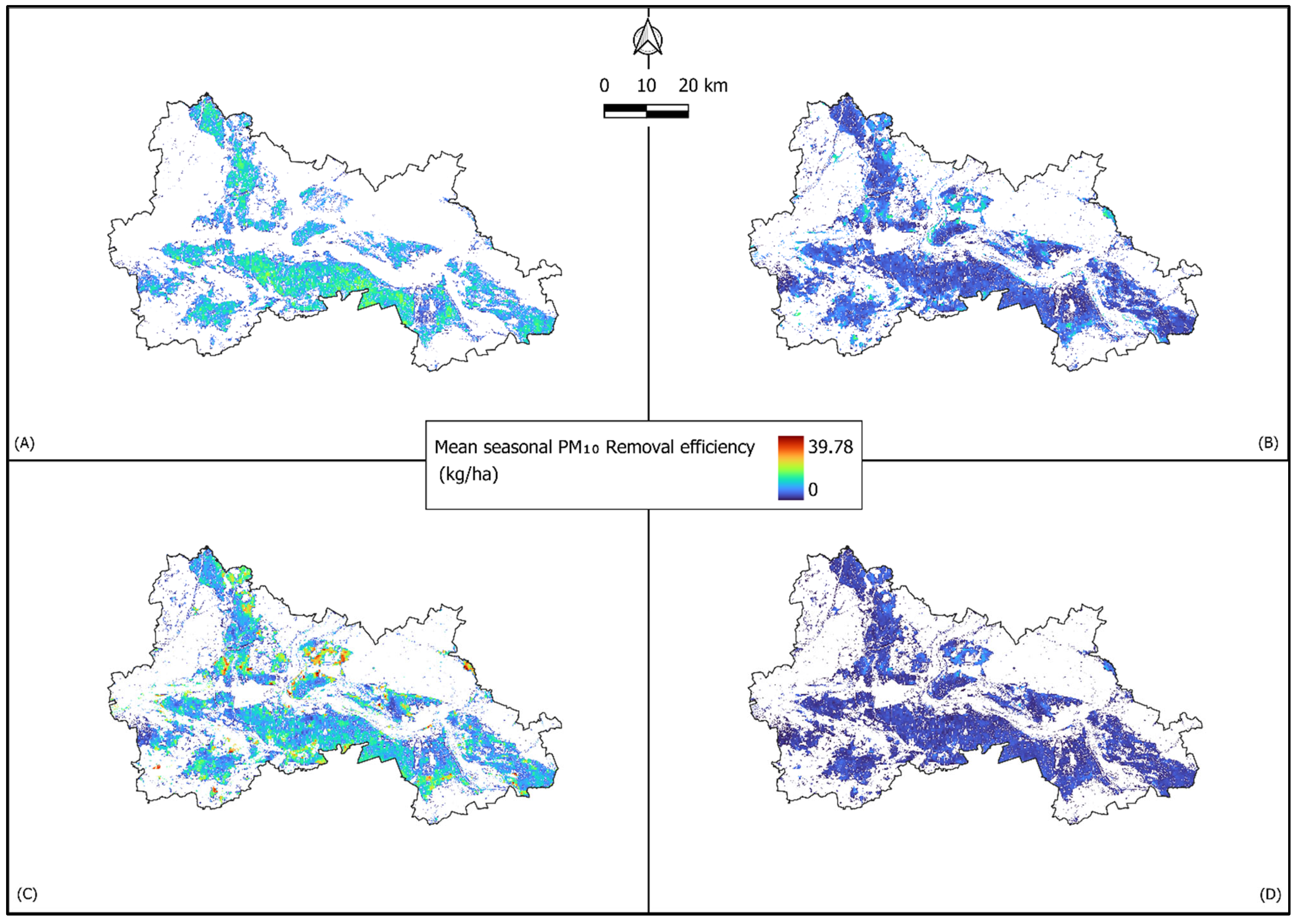
Mean seasonal PM10 removal efficiency (kg/ha) maps are presented in Figure 4, while values are given in Table 6. Deciduous broadleaf trees display the highest removal efficiency values in the summer season, with a value of 12.13 kg/ha. However, after the summer season, the values start to plummet, decreasing to 2.69 kg/ha in the autumn period, after which winter removal is assumed to be 0.
In conifers, the peak in removal efficiency also occurs in the summer season (9.33 kg/ha); then, it rapidly drops in autumn, reaching the minimum value of 2.68 kg/ha. During the long winter months, due to a higher PM10 concentration, it rises again to 9.28 kg/ha only to fall when the concentrations are lower in the springtime (4.20 kg/ha).
From removal efficiency values and FG surface cover, the total removal per FG can be estimated. As shown in Table 7, conifers are responsible for removing 2776.25 Mg of PM10 from the atmosphere annually, thanks to their wider distribution and their continuous ES provision, which also occurs during the winter months. On the other hand, deciduous broadleaf trees are only adsorbed at an estimated 584.15 Mg annually from the atmosphere. In 2018, the vegetation of the Bydgoszcz–Toruń area removed a total of 3360.40 Mg.

3.5. Monetary Evaluation

The economic value of the PM10 removal ES generated by the urban forests of the Bydgoszcz–Toruń area was 255.69 million Euros for the year 2018, as shown in Table 8. As expected, a major contribution comes from conifers, with an estimated value of 211.24 million Euros, while PM10 removal by deciduous broadleaves accounts for an economic value of 44.45 million Euros per year.

4. Discussion

As previously mentioned in the introductory section, and as further supported by the results, Poland is one of the European countries with the highest exceedances in the threshold values set by EU and WHO guidelines. This is largely due to a combination of factors. In temperate transitional regions, meteorological conditions play a crucial role: phenomena such as surface temperature inversions and air contraction can trap pollutants near the ground during the cold months [60,61,62]. Together with the widespread use of fossil fuels and biomass for heating domestic and commercial spaces, PM concentrations tend to be particularly high during this period [44,63]. Indeed, PM has a serious impact on human health and places a significant impact on the healthcare system [43], especially in urban areas during winter. In this context, the results presented here appear relevant, as they highlight a synchrony in the temporal dynamics involving ES demand increase, determined by winter pollutant concentration peaks, and ES supply by evergreen coniferous species. This aspect is particularly relevant given the collapse in winter removal efficiency in deciduous species due to foliage loss.
Examining the results in detail, the mean seasonal PM10 removal efficiency (kg/ha) for the two FGs is in line with what was expected. Deciduous broadleaves reach the highest absolute value during the summer period (12.13 kg/ha). This peak is followed by a rapid drop in the autumn season (2.69 kg/ha) that leads to a complete loss of the foliage for the winter period. It increases again when the temperature gets milder, during spring (5.99 kg/ha).
The conifers follow a different pattern: thanks to their constant provision of air filtrationESs, especially during the winter period (when the highest values of PM10 concentrations are reached: 27.91 µg/m3), conifers show the highest value for the annual mean PM10 removal efficiency (6.37 kg/ha). This result is also in line with other studies [55,64,65,66,67]. In the studies of Sebastiani et al. [54] and Fusaro et al. [64], the dynamics for conifers are the same: they present removal efficiency values lower in magnitude during the other seasons, but the annual average value is higher in this FG. Comparing this study with the two studies by Bottalico et al. [65,66], even if seasonal values are not available, a higher annual PM10 removal efficiency can still be observed for conifers, suggesting a similar pattern. A similar situation is observed in the study by Muresan et al. [67], where conifers exhibit a higher annual PM10 removal efficiency; the difference from other cases is that they do so in each season, diverging from the patterns reported in the studies mentioned above. The presence of higher values, also on a seasonal basis, is likely due to the use of a different Vd for the two FGs in this study, which was applied to obtain more accurate estimations for the PM10 removal efficiencies. A higher annual removal efficiency by conifers also appears when fine particulate matter is considered as observed in the case study by Pace et al. [68], the PM2.5 annual removal efficiency for this FG was six times higher in one city and five times higher in the other two compared to deciduous broadleaf trees’ values, making this difference clearly visible.
Indeed, the shape of the leaves of conifers allows them to be particularly useful, especially in adverse meteorological conditions. The needle shape of the leaves seems more efficient at removing PM from the atmosphere thanks to their stiffness, which allows them to flutter less, resulting in a larger leaf area that increases the capture efficiency rate [69]. Other morpho-functional and anatomical traits also contribute to their removal efficiency in catching PM10, like trichomes, cuticular wax, high stomatal densities, etc. [70,71].
The removal efficiency values obtained for the two FGs are very similar to those obtained in the study conducted by Nardella et al. [56]. Although the species in the area are different in the milder coastal climate of Italy, this correspondence of values allows for a comparison between the two studies, conducted using a similar methodology.
This comparison can offer an interesting perspective, especially in the case of Genova (GE) and Reggio Calabria (RC), in which most of their vegetation is distributed in mountainous areas characterized by lower temperatures and shorter tree-growing periods. In both studies, the annual trend seems to follow similar patterns (except for conifers during the winter period), but the values in the Bydgoszcz–Toruń area turn out to be lower on average.
The first marked difference between the two studies lies in a higher annual removal value in deciduous broadleaf trees, whereas in the Bydgoszcz–Toruń area and the many other studies mentioned above, it was found to be associated with conifers. This difference may be due to two causes. The former is probably linked to the different seasonality considered in this study. In the case of Poland, the seasonal ranges (based on vegetation phenology) are different from the astronomical seasons considered in the case of Italy, in which the phenological characteristics of the Italian tree species can be reflected. Lower values in spring and autumn may then depend on a narrow time range in favor of winter, which represents the longest period of the year in the case of Poland. These values are reflected in the high value for conifers recorded in winter in the Bydgoszcz–Toruń area (9.28 kg/ha) compared to the values of the two coastal cities considered (respectively 3.12 kg/ha for GE and 3.62 kg/ha for RC).
The latter may lie in the distribution of the deciduous broadleaves FG. In both Italian regions, the deciduous broadleaves appear to be widely distributed, compactly and homogeneously. The lack of fragmentation suggests the presence of vast forests of these species in the two regions. This continuity could represent the key to a higher degree of health, which in turn can be translated into higher LAI values, as found by comparing the values of the two studies.
Since winter removal efficiency values in most studies are extremely low compared with this study, a more suitable comparison is the Bosco Mesola (Ferrara, Italy) case study by Gaglio et al. [72], where winter PM10 efficiency removal (19.95 kg/ha) is almost double that found here (9.82 kg/ha), despite a similar LAI (0.92 vs. 0.82). This high winter value highlights the potential influence of other factors on PM10 removal, such as the presence of other FGs, providing this ES during winter (evergreen broadleaves) and the surrounding land use. The surrounding landscape could play an important role: the presence of agricultural fields and deciduous broadleaves, combined with the relatively small area considered, may allow PM to reach the other evergreen FGs more easily, while the compact canopy of a large conifer monoculture may limit pollutant penetration into the inner crown, as in this case study, explaining the lower values recorded.
In all the studies considered, the findings suggest that the two FGs work in synergy, balancing each other. Conifers remove PM10 during the most critical time of the year (wintertime) when deciduous broadleaf trees cannot, whereas deciduous broadleaf trees are most efficient in the summer months, supporting the conifers, while they have lower removal efficiency values compared to the latter.
A comparison with other studies on total removal of PM10 is more difficult because an additional parameter must be considered: the spatial extent of the two FGs. When analyzing the total removal by the FGs in the Bydgoszcz–Toruń area, there is a big disproportion between the conifers and deciduous broadleaves, reflecting their different forest cover. As can be seen from the vegetation map, conifers account for a cover of 109,592.52 ha, while deciduous broadleaves only account for 28,306.50 ha. The reason is probably linked to the use of the Bydgoszcz–Toruń urban forest and to the natural potential vegetation typical for this region. This results in a total removal rate of 2776.25 Mg of PM10 for conifers annually and an estimated value of 584.15 Mg for deciduous broadleaves per year. In 2018, the vegetation of the Bydgoszcz–Toruń area was responsible for a total of 3360.40 Mg of PM10 removed from the atmosphere.
However, the classification performed using the species data of the Bank Danych o Lasach database showed a higher disproportion among the biodiversity of deciduous broadleaves (33 species) and the conifer species (9 species), where a strong predominance of P. sylvestris is recorded. Deciduous broadleaves appear highly fragmented, while conifers show a certain continuity, suggesting the presence of monocultures in the area.
Poland is well known as a wood producer and exporter. The wood sector represents almost 9% of industry sales and more than 10% of manufacturing sales, for a value equal to PLN 228.6 billion (€ 48.8 billion) in 2022 [73]. From 2013 to 2017, a volume of 2587 million m3 of gross merchantable timber was produced, and pines account for 56.5% of the total volume [74].
The choice of conifers may also be explained by the fact that they are the most suitable type of tree vegetation for the region’s cold climate, where soil nutrients are often limited during the winter months, and frequent frosts shorten the growing season.
Even if monocultures can provide many advantages, like decreasing the pressure on natural forests, being easier to manage and providing large quantities of timber [75], these types of ecosystems lack biodiversity, which makes them less resilient to biotic and abiotic stress factors [76]. The increase in extreme events due to climate change can exacerbate the problem [77].
In the wake of what was mentioned above, 2018 was already defined as an “extreme” year for Poland since an increase in temperature and other anomalies were recorded [78], and the same happened in the following years [79]. All these alterations in weather conditions can influence the functional and structural properties of the vegetation, which, in turn, have an impact on LAI values detected by the satellite and considered in the applied model. These changes can alter the resilience of the forests and lead to a loss of the ES of the PM10 removal facilitated by the vegetation present in the area. To mitigate this problem, promoting functional biodiversity among the FGs and avoiding fragmentation for the deciduous broadleaf trees could play a pivotal role.
For 2018, the monetary value for the PM10 removal ES in the Bydgoszcz–Toruń area was estimated to have a value of 266 million Euros. This figure could vary significantly depending on the critical decisions made in the coming years. Moreover, it is worth considering that urban and peri-urban forests do not provide just one ES at a time. A wide range of ESs should be considered, and mixed forests seem to perform better when multiple ecosystem goods and services are analyzed [80].
Even if large conifer monocultures can provide crucial RESs in synergy with some others provisioning ESs, such as timber production, it is important to consider the potential trade-offs associated with a loss of biodiversity. Reduced biodiversity may, in turn, affect ecological resilience, water regulation, and even landscape quality, potentially making these forests less enjoyable for the local communities.
Moreover, certain RESs may be less effective in conifer monocultures, such as tropospheric ozone (O3) removal via vegetation. This ES is generally provided mostly by deciduous broadleaf species thanks to their higher stomatal conductance [56,67]. Similar patterns have also been observed for nitrogen dioxide (NO2) [81]. Also, assessing carbon stock and sequestration in the area could provide valuable insights for evaluating the advantages and disadvantages of this forest asset. These trade-offs highlight the importance of promoting functional biodiversity while taking multiple ESs into account simultaneously. These considerations do not apply only to the biophysical dimension but also to the economic one. In this study, we focused exclusively on the negative externalities of a particular ES. Tools such as Payments for Ecosystem Services (PES) can help enhance the value of ecosystem benefits and support their integration into environmental accounting frameworks. If more ESs are considered, these benefits could become more visible to policymakers and be integrated into green planning and forest management, helping to reorient decision-making processes toward more sustainable objectives. However, it is important that this perspective does not lead to an overly utilitarian view of nature, especially when dealing with more market-oriented services such as provisioning and cultural ESs [82].

5. Limitations of the Study

The present study has some limitations that could be addressed in further developments.
ESs such as air pollutant removal via vegetation are complex ecological functions for which primary data are often difficult to obtain at adequate spatial and temporal scales. For this reason, the models used for this study include some assumptions and simplifications and do not consider parameters such as species-specific leaf traits grouping the trees in FGs, interactions with meteorological conditions or the topography of the landscape. Moreover, the model applied in this study does not account for certain dynamic processes affecting PM retention, such as particle resuspension from leaf surfaces, incomplete wash-off by rainfall and wind-driven effects on PM10 [83,84]. These omissions may lead to uncertainties in the estimated removal.
Additionally, the results may have been influenced by methodological simplifications. As reported in Sebastiani et al. [55], a comparison with field measurements showed that satellite-derived LAI tend to saturate at high canopy densities, which can lead to underestimation of the actual leaf surface area.
Another limitation of this study is that the deposition velocity (Vd) was assumed to be uniform across the two FGs (conifers and deciduous broadleaves), even if conifers typically exhibit higher Vd values than deciduous broadleaves, as reported in the Section 4, referring to the case study of Muresan et al. [67]. The use of a uniform Vd yields conservative estimates, facilitating comparison with other studies that adopt the same methodology [53,54,55,56]. However, it also suggests that the actual PM10 removal by the forest may be even higher than the values accounted for in this study.
Additionally, analyses aimed at understanding the chemical composition of PM particles, as done by Rusca et al. [85], could provide insights into the specific sources present in the area, helping to identify the most critical ones to mitigate. This approach could also be useful in revealing potential correlations between PM10 composition and its sequestration across the two FGs, further supporting the use of tree species for urban afforestation that are particularly effective in the local pollution context.
Despite these limitations, the findings provide a preliminary but valuable assessment of PM10 removal in urban forests, highlighting the crucial role of vegetation in mitigating particle pollution and serving as a baseline for further, more detailed studies.

6. Conclusions

In this study, the potential of the Bydgoszcz–Toruń urban forest in the provision of air quality improvement through PM10 removal ES was investigated. The applied model helped to demonstrate that the vegetation in the analyzed area makes an important contribution to the removal of PM10 from the atmosphere. This contribution can also be translated into the monetary values associated with this ES. Moreover, the quantitative analysis performed using a spatially explicit model allowed us to obtain results that include the spatial distribution of this phenomenon.
Since the results obtained from this study show only a small fraction of those that would be obtained if the whole multitude of ESs provided by the urban forest of Bydgoszcz–Toruń were analyzed, further elaboration could extend the analysis to other forms of air pollution, highlighting in a targeted way how a more widespread and a more targeted management can promote air mitigation through the presence of the arboreal vegetation.
Overall, in the case of PM10 (and many other atmospheric pollutants), characterized by a markedly increased concentration in and around urban areas, a focus on the metropolitan cities present in the area could also represent a useful tool in helping to understand how to mitigate the problem in the most critical contexts. The recent approval of the Nature Restoration Law by the EC may also represent a way to channel the efforts toward the restoration and implementation of the urban forests of this area, providing wellness to the local population while also enhancing biodiversity. In this context, the approach presented in this study can serve as a valuable tool for policymakers, supporting evidence-based management and guiding the implementation of sustainable urban planning strategies that enhance ESs and promote long-term environmental sustainability.

Author Contributions

F.F.: conceptualization, methodology, software, validation, formal analysis, data curation, writing–original draft preparation, writing—review and editing; L.N.: conceptualization, methodology, validation, data curation, writing—review and editing; U.G.: validation, writing—review and editing, visualization; D.K.: conceptualization, data curation; E.B.: conceptualization, writing—review and editing, supervision, P.P.F.: conceptualization, writing—review and editing, supervision, A.P.: conceptualization, writing—review and editing, supervision. All authors have read and agreed to the published version of the manuscript.

Funding

This research received no external funding.

Institutional Review Board Statement

Not applicable.

Informed Consent Statement

Not applicable.

Data Availability Statement

Dataset available on request from the authors.

Conflicts of Interest

The authors declare no conflict of interest.

References

  1. United Nations, Department of Economic and Social Affairs, Population Division. World Urbanization Prospects 2018: Highlights (ST/ESA/SER.A/421). 2019. Available online: https://population.un.org/wup/assets/WUP2018-Highlights.pdf (accessed on 3 October 2025).
  2. United Nations Human Settlements Programme (UN-Habitat). World Cities Report 2022: Envisaging the Future of Cities. Available online: https://unhabitat.org/world-cities-report-2022 (accessed on 1 October 2025).
  3. European Commission. Megatrend Continuing Urbanisation. 2023. Available online: https://knowledge4policy.ec.europa.eu/continuing-urbanisation_en?utm_source=pocket_shared (accessed on 5 October 2025).
  4. World Health Organization. Ambient (Outdoor) Air Pollution. Key Facts. 2022. Available online: https://www.who.int/news-room/fact-sheets/detail/ambient-(outdoor)-air-quality-and-health?utm_source=pocket_shared (accessed on 15 October 2025).
  5. Kelly, F.J.; Fussell, J.C. Size, source and chemical composition as determinants of toxicity attributable to ambient particulate matter. Atmos. Environ. 2012, 60, 504–526. [Google Scholar] [CrossRef]
  6. Misiukiewicz-Stepien, P.; Paplinska-Goryca, M. Biological effect of PM10 on airway epithelium—Focus on obstructive lung diseases. Clin. Immunol. 2021, 227, 108754. [Google Scholar] [CrossRef] [PubMed]
  7. Thangavel, P.; Park, D.; Lee, Y.C. Recent insights into particulate matter (PM2.5)-mediated toxicity in humans: An overview. Int. J. Environ. Res. Public Health. 2022, 19, 7511. [Google Scholar] [CrossRef] [PubMed]
  8. Wright, J.; Ding, Y. Pathophysiological effects of particulate matter air pollution on the central nervous system. Environ. Dis. 2016, 1, 191932. [Google Scholar] [CrossRef]
  9. Hamra, G.B.; Guha, N.; Cohen, A.; Laden, F.; Raaschou-Nielsen, O.; Samet, J.M.; Vineis, P.; Forastiere, F.; Saldiva, P.; Yorifuji, T.; et al. Outdoor particulate matter exposure and lung cancer: A systematic review and meta-analysis. Environ. Health Perspect. 2014, 122, 906–911. [Google Scholar] [CrossRef]
  10. Fiordelisi, A.; Piscitelli, P.; Trimarco, B.; Coscioni, E.; Iaccarino, G.; Sorriento, D. The mechanisms of air pollution and particulate matter in cardiovascular diseases. Heart Fail. Rev. 2017, 22, 337–347. [Google Scholar] [CrossRef]
  11. Roy, A.; Mandal, M.; Das, S.; Popek, R.; Rakwal, R.; Agrawal, G.K.; Sarkar, A. The cellular consequences of particulate matter pollutants in plants: Safeguarding the harmonious integration of structure and function. Sci. Total Environ. 2024, 906, 169763. [Google Scholar] [CrossRef]
  12. Zeeshan, N.; Freer-Smith, P.; Murtaza, G.; Wong, A.E.; Taylor, G. His dark materials: Quantifying the problem of dust (particulate matter) in the agricultural landscape of California. Atmos. Environ. 2024, 330, 120562. [Google Scholar] [CrossRef]
  13. Grantz, D.A.; Garner, J.H.B.; Johnson, D.W. Ecological effects of particulate matter. Environ. Int. 2003, 29, 213–239. [Google Scholar] [CrossRef]
  14. European Environmental Agency. Air Pollution. 2024. Available online: https://www.eea.europa.eu/en/topics/in-depth/air-pollution?utm_source=pocket_reader (accessed on 7 October 2025).
  15. European Environmental Agency. Every Breath We Take, Improving Air Quality in Europe, EEA Signals 2013. 2013. Available online: https://www.eea.europa.eu/publications/eea-signals-2013 (accessed on 31 October 2025).
  16. World Health Organization. WHO Global Air Quality Guidelines: Particulate Matter (PM2.5 and PM10), Ozone, Nitrogen Dioxide, Sulfur Dioxide and Carbon Monoxide. 2021. Available online: https://iris.who.int/handle/10665/345329 (accessed on 3 November 2025).
  17. European Environmental Agency. Estimating the External Costs of Industrial Air Pollution: Trends 2012–2021. 2024. Available online: https://www.eea.europa.eu/en/analysis/publications/the-costs-to-health-and-the-environment-from-industrial-air-pollution-in-europe-2024-update (accessed on 3 November 2025).
  18. European Parliament; Council of the European Union. Directive 2008/50/EC of 21 May 2008 on Ambient Air Quality and Cleaner Air for Europe. 2008. Available online: https://eur-lex.europa.eu/legal-content/EN/TXT/?uri=CELEX%3A32008L0050 (accessed on 3 November 2025).
  19. European Commission, Directorate-General for Environment. Proposal for a Directive of the European Parliament and of the Council on Ambient Air Quality and Cleaner Air for Europe (Recast) COM/2022/542 Final. 2022. Available online: https://eur-lex.europa.eu/resource.html?uri=cellar:2ae4a0cc-55f8-11ed-92ed-01aa75ed71a1.0001.02/DOC_3&format=PDF (accessed on 3 November 2025).
  20. European Environmental Agency. European Air Quality Index (AQI); EEA: Copenhagen, Denmark; Available online: https://airindex.eea.europa.eu/AQI/index.html (accessed on 6 March 2026).
  21. European Commission, Directorate-General for Environment. COMMUNICATION FROM THE COMMISSION Pathway to a Healthy Planet for All EU Action Plan: ‘Towards Zero Pollution for Air, Water and Soil’ COM/2021/400 Final. 2021. Available online: https://eur-lex.europa.eu/resource.html?uri=cellar:a1c34a56-b314-11eb-8aca-01aa75ed71a1.0001.02/DOC_1&format=PDF (accessed on 5 November 2025).
  22. European Environmental Agency. Poland—Air Pollution Country Fact Sheet. 2023. Available online: https://www.eea.europa.eu/themes/air/country-fact-sheets/2023-country-fact-sheets/poland-air-pollution-country (accessed on 14 November 2025).
  23. European Environmental Agency. Europe’s Air Quality Status 2024. 2024. Available online: https://www.eea.europa.eu/publications/europes-air-quality-status-2024 (accessed on 14 November 2025).
  24. European Environmental Agency. Europe’s Air Quality Status 2023—PM10/PM2.5. 2023. Available online: https://www.eea.europa.eu/publications/europes-air-quality-status-2023 (accessed on 14 November 2025).
  25. Abas, N.; Saleem, M.S.; Kalair, E.; Khan, N. Cooperative control of regional transboundary air pollutants. Environ. Syst. Res. 2019, 8, 10. [Google Scholar] [CrossRef]
  26. Costanza, R.; D’Arge, R.; de Groot, R.; Farber, S.; Grasso, M.; Hannon, B.; Limburg, K.; Naeem, S.; O’Neill, R.V.; Paruelo, J.; et al. The value of the world’s ecosystem services and natural capital. Nature 1997, 387, 253–260. [Google Scholar] [CrossRef]
  27. Millennium Ecosystem Assessment. Ecosystems and Human Well-Being: Current State and Trends; Island Press: Washington, DC, USA, 2005; Available online: https://www.millenniumassessment.org/documents/document.356.aspx.pdf (accessed on 25 September 2025).
  28. IPBES. Global Assessment Report on Biodiversity and Ecosystem Services of the Intergovernmental Science-Policy Platform on Biodiversity and Ecosystem Services; Brondizio, E.S., Settele, J., Díaz, S., Ngo, H.T., Eds.; IPBES Secretariat: Bonn, Germany, 2019. [Google Scholar] [CrossRef]
  29. European Commission. Green Infrastructure (GI) Enhancing Europe’s Natural Capital. COM (2013) 249 Final. 2013. Available online: https://eur-lex.europa.eu/legal-content/EN/TXT/?uri=CELEX:52013DC0249 (accessed on 20 November 2025).
  30. Semeraro, T.; Aretano, R.; Pomes, A. Green infrastructure to improve ecosystem services in the landscape urban regeneration. IOP Conf. Ser. Mater. Sci. Eng. 2017, 245, 082044. [Google Scholar] [CrossRef]
  31. Schrijnen, P.M. Infrastructure networks and red-green patterns in city regions. Landsc. Urban Plan. 2000, 48, 191–204. [Google Scholar] [CrossRef]
  32. Walmsley, A. Greenways: Multiplying and diversifying in the 21st century. Landsc. Urban Plan. 2006, 76, 252–290. [Google Scholar] [CrossRef]
  33. European Commission, Directorate-General for Research and Innovation. Towards an EU Research and Innovation Policy Agenda for Nature-Based Solutions & Re-Naturing Cities—Final Report of the Horizon 2020 Expert Group on ‘Nature-Based Solutions and Re-Naturing Cities’. Publications Office. 2015. Available online: https://data.europa.eu/doi/10.2777/479582 (accessed on 25 March 2025).
  34. Di Pirro, E.; Sallustio, L.; Castellar, J.A.C.; Sgrigna, G.; Marchetti, M.; Lasserre, B. Facing multiple environmental challenges through maximizing the co-benefits of nature-based solutions at a national scale in Italy. Forests 2022, 13, 548. [Google Scholar] [CrossRef]
  35. Diener, A.; Mudu, P. How can vegetation protect us from air pollution? A critical review on green spaces’ mitigation abilities for air-borne particles from a public health perspective—With implications for urban planning. Sci. Total Environ. 2021, 796, 148605. [Google Scholar] [CrossRef]
  36. Sokolova, M.V.; Fath, B.D.; Grande, U.; Buonocore, E.; Franzese, P.P. The role of green infrastructure in providing urban ecosystem services: Insights from a bibliometric perspective. Land 2024, 13, 1664. [Google Scholar] [CrossRef]
  37. Gaglio, M.; Pace, R.; Muresan, A.N.; Grote, R.; Castaldelli, G.; Calfapietra, C.; Fano, E.A. Species-specific efficiency in PM2.5 removal by urban trees: From leaf measurements to improved modeling estimates. Sci. Total Environ. 2022, 844, 157131. [Google Scholar] [CrossRef]
  38. Cai, M.; Xin, Z.; Yu, X. Spatio-temporal variations in PM leaf deposition: A meta-analysis. Environ. Pollut. 2017, 231, 207–218. [Google Scholar] [CrossRef]
  39. Nowak, D.J. Air pollution removal by Chicago’s urban forest. In Chicago’s Urban Forest Ecosystem: Results of the Chicago Urban Forest Climate Project; Chapter 5; McPherson, E.G., Nowak, D.J., Rowntree, R.A., Eds.; USDA Forest Service: Washington, DC, USA, 1994; pp. 5-1–5-12. [Google Scholar] [CrossRef]
  40. Zhang, X.; Lyu, J.; Zeng, Y.; Sun, N.; Liu, C.; Yin, S. Individual effects of trichomes and leaf morphology on PM2.5 dry deposition velocity: A variable-control approach using species from the same family or genus. Environ. Pollut. 2021, 272, 116385. [Google Scholar] [CrossRef]
  41. Sæbø, A.; Popek, R.; Nawrot, B.; Hanslin, H.M.; Gawronska, H.; Gawronski, S.W. Plant species differences in particulate matter accumulation on leaf surfaces. Sci. Total Environ. 2012, 427, 347–354. [Google Scholar] [CrossRef]
  42. Derkowska, I.; Araźny, A. Bioclimatic features of Toruń according to the tourism climate index. Bull. Geogr. Phys. Geogr. Ser. 2022, 22, 59–71. [Google Scholar] [CrossRef]
  43. The World Bank. Air Quality Management—Poland. Final Report. 2019. Available online: https://documents1.worldbank.org/curated/en/574171554178748054/pdf/Air-Quality-Management-in-Poland.pdf (accessed on 25 November 2025).
  44. Krajowy Ośrodek Bilansowania i Zarządzania Emisjami (KOBiZE). Poland’s National Inventory Report 2018: Greenhouse Gas Inventory for 1988–2016. Submission Under the UNFCCC and Its Kyoto Protocol; Institute of Environmental Protection—National Research Institute: Warsaw, Poland, 2018; Available online: https://www.kobize.pl/uploads/materialy/materialy_do_pobrania/krajowa_inwentaryzacja_emisji/NIR_2018_POL.pdf (accessed on 26 November 2025).
  45. Copernicus Land Monitoring Service. Forest Type 2018 (raster 10 m and 100 m), Europe, 3-Yearly. 2021. Available online: https://land.copernicus.eu/en/products/high-resolution-layer-forest-type/forest-type-2018 (accessed on 15 April 2025).
  46. Bank Danych o Lasach. Available online: https://www.bdl.lasy.gov.pl (accessed on 22 February 2025).
  47. Global Climate Observing System (GCOS). Systematic Observation Requirements for Satellite-Based Products for Climate, 2011 Update. Supplemental Details to the Satellite-Based Component of the Implementation Plan for the Global Observing System for Climate in Support of the UNFCCC (2011 Update). 2011. Available online: https://library.wmo.int/idurl/4/48411 (accessed on 3 April 2025).
  48. AGROMETEO IMGW-PIB. FENOLOGIA. 2018. Available online: https://agrometeo.imgw.pl/fenologia/fenologiczne_pory_roku (accessed on 1 April 2025).
  49. Waszak, N.; Robertson, I.; Puchałka, R.; Przybylak, R.; Pospieszyńska, A.; Koprowski, M. Investigating the climate-growth response of Scots pine (Pinus sylvestris L.) in Northern Poland. Atmosphere 2021, 12, 1690. [Google Scholar] [CrossRef]
  50. Copernicus Atmosphere Monitoring Service (CAMS). Atmosphere Data Store (ADS). Available online: https://ads.atmosphere.copernicus.eu/cdsapp#!/dataset/cams-global-reanalysis-eac4?tab=overview (accessed on 1 May 2025).
  51. European Centre for Medium-Range Weather Forecasts (ECMWF). CAMS: Reanalysis Data Documentation. 2024. Available online: https://confluence.ecmwf.int/display/CKB/CAMS%3A+Reanalysis+data+documentation (accessed on 2 May 2025).
  52. Inness, A.; Ades, M.; Agustí-Panareda, A.; Barré, J.; Benedictow, A.; Blechschmidt, A.-M.; Dominguez, J.J.; Engelen, R.; Eskes, H.; Flemming, J.; et al. The CAMS reanalysis of atmospheric composition. Atmos. Chem. Phys. 2019, 19, 3515–3556. [Google Scholar] [CrossRef]
  53. Manes, F.; Marando, F.; Capotorti, G.; Blasi, C.; Salvatori, E.; Fusaro, L.; Ciancarella, L.; Mircea, M.; Marchetti, M.; Chirici, G.; et al. Regulating ecosystem services of forests in ten Italian metropolitan cities: Air quality improvement by PM10 and O3 removal. Ecol. Indic. 2016, 67, 425–440. [Google Scholar] [CrossRef]
  54. Fusaro, L.; Marando, F.; Sebastiani, A.; Capotorti, G.; Blasi, C.; Copiz, R.; Congedo, L.; Munafò, M.; Ciancarella, L.; Manes, F. Mapping and assessment of PM10 and O3 removal by woody vegetation at urban and regional level. Remote Sens. 2017, 9, 791. [Google Scholar] [CrossRef]
  55. Sebastiani, A.; Buonocore, E.; Franzese, P.P.; Riccio, A.; Chianese, E.; Nardella, L.; Manes, F. Modeling air quality regulation by green infrastructure in a Mediterranean coastal urban area: The removal of PM10 in the Metropolitan City of Naples (Italy). Ecol. Model. 2021, 440, 109383. [Google Scholar] [CrossRef]
  56. Nardella, L.; Sebastiani, A.; Stafoggia, M.; Franzese, P.P.; Manes, F. Modelling PM10 removal in three Italian coastal Metropolitan Cities along a latitudinal gradient. Ecol. Model. 2023, 483, 110423. [Google Scholar] [CrossRef]
  57. Nowak, D.J.; Hirabayashi, S.; Bodine, A.; Greenfield, E. Tree and forest effects on air quality and human health in the United States. Environ. Pollut. 2014, 193, 119–129. [Google Scholar] [CrossRef]
  58. Vardoulakis, S.; Kassomenos, P. Sources and factors affecting PM10 levels in two European cities: Implications for local air quality management. Atmos. Environ. 2008, 42, 3949–3963. [Google Scholar] [CrossRef]
  59. Wang, Y.Q.; Zhang, X.Y.; Sun, J.Y.; Zhang, X.C.; Che, H.Z.; Li, Y.J. Spatial and temporal variations of the concentrations of PM10, PM2.5 and PM1 in China. Atmos. Chem. Phys. 2015, 15, 13585–13598. [Google Scholar] [CrossRef]
  60. Danek, T.; Weglinska, E.; Zareba, M. The influence of meteorological factors and terrain on air pollution concentration and migration: A geostatistical case study from Krakow, Poland. Sci. Rep. 2022, 12, 11050. [Google Scholar] [CrossRef] [PubMed]
  61. Nidzgorska-Lencewicz, J.; Czarnecka, M. Thermal inversion and particulate matter concentration in Wrocław in winter season. Atmosphere 2020, 11, 1351. [Google Scholar] [CrossRef]
  62. Janhäll, S.; Olofson, K.F.; Andersson, P.U.; Pettersson, J.B.; Hallquist, M. Evolution of the urban aerosol during winter temperature inversion episodes. Atmos. Environ. 2006, 40, 5355–5366. [Google Scholar] [CrossRef]
  63. Czernecki, B.; Półrolniczak, M.; Kolendowicz, L.; Marosz, M.; Kendzierski, S.; Pilguj, N. Influence of the atmospheric conditions on PM10 concentrations in Poznań, Poland. J. Atmos. Chem. 2017, 74, 115–139. [Google Scholar] [CrossRef]
  64. Marando, F.; Salvatori, E.; Fusaro, L.; Manes, F. Removal of PM10 by forests as a nature-based solution for air quality improvement in the Metropolitan city of Rome. Forests 2016, 7, 150. [Google Scholar] [CrossRef]
  65. Bottalico, F.; Chirici, G.; Giannetti, F.; De Marco, A.; Nocentini, S.; Paoletti, E.; Salbitano, F.; Sanesi, G.; Serenelli, C.; Travaglini, D. Air pollution removal by green infrastructures and urban forests in the city of Florence. Agric. Agric. Sci. Procedia 2016, 8, 243–251. [Google Scholar] [CrossRef]
  66. Bottalico, F.; Travaglini, D.; Chirici, G.; Garfì, V.; Giannetti, F.; De Marco, A.; Fares, S.; Marchetti, M.; Nocentini, S.; Paoletti, E.; et al. A spatially-explicit method to assess the dry deposition of air pollution by urban forests in the city of Florence, Italy. Urban For. Urban Green. 2017, 27, 221–234. [Google Scholar] [CrossRef]
  67. Muresan, A.N.; Sebastiani, A.; Gaglio, M.; Fano, E.A.; Manes, F. Assessment of air pollutants removal by green infrastructure and urban and peri-urban forests management for a greening plan in the Municipality of Ferrara (Po river plain, Italy). Ecol. Indic. 2022, 135, 108554. [Google Scholar] [CrossRef]
  68. Pace, R.; Grote, R. Deposition and resuspension mechanisms into and from tree canopies: A study modeling particle removal of conifers and broadleaves in different cities. Front. For. Glob. Change 2020, 3, 26. [Google Scholar] [CrossRef]
  69. Chen, L.; Liu, C.; Zhang, L.; Zou, R.; Zhang, Z. Variation in tree species ability to capture and retain airborne fine particulate matter (PM2.5). Sci. Rep. 2017, 7, 3206. [Google Scholar] [CrossRef]
  70. Beckett, K.P.; Freer-Smith, P.; Taylor, G. Effective tree species for local air quality management. Arboric. Urban For. 2000, 26, 12–19. [Google Scholar] [CrossRef]
  71. Jin, E.J.; Yoon, J.H.; Bae, E.J.; Jeong, B.R.; Yong, S.H.; Choi, M.S. Particulate matter removal ability of ten evergreen trees planted in Korea urban greening. Forests 2021, 12, 438. [Google Scholar] [CrossRef]
  72. Gaglio, M.; Muresan, A.N.; Sebastiani, A.; Cavicchi, D.; Fano, E.A.; Castaldelli, G. A “reserve” of regulating services: The importance of a remnant protected forest for human well-being in the Po delta (Italy). Ecol. Model. 2023, 484, 110485. [Google Scholar] [CrossRef]
  73. Ministry of Climate and Environment. Poland 2023. Statement on the Wood Market Review and Prospects. 2023. Available online: https://unece.org/sites/default/files/2023-10/PL_statement_2023_eng.pdf (accessed on 30 May 2025).
  74. State Forests Poland. Forests in Poland 2018. 2018. Available online: https://www.lasy.gov.pl/pl/informacje/publikacje/in-english/forests-in-poland/fortests-in-poland-2018-4.pdf (accessed on 4 June 2025).
  75. Liu, C.L.C.; Kuchma, O.; Krutovsky, K.V. Mixed-species versus monocultures in plantation forestry: Development, benefits, ecosystem services and perspectives for the future. Glob. Ecol. Conserv. 2018, 15, e00419. [Google Scholar] [CrossRef]
  76. Larjavaara, M. A review on benefits and disadvantages of tree diversity. Open For. Sci. J. 2008, 1, 24–30. [Google Scholar] [CrossRef]
  77. Lindner, M.; Maroschek, M.; Netherer, S.; Kremer, A.; Barbati, A.; Garcia-Gonzalo, J.; Seidl, R.; Delzon, S.; Corona, P.; Kolström, M.; et al. Climate change impacts, adaptive capacity, and vulnerability of European forest ecosystems. For. Ecol. Manag. 2010, 259, 698–709. [Google Scholar] [CrossRef]
  78. Tomczyk, A.M.; Bednorz, E. The extreme year—Analysis of thermal conditions in Poland in 2018. Theor. Appl. Climatol. 2020, 139, 265–276. [Google Scholar] [CrossRef]
  79. Pinskwar, I.; Chorynski, A.; Kundzewicz, Z.W. Severe drought in the spring of 2020 in Poland—More of the same? Agronomy 2020, 10, 11646. [Google Scholar] [CrossRef]
  80. Schuler, L.J.; Bugmann, H.; Snell, R.S. From monocultures to mixed-species forests: Is tree diversity key for providing ecosystem services at the landscape scale? Landsc. Ecol. 2017, 32, 1499–1516. [Google Scholar] [CrossRef]
  81. Fang, J.; Li, S.; Wang, M.; Zhao, N.; Xu, X.; Li, B.; Zhang, J.; Liu, C.; Zhang, Q.; Lu, S. Ability of typical greening tree species to purify NO2 under different environmental factors. Atmos. Pollut. Res. 2025, 16, 102357. [Google Scholar] [CrossRef]
  82. Krozer, Y.; Coenen, F.; Hanganu, J.; Lordkipanidze, M.; Sbarcea, M. Towards innovative governance of nature areas. Sustainability 2020, 12, 10624. [Google Scholar] [CrossRef]
  83. Wang, H.; Shi, H.; Li, Y.; Yu, Y.; Zhang, J. Seasonal variations in leaf capturing of particulate matter, surface wettability and micromorphology in urban tree species. Front. Environ. Sci. Eng. 2013, 7, 579–588. [Google Scholar] [CrossRef]
  84. Pace, R.; Guidolotti, G.; Baldacchini, C.; Pallozzi, E.; Grote, R.; Nowak, D.J.; Calfapietra, C. Comparing i-Tree eco estimates of particulate matter deposition with leaf and canopy measurements in an urban Mediterranean Holm Oak Forest. Environ. Sci. Technol. 2021, 55, 6613–6622. [Google Scholar] [CrossRef]
  85. Rusca, M.; Rusu, T.; Avram, S.E.; Prodan, D.; Paltinean, G.A.; Filip, M.R.; Ciotlaus, I.; Pascuta, P.; Rusu, T.A.; Petean, I. Physicochemical assessment of the road vehicle traffic pollution impact on the urban environment. Atmosphere 2023, 14, 862. [Google Scholar] [CrossRef]
Figure 1. Vegetation map representing the spatial distribution of the two FGs.
Sustainability 18 03018 g001
Figure 2. Mean seasonal LAI maps in the Bydgoszcz–Toruń area (2018) in winter (A), spring (B), summer (C), autumn (D).
Sustainability 18 03018 g002
Figure 3. PM10 mean seasonal concentrations maps of the Bydgoszcz–Toruń area (2018) in winter (A), spring (B), summer (C), autumn (D).
Sustainability 18 03018 g003
Figure 4. Mean seasonal PM10 removal efficiency (kg/ha) maps in the Bydgoszcz–Toruń area in winter (A), spring (B), summer (C) and autumn (D).
Sustainability 18 03018 g004
Table 1. Atmospheric PM10 limits according to the EU and the WHO.
GuidelinesLimits
EU daily value50 µg/m3
WHO daily value45 µg/m3
EU annual value40 µg/m3
WHO annual value15 µg/m3
Table 2. European Air Quality Index (AQI, µg/m3) for PM10 and the color codes indicating the level of pollution [20].
European Air Quality Index
Index LevelGoodFairModeratePoorVery poorExtremly poor
Particles less than 10 µm (PM10)0–1516–4546–120121–195196–270>270
Table 3. Phenological seasons for the trees in the investigated area according to AGROMETEO IMGW-PIB phenological maps for the year 2018.
WinterSpringSummerAutumn
Phenological
Seasons
11th October–
20th April
21st April–
31st May
1st June–
31st August
1st September–
10th October
Table 4. Table of the mean seasonal LAI values for the two FGs of vegetation.
Leaf Area Index (LAI)
WinterSpringSummerAutumn
Conifers0.822.672.732.07
Deciduous
broadleaves
03.113.011.98
Table 5. Table of the PM10 mean seasonal concentration values.
PM10 Mean Seasonal Concentrations (µg/m3)
WinterSpring SummerAutumn
27.9914.9713.6616.17
Table 6. Table of mean seasonal PM10 removal efficiency (kg/ha) per FG in the Bydgoszcz–Toruń area.
Removal Efficiency (kg/ha × yr)
WinterSpringSummerAutumnAnnual
Conifers9.284.209.332.686.37
Deciduous broadleaves05.9912.132.695.20
Table 7. Table of mean seasonal PM10 total removal (Mg/yr) per FG in the Bydgoszcz–Toruń area.
Total Removal (Mg/yr)
WinterSpringSummerAutumnAnnual
Conifers1011.75456.951015.70291.852776.25
Deciduous
broadleaves
0168.11340.4475.6584.15
Total Removal1011.75625.061356.14367.453360.40
Table 8. Table of monetary evaluation (€ × 106/yr) per FG in the Bydgoszcz–Toruń area.
Monetary Evaluation (€ × 106/yr)
WinterSpringSummerAutumnAnnual
Conifers76.9834.7777.2822.21211.24
Deciduous Broadleaves012.7925.905.7544.45
Total Removal76.9847.56103.1927.96255.69
Disclaimer/Publisher’s Note: The statements, opinions and data contained in all publications are solely those of the individual author(s) and contributor(s) and not of MDPI and/or the editor(s). MDPI and/or the editor(s) disclaim responsibility for any injury to people or property resulting from any ideas, methods, instructions or products referred to in the content.