Article

Perceptions and Preferences for Using Native Plants in Residential Landscapes

1
Department of Horticultural Sciences, University of Florida, Gainesville, FL 32611, USA
2
Department of Landscape Architecture, University of Florida, Gainesville, FL 32611, USA
*
Author to whom correspondence should be addressed.
Sustainability 2026, 18(6), 2975; https://doi.org/10.3390/su18062975
Submission received: 4 February 2026 / Revised: 10 March 2026 / Accepted: 12 March 2026 / Published: 18 March 2026
(This article belongs to the Section Environmental Sustainability and Applications)

Abstract

Residential yards are underappreciated and under-studied urban ecosystems. While there is a slow paradigm change taking place for using native plants in urban landscapes, little is known about the perceptions and preferences for native landscapes and the inclination to use native plants in residential yards. For this study, two plots were designed and planted with native plants to resemble residential gardens, and site visit surveys were used to collect data. Likert scale and checkbox questions with additional written comments were used to assess perceptions and preferences on the aesthetics, maintenance, environmental value, and willingness to adopt a native plant garden. The results were mostly positive; a high majority of respondents found the yards aesthetically pleasing, well-maintained, and very good for the environment. Although perceptions were positive, the results for willingness to use native plants in their own yard were nearly equal between willing and not willing/neutral. However, a high majority stated their likelihood to use native plants would increase if they knew more about the ecological benefits. The knowledge gained from this study will help (1) designers to create ecology-based aesthetic landscapes, (2) policy-makers to craft ecology-focused landscape codes and ordinances, and (3) educators and advocates to target behaviors and preferences in educational materials and social marketing campaigns.

1. Introduction

1.1. Native Plants in the Urban Environment

In the past decade, native plant enthusiasts and urban environmentalists have increased their advocacy for the use of native plants and ecological-based landscapes in residential yards, which comprise 30 to 40% of the total land area in cities [1]. Most cite the environmental benefits, including wildlife habitats, increased biodiversity, conserving water, and less chemical use, as the imperative for adopting a native plant landscape, particularly in residential neighborhoods [1,2]. More recently, studies on small-scale designed landscapes show that synergies between high visual quality, biodiversity, pollinator habitats, and water conservation in urban areas can contribute to human well-being [1]. The concept of using native plants in urban areas to improve the environment has merit based on the knowledge of natural plant habitats. But the reality of using native plant landscapes in urban areas is often problematic. Multiple barriers exist, including social and environmental challenges, that often deter homeowners from using native plants in their gardens.

1.2. Purpose and Significance

This practical study has been designed to collect and use data from people’s observations (perceptions and preferences) for specific landscape characteristics in native plant gardens. The goal of the study is to provide data and discussion comments to help create design recommendations, develop landscape codes and ordinances, develop educational materials, and craft promotional strategies to encourage the adoption of native plant yards. The significance of this study is in the immersive approach to engage the senses, emotions, and attention to detail during on-site data collection. The site design, maintenance practices, and survey structure are carefully considered to enhance the immersive approach. The survey questions are based on the authors’ personal experiences with landscape design (all are faculty in landscape architecture and horticulture departments), and previous research showing aesthetics, familiarity, maintenance, ecological knowledge and value, functionality, and social norms for landscape styles are important factors for landscape preference and willingness to adopt native plant yards [2,3,4,5,6]. The study site has been designed by the authors to replicate, at scale, a front and back yard native plant garden for a realistic experience on an emotional and subjective level. Site visits included the ability to observe, smell, and touch plants, see and hear insects and wildlife in the landscape, see and critique the visual quality, and experience an intentional landscape. The survey is structured to guide and prompt participants to notice and comment on plant details, garden organization, and their perceived environmental value, as well as to react to plant maintenance (or lack of). Participants were also asked to reflect and comment on their willingness to use a native plant landscape in their own garden.

1.3. Ecological and Social Barriers to Using Native Plant Landscapes

The use of native plant landscapes in residential areas has the potential to make a substantial contribution to the biodiversity and health of urban green spaces; however, there are significant barriers to adoption, including limited knowledge about the design, aesthetic preferences, and attitudes toward native plant gardens [1,2,3,7]. The compromised ecological function of many natural systems in urban areas, including soil health, hydrological patterns, and weather conditions, can make the use of native plants challenging. Social and cultural constraints are also numerous, including urban landscape policies, neighborhood norms, landscape maintenance practices, plant availability, social norms, and homeowners’ knowledge of ecological landscapes [1,2,8,9]. While ecological and social barriers are important considerations, this study focuses on the role of plants, maintenance, and environmental knowledge in homeowners’ decisions to use native plants in their gardens.

1.4. Aesthetics and Plant Preferences

Aesthetic appeal is consistently identified in research as a primary motive for landscape decisions, which may explain the low adoption of native plant landscapes that are often characterized as weedy, messy, and unkempt [2,6,9,10]. Aesthetically, these landscapes are often described as having small, less colorful flowers, uneven growth habits of shrubs, less defined organization (caused by randomly spreading plants), and less human influence, which contrasts with the preferred characteristics of large colorful flowers and green foliage, large plants with distinct forms, canopy trees with clean growth habits, and a discernable pattern to plant organization [7,9,10,11]. Design sophistication with multiple beds, curved bedlines, and organized complexity are also preferred, often with the overall design being more important than the specific plant types [5,11]. Other preferences include landscapes that exhibit care and human influence such as a built elements, landscapes that are clear in use, fragrant plants, landscapes that evoke childhood memories, and functional roles such as blocking or screening views [7,10]. When asked to state reasons for choosing plants, respondents in one study stated that flower and foliage traits and their suitability for the garden location, such as drought tolerance, were important. However, while many stated their concerns for the environment as they admitted to selecting plants with colorful flowers, bright green foliage, long bloom periods, and lush foliage [5,6,7]. When homeowners were asked to photograph their favorite garden features, the highest number were photos of exotic (non-native) plants followed by structure and photos of native plants, which may imply preference for non-native ornamental plants [12]. Neighborhood social norms can also shape landscape preferences; in a simulation study where a neighborhood was dominated by native plant yards, most preferred 75% native plant yards to turf yards and when asked about preferences for plant types in yards, people preferred 50% native plant yards over 75% and 100% native plants or 100% turf yards [13]. Homeowners also prefer the plants growing in their own garden, particularly if they have lived in the house for more than 5 years, demonstrating that familiarity with plants is important in preferences [7]. Taken as a whole, these studies suggest that overall design (organization) and aesthetic characteristics of individual plants are a factor in preferences for native plant yards. A study in Switzerland showed that the general public found natural and species-rich gardens (described as ecological gardening) to be aesthetically pleasing; however, they were hesitant to adopt ecological gardening because they did not want their garden to be considered as chaotic by their neighbors. It was also noted that the greatest constraint to adoption was a lack of knowledge about ecological gardening [14].

1.5. Maintenance and Aesthetics of Care

Several studies have shown negative aesthetic quality is linked to lack of maintenance and the aesthetics of care has evolved over time with concepts such as “cues to care” [5,15]. Cues to care, developed by Joan Nassauer, includes design elements, spatial organization, and maintenance practices that create order in native plant landscapes consistent with social norms for aesthetic quality [15,16]. Cues to care was the foundation for a shifting trend, mostly among younger, environmentally aware people, to “re-wild” by not just incorporating native plants but also using traditional manicuring to avoid a messy appearance [17]. The new aesthetics of care means using less fixed compositions of plant material in favor of novelty landscapes where organization and maintenance are adjusted based on changes over time [18]. A similar concept is often evident with native plants in urban landscapes that do not exhibit desired characteristics; this may be attributed to the owner desiring a wild look and intentionally letting plants naturally spread, or that they consider their native plant gardens to be low-maintenance and do not practice typical garden maintenance activities [2]. The results from a study on high-performance landscapes supported the conventional view that native plant gardens required less maintenance, but only when using fuel-powered maintenance tools; otherwise, they still required more time-intensive weeding and pruning by hand [1]. Characterizing these gardens as low maintenance may not be the best strategy to increase the use of native plants. Although native plants are often described as easy to maintain, the perception is not strongly associated with intention, and low maintenance attitudes are less predictive of intentions to use native plants [2]. In a study using visual attention (eye-tracking) to quantify homeowners’ perceptions of aesthetics and maintenance, participants with horticulture knowledge had higher visual appeal ratings for residential gardens with 100% plants (no turf) but lower maintenance perception ratings. The study participants rated themselves as knowledgeable, which may indicate the ability to more accurately recognize maintenance requirements [5]. Emphasizing the beauty of native plants may be a better strategy, as aesthetic appeal of native plants is an important predictor of native plant selection, has a strong association with intent, and is a common desire of homeowners [2].

1.6. Environmental Health and Native Plants

Native plant gardens are one example of a landscape type that can improve environmental health by providing wildlife habitats and reducing the use of landscape chemicals and water [13]. When selecting plants for the garden, people with plant knowledge have preferences for aesthetics and non-visual traits such as nativeness and drought tolerance [7]. Higher education levels are also associated with preferences for native plants and naturalistic landscapes, possibly due to a better understanding of environmental issues [3,7]. People may be willing to adopt best management practices for water conservation in landscapes if the options satisfy their aesthetic preferences, if they are familiar with drought tolerant plants and water conserving irrigation systems, and if they can change their landscape at a reasonable cost with money, time, and effort [17]. Although recognizing that a landscape without turf (plants only) required less water than one with turf and plants, homeowners still preferred the one with turf even though they were asked to consider water use only. This indicates that aesthetics may override some environmental concerns. However, in the same study, when asked which was preferred based on contributions to the ecological/environmental health of the yard, the landscape without turf was preferred. Designs in the same study also rated high on visual quality, supported high pollinator biodiversity, and used less irrigation, showing the possibility for aesthetic and environmental benefits from the same yard [17]. Emphasizing the ecological value of native plants has been shown to be a strong predictor for using natives (especially in the back yard) and could be an effective strategy to change behavior [2].

1.7. Desire to Use a Similar Native Plant Design

Social norms, economic considerations, knowledge, and functionality are important in decisions to use native plants along with perceptions, value orientations, and environmental beliefs [6,9,19]. Other barriers that are more personal to homeowners include people’s attitudes toward native plants, a preference for more visually appealing plants, a lack of maintenance knowledge, and a fear of dangerous insects associated with native plants [2,9]. Social norms (beliefs about what others do and do not approve of) have been found to be stronger predictors of intention and behavior for native plant use in front yards as opposed to back yards. Researchers have speculated this was due to the public nature of front yards and norms having a stronger influence where people perceive stronger social pressures [2]. The most important social influence in the decision to adopt a wild/natural style is the desire to conform to the social and cultural norms of the neighborhood and wider community [2,3,6]. Changing people’s attitudes and behaviors require a variety of strategies. A study of Southwest Ohio (US) residents showed that incentives, including help with economic costs, labor, and online resources, did not change intentions to add pollinator-beneficial plants to their garden; however, other studies have shown that demonstration gardens, where people can observe their look and function, are effective in changing behavior [3,9]. Other economic community-wide incentives such as free mulch, rebates for native plant purchases from local nurseries, and subsidized educational programs have proven to encourage adoption, especially when they are part of a broader sustainability culture in a community [6]. Native plant advocates and designers can also influence adoption if they understand and account for homeowners’ perceptions and preferences of native plant landscapes. Research about the specific topic of peoples preferences for designed native plant yards and the preferred characteristics of these yards included comments about the plants’ growing habits, such as too much spread, fewer or shorter blooming periods, toxicity to pets, and are weed-like or invasive [9]. It is also known that familiarity and knowledge can influence perceptions and preferences for landscapes. Homeowners’ knowledge of landscapes and their perception of landscape conservation practices positively correlate with their intent to adopt a sustainable landscape [4,20]. Interviews from a study in Fremantle, Australia, highlighted more practical reasons given for adopting native plant yards, including reduced maintenance costs, water savings, wildlife support, and suitability to local environmental conditions [6]. Many participants in the same study cited their environmental knowledge, the influence of neighbors with native plant yards, the influence of celebrity gardeners that lived in their community, a sense of guilt about not using native plants, and a moral obligation to care for the environment as reasons for having native plant yards. In the same study, participants identified themselves as sustainable native gardeners but did not embrace having a garden that resembled a native Australian garden, which they characterized as woody and brown; instead, they preferred their garden in the spring when it was lush and colorful [6]. Another study example from New Zealand used biodiversity assessments and meetings with homeowners to increase knowledge, which led to one quarter of the participants incorporating native plants in their gardens, with 13% stating their intent was to improve biodiversity [20]. Landscape preferences and emotional responses also play a role in positive attachment and environmental awareness, which often leads to positive environmental decisions and activities [21]. While homeowners do not have the capacity to change some barriers, with increased knowledge of conservation strategies and alternative landscapes, they could make more informed plant selections and design choices for their gardens [3,19].

1.8. Hypothesis

We have created specific hypotheses for each of the four primary areas of investigation in this study of native plant gardens, including aesthetics, maintenance, environmental health, willingness to adopt, and knowledge of benefits. We hypothesize that: (1) respondents would find the gardens in this study aesthetically pleasing if the plant materials are organized in a traditional layout based on studies showing design sophistication and organization are important for aesthetics; (2) respondents would not find the gardens well-maintained due to our low-maintenance approach of letting native plants spread, which does not exhibit desired characteristics of care; (3) respondents would find the gardens good for the environment due to our speculation that plant enthusiasts, who have knowledge about native plants and believe they are important for the environment, would be our most likely study participants; (4) respondents would be inclined to use a similar design in their yards if they respond positively to the aesthetics, maintenance, and environmental characteristics of the native plant gardens in this study; and (5) respondents who are unsure of their desire to adopt native plant use or need more information would be more likely to plant an ecological-based landscape if they knew the benefits.

1.9. Aim of the Study

The aim of this study is to gather data and create practical information for anyone involved in the design and promotion of native plant landscapes. The information gained from this study will help designers and homeowners create aesthetic and ecological urban landscapes, help policy-makers craft more ecology-focused landscape codes and ordinances, help educators and advocates target behaviors and preferences in educational materials and social marketing campaigns, and help promote the use of native plant gardens with developers and builders to improve urban ecology on a larger scale.

2. Materials and Methods

2.1. Survey and Site Description

Participants in the study answered survey questions about design and plant aesthetics, maintenance perceptions, and environmental characteristics, including if they would use a similar design in their own yard—specifically, what design elements they would include. Participants were also asked if they would be more likely to adopt an ecological-based landscape if they knew more about the environmental benefits. This study was conducted at the University of Florida, Institute of Food and Agricultural Sciences (IFAS) Landscape Research Unit in Gainesville, Florida. Three 5000 sq. ft. research plots were previously created on the site in 2015 for an investigation on water use for Florida yards, and two of these plots were re-designed for this study [22]. The original landscape for the 2015 study was planted in mid-2015, and water use data was collected for 4 years until mid-2019; consequently, the results were submitted in 2020 and published in 2021. The plot dimensions represented the plant-able area of a typical one-quarter acre (0.10 hectare) residential lot in size and configuration, with a concrete patio representing the house location in the center of the plot. The hardscape included a 126 sq. ft. walkway and a 364 sq. ft. concrete patio. The original turf area in the “front” yard covered 75% (1875 sq. ft.) of the yard, and the original turf area in the “back” yard covered 25% (625 sq. ft.).

2.2. Research Plot Preparation and Plant Palette for Front Yards

Two of the plots were repurposed for this study on native plant perceptions in 2022 by removing the turf areas and planting native plants in the front yards. The turf was removed with the use of herbicides and tilled before planting. Since only turf was removed, some existing plants were retained with each front yard from the original 2015 study, including two oak trees (Quercus virginiana), some shore juniper (Juniperus conferta), and a few Simpsons stopper shrubs (Myrcianthes fragrans). The intent of this decision was to replicate the plausible decisions of a homeowner who was replanting their yard with native plants and would most likely keep some of the large, mature, healthy plants. For the study, the plots were divided into front and back yards (2500 sq. ft. each) for a total of 4 research yards including FY1—front yard 1, FY2—front yard 2, BY1—back yard 1 and BY2—back yard 2. All four plots were in full sun and had the same soil conditions. The native plants were installed by professional landscape contractors in FY1 and FY2 and by horticulture students in BY1 and BY2. The FY1 and FY2 yards were planted first because the plant materials, primarily the trees, shrubs, and grasses, required more time to grow before conducting the preference surveys. The BY1 and BY2 yards were planted a year later because the new plant material consisted primarily of wildflowers, which required less time to mature.
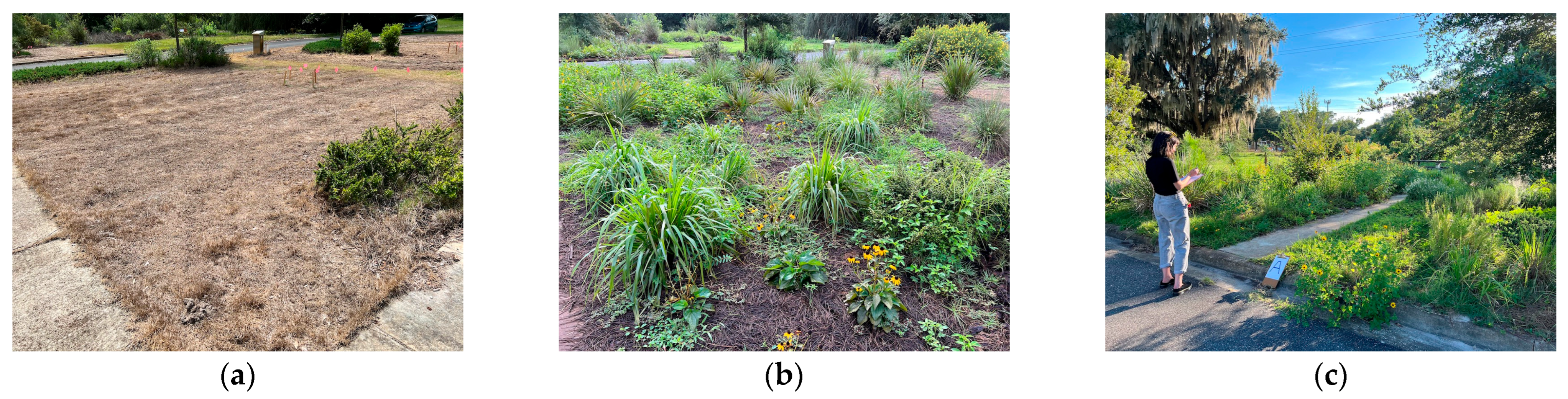
The plant palette for FY1 and FY2 yards included four tree species, seven shrub species, four grass species, three groundcover species, and three wildflower species (the full plant list is in Appendix A.2). The total number of plants in FY1 and FY2 included 8 trees, 62 shrubs, 98 grasses, 62 wildflowers, and 120 groundcover plants. The plant types and numbers were the same in FY1 and FY2. Both had a “naturalistic” style, but the primary design difference between FY1 and FY2 was the spacing and arrangement of the plants. In FY1, the plants were loosely clustered by type but evenly spaced throughout the yard. In FY2, the plants were tightly clustered by type with mulched open spaces between plants for a more open appearance. Eight bales of pine straw mulch were used in each yard to cover the soil at a depth of 7.62 cm (3 inches). The yards were irrigated for 30 mins once a day for 8 weeks in total using rotors mounted on a tripod with battery-operated timers. Once the plants were established, the irrigation was turned off and the yards were not irrigated for the remainder of the study (3 years); subsequently, rainwater was the only source of water. The yards were weeded twice a month in spring/summer and every other month in fall/winter. Figure 1 includes photos of the front yards, which were planted on 20 June 2022, with the first survey conducted on 25 October 2024 (fall/winter survey), the second survey on 5 April 2025 (spring survey), and the third on 22 August 2025 (summer survey).

2.3. Plant Palette and Design for Back Yards

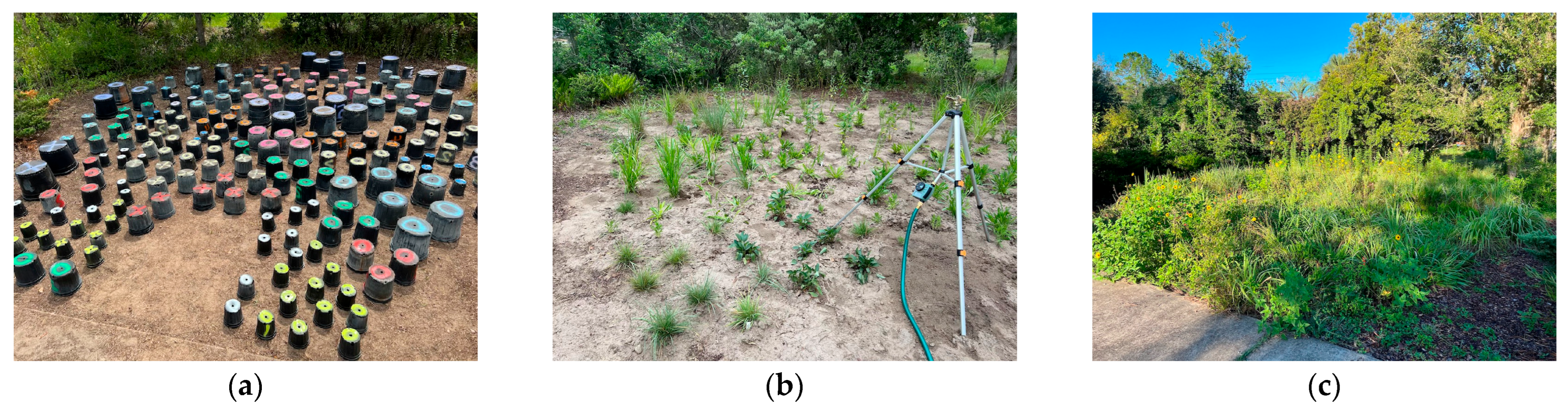
The plant palette for the BY1 and BY2 yards included 14 wildflower species, 2 shrub species, and 3 grass species. The total number of plants in BY1 and BY2 included 498 wildflowers, 10 shrubs, and 58 grasses. (the full plant list is in Appendix A.2). The back yard designs were also similar but not identical; the design intent for these yards was also a “naturalistic” style but with more perennials, mostly wildflowers. The idea was to resemble a wildflower meadow and achieve a different look from the front yards. There were also more existing native trees and shrubs retained in the BY1 and BY2, so there was no need to plant more trees or shrubs. The primary difference between the back yards was the arrangement of the plants and a distinct pine bark mulch trail around the meadow in BY1, but only a small open area of pine bark mulch in the center of BY2. Four bales of pine straw mulch were used in each yard to cover the soil at a depth of 7.62 cm (3 inches). The yards were irrigated for 30 mins once a day for 6 weeks in total using rotors mounted on a tripod with battery-operated timers. Once the plants were established, the irrigation was turned off and the yards were not irrigated for the remainder of the study; subsequently, rainwater was the only source of water. The yards were weeded twice a month in spring/summer and every other month in fall/winter. Figure 2 shows photos of the back yards which were planted on 8 June 2023, with the first survey conducted on 25 October 2024 (fall/winter survey), the second survey on 5 April 2025 (spring survey), and the third on 22 August 2025 (summer survey). Because the back yards were installed by students, color-coded buckets (as opposed to a plan drawing) were used to locate where specific plants should be installed. The color on the top of the buckets matched a color strip on the plant container, with each bucket indicating where each plant should go.

2.4. Plot Surveys

Prior to completing the survey [Appendix A.1], each participant signed an informed consent approved by the University of Florida’s IRB board (IRB Project #ET00043742) and were given instructions for filling out the survey. Respondents were asked to consider the entire landscape and the individual plants and were encouraged to walk into the gardens and spend time observing and touching the plants. The survey was administered by all three authors of the study, with the lead author at all three survey events (fall/winter, spring, and summer surveys). The surveys were conducted in the morning (9 a.m. to 12 p.m.) and the weather conditions were similar for all three surveys—sunny with moderate temperatures. Invitations to participate in the surveys were advertised through different methods. All three surveys were posted on the local county extension office website (Alachua County, Florida). The fall/winter survey was also promoted at a booth at the annual UF IFAS Extension Fall Plant Festival, which hosted approximately 1500 people. The spring survey was promoted at the Florida Native Plant Society Conference in a presentation about native plant yards, and a tour of the research plots was offered as part of the conference schedule. Due to the interests of attendees at the plant-centered events where the promotions took place, most of the participants were plant enthusiasts interested in learning more about native plants, while many were master gardeners.
Our target group for survey participants were people who had an interest in plants and possibly some knowledge of gardening for two reasons. First, past experience with conducting site surveys showed that people not interested in plants, gardening, or landscapes will generally not participate unless they are offered an incentive. Our experience with giving incentives (such as gift cards) was that while they can motivate people to participate, the surveys were often distorted by participants marking the same answer to every question, indicating either their lack of understanding or their lack of interest in the survey and its questions. Second, while our target group has interest in plants and gardening, they may not necessarily have knowledge of native plants and may not use native plants in their landscapes. Our experience in conducting master gardener training workshops on landscape design can be a good example; they were often knowledgeable about gardening with ornamental plants but not natives, as this was a relatively new concept for “old” traditional gardeners. We also speculated that plant enthusiasts (1) would be more likely to understand the terminology in the survey (for example, pollinator friendly, organic, environmentally friendly, ecological based); (2) would most likely change gardening behavior after experiencing the research gardens; and (3) would be the most likely to influence others (the general public) by adopting native plant gardens. We also posted a large sign at the entrance of the research site inviting drivers passing by to visit the gardens on the off chance that someone might be intrigued about the plots.
Out of 216 surveys that were collected, four surveys each from 54 respondents were collected and 8 incomplete surveys were discarded, resulting in a total of 208 surveys from 52 respondents. Participants for each season include 18 respondents for fall/winter; 23 respondents for spring; and 11 respondents for summer. A total of 50 participants did not return for multiple seasons and two participants took part in both the fall/winter and summer surveys. The rationale for collecting four surveys was to investigate preferences and perceptions for the organization of plants in each of the four yards. The surveys had eight questions for each yard—four using a Likert scale response and four follow-up checkbox questions (check all that apply). The respondents were also asked to write comments for clarification or additional information if they desired.

3. Results

The results for the four different categories of the survey—aesthetics, maintenance, environment, and willingness to use a similar design—are reported and summarized. with the survey questions, demographics, and plant lists in Appendix A. Two figures are presented for each category—the first figure is a summary of the Likert scale responses and the second is the number of related checkbox responses reported by seasons.
The positive and negative comments for each category that respondents wrote on the survey are listed in the table for that category. Several strategies were used to determine if a written comment was positive or negative: First, comments that started with a positive or negative qualifier, such as “I love the color of the grasses” or “I dislike the tall grasses”. Second, if the comment contained a descriptive word that was normally seen as positive or negative in the context of landscapes, such as “the purple grasses are beautiful” or “the groundcover looks really messy”. Third, comments that read as statements, such as “Those mints are loaded with bees” or “there are a lot of weeds”, were considered per the context of the category. For example, the bee comment was written by the respondent in the environmentally friendly category and contextually it would be a positive comment. However, if it was in the maintenance category, it might be considered negative for someone who is allergic to bees. Other comments that used words commonly related to good design, such as “mulch pathways provide organization”, were seen as positive in the aesthetics category, since organization was considered a good attribute for aesthetics.

3.1. Aesthetics Results

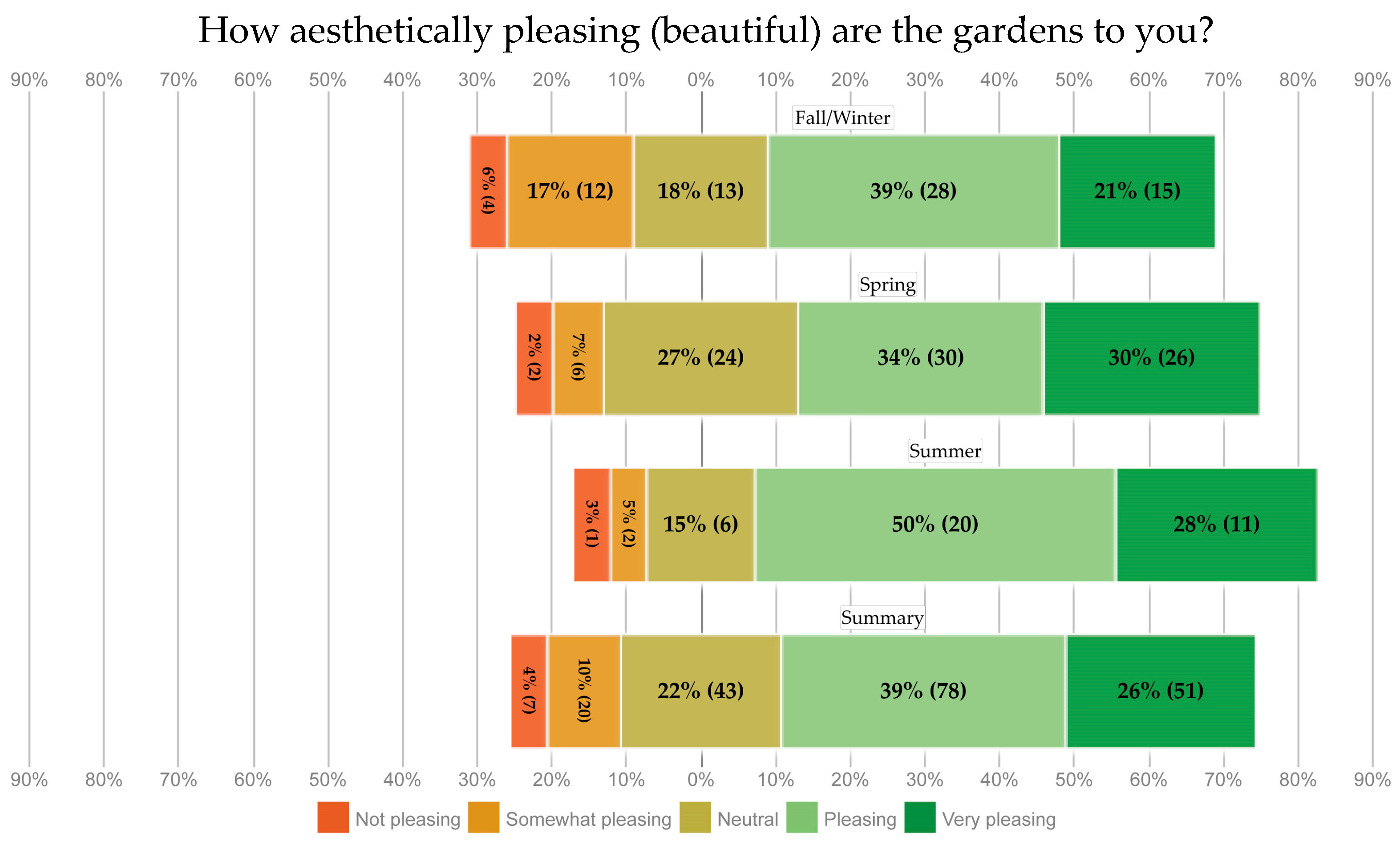
We hypothesized that respondents would find the gardens aesthetically pleasing if the plant materials were organized in a traditional layout based on studies which showed design sophistication and organization were important for aesthetics. Our position was based on studies showing that design sophistication and organization was more important than the type of plant material (native plants vs. non-natives) when evaluating aesthetics [5,10,11]. To test this hypothesis, planting plans for the study were developed using established landscape design principles and elements, including repetition of plant material, incorporating a variety of vertical heights, and using plants with different textures, forms, colors, and sizes. The results showed that 65% found the gardens to be pleasing or very pleasing, while 14% found the gardens to be somewhat pleasing or not pleasing, and 22% were neutral or undecided about aesthetics [Figure 3].
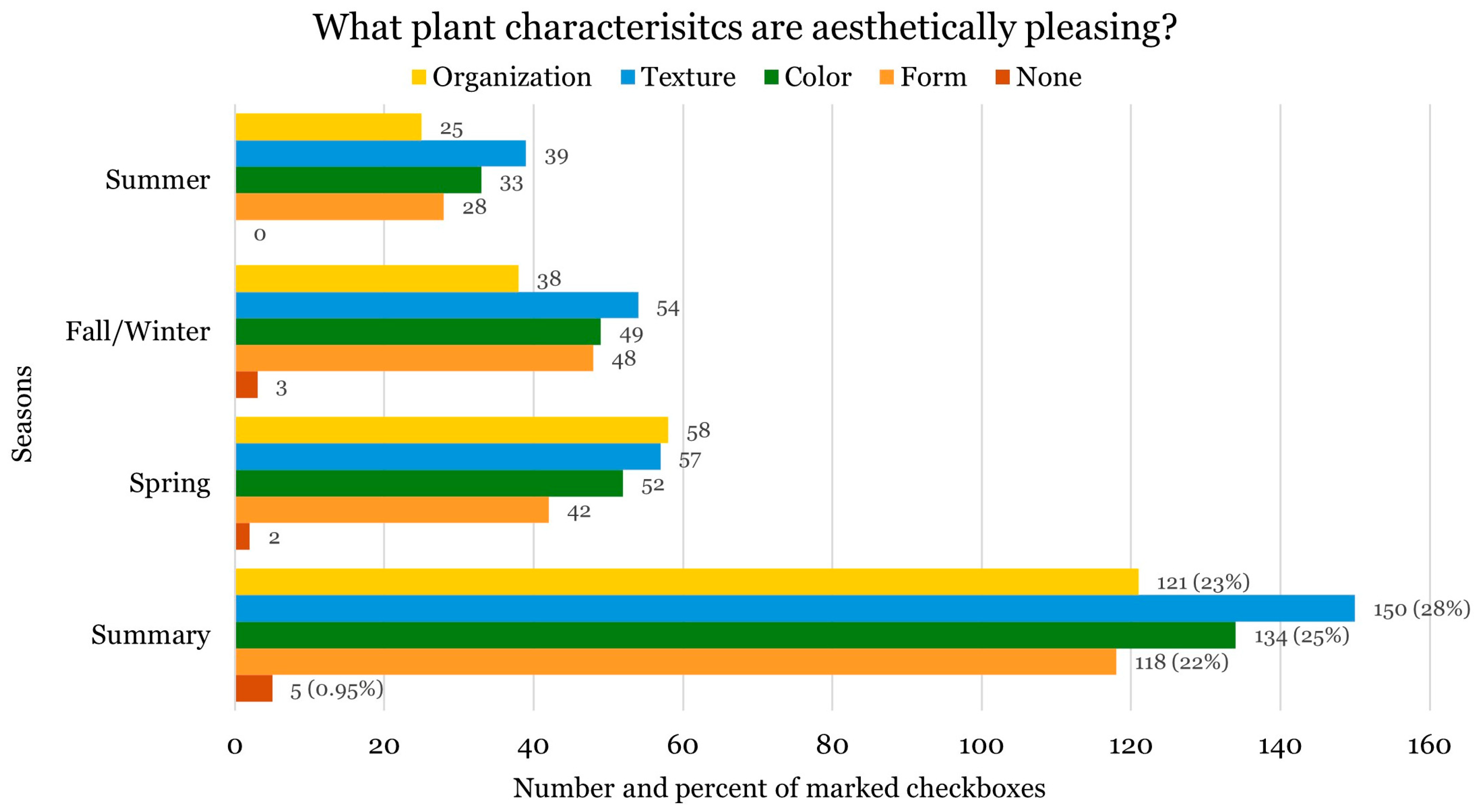
A summary of the results from the survey checkbox questions about plant characteristics across all three seasons demonstrated that 76% of respondents found texture, color, and organization were the most important for aesthetically pleasing gardens [Figure 4]. While color and organization were commonly cited in previous studies as important, texture may have been ranked higher in this study because the designers purposely selected plants for texture to add more interest to predominantly green landscapes.
Despite most respondents finding the gardens to be aesthetically pleasing, the number of negative comments (36) were surprisingly high, particularly when compared to only 44 positive comments [Table 1]. One possible explanation could be that people were more likely to leave negative comments due to negativity bias, where negative emotions are stronger, and make people focus on negative traits in the context of decision-making [23].
Other comments mentioned aspects of design that were not considered in the survey. For example, we did include pathways in the checkboxes, but the use of a circular mulch pathway was cited repeatedly (16 comments) as a positive for organization, and 11 comments cited no clear path as a negative for organization [Table 1]. The type of mulch generated six comments, where the use of pine straw viewed both positively and negatively, particularly, if its use was not thick enough and bare soil was visible [Table 1]. Another characteristic not related to design (and not included in the survey) was fragrance. Two respondents noted that the garden smelled good [Table 1], which should be worth mentioning because scent is considered to be a powerful and positive aspect of a garden. Scent also adds to a garden’s visual appeal because it creates a more immersive experience [24]. Overall, checkbox replies and comments showed that traditional landscape design elements and principles were important for native plant gardens, but a slightly more natural, organic, or meadow-like look with a diversity of plant materials was also a positive attribute for native plant gardens.

3.2. Maintenance Results

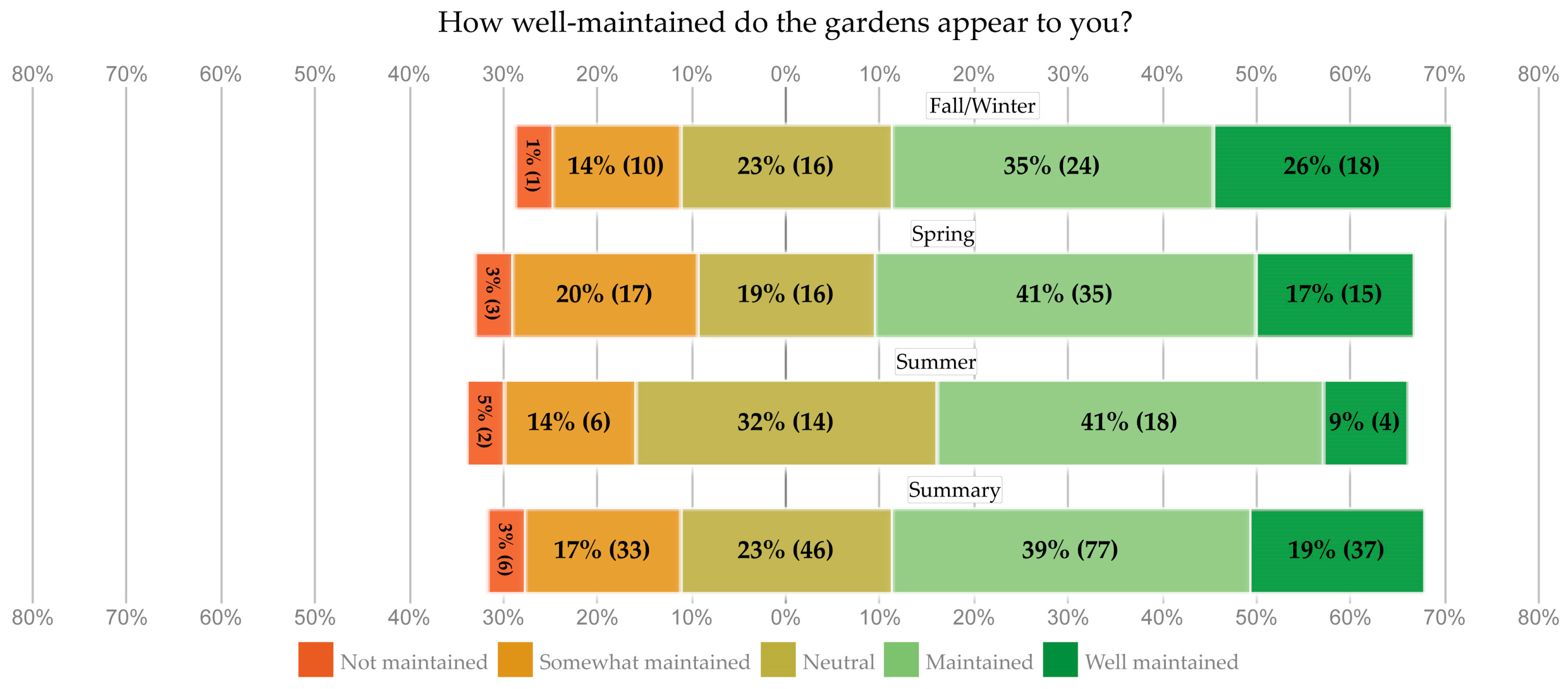
We hypothesized that respondents would not find the gardens to be well-maintained due to our low-maintenance approach of letting native plants spread, which typically did not exhibit the desired characteristics of care. We purposely embraced low-maintenance claims by not deadheading flowering plants, shearing clump grasses, or limiting sprawling plants, and instead let plants reseed or spread naturally. Our hypothesis was based on studies showing that many people described native plants and landscapes as weedy, messy, and/or low maintenance [5,9]. However, just over half (57%) of the respondents found the gardens to be well-maintained or maintained despite our low-maintenance approach, while 43% said they were somewhat maintained, not maintained, or neutral [Figure 5].
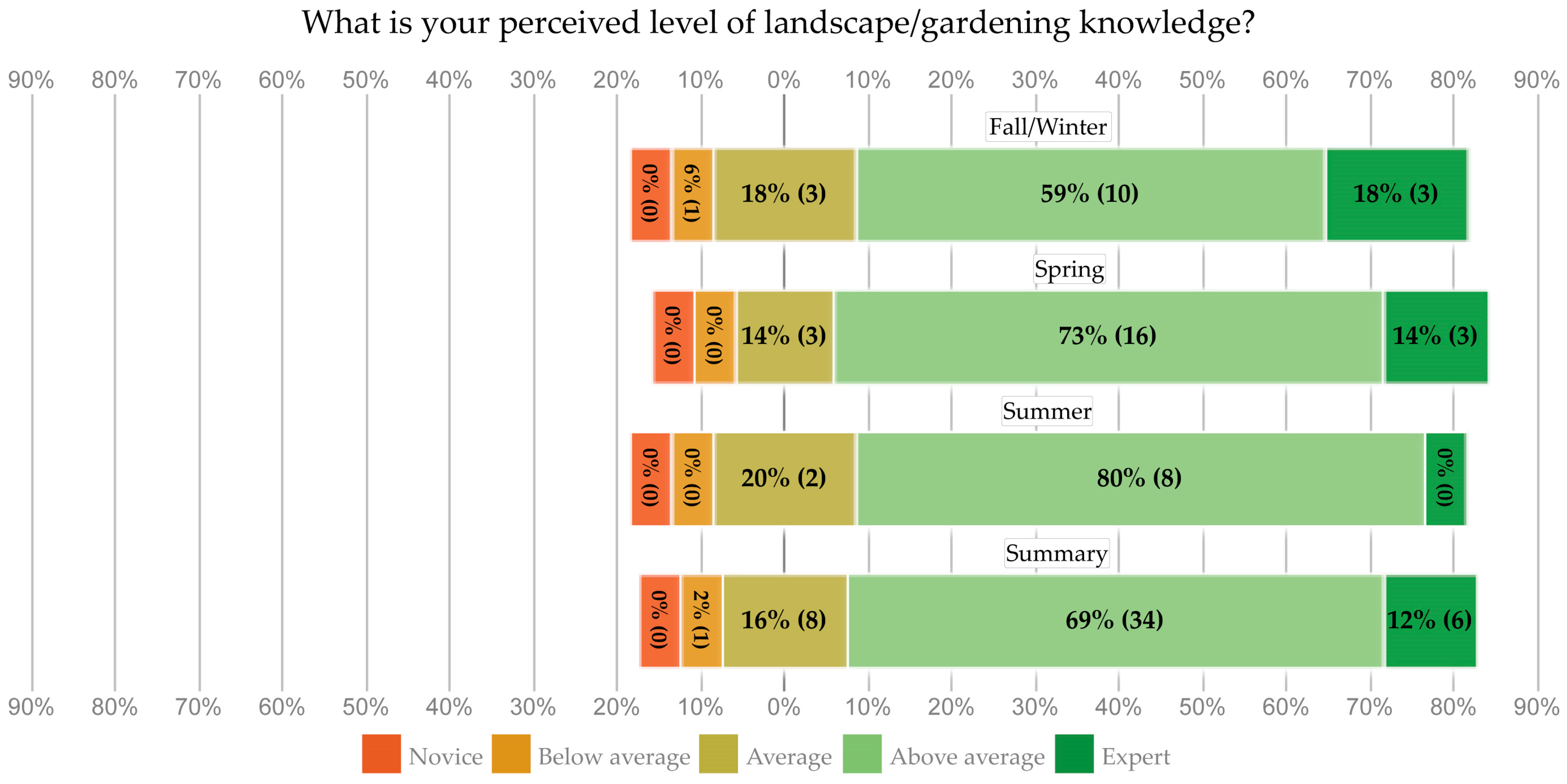
The neutral results suggested that respondents may have been undecided about whether the gardens were well-maintained or not based on perceptions that conventional yards were easier to maintain, with maintenance requirements being linked to aesthetics [5]. There was a high number of people who described their landscaping and gardening knowledge as average (16%), above average (69%), or expert (12%), which may explain this ambivalence as well as the high number of positive responses. Direct experience or knowledge about maintaining a garden as well as those who garden to connect to nature may have a different perspective based on the acceptance of the “perfect imperfection” of nature in a garden, where signs of meticulous maintenance were not important [15,25]. Naturalness can also be an expression of care (maintenance) to those with knowledge of ecology or those with ecological gardening experience [15,25].
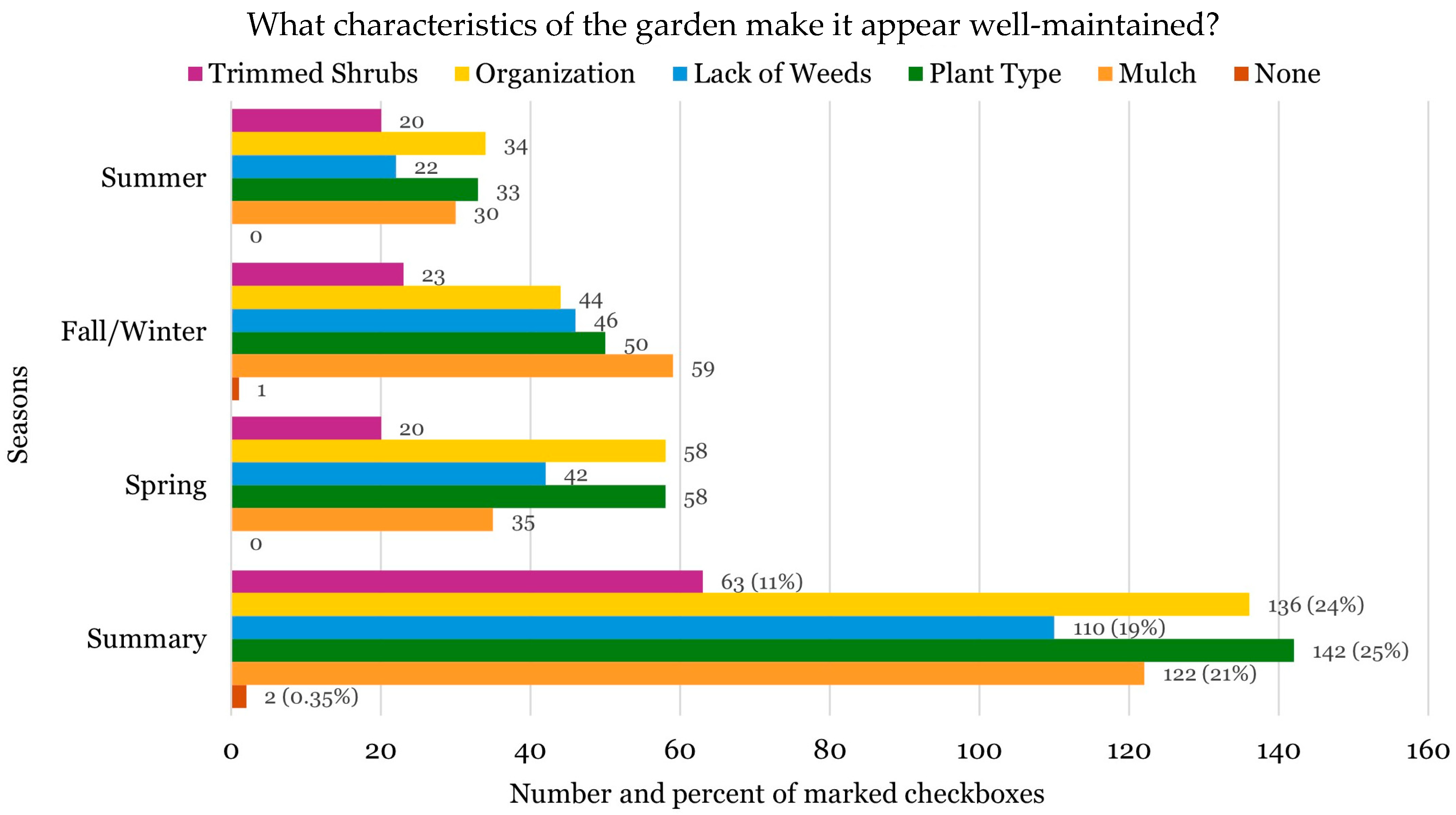
Figure 6 shows the results for survey checkbox questions about maintenance characteristics. The summary across all three seasons revealed that 70% of respondents found plant types, organization, and mulch to be the most important characteristics for well-maintained landscapes, and eight out of the nine positive comments written by participants mentioned these characteristics. The least important characteristics for well-maintained gardens were weeds (presence or lack of) and trimmed shrubs, which was interesting, as several previous studies cited the presence of weeds and untrimmed shrubs as maintenance issues [6,9], and negative comments by respondents in this study mentioned weeds in the groundcover and not seeing mulch due to weeds. There were almost twice the number of positive comments (9) compared to negative comments (5), which was also unexpected for our maintenance activities. Two of the five negative comments regarding maintenance were about tall grasses having dead leaves (thatch) and being unkempt. There were also very different (opposite) perceptions of maintenance, as the positive comments included grasses being cut back (this was the respondents perception, we did not cut the grasses), weeds under control, groundcover suppressing weeds, and mulch in paths and beds as well-maintained [Table 2].
Our maintenance activities were limited to pulling weeds and turf that survived the application of herbicides when preparing the plots (mostly random turf clumps), as well as a native plant Bidens alba (Spanish Needle) that was not purposely planted but invaded from a near-by wooded area. Studies have shown that homeowners typically remove natives that self-disperse and grow like weeds in their flowerbeds, but would leave seedlings of native plants they liked in areas with shrubs or trees [26].

3.3. Environmental Health Results

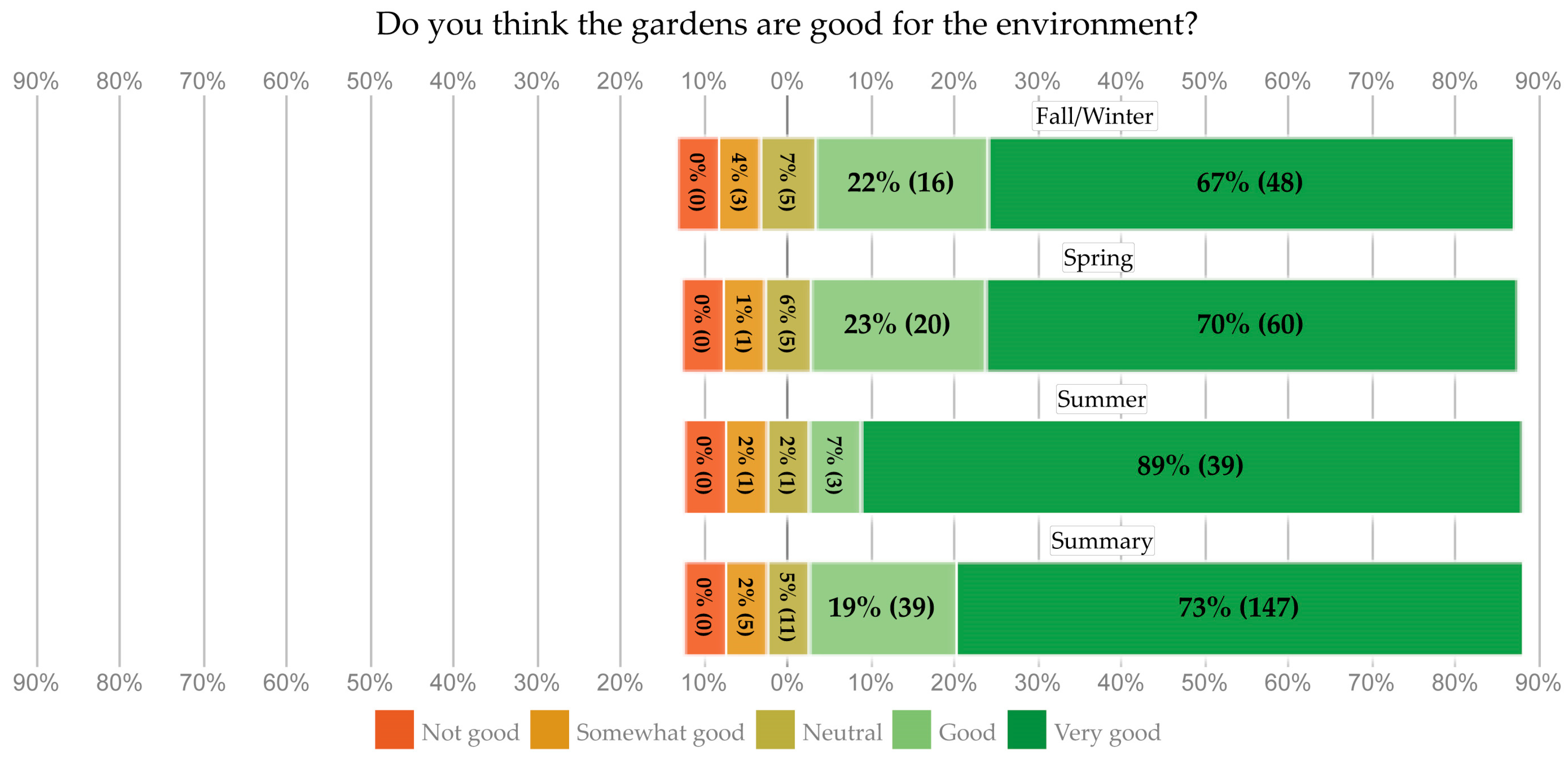
Our environmental health hypothesis stated that respondents would find the gardens good for the environment due to our speculation that plant enthusiasts, who have knowledge about native plants and believe they are important for the environment, would be our most likely study participants. The majority of respondents (92%) found the gardens to be very good or good for the environment, while only 2% rated these as somewhat good or not good [Figure 7]. In total, 82% of participants rated their landscape knowledge as above average or expert and 35 were master gardeners, confirming our speculation that plant enthusiasts would be attracted to the study. However, it must be noted that we did not ask for confirmation of native plant knowledge in the survey, so we do not know if the participants had knowledge of native plants or if they had experience with native plants in their own gardens. As only 29% of the participants were master gardeners, their status was not seen as an issue with skewing the results. Our professional experience with teaching master gardeners about landscape design in training workshops led us to believe that master gardeners would have more knowledge and were more interested in traditional garden design, but this was speculative on our part.
Respondents’ positive comments on the presence of pollinators and bees, as well as bird habitats and insects, were an indication they recognized the gardens as a good wildlife habitat and good for the environment. However, the negative comments implied that the gardens could be even more wildlife friendly, citing the low diversity of plants and the need for more pollinator plants [Table 3]. One unexplainable finding was the top positive and negative comments which opposed each other, as both were cited in the fall/winter surveys; the bottom positive and negative comments, which also opposed each other, were similarly both cited in the summer survey when there were the highest number of blooms, as one participant noted in their comments “large bunches of blooming yellow flowers”.
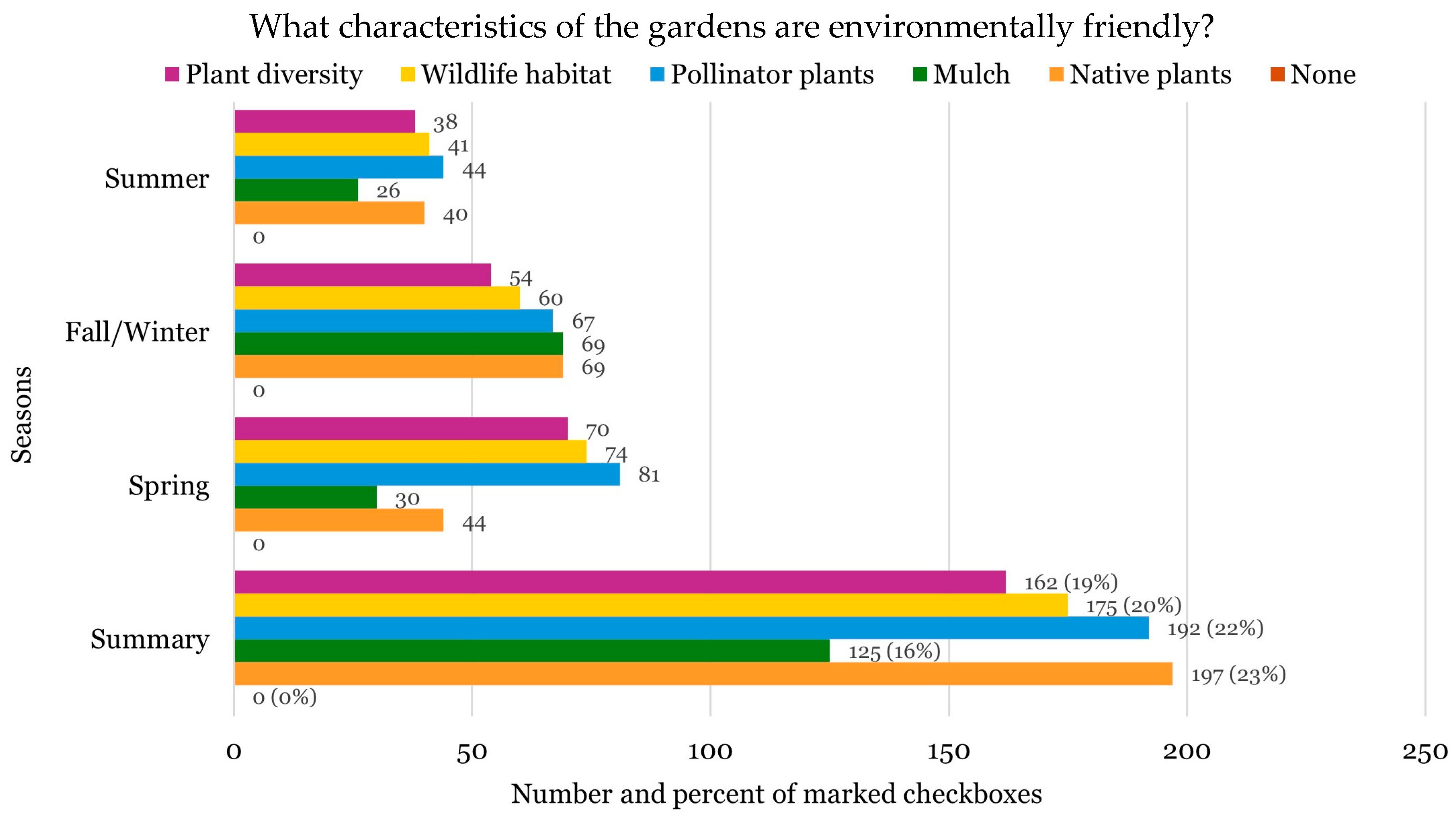
Similar studies also reported that the number of pollinator visitations depended on the number of native plants and the clumping of plants, with a strong positive correlation between visual ratings and pollinator richness, speculating that a diverse plant palette appealed to pollinators and humans [1]. Native plants (23%), pollinator plants (22%), and wildlife habitat (20%) were cited as the top characteristics that made the gardens environmentally friendly [Figure 8]. Positive comments relating to environmental health focused on pollinators, birds, wildlife, and insects as indicators of being good for the environment. Supporting wildlife was often a primary reason for using native plants in gardens [6], so these comments were expected. However, the negative comments implied that native plants alone were not enough, and more attention needs to be put on the type and number of plants with specific roles, such as food sources for wildlife or plants that support important pollinators.
When homeowners’ received direct information (as a study participant) about how their garden did and/or could contribute to native biodiversity, they were eager to use more native plants and environmentally friendly practices, showing that direct exposure/information about native plant landscapes has the potential for increasing native plant biodiversity [12]. However, the results from our study suggested that people who had received information (based on their reported expertise) and therefore had ecological knowledge recognized that native plants were good for the environment but were not particularly eager or motivated to use a similar native plant landscape.

3.4. Willingness to Use a Similar Design Results

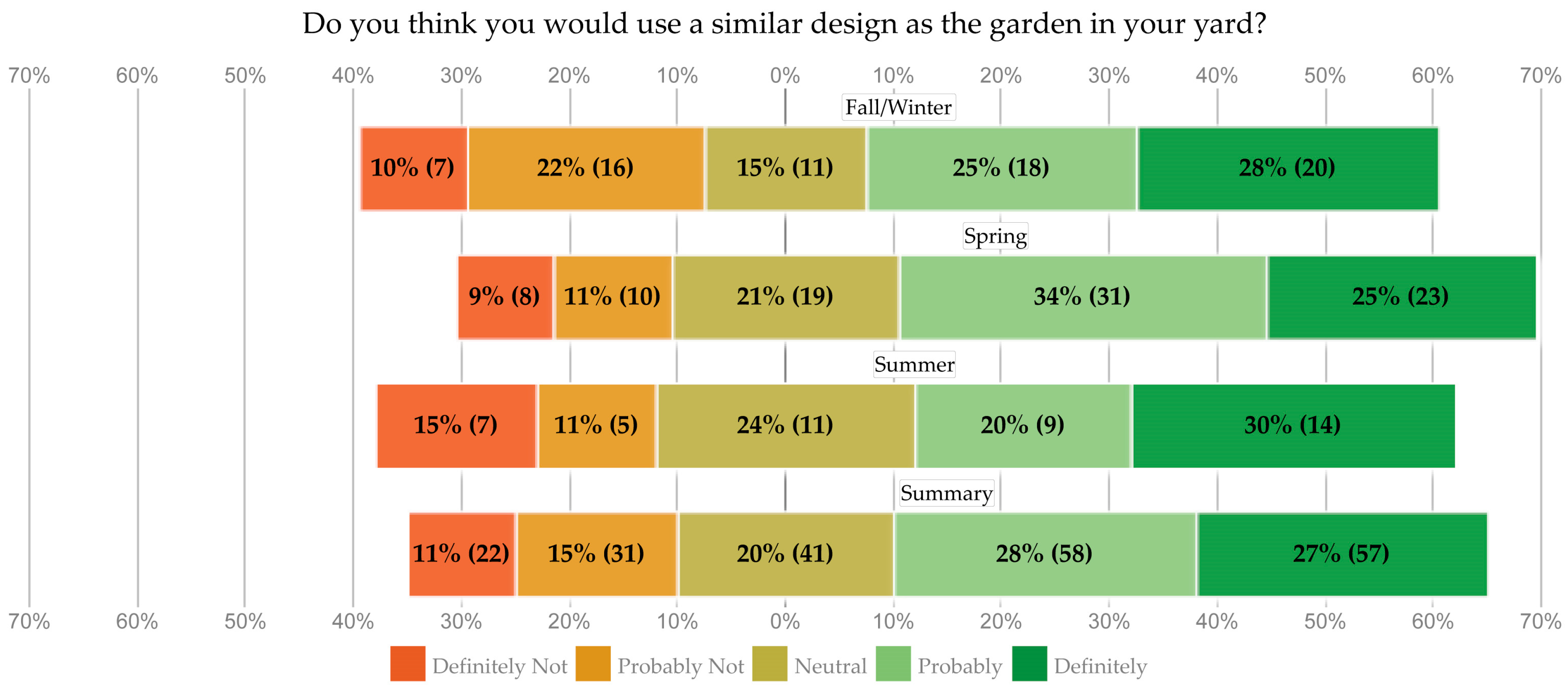
We hypothesized that survey participants would be inclined to use a similar design in their yards if they responded positively to the aesthetics, maintenance, and environmental characteristics of a native plant yard. This was based on studies employing Ajzen’s theory of planned behavior where individuals’ knowledge and perceptions of sustainable landscapes can influence their adoption intentions and predict their pro-environmental behavior [19]. On the Likert scale [Figure 9], a small majority of respondents (55%) indicated they probably or definitely would use a similar design in their yard; however, 20% were neutral (undecided) and 26% indicated they would either probably not or definitely not use a similar design. For this question, the neutral response more likely leaned to the negative as it indicated hesitation to commit to a similar yard. Considered together, the negative and neutral responses were 46%, a high number considering most respondents had positive perceptions of the native plant gardens. Since aesthetics (both by design and maintenance) and environmental benefits did not appear to be a factor in willingness to use, we speculated that other factors such as neighborhood social norms, regulations and policies, or a lack of knowledge of native plants may have been barriers for some respondents.
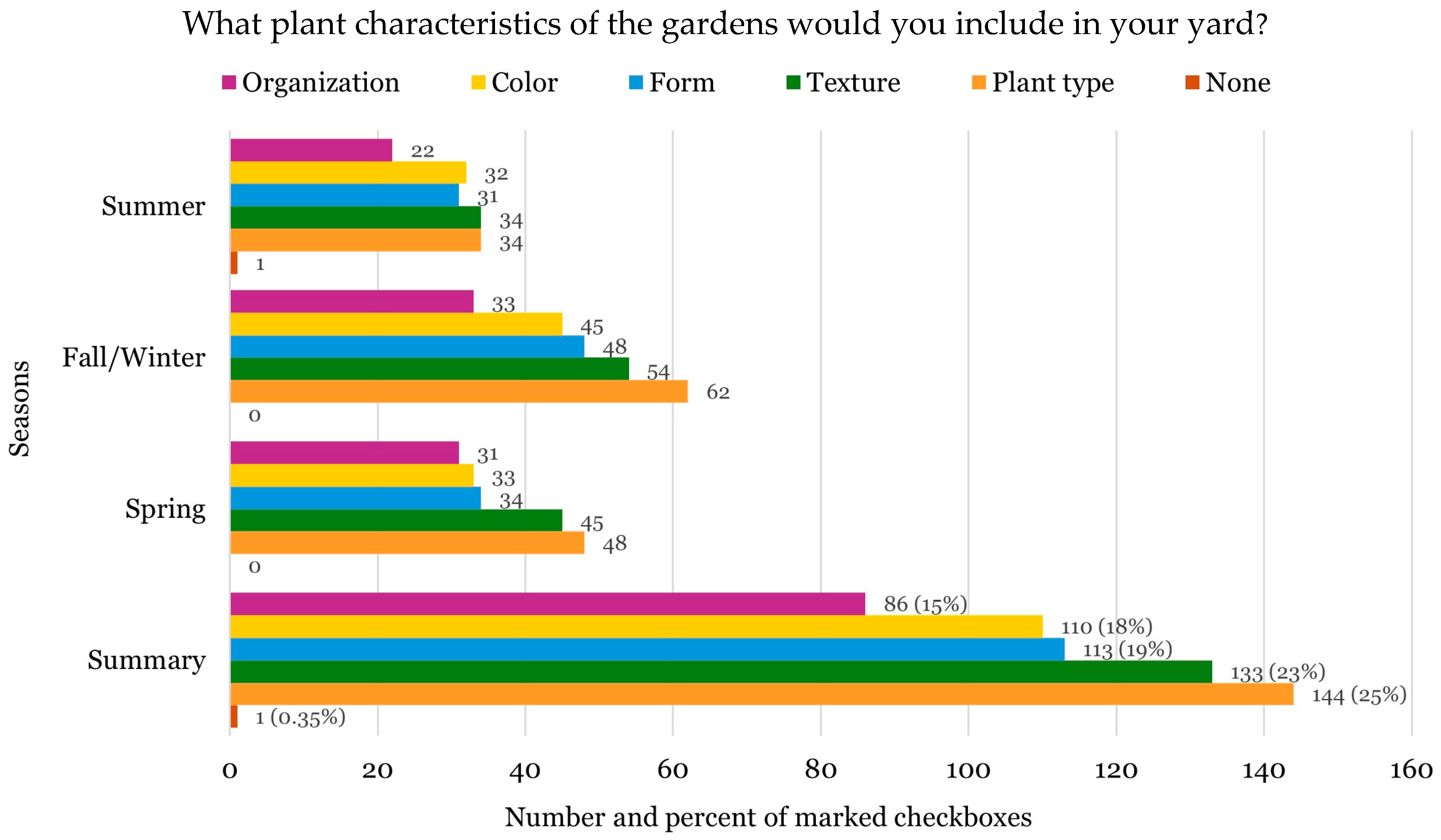
The small difference between those who would and would not use a similar design was surprising since most responded positively to the aesthetics, maintenance, and environmental characteristics. Overall, 66% indicated they would include plant types, texture, and form in their yard if they adopted a native plant landscape; however, one commented they would not use some of the plants seen in the survey plots [Table 4]. It was also surprising that color and organization ranked last for characteristics that participants would include in their yard [Figure 10], since other studies have consistently ranked these as very important characteristics for native plant yards [7,9,10,11].
Participants wrote few comments, so it was difficult to gain additional insight into the reasons for non-adoption [Table 4]. After completing the survey, several mentioned that their HOA (Homeowner Association) landscape codes would not allow it, but there were no written comments specific to HOA codes. Other studies have shown people were also more willing to plant local natives if provided with the plants and information and could control the location of the plantings [9], indicating that knowledge should increase willingness; however, this did not appear to be a factor in this study, since most participants rated themselves as knowledgeable. A study on ecological gardening found that a lack of knowledge and concern about what the neighbors would think made them hesitant to embrace a more chaotic-looking (ecological) yard [14]. One participant in this study commented they would only use a similar yard in the back yard, which also indicated a desire to control the location of the plants and follow social norms for the front yard. The comment on needing more usable space implied there was a need for turf; although this was not explicitly written in the comments, several participants mentioned the need for turf while talking to the survey administrator after completing the survey.
Others have found that homeowners who were more knowledgeable about landscapes were more likely to adopt sustainable landscapes, and there has been a positive correlation with sustainable landscape adoption intentions when homeowners’ perceptions of landscape conservation practices matched sustainable landscape practices [19]. However, in this study, while a high number of participants perceived their level of landscape knowledge to be expert (12%), above average (69%), and average (16%), this did not appear to motivate them to use a similar native plant landscape. Only 2% felt their knowledge was below average and no one rated themselves as novice. One possible explanation could be that 35% of participants were master gardeners, 59% were homeowners, and 6% college students; as a result, master gardeners and long-time gardeners may have been influenced by their training and experience with more traditional landscape design, and homeowners may have been influenced by their neighborhood yards and social norms.

3.5. Knowledge of Benefits—Results

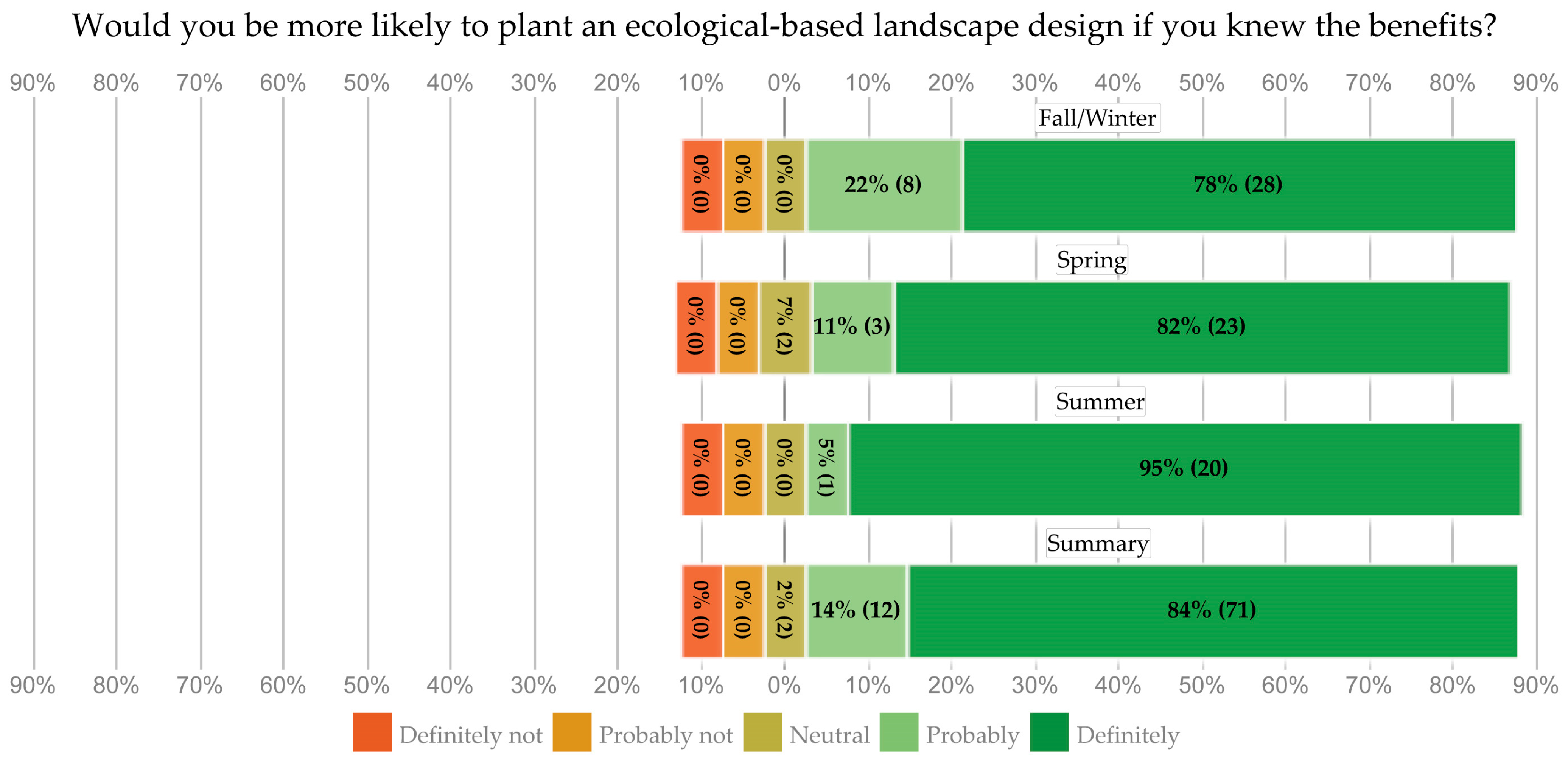
We hypothesized respondents who were unsure of their desire to adopt or needed more information would be more likely to plant an ecological-based landscape if they knew the benefits. Our assumption was based on several studies have shown people with knowledge of benefits were more likely to use native plants, adopt sustainable landscapes, improve biodiversity in their yard, and select plants with traits such as nativeness, drought tolerance, and attractiveness to birds [7,19]. In our study, 98% indicated they would definitely or probably be more likely to plant an ecological-based landscape if they knew the benefits, while 2% were undecided and no respondents marked probably not or definitely not [Figure 11].

3.6. Perceived Level of Landscape and Gardening Knowledge—Results

Participants were asked to rank themselves on their level of landscape/gardening knowledge, as this additional information could be helpful in explaining results or making recommendations for influencing others to adopt native plant gardens. The Likert scale results showed that most believed they were above average in general landscape and gardening knowledge, and expanding their knowledge to more specific, specialized gardens may have motivated them to participate in the study [Figure 12].

3.7. Additional Survey Questions

Questions 17 to 21 of the survey were used to gain additional information about the participants that might help explain some of the survey responses to questions 1–8 and 9–16 which were specifically about the front and back yards. Results for questions 17 and 21 are presented in Figure 11 and Figure 12. We also asked about demographics to see if homeownership (question 18) or special training as a master gardener or college student (questions 19 and 20), might have been factors, but less than half (42%) of the participants owned homes and most (46%) were not master gardeners, so this did not seem to put most of the participants in any special category of knowledge [Table 5].

4. Discussion

This study was about the preferences and perceptions for native plant landscapes. To learn more about what people preferred and how they perceived the landscape, the survey was structured first with a simple agree/neutral/disagree Likert scale question. These were followed by checkbox options where participants had the opportunity to select responses that represented their perception of native plants in a landscape, and finally the participants could further clarify their preferences with personal observations. Most of the Likert scale responses were on the positive side of neutral, which initially made it appear that participants were fully accepting of native plant landscapes and would be potential advocates for native plants. However, their personal comments exposed some concerns and dislikes that hinted at possible hesitations for using native plants in their own gardens.

4.1. Aesthetics

The first question of the survey, specifically about how aesthetically pleasing (beautiful) the gardens were, was clearly the most interesting to the study participants. Based on the number of comments, they had many opinions about aesthetics. Although many of the participants were master gardeners and/or rated their perceived level of gardening knowledge as above average or expert, they were not necessarily native plant or landscape design experts. Although we did not ask about their expertise with native plants, we noted that none of the participants commented on the native status of the plants as being important to the beauty of the garden (as in, the gardens are beautiful because the plants are native). Comments showed that participants focused on design issues, such as organization, as important to aesthetics but not to the function of the gardens. For example, the organization of plant clusters were important to wildlife and the gardens were ranked very good for the environment, but the organization of plants to create habitats for wildlife was not mentioned as an environmental concern. Comments showed the mulch path was of greater importance as an organizing design element than the placement of plants. Other studies have shown that species richness can increase aesthetic appreciation; however, high diversity can also mean low legibility if there is no organization. Similar results from other studies showed that native plant gardens were rated highly for visual quality [1].
While colors in flowers and plant shapes were also cited as important to aesthetics (reflecting a well-studied preference for color and form in plant selection), the comments about color and shape were related more to ensuring diversity and variety of the plants in the garden, in addition to improving aesthetics. The natural organic look, which is a defining feature of native plant gardens, was mentioned more often as a negative feature for aesthetics, describing the look as lacking organization, messy, and scattered.

4.2. Maintenance

Maintenance issues such as weeds, unpruned shrubs, plants sprawling in walkways, and a lack of mulch were also negatively associated with aesthetics. It is important to note that these maintenance observations also hold true for traditional non-native gardens, as people who do not garden or have little knowledge of plants will often describe a well-maintained garden as aesthetically pleasing, regardless of the plant characteristics or types of plants. Many of the participants comments tracked closely with previous research showing that aesthetics, maintenance, ecological knowledge, and social norms for certain landscape styles were important factors for landscape preference [2,3,4,5,6]. Participants’ perceptions of aesthetics as a function of maintenance of native plants suggested that advocates should focus primarily on spatial organization with mulch pathways and a less organic form in the layout to convince homeowners to use native plants. As is true with ornamental plants in traditional gardens, highlighting the colorful flowers of native plants and an organized design that is neat and well-maintained will be key to promoting native plants as an alternative to ornamentals. In other words, to promote native plant landscapes, traditional principles and elements of garden design and standard maintenance practices need to be used.
We hypothesized that respondents would not find the gardens well-maintained due to our low-maintenance approach of letting native plants spread; however, comments in the survey suggested that other issues were more closely associated with maintenance. There were more positive comments than negative, citing the healthy look and natural form of the plants, as well as the use of mulch and pathways to make the garden look maintained, emphasizing the relationship between aesthetics, preference, and maintenance. Negative comments about dead leaves, weeds, and untrimmed grasses were also cited as the same issues that made traditional landscapes look poorly maintained. A new aesthetics of care paradigm for maintaining native plant landscapes has been proposed that are governed by a set of rules rather than an image or look; however, this may be counterproductive. The framework includes a care ethic (moral human-land relations), a care ordinance (maintenance practices for desired site performance and appearance), and a calendar of care (managed evolution of the landscape over time) [18]. Our results suggested that looks have remained an important issue in the acceptance of native plant landscapes, and the care ordinance would need to closely resemble a traditional maintenance program to achieve the desired aesthetics.

4.3. Ecological Knowledge

We anticipated that our study participants would be plant enthusiasts with at least some knowledge of native plants, and they would find the gardens good for the environment. While we were correct about their enthusiasm for plants and perceptions that the gardens were environmentally friendly, we learned from their survey comments and post-survey questions that their ecological knowledge was not necessarily related to their perceptions. People with environmental gardening knowledge often prioritized native plantings for ecological health [25], and our respondents may have felt the use of native plants reflected their values and beliefs toward a nature that should not be highly maintained. In addition, self-identified ecological gardeners were less concerned with creating beauty than with creating better ecological function in their garden [25], which may also explain the high number of respondents who found our garden to be well-maintained despite the lack of traditional maintenance practices. Most of the comments were positive, citing the abundance of pollinators and birds as an indication that a native plant garden was good for the environment, which meant by default the plants that supported them were good for the environment. However, this could be interpreted as native plants were only good for the environment when they supported wildlife. The same could be said for a garden without native plants that can attract pollinators and birds, as they both serve the same purpose—to support wildlife. Other positive comments, such as no irrigation, fertilizer, or mowing, could also apply to a garden without native plants. Perhaps more revealingly were the negative comments that included a lack of pollinator plants, low diversity, and too few flowers despite the abundance of native plants in the study garden. These implied that the types and mix of native plants were also important for the environment, not just the number of plants. The plants must also be selected for certain characteristics to meet the criteria of environmentally friendly, and those characteristics would also apply to a non-native garden.

4.4. Willingness to Adopt

Generally, the participants responded positively to the aesthetics, maintenance, and environmental characteristics of a native plant garden, which we hypothesized would encourage them to adopt a native plant garden. However, their willingness to adopt was not based on their perception of these characteristics, as they were more concerned with code requirements, functionality (need space to play), and plant choices. This indicated a need to reconsider how we can design native plant landscapes to be more functional, meet the landscape codes of neighborhoods, and exhibit preferred aesthetic characteristics. A similar study showed that the general public found natural and species-rich gardens to be aesthetically pleasing, but were hesitant to adopt ecological gardening because they did not want their garden to be considered as chaotic by their neighbors [14]. Clearly, the design we created in our plots did not meet the needs of the participants, as expressed by the hesitancy to adopt. A more traditional design would have likely increased the willingness to adopt. One key to using more native plants could therefore be a traditional design that does not depend on 100% natives, but aims for a 75% and 50% native/non-native mix.

4.5. Knowledge and Education

Other strategies will also be important to encourage adoption. Higher education levels, knowledge of landscapes, and landscape conservation practices have been highly correlated with homeowners’ intent to adopt sustainable landscapes, and their preference for native plants and naturalistic landscapes was possibly due to a better understanding of environmental issues [3,4,7,19,20]. This could mean that advocates for native plant use must consider educational programs and social marketing approaches that align with and support perceptions of native plant landscapes. Knowledge about maintenance requirements may have also played a role in using ecological landscapes; in a study using visual attention to quantify homeowners perceptions of aesthetics and maintenance, participants with horticulture knowledge had higher visual appeal ratings for landscapes with 100% plants, but rated maintenance as low [5]. This may indicate that knowledgeable people recognize maintenance requirements more accurately and were more confident in their maintenance abilities. Other knowledges such as functionality, values, environmental beliefs, and economic considerations could also influence the likelihood of using native plants [6,19]. Participants in one study cited their environmental knowledge and a moral obligation to care for the environment for future generations as reasons for having native plant gardens [6]. Community-wide incentives such as subsidized educational programs have proven to encourage adoption, especially when they were a part of a broader sustainability culture in a community [6]. One example from New Zealand was the use of biodiversity assessments and meetings with homeowners to increase their knowledge, which led to one quarter of the participants incorporating native plants in their yards [20]. A study in Switzerland also noted that the greatest constraint to adoption was a lack of knowledge about ecological gardening [14]. One study that involved before and after tours of plots resembling back yards with an educational workshop between tours did not change perceptions of aesthetics; however, the workshops did change perceptions of maintenance time, which may be due to the participants being master gardeners who were more interested in factual information [27]. Other studies have recommended the use of tools such as plant databases to research specific plant characteristics, as well as consulting with a landscape designer, visiting demonstration landscapes, and advocating for municipal policies for landscape regulations that support biodiversity rather than counterproductive policies that prohibit diversity with turf requirements and strict visual standards [1]. This has suggested that a variety of activities should be considered to increase knowledge to meet different needs and abilities, including community classes and workshops, demonstration landscapes, websites, literature, and other horticulture activities such as native plant sales. Zhang et al. concluded that incorporating knowledge and environmental benefits information into educational programs can improve homeowners’ perception of sustainable landscapes, which influences preferences and increases the probability of adoption [19].

5. Conclusions

5.1. Primary Conclusions

The conclusions relevant to the goal of increasing adoption of native plant landscapes include: (1) most respondents were positive about the aesthetic appeal of native plant landscapes based primarily on color, texture, and organization; (2) the majority were also positive about the maintenance appearance based on the plant types and use of mulch; (3) a high percentage thought the yards were good for the environment based on the use of native plants, pollinator plants, and observing pollinators in the yards; (4) respondents were split on whether they would use a similar design and cited external factors not included in the study, such as landscape codes and functionality, as important characteristics informing their decision; and (5) others noted they would be more likely to use a similar design if they had more knowledge about the benefits. The key message was that native plant gardens should use traditional design principles and maintenance practices and should follow a set of environmental guidelines so they are not perceived as a totally new concept that will be difficult to adopt. The knowledge gained from this study will (1) help designers and homeowners create native plant gardens that are aesthetic and ecologically based; (2) help policy-makers craft more ecology-focused landscape codes and ordinances that also meet aesthetic preferences; (3) help educators and advocates target perceptions and preferences in educational materials and social marketing campaigns; and (4) help promote the use of native plant gardens with developers and builders to improve urban ecology on a large scale. Landscape designers and architects can use information about preferred design characteristics to create a set of rules-based design recommendations for native plant landscapes. Urban ecologists can partner with designers to improve environmental quality by helping to create wildlife habitats with native and pollinator plants for greater biodiversity, and maintenance companies can use the information to develop better maintenance practices for native plant gardens. A rules-based design to encourage adoption of native plant landscapes should include desired plant characteristics for aesthetics and environmental benefits, as well as design recommendations for spatial organization and composition, such as species mix, percent native plants, and vertical heights. Designers and educators should emphasize plant organization and type, followed by the standard elements of design, including plant texture, color, and form. A study of college students’ preferences for home landscapes found that students in horticulture and social sciences preferred well-maintained landscapes, while wildlife science students prefer more natural landscapes [28]. This could present an opportunity in both groups to show how well-designed landscapes can have similar ecological characteristics. Despite the fact that organization and color ranked low by participants as plant characteristics they would include in their garden (Figure 8), they were important principles and elements of design that have the potential to make a native plant garden look more traditional and therefore more acceptable to the general public. Mulch should also be recommended as a groundcover and design element to help garden organization. Plant selection should include native pollinator plants, as well as an abundance of plants for biodiversity and wildlife habitat. Policy-makers can promote the goal of creating wildlife habitat by requiring a percentage of native plants and pollinator plants be included in the gardens and using a wide diversity of plant material. And last, homeowners and developers should embrace a low-maintenance protocol that emphasizes weed control and shrub trimming only, with the goal of establishing a new neighborhood social norm for native plant gardens.

5.2. Study Limitations

This study had two limitations that should be addressed in future studies. The first was that the majority of participants in this study were plant enthusiasts (though not necessarily knowledgeable about native plants), so the data may not reflect the preferences and perceptions of the general population. However, we would recommend that the first population to target for further studies should be plant enthusiasts with little knowledge of native plants, as they are more likely to adopt native plant landscapes quicker and can help advocate to the general population through their behavior change. The second limitation was the location of our study. Except for bloom times, there was relatively little seasonal change in plant material in Florida (except for when we experience an occasional freeze in North Florida), so the data on seasonal change may only be relevant to tropical, sub-tropical, and other warm climate areas with small temperature fluctuations that have less impact the visual characteristics of plants and aesthetic appeal. It is important to also note that the tropics and sub-tropics have a very wide band (between 30-degrees North latitude and 30-degrees South latitude) that covers a large area and accounts for half of the Earth’s surface, which means this study would be valid for a large portion of the Earth’s population.

Author Contributions

Conceptualization, M.V., B.B.N. and G.H.; methodology, B.B.N.; validation, G.H., B.B.N. and M.V.; formal analysis, G.H.; investigation, G.H.; resources, G.H.; data curation, G.H.; writing—original draft preparation, G.H.; writing—review and editing, G.H., B.B.N. and M.V.; project administration, G.H.; funding acquisition, G.H., M.V. and B.B.N. All authors have read and agreed to the published version of the manuscript.

Funding

This research was funded by IFAS Center for Land Use Efficiency (CLUE), at the University of Florida. There is no assigned grant number and no funds were received to cover publication costs.

Institutional Review Board Statement

The study was conducted in accordance with the Declaration of Helsinki and approved by the Institutional Review Board of the University of Florida (IRB Project #ET00043742, IRB version 1 March 2024, PI version 16 October 2024).

Informed Consent Statement

Informed consent was obtained from all subjects involved in the study.

Data Availability Statement

The raw data supporting the conclusions of this article will be made available by the authors on request.

Conflicts of Interest

The authors declare no conflicts of interest.

Appendix A

Appendix A.1

Survey questions
Questions 1 to 8 for Front Yard 1 are repeated as Questions 9 to 16 for Back Yard 1.
Questions 1 and 9: On a scale of 1 to 5, how aesthetically pleasing (beautiful) are the gardens to you?
1—not pleasing, 2—somewhat pleasing, 3—neutral, 4—pleasing, 5—very pleasing
Questions 2 and 10: What plant characteristics are aesthetically pleasing? (Check all apply)
Organization (well-organized or organic), Color, Texture, Form, None
Questions 3 and 11: On a scale of 1 to 5, how well-maintained do the gardens appear to you?
1—not maintained, 2—somewhat maintained, 3—neutral, 4—maintained, 5—well-maintained
Questions 4 and 12: What characteristics of the garden make it appear well-maintained?
Weeds (presence or lack of weeds), Mulch, Trimmed/pruned shrubs, Plant types (grasses, shrubs), Plant organization, None
Questions 5 and 13: On a scale of 1 to 5, do you think the gardens are good for the environment?
1—not good, 2—somewhat good, 3—neutral, 4—good, 5—very good
Questions 6 and 14. What characteristics of the gardens are environmentally friendly?
Greater diversity of plants, Native plants, Pollinator friendly, Wildlife habitat, Mulch, None
Questions 7 and 15: On a scale of 1 to 5, do you think you would use a similar design as the garden in your yard?
1—definitely not, 2—probably not, 3—neutral, 4—maybe, 5—definitely
Questions 8 and 16: What plant characteristics of the gardens would you include in your yard?
Organization, Color, Texture, Form, None
Participants filled out all eight questions for each yard—FY1, FY2, BY1, and BY2—plus the following final survey question about ecological-based landscapes.
Question 17: On a scale of 1 to 5, do you think you would be more likely to plant an ecological-based landscape design if you knew the benefits?
1—definitely not, 2—probably not, 3—neutral, 4—maybe, 5—definitely
Question 18: Are you a homeowner?
Yes/No
Question 19: Are you a master gardener?
Yes/No
Question 20: Are you a college student?
Yes/No
Question 21: What is your perceived level of landscape/gardening knowledge?
1—novice, 2—below average, 3—average, 4—above average, 5—expert.

Appendix A.2

Table A1. Plant list for Front Yards 1 and 2.
Plants Used in Front Yards—FY1 and FY2
Common NameBotanical NameContainer Size (Gallon)Flower Color
Trees
chinquipinCastahea pumila7white
American hophornbeamOstrya virginiana3green
wafer ashPtelea trifoliata3green
winged elmUlmus alata3brown
Shrubs
summer sweetClethra alnifolia3white
firebushHamelia patens3red
rusty lyoniaLyonia ferriginea3pink
wax myrtleMyrica cerifera3yellow
chickasaw plumPrunus angustifolia3white
blue stem palmettoSabal minor7blue
Spanish bayonetYucca aloifolia3white
Groundcover
calamintCaliminta georgiana1purple
pineland mintConradina grandiflora1purple
tickseedCoreopsis lanceolata1yellow
Joe Pye weedEutrochium fistulosum1purple
dune sunflowerHelianthus debilis1yellow
St. John’s wortHypericum reductum1yellow
muhly grassMuhlenbergia capillaris3pink
purple top grassTridens flavus1purple
fakahatchee grassTripsacum floridanum1brown
sunshine mimosaMimosa strigillosa1pink
Table A2. Plant list for Back Yards 1 and 2.
Plants Used in Back Yards—BY1 and BY2
Common NameBotanical NameContainer Size (Gallon)Flower Color
Shrubs
blue stem palmettoSabal minor7white
Groundcover
calamintCaliminta georgiana1purple
lanceleaf coreopsisCoreopsis lanceolata1yellow
Savannah blazing starLiatris scarlosa1purple
phloxPhlox sublata1purple
camphor daiseyRayjacksonia phyllocephala1yellow
orange coneflowerRudbackia fulgida1yellow
salviaSalvia coccinea1red
dixie asterSericocarpus tortifolius1white
starry rosenweedSilphium asteriscus1yellow
pineywood dropseedSporobolus junceus1brown
stokes asterStokesia laevis1purple
purple top grassTridens flavus1purple
gamma grassTripsacum dactyloides1brown
Darrow’s blueberryVaccinium darrowii1pink
giant ironweedVernonia gigantea1purple

References

  1. Balaire, J.A.; Bass, H.; Venhaus, H.; Barfield, K.; Pannkuk, T.; Lieberknecht, K.; Jha, S. High-performance landscapes: Re-thinking design and management choices to enhance ecological benefits in urban environments. Land 2023, 12, 1689. [Google Scholar] [CrossRef]
  2. Gillis, A.J.; Swim, J.K. Adding native plants to home landscapes: The role of attitudes, social norms, and situational strength. J. Environ. Psychol. 2020, 72, 101519. [Google Scholar] [CrossRef]
  3. Kurz, T.; Baudains, C. Biodiversity in the front yard: An investigation of landscape preferences in a domestic urban context. Environ. Behav. 2010, 44, 166–196. [Google Scholar] [CrossRef]
  4. Dearden, P. Factors influencing landscape preferences: An empirical investigation. Landsc. Plan. 1984, 11, 293–306. [Google Scholar] [CrossRef]
  5. Khachatryan, H.; Rihn, A.; Hansen, G.; Clem, T. Landscape aesthetics and maintenance perceptions: Assessing the relationship between homeowners’ visual attention and landscape care knowledge. Land Use Policy 2020, 95, 104645. [Google Scholar] [CrossRef]
  6. Uren, H.V.; Dzidic, P.L.; Bishop, B.J. Exploring social and cultural norms to promote ecologically sensitive residential garden design. Landsc. Urban Plan. 2015, 137, 76–84. [Google Scholar] [CrossRef]
  7. Kendal, D.; Williams, K.; Williams, N. Plant traits link people’s plant preferences to the composition of their gardens. Landsc. Urban Plan. 2012, 105, 34–42. [Google Scholar] [CrossRef]
  8. Nassauer, J.I.; Wang, Z.; Dayrell, E. What will the neighbors think? Cultural norms and ecological design. Landsc. Urban Plan. 2009, 92, 282–292. [Google Scholar] [CrossRef]
  9. Davis, A.; Stoyko, J. Barriers to native plantings in private residential yards. Land 2023, 12, 114. [Google Scholar] [CrossRef]
  10. Nassauer, J.I. Messy Ecosystems, Orderly Frames. Landsc. J. 1995, 14, 161–170. [Google Scholar] [CrossRef]
  11. Hardy, J.; Behe, B.K.; Barton, S.S.; Page, T.J.; Schutzki, R.E.; Muzii, K.; Fernandez, R.T.; Haque, M.T.; Brooker, J.; Hall, C.R.; et al. Consumers preferences for plant size, type of plant material and design sophistication in residential landscaping. J. Environ. Hortic. 2000, 18, 224–230. [Google Scholar] [CrossRef]
  12. Freeman, C.; Dickinson, K.J.M.; Porter, S.; van Heezik, Y. “My garden is an expression of me”: Exploring householders’ relationships with their gardens. J. Environ. Psychol. 2012, 32, 135–143. [Google Scholar] [CrossRef]
  13. Peterson, N.M.; Thurmond, B.; Mchale, M.; Rodriguez, S.; Bondell, E.D.; Cook, M. Predicting native plant landscaping preferences in urban areas. Sustain. Cities Soc. 2012, 5, 70–76. [Google Scholar] [CrossRef]
  14. Lindemann-Matthies, P.; Marty, T. Does ecological gardening increase species richness and aesthetic quality of a garden? Biol. Conserv. 2013, 159, 37–44. [Google Scholar] [CrossRef]
  15. Nassauer, J.I. The aesthetics of horticulture: Neatness as a form of care. HortScience 1988, 23, 973–977. [Google Scholar] [CrossRef]
  16. Li, J.; Nassauer, J.I. Cues to care: A systematic analytical review. Landsc. Urban Plan. 2020, 201, 103821. [Google Scholar] [CrossRef]
  17. Hayden, L.; Cadenasso, M.L.; Haver, D.; Oki, L.R. Residential landscape aesthetics and water conservation best management practices: Homeowner perceptions and preferences. Landsc. Urban Plan. 2015, 144, 1–9. [Google Scholar] [CrossRef]
  18. Sutton, P. A new aesthetic of care. J. Archit. Educ. 2022, 76, 137–144. [Google Scholar] [CrossRef]
  19. Zhang, X.; Khachatryan, H.; Knuth, M. Relating knowledge and perception of sustainable landscape practices to the adoption intention of environmentally friendly landscapes. Sustainability 2021, 13, 14070. [Google Scholar] [CrossRef]
  20. Van Heezik, Y.M.; Dickinson, K.J.M.; Freeman, C. Closing the gap: Communicating to change gardening practices in support of native biodiversity in urban private gardens. Ecol. Soc. 2012, 17, 34. [Google Scholar] [CrossRef]
  21. Nguyen-Dinh, N.; Zhang, H. How landscape preferences and emotions shape environmental awareness: Perspectives from university experiences. Sustainability 2025, 17, 3161. [Google Scholar] [CrossRef]
  22. Clem, T.B.; Hansen, G.M.; Dukes, M.D.; Momol, E.; Kruse, K.; Harchick, C.; Bossart, J. Sustainable residential landscapes in Florida: Controlled comparison of Traditional versus Florida-Friendly landscaping. J. Irrig. Drain. Eng. 2021, 147, 04021025. [Google Scholar] [CrossRef]
  23. Nikolopoulou, K. What Is Negativity Bias? Definition & Examples. Scribbr. 2023. Available online: https://www.scribbr.com/research-bias/negativity-bias/ (accessed on 20 January 2026).
  24. Taufer, F.; Pálsdóttir, A.M.; Hedblom, M. Psychological and physiological responses to smells from nature-potential health benefits for urban dwellers. Urban Sustain. 2025, 5, 80. [Google Scholar] [CrossRef]
  25. Kiesling, F.M.; Manning, C.M. How green is your thumb? Environmental gardening identity and ecological gardening practices. J. Environ. Psychol. 2010, 30, 315–327. [Google Scholar] [CrossRef]
  26. Doody, B.J.; Sullivan, J.J.; Meurk, C.D.; Stewart, G.H.; Perkins, H.C. Urban realities: The contribution of residential gardens to the conservation of urban forest remnants. Biodivers. Conserv. 2010, 19, 1385–1400. [Google Scholar] [CrossRef]
  27. Beck, T.B.; Heimlich, J.E.; Quigley, M.F. Gardeners’ perceptions of the aesthetics, manageability, and sustainability of residential landscapes. Appl. Environ. Educ. Commun. 2002, 1, 163–172. [Google Scholar] [CrossRef]
  28. Zheng, B.; Zhang, Y.; Chen, J. Preference to home landscape: Wildness or neatness? Landsc. Urban Plan. 2011, 99, 1–8. [Google Scholar] [CrossRef]
Figure 1. Front Yards 1 and 2: (a) site preparation with turf removal, June 2022; (b) established plants, September 2022; (c) survey participant, August 2025.
Sustainability 18 02975 g001
Figure 2. Back Yard 1: (a) color-coded buckets showing plant installation locations, June 2023; (b) installation and rotor irrigation, June 2023; (c) established meadow surrounded by previously planted trees, February 2026.
Sustainability 18 02975 g002
Figure 3. Results for Question 1: On a scale of 1 to 5, how aesthetically pleasing (beautiful) are the gardens to you?
Sustainability 18 02975 g003
Figure 4. Results for Question 2: What plant characteristics are aesthetically pleasing?
Sustainability 18 02975 g004
Figure 5. Results for Question 3: On a scale of 1 to 5, How well-maintained do the gardens appear to you?
Sustainability 18 02975 g005
Figure 6. Results for Question 4: What characteristics of the garden make it appear well-maintained?
Sustainability 18 02975 g006
Figure 7. Results for Question 5: On a scale of 1 to 5, do you think the gardens are good for the environment?
Sustainability 18 02975 g007
Figure 8. Results for Question 6: What characteristics of the gardens are environmentally friendly?
Sustainability 18 02975 g008
Figure 9. Results for Question 7: Do you think you would use a similar design as the garden in your yard?
Sustainability 18 02975 g009
Figure 10. Results for Question 8: What plant characteristics of the gardens would you include in your yard?
Sustainability 18 02975 g010
Figure 11. Results for Question 17: On a scale of 1 to 5, do you think you would be more likely to plant an ecological-based landscape design if you knew the benefits?
Sustainability 18 02975 g011
Figure 12. Question 21: What is your perceived level of landscape/gardening knowledge.
Sustainability 18 02975 g012
Table 1. Participants comments about aesthetic perceptions.
Positive Comments from All Surveys (n =208)
Aesthetics Themes (Summarized from All Comments)Example Comments Total no.of Comments Survey
Season(s)
Yard
Circular mulch pathways for organizationLove the circular path—makes you feel like you can enjoy and experience plantings.16Spring
Summer
Fall/Winter
BY1
Diversity of plant types, forms, color, and heightsVariation in plant type, shape and height, nice color contrasts. Great diversity in bloom color and plant shapes7Summer
Fall/Winter
FY1
Well-organized, plant massingOrganization shows attention to form and height4Spring
Summer
Fall/Winter
FY2
Large flowers, trees, grassesMany different flowers, varied colors,
Grasses are good visual anchors
4SummerFY2
Natural look, organicI like the “dis” organization4Fall/WinterBY1
Pine straw mulchThe mulch (pine needles) adds a sense of order3Fall/WinterFY1
Blooming grasses and plantsTransparency of the blooming grasses are lovely3Fall/WinterFY1
Organic, open
meadow feel
I like the “openness” of this garden and I think it requires less maintenance to look attractive3Summer
Fall/Winter
FY2
Pleasant Smells Smells good! Smells nice.2SummerFY2
Groundcover/no turfReally like using a ground cover (sunshine mimosa) instead of turf1SpringFY1
Negative Comments from All Surveys (n = 208)
Lack of organization—messy, scattered, and crowdedLacks organization, cohesion—patchy dead spots. Inconsistent mulch coverage, no clear pathway to walk11Spring
Summer
Fall/winter
BY1
Presence of weedsAppear to be many weeds6Summer
Fall/Winter
FY2
Lack of colorWould like a wider variety of color6Fall/WinterFY2
Clump grasses heightMy eye goes up and down with the plant height—not appealing4Spring
Fall/Winter
BY1
Unpruned shrubsTrees overwhelmed by large shrubs3SummerFY1
Lack of mulchThe pine straw seems too sparse3Fall/WinterFY2
Shrubs along walkway, overgrown groundcoverThe bushes encroaching onto walkway will be harder for older family members,
use lower stuff along walkway
2SpringFY2
Flower colorAll same yellow flowers1SummerFY1
Table 2. Participants comments about maintenance perceptions.
Positive Comments from All Surveys (n = 208)
Maintenance Themes (Summarized from All Comments)Example CommentsTotal no. of CommentsSurvey
Season(s)
Yard
Shrubs with natural form, maintained on edgesMaybe not intentionally shaped, but natural growth of shrubs at edges is “tidy” and not overgrown2Spring
Summer
BY1
Healthy plants and treesPlants appear very healthy1Fall/WinterFY1
Weeds under controlWeeds appear to be under control1Fall/WinterFY2
Mulch in paths and bedsMaintain a clean edge1SummerFY2
Clump grass maintenanceEvidence of grasses cut back1Fall/WinterBY1
Pine bark/needle mulch Mulch pine bark and pine needles make it appear maintained1Fall/WinterFY1
Pathways and treesPathways and trees make it appear well-maintained1Fall/WinterBY2
Groundcover and weedsGreen mulch—using groundcover to suppress weeds1SummerFY2
Negative Comments from All Surveys (n = 208)
Dead leaves in grassLarge grass—Fakahatchee—at entrance with dead leaves is un-maintained2SpringBY1
Weeds/turf in groundcoverSpots of grass in the groundcover are a maintenance nightmare1Spring
Fall/Winter
FY1
Grasses unkemptTaller grasses make it feel like maintenance is overdue1Fall/WinterBY1
Visibility of mulchReally can’t see the mulch1Fall/WinterFY1
Table 3. Participants comments on environmental health perceptions.
Positive Comments from All Surveys (n = 208)
Environmental Themes Summarized from All CommentsExample CommentsTotal no. of CommentsSurvey
Season(s)
Yard
Abundance of blooming pollinators and beesAbundance of a variety of pollinators on the blooming mints is very beautiful9Summer
Fall/Winter
FY1
Bird cover, food, and plant height for wildlifeFood for wildlife, tons of bees on Dune Sunflowers. Dense shrubs good for birds3Spring
Summer
Fall/Winter
BY1
FY1
Insect habitatGreat insect habitat overall2Fall/WinterBY1
No irrigationUses less irrigation water or no irrigation2Fall/WinterFY1
No mowing, fertilizerNo fertilizer needed; no mowing needed1Fall/WinterFY1
Soil healthPerennial species are good for the soil1Fall/WinterFY1
Pollinator plantsPollinator plants bloom year around1Fall/WinterFY1
Negative Comments from All Surveys (n = 208)
Pollinator/host plantsNeeds more pollinator friendly/host plants2Spring
Fall/Winter
BY1
Low diversity of plantsLess diversity than plot 11SummerFY2
Few flowersVery few flowers, except Rosemary1SummerFY1
Table 4. Participants comments on willingness to adopt a similar landscapes.
Positive Comments from All Surveys (n = 208)
Theme—Willingness to AdoptExample CommentsTotal no. of CommentsSurvey
Season(s)
Yard
Use similar designWould use similar design on the way plants are planted/organized1SummerBY2
Back yard designI would use this garden in a back yard1SpringBY2
Negative Comments from All Surveys (n = 208)
Plant choicesWould not use some plant choices1SummerBY2
Code requirementsLower plants along walkway—would not meet urban code requirements1SpringFY2
FunctionalWould like more usable space, need more usable space for playing, etc.1SpringFY1
Table 5. Homeownership and special training.
Are You a Homeowner, Master Gardener, or College Student?
Yes—One of the BelowNo—Not One of the Below
SurveyHome
Owner
Master GardnerCollege StudentHome
Owner
Master GardnerCollege
Student
Spring97021421
Summer971038
Fall/Winter4134713
All surveys2215462442
% of total42%29%8%12%46%81%
Disclaimer/Publisher’s Note: The statements, opinions and data contained in all publications are solely those of the individual author(s) and contributor(s) and not of MDPI and/or the editor(s). MDPI and/or the editor(s) disclaim responsibility for any injury to people or property resulting from any ideas, methods, instructions or products referred to in the content.