Article

A Conceptual Framework for Sustainable Pollution Control in Informal Economies with Generative AI


1
Department of Management Science and Technology, Graduate School of Engineering, Tohoku University, Sendai 980-8579, Japan
2
Faculty of Business Administration, Tohoku Gakuin University, Sendai 980-8511, Japan
3
Department of Industrial Engineering and Economics, School of Engineering, Institute of Science Tokyo, Tokyo 152-8550, Japan
4
International Institute for Applied Systems Analysis (IIASA), Schlossplatz 1, A-2361 Laxenburg, Austria
*
Author to whom correspondence should be addressed.
Sustainability 2026, 18(3), 1703; https://doi.org/10.3390/su18031703
Submission received: 29 December 2025 / Revised: 30 January 2026 / Accepted: 4 February 2026 / Published: 6 February 2026

Abstract

Intangible environmental externalities in informal economies are hard to detect, attribute, and regulate because transaction records and evidentiary trails are fragmented. This conceptual paper reframes pollution control from improving model performance to designing institutions for verifiability and examines how generative AI (GAI) can both strengthen and undermine that verifiability. Integrating transaction-structure theory, institutional economics, and digital-governance research, we derive four propositions: (P1) standardized, interoperable evidence and hybrid auditing allow GAI to lower verification costs; (P2) opaque, multi-tier transactions and concentrated data control enable plausible falsification; (P3) detection reduces pollution only when linked to remediation through enforcement capacity; and (P4) incentives must reward verified, not merely claimed, circularity to deter greenwashing. We illustrate feasibility and boundary conditions through three precedents: Amazon’s unit-level identifiers and sustainability labeling, India’s CPCB extended producer responsibility portal for plastic packaging, and Brazil’s nationwide e-invoicing infrastructure (NF-e/SPED). The framework offers actionable design principles, testable hypotheses, and measurable indicators (evidence linkage, audit-log completeness, time-to-remediation) for future empirical work. The framework is intended to support analytic generalization for policy and practice across contexts.

1. Introduction

1.1. Background and Problem Statement

Informal economies include unregistered or weakly regulated activities that often evade enforcement, yet they significantly shape environmental pollution in both developing and advanced economies [1,2,3]. Empirical studies show that the link between informality and emissions varies across countries and may follow an Environmental Kuznets Curve (EKC) pattern [4,5,6,7]. They also suggest that information and communication technology (ICT) diffusion can weaken or strengthen this link, making digitalization a key condition for successful pollution control [8,9].
The problem is acute in waste management and resource circulation, especially for plastics and electronic waste, where informal collection and recycling are widespread [10,11,12,13]. Rising waste volumes and complex supply chains increase leakage risks, while informal actors face limited capacity for safe sorting, treatment, and disposal [14,15,16,17,18]. As a result, emissions and health damages can persist and accumulate as long-term social costs [19,20].
Yet pollution control is hard when transaction records are missing, responsibilities are dispersed, and enforcement is weak across multi-tier, fragmented networks [1,2,3,7,21]. Formal rules can therefore raise compliance for some actors but push others toward evasion or deeper underground activity, reducing overall effectiveness [7].
In recent years, digital technologies such as the Internet of Things (IoT) and blockchain have been used to enhance visibility by tracking physical flows and preventing tampering with evidence [22]. Yet, unless the authenticity of input data and the standardization of evidentiary records are assured, traceability may amount to little more than the appearance of being traceable, while the risks of greenwashing and misinformation persist [23,24,25,26]. Although policy initiatives to institutionalize product and waste disclosure are advancing (e.g., the European Union’s (EU) sustainable product regulation) [27], ensuring verifiability in supply chains where informal economies coexist remains a persistent challenge.
Under these constraints, GAI has attracted attention as a technology that can summarize, extract, and cross-check unstructured data (documents, images, transaction notes, field records, among others), thereby supporting audit preparation and anomaly detection [28]. At the same time, generative AI entails risks such as hallucination, bias, and malicious use, and it may further sophisticate evasion and falsification [29,30,31]. Therefore, GAI is not an automatic solution; beyond model performance, its contribution depends on institutional designs that secure verifiability.
In this paper, “generative AI” is distinguished from conventional predictive or analytic AI by its capacity to (i) generate plausible narratives and documentation at scale (thereby lowering the cost of falsification), (ii) translate and normalize heterogeneous, multilingual, and informal records into standardized representations (thereby expanding the scope of verifiable traces), and (iii) support interactive articulation of compliance and evidence requirements for diverse actors. These affordances make verifiability simultaneously easier to operationalize and easier to game, motivating an institutional-design perspective.
To reduce ambiguity and align key constructs across sections, Table 1 summarizes the core terms used in this paper and their distinctions from closely related governance concepts.

1.2. Research Purpose

This conceptual paper examines how GAI changes verifiability in pollution control within informal economies [32,33]. GAI can lower audit and reconciliation costs and make externalities easier to trace, but it can also accelerate falsification and regulatory evasion. We therefore propose design principles for institutionally verifiable evidence that can deter greenwashing and prevent the hollowing out of accountability [23,24,25,26].
Three research questions guide this study. RQ1 is: Where in a transaction structure can GAI reduce or amplify information asymmetry? RQ2 is: Which arrangements among regulators/auditors, firms, and communities raise verifiability and improve pollution control? RQ3 is: When does GAI increase evasion and falsification, and which governance measures mitigate these risks? These questions extend prior work on GAI and informal economies [34] and on transaction network structures and risks [35].
We deliver three outputs. First, we redefine pollution control in informal economies as an institutional design for verifiability in the digital economy. Second, we develop a complementarity-based framework that links intangible pollution, verifiability, and GAI’s dual role in compliance and evasion. Third, we examine three pioneer challenges (Amazon, India, and Brazil) to clarify mechanisms and boundary conditions for application and testing.

1.3. Approach

We synthesize work on informal economies and pollution governance with transaction-cost theory, information asymmetry, and digital traceability [1,2,3,4,5,7,21,22,27,32,33]. We also integrate studies of GAI to clarify enabling capabilities and key risks for regulation in real settings [28,29,30,31]. Following established guidance for conceptual articles [36,37,38,39,40,41], we propose four propositions that specify when GAI strengthens verifiability and when it instead supports regulatory evasion. These propositions offer testable hypotheses for future case-based and quantitative studies and contribute to debates on verifiability-oriented institutional design for pollution control [34,36,38,39,40].
The paper proceeds as follows: Section 2 explains the synthesis method; Section 3 outlines the theoretical framework; Section 4 presents the branching logic and four propositions; Section 5 discusses implications, limitations, and future research; and Section 6 concludes.
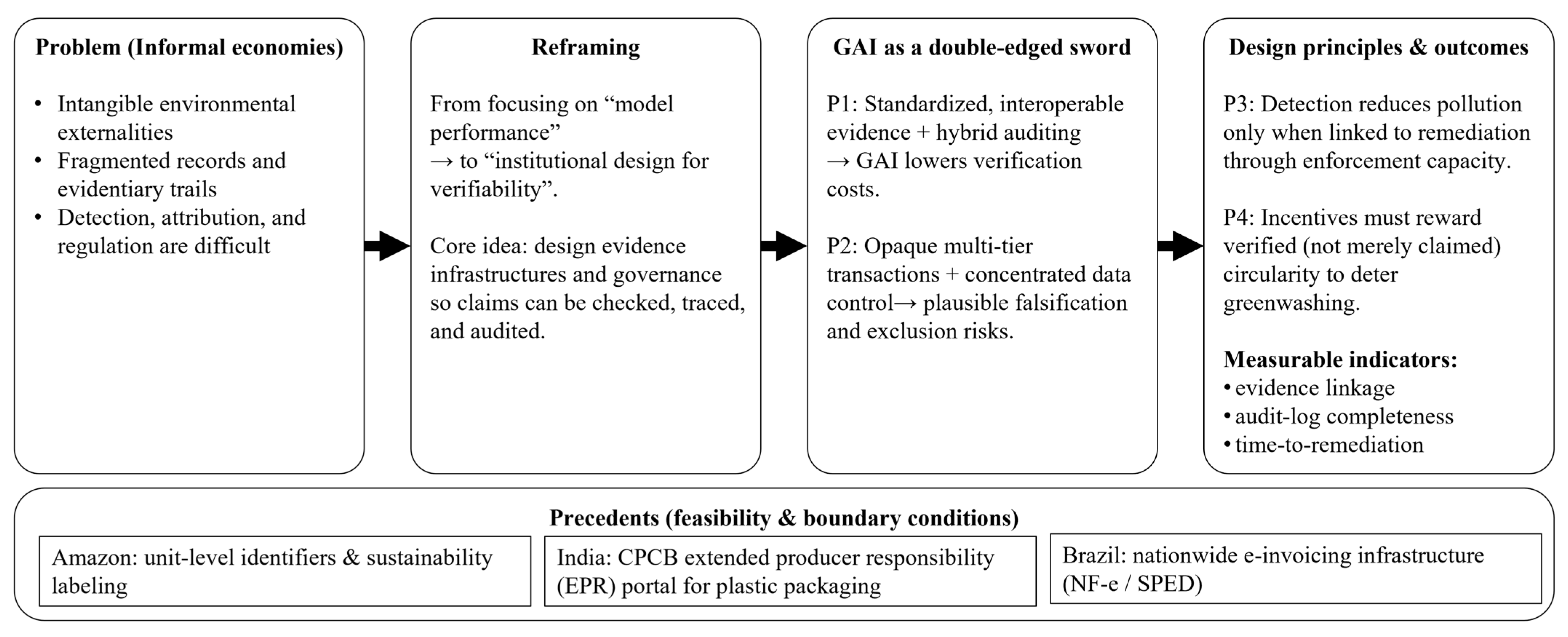
Figure 1 provides an overview of the proposed verifiability-design framework and propositions (P1–P4).

2. Methodology: Theory Building

2.1. Research Design: Logic of Synthesis

This study builds a theory to explain when the diffusion of GAI strengthens verifiability and when it enables regulatory evasion. We synthesize research on informality and emissions [32], transaction costs and governance [33], and informal regulation and compliance [21]. Conceptual work is valuable when mechanisms are unclear, and measurement is difficult, yet decisions are urgent [36,37,38,41]. We proceed in three steps: problem structuring, mapping technology characteristics, and deriving propositions.
To make the synthesis transparent, we document our referencing logic and how each source informs constructs, mechanisms, boundary conditions, and outcomes [36,37,38,39,40,41]. We start from policy documents and major waste-management frameworks, then expand to peer-reviewed studies using keywords such as ‘informal economy’, ‘plastic’, ‘traceability’, and ‘generative AI’ [1,2,10,11,12,13,14,15,16]. We prioritize studies that specify causal mechanisms and boundary conditions and code each insight into a constructs-mechanisms-boundary-conditions set. We then link the coded elements to the four propositions as condition-to-outcome statements [36,37,38,39,40,41].

2.1.1. Problem Structuring

We review policy documents and prior studies to structure how pollution emerges and spreads in informal economies, and why regulation often fails [1,2,3,40]. We treat the informality–pollution link as context-dependent, varying by institutions, income, and ICT diffusion [4,5,6,8,9]. We focus on three core variables: information asymmetry [32], transaction structures [33,35], and informal regulation and enforcement capacity [7,21]. We define transaction structures by actor dispersion, subcontracting tiers, responsibility allocation, and the presence of records that enable traceability [33,35].

2.1.2. Applying Technology Characteristics

Next, we position GAI’s knowledge-processing functions (summarization, extraction, cross-checking, and generation) as a thought experiment that intervenes in the above variables [36,41]. Specifically, we consider functions such as (a) organizing unstructured data and extracting candidate evidence, (b) consistency checks across multiple sources and anomaly detection, and (c) supporting audits and report writing as pathways that may reduce audit costs and information asymmetry (a compliance-enhancing pathway) [28,31]. We also consider pathways through which GAI may support deception and regulatory evasion (an evasion-enhancing pathway), including (d) automated generation of text, images, and evidence, (e) narrativizing transactions to add plausibility, and (f) improving the efficiency of searching for audit loopholes. This parallel framing enables comparison of the conditions under which each pathway holds [30,31].

2.1.3. Deriving Propositions

Each proposition is described as a causal chain in which transaction structures, the information environment, institutional and enforcement capacity, and incentive design shape verifiability, which in turn determines whether pollution is suppressed or persists, in a form that can be tested in future empirical research [36,37,38,41]. As a theoretical contribution, we go beyond a simple application of existing theories by specifying new mechanisms that arise when the novel technology of GAI couples with existing institutions and transaction governance (e.g., the simultaneous automation of auditing and the automation of audit avoidance) [37,38].

2.1.4. Evidence Base and Screening Protocol

To strengthen transparency while keeping the scope appropriate for a conceptual article, we adopt a structured but non-exhaustive evidence synthesis. We begin with policy and regulatory documents and major waste-management frameworks that specify obligations, reporting requirements, and verification practices in settings where informal actors are prevalent (notably plastics and e-waste). We then expand to peer-reviewed studies on informal-economy pollution governance, transaction structures, traceability, and digital compliance, and complement these with studies on GAI capabilities and risks that directly affect verifiability (e.g., evidence extraction and cross-checking versus low-cost fabrication and plausible false narratives).
We apply clear inclusion and exclusion rules. A source is included if it (i) addresses pollution control in fragmented networks with informal actors, (ii) provides mechanisms or institutional-design implications for verifiability, auditability, or traceability, and/or (iii) identifies conditions under which digital records strengthen or weaken enforcement and accountability. We exclude sources that focus solely on model performance without governance implications, or that discuss AI ethics in general terms without a link to verifiability in pollution-control institutions. To improve coverage of key mechanisms and boundary conditions, we also use backward and forward citation tracing from the most relevant sources and policy documents [36,37,38,39,40,41].

2.1.5. Coding and Synthesis Procedure

Each included source is coded into a common template that captures (a) constructs (transaction structure, information environment, institutional capacity, and incentives), (b) mechanisms (how records become verifiable traces, or how evasion and falsification are enabled), (c) boundary conditions (when the mechanisms fail or reverse), and (d) observable implications (candidate indicators and verification actors). This coding enables us to integrate heterogeneous evidence types (policy documents, peer-reviewed studies, and system descriptions) using a consistent, mechanism-oriented lens.
We iteratively refine the codes through comparison across sources and across the three illustrative contexts (Section 2.2). We then synthesize the coded elements into four propositions stated as condition-to-outcome chains. In particular, we map (i) transaction-structure features (actor dispersion, subcontracting tiers, responsibility allocation, and record availability), (ii) GAI affordances (summarization, extraction, cross-checking, translation/normalization, and content generation), and (iii) governance capacity (access governance, monitoring and enforcement conversion, and incentive alignment) to the expected direction of change in verifiability and, ultimately, pollution outcomes.

2.1.6. Traceability and Falsifiability Checks

To prevent the framework from becoming a purely normative argument, we conduct traceability and falsifiability checks during synthesis. For traceability, we verify that each proposition’s key elements (antecedent, mechanism, outcome, and boundary condition) are supported by explicit statements in the evidence base and are consistent with at least one illustrative precedent. For falsifiability, we specify what would be observed if a proposition fails (e.g., persistent opacity, unverifiable records, displaced burdens to informal workers, or compliance that does not translate into remediation) and identify candidate indicators and verification actors that can be used in future empirical tests.
These checks also guide our treatment of mixed outcomes. Rather than presenting limitations as post hoc caveats, we articulate failure modes as boundary conditions, including weak access governance, data capture and exclusion, low enforcement capacity, and GAI-enabled fabrication. Table 2 summarizes the evidence base and screening logic, Table 3 summarizes evidence-to-proposition traceability, Table 4 summarizes candidate indicators and verification actors for future empirical tests, and Table 5 summarizes the proposition-to-precedent alignment.
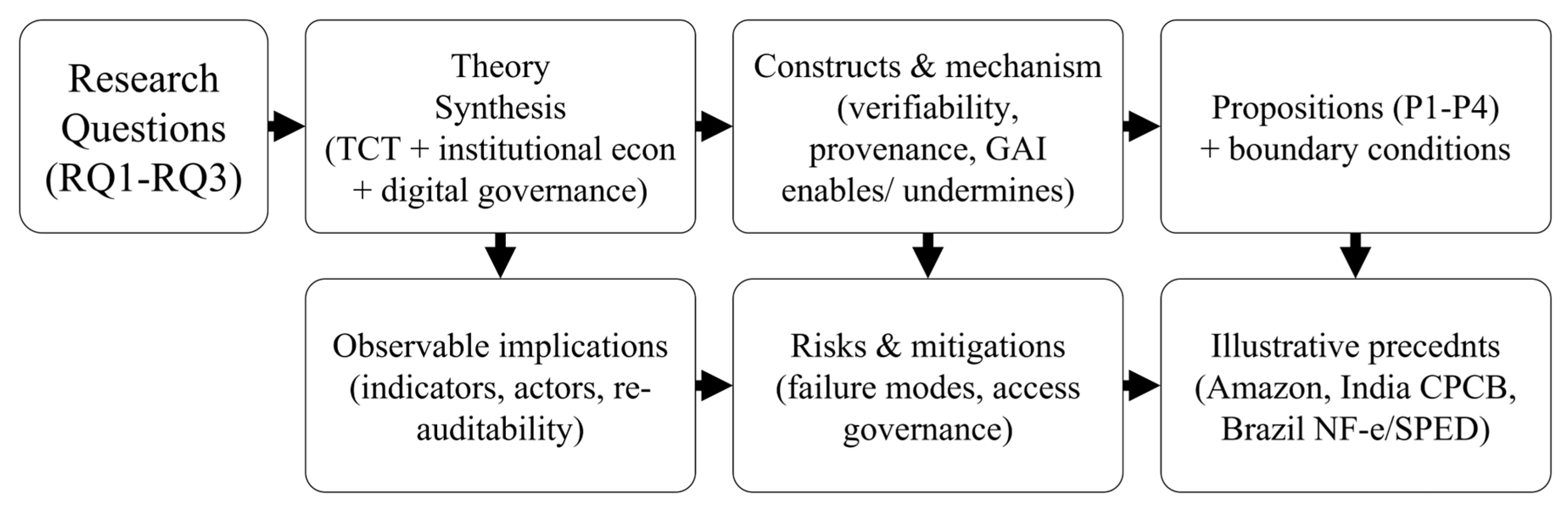
Figure 2 summarizes the transparent synthesis logic from research questions to constructs, mechanisms, propositions, and observable implications; Table 2 provides a compact overview of the evidence base used in the synthesis, Table 4 provides a compact proposition matrix (indicators, risks, and mitigations), Table 3 summarizes evidence-to-proposition traceability, and Table 5 provides precedent mappings.

2.2. Illustrative Contexts

To ensure concreteness and transferability of the argument, we set three typical illustrative contexts based on theoretical sampling [36,41]. The selection criteria are as follows: (i) strong or mixed involvement of the informal sector, (ii) mutually different transaction structures (cross-border nature, hierarchy, and degree of institutionalization), and (iii) a high likelihood that data are unstructured and verification is difficult [3,10,11,12,13,14,15,16,27]. These cases are not empirical objects to be analyzed; rather, they serve as analytical backdrops for examining the validity and boundary conditions of the conceptual model and propositions.

2.2.1. Case A: e-Waste (Cross-Border, Distributed Type)

Electronic waste (e-waste) is rapidly increasing in volume and is highly cross-border. Through informal networks of collection, dismantling, transport, and recycling, responsible actors and actual treatment practices tend to become opaque [13,14]. While international technical guidelines and monitoring frameworks exist, traceability and verification are often fragmented in practice due to mixed waste streams, disguised exports, and incomplete documentation [12,13,14]. Accordingly, this case is positioned as a typical context for examining the duality that, under ‘distributed and multi-layer intermediation’ and ‘diluted responsibility’, GAI may enhance verifiability via evidence matching and anomaly detection, yet also facilitate evasion via the generation of falsified documents [30,31].

2.2.2. Case B: Construction and Demolition Waste (Local, Subcontracting Type)

Construction and demolition waste has dispersed generation points, and responsibilities can be hierarchically shifted through subcontracting structures. In such settings, physical proximity exists, yet on-site records (inbound/outbound movements, outsourcing of treatment, and the reality of recycling) are fragmented, making ex post reconciliation costly [10,11,47]. Moreover, because regulatory tightening may either promote compliance or push activities underground, the fit between enforcement capacity and incentive design becomes crucial [7]. This case represents a context of ‘locally embedded yet hierarchical and fragmentation-prone transaction structures’ and is used to examine the conditions under which GAI adoption translates into audit practice (verification and correction).

2.2.3. Case C: Plastic Circularity (Institutional, Market Type)

Plastics, including marine leakage, pose a major international environmental burden [15,16], and the transition to a circular economy is widely demanded [23,47]. In the European Union, institutionalization of sustainable product design and information disclosure is advancing [27], and verifiability of corporate environmental claims—linking claims to evidence—is increasingly required [23,24,25,26]. At the same time, throughout collection, reprocessing, and remanufacturing, information such as feedstock origin and recycled content typically depends on documentary evidence, and the longer the transaction chain, the harder it becomes to check consistency. This case is therefore positioned as a typical context where verifiability shapes outcomes at the intersection of institutions (disclosure obligations) and markets (incentives), allowing us to examine both conditions under which GAI supports disclosure and auditing and conditions under which it fuels greenwashing [23,24,25,26,31].
Using these three contexts, we compare how differences in transaction structures and institutional environments bifurcate GAI’s effects (compliance enhancement vs. evasion sophistication), visualize them as a conceptual model in Section 3, and present four propositions in Section 4. We conceptually distinguish these problem contexts (Section 2.2) from solution-side institutional precedents (Section 2.3); Table 5 maps the precedents to Propositions 1–4 to make this linkage explicit.

2.3. Empirical Precedents for Institutional Complementarity

Propositions derived from theoretical synthesis should be examined across diverse contexts of informal economies. In recent years, pioneering cases have emerged in which digital technologies function as ‘institutional complementarity’ and increase the verifiability of transactions and circular actions. To indicate a pathway toward extending Propositions 1–4 to broader generality and applicability, we illustrate three precedents—(i) enforced record-keeping through private platforms, (ii) institutionalized measurement, reporting, and verification (MRV) through centralized portals run by regulators, and (iii) transaction-log infrastructures enabled by national e-invoicing systems—and additionally provide a mixed-outcome vignette that clarifies failure modes when verifiability breaks down.

2.3.1. Amazon: Unit IDs and Signaling Environmental Attributes (Pioneering Platform Practice)

Amazon’s Transparency is a program designed to deter the circulation of non-compliant products by verifying authenticity using identifiers (codes) at the brand/product level [49]. In addition, Climate Pledge Friendly presents environmental attributes as labels based on third-party certifications and connects them to purchase decisions [50]. These initiatives can be positioned as pioneering examples in which platforms act as proto-institutions by combining ‘standardized evidence’, ‘enforcement (platform rules)’, and ‘market incentives’ to make otherwise intangible environmental attributes recordable and auditable, thereby enhancing verifiability.
Observable data: Records of authenticity verification via unit IDs (codes), matching results at listing and distribution stages, and environmental-attribute labels based on certifications and their accompanying information are observable as operational data on the platform [49,50]. Verification actors: The platform operator and brand rights holders conduct primary verification through rules and matching procedures, while third-party certifiers and consumers secondarily participate by referencing signals of environmental attributes [49,50]. Limitations: Data tend to remain closed within the platform, limiting the scope of external audits; moreover, depending on certification coverage and disclosure granularity, risks of greenwashing and selective application (selection bias) may persist. Counterfactual: Without enforceable unit-level identifiers and credible third-party signals, environmental attributes would remain largely self-declared and harder to re-audit at scale.

2.3.2. India CPCB: Centralized EPR Portal for Plastic Packaging (Pioneering Regulatory Portal)

India’s CPCB operates the Centralized EPR Portal for Plastic Packaging, which centrally manages registration and reporting under the EPR regime and digitalizes the tracking of collection and recycling flows [42]. In addition, related materials indicate that the portal is designed to enhance accountability/traceability/transparency and includes check mechanisms, system-generated reports, and AI chatbots [43], making it a pioneering case that supports MRV as an institutional design.
Observable data: Registration information, reports of EPR obligations and fulfillment, certificates, and transaction (flow) records related to collection and recycling, and system-generated reports are traceable on the portal [42,43]. Verification actors include CPCB and state-level authorities, registered entities (producers, brand owners, importers, and other obligated entities), their contractors, and audit/verification stakeholders, who are involved in consistency checks and compliance verification of submitted data [42,43]. Limitations: Effectiveness depends on operational maturity because of constraints such as the quality of self-reported data, risks of misreporting and double-counting, coverage of informal actors, and limited on-site verification capacity. Counterfactual: Without a centralized portal and standardized reporting, EPR obligations would remain fragmented across actors, increasing double-counting and leakage risks.

2.3.3. Brazil: Nationwide E-Invoicing Infrastructure via NF-e/SPED (Pioneering National E-Invoicing)

In Brazil, a national portal for NF-e, a nationwide electronic invoicing system, links transaction information as digital documents to tax procedures [44]. Moreover, SPED, a national digital bookkeeping and reporting infrastructure, was institutionalized by a 2007 decree and has evolved as a public system integrating firm-level records [45,46]. Together, NF-e and SPED constitute a national record infrastructure that reduces “unrecorded” transactions and strengthens auditing and enforcement, thereby supporting verifiability.
Together, these three precedents suggest that bifurcation conditions emerge depending on evidence design and governance structures. Robust evidence standardization and hybrid auditing strengthen verifiability (Proposition 1), whereas opacity in multi-tier transactions and/or concentrated control of data/GAI capabilities can activate risks of plausible falsification and digital informality (Proposition 2). The mixed-outcome vignette in Section 2.3.4 further illustrates how these risks materialize in practice when ground-truth verification and enforcement conversion are weak.
Observable data: The XML of e-invoices (NF-e), issuance and approval (clearance) timestamps, transaction-party information, and digital bookkeeping and reporting data via SPED are observable in administrative systems [44,45,46]. Verification actors: State tax authorities and the Federal Revenue Service, along with stakeholders in accounting and tax audits and transaction counterparties, can verify the consistency of transaction logs [44,45,46]. Limitations: The invoicing infrastructure is strong in capturing formal transactions, while fully informal transactions and the physical realities of emissions/disposal are not directly represented; connecting it to environmental governance, therefore, requires additional institutional designs (e.g., EPR and waste-tracking systems) [44,45,46]. Counterfactual: Without nationwide e-invoicing and digital bookkeeping infrastructure, transaction logs would be less complete, and auditing costs higher; environmental outcomes would still require linkage to physical waste flows.

2.3.4. Mixed Outcomes: “Paper Compliance” and Exclusion Under Weak Ground-Truth Verification (A Failure-Mode Vignette)

Digital portals and traceability infrastructures can increase reporting volume without improving environmental outcomes when they are built on self-reported data and weak ground-truth verification. In such settings, actors can use GAI to produce internally consistent bundles of documentation (e.g., manifests, certificates, narratives) that satisfy superficial checks, while material practices (sorting quality, leakage, illegal disposal) remain unchanged. Moreover, when access governance is opaque or participation costs are high, informal workers may be excluded or pushed further underground, shifting burdens rather than reducing pollution [7,21,23,24,25,26,29,30,31].
Observable data: Rapid growth in submitted reports and certificates, low contestability of records, repeated discrepancies found only in deep audits, and a widening gap between documentary compliance and ground indicators (e.g., leakage incidents, complaints, hotspot observations) [21,31]. Verification actors: Regulators and auditors may detect anomalies, but effective verification requires independent third parties, community monitoring, and random on-site checks to validate evidence-in-the-loop claims [31].
Implications for the propositions: This vignette represents the joint activation of Proposition 2 (plausible falsification under opacity and concentrated control) and Proposition 3 (detection that fails to convert into remediation under weak enforcement capacity). It motivates designing hybrid auditing, auditable access logs, and a detection-to-remediation pipeline that includes appeals/redress and transition support for informal actors [7,21,31,42,43].

3. Theoretical Framework

3.1. Affordances of GAI

In this study, we position GAI not as a mere automation tool but as an “institution-complementing technology” that handles unstructured information and can shape verifiability and accountability [28,29,30,31]. In pollution problems in informal economies, missing transaction records, dispersed actors, and limits to regulatory enforcement make pollution sources and chains of responsibility difficult to observe [1,2,3,7,21]. This invisibility can also foster unsubstantiated environmental claims (greenwashing) and misinformation [23,24,25,26].
Conversely, GAI can support extracting, cross-checking, summarizing, translating, and preparing for audits from fragmented information such as documents, images, logs, and field notes, thereby reducing monitoring and compliance costs [22,27,28,31]. This is consistent with empirical evidence that the relationship between informal economies and pollution is nonlinear and that ICT diffusion can alter that relationship [4,8,9]. That is, where the costs of verifying and sharing information can be reduced, regulatory and market mechanisms may work more effectively.
However, because GAI can also generate “plausible but incorrect” explanations and documents at low cost, it may increase the productivity of regulatory evasion and falsification [29,30,31]. Accordingly, we treat the effects of adopting GAI as contingent not on technical performance per se, but on governance requirements such as the authenticity of input data, evidence linkage, audit logs, and purpose-specific controls (e.g., AI risk management frameworks) [31].
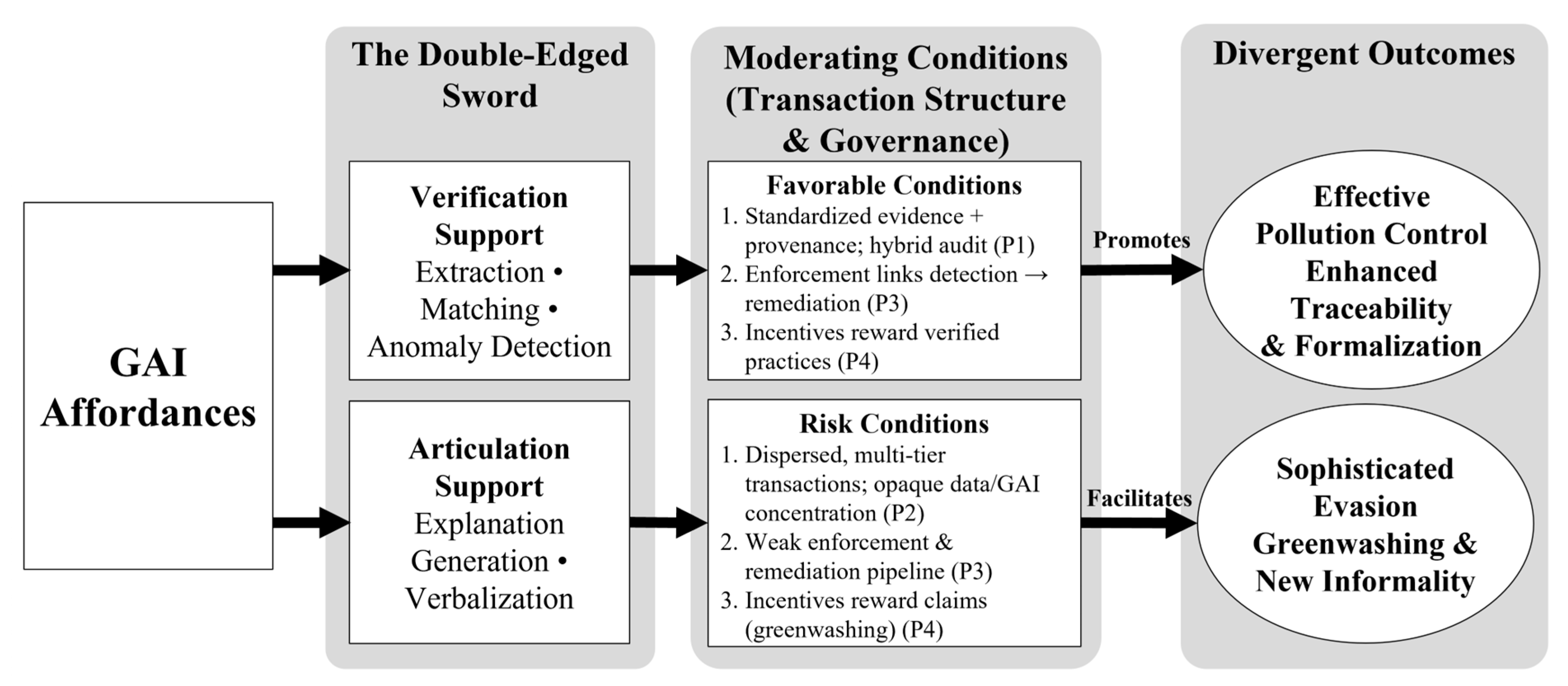
Figure 3 summarizes the branching logic of this duality (compliance enhancement vs. sophisticated evasion).
Figure 3 presents our conceptual model in which the affordances of GAI (verification support and articulation support) interact with transaction structures and governance conditions (moderating conditions) to bifurcate toward verification-driven compliance or sophisticated evasion (based on our theoretical integration) [36,37,41].
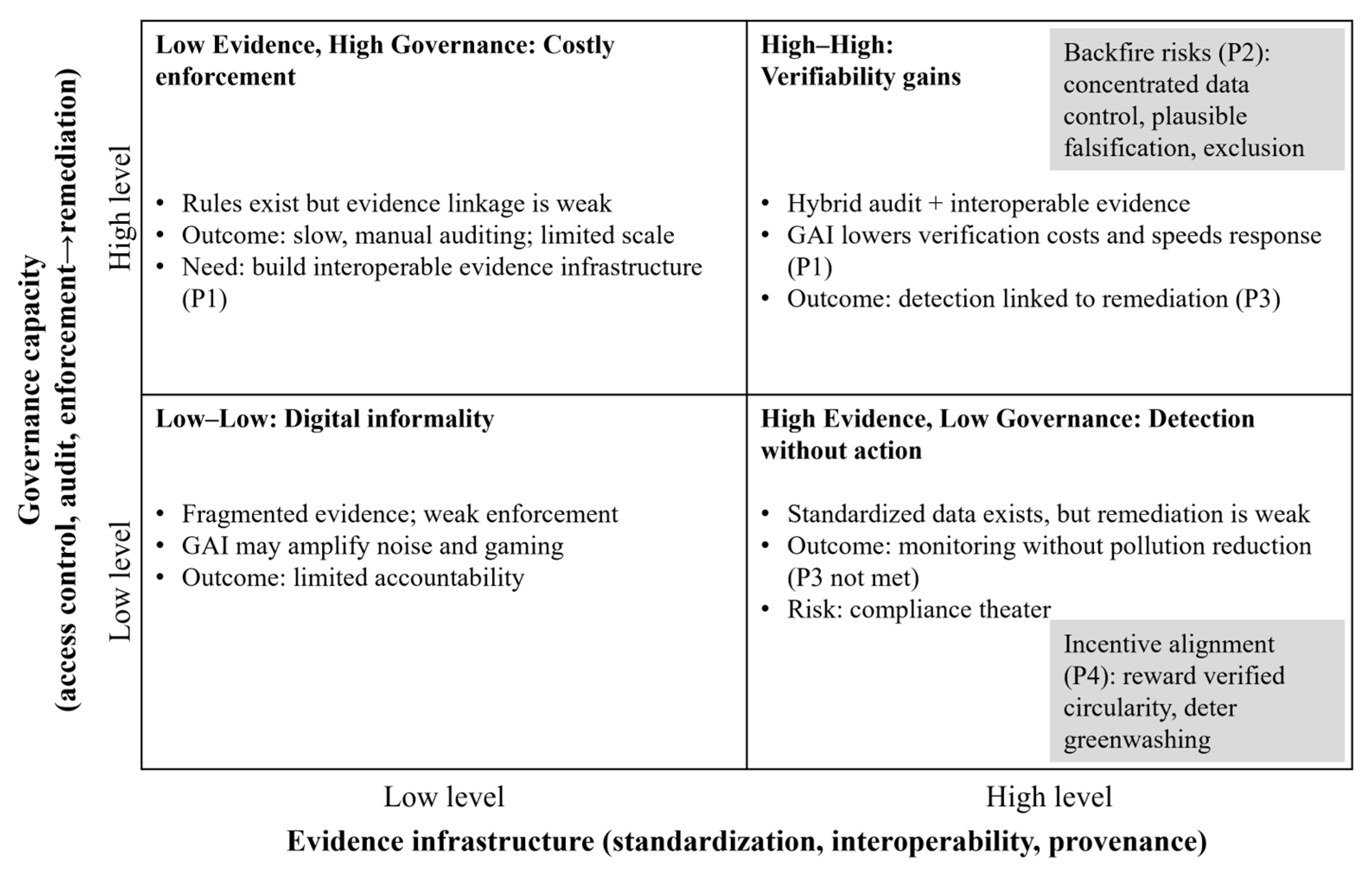
Figure 4 complements Figure 3 by summarizing the boundary conditions under which GAI improves verifiability and when it backfires.

3.1.1. Verification Support

Verification Support refers to functions that extract factual relations (who, when, where, what, and how) from unstructured data such as regulatory documents, manifests, contracts, audit records, internal reports, and field photos, and mechanically check consistency across records and against standards (regulations, standards, and internal rules) [22,27,28,31]. Concrete examples include record linkage, anomaly detection, identification of missing data, translating regulatory requirements into checklists, and generating audit-ready summaries.
In informal economies, records are fragmented, responsible parties are dispersed, and cross-border flows, subcontracting, and intermediaries overlap, making it difficult to trace causal chains of pollution [1,2,3,21]. By lowering the “search and matching costs” of evidence, verification support can complement oversight even when enforcement capacity is limited [7,31]. In particular, findings that ICT diffusion can mitigate the relationship between informality and pollution suggest that improving verifiability can amplify policy effectiveness [8,9].
However, if the input data themselves are falsified, verification support may amount only to “processing uncertain inputs faster.” Therefore, it must be designed together with institutional mechanisms that secure verifiability, such as preserving provenance information, linking to primary evidence, maintaining audit logs, and enabling third-party verification [31].

3.1.2. Articulation Support

Articulation Support refers to functions that connect fragmented information and generate situation descriptions, issue framing, causal hypotheses, and explanations for stakeholders [28,29,30]. Because informal economies rely heavily on tacit knowledge and non-standard procedures, standardizing explanations can be useful for consensus-building and regulatory responses [1,2,21].
At the same time, generated explanations tend to appear “plausible,” which entails risks of misinformation and strategic justification [29,30]. Especially in contexts such as greenwashing, where environmental responsibility is performed through document-level consistency alone, articulation support may increase the productivity of deception [23,24,25,26]. Therefore, articulation support should always be tied to primary evidence and ground-truth verification, with controls that ensure outputs are used in an auditable manner [31].

3.2. Core Logic: The Double-Edged Sword

Our theoretical framework rests on the double-edged sword of GAI: it can both (a) reduce information asymmetries and (b) undermine information authenticity [29,30,31,32]. The relationship between informal economies and pollution is not a simple monotonic increase; institutional, income, and regional heterogeneity, as well as nonlinearities, have been reported [4,5,6]. Environmental regulation can likewise have dual effects on informality and pollution, promoting compliance while also pushing activity underground [7]. Hence, the impact of GAI adoption also bifurcates depending on transaction structures and governance conditions.
First, transaction structures (e.g., hierarchical subcontracting, cross-border flows, and fragmented records) and the linkability of evidence determine the effectiveness of verification support [33]. For example, in waste flows and coastal/marine pollution, a mix of informal collection, transport, and processing tends to render pollution sources “invisible” [17,18]. Moreover, because informal-sector workers directly bear exposure risks, making the social costs, including health impacts, visible is also important [19,20].
We explicitly consider asymmetric capacities among actors. Large formal organizations may adopt compliance-by-design, while informal or marginal actors may face higher participation costs and stronger incentives for avoidance. Therefore, institutional design for verifiability should include safeguards against exclusion (e.g., minimal disclosure, graded participation, and accessible appeals) while maintaining credible deterrence (e.g., triangulation and randomized audits).
Second, governance conditions (enforcement capacity, penalties, transparency, incentives, and community monitoring and informal norms) serve as boundary conditions for whether GAI reinforces compliance or evasion [7,21,31]. Recent proposals include data-driven governance, such as spatial management of informal activities using mobile data and machine-learning-based zoning [51]; however, there are also reported cases in which criminalization and intensified crackdowns are intertwined with social conflict and security issues [52]. Therefore, introducing GAI should be treated not as mere technology adoption but as institutional design (what counts as evidence, who verifies it, and how remediation is prompted).
Building on this logic, the next chapter formalizes the branching logic in Figure 3 as propositions and specifies boundary conditions that future empirical studies should test [36,37,41].

4. Theoretical Development and Propositions

In this chapter, we apply the branching logic shown in Figure 3 (compliance strengthening vs. advanced regulatory evasion) to major contexts of pollution control in informal economies (e-waste, construction waste, plastics circularity, and diffusion to coastal and marine areas) and present four propositions with verifiability as the core concept. These are conceptual propositions derived from integrating existing theory and prior research rather than empirical findings, and they should be tested in future case studies and quantitative research [36,37,41].

4.1. Evidence Standardization, Interoperability, and Hybrid Auditing (Proposition 1)

In domains involving cross-border and multi-actor flows such as e-waste and construction waste, evidentiary records—manifests, contracts, shipment/receiving logs, and on-site photos—tend to be non-standardized and fragmented, and linkage across actors becomes an auditing bottleneck [10,11,12,13,14]. Conversely, the more that evidence fields, formats, and identifiers are standardized, and interoperability is ensured through digital traceability mechanisms such as digital product passports, the more GAI can lower audit costs by extracting, matching, and detecting exceptions in unstructured information, thereby improving traceability and verifiability [22,27,28,31].
Proposition 1
(The Evidence Standardization and Hybrid Audit Hypothesis). If evidentiary records are standardized, interoperable, and accompanied by provenance management and hybrid auditing (human/third-party/community checks with evidence-in-the-loop), GAI can reduce verification costs, enable scalable anomaly detection and cross-checking, and improve re-auditability, thereby strengthening compliance and pollution control:
This proposition emphasizes that verifiability is not achieved by model performance alone: It requires institutional designs that keep humans and independent actors in the verification loop while anchoring GAI outputs to auditable evidence trails.
Testable implication: Improvements should be observed in evidence linkage rates, audit-log completeness, and the feasibility of third-party re-verification (re-auditability). Potential falsifier/boundary: If standardization increases reporting volume but audit logs remain non-reproducible, or anomalies cannot be independently re-checked, verifiability does not improve as predicted (Table 4).

4.2. Transaction Complexity, Data Concentration, and Plausible Falsification (Proposition 2)

In informal economies, the more intermediated and multi-tier subcontracting becomes, and the more transaction routes are dispersed, the more responsibility becomes ambiguous, and pollution sources become invisible [1,2,12,13,14,21]. Such invisibility is further intensified by diffusion into coastal and marine areas and the coexistence of atypical pollution sources [17,18]. In markets with high quality uncertainty and information asymmetry, classic arguments suggest that adverse selection is likely [32]. Under these conditions, by generating narratives and coherent bundles of documentation at low cost, GAI may enhance plausible falsification and end up facilitating regulatory evasion [29,30,33]. For instance, in cross-border e-waste shipments, an intermediary could use a generative model to draft mutually consistent bills of lading, recycling certificates, and inspection narratives, aligning dates, quantities, and identifiers across documents to pass superficial checks.
Proposition 2
(The Opacity and Plausible-Falsification Risk Hypothesis). If transaction structures are highly dispersed and mediated across multiple tiers and/or if access to critical evidence data and GAI capabilities is concentrated under opaque oversight, then evidence linkages weaken, and GAI is more likely to be used for plausible falsification, regulatory evasion, and a new form of digital informality, undermining verifiability:
Accordingly, institutional safeguards (access governance, logging, sampling audits, and transparency-by-design) are necessary to prevent centralization from turning into opacity and to keep verifiability contestable.
Testable implication: Under higher multi-tier opacity and concentrated control of evidence/GAI, mismatch rates after deeper cross-checking, disputed cases, and detected forged-document patterns should rise. Potential falsifier/boundary: If contestable access governance (auditable logs, independent audits, and redress) prevents such patterns despite complexity, the risk pathway is mitigated (Table 4).

4.3. Linking Detection to Remediation and Enforcement Capacity (Proposition 3)

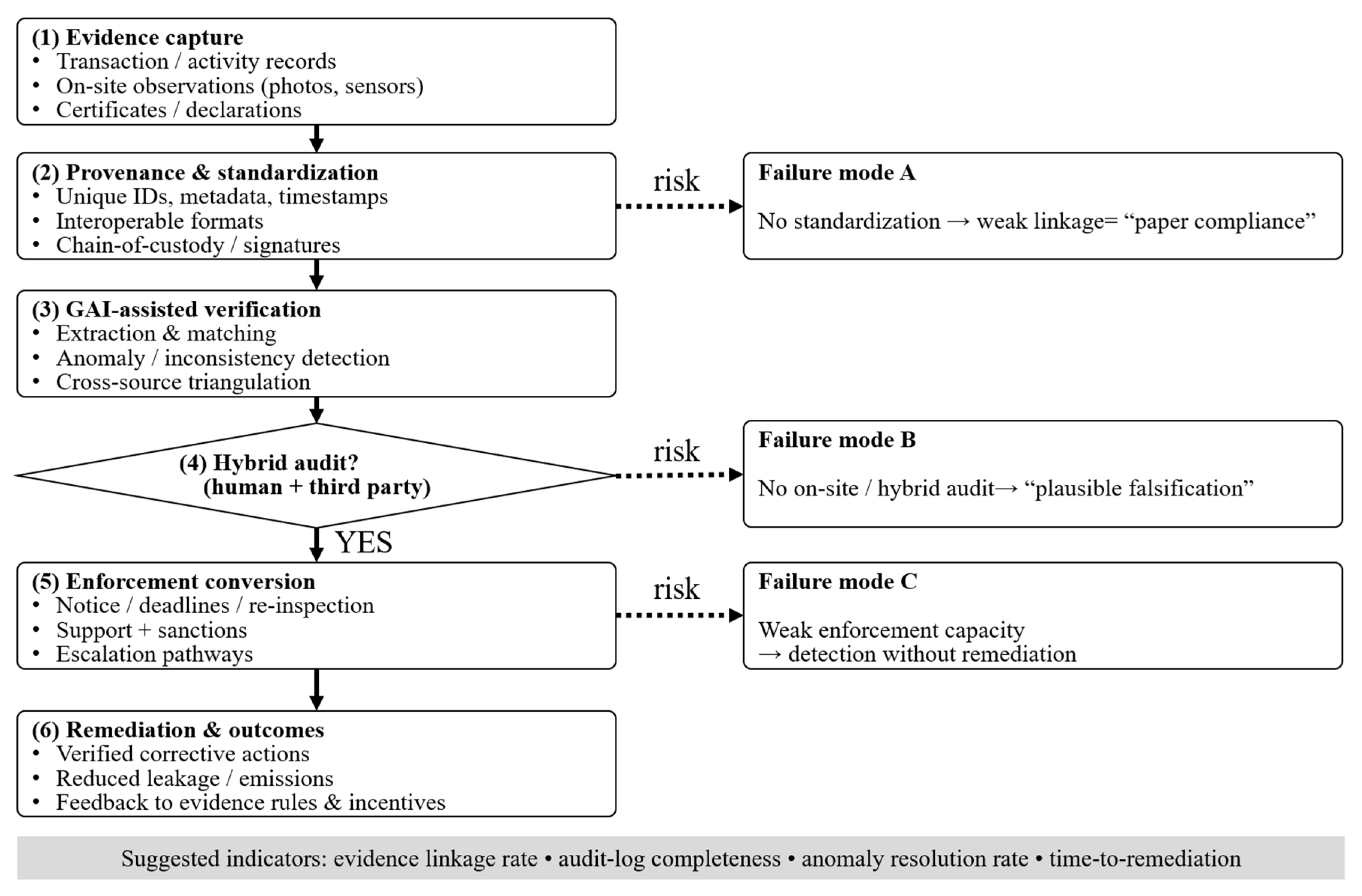
Even if GAI detects inconsistencies or anomalies, pollution will not be reduced unless detection is converted into remediation. Conversion requires enforcement capacity—audit authority, penalties, remediation procedures, and operational resources—and in weak-enforcement settings, “better detection” may fail to yield tangible results [21,31]. In addition, ICT diffusion can moderate and either attenuate or amplify the relationship between informal economies and pollution [8,9], and the effects of environmental regulation on informal-economy size and pollution also depend on institutional conditions [7]. Accordingly, the effectiveness of GAI adoption depends less on detection technology per se than on the design that links enforcement to remediation.
Proposition 3
(The Enforcement-Conversion Hypothesis). If enforcement capacity and corrective mechanisms are weak, then GAI-enabled detection yields limited pollution-control impact; conversely, stronger enforcement combined with ICT infrastructure converts detection into remediation [7,8,9,21,31]:
Testable implication: Stronger enforcement conversion should reduce time-to-remediation and increase the share of AI-flagged anomalies that lead to corrective actions and re-audits. Potential falsifier/boundary: If detection increases but remediation indicators do not change (or displacement underground increases), then enforcement conversion is insufficient (Table 4).
Figure 5 illustrates the evidence-to-remediation conversion logic underpinning Proposition 3, including common failure modes.

4.4. Incentive Design: Verifying Circularity and Greenwashing (Proposition 4)

In areas where environmental considerations are tied to market value and procurement requirements, such as plastics circularity, demand for accountability rises, but incentives for unsupported claims (greenwashing) also increase [23,24,25,26]. Schemes such as EPR can promote circularity [47], yet if markets reward “claimed” rather than “verified” circular behavior, GAI can scale narrative generation and accelerate greenwashing. Conversely, when clear economic and financial rewards (e.g., green/social finance) are attached to circular actions secured by verifiability, GAI can support formalization and accountability [31,48].
Proposition 4
(The Verified-Incentive Hypothesis). When economic, procurement, and finance incentives explicitly reward verified circular practices (not merely claimed ones), GAI supports formalization and accountability; otherwise, it amplifies greenwashing by scaling narrative production [23,24,25,26,31,47,48]:
Testable implication: Where incentives are tied to verified evidence, claim-to-evidence attachment rates and audit pass rates should improve, and corrected/withdrawn claims should increase relative to self-declared schemes. Potential falsifier/boundary: If rewards accrue to narrative compliance without evidence linkage (greenwashing inflation), the proposition does not hold as predicted (Table 4).
Taken together, these four propositions indicate that the effectiveness of GAI-enabled pollution control in informal economies depends on institutional complementarity conditions: (i) standardized evidence design to enable standardization, interoperability, provenance management, and re-auditability, (ii) transparency-oriented governance to prevent opacity and plausible falsification under complex transactions and concentrated control, (iii) enforcement capacity to convert detection into remediation, and (iv) incentive alignment to reward verifiable circularity and deter greenwashing.
To clarify AI-specific mechanisms, boundary conditions, observable implications, and implementation levers for each proposition, Table 4 provides a compact proposition matrix.
Table 5 provides an exploratory mapping between Propositions 1–4 and the three pioneering illustrations, which can be treated as testable hypotheses for future case studies and macro-level analyses.

5. Discussion and Implications

5.1. Theoretical Contributions: Verifiability and Branching Conditions in the GAI Era

First, we treat GAI as an institution-complementing technology with a dual effect: it can lower verification and reconciliation costs while also scaling plausible falsification. By stating this bifurcation explicitly and formalizing it as four propositions, the paper integrates the “compliance-enhancing” and “evasion-enhancing” pathways within a single logic [31].
Second, we organize the heterogeneity reported in the informality–pollution nexus (including nonlinearity and ICT moderation) as a set of branching conditions: transaction structure × evidence verifiability × enforcement capacity × incentive design [4,5,6,7,8,9]. This framing shifts attention from “better models” to the institutional requirements under which digital tools (including GAI) translate detection into pollution reduction [7,21,31].
Third, we redefine intangible (invisible) pollution as a verifiability failure produced by fragmented transaction records and contested responsibility allocation, rather than as a mere absence of regulation. To make this operational, we emphasize (i) claim–evidence linkage strength and (ii) reproducible third-party re-verification (re-auditability) as core dimensions of verifiability, and we connect pollution control to hybrid governance that combines formal regulation, informal regulation, and worker health and safety considerations [19,20,21,31,33].

5.2. Policy Implications: From Technology Adoption to Institutional Redesign

Policy leverage lies less in promoting GAI adoption itself and more in specifying what counts as auditable evidence, who can verify it, and how detected problems trigger remediation. Propositions 1–4 can be read as actionable policy design variables [31].
GAI can support verification at scale only when minimum evidence fields, identifiers, and metadata are standardized and interoperable (P1) [22,31]. Therefore, policy should prioritize evidence standardization and interoperability, and initiatives such as digital product passports are best treated as foundations for claim–evidence linkage rather than mere disclosure requirements [27].
GAI-enabled anomaly detection does not reduce pollution unless it is connected to corrective action; thus, enforcement capacity and remediation pipelines are prerequisites for translating detection into remediation (P3) [21,31]. Regulators should therefore design a detection-to-remediation pipeline (corrective orders, deadlines, re-audits, and penalties) while considering the risk that poorly designed tightening can push activity further underground [7].
Institutionalizing MRV can counter explanation inflation, particularly in circular-economy markets where incentives for greenwashing rise as environmental claims become monetized (P4) [23,24,25,26]. Because GAI makes narrative production cheap, MRV should institutionalize claim–evidence linkage (primary data, audit logs, sampling) so that “more explanation” does not substitute for verification [31].
Access governance and transparency-by-design become crucial when critical data and GAI capabilities are concentrated under opaque oversight, verifiability erodes, and plausible falsification becomes more feasible (P2) [31]. Access rights, auditable logs, and third-party contestability should be designed in as institutional requirements, rather than left to platform or provider discretion [22,31].
Social protection, health, and safety considerations become central because exposure risks often concentrate on informal workers; pollution control also functions as labor and public-health policy [19,20]. Effective packages should combine compliance mechanisms with transition support (training, protective measures, and livelihood support), rather than relying on penalties alone [53].

5.3. Practical Implications: Operational Design for Firms, Auditors, and Platforms

At the implementation level, GAI should be deployed as part of a verification workflow (evidence-in-the-loop and human/third-party checks), not as a standalone reporting tool (P1) [31].
Firms can reduce greenwashing risk by embedding GAI into evidence management (source control, provenance, exception handling) and by standardizing internal verification procedures across complex supplier networks [3,31,33].
Auditors and authorities should treat GAI outputs as risk signals that must be validated against ground truth (sampling, on-site checks, third-party data), and prioritize clear handoffs from detection to remediation responsibilities (P3) [21,31].
Platforms and technology providers are critical where platforms function as proto-institutions; trust depends on transparent access design, auditable logs, and interfaces that enable external re-verification and reduce data lock-in (P1/P2) [31].
In local government and field operations, data-driven management of informal spaces can improve situational awareness, but it should be coupled with safeguards on purpose limitation, accountability, and grievance/redress to avoid surveillance-driven exclusion [21,51,52].
In finance and intermediation, financiers and intermediaries can strengthen incentives for verified circularity by tying funding conditions to MRV and verifiability indicators (P4) [31,48].

5.4. Limitations and Future Research

This paper provides analytic generalization through conceptual synthesis and illustrative precedents, rather than statistical generalization. Future work should operationalize verifiability and test the propositions through comparative designs and mixed methods across sectors and institutional settings [36,37,41].
Intermediate indicators of verifiability can be operationalized through measurable proxies. Promising intermediate measures include evidence-standardization levels, linkage rates across actors, audit-log completeness, claim–evidence linkage strength, feasibility of third-party re-verification, and time-to-remediation [31].
Nonlinearity and threshold effects should be expected; given reported nonlinearity in the informality–pollution nexus and ICT moderation [4,5,6,8,9], future empirical work should examine whether GAI’s benefits materialize only after evidence infrastructure and enforcement capacity exceed practical thresholds.
Comparative designs across sectors and institutions can test the framework. Testing the branching conditions across e-waste, construction waste, and plastics circularity can clarify which transaction structures and governance arrangements generalize and where sector-specific adaptations are required [3,10,11,12,13,14,15,16,23,47].
The framework should remain robust under technological evolution because GAI capabilities and risks evolve rapidly [28,29,30,31]. Therefore, the framework aims to remain robust at the level of institutional and structural conditions. In the next section, we conclude by synthesizing this verifiability-oriented shift and the four propositions into a concise set of takeaways.

6. Conclusions

This paper reframes pollution control in informal and hybrid economies as an institutional design problem: how to make environmental claims and actions verifiable when transaction records are fragmented, and enforcement is limited. It also highlighted the double-edged nature of GAI: it can lower verification and documentation costs, but it can also scale plausible misinformation and falsified evidence.
We summarized the branching conditions in four propositions on (i) evidence standardization and hybrid auditing, (ii) transaction opacity and concentrated control of data/GAI capabilities, (iii) enforcement capacity to convert detection into remediation, and (iv) incentive alignment to reward verified (not merely claimed) circularity and deter greenwashing.
Future research should operationalize verifiability (e.g., evidence linkage rates, audit-log integrity, and time to remediation) and test the propositions through comparative case studies and quantitative designs across sectors such as plastics, e-waste, and construction waste.

Author Contributions

Conceptualization, A.N. and C.W.; Methodology, A.N. and Y.T.; Software, Y.T.; Data curation, A.N.; Formal analysis, A.N.; Investigation, A.N.; Project administration, A.N.; Resources, A.N.; Writing—original draft, A.N.; Writing—review and editing, Y.T. and C.W.; Visualization, A.N.; Supervision, A.N. and C.W.; All authors have read and agreed to the published version of the manuscript.

Funding

This research received no external funding.

Institutional Review Board Statement

Not applicable.

Informed Consent Statement

Not applicable.

Data Availability Statement

The original contributions presented in this study are included in the article. Further inquiries can be directed to the corresponding author.

Conflicts of Interest

The authors declare no conflicts of interest.

References

  1. International Labour Organization (ILO). Transition from the Informal to the Formal Economy Recommendation, 2015 (No. 204); ILO: Geneva, Switzerland, 2015; Available online: https://normlex.ilo.org/dyn/nrmlx_en/f?p=NORMLEXPUB:12100:0::NO::P12100_ILO_CODE:R204 (accessed on 15 December 2025).
  2. International Labour Organization (ILO). Women and Men in the Informal Economy: A Statistical Picture, 3rd ed.; ILO: Geneva, Switzerland, 2018; Available online: https://www.ilo.org/publications/women-and-men-informal-economy-statistical-picture-third-edition (accessed on 22 December 2025).
  3. Swain, R.B.; Kambhampati, U. (Eds.) The Informal Sector and the Environment; Routledge: London, UK, 2022. [Google Scholar] [CrossRef]
  4. Elgin, C.; Öztunalı, O. Environmental Kuznets curve for the informal sector of Turkey (1950–2009). Panoeconomicus 2014, 61, 471–485. [Google Scholar] [CrossRef]
  5. Elgin, C.; Öztunalı, O. Pollution and informal economy. Econ. Syst. 2014, 38, 333–349. [Google Scholar] [CrossRef]
  6. Yang, J.; Tan, Y.; Xue, D.; Huang, G.; Xing, Z. The Environmental Impacts of Informal Economies in China: Inverted U-shaped Relationship and Regional Variances. Chin. Geogr. Sci. 2021, 31, 585–599. [Google Scholar] [CrossRef]
  7. Abid, M.; Sekrafi, H.; Gheraia, Z.; Abdelli, H. Regulating the unobservable: The impact of the environmental regulation on informal economy and pollution. Energy Environ. 2024, 35, 3463–3482. [Google Scholar] [CrossRef]
  8. Sadaoui, N.; Zabat, L.; Abid, M.; Hussien, B.S.A. The Moderating Role of Information and Communication Technology Diffusion in Informal Economy-Pollution Nexus in Kingdom Saudi Arabia. Int. J. Energy Econ. Policy 2025, 15, 176–185. [Google Scholar] [CrossRef]
  9. Shahnazi, R.; Jamshidi, N.; Shafiei, M. Informal economy and CO2 emissions: Threshold effects of information and communication technology. Clean Technol. Environ. Policy 2025, 27, 347–365. [Google Scholar] [CrossRef]
  10. United Nations Environment Programme (UNEP). Global Waste Management Outlook 2024; UNEP: Nairobi, Kenya, 2024. [Google Scholar] [CrossRef]
  11. Kaza, S.; Yao, L.; Bhada-Tata, P.; Van Woerden, F. What a Waste 2.0: A Global Snapshot of Solid Waste Management to 2050; World Bank: Washington, DC, USA, 2018. [Google Scholar] [CrossRef]
  12. Basel Convention Secretariat. Revised Technical Guidelines on Transboundary Movements of Electrical and Electronic Waste and Used Electrical and Electronic Equipment, in Particular Regarding the Distinction Between Waste and Non-Waste Under the Basel Convention (Decision BC-16/5); Basel Convention Secretariat: Geneva, Switzerland, 2023; Available online: https://www.basel.int/implementation/ewaste/technicalguidelines/developmentoftgs/tabid/2377/default.aspx (accessed on 15 December 2025).
  13. International Telecommunication Union (ITU); United Nations Institute for Training and Research (UNITAR). Global e-Waste Monitor 2024; ITU/UNITAR: Geneva, Switzerland; Bonn, Germany, 2024; Available online: https://www.itu.int/hub/publication/d-gen-e_waste-01-2024/ (accessed on 22 December 2025).
  14. European Parliament and Council. Directive 2012/19/EU on Waste Electrical and Electronic Equipment (WEEE). 2012, L197, pp. 38–71. Available online: https://eur-lex.europa.eu/eli/dir/2012/19/oj (accessed on 15 December 2025).
  15. Jambeck, J.R.; Geyer, R.; Wilcox, C.; Siegler, T.R.; Perryman, M.; Andrady, A.; Narayan, R.; Law, K.L. Plastic Waste Inputs from Land into the Ocean. Science 2015, 347, 768–771. [Google Scholar] [CrossRef]
  16. Geyer, R.; Jambeck, J.R.; Law, K.L. Production, Use, and Fate of All Plastics Ever Made. Sci. Adv. 2017, 3, e1700782. [Google Scholar] [CrossRef]
  17. Pereira, L.C.C.; Jimenez, J.A.; da Costa, R.M.; Medeiros, C. Use and occupation of Olinda littoral (NE, Brazil): Guidelines for an integrated coastal management. Environ. Manag. 2007, 40, 210–218. [Google Scholar] [CrossRef]
  18. Rangel-Buitrago, N.; Galgani, F.; Neal, W.J. Invisible pressures: A global review of unconventional coastal pollution sources and their environmental impacts. Mar. Pollut. Bull. 2026, 222, 118610. [Google Scholar] [CrossRef]
  19. Sahay, A.; Ranjana, R. Impact of Environmental Pollution on the Health of Workers Engaged in Informal Economy: A Case Study of Patna Metropolitan City. In Urban Dynamics, Environment and Health; Springer: Singapore, 2024; pp. 391–411. [Google Scholar] [CrossRef]
  20. Tsang, V.W.L.; Lockhart, K.; Spiegel, S.J.; Yassi, A. Occupational Health Programs for Artisanal and Small-Scale Gold Mining: A Systematic Review for the WHO Global Plan of Action for Workers’ Health. Ann. Glob. Health 2019, 85, 128. [Google Scholar] [CrossRef] [PubMed]
  21. Pargal, S.; Wheeler, D. Informal Regulation of Industrial Pollution in Developing Countries: Evidence from Indonesia. J. Political Econ. 1996, 104, 1314–1327. [Google Scholar] [CrossRef]
  22. Saberi, S.; Kouhizadeh, M.; Sarkis, J.; Shen, L. Blockchain Technology and Its Relationships to Sustainable Supply Chain Management. Int. J. Prod. Res. 2019, 57, 2117–2135. [Google Scholar] [CrossRef]
  23. Ellen MacArthur Foundation. The New Plastics Economy: Rethinking the Future of Plastics; Ellen MacArthur Foundation: Cowes, UK, 2016; Available online: https://www.weforum.org/reports/the-new-plastics-economy-rethinking-the-future-of-plastics/ (accessed on 22 December 2025).
  24. Delmas, M.A.; Burbano, V.C. The Drivers of Greenwashing. Calif. Manag. Rev. 2011, 54, 64–87. [Google Scholar] [CrossRef]
  25. Lyon, T.P.; Montgomery, A.W. The Means and End of Greenwash. Organ. Environ. 2015, 28, 223–249. [Google Scholar] [CrossRef]
  26. de Freitas Netto, S.V.; Sobral, M.F.F.; Ribeiro, A.R.B.; Soares, G.R.L. Concepts and Forms of Greenwashing: A Systematic Review. Environ. Sci. Eur. 2020, 32, 19. [Google Scholar] [CrossRef]
  27. European Parliament and Council. Regulation (EU) 2024/1781 Establishing a Framework for the Setting of Ecodesign Requirements for Sustainable Products. 2024. Available online: https://eur-lex.europa.eu/eli/reg/2024/1781/oj (accessed on 15 December 2025).
  28. OpenAI. GPT-4 Technical Report. arXiv 2023, arXiv:2303.08774. [Google Scholar] [CrossRef]
  29. Weidinger, L.; Mellor, J.; Rauh, M.; Griffin, C.; Huang, P.-S.; Mellor, J.; Glaese, A.; Cheng, M.; Balle, B.; Kasirzadeh, A.; et al. Taxonomy of Risks Posed by Language Models. In Proceedings of the 2022 ACM Conference on Fairness, Accountability, and Transparency (FAccT′22); ACM: New York, NY, USA, 2022. [Google Scholar] [CrossRef]
  30. Bender, E.M.; Gebru, T.; McMillan-Major, A.; Shmitchell, S. On the Dangers of Stochastic Parrots: Can Language Models Be Too Big? In Proceedings of the 2021 ACM Conference on Fairness, Accountability, and Transparency (FAccT′21); ACM: New York, NY, USA, 2021; pp. 610–623. [Google Scholar] [CrossRef]
  31. National Institute of Standards and Technology (NIST). Artificial Intelligence Risk Management Framework (AI RMF 1.0); NIST AI 100-1; NIST: Gaithersburg, MD, USA, 2023. [Google Scholar] [CrossRef]
  32. Akerlof, G.A. The Market for “Lemons”: Quality Uncertainty and the Market Mechanism. Q. J. Econ. 1970, 84, 488–500. [Google Scholar] [CrossRef]
  33. Williamson, O.E. The Economic Institutions of Capitalism: Firms, Markets, Relational Contracting; Free Press: New York, NY, USA, 1985; Available online: https://books.google.co.jp/books/about/The_Economic_Institutions_of_Capitalism.html?id=lj-6AAAAIAAJ (accessed on 22 December 2025).
  34. Nagamatsu, A.; Tou, Y.; Watanabe, C. New Paradigm of the Informal Economies under the GAI-driven Innovation. Telecom 2025, 6, 39. [Google Scholar] [CrossRef]
  35. Sasaki, T.; Nagamatsu, A. Risks of Supply Chain Disruption and Market Concentration: Constructing Conceptual Models of Transaction Structures in Supply Chain Networks. In Methods and Applications for Modeling and Simulation of Complex Systems—23rd Asia Simulation Conference, AsiaSim 2024, Proceedings; Saito, S., Tanaka, S., Li, L., Takatori, S., Tamura, Y., Eds.; Communications in Computer and Information Science; Springer: Singapore, 2024; Volume 2170, pp. 285–298. [Google Scholar] [CrossRef]
  36. Jaakkola, E. Designing Conceptual Articles: Four Approaches. AMS Rev. 2020, 10, 18–26. [Google Scholar] [CrossRef]
  37. Whetten, D.A. What Constitutes a Theoretical Contribution? Acad. Manag. Rev. 1989, 14, 490–495. [Google Scholar] [CrossRef]
  38. Corley, K.G.; Gioia, D.A. Building Theory about Theory Building: What Constitutes a Theoretical Contribution? Acad. Manag. Rev. 2011, 36, 12–32. [Google Scholar] [CrossRef]
  39. Alvesson, M.; Sandberg, J. Generating Research Questions through Problematization. Acad. Manag. Rev. 2011, 36, 247–271. [Google Scholar] [CrossRef]
  40. Webster, J.; Watson, R.T. Analyzing the Past to Prepare for the Future: Writing a Literature Review. MIS Q. 2002, 26, xiii–xxiii. Available online: https://www.jstor.org/stable/4132319 (accessed on 29 December 2025).
  41. MacInnis, D.J. A Framework for Conceptual Contributions in Marketing. J. Mark. 2011, 75, 136–154. [Google Scholar] [CrossRef]
  42. Central Pollution Control Board (CPCB). Registration for PIBOs/PWPs under Plastic Waste Management Rules, 2016 (Centralized EPR Portal for Plastic Packaging). Available online: https://cpcb.nic.in/registration-for-brand-owner/ (accessed on 20 December 2025).
  43. Deutsche Gesellschaft für Internationale Zusammenarbeit (GIZ); Central Pollution Control Board (CPCB). Extended Producer Responsibility (EPR) Portal for Plastic Packaging (Brochure). Available online: https://www.giz.de/en/downloads/giz2022-en-extended-producer-responsibility-portal-for-plastic-packaging-brochure-CPCB-new-delhi.pdf (accessed on 20 December 2025).
  44. Portal Nacional da Nota Fiscal Eletrônica (NF-e). Available online: https://www.nfe.fazenda.gov.br/ (accessed on 20 December 2025).
  45. Brazil. Decreto No 6.022, de 22 de Janeiro de 2007 (Institui o Sistema Público de Escrituração Digital—SPED). Available online: https://www.planalto.gov.br/ccivil_03/_ato2007-2010/2007/decreto/d6022.htm (accessed on 20 December 2025).
  46. Gov.br. Histórico do SPED. Available online: https://www.gov.br/nfse/pt-br/municipios/conheca/o-que-e-sped/historico-do-sped (accessed on 20 December 2025).
  47. Organisation for Economic Co-operation and Development (OECD). Extended Producer Responsibility: Updated Guidance for Efficient Waste Management; OECD Publishing: Paris, France, 2016. [Google Scholar] [CrossRef]
  48. Gómez Calvo, V.; Gómez-Álvarez Díaz, R. The Economy for the Common Good and the Social and Solidarity Economies: Are They Complementary? CIRIEC-España Rev. Econ. Pública Soc. Coop. 2016, 87, 257–294. [Google Scholar] [CrossRef]
  49. Amazon. Transparency. Available online: https://sell.amazon.com/brand-registry/transparency (accessed on 20 December 2025).
  50. Amazon. Climate Pledge Friendly. Available online: https://www.amazon.com/Climate-Pledge-Friendly/b?ie=UTF8&node=21221607011 (accessed on 20 December 2025).
  51. Zhou, H.; Yang, K.; Huang, J.; Huang, J.; Gao, Y.; Zhang, J.; Chen, Y.; Yu, M. Zoning management of urban informal vendor spaces using mobile signaling and machine learning: The case of Wuhan. Sustain. Cities Soc. 2025, 133, 106858. [Google Scholar] [CrossRef]
  52. Hove, M.; Ndawana, E.; Ndemera, W.S. Illegal street vending and national security in Harare, Zimbabwe. Afr. Rev. 2020, 12, 71–91. [Google Scholar] [CrossRef]
  53. Roy, N.; Gupta, K. Unconditional Cash Transfers, Environmental Degradation and Sustainable Livelihood in an Informal Economy: A Trade-Theoretic Perspective. In Informal Manufacturing and Environmental Sustainability; Emerald Publishing Limited: Bingley, UK, 2024; pp. 67–80. [Google Scholar] [CrossRef]
Figure 1. Overview of the proposed verifiability-design framework and propositions (P1–P4).
Sustainability 18 01703 g001
Figure 2. From research questions to propositions: synthesis logic, observable implications, and illustrative precedents.
Sustainability 18 01703 g002
Figure 3. The divergent paths of GAI in informal pollution control. Black dots represent nodes (key elements) in the pathway.
Sustainability 18 01703 g003
Figure 4. When GAI improves verifiability (and when it backfires): evidence infrastructure and governance capacity. The grey-shaded area indicates conditions under which GAI is likely to backfire.
Sustainability 18 01703 g004
Figure 5. Evidence-to-remediation process for verifiability design (with illustrative failure modes). The grey-shaded background indicates contextual conditions/assumptions that shape the mechanism.
Sustainability 18 01703 g005
Table 1. Key terms and distinctions used in this study.
TermOperational Meaning in This PaperDistinct fromExample Indicator (Illustrative)
VerifiabilityThe degree to which claims and actions can be independently checked and re-checked from linked evidence trails.Transparency (mere visibility) and accountability (assignment of responsibility).Feasibility of third-party re-verification; audit-log completeness.
ProvenanceMetadata and records that document where evidence came from, how it was produced, and how it has been handled.Traceability of flows without source authenticity.Source hashes/signatures; chain-of-custody fields present.
TraceabilityThe ability to link evidence across actors and transaction stages to reconstruct flows in an auditable way.Disclosure without linkage; narrative explanations without evidence.Cross-actor linkage rate; identifier coverage across tiers.
Claim-evidence linkageInstitutional requirement that an environmental claim must be anchored to primary evidence and linkable records.Marketing claims or narrative consistency alone.Share of claims with attached primary evidence; exception handling rate.
Hybrid auditingVerification workflow combining GAI outputs with human, third-party, and/or community checks (evidence-in-the-loop).Fully automated scoring or purely manual audits.Sampling audit rate; human review rate of AI-flagged anomalies.
Informal economyUnregistered or weakly regulated transactions and activities where enforcement and record-keeping are limited.Illicit networks only; informal work inside formal supply chains (a distinct subset).Registration coverage, share of transactions without formal invoices/manifests.
Digital informalityInformality reproduced through digital means (e.g., unlogged transactions or unverifiable digital records).Simple digitization of existing informality; formal e-invoicing systems.Unlogged transaction share; mismatch rate between digital records and ground truth.
Plausible falsificationLow-cost production of coherent but false documentation and narratives that pass superficial checks.Random errors or hallucinations without strategic intent.Detected inconsistencies after deeper cross-checking; falsification incident rate.
Table 2. Evidence-based overview and screening logic (summary).
Evidence CategoryTypical Sources UsedInclusion Logic (What We Extract)Exclusion/Out-of-Scope
Policy and regulatory frameworksWaste management/EPR/product and waste rules; technical guidelines; national record infrastructures (e.g., e-invoicing)Obligations, reporting requirements, evidence fields, and verification practices that shape what counts as auditable evidence in informal settings [10,11,12,13,14,15,16,27,42,43,44,45,46].Documents unrelated to verifiability or that do not specify evidentiary requirements or enforcement pathways.
Peer-reviewed research (informality, transaction structures, governance)Informality–pollution nexus; ICT moderation; transaction-cost/network governance; informal regulation and enforcement capacityMechanisms and boundary conditions linking transaction structures, information asymmetry, and governance capacity to outcomes [1,2,3,4,5,6,7,8,9,21,33,35].Studies focused solely on emissions modeling or abstract governance principles without institution-level implications for evidence and auditability.
Digital traceability/verifiability and greenwashing researchTraceability technologies, auditability, MRV, claim–evidence linkage, greenwashing dynamicsDesign implications for evidence linkage, provenance, audit logs, and incentives that affect re-verification and contestability [22,23,24,25,26,31,47,48].General CSR/ESG discussions without verifiable evidence requirements or measurable implications.
GAI capabilities and risks for verifiabilityGAI/LLM affordances (extraction, cross-checking, translation/normalization) and risks (hallucination, misuse, fabrication); AI risk governanceHow GAI changes the cost and feasibility of verification versus falsification, informing P1–P4 mechanisms and failure modes [28,29,30,31].AI performance benchmarking without governance relevance; general AI ethics not connected to evidence trails in pollution-control institutions.
Table 3. Evidence-to-proposition traceability matrix (summary).
PropositionTestable Claim (Condition → Mechanism → Outcome)Evidence Anchors (Representative)Illustrative Checks (Precedents/Indicators)
P1 Evidence standardization + hybrid auditingIf evidence fields/identifiers are standardized and interoperable with provenance + hybrid auditing, GAI lowers matching costs and improves re-auditability, strengthening compliance and pollution control.Traceability/digital governance and auditability: [22,27,28,31]; conceptual theory-building guidance: [36,37,38,41]; informal/waste contexts: [10,11,12,13,14].Amazon; CPCB; Brazil. Indicators: evidence linkage rate, audit-log completeness, and feasibility of third-party re-verification (see Table 4 for the full indicator set).
P2 Opacity + data concentration → plausible falsificationIf multi-tier opacity persists and/or critical data/GAI capabilities are concentrated under weak access governance, GAI increases plausible falsification and digital informality, undermining verifiability.Informality, opacity, and governance: [1,2,12,13,14,21,33]; GAI risks and misuse: [29,30,31].Amazon/CPCB/Brazil (conditional). Indicators: mismatches after deep cross-checking, forged-document patterns, disputed cases (see Table 4 for full indicator set).
P3 Detection → remediation depends on enforcement capacityGAI-enabled detection reduces pollution only when enforcement capacity and corrective workflows convert flags into remediation; otherwise, detection yields limited impact.Enforcement and informal regulation: [7,21]; ICT moderation evidence: [8,9]; GAI governance implications: [31].CPCB; Brazil; Amazon. Indicators: time-to-remediation, share of flags leading to corrective action, reinspection rate (see Table 4 for full indicator set).
P4 Incentives reward verified (not claimed) circularityWhen market/finance/procurement incentives explicitly reward verified circular actions, GAI supports MRV and accountability; otherwise, it scales narrative-based greenwashing.Greenwashing and claim–evidence linkage: [23,24,25,26]; circular economy/EPR: [47]; incentive design and governance: [31,48].Amazon; CPCB. Indicators: claim-to-evidence attachment rate, audit pass rate, incidence of corrected claims (see Table 4 for full indicator set).
Table 4. Proposition matrix: GAI-specific mechanisms, boundary conditions, indicators, risks, and mitigations.
PropositionGAI-Specific MechanismMost Likely When/Least Likely WhenObservable Indicators (Examples)Failure ModeMitigation LeverLink to Precedents
P1 Evidence standardization + hybrid auditingGAI reduces search/matching costs by extracting and linking heterogeneous evidence; supports audit-ready summaries and anomaly flags.Most: standardized fields/identifiers + provenance; independent checks possible. Least: nonstandard records, weak provenance, closed data silos.Evidence linkage rate; audit-log completeness; re-auditability (third-party replication).“Paper compliance” via cosmetic records.Provenance requirements; hybrid audits; sampling + on-site checks.Amazon; CPCB; Brazil
P2 Opacity + data concentration →plausible falsificationGAI generates coherent bundles of documentation and narratives; speeds loophole search; and can mimic compliant records.Most: multi-tier opacity, weak linkage, concentrated AI/data control. Least: transparent access governance, contestable logs.Mismatch rate after deep cross-checking, disputed cases, and detected forged-document patterns.Gaming/collusion; document forgery; “AI-aided” greenwashing.Access governance (RBAC); immutable logs; third-party contestability; redress/appeals.Amazon; CPCB; Brazil
P3 Detection → remediation depends on enforcement capacityGAI flags anomalies faster but does not remediate; effectiveness depends on the conversion pipeline.Most: clear enforcement authority, penalties, and corrective workflow. Least: weak enforcement, no follow-up capacity.Time-to-remediation; share of flags leading to corrective action; reinspection rate.“Detection without action”; displacement underground.Defined remediation pipeline; graduated sanctions; support for transition.CPCB; Amazon; Brazil
P4 Incentives reward verified (not claimed) circularityGAI scales reporting and narratives; can support MRV or scale greenwashing depending on incentive design.Most: incentives tied to verified evidence; MRV and procurement rules. Least: rewards for self-declared claims.Claim-to-evidence attachment rate; audit pass rate; incidence of corrected claims.Greenwashing inflation; selective disclosure.MRV schema; certification + re-auditability; procurement/finance tied to verified metrics.Amazon; CPCB
Table 5. Mapping of pioneering illustrations to Propositions 1–4 (precedent mapping).
Pioneering IllustrationKey Institutional Complementarity MechanismsLinked PropositionsNotes
Amazon (Transparency/CPF)
[49,50]
Unit IDs + eco labels; platform enforcement; auditable evidence trails.P1, P3, P4
P2 (conditional)
If evidence linkages are weak, room for falsification remains. Third-party certification plus audit logs and re-auditability (P1) are key.
India CPCB EPR portal
[42,43]
Centralized EPR/MRV portal; standardized reporting + checks; detection-to-remediation linkage.P1, P3, P4
P2 (conditional)
Enforcement capacity to turn detection into remediation is required. Access governance and transparency safeguards are needed to avoid opacity (P2).
Brazil NF-e/SPED
[44,45,46]
NF-e/SPED e-invoicing + digital bookkeeping; standardized, interoperable logs; traceable, re-auditable records.P1, P3
P2 (conditional)
Centralization improves efficiency but also risks black-boxing and contestability loss (P2). Re-auditability and hybrid checks should be designed in (P1).
Note: “P2 (conditional)” indicates that the risk condition in Proposition 2 (opacity/plausible falsification) is activated when evidence linkages are weak or when GAI is misused, even if other design elements are present.
Disclaimer/Publisher’s Note: The statements, opinions and data contained in all publications are solely those of the individual author(s) and contributor(s) and not of MDPI and/or the editor(s). MDPI and/or the editor(s) disclaim responsibility for any injury to people or property resulting from any ideas, methods, instructions or products referred to in the content.