Can ESG Promote Sustained Innovation in Specialized, Innovation-Driven SMEs? Evidence from China’s “Specialized, Refined, Unique, and Innovative” Enterprises

Abstract
1. Introduction
- (1)
- This study pioneers a research focus on SRUI enterprises, addressing a gap in the literature regarding the relationship between ESG and the sustained innovation of highly specialized SMEs. By distinguishing between sustained innovation input and output, we provide a dynamic assessment of firms’ long-term technological accumulation capacity. Our findings reveal that ESG significantly promotes both dimensions, demonstrating that its value lies not only in scaling innovation but also in maintaining its cross-period continuity.
- (2)
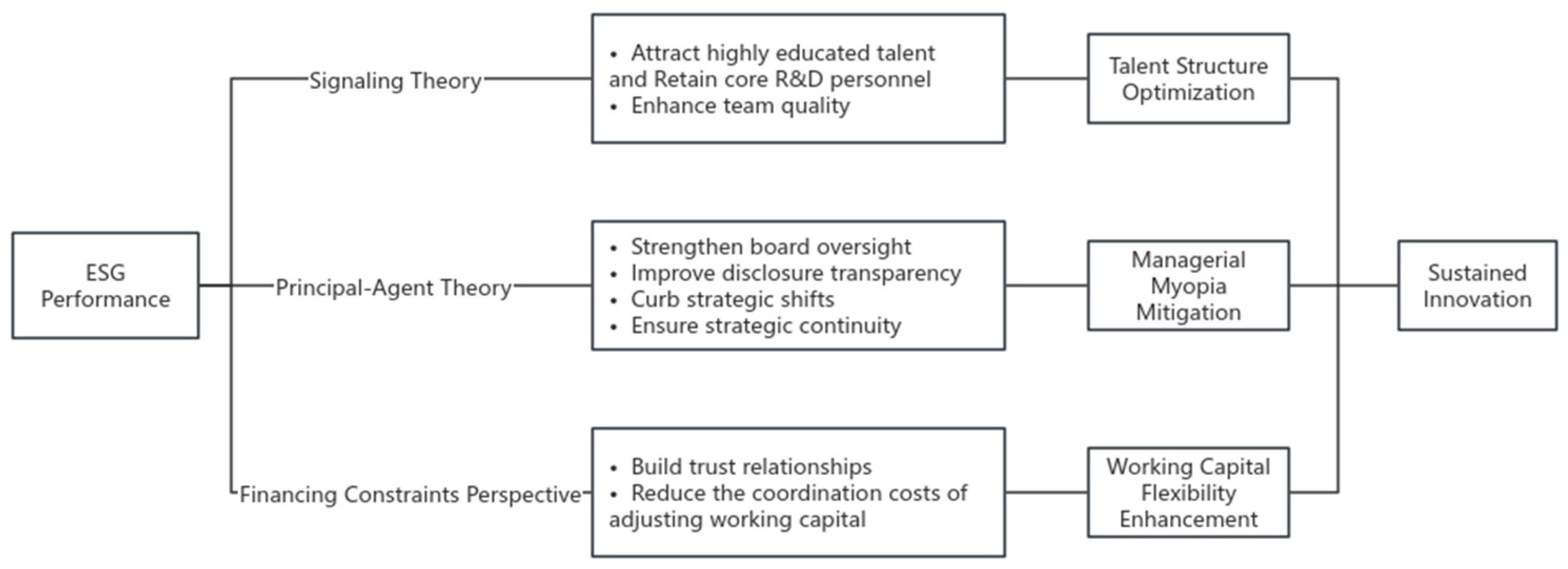
- This study identifies and tests three mechanisms through which ESG supports sustained innovation: talent structure optimization, managerial myopia mitigation, and working capital flexibility enhancement. These mechanisms reveal that ESG’s true value lies in transforming sustainable governance into enduring technological accumulation capacity, moving beyond viewing ESG merely as an external reputation or financing tool.
- (3)
- This study delineates four boundary conditions that shape the ESG–innovation relationship. We show that ESG’s effect varies systematically across contexts—stronger in firms with younger management teams and lower subsidies; under high climate risk, it enhances input but not output continuity; and in firms with strong big-data capabilities, it boosts output without affecting input. These findings offer empirical grounding for designing differentiated ESG policies.
2. Theoretical Analysis and Research Hypotheses
2.1. Talent Structure Mechanism
2.2. Managerial Myopia Mechanism
2.3. Working Capital Flexibility Mechanism
3. Research Design
3.1. Data Sources and Sample Selection
3.2. Variable Definitions
3.2.1. Sustained Innovation
3.2.2. Corporate ESG Performance
3.2.3. Control Variables
3.2.4. Descriptive Statistics
3.3. Baseline Model Specification
4. Empirical Results and Analysis
4.1. Baseline Regression
4.2. Robustness Tests
4.3. Endogeneity Tests
- (1)
- Instrumental Variables Approach. This study selects the industry-year average ESG score of firms located in other provinces as the instrumental variable. This variable theoretically meets the relevance condition: due to industry-specific norms and peer learning effects, a firm’s ESG performance is influenced by the average practices of its industry peers, even those in different regions. At the same time, it plausibly satisfies the exclusion restriction because the ESG levels of other firms in the same industry but different provinces do not share the same local market conditions, resource constraints, or regional policy shocks that would directly influence the focal firm’s innovation activities. The test results are shown in columns (1) to (4) of Table 4. The first-stage tests indicate that the Cragg–Donald F-statistics all exceed the Stock–Yogo weak identification test critical value of 16.38 at the 10% significance level, rejecting the weak-instrument hypothesis. The second-stage regression results show that the coefficients of ESG on sustained innovation input and output remain positive and significant at the 1% level, confirming that the main conclusion holds after accounting for endogeneity.
- (2)
- Propensity Score Matching. To reduce the influence of sample self-selection bias on the conclusions, this study employs PSM to re-match the sample for testing. Firms are classified into high-ESG and low-ESG groups based on the industry–year average ESG score. We estimate propensity scores using a logit model with all covariates from the baseline regression. We then perform one-to-one nearest-neighbor matching with a caliper of 0.05 and restrict the analysis to the common support region. Appendix A Table A2 presents the balance tests. After matching, the standardized biases for all covariates are below 5% with no statistically significant differences between the matched groups, confirming the matching quality. The post-matching estimation results (columns (5) and (6) of Table 4) show that the coefficient on ESG remains positive and significant, indicating that the research findings are robust after mitigating selection bias and further validating the positive effect of ESG.
- (3)
- Lagged Explanatory Variable. This study incorporates a one-period lag of the core explanatory variable, ESG performance, into the regression. The results (columns (7) and (8) of Table 4) show that the coefficients of lagged ESG on sustained innovation input (IIP) and output (OIP) are both positive and significant, providing further support for the causal inference that ESG enhances firms’ sustained innovation.
5. Further Analysis
5.1. Mechanism Analysis
5.1.1. Talent Structure
5.1.2. Managerial Myopia
5.1.3. Working Capital Management
5.2. Heterogeneity Analysis
- (1)
- Climate Risk Perception. As climate-related regulatory and market pressures intensify, a firm’s attention to climate risk may influence how it translates ESG into sustained innovation. Firms that frequently discuss climate policies, extreme weather impacts, or low-carbon transition costs in their annual reports are typically aware that climate change poses a tangible challenge to their long-term operations. Consequently, such firms may leverage ESG practices earlier to stabilize their R&D direction and maintain investment continuity. However, this heightened awareness comes with trade-offs. These firms may also devote considerable resources to meeting disclosure requirements or responding to regulatory scrutiny. Such efforts could hinder the effective conversion of resources into tangible innovation outputs. To identify this potential heterogeneity, this study constructs a climate risk perception indicator (Climate) based on the textual analysis of corporate annual reports (The specific steps for constructing the Climate Risk Perception Indicator are as follows: (1) Data Collection: Annual report texts of SRUI enterprises from 2010 to 2023 were sourced from the China Information Website. (2) Text Processing: The Jieba Chinese word segmentation tool was applied to process the annual report texts. Climate-risk-related terms were identified using a climate risk dictionary comprising 98 keywords, covering dimensions such as climate policy, transition costs, physical disasters, and regulatory compliance (see Appendix A Table A4 for details). (3) Index Calculation: The cumulative frequency of climate risk keywords in each annual report was calculated and divided by the total word count of that report to derive a firm-level climate risk perception index). This indicator quantifies management’s focus on climate-related topics, thereby reflecting the firm’s subjective assessment of transition and physical risks, as well as its strategic willingness to respond.The regression results in columns (1)–(2) of Table 6 show that the interaction term between ESG and climate risk perception is significantly positive for IIP but not significant for OIP. This contrast suggests that firms with high climate risk perception leverage strong ESG practices to maintain R&D investment continuity. However, they do not achieve a corresponding improvement in sustained innovation output, such as patents. In other words, ESG primarily functions as a “stabilizer” in such firms, mitigating the impact of external pressures on R&D activities, but has not yet been transformed into an efficient mechanism for innovation conversion. This finding implies that while promoting climate-related disclosures, regulators may need to pay attention to whether firms possess the supporting mechanisms to translate risk awareness into actual innovation capacity, thereby helping to ensure that ESG practices are more than just a formality.
- (2)
- Management Team Age Structure. The senior management team plays a pivotal role in allocating corporate resources and implementing strategies. Consequently, its age composition may critically influence how effectively ESG initiatives are translated into sustained innovation. Compared to older managers, younger executives are generally more familiar with emerging technologies and sustainability trends, and are also more willing to commit to long-term investments in the face of uncertainty. This study uses executive biographical information from the CSMAR database to calculate the average age of the core management team each year as the moderating variable (TMTAge).The empirical results (columns (3)–(4) in Table 6) show that the interaction term between ESG and management team age is significantly negative for both IIP and OIP. This indicates that in firms with younger management teams, the enhancing effect of ESG on the continuity of innovation input and output is significantly stronger. This finding supports the perspective of upper echelons theory: executives’ cognitive characteristics profoundly shape the effectiveness of strategy implementation, and younger managers are better able to translate the long-term governance value of ESG into concrete innovation actions.
- (3)
- Big-Data Technology Application Capability. With the development of the digital economy, a firm’s understanding and application capabilities of technologies such as big data and artificial intelligence may profoundly influence how ESG practices translate into sustained innovation. Firms with stronger big-data capabilities are more likely to leverage data-analysis tools to optimize R&D processes, forecast technology trends, and improve the efficiency of resource allocation. To measure this capability, this study constructs an index of corporate big-data technology application capability (DT) based on the textual content of listed companies’ annual reports (the indicator DT is constructed by summing the frequencies of keywords such as “big data,” “data mining,” “text mining,” “data visualization,” “heterogeneous data,” “credit investigation,” “augmented reality,” “mixed reality,” and “virtual reality” in the annual reports, adding one, and then taking the natural logarithm).The regression results, shown in columns (5)–(6) of Table 6, indicate that the interaction term between ESG and DT has a significantly positive effect on OIP but no significant effect on IIP. This suggests that in firms with stronger big-data technology application capabilities, ESG’s role in promoting the continuity of patent output is significantly enhanced, while its impact on the continuity of R&D investment remains unchanged. In other words, big-data technology primarily functions in the “back-end” of innovation. It helps high-ESG firms more efficiently translate sustainable principles into verifiable technological outcomes, thereby improving the persistence of innovation output.
- (4)
- Government Subsidies. Government subsidies, as an important external incentive tool, warrant in-depth exploration regarding their interaction with firms’ endogenous ESG motivations. Theoretically, subsidies can alleviate financing constraints for innovation. However, they may also trigger a “crowding-out effect”. If firms view ESG more as a means to obtain subsidies rather than as a reflection of long-term strategy or genuine commitment to sustainable development, the actual governance role of ESG may be diluted. To examine this, this study constructs the Subsidy variable as the ratio of government subsidies to annual operating revenue.The results in columns (7)–(8) of Table 6 show that the interaction term between ESG and government subsidies is significantly negative for both IIP and OIP. This indicates that in firms receiving higher subsidies, the promoting effect of ESG on sustained innovation is notably weaker. This finding suggests that external fiscal support partly substitutes for the motivation of firms to drive long-term innovation based on their own governance intentions. From a policy perspective, excessive reliance on subsidies may induce strategic “ESG-for-funding” behavior. Moving forward, policy design may consider reducing dependence on “transfusion-style” subsidies and instead foster an institutional environment centered on market mechanisms and governance self-discipline. Such an approach could help guide firms to internalize ESG as a core capability for supporting high-quality, sustained innovation.
6. Conclusions
6.1. Discussion of the Findings
6.2. Policy Implications
6.3. Limitations and Future Research
Author Contributions
Funding
Institutional Review Board Statement
Informed Consent Statement
Data Availability Statement
Conflicts of Interest
Appendix A

| Variables | Symbol | Measurement |
|---|---|---|
| Sustained innovation investment | IIP | The natural logarithm of the variable calculated in Equation (1). |
| Sustained innovation output | OIP | The natural logarithm of the variable calculated in Equation (2). |
| ESG | ESG | Huazheng ESG ratings |
| Firm Size | Size | Natural logarithm of total assets |
| Leverage ratio | Lev | Total liabilities/Total assets |
| Return on assets | ROA | Net profit/Total assets |
| Firm age | Age | The natural logarithm of the difference between the fiscal year and the year of establishment plus one |
| Cash ratio | Cash | (Cash and equivalents)/Current liabilities |
| Ownership concentration | TOP1 | Shareholding ratio of the largest shareholder |
| TobinQ | TobinQ | the Tobin’s Q ratio of the firm in year t |
| The proportion of independent directors | ID | The number of independent directors/Total board members |
| Asset Intensity | Intensity | Total assets/sales |
| The share of secondary industry in GDP | Second | Secondary Industry Output/Gross Domestic Product |
| GDP per capita | PGDP | The natural logarithm of the ratio of real GDP to permanent resident population. |
| Variable | Sample | Treated | Control | %Bias | t-Test | p > t |
|---|---|---|---|---|---|---|
| Size | Unmatched | 21.759 | 21.62 | 17.1 | 5.99 | 0.000 |
| Matched | 21.643 | 21.68 | −4.6 | −1.48 | 0.138 | |
| Lev | Unmatched | 0.329 | 0.376 | −26.5 | −9.24 | 0.000 |
| Matched | 0.348 | 0.344 | 2.5 | 0.83 | 0.405 | |
| ROA | Unmatched | 0.046 | 0.023 | 32.4 | 11.3 | 0.000 |
| Matched | 0.035 | 0.039 | −4.7 | −1.72 | 0.086 | |
| Age | Unmatched | 2.931 | 2.946 | −5.3 | −1.87 | 0.062 |
| Matched | 2.941 | 2.935 | 2 | 0.63 | 0.529 | |
| Cash | Unmatched | 0.049 | 0.041 | 13.1 | 4.57 | 0.000 |
| Matched | 0.043 | 0.043 | −1.2 | −0.4 | 0.692 | |
| Top1 | Unmatched | 0.297 | 0.294 | 2 | 0.69 | 0.492 |
| Matched | 0.298 | 0.297 | 0.5 | 0.15 | 0.88 | |
| TobinQ | Unmatched | 2.395 | 2.342 | 3.9 | 1.35 | 0.178 |
| Matched | 2.296 | 2.342 | −3.3 | −1.1 | 0.273 | |
| ID | Unmatched | 0.401 | 0.391 | 13.5 | 4.72 | 0.000 |
| Matched | 0.394 | 0.397 | −4.2 | −1.35 | 0.178 | |
| Intensity | Unmatched | 2.511 | 2.605 | −5.7 | −1.97 | 0.049 |
| Matched | 2.556 | 2.534 | 1.3 | 0.43 | 0.669 | |
| Second | Unmatched | 36.84 | 37.394 | −4.8 | −1.68 | 0.093 |
| Matched | 37.196 | 37.249 | −0.5 | −0.15 | 0.885 | |
| PGDP | Unmatched | 11.709 | 11.689 | 4.7 | 1.65 | 0.099 |
| Matched | 11.694 | 11.7 | −1.4 | −0.43 | 0.669 |
| Variables | (1) | (2) | (3) | (4) | (5) | (6) | (7) | (8) |
|---|---|---|---|---|---|---|---|---|
| IIP | OIP | IIP | OIP | IIP | OIP | IIP | OIP | |
| ESG | 0.008 | 0.086 ** | 0.163 *** | 0.096 *** | 0.019 * | 0.065 * | 0.075 *** | 0.135 *** |
| (0.012) | (0.031) | (0.018) | (0.033) | (0.011) | (0.035) | (0.012) | (0.027) | |
| High_edu | −0.204 *** | −0.055 | ||||||
| (0.068) | (0.115) | |||||||
| ESG × High_edu | 0.045 *** | 0.054 * | ||||||
| (0.016) | (0.028) | |||||||
| High_skill | 0.153 | −0.302 | ||||||
| (0.113) | (0.202) | |||||||
| ESG × High_skill | 0.047 * | 0.105 ** | ||||||
| (0.027) | (0.047) | |||||||
| High_myopia | −0.143 ** | −0.480 ** | ||||||
| (0.059) | (0.209) | |||||||
| ESG × High_myopia | 0.028 ** | 0.145 *** | ||||||
| (0.014) | (0.049) | |||||||
| High_WKS | 0.043 ** | 0.080 | ||||||
| (0.021) | (0.053) | |||||||
| ESG × High_WKS | 0.027 *** | 0.023 *** | ||||||
| (0.006) | (0.006) | |||||||
| Constant | −1.750 | −3.951 *** | 4.233 *** | −5.860 *** | −1.898 * | −4.496 *** | −0.181 | 2.338 *** |
| (1.151) | (0.748) | (0.887) | (1.571) | (1.149) | (1.105) | (1.421) | (0.121) | |
| Obs | 4515 | 4254 | 5026 | 4485 | 4515 | 4260 | 4767 | 4594 |
| Firm FE | YES | YES | YES | YES | YES | YES | YES | YES |
| Year FE | YES | YES | YES | YES | YES | YES | YES | YES |
| Adj-R2 | 0.865 | 0.118 | 0.302 | 0.102 | 0.865 | 0.049 | 0.609 | 0.098 |
| Risk Type | Word Set |
|---|---|
| Serious Risks Keywords (34) | typhoon, disaster, drought and flood, drought, severe, extreme, strong wind, frost, flooding, hurricane, urban water logging, storm, dust, debris flow, freezing, snow disaster, drought situation, landslide, flood, hail, tornado, rainstorm, rain and snow, heavy snow, freeze injury, flood disaster, earthquake, severe cold, tsunami, heavy rain, sandstorm, intense rainfall, freeze, water disaster |
| Chronic Risks Keywords (30) | weather, humidity, water temperature, cooling, temperature, rainfall, cold, air temperature, heavy rain, precipitation, rainy season, rainwater, rain situation, overcast, winter, flood season, extreme cold, high humidity, water regime, sunlight, water shortage, water level, cold, surface, cold wave, climate, groundwater, flood situation, sedimentation, water storage |
| Transition Risks Keywords (34) | energy, clean, energy saving, ecology, environment, intensive, solar energy, upgrading, transformation, recycling, utilization, wind power, natural gas, nuclear power, efficiency, fuel, regeneration, emission reduction, environmental protection, green, consumption reduction, low carbon, water saving, photovoltaic, fuel consumption, high efficiency, power consumption, energy consumption |
References
- D’Attoma, I.; Ieva, M. Determinants of technological innovation success and failure: Does marketing innovation matter? Ind. Mark. Manag. 2020, 91, 64–81. [Google Scholar] [CrossRef]
- Wen, H.; Zhong, Q.; Lee, C. Digitalization, competition strategy and corporate innovation: Evidence from Chinese manufacturing listed companies. Int. Rev. Financ. Anal. 2022, 82, 102166. [Google Scholar] [CrossRef]
- Al-Thageb, S.A.; Algharabali, B.G.; Alabdulghafour, K.T. The pandemic and economic policy uncertainty. Int. J. Financ. Econ. 2022, 27, 2784–2794. [Google Scholar] [CrossRef]
- Bertrand, J.-L.; Parnaudeau, M. Understanding the economic effects of abnormal weather to mitigate the risk of business failures. J. Bus. Res. 2019, 98, 391–402. [Google Scholar] [CrossRef]
- Nickel, C. What do we talk about when we talk about the ‘return’ of geopolitics? Int. Aff. 2024, 100, 7–25. [Google Scholar] [CrossRef]
- Geroski, P.A.; Van Reenen, J.; Walters, C.F. How persistently do firms innovate? Res. Policy 1997, 26, 33–48. [Google Scholar] [CrossRef]
- Cabaleiro-Cerviño, G.; Mendi, P. ESG-driven innovation strategy and firm performance. Eurasian Bus. Rev. 2024, 14, 137–185. [Google Scholar] [CrossRef]
- Li, J.; Lian, G.; Xu, A. How do ESG affect the spillover of green innovation among peer firms? Mechanism discussion and performance study. J. Bus. Res. 2023, 158, 113648. [Google Scholar] [CrossRef]
- Ahmad, N.; Mobarek, A.; Roni, N.N. Revisiting the impact of ESG on financial performance of FTSE350 UK firms: Static and dynamic panel data analysis. Cogent Bus. Manag. 2021, 8, 1900500. [Google Scholar] [CrossRef]
- Chen, L.; Khurram, M.U.; Gao, Y.; Abedin, M.Z.; Lucey, B. ESG disclosure and technological innovation capabilities of the Chinese listed companies. Res. Int. Bus. Financ. 2023, 66, 101974. [Google Scholar] [CrossRef]
- Flammer, C. Competing for government procurement contracts: The role of corporate social responsibility. Strateg. Manag. J. 2018, 39, 1299–1324. [Google Scholar] [CrossRef]
- Houston, J.F.; Shan, H.Y. Corporate ESG profiles and banking relationships. Rev. Financ. 2022, 26, 3373–3417. [Google Scholar] [CrossRef]
- Li, Y.; Li, S. ESG performance and innovation quality. Int. Rev. Econ. Financ. 2024, 92, 1361–1373. [Google Scholar] [CrossRef]
- Sun, H.; Bai, T.; Fan, Y.; Liu, Z. Environmental, social, and governance performance and enterprise sustainable green innovation: Evidence from China. Corp. Soc. Responsib. Environ. Manag. 2024, 31, 3633–3650. [Google Scholar] [CrossRef]
- Zhai, Y.; Cai, Z.; Lin, H.; Yuan, M.; Mao, Y.; Yu, M. Does better environmental, social, and governance induce better corporate green innovation: The mediating role of financing constraints. Corp. Soc. Responsib. Environ. Manag. 2022, 29, 1513–1526. [Google Scholar] [CrossRef]
- Cohen, L.; Gurun, U.G.; Nguyen, Q.H. The ESG-innovation disconnect: Evidence from green patenting. Manag. Sci. 2026. [Google Scholar] [CrossRef]
- Manes-Rossi, F.; Nicolò, G. Exploring Sustainable Development Goals reporting practices: From symbolic to substantive approaches—Evidence from the energy sector. Corp. Soc. Responsib. Environ. Manag. 2022, 29, 1799–1815. [Google Scholar] [CrossRef]
- Li, H.; Wang, J.; Zhang, R.; Duan, M. Research on the impact of corporate ESG performance on sustained innovation in the VUCA context: Evidence from China. Sustainability 2025, 17, 5304. [Google Scholar] [CrossRef]
- Li, L.; Zhu, J. Can data assetization drive high-quality enterprise development? Evidence from China’s “specialized, refined, unique, and innovative” SMEs. PLoS ONE 2025, 20, e0335903. [Google Scholar] [CrossRef]
- Jensen, M.C.; Meckling, W.H. Theory of the firm: Managerial behavior, agency costs and ownership structure. J. Financ. Econ. 1976, 3, 305–360. [Google Scholar] [CrossRef]
- Hall, B.H. The financing of research and development. Oxf. Rev. Econ. Policy 2002, 18, 35–51. [Google Scholar] [CrossRef]
- Cremers, M.; Pareek, A.; Sautner, Z. Short-term investors, long-term investments, and firm value: Evidence from Russell 2000 index inclusions. Manag. Sci. 2020, 66, 4535–4551. [Google Scholar] [CrossRef]
- Akcigit, U.; Liu, Q. The role of information in innovation and competition. J. Eur. Econ. Assoc. 2015, 14, 828–870. [Google Scholar] [CrossRef]
- Chen, T.; Huang, Y.; Lin, C.; Sheng, Z. Finance and firm volatility: Evidence from small business lending in China. Manag. Sci. 2021, 68, 2226–2249. [Google Scholar] [CrossRef]
- Donaldson, T.; Preston, L.E. The stakeholder theory of the corporation: Concepts, evidence, and implications. Acad. Manag. Rev. 1995, 20, 65–91. [Google Scholar] [CrossRef]
- Spence, M. Job market signaling. Q. J. Econ. 1973, 87, 355–374. [Google Scholar] [CrossRef]
- Zuo, Y.; Jiang, S.Y.; Wei, J. Can corporate social responsibility mitigate the liability of newness? Evidence from China. Small Bus. Econ. 2022, 59, 573–592. [Google Scholar] [CrossRef]
- Song, J. Corporate ESG performance and human capital investment efficiency. Financ. Res. Lett. 2024, 62, 105239. [Google Scholar] [CrossRef]
- Dyck, A.; Lins, K.V.; Roth, L.; Wagner, H.F. Do institutional investors drive corporate social responsibility? International evidence. J. Financ. Econ. 2019, 131, 693–714. [Google Scholar] [CrossRef]
- Modigliani, F.; Miller, M.H. The cost of capital, corporation finance and the theory of investment. Am. Econ. Rev. 1958, 48, 261–297. [Google Scholar]
- Giebel, M.; Kraft, K. External financing constraints and firm innovation. J. Ind. Econ. 2019, 67, 91–126. [Google Scholar] [CrossRef]
- Fazzari, S.M.; Petersen, B.C. Working capital and fixed investment: New evidence on financing constraints. Rand J. Econ. 1993, 24, 328–342. [Google Scholar]
- Boisjoly, R.P.; Conine, T.E.; McDonald, M.B. Working capital management: Financial and valuation impacts. J. Bus. Res. 2020, 108, 1–8. [Google Scholar] [CrossRef]
- Jalal, A.; Khaksari, S. Cash cycle: A cross-country analysis. Financ. Manag. 2020, 49, 635–671. [Google Scholar]
- Flannery, M.J.; Öztekin, Ö. Working capital balances and financial policy. J. Corp. Financ. 2024, 87, 102618. [Google Scholar]
- Triguero, A.; Córcoles, D. Understanding innovation: An analysis of persistence for Spanish manufacturing firms. Res. Policy 2013, 42, 340–352. [Google Scholar] [CrossRef]
- Huang, Y.; Yan, J. The effects of artificial intelligence and digitalization on sustained corporate innovation. Financ. Res. Lett. 2026, 87, 108992. [Google Scholar]
- Wang, X.; Shi, Y.; Wang, J.; Wang, G.; Wei, Z.; Li, J. Does corporate ESG performance enhance sustained green innovation? Empirical evidence from China. Economics 2025, 19, 20250167. [Google Scholar] [CrossRef]
- Tang, L.; Hu, J.; Stauvermann, P.J.; Xiong, Z. The impact of short-term debt for long-term investment on corporate ESG performance. Financ. Res. Lett. 2026, 91, 109459. [Google Scholar]
- Zhang, L.; Chen, J.; Zeng, H. Media attention and financial returns to ESG performance. Financ. Res. Lett. 2026, 91, 109471. [Google Scholar]
- Hall, B.H.; Jaffe, A.; Trajtenberg, M. Market value and patent citations. Rand J. Econ. 2005, 36, 16–38. [Google Scholar]
- Xiao, C.; Song, A.; Gu, K. Analysis of R&D expense plus deduction incentive to improve the innovation capacity of enterprises—Based on the moderating effect of financing constraints. Tax. Res. 2024, 5, 80–87. [Google Scholar]
- Cui, X.; Wang, C.; Liao, J.; Fang, Z.; Cheng, F. Economic policy uncertainty exposure and corporate innovation investment: Evidence from China. Pac.-Basin Financ. J. 2021, 67, 101533. [Google Scholar] [CrossRef]
- He, Z.; Chen, W.; Chen, M.; He, S. Local government debt and commercial bank liquidity creation. Financ. Res. Lett. 2025, 80, 107317. [Google Scholar] [CrossRef]
- Becker, G.S. Human Capital: A Theoretical and Empirical Analysis, with Special Reference to Education; National Bureau of Economic Research: Cambridge, MA, USA, 1964. [Google Scholar]
- Brochet, F.; Loumioti, M.; Serafeim, G. Speaking of the short-term: Disclosure horizon and managerial myopia. Rev. Account. Stud. 2015, 20, 1122–1163. [Google Scholar] [CrossRef]
- Hu, N.; Xue, F.; Wang, H. Does managerial myopia affect long-term investment? Based on text analysis and machine learning. Manag. World 2021, 37, 139–156. [Google Scholar]
- Sun, X.; Xiong, X. ESG performance and corporate innovation. Res. Int. Bus. Financ. 2025, 76, 102817. [Google Scholar] [CrossRef]
- Peng, H.X.; Tan, H.P.; Zhang, Y. Human capital, financial constraints, and innovation investment persistence. Asian J. Technol. Innov. 2020, 28, 453–475. [Google Scholar] [CrossRef]
- Lin, Y.; Shi, W.L.; Prescott, J.E.; Yang, H. In the eye of the beholder: Top managers’ long-term orientation, industry context, and decision-making processes. J. Manag. 2019, 45, 3114–3145. [Google Scholar] [CrossRef]
- Bernstein, J.I.; Nadiri, M.I. Advances in Econometrics and Modelling; Springer: Berlin/Heidelberg, Germany, 1989. [Google Scholar]
- Hamermesh, D.S.; Pfann, G.A. Adjustment costs in factor demand. J. Econ. Lit. 1996, 34, 1264–1292. [Google Scholar]
- Sheng, X.; Guo, S.; Chang, X. Managerial myopia and firm productivity: Evidence from China. Financ. Res. Lett. 2022, 49, 103083. [Google Scholar] [CrossRef]

| Variable | N | Mean | SD | Min | Max |
|---|---|---|---|---|---|
| IIP | 5165 | 18.730 | 1.024 | 14.748 | 23.107 |
| OIP | 4599 | 2.998 | 1.482 | −3.045 | 7.276 |
| ESG | 5287 | 4.117 | 0.934 | 1.000 | 8.000 |
| Size | 5287 | 21.676 | 0.822 | 19.687 | 26.376 |
| Lev | 5287 | 0.351 | 0.176 | 0.038 | 0.934 |
| ROA | 5287 | 0.035 | 0.072 | −0.416 | 0.255 |
| Age | 5287 | 2.938 | 0.285 | 1.386 | 3.689 |
| Cash | 5287 | 0.045 | 0.063 | −0.195 | 0.266 |
| Top1 | 5287 | 0.297 | 0.126 | 0.075 | 0.740 |
| TobinQ | 5230 | 2.369 | 1.384 | 0.804 | 12.539 |
| ID | 5287 | 0.396 | 0.075 | 0.231 | 0.615 |
| Intensity | 5287 | 2.577 | 1.680 | 0.379 | 20.476 |
| Second | 5002 | 37.208 | 11.523 | 14.900 | 89.300 |
| PGDP | 5213 | 11.677 | 0.432 | 9.843 | 12.237 |
| Variables | (1) | (2) | (3) | (4) |
|---|---|---|---|---|
| IIP | IIP | OIP | OIP | |
| ESG | 0.063 *** | 0.033 *** | 0.168 *** | 0.124 *** |
| (0.010) | (0.008) | (0.023) | (0.025) | |
| Size | 0.933 *** | 0.221 *** | ||
| (0.023) | (0.033) | |||
| Lev | 0.106 | 0.076 | ||
| (0.076) | (0.161) | |||
| ROA | −0.759 *** | 0.933 ** | ||
| (0.121) | (0.395) | |||
| Age | −0.300 * | −0.172 ** | ||
| (0.163) | (0.080) | |||
| Cash | −0.172 | 0.027 | ||
| (0.126) | (0.394) | |||
| Top1 | 0.712 *** | 0.554 *** | ||
| (0.143) | (0.186) | |||
| TobinQ | 0.017 ** | 0.000 | ||
| (0.008) | (0.017) | |||
| ID | −0.124 | 0.168 | ||
| (0.104) | (0.293) | |||
| Intensity | −0.118 *** | −0.047 *** | ||
| (0.007) | (0.016) | |||
| Second | 0.000 | 0.008 *** | ||
| (0.003) | (0.002) | |||
| PGDP | 0.104 | 0.326 *** | ||
| (0.083) | (0.059) | |||
| Constant | 18.470 *** | −1.875 | 2.302 *** | −6.084 *** |
| (0.041) | (1.150) | (0.099) | (0.985) | |
| Obs | 4909 | 4515 | 4594 | 4254 |
| Firm FE | YES | YES | YES | YES |
| Year FE | YES | YES | YES | YES |
| Adj-R2 | 0.779 | 0.865 | 0.091 | 0.112 |
| Panel A. Replace ESG | (1) | (2) | (3) | (4) | ||
| IIP | OIP | IIP | OIP | |||
| WIND ESG | 0.226 *** (0.017) | 0.195 *** (0.039) | ||||
| ESG_medium | 0.052 *** (0.018) | 0.250 *** (0.052) | ||||
| ESG_high | 0.405 ** (0.171) | 0.545 * (0.268) | ||||
| Constant | −3.891 *** (0.558) | −6.005 *** (1.275) | −1.771 (1.151) | 2.797 *** (0.042) | ||
| Obs | 3495 | 3145 | 4515 | 4394 | ||
| Controls | YES | YES | YES | YES | ||
| Firm FE | YES | YES | YES | YES | ||
| Year FE | YES | YES | YES | YES | ||
| Adj-R2 | 0.573 | 0.047 | 0.865 | 0.104 | ||
| Panel B. Replace Dependent Variable | (1) | (2) | (3) | |||
| INNO | IIP_alt | OIP_alt | ||||
| ESG | 0.001 ** (0.000) | 0.041 *** (0.008) | 0.137 *** (0.031) | |||
| Constant | 0.023 (0.016) | 2.113 (1.141) | −4.118 *** (1.293) | |||
| Obs | 4886 | 4488 | 3152 | |||
| Controls | YES | YES | YES | |||
| Firm FE | YES | YES | YES | |||
| Year FE | YES | YES | YES | |||
| Adj-R2 | 0.032 | 0.797 | 0.039 | |||
| Panel C. Other Robustness Checks | Exclude Exceptional Years | Adjust Clustering Level | Modify Model Specification | |||
| (1) IIP | (2) OIP | (3) IIP | (4) OIP | (5) IIP | (6) OIP | |
| ESG | 0.051 *** (0.013) | 0.070 * (0.038) | 0.033 *** (0.010) | 0.134 *** (0.031) | 0.052 *** (0.012) | 0.139 *** (0.028) |
| Constant | 0.573 (2.078) | −5.032 (3.756) | −1.875 (1.875) | −4.604 * (2.481) | −2.813 *** (0.523) | −4.282 *** (1.165) |
| Obs | 2023 | 2003 | 4515 | 4260 | 4639 | 4142 |
| Controls | YES | YES | YES | YES | YES | YES |
| Firm FE | YES | YES | YES | YES | ||
| Year FE | YES | YES | YES | YES | ||
| IND × Year | YES | YES | ||||
| Adj-R2 | 0.839 | 0.116 | 0.865 | 0.046 | 0.638 | 0.109 |
| Variables | IV | PSM | One-Period Lag | |||||
|---|---|---|---|---|---|---|---|---|
| (1) ESG | (2) IIP | (3) ESG | (4) OIP | (5) IIP | (6) OIP | (7) IIP | (8) OIP | |
| ESG | 0.435 *** | 0.223 ** | 0.045 *** | 0.181 *** | ||||
| (0.063) | (0.111) | (0.015) | (0.050) | |||||
| L.ESG | 0.034 *** | 0.109 *** | ||||||
| (0.009) | (0.028) | |||||||
| IV | 0.460 *** (0.034) | 0.461 *** (0.034) | ||||||
| Constant | −3.123 *** (0.593) | −3.915 *** (0.562) | 2.252 *** (0.143) | 2.071 *** (0.461) | −2.973 * (1.616) | −2.950 ** (1.347) | −1.286 (1.362) | −3.652 *** (1.273) |
| Controls | YES | YES | YES | YES | YES | YES | YES | YES |
| Firm FE | YES | YES | YES | YES | YES | YES | YES | YES |
| Year FE | YES | YES | YES | YES | YES | YES | YES | YES |
| CD Wald F | 245.561 [16.38] | 223.232 [16.38] | ||||||
| Obs | 4651 | 4651 | 4502 | 4502 | 3567 | 3438 | 3419 | 3195 |
| Adj-R2 | 0.863 | 0.118 | 0.871 | 0.044 | ||||
| Variables | (1) | (2) | (3) | (4) |
|---|---|---|---|---|
| Skill | Edu | Myopia | WKS | |
| ESG | 0.101 *** | 0.001 ** | −0.148 *** | 0.007 *** |
| (0.023) | (0.000) | (0.050) | (0.002) | |
| Constant | 0.018 | −0.125 | 3.987 *** | 0.027 *** |
| (0.883) | (0.092) | (0.214) | (0.007) | |
| Obs | 4260 | 4421 | 4892 | 4811 |
| Controls | YES | YES | YES | YES |
| Firm FE | YES | YES | YES | YES |
| Year FE | YES | YES | YES | YES |
| Adj-R2 | 0.237 | 0.888 | 0.383 | 0.513 |
| Variables | (1) | (2) | (3) | (4) | (5) | (6) | (7) | (8) |
|---|---|---|---|---|---|---|---|---|
| IIP | OIP | IIP | OIP | IIP | OIP | IIP | OIP | |
| ESG | 0.048 ** | 0.114 *** | 0.423 ** | 0.861 ** | 0.039 *** | 0.065 * | 0.239 ** | 0.633 ** |
| (0.019) | (0.026) | (0.165) | (0.413) | (0.014) | (0.033) | (0.098) | (0.295) | |
| Climate | −0.867 *** (0.224) | 0.188 (0.542) | ||||||
| ESG × Climate | 0.079 * | 0.011 | ||||||
| (0.044) | (0.125) | |||||||
| TMTAge | 0.033 * | 0.056 | ||||||
| (0.014) | (0.035) | |||||||
| ESG × TMTAge | −0.007 ** | −0.017 ** | ||||||
| (0.003) | (0.008) | |||||||
| DT | 0.046 | −0.148 | ||||||
| (0.045) | (0.111) | |||||||
| ESG × DT | 0.006 | 0.053 ** | ||||||
| (0.010) | (0.026) | |||||||
| Subsidy | 0.060 | 0.181 * | ||||||
| (0.036) | (0.096) | |||||||
| ESG × Subsidy | −0.018 * | −0.041 * | ||||||
| (0.010) | (0.023) | |||||||
| Constant | −3.148 *** | −4.345 *** | −6.120 *** | −8.359 *** | −2.378 *** | −3.745 *** | −4.102 *** | −8.034 |
| (0.452) | (0.702) | (0.806) | (4.198) | (0.509) | (1.240) | (0.963) | (2.203) | |
| Obs | 4776 | 4254 | 4776 | 4245 | 3844 | 3402 | 4776 | 4254 |
| Firm FE | YES | YES | YES | YES | YES | YES | YES | YES |
| Year FE | YES | YES | YES | YES | YES | YES | YES | YES |
| Adj-R2 | 0.643 | 0.131 | 0.623 | 0.126 | 0.630 | 0.129 | 0.592 | 0.132 |
Disclaimer/Publisher’s Note: The statements, opinions and data contained in all publications are solely those of the individual author(s) and contributor(s) and not of MDPI and/or the editor(s). MDPI and/or the editor(s) disclaim responsibility for any injury to people or property resulting from any ideas, methods, instructions or products referred to in the content. |
© 2026 by the authors. Licensee MDPI, Basel, Switzerland. This article is an open access article distributed under the terms and conditions of the Creative Commons Attribution (CC BY) license.
Share and Cite
Dai, Y.; Wu, X. Can ESG Promote Sustained Innovation in Specialized, Innovation-Driven SMEs? Evidence from China’s “Specialized, Refined, Unique, and Innovative” Enterprises. Sustainability 2026, 18, 2967. https://doi.org/10.3390/su18062967
Dai Y, Wu X. Can ESG Promote Sustained Innovation in Specialized, Innovation-Driven SMEs? Evidence from China’s “Specialized, Refined, Unique, and Innovative” Enterprises. Sustainability. 2026; 18(6):2967. https://doi.org/10.3390/su18062967
Chicago/Turabian StyleDai, Yulin, and Xiaodi Wu. 2026. "Can ESG Promote Sustained Innovation in Specialized, Innovation-Driven SMEs? Evidence from China’s “Specialized, Refined, Unique, and Innovative” Enterprises" Sustainability 18, no. 6: 2967. https://doi.org/10.3390/su18062967
APA StyleDai, Y., & Wu, X. (2026). Can ESG Promote Sustained Innovation in Specialized, Innovation-Driven SMEs? Evidence from China’s “Specialized, Refined, Unique, and Innovative” Enterprises. Sustainability, 18(6), 2967. https://doi.org/10.3390/su18062967