1. Introduction
Rear-end collisions and inefficient utilization of roadway capacity remain central challenges for sustainable traffic systems, particularly on two-lane rural roads where geometric constraints and limited instrumentation restrict technological interventions. At the microscopic level, both safety and operational performance are governed by inter-vehicle spacing, which directly reflects physical vehicle interactions and roadway occupancy. Consequently, spatial spacing represents a primary variable for sustainability-oriented traffic analysis, as it influences collision risk, traffic organization, and infrastructure efficiency.
Vehicle spacing, also referred to as distance headway or spatial headway, is defined as the longitudinal distance between two successive vehicles measured at a given instant along a roadway segment, typically between homologous reference points on consecutive vehicles. Conversely, vehicle headway, or temporal headway, represents the time interval between successive vehicles passing the same point on the same lane at a fixed cross section. Although both variables describe microscopic traffic interactions, spatial spacing directly reflects the physical occupation of road space and the organization of traffic streams, whereas temporal headways provide only indirect information mediated by vehicle speed.
Vehicle spacing is a fundamental element of traffic analysis due to its direct relationship with vehicle density and its influence on driving behavior, safety conditions, and infrastructure performance [
1,
2]. Through this relationship, spacing affects traffic characteristics and levels of service on uninterrupted-flow facilities, such as multilane highways and freeways [
1,
3,
4].
Historically, research on vehicle interactions has concentrated primarily on temporal headways. As reviewed by [
5], early headway studies from the 1930s to the 1970s [
6,
7,
8,
9,
10] and later developments addressing higher traffic demands on increasingly crowded roads [
11,
12,
13] focused on vehicle arrival processes observed at fixed cross sections. These approaches implicitly assumed that headway distributions measured at a point were representative of vehicle interactions along an entire roadway segment. Subsequent studies demonstrated that headway distributions vary with traffic state, speed, and interaction intensity and therefore cannot be considered spatially homogeneous [
5,
14,
15,
16].
Although temporal headways are easier to collect using fixed-point detectors, they provide only indirect information on physical vehicle proximity and implicitly assume homogeneous speeds. Under real traffic conditions, speed variability introduces additional randomness that breaks the equivalence between time-based and space-based observations. As a result, temporal headways cannot reliably represent actual inter-vehicle separation along a road segment. In contrast, spatial spacing directly quantifies physical distance between vehicles and is therefore more appropriate for evaluating collision risk, roadway occupancy, and compliance with safety thresholds.
Proper understanding of vehicle spacing is essential for developing traffic models that enhance safety, support sustainability objectives, establish safe following distances, and inform regulatory standards. Rear-end collisions, which account for a substantial portion of traffic accidents, often result from sudden deceleration of the leading vehicle or unexpected acceleration of the following vehicle, primarily due to driver inattention, misjudgment, or aggressive [
17,
18,
19,
20]. Consequently, analyzing vehicle behavior in terms of spatial distancing is fundamental for modeling rear-end collision mechanisms and testing mitigation strategies.
Direct measurement of spatial spacing over extended road segments poses practical challenges, particularly on rural networks. While speeds and temporal headways are easily collected using fixed-point detectors, spatial spacing is often inferred indirectly through local density estimates based on stationarity assumptions that are rarely satisfied under real traffic conditions [
1,
2,
21]. Experimental approaches using GPS, LiDAR, or instrumented vehicles provide accurate spacing measurements but are typically limited in scale and applicability [
22]. Recent advances in video recording and image processing enable high-resolution spacing measurements [
17,
23], yet these technologies require substantial infrastructure and are generally confined to motorways and major corridors [
24]. In recent years, UAV-based aerial video combined with computer-vision trajectory reconstruction has enabled the collection of high-resolution microscopic traffic data, including vehicle trajectories and spatial gaps, over extended road segments [
25,
26,
27]. However, such approaches typically require dedicated survey campaigns, regulatory authorization, and significant data-processing resources, and their systematic deployment over extended rural networks remains operationally constrained.
Two-lane rural roads represent a substantial share of national and regional road networks and play a key role in connecting urban areas with local and peripheral territories. These facilities are characterized by heterogeneous traffic, geometric constraints, and limited technological equipment [
28,
29,
30]. From a sustainability standpoint, improving safety and operational efficiency on such roads is essential, as extensive infrastructure upgrades or sensor deployments are often economically and environmentally unfeasible. In this context, modeling approaches capable of extracting meaningful information from commonly available traffic data are particularly valuable.
Probabilistic modeling provides a suitable framework for representing inter-vehicle spacing under these constraints. Empirical evidence shows that spacing distributions are asymmetric, bounded, and strongly dependent on traffic conditions, reflecting the coexistence of free-flow and interaction-dominated regimes [
9,
10,
11]. Despite their relevance, spatial spacing distributions have received less attention than temporal headways, particularly for two-lane rural roads, where their characterization can support sustainable traffic management and safety-oriented decision making.
The present study addresses this gap by focusing on the probabilistic characterization of inter-vehicle spacing on no-passing two-lane rural roads. To overcome the lack of direct spacing measurements, the research adopts the isomorphism between Event Flows and Linear Fields of Random Points [
21], which provides a theoretical basis for deriving spacing distributions from temporal headway distributions. Building on the simulation model proposed by [
31], calibrated and validated using monitored data from a two-lane rural road section in Northern Italy, this study analyzes spacing distributions across a wide range of traffic flow rates and densities.
The objective is to identify and estimate an appropriate probabilistic representation of vehicle spacing, focusing on the Pearson Type III distribution, and to investigate the behavior of its parameters as traffic conditions evolve. The Pearson Type III family is selected because it provides a flexible three-parameter formulation capable of simultaneously representing positive skewness, leptokurtic behavior, and non-zero minimum spacing values, while encompassing classical models such as the Negative Exponential, Shifted Exponential, and Erlang distributions as special cases. This property allows a unified distributional framework across different traffic regimes without switching between unrelated functional forms. By providing a statistically consistent description of spacing, the proposed framework supports sustainability-oriented traffic analysis by enabling quantitative safety assessment, performance evaluation, and regulatory considerations without requiring extensive monitoring infrastructure.
The principal scientific contribution of this study is the formulation and validation of a probabilistic framework for inter-vehicle spacing on two-lane rural roads, based on the isomorphism between Event Flows and Linear Fields of Random Points and implemented through the Pearson Type III distribution, whose parameters exhibit systematic relationships with macroscopic traffic variables.
The remainder of the paper is organized as follows.
Section 2 presents the problem formulation and introduces the theoretical framework based on Event Flows and Linear Fields isomorphism.
Section 3 summarizes the simulation model and the spacing datasets used in the analysis.
Section 4 presents the estimation of spacing probability distributions using the Pearson Type III family.
Section 5 discusses parameter trends across traffic conditions. Finally,
Section 6 summarizes the main conclusions.
3. Methods and Materials
3.1. Spacing Simulation Model for a Single-Lane Traffic Stream
This study develops a probabilistic characterization of inter-vehicle spacing that can support safety-oriented and sustainable traffic operations on two-lane rural roads, where extensive sensing infrastructure is often impractical. Building on the theoretical isomorphism between Event Flows and Linear Fields of Random Points on the semi-infinite line
, the paper focuses on selecting and calibrating a probability model for spacing under operating conditions that enforce single-lane behavior (i.e., no overtaking). The spacing datasets analyzed herein are generated using the calibrated Spacing Simulation Model introduced in [
31]. The complete modeling chain, including model assumptions, calibration procedures, and validation results, is presented in detail in the previous study [
28], which provides the empirical basis for the simulation framework adopted here.
The simulation framework consists of two main components: a Vehicle-Generation Model (VGM) and a Vehicle-Interaction Model (VIM).
The VGM defines vehicle entry at the origin O of a lane of indefinite length and includes:
Temporal Headway Distribution Model (THDM): assigns a stochastic temporal headway to each vehicle relative to its predecessor;
Initial Speed Distribution Model (ISDM): assigns entry speeds at O using a stochastic representation consistent with the macroscopic fundamental diagram, thereby capturing realistic variability in driver behavior and vehicle performance.
The VIM governs longitudinal interactions after entry and includes:
First Vehicle Speed Pattern (FVSP): prescribes the motion pattern of the lead vehicle;
Car-Following Model (CFM): reproduces the response of each following vehicle in terms of speed and spacing adaptation to the leader, incorporating reaction effects and collision-avoidance constraints.
In the adopted framework, vehicle interactions are modeled through General Motors (GM) car-following formulation. The parameters
,
, and
are defined consistently with the macroscopic traffic law calibrated for the monitored site. In particular, the values
and
associate the GM formulation with the Greenberg fundamental diagram calibrated for the reference road section, while the sensitivity parameter
is set equal to the characteristic speed parameter
of the same diagram, as reported [
31]. This ensures consistency between the microscopic interaction mechanism and the macroscopic traffic relationships observed in the field.
Vehicles are represented as extended objects with constant length m, consistent with the passenger-car length observed at the monitoring site. This value corresponds to the average vehicle length measured in the calibrated dataset and reflects the single-class traffic composition of the study site, where heavy vehicles over 3.5 tons are not permitted.
Simulations cover hourly flow rates from 100 to 1300 veh/h in increments of 100 veh/h. For each flow level, 100 independent sequences of 100 vehicles are generated (single vehicle class, no overtaking). Vehicles enter at O according to THDM and ISDM and then interact according to the CFM under FVSP, producing a controlled yet behaviorally consistent stream suitable for systematic spacing analysis.
Model specification, calibration, and validation rely on the monitoring section described in [
29]. The site consists of a straight, level two-lane rural road segment in Northern Italy instrumented with 24.165 GHz Doppler radar sensors on both sides. The facility has a 90 km/h speed limit, a no-transit rule for heavy vehicles over 3.5 tons, and a no-overtaking rule for all vehicle categories. Traffic was monitored over 24 h in both directions, capturing approximately 28,000 vehicles during a typical workday without atmospheric or incidental disruptions. The monitoring data collected at this site were used in [
31] to calibrate the parameters of the vehicle-generation process, the stochastic fundamental diagram, and the GM car-following model, and to validate the simulated traffic variables (speeds and headways) against observed measurements.
Overall, 130,000 vehicles are simulated (13 flow levels × 100 sequences × 100 vehicles). For each 100-vehicle sequence, the following variables are extracted:
Temporal headways () at the origin O;
Speeds () at the origin O;
Spacing (), at the reference time , defined as the longitudinal separation between vehicle i and its predecessor at the instant when the last vehicle () enters the stream, thus providing an instantaneous spatial snapshot of the traffic configuration.
As reported in [
31], simulated headways and entry speeds were validated against the monitored data, showing strong agreement both for headway distributions and for speed trends consistent with the macroscopic behavior observed at the site. This validation supports the use of the simulated spacing datasets for the probabilistic analyses developed in the present paper.
3.2. Spacing Data Simulated at Varying Flow Rates and Densities
The analyses focus on spacing observations () collected at the reference time , i.e., when the last vehicle of each 100-vehicle sequence is generated at the origin O. In the simulation output, spacing is defined as the longitudinal distance between homologous reference points on consecutive vehicles (front-to-front in the simulated representation) and therefore includes the vehicle length. Accordingly, the gross spacing can be written as A net physical gap can be obtained by subtracting vehicle length, with m.
In the following, only the gross spacing is considered because it ensures that spacing measurements refer to a consistent homologous point on successive vehicles and remains fully coherent with the point-based probabilistic framework and the extended-vehicle representation adopted in the simulation model. For simplicity, the notation is used to denote gross spacing unless otherwise stated.
Spacing data are analyzed to characterize the probabilistic behavior of inter-vehicle separation under varying traffic conditions. The study considers flow classes from 100 to 1300 veh/h (step 100 veh/h) and density classes from 1 to 45 veh/km (step 5 veh/km). The simulated flow is normalized to an hourly rate using transits between and , while density is computed at by normalizing the number of simulated vehicles to a 1 km road segment based on the total inter-point spacing along the road axis.
Further details and descriptive statistics of spacing for each class (central tendency, dispersion, quartiles, skewness, and kurtosis) can be found in [
31]. The key empirical characteristics motivating the distributional modeling in this paper are summarized as follows:
Positive skewness: spacing distributions are right-skewed, with most values concentrated at low spacings and occasional large separations;
High kurtosis: distributions are leptokurtic, indicating a pronounced peak and heavier tails than a normal distribution;
Non-zero minimum values: minimum spacings reflect kinematic constraints and interaction rules embedded in the simulation;
Autocorrelation at high traffic levels: dependence becomes more evident at higher flow and density regimes.
Consistent with these features and with the evidence reported in [
31], the Pearson Type III distribution provides a flexible parametric representation capable of reproducing asymmetry, kurtosis, and non-zero minima. Moreover, unlike exponential or Erlang-based formulations, Pearson Type III does not require independence or limited-memory assumptions and can therefore be applied to datasets exhibiting interdependencies, as supported by the lag-1 autocorrelation analyses in [
31]. These datasets constitute the empirical basis for the parameter estimation and goodness-of-fit analyses presented in
Section 4.
4. Results
To quantify and model spacing dynamics, the parameters of the Pearson Type III distribution are estimated separately for classes of hourly traffic volume and for classes of traffic density, each defined by a specific range of vehicles per hour or per kilometer.
Thus, for the set of 1300 simulated series, each consisting of 100 vehicles generated by the simulation, two fitting analyses of the Pearson Type III distribution were carried out, for: simulated flow segmentation ( ranging from 100 to 1300 vehicles/hour with an increment of 100 vehicles/hour); and simulated density segmentation ( ranging from 1 to 45 vehicles/km with an increment of 5 vehicles/km). For the estimation of the parameters and in Equation (9), the MATLAB 2020a function ‘gamfit’ was used, which is based on the MLE method. This was preceded by a data shift equal to the estimated location parameter , to reduce the three-parameter Pearson Type III distribution to a standard Gamma form suitable for MLE.
As is well-known in the practice of data fitting, an assessment of autocorrelation is crucial for understanding its potential impact on parameter estimation. As highlighted in [
31], the analysis can be confined to autocorrelation at lag 1, assuming no compelling reasons exist for higher lag autocorrelations among vehicle distances unless a correlation at lag 1 (i.e., among three consecutive vehicles) is present. Based on the results in [
31], it can be stated that, generally, in situations of low traffic volume where autocorrelation is less pronounced, the estimation of parameters is statistically reliable. However, at higher traffic volumes, even though the focus is placed on the average values of the estimated parameters, verifying that increased autocorrelation does not significantly distort the results involves evaluating the consistency of parameter trends with varying traffic volume and density. If the parameters vary predictably and without anomalies across different traffic classes, it can be concluded that the effect of autocorrelation, while present, does not compromise the validity of the Gamma distribution parameter estimates. In this context, MLE is used to estimate the parameters of the marginal spacing distribution rather than to perform statistical inference based on asymptotic standard errors. The objective of the analysis is the identification of the appropriate probabilistic form and the examination of the evolution of the distribution parameters across traffic regimes. Consequently, the robustness of the estimation under serial dependence is assessed through the regularity and coherence of the parameter trends with respect to traffic flow and density. Any possible underestimation of variance due to autocorrelation therefore mainly affects the quantification of parameter uncertainty, while it does not alter the identification of the distributional form describing inter-vehicle spacing.
For each class of
and
,
Table 2 and
Table 3 show the values of the estimated parameters. The same tables report the goodness-of-fit (GoF) test, which is performed with the heuristic criterion defined in [
30] to address the oversensitivity of traditional tests when dealing with large datasets. Thus, a heuristic Kolmogorov–Smirnov (KS) goodness-of-fit procedure was considered as a practical GoF assessment under large-sample conditions, through resampling a large number (1000) of small random sub-samples (100) compared to the hundreds of thousands of headways in the original samples.
The proposed criterion for assessing the overall GoF involves calculating the KS statistic (namely the maximum difference between the theoretical and observed cumulated frequencies) for each sub-sample and obtaining their average . By comparing the mean value with the critical value, it provides a basis for accepting or rejecting the null hypothesis for the entire dataset. With a significance level of , the critical value of the KS test is .
Table 2 and
Table 3 present the mean value
of the
statistic over 1000 random sub-samples of size 100. It also indicates (**) if the null hypothesis that the empirical distribution is consistent with the estimated theoretical distribution is not rejected based on the heuristic criterion
and on the mean of the relative
p-value values of each
(which must be >0.05).
Table 2 and
Table 3 also contain the expected value of spacing calculated based on the distribution parameters as
and the average density
(veh/km) always calculated using the parameters of the estimated probability distribution function.
It can be observed that, for all flow rate classes reported in
Table 2, the null hypothesis that the empirical spacing distribution is consistent with the Pearson Type III distribution with the estimated parameters is not rejected. A similar result is obtained for the density classes reported in
Table 3, with one exception corresponding to the lowest density class (1–5 veh/km). In this case, although the mean
p-value remains above the prescribed significance threshold, the mean KS statistic
is very close to the critical value.
This behavior can be attributed to the higher heterogeneity of traffic conditions characterizing this density range, which includes simulated flow rates between 100 and 400 veh/h and average speeds ranging from approximately 90.5 to 63.5 km/h. To account for this heterogeneity,
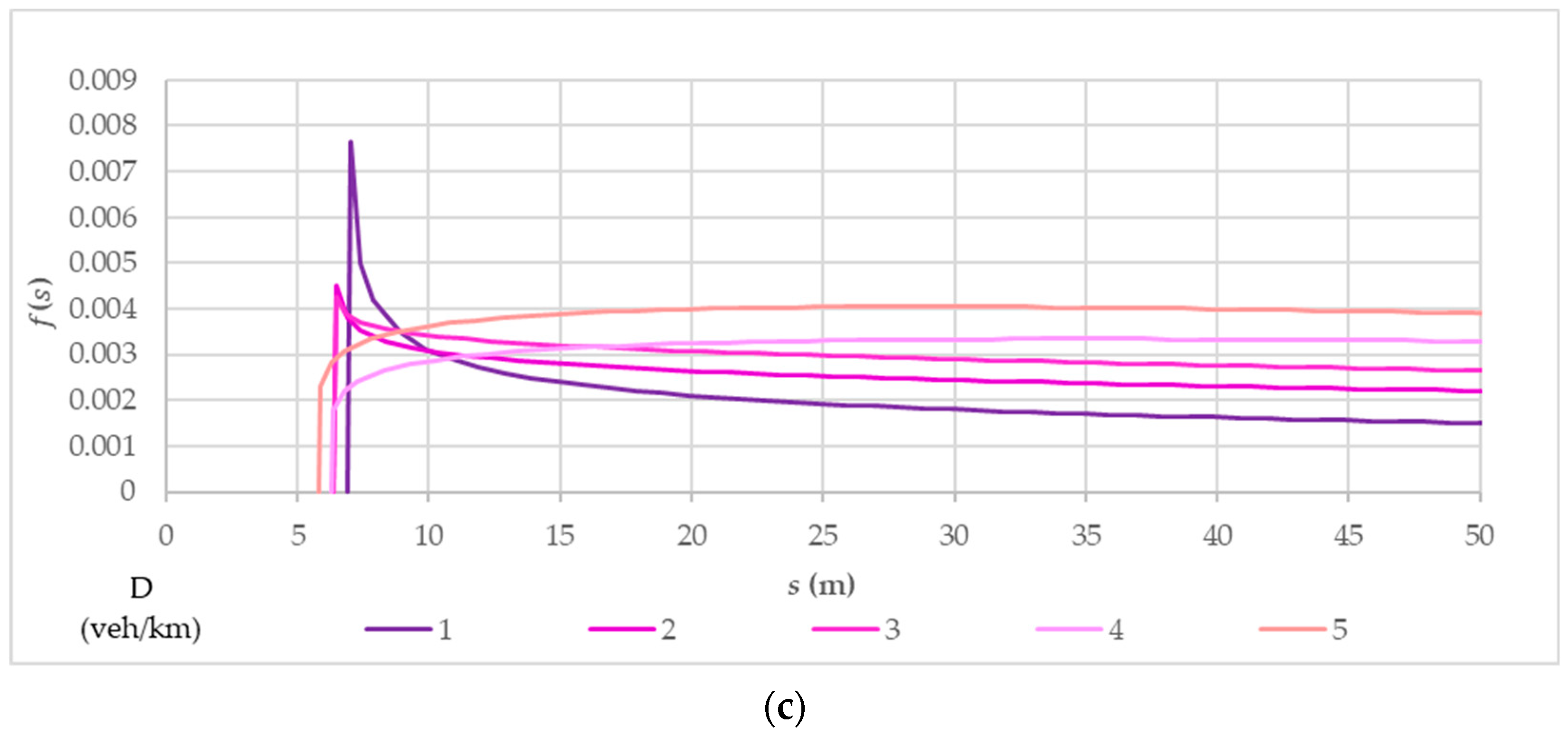
Table 4 reports the results of the parameter estimation, goodness-of-fit assessment, expected spacing
, and estimated density
for simulated densities between 1 and 5 veh/km, disaggregated with a step of 1 veh/km. The five disaggregated density classes all exhibit
values below the critical threshold and substantially lower than those obtained for the aggregated class, indicating a marked improvement in goodness-of-fit.
5. Discussion
The analysis of vehicle spacings using the Pearson Type III distribution has proven effective in capturing the main statistical features of the simulated traffic data. The estimated parameters provide meaningful insight into traffic dynamics and inter-vehicle interactions under varying operating conditions. Overall, the flexibility of the Pearson Type III distribution allows it to accommodate both the asymmetry and the leptokurtic nature of spacing distributions observed across different flow and density regimes.
In this section, the trends of the estimated distribution parameters and selected characteristic quantities are discussed with respect to hourly traffic flow and vehicle density.
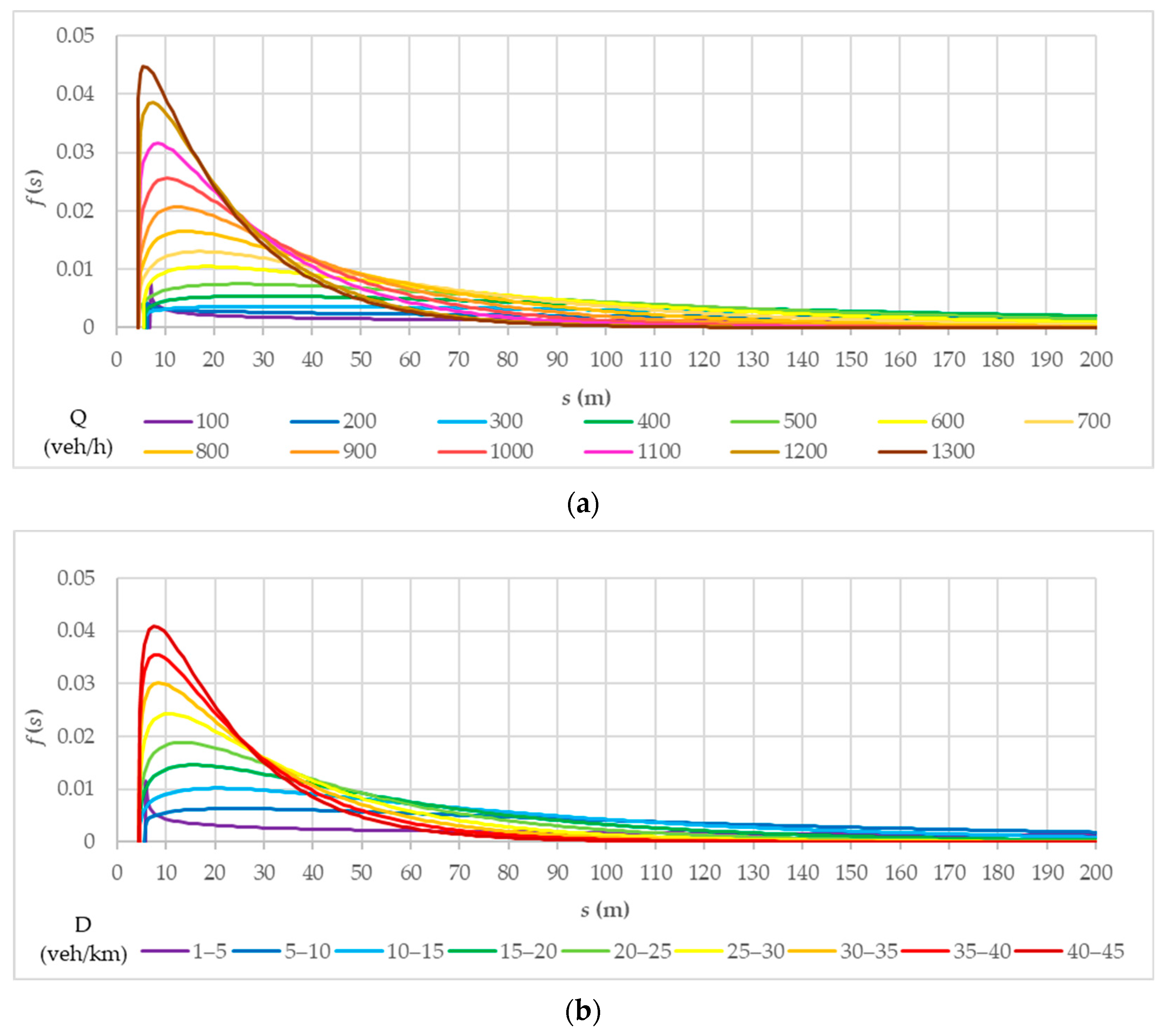
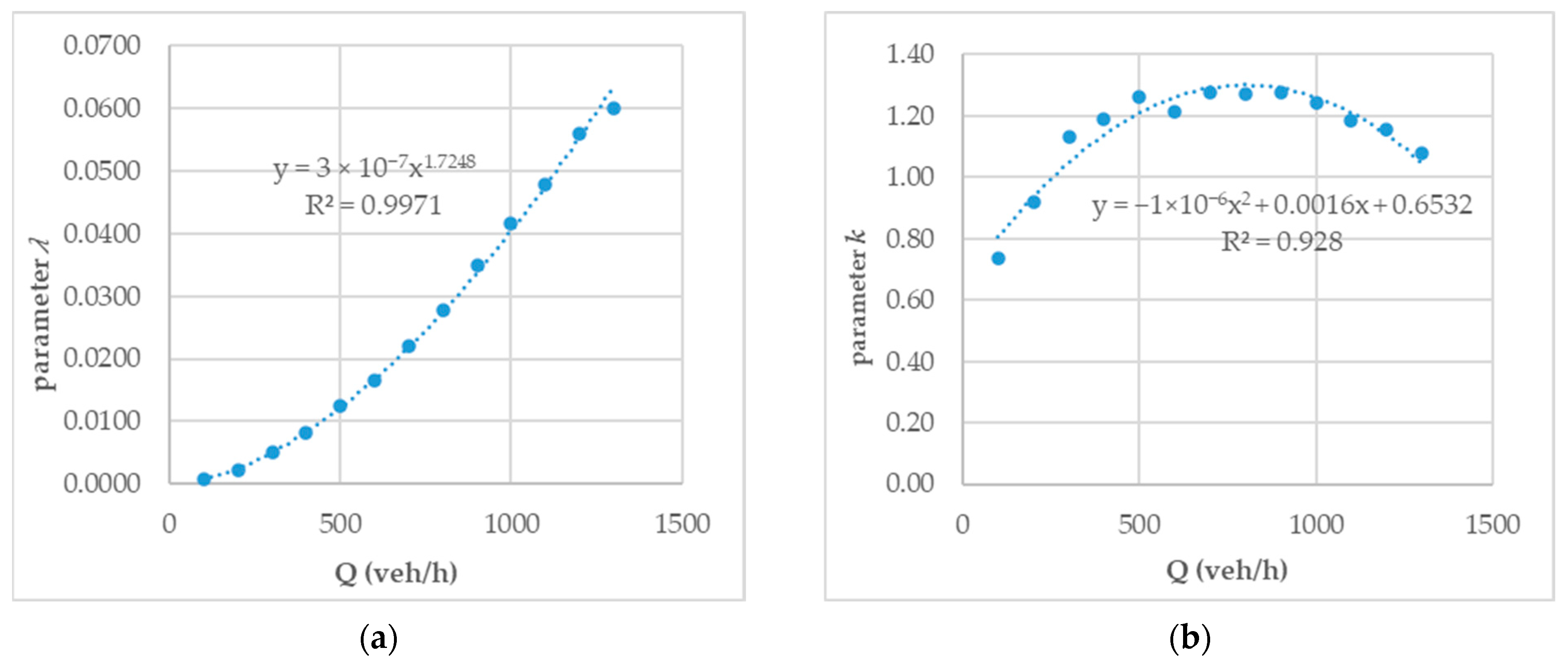
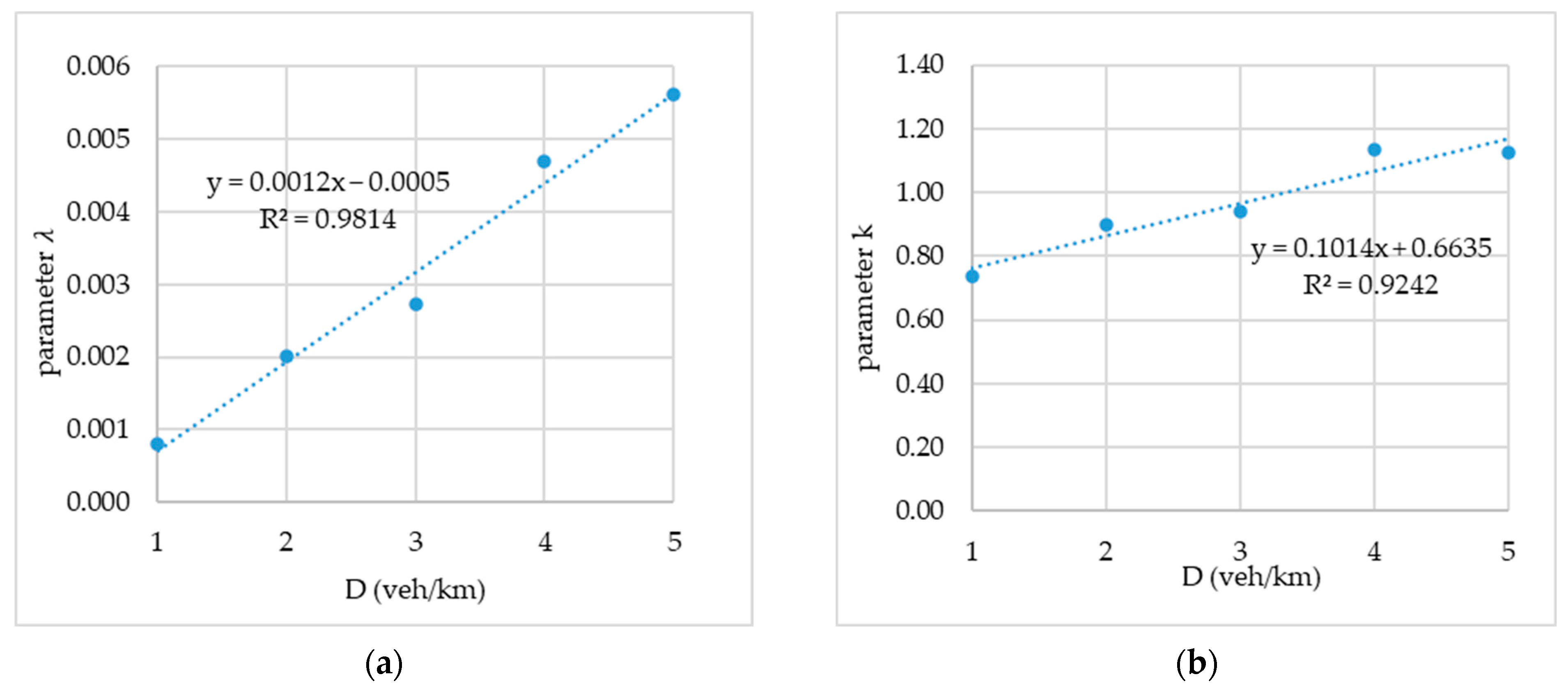
Figure 3,
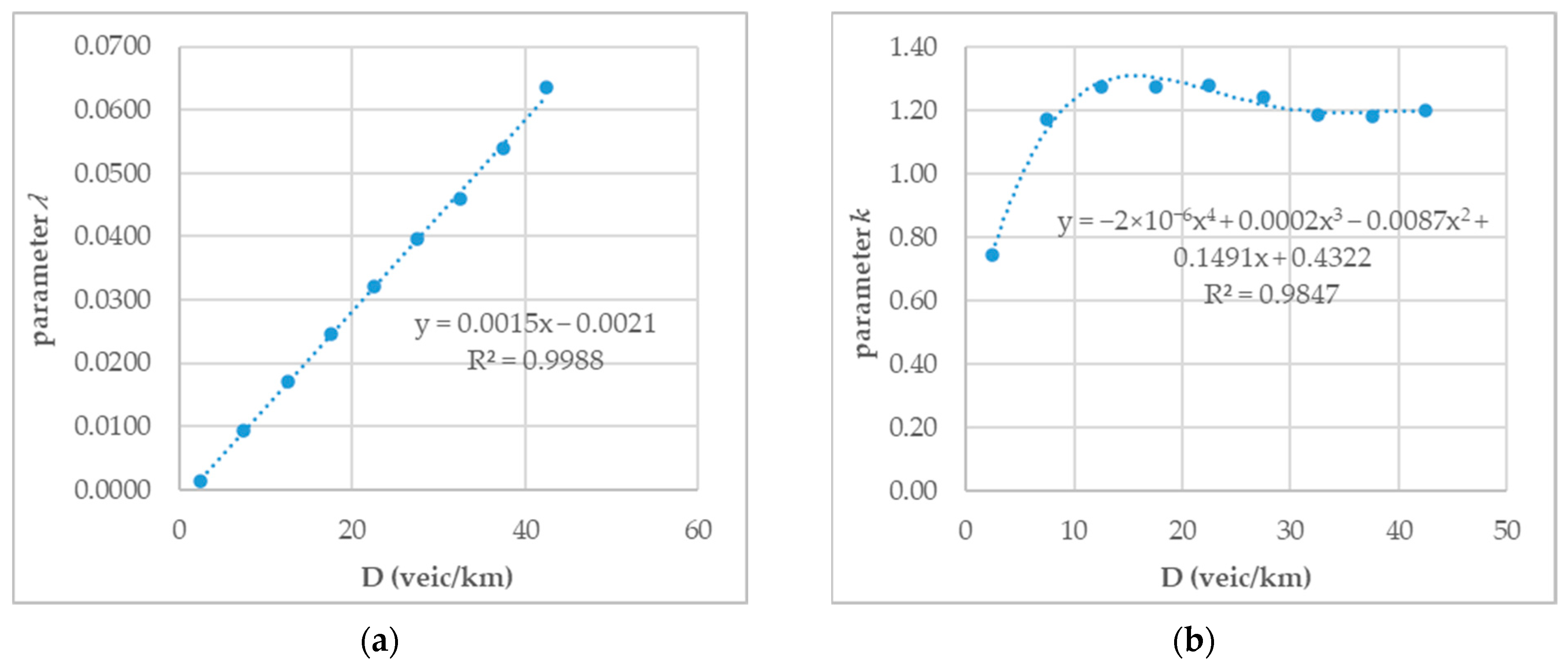
Figure 4 and
Figure 5 illustrate the variation in the parameters
and
across the different traffic classes considered.
Consistent with expected driving behavior, the rate parameter increases with increasing traffic flow and density. This trend reflects a progressive reduction in average inter-vehicle spacing as traffic conditions become more congested. From a mathematical perspective, higher values of correspond to a stronger concentration of probability mass at lower spacing values, since the parameter governs the rate at which the distribution decays. As a result, larger values of indicate more compact vehicle configurations along the road axis.
A comparison between
Figure 3a,
Figure 4a and
Figure 5a highlights different functional relationships between
and the macroscopic traffic variables. For the flow rate classes, the variation of
is well approximated by a power-law relationship, indicating an accelerating increase in the parameter as flow rises. In particular,
Figure 3a suggests the presence of two distinct regimes separated by a threshold around 600 veh/h: a regime of moderate parameter growth at lower flows and a regime of more rapid growth beyond this value. This threshold is consistent with the calibrated fundamental diagrams for the same road section, which indicate that around
veh/h traffic transitions from weak interaction conditions to a regime dominated by car-following. As vehicle interactions become systematic and platoons form, spacing becomes more constrained, explaining the faster growth of
beyond this flow level. In contrast, when
is analyzed as a function of traffic density,
Figure 4a and
Figure 5a show a nearly linear trend, both for density classes with a step of 5 veh/km and for the finer disaggregation below 5 veh/km.
The shape parameter
plays a critical role in determining the form of the Pearson Type III distribution and the degree of variability around the mean spacing. For
, the distribution is highly skewed with a mode at zero, indicating pronounced variability and a high frequency of very small spacings. When
, the distribution reduces to the exponential case, corresponding to maximum randomness. For
, the mode shifts away from zero and the distribution becomes progressively more symmetric, with reduced relative variability. As shown in
Figure 3b and
Figure 5b, the estimated values of
range approximately between 0.7 and 1.3, reflecting higher variability at low flow and low density levels and a tendency toward stabilization as traffic density increases.
The relationships illustrated in
Figure 3,
Figure 4 and
Figure 5 describe the evolution of the estimated distribution parameters as functions of traffic flow and density. These relationships provide an interpretable and analytically tractable representation of spacing dynamics and can be directly employed in safety-oriented assessments and evaluations of compliance with regulatory spacing requirements, as further discussed in this section.
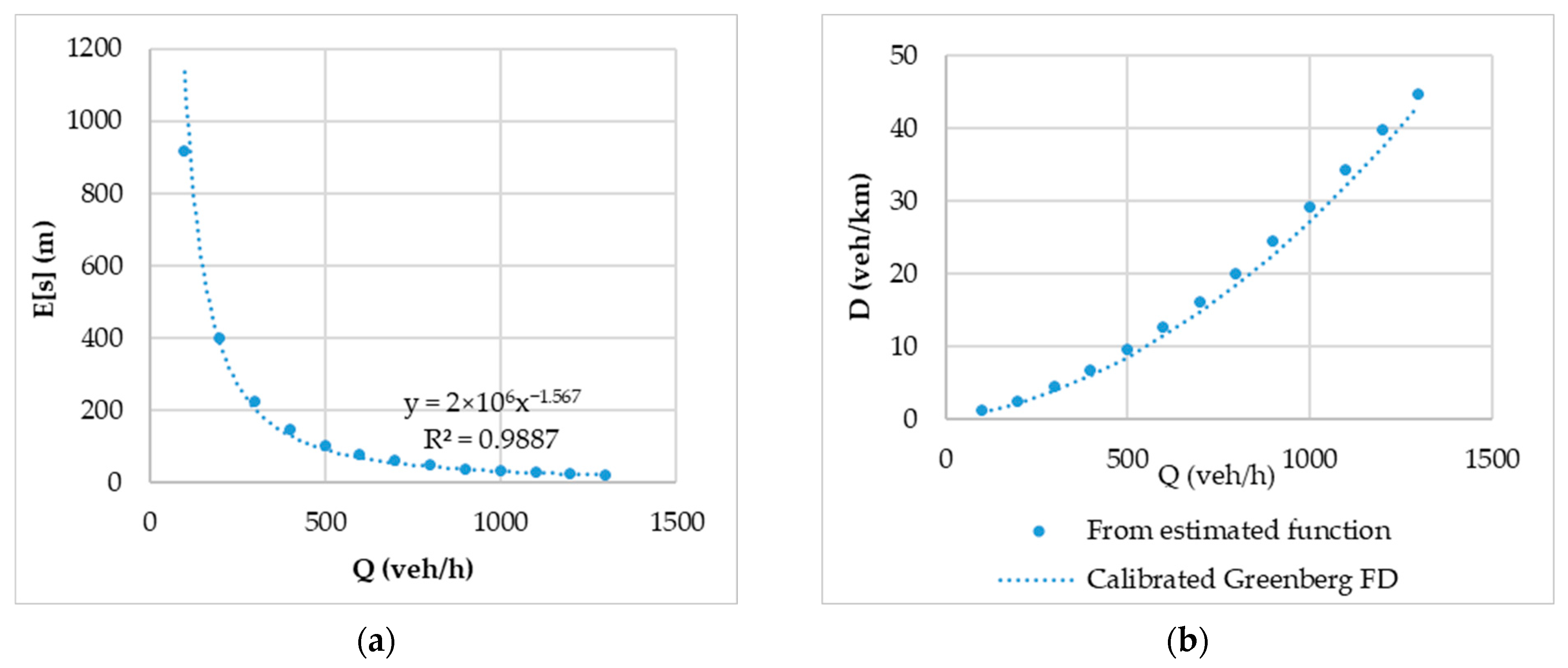
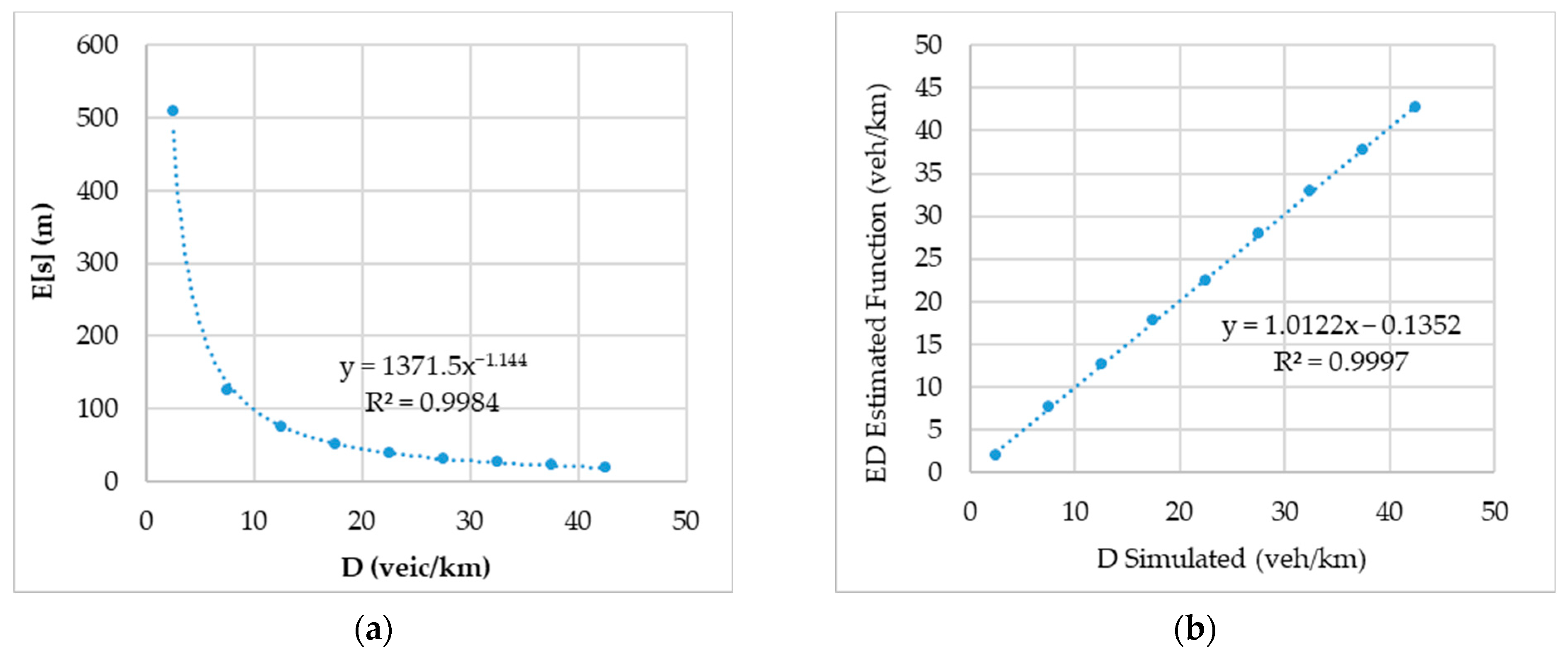
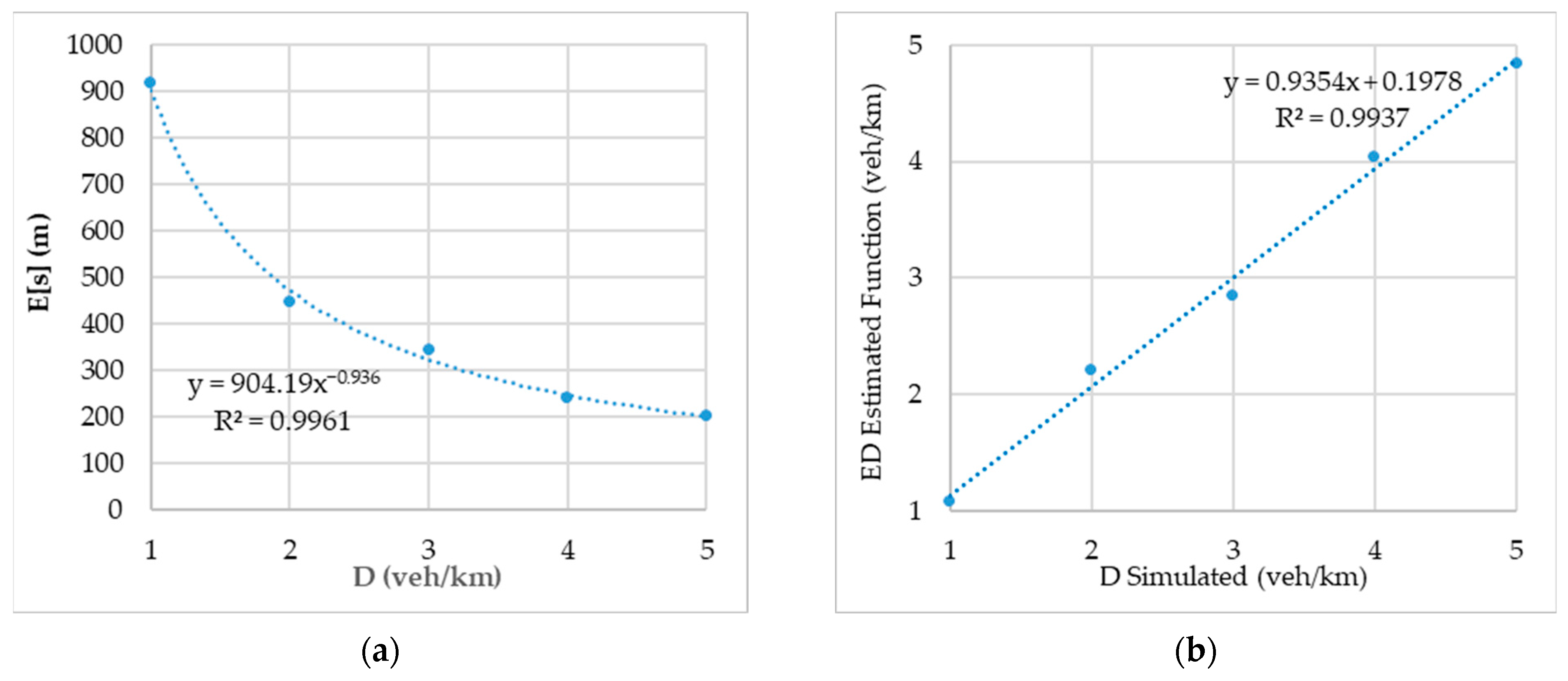
Figure 6,
Figure 7 and
Figure 8 further illustrate characteristic trends of the estimated Pearson Type III distributions across the different flow rate and density classes. Specifically,
Figure 6a,
Figure 7a and
Figure 8a show the variation of the expected spacing value associated with each estimated distribution, which, according to the model parameters, is given by
. In all cases, the observed trend of the expected spacing is accurately represented by a negative power-law function, highlighting the systematic reduction in average spacing as traffic conditions become more congested.
Additional insight is provided by
Figure 6b,
Figure 7b and
Figure 8b, which depict the expected average density derived from the estimated spacing distributions, defined as
Figure 6b shows a close correspondence between the density values
inferred from the estimated spacing distributions (vertical axis) and the trend predicted by the Greenberg macroscopic model (horizontal axis), thereby providing further support for the adequacy of the fitted probability distributions. A similar confirmation is provided by
Figure 7b and
Figure 8b, where the expected average density is compared with the mean density of each class, yielding a linear correlation coefficient very close to unity.
6. Conclusions
This study emphasizes the central role of inter-vehicle spacing, interpreted as spatial headway, for the microscopic analysis of traffic streams on two-lane rural roads operating under unidirectional, single-lane conditions. Although temporal headways have been extensively investigated in the literature, they describe vehicle arrivals at a fixed point and provide only indirect information on physical proximity between vehicles. In contrast, spatial spacing directly represents instantaneous vehicle configurations along the roadway and therefore constitutes a more appropriate variable for assessing collision risk, roadway occupancy, and operational efficiency. Despite this relevance, spacing distributions have received comparatively limited attention. This paper contributes to addressing this gap by developing a probabilistic framework for modeling vehicle spacings under varying traffic volumes and densities.
The principal scientific contribution of this study is the formulation and validation of a probabilistic model for inter-vehicle spacing on two-lane rural roads, based on a flexible parametric distribution and characterized by systematic relationships between distribution parameters and macroscopic traffic variables.
The theoretical foundation of the study is based on the statistical isomorphism between Event Flows and Linear Fields of Random Points, which establishes a formal correspondence between temporal and spatial processes. This framework enables derivation of spacing probability laws from point-process theory while recognizing that, under real traffic conditions with speed variability, temporal and spatial distributions are generally not physically equivalent. Building on this theoretical structure, the calibrated simulation methodology introduced in [
31] was employed to generate spacing datasets across a wide range of traffic regimes. These datasets provided the empirical basis for estimating and validating spacing probability distributions, which were consistently and accurately represented by the Pearson Type III family. The Pearson Type III distribution was selected because it provides a three-parameter formulation capable of representing positive skewness, non-zero minimum spacing, and regime-dependent dispersion within a single functional form, while encompassing classical models such as the Negative Exponential, Shifted Exponential, and Erlang distributions as special cases, thereby ensuring a unified representation of spacing across traffic conditions.
The results show that Pearson Type III distributions capture the essential statistical properties of inter-vehicle spacing, including pronounced positive skewness, leptokurtic behavior, non-zero minimum spacing imposed by kinematic and interaction constraints, and increasing autocorrelation under higher flow and density conditions. Importantly, the estimated distribution parameters exhibit systematic and interpretable trends with respect to both hourly traffic flow and vehicle density. The consistency between densities inferred from the fitted spacing distributions and those implied by macroscopic traffic relationships confirms that the proposed probabilistic formulation preserves fundamental traffic dynamics rather than acting as a purely statistical approximation.
From an applied perspective, these findings provide a practical pathway for linking microscopic vehicle interactions with macroscopic traffic variables. By relating spacing distributions to commonly available measurements such as flow and density, the proposed framework enables estimation of the probability of unsafe following conditions without requiring continuous vehicle-position tracking. This capability is particularly relevant for rural road networks, where dense sensing infrastructure is often economically and environmentally impractical. In this context, probabilistic spacing models offer an effective tool for identifying critical operating regimes, supporting compliance with spacing-related safety standards, and informing traffic management strategies aimed at improving both safety and operational sustainability.
The methodology also establishes a statistical foundation for applications in advanced driver assistance systems, collision warning algorithms, and vehicle-to-vehicle communication strategies, where knowledge of the probabilistic structure of inter-vehicle spacing is essential for defining adaptive safety thresholds. In this sense, the contribution to sustainability arises not only through improved safety outcomes but also through enhanced traffic efficiency and reduced dependence on costly monitoring technologies.
Some limitations should be acknowledged. The analysis focuses on unidirectional traffic on two-lane rural roads under no-overtaking conditions and assumes a homogeneous vehicle class with constant length. In addition, the spatial spacing distributions are derived from a calibrated microscopic simulation model and are not yet cross-validated against independent, directly monitored spatial gap datasets (e.g., UAV-based or trajectory-reconstructed measurements). Moreover, although autocorrelation effects are examined and shown not to compromise parameter estimation, the framework remains distribution-based and does not explicitly model the full temporal dependence structure of vehicle interactions.
Future research will extend the present results by using calibrated spacing distributions to derive safety-oriented indicators explicitly linked to minimum following-distance criteria and rear-end collision exposure across traffic regimes. A priority research step will consist in acquiring and analyzing directly observed spatial vehicle spacing data along two-lane rural road segments in order to perform independent empirical validation of the proposed probabilistic model. This development will provide an operational connection between probabilistic spacing models, regulatory compliance, and longitudinal safety, advancing toward a unified framework for assessing safety, efficiency, and sustainability on two-lane road systems.