1. Introduction
The cement industry plays a critical role in supporting global infrastructure development; however, it is also one of the most energy- and carbon-intensive industrial sectors worldwide [
1,
2,
3]. Cement production is responsible for approximately 7–8% of global anthropogenic carbon dioxide (CO
2) emissions, with the majority originating from clinker production, the intermediate product formed during high-temperature processing of limestone-based raw materials [
4,
5,
6,
7,
8,
9,
10]. Clinker production requires substantial thermal energy input and involves the chemical decomposition of calcium carbonate, making it inherently carbon-intensive. As global demand for cement continues to grow, reducing the environmental impact of clinker production has become a central challenge for both industry and policy makers [
11]. Achieving deep decarbonization in the cement sector requires a clear understanding of the relative contributions of energy- and process-related emissions at the plant level.
Life cycle assessment (LCA) has been widely applied as a systematic framework for quantifying the environmental impacts associated with cement and clinker production across different system boundaries and geographical contexts [
12,
13,
14]. Numerous LCA studies have consistently demonstrated that greenhouse gas emissions from clinker production are dominated by two main sources: process-related emissions from limestone calcination and energy-related emissions from fuel combustion in the kiln system [
15]. Process-related emissions arise directly from the clinker formation chemistry and typically account for the largest share of total emissions, while fuel-related emissions are linked to kiln operation and energy efficiency [
16]. Although improvements in energy efficiency, alternative fuels, and waste heat recovery have contributed to reducing fuel-related emissions, the intrinsic nature of calcination-related CO
2 emissions limits the overall mitigation potential achievable through energy measures alone [
17]. Consequently, evaluating whether improvements in energy intensity effectively translate into meaningful reductions in overall climate change impact remains a critical research question.
To support performance evaluation and emission reduction strategies, benchmarking of clinker production systems using life cycle indicators has gained increasing attention in the literature. Benchmarking enables the comparison of key performance indicators, such as thermal energy intensity, electricity consumption, and greenhouse gas emissions, across different plants and technologies [
18,
19]. Such comparisons provide valuable insights into relative performance levels, identify potential efficiency gaps, and support the dissemination of best practices within the cement industry [
20]. However, the interpretation of benchmarking results strongly depends on the consistency of methodological choices, including the functional unit, system boundary, data representativeness, background database selection, and life cycle impact assessment approach [
21]. Inconsistent methodological assumptions can lead to apparent performance differences that reflect modeling choices rather than true technological or operational variation.
Despite the growing availability of life cycle inventory data for clinker production, many existing benchmark datasets are derived from generic, aggregated, or regionally averaged values from the literature. These datasets may not fully capture the operational characteristics of modern integrated cement plants operating under real industrial conditions [
22,
23,
24]. Furthermore, plant-level benchmarking studies based on real industrial operational datasets remain relatively limited, particularly those that explicitly harmonize foreground plant data with literature-based reference inventories using consistent system boundaries and impact assessment methods. The absence of transparent and methodologically aligned comparisons constrains the robustness of benchmarking analyses and may obscure the relationship between improvements in energy efficiency and overall climate change impacts. As a result, there remains a need for plant-level studies that combine real operational data with a rigorously harmonized benchmarking framework.
The objective of this study is to assess the environmental performance of clinker production at a representative integrated cement plant using a publicly available plant-level industrial life cycle inventory dataset and to benchmark the results against a literature-based reference dataset under harmonized methodological conditions. A cradle-to-gate life cycle assessment is conducted with a functional unit of 1 t of Portland cement clinker, focusing on global warming potential (GWP) using IPCC 100-year characterization factors. By systematically aligning system boundaries, functional units, and background assumptions, this study aims to provide a transparent and methodologically consistent comparison of energy use and greenhouse gas emissions. In particular, the analysis seeks to clarify the extent to which improvements in energy-related performance indicators translate into reductions in total climate change impacts. The findings contribute to the scientific discussion on plant-level environmental benchmarking and support the development of more effective emission mitigation strategies in the cement industry.
2. Materials and Methods
2.1. Literature Identification
The relevant scientific literature was identified with the assistance of the AI-based research platform SciSpace (SciSpace Inc., Version 2026). The tool was used to facilitate the discovery and screening of potentially relevant publications during the literature review stage. All evaluations, interpretations, and syntheses of the literature were conducted independently by the authors.
2.2. Case Study Description
This study analyzes clinker production using plant-level industrial life cycle inventory data obtained from the DiB cement plant dataset (Basavaraj and Gettu, 2024) [
25]. The dataset represents an integrated cement manufacturing facility located in India and provides multi-year averaged operational data for clinker production. The plant operates a conventional rotary kiln system equipped with a multi-stage preheater and precalciner, which reflects modern dry-process clinker production technology.
The facility produces Portland cement clinker as its main intermediate product, with a clinker-to-cement ratio greater than 0.70, consistent with typical ordinary Portland cement (OPC) production. Thermal energy demand is supplied through a mixed fuel system consisting of coal, petroleum coke, and alternative fuels. Electricity consumption is supplied by the Indian national grid.
The dataset includes measured operational inputs and emissions associated with clinker production, including raw material consumption, fuel use, electricity demand, and direct CO2 emissions from both calcination and fuel combustion. The reported inventory values represent multi-year averaged plant performance and are expressed per unit of clinker output.
The plant is considered representative of modern integrated cement production facilities employing dry-process technology with preheating and precalcination stages. The main technical characteristics of the case-study plant are summarized in
Table 1.
2.3. Goal and Scope Definition
The goal of this study is to evaluate the environmental performance of clinker production at the selected integrated cement plant and to benchmark the results against a literature-based reference inventory under harmonized methodological conditions. The assessment aims to provide a transparent plant-level comparison of energy use and greenhouse gas emissions and to examine the relationship between energy efficiency indicators and total climate change impact.
The functional unit (FU) is defined as 1 t of Portland cement clinker produced at the plant gate. Clinker is selected as the FU because it represents the most energy- and carbon-intensive stage of cement manufacturing and serves as a common reference unit in life cycle assessment studies, enabling consistent comparison with published datasets.
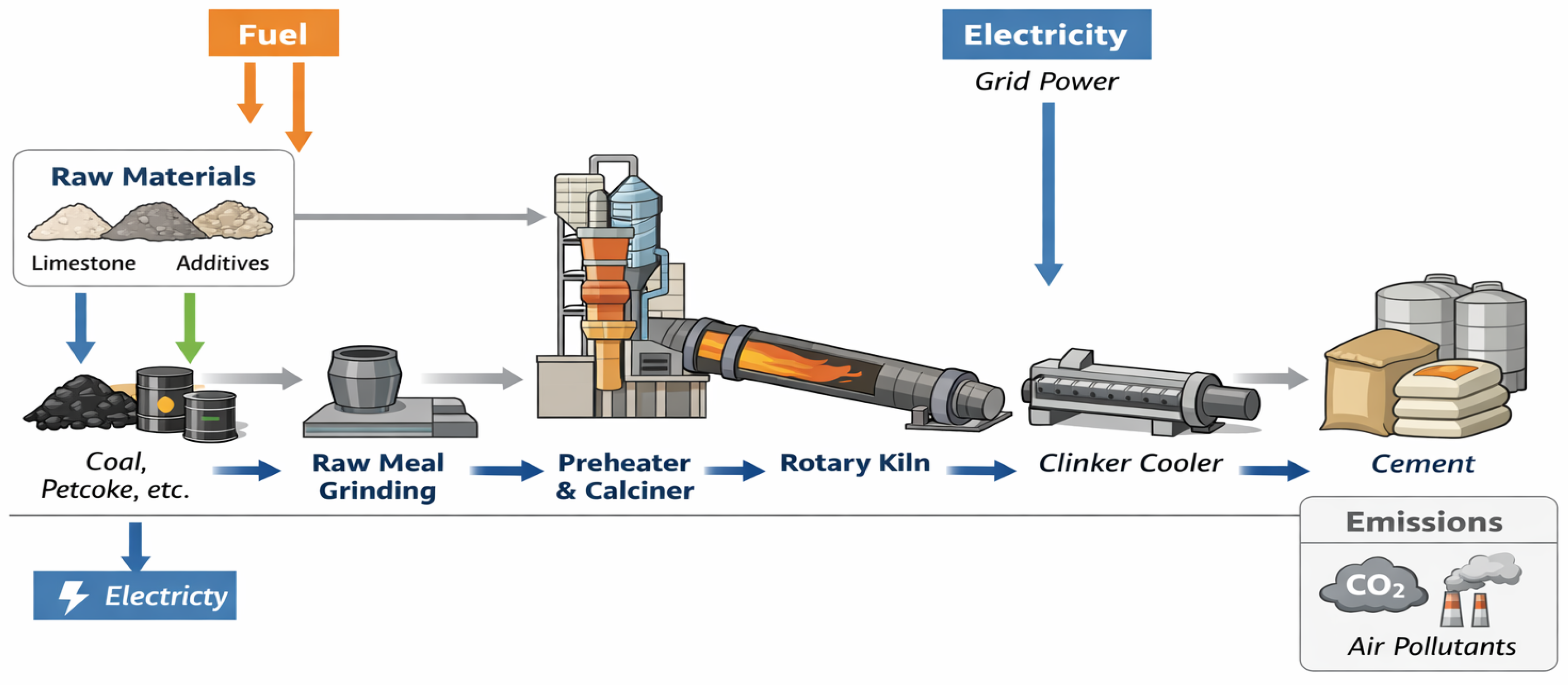
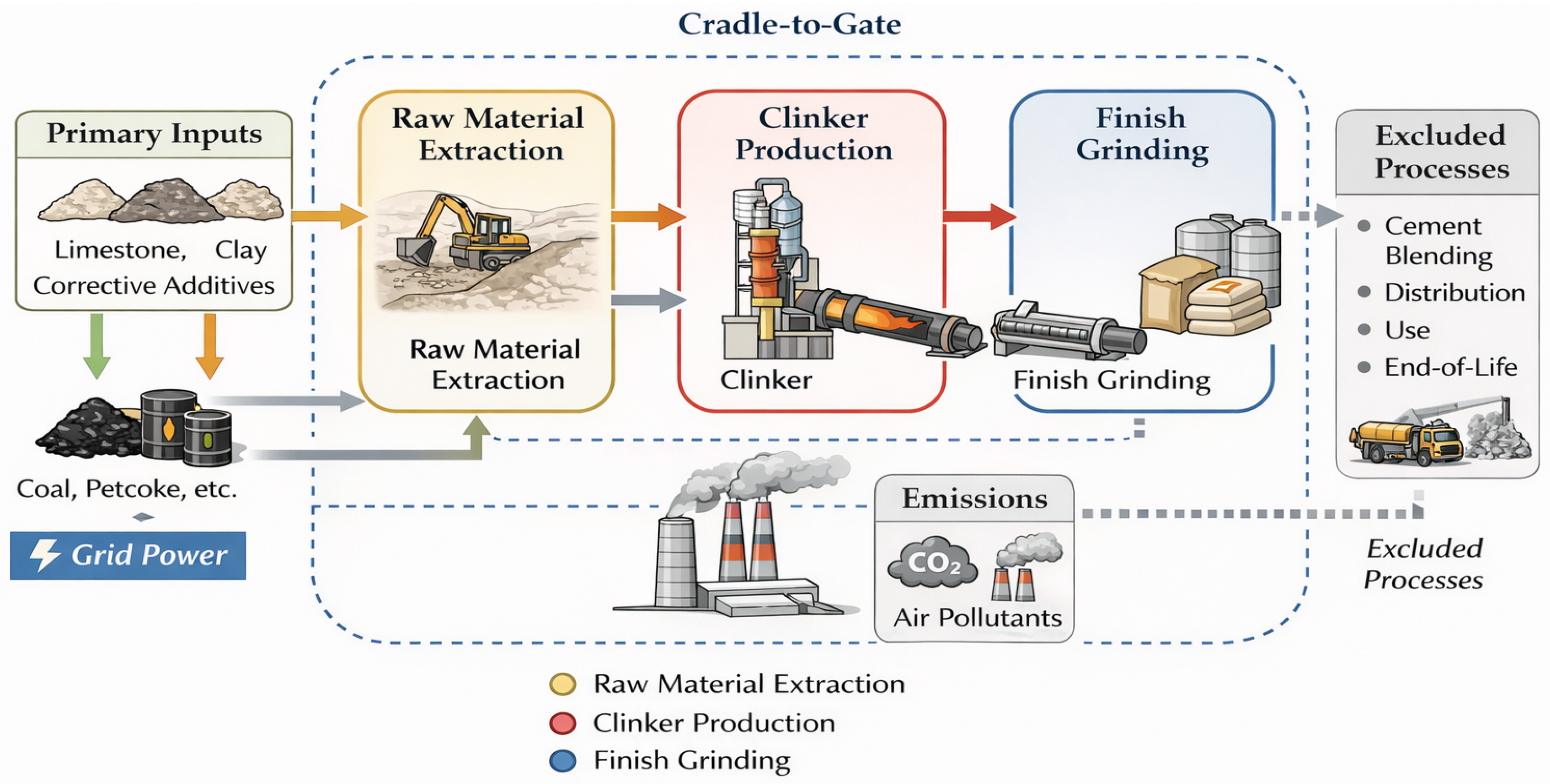
A cradle-to-gate system boundary is adopted. The overall clinker production process considered in this study is illustrated in
Figure 1, while the specific system boundary applied in the life cycle assessment is shown in
Figure 2. The system includes raw material extraction and preparation, raw meal grinding, preheating and calcination, clinker formation in the rotary kiln, and clinker cooling. Downstream processes such as cement blending, packaging, distribution, use phase, and end-of-life are excluded.
The principal methodological assumptions applied in the life cycle assessment are summarized in
Table 2. Life cycle impact assessment (LCIA) is conducted at the midpoint level using the IPCC 100-year Global Warming Potential (GWP) characterization factors. Clinker production is treated as a single main product system; therefore, no allocation procedures are required. A cut-off criterion of 1% is applied to exclude flows contributing less than 1% of total mass, energy, or environmental impact, while ensuring that at least 99% of the environmental burden is captured.
Foreground and benchmark inventories are harmonized to the same functional unit, system boundary, and impact assessment method prior to comparison. Background datasets are applied consistently across both systems to minimize methodological bias in the benchmarking analysis.
2.4. Life Cycle Inventory
The life cycle inventory (LCI) for clinker production was compiled using plant-level industrial data derived from the DiB cement plant dataset (Basavaraj and Gettu, 2024) [
25]. The dataset provides operational information on raw material inputs, fuel consumption, electricity demand, and direct carbon dioxide (CO
2) emissions associated with clinker production. All inventory flows were recalculated and expressed per functional unit of 1 t of clinker to ensure consistency with the defined goal and scope. The resulting foreground inventory for the case-study plant is summarized in
Table 3.
Raw material inputs include limestone and corrective materials used for feed composition control. Thermal energy demand was calculated by converting reported fuel masses into energy equivalents using their respective lower heating values (LHVs). Electricity consumption represents the aggregated demand of major unit operations, including raw meal preparation, kiln operation, and clinker cooling. Direct CO2 emissions consist of process-related emissions from limestone calcination and fuel-related emissions from combustion in the kiln system. Process emissions were estimated using the dataset-specific calcination factor applied to limestone input, while fuel-related emissions were calculated using fuel-specific emission factors reported in the dataset.
For benchmarking purposes, a literature-based clinker inventory was adapted from Rhaouti et al. (2024) [
26]. The reference dataset was harmonized to the same functional unit (1 t clinker) and aligned to the system boundary defined in
Section 2.2 prior to comparison. Where necessary, reported fuel masses were converted to energy equivalents using consistent LHV assumptions to ensure comparability. The harmonized benchmark inventory is presented in
Table 4.
The foreground (
Table 3) and benchmark (
Table 4) inventories form the quantitative basis for the subsequent life cycle impact assessment and benchmarking analysis.
2.5. Harmonized Benchmarking Approach
The benchmarking analysis was conducted under a harmonized methodological framework to ensure a consistent and unbiased comparison between the case-study plant and the literature-based reference system. Prior to comparison, both inventories were aligned with respect to functional unit, system boundary, and energy and emission calculation procedures.
First, all inventory flows were standardized to the functional unit of 1 t of Portland cement clinker. Where the benchmark dataset was originally reported per kilogram of clinker, values were proportionally scaled. Second, the system boundary was aligned to a cradle-to-gate configuration consistent with
Section 2.2, excluding downstream cement processing and use-phase stages to avoid structural discrepancies between systems.
Thermal energy demand was expressed in energy-equivalent terms to enable direct comparison of kiln performance. Reported fuel masses were converted to thermal energy using lower heating values (LHV) according to
where
represents the mass of fuel
i and
its corresponding lower heating value.
Direct carbon dioxide emissions were treated consistently across both systems. Process-related emissions from limestone calcination were estimated as follows:
and fuel-related emissions were calculated as:
where
denotes the relevant emission factor. Equivalent assumptions were applied when deriving benchmark emission intensities to maintain methodological consistency.
Key benchmarking indicators include thermal energy intensity (MJ/t clinker), electricity consumption (kWh/t clinker), and total direct CO
2 emissions (kg CO
2/t clinker). Relative differences between the case-study and benchmark values were quantified using
This harmonized procedure minimizes methodological bias and allows a transparent evaluation of performance differences attributable to operational characteristics rather than modeling inconsistencies.
2.6. Uncertainty and Sensitivity Considerations
Uncertainty in the present study arises from data variability, emission factor assumptions, and background modeling choices. The foreground inventory is based on multi-year averaged operational data, which reduces short-term variability but does not eliminate potential measurement uncertainty or plant-level fluctuations.
To evaluate the robustness of the benchmarking results, a sensitivity analysis was conducted for key parameters influencing greenhouse gas emissions. Thermal energy demand was varied by to assess the influence of kiln energy efficiency on total climate impact. The calcination emission factor was varied by to account for potential differences in raw material composition and carbonate content. In addition, an alternative electricity emission factor scenario was considered to evaluate the effect of grid intensity on indirect emissions.
The sensitivity results were analyzed in terms of changes in total GWP per functional unit. This approach allows identification of parameters with the greatest influence on performance differences between the case-study and benchmark systems.
While the harmonization procedure reduces structural uncertainty, residual uncertainty remains due to differences in plant configuration, regional energy systems, and reporting conventions in literature-based inventories. These limitations should be considered when interpreting benchmarking results.
3. Results
3.1. Comparative Performance of the Case-Study and Benchmark Systems
The comparative performance indicators of the case-study and benchmark clinker production systems are summarized in
Table 5. The evaluation focuses on three key parameters commonly used in clinker benchmarking studies: thermal energy intensity, electricity consumption, and total direct CO
2 emissions per functional unit of 1 t clinker.
The case-study plant exhibits a thermal energy intensity of 3162.44 MJ/t clinker, which is 6% lower than the benchmark value of 3364.34 MJ/t clinker. This difference suggests comparatively efficient kiln operation and potentially optimized combustion control or heat recovery performance. In industrial clinker production, thermal energy demand is primarily governed by kiln design, raw meal properties, fuel characteristics, and operational stability. A 6% reduction is therefore operationally meaningful and reflects improved energy performance relative to the reference system.
A more substantial difference is observed for electricity consumption. The case-study plant requires 52.23 kWh/t clinker, compared to 74.00 kWh/t clinker for the benchmark system, corresponding to a 29.42% reduction. Electricity demand in clinker production is associated with raw material grinding, kiln auxiliaries, and clinker cooling. The magnitude of this reduction indicates potential differences in grinding efficiency, equipment modernization, or plant-specific electrical optimization strategies. From an energy-intensity perspective, the case-study plant performs favorably across both thermal and electrical indicators.
However, despite these improvements in energy efficiency, total direct CO2 emissions are slightly higher for the case-study plant (1010.03 kg CO2/t clinker) compared to the benchmark value (995.00 kg CO2/t clinker), representing a 1.51% increase. This outcome demonstrates that reductions in energy intensity do not necessarily translate into proportional reductions in total greenhouse gas emissions.
The discrepancy can be attributed to the structural dominance of process-related emissions from limestone calcination. Unlike fuel-related emissions, which are directly influenced by thermal energy demand and fuel mix, calcination emissions are primarily determined by the carbonate content of the raw materials and the clinker chemistry. Since these emissions are inherent to clinker formation, improvements in kiln energy efficiency alone cannot significantly reduce this component of total emissions.
The results therefore highlight an important distinction between operational energy performance and overall climate impact performance. While energy efficiency improvements contribute to reducing fuel-related emissions, the relative contribution of process emissions constrains the total mitigation potential achievable through energy optimization measures alone. Consequently, benchmarking based solely on energy indicators may lead to incomplete conclusions regarding environmental performance, particularly when comparing plants with similar clinker chemistry but different operational efficiencies.
These findings underscore the importance of integrated benchmarking approaches that simultaneously consider energy intensity and emission structure when evaluating clinker production systems.
3.2. Contribution Analysis of CO2 Emissions
To better understand the discrepancy between energy efficiency improvements and total emission outcomes, the contribution of different emission sources to total direct CO
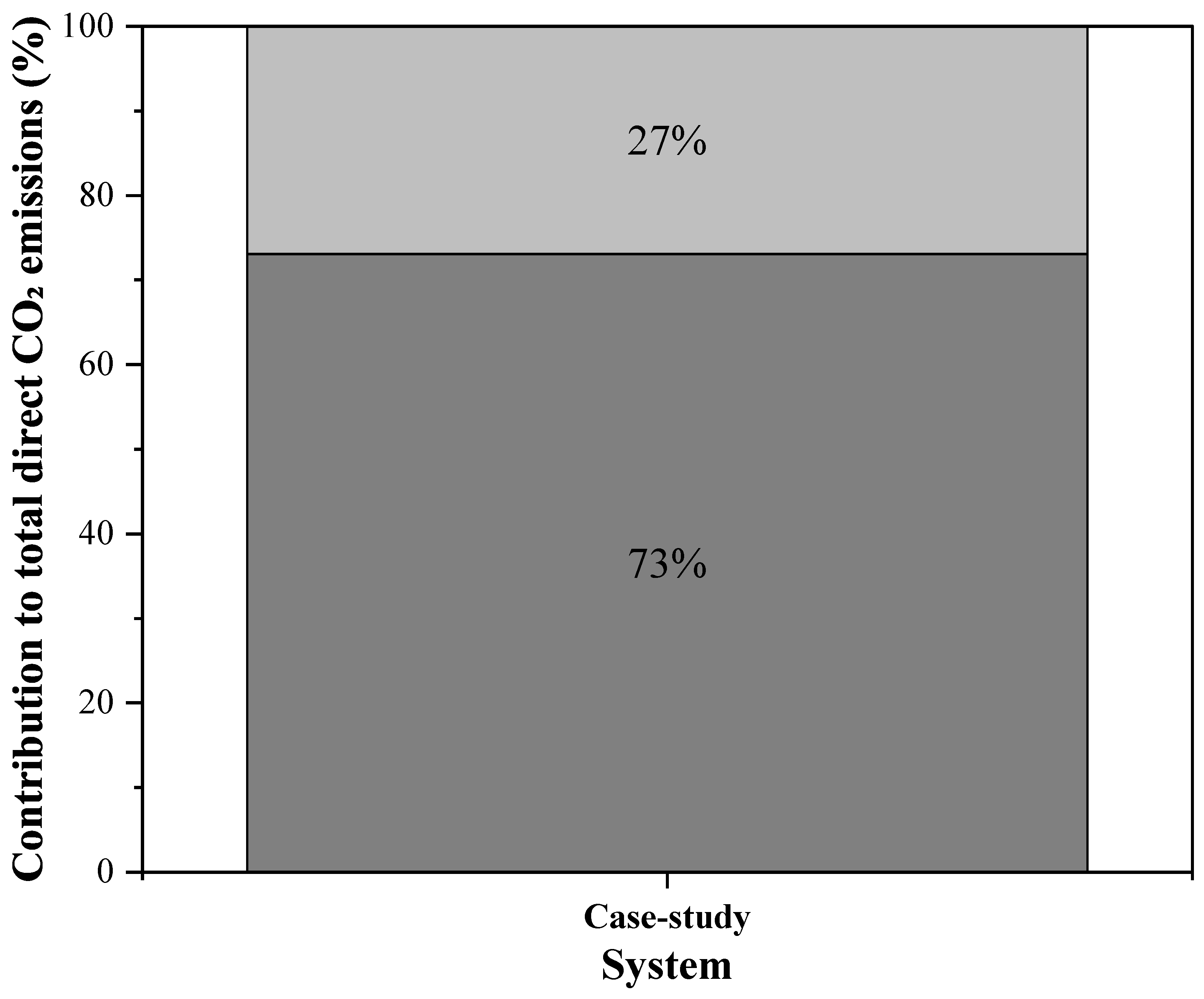
2 emissions was analyzed for the case-study plant. The relative shares of process-related and fuel-related emissions are illustrated in
Figure 3.
For the case-study system, process-related emissions from limestone calcination account for approximately 73% of total direct CO2 emissions (738.40 kg CO2/t clinker), while fuel combustion contributes the remaining 27% (271.63 kg CO2/t clinker). This distribution confirms that calcination is the dominant emission source in clinker production, consistent with established findings in the cement LCA literature.
The structural dominance of process emissions explains why a 6% reduction in thermal energy intensity does not result in a proportional decrease in total CO2 emissions. Even if fuel-related emissions are reduced through improved kiln efficiency, the calcination component remains largely unaffected because it is governed by raw material composition and clinker chemistry rather than operational energy input.
When considering benchmarking implications, this emission structure indicates that performance improvements targeting energy optimization alone have limited mitigation potential. While electrical efficiency gains (29.42% reduction relative to the benchmark) contribute to lowering indirect emissions, their overall influence on total direct CO2 remains comparatively small due to the predominance of process emissions.
These results emphasize that meaningful reductions in total climate impact require strategies addressing both fuel-related emissions and process-related emissions. Potential mitigation pathways therefore extend beyond energy efficiency measures and may include clinker factor reduction, alternative raw material selection, or carbon capture technologies.
Overall, the contribution analysis demonstrates that differences in emission structure must be explicitly considered in plant-level benchmarking to avoid overinterpreting improvements in energy intensity as direct indicators of climate performance.
3.3. Relationship Between Energy Intensity and Total CO2 Emissions
The relationship between energy intensity indicators and total direct CO
2 emissions was examined using the comparative results presented in
Table 5. The case-study plant exhibits a 6% reduction in thermal energy intensity (3162.44 MJ/t clinker vs. 3364.34 MJ/t clinker) and a 29.42% reduction in electricity consumption (52.23 kWh/t clinker vs. 74.00 kWh/t clinker) relative to the benchmark system.
In absolute terms, the reduction of 201.90 MJ/t clinker in thermal energy demand corresponds to lower kiln fuel input. Similarly, the difference of 21.77 kWh/t clinker reflects reduced electrical consumption across major unit operations. These differences indicate measurable improvements in operational energy performance at the case-study plant.
However, total direct CO2 emissions differ by only 15.03 kg CO2/t clinker between the two systems, corresponding to a 1.51% increase for the case-study plant (1010.03 kg CO2/t clinker vs. 995.00 kg CO2/t clinker). The magnitude of change in energy indicators therefore exceeds the magnitude of change observed in total emission performance.
This result indicates that variations in thermal and electrical energy intensity are not directly proportional to total CO2 emission outcomes under the reported operating conditions. While reductions in energy demand decrease fuel-related emissions, the dominant contribution of process-related emissions limits the overall sensitivity of total climate impact to operational energy improvements.
Accordingly, benchmarking based solely on energy intensity indicators may not provide a complete representation of climate performance. The observed discrepancy underscores the importance of jointly interpreting energy metrics and emission structure when evaluating clinker production systems.
3.4. Sensitivity Analysis Results
The sensitivity analysis was performed to evaluate the robustness of the benchmarking results with respect to key parameters influencing total global warming potential (GWP). The examined variables included thermal energy demand (±5%), the calcination emission factor (±3%), and the electricity emission factor under an alternative grid scenario.
A ±5% variation in thermal energy demand resulted in a change of approximately ±13.6 kg CO
2-eq/t clinker, corresponding to a relative variation of ±1.35% in total GWP (
Table 6). This response reflects the contribution of fuel-related emissions to overall climate impact. Although kiln energy efficiency directly affects fuel combustion emissions, its influence on total GWP remains limited due to the dominance of process-related emissions.
When the calcination emission factor was varied by ±3%, total GWP changed by approximately ±22.2 kg CO2-eq/t clinker, corresponding to a relative variation of ±2.20%. This represents the largest sensitivity among the examined parameters. The magnitude of this effect indicates that total climate performance is more strongly influenced by uncertainties in raw material carbonate content and clinker chemistry than by moderate variations in fuel energy demand.
In contrast, modification of the electricity emission factor produced a comparatively small change of ±4.8 kg CO2-eq/t clinker (±0.47%). This limited influence is consistent with the relatively small share of indirect electricity-related emissions within the defined cradle-to-gate system boundary.
Overall, the sensitivity results demonstrate that total GWP is structurally more responsive to variations in process-related emission parameters than to equivalent proportional changes in operational energy indicators. These findings reinforce the conclusion that mitigation strategies focusing solely on energy efficiency improvements have limited potential to substantially alter total climate performance unless accompanied by measures targeting calcination-related emissions.
4. Discussion
4.1. Interpretation of Energy Performance
The results presented in
Section 3.1 indicate that the case-study plant demonstrates comparatively favorable energy performance relative to the harmonized literature benchmark. The observed 6% reduction in thermal energy intensity suggests improved kiln operation, potentially reflecting optimized combustion control, stable feed chemistry, or effective heat recovery within the preheater–precalciner system. In modern dry-process clinker production, incremental improvements in thermal efficiency are often associated with enhanced process integration and tighter operational control.
The difference in electricity consumption is more pronounced, with a 29.42% lower demand observed for the case-study plant. Electricity use in clinker production is primarily linked to raw material grinding, kiln auxiliaries, and clinker cooling systems. The magnitude of this reduction may reflect differences in grinding technology, equipment modernization, or plant-specific optimization of auxiliary systems. While detailed operational parameters are beyond the scope of the present analysis, the results indicate that the case-study plant operates at a comparatively efficient electrical performance level within the defined system boundary.
From an energy benchmarking perspective, the case-study plant performs within or below the typical energy intensity range reported for contemporary dry-process clinker production systems. However, as demonstrated in
Section 3, improved energy performance alone does not necessarily result in proportional reductions in total climate change impact. The interpretation of energy indicators therefore requires careful consideration of the broader emission structure governing clinker production.
4.2. Energy Efficiency and Climate Impact Relationship
Despite the improved energy-related indicators observed for the case-study plant, the total global warming potential (GWP) remains comparable to that of the benchmark system. This outcome highlights a fundamental structural characteristic of clinker production: the dominance of process-related emissions from limestone calcination over energy-related emissions from fuel combustion [
27,
28,
29].
As demonstrated in
Section 3.2, approximately 73% of total direct CO
2 emissions originate from calcination, while fuel-related emissions account for the remaining 27%. Consequently, reductions in thermal energy demand primarily influence the smaller fuel-related fraction of total emissions [
30,
31]. Even when measurable improvements in kiln efficiency are achieved, the overall reduction in total GWP remains constrained by the relatively fixed contribution of process emissions [
32].
The sensitivity analysis further supports this interpretation. Variations in the calcination emission factor produced larger changes in total GWP than equivalent proportional variations in thermal energy demand. This indicates that total climate performance is more responsive to changes in raw material composition and clinker chemistry than to moderate improvements in operational energy efficiency.
These findings suggest that benchmarking based solely on energy intensity indicators may lead to incomplete conclusions regarding environmental performance. While energy efficiency remains an essential component of industrial optimization, its impact on total climate change potential is structurally limited in clinker production systems characterized by high process-related emission shares.
Therefore, a comprehensive evaluation of clinker production performance requires the simultaneous consideration of energy metrics and emission structure. Without this integrated perspective, improvements in operational efficiency may be overinterpreted as proportional gains in climate performance.
4.3. Benchmarking Implications
The findings of this study provide several important implications for plant-level environmental benchmarking in the cement industry. First, the results demonstrate that benchmarking outcomes are highly sensitive to methodological alignment. Differences in functional unit definition, system boundary configuration, background database selection, and emission calculation procedures can significantly influence reported performance indicators. The harmonized framework applied in this study reduces such methodological inconsistencies and allows performance differences to be attributed primarily to operational characteristics rather than modeling artifacts.
Second, the comparison highlights the limitations of benchmarking approaches based exclusively on energy intensity indicators. Although thermal and electrical energy performance are widely used as proxies for environmental efficiency, the present results show that these indicators do not fully capture climate performance when process-related emissions dominate total greenhouse gas emissions. Benchmarking frameworks that focus solely on energy metrics may therefore misrepresent relative environmental performance across plants with similar clinker chemistry.
Third, the integration of plant-level industrial inventory data with harmonized literature-based reference datasets enhances transparency and comparability. By explicitly aligning system boundaries and emission calculation procedures, the benchmarking analysis provides a more robust basis for contextualizing plant performance within the broader industry range. This approach contributes to improving the methodological rigor of comparative LCA studies in the cement sector.
Overall, the study underscores the importance of harmonized and structurally informed benchmarking frameworks. Effective plant-level benchmarking should simultaneously evaluate energy intensity, emission structure, and total climate impact to ensure meaningful and policy-relevant performance assessment.
4.4. Implications for Emission Mitigation Strategies
The results of this study have direct implications for greenhouse gas mitigation strategies in the cement industry. Although improvements in thermal energy efficiency and electricity optimization contribute to reductions in fuel-related emissions, the dominance of process-related CO
2 emissions limits the overall mitigation potential achievable through energy measures alone. As demonstrated in the contribution and sensitivity analyses, total climate performance is structurally constrained by calcination emissions associated with clinker formation [
33,
34].
Consequently, mitigation pathways focusing exclusively on operational energy optimization are unlikely to deliver substantial reductions in total greenhouse gas emissions. While continued improvements in kiln efficiency, alternative fuel substitution, and waste heat recovery remain important for incremental emission reductions, deeper decarbonization requires strategies that directly address process-related emissions.
Potential approaches include reducing the clinker-to-cement ratio through increased use of supplementary cementitious materials, incorporating alternative raw materials with lower carbonate content, and implementing carbon capture, utilization, and storage (CCUS) technologies [
35,
36,
37]. These measures target the dominant emission source and therefore offer greater leverage for long-term emission reduction.
The findings emphasize the need for integrated mitigation strategies combining energy efficiency improvements with structural measures targeting calcination-related emissions. From a policy and industry perspective, plant-level benchmarking should therefore inform not only operational optimization but also strategic investment decisions aimed at transformative emission reduction pathways.
4.5. Limitations and Future Research
Several limitations of the present study should be acknowledged. First, the analysis is based on a single plant-level industrial dataset. Although the dataset represents a modern integrated dry-process cement plant and provides multi-year averaged operational data, the results may not fully capture the variability in kiln technologies, fuel mixes, and raw material compositions observed across different regions and production systems.
Second, the benchmarking comparison relies on a literature-based reference inventory. While harmonization procedures were applied to align the functional unit, system boundary, and emission calculation methods, residual differences in data quality, reporting conventions, and background assumptions may influence the comparative results. Such limitations are inherent to cross-study benchmarking analyses and should be considered when interpreting performance differences.
Third, the environmental assessment focuses exclusively on climate change impact using the IPCC 100-year Global Warming Potential indicator. Other environmental impact categories, such as particulate matter formation, acidification, resource depletion, or water use, were not evaluated and may reveal additional performance trade-offs.
Future research could extend the present framework by incorporating multiple plant-level datasets to assess variability across different technological and regional contexts. Expanding the analysis to include additional impact categories and scenario-based assessments of clinker substitution, alternative raw materials, and carbon capture technologies would further enhance understanding of potential decarbonization pathways. In addition, probabilistic uncertainty analysis could provide deeper insight into the robustness of benchmarking outcomes under varying operational and modeling assumptions.
5. Conclusions
This study presented a harmonized plant-level benchmarking framework for clinker production based on industrial life cycle inventory data. A cradle-to-gate life cycle assessment was conducted using a publicly available plant-level dataset, and the results were compared with a literature-based reference inventory under aligned methodological conditions.
The case-study plant exhibited lower thermal energy demand (3162 MJ/t clinker) and electricity consumption (52.23 kWh/t clinker) than the benchmark system, indicating comparatively favorable operational energy performance. However, total direct CO2 emissions (1010 kg CO2/t clinker) were comparable to the benchmark value (995 kg CO2/t clinker), demonstrating that improvements in energy intensity do not necessarily translate into proportional reductions in total climate change impact.
Contribution analysis showed that process-related CO2 emissions from limestone calcination account for approximately 73% of total emissions, structurally limiting the sensitivity of overall GWP to improvements in fuel-related energy efficiency. Sensitivity analysis further confirmed that variations in calcination-related parameters exert a greater influence on total climate performance than equivalent proportional changes in thermal energy demand.
The results highlight the importance of harmonized benchmarking approaches that simultaneously consider energy intensity, emission structure, and total climate impact. Benchmarking based solely on energy indicators may lead to incomplete or misleading conclusions regarding environmental performance.
Overall, while continued improvements in energy efficiency remain necessary, substantial reductions in greenhouse gas emissions from clinker production will require mitigation strategies that directly address process-related emissions, including clinker substitution, alternative raw materials, and carbon capture technologies.