


Abstract
Against the backdrop of increasingly scarce global arable land resources, the remediation and resource utilization of saline–alkali soils have become a critical issue in circular agriculture. This study proposes micro-nano bubble (MNB) irrigation technology as a green, low-carbon strategy for saline–alkali soil remediation, highlighting its multi-level driving mechanism through pot experiments at different aeration frequencies. Results indicated that MNB irrigation significantly enhanced salt leaching and acid-base neutralization by reducing the soil pH (11.75%) and electrical conductivity (53.41%). Meanwhile, soil organic matter, cation exchange capacity, and available nitrogen, phosphorus, and potassium increased to normal soil levels. MNBs also strongly activated native enzymes (urease and alkaline phosphatase), raising the total enzyme activity by 68.54%, which is linked to carbon, nitrogen, and phosphorus metabolism. These results were also validated by microbial analysis, which indicated that MNBs shifted the community structure from one dominated by salt-tolerant taxa (i.e., Pseudomonadota) to a more functionally beneficial composition (i.e., Bacillota). Through these changes, the microbial diversity and network connectivity were enhanced, with Qipengyuania and Psychrophilus identified as critical nodes. This study reveals the multi-level driving mechanism of MNB technology, providing new technical pathways and theoretical support for the remediation, resource recovery, and circular utilization of agricultural waste soils.
1. Introduction
With the growing impact of climate change and unsustainable agricultural irrigation practices, the global expansion of saline–alkali soils has rapidly accelerated, exceeding 1.381 billion hectares by 2024 [1]. In this context, excessive sodium accumulation increases solid compaction and reduces permeability, interrupting the water and gas exchange [2]. These changes restrict the mobility of essential nutrients (e.g., nitrogen, phosphorus, and potassium), which significantly reduces microbial activity and degrades soil fertility [3]. Under these conditions, root respiration and nutrient assimilation in crops are hindered, leading to reduced biomass, poor quality, and, in severe cases, crop failure [4]. Given the backdrop of population growth and diminishing arable land [5], soil salinization has become a threat to food security, making the restoration of these soil types an urgent priority.
The current strategies to improve the fertility of saline–alkali soils include physical remediation, chemical adjustment, and bioremediation [6]. Among them, the physical soil treatment refers to immediately optimizing the soil environment in the root zone of the plants by replacing it with new soil [7,8]. The chemical adjustment reduces alkalinity and salinity but often provides short-term benefits and may introduce secondary pollution risks [9,10]. In contrast, bioremediation mainly relies on salt-tolerant plants or microorganisms to alleviate salt stress; however, its effects are often gradual and highly dependent on environmental conditions [7,11]. Due to these limitations, existing methods struggle to achieve comprehensive soil improvement, long-term fertility enhancement, and sustained yield increases. Therefore, there is an urgent need to explore economical, efficient, and environmentally sustainable mechanisms to enhance the in situ fertility of saline–alkali lands.
Bubbles with diameters smaller than 50 μm can remain stably suspended in water. In this context, water systems containing both micron- (between 1 and 50 μm) and nano-sized bubbles (<1 μm) are defined as micro-nano bubbles (MNBs) [12]. MNB technology is distinguished by a simple, eco-friendly, and low-carbon preparation process. Additionally, these bubbles exhibit a large specific area and high stability, which facilitates oxygen transfer efficiency and improves the generation of hydroxyl radicals (·OH) [13,14].
In recent years, MNBs in water have been increasingly applied to enhance soil irrigation by improving the water, nutrient, air, and thermal conditions of the root zone environment [15]. Previous studies reported that MNBs can significantly increase oxygen levels in rhizosphere soil [16], alter soil redox potential, and reduce the content of active reducing substances (e.g., Fe2+ and Mn2+) [17]. These changes promote the activity and proliferation of aerobic microorganisms in the soil [18], thereby accelerating the organic matter decomposition and enhancing the root metabolic process [19]. For instance, Zan Ouyang et al. conducted experimental analysis via a small hydroponic system combined with MNBs on lettuce, which increased plant height and dry biomass by reducing the relative nitrate concentration compared to conventional irrigation [20].
Under soil cultivation conditions, MNB irrigation has also shown potential to improve the availability and uptake of nitrogen, phosphorus, and potassium in the rhizosphere, such as in tomato production, which is 20% better with MNB exposure. Similarly, irrigation in rice systems with MNBs can reduce the dosage of chemical fertilizer by over 25% [21]. The potassium-supplemented MNB irrigation significantly enhanced the strawberry production. Altogether, these findings support the efficiency of MNB irrigation to positively influence soil fertility and crop growth [22].
Despite its potential, prior approaches have focused on soil physicochemical properties and microbial community responses, with limited attention given to soil enzyme activity. Because soil enzymes are central regulators of nutrient cycling and long-term fertility maintenance [23], elucidating the effects of MNBs on soil enzyme activity and associated mechanisms remains essential for understanding their role in sustainable soil improvement. Additionally, while current applications of MNB systems have primarily focused on improving conventional agricultural soils, their potential for remediating saline–alkaline soils remains largely underexplored. Although previous studies have investigated the effects of MNBs on basic physicochemical properties and general microbial diversity, there is limited research comprehensively evaluating their specific impact on intricate biochemical networks—particularly the synergistic responses of soil enzyme activities and microbial co-occurrence patterns—under saline–alkali stress. Given that MNBs can improve aeration, permeability, and biological activity, their functional advantages are aligned with the standard constraints of saline–alkali soils (e.g., poor permeability, low enzyme activity, and limited fertility) [18,24,25].
In this study, we analyzed the impact of MNB irrigation in moderately saline–alkali soil using a tomato pot experiment at different frequencies, assessing the soil quality based on its physicochemical properties. In addition, this study reveals the fertility enhancement strategies by analyzing the soil enzyme activities (i.e., urease and phosphatase) and microbial functional characteristics. By integrating soil responses with plant growth indicators, an efficient MNB irrigation frequency can be determined for promoting crop growth. This study proposes a reliable and robust framework for the application of green and efficient technologies in saline–alkali soil, improving soil restoration and agricultural capacity.
2. Materials and Methods
2.1. Design of the Experimental System
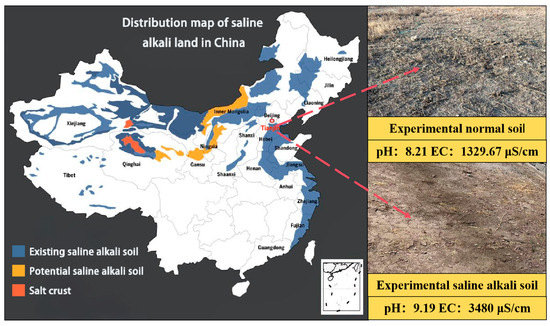
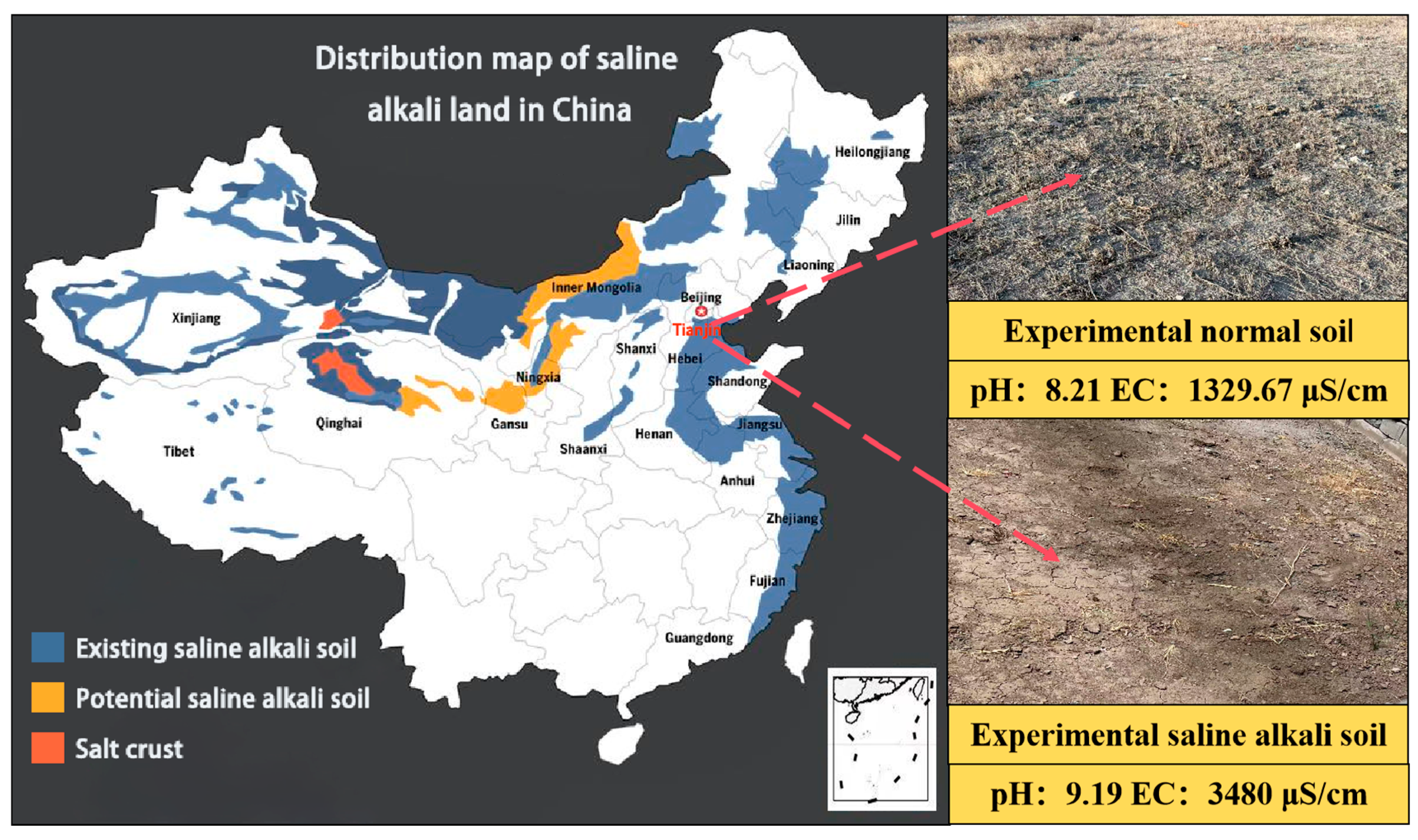
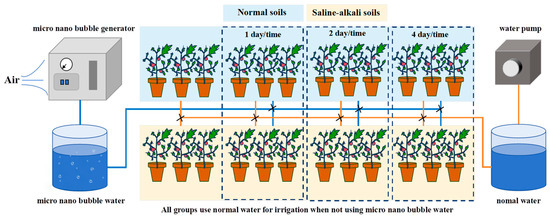
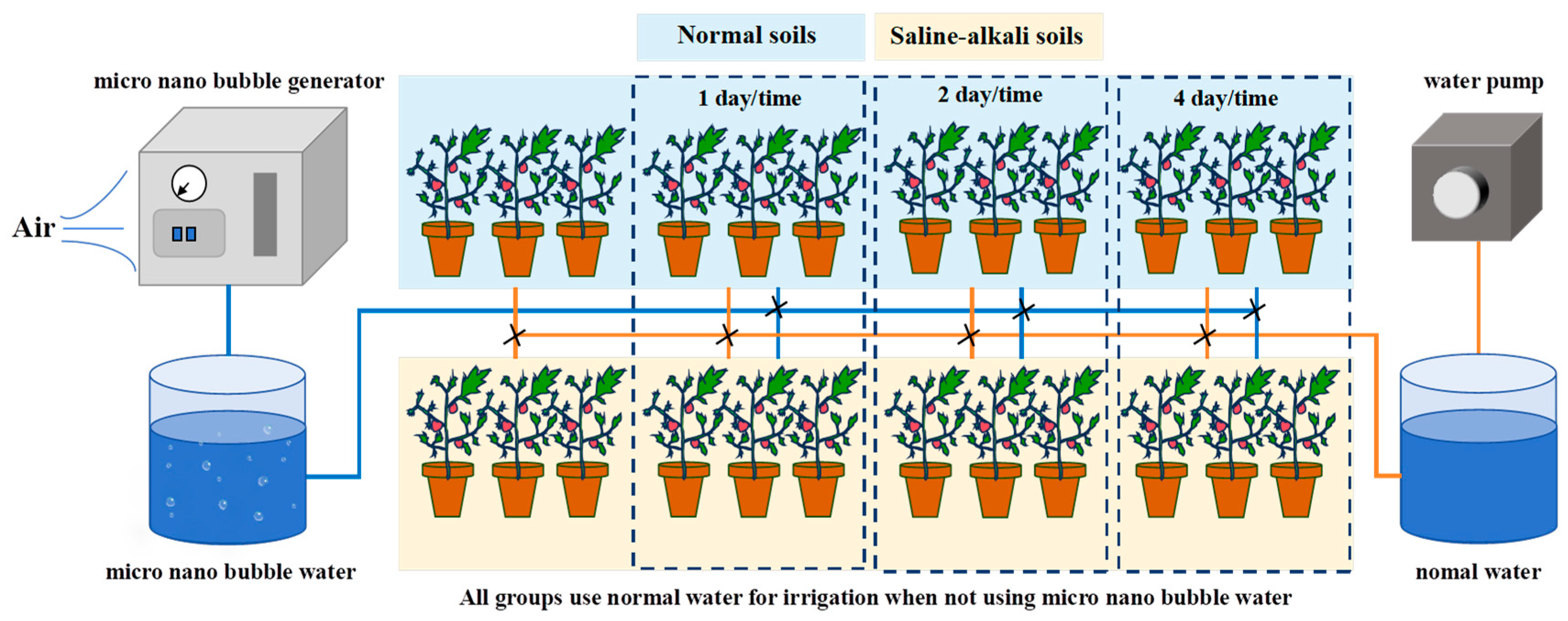
The experiment was conducted from September to December 2024 at the Tianjin University Nano-Agriculture Demonstration Base (117°20′49″, 38°56′4″) in Tianjin, China (Figure S1). Large-fruit tomatoes were provided by the China Xinqing Seedling Co., Ltd., Zhuhai, China. Saline–alkali soil was collected from the southwestern part of Dongli District, Tianjin, as shown in Figure 1. This area exhibits typical secondary saline–alkali soil due to prolonged irrigation waterlogging, resulting in high groundwater mineralization and persistent accumulation of surface soil salts. The initial soil electrical conductivity (EC) reached 3480 μS/cm, classifying it as moderately saline–alkali soil [26]. For this study, an integrated water–fertilizer–air container cultivation system was custom developed specifically for saline–alkali soils. The experimental setup comprised a micro-nano bubbles generator (RuiDe ZhiChuang Innovation Technology (Tianjin) Co., Ltd., Tianjin, China), water storage tank, drip irrigation tubing, planting pots, pressure gauge, valves, and other components, as illustrated in Figure 2. Large soil aggregates were first crushed and uniformly distributed into planting pots (top diameter 24 cm, bottom diameter 19.5 cm, height 26.5 cm, and volume 11.4 L). As shown in Table 1, a two-factor orthogonal design was employed with eight treatments. The proposed design contained a subsurface drip irrigation using tubing with a flow rate of 1.3 L/h. Post-transplant daily irrigation was applied according to treatment requirements. Emitter spacing was 30 cm, with tubing buried at a depth of 15 cm. Basal fertilizer application rates and subsequent top-dressing rates remained consistent throughout the experiment.
Figure 1.
Map of saline–alkali land distribution in China and sampling points.
Figure 2.
System diagram under different irrigation treatments.
Table 1.
Experimental design for tomato pot cultivation in normal and saline–alkali soils under different micro-nano bubble (MNB) irrigation frequencies.
2.2. Soil Sampling
During the entire tomato growth period, root zone soil samples were collected from each treatment group at days 0, 7, 14, 28, 42, 63, and 91. Soil was collected using a multi-point sampling method (taking small amounts from three different locations within the root zone of the same pot) and mixed thoroughly. From this homogenized mixture, approximately 50 g was taken as the final sample. To ensure the reliability and repeatability of the results, each treatment was conducted with three independent biological replicates (n = 3), which provide sufficient statistical power to detect significant differences among treatments while maintaining logistical feasibility. Samples for each biological replicate were stored in sterile plastic bags. A portion of the soil samples was air-dried naturally and then sieved sequentially through 20 and 60 mesh screens for physicochemical effects and enzyme activity measurements. The remaining samples were retained for subsequent high-throughput sequencing analysis.
2.3. Assessment of Soil Properties
2.3.1. Soil Salinization Index
The soil pH (water: air-dried soil ratio of 2.5:1) was determined with a pH meter. The EC value (water: air-dried soil ratio of 5:1) was determined via a sensor, measuring the soluble salts in the soil and resolving the soil salinization capacity [27].
2.3.2. Soil Fertility Index
The content of soil organic matter was estimated using the potassium dichromate oxidation by heating method, defining the soil fertility capacity [28]. The soil cation exchange capacity (CEC) was calculated using the ammonium chloride–ammonium acetate exchange method since it indicates soil nutrient retention and availability [29]. The available nitrogen (AN) content was estimated using the alkali diffusion method, assessing the soil’s capability to provide available nitrogen in the short term. The available phosphorus (AP) content was quantified using the NaHCO3 extraction–molybdenum–antimony colorimetric method, resolving the level of available phosphorus in soil. The available potassium (AK) content was estimated using the combined extraction–colorimetric method, since it indicates soil potassium availability [27].
2.3.3. Rhizosphere Soil Enzyme Activity
Using the phenol–sodium–sodium hypochlorite colorimetric method, the degree of urea hydrolysis in the soil was determined, assessing the basal fertilizer effect under MNB conditions. Similarly, phosphatase activity was quantified by the sodium phosphate–sodium benzoate colorimetric method based on the enzyme captured in mineralizing soil-organic phosphorus. The sucrase activity was estimated using the 3,5-dinitrosalicylic acid colorimetric method, with its level indicating the vigor of soil carbon cycling and organic matter transformation. The protease activity was determined using the Garrett method, closely related to the decomposition of proteinaceous nitrogenous organic matter in soil. Catalase activity was measured using the potassium permanganate titration method, reflecting the intensity of soil detoxification and redox processes [23].
2.3.4. Analysis of the Soil Microbial Community
Total genomic DNA from microbial communities was extracted using the E.Z.N.A.® soil DNA equipment (Omega Bio-tek, Norcross, GA, USA), following the manufacturer’s instructions. The quality of the extracted genomic DNA was assessed via 1% agarose gel electrophoresis, and DNA concentration and purity were determined using NanoDrop2000 (Thermo Scientific, Waltham, MA, USA). Using the extracted DNA as a template, PCR amplification of the 16S rRNA gene V3-V4 variable region was performed with barcoded primers: forward primer 338F (5′-ACTCCTACGGGAGGCAGCAG-3′) and reverse primer 806R (5′-GGACTACHVGGGTWTCTAAT-3′). PCR products were retrieved from a 2% agarose gel and purified using a DNA gel purification kit (YuHua, Shanghai, China). The purified products were quantified using Qubit 4.0 (Thermo Fisher Scientific, USA). The purified PCR products were library-prepared using the NEXTFLEX Rapid DNA-Seq Kit and sequenced on the Illumina NextSeq 2000 platform (Shanghai Meiji Biotechnology Co., Ltd., Shanghai, China). Raw sequencing data (FASTQ files) were demultiplexed and quality-filtered using fastp to remove low-quality reads (e.g., sequences with an average quality score below 20). Paired-end reads were then merged using FLASH version 1.2.7. Chimeric sequences were identified and removed to obtain high-quality effective tags. The high-quality sequences were subsequently clustered into Operational Taxonomic Units (OTUs) at a 97% sequence similarity threshold using UPARSE 7.1. The 97% threshold was selected as it is the widely accepted standard for species-level differentiation in 16S rRNA gene amplicon sequencing. Taxonomic classification of the representative sequence for each OTU was performed against the SILVA database.
2.3.5. Statistical Analysis
All experiments were conducted in triplicate. Data were processed using Excel 2019, and statistical analyses were performed using SPSS 27.0 (SPSS Inc., Chicago, IL, USA). To evaluate the ultimate efficacy of the different irrigation treatments on soil physicochemical properties and enzyme activities, a one-way analysis of variance (ANOVA) was specifically conducted on the data collected at the end of the experiment (Day 91). This was followed by Duncan’s multiple range test for post hoc comparisons. Differences were considered statistically significant at a threshold of p < 0.05. Furthermore, Pearson correlation analysis was used to evaluate the relationships between soil physicochemical properties and enzyme activities. Graphical representations were created using Origin 2022.
Microbial community ecological network analysis was performed using the high-throughput sequencing data from soils treated with MNBs. Meanwhile, the OTU abundance tables and taxonomic annotations were analyzed using R (v4.5.1). The OTU co-occurrence networks were constructed using Gephi 0.9.2 software. The microbial community diversity indices were calculated based on the OTU classification, including Shannon diversity, Simpson’s diversity index, and abundance indices (Chao, ACE).
3. Results
3.1. Effects of Micro-Nano Bubble Water on Physical and Chemical Properties in Saline–Alkali Soil
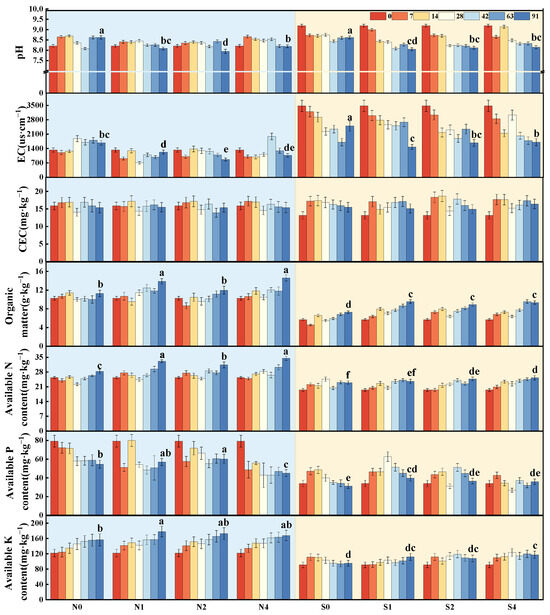
As shown in Figure 3, the physicochemical properties of soil under MNB conditions were analyzed at different aeration frequencies. The figure indicates that under initial soil conditions, the pH, EC, CEC, organic matter content, AN, AP, and AK values of saline–alkali soil were 9.19, 3480 μS/cm, 13.19 mg/kg, 5.69 g/kg, 19.47 mg/kg, 33.92 mg/kg, and 91.17 mg/kg, respectively. Notably, the pH and EC values were 0.98% and 161.72% higher than those of normal soil, indicating that the experimental soil represents a moderately saline–alkali soil. Conversely, CEC, organic matter content, AN, AP, and AK were 16.87%, 44.47%, 23.26%, 57.19%, and 25.28% lower than those of normal soil, respectively. These findings suggest that the restricted nutrient retention capacity and organic matter levels in saline–alkali soils reveal a significant shortage of readily available nutrients.
Figure 3.
Comparison of soil physicochemical properties (pH, electrical conductivity [EC], cation exchange capacity [CEC], organic matter, available nitrogen [AN], available phosphorus [AP], and available potassium [AK]) between normal soil and saline–alkali soil under different micro-nano bubble (MNB) aeration frequencies over a 91-day treatment period. (Note: different lowercase letters at day 91 indicate significant differences among treatment groups based on Duncan’s multiple range test, p < 0.05).
After the MNB irrigation treatment, the EC and pH observations exhibited a rapid decrease, followed by uneven fluctuations in the saline–alkali soil. During the initial period of irrigation (0–14 days), the EC and pH values dropped from 3480 μS/cm and 9.19 to 2665 μS/cm and 8.77, respectively, with reduction rates of 23.41% and 4.55%. After 14 days, both variables showed slow reduction with fluctuations. At the end of the experiment (day 91), the pH of the saline–alkali soil decreased to 8.11 with a reduction rate of 11.75%, which was lower than the normal soil (8.21) at the first stage. However, the EC value declined by 53.41% (1621 μS/cm), coming closer to the initial EC value of the normal soil (1329 μS/cm) at the final stage. These results indicate that MNBs significantly mitigated the salinity and alkalinity in the tested soil.
Additionally, the MNB treatment revealed a gradual increase in CEC content, organic matter, AN, AP, and AK in saline–alkali soils over time, in particular during the early irrigation period (0–14 days). After 14 days, these indicators exhibited a slow fluctuating upward trend, and by the end of the experiment (day 91), the CEC, organic matter, AN, AP, and AK content exhibited an increase rate of 17.47%, 62.66%, 25.97%, 10.18%, and 23.29%, respectively. As a result, these results indicate that MNB irrigation substantially improved soil fertility indicators in saline–alkali soil, bringing them closer to the levels observed in normal soil.
At different aeration frequencies, after 91 days with MNB treatment, the S1 group showed significant improvement in soil salinity and alkalinity indicators. Specifically, the S1 group achieved the lowest EC value at 1674 μS/cm, which was 11.59% and 13.45% lower than the S2 and S4 groups, respectively. Meanwhile, the S4 treatment group demonstrated the most pronounced improvement in soil fertility indicators, achieving the highest CEC, AN, and AK contents at 16.74 mg/kg, 23.39 mg/kg, and 116.31 mg/kg, respectively. These indicators surpassed those of the S1 and S2 treatments by 8.83% and 9.92% (for CEC), 7.37% and 2.02% (for AN), and 4.78% and 8.70% (for AK), respectively.
3.2. Effects of Micro-Nano Bubble Water on Enzyme Activities in Saline–Alkali Soil
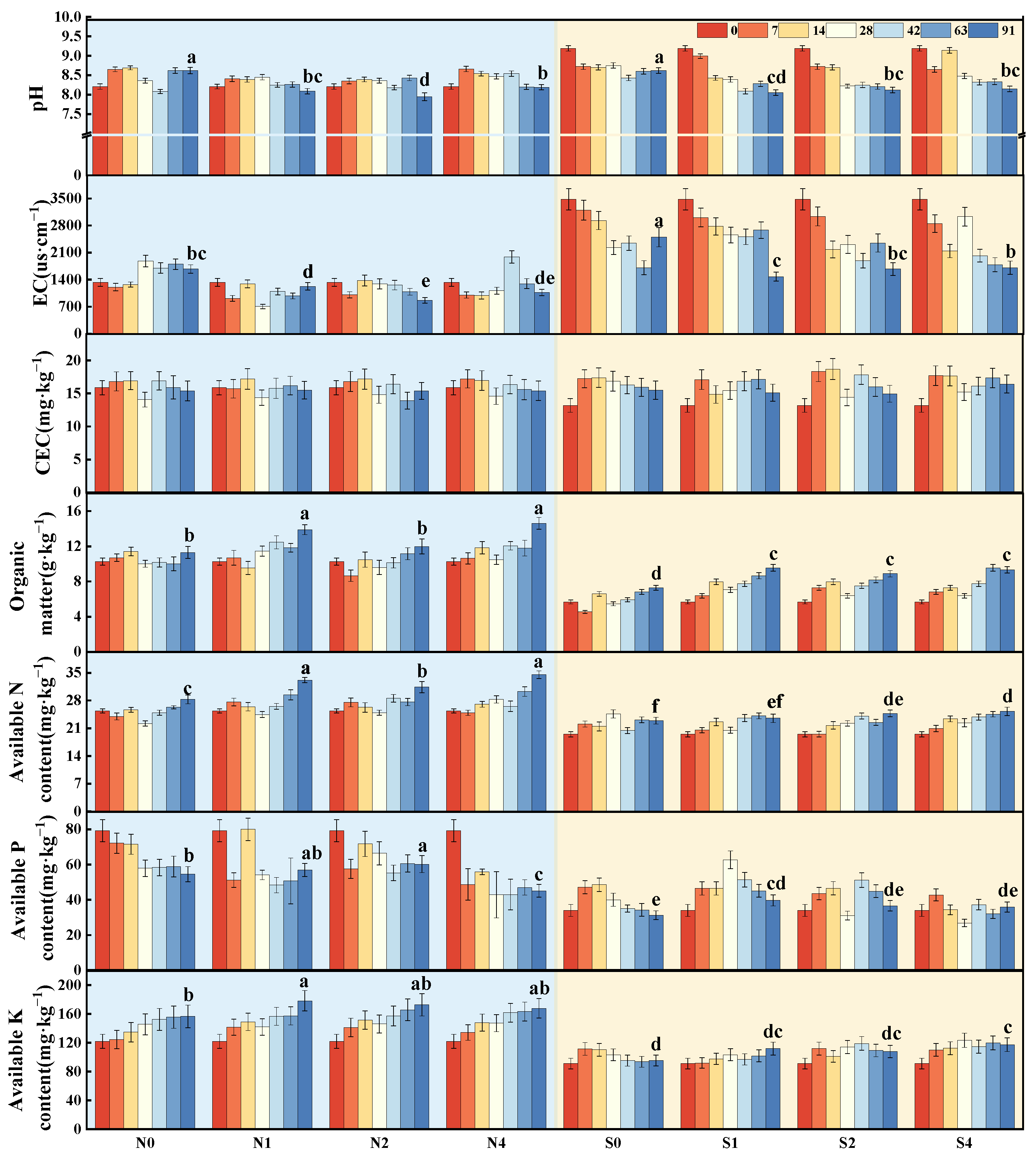
As shown in Figure 4, this study examined the effect of MNBs on soil enzyme activity under different aeration frequencies. Under initial conditions, saline–alkali soil exhibited significantly lower enzyme activity than regular soil, with a total enzyme activity of 19.77 mg/g/d and a reduction rate of 39.31%. Specifically, sucrase, catalase, urease, and alkaline phosphatase activities dropped by 6.98%, 50.42%, 8.96%, and 22.65%, respectively, relative to regular soil (Figure 4a). These findings suggest significant suppression of soil biochemical activity in saline–alkali soil, especially for enzymes related to nitrogen and phosphorus transformation.
Figure 4.
Variations in soil enzyme activities in normal and saline–alkali soils under different MNB aeration frequencies over a 91-day period. (a) Total soil enzyme activity. (b) Specific activities of protease, sucrase, catalase, urease, and alkaline phosphatase. (Note: different lowercase letters at Day 91 indicate significant differences among treatment groups based on Duncan’s multiple range test, p < 0.05).
In Figure 4b, the enzyme activity revealed a sharp upward trend in saline–alkali soil with MNB. During the whole treatment cycle, the total enzyme activity increased to 33.31 mg/g/d, with a growing rate of 68.54%. In saline–alkali soil, enzyme activity, including protease, urease, and alkaline phosphatase, showed an upward trend, while sucrase and catalase activities gradually decreased, with lower levels than those from the control group, during the whole experiment. At the final stage (day 91), the protease (0.31 mg/g), urease (0.68 mg/g), and phosphatase (22.95 mg/g) levels increased by 16.05%, 12.02%, and 156.11%, respectively, in saline–alkali soils. As a result, these indicators showed higher levels than those from the regular soil, with the protease, urease, and phosphatase contents approaching 0.29 mg/g, 0.67 mg/g, and 11.58 mg/g, respectively, while the sucrase and catalase levels were 9.37 mg/g and 1.72 mg/g, respectively, showing values lower than those from the regular soil.
At different aeration frequencies, the S1 treatment achieved the highest level in alkaline phosphatase activity, with growing rates (47.21% and 29.8%, respectively) higher than those from the S2 and S4 treatment groups during the last experimental stage. The S2 treatment group exhibited the highest catalase activity, which was 5.89% and 0.36% higher than that of the S1 and S4 treatment groups, respectively. Meanwhile, the S4 treatment group had the highest sucrase (10.63 mg/g), protease (0.34 mg/g), and urease (0.71 mg/g) levels, with elevated rates compared to the S1 and S2 treatment groups.
3.3. Effect of Micro-Nano Bubble Water on Distribution Characteristics of Microbial Community in Saline–Alkali Soil
In this study, high-throughput sequencing was used to characterize soil microbial communities. After rigorous quality control and chimera removal, a total of 41,345 to 50,047 high-quality microbial sequences were obtained per sample, which were clustered into 3013 OTUs at the standard 97% sequence similarity threshold. To verify the sufficiency of our sequencing effort, rarefaction curves were generated (Figure S2). The curves for all samples approached a stable asymptote, demonstrating that the current sequencing depth was highly adequate to capture the vast majority of microbial community diversity in both the normal and saline–alkali soils. As shown in Table 2, the Chao (3272) and ACE (3355) indices in the S0 group slightly differed from those in the N0 group (3326 and 3319), indicating that the salinization effects restricted species richness. By contrast, the Shannon index decreased from 6.44 (N0) to 5.29 (S0), while the Simpson index rose from 0.007 to 0.081, indicating a decrease in microbial diversity in saline–alkali soil. Using Principal Component Analysis (see Figures S3 and S4), we identified a clear separation between microbial communities in regular and saline–alkali soils. Following the MNB irrigation, microbial community structure in saline–alkali soil moved toward that of regular soil. By comparing with the S0 group, the MNB-treated group exhibited an increased rate of 0.87%, 2.50%, and 23.85% in Chao, ACE, and Shannon indices, respectively, accompanied by a 95.0% reduction in the Simpson index.
Table 2.
Variations in microbial richness index and diversity index under different treatments.
At different aeration frequencies, the S1 treatment group exhibited the highest Shannon (6.663), Ace (3573), and Chao (3542) indices during the last treatment stage with MNBs. These indices were 4.03%, 8.02%, and 8.42% higher than those of the S2 and S4 treatment groups, and 1.16%, 9.11%, and 8.88% higher than the S4 group. The highest value of the Simpson index was achieved by the S2 (0.006) treatment group, exceeding the S1 and S4 groups by 59.77% and 50.14%, respectively. These findings imply that daily aerating yields a more pronounced enhancement in microbial abundance within saline–alkali soils.
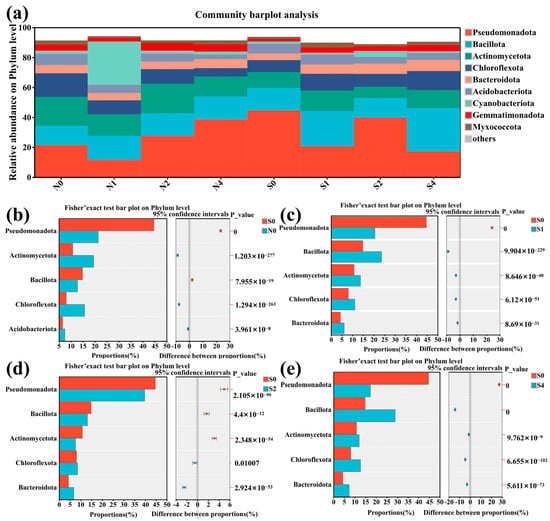
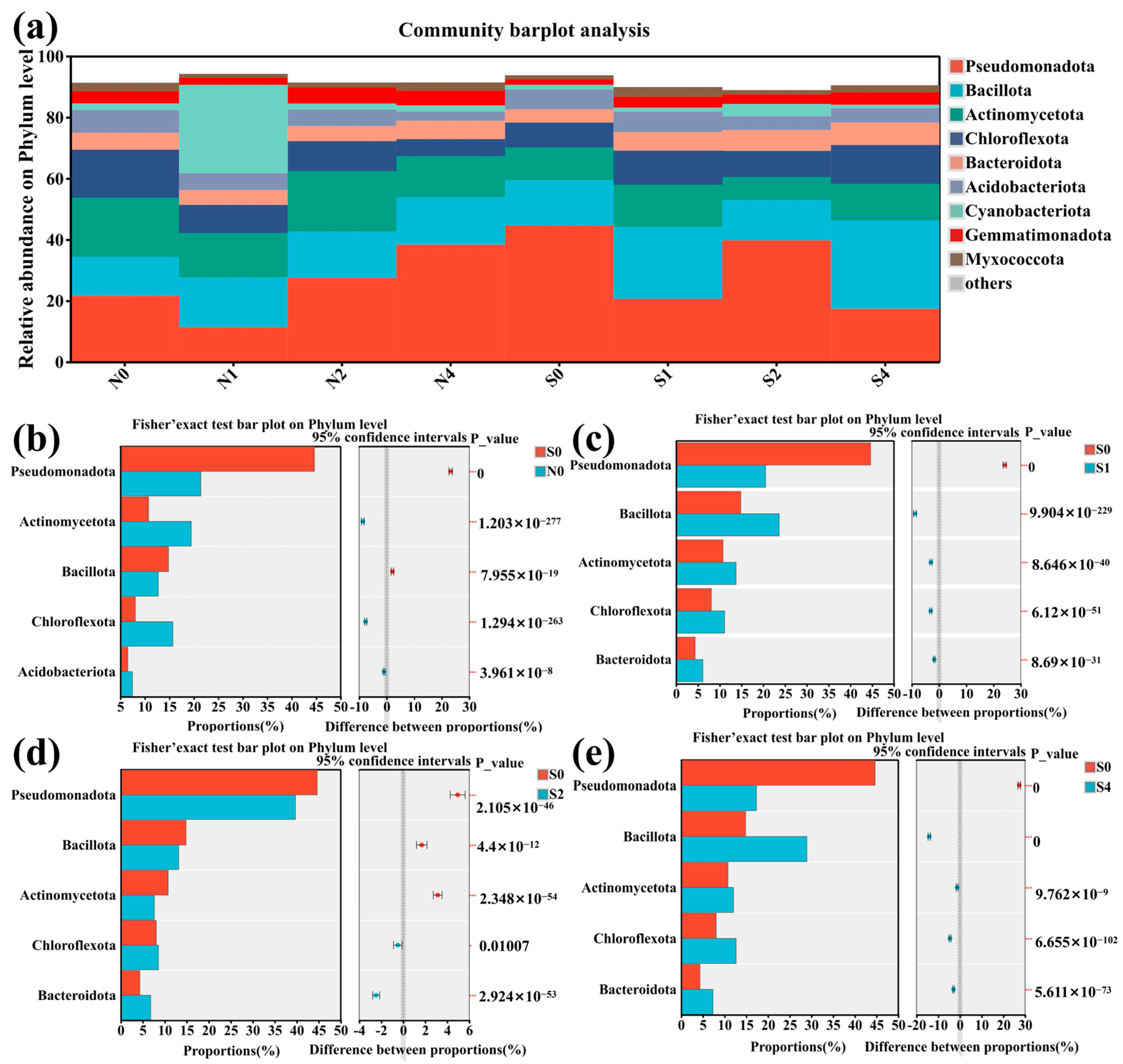
As shown in Figure 5a, we further analyzed the bacterial community composition from phylum to OTU levels under MNB treatment. Across soil types, dominant bacteria included Pseudomonadota, Actinomycetota, Bacillota, Chloroflexota, and Acidobacteriota, accounting for 56.88–84.78% of the total abundance. However, the relative abundance of phylum-level species within bacterial communities exhibited significant differences between the two soil types. For instance, in the S0 group, the relative abundances of the Pseudomonadota phylum and Bacillota phylum were 44.63% and 14.82%, respectively, representing increases of 106.72% and 16.05% compared to the N0 group, while the relative abundances of Actinomycetota, Chloroflexota, and Acidobacteriota were 10.76%, 8.05%, and 6.52%, respectively, representing decreases of 44.56%, 48.60%, and 12.83% compared to the N0 group. Following MNB treatment in saline–alkali soil, the relative abundance of Pseudomonadota decreased by 41.97%, whereas Actinomycetota and Chloroflexota increased by 3.38% and 33.87%, respectively. Based on these results, a partial reorganization of the bacterial community in saline–alkali soil toward a compositional profile was observed in regular soil (Figure 5b–e).
Figure 5.
Soil microbial community composition and differential abundance at the phylum level after 91 days of micro-nano bubble (MNB) treatment. (a) Bar chart of community composition distribution in different samples (at the phylum level). (b) Significant differences between S0 and N0 soil microbes (at the phylum level). (c) Significant differences between S0 and S1 soil microbes (at the phylum level). (d) Significant differences between S0 and S2 soil microbes (at the phylum level). (e) Significant differences between S0 and S4 soil microbes (at the phylum level).
For different aeration frequencies, the relative abundance of Actinomycetota and Acidobacteriota was significantly raised in the S1 treatment group by 3.04% and 0.21%, respectively. Meanwhile, the S4 treatment group exhibited a higher reduction in the relative abundance of the Pseudomonadota phylum, with a rate of 27.29%, as well as in the growing rate of Bacillota (14.12%) and Chloroflexota (4.59%) phyla.
3.4. Effect of Micro-Nano Bubble Water on Microbial Function Expression in Saline–Alkali Soil
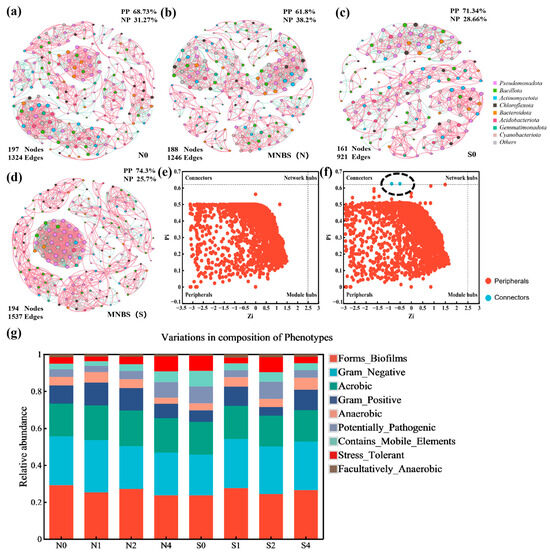
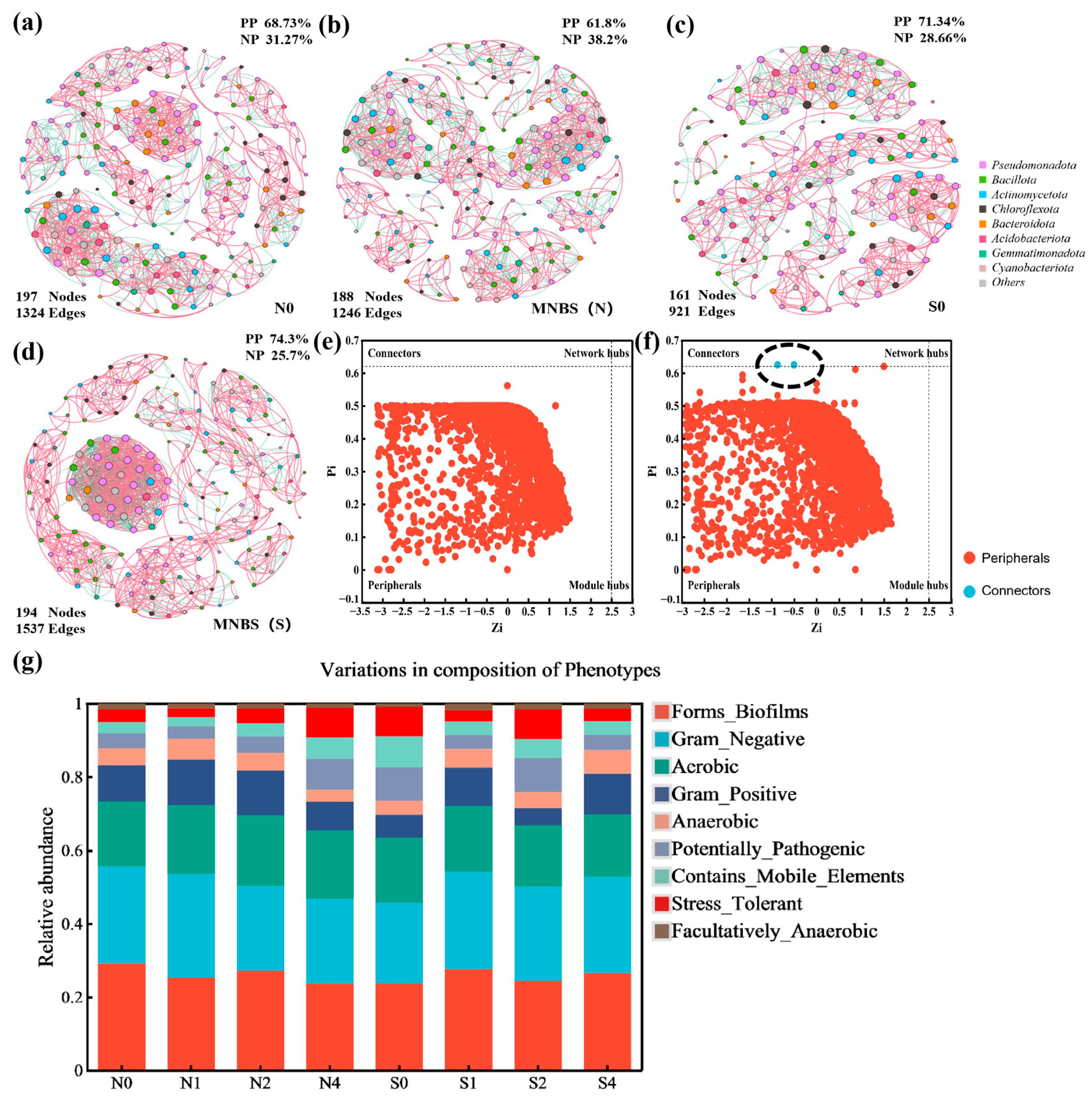
To assess the effects of aerated treatment on interspecies interactions within microbial communities in saline–alkali soils, we constructed a phylogenetic molecular ecological network (pMENs), as shown in Table 3 and Figure 6a–d. As a result, in the S0 group, the molecular network comprised 161 nodes and 921 edges, with an average degree of 11.41, an average weighted degree of 4.879, a modularity of 1.73, an average path length of 6.96, and a clustering coefficient of 0.80. Comparison with the N0 group showed that those components dropped by 18.27%, 30.44%, 14.89%, 3.04%, 15.03%, and 1.23%, respectively, indicating a simplified and less connected microbial network under saline stress.
Table 3.
Topological parameters of molecular ecological network of microbial community.
Figure 6.
Co-occurrence network analysis, topological roles, and phenotypic predictions of soil bacterial communities under different MNB treatments. (a) Co-occurrence networks of bacterial communities in N0. (b) Co-occurrence networks of bacterial communities in MNBs (N). (c) Co-occurrence networks of bacterial communities in S0. (d) Co-occurrence networks of bacterial communities in MNBs (S). (e) S0 group Zi-Pi plots based on the topological roles. (f) MNBs (S) group Zi-Pi plots based on the topological roles. (g) Prediction of BugBase phenotype under different treatment conditions.
Following the MNB irrigation, the molecular network complexity components, such as the number of nodes and edges, increased from 161 to 194, and from 921 to 1537, respectively. The average connectivity markedly improved from 11.441 (S0) to 15.845 (MNBs), representing a 38.5% increase. The average path length rose from 6.960 (S0) to 7.949 (MNBs), while the average clustering coefficient rose slightly from 0.800 to 0.828, indicating the enhanced local aggregation of microorganisms. However, the network modularity index decreased from 1.730 (S0) to 1.323 (MNBs). The higher modularity in the untreated saline–alkali soil (S0) likely reflected the network fragmentation, where isolated clusters of halotolerant taxa survived under extreme stress. Although the MNB-treated soil revealed more elevated average connectivity than regular soil (15.85 and 13.44, respectively), its modularity remained substantially lower than that of the N0 group (1.32 and 2.04, respectively), indicating an incomplete recovery of network structural stability and functional differentiation. Meanwhile, the incorporation of MNBs significantly enhanced network-restructuring effects in normal soil, increasing the modularity coefficient in regular soil from 2.036 to 4.894.
To further characterize interspecies interactions under MNB treatment, we constructed a microbial genus-level topology map using the 3000 most abundant OTUs, as shown in Figure 6e–f. In saline–alkali soil, most nodes were peripheral, while under MNB treatment, the dispersal of nodes significantly increased in the saline–alkali soil, indicating a tendency to disperse into the connectors phase. These findings reveal the creation of new connections between various functional modules, elevating the capabilities of material cycling, energy transfer, and information exchange among the modules. In particular, after MNB treatment, two core nodes (i.e., OTU3355 and OTU3823) were identified, which were affiliated with the Proteobacteria phylum (i.e., Qipengyuania) and the genus Psychrophilus. Among them, the Qipengyuania genus is capable of producing a biosurfactant like sphingoglycolipid, supporting the aggregate structure, aeration, and water-holding capacity of saline–alkali soil. Meanwhile, the Psychrophilus genus revealed strong metabolic functions under specific (alkali/saline) environments.
As displayed in Figure 6g, functional prediction analysis indicated that MNB treatment increased the relative abundance of biofilm-forming functions by 10.56%. The proportions of Gram-negative, Gram-positive, and anaerobic bacteria rose by 18.45%, 37.07%, and 39.40%, respectively, while predicted pathogenic taxa declined by 36.54%. These findings indicate enhanced microbial structural organization and metabolic potential in saline–alkali soil following MNB irrigation.
4. Discussion
Prior approaches indicated that the MNB technology enhanced irrigation effectiveness and crop yield, especially in regular soils, although its treatment mechanism in saline–alkali soils remains insufficient [18,24,30]. Building on this limitation, saline–alkali soil restoration involves coupled physical, chemical, and biochemical processes, making mechanistic clarification crucial [1,31]. Thus, this study addressed this gap by examining the effects of MNBs in enhancing the saline–alkaline soil fertility, offering a robust framework for targeted soil restoration under salinization stress [18,32].
4.1. Microbiological Mechanisms Underlying Soil Fertility Deterioration Due to Salinization
Through experimental analysis, this study indicates that saline–alkali soil is characterized by high pH (9.19) and electrical conductivity (3480 µS cm−1), increasing the soluble salt amount. High sodium concentrations disrupt soil particle aggregation, reduce permeability, and impair nutrient retention by competing for adsorption sites [31,33,34]. For instance, compared with normal soil, the cation exchange capacity in saline–alkali soil decreased by 16.87%, which weakened the retention and supply of essential nutrients such as nitrogen, phosphorus, and potassium [35]. Regarding the soil enzyme activity, sucrase, urease, and alkaline phosphatase play a crucial role in regulating the carbon, nitrogen, and phosphorus cycle, although their activity declined by 50.42%, 8.96%, and 22.65%, respectively. This enzymatic suppression indicates a weakened biochemical processing capability of organic matter and nutrient transformation, further constraining soil fertility [23].
These physicochemical and biochemical stresses jointly reshaped the microbial community [23]. Although species richness (Chao and ACE indices) remained relatively consistent, microbial diversity and evenness deteriorated significantly, as indicated by the Shannon index decreasing by 17.9% and a 10.57-fold increase in the Simpson index. These findings suggest dominance by a limited number of stress-tolerant taxa rather than wholesale species loss [23]. Additionally, the halotolerant phylum Pseudomonadota became disproportionately abundant, while functionally important groups (i.e., Actinomycota and Chloroflexota) were involved in organic matter decomposition and nutrient cycling [36,37]. This observed imbalance increased the reduction in soil organic matter (−44.47%) and available phosphorus (−57.19%) [38]. According to the molecular network, microbial interactions offered a simplified structure in saline–alkali soil, indicating dominant peripheral nodes and weak inter-module connectivity. Such network formations are frequently associated with stressed ecosystems, limiting the microbial material cycling and energy transfer [27,39,40]. Therefore, salinization-induced physicochemical stress declines enzyme activity and restructures microbial communities, significantly reducing microbial diversity. Together, these interacting processes collectively drive the systemic decline in soil fertility observed in saline–alkali soils [23,31].
4.2. Microbiological Mechanism of Micro-Nano Bubbles on Improving Planting Fertility in Saline–Alkali Soil
Our results suggest that MNB irrigation can improve saline–alkali soil fertility through three interconnected processes: physicochemical amelioration, activation of enzyme systems, and directed restructuring of microbial communities [17,32].
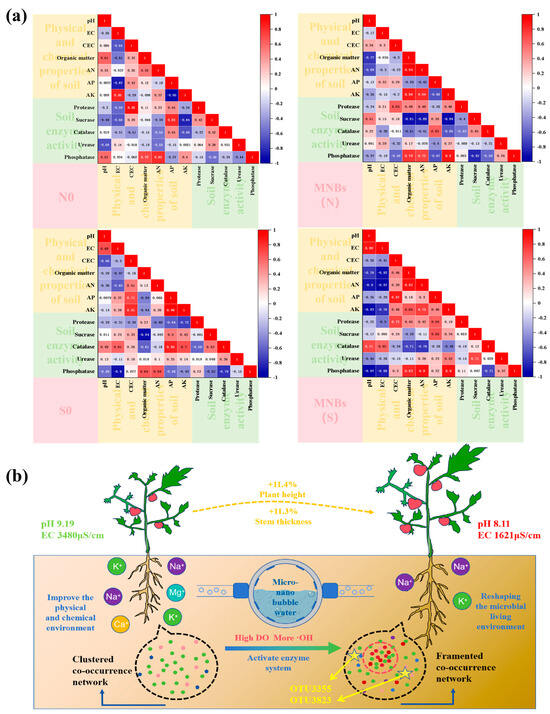
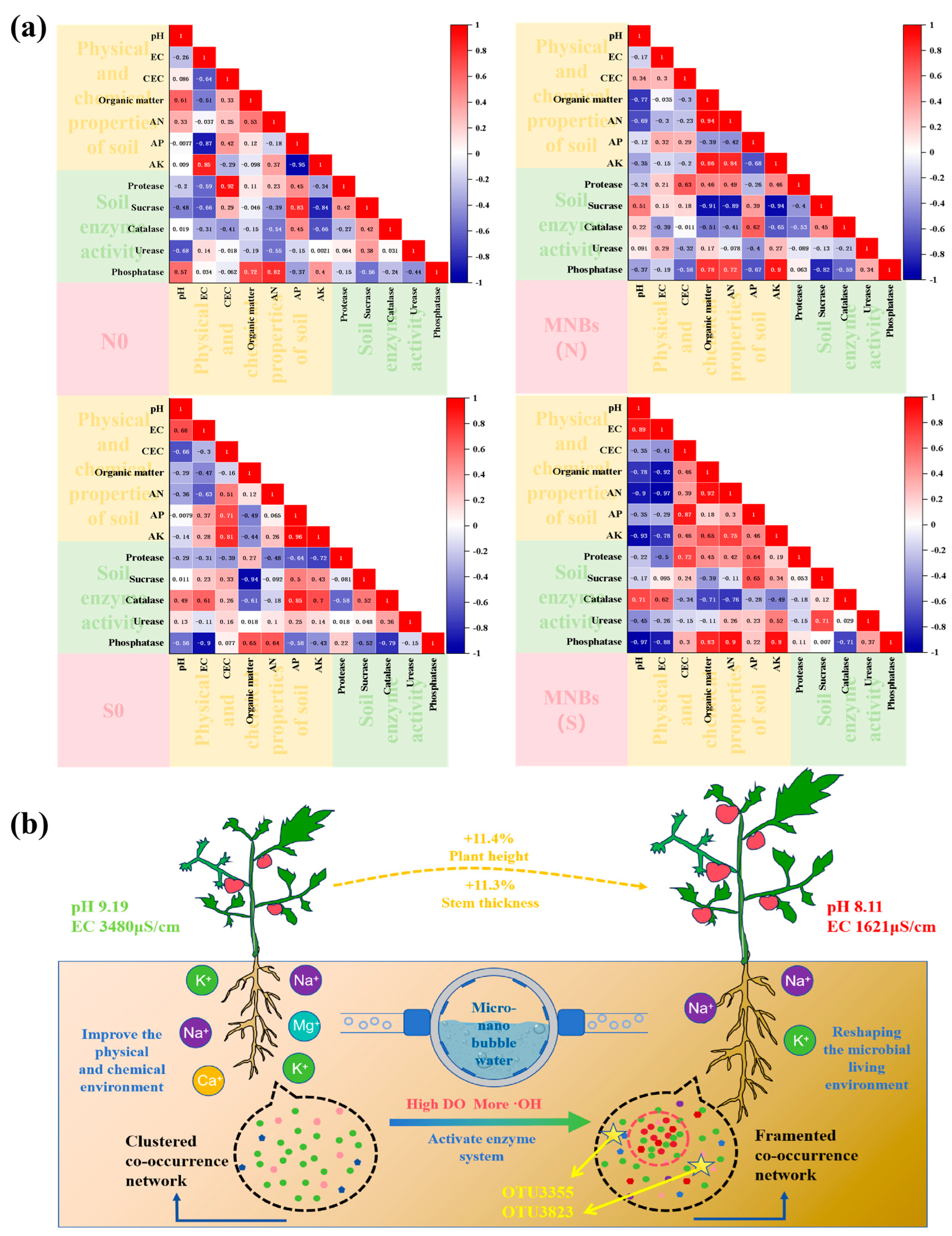
First, MNBs directly and quickly improve the soil’s physicochemical foundation. They effectively leach salts. According to Figure 7a, after treatment with micro-nano bubbles, the correlation between pH and other indicators in the saline–alkali soil group was significantly improved, reducing the EC by 53.41% after 91 days, regulating surface charge, and lowering the pH to 8.11. This alleviation of saline–alkali stress is facilitated by hydroxyl radicals from bubble collapse, which help neutralize alkalinity [41,42,43]. Consequently, key fertility indicators such as soil organic matter, cation exchange capacity (CEC), and levels of available nitrogen, phosphorus, and potassium (AN, AP, AK) show systematic upward trends, enhancing the soil’s nutrient retention and supply capacity [38].
Figure 7.
(a) Pearson correlation heatmap evaluating the relationships between soil physicochemical properties and enzyme activities under different MNB aeration frequencies after 91 days of treatment. (b) Microbiological mechanisms by which MNBs improve the fertility of saline–alkali soils.
Second, the improved soil environment was accompanied by the recovery of several key enzyme activities. The correlation between AK and alkaline phosphatase increased from 0.43 to 0.9, while the link between pH and catalase rose from 0.49 to 0.71, since soil enzyme activity is jointly regulated by substrate availability and environmental conditions. By creating a more neutral and aerated microenvironment, MNBs directly reactivate key biochemical pathways for nutrient transformation [35]. Furthermore, different aeration frequencies can precisely regulate this process, selectively enhancing specific enzymes.
Ultimately, the optimized physicochemical and biochemical conditions drive a beneficial reorganization of the microbial community [27,44]. MNB treatment significantly increased microbial diversity (Shannon index up 23.85%) and reduced the excessive dominance of the Pseudomonas phylum (−41.97%). Importantly, it promoted functional phyla like Bacillota (up 47.64%), which are involved in nutrient solubilization and decomposition, shifting the community from a “salt-tolerant survival” state to a “functional metabolic” one [45,46]. The enrichment of beneficial microbial communities plays a key role in enhancing soil quality and offers a biological foundation for the long-term improvement of soil fertility. Ecological network analysis revealed a more complex and cooperative microbial network (average connectivity increased by 38.5%, and two key connection nodes appeared), featuring key connector species that enhance soil aggregation and ecosystem stability [40]. This can help form complex and more efficient cooperative relationships among microbial groups, thus improving the speed and efficiency of substance exchange and exchange of microbial information. This means that a complex and efficient cooperative system is being developed within the microbial ecosystem, raising the abilities of cycling material and information flows within the system [39]. Although the microbial network was still in a transitional state of recovery by day 91, the overall agricultural utility of the soil was genuinely restored, as evidenced by macroscopic biological validation. This created more favorable growth conditions for the plant roots. As shown in Figure S5, after micro-nano bubble treatment, the height of tomato plants, stem diameter, and root length were all significantly increased.
In summary, MNB treatment appears to improve saline–alkali soil fertility through coordinated physicochemical, biochemical, and microbial responses. First, it rapidly improves the soil’s physicochemical properties. Next, it activates the soil enzyme system to unlock nutrient transformation pathways. Finally, it drives microbial communities toward a healthy, diverse, and interconnected succession. These interconnected stages form the core mechanism for efficient and ecologically sustainable restoration (Figure 7b).
5. Conclusions
In this study, we systematically investigated the impact of MNB irrigation with varying aeration frequencies on the physicochemical properties, soil enzyme activity, and microbial communities of saline–alkali soil using pot experiments. Thus, our approach elucidated the dominant mechanisms and regulatory rules of MNB technology to handle saline–alkali soil. The key findings are involved in the following aspects:
- (1)
- Soil salinization inhibited enzyme activity, with a reduction rate of 39.31% in the total enzyme activity. While the sucrase, urease, and alkaline phosphatase, which play crucial roles in carbon, nitrogen, and phosphorus cycling, respectively, achieved reduction rates of 50.42%, 8.96%, and 22.65%, respectively. Thus, soil microbial communities exhibited structural simplification and functional decline, severely limiting nutrient transformation and cycling. This significantly constrained the resource utilization potential of saline–alkali soils.
- (2)
- MNB irrigation effectively promoted salt leaching and alkaline neutralization in saline–alkali soils, significantly reducing soil pH and decreasing EC by 11.75% and 53.41%, respectively. Addressing this, soil properties such as nutrient adsorption and supply capacity were restored systematically. Moreover, soil CEC, organic matter content, AN, AP, and AK values rose by 17.47%, 62.66%, 25.97%, 10.18%, and 23.29%, respectively, while the soil physicochemical properties tended towards normal. This lays the foundation for its utilization as an agricultural resource.
- (3)
- The MNB treatment strongly promoted enzyme activity in the saline–alkali soil, with a growing rate of 68.54%. Moreover, this treatment could increase the urease activity and alkaline phosphatase by 12.02% and 156.11%, respectively. However, it also led to the conversion of the functional diversity of the salt-tolerant community in the saline–alkali soil from “salt-tolerant” to “functional.” This result exhibited a reduction rate of 41.97% in the salt-tolerant Pseudomonadota phylum, while the Bacillota phylum induced phosphorus solubilization and nitrogen fixation and enhanced the functionality and sustainability of soil biological resources.
- (4)
- MNBs improved the diversity and connectivity of microbial communities in saline–alkali soil. More importantly, MNBs promote the functional connectivity of Qipengyuania bacteria in the phylum Proteobacteria and psychrophilic bacilli from the phylum Proteobacteria, breaking up the “closed and singular” relationship type in microbial communities in saline–alkali soil. Thus, this technology enabled the complex and efficient cooperative relationships in microbial communities, which improved the efficiency of material and information transmission. MNBs also decreased the quantity of potential pathogenic bacteria by 36.54%, further enhancing the health of soil ecosystems and their resource recycling capacity.
- (5)
- MNBs achieved systematic remediation and resource enhancement of saline–alkali soils through a coupled progressive pathway: (i) rapid physicochemical environment enhancement, (ii) synchronous enzyme system activation, and (iii) targeted microbial community restructuring. These three interconnected and synergistic processes collectively provide an associated ecological foundation for the recycling of saline–alkali land as a land resource.
Supplementary Materials
The following supporting information can be downloaded at: https://www.mdpi.com/article/10.3390/su18062855/s1, Figure S1: Layout of the integrated water-fertilizer-air tomato pot cultivation experiment under normal and saline-alkali soil conditions; Figure S2: Rarefaction curves of soil microbial communities for all treatment groups (N0, N1, N2, N4, S0, S1, S2, and S4) based on 16S rRNA gene high-throughput sequencing data, verifying the sufficiency of the sequencing depth; Figure S3: Principal component analysis (PCA) of soil microbial communities at the OTU level under different micro-nano bubble (MNB) irrigation treatments; Figure S4: Kruskal-Wallis H test bar plot illustrating the significant differences in specific microbial species abunda nce between normal and saline-alkali control soils and MNB-treated groups; Figure S5: Macroscopic biological validation of tomato plants after 91 days of micro-nano bubble (MNB) treatment under different aeration frequencies. (a) Plant height (cm). (b) Stem thickness (cm). (c) Root length (cm).
Author Contributions
Conceptualization, J.Y. and T.W.; Methodology, H.Z. and T.W.; Software, H.Z.; Validation, H.Z.; Formal analysis, X.Y.; Investigation, H.Z. and Q.J.; Data curation, J.C.; Writing—original draft, H.Z.; Writing—review & editing, Jun Yang, T.W. and F.M.; Visualization, Q.J., X.Y. and F.M.; Supervision, J.C. All authors have read and agreed to the published version of the manuscript.
Funding
The study was supported by the National Natural Science Fund Independent Innovation Fund of Tianjin University (2022XSU-0030, 2023XJS-0043).
Institutional Review Board Statement
Not applicable.
Informed Consent Statement
Not applicable.
Data Availability Statement
The original contributions presented in this study are included in the article. Further inquiries can be directed to the corresponding author.
Conflicts of Interest
The authors declare no conflict of interest.
References
- Dai, S.; Feng, W.; Song, F.; Li, T.; Tao, Y.; Yang, F.; Miao, Q.; Duan, P.; Liao, H.; Shi, H.; et al. Review of biological algal fertilizer technology: Alleviating salinization, sequestering carbon, and improving crop productivity. Bioresour. Technol. 2025, 429, 132507. [Google Scholar] [CrossRef] [Scilit] [PubMed]
- Ran, C.; Gao, D.; Bai, T.; Geng, Y.; Shao, X.; Guo, L. Straw return alleviates the negative effects of saline sodic stress on rice by improving soil chemistry and reducing the accumulation of sodium ions in rice leaves. Agric. Ecosyst. Environ. 2023, 342, 108253. [Google Scholar] [CrossRef] [Scilit]
- Xie, Y.; Bai, T.; Zhang, Y.; Sun, B.; Gao, M.; Feng, H. Nano biochar enhances organic carbon accumulation, molecular complexity, and salt leaching in saline–alkali soil columns. J. Environ. Manag. 2025, 389, 126205. [Google Scholar] [CrossRef] [Scilit] [PubMed]
- Zhang, B.; Wu, J.; Bai, X.; Li, L.; Lin, M.; Xu, X.; Zhang, F.; Wang, B. Changes in soil quality and crop productivity along rice cultivation chronosequences in saline-alkali soils. J. Environ. Manag. 2025, 395, 127872. [Google Scholar] [CrossRef] [Scilit]
- Li, J.; Ye, H.; Liu, S.; Yang, L.; Zhang, Z. Guiding the sustainable reclamation of abandoned farmland: Insights from China’s Loess Plateau. Ecol. Indic. 2025, 181, 114440. [Google Scholar] [CrossRef] [Scilit]
- Han, Z.; Leng, Y.; Xu, Z.; Tu, L.; Wang, C.; Li, S.; Wu, S.; Huang, Y.; Liu, S.; Wang, J.; et al. Location-optimized remediation measures for soil multifunctionality and carbon sequestration of saline-alkali land in China. J. Clean. Prod. 2025, 519, 146017. [Google Scholar] [CrossRef] [Scilit]
- Guo, Y.; Dong, J.; Wang, J.; Meng, Q.; Ma, J.; Luqmon, S.; Gong, P.; Reaihan, E.; Liu, H. Regional adaptability and integrated evaluation of saline-alkali soil remediation technologies: A comprehensive review. Ecol. Indic. 2025, 180, 114305. [Google Scholar] [CrossRef] [Scilit]
- Li, S.; Wu, M.; Jia, Z.; Luo, W.; Fei, L.; Li, J. Influence of different controlled drainage strategies on the water and salt environment of ditch wetland: A model-based study. Soil Tillage Res. 2021, 208, 104894. [Google Scholar] [CrossRef] [Scilit]
- Fei, Y.; Jiao, K.; Liu, X.; Wang, B.; Song, R.; Meng, Z.; Liu, B.; Wu, J.; Qi, C.; Zhou, W.; et al. A sulfate-palygorskite composite amendment for saline-alkali soil: Simultaneous alkalinity reduction, nutrient enrichment, and crop growth promotion. Soil Tillage Res. 2026, 256, 106872. [Google Scholar] [CrossRef] [Scilit]
- Ren, G.; Meng, M.; Fan, H.; Wen, J.; Zhang, J.; Zhao, G.; Yang, X.; Sun, Z.; He, X. Calcium ions and calcium carbonate: Key regulators of the enzymatic mineralization for soil dispersivity control. Acta Geotech. 2024, 19, 6661–6682. [Google Scholar] [CrossRef] [Scilit]
- Cui, X.; Chen, J.; Li, S.; Shao, A.; Fu, J. Growth and physiological characteristics of forage bermudagrass in response to salt stress. BMC Plant Biol. 2025, 25, 269. [Google Scholar] [CrossRef] [Scilit] [PubMed]
- Ci, Y.; Tianzhi, W.; Peiyuan, L.; Manuel, F.; Suxia, G.; Yujie, Z. Disinfection mechanism of chlorine-resistant bacteria by micro-nano bubbles in drinking water: A case study of Bacillus cereus. Chem. Eng. J. 2025, 515, 163782. [Google Scholar] [CrossRef] [Scilit]
- Ouyang, L.; Cha, H.; Zhang, J.; Hansen, H.H.W.B.; Li, Q.; Tan, B.H.; Liu, P.; Zhang, D.; Wang, L.; Nguyen, N.-T.; et al. Energy-efficient nanobubble generation with microporous materials. J. Mol. Liq. 2025, 423, 126873. [Google Scholar] [CrossRef] [Scilit]
- Hao, Y.; Zou, H.; Liu, B.; Zhang, H.; Sun, L.; Cui, M. Study on the properties of bulk micro-nanobubbles water generated by multi-jet hydrodynamic cavitation. Chem. Eng. Process. Process Intensif. 2025, 210, 110210. [Google Scholar] [CrossRef] [Scilit]
- Ouyang, Z.; Zhang, J.; Liang, X.; Wang, H.; Yang, Z.; Tang, R.; Yu, Q.; Zhang, Y. Micro-nano aerated subsurface drip irrigation and biochar promote photosynthesis, dry matter accumulation and yield of cucumbers in greenhouse. Agric. Water Manag. 2025, 308, 109295. [Google Scholar] [CrossRef] [Scilit]
- Zhou, Y.; Zhou, B.; Xu, F.; Muhammad, T.; Li, Y. Appropriate dissolved oxygen concentration and application stage of micro-nano bubble water oxygation in greenhouse crop plantation. Agric. Water Manag. 2019, 223, 105713. [Google Scholar] [CrossRef] [Scilit]
- Bian, Q.; Dong, Z.; Zhao, Y.; Feng, Y.; Fu, Y.; Wang, Z.; Zhu, J.; Ma, L. Micro-/nanobubble oxygenation irrigation enhances soil phosphorus availability and yield by altering soil bacterial community abundance and core microbial populations. Front. Plant Sci. 2025, 15, 1497952. [Google Scholar] [CrossRef] [Scilit]
- Wang, J.; Cui, Y.; Wu, K.; Wu, S.; Wu, K.; Li, Y.; Niu, W. Micro/nanobubble-aerated drip irrigation affects saline soil microenvironments and tomato growth by altering bacterial communities. Soil Tillage Res. 2024, 239, 106034. [Google Scholar] [CrossRef] [Scilit]
- Chen, P.; Mo, C.; He, C.; Cui, H.; Lin, J.; Yang, J. Shift of microbial turnover time and metabolic efficiency strongly regulates rhizosphere priming effect under nitrogen fertilization in paddy soil. Sci. Total Environ. 2021, 800, 149590. [Google Scholar] [CrossRef] [Scilit]
- Ouyang, Z.; Tian, J.; Yan, X.; Shen, H. Effects of different concentrations of dissolved oxygen or temperatures on the growth, photosynthesis, yield and quality of lettuce. Agric. Water Manag. 2020, 228, 105896. [Google Scholar] [CrossRef] [Scilit]
- Chuenchart, W.; Karki, R.; Shitanaka, T.; Marcelino, K.R.; Lu, H.; Khanal, S.K. Nanobubble technology in anaerobic digestion: A review. Bioresour. Technol. 2021, 329, 124916. [Google Scholar] [CrossRef] [Scilit] [PubMed]
- Zheng, Z.; He, Y.; He, Y.; Zhan, J.; Shi, C.; Xu, Y.; Wang, X.; Wang, J.; Zhang, C. Micro-nano bubble water subsurface drip irrigation affects strawberry yield and quality by modulation of microbial communities. Agric. Water Manag. 2025, 307, 109228. [Google Scholar] [CrossRef] [Scilit]
- Yang, D.; Tang, L.; Cui, Y.; Chen, J.; Liu, L.; Guo, C. Saline-alkali stress reduces soil bacterial community diversity and soil enzyme activities. Ecotoxicology 2022, 31, 1356–1368. [Google Scholar] [CrossRef] [Scilit]
- Chen, W.; Bastida, F.; Liu, Y.; Zhou, Y.; He, J.; Song, P.; Kuang, N.; Li, Y. Nanobubble oxygenated increases crop production via soil structure improvement: The perspective of microbially mediated effects. Agric. Water Manag. 2023, 282, 108263. [Google Scholar] [CrossRef] [Scilit]
- Arablousabet, Y.; Povilaitis, A. The Impact of Nanobubble Gases in Enhancing Soil Moisture, Nutrient Uptake Efficiency and Plant Growth: A Review. Water 2024, 16, 3074. [Google Scholar] [CrossRef] [Scilit]
- Andrade Foronda, D.; Colinet, G. Prediction of Soil Salinity/Sodicity and Salt-Affected Soil Classes from Soluble Salt Ions Using Machine Learning Algorithms. Soil Syst. 2023, 7, 47. [Google Scholar] [CrossRef] [Scilit]
- Cui, Y.; Ning, Z.; Li, M.; Qin, X.; Yue, X.; Chen, X.; Zhu, C.; Sun, H.; Huang, Y. Microbial network-driven remediation of saline-alkali soils by salt-tolerant plants. Front. Microbiol. 2025, 16, 1565399. [Google Scholar] [CrossRef] [Scilit]
- He, S.; Tan, S.; Shen, L.; Zhou, Q. Soil Organic Matter Estimation Model Integrating Spectral and Profile Features. Sensors 2023, 23, 9868. [Google Scholar] [CrossRef] [Scilit]
- Yuan, J.; E, S.; Zhao, X. Improved determination efficiency of the cation exchange capacity and exchangeable base cations in soil using stirring and extraction modifications. Soil Tillage Res. 2025, 248, 106429. [Google Scholar] [CrossRef] [Scilit]
- Baram, S.; Weinstein, M.; Evans, J.F.; Berezkin, A.; Sade, Y.; Ben-Hur, M.; Bernstein, N.; Mamane, H. Drip irrigation with nanobubble oxygenated treated wastewater improves soil aeration. Sci. Hortic. 2022, 291, 110550. [Google Scholar] [CrossRef] [Scilit]
- Rezapour, S.; Nouri, A.; Asadzadeh, F.; Barin, M.; Erpul, G.; Jagadamma, S.; Qin, R. Combining chemical and organic treatments enhances remediation performance and soil health in saline-sodic soils. Commun. Earth Environ. 2023, 4, 285. [Google Scholar] [CrossRef] [Scilit]
- Zhang, Y.; Cai, L.; Chen, L.; Zhang, H.; Li, G.; Wang, G.; Cui, J.; Filatova, I.; Liu, Y. Effect of micro–nano bubbles on the remediation of saline–alkali soil with microbial agent. Sci. Total Environ. 2024, 912, 168940. [Google Scholar] [CrossRef] [Scilit] [PubMed]
- Singh, A. Soil salinization management for sustainable development: A review. J. Environ. Manag. 2021, 277, 111383. [Google Scholar] [CrossRef] [Scilit]
- Li, M.; Li, W.; Wang, C.; Ji, L.; Han, K.; Gong, J.; Dong, S.; Wang, H.; Zhu, X.; Du, B.; et al. Growth-promoting effects of self-selected microbial community on wheat seedlings in saline-alkali soil environments. Front. Bioeng. Biotechnol. 2024, 12, 1464195. [Google Scholar] [CrossRef] [Scilit]
- Dou, C.; Lv, Y.; Sun, Y.; Chen, X.; Li, Y. Assessment of Soil Enzyme Activities in Plant Root Zone of Saline Soil Reclaimed by Drip Irrigation with Saline Groundwater. Agronomy 2024, 14, 1416. [Google Scholar] [CrossRef] [Scilit]
- Wang, L.; Ye, X.; Hu, H.; Du, J.; Xi, Y.; Shen, Z.; Lin, J.; Chen, D. Soil bacterial communities triggered by organic matter inputs associates with a high-yielding pear production. Soil 2022, 8, 337–348. [Google Scholar] [CrossRef] [Scilit]
- Silva, G.d.C.; Kitano, I.T.; Ribeiro, I.A.d.F.; Lacava, P.T. The Potential Use of Actinomycetes as Microbial Inoculants and Biopesticides in Agriculture. Front. Soil Sci. 2022, 2, 833181. [Google Scholar] [CrossRef] [Scilit]
- Xing, J.; Li, X.; Li, Z.; Wang, X.; Hou, N.; Li, D. Remediation of soda-saline-alkali soil through soil amendments: Microbially mediated carbon and nitrogen cycles and remediation mechanisms. Sci. Total Environ. 2024, 924, 171641. [Google Scholar] [CrossRef] [Scilit]
- Xiao, Y.; Wang, J.; Wang, B.; Fan, B.; Zhou, G. Soil microbial network complexity predicts soil multifunctionality better than soil microbial diversity during grassland-farmland-shrubland conversion on the Qinghai-Tibetan Plateau. Agric. Ecosyst. Environ. 2025, 379, 109356. [Google Scholar] [CrossRef] [Scilit]
- Wu, D.; Bai, H.; Zhao, C.; Peng, M.; Chi, Q.; Dai, Y.; Gao, F.; Zhang, Q.; Huang, M.; Niu, B. The characteristics of soil microbial co-occurrence networks across a high-latitude forested wetland ecotone in China. Front. Microbiol. 2023, 14, 1160683. [Google Scholar] [CrossRef] [Scilit]
- Patel, A.K.; Singhania, R.R.; Chen, C.-W.; Tseng, Y.-S.; Kuo, C.-H.; Wu, C.-H.; Dong, C.D. Advances in micro- and nano bubbles technology for application in biochemical processes. Environ. Technol. Innov. 2021, 23, 101729. [Google Scholar] [CrossRef] [Scilit]
- Wang, T.; Yang, C.; Sun, P.; Wang, M.; Lin, F.; Fiallos, M.; Khu, S.-T. Generation Mechanism of Hydroxyl Free Radicals in Micro–Nanobubbles Water and Its Prospect in Drinking Water. Processes 2024, 12, 683. [Google Scholar] [CrossRef] [Scilit]
- Yang, S.-Y.; Wang, W.; Chen, J.-J.; Francisco, J.S.; Liu, X.-W. Probing catalyst-free hydroxyl radical generation at microbubble interfaces. Nat. Commun. 2025, 16, 8835. [Google Scholar] [CrossRef] [Scilit] [PubMed]
- Song, J.; Guan, X.; Cui, H.; Liu, L.; Li, Y.; Li, Y.; Ma, S. The impact of salt-tolerant plants on soil nutrients and microbial communities in soda saline-alkali lands of the Songnen plain. Front. Microbiol. 2025, 16, 1592834. [Google Scholar] [CrossRef] [Scilit]
- Huang, J.; Gao, K.; Yang, L.; Lu, Y. Successional action of Bacteroidota and Firmicutes in decomposing straw polymers in a paddy soil. Environ. Microbiome 2023, 18, 76. [Google Scholar] [CrossRef] [Scilit]
- Li, L.; Yang, S.; Hu, X.; Li, Z.; Chen, H. The combined application of salt-alkali tolerant phosphate solubilizing microorganisms and phosphogypsum is an excellent measure for the future improvement of saline-alkali soils. Front. Microbiol. 2024, 15, 1364487. [Google Scholar] [CrossRef] [Scilit]

Disclaimer/Publisher’s Note: The statements, opinions and data contained in all publications are solely those of the individual author(s) and contributor(s) and not of MDPI and/or the editor(s). MDPI and/or the editor(s) disclaim responsibility for any injury to people or property resulting from any ideas, methods, instructions or products referred to in the content. |
© 2026 by the authors. Licensee MDPI, Basel, Switzerland. This article is an open access article distributed under the terms and conditions of the Creative Commons Attribution (CC BY) license.