Flooding, Climate Change, and Indigenous Environmental Justice Issues in Subarctic Ontario, Canada: Treaty No. 9, the Establishment of “Reserves,” and Cultural Sustainability

Abstract
1. Introduction
1.1. Flooding
1.2. Anthropogenic Flooding
1.3. Fluvial (Riverine), Pluvial (Rainfall Related), and Coastal (Sea-Level Related and/or Storm Surges) Flooding
1.4. Albany River Flooding
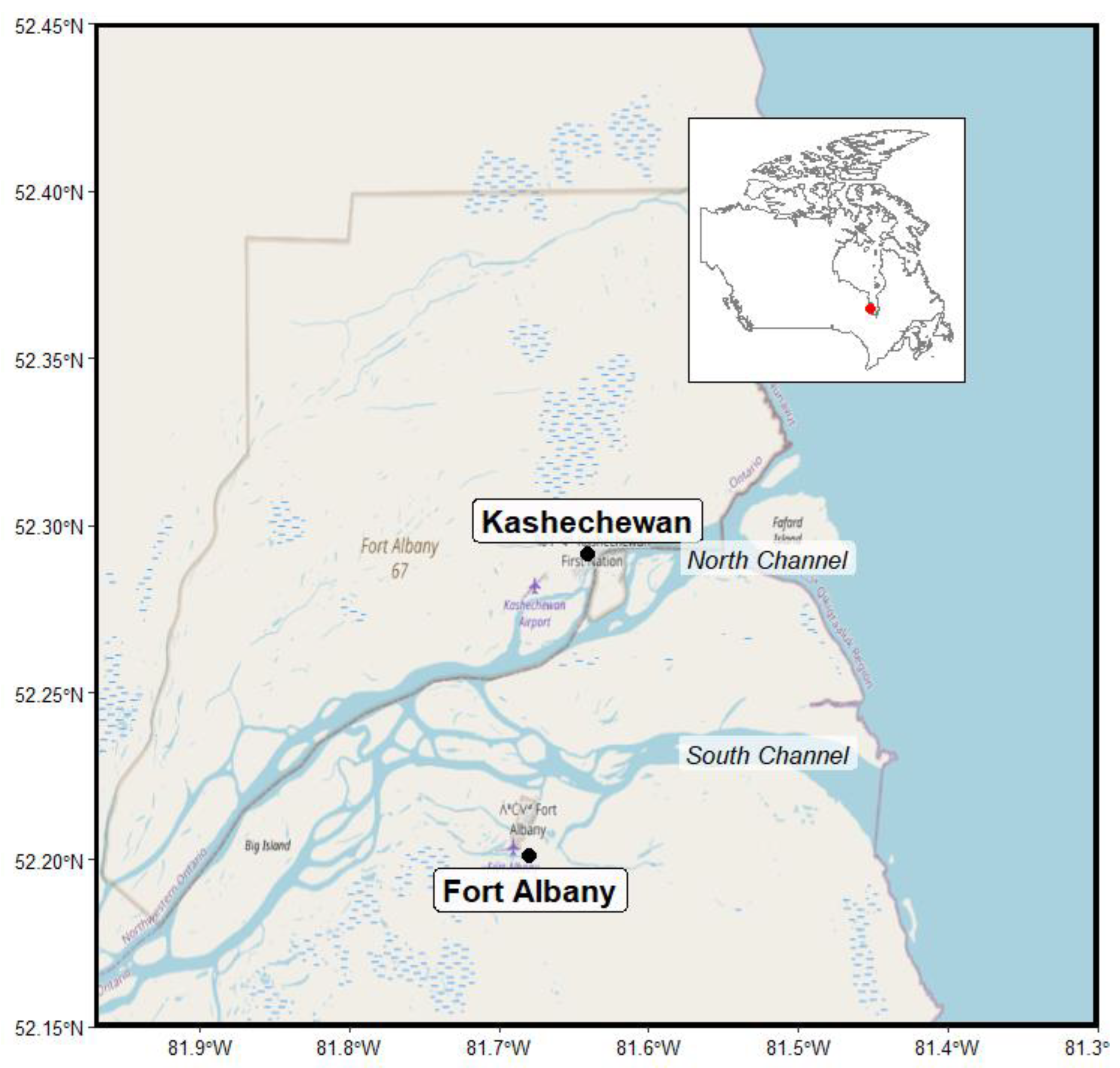
1.4.1. Kashechewan First Nation Flooding
1.4.2. Fort Albany First Nation Flooding
2. Background
2.1. Indigenous Environmental Justice
2.2. Treaty No. 9 and the Establishment of “Reserves”
3. Methods
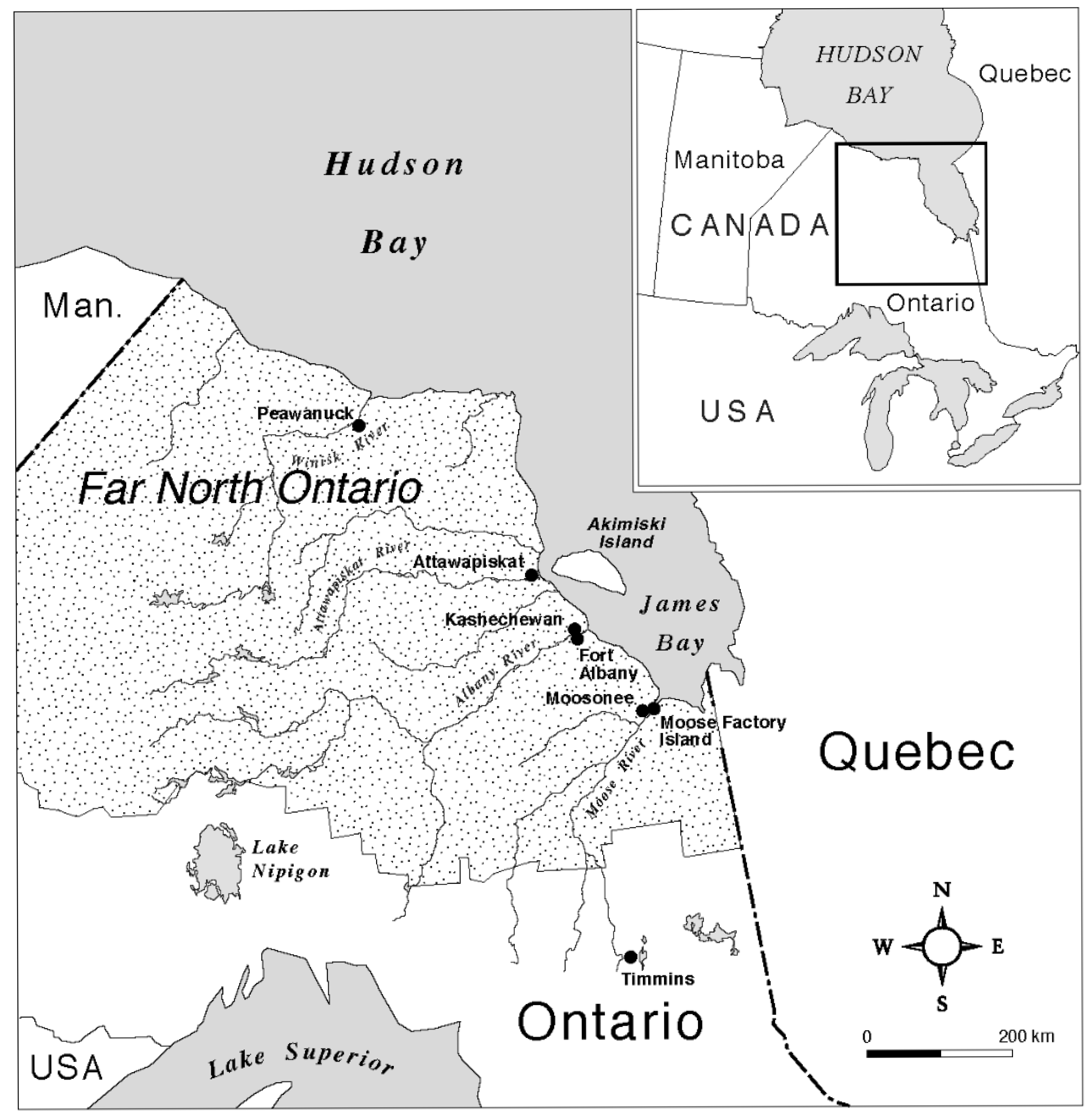
3.1. Study Area
3.2. Climate Change in Subarctic Ontario, Canada
3.3. Data Collection and Analyses
3.3.1. Why Are the First Nations Located on the Albany River Flood Plain in the First Place?
3.3.2. Fort Albany First Nation Perspectives of the 2008 Flood
4. Results and Discussion
4.1. The Evolution of In-Text Stipulations in Relation to “Reserves” in Treaty No. 9
“It is further proposed to set apart reserves of sufficient area in localities chosen by the Indians with special regard for their needs, which reserves should be held in trust by this Department [Indian Affairs], free of any claims by the Province for timber upon, or base or precious metals in upon or under the soil.” [61] (pp. 1–2)
“The setting apart and location of reserves not greater than one square mile for each family of five, or in like proportion, at points to be chosen by the Commissioners negotiating the said Treaty, one of said Commissioners to be appointed by the Lieutenant-Governor of Ontario in Council, and said selection to be subject to the approval of the Lieutenant-Governor of Ontario in Council.” [65] (p. 2)
“the advice of counsel…strongly advised that in order to prevent future litigation an agreement should be made between the Dominion and the Province defining the liability of the Province in respect to the Treaty…[Treaty No. 9] might be well to refer to the agreement between the Province and the Dominion in it.” [67] (pp. 1–2)
“under the provisions of clause 6 [the Statute of Canada, 54–55 Vic., chapter V]…the terms of the treaty [No. 9] were fixed by the governments of the Dominion and Ontario; the commissioners were empowered to offer certain conditions, but were not allowed to alter or add to them in the event of their not being acceptable to the Indians.” [44] (pp. 1–2).
4.2. What Did the First Nations Signatories of Treaty No. 9 Know of the Agreement?
“They [Indians] were to make certain promises and we [Government of Canada] were to make certain promises, but our purpose and our reasons were alike unknowable. What could they grasp of the pronouncement on the Indian tenure which had been delivered by the law lords of the Crown, what of the elaborate negotiations between a dominion [Canada] and a province [Ontario] which had made the treaty possible, what of the sense of traditional policy which brooded over the whole? Nothing. So there was no basis for argument.”
“Moonias [of Fort Hope], one of the most influential chiefs, asked a number of questions. He said that…he had never been given something for nothing…”Now,” he said “you gentlemen come to us from the King offering to give us benefits for which we can make no return. How is this?” Father Fafard thereupon explained to him…the Indians were giving their faith and allegiance to the King, and for giving up their title to a large area of land of which they could make no use…and that their reserves were set apart for them in order that they might have a tract in which they could not be molested, and where no white man would have any claims without the consent of their tribe and of the government.” [44] (paragraph 27)
“A lot of people say it’s our last frontier. What the government instead should be doing is congratulating all of the First Nations…for keeping the land in its natural state” (Chief George Hunter of Weenusk First Nation) [89] (p. 956)
“The land up north is not an untouched land. Our people, my ancestors, travelled that land…We’ve been there for thousands and thousands of years…there are footprints all over the place in my territory, that signifies that my people were out in the land.” (Chief Jonathon Solomon of Kashechewan First Nation) [89] (p. 954)
“The legacy of our care is that our use has been next to invisible. To you, the lands look untouched. They aren’t. They’ve just been touched by the Anishnawbe in accordance with Anishnawbe laws and customs…Ontario is penalizing us because they’re saying that that land is untouched by us.” (Special Envoy Frank Beardy of Nishnawbe Aski Nation) [89] (p. 953)
4.3. Choosing of Reserves at the Time of Treaty Signing
“And His Majesty the [British] King hereby agrees and undertakes to lay aside reserves for each band, the same not to exceed in all one square mile for each family of five, or in that proportion for larger and smaller families; and the location of the said reserves having been arranged between His Majesty’s commissioners and the chiefs and headmen, as described in the schedule of reserves hereto attached, the boundaries thereof to be hereafter surveyed and defined, the said reserves when confirmed shall be held and administered by His Majesty for the benefit of the Indians free of all claims, liens, or trusts by Ontario.” [29] (paragraph 9)
“that the Mattagami Band had originally wanted a site east of the post that was good deer-hunting country, but James Miller, the local [Hudson’s Bay] Company manager, persuaded them that Kenogamissi Falls down river was a better choice because of its power potential. Since the commissioners ‘wouldn’t allow that,’ he added, Mr. Miller ‘got them the only place—where they eventually got’ because ‘he knew there was some good pine there.’” [76] (p. 46)
“In the Northwest Territories, beginning at the point where the North river flows out of the main stream of the Albany, thence north on the west side of the North river a distance of ten miles and of sufficient depth to give an area of one hundred and forty square miles.” [44] (Schedule of Reserves).
4.4. Surveying the Reserves: The Correspondence
“Mr. Jabez Williams [Hudson’s Bay Company agent]…who was a witness to the signing of the Treaty informed me that he understood this reserve was to extend to the eastward of the Post and not to the westward, and the Indians also appeared to hold this view.” [97] (pp. 1–4)
“be careful to exclude by survey from all reserves where water-powers occur on a main river, a tract of about eighty acres… required to utilize the water power… roads for access to the said water-powers… roads for the public use across their reserves when they become necessary.” [100] (pp. 1–2)
4.5. The “Taken-Up Clause” and the Sharing of the Land
“And His Majesty the King hereby agrees with the said Indians that they shall have the right to pursue their usual vocations of hunting, trapping and fishing throughout the tract surrendered as heretofore described, subject to such regulations as may from time to time be made by the government of the country, acting under the authority of His Majesty, and saving and excepting such tracts as may be required or taken up from time to time for settlement, mining, lumbering, trading or other purposes.” [29] (paragraph 8).
“For the most part the reserves were selected by the commissioners after conference with the Indians. They have been selected in situations which are especially advantageous to their owners, and where they will not in any way interfere with railway development or the future commercial interests of the country. While it is doubtful whether the Indians will ever engage in agriculture, these reserves, being of a reasonable size, will give a secure and permanent interest in the land which the indeterminate possession of a large tract could never carry. No valuable water-powers are included within the allotments…When the vast quantity of waste and, at present, unproductive land, surrendered is considered, these allotments must, we think, be pronounced most reasonable.” [44] (second-last paragraph)
“Missabay, the recognized chief…spoke, expressing the fears of the Indians that, if they signed the treaty, they would be compelled to reside upon the reserve to be set apart for them, and would be deprived of the fishing and hunting privileges which they now enjoy…informed that their fears in regard to both these matters were groundless” [44] (paragraph 27).
“The Indians asked several questions as to whether they would be compelled to live on the reserve to be set apart for them, and as to whether their fishing and hunting privileges would be curtailed…informed that they could continue to live as they and their forefathers had done” [86] (pp. 38–39).
“Chief White head then delivered an oration, in wh[ich] he said, pointing up and down the river that they were being cornered by not being allowed both banks of the River…When it was explained to them that they could hunt and fish as of old and they were not restricted as to territory, the Reserve, merely being a home for them where in which no white man could interfere, or trespass upon, that the land was theirs for ever; they gladly accepted the situation” [84] (pp. 56–57).
4.6. Environmental Justice
4.7. Indigenous Environmental Justice
4.7.1. Cree Worldview
4.7.2. Nomadic or Mobile?
4.8. Fort Albany First Nation Perspectives of the 2008 Flood
4.8.1. Our Cycle of Life: The Way We Live
“Used to have tent frames on high ground in case of flooding—could do this again using gravel to build high ground—but need a nurse to visit camps to look after sick people and check to make sure everything okay…Need gravel to build high ground…Winter tents need heat.” (M24)
“relocate the communities [to high ground]…If you move the communities, the people would not have to go through this [evacuation] every year or finish the dikes and extend them―finish the dikes and extension and upgrades, and continue living here” (M17).
“The community should not have been evacuated. Should have used evacuation centre unless really serious…community hall [also purposed as an evacuation centre, needed]—more equipment…water purifiers, other things needed to deal a large number of people…build another building for accommodations” (M12).
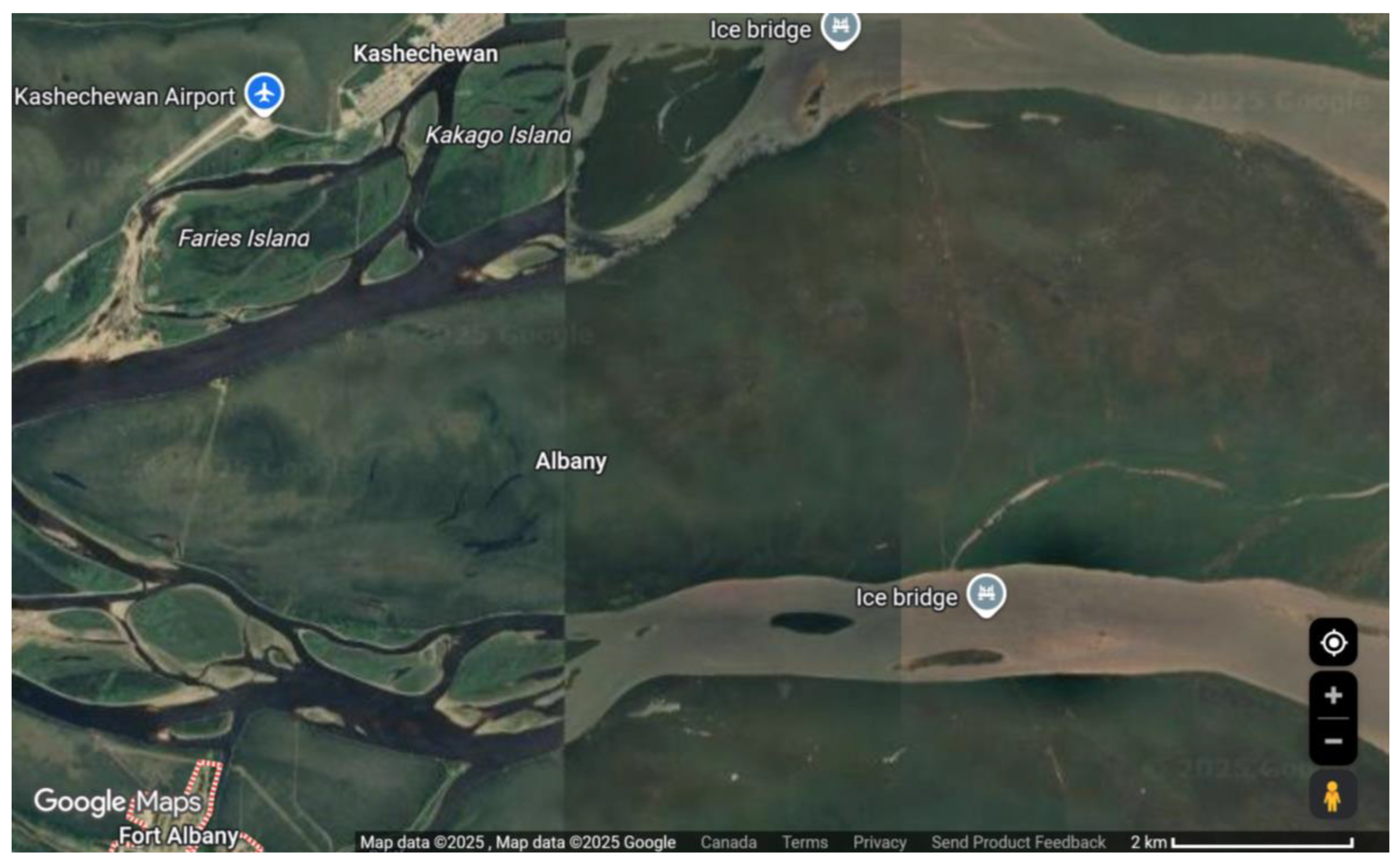
“Ice jam caused the flood this year [but]…winter ice road may have had some effect resulting in the flood since the winter road was thicker and wider than previous years, and the winter road was downstream of Fort Albany [see Figure 4]. [Ice-road workers] Drilled holes in the ice of the winter road but these holes appeared to be drilled randomly—there appears to be no set plan” (M3).
4.8.2. Water and Wellbeing
4.9. The Way Forward for Fort Albany First Nation
5. Conclusions
Author Contributions
Funding
Institutional Review Board Statement
Informed Consent Statement
Data Availability Statement
Acknowledgments
Conflicts of Interest
References
- WMO. Devastating Floods Highlight Need and Challenges for Warnings. World Meteorological Organization. Available online: https://wmo.int/media/news/devastating-floods-highlight-need-and-challenges-warnings (accessed on 21 November 2025).
- WMO. Natural Hazards. World Meteorological Organization. Available online: https://wmo.int/topics/floods (accessed on 21 November 2025).
- Waldram, J.B. As Long as the Rivers Run: Hydroelectric Development and Native Communities in Western Canada; University of Manitoba Press: Winnipeg, MB, Canada, 1993. [Google Scholar]
- Thompson, S. Flooding of first nations and environmental justice in Manitoba: Case studies of the impacts of the 2011 flood and hydro development in Manitoba. Manit. Law J. 2015, 38, 220–259. [Google Scholar] [CrossRef]
- Indigenous Services Canada. Wildland Fire and Flood Evacuation Statistics Between April 1, 2014 and March 31, 2024. Government of Canada. Available online: https://www.sac-isc.gc.ca/eng/1583177459681/1583177553276 (accessed on 5 January 2026).
- Tsosie, R. Indigenous Peoples and Epistemic Injustice: Science, Ethics, and Human Rights. Wash. Law Rev. 2012, 87, 1133. [Google Scholar]
- Annin, P. The Great Lakes Water Wars; Island Press: Washington, DC, USA, 2006. [Google Scholar]
- Chakraborty, L.; Rus, H.; Henstra, D.; Thistlethwaite, J.; Minano, A.; Scott, D. Exploring spatial heterogeneity and environmental injustices in exposure to flood hazards using geographically weighted regression. Environ. Res. 2022, 210, 112982. [Google Scholar] [CrossRef]
- Chakraborty, L.; Thistlethwaite, J.; Minano, A.; Henstra, D.; Scott, D. Leveraging hazard, exposure, and social vulnerability data to assess flood risk to indigenous communities in Canada. Int. J. Disas. Risk Sci. 2021, 12, 821–838. [Google Scholar] [CrossRef]
- Tsuji, S. Economic Recovery in Response to Worldwide Crises: Fiduciary Responsibility and the Legislative Consultative Process with Respect to Bill 150 (Green Energy and Green Economy Act, 2009) and Bill 197 (COVID-19 Economic Recovery Act, 2020) in Ontario, Canada. Int. Indig. Policy J. 2022, 13, 1–40. [Google Scholar] [CrossRef]
- Tsuji, L.J.S.; Daradich, A.; Gomez, N.; Hay, C.; Mitrovica, J.X. Sea-Level Change in the Western James Bay Region of Sub-Arctic Ontario: Emergent Land and Implications for Treaty No. 9. Arctic 2016, 69, 99–107. [Google Scholar] [CrossRef]
- Tsuji, L.J.S.; Nieboer, E. A question of sustainability in Cree harvesting practices: The seasons, technological and cultural changes in the western James Bay region of northern Ontario, Canada. Can. J. Native Stud. 1999, 19, 169–192. [Google Scholar]
- Turcotte, B.; Burrell, B.C.; Beltaos, S. The Impact of Climate Change on Breakup Ice Jams in Canada: State of knowledge and research approaches. In Proceedings of the CGU HS Committee on River Ice Processes and the Environment. 20th Workshop on the Hydraulics of Ice Covered Rivers, Ottawa, ON, Canada, 14–16 May 2019. [Google Scholar]
- Beltaos, S.; Prowse, T.D. Climate impacts on extreme ice-jam events in Canadian rivers. Hydro. Sci. J. 2001, 46, 57–181. [Google Scholar] [CrossRef]
- Ho, E.; Tsuji, L.J.S.; Gough, W.A. Trends in River-Ice Break-up Data for the Western James Bay Region of Canada. Polar Geog. 2005, 29, 291–299. [Google Scholar] [CrossRef]
- Abdelnour, R. Albany River 2008 ice breakup: Forecasting the flood event, observations of the river during the spring breakup and the potential for mitigating the flooding risk of the Kashechewan and Fort Albany First Nation. In Proceedings of the CGU-HS Committee on River Ice Processes and the Environment, 17th Workshop on River Ice, Edmonton, AB, Canada, 21–24 July 2013. [Google Scholar]
- Nishnawbe Aski Nation (NAN). Final Report: Emergency Management for First Nations in Ontario; Ninshnawbe Aski Nation: Thunder Bay, ON, Canada, 2021. [Google Scholar]
- Hatch Ltd. Kashechewan First Nation. Assessment of Dam Safety Risks and Dam Safety Management Requirements for the Kashechewan Ring Dyke; H348671-000-200-230-0001; Hatch Ltd.: Mississauga, ON, Canada, 2015. [Google Scholar]
- Grover, P.; Vrkljan, C.; Beltaos, S.; Andres, D. Prediction of ice jam water levels in a multi-channel river: Fort Albany, Ontario. In Proceedings of the Tenth Workshop on River Ice, Winnipeg, MB, Canada, 8–11 June 1999. Canadian Geophysical Union, Committee on River Ice Processes and Environment, Hydrology Section. [Google Scholar]
- Pope, A.W. Report on the Kashechewan and Its People; Report Submitted to Aboriginal Affairs and Northern Development Canada. 2006. Available online: https://central.bac-lac.gc.ca/.item?id=kfnp_e&op=pdf&app=Library (accessed on 10 December 2025).
- Faries, E. Voice of the people on the re-location issue: Kashechewan First Nation, Ontario, Canada. OIDA Int. J. Sustain. Dev. 2015, 8, 99–109. [Google Scholar]
- Khalafzai, M.; McGee, T.K.; Parlee, B. Flooding in the James Bay region of northern Ontario, Canada: Learning from traditional knowledge of Kashechewan First Nation. Int. J. Dis. Risk Red. 2019, 36, 101100. [Google Scholar] [CrossRef]
- Khalafzai, M.; McGee, T.K.; Parlee, B. Frequent Flooding and Perceived Adaptive Capacity of Subarctic Kashechewan First Nation, Canada. Arctic 2020, 73, 433–449. [Google Scholar] [CrossRef]
- Kashechewan First Nation; Government of Canada; Government of Ontario. The Together We Work for Hope 2019 Framework Agreement; Kashechewan First Nation: Kashechewan, ON, Canada; Government of Canada: Ottawa, ON, Canada; Government of Ontario: Toronto, ON, Canada, 2019.
- White, E. Northern Ontario Chief Says His Community Continues to ‘Fear’ Flooding Because of Neighbouring First Nation. Available online: https://www.cbc.ca/news/canada/sudbury/kashechewan-fort-albany-relocation-federal-government-1.6813820 (accessed on 17 December 2025).
- Rabski-McColl, A. Fort Albany Chief Says Flood Protections Are Falling Short. Available online: https://www.timminstoday.com/local-news/fort-albany-chief-says-flood-protections-are-falling-short-6968566 (accessed on 10 December 2025).
- Beaton, A.; Van Der Sanden, J.; Corston, K.; Deschamps, A.; Tolszczuk-Leclerc, S. Near Real-Time Monitoring of Ice Breakup in the Far North of Ontario Using RADARSAT-2 in Support of Provincial Flood Forecasting and Warning. In Proceedings of the CGU HS Committee on River Ice Processes and the Environment 19th Workshop on the Hydraulics of Ice Covered Rivers, Whitehorse, YT, Canada, 9–12 July 2017. [Google Scholar]
- Beaton, A.; Whaley, R.; Corston, K.; Kenny, F. Identifying historic river ice breakup timing using MODIS and Google Earth Engine in support of operational flood monitoring in Northern Ontario. Rem. Sens. Environ. 2019, 224, 352–364. [Google Scholar] [CrossRef]
- The James Bay Treaty: Treaty No. 9; Made in 1905 and 1906, and Adhesions Made in 1929 and 1930. 1929. Cat. No. Ci 72-0964. QS-0577-OOO-EE-A-1. Reprinted from the Edition of 1931 by Roger Duhamel, Queen’s Printer and Controller of Stationary, Ottawa, Ontario, 1964; The James Bay Treaty—Treaty No. 9 (1905) Treaty No. 9. 1905. James Bay Treaty No. 9. James Bay Treaty No. 9. Government of Canada’s Vellum Copy (MIKAN No. 3987469 or R216-79-6-E; Volume 1851/IT436; GAD Reference Number IT 436). Available online: http://occc.ca/wp-content/uploads/2016/12/treaty-9-english-original-copy.pdf (accessed on 8 December 2025).
- Commission for Racial Justice. Toxic Wastes and Race in the United States; United Church of Christ: Cleveland, OH, USA, 1987. [Google Scholar]
- Bullard, R.D.; Mohai, P.; Saha, R.; Wright, B. Toxic Wastes and Race at Twenty 1987–2007; United Church of Christ: Cleveland, OH, USA, 2007. [Google Scholar]
- Scott, D.N. What is environmental justice? Osgoode Legal Stud. Res. Pap. 2014, 10, 72. [Google Scholar] [CrossRef]
- Lindgren, R.D. Access to Environmental Justice in Canada: The Road Ahead. Canadian Environmental Law Association. 2019. Available online: https://cela.ca/access-to-environmental-justice-in-canada-the-road-ahead/ (accessed on 8 December 2025).
- Tsuji, S.R.J. Indigenous Environmental Justice and Sustainability: What Is Environmental Assimilation? Sustainability 2021, 13, 8382. [Google Scholar] [CrossRef]
- Government of Canada. Environmental Justice and Environmental Racism. 2025. Available online: https://www.canada.ca/en/environment-climate-change/services/strategic-policy-branch/environmental-justice.html (accessed on 31 October 2025).
- McGregor, D.; Whitaker, S.; Sritharan, M. Indigenous environmental justice and sustainability. Curr. Opin. Environ. Sustain. 2020, 43, 35–40. [Google Scholar] [CrossRef]
- Shaikh, A.; Kauppi, C.; Case, R. Flooding in Kashechewan First Nation: Is it an environmental justice issue. Can. J. Nat. Stud. 2017, 377, 105–130. [Google Scholar]
- Tsuji, L.J.S.; Tsuji, S.R.J. Development on Indigenous Homelands and the need to get back to basics with scoping: Is there still “unceded” land in Northern Ontario, Canada, with respect to Treaty No. 9 and its Adhesions? Int. Indig. Policy J. 2021, 12, 1–49. [Google Scholar] [CrossRef]
- British North American Act, 1867 (or Constitution Act, 1867); A Consolidation of the Constitution Acts 1867 to 1982, Department of Justice Canada, Consolidated as of January 1, 2013; Public Works and Government Services Canada: Ottawa, ON, Canada, 2012; Available online: https://laws-lois.justice.gc.ca/pdf/const_e.pdf (accessed on 8 December 2025).
- Dean, W.G. Economic Atlas of Ontario; University of Toronto Press: Toronto, ON, Canada, 1969. [Google Scholar]
- Archives of Ontario. The Evolution of Ontario’s Boundaries 1774–1912. 2008. Available online: http://www.archives.gov.on.ca/en/maps/ontario-boundaries.aspx (accessed on 8 December 2025).
- Rupert’s Land and North-Western Territory–Enactment No. 3. 1870. Part 1. 1870. Available online: http://canada.justice.gc.ca/eng/rp-pr/csj-sjc/constitution/lawreg-loireg/p1t31.html (accessed on 8 December 2025).
- Royal Proclamation of 1763. 1763. CIRNAC: Ottawa, ON, Canada. Available online: https://www.rcaanc-cirnac.gc.ca/eng/1370355181092/1607905122267 (accessed on 8 December 2025).
- Scott, D.C.; Stewart, S.; MacMartin, D.G. James Bay Treaty No. 9—November 6, 1905; Treaty No. 9—James Bay Treaty—Annuity interest payments and accounts (MIKAN No. 2083329 or R216-244-6-E; Volume 3034 File Part 4; File 235,225); Government Printing Bureau: Ottawa, ON, Canada, 1907. [Google Scholar]
- Drake, K. The Impact of St Catherine’s Milling. Law Society of Upper Canada, Special Lectures 2017. In Canada at 150: The Charter and the Constitution; Law Society of Upper Canada: Toronto, ON, Canada, 2018; Available online: https://digitalcommons.osgoode.yorku.ca/cgi/viewcontent.cgi?article=3684&context=scholarly_works (accessed on 8 December 2025).
- Tsuji, S.R.J.; Tsuji, L.J.S. Treaty No. 9 and the Question of “Unceded” Land South of the Albany River in Subarctic Ontario, Canada. Arctic 2021, 74, 372–395. [Google Scholar] [CrossRef]
- Government of Ontario. About Ontario. 2025. Available online: https://www.ontario.ca/page/about-ontario (accessed on 8 December 2025).
- Spotton, N. A Profile of Aboriginal Peoples in Ontario; Ipperwash Inquiry: Toronto, ON, Canada, 2006. [Google Scholar]
- Keller, B.; Paterson, A.M.; Rühland, K.M.; Blais, J.M. Introduction—Environmental Change in the Hudson and James Bay Region. Arct. Antarct. Alp. Res. 2014, 46, 2–5. [Google Scholar] [CrossRef][Green Version]
- Martini, I.P.; Kwong, J.K.; Sadura, S. Sediment ice rafting and cold climate fluvial deposits: Albany River, Ontario, Canada. Spec. Pubis Int. Ass. Sediment. 1993, 17, 63–76. [Google Scholar] [CrossRef]
- Gough, W.A.; Cornwell, A.; Tsuji, L.J.S. Trends in seasonal sea ice duration in southwestern Hudson Bay. Arctic 2004, 57, 299–305. [Google Scholar] [CrossRef]
- Gagnon, A.S.; Gough, W.A. Trends in the dates of ice freeze-up and breakup over Hudson Bay, Canada. Arctic 2005, 58, 370–382. [Google Scholar] [CrossRef]
- Rantanen, M.; Karpechko, A.Y.; Lipponen, A.; Nordling, K.; Hyvarinen, O.; Ruosteenoja, K.; Vihma, T.; Laaksonen, A. The arctic has warmed nearly four times faster than the globe since 1979. Commun. Earth Environ. 2022, 3, 168. [Google Scholar] [CrossRef]
- Gagnon, A.S.; Gough, W.A. Hydro-climatic trends in the Hudson Bay region, Canada. Can. Water Res. J. 2002, 27, 245–262. [Google Scholar] [CrossRef]
- Hori, Y.; Gough, W.A.; Butler, K.; Tsuji, L.J.S. Trends in seasonal length and opening dates of a winter road in the western James Bay region, Ontario, Canada. Theor. Appl. Clim. 2017, 129, 1309–1320. [Google Scholar] [CrossRef]
- Déry, S.J.; Stadnyk, T.A.; MacDonald, M.K.; Gauli-Sharma, B. Recent trends and variability in river discharge across northern Canada. Hydrol. Earth Syst. Sci. 2016, 20, 4801–4818. [Google Scholar] [CrossRef]
- Champagne, O.; Arain, M.A.; Wang, S.; Leduc, M.; Russell, H.A.J. Interdecadal variability of streamflow in the Hudson Bay Lowlands watersheds driven by atmospheric circulation. J. Hydrol. Reg. Stud. 2021, 36, 100868. [Google Scholar] [CrossRef]
- Hori, Y.; Gough, W.A.; Tam, B.; Tsuji, L.J.S. Community vulnerability to changes in the winter road viability and longevity in the western James Bay region of Ontario’s Far North. Reg. Environ. Change 2018, 18, 1753–1763. [Google Scholar] [CrossRef]
- McCarthy, D.D.; Crandall, D.; Whitelaw, G.S.; General, Z.L.; Tsuji, L.J.S. A critical systems approach to social learning: Building adaptive capacity in social, ecological, epistemological (SEE) system. Ecol. Soc. 2011, 16, 18. [Google Scholar] [CrossRef]
- Long, J. Treaty No. 9. Making the Agreement to Share the Land in Far Northern Ontario in 1905; McGill-Queen’s University Press: Montreal, QC, Canada, 2010. [Google Scholar]
- Pedley, F.F. Pedley, Deputy Superintendent General Indian Affairs, Letter dated 30 April 1904, to E. Davis, Commissioner of Crown Lands, Government of Ontario. Treaty No. 9 The James Bay Treaty—Reports, Correspondence, Drafts, Memorandums, Order in Council (MIKAN No. 2082958 or R216-244-6-E; Volume 3033; File 235,225 Part 1). Available online: https://www.bac-lac.gc.ca/eng/CollectionSearch/Pages/record.aspx?app=fonandcol&IdNumber=2082958&new=-8585745426240422147 (accessed on 11 December 2025).
- Newcombe, E.E. Newcombe, Deputy Minister of Justice, Government of Canada, Letter Dated 5 May 1905, to F. Pedley, Deputy Superintendent General Indian Affairs. Treaty No. 9 The James Bay Treaty—Reports, Correspondence, Drafts, Memorandums, Order in Council (MIKAN No. 2082958 or R216-244-6-E; Volume 3033; File 235,225 Part 1). Available online: https://www.bac-lac.gc.ca/eng/CollectionSearch/Pages/record.aspx?app=fonandcol&IdNumber=2082958&new=-8585745426240422147 (accessed on 11 December 2025).
- Government of Canada Order-in-Council (#1905-1065). Orders-in-Council, 1867 to 1940. Available online: https://www.canada.ca/en/library-archives/collection/research-help/politics-government-law/orders-in-council.html (accessed on 8 December 2025).
- Government of Ontario. Orders in Council. 2020. Available online: https://www.ontario.ca/page/orders-council (accessed on 8 December 2025).
- Matheson, A. A Matheson, Provincial Treasurer, Government of Ontario, Letter Dated 1 June 1905, and Enclosure (Draft Order-in-Council) to F. Pedley, Deputy Superintendent General Indian Affairs. Treaty No. 9 The James Bay Treaty—Reports, Correspondence, Drafts, Memorandums, Order in Council (MIKAN No. 2082958 or R216-244-6-E; Volume 3033; File 235,225 Part 1). Available online: https://www.bac-lac.gc.ca/eng/CollectionSearch/Pages/record.aspx?app=fonandcol&IdNumber=2082958&new=-8585745426240422147 (accessed on 11 December 2025).
- Pedley, F. F Pedley, Memorandum Dated 2 June 1905, to Sir Wilfred Laurier, Department of Indian Affairs, Ottawa [Ontario, Canada]. Treaty No. 9 The James Bay Treaty—Reports, Correspondence, Drafts, Memorandums, Order in Council (MIKAN No. 2082958 or R216-244-6-E; Volume 3033; File 235,225 Part 1). Available online: https://www.bac-lac.gc.ca/eng/CollectionSearch/Pages/record.aspx?app=fonandcol&IdNumber=2082958&new=-8585745426240422147 (accessed on 11 December 2025).
- Matheson, A.A. Matheson, Provincial Treasurer, Government of Ontario, Letter Dated 23 June 1905, to F. Pedley, Deputy Superintendent General Indian Affairs. Treaty No. 9 The James Bay Treaty—Reports, Correspondence, Drafts, Memorandums, Order in Council (MIKAN No. 2082958 or R216-244-6-E; Volume 3033; File 235,225 Part 1). Available online: https://www.bac-lac.gc.ca/eng/CollectionSearch/Pages/record.aspx?app=fonandcol&IdNumber=2082958&new=-8585745426240422147 (accessed on 11 December 2025).
- Government of Ontario. Draft Agreement was Enclosed with the A. Matheson, Provincial Treasurer, Government of Ontario, Letter Dated June 23, 1905, to F. Pedley, Deputy Superintendent General Indian Affairs Treaty No. 9 The James Bay Treaty—Reports, Correspondence, Drafts, Memorandums, Order in Council (MIKAN No. 2082958 or R216-244-6-E; Volume 3033; File 235,225 Part 1). Available online: https://www.bac-lac.gc.ca/eng/CollectionSearch/Pages/record.aspx?app=fonandcol&IdNumber=2082958&new=-8585745426240422147 (accessed on 11 December 2025).
- Pedley, F.F. Pedley, Deputy Superintendent General Indian Affairs, Memorandum Dated 26 June 1905, RE Treaty No. 9. Treaty No. 9 The James Bay Treaty—Reports, Correspondence, Drafts, Memorandums, Order in Council (MIKAN No. 2082958 or R216-244-6-E; Volume 3033; File 235,225 Part 1). Available online: https://www.bac-lac.gc.ca/eng/CollectionSearch/Pages/record.aspx?app=fonandcol&IdNumber=2082958&new=-8585745426240422147 (accessed on 11 December 2025).
- Rosenberg, D.M.; Bodaly, R.A.; Usher, P.J. Environmental and social impacts of large scale hydroelectric development: Who is listening? Glob. Environ. Change 1995, 5, 127–148. [Google Scholar] [CrossRef]
- Macfarlane, D.; Kitay, P. Hydraulic Imperialism: Hydroelectric Development and Treaty 9 in the Abitibi Region. Am. Rev. Can. Stud. 2016, 46, 380–397. [Google Scholar] [CrossRef]
- Macfarlane, D.; Watson, A. Hydro Democracy: Water Power and Political Power in Ontario. Sci. Can. 2018, 40, 1–18. [Google Scholar] [CrossRef]
- Armstrong, J. A Political Economy of Native Marginalization: A Study of the Appropriation of Aboriginal Water Rights: The Case of the Mishkeegogamang First Nation. Ph.D. Thesis, Queen’s University, Kingston, ON, Canada, 2000. Available online: https://www.collectionscanada.gc.ca/obj/s4/f2/dsk3/ftp04/NQ56072.pdf (accessed on 17 December 2025).
- Wildman, C.J. Letter Dated 2 May 1993, to John Turner, Chairman of the Moose River/James Bay Coalition; Government of Ontario: Algoma, ON, Canada, 1993. [Google Scholar]
- Tsuji, S.R.J.; McCarthy, D.D.P.; Quilley, S. Green Energy—Green for Whom? A Case Study of the Kabinakagami River Waterpower Project in Northern Canada. Sustainability 2021, 13, 9445. [Google Scholar] [CrossRef]
- Morrison, J. Treaty Research Report—Treaty No. 9 (1905–1906); Treaties and Historical Research Centre, Indian and Northern Affairs Canada: Ottawa, ON, Canada, 1986; Available online: https://www.rcaanc-cirnac.gc.ca/eng/1100100028859/1564415209671 (accessed on 8 December 2025).
- Morrison, J. The poet and the Indians. Duncan Campbell Scott woos the muse and negotiates Treaty Number Nine. Beaver 1988, 68, 4–16. [Google Scholar]
- Long, J. “No basis for argument”: The signing of Treaty Nine in northern Ontario, 1905–1906. Nat. Stud. Rev. 1989, 5, 19–54. [Google Scholar]
- Dragland, S. Floating Voice. Duncan Campbell Scott and the Literature of Treaty 9; House of Anansi Press: Concord, ON, Canada, 1994. [Google Scholar]
- Supreme Court Judgments. Rio Tinto Alcan Inc. v. Carrier Sekani Tribal Council; 2010 SCC 43; Supreme Court Judgments (SCC): Ottawa, ON, Canada, 2010. [Google Scholar]
- Scott, D.C. The last of the Indian treaties. Scribner’s Mag. 1906, 40, 573–583. [Google Scholar]
- Armstrong, J. The Role of Ontario in the Making and Implementation of Treaty Nine: The Taking up Clause and Harvesting Rights; Armstrong Historical Research Services; Nishnawbe Aski Nation Head Office: Thunder Bay, ON, Canada, 2013. [Google Scholar]
- Macklem, P. The impact of Treaty 9 on natural resource development in northern Ontario. In Aboriginal and Treaty Rights in Canada: Essays on Law, Equity, and Respect for Difference; Asch, M., Ed.; UBC Press: Vancouver, BC, Canada, 1997; pp. 97–132. [Google Scholar]
- MacMartin, D.G. Treaty No. 9 Diary; Daniel George W. MacMartin Collection, CA ON00239 F00149; Queen’s University Archives: Kingston, ON, Canada, 1905. [Google Scholar]
- Scott, D.C. Journal of James Bay Treaty Trips; 30 June–6 September 1905. 38p; Library and Archives Canada (LAC): Ottawa, ON, Canada, 1905; RG 10; Volume 1028. [Google Scholar]
- Stewart, S. The James Bay Treaty: Treaty 9; 1905; 175p. Available online: http://www.treaty9diaries.ca/wp-content/uploads/2011/05/Stewart-Diary-1905.pdf (accessed on 8 December 2025).
- Stewart, S. The James Bay Treaty: Indians Dealt with by the Commissioners During Summer of 1906; 1906; 131p. Available online: http://www.treaty9diaries.ca/wp-content/uploads/2011/05/Stewart-Diary-1906.pdf (accessed on 8 December 2025).
- Armstrong, J. The Elusive Statement of Treaty Principles James Bay Treaty No. 9. NAN-Canada Treaty Discussion Forum; Armstrong Historical Research Services; Nishnawbe Aski Nation Head Office: Thunder Bay, ON, Canada, 2008. [Google Scholar]
- G35 Standing Committee on the General Government, Hearings, Bill 173 (Mining Amendment Act, 2009). Available online: https://www.ola.org/en/legislative-business/bills/parliament-39/session-1/bill-173/debates (accessed on 8 December 2025).
- Scott, D.C. D.C. Scott, Department of Indian Affairs Letter Dated 3 August 1927, to G. Ferguson, Premier of Ontario; Library and Archives: Ottawa, ON, Canada, 1927; MIKAN No. 2083404 or R216-244-6-E; Volume 3033 File Part 1A; File 235,225. [Google Scholar]
- Brabant, A.A. Brabant of the Hudson’s Bay Company Letter Dated 7 June 1926, to D.C. Scott and R. Coward, Department of Indian Affairs; MIKAN No. 2083404 or R216-244-6-E; Volume 3033 File Part 1A; File 235,225; Library and Archives Canada: Ottawa, ON, Canada, 1926. [Google Scholar]
- Department of Indian Affairs Canada. Memorandum Dated 29 July 1927, Re Census of Indians, as Supplied by the Hudson’s Bay Company and Messrs. Revillon Freres, in Connection with Adhesion to Treaty 9; Library and Archives Canada: Ottawa, ON, Canada, 1927; MIKAN No. 2083404 or R216-244-6-E; Volume 3033 File Part 1A; File 235,225. [Google Scholar]
- Calverley, D. The impact of the Hudson’s Bay Companyon the creation of Treaty Number Nine. Ont. Hist. 2006, 98, 30–51. [Google Scholar] [CrossRef]
- Manore, J.L. Cross-Currents: Hydroelectricity and the Engineering of Northern Ontario; Wilfred Laurier University Press: Waterloo, ON, Canada, 1999. [Google Scholar]
- McLean, J.D. J.D. McLean, Secretary, Department of Indian Affairs Letter Dated 14 June 1909, to W. Galbraith, Surveyor Treaty No. 9—James Bay Agency Survey of Treaty No. 9: Reports, Memoranda, Diaries, Pay Sheets, Accounts (Plans, Tracings); MIKAN No. 2072971 (R216-244-6-E; Volume 3105; File 309,350-3). 1909–1914; Library and Archives Canada (LAC): Ottawa, ON, Canada, 1909. [Google Scholar]
- Galbraith, W.W. Galbraith, Surveyor, Correspondence Dated 29 July 1909, to J.D. McLean, Department of Indian Affairs. Treaty No. 9—James Bay Agency Survey of Treaty No. 9: Reports, Memoranda, Diaries, Pay Sheets, Accounts (Plans, Tracings); MIKAN No. 2072971 (R216-244-6-E; Volume 3105; File 309,350-3); Library and Archives Canada (LAC): Ottawa, ON, Canada, 1909. [Google Scholar]
- Galbraith, W.W. Galbraith, Surveyor, Correspondence Dated 30 September 30, 1909, to J.D. McLean, Secretary, Department of Indian Affairs Treaty No. 9—James Bay Agency Survey of Treaty No. 9: Reports, Memoranda, Diaries, Pay Sheets, Accounts (Plans, Tracings); MIKAN No. 2072971 (R216-244-6-E; Volume 3105; File 309,350-3); Library and Archives Canada (LAC): Ottawa, ON, Canada, 1909. [Google Scholar]
- Galbraith, W. Galbraith’s Diary 1909, 1910. Treaty No. 9—James Bay Agency Survey of Treaty No. 9: Reports, Memoranda, Diaries, Pay Sheets, Accounts (Plans, Tracings); MIKAN No. 2072971 (R216-244-6-E; Volume 3105; File 309,350-3); Library and Archives Canada (LAC): Ottawa, ON, Canada, 1909. [Google Scholar]
- Galbraith, W. Galbraith’s Report on Survey of Indian Reserves as per Treaty No. 9, 1910. Treaty No. 9—James Bay Agency Survey of Treaty No. 9: Reports, Memoranda, Diaries, Pay Sheets, Accounts (Plans, Tracings); MIKAN No. 2072971 (R216-244-6-E; Volume 3105; File 309,350-3); Library and Archives Canada (LAC): Ottawa, ON, Canada, 1910. [Google Scholar]
- McLean, J. J McLean, Assistant Deputy and Secretary Indian Affairs, Letter Dated 11 April 1911, to S Dobie, Ontario & Dominion Land Surveyor. Treaty No. 9—James Bay Agency Survey of Treaty No. 9: Reports, Memoranda, Diaries, Pay Sheets, Accounts (Plans, Tracings); MIKAN No. 2072971 or R216-244-6-E; Volume 3105; File 309,350-3; Library and Archives Canada (LAC): Ottawa, ON, Canada, 1911. [Google Scholar]
- Dobie, S. Surveyor Report Dated 30 March 1912, to J. McLean, Assistant Deputy and Secretary Indian Affairs Treaty No. 9—James Bay Agency Survey of Treaty No. 9: Reports, Memoranda, Diaries, Pay Sheets, Accounts (Plans, Tracings); MIKAN No. 2072971 (R216-244-6-E; Volume 3105; File 309,350-3); Library and Archives Canada (LAC): Ottawa, ON, Canada, 1912. [Google Scholar]
- Tsuji, S.R.J. Fiduciary Responsibility and the Green Energy Act, 2009 (Ontario, Canada). Environ. Just. 2020, 14, 76–85. [Google Scholar] [CrossRef]
- Tsuji, S.R.J. Indigenous Homelands and Environmental Assimilation: Canada’s Impact Assessment Act (2019), and the Public Interest Determination. Int. Indig. Pol. J. 2025, 16. in press. [Google Scholar]
- Long, J. “The Government is Asking You for Your Land”: The Treaty Made in 1905 at Fort Albany According to Cree Oral Tradition; J.S. Long: Moose Factory, ON, Canada, 1993. [Google Scholar]
- Long, J. How the commissioners explained Treaty Number Nine to the Ojibway and Cree in 1905. Ont. Hist. 2006, 98, 1–29. [Google Scholar] [CrossRef][Green Version]
- Bill 5. An Act to Enact the Special Economic Zones Act, 2025, to Amend the Endangered Species Act, 2007 and to Replace it with the Species Conservation Act, 2025, and to Amend Various Acts and Revoke Various Regulations in Relation to Development and to Procurement, 2025; Short Title: Bill 5, Protect Ontario by Unleashing our Economy Act. 2025. Available online: https://www.ola.org/en/legislative-business/bills/parliament-44/session-1/bill-5/status (accessed on 11 December 2025).
- Bill C-5. An Act to Enact the Free Trade and Labour Mobility in Canada Act and the Building Canada Act, 2025; Short Title: One Canadian Economy Act. Available online: https://www.parl.ca/documentviewer/en/45-1/bill/C-5/royal-assent (accessed on 11 December 2025).
- Gardner, H.L.; Tsuji, S.R.J.; McCarthy, D.D.; Whitelaw, G.S.; Tsuji, L.J.S. The Far North Act (2010) consultative process: A new beginning or the reinforcement of an unacceptable relationship in northern Ontario, Canada? Int. Indig. Pol. J. 2012, 3, 7. [Google Scholar] [CrossRef]
- Tsuji, L.J.S.; McCarthy, D.D.; Whitelaw, G.S.; McEachren, J. Getting back to basics: The Victor Diamond Mine environmental assessment scoping process and the issue of family-based traditional lands versus registered traplines. Impact Assess. Proj. Apprais. 2011, 129, 37–47. [Google Scholar] [CrossRef]
- Tsuji, S.R.J.; Zuk, A.M.; Solomon, A.; Edwards-Wheesk, R.; Ahmed, F.; Tsuji, L.J.S. What Is Wellbeing, and What Is Important for Wellbeing? Indigenous Voices from across Canada. Int. J. Environ. Res. Public Health 2023, 20, 6656. [Google Scholar] [CrossRef] [PubMed]
- Tsuji, L.J.S.; Tsuji, S.R.J.; Zuk, A.M.; Davey, R.; Liberda, E.N. Harvest programs in First Nations of Subarctic Canada: The benefits go beyond addressing food security and environmental sustainability issues. Int. J. Environ. Res. Public Health 2020, 17, 8113. [Google Scholar] [CrossRef]
- Lytwyn, V.P. Muskekowuck Athinuwick: Original People of the Great Swampy Land; University of Manitoba Press: Winnipeg, MB, Canada, 2002. [Google Scholar]
- Tsuji, L.J.S. The use of modified school years: An important local control of education issue. Can. J. Nat. Ed. 2000, 24, 158–168. [Google Scholar]
- Merriam-Webster. Available online: https://www.merriam-webster.com/dictionary/nomadic (accessed on 8 December 2025).
- Cambridge Dictionary. Available online: https://dictionary.cambridge.org/dictionary/english/nomadic (accessed on 8 December 2025).
- Oxford Learners Dictionaries. Available online: https://www.oxfordlearnersdictionaries.com/definition/english/nomadic (accessed on 8 December 2025).
- Whitelaw, G.S.; McEachren, J.; McCarthy, D.D.; Tsuji, L.J.S. The use of traditional environmental knowledge to resolve the issue of family-based traditional lands versus registered traplines: The Victor Diamond Mine comprehensive environmental assessment scoping process. Can. J. Nat. Stud. 2012, 32, 141–158. [Google Scholar]
- Solomon, A. Bump-Up Request Dated 11 May 2012, to the Ontario Minister of the Environment, Hon. Jim Bradley; Fort Albany First Nation: Fort Albany, ON, Canada, 2012. [Google Scholar]
- Mushkegowuk Council. Mushkegowuk Communities at Serious Risk from Flooding. Press Release Dated 5 May 2025. Available online: https://mushkegowuk.ca/mushkegowuk-communities-at-serious-risk-from-flooding/ (accessed on 7 December 2025).
- Graham, J.E. After the Flood: Relocation to the Promised Land. Algonq. Pap.-Arch. 1987, 18, 137–145. [Google Scholar]
- Cain, W.C.; Awrey, H.N. Report of Commissioners re Adhesion to Treaty No. 9 for the Year 1930. Printed in: Annual Report of the Department of Indian Affairs for the Year Ended 31 March 1930. Available online: http://www.publications.gc.ca/site/eng/9.828708/publication.html (accessed on 7 December 2025).
- TV Ontario. Peawanuck the Promised Land (1987) Documentary. Available online: https://www.google.com/search?client=firefox-b-e&channel=entpr&q=peawanuck+flood&sei=yBMfaYWDLcmZ0PEPnKfGkQ4#fpstate=ive&vld=cid:e385b288,vid:7wwGL8jqDys,st:0 (accessed on 8 December 2025).
- An Act Respecting the Development of a National Strategy to Assess, Prevent and Address Environmental Racism and to Advance Environmental justice (2024); Short Title: National Strategy Respecting Environmental Racism and Environmental Justice Act. Available online: https://www.parl.ca/legisinfo/en/bill/44-1/c-226 (accessed on 8 December 2025).
- Thistlethwaite, J.; Minano, A.; Henstra, D.; Scott, D. Indigenous Reserve Lands in Canada Face High Flood Risk. Centre for International Governance Innovation Policy Brief No. 159, 2020. Available online: https://www.cigionline.org/static/documents/documents/PB%20no.159.pdf (accessed on 7 January 2026).
- Yumagulova, L.; Yellow Old Woman-Munro, D.; Dicken, E. From the Floodwaters: Siksika Nation and the Bow River Flood Insights for Public Health Responses to Long-Term Evacuation. National Collaborating Centres for Public Health. 2021. Available online: https://nccid.ca/wp-content/uploads/sites/2/2021/08/Long-term-Evacuation-and-Recovery-Series-Case-Study2-EN-Aug_24.pdf (accessed on 7 January 2026).
- Yellow Old Woman-Munro, D.; Yumagulova, L.; Dicken, E. Unnatural Disasters. Canadian Climate Institute. 2021. Available online: https://climateinstitute.ca/publications/unnatural-disasters/ (accessed on 7 January 2026).



Disclaimer/Publisher’s Note: The statements, opinions and data contained in all publications are solely those of the individual author(s) and contributor(s) and not of MDPI and/or the editor(s). MDPI and/or the editor(s) disclaim responsibility for any injury to people or property resulting from any ideas, methods, instructions or products referred to in the content. |
© 2026 by the authors. Licensee MDPI, Basel, Switzerland. This article is an open access article distributed under the terms and conditions of the Creative Commons Attribution (CC BY) license.
Share and Cite
Tsuji, S.R.J.; Solomon, A.; Tsuji, L.J.S. Flooding, Climate Change, and Indigenous Environmental Justice Issues in Subarctic Ontario, Canada: Treaty No. 9, the Establishment of “Reserves,” and Cultural Sustainability. Sustainability 2026, 18, 2840. https://doi.org/10.3390/su18062840
Tsuji SRJ, Solomon A, Tsuji LJS. Flooding, Climate Change, and Indigenous Environmental Justice Issues in Subarctic Ontario, Canada: Treaty No. 9, the Establishment of “Reserves,” and Cultural Sustainability. Sustainability. 2026; 18(6):2840. https://doi.org/10.3390/su18062840
Chicago/Turabian StyleTsuji, Stephen R. J., Andrew Solomon, and Leonard J. S. Tsuji. 2026. "Flooding, Climate Change, and Indigenous Environmental Justice Issues in Subarctic Ontario, Canada: Treaty No. 9, the Establishment of “Reserves,” and Cultural Sustainability" Sustainability 18, no. 6: 2840. https://doi.org/10.3390/su18062840
APA StyleTsuji, S. R. J., Solomon, A., & Tsuji, L. J. S. (2026). Flooding, Climate Change, and Indigenous Environmental Justice Issues in Subarctic Ontario, Canada: Treaty No. 9, the Establishment of “Reserves,” and Cultural Sustainability. Sustainability, 18(6), 2840. https://doi.org/10.3390/su18062840