
Article

Investigating the Socioeconomic Determinants of Solar Pump Adoption Among Respondents in Bangladesh: A Firth’s Penalized Likelihood Logistic Regression Approach


1
Graduate School of Humanities and Social Sciences, Saitama University, 255 Shimo-Okubo, Sakura-ku, Saitama 338-8570, Japan
2
Department of Agricultural Economics, Khulna Agricultural University, Khulna 9100, Bangladesh
3
Department of Agricultural Economics, Bangladesh Agricultural University, Mymensingh 2202, Bangladesh
*
Author to whom correspondence should be addressed.
Sustainability 2026, 18(5), 2562; https://doi.org/10.3390/su18052562
Submission received: 23 January 2026 / Revised: 28 February 2026 / Accepted: 4 March 2026 / Published: 5 March 2026
(This article belongs to the Section Economic and Business Aspects of Sustainability)

Abstract

This study examines the socioeconomic and behavioral determinants, together with spatial heterogeneity, influencing the adoption of solar irrigation pumps in Bangladesh. Five study regions of Bangladesh were sampled using stratified random sampling to collect 257 respondents, who were familiar with both solar and diesel pumps, to justify the energy transition, ensuring sample equity throughout the regions. Income inequality among respondents was assessed using the Lorenz curve, revealing that the bottom 50% of respondents only earned 20% of total income, while a Gini coefficient of 0.46 indicated moderate to high income disparity. To determine whether socioeconomic factors and spatial heterogeneity significantly influence adoption decisions, a Firth’s penalized likelihood logistic regression model was employed, complemented by predictive and average marginal effects for regional categories. The results identified that training, social influence, large household size and income are the prominent drivers for solar pump adoption. Based on the significant spatial heterogeneity, we further recorded a five-point Likert scale response to design region-wise policy recommendations for the fast diffusion of solar pumps. Financial incentives emerged as the most critical policy lever, with 89.10% of respondents expressing strong agreement and a mean score of 4.83. Overall, these findings highlight the central role of socioeconomic and spatial factors in shaping adoption behavior and suggest that policy interventions should prioritize targeted financial and technical support to promote the equitable and rapid diffusion of solar irrigation technologies.

1. Introduction

Environmental preservation while ensuring the unlimited demands of people with limited resources is a major concern nowadays. To run a dynamic economy and industrialization, we focused too much on production and advancement without realizing the damage to nature [1]. To restore nature, lessen reliance on fossil fuels, and search for an alternative, sustainable solution to meet energy demand are crucial.
However, new and less cost-efficient technologies that can perfectly substitute fossil fuel energy are still unavailable, and, currently, an increase in energy consumption is connected to increased fossil fuel energy use [2]. This is contributing to global warming, and it is becoming crucial for countries to achieve economic development using energy in a more efficient way [2]. In an agriculture-based economy like Bangladesh, where food security and poverty reduction are the main welfare concerns of the population, water has been a vital lifeline for farmers because a day without adequate irrigation can damage crop yields and quality [3]. Access to reliable irrigation infrastructure remains a critical determinant of agricultural productivity and food security in Bangladesh, where agriculture contributes approximately 11.5% to the national gross domestic product (GDP) and employs nearly 40% of the labor force [4]. The efficiency of irrigation systems directly influences rural livelihoods and economic development [5].
Bangladesh’s agricultural landscape has long been dominated by conventional diesel-powered irrigation pumps [6]. Another major issue is grid connection outages; the electricity supply is not sufficient to meet the entire demand of grid-connected diesel pumps. Farmers frequently rely on intermediaries, who force them further into economic distress by raising diesel costs during the peak cropping and irrigation seasons. Additionally, diesel pumps adversely impact the environment, break down quickly, and require expensive maintenance [7]. Solar pump irrigation (SPI) has gained popularity in Bangladesh as a sustainable substitute for conventional diesel and grid-connected pumps. This shift is driven by the need to enhance energy security, reduce greenhouse gas emissions, and mitigate the environmental impact of irrigation practices [8]. In Bangladesh’s agricultural sector, it has become a promising technology that gives farmers a clean, renewable, and possibly affordable crop irrigation option. Sarker et al. [9] reported a benefit–cost ratio (BCR) analysis showing a BCR of 1.31 for solar pumps vs. 1.09 for diesel. The Government of Bangladesh, through its Infrastructure Development Company Limited (IDCOL), has simplified the installation of over 1515 solar irrigation pumps since 2021 [10]. Moreover, IDCOL has a target to finance 10,000 solar irrigation pumps by 2030. The World Bank, Kreditanstalt für Wiederaufbau (KfW), Global Partnership on Output-Based Aid (GPOBA), Japan International Cooperation Agency (JICA), United States Agency for International Development (USAID), Asian Development Bank (ADB), and Bangladesh Climate Change Resilience Fund (BCCRF) are supporting this initiative. Farmlands that are not flooded during the rainy season with low arsenic and therefore suitable for three crops per year are ideal for solar pumps, which can provide power for about 8.09 ha of land and three annual crop irrigations [10].
IDCOL’s Fee-for-Service model [11] allows farmers to obtain solar pumps without significant initial expenses, paying according to usage as service providers manage installation and maintenance. This strategy enhances affordability, expands access, and encourages smallholder farmers to use sustainable irrigation choices. Even with policy backing and evident cost benefits, adoption is still under 1% of irrigation pumps in Bangladesh [8], underscoring a discrepancy between policy objectives and real-world implementation due to socioeconomic obstacles.
A growing body of literature has examined technological advancement, adoption behavior, and policy dimensions associated with solar irrigation pumps. For example, Aklin et al. [12] identified that community trust, risk acceptance, and fuel expenditure are the major drivers of solar pump adoption among households in six states of India, emphasizing the role of social and behavioral factors in technology diffusion. In contrast, Buisson et al. [13] highlighted the economic and developmental co-benefits of solar pumps in Bangladesh, reporting reductions in irrigation costs by 20–30% and improved labor utilization. While both studies underscore the economic attractiveness of solar irrigation systems, the former emphasizes behavioral determinants, whereas the latter focuses on cost efficiency and broader development outcomes. However, limited research has jointly examined behavioral, economic, and inequality dimensions within a single analytical framework, particularly in the context of Bangladesh. This study contributes to the literature by integrating adoption behavior with income inequality analysis to provide a more comprehensive understanding of the distributional and policy implications of solar pump diffusion.
Despite these benefits, several studies highlight persistent barriers to widespread diffusion. Sarker et al. [14] identified high upfront investment costs, seasonal underutilization, and weak policy frameworks as major constraints to solar pump dissemination. Subsequent work by Sarker et al. [9] found that solar pumps significantly reduce costs and emissions, saving up to 50% on operational expenses. Complementing these findings, Sunny et al. [15] conducted an economic feasibility study of solar pumps in northern Bangladesh and found that they minimize irrigation costs by 1.88 to 2.22%, obtain 4.48 to 8.16% higher returns on investment (ROI), and reduce total production cost by 0.06 to 0.98% compared to non-adopters. However, persistent institutional and financial barriers remain, as highlighted by Sarker et al. [9], who emphasized high capital requirements and inadequate institutional support as key impediments to adoption.
Recent research emphasizes equity, regional variability, and institutional effectiveness in the spread of solar pumps. Khadka et al. [16,17] highlight gender bias in policies, advocating for the inclusion of women via financial and market literacy education. Rana et al. [18] and Kumar et al. [19] highlight credit access, farm size, costs, awareness, and incentives as crucial factors for adoption, whereas Kumar et al. [20] emphasize region-specific policy environments in Gujarat. Amin et al. [21] note an average efficiency of 63.43% for Infrastructure Development Company Limited in Bangladesh, highlighting the significance of implementation quality.
Recent empirical studies further underscore social diffusion and policy formulation. Akter [22] emphasizes demonstration effects in Bogra, whereas Patel et al. [23] point out institutional hurdles in incorporating grid-connected and carbon credit systems. Khan et al. [24] indicate that peer adoption, demonstration sites, and 50–80% subsidies increase adoption rates by 20%.
Despite these advances, the existing literature has predominantly focused on technical feasibility assessments or aggregate adoption statistics [25]. Relatively few studies have looked at how peer influence mechanisms, community demonstration effects, and informal social networks affect adoption factors that might be especially important in Bangladesh’s highly connected rural communities [26]. Moreover, prior research has largely adopted technology-centric or policy-oriented perspectives, often overlooking heterogeneous socioeconomic profiles and within-country spatial variability. Most studies have focused on large-scale solar energy initiatives or have been confined to one or two regions, limiting their generalizability [15,27].
This study addresses these gaps by providing a comprehensive, regionally disaggregated analysis of solar pump adoption in Bangladesh. Specifically, it examines how household socioeconomic characteristics, educational attainment, landholding size, access to financial services, and social network effects jointly influence adoption decisions across five regions, together with satisfying a specific hypothesis:
H1
Solar pump adoption probability is higher in the Rangpur region due to training and the affordable “fee-for-service” model of IDCOL.
In addition, the study addresses the following research question: Do adoption probabilities differ significantly across regions when controlling for other factors? By integrating behavioral, socioeconomic, and spatial dimensions, this research aims to generate actionable policy insights for policymakers and stakeholders to accelerate the equitable and sustainable diffusion of solar irrigation pumps in rural Bangladesh. The specific objectives are to (i) identify the key determinants that influence the adoption of solar pump irrigation, (ii) examine regional heterogeneity in adoption behavior, and (iii) propose policy recommendations to promote rapid and inclusive solar pump diffusion based on respondents’ prioritized needs.

2. Conceptual Framework for Analyzing Solar Pump Adoption Behavior

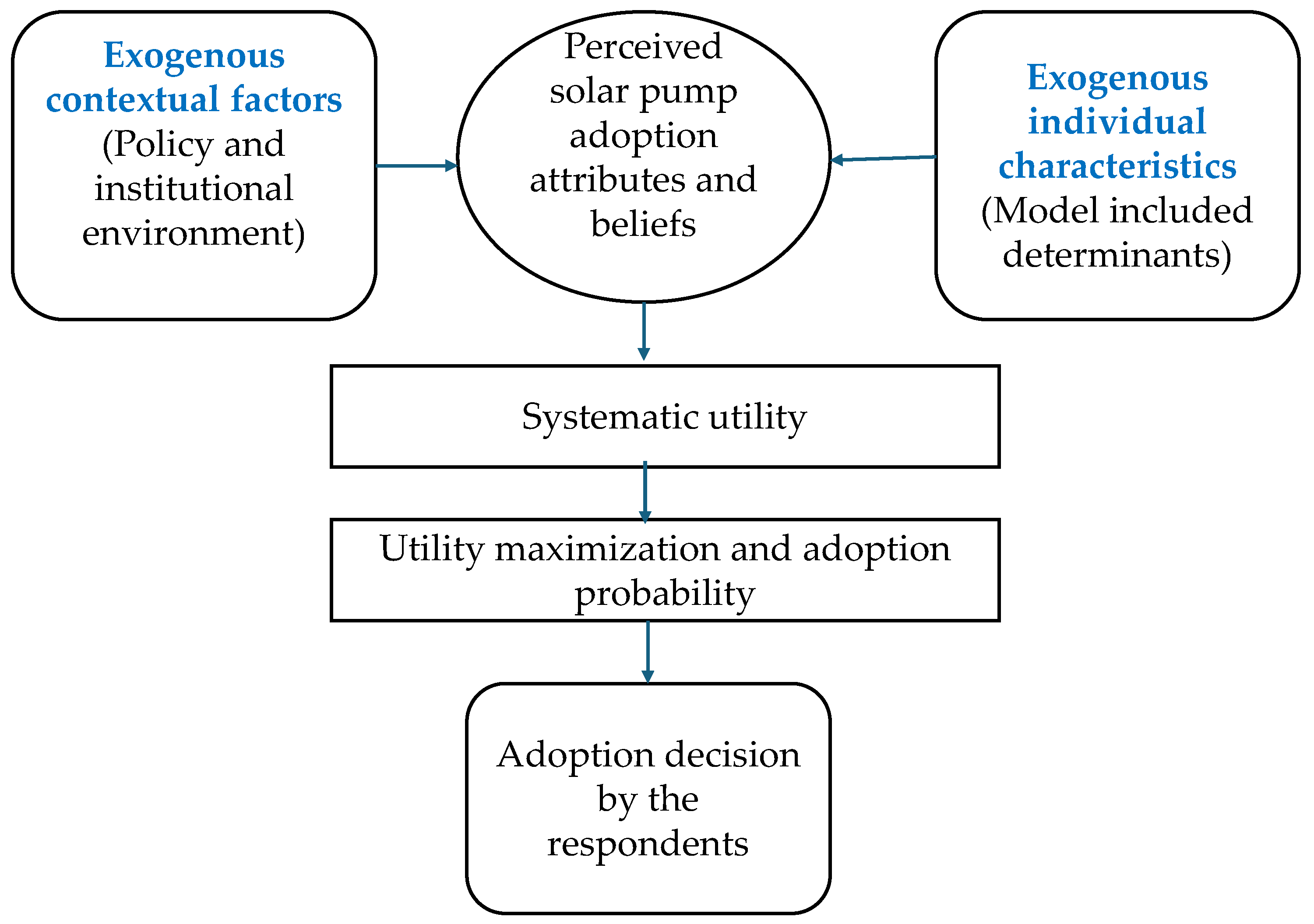
The conceptual framework integrates both exogenous contextual factors and exogenous individual characteristics that shape the adoption decisions of a respondent regarding solar pumps (Figure 1).
Compatibility, complexity, costs, and perceived risks serve as determinants that shape adoption decisions [28]. Therefore, the adoption decision does not depend only on any specific determinants, but rather a complex process of multiple factors, both external and internal, has an effect on it simultaneously. We considered the age of the respondent, educational achievement, training received, etc., as exogenous individual characteristic elements that directly emphasize the adoption decision, whereas exogenous contextual factors like financial incentives, availability of technical support, awareness campaigns, and government policies are not directly included in the model as explanatory variables, but have a strong influence in shaping the respondents’ influence on attributes and perceptions (adoption decision) towards solar pump adoption that enter the systematic utility component. These drivers operate upstream of the adoption decision by altering perceived costs, risks, expected benefits, and informational clarity associated with the technology [29]. Hence, the goal of every respondent is to maximize utility and determine adoption probability by measuring the expected utility from their decision of either adoption or non-adoption.

3. Materials and Methods

3.1. Selection of the Study Area

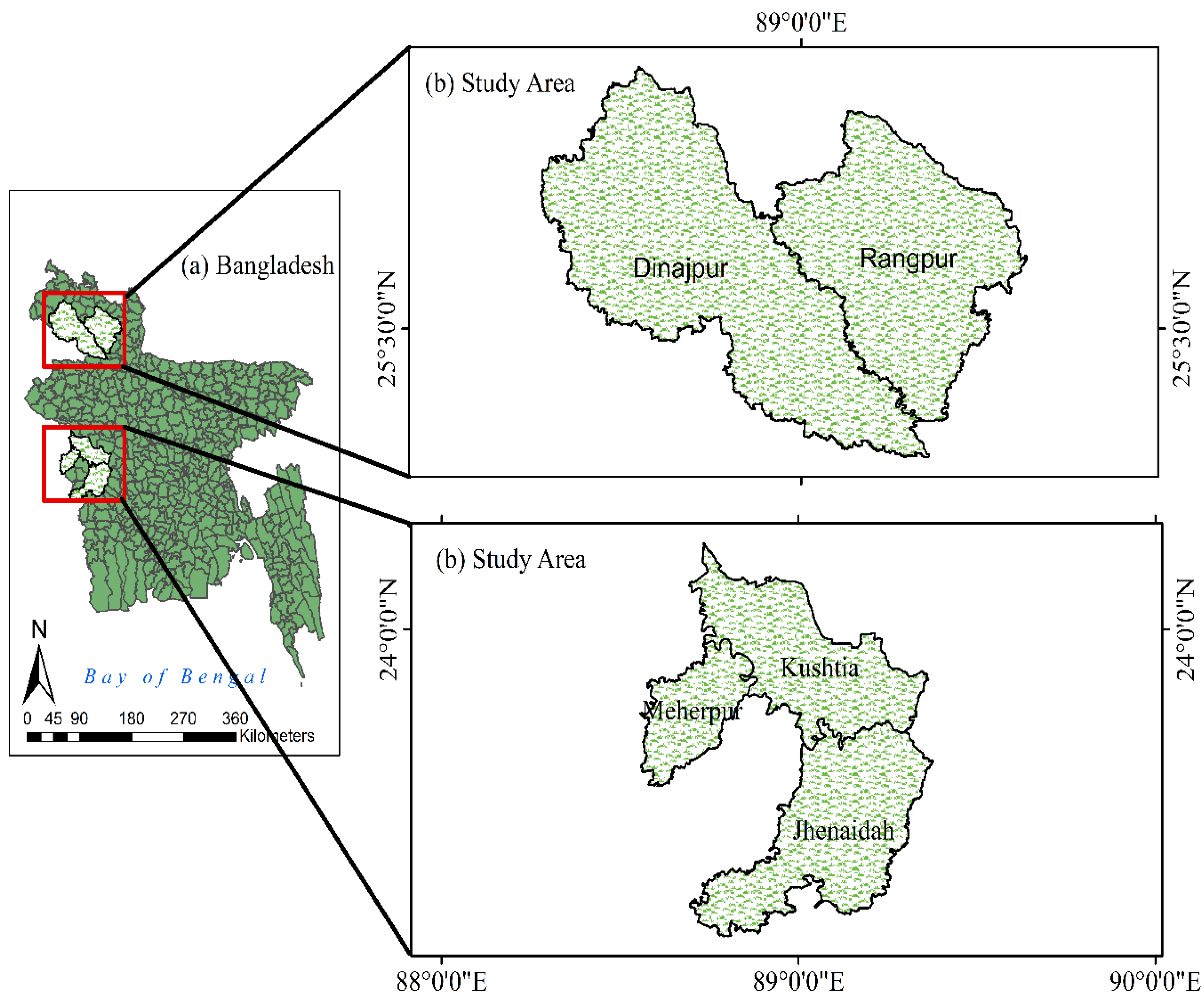
The research was conducted at the grassroots level, covering five regions of the northwest (Dinajpur and Rangpur) and the southwest (Kushtia, Meherpur, and Jhenaidah) part of Bangladesh (Figure 2).
These regions were selected for three main reasons. First, they are characterized by high irrigation intensity and significant reliance on groundwater extraction, particularly for Boro rice cultivation, where diesel-powered pumps have traditionally dominated. Second, these districts host a substantial concentration of solar irrigation pumps installed under the government-supported program implemented by IDCOL. Third, IDCOL operates a standardized subsidy-based financing model on behalf of the Government of Bangladesh, ensuring consistency in institutional and financial arrangements across the selected regions.
Selecting these five districts allows for the evaluation of solar pump adoption within areas where both diesel and solar technologies are actively used and where the policy intervention is most prominent. This enhances the relevance of the findings for ongoing renewable energy and irrigation policies.
We restricted our sample in this way to compare prices, performance, and operational issues in an unbiased, experience-based manner. Farmers who were not exposed to both technologies would have provided speculative or perception-based responses, which could have increased measurement inaccuracy. A detailed regional profile of the sampled respondents is presented in Appendix A.

3.2. Sampling Technique

A stratified random sampling technique was applied to ensure proportional representation of the respondents across five regions with socioeconomic conditions, thereby improving the efficiency and robustness of the logistic regression estimates of solar pump adoption. It allows the inclusion of dummy variables in the logistic regression model, which can specify the adoption behavior of the respondents. Moreover, it enables region-specific policy insights by ensuring that adoption determinants are not dominated by observations from a single region. The following equation was used to ensure a sufficient sample size for the significance of the study [30]:
n 10 × k p  
where n stands for the minimum sample size, k is the number of predictors, and p is the proportion with the rarer outcome.

3.3. Data Collection and Sample Size

Before conducting the original survey among respondents, the questionnaire was pretested using a pilot study and modified accordingly to harvest quality data for the study. The cross-sectional primary data were collected from 10th to 25th March 2025 by means of a smartphone using the “Kobo Collect Toolbox.” The respondents were also screened by their age (20–60 years), as they could make rational decisions regarding the adoption. Among 260 samples, 3 were excluded due to irrelevant information, and the finalized sample size was 257 (Table 1).
The questionnaire was structured in such a way that it could apprehend the social demographic information, adoption behavior, and perception of the respondents towards the existing policy of renewable energy. After compilation and tabulation, data were analyzed using STATA 18 and R software 4.5.2 for illustration.

3.4. Analytical Techniques

3.4.1. Theoretical Foundation

This study is based on the random utility theory (RUT), which posits that individuals choose the alternative that provides the highest expected utility [31]. In the context of our study, respondents are presumed to compare the expected utility acquired from adopting a solar pump with that of non-adoption. Adoption takes place when the perceived benefits outweigh the associated costs, subject to respondents’ socioeconomic profiles, resource constraints, and local conditions.
We denote U i * as the latent (unobserved) utility associated with solar pump adoption for respondent i . This latent utility is assumed to be a function of observable attributes and an unobservable random component. The adoption of solar irrigation pumps is modelled as a binary decision, where respondent i either adopts ( P i = 1 ) or does not adopt ( P i = 0 ). Following random utility theory, it is assumed that respondents choose the option that provides the highest expected utility. In this framework, utility is not limited to monetary returns but may also include social, psychological, and contextual factors that influence decision making. Therefore, variables such as social influence, training, infrastructure availability, and regional characteristics are incorporated into the systematic component of the utility function. Adoption of solar pumps is thus modelled as a utility-maximizing decision that reflects both economic incentives and behavioral considerations.

3.4.2. Model Specification

To satisfy both the first and second objectives, we initially conducted a binary logistic regression model, following the random utility framework [31,32] and agricultural technology adoption literature [33,34]. The description of the variables used in the model is presented in Table 2 and will be explained in detail in a later section. Our events-per-variable (EPV = 7.78) ratio was below the conventional threshold of 10, indicating the possibility of small-sample bias and increased risk of separation [30]. Several simulation studies have shown that this rule can be conservative: Vittinghoff and McCulloch [35] demonstrated that models with an EPV below 10 (including in the 5–9 range) can still yield unbiased estimates and acceptable confidence interval coverage in many circumstances, independent of severe bias or convergence problems. However, diagnostic analysis revealed the presence of mild quasi-complete separation in the data, where certain predictor categories almost perfectly predict the adoption of solar pumps. Under such conditions, conventional maximum likelihood estimation (MLE) produces inflated odd ratios and unstable standard errors.
To address this issue, we employed Firth’s [36] penalized likelihood logistic regression to obtain bias-reduced and finite parameter estimates in the presence of separation. Unlike standard logit estimation, Firth’s method maximizes a penalized likelihood function that incorporates a Jeffreys invariant prior, thereby reducing first-order bias in parameter estimates [37].
Hence, respondent i’s latent utility from adopting a solar pump is specified as follows:
U i * = β 0 + β 1   A g e i + β 2   T r a i n i n g i + β 3   I n c o m e i + β 4   E d u c a t i o n i + β 5   H o u s e h o l d   s i z e i + β 6   L a n d h o l d i n g i + β 7   S o c i a l   i n f l u e n c e i + r = 1 R 1 δ r   R e g i o n i r + i
The respondent adopts the solar pump i  U i * > 0.
Assuming the error term i follows a logistic distribution, the probability of adoption is given by the following:
P i = P r A d o p t i o n i = 1 = 1 1 + e X i β
Taking the log-odds transformation generates the following logit specification:
L o g i t ( P i 1 P i ) = β 0 + β 1   A g e i + β 2   T r a i n i n g i + β 3   I n c o m e i + β 4   E d u c a t i o n i + β 5 H o u s e h o l d   s i z e i + β 6   L a n d h o l d i n g i + β 7   S o c i a l   i n f l u e n c e i + r = 1 R 1 δ r   R e g i o n i r + i
where P i = P r A d o p t i o n i = 1 , which denotes the observed positive response rate that household i adopts the solar pump. The Rangpur region is considered as the reference region (0).
All explanatory variables are exogenous, implying that the determinants are uncorrelated with the stochastic error term. These variables represent predetermined socioeconomic and farm characteristics that influence the probability of solar pump adoption but are not determined by the adoption decision itself, and it does not incorporate any jointly determined or instrumented endogenous regressors.
As the coefficient or odds ratio of Firth’s penalized likelihood logistic regression indicates the direction and relative strength of associations, they are expressed in log-odds or odds units that are not directly interpretable as probabilities. To accumulate intensive interpretation and satisfy the second objective, predictive margins and average marginal effects were calculated following the logit estimation. Therefore, using Equation (5), the predicted probability of adoption for household i is as follows:
P ^ i = 1 1 + exp X i
where
X i = β 0 + β 1   A g e i + β 2   T r a i n i n g i + β 3   I n c o m e i + β 4   E d u c a t i o n i + β 5   H o u s e h o l d   s i z e i + β 6   L a n d h o l d i n g i + β 7   S o c i a l   i n f l u e n c e i + r = 1 R 1 δ r   R e g i o n i r
Hence, the predictive margins are calculated as follows [38]:
Predictive   margins   P M ^ r = 1 N i = 1 N P i ^ | R e g i o n i r = 1
That is, all households are assigned to region r , while their other characteristics remain unchanged, and the resulting probabilities are averaged.
Because region is a categorical variable, the average marginal effect is computed as a discrete change relative to the reference region 0 [38]:
A M E r = 1 N i = 1 N [ P ^ i R e g i o n i r = 1 P i ^ R e g i o n i 0 = 1 ]
This measures the average change in the probability of adoption when a household is located in region r rather than in the reference region, holding other variables constant at their observed values. Predictive margins and average marginal effects of the region category were computed as post-estimation quantities from the fitted logistic regression model and therefore reflect the same underlying parameter estimates [38].

3.5. Variable Description

Table 2 summarizes the key variables used in the empirical analysis, including their measurement, conceptual rationale, and hypothesized influence on solar pump adoption. The dependent variable is a binary indicator equal to one if the respondent has adopted a solar irrigation pump and zero otherwise. The explanatory variables are selected based on established technology adoption and diffusion frameworks and capture critical socioeconomic, behavioral, and spatial dimensions relevant to smallholder irrigation technology uptake in rural contexts. Household-level variables include age, reflecting farming experience and openness to innovation; training, representing access to technical knowledge and information; income, capturing the capacity to meet upfront investment costs; education, reflecting cognitive capacity and awareness of long-term benefits; household size, indicating labor availability and consumption needs; and landholding, capturing scale effects and economic feasibility. Regional dummy variables are incorporated to account for spatial heterogeneity in agro-climatic conditions, infrastructure, and policy exposure.
Collectively, these variables capture variations in resource endowments, human capital, and risk preferences, enabling a robust analysis of the determinants of solar pump adoption.
Table 2. Definition of variables and their expected effects on adoption.
Variable NameUnitDescription/MeasurementExpected SignReference
Age DiscreteNumber of years of the respondent
(experience; receptivity to new technology)
+/−[18]
TrainingDummy Yes = 1; no = 0
(reduce uncertainty; reflect capability and information access)
+/−[15]
IncomeDiscreteCapacity to pay for upfront investment expenses+/−[16]
Education Categorical1 = no education
2 = primary education
3 = secondary to higher education
(cognitive capacity and long-term benefit awareness)
+/−[39]
Household sizeCategorical 3 persons = small
3–5 persons = medium
>5 persons = large
Number of members in the family
(labor availability and consumption requirement)
+/−[15]
Landholding Categorical1 = small landholding (<1 ha)
2 = medium landholding (1.01–2.50 ha)
3 = large landholding (>2.51 ha)
(economic feasibility of the technology and scale impact)
+/−[9]
Social influenceDummyYes = 1; no = 0
(peer recommendation, influence of fellow farmers)
+/−[40]
Region DummyYes = 1; no = 0
(spatial heterogeneity in agro-climatic conditions, infrastructure, and policy exposure)
+/−[15]

3.6. Lorenz Curve and Gini Coefficient Estimation

The Lorenz curve has been used to identify income inequality among the respondents using the cumulative percentage of population against the cumulative percentage of income. For computing the Gini coefficient, the following formula has been used [41]:
G = 1 2   0 1 L P d P
where L ( P ) is the Lorenz curve, representing the cumulative share of the income held by the bottom proportion of the population.

3.7. Assessment of Policy Priorities Using Likert Scale Data

To capture the most emphasized sectors that can contribute to policy aid and more rigorous adoption of solar pumps in Bangladesh from the respondents’ perspective, we employed a five-point Likert scale. It helps in transforming qualitative data into a quantitative form by using descriptive statistics such as means, standard deviations, and percentage distributions. Data were collected against five statements through focus group discussion (FGD) and a vis-à-vis interview [financial incentives (e.g., subsidies, loans, and financial models), availability of technical support, awareness campaigns and training, peer recommendations, and government policies]. Each statement was measured using a five-point Likert scale, where 1 = strongly disagree, 2 = disagree, 3 = neutral, 4 = agree, and 5 = strongly agree. The Likert scale was selected for its reliability and suitability in measuring perceptions and attitudes.
Further in line with previous research, such as Kumar et al. [20], which creates region-specific policy insights based on identified adoption determinants, a region-wise policy driver matrix table was generated by merging RUT-based econometric analysis, descriptive statistics, and field-level observations. Using the five statements as policy drivers, the opinion and ranking order of the statements were utilized to formulate priority-based policy recommendations. To maintain consistency and transparency, a structured triangulation technique was used in the construction of the region-wise policy driver matrix. Initially, regional mean scores were used to summarize Likert scale responses, which were then categorized as low priority (<3.0), moderate (3.0–3.9), or high (≥4.0). Second, without mechanically weighting regression outputs, econometric results from the Firth logit model were utilized as a consistency check to see whether perception-based priorities matched statistically significant determinants. Third, the quantitative findings were contextualized and validated using thematic coding of FGD and interview responses. Star ratings should not be viewed as a stand-alone econometric indicator but rather as a structured synthesis that reflects the degree of conformity across multiple evidence sources.

4. Results

4.1. Demographic Characteristics of the Respondents

Table 3 presents the demographic characteristics of the sample, which have been categorized as adopters and non-adopters of solar pumps.
Adopters were significantly older than non-adopters, with mean ages of 45.72 and 42.54 years, respectively (t = 2.46, p = 0.014). Training, education, and household size have a strong association with adoption. These variables are found to be significant at a 1% level of significance. From the table, it is seen that 80% of the respondents adopt solar pumps after receiving training. Most of the adopters have passed primary education, and the most interesting fact is that among respondents who received higher education, 100% are non-adopters. This may reflect the tendency of highly educated individuals to view agriculture as a secondary occupation, dedicating less time and effort to farm management. As a result, they are less inclined to experiment with new technologies and prefer to maintain established practices rather than adopting solar pumps. Of the adopters, 61.76% are maintaining a household that is greater than five people, as opposed to the majority of the non-adopters’ household size, which falls in the three–five-person category.
The highest percentage (57.52%) of respondents who are non-adopters belongs to the early adopter group, and for adopters the highest percentage (81.82%) is found in the innovator group. Although the mean income is higher for the adopters compared to non-adopters, the difference in income was not large enough.

4.2. Estimation of Income Inequality

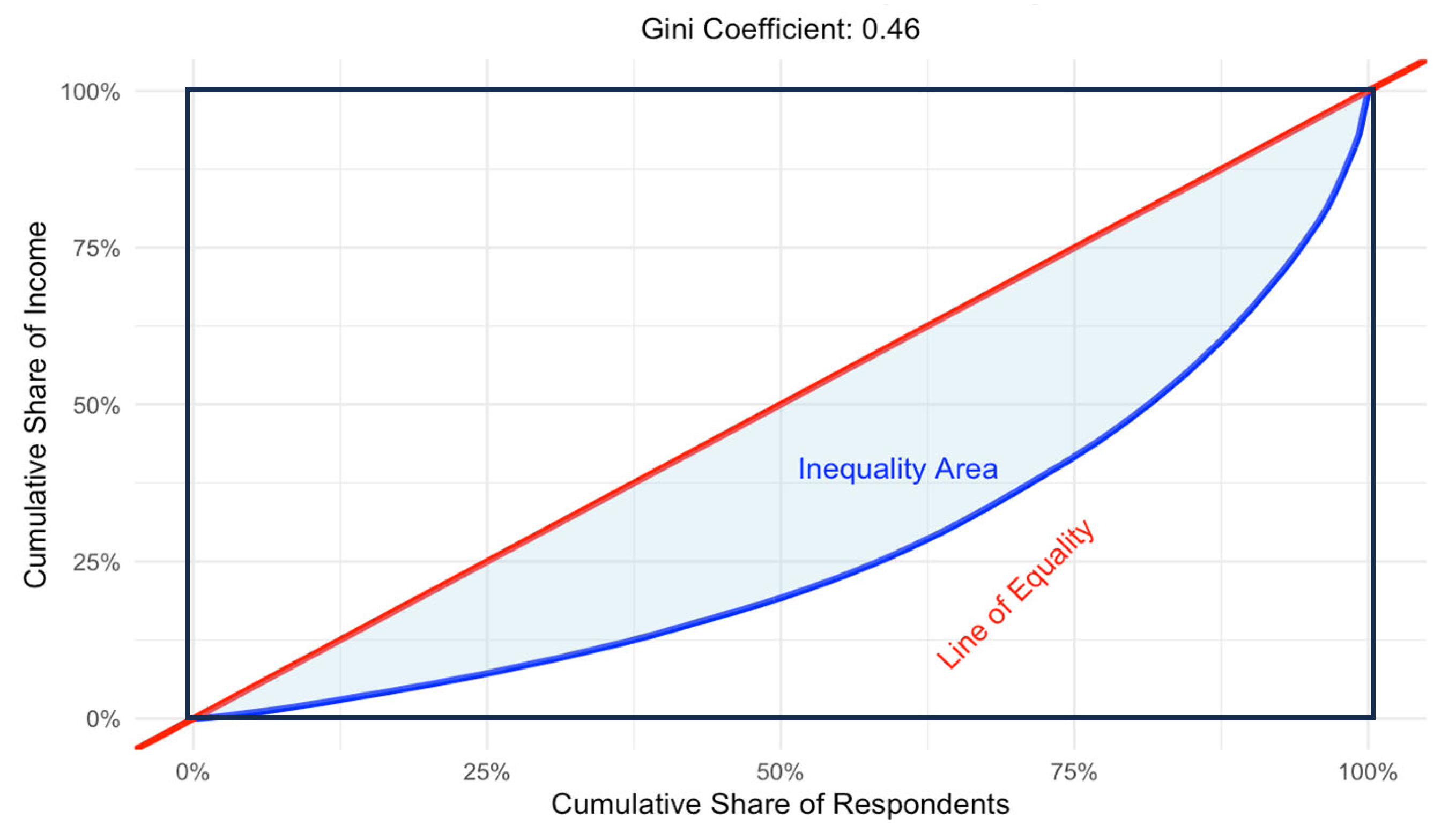
Although there was no significant relationship between adoption and the monthly income of the respondents, we noticed a remarkably unequal income distribution based on the land sizes of the respondents. From Table 3, it is seen that 80% of non-adopters own larger land sizes, and they earn income from multiple sources, which include other employment, business, and shops, whereas only 20% of large landowners adopted solar pumps for their farming activities. The bottom 50% of respondents only earned 20% of the total income, and the Gini coefficient of 0.46 showed moderate to high income disparity (Figure 3).
National survey data from the Household Income and Expenditure Survey (HIES), 2022, shows a national Gini of 0.499, with the top 5% capturing about 30% of national income while the bottom 50% holds around 18%, with a rural Gini of 0.446 and an urban Gini of 0.539 reported [42].
This sort of income inequality is a practical scenario in most developing countries. Ahmed et al. [43] also found that the bottom 50% share is at a mere 11.6% in a study on Pakistan, while Chancel and Piketty [44] found it to be approximately 13% in India.

4.3. Determinants of Solar Pump Adoption

The Firth bias-reduced logistic regression model is statistically significant overall (Wald χ2(14) = 87.45, p < 0.001), indicating that the set of explanatory variables jointly explains variation in solar pump adoption. The penalized log-likelihood value is −52.372 based on 257 observations. These results suggest that the covariates collectively contribute to predicting the probability of adoption. The mean value of the multicollinearity test is presented in Appendix A Table A3, where the mean VIF was 1.86. The model converged smoothly and quickly without any interruption. The odds ratio has been used to interpret the results instead of the coefficient because it is more intuitive and comparable than using the log-odds of the model (Table 4).
In comparison with the logistic regression approach, which is added in Appendix A (Table A2) to define the model stability, we found that there was almost no change in the significance of the predictors, which denotes that the model is stable and not overfitted, but there was a mild quasi-complete separation issue.
For the major drivers of solar pump adoption, we found that training, large households, social influence, and monthly incomes become significant at significance levels of 1%, 5%, and 10%. The predictor training received emerged as highly significant at a 1% level of significance. Respondents who received training are approximately 27 times more likely to adopt solar pump irrigation than those who did not, holding other variables constant, indicating that it is the most important determinant for solar pump adoption. The predictor ‘large household’, especially for households that have more than five persons, is significant at a 5% level of significance. They are 4.5 times more likely to adopt solar pumps because a larger household ensures active monitoring and saves labor costs, which may increase the significance of the predictor.
Social influence was found to be significant at a 5% level of significance, indicating that respondents’ fellow neighbors play a vital role in adoption. It is found that respondents who collect information from their fellow farmers regarding the pros and cons of using solar pumps are approximately 3.7 times more likely to adopt them. The monthly income of a respondent is significant at a 10% level of significance. Holding other variables constant, a one-unit increase in monthly income increases the odds of adopting a solar pump by approximately 2.0%. Other variables such as education, age of the respondent, and land category are not found to be statistically significant in the model.
From Table 4, addressing spatial heterogeneity, we found that the Dinajpur, Meherpur, and Jhenaidah regions are strongly significant at a 1% level of significance, while the Kushtia region is insignificant, ensuring that there is no adoption likelihood difference compared to the reference region (Rangpur). For the other three regions, we observed that there are significantly lower odds of solar pump adoption (98.5%, 99.1%, and 99.6% in Dinajpur, Meherpur, and Jhenaidah, respectively) compared to the Rangpur region.

Predictive and Average Margins of the Regions

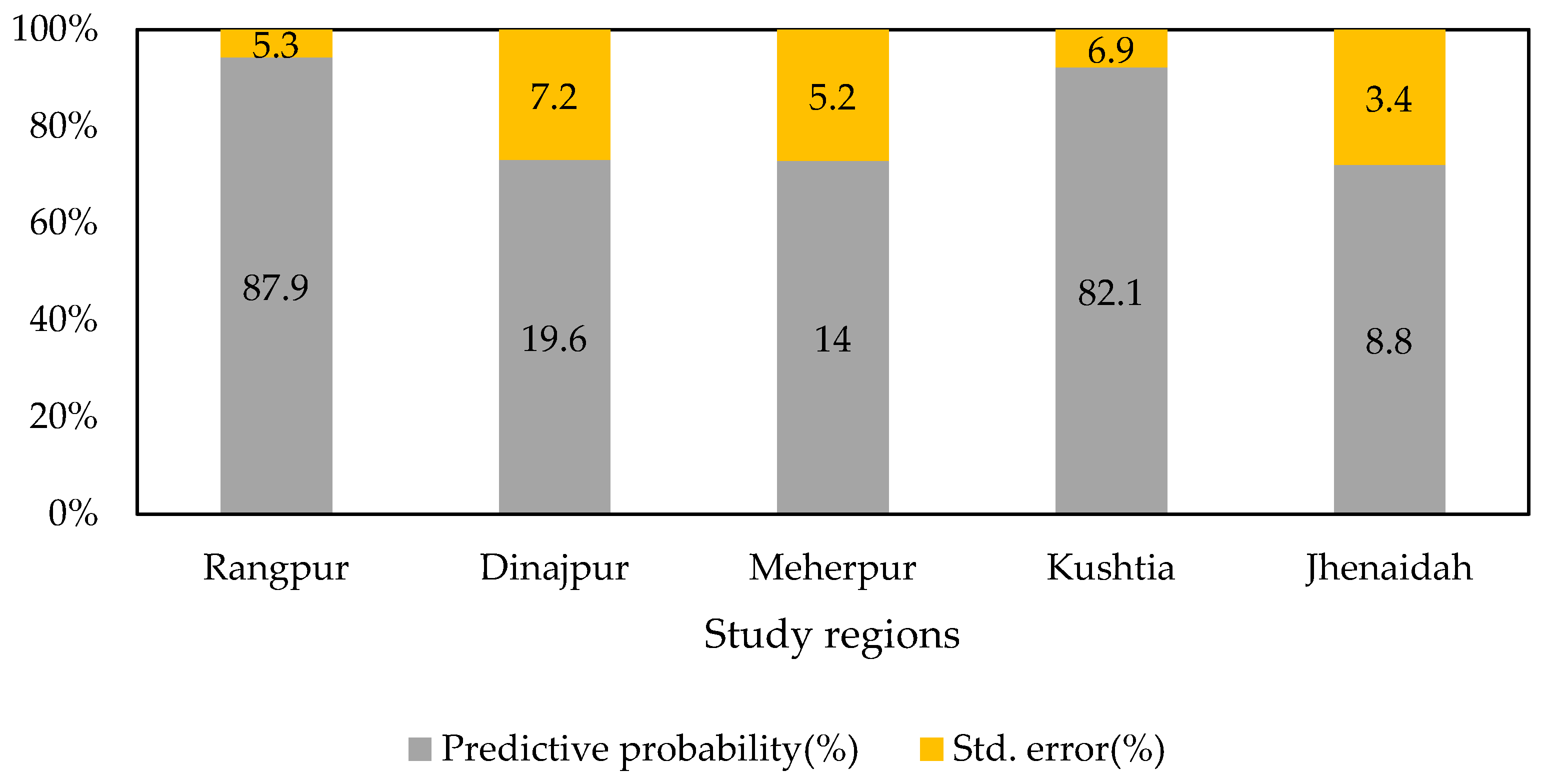
From the Firth logit model, we concluded that regional category or spatial heterogeneity is a very strong determinant of adoption; hence, we calculated the predictive and average margins with respect to regions to identify the probabilities of adoption that vary region-wise. Respondents in Rangpur and Kushtia have an immensely high predicted probability of adoption, approximately 90% and 82% (Table 5), respectively, indicating that individuals in these regions are highly likely to adopt solar pumps after controlling for other socioeconomic determinants.
Dinajpur, Meherpur, and Jhenaidah show substantially lower probabilities, with Jhenaidah being the lowest (approx. 8.8%). Since every predicted probability is statistically significant, regional disparities are not due to random variation. These anticipated probabilities are precisely calculated and substantially distinct from zero, according to the statistically significant z-values. In comparison to the reference region (Rangpur), our findings indicate that residing in the Dinajpur region diminishes the likelihood of adoption by an average of 68%. Meherpur and Jhenaidah experience even larger reductions (74% and 79%, respectively) (Figure 4). Kushtia shows no statistically significant difference from the reference region (p = 0.533), implying that the adoption probability of this region’s respondents shows no difference from the Rangpur region.
However, our hypothesis predicted higher adoption probability in the Rangpur region due to training and acceptance of the fee-for-service model. In Rangpur, the fee-for-service model widens the scope of adoption by reducing upfront cost and risk, leading to institutionally driven adoption. Moreover, IDCOL provides short-duration training programs (10–15 days) on the operation and management of solar pumps, along with cost–benefit demonstrations, which results in an increase in solar pump adoption. Mitra et al. [45] reported the massive adoption of the fee-for-service model among farmers in the Rangpur and Dinajpur regions.
The accumulated evidence from Table 3, Table 4 and Table 5 and Appendix A supports the acceptance of our hypothesis.

4.4. Respondents’ Perceptions of Policy Priorities

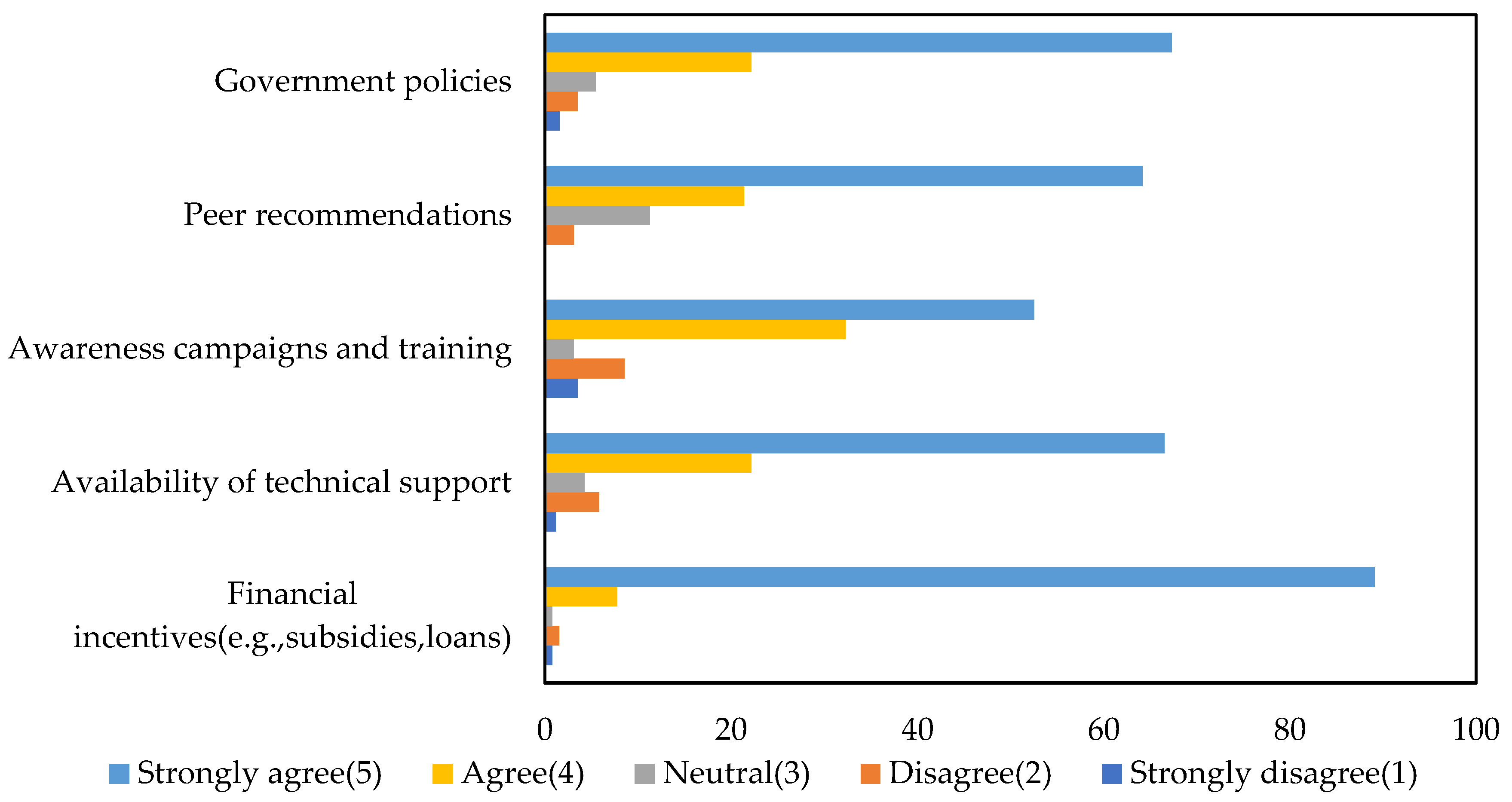
The results from Table 6 show that all the means are above 4.2, indicating strong agreement across all factors, whereas financial incentives show the highest mean and the lowest SE (0.037), suggesting strong and consistent agreement among respondents.
It is obvious that without subsidies, loans, or financial support from authorities, it is quite impossible for the respondents of an underdeveloped country to accept any new technology. Awareness campaigns and training, while still positive, show slightly more variability (0.068). This is because, from Table 4, we have seen that those who received training are more likely to adopt solar pumps, whereas many people are reluctant to receive training without incentives, so high variations are expected to appear.
The analysis revealed that financial incentives, with 89.11% (Figure 5) of responses, were ranked as the top priority, whereas government policies (67.31%), availability of technical support (66.54%), peer recommendations (64.20%), and awareness campaigns and training (52.53%) held ranks of second, third, fourth, and fifth, respectively, in terms of prioritized sectors that the respondents are willing to receive support from.

4.5. Region-Wise Policy Driver Matrix for Rapid Dissemination

From the focus group discussion and direct interview with the respondents, the importance of region-wise policy design has emerged. Therefore, Table 7 was generated based on the study findings, respondents’ perceptions, and some supporting literature. It provides theoretical support for the inclusion of each policy recommendation by connecting it to the associated utility channel within the RUT framework, which would be beneficial for better understanding the behavioral action of the respondents. Moreover, region-wise major obstacles that hinder adoption can also be perceived. By lowering upfront costs and alleviating cash flow limitations, financial incentives work through the cost-liquidity utility channel. Ensuring stable technical support by reducing uncertainty regarding system performance, maintenance, and downtime increases reliability and lowers operational risk among respondents operating through the reliability-risk reduction utility channel. Enhancing respondents’ technical knowledge and operational confidence through training as well as improving understanding of costs, benefits, and long-term returns functions through the information-expectation utility channel. Community engagement is essential in the context of rural Bangladesh, as many people are influenced by observing the success of other people within their social network [26], which in turn increases trust and reduces perceived adoption risk. In this way, peer recommendation acts through the social learning utility channel. The utility channel of institutional certainty optimizes coordination, trust, and overall system efficiency by reducing transaction costs and regulatory risk.
The recommended policies not only focused on sustainable solar pump diffusion by increasing expected utility, but also enhanced the scope of the liquidity-constrained respondents’ flexible adoption choices.

5. Discussion

This study aims to reveal the impacts of key drivers on solar pump adoption while at the same time capturing the spatial heterogeneity across five study regions for policy recommendations. According to the results of the Firth logistic regression, adoption is impacted by both environmental and individual variables. Training, larger households, and social influence were found to be important and significant contributors, highlighting the need for knowledge sharing and capacity building. This finding is consistent with [9,15,47]. However, there is a substantial risk of reverse causality, that respondents received training as part of the installation service provided by IDCOL. The respondents’ preference for financial incentives revealed that, despite the income determinant’s lower significance in this model, it still has a significant impact on adoption.
The adoption of solar pumps is more practical for larger households because of increased labor availability, economies of scale, and greater irrigation needs, whereas smaller households encounter labor and financial limitations [48]. Despite land size being statistically insignificant, the negative coefficient indicates that larger farmers are likely to depend on diesel pumps, as smaller solar pumps may not suffice. This accounts for the greater likelihood of adoption in Rangpur, where the typical landholding (0.64 ha) is ideal for small-scale solar pump usage.
The lack of statistically significant effects for education level and landholding, which is contrary to Gupta and Singh [49] and Sarker et al. [9], suggests that adoption in this situation may be more influenced by access to pertinent knowledge and skills than by formal education or financial resources.
The observed discrepancy, whereby education showed significance in chi-square tests but not in multivariate Firth logistic regression, despite the absence of multicollinearity, is consistent with confounding and mediation effects commonly reported in socioeconomic research. As Pourhoseingholi et al. [47] explained, variables showing significant crude associations may lose significance in adjusted models when their effects are controlled for or mediated through other covariates. Hence, for confirmation, we further conducted a likelihood ratio test (Prob > chi2 = 0.1385) for the education category, which we found insignificant overall. Kimani-Murage et al. [50] examined education and household factors like sex, marital status, etc., and showed similar types of findings for socioeconomic data.
The findings demonstrate significant geographical variations in adoption. Even after adjusting for factors, Meherpur and Jhenaidah continue to be at a disadvantage, while Rangpur and Kushtia have high projected probabilities. Adoption is hampered in Dinajpur by greater landholdings, poor wages, and a lack of training, indicating the need for funding and extension-led instruction. Enhancing Rangpur’s financial accessibility through reasonably priced fee-for-service models with technical assistance is essential. While Jhenaidah needs robust government and extension support, Meherpur needs awareness campaigns, training, and collaborative approaches. Rangpur and Kushtia share similar features that make cost-sharing and training interventions possible. Regions reveal unobserved contextual factors that affect adoption possibilities, such as variations in project intensity, different installer availability and their strategies of dissemination, groundwater conditions, and institutional backing. Although household characteristics like household size, training, social influence, and income are still important, their influence operates within these broader frameworks of geographical opportunity.
We observed the success of the fee-of-service model of solar pumps by IDCOL in the Dinajpur region, so now the adoption rates tend to decrease in Dinajpur, whereas Kushtia and Rangpur are the most prospective regions right now to disseminate adoption following this financial strategy [51]. Mitra et al. [52] elaborated on the mechanism of the fee-for-service model, where the private sponsors purchase the solar pump, install it in their territory, and sell the water to the farmers at an agreed monetary rate. This model has gained popularity among the small landholder liquidity-constrained farmers. Since the high upfront cost discourages many respondents from availing themselves of the advantage of a solar pump, all the respondents emphasized financial incentives as their prime concern, and this result is aligned with [20,53,54,55].
These findings suggested that training, large households, social influence, and income are the prominent drivers for adoption, but regional factors such as infrastructure, agricultural extension services, weather, and peer influence play a critical role. So, region-specific interventions may be necessary to reduce disparities. Concededly, Bangladesh should emphasize regulation-supervised training programs, farmer-to-farmer diffusion, and implementable financial strategies to promote solar irrigation pump adoption. Expanding subsidies, flexible financing options, and affordable low-interest loan schemes can remarkably reduce adoption obstacles. Meanwhile, consistent and supportive government policies, stable technical support, demonstration, and cooperative formation, along with awareness campaigns, are essential to build long-term confidence in and the effective utilization of solar pumps.
Like other socioeconomic studies, this study has certain limitations. Due to budget constraints, only five regions of the northwest and southwest were covered, which restricts its spatial representativeness. Though the sample size was sufficient to conduct a significant study, a more diverse sample could capture greater variability in socioeconomic and behavioral factors. Since respondents were selected from regions where awareness of solar pumps already existed, a positive awareness bias may be present. Regional variables might serve as a proxy for variations in program penetration or institutional presence, which could affect adoption irrespective of household composition. Policy recommendations were context-specific, which were interpreted as suggestive patterns within the sample regions rather than conclusive national evidence. Regional effects reflect structural and supply-relevant elements that the model did not specifically account for.
Moreover, the analysis focused mainly on tangible factors, while intangible aspects such as behavioral and psychological influences were not explicitly examined. Additionally, we acknowledge the potential endogeneity between training and adoption, as participation in training programs may be influenced by unobserved characteristics that also affect adoption decisions.
Future research should expand the geographical coverage and sample size to enhance external validity. The use of mixed methods and choice experiments could help identify latent behavioral drivers and explicit adoption preferences. The use of instrumental variable approaches to correct for potential simultaneity or selection bias, as well as longitudinal studies, could also be undertaken to examine changes in adoption behavior over time and to assess post-adoption impacts on income and training. As the regional category emerged as a strong determinant, region-specific studies utilizing multi-level modelling or spatially explicit supply-relevant data would enable a better distinction between household and contextual influences on adoption as well as incorporate regional constraints and policy needs.

6. Conclusions

This study used a logistic regression model in conjunction with predictive margins and average marginal effects to examine regional variations in solar pump adoption across five regions in Bangladesh. Training was the strongest socioeconomic determinant that could expand adoption. The results demonstrated that adoption probabilities vary significantly across regions even after controlling for household socioeconomic determinants, including age, education, income, training, household size, and land size. Respondents in Rangpur and Kushtia exhibit significantly higher predicted adoption probabilities than those in Dinajpur, Meherpur, and Jhenaidah, indicating that regional context is relevant. The findings brought to light the fact that region-wise policy intervention is necessary for the successful dissemination of solar irrigation pumps. Furthermore, financial and technical assistance should take precedence over social or policy influences in adoption initiatives.

Author Contributions

Conceptualization, A.T.M. and K.A.; methodology, A.T.M. and K.A.; software, A.T.M. and K.A.; formal analysis, A.T.M.; data curation, A.T.M.; visualization, A.T.M.; supervision, K.A.; validation, K.A. and M.M.I.; writing—original draft preparation, A.T.M.; writing—review and editing, K.A. and M.M.I. All authors have read and agreed to the published version of the manuscript.

Funding

This research received no external funding.

Institutional Review Board Statement

Ethical review and approval were waived for this study by the Institutional Committee because the study involved an anonymous questionnaire survey with no collection of identifiable personal data, in accordance with institutional guidelines and the Declaration of Helsinki.

Informed Consent Statement

Informed consent was obtained from all subjects involved in the study prior to participation.

Data Availability Statement

Household survey data were used in this study. The data that support the findings of this study are not openly available due to ethical concerns and reasons of sensitivity. The data can be made available from the corresponding author upon request.

Conflicts of Interest

The authors declare no conflicts of interest.

Appendix A

Table A1. Regional profile based on the sample.
CharacteristicsDinajpurRangpurMeherpurKushtiaJhenaidah
Monthly income (mean)18,000 Tk.25,000 Tk.27,000 Tk.26,000 Tk.15,000 Tk.
Training received7.84%9.23%2%6.62%1.42%
Land size (mean)0.87 ha.0.64 ha.0.88 ha.0.67 ha.0.55 ha.
Household size (mean)4–54–56–74–56–7
Major crops [56]Rice, Jute, Wheat, etc.Rice, Jute, Wheat, etc.Rice, Mustard, Onions, etc.Rice, Jute, Wheat, etc.Rice, Sugarcane, Banana, etc.
Access to agricultural extension services19.01%17.76%20.66%17.32%27.27%
Farming type (%)
a. Commercial
b. Subsistence
(1) 68.63(1) 63.46(1) 46.00(1) 53.85(1) 5.77
(2) 31.37(2) 36.54(2) 54.00(2) 46.15(2) 94.23
Cropping intensity (mean) [57]228%227%239%240%223%
Annual precipitation (mean) [58]~2275 mm~2192 mm~2421 mm~1467 mm~1467 mm
Annual Boro rice production per hectare [57]3.66 ton4.32 ton4.32 ton4.06 ton5.31 ton
Table A2. Drivers of solar pump adoption: logistic regression approach.
AdoptionOdds (S.E)
Age 0.962 (0.024)
Training (yes = 1)44.430 *** (46.914)
Monthly income (1000 Tk.)1.019 * (0.013)
Education (base = no education)
Primary education0.736 (0.565)
Secondary to higher education0.643 (0.559)
Household size (base = medium household)
Small household1.318 (0.927)
Large household5.414 ** (3.995)
Landholding (base = medium landholding)
Small landholding0.877 (0.761)
Large landholding0.157 (0.261)
Social influence4.291 ** (2.519)
Region (base = Rangpur)
Dinajpur0.009 *** (0.008)
Meherpur0.005 *** (0.004)
Kushtia0.560 (0.507)
Jhenaidah0.002 *** (0.002)
Constant16.759 (31.929)
Log-likelihood−66.64
LR chi2 (14)217.17
Prob > chi20.0000
Pseudo R20.6196
N257
Note: *, **, and *** represent 10%, 5%, and 1% levels of significance, respectively.
Table A3. Multicollinearity of the covariates.
VariableVIF1/VIF
Age 1.370.732
Training1.170.852
Monthly income1.880.533
Education (base = no education)
Primary education2.170.462
Secondary to higher education2.650.378
Household size (base = medium household)
Small household2.060.485
Large household1.190.841
Landholding (base = medium landholding)
Small landholding1.540.650
Large landholding1.730.576
Social influence1.090.916
Region (base = Rangpur)
Dinajpur2.200.454
Meherpur2.230.448
Kushtia2.800.357
Jhenaidah1.910.520

References

  1. Cherniwchan, J. Economic growth, industrialization, and the environment. Resour. Energy Econ. 2012, 34, 442–467. [Google Scholar] [CrossRef]
  2. Aruga, K. Investigating the energy–environmental Kuznets curve hypothesis for the Asia-Pacific region. Sustainability 2019, 11, 2395. [Google Scholar] [CrossRef]
  3. Mondol, M.A.H.; Zhu, X.; Dunkerley, D.; Henley, B.J. Changing occurrence of crop water surplus or deficit and the impact of irrigation: An analysis highlighting consequences for rice production in Bangladesh. Agric. Water Manag. 2012, 269, 107695. [Google Scholar] [CrossRef]
  4. ACIAR. ACIAR Annual Operational Plan 2024–2025; Australian Centre for International Agricultural Research: Canberra, Australia, 2025. [Google Scholar]
  5. Gidey, G. Impact of small scale irrigation development on farmers’ livelihood improvement in Ethiopia: A review. J. Resour. Dev. Manag. 2020, 62, 10–18. [Google Scholar]
  6. Islam, M.T.; Hossain, M.E. Economic feasibility of solar irrigation pumps: A study of northern Bangladesh. Int. J. Renew. Energy Dev. 2022, 11, 1–13. [Google Scholar] [CrossRef]
  7. Sarker, K.K.; Akanda, M.A.; Hossain, M.A.; Hossain, M.A.; Biswas, S.K.; Rahman, M.M.; Rashid, M.A.; Hossain, A. Feasibility Study of a Technoeconomic Solar Photovoltaic Irrigation Compared with Grid and Diesel Systems for Sustainability of Crop Production. Appl. Sol. Energy 2025, 61, 280–298. [Google Scholar] [CrossRef]
  8. Rana, M.; Al Mamun, M.A.; Hossain, M.K.; Hossain, M.J.; Islam, M.A.; Prodhan, M.M.H. Understanding the adoption of renewable energy technologies by households in South Asia: A theory of planned behavior perspective. Discov. Sustain. 2025, 6, 477. [Google Scholar] [CrossRef]
  9. Sarker, S.A.; Zhu, N.; Almutlaq, F.; Adnan, K.M.M.; Huq, M.E. Financial Impact and Adoption of Solar Irrigation in Rangpur, Bangladesh. Energy Strategy Rev. 2025, 59, 101732. [Google Scholar] [CrossRef]
  10. Infrastructure Development Company Limited (IDCOL). Solar Irrigation Program. 2021. Available online: https://idcol.org/home/solar_ir (accessed on 10 January 2026).
  11. Infrastructure Development Company Limited (IDCOL). Solar Irrigation Program—Fee-for-Service Business Model. 2021. Available online: https://idcol.org/idcol_new/public/renewable/solar-irrigation-program (accessed on 8 January 2026).
  12. Aklin, M.; Bayer, P.; Harish, S.P.; Urpelainen, J. Economics of household technology adoption in developing countries: Evidence from solar technology adoption in rural India. Energy Econ. 2018, 72, 35–46. [Google Scholar] [CrossRef]
  13. Buisson, M.-C.; Mitra, A.; Hounsa, T.; Habib, M.A.; Mukherji, A. A place in the sun: Farmers’ co-benefits from solar irrigation in Bangladesh. Energy Econ. 2024, 140, 107973. [Google Scholar] [CrossRef]
  14. Sarkar, M.N.I.; Ghosh, A.K. Techno-economic analysis and challenges of solar-powered pumps dissemination in Bangladesh. Sustain. Energy Technol. Assess. 2017, 20, 33–46. [Google Scholar] [CrossRef]
  15. Sunny, F.A.; Fu, L.; Rahman, M.S.; Huang, Z. Determinants and Impact of Solar Irrigation Facility (SIF) Adoption: A Case Study in Northern Bangladesh. Energies 2022, 15, 2460. [Google Scholar] [CrossRef]
  16. Khadka, M.; Uprety, L.; Shrestha, G.; Shakya, S.; Mitra, A.; Mukherji, A. Can water, energy, and food policies in support of solar irrigation enable gender transformative changes? Evidence from policy analysis in Bangladesh and Nepal. Front. Sustain. Food Syst. 2024, 7, 1159867. [Google Scholar] [CrossRef]
  17. Khadka, M.; Kafle, K.; Uprety, L.; Minh, T.T.; Nangia, V.; Pandey, V.P. Technology for whom? Solar irrigation pumps, women, and smallholders in Nepal. Front. Sustain. Food Syst. 2023, 7, 1143546. [Google Scholar] [CrossRef]
  18. Rana, J.; Kamruzzaman, M.; Hosain Oliver, M.; Akhi, K. Financial and Factors Demand Analysis of Solar Powered Irrigation System in Boro Rice Production: A Case Study in Meherpur District of Bangladesh. Renew. Energy 2021, 167, 433–439. [Google Scholar] [CrossRef]
  19. Kumar, V.; Syan, A.S.; Kaur, A.; Hundal, B.S. Determinants of farmers’ decision to adopt solar-powered pumps. Int. J. Energy Sect. Manag. 2020, 14, 707–727. [Google Scholar] [CrossRef]
  20. Kumar, M.S.; Lad, Y.A.; Pundir, R.S. Factors influencing farmers’ adoption of solar water-pumping systems in Gujarat. Clean Energy 2024, 8, 157–165. [Google Scholar] [CrossRef]
  21. Amin, A.; Tanni, T.F.; Rahman, D.H.; Asaduzzaman, M.M.; Al Matin, A. A study on the present scenario of solar irrigation in Bangladesh. Int. J. Sci. Eng. Res. 2017, 8, 1754–1760. [Google Scholar] [CrossRef]
  22. Akter, T. A study on making a solar-powered irrigation system economically viable and socially acceptable in Bangladesh. Eur. J. Soc. Sci. Stud. 2024, 9. [Google Scholar] [CrossRef]
  23. Patel, P.M.; Scott, C.A.; Brent, D.A. Four Birds with One Stone? Opportunities and Challenges in Adopting Solar Irrigation for a Sustainable Water–Energy–Food Nexus with Carbon Credits. Water Int. 2024, 50, 235–258. [Google Scholar] [CrossRef]
  24. Khan, N.; Elhindi, K.M.; Kassem, H.S.; Kazim, R.; Zhang, S. Unveiling the nexus between solar energy adoption and crop farmer income: Evidence from Pakistan. Front. Sustain. Food Syst. 2024, 8, 1364040. [Google Scholar] [CrossRef]
  25. Diop, L. Technical and economic feasibility of solar irrigation pumping system: A review. Knowl. Based Eng. Sci. 2020, 1, 1–22. [Google Scholar] [CrossRef]
  26. Ward, P.S. Capturing Social Network Effects in Technology Adoption: The Spatial Diffusion of Hybrid Rice in Bangladesh. Agric. Resour. Econ. 2015, 59, 225–241. [Google Scholar] [CrossRef]
  27. Asian Development Bank. Roadmap to Scale Up Solar Irrigation Pumps in Bangladesh (2023–2031); Asian Development Bank: Metro Manila, Philippines, 2023; Available online: https://www.adb.org/sites/default/files/publication/935026/solar-irrigation-pumps-bangladesh-2023-2031.pdf (accessed on 8 January 2026).
  28. Ghobakhloo, M.; Iranmanesh, M.; Grybauskas, A.; Vilkas, M.; Petraitė, M. Industry 4.0, innovation, and sustainable development: A systematic review and a roadmap to sustainable innovation. Bus. Strategy Environ. 2021, 30, 4237–4261. [Google Scholar] [CrossRef]
  29. Foster, A.D.; Rosenzweig, M.R. Microeconomics of technology adoption. Annu. Rev. Econ. 2010, 2, 395–424. [Google Scholar] [CrossRef]
  30. Peduzzi, P.; Concato, J.; Kemper, E.; Holford, T.R.; Feinstein, A.R. A Simulation Study of the Number of Events per Variable in Logistic Regression Analysis. J. Clin. Epidemiol. 1996, 49, 1373–1379. [Google Scholar] [CrossRef]
  31. McFadden, D. Conditional logit analysis of qualitative choice behavior. In Frontiers in Econometrics; Zarembka, P., Ed.; Academic Press: Cambridge, MA, USA, 1974; pp. 105–142. [Google Scholar]
  32. Manski, C.F. The structure of random utility models. Theory Decis. 1977, 8, 229–254. [Google Scholar] [CrossRef]
  33. Feder, G.; Just, R.E.; Zilberman, D. Adoption of agricultural innovations in developing countries: A survey. Econ. Dev. Cult. Change 1985, 33, 255–298. [Google Scholar] [CrossRef]
  34. Feder, G.; Umali, D.L. The adoption of agricultural innovations: A review. Technol. Forecast. Soc. Change 1993, 43, 215–239. [Google Scholar] [CrossRef]
  35. Vittinghoff, E.; McCulloch, C.E. Relaxing the rule of ten events per variable in logistic and Cox regression. Am. J. Epidemiol. 2007, 165, 710–718. [Google Scholar] [CrossRef]
  36. Firth, D. Bias reduction of maximum likelihood estimates. Biometrika 1993, 80, 27–38. [Google Scholar] [CrossRef]
  37. Jeffreys, H. An invariant form for the prior probability in estimation problems. Proc. R. Soc. Lond. A Math. Phys. Sci. 1946, 186, 453–461. [Google Scholar] [CrossRef] [PubMed]
  38. Long, J.S.; Freese, J. Regression Models for Categorical Dependent Variables Using Stata, 2nd ed.; Stata Press: College Station, TX, USA, 2006; Volume 7. [Google Scholar]
  39. Kafle, K.; Uprety, L.; Shrestha, G.; Pandey, V.; Mukherji, A. Are Climate Finance Subsidies Equitably Distributed among Farmers? Assessing Socio-Demographics of Solar Irrigation in Nepal. Energy Res. Soc. Sci. 2022, 91, 102756. [Google Scholar] [CrossRef]
  40. Nguyen, L.L.H.; Khuu, D.T.; Halibas, A.; Nguyen, T.Q. Factors that influence the intention of smallholder rice farmers to adopt cleaner production practices: An empirical study of precision agriculture adoption. Eval. Rev. 2024, 48, 692–735. [Google Scholar] [CrossRef]
  41. Cowell, F.A. Measuring Inequality, 3rd ed.; Oxford University Press: Oxford, UK, 2011. [Google Scholar]
  42. Bangladesh Bureau of Statistics (BBS). Household Income and Expenditure Survey 2022: Key Findings; Bangladesh Bureau of Statistics: Dhaka, Bangladesh, 2023. [Google Scholar]
  43. Ahmed, A. Measuring Income Inequality in Pakistan: Constructing Distributional National Accounts; University of California, Department of Economics: Berkeley, CA, USA, 2019. [Google Scholar]
  44. Chancel, L.; Piketty, T. Indian income inequality, 1922–2015: From British Raj to Billionaire Raj? Rev. Income Wealth 2019, 65, S33–S62. [Google Scholar] [CrossRef]
  45. Mitra, A.; Alam, M.F.; Yashodha, Y. Solar Irrigation in Bangladesh: A Situation Analysis Report (SoLAR Project); International Water Management Institute (IWMI): Colombo, Sri Lanka, 2021. [Google Scholar]
  46. Rahman, S.M.; Mori, A.; Sultan-Ul-Islam, M.; Rahman, S.M. Integrating adaptation and mitigation in irrigation through diffusion of solar energy technology: A case from the Northwest Bangladesh. In Handbook of Climate Change Management: Research, Leadership, Transformation; Springer International Publishing: Cham, Germany, 2020; pp. 1–25. [Google Scholar]
  47. Pourhoseingholi, M.A.; Baghestani, A.R.; Vahedi, M. How to Control Confounding Effects by Statistical Analysis. Gastroenterol. Hepatol. Bed Bench 2012, 5, 79–83. [Google Scholar]
  48. Ali, A.; Erenstein, O. Assessing farmer use of climate change adaptation practices and impacts on food security and poverty in Pakistan. Clim. Risk Manag. 2017, 16, 183–194. [Google Scholar] [CrossRef]
  49. Gupta, V.; Singh, S.P. Exploring the multiple dimensions of solar irrigation in South-Asian countries: Insights from a systematic review. Renew. Energy Focus 2025, 54, 100711. [Google Scholar] [CrossRef]
  50. Kimani-Murage, E.W.; Madise, N.J.; Fotso, J.C.; Kyobutungi, C.; Mutua, M.K.; Gitau, T.M.; Yatich, N. Patterns and determinants of breastfeeding and complementary feeding practices in urban informal settlements, Nairobi Kenya. BMC Public Health 2011, 11, 396. [Google Scholar] [CrossRef]
  51. Hasnain, M.N.; Hossain, M.E.; Islam, M.K. Technical efficiency of Boro rice production in Meherpur District of Bangladesh: A stochastic frontier approach. Am. J. Agric. For. 2015, 3, 31–37. [Google Scholar] [CrossRef][Green Version]
  52. Mitra, A.; Buisson, M.C.; Osmani, A.Z.; Mukherji, A. Unleashing the potential of solar irrigation in Bangladesh: Key lessons from different implementation models. Environ. Res. Lett. 2024, 19, 014024. [Google Scholar] [CrossRef]
  53. Ud Din, S.; Wimalasiri, R.; Ehsan, M.; Liang, X.; Ning, F.; Guo, D.; Manzoor, Z.; Abu-Alam, T.; Abioui, M. Assessing Public Perception and Willingness to Pay for Renewable Energy in Pakistan through the Theory of Planned Behavior. Front. Energy Res. 2023, 11, 1088297. [Google Scholar] [CrossRef]
  54. Jahan, N.A.; Chowdhury, S.A.; Irfanullah, H.M.; Selim, S.A. Uptake of Solar Energy by Industries in Bangladesh: Driving Factors, Barriers, and Opportunities. Clean. Energy Syst. 2025, 12, 100205. [Google Scholar] [CrossRef]
  55. Luthra, S.; Kumar, S.; Garg, D.; Haleem, A. Barriers to renewable/sustainable energy technologies adoption: Indian perspective. Renew. Sustain. Energy Rev. 2014, 41, 762–776. [Google Scholar] [CrossRef]
  56. Bangladesh Agro-Meteorological Information Service. District-Wise Major Crops Grown in Bangladesh. Ministry of Agriculture, Government of the People’s Republic of Bangladesh. Available online: https://www.bamis.gov.bd/en/page/district-wise-major-crops/ (accessed on 8 January 2026).
  57. Bangladesh Bureau of Statistics. Yearbook of Agricultural Statistics 2024; Government of the People’s Republic of Bangladesh: Dhaka, Bangladesh, 2024. [Google Scholar]
  58. Islam, A.R.M.T.; Rahman, M.S.; Khatun, R.; Hu, Z. Spatiotemporal trends in the frequency of daily rainfall in Bangladesh during 1975–2017. Theor. Appl. Climatol. 2020, 141, 869–887. [Google Scholar] [CrossRef]
Figure 1. Conceptual framework regarding adoption decisions of solar pump.
Sustainability 18 02562 g001
Figure 2. Study areas for the solar pump adoption survey across selected districts in Bangladesh. Panel (a) shows a map of Bangladesh, highlighting the locations of the selected study regions using red boxes. Panel (b) provides detailed views of the study areas: the top inset displays Dinajpur and Rangpur districts, while the bottom inset shows Meherpur, Kushtia, and Jhenaidah districts.
Sustainability 18 02562 g002
Figure 3. Lorenz curve for income inequality among respondents.
Sustainability 18 02562 g003
Figure 4. Predictive margins with respect to regions.
Sustainability 18 02562 g004
Figure 5. Likert-scale-based ranking of different sectors’ importance in adoption.
Sustainability 18 02562 g005
Table 1. Sample distribution.
RegionSample Size
Rangpur50
Dinjapur53
Meherpur50
Kushtia52
Jhenaidah52
Total257
Table 3. Basic statistics of adopters and non-adopters of solar pumps.
VariableUnitsAdopters
(n = 109)
Non-Adopters
(n = 148)
Test Statisticp-Value
Age (mean)Years45.7242.54t = 2.460.014 **
Income (mean)1000 Tk./household25.0020.73t = 1.370.171
Training received (%)Yes16 (80.00)4 (20.00) χ 2 = 12.550.000 ***
No93 (39.24)144 (60.76)
Education No education24 (38.71)38 (61.29) χ 2 = 13.140.004 ***
Primary education58 (53.70)50 (46.30)
Secondary education27 (33.33)54 (66.67)
Higher education0 (0.00)6 (100.00)
Household size 3 persons40 (53.33)35 (46.67) χ 2 = 14.910.00 1 ***
3–5 persons48 (32.43)100 (67.57)
>5 persons21 (61.76)13 (38.24)
Adopter Innovator9 (81.82)2 (18.18) χ 2 = 18.180.053 *
Early adopter28 (34.57)53 (65.43)
Early majority48 (42.48)65 (57.52)
Late majority21 (46.67)24 (53.33)
Laggard3 (42.86)4 (57.14)
Land size (ha)Small95 (43.38)124 (56.62) χ 2 = 2.140.343
Medium12 (42.86)16 (57.14)
Large2 (20.00)8 (80.00)
Source: Authors’ estimation, 2025. [Note: *, **, and *** represent 10%, 5%, and 1% levels of significance, respectively. t-statistic computed as mean (adopters)—mean (non-adopters). The value within the parentheses indicates a percentage].
Table 4. Drivers of solar pump adoption: penalized logistic regression approach (Firth logit).
AdoptionOdds (S.E)
Age 0.965 (0.022)
Training (yes = 1)26.705 *** (25.145)
Monthly income (1000 Tk.)1.020 * (0.011)
Education (base = no education)
Primary education0.804 (0.568)
Secondary to higher education0.682 (0.549)
Household size (base = medium household)
Small household1.280 (0.841)
Large household4.501 ** (3.108)
Landholding (base = medium landholding)
Small landholding0.947 (0.779)
Large landholding0.199 (0.293)
Social influence3.692 ** (2.042)
Region (base = Rangpur)
Dinajpur0.015 *** (0.012)
Meherpur0.009 *** (0.007)
Kushtia0.591 (0.499)
Jhenaidah0.004 *** (0.004)
Constant11.005 (19.697)
Wald chi2 (14)87.45
Prob > chi20.0000
Penalized log-likelihood−52.372
N257
Source: Authors’ estimation, 2025. Note: *, **, and *** represent 10%, 5%, and 1% levels of significance, respectively.
Table 5. Predictive and average margins with respect to regions.
Predictive MarginsAverage Margins
Region CategoryPredictive Probability (S.E)Region CategoryAverage Probability
(S.E)
Rangpur0.879 *** (0.053)Rangpur (Ref)-
Dinajpur0.196 *** (0.072)Dinajpur−0.683 *** (0.090)
Meherpur0.140 *** (0.052)Meherpur−0.739 *** (0.074)
Kushtia0.821 *** (0.069)Kushtia−0.058 (0.087)
Jhenaidah0.088 *** (0.034)Jhenaidah−0.792 *** (0.063)
Source: Authors’ estimation, 2025. Note: *** represents 1% level of significance.
Table 6. Significant sectors from the respondents’ perspective.
OpinionFinancial Incentives (e.g., Subsidies, Loans)Availability of
Technical Support
Awareness
Campaigns and Training
Peer
Recommendations
Government Policies
Strongly disagree (1)2 (0.78)3 (1.17)9 (3.50)0 (0.00)4 (1.56)
Disagree (2)4 (1.55)15 (5.84)22 (8.56)8 (3.11)9 (3.50)
Neutral (3)2 (0.78)11 (4.28)8 (3.11)29 (11.28)14 (5.45)
Agree (4)20 (7.78)57 (22.18)83 (32.30)55 (21.40)57 (22.18)
Strongly agree (5)229 (89.10)171 (66.54)135 (52.53)165 (64.20)173 (67.31)
mean4.834.474.224.464.50
Std. Err.0.0370.0570.0680.0510.054
Source: Authors’ estimation, 2025. Note: the value within the parentheses indicates a percentage.
Table 7. Region-wise policy driver matrix for solar pump adoption.
Policy RecommendationsPolicy DriversUtility ChannelDinRangMehKushJhe
i. Expand subsidies, concessional loans, and fee-for-service models [8].Financial incentivesCost-Liquidity***************
ii. Introduce solar pump leasing models.***************
i. Ensure mobile service units/local technicians’ availability for maintenance concerns.Technical supportReliability-Risk reduction**************
ii. Reduce risk of technological failure.************
iii. Ensure installation of a high-quality solar pump with a longer life span [27].*************
iv. Locality-based grid integration and emphasis on hybrid connection.************
i. Demonstration plots and hands-on training [18].Awareness and trainingInformation-Expectation**************
ii. Use incentives for basic operational training.***************
iii. Special visual aid campaign promoting solar pump benefits [18].************
i. Cooperative-based solar pump schemes [46].Peer recommendationSocial learning***************
ii. Farmer-to-farmer diffusion [9,46].******
i. Integrate solar pumps into formal agricultural programs [9].Government policiesInstitutional certainty************
ii. Integration of local manufacturers and NGOs into the programs.************
Note: [*** = high priority, ** = moderate priority, and * = low priority].
Disclaimer/Publisher’s Note: The statements, opinions and data contained in all publications are solely those of the individual author(s) and contributor(s) and not of MDPI and/or the editor(s). MDPI and/or the editor(s) disclaim responsibility for any injury to people or property resulting from any ideas, methods, instructions or products referred to in the content.