Article

Towards a Sustainable and Ethical Integration of AI Chatbots in Higher Education

by
Mirela-Catrinel Voicu
1,*,
Nicoleta Sîrghi
2,
Gabriela Mircea
1 and
Daniela Maria-Magdalena Toth
1
1
Department of Finance, Information Systems and Modeling for Business, Faculty of Economics and Business Administration, West University of Timisoara, 300223 Timisoara, Romania
2
Department of Marketing, International Business and Economics, Faculty of Economics and Business Administration, West University of Timisoara, 300223 Timisoara, Romania
*
Author to whom correspondence should be addressed.
Sustainability 2026, 18(5), 2534; https://doi.org/10.3390/su18052534
Submission received: 20 November 2025 / Revised: 1 March 2026 / Accepted: 2 March 2026 / Published: 5 March 2026

Abstract

This paper examines students’ perceptions of factors influencing normative support for the integration of AI Chatbots in universities, providing an empirical basis for developing institutional policies and implementation strategies in higher education. Framed within the sustainability perspective, the study examines how ethical, cognitive, and perceptual factors shape the long-term adoption of AI technologies in academic environments. Our study employs a structural model comprising 10 constructs, 46 items, and 9 hypotheses, tested on a sample of 408 economics students from Timisoara. The research identifies AI literacy as the most influential factor in the formal integration of these technologies in universities. The following factors have a direct impact: teacher perception, student perception, and cognitive risks (reliance on AI Chatbots and avoidance of intellectual effort). Use for personalized learning is a factor with a significant direct effect on positive perceptions and intentions to use AI Chatbots among students. Academic integrity risks, as well as limitations on accuracy and reliability, have no significant impact. AI Chatbots represent an essential opportunity to transform higher education. However, their positive impact is realized only through responsible formal integration, grounded in ethical policies, adequate digital education, and the adaptation of pedagogical practices. Universities must regard AI as a strategic ally for teachers and students, while keeping human interaction, critical thinking, and academic integrity at the centre of the educational process. The study argues that students’ perceptions are that universities must approach AI Integration as a strategic component of sustainable educational ecosystems, aligning innovation with long-term academic integrity and the objectives of sustainable development, particularly Sustainable Development Goal 4 (Quality Education).

1. Introduction

Sustainable digital transformation has gained increasing attention in recent years, reflecting the need to align technological innovation with long-term economic and sustainable goals (SDG 4). Thus, digital technologies can support sustainable development goals by increasing institutional adaptability across all sectors, including higher education.
A 2025 study of DataCamp says that “69% of leaders believe AI literacy is important for their teams’ daily tasks; 60% of leaders believe their organization has an AI literacy skill gap; 50% of organizations are planning employee training to increase GenAI adoption; 71% of organizations regularly use GenAI in at least one business function, up from 65% in 2024” [1]. A prior goal of universities has been to prepare students for the required work, and they are increasingly exploring the formal integration of AI. Also, AI literacy is being extended to pre-university education [2]. AI in higher education brings opportunities such as automating administrative processes, personalized learning, and monitoring student progress [3,4] but also risks related to equity, confidentiality, and academic autonomy [5]. A recent study shows expanded investment in AI tools to optimize institutional efficiency and student attention [6]. Depersonalization of the educational relationship [7], the destabilization of traditional teacher–student hierarchies [8], or the algorithmic risks of discriminating against groups of students [9] are concerning examples regarding the use of AI. The use of conversational AI raises acute academic integrity issues, including the risk of AI-assisted plagiarism and the difficulty of distinguishing between original and automatically generated text [10,11].
The literature suggests that AI is not a threat, but as a stimulus for pedagogical and institutional restructuring [5,12]. Sustainable integration requires clear policies, investments in teacher training, and the development of students’ ethical literacy. In this context, the article presents a study on integrating popular AI Chatbots (e.g., ChatGPT, Gemini, DeepSeek, Microsoft Copilot, Claude, Grok, Perplexity, etc.) in universities, focusing on the teacher–student relationship, the ethical risks generated by AI Chatbots, and the educational policy directions necessary for a balanced and responsible adoption. Thus, our study aims to provide answers to the following research questions:
RQ1: 
Under what normative conditions does AI become institutionally legitimate, in the students’ perceptions?
RQ2: 
What are the risks of the AI Chatbots integration?
Our study aims to show that in higher education, sustainable digital transformation involves more than the adoption of artificial intelligence tools. It involves developing AI literacy, adopting pedagogical practices, and implementing governance mechanisms that ensure innovation strengthens institutional resilience rather than undermines academic values.
This paper is structured in six sections. Section 1 introduces the topic. Section 2 provides a general background based on a literature review. Section 3 describes the methodology and data collection. Section 4 presents the results, and Section 5 presents discussions. Section 6 presents the conclusions, limitations, and directions for future research.

2. Theoretical Framework

2.1. Background to AI Integration in Universities

The broader concept of digital sustainability clarifies that sustainable digital transformation requires a long-term vision that integrates ethical safeguards and digital competencies. In this context, universities are complex ecosystems in which technological innovation must coexist with academic norms and equitable access to learning resources.
“Coursera was launched in 2012 with a mission to provide universal access to world-class learning. Today, it is one of the largest online learning platforms worldwide, with 197 million registered learners. Coursera partners with over 375 leading universities and industry partners to offer a broad catalogue of content” [13]. The Coursera course categories are: Artificial Intelligence, Business, Data Science, Information Technology, Computer Science, Healthcare, Physical Science and Engineering, Personal Development, Social Sciences, Language Learning, and Arts and Humanities. Currently, Coursera, like other online learning platforms, uses an AI Assistant (i.e., an AI Chatbot) in each course—this means that it is known that today, students use AI Chatbots in the learning process, on the one hand, and that they encourage this, on the other hand. Microsoft has integrated Copilot into the entire Office suite. This means that everyone who writes technical content in Microsoft Word will soon use the built-in Copilot, if they don’t already [14]. Google has integrated Gemini into Google Drive applications [15]. Moodle is increasingly incorporating AI solutions, including an AI Chatbot [16]. In this context, AI integration in universities contributes to long-term institutional and societal sustainability.
Integrating artificial intelligence into universities offers meaningful opportunities and significant challenges, reshaping teaching, learning, and university administration [17,18]. This change needs coherent academic and ethical guidelines for AI’s transparent, equitable, and trustworthy use to advance invention without compromising essential instructional codes. According to [17], the ethical integration of AI in education refers to the responsible design, deployment, and use of AI systems in educational contexts in ways that carefully regulate automation, promote equity and transparency, ensure meaningful human oversight, and protect learners’ autonomy, well-being, and fundamental rights, particularly those of vulnerable groups. Transparency in AI-assisted assessment, AI literacy among educators and students, and proactive mitigation of algorithmic bias are essential to ensure the responsible and inclusive use of AI.
One visible effect is the reconfiguration of the teacher–student relationship: teachers shift from being the primary source of knowledge to the moderator of learning and designer of the educational experience [3,6]. At the same time, AI Chatbots provide students with quick access to resources and explanations, increasing their autonomy, but at the risk of encouraging shallow thinking and reliance on automated solutions [19,20,21].
Implementing AI in universities is often undertaken without explicit ethical risk assessment policies [22]. There are multinational regulatory frameworks, such as [17,18], but their implementation is separate and voluntary [12]. Existing trends focus primarily on cybersecurity and data protection, overlooking pedagogical and epistemological dimensions [23]. Educators’ lack of involvement exacerbates these deficiencies [4].
Nowadays, the evolution of explicit procedures and guidelines for the use of AI in universities is a priority [24,25]. Ignoring or refusing AI is not a viable solution [25]. It is essential to develop a set of adjusted rules that categorize AI applications by risk and impose rigorous conditions on protection, transparency, rights, and responsibility [26,27,28,29].
For reliable management, it suggests an ethical observatory of AI in education. This observatory will investigate appropriate initiatives, deliver platforms for information sharing, and design strategic goals and ethical codes [24,25]. Policies must also handle difficulties such as individual privacy and the risk of discrimination [30].
Research reveals the threats of using AI Chatbots to develop high-quality argumentative texts without origins, promoting plagiarism and inappropriate attribution [25,31,32,33,34]. Universities must clearly distinguish between legitimate AI use and academic fraud [29].
Data privacy issues are essential. Policies must regulate how teacher and student data are collected and used through AI systems [24,25] to prevent information manipulation and privacy intrusion [35]. For example, ChatGPT was banned in Italy for privacy reasons [35].
AI Chatbots have captured the attention of universities, as modern components with a transformative role in education [36,37,38]. The specialized literature, however, notes a notable lack of robust empirical studies investigating the real impact of AI Chatbots on teaching and learning processes [25,39,40]. The absence of a solid evidence base makes it difficult to develop informed education policies and to deeply understand the implications of using AI in education [24,26]. For this reason, education policies should encourage greater research to provide a solid evidence base.

2.2. AI Literacy in Education. Changing Roles in Educational Activities

AI Chatbots have become a constant partner in learning, and artificial intelligence is profoundly transforming society and education [31,41]. In this context, using AI is insufficient; understanding it becomes imperative [30,42].
AI literacy is considered the new standard of digital competence. It is more than a technical skill: it represents a framework of thought through which students and teachers can critically evaluate results, recognize ethical limits and implications, and collaborate responsibly with generative AI systems [43,44,45]. This literacy involves the development of fundamental knowledge, skills, and values, including prompt engineering, critical fact-checking, and using AI as a starting point rather than a final authority [40,46]. Reference [40] says that AI literacy is essential for educational integration because: it’s inevitable—AI is already transforming education; knowledge gaps create resistance—lack of literacy breeds fear and rejection; AI requires new competencies—traditional tech skills are insufficient; AI is fundamentally different—it requires specialized understanding. The [30] main argument is “AI literacy is not just an educational objective but a vital life skill for the twenty-first century”. Reference [47] shows that AI literacy is a significant predictor of adoption. Quantitative empirical evidence [48] indicates that AI literacy—specifically, practical AI knowledge combined with data literacy—is not only beneficial but also essential and measurable for successful AI integration in education.
Hypothesis 1: 
GenAI literacy significantly predicts perceived normative support regarding institutional AI integration in higher education settings.
The rapid development of AI Chatbots is profoundly changing education and necessitating a redefinition of teachers’ roles [49,50]. AI can automate organizational and repetitive jobs, letting teachers concentrate on mentoring, examination, and monitoring the learning process [31,51].
This transformation of the teaching process requires developing new skills, including critically evaluating AI-generated content for accuracy, originality, and relevance [52,53]. The ability to effectively interrogate AI systems and to train students to formulate prompts and understand model limitations is becoming increasingly important, transforming them from passive receivers into active investigators [54,55].
Understanding and prior knowledge of AI technologies positively influence the perception of their usefulness [54]. Universities inspire the investigation into and adoption of AI through sustained initiatives within educational administration [31]. University professors favor the use of AI Chatbots in the educational process [46,56].
Most teachers agree that the effective use of AI Chatbots requires adequate training [27,57]. University professors believe AI Chatbots should be a complementary tool, not a substitute for interpersonal relationships in education [56,58].
Teachers are gatekeepers—their literacy determines adoption success [40,59] shows that when academic staff perceive AI Chatbots as enjoyable, human-like, beneficial, and socially endorsed, they develop positive emotions and greater willingness to integrate them into their teaching and learning practices.
Hypothesis 2: 
Teachers’ favorable perceptions of AI Chatbot use positively predict perceived normative support toward institutional AI integration in higher education institutions.
AI Chatbots adapt well to traditional assessments, but they remain vulnerable to emerging technologies, necessitating the transformation of assessment methods [49,60]. The specialized literature proposes a reform oriented towards higher-level thinking and authentic tasks, shifting the emphasis from questions “What?” to questions “Why?” and “How?” [54,61,62]. Knowledge testing can be helpful when using active pedagogical methods [54] or oral evaluations [62,63].

2.3. AI Chatbots as Educational Tools

AI Chatbots are a rapidly evolving technology reshaping society and education. They simulate human conversations and open new directions for learning and research [64,65]. Provides quick answers to theoretical questions, generates ideas for essays, provides feedback on drafts, and supports exam preparation [27,53]. They contribute to literature reviews, data analyses, and hypothesis formulation in research.
The capacity to process and examine information at a higher level, by quickly synthesizing large volumes of text, saving time and supporting focus on critical interpretation [66,67]. They function as partners in the creative process, providing alternative perspectives, stimulating critical thinking and creativity [65,68].
Reference [69] demonstrates that when AI Chatbots possess characteristics like ease of use, usefulness, human-like interaction, reliability, and personalization capabilities, they significantly and positively influence teachers’ perceptions and willingness to adopt them for teaching and learning purposes.
Hypothesis 3: 
The characteristics of AI Chatbots positively influence teachers’ perception of using AI Chatbots.
AI Chatbots are increasingly present tools in learning and documentation processes [61,70]. They can cultivate critical thinking by delivering information and interacting with users [30,46]. Chatbots provide quick, context-aware access to complex information, reducing the time spent searching and allowing focus on interpretation [31,68]. Interacting with AI requires users to develop critical evaluation skills, such as verifying information with reliable sources and being aware of the risk of errors or biases [25,31]. AI Chatbots facilitate exploration of multiple perspectives, challenging users to approach problems from various angles [39,56,67].
Reference [71] demonstrates that the cognitive benefits (enhanced learning, knowledge acquisition, problem-solving) and pedagogical benefits (personalized learning, efficient teaching, continuous support) significantly and positively influence educators’ perceptions of AI chatbot adoption in higher education.
Hypothesis 4: 
The cognitive and pedagogical benefits of AI Chatbots positively influence teachers’ perception of using AI Chatbots.

2.4. Students’ Perspective on AI Chatbots

AI Chatbots are considered useful tools because they can streamline processes and increase productivity [56,65]. Students perceive AI Chatbots as valuable and practical tools, especially for generating new ideas, saving time, and improving learning efficiency [72].
According to recent studies, one year after the introduction of ChatGPT, most students are comfortable with adopting GenAI technology and developing habitual user behaviour [30,37]. Several factors influence students’ intention to adopt and use ChatGPT:
Students are more likely to use a chatbot if they perceive it as applicable in counselling. Thus, AI is believed to help students complete their learning tasks more quickly and more productively [56,64]. Students may be willing to adopt AI counselling Chatbots if they find them easy to use [72]. Studies show that performance expectations motivate students to use and accept new technologies [64].
The primary goal of personalization is to provide answers that understand users’ requirements and contexts. AI Chatbots can provide individualized recommendations to students, increasing collaboration and communication, and improving learning outcomes. Studies indicate a significant positive impact of personalization on students’ intention to use AI chatbots [34,72]. AI Chatbots have been shown to increase student engagement and learning outcomes by simulating human conversations [31,39,73].
Reference [74] demonstrates that, in the higher education context, emotional engagement (enjoyment) and trust are paramount for the adoption of AI chatbots. The research provides actionable insights for educational institutions and developers seeking to enhance AI integration in learning environments, emphasizing the need to prioritize student engagement and security to facilitate successful adoption.
Hypothesis 5: 
Students’ positive perceptions of AI Chatbots are positively associated with stronger perceived normative support for institutional AI integration.
AI Chatbots are for explanations but also generation of questions for self-assessment, being a valuable tool for students in the process of understanding concepts by providing detailed descriptions and logical structuring of information automatic generation of tests for the preparation of assessments [27,55], precise answers to complex questions from various fields of science [70,75], facilitating language learning [68] but the possibility of continuing the dialogue on a topic, which allows for the deepening of knowledge [68].
One of the most valuable functions of AI Chatbots is to adapt the learning process to each student’s needs, thereby generating personalized learning experiences [31,58]. Therefore, AI Chatbots analyze the students’ pace, style, and level of knowledge to provide a personalized educational path [76], improve engagement and support self-directed learning [37,41], and provide immediate, personalized, and scalable feedback [51]. Activities adapt according to the strengths or difficulties encountered by each student [52,76].
AI Chatbots function independently of time and space, ideal for asynchronous online learning and adult learners [38,70], act as an interactive assistant [27], with instructions in real time [44,51], and can simulate human conversations [38,73]; the possibility of receiving step-by-step assistance at any time creates a sense of permanent support [45], AI Chatbots can deliver dedicated help for students with distinctive needs, encouraging a more inexpensive education [30].
AI chatbots can serve as valuable student allies, complement traditional learning methods, and facilitate student preparation, thereby supporting learning and revision [52,65,77]. Currently, AI chatbots provide support for writing code, essays, poems, and other forms of written content [78]. Moreover, they support academic research by analyzing information [31] and assisting in structuring research papers [45,65]. Thus, AI Chatbots provide detailed and tailored feedback. Actively contributing to the development of competences in writing academic papers [45,79], the automatic identification of weaknesses and the recommendation of strategies to improve scientific papers [45], the automatic correction of written texts [79], but also the provision of a framework for reflection and self-regulation, through constant feedback throughout the academic writing process [45].
Ref. [80] emphasizes that how students engage with AI tools matters more than mere access or awareness—suggesting that assisted and personalized learning contexts (which provide structure and purpose for AI use) would be particularly effective in developing positive perceptions and meaningful engagement.
Hypothesis 6: 
Using AI Chatbots for assisted and personalized student learning positively influences students’ positive perception of using AI Chatbots.

2.5. Risks and Limitations of AI Chatbots

Although AI Chatbots are powerful and useful, they also pose risks that require special attention [65,81]. Excessive use can decrease critical thinking, creativity, and problem-solving ability [53,82]. It fosters passive learning, centered on the reproduction of information [53,68].
AI-generated responses can be superficial, incomplete, or contradictory [25,61], and are susceptible to the phenomenon of “AI hallucination” [61,81]. Opinions divide—some investigators claim that outsourcing the innovative process can alter individual creativity [81], while others emphasize the possibility of AI helping creativity [65].
AI Chatbots cannot reproduce the complexity of interpersonal relationships and a teacher’s empathy [37,83]. Technology should complement, not replace, the authentic interaction between teachers and students [37,83]. Human contact remains essential in socio-emotional development and the formation of critical thinking through dialogue and debate [31,83].
Hypothesis 7: 
Perceived cognitive risks and limitations of AI Chatbots influence the perceived normative support for institutional AI integration.
The use of AI Chatbots has raised concerns about academic integrity [37,41]. This reality necessitates reassessing educational practices and institutional policies [70,84]. Risks of plagiarism and academic fraud include automated generation of high-quality content [46]; passing professional exams [60,61]; circumvention of the learning process [41,45]; and a subtle form of plagiarism [41,83]. Amplification of “contract cheating” [64]: the phenomenon whereby students outsource the realization of work is amplified by the use of AI Chatbots, as it becomes increasingly difficult to differentiate between original and automatically generated content [64].
Hypothesis 8: 
Perceived academic integrity risks of AI Chatbots negatively influence perceived normative support for institutional AI integration.
The authors have reported significant concerns about the information provided by GenAI [31,65]. The phenomenon of artificial “hallucinations” and systematic inaccuracies includes the generation of false but plausible information [61,81], lack of self-knowledge and verification [53,84], algorithmic biases and systemic biases [35,52], and uniform presentation of correct and incorrect information [57,70]. Temporal and informational limitations: knowledge frozen in time—absence of real-time connectivity [53,84]; limitations in accessing recent academic literature [84].
Superficiality of answers and lack of analytical depth: vague and insubstantial answers [57,85]; the absence of deep semantic understanding [45,84]; issues of relevance and specificity [65,86]; quantitative limitations [57,68]. Among the critical elements are the difficulty of distinguishing between correct and incorrect [27,70,75], the transparency regarding training data and how AI generates content [43,45], attribution and referencing issues [66], and the quality of responses [63].
Hypothesis 9: 
Perceived limitations in accuracy and reliability significantly reduce perceived normative support for institutional AI integration.

2.6. Longitudinal Studies on the Long-Term Impact of Artificial Intelligence Chatbots on Students’ Educational Experiences

Longitudinal studies play a critical role in deeply understanding the long-term impact of AI Chatbots on students’ educational experiences. This research enables monitoring of the evolution of attitudes, behaviors, and learning outcomes over an extended period, providing a more complete and realistic picture of the problem [72,83].
Several arguments, highlighted in the literature, support the need for such studies. Thus, from a technological standpoint, AI chatbots are considered a relatively recent innovation, as the public launch of ChatGPT occurred in November 2022, and their many applications are still being explored [30,65]. Most current studies provide only current perspectives and do not capture adaptation processes or evolutionary changes in dynamics [72,87]. AI technologies have growing capabilities and applicability [73,81]. Longitudinal studies help to understand how technological transformations affect educational approaches [46,72]. Short-term results do not necessarily reflect a real impact [42,87]. For this reason, long-term studies can distinguish between temporary effects and sustainable benefits. An important issue is the transformation of students’ intentions to use AI Chatbots into actual use behaviors, and the monitoring of changes in usage patterns as users gain experience [64,72].
Long-term analysis of how AI Chatbots influence students’ engagement and motivation in learning leads to identifying both positive effects and potential risks of technological addiction [27,31]. As the use of AI Chatbots is increasing in the university system, this leads to the need to conduct longitudinal studies that can capture and monitor challenges related to academic integrity, directly contributing to the development of policies for the ethical and responsible use of AI [72,84].
The teacher-student relationship and teaching roles may change as AI is integrated into teaching (e.g., generating materials [50,53] or providing personalized feedback [37,45]). Thus, changes in the dynamics of educational relationships may occur [73], necessitating longitudinal investigations.
Longitudinal studies are fundamental to a rigorous and comprehensive understanding of how AI Chatbots influence the educational process. Only through a long-term perspective can well-founded educational policies and effective pedagogical practices be articulated and adapted to the challenges and opportunities posed by new technologies [2,25,46].
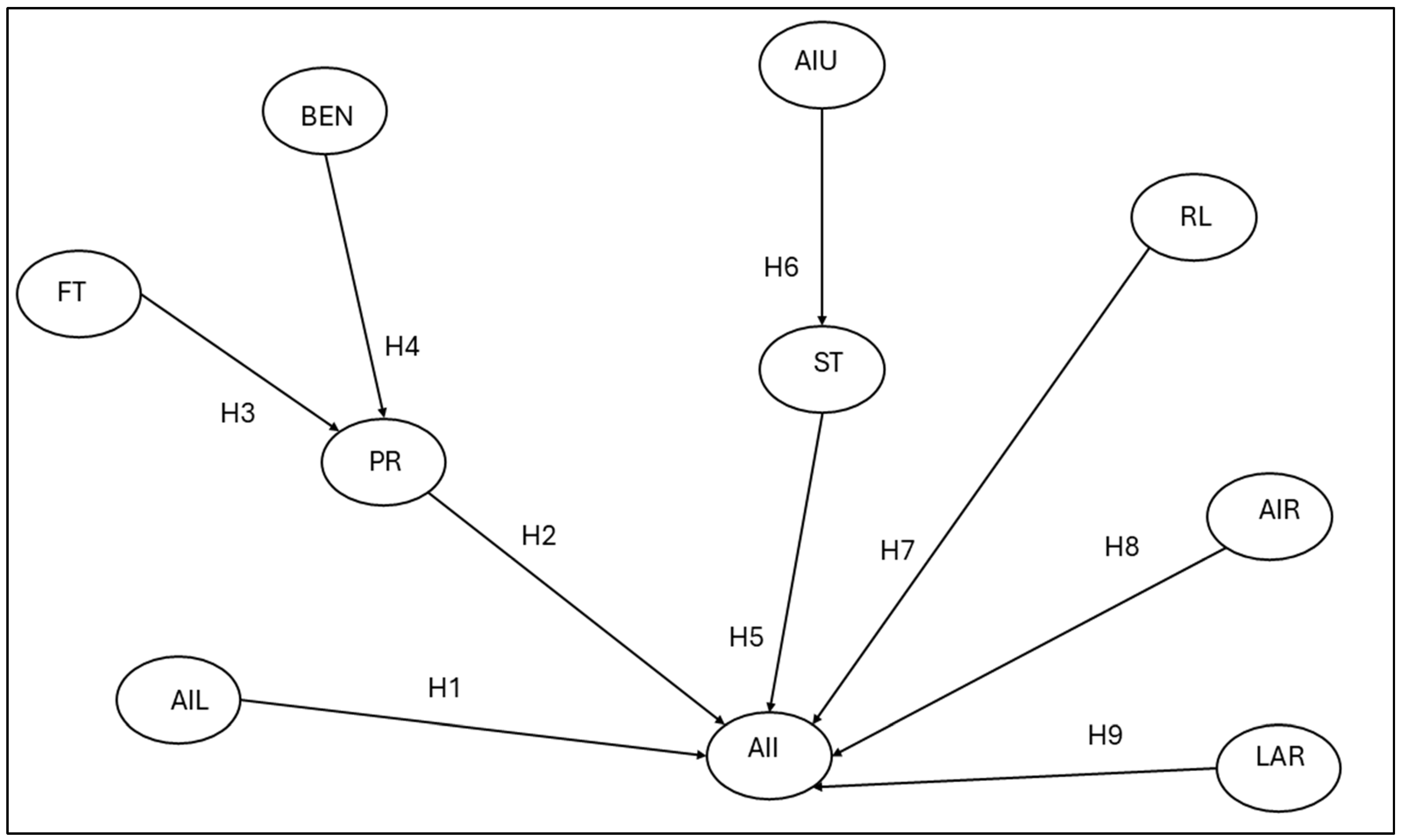
To test the research Hypotheses H1–H9, we build the model shown in Figure 1.

3. Materials and Methods

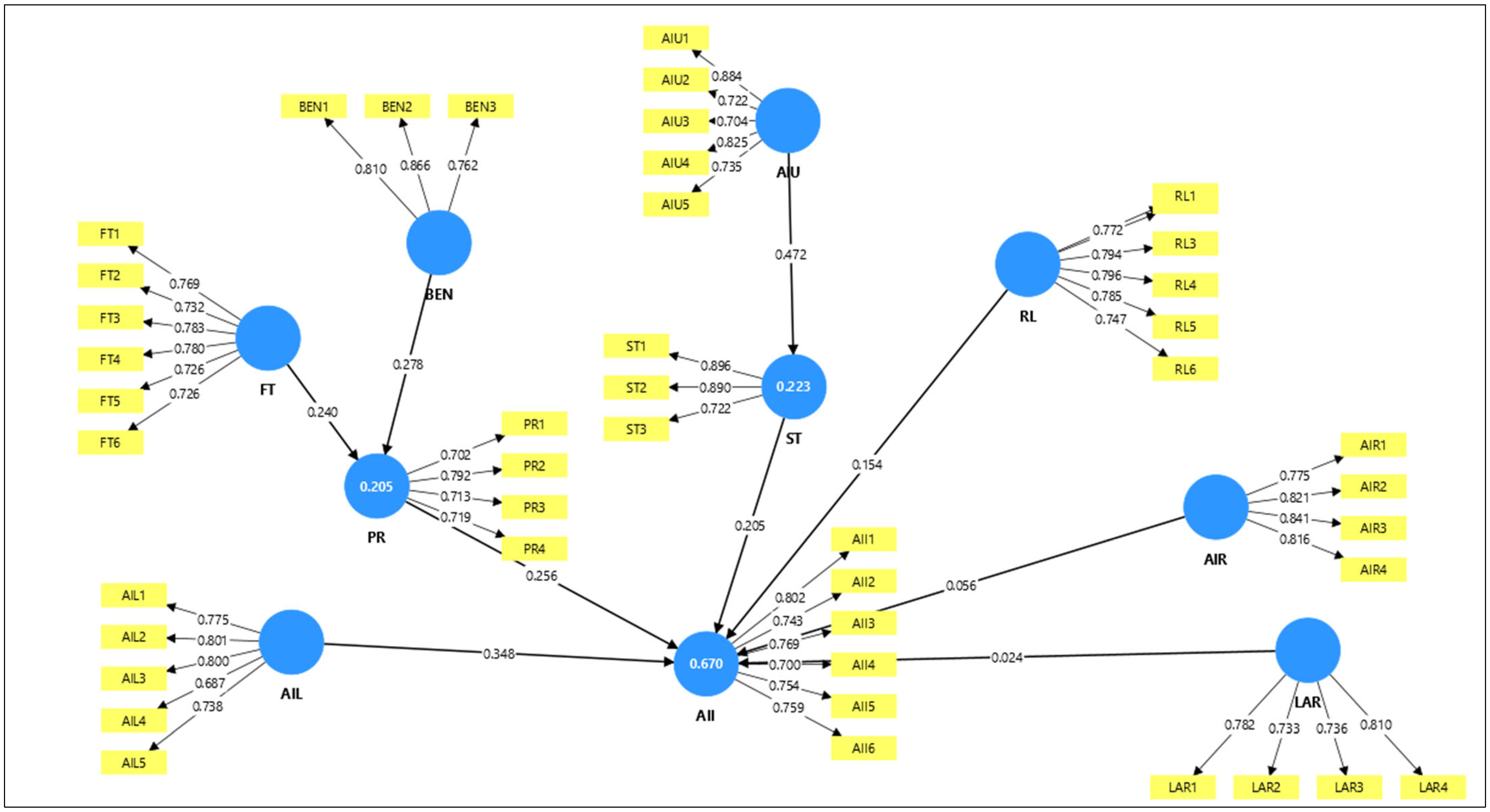
Based on the specialized literature presented in the references, a 75-item survey was used with a 5-point Likert scale. Between March 2025 and April 2025, we distributed the questionnaire online to students of the Faculty of Economics and Business Administration at the West University of Timisoara, and we received 408 valid responses out of 429 (see Table 1). For reasons related to model reliability and validity, 29 items were eliminated, leaving 46 items in the final model. We constructed a model with ten constructs (Figure 2 and Appendix A): AII—perceived normative institutional AI Integration: although AII refers to institutional transformation, it is measured at the perceptual level through students’ evaluations of institutional responsibilities and governance expectations.; AIL—Artificial intelligence literacy; PR—Perception and intention to use AI Chatbots among higher education professors; FT—AI Chatbot features; BEN—Cognitive and pedagogical benefits of AI Chatbots in developing critical thinking and creativity; ST—Positive perceptions and intention to use AI Chatbots among students; AIU—AI Chatbots using for assisted and personalized student Learning; RL—Perceived cognitive risks and limitations of AI Chatbots; AIR—perceived academic integrity risks; and LAR—perceived AI chatbots’ limitations of accuracy and reliability.
When we started the study, we searched the Web of Science for papers on AI Integration in Education and selected well-rated journals. Even though many of these papers were more theoretical, the journals’ reputation helped us move towards reading with recognition within the academic environment. The authors are university teachers, which means we are directly involved in this process and understand very well what specialized literature presents, but we emphasize relevant and recognized literature in the academic environment. We consider the presented references the foundation of our study, and we selected many items that resonated with our general perception. We are convinced that the selection is not necessarily optimal, but we still consider it relevant. 29 items were eliminated. In almost all cases, items were eliminated due to reliability concerns (outer loadings were below 0.68). For example, the item “Chatbot AI had a positive impact on critical thinking skills, exposing different points of view and challenging them to analyze and evaluate” used in AIU items, had a 0.473 value for outer loading. We added the item “AI Chatbots can generate lesson plans, teaching materials, and updated course content” to FT. It had an outer loading value of 0.455 for FT and 0.696 for AIR. Here, we acknowledge an interpretive gap between what we intended to ask and what the students understood. Perhaps the term ‘teaching materials generation’ seemed more closely related to AIR than to FT. Thus, we dropped this item.
We analyzed the model using Partial Least Squares Structural Equation Modeling (PLS-SEM) and SmartPLS 4. We assessed the reliability and validity of the research model. PLS-SEM is a variance-based statistical technique used to analyze complex relationships between observed variables and latent constructs. This is a widely used statistical method in research. Theoretical support can be found in many sources, including [88]. In the next section, we present the numerical results obtained using PLS-SEM.

4. Results

In PLS-SEM, outer loadings indicate how well each item reflects the construct to which it belongs. Common rules [88]: good, reliable indicator (≥0.70); conditionally acceptable (0.40–0.69) is kept if the AVE and CR are good; is eliminated (<0.40). In Table 2, all loadings are ≥0.687, indicating no major problematic indicators. According to the PLS-SEM literature [88], for internal reliability, it is necessary that: Cronbach’s alpha ≥ 0.70, rho_a ≥ 0.70; composite Reliability (CR) between 0.70 and 0.95 (good internal consistency, no redundancy). The results in Table 2 indicate that all constructs exhibit adequate internal reliability, with Cronbach’s alpha and composite reliability (rho_a and CR) exceeding the recommended threshold of 0.70. Also, the AVE values exceed the 0.50 threshold for all constructs, confirming the measurement model’s convergent validity.
In PLS-SEM, for discriminant validity, we study Fornell–Larcker criterion analysis and the heterotrait–monotrait ratio (HTMT) matrix. The Fornell–Larcker criterion states that, to ensure discriminant validity, the square root of the AVE (diagonal values) must exceed all correlations of that construct with other constructs (the values in the row and column). For the heterotrait–monotrait ratio (HTMT) matrix, the values less than 0.85 mean good discriminating validity. The values in Table 3 and Table 4 confirm the discriminant validity, as shown in Figure 1 and Figure 2.
Structural model assessment measures include the coefficient of determination (R2), the variance inflation factor (VIF), the statistical significance and relevance of path coefficients, and the predictive relevance (Q2).
Usual benchmarks in PLS-SEM [89] for R2: ≥0.75—substantial; ≥0.50—moderate; ≥0.25—weak. The structural model (Figure 2) shows strong explanatory power for AII (R2 = 0.67) and modest explanatory power for PR (R2 = 0.205) and ST (R2 = 0.223), indicating that the model explains AII well, while professors’ and students’ intentions/perceptions are only partially captured and likely depend on additional determinants not included in the model.
The rule for path coefficients is: >0.30—strong effect; >0.20—moderate effect; >0.10—weak effect. Results indicate that AIL has a moderate to strong positive effect on AII (β = 0.348), while PR (β = 0.256) and ST (β = 0.205) also exhibit meaningful contributions (Table 5). Higher AII is associated with higher AIL. Substantively, this supports the logic that in institutions that integrate AI more strongly (policies, redesign, support), the users are more literate/competent in AI use. When professors are more positive about AI Chatbots and more willing to use them, universities tend to show higher levels of AII. Students’ trust/satisfaction/stance toward AI chatbots improves AII—but the effect isn’t large, other determinants likely matter.
The path coefficient from RL to AII (β = 0.154) indicates a small but meaningful positive effect, suggesting that concerns regarding learning-related risks—such as reduced critical thinking, creativity, and over-reliance on AI chatbots—moderately increase support for structured and responsible AI integration in higher education. While these risks do not strongly drive integration strategies, they underscore the need for pedagogical guidance and institutional frameworks. AIR shows a negligible positive effect on AII in universities (β = 0.056), indicating that concerns about cheating and plagiarism are not a substantial direct driver of AII. Ethical risks are recognized, but they are not, in themselves, sufficient to trigger major structural changes. The path coefficient from LAR to AII is extremely weak (β = 0.024), indicating a negligible influence of perceived limitations and accuracy risks of AI chatbots on AII.
AIU strongly predicts ST (β = 0.472), suggesting that AI usage plays a key role in shaping ST. When students experience or perceive themselves using AI Chatbots in these practical, supportive ways, they tend to develop more positive attitudes and stronger intentions to use them.
The results indicate that for the indirect relationships AIU → AII, BEN → AII, and FT → AII, the magnitudes of the path coefficients are small (β = 0.097, β = 0.071, and β = 0.062, respectively), suggesting limited explanatory power. These findings imply that AIU, BEN, and FT contribute only marginally to explaining the variance in AII. Rather than acting as key determinants, these constructs appear to play complementary roles within the overall explanatory model, with weak effects.
To explore the R2 statistical implications, we used a bootstrapping technique in SmartPLS with 5000 iterations. Hypotheses 1–7 are supported (these hypotheses are true)—the values in Table 6 are statistically significant; Hypotheses 8 and 9 are not supported (these hypotheses are false). In Table 6, we present the path coefficients (values greater than 0.100 are significant), confidence intervals, t-statistics, p-values, and remarks on each hypothesis.
In addition to establishing discriminant validity using the HTMT criterion, we assessed common method variance using the full collinearity VIF approach [89]. All construct-level VIF values were below the conservative threshold of 3.3 (Table 7), suggesting that collinearity is not problematic and that common method bias is unlikely to threaten the validity of the results. Taken together, these diagnostics provide further support for the empirical distinctiveness of the constructs, beyond potential measurement-method effects.
In Table 8, we present the effect size f2 (≥0.02 is small; ≥0.15 is medium; ≥0.35 is large), which indicates the proportion of variance in one factor accounted for by another factor. f2 tells how much an individual path contributes to the R2 of the dependent variable. The real effects are: AIL → AII, with f2 = 0.206—medium, solid effect and AIU → ST, with f2 = 0.287—medium, solid effect. Effects are small for relationships: PR → AII: 0.122; BEN → PR: 0.071; FT → PR: 0.053; RL → AII: 0.032; ST → AII: 0.059. Negligible/problematic effects are AIR → AII: 0.005; LAR → AII: 0.001—these are dead paths, which cause a high SRMR. The impact on AII is almost non-existent; removing them from the model would probably not change R2 significantly. If we were to refer to a model like “what are the factors that significantly influence AII”, these pathways would have to be eliminated to improve the SRMR, thereby outlining a better model. As the literature indicates, there are many concerns regarding AIR and LAR. In our study, we retained these constructions precisely to examine how they influence AII, and the finding that they do not is part of our results. SRMR (the main indicator of model fit) is 0.076, which falls below the accepted threshold in PLS-SEM: SRMR < 0.08. Following Henseler’s bootstrapped model fit assessment, the discrepancy measure d_ULS = 6.191 and d_G = 2.089 of the estimated model exceeded the 95% quantile of the bootstrap distribution. NFI = 0.627—in PLS-SEM, values between 0.60 and 0.80 are frequently encountered in complex models. However, in variance-based SEM, global fit measures are considered supplementary diagnostics. In our case, the SRMR value (0.075) remains below the recommended cutoff of 0.08, suggesting an acceptable overall model fit. Combined with the satisfactory reliability, convergent and discriminant validity of the constructs, the absence of problematic construct-level collinearity, and the substantial explained variance in AII (R2 ≈ 0.67), the model can be regarded as empirically adequate for explaining the hypothesized relationships.
Guidelines [84] for Q2 are: high prediction ≥0.5; ≥0.2 moderate prediction; ≥0.10—weak prediction. The PLS predictive assessment indicates strong predictive relevance for AII (Q2 = 0.535), demonstrating robust out-of-sample predictive performance for institutional AI integration. In contrast, PR (Q2 = 0.192) and ST (Q2 = 0.212) show modest but positive predictive relevance, suggesting acceptable predictive performance while indicating the presence of additional unexplored predictors.
Descriptive statistics are in Appendix B.

5. Discussion

This paper examines the factors influencing the normative support for the integration of AI Chatbots in universities. AI literacy is the most critical factor influencing AII (with a path coefficient of 0.385; see Figure 2 and Table 5) and exerts a direct effect. AI literacy refers to the fact that to integrate AI chatbots into education effectively, it is essential to organize training sessions for students and teachers. Reference [47] confirms that AI Literacy is a foundational enabler of AI adoption by influencing performance expectancy, effort expectancy, and social influence. Reference [48] shows that AI Knowledge is the strongest predictor of actual AI adoption. AIL → AII, with f2 = 0.206, means that removing AIL from the model would produce a substantial decrease in R2 for AII. AIL has one of the model’s real structural effects: AI literacy is a catalyst for institutional reform.
The following factors influence direct AII:
PR (professors’ perceptions on using AI Chatbots in universities)—with the path coefficient of 0.227, see Figure 2 and Table 5. University professors see AI Chatbots as a promising tool for streamlining and enriching the educational process, provided their use complements classical pedagogical approaches. Our study confirms that this positively impacts AII [59] shows that teachers’ positive perceptions influence the integration of AI chatbots in universities. Key positive perception factors are hedonic motivation (the strongest predictor), positive emotions, and performance expectancy. PR exerts a small-to-moderate effect on AII (f2 = 0.122), suggesting that positive academic attitudes toward AI Chatbots are associated with tendencies toward institutional reform. However, the effect is weaker than that of AI literacy, suggesting that favorable perceptions alone are insufficient to drive structural transformation without deeper conceptual and pedagogical grounding. The effect of BEN on professors’ perceptions (PR) is small but meaningful (f2 = 0.071). This indicates that while the perceived potential of AI Chatbots to stimulate critical thinking and broaden perspectives contributes to positive attitudes, it does not constitute the primary explanatory factor. Professors’ perceptions appear to be shaped by a broader pedagogical and strategic framework rather than by cognitive enhancement alone. The effect of FT on PR is small (f2 = 0.053). This suggests that while awareness of AI Chatbots’ capabilities contributes to positive attitudes, technological functionality alone does not strongly shape professors’ perceptions. AI acceptance is not purely technological. Teachers’ perceptions are mediated by pedagogical considerations. Functionality is necessary, but not sufficient, for educational legitimacy. Attitudes appear to be influenced more by pedagogical value than by technical performance.
ST (positive perceptions and intention to use AI Chatbots among students)—with a path coefficient of 0.215, see Figure 2 and Table 5. Students are already familiar with AI Chatbots and find them especially useful for generating new ideas, saving time, and increasing learning efficiency. The effect of ST on AII is small (f2 = 0.059), indicating that while students’ familiarity, perceived usefulness, and intention to use AI Chatbots influence AII, they are not the primary drivers of AII. This shows that AII Integration is not primarily determined by student openness, but rather by institutional and pedagogical factors (AIL and PR in our model). Reference [70] shows that students’ positive perceptions of AI chatbots influence their integration into universities, and that perceived enjoyment is the strongest predictor. One of the main advantages is the ability to offer a personalized learning experience. Reference [90] demonstrates, through PLS-SEM analysis, that the use of AI chatbots as assisted and personalized learning tools (operationalized through self-directed learning with technology and perceived usefulness) positively influences students’ perception of the use of chatbots, reflected by intention to use and actual use. Figure 2 shows that AIU exerts a substantial effect on ST (f2 = 0.287), indicating that practical, pedagogically meaningful engagement with AI Chatbots significantly enhances students’ familiarity, perceived usefulness, and intention to adopt these tools. This finding suggests that experiential interaction, rather than abstract attitudes alone, plays a central role in shaping student endorsement of AI technologies in higher education.
The informal use of AI Chatbots among students and teachers is already massive [30,72]. This use brings important benefits [63,69] but also challenges that require a strategic approach [41,64]. For effective integration, higher education institutions need to develop clear policies [41,46], provide training programs for students and teachers [53,64], redefine assessments [60,81], and promote a culture of ethical and responsible use [58,64].
In addition to these positive factors, the study also reveals a negative factor that can positively influence AIII: the cognitive limitations generated by AI Chatbots (addiction and avoidance of intellectual effort), even if they are real problems, can act as a driver of responsible integration [67,68]. Consequently, universities need to actively manage these risks by developing AI skills. The effect of RL on AII is small (f2 = 0.032). This suggests that RL is not the primary driver of institutional transformation. AII appears to be shaped more by pedagogical and strategic considerations than by RL.
Our paper shows that academic integrity risks [37,64] and limitations of accuracy and reliability [81,82] do not influence AII. However, universities must balance innovation with adherence to educational and ethical standards through clear policies, the redesign of assessments, and the promotion of AI literacy. The effect of AIR on AII is negligible (f2 = 0.005). This finding indicates that concerns related to plagiarism, cheating, and source attribution do not substantially explain institutional AI integration strategies. AII is not triggered by the fear of fraud, but by the need for pedagogical and institutional adaptation. The effect of LAR on AII is negligible (f2 = 0.001). This finding indicates that concerns related to hallucinations, outdated information, and response vagueness do not meaningfully explain AII. AII is not determined by technological imperfections, but by pedagogical and institutional maturity. AIR and LAR were not significant predictors in this sample. Several contextual and methodological explanations may account for these non-significant results. First, the relative homogeneity of the sample (economics students from the same institution) may have limited variance in perceptions. Second, measurement limitations or ceiling effects may have reduced the ability to detect significant relationships. Finally, it is possible that perceived benefits of AI integration outweigh perceived risks in this educational context.
This study advances the literature on AI adoption in higher education by reconceptualizing institutional AI integration as a legitimacy formation process rather than a purely technological adoption outcome. By positioning perceived normative support as a central institutional mechanism, the model extends traditional acceptance frameworks (e.g., TAM—Technology Acceptance Model [91] and UTAUT—Unified Theory of Acceptance and Use of Technology [92]) toward an institutional and climate-based perspective grounded in legitimacy and organizational theory. Furthermore, the study integrates cognitive drivers (e.g., literacy and perceived benefits) and ethical–technical inhibitors (e.g., academic integrity risks and reliability limitations) within a unified explanatory framework, offering a more balanced and realistic account of AI integration dynamics. In doing so, it contributes to the emerging discourse on responsible AI governance by demonstrating that institutional transformation depends on socially constructed normative support rather than on individual attitudes or technological capabilities alone.
The model’s context is institutional AI integration in higher education. The model integrates multiple theoretical layers: micro level—TAM, UTAUT, IS Success Model (Information Systems Success [93]); meso level—Organizational climate theory [94], Institutional theory [95]; and macro level—Institutional legitimacy [96] and Responsible AI governance [97].
When AI integration is viewed as socially supported within the university context—by leadership, peers, and academic communities—it gains legitimacy, reducing uncertainty and resistance while fostering collective alignment. In this sense, perceived normative support functions as a proximal institutional mechanism that translates individual evaluations into organizational-level integration processes. Therefore, higher levels of perceived normative support are expected to facilitate institutional AI integration in higher education settings, as shown in other works [98,99,100].
This model is a hybrid framework integrating Technology Adoption Models (TAM/UTAUT) with Institutional Theory to explain both individual AI use and perceived institutional transformation in higher education: TAM/UTAUT (BEN → perceived usefulness; ST → behavioral intention; AIU → actual use; FT → performance expectancy); Risk theory (RL; AIR; LAR); and Institutional Theory (AII—normative pressure; AIL -institutional capacity building; PR—normative influence of professors). This model extends technology adoption theories by incorporating institutional-level normative expectations, thus bridging individual adoption mechanisms with perceived organizational transformation processes (see Table 9).

6. Conclusions

This paper indicates that the success of AII depends mainly on the academic community’s AI literacy and teachers’ and students’ positive perceptions of AI. The finding that cognitive risks positively affect AII implies that universities must develop strategies to mitigate them.
The study presented in this paper shifts focus from individual use to perceived institutional integration; integrates dimensions of governance and responsibility; introduces a normative-institutional perspective on AI in higher education; and extends classic adoption models towards organizational transformation.

6.1. Theoretical and Practical Implications for Higher Education Institutions

Our paper shows the importance of prioritizing artificial intelligence (AI) literacy through developing training programs for teachers and students, investing in educational resources for AI skills, and creating centers of excellence in educational AI. To address the need to develop institutional policies, it is necessary to clearly define the ethical use of AI-based chatbots, establish guidelines for academic integrity, and develop assessment criteria adapted to the AI era. Thus, educational processes will be redesigned based on adapting teaching methods to human-AI collaboration, reforming assessment systems, and promoting critical thinking and creativity.
The results of this paper highlight practical implications for teachers: AI literacy and adapting pedagogical methods. In addition, the redefinition of the teaching role will be done by moving from transmitting information to mentoring, focusing on developing critical thinking, and promoting interactive and personalized learning. Regarding practical implications for students, the emphasis is on responsible use, developing information verification skills, understanding the limits of AI chatbots, and maintaining a balance between AI assistance and personal effort.

6.2. Limitations of the Paper and Future Research Directions

Our study relies on a sample consisting exclusively of 408 economics students from a single university. While the sample size is adequate, its homogeneity introduces notable limitations regarding the representativeness of the findings. Students enrolled in business and economics programs could be more digitally literate and more receptive to technological innovations, which may positively bias attitudes toward AI-based tools such as chatbots. Moreover, the absence of participants from disciplines in which ethical, pedagogical, or epistemological concerns about AI are more pronounced (e.g., the humanities, law, social sciences, teacher education) could constrain the scope of the conclusions. As a result, the findings may differ for the university student population, even though our study results suggest otherwise. The authors acknowledge this limitation. Future research should use more diverse, heterogeneous samples across institutions and academic disciplines to enhance the external validity of findings. Comparative and mixed-method approaches would provide deeper insights into disciplinary differences and contextual factors shaping students’ attitudes toward AI Chatbots.
AI technologies, particularly generative AI tools, are evolving at an unprecedented pace, accompanied by fluctuating public discourse and institutional responses. As a result, student perceptions of AI use in higher education remain dynamic rather than fully stabilized. While this snapshot provides insight into prevailing trends at an early, formative stage of AI adoption, it may not fully reflect enduring or long-term attitudes toward AI integration. Perceptions of usefulness, risk, and ethical implications are likely to shift as students gain more experience with AI tools and as institutional guidelines mature. Future research would benefit from longitudinal or repeated-measures designs to examine how students’ perceptions and usage patterns develop over time. Such approaches would allow for the identification of stable trends, transitional phases, and potential shifts in attitudes as AI technologies become more embedded in educational practice.
Higher education institutions must invest in robust AI literacy programs, clear ethical-use policies, and examination systems adapted to the AI era to ensure the adequate and ethical integration of AI. The future of education lies in a hybrid system that integrates AI with fundamental human and academic values.
In conclusion, the ethical integration of AI-based chatbots in higher education contributes to sustainable digital transformation by enhancing educational quality. AI literacy and personalized learning promote equitable access and engagement, while governance frameworks and ethical policies ensure responsible adoption of AI. By integrating AI into sustainable institutional practices, universities can align technological innovations with long-term educational sustainability and SDG 4 (Quality Education). Thus, AI becomes a strategic tool that strengthens both learning outcomes and the broader role of universities as long-term sustainable ecosystems.

Author Contributions

Conceptualization, M.-C.V., N.S., G.M. and D.M.-M.T.; methodology, M.-C.V., N.S., GM. and D.M.-M.T.; validation, M.-C.V. and N.S.; formal analysis, M.-C.V. and N.S.; writing—original draft preparation, M.-C.V. and N.S.; writing—review and editing, N.S. and M.-C.V. All authors have read and agreed to the published version of the manuscript.

Funding

This article was supported by the Doctoral School of Economics and Business Administration (SDEEA), West University of Timisoara (WUT). The APC was funded by the West University of Timișoara.

Institutional Review Board Statement

The proposed research meets the criteria for exemption from approval by the Research Ethics Committee, as set out in the guide on observing ethics in research-innovation projects/studies with European funding, developed by the Department for Scientific Research and University Creation, approved by the Scientific Council of University Research and Creation (CSCCU) of the West University of Timișoara on 14.10.2020; point 4.4 “Data that have been anonymized are not subject to these regulations !”.

Informed Consent Statement

The study was conducted in accordance with ethical research standards and the principles of the EU General Data Protection Regulation (Regulation (EU) 2016/679—GDPR). Participation was voluntary, and informed consent was obtained through completion of the questionnaire after participants were provided with detailed information regarding the study’s purpose, procedures, and their rights. All collected data were anonymised and processed solely for research purposes, ensuring confidentiality and compliance with data protection regulations.

Data Availability Statement

Data are contained within the article.

Conflicts of Interest

The authors declare no conflicts of interest.

Abbreviations

The following abbreviations are used in this manuscript:
AIArtificial Intelligence
AI ChatbotsArtificial Intelligence Chatbots
AIIArtificial Intelligence Integration in universities
AILArtificial Intelligence Literacy
AIRAcademic Integrity Risks
AIUAI Chatbots are used for assisted and personalized student learning
BENCognitive and pedagogical benefits of AI Chatbots
FTFeatures of AI Chatbots
LARAI Chatbots’ limitations of accuracy and reliability.
PRProfessors’ perceptions of the use of AI Chatbots in universities
RLCognitive risks and limitations of AI Chatbots
STPositive perceptions and intention to use AI Chatbots among students

Appendix A

Table A1. Survey Questions.
ConstructItemScaleScale Reference
AIIAII1Universities must design explicit procedures, approaches, and frameworks for the trustworthy integration of AI Chatbots. These include managing intellectual integrity, data privacy, and algorithmic bias.[32,34,37,38]
AII2Ample empirical research is required to comprehend the real influence of AI Chatbots on education.[27,32,37,63,64,75]
AII3Longitudinal studies can provide a more detailed understanding of the long-term impact and evolution of student experiences with AI Chatbots.[64,72]
AII4Teachers must redefine their roles, focusing on critical pedagogical decisions, encouraging students to be active investigators, and raising ethical awareness.[55]
AII5The design of assessments should focus on the application and interpretation of knowledge, not just basic knowledge, to prevent unauthorized use and encourage critical thinking.[45,62]
AII6AI Chatbot developers should focus on intuitive design, performance improvement, and integrating features that facilitate knowledge sharing.[64]
AILAIL1Providing training sessions and resources to familiarize students and teachers with AI Chatbots and their functionalities.[34,38,50,64,73]
AIL2Training should focus on building confidence in using the tool and addressing technical barriers.[66]
AIL3Educating students on AI Chatbots’ capabilities, ethical implications, and limits, encouraging their responsible use.[37,38,64]
AIL4Users should always check the information AI Chatbots provide, as it is unreliable.[25,37,38,45,57,62,65,81]
AIL5Encouraging interdisciplinary collaboration to fully harness the benefits of AI Chatbots in an educational context.[34,37]
PRPR1The general perception of university professors is positive regarding implementing AI Chatbots in teaching activities.[27]
PR2University professors see it as a means to support time-consuming teaching activities, stimulate interest, activate and engage learners, and stimulate their critical thinking and creativity.[27]
PR3Most university professors consider studying AI Chatbots for proper use in education.[27]
PR4The professors recognise the potential of AI Chatbots as a tool to support and improve traditional methods, but emphasise the importance of complementing, not replacing, human interaction.[54,83]
FTFT1AI Chatbots can assist in academic research, courses, assignments, and projects.[31,37]
FT2AI Chatbots can summarise information and analyse content.[31,64,65,81]
FT3AI Chatbots provide initial essay ideas and can help with the research writing.[37]
FT4Users can use AI Chatbots for topic exploration, brainstorming, and schema development.[45]
FT5AI Chatbots can generate linguistic and discourse analysis.[66]
FT6AI Chatbots are effective at composing explanatory answers and can write manuscripts.[32,81]
BENBEN1Its ability to provide instant answers can stimulate critical thinking.[31]
BEN2Through AI-generated text analysis, users can learn to evaluate information and develop critical thinking skills.[39,45,53]
BEN3The use of AI Chatbots exposed different points of view, encouraging the user to think about questions other than those initially proposed by the user (i.e., it expanded the conversation).[3]
STST1Students are familiar with AI Chatbots.[65]
ST2Students perceive AI Chatbots as especially useful for generating new ideas, saving time, and improving efficiency.[56,65,81]
ST3Higher education students’ intent to use AI Chatbots is influenced by their perceived ease of use, usefulness, interactivity, and personalisation.[64,72]
AIUAIU1Students can use AI Chatbots as a study tool, complementary to traditional learning, and as a revision aid in exam preparation.[49,82]
AIU2They can ask AI Chatbots to explain their answers and generate quiz questions.[49]
AIU3AI Chatbots can provide personalised learning experiences by tailoring content to students’ needs.[31,65]
AIU4AI Chatbots can provide tailored feedback and explanations, helping students understand complex concepts and identify knowledge gaps.[34,37,38,110]
AIU5AI Chatbots are patient virtual tutors available 24/7. They explain concepts in different ways and provide instant access to information and resources.[37,65,81,83]
RLRL1The danger of becoming overly dependent on AI Chatbots can reduce students’ critical thinking, problem-solving, and creativity skills.[28,37,38,40,45,53,65,67]
RL2AI Chatbots could lead to poor user training if a process of deepening and nuancing understanding is missing.[50,67]
RL3Some experts believe that the extensive use of AI Chatbots could decrease competence in creative thinking.[81]
RL4AI Chatbots do not possess the same level of human interaction and interpersonal skills as instructors or peers, limiting their effectiveness in group activities and collaborative discussions.[37,38,83]
RL5New skills and thinking styles are needed to harness AI Chatbots’ potential fully.[63]
RL6Some teachers fear that students could become lazy and rely on AI Chatbots to avoid the human effort required to acquire intellectual skills.[25,32,57,65]
AIRAIR1One of the biggest concerns is the risk of plagiarism and cheating, as students can use AI Chatbots to generate content for assignments or exams, which can bypass conventional plagiarism detectors.[27,32,37,40,45,53,60,61,62,63,64,65,84,111]
AIR2A struggling student can substantially improve their score by using AI Chatbots unauthorisedly.[49]
AIR3Cheating occurs when students purchase third-party writing services.[64]
AIR4The lack of attribution of sources by AI Chatbots raises ethical and learning issues.[25]
LARLAR1AI Chatbots can generate incorrect, misleading, or biased answers because they lack a deep understanding of the meaning of words and rely on statistical models. They can even produce artificial hallucinations, generating information that does not exist, including false references.[27,37,45,53,63,64,65,81,82]
LAR2AI Chatbots’ knowledge is limited to the data they have been trained on, so they cannot provide real-time information or information about recent events.[25,27,37,45,65,84]
LAR3The answers can be vague, without providing sufficient details or specific information.[65]
LAR4It is difficult to assess the quality of the answers and the credibility of the data on which they have been trained.[53,65,67]

Appendix B

Table A2. Descriptive Statistics.
MeanMedianMinMaxStandard DeviationExcess KurtosisSkewness
AII14.4145.0002.0005.0000.839−0.534−1.003
AII24.3315.0002.0005.0000.968−1.006−0.866
AII34.3925.0003.0005.0000.862−1.119−0.850
AII44.3735.0001.0005.0000.957−0.293−1.075
AII54.3435.0002.0005.0000.923−1.292−0.770
AII64.4615.0002.0005.0000.907−0.296−1.200
AIL14.2795.0001.0005.0000.980−0.478−0.928
AIL24.2675.0001.0005.0000.978−0.268−0.936
AIL34.3535.0001.0005.0000.8530.539−1.126
AIL44.4615.0002.0005.0000.912−0.162−1.236
AIL54.3505.0001.0005.0000.940−0.264−1.035
PR13.9494.0001.0005.0001.036−1.012−0.414
PR23.9884.0001.0005.0001.004−0.750−0.472
PR34.2135.0002.0005.0000.921−1.040−0.643
PR44.4025.0001.0005.0000.8860.004−1.113
FT14.5985.0001.0005.0000.8832.478−1.951
FT24.8535.0001.0005.0000.60120.383−4.426
FT34.7165.0002.0005.0000.7464.276−2.400
FT44.7945.0002.0005.0000.6165.901−2.749
FT54.6135.0001.0005.0000.8472.473−1.935
FT64.5985.0002.0005.0000.7771.419−1.685
BEN14.1425.0001.0005.0001.188−0.490−0.946
BEN24.3385.0001.0005.0001.0790.282−1.280
BEN34.5715.0001.0005.0000.8741.701−1.742
ST14.7015.0003.0005.0000.6452.201−1.938
ST24.6325.0003.0005.0000.7390.835−1.633
ST34.3245.0001.0005.0000.969−0.677−0.913
AIU14.7795.0001.0005.0000.69010.770−3.276
AIU24.7215.0001.0005.0000.7897.879−2.883
AIU34.7355.0001.0005.0000.7407.519−2.811
AIU44.7895.0001.0005.0000.69311.567−3.419
AIU54.6915.0001.0005.0000.8627.609−2.863
RL14.4075.0001.0005.0001.0321.114−1.495
RL24.4025.0001.0005.0000.9980.770−1.378
RL34.3095.0001.0005.0001.0510.071−1.151
RL44.3095.0001.0005.0001.0400.282−1.170
RL54.3145.0002.0005.0000.923−0.971−0.812
RL64.3095.0001.0005.0000.979−0.154−1.060
AIR14.1085.0001.0005.0001.187−0.492−0.897
AIR24.0205.0001.0005.0001.163−1.013−0.611
AIR33.8684.0001.0005.0001.199−1.057−0.445
AIR44.1475.0001.0005.0001.152−0.190−0.966
LAR14.3335.0002.0005.0000.993−0.703−0.978
LAR23.9515.0001.0005.0001.218−1.061−0.576
LAR33.9365.0001.0005.0001.274−1.059−0.629
LAR44.0425.0001.0005.0001.134−1.298−0.528

References

  1. Available online: https://connect.informs.org/discussion/findings-from-data-ai-literacy-report-from-datacamp (accessed on 18 October 2025).
  2. Su, J.; Yang, W. Artificial Intelligence (AI) literacy in early childhood education: An intervention study in Hong Kong. Interact. Learn. Environ. 2023, 32, 5494–5508. [Google Scholar] [CrossRef] [Scilit]
  3. Luckin, R.; Holmes, W.; Griffiths, M.; Forcier, L.B. Intelligence Unleashed: An Argument for AI in Education; Pearson Education: Harlow, UK, 2016. [Google Scholar]
  4. Zawacki-Richter, O.; Marín, V.I.; Bond, M.; Gouverneur, F. Systematic review of research on artificial intelligence applications in higher education–where are the educators? Int. J. Educ. Technol. High. Educ. 2019, 16, 39. [Google Scholar] [CrossRef] [Scilit]
  5. Williamson, B.; Eynon, R. Historical threads, missing links, and future directions in AI in education. Learn. Media Technol. 2020, 45, 223–235. [Google Scholar] [CrossRef] [Scilit]
  6. Holmes, W.; Bialik, M.; Fadel, C. Artificial Intelligence in Education: Promises and Implications for Teaching and Learning; Center for Curriculum Redesign: Jamaica Plain, MA, USA, 2021. [Google Scholar]
  7. Selwyn, N. Should Robots Replace Teachers?: AI and the Future of Education; John Wiley & Sons: Hoboken, NJ, USA, 2019. [Google Scholar]
  8. Popenici, S.A.D.; Kerr, S. Exploring the impact of artificial intelligence on teaching and learning in higher education. Res. Pract. Technol. Enhanc. Learn. 2017, 12, 22. [Google Scholar] [CrossRef] [Scilit]
  9. Binns, R.; Veale, M.; Van Kleek, M.; Shadbolt, N. ‘It’s Reducing a Human Being to a Percentage’: Perceptions of Justice in Algorithmic Decisions. In Proceedings of the 2018 CHI Conference on Human Factors in Computing Systems; ACM: New York, NY, USA, 2018; pp. 1–14. [Google Scholar] [CrossRef] [Scilit]
  10. Cotton, D.R.E.; Cotton, P.A.; Shipway, J.R. Chatting and cheating: Ensuring academic integrity in the era of ChatGPT. Innov. Educ. Teach. Int. 2023, 60, 150–161. [Google Scholar] [CrossRef] [Scilit]
  11. Pillai, R.; Sivathanu, B.; Metri, B.; Kaushik, N. Students’ adoption of AI-based teacher-bots (T-bots) for learning in higher education. Inf. Technol. People 2024, 37, 328–355. [Google Scholar] [CrossRef] [Scilit]
  12. Floridi, L.; Cowls, J.; Beltrametti, M.; Chatila, R.; Chazerand, P.; Dignum, V.; Luetge, C.; Madelin, R.; Pagallo, U.; Rossi, F.; et al. AI4People—An ethical framework for a good AI society: Opportunities, risks, principles, and recommendations. Minds Mach. 2018, 28, 689–707. [Google Scholar] [CrossRef] [Scilit]
  13. Available online: https://www.coursera.org/about/ (accessed on 18 November 2025).
  14. Available online: https://support.microsoft.com/en-us/microsoft-365-copilot (accessed on 18 November 2025).
  15. Available online: https://support.google.com/docs/answer/16579428?visit_id=639057871340742429-1162443753&p=gemini_direct_content_insertion&rd=1 (accessed on 18 November 2025).
  16. Available online: https://moodle.com/us/news/ai-solutions-for-moodle/ (accessed on 18 November 2025).
  17. European Commission. Ethics Guidelines for Trustworthy AI. 2019. Available online: https://digital-strategy.ec.europa.eu/en/library/ethics-guidelines-trustworthy-ai (accessed on 8 November 2025).
  18. European Commission. Coordinated Plan on Artificial Intelligence 2021 Review. 2021. Available online: https://digital-strategy.ec.europa.eu (accessed on 8 November 2025).
  19. Kasneci, E.; Sessler, K.; Küchemann, S.; Bannert, M.; Dementieva, D.; Fischer, F.; Gasser, U.; Groh, G.; Günnemann, S.; Hüllermeier, E.; et al. ChatGPT for good? On opportunities and challenges of large language models for education. Learn. Individ. Differ. 2023, 103, 102274. [Google Scholar] [CrossRef] [Scilit]
  20. Johnston, H.; Wells, R.F.; Shanks, E.M.; Boey, T.; Parsons, B.N. Student perspectives on the use of generative artificial intelligence technologies in higher education. Int. J. Educ. Integr. 2024, 20, 2. [Google Scholar] [CrossRef] [Scilit]
  21. Hashmi, N.; Bal, A.S. Generative AI in higher education and beyond. Bus. Horiz. 2024, 67, 607–614. [Google Scholar] [CrossRef] [Scilit]
  22. Mittelstadt, B.D.; Allo, P.; Taddeo, M.; Wachter, S.; Floridi, L. The ethics of algorithms: Mapping the debate. Big Data Soc. 2016, 3, 1–21. [Google Scholar] [CrossRef] [Scilit]
  23. Smuha, N.A. The EU approach to ethics guidelines for trustworthy artificial intelligence. Comput. Law Rev. Int. 2019, 20, 97–106. [Google Scholar] [CrossRef] [Scilit]
  24. Flores-Vivar, J.M.; García-Peñalvo, F.J. Reflections on the ethics, potential, and challenges of artificial intelligence in the framework of quality education (SDG4). Comunicar 2023, 30, 35–44. [Google Scholar] [CrossRef] [Scilit]
  25. García-Peñalvo, F.J. La percepción de la Inteligencia Artificial en contextos educativos tras el lanzamiento de ChatGPT: Disrupción o pánico. Educ. Knowl. Soc. (EKS) 2023, 24, e31279. [Google Scholar] [CrossRef] [Scilit]
  26. Farrow, R. The possibilities and limits of XAI in education: A socio-technical perspective. Learn. Media Technol. 2023, 48, 266–279. [Google Scholar] [CrossRef] [Scilit]
  27. Kiryakova, G.; Angelova, N. ChatGPT—A Challenging Tool for the University Professors in Their Teaching Practice. Educ. Sci. 2023, 13, 1056. [Google Scholar] [CrossRef] [Scilit]
  28. Cain, W. Prompting Change: Exploring Prompt Engineering in Large Language Model AI and Its Potential to Transform Education. TechTrends 2024, 68, 47–57. [Google Scholar] [CrossRef] [Scilit]
  29. Yusuf, A.; Pervin, N.; Román-González, M. Generative AI and the future of higher education: A threat to academic integrity or reformation? Evidence from multicultural perspectives. Int. J. Educ. Technol. High. Educ. 2024, 21, 21. [Google Scholar] [CrossRef] [Scilit]
  30. Walter, Y. Embracing the future of Artificial Intelligence in the classroom: The relevance of AI literacy, prompt engineering, and critical thinking in modern education. Int. J. Educ. Technol. High. Educ. 2024, 21, 15. [Google Scholar] [CrossRef] [Scilit]
  31. Grájeda, A.; Burgos, J.; Córdova, P.; Sanjinés, A. Assessing student-perceived impact of using artificial intelligence tools: Construction of a synthetic index of application in higher education. Cogent Educ. 2023, 11, 2287917. [Google Scholar] [CrossRef] [Scilit]
  32. Yan, D. Impact of ChatGPT on learners in a L2 writing practicum: An exploratory investigation. Educ. Inf. Technol. 2023, 28, 13943–13967. [Google Scholar] [CrossRef] [Scilit]
  33. Barrett, A.; Pack, A. Not quite eye to A.I.: Student and teacher perspectives on the use of generative artificial intelligence in the writing process. Int. J. Educ. Technol. High. Educ. 2023, 20, 59. [Google Scholar] [CrossRef] [Scilit]
  34. Rawas, S. ChatGPT: Empowering lifelong learning in the digital age of higher education. Educ. Inf. Technol. 2024, 29, 6895–6908. [Google Scholar] [CrossRef] [Scilit]
  35. Mao, J.; Chen, B.; Liu, J.C. Generative Artificial Intelligence in Education and Its Implications for Assessment. TechTrends 2024, 68, 58–66. [Google Scholar] [CrossRef] [Scilit]
  36. Rahiman, H.U.; Kodikal, R. Revolutionizing education: Artificial intelligence empowered learning in higher education. Cogent Educ. 2024, 11, 2293431. [Google Scholar] [CrossRef] [Scilit]
  37. Michel-Villarreal, R.; Vilalta-Perdomo, E.; Salinas-Navarro, D.E.; Thierry-Aguilera, R.; Gerardou, F.S. Challenges and opportunities of generative AI for higher education as explained by ChatGPT. Educ. Sci. 2023, 13, 856. [Google Scholar] [CrossRef] [Scilit]
  38. Lin, X. Exploring the Role of ChatGPT as a Facilitator for Motivating Self-Directed Learning Among Adult Learners. Adult Learn. 2024, 35, 156–166. [Google Scholar] [CrossRef] [Scilit]
  39. Essien, A.; Bukoye, O.T.; O’Dea, X.; Kremantzis, M. The influence of AI text generators on critical thinking skills in UK business schools. Stud. High. Educ. 2024, 49, 865–882. [Google Scholar] [CrossRef] [Scilit]
  40. Zhang, C.; Schießl, J.; Plößl, L.; Hofmann, F.; Gläser-Zikuda, M. Acceptance of artificial intelligence among pre-service teachers: A multigroup analysis. Int. J. Educ. Technol. High. Educ. 2023, 20, 49. [Google Scholar] [CrossRef] [Scilit]
  41. Williams, R.T. The ethical implications of using generative chatbots in higher education. Front. Educ. 2023, 8, 1331607. [Google Scholar] [CrossRef] [Scilit]
  42. Ng, D.T.K.; Wu, W.; Leung, J.K.L.; Chiu, T.K.F.; Chu, S.K.W. Design and validation of the AI literacy questionnaire: The affective, behavioural, cognitive and ethical approach. Br. J. Educ. Technol. 2024, 55, 1082–1104. [Google Scholar] [CrossRef] [Scilit]
  43. Velander, J.; Taiye, M.A.; Otero, N.; Milrad, M. Artificial Intelligence in K-12 Education: Eliciting and reflecting on Swedish teachers’ understanding of AI and its implications for teaching & learning. Educ. Inf. Technol. 2024, 29, 4085–4105. [Google Scholar] [CrossRef] [Scilit]
  44. Ding, L.; Li, T.; Jiang, S.; Gapud, A. Students’ perceptions of using ChatGPT in a physics class as a virtual tutor. Int. J. Educ. Technol. High. Educ. 2023, 20, 63. [Google Scholar] [CrossRef] [Scilit]
  45. Kim, M.; Adlof, L. Adapting to the Future: ChatGPT as a Means for Supporting Constructivist Learning Environments. TechTrends 2024, 68, 37–46. [Google Scholar] [CrossRef] [Scilit]
  46. Delcker, J.; Heil, J.; Ifenthaler, D.; Seufert, S.; Spirgi, L. First-year students AI-competence as a predictor for intended and de facto use of AI-tools for supporting learning processes in higher education. Int. J. Educ. Technol. High. Educ. 2024, 21, 18. [Google Scholar] [CrossRef] [Scilit]
  47. Ke, Q.; Gong, Y.; Ke, C. Bridging AI literacy and UTAUT constructs: Structural equation modeling of AI adoption among Chinese university students. Humanit. Soc. Sci. Commun. 2025, 12, 1452. [Google Scholar] [CrossRef] [Scilit]
  48. López-Costa, M.; Donate-Beby, B.; Cabrera-Lanzo, N.; Maina, M.F. Understanding AI adoption among secondary education teachers: A pls-sem approach. Comput. Educ. Artif. Intell. 2025, 8, 100416. [Google Scholar] [CrossRef] [Scilit]
  49. Newton, P.; Xiromeriti, M. ChatGPT performance on multiple choice question examinations in higher education. A pragmatic scoping review. Assess. Eval. High. Educ. 2024, 49, 781–798. [Google Scholar] [CrossRef] [Scilit]
  50. Hashem, R.; Ali, N.; El Zein, F.; Fidalgo, P.; Abu, O. Al to the rescue: Exploring the potential of ChatGPT as a teacher ally for workload relief and burnout prevention [Al rescate: Explorando el potencial de ChatGPT como aliado para los profesores en la reducción de carga de trabajo y la prevención del agota]. Res. Pract. Technol. Enhaced Learn. 2023, 19, 023. [Google Scholar] [CrossRef] [Scilit]
  51. Ahmad, K.; Iqbal, W.; El-Hassan, A.; Qadir, J.; Benhaddou, D.; Ayyash, M.; Al-Fuqaha, A. Data-Driven Artificial Intelligence in Education: A Comprehensive Review. IEEE Trans. Learn. Technol. 2024, 17, 12–31. [Google Scholar] [CrossRef] [Scilit]
  52. Hsu, Y.C.; Ching, Y.H. Generative Artificial Intelligence in Education, Part One: The Dynamic Frontier. TechTrends 2023, 67, 603–607. [Google Scholar] [CrossRef] [Scilit]
  53. van den Berg, G.; du Plessis, E. ChatGPT and Generative AI: Possibilities for Its Contribution to Lesson Planning, Critical Thinking and Openness in Teacher Education. Educ. Sci. 2023, 13, 998. [Google Scholar] [CrossRef] [Scilit]
  54. Bower, M.; Torrington, J.; Lai, J.W.M.; Petocz, P.; Alfano, M. How should we change teaching and assessment in response to increasingly powerful generative Artificial Intelligence? Outcomes of the ChatGPT teacher survey. Educ. Inf. Technol. 2024, 29, 15403–15439. [Google Scholar] [CrossRef] [Scilit]
  55. Jeon, J.; Lee, S. Large language models in education: A focus on the complementary relationship between human teachers and ChatGPT. Educ. Inf. Technol. 2023, 28, 15873–15892. [Google Scholar] [CrossRef] [Scilit]
  56. Chan, C.K.Y.; Zhou, W. An expectancy value theory (EVT) based instrument for measuring student perceptions of generative AI. Smart Learn. Environ. 2023, 10, 64. [Google Scholar] [CrossRef] [Scilit]
  57. Stojanov, A. Learning with ChatGPT 3.5 as a more knowledgeable other: An autoethnographic study. Int. J. Educ. Technol. High. Educ. 2023, 20, 35. [Google Scholar] [CrossRef] [Scilit]
  58. Bilquise, G.; Ibrahim, S.; Salhieh, S.M. Investigating student acceptance of an academic advising chatbot in higher education institutions. Educ. Inf. Technol. 2024, 29, 6357–6382. [Google Scholar] [CrossRef] [Scilit]
  59. Yadegaridehkordi, E.; Foroughi, B.; Ghobakhloo, M. Factors Affecting Academic Staff’s Willingness to Use ChatGPT for Teaching and Learning: A PLS-SEM and ANN Approach. Innov. High. Educ. 2025, 51, 1–28. [Google Scholar] [CrossRef] [Scilit]
  60. Ali, K.; Barhom, N.; Tamimi, F.; Duggal, M. ChatGPT—A double-edged sword for healthcare education? Implications for assessments of dental students. Eur. J. Dent. Educ. 2024, 28, 206–211. [Google Scholar] [CrossRef] [Scilit]
  61. Ajevski, M.; Barker, K.; Gilbert, A.; Hardie, L.; Ryan, F. ChatGPT and the future of legal education and practice. Law Teach. 2023, 57, 352–364. [Google Scholar] [CrossRef] [Scilit]
  62. Fergus, S.; Botha, M.; Ostovar, M. Evaluating Academic Answers Generated Using ChatGPT. J. Chem. Educ. 2023, 100, 1672–1675. [Google Scholar] [CrossRef] [Scilit]
  63. Tlili, A.; Shehata, B.; Adarkwah, M.A.; Bozkurt, A.; Hickey, D.T.; Huang, R.; Agyemang, B. What if the devil is my guardian angel: ChatGPT as a case study of using chatbots in education. Smart Learn. Environ. 2023, 10, 15. [Google Scholar] [CrossRef] [Scilit]
  64. Duong, C.D.; Vu, T.N.; Ngo, T.V.N. Applying a modified technology acceptance model to explain higher education students’ usage of ChatGPT: A serial multiple mediation model with knowledge sharing as a moderator. Int. J. Manag. Educ. 2023, 21, 100883. [Google Scholar] [CrossRef] [Scilit]
  65. Vecchiarini, M.; Somià, T. Redefining entrepreneurship education in the age of artificial intelligence: An explorative analysis. Int. J. Manag. Educ. 2023, 21, 100879. [Google Scholar] [CrossRef] [Scilit]
  66. Pack, A.; Maloney, J. Using Generative Artificial Intelligence for Language Education Research: Insights from Using OpenAI’s ChatGPT. TESOL Q. 2023, 57, 1571–1582. [Google Scholar] [CrossRef] [Scilit]
  67. Farrokhnia, M.; Banihashem, S.K.; Noroozi, O.; Wals, A. A SWOT analysis of ChatGPT: Implications for educational practice and research. Innov. Educ. Teach. Int. 2024, 61, 460–474. [Google Scholar] [CrossRef] [Scilit]
  68. Chaudhry, I.S.; Sarwary, S.A.M.; El Refae, G.A.; Chabchoub, H. Time to Revisit Existing Student’s Performance Evaluation Approach in Higher Education Sector in a New Era of ChatGPT—A Case Study. Cogent Educ. 2023, 10, 2210461. [Google Scholar] [CrossRef] [Scilit]
  69. Celik, I.; Muukkonen, H.; Siklander, S. Teacher–Artificial Intelligence (AI) interaction: The role of trust, subjective norm and innovativeness in Teachers’ acceptance of educational chatbots. Policy Futures Educ. 2026, 24, 164–188. [Google Scholar] [CrossRef] [Scilit]
  70. Friederichs, H.; Friederichs, W.J.; März, M. ChatGPT in medical school: How successful is AI in progress testing? Med. Educ. Online 2023, 28, 2220920. [Google Scholar] [CrossRef] [Scilit]
  71. Saihi, A.; Ben-Daya, M.; Hariga, M.; As’ad, R. A Structural equation modeling analysis of generative AI chatbots adoption among students and educators in higher education. Comput. Educ. Artif. Intell. 2024, 7, 100274. [Google Scholar] [CrossRef] [Scilit]
  72. Maheshwari, G. Factors influencing students’ intention to adopt and use ChatGPT in higher education:A study in the Vietnamese context. Educ. Inf. Technol. 2024, 29, 12167–12195. [Google Scholar] [CrossRef] [Scilit]
  73. Ait Baha, T.; El Hajji, M.; Es-Saady, Y.; Fadili, H. The impact of educational chatbot on student learning experience. Educ. Inf. Technol. 2024, 29, 10153–10176. [Google Scholar] [CrossRef] [Scilit]
  74. Guo, H.; Erdenebold, T. Factors influencing intention to adopt an AI chatbot for learning in higher education: An integrated PLS-SEM, IPMA, and ANN approach. Comput. Educ. Artif. Intell. 2025, 9, 100477. [Google Scholar] [CrossRef] [Scilit]
  75. Romero-Rodríguez, J.M.; Ramírez-Montoya, M.S.; Buenestado-Fernández, M.; Lara-Lara, F. Use of ChatGPT at University as a Tool for Complex Thinking: Students’ Perceived Usefulness. J. New Approaches Educ. Res. 2023, 12, 323–339. [Google Scholar] [CrossRef] [Scilit]
  76. Chen, J.J.; Lin, J.C. Artificial intelligence as a double-edged sword: Wielding the POWER principles to maximize its positive effects and minimize its negative effects. Contemp. Issues Early Child. 2024, 25, 146–153. [Google Scholar] [CrossRef] [Scilit]
  77. Scherr, R.; Halaseh, F.F.; Spina, A.; Andalib, S.; Rivera, R. ChatGPT Interactive Medical Simulations for Early Clinical Education: Case Study. JMIR Med. Educ. 2023, 9, e49877. [Google Scholar] [CrossRef] [Scilit]
  78. Lim, W.M.; Gunasekara, A.; Pallant, J.L.; Pallant, J.I.; Pechenkina, E. Generative AI and the future of education: Ragnarök or reformation? A paradoxical perspective from management educators. Int. J. Manag. Educ. 2023, 21, 100790. [Google Scholar] [CrossRef] [Scilit]
  79. Rad, H.S.; Alipour, R.; Jafarpour, A. Using artificial intelligence to foster students’ writing feedback literacy, engagement, and outcome: A case of Wordtune application. Interact. Learn. Environ. 2023, 32, 5020–5040. [Google Scholar] [CrossRef] [Scilit]
  80. Jurišević, N.; Nikolić, N.; Nemś, A.; Gordić, D.; Rakić, N.; Končalović, D.; Kocsis, D. Bridging LLMs, Education, and Sustainability: Guiding Students in Local Community Initiatives. Sustainability 2025, 17, 10148. [Google Scholar] [CrossRef] [Scilit]
  81. Guha, A.; Grewal, D.; Atlas, S. Generative AI and Marketing Education: What the Future Holds. J. Mark. Educ. 2024, 46, 6–17. [Google Scholar] [CrossRef] [Scilit]
  82. Chiu, T.K.F. A classification tool to foster self-regulated learning with generative artificial intelligence by applying self-determination theory: A case of ChatGPT. Educ. Technol. Res. Dev. 2024, 72, 2401–2416. [Google Scholar] [CrossRef] [Scilit]
  83. Mohamed, A.M. Exploring the potential of an AI-based Chatbot (ChatGPT) in enhancing English as a Foreign Language (EFL) teaching: Perceptions of EFL Faculty Members. Educ. Inf. Technol. 2024, 29, 3195–3217. [Google Scholar] [CrossRef] [Scilit]
  84. Skavronskaya, L.; Hadinejad, A.; Cotterell, D. Reversing the threat of artificial intelligence to opportunity: A discussion of ChatGPT in tourism education. J. Teach. Travel Tour. 2023, 23, 253–258. [Google Scholar] [CrossRef] [Scilit]
  85. Talanquer, V. Interview with the Chatbot: How Does It Reason? J. Chem. Educ. 2023, 100, 2821–2824. [Google Scholar] [CrossRef] [Scilit]
  86. Escalante, J.; Pack, A.; Barrett, A. AI-generated feedback on writing: Insights into efficacy and ENL student preference. Int. J. Educ. Technol. High. Educ. 2023, 20, 57. [Google Scholar] [CrossRef] [Scilit]
  87. Hu, Y.H.; Fu, J.S.; Yeh, H.C. Developing an early-warning system through robotic process automation: Are intelligent tutoring robots as effective as human teachers? Interact. Learn. Environ. 2024, 32, 2803–2816. [Google Scholar] [CrossRef] [Scilit]
  88. Hair, J.F.; Hult, G.T.M.; Ringle, C.M.; Sarstedt, M. Partial Least Squares Structural Equation Modeling (PLS-SEM), 3rd ed.; Sage Publications: Thousand Oaks, CA, USA, 2022. [Google Scholar]
  89. Kock, N. Common method bias in PLS-SEM: A full collinearity assessment approach. Int. J. E-Collab. 2015, 11, 1–10. [Google Scholar] [CrossRef] [Scilit]
  90. Esiyok, E.; Gokcearslan, S.; Kucukergin, K.G. Acceptance of Educational Use of AI Chatbots in the Context of Self-Directed Learning with Technology and ICT Self-Efficacy of Undergraduate Students. Int. J. Hum.-Comput. Interact. 2025, 41, 641–650. [Google Scholar] [CrossRef] [Scilit]
  91. Davis, F.D. Perceived usefulness, perceived ease of use, and user acceptance of information technology. MIS Q. 1989, 13, 319. [Google Scholar] [CrossRef] [Scilit]
  92. Venkatesh, V.; Morris, M.G.; Davis, G.B.; Davis, F.D. User acceptance of information technology: Toward a unified view. MIS Q. Manag. Inf. Syst. 2003, 27, 425–478. [Google Scholar] [CrossRef] [Scilit]
  93. Delone, W.H.; McLean, E.R. The DeLone and McLean Model of Information Systems Success: A Ten-Year Update. J. Manag. Inf. Syst. 2003, 19, 9–30. [Google Scholar] [CrossRef] [Scilit]
  94. Schneider, B.; Ehrhart, M.G.; Macey, W.H. Organizational climate and culture. Annu. Rev. Psychol. 2013, 64, 361–388. [Google Scholar] [CrossRef] [Scilit] [PubMed]
  95. Dimaggio, P.J.; Powell, W.W. The Iron Cage Revisited: Institutional Isomorphism and Collective Rationality in Organizational Fields. Am. Sociol. Rev. 1983, 48, 2. [Google Scholar] [CrossRef] [Scilit]
  96. Vargo, S.L.; Lusch, R.F. Institutions and axioms: An extension and update of service-dominant logic. J. Acad. Mark. Sci. 2016, 44, 5–23. [Google Scholar] [CrossRef] [Scilit]
  97. Papagiannidis, E.; Mikalef, P.; Conboy, K. Responsible artificial intelligence governance: A review and research framework. J. Strateg. Inf. Syst. 2025, 34, 101885. [Google Scholar] [CrossRef] [Scilit]
  98. Bunduchi, R.; Sitar-Tăut, D.A.; Mican, D. A legitimacy-based explanation for user acceptance of controversial technologies: The case of Generative AI. Technol. Forecast. Soc. Change 2025, 215, 124095. [Google Scholar] [CrossRef] [Scilit]
  99. Rodriguez Müller, A.P.; Tangi, L.; Lerusse, A. Understanding the Adoption of Artificial Intelligence in Local Government Decision-Making: The Influence of Institutional Pressures and Managerial Perceptions. Public Adm. 2025, 1–17. [Google Scholar] [CrossRef] [Scilit]
  100. Pierce, M.E.; Jiang, P. Normative Influence on the Adoption of Generative Artificial Intelligence in Higher Education. J. Mark. Educ. 2025. [Google Scholar] [CrossRef] [Scilit]
  101. Altintas, G. Microfoundations of Knowledge-Based Dynamic Capabilities. Management 2023, 26, 54–67. [Google Scholar] [CrossRef] [Scilit]
  102. Spante, M.; Hashemi, S.S.; Lundin, M.; Algers, A. Digital competence and digital literacy in higher education research: Systematic review of concept use. Cogent Educ. 2018, 5, 1519143. [Google Scholar] [CrossRef] [Scilit]
  103. Prince, M. Does active learning work? A review of the research. J. Eng. Educ. 2004, 93, 223–231. [Google Scholar] [CrossRef] [Scilit]
  104. Vargo, S.L.; Akaka, M.A.; Wieland, H. Rethinking the process of diffusion in innovation: A service-ecosystems and institutional perspective. J. Bus. Res. 2020, 116, 526–534. [Google Scholar] [CrossRef] [Scilit]
  105. Abioye, S.O.; Oyedele, L.O.; Akanbi, L.; Ajayi, A.; Davila Delgado, J.M.; Bilal, M.; Akinade, O.O.; Ahmed, A. Artificial intelligence in the construction industry: A review of present status, opportunities and future challenges. J. Build. Eng. 2021, 44, 103299. [Google Scholar] [CrossRef] [Scilit]
  106. Kim, H.W.; Kankanhalli, A. Investigating user resistance to information systems implementation: A status quo bias perspective. MIS Quart. 2009, 33, 567–582. [Google Scholar] [CrossRef] [Scilit]
  107. Pavlou, P.A. Consumer acceptance of electronic commerce: Integrating trust and risk with the technology acceptance model. Int. J. Electron. Commer. 2003, 7, 101–134. [Google Scholar] [CrossRef] [Scilit]
  108. Ajzen, I. The theory of planned behavior. Organ. Behav. Hum. Decis. Process. 1991, 50, 179–211. [Google Scholar] [CrossRef] [Scilit]
  109. Suddaby, R.; Bitektine, A.; Haack, P. Legitimacy. Acad. Manag. Ann. 2017, 11, 451–478. [Google Scholar] [CrossRef] [Scilit]
  110. Alkhaaldi, S.M.I.; Kassab, C.H.; Dimassi, Z.; Alsoud, L.O.; Al Fahim, M.; Al Hageh, C.; Ibrahim, H. Medical Student Experiences and Perceptions of ChatGPT and Artificial Intelligence: Cross-Sectional Study. JMIR Med. Educ. 2023, 9, e51302. [Google Scholar] [CrossRef] [Scilit]
  111. Perkins, M.; Roe, J. Decoding Academic Integrity Policies: A Corpus Linguistics Investigation of AI and Other Technological Threats. High. Educ. Policy 2024, 37, 633–653. [Google Scholar] [CrossRef] [Scilit]
Figure 1. Research model. AII—perceived normative institutional AI Integration; AIL—Artificial intelligence literacy; PR—Professors’ perceptions on the use of AI Chatbots in universities; FT—Features of AI Chatbots; BEN—Cognitive and pedagogical benefits of AI Chatbots; ST—Positive perceptions and intention to use AI Chatbots among students; AIU—AI Chatbots using for assisted and personalized student learning; RL- Perceived cognitive risks and limitations of AI Chatbots; AIR—Perceived academic integrity risks; LAR—perceived AI chatbots limitations of accuracy and reliability.
Sustainability 18 02534 g001
Figure 2. Model results.
Sustainability 18 02534 g002
Table 1. Respondents ‘data.
CharacteristicsCategoryFrequency%
GenderFemale22855.88
Male18044.12
StudentsFirst-year9022.06
Second-year14034.31
Third year17843.63
Age1881.96
198520.83
2012330.15
2114435.29
22338.09
2371.72
over 2381.96
AI chatbot usingChatGPT408100.00
Gemini7418.14
DeepSeek4611.27
Microsoft Copilot409.80
Claude204.90
Grok143.43
Perplexity81.96
Table 2. Outer loadings, Cronbach’s alpha, Composite reliability rho_a, Composite reliability CR, and Average variance extracted (AVE).
ConstructItemOuter LoadingCronbach’s Alpharho_aCRAVE
AIIAII10.8020.8490.8500.8880.570
AII20.743
AII30.769
AII40.700
AII50.754
AII60.759
AILAIL10.7750.8190.8190.8730.580
AIL20.801
AIL30.800
AIL40.687
AIL50.738
AIR10.7750.8300.8350.8870.662
AIR20.821
AIR30.841
AIR40.816
AIU10.8840.8350.8620.8830.604
AIU20.722
AIU30.704
AIU40.825
AIU50.735
BEN10.8100.7430.7460.8540.662
BEN20.866
BEN30.762
FT10.7690.8480.8520.8870.567
FT20.732
FT30.783
FT40.780
FT50.726
FT60.726
LAR10.7820.7650.7690.8500.587
LAR20.733
LAR30.736
LAR40.810
PR10.7020.7130.7160.8220.536
PR20.792
PR30.713
PR40.719
RL10.7720.8750.8760.9050.615
RL20.809
RL30.794
RL40.796
RL50.785
RL60.747
ST10.8960.7860.8000.8770.705
ST20.890
ST30.722
Table 3. Fornell–Larcker standard study.
AIIAlLAlRAlUBENFTLARPRRLST
AII0.755
AlL0.7030.761
AlR0.4650.3510.813
AlU0.3050.2690.2690.777
BEN0.2830.2980.1680.4330.814
FT0.4310.3890.2050.5430.5170.753
LAR0.3620.3200.5460.1480.1580.2340.766
PR0.6420.5290.3640.3710.4030.3840.2780.732
RL0.5720.4460.6330.2400.1240.2700.4950.3840.784
ST0.6740.6000.4020.4720.2530.5130.2350.5620.5670.840
Table 4. Heterotrait–monotrait ratio matrix.
AIIAlLAlRAlUBENFTLARPRRLST
AII
AlL0.822
AlR0.5480.419
AlU0.3530.3120.314
BEN0.3560.3800.2130.547
FT0.4950.4620.2420.6260.650
LAR0.4470.3980.6860.1790.2320.283
PR0.8120.6680.4640.4630.5580.4700.377
RL0.6610.5170.7450.2650.2030.3080.6080.473
ST0.8210.7300.4920.5670.3290.6200.3060.7280.677
Table 5. Path coefficient effects. (D—direct, I—indirect, T—total).
DITDTDT
AIIAIIAIIPRPRSTST
AII0.348 0.348
AIR0.056 0.056
AlU 0.0970.097 0.4720.472
BEN 0.0710.0710.2780.278
FT 0.0620.0620.2400.240
LAR0.024 0.024
PR0.256 0.256
RL0.154 0.154
ST0.205 0.205
Table 6. Path coefficients. Direct effects.
Path Coefficients0.0250.975T Statisticsp ValuesRemark
AlL -> AII0.3480.2690.4308.4950.000H1 is supported
PR -> AII0.2560.1620.3565.1910.000H2 is supported
FT -> PR0.2400.1560.3385.0950.000H3 is supported
BEN -> PR0.2780.1720.3785.2890.000H4 is supported
ST -> AII0.2050.1120.2904.4870.000H5 is supported
AlU -> ST0.4720.3750.5729.4930.000H6 is supported
RL -> AII0.1540.0680.2413.5110.000H7 is supported
AlR -> AII0.056−0.0240.1391.3340.182H8 is not supported
LAR -> AII0.024−0.0650.1150.5240.601H9 is not supported
Table 7. The full collinearity of VIFs at the construct level.
ConstructFull Collinearity VIF
AII2.636
AIL2.649
PR2.723
ST2.908
BEN2.869
FT2.873
AIU2.967
RL2.911
AIR2.931
LAR3.007
Table 8. f2 values.
Table 8. f2 values.
AIIPRST
AlL0.206
AlR0.005
AlU 0.287
BEN 0.071
FT 0.053
LAR0.001
PR0.122
RL0.032
ST0.059
Table 9. Conceptual Positioning of the Model.
DimensionHypothesesDescriptionTheoretical GroundingObservation
Cognitive and Perceptual Drivers
Competence DimensionH1—GenAI literacy cognitive capability, critical AI understanding, and informed evaluation capacity.Knowledge-based view [101]; IS capability frameworks [93]; Digital competence theory [102].This hypothesis suggests that the legitimacy of AI integration is partially rooted in informed literacy rather than blind enthusiasm.
Teachers’ Perceptual DimensionH2—Teachers’ favorable perceptions
H3—AI Chatbot characteristics
H4—Cognitive and pedagogical benefits
These hypotheses establish a structural chain:
AI Chatbot characteristics → Teacher perception → Normative support
TAM (Perceived Usefulness) [91]
UTAUT (Performance Expectancy) [92]
IS Success Model [93]
Unlike traditional adoption studies, the outcome is not behavioral intention, but institutional legitimacy perception.
Students’ Perceptual DimensionH5—Students’ positive perceptions
H6—AI-supported personalized learning
These hypotheses establish a structural chain:
AI-assisted learning → Student perception → Normative support
Student-centered learning theory [103],
Educational technology acceptance models [92],
Diffusion of innovation logic [104]
By incorporating both teachers and students, the model captures institutional legitimacy as a socially distributed construct.
Ethical and Cognitive Inhibitors—the model includes both drivers and barriers.
H7—Cognitive risksdeskilling,
overreliance,
superficial learning
Risk–benefit adoption frameworks [105]
Technology resistance models [106],
Technology trust theory [107],
Institutional legitimacy theory [96]
H8—Academic integrity risksplagiarism,
ghostwriting,
assessment validity erosion
H9—Accuracy and reliability limitationsHallucinations,
factual inaccuracies,
instability
Central Institutional Mechanism: Perceived Normative Support
The pivotal construct of the model is:
Perceived Normative Support for Institutional AI Integration
It functions as a legitimacy mechanism, a perceived normative climate, and a social filter for technological adoption.Theory of Planned Behavior (subjective norm component) [108], Institutional theory (normative pressures) [95], Organizational climate theory [108], Legitimacy theory [109].By positioning normative support as central, the model extends beyond TAM/UTAUT and moves into the domain of Institutional AI governance and organizational transformation.
Disclaimer/Publisher’s Note: The statements, opinions and data contained in all publications are solely those of the individual author(s) and contributor(s) and not of MDPI and/or the editor(s). MDPI and/or the editor(s) disclaim responsibility for any injury to people or property resulting from any ideas, methods, instructions or products referred to in the content.