Towards a Sustainable Campus: The UI GreenMetric Model for the Assessment and Evaluation of the University of Béjaïa (Algeria)

Abstract
1. Introduction
2. Materials and Methods
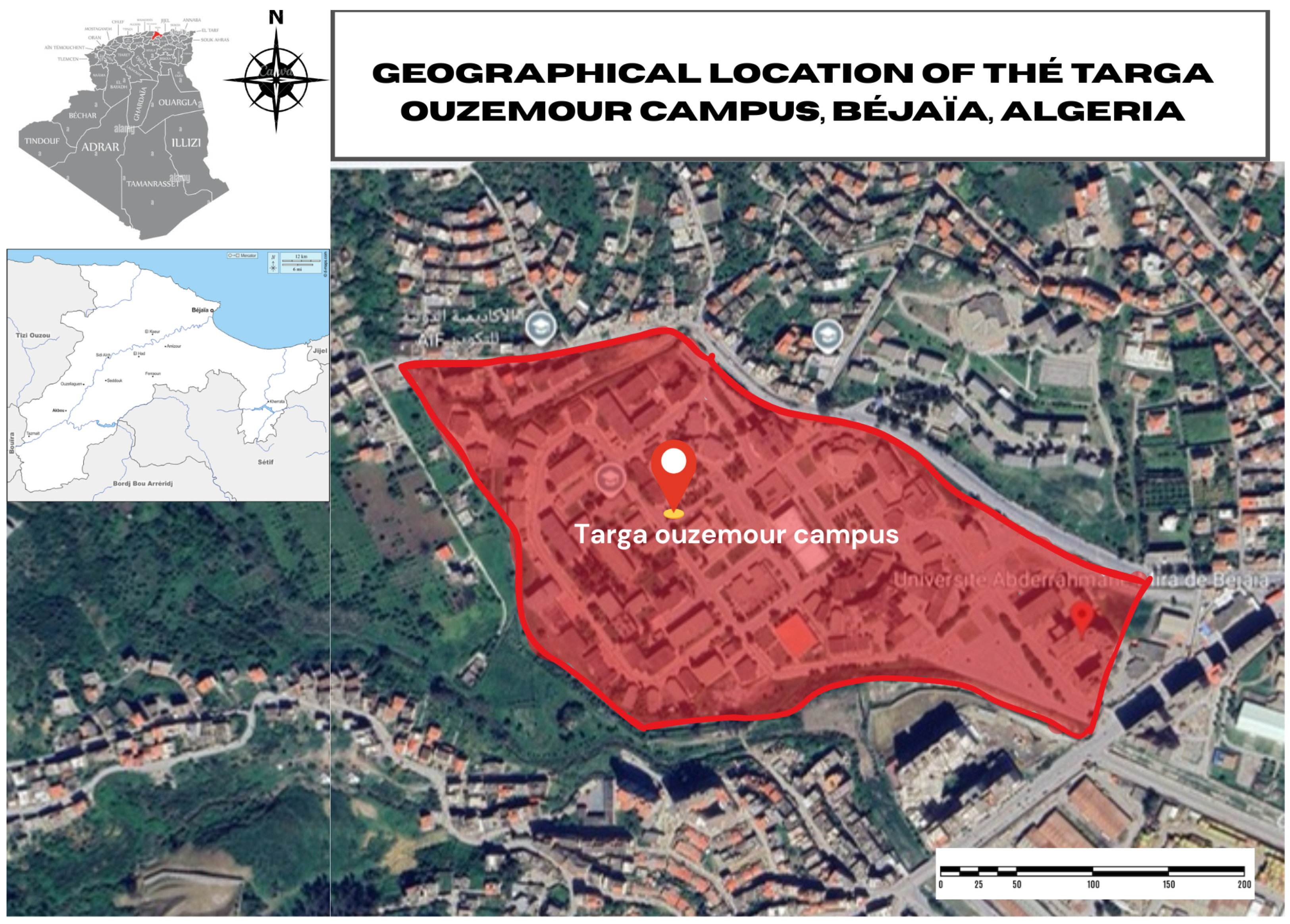
2.1. Study Site: University of Béjaïa
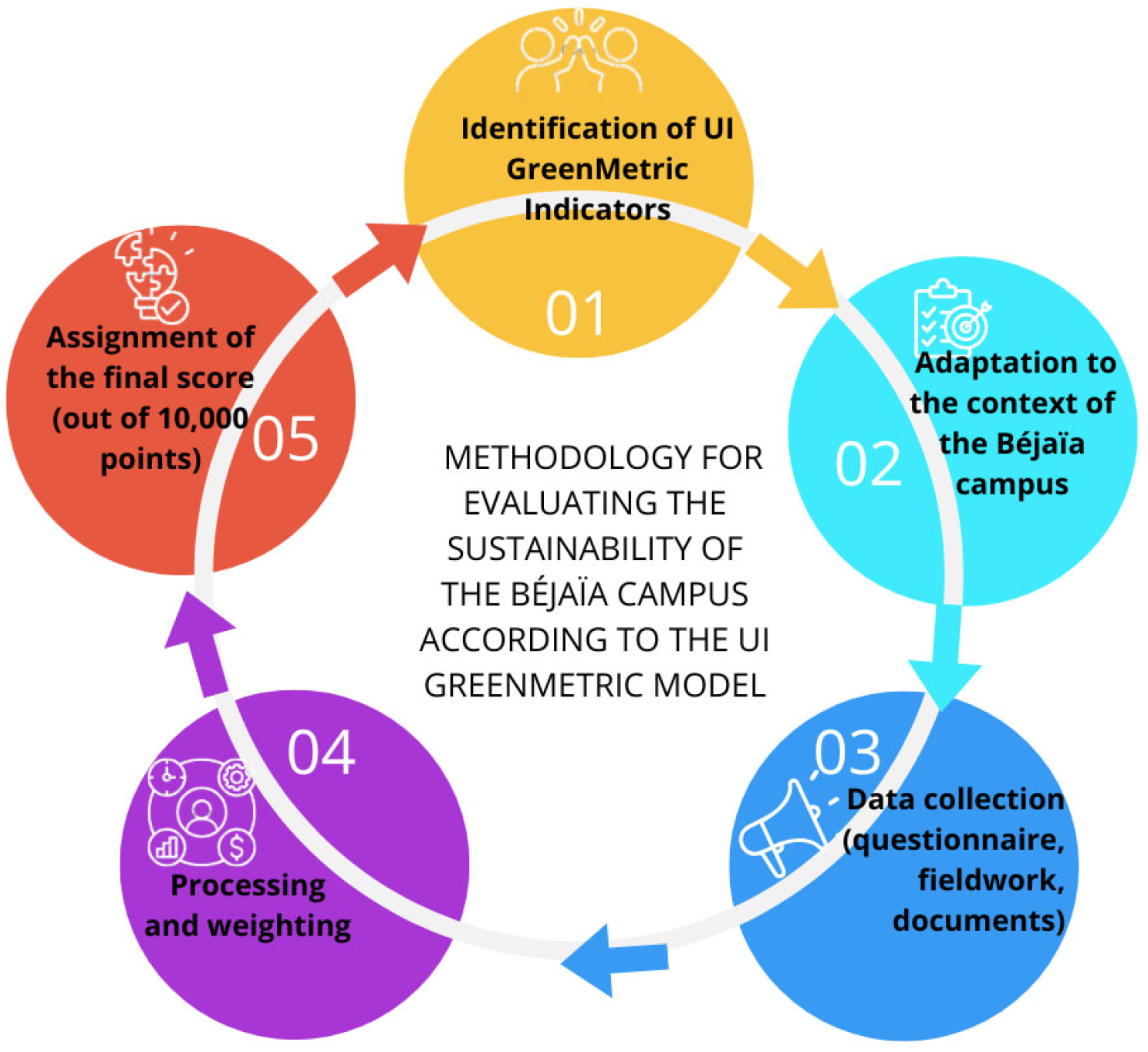
2.2. Selection of the Reference Model: The UI GreenMetric
2.3. Indicators and Local Adaptation
- ▪
- Climate adaptation: The energy consumption indicators were weighted in accordance with the Mediterranean climatic conditions, which are characterized by strong seasonal differences between the heating needs in winter and the cooling demands in summer.
- ▪
- Ecological assessment by means of the Biotope Surface Coefficient (BSC): In addition to the GreenMetric green space criterion, the BSC assesses the ecological capacity of a site by directly comparing vegetated or permeable surfaces with the total campus area. It should be emphasized that the Biotope Surface Coefficient (BSC) is widely used as a quantitative ecological index for assessing green infrastructure and ecosystem functionality on urban campuses [11].
- -
- The Biotope Surface Coefficient (BSC) is an indicator that is widely employed in urban sustainable development policies to evaluate surfaces that contribute to biodiversity and natural water management, such as green roofs, permeable surfaces, gardens, and vertical gardens.
- -
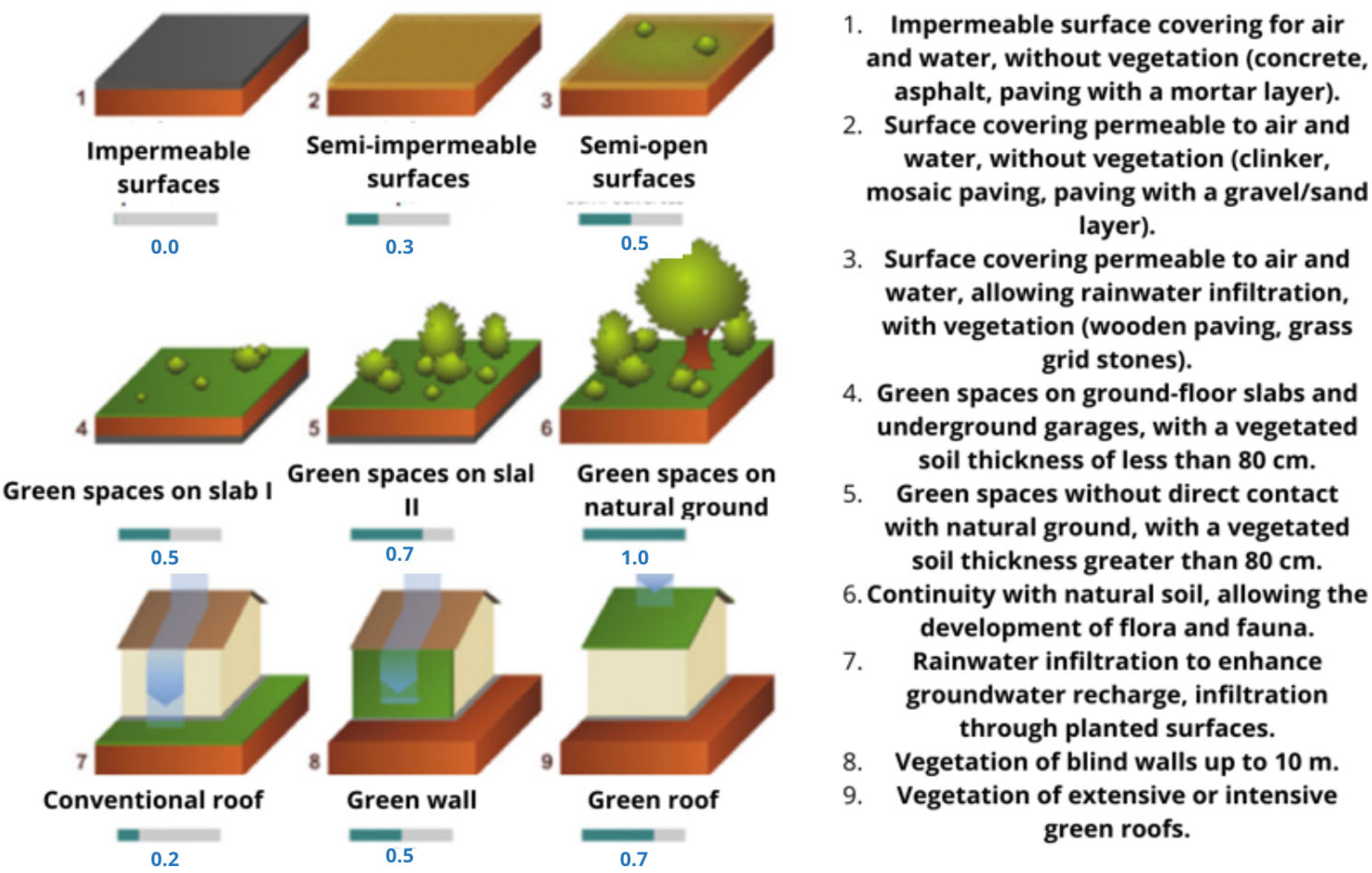
- The BSC can be calculated using a weighting system where entirely natural spaces receive the maximum value (1.0), while impermeable surfaces, such as asphalt, receive the value of zero.
- -
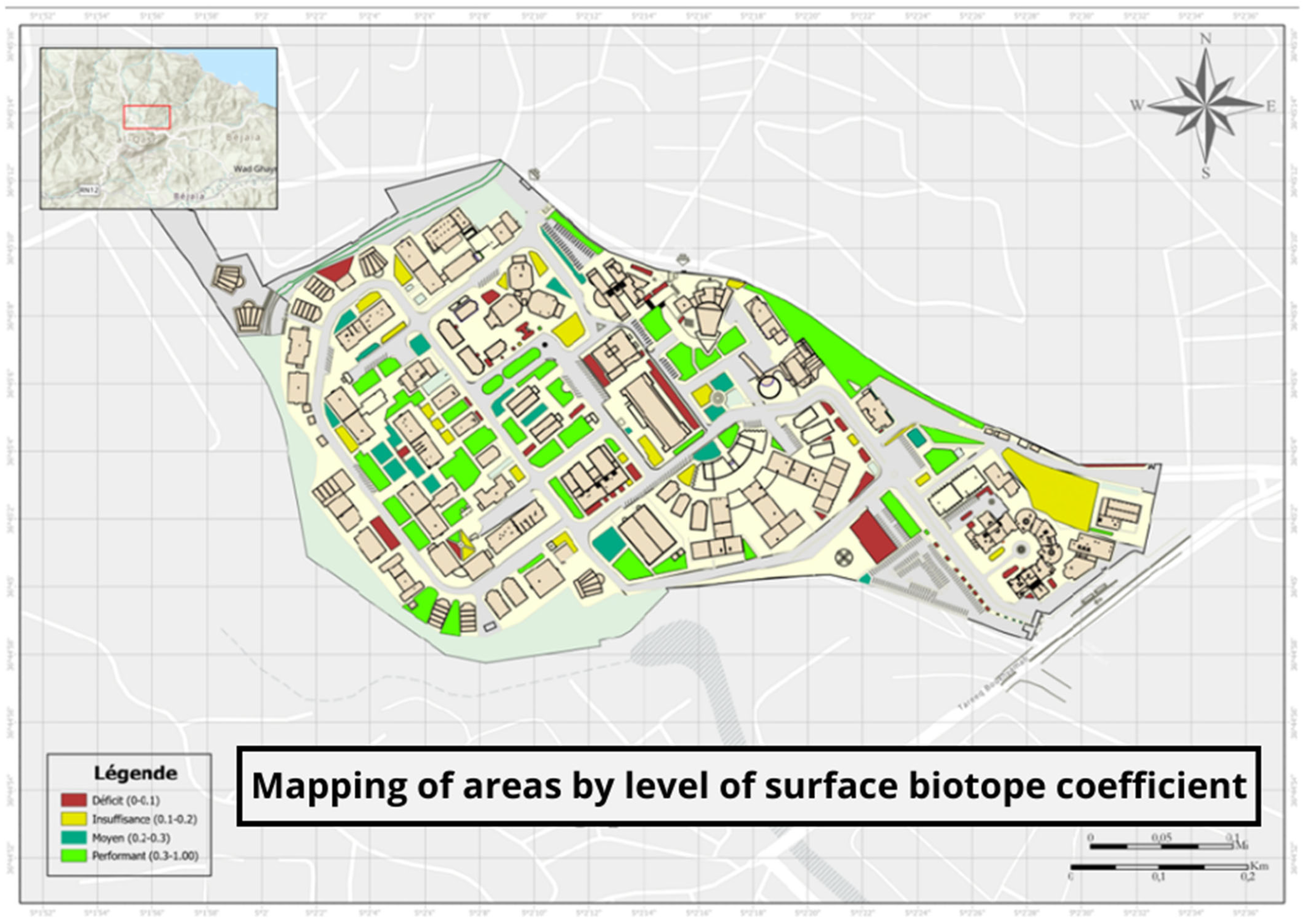
- This metric promotes the ecological reconversion of urban campuses through a balance between densification and integration of natural elements. As shown in Figure 2, the ecological weighting of surfaces is applied for the calculation of the Biotope Surface Coefficient (BSC).
- ▪
- Strengthening the Education and Research dimension: Besides the various study programs and publications, additional indicators were integrated in order to take into account the environmental awareness initiatives, sustainable development workshops, and student-led Green Projects, hence reflecting the local university culture.
2.4. Data Collection and Processing
- ▪ Internal surveys: Questionnaires were distributed to administrative, technical, and academic staff to collect data on energy, water and waste management, and on research and training activities related to sustainable development as illustrated in Table 2, the internal questionnaire was addressed to campus managers and technical departments.
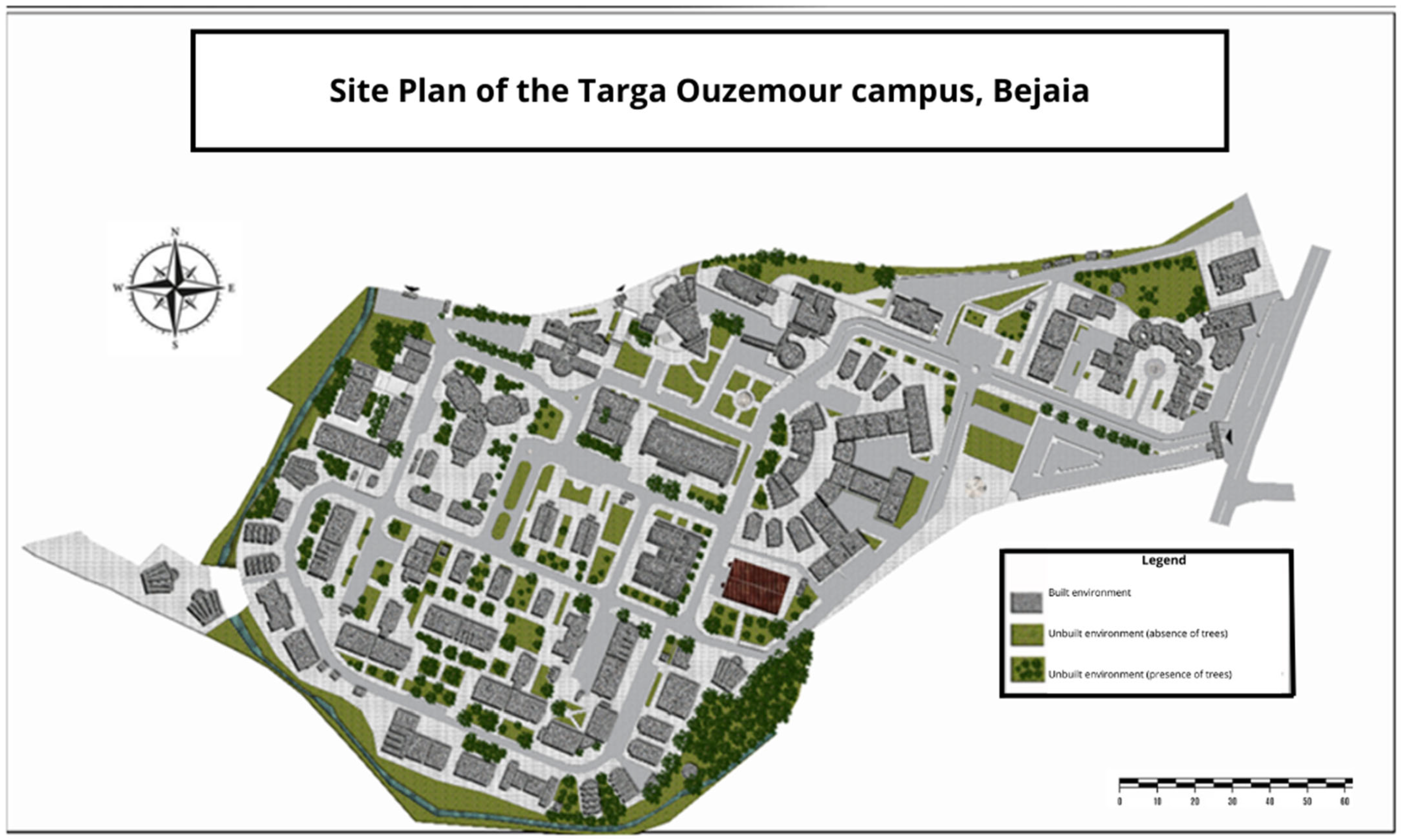
- ▪ Field observations: Information on green spaces, infrastructure, and energy installations (solar panels, lighting systems, rainwater harvesting devices, etc.) was collected from on-site assessments, as illustrated in Figure 4.
- ▪ Documentary analysis: Technical and institutional reports, including energy audits, waste management plans, campus master plans, and maintenance records, were thoroughly reviewed. In addition, all publicly available institutional data were also considered, as summarized in Table 3.
2.5. Comparative Analysis
- ▪
- Identify performance gaps between the University of Béjaïa and universities operating in broadly comparable climatic and socio-economic environments;
- ▪
- Highlight regional best practices that could potentially be adapted to the Algerian context;
- ▪
- Identify priority areas for improvement, particularly in governance, energy management, and sustainable mobility.
3. Results
3.1. Analysis by Indicator Category
3.2. Strengths Identified
- Biodiversity and green spaces
- Social engagement and awareness
- Energy initiatives
- Academic dimension
3.3. Weaknesses and Constraints
- Waste management
- Sustainable mobility. High dependence on personal vehicles and the absence of bicycle paths and green shuttle systems.
- Water and energy consumption. Lack of centralized data, absence of real-time monitoring sensors, and limited optimization strategies.
- Environmental governance. Fragmented initiatives and the absence of a coordinating body dedicated to sustainability. Effective sustainability governance requires coordination mechanisms along with transparency frameworks [15].
3.4. International Perspective
- Lack of systematic environmental data;
- Lack of centralized decision-making structures;
- Limited intersectoral coordination of sustainable development policies.
- The establishment of an on-Campus Sustainability Development Committee;
- The integration of sustainability development principles into academic programs;
- The implementation of a continuous monitoring system that is based on quantitative indicators, such as energy use, biodiversity, and mobility.
3.5. Improvement Levers Suggested
- Governance and management: Establish a Committee for a Sustainable Campus in Béjaïa University. This committee is responsible for coordinating actions, collecting data, and overseeing environmental policies.
- Green and resilient infrastructures: Include the Biotope Surface Coefficient (BSC) in future planning projects, such as green roofs, permeable surfaces, and ecological corridors [19].
- Sustainable mobility: Develop cycle paths, pedestrian zones, and inter-campus shuttle systems.
- Education and engagement: Enhance sustainability workshops, student clubs, and applied research projects focused on sustainable development.
4. Discussion
4.1. Development of a Localized Model: The “AlgéMetric” Tool
- Measure their environmental and social performance;
- Identify the weaknesses and improvement areas;
- Align their sustainability strategies with the Sustainable Development Goals (SDGs) and the National Biodiversity Strategy and Action Plan (NBSAP 2016–2030).
4.2. Structure and Dimensions of AlgéMetric
4.3. Taking into Account National Specificities
- Climate factors
- 2.
- Economic and institutional factors
- 3.
- Governance factors
4.4. Strategic Alignment with SDGs and NBSAP (2016–2030)
4.5. Towards a National Monitoring Platform
- An automated collection of environmental data (energy, water, waste, biodiversity) via smart sensors;
- A 3D modeling of campuses to visualize all potential environmental impacts;
- An interactive monitoring of performance indicators by the university;
- The publication of an annual ranking of sustainable campuses in Algeria.
4.6. Methodological Limitations and Data Uncertainty
5. Conclusions
- Establishing a culture of environmental governance in universities;
- Fostering research and green innovation;
- Positioning Algerian universities within the international network of sustainable campuses.
- 1.
- The first systematic application of the UI GreenMetric model in Algeria: Indeed, this research represents the first comprehensive implementation of the GreenMetric framework in an Algerian university, which provides an unprecedented empirical basis for assessing sustainability performance in the national higher education system. It also supports the integration of GreenMetric into institutional and public sustainability strategies.
- 2.
- Proposal of a hybrid and contextualized tool: the AlgéMetric model: Inspired by the Chinese experience with the sustainability assessment tools (SATs), as previously suggested by Du et al. (2020), this study proposes a hybrid model that combines the following:
- •
- The international stringency of the GreenMetric;
- •
- The contextual flexibility of the Biotope Surface Coefficient (BSC);
- •
- The local governance dimension designed for the Algerian university system.
Hence, the AlgéMetric model introduces an integrated approach in which the institutional sustainability, climate resilience, and stakeholder participation become key assessment criteria. - 3.
- International comparative dimension: This study places the University of Béjaïa within a regional and Mediterranean context. Its sustainability performance is then compared to that of other universities in the Maghreb, North Africa, and the Arab world. This comparative approach promotes the inter-university cooperation and the establishment of a Mediterranean network of sustainable campuses sharing common indicators and objectives. It also enhances the international visibility of Algerian universities in global environmental rankings.
Author Contributions
Funding
Institutional Review Board Statement
Informed Consent Statement
Data Availability Statement
Acknowledgments
Conflicts of Interest
Abbreviations
| UI | Universitas Indonesia |
| UI GreenMetric | UI GreenMetric World University Ranking |
| SD | Sustainable Development |
| SDG(s) | Sustainable Development Goal(s) |
| SPANB | National Strategy and Action Plan for Biodiversity (2016–2030) |
| BSC | Biotope Surface Coefficient |
| SAT(s) | Sustainability Assessment Tool(s) |
| AlgéMetric | Proposed Algerian Model for University Sustainability Assessment |
| ODD | Objectifs de Développement Durable (French equivalent of SDGs) |
| LED | Light-Emitting Diode |
Appendix A. UI GreenMetric Dataset for the University of Béjaïa

| UI GreenMetric Indicator | Béjaïa Value | Unit | Data Source |
|---|---|---|---|
| Campus area | 238,087.0616 | m2 | Facilities Management Office |
| Green open space | 36,467.8036 | m2 | Field survey |
| Total building area | 201,619.258 | m2 | Technical Services |
| Electricity consumption | 806,339 | kWh/0.5 year | Utility bills |
| Installed solar capacity | 0 | kW | Energy Management Unit |
| Water consumption | 94,179 | m3/year | Maintenance Department |
| Total academic staff | 927 | Persons | University administration |
| Total administrative and technical staff (ATS) | 322 | Persons | Human resources office |
| Total number of students | 16423 | Persons | Academic registry |
| Number of people surveyed (questionnaires distributed) | 330 | Persons | Authors’ survey |
| Number of respondents (valid questionnaires returned) | 303 | Persons | Authors’ survey |
References
- Albareda-Tiana, S.; Vidal-Raméntol, S.; Pujol-Valls, M.; Fernández-Morilla, M. Towards a Green Curriculum: Integrating Education for Sustainable Development into University Programs. J. Clean. Prod. 2018, 172, 432–441. [Google Scholar]
- Atici, K.B.; Yasayacak, G.; Yildiz, Y.; Ulucan, A. Green University and Academic Performance: An Empirical Study on UI GreenMetric and World University Rankings. J. Clean. Prod. 2021, 291, 125–138. [Google Scholar] [CrossRef]
- Alghamdi, N.; den Heijer, A.; de Jonge, H. Assessment Tools Indicators. Evaluation and Implementation of Sustainability Assessment Tools in Higher Education. Int. J. Sustain. Stud. 2017, 9, 112–130. [Google Scholar]
- Du, X.; Li, H.; Wang, Y. Sustainability Assessment Tools in Chinese Universities: Adaptation and Contextualization. Sustainability 2020, 12, 2345–2356. [Google Scholar]
- Junior, P.R.; Oliveira, L.; de Souza, A. Institutional Barriers to Sustainability in Developing Countries’ Universities. Environ. Manag. Rev. 2018, 11, 55–72. [Google Scholar]
- Marrone, P.; Orsini, F.; Asdrubali, F.; Guattari, C. Environmental Performance of Universities: UI GreenMetric and Its Application. J. Sustain. High. Educ. 2018, 19, 915–932. [Google Scholar]
- Domingos, J.M.F.; Marques, D.G.; Campos, V.; Nolasco, M.A. Analysis of the Water Indicators in the UI GreenMetric Applied to Environmental Performance in a University in Brazil. Sustainability 2024, 16, 9014. [Google Scholar] [CrossRef]
- Sribanasarn, W.; Phumiphan, A.; Kaewplang, S.; Khotdee, M.; Sivanpheng, O.; Kangrang, A. Sustainability in Action: Analyzing Mahasarakham University’s Integration of SDGs in Education, Research, and Operations. Sustainability 2025, 17, 6378. [Google Scholar] [CrossRef]
- Movlyanov, A.; Selçuklu, S.B. Energy Efficiency Optimization Model for Sustainable Campus Buildings and Transportation. Buildings 2025, 15, 1993. [Google Scholar] [CrossRef]
- Sahin, B. Advancing Sustainable Development Goal 4 Through Green Education: A Multidimensional Assessment of Turkish Universities. Sustainability 2025, 17, 8800. [Google Scholar] [CrossRef]
- Haggag, M.; El-Nasr, M.; Abdelkader, R. Smart and Sustainable Campuses: Integrating Digital Technologies for Environmental Monitoring. Energy Build. 2025, 315, 1221–1236. [Google Scholar]
- Zacki, K.; Pathirana, R. Renewable Energy Integration in Universities: Lessons from South Asia. Energy Build. 2025, 316, 1259–1274. [Google Scholar]
- Envisioning Green Solutions. Waste Management in Higher Education: Challenges and Opportunities. Available online: https://www.envisiongreen.org (accessed on 20 October 2025).
- Wei, L.; Shang, Z. University Governance for Sustainability: Frameworks and Practice. J. Environ. Policy Stud. 2023, 15, 87–103. [Google Scholar]
- Zhu, B.; Liu, G. The Development Model of Sustainable Campus Based on Green Buildings: A Systematic Comparative Study between Japan and China. Eng. Constr. Archit. Manag. 2025, 32, 805–823. [Google Scholar] [CrossRef]
- Adenle, A.A.; Stevens, C.; Bridgewater, P.; Illgner, P.; Ncube, M.; Mguni, P.; Mpofu, S.; Moyo, T.; Chikodzi, D.; Dube, T.; et al. Sustainability in African Universities: Contextual Challenges and Innovation Opportunities. Sustain. Sci. 2021, 16, 345–362. [Google Scholar]
- Magalhães, P.; Ferreira, L.; de Souza, R. Smart Campus Management: IoT-Based Sustainability Applications in Higher Education Institutions. Sustain. Comput. Inform. Syst. 2025, 40, 101–118. [Google Scholar]
- Nicol, J.; Terzano, K. Green Roofs and Permeable Surfaces: Enhancing Biodiversity and Resilience in University Campuses. Landsc. Urban Plan. 2025, 245, 104–126. [Google Scholar]
- Yang, L.; Chen, Z.; Liu, Q. Ecological Infrastructure and Urban Resilience: Applications in Sustainable Campus Design. Sustainability 2024, 16, 2395. [Google Scholar]
- Ma, J.; Han, R.; Zhang, Y. Green Space and Student Wellbeing on Campus: A Cross-Regional Study. Environ. Psychol. Rev. 2025, 42, 110–128. [Google Scholar]
- Frizon, J.A.; Eugénio, T.; Frizon, N.N. Green Campus and Student Proactivity Initiatives: The Importance of a Participatory Approach. Int. J. Sustain. High. Educ. 2024, 25, 1279–1296. [Google Scholar] [CrossRef]
- CoLab. CASS (Curriculum Assessment System for Sustainability): A Theoretical-Methodological Tool for Assessment in Higher Education Institutions. Available online: https://colab.ws/articles/10.1108/ijshe-06-2024-0414 (accessed on 20 October 2025).
- Oliveira, M.C.; Proença, J. Sustainable Campus Operations in Higher Education Institutions: A Systematic Literature Review. Sustainability 2025, 17, 607. [Google Scholar] [CrossRef]


| Category | Indicators | Points | Weighting |
|---|---|---|---|
| Setting and Infrastructure (SI) | CBS Coefficient Biotope Surfacique (CBS) | 100 | data |
| The ratio of open space area to the total area | 100 | data | |
| Total area on campus covered in forest vegetation | 100 | ||
| Total area on campus covered in planted vegetation | 200 | ||
| Total area on campus for water absorption, apart from forest and planted vegetation | 100 | ||
| Total open space area over total campus population | 200 | ||
| Percentage of university budget for sustainability efforts | 100 | ||
| Percentage of building operation and maintenance activities over a one-year period | 100 | ||
| Campus facilities for disabled, special needs, and/or maternity care | 100 | ||
| Security and safety facilities | 100 | ||
| Health infrastructure facilities for students, academics, and administrative staff’s wellbeing | 100 | ||
| Conservation: plant (flora), animal (fauna), or wildlife, genetic resources for food and agriculture secured in either medium or long-term conservation facilities | 100 | ||
| Total | 1500 | 15% | |
| Energy and Climate Change (EC) | Optimal energy use of appliances | 200 | |
| Smart building implementation | 300 | ||
| Number of renewable energy sources on campus | 300 | ||
| Total electricity usage over total population on campus (kWh per person) | 300 | ||
| Ratio of renewable energy production over total energy usage per year | 200 | ||
| Green building implementation elements, as discussed under all construction and renovation policies | 200 | ||
| Greenhouse gas emission reduction program | 200 | ||
| Total carbon footprint over total population on campus (metric tons per person) | 200 | ||
| Number of innovative program(s) in energy and climate change | 100 | ||
| University programs with a strong impact on climate change | 100 | ||
| Total | 2100 | 21% | |
| Waste (WS) | 3Rs (Reduce, Reuse, Recycling) program for the university’s waste | 300 | |
| Program to reduce the use of paper and plastic on campus | 300 | ||
| Organic waste treatment | 300 | ||
| Inorganic waste treatment | 300 | ||
| Toxic waste treatment | 300 | ||
| Sewage disposal | 300 | ||
| Total | 1800 | 18% | |
| Water (WR) | Program for water conservation and its implementation | 200 | |
| Water recycling program and its implementation | 200 | ||
| Usage of water-efficient appliances | 200 | ||
| Consumption of treated water | 200 | ||
| Water pollution control in the campus area | 200 | ||
| Total | 1000 | 10% | |
| Transportation (TR) | Total number of vehicles (cars and motorcycles) over the total population on campus | 200 | |
| Shuttle services | 300 | ||
| Zero-Emission Vehicle (ZEV) policy on campus | 200 | ||
| Total number of Zero-Emission Vehicles (ZEVs) over the total population on campus | 200 | ||
| Ratio of ground parking area to total campus area | 200 | ||
| Program to limit or reduce the parking area on campus for the last 3 years (2020 to 2022) | 200 | ||
| Number of initiatives to decrease private vehicles on campus | 200 | ||
| Pedestrian paths on campus | 300 | ||
| Total | 1800 | 18% | |
| Education and Research (ED) | Ratio of sustainability courses to total courses/subjects | 300 | |
| Ratio of sustainability research funding to total research funding | 200 | ||
| Number of scholarly publications on sustainability | 200 | ||
| Number of sustainable development-related events | 200 | ||
| Number of activities organized by student associations related to sustainability per year | 100 | ||
| University-run sustainability website | 100 | ||
| Sustainability report | 100 | ||
| Number of cultural activities on campus | 100 | ||
| Number of university sustainability program(s) with international collaborations | 100 | ||
| Number of projects on sustainability community services organized by and/or involving students | 100 | ||
| Number of sustainability-related startups | 100 | ||
| Smart sensors for green space monitoring | 100 | ||
| Interactive environmental modeling and simulation | 100 | ||
| Total | 1800 | 18% |
| Category | Question(s) | Expected Type of Responses |
|---|---|---|
| Energy and Climate | Does your institution have systems or policies aimed at reducing energy consumption (e.g., LED lighting, solar panels, awareness campaigns)? | Yes/No + Specify the actions implemented |
| Water and Resource Management | Are rainwater harvesting or reuse measures implemented on the campus? | Yes/No/Planned + Specify location if applicable |
| Waste and Environment | Is a waste sorting or recycling system operational in university buildings? If yes, what types of waste are concerned? | Multiple choice (paper, plastic, glass, organic waste, etc.) |
| Education and Engagement | Are any educational activities or student initiatives related to sustainable development conducted (e.g., courses, green clubs, workshops, campaigns)? | Open-ended response (describe specific examples) |
| Type of Data | Source | Collection Method | Analysis Objective |
|---|---|---|---|
| Institutional data | Technical reports | Documentary analysis | Identify resource management practices and environmental policies |
| Environmental data | Field observations | Direct surveys, photographs | Assess the ecological quality on campus |
| Educational data | Questionnaires, curricula | Interviews and analysis | Measure the integration of sustainable development |
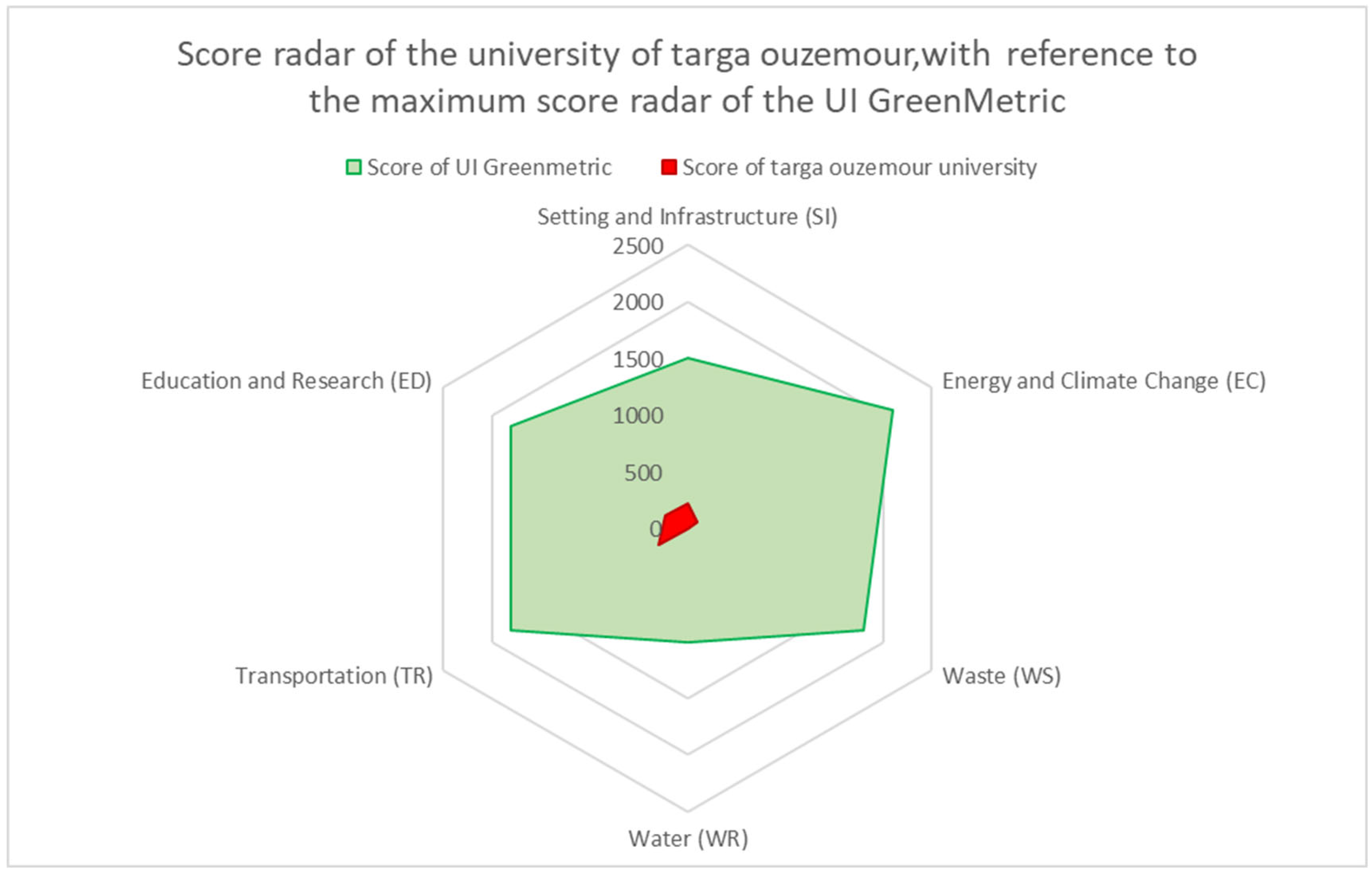
| Category | Score of Targa Ouzemmour | Maximum UI GreenMetric Score |
|---|---|---|
| Setting and Infrastructure (SI) | 225 | 1500 |
| 2.25% | 15% | |
| Energy and Climate Change (EC) | 100 | 2100 |
| 1% | 21% | |
| Waste (WS) | 0 | 1800 |
| 0% | 18% | |
| Water (WR) | 0 | 1000 |
| 0% | 10% | |
| Transportation (TR) | 300 | 1800 |
| 3% | 18% | |
| Education and Research (ED) | 225 | 1800 |
| 2.25% | 18% | |
| Score Total | 850 | 10,000 |
| 8.5% | 100% |
| Dimensions | Proposed Weight (%) | Description and Key Indicators |
|---|---|---|
| Infrastructure and Environment | 15% | Green spaces, accessibility, bioclimatic integration of buildings, and land management. |
| Energy and Climate Change | 20% | Energy efficiency, use of renewable energy, carbon footprint, and adaptation to the Mediterranean climate. |
| Water Management | 10% | Greywater reuse, rainwater harvesting, and reduction in water consumption. |
| Waste Management | 15% | Sorting, recycling, composting, and awareness campaigns. |
| Transportation and Sustainable Mobility | 10% | Inter-campus shuttle systems, pedestrian and cycling facilities, and electric vehicles. |
| Education, Research, and Engagement | 20% | Integration of sustainability into curricula, student projects, green laboratories, and community partnerships. |
| Governance and Institutional Innovation (new dimension) | 10% | Creation or implementation of a “Sustainable Campus Committee”, user participation, data transparency, and local innovations. |
| Related SDG | Link with AlgéMetric |
|---|---|
| SDG 4—Quality Education | Integration of sustainability into curricula and educational activities. |
| SDG 6—Clean Water and Sanitation | Water reuse, conservation, and integrated management on university campuses. |
| SDG 7—Affordable and Clean Energy | Promotion of renewable energy and energy efficiency. |
| SDG 11—Sustainable Cities and Communities | Sustainable management of campuses as urban microcosms. |
| SDG 13—Climate Action | Reduction of carbon footprint and bioclimatic adaptation. |
| SDG 15—Life on Land | Improving biodiversity and enhancing the Biotope Surface Coefficient (BSC). |
| SDG 17—Partnerships for the Goals | Inter-university collaboration and local engagement. |
Disclaimer/Publisher’s Note: The statements, opinions and data contained in all publications are solely those of the individual author(s) and contributor(s) and not of MDPI and/or the editor(s). MDPI and/or the editor(s) disclaim responsibility for any injury to people or property resulting from any ideas, methods, instructions or products referred to in the content. |
© 2026 by the authors. Licensee MDPI, Basel, Switzerland. This article is an open access article distributed under the terms and conditions of the Creative Commons Attribution (CC BY) license.
Share and Cite
Bounouni, S.; Boudina, T.; Amrouche, L. Towards a Sustainable Campus: The UI GreenMetric Model for the Assessment and Evaluation of the University of Béjaïa (Algeria). Sustainability 2026, 18, 2427. https://doi.org/10.3390/su18052427
Bounouni S, Boudina T, Amrouche L. Towards a Sustainable Campus: The UI GreenMetric Model for the Assessment and Evaluation of the University of Béjaïa (Algeria). Sustainability. 2026; 18(5):2427. https://doi.org/10.3390/su18052427
Chicago/Turabian StyleBounouni, Sofiane, Tounsia Boudina, and Lisa Amrouche. 2026. "Towards a Sustainable Campus: The UI GreenMetric Model for the Assessment and Evaluation of the University of Béjaïa (Algeria)" Sustainability 18, no. 5: 2427. https://doi.org/10.3390/su18052427
APA StyleBounouni, S., Boudina, T., & Amrouche, L. (2026). Towards a Sustainable Campus: The UI GreenMetric Model for the Assessment and Evaluation of the University of Béjaïa (Algeria). Sustainability, 18(5), 2427. https://doi.org/10.3390/su18052427