1. Introduction
The report released by Statista Research Development on 24 November 2024 stated that between 2000 and 2024, the global population without access to electricity decreased by more than half, reaching 737 million in 2024. The largest drop was seen in developing Asia, where the number of people without access to electricity decreased by approximately 90% during that period. In 2024, Sub-Saharan Africa, which accounted for 80% of the global total, achieved this value [
1]. However, over half a billion people have gained access to electricity in the last decade due to major advancements made by developing Asian nations. More specifically, Bangladesh achieved universal access in 2023, whereas India and Indonesia did so in 2021 and 2022, respectively. Over 70% of the region’s nations have achieved access rates above 90%. Therefore, progress toward universal coverage has slowed in these nations, as connecting the last-mile populations has proven more challenging. As of 2023, approximately 107 million people in the region, primarily in Pakistan, Myanmar, and the Democratic People’s Republic of Korea, still lack access to electricity. Moving to Latin America, most countries—aside from Haiti—have already achieved high levels of electrification, which is proving to be more challenging than anticipated. However, after stalling since the epidemic, progress began in 2023 [
1].
The bulk of concern is in Sub-Saharan Africa, as mentioned earlier. Here, 80% of people are without electricity. This is the region where the biggest disparity and severe gap exist. In 2023, after three years of reversing course, a surge in grid connections fueled advancements, a sustained expansion in the installation of solar home systems, and, to a lesser degree, the creation of new small grids. Compared with 2019, 600 million sub-Saharan Africans still lacked access to electricity in 2023. The number of people in the region without access to electricity will still be larger than in 2019, even if 2024 continues to see the development that preliminary reports indicate. In sub-Saharan Africa, rural households are the most vulnerable, with 52.3% lacking access to electricity. It is heartbreaking that 82% of the rural population relies on traditional firewood cookstoves, paraffin or kerosene lanterns, and candles for cooking and heating, despite the environmental and health hazards they pose [
2,
3,
4].
The IEA predicted that the number of people using traditional cookstoves would increase to 2.8 billion by 2030, up from 1.7 billion in 2010. Further, in terms of health hazards associated with this traditional cooking stove and others, it is estimated that 1.5 million people will die by 2030. Although the world is currently sitting at 3.8 million deaths because of illnesses related to this, among these deaths, WHO [
5] reported that 27% are pneumonia-related in children under the age of 5; 18% are stroke; 27% are ischemic heart diseases; 20% are chronic obstructive pulmonary disease and lung cancer accounts for 8%.
Narrowing to Nigeria, a report published by Sasu [
6] noted that, as of 2022, approximately 61% of Nigeria’s population had access to electricity. The highest percentage of the population without access to electricity is in rural areas. On the other hand, most households without access to electricity reside in the northern part of the country, while the South has the lowest share. The study by Sanusi and Owoyele [
7] stated that regional energy wellbeing performance is generally poor, particularly in the Northern part of Nigeria. The study reported that the Southern region has an Energy Development Index (EDI) of 0.365, compared with 0.177 for the Northern region. Thus, the national average EDI is 0.274. The study reported that the EDIs for the North Central, Northwest, and Northeast are 0.234, 0.167, and 0.131, respectively, while those for the Southwest, Southeast, and South-South are 0.417, 0.330, and 0.347, respectively. Therefore, the performance of the EDIs in the Northern region, which is associated with energy poverty, is due to geographical, infrastructural, security, and economic factors. Other underlying factors driving energy poverty in rural and Northern areas include security challenges, vandalism, limited economic capacity, long distances to the grid, poor infrastructure, and low rural connectivity, etc. This is responsible for the energy crises, conflicts, and worsening climate issues. However, it is estimated that 58% and 57% of Nigerians use kerosene and firewood for cooking and lighting, while only 10% have access to clean cooking energy [
8,
9]. With Nigeria’s energy demand of 98,000 MW, only 4000 MW is generated to serve the 110 million people connected to the grid. On the contrary, South Africa’s energy demand is 51,000 MW, and 52 million people have access to grid electricity. The USAID [
10] report shows Nigeria has about 12,522 MW installed capacity, transmitting 8100 MW of energy.
For decades, a generalized acceptable definition of energy poverty has been lacking. Both international organizations and individual researchers have attempted to do so. The United Nations Development Programme (UNDP) defines energy poverty as a lack of options for obtaining sufficient, reasonably priced, dependable, high-quality, environmentally friendly, and health-friendly energy services to promote community economic development potential [
11]. On the other hand, the IEA [
2] defines energy poverty differently, focusing on the lack of access to electricity and reliance on traditional biomass for heating and cooking. According to the ADB, the inability to cook with contemporary cooking fuels and the lack of the minimum energy required to meet basic needs and activities at sunset are indicators of energy poverty [
12]. From an individual’s point of view, Bazilian et al. [
13] defined energy poverty as the lack of access to affordable, high-quality energy services. On the contrary, the inability or absence of freedom to meet basic energy needs is referred to as energy poverty according to Gonzalez-Eguino [
14].
1.1. Research Objective
The objective of this study is to examine the various aspects of energy poverty at the household level in Nigeria.
1.2. Research Questions
What characterized energy poverty in Nigeria?
In what way(s) can energy poverty be measured?
What are the reasons behind the causes of energy poverty in Nigeria?
What impact does energy poverty have in Nigeria?
In what way(s) can energy poverty in Nigeria be addressed?
Previous studies on the topic have been published in renewable energy and development journals and donor agency reports (WHO, World Bank, etc.). These are essential to stakeholders, managers, and instructors. To the best of the author’s knowledge, this is the first paper on the topic to be subjected to peer review and to present a theoretical argument, published in a scholarly academic journal. Secondly, studies on energy poverty, with an emphasis on Nigeria, have not been conducted or published as standalone topics; rather, they have been integrated. To address this gap, the authors sought to present a deep, comprehensive, detailed, and critical analysis, along with a theoretical experiment, capable of publication in an accredited academic journal. Additionally, focusing on the topic as a standalone, without integrating or combining it, tends to differentiate this study from others. To this effect, the major contributions are as follows.
To provide an original, peer-reviewed study with deep, critical analysis and theoretical engagement and understanding of the topic.
The study contributes to the related body of knowledge by addressing the research questions.
Having reviewed the literature and reports on the topic, the study proposes steps to address energy poverty in Nigeria, highlights key policy and practical solutions, and identifies areas for future study.
For simplicity, the review outlines characteristics and indicators of measuring energy poverty to form the literature review in
Section 2. In
Section 3, the methodology discusses how the studies and data were selected and the approaches employed. It also briefly presents the inclusive and exclusive criteria used in the study, along with their justification. The results and discussion present a review of the literature on the causes, impacts, addressing, policy interventions, and implications of energy poverty in Nigeria.
3. Methodology
This section details the study’s literature search using both quantitative and qualitative approaches. The quantitative approach deals with numerical data and statistical analysis, while the qualitative approach focuses on the rich textures of human experience and perspective, thereby capturing its context and nuances often lost in numerical translation [
40]. Both approaches were used in the review because they provide a comprehensive, holistic, and validated understanding of the study by merging statistical precision with deep, contextual insight. In general, the review employed publications from Scopus, Web of Science and the Renewable Energy Report as databases. Also, publications from development and donor agencies, such as the World Health Organisation (WHO), the Nigerian Energy Commission (NEC), the International Energy Agency (IEA), and the United Nations Development Programme (UNDP), were also used. To fine-tune the selection of the relevant publications, important and necessary keywords related to the subject topic were employed. These are “deprivation, energy sustainability, energy poverty index, renewable energy, and policy intervention”. These keywords are also used to help identify appropriate research and literature from peer-reviewed publications and other published reports. The review mainly considered energy reports, reviews, and original articles. It is worth mentioning that publications with specific keywords in the topic, abstract, and main findings are included in the search results. These were the same and related in the methodology carried out by Maqekeni et al. [
41]. Based on the inclusion and exclusion criteria, these were considered in the study because of their importance as a standard requirement for conducting high-quality research. Inclusion criteria are the features the authors employed in the study, whereas exclusion criteria are the features they did not use. This has a way of undermining the study’s success [
41].
The purpose of using inclusion criteria for scholarly publications was to build a solid foundation of knowledge on energy poverty in Nigeria and to identify the study gap, as shown in
Table 1. These include original and review articles, as well as renewable and development and donor agency reports. Another inclusion criterion used in the study is specific to the language (English). This is because English is recognized as the international language of science, leading to more and better citations. Additionally, it achieves global reach and audience [
41]. Publication type also influenced the methodology employed in the review, as shown in
Table 1. In this case, a systematic review was considered because it provides a reliable and unbiased summary of existing studies on a particular topic. Secondly, this type of review involves gathering information from primary studies, thereby ensuring a comprehensive overview of the current evidence. These are not applicable to other reviews, such as the narrative review, which was an exclusion criterion. To identify potentially eligible articles, the reference lists of each article were manually searched. This was done by screening the titles and abstracts of the retrieved articles to exclude those irrelevant to the study, in accordance with Simela et al. [
42].
4. Results and Discussion
4.1. Causes of Energy Poverty in Nigeria
The causes of energy poverty were established through analyses of institutional, infrastructural, and economic data. This highlights an insufficient generation of about 3500–5000 MW out of a 12,500 MW capacity. The rationale behind this stems from infrastructure decay, governance issues, and economic factors. Based on the established causes of energy poverty and their rationale, it is necessary to provide a detailed account of the causes of this critical, systemic problem in Nigeria.
4.1.1. Inadequate Infrastructure
A study conducted by Benayed et al. [
43] on sustainable energy access revealed that infrastructure significantly improves access to energy and reduces energy poverty. Additionally, the study noted that infrastructure development aimed at reducing energy poverty can be effective only if it is accompanied by a high level of social development and a high-quality environment. However, Nigeria’s energy infrastructure is primarily focused on electricity generation capacity provided by 23 power plants. The Oxford Business Group reported that gas generation accounts for roughly 12,000 MW of its installed capacity, with hydropower providing the remaining 2062 MW. Wind and solar capacity provide an additional 10 MW and 7 MW, respectively. The authors opined that the number of power plants in Nigeria remains inadequate to address energy poverty in the Country, regardless of the capacity generated. This situation is not only familiar in Nigeria but also prevalent in developing countries, deepening and perpetuating energy poverty, driven by socio-economic, political, and technical constraints. There appears to be a breakthrough in Nigeria’s energy problem, as highlighted at the 1st China–Nigeria Economy and Trade Conference in Beijing. It was reported that Nigeria was looking to boost its energy infrastructure and would spend
$800 million on constructing substations and distribution lines. Interestingly, the fund falls under the Presidential Power Initiative (PPI) [
44]. As part of efforts towards improving the energy infrastructure, the Central Bank of Nigeria assisted the government of Nigeria in setting out several program such as Power and Air Intervention Fund (PAIF), Nigeria Electricity Market Stabilization Facility (NEMSF), Nigeria Bulk Electricity Trading Payment Assurance Facility (NBET-PAF), National Mass Metering Programme (NMMP), Solar connection facility (SCF) and Family Homes Financing Initiative (FHFI).
4.1.2. Lack of Investment in Renewable Energy Sources
Nigeria’s available renewable energy sources include solar, wind, geothermal, biomass, and hydro [
45]. Somoye [
45] recommends harnessing renewable energy sources to address energy poverty and its shortfall. Therefore, effective policies must be implemented to solve the country’s socio-economic problems. Nigeria’s lack of investment in renewable energy sources is attributed to high perceived risks, low creditworthiness, limited local currency availability, and insecurity, which deter foreign investors. These factors have enabled the country to access affordable and long-term financing for renewable energy projects [
46]. From the author’s viewpoint, this failure to invest in renewable energy is now being quantified not only in economic terms but also in terms of human health and social inequality. However, existing subsidies and tariffs on fossil fuels and electricity hinder the investment and deployment of renewable energy projects in Nigeria. This is due to the distortion and disincentives associated with renewable energy sources. As Nigeria is on the verge of achieving global change and meeting the objective of sustainable development, the IRENA report revealed that investing in renewable energy is one way to meet Nigeria’s energy needs, create jobs, and sustain the economic growth of the power sector. Renewable energy is known to be both affordable and accessible, especially in areas where grid extension is expensive. Thus, solar PV and mini-grids generate electricity in hospitals, schools, the transportation sector, and power homes and appliances [
47]. Based on that, Nigeria and the United Nations agency established a 500 million USD fund to finance the rollout of distributed renewable energy solutions (solar homes and mini-grids). This is because mini-grids and solar home systems are regarded as crucial for delivering electricity to rural areas and remote settlements far from the national grid [
https://www.power-technology.com/news/nigeria-un-distributed-renewable-energy, accessed on 6 November 2025].
4.1.3. Political Instability
Political instability is said to significantly contribute to energy poverty. It is a common occurrence in Nigeria that affects the country’s unity, peaceful coexistence, and access to energy. According to the author, political instability creates a barrier to transitioning to clean, smart energy, which is required to address long-term energy poverty. The author observed that an unstable environment or country tends to reduce investment in research and development for renewable energy and other approaches. However, it is known that these causes of energy poverty stem from the government’s inability to address public concerns, discrimination among citizens, and perceptions of social injustice [
48]. As other phases of life are often influenced by political instability, energy poverty is no exception. The political instability in Nigeria restricts access to reliable and affordable energy sources, leading to energy poverty. In Nigeria, characterised by high political instability, there is a tendency for investment in energy infrastructure to cause delays, leading to power system deterioration and a prolonged reduction in access to reliable energy [
49]. In Boardman [
50] and Okushima [
51], it was noted that political unrest led to a sharp increase in energy prices, resulting in households spending more on energy. This is the case in Nigeria, where families spend a significant portion of their income on energy they do not use. The political conflict or instability damages energy infrastructure, reduces access to energy, and hinders economic growth, thereby exacerbating energy deprivation. As a result, this limits access to electricity and clean cooking fuel, affecting both individuals and businesses.
4.1.4. Population Growth
Nigeria is known as the country with the largest human population in Africa [
52], and hence, it is not surprising that population growth is a factor contributing to energy poverty. The author’s perspective is that the country’s growing population increases demand for traditional biomass, leading to various factors (deforestation and land degradation) that worsen energy poverty in rural areas. Nevertheless, Nigeria’s overreliance on fossil fuels has increased due to its rapid population growth rate, resulting in socio-economic drawbacks. However, the lack of an established energy supply chain in Nigeria, combined with high demand, contributes to the acute energy poverty the country faces [
53]. As the Nigerian population increases, there is every tendency that demand for electricity and other forms of energy will also increase, straining the existing infrastructure and exacerbating the energy deficit.
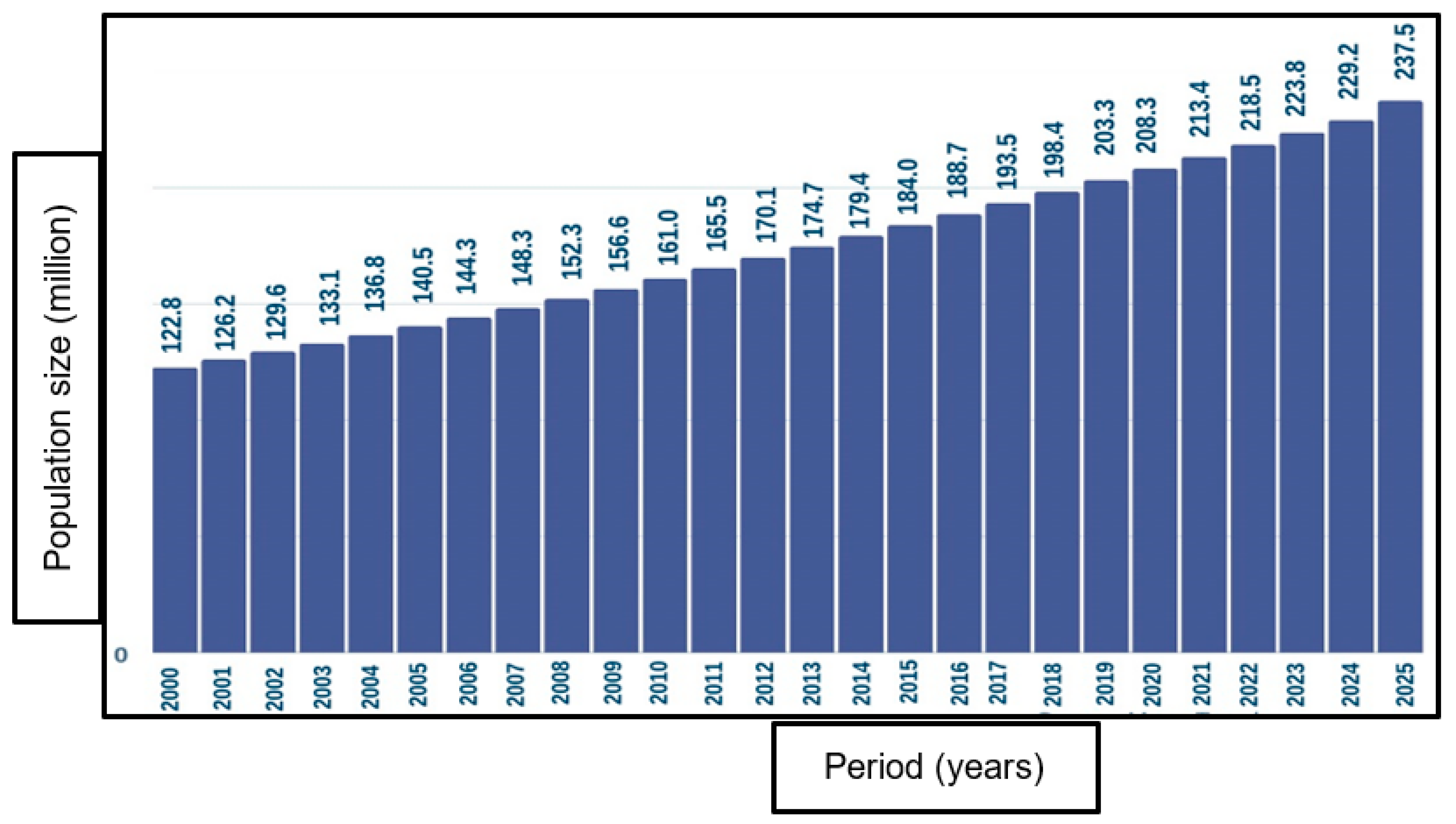
Figure 1 illustrates the trends in population growth in Nigeria from 2000 to the present (2025). Between 2020 and 2025, Nigeria’s average population increased by 26.2 million to 222.78 million.
According to
Figure 1, Nigeria’s population increased from 122.2 million to 154.4 million between 2000 and 2010. This results in a fertility rate of 6.08 and an annual growth rate of 2.6%. Between 2010 and 2020, the population increased from 160.9 million to 208.3 million, fertility rates dropped to 5.31, and the urban population reached 51.96%. Based on the predictions, the population growth is expected to rise to 262.4 M from 2020 to 2030, and 312.7 M (2020 to 2040). By 2050, Nigeria is expected to be the third-most populous country, with 43% of its population under 15, fueling ongoing growth. All these consider the energy poverty in the country.
4.1.5. Climate Change
Climate change refers to the alteration in mean conditions, such as temperature and precipitation, in an area over a specified period [
55]. Factors responsible for climate change include rising temperatures, changes in rainfall patterns, and the impacts of global warming. In Nigeria, climate change is said to have impacted the country’s economy and GDP, affecting sectors ranging from agriculture to energy. With regard to energy, climate change has impacted hydropower as a source of electricity in the country. It is reported that hydropower performance at the Kainji Dam in Nigeria has been affected by drought, hindering electricity generation. According to Afaha and Ifarajimi [
55], this has brought about a reduction in power supply to the Kainji Dam. In general, transmission and above-ground power lines, as well as transmission towers, are prone to climate change-related issues, including extreme weather, wildfires, and wind [
56]. Additionally, underground powerlines, pipelines, and electricity transmission and generation facilities are affected by flooding. In the Northern region of Nigeria, where high temperatures are most common, they tend to affect power transmission. This is because, as temperature increases, the capacity of transmission lines decreases, as does wildfire risk in the Southwest region [
56]. Due to Nigeria’s inadequate and low-grade electricity infrastructure, the country’s power utility provider implements power cuts when extreme weather is forecast. To conclude this section, Nigeria is considered highly vulnerable to the impacts of climate change. This is because its economy depends on the income generated from the production, processing, export, and consumption of fossil fuels, as well as its association with energy-intensive products, as mentioned in the Akuru et al. [
57] conference paper.
4.2. Impact of Energy Poverty in Nigeria
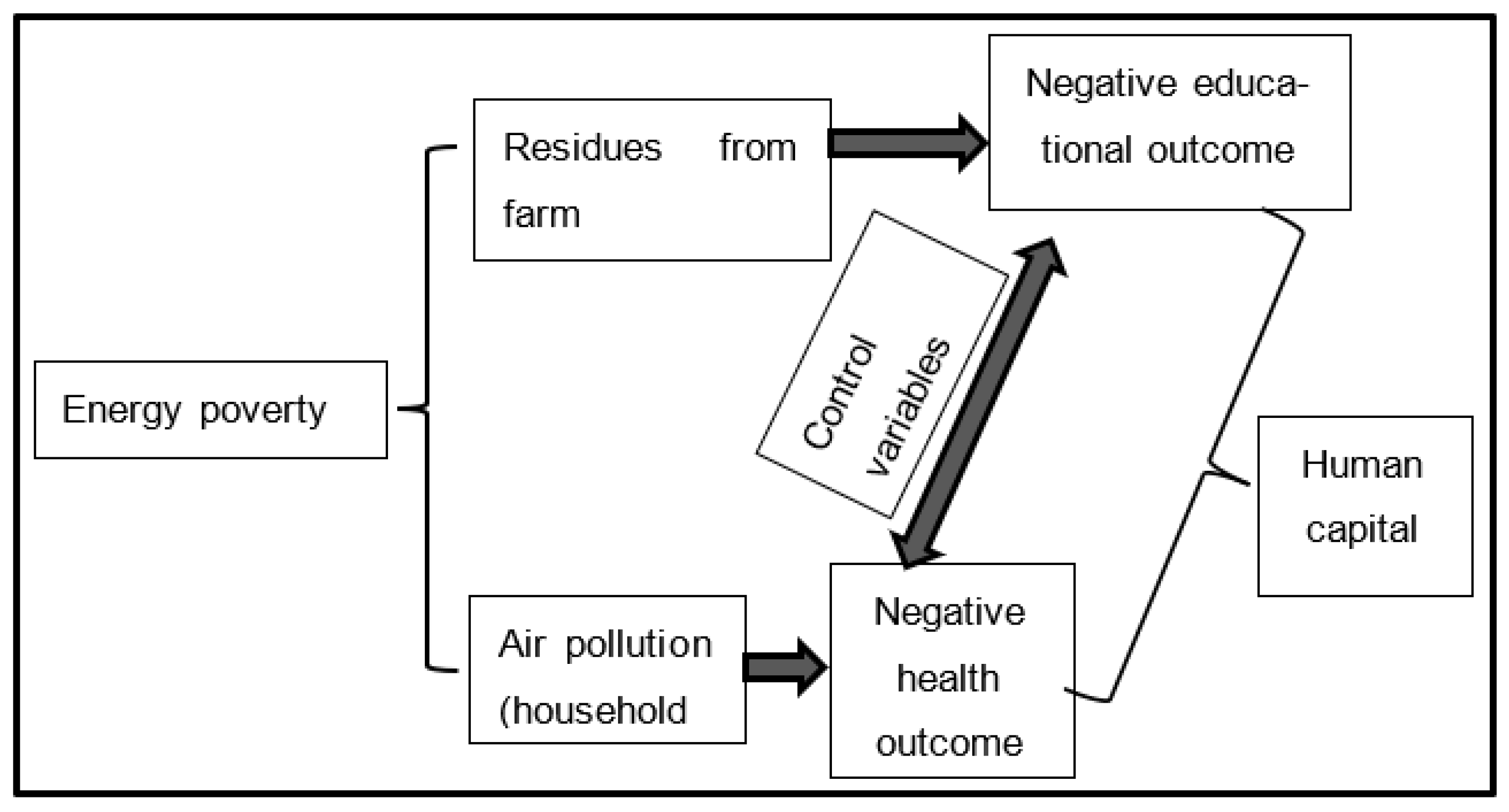
Energy poverty has impacted the development of human capital in Nigeria. Human development refers to the economic value of a worker’s experience and skills, which is enhanced by education, training, intelligence, health, and other qualities valued by employers. Nevertheless, a relationship exists between energy poverty and human capital development, as illustrated in
Figure 2. Hence, it is imperative to note that many rural households in Nigeria are experiencing energy poverty, which is said to have impacted their human capital development, particularly in terms of education and health (See
Figure 2).
In
Figure 2, the case study is Kano State, Nigeria, where Wali et al. [
58] focus on the health and educational attainment that influence energy deprivation and human capital among rural households in developing countries. In Nigeria, energy poverty exposes women and children from low-income, low-energy households to collecting firewood for cooking and heating, as well as farm residues. As a result, school attendance and punctuality are affected. It is worth noting that student absences from school and late arrivals hinder educational attainment, thereby reducing human capital development [
58]. On the other hand, in terms of health, respiratory diseases, child mortality, and chronic eye diseases are a result of air pollution from the household in Kano State, Nigeria. Therefore, these negative health outcomes from diseases worsen human capital development according to Wali et al. [
58].
Energy poverty has also been observed to affect small and medium-sized businesses in Nigeria, particularly in Benin City. Empirically, in Nigeria, small businesses comprise 10–99 persons, increasing from 15 million in 2010 to 36,994,578 in 2013. For large-scale businesses, the number of persons increased from 100 or more in 2010 to 4670 in 2013 [
59]. With reference to Ogunmuyiwa and Okunleye [
60], small businesses in Nigeria account for 70% and 50% of industrial employment and manufacturing output, respectively. Energy poverty has been named as one of the factors affecting the growth of SMEs in Nigeria. Hence, reliable, constant, and stable electricity is essential for optimal SME performance and economic growth [
61,
62]. This comes at a time when the power supply in Nigeria is unreliable, thereby affecting various businesses and causing damage to machinery. According to the World Bank [
63], these challenges result in the inability to deliver on time and impact overall business operations in the country. A study by Oshio et al. [
64] assessing the impact of energy poverty on businesses found that most businesses (49.2% of respondents) depend on the electricity grid for their power supply. Based on the reliability of the electricity grid supply, 49.3% indicated that the supply is inconsistent, 35.4% stated that the supply is inadequate for business, and 38.6% reported that the supply is available for only 4–5 h a day. With these findings, energy poverty has a significant impact on Nigerian businesses.
4.3. Addressing the Energy Poverty in Nigeria
Having examined the causes and impact of energy poverty in Nigeria, renewable energy is one effective way to address this problem. The decentralized renewable energy solution is said to be a potential solution to address the energy challenges, as well as a promising tool for providing access to electricity to its communities (rural and urban). A report by Adedinni and Jimoh [
47] from the Renewable Energy Association of Nigeria (REAN) stated that renewable energy can help Nigeria meet its energy needs, drive sustainable economic growth, and create job opportunities. In doing so, the country will achieve the objectives of global climate action and sustainable development. With renewable energy, it becomes more affordable and accessible to communities that experience the high costs of grid extension. Addressing renewable energy poverty through renewable energy options can be summarized as follows.
Like countries such as the United States, Germany and the United Kingdom, etc., the Nigerian government should develop and implement policies that incentivise investment in renewable energy, thereby facilitating the integration of the grid.
There is a need to remove or grant tax waivers on imported renewable energy equipment and to streamline licensing procedures in Nigeria.
Renewable energy developers in Nigeria should access innovative financing models (green bond or micro-finance) for the purpose of designing projects specifically for low-income households and communities.
Renewable energy projects and monitoring need to be implemented and facilitated by leveraging resources. This is possible through collective collaboration among the government, the private sector, and NGOs.
Another point to consider in addressing energy poverty in Nigeria is financing. This is a more practical point to note. According to the International Centre for Energy, Environment and Development (ICEED), in 2011, US
$200 billion was required to enhance power, transport and water infrastructure and US
$32 billion over the next ten years for hydropower and gas only. To achieve the objective of enhancing energy access, the private sector needs to invest. However, Nigerian financial institutions are reluctant to invest. The investment in renewable energy is said to be inhibited by the existing tariff structure and the lack of competition. Efforts have been made to address energy poverty in Nigeria through financing by the Nigeria Electricity Regulatory Commission (NERC) and the Central Bank of Nigeria (CBN). With the NERC, technical preparations were made for the implementation of the Feed-in-Tariff (FiT). It was reported that it will take 10–15 years to recoup the cost. The Bank of Industry was said to have received US
$3.3 billion from the Central Bank of Nigeria as a power intervention fund, with a maximum interest rate of 7% over 10–15 years [
65].
An appropriate legal framework is needed to address energy poverty in Nigeria. Nigeria’s energy policies are said not to have sufficient force of law, which limits the option for non-compliance. As a result, Mshelia et al. [
65] stated that frequent policy changes by the previous government, as well as the unwillingness to challenge vested interests or corruption, are problems. It is important to note that the Electric Power Sector Reform Act (EPSRA) and the NERC were created to address rural energy challenges and were implemented by the Rural Electrification Agency. It is the duty of the NERC to reform the electricity market and establish a competitive electricity generation and distribution industry. This is supervised and regulated by the NERC to ensure the standards and cooperation. It is reported that subsidies for initial investment are the only tool to reconcile commercial and social objectives. Nevertheless, the country lacks the capacity to guide its low-carbon development through its climate change legislation [
65].
An institutional agreement can be used to address the energy poverty in the country. The lack of coordination among government agencies has led to distortions and complications in implementing necessary mandates, such as clean energy mandates. Under the presidency, the proposed climate change commission could create synergies across the country’s various departments and units, including the three tiers of government (federal, state, and local). However, the Nigerian renewable energy market is reported to be affected by many factors, and it is seen as smaller than those in countries like Kenya. These factors include a lack of clear political vision and leadership, weak legislative regulation institutions and limited financial funding.
4.4. Policy Intervention in Energy Poverty in Nigeria
One way to address energy poverty, which Nigeria is currently experiencing, is through a combination of policy interventions, which primarily focus on the Electricity Act of 2023. The Electricity Act of 2023 [
66] promotes decentralization of generation and investment in renewable energy. The Nigeria Electricity Act [
66] was introduced in response to the failure of short-term policy responses to address the structural causes of energy deprivation in the country (inadequate infrastructure, an old transmission grid, and entrenched governance challenges). Based on this, households are trapped in cycles of energy poverty and insecurity with little or no prospects for sustainable development. This has resulted in a backdrop in the recent Nigerian enactment of the Electricity Act [
66]. The Act is said to represent a significant policy shift [
66], which seeks to restructure the electricity sector, thereby promoting decentralized generation, incentivizing investment in renewable energy, and giving the state government greater regulatory control over electricity supply. It is noteworthy that the Electricity Act [
66] ensures the right to health and affordable access to energy nationwide. With reference to that, in a report written by Ilegogie [
67] on energizing health: Electricity Access and the Right to Health in Nigeria, the author examined the extent to which the Electricity Act [
66] provides a framework in addressing structural deficits in energy provision and the fulfilment of health entitlement under the international and human rights law.
Although the Electricity Act [
66] in Nigeria focuses mainly on decentralisation, renewable energy, and the inclusion of electricity supply, it is regarded as an interesting tool in addressing the country’s energy challenges. This is beneficial to the country, but it faces shortcomings, including structural, regulatory, and financial gaps that tend to limit its transformative potential and expose weaknesses in the national renewable energy policy. The absence of an operational roadmap is a weakness of the Electricity Act 2023. For instance, the targets for off-grid renewable energy and grid capacity expansion were set at 6.5 GW and 42 GW, respectively, by the federal government of Nigeria and the Electricity Act [
66]. This initiative is part of the country’s 2030 energy transition plan, utilising solar and biomass energy resources alongside a mix of gas. Sadly, this initiative has not been carried out due to the non-implementation of the federal government’s scheduled funding model and the inability to provide an accountability mechanism [
68]. Neglect in this regard revealed that the government undermines its statutory commitments and weakens accountability for results. In relation to the Electricity Act [
66], lack of coordination between the federal and state regulators is another weakness of the policy intervention in Nigeria’s energy poverty. The act provides regulators with the mechanism to oversee and develop their respective electricity markets, and to issue licenses for generation, transmission, and distribution projects. This is based on the context within their borders, provided that both parties have established and agreed upon their state laws regarding electricity. Due to the lack of coordination in Nigeria’s two-tier regulatory system, confusion arises from overlapping powers, according to a report by Ilegogie [
67]. Therefore, this creates inconsistent regulations, thereby posing a threat and discouraging private investors and capital from entering the market.
To address the potential shortcomings outlined in the policy intervention, each state in Nigeria should develop and establish an autonomous electricity framework, including independent generation and grid systems. By doing so, it will minimize the over-reliance on national infrastructure. For many states in Nigeria, Ilegogie [
67] reports that the solution is capital-intensive, making the idea and recommendation unrealistic. However, the authors provided a more practical solution that addresses the creation of joint licensing protocols between the Nigeria Electricity Regulatory Commission (NERC) and the state regulatory authority.
The decrepit state of Nigeria’s national grid has compromised service delivery, even in areas connected to the power infrastructure. For instance, according to the Electricity Hub report released in 2025, the Nigerian national electricity grid collapsed 12 times in 2024, whereas between 2017 and 2023 it collapsed over 45 times [
69]. The issue of grid collapse in Nigeria should not be a concern in a country with abundant natural gas, according to the Nigerian Upstream Petroleum Regulatory Commission. With its abundance, electricity generation accounts for 30% of the national electricity grid’s installed capacity of 11,000 MW. According to the Federal Government of Nigeria, this is due to chronic failures in supplying gas to power plants.
4.5. Implications of Nigeria’s Energy Poverty
In Nigeria, economic growth has been crippled and affected because of energy poverty through increased use of generators, health damage via indoor air pollution of traditional fuel, hindering education and worsening gender inequalities, as well as limiting health care quality. In an article published by Sun Connect [
https://sun-connect.org/implications-of-energy-access-deficit-and-energy-poverty-in-nigeria/, accessed on 6 November 2025], it was reported that energy poverty in Nigeria has influenced not only the quantity and quality of energy consumption but also endangers food security and sustainable agriculture and development [
70]. All of this boiled down to economic growth in Nigeria. Examining the implications of energy poverty in Nigeria for sustainable development, Ogwumike and Ozughalu [
22] noted that most people in the country rely on inferior energy sources for cooking, heating, and lighting. This attestation is based on the multidimensional energy poverty index (MEPI), which was used in the study to analyse energy poverty and its implications in Nigeria. The study stated that relying on inferior energy sources, such as the widespread use of firewood, leads to the overexploitation of the environment through massive deforestation and other harmful activities. However, for sustainable development and economic growth, it is argued that these practices are said to jeopardize the welfare of future generations. Pollution, in the form of environmental and air pollution, is said to result from these energy sources (firewood) and tends to affect health, especially indoor pollution. Indoor pollution from cooking stoves or open fires negatively affects the quality of life, according to a WHO report. Exposure to indoor pollution tends to reduce earning capacity, productivity, output, and income due to ill health [
61]. Due to a lack of basic energy service experience in Nigeria, workplace productivity is negatively affected, including in the firms that are engines of growth in the country [
71]. In Sambo et al. [
72], there is a strong positive interaction between electricity supply and the organisational or firm’s output or performance. Nigeria is composed of small- and medium-sized enterprises in terms of economic production. Sambo et al. [
72] mentioned that 103,000 MW of electricity generation was anticipated in 2020, if the expected economic industrialisation is to be achieved in Nigeria. In 2015, it was reported that the generation reached 9435 MW; however, to ensure a stable, constant electricity supply, an estimated 180,000 MW is required.
In Nigeria, deforestation occurred due to energy poverty. There has been demand for firewood and other conventional products, which depletes natural resources without consideration of the welfare of future generations. According to Sambo [
72], approximately 350,000 hectares of natural vegetation and forest are destroyed in Nigeria each year. Hence, it is expected that this rate will continue to increase as demand for environmentally harmful energy sources grows. The deforestation has led to desertification and erosion in the northern and southern parts of Nigeria, respectively. This development is attributed to the high demand for firewood for both domestic and commercial purposes. Therefore, it is concluded that the significant occurrence of desertification and erosion in Nigeria is due to the limited energy sources. This is a challenge to the country’s sustainable development [
60].
In terms of education, which is the bedrock of any society, this has been threatened by limited coverage of the energy supply. Indeed, electricity plays a significant role in achieving academic excellence and enhancing digital literacy. Teaching and learning are being affected in most schools in Nigeria due to limited or no access to electricity. Based on this, school electrification is a nationwide concern, particularly in rural areas. According to a report released by the United Nations Humanitarian, 75% of schools (primary and secondary) are not connected to the electricity grid. To this effect, the Federal Government of Nigeria’s intervention focuses on energising the educational institution, which is coordinated with the Energizing Education Programme (EEP). In a report published by the United Nations Humanitarian, the aim of the EEP is to illuminate educational institutions with clean, sustainable energy.
5. Conclusions, Limitation and Future Studies
The review examined the various aspects of energy poverty in Nigeria. Evidently, energy is a promising enabler and fulcrum for successful socioeconomic development. The review shows that energy poverty and restricted access to clean energy have affected, and continue to affect, the daily lives of Nigerian citizens. As seen in the review, for sustainable economic development and industrialization breakthroughs, improved capacity of clean energy resources, as well as technological innovation and the implementation of a supportive policy framework are required. These are said to be essential. Although energy poverty in Nigeria is very high, addressing and tackling it simultaneously would not be possible. Thus, attention should be given to the areas and regions with the highest incidence, as this will be a gradual step. However, given the review’s objective, the findings are as follows.
MEPI is a promising and suitable tool for measuring energy poverty, especially for residential energy consumption in Nigeria.
The rationale behind energy poverty in the country is basically focused on infrastructure decay, governance issues and economic growth.
With the challenges and shortcomings associated with the Electricity Act 2023, it is one of the effective and suitable avenues for addressing energy poverty in Nigeria.
Economic growth, education and health are areas and sectors heavily impacted by energy poverty.
Based on the above findings, adequate steps and efforts are necessary to provide Nigeria with access to modern energy sources. Reports and studies on energy poverty in Nigeria emphasize that it is a pervasive, multidimensional issue with negative impacts on public health, education, and the country’s economic growth and development. Nevertheless, the study’s insights deepen the localised understanding of energy poverty and contribute to global efforts to design interventions for marginalised populations experiencing energy deprivation.
The review has some limitations that can be addressed in future studies. First, the review is reported to rely on collective data, suggesting it does not provide a comprehensive understanding of the causal factors behind energy poverty in Nigeria. Therefore, future studies should focus on the avenues through which energy poverty influences economic growth in Nigeria. Also, the present study limits the data used, particularly in the qualitative method. Therefore, future studies should employ original research methods, utilising various quantitative approaches, such as conducting interviews and administering questionnaires, to gather respondents’ views on the study. This will assist in investigating the trend and impact of energy poverty in the country. While this study focuses on Nigeria, its results have broader implications for understanding energy poverty in other isolated, off-grid regions facing similar challenges, such as inadequate infrastructure, limited renewable energy sources, political instability, and population growth. Studies should be conducted in this direction, focusing on other countries. Although the review mentioned technical issues related to inadequate infrastructure as causes of energy poverty in Nigeria, it fails to discuss the neglect of governance factors (corruption, mismanagement, and institutional weaknesses). Hence, future studies should focus on those factors.