1. Introduction
Human settlements have been affected by crises throughout history and have undergone radical transformations at turning points. Today, the ongoing climate crisis is pushing human settlements into a new sphere of influence, placing them on the threshold of a turning point shaped by technological developments. The term “crisis” is frequently employed and generally conveys a sense of the prevailing circumstances on a global scale. [
1]. De Rycker and Mohd Don’ [
2] meta-analysis of definitions from various research fields incorporating the concept of crisis identified several common elements. The following terms are employed to describe the events in question: “negative”, “recurring”, “survival-threatening”, “disrupting the existing order”, “unexpected but not entirely surprising”, and “requiring major decisions”. As De Rycker [
3] observes, “crises are disruptive events that necessitate immediate recovery”. Crises can also be defined as “a moment of intense disruption following a decisive transformation” [
4].
In this context, the climate crisis and its secondary effects are, at their core, a global-scale problem of exceeding carrying capacity. It is a well-established fact that resources are not used equitably and that, as a result, numerous inequalities emerge among societies. However, the rate at which the total stock of resources is being depleted is becoming not merely an issue of inequality, but a matter of existential significance. Recent studies [
5] argue that within 250 million years a supercontinent termed “Pangea Ultima” will form and that this formation will trigger a mass extinction. Yet, prior to the threats posed by such geological events unfolding through natural processes, rising mean surface temperatures already constitute an urgent problem. Although it is not expected to occur in the near term, at approximately 7 °C of global mean warming the habitability of certain regions would be called into question; with 11–12 °C of warming, such regions would expand to encompass much of the currently dispersed human population [
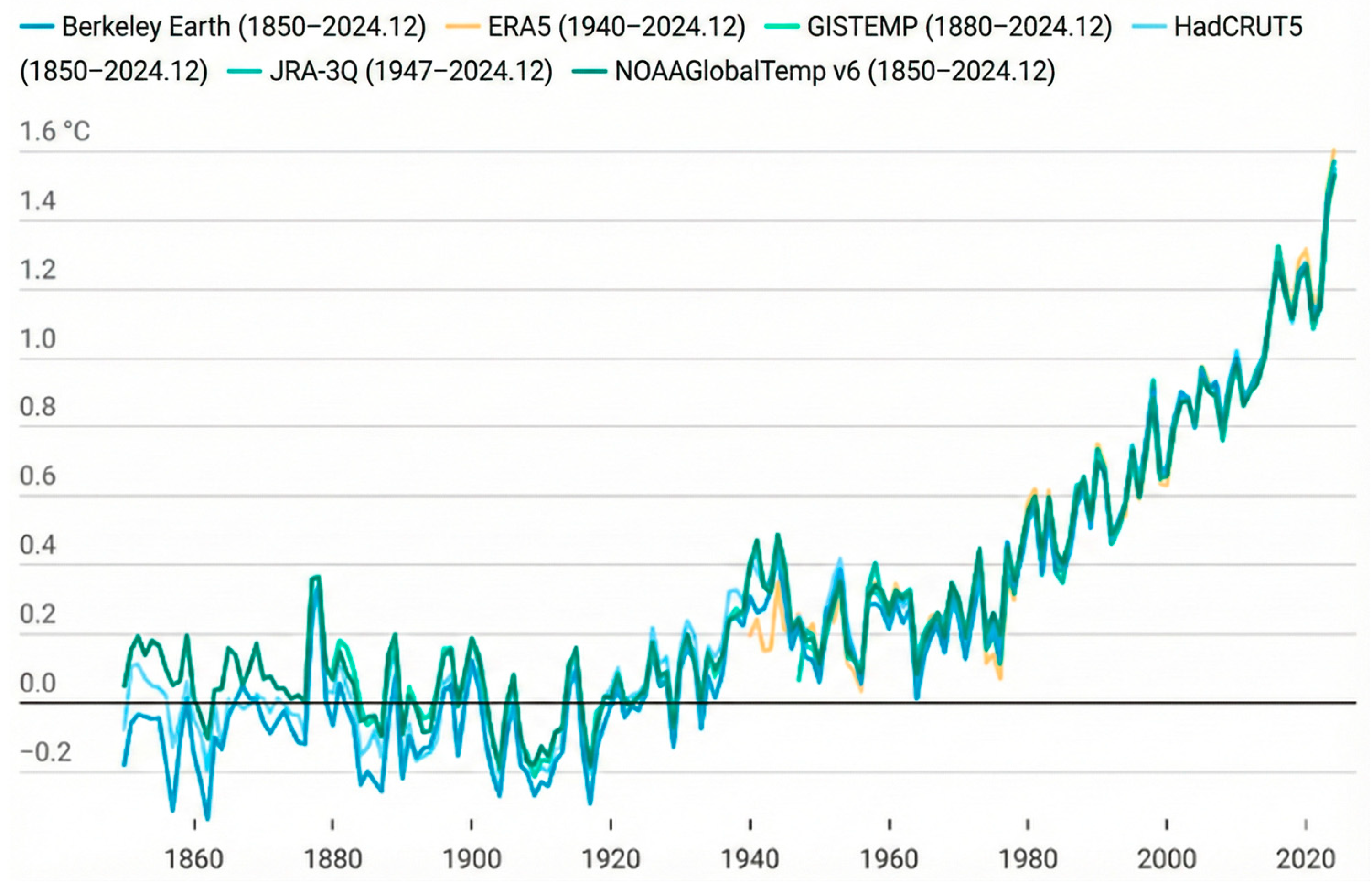
6]. While warming on this scale is not currently being claimed, the trajectory can nonetheless be characterized as highly risky. According to WMO’s most recent data the increase in global mean surface temperature relative to the pre-industrial period is 1.5 °C (
Figure 1).
Depending on greenhouse gas emission levels, projections indicate scenarios ranging from 1.5 to 5 °C of warming by the end of the century [
8]. The climate crisis also threatens global food security, primarily through changes in precipitation regimes, declining soil moisture, and an increase in the frequency and duration of extreme drought periods. Today, food production faces multiple challenges, including environmental and logistical pressures such as water scarcity, the reduction in arable land due to urban expansion, climate change, declining crop yields, and labor shortages [
9]. These challenges constitute a major obstacle to meeting the growing demand for food and agricultural products driven by population increase and to closing the associated supply gap [
10].
Agricultural activities, which began approximately 10,000 years ago in Mesopotamia with the gathering and cultivation of wild plants, experienced a rapid increase in food yields in the twentieth century in the Western world through the widespread use of fertilizers and biotechnology [
11]. Food processing, storage, and distribution became indispensable components of economic models [
12]. Industrialization and urbanization expanded access to food in middle- and high-income countries [
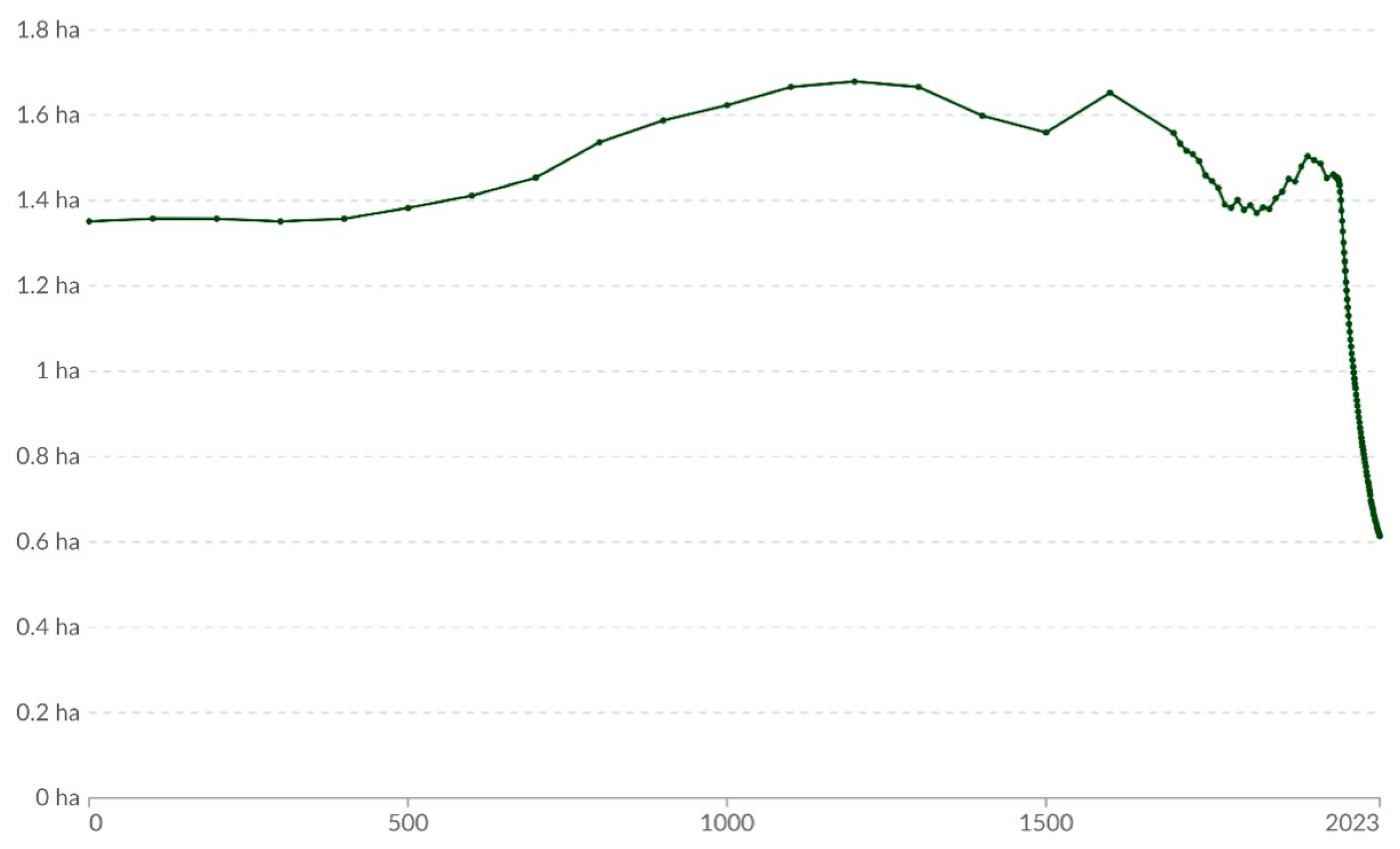
13]. Given the widely held view that greater production is needed to provide food and other basic necessities for the world’s rapidly growing population [
14] it would be expected that existing agricultural lands would expand and that their productivity and output would increase [
15] (
Figure 2).
However, agricultural production accounts for 70% of total freshwater use worldwide [
17]. Although most of Earth’s surface is covered by water, less than 1% of surface and groundwater is readily accessible, creating severe pressures on water resources as a result of increasing urbanization, industrialization, population growth, and climate change [
18,
19]. Globally, 69% of accessible water resources are used for agricultural irrigation, 23% in industry, and 8% for domestic use [
19]. Consequently, while the climate crisis affects thermal conditions, access to food, and water resources, it also indirectly reshapes the character of human settlements.
In addition to the crises that are currently unfolding and those that may plausibly emerge, the world is also at a critical, technology-driven turning point. Contemporary technological advancement constitutes one of the most significant drivers of societal development. Over the coming decades, the success of economic strategies and societies’ positions within the global balance of power will depend to a large extent on the successful development of a range of innovative technologies. Although this trajectory of progress is observable, there are also scholars who articulate more pessimistic perspectives alongside such technological optimism [
20,
21]. Beyond the question of whether optimistic or pessimistic viewpoints are ultimately warranted, Baldwin [
22] suggests that when the trajectory of technological progress intersects with individuals’ expectations about the future, a “Holy-Cow moment” occurs. The main focus here is to be aware of the development, but not to expect it to happen so quickly.
Structural and fundamental transformations do not materialise as a consequence of isolated moments; rather, they result from extended processes. Such processes, by their very nature, engender pivotal moments, which are often referred to as revolutions. A revolution is defined as a violent and transformative event, or sequence of events, that brings about the transformation of a nation, region, or society [
23]. When the historical process is considered holistically, the most significant sequence of revolutions that can be systematically observed is the transformation of modes of production. Grinin and colleagues [
24] theorize this transformation through four main production principles and three revolutions occurring between them (
Table 1).
A “production principle” is a concept that delineates the stages of development in global productive capacity across the historical process. Each new production principle, in terms of opportunity, scale, and efficiency, fundamentally lags behind the one that follows. In theory, it is argued that each production revolution exhibits a similar internal cycle comprising three phases: two innovative phases (an initial and a final phase) and an intermediate phase of modernization [
25]. Researchers suggest that the present period corresponds to the modernization phase of the Cybernetic Revolution, whose initial phase was completed between 1950 and 1990 and is expected to conclude in the 2040s. The final phase is assumed to be completed in the early twenty-second century with the emergence of self-regulating systems.
One of the most significant transformations that the Cybernetic Revolution has begun to generate in human settlements concerns the relationship between living spaces and workplaces. Work, in its universal definition, refers to the voluntary expenditure of time and energy to carry out tasks aimed at achieving a specific goal or outcome [
26]. The time and energy expended have varied throughout history depending on the type of work performed, the mode of production, and the prevailing culture of work. As shown in
Table 2, this variability is structured primarily around the axes of the Agricultural and Industrial Revolutions.
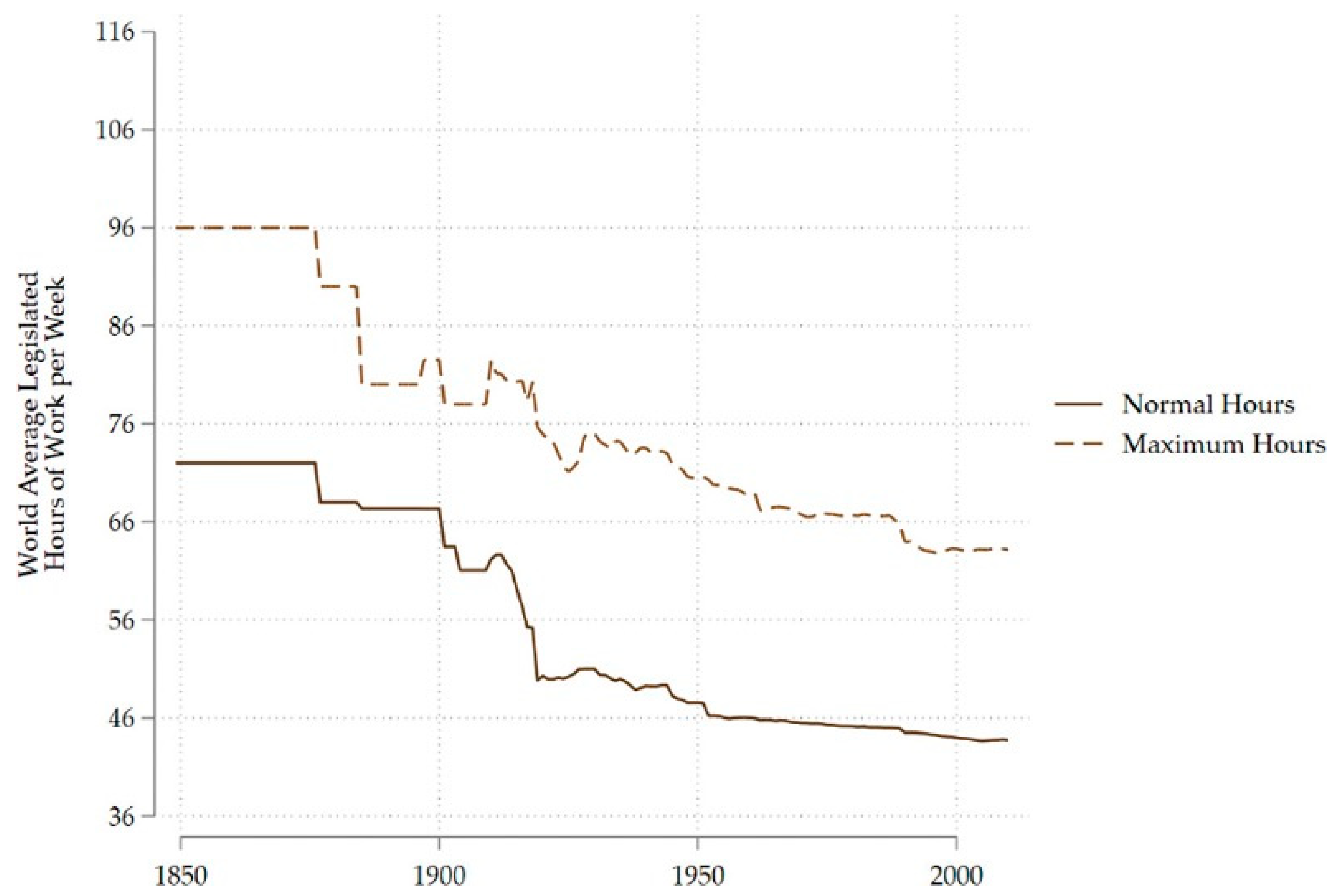
Fluctuations in time-use patterns and conceptions significantly affect the spatial organisation of settlements. The temporal allocation of activities, including work, is a critical factor in achieving a harmonious balance between living and working environments. Prior to the Industrial Revolution, working hours were sporadic and largely contingent on individual needs. However, with the advent of industrialisation, these hours escalated to unprecedented levels. Nevertheless, from the 1850s onwards, there is evidence to suggest that working hours have been subject to a steady decline. (
Figure 3)
Within this framework, the study aims to assess the future of human settlements by examining two plausible alternatives and evaluating adaptive and experimental approaches along the axes of climate crisis and technological revolution. Accordingly, the research addresses the following three questions:
RQ1: Under the concurrent pressures of the climate crisis and the technological revolution, what are the principal mechanisms producing transformation in human settlements, and how do these mechanisms vary across the scenarios?
RQ2: What conditions give rise to plan-led adaptation processes grounded in optimistic assumption sets, thereby producing regions that are not directly exposed to extreme living conditions yet nevertheless embody the indirect effects of crises?
RQ3: What mechanisms generate project-led urban experimental orientations—claiming resilience—that are configured by prioritizing technologies produced by the Technological Revolution?
The remainder of the article is structured as follows.
Section 2 presents the methodology and research design adopted to elucidate the implications of the two critical turning points introduced above for the future of human settlements.
Section 3 reports the datasets employed within this methodological framework and presents the results of the analyses. Finally,
Section 4 offers a discussion and the key inferences derived from the findings.
2. Materials and Methods
Given that the study necessarily contains a set of forward-looking projections, it employs the scenario planning method [
29,
30] which is frequently used in futures research. Here, we define the scenario-planning method as constructing multiple possible images of the future in order to anticipate it; increasing the number of envisioned futures; and, by accepting from the outset that futures other than the normal and expected are also possible, determining what those futures might be [
31]. In this way, an approach that may appear speculative—namely, “putting forward alternatives for the future”—is grounded in a robust and internally consistent framework of relationships among variables. Scenarios, used as a tool to indirectly explore the future of societies and institutions, have also been adopted by militaries and have historically been treated as a strategic planning instrument for creating war simulations [
32]. Modern scenario planning techniques emerged in the post–Second World War period through the U.S. Department of Defense’s decision-making process regarding which projects should be funded for the development of new weapons systems. Subsequently adopted by the private sector, this approach gained broader traction in the 1960s with Shell’s “Year 2000” project, initiated to examine the business environment anticipated for the year 2000 [
33].
As its applications expanded, the method became more widely institutionalized, giving rise to distinct typologies. Mannermaa [
34] proposes three scenario typologies for futures research. The first consists of “descriptive” forecasts rooted in positivist thinking and situated at the limits of potential reality. The second is the “scenario paradigm,” which, rather than attempting to predict the future, constructs several alternative scenarios and focuses on their underlying processes. Methodologically, Mannermaa argues that descriptive futures research frequently aims to employ quantitative methods within a rigidly scientific framework, whereas the degree of methodological freedom within the scenario paradigm is considerably broader. The final category is the “evolutionary” future. In this model, the role is twofold: on the one hand, to identify signs of rupture, social movements, technological innovations, and indicators of destabilization; on the other, to outline potential alternatives following a “bifurcation” and thereby to construct a kind of map of possibilities for the future [
34].
Marien [
35] classifies scenarios in futures research into four main categories: probable futures, possible futures, preferable futures, and panoramic views. Although most studies of this kind focus on forecasting probable and possible futures, Marien argues that panoramic views yield more accurate outcomes because they reflect a holistic analysis.
Masini [
36], identifies three distinct ways of constructing future scenarios: forecasts, visions, and projects. Forecasting aims to determine what is probable among what is possible and is grounded in empirical data. Visions—closely associated with utopian thinking—are oriented toward “desired” futures and should be formulated in relation to systems of thought that emerge through historical processes. Projects constitute a synthesis of forecasts and visions; in other words, they comprise an integrated set of actions and designs guided by social ideals, models, and visions, while also taking into account empirical evidence regarding past trends and present conditions [
36].
These classifications can be extended. For instance, Inayatullah [
37] proposes a distinction among predictive–empirical, cultural–interpretive, and critical approaches. Bell [
38] in turn, articulates perspectives grounded in positivism, critical realism, and post-positivism.
As summarized in
Table 3, although the typologies presented involve distinct and original assessments, they also share multiple points of convergence. Broadly, they may be distilled into three strands: data-driven forecasts; interpretations that develop in parallel with empirical evidence but lack consensus regarding their likelihood; and perspectives that synthesize scenarios through a utopian lens. These categorizations essentially encompass predictive scenarios that ask “what will happen?”, exploratory scenarios that seek to answer “what could happen?”, and normative scenarios that attempt to address “how can a specific goal be achieved?” [
39].
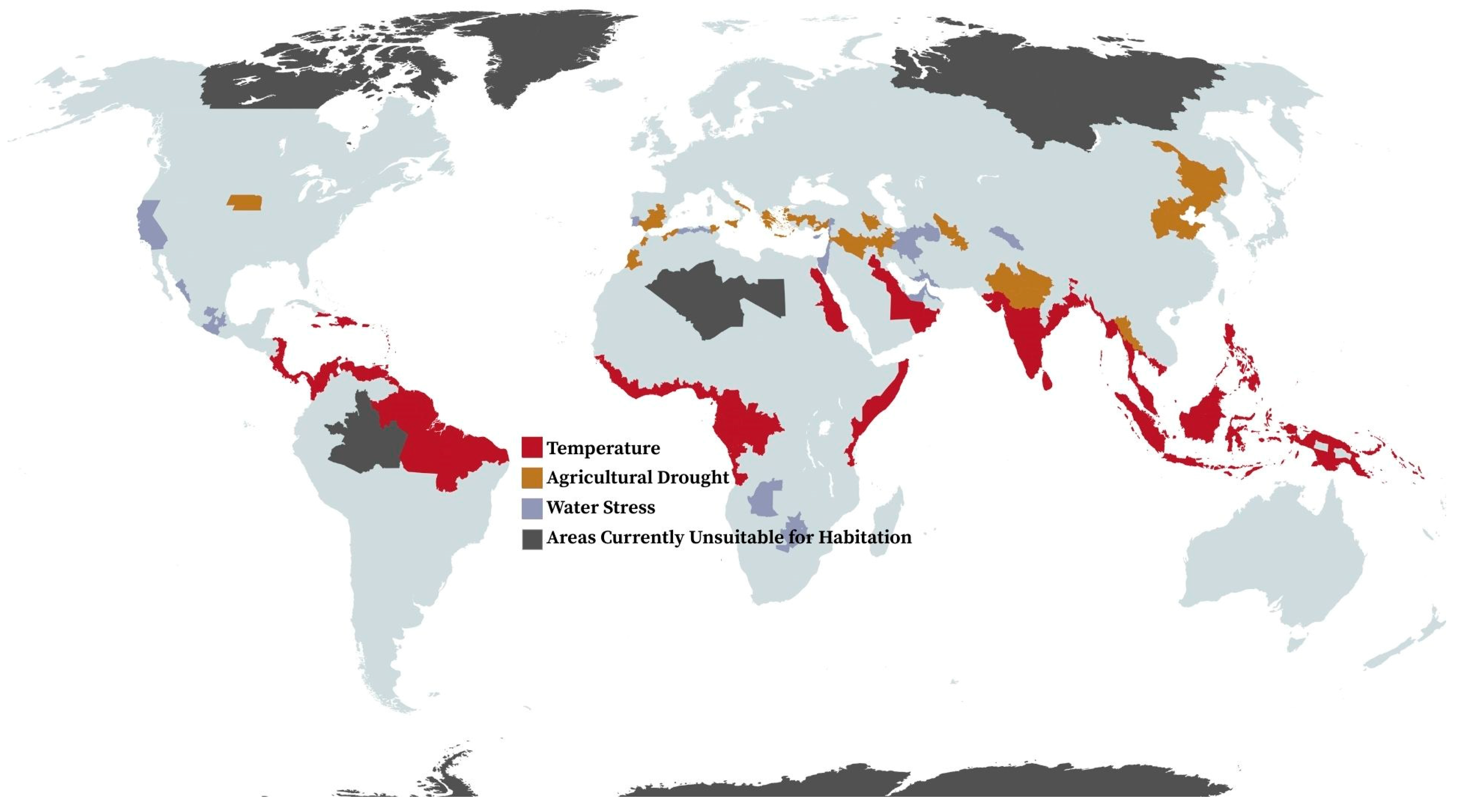
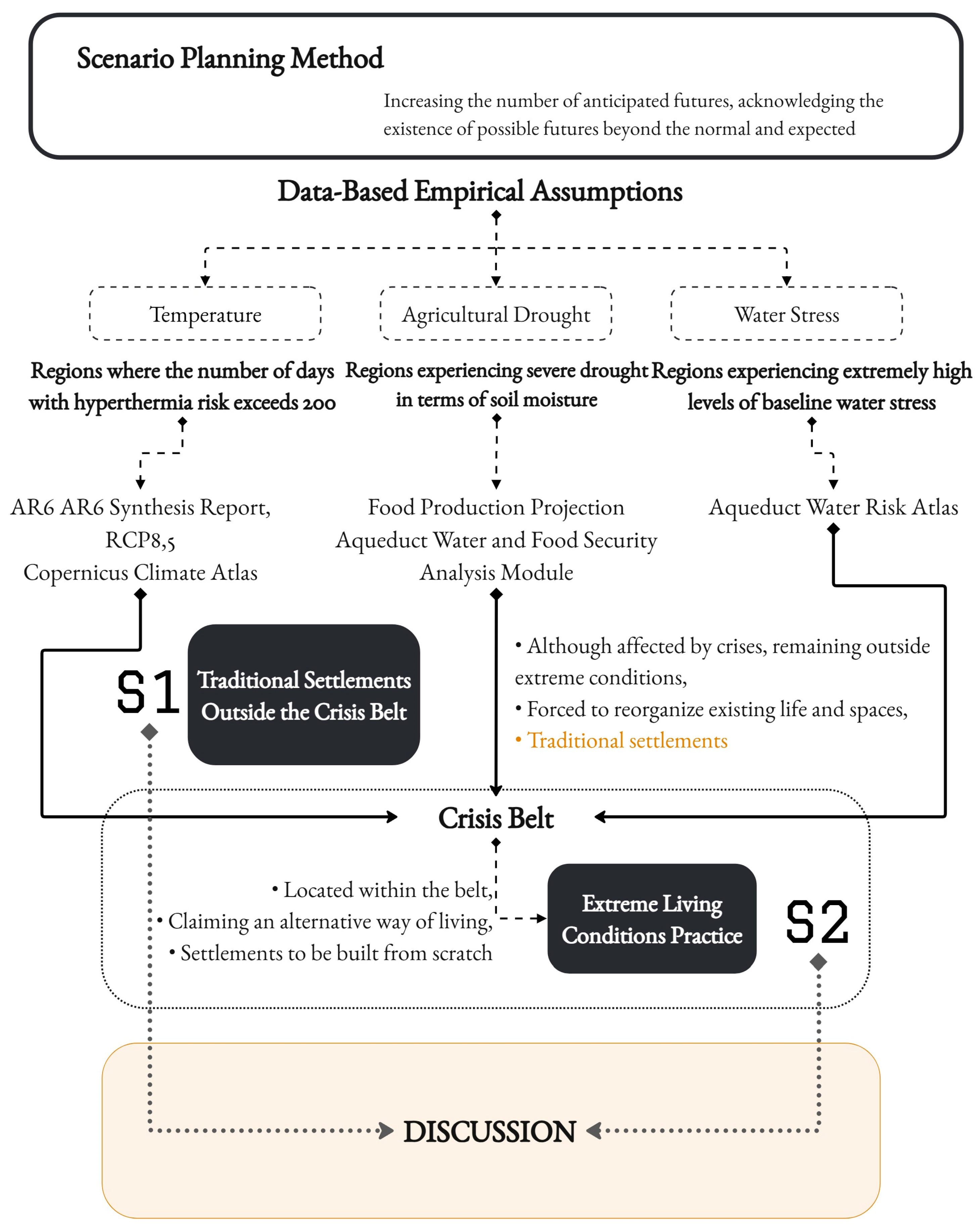
Within the perspective of the categorizations outlined above, this study delineates a bounded “slice” of the future shaped by data-driven assumptions and, on this basis, defines a geographically delimited crisis belt on Earth (
Figure 4).
The delineated crisis belt enables the consideration of multiple scenario configurations. Accordingly, alternative analytical options include focusing on traditional and experimental settlements located either within or outside the belt. In this study, two extreme scenarios are operationalized by cross-comparing traditional settlements situated outside the belt with experimental settlements that are either situated within the belt or explicitly frame themselves as responses to crisis-belt-like extreme conditions. Accordingly, the crisis belt is used as a scenario-bounding stress-threshold layer rather than as a deterministic explanatory variable.
The first scenario is constructed around traditional settlements located outside the crisis region. Although these settlements are not directly exposed to extreme conditions, they nonetheless face a range of indirect risks. The second scenario addresses life and spatial organization within the crisis belt. In light of the data that constitute the fixed parameters of the scenarios, the analysis focuses on urban experiments that claim to offer alternative modes of living, on the premise that maintaining the existing order would not be viable in this region. Accordingly, the forces that will shape the future of settlements are considered under two primary categories:
A pivotal challenge in scenario construction pertains to the identification of assumptions inherent in temperature-increase projections, facilitating discourse on the spatial extent and severity of disruption. At this juncture, numerous parameters could be used to delineate a crisis belt. This study deliberately limits the definition to three foundational prerequisites for habitability: climate, food, and water. The rationale is that a systemic crisis in any one of these requirements would, from the outset, call the viability of a region into question. Otherwise, the crisis belt could equally have been constructed on the basis of alternative factors such as biodiversity loss, the rate of sea-level rise, or the sectoral distribution of carbon emissions. In the IPCC’s most recent report [
8] three scenarios were formulated—RCP 2.6, RCP 4.5, and RCP 8.5 (from more favorable to more adverse). In defining the crisis belt, RCP 8.5, which models the highest temperature increase, was taken as the reference. Several reasons can be advanced for this choice. First, in scenarios where extreme conditions are anticipated, the use of the minimax principle is vital for risk management under high uncertainty [
41]. Moreover, in large-scale threats of this kind, “compound hazards” are often not adequately anticipated. Another reason concerns the fact that, while IPCC reports project a 2–3 °C increase even under average emissions trajectories, the present study concentrates on the impacts of 1.5 °C and 2 °C. Kemp and colleagues [
42], argue that this emphasis is rooted in the Paris Climate Agreement and in a climate-science culture that tends not to be alarmist. For this reason, the analysis foregrounds the worst-case scenario, whose impacts are often insufficiently debated. Indeed, even a 2.7 °C increase would push approximately 2 billion people outside optimal thermal conditions [
43]. By design, planning incorporates ‘the worst case’ as a central consideration. At this point, the fundamental distinction between planning and projection lies in the former’s involvement in—and capacity to intervene in—the process itself [
44]. In other words, while projection identifies threats, planning deliberates the pathway through which those threats are addressed.
Adopting a similar approach, the parameter for agricultural drought was operationalized using the “agricultural drought” indicator in the World Resources Institute (WRI) Aqueduct Water and Food Security Analysis module. Within the scenario, regions expected to experience extremely high drought exposure (greater than 80%) are included in the belt. The third parameter is broadly defined, usable water stress. Accordingly, regions projected to experience extremely high levels of stress (greater than 75%) under the pessimistic scenario—based on the “water depletion” indicator in WRI’s Aqueduct Water Risk Atlas—are also situated within the crisis belt. (
Figure 5).
To examine the sustainability and high life-satisfaction claims advanced by these projects, the 18 cases considered under the second scenario were evaluated using performance measurement indices. All selected projects remain uncompleted and are typically articulated through a medium-term planning horizon of approximately 5–25 years. To reduce ambiguity in the scope of “urban experiments,” the inclusion criteria required that all projects be built from scratch and exhibit no organic, technical, or infrastructure-based continuity with an existing settlement; thus, conventional urban regeneration initiatives or narrowly sectoral intervention packages were excluded. The selection was further constrained in line with Bulkeley and Broto’s [
47] typology of urban experiments, focusing on cases that entail policy/governance innovation, a socio-technical dimension, and a “living laboratory” character. Each project’s relationship to the “crisis belt” was verified through geospatial matching against the extreme climate projection layer employed in this study; the primary sources are provided in
Appendix A.
The Arcadis Sustainable Cities Index was employed to represent sustainability dimensions, and the OECD Better Life Index was used to operationalize life satisfaction through wellbeing/quality-of-life proxies and explicit wellbeing claims present in project documents, given the design-stage nature of the materials. From the combined total of 47 criteria across the two indices, those with overlapping content were first consolidated, and 10 criteria were eliminated. Given that the materials to be assessed consist of master plans that remain at the design stage—where daily life has not yet commenced—a second round of elimination was conducted, resulting in a final set of 14 criteria. To measure each plan’s performance against these 14 criteria, a content analysis was carried out using statements, technical documents, and reports published on official project websites and on designers’ web pages. Design showcase pages, forum content, and promotional launch materials were excluded from the analysis. The analytical approach employed a 0–3 scoring system based on the level of emphasis in the content: 3 = addressed at the main-heading level; 2 = addressed at the subheading level; 1 = not addressed as a heading but present within the text; 0 = not addressed at all. These rubric captures discursive prominence in the documents (what is emphasized and how), not implemented outcomes or causal effectiveness. All 14 indicators were equally weighted to avoid introducing normative priorities; alternative weightings are left for future work. Within this framework, the following hypotheses were tested:
H1. The climate crisis and the technological revolution generate new relational configurations, leading to the emergence of spaces that are not produced by traditional settlement logics.
H2. Because traditional planning paradigms and adaptation mechanisms do not adequately incorporate the transformations driven by the technological revolution or the pessimistic scenarios of the climate crisis, they tend to produce solutions oriented primarily toward short-term and optimistic scenarios.
H3. Urban experiments built from scratch in response to extreme living conditions, despite their sustainability rhetoric, may—through their selective, rent-oriented configuration and their tendency to serve a limited population—neglect critical human needs such as social justice and life satisfaction, thereby posing a risk of spatially reproducing existing social inequalities.
3. Results
In this context, two scenarios were developed:
Within the scope of the S1 analysis, a total of 34 climate adaptation plans prepared at the settlement scale were included for assessment (
Table 4). The plans were selected through a staged screening process from a larger initial document pool compiled during the preliminary review. The inclusion criteria were as follows: the plan is published by, or formally endorsed/owned by, a public authority (e.g., a municipality or metropolitan administration); it goes beyond a sector-specific action list by incorporating a spatial perspective (e.g., land-use provisions, spatial priority areas, or place-based intervention packages); it specifies a concrete timeline or planning horizon (e.g., a target year, phasing, or an implementable schedule); and it has legal and/or institutional binding force (e.g., council approval mechanisms or formal status as an official strategic document). By contrast, documents prepared by private companies, civil society actors, or non-profit organizations that were narrowly confined to a single sector and/or lacked formal binding force—such as vision statements and campaign texts—were excluded from the analysis.
Table 4 brings together 34 urban climate action/adaptation plans developed across diverse continental and climatic contexts (Europe, North and South America, Asia, Africa, and Oceania), thereby making visible—through a comparative lens—the principal orientations adopted by settlements in response to the climate crisis. Overall, the plans tend to cluster along two broad axes:
Mitigation-oriented approaches (e.g., carbon neutrality/net-zero targets, transitions to renewable energy, energy efficiency measures, sustainable mobility, and waste reduction)
Adaptation–resilience-oriented approaches (e.g., integrated water management, coastal protection against flooding and sea-level rise, heat-island mitigation, disaster risk reduction, early-warning systems, and infrastructure strengthening).
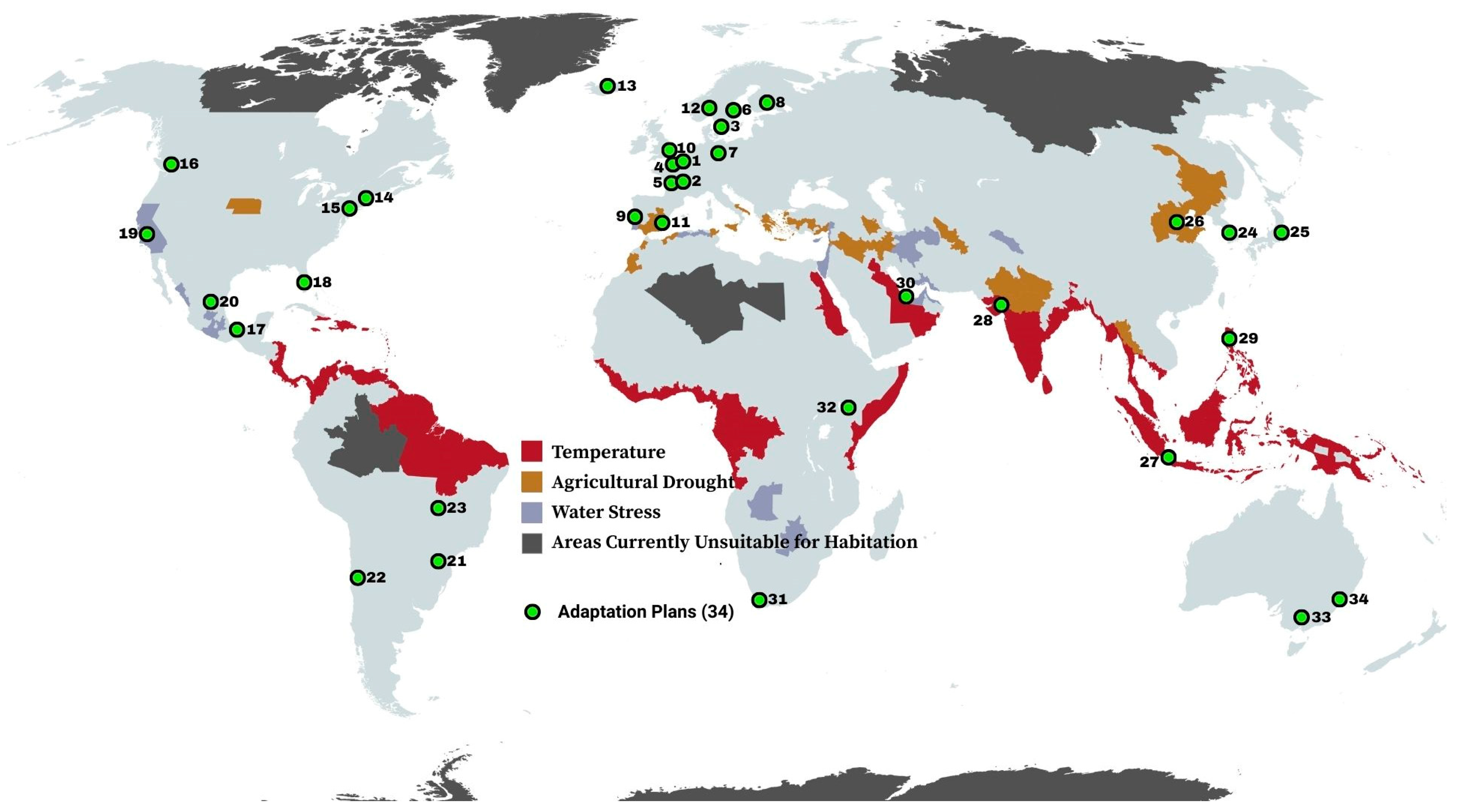
In particular, coastal cities and water-stressed metropolises foreground strategies that manage flood and drought risks in an integrated manner, whereas regions under intense urbanization pressure place greater emphasis on social resilience, participation, and governance. The variation in target years between 2025 and 2050 further indicates that short-term implementation needs are being articulated alongside long-term transformation agendas, and that settlements differentiate their scales and priorities in accordance with their respective risk profiles. 34 adaptation plans included in the table were superimposed onto the crisis-belt map (
Figure 6). Although S1 cases are defined as outside the belt, they are not treated as a homogeneous group; they span distinct risk profiles which is reflected in differentiated priorities and target horizons. The crisis-belt overlay is therefore used to situate governance capacity and planning intensity relative to crisis geographies, rather than to run a proximity-based causal test within S1.
In the second scenario (S2), an evaluative framework is established to enable comparison among “new settlement” proposals that have emerged in geographies with high potential exposure to the climate crisis, or that explicitly mobilize “extreme conditions” narratives aligned with crisis-belt stressors. In this scenario, the unit of analysis is not the institutional policy of an established city; rather, it consists of project-based masterplans and the accompanying official/semi-official document sets. Accordingly, the findings derived from S2 are not intended to capture realized socioeconomic outcomes, but to examine design-oriented governance rationales, projected performance claims, and stated planning priorities. On this basis, the 18 projects included for discussion are listed in
Table 5.
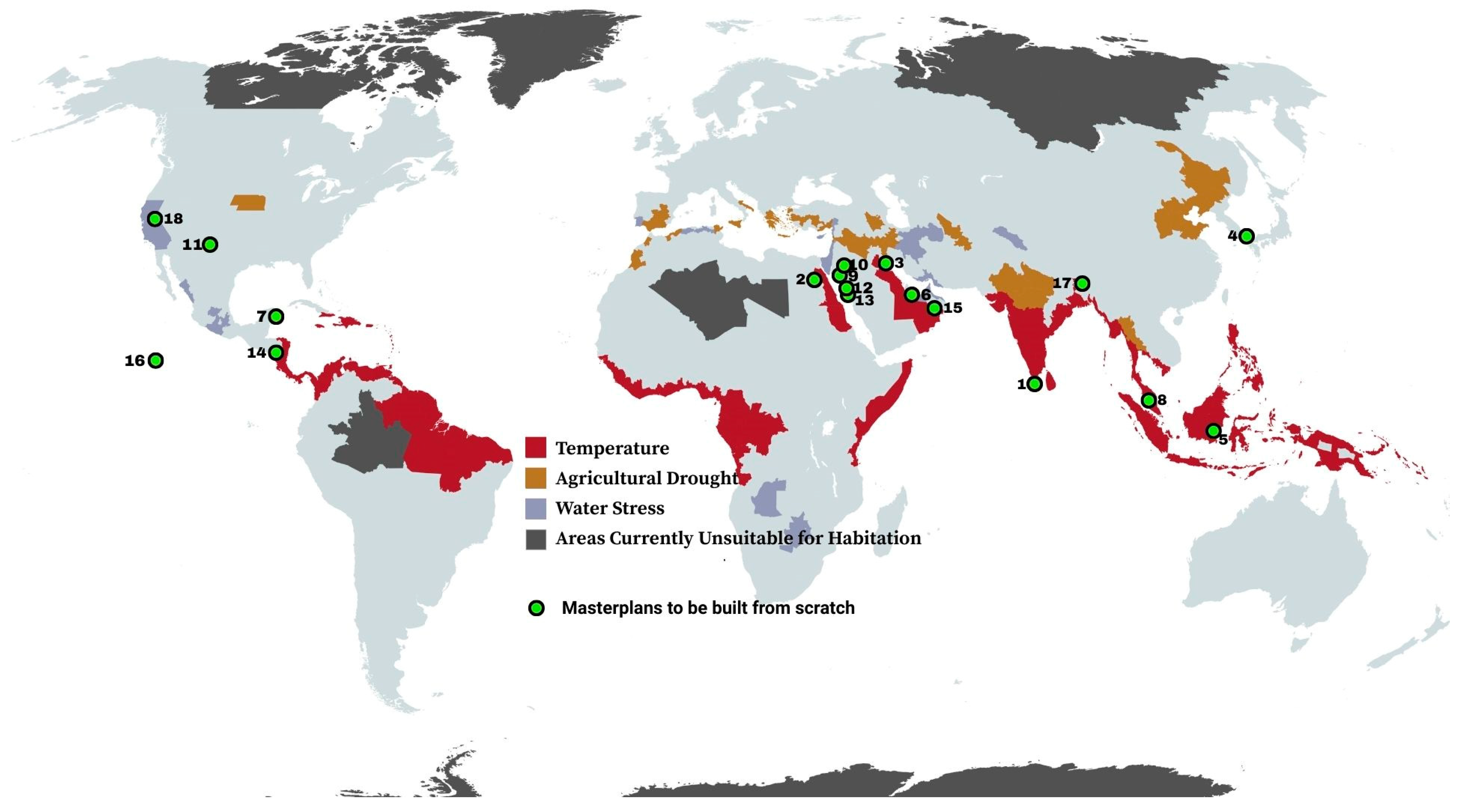
Table 5 brings together 18 experimental settlements proposed to be established from scratch across diverse geographies, offering a comparative view of how contemporary urban experiments vary in scale, design approach, and target timelines. The projects span a broad spectrum—from floating and modular solutions associated with coastal risks, to green/eco-city visions that foreground adaptation to climatic conditions and resource efficiency, to smart-city configurations framed through discourses of digitalization and new economic paradigms. The wide range of project areas—from module-scale interventions to developments spanning hundreds of thousands of hectares—suggests that while some initiatives function as pilot or demonstrator projects, others advance claims of comprehensive regional transformation. The concentration of target years within the 2025–2050 interval further indicates an interweaving of short-term “showcase” delivery milestones with long-term, phased growth trajectories. Moreover, the presence of projects with undefined target dates or those explicitly designated as conceptual underscores that, in a substantial portion of this domain, tensions remain pronounced between discursive/representational production and institutional–financial implementability. The masterplans included in the table were superimposed onto the crisis-belt map (
Figure 7).
4. Discussion
4.1. S1: Traditional Settlements Outside the Crisis-Belt
The evolution of contemporary concepts of sustainable development in the twentieth century has been characterized by a dilemma between expanding resource-management practices and pursuing long-term economic prosperity. In the context of climate change, sustainable development has generated significant challenges, particularly in metropolitan regions characterized by high growth intensity [
48]. At a global scale—regardless of national or regional distinctions—the spatial impacts of the climate crisis, together with the technological revolution, which has the potential to constitute a major turning point, are increasingly shaping traditional settlements. Within the scope of this study, the term “traditional settlements” refers to the contemporary spatial organization that represents lived practices formed over approximately two centuries, shaped by modes of production that emerged in the post–Industrial Revolution period.
Mitigation and adaptation constitute the core strategies employed to reduce the risks and impacts of climate change on both society and nature. Mitigation strategies are designed to reduce carbon or greenhouse gas emissions [
49]. In this paper, adaptation refers to efforts or actions directed toward the most vulnerable populations and systems in response to climatic impacts—whether observed or anticipated—that cause harm or enable the seizing of beneficial opportunities [
50]. Scenario 1 focuses on settlements outside the crisis belt—settlements whose underlying dynamics may not change radically, yet which nonetheless need to adapt. It can also be characterized as the most emphasized and most demanded pathway, and, driven by the instinct to preserve the status quo, as the most likely scenario. Adaptation comprises a set of actions undertaken in the process of adjusting to changing conditions. In spatial terms, adaptation is typically structured through strategic plans that articulate fundamental principles, policies, and methods.
The adaptation process can be classified as incremental or transformational, depending on the magnitude of change produced by the measures or actions implemented [
50]. This study distinguishes between adaptation and adaptive capacity. While the former is defined as a process involving adjustment to climate change, the latter refers to a system’s ability or potential to adjust to potential climatic changes [
49]. It is evident that the concept is operationalized in a variety of ways. Consequently, defining the term and delineating its scope constitutes a major challenge within the relevant literature [
51]. Conceptually, it can be derived from a multidimensional framework encompassing several parameters: a short- or long-term planning horizon; the reactive or preventive character of actions; technical, institutional, legal, psychological, and educational dimensions; public or private actors; and autonomous or planned policies [
52].
To discuss this scenario, which foregrounds adaptation as action-oriented, it is first necessary to distinguish the key stages of adaptation planning and the actions associated with each. The adaptation planning process typically follows stages of risk assessment, identification and selection of adaptation options, implementation, monitoring, and evaluation—although in practice these stages do not always occur sequentially.
Table 6 delineates, in detail, specific actions that can be undertaken at each stage of a climate change–based adaptation planning process.
There are also studies that add additional layers to these basic steps, such as urban and regional justice [
55,
56], and mental preparedness and awareness [
57].
Within this framework, an examination of settlement-scale adaptation plans indicates that one of the most common shared strategies involves energy policies aimed at a low-carbon transition. The majority of plans prioritize the integration of renewable energy sources and improvements in the efficiency of existing energy systems to reduce dependence on fossil fuels. In Freiburg’s model of sustainable urban planning, cycling- and pedestrian-friendly infrastructure is pursued in tandem with green-energy investments, whereas the climate action plans of Paris and Berlin propose comprehensive regulations and energy transition pathways aimed at reducing carbon emissions. Moreover, many plans address the strengthening of intra-urban public transport systems, the promotion of low-carbon mobility modes, and the expansion of green infrastructure within this broader policy framework.
On the other hand, water management and flood-risk reduction constitute another principal axis of these adaptation plans. In delta contexts such as Amsterdam and Rotterdam, flexible spatial arrangements against river flooding are developed through “Room for the River” approaches. Meanwhile, plans ranging from Tokyo to Miami propose measures such as elevated ground levels, district-scale planning instruments, and resilient infrastructure solutions to address coastal erosion and sea-level rise. In addition, ecosystem-based approaches—such as urban agriculture, green-roof applications, and biodiversity-supporting strategies—seek to enhance both social and environmental resilience to extreme weather events.
These strategies are framed through an integrated approach that pursues dual objectives: mitigating the impacts of climate change and strengthening adaptive capacity. Implementation is facilitated by the use of tools such as needs assessments, risk and vulnerability mapping, and disaster scenario analyses. Ownership and delivery processes are supported through community participation and collaboration among stakeholders. Innovative technological solutions, smart mobility systems, and digital monitoring mechanisms emerge as complementary elements that further reinforce these processes.
Despite these efforts, despite these efforts, adaptation processes still contain a number of gaps and constraints. Such processes, which require a higher capacity for flexibility, struggle to be fully incorporated into the cumbersome and regulatory structure of spatial planning. Environmental conditions that planners have traditionally treated as stable within conventional planning horizons are now changing on timescales as short as—or even shorter than—the design lifespans of urban development models and certain fixed-capital infrastructures [
58]. This not only increases the number of variables that must be accounted for but also calls into question the practice of long-term planning itself.
A further problem concerns the misalignment between the long projection horizons and dynamic trajectories of challenges such as the climate crisis and the immediate, everyday expectations of societies. As a result, discussion of such issues often remains confined to the scientific domain and, within mass media accessible to the public, is reduced to distorted or sensationalized reporting. From a related perspective, policymakers’ comparatively short decision-making tenures, relative to the temporal scale of the problem, can hinder the prioritization of adaptation and contribute to its relegation. Another constraint in this scenario lies in the set of assumptions underpinning adaptation plans. A scenario-based, classical projection typically comprises three main categories:
Optimistic scenario: The best-case outcome in which favorable conditions converge (Best Case);
Baseline scenario: The “business-as-usual” outcome in which current trends continue without major change (Business as Usual);
Pessimistic scenario: The worst-case outcome in which conditions deteriorate beyond expectations (Worst Case).
Nearly all adaptation plans reference the Paris Climate Agreement (2015) and therefore take the 1.5 °C target into account. In recent years, assumptions aligned with 2 °C have also begun to appear, albeit to a limited extent. Meanwhile, some plans attempt to construct an entirely uncertain future through target values that are not explicitly specified. In other words, the processes proceed either under conditions of ambiguity or through an optimistic perspective that anticipates improved conditions relative to the present. Yet the IPCC reports cited across these plans indicate that, across successive updates, current trends have not shifted in a positive direction. On the contrary, the deterioration in the data persists, and in each report the upper bounds of the scenarios tend to be revised upward [
8,
49]. Therefore, adaptation should not rely on a single action; instead, it should manage change by continuously generating new adaptive pathways and implementing demand-driven processes capable of coping with shifting contextual challenges [
59].
Despite their limitations, adaptation plans can be regarded as an initial step toward reducing the disruptive impacts of anthropogenic climate change and adjusting to the unfolding process.
Figure 7 shows that, under the selected criteria, the plans in
Table 4 that address the problem more comprehensively and with greater binding force are predominantly located outside the crisis belt. In addition, nearly all are situated in countries with a per capita gross domestic product of USD 10,000 or more. In other regions, national-scale adaptation plans are being prepared—particularly for developing, least developed, and small island countries—encouraged by the UN climate change unit [
60]. However, these plans tend to be national in scale, focused on establishing general principles, and lack settlement-specific specialization. As a result, the extreme risks faced by regions within the crisis belt are often overlooked.
4.2. S2: The Practice of Extreme Living Conditions: Uninhabitable Regions
The central question of the second scenario is as follows: for settlements located within the crisis belt—where sustaining existence is not feasible through the preventive and adaptive processes described in the first scenario, despite all their shortcomings—what, then, constitutes a viable pathway forward? Although the character of settlements has shifted over historical time under the influence of numerous parameters, it has generally preserved its core dynamics. Attempting to maintain this existing settlement character may be a rational decision; however, the planning and architectural literature has not yet produced sufficiently satisfactory answers regarding the alternative.
Alternative exit pathways, which by their nature exhibit signs of radicalization, frequently become part of trial-and-error processes. For this reason, the context of the second scenario is, in essence, an analysis of “urban experiments” [
61]. With respect to the concept of urban experimentation—defined as viewing the settlement as a laboratory for testing new practices or as a setting for experimental spaces—Bulkeley and Broto [
47] propose three primary categories:
The first category concerns experiments that involve policy and governance innovations. Such experiments are typically implemented at the sub-national level—particularly in urban areas—where new forms of policy and governance are tested in response to diverse challenges.
The second category of urban experimentation is referred to as “socio-technical experimentation.” These forms of urban experiments occupy a central place within the sustainability transitions literature.
The third category is “strategic experimentation,” most clearly represented by the notion of the “living laboratory.” Living labs provide a setting for field-testing social and technological innovations in real-world environments.
As numerous studies indicate, the two most prominent typologies of experimental urbanism worldwide are the smart city and eco-city approaches, both of which have been pursued through multiple initiatives across diverse geographical contexts. [
62,
63,
64]. In theoretical terms, the two models engage with sustainability from different vantage points. The eco-city ideal focuses on ecology and seeks to establish a balance between human societies and ecosystems through urban design and behavioral change. By contrast, the smart city movement relies on information technology to generate data on how settlements function—particularly in relation to energy (production, distribution, and consumption) and mobility—and deploys this data to reduce the costs and waste produced by living environments [
62,
65,
66].
Studies on experimental urbanism have shown substantial interest in the complex realities of who conducts experiments, yet they have largely remained silent on the question of who the subject of the experiment is [
67]. A related question must also be posed: who decides that an experiment should take place? Moreover, who will define the spatial, political, or social boundaries that determine the scope of an urban experiment?
An examination of data derived from the projects’ openly available documents reveals a design process shaped by the popular concepts of recent years. These concepts—frequently invoking contemporary crises and turning points—can be grouped under two headings: the Anthropocene degradation of the natural environment and techno-utopian development strategies. All projects planned to be built from scratch reference these two rupture points, thereby projecting an awareness of the climate crisis and the technological revolution. Contemporary eco-city projects are promoted as experiments that wholly rethink urban life and deliver clear benefits aligned with sustainability goals. Their advocates argue that a blank slate is necessary to enable innovation unencumbered by the constraints of existing infrastructure [
68]. Despite the limited evidence regarding their capacity to achieve social, economic, and environmental sustainability objectives, a wide range of global actors—including research organizations, consultancy firms, national and international public institutions, NGOs, and increasingly technology companies—continue to promote eco-cities as a solution to the climate crisis [
69].
From another perspective, developers position and justify their efforts as solutions to a range of urban crises. Developers experiment with technology-based solutions to environmental challenges and seek to test, market, and replicate these solutions across cities worldwide. Although past initiatives of this idealistic, relatively small-scale, bottom-up character were largely planned in European and American contexts, many were not implemented. By contrast, ecological city projects are now being realized in numerous countries—particularly across Asia and Africa—through top-down implementation approaches. [
64]. A further perspective on these master plans—whose decision-making structures, professional project networks, and capital dynamics are contested and for which there is no clear consensus regarding outcomes—concerns their prospective users and the lifestyles they purport to offer.
According to
Table 7, the most strongly emphasized themes in the content are clean energy, life satisfaction, green spaces, economic development, and digital services. In addition, although it is not among the formal parameters, one of the most frequently referenced notions across the materials is modularity. Within the domain of digital services, the largest share appears to be associated with automation systems and autonomous technologies. By contrast, the most ambiguously addressed parameters are individual income and living standards, security, health, and work–life balance.
One argument advanced by developers, stakeholders, and project advocates is that such initiatives are distinct and genuinely alternative because they are systematically developed and implemented according to a detailed master plan. The underlying assumption is that they embody a scientific approach grounded in a holistic and rigorous action plan that shapes the entire settlement in a uniform manner and renders it sustainable. In practice, however, existing projects exhibit a substantial number of shared characteristics and discursive framings and, despite carrying different labels, tend to be products of the same pro–economic growth structure [
62]. Numerous studies examining urban experiments of this kind in previous years have shown that purported smart cities and eco-cities often depart from their philosophical ideals, innovate only rarely, and instead replicate conventional capitalist urbanization strategies—while seldom fulfilling their sustainability promises [
70,
71].
Another unresolved issue concerns the intended user profile. None of the projects explicitly disclose the populations they aim to attract. Consequently, the question “Who will live in these settlements?” remains unanswered. Given the lack of transparency surrounding property acquisition procedures—and particularly pricing— these settlements may operate through a selective, exclusionary logic based on the available documentation and the lack of transparent pricing information. Given the design-stage nature of most cases, this is framed as a discursive/institutional risk claim rather than an observed outcome. Moreover, even if such settlements were to achieve the functional conditions envisioned in their design narratives, their promised population figures suggest that they could accommodate only a very limited fraction of the communities currently living in their respective regions. In this sense, the alternative solutions advanced in this domain have not yet moved beyond the aspirations of certain privileged groups.
The production of the spaces discussed in this scenario entails more than a straightforward act of construction or a conventional planning decision. As with many large-scale interventions, these alternatives are shaped by capitalist, market-prioritizing economic relations as the dominant force. Such initiatives intersect with capital’s search for “safe” and scalable investment domains under conditions of climate risk and uncertainty; accordingly, new settlements are often configured as accumulation strategies through infrastructure provision, real-estate development, and special regulatory regimes. For this reason, planning discourse should be read not only in terms of habitability, but also through the lenses of rent generation and investment attraction. In projects built from scratch in particular, urban land may be framed less as the foundation of a right to housing than as a financial asset. Masterplans at the conceptual stage can thus produce a narrative that prices anticipated future value appreciation in the present.
This study has several limitations. First, the sample may exhibit an uneven regional distribution because it relies on plans that are publicly accessible and institutionally well documented. Second, because the analysis is based on document-oriented content analysis, the goals and priorities articulated in planning texts are not directly equivalent to implementation performance. Moreover, since a substantial share of the S2 projects remains uncompleted or at a conceptual stage, the assessment presented here does not concern realized social outcomes; rather, it examines planning discourse, design-oriented governance configurations, and projected performance claims.
Despite these limitations, the approach is transferable as an analytical template that can be applied across different regions. The definition of the crisis belt can be reproduced and updated using locally relevant climate projections and risk layers, while the criteria set can be expanded or weighted in accordance with regional determinants such as the prevalence of informal settlements, governance capacity, or basic infrastructure deficits. Accordingly, the findings should be interpreted not as universally generalizable conclusions at the global scale, but as a comparative evaluative framework that can be adapted to different contexts when calibrated with local data.
5. Conclusions
Anthropocene process has unequivocally evolved into a crisis in the present day. By the end of the twenty-first century, this crisis is expected to generate regions that are no longer suitable for human habitation. The climate crisis does not affect atmospheric conditions alone; it also compounds disruptions in global food and freshwater systems, pushing them toward systemic crisis. These systems, in turn, are likely to produce their own distinct geographies of uninhabitability. Meanwhile, contemporary technological developments are triggering the first large-scale transformation in modes of production since the Industrial Revolution. Services are rapidly undergoing digitalization, reshaping the spatial organization of existing functional domains while simultaneously generating new ones. Taken together, this broader transformation affects not only operational practices but also ontologically reconfigures the very concept of work. In doing so, it weakens the network of economic relations through which settlements are linked to—and sustained by—their users.
This study evaluates the possible trajectories of human settlements under the concurrent influences of the climate crisis and the Technological Revolution by scenario-building around plan-led adaptation approaches (S1) and project-led, from-scratch urban experiments (S2). The analysis indicates that adaptation plans provide a necessary framework in terms of institutional capacity, target specification, and implementation coordination; however, under conditions of deep uncertainty, non-linear risks, and accelerating socio-technical transformation, plan architectures grounded in fixed assumptions may prove insufficient. The concentration of planning capacity largely in high-income contexts outside the crisis belt, in turn, renders visible a settlement-scale governance gap across crisis geographies.
Because conventional planning paradigms and adaptation mechanisms often fail to account for both the transformations driven by the technological revolution and the pessimistic trajectories associated with climate crisis, they tend to generate solutions oriented primarily toward short-term and optimistic scenarios. At present, adaptation and risk-reduction processes still largely operate as advisory, ancillary components rather than being integrated into core strategic decision-making. Moreover, a truly global public agenda has not coalesced: in industrialized countries, the climate crisis has not yet manifested as a structural disruption of everyday systems at sufficient scale, while in many non-industrialized contexts it lacks the agenda-setting power to shape international priorities. Within this landscape, the targets articulated in many existing plans remain ambiguous, often failing to specify the problem with sufficient clarity and, at times, advancing proposals—such as fully “zeroing” carbon emissions—that can appear detached from prevailing political–economic realities and implementation constraints.
Urban experiments planned to be built from scratch under the claim of responding to extreme living conditions, despite their sustainability rhetoric, may—through their selective, rent-oriented configuration and their orientation toward serving a limited population—neglect critical human needs such as social justice and life satisfaction, thereby posing a risk of reproducing existing social inequalities. This pattern can be read through Wallerstein’s [
72] World-Systems theory as a heuristic lens. Wallerstein proposes a global mode of analysis that transcends administrative and political boundaries, and conceptualizes the world as comprising three zones: the core, the periphery, and the semi-periphery. Actors that have completed industrialization constitute the core; those that receive little to no share of global wealth are positioned in the periphery; and those that mediate between these two poles are classified as semi-peripheral. In the context of contemporary masterplans, the countries demanding such projects are often located in the periphery or semi-periphery, whereas the countries that design and implement them tend to be core countries. In this way, core countries can produce new forms of spatial dependence and constraint.
Moreover, masterplan imaginaries are frequently concentrated within a limited circle of designers, effectively forming a monopolized repertoire. The competition-based instruments that core countries commonly employ to produce their own built environments are often not preferred in such projects by peripheral contexts. Reports and explanatory documents typically provide no information regarding property regimes. Under the information currently available, ownership within these settlements appears as a privilege rather than an accessible right. These masterplans also frequently refrain from offering a clear definition of public space, instead foregrounding private and commodifiable areas. They often prescribe governance arrangements that are poorly aligned with the socio-spatial realities of their host geographies and evoke notions of autonomous zones as enabling conditions. In these respects, they recall medieval fortress settlements and the logic of feudal lordship.
These findings highlight two implementation priorities. For settlements outside the crisis belt, rather than planning toward a single fixed target year under uncertainty, an institutional design for dynamic adaptive planning can be advanced—one that specifies phased decision pathways and is periodically updated in response to trigger thresholds. Such a design should be coupled with clear responsibility allocation and a monitoring–feedback mechanism. At the same time, the discourses produced at the conceptual stage of from-scratch experimental settlements do not appear to constitute reliable commitments regarding social outcomes. Accordingly, such initiatives should not be assessed solely on the basis of promises of technical efficiency; instead, they should be evaluated against whether they meet threshold conditions established through a mandatory and independent social impact assessment (e.g., access and housing affordability, displacement risk, governance transparency and participation, and equitable access to services as minimum indicators).